Questions as text
Q1 · Use the following numbers or words to complete the sentences about the menstrual cycle 0653/32 Oct/Nov 2017
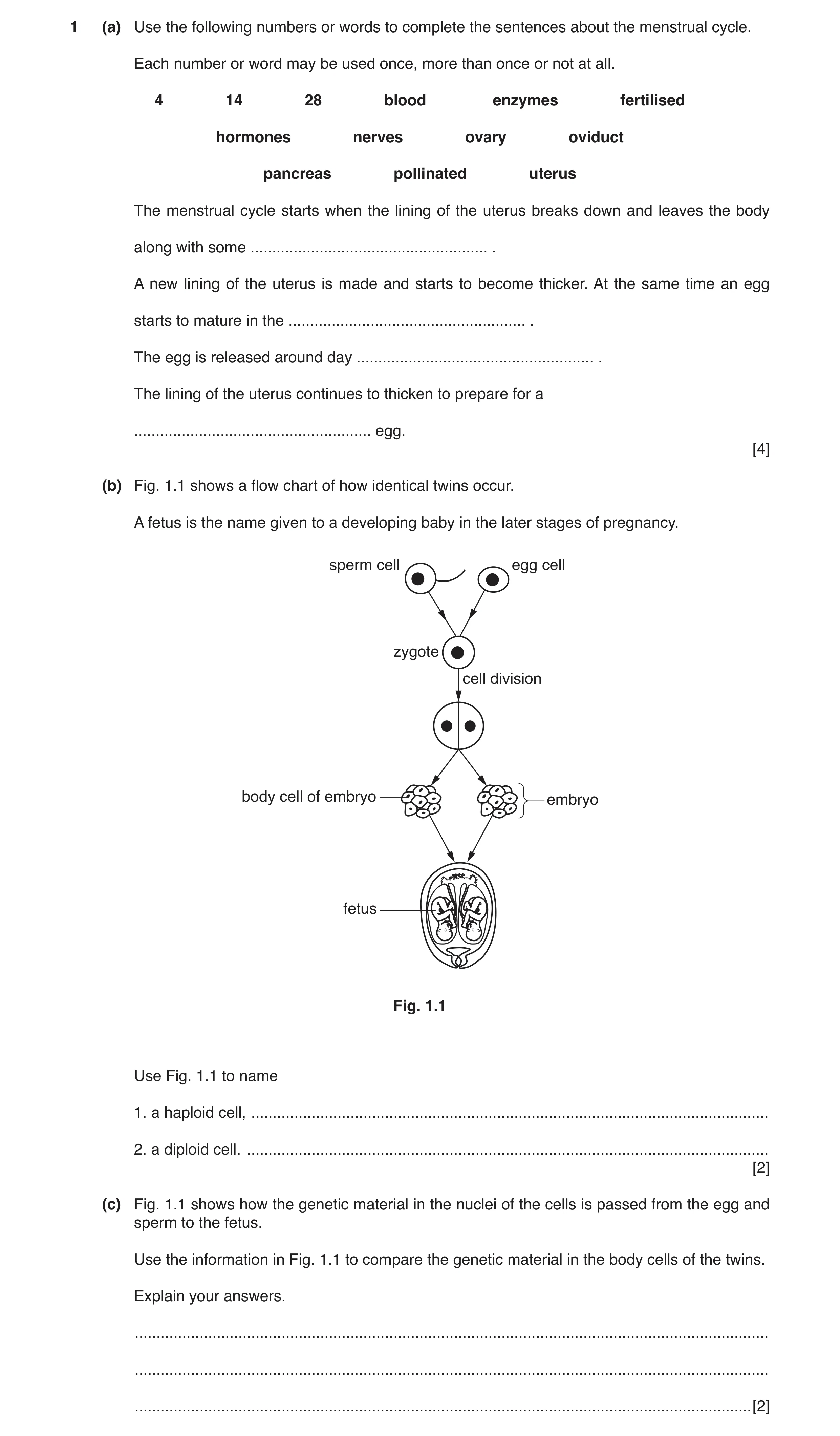
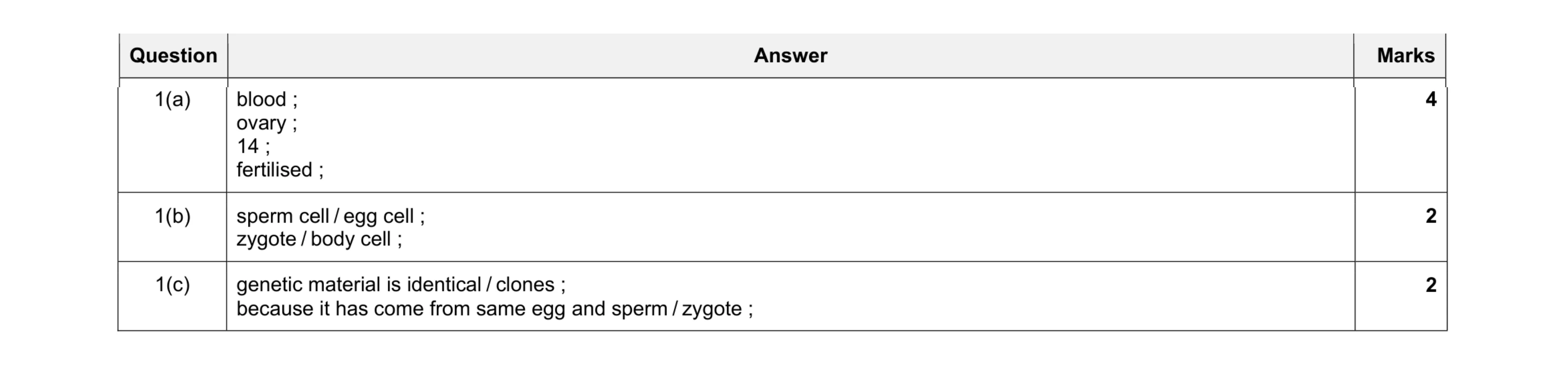
1 (a) Use the following numbers or words to complete the sentences about the menstrual cycle. Each number or word may be used once, more than once or not at all. 4 14 28 blood enzymes fertilised hormones nerves ovary oviduct pancreas pollinated uterus The menstrual cycle starts when the lining of the uterus breaks down and leaves the body along with some … . A new lining of the uterus is made and starts to become thicker. At the same time an egg starts to mature in the … . The egg is released around day … . The lining of the uterus continues to thicken to prepare for a … egg. [4] (b) Fig. 1.1 shows a flow chart of how identical twins occur. A fetus is the name given to a developing baby in the later stages of pregnancy. sperm cell egg cell zygote cell division body cell of embryo embryo fetus Fig. 1.1 Use Fig. 1.1 to name 1. a haploid cell, … 2. a diploid cell. … [2] (c) Fig. 1.1 shows how the genetic material in the nuclei of the cells is passed from the egg and sperm to the fetus. Use the information in Fig. 1.1 to compare the genetic material in the body cells of the twins. Explain your answers. … … … [2]
8 marks
Mark scheme: 1(a) blood ; ovary ; 14 ; fertilised ; 4 1(b) sperm cell / egg cell ; zygote / body cell ; 2 1(c) genetic material is identical / clones ; because it has come from same egg and sperm / zygote ; 2
This question in 0653/32 Oct/Nov 2017
Q2 · A diagram of the female reproductive system and some of the events that take place before… 0653/32 Feb/March 2018
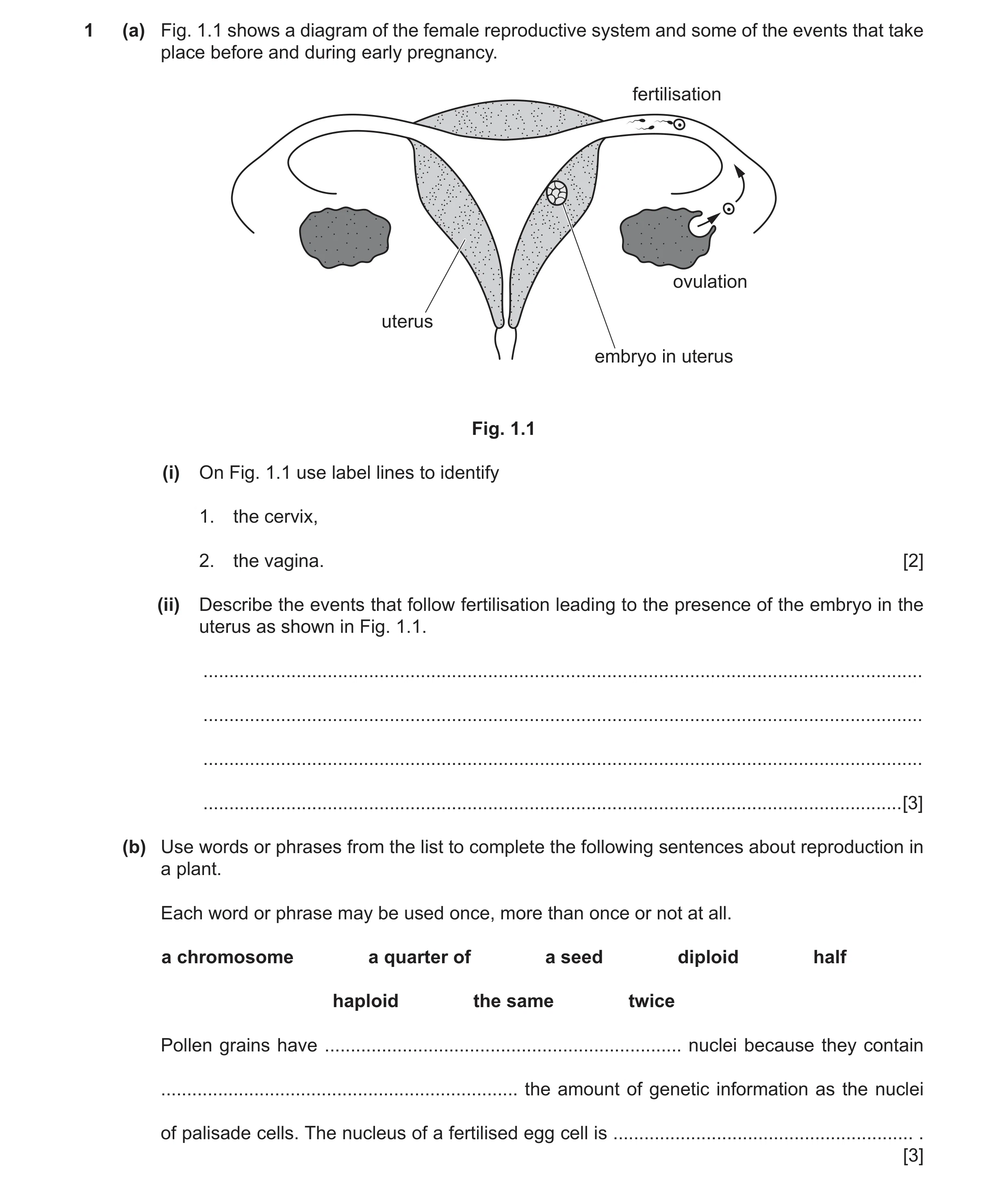
1 (a) Fig. 1.1 shows a diagram of the female reproductive system and some of the events that take place before and during early pregnancy. fertilisation ovulation uterus embryo in uterus Fig. 1.1 (i) On Fig. 1.1 use label lines to identify 1. the cervix, 2. the vagina. [2] (ii) Describe the events that follow fertilisation leading to the presence of the embryo in the uterus as shown in Fig. 1.1. … … … … [3] (b) Use words or phrases from the list to complete the following sentences about reproduction in a plant. Each word or phrase may be used once, more than once or not at all. a chromosome a quarter of a seed diploid half haploid the same twice Pollen grains have … nuclei because they contain … the amount of genetic information as the nuclei of palisade cells. The nucleus of a fertilised egg cell is … . [3]
8 marks
Mark scheme: 1(a)(i) cervix correctly labelled ; vagina correctly labelled ; 2 1(a)(ii) zygote results from fertilisation ; cells divide / ball of cells forms ; (ball of cells / embryo) becomes implanted ; in wall of uterus / uterus lining ; max 3 1(b) haploid ; half ; diploid ; 3
This question in 0653/32 Feb/March 2018
Q3 · A diagram of the male reproductive system 0653/31 May/June 2019
4 (a) Fig. 4.1 is a diagram of the male reproductive system. A B C D Fig. 4.1 Complete Table 4.1 to show the names and the functions of parts A, B, C and D shown in Fig. 4.1. Table 4.1 letter of name of part function structure A sperm duct B carries urine and semen out of the body C production of male gametes (sperm) D scrotum [4] (b) Fig. 4.2 shows the changes to the thickness of the uterus lining during the menstrual cycle. thickness of uterus lining 0 5 10 15 20 25 30 35 time / days Fig. 4.2 (i) State what happens to the uterus lining during the first five days. … [1] (ii) Use Fig. 4.2 to determine the number of days in a complete menstrual cycle. number of days = … [1] (iii) Suggest why the uterus lining becomes thicker between days 7 and 30. … … [1] (c) Describe the process of fertilisation of a sperm cell and an egg cell. … … [2] [Total: 9]
9 marks
Mark scheme: 4(a) One mark each for lines A, B, C, D letter of structure name of structure definition A sperm duct carries sperm (to the urethra/from the testes) B urethra carries urine and semen out of the body C testis/testes production of male gametes (sperm) D scrotum (sac that) holds the testes (outside the body) 4 4(b)(i) uterus lining becomes thinner / breaks down ; 1 4(b)(ii) 30 days ; 1 4(b)(iii) preparing for a fertilised egg / implantation ; 1 4(c) fusion / joining ; of the nuclei ; 2
This question in 0653/31 May/June 2019
Q4 · A diagram of an insect‑pollinated flower 0653/32 Oct/Nov 2019
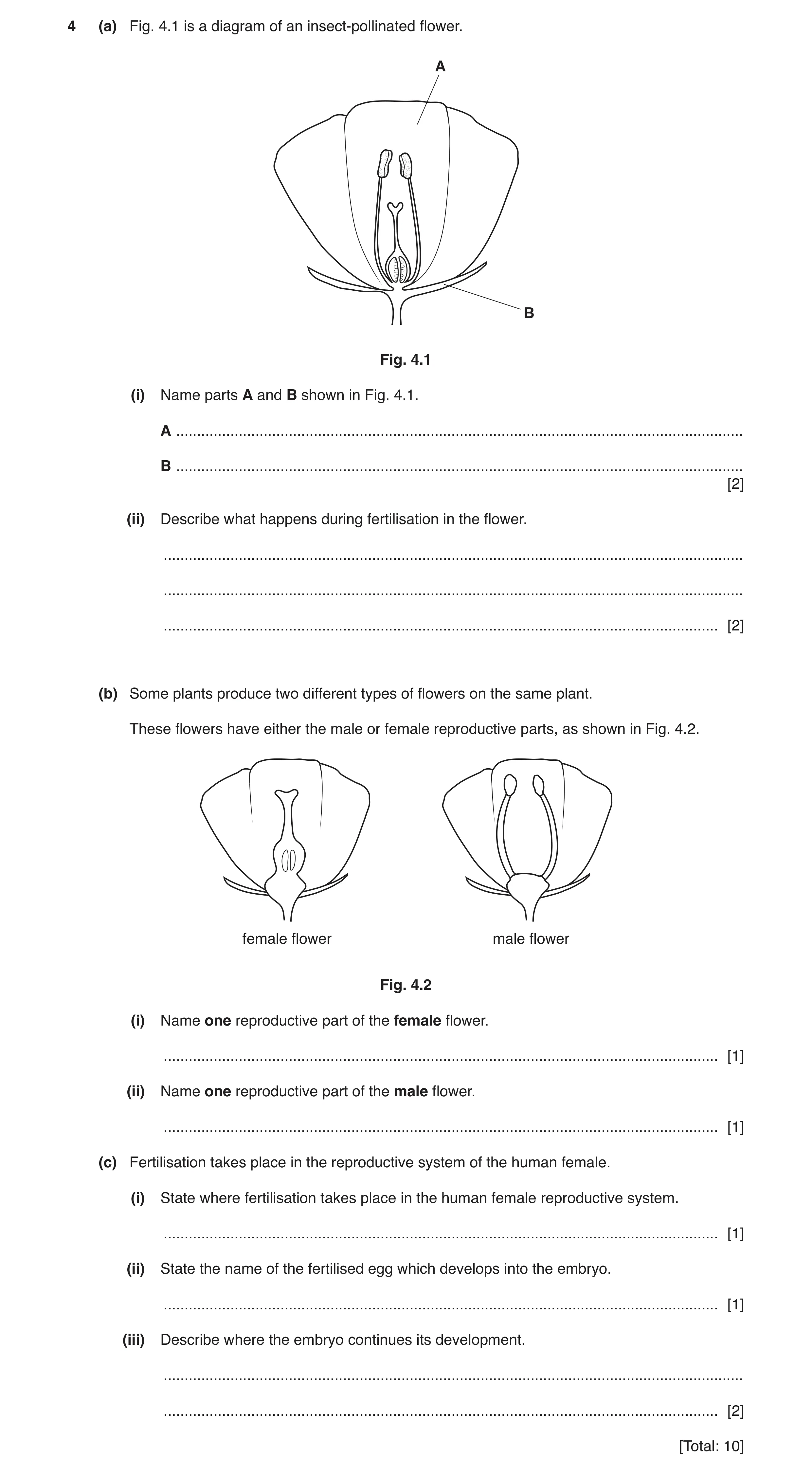
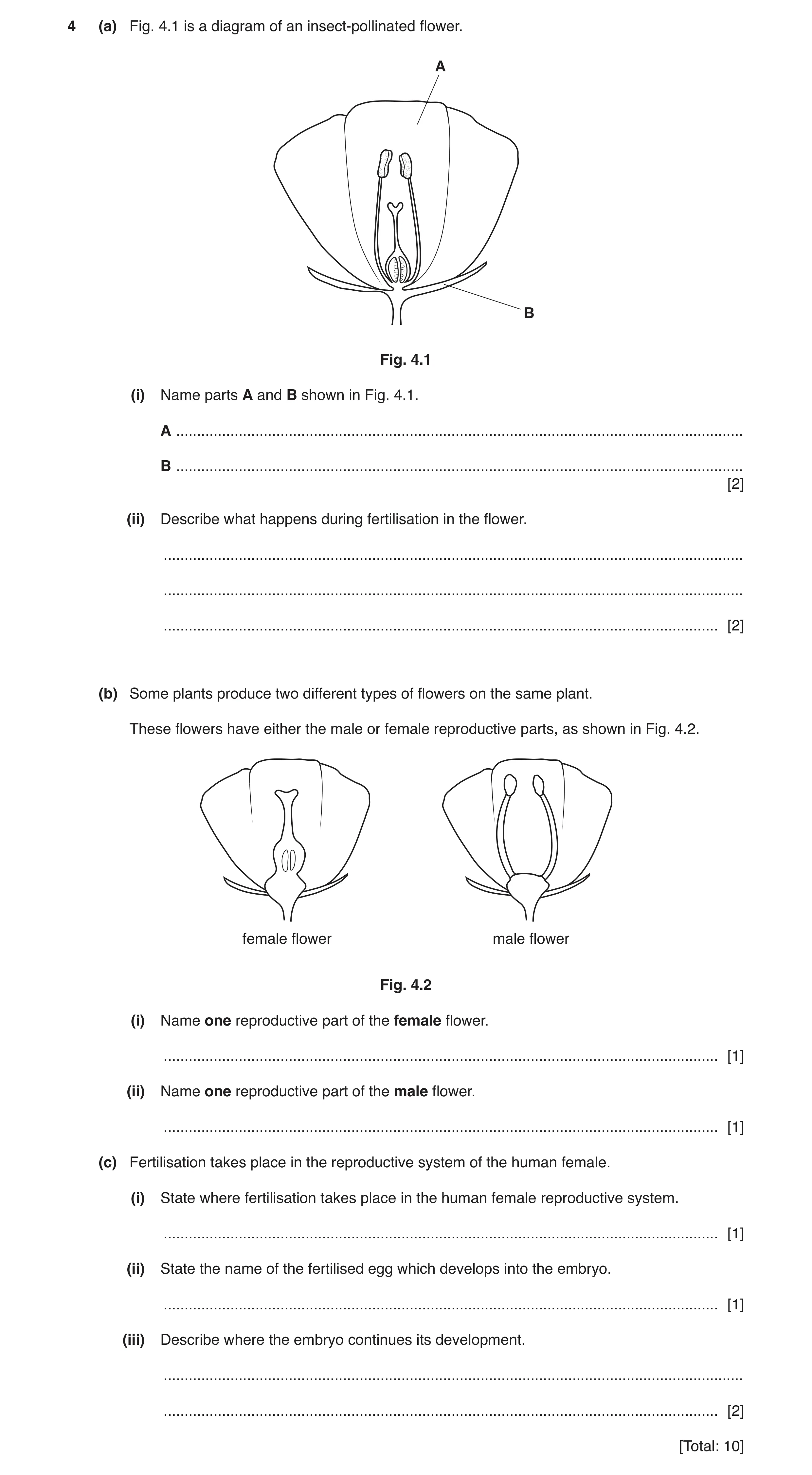
4 (a) Fig. 4.1 is a diagram of an insect‑pollinated flower. A B Fig. 4.1 (i) Name parts A and B shown in Fig. 4.1. A … B … [2] (ii) Describe what happens during fertilisation in the flower. … … … [2] (b) Some plants produce two different types of flowers on the same plant. These flowers have either the male or female reproductive parts, as shown in Fig. 4.2. female flower male flower Fig. 4.2 (i) Name one reproductive part of the female flower. … [1] (ii) Name one reproductive part of the male flower. … [1] (c) Fertilisation takes place in the reproductive system of the human female. (i) State where fertilisation takes place in the human female reproductive system. … [1] (ii) State the name of the fertilised egg which develops into the embryo. … [1] (iii) Describe where the embryo continues its development. … … [2] [Total: 10]
10 marks
Mark scheme: 4(a)(i) A petal ; B sepal ; 2 4(a)(ii) pollen nucleus fuses ; with a nucleus in the ovule ; 2 4(b)(i) stigma / carpel / style / ovary ; 1 4(b)(ii) anthers / stamen ; 1 4(c)(i) oviduct ; 1 Question Answer Marks 4(c)(ii) zygote ; 1 4(c)(iii) wall / lining ; of the uterus ; 2
This question in 0653/32 Oct/Nov 2019
Q5 · A diagram of an insect‑pollinated flower 0653/33 Oct/Nov 2019
4 (a) Fig. 4.1 is a diagram of an insect‑pollinated flower. A B Fig. 4.1 (i) Name parts A and B shown in Fig. 4.1. A … B … [2] (ii) Describe what happens during fertilisation in the flower. … … … [2] (b) Some plants produce two different types of flowers on the same plant. These flowers have either the male or female reproductive parts, as shown in Fig. 4.2. female flower male flower Fig. 4.2 (i) Name one reproductive part of the female flower. … [1] (ii) Name one reproductive part of the male flower. … [1] (c) Fertilisation takes place in the reproductive system of the human female. (i) State where fertilisation takes place in the human female reproductive system. … [1] (ii) State the name of the fertilised egg which develops into the embryo. … [1] (iii) Describe where the embryo continues its development. … … [2] [Total: 10]
10 marks
Mark scheme: 4(a)(i) A petal ; B sepal ; 2 4(a)(ii) pollen nucleus fuses ; with a nucleus in the ovule ; 2 4(b)(i) stigma / carpel / style / ovary ; 1 4(b)(ii) anthers / stamen ; 1 4(c)(i) oviduct ; 1 Question Answer Marks 4(c)(ii) zygote ; 1 4(c)(iii) wall / lining ; of the uterus ; 2
This question in 0653/33 Oct/Nov 2019
Q6 · The male reproductive organs 0653/32 May/June 2020
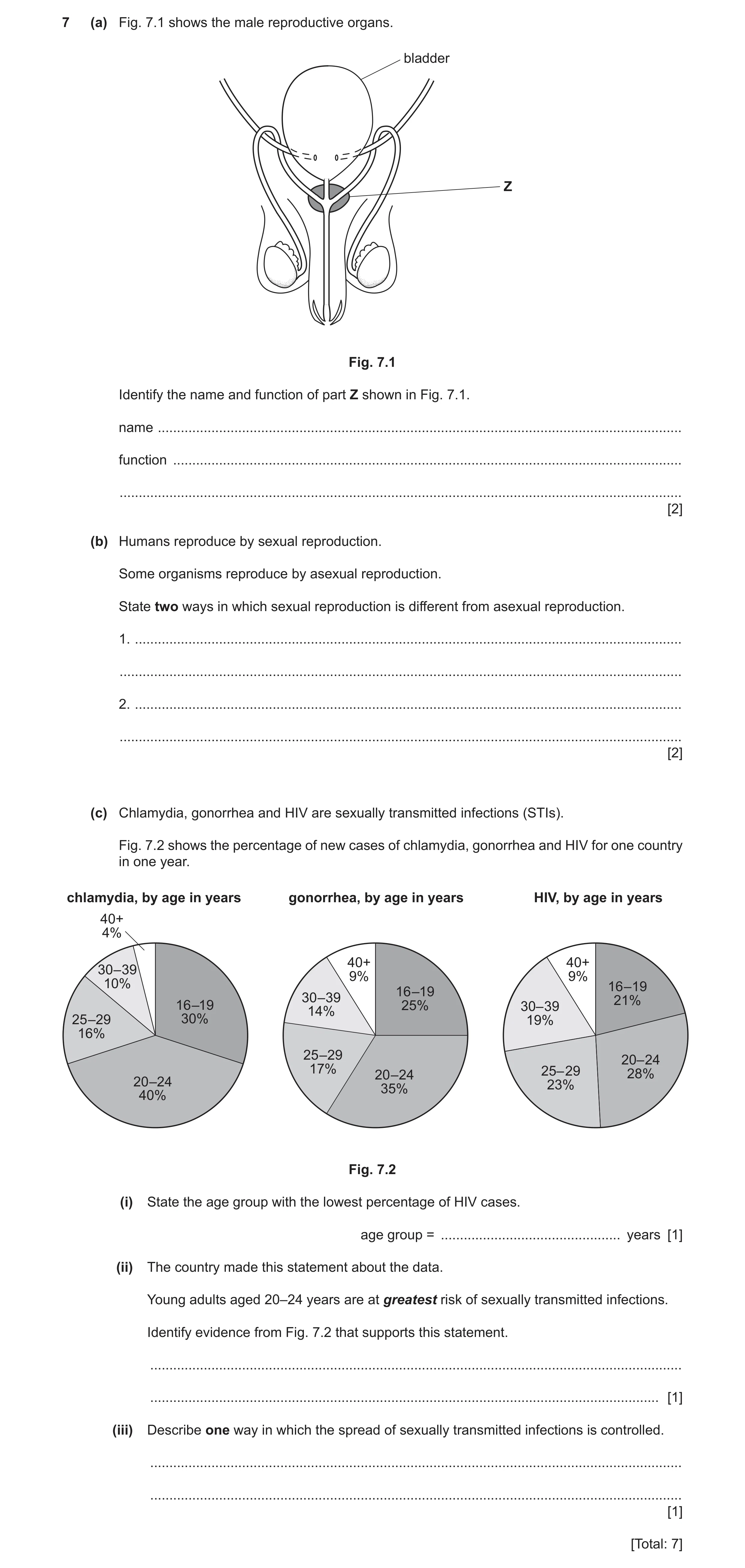
7 (a) Fig. 7.1 shows the male reproductive organs. bladder Z Fig. 7.1 Identify the name and function of part Z shown in Fig. 7.1. name … function … … [2] (b) Humans reproduce by sexual reproduction. Some organisms reproduce by asexual reproduction. State two ways in which sexual reproduction is different from asexual reproduction. 1. … … 2. … … [2] (c) Chlamydia, gonorrhea and HIV are sexually transmitted infections (STIs). Fig. 7.2 shows the percentage of new cases of chlamydia, gonorrhea and HIV for one country in one year. chlamydia, by age in years gonorrhea, by age in years HIV, by age in years 40+ 4% 40+ 40+ 30–39 9% 9% 10% 16–19 16–19 30–39 21% 16–19 25% 30–39 14% 25–29 30% 19% 16% 25–29 20–24 17% 25–29 28% 20–24 20–24 23% 35% 40% Fig. 7.2 (i) State the age group with the lowest percentage of HIV cases. age group = … years [1] (ii) The country made this statement about the data. Young adults aged 20–24 years are at greatest risk of sexually transmitted infections. Identify evidence from Fig. 7.2 that supports this statement. … … [1] (iii) Describe one way in which the spread of sexually transmitted infections is controlled. … … [1] [Total: 7]
7 marks
Mark scheme: 7(a) (name) prostate (gland) ; (function) secretes fluid for sperm to swim in / owtte ; 2 7(b) any two from: offspring show genetic variation ; zygote formed ; fertilisation takes place / nuclei fuse ; involves gametes ; 2 7(c)(i) 40+ ; 1 Question Answer Marks 7(c)(ii) 20–24 years has the highest percentage of cases in all three charts ; 1 7(c)(iii) any one from: idea of protective sexual intercourse ; abstinence ; 1
This question in 0653/32 May/June 2020
Q7 · The boxes on the left show some parts of the male reproductive system in humans 0653/31 Oct/Nov 2020
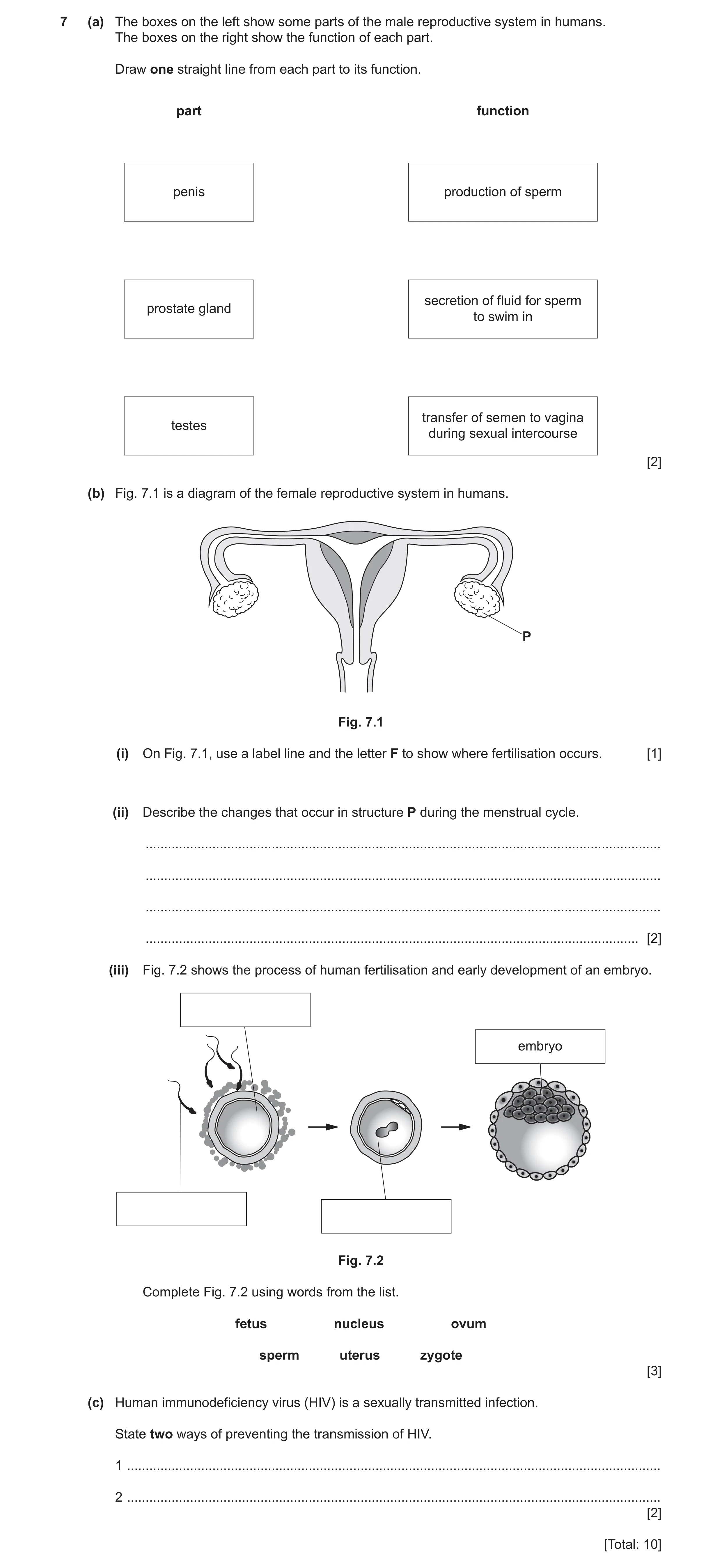
7 (a) The boxes on the left show some parts of the male reproductive system in humans. The boxes on the right show the function of each part. Draw one straight line from each part to its function. part function penis production of sperm secretion of fluid for sperm prostate gland to swim in transfer of semen to vagina testes during sexual intercourse [2] (b) Fig. 7.1 is a diagram of the female reproductive system in humans. P Fig. 7.1 (i) On Fig. 7.1, use a label line and the letter F to show where fertilisation occurs. [1] (ii) Describe the changes that occur in structure P during the menstrual cycle. … … … … [2] (iii) Fig. 7.2 shows the process of human fertilisation and early development of an embryo. embryo Fig. 7.2 Complete Fig. 7.2 using words from the list. fetus nucleus ovum sperm uterus zygote [3] (c) Human immunodeficiency virus (HIV) is a sexually transmitted infection. State two ways of preventing the transmission of HIV. 1 … 2 … [2] [Total: 10]
10 marks
Mark scheme: 7(a) penis production of sperm prostate gland secretion of fluid for sperm to swim in testes transfer of semen to vagina during sexual intercourse 1 correct ; 3 correct ; 2 Question Answer Marks 7(b)(i) line labelled F to either oviduct ; 1 7(b)(ii) any two from: female gamete / ova / egg (cell), develops / matures ; follicle develops ; female gamete / ova / egg (cell), released ; correct reference to time ; 2 7(b)(iii) ovum ; sperm ; zygote ; 3 7(c) any two from: idea of protective sexual intercourse ; abstinence ; not sharing needles ; 2
This question in 0653/31 Oct/Nov 2020
Q8 · The boxes on the left show parts of the male reproductive system 0653/32 Feb/March 2021
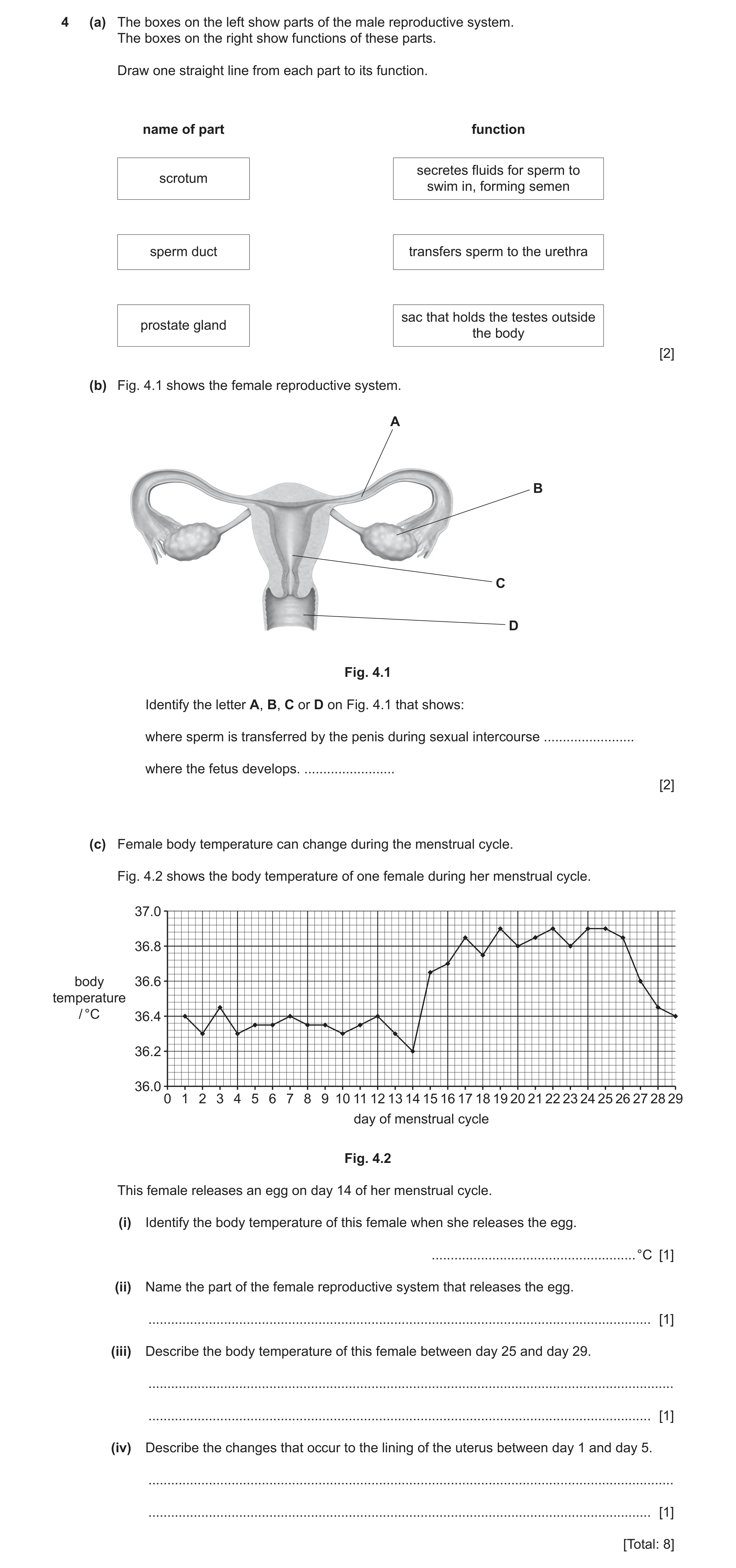
4 (a) The boxes on the left show parts of the male reproductive system. The boxes on the right show functions of these parts. Draw one straight line from each part to its function. name of part function secretes fluids for sperm to scrotum swim in, forming semen sperm duct transfers sperm to the urethra sac that holds the testes outside prostate gland the body [2] (b) Fig. 4.1 shows the female reproductive system. A B C D Fig. 4.1 Identify the letter A, B, C or D on Fig. 4.1 that shows: where sperm is transferred by the penis during sexual intercourse … where the fetus develops. … [2] (c) Female body temperature can change during the menstrual cycle. Fig. 4.2 shows the body temperature of one female during her menstrual cycle. 37.0 36.8 body 36.6 temperature / °C 36.4 36.2 36.0 0 1 2 3 4 5 6 7 8 9 10 11 12 13 14 15 16 17 18 19 20 21 22 23 24 25 26 27 28 29 day of menstrual cycle Fig. 4.2 This female releases an egg on day 14 of her menstrual cycle. (i) Identify the body temperature of this female when she releases the egg. … °C [1] (ii) Name the part of the female reproductive system that releases the egg. … [1] (iii) Describe the body temperature of this female between day 25 and day 29. … … [1] (iv) Describe the changes that occur to the lining of the uterus between day 1 and day 5. … … [1] [Total: 8]
8 marks
Mark scheme: 4(a) scrotum secretes fluids for sperm to swim in, forming semen sperm duct transfers sperm to the urethra prostate gland sac that holds testes outside the body ; ; all correct = two marks one or two correct = 1 mark 4(b) D ; C ; 2 4(c)(i) 36.2 (°C) ; 1 4(c)(ii) ovary ; 1 4(c)(iii) decreases from 36.9 to 36.4 / decreases by 0.5 ; 1 4(c)(iv) breaks down / decreases in thickness ; 1
This question in 0653/32 Feb/March 2021
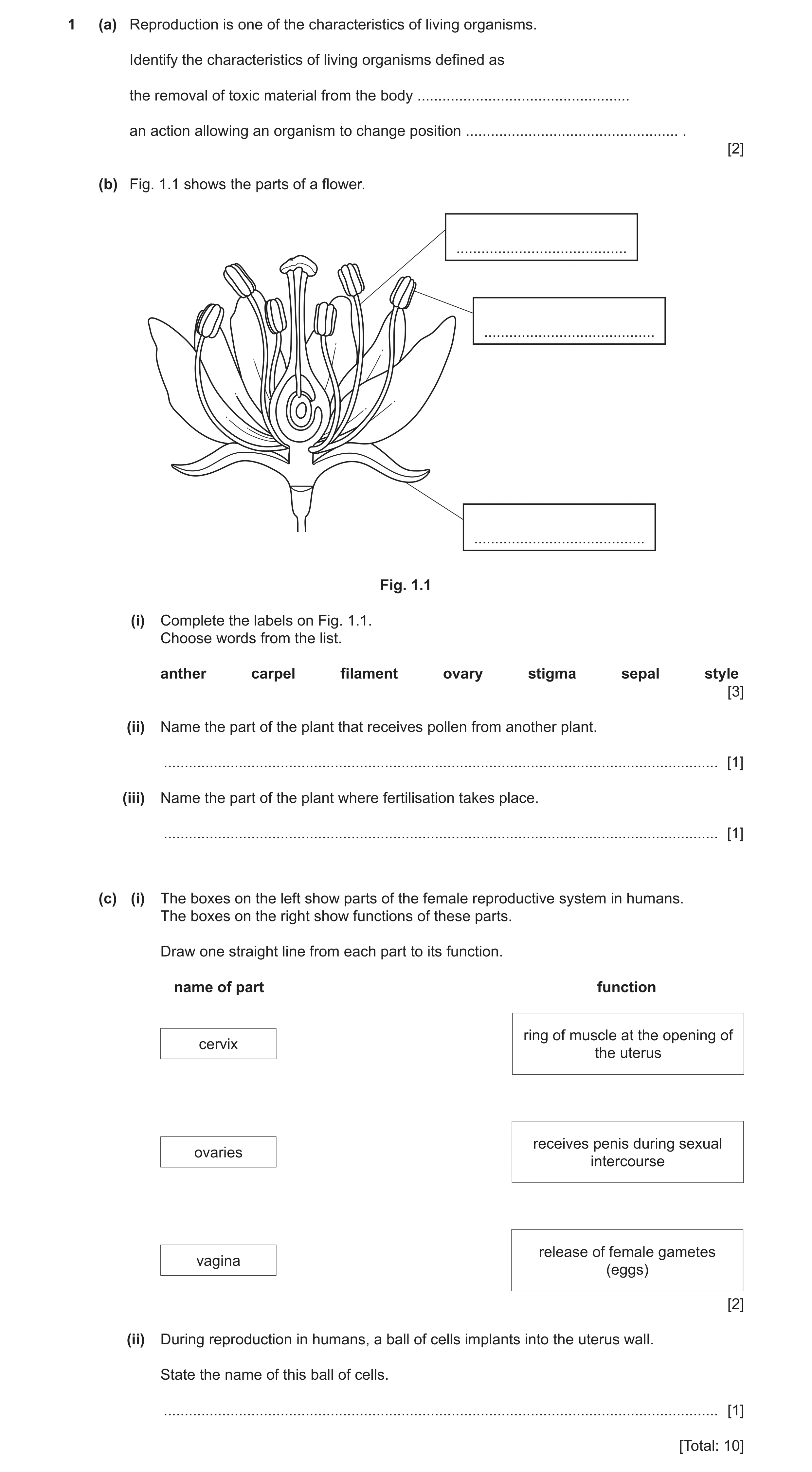
Q9 · Reproduction is one of the characteristics of living organisms 0653/32 May/June 2021
1 (a) Reproduction is one of the characteristics of living organisms. Identify the characteristics of living organisms defined as the removal of toxic material from the body … an action allowing an organism to change position … . [2] (b) Fig. 1.1 shows the parts of a flower. … … … Fig. 1.1 (i) Complete the labels on Fig. 1.1. Choose words from the list. anther carpel filament ovary stigma sepal style [3] (ii) Name the part of the plant that receives pollen from another plant. … [1] (iii) Name the part of the plant where fertilisation takes place. … [1] (c) (i) The boxes on the left show parts of the female reproductive system in humans. The boxes on the right show functions of these parts. Draw one straight line from each part to its function. name of part function ring of muscle at the opening of cervix the uterus receives penis during sexual ovaries intercourse release of female gametes vagina (eggs) [2] (ii) During reproduction in humans, a ball of cells implants into the uterus wall. State the name of this ball of cells. … [1] [Total: 10]
10 marks
Mark scheme: 1(a) excretion ; movement ; 2 1(b)(i) filament ; anther ; sepal ; 3 1(b)(ii) stigma ; 1 1(b)(iii) ovule ; 1 1(c)(i) cervix ring of muscle at the opening of the uterus ovaries receives penis during sexual intercourse vagina release of female gametes (eggs) ;; all three correct = 2 marks one or two correct = 1 mark 2 1(c)(ii) embryo ; 1
This question in 0653/32 May/June 2021
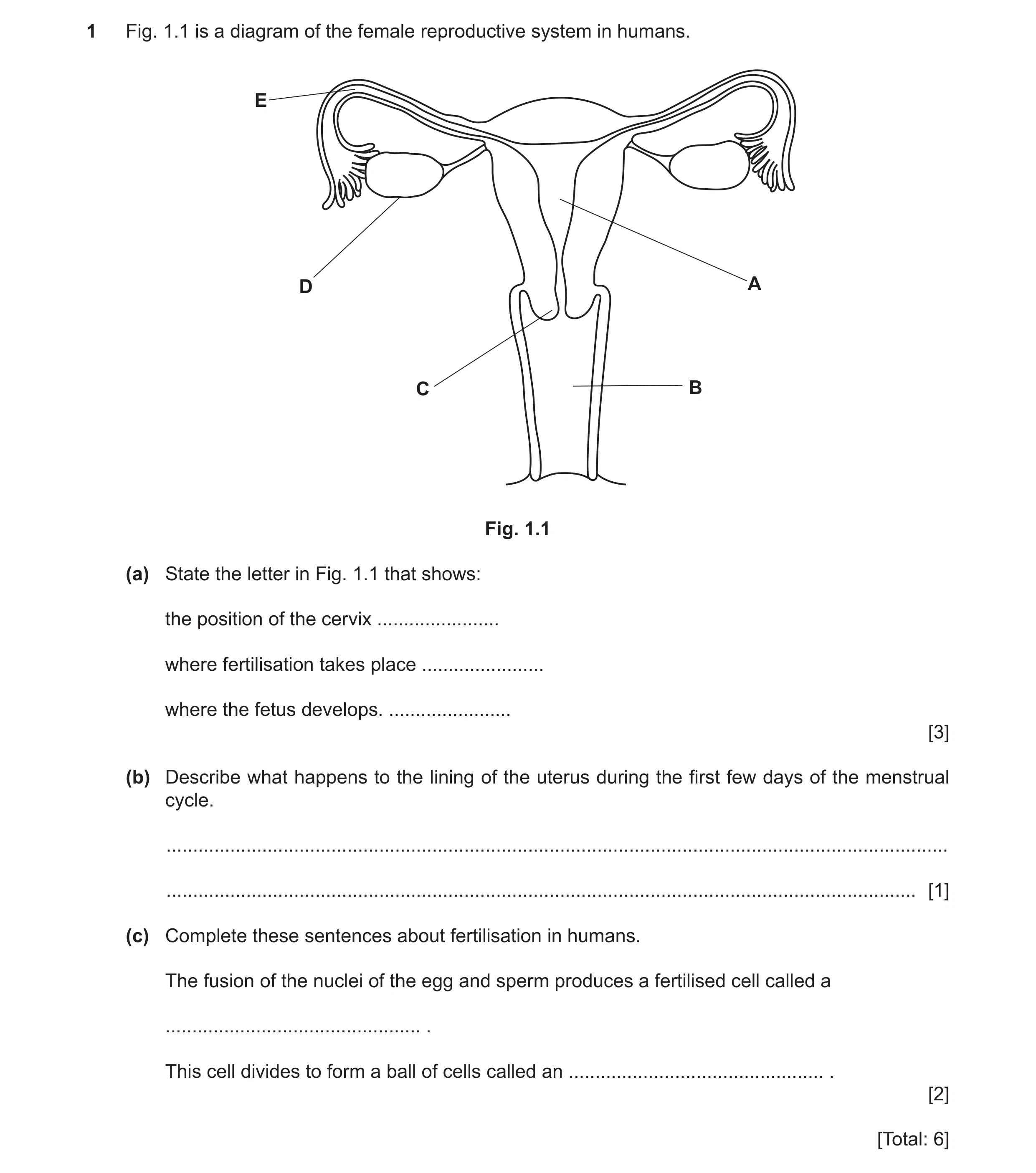
Q10 · A diagram of the female reproductive system in humans 0653/31 May/June 2022
1 Fig. 1.1 is a diagram of the female reproductive system in humans. E D A C B Fig. 1.1 (a) State the letter in Fig. 1.1 that shows: the position of the cervix … where fertilisation takes place … where the fetus develops. … [3] (b) Describe what happens to the lining of the uterus during the first few days of the menstrual cycle. … … [1] (c) Complete these sentences about fertilisation in humans. The fusion of the nuclei of the egg and sperm produces a fertilised cell called a … . This cell divides to form a ball of cells called an … . [2] [Total: 6]
6 marks
Mark scheme: 1(a) C ; E ; A ; 3 1(b) it is shed / reduced in thickness ; 1 1(c) zygote ; embryo ; 2
This question in 0653/31 May/June 2022
Q11 · A diagram of the male reproductive system in humans 0653/32 May/June 2022
4 (a) Fig. 4.1 is a diagram of the male reproductive system in humans. X Fig. 4.1 (i) State the name of the part labelled X in Fig. 4.1. … [1] (ii) Name the gland that secretes fluids for sperm to swim in. … [1] (b) Complete these sentences about reproduction. Choose words from the list. Each word may be used once, more than once or not at all. embryo gamete ovary oviduct uterus vagina zygote The male releases sperm from the penis into the … of the female. The sperm swim to the … where fertilisation takes place. The fertilised egg is called a … . [3] (c) The menstrual cycle in females is controlled by hormones. Fig. 4.2 shows the relationship between the lining of the uterus and one of these hormones. thickness of uterus lining level of hormone in blood 0 2 4 6 8 10 12 14 16 18 20 22 24 26 28 menstruation time / days begins Fig. 4.2 (i) Use Fig. 4.2 to identify the day when the blood contains the highest level of the hormone. … [1] (ii) Describe how the thickness of the uterus lining changes during the menstrual cycle. Include data from Fig. 4.2 in your answer. … … … [2] (d) During pregnancy a female is advised to increase the amount of protein in her diet. State the importance of protein in the diet. … … [1] [Total: 9]
9 marks
Mark scheme: 4(a)(i) scrotum ; 1 4(a)(ii) prostate (gland) ; 1 4(b) vagina ; oviduct ; zygote ; 3 4(c)(i) (day) 22 ; 1 Question Answer Marks 4(c)(ii) thickness decreases, increases, then levels off ; correct data ; 2 4(d) needed for, growth / repair / build tissue / build cells ; 1
This question in 0653/32 May/June 2022
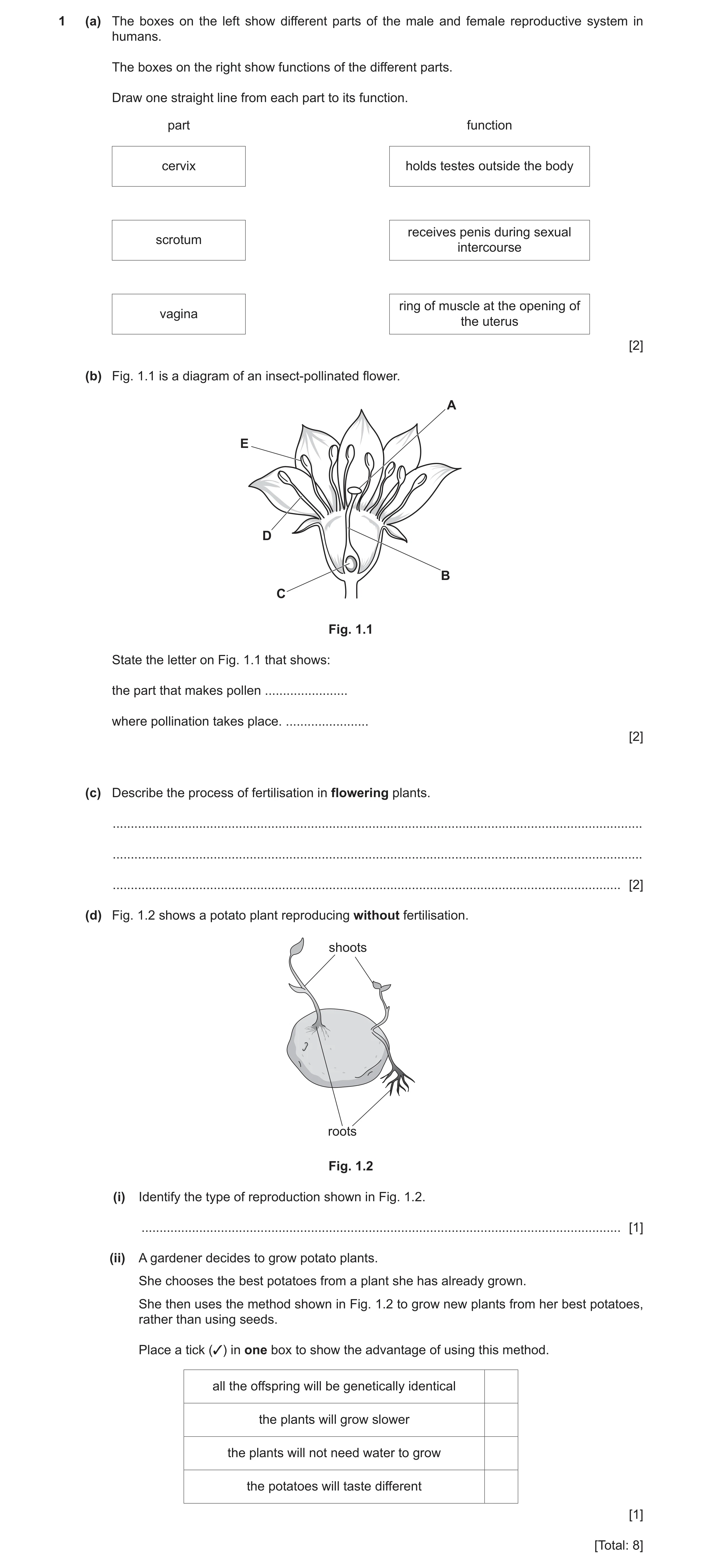
Q12 · The boxes on the left show different parts of the male and female reproductive system in… 0653/33 May/June 2022
1 (a) The boxes on the left show different parts of the male and female reproductive system in humans. The boxes on the right show functions of the different parts. Draw one straight line from each part to its function. part function cervix holds testes outside the body receives penis during sexual scrotum intercourse ring of muscle at the opening of vagina the uterus [2] (b) Fig. 1.1 is a diagram of an insect‑pollinated flower. A E D B C Fig. 1.1 State the letter on Fig. 1.1 that shows: the part that makes pollen … where pollination takes place. … [2] (c) Describe the process of fertilisation in flowering plants. … … … [2] (d) Fig. 1.2 shows a potato plant reproducing without fertilisation. shoots roots Fig. 1.2 (i) Identify the type of reproduction shown in Fig. 1.2. … [1] (ii) A gardener decides to grow potato plants. She chooses the best potatoes from a plant she has already grown. She then uses the method shown in Fig. 1.2 to grow new plants from her best potatoes, rather than using seeds. Place a tick (✓) in one box to show the advantage of using this method. all the offspring will be genetically identical the plants will grow slower the plants will not need water to grow the potatoes will taste different [1] [Total: 8]
8 marks
Mark scheme: 1(a) cervix holds testes outside the body scrotum receives penis during sexual intercourse vagina ring of muscle at opening to uterus all three correct = 2 marks one or two correct = 1 mark 2 1(b) E ; A ; 2 1(c) fusion of pollen and ovule ; correct ref to nuclei ; 2 1(d)(i) asexual ; 1 1(d)(ii) all the offspring will be genetically identical ; plants will grow slower the plants will not need water to grow the potatoes will taste different 1
This question in 0653/33 May/June 2022
Q13 · The boxes on the left name some parts of the male reproductive system in humans 0653/32 Feb/March 2023
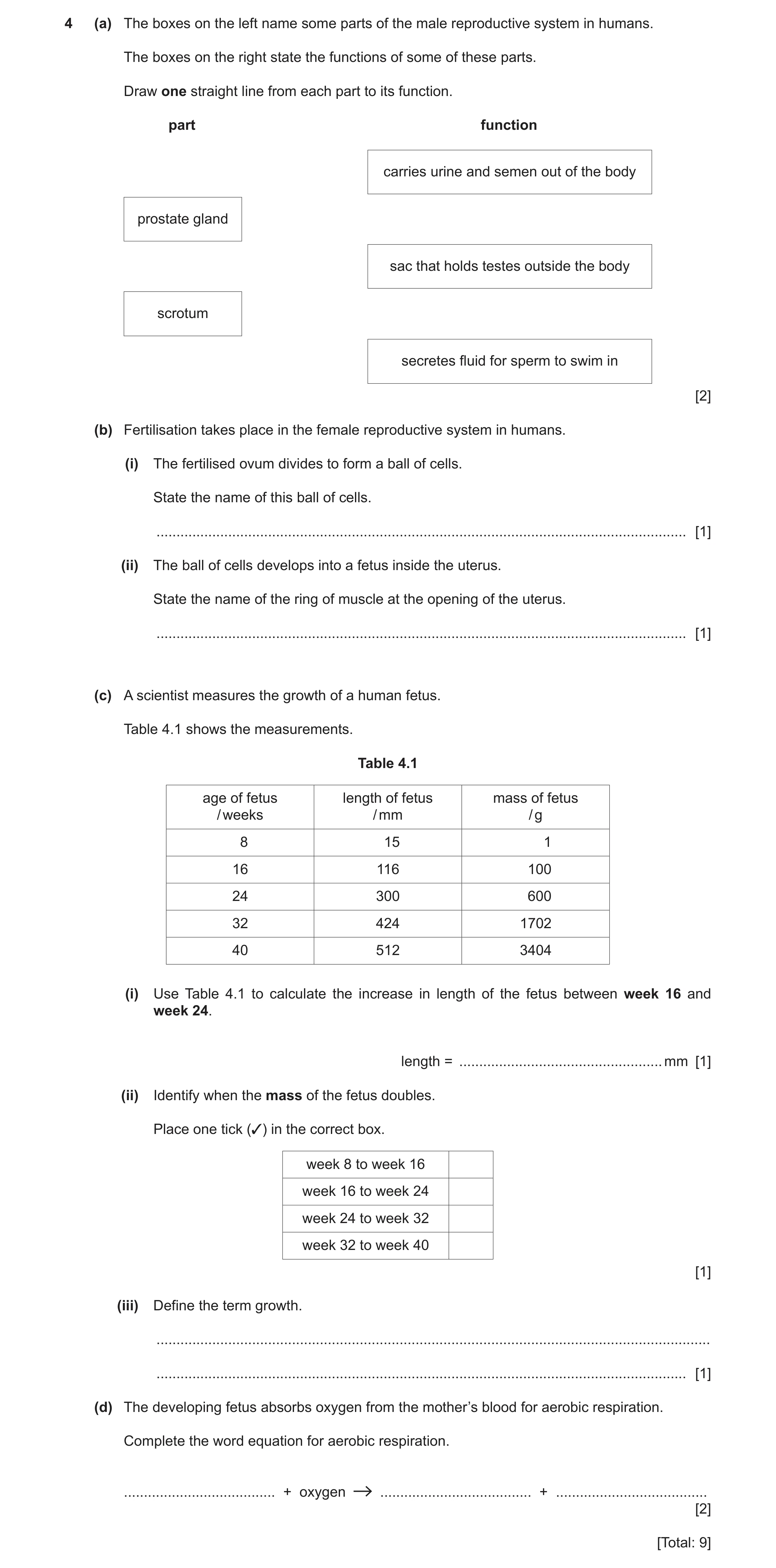
4 (a) The boxes on the left name some parts of the male reproductive system in humans. The boxes on the right state the functions of some of these parts. Draw one straight line from each part to its function. part function carries urine and semen out of the body prostate gland sac that holds testes outside the body scrotum secretes fluid for sperm to swim in [2] (b) Fertilisation takes place in the female reproductive system in humans. (i) The fertilised ovum divides to form a ball of cells. State the name of this ball of cells. … [1] (ii) The ball of cells develops into a fetus inside the uterus. State the name of the ring of muscle at the opening of the uterus. … [1] (c) A scientist measures the growth of a human fetus. Table 4.1 shows the measurements. Table 4.1 age of fetus length of fetus mass of fetus / weeks / mm / g 8 15 1 16 116 100 24 300 600 32 424 1702 40 512 3404 (i) Use Table 4.1 to calculate the increase in length of the fetus between week 16 and week 24. length = … mm [1] (ii) Identify when the mass of the fetus doubles. Place one tick (✓) in the correct box. week 8 to week 16 week 16 to week 24 week 24 to week 32 week 32 to week 40 [1] (iii) Define the term growth. … … [1] (d) The developing fetus absorbs oxygen from the mother’s blood for aerobic respiration. Complete the word equation for aerobic respiration. … + oxygen … + … [2] [Total: 9]
9 marks
Mark scheme: 4(a) 2 carries urine and semen out of the body prostate gland sac that holds testes outside the body scrotum secretes fluid for sperm to swim in ;; 4(b)(i) embryo ; 1 4(b)(ii) cervix ; 1 4(c)(i) 184 (mm) ; 1 4(c)(ii) week 32 to week 40 ; 1 4(c)(iii) permanent increase in size ; 1 4(d) glucose ; 2 carbon dioxide and water ;
This question in 0653/32 Feb/March 2023
Q14 · A diagram of the alimentary canal and associated organs 0653/33 May/June 2023
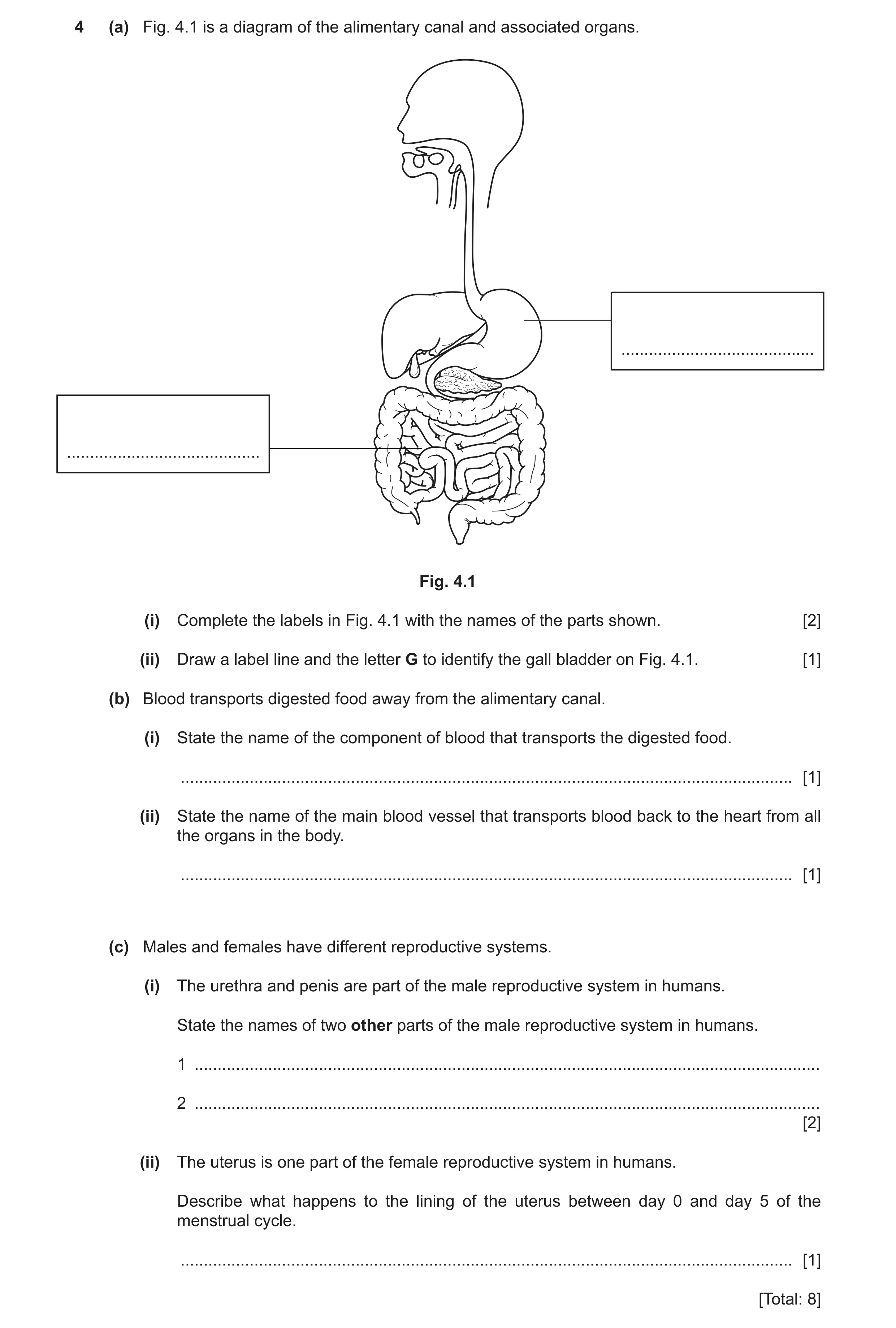
4 (a) Fig. 4.1 is a diagram of the alimentary canal and associated organs. … … Fig. 4.1 (i) Complete the labels in Fig. 4.1 with the names of the parts shown. [2] (ii) Draw a label line and the letter G to identify the gall bladder on Fig. 4.1. [1] (b) Blood transports digested food away from the alimentary canal. (i) State the name of the component of blood that transports the digested food. … [1] (ii) State the name of the main blood vessel that transports blood back to the heart from all the organs in the body. … [1] (c) Males and females have different reproductive systems. (i) The urethra and penis are part of the male reproductive system in humans. State the names of two other parts of the male reproductive system in humans. 1 … 2 … [2] (ii) The uterus is one part of the female reproductive system in humans. Describe what happens to the lining of the uterus between day 0 and day 5 of the menstrual cycle. … [1] [Total: 8]
8 marks
Mark scheme: 4(a)(i) small intestine ; stomach ; 2 4(a)(ii) gall bladder labelled ; 1 4(b)(i) plasma ; 1 4(b)(ii) vena cava ; 1 4(c)(i) any two from: testes ; scrotum ; sperm duct ; prostate gland ; 2 4(c)(ii) thickness decreases / is shed ; 1
This question in 0653/33 May/June 2023
Q15 · The female reproductive system in humans 0653/31 Oct/Nov 2023
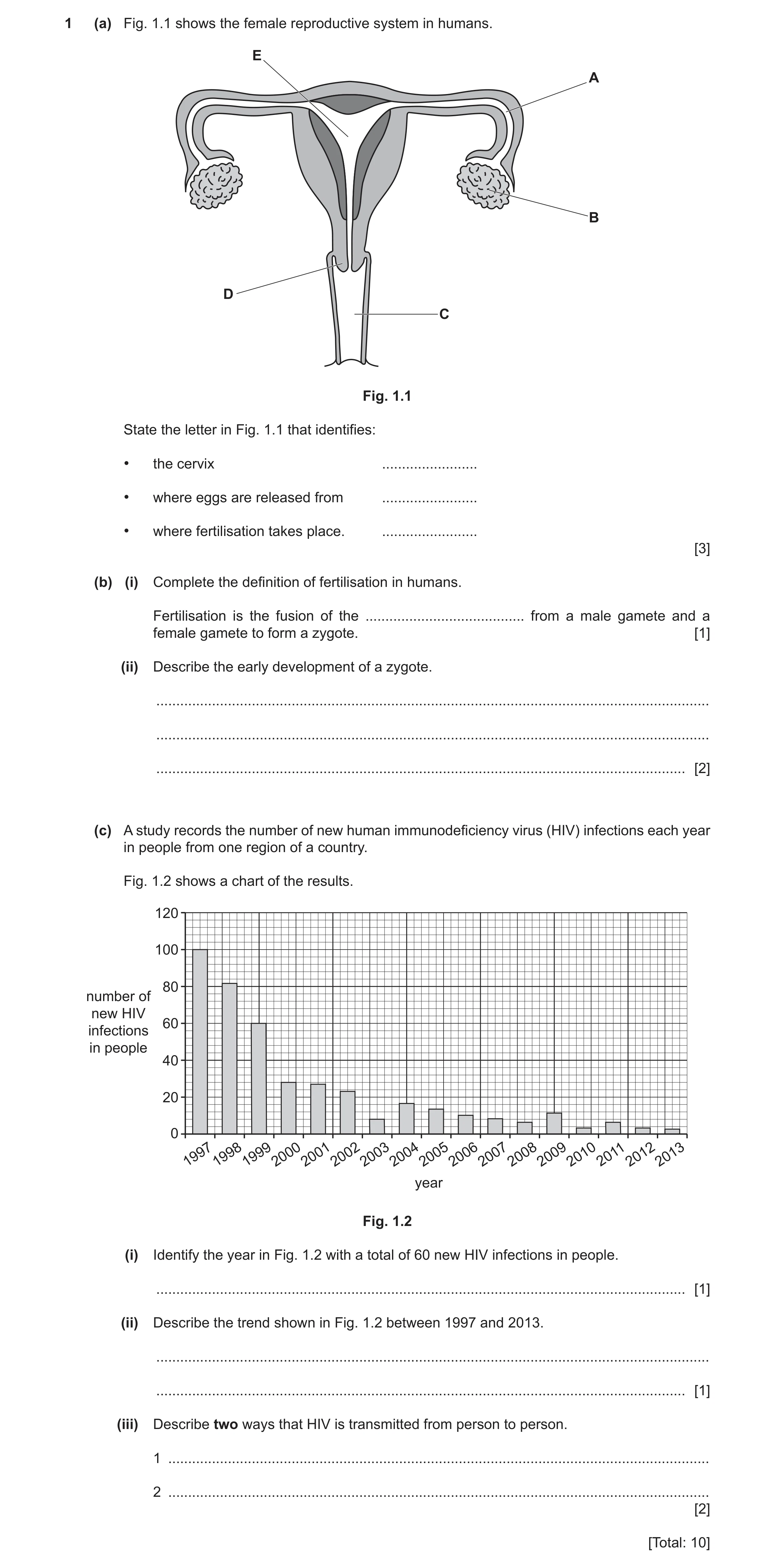
1 (a) Fig. 1.1 shows the female reproductive system in humans. E A B D C Fig. 1.1 State the letter in Fig. 1.1 that identifies: • the cervix … • where eggs are released from … • where fertilisation takes place. … [3] (b) (i) Complete the definition of fertilisation in humans. Fertilisation is the fusion of the … from a male gamete and a female gamete to form a zygote. [1] (ii) Describe the early development of a zygote. … … … [2] (c) A study records the number of new human immunodeficiency virus (HIV) infections each year in people from one region of a country. Fig. 1.2 shows a chart of the results. 120 100 80number of new HIV 60infections in people 40 20 0 19971998199920002001200220032004200520062007200820092010201120122013 year Fig. 1.2 (i) Identify the year in Fig. 1.2 with a total of 60 new HIV infections in people. … [1] (ii) Describe the trend shown in Fig. 1.2 between 1997 and 2013. … … [1] (iii) Describe two ways that HIV is transmitted from person to person. 1 … 2 … [2] [Total: 10]
10 marks
Mark scheme: Question Answer Marks 1(a) D ; 3 B ; A ; 1(b)(i) nuclei ; 1 1(b)(ii) any two from: 2 forms a ball of cells ; (called an / forms an) embryo ; implants into (wall of) uterus ; 1(c)(i) 1999 ; 1 1(c)(ii) the number of people infected decreased (over the period) ; 1 1(c)(iii) any two from: 2 contaminated blood / contaminated transfusion ; sexual intercourse ; sharing needles ; mother to baby, e.g. across the placenta / during birth / breast feeding ;
This question in 0653/31 Oct/Nov 2023
Q16 · A food web for one ecosystem 0653/32 Oct/Nov 2023
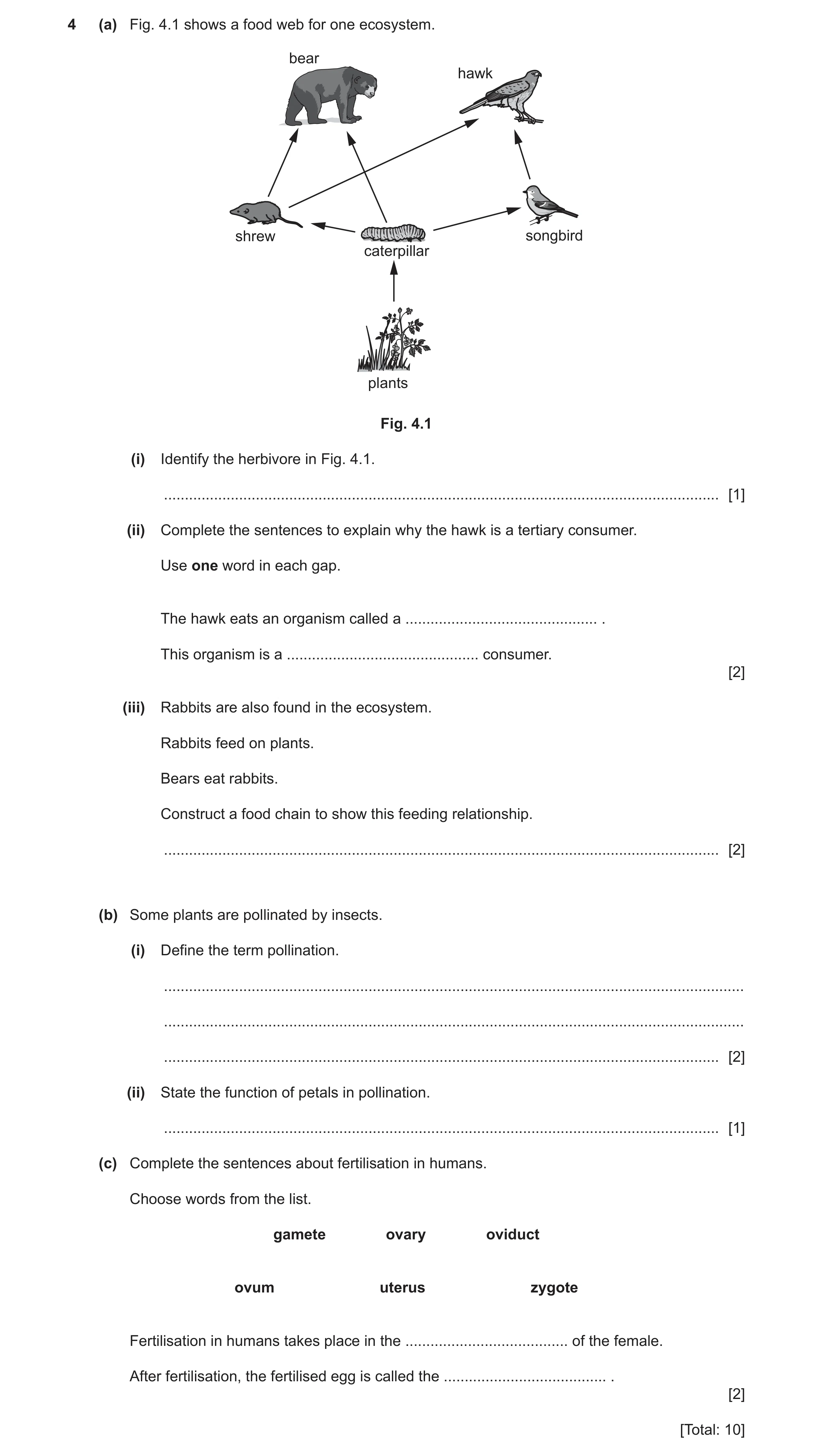
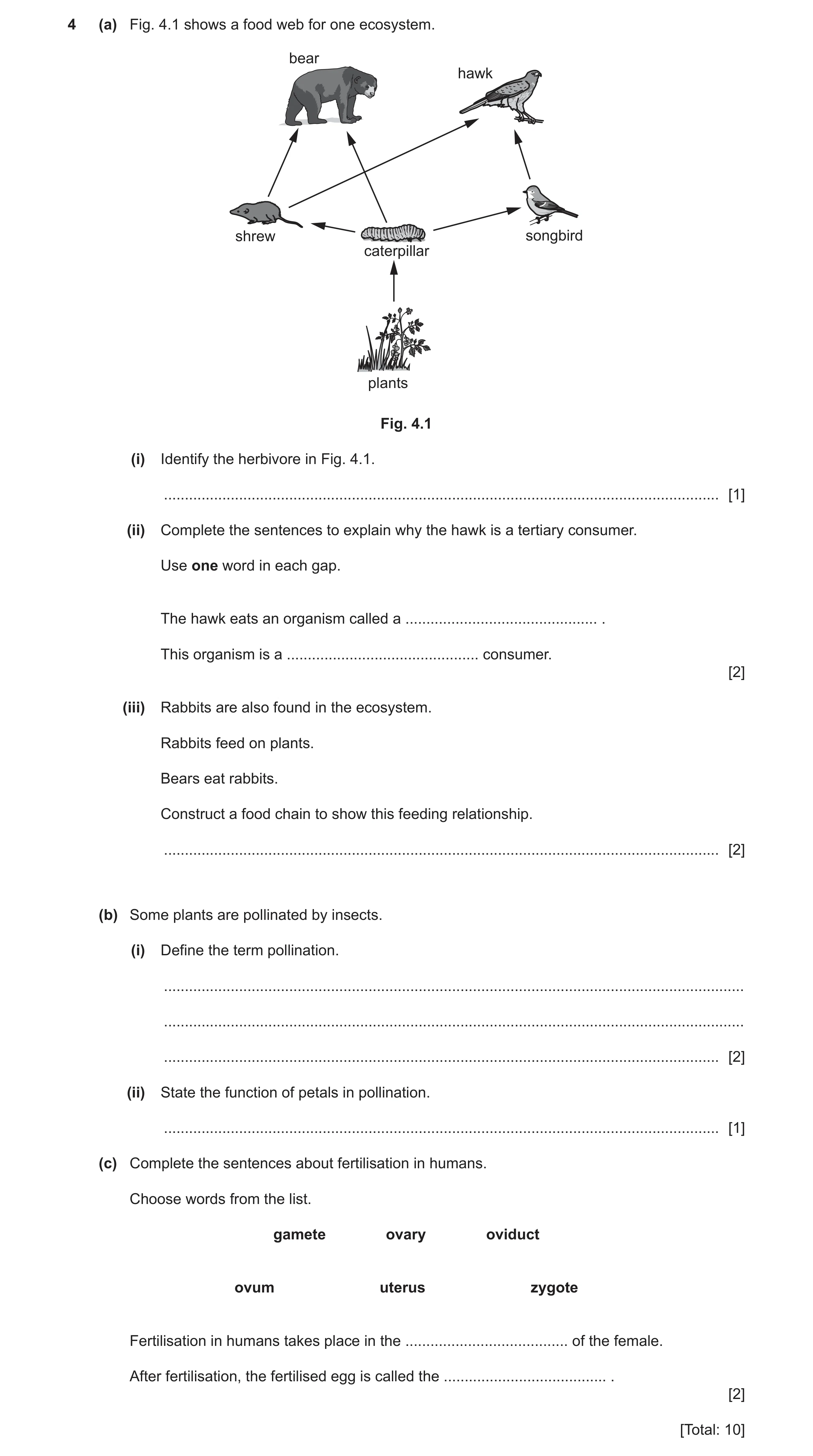
4 (a) Fig. 4.1 shows a food web for one ecosystem. bear hawk shrew songbird caterpillar plants Fig. 4.1 (i) Identify the herbivore in Fig. 4.1. … [1] (ii) Complete the sentences to explain why the hawk is a tertiary consumer. Use one word in each gap. The hawk eats an organism called a … . This organism is a … consumer. [2] (iii) Rabbits are also found in the ecosystem. Rabbits feed on plants. Bears eat rabbits. Construct a food chain to show this feeding relationship. … [2] (b) Some plants are pollinated by insects. (i) Define the term pollination. … … … [2] (ii) State the function of petals in pollination. … [1] (c) Complete the sentences about fertilisation in humans. Choose words from the list. gamete ovary oviduct ovum uterus zygote Fertilisation in humans takes place in the … of the female. After fertilisation, the fertilised egg is called the … . [2] [Total: 10]
10 marks
Mark scheme: 4(a)(i) caterpillar ; 1 4(a)(ii) songbird / shrew ; 2 secondary ; 4(a)(iii) plants → rabbits → bears 2 correct order ; correct arrows ; 4(b)(i) transfer of pollen (grains) ; 2 from anther to stigma ; 4(b)(ii) (petals) attract insects ; 1 4(c) oviduct ; 2 zygote ;
This question in 0653/32 Oct/Nov 2023
Q17 · A food web for one ecosystem 0653/33 Oct/Nov 2023
4 (a) Fig. 4.1 shows a food web for one ecosystem. bear hawk shrew songbird caterpillar plants Fig. 4.1 (i) Identify the herbivore in Fig. 4.1. … [1] (ii) Complete the sentences to explain why the hawk is a tertiary consumer. Use one word in each gap. The hawk eats an organism called a … . This organism is a … consumer. [2] (iii) Rabbits are also found in the ecosystem. Rabbits feed on plants. Bears eat rabbits. Construct a food chain to show this feeding relationship. … [2] (b) Some plants are pollinated by insects. (i) Define the term pollination. … … … [2] (ii) State the function of petals in pollination. … [1] (c) Complete the sentences about fertilisation in humans. Choose words from the list. gamete ovary oviduct ovum uterus zygote Fertilisation in humans takes place in the … of the female. After fertilisation, the fertilised egg is called the … . [2] [Total: 10]
10 marks
Mark scheme: 4(a)(i) caterpillar ; 1 4(a)(ii) songbird / shrew ; 2 secondary ; 4(a)(iii) plants → rabbits → bears 2 correct order ; correct arrows ; 4(b)(i) transfer of pollen (grains) ; 2 from anther to stigma ; 4(b)(ii) (petals) attract insects ; 1 4(c) oviduct ; 2 zygote ;
This question in 0653/33 Oct/Nov 2023
Q18 · The boxes on the left show the names of some structures found in cells 0653/32 Feb/March 2024
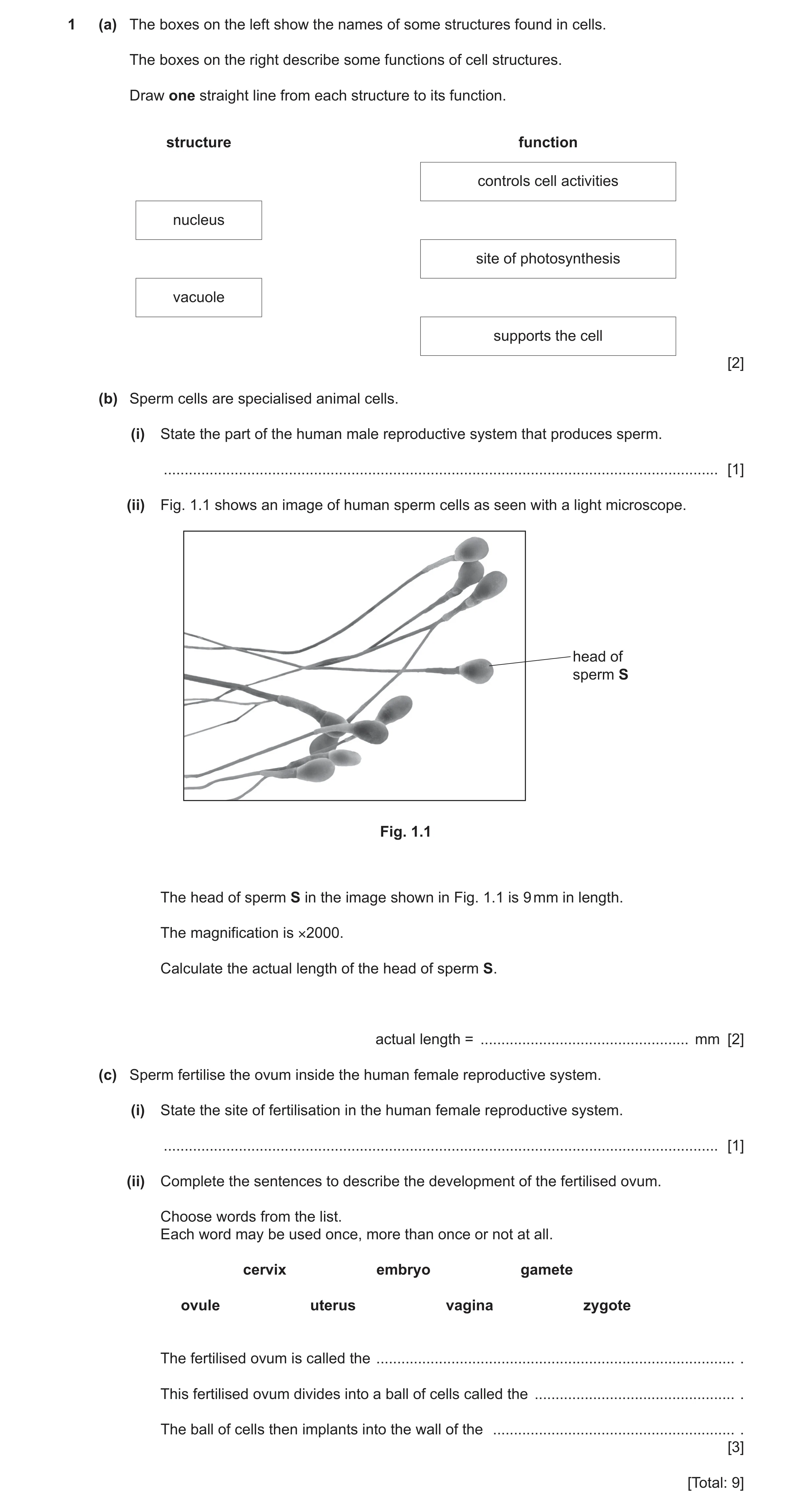
1 (a) The boxes on the left show the names of some structures found in cells. The boxes on the right describe some functions of cell structures. Draw one straight line from each structure to its function. structure function controls cell activities nucleus site of photosynthesis vacuole supports the cell [2] (b) Sperm cells are specialised animal cells. (i) State the part of the human male reproductive system that produces sperm. … [1] (ii) Fig. 1.1 shows an image of human sperm cells as seen with a light microscope. head of sperm S Fig. 1.1 The head of sperm S in the image shown in Fig. 1.1 is 9 mm in length. The magnification is ×2000. Calculate the actual length of the head of sperm S. actual length = … mm [2] (c) Sperm fertilise the ovum inside the human female reproductive system. (i) State the site of fertilisation in the human female reproductive system. … [1] (ii) Complete the sentences to describe the development of the fertilised ovum. Choose words from the list. Each word may be used once, more than once or not at all. cervix embryo gamete ovule uterus vagina zygote The fertilised ovum is called the … . This fertilised ovum divides into a ball of cells called the … . The ball of cells then implants into the wall of the … . [3] [Total: 9]
9 marks
Mark scheme: Question Answer Marks 1(a) 2 controls cell activities nucleus site of photosynthesis vacuole supports the cell ;; one mark for each correct line 1(b)(i) testes ; 1 1(b)(ii) magnification = image length ÷ actual length (in any form) / actual = 9 ÷ 2000 ; 2 = 0.0045 (mm) ; 1(c)(i) oviduct ; 1 1(c)(ii) zygote ; 3 embryo ; uterus ;
This question in 0653/32 Feb/March 2024
Q19 · Part of the human circulatory system 0653/31 May/June 2024
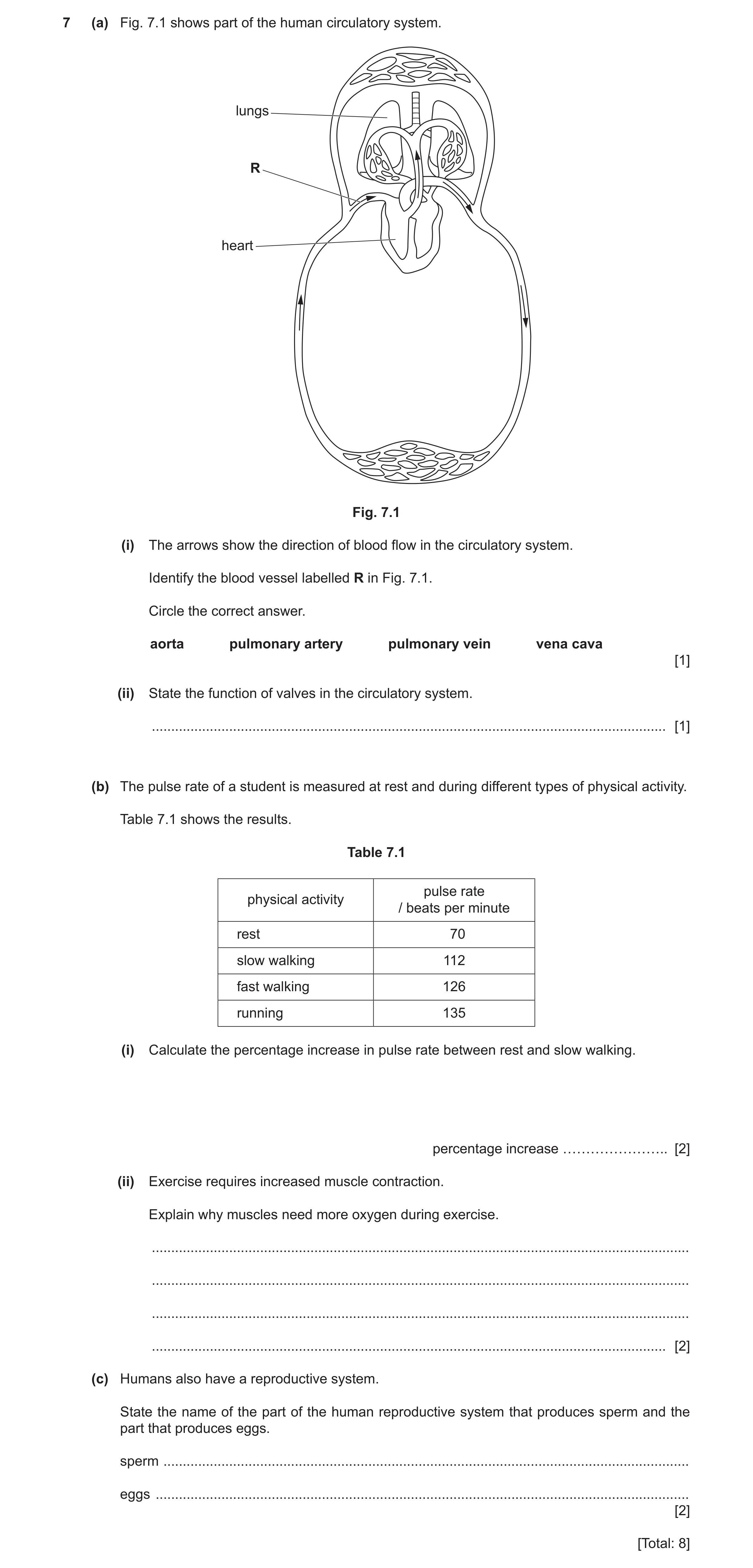
7 (a) Fig. 7.1 shows part of the human circulatory system. lungs R heart Fig. 7.1 (i) The arrows show the direction of blood flow in the circulatory system. Identify the blood vessel labelled R in Fig. 7.1. Circle the correct answer. aorta pulmonary artery pulmonary vein vena cava [1] (ii) State the function of valves in the circulatory system. … [1] (b) The pulse rate of a student is measured at rest and during different types of physical activity. Table 7.1 shows the results. Table 7.1 pulse rate physical activity / beats per minute rest 70 slow walking 112 fast walking 126 running 135 (i) Calculate the percentage increase in pulse rate between rest and slow walking. percentage increase ………………….. [2] (ii) Exercise requires increased muscle contraction. Explain why muscles need more oxygen during exercise. … … … … [2] (c) Humans also have a reproductive system. State the name of the part of the human reproductive system that produces sperm and the part that produces eggs. sperm … eggs … [2] [Total: 8]
8 marks
Mark scheme: 7(a)(i) vena cava ; 1 7(a)(ii) only allow one-way flow of blood ; 1 7(b)(i) (112 – 70 = ) 42 ; (42 70 100) = 60 ; 2 7(b)(ii) reference to respiration (in muscles) ; idea that oxygen is needed to, release / supply energy (in respiration) ; 2 7(c) testes ; ovaries ; 2
This question in 0653/31 May/June 2024
Q20 · A diagram of the male reproductive system in humans 0653/32 May/June 2024
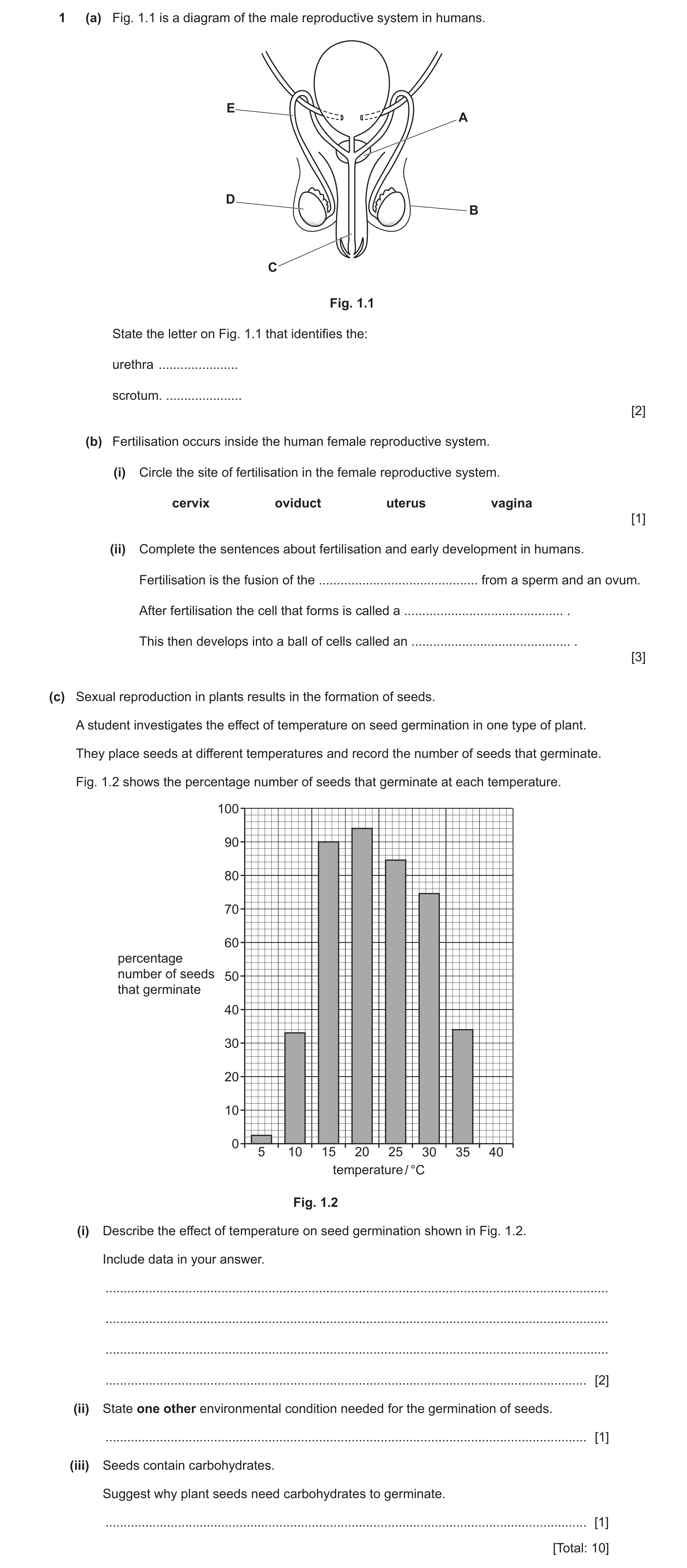
1 (a) Fig. 1.1 is a diagram of the male reproductive system in humans. E A D B C Fig. 1.1 State the letter on Fig. 1.1 that identifies the: urethra … scrotum. … [2] (b) Fertilisation occurs inside the human female reproductive system. (i) Circle the site of fertilisation in the female reproductive system. cervix oviduct uterus vagina [1] (ii) Complete the sentences about fertilisation and early development in humans. Fertilisation is the fusion of the … from a sperm and an ovum. After fertilisation the cell that forms is called a … . This then develops into a ball of cells called an … . [3] (c) Sexual reproduction in plants results in the formation of seeds. A student investigates the effect of temperature on seed germination in one type of plant. They place seeds at different temperatures and record the number of seeds that germinate. Fig. 1.2 shows the percentage number of seeds that germinate at each temperature. 100 90 80 70 60 percentage number of seeds 50 that germinate 40 30 20 10 0 5 10 15 20 25 30 35 40 temperature / °C Fig. 1.2 (i) Describe the effect of temperature on seed germination shown in Fig. 1.2. Include data in your answer. … … … … [2] (ii) State one other environmental condition needed for the germination of seeds. … [1] (iii) Seeds contain carbohydrates. Suggest why plant seeds need carbohydrates to germinate. … [1] [Total: 10]
10 marks
Mark scheme: 1(a) C ; B ; 2 1(b)(i) oviduct ; 1 1(b)(ii) nuclei / nucleus ; zygote ; embryo ; 3 1(c)(i) as temperature increases percentage germination increases then decreases ; maximum germination / optimum temperature at 20 °C ; 2 1(c)(ii) water / moisture / oxygen ; 1 1(c)(iii) energy / respiration ; 1
This question in 0653/32 May/June 2024
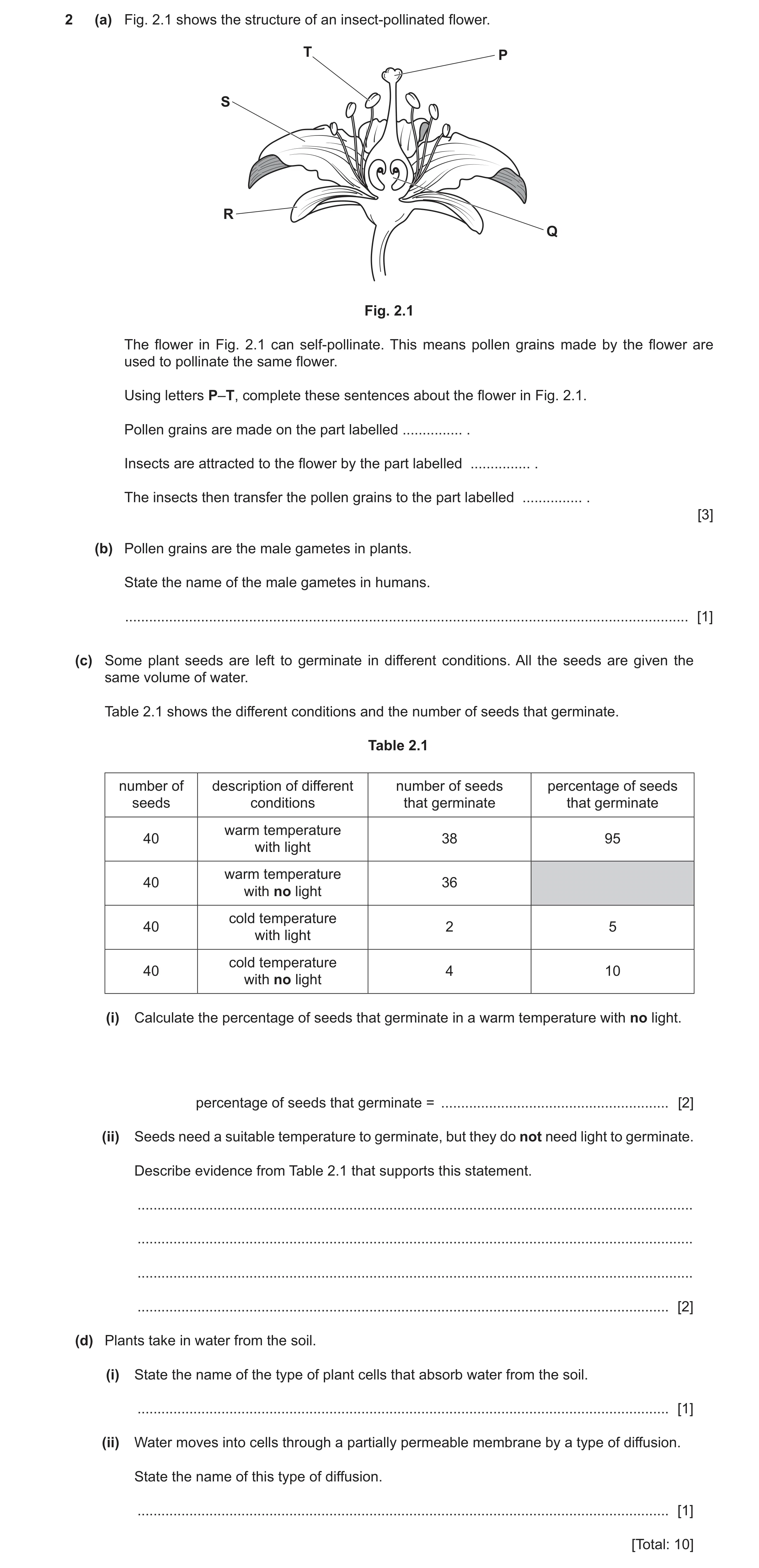
Q21 · The structure of an insect-pollinated flower 0653/32 Feb/March 2025
2 (a) Fig. 2.1 shows the structure of an insect-pollinated flower. T P S R Q Fig. 2.1 The flower in Fig. 2.1 can self-pollinate. This means pollen grains made by the flower are used to pollinate the same flower. Using letters P–T, complete these sentences about the flower in Fig. 2.1. Pollen grains are made on the part labelled … . Insects are attracted to the flower by the part labelled … . The insects then transfer the pollen grains to the part labelled … . [3] (b) Pollen grains are the male gametes in plants. State the name of the male gametes in humans. … [1] (c) Some plant seeds are left to germinate in different conditions. All the seeds are given the same volume of water. Table 2.1 shows the different conditions and the number of seeds that germinate. Table 2.1 number of description of different number of seeds percentage of seeds seeds conditions that germinate that germinate warm temperature 40 38 95 with light warm temperature 40 36 with no light cold temperature 40 2 5 with light cold temperature 40 4 10 with no light (i) Calculate the percentage of seeds that germinate in a warm temperature with no light. percentage of seeds that germinate = … [2] (ii) Seeds need a suitable temperature to germinate, but they do not need light to germinate. Describe evidence from Table 2.1 that supports this statement. … … … … [2] (d) Plants take in water from the soil. (i) State the name of the type of plant cells that absorb water from the soil. … [1] (ii) Water moves into cells through a partially permeable membrane by a type of diffusion. State the name of this type of diffusion. … [1] [Total: 10]
10 marks
Mark scheme: 2(a) T ; 3 S ; P ; 2(b) sperm ; 1 2(c)(i) 36 ÷ 40 100 ; 2 90 (%) ; 2(c)(ii) more seeds germinated in warm conditions / less germination in cold ; 2 seeds germinated without light (in warm / cold conditions) ; 2(d)(i) root hair (cells) ; 1 2(d)(ii) osmosis ; 1
This question in 0653/32 Feb/March 2025
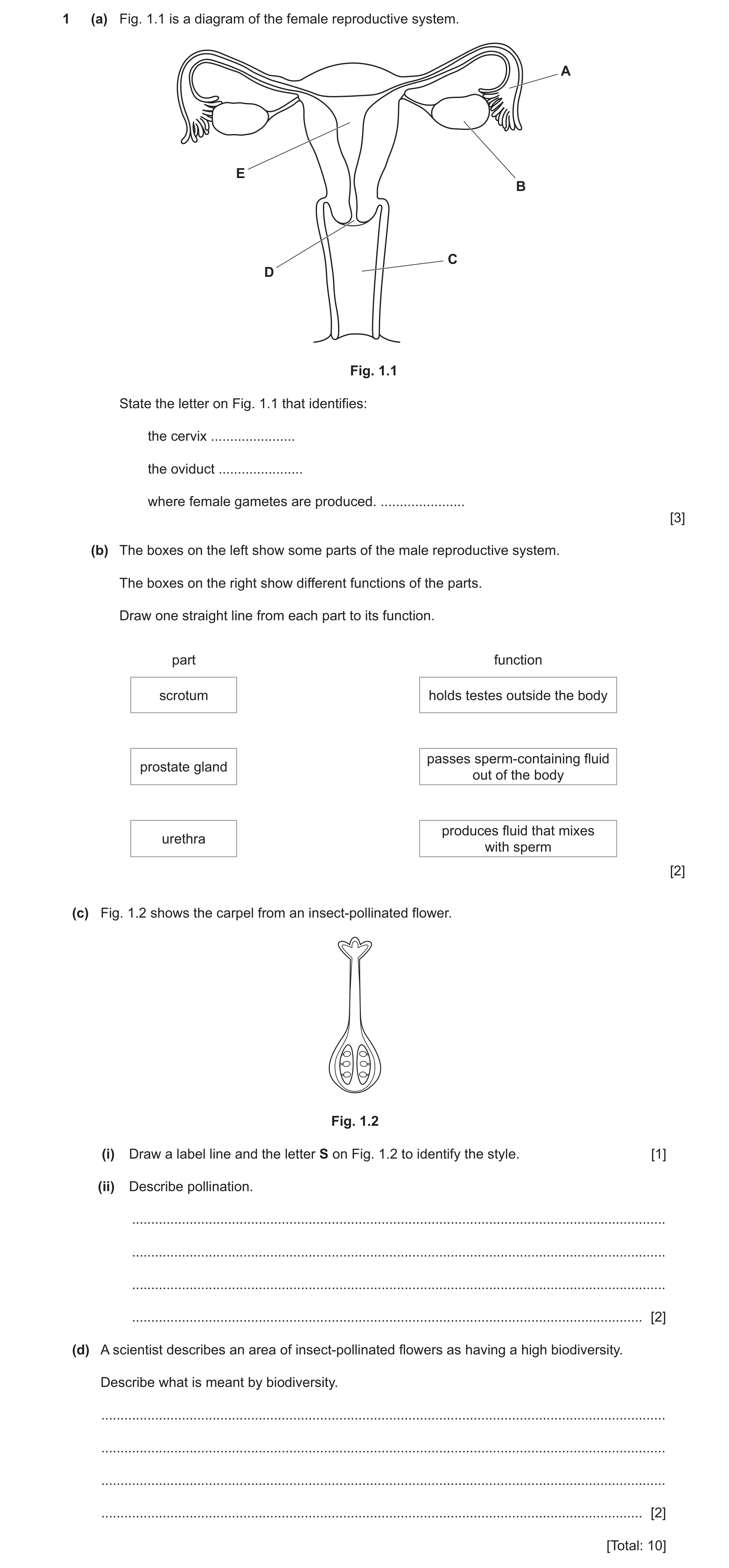
Q22 · A diagram of the female reproductive system 0653/33 May/June 2025
1 (a) Fig. 1.1 is a diagram of the female reproductive system. A E B C D Fig. 1.1 State the letter on Fig. 1.1 that identifies: the cervix … the oviduct … where female gametes are produced. … [3] (b) The boxes on the left show some parts of the male reproductive system. The boxes on the right show different functions of the parts. Draw one straight line from each part to its function. part function scrotum holds testes outside the body passes sperm-containing fluid prostate gland out of the body produces fluid that mixes urethra with sperm [2] (c) Fig. 1.2 shows the carpel from an insect-pollinated flower. Fig. 1.2 (i) Draw a label line and the letter S on Fig. 1.2 to identify the style. [1] (ii) Describe pollination. … … … … [2] (d) A scientist describes an area of insect-pollinated flowers as having a high biodiversity. Describe what is meant by biodiversity. … … … … [2] [Total: 10]
10 marks
Mark scheme: Question Answer Marks 1(a) D ; 3 A ; B ; 1(b) 2 part function scrotum holds testes outside the body prostate gland passes sperm-containing fluid out of the body urethra produces fluid that mixes with sperm ;; all three correct = 2 marks one or two correct = 1 mark 1(c)(i) label line touching style labelled S ; 1 1(c)(ii) transfer of pollen ; 2 from anther to stigma ; 1(d) number of different species ; 2 living in, an area/habitat ;
This question in 0653/33 May/June 2025
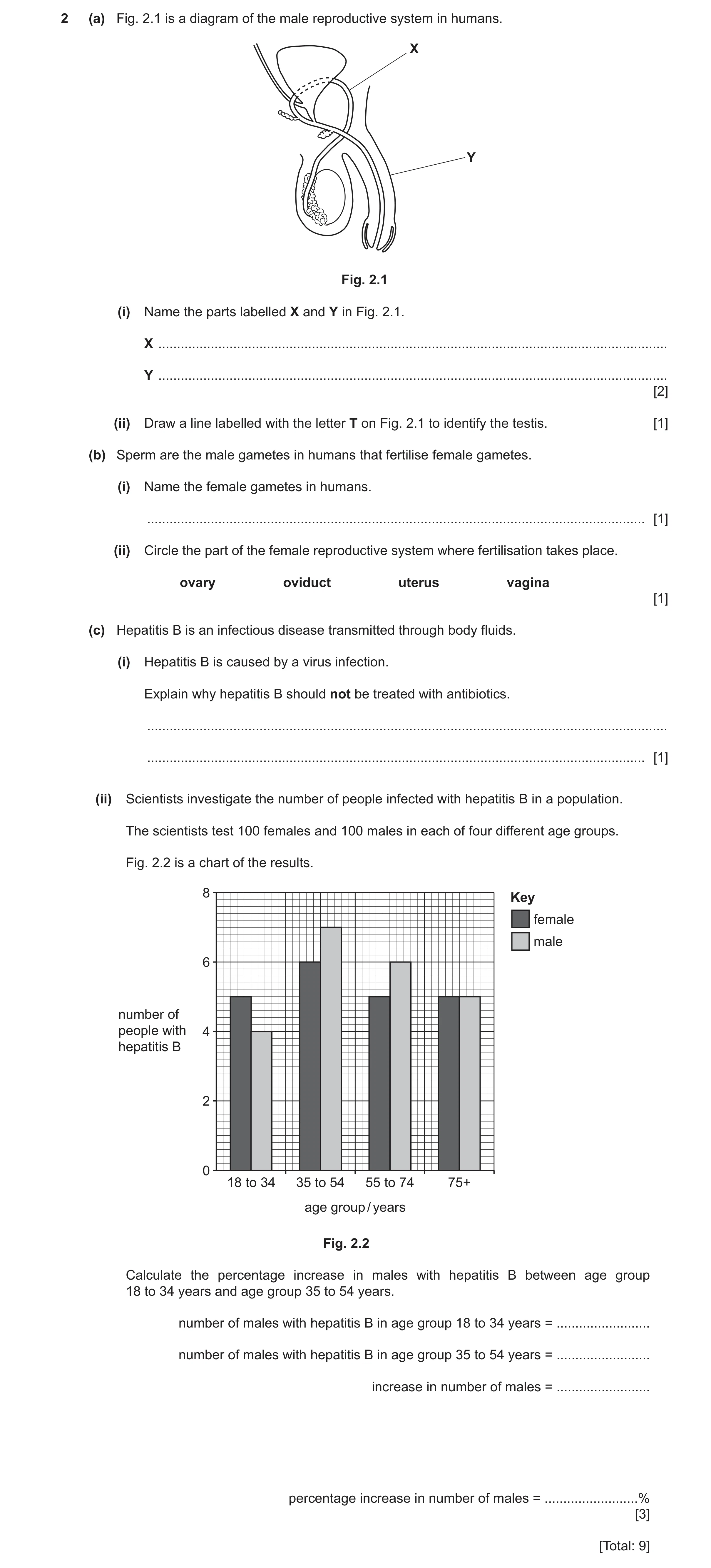
Q23 · A diagram of the male reproductive system in humans 0653/31 Oct/Nov 2025
2 (a) Fig. 2.1 is a diagram of the male reproductive system in humans. X Y Fig. 2.1 (i) Name the parts labelled X and Y in Fig. 2.1. X … Y … [2] (ii) Draw a line labelled with the letter T on Fig. 2.1 to identify the testis. [1] (b) Sperm are the male gametes in humans that fertilise female gametes. (i) Name the female gametes in humans. … [1] (ii) Circle the part of the female reproductive system where fertilisation takes place. ovary oviduct uterus vagina [1] (c) Hepatitis B is an infectious disease transmitted through body fluids. (i) Hepatitis B is caused by a virus infection. Explain why hepatitis B should not be treated with antibiotics. … … [1] (ii) Scientists investigate the number of people infected with hepatitis B in a population. The scientists test 100 females and 100 males in each of four different age groups. Fig. 2.2 is a chart of the results. 8 Key female male 6 number of people with 4 hepatitis B 2 0 18 to 34 35 to 54 55 to 74 75+ age group / years Fig. 2.2 Calculate the percentage increase in males with hepatitis B between age group 18 to 34 years and age group 35 to 54 years. number of males with hepatitis B in age group 18 to 34 years = … number of males with hepatitis B in age group 35 to 54 years = … increase in number of males = … percentage increase in number of males = … % [3] [Total: 9]
9 marks
Mark scheme: 2(a)(i) sperm duct ; 2 penis; 2(a)(ii) testes labelled ; 1 2(b)(i) egg (cell) ; 1 2(b)(ii) oviduct ; 1 2(c)(i) antibiotics have no effect on viruses ; 1 2(c)(ii) 4 AND 7 and difference of 3 ; 3 3 ÷ 4 100 ; 75 (%) ;
This question in 0653/31 Oct/Nov 2025
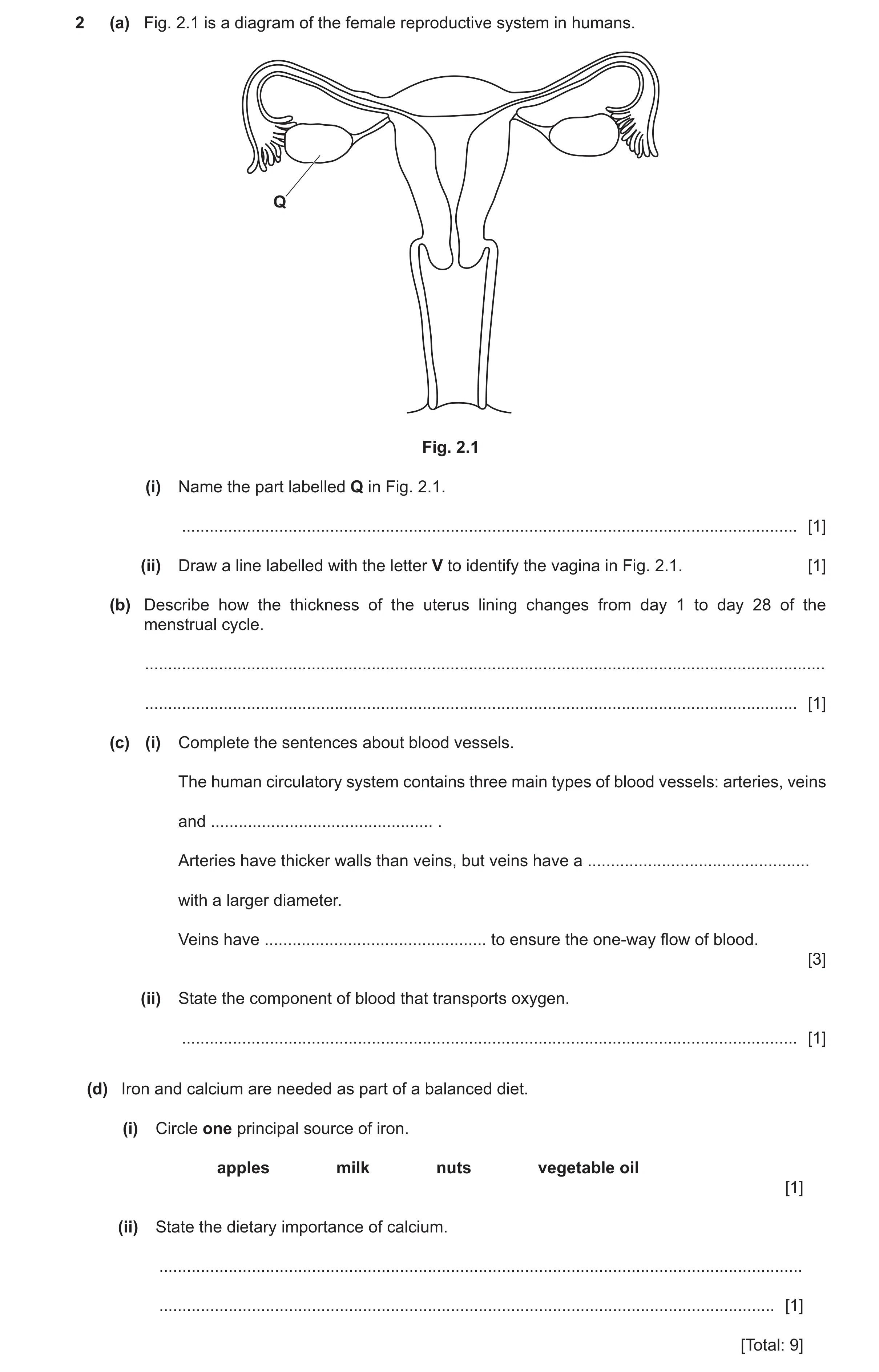
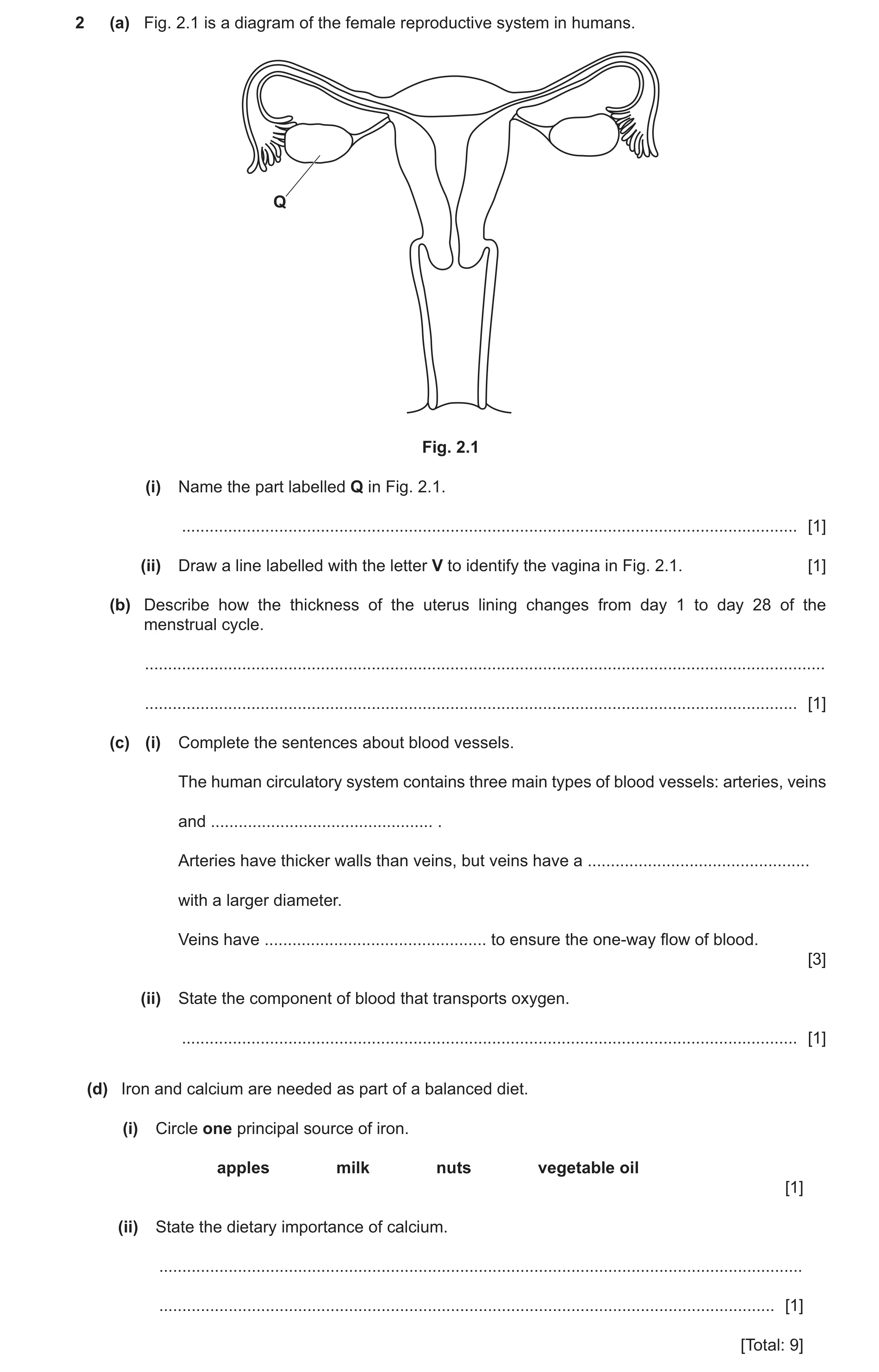
Q24 · A diagram of the female reproductive system in humans 0653/32 Oct/Nov 2025
2 (a) Fig. 2.1 is a diagram of the female reproductive system in humans. Q Fig. 2.1 (i) Name the part labelled Q in Fig. 2.1. … [1] (ii) Draw a line labelled with the letter V to identify the vagina in Fig. 2.1. [1] (b) Describe how the thickness of the uterus lining changes from day 1 to day 28 of the menstrual cycle. … … [1] (c) (i) Complete the sentences about blood vessels. The human circulatory system contains three main types of blood vessels: arteries, veins and … . Arteries have thicker walls than veins, but veins have a … with a larger diameter. Veins have … to ensure the one-way flow of blood. [3] (ii) State the component of blood that transports oxygen. … [1] (d) Iron and calcium are needed as part of a balanced diet. (i) Circle one principal source of iron. apples milk nuts vegetable oil [1] (ii) State the dietary importance of calcium. … … [1] [Total: 9]
9 marks
Mark scheme: 2(a)(i) ovary ; 1 2(a)(ii) vagina labelled ; 1 2(b) decreases AND then increases ; 1 2(c)(i) capillaries ; 3 lumen ; valves ; 2(c)(ii) red blood cell ; 1 2(d)(i) nuts ; 1 2(d)(ii) healthy bones / teeth ; 1
This question in 0653/32 Oct/Nov 2025
Q25 · A diagram of the female reproductive system in humans 0653/33 Oct/Nov 2025
2 (a) Fig. 2.1 is a diagram of the female reproductive system in humans. Q Fig. 2.1 (i) Name the part labelled Q in Fig. 2.1. … [1] (ii) Draw a line labelled with the letter V to identify the vagina in Fig. 2.1. [1] (b) Describe how the thickness of the uterus lining changes from day 1 to day 28 of the menstrual cycle. … … [1] (c) (i) Complete the sentences about blood vessels. The human circulatory system contains three main types of blood vessels: arteries, veins and … . Arteries have thicker walls than veins, but veins have a … with a larger diameter. Veins have … to ensure the one-way flow of blood. [3] (ii) State the component of blood that transports oxygen. … [1] (d) Iron and calcium are needed as part of a balanced diet. (i) Circle one principal source of iron. apples milk nuts vegetable oil [1] (ii) State the dietary importance of calcium. … … [1] [Total: 9]
9 marks
Mark scheme: 2(a)(i) ovary ; 1 2(a)(ii) vagina labelled ; 1 2(b) decreases AND then increases ; 1 2(c)(i) capillaries ; 3 lumen ; valves ; 2(c)(ii) red blood cell ; 1 2(d)(i) nuts ; 1 2(d)(ii) healthy bones / teeth ; 1
This question in 0653/33 Oct/Nov 2025
 3 / 38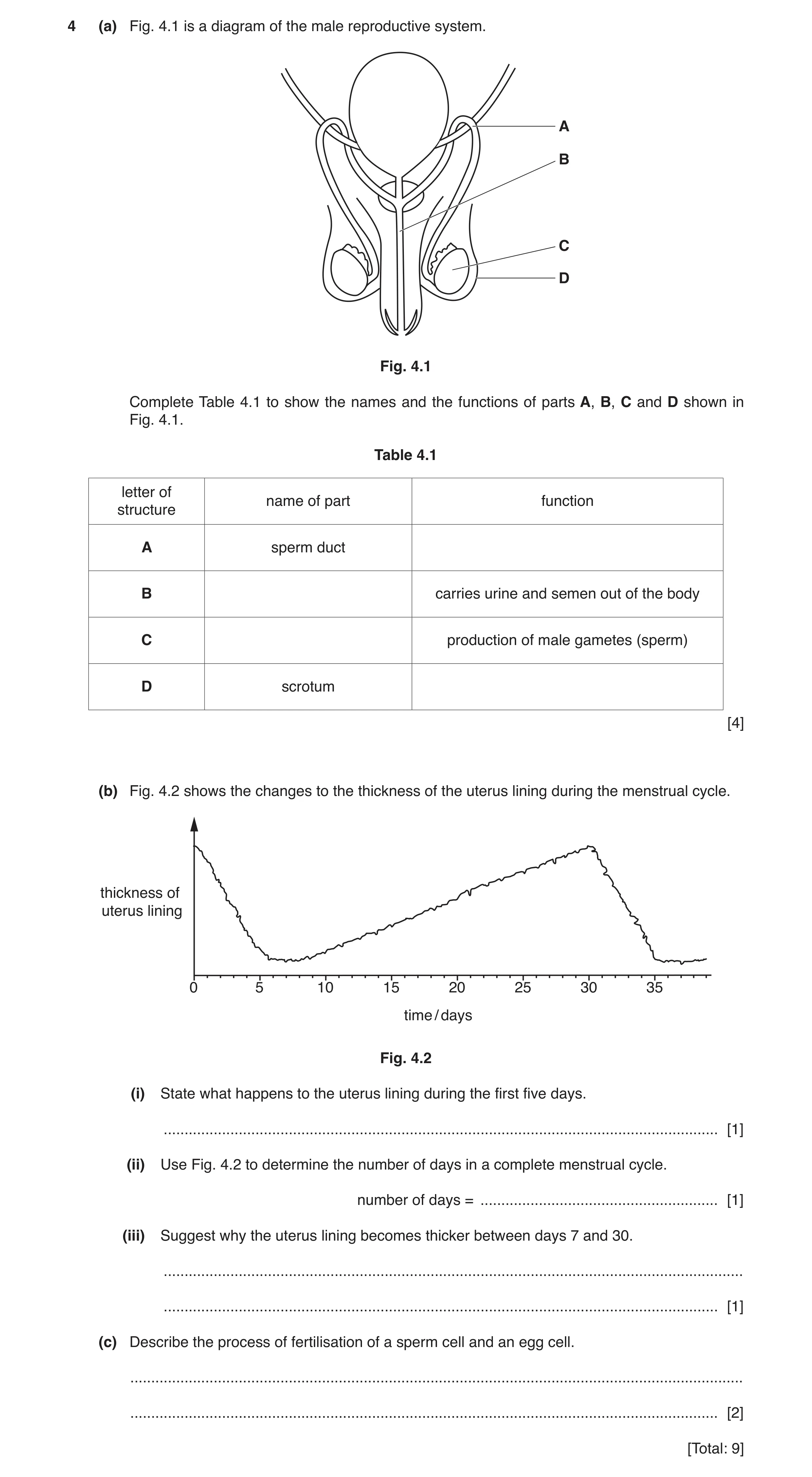
 15 / 38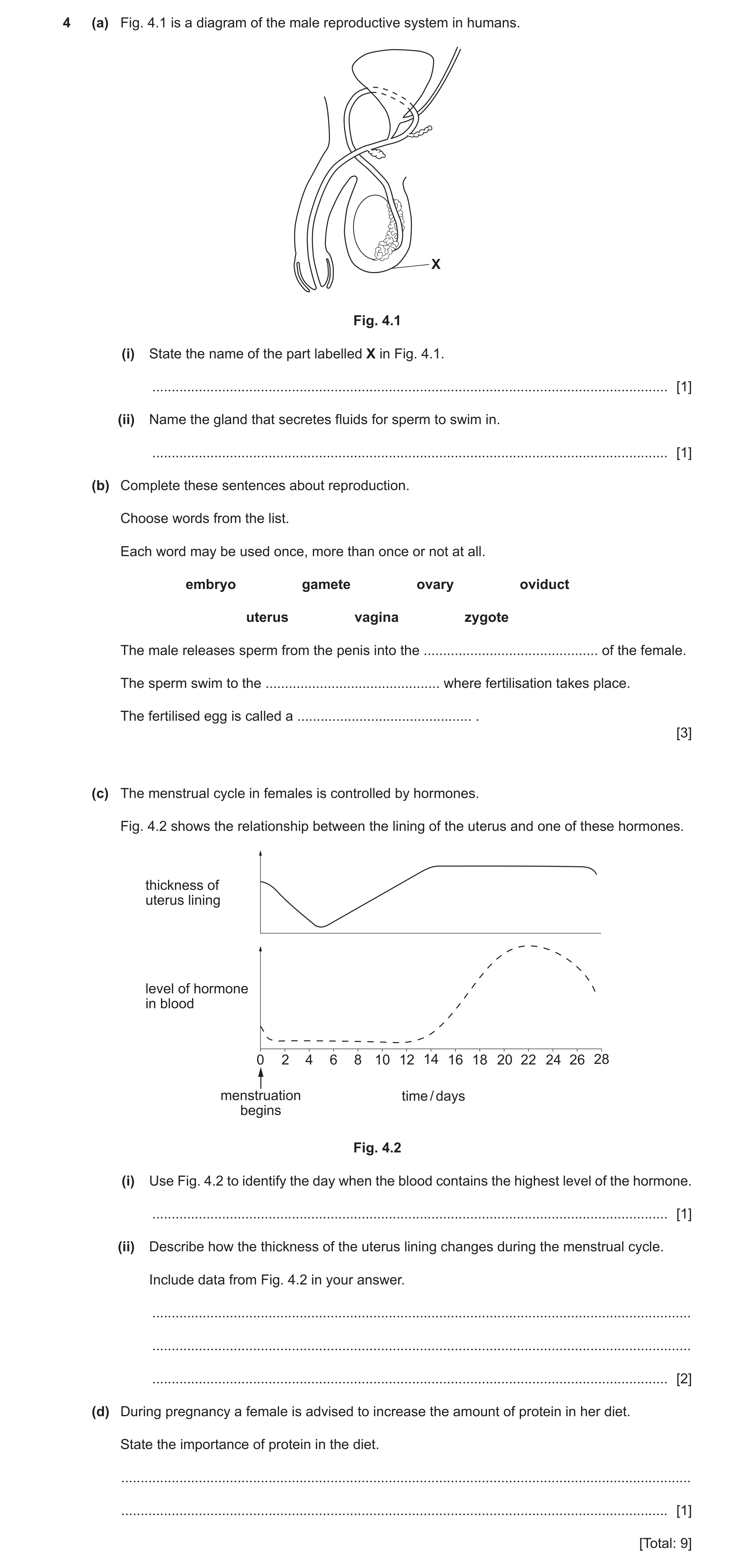
 8
8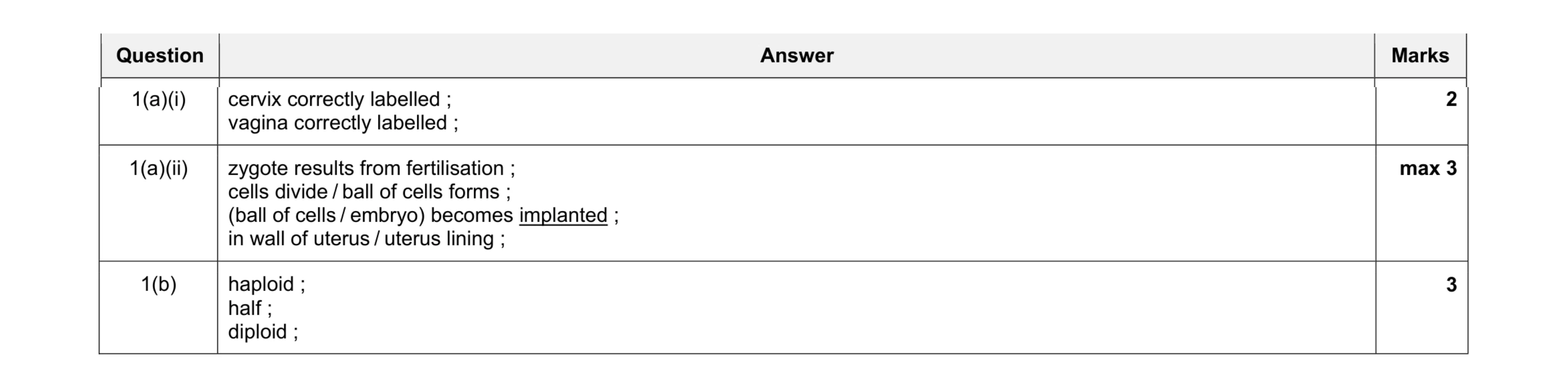 8
8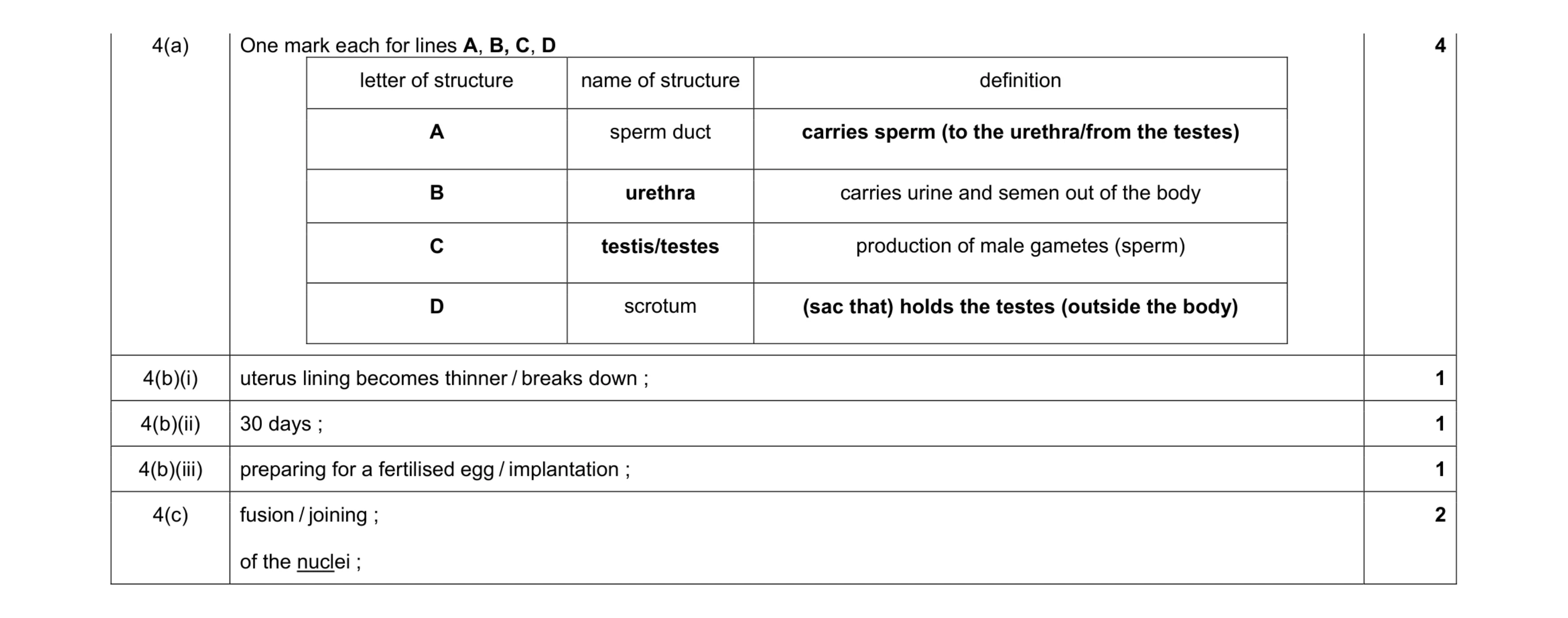 9
9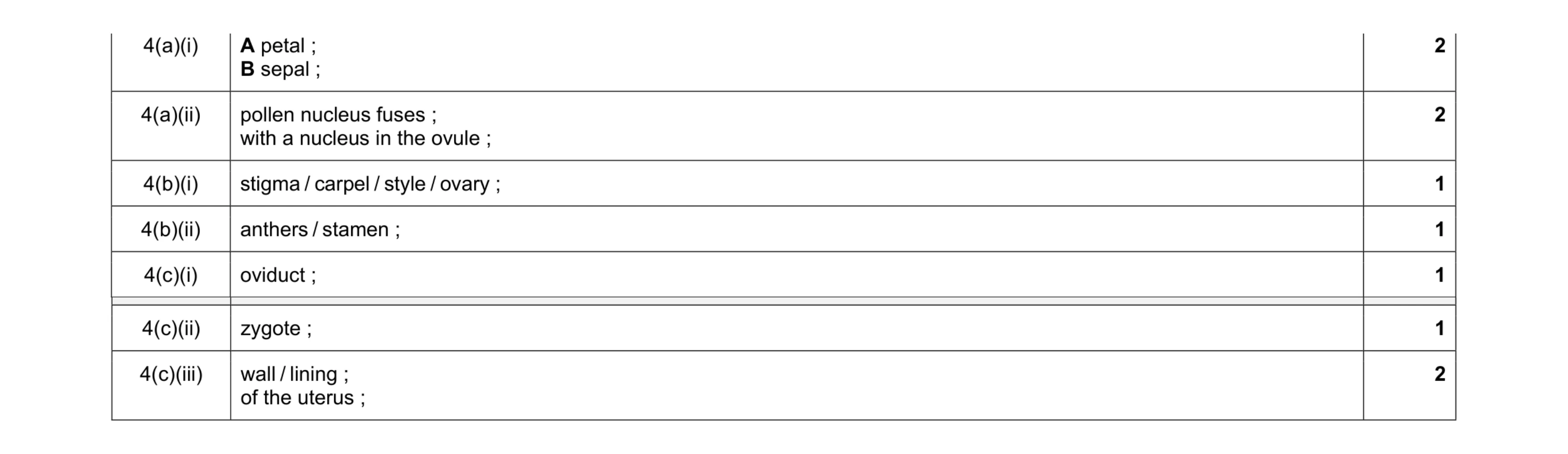 10
10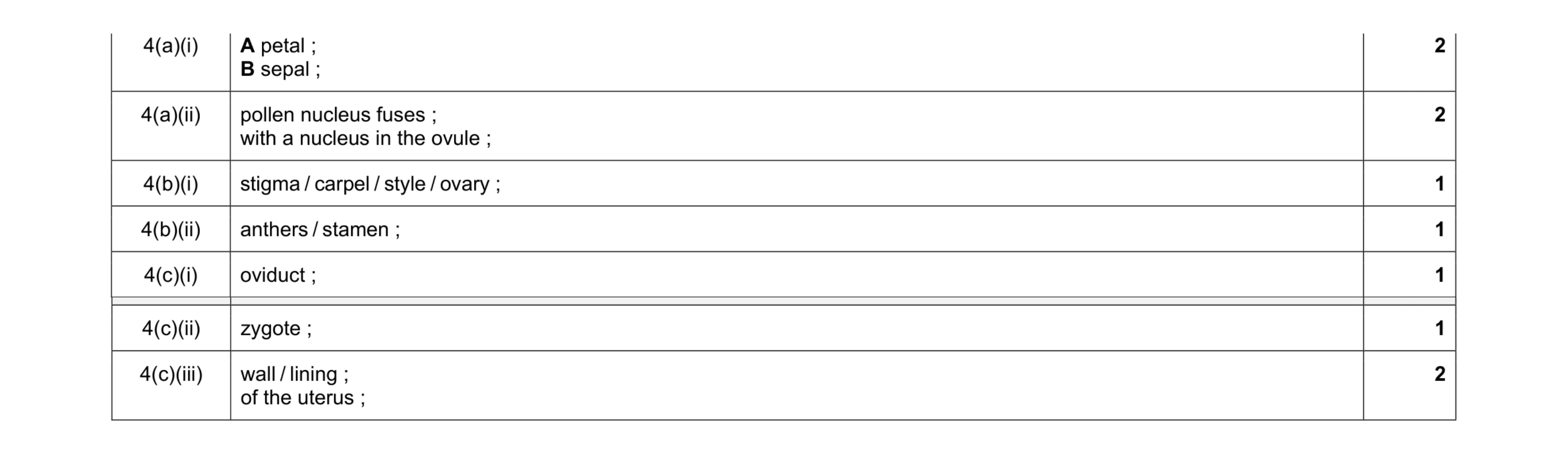 10
10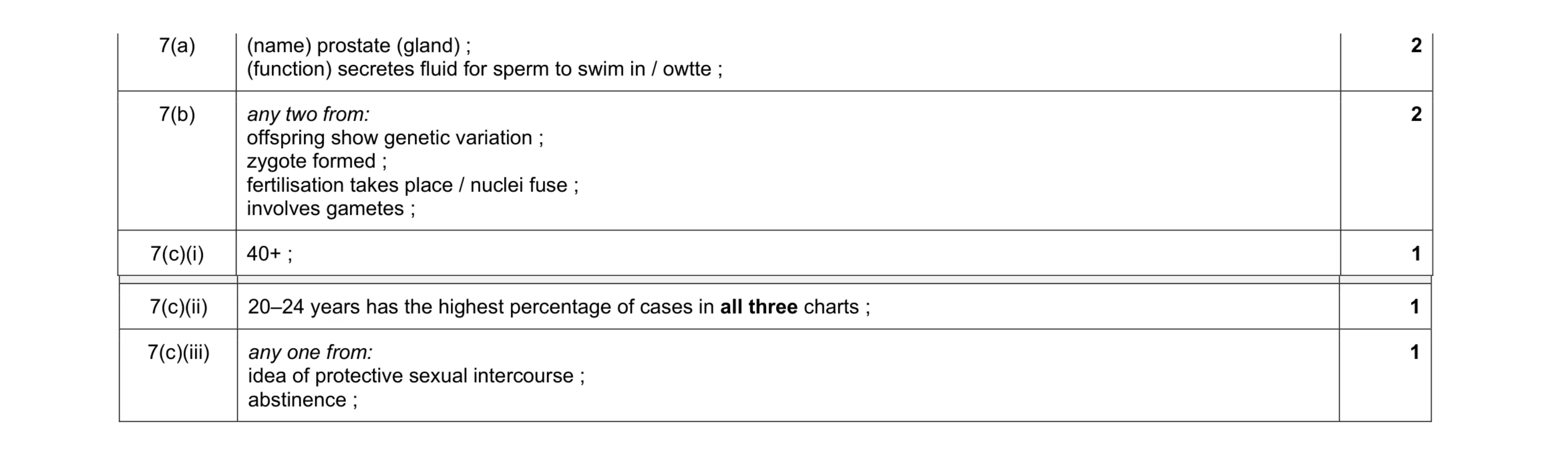 7
7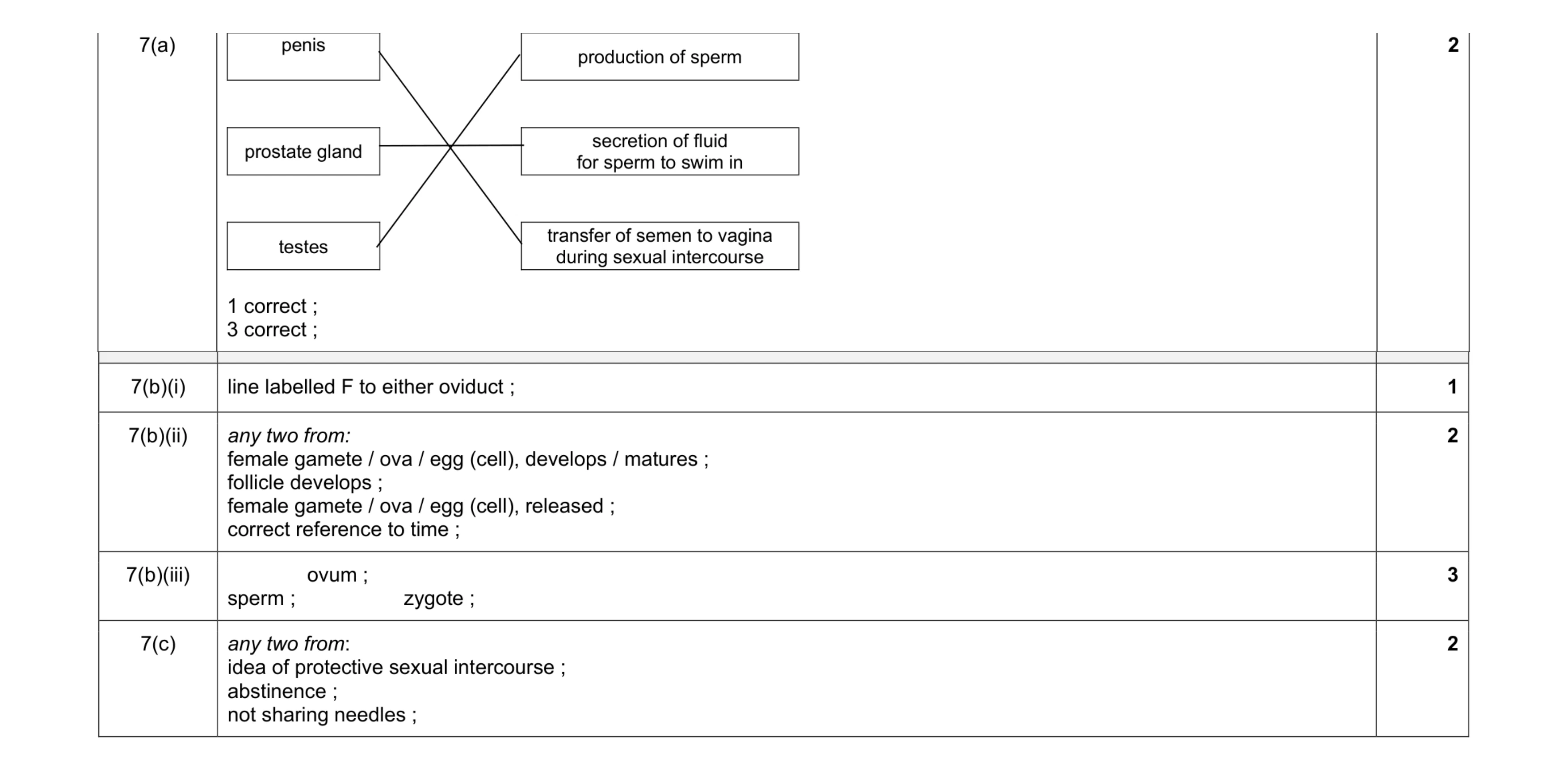 10
10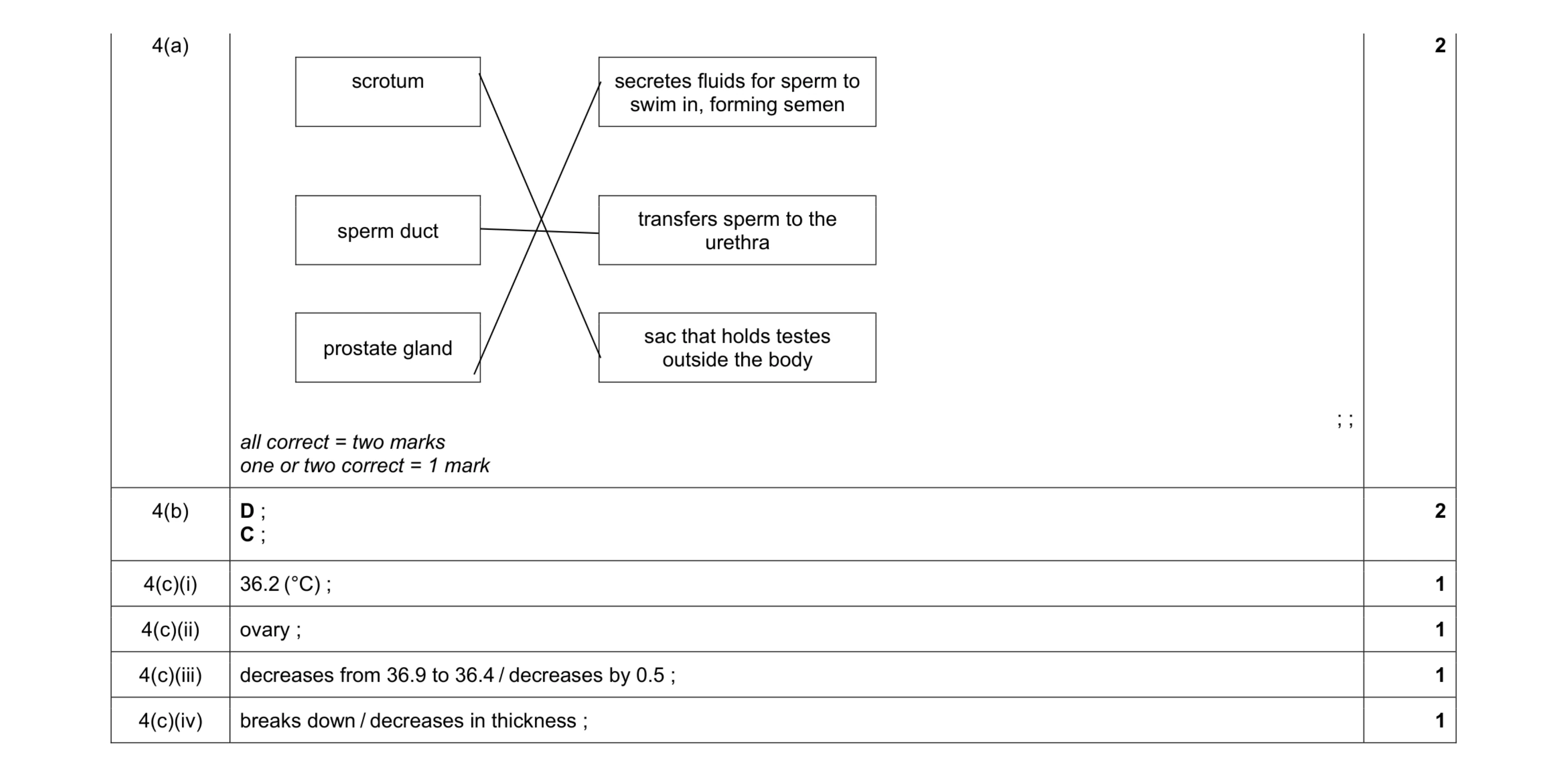 8
8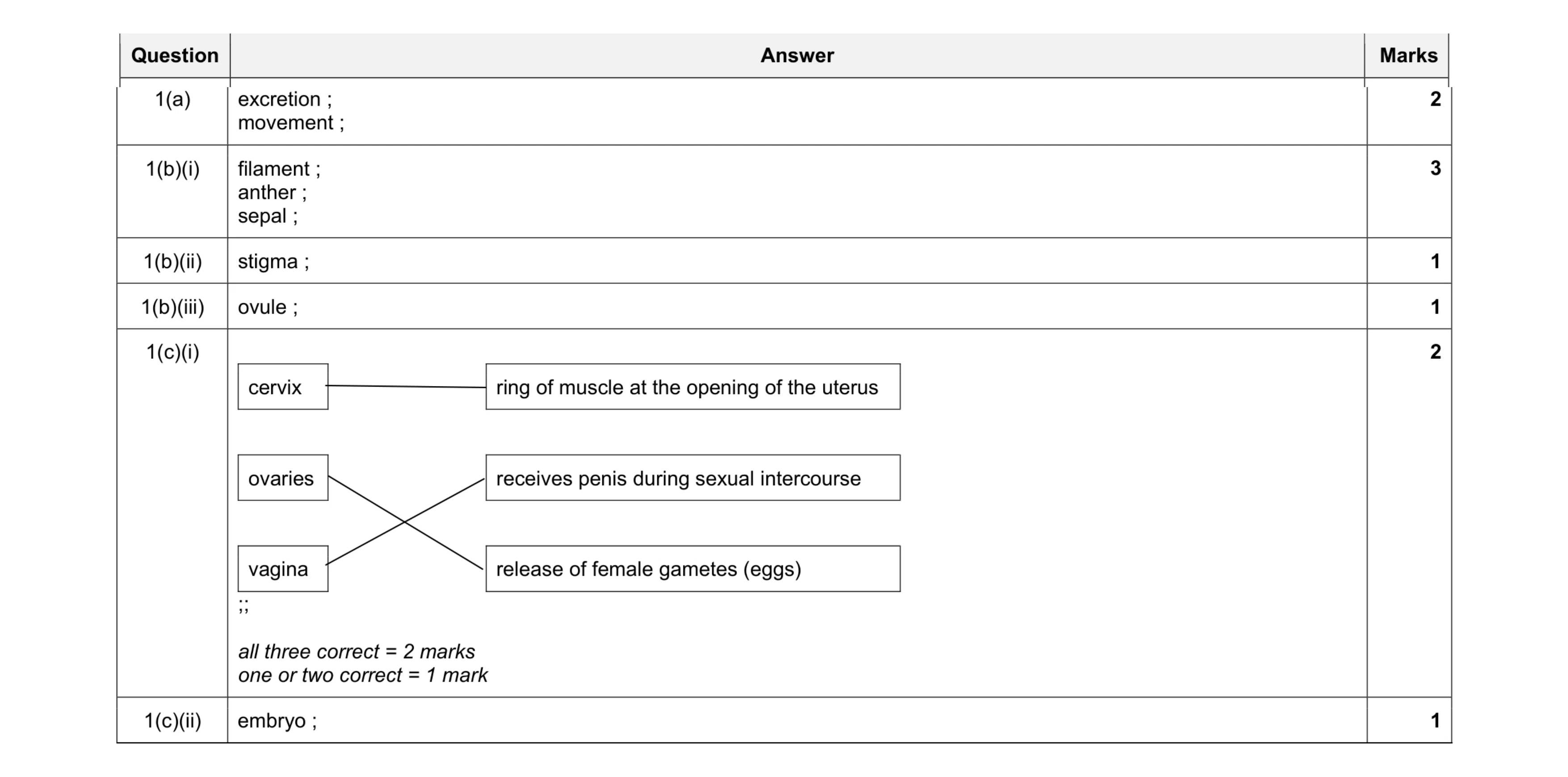 10
10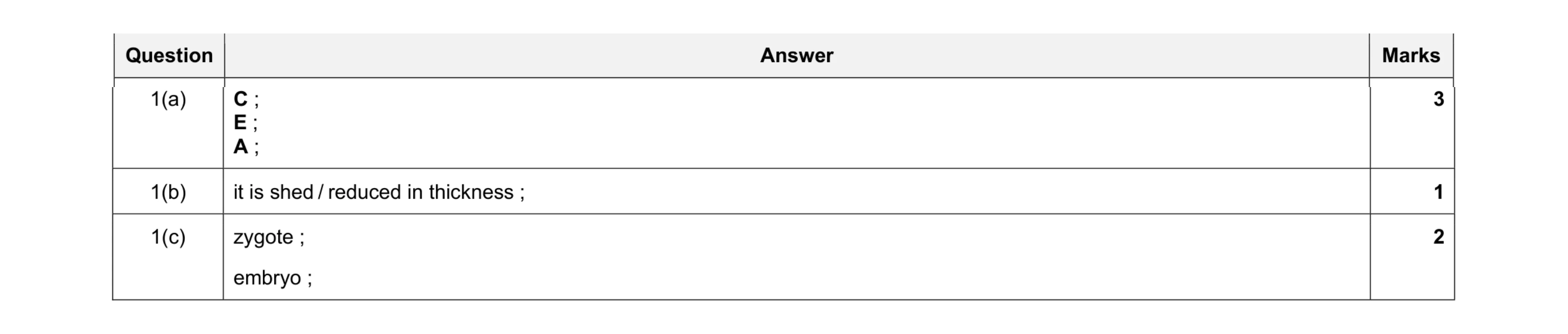 6
6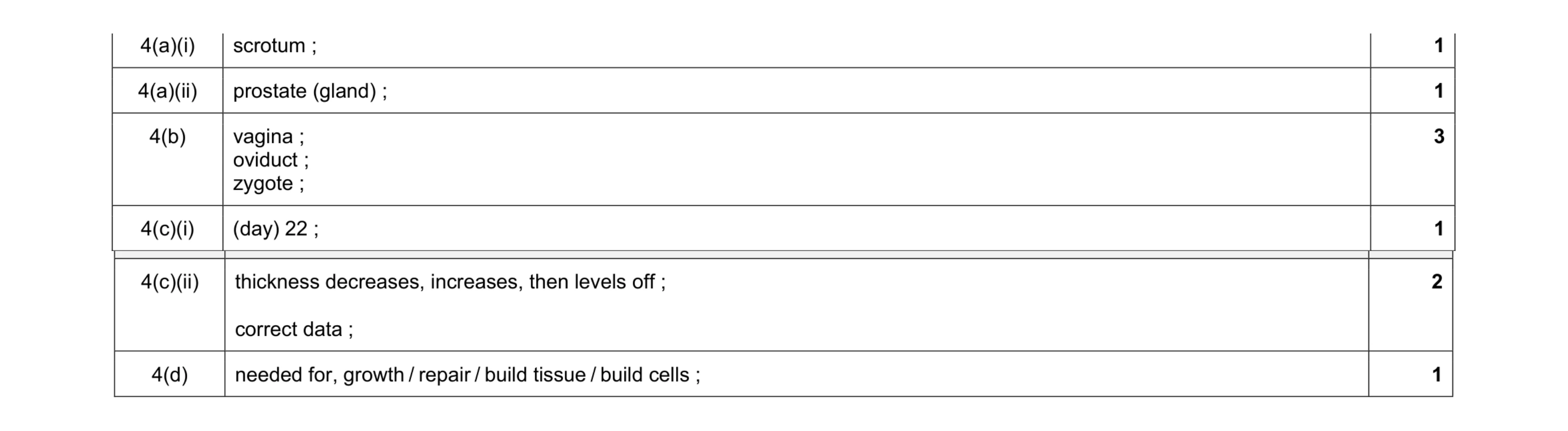 9
9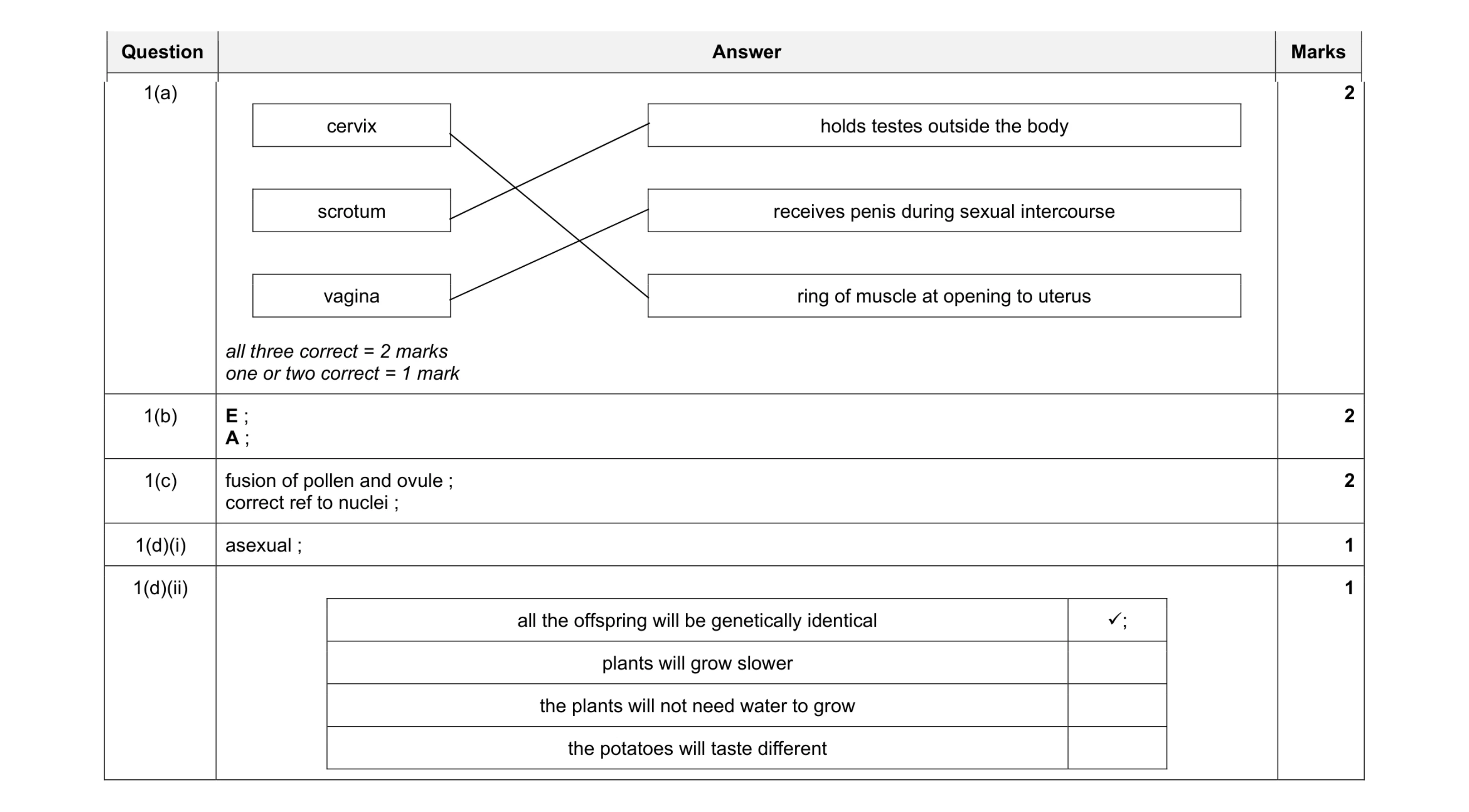 8
8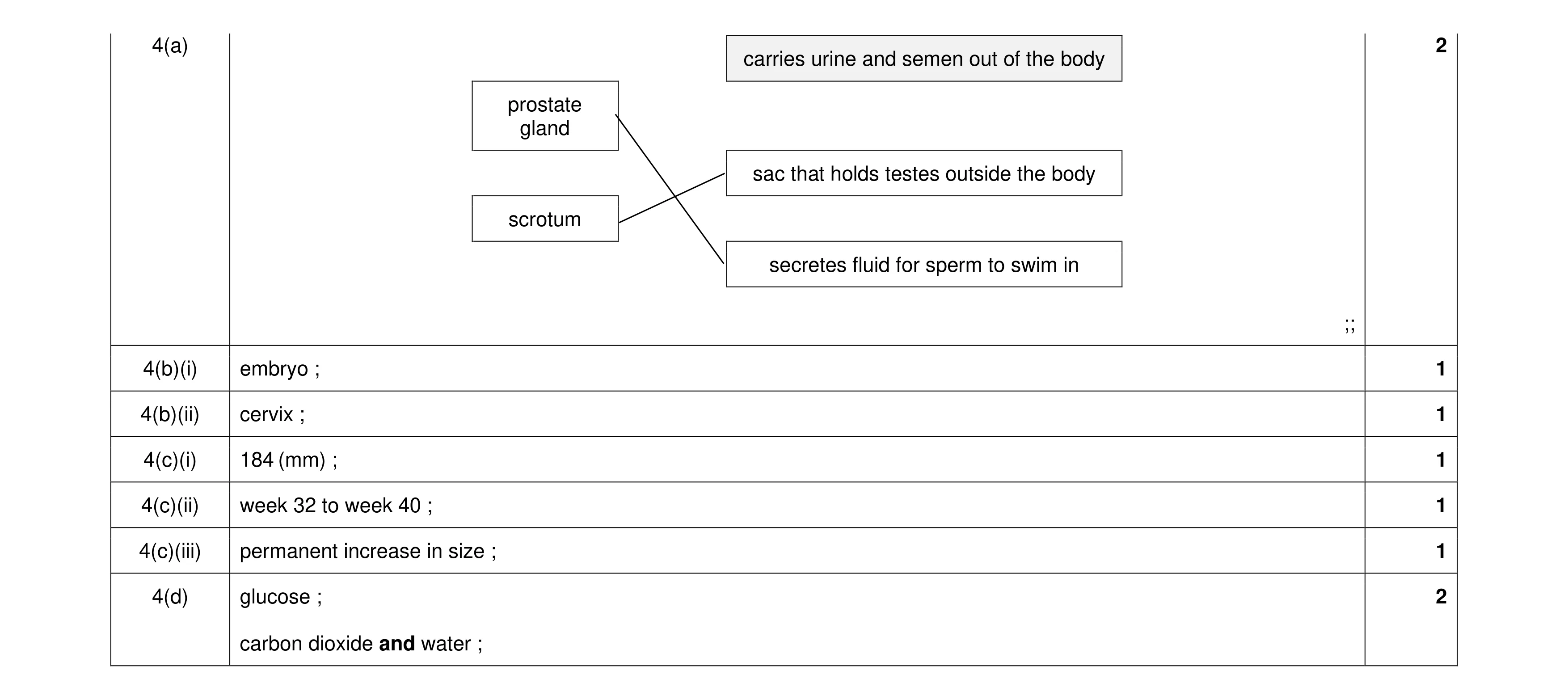 9
9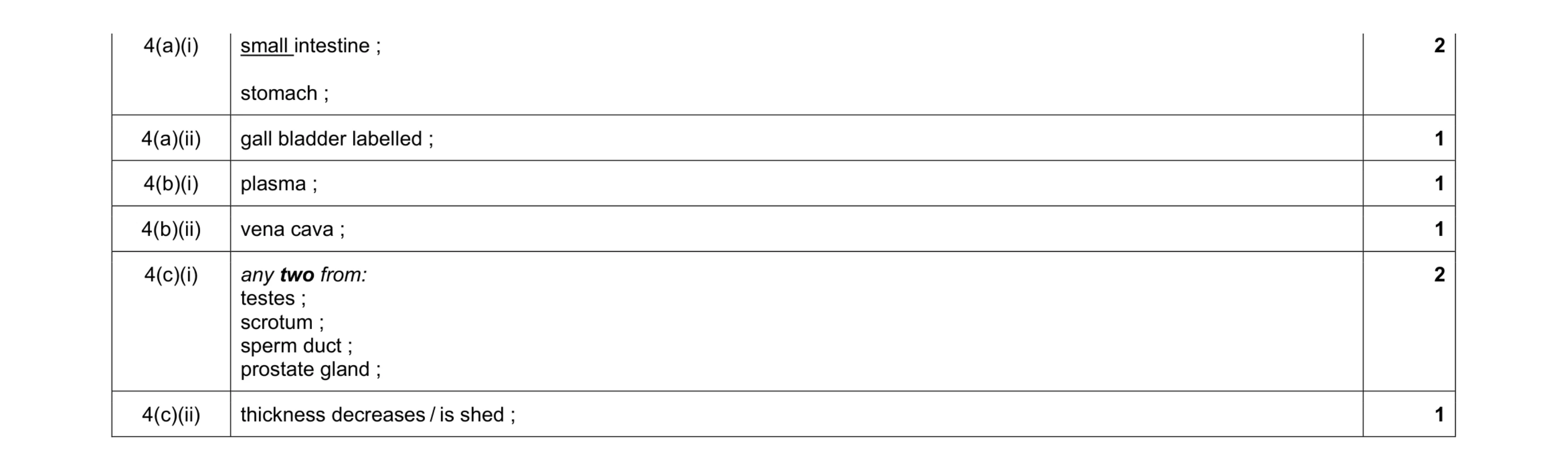 8
8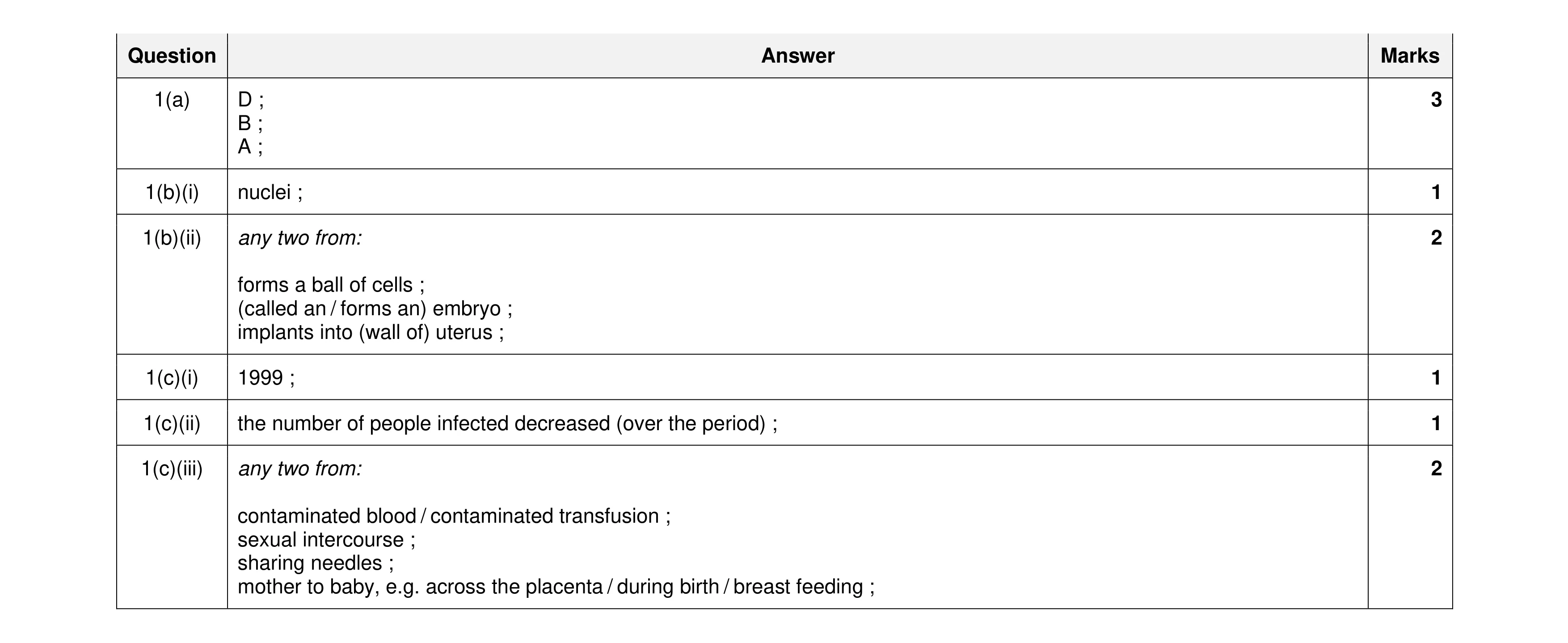 10
10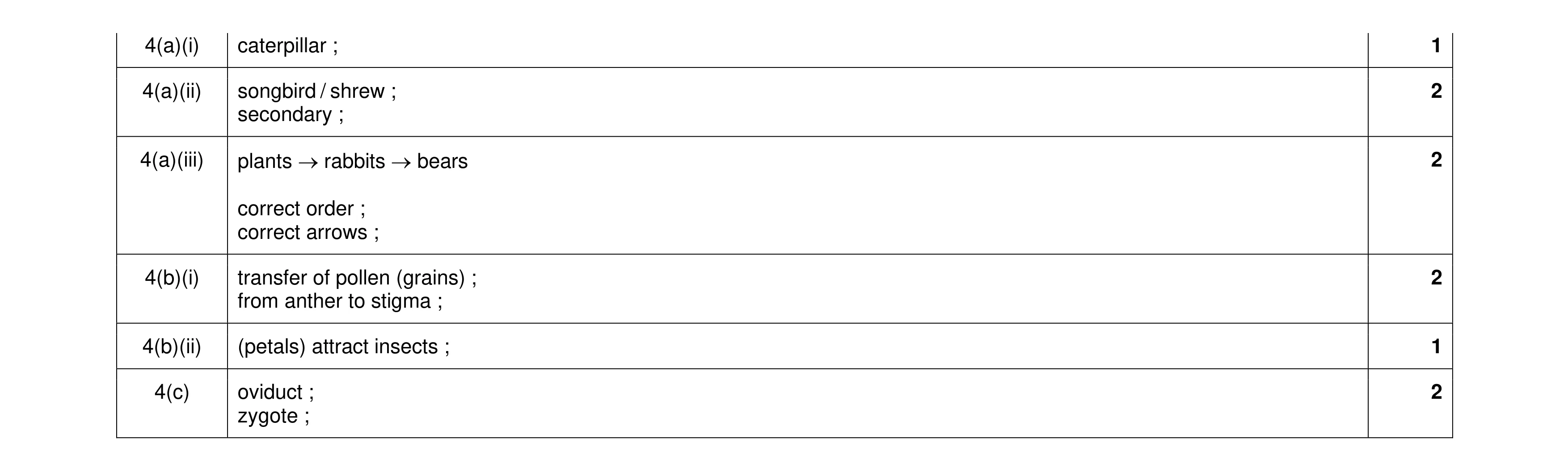 10
10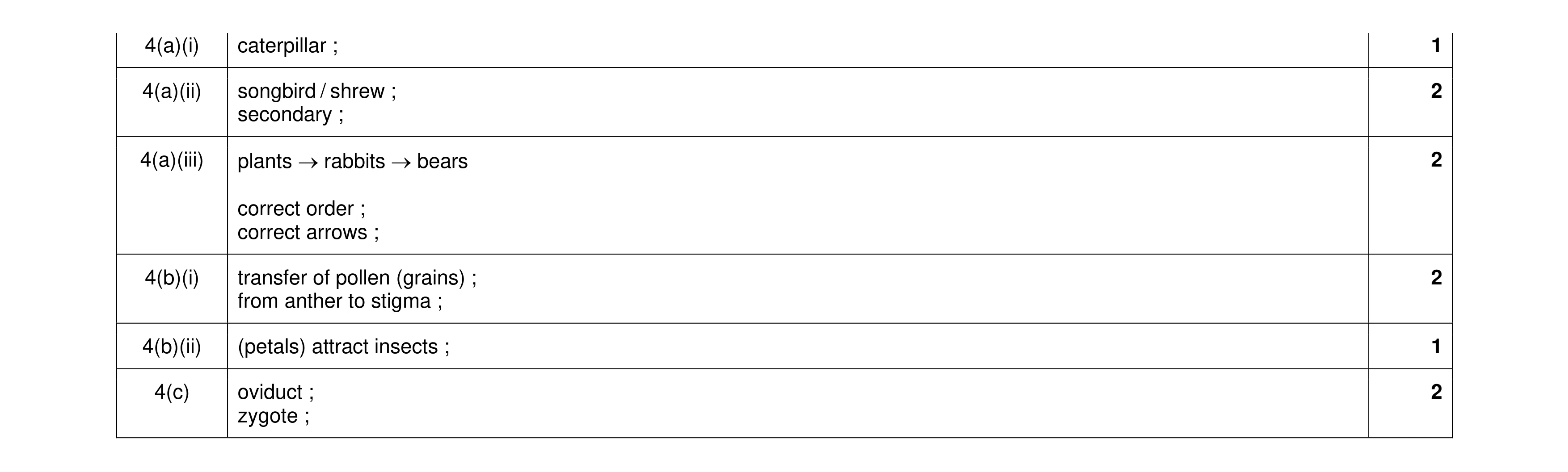 10
10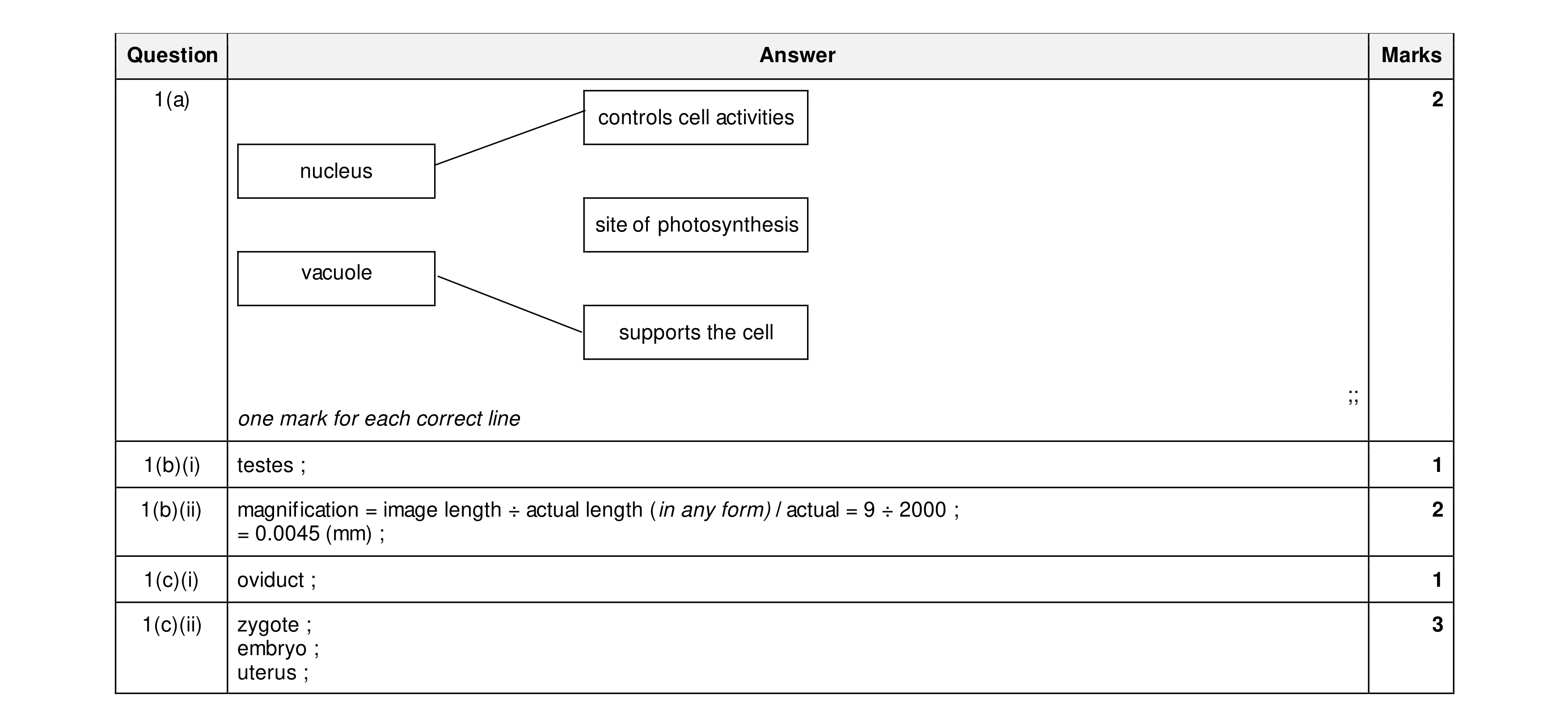 9
9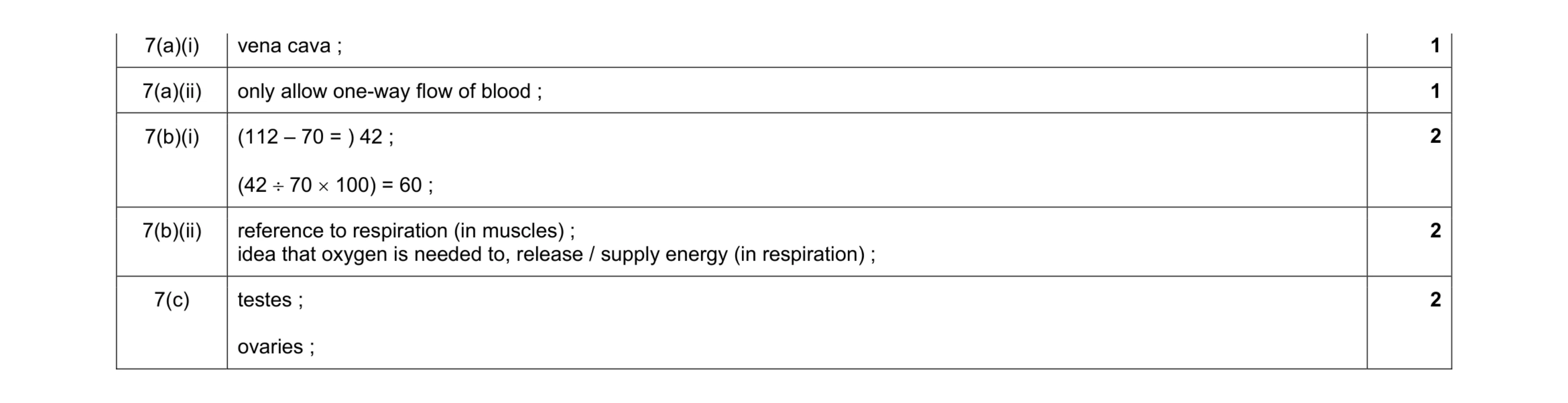 8
8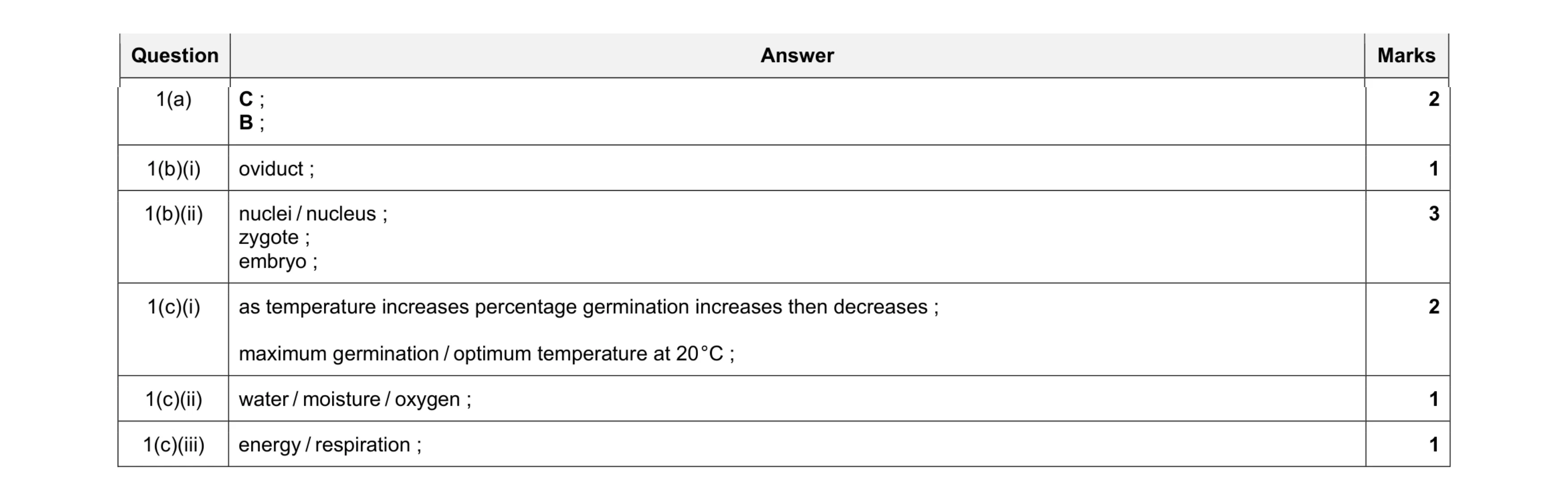 10
10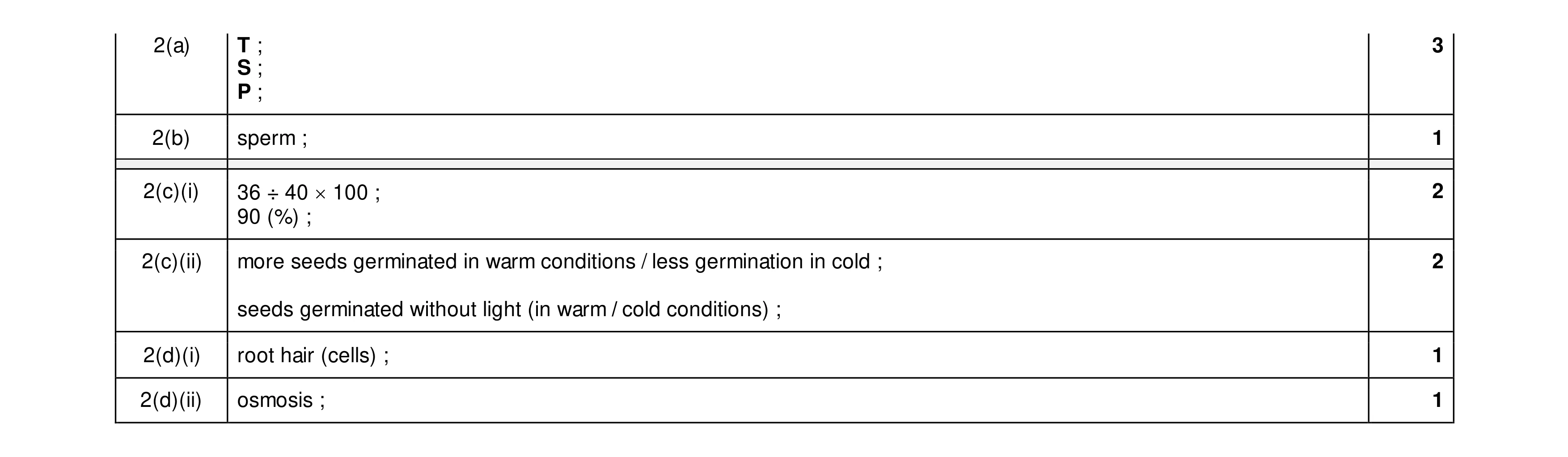 10
10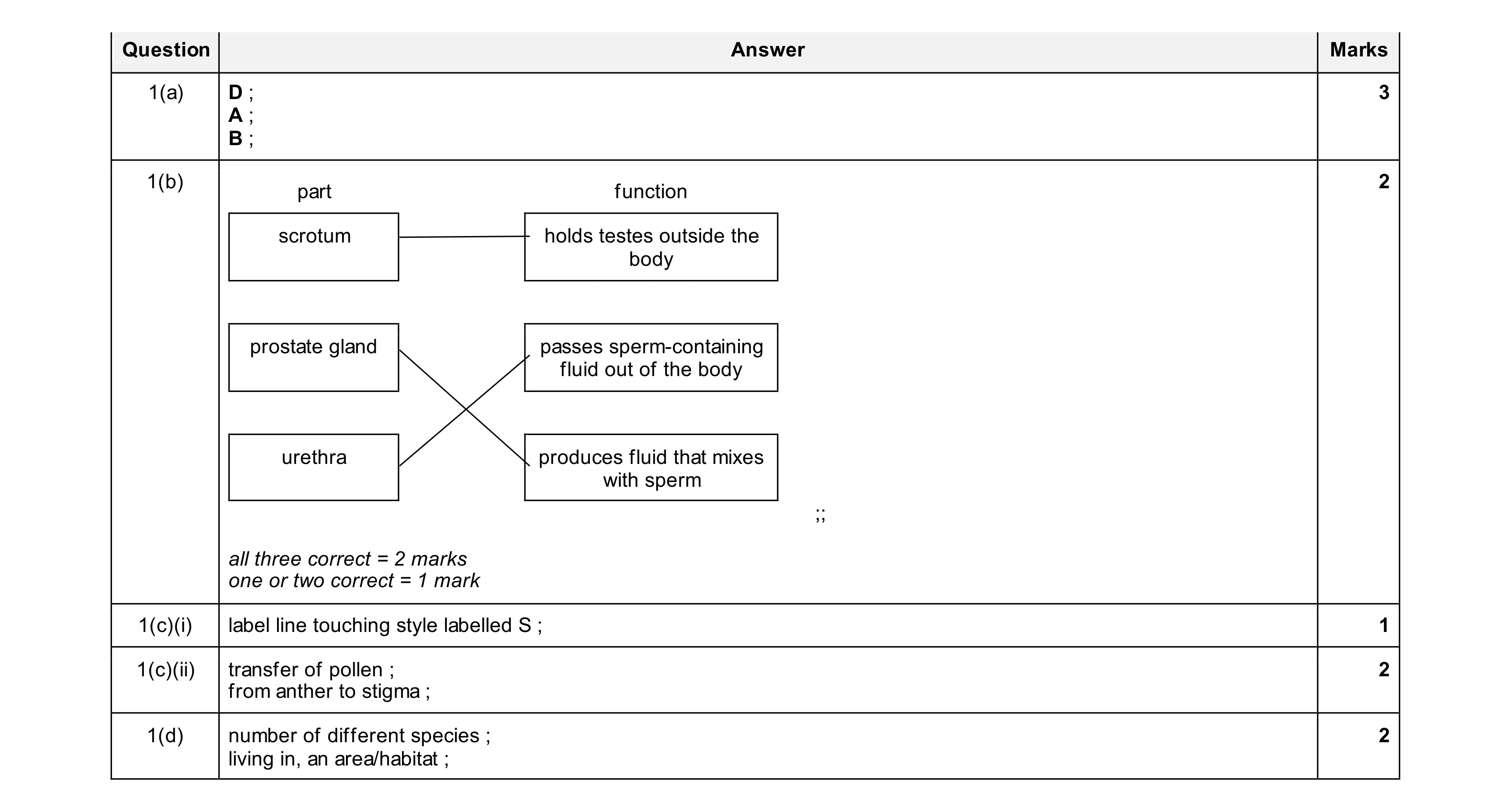 10
10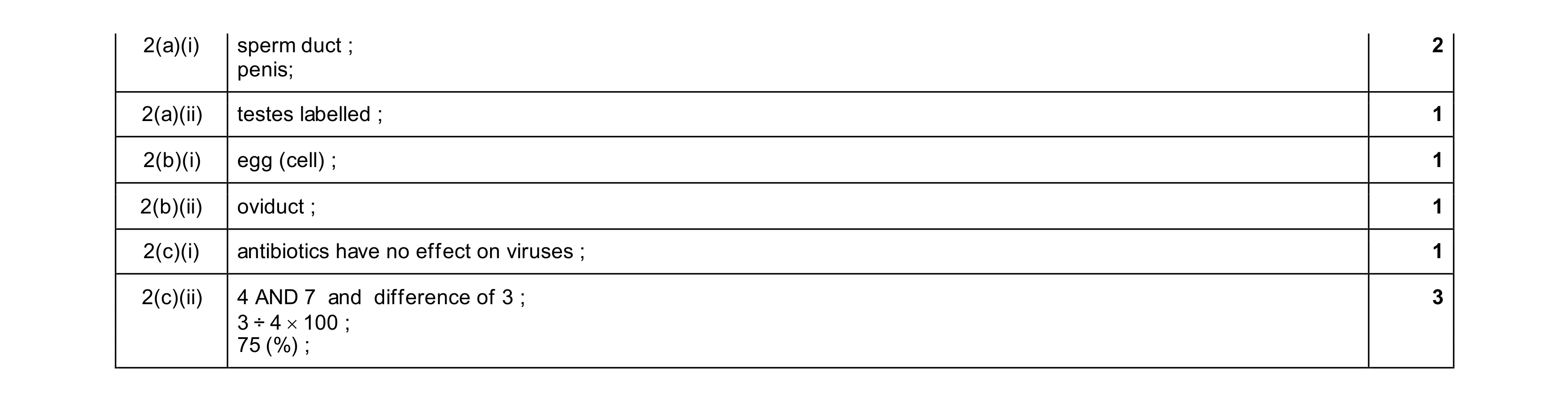 9
9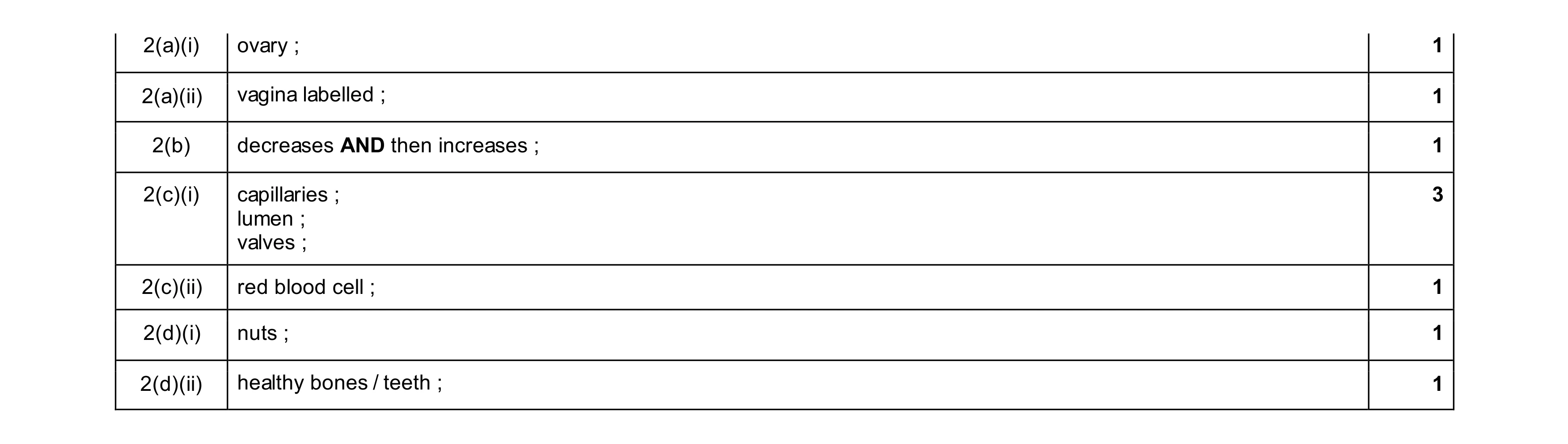 9
9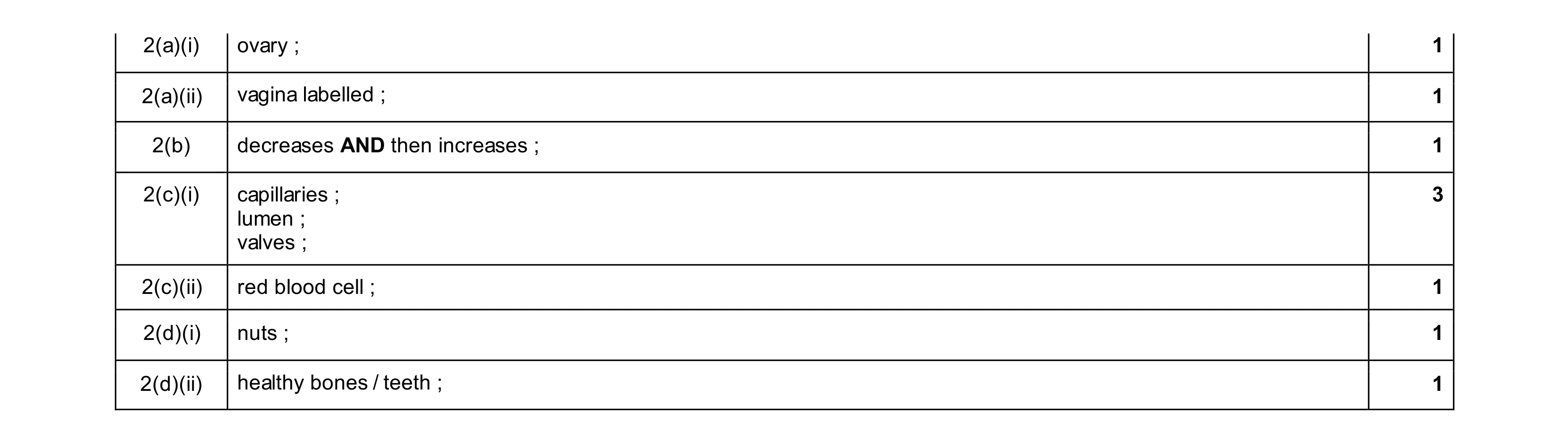 9
9