Questions as text
Q1 · A fetus is the name given to a developing baby in the later stages of pregnancy 0653/42 Oct/Nov 2017
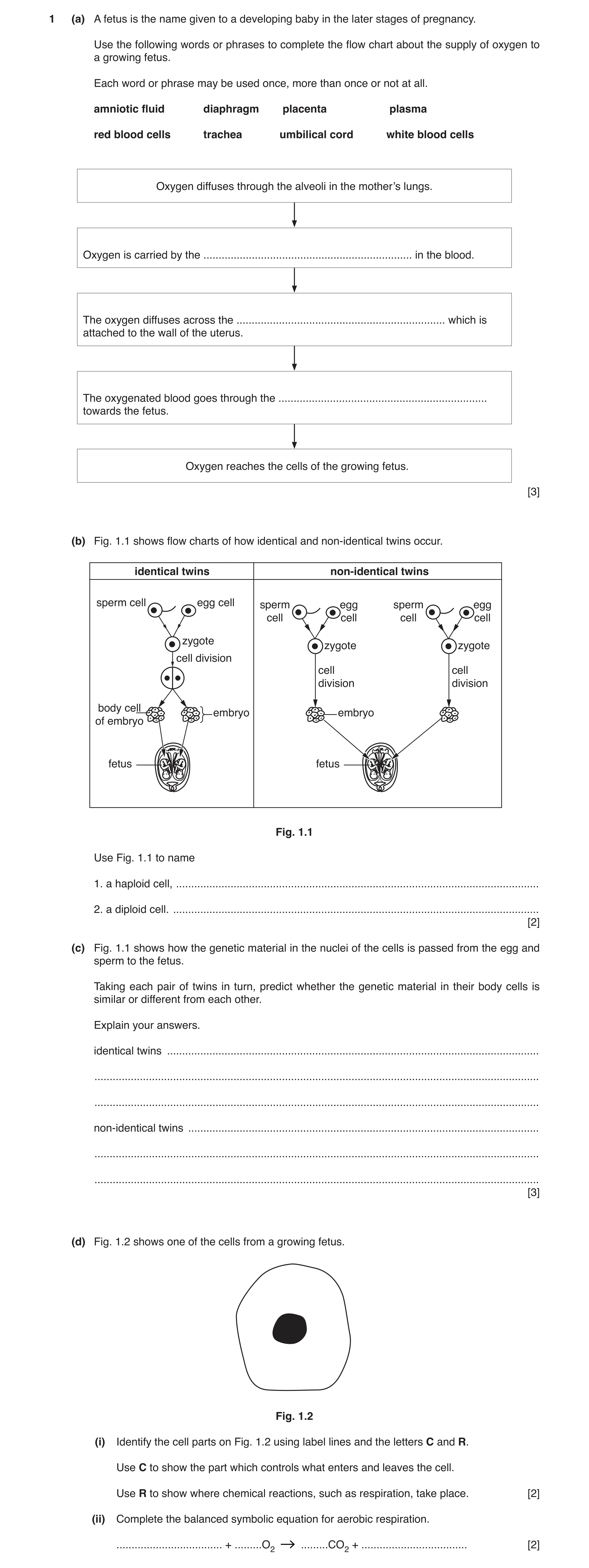
1 (a) A fetus is the name given to a developing baby in the later stages of pregnancy. Use the following words or phrases to complete the flow chart about the supply of oxygen to a growing fetus. Each word or phrase may be used once, more than once or not at all. amniotic fluid diaphragm placenta plasma red blood cells trachea umbilical cord white blood cells Oxygen diffuses through the alveoli in the mother’s lungs. Oxygen is carried by the … in the blood. The oxygen diffuses across the … which is attached to the wall of the uterus. The oxygenated blood goes through the … towards the fetus. Oxygen reaches the cells of the growing fetus. [3] (b) Fig. 1.1 shows flow charts of how identical and non-identical twins occur. identical twins non-identical twins sperm cell egg cell sperm egg sperm egg cell cell cell cell zygote zygote zygote cell division cell cell division division body cell embryo embryo of embryo fetus fetus Fig. 1.1 Use Fig. 1.1 to name 1. a haploid cell, … 2. a diploid cell. … [2] (c) Fig. 1.1 shows how the genetic material in the nuclei of the cells is passed from the egg and sperm to the fetus. Taking each pair of twins in turn, predict whether the genetic material in their body cells is similar or different from each other. Explain your answers. identical twins … … … non-identical twins … … … [3] (d) Fig. 1.2 shows one of the cells from a growing fetus. Fig. 1.2 (i) Identify the cell parts on Fig. 1.2 using label lines and the letters C and R. Use C to show the part which controls what enters and leaves the cell. Use R to show where chemical reactions, such as respiration, take place. [2] (ii) Complete the balanced symbolic equation for aerobic respiration. … + … O2 … CO2 + … [2]
12 marks
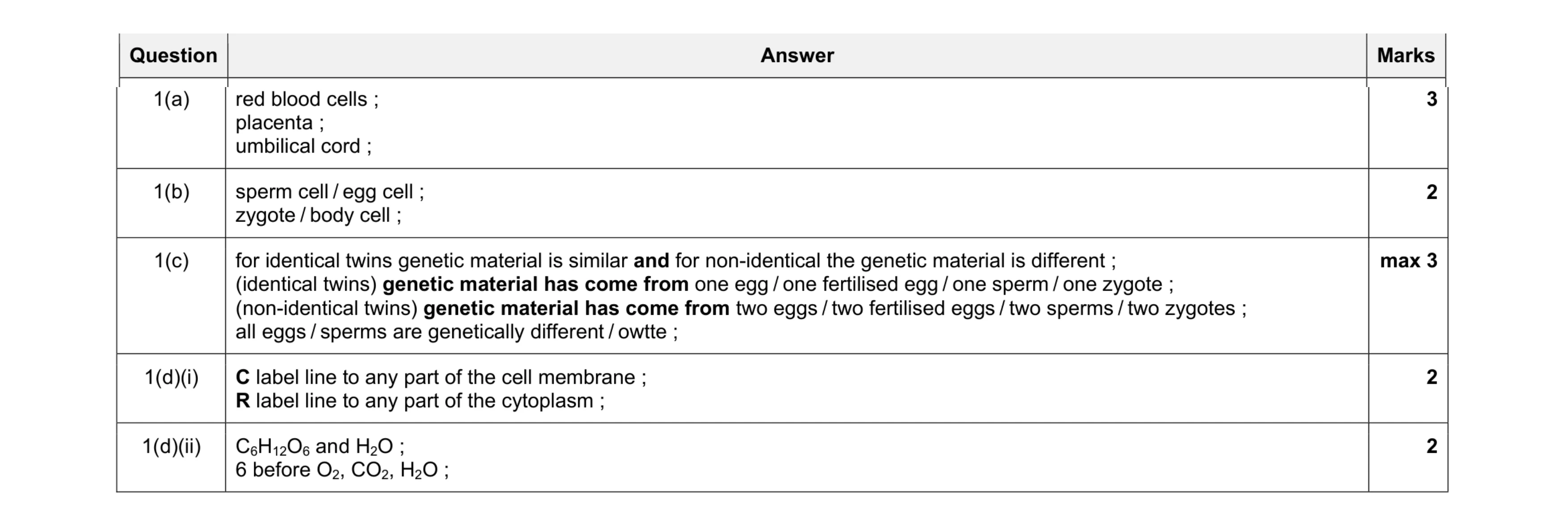
Mark scheme: 1(a) red blood cells ; placenta ; umbilical cord ; 3 1(b) sperm cell / egg cell ; zygote / body cell ; 2 1(c) for identical twins genetic material is similar and for non-identical the genetic material is different ; (identical twins) genetic material has come from one egg / one fertilised egg / one sperm / one zygote ; (non-identical twins) genetic material has come from two eggs / two fertilised eggs / two sperms / two zygotes ; all eggs / sperms are genetically different / owtte ; max 3 1(d)(i) C label line to any part of the cell membrane ; R label line to any part of the cytoplasm ; 2 1(d)(ii) C6H12O6 and H2O ; 6 before O2, CO2, H2O ; 2
This question in 0653/42 Oct/Nov 2017
Q2 · A diagram of the female reproductive system and some events that take place before and… 0653/42 Feb/March 2018
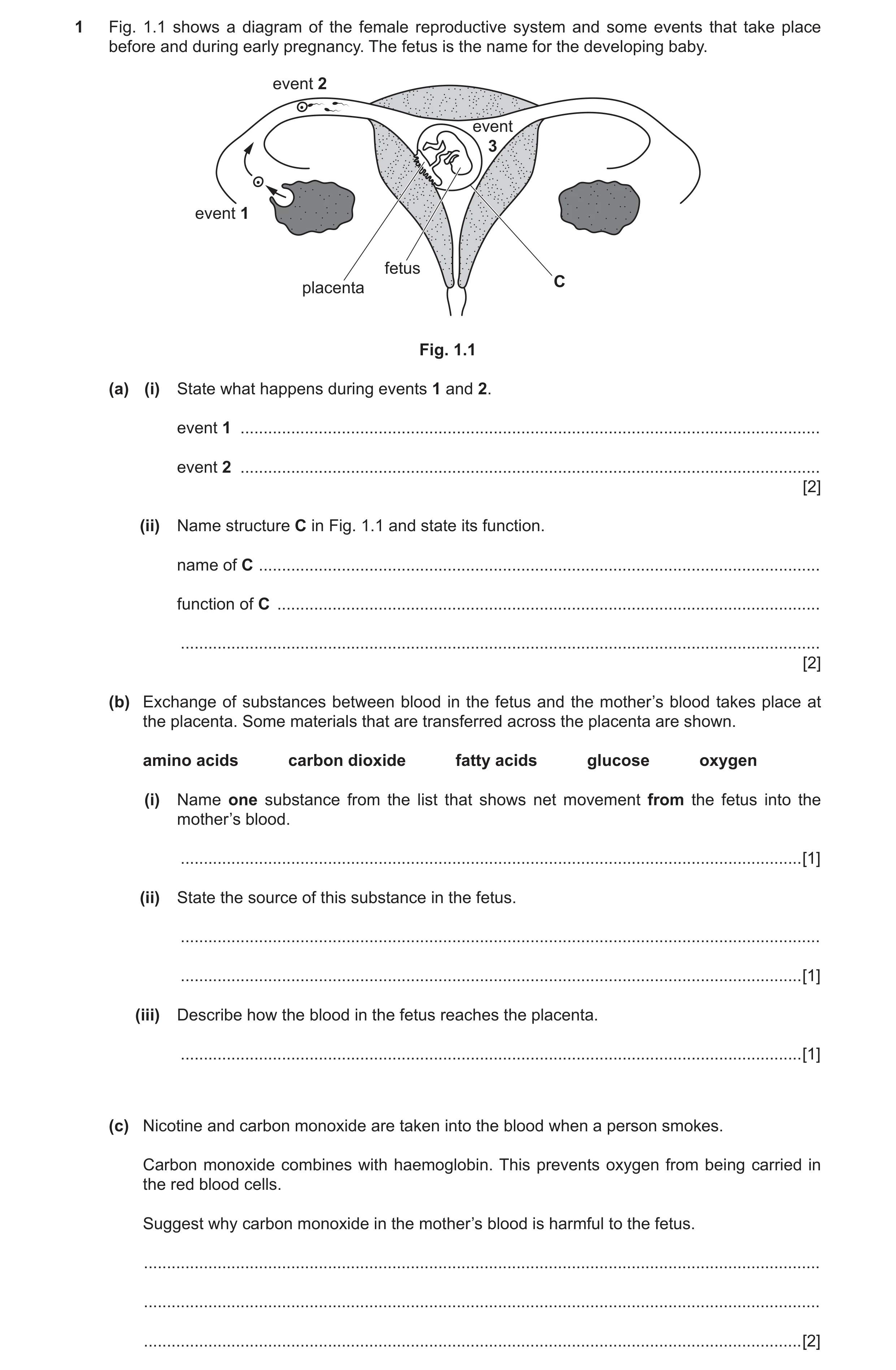
1 Fig. 1.1 shows a diagram of the female reproductive system and some events that take place before and during early pregnancy. The fetus is the name for the developing baby. event 2 event 3 event 1 fetus C placenta Fig. 1.1 (a) (i) State what happens during events 1 and 2. event 1 … event 2 … [2] (ii) Name structure C in Fig. 1.1 and state its function. name of C … function of C … … [2] (b) Exchange of substances between blood in the fetus and the mother’s blood takes place at the placenta. Some materials that are transferred across the placenta are shown. amino acids carbon dioxide fatty acids glucose oxygen (i) Name one substance from the list that shows net movement from the fetus into the mother’s blood. … [1] (ii) State the source of this substance in the fetus. … … [1] (iii) Describe how the blood in the fetus reaches the placenta. … [1] (c) Nicotine and carbon monoxide are taken into the blood when a person smokes. Carbon monoxide combines with haemoglobin. This prevents oxygen from being carried in the red blood cells. Suggest why carbon monoxide in the mother’s blood is harmful to the fetus. … … … [2]
9 marks
Mark scheme: 1(a)(i) 1 ovulation ; 2 fertilisation ; 2 1(a)(ii) amnion / amniotic membrane ; contains (amniotic) fluid ; 2 1(b)(i) carbon dioxide ; 1 1(b)(ii) (waste product of / produced by) respiration ; 1 1(b)(iii) through umbilical cord ; 1 1(c) reduces oxygen available (to fetus) ; any consequence e.g. reduced respiration / growth ; 2
This question in 0653/42 Feb/March 2018
Q3 · A diagram of an alveolus 0653/41 Oct/Nov 2018
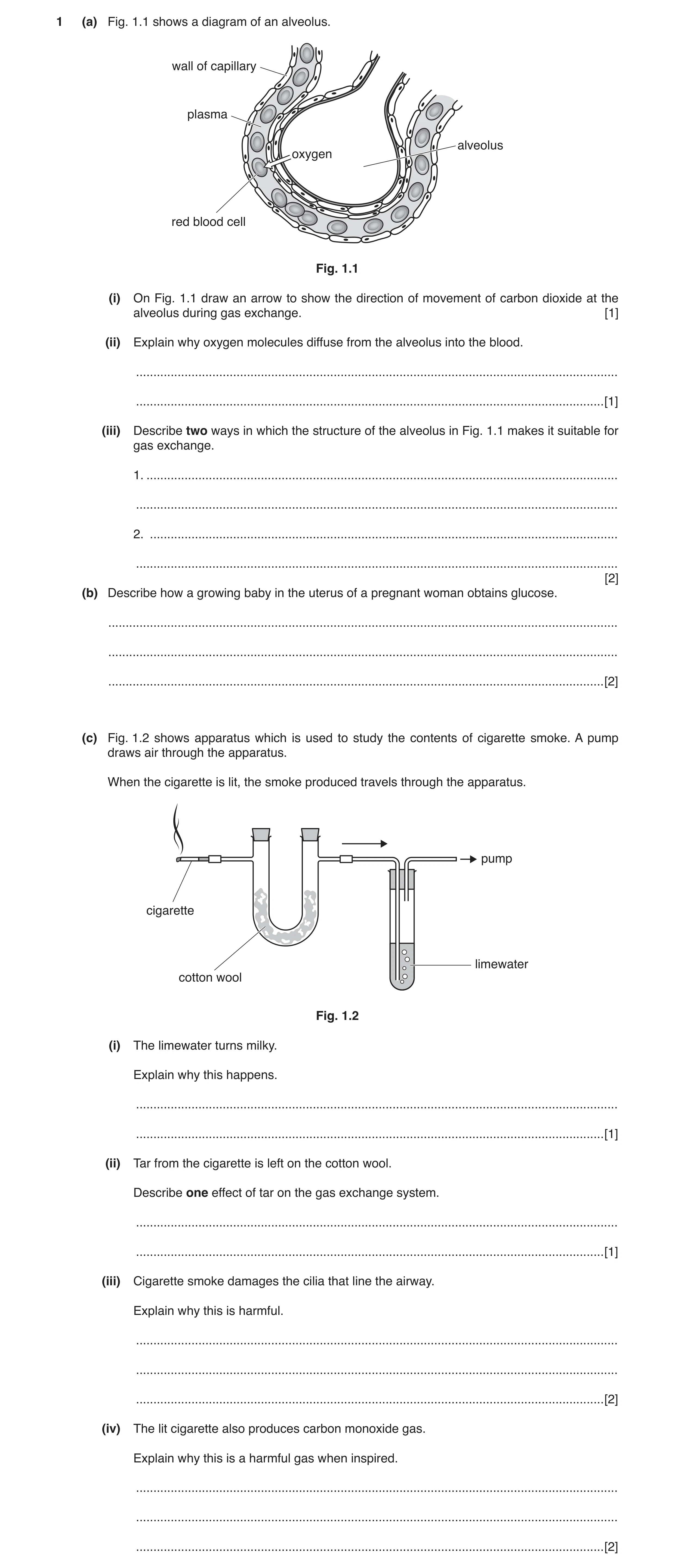
1 (a) Fig. 1.1 shows a diagram of an alveolus. wall of capillary plasma alveolus oxygen red blood cell Fig. 1.1 (i) On Fig. 1.1 draw an arrow to show the direction of movement of carbon dioxide at the alveolus during gas exchange. [1] (ii) Explain why oxygen molecules diffuse from the alveolus into the blood. … … [1] (iii) Describe two ways in which the structure of the alveolus in Fig. 1.1 makes it suitable for gas exchange. 1. … … 2. … … [2] (b) Describe how a growing baby in the uterus of a pregnant woman obtains glucose. … … … [2] (c) Fig. 1.2 shows apparatus which is used to study the contents of cigarette smoke. A pump draws air through the apparatus. When the cigarette is lit, the smoke produced travels through the apparatus. pump cigarette limewater cotton wool Fig. 1.2 (i) The limewater turns milky. Explain why this happens. … … [1] (ii) Tar from the cigarette is left on the cotton wool. Describe one effect of tar on the gas exchange system. … … [1] (iii) Cigarette smoke damages the cilia that line the airway. Explain why this is harmful. … … … [2] (iv) The lit cigarette also produces carbon monoxide gas. Explain why this is a harmful gas when inspired. … … … [2]
12 marks
Mark scheme: 1(a)(i) arrow drawn from the plasma of the blood to the air sac of alveolus ; 1 1(a)(ii) there is a concentration / diffusion gradient / greater oxygen concentration in alveolus than the blood ; 1 1(a)(iii) thin wall / flattened cells ; large surface area ; good blood supply ; Max 2 2 1(b) through placenta ; and then one of by diffusion ; via (umbilical) cord ; Max 2 2 1(c)(i) carbon dioxide / CO2 / produced / present (in smoke) ; 1 1(c)(ii) causes cancer ; stimulates mucus production ; Max 1 1 1(c)(iii) mucus cannot be swept out of the lungs ; pathogens / particles (in mucus) more likely to enter lungs ; 2 1(c)(iv) combines with the haemoglobin / red blood cells ; CO replaces oxygen (on haemoglobin) ; reduces the transport of oxygen by blood / less oxygen available ( for cells) ; Max 2 2
This question in 0653/41 Oct/Nov 2018
Q4 · A diagram of the internal structure of the heart 0653/42 Oct/Nov 2018
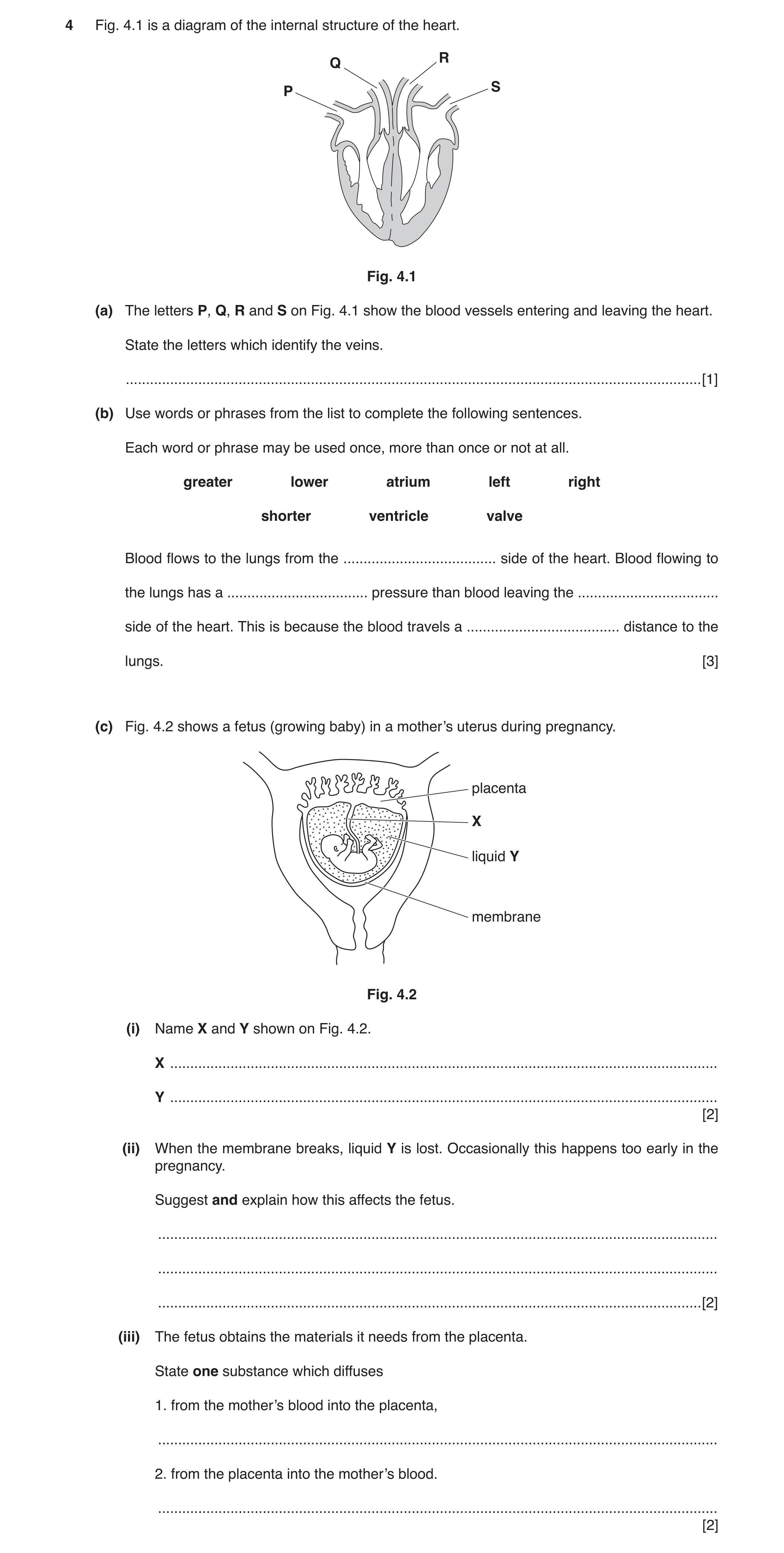
4 Fig. 4.1 is a diagram of the internal structure of the heart. R Q S P Fig. 4.1 (a) The letters P, Q, R and S on Fig. 4.1 show the blood vessels entering and leaving the heart. State the letters which identify the veins. … [1] (b) Use words or phrases from the list to complete the following sentences. Each word or phrase may be used once, more than once or not at all. greater lower atrium left right shorter ventricle valve Blood flows to the lungs from the … side of the heart. Blood flowing to the lungs has a … pressure than blood leaving the … side of the heart. This is because the blood travels a … distance to the lungs. [3] (c) Fig. 4.2 shows a fetus (growing baby) in a mother’s uterus during pregnancy. placenta X liquid Y membrane Fig. 4.2 (i) Name X and Y shown on Fig. 4.2. X … Y … [2] (ii) When the membrane breaks, liquid Y is lost. Occasionally this happens too early in the pregnancy. Suggest and explain how this affects the fetus. … … … [2] (iii) The fetus obtains the materials it needs from the placenta. State one substance which diffuses 1. from the mother’s blood into the placenta, … 2. from the placenta into the mother’s blood. … [2]
10 marks
Mark scheme: 4(a) P and S ; 1 Question Answer Marks 4(b) right ; lower ; left ; shorter ; 3 4(c)(i) X umbilical cord ; Y amniotic fluid ; 2 4(c)(ii) reference to the loss of protection (of fetus) ; higher risk of physical damage / infection / premature birth ; 2 4(c)(iii) oxygen / glucose / any named dissolved nutrient ; carbon dioxide ; 2
This question in 0653/42 Oct/Nov 2018
Q5 · A diagram of a sperm cell showing its adaptive features 0653/41 May/June 2019
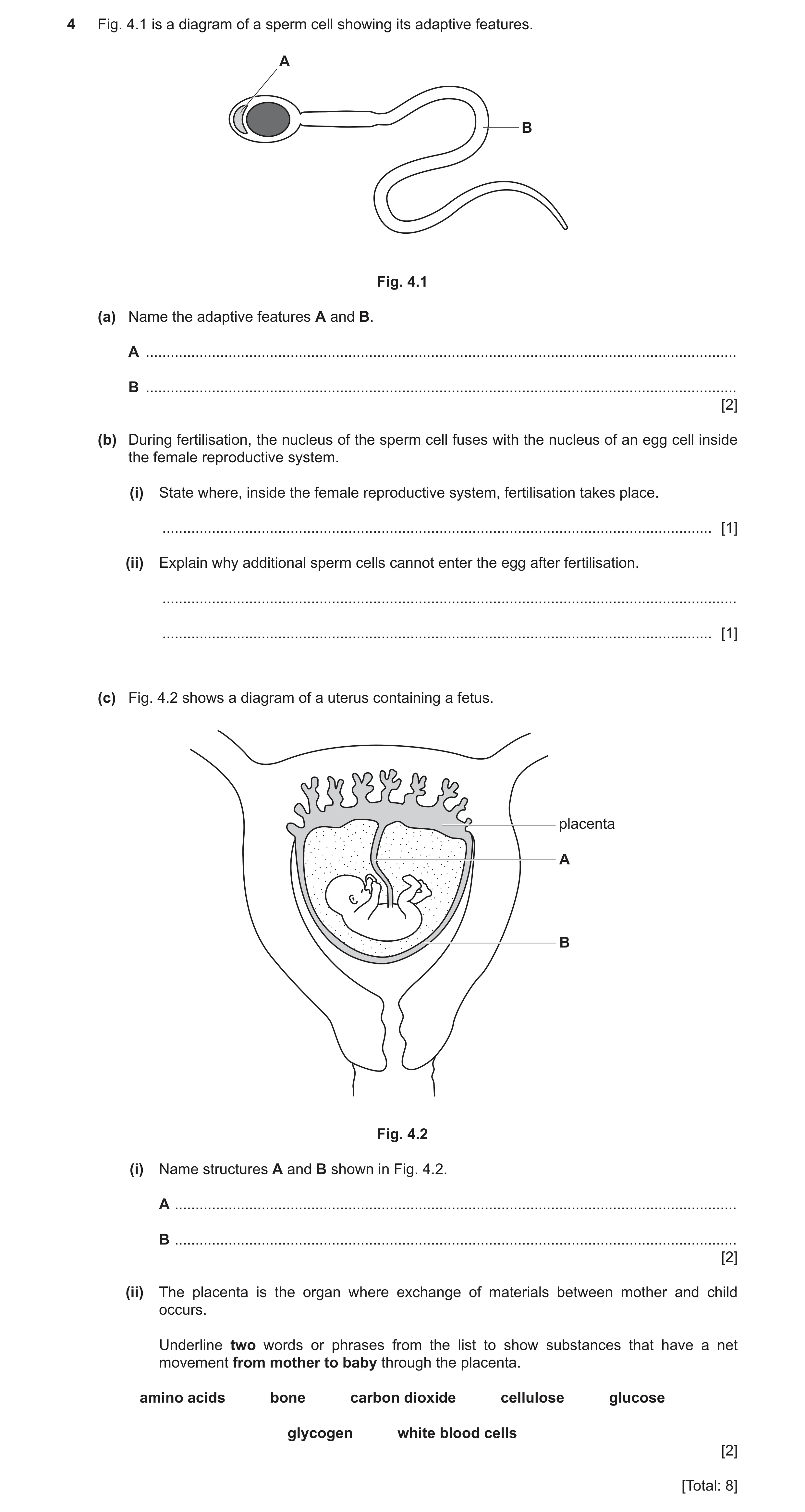
4 Fig. 4.1 is a diagram of a sperm cell showing its adaptive features. A B Fig. 4.1 (a) Name the adaptive features A and B. A … B … [2] (b) During fertilisation, the nucleus of the sperm cell fuses with the nucleus of an egg cell inside the female reproductive system. (i) State where, inside the female reproductive system, fertilisation takes place. … [1] (ii) Explain why additional sperm cells cannot enter the egg after fertilisation. … … [1] (c) Fig. 4.2 shows a diagram of a uterus containing a fetus. placenta A B Fig. 4.2 (i) Name structures A and B shown in Fig. 4.2. A … B … [2] (ii) The placenta is the organ where exchange of materials between mother and child occurs. Underline two words or phrases from the list to show substances that have a net movement from mother to baby through the placenta. amino acids bone carbon dioxide cellulose glucose glycogen white blood cells [2] [Total: 8]
8 marks
Mark scheme: 4(a) A – enzymes ; B – flagellum ; 2 4(b)(i) oviduct ; 1 4(b)(ii) jelly coating changes form after fertilisation (to prevent further entry of sperm) ; 1 4(c)(i) A umbilical cord ; B amniotic sac / amnion ; 2 4(c)(ii) glucose ; amino acids ; 2
This question in 0653/41 May/June 2019
Question 6 0653/41 Oct/Nov 2019
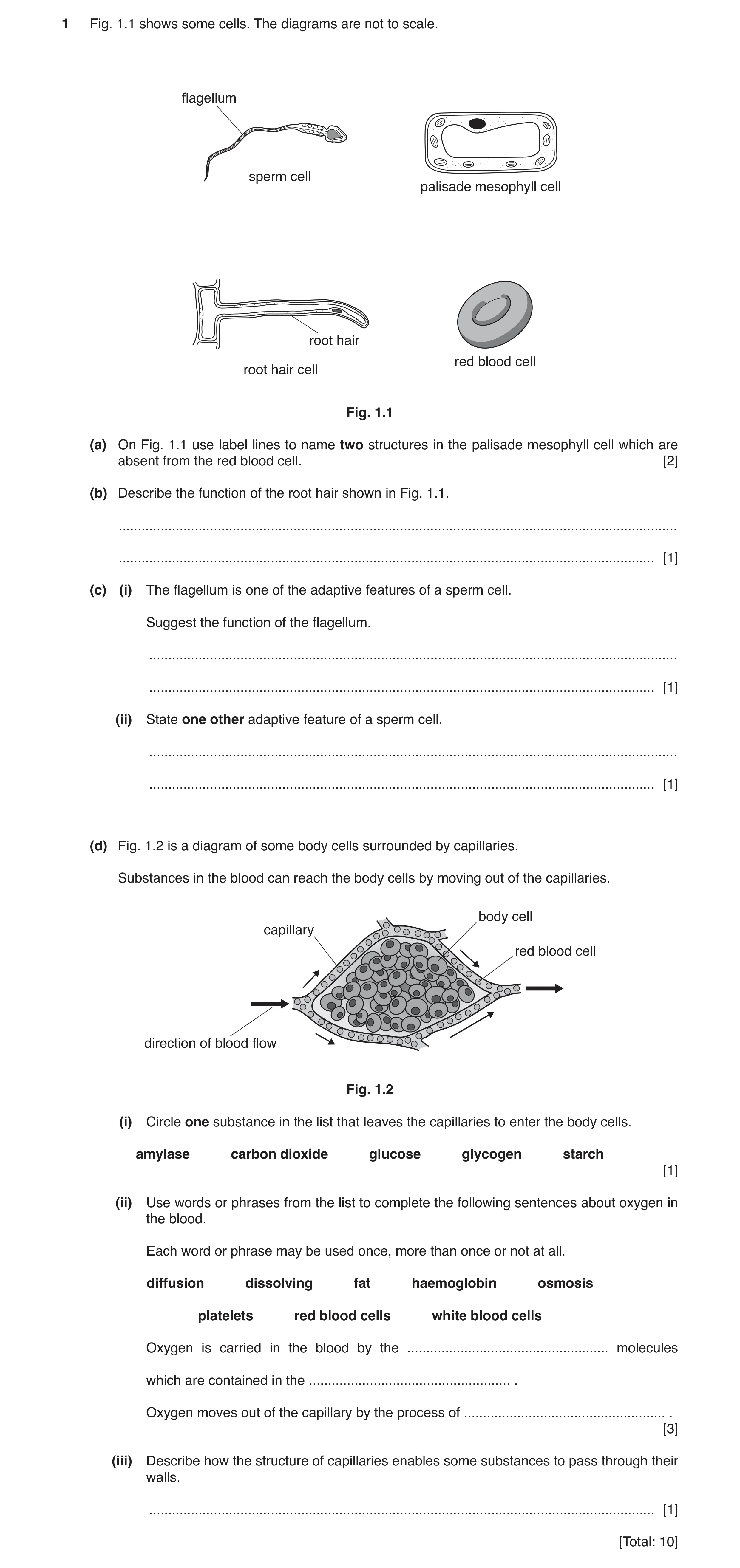
1 Fig. 1.1 shows some cells. The diagrams are not to scale. flagellum sperm cell palisade mesophyll cell root hair red blood cell root hair cell Fig. 1.1 (a) On Fig. 1.1 use label lines to name two structures in the palisade mesophyll cell which are absent from the red blood cell. [2] (b) Describe the function of the root hair shown in Fig. 1.1. … … [1] (c) (i) The flagellum is one of the adaptive features of a sperm cell. Suggest the function of the flagellum. … … [1] (ii) State one other adaptive feature of a sperm cell. … … [1] (d) Fig. 1.2 is a diagram of some body cells surrounded by capillaries. Substances in the blood can reach the body cells by moving out of the capillaries. body cell capillary red blood cell direction of blood flow Fig. 1.2 (i) Circle one substance in the list that leaves the capillaries to enter the body cells. amylase carbon dioxide glucose glycogen starch [1] (ii) Use words or phrases from the list to complete the following sentences about oxygen in the blood. Each word or phrase may be used once, more than once or not at all. diffusion dissolving fat haemoglobin osmosis platelets red blood cells white blood cells Oxygen is carried in the blood by the … molecules which are contained in the … . Oxygen moves out of the capillary by the process of … . [3] (iii) Describe how the structure of capillaries enables some substances to pass through their walls. … [1] [Total: 10]
10 marks
Mark scheme: 1(a) any two of the following correctly labelled: nucleus ; chloroplast ; cell wall ; vacuole ; 2 1(b) for (rapid) absorption of water ; 1 1(c)(i) for movement ; 1 1(c)(ii) acrosome containing enzymes used in fertilisation / many mitochondria to release energy for swimming ; 1 1(d)(i) glucose ; 1 1(d)(ii) haemoglobin ; red blood cells ; diffusion ; 3 1(d)(iii) capillary walls are thin ; 1
This question in 0653/41 Oct/Nov 2019
Q7 · Gas exchange takes place at the gas exchange surfaces of organisms 0653/41 Oct/Nov 2020
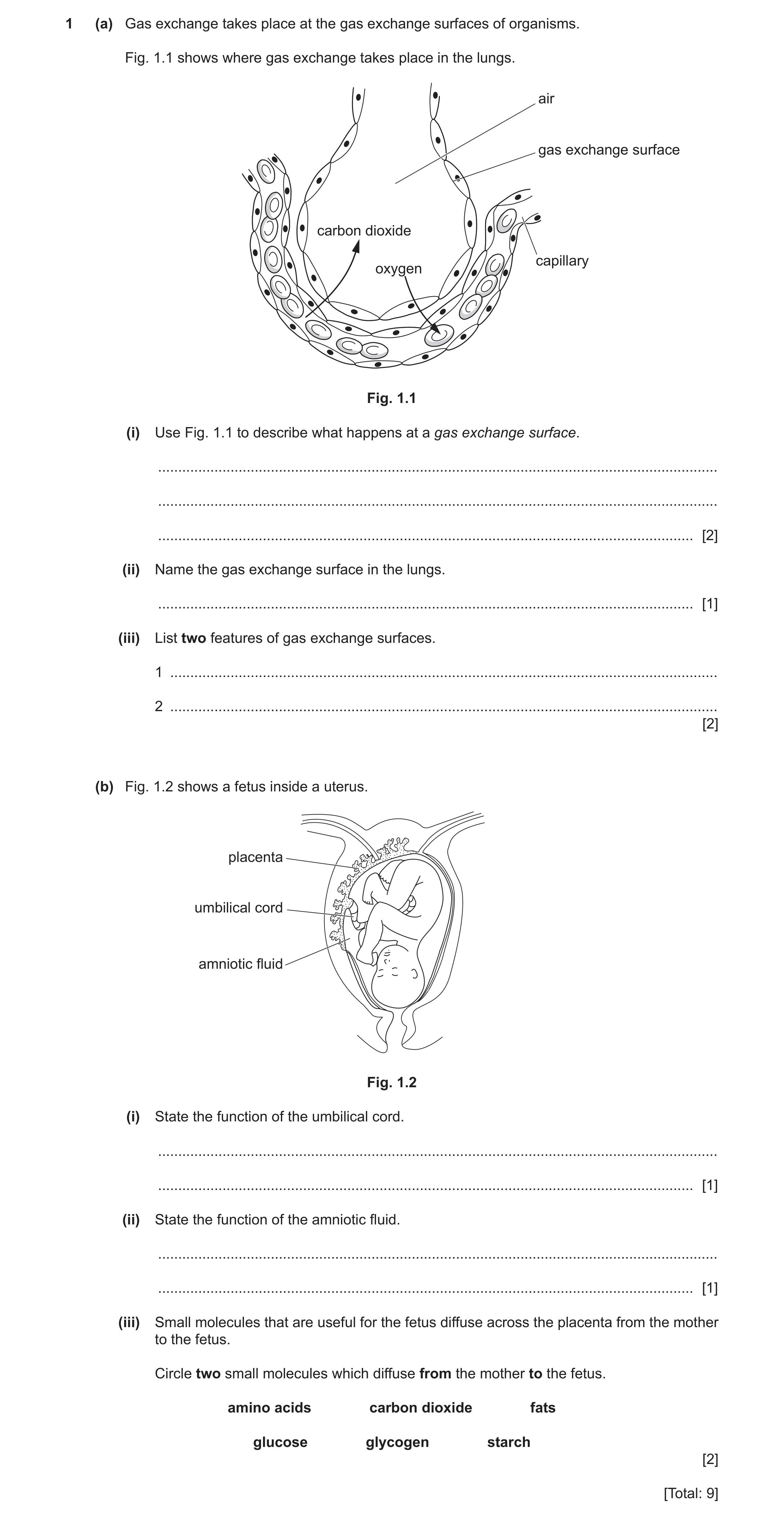
1 (a) Gas exchange takes place at the gas exchange surfaces of organisms. Fig. 1.1 shows where gas exchange takes place in the lungs. air gas exchange surface carbon dioxide capillary oxygen Fig. 1.1 (i) Use Fig. 1.1 to describe what happens at a gas exchange surface. … … … [2] (ii) Name the gas exchange surface in the lungs. … [1] (iii) List two features of gas exchange surfaces. 1 … 2 … [2] (b) Fig. 1.2 shows a fetus inside a uterus. placenta umbilical cord amniotic fluid Fig. 1.2 (i) State the function of the umbilical cord. … … [1] (ii) State the function of the amniotic fluid. … … [1] (iii) Small molecules that are useful for the fetus diffuse across the placenta from the mother to the fetus. Circle two small molecules which diffuse from the mother to the fetus. amino acids carbon dioxide fats glucose glycogen starch [2] [Total: 9]
9 marks
Mark scheme: 1(a)(i) any two from: oxygen moves into the blood; carbon dioxide moves into the, air / lungs / alveoli; by diffusion ; 2 1(a)(ii) alveoli ; 1 1(a)(iii) any two from: thin / one, layer of cells ; good blood supply ; large surface area ; well ventilated ; 2 1(b)(i) (contains blood vessels for) taking substances / correct named substances, to (and from) the placenta / fetus ; 1 1(b)(ii) protects the fetus from mechanical shock ; 1 1(b)(iii) amino acids circled ; glucose circled ; 2
This question in 0653/41 Oct/Nov 2020
Q8 · An external view of the heart 0653/41 Oct/Nov 2020
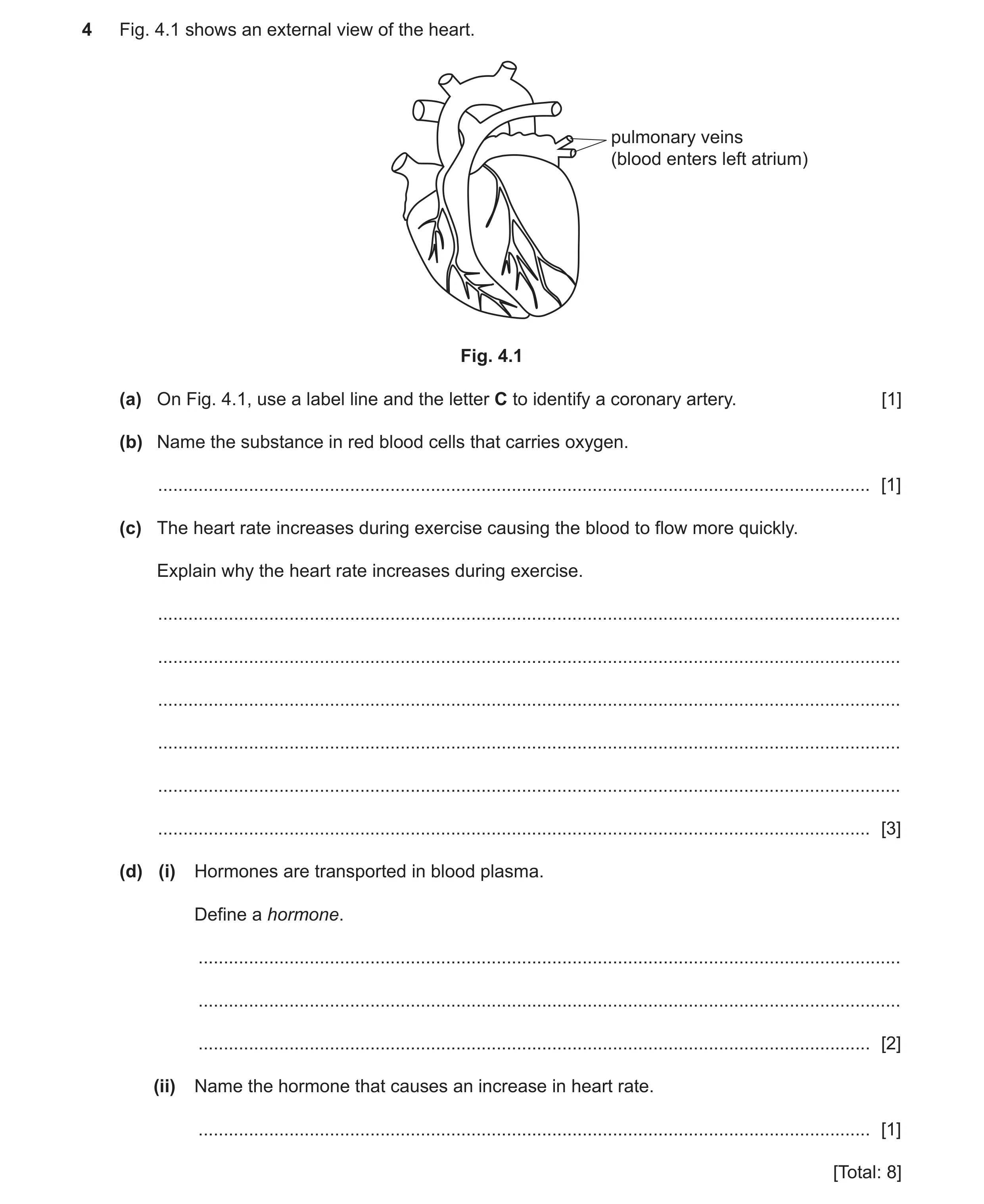
4 Fig. 4.1 shows an external view of the heart. pulmonary veins (blood enters left atrium) Fig. 4.1 (a) On Fig. 4.1, use a label line and the letter C to identify a coronary artery. [1] (b) Name the substance in red blood cells that carries oxygen. … [1] (c) The heart rate increases during exercise causing the blood to flow more quickly. Explain why the heart rate increases during exercise. … … … … … … [3] (d) (i) Hormones are transported in blood plasma. Define a hormone. … … … [2] (ii) Name the hormone that causes an increase in heart rate. … [1] [Total: 8]
8 marks
Mark scheme: 4(a) coronary artery correctly labelled ; 1 4(b) haemoglobin ; 1 4(c) any three from: so more oxygen / glucose, taken to the muscles ; so more energy can be released ; correct reference to respiration ; so more carbon dioxide can be removed (from the muscles) ; 3 4(d)(i) a chemical substance produced by a gland, carried by blood ; which alters the activity of one or more specific target organs ; 2 4(d)(ii) adrenaline ; 1
This question in 0653/41 Oct/Nov 2020
Q9 · A diagram of a human sperm cell 0653/41 May/June 2021
1 (a) Fig. 1.1 is a diagram of a human sperm cell. nucleus Fig. 1.1 (i) State the function of the nucleus. … [1] (ii) State one way the sperm is adapted to its function in reproduction. … [1] (iii) Name the part of the male reproductive system that makes sperm. … [1] (b) Fig. 1.2 shows two different types of cells from the leaf of a plant. stoma nucleus cytoplasm epidermal cell X nucleus Fig. 1.2 (i) Identify the cells labelled X in Fig. 1.2. … [1] (ii) Identify one structure in cell X in Fig. 1.2 that is absent from a sperm cell. … [1] (c) A student investigates the effect of light intensity on the rate of photosynthesis in an aquatic plant. Fig. 1.3 shows the apparatus the student uses. bubbles of gas lamp water ruler aquatic plant Fig. 1.3 The student: • places the lamp 10 cm from the beaker • counts the number of bubbles the aquatic plant produces in 3 minutes • repeats the count two more times at this distance • then repeats the experiment with the lamp at different distances from the beaker. Table 1.1 shows the results. Table 1.1 distance of lamp number of bubbles average from beaker number of / cm attempt 1 attempt 2 attempt 3 bubbles 10 120 118 123 120 20 118 120 119 119 30 80 78 75 78 40 48 45 42 45 50 15 12 14 (i) Calculate the average number of bubbles when the lamp is 50 cm from the beaker. Give your answer to the nearest whole number. … bubbles [2] (ii) Describe the effect of light intensity on the rate of photosynthesis shown in Table 1.1. … … … … [2] (d) Explain the role of chlorophyll in photosynthesis. … … … [2] [Total: 11]
11 marks
Mark scheme: 1(a)(i) contains genetic material ; 1 1(a)(ii) has a flagellum / presence of enzymes ; 1 1(a)(iii) testes ; 1 1(b)(i) guard cell ; 1 1(b)(ii) chloroplast / cell wall ; 1 1(c)(i) (15 + 12 + 14) ÷ 3 ; (=) 14 (bubbles) ; 2 1(c)(ii) as light intensity increases or distance decreases the rate increases ORA ; the idea that the rate levels off (closer than 20 cm) ; 2 1(d) any two from: absorbs light (energy) ; (transfers) light to chemical energy ; for the synthesis of carbohydrates ; 2
This question in 0653/41 May/June 2021
Q10 · A diagram of a fetus inside the uterus 0653/42 Oct/Nov 2021
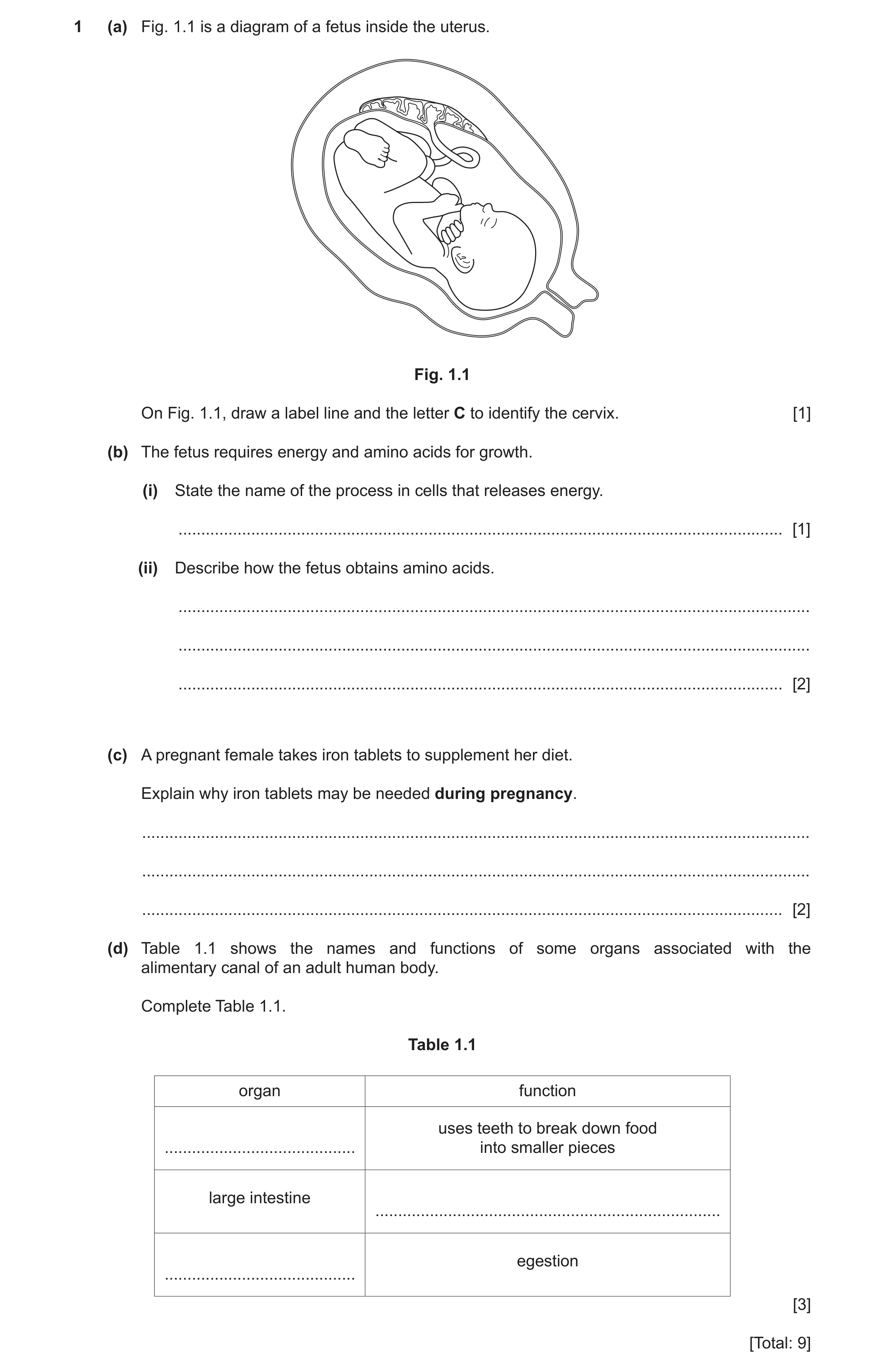
1 (a) Fig. 1.1 is a diagram of a fetus inside the uterus. Fig. 1.1 On Fig. 1.1, draw a label line and the letter C to identify the cervix. [1] (b) The fetus requires energy and amino acids for growth. (i) State the name of the process in cells that releases energy. … [1] (ii) Describe how the fetus obtains amino acids. … … … [2] (c) A pregnant female takes iron tablets to supplement her diet. Explain why iron tablets may be needed during pregnancy. … … … [2] (d) Table 1.1 shows the names and functions of some organs associated with the alimentary canal of an adult human body. Complete Table 1.1. Table 1.1 organ function uses teeth to break down food … into smaller pieces large intestine … egestion … [3] [Total: 9]
9 marks
Mark scheme: 1(a) cervix labelled anywhere in shaded area ; 1 1(b)(i) respiration ; 1 1(b)(ii) amino acids come from mother's blood ; plus any one from: cross the placenta ; brought to fetus by umbilical cord ; via diffusion ; 2 1(c) idea that fetus needs some of the iron ; reference to any named iron deficiency symptom (in mother) / iron is needed for haemoglobin production ; 2 1(d) organ function mouth ; (uses teeth to breakdown food into smaller pieces) (large intestine) absorbs water ; anus ; (egestion) 3
This question in 0653/42 Oct/Nov 2021
Q11 · A diagram of a fetus inside the uterus 0653/43 Oct/Nov 2021
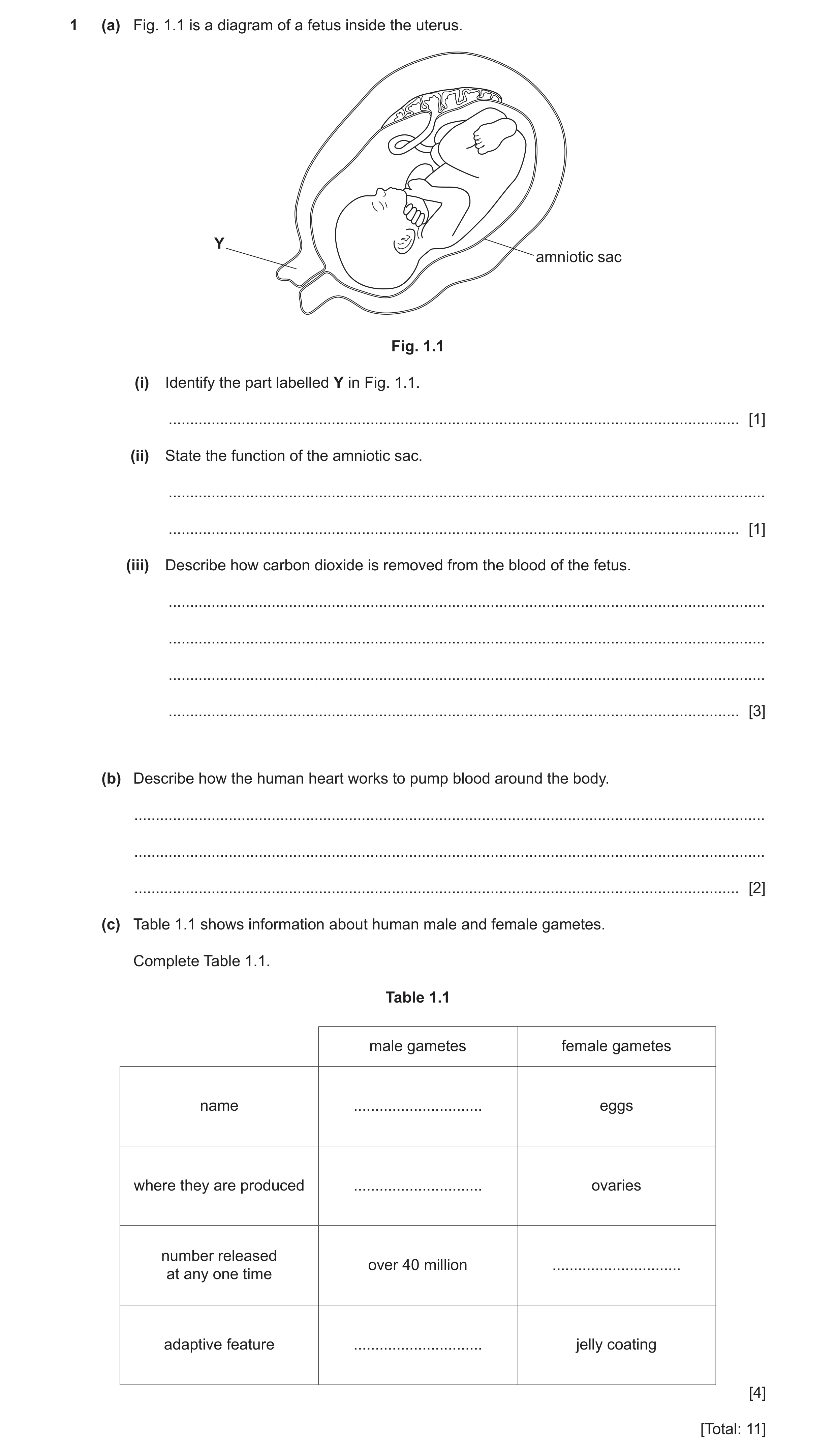
1 (a) Fig. 1.1 is a diagram of a fetus inside the uterus. Y amniotic sac Fig. 1.1 (i) Identify the part labelled Y in Fig. 1.1. … [1] (ii) State the function of the amniotic sac. … … [1] (iii) Describe how carbon dioxide is removed from the blood of the fetus. … … … … [3] (b) Describe how the human heart works to pump blood around the body. … … … [2] (c) Table 1.1 shows information about human male and female gametes. Complete Table 1.1. Table 1.1 male gametes female gametes name … eggs where they are produced … ovaries number released over 40 million … at any one time adaptive feature … jelly coating [4] [Total: 11]
11 marks
Mark scheme: 1(a)(i) cervix ; 1 1(a)(ii) encloses fetus / holds or produces amniotic fluid ; 1 1(a)(iii) any three from: via umbilical cord ; to the placenta ; passes into mother’s blood ; correct reference to diffusion ; 3 1(b) any two from: contraction ; of ventricles / muscle ; AVP ; 2 1(c) male gametes female gametes name sperm(s) ; (eggs) where they are made testes ; (ovaries) number released at any one time (over 40 million) one ; adaptive feature flagellum / enzymes ; (jelly coating) 4
This question in 0653/43 Oct/Nov 2021
Q12 · A diagram of a wind‑pollinated flower 0653/42 May/June 2022
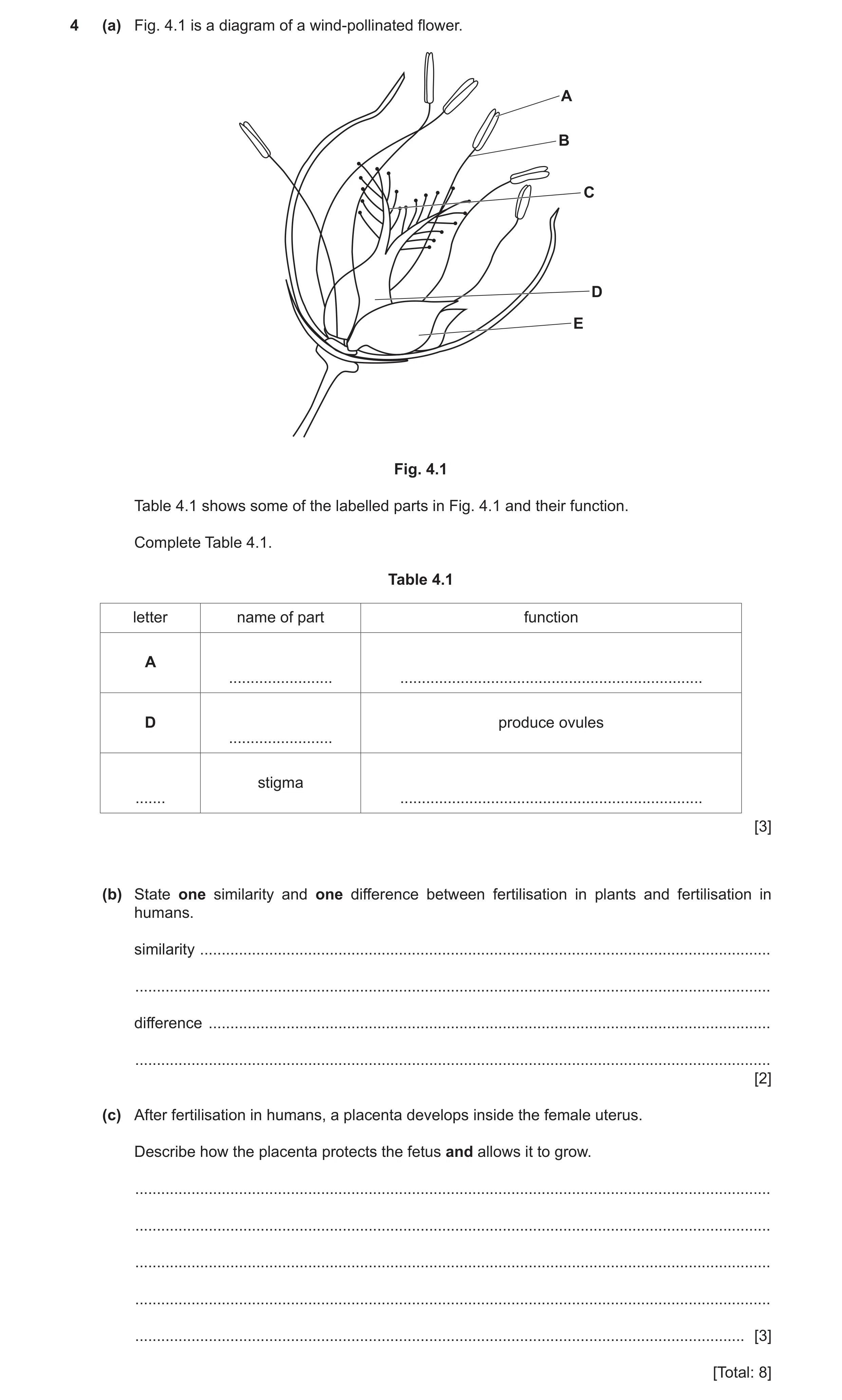
4 (a) Fig. 4.1 is a diagram of a wind‑pollinated flower. A B C D E Fig. 4.1 Table 4.1 shows some of the labelled parts in Fig. 4.1 and their function. Complete Table 4.1. Table 4.1 letter name of part function A … … D produce ovules … stigma … … [3] (b) State one similarity and one difference between fertilisation in plants and fertilisation in humans. similarity … … difference … … [2] (c) After fertilisation in humans, a placenta develops inside the female uterus. Describe how the placenta protects the fetus and allows it to grow. … … … … … [3] [Total: 8]
8 marks
Mark scheme: 4(a) letter name of part function (A) anther / stamen produce, pollen / male gamete (D) ovary (produce ovules) C (stigma) receives pollen / AW ;;; 4(b) similarity – fusion of nuclei ; difference – pollen used instead of sperm / takes place in ovary not oviduct ; 2 4(c) acts as a barrier against, toxins / poisons ; then any two from: provides nutrients ; provides oxygen ; removes waste products ; 3
This question in 0653/42 May/June 2022
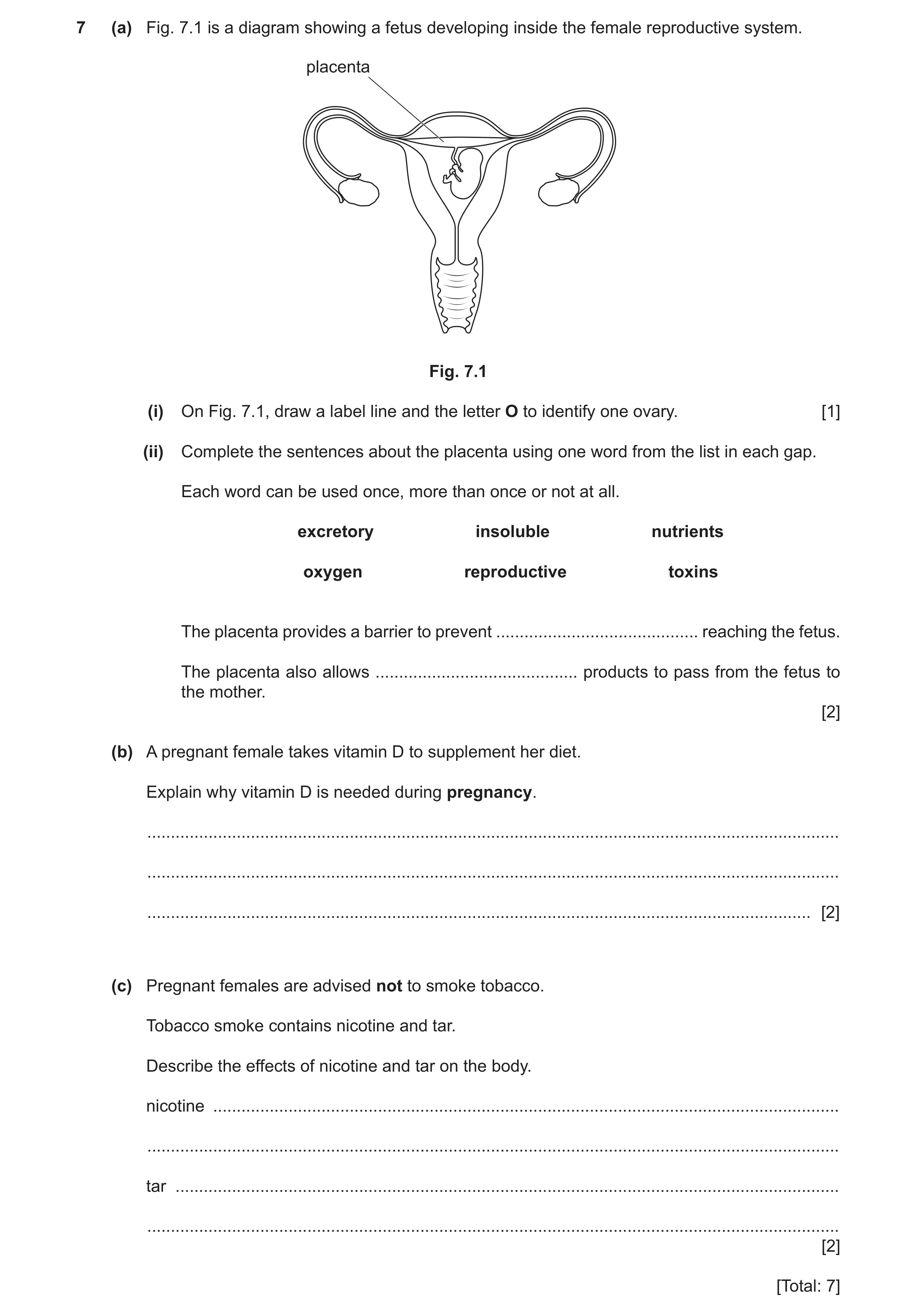
Q13 · A diagram showing a fetus developing inside the female reproductive system 0653/41 Oct/Nov 2022
7 (a) Fig. 7.1 is a diagram showing a fetus developing inside the female reproductive system. placenta Fig. 7.1 (i) On Fig. 7.1, draw a label line and the letter O to identify one ovary. [1] (ii) Complete the sentences about the placenta using one word from the list in each gap. Each word can be used once, more than once or not at all. excretory insoluble nutrients oxygen reproductive toxins The placenta provides a barrier to prevent … reaching the fetus. The placenta also allows … products to pass from the fetus to the mother. [2] (b) A pregnant female takes vitamin D to supplement her diet. Explain why vitamin D is needed during pregnancy. … … … [2] (c) Pregnant females are advised not to smoke tobacco. Tobacco smoke contains nicotine and tar. Describe the effects of nicotine and tar on the body. nicotine … … tar … … [2] [Total: 7]
7 marks
Mark scheme: 7(a)(i) either ovary labelled ; 1 7(a)(ii) toxins ; 2 excretory ; 7(b) idea that, fetus needs (some of the) vitamin D ; 2 vitamin D needed, for bone (development) / to prevent rickets ; 7(c) nicotine addictive ; 2 tar prevents cilia working / causes (lung) cancer ;
This question in 0653/41 Oct/Nov 2022
Q14 · A diagram of the male reproductive system in humans 0653/43 May/June 2023
1 (a) Fig. 1.1 is a diagram of the male reproductive system in humans. A E D B C Fig. 1.1 The letters A – E, in Fig. 1.1 indicate parts of the male reproductive system. Complete Table 1.1 to show the letter, name and function of some of these parts. Table 1.1 letter name of part function scrotum B carries urine and semen out of the body [3] (b) The female reproductive system in humans produces egg cells. Complete the sentences about egg cells. Egg cells are specialised cells. Each cell has an energy store and a … coating which changes after fertilisation. Fertilisation is the fusion of the … from a sperm and an egg cell. [2] (c) During pregnancy a placenta develops. Describe two different functions of the placenta. 1 … … 2 … … [2] [Total: 7]
7 marks
Mark scheme: 1(a) letter name function D (scrotum) hold testes outside body (B) testes (produce male) gametes / sperm C urethra (carries urine and semen out of the body) ;;; one mark for each correct row 3 1(b) jelly ; nuclei ; 2 1(c) any two from: allows nutrients / oxygen, to pass to fetus ; allows toxins / excretory products, to pass from fetus ; provides barrier for toxins ; 2
This question in 0653/43 May/June 2023
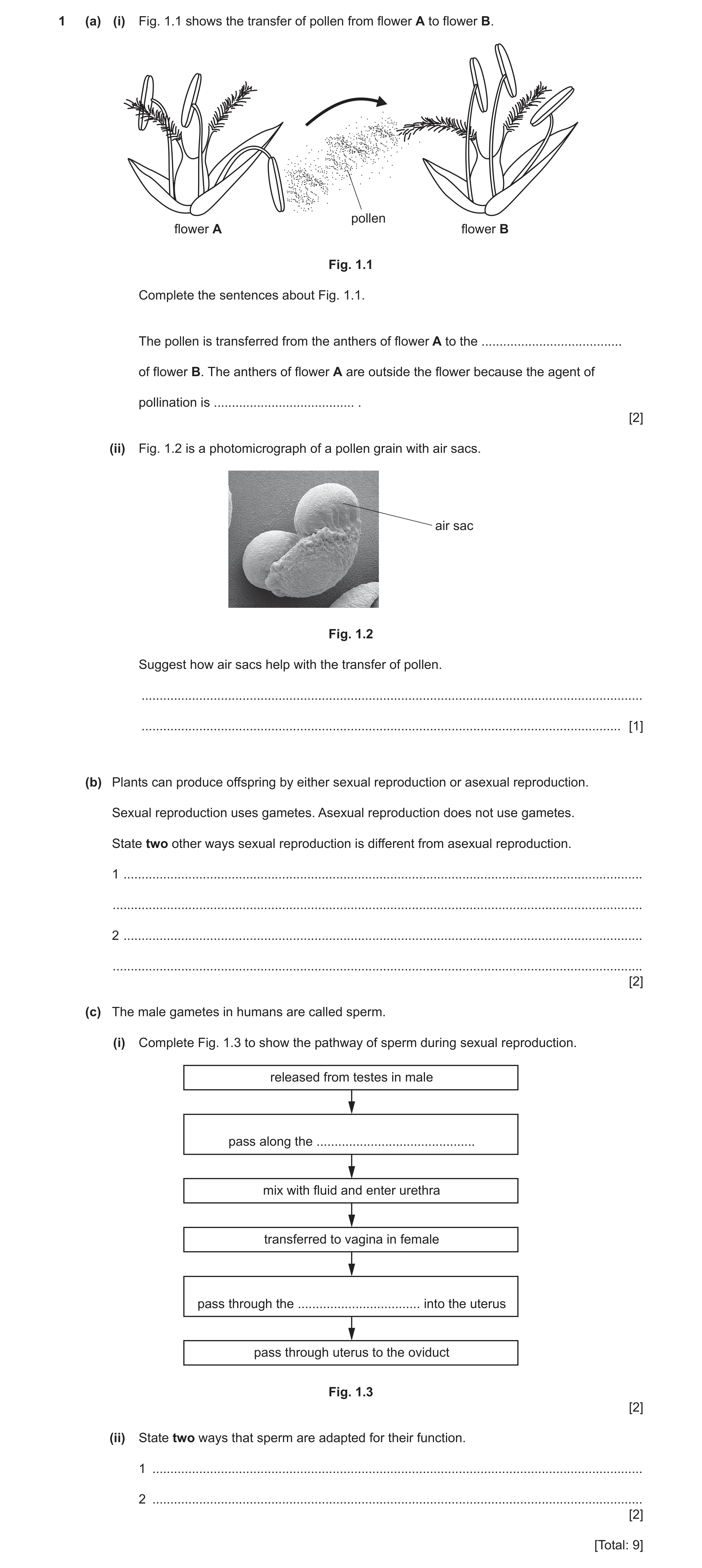
Q15 · The transfer of pollen from flower A to flower B 0653/42 Oct/Nov 2023
1 (a) (i) Fig. 1.1 shows the transfer of pollen from flower A to flower B. pollen flower A flower B Fig. 1.1 Complete the sentences about Fig. 1.1. The pollen is transferred from the anthers of flower A to the … of flower B. The anthers of flower A are outside the flower because the agent of pollination is … . [2] (ii) Fig. 1.2 is a photomicrograph of a pollen grain with air sacs. air sac Fig. 1.2 Suggest how air sacs help with the transfer of pollen. … … [1] (b) Plants can produce offspring by either sexual reproduction or asexual reproduction. Sexual reproduction uses gametes. Asexual reproduction does not use gametes. State two other ways sexual reproduction is different from asexual reproduction. 1 … … 2 … … [2] (c) The male gametes in humans are called sperm. (i) Complete Fig. 1.3 to show the pathway of sperm during sexual reproduction. released from testes in male pass along the … mix with fluid and enter urethra transferred to vagina in female pass through the … into the uterus pass through uterus to the oviduct Fig. 1.3 [2] (ii) State two ways that sperm are adapted for their function. 1 … 2 … [2] [Total: 9]
9 marks
Mark scheme: Question Answer Marks 1(a)(i) stigma(s) ; 2 wind ; 1(a)(ii) idea that air sacs, increase the time in the air / increase air resistance / increase surface area / provide a sail effect / reduce 1 density ; 1(b) any two from: 2 sexual reproduction ORA, (usually) requires two parents (not one) ; requires, fertilisation / fusion, of (nuclei) of gametes ; produces offspring that are not genetically identical ; leads to a zygote forming ; 1(c)(i) sperm duct ; 2 cervix ; 1(c)(ii) any two from: 2 have a flagellum ; contain enzymes ; AVP;
This question in 0653/42 Oct/Nov 2023
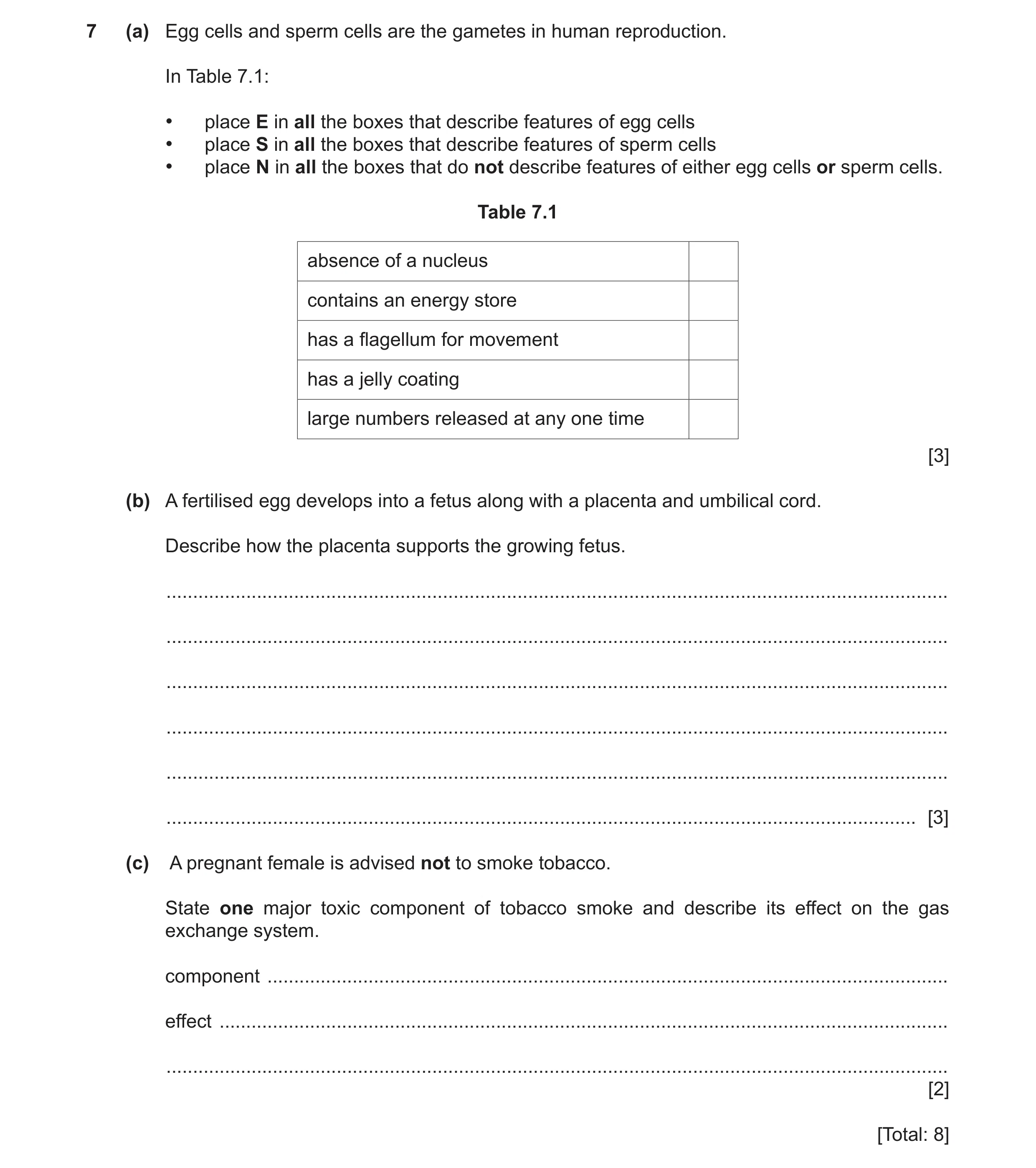
Q16 · Egg cells and sperm cells are the gametes in human reproduction 0653/42 Feb/March 2024
7 (a) Egg cells and sperm cells are the gametes in human reproduction. In Table 7.1: • place E in all the boxes that describe features of egg cells • place S in all the boxes that describe features of sperm cells • place N in all the boxes that do not describe features of either egg cells or sperm cells. Table 7.1 absence of a nucleus contains an energy store has a flagellum for movement has a jelly coating large numbers released at any one time [3] (b) A fertilised egg develops into a fetus along with a placenta and umbilical cord. Describe how the placenta supports the growing fetus. … … … … … … [3] (c) A pregnant female is advised not to smoke tobacco. State one major toxic component of tobacco smoke and describe its effect on the gas exchange system. component … effect … … [2] [Total: 8]
8 marks
Mark scheme: 7(a) 3 absence of a nucleus N contains an energy store E has a flagellum for movement S has a jelly coating E large numbers released at any one time S ;;; 5 correct = [3] 3–4 correct = [2] 1–2 correct = [1] 7(b) (dissolved) nutrients / oxygen, pass (from the mother’s blood across placenta) to fetus ; 3 waste products pass from fetus (to mother across placenta) ; placenta provides a barrier to toxins ; 7(c) carbon monoxide ; 2 reduces oxygen uptake (into blood / cells / body) / binds to haemoglobin ; OR tar ; causes, lung cancer / bronchitis / emphysema ;
This question in 0653/42 Feb/March 2024
Q17 · The male reproductive system in humans 0653/41 May/June 2024
4 (a) Fig. 4.1 shows the male reproductive system in humans. E A D B C Fig. 4.1 State the letter in Fig. 4.1 that identifies the part that: produces sperm … carries urine out of the body … . [2] (b) Human gametes are either egg cells or sperm cells. (i) State two adaptive features of egg cells. 1 … 2 … [2] (ii) State two ways the structure of an egg cell is the same as the structure of a sperm cell. 1 … 2 … [2] (c) Fig. 4.2 shows a human baby inside a uterus just before birth. placenta amniotic fluid umbilical cord Fig. 4.2 (i) State the function of the amniotic fluid. … … [1] (ii) Describe the functions of the placenta and umbilical cord in relation to providing nutrients for the baby. placenta … … umbilical cord … … [2] [Total: 9]
9 marks
Mark scheme: 4(a) B ; E ; 2 4(b)(i) any two from: energy store ; jelly coating OR a coating that changes after fertilisation ; AVP ; 2 4(b)(ii) any two from: have a cell membrane ; contain cytoplasm ; have a nucleus ; 2 4(c)(i) protect from mechanical shock ; 1 4(c)(ii) idea that placenta, obtains / exchanges / passes / diffuses nutrients from mother(’s blood) ; idea that the umbilical cord, passes / transports, nutrients / glucose / oxygen (to fetus) ; 2
This question in 0653/41 May/June 2024
Question 18 0653/43 May/June 2024
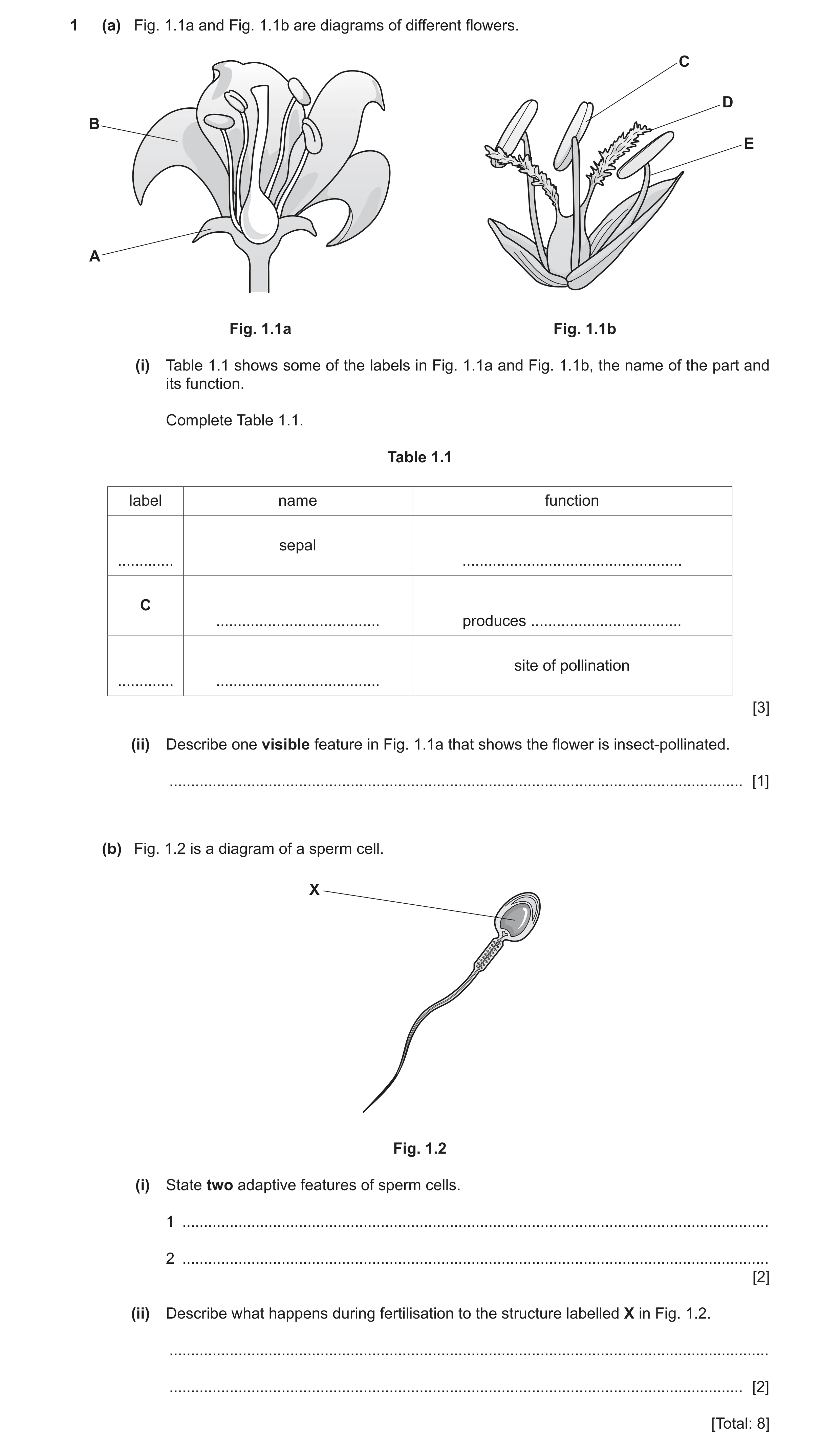
1 (a) Fig. 1.1a and Fig. 1.1b are diagrams of different flowers. C D B E A Fig. 1.1a Fig. 1.1b (i) Table 1.1 shows some of the labels in Fig. 1.1a and Fig. 1.1b, the name of the part and its function. Complete Table 1.1. Table 1.1 label name function sepal … … C … produces … site of pollination … … [3] (ii) Describe one visible feature in Fig. 1.1a that shows the flower is insect‑pollinated. … [1] (b) Fig. 1.2 is a diagram of a sperm cell. X Fig. 1.2 (i) State two adaptive features of sperm cells. 1 … 2 … [2] (ii) Describe what happens during fertilisation to the structure labelled X in Fig. 1.2. … … [2] [Total: 8]
8 marks
Mark scheme: 1(a)(i) label name function A (sepal) to protect / to support (the flower / bud / ovary) (C) anther (produces) pollen / male gamete D stigma (site of pollination) ;;; one mark for each correct row 3 1(a)(ii) any one from: (large) petals ; anther inside (petals / flower) ; stigma inside (petals / flower) ; 1 1(b)(i) any two from: flagellum ; enzymes ; AVP ; 2 1(b)(ii) (nucleus of sperm cell) fuses / joins ; with nucleus of, ovum / egg ; 2
This question in 0653/43 May/June 2024
Q19 · The female human reproductive system 0653/41 Oct/Nov 2024
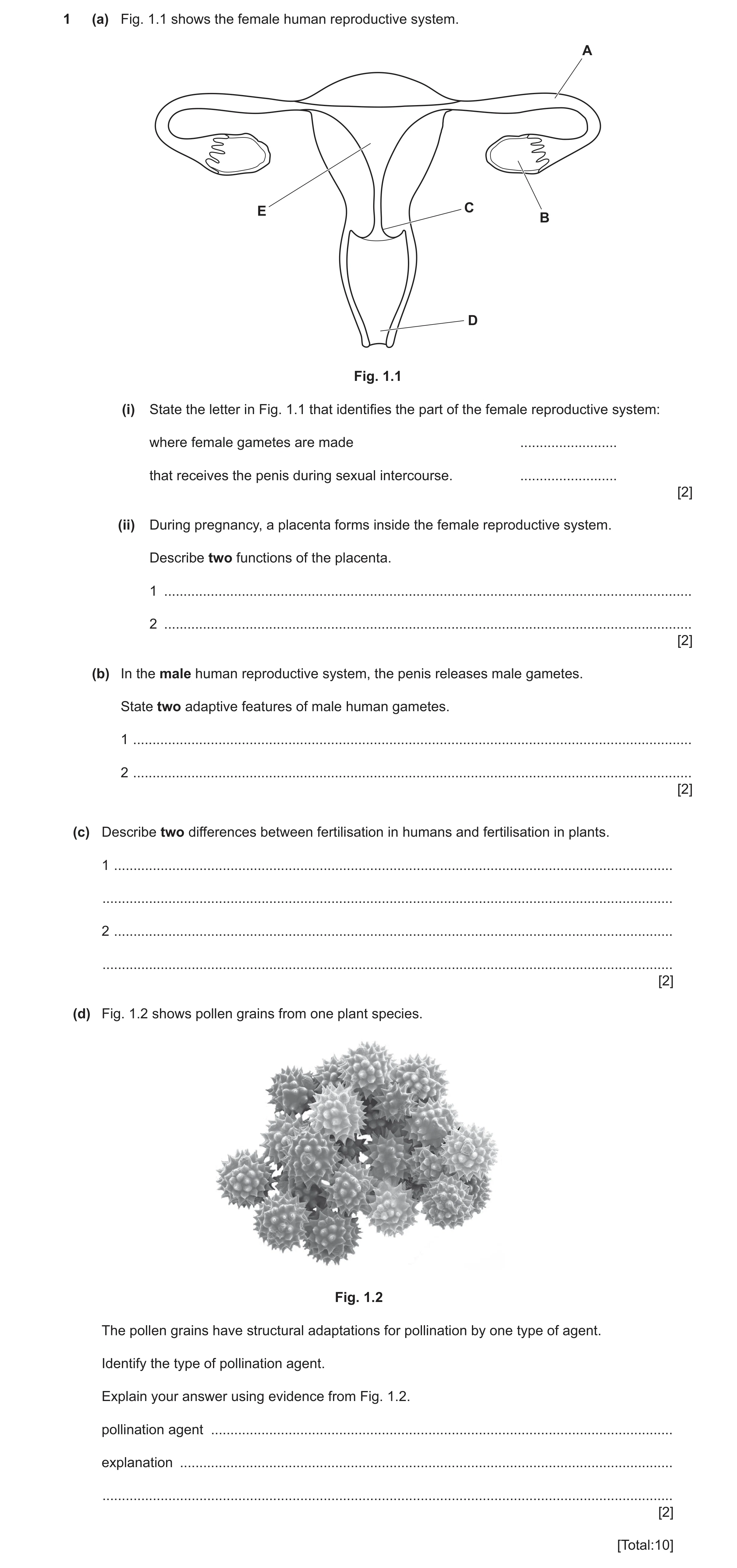
1 (a) Fig. 1.1 shows the female human reproductive system. A E C B D Fig. 1.1 (i) State the letter in Fig. 1.1 that identifies the part of the female reproductive system: where female gametes are made … that receives the penis during sexual intercourse. … [2] (ii) During pregnancy, a placenta forms inside the female reproductive system. Describe two functions of the placenta. 1 … 2 … [2] (b) In the male human reproductive system, the penis releases male gametes. State two adaptive features of male human gametes. 1 … 2 … [2] (c) Describe two differences between fertilisation in humans and fertilisation in plants. 1 … … 2 … … [2] (d) Fig. 1.2 shows pollen grains from one plant species. Fig. 1.2 The pollen grains have structural adaptations for pollination by one type of agent. Identify the type of pollination agent. Explain your answer using evidence from Fig. 1.2. pollination agent … explanation … … [2] [Total:10]
10 marks
Mark scheme: Question Answer Marks 1(a)(i) B ; 2 D ; 1(a)(ii) any two from: 2 exchange / transfer, of (dissolved) nutrients ; exchange / transfer, of (dissolved) gases ; transfer / removal, of excretory products ; barrier to toxins ; 1(b) flagellum ; 2 (presence of) enzymes ; 1(c) any two from: 2 humans have sperm (cells) AND plants have pollen (grains) ; humans have eggs/ova AND plants have ovules ; takes place in, oviducts in humans AND ovaries in plants ; 1(d) insect / animal / bird ; 2 spikes to help them stick (to pollinators) ;
This question in 0653/41 Oct/Nov 2024
Q20 · A diagram of the male reproductive system in humans 0653/41 Oct/Nov 2025
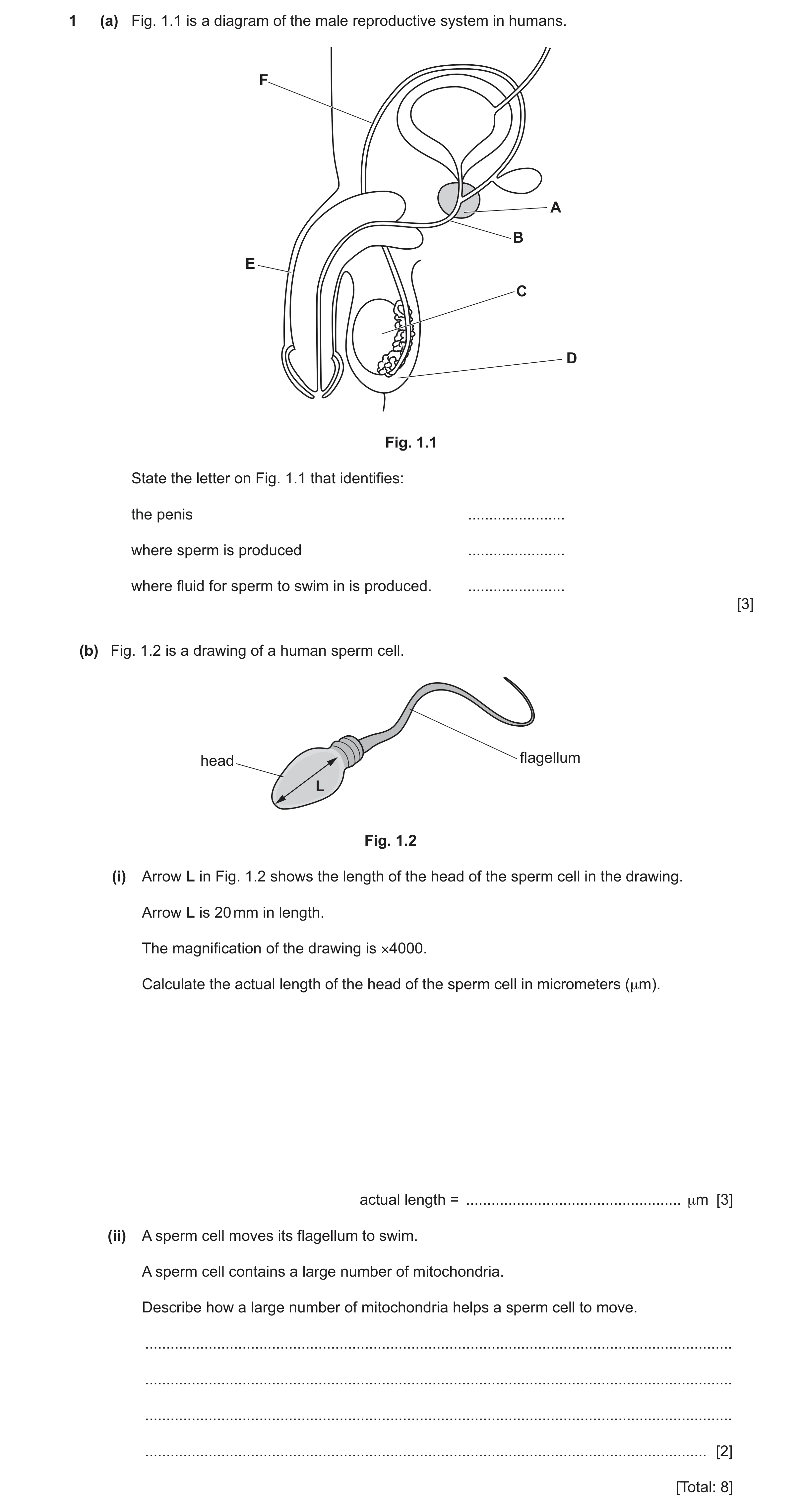
1 (a) Fig. 1.1 is a diagram of the male reproductive system in humans. F A B E C D Fig. 1.1 State the letter on Fig. 1.1 that identifies: the penis … where sperm is produced … where fluid for sperm to swim in is produced. … [3] (b) Fig. 1.2 is a drawing of a human sperm cell. head flagellum L Fig. 1.2 (i) Arrow L in Fig. 1.2 shows the length of the head of the sperm cell in the drawing. Arrow L is 20 mm in length. The magnification of the drawing is ×4000. Calculate the actual length of the head of the sperm cell in micrometers (μm). actual length = … μm [3] (ii) A sperm cell moves its flagellum to swim. A sperm cell contains a large number of mitochondria. Describe how a large number of mitochondria helps a sperm cell to move. … … … … [2] [Total: 8]
8 marks
Mark scheme: Question Answer Marks 1(a) E ; 3 C ; A ; 1(b)(i) 20 ÷ 4000 seen 3 OR actual L = measured L ÷ magnification ; 20 (mm) 1000; seen OR 0.005 (mm) 1000 ; 5 (m) ; 1(b)(ii) respiration occurs within mitochondria; 2 Idea that the mitochondria provide energy (for movement of the flagellum) ;
This question in 0653/41 Oct/Nov 2025
 12 / 29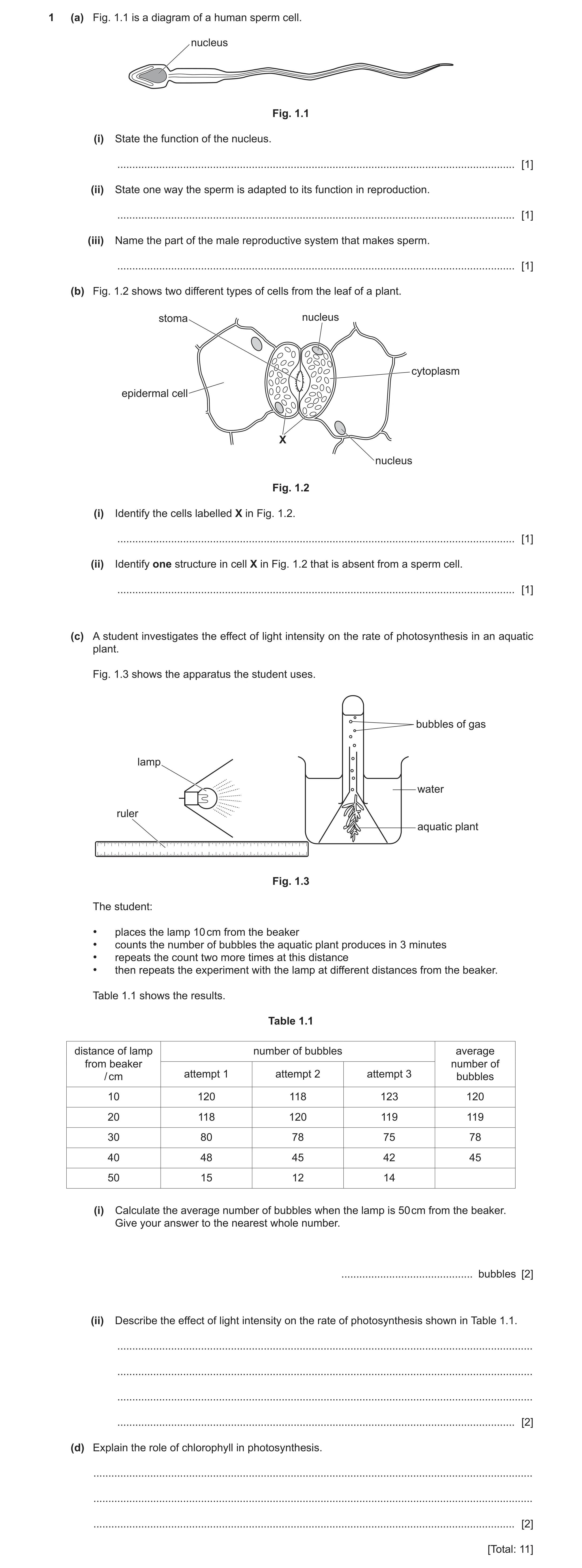
 19 / 29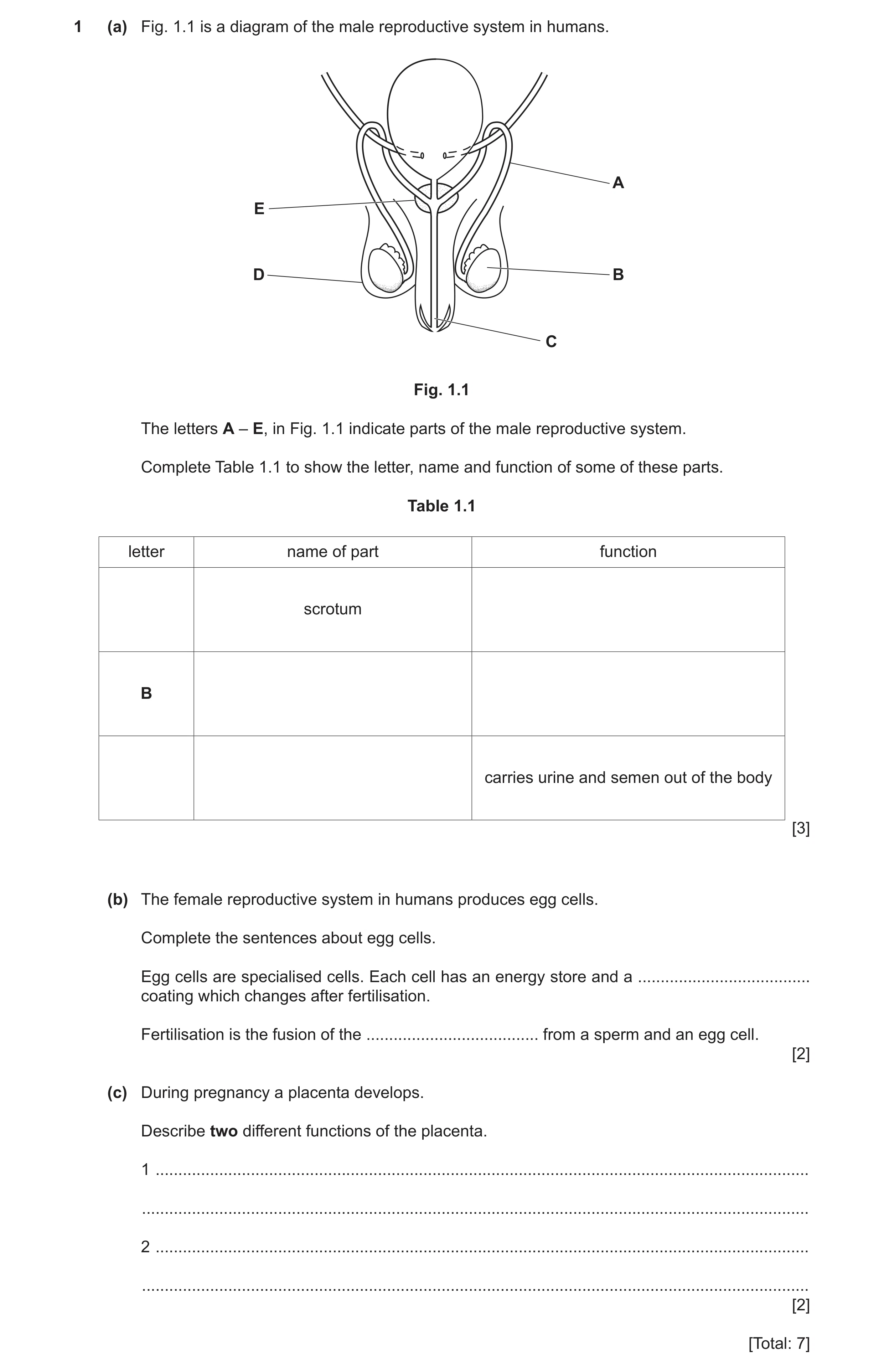
 23 / 29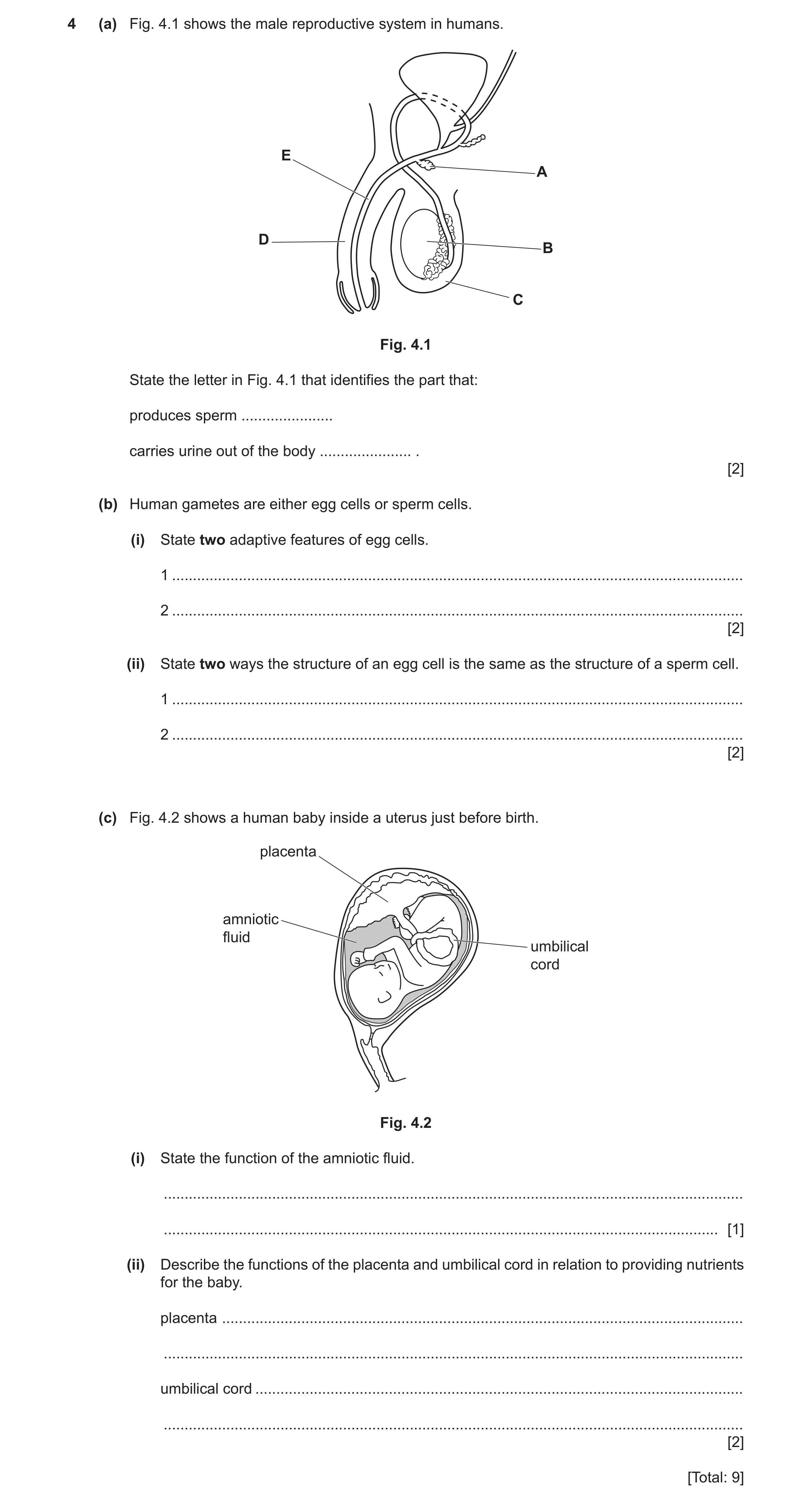
 12
12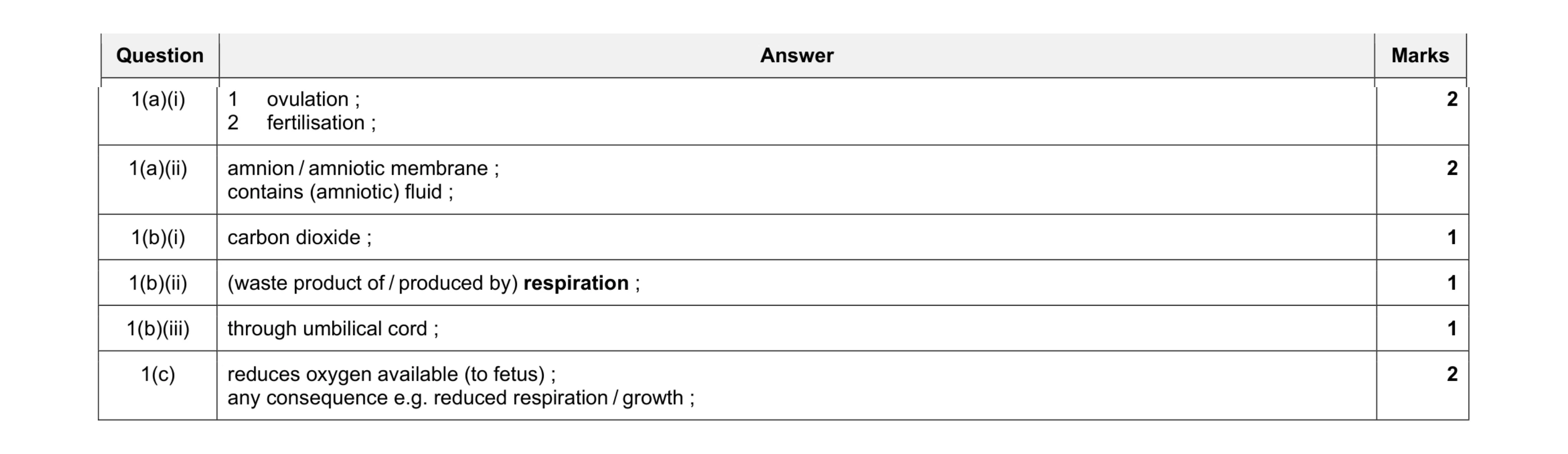 9
9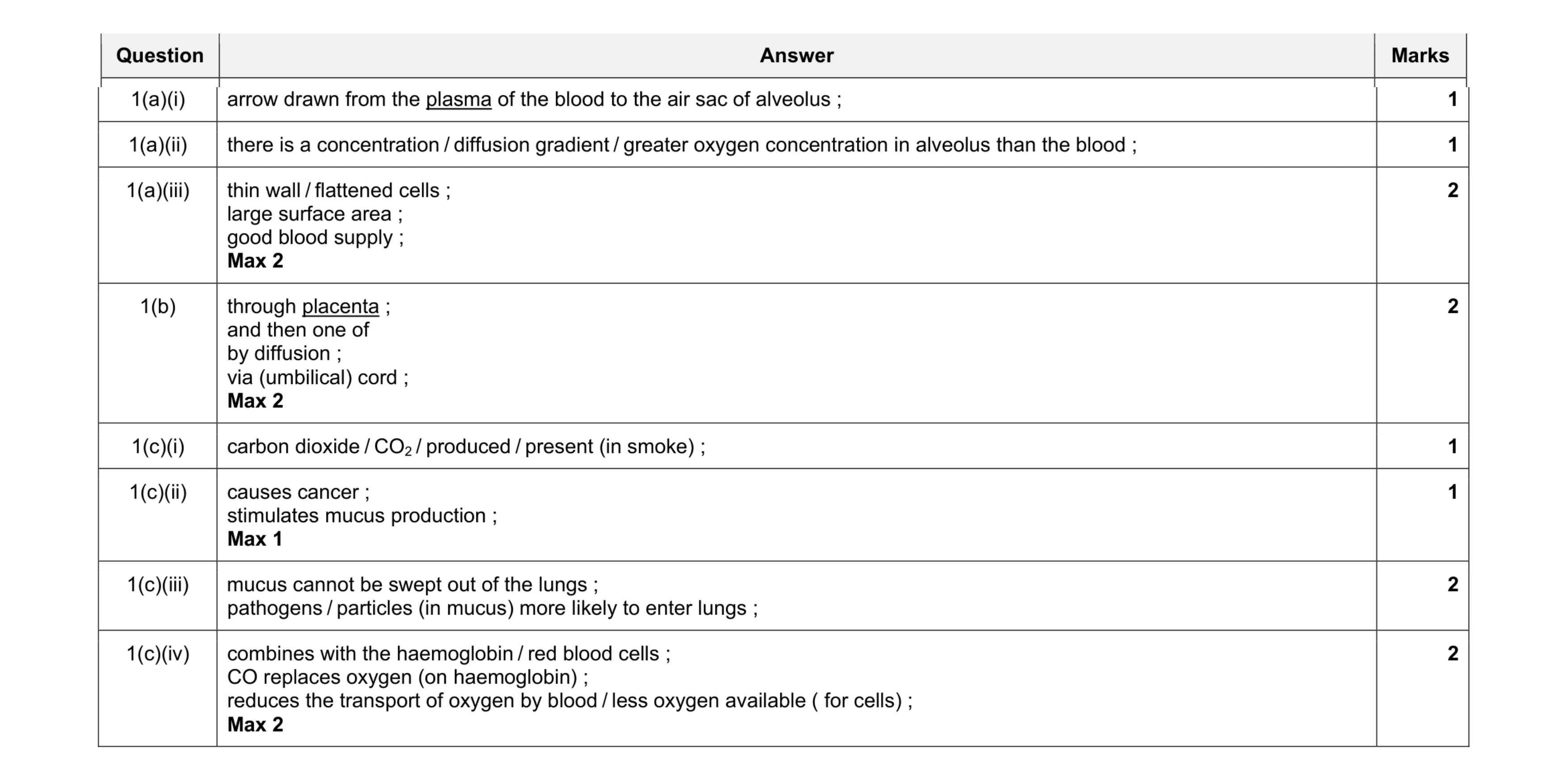 12
12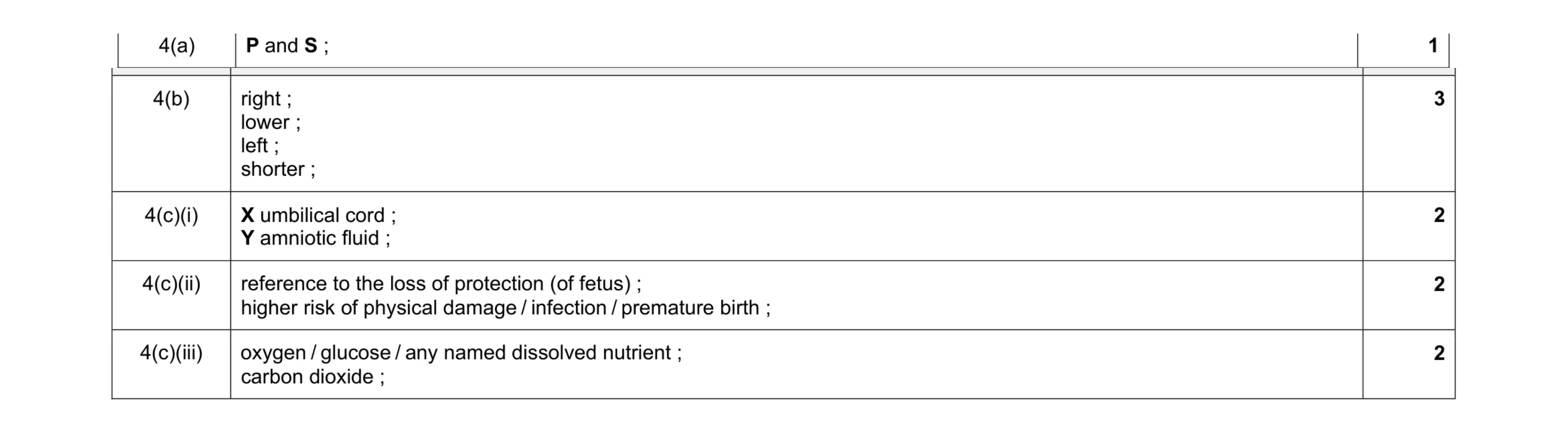 10
10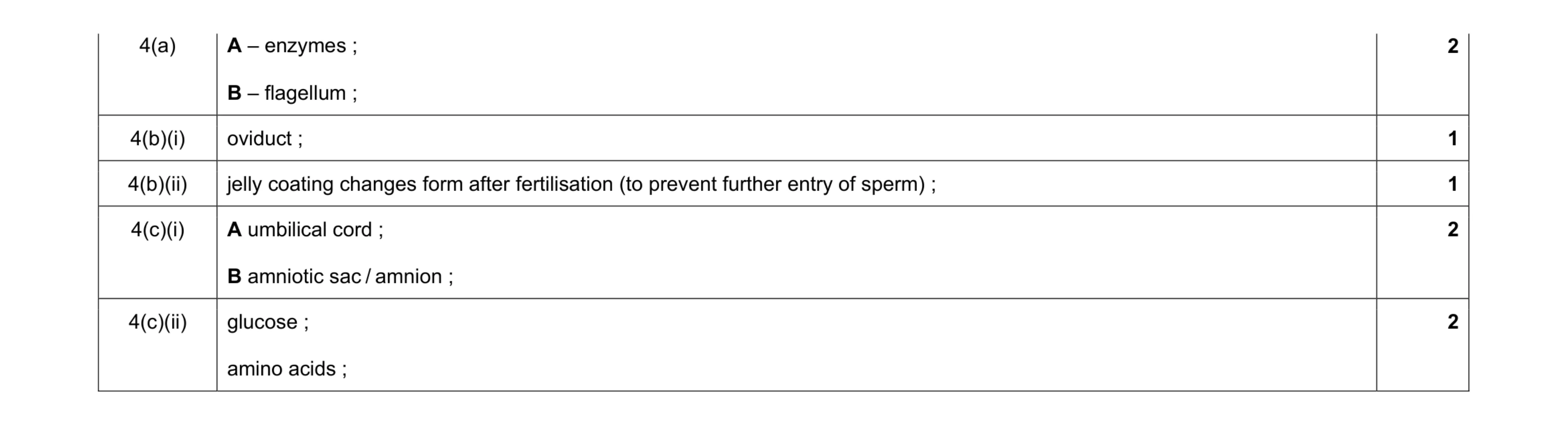 8
8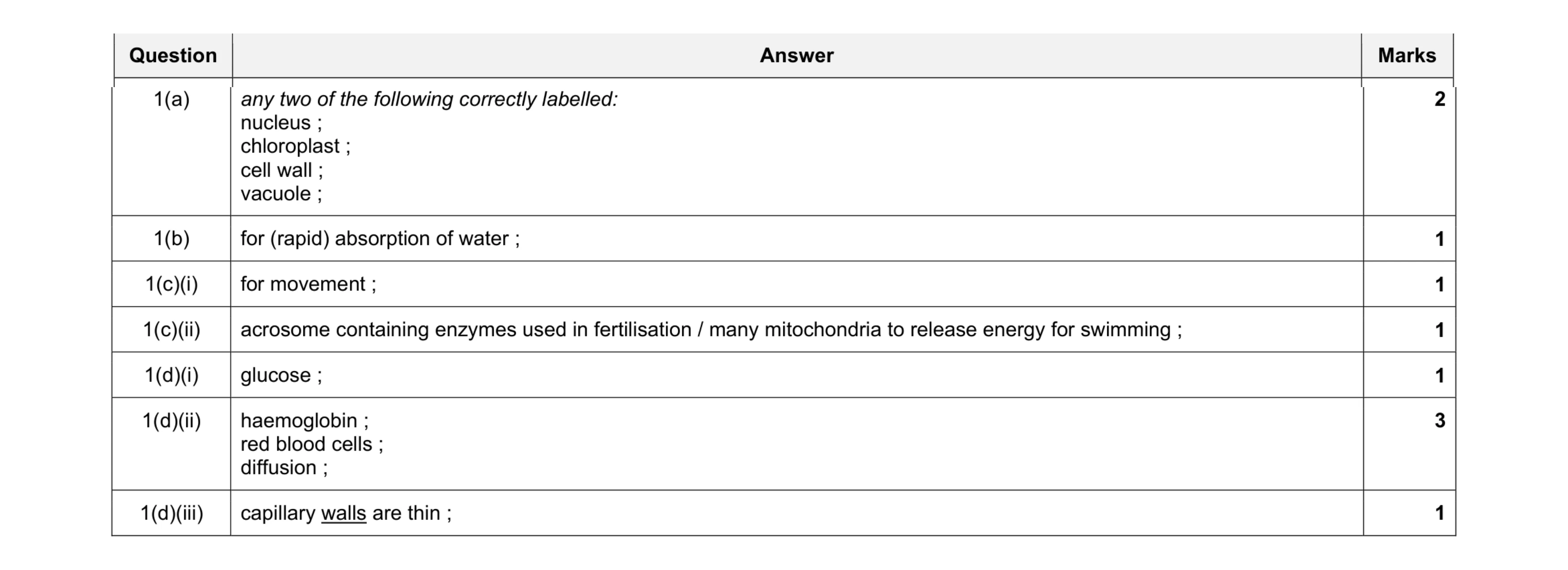 10
10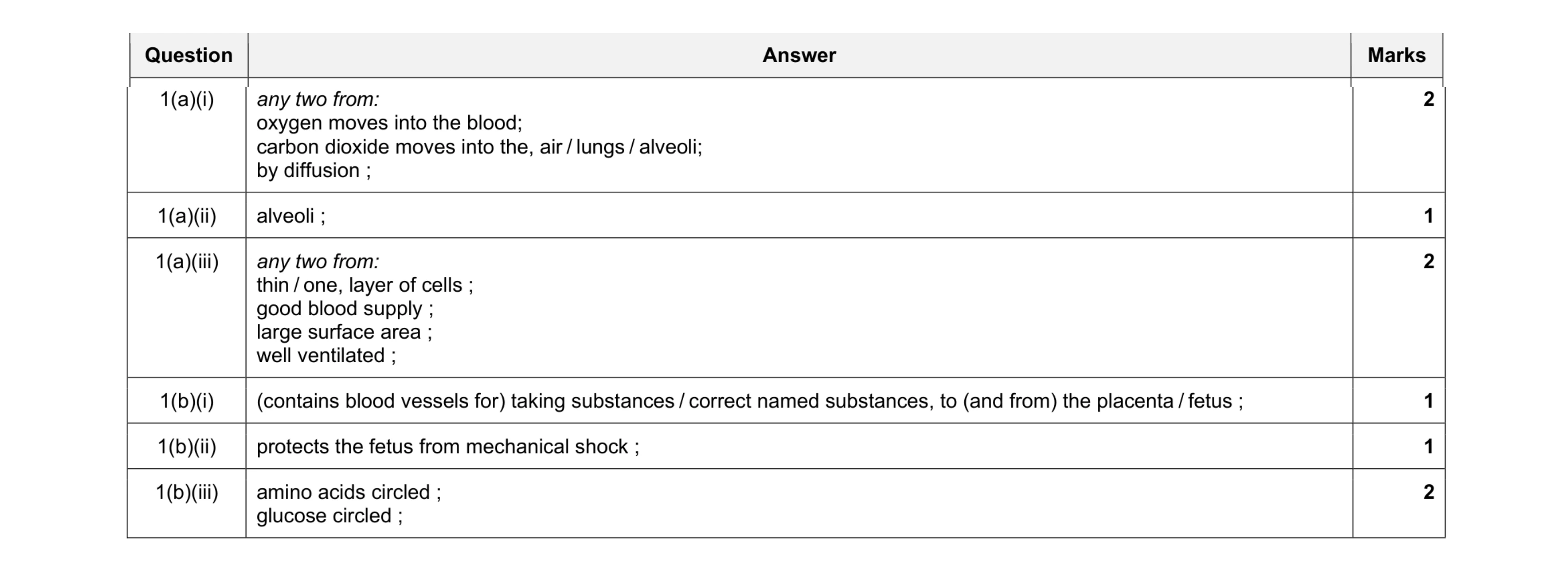 9
9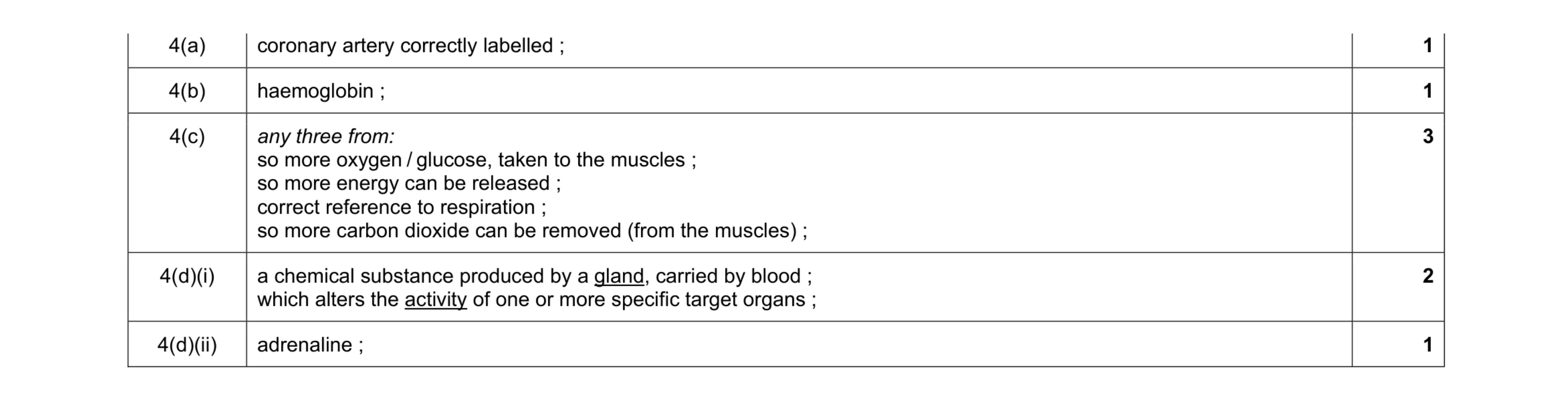 8
8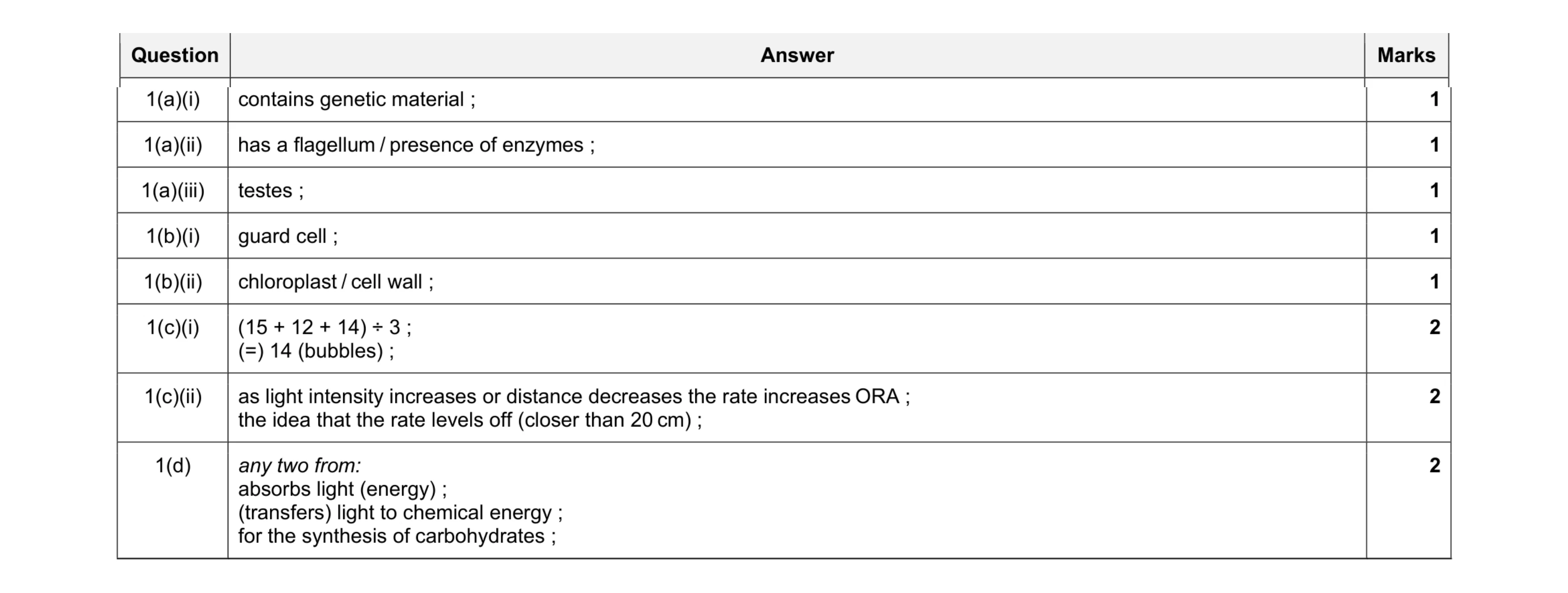 11
11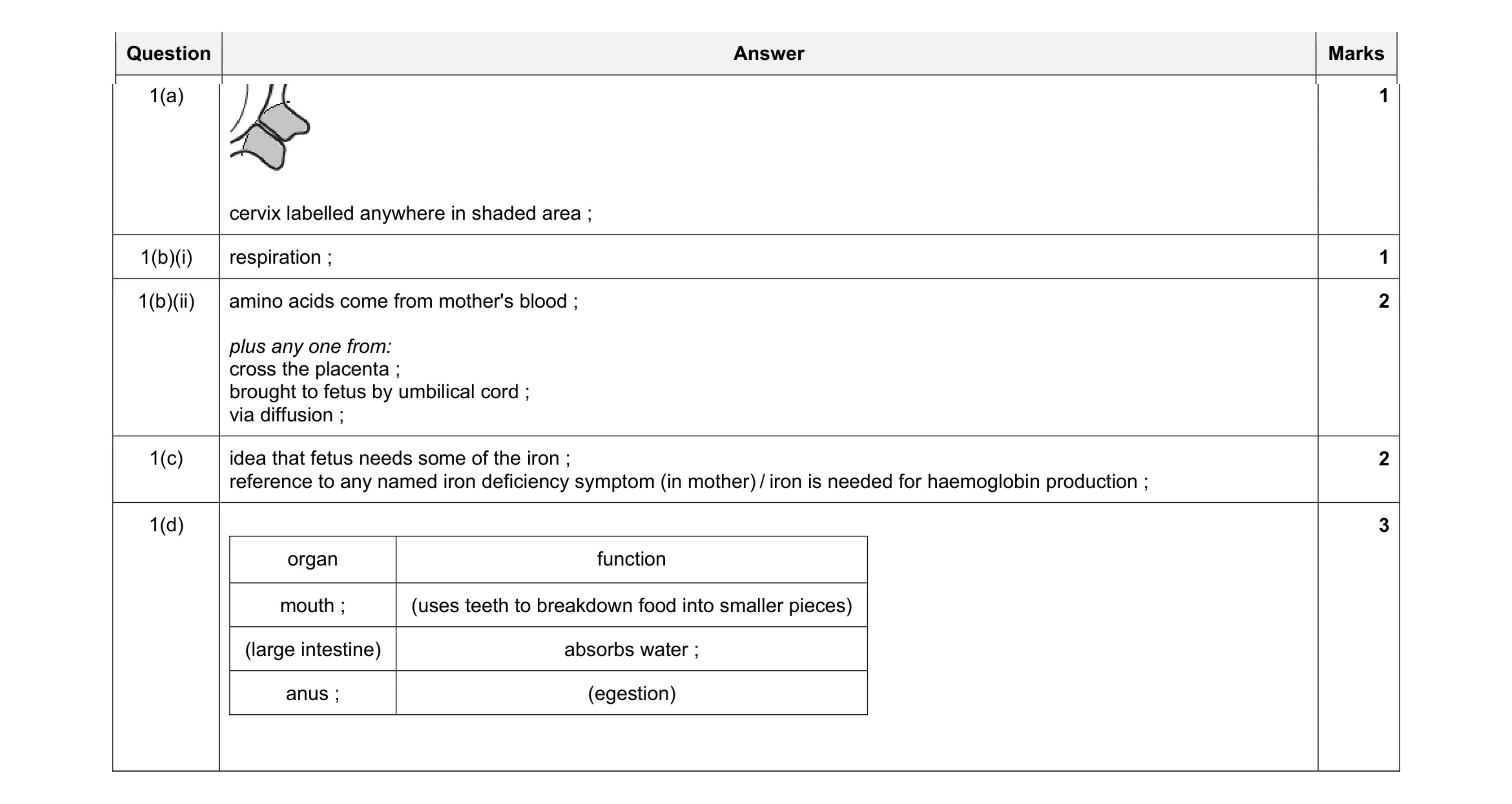 9
9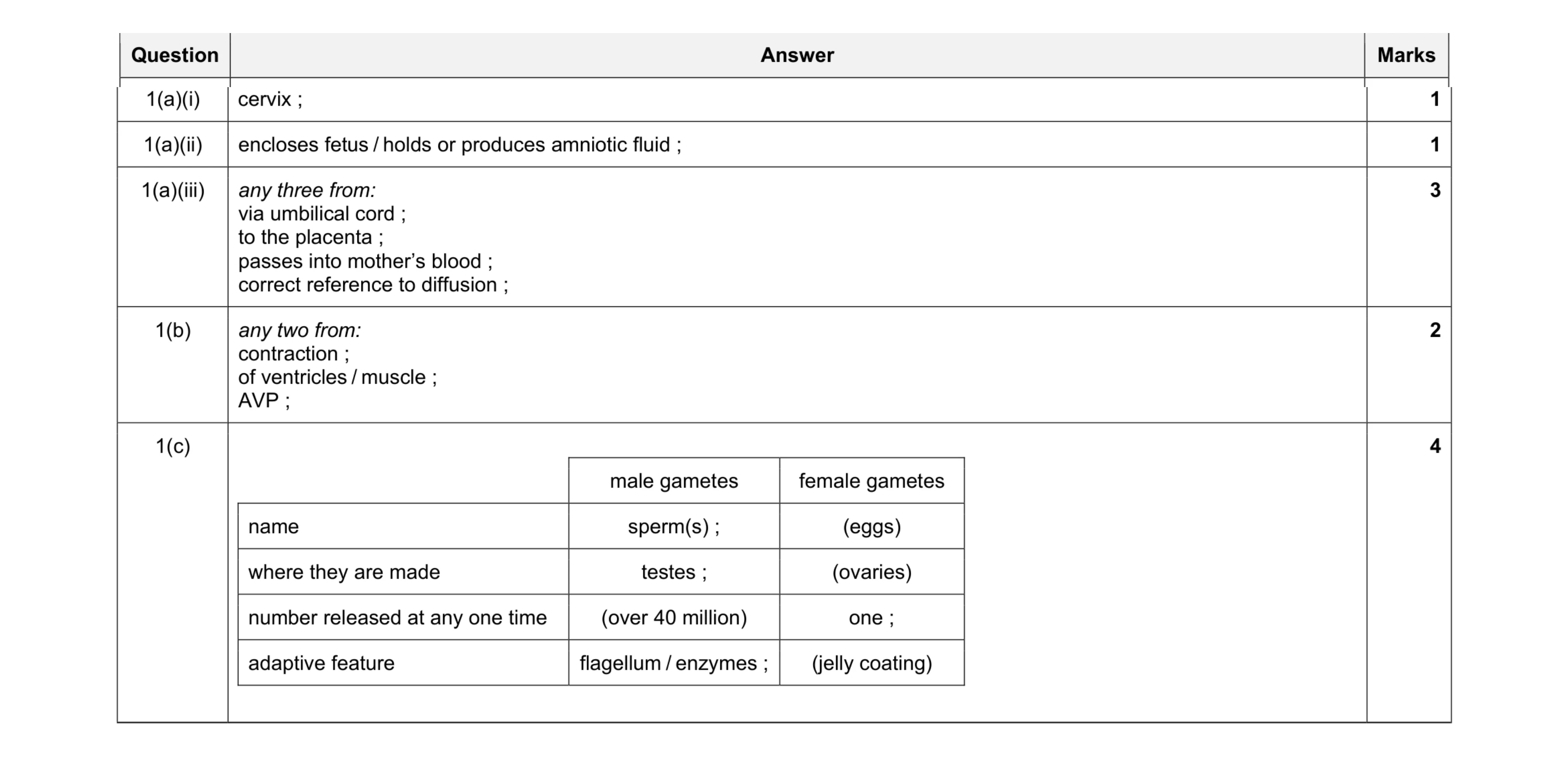 11
11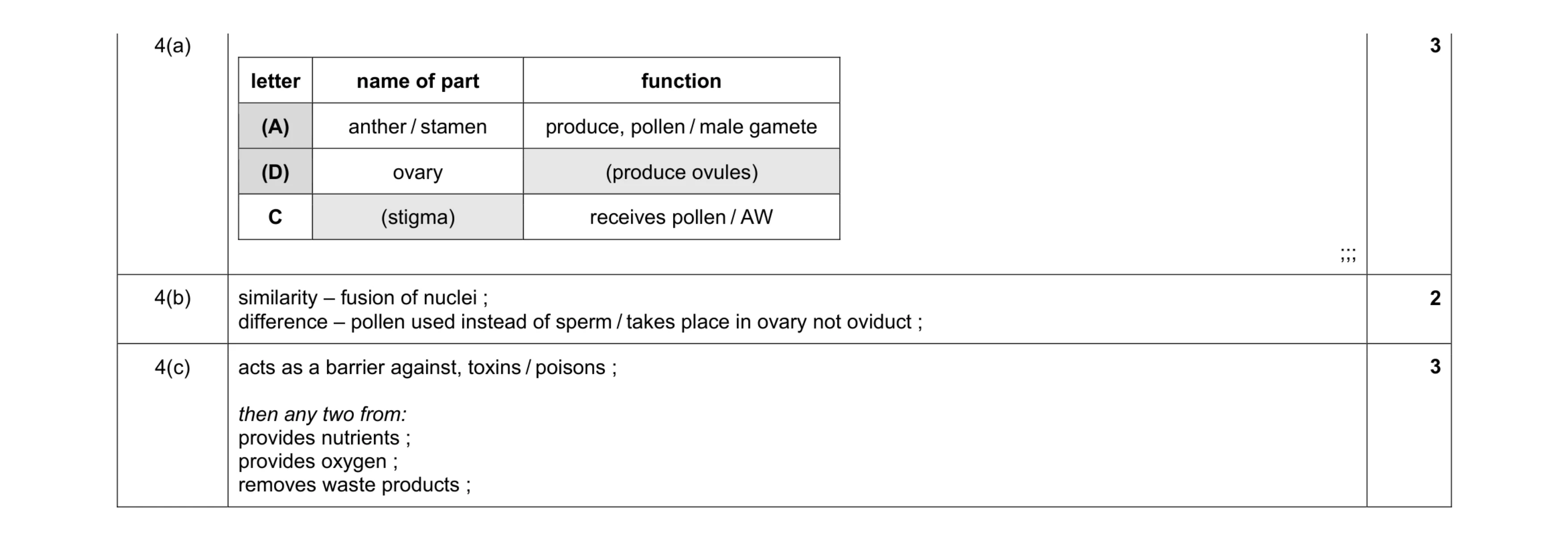 8
8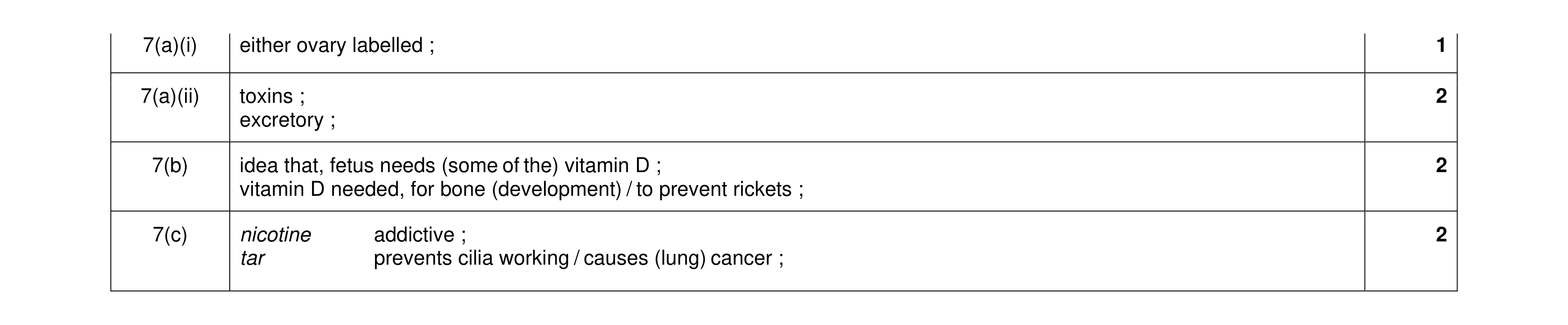 7
7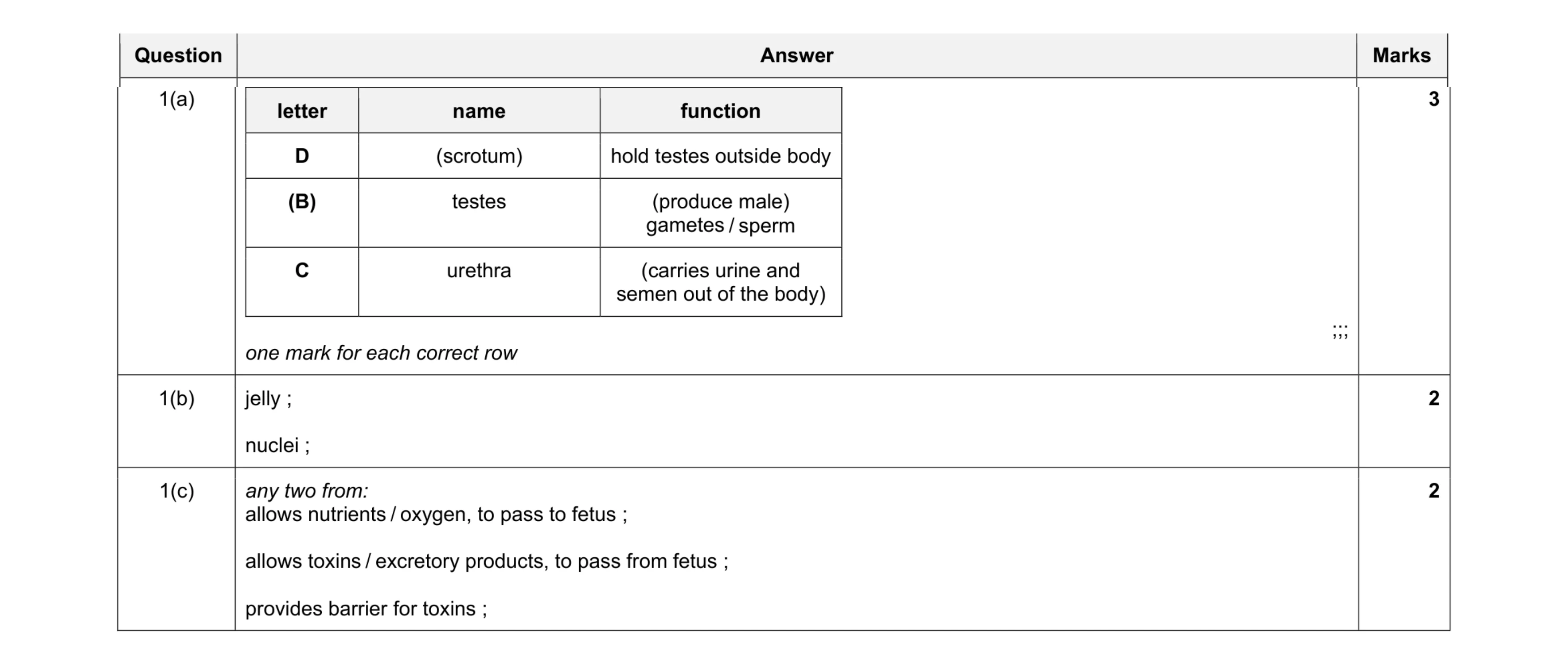 7
7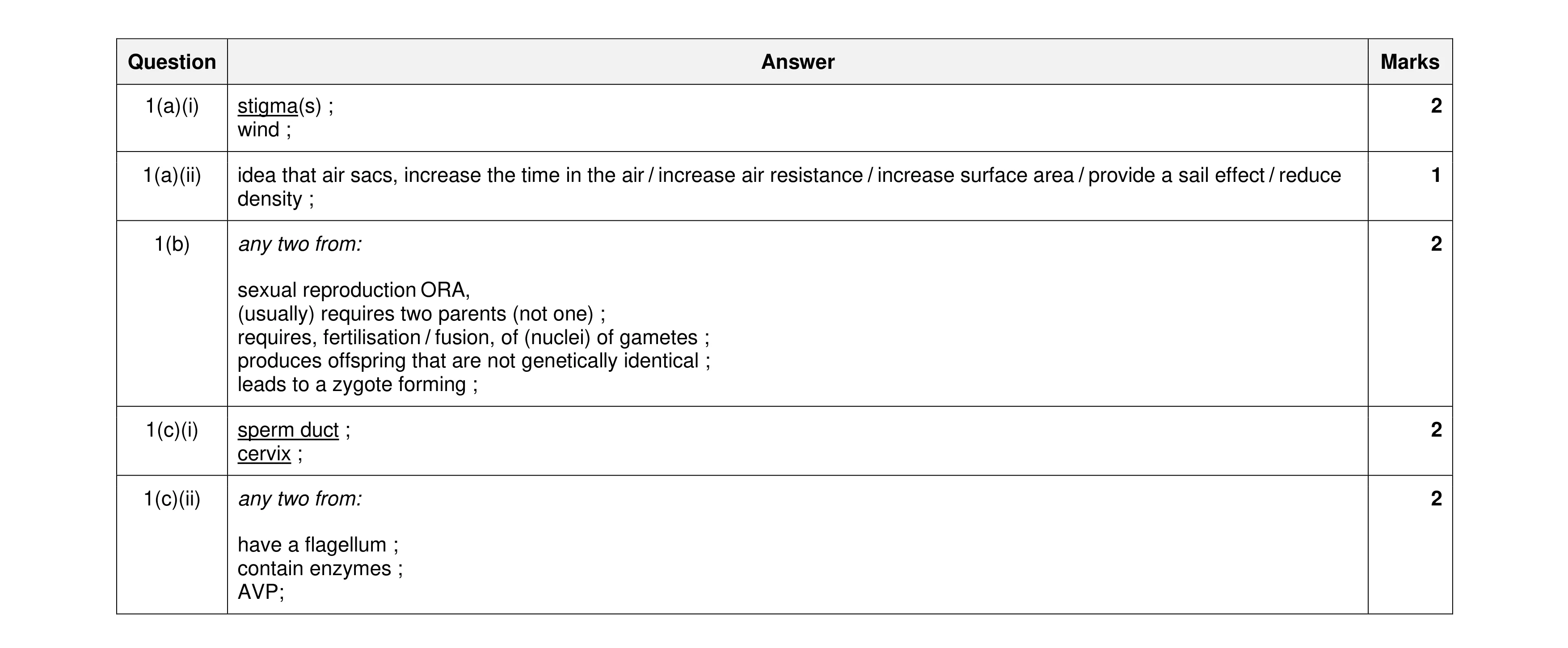 9
9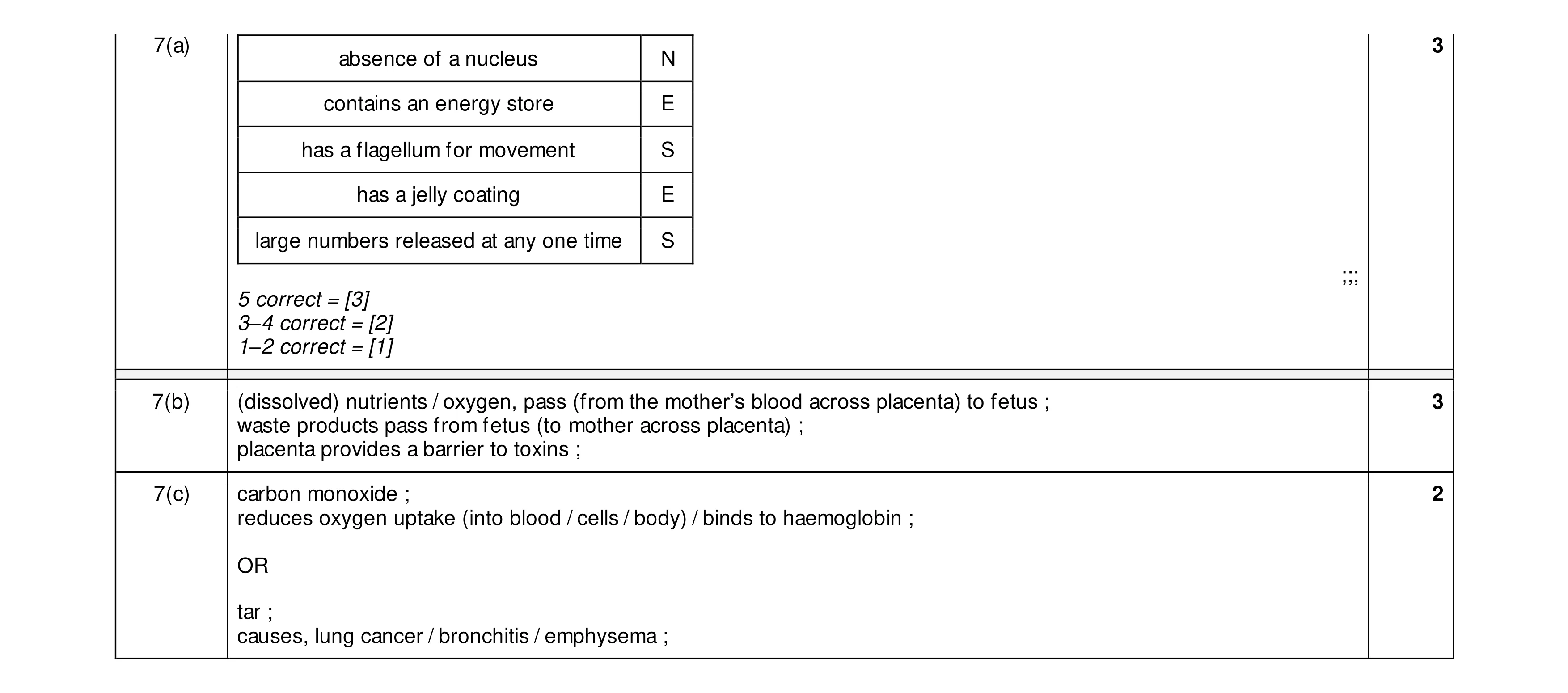 8
8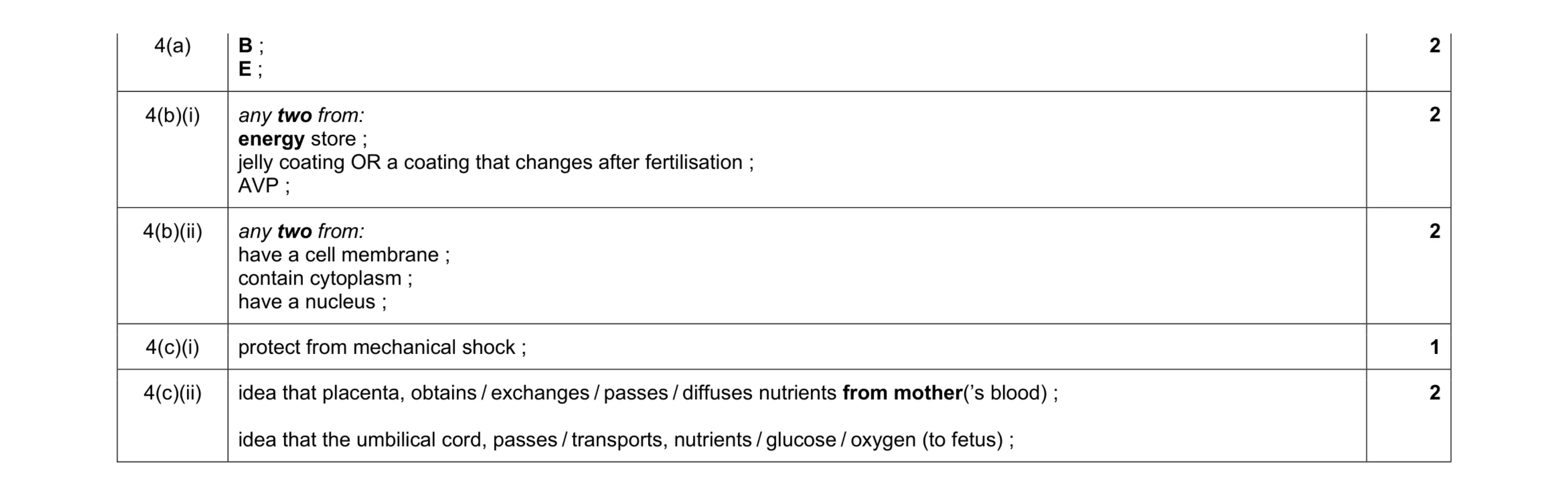 9
9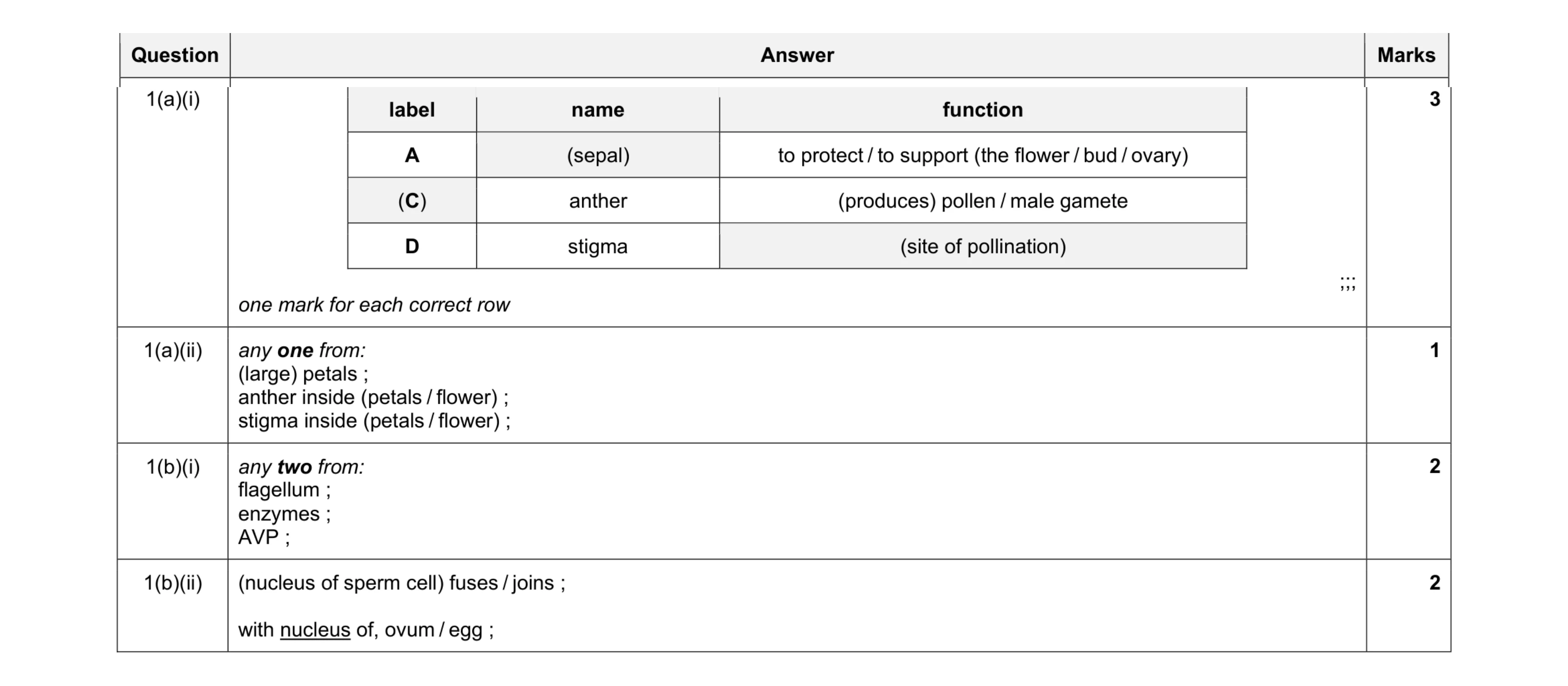 8
8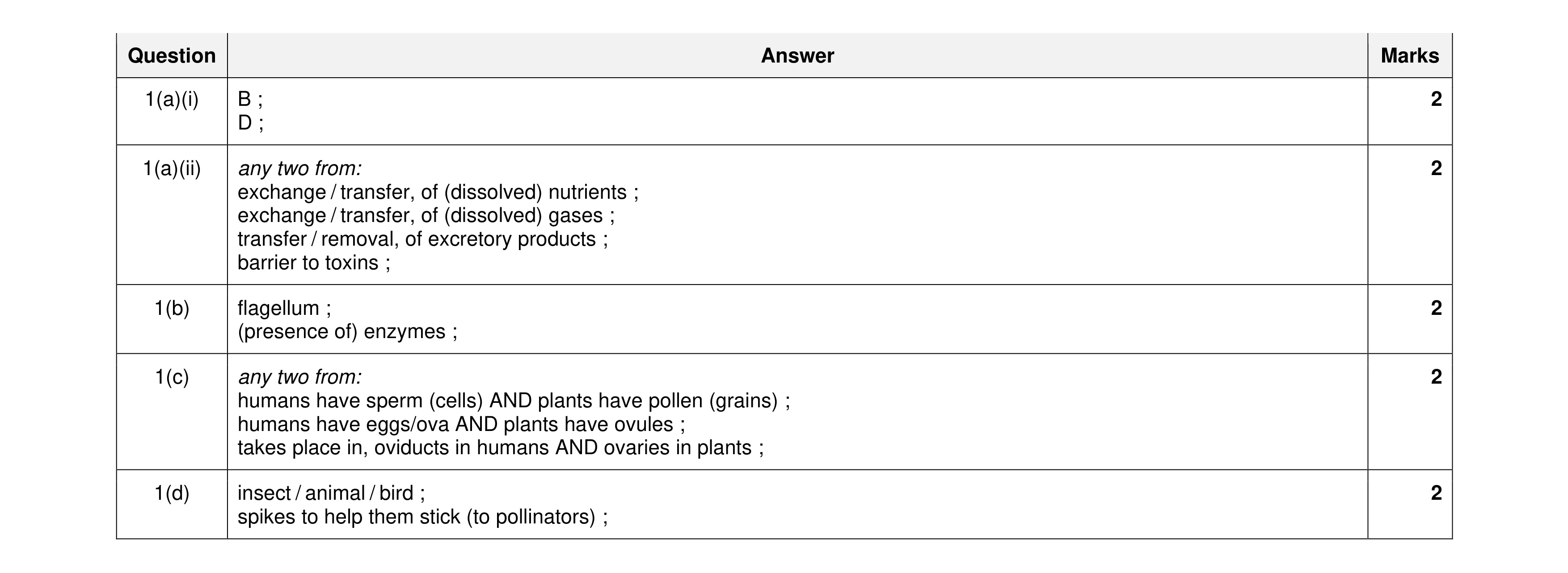 10
10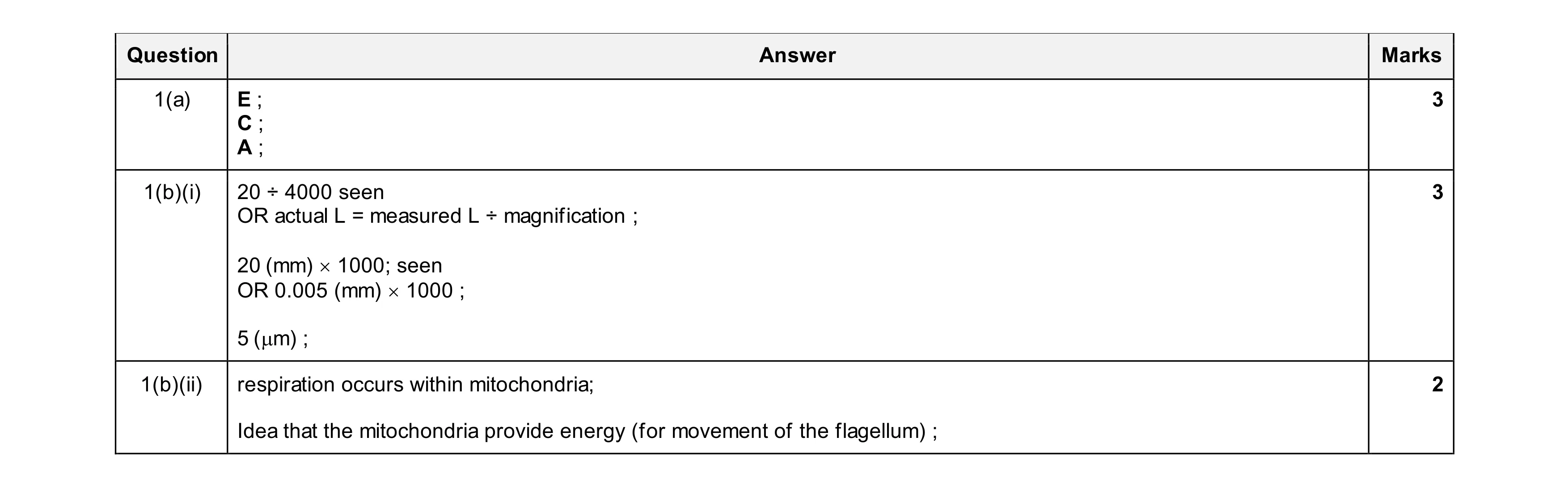 8
8