Questions as text
Q1 · Use lines to connect the box on the left to different boxes on the right to make correct… 0653/43 May/June 2017
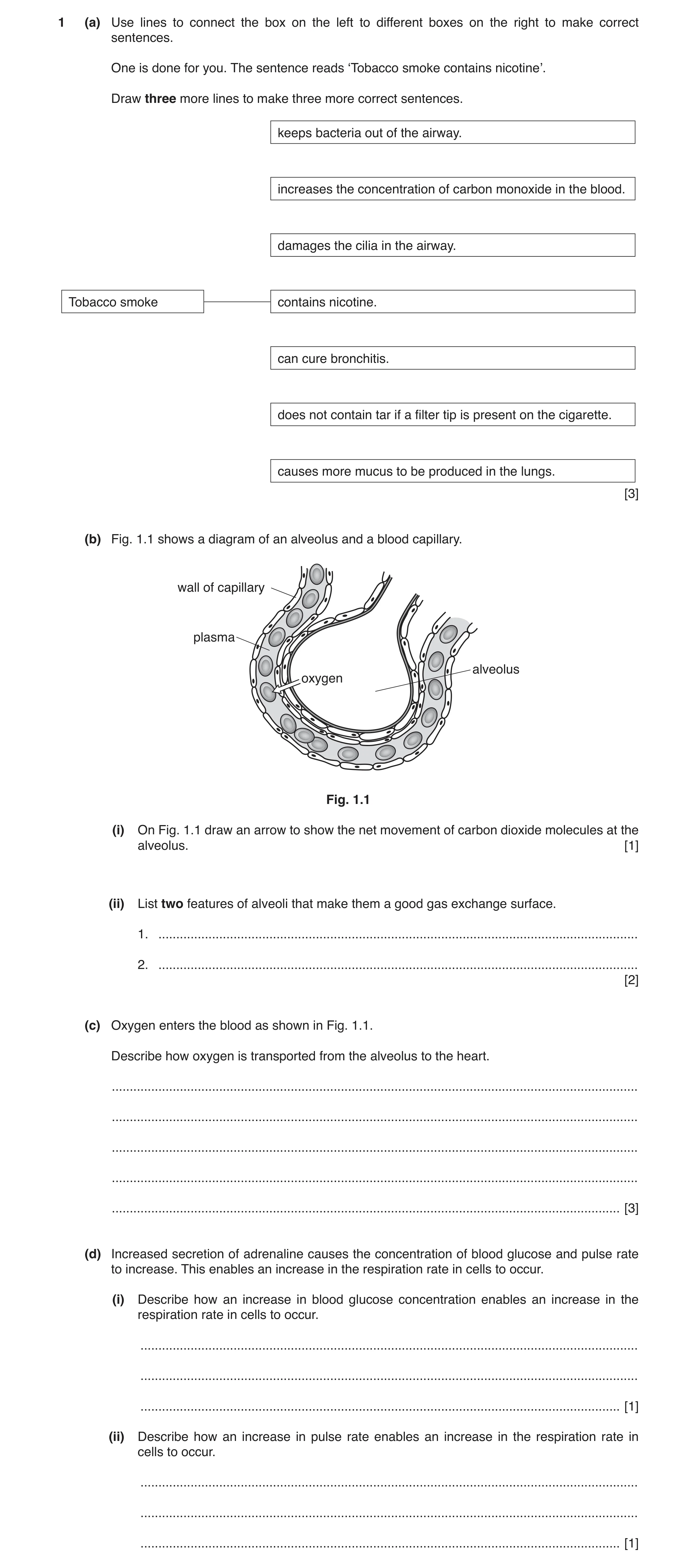
1 (a) Use lines to connect the box on the left to different boxes on the right to make correct sentences. One is done for you. The sentence reads ‘Tobacco smoke contains nicotine’. Draw three more lines to make three more correct sentences. keeps bacteria out of the airway. increases the concentration of carbon monoxide in the blood. damages the cilia in the airway. Tobacco smoke contains nicotine. can cure bronchitis. does not contain tar if a filter tip is present on the cigarette. causes more mucus to be produced in the lungs. [3] (b) Fig. 1.1 shows a diagram of an alveolus and a blood capillary. wall of capillary plasma alveolus oxygen Fig. 1.1 (i) On Fig. 1.1 draw an arrow to show the net movement of carbon dioxide molecules at the alveolus. [1] (ii) List two features of alveoli that make them a good gas exchange surface. 1. … 2. … [2] (c) Oxygen enters the blood as shown in Fig. 1.1. Describe how oxygen is transported from the alveolus to the heart. … … … … … [3] (d) Increased secretion of adrenaline causes the concentration of blood glucose and pulse rate to increase. This enables an increase in the respiration rate in cells to occur. (i) Describe how an increase in blood glucose concentration enables an increase in the respiration rate in cells to occur. … … … [1] (ii) Describe how an increase in pulse rate enables an increase in the respiration rate in cells to occur. … … … [1]
11 marks
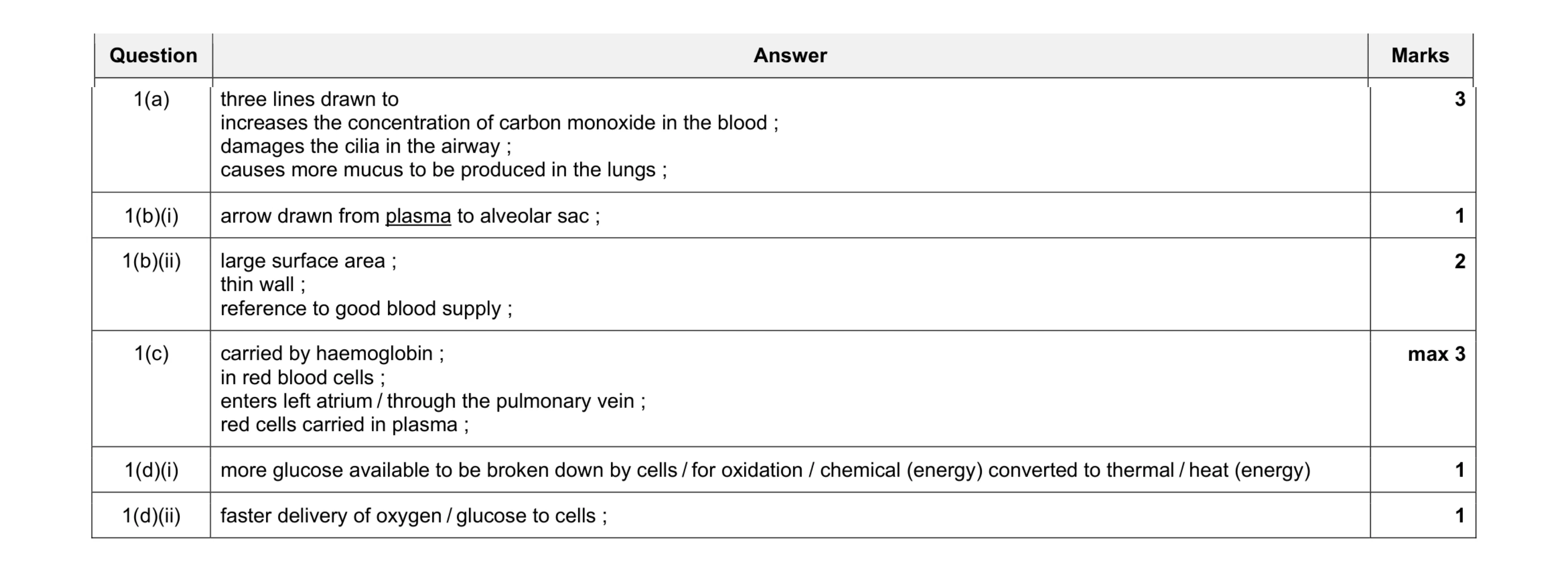
Mark scheme: 1(a) three lines drawn to increases the concentration of carbon monoxide in the blood ; damages the cilia in the airway ; causes more mucus to be produced in the lungs ; 3 1(b)(i) arrow drawn from plasma to alveolar sac ; 1 1(b)(ii) large surface area ; thin wall ; reference to good blood supply ; 2 1(c) carried by haemoglobin ; in red blood cells ; enters left atrium / through the pulmonary vein ; red cells carried in plasma ; max 3 1(d)(i) more glucose available to be broken down by cells / for oxidation / chemical (energy) converted to thermal / heat (energy) 1 1(d)(ii) faster delivery of oxygen / glucose to cells ; 1
This question in 0653/43 May/June 2017
Q2 · Use the following words or phrases to complete the flow chart about the transport of… 0653/41 Oct/Nov 2017
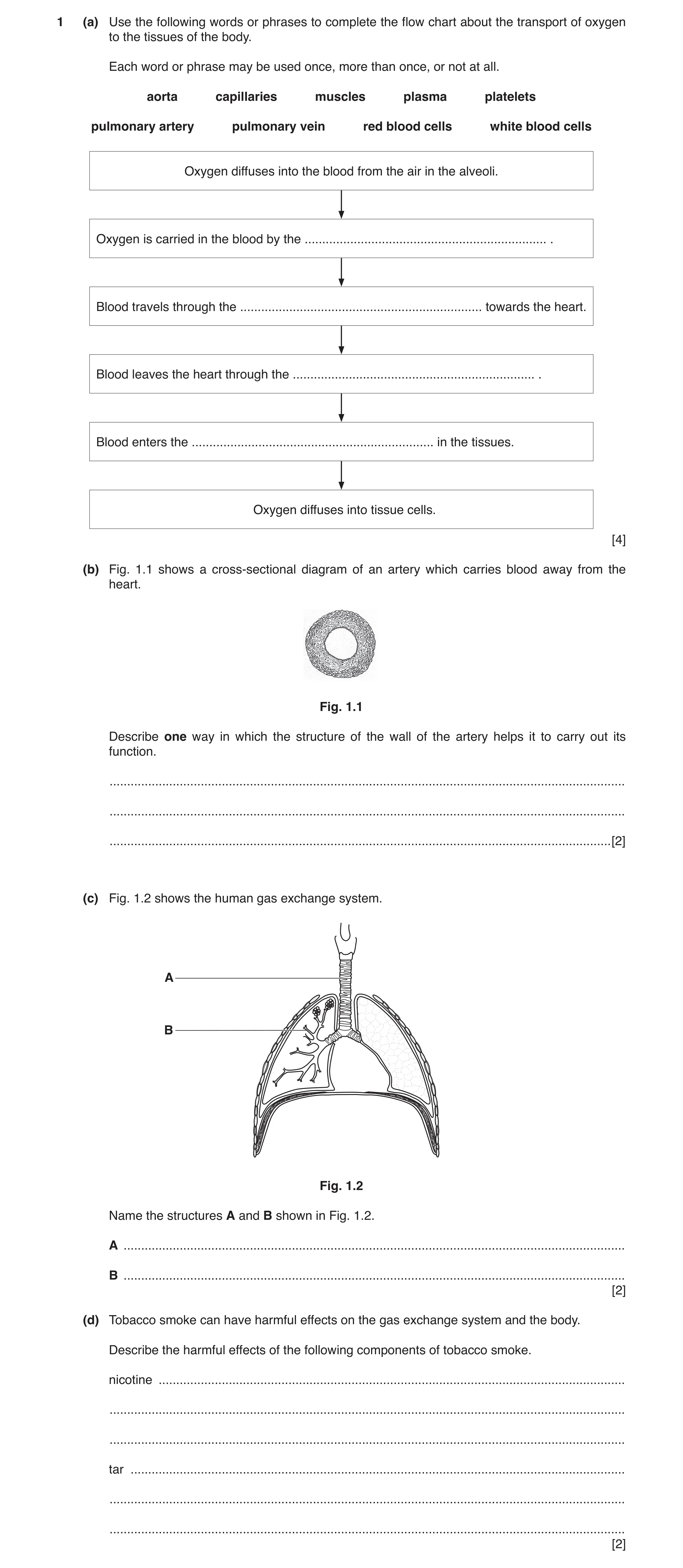
1 (a) Use the following words or phrases to complete the flow chart about the transport of oxygen to the tissues of the body. Each word or phrase may be used once, more than once, or not at all. aorta capillaries muscles plasma platelets pulmonary artery pulmonary vein red blood cells white blood cells Oxygen diffuses into the blood from the air in the alveoli. Oxygen is carried in the blood by the … . Blood travels through the … towards the heart. Blood leaves the heart through the … . Blood enters the … in the tissues. Oxygen diffuses into tissue cells. [4] (b) Fig. 1.1 shows a cross-sectional diagram of an artery which carries blood away from the heart. Fig. 1.1 Describe one way in which the structure of the wall of the artery helps it to carry out its function. … … … [2] (c) Fig. 1.2 shows the human gas exchange system. A B Fig. 1.2 Name the structures A and B shown in Fig. 1.2. A … B … [2] (d) Tobacco smoke can have harmful effects on the gas exchange system and the body. Describe the harmful effects of the following components of tobacco smoke. nicotine … … … tar … … … [2]
10 marks
Mark scheme: 1(a) red blood cells ; pulmonary vein ; aorta ; capillaries ; 4 1(b) thick (wall) ; to resist bursting / withstand high blood pressure ; 2 1(c) A trachea ; B bronchiole ; 2 1(d) (nicotine) causes addiction / increases blood pressure / leads to heart disease ; (tar) increases mucus / (tar) builds up in lungs / paralyses / destroys cilia / can cause cancer / avp ; 2
This question in 0653/41 Oct/Nov 2017
Q3 · During inspiration air passes through different parts of the airway to reach the alveoli 0653/42 May/June 2018
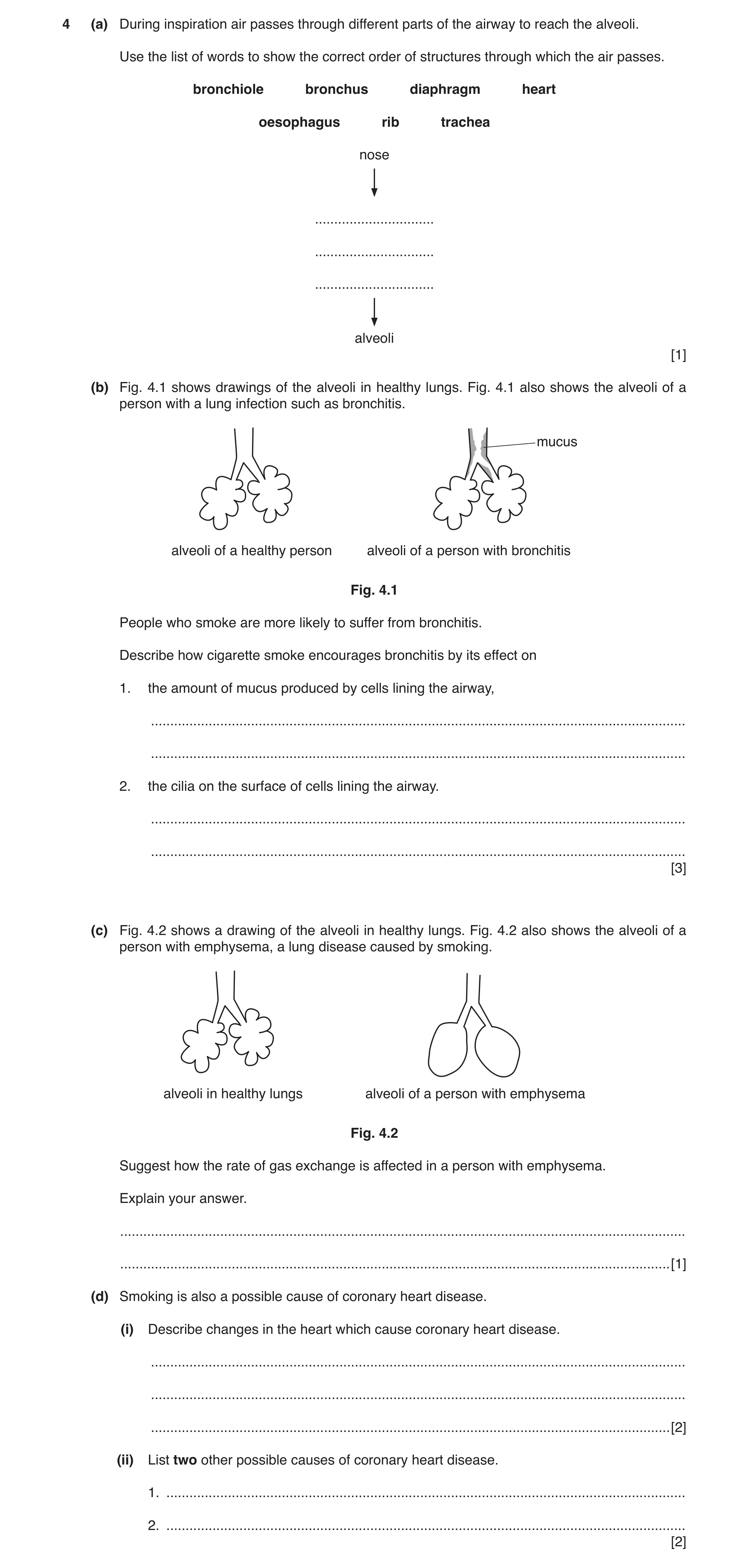
4 (a) During inspiration air passes through different parts of the airway to reach the alveoli. Use the list of words to show the correct order of structures through which the air passes. bronchiole bronchus diaphragm heart oesophagus rib trachea nose … … … alveoli [1] (b) Fig. 4.1 shows drawings of the alveoli in healthy lungs. Fig. 4.1 also shows the alveoli of a person with a lung infection such as bronchitis. mucus alveoli of a healthy person alveoli of a person with bronchitis Fig. 4.1 People who smoke are more likely to suffer from bronchitis. Describe how cigarette smoke encourages bronchitis by its effect on 1. the amount of mucus produced by cells lining the airway, … … 2. the cilia on the surface of cells lining the airway. … … [3] (c) Fig. 4.2 shows a drawing of the alveoli in healthy lungs. Fig. 4.2 also shows the alveoli of a person with emphysema, a lung disease caused by smoking. alveoli in healthy lungs alveoli of a person with emphysema Fig. 4.2 Suggest how the rate of gas exchange is affected in a person with emphysema. Explain your answer. … … [1] (d) Smoking is also a possible cause of coronary heart disease. (i) Describe changes in the heart which cause coronary heart disease. … … … [2] (ii) List two other possible causes of coronary heart disease. 1. … 2. … [2]
9 marks
Mark scheme: 4(a) trachea, bronchus, bronchiole ; 1 4(b) effect on mucus mucus production increases ; effect on cilia cilia become paralysed / damaged ; cannot remove mucus from airway / away from lungs ; 3 4(c) (rate of gas exchange reduced) reduced area (for gas exchange in alveoli) ; 1 4(d)(i) narrowing / blockage of coronary arteries ; due to fatty deposits / plaque ; 2 4(d)(ii) high fat diet ; stress ; 2
This question in 0653/42 May/June 2018
Q4 · A diagram of the human gas exchange system 0653/43 May/June 2018
7 (a) Fig. 7.1 shows a diagram of the human gas exchange system. Fig. 7.1 On Fig. 7.1 use label lines to identify (i) the larynx, [1] (ii) a bronchiole. [1] (b) Fig. 7.2 shows a diagram of an alveolus in the lungs. wall of capillary plasma alveolus oxygen red blood cell Fig. 7.2 (i) Describe two features of a gas exchange surface which are visible in Fig. 7.2. 1. … 2. … [2] (ii) Oxygen diffuses into the blood at the alveoli. Explain why oxygen diffuses from the alveoli into the blood. … … … [1] (c) Describe how the gas exchange system is protected by mucus and cilia. mucus … … cilia … … [2] (d) The blood leaving the heart from the left ventricle has a greater pressure than the blood leaving the right ventricle. Explain why this difference in pressure is needed. … … … … [2]
9 marks
Mark scheme: 7(a)(i) larynx correctly labelled ; 1 7(a)(ii) any bronchiole correctly labelled ; 1 7(b)(i) thin wall / short diffusion distance ; good blood supply ; 2 Question Answer Marks 7(b)(ii) down concentration gradient owtte ; 1 7(c) mucus traps pathogens / dust ; cilia (beat upwards to) remove the mucus ; 2 7(d) (blood leaving left ventricle) has to go all round the body ; blood leaving right ventricle only has to go to lungs / high pressure in lung capillaries would damage them ; 2
This question in 0653/43 May/June 2018
Q5 · A diagram of an alveolus 0653/41 Oct/Nov 2018
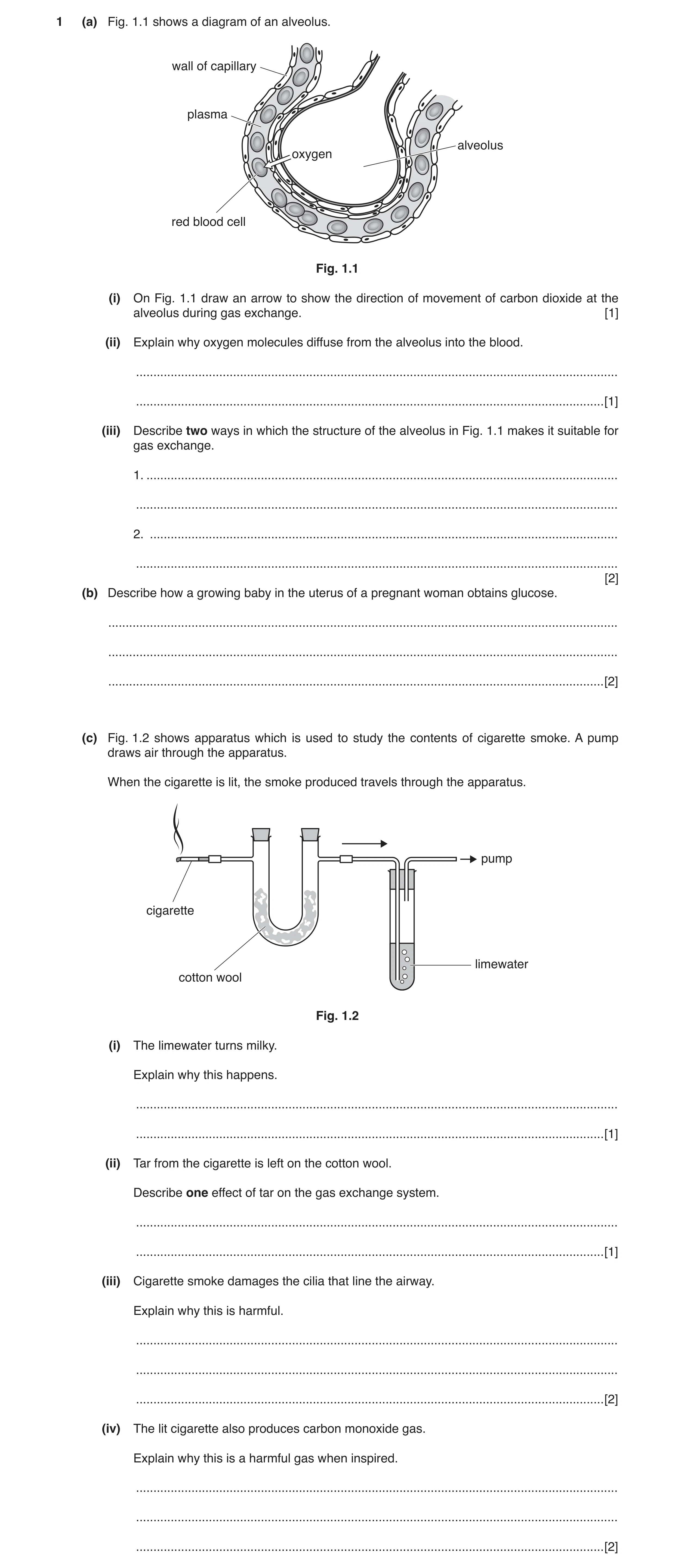
1 (a) Fig. 1.1 shows a diagram of an alveolus. wall of capillary plasma alveolus oxygen red blood cell Fig. 1.1 (i) On Fig. 1.1 draw an arrow to show the direction of movement of carbon dioxide at the alveolus during gas exchange. [1] (ii) Explain why oxygen molecules diffuse from the alveolus into the blood. … … [1] (iii) Describe two ways in which the structure of the alveolus in Fig. 1.1 makes it suitable for gas exchange. 1. … … 2. … … [2] (b) Describe how a growing baby in the uterus of a pregnant woman obtains glucose. … … … [2] (c) Fig. 1.2 shows apparatus which is used to study the contents of cigarette smoke. A pump draws air through the apparatus. When the cigarette is lit, the smoke produced travels through the apparatus. pump cigarette limewater cotton wool Fig. 1.2 (i) The limewater turns milky. Explain why this happens. … … [1] (ii) Tar from the cigarette is left on the cotton wool. Describe one effect of tar on the gas exchange system. … … [1] (iii) Cigarette smoke damages the cilia that line the airway. Explain why this is harmful. … … … [2] (iv) The lit cigarette also produces carbon monoxide gas. Explain why this is a harmful gas when inspired. … … … [2]
12 marks
Mark scheme: 1(a)(i) arrow drawn from the plasma of the blood to the air sac of alveolus ; 1 1(a)(ii) there is a concentration / diffusion gradient / greater oxygen concentration in alveolus than the blood ; 1 1(a)(iii) thin wall / flattened cells ; large surface area ; good blood supply ; Max 2 2 1(b) through placenta ; and then one of by diffusion ; via (umbilical) cord ; Max 2 2 1(c)(i) carbon dioxide / CO2 / produced / present (in smoke) ; 1 1(c)(ii) causes cancer ; stimulates mucus production ; Max 1 1 1(c)(iii) mucus cannot be swept out of the lungs ; pathogens / particles (in mucus) more likely to enter lungs ; 2 1(c)(iv) combines with the haemoglobin / red blood cells ; CO replaces oxygen (on haemoglobin) ; reduces the transport of oxygen by blood / less oxygen available ( for cells) ; Max 2 2
This question in 0653/41 Oct/Nov 2018
Q6 · Rainforest is often cleared for agriculture by cutting down the trees and burning them 0653/43 Oct/Nov 2018
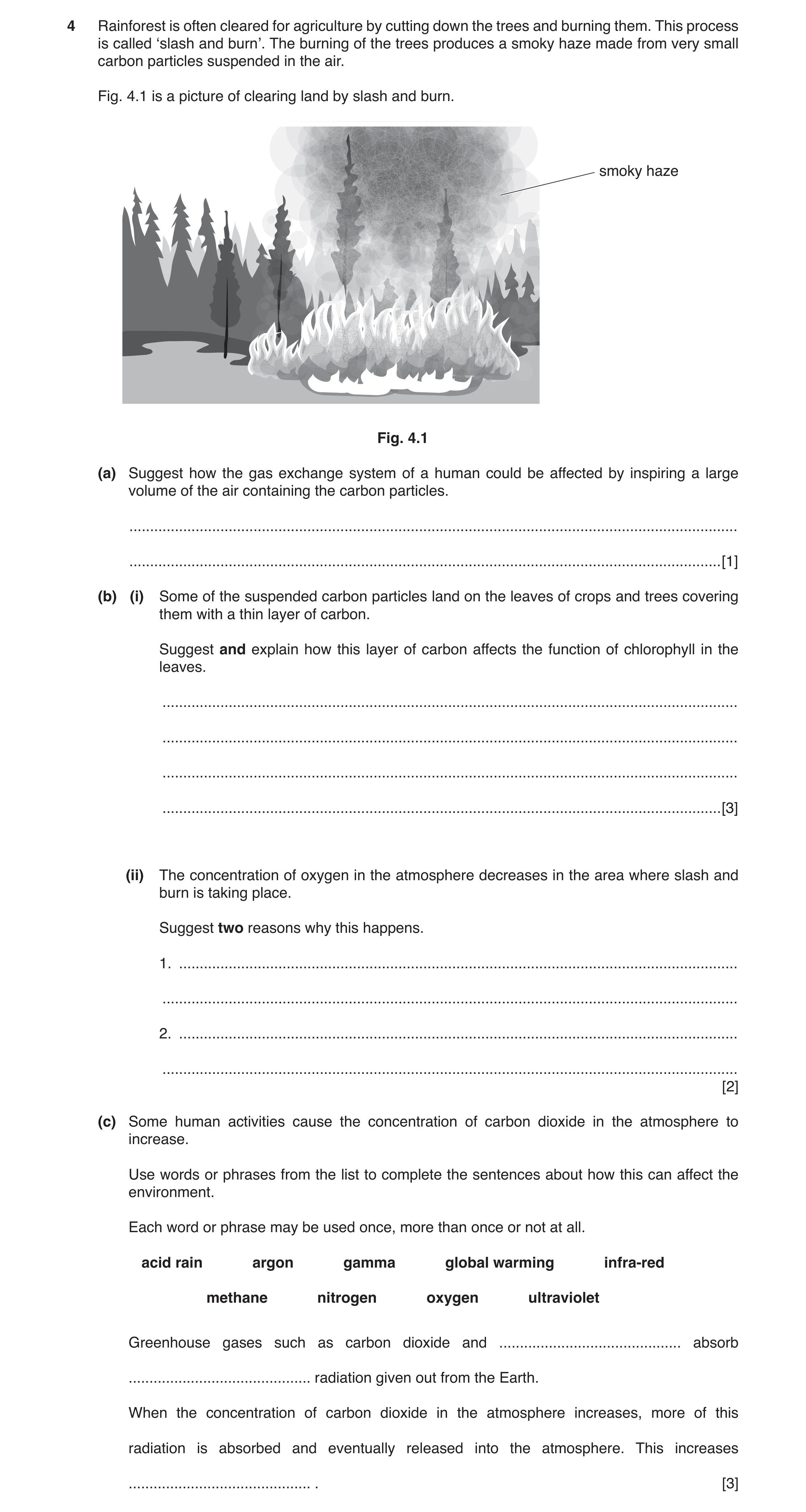
4 Rainforest is often cleared for agriculture by cutting down the trees and burning them. This process is called ‘slash and burn’. The burning of the trees produces a smoky haze made from very small carbon particles suspended in the air. Fig. 4.1 is a picture of clearing land by slash and burn. smoky haze Fig. 4.1 (a) Suggest how the gas exchange system of a human could be affected by inspiring a large volume of the air containing the carbon particles. … … [1] (b) (i) Some of the suspended carbon particles land on the leaves of crops and trees covering them with a thin layer of carbon. Suggest and explain how this layer of carbon affects the function of chlorophyll in the leaves. … … … … [3] (ii) The concentration of oxygen in the atmosphere decreases in the area where slash and burn is taking place. Suggest two reasons why this happens. 1. … … 2. … … [2] (c) Some human activities cause the concentration of carbon dioxide in the atmosphere to increase. Use words or phrases from the list to complete the sentences about how this can affect the environment. Each word or phrase may be used once, more than once or not at all. acid rain argon gamma global warming infra-red methane nitrogen oxygen ultraviolet Greenhouse gases such as carbon dioxide and … absorb … radiation given out from the Earth. When the concentration of carbon dioxide in the atmosphere increases, more of this radiation is absorbed and eventually released into the atmosphere. This increases … . [3]
9 marks
Mark scheme: 4(a) produces irritation / cough / more mucus production ; 1 4(b)(i) thin layer of carbon reduces the amount of light (energy) reaching leaves / chlorophyll ; (chlorophyll) traps less light (energy) ; less conversion to chemical energy ; reduces rate of photosynthesis ; Max 3 3 4(b)(ii) oxygen used during combustion (of wood) ; oxygen not produced by plants ; 2 4(c) methane ; infra-red ; global warming ; 3
This question in 0653/43 Oct/Nov 2018
Q7 · A bar chart which shows some differences in the composition of inspired air and expired… 0653/43 May/June 2019
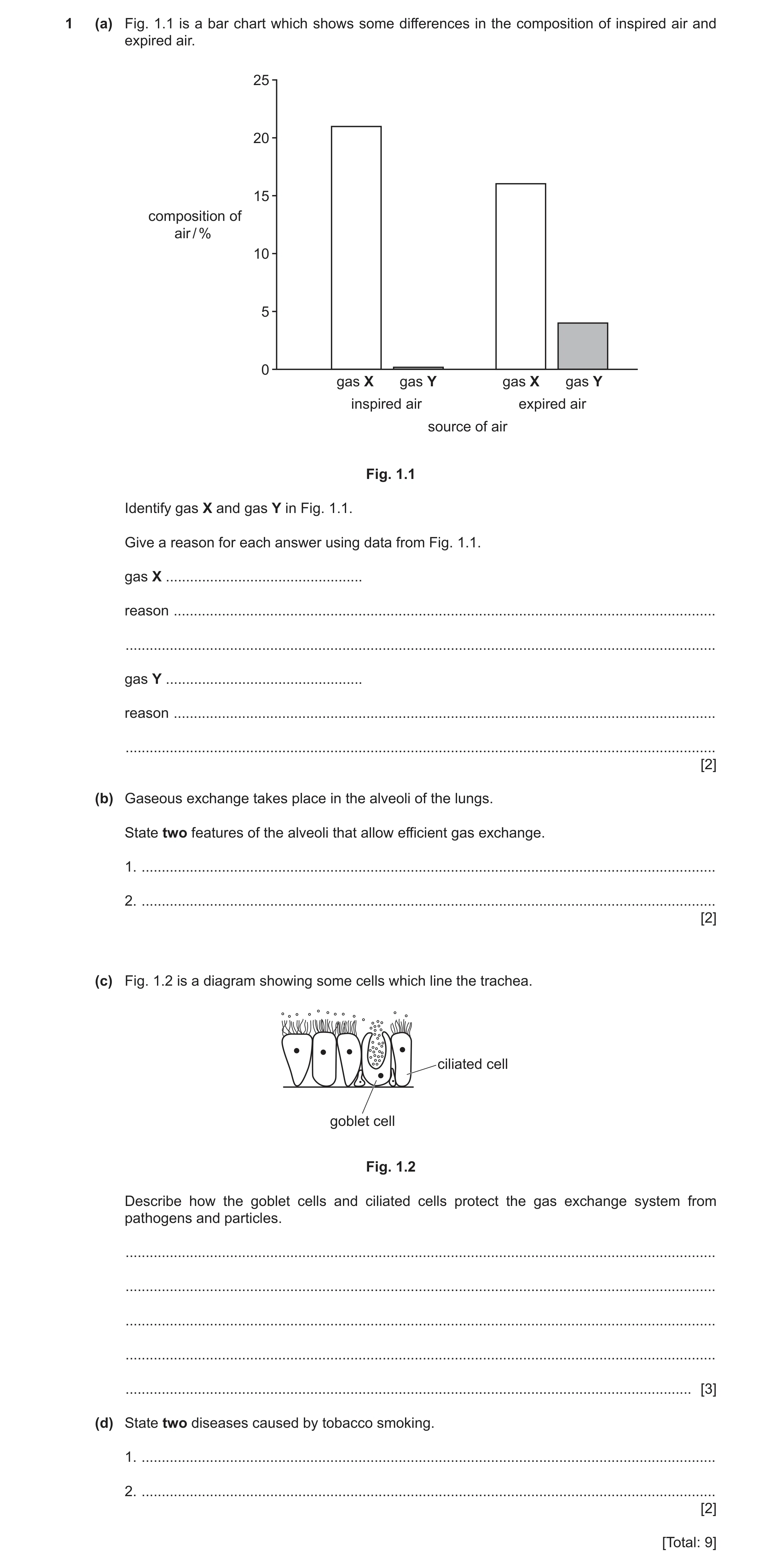
1 (a) Fig. 1.1 is a bar chart which shows some differences in the composition of inspired air and expired air. 25 20 15 composition of air / % 10 5 0 gas X gas Y gas X gas Y inspired air expired air source of air Fig. 1.1 Identify gas X and gas Y in Fig. 1.1. Give a reason for each answer using data from Fig. 1.1. gas X … reason … … gas Y … reason … … [2] (b) Gaseous exchange takes place in the alveoli of the lungs. State two features of the alveoli that allow efficient gas exchange. 1. … 2. … [2] (c) Fig. 1.2 is a diagram showing some cells which line the trachea. ciliated cell goblet cell Fig. 1.2 Describe how the goblet cells and ciliated cells protect the gas exchange system from pathogens and particles. … … … … … [3] (d) State two diseases caused by tobacco smoking. 1. … 2. … [2] [Total: 9]
9 marks
Mark scheme: 1(a) gas X oxygen (no mark) reduces in expired air (so oxygen used in respiration) ; gas Y carbon dioxide (no mark) increases in expired air (so carbon dioxide released in respiration) ; 2 1(b) any two of large surface area ; thin walls ; good blood supply ; good ventilation with air ; max 2 1(c) goblet cells secrete mucus ; mucus traps pathogens and particles ; cilia sweep mucus out of the trachea ; 3 1(d) chronic obstructive pulmonary disease / COPD ; lung cancer ; coronary heart disease ; max 2
This question in 0653/43 May/June 2019
Q8 · A student investigates the volumes of air breathed in and out of their lungs before and… 0653/42 Oct/Nov 2019
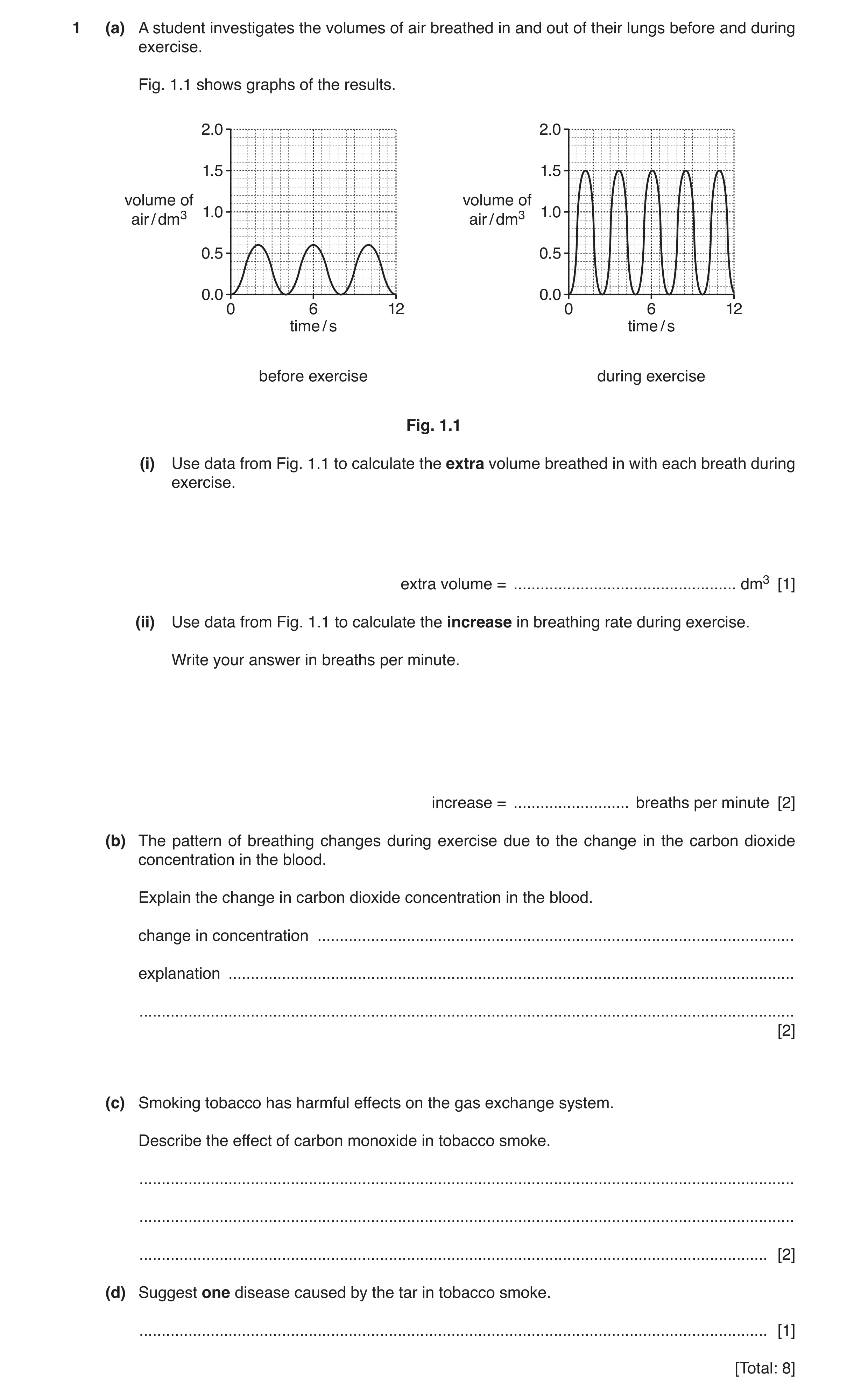
1 (a) A student investigates the volumes of air breathed in and out of their lungs before and during exercise. Fig. 1.1 shows graphs of the results. 2.0 2.0 1.5 1.5 volume of volume of 1.0 1.0 air / dm3 air / dm3 0.5 0.5 0.0 0.0 0 6 12 0 6 12 time / s time / s before exercise during exercise Fig. 1.1 (i) Use data from Fig. 1.1 to calculate the extra volume breathed in with each breath during exercise. extra volume = … dm3 [1] (ii) Use data from Fig. 1.1 to calculate the increase in breathing rate during exercise. Write your answer in breaths per minute. increase = … breaths per minute [2] (b) The pattern of breathing changes during exercise due to the change in the carbon dioxide concentration in the blood. Explain the change in carbon dioxide concentration in the blood. change in concentration … explanation … … [2] (c) Smoking tobacco has harmful effects on the gas exchange system. Describe the effect of carbon monoxide in tobacco smoke. … … … [2] (d) Suggest one disease caused by the tar in tobacco smoke. … [1] [Total: 8]
8 marks
Mark scheme: 1(a)(i) (1.5 – 0.6 =) 0.9 (dm3) ; 1 1(a)(ii) (increase in breaths) = 2 breaths (over 12 seconds) ; × 60 / 12 = 10 ; 2 1(b) increase ; (aerobic) respiration increases during exercise ; 2 1(c) combines with haemoglobin / reduces the amount of oxygen able to combine with haemoglobin ; reduces amount of oxygen being transported (by blood / red cells) ; 2 1(d) lung cancer / COPD / emphysema / bronchitis ; 1
This question in 0653/42 Oct/Nov 2019
Q9 · The percentage composition of the gases in inspired air and in expired air 0653/41 May/June 2020
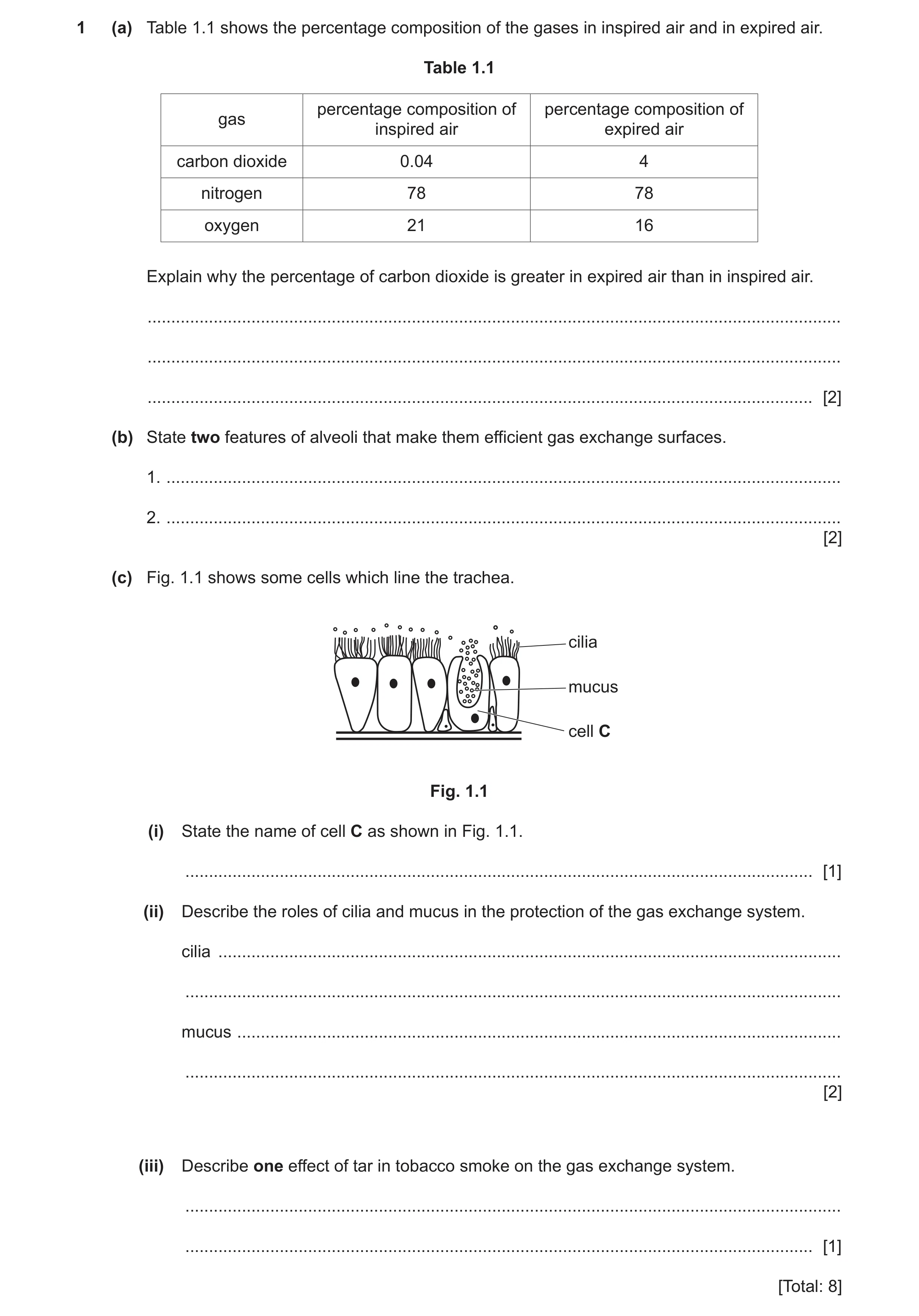
1 (a) Table 1.1 shows the percentage composition of the gases in inspired air and in expired air. Table 1.1 percentage composition of percentage composition of gas inspired air expired air carbon dioxide 0.04 4 nitrogen 78 78 oxygen 21 16 Explain why the percentage of carbon dioxide is greater in expired air than in inspired air. … … … [2] (b) State two features of alveoli that make them efficient gas exchange surfaces. 1. … 2. … [2] (c) Fig. 1.1 shows some cells which line the trachea. cilia mucus cell C Fig. 1.1 (i) State the name of cell C as shown in Fig. 1.1. … [1] (ii) Describe the roles of cilia and mucus in the protection of the gas exchange system. cilia … … mucus … … [2] (iii) Describe one effect of tar in tobacco smoke on the gas exchange system. … … [1] [Total: 8]
8 marks
Mark scheme: 1(a) carbon dioxide produced by cells during respiration ; carbon dioxide, diffuses from blood (plasma) / into alveoli / is excreted at the lungs ; 2 1(b) any two from: large surface area ; thin surface ; good blood supply ; well ventilated ; max 2 1(c)(i) goblet cell ; 1 1(c)(ii) (cilia) (beat to) remove mucus ; (mucus) traps pathogens and particles ; 2 1(c)(iii) stimulates mucus production / bronchitis / lung cancer / destroys or paralyses cilia / collects in alveoli / coats gas exchange surface ; 1
This question in 0653/41 May/June 2020
Question 10 0653/42 May/June 2020
1 (a) Fig. 1.1 represents a plant cell. Fig. 1.1 Add labels to Fig. 1.1 to name two structures that are only present in plant cells. [2] (b) Fig. 1.2 represents an animal cell from the trachea. Fig. 1.2 Describe how the structure of this cell is adapted to its function. … … … [2] (c) Fig. 1.3 shows part of a food web. foxes frogs owls stoats spiders rabbits voles insects grass Fig. 1.3 (i) Define the term consumer. … … [1] (ii) List all of the tertiary consumers shown in the food web in Fig. 1.3. Explain how you identified these consumers using the term trophic level. tertiary consumers … … explanation … … [2] (iii) Complete the food chain containing five organisms from the food web in Fig. 1.3. grass [1] (iv) Describe what the arrows in the food chain represent. … [1] (d) Use words from the list to complete the sentences about photosynthesis. chemical chlorophyll cytoplasm glucose light oxygen starch thermal Each word may be used once, more than once or not at all. During photosynthesis … energy is transferred into … energy by … molecules. [2] [Total: 11]
11 marks
Mark scheme: 1(a) any two of the following correctly labelled: chloroplast ; (large) vacuole ; cell wall ; 2 1(b) (presence of) cilia ; move mucus ; 2 1(c)(i) an organism that gets its energy by feeding on other organisms ; 1 1(c)(ii) (tertiary consumers) foxes and frogs and owls ; (explanation) organisms are at the fourth trophic level ; 2 1(c)(iii) (grass) insects spiders frogs foxes ; 1 1(c)(iv) transfer of energy ; 1 1(d) light (energy is transferred into) chemical (energy) ; chlorophyll ; 2
This question in 0653/42 May/June 2020
Q11 · Gas exchange takes place at the gas exchange surfaces of organisms 0653/41 Oct/Nov 2020
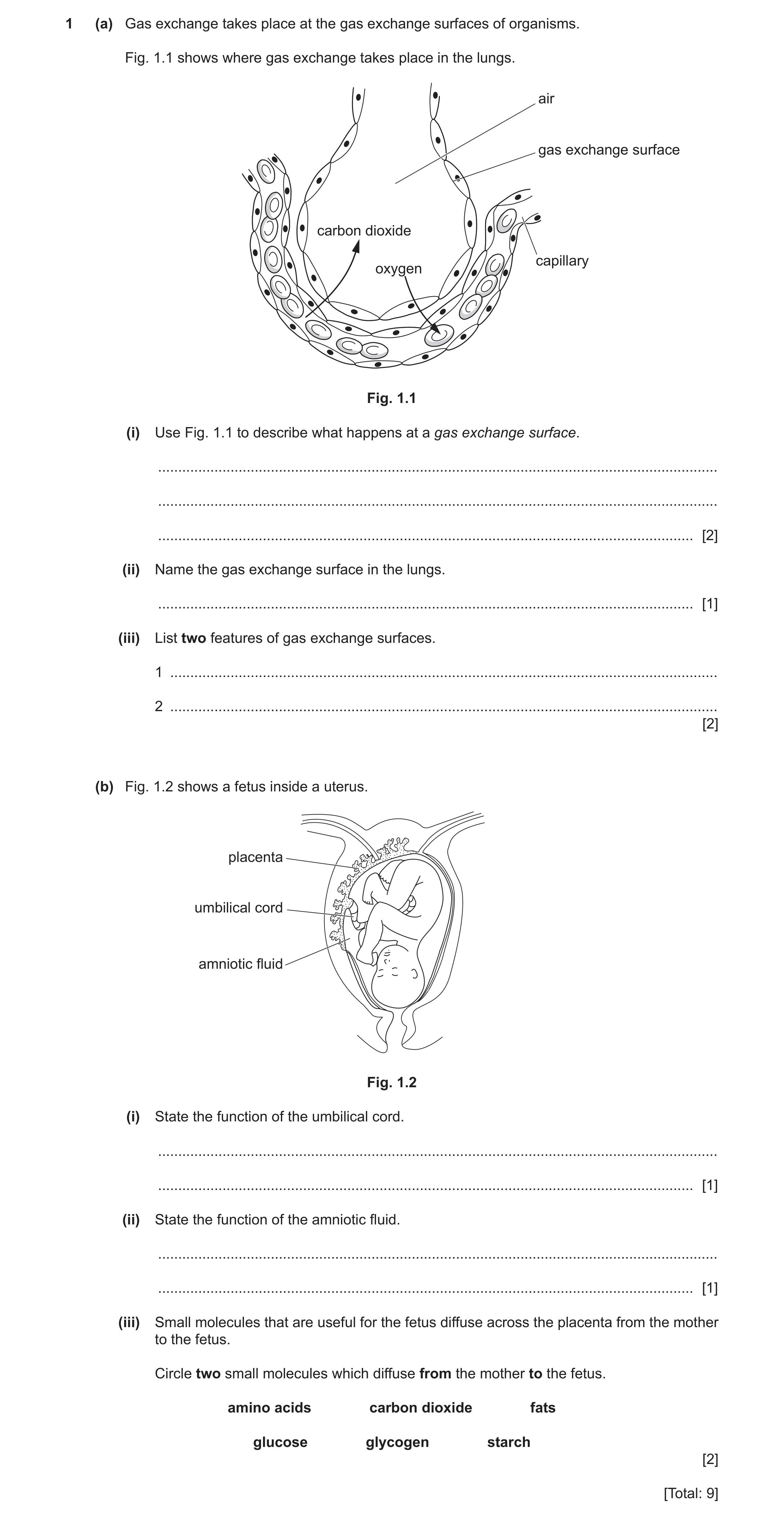
1 (a) Gas exchange takes place at the gas exchange surfaces of organisms. Fig. 1.1 shows where gas exchange takes place in the lungs. air gas exchange surface carbon dioxide capillary oxygen Fig. 1.1 (i) Use Fig. 1.1 to describe what happens at a gas exchange surface. … … … [2] (ii) Name the gas exchange surface in the lungs. … [1] (iii) List two features of gas exchange surfaces. 1 … 2 … [2] (b) Fig. 1.2 shows a fetus inside a uterus. placenta umbilical cord amniotic fluid Fig. 1.2 (i) State the function of the umbilical cord. … … [1] (ii) State the function of the amniotic fluid. … … [1] (iii) Small molecules that are useful for the fetus diffuse across the placenta from the mother to the fetus. Circle two small molecules which diffuse from the mother to the fetus. amino acids carbon dioxide fats glucose glycogen starch [2] [Total: 9]
9 marks
Mark scheme: 1(a)(i) any two from: oxygen moves into the blood; carbon dioxide moves into the, air / lungs / alveoli; by diffusion ; 2 1(a)(ii) alveoli ; 1 1(a)(iii) any two from: thin / one, layer of cells ; good blood supply ; large surface area ; well ventilated ; 2 1(b)(i) (contains blood vessels for) taking substances / correct named substances, to (and from) the placenta / fetus ; 1 1(b)(ii) protects the fetus from mechanical shock ; 1 1(b)(iii) amino acids circled ; glucose circled ; 2
This question in 0653/41 Oct/Nov 2020
Q12 · Red blood cells and white blood cells 0653/43 Oct/Nov 2020
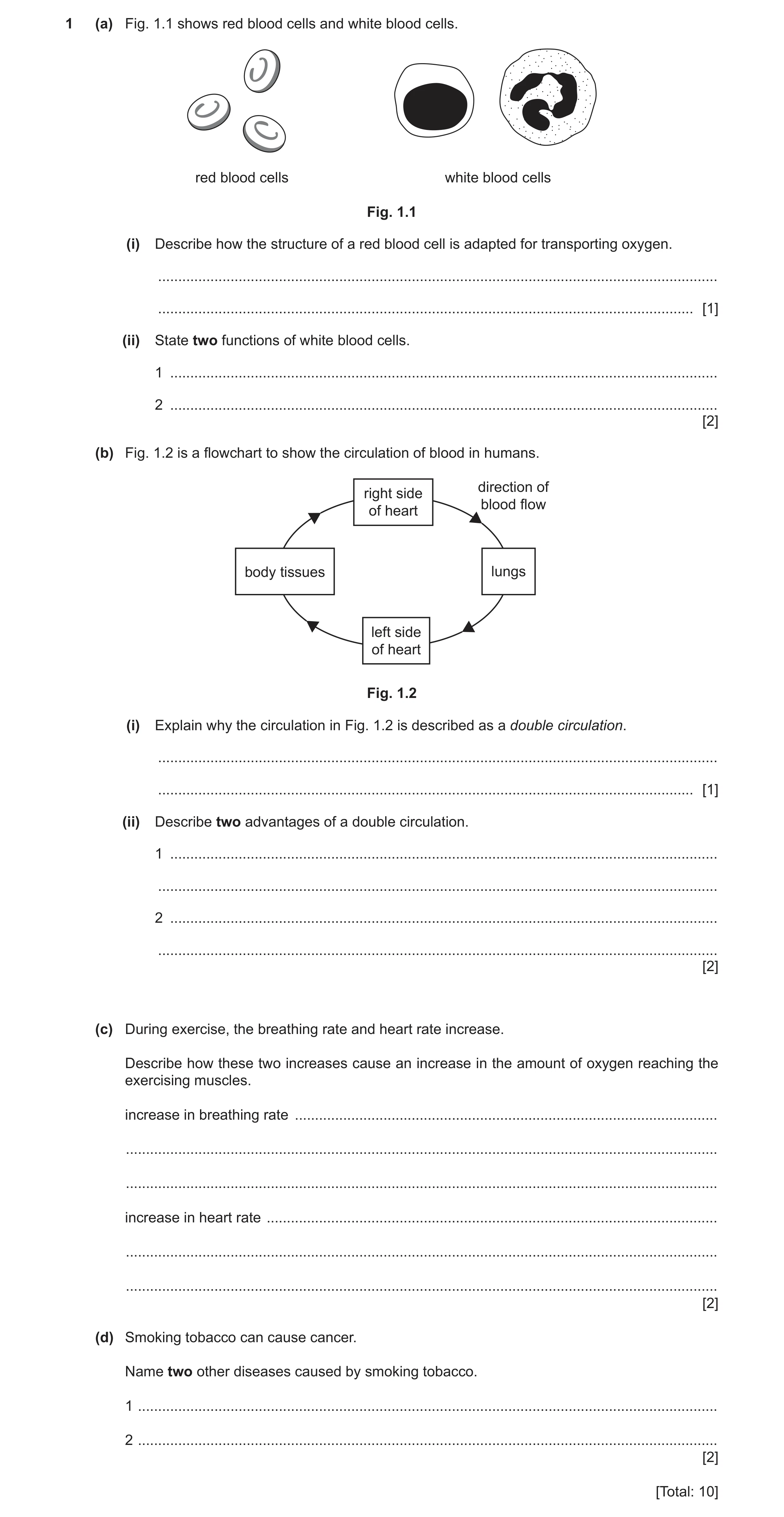
1 (a) Fig. 1.1 shows red blood cells and white blood cells. red blood cells white blood cells Fig. 1.1 (i) Describe how the structure of a red blood cell is adapted for transporting oxygen. … … [1] (ii) State two functions of white blood cells. 1 … 2 … [2] (b) Fig. 1.2 is a flowchart to show the circulation of blood in humans. direction of right side blood flow of heart body tissues lungs left side of heart Fig. 1.2 (i) Explain why the circulation in Fig. 1.2 is described as a double circulation. … … [1] (ii) Describe two advantages of a double circulation. 1 … … 2 … … [2] (c) During exercise, the breathing rate and heart rate increase. Describe how these two increases cause an increase in the amount of oxygen reaching the exercising muscles. increase in breathing rate … … … increase in heart rate … … … [2] (d) Smoking tobacco can cause cancer. Name two other diseases caused by smoking tobacco. 1 … 2 … [2] [Total: 10]
10 marks
Mark scheme: 1(a)(i) any one from: biconcave disc / large surface area (to volume ratio) for maximum oxygen absorption ; no nucleus so more space for oxygen transport ; contains haemoglobin ; 1 1(a)(ii) produce antibodies ; phagocytosis ; 2 1(b)(i) there is a circulation to the lungs and a circulation to the body (tissues) ; 1 1(b)(ii) any two from: enables blood to go to the body tissues at high pressure ; enables blood to go the lungs at low pressure ; keeps oxygenated blood separate from deoxygenated blood ; enables faster blood flow ; 2 1(c) (increase in breathing rate) enables more oxygen to, diffuse into / enter, the blood (at the lungs) ; (increase in heart rate) transports oxygenated blood faster ; 2 1(d) coronary heart disease (CHD) ; COPD ; 2
This question in 0653/43 Oct/Nov 2020
Q13 · A diagram of the gas exchange system in humans 0653/41 Oct/Nov 2021
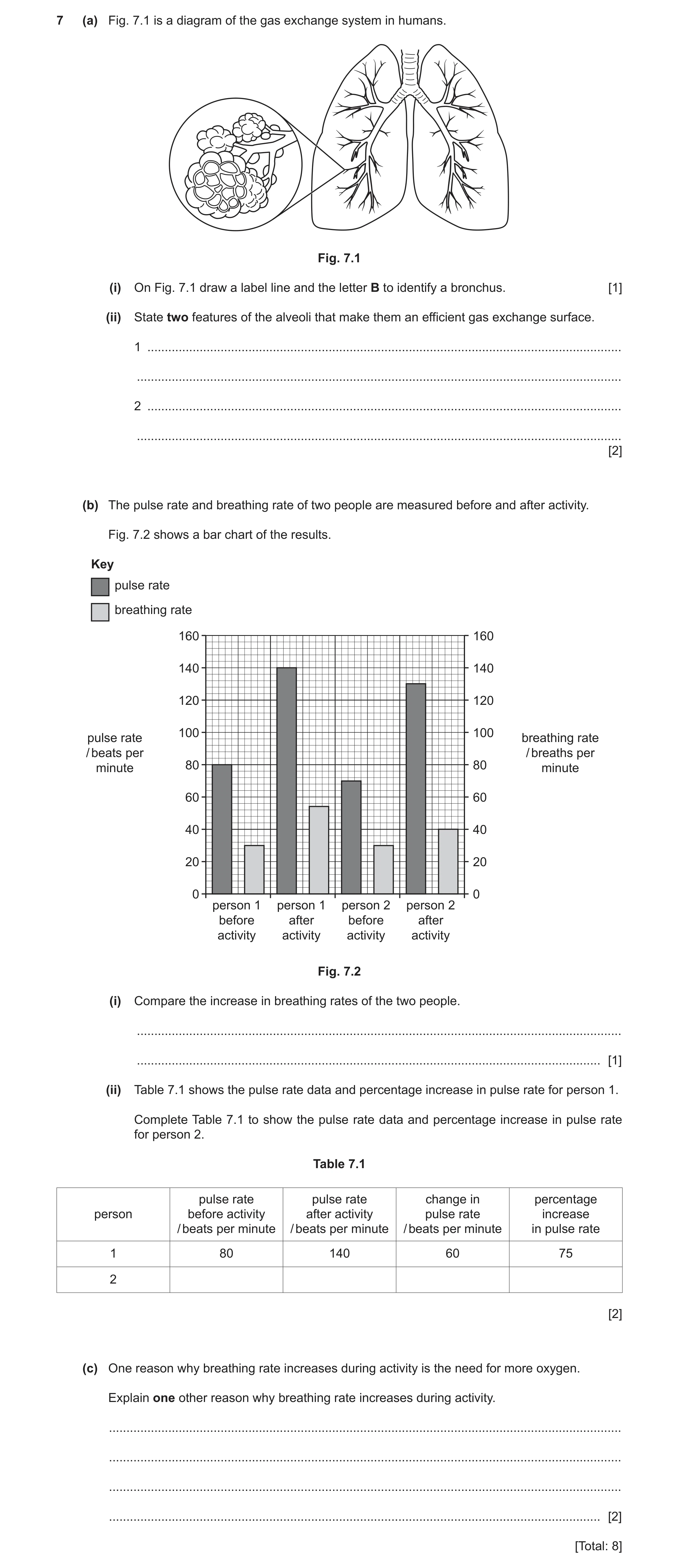
7 (a) Fig. 7.1 is a diagram of the gas exchange system in humans. Fig. 7.1 (i) On Fig. 7.1 draw a label line and the letter B to identify a bronchus. [1] (ii) State two features of the alveoli that make them an efficient gas exchange surface. 1 … … 2 … … [2] (b) The pulse rate and breathing rate of two people are measured before and after activity. Fig. 7.2 shows a bar chart of the results. Key pulse rate breathing rate 160 160 140 140 120 120 100 100 pulse rate breathing rate / beats per / breaths per minute 80 80 minute 60 60 40 40 20 20 0 0 person 1 person 1 person 2 person 2 before after before after activity activity activity activity Fig. 7.2 (i) Compare the increase in breathing rates of the two people. … … [1] (ii) Table 7.1 shows the pulse rate data and percentage increase in pulse rate for person 1. Complete Table 7.1 to show the pulse rate data and percentage increase in pulse rate for person 2. Table 7.1 pulse rate pulse rate change in percentage person before activity after activity pulse rate increase / beats per minute / beats per minute / beats per minute in pulse rate 1 80 140 60 75 2 [2] (c) One reason why breathing rate increases during activity is the need for more oxygen. Explain one other reason why breathing rate increases during activity. … … … … [2] [Total: 8]
8 marks
Mark scheme: 7(a)(i) bronchus labelled anywhere in shaded area ; 7(a)(ii) any two from: large surface area ; good blood supply ; thin walls ; good ventilation ; AVP ; 2 7(b)(i) person 1 has a higher increase in breathing rate ORA ; 1 7(b)(ii) 70 AND 130 AND 60 ; 86 ; 2 7(c) any two from: increased respiration ; cause increase in carbon dioxide levels (in the blood) ; removes more carbon dioxide (from the blood) / removes carbon dioxide faster ; AVP ; 2
This question in 0653/41 Oct/Nov 2021
Q14 · A diagram of the gas exchange system in a human 0653/42 Oct/Nov 2021
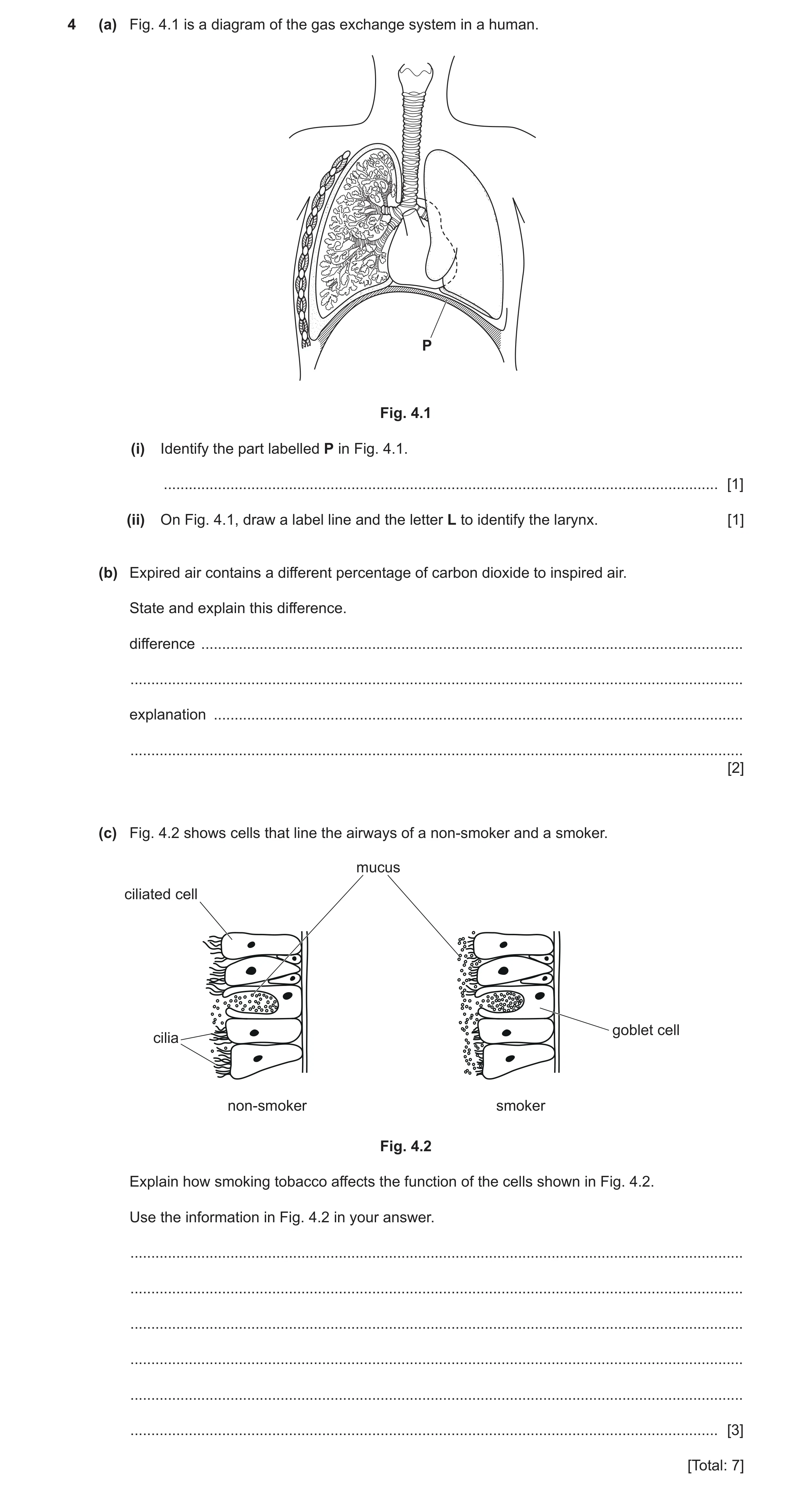
4 (a) Fig. 4.1 is a diagram of the gas exchange system in a human. P Fig. 4.1 (i) Identify the part labelled P in Fig. 4.1. … [1] (ii) On Fig. 4.1, draw a label line and the letter L to identify the larynx. [1] (b) Expired air contains a different percentage of carbon dioxide to inspired air. State and explain this difference. difference … … explanation … … [2] (c) Fig. 4.2 shows cells that line the airways of a non-smoker and a smoker. mucus ciliated cell goblet cell cilia non-smoker smoker Fig. 4.2 Explain how smoking tobacco affects the function of the cells shown in Fig. 4.2. Use the information in Fig. 4.2 in your answer. … … … … … … [3] [Total: 7]
7 marks
Mark scheme: 4(a)(i) diaphragm ; 1 4(a)(ii) larynx labelled ; 1 4(b) difference: more carbon dioxide in expired air ; explanation: because produced in respiration ; 2 4(c) any three from: cilia are, damaged / shorter ; (goblet cells make) more mucus ; pathogens / particles, trapped in the mucus ; idea that it is harder (for cilia) to move the mucus ; idea that, pathogens / particles, are not removed (easily) from the airways ; 3
This question in 0653/42 Oct/Nov 2021
Q15 · A study investigates the number of people with lung cancer in different age ranges 0653/42 Feb/March 2022
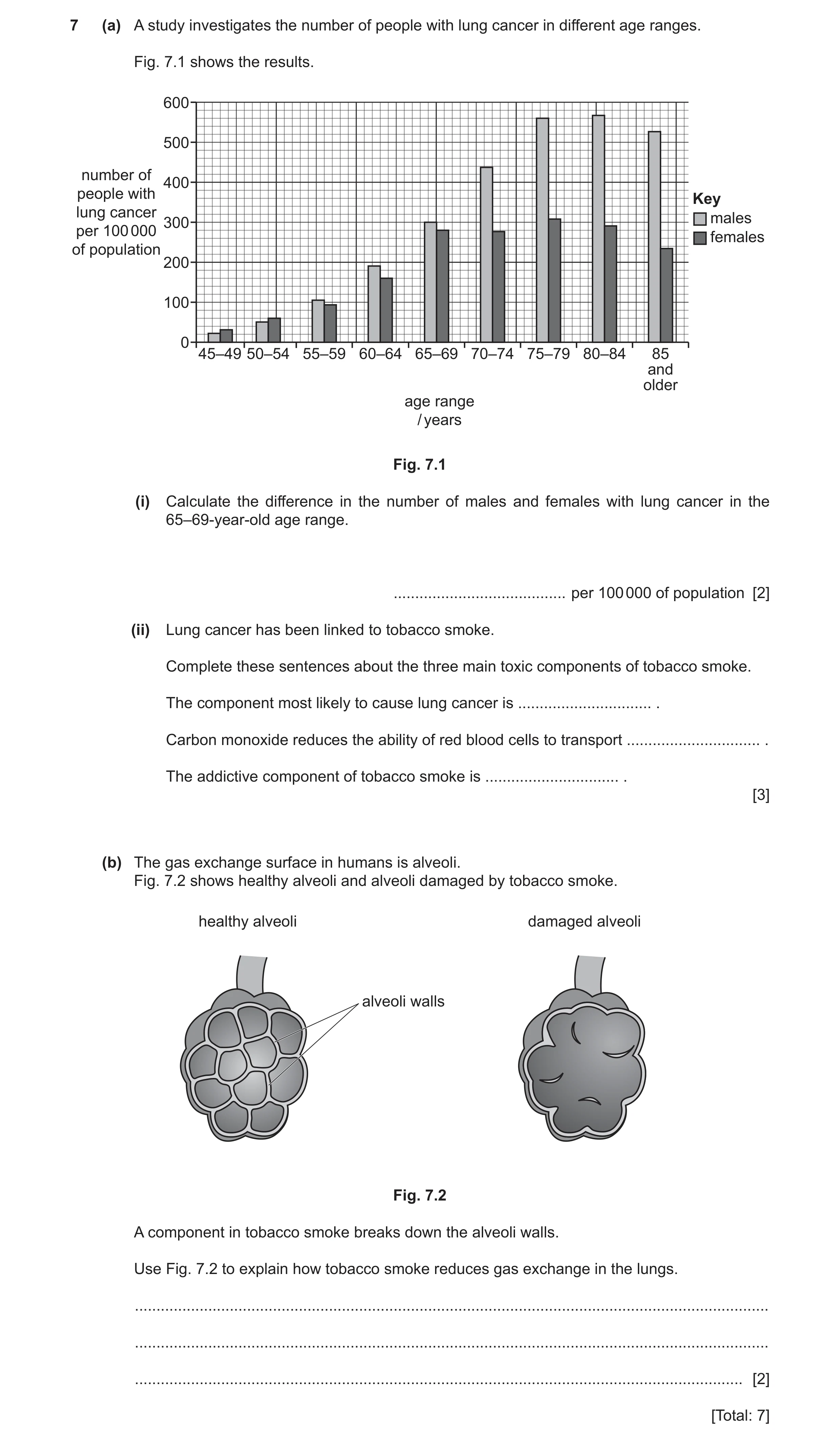
7 (a) A study investigates the number of people with lung cancer in different age ranges. Fig. 7.1 shows the results. 600 500 number of 400 people with Key lung cancer males 300 per 100 000 females of population 200 100 0 45–49 50–54 55–59 60–64 65–69 70–74 75–79 80–84 85 and older age range / years Fig. 7.1 (i) Calculate the difference in the number of males and females with lung cancer in the 65–69-year-old age range. … per 100 000 of population [2] (ii) Lung cancer has been linked to tobacco smoke. Complete these sentences about the three main toxic components of tobacco smoke. The component most likely to cause lung cancer is … . Carbon monoxide reduces the ability of red blood cells to transport … . The addictive component of tobacco smoke is … . [3] (b) The gas exchange surface in humans is alveoli. Fig. 7.2 shows healthy alveoli and alveoli damaged by tobacco smoke. healthy alveoli damaged alveoli alveoli walls Fig. 7.2 A component in tobacco smoke breaks down the alveoli walls. Use Fig. 7.2 to explain how tobacco smoke reduces gas exchange in the lungs. … … … [2] [Total: 7]
7 marks
Mark scheme: 7(a)(i) 300 – 280 ; 20 ; 2 7(a)(ii) tar ; oxygen ; nicotine ; 3 7(b) (damaged alveoli) less surface (area) ; so less diffusion / lower rate of diffusion (of gases) ; 2
This question in 0653/42 Feb/March 2022
Q16 · A diagram of the gas exchange system in humans 0653/41 May/June 2022
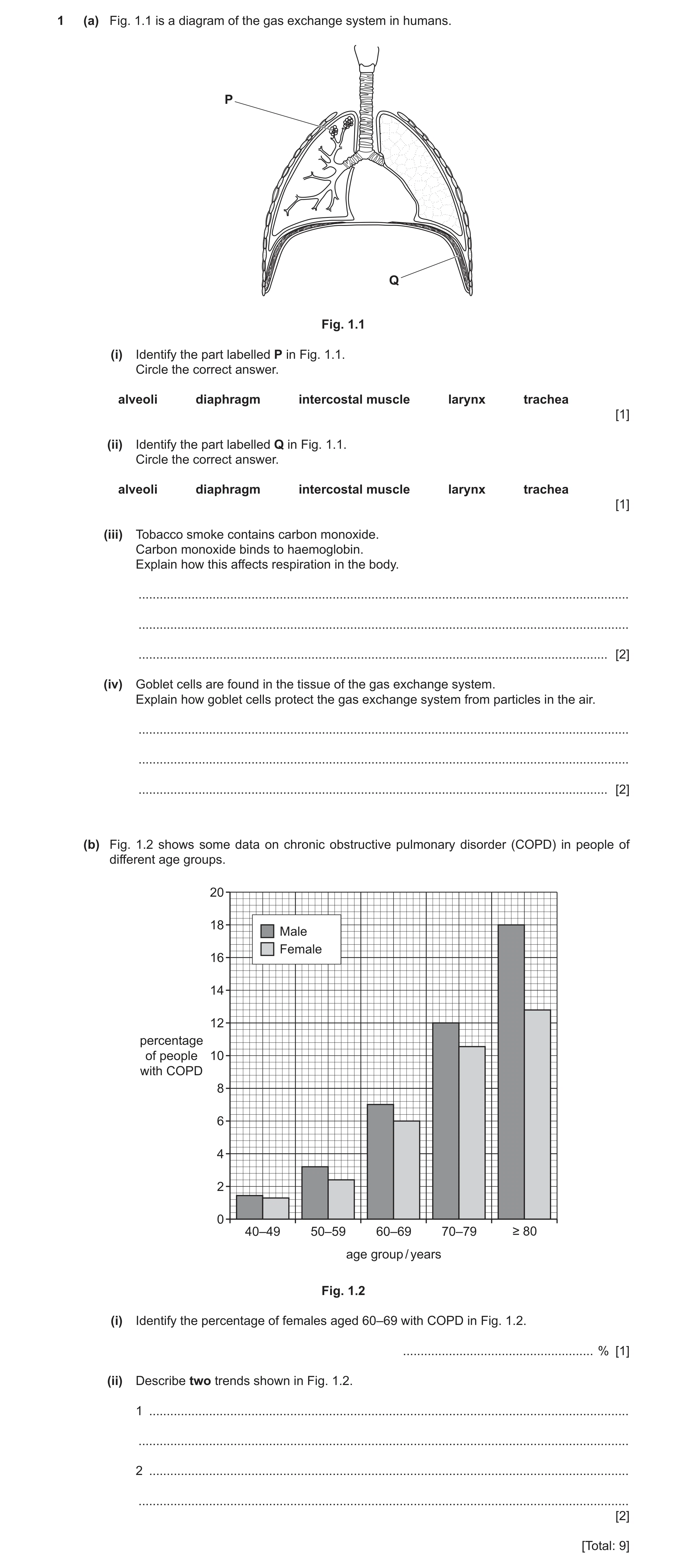
1 (a) Fig. 1.1 is a diagram of the gas exchange system in humans. P Q Fig. 1.1 (i) Identify the part labelled P in Fig. 1.1. Circle the correct answer. alveoli diaphragm intercostal muscle larynx trachea [1] (ii) Identify the part labelled Q in Fig. 1.1. Circle the correct answer. alveoli diaphragm intercostal muscle larynx trachea [1] (iii) Tobacco smoke contains carbon monoxide. Carbon monoxide binds to haemoglobin. Explain how this affects respiration in the body. … … … [2] (iv) Goblet cells are found in the tissue of the gas exchange system. Explain how goblet cells protect the gas exchange system from particles in the air. … … … [2] (b) Fig. 1.2 shows some data on chronic obstructive pulmonary disorder (COPD) in people of different age groups. 20 18 Male Female 16 14 12 percentage of people 10 with COPD 8 6 4 2 0 40–49 50–59 60–69 70–79 ≥ 80 age group / years Fig. 1.2 (i) Identify the percentage of females aged 60–69 with COPD in Fig. 1.2. … % [1] (ii) Describe two trends shown in Fig. 1.2. 1 … … 2 … … [2] [Total: 9]
9 marks
Mark scheme: 1(a)(i) alveoli ; 1 1(a)(ii) diaphragm ; 1 1(a)(iii) less oxygen can bind (to haemoglobin) / less oxygen transported (by red blood cells) ; so less (aerobic) respiration ; 2 1(a)(iv) produce mucus ; mucus traps particles ; 2 1(b)(i) 6 (%) ; 1 1(b)(ii) Any two from: the percentage of people with COPD increases with age ; more males than females have COPD (in all age groups) ; the difference between males and females increases with age ; 2
This question in 0653/41 May/June 2022
Q17 · A diagram of the gas exchange system in humans 0653/43 May/June 2022
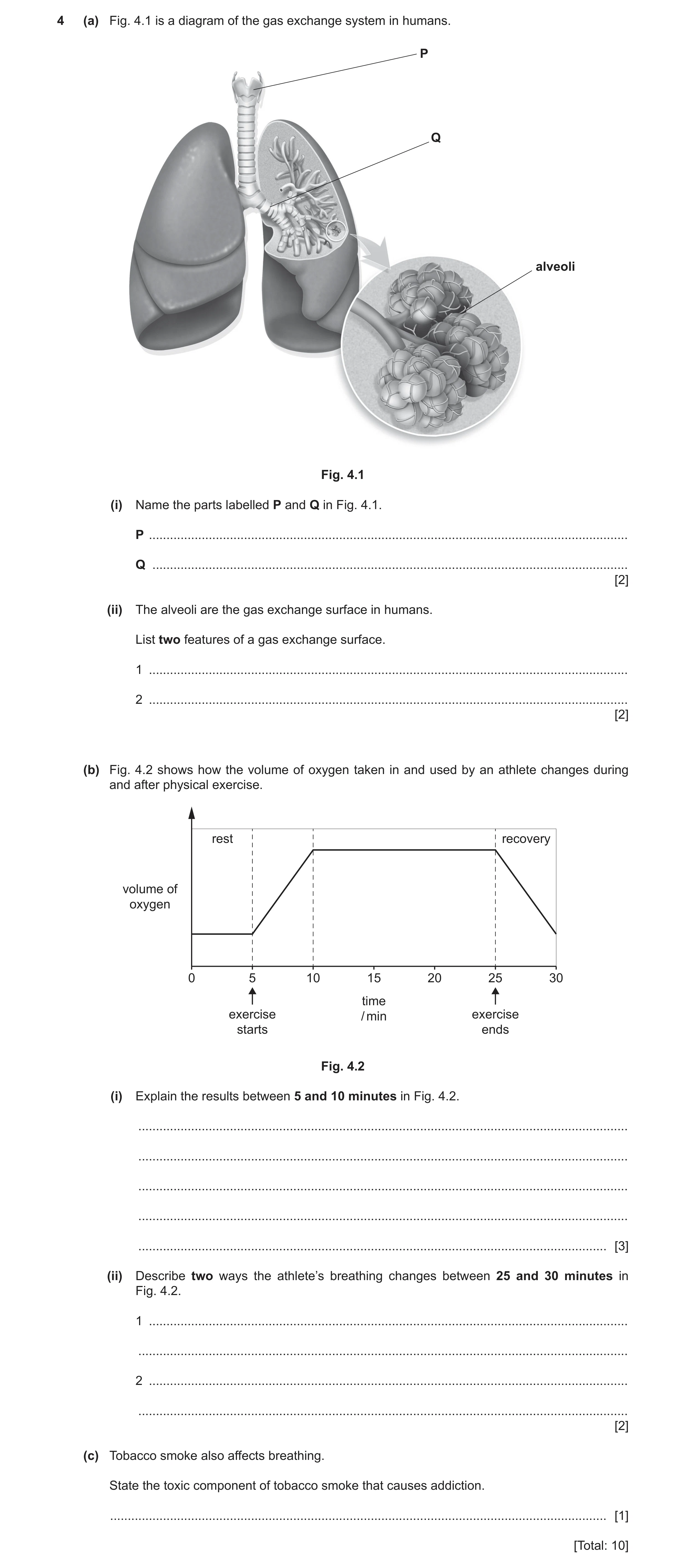
4 (a) Fig. 4.1 is a diagram of the gas exchange system in humans. P Q alveoli Fig. 4.1 (i) Name the parts labelled P and Q in Fig. 4.1. P … Q … [2] (ii) The alveoli are the gas exchange surface in humans. List two features of a gas exchange surface. 1 … 2 … [2] (b) Fig. 4.2 shows how the volume of oxygen taken in and used by an athlete changes during and after physical exercise. rest recovery volume of oxygen 0 5 10 15 20 25 30 time exercise / min exercise starts ends Fig. 4.2 (i) Explain the results between 5 and 10 minutes in Fig. 4.2. … … … … … [3] (ii) Describe two ways the athlete’s breathing changes between 25 and 30 minutes in Fig. 4.2. 1 … … 2 … … [2] (c) Tobacco smoke also affects breathing. State the toxic component of tobacco smoke that causes addiction. … [1] [Total: 10]
10 marks
Mark scheme: 4(a)(i) P – larynx ; Q – bronchus ; 2 4(a)(ii) any two from: large surface area ; thin surface ; good blood supply ; good ventilation ; 2 4(b)(i) any three from: (volume of oxygen taken in increases because,) more energy required ; increased contraction of muscles ; muscles require more oxygen ; (oxygen required ) for respiration / respiration (rate) increases ; 3 4(b)(ii) decrease in rate (of breathing) ; decrease in depth (of breathing) ; 2 4(c) nicotine ; 1
This question in 0653/43 May/June 2022
Q18 · Cells that line the gas exchange system of humans 0653/43 Oct/Nov 2022
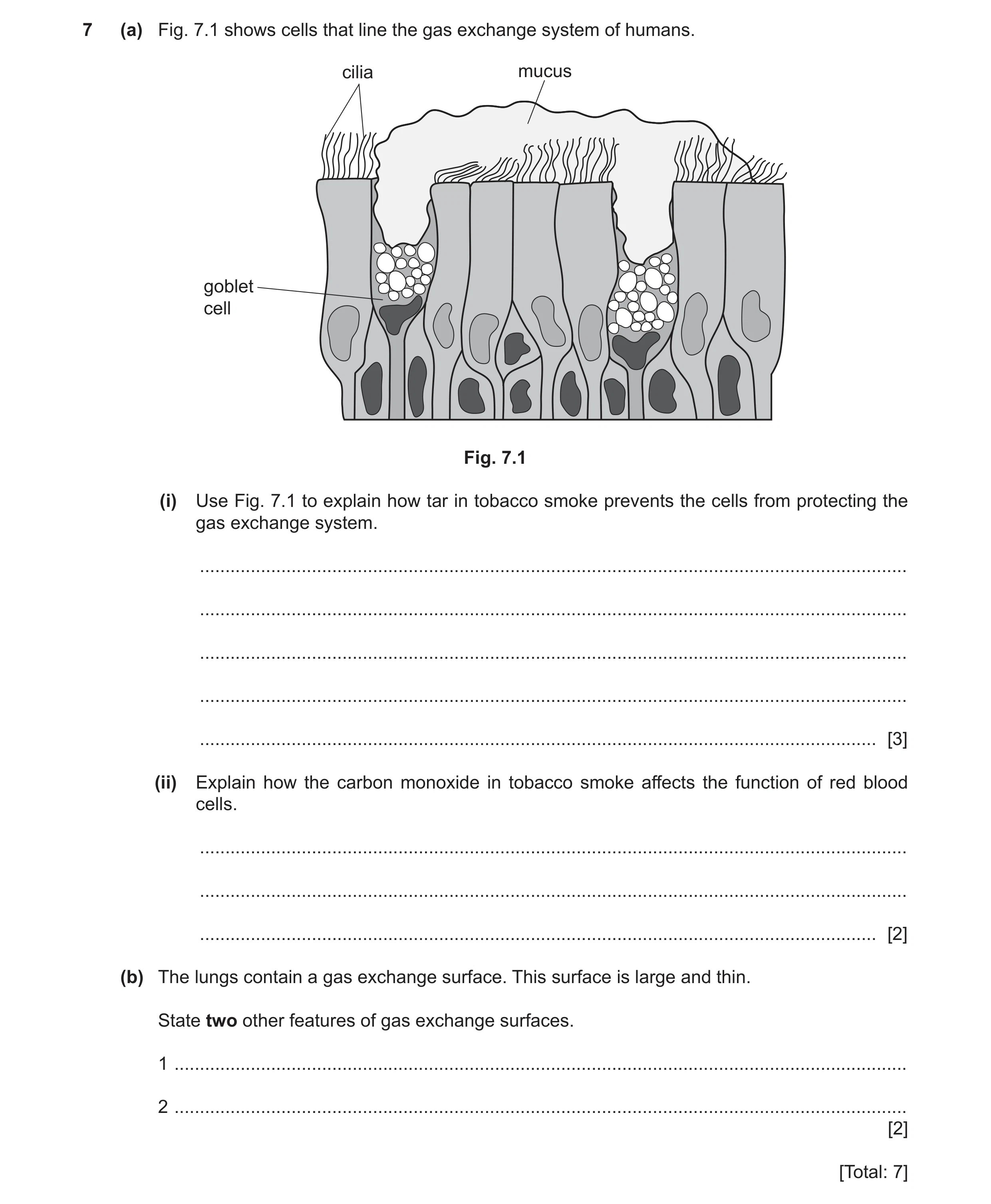
7 (a) Fig. 7.1 shows cells that line the gas exchange system of humans. cilia mucus goblet cell Fig. 7.1 (i) Use Fig. 7.1 to explain how tar in tobacco smoke prevents the cells from protecting the gas exchange system. … … … … … [3] (ii) Explain how the carbon monoxide in tobacco smoke affects the function of red blood cells. … … … [2] (b) The lungs contain a gas exchange surface. This surface is large and thin. State two other features of gas exchange surfaces. 1 … 2 … [2] [Total: 7]
7 marks
Mark scheme: 7(a)(i) any three from: 3 (tar causes an) increased production of mucus by goblet cells ; mucus blocks airways ; (tar) damages cilia ; (cilia) cannot (re)move, particles / pathogens ; 7(a)(ii) (carbon monoxide) combines with haemoglobin ; 2 idea of, reduced ability to transport oxygen ; 7(b) good blood supply ; 2 good ventilation (with air) ;
This question in 0653/43 Oct/Nov 2022
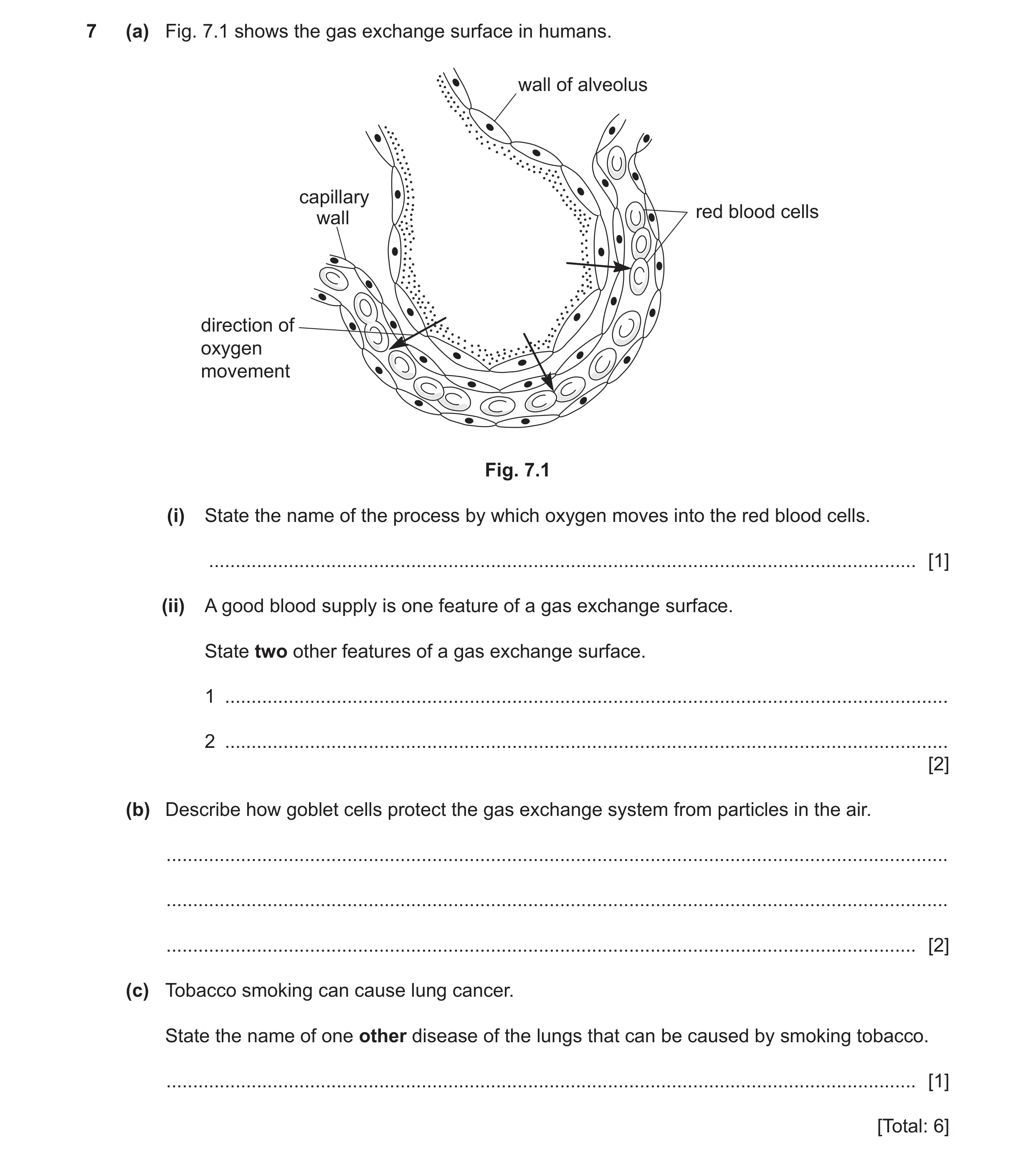
Q19 · The gas exchange surface in humans 0653/42 May/June 2023
7 (a) Fig. 7.1 shows the gas exchange surface in humans. wall of alveolus capillary red blood cells wall direction of oxygen movement Fig. 7.1 (i) State the name of the process by which oxygen moves into the red blood cells. … [1] (ii) A good blood supply is one feature of a gas exchange surface. State two other features of a gas exchange surface. 1 … 2 … [2] (b) Describe how goblet cells protect the gas exchange system from particles in the air. … … … [2] (c) Tobacco smoking can cause lung cancer. State the name of one other disease of the lungs that can be caused by smoking tobacco. … [1] [Total: 6]
6 marks
Mark scheme: 7(a)(i) diffusion ; 1 7(a)(ii) any two from: large surface area ; thin surface ; good ventilation ; AVP, e.g. moist / short diffusion distance ; 2 7(b) produce mucus ; (mucus) traps, particles / pathogens / microbes ; 2 7(c) chronic obstructive pulmonary disease / COPD ; 1
This question in 0653/42 May/June 2023
Q20 · Part of the breathing system in humans 0653/41 Oct/Nov 2023
4 (a) Fig. 4.1 shows part of the breathing system in humans. X rib Fig. 4.1 State the name of the part labelled X in Fig. 4.1. … [1] (b) Alveoli are the gas exchange surface in humans. State one feature of the gas exchange surface in humans. … [1] (c) Complete the sentences about the differences in composition between expired and inspired air. Expired air contains more carbon dioxide than inspired air. This is because carbon dioxide is made in cells by the process of … . Expired air also contains more … than inspired air. [2] (d) Fig. 4.2 shows cells that line the bronchi. Y Fig. 4.2 Describe how cell Y is adapted to its function. … … … [2] (e) Tobacco smoking affects the body. The boxes on the left show different components of tobacco smoke. The boxes on the right show the effects of these components on the body. Draw one straight line from each component to its effect. component effect carbon monoxide addiction nicotine lung cancer tar reduced oxygen transport by red blood cells [1] [Total: 7]
7 marks
Mark scheme: 4(a) intercostal muscle ; 1 4(b) any one from: 1 large (surface) area ; thin (surface) ; good blood supply ; good ventilation (with air) ; AVP ; 4(c) (aerobic) respiration ; 2 water (vapour) ; 4(d) ciliated / has cilia ; 2 to move mucus (away from lungs) ; 4(e) 1 carbon monoxide addiction nicotine lung cancer tar reduced oxygen transport by red blood cells only three lines and all correct ;
This question in 0653/41 Oct/Nov 2023
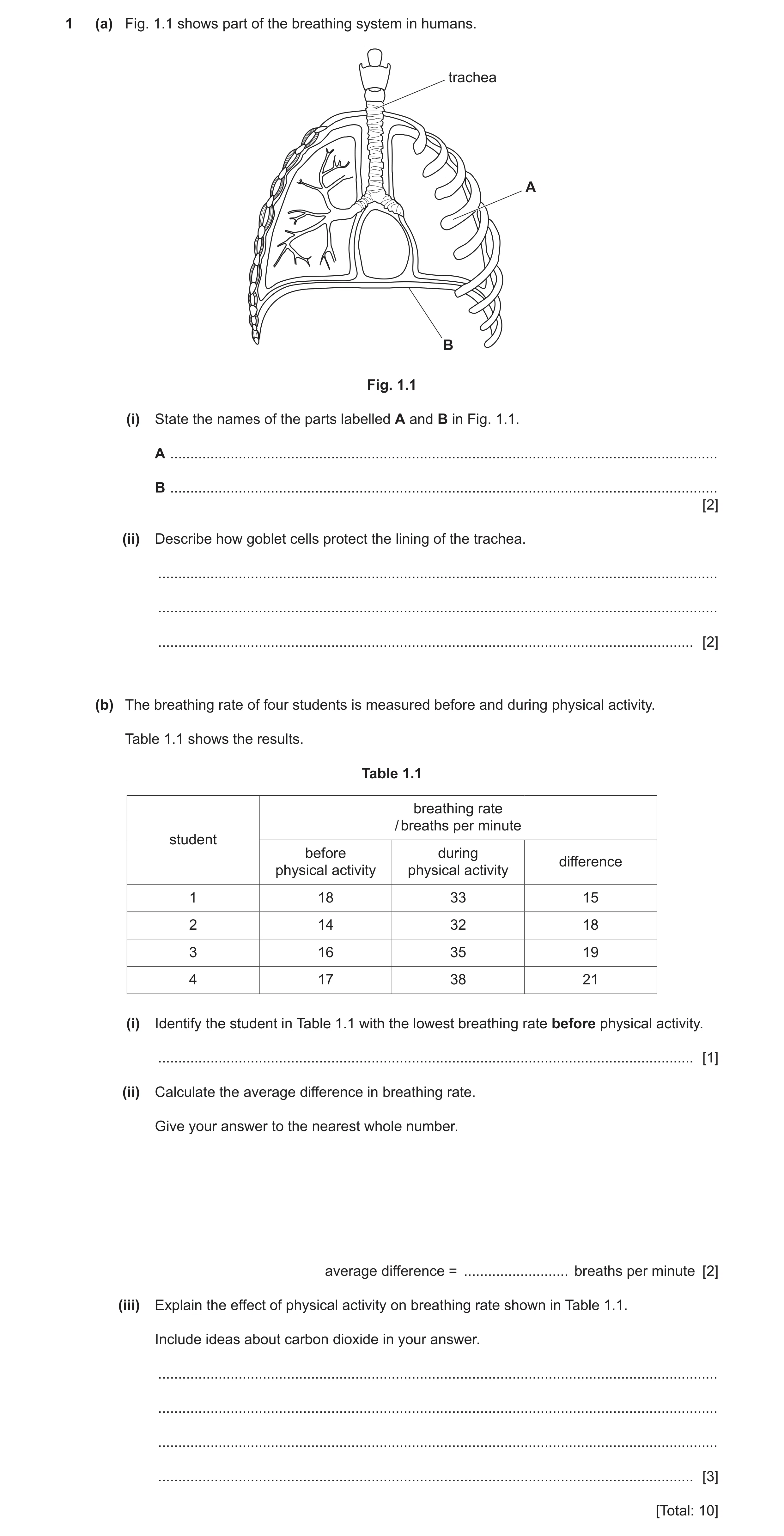
Q21 · Part of the breathing system in humans 0653/43 Oct/Nov 2023
1 (a) Fig. 1.1 shows part of the breathing system in humans. trachea A B Fig. 1.1 (i) State the names of the parts labelled A and B in Fig. 1.1. A … B … [2] (ii) Describe how goblet cells protect the lining of the trachea. … … … [2] (b) The breathing rate of four students is measured before and during physical activity. Table 1.1 shows the results. Table 1.1 breathing rate / breaths per minute student before during difference physical activity physical activity 1 18 33 15 2 14 32 18 3 16 35 19 4 17 38 21 (i) Identify the student in Table 1.1 with the lowest breathing rate before physical activity. … [1] (ii) Calculate the average difference in breathing rate. Give your answer to the nearest whole number. average difference = … breaths per minute [2] (iii) Explain the effect of physical activity on breathing rate shown in Table 1.1. Include ideas about carbon dioxide in your answer. … … … … [3] [Total: 10]
10 marks
Mark scheme: Question Answer Marks 1(a)(i) A rib ; 2 B diaphragm ; 1(a)(ii) produce mucus ; 2 (mucus) traps, pathogens / particulates ; 1(b)(i) (student) 2 ; 1 1(b)(ii) 73 ÷ 4 / 18.25 ; 2 18 ; 1(b)(iii) (increased) respiration ; 3 (idea that respiration) produces carbon dioxide ; increase in carbon dioxide (concentration) in the blood (causes increase in breathing rate) ;
This question in 0653/43 Oct/Nov 2023
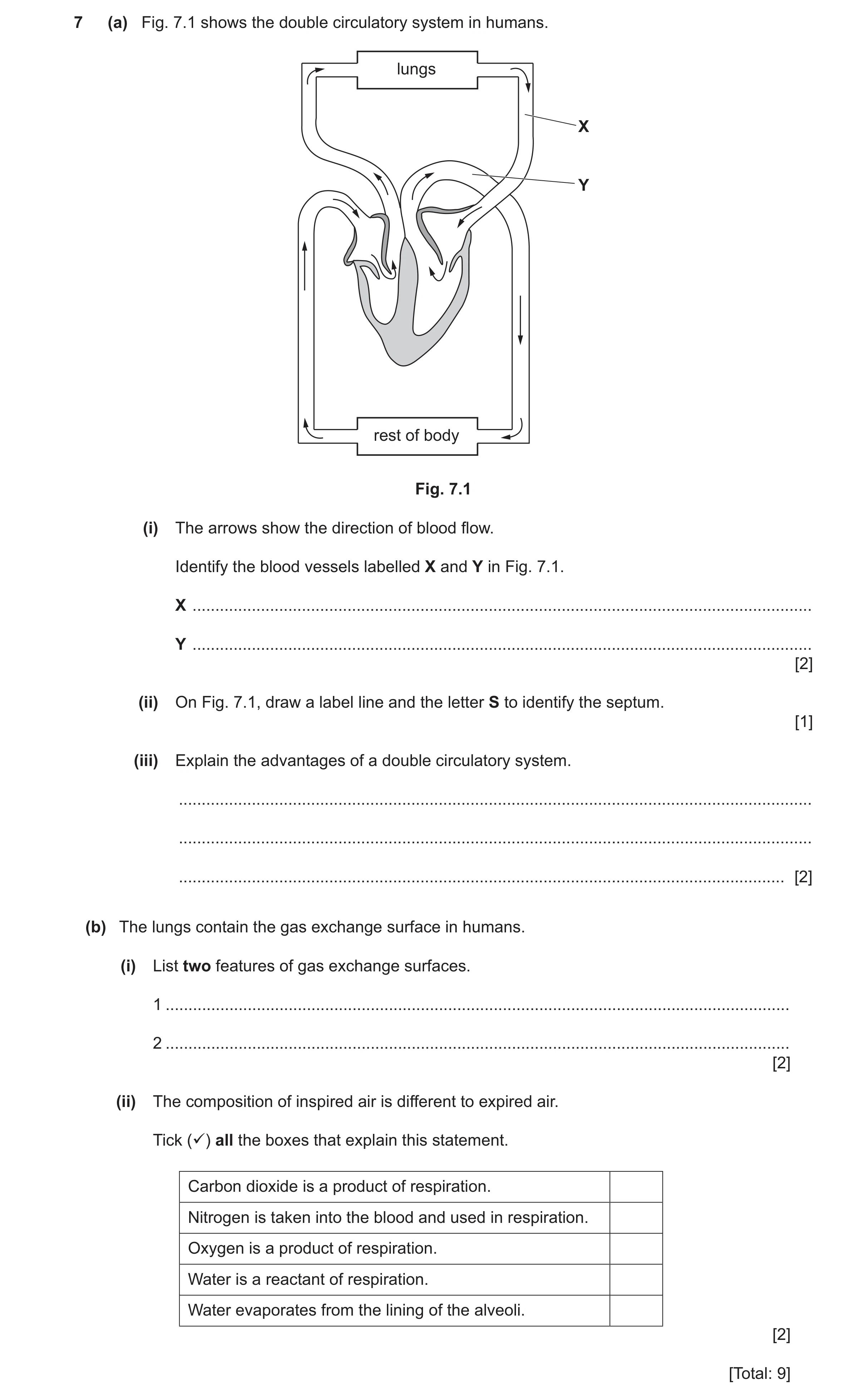
Q22 · The double circulatory system in humans 0653/42 May/June 2024
7 (a) Fig. 7.1 shows the double circulatory system in humans. lungs X Y rest of body Fig. 7.1 (i) The arrows show the direction of blood flow. Identify the blood vessels labelled X and Y in Fig. 7.1. X … Y … [2] (ii) On Fig. 7.1, draw a label line and the letter S to identify the septum. [1] (iii) Explain the advantages of a double circulatory system. … … … [2] (b) The lungs contain the gas exchange surface in humans. (i) List two features of gas exchange surfaces. 1 … 2 … [2] (ii) The composition of inspired air is different to expired air. Tick () all the boxes that explain this statement. Carbon dioxide is a product of respiration. Nitrogen is taken into the blood and used in respiration. Oxygen is a product of respiration. Water is a reactant of respiration. Water evaporates from the lining of the alveoli. [2] [Total: 9]
9 marks
Mark scheme: 7(a)(i) X pulmonary vein ; Y aorta ; 2 7(a)(ii) septum labelled ; 1 7(a)(iii) separates blood with and without oxygen ; blood to lungs at lower pressure or blood to body at higher pressure ; 2 Question Answer Marks 7(b)(i) any two from: large surface / large area ; thin (surface) ; good blood supply ; good ventilation ; AVP, e.g. moist ; 2 7(b)(ii) Carbon dioxide is a product of respiration. ; Water evaporates from the lining of the alveoli. ; three ticks and two correct = 1 mark three ticks and one correct = 0 marks more than three ticks = 0 marks 2
This question in 0653/42 May/June 2024
Q23 · Part of the breathing system in humans 0653/43 May/June 2025
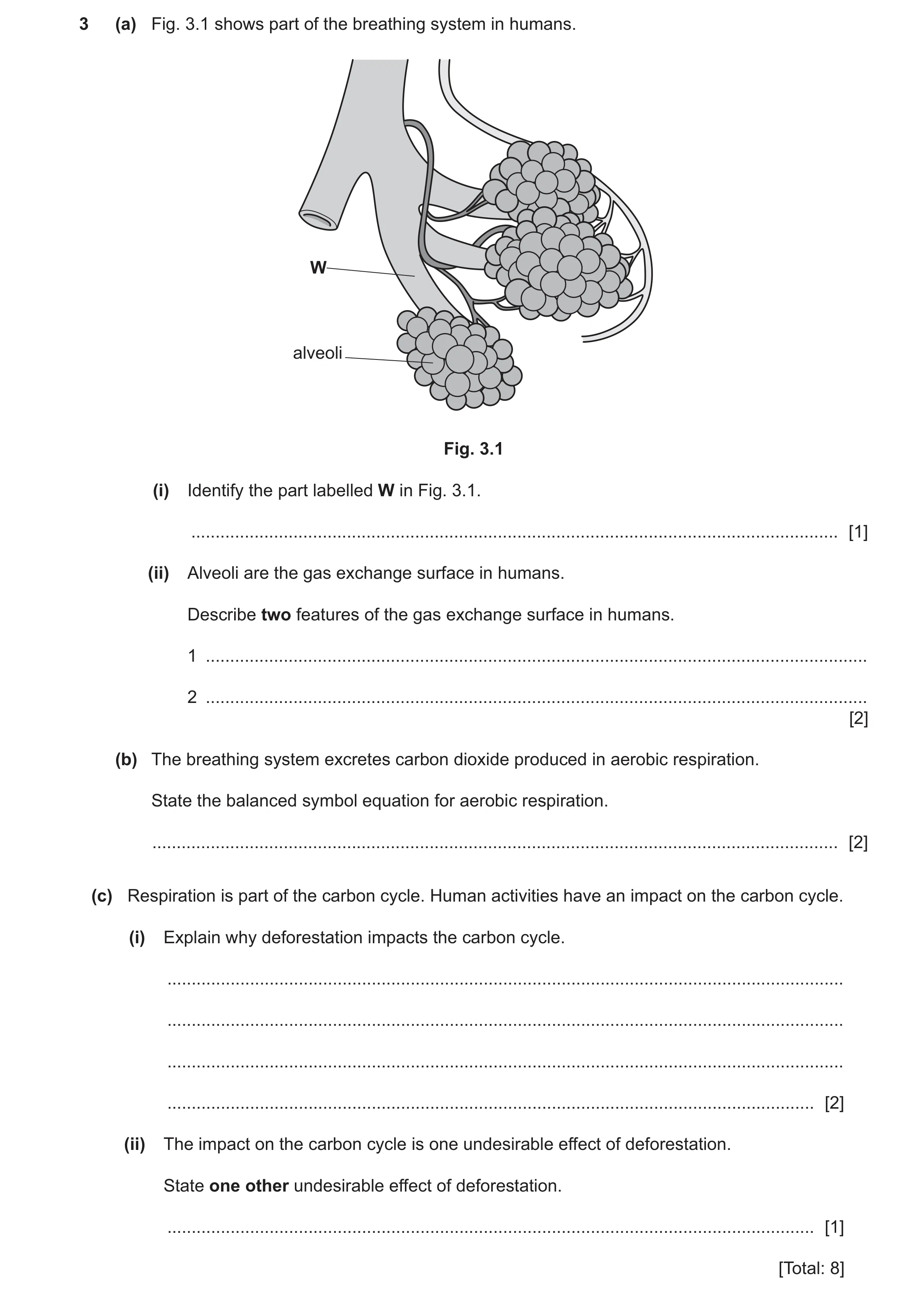
3 (a) Fig. 3.1 shows part of the breathing system in humans. W alveoli Fig. 3.1 (i) Identify the part labelled W in Fig. 3.1. … [1] (ii) Alveoli are the gas exchange surface in humans. Describe two features of the gas exchange surface in humans. 1 … 2 … [2] (b) The breathing system excretes carbon dioxide produced in aerobic respiration. State the balanced symbol equation for aerobic respiration. … [2] (c) Respiration is part of the carbon cycle. Human activities have an impact on the carbon cycle. (i) Explain why deforestation impacts the carbon cycle. … … … … [2] (ii) The impact on the carbon cycle is one undesirable effect of deforestation. State one other undesirable effect of deforestation. … [1] [Total: 8]
8 marks
Mark scheme: 3(a)(i) bronchiole ; 1 3(a)(ii) any two from: 2 large surface area ; thin surface ; good blood supply ; good ventilation (with air) ; AVP ; 3(b) C6H12O6 + 6O2 → 6H2O + 6CO2 ;; 2 correct reactants (in either order) and balanced = 1 mark correct products (in either order) and balanced = 1mark 3(c)(i) any two from: 2 decrease in photosynthesis ; so less carbon dioxide removed from atmosphere / carbon dioxide (in atmosphere) increases ; AVP ; 3(c)(ii) any one from: 1 habitat destruction ; reduced biodiversity ; extinction ; loss of soil ; flooding ;
This question in 0653/43 May/June 2025
![Question 4: (a) Fig. 7.1 shows a diagram of the human gas exchange system. Fig. 7.1 On Fig. 7.1 use label lines to identify (i) the larynx, [1] (ii) a …](https://img.pastlit.com/crops/6ef42b4e-1070-48b4-b72f-0c77fc4fe51f/q7.webp)
 14 / 35
![Question 10: (a) Fig. 1.1 represents a plant cell. Fig. 1.1 Add labels to Fig. 1.1 to name two structures that are only present in plant cells. [2] (b) …](https://img.pastlit.com/crops/1f783e97-1b33-4816-ae7a-e40f7ac4b774/q1.webp)
 28 / 35
 29 / 35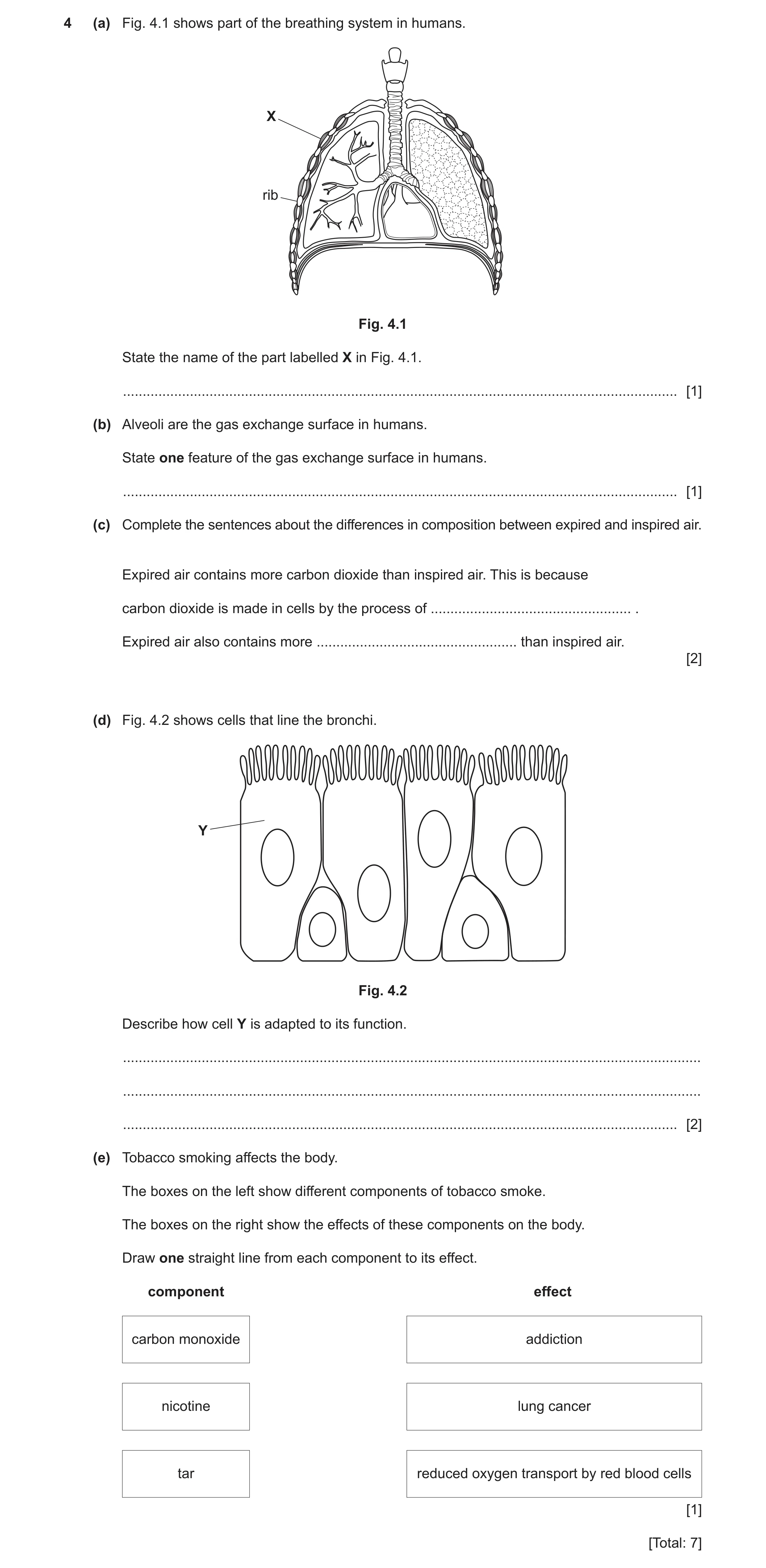
 35 / 35
 11
11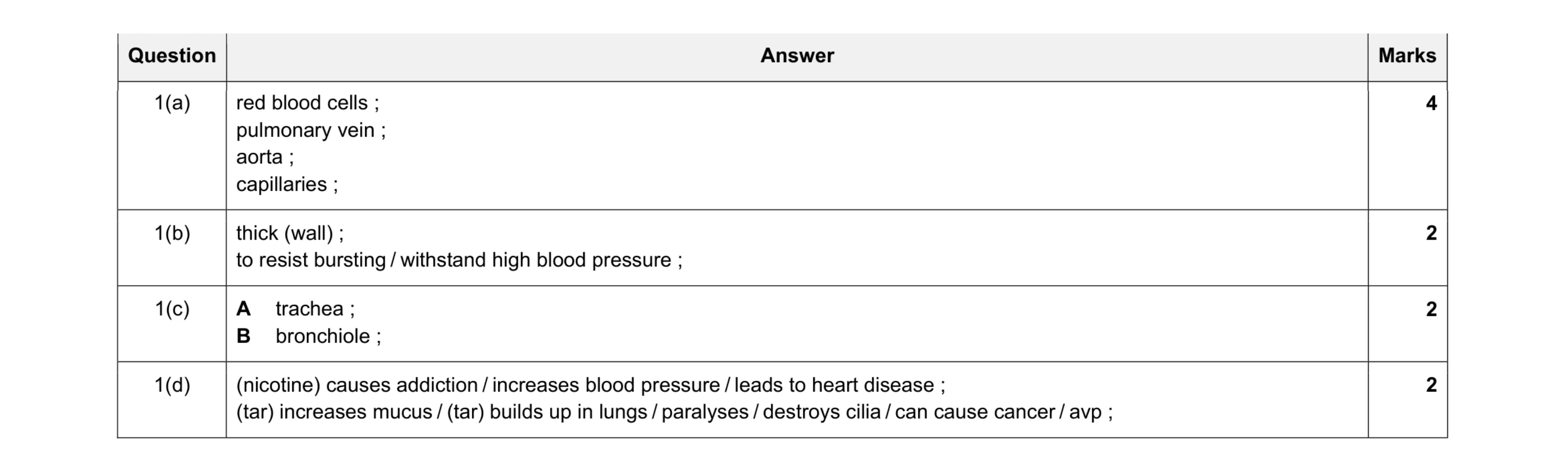 10
10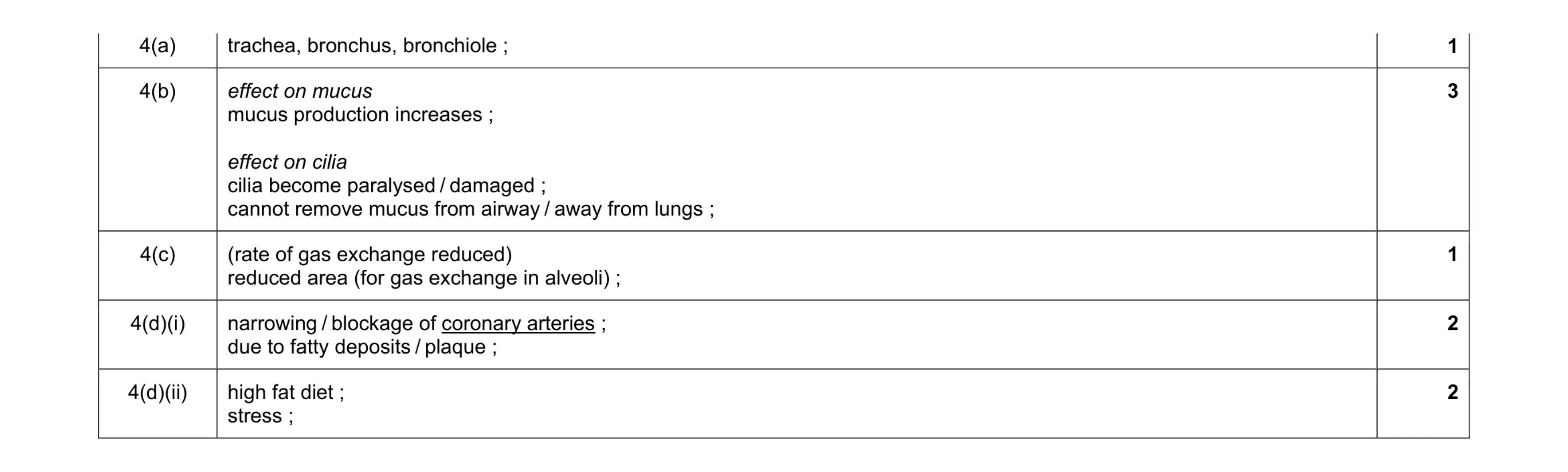 9
9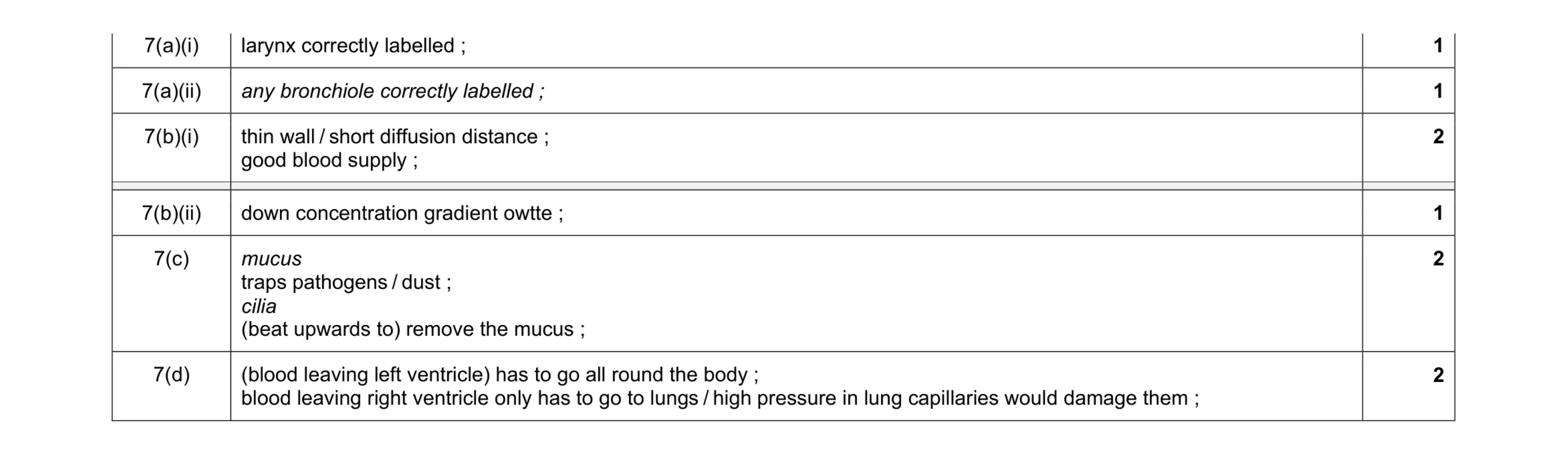 9
9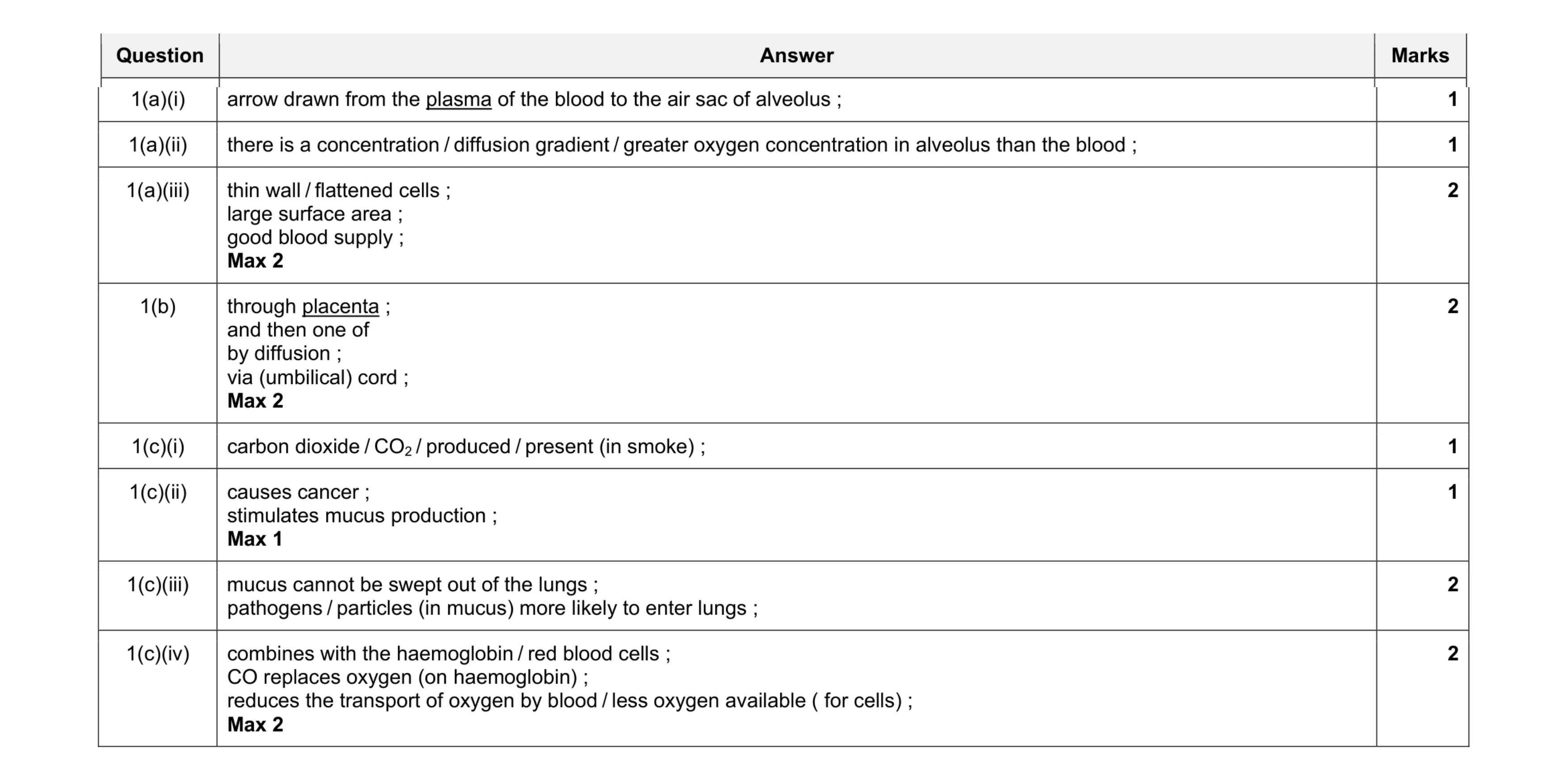 12
12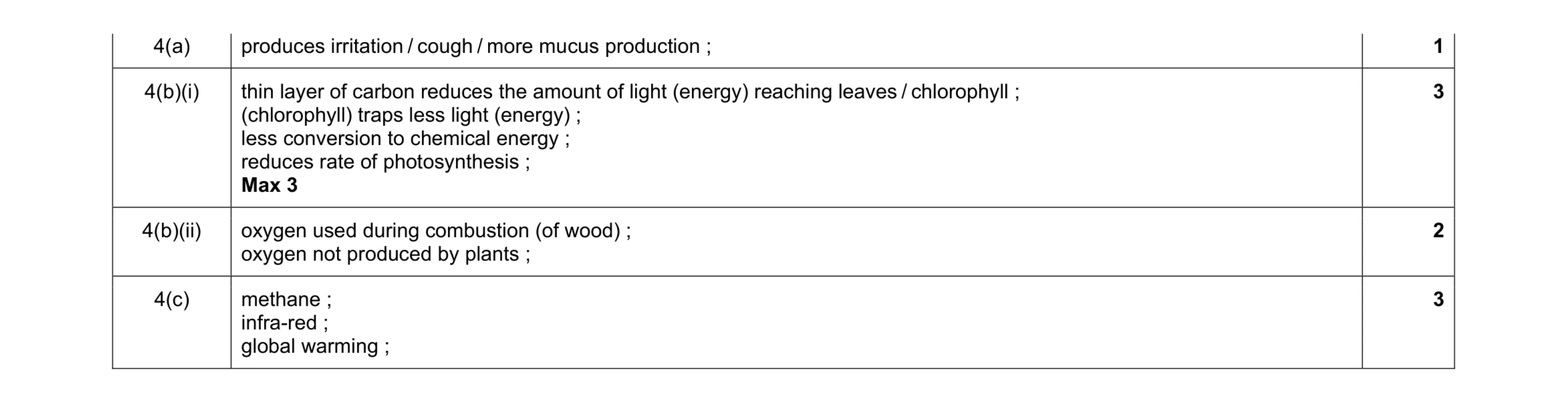 9
9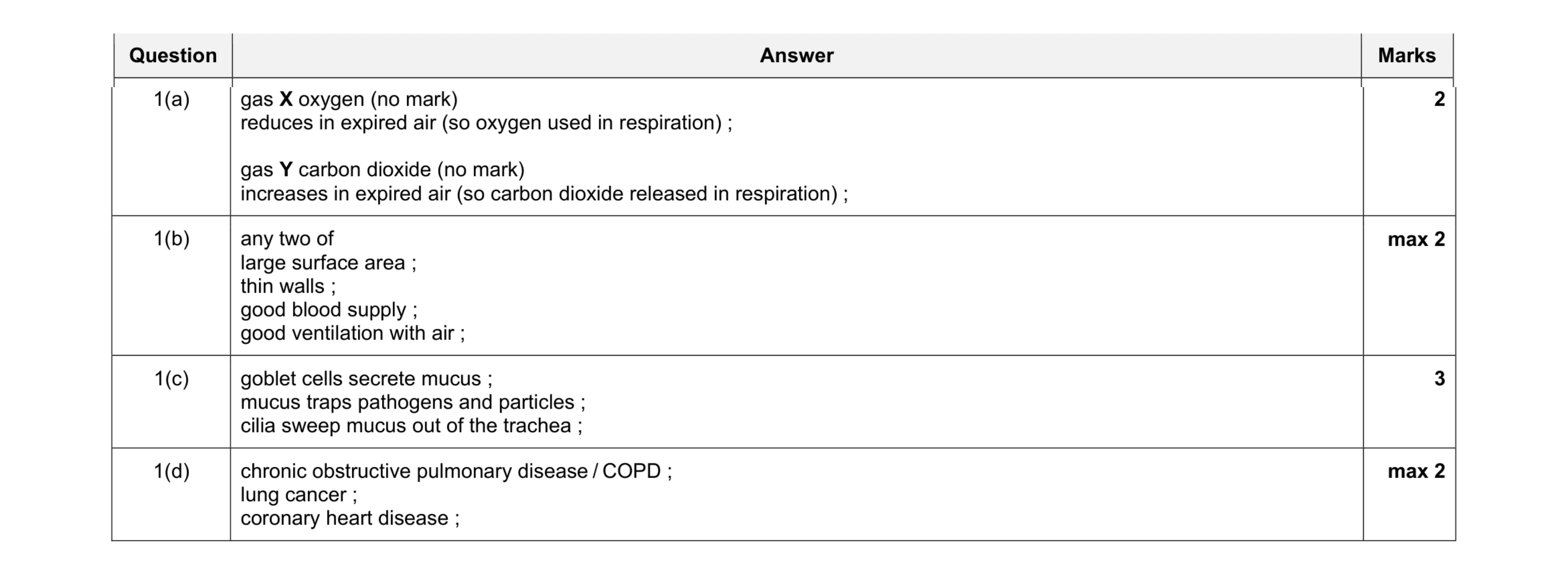 9
9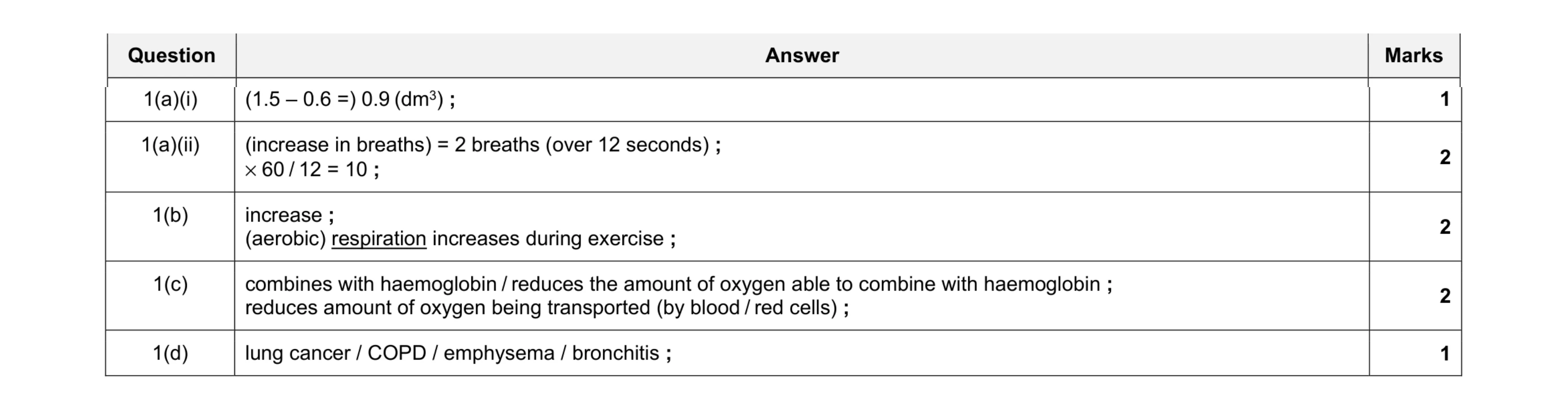 8
8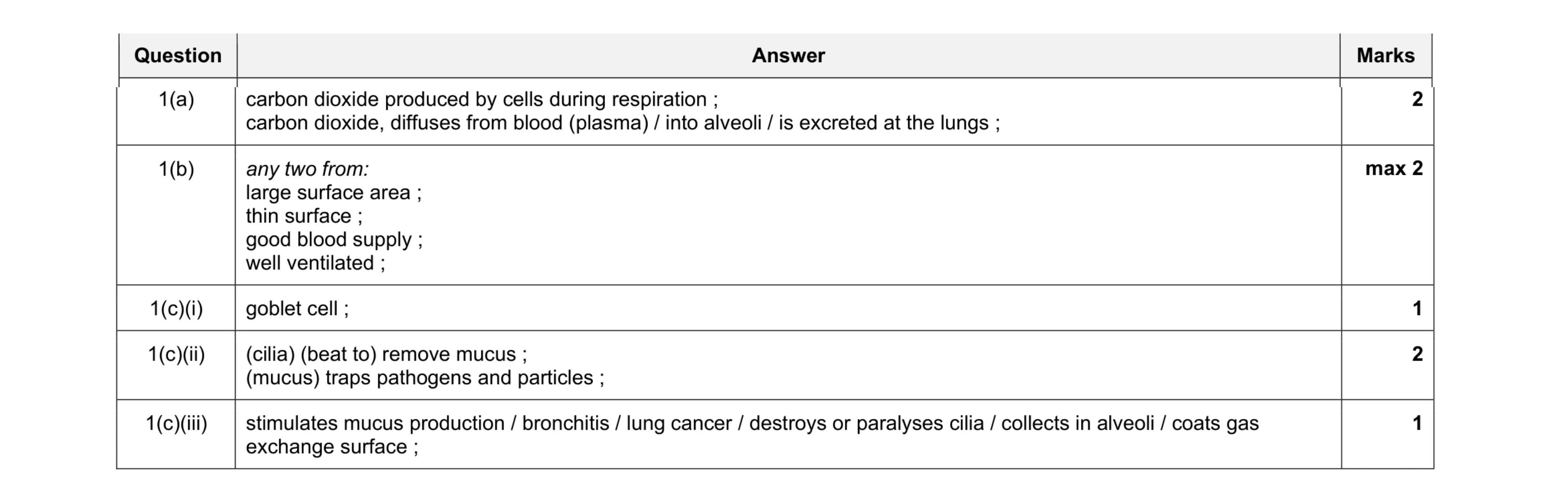 8
8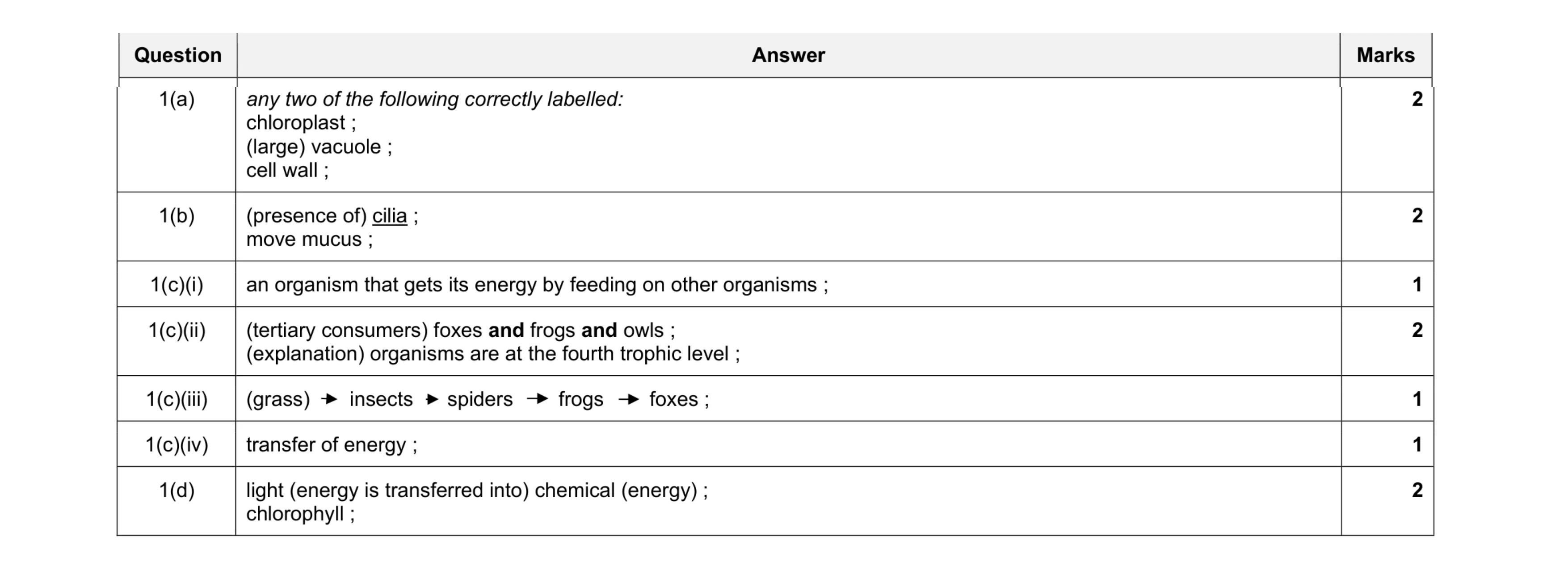 11
11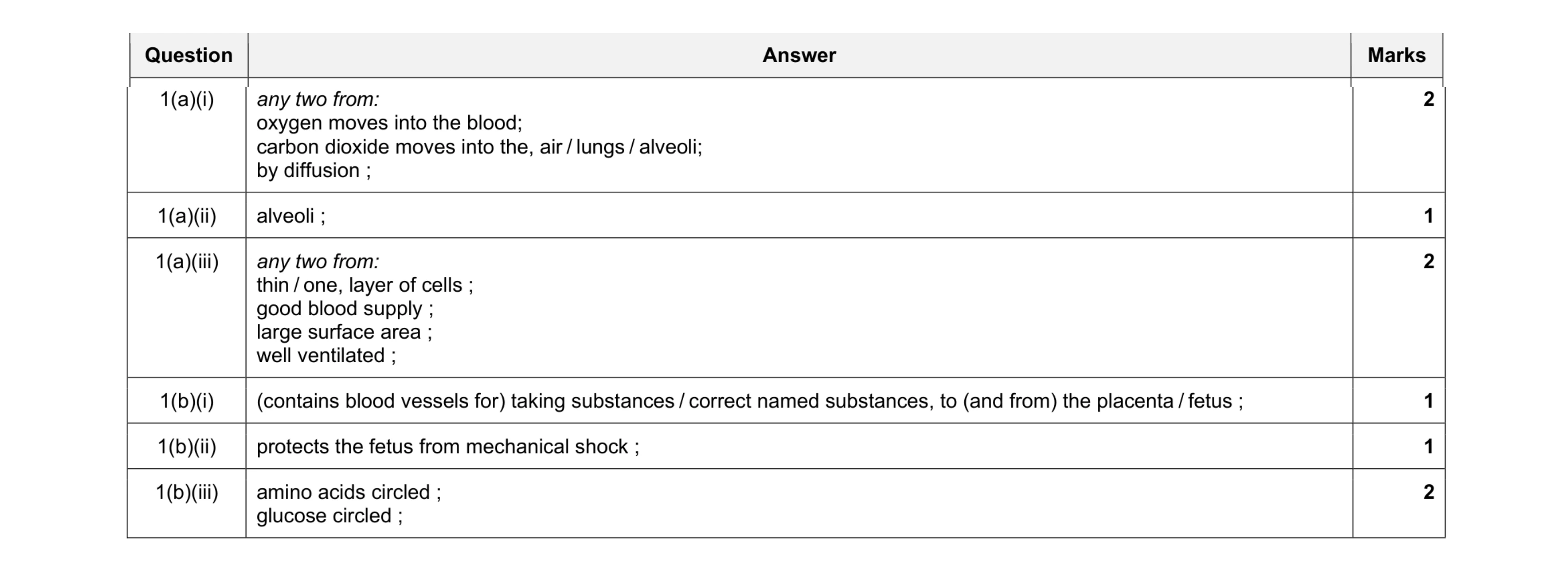 9
9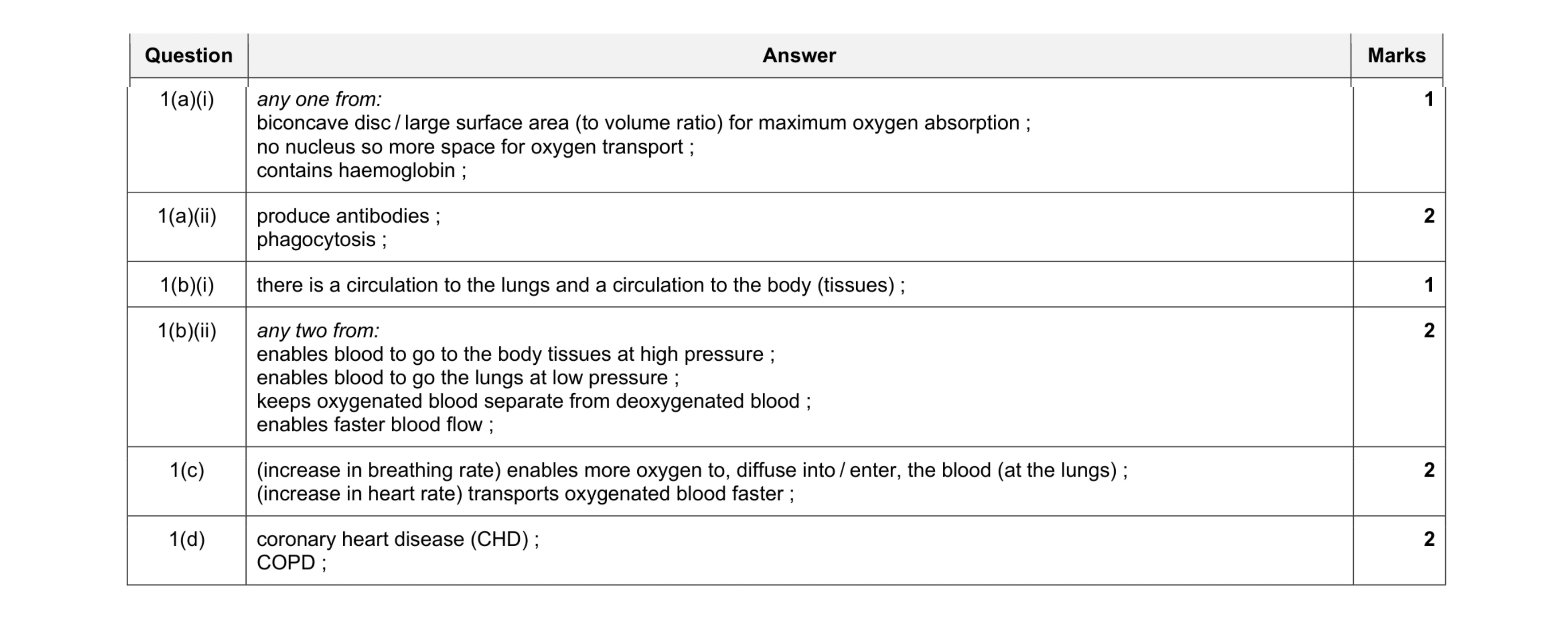 10
10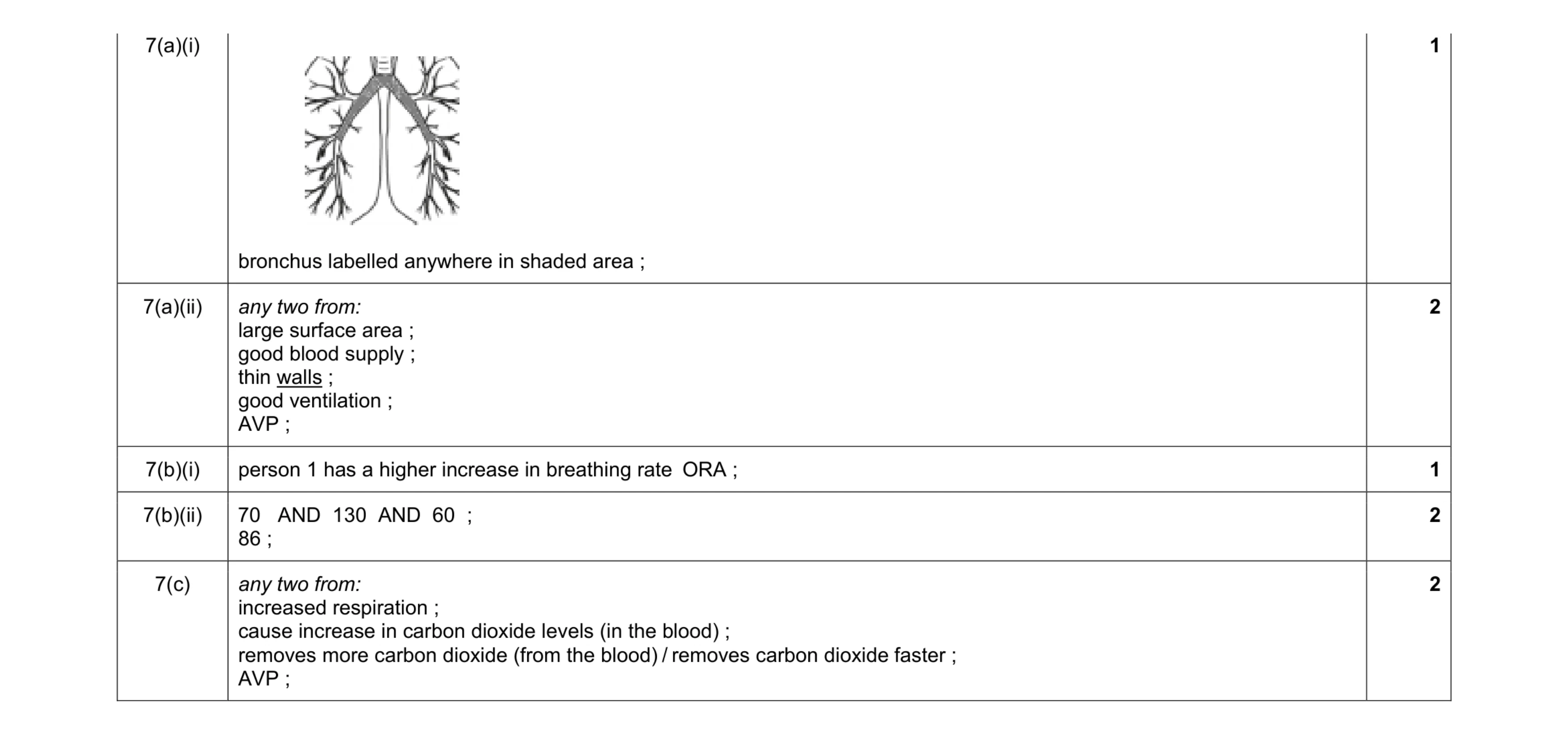 8
8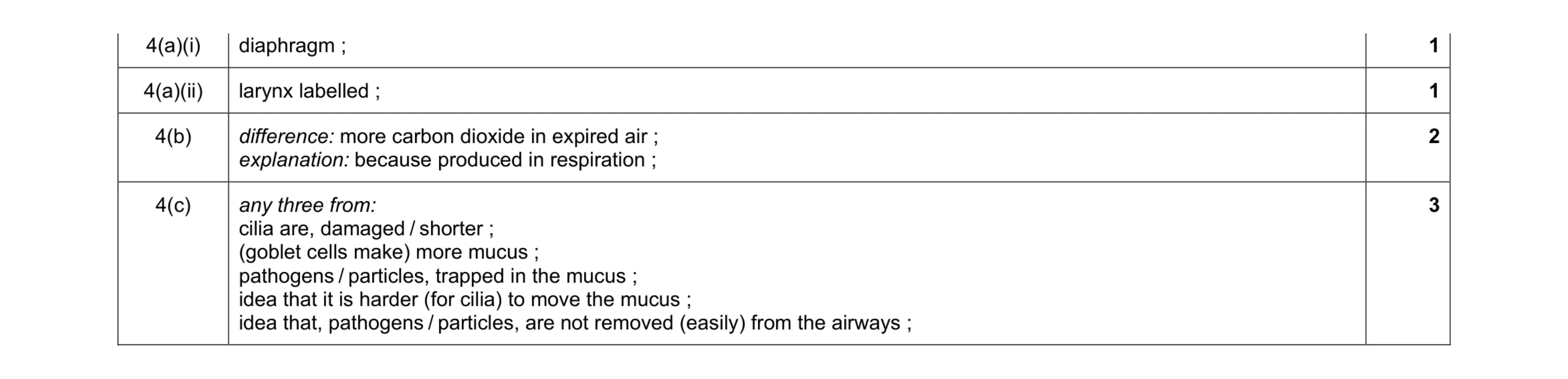 7
7 7
7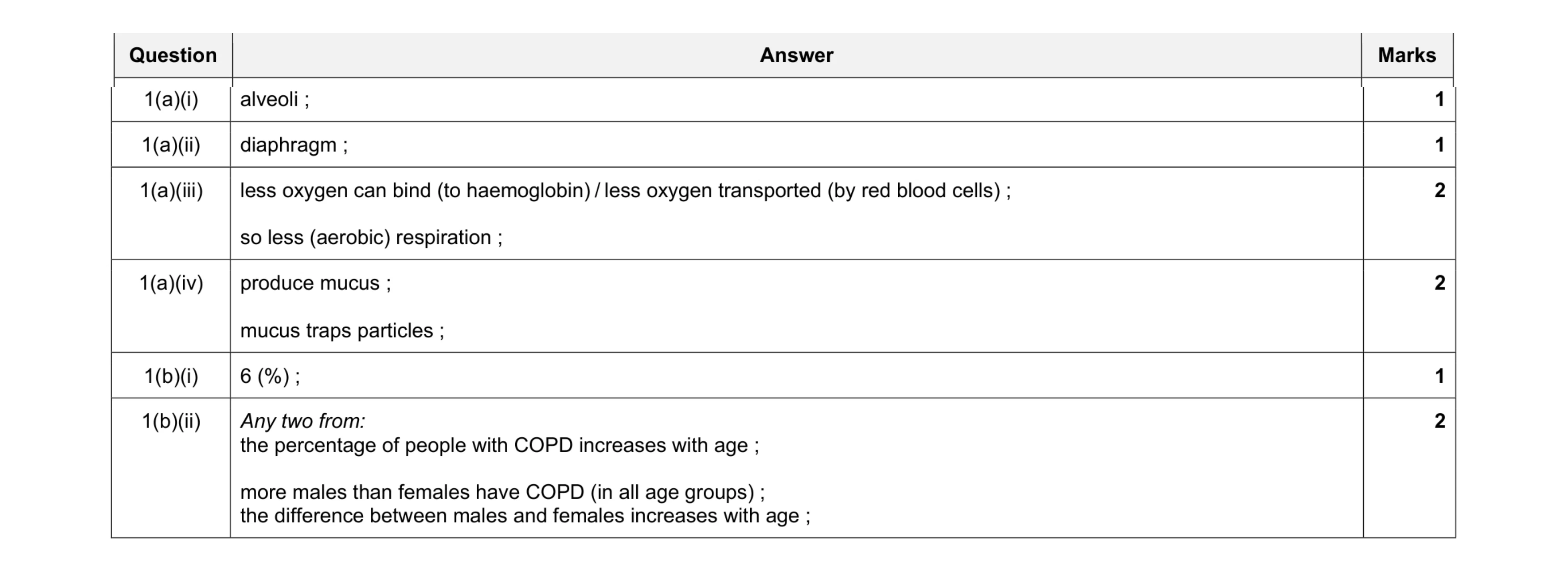 9
9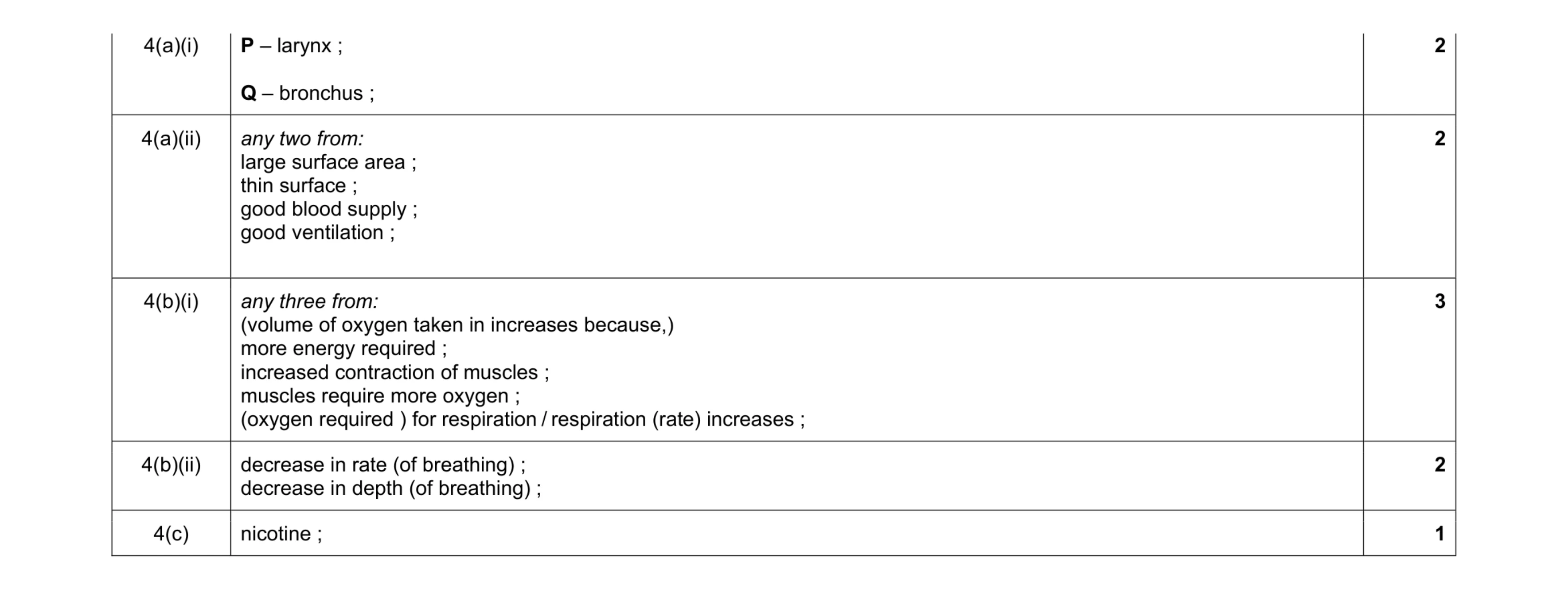 10
10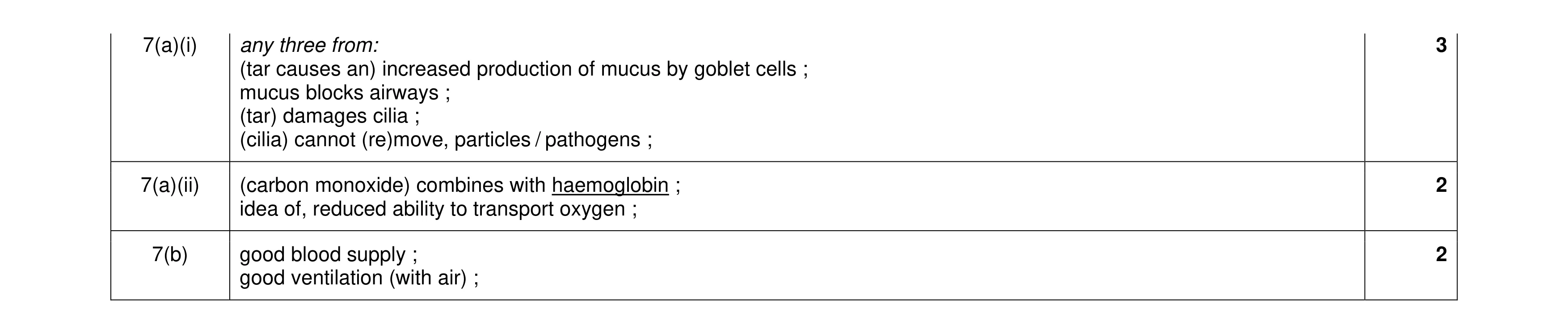 7
7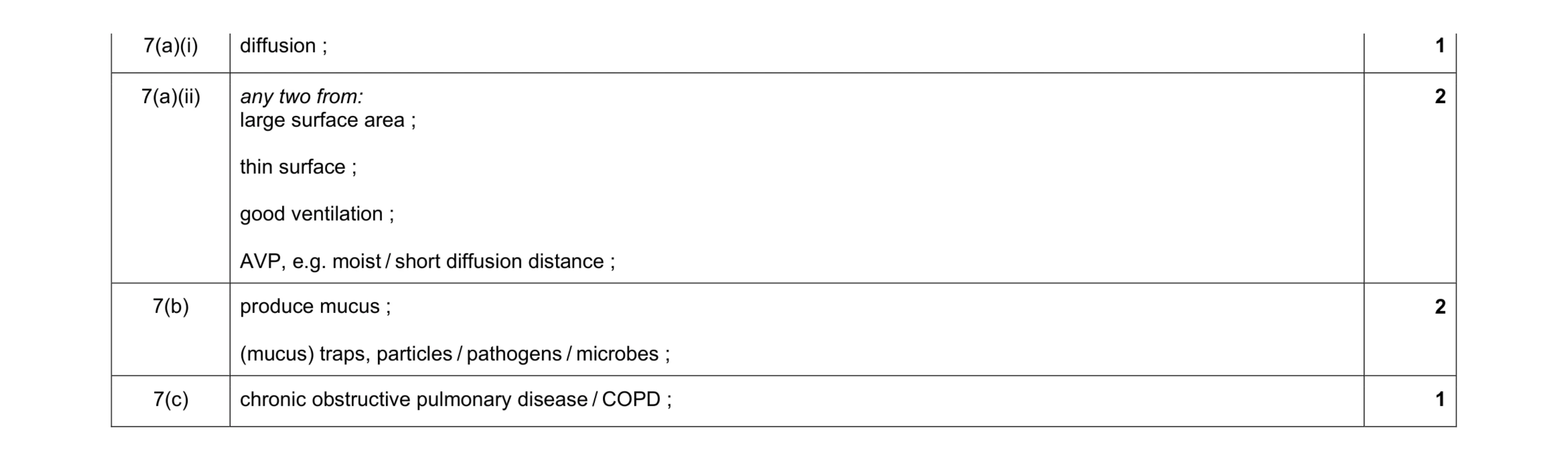 6
6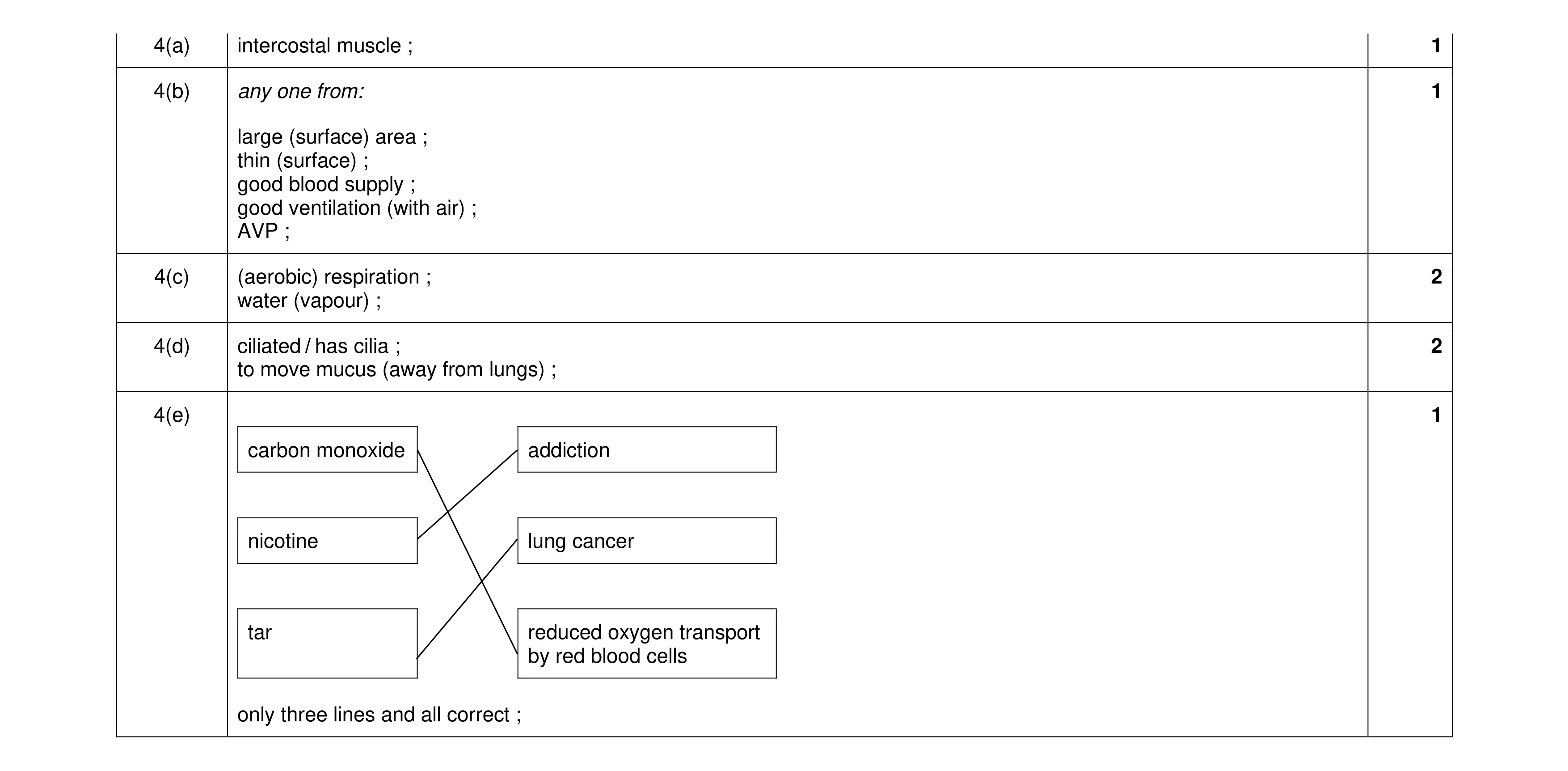 7
7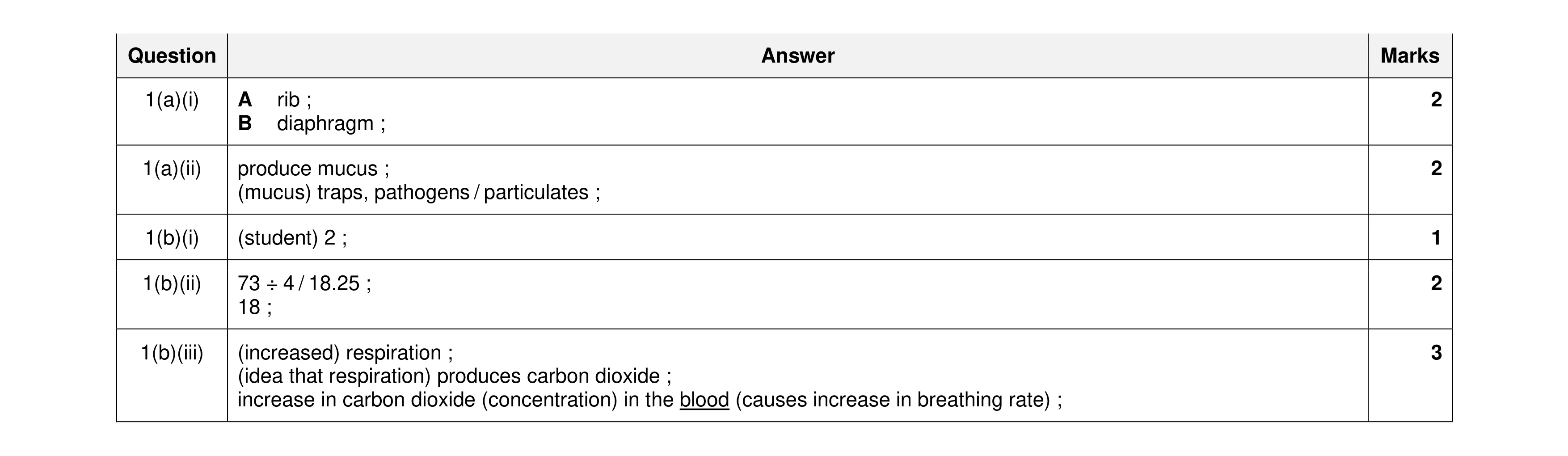 10
10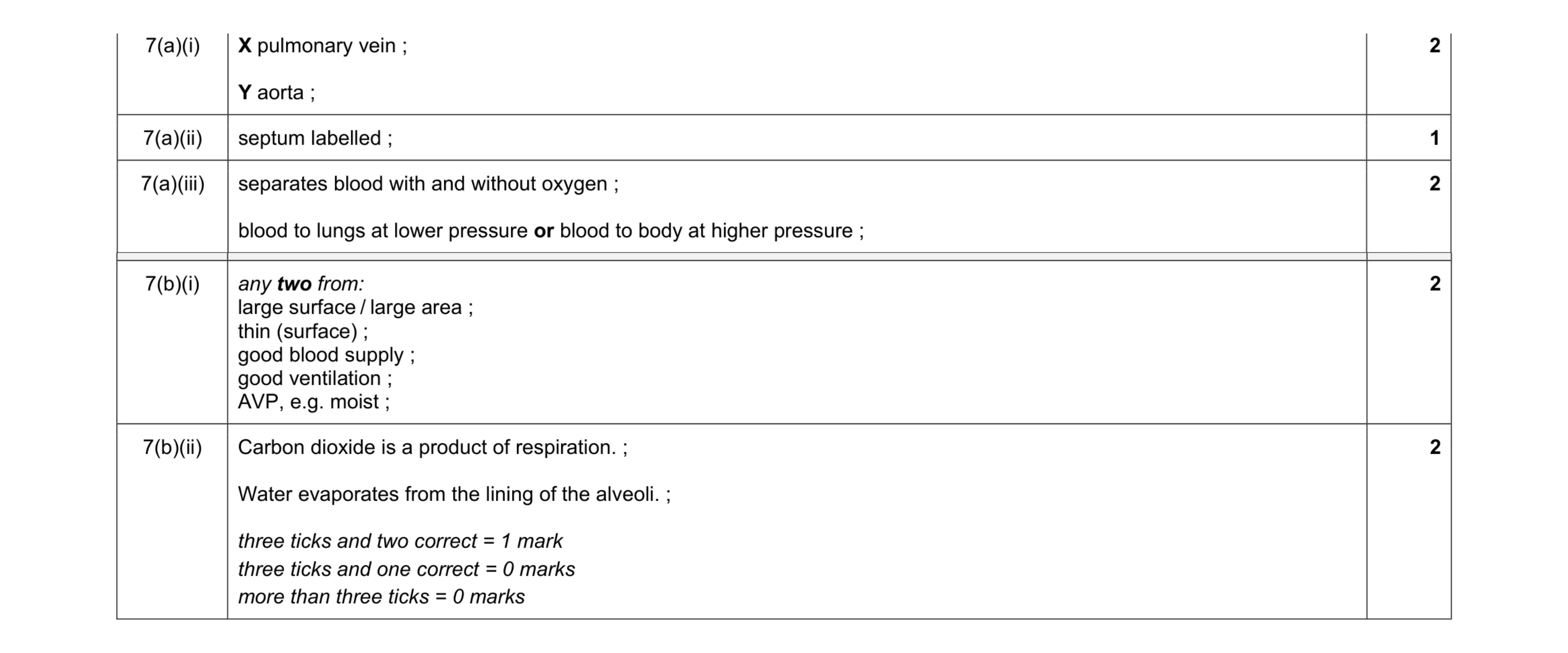 9
9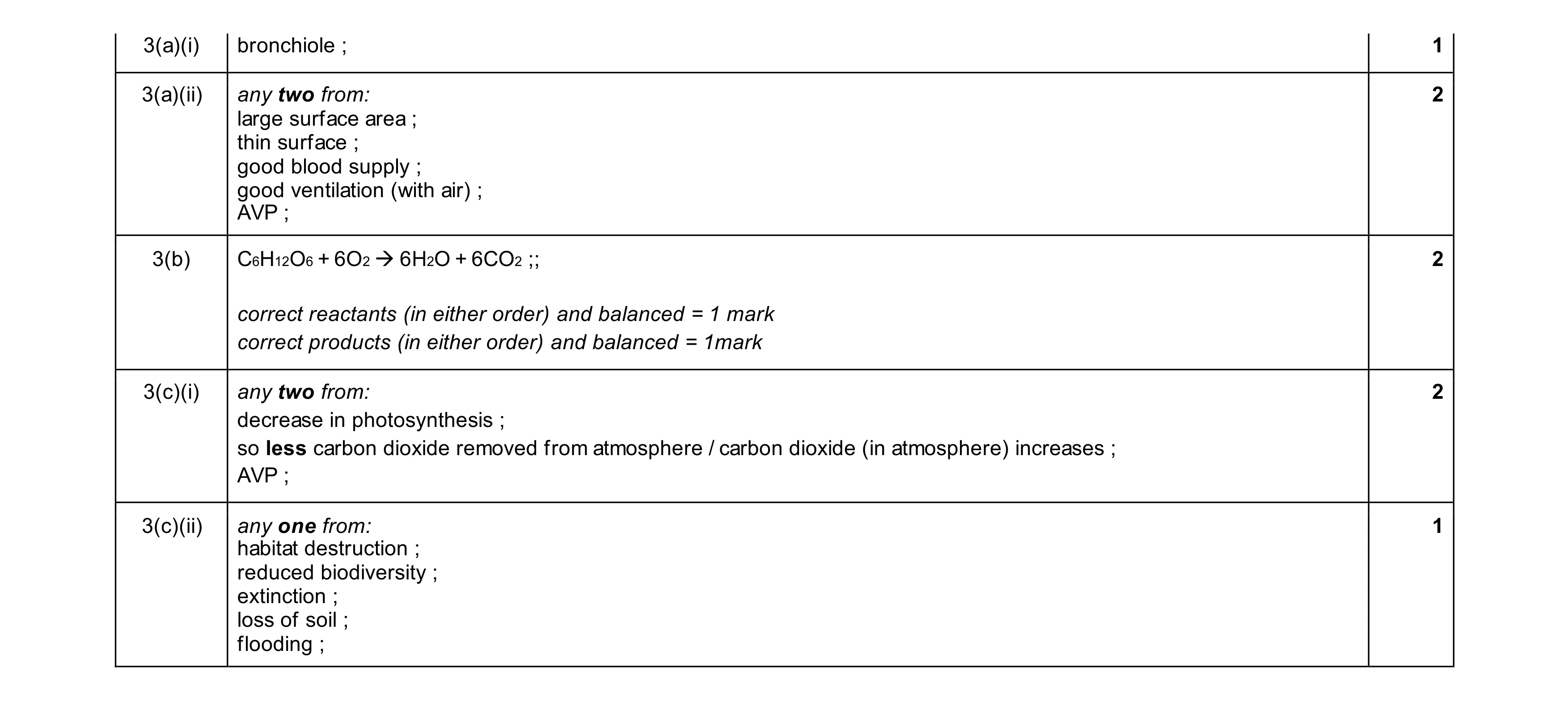 8
8