Questions as text
Q1 · Use the following words or phrases to complete the flow chart about the transport of… 0653/31 Oct/Nov 2017
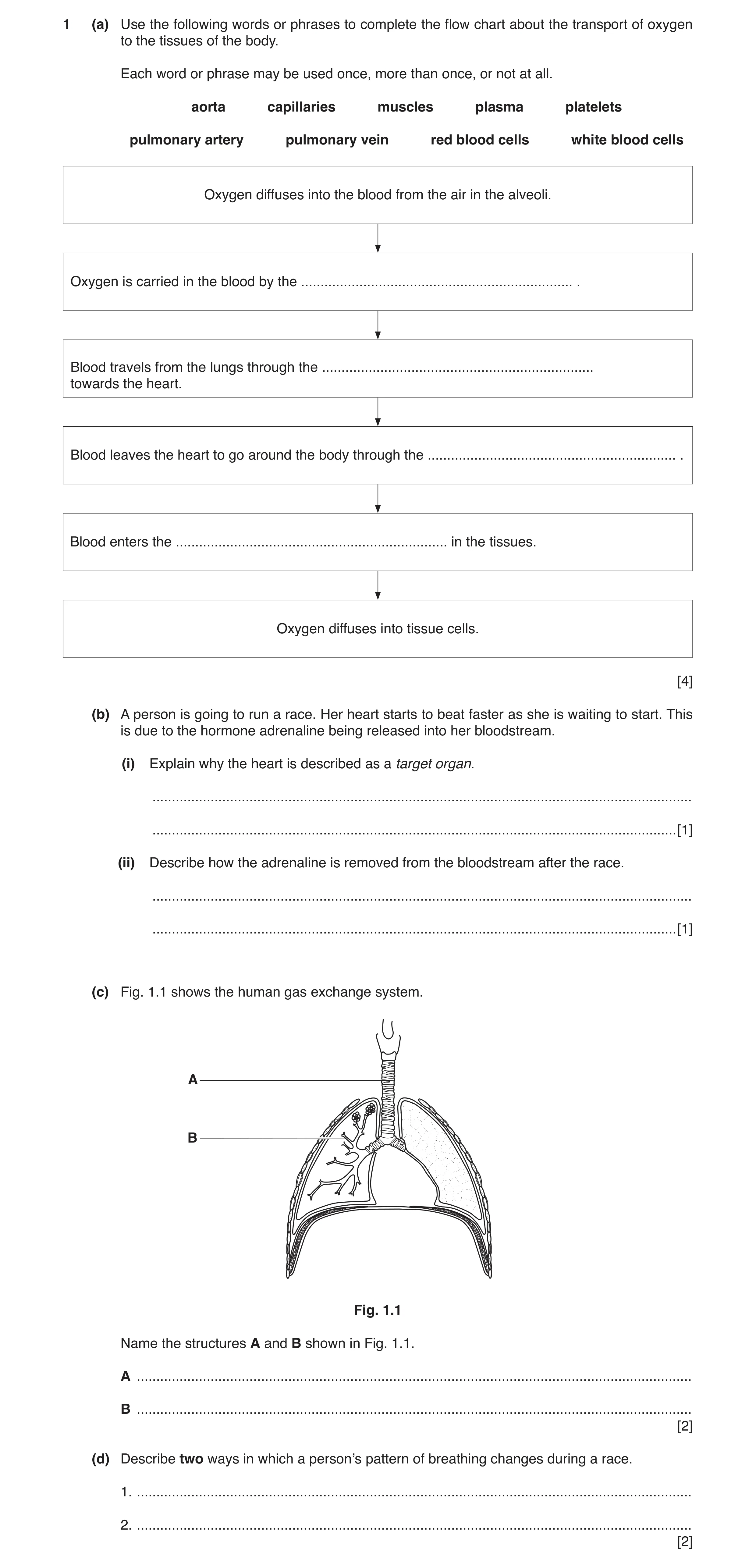
1 (a) Use the following words or phrases to complete the flow chart about the transport of oxygen to the tissues of the body. Each word or phrase may be used once, more than once, or not at all. aorta capillaries muscles plasma platelets pulmonary artery pulmonary vein red blood cells white blood cells Oxygen diffuses into the blood from the air in the alveoli. Oxygen is carried in the blood by the … . Blood travels from the lungs through the … towards the heart. Blood leaves the heart to go around the body through the … . Blood enters the … in the tissues. Oxygen diffuses into tissue cells. [4] (b) A person is going to run a race. Her heart starts to beat faster as she is waiting to start. This is due to the hormone adrenaline being released into her bloodstream. (i) Explain why the heart is described as a target organ. … … [1] (ii) Describe how the adrenaline is removed from the bloodstream after the race. … … [1] (c) Fig. 1.1 shows the human gas exchange system. A B Fig. 1.1 Name the structures A and B shown in Fig. 1.1. A … B … [2] (d) Describe two ways in which a person’s pattern of breathing changes during a race. 1. … 2. … [2]
10 marks
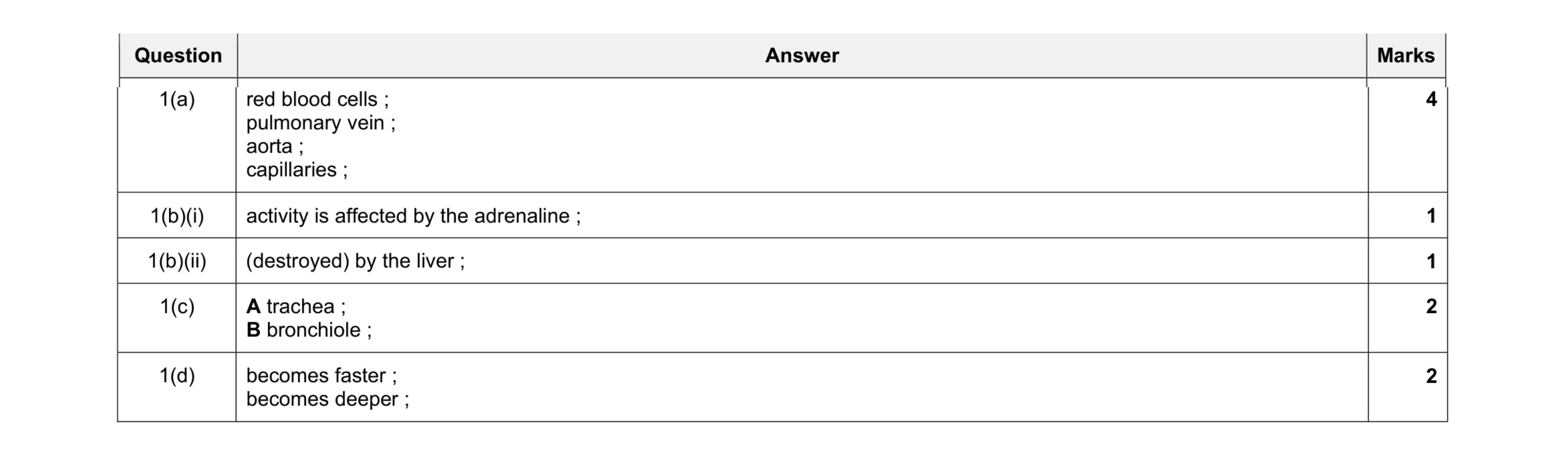
Mark scheme: 1(a) red blood cells ; pulmonary vein ; aorta ; capillaries ; 4 1(b)(i) activity is affected by the adrenaline ; 1 1(b)(ii) (destroyed) by the liver ; 1 1(c) A trachea ; B bronchiole ; 2 1(d) becomes faster ; becomes deeper ; 2
This question in 0653/31 Oct/Nov 2017
Q2 · Apparatus which is used to compare the carbon dioxide content of inspired air with… 0653/31 May/June 2018
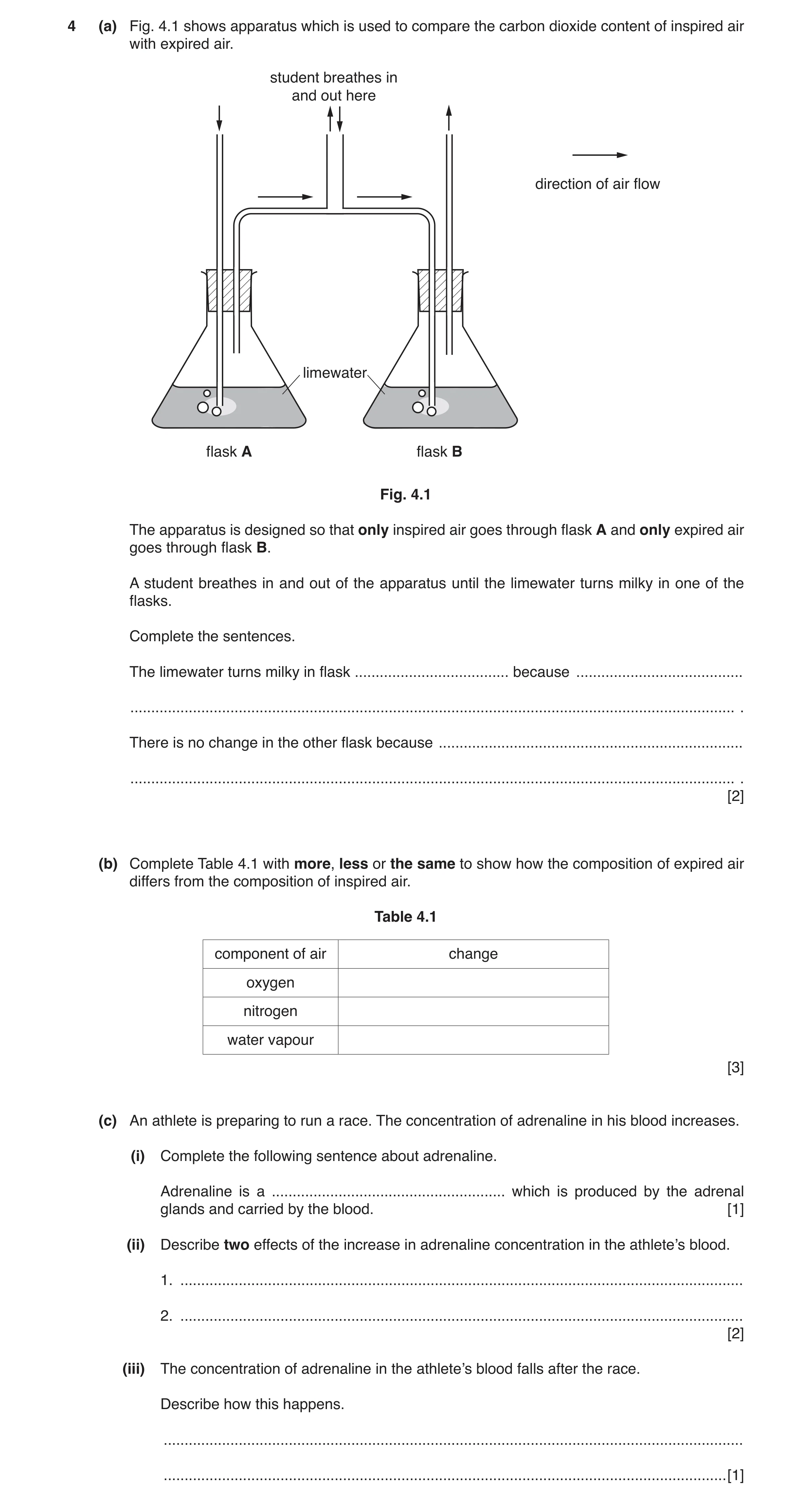
4 (a) Fig. 4.1 shows apparatus which is used to compare the carbon dioxide content of inspired air with expired air. student breathes in and out here direction of air flow limewater flask A flask B Fig. 4.1 The apparatus is designed so that only inspired air goes through flask A and only expired air goes through flask B. A student breathes in and out of the apparatus until the limewater turns milky in one of the flasks. Complete the sentences. The limewater turns milky in flask … because … … . There is no change in the other flask because … … . [2] (b) Complete Table 4.1 with more, less or the same to show how the composition of expired air differs from the composition of inspired air. Table 4.1 component of air change oxygen nitrogen water vapour [3] (c) An athlete is preparing to run a race. The concentration of adrenaline in his blood increases. (i) Complete the following sentence about adrenaline. Adrenaline is a … which is produced by the adrenal glands and carried by the blood. [1] (ii) Describe two effects of the increase in adrenaline concentration in the athlete’s blood. 1. … 2. … [2] (iii) The concentration of adrenaline in the athlete’s blood falls after the race. Describe how this happens. … … [1]
9 marks
Mark scheme: 4(a) B – no mark (expired air) contains carbon dioxide ; (inspired air) contains very little carbon dioxide ; 2 4(b) in order in the table less ; stays the same ; increases ; 3 4(c)(i) hormone ; 1 4(c)(ii) increase of blood glucose concentration ; increase in pulse / heart rate ; 2 4(c)(iii) destroyed by liver ; 1
This question in 0653/31 May/June 2018
Q3 · The human gas exchange system 0653/33 May/June 2019
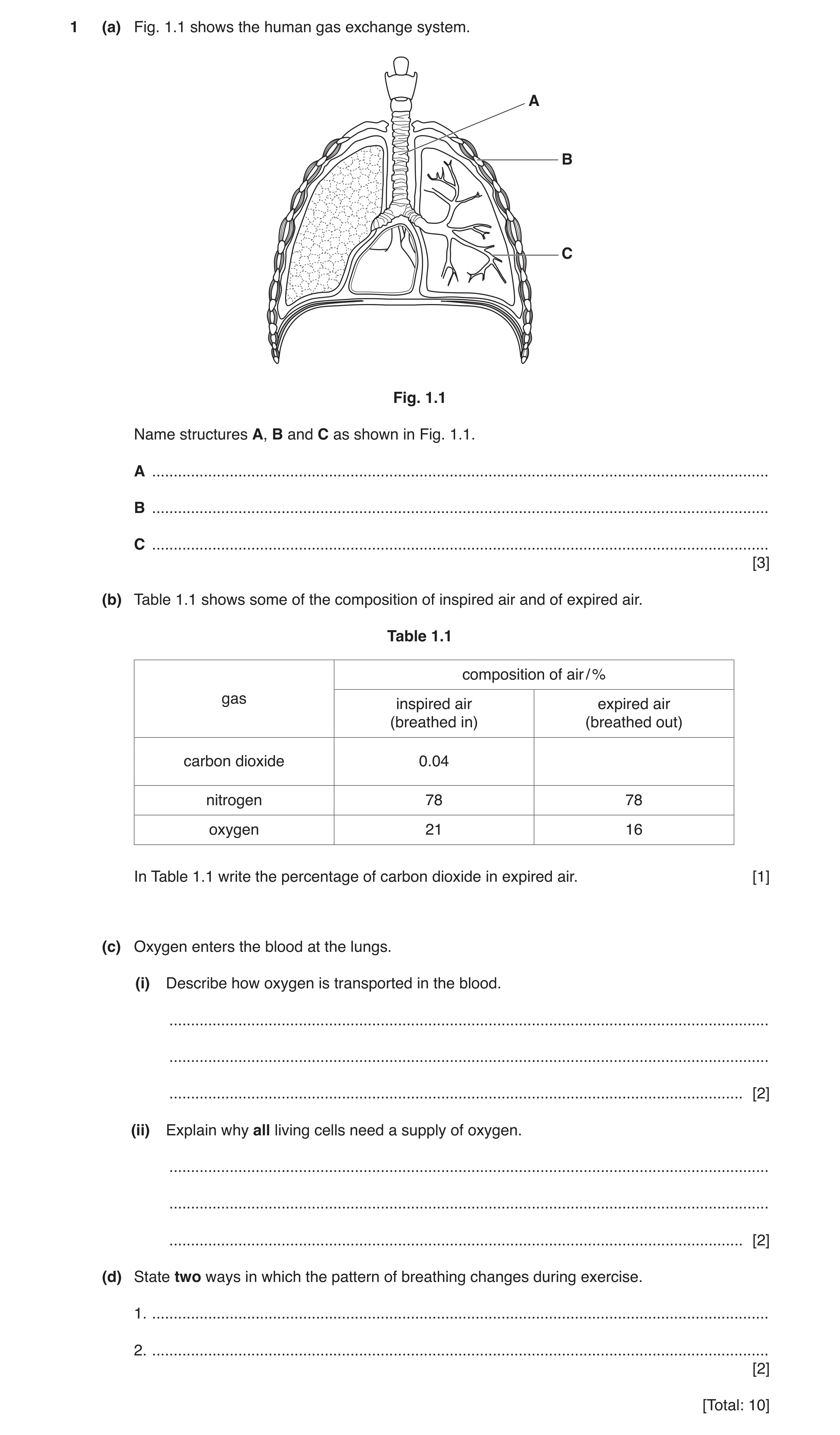
1 (a) Fig. 1.1 shows the human gas exchange system. A B C Fig. 1.1 Name structures A, B and C as shown in Fig. 1.1. A … B … C … [3] (b) Table 1.1 shows some of the composition of inspired air and of expired air. Table 1.1 composition of air / % gas inspired air expired air (breathed in) (breathed out) carbon dioxide 0.04 nitrogen 78 78 oxygen 21 16 In Table 1.1 write the percentage of carbon dioxide in expired air. [1] (c) Oxygen enters the blood at the lungs. (i) Describe how oxygen is transported in the blood. … … … [2] (ii) Explain why all living cells need a supply of oxygen. … … … [2] (d) State two ways in which the pattern of breathing changes during exercise. 1. … 2. … [2] [Total: 10]
10 marks
Mark scheme: 1(a) A trachea ; B rib ; C bronchiole ; 3 1(b) 4 (%) ; 1 1(c)(i) carried by haemoglobin ; in red blood cells ; 2 1(c)(ii) needed for respiration ; reacts with glucose / releases energy ; 2 1(d) breathing rate increases ; depth of breathing increases ; 2
This question in 0653/33 May/June 2019
Q4 · A diagram of some parts of the body 0653/31 Oct/Nov 2020
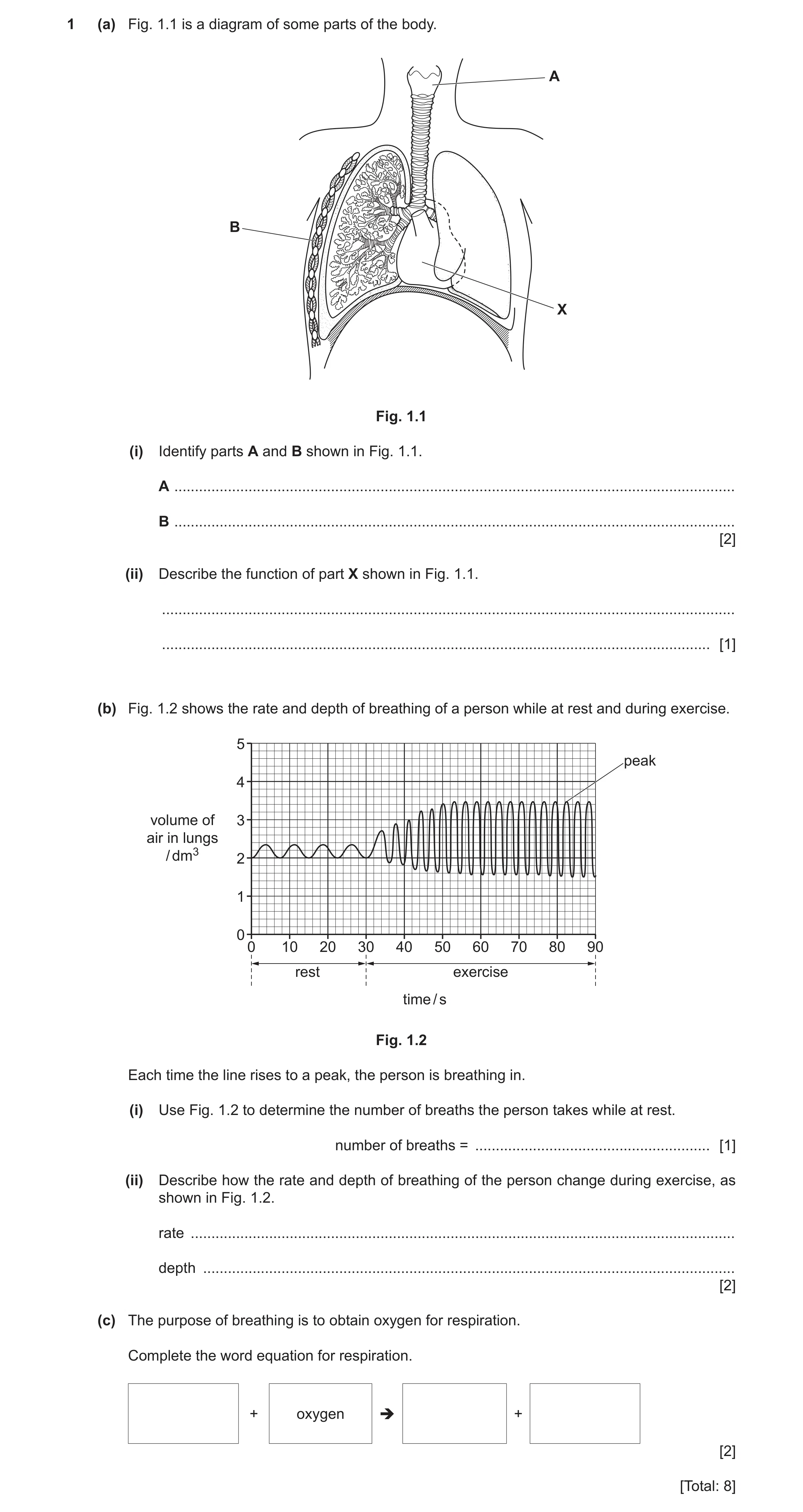
1 (a) Fig. 1.1 is a diagram of some parts of the body. A B X Fig. 1.1 (i) Identify parts A and B shown in Fig. 1.1. A … B … [2] (ii) Describe the function of part X shown in Fig. 1.1. … … [1] (b) Fig. 1.2 shows the rate and depth of breathing of a person while at rest and during exercise. 5 peak 4 volume of 3 air in lungs / dm3 2 1 0 0 10 20 30 40 50 60 70 80 90 rest exercise time / s Fig. 1.2 Each time the line rises to a peak, the person is breathing in. (i) Use Fig. 1.2 to determine the number of breaths the person takes while at rest. number of breaths = … [1] (ii) Describe how the rate and depth of breathing of the person change during exercise, as shown in Fig. 1.2. rate … depth … [2] (c) The purpose of breathing is to obtain oxygen for respiration. Complete the word equation for respiration. + oxygen + [2] [Total: 8]
8 marks
Mark scheme: 1(a)(i) B intercostal muscles ; 2 1(a)(ii) pump blood (around the body) ; 1 1(b)(i) 4 ; 1 1(b)(ii) (rate) increases ; (depth) increases ; 2 1(c) glucose + (oxygen) carbon dioxide + water LHS ; RHS ; 2
This question in 0653/31 Oct/Nov 2020
Q5 · Parts of the human gas exchange system 0653/32 Oct/Nov 2020
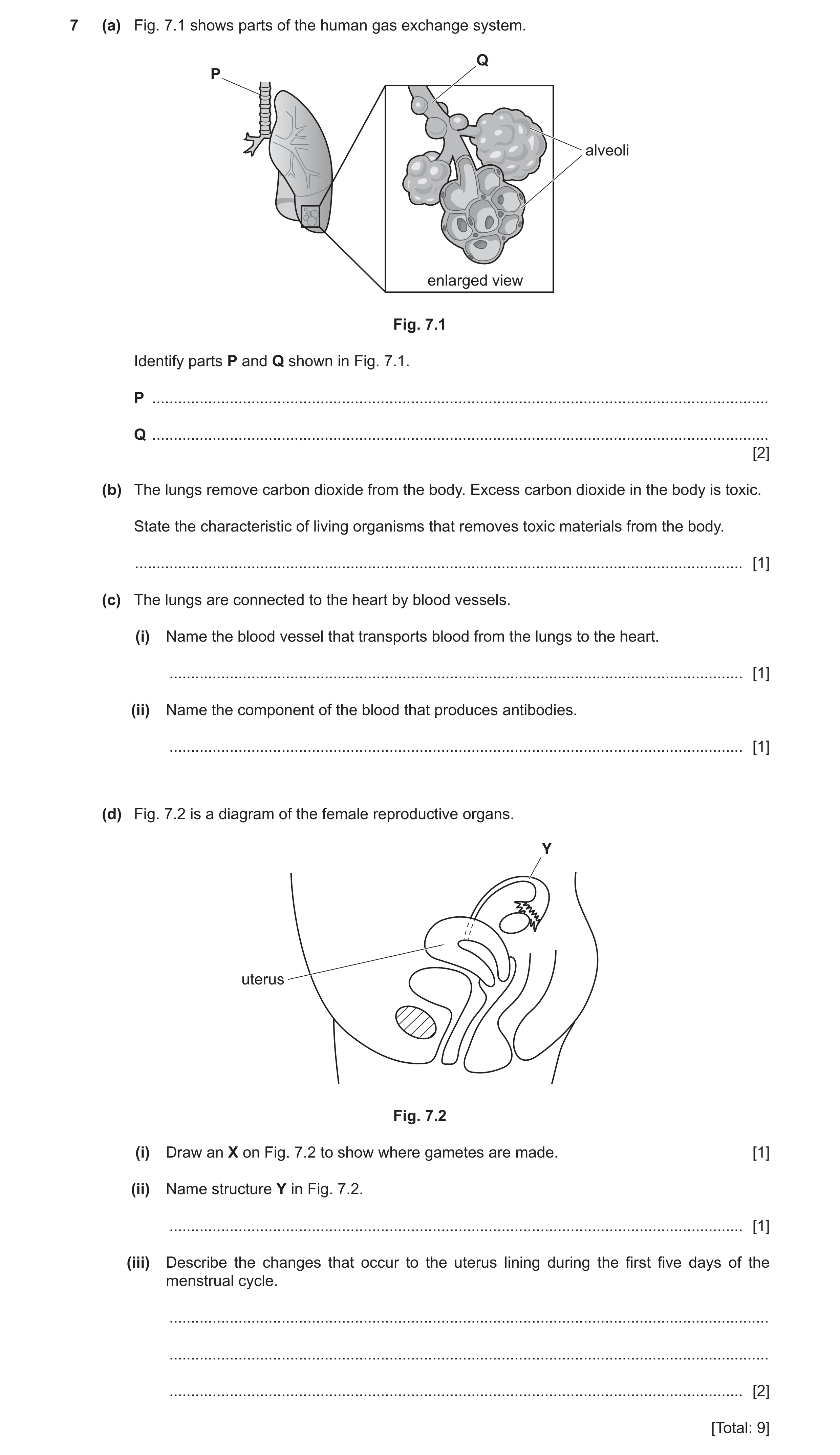
7 (a) Fig. 7.1 shows parts of the human gas exchange system. Q P alveoli enlarged view Fig. 7.1 Identify parts P and Q shown in Fig. 7.1. P … Q … [2] (b) The lungs remove carbon dioxide from the body. Excess carbon dioxide in the body is toxic. State the characteristic of living organisms that removes toxic materials from the body. … [1] (c) The lungs are connected to the heart by blood vessels. (i) Name the blood vessel that transports blood from the lungs to the heart. … [1] (ii) Name the component of the blood that produces antibodies. … [1] (d) Fig. 7.2 is a diagram of the female reproductive organs. Y uterus Fig. 7.2 (i) Draw an X on Fig. 7.2 to show where gametes are made. [1] (ii) Name structure Y in Fig. 7.2. … [1] (iii) Describe the changes that occur to the uterus lining during the first five days of the menstrual cycle. … … … [2] [Total: 9]
9 marks
Mark scheme: 7(a) P trachea ; Q bronchiole ; 2 7(b) excretion ; 1 7(c)(i) pulmonary vein ; 1 7(c)(ii) white blood cell ; 1 Question Answer Marks 7(d)(i) centre of X on ovary ; 1 7(d)(ii) oviduct ; 1 7(d)(iii) any two from: (uterus lining) breaks down ; (uterus lining) is shed ; (uterus) thickness decreases ; 2
This question in 0653/32 Oct/Nov 2020
Q6 · The boxes on the left show characteristics of living organisms 0653/31 May/June 2021
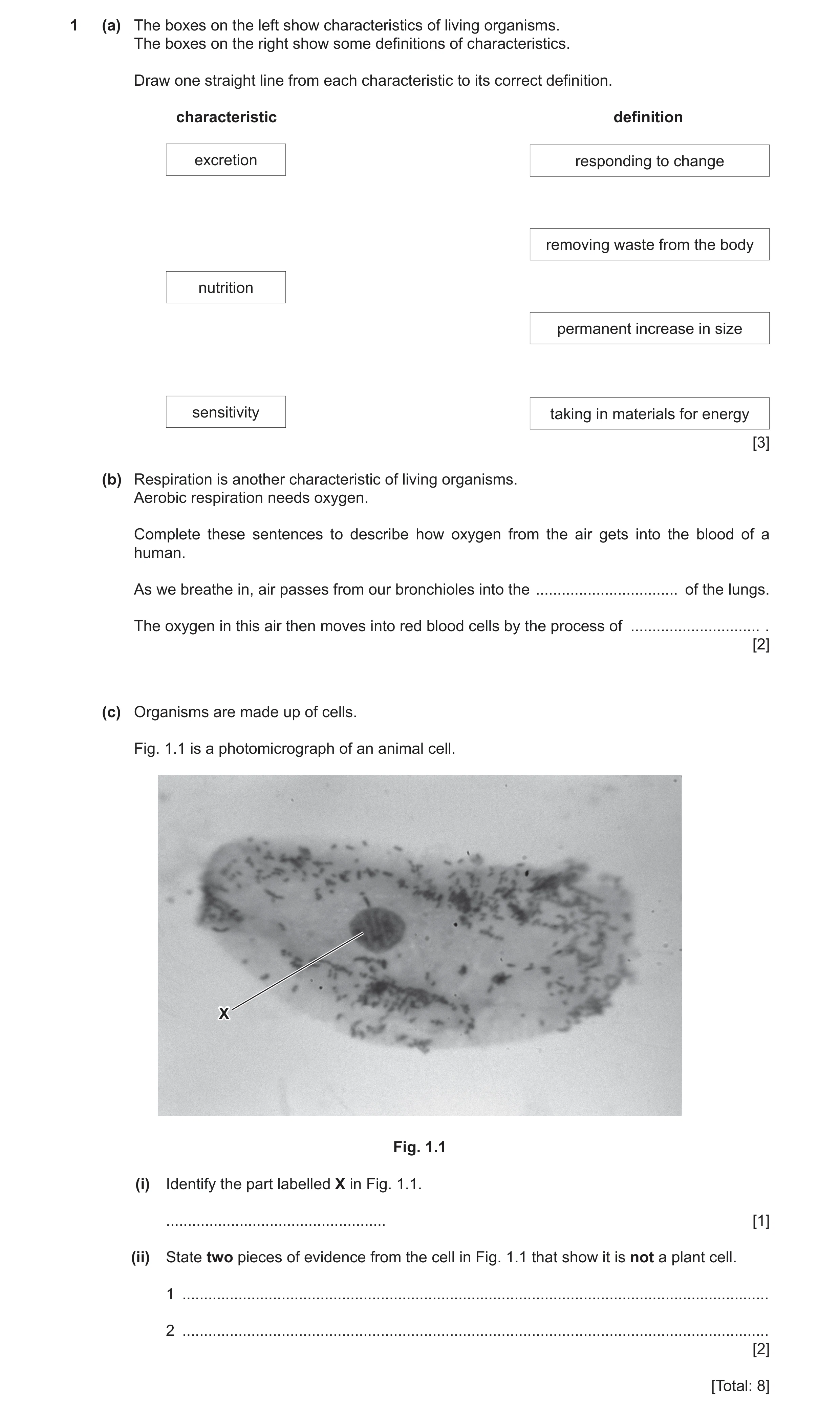
1 (a) The boxes on the left show characteristics of living organisms. The boxes on the right show some definitions of characteristics. Draw one straight line from each characteristic to its correct definition. characteristic definition excretion responding to change removing waste from the body nutrition permanent increase in size sensitivity taking in materials for energy [3] (b) Respiration is another characteristic of living organisms. Aerobic respiration needs oxygen. Complete these sentences to describe how oxygen from the air gets into the blood of a human. As we breathe in, air passes from our bronchioles into the … of the lungs. The oxygen in this air then moves into red blood cells by the process of … . [2] (c) Organisms are made up of cells. Fig. 1.1 is a photomicrograph of an animal cell. X Fig. 1.1 (i) Identify the part labelled X in Fig. 1.1. … [1] (ii) State two pieces of evidence from the cell in Fig. 1.1 that show it is not a plant cell. 1 … 2 … [2] [Total: 8]
8 marks
Mark scheme: 1(a) responding to change excretion removing waste from the body nutrition permanent increases in size sensitivity taking in materials for energy ;;; 1(b) alveoli ; diffusion ; 2 1(c)(i) nucleus ; 1 1(c)(ii) any two from: no cell wall ; no chloroplasts ; no (large) vacuole ; 2
This question in 0653/31 May/June 2021
Q7 · A diagram of the circulatory system in humans 0653/31 Oct/Nov 2021
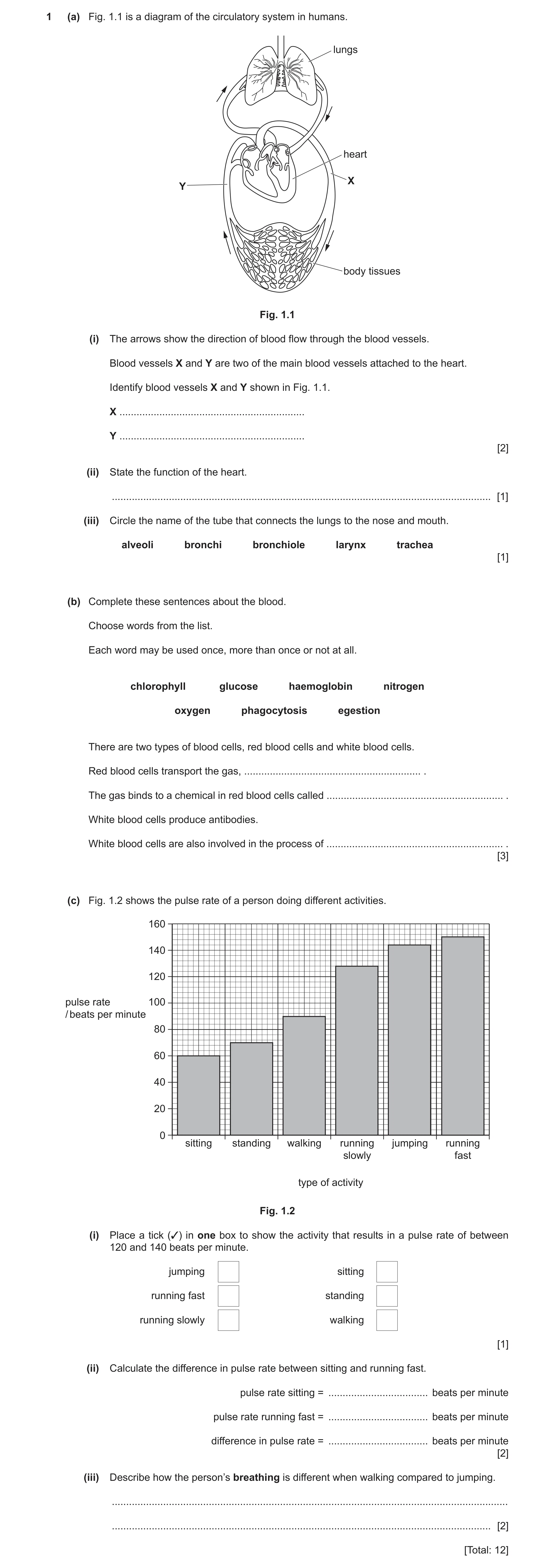
1 (a) Fig. 1.1 is a diagram of the circulatory system in humans. lungs heart X Y body tissues Fig. 1.1 (i) The arrows show the direction of blood flow through the blood vessels. Blood vessels X and Y are two of the main blood vessels attached to the heart. Identify blood vessels X and Y shown in Fig. 1.1. X … Y … [2] (ii) State the function of the heart. … [1] (iii) Circle the name of the tube that connects the lungs to the nose and mouth. alveoli bronchi bronchiole larynx trachea [1] (b) Complete these sentences about the blood. Choose words from the list. Each word may be used once, more than once or not at all. chlorophyll glucose haemoglobin nitrogen oxygen phagocytosis egestion There are two types of blood cells, red blood cells and white blood cells. Red blood cells transport the gas, … . The gas binds to a chemical in red blood cells called … . White blood cells produce antibodies. White blood cells are also involved in the process of … . [3] (c) Fig. 1.2 shows the pulse rate of a person doing different activities. 160 140 120 pulse rate 100 / beats per minute 80 60 40 20 0 sitting standing walking running jumping running slowly fast type of activity Fig. 1.2 (i) Place a tick (3) in one box to show the activity that results in a pulse rate of between 120 and 140 beats per minute. jumping sitting running fast standing running slowly walking [1] (ii) Calculate the difference in pulse rate between sitting and running fast. pulse rate sitting = … beats per minute pulse rate running fast = … beats per minute difference in pulse rate = … beats per minute [2] (iii) Describe how the person’s breathing is different when walking compared to jumping. … … [2] [Total: 12]
12 marks
Mark scheme: 1(a)(i) aorta ; vena cava ; 2 1(a)(ii) pump blood ; 1 1(a)(iii) trachea ; 1 1(b) oxygen ; haemoglobin ; phagocytosis ; 3 1(c)(i) running slowly box ticked ; 1 1(c)(ii) reading values from graph 60 and 150 ; correct subtraction / 90 ; 2 1(c)(iii) lower breathing rate / AW ; lesser depth of breathing / AW ; 2
This question in 0653/31 Oct/Nov 2021
Q8 · A diagram of the human gas exchange system 0653/32 May/June 2022
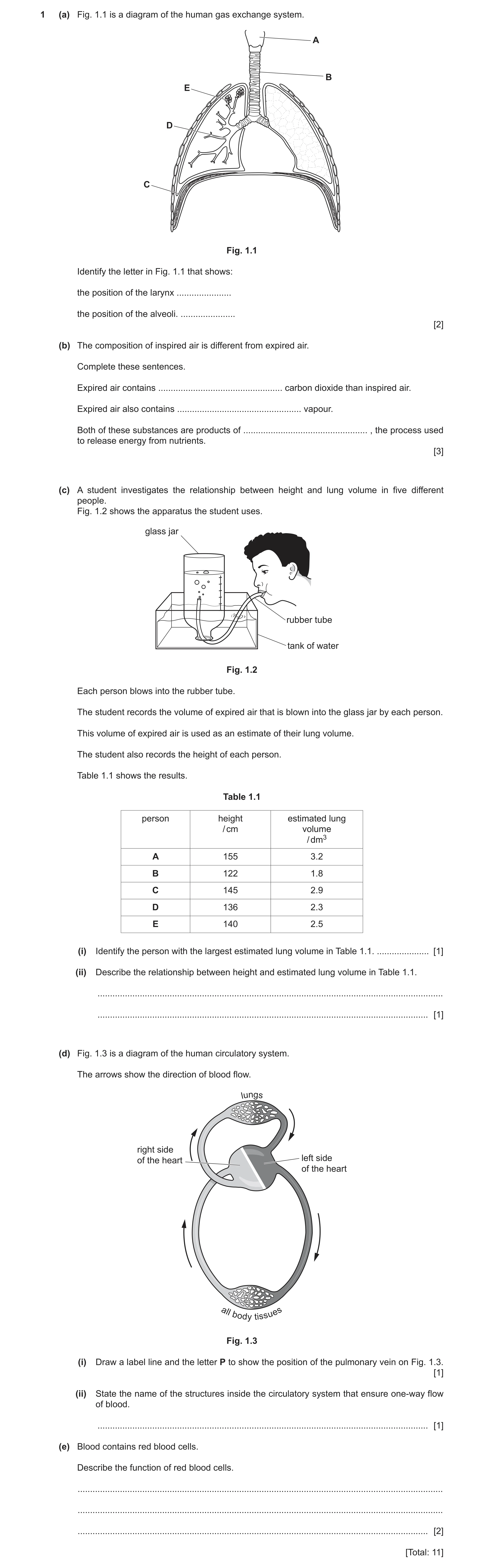
1 (a) Fig. 1.1 is a diagram of the human gas exchange system. A B E D C Fig. 1.1 Identify the letter in Fig. 1.1 that shows: the position of the larynx … the position of the alveoli. … [2] (b) The composition of inspired air is different from expired air. Complete these sentences. Expired air contains … carbon dioxide than inspired air. Expired air also contains … vapour. Both of these substances are products of … , the process used to release energy from nutrients. [3] (c) A student investigates the relationship between height and lung volume in five different people. Fig. 1.2 shows the apparatus the student uses. glass jar rubber tube tank of water Fig. 1.2 Each person blows into the rubber tube. The student records the volume of expired air that is blown into the glass jar by each person. This volume of expired air is used as an estimate of their lung volume. The student also records the height of each person. Table 1.1 shows the results. Table 1.1 person height estimated lung / cm volume / dm3 A 155 3.2 B 122 1.8 C 145 2.9 D 136 2.3 E 140 2.5 (i) Identify the person with the largest estimated lung volume in Table 1.1. … [1] (ii) Describe the relationship between height and estimated lung volume in Table 1.1. … … [1] (d) Fig. 1.3 is a diagram of the human circulatory system. The arrows show the direction of blood flow. lungs right side of the heart left side of the heart all body tissues Fig. 1.3 (i) Draw a label line and the letter P to show the position of the pulmonary vein on Fig. 1.3. [1] (ii) State the name of the structures inside the circulatory system that ensure one-way flow of blood. … [1] (e) Blood contains red blood cells. Describe the function of red blood cells. … … … [2] [Total: 11]
11 marks
Mark scheme: 1(a) A ; E ; 2 1(b) more ; water ; respiration ; 3 1(c)(i) (person) A ; 1 1(c)(ii) taller the person / as the height increases, the greater the (estimated) lung volume ; 1 1(d)(i) pulmonary vein labelled ; 1 1(d)(ii) valves ; 1 1(e) transport oxygen ; ref. haemoglobin ; 2
This question in 0653/32 May/June 2022
Q9 · A model of the human gas exchange system 0653/31 May/June 2023
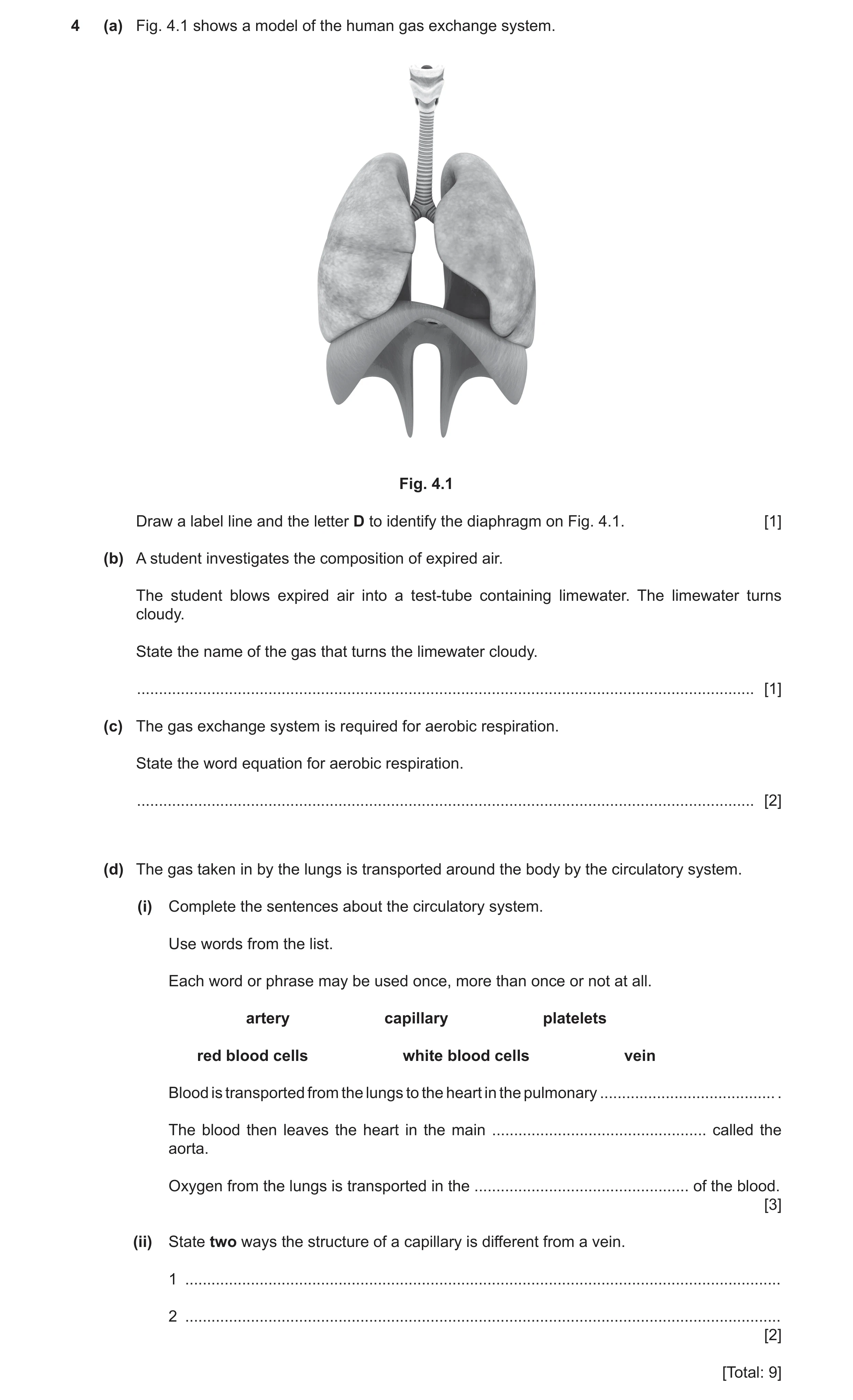
4 (a) Fig. 4.1 shows a model of the human gas exchange system. Fig. 4.1 Draw a label line and the letter D to identify the diaphragm on Fig. 4.1. [1] (b) A student investigates the composition of expired air. The student blows expired air into a test-tube containing limewater. The limewater turns cloudy. State the name of the gas that turns the limewater cloudy. … [1] (c) The gas exchange system is required for aerobic respiration. State the word equation for aerobic respiration. … [2] (d) The gas taken in by the lungs is transported around the body by the circulatory system. (i) Complete the sentences about the circulatory system. Use words from the list. Each word or phrase may be used once, more than once or not at all. artery capillary platelets red blood cells white blood cells vein Blood is transported from the lungs to the heart in the pulmonary … . The blood then leaves the heart in the main … called the aorta. Oxygen from the lungs is transported in the … of the blood. [3] (ii) State two ways the structure of a capillary is different from a vein. 1 … 2 … [2] [Total: 9]
9 marks
Mark scheme: 4(a) diaphragm labelled D ; 1 4(b) carbon dioxide ; 1 4(c) glucose + oxygen carbon dioxide + water ;; reactants (1) products (1) 2 4(d)(i) vein ; artery ; red blood cells ; 3 4(d)(ii) any two from: idea of small(er) internal cross-sectional area ; thinner wall / wall one cell thick ; no, muscles / elastic tissue in wall ; no valves ; 2
This question in 0653/31 May/June 2023
Q10 · A diagram of the human gas exchange system 0653/32 Oct/Nov 2023
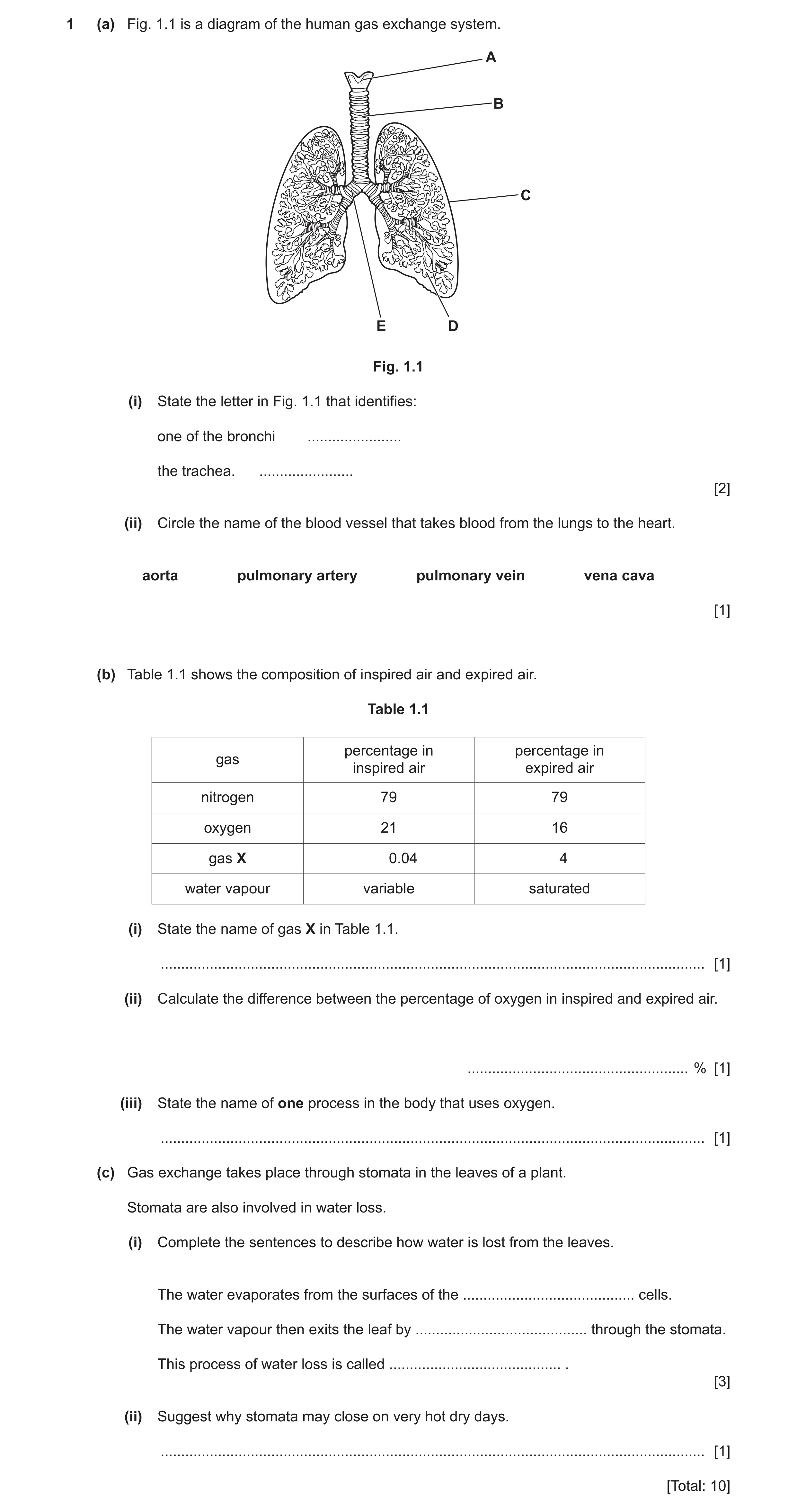
1 (a) Fig. 1.1 is a diagram of the human gas exchange system. A B C E D Fig. 1.1 (i) State the letter in Fig. 1.1 that identifies: one of the bronchi … the trachea. … [2] (ii) Circle the name of the blood vessel that takes blood from the lungs to the heart. aorta pulmonary artery pulmonary vein vena cava [1] (b) Table 1.1 shows the composition of inspired air and expired air. Table 1.1 percentage in percentage in gas inspired air expired air nitrogen 79 79 oxygen 21 16 gas X 0.04 4 water vapour variable saturated (i) State the name of gas X in Table 1.1. … [1] (ii) Calculate the difference between the percentage of oxygen in inspired and expired air. … % [1] (iii) State the name of one process in the body that uses oxygen. … [1] (c) Gas exchange takes place through stomata in the leaves of a plant. Stomata are also involved in water loss. (i) Complete the sentences to describe how water is lost from the leaves. The water evaporates from the surfaces of the … cells. The water vapour then exits the leaf by … through the stomata. This process of water loss is called … . [3] (ii) Suggest why stomata may close on very hot dry days. … [1] [Total: 10]
10 marks
Mark scheme: Question Answer Marks 1(a)(i) E ; 2 B ; 1(a)(ii) pulmonary vein ; 1 1(b)(i) carbon dioxide ; 1 1(b)(ii) 5 ; 1 1(b)(iii) (aerobic) respiration ; 1 1(c)(i) mesophyll ; 3 diffusion / diffusing ; transpiration ; 1(c)(ii) to reduce water loss ; 1
This question in 0653/32 Oct/Nov 2023
Q11 · A diagram of the human gas exchange system 0653/33 Oct/Nov 2023
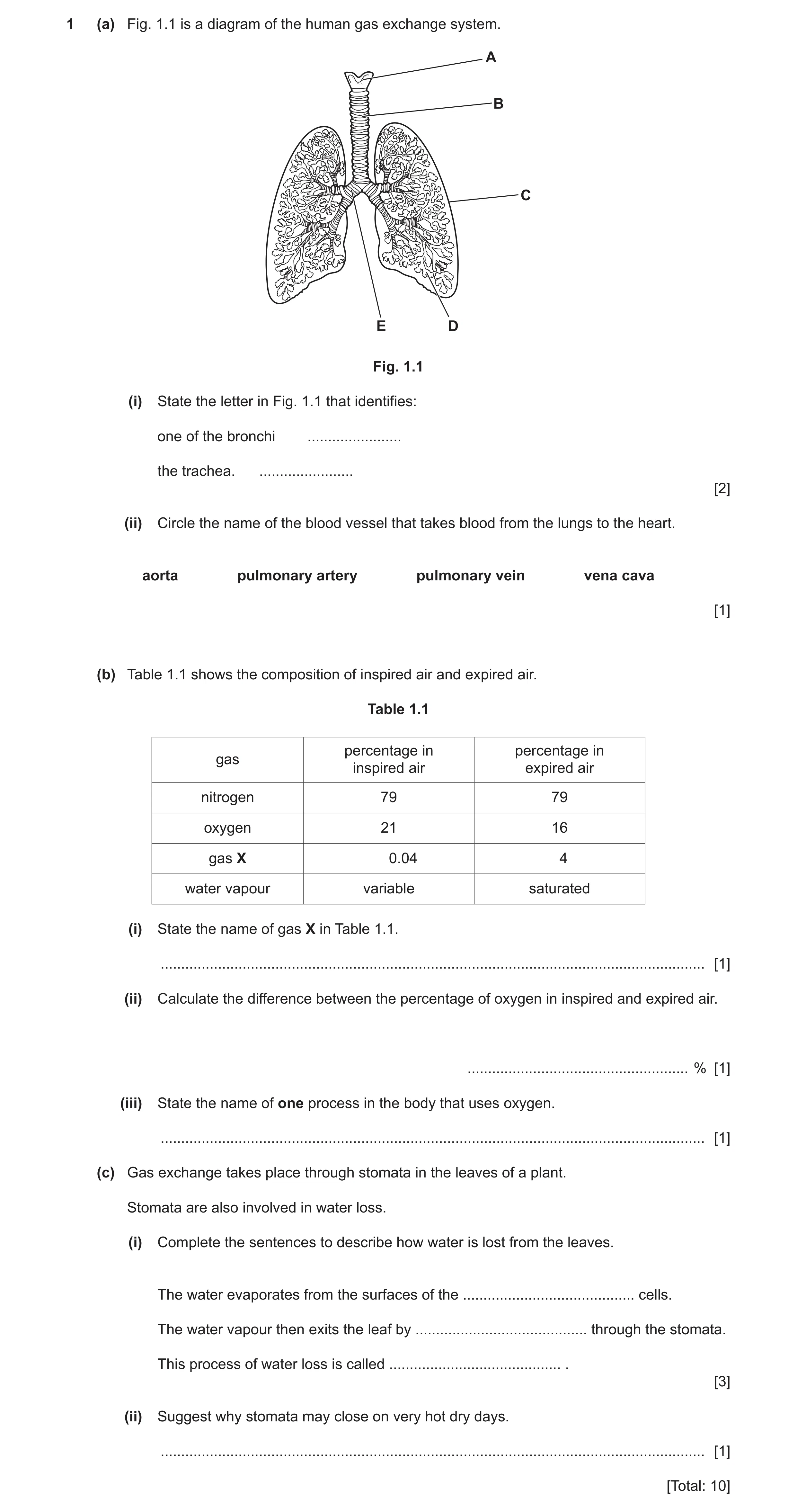
1 (a) Fig. 1.1 is a diagram of the human gas exchange system. A B C E D Fig. 1.1 (i) State the letter in Fig. 1.1 that identifies: one of the bronchi … the trachea. … [2] (ii) Circle the name of the blood vessel that takes blood from the lungs to the heart. aorta pulmonary artery pulmonary vein vena cava [1] (b) Table 1.1 shows the composition of inspired air and expired air. Table 1.1 percentage in percentage in gas inspired air expired air nitrogen 79 79 oxygen 21 16 gas X 0.04 4 water vapour variable saturated (i) State the name of gas X in Table 1.1. … [1] (ii) Calculate the difference between the percentage of oxygen in inspired and expired air. … % [1] (iii) State the name of one process in the body that uses oxygen. … [1] (c) Gas exchange takes place through stomata in the leaves of a plant. Stomata are also involved in water loss. (i) Complete the sentences to describe how water is lost from the leaves. The water evaporates from the surfaces of the … cells. The water vapour then exits the leaf by … through the stomata. This process of water loss is called … . [3] (ii) Suggest why stomata may close on very hot dry days. … [1] [Total: 10]
10 marks
Mark scheme: Question Answer Marks 1(a)(i) E ; 2 B ; 1(a)(ii) pulmonary vein ; 1 1(b)(i) carbon dioxide ; 1 1(b)(ii) 5 ; 1 1(b)(iii) (aerobic) respiration ; 1 1(c)(i) mesophyll ; 3 diffusion / diffusing ; transpiration ; 1(c)(ii) to reduce water loss ; 1
This question in 0653/33 Oct/Nov 2023
 10
10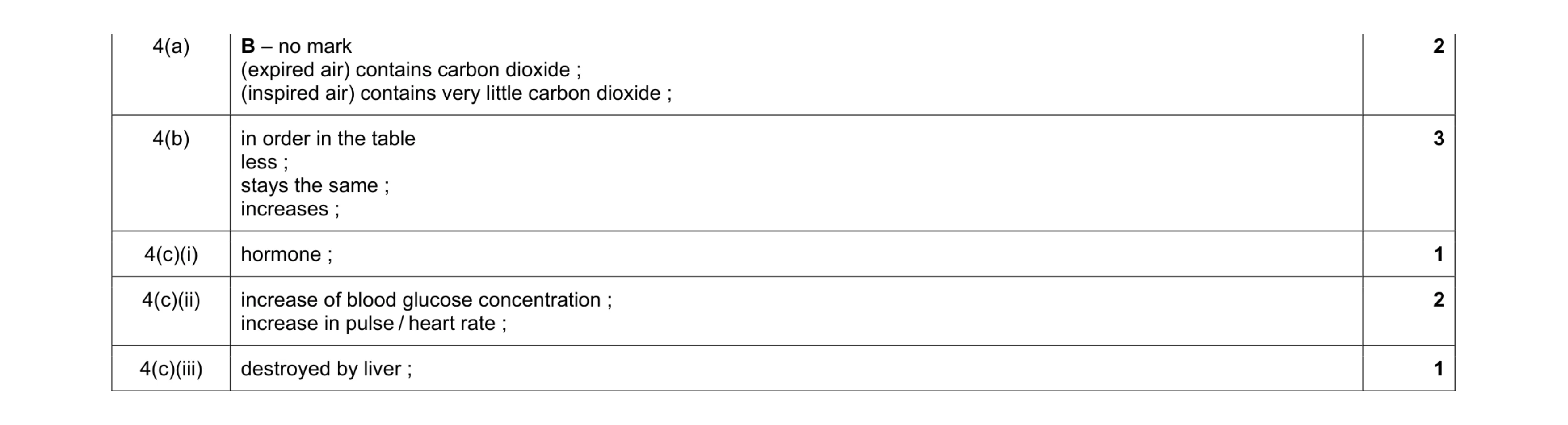 9
9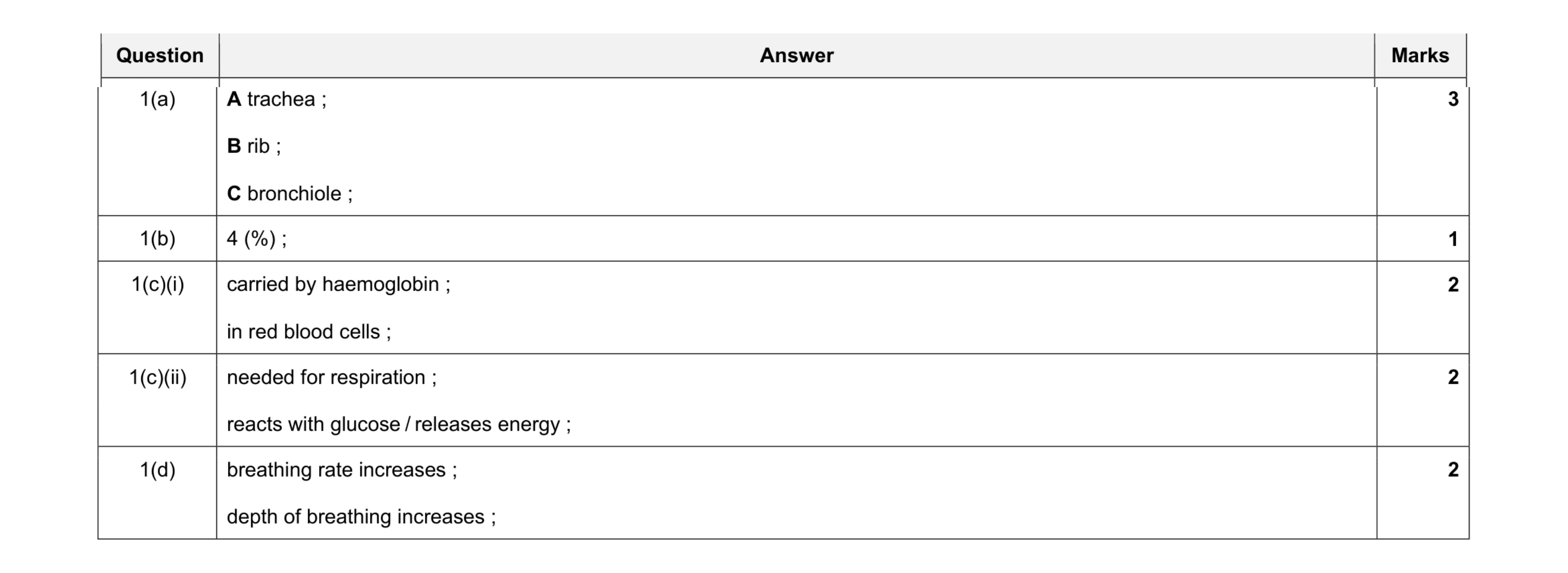 10
10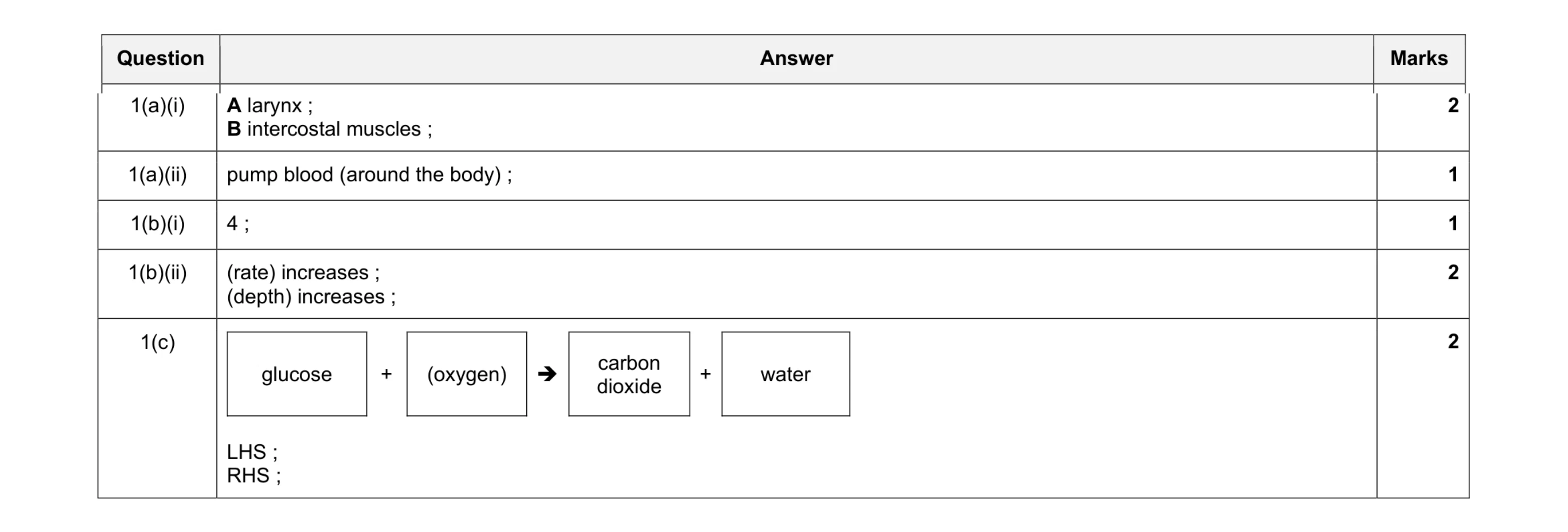 8
8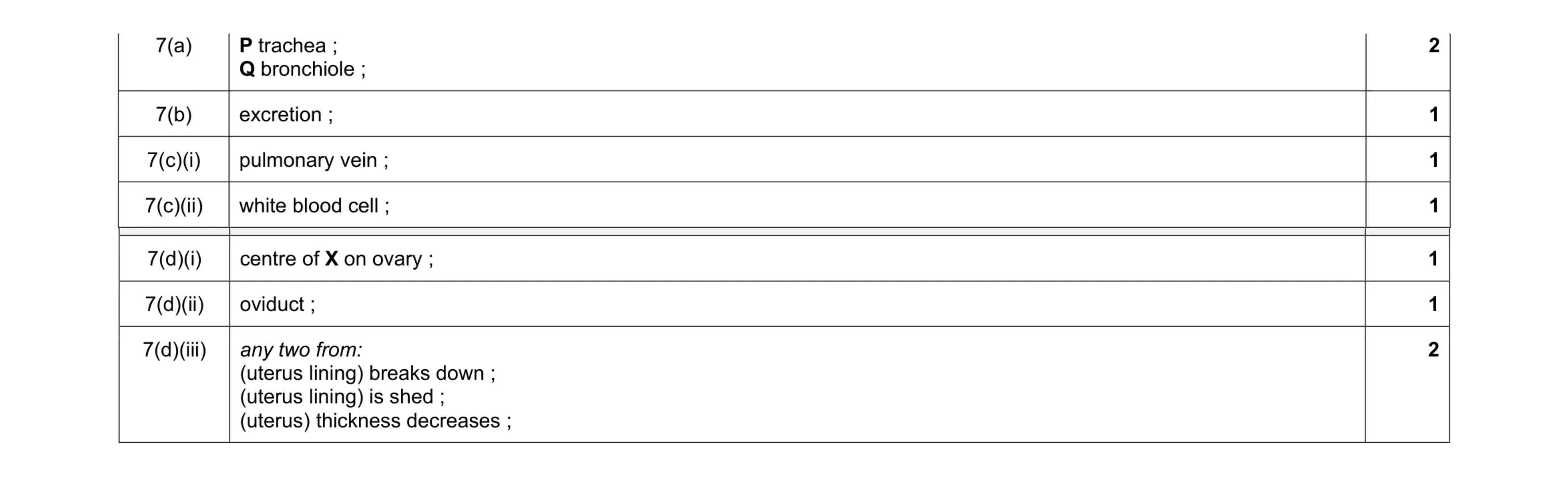 9
9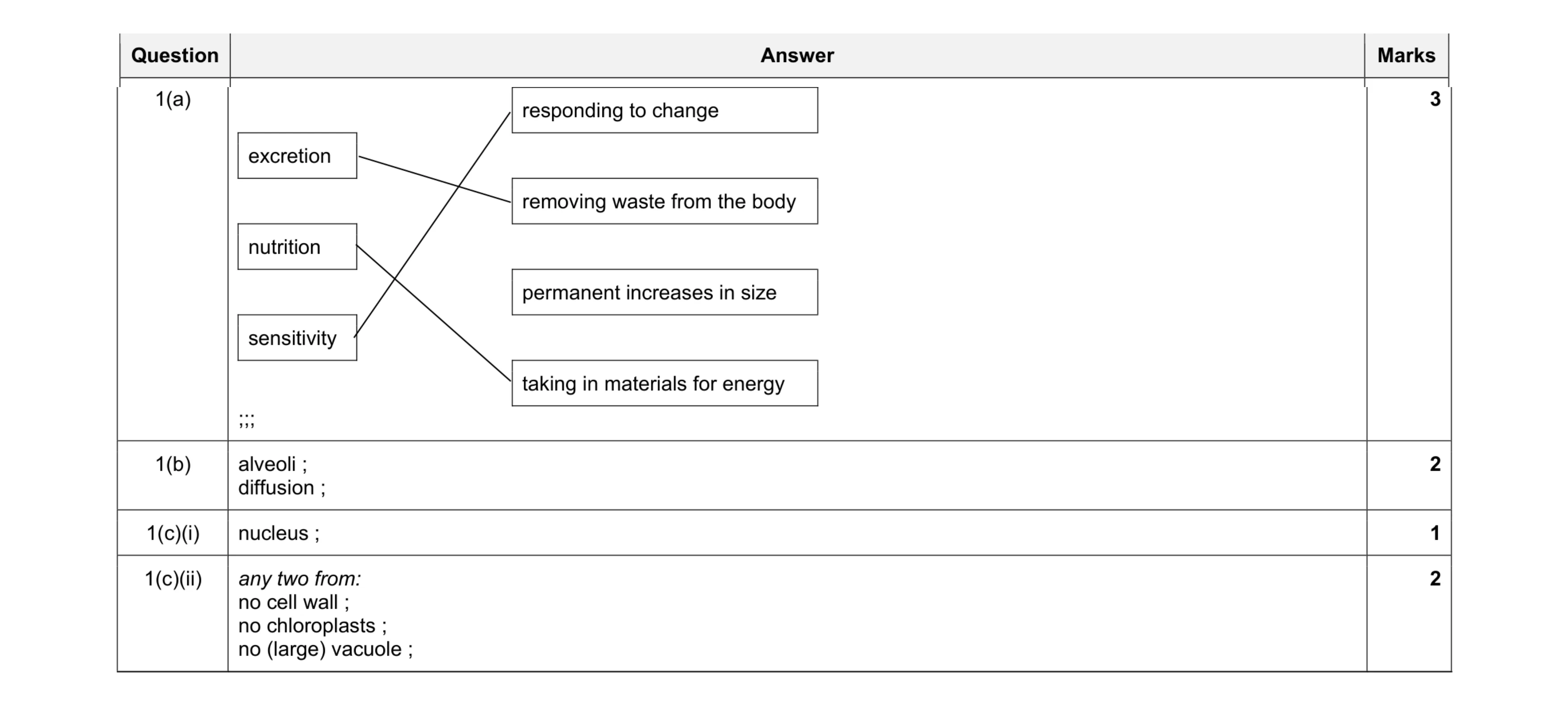 8
8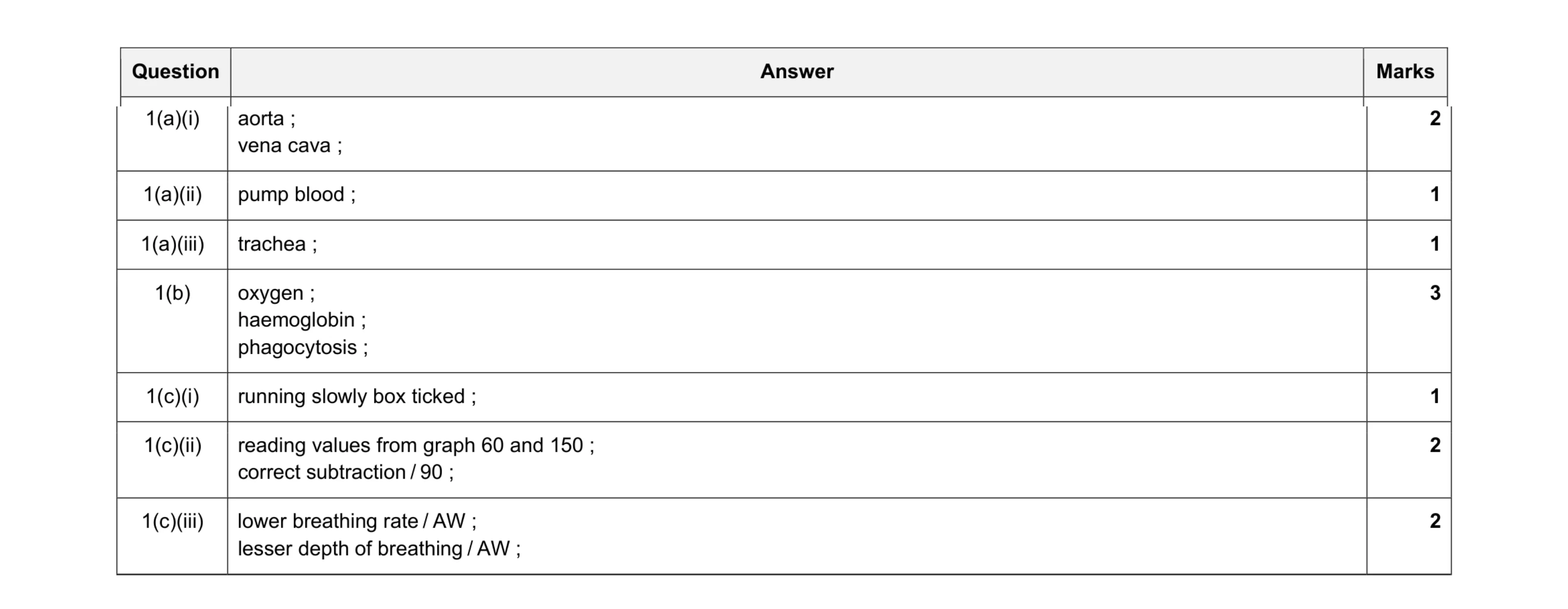 12
12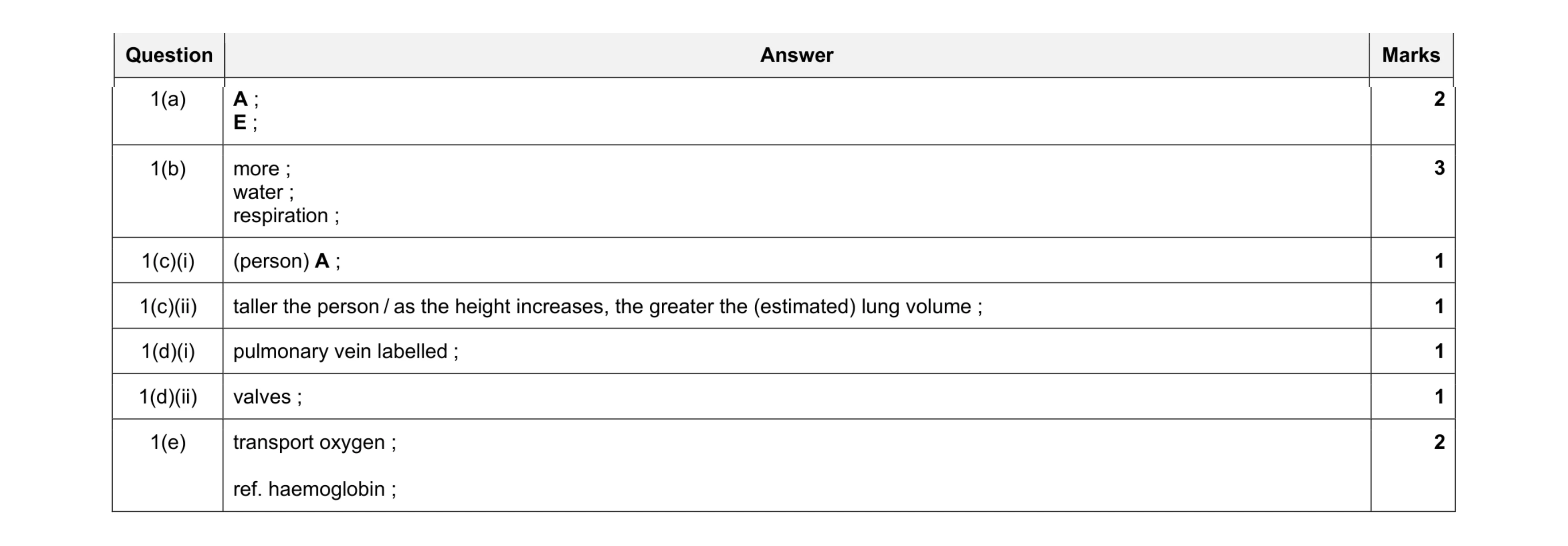 11
11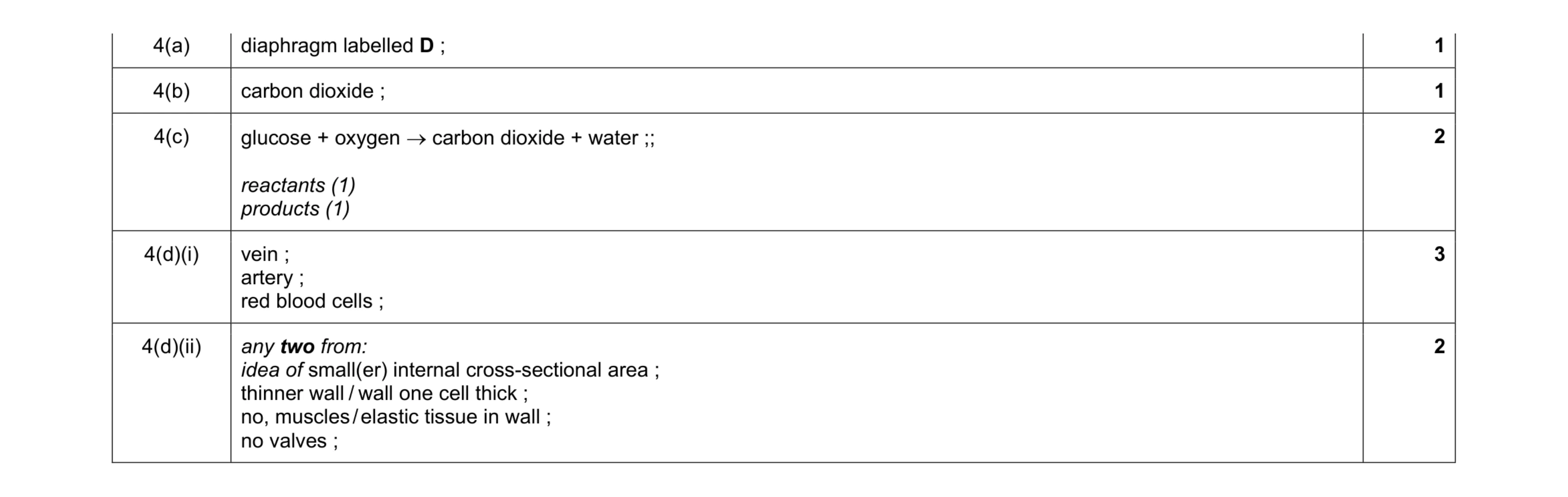 9
9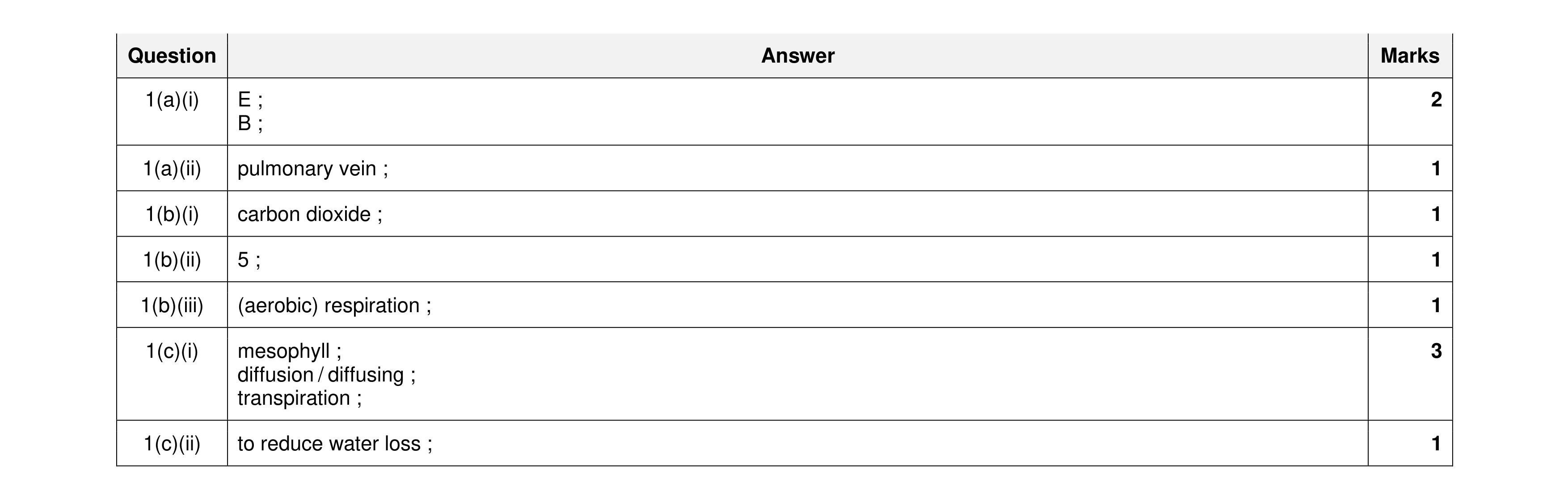 10
10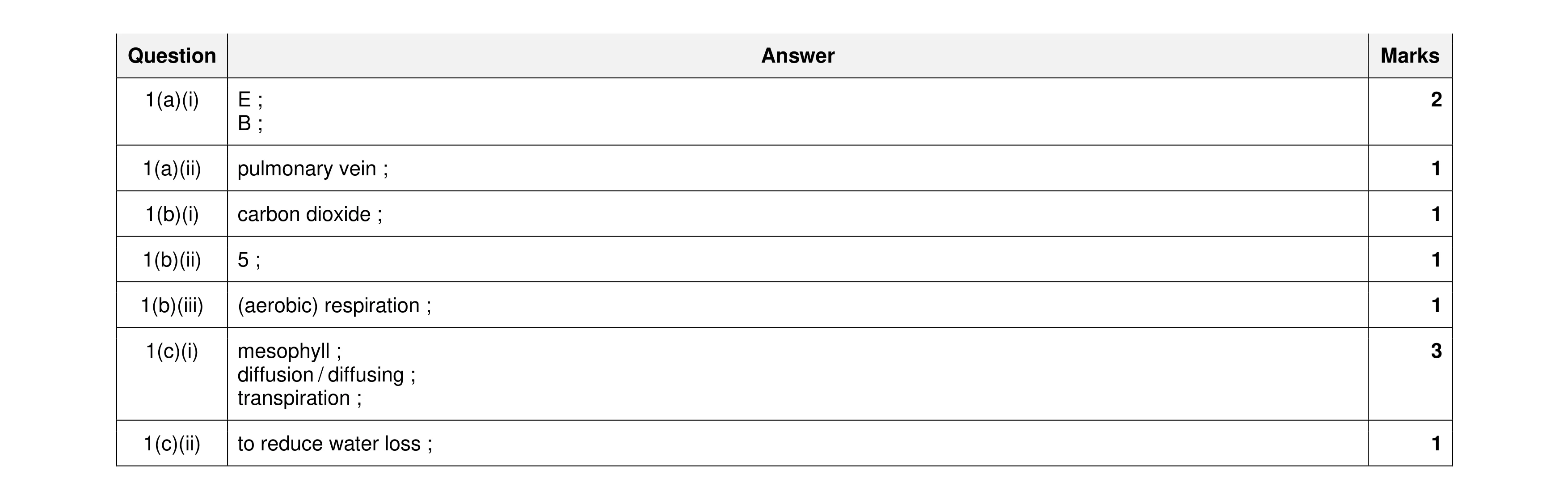 10
10