Cambridge IGCSE Mathematics 0580 — 2016 May/June Paper 2 · Variant 1
0580/21/M/J/16 · 26 questions · 70 marks · ≈79 min
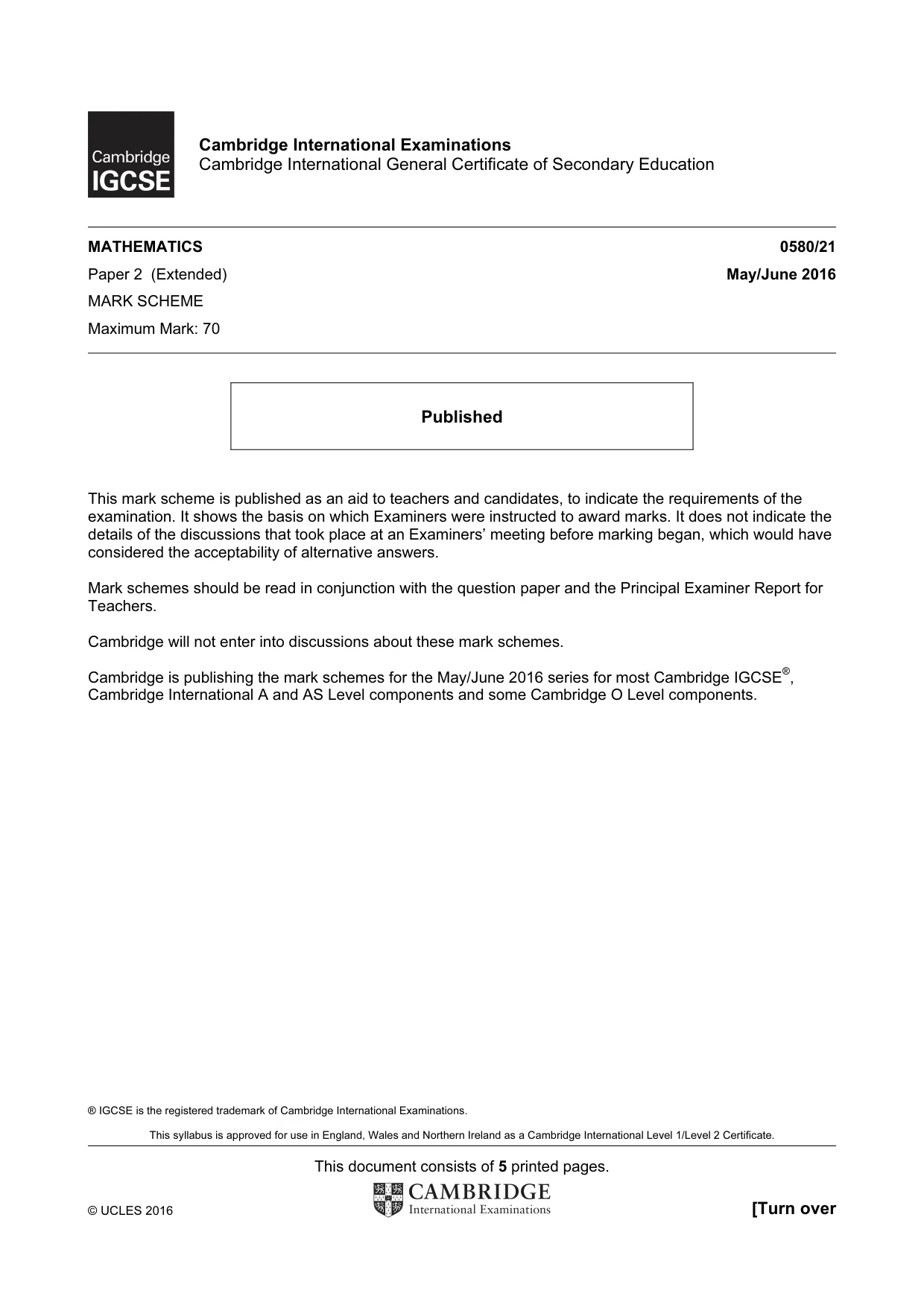
The question paper and its mark scheme, free to read here and free to download. This is Cambridge’s own paper, exactly as it was sat.
Question paper12 pages
Mark scheme5 pages
Answers below. Sit the paper first if you are practising.
Questions as text
Q1 · A train leaves Zurich at 22 40 and arrives in Vienna at 07 32 the next day
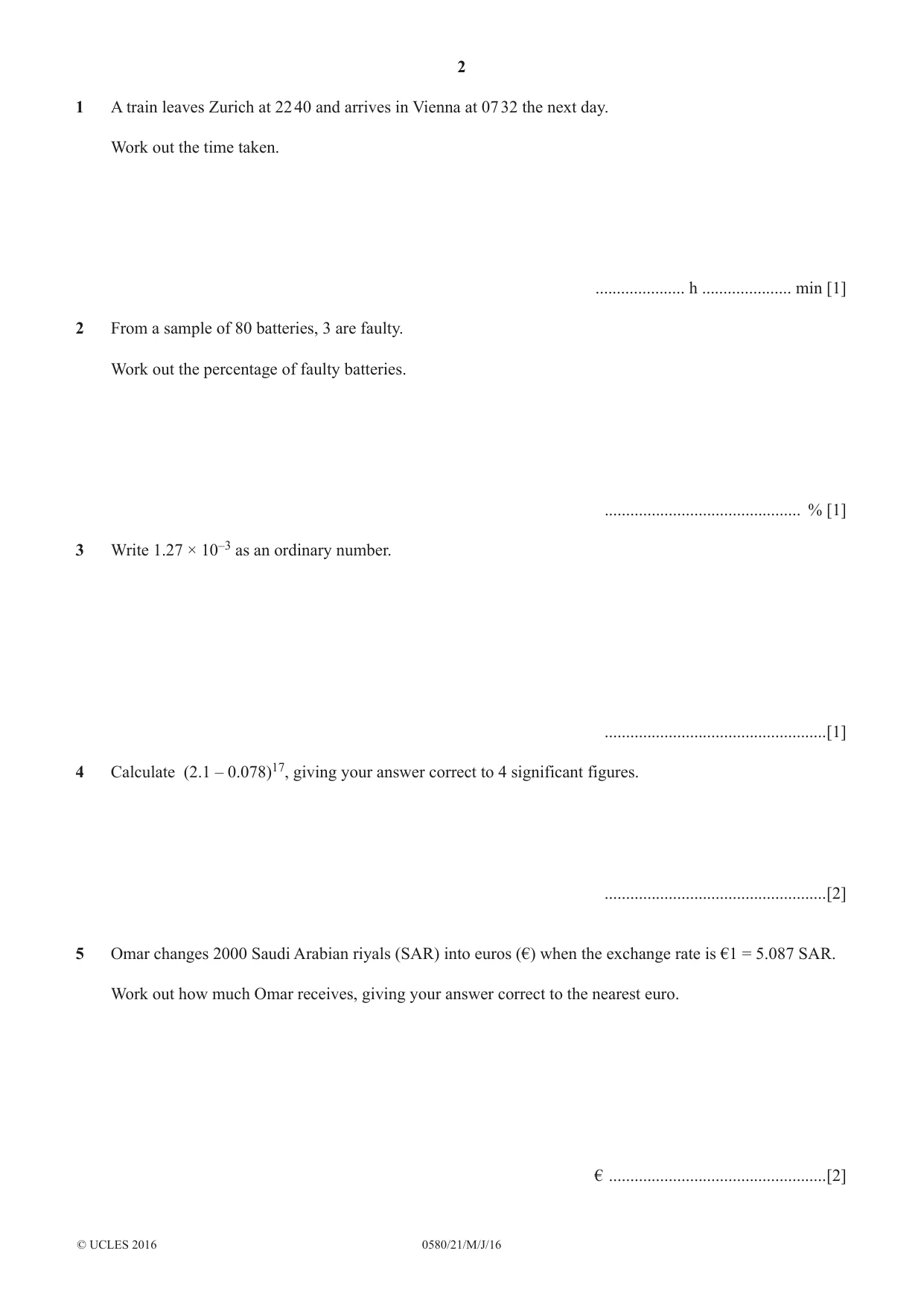
1 A train leaves Zurich at 22 40 and arrives in Vienna at 07 32 the next day. Work out the time taken. ..................... h ..................... min [1]
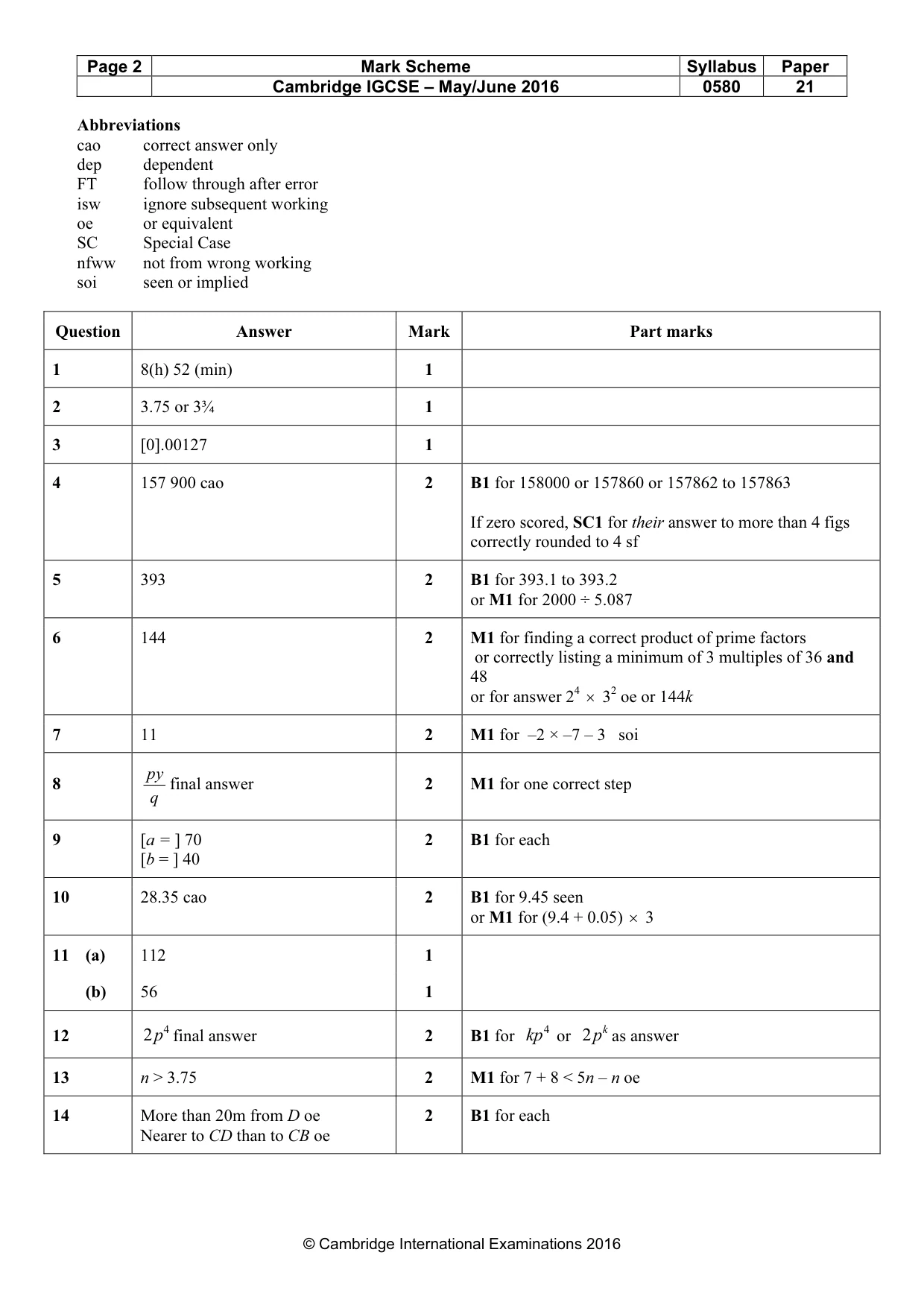
Mark scheme: Question Answer Mark Part marks 1 8(h) 52 (min) 1
Q2 · From a sample of 80 batteries, 3 are faulty
2 From a sample of 80 batteries, 3 are faulty. Work out the percentage of faulty batteries. .............................................. % [1]
Mark scheme: 2 3.75 or 3¾ 1
Q3 · Write 1.27 × 10⁻³ as an ordinary number
3 Write 1.27 × 10⁻³ as an ordinary number. ....................................................[1]
Mark scheme: 3 [0].00127 1
Q4 · Calculate (2.1 – 0.078)17, giving your answer correct to 4 significant figures
4 Calculate (2.1 – 0.078)17, giving your answer correct to 4 significant figures. ....................................................[2]
Mark scheme: 4 157 900 cao 2 B1 for 158000 or 157860 or 157862 to 157863 If zero scored, SC1 for their answer to more than 4 figs correctly rounded to 4 sf
Q5 · Omar changes 2000 Saudi Arabian riyals (SAR) into euros (€) when the exchange rate is €1…
5 Omar changes 2000 Saudi Arabian riyals (SAR) into euros (€) when the exchange rate is €1 = 5.087 SAR. Work out how much Omar receives, giving your answer correct to the nearest euro. € ...................................................[2]
Mark scheme: 5 393 2 B1 for 393.1 to 393.2 or M1 for 2000 ÷ 5.087
Q6 · Find the lowest common multiple (LCM) of 36 and 48
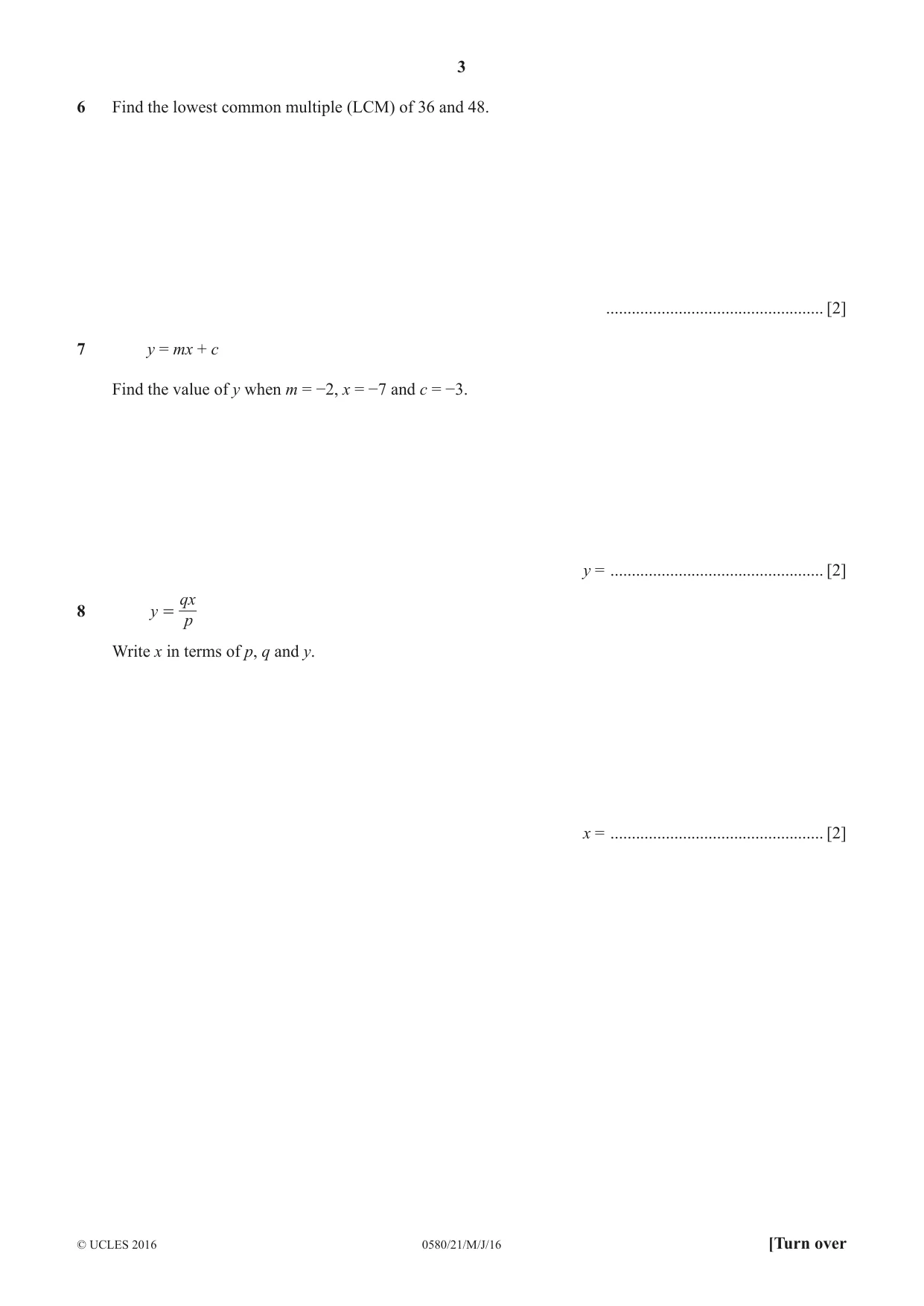
6 Find the lowest common multiple (LCM) of 36 and 48. ................................................... [2]
Mark scheme: 6 144 2 M1 for finding a correct product of prime factors or correctly listing a minimum of 3 multiples of 36 and 48 or for answer 24 × 32 oe or 144k
Q7 · Y = mx + c Find the value of y when m = −2, x = −7 and c = −3
7 y = mx + c Find the value of y when m = −2, x = −7 and c = −3. y = .................................................. [2]
Mark scheme: 7 11 2 M1 for –2 × –7 – 3 soi py
Q8 · Qx 8 y = p Write x in terms of p, q and y
qx 8 y = p Write x in terms of p, q and y. x = .................................................. [2]
Mark scheme: py 8 final answer 2 M1 for one correct step q
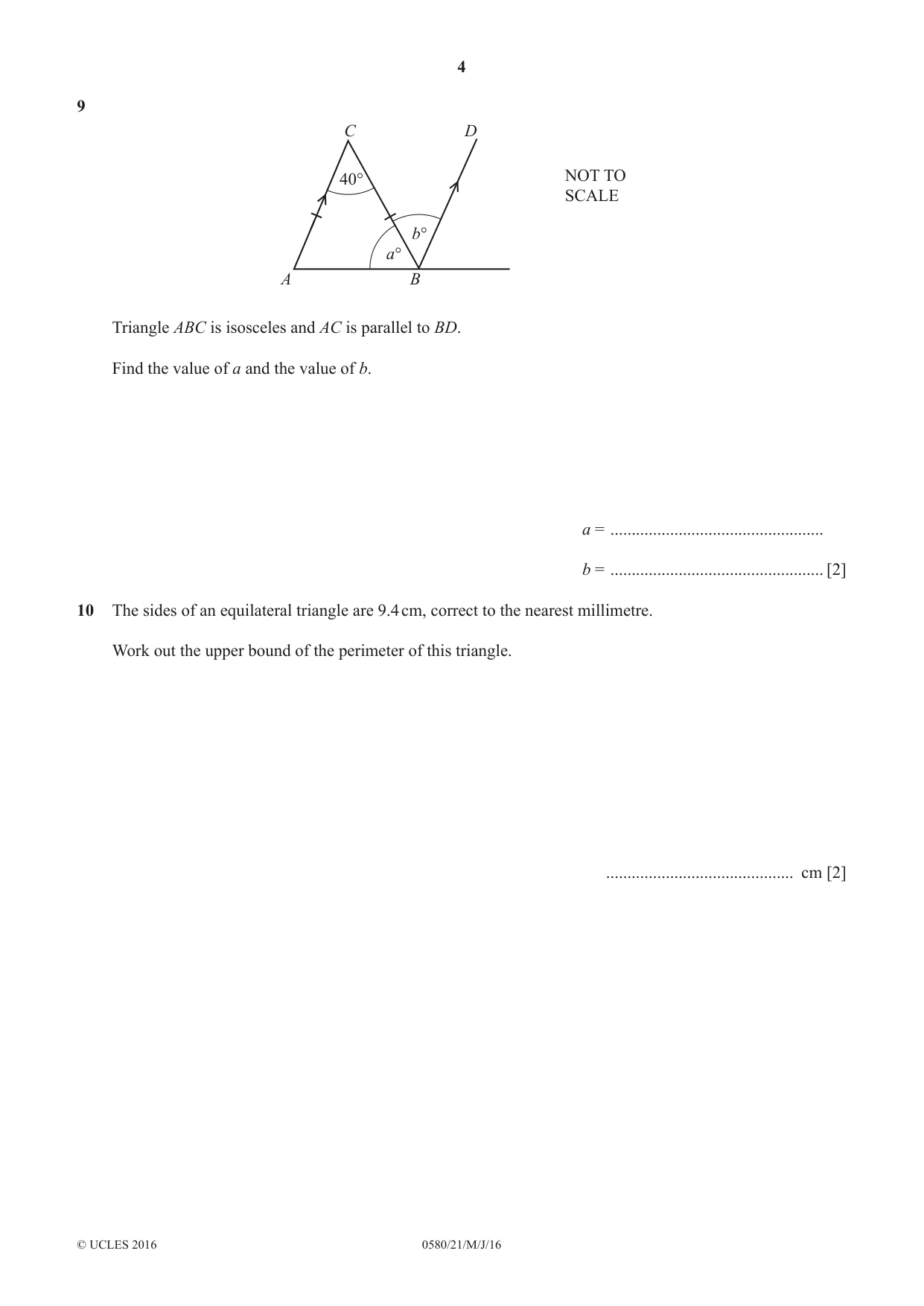
Q9 · C D 40° NOT TO SCALE b° a° A B Triangle ABC is isosceles and AC is parallel to BD
9 C D 40° NOT TO SCALE b° a° A B Triangle ABC is isosceles and AC is parallel to BD. Find the value of a and the value of b. a = .................................................. b = .................................................. [2]
Mark scheme: 9 [a = ] 70 2 B1 for each [b = ] 40
Q10 · The sides of an equilateral triangle are 9.4 cm, correct to the nearest millimetre
10 The sides of an equilateral triangle are 9.4 cm, correct to the nearest millimetre. Work out the upper bound of the perimeter of this triangle. ............................................ cm [2]
Mark scheme: 10 28.35 cao 2 B1 for 9.45 seen or M1 for (9.4 + 0.05) × 3
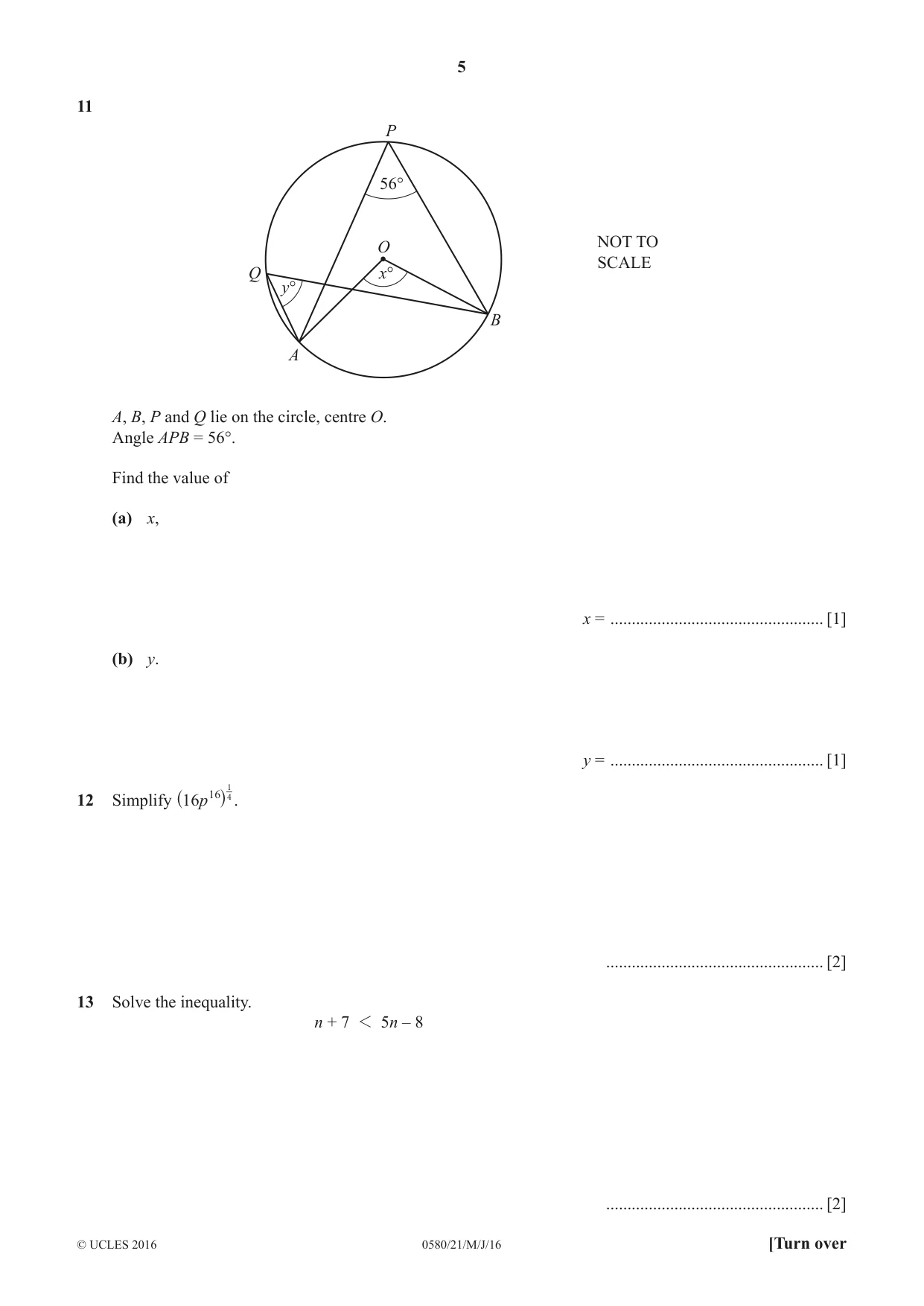
Q11 · P 56° O NOT TO SCALE Q x° y° B A A, B, P and Q lie on the circle, centre O
11 P 56° O NOT TO SCALE Q x° y° B A A, B, P and Q lie on the circle, centre O. Angle APB = 56°. Find the value of (a) x, x = .................................................. [1] (b) y. y = .................................................. [1]
Mark scheme: 11 (a) 112 1 (b) 56 1
Q12 · 4112 Simplify ^16p h
16 4112 Simplify ^16p h . ................................................... [2]
Mark scheme: 12 2p 4 final answer 2 B1 for kp 4 or 2 p k as answer
Question 13
13 Solve the inequality. n + 7 1 5n – 8 ................................................... [2]
Mark scheme: 13 n > 3.75 2 M1 for 7 + 8 < 5n – n oe
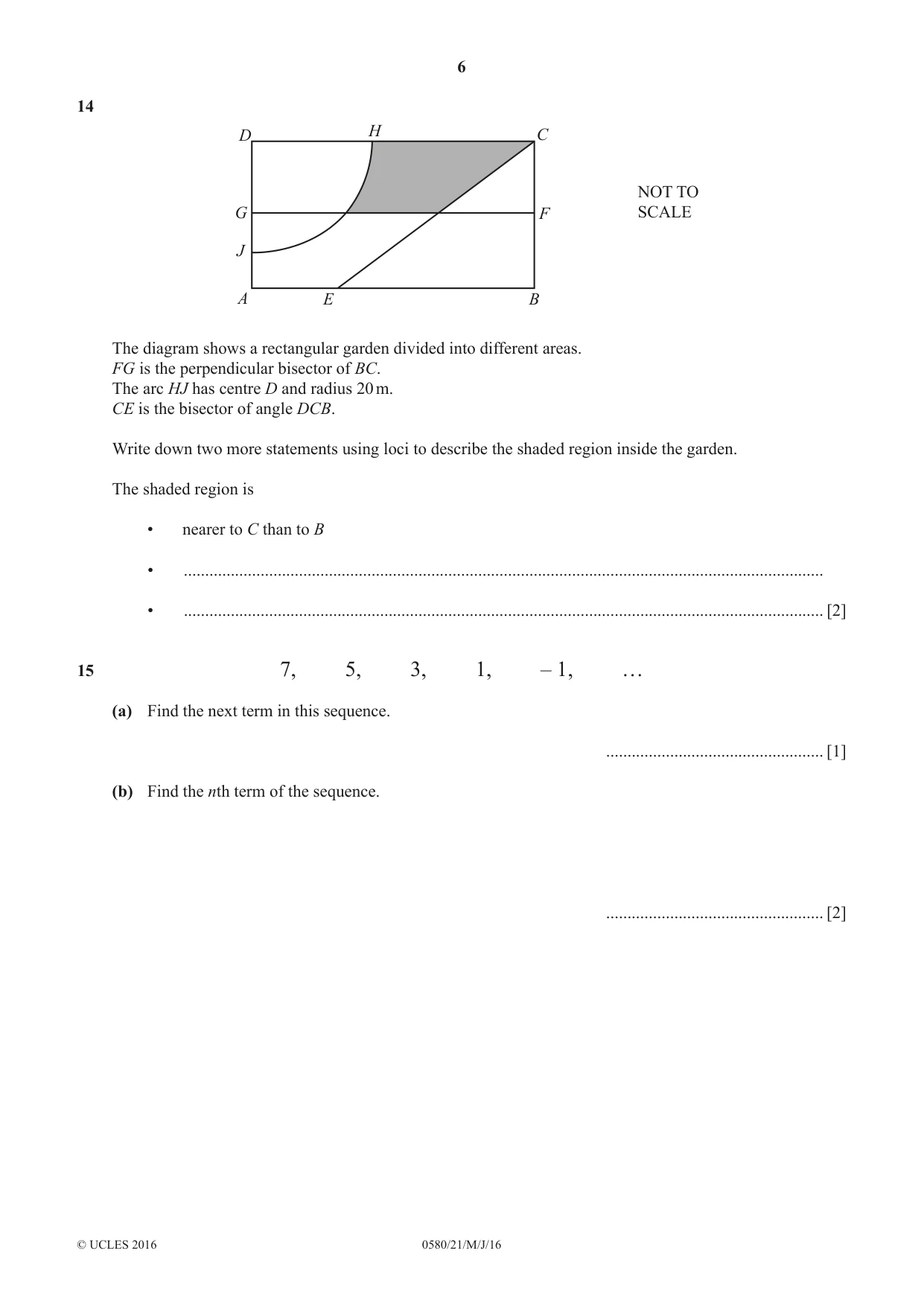
Q14 · H C D NOT TO G F SCALE J A E B The diagram shows a rectangular garden divided into…
14 H C D NOT TO G F SCALE J A E B The diagram shows a rectangular garden divided into different areas. FG is the perpendicular bisector of BC. The arc HJ has centre D and radius 20 m. CE is the bisector of angle DCB. Write down two more statements using loci to describe the shaded region inside the garden. The shaded region is • nearer to C than to B • ...................................................................................................................................................... • ...................................................................................................................................................... [2]
Mark scheme: 14 More than 20m from D oe 2 B1 for each Nearer to CD than to CB oe
Q15 · 7, 5, 3, 1, – 1, … (a) Find the next term in this sequence
15 7, 5, 3, 1, – 1, … (a) Find the next term in this sequence. ................................................... [1] (b) Find the nth term of the sequence. ................................................... [2]
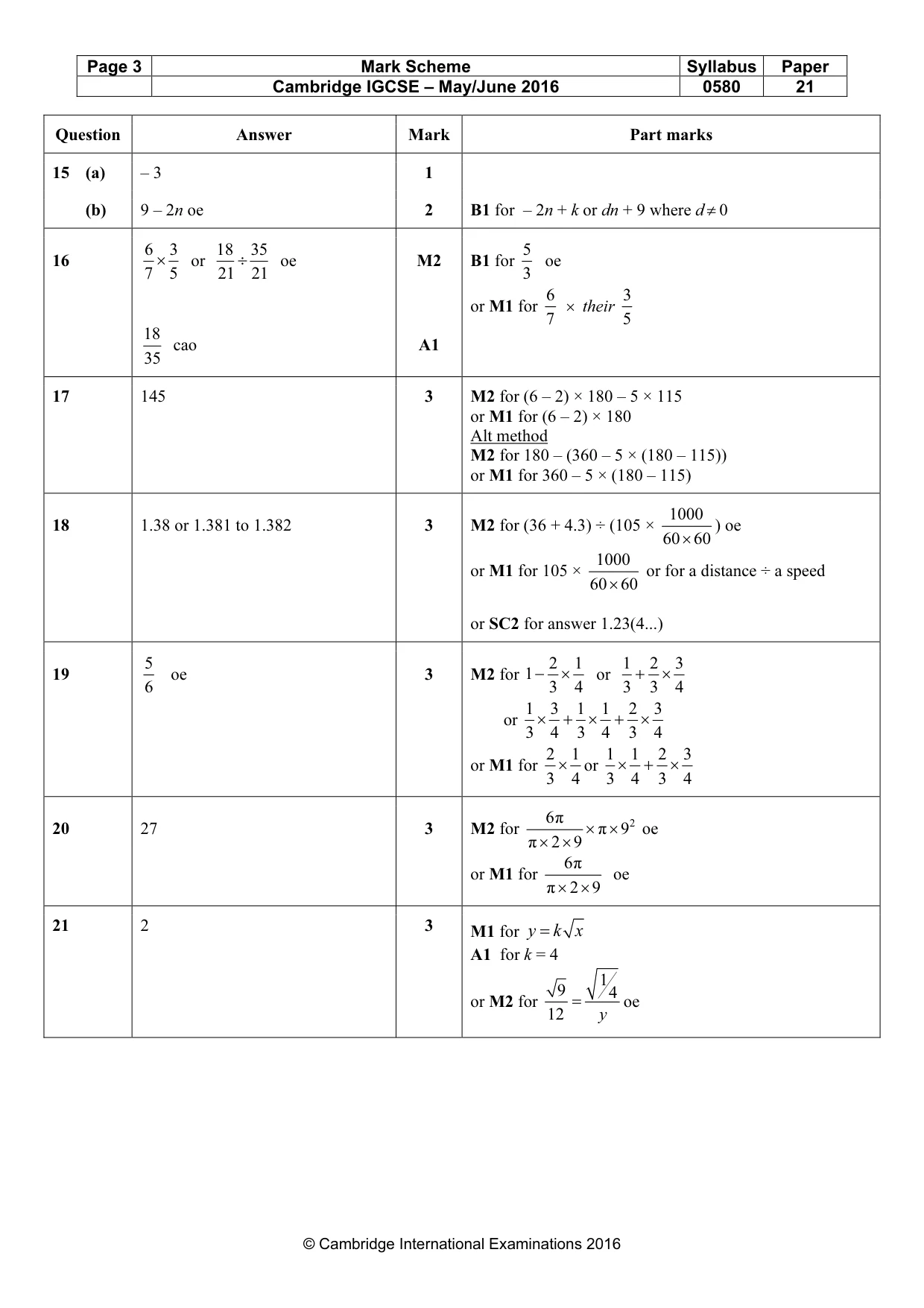
Mark scheme: 15 (a) – 3 1 (b) 9 – 2n oe 2 B1 for – 2n + k or dn + 9 where d ≠0 6 3 18 35 5
Q16 · 2 16 Without using a calculator, work out 7 ' 1 3
6 2 16 Without using a calculator, work out 7 ' 1 3 . Show all your working and give your answer as a fraction in its lowest terms. ................................................... [3]
Mark scheme: 6 3 18 35 5 16 × or ÷ oe M2 B1 for oe 7 5 21 21 3 6 3 or M1 for × their 7 5 18 cao A1 35
Q17 · Five angles of a hexagon are each 115°
17 Five angles of a hexagon are each 115°. Calculate the size of the sixth angle. ................................................... [3]
Mark scheme: 17 145 3 M2 for (6 – 2) × 180 – 5 × 115 or M1 for (6 – 2) × 180 Alt method M2 for 180 – (360 – 5 × (180 – 115)) or M1 for 360 – 5 × (180 – 115) 1000
Q18 · A car of length 4.3 m is travelling at 105 km/h
18 A car of length 4.3 m is travelling at 105 km/h. It passes over a bridge of length 36 m. Calculate the time, in seconds, it takes to pass over the bridge completely. ................................................ s [3]
Mark scheme: 1000 18 1.38 or 1.381 to 1.382 3 M2 for (36 + 4.3) ÷ (105 × ) oe 60 × 60 1000 or M1 for 105 × or for a distance ÷ a speed 60 × 60 or SC2 for answer 1.23(4...) 5 2 1 1 2 3
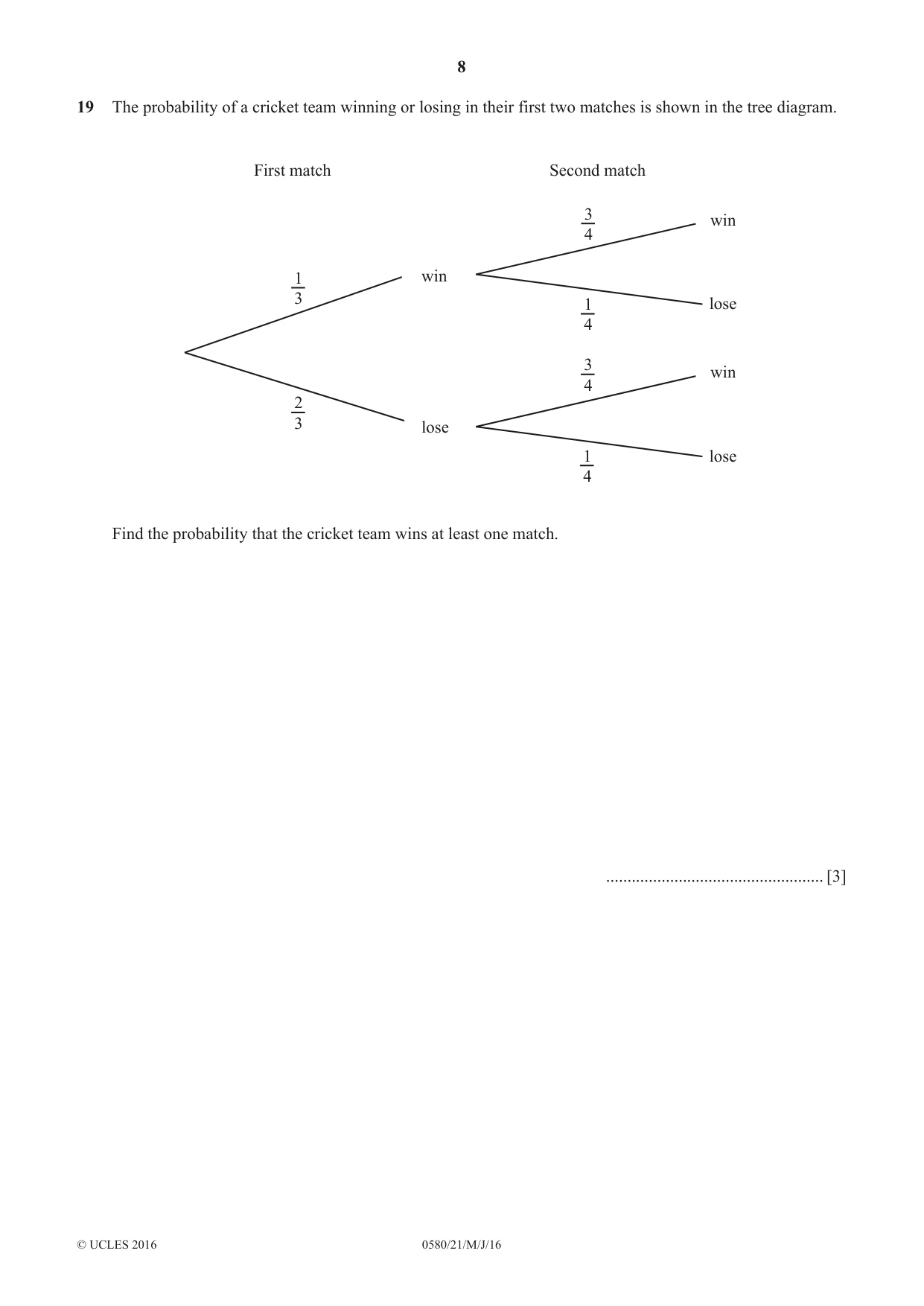
Q19 · The probability of a cricket team winning or losing in their first two matches is shown…
19 The probability of a cricket team winning or losing in their first two matches is shown in the tree diagram. First match Second match 3 win 4 1 win 3 1 lose 4 3 win 4 2 3 lose 1 lose 4 Find the probability that the cricket team wins at least one match. ................................................... [3]
Mark scheme: 5 2 1 1 2 3 19 oe 3 M2 for 1 − × or + × 6 3 4 3 3 4 1 3 1 1 2 3 or × + × + × 3 4 3 4 3 4 2 1 1 1 2 3 or M1 for × or × + × 3 4 3 4 3 4 6π
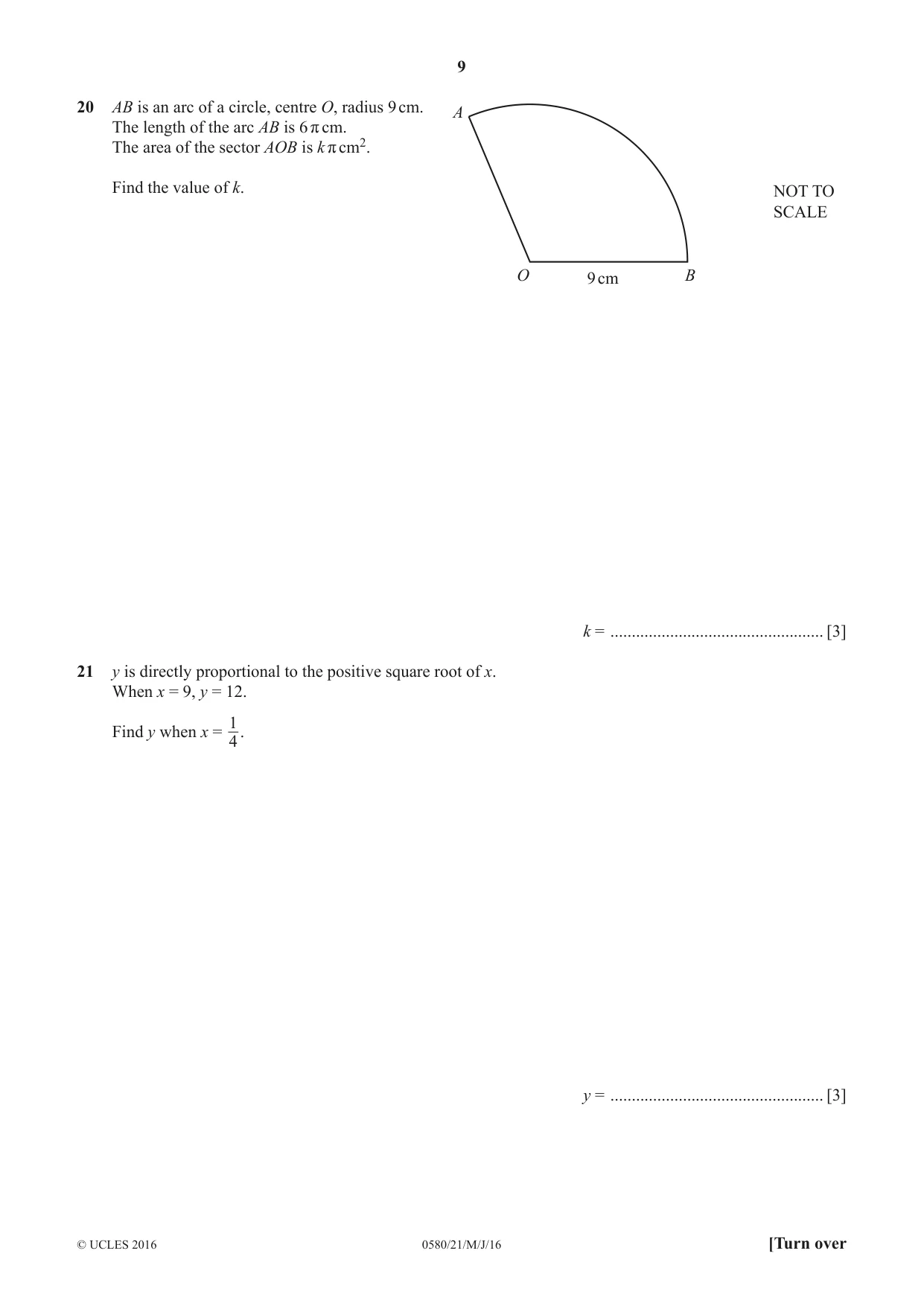
Q20 · AB is an arc of a circle, centre O, radius 9 cm
20 AB is an arc of a circle, centre O, radius 9 cm. A The length of the arc AB is 6 r cm. The area of the sector AOB is k r cm2. Find the value of k. NOT TO SCALE O 9 cm B k = .................................................. [3]
Mark scheme: 6π 220 27 3 M2 for × π × 9 oe π × 2 × 9 6π or M1 for oe π × 2 × 9
Q21 · Y is directly proportional to the positive square root of x
21 y is directly proportional to the positive square root of x. When x = 9, y = 12. 1 Find y when x = 4 . y = .................................................. [3]
Mark scheme: 21 2 3 M1 for y = k x A1 for k = 4 1 9 4 or M2 for = oe 12 y
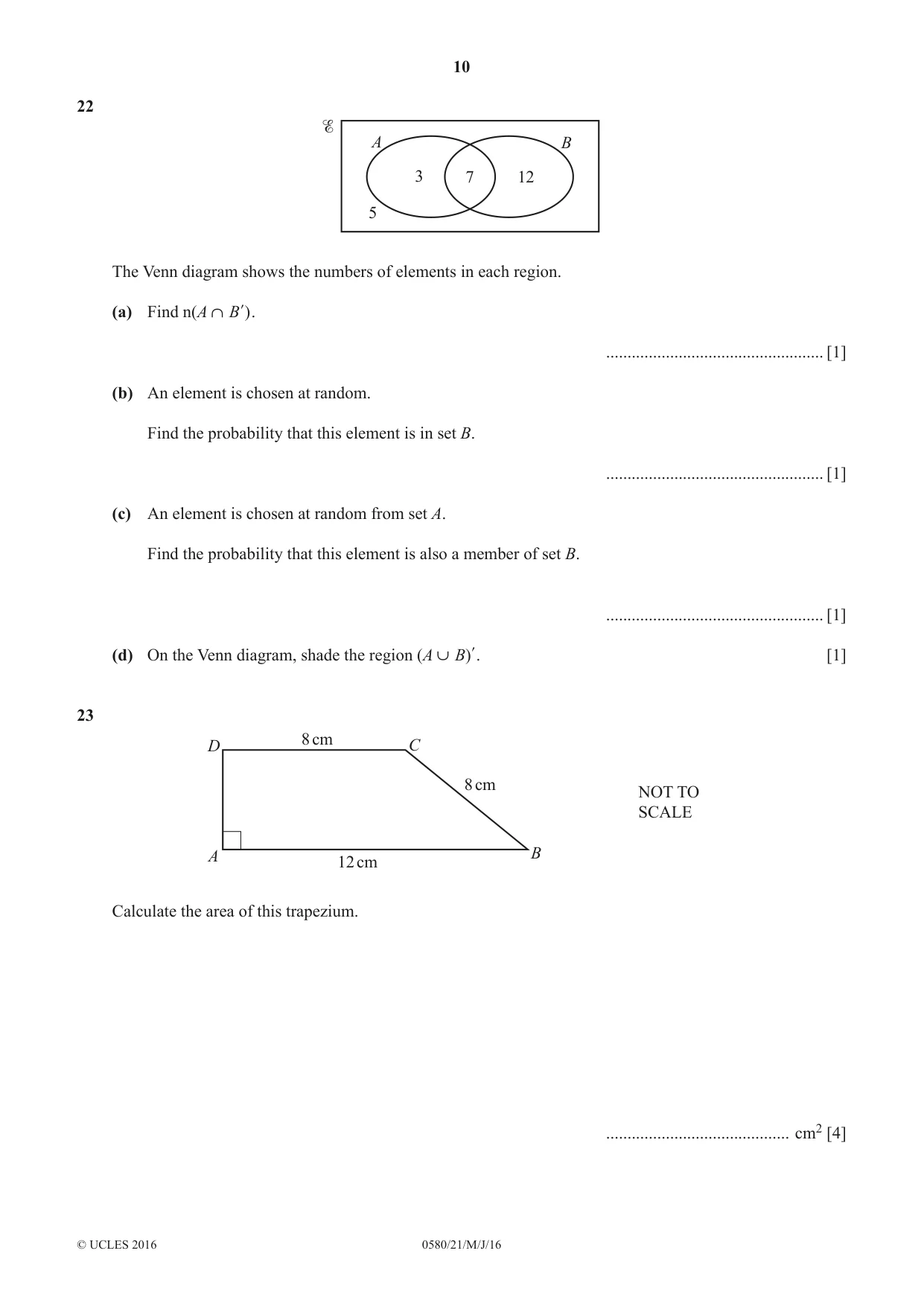
Q22 · A B 3 7 12 5 The Venn diagram shows the numbers of elements in each region
22 A B 3 7 12 5 The Venn diagram shows the numbers of elements in each region. (a) Find n(A Bl ) . ................................................... [1] (b) An element is chosen at random. Find the probability that this element is in set B. ................................................... [1] (c) An element is chosen at random from set A. Find the probability that this element is also a member of set B. ................................................... [1] (d) On the Venn diagram, shade the region (A B) l. [1]
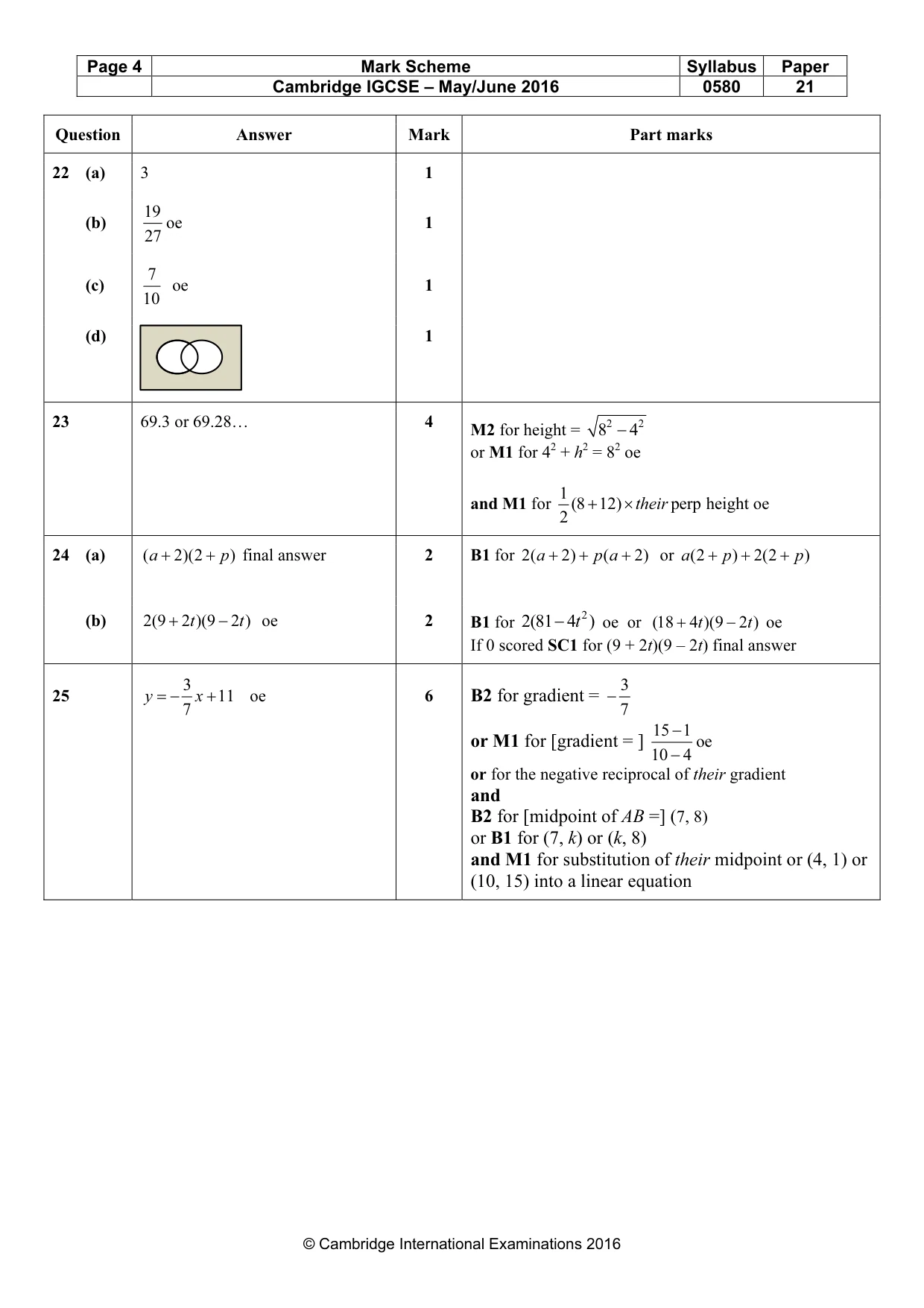
Mark scheme: 22 (a) 3 1 19 (b) oe 1 27 7 (c) oe 1 10 (d) 1
Q23 · 8 cm D C 8 cm NOT TO SCALE A B 12 cm Calculate the area of this trapezium
23 8 cm D C 8 cm NOT TO SCALE A B 12 cm Calculate the area of this trapezium. ........................................... cm2 [4]
Mark scheme: 2 − 4 223 69.3 or 69.28… 4 M2 for height = 8 or M1 for 42 + h2 = 82 oe 1 and M1 for (8 + 12) × their perp height oe 2
Question 24
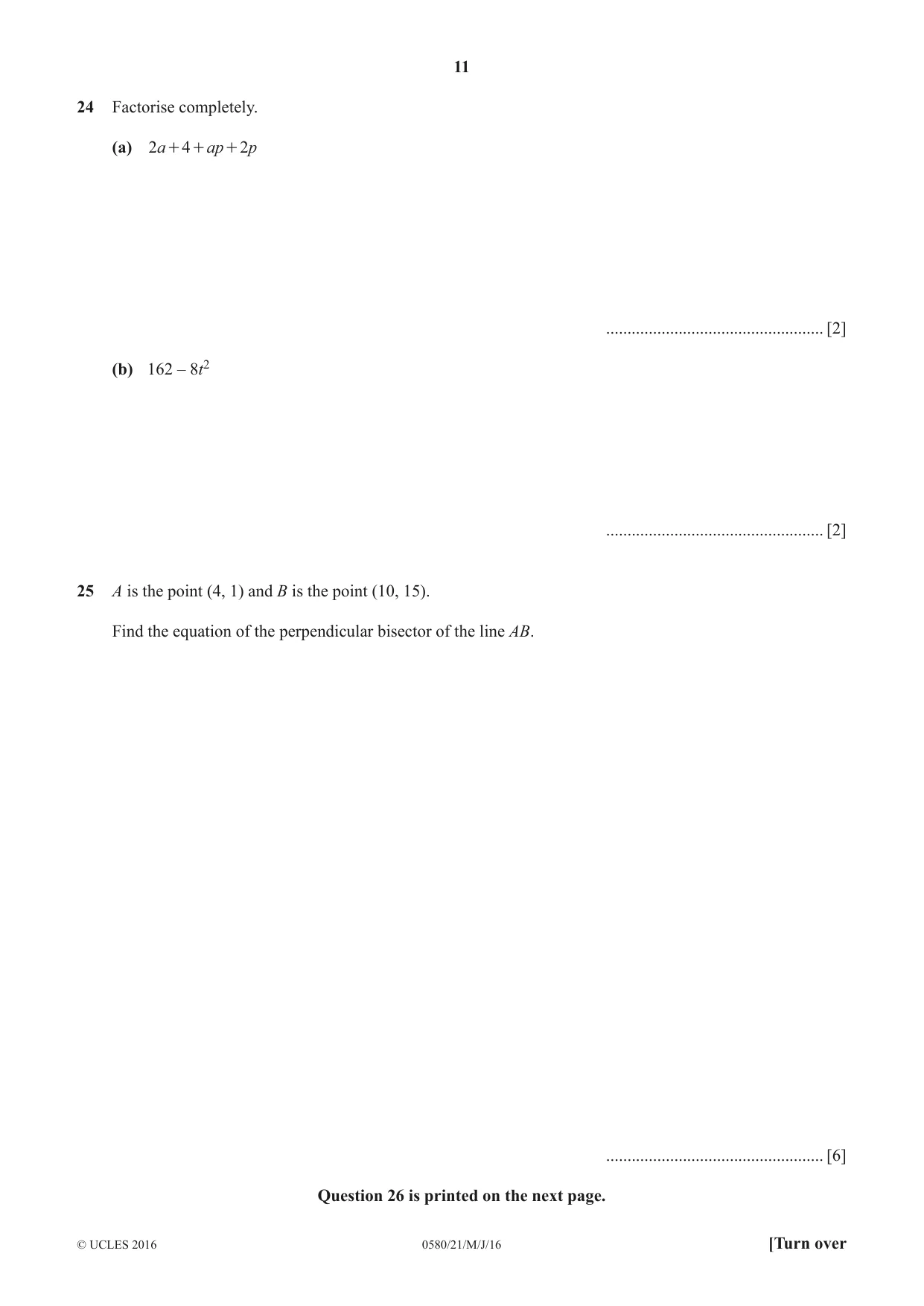
24 Factorise completely. (a) 2a + 4 + ap + 2p ................................................... [2] (b) 162 – 8t2 ................................................... [2]
Mark scheme: 24 (a) ( a + 2)(2 + p ) final answer 2 B1 for 2( a + 2) + p ( a + 2) or a (2 + p ) + 2(2 + p ) (b) 2(9 + 2t )(9 − 2t ) oe 2 B1 for 2(81 − 4t 2 ) oe or (18 + 4t )(9 − 2t ) oe If 0 scored SC1 for (9 + 2t)(9 – 2t) final answer 3 3
Q25 · A is the point (4, 1) and B is the point (10, 15)
25 A is the point (4, 1) and B is the point (10, 15). Find the equation of the perpendicular bisector of the line AB. ................................................... [6] Question 26 is printed on the next page.
Mark scheme: 3 3 25 y = − x + 11 oe 6 B2 for gradient = − 7 7 15 − 1 or M1 for [gradient = ] oe 10 − 4 or for the negative reciprocal of their gradient and B2 for [midpoint of AB =] (7, 8) or B1 for (7, k) or (k, 8) and M1 for substitution of their midpoint or (4, 1) or (10, 15) into a linear equation
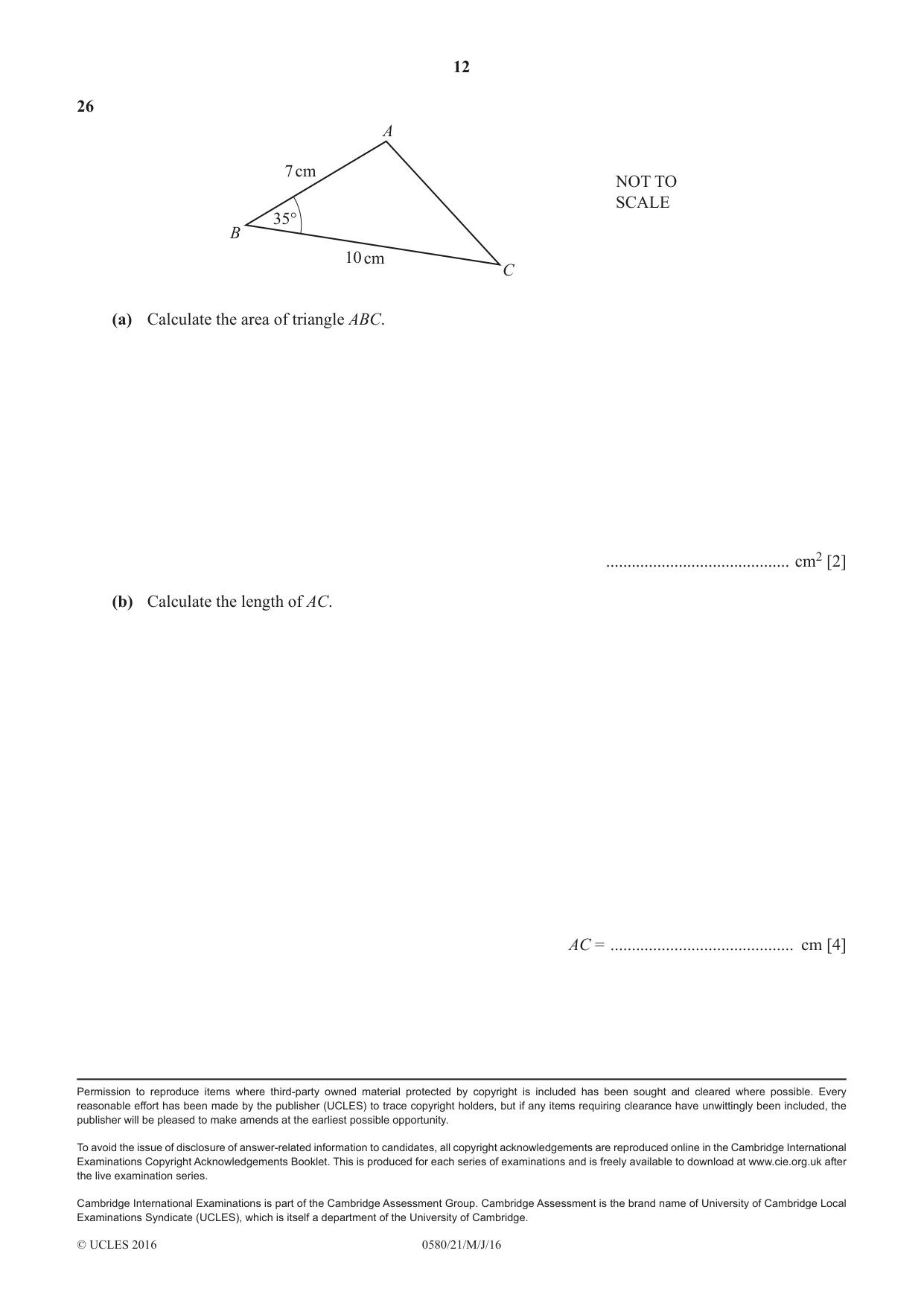
Q26 · A 7 cm NOT TO SCALE 35° B 10 cm C (a) Calculate the area of triangle ABC
26 A 7 cm NOT TO SCALE 35° B 10 cm C (a) Calculate the area of triangle ABC. ........................................... cm2 [2] (b) Calculate the length of AC. AC = ........................................... cm [4]
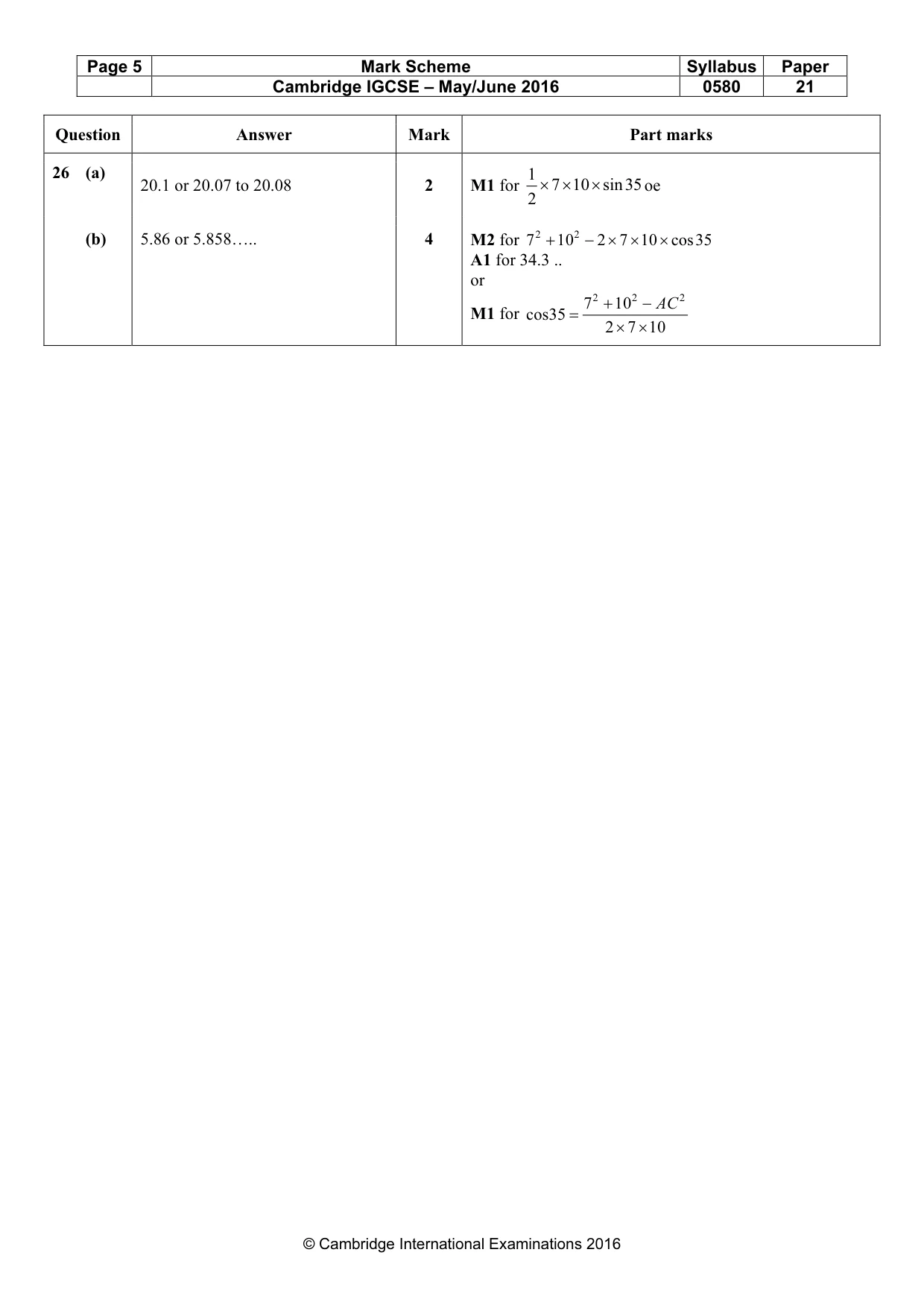
Mark scheme: 26 (a) 1 20.1 or 20.07 to 20.08 2 M1 for × 7 × 10 × sin35 oe 2 (b) 5.86 or 5.858….. 4 M2 for 7 2 + 10 2 − 2 × 7 × 10 × cos35 A1 for 34.3 .. or 7 2 + 10 2 − AC 2 M1 for cos35 = 2 × 7 × 10
What was in this paper
The subtopics covered by these 26 questions, and how many questions each got. Open one in a new tab to see every Cambridge question on it.
2Angles2Ratio and proportion2Area and perimeter1Circle theorems I1Circles, arcs and sectors1Equations1Equations of linear graphs1Fractions, decimals and percentages1Inequalities1Introduction to algebra1Limits of accuracy1Non-right-angled triangles1Percentages1Powers and roots1Probability of combined events1Rates1Sequences1Sets1Standard form1Time1Types of number1Using a calculator1What you needed in this session
Cambridge’s own grade thresholds for 2016 May/June, Paper 2 · Variant 1. A higher threshold means an easier paper — the bar moves with how the cohort did.