Cambridge IGCSE Mathematics 0580 — 2019 May/June Paper 2 · Variant 1
0580/21/M/J/19 · 26 questions · 70 marks · ≈79 min
The question paper and its mark scheme, free to read here and free to download. This is Cambridge’s own paper, exactly as it was sat.
Question paper12 pages
Mark scheme6 pages
Answers below. Sit the paper first if you are practising.
Questions as text
Q1 · Work out $1.20 as a percentage of $16
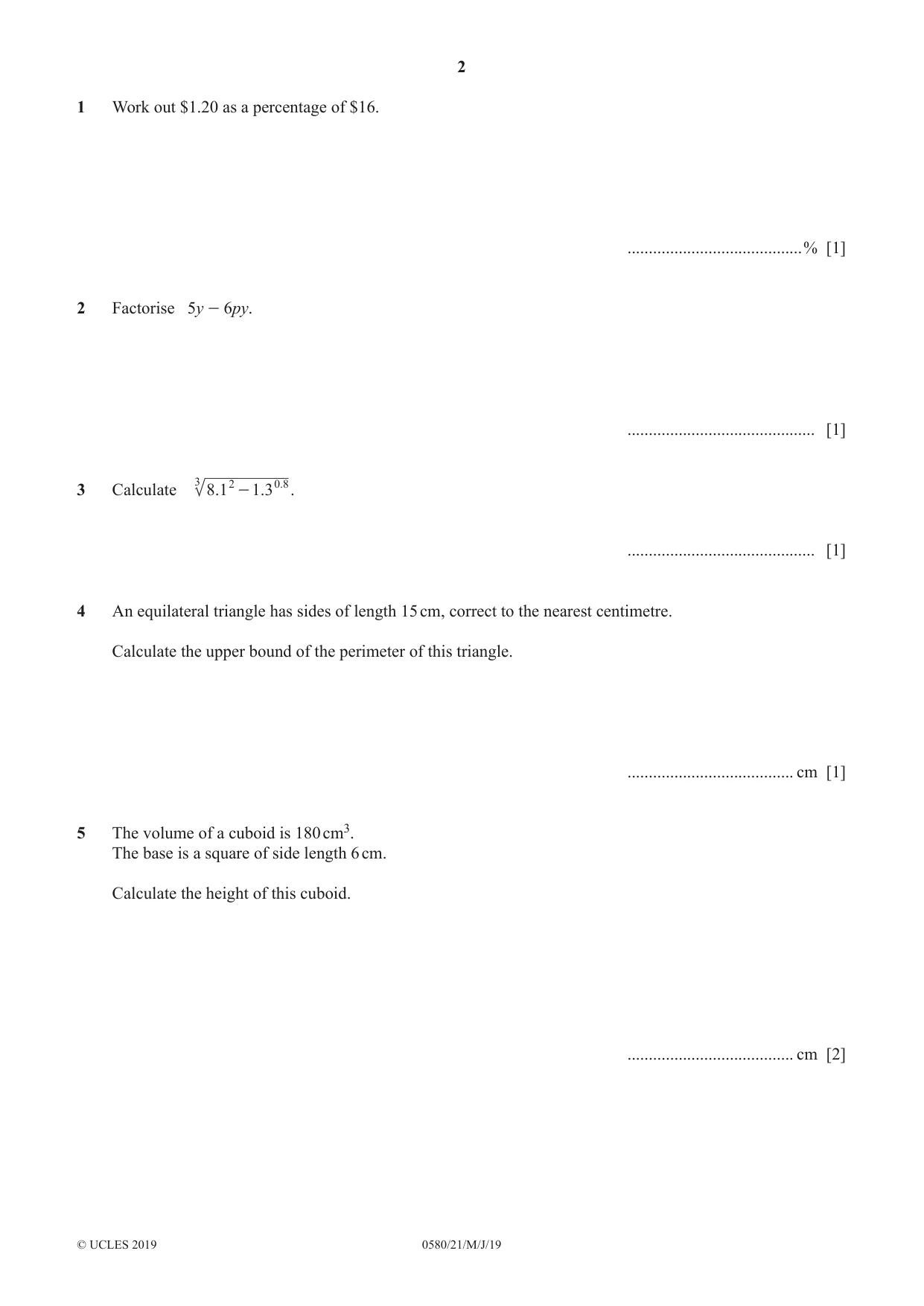
1 Work out $1.20 as a percentage of $16. .........................................% [1]
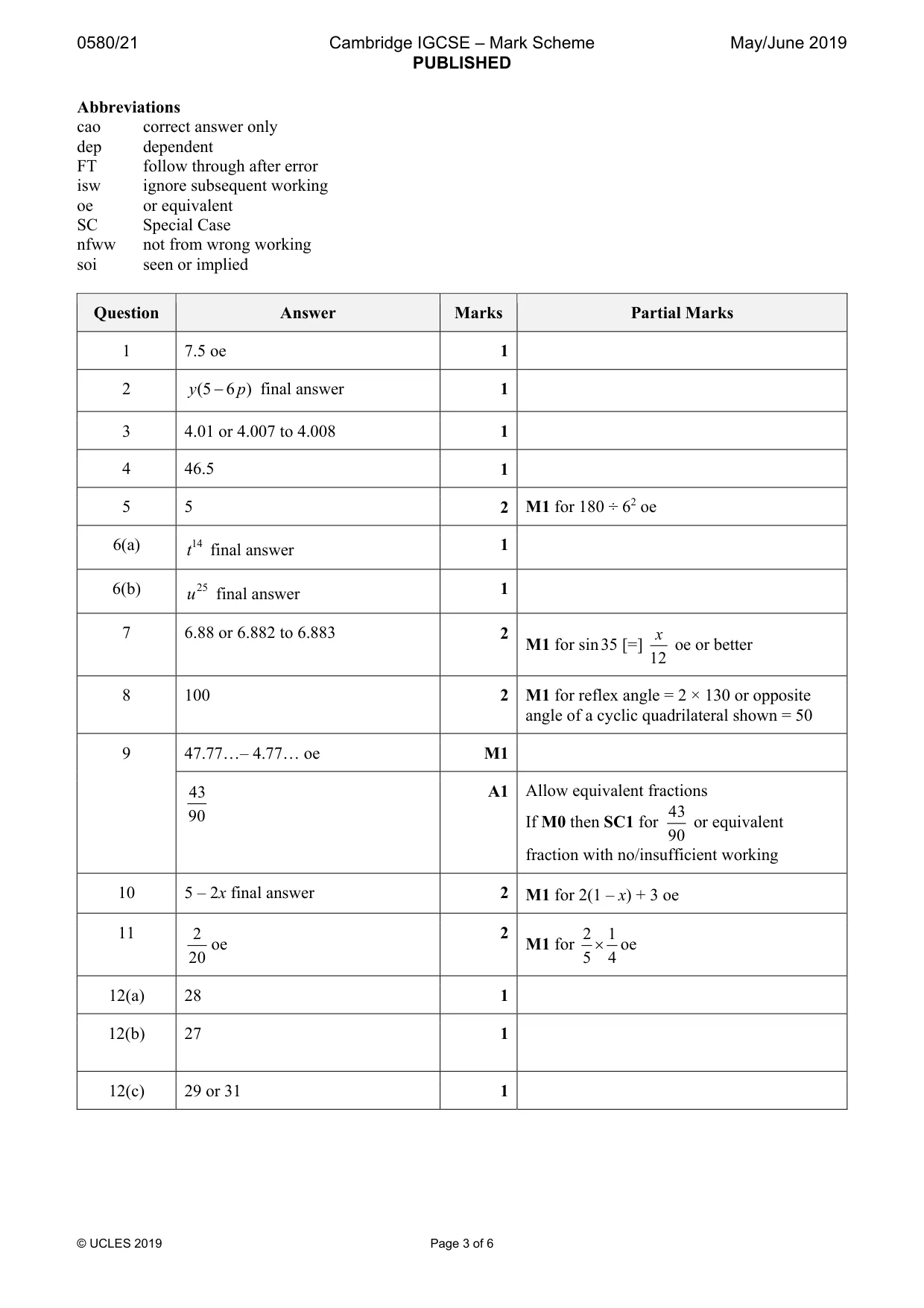
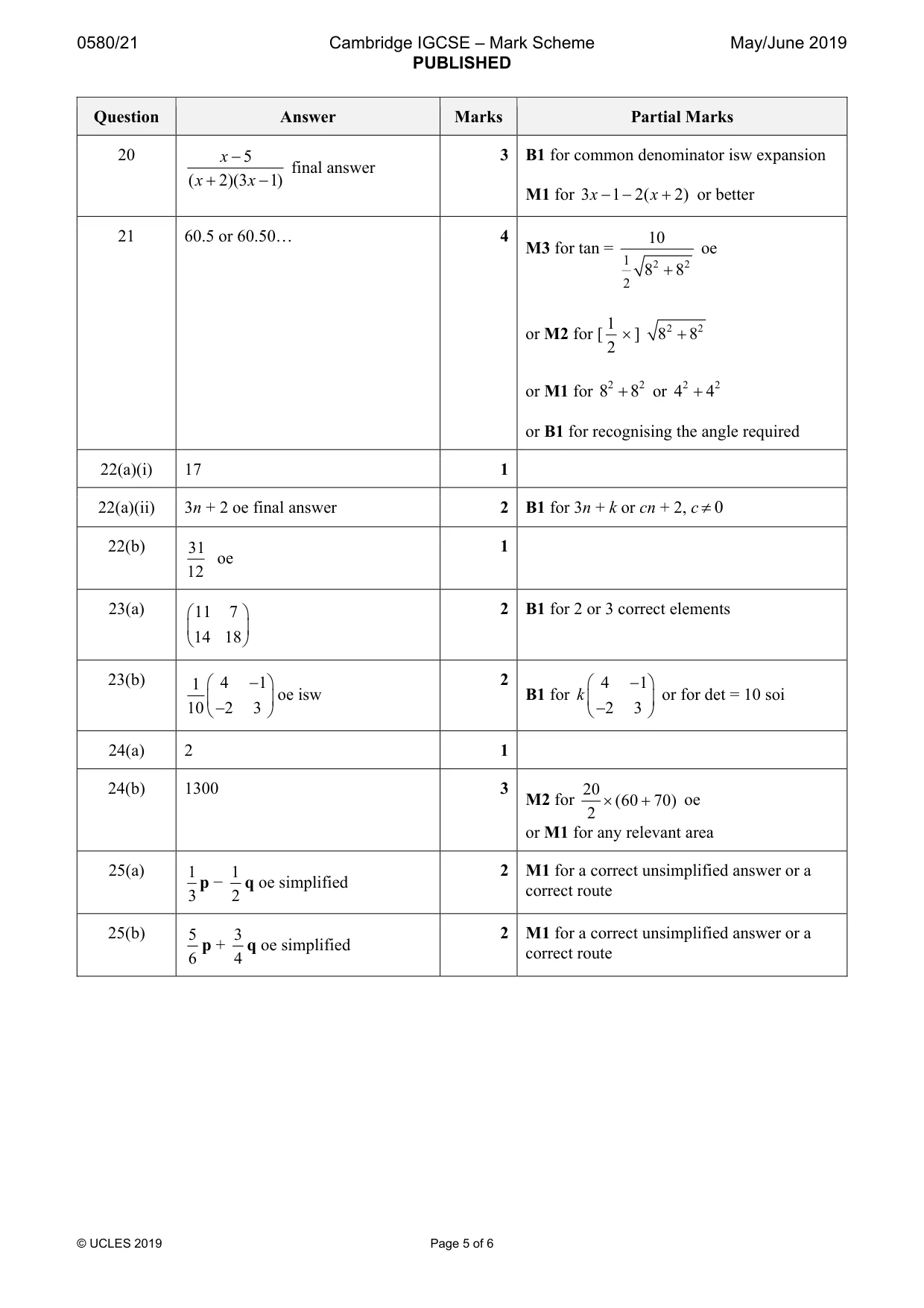
Mark scheme: Question Answer Marks Partial Marks 1 7.5 oe 1
Q2 · Factorise 5y - 6py
2 Factorise 5y - 6py. ............................................ [1]
Mark scheme: 2 y (5 − 6 p ) final answer 1
Q3 · Calculate 3 8.1 2 - 1.3 0 .8
3 Calculate 3 8.1 2 - 1.3 0 .8 . ............................................ [1]
Mark scheme: 3 4.01 or 4.007 to 4.008 1
Q4 · An equilateral triangle has sides of length 15 cm, correct to the nearest centimetre
4 An equilateral triangle has sides of length 15 cm, correct to the nearest centimetre. Calculate the upper bound of the perimeter of this triangle. ....................................... cm [1]
Mark scheme: 4 46.5 1
Q5 · The volume of a cuboid is 180 cm3
5 The volume of a cuboid is 180 cm3. The base is a square of side length 6 cm. Calculate the height of this cuboid. ....................................... cm [2]
Mark scheme: 5 5 2 M1 for 180 ÷ 62 oe
Question 6
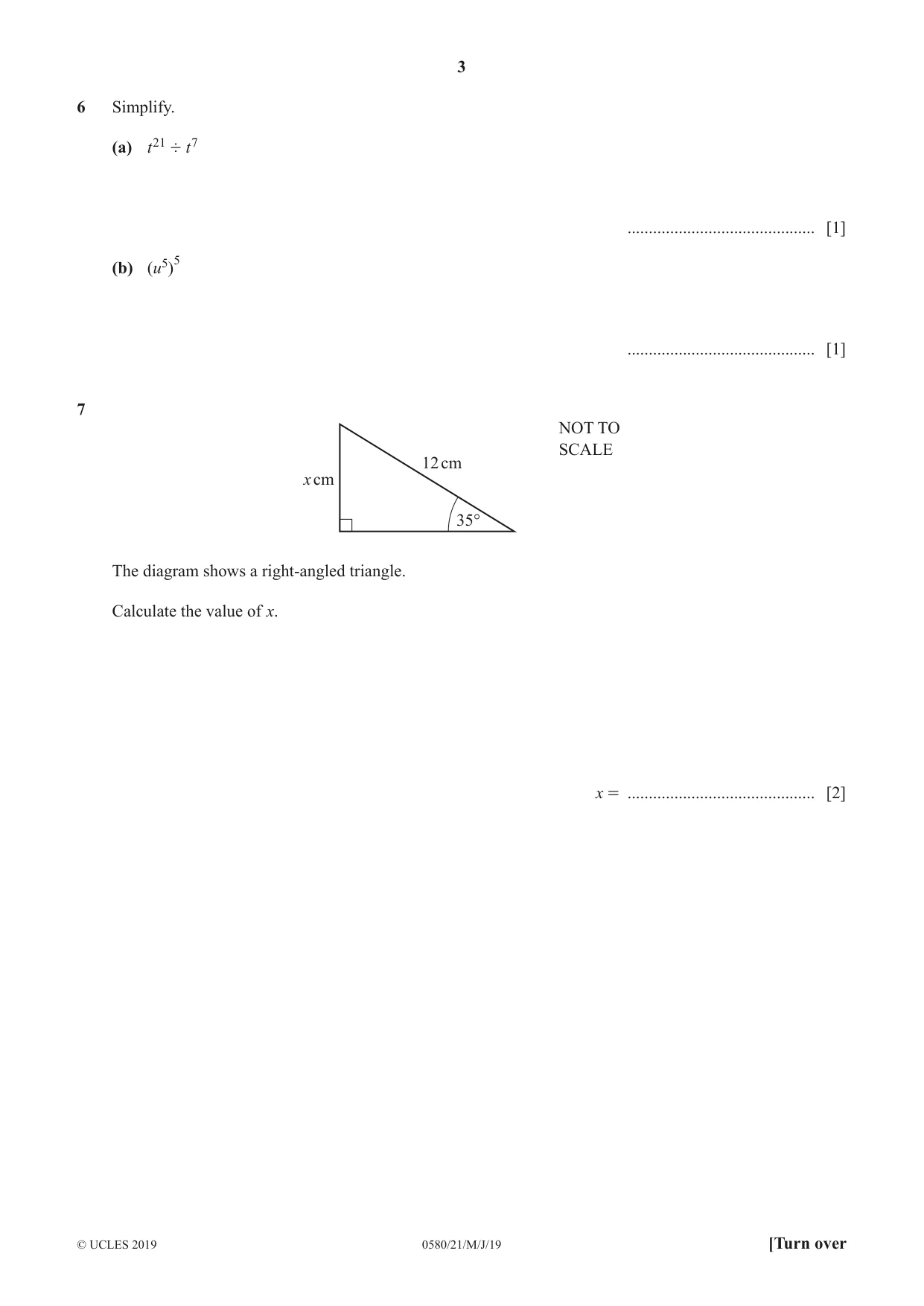
6 Simplify. (a) t21 ÷ t7 ............................................ [1] (b) (u5)5 ............................................ [1]
Mark scheme: 6(a) t14 final answer 1 6(b) u 25 final answer 1
Q7 · NOT TO SCALE 12 cm x cm 35° The diagram shows a right-angled triangle
7 NOT TO SCALE 12 cm x cm 35° The diagram shows a right-angled triangle. Calculate the value of x. x = ............................................ [2]
Mark scheme: 7 6.88 or 6.882 to 6.883 2 x M1 for sin 35 [=] oe or better 12
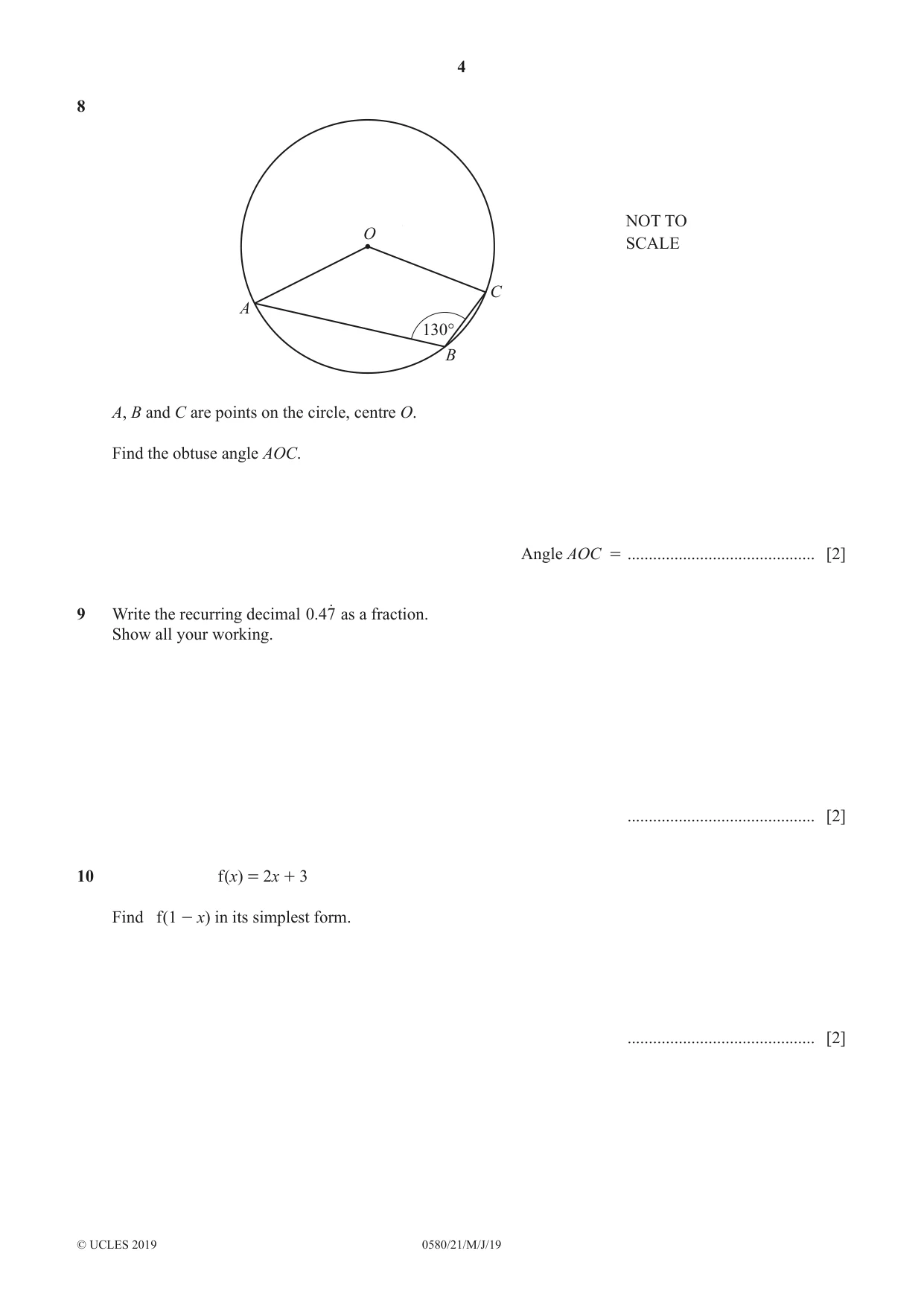
Q8 · NOT TO O SCALE C A 130° B A, B and C are points on the circle, centre O
8 NOT TO O SCALE C A 130° B A, B and C are points on the circle, centre O. Find the obtuse angle AOC. Angle AOC = ............................................ [2]
Mark scheme: 8 100 2 M1 for reflex angle = 2 × 130 or opposite angle of a cyclic quadrilateral shown = 50
Q9 · Write the recurring decimal .047o as a fraction
9 Write the recurring decimal .047o as a fraction. Show all your working. ............................................ [2]
Mark scheme: 9 47.77…– 4.77… oe M1 43 A1 Allow equivalent fractions 90 43 If M0 then SC1 for or equivalent 90 fraction with no/insufficient working
Q10 · F(x) = 2x + 3 Find f(1 - x) in its simplest form
10 f(x) = 2x + 3 Find f(1 - x) in its simplest form. ............................................ [2]
Mark scheme: 10 5 – 2x final answer 2 M1 for 2(1 – x) + 3 oe
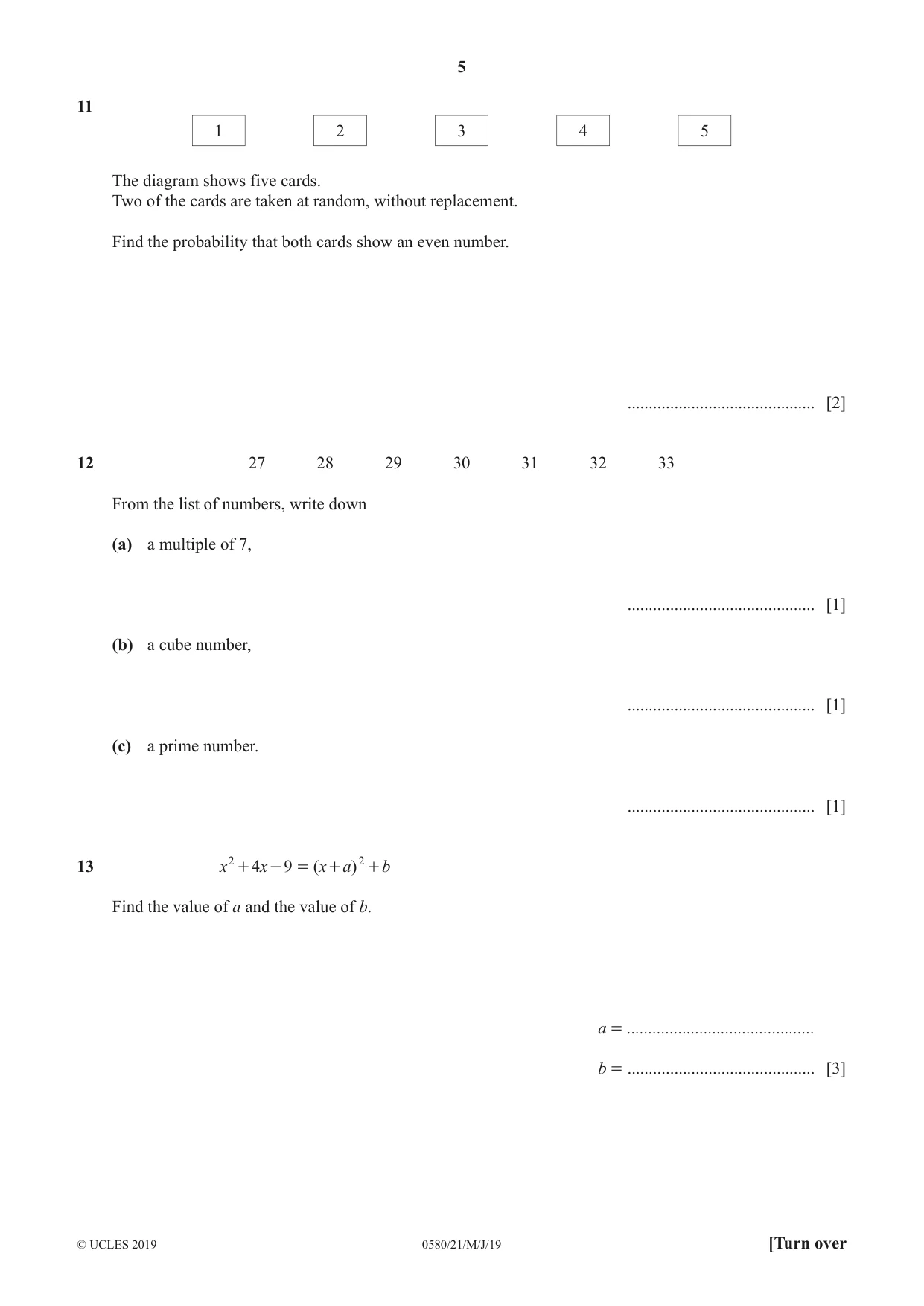
Q11 · 1 2 3 4 5 The diagram shows five cards
11 1 2 3 4 5 The diagram shows five cards. Two of the cards are taken at random, without replacement. Find the probability that both cards show an even number. ............................................ [2]
Mark scheme: 11 2 2 2 1 oe M1 for × oe 20 5 4
Q12 · 27 28 29 30 31 32 33 From the list of numbers, write down (a) a multiple of 7…
12 27 28 29 30 31 32 33 From the list of numbers, write down (a) a multiple of 7, ............................................ [1] (b) a cube number, ............................................ [1] (c) a prime number. ............................................ [1]
Mark scheme: 12(a) 28 1 12(b) 27 1 12(c) 29 or 31 1
Q13 · X 2 + 4x - 9 = (x + a) 2 + b Find the value of a and the value of b
13 x 2 + 4x - 9 = (x + a) 2 + b Find the value of a and the value of b. a = ............................................ b = ............................................ [3]
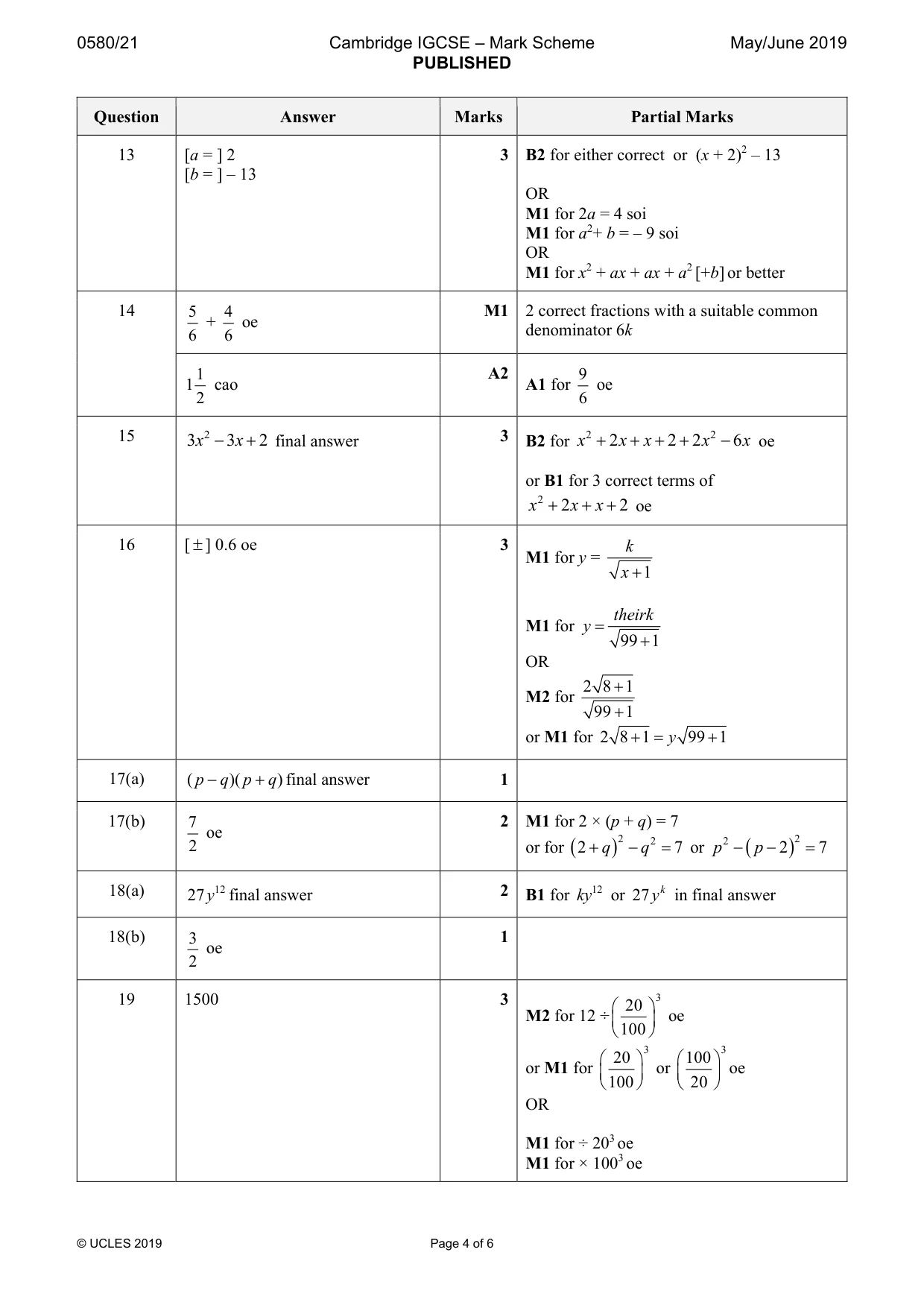
Mark scheme: 13 [a = ] 2 3 B2 for either correct or (x + 2)2 – 13 [b = ] – 13 OR M1 for 2a = 4 soi M1 for a2+ b = – 9 soi OR M1 for x2 + ax + ax + a2 [+b] or better
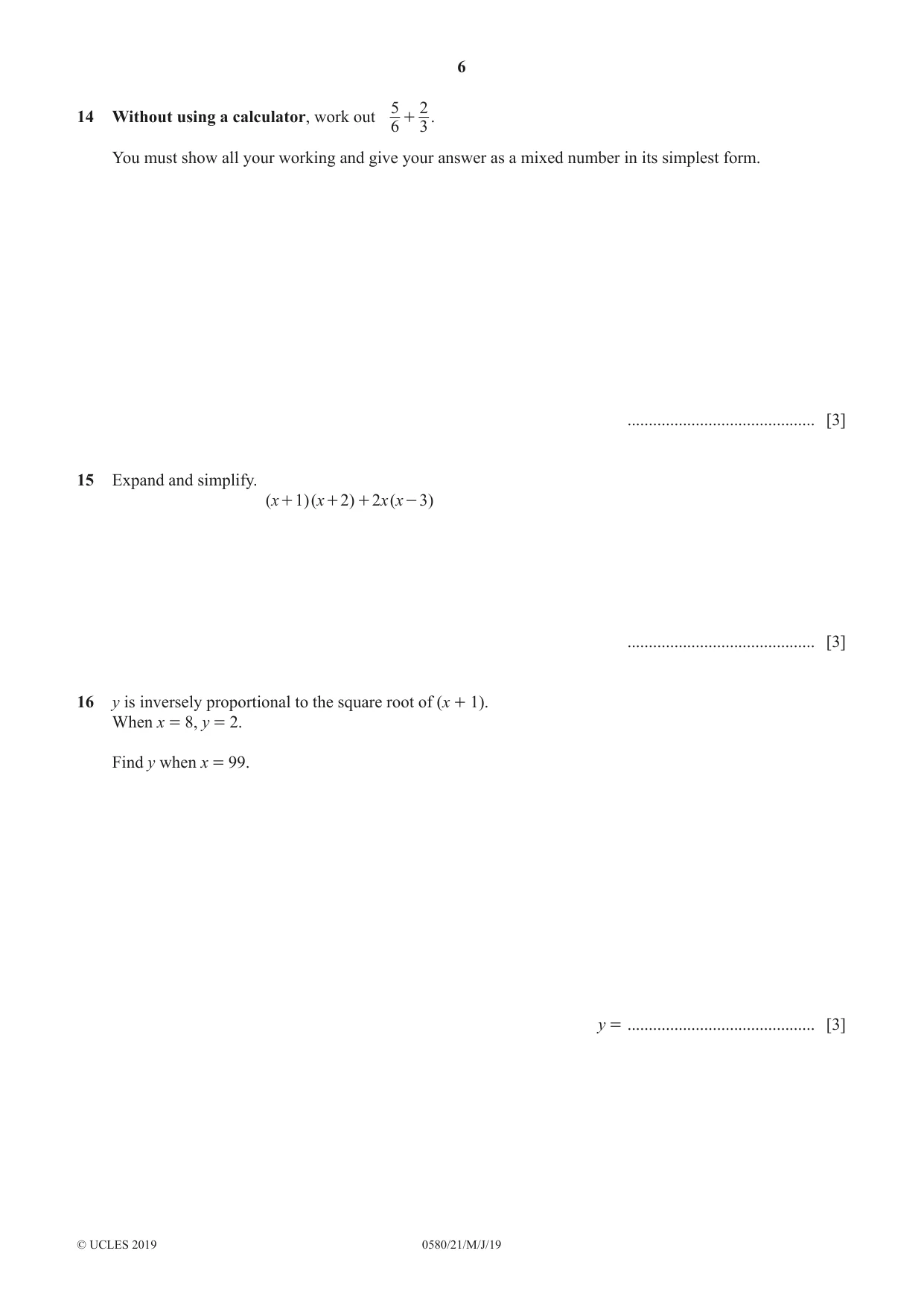
Q14 · 214 Without using a calculator, work out +
5 214 Without using a calculator, work out + . 6 3 You must show all your working and give your answer as a mixed number in its simplest form. ............................................ [3]
Mark scheme: 14 5 4 M1 2 correct fractions with a suitable common + oe denominator 6k 6 6 1 A2 9 12 cao A1 for 6 oe
Question 15
15 Expand and simplify. (x + 1)(x + 2) + 2x (x - 3) ............................................ [3]
Mark scheme: 15 3 x 2 − 3 x + 2 final answer 3 B2 for x 2 + 2 x + x + 2 + 2 x 2 − 6 x oe or B1 for 3 correct terms of x 2 + 2 x + x + 2 oe
Q16 · Y is inversely proportional to the square root of (x + 1)
16 y is inversely proportional to the square root of (x + 1). When x = 8, y = 2. Find y when x = 99. y = ............................................ [3]
Mark scheme: 16 [ ± ] 0.6 oe 3 k M1 for y = x + 1 theirk M1 for y = 99 + 1 OR 2 8 + 1 M2 for 99 + 1 or M1 for 2 8 + 1 = y 99 + 1
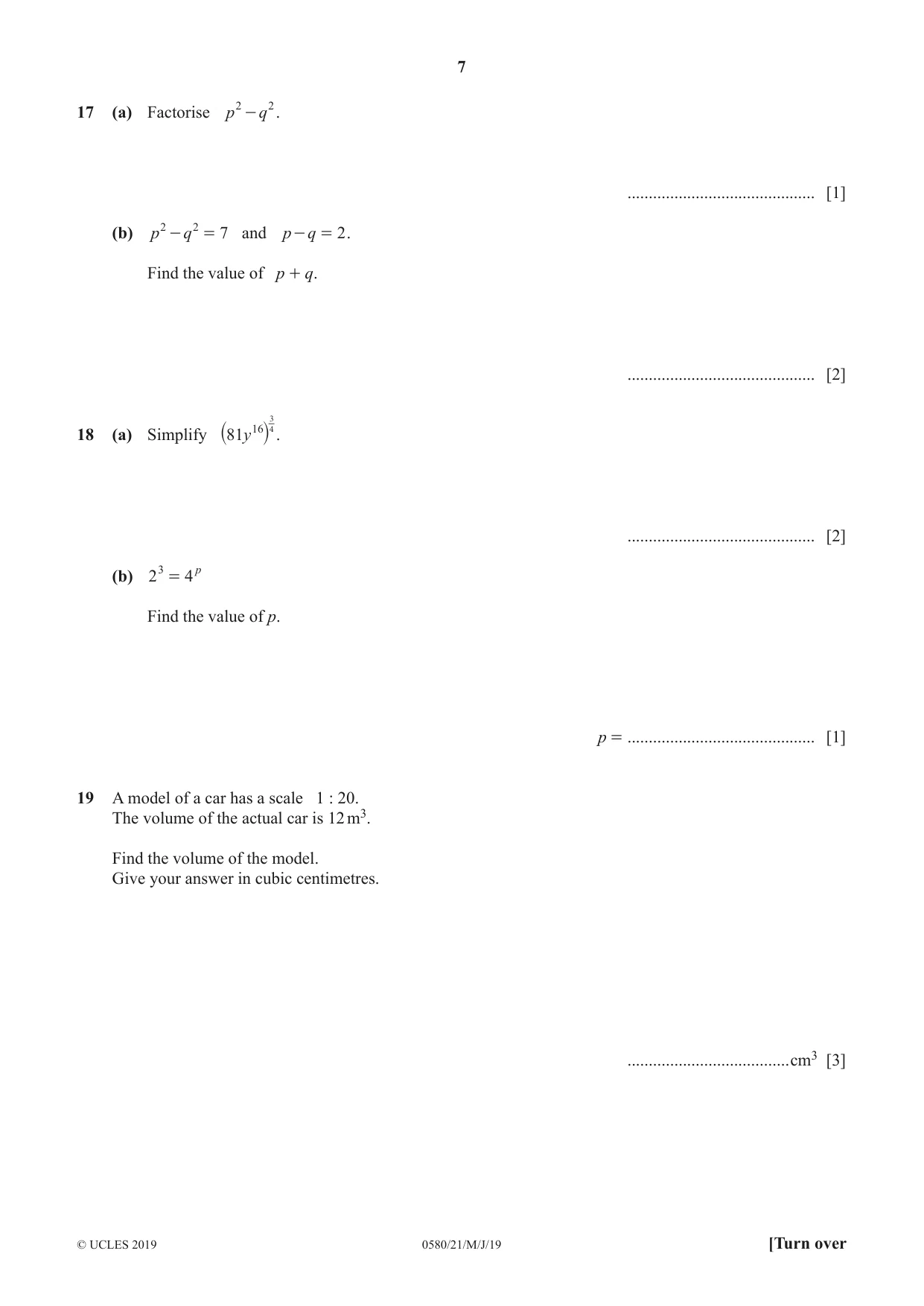
Q17 · Factorise p 2 - q 2
17 (a) Factorise p 2 - q 2 . ............................................ [1] (b) p 2 - q 2 = 7 and p - q = 2 . Find the value of p + q. ............................................ [2]
Mark scheme: 17(a) ( p − q )( p + q ) final answer 1 17(b) 7 2 M1 for 2 × (p + q) = 7 oe 2 2 2 2 2 or for ( 2 + q ) − q = 7 or p − ( p − 2 ) = 7
Q18 · 18 (a) Simplify 81y 16 4
3 18 (a) Simplify 81y 16 4 . ` j ............................................ [2] (b) 2 3 = 4 p Find the value of p. p = ............................................ [1]
Mark scheme: 18(a) 27y 12 final answer 2 B1 for ky12 or 27 ky in final answer 18(b) 3 1 oe 2
Q19 · A model of a car has a scale 1 : 20
19 A model of a car has a scale 1 : 20. The volume of the actual car is 12 m3. Find the volume of the model. Give your answer in cubic centimetres. ......................................cm3 [3]
Mark scheme: 19 1500 3 3 20 M2 for 12 ÷ oe 100 20 3 100 3 or M1 for or oe 100 20 OR M1 for ÷ 203 oe M1 for × 1003 oe
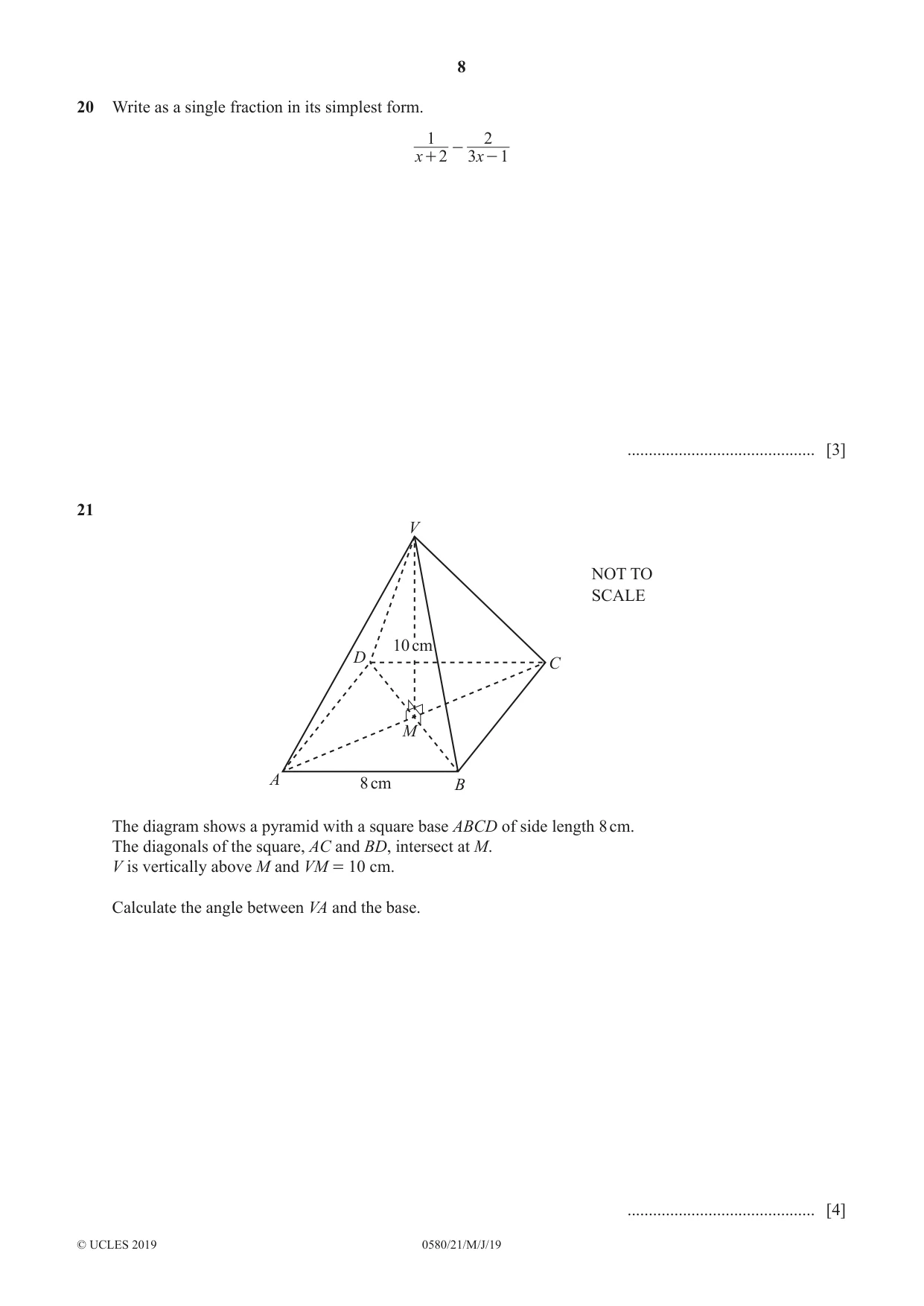
Q20 · Write as a single fraction in its simplest form
20 Write as a single fraction in its simplest form. 1 2 - x + 2 3x - 1 ............................................ [3]
Mark scheme: 20 x − 5 3 B1 for common denominator isw expansion final answer ( x + 2)(3 x − 1) M1 for 3 x −−1 2( x + 2) or better
Q21 · V NOT TO SCALE 10 cm D C M A 8 cm B The diagram shows a pyramid with a square base ABCD…
21 V NOT TO SCALE 10 cm D C M A 8 cm B The diagram shows a pyramid with a square base ABCD of side length 8 cm. The diagonals of the square, AC and BD, intersect at M. V is vertically above M and VM = 10 cm. Calculate the angle between VA and the base. ............................................ [4]
Mark scheme: 21 60.5 or 60.50… 4 10 M3 for tan = oe 1 2 2 8 + 8 2 1 2 2 or M2 for [ × ] 8 + 8 2 or M1 for 82 + 82 or 4 2 + 4 2 or B1 for recognising the angle required
Q22 · These are the first four terms of a sequence
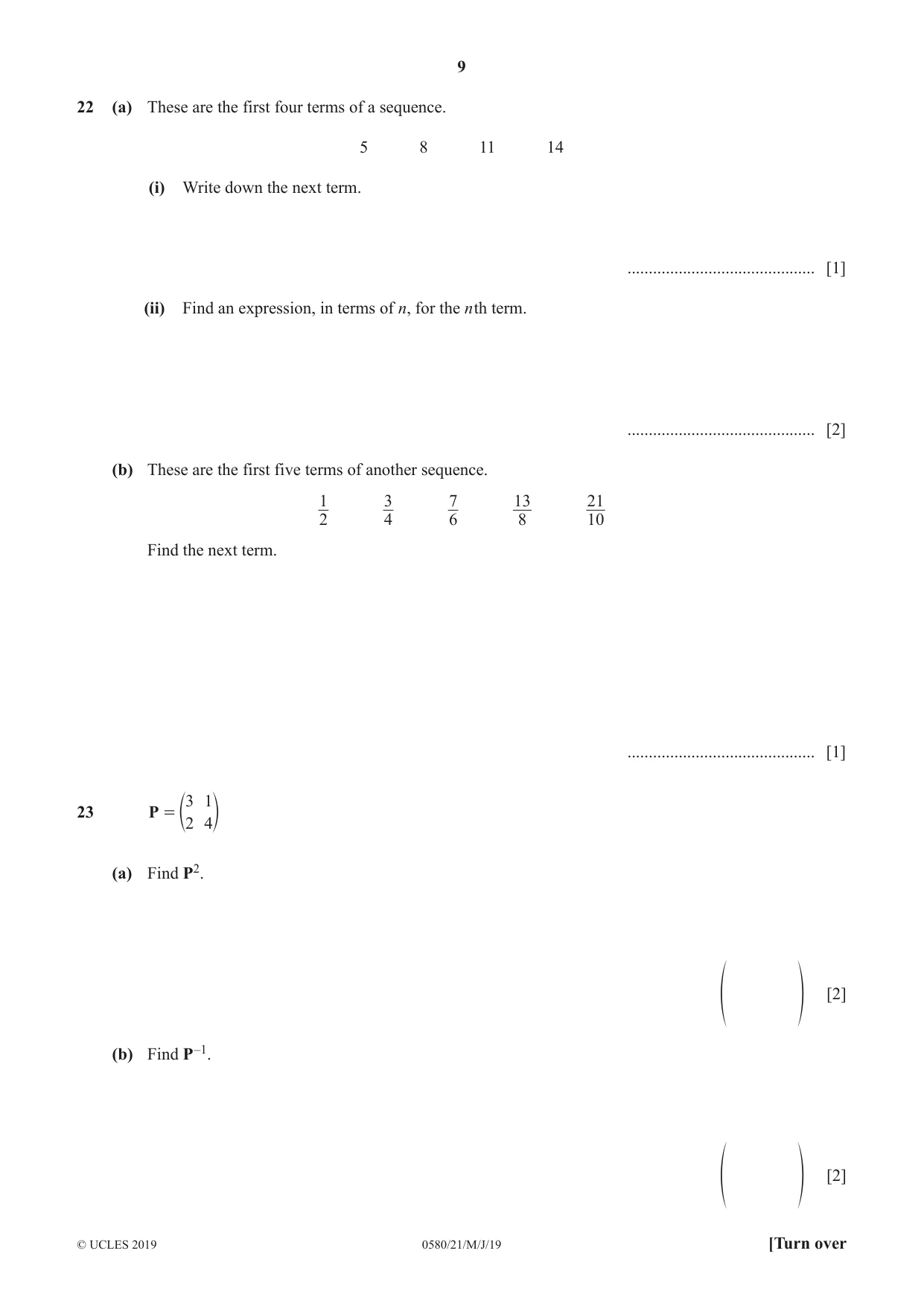
22 (a) These are the first four terms of a sequence. 5 8 11 14 (i) Write down the next term. ............................................ [1] (ii) Find an expression, in terms of n, for the nth term. ............................................ [2] (b) These are the first five terms of another sequence. 1 3 7 13 21 2 4 6 8 10 Find the next term. ............................................ [1]
Mark scheme: 22(a)(i) 17 1 22(a)(ii) 3n + 2 oe final answer 2 B1 for 3n + k or cn + 2, c ≠ 0 22(b) 31 1 oe 12
Q23 · 1 23 P = e2 4o (a) Find P2
3 1 23 P = e2 4o (a) Find P2. [2] f p (b) Find P–1. [2] f p
Mark scheme: 23(a) 11 7 2 B1 for 2 or 3 correct elements 14 18 23(b) 1 4 − 1 2 4 − 1 oe isw B1 for k or for det = 10 soi 10 − 2 3 − 2 3
Q24 · 20 NOT TO Speed SCALE (m/s) 0 0 60 70 Time (seconds) The diagram shows information about…
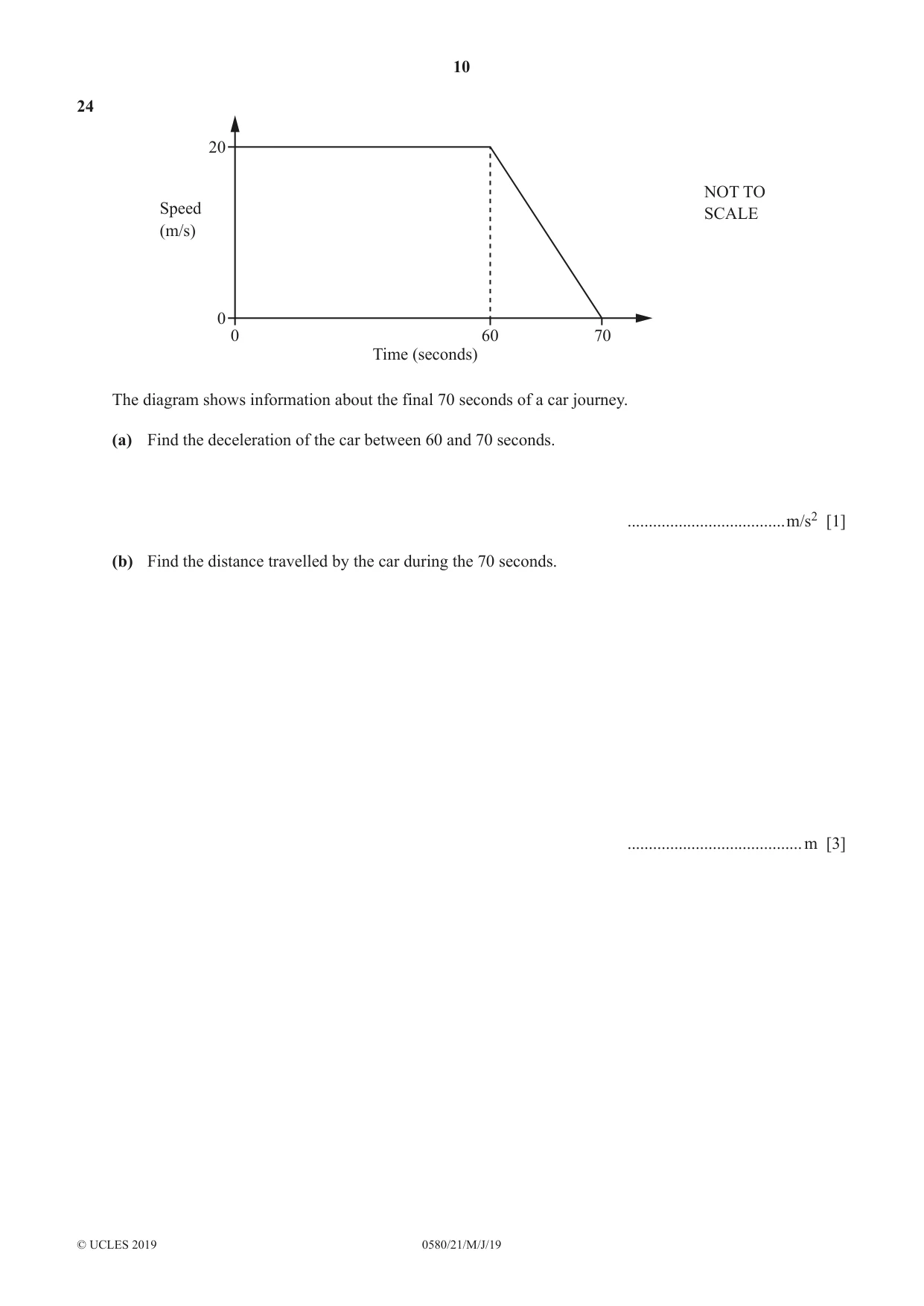
24 20 NOT TO Speed SCALE (m/s) 0 0 60 70 Time (seconds) The diagram shows information about the final 70 seconds of a car journey. (a) Find the deceleration of the car between 60 and 70 seconds. .....................................m/s2 [1] (b) Find the distance travelled by the car during the 70 seconds. .........................................m [3]
Mark scheme: 24(a) 2 1 24(b) 1300 3 20 M2 for × (60 + 70) oe 2 or M1 for any relevant area
Q25 · C K B M NOT TO q SCALE L O p A OABC is a parallelogram and O is the origin
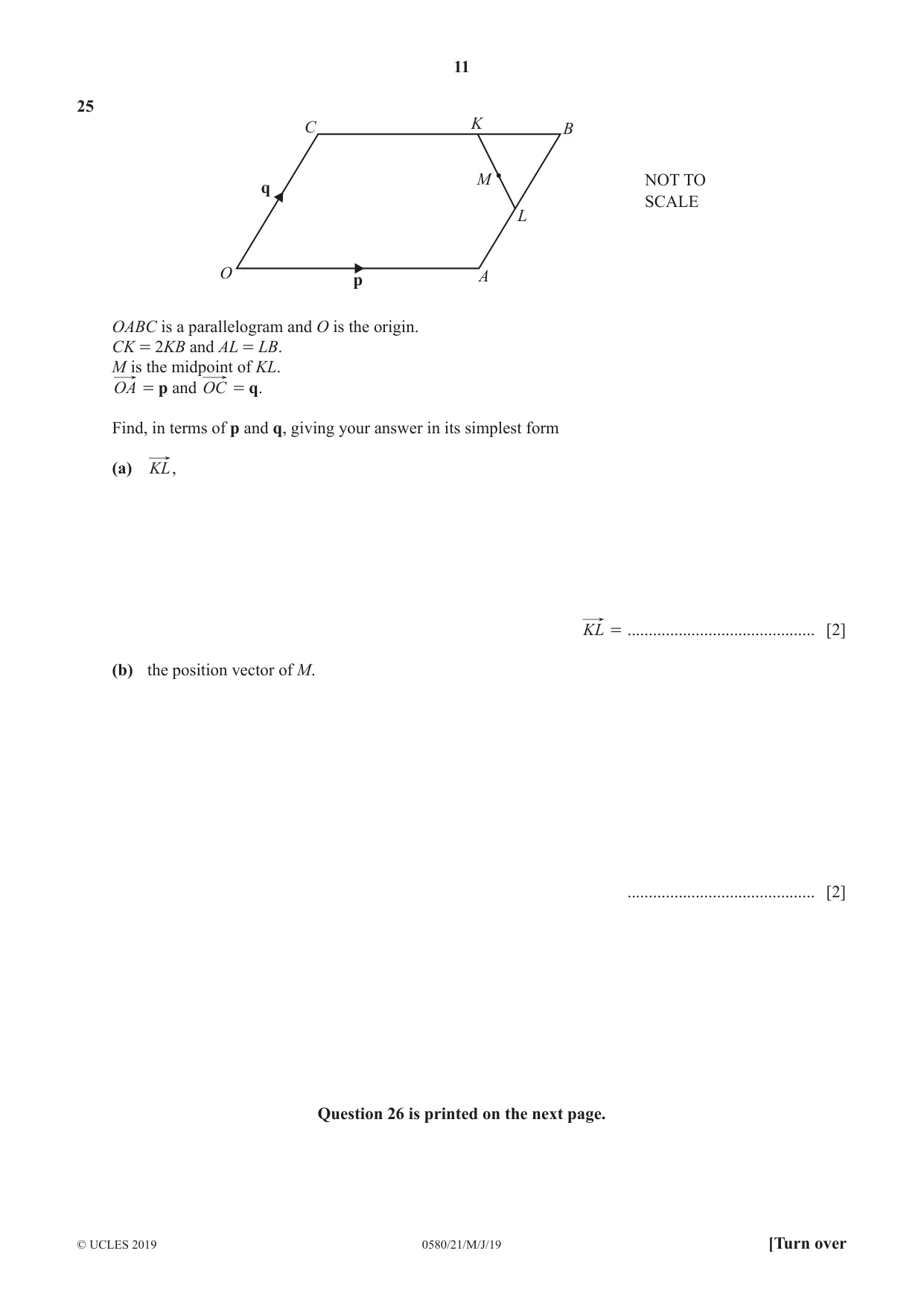
25 C K B M NOT TO q SCALE L O p A OABC is a parallelogram and O is the origin. CK = 2KB and AL = LB. M is the midpoint of KL. OA = p and OC = q. Find, in terms of p and q, giving your answer in its simplest form (a) KL, KL = ............................................ [2] (b) the position vector of M. ............................................ [2] Question 26 is printed on the next page.
Mark scheme: 25(a) 1 1 2 M1 for a correct unsimplified answer or a p − q oe simplified correct route 3 2 25(b) 5 3 2 M1 for a correct unsimplified answer or a p + q oe simplified correct route 6 4
Q26 · Line L passes through the points (0, -3) and (6, 9)
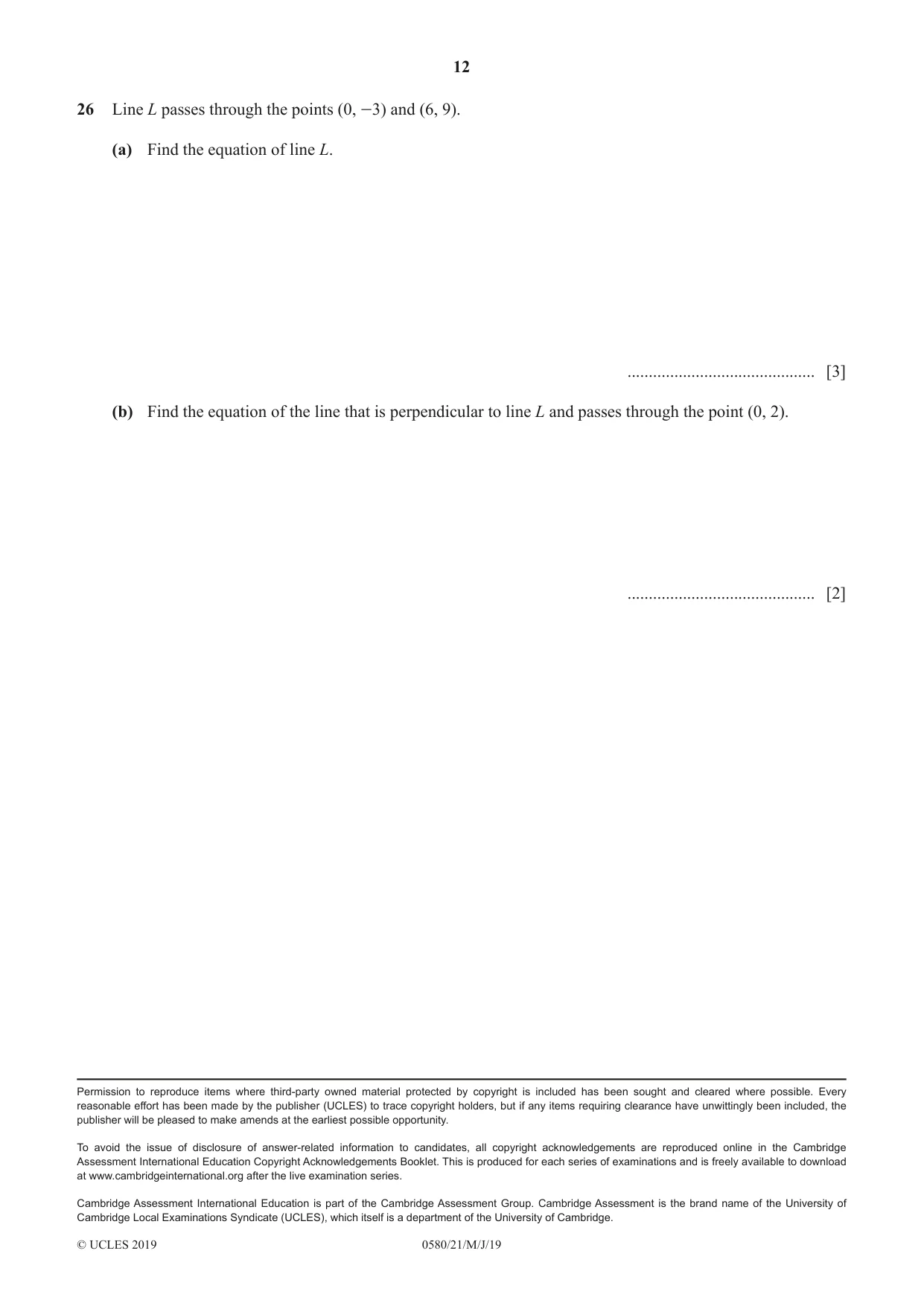
26 Line L passes through the points (0, -3) and (6, 9). (a) Find the equation of line L. ............................................ [3] (b) Find the equation of the line that is perpendicular to line L and passes through the point (0, 2). ............................................ [2]
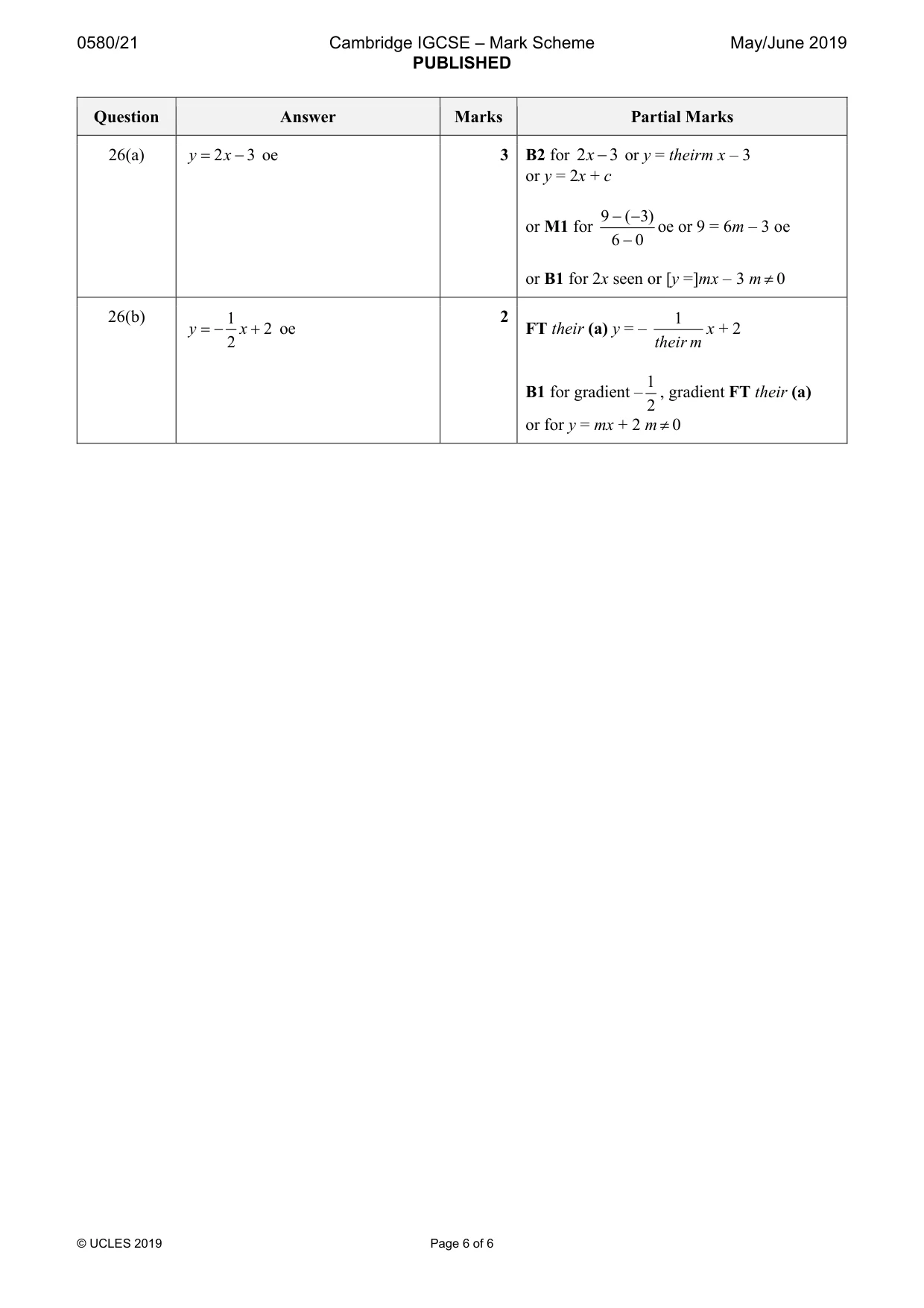
Mark scheme: 26(a) y = 2 x − 3 oe 3 B2 for 2 x − 3 or y = theirm x – 3 or y = 2x + c 9 −−( 3) or M1 for oe or 9 = 6m – 3 oe 6 − 0 or B1 for 2x seen or [y =]mx – 3 m ≠0 26(b) 1 2 1 y = − x + 2 oe FT their (a) y = – x + 2 2 their m 1 B1 for gradient – , gradient FT their (a) 2 or for y = mx + 2 m ≠0
What was in this paper
The subtopics covered by these 26 questions, and how many questions each got. Open one in a new tab to see every Cambridge question on it.
4Fractions, decimals and percentages2Powers and roots2Right-angled triangles2Algebraic fractions1Area and perimeter1Circle theorems I1Equations1Equations of linear graphs1Functions1Indices I1Limits of accuracy1Percentages1Probability of combined events1Ratio and proportion1Scale drawings1Sequences1Surface area and volume1Types of number1Vectors in two dimensions1What you needed in this session
Cambridge’s own grade thresholds for 2019 May/June, Paper 2 · Variant 1. A higher threshold means an easier paper — the bar moves with how the cohort did.