Cambridge IGCSE Mathematics 0580 — 2022 Oct/Nov Paper 2 · Variant 2
0580/22/O/N/22 · 23 questions · 70 marks · ≈79 min
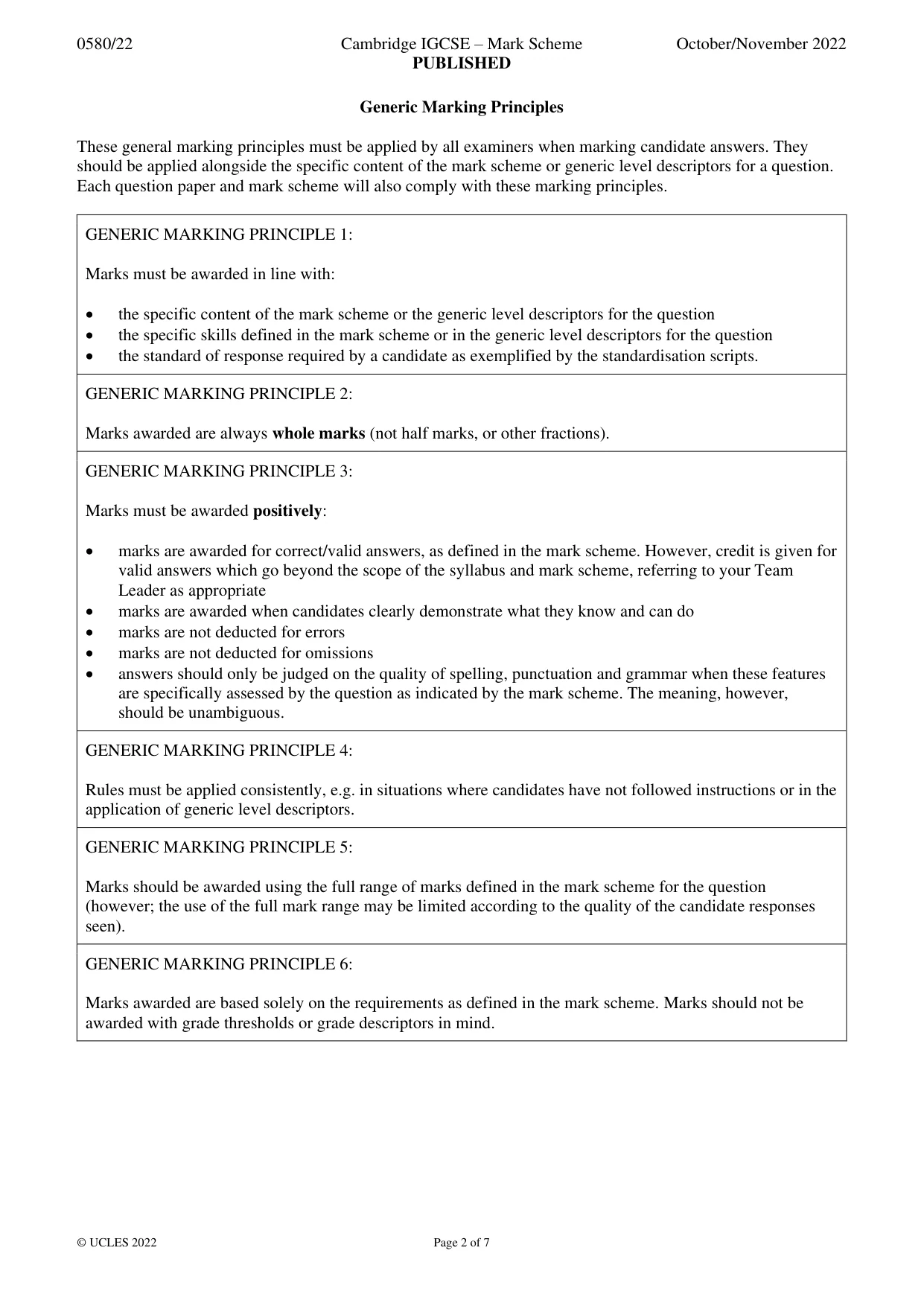
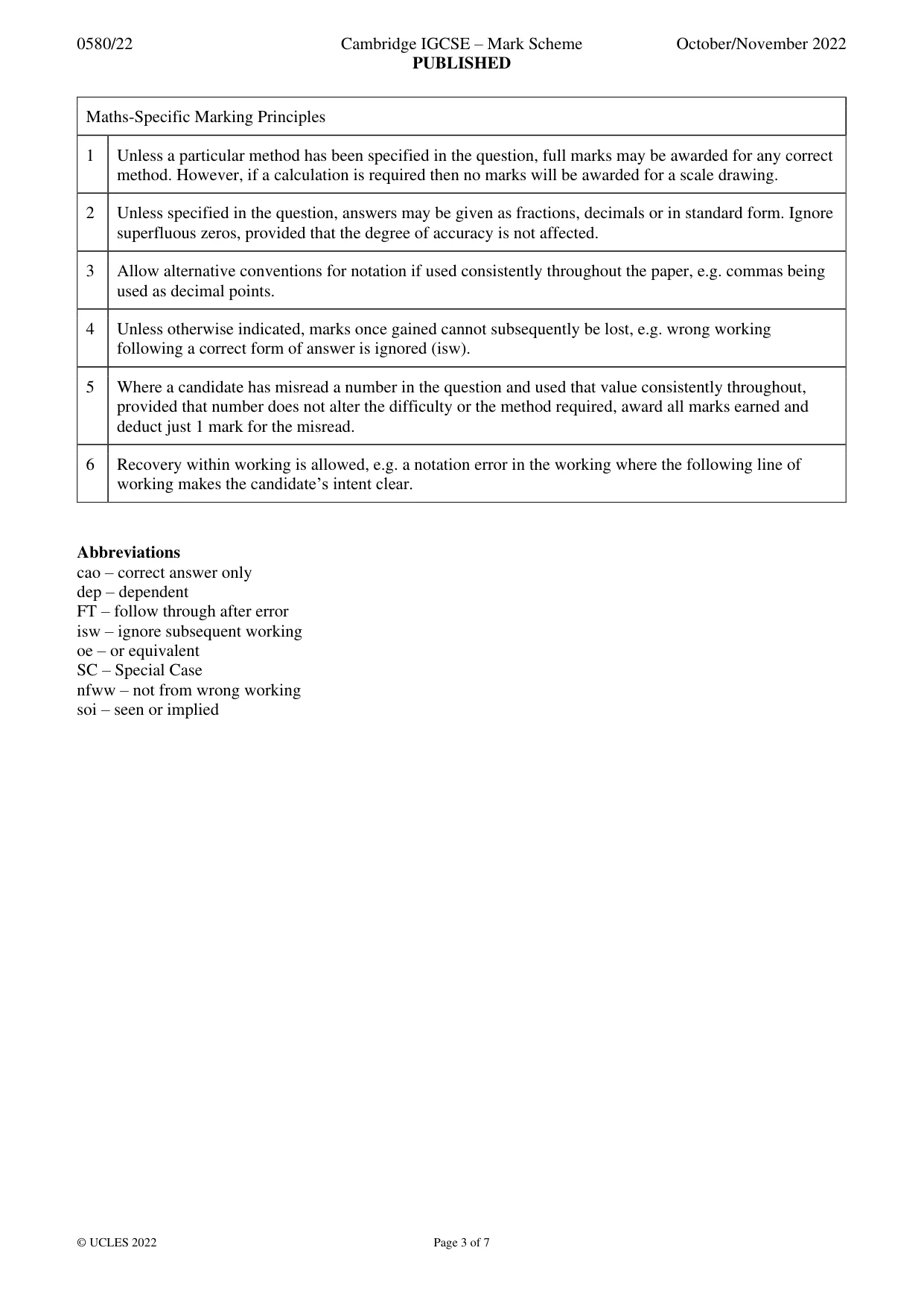
The question paper and its mark scheme, free to read here and free to download. This is Cambridge’s own paper, exactly as it was sat.
Question paper12 pages

Mark scheme7 pages
Answers below. Sit the paper first if you are practising.
Questions as text
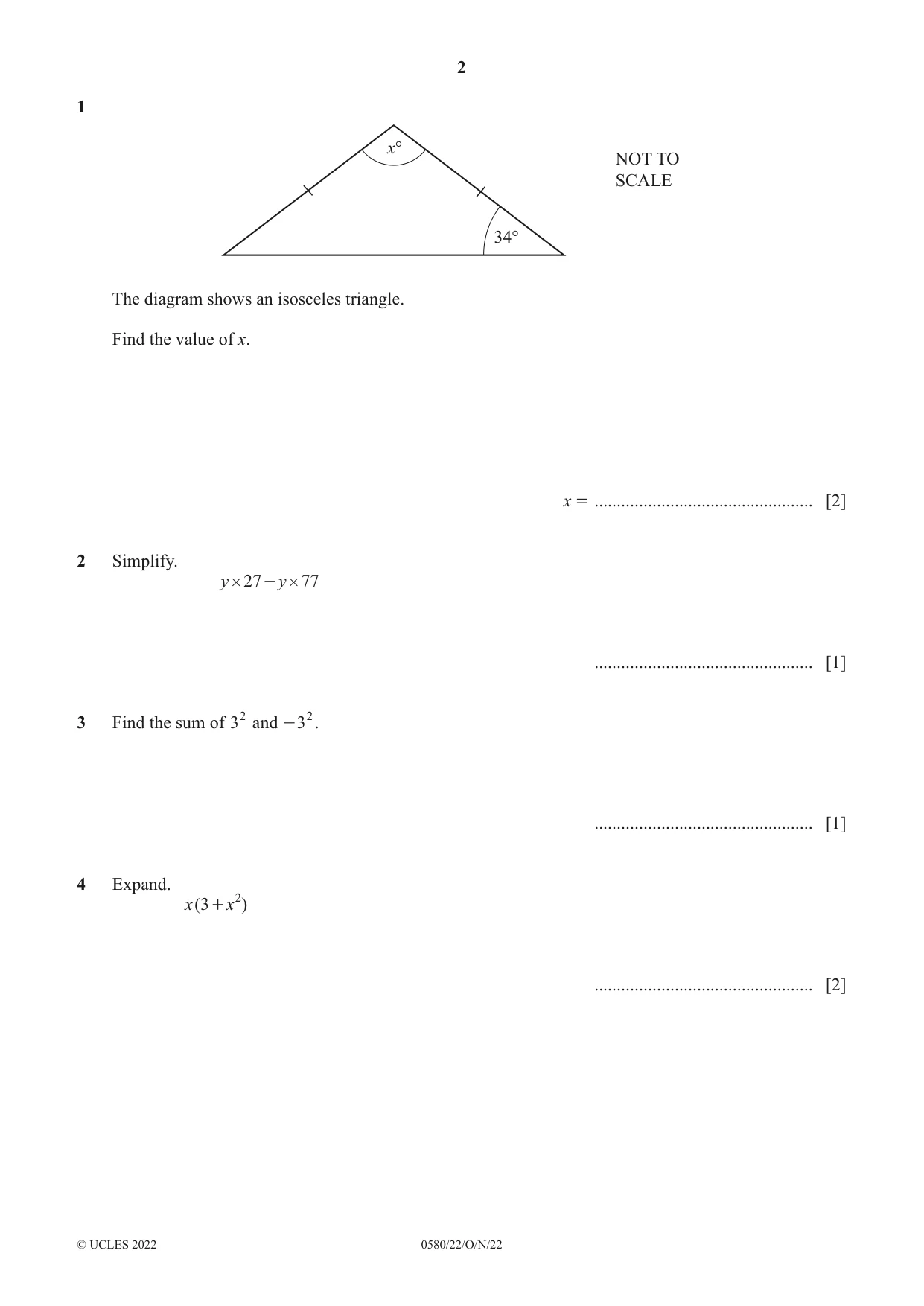
Q1 · X° NOT TO SCALE 34° The diagram shows an isosceles triangle
1 x° NOT TO SCALE 34° The diagram shows an isosceles triangle. Find the value of x. x = ................................................. [2]
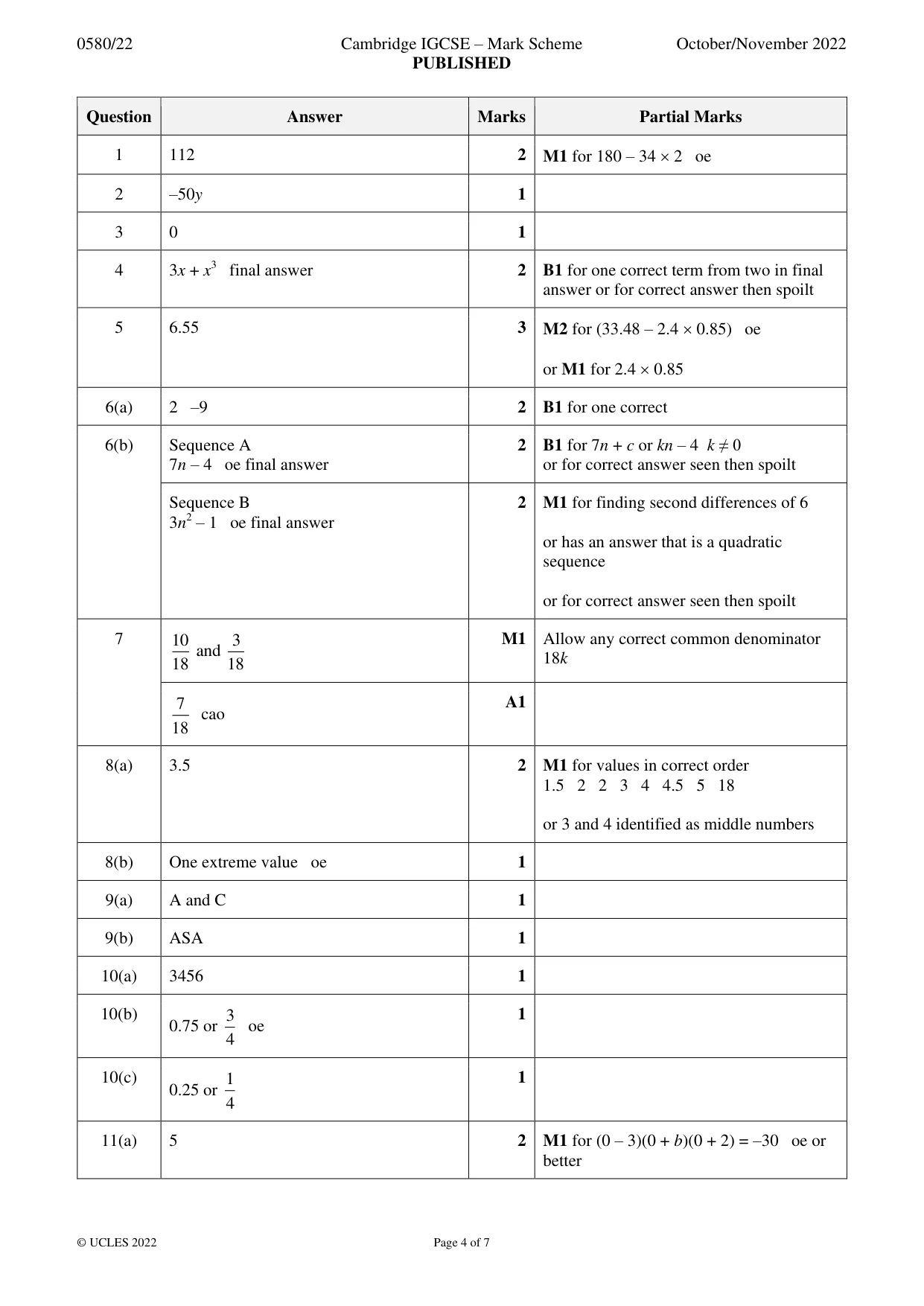
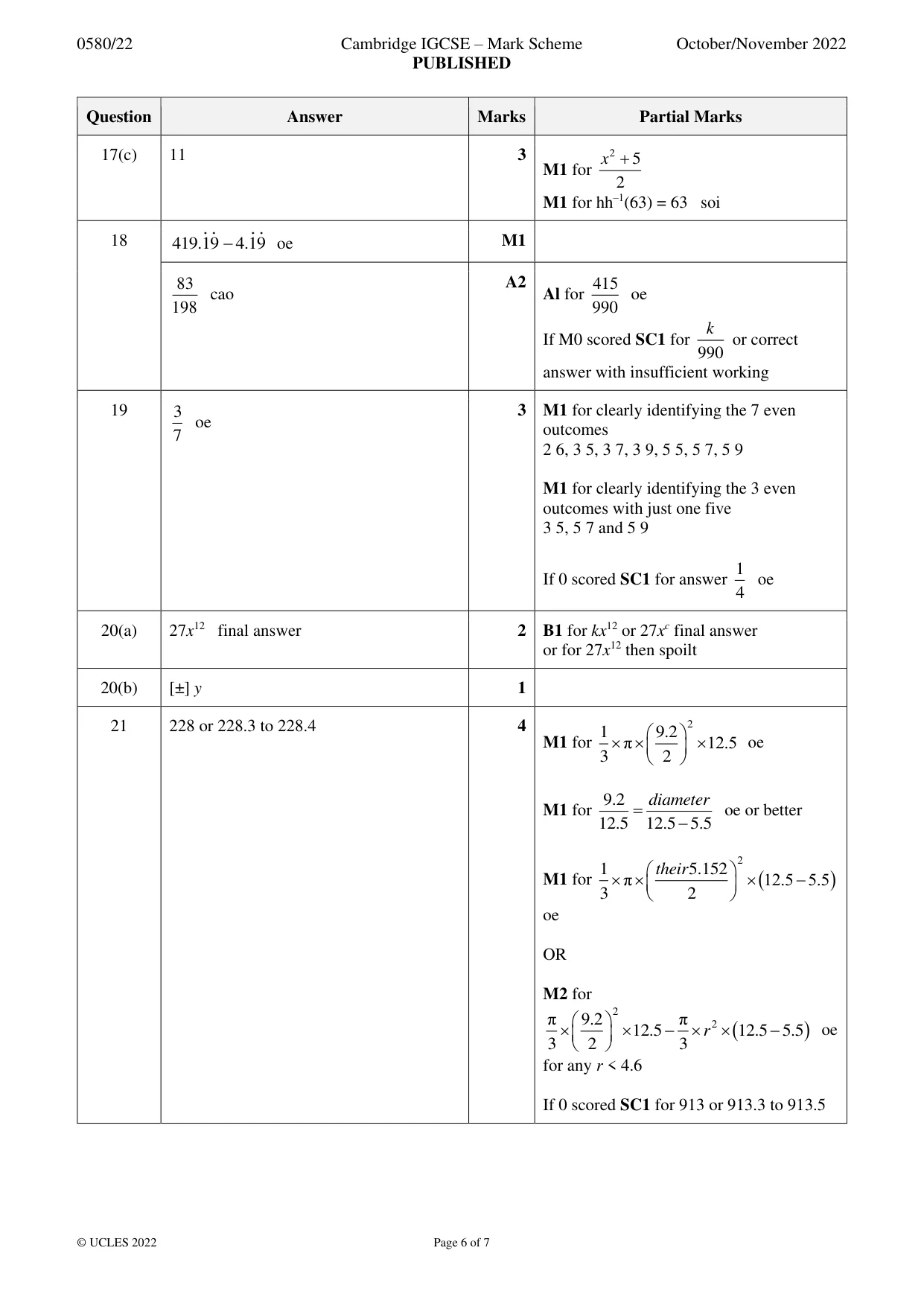
Mark scheme: Question Answer Marks Partial Marks 1 112 2 M1 for 180 – 34 2 oe
Question 2
2 Simplify. y # 27 - y # 77 ................................................. [1]
Mark scheme: 2 –50y 1
Q3 · Find the sum of 32 and - 32
3 Find the sum of 32 and - 32 . ................................................. [1]
Mark scheme: 3 0 1
Question 4
4 Expand. x ( 3 + x 2 ) ................................................. [2]
Mark scheme: 4 3x + x3 final answer 2 B1 for one correct term from two in final answer or for correct answer then spoilt
Q5 · Jenna buys 2.4 m of ribbon and 4.8 m of fabric
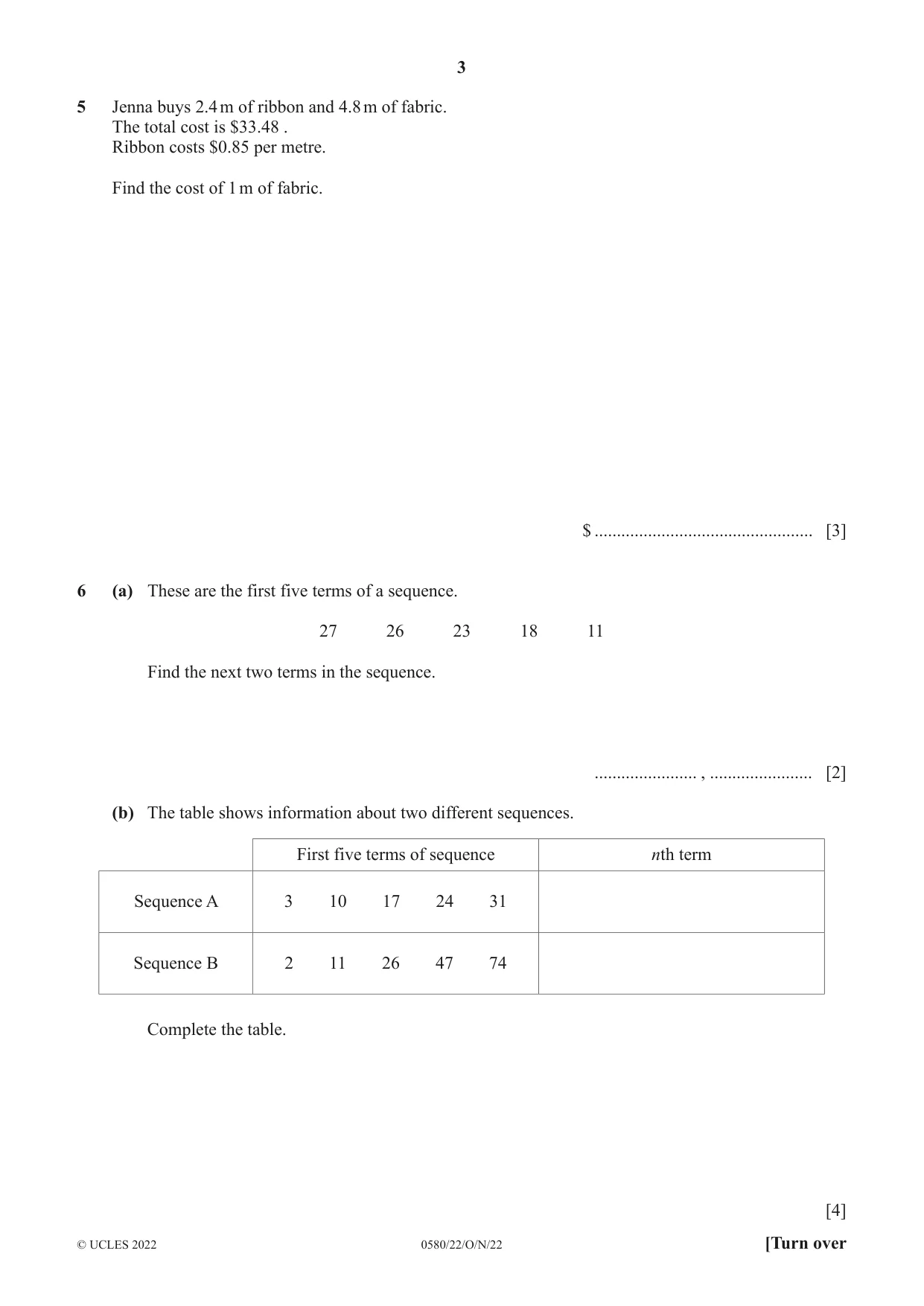
5 Jenna buys 2.4 m of ribbon and 4.8 m of fabric. The total cost is $33.48 . Ribbon costs $0.85 per metre. Find the cost of 1 m of fabric. $ ................................................. [3]
Mark scheme: 5 6.55 3 M2 for (33.48 – 2.4 0.85) oe or M1 for 2.4 0.85
Q6 · These are the first five terms of a sequence
6 (a) These are the first five terms of a sequence. 27 26 23 18 11 Find the next two terms in the sequence. ....................... , ....................... [2] (b) The table shows information about two different sequences. First five terms of sequence nth term Sequence A 3 10 17 24 31 Sequence B 2 11 26 47 74 Complete the table. [4]
Mark scheme: 6(a) 2 –9 2 B1 for one correct 6(b) Sequence A 2 B1 for 7n + c or kn – 4 k ≠ 0 7n – 4 oe final answer or for correct answer seen then spoilt Sequence B 2 M1 for finding second differences of 6 3n2 – 1 oe final answer or has an answer that is a quadratic sequence or for correct answer seen then spoilt
Q7 · 17 Without using a calculator, work out -
5 17 Without using a calculator, work out - . 9 6 You must show all your working and give your answer as a fraction in its simplest form. ................................................. [2]
Mark scheme: 7 10 3 M1 Allow any correct common denominator and 18k 18 18 7 A1 cao 18
Q8 · Daryl records the number of hours in a week 8 people spend exercising
8 Daryl records the number of hours in a week 8 people spend exercising. 5 2 1.5 3 18 4.5 2 4 (a) Find the median. ............................................... h [2] (b) Explain why the mean may not be a suitable average to use. ..................................................................................................................................................... [1]
Mark scheme: 8(a) 3.5 2 M1 for values in correct order 1.5 2 2 3 4 4.5 5 18 or 3 and 4 identified as middle numbers 8(b) One extreme value oe 1
Q9 · The diagram shows three triangles A, B and C
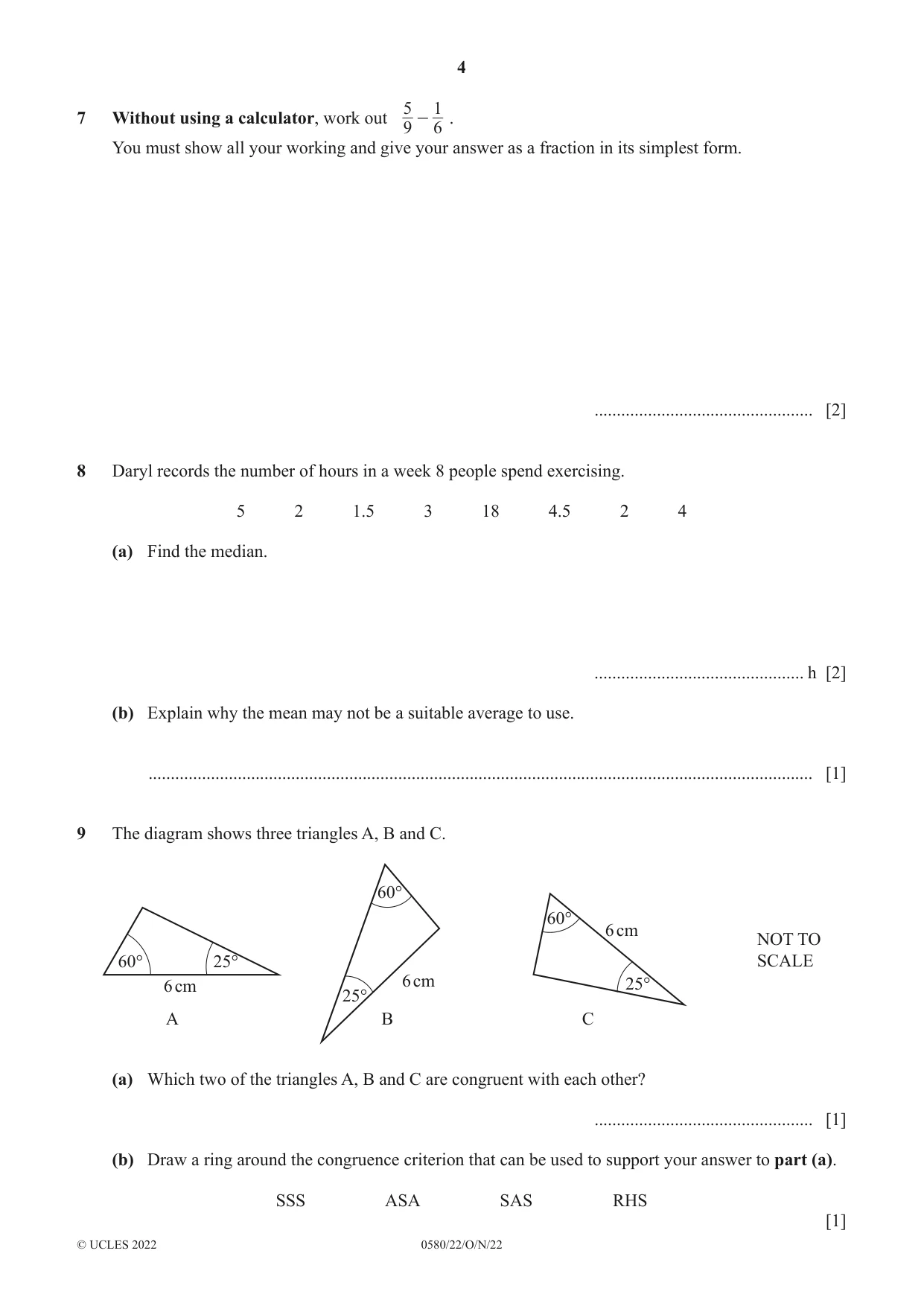
9 The diagram shows three triangles A, B and C. 60° 60° 6 cm NOT TO 60° 25° SCALE 6 cm 25° 6 cm 25° A B C (a) Which two of the triangles A, B and C are congruent with each other? ................................................. [1] (b) Draw a ring around the congruence criterion that can be used to support your answer to part (a). SSS ASA SAS RHS [1]
Mark scheme: 9(a) A and C 1 9(b) ASA 1
Question 10
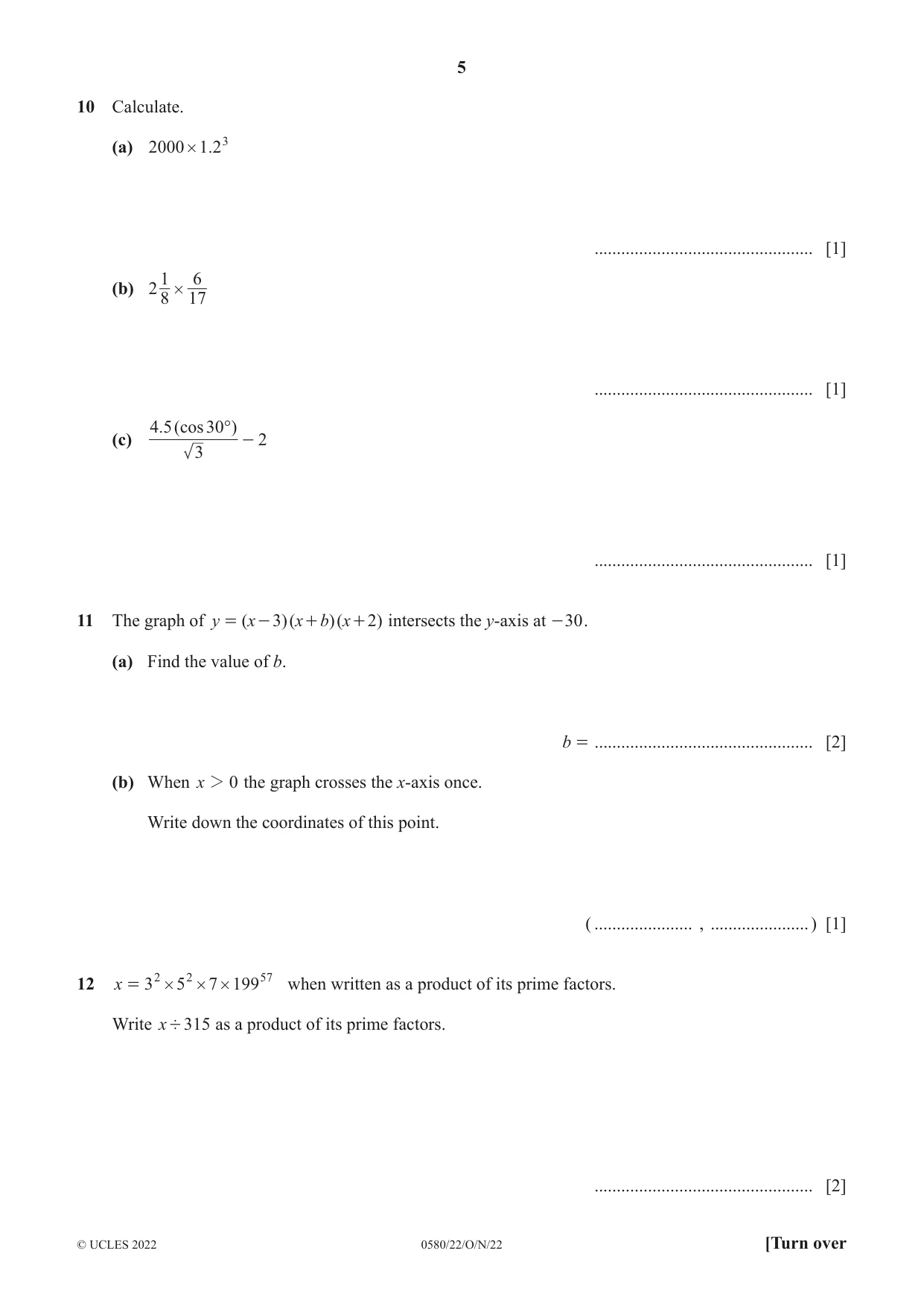
10 Calculate. (a) 2000 # 1.23 ................................................. [1] 1 6 (b) 2 # 8 17 ................................................. [1] 4.5 ( cos 30°) (c) - 2 3 ................................................. [1]
Mark scheme: 10(a) 3456 1 10(b) 3 1 0.75 or oe 4 10(c) 1 1 0.25 or 4
Q11 · The graph of y = ( x - 3)( x + b)( x + 2) intersects the y-axis at - 30
11 The graph of y = ( x - 3)( x + b)( x + 2) intersects the y-axis at - 30 . (a) Find the value of b. b = ................................................. [2] (b) When x 2 0 the graph crosses the x-axis once. Write down the coordinates of this point. ( ...................... , ...................... ) [1]
Mark scheme: 11(a) 5 2 M1 for (0 – 3)(0 + b)(0 + 2) = –30 oe or better 11(b) (3, 0) 1
Q12 · X = 3 2 # 5 2 # 7 # 199 57 when written as a product of its prime factors
12 x = 3 2 # 5 2 # 7 # 199 57 when written as a product of its prime factors. Write x ' 315 as a product of its prime factors. ................................................. [2]
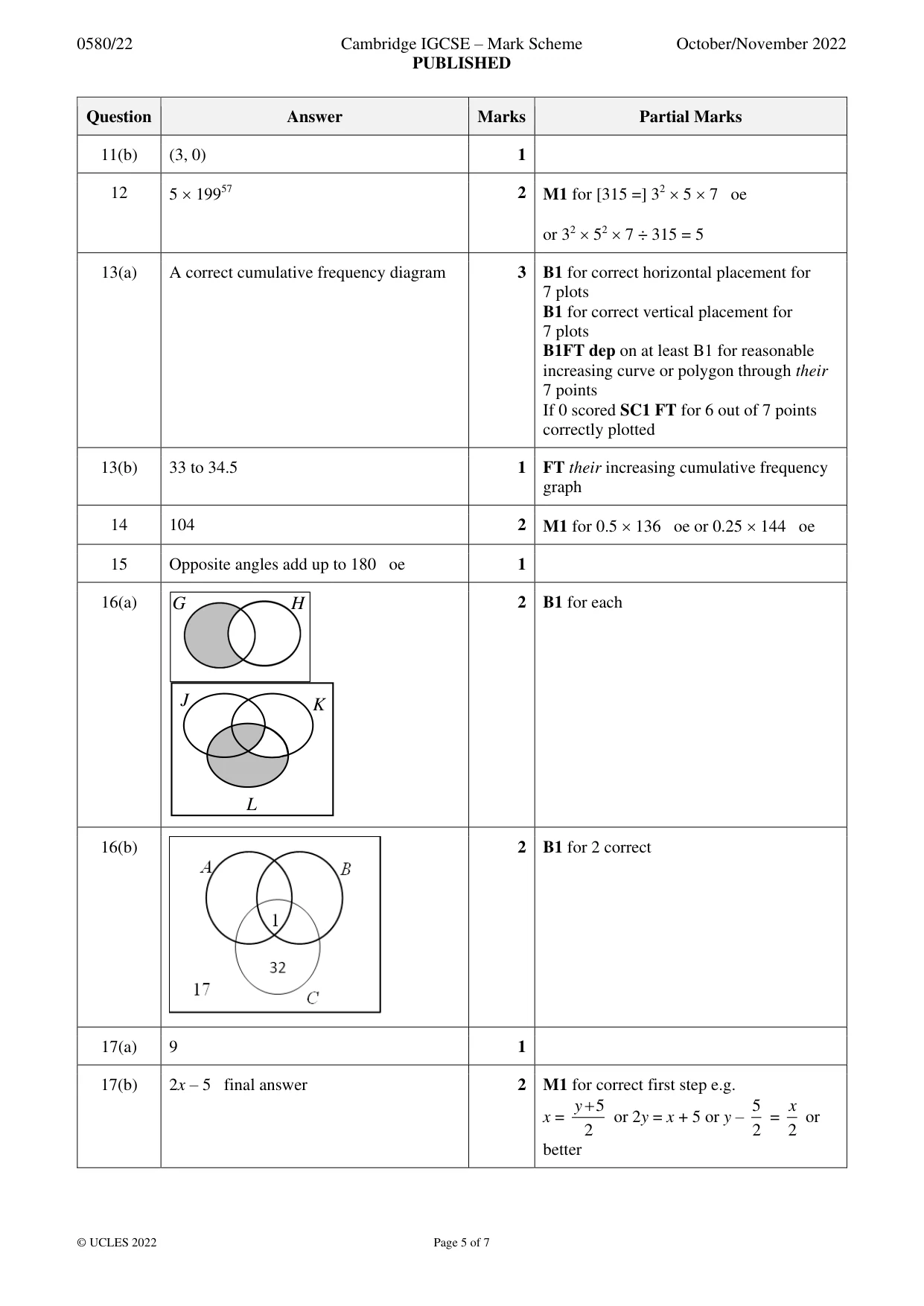
Mark scheme: 12 5 19957 2 M1 for [315 =] 32 5 7 oe or 32 52 7 ÷ 315 = 5
Q13 · The table shows information about the mass of each of 50 children
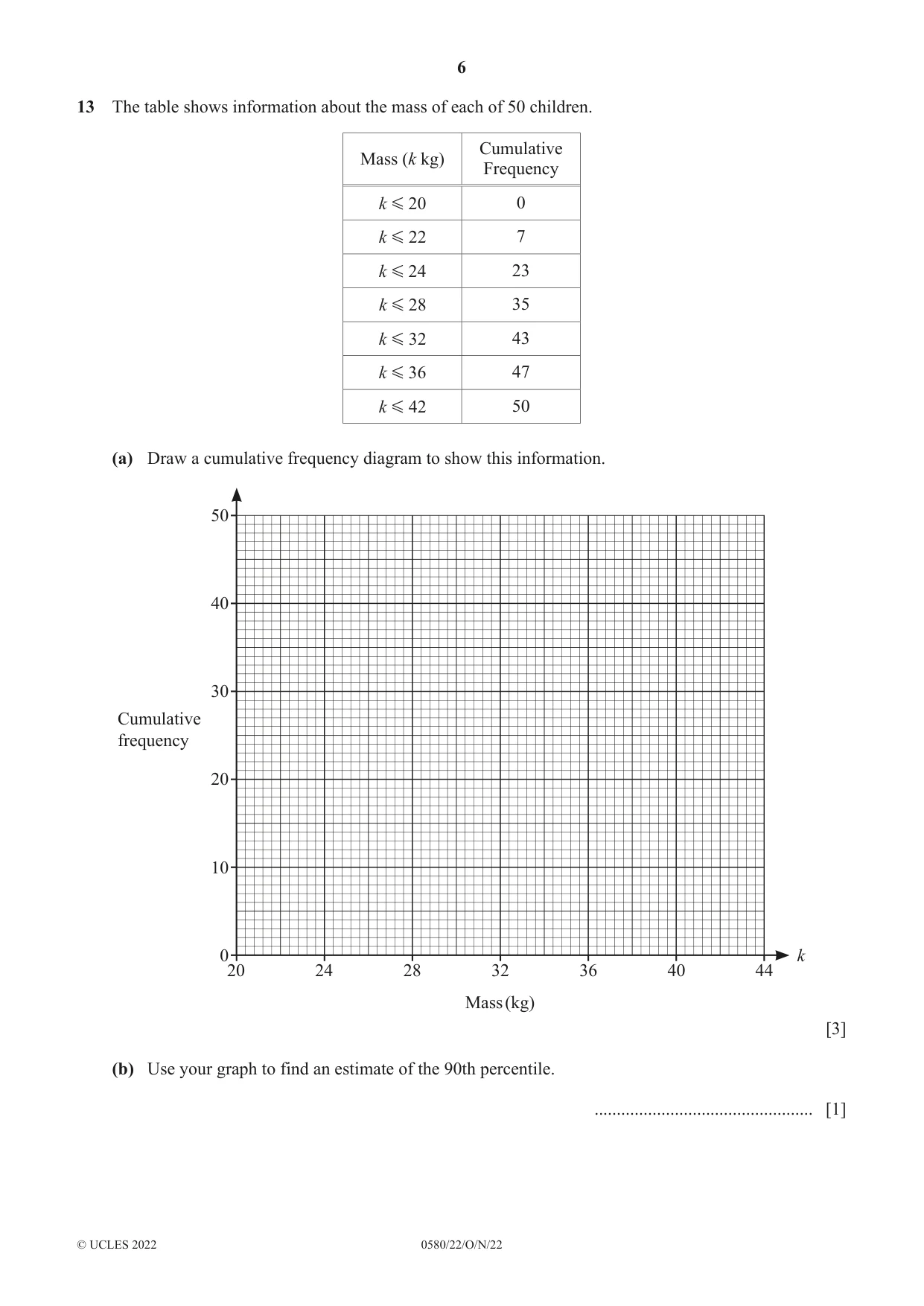
13 The table shows information about the mass of each of 50 children. Cumulative Mass (k kg) Frequency k G 20 0 k G 22 7 k G 24 23 k G 28 35 k G 32 43 k G 36 47 k G 42 50 (a) Draw a cumulative frequency diagram to show this information. 50 40 30 Cumulative frequency 20 10 0 k 20 24 28 32 36 40 44 Mass (kg) [3] (b) Use your graph to find an estimate of the 90th percentile. ................................................. [1]
Mark scheme: 13(a) A correct cumulative frequency diagram 3 B1 for correct horizontal placement for 7 plots B1 for correct vertical placement for 7 plots B1FT dep on at least B1 for reasonable increasing curve or polygon through their 7 points If 0 scored SC1 FT for 6 out of 7 points correctly plotted 13(b) 33 to 34.5 1 FT their increasing cumulative frequency graph
Q14 · 136 girls and 144 boys each measure the distance they jump in centimetres
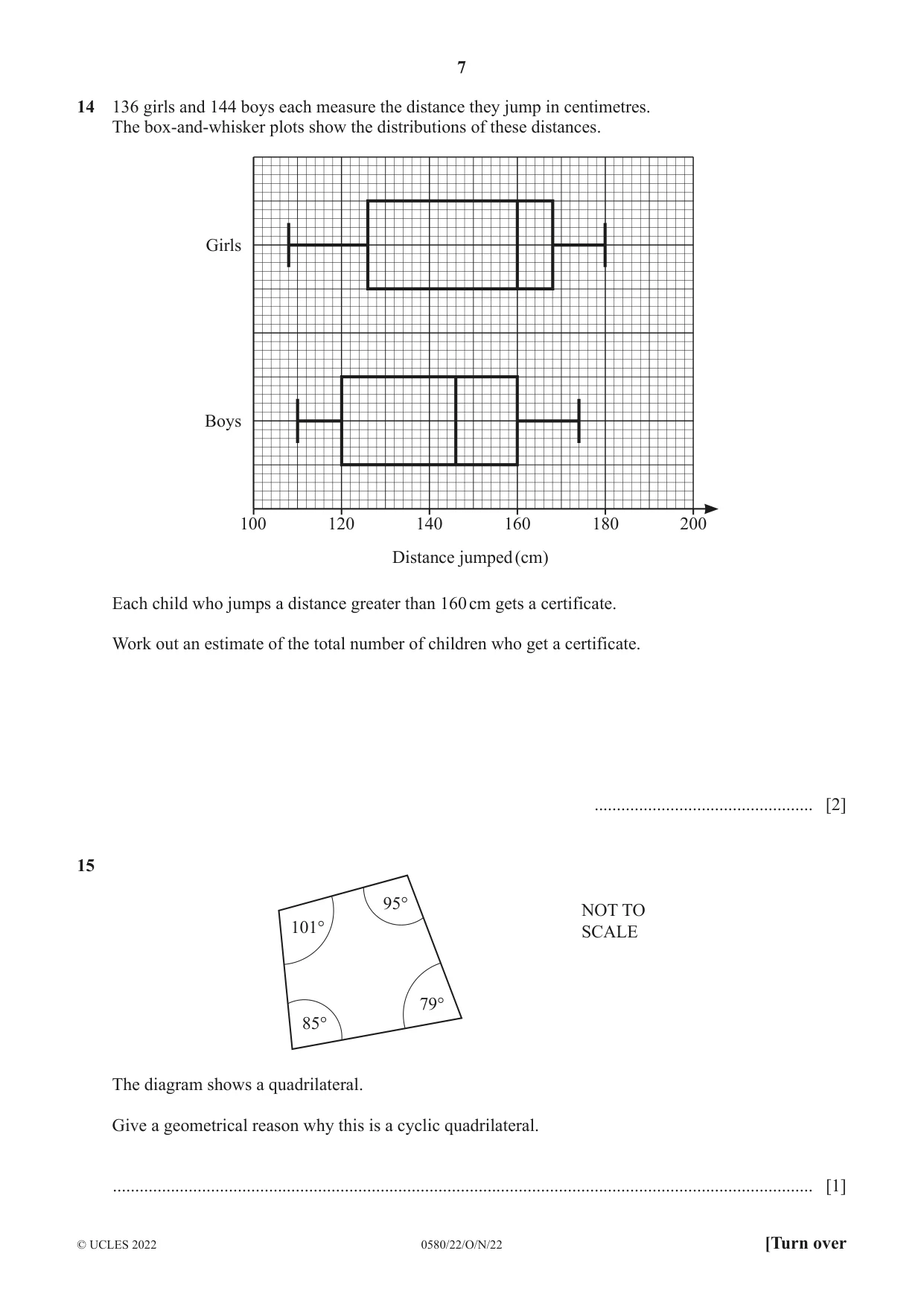
14 136 girls and 144 boys each measure the distance they jump in centimetres. The box-and-whisker plots show the distributions of these distances. Girls Boys 100 120 140 160 180 200 Distance jumped (cm) Each child who jumps a distance greater than 160 cm gets a certificate. Work out an estimate of the total number of children who get a certificate. ................................................. [2]
Mark scheme: 14 104 2 M1 for 0.5 136 oe or 0.25 144 oe
Q15 · 95° NOT TO 101° SCALE 79° 85° The diagram shows a quadrilateral
15 95° NOT TO 101° SCALE 79° 85° The diagram shows a quadrilateral. Give a geometrical reason why this is a cyclic quadrilateral. ............................................................................................................................................................. [1]
Mark scheme: 15 Opposite angles add up to 180 oe 1
Q16 · Shade the region indicated in each Venn diagram
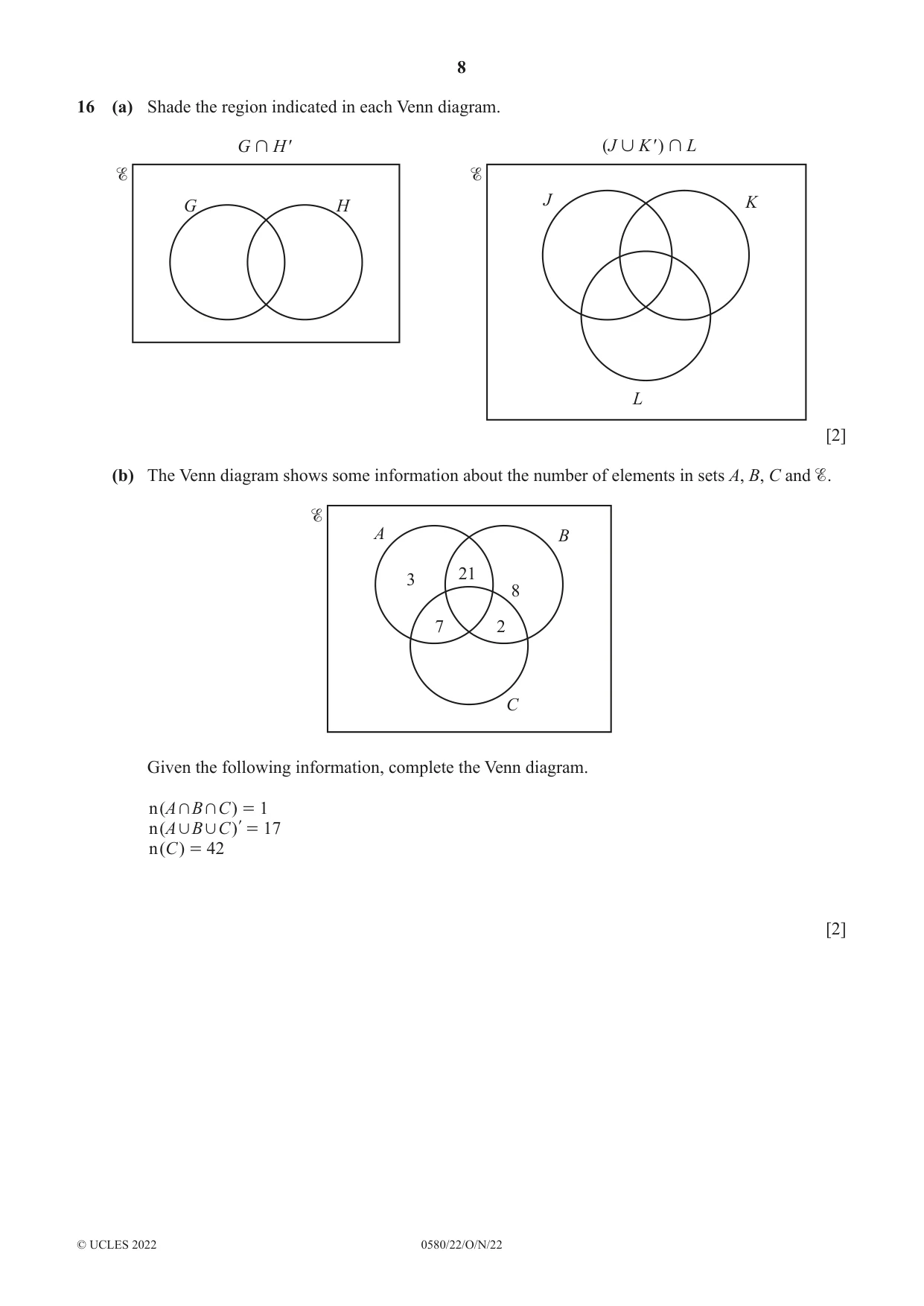
16 (a) Shade the region indicated in each Venn diagram. G ∩ H ′ (J ∪ K ′ ) ∩ L J K G H L [2] (b) The Venn diagram shows some information about the number of elements in sets A, B, C and . A B 21 3 8 7 2 C Given the following information, complete the Venn diagram. n ( A + B + C ) = 1 n ( A , B , C ) l = 17 n ( C ) = 42 [2]
Mark scheme: 16(a) G H 2 B1 for each J K L 16(b) 2 B1 for 2 correct
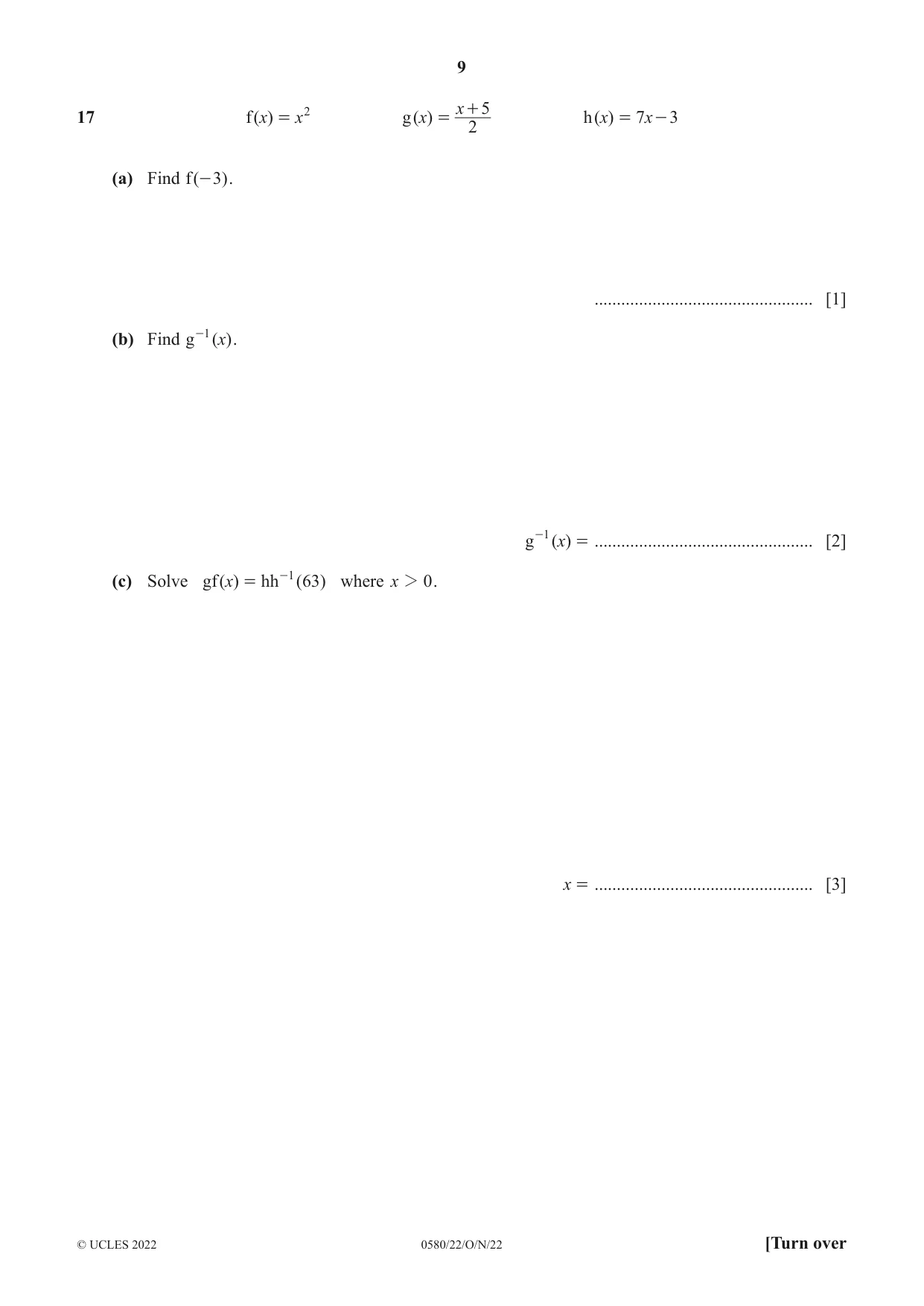
Q17 · X + 517 f ( x) = x2 g ( x) = h ( x) = 7 x - 3 2 (a) Find f ( - 3)
x + 517 f ( x) = x2 g ( x) = h ( x) = 7 x - 3 2 (a) Find f ( - 3) . ................................................. [1] (b) Find g -1 ( x) . g -1 ( x) = ................................................. [2] (c) Solve gf ( x) = hh -1 ( 63) where x 2 0 . x = ................................................. [3]
Mark scheme: 17(a) 9 1 17(b) 2x – 5 final answer 2 M1 for correct first step e.g. y + 5 5 x x = or 2y = x + 5 or y – = or 2 2 2 better 17(c) 11 3 x 2 + 5 M1 for 2 M1 for hh–1(63) = 63 soi
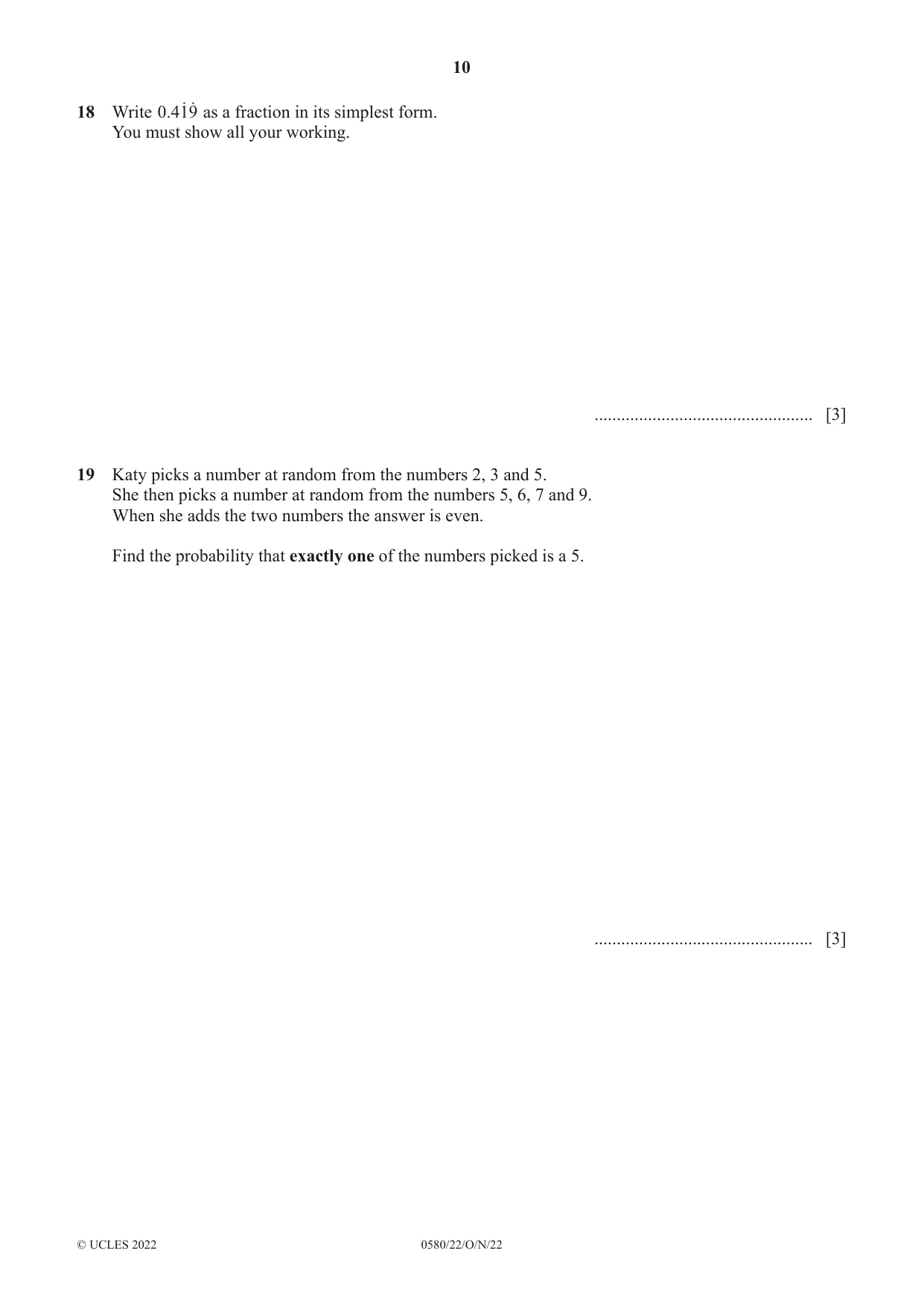
Q18 · Write .0419o o as a fraction in its simplest form
18 Write .0419o o as a fraction in its simplest form. You must show all your working. ................................................. [3]
Mark scheme: 18 419.19 − 4.19 oe M1 83 A2 415 cao Al for oe 198 990 k If M0 scored SC1 for or correct 990 answer with insufficient working
Q19 · Katy picks a number at random from the numbers 2, 3 and 5
19 Katy picks a number at random from the numbers 2, 3 and 5. She then picks a number at random from the numbers 5, 6, 7 and 9. When she adds the two numbers the answer is even. Find the probability that exactly one of the numbers picked is a 5. ................................................. [3]
Mark scheme: 19 3 3 M1 for clearly identifying the 7 even oe outcomes 7 2 6, 3 5, 3 7, 3 9, 5 5, 5 7, 5 9 M1 for clearly identifying the 3 even outcomes with just one five 3 5, 5 7 and 5 9 1 If 0 scored SC1 for answer oe 4
Question 20
20 Simplify fully. 3 (a) ( 81x 16 ) 4 ................................................. [2] 1 1 - 2 (b) 2 e y o ................................................. [1]
Mark scheme: 20(a) 27x12 final answer 2 B1 for kx12 or 27xc final answer or for 27x12 then spoilt 20(b) [±] y 1
Q21 · 12.5 cm NOT TO SCALE 5.5 cm 9.2 cm A solid is made by cutting a small cone from a larger…
21 12.5 cm NOT TO SCALE 5.5 cm 9.2 cm A solid is made by cutting a small cone from a larger cone, as shown in the diagram. The height of the larger cone is 12.5 cm. The height of the solid is 5.5 cm. The diameter of the base of the larger cone is 9.2 cm. Work out the volume of the solid. 1 2 [The volume, V, of a cone with radius r and height h is V = rr h .] 3 .......................................... cm3 [4] Questions 22 and 23 are printed on the next page.
Mark scheme: 21 228 or 228.3 to 228.4 4 2 1 9.2 M1 for π 12.5 oe 3 2 9.2 diameter M1 for = oe or better 12.5 12.5 − 5.5 1 their 5.152 2 M1 for π (12.5 − 5.5 ) 3 2 oe OR M2 for π 9.2 2 π 2 12.5 − r (12.5 − 5.5 ) oe 3 2 3 for any r < 4.6 If 0 scored SC1 for 913 or 913.3 to 913.5
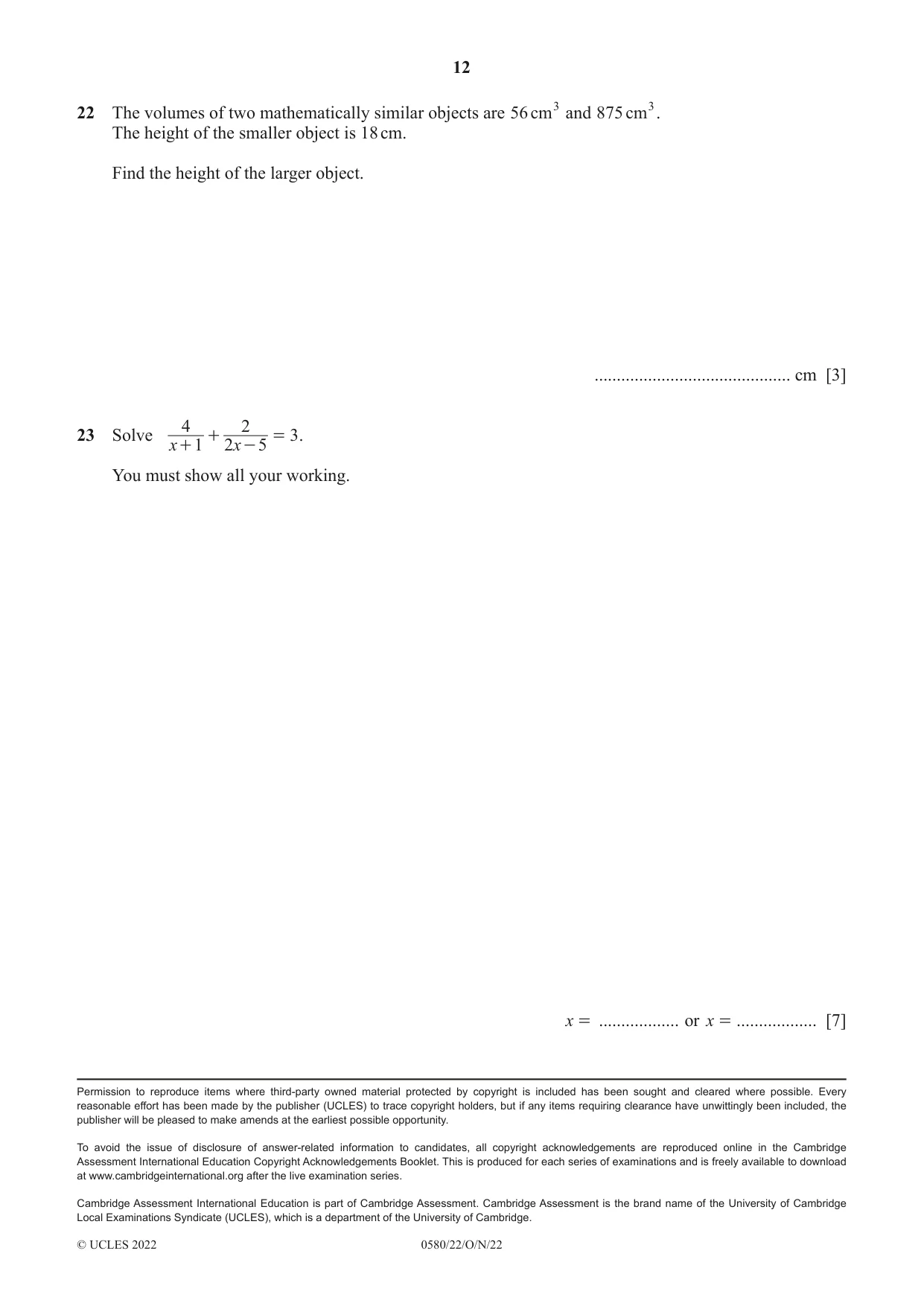
Q22 · The volumes of two mathematically similar objects are 56 cm 3 and 875 cm 3
22 The volumes of two mathematically similar objects are 56 cm 3 and 875 cm 3. The height of the smaller object is 18 cm. Find the height of the larger object. ............................................ cm [3]
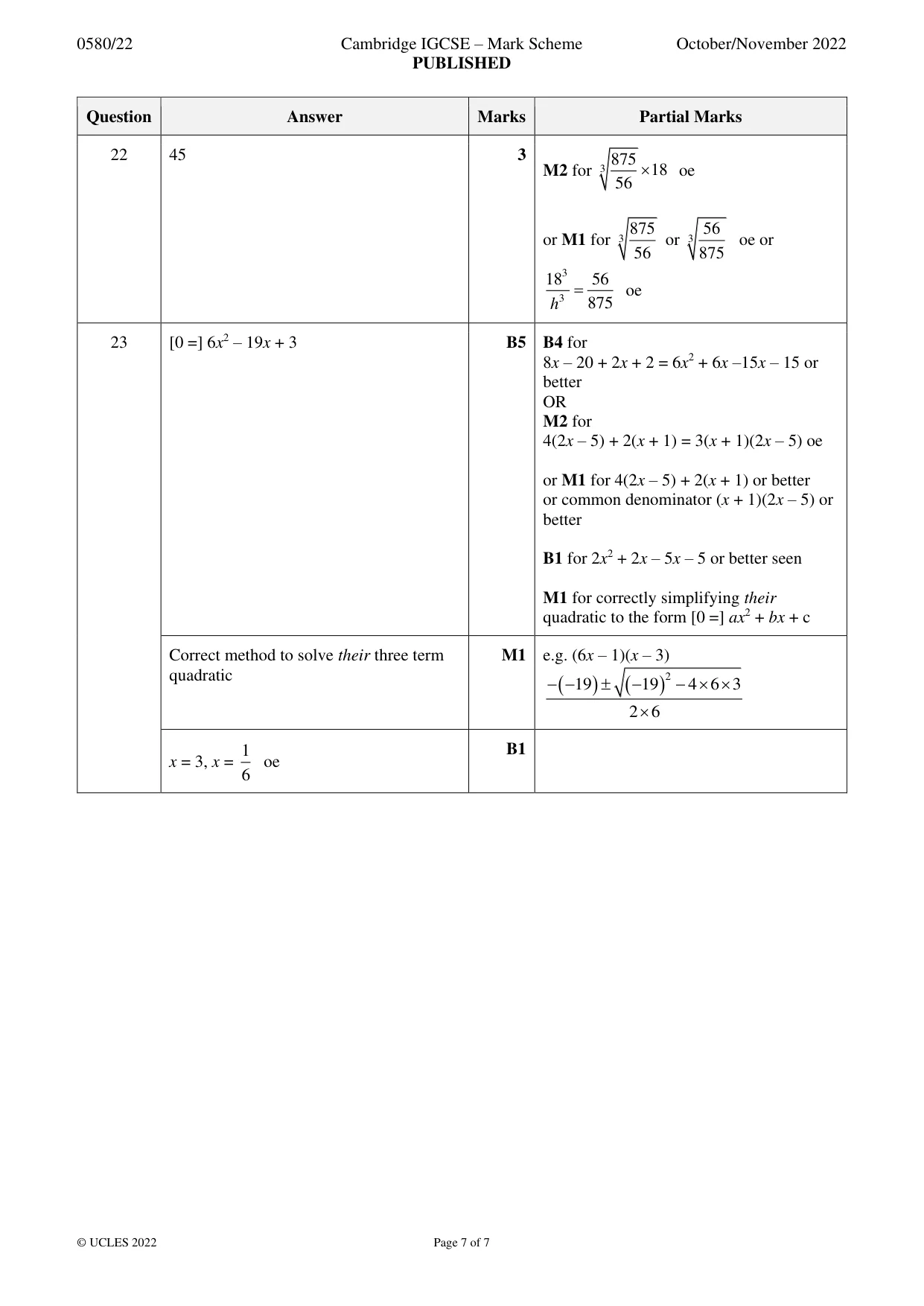
Mark scheme: 22 45 3 875 M2 for 3 18 oe 56 875 56 or M1 for 3 or 3 oe or 56 875 183 56 = oe h 3 875
Q23 · 223 Solve + = 3
4 223 Solve + = 3 . x + 1 2x - 5 You must show all your working. x = .................. or x = .................. [7]
Mark scheme: 23 [0 =] 6x2 – 19x + 3 B5 B4 for 8x – 20 + 2x + 2 = 6x2 + 6x –15x – 15 or better OR M2 for 4(2x – 5) + 2(x + 1) = 3(x + 1)(2x – 5) oe or M1 for 4(2x – 5) + 2(x + 1) or better or common denominator (x + 1)(2x – 5) or better B1 for 2x2 + 2x – 5x – 5 or better seen M1 for correctly simplifying their quadratic to the form [0 =] ax2 + bx + c Correct method to solve their three term M1 e.g. (6x – 1)(x – 3) quadratic 2 −−( 19 ) ( −19 ) −4 6 3 2 6 1 B1 x = 3, x = oe 6
What was in this paper
The subtopics covered by these 23 questions, and how many questions each got. Open one in a new tab to see every Cambridge question on it.
3Algebraic manipulation2Equations2Fractions, decimals and percentages2Similarity2Angles1Averages and measures of spread1Circle theorems I1Functions1Interpreting statistical data1Introduction to probability1Ratio and proportion1Sequences1Sets1Statistical charts and diagrams1Surface area and volume1Using a calculator1What you needed in this session
Cambridge’s own grade thresholds for 2022 Oct/Nov, Paper 2 · Variant 2. A higher threshold means an easier paper — the bar moves with how the cohort did.