Cambridge IGCSE Mathematics 0580 — 2025 Feb/March Paper 2 · Variant 2
0580/22/F/M/25 · 23 questions · 100 marks · 120 min
The question paper and its mark scheme, free to read here and free to download. This is Cambridge’s own paper, exactly as it was sat.
Question paper20 pages
Mark scheme13 pages
Answers below. Sit the paper first if you are practising.
Questions as text
Q1 · Oranges cost 220 rupees per kilogram
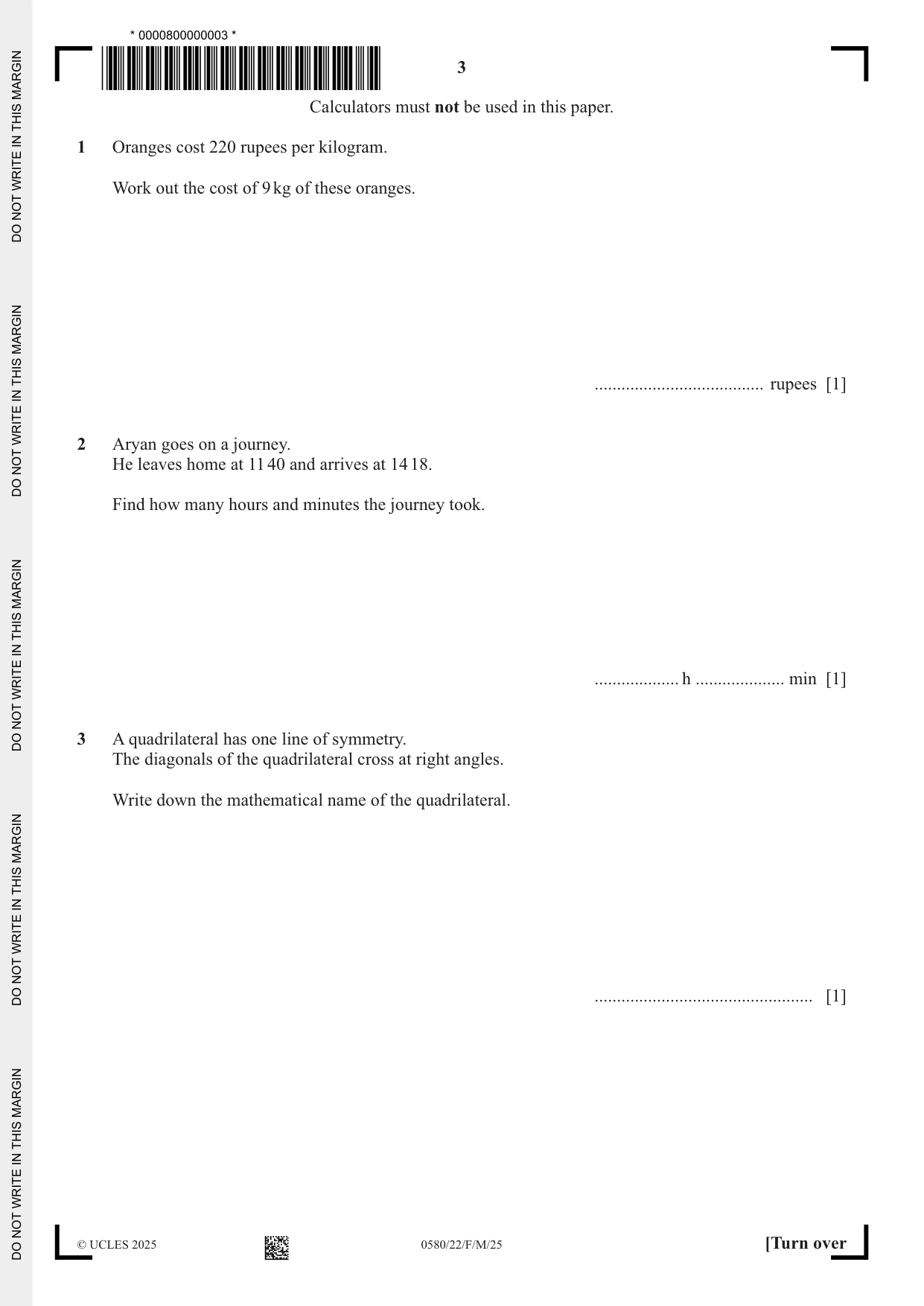
1 Oranges cost 220 rupees per kilogram. Work out the cost of 9 kg of these oranges. ...................................... rupees [1]
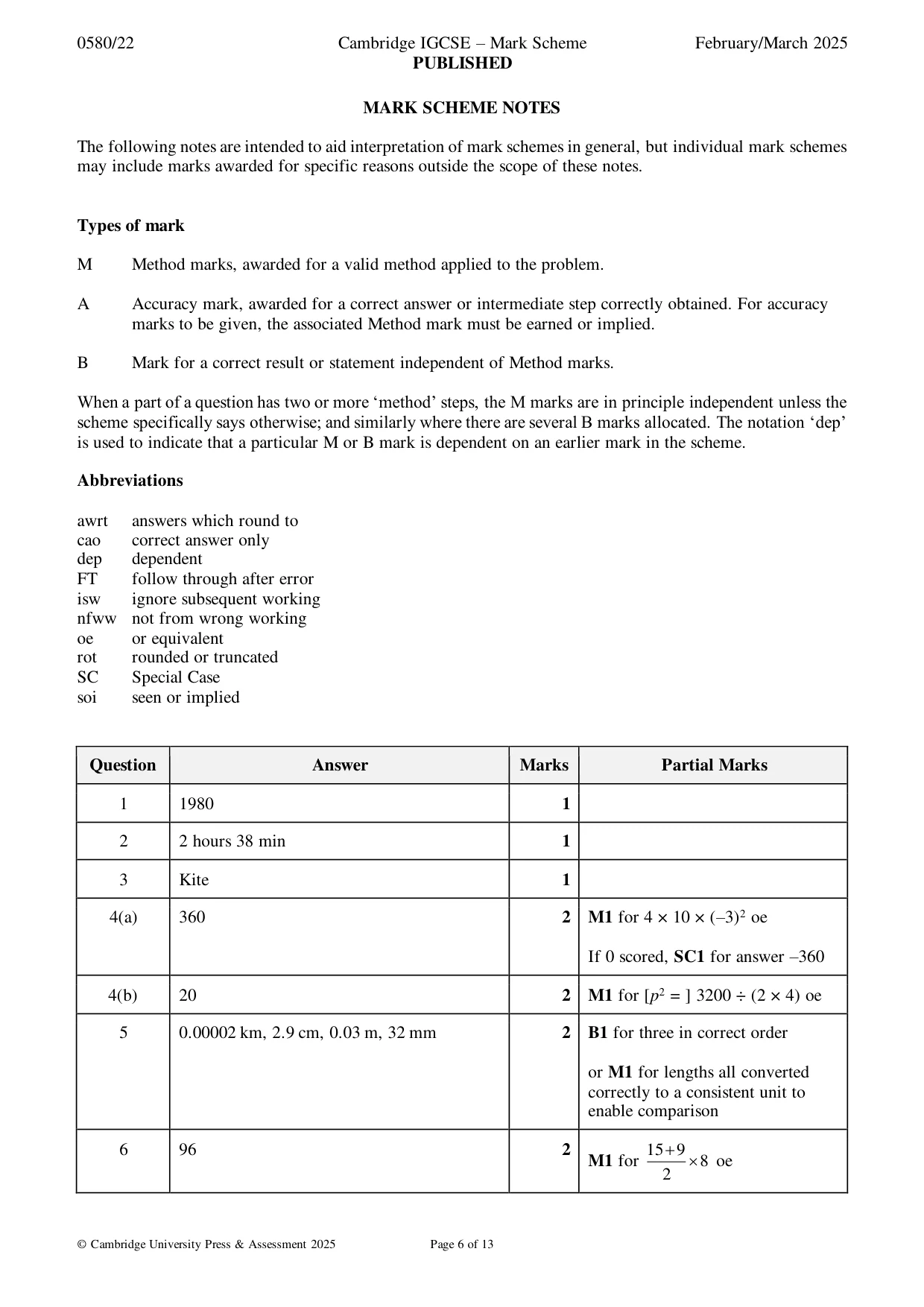
Mark scheme: Question Answer Marks Partial Marks 1 1980 1
Q2 · Aryan goes on a journey
2 Aryan goes on a journey. He leaves home at 11 40 and arrives at 14 18. Find how many hours and minutes the journey took. ................... h .................... min [1]
Mark scheme: 2 2 hours 38 min 1
Q3 · A quadrilateral has one line of symmetry
3 A quadrilateral has one line of symmetry. The diagonals of the quadrilateral cross at right angles. Write down the mathematical name of the quadrilateral. ................................................. [1]
Mark scheme: 3 Kite 1
Q4 · V = 4 mp 2 (a) Find V when m = 10 and p =- 3
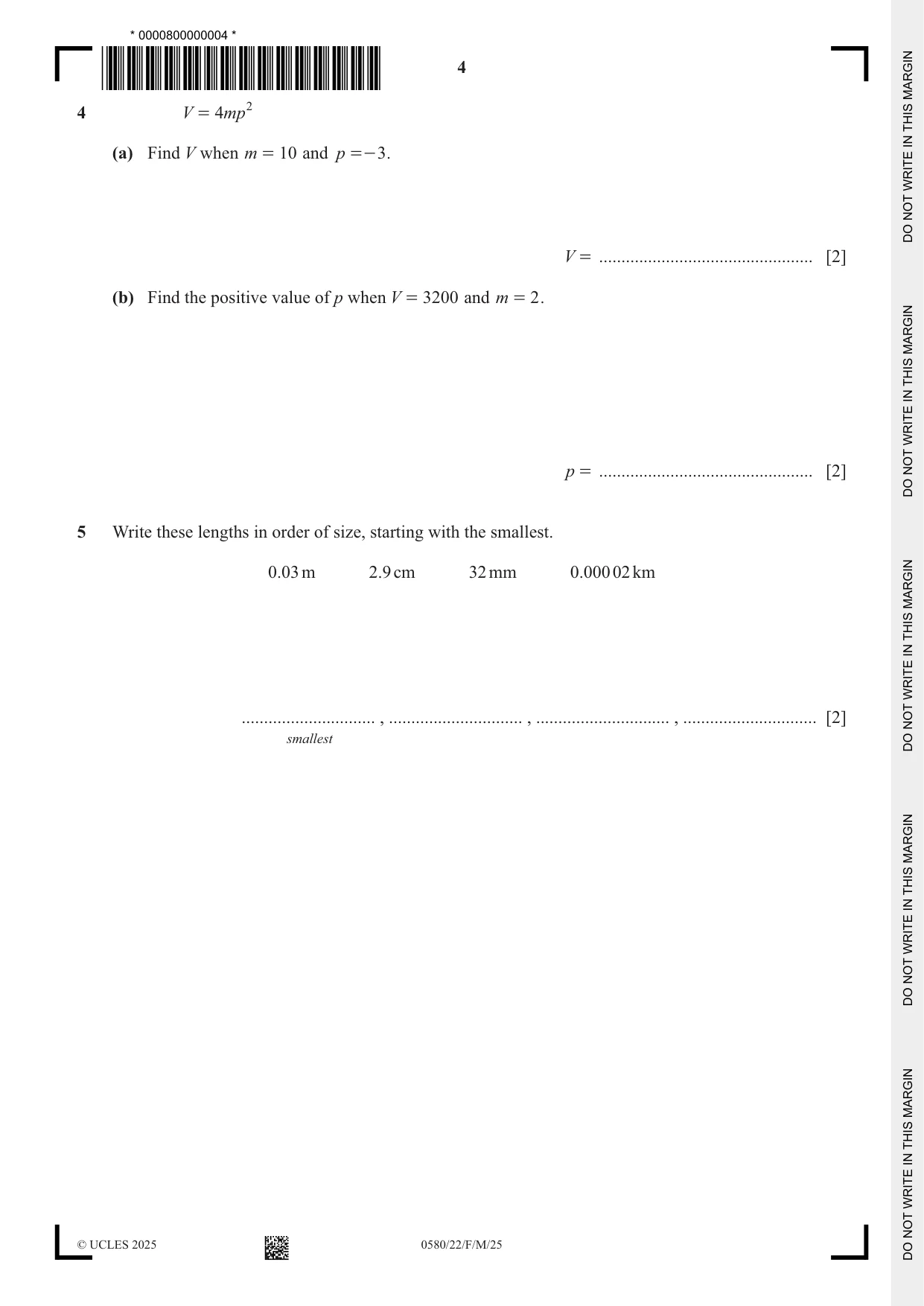
4 V = 4 mp 2 (a) Find V when m = 10 and p =- 3 . V = ................................................ [2] (b) Find the positive value of p when V = 3200 and m = 2 . p = ................................................ [2]
Mark scheme: 4(a) 360 2 M1 for 4 × 10 × (–3)2 oe If 0 scored, SC1 for answer –360 4(b) 20 2 M1 for [p2 = ] 3200 ÷ (2 × 4) oe
Q5 · Write these lengths in order of size, starting with the smallest
5 Write these lengths in order of size, starting with the smallest. 0.03 m 2.9 cm 32 mm 0.000 02 km .............................. , .............................. , .............................. , .............................. [2] smallest
Mark scheme: 5 0.00002 km, 2.9 cm, 0.03 m, 32 mm 2 B1 for three in correct order or M1 for lengths all converted correctly to a consistent unit to enable comparison
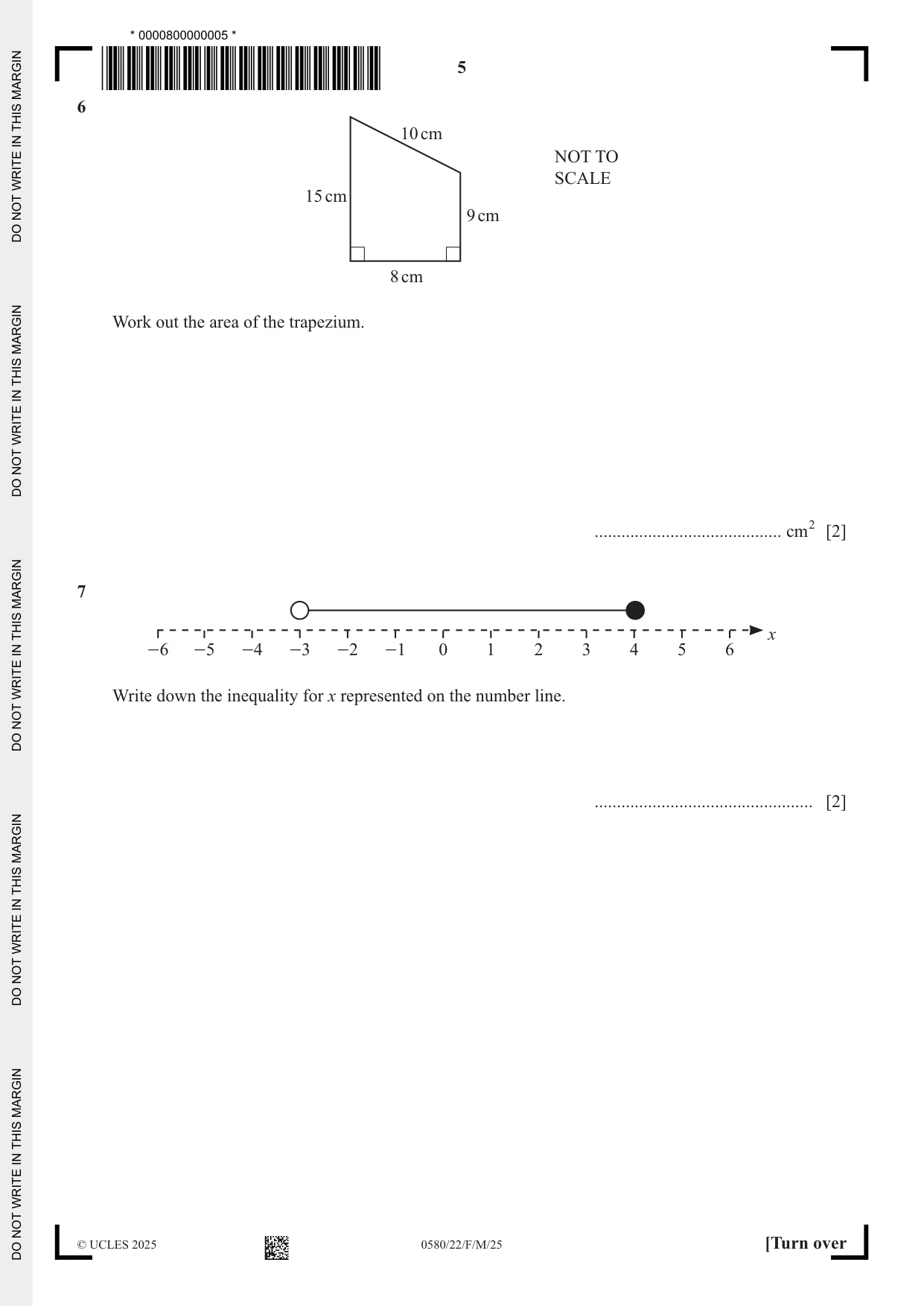
Q6 · 10 cm NOT TO SCALE 15 cm 9 cm 8 cm Work out the area of the trapezium
6 10 cm NOT TO SCALE 15 cm 9 cm 8 cm Work out the area of the trapezium. .......................................... cm2 [2]
Mark scheme: 6 96 2 15 + 9 M1 for 8 oe 2
Q7 · X -6 -5 -4 -3 -2 -1 0 1 2 3 4 5 6 Write down the inequality for x represented on the…
7 x -6 -5 -4 -3 -2 -1 0 1 2 3 4 5 6 Write down the inequality for x represented on the number line. ................................................. [2]
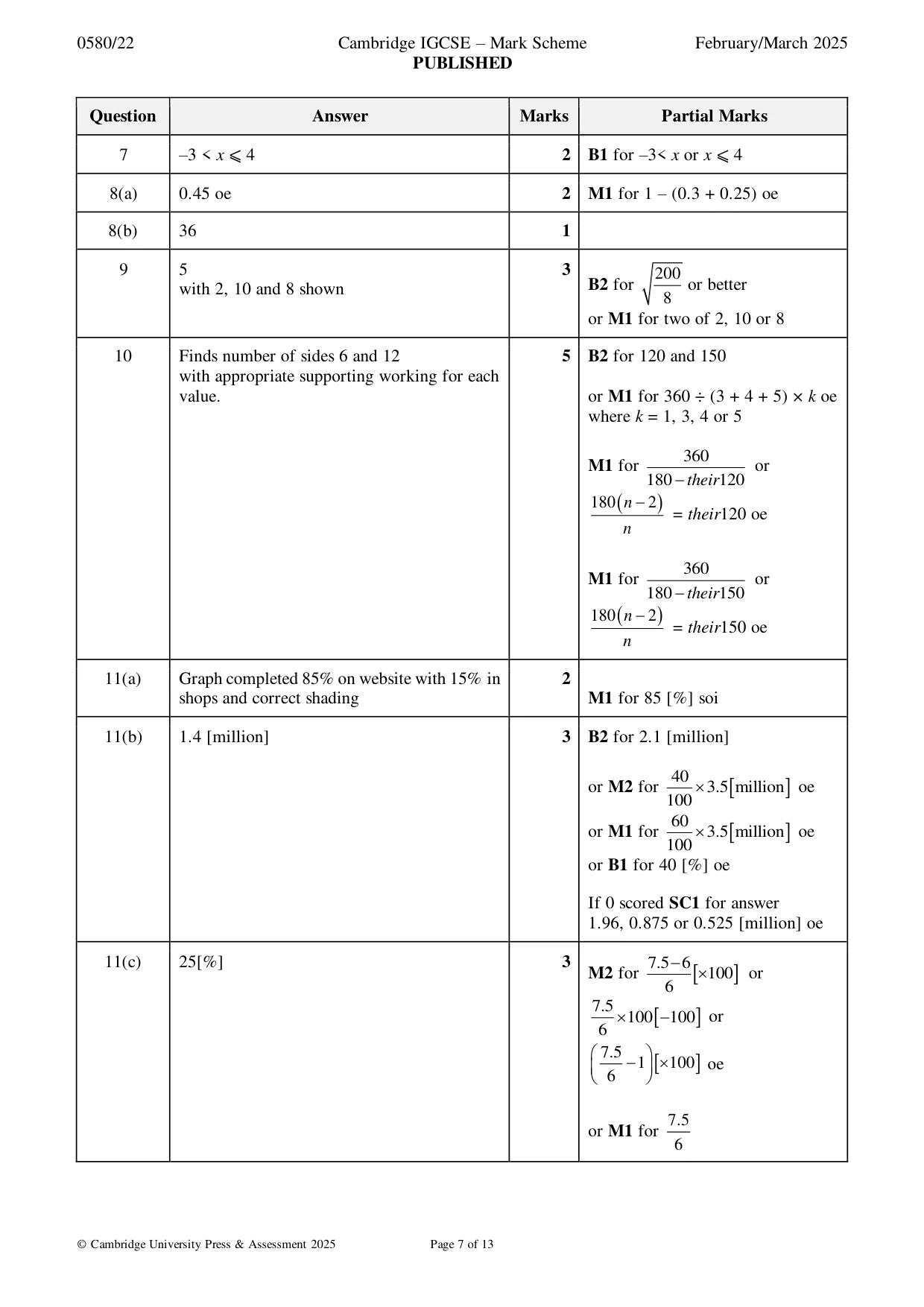
Mark scheme: 7 –3 < x ⩽ 4 2 B1 for –3< x or x ⩽ 4
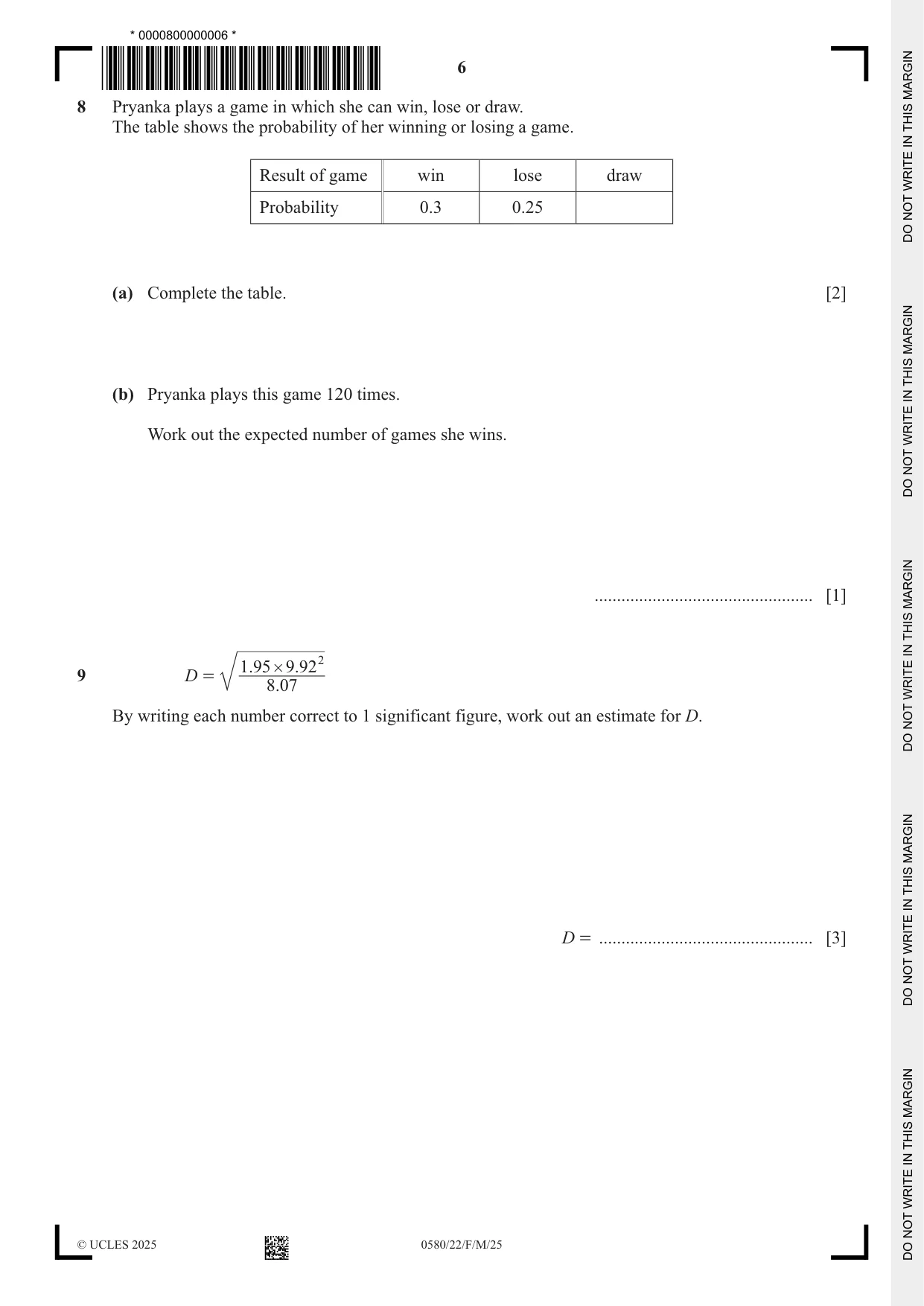
Q8 · Pryanka plays a game in which she can win, lose or draw
8 Pryanka plays a game in which she can win, lose or draw. The table shows the probability of her winning or losing a game. Result of game win lose draw Probability 0.3 0.25 (a) Complete the table. [2] (b) Pryanka plays this game 120 times. Work out the expected number of games she wins. ................................................. [1]
Mark scheme: 8(a) 0.45 oe 2 M1 for 1 – (0.3 + 0.25) oe 8(b) 36 1
Question 9
1. 95 # 9. 922 9 D = 8.07 By writing each number correct to 1 significant figure, work out an estimate for D. D = ................................................ [3]
Mark scheme: 9 5 3 200 B2 for or better with 2, 10 and 8 shown 8 or M1 for two of 2, 10 or 8
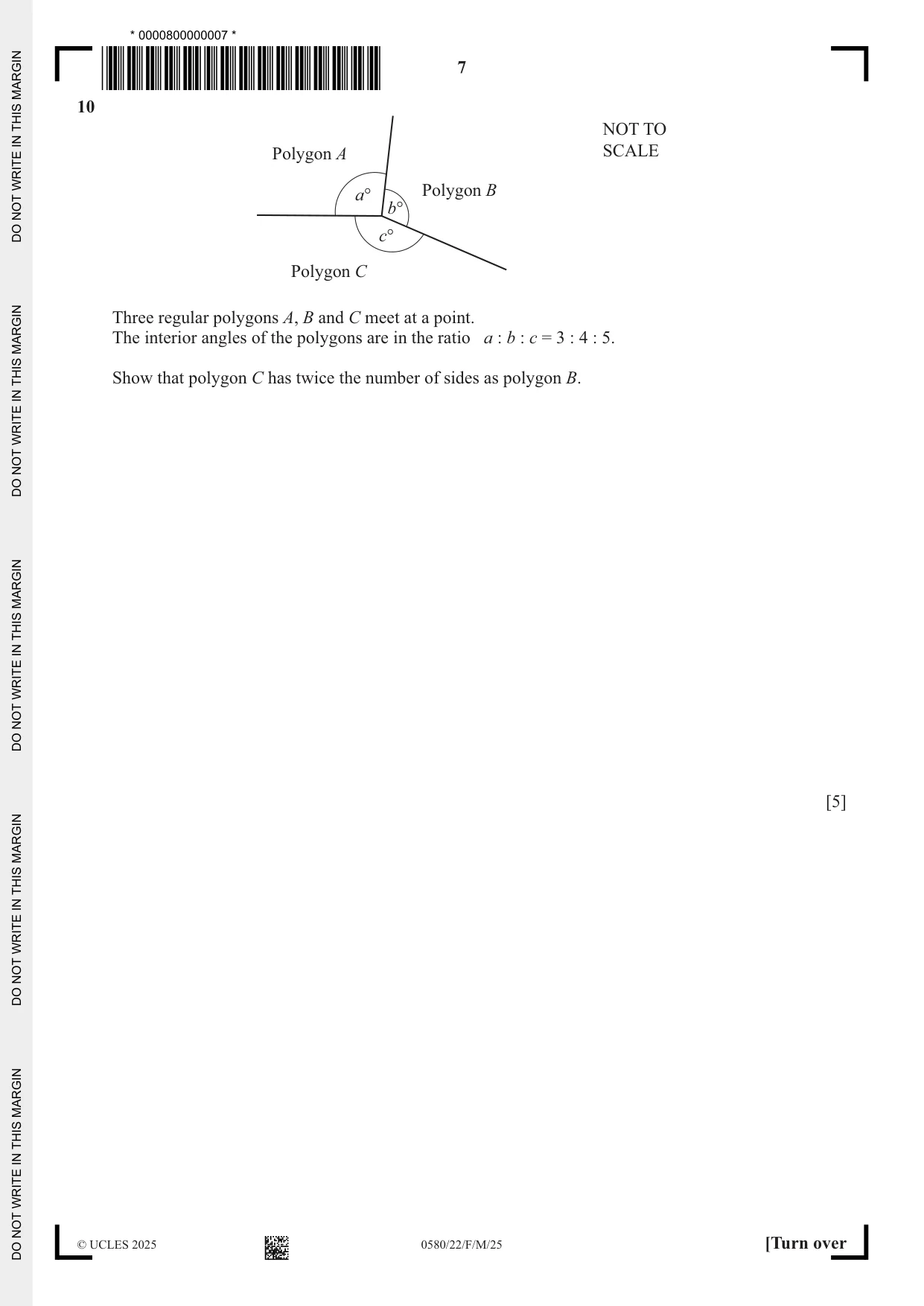
Q10 · NOT TO Polygon A SCALE a° Polygon B b° c° Polygon C Three regular polygons A, B and C…
10 NOT TO Polygon A SCALE a° Polygon B b° c° Polygon C Three regular polygons A, B and C meet at a point. The interior angles of the polygons are in the ratio a : b : c = 3 : 4 : 5. Show that polygon C has twice the number of sides as polygon B. [5]
Mark scheme: 10 Finds number of sides 6 and 12 5 B2 for 120 and 150 with appropriate supporting working for each value. or M1 for 360 ÷ (3 + 4 + 5) × k oe where k = 1, 3, 4 or 5 360 M1 for or 180 −their120 180 ( n − 2 ) = their120 oe n 360 M1 for or 180 −their150 180 ( n − 2 ) = their150 oe n
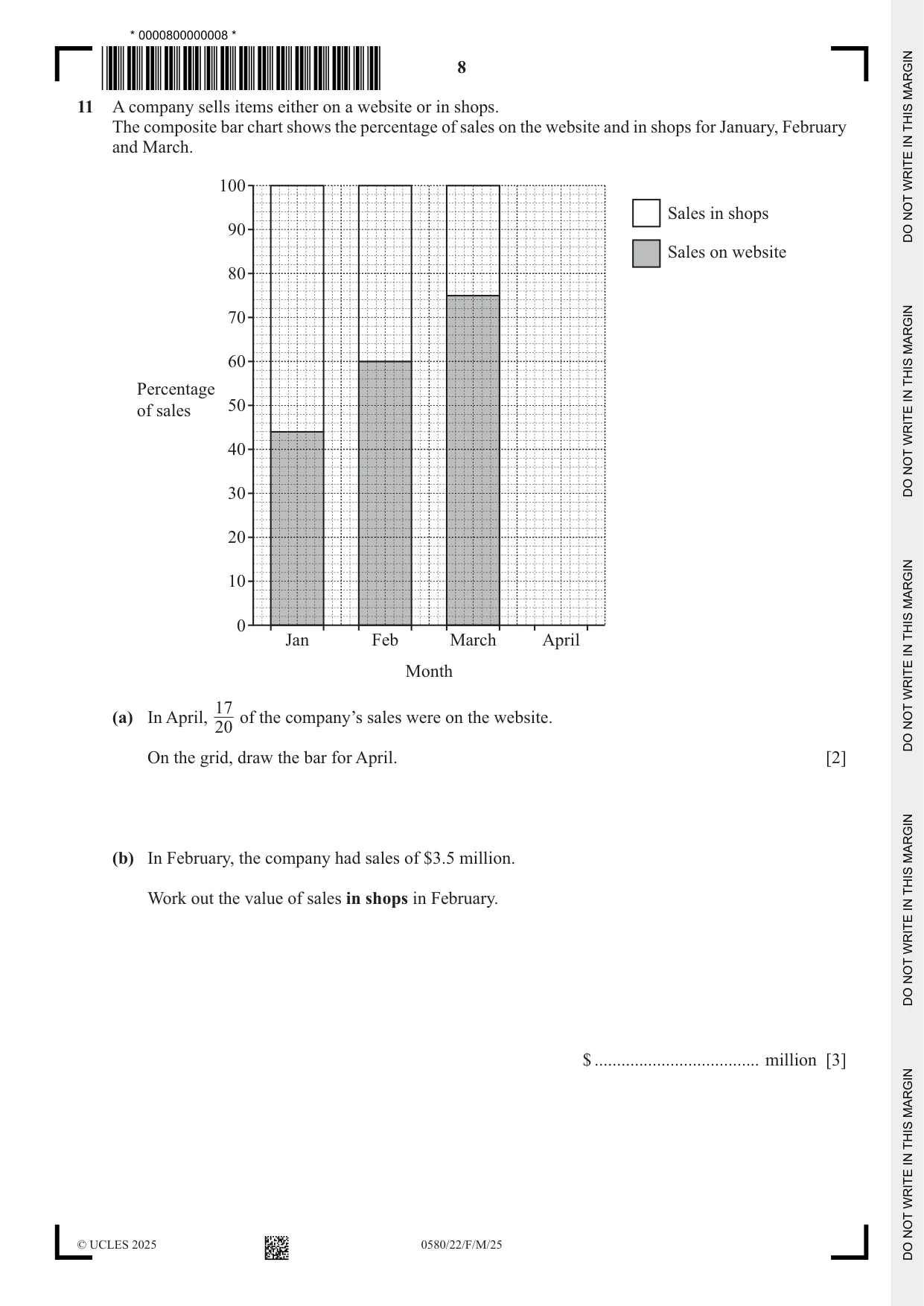
Q11 · A company sells items either on a website or in shops
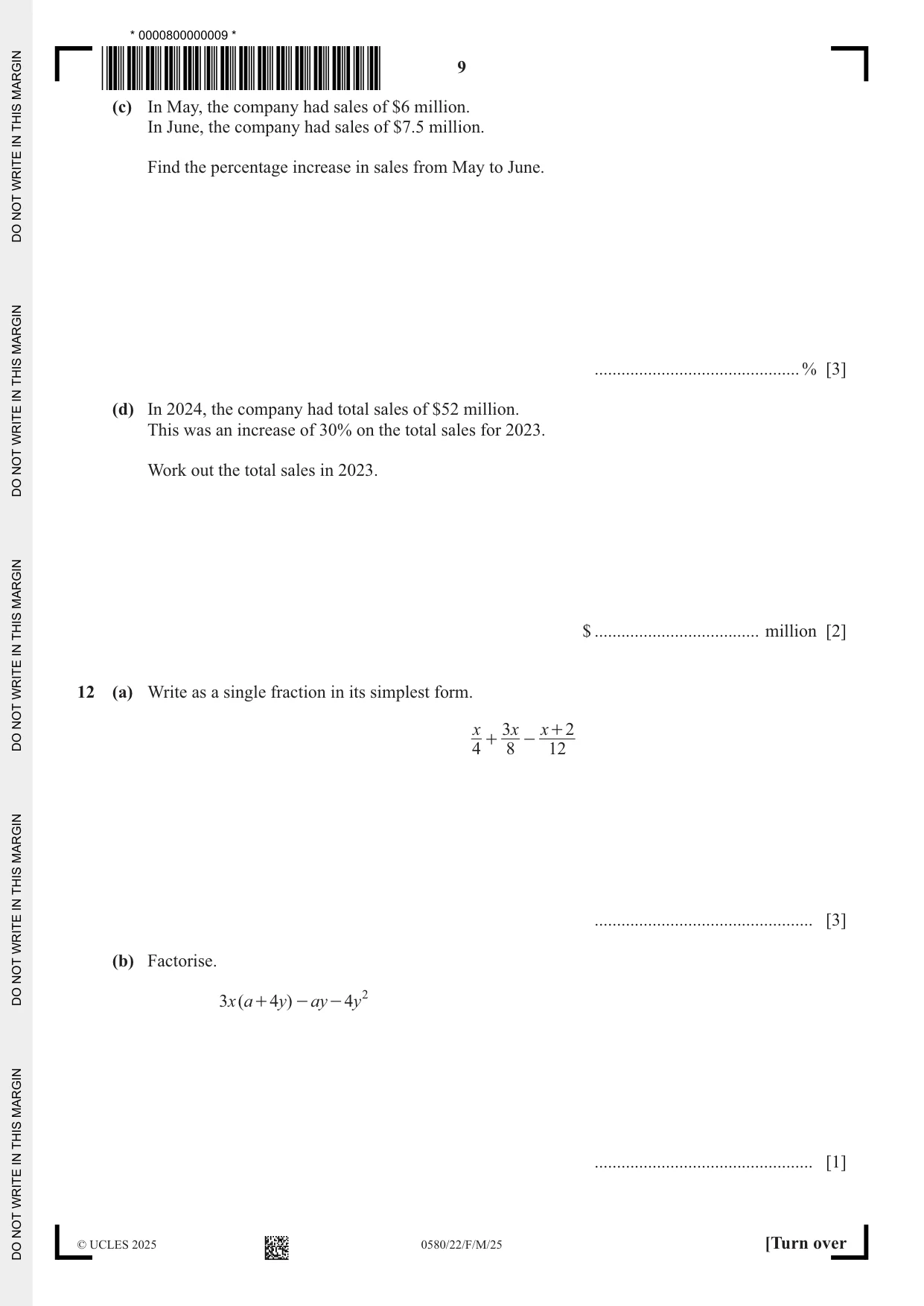
11 A company sells items either on a website or in shops. The composite bar chart shows the percentage of sales on the website and in shops for January, February and March. 100 Sales in shops 90 Sales on website 80 70 60 Percentage 50 of sales 40 30 20 10 0 Jan Feb March April Month 17 (a) In April, of the company’s sales were on the website. 20 On the grid, draw the bar for April. [2] (b) In February, the company had sales of $3.5 million. Work out the value of sales in shops in February. $ ..................................... million [3] (c) In May, the company had sales of $6 million. In June, the company had sales of $7.5 million. Find the percentage increase in sales from May to June. ..............................................% [3] (d) In 2024, the company had total sales of $52 million. This was an increase of 30% on the total sales for 2023. Work out the total sales in 2023. $ ..................................... million [2]
Mark scheme: 11(a) Graph completed 85% on website with 15% in 2 shops and correct shading M1 for 85 [%] soi 11(b) 1.4 [million] 3 B2 for 2.1 [million] 40 or M2 for 3.5 million oe 100 60 or M1 for 3.5 million oe 100 or B1 for 40 [%] oe If 0 scored SC1 for answer 1.96, 0.875 or 0.525 [million] oe 11(c) 25[%] 3 7.5 − 6 M2 for 100 or 6 7.5 100 −100 or 6 7.5 − 1 100 oe 6 7.5 or M1 for 6 11(d) 40 [million] 2 30 M1 for 1 + k = 52 million oe 100
Q12 · Write as a single fraction in its simplest form
12 (a) Write as a single fraction in its simplest form. x 3 x x + 2 + - 4 8 12 ................................................. [3] (b) Factorise. 3 x ( a + 4y) - ay - 4y 2 ................................................. [1]
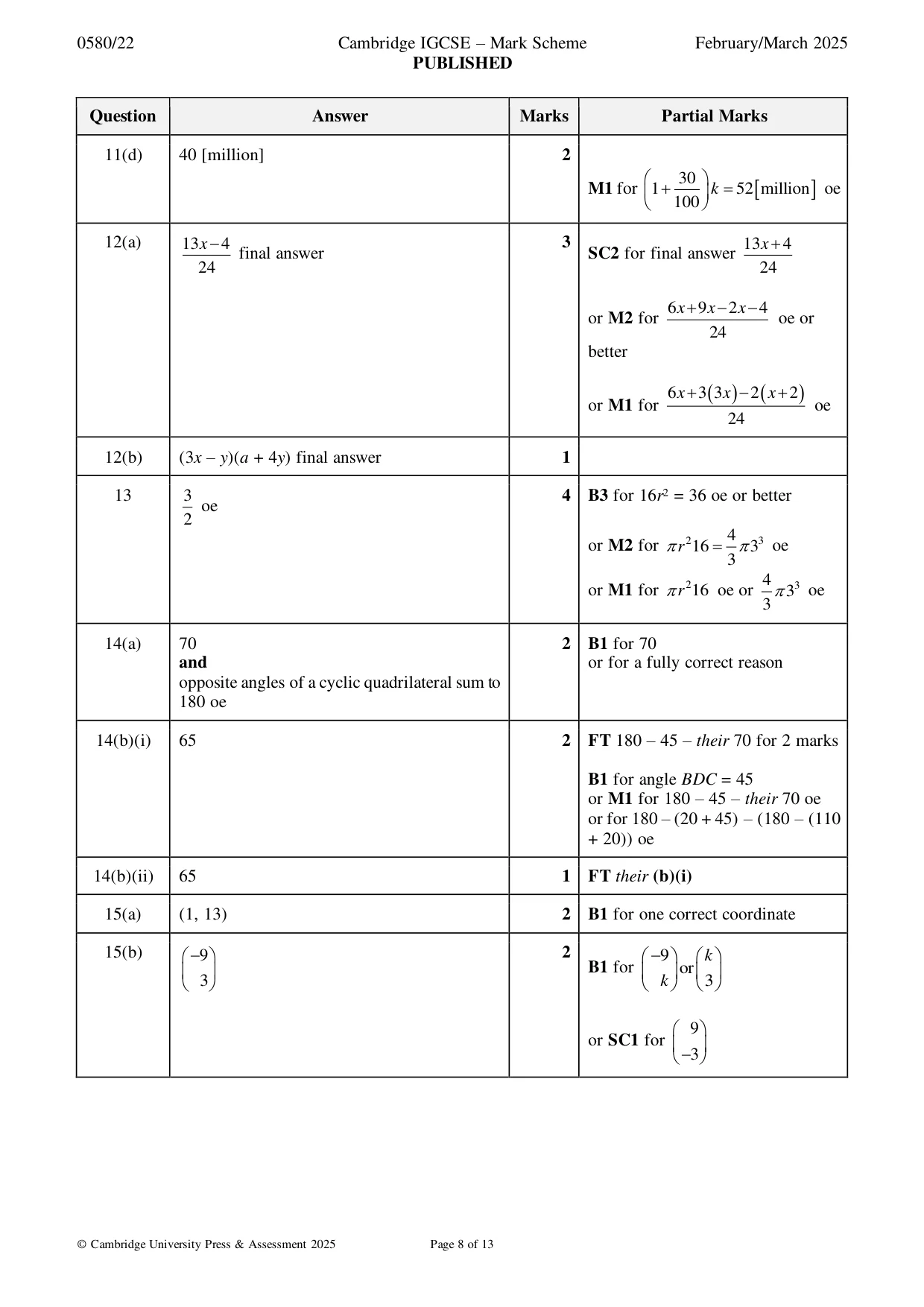
Mark scheme: 12(a) 13 x − 4 3 13 x + 4 final answer SC2 for final answer 24 24 6 x + 9 x − 2 x − 4 or M2 for oe or 24 better 6 x + 3 ( 3 x ) − 2 ( x + 2 ) or M1 for oe 24 12(b) (3x – y)(a + 4y) final answer 1
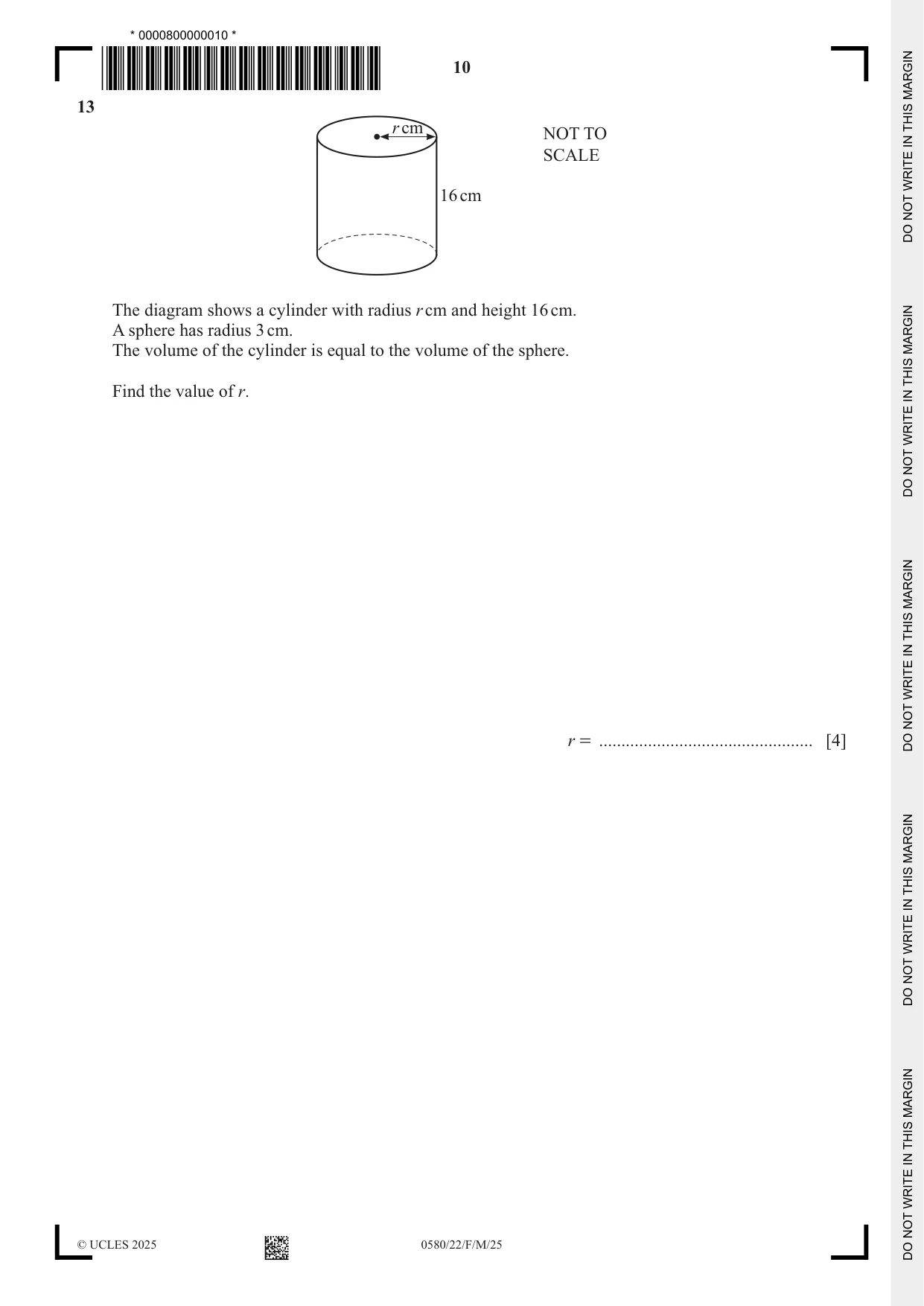
Q13 · R cm NOT TO SCALE 16 cm The diagram shows a cylinder with radius r cm and height 16 cm
13 r cm NOT TO SCALE 16 cm The diagram shows a cylinder with radius r cm and height 16 cm. A sphere has radius 3 cm. The volume of the cylinder is equal to the volume of the sphere. Find the value of r. r = ................................................ [4]
Mark scheme: 13 3 4 B3 for 16r2 = 36 oe or better oe 2 2 4 3 or M2 for r 16 = 3 oe 3 4 3 or M1 for r 216 oe or 33 oe
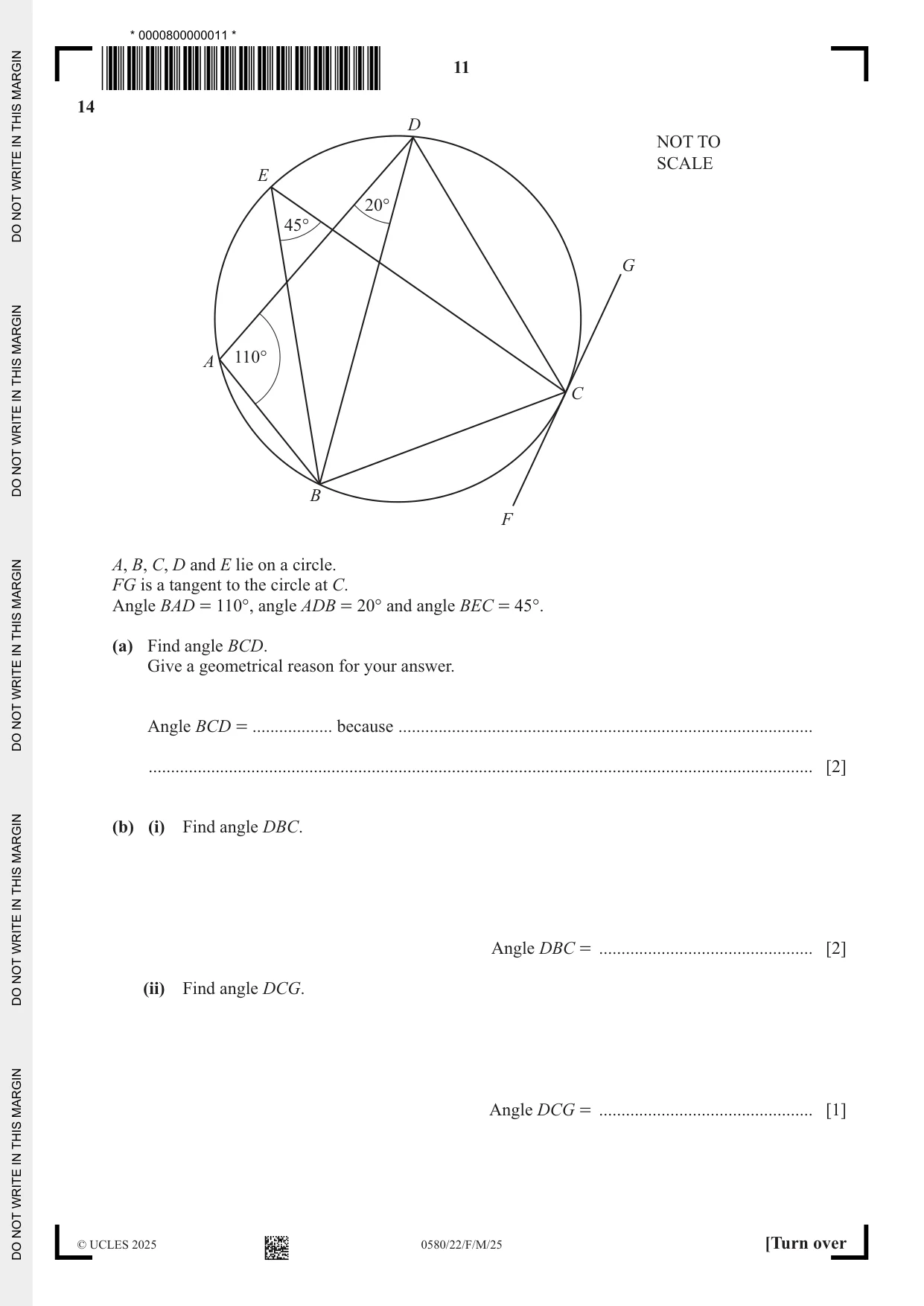
Q14 · D NOT TO SCALE E 20° 45° G A 110° C B F A, B, C, D and E lie on a circle
14 D NOT TO SCALE E 20° 45° G A 110° C B F A, B, C, D and E lie on a circle. FG is a tangent to the circle at C. Angle BAD = 110°, angle ADB = 20° and angle BEC = 45°. (a) Find angle BCD. Give a geometrical reason for your answer. Angle BCD = .................. because ............................................................................................. ..................................................................................................................................................... [2] (b) (i) Find angle DBC. Angle DBC = ................................................ [2] (ii) Find angle DCG. Angle DCG = ................................................ [1]
Mark scheme: 14(a) 70 2 B1 for 70 and or for a fully correct reason opposite angles of a cyclic quadrilateral sum to 180 oe 14(b)(i) 65 2 FT 180 – 45 – their 70 for 2 marks B1 for angle BDC = 45 or M1 for 180 – 45 – their 70 oe or for 180 – (20 + 45) – (180 – (110 + 20)) oe 14(b)(ii) 65 1 FT their (b)(i)
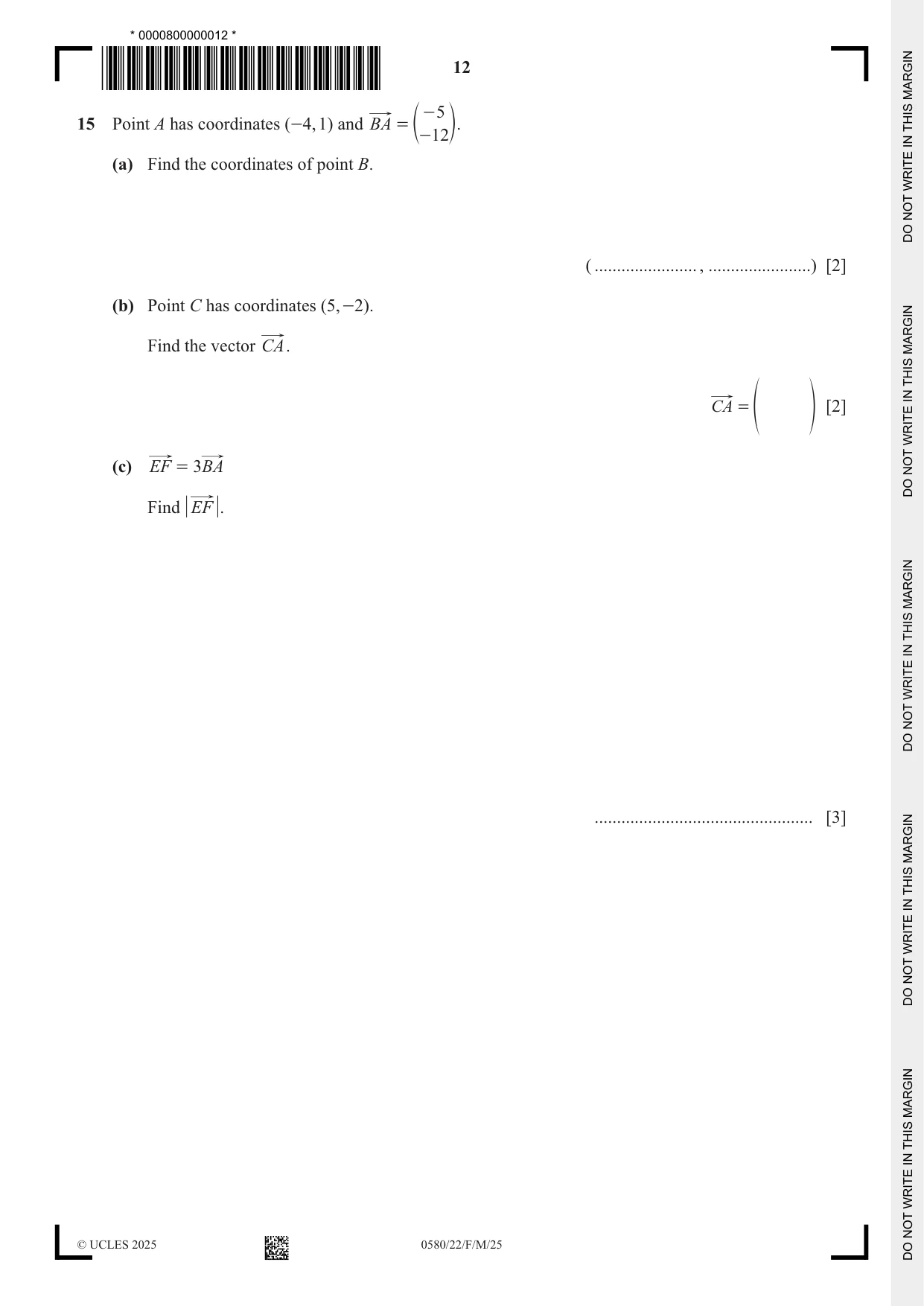
Q15 · - 5 15 Point A has coordinates (-4, 1) and BA = e o
- 5 15 Point A has coordinates (-4, 1) and BA = e o. -12 (a) Find the coordinates of point B. ( ......................., .......................) [2] (b) Point C has coordinates (5, -2). Find the vector CA . C A = f p [2] (c) EF = 3BA Find EF . ................................................. [3]
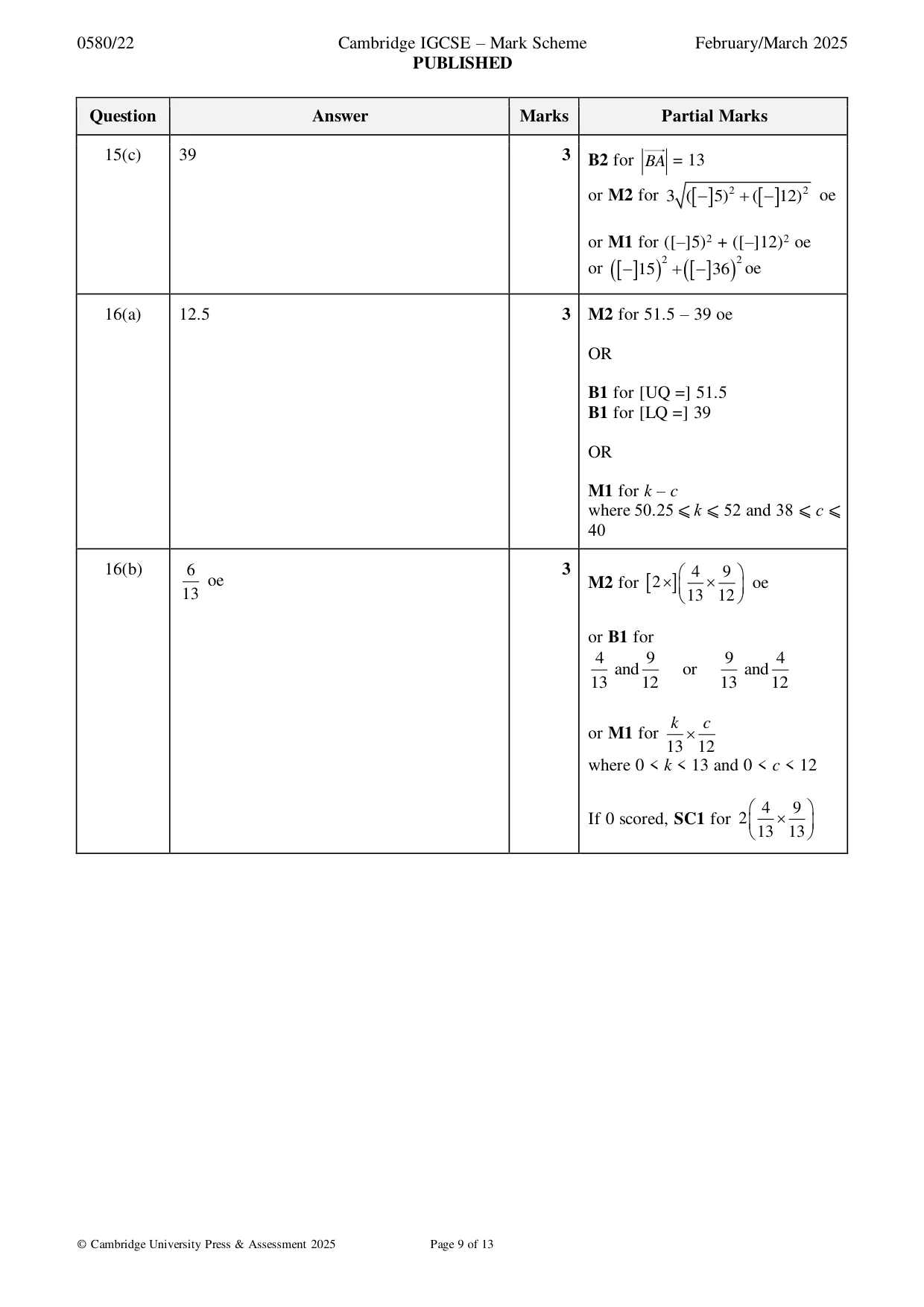
Mark scheme: 15(a) (1, 13) 2 B1 for one correct coordinate 15(b) −9 2 −9 k B1 for or 3 k 3 9 or SC1 for −3 15(c) 39 3 B2 for BA = 13 or M2 for 3 (− 5) 2 + (− 12) 2 oe or M1 for ([–]5)2 + ([–]12)2 oe or ( − 15 ) 2 + ( − 36 ) 2 oe
Q16 · The stem-and-leaf diagram shows the mass of each of 13 packets
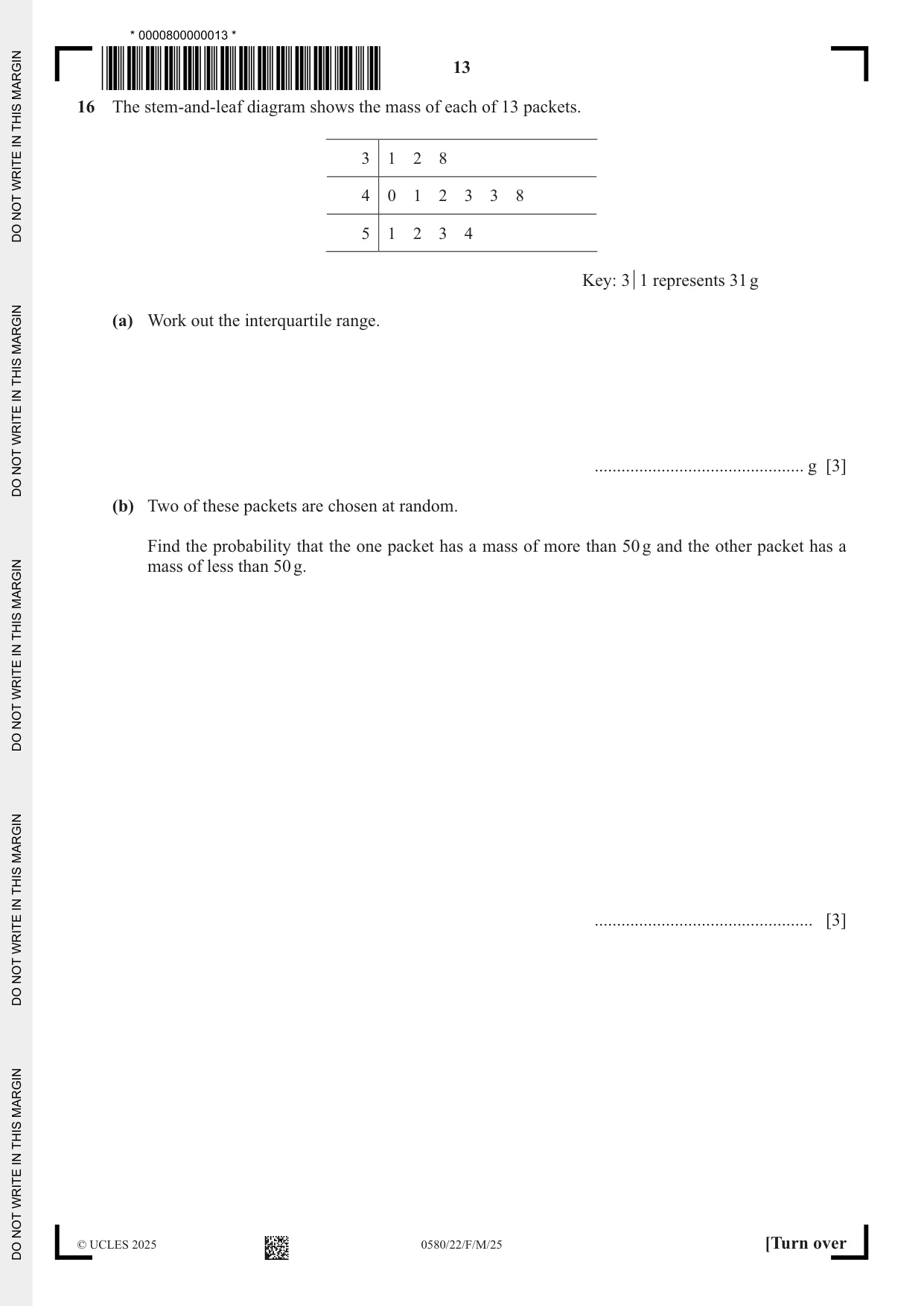
16 The stem-and-leaf diagram shows the mass of each of 13 packets. 3 1 2 8 4 0 1 2 3 3 8 5 1 2 3 4 Key: 3 q1 represents 31 g (a) Work out the interquartile range. ............................................... g [3] (b) Two of these packets are chosen at random. Find the probability that the one packet has a mass of more than 50 g and the other packet has a mass of less than 50 g. ................................................. [3]
Mark scheme: 16(a) 12.5 3 M2 for 51.5 – 39 oe OR B1 for [UQ =] 51.5 B1 for [LQ =] 39 OR M1 for k – c where 50.25 ⩽ k ⩽ 52 and 38 ⩽ c ⩽ 40 16(b) 6 3 4 9 oe M2 for 2 oe 13 13 12 or B1 for 4 9 9 4 and or and 13 12 13 12 k c or M1 for 13 12 where 0 < k < 13 and 0 < c < 12 4 9 If 0 scored, SC1 for 2 13 13
Question 17
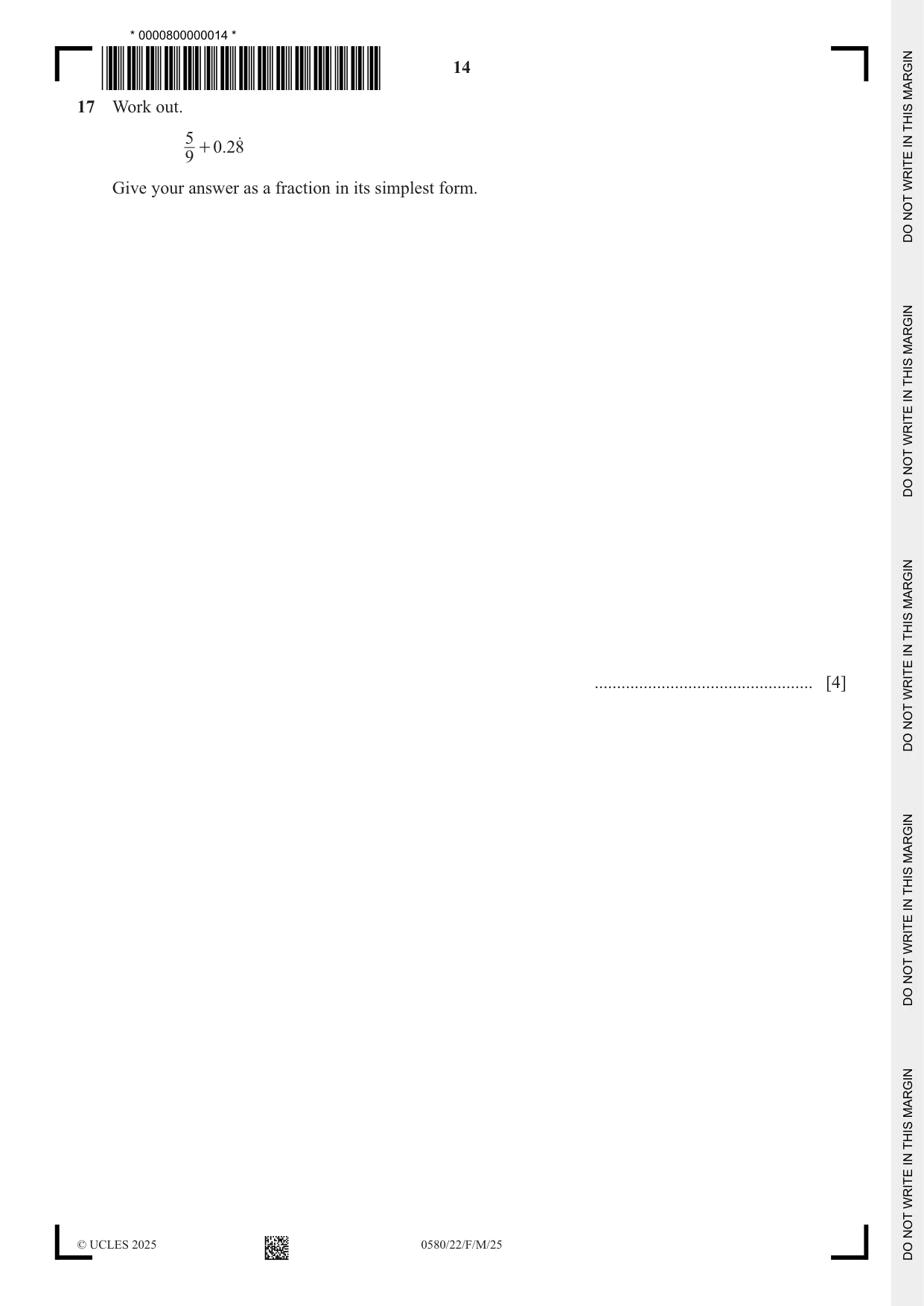
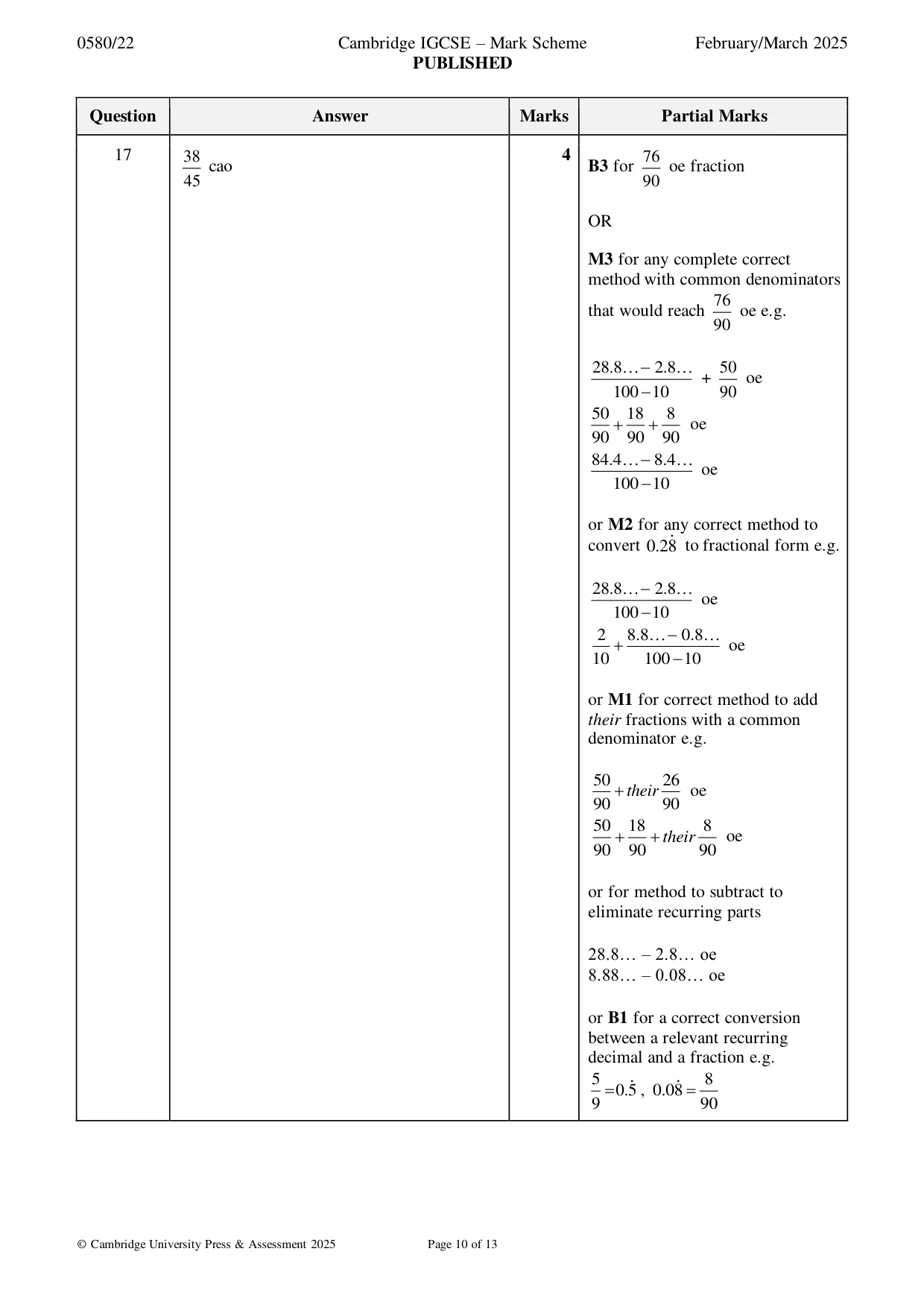
17 Work out. 5 o + 0.28 9 Give your answer as a fraction in its simplest form. ................................................. [4]
Mark scheme: 17 38 4 76 cao B3 for oe fraction 45 90 OR M3 for any complete correct method with common denominators 76 that would reach oe e.g. 90 28.8− 2.8 50 + oe 100 − 10 90 50 18 8 + + oe 90 90 90 84.4 − 8.4 oe 100 − 10 or M2 for any correct method to convert 0.28 to fractional form e.g. 28.8− 2.8 oe 100 − 10 2 8.8− 0.8 + oe 10 100 − 10 or M1 for correct method to add their fractions with a common denominator e.g. 50 26 + their oe 90 90 50 18 8 + + their oe 90 90 90 or for method to subtract to eliminate recurring parts 28.8… – 2.8… oe 8.88… – 0.08… oe or B1 for a correct conversion between a relevant recurring decimal and a fraction e.g. 5 8 = 0.5 , 0.08 = 9 90
Q18 · NOT TO E SCALE D 18 cm 6 cm 60° A B C 17 cm The quadrilateral ACDE is formed by two…
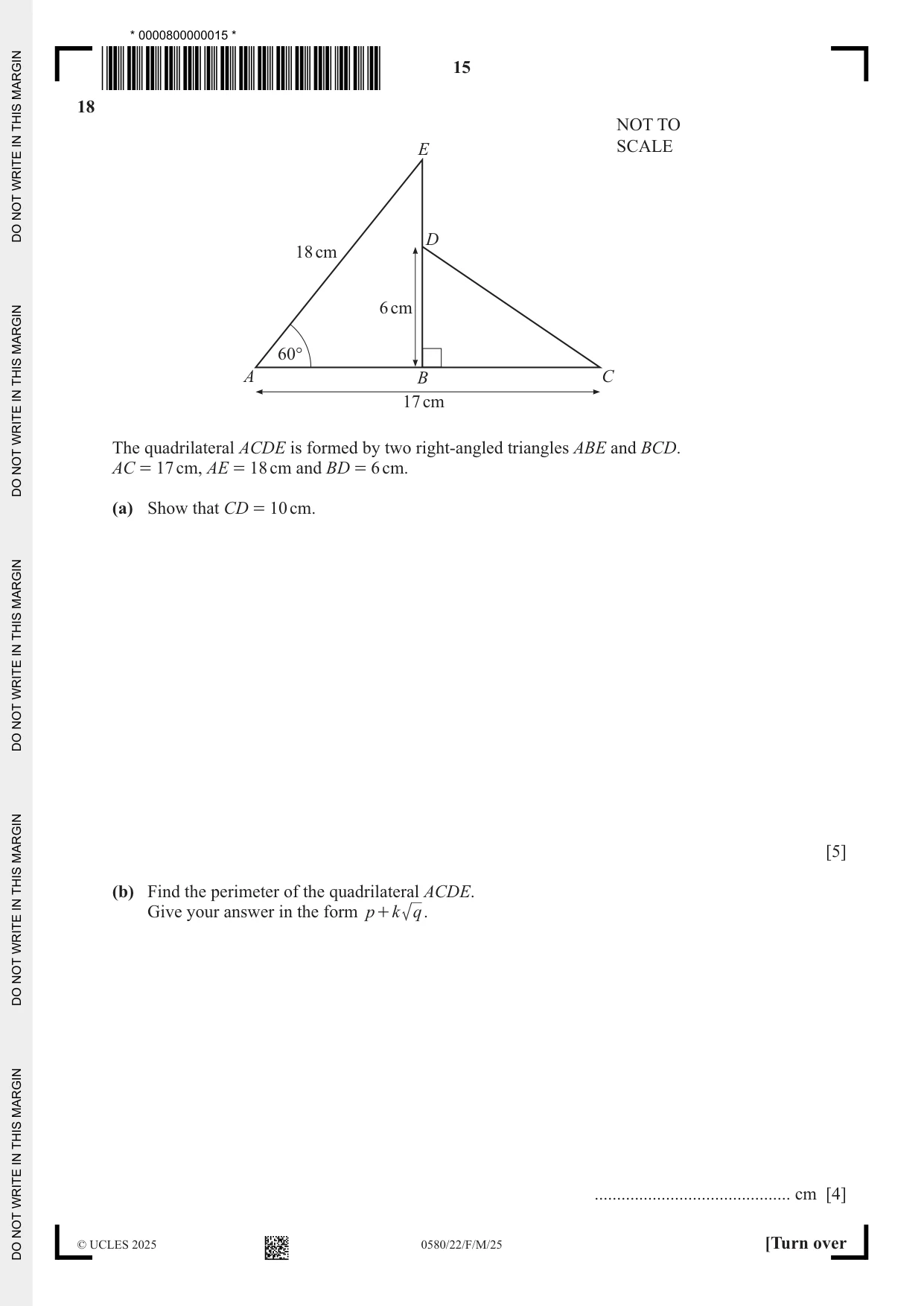
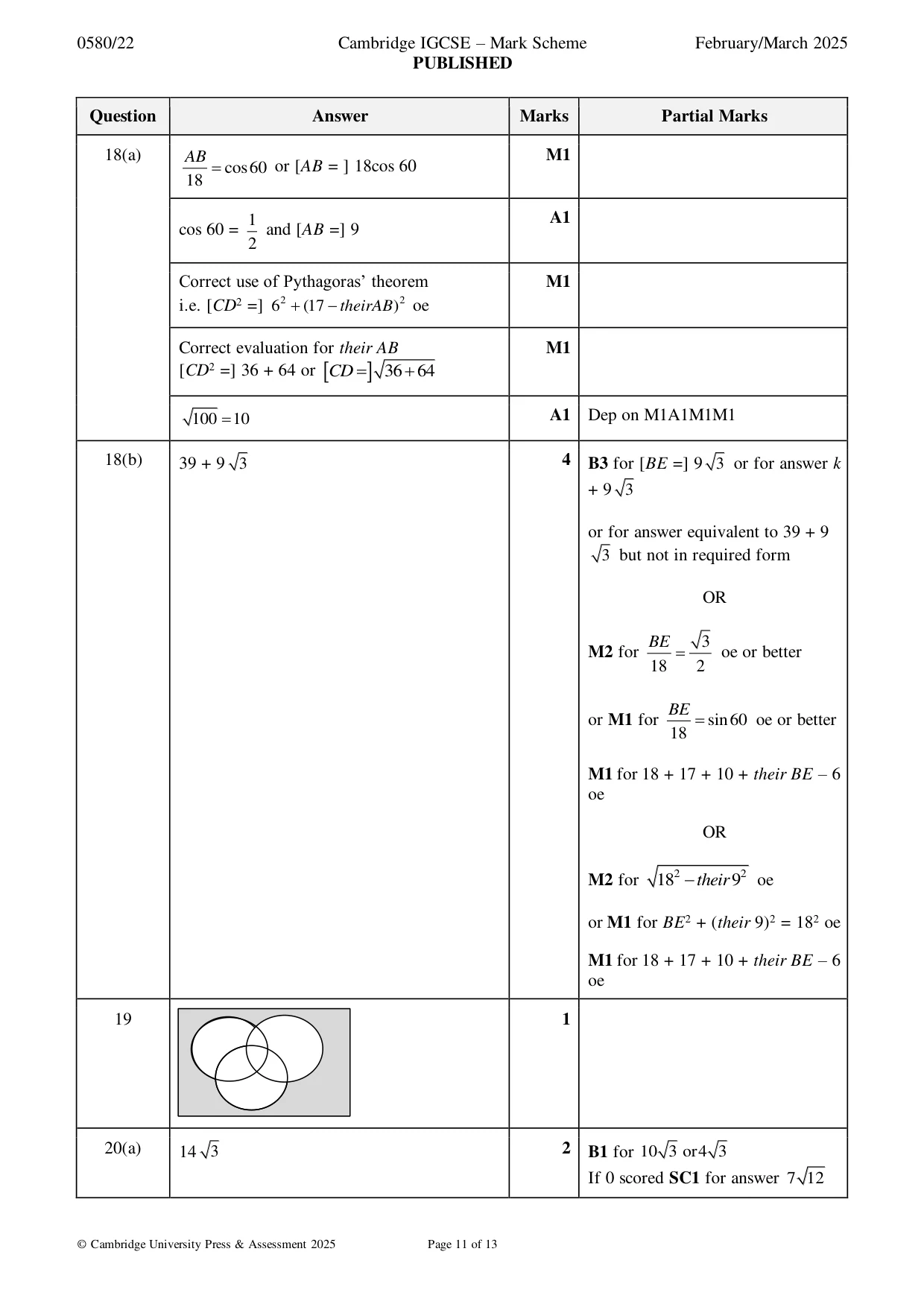
18 NOT TO E SCALE D 18 cm 6 cm 60° A B C 17 cm The quadrilateral ACDE is formed by two right-angled triangles ABE and BCD. AC = 17 cm, AE = 18 cm and BD = 6 cm. (a) Show that CD = 10 cm. [5] (b) Find the perimeter of the quadrilateral ACDE. Give your answer in the form p + k q . ............................................ cm [4]
Mark scheme: 18(a) AB M1 = cos60 or [AB = ] 18cos 60 18 1 A1 cos 60 = and [AB =] 9 2 Correct use of Pythagoras’ theorem M1 i.e. [CD2 =] 6 2 + (17 −theirAB ) 2 oe Correct evaluation for their AB M1 [CD2 =] 36 + 64 or CD = 36 + 64 100 = 10 A1 Dep on M1A1M1M1 18(b) 39 + 9 3 4 B3 for [BE =] 9 3 or for answer k + 9 3 or for answer equivalent to 39 + 9 3 but not in required form OR BE 3 M2 for = oe or better 18 2 BE or M1 for = sin60 oe or better 18 M1 for 18 + 17 + 10 + their BE – 6 oe OR M2 for 182 −their 92 oe or M1 for BE2 + (their 9)2 = 182 oe M1 for 18 + 17 + 10 + their BE – 6 oe
Q19 · % A B C In the Venn diagram, shade the region ( A , B , C ) l
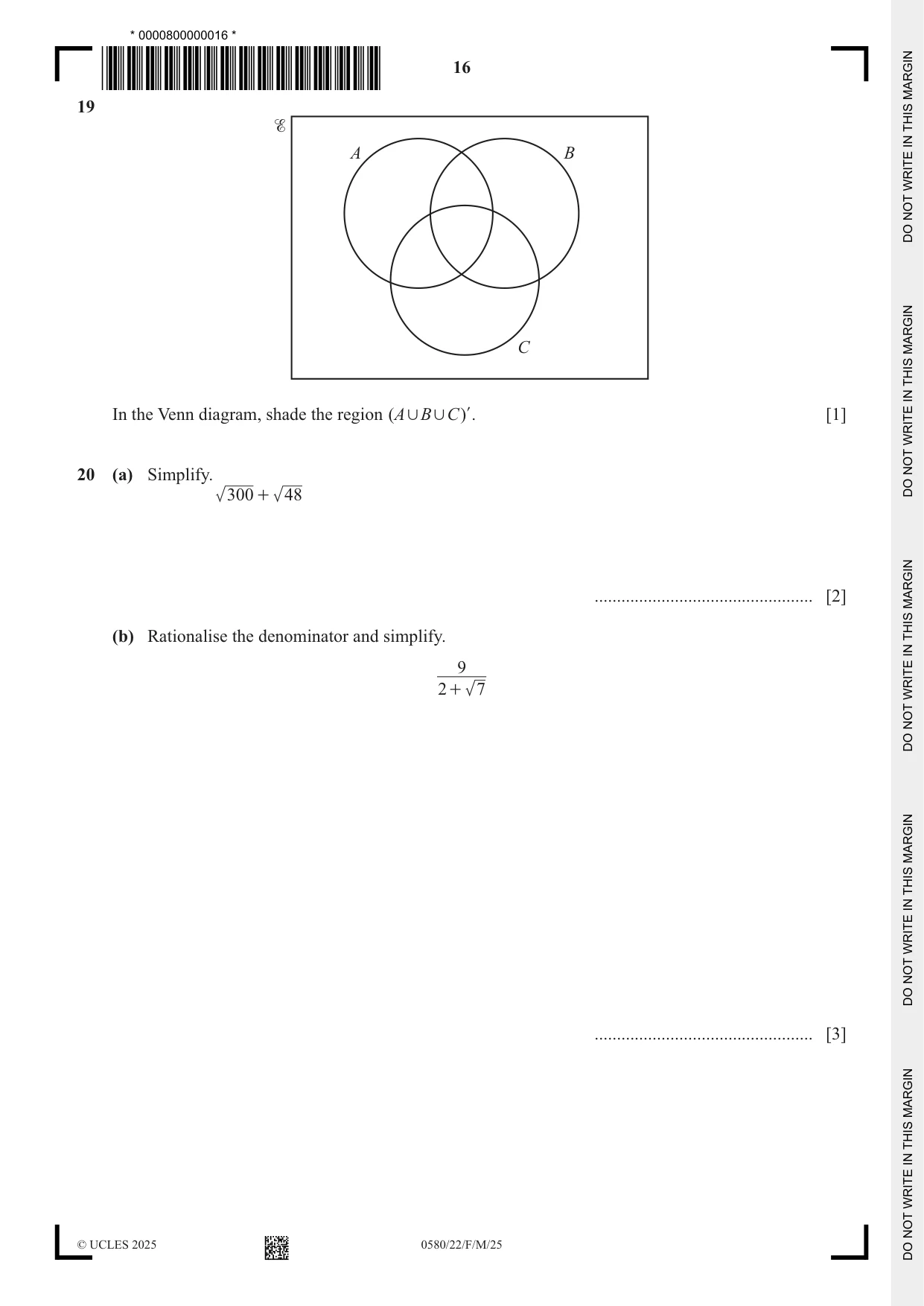
19 % A B C In the Venn diagram, shade the region ( A , B , C ) l. [1]
Mark scheme: 19 1
Question 20
20 (a) Simplify. 300 + 48 ................................................. [2] (b) Rationalise the denominator and simplify. 9 2 + 7 ................................................. [3]
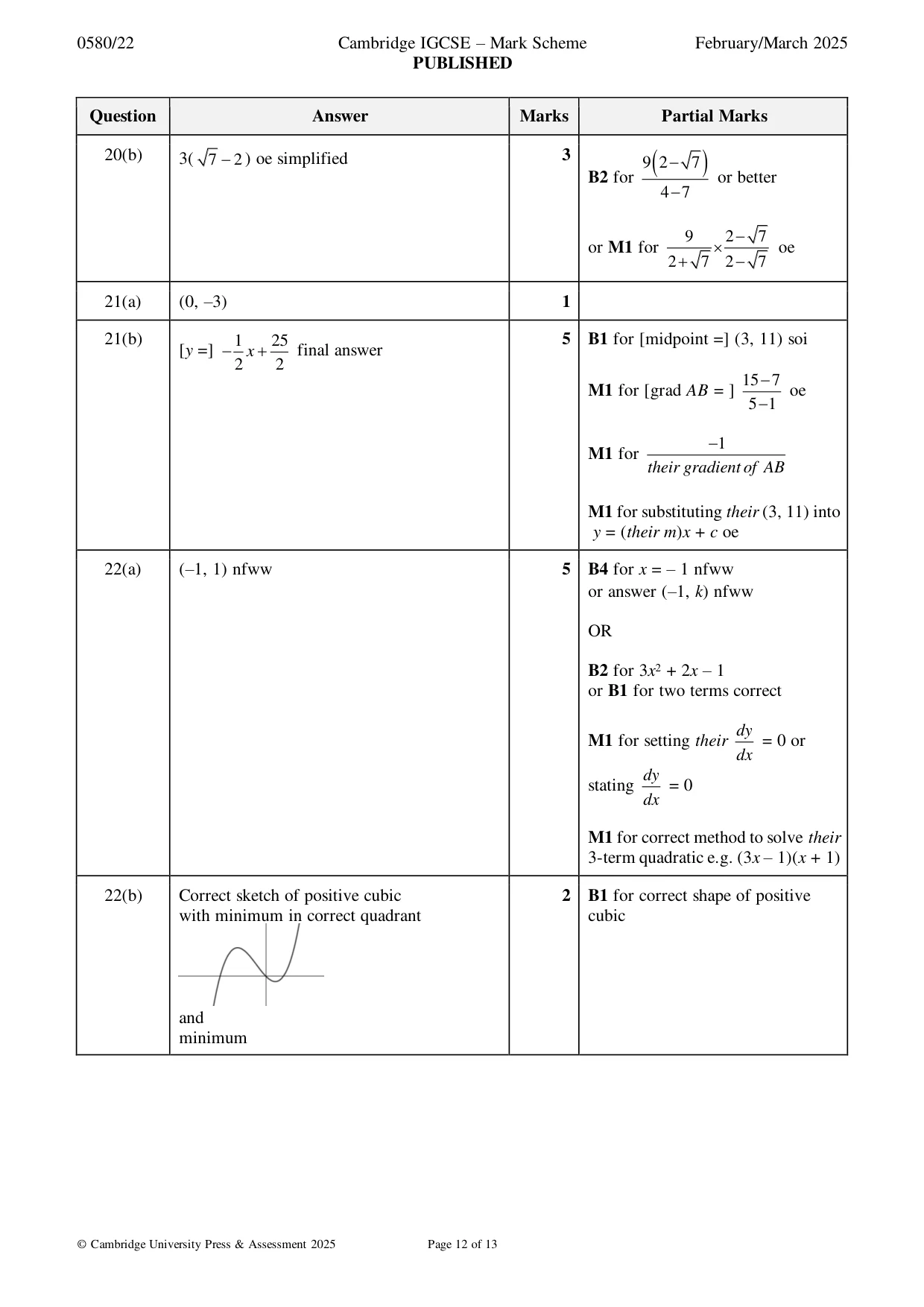
Mark scheme: 20(a) 14 3 2 B1 for 10 3 or 4 3 If 0 scored SC1 for answer 7 12 20(b) 3( 7 − 2 ) oe simplified 3 9 2 − 7 ( ) B2 for or better 4 − 7 9 2 − 7 or M1 for oe 2 + 7 2 − 7
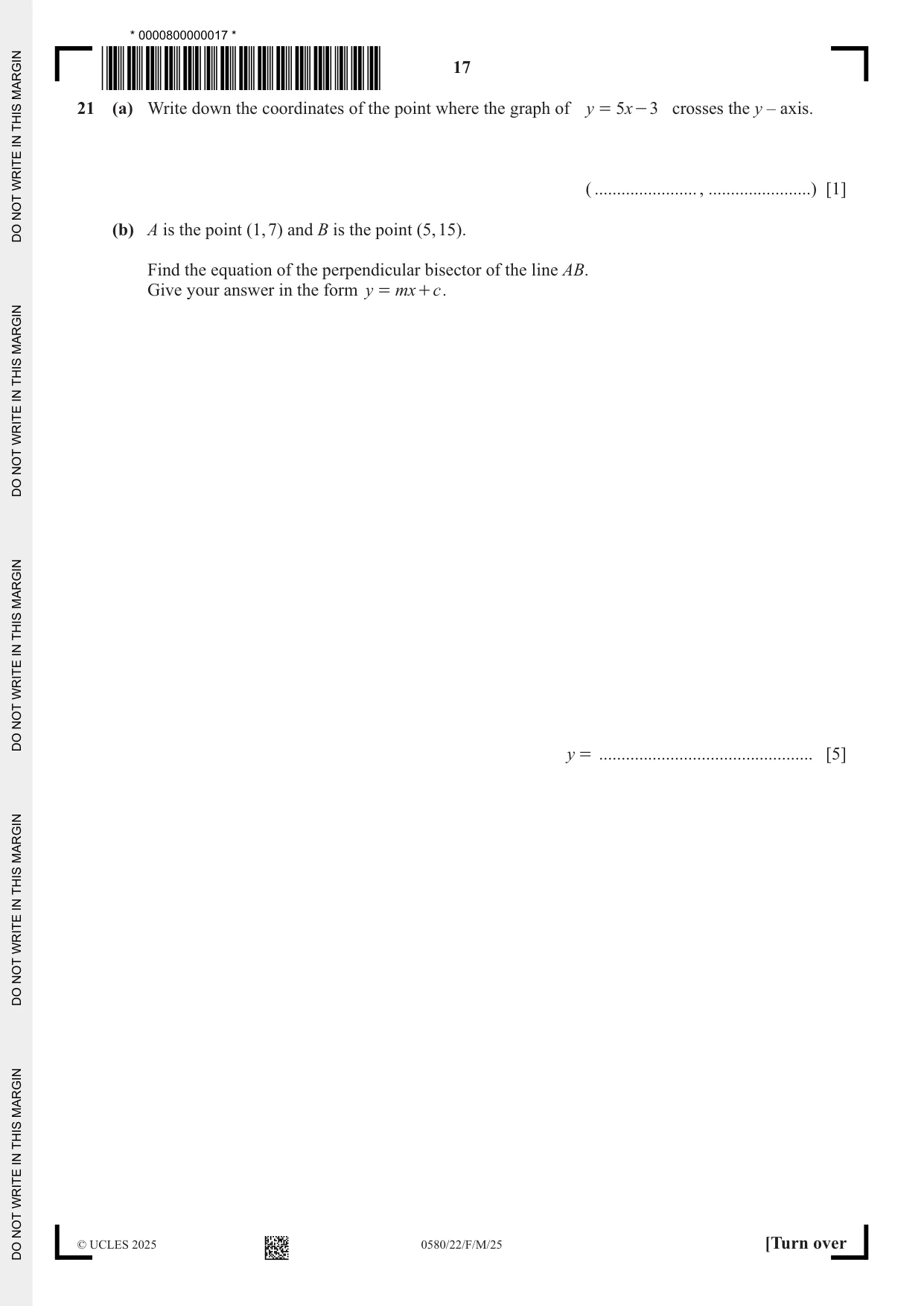
Q21 · Write down the coordinates of the point where the graph of y = 5x - 3 crosses the y – axis
21 (a) Write down the coordinates of the point where the graph of y = 5x - 3 crosses the y – axis. ( ......................., .......................) [1] (b) A is the point (1, 7) and B is the point (5, 15). Find the equation of the perpendicular bisector of the line AB. Give your answer in the form y = mx + c . y = ................................................ [5]
Mark scheme: 21(a) (0, –3) 1 21(b) 1 25 5 B1 for [midpoint =] (3, 11) soi [y =] − x + final answer 2 2 15 − 7 M1 for [grad AB = ] oe 5 − 1 −1 M1 for their gradient of AB M1 for substituting their (3, 11) into y = (their m)x + c oe
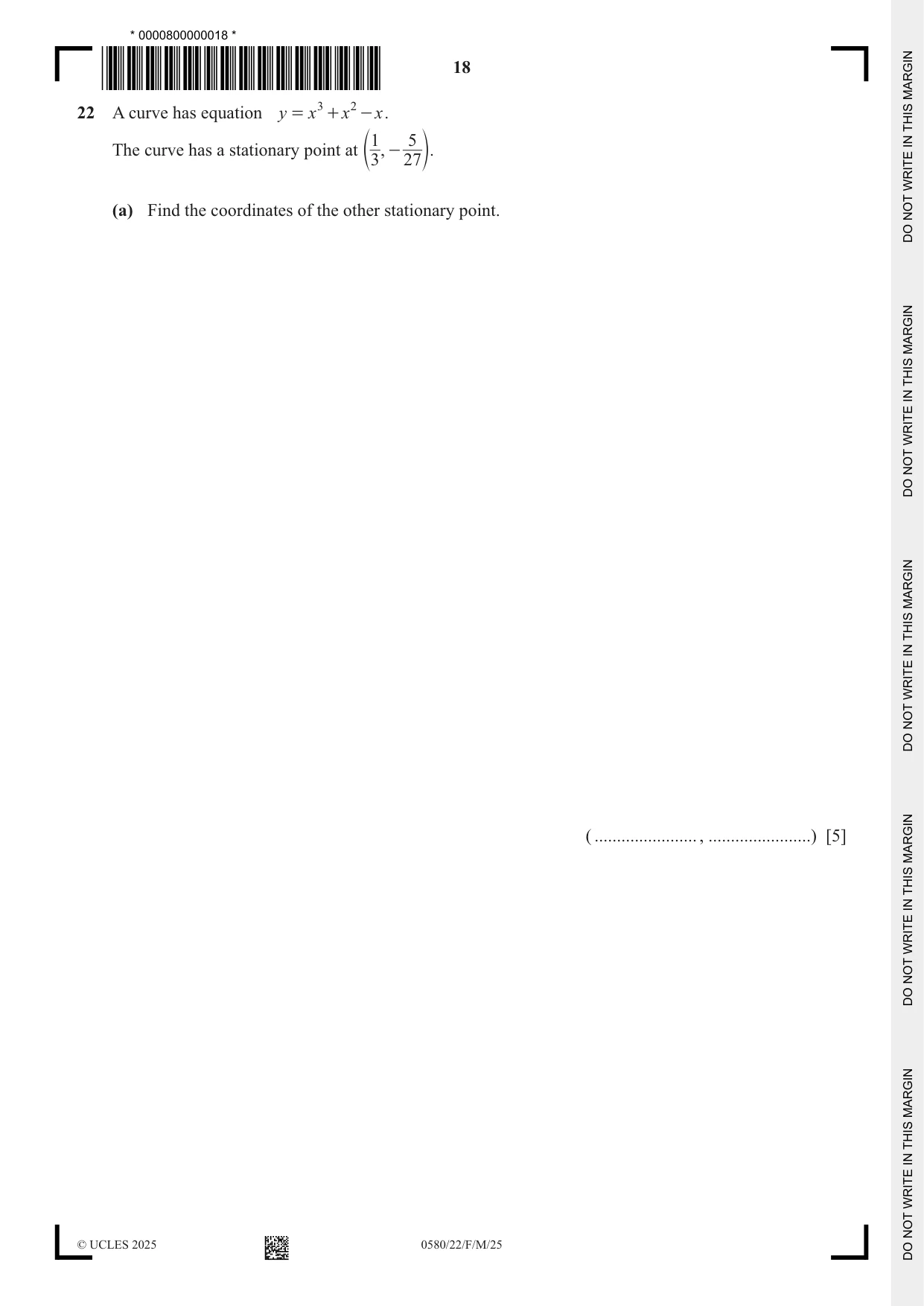
Q22 · A curve has equation y = x 3 + x 2 - x
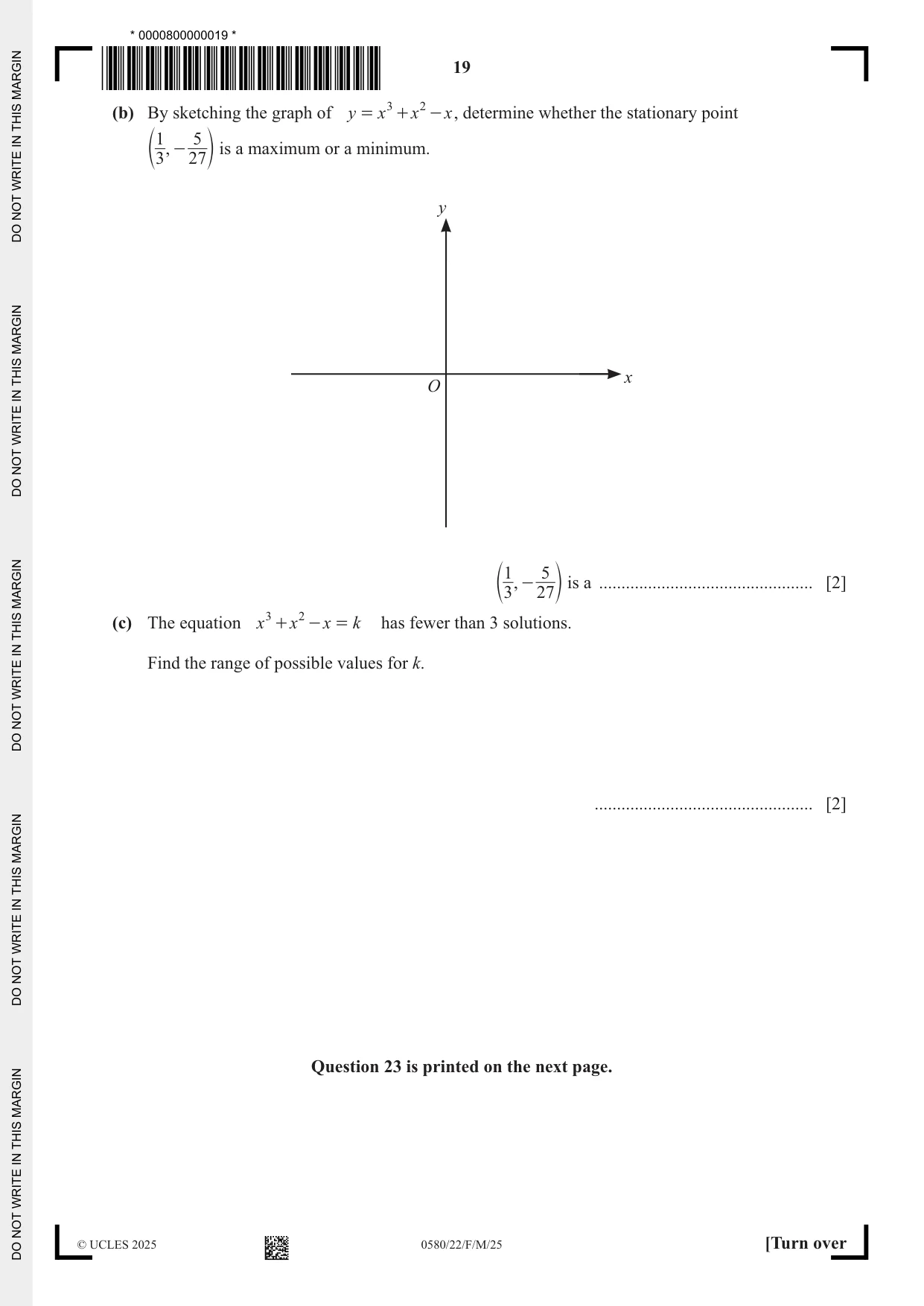
22 A curve has equation y = x 3 + x 2 - x . 1 5 The curve has a stationary point at e ,3 - 27 o. (a) Find the coordinates of the other stationary point. ( ......................., .......................) [5] (b) By sketching the graph of y = x 3 + x 2 - x , determine whether the stationary point 1 5 e ,3 - 27 o is a maximum or a minimum. y x O 1 5 e ,3 - 27 o is a ................................................ [2] (c) The equation x 3 + x 2 - x = k has fewer than 3 solutions. Find the range of possible values for k. ................................................. [2] Question 23 is printed on the next page.
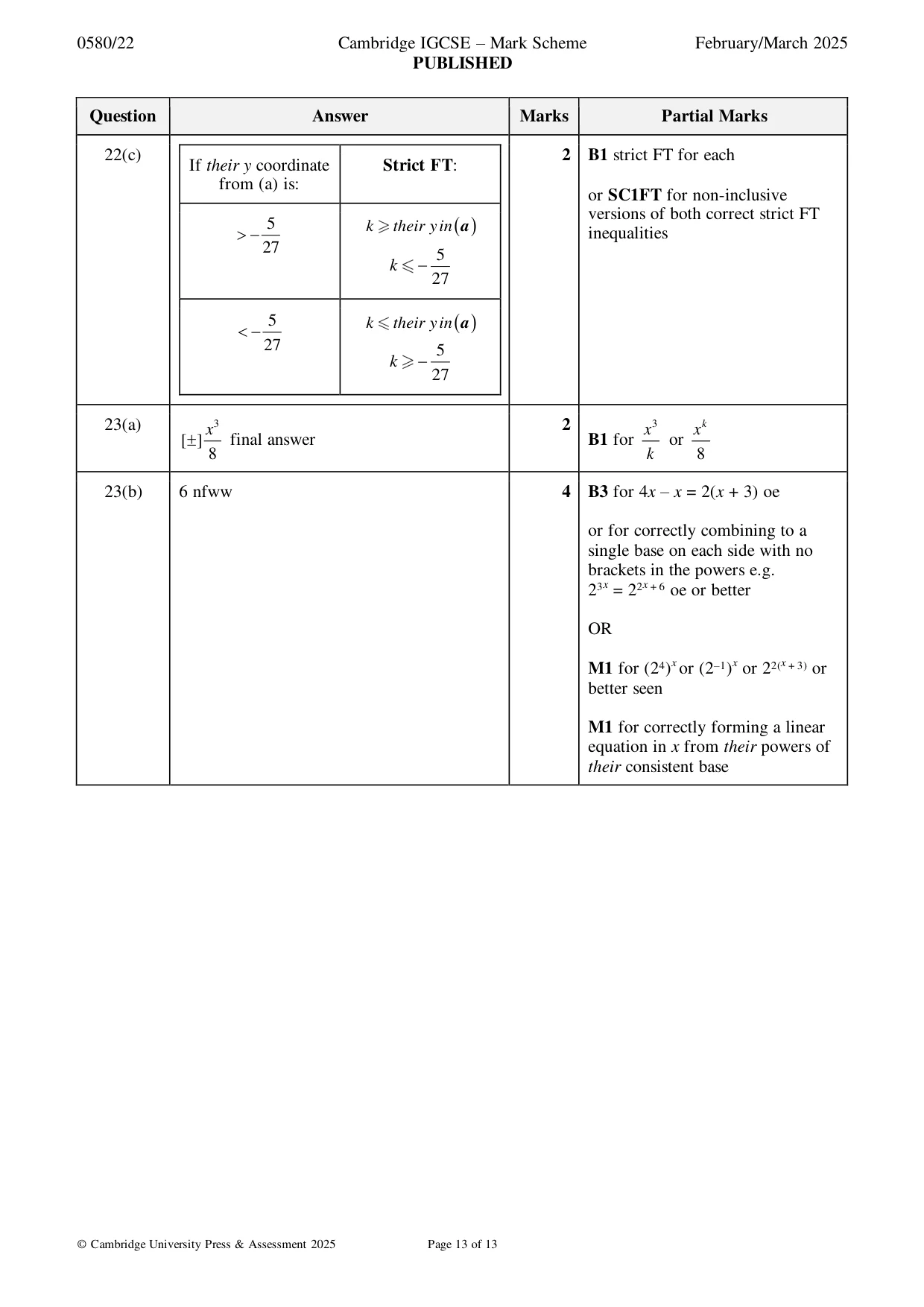
Mark scheme: 22(a) (–1, 1) nfww 5 B4 for x = – 1 nfww or answer (–1, k) nfww OR B2 for 3x2 + 2x – 1 or B1 for two terms correct dy M1 for setting their = 0 or dx dy stating = 0 dx M1 for correct method to solve their 3-term quadratic e.g. (3x – 1)(x + 1) 22(b) Correct sketch of positive cubic 2 B1 for correct shape of positive with minimum in correct quadrant cubic and minimum 22(c) 2 B1 strict FT for each If their y coordinate Strict FT: from (a) is: or SC1FT for non-inclusive versions of both correct strict FT 5 k their yin ( a ) − inequalities 27 5 k − 27 5 k their yin ( a ) − 27 5 k − 27
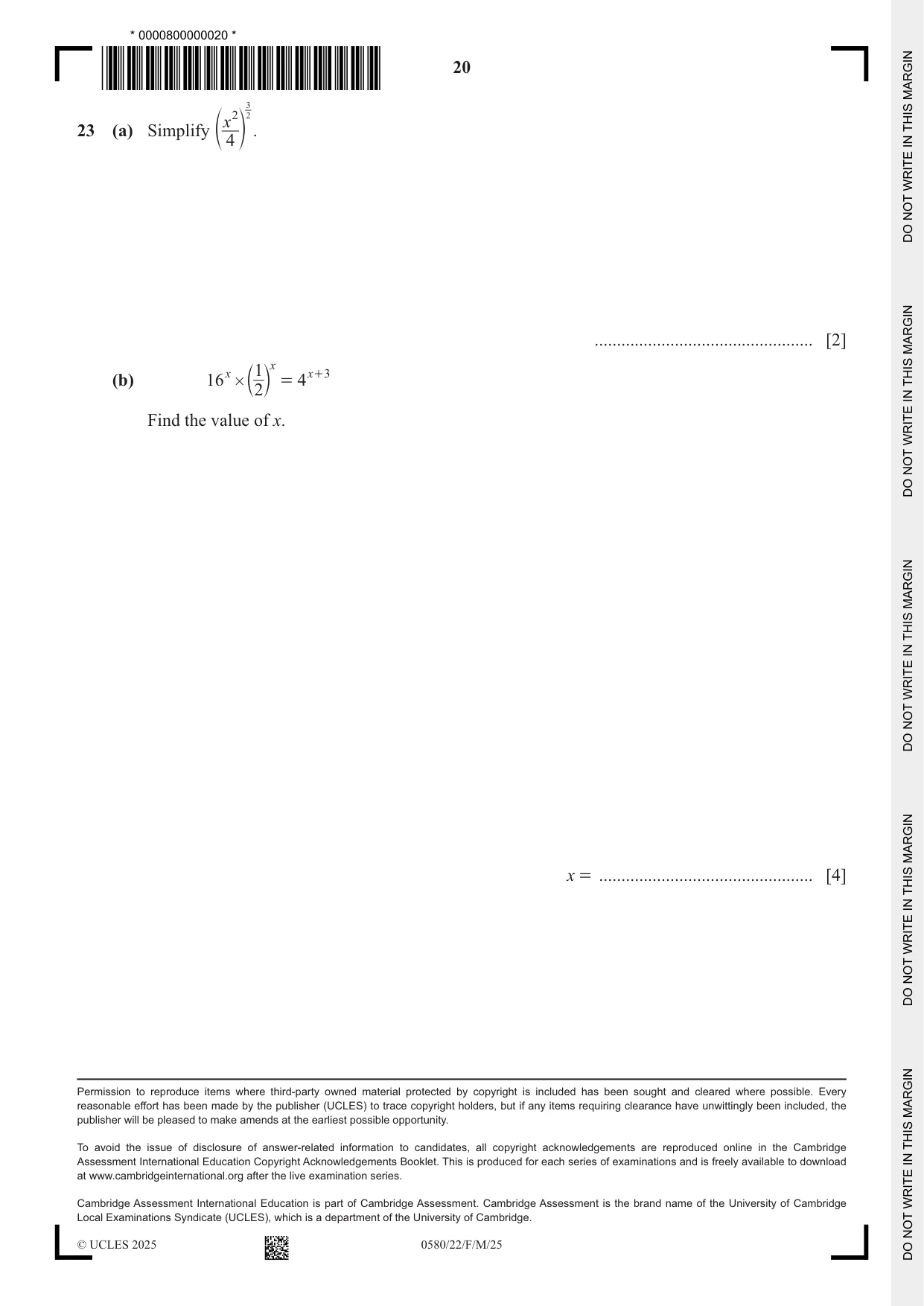
Q23 · X 2 223 (a) Simplify e o
x 2 223 (a) Simplify e o . 4 ................................................. [2] x 1 x x + 3 (b) 16 # b l = 4 2 Find the value of x. x = ................................................ [4]
Mark scheme: 23(a) 3 2 3x kx [ x] final answer B1 for or 8 k 8 23(b) 6 nfww 4 B3 for 4x – x = 2(x + 3) oe or for correctly combining to a single base on each side with no brackets in the powers e.g. 23x = 22x + 6 oe or better OR M1 for (24)x or (2–1)x or 22(x + 3) or better seen M1 for correctly forming a linear equation in x from their powers of their consistent base
What was in this paper
The subtopics covered by these 23 questions, and how many questions each got. Open one in a new tab to see every Cambridge question on it.
2Indices I2Area and perimeter1Averages and measures of spread1Circle theorems I1Estimation1Geometrical terms1Graphs of functions1Inequalities1Introduction to probability1Ordering1Percentages1Perpendicular lines1Powers and roots1Pythagoras’ theorem1Rates1Ratio and proportion1Sets1Surface area and volume1Time1Vectors in two dimensions1What you needed in this session
Cambridge’s own grade thresholds for 2025 Feb/March, Paper 2 · Variant 2. A higher threshold means an easier paper — the bar moves with how the cohort did.