Cambridge IGCSE Mathematics 0580 — 2010 Oct/Nov Paper 2 · Variant 3
0580/23/O/N/10 · 25 questions · 70 marks · ≈79 min
The question paper and its mark scheme, free to read here and free to download. This is Cambridge’s own paper, exactly as it was sat.
Question paper12 pages
Mark scheme4 pages
Answers below. Sit the paper first if you are practising.
Questions as text
Q1 · Write down the number which is 3.6 less than – 4.7
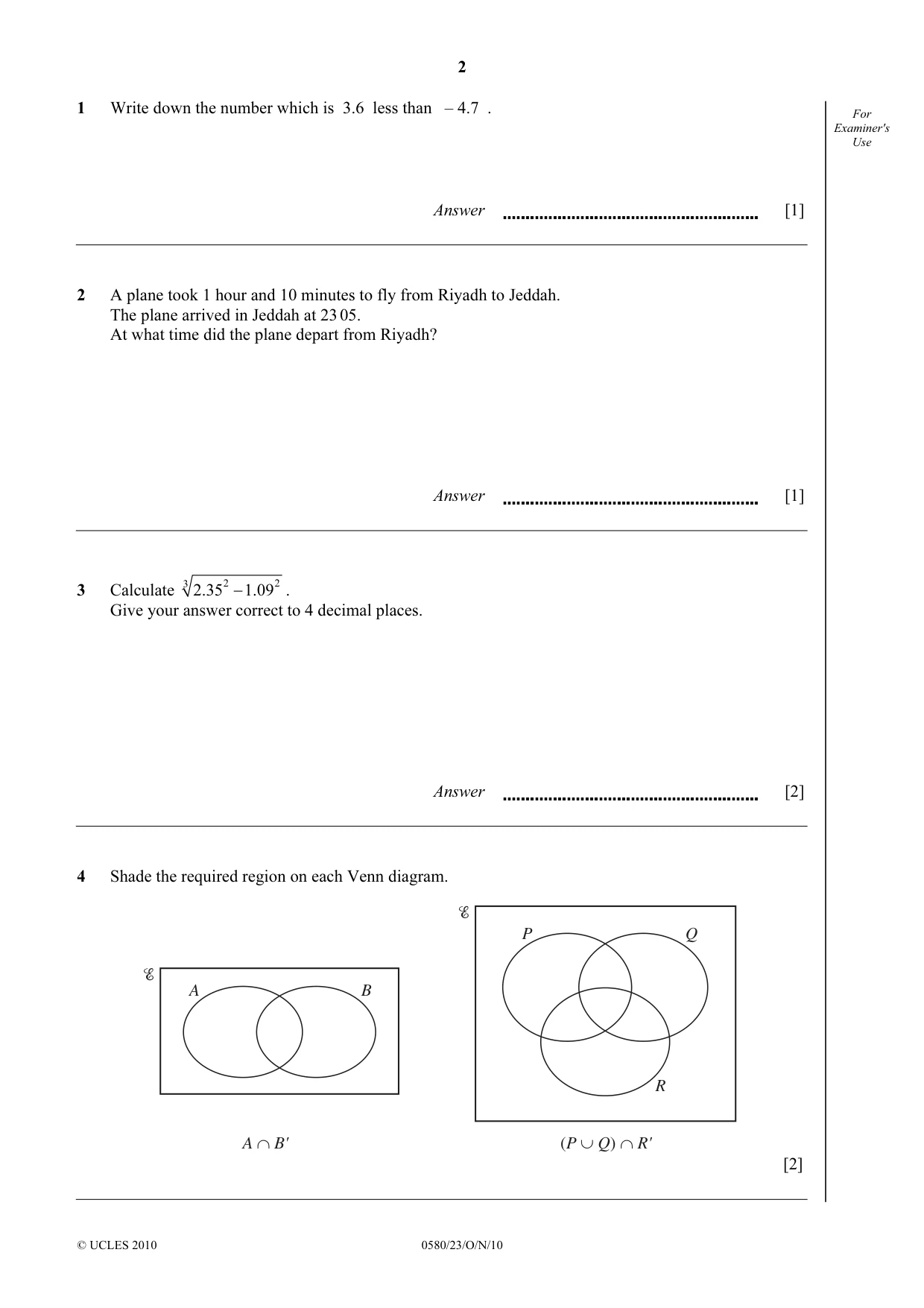
1 Write down the number which is 3.6 less than – 4.7 . For Examiner's Use Answer [1]
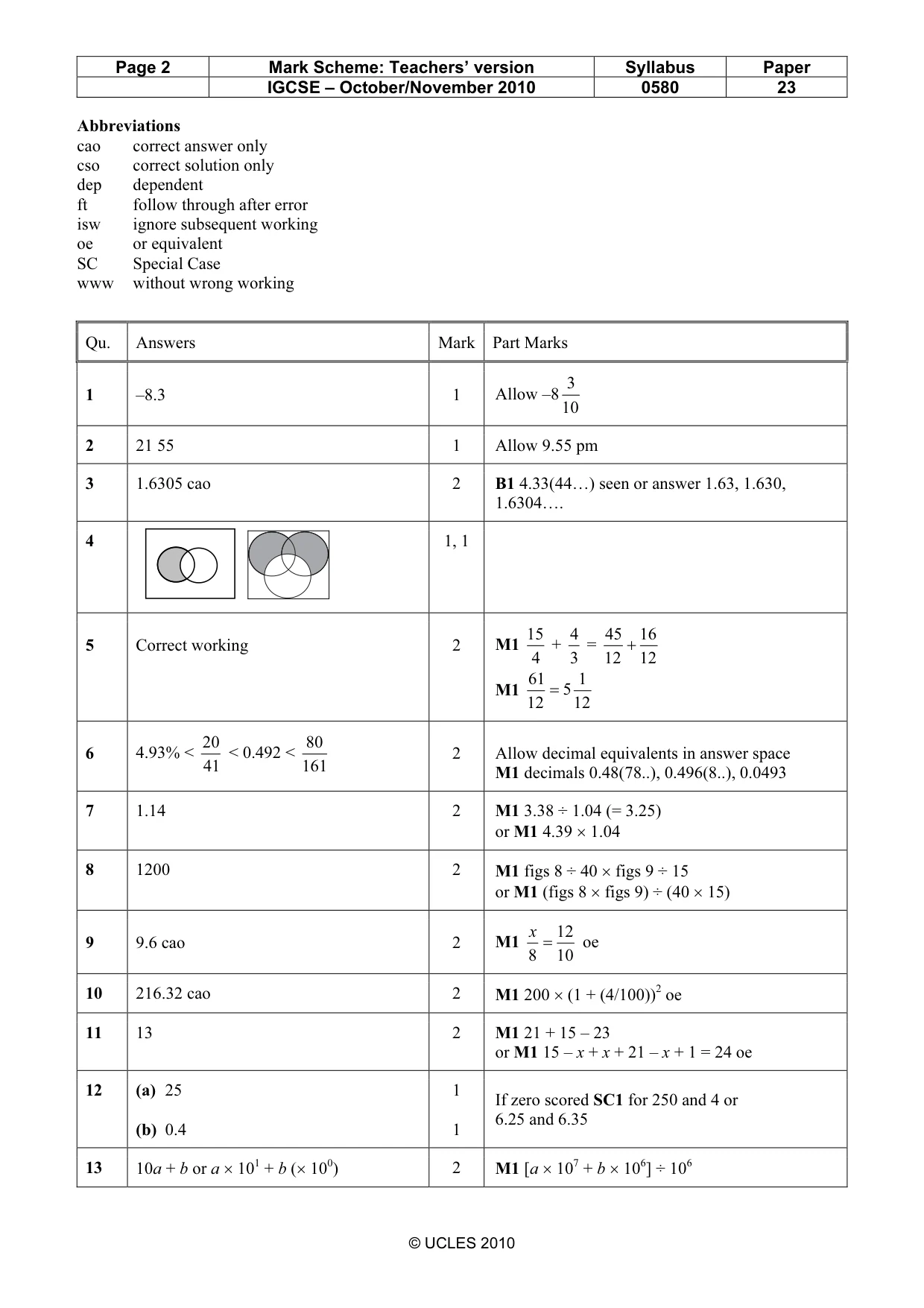
Mark scheme: Qu. Answers Mark Part Marks 33 1 –8.3 1 Allow –810
Q2 · A plane took 1 hour and 10 minutes to fly from Riyadh to Jeddah
2 A plane took 1 hour and 10 minutes to fly from Riyadh to Jeddah. The plane arrived in Jeddah at 23 05. At what time did the plane depart from Riyadh? Answer [1]
Mark scheme: 2 21 55 1 Allow 9.55 pm
Q3 · Calculate 3 2.35 2 − 1.09 2
3 Calculate 3 2.35 2 − 1.09 2 . Give your answer correct to 4 decimal places. Answer [2]
Mark scheme: 3 1.6305 cao 2 B1 4.33(44…) seen or answer 1.63, 1.630, 1.6304….
Q4 · Shade the required region on each Venn diagram
4 Shade the required region on each Venn diagram. P Q A B R A ∩ B' (P ∪ Q) ∩ R' [2]
Mark scheme: 4 1, 1 15 4 45 16
Q5 · 1 1 For 5 Show that 3 + 1 = 5
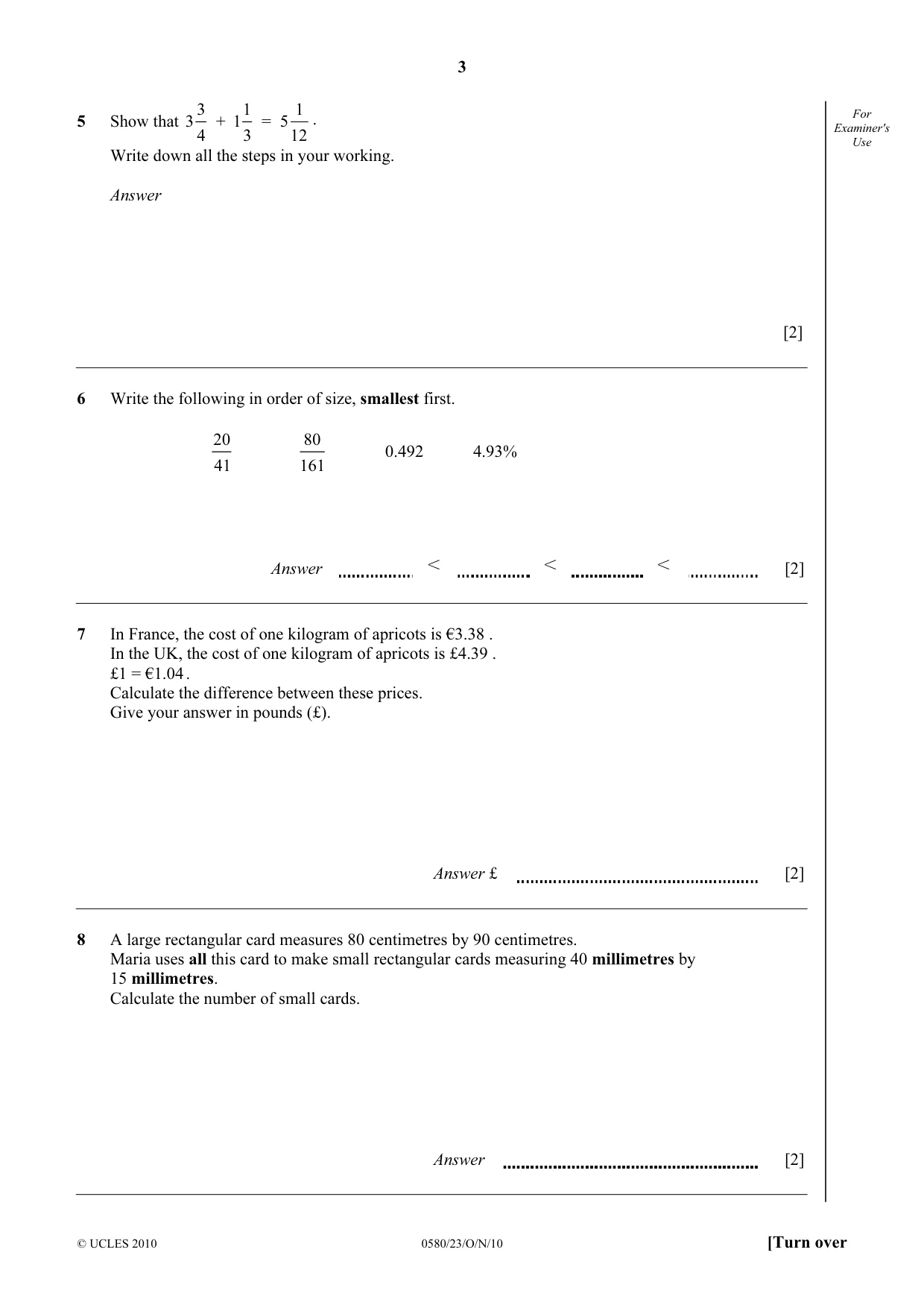
3 1 1 For 5 Show that 3 + 1 = 5 . Examiner's 4 3 12 Use Write down all the steps in your working. Answer [2]
Mark scheme: 15 4 45 16 5 Correct working 2 M1 + = + 4 3 12 12 61 1 M1 = 5 12 12 20 80
Q6 · Write the following in order of size, smallest first
6 Write the following in order of size, smallest first. 20 80 0.492 4.93% 41 161 Answer I I I [2]
Mark scheme: 20 80 6 4.93% < < 0.492 < 2 Allow decimal equivalents in answer space 41 161 M1 decimals 0.48(78..), 0.496(8..), 0.0493
Q7 · In France, the cost of one kilogram of apricots is €3.38
7 In France, the cost of one kilogram of apricots is €3.38 . In the UK, the cost of one kilogram of apricots is £4.39 . £1 = €1.04 . Calculate the difference between these prices. Give your answer in pounds (£). Answer £ [2]
Mark scheme: 7 1.14 2 M1 3.38 ÷ 1.04 (= 3.25) or M1 4.39 × 1.04
Q8 · A large rectangular card measures 80 centimetres by 90 centimetres
8 A large rectangular card measures 80 centimetres by 90 centimetres. Maria uses all this card to make small rectangular cards measuring 40 millimetres by 15 millimetres. Calculate the number of small cards. Answer [2]
Mark scheme: 8 1200 2 M1 figs 8 ÷ 40 × figs 9 ÷ 15 or M1 (figs 8 × figs 9) ÷ (40 × 15) x 12
Q9 · For A Examiner's Use NOT TO 8 cm SCALE Q P 10 cm C 12 cm B APB and AQC are straight lines
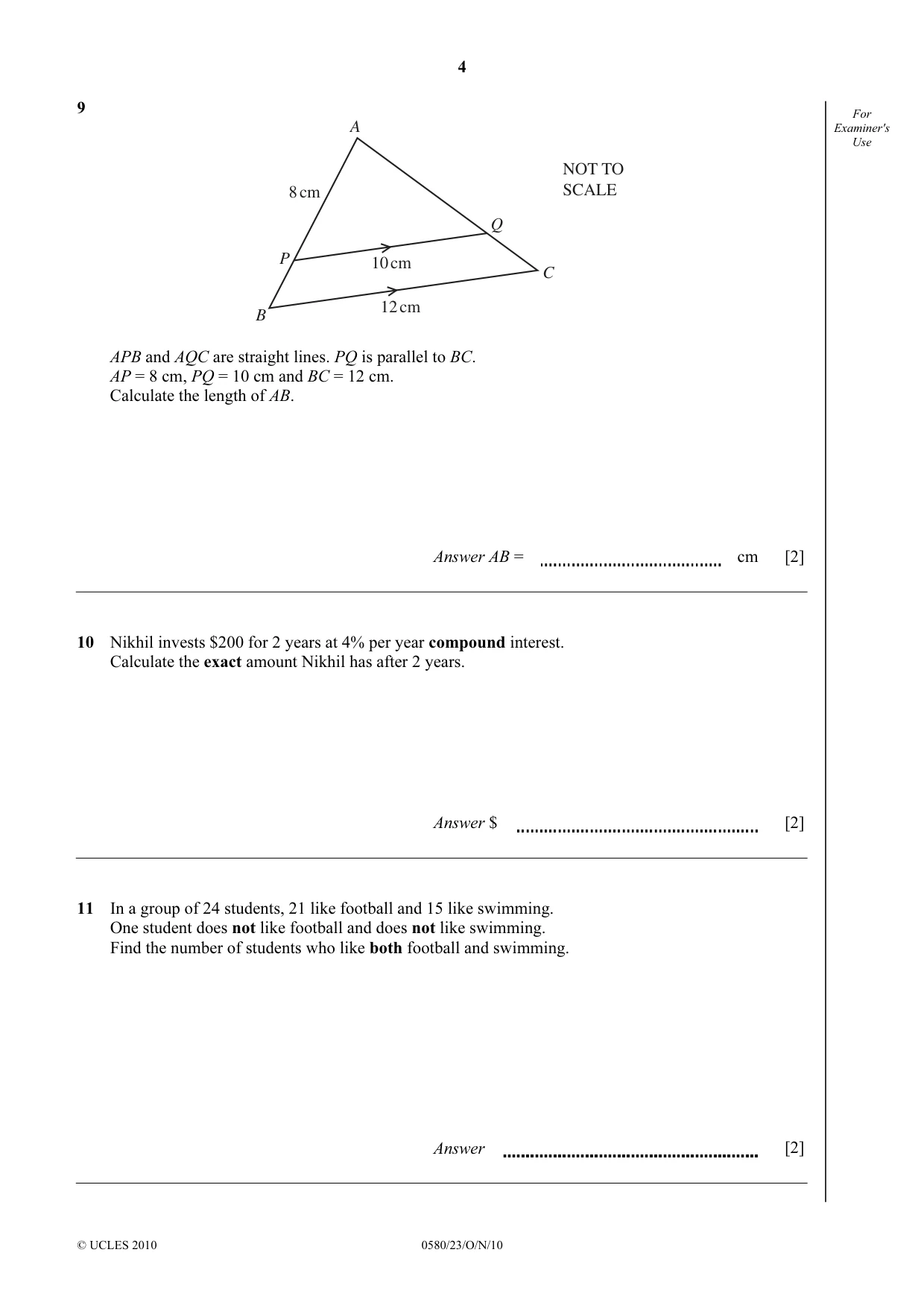
9 For A Examiner's Use NOT TO 8 cm SCALE Q P 10 cm C 12 cm B APB and AQC are straight lines. PQ is parallel to BC. AP = 8 cm, PQ = 10 cm and BC = 12 cm. Calculate the length of AB. Answer AB = cm [2]
Mark scheme: x 12 9 9.6 cao 2 M1 = oe 8 10 2
Q10 · Nikhil invests $200 for 2 years at 4% per year compound interest
10 Nikhil invests $200 for 2 years at 4% per year compound interest. Calculate the exact amount Nikhil has after 2 years. Answer $ [2]
Mark scheme: 10 216.32 cao 2 M1 200 × (1 + (4/100))2 oe
Q11 · In a group of 24 students, 21 like football and 15 like swimming
11 In a group of 24 students, 21 like football and 15 like swimming. One student does not like football and does not like swimming. Find the number of students who like both football and swimming. Answer [2]
Mark scheme: 11 13 2 M1 21 + 15 – 23 or M1 15 – x + x + 21 – x + 1 = 24 oe
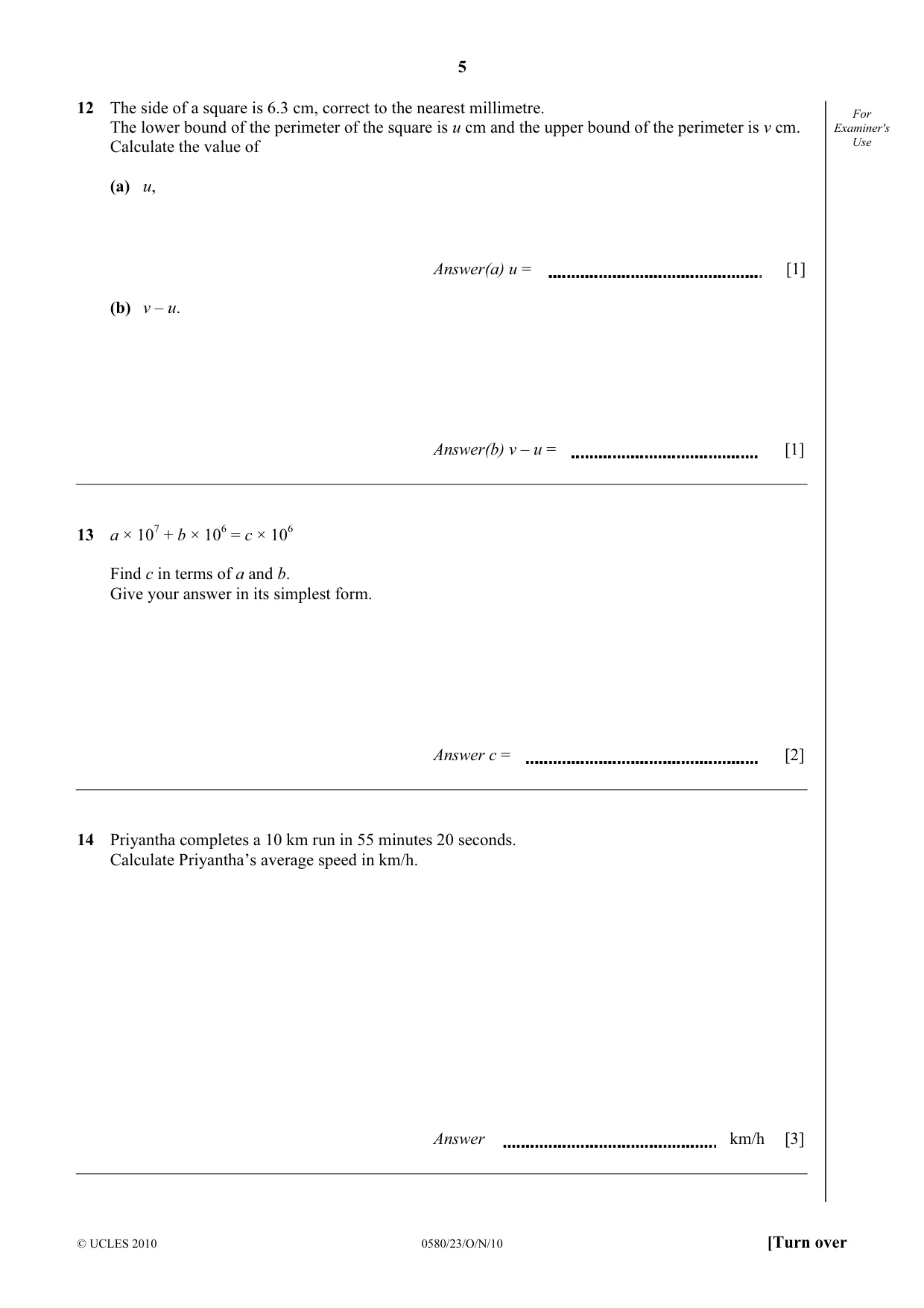
Q12 · The side of a square is 6.3 cm, correct to the nearest millimetre
12 The side of a square is 6.3 cm, correct to the nearest millimetre. For The lower bound of the perimeter of the square is u cm and the upper bound of the perimeter is v cm. Examiner's Calculate the value of Use (a) u, Answer(a) u = [1] (b) v – u. Answer(b) v – u = [1]
Mark scheme: 12 (a) 25 1 If zero scored SC1 for 250 and 4 or 6.25 and 6.35 (b) 0.4 1 1 0 7 6 6
Q13 · A × 107 + b × 106 = c × 106 Find c in terms of a and b
13 a × 107 + b × 106 = c × 106 Find c in terms of a and b. Give your answer in its simplest form. Answer c = [2]
Mark scheme: 13 10a + b or a × 101 + b (× 100) 2 M1 [a × 107 + b × 106] ÷ 106 IGCSE – October/November 2010 0580 23 70
Q14 · Priyantha completes a 10 km run in 55 minutes 20 seconds
14 Priyantha completes a 10 km run in 55 minutes 20 seconds. Calculate Priyantha’s average speed in km/h. Answer km/h [3]
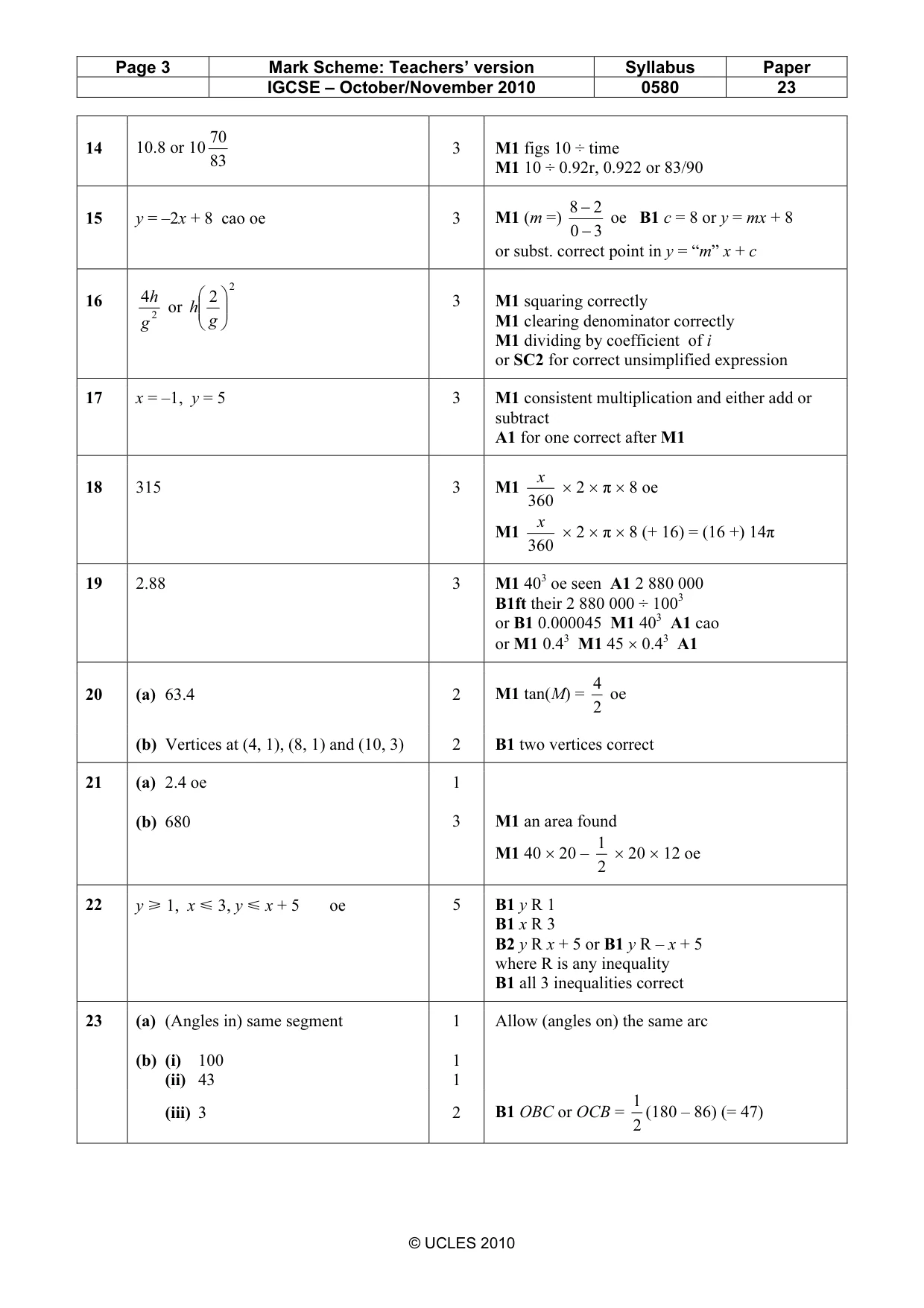
Mark scheme: 70 14 10.8 or 10 3 M1 figs 10 ÷ time 83 M1 10 ÷ 0.92r, 0.922 or 83/90 8 − 2
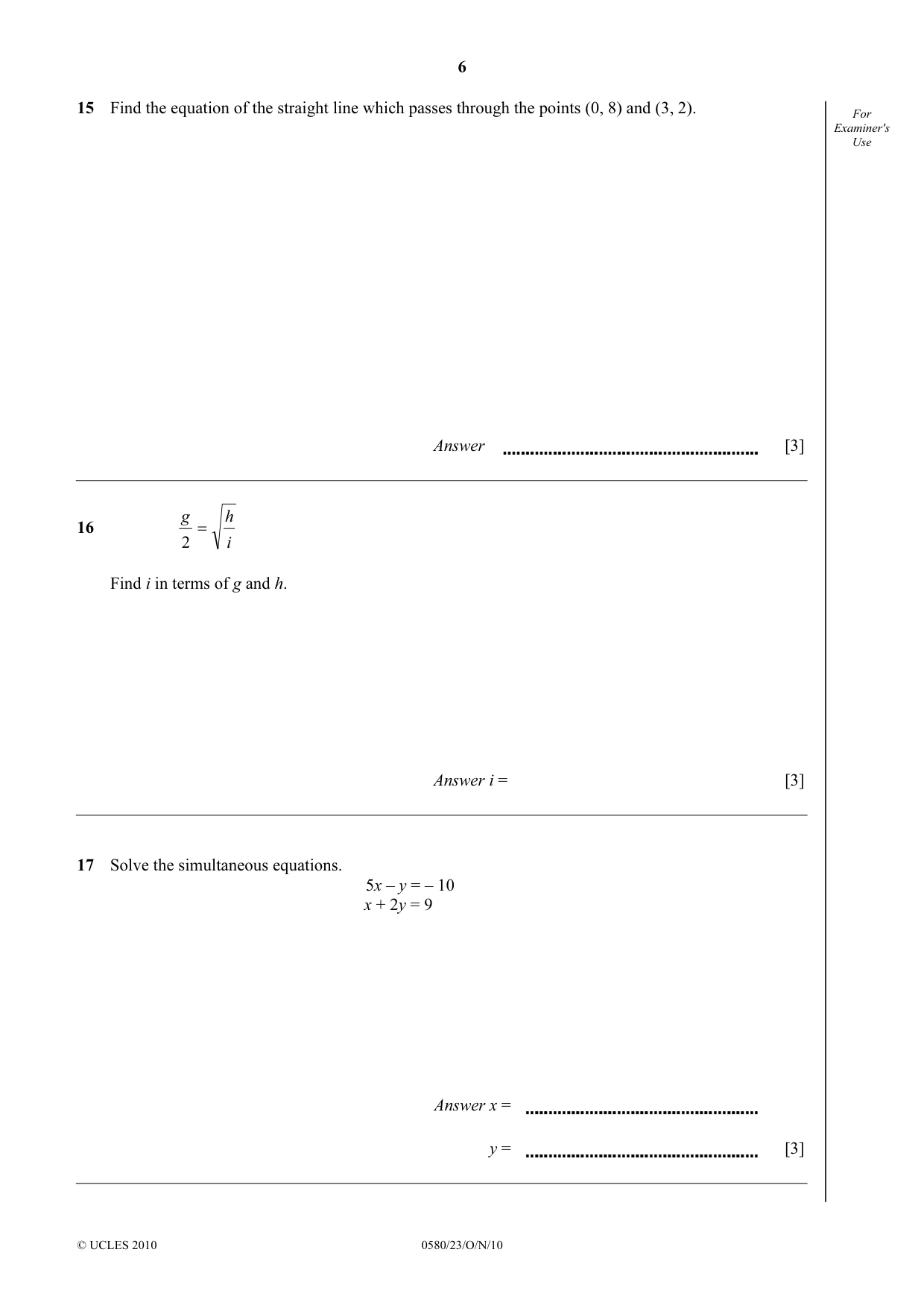
Q15 · Find the equation of the straight line which passes through the points (0, 8) and (3, 2)
15 Find the equation of the straight line which passes through the points (0, 8) and (3, 2). For Examiner's Use Answer [3]
Mark scheme: 8 2 15 y = –2x + 8 cao oe 3 M1 (m =) oe B1 c = 8 or y = mx + 8 0 − 3 or subst. correct point in y = “m” x + c 2 4h 2
Q16 · G h 16 = 2 i Find i in terms of g and h
g h 16 = 2 i Find i in terms of g and h. Answer i = [3]
Mark scheme: 4 h 2 16 3 M1 squaring correctly 2 or h g g M1 clearing denominator correctly M1 dividing by coefficient of i or SC2 for correct unsimplified expression
Q17 · Solve the simultaneous equations
17 Solve the simultaneous equations. 5x – y = – 10 x + 2y = 9 Answer x = y = [3]
Mark scheme: 17 x = –1, y = 5 3 M1 consistent multiplication and either add or subtract A1 for one correct after M1 x
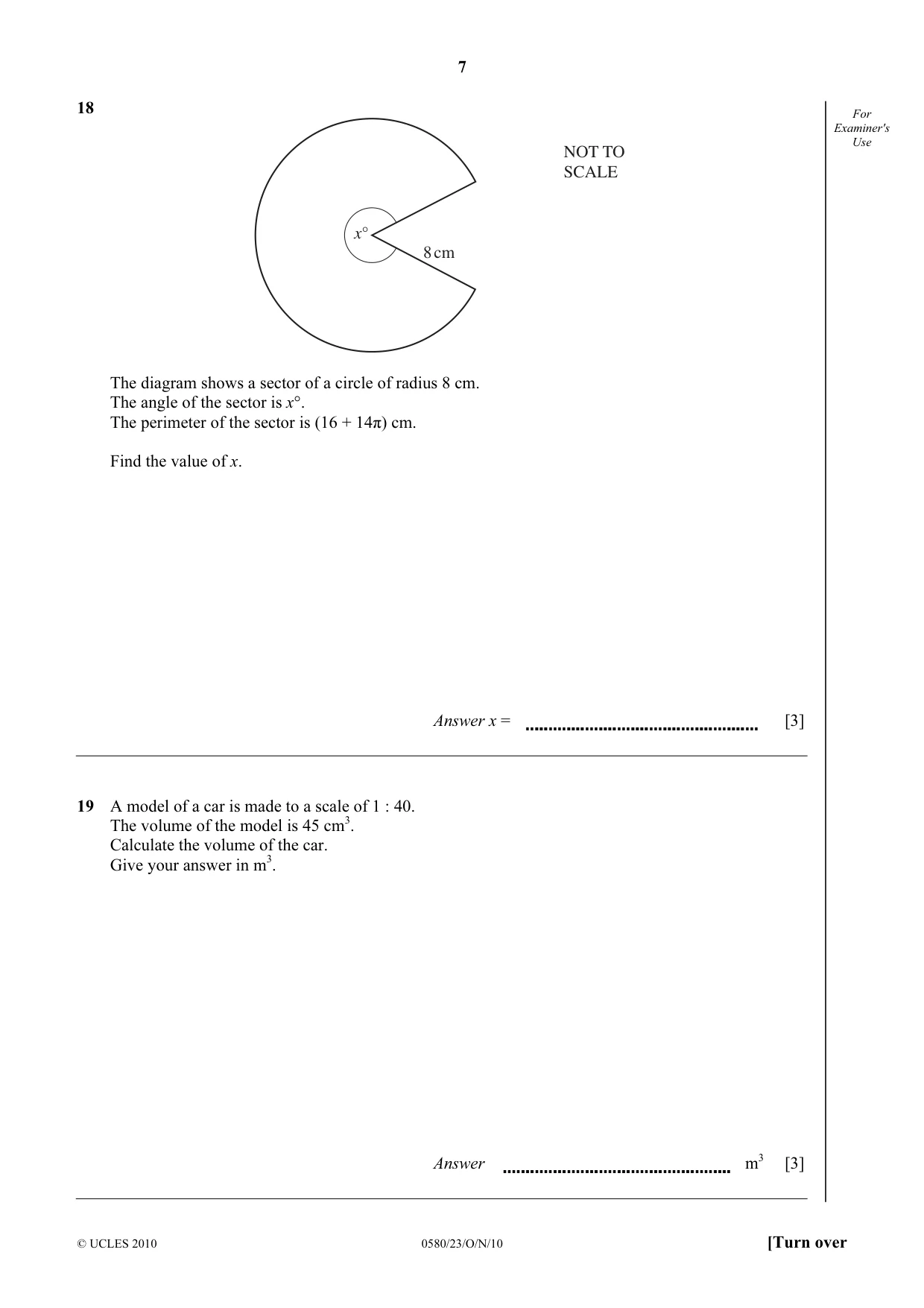
Q18 · For Examiner's NOT TO Use SCALE x° 8 cm The diagram shows a sector of a circle of radius…
18 For Examiner's NOT TO Use SCALE x° 8 cm The diagram shows a sector of a circle of radius 8 cm. The angle of the sector is x°. The perimeter of the sector is (16 + 14π) cm. Find the value of x. Answer x = [3]
Mark scheme: x 18 315 3 M1 × 2 × π × 8 oe 360 x M1 × 2 × π × 8 (+ 16) = (16 +) 14π 360 3
Q19 · A model of a car is made to a scale of 1 : 40
19 A model of a car is made to a scale of 1 : 40. The volume of the model is 45 cm3. Calculate the volume of the car. Give your answer in m3. Answer m3 [3]
Mark scheme: 19 2.88 3 M1 403 oe seen A1 2 880 000 B1ft their 2 880 000 ÷ 1003 or B1 0.000045 M1 403 A1 cao or M1 0.43 M1 45 × 0.43 A1 4
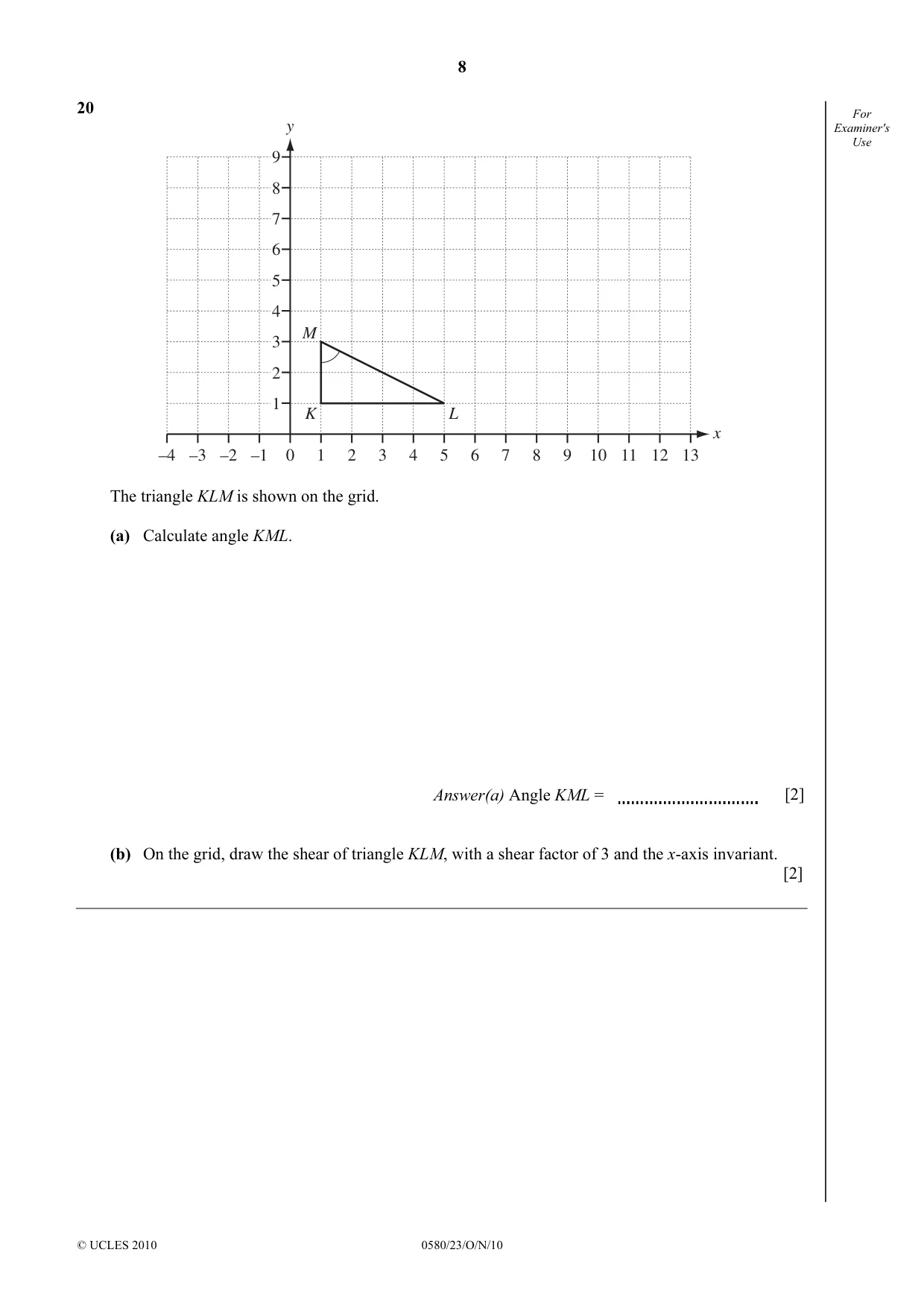
Q20 · For y Examiner's Use 9 8 7 6 5 4 M 3 2 1 K L x –4 –3 –2 –1 0 1 2 3 4 5 6 7 8 9 10 11 12…
20 For y Examiner's Use 9 8 7 6 5 4 M 3 2 1 K L x –4 –3 –2 –1 0 1 2 3 4 5 6 7 8 9 10 11 12 13 The triangle KLM is shown on the grid. (a) Calculate angle KML. Answer(a) Angle KML = [2] (b) On the grid, draw the shear of triangle KLM, with a shear factor of 3 and the x-axis invariant. [2]
Mark scheme: 4 20 (a) 63.4 2 M1 tan(M) = oe 2 (b) Vertices at (4, 1), (8, 1) and (10, 3) 2 B1 two vertices correct
Q21 · For 20 Examiner's Use 18 16 14 12 Speed 10 (m / s) 8 6 4 2 0 10 20 30 40 Time (seconds)…
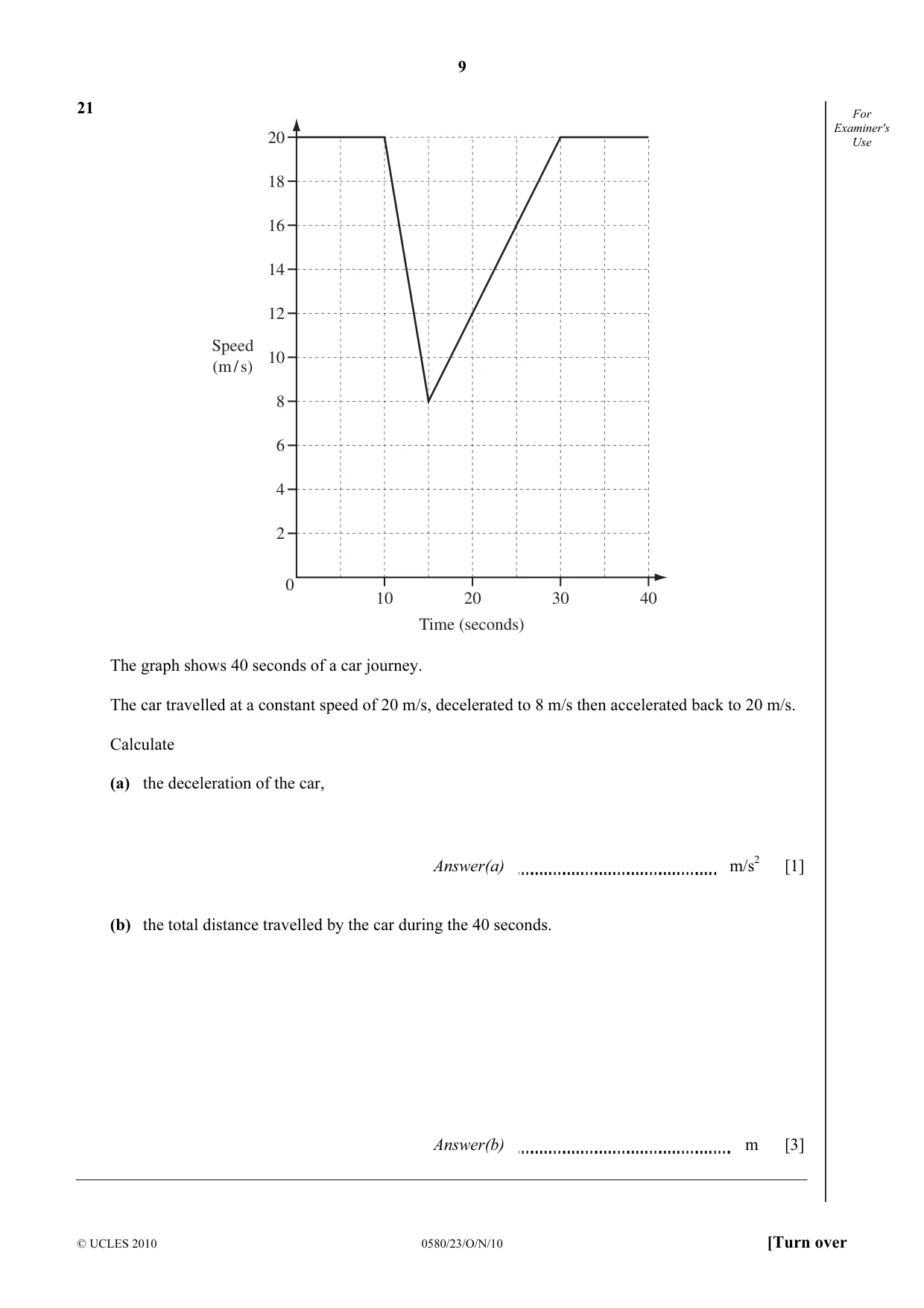
21 For 20 Examiner's Use 18 16 14 12 Speed 10 (m / s) 8 6 4 2 0 10 20 30 40 Time (seconds) The graph shows 40 seconds of a car journey. The car travelled at a constant speed of 20 m/s, decelerated to 8 m/s then accelerated back to 20 m/s. Calculate (a) the deceleration of the car, Answer(a) m/s2 [1] (b) the total distance travelled by the car during the 40 seconds. Answer(b) m [3]
Mark scheme: 21 (a) 2.4 oe 1 (b) 680 3 M1 an area found 1 M1 40 × 20 – × 20 × 12 oe 2
Q22 · For y Examiner's Use 9 8 7 6 5 4 3 2 1 x 0 –6 –5 –4 –3 –2 –1 1 2 3 4 –1 Find the three…
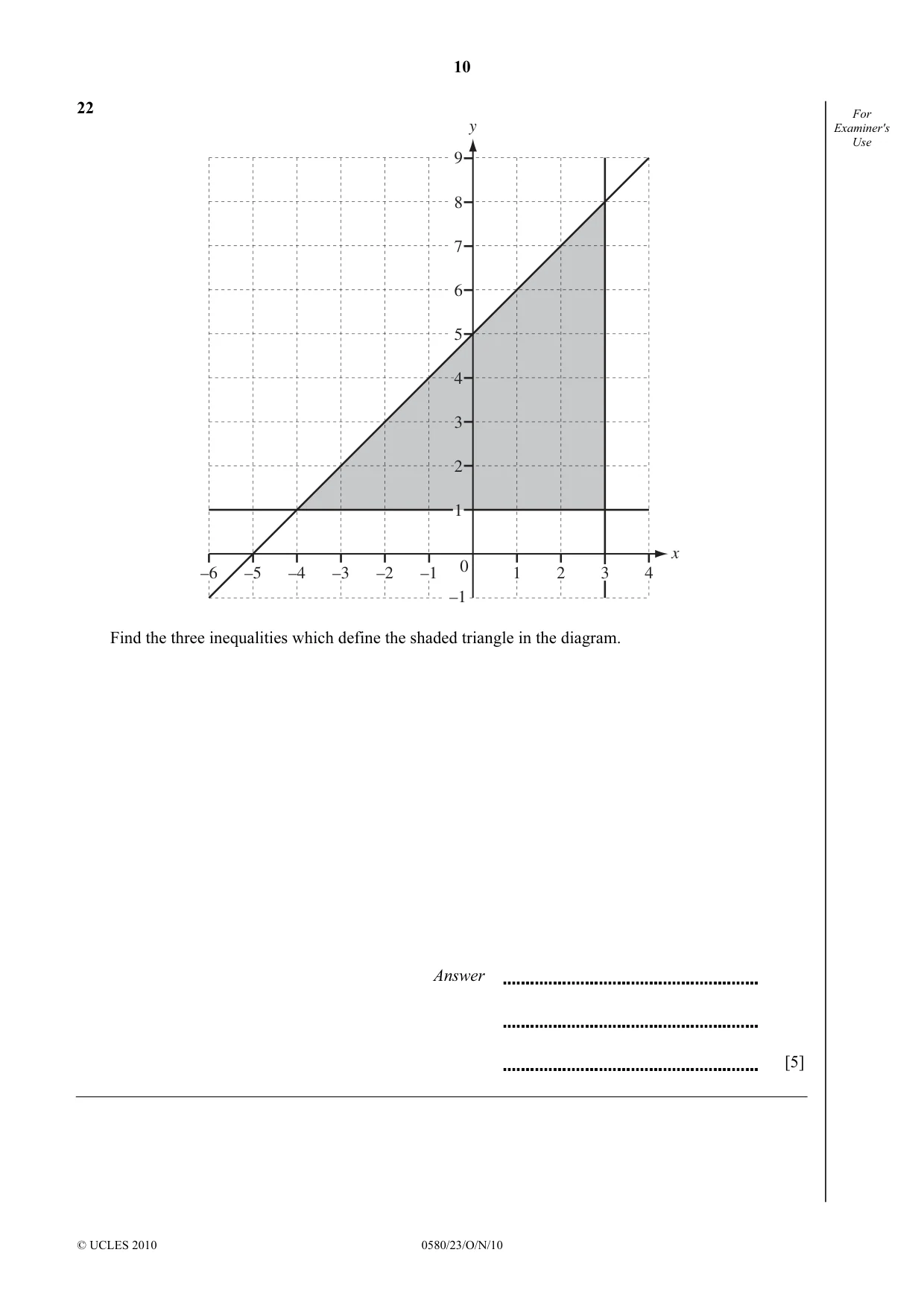
22 For y Examiner's Use 9 8 7 6 5 4 3 2 1 x 0 –6 –5 –4 –3 –2 –1 1 2 3 4 –1 Find the three inequalities which define the shaded triangle in the diagram. Answer [5]
Mark scheme: 22 y [ 1, x Y 3, y Y x + 5 oe 5 B1 y R 1 B1 x R 3 B2 y R x + 5 or B1 y R – x + 5 where R is any inequality B1 all 3 inequalities correct
Q23 · For A D Examiner's 50° Use NOT TO SCALE O 86° 30° C B The points A, B, C and D lie on the…
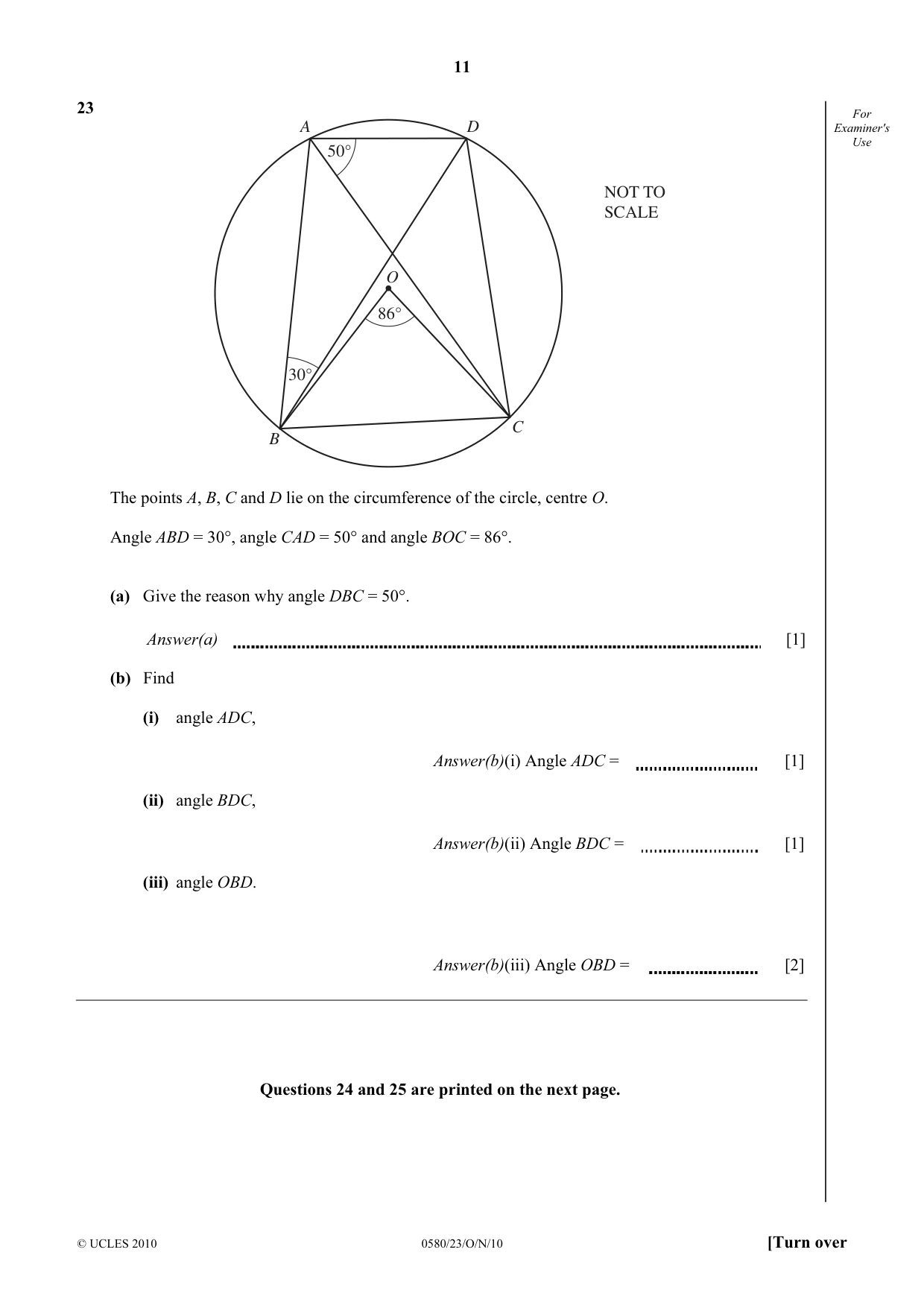
23 For A D Examiner's 50° Use NOT TO SCALE O 86° 30° C B The points A, B, C and D lie on the circumference of the circle, centre O. Angle ABD = 30°, angle CAD = 50° and angle BOC = 86°. (a) Give the reason why angle DBC = 50°. Answer(a) [1] (b) Find (i) angle ADC, Answer(b)(i) Angle ADC = [1] (ii) angle BDC, Answer(b)(ii) Angle BDC = [1] (iii) angle OBD. Answer(b)(iii) Angle OBD = [2] Questions 24 and 25 are printed on the next page.
Mark scheme: 23 (a) (Angles in) same segment 1 Allow (angles on) the same arc (b) (i) 100 1 (ii) 43 1 1 (iii) 3 2 B1 OBC or OCB = (180 – 86) (= 47) 2 IGCSE – October/November 2010 0580 23 x − 2 y
Q24 · 2 For 24 (a) Write − as a single fraction in its lowest terms
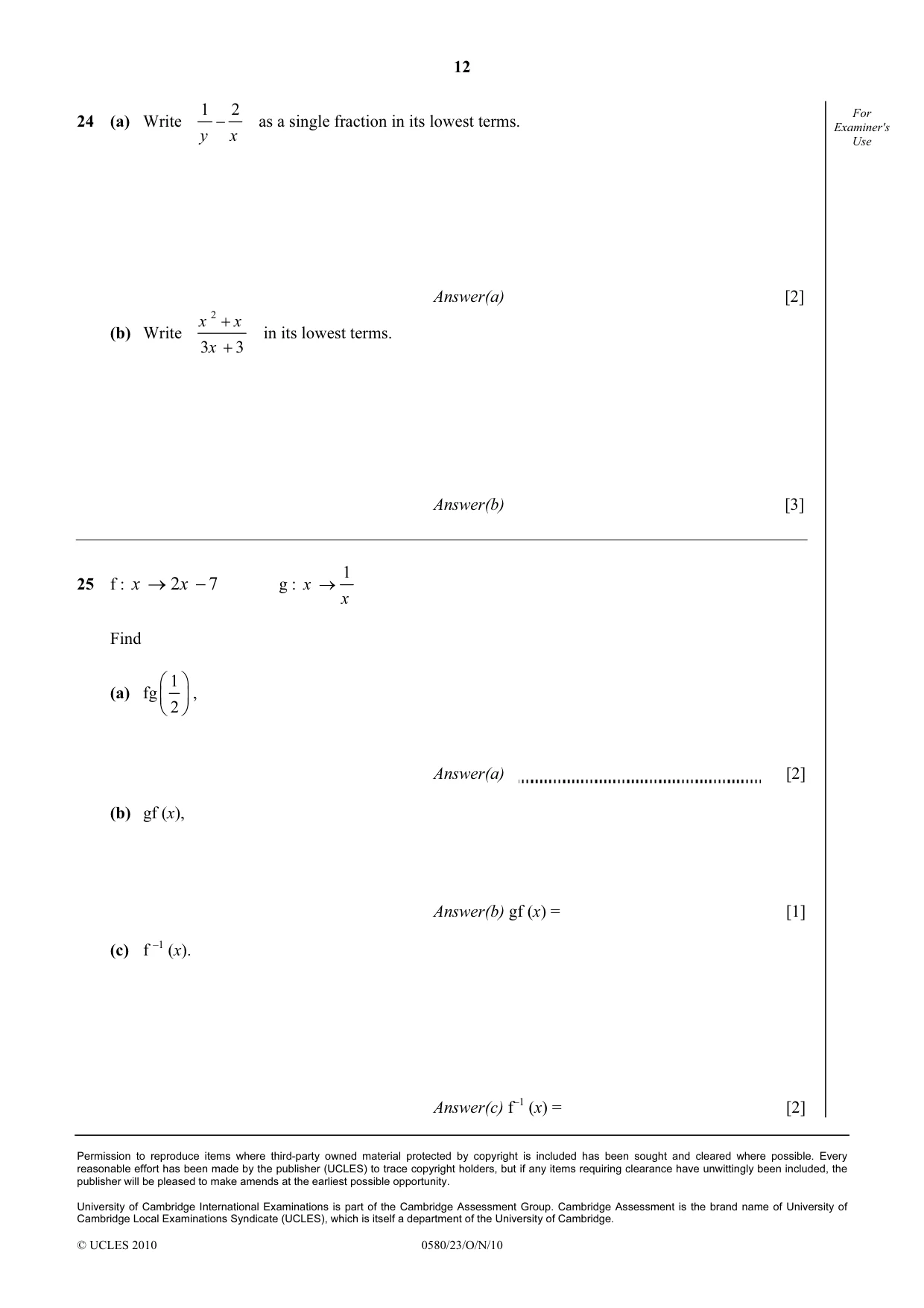
1 2 For 24 (a) Write − as a single fraction in its lowest terms. Examiner's y x Use Answer(a) [2] x 2 + x (b) Write in its lowest terms. 3x + 3 Answer(b) [3]
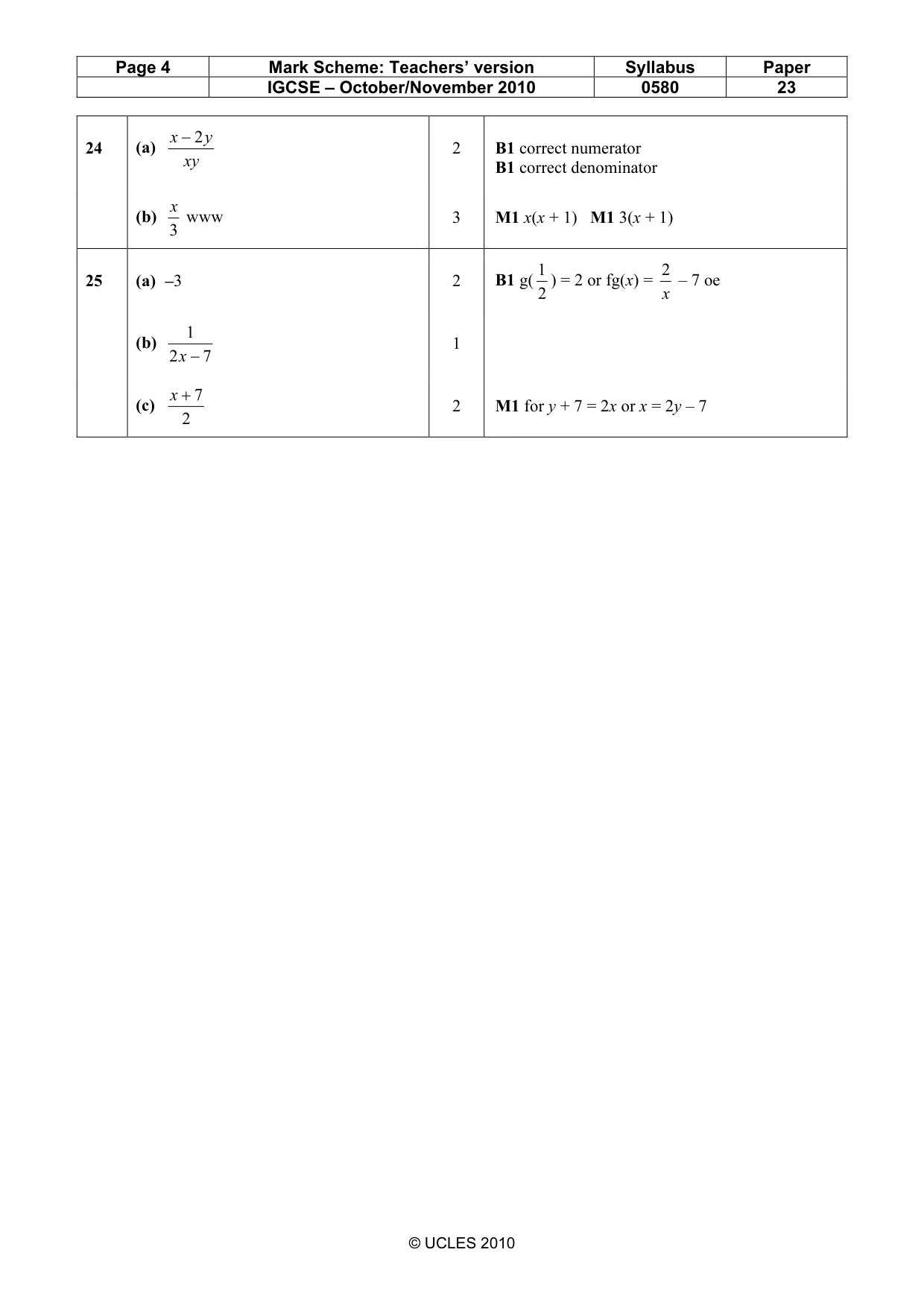
Mark scheme: x 2 y 24 (a) 2 B1 correct numerator xy B1 correct denominator x (b) www 3 M1 x(x + 1) M1 3(x + 1) 3 1 2
Q25 · 25 f : x → 2 x − 7 g : x → x Find 1 (a) fg , 2 Answer(a) [2] (b) gf (x)…
1 25 f : x → 2 x − 7 g : x → x Find 1 (a) fg , 2 Answer(a) [2] (b) gf (x), Answer(b) gf (x) = [1] (c) f –1 (x). Answer(c) f–1 (x) = [2]
Mark scheme: 1 2 25 (a) –3 2 B1 g( ) = 2 or fg(x) = – 7 oe 2 x 1 (b) 1 2 x − 7 x + 7 (c) 2 M1 for y + 7 = 2x or x = 2y – 7 2
What was in this paper
The subtopics covered by these 25 questions, and how many questions each got. Open one in a new tab to see every Cambridge question on it.
2Rates2Algebraic manipulation1Area and perimeter1Circle theorems I1Circles, arcs and sectors1Classifying statistical data1Equations of linear graphs1Fractions, decimals and percentages1Functions1Indices I1Inequalities1Limits of accuracy1Ordering1Percentages1Powers and roots1Right-angled triangles1Scale drawings1Sets1Similarity1The four operations1Time1Units of measure1What you needed in this session
Cambridge’s own grade thresholds for 2010 Oct/Nov, Paper 2 · Variant 3. A higher threshold means an easier paper — the bar moves with how the cohort did.