Cambridge IGCSE Mathematics 0580 — 2018 May/June Paper 2 · Variant 3
0580/23/M/J/18 · 26 questions · 70 marks · ≈79 min
The question paper and its mark scheme, free to read here and free to download. This is Cambridge’s own paper, exactly as it was sat.
Question paper12 pages
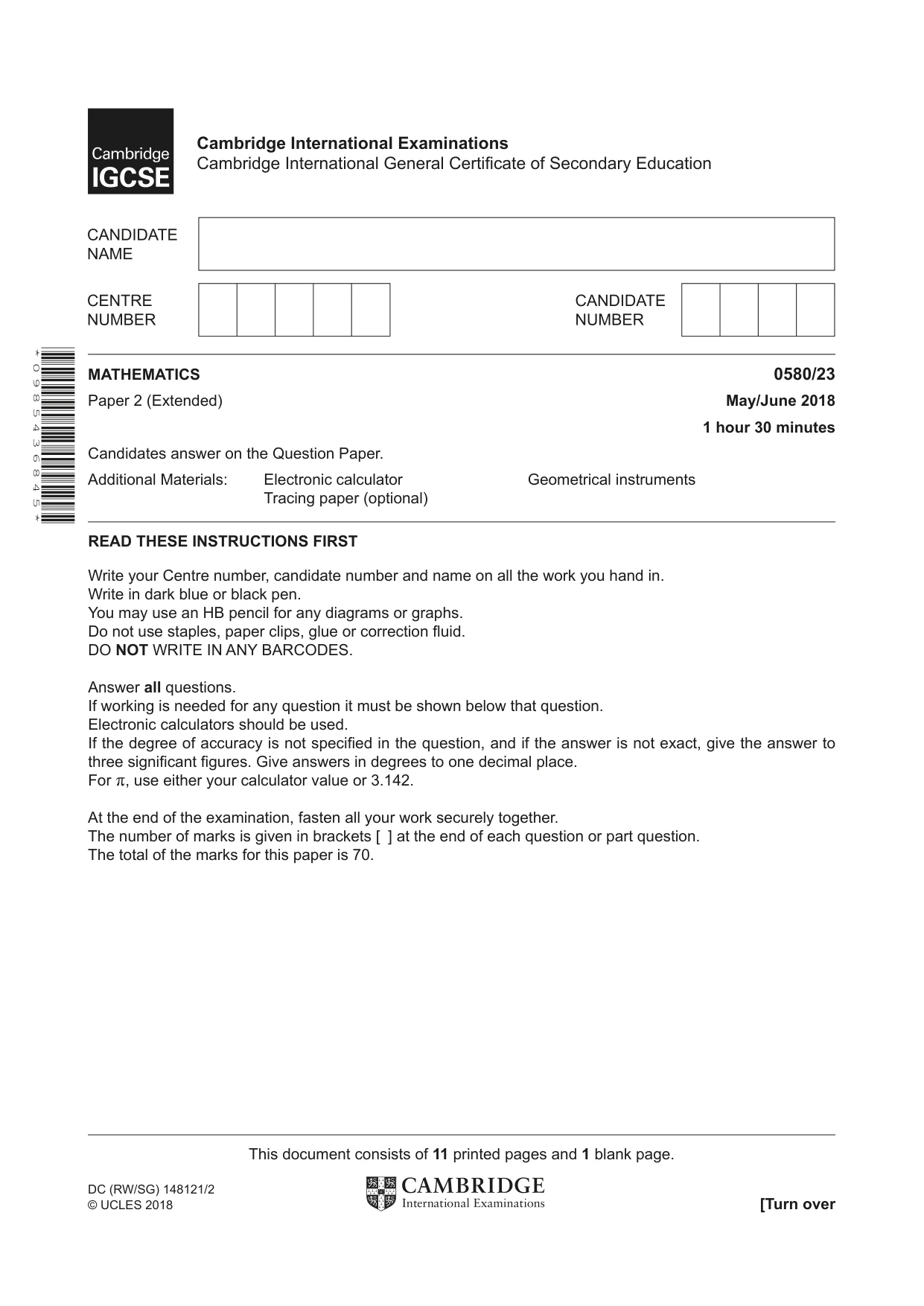
Mark scheme5 pages
Answers below. Sit the paper first if you are practising.
Questions as text
Q1 · One day in Chamonix the temperature at noon was 6 °C
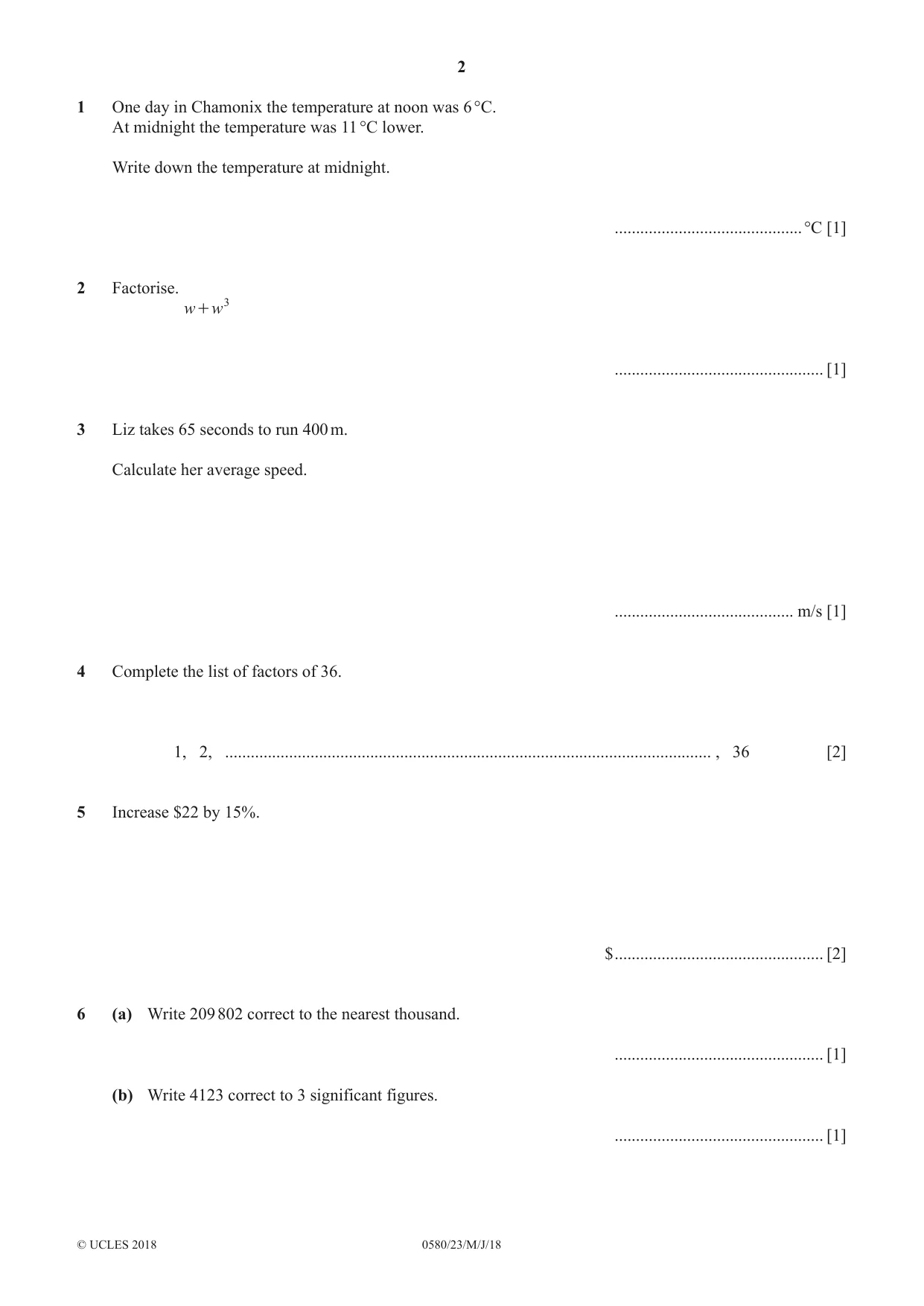
1 One day in Chamonix the temperature at noon was 6 °C. At midnight the temperature was 11 °C lower. Write down the temperature at midnight. ............................................°C [1]
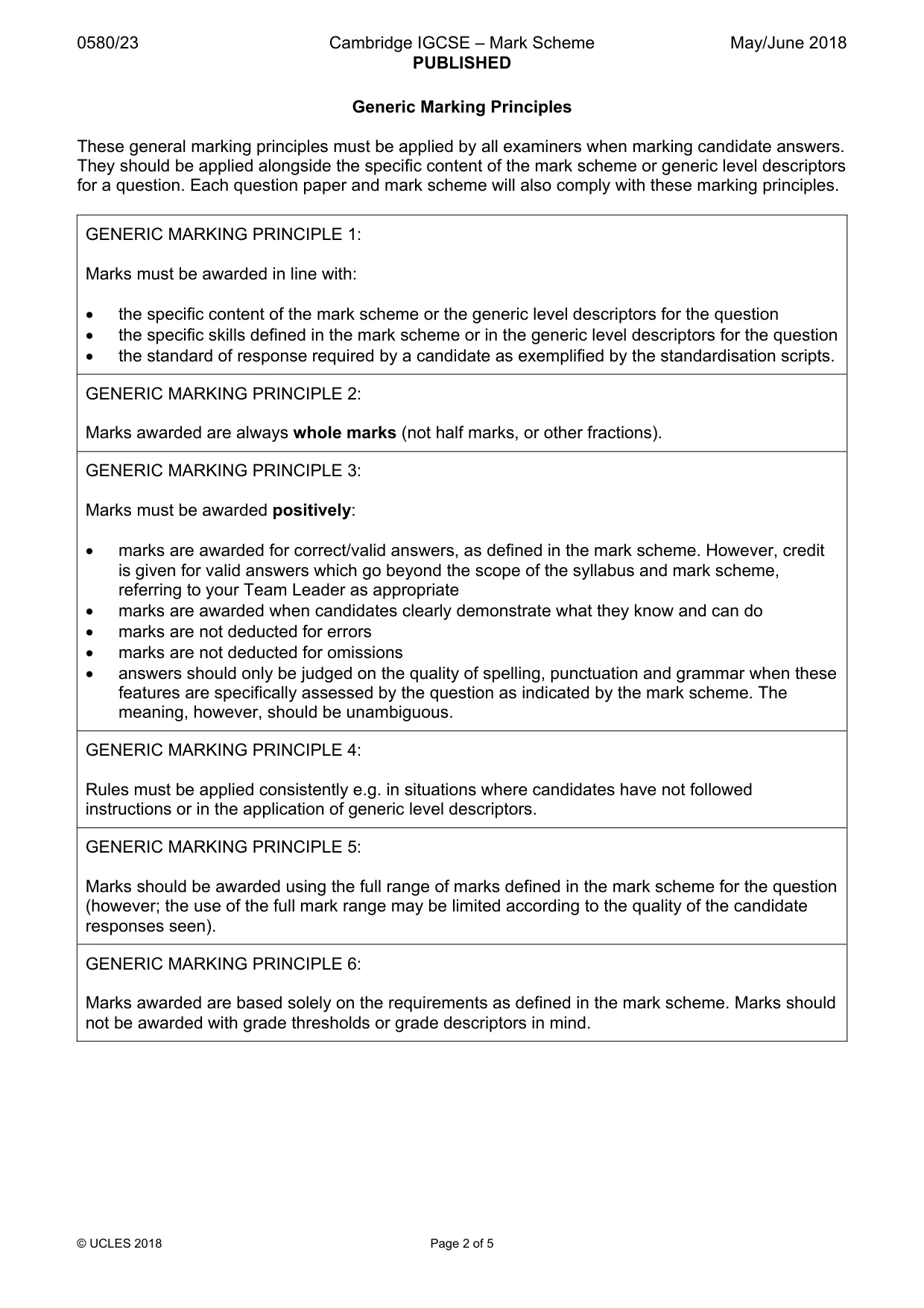
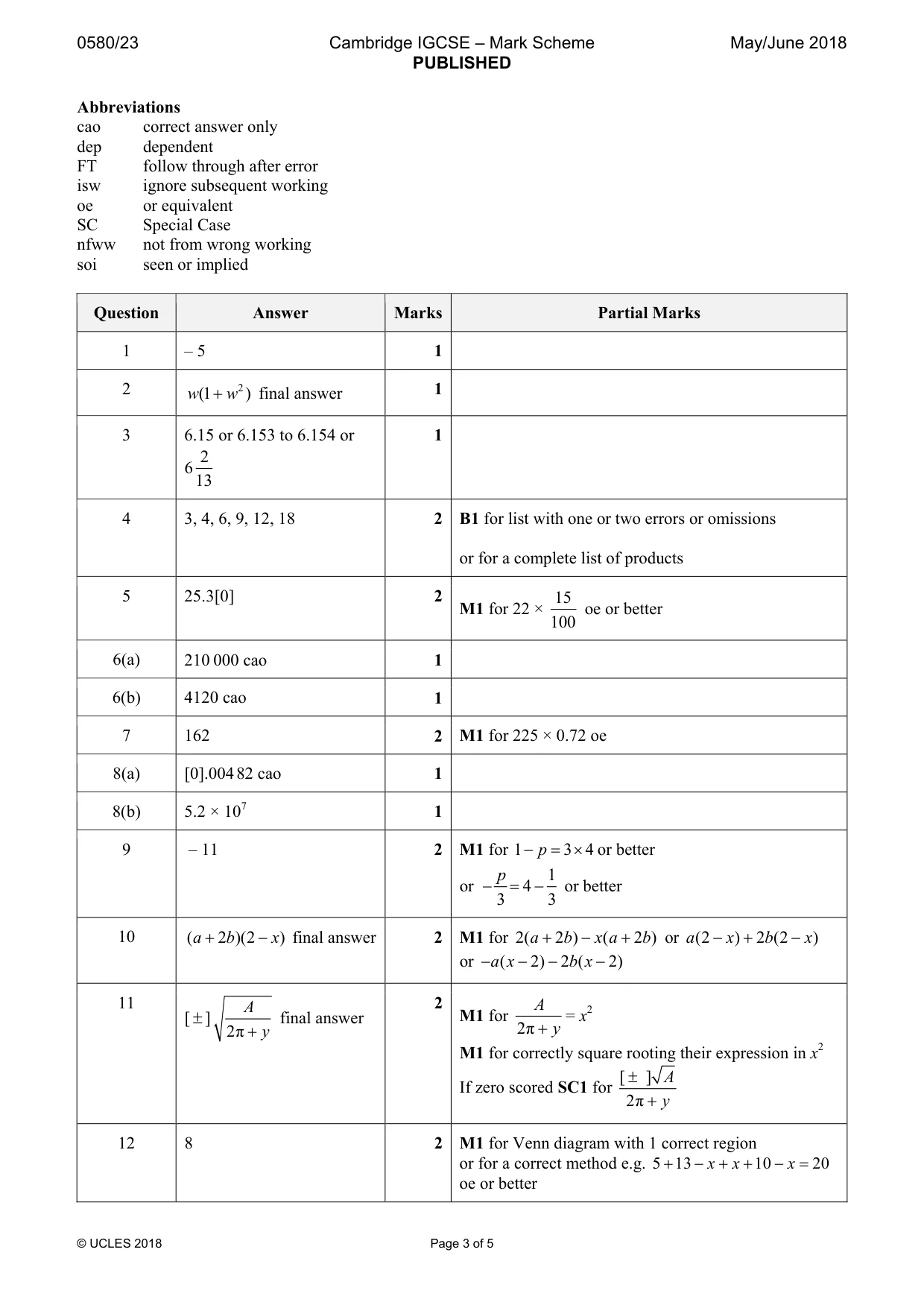
Mark scheme: Question Answer Marks Partial Marks 1 – 5 1
Question 2
2 Factorise. w + w3 ................................................. [1]
Mark scheme: 2 w(1 + w 2 ) final answer 1
Q3 · Liz takes 65 seconds to run 400 m
3 Liz takes 65 seconds to run 400 m. Calculate her average speed. .......................................... m/s [1]
Mark scheme: 3 6.15 or 6.153 to 6.154 or 1 2 6 13
Q4 · Complete the list of factors of 36
4 Complete the list of factors of 36. 1, 2, .................................................................................................................. , 36 [2]
Mark scheme: 4 3, 4, 6, 9, 12, 18 2 B1 for list with one or two errors or omissions or for a complete list of products
Q5 · Increase $22 by 15%
5 Increase $22 by 15%. $ ................................................. [2]
Mark scheme: 5 25.3[0] 2 15 M1 for 22 × oe or better 100
Q6 · Write 209 802 correct to the nearest thousand
6 (a) Write 209 802 correct to the nearest thousand. ................................................. [1] (b) Write 4123 correct to 3 significant figures. ................................................. [1]
Mark scheme: 6(a) 210 000 cao 1 6(b) 4120 cao 1
Q7 · The probability that Kim wins a game is 0.72
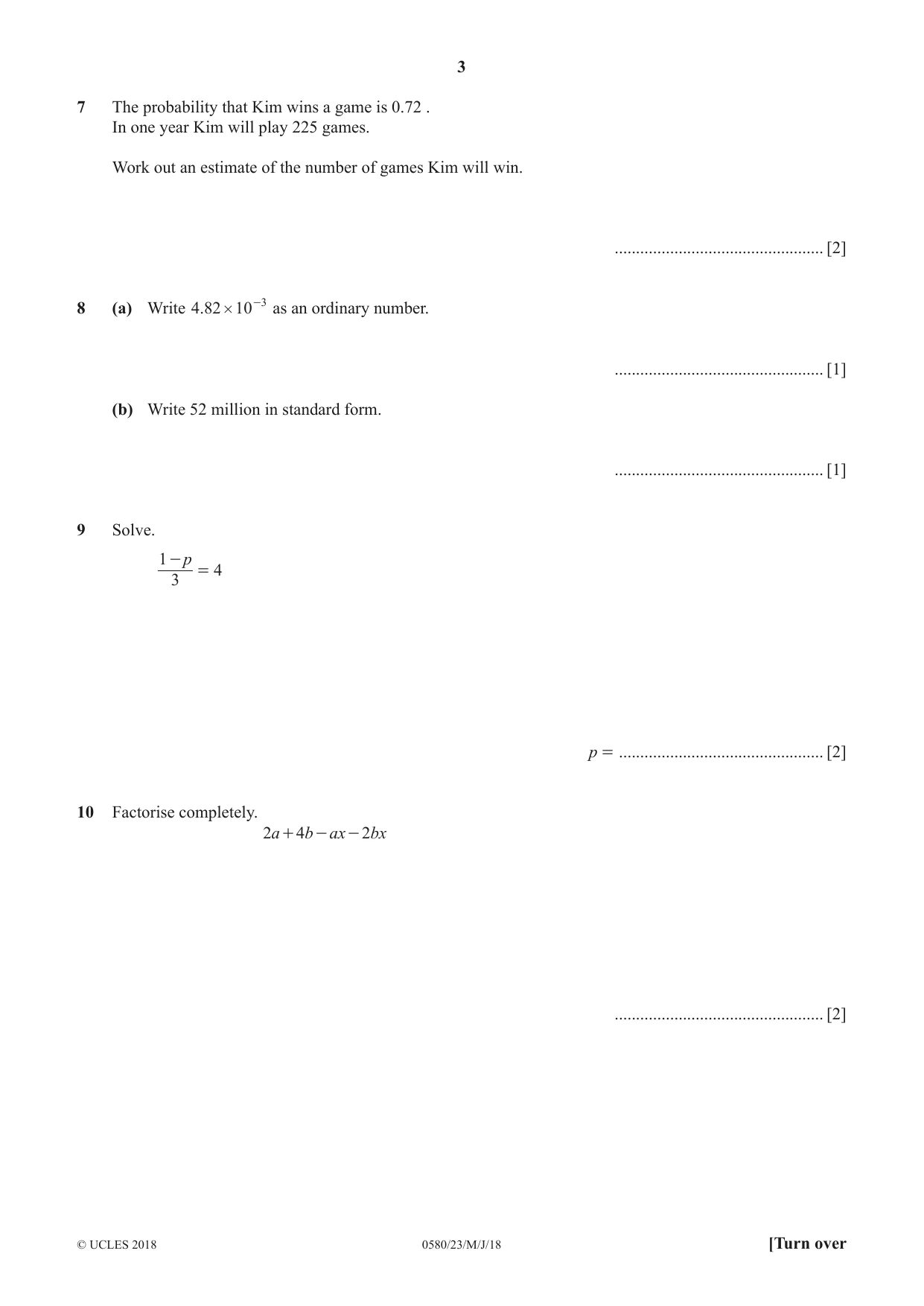
7 The probability that Kim wins a game is 0.72 . In one year Kim will play 225 games. Work out an estimate of the number of games Kim will win. ................................................. [2]
Mark scheme: 7 162 2 M1 for 225 × 0.72 oe
Q8 · Write .482 # 10 -3 as an ordinary number
8 (a) Write .482 # 10 -3 as an ordinary number. ................................................. [1] (b) Write 52 million in standard form. ................................................. [1]
Mark scheme: 8(a) [0].004 82 cao 1 8(b) 5.2 × 10⁷ 1
Question 9
9 Solve. 1 - p = 4 3 p = ................................................ [2]
Mark scheme: 9 – 11 2 M1 for 1 − p = 3 × 4 or better p 1 or − = 4 − or better 3 3
Question 10
10 Factorise completely. 2a + 4b - ax - 2bx ................................................. [2]
Mark scheme: 10 ( a + 2b )(2 − x ) final answer 2 M1 for 2( a + 2b ) − x ( a + 2b ) or a (2 − x ) + 2b (2 − x ) or − a ( x − 2) − 2b ( x − 2)
Q11 · A = 2 r + y x 2 ^ h Rearrange the formula to make x the subject
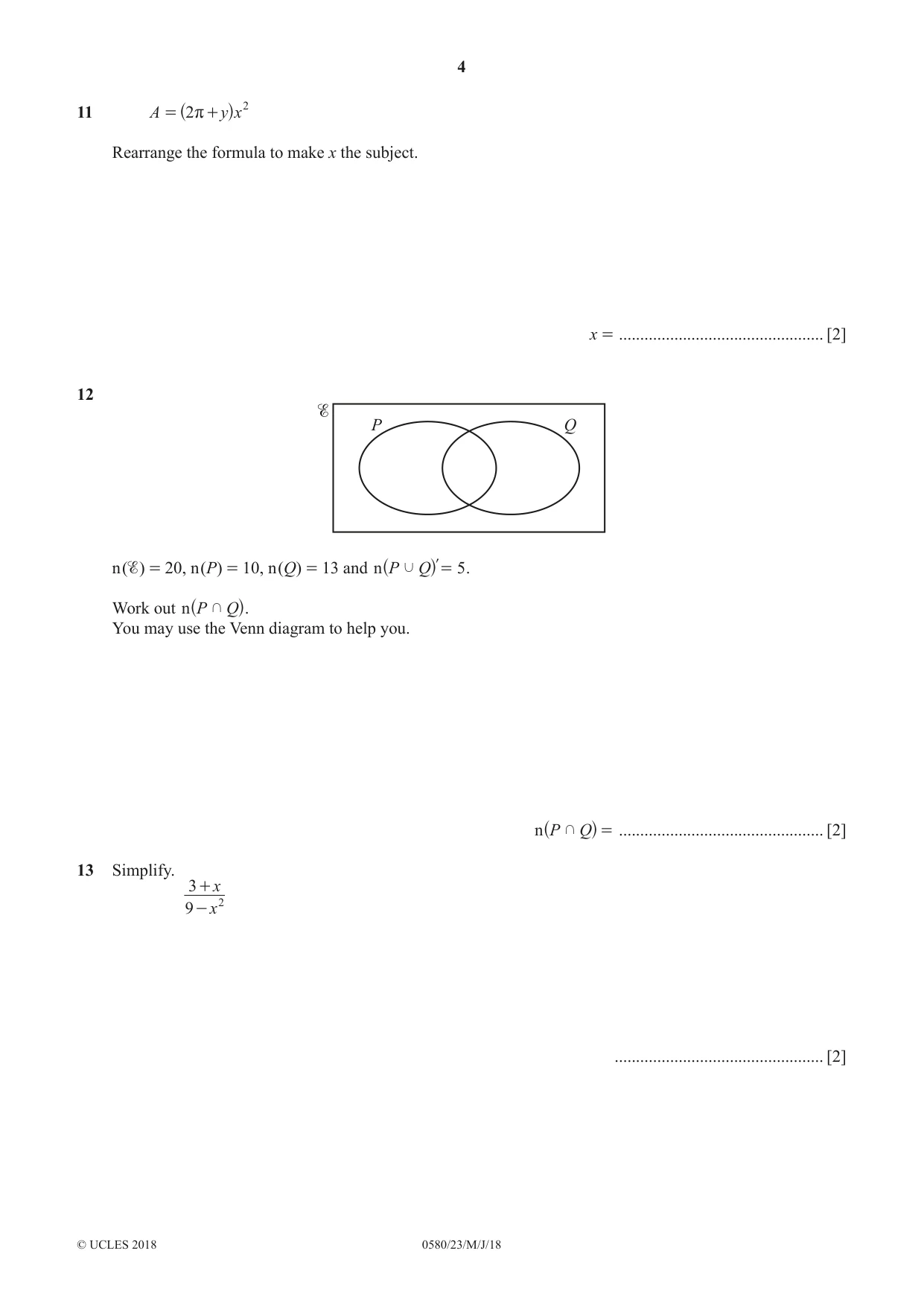
11 A = 2 r + y x 2 ^ h Rearrange the formula to make x the subject. x = ................................................ [2]
Mark scheme: 11 A 2 A [ ± ] final answer M1 for = x2 2π + y 2π + y M1 for correctly square rooting their expression in x2 [ ± ] A If zero scored SC1 for 2π + y
Q12 · P Q n () = 20, n (P) = 10, n (Q) = 13 and n P j Q l = 5
12 P Q n () = 20, n (P) = 10, n (Q) = 13 and n P j Q l = 5 . ^ h Work out n P k Q ^ h. You may use the Venn diagram to help you. n P k Q = ................................................ [2] ^ h
Mark scheme: 12 8 2 M1 for Venn diagram with 1 correct region or for a correct method e.g. 5 + 13 − x + x + 10 − x = 20 oe or better
Question 13
13 Simplify. 3 + x 9 - x 2 ................................................. [2]
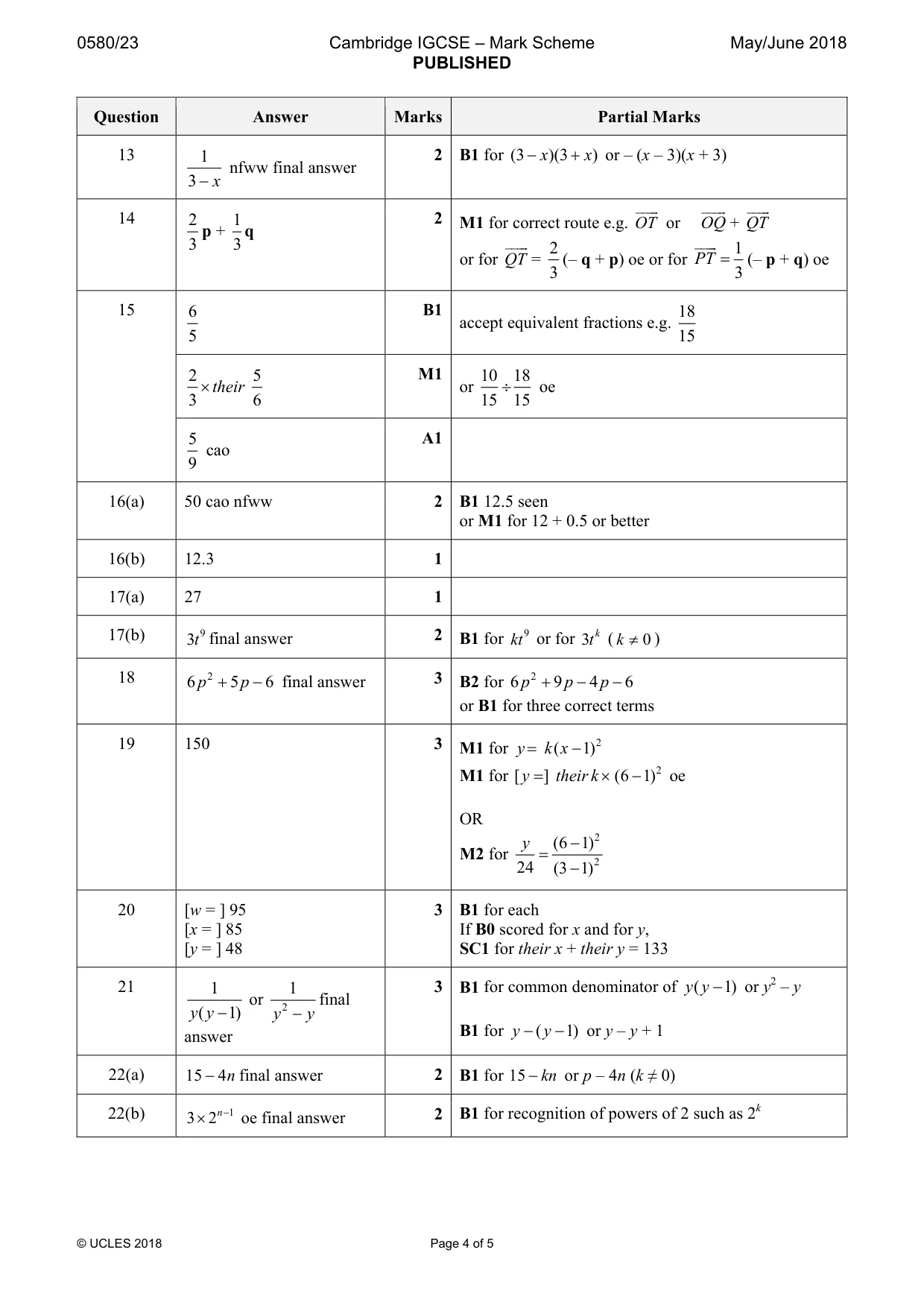
Mark scheme: 13 1 2 B1 for (3 − x )(3 + x ) or – (x – 3)(x + 3) nfww final answer 3 − x
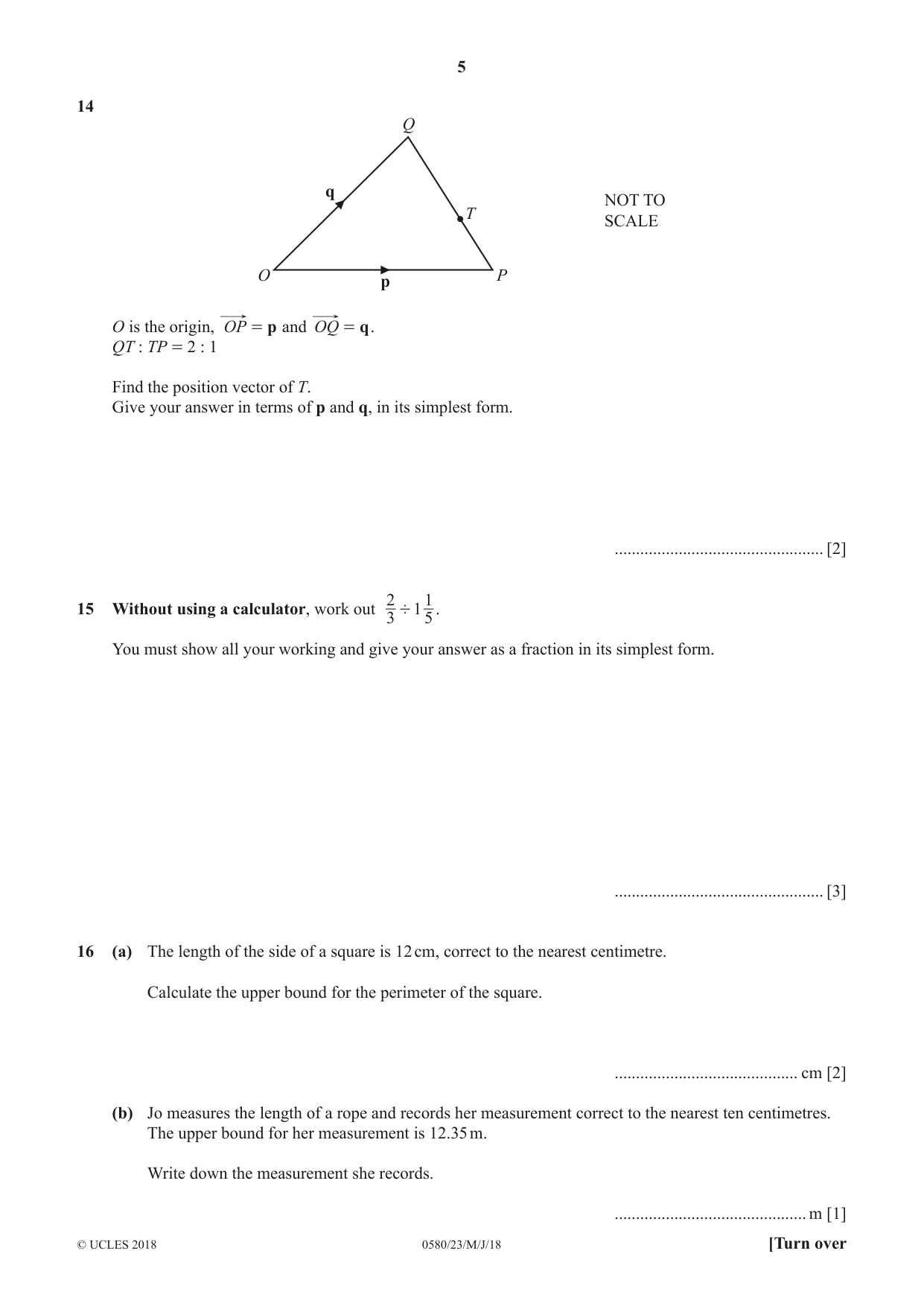
Q14 · Q q NOT TO T SCALE O P p O is the origin, OP = p and OQ = q
14 Q q NOT TO T SCALE O P p O is the origin, OP = p and OQ = q . QT : TP = 2 : 1 Find the position vector of T. Give your answer in terms of p and q, in its simplest form. ................................................. [2]
Mark scheme: JJJG JJJG JJJG 14 2 1 2 M1 for correct route e.g. OT or OQ + QT p + q 3 3 JJJG 2 JJJG 1 or for QT = (– q + p) oe or for PT = (– p + q) oe 3 3
Q15 · 115 Without using a calculator, work out ' 1
2 115 Without using a calculator, work out ' 1 . 3 5 You must show all your working and give your answer as a fraction in its simplest form. ................................................. [3]
Mark scheme: 15 6 B1 18 accept equivalent fractions e.g. 5 15 2 5 M1 10 18 ×their or ÷ oe 3 6 15 15 5 A1 cao 9
Q16 · The length of the side of a square is 12 cm, correct to the nearest centimetre
16 (a) The length of the side of a square is 12 cm, correct to the nearest centimetre. Calculate the upper bound for the perimeter of the square. ........................................... cm [2] (b) Jo measures the length of a rope and records her measurement correct to the nearest ten centimetres. The upper bound for her measurement is 12.35 m. Write down the measurement she records. ............................................. m [1]
Mark scheme: 16(a) 50 cao nfww 2 B1 12.5 seen or M1 for 12 + 0.5 or better 16(b) 12.3 1
Q17 · 4 1 -17 (a) Find the value of
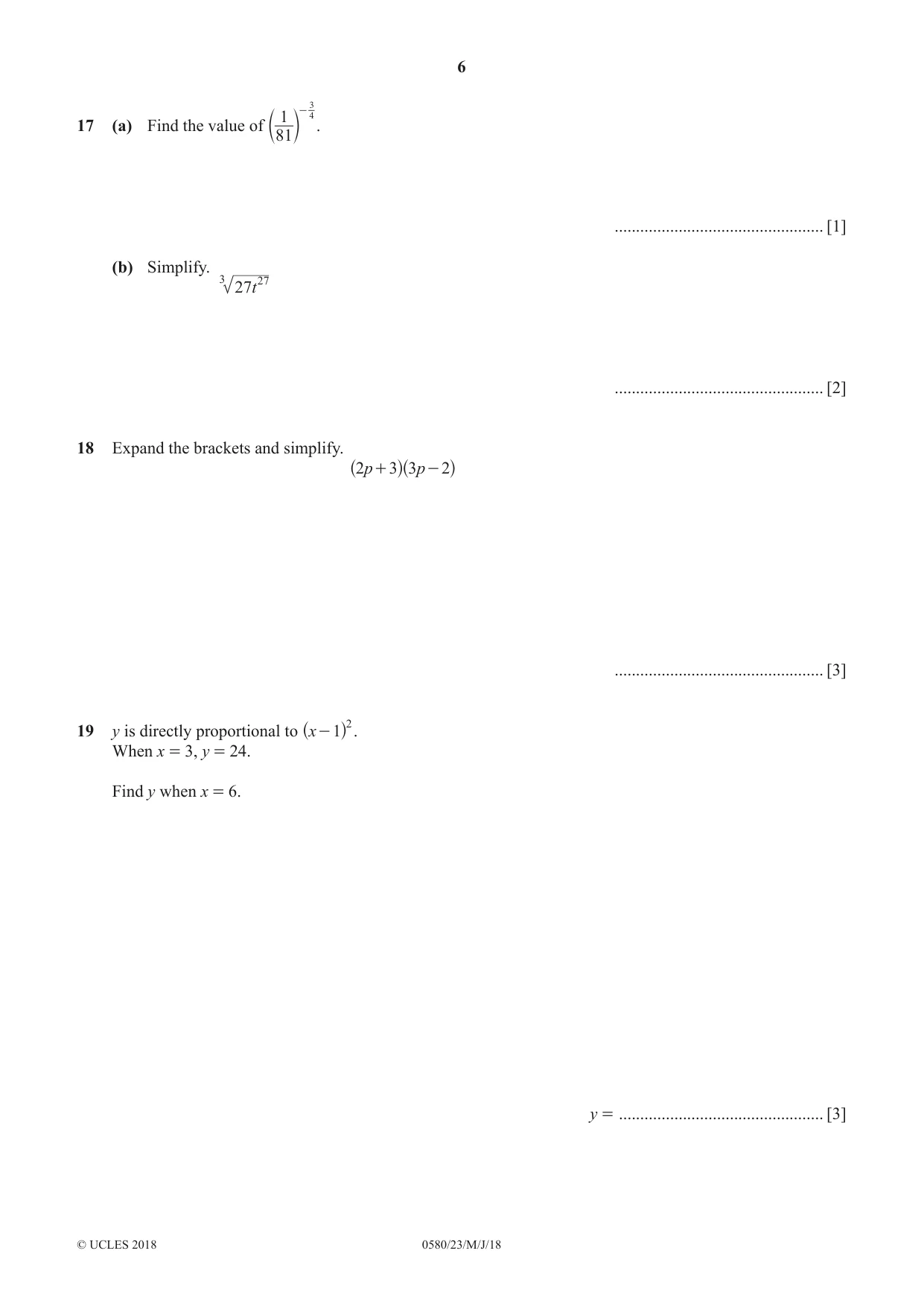
3 4 1 -17 (a) Find the value of . c 81 m ................................................. [1] (b) Simplify. 3 27t 27 ................................................. [2]
Mark scheme: 17(a) 27 1 17(b) 3t 9 final answer 2 B1 for kt 9 or for 3kt ( k ≠ 0 )
Q18 · Expand the brackets and simplify
18 Expand the brackets and simplify. 2p + 3 3p - 2 ^ ^h h ................................................. [3]
Mark scheme: 18 6 p 2 + 5 p − 6 final answer 3 B2 for 6 p 2 + 9 p − 4 p − 6 or B1 for three correct terms
Q19 · Y is directly proportional to x - 1 2
19 y is directly proportional to x - 1 2 . ^ h When x = 3, y = 24. Find y when x = 6. y = ................................................ [3]
Mark scheme: 19 150 3 M1 for y = k ( x − 1) 2 M1 for [ y = ] their k × (6 − 1) 2 oe OR y (6 − 1) 2 M2 for = 24 (3 − 1) 2
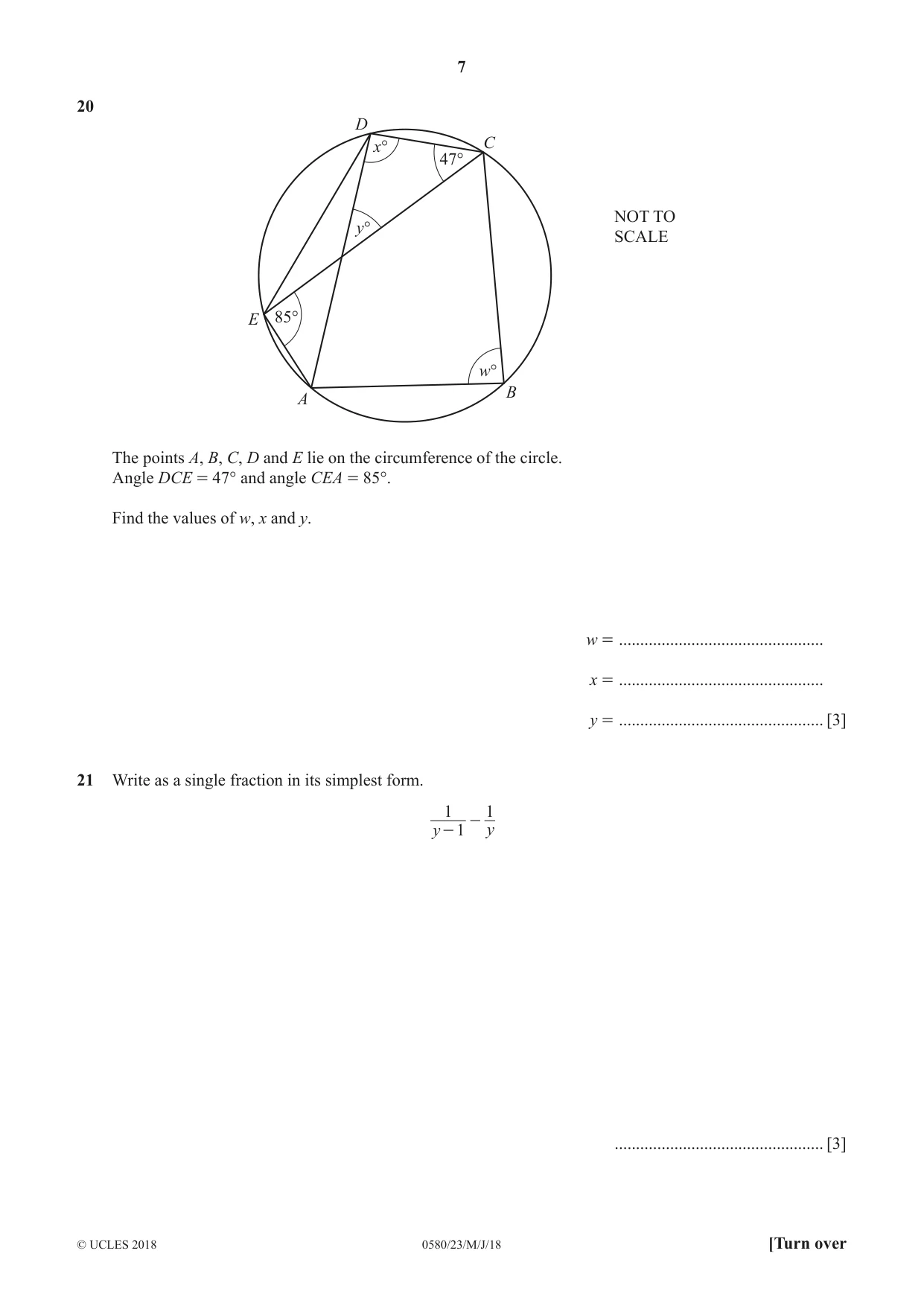
Q20 · D x° C 47° NOT TO y° SCALE E 85° w° B A The points A, B, C, D and E lie on the…
20 D x° C 47° NOT TO y° SCALE E 85° w° B A The points A, B, C, D and E lie on the circumference of the circle. Angle DCE = 47° and angle CEA = 85°. Find the values of w, x and y. w = ................................................ x = ................................................ y = ................................................ [3]
Mark scheme: 20 [w = ] 95 3 B1 for each [x = ] 85 If B0 scored for x and for y, [y = ] 48 SC1 for their x + their y = 133
Q21 · Write as a single fraction in its simplest form
21 Write as a single fraction in its simplest form. 1 1 - y - 1 y ................................................. [3]
Mark scheme: 21 1 1 3 B1 for common denominator of y ( y − 1) or y2 – y or final y ( y − 1) y 2 − y B1 for y − ( y − 1) or y – y + 1 answer
Q22 · Find an expression for the nth term of each sequence
22 Find an expression for the nth term of each sequence. (a) 11, 7, 3, – 1, … ................................................. [2] (b) 3, 6, 12, 24, … ................................................. [2]
Mark scheme: 22(a) 15 − 4n final answer 2 B1 for 15 − kn or p – 4n (k ≠ 0) 22(b) 3 × 2n−1 oe final answer 2 B1 for recognition of powers of 2 such as 2k
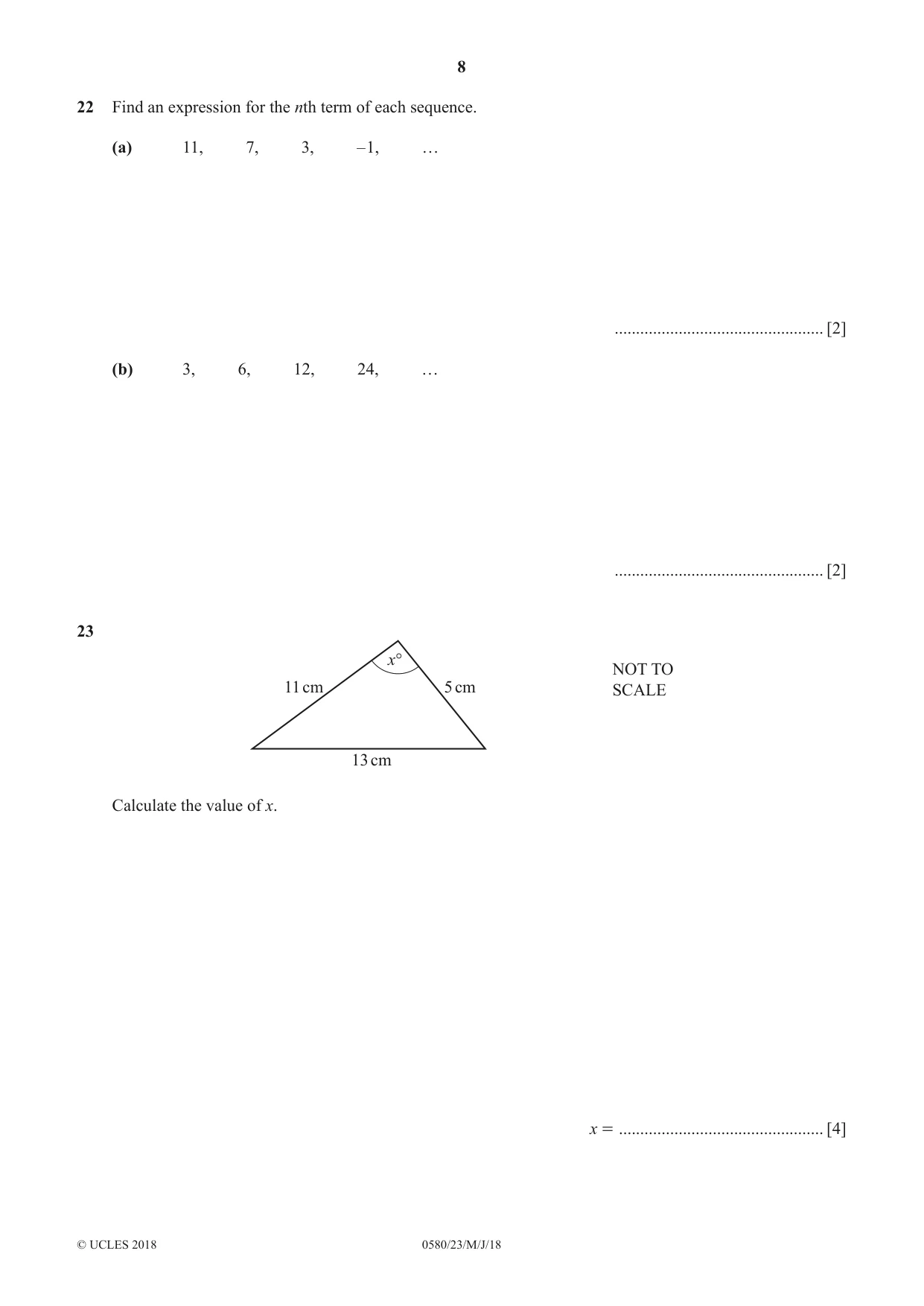
Q23 · X° NOT TO 11 cm 5 cm SCALE 13 cm Calculate the value of x
23 x° NOT TO 11 cm 5 cm SCALE 13 cm Calculate the value of x. x = ................................................ [4]
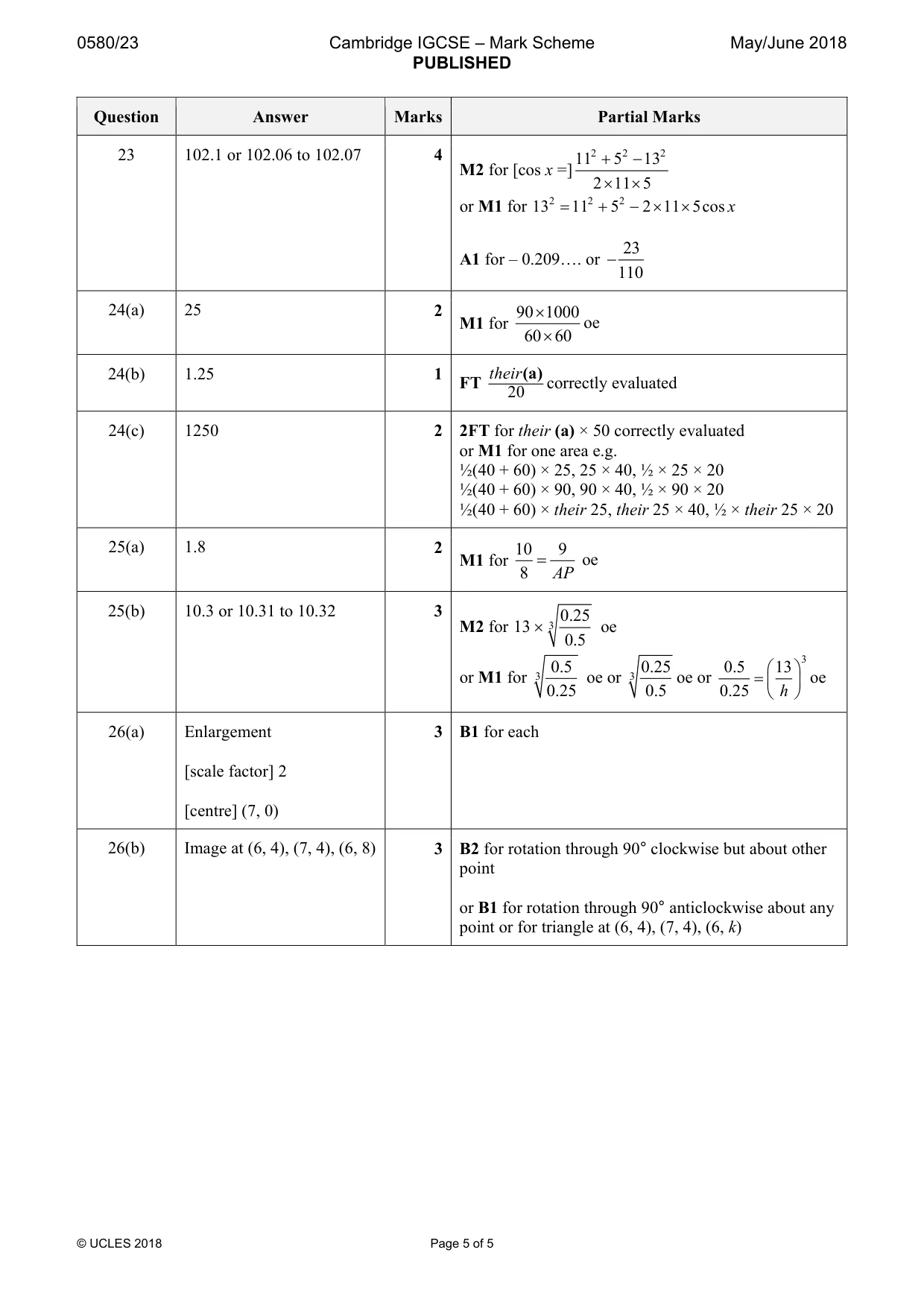
Mark scheme: 23 102.1 or 102.06 to 102.07 4 112 + 5 2 − 132 M2 for [cos x =] 2 × 11 × 5 or M1 for 13 2 = 112 + 5 2 − 2 × 11 × 5cos x 23 A1 for – 0.209…. or − 110
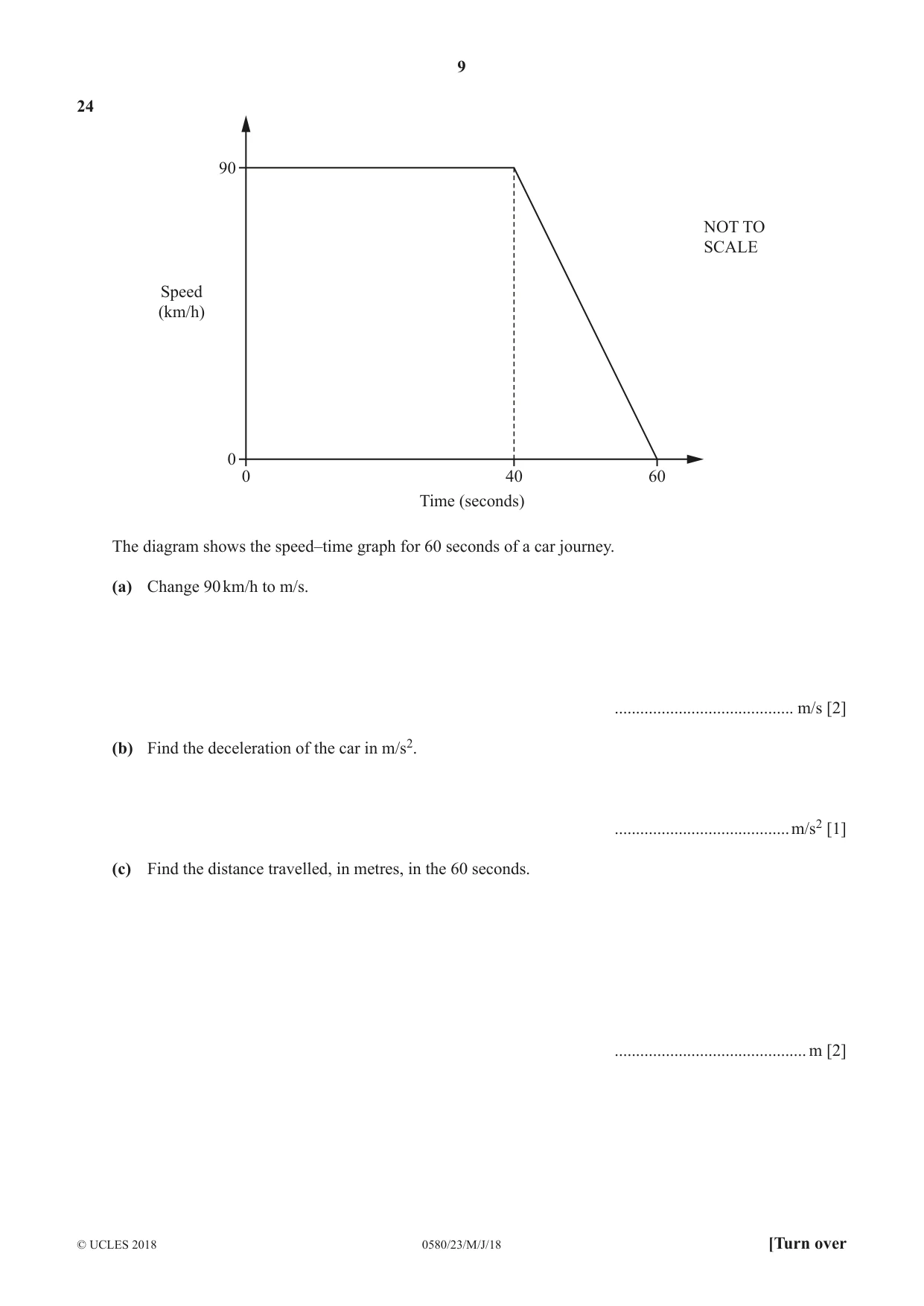
Q24 · 90 NOT TO SCALE Speed (km/h) 0 0 40 60 Time (seconds) The diagram shows the speed–time…
24 90 NOT TO SCALE Speed (km/h) 0 0 40 60 Time (seconds) The diagram shows the speed–time graph for 60 seconds of a car journey. (a) Change 90 km/h to m/s. .......................................... m/s [2] (b) Find the deceleration of the car in m/s2. .........................................m/s2 [1] (c) Find the distance travelled, in metres, in the 60 seconds. ............................................. m [2]
Mark scheme: 24(a) 25 2 90 × 1000 M1 for oe 60 × 60 24(b) 1.25 1 their (a) FT correctly evaluated 20 24(c) 1250 2 2FT for their (a) × 50 correctly evaluated or M1 for one area e.g. ½(40 + 60) × 25, 25 × 40, ½ × 25 × 20 ½(40 + 60) × 90, 90 × 40, ½ × 90 × 20 ½(40 + 60) × their 25, their 25 × 40, ½ × their 25 × 20
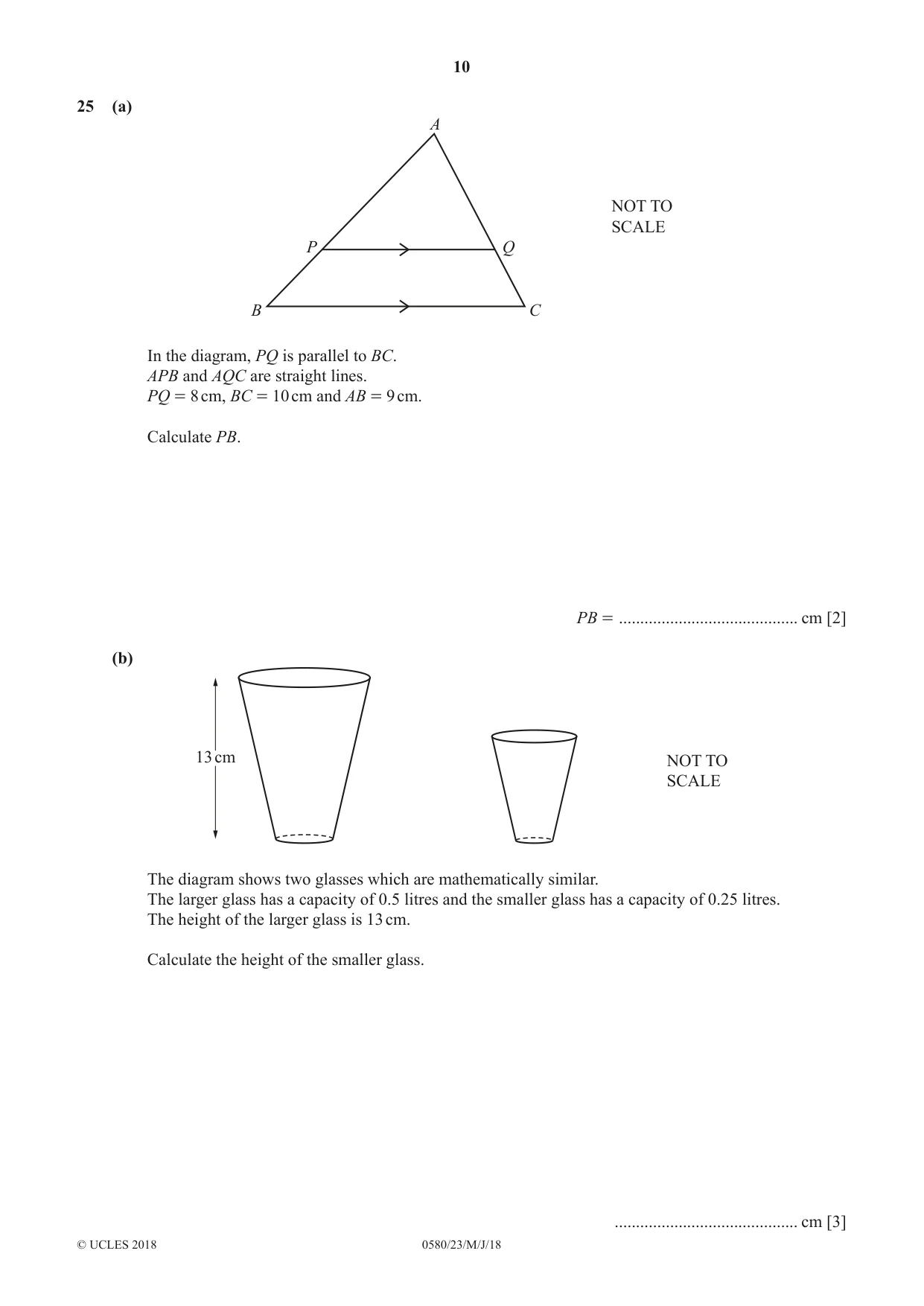
Q25 · A NOT TO SCALE P Q B C In the diagram, PQ is parallel to BC
25 (a) A NOT TO SCALE P Q B C In the diagram, PQ is parallel to BC. APB and AQC are straight lines. PQ = 8 cm, BC = 10 cm and AB = 9 cm. Calculate PB. PB = .......................................... cm [2] (b) 13 cm NOT TO SCALE The diagram shows two glasses which are mathematically similar. The larger glass has a capacity of 0.5 litres and the smaller glass has a capacity of 0.25 litres. The height of the larger glass is 13 cm. Calculate the height of the smaller glass. ........................................... cm [3]
Mark scheme: 25(a) 1.8 2 10 9 M1 for = oe 8 AP 25(b) 10.3 or 10.31 to 10.32 3 0.25 M2 for 13 × 3 oe 0.5 0.5 0.25 0.5 13 3 or M1 for 3 oe or 3 oe or = oe 0.25 0.5 0.25 h
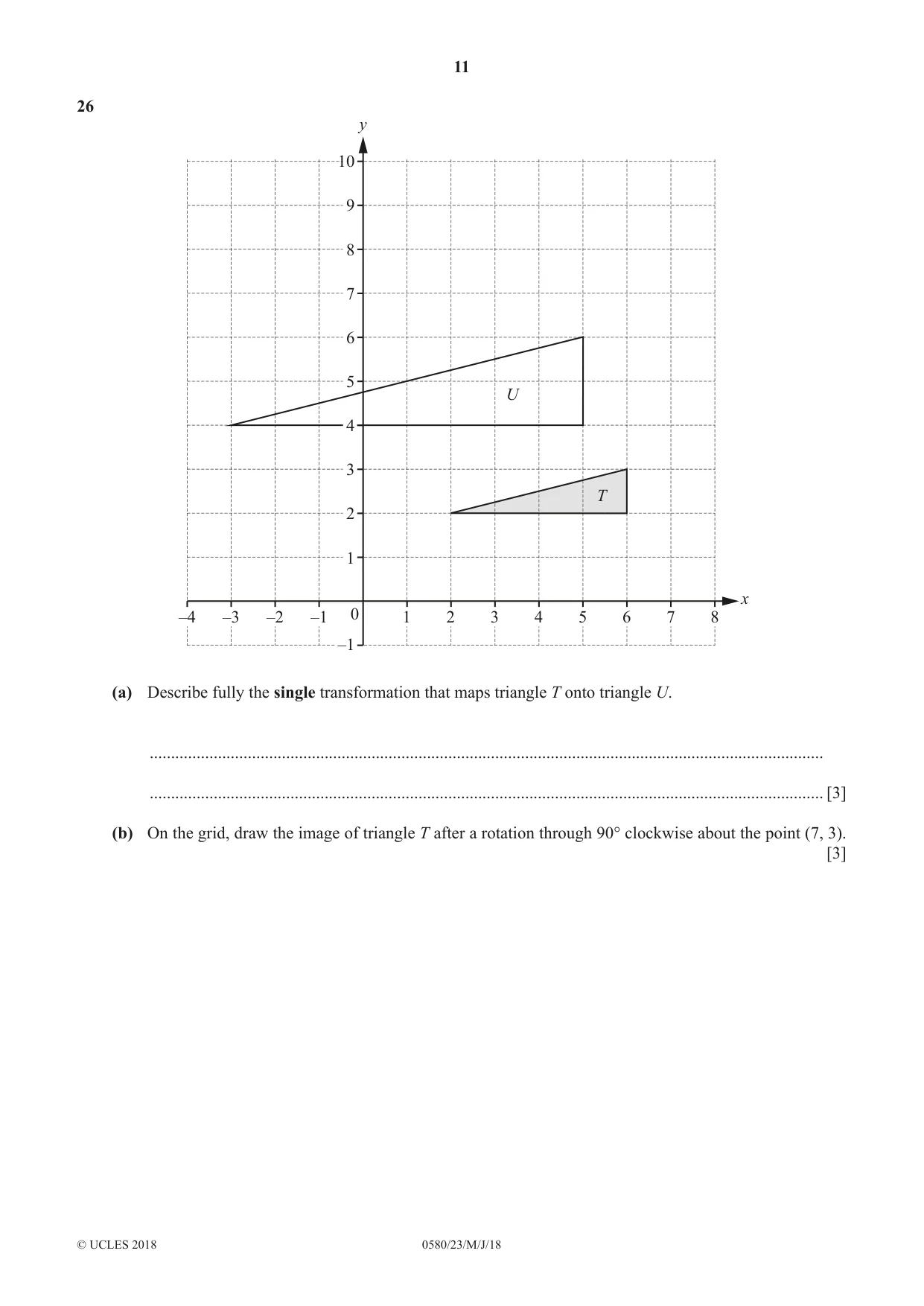
Q26 · Y 10 9 8 7 6 5 U 4 3 T 2 1 x –4 –3 –2 –1 0 1 2 3 4 5 6 7 8 –1 (a) Describe fully the…
26 y 10 9 8 7 6 5 U 4 3 T 2 1 x –4 –3 –2 –1 0 1 2 3 4 5 6 7 8 –1 (a) Describe fully the single transformation that maps triangle T onto triangle U. .............................................................................................................................................................. .............................................................................................................................................................. [3] (b) On the grid, draw the image of triangle T after a rotation through 90° clockwise about the point (7, 3). [3]
Mark scheme: 26(a) Enlargement 3 B1 for each [scale factor] 2 [centre] (7, 0) 26(b) Image at (6, 4), (7, 4), (6, 8) 3 B2 for rotation through 90° clockwise but about other point or B1 for rotation through 90° anticlockwise about any point or for triangle at (6, 4), (7, 4), (6, k)
What was in this paper
The subtopics covered by these 26 questions, and how many questions each got. Open one in a new tab to see every Cambridge question on it.
4Equations2Limits of accuracy2Percentages2Rates2Algebraic fractions1Circle theorems I1Fractions, decimals and percentages1Non-right-angled triangles1Powers and roots1Ratio and proportion1Sequences1Sets1Standard form1Surface area and volume1The four operations1Transformations1Types of number1Vectors in two dimensions1What you needed in this session
Cambridge’s own grade thresholds for 2018 May/June, Paper 2 · Variant 3. A higher threshold means an easier paper — the bar moves with how the cohort did.