Cambridge IGCSE Mathematics 0580 — 2016 Oct/Nov Paper 2 · Variant 3
0580/23/O/N/16 · 25 questions · 70 marks · ≈79 min
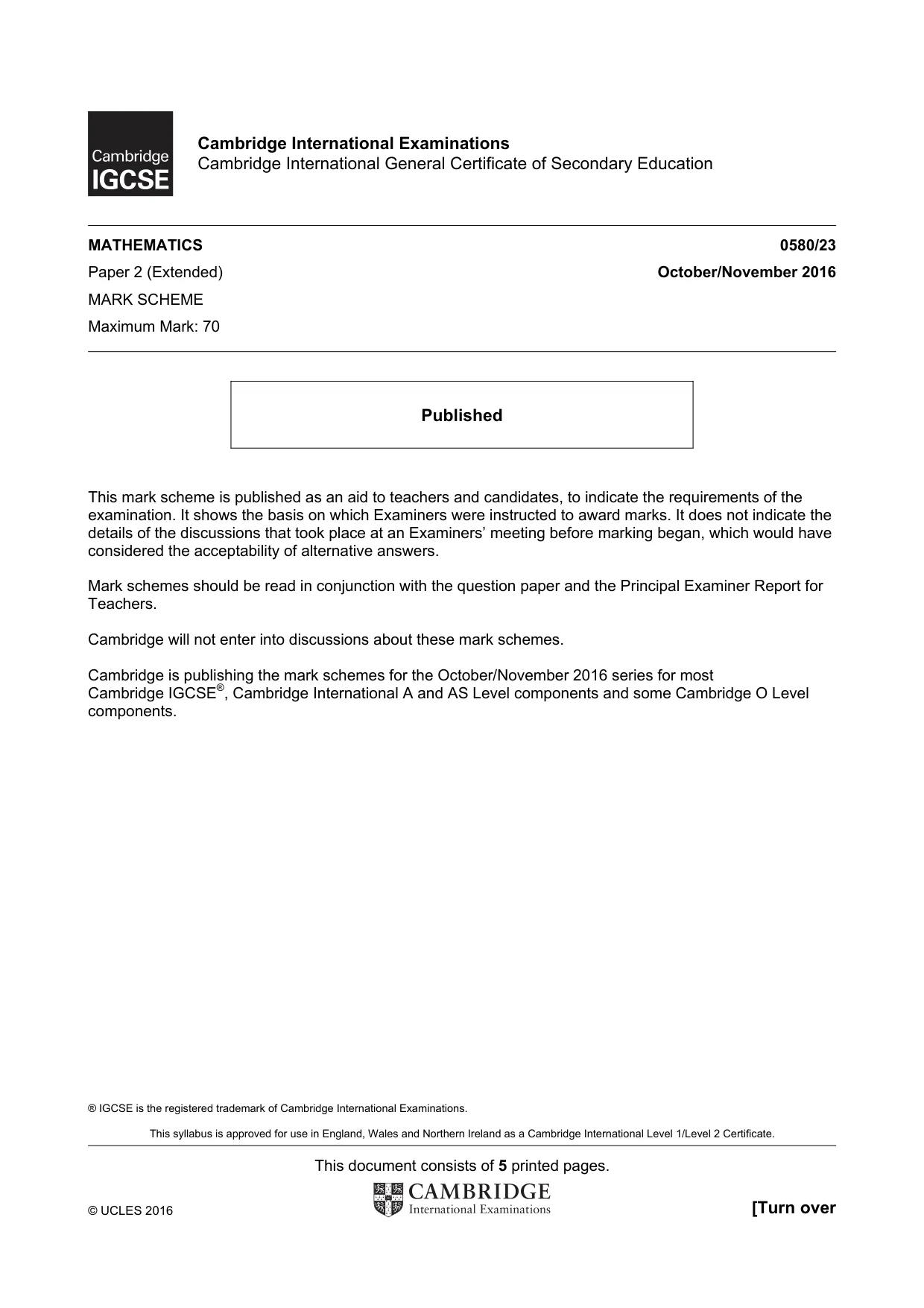
The question paper and its mark scheme, free to read here and free to download. This is Cambridge’s own paper, exactly as it was sat.
Question paper16 pages
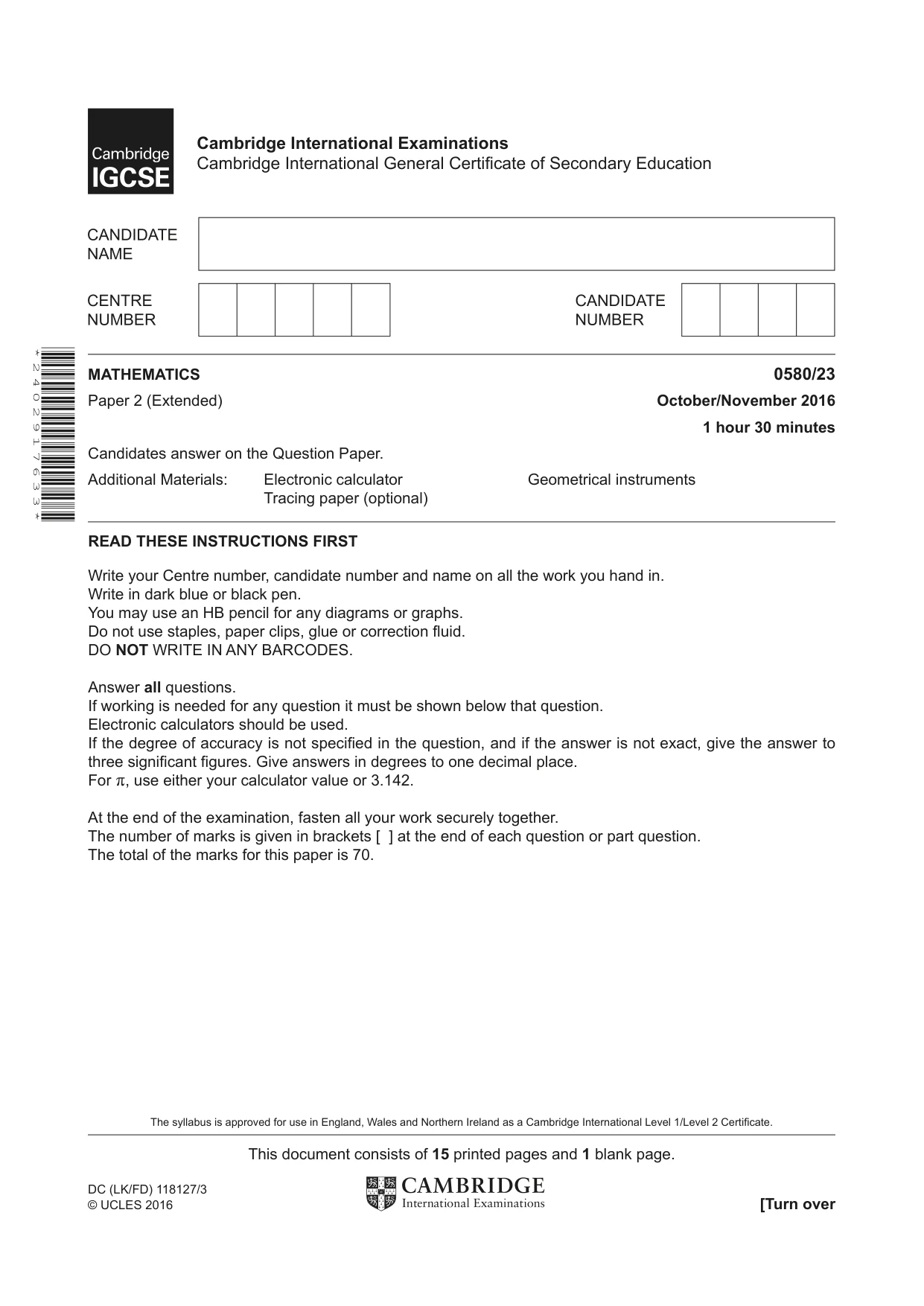
Mark scheme5 pages
Answers below. Sit the paper first if you are practising.
Questions as text
Q1 · V = 4p2 Find V when p = 3
1 V = 4p2 Find V when p = 3. V = ................................................[1]
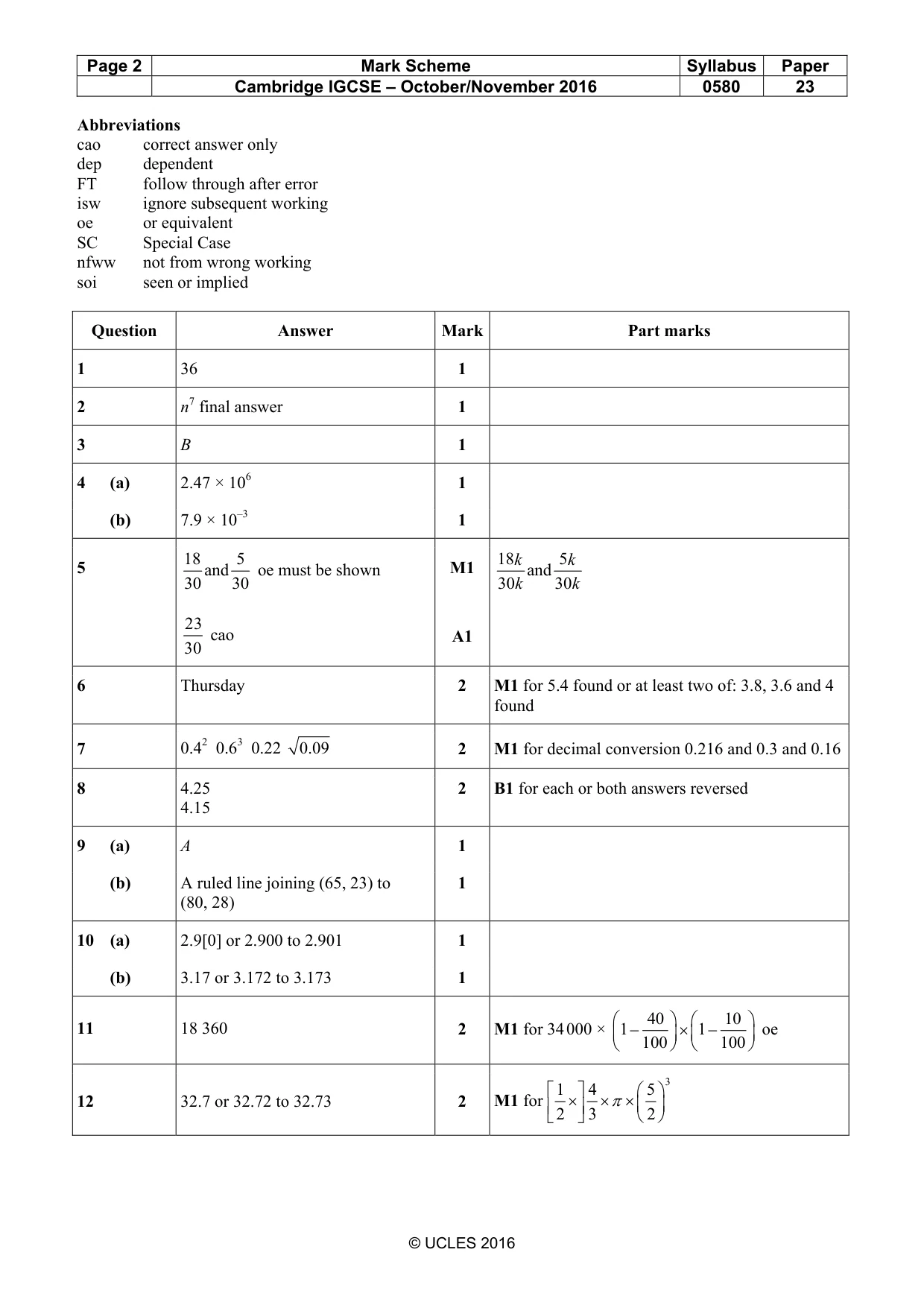
Mark scheme: Question Answer Mark Part marks 1 36 1
Question 2
2 Simplify. n2 × n5 .................................................[1]
Mark scheme: 2 n7 final answer 1
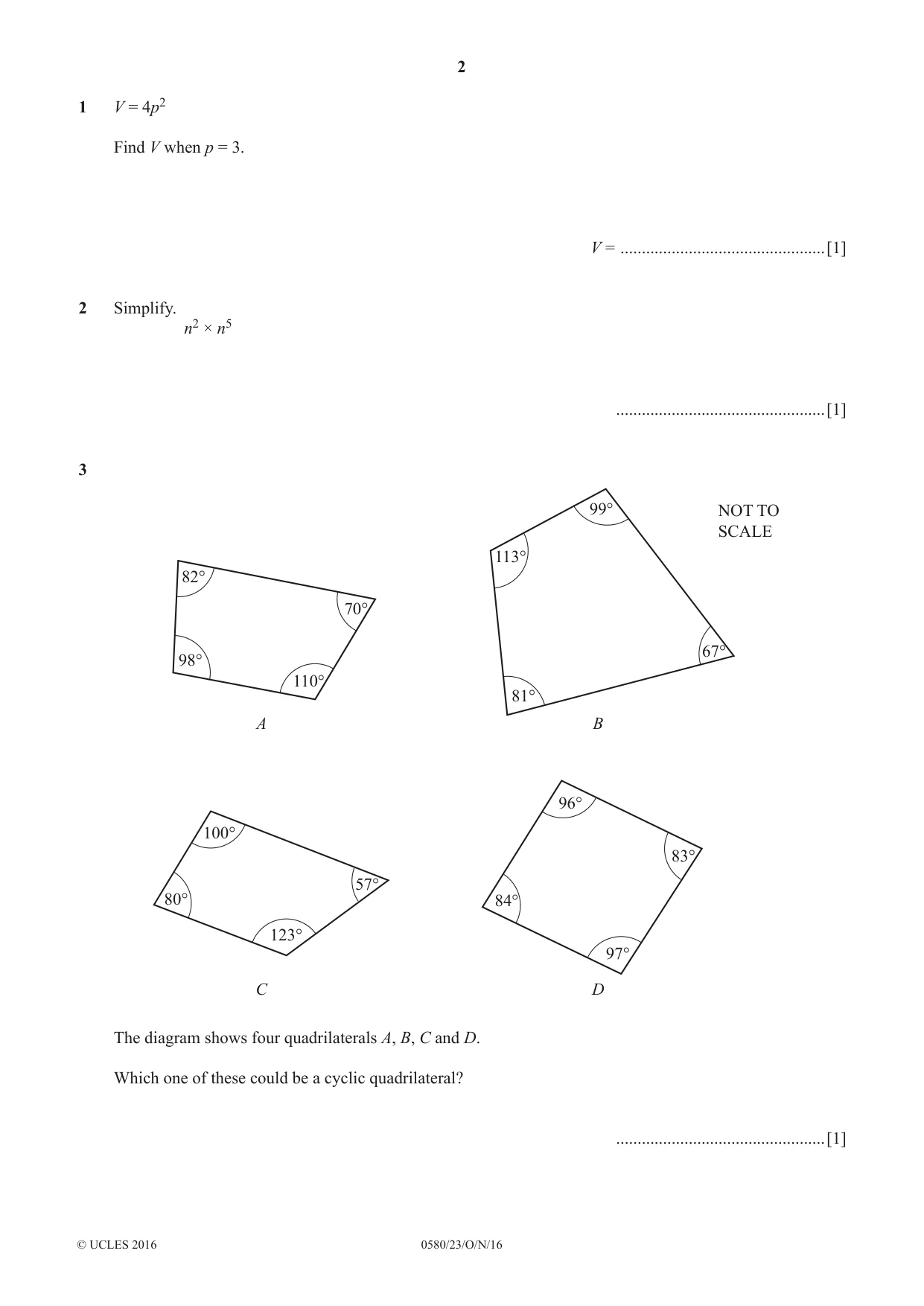
Q3 · 99° NOT TO SCALE 113° 82° 70° 67° 98° 110° 81° A B 96° 100° 83° 57° 80° 84° 123° 97° C D…
3 99° NOT TO SCALE 113° 82° 70° 67° 98° 110° 81° A B 96° 100° 83° 57° 80° 84° 123° 97° C D The diagram shows four quadrilaterals A, B, C and D. Which one of these could be a cyclic quadrilateral? .................................................[1]
Mark scheme: 3 B 1 6
Q4 · Write in standard form
4 Write in standard form. (a) 2 470 000 ................................................. [1] (b) 0.0079 ................................................. [1]
Mark scheme: 4 (a) 2.47 × 10⁶ 1 (b) 7.9 × 10⁻³ 1 18 5 18 k 5 k
Q5 · 1 5 Without using a calculator, work out 5 + 6
3 1 5 Without using a calculator, work out 5 + 6 . Write down all the steps of your working and give your answer as a fraction in its simplest form. ................................................. [2]
Mark scheme: 18 5 18 k 5 k 5 and oe must be shown M1 and 30 30 30 k 30 k 23 cao A1 30
Q6 · James is an animal doctor
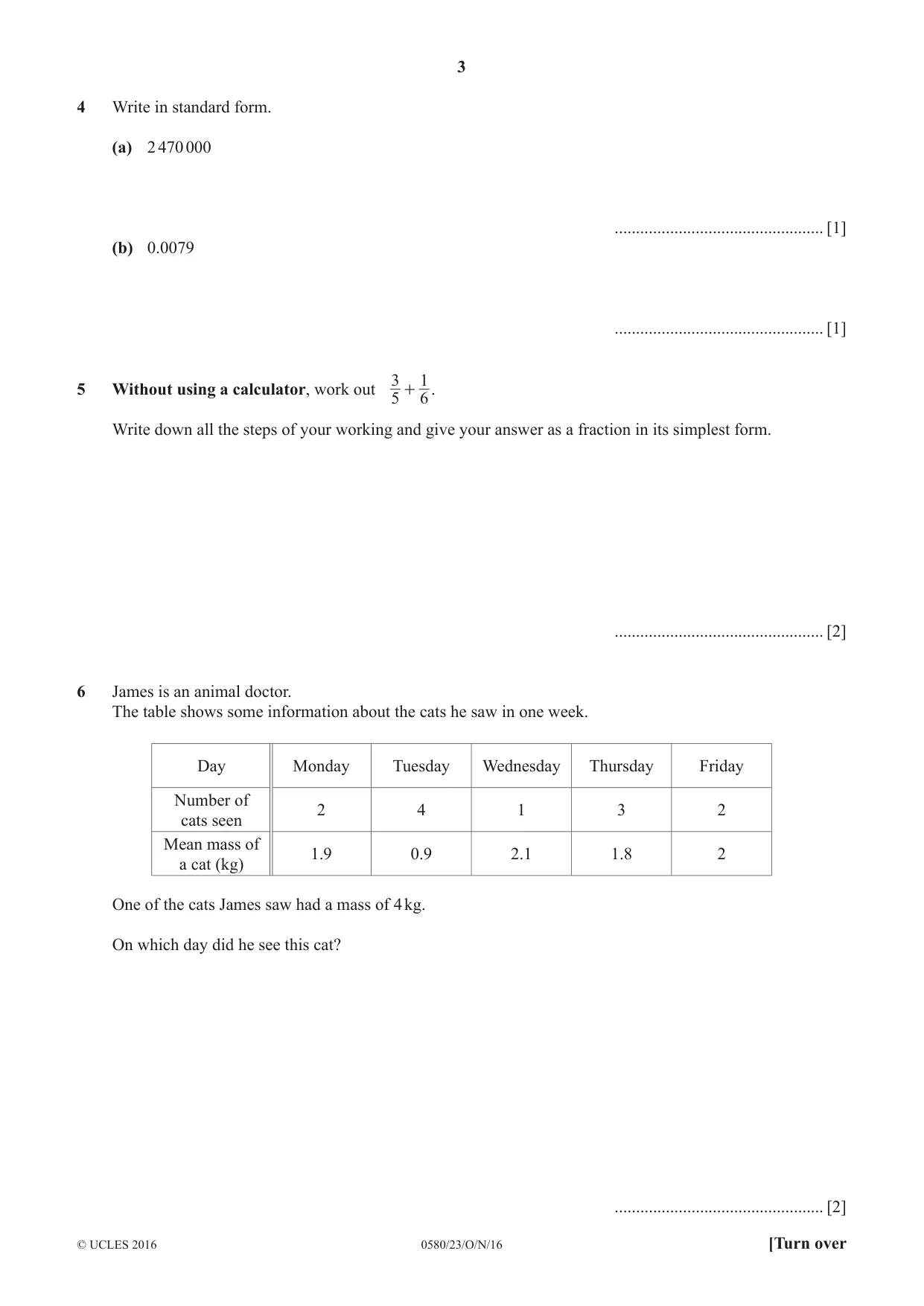
6 James is an animal doctor. The table shows some information about the cats he saw in one week. Day Monday Tuesday Wednesday Thursday Friday Number of 2 4 1 3 2 cats seen Mean mass of 1.9 0.9 2.1 1.8 2 a cat (kg) One of the cats James saw had a mass of 4 kg. On which day did he see this cat? ................................................. [2]
Mark scheme: 6 Thursday 2 M1 for 5.4 found or at least two of: 3.8, 3.6 and 4 found 2 3
Q7 · Write these in order of size, smallest first
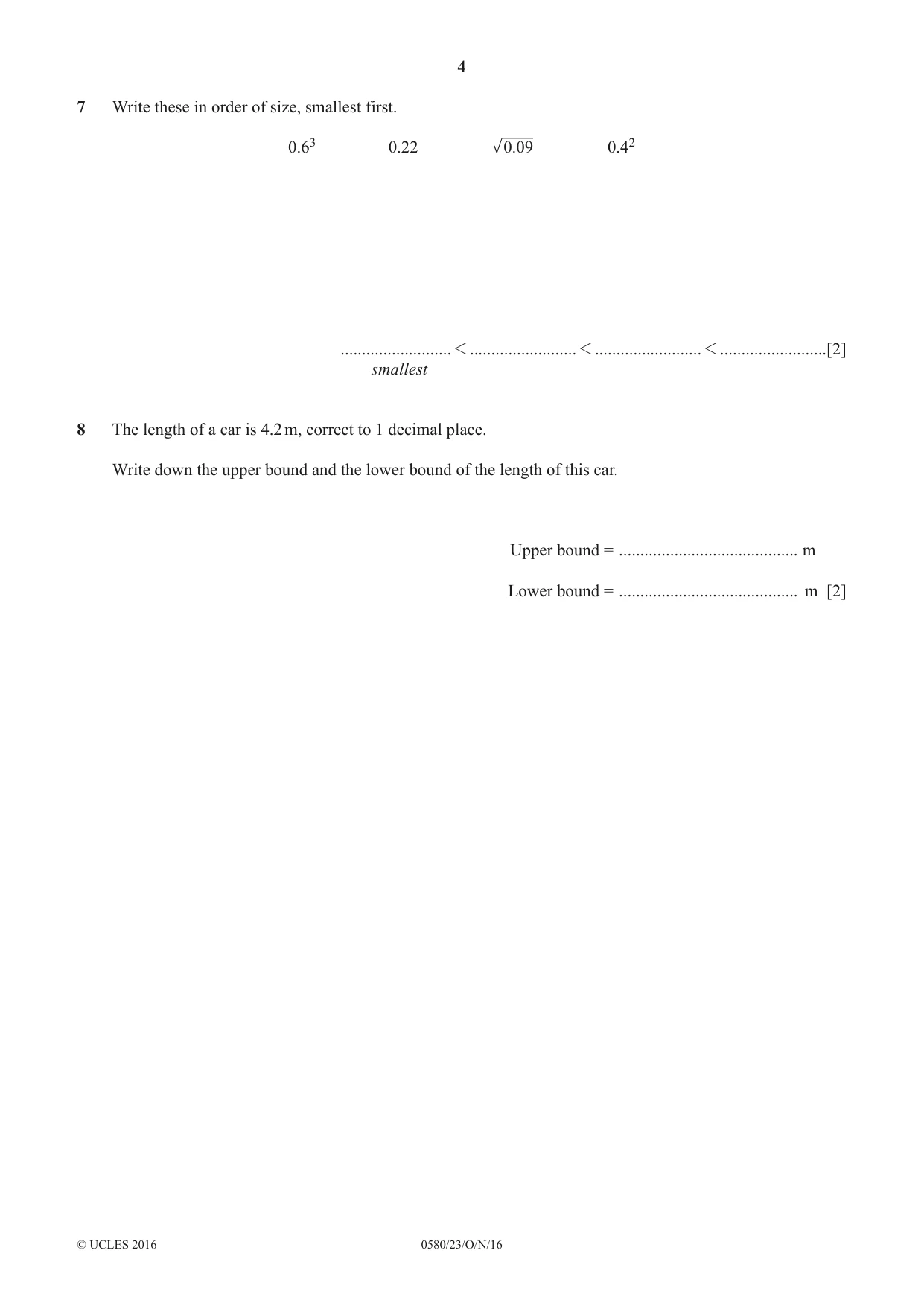
7 Write these in order of size, smallest first. 0.63 0.22 .009 0.42 .......................... 1 ......................... 1 ......................... 1 .........................[2] smallest
Mark scheme: 7 0.42 0.63 0.22 0.09 2 M1 for decimal conversion 0.216 and 0.3 and 0.16
Q8 · The length of a car is 4.2 m, correct to 1 decimal place
8 The length of a car is 4.2 m, correct to 1 decimal place. Write down the upper bound and the lower bound of the length of this car. Upper bound = .......................................... m Lower bound = .......................................... m [2]
Mark scheme: 8 4.25 2 B1 for each or both answers reversed 4.15
Q9 · 30 28 26 24 22 D 20 C 18 Distance (km) 16 B 14 12 10 8 A 6 4 2 0 0 10 20 30 40 50 60 70…
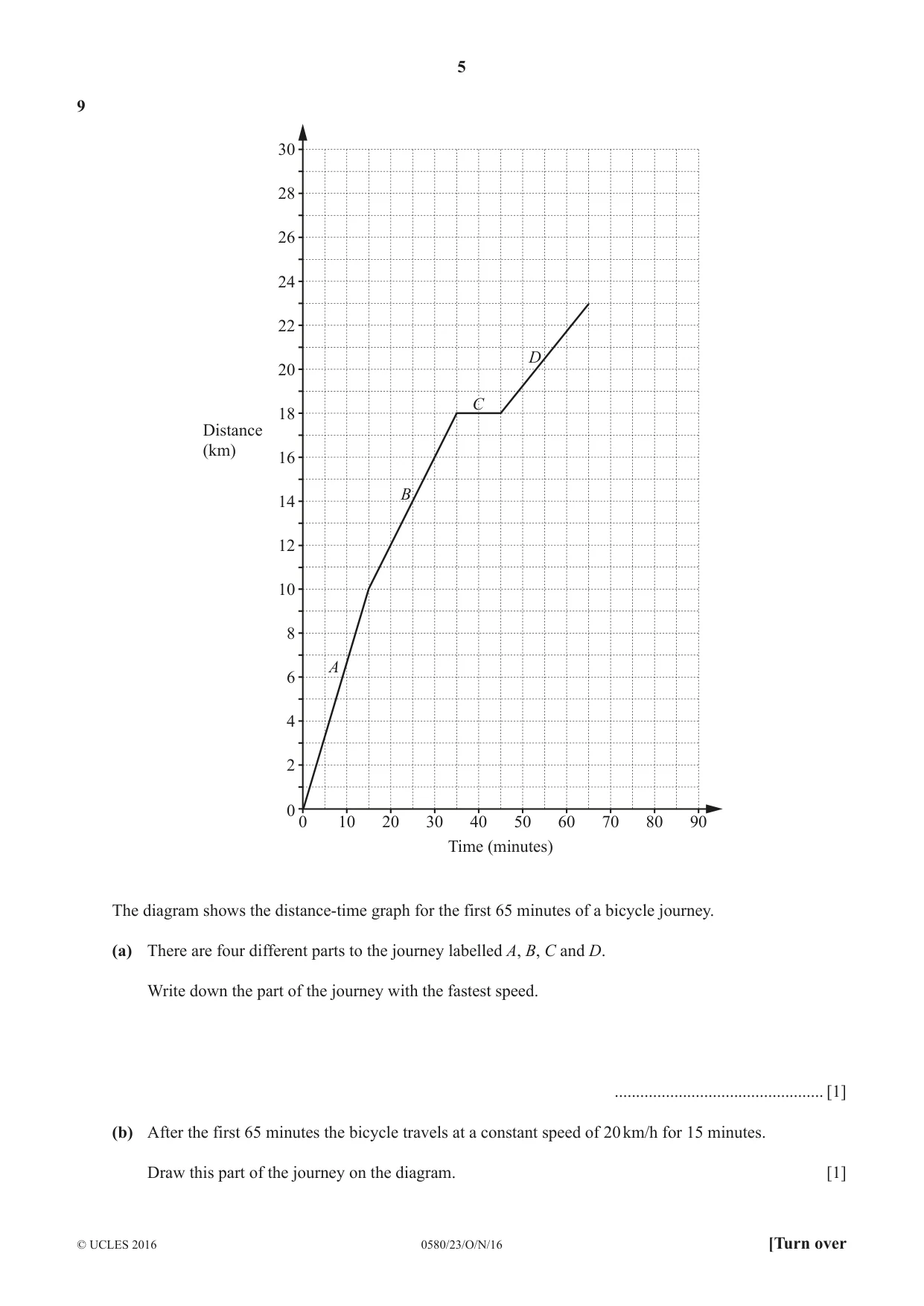
9 30 28 26 24 22 D 20 C 18 Distance (km) 16 B 14 12 10 8 A 6 4 2 0 0 10 20 30 40 50 60 70 80 90 Time (minutes) The diagram shows the distance-time graph for the first 65 minutes of a bicycle journey. (a) There are four different parts to the journey labelled A, B, C and D. Write down the part of the journey with the fastest speed. ................................................. [1] (b) After the first 65 minutes the bicycle travels at a constant speed of 20 km/h for 15 minutes. Draw this part of the journey on the diagram. [1]
Mark scheme: 9 (a) A 1 (b) A ruled line joining (65, 23) to 1 (80, 28)
Question 10
10 Calculate. (a) 2 3 - 10 + 4 2 ................................................. [1] 2 3 # tan 70° (b) 3 ................................................. [1]
Mark scheme: 10 (a) 2.9[0] or 2.900 to 2.901 1 (b) 3.17 or 3.172 to 3.173 1 40 10
Q11 · Ahmed paid $34 000 for a car
11 Ahmed paid $34 000 for a car. His car decreased in value by 40% at the end of the first year. The value at the end of the second year was 10% less than the value at the end of the first year. Calculate the value of Ahmed’s car after 2 years. $ ................................................ [2]
Mark scheme: 40 10 11 18 360 2 M1 for 34 000 × 1 − × 1 − oe 100 100 1 4 5 3
Q12 · NOT TO SCALE 5 cm The diagram shows a hemisphere with diameter 5 cm
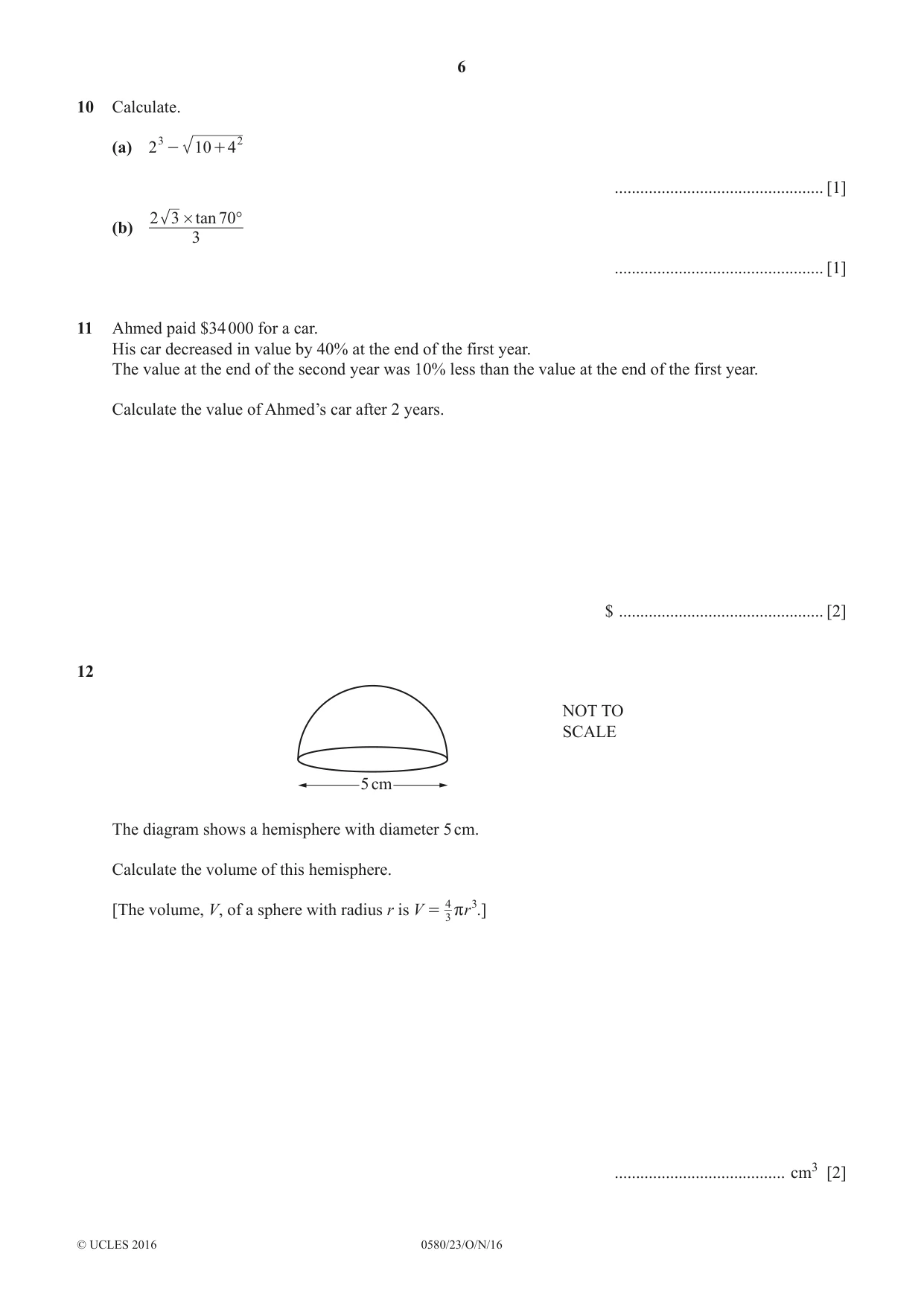
12 NOT TO SCALE 5 cm The diagram shows a hemisphere with diameter 5 cm. Calculate the volume of this hemisphere. [The volume, V, of a sphere with radius r is V = 43 r r 3.] ........................................ cm3 [2]
Mark scheme: 1 4 5 ×12 32.7 or 32.72 to 32.73 2 M1 for × π× 2 3 2
Q13 · Write the recurring decimal .02o as a fraction
13 Write the recurring decimal .02o as a fraction. [ .02o means 0.222…] ................................................. [2]
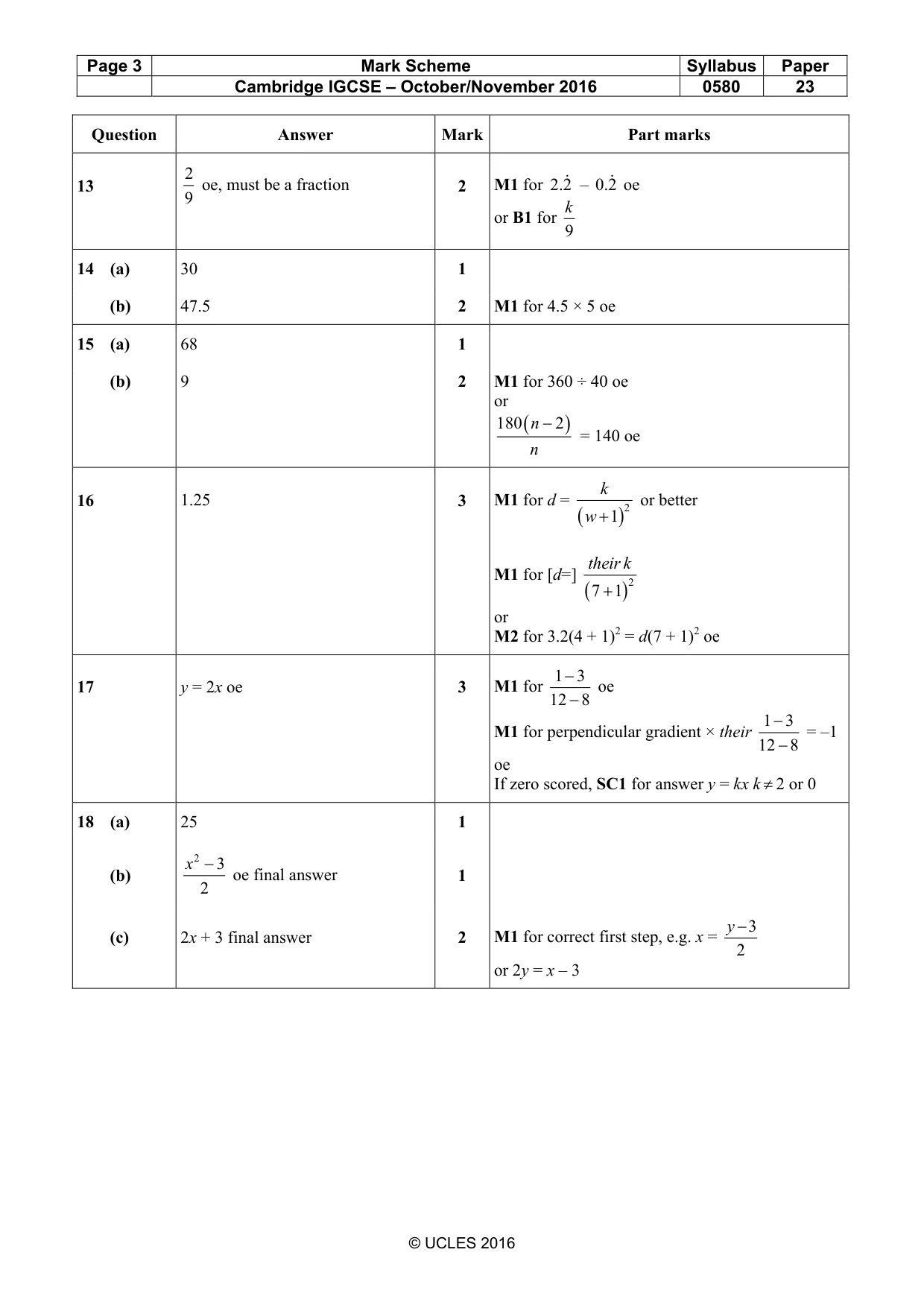
Mark scheme: 2 13 oe, must be a fraction 2 M1 for 2.2 – 0.2 oe 9 k or B1 for 9
Q14 · The shaded shape is made by joining a square and a rhombus
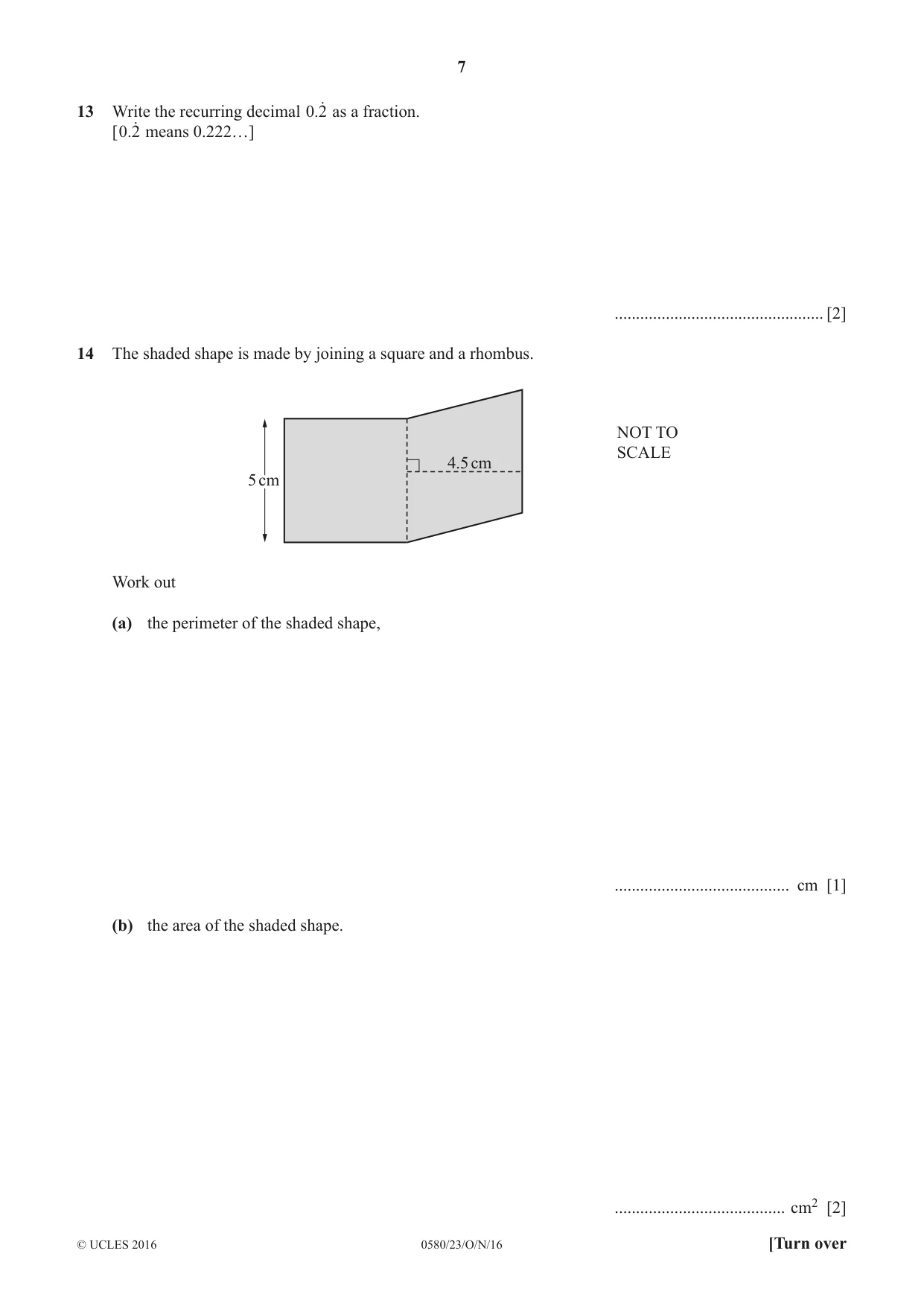
14 The shaded shape is made by joining a square and a rhombus. NOT TO SCALE 4.5 cm 5 cm Work out (a) the perimeter of the shaded shape, ......................................... cm [1] (b) the area of the shaded shape. ........................................ cm2 [2]
Mark scheme: 14 (a) 30 1 (b) 47.5 2 M1 for 4.5 × 5 oe
Q15 · A NOT TO SCALE C 44° B Triangle ABC is an isosceles triangle with AB = CB
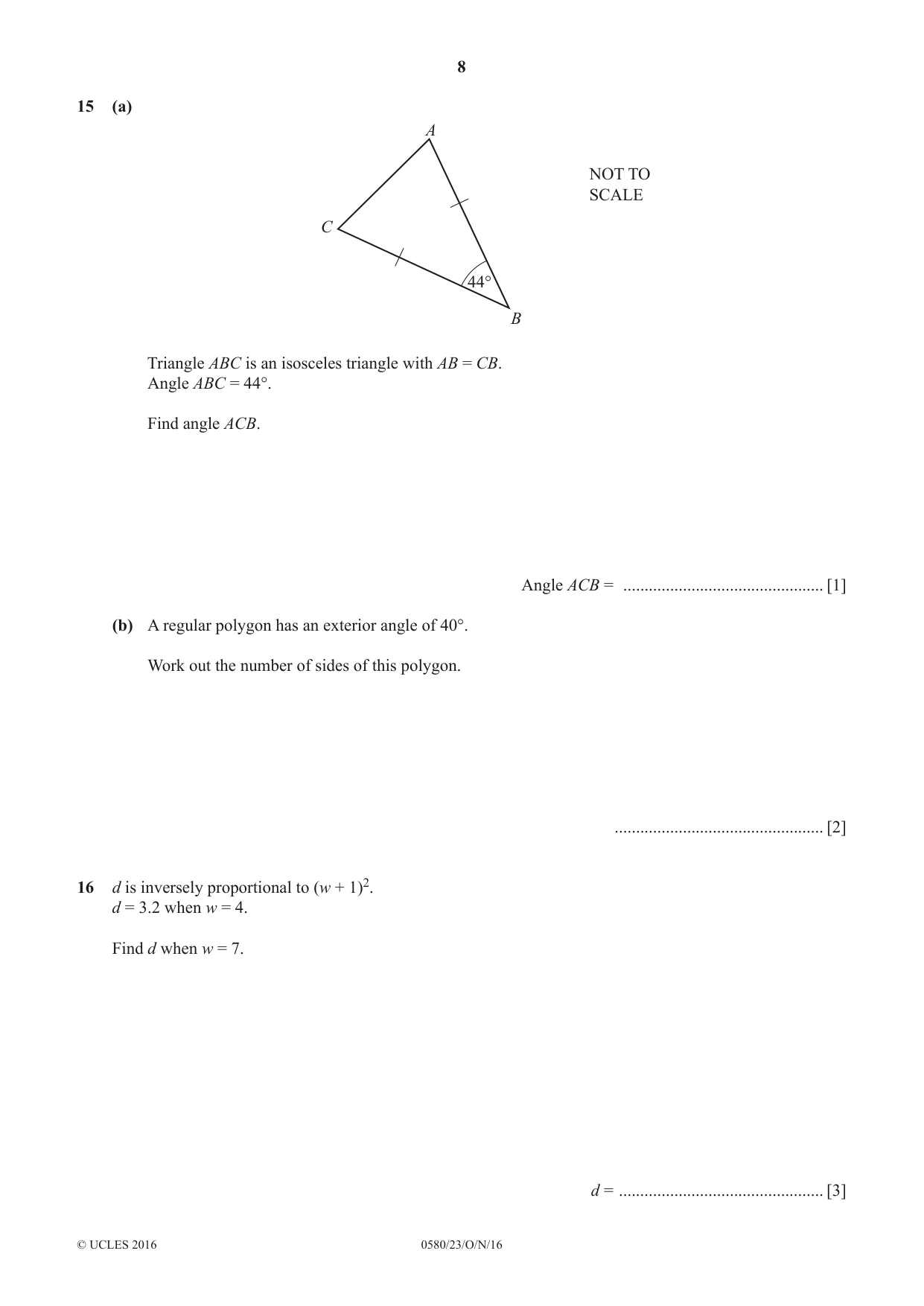
15 (a) A NOT TO SCALE C 44° B Triangle ABC is an isosceles triangle with AB = CB. Angle ABC = 44°. Find angle ACB. Angle ACB = ............................................... [1] (b) A regular polygon has an exterior angle of 40°. Work out the number of sides of this polygon. ................................................. [2]
Mark scheme: 15 (a) 68 1 (b) 9 2 M1 for 360 ÷ 40 oe or 180 ( n − 2 ) = 140 oe n k
Q16 · D is inversely proportional to (w + 1)2
16 d is inversely proportional to (w + 1)2. d = 3.2 when w = 4. Find d when w = 7. d = ................................................ [3]
Mark scheme: k 16 1.25 3 M1 for d = 2 or better ( w + 1) their k M1 for [d=] ( 7 + 1) 2 or M2 for 3.2(4 + 1)2 = d(7 + 1)2 oe 1 − 3
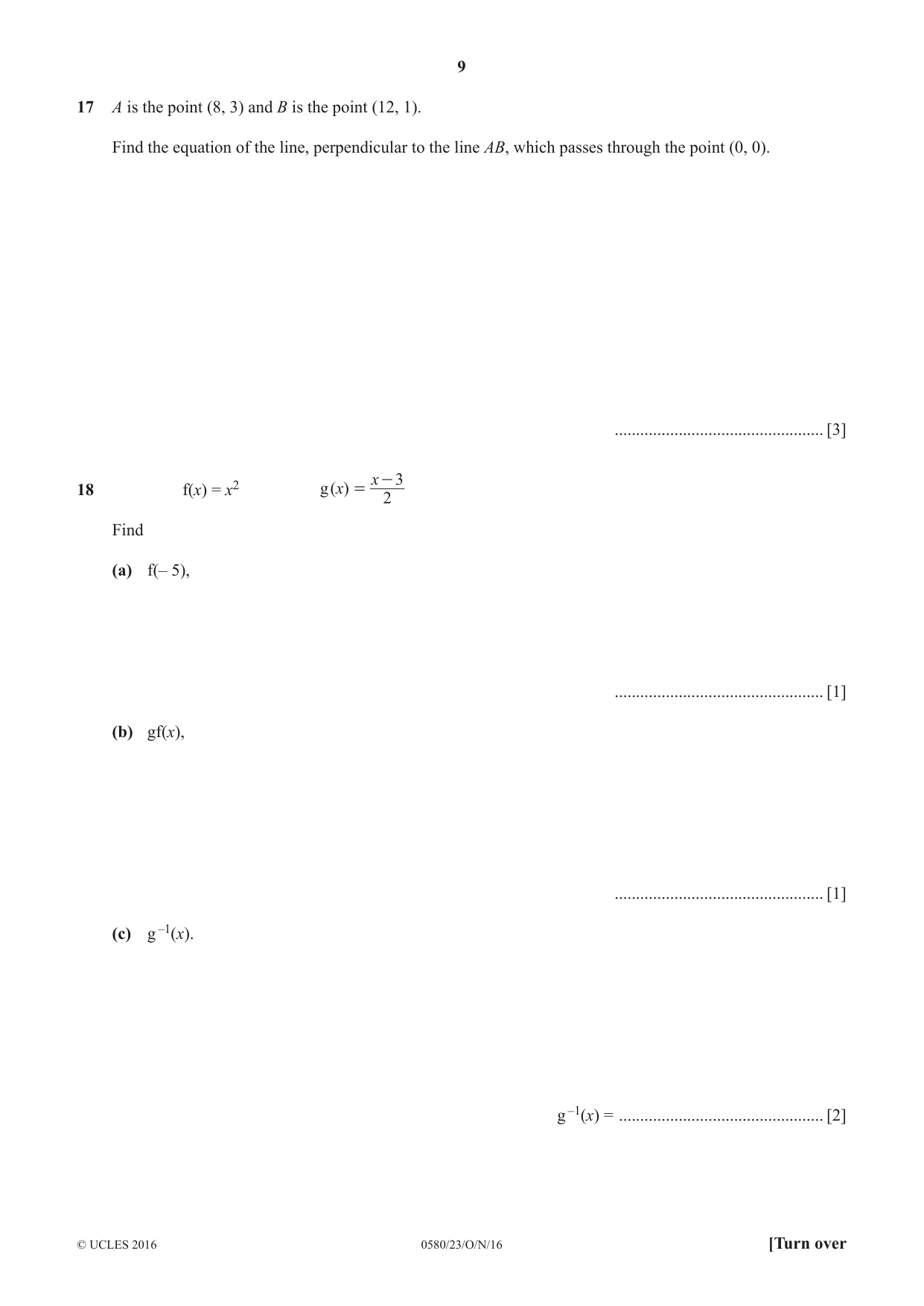
Q17 · A is the point (8, 3) and B is the point (12, 1)
17 A is the point (8, 3) and B is the point (12, 1). Find the equation of the line, perpendicular to the line AB, which passes through the point (0, 0). ................................................. [3]
Mark scheme: 1 − 3 17 y = 2x oe 3 M1 for oe 12 − 8 1 − 3 M1 for perpendicular gradient × their = –1 12 − 8 oe If zero scored, SC1 for answer y = kx k ≠2 or 0
Q18 · X - 318 f(x) = x2 g ( x) = 2 Find (a) f(– 5)…
x - 318 f(x) = x2 g ( x) = 2 Find (a) f(– 5), ................................................. [1] (b) gf(x), ................................................. [1] (c) g –1(x). g –1(x) = ................................................ [2]
Mark scheme: 18 (a) 25 1 x 2 − 3 (b) oe final answer 1 2 y − 3 (c) 2x + 3 final answer 2 M1 for correct first step, e.g. x = 2 or 2y = x – 3
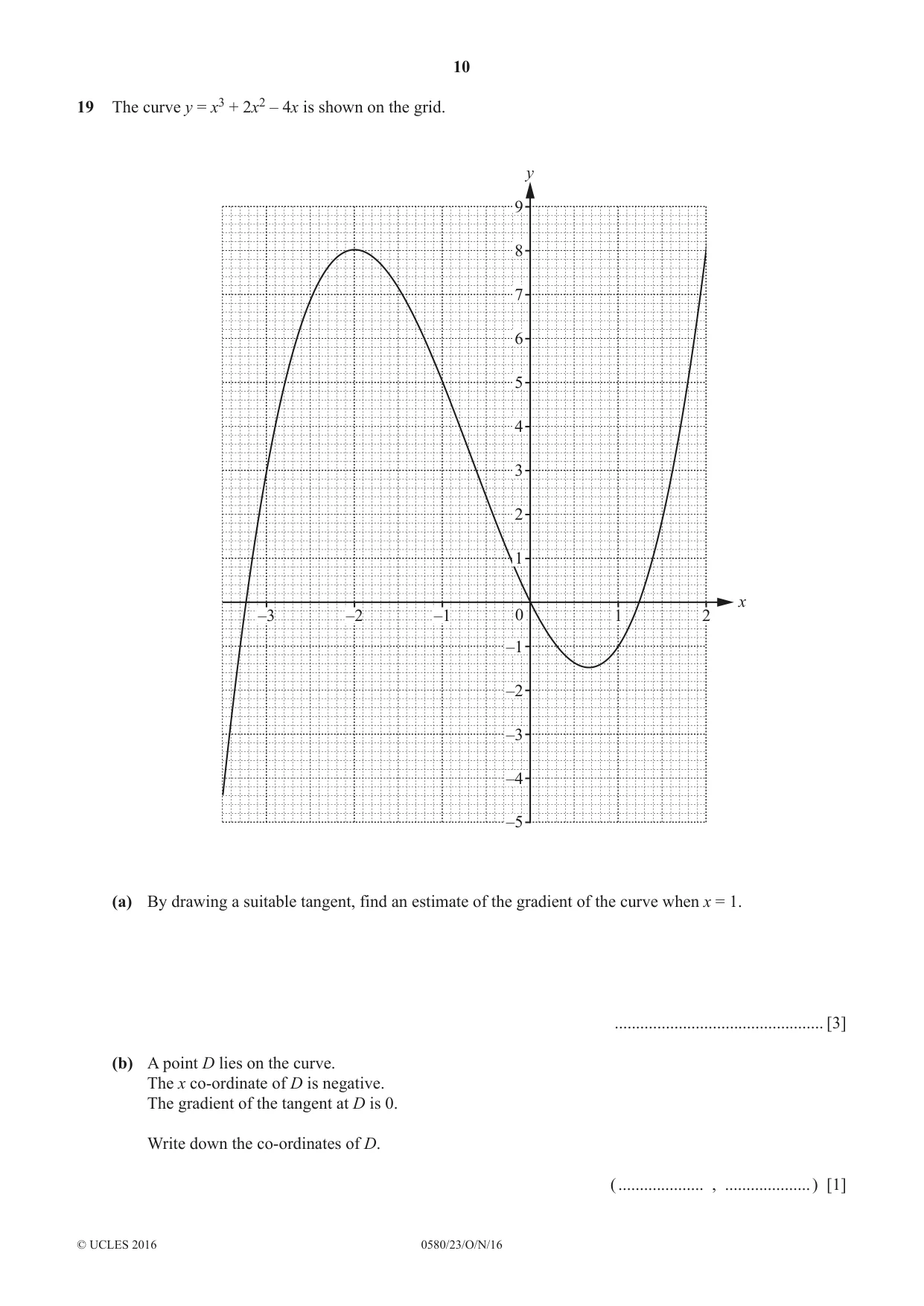
Q19 · The curve y = x3 + 2x2 – 4x is shown on the grid
19 The curve y = x3 + 2x2 – 4x is shown on the grid. y 9 8 7 6 5 4 3 2 1 x –3 –2 –1 0 1 2 –1 –2 –3 –4 –5 (a) By drawing a suitable tangent, find an estimate of the gradient of the curve when x = 1. ................................................. [3] (b) A point D lies on the curve. The x co-ordinate of D is negative. The gradient of the tangent at D is 0. Write down the co-ordinates of D. ( .................... , .................... ) [1]
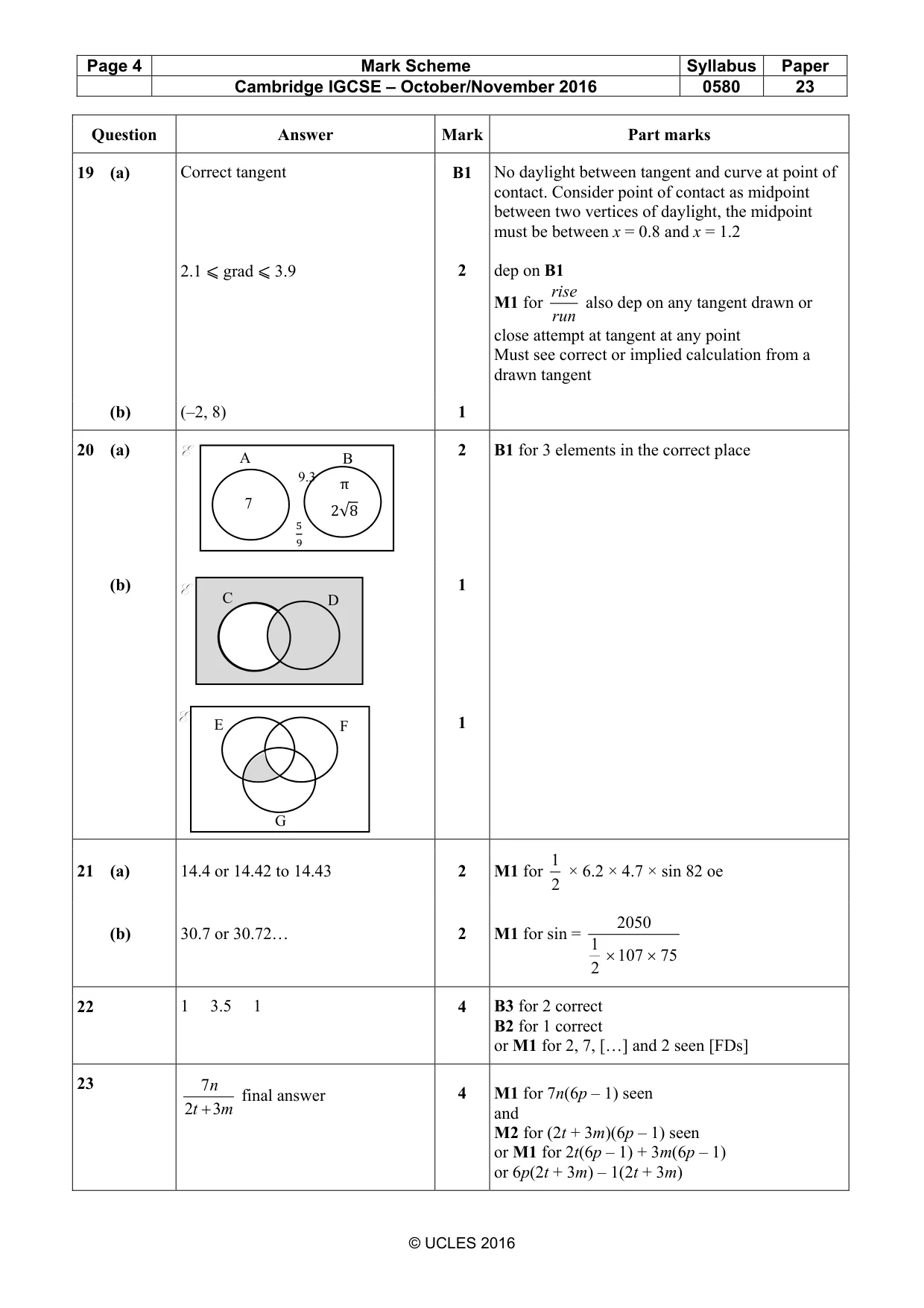
Mark scheme: 19 (a) Correct tangent B1 No daylight between tangent and curve at point of contact. Consider point of contact as midpoint between two vertices of daylight, the midpoint must be between x = 0.8 and x = 1.2 2.1 ⩽ grad ⩽ 3.9 2 dep on B1 rise M1 for also dep on any tangent drawn or run close attempt at tangent at any point Must see correct or implied calculation from a drawn tangent (b) (–2, 8) 1
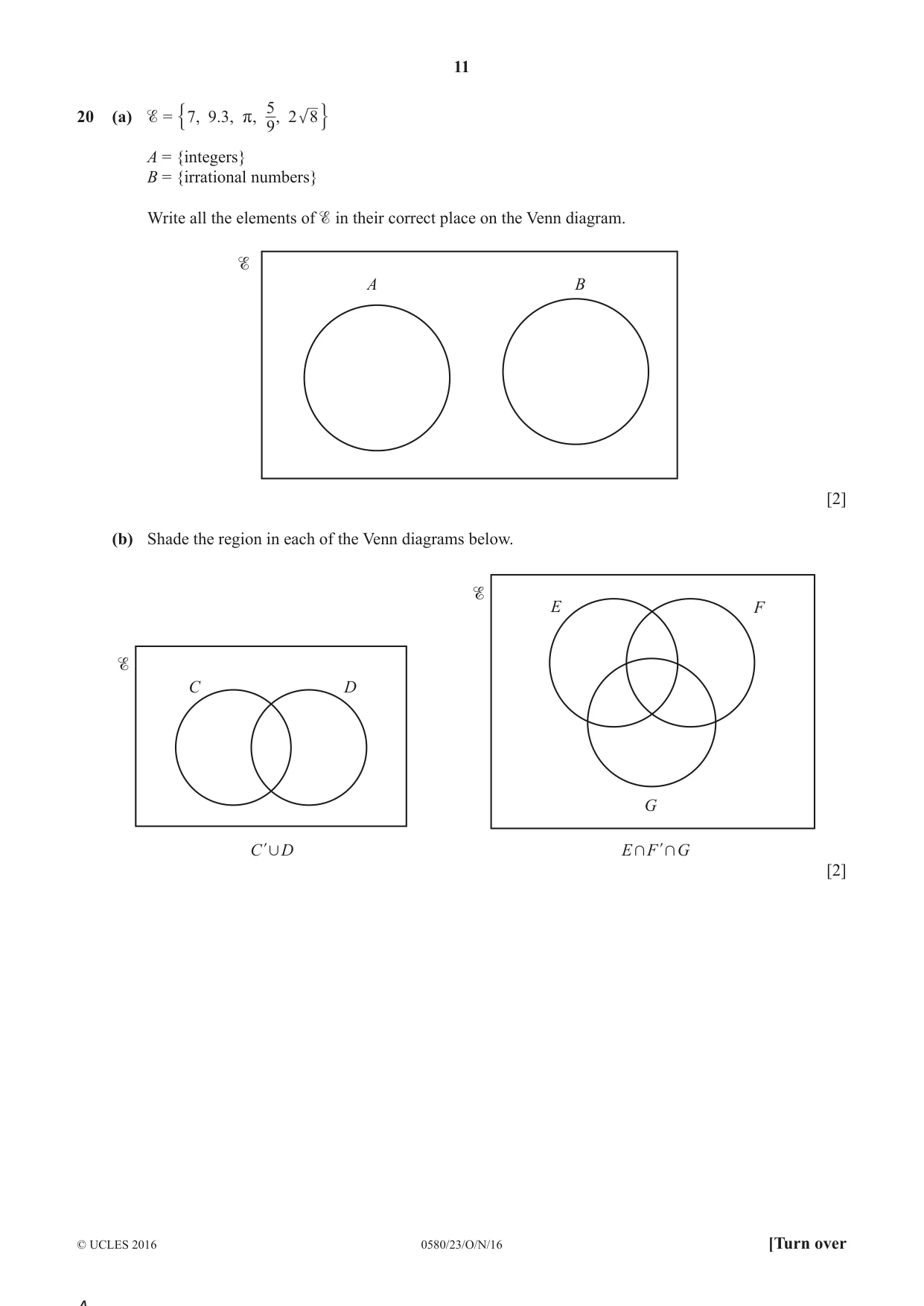
Q20 · , 2 8 7 , 9 .3 , r ,20 (a) = % / 9 A = {integers} B = {irrational numbers} Write all…
5 , 2 8 7 , 9 .3 , r ,20 (a) = % / 9 A = {integers} B = {irrational numbers} Write all the elements of in their correct place on the Venn diagram. A B [2] (b) Shade the region in each of the Venn diagrams below. E F C D G C l , D E + F l + G [2]
Mark scheme: 20 (a) E 2 B1 for 3 elements in the correct place A B 9.3 π 7 2√8 ହ ଽ (b) E 1 C D E E F 1 G 1
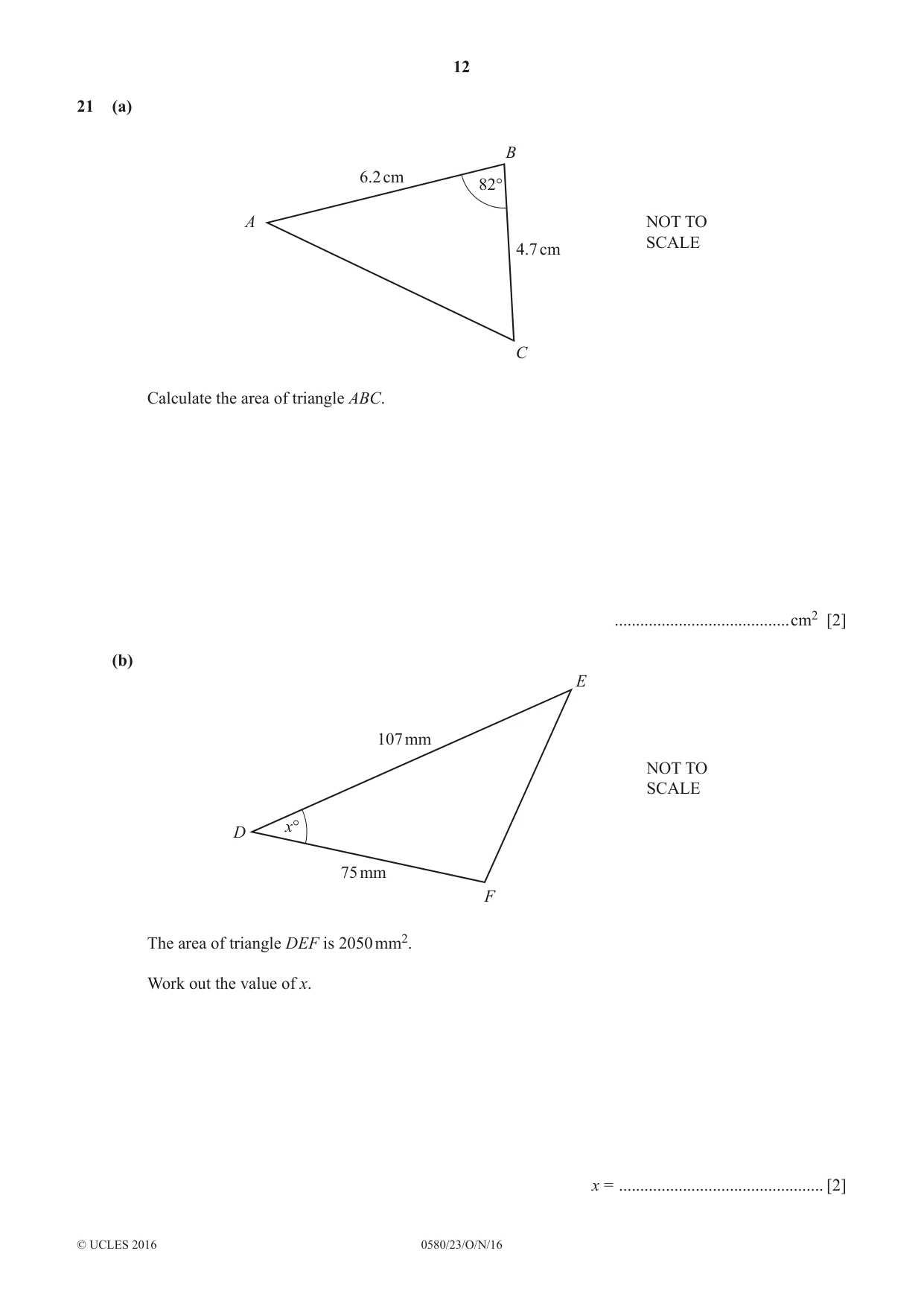
Q21 · B 6.2 cm 82° A NOT TO SCALE 4.7 cm C Calculate the area of triangle ABC
21 (a) B 6.2 cm 82° A NOT TO SCALE 4.7 cm C Calculate the area of triangle ABC. .........................................cm2 [2] (b) E 107 mm NOT TO SCALE x° D 75 mm F The area of triangle DEF is 2050 mm2. Work out the value of x. x = ................................................ [2]
Mark scheme: 1 21 (a) 14.4 or 14.42 to 14.43 2 M1 for × 6.2 × 4.7 × sin 82 oe 2 2050 (b) 30.7 or 30.72… 2 M1 for sin = 1 × 1 07 × 75 2
Q22 · The table shows some information about the mass, m grams, of 200 bananas
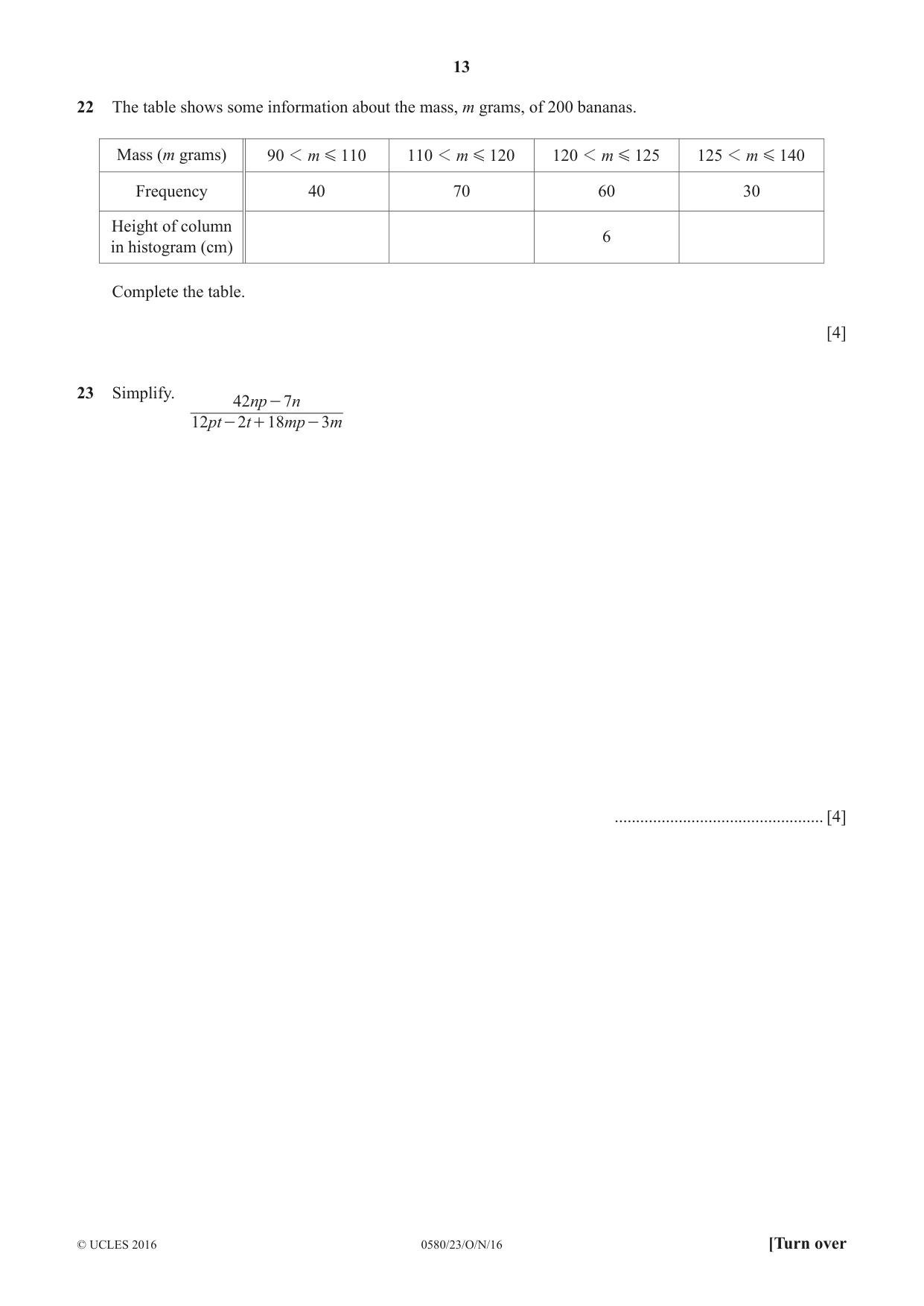
22 The table shows some information about the mass, m grams, of 200 bananas. Mass (m grams) 90 1 m G 110 110 1 m G 120 120 1 m G 125 125 1 m G 140 Frequency 40 70 60 30 Height of column 6 in histogram (cm) Complete the table. [4]
Mark scheme: 22 1 3.5 1 4 B3 for 2 correct B2 for 1 correct or M1 for 2, 7, […] and 2 seen [FDs]
Question 23
23 Simplify. 42 np - 7n 12pt - 2t + 18mp - 3 m ................................................. [4]
Mark scheme: 23 7 n final answer 4 M1 for 7n(6p – 1) seen 2t + 3m and M2 for (2t + 3m)(6p – 1) seen or M1 for 2t(6p – 1) + 3m(6p – 1) or 6p(2t + 3m) – 1(2t + 3m)
Q24 · Y 7 6 5 4 R 3 2 1 0 x 0 1 2 3 4 5 6 7 8 9 10 11 Find the three inequalities that define…
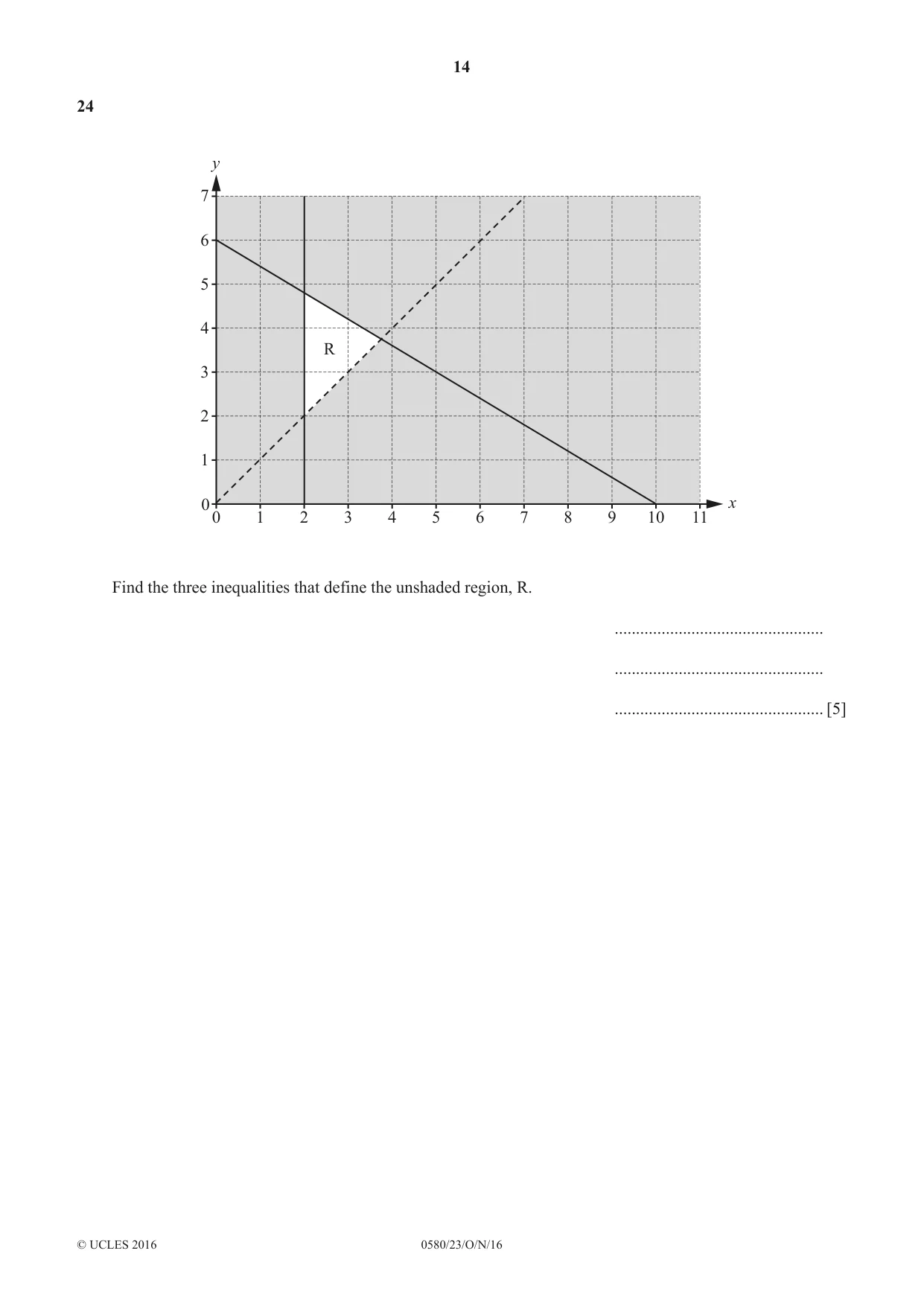
24 y 7 6 5 4 R 3 2 1 0 x 0 1 2 3 4 5 6 7 8 9 10 11 Find the three inequalities that define the unshaded region, R. ................................................. ................................................. ................................................. [5]
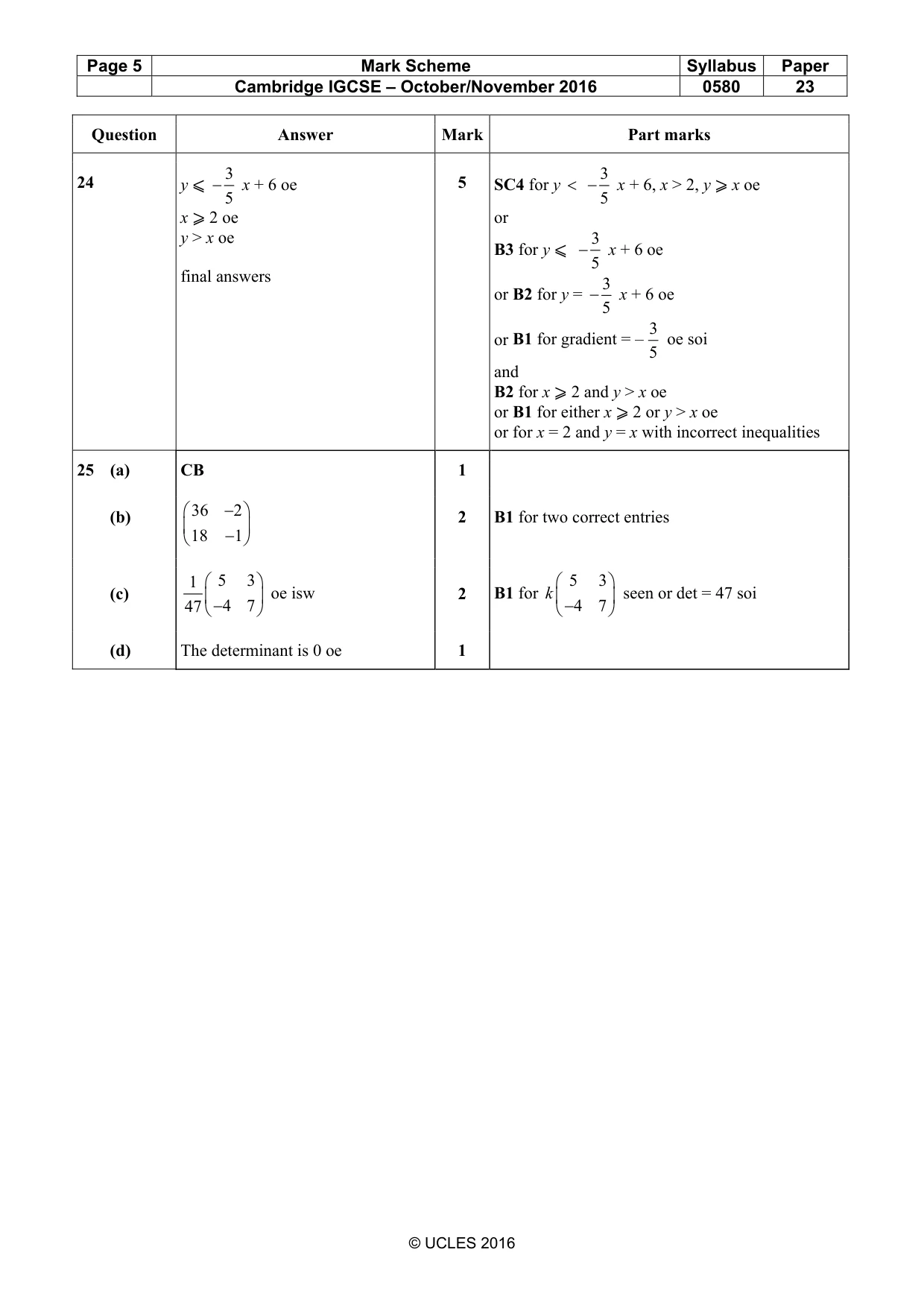
Mark scheme: 3 3 24 y ⩽ − x + 6 oe 5 SC4 for y < − x + 6, x > 2, y ⩾ x oe 5 5 x ⩾ 2 oe or y > x oe 3 B3 for y ⩽ − x + 6 oe 5 final answers 3 or B2 for y = − x + 6 oe 5 3 or B1 for gradient = – oe soi 5 and B2 for x ⩾ 2 and y > x oe or B1 for either x ⩾ 2 or y > x oe or for x = 2 and y = x with incorrect inequalities
Q25 · 2 7 - 3 - 2 3 1 - 9 25 A = B = C = D = c2 1m c4 5m c 4 5 - 1m c 0m (a) Which of these…
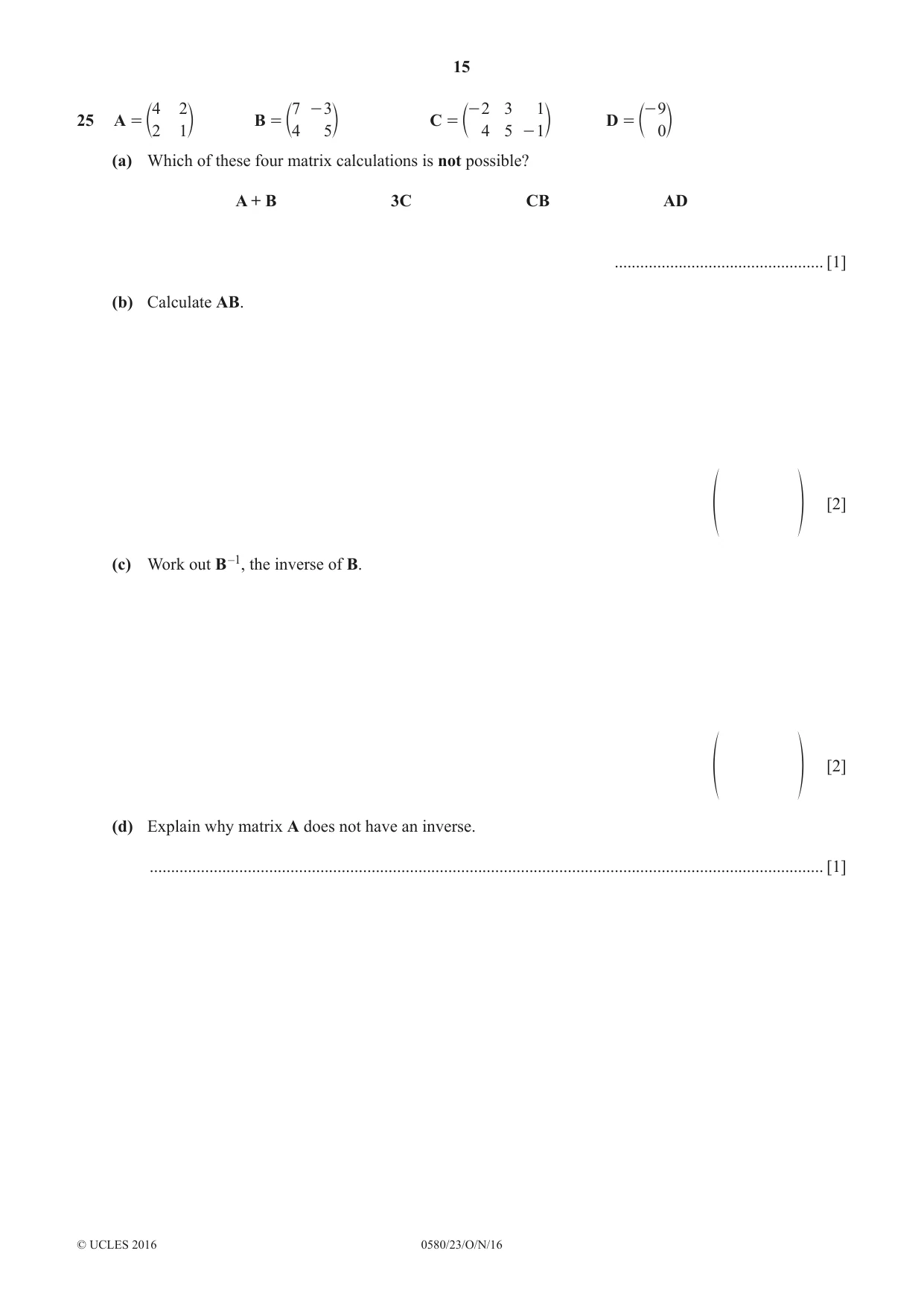
4 2 7 - 3 - 2 3 1 - 9 25 A = B = C = D = c2 1m c4 5m c 4 5 - 1m c 0m (a) Which of these four matrix calculations is not possible? A + B 3C CB AD ................................................. [1] (b) Calculate AB. [2] f p (c) Work out B –1, the inverse of B. [2] f p (d) Explain why matrix A does not have an inverse. .............................................................................................................................................................. [1]
Mark scheme: 25 (a) CB 1 36 −2 (b) 2 B1 for two correct entries 18 −1 1 5 3 5 3 (c) oe isw 2 B1 for k seen or det = 47 soi 47 −4 7 −4 7 (d) The determinant is 0 oe 1
What was in this paper
The subtopics covered by these 25 questions, and how many questions each got. Open one in a new tab to see every Cambridge question on it.
3Fractions, decimals and percentages2Angles1Area and perimeter1Circle theorems I1Compound shapes and parts of shapes1Equations of linear graphs1Functions1Graphs of functions1Indices I1Inequalities1Interpreting statistical data1Limits of accuracy1Ordering1Percentages1Powers and roots1Rates1Ratio and proportion1Sets1Standard form1Statistical charts and diagrams1Surface area and volume1What you needed in this session
Cambridge’s own grade thresholds for 2016 Oct/Nov, Paper 2 · Variant 3. A higher threshold means an easier paper — the bar moves with how the cohort did.