Cambridge IGCSE Mathematics 0580 — 2024 Oct/Nov Paper 2 · Variant 2
0580/22/O/N/24 · 23 questions · 70 marks · ≈79 min
The question paper and its mark scheme, free to read here and free to download. This is Cambridge’s own paper, exactly as it was sat.
Question paper16 pages

Mark scheme7 pages
Answers below. Sit the paper first if you are practising.
Questions as text
Q1 · These are the first eight terms of a sequence
1 These are the first eight terms of a sequence. c -3 -9 -15 -21 -27 -33 k Find the value of c and the value of k. c = ................................................ k = ................................................ [2]
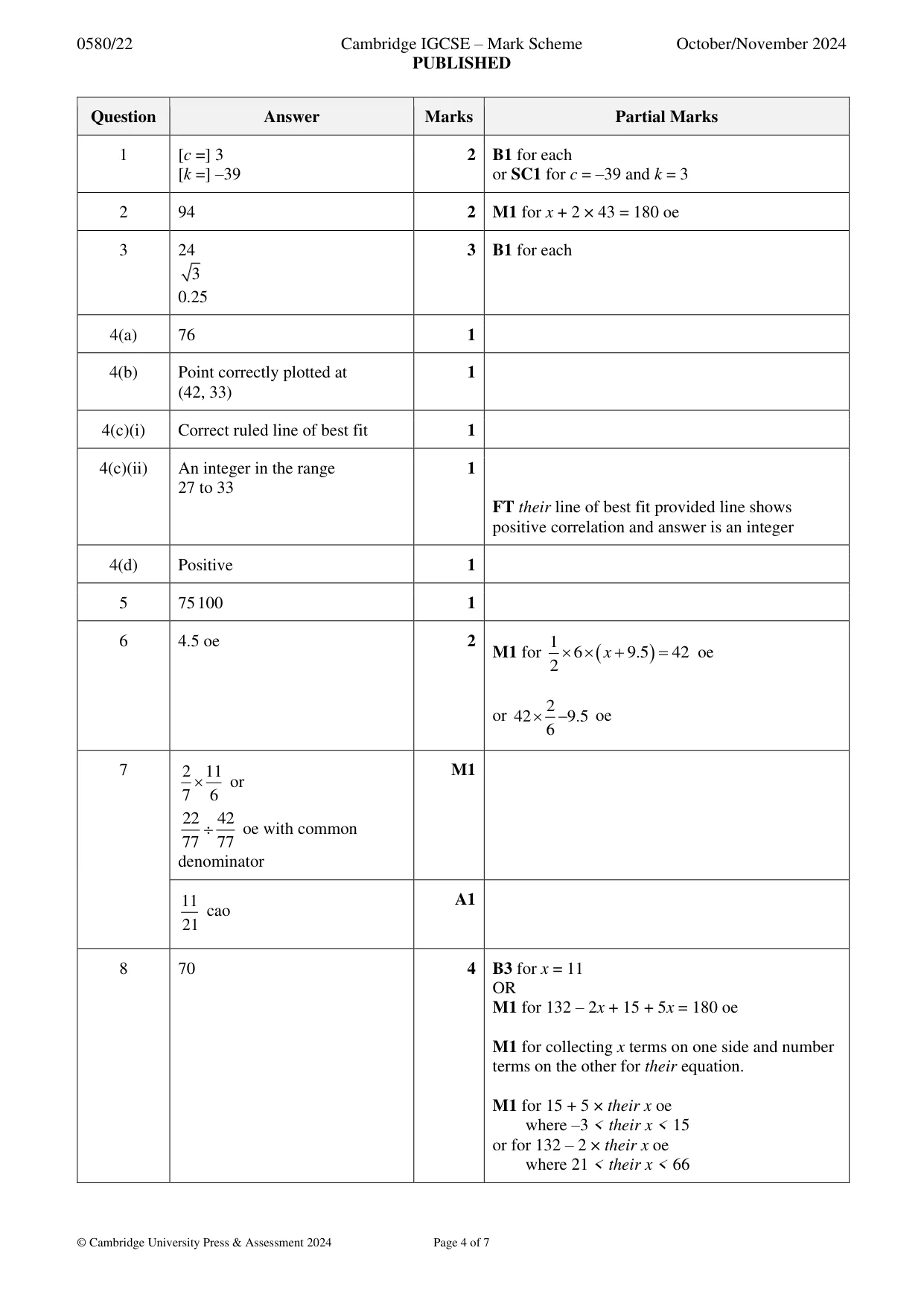
Mark scheme: Question Answer Marks Partial Marks 1 [c =] 3 2 B1 for each [k =] –39 or SC1 for c = –39 and k = 3
Q2 · The diagram shows an isosceles triangle
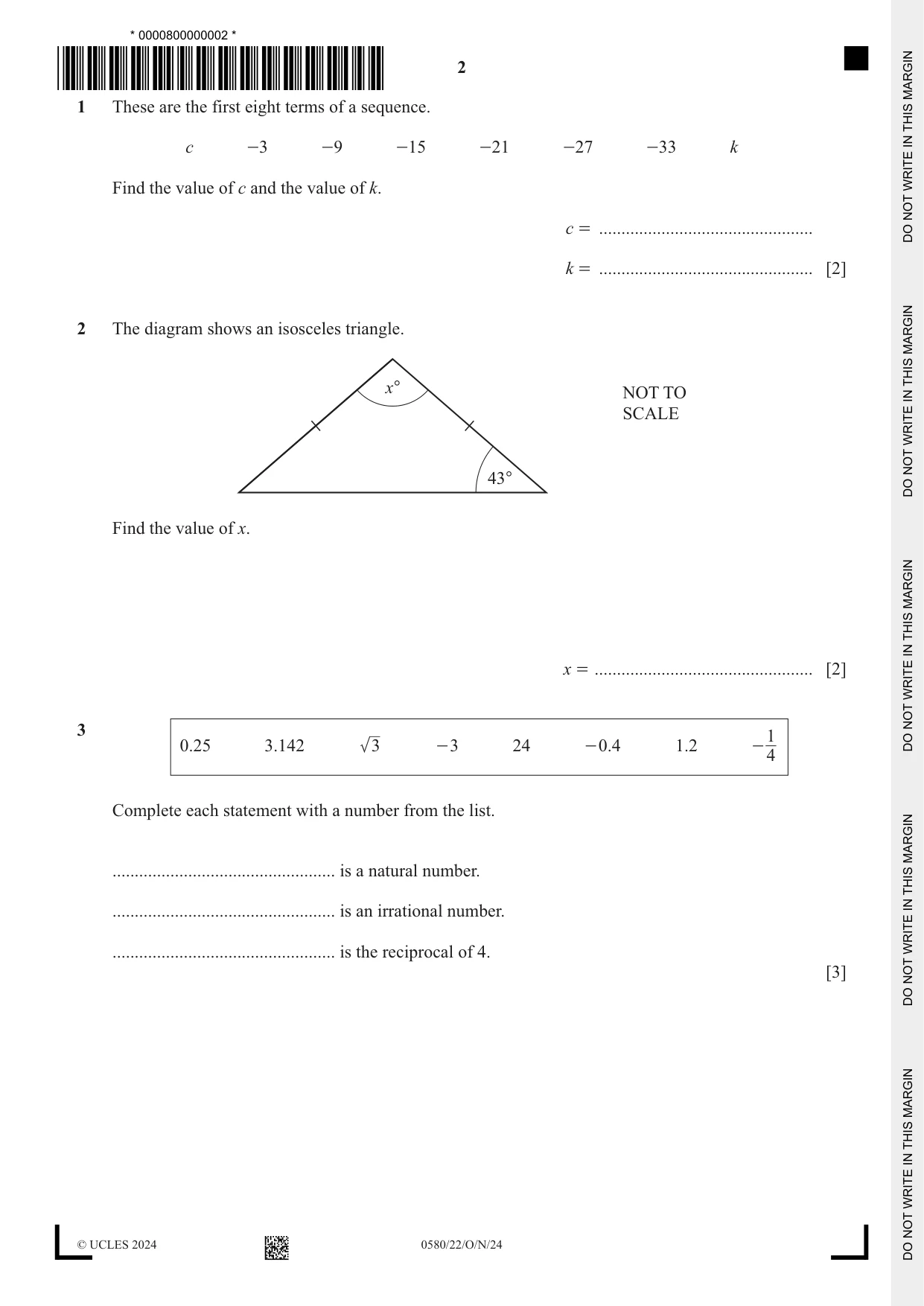
2 The diagram shows an isosceles triangle. x° NOT TO SCALE 43° Find the value of x. x = ................................................. [2]
Mark scheme: 2 94 2 M1 for x + 2 × 43 = 180 oe
Q3 · 1 0.25 3.142 3 - 3 24 - .04 1.2 - 4 Complete each statement with a number from the list
3 1 0.25 3.142 3 - 3 24 - .04 1.2 - 4 Complete each statement with a number from the list. .................................................. is a natural number. .................................................. is an irrational number. .................................................. is the reciprocal of 4. [3]
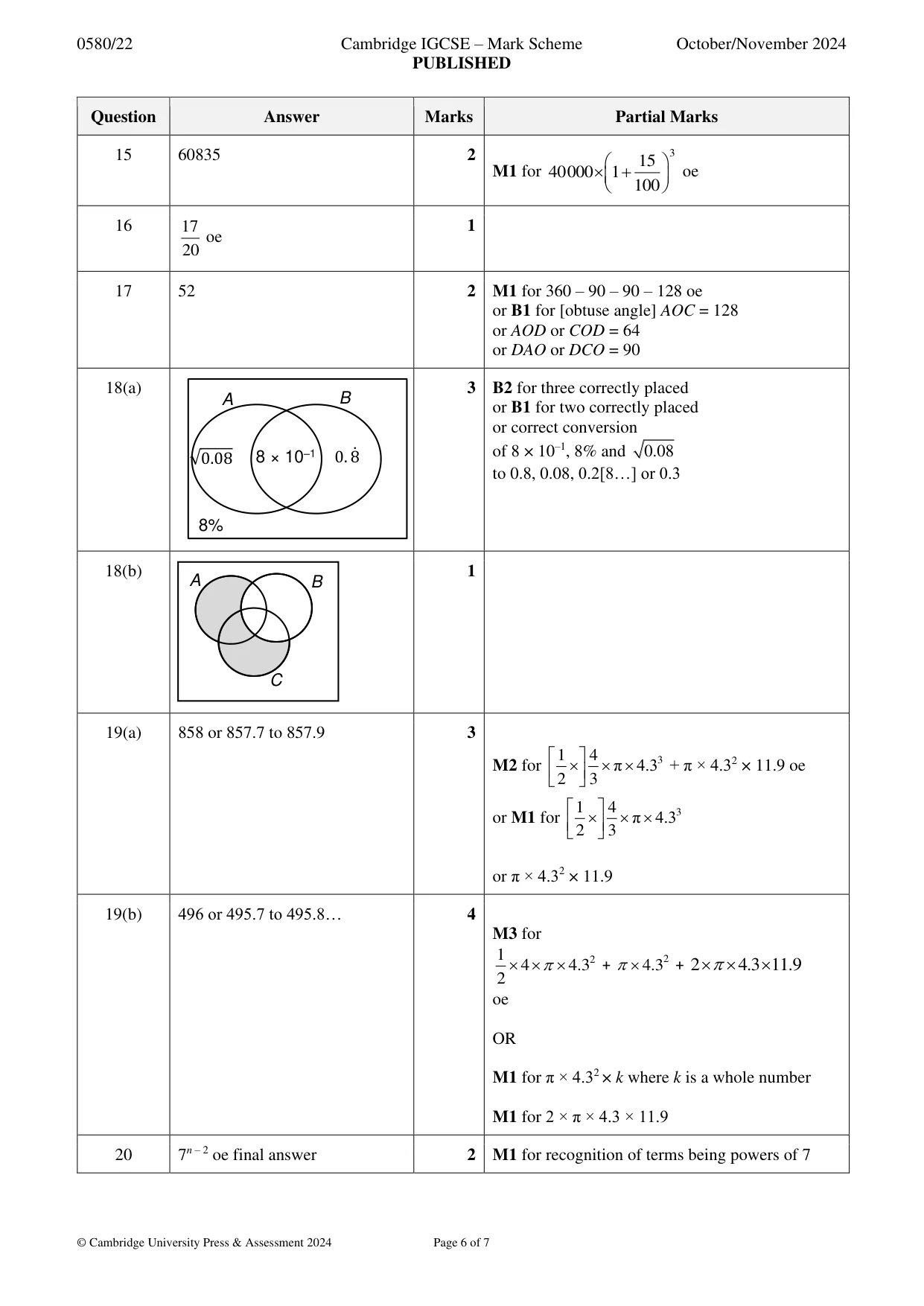
Mark scheme: 3 24 3 B1 for each 3 0.25
Q4 · The scatter diagram shows the number of rooms and the number of people in each of eight…
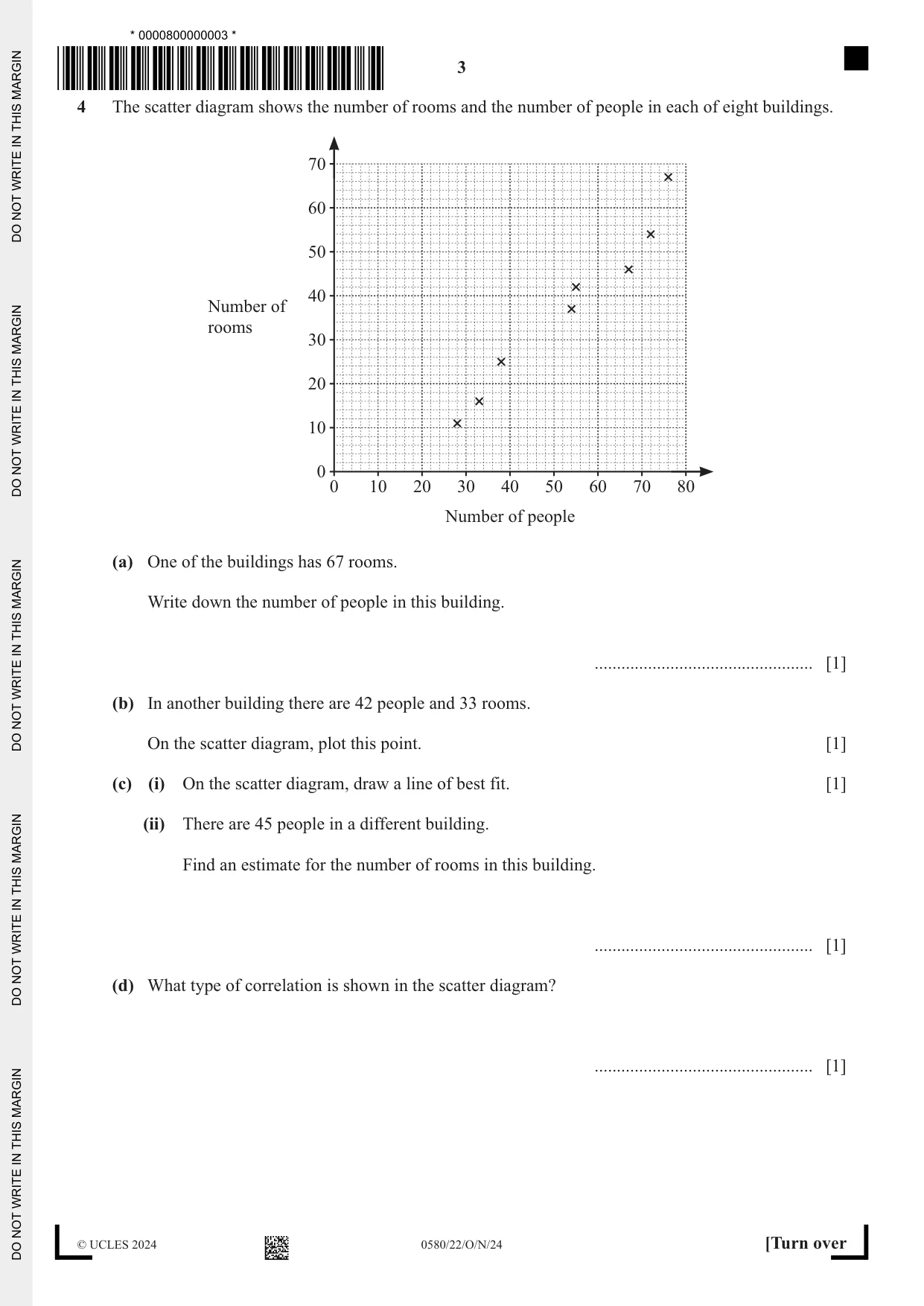
4 The scatter diagram shows the number of rooms and the number of people in each of eight buildings. 70 60 50 40 Number of rooms 30 20 10 0 0 10 20 30 40 50 60 70 80 Number of people (a) One of the buildings has 67 rooms. Write down the number of people in this building. ................................................. [1] (b) In another building there are 42 people and 33 rooms. On the scatter diagram, plot this point. [1] (c) (i) On the scatter diagram, draw a line of best fit. [1] (ii) There are 45 people in a different building. Find an estimate for the number of rooms in this building. ................................................. [1] (d) What type of correlation is shown in the scatter diagram? ................................................. [1]
Mark scheme: 4(a) 76 1 4(b) Point correctly plotted at 1 (42, 33) 4(c)(i) Correct ruled line of best fit 1 4(c)(ii) An integer in the range 1 27 to 33 FT their line of best fit provided line shows positive correlation and answer is an integer 4(d) Positive 1
Q5 · Convert 7.51 m 2 into cm2
5 Convert 7.51 m 2 into cm2. .......................................... cm2 [1]
Mark scheme: 5 75 100 1
Q6 · The diagram shows a trapezium
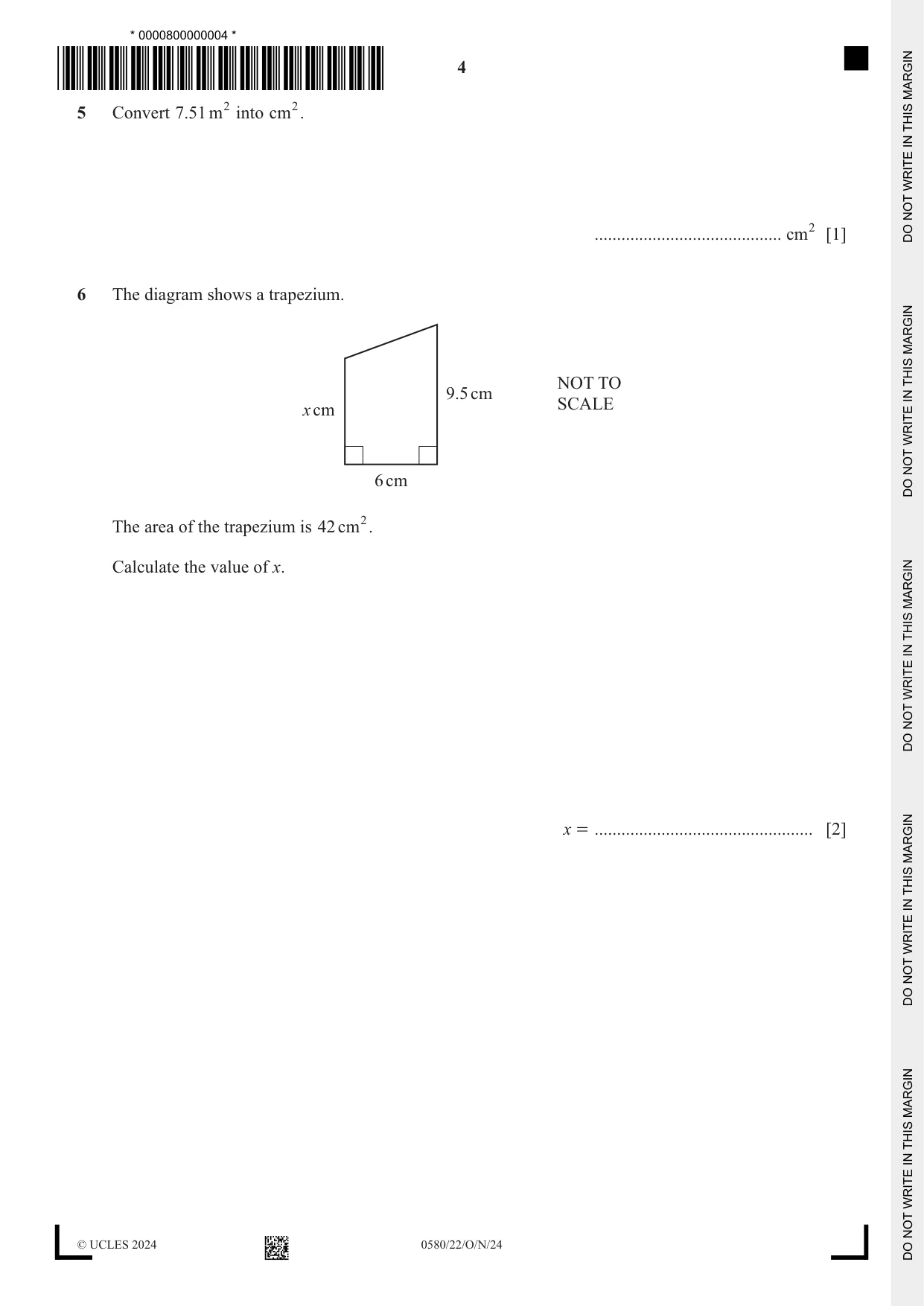
6 The diagram shows a trapezium. NOT TO 9.5 cm SCALE x cm 6 cm The area of the trapezium is 42 cm 2. Calculate the value of x. x = ................................................. [2]
Mark scheme: 6 4.5 oe 2 1 M1 for 6 ( x + 9.5 ) = 42 oe 2 2 or 42 −9.5 oe 6
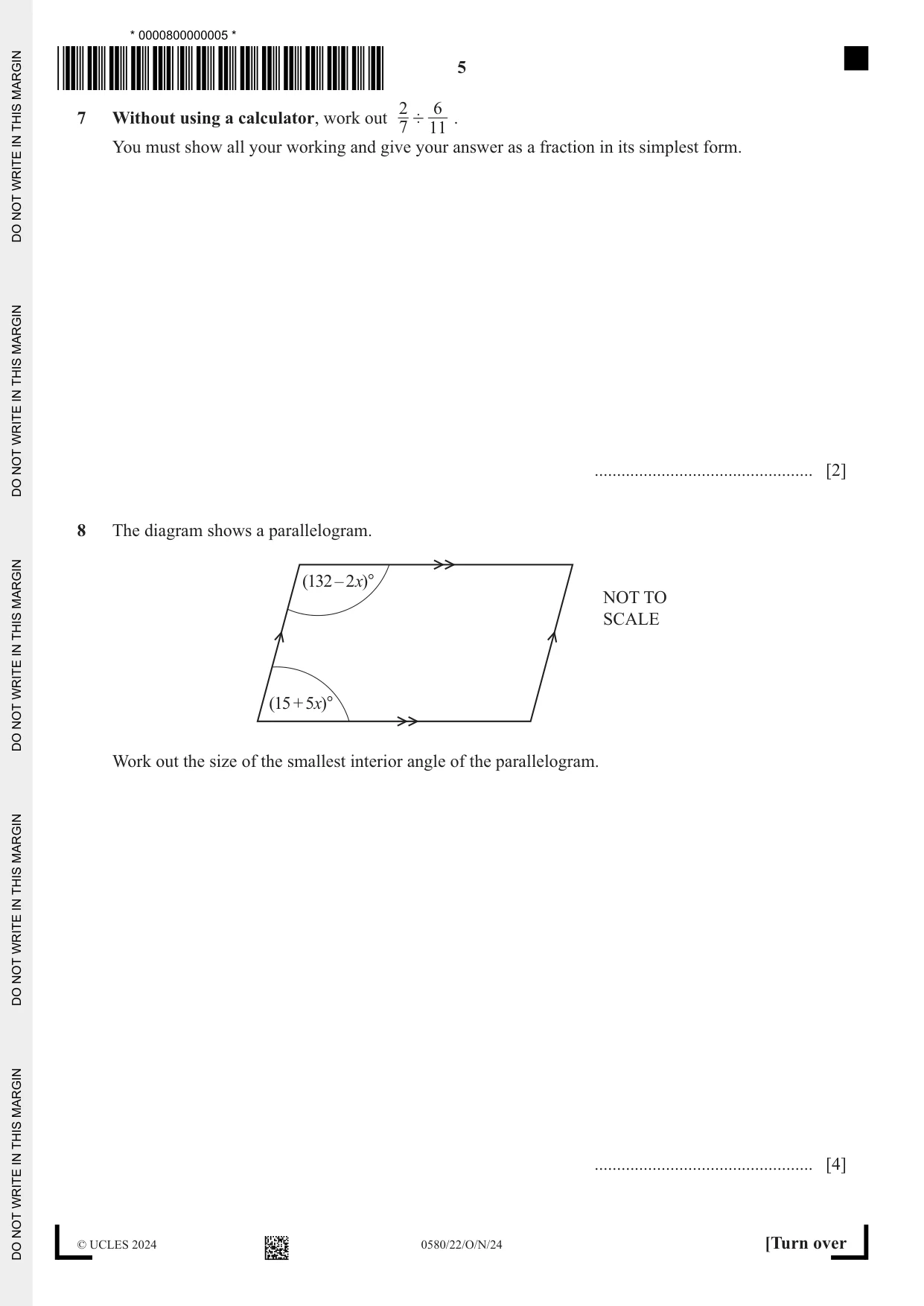
Q7 · 6 7 Without using a calculator, work out '
2 6 7 Without using a calculator, work out ' . 7 11 You must show all your working and give your answer as a fraction in its simplest form. ................................................. [2]
Mark scheme: 7 2 11 M1 or 7 6 22 42 oe with common 77 77 denominator 11 A1 cao 21
Q8 · The diagram shows a parallelogram
8 The diagram shows a parallelogram. (132 – 2x)° NOT TO SCALE (15 + 5x)° Work out the size of the smallest interior angle of the parallelogram. ................................................. [4]
Mark scheme: 8 70 4 B3 for x = 11 OR M1 for 132 – 2x + 15 + 5x = 180 oe M1 for collecting x terms on one side and number terms on the other for their equation. M1 for 15 + 5 × their x oe where –3 < their x < 15 or for 132 – 2 × their x oe where 21 < their x < 66
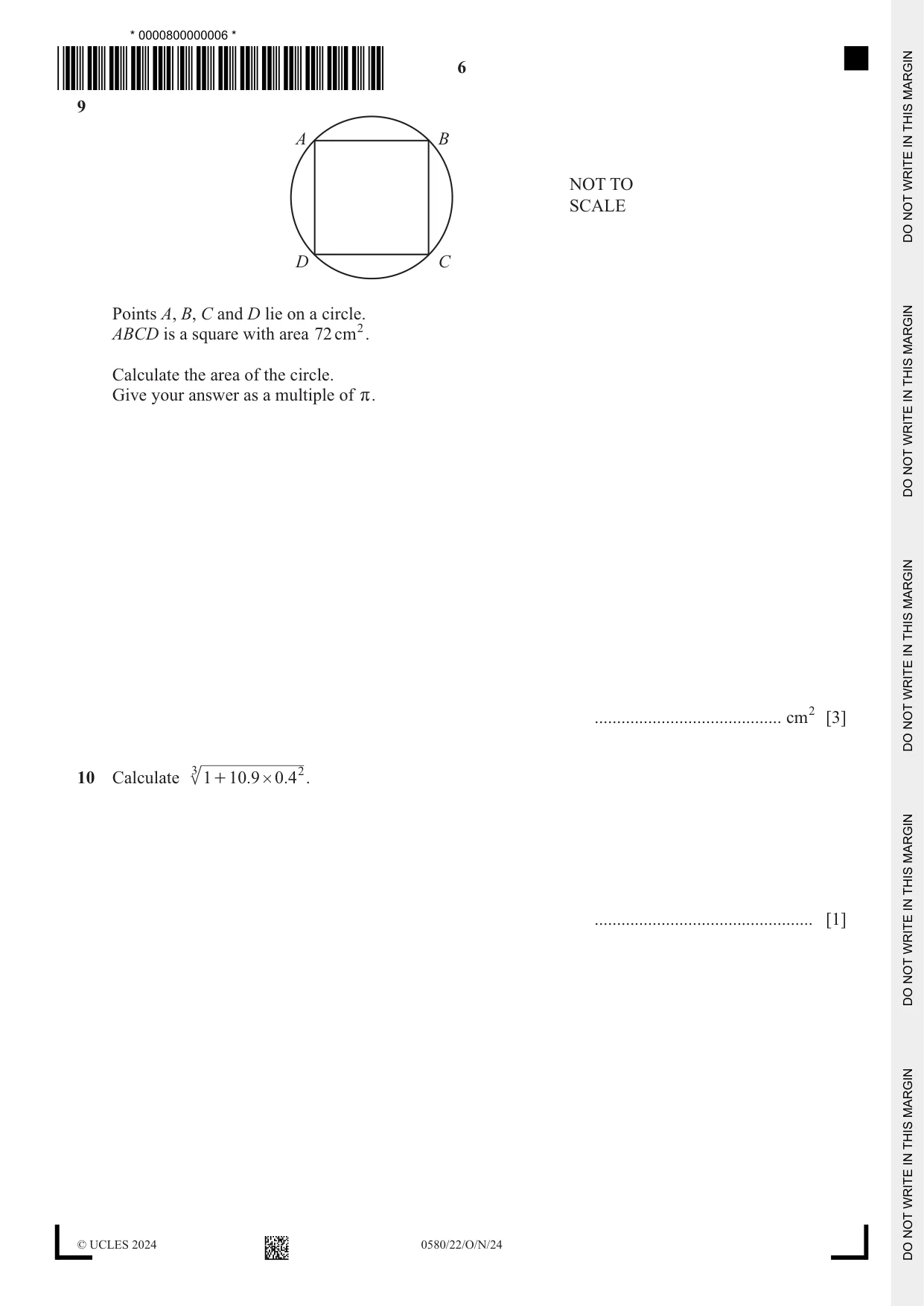
Q9 · A B NOT TO SCALE D C Points A, B, C and D lie on a circle
9 A B NOT TO SCALE D C Points A, B, C and D lie on a circle. ABCD is a square with area 72 cm 2. Calculate the area of the circle. Give your answer as a multiple of r. .......................................... cm2 [3]
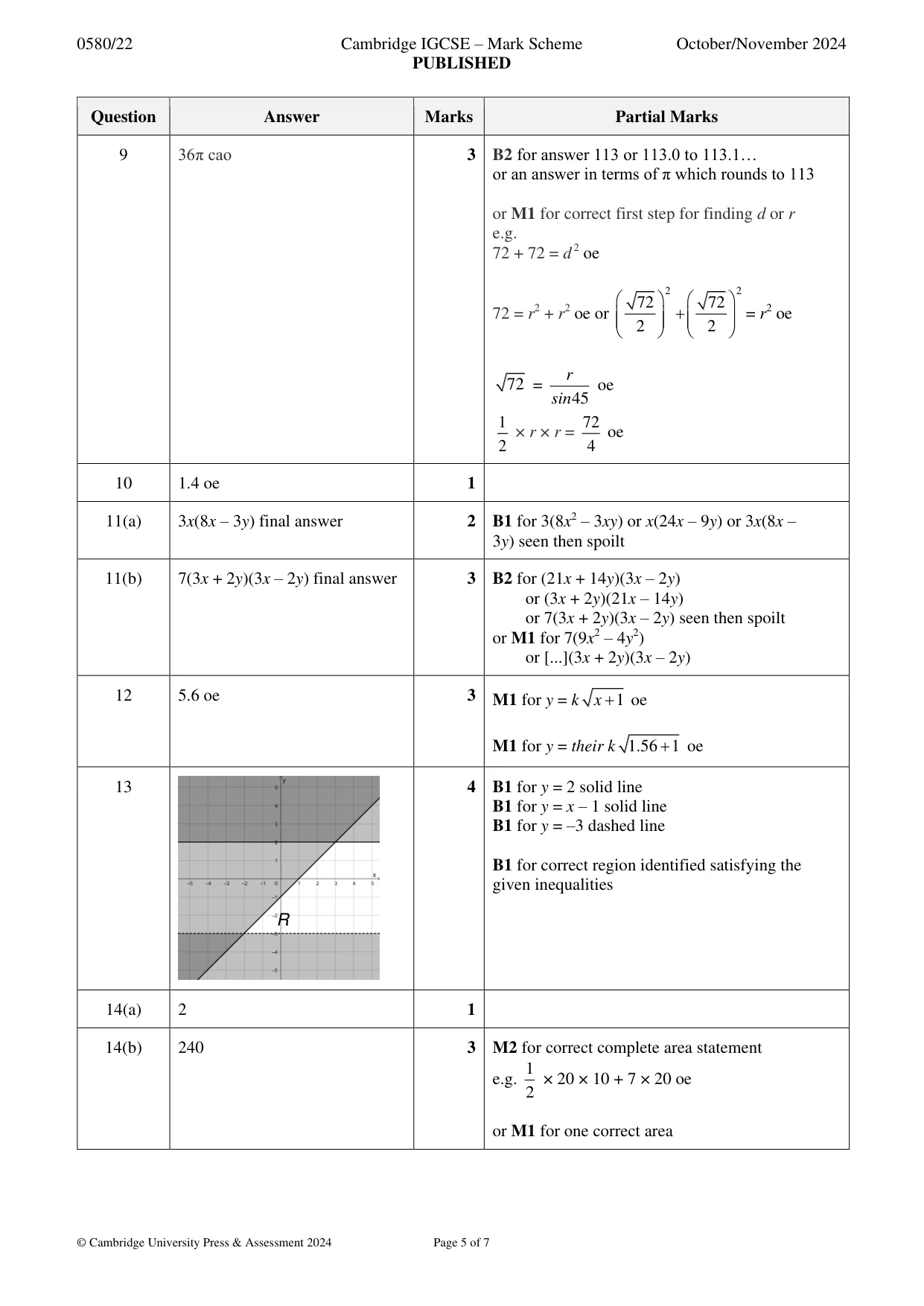
Mark scheme: 9 36π cao 3 B2 for answer 113 or 113.0 to 113.1… or an answer in terms of π which rounds to 113 or M1 for correct first step for finding d or r e.g. 72 + 72 = d 2 oe 72 2 72 2 72 = r2 + r2 oe or + = r2 oe 2 2 r 72 = oe sin 45 1 72 × r × r = oe 2 4
Q10 · 0 Calculate 1 + 10 .9 # 0 .42
310 Calculate 1 + 10 .9 # 0 .42 . ................................................. [1]
Mark scheme: 10 1.4 oe 1
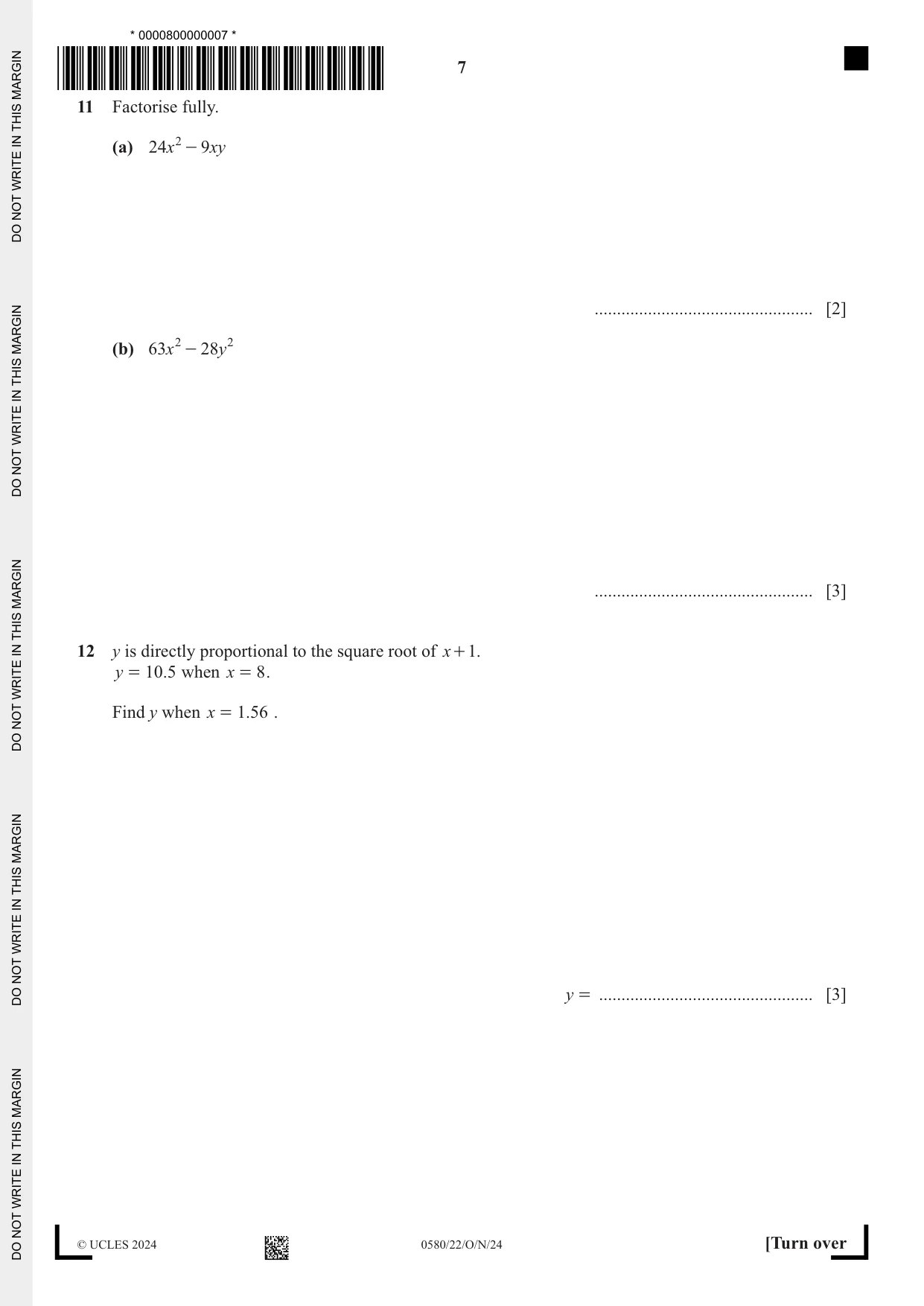
Question 11
11 Factorise fully. (a) 24x 2 - 9 xy ................................................. [2] (b) 63x 2 - 28y 2 ................................................. [3]
Mark scheme: 11(a) 3x(8x – 3y) final answer 2 B1 for 3(8x2 – 3xy) or x(24x – 9y) or 3x(8x – 3y) seen then spoilt 11(b) 7(3x + 2y)(3x – 2y) final answer 3 B2 for (21x + 14y)(3x – 2y) or (3x + 2y)(21x – 14y) or 7(3x + 2y)(3x – 2y) seen then spoilt or M1 for 7(9x2 – 4y2) or [...](3x + 2y)(3x – 2y)
Q12 · Y is directly proportional to the square root of x + 1
12 y is directly proportional to the square root of x + 1. y = 10 .5 when x = 8 . Find y when x = 1.56 . y = ................................................ [3]
Mark scheme: 12 5.6 oe 3 M1 for y = k x + 1 oe M1 for y = their k 1.56 + 1 oe
Q13 · Y 5 4 3 2 1 – 5 – 4 – 3 – 2 – 1 0 1 2 3 4 5 x – 1 – 2 – 3 – 4 – 5 The region R satisfies…
13 y 5 4 3 2 1 – 5 – 4 – 3 – 2 – 1 0 1 2 3 4 5 x – 1 – 2 – 3 – 4 – 5 The region R satisfies these inequalities. - 3 1 y G 2 y G x - 1 By drawing suitable straight lines and shading unwanted regions, find and label the region R. [4]
Mark scheme: 13 4 B1 for y = 2 solid line B1 for y = x – 1 solid line B1 for y = –3 dashed line B1 for correct region identified satisfying the given inequalities R
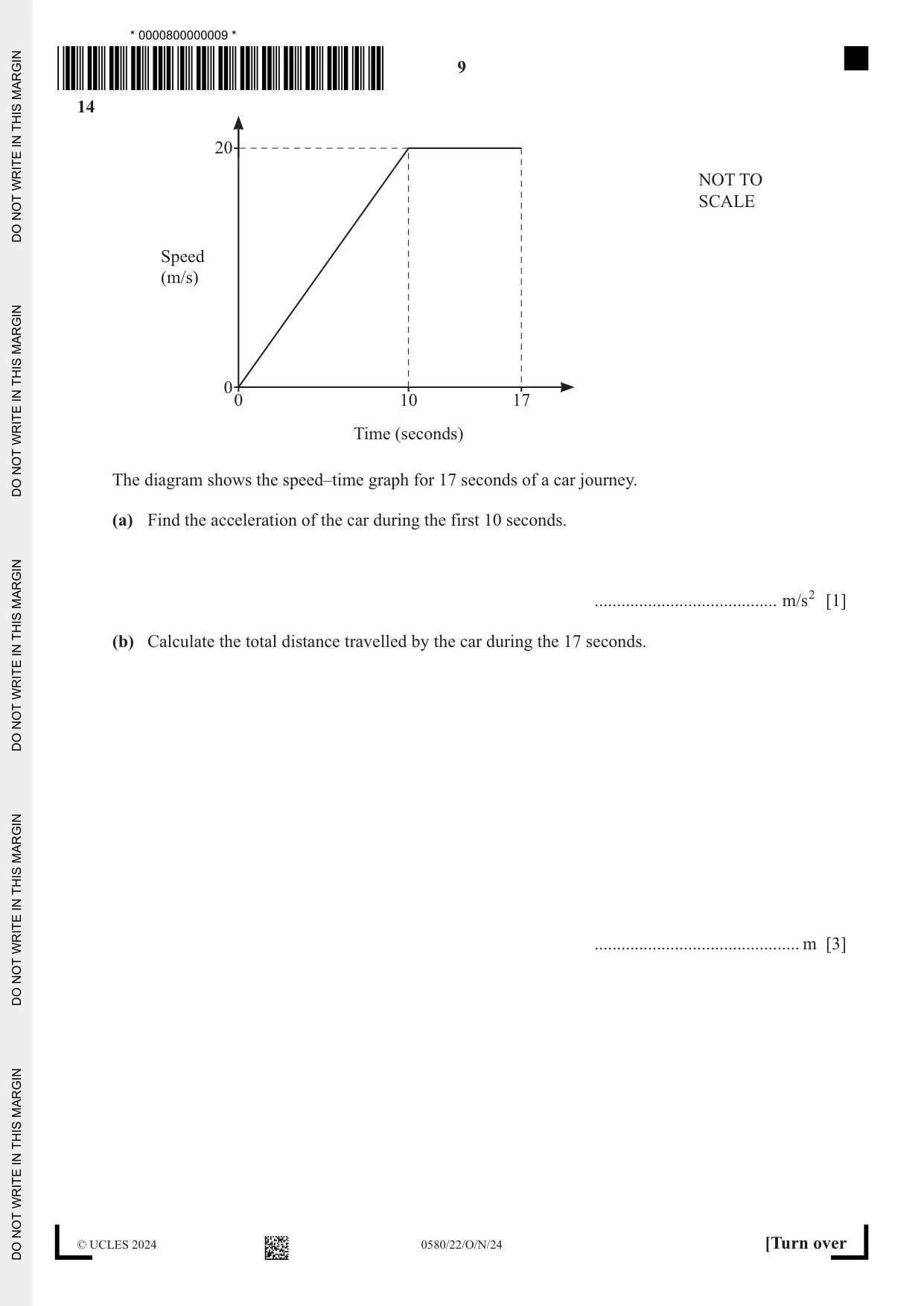
Q14 · 20 NOT TO SCALE Speed (m/s) 00 10 17 Time (seconds) The diagram shows the speed–time…
14 20 NOT TO SCALE Speed (m/s) 00 10 17 Time (seconds) The diagram shows the speed–time graph for 17 seconds of a car journey. (a) Find the acceleration of the car during the first 10 seconds. ......................................... m/s2 [1] (b) Calculate the total distance travelled by the car during the 17 seconds. .............................................. m [3]
Mark scheme: 14(a) 2 1 14(b) 240 3 M2 for correct complete area statement 1 e.g. × 20 × 10 + 7 × 20 oe 2 or M1 for one correct area
Q15 · At the start of an experiment there are 40 000 bacteria
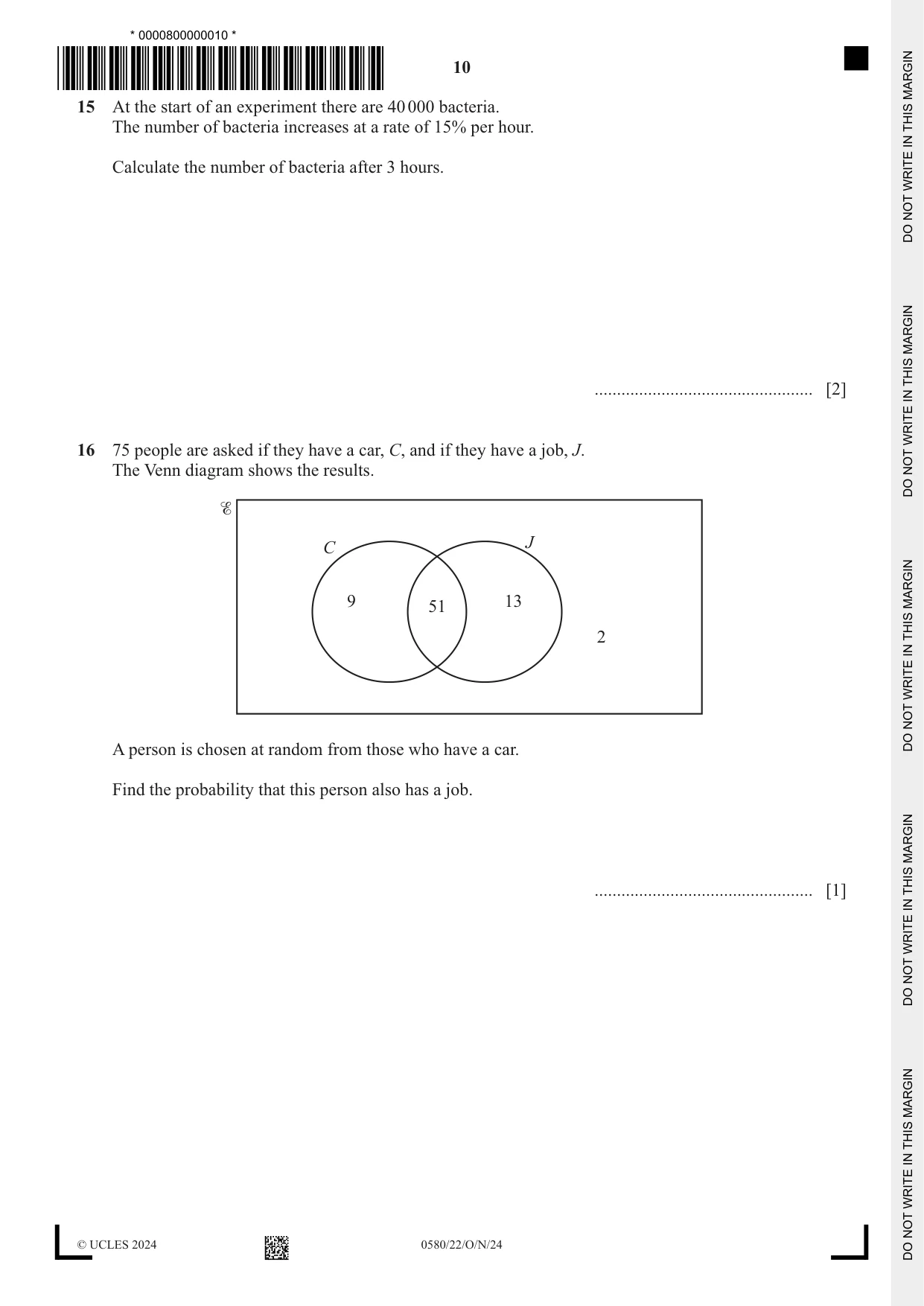
15 At the start of an experiment there are 40 000 bacteria. The number of bacteria increases at a rate of 15% per hour. Calculate the number of bacteria after 3 hours. ................................................. [2]
Mark scheme: 15 60835 2 3 15 M1 for 40 000 1 + oe 100
Q16 · 75 people are asked if they have a car, C, and if they have a job, J
16 75 people are asked if they have a car, C, and if they have a job, J. The Venn diagram shows the results. % J C 9 51 13 2 A person is chosen at random from those who have a car. Find the probability that this person also has a job. ................................................. [1]
Mark scheme: 16 17 1 oe 20
Q17 · A B 64° D x° O NOT TO SCALE C A, B and C are points on the circumference of a circle with…
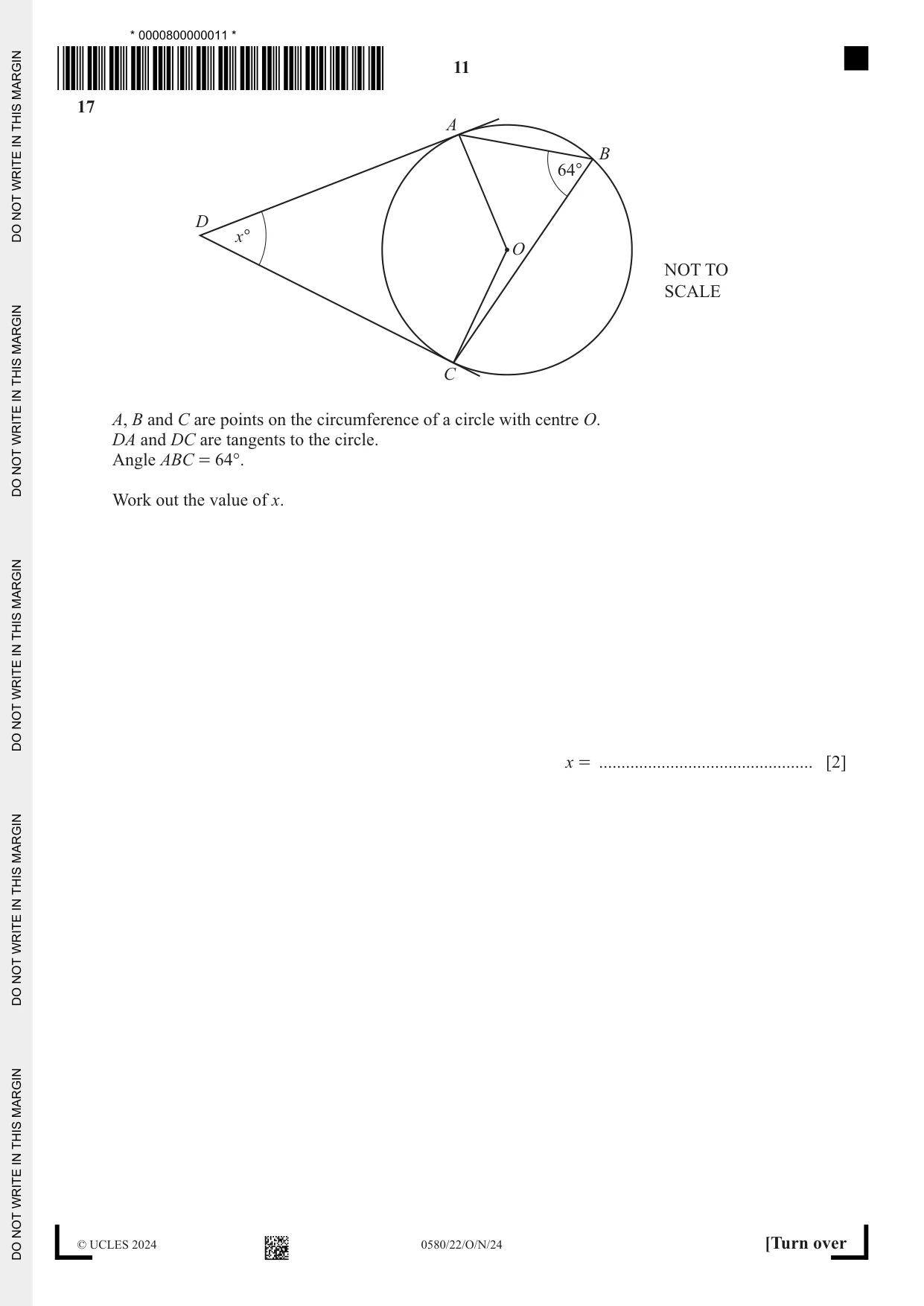
17 A B 64° D x° O NOT TO SCALE C A, B and C are points on the circumference of a circle with centre O. DA and DC are tangents to the circle. Angle ABC = 64°. Work out the value of x. x = ................................................ [2]
Mark scheme: 17 52 2 M1 for 360 – 90 – 90 – 128 oe or B1 for [obtuse angle] AOC = 128 or AOD or COD = 64 or DAO or DCO = 90
Q18 · % = {8 # 10 -1 , .08o , 8%, .008} A = { a: 0.08 1 a G 0.8 } B = { b: b H 0.8 } % A B…
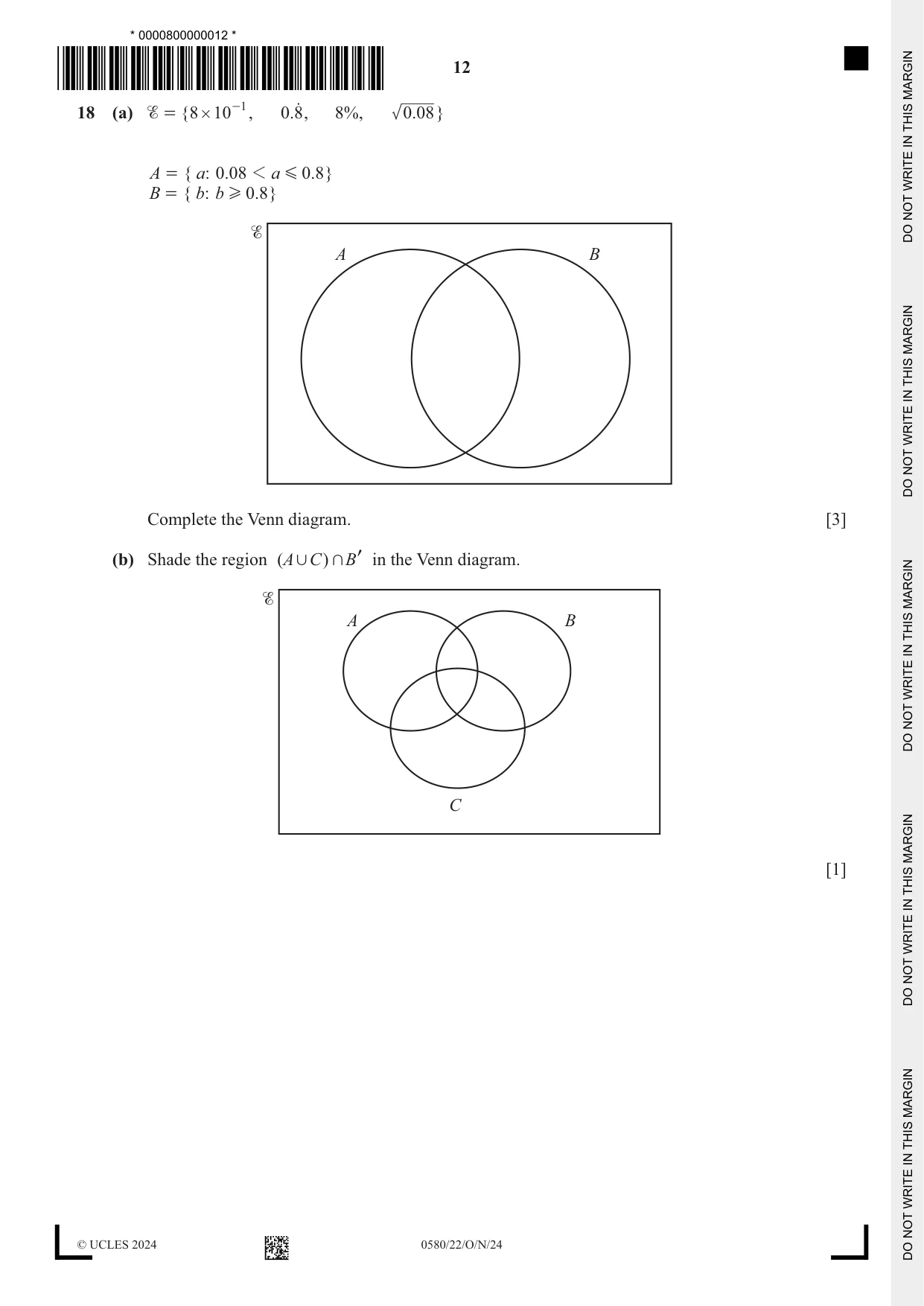
18 (a) % = {8 # 10 -1 , .08o , 8%, .008} A = { a: 0.08 1 a G 0.8 } B = { b: b H 0.8 } % A B Complete the Venn diagram. [3] (b) Shade the region ( A , C ) + Bl in the Venn diagram. % A B C [1]
Mark scheme: 18(a) 3 B2 for three correctly placed A B or B1 for two correctly placed or correct conversion of 8 × 10⁻¹, 8% and 0.08 ξ0.08 8 × 10⁻¹ 0. 8ሶ to 0.8, 0.08, 0.2[8…] or 0.3 8% 18(b) 1 A B C
Q19 · 4.3 cm NOT TO SCALE 11.9 cm A solid is made from a cylinder and a hemisphere, both of…
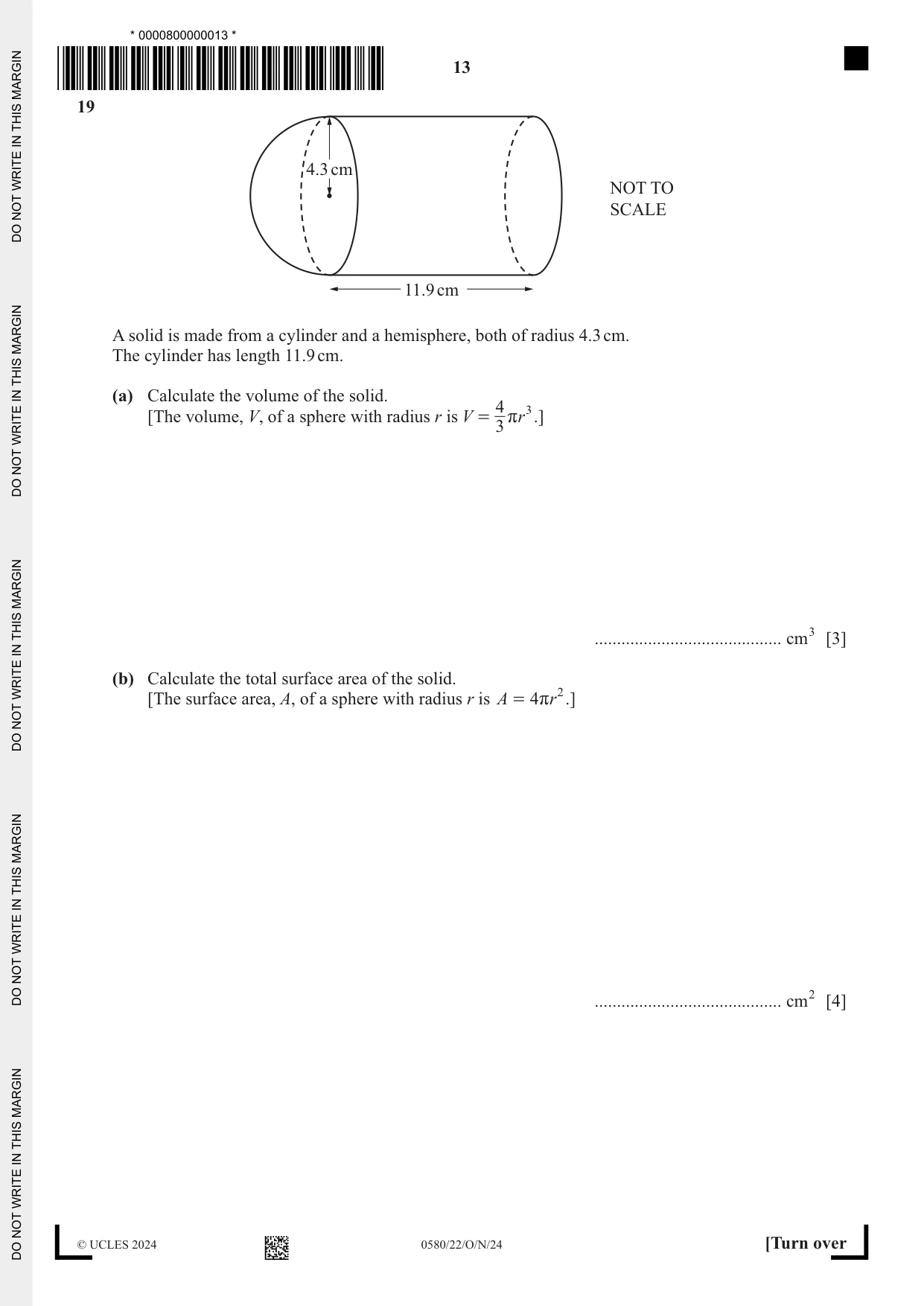
19 4.3 cm NOT TO SCALE 11.9 cm A solid is made from a cylinder and a hemisphere, both of radius 4.3 cm. The cylinder has length 11.9 cm. (a) Calculate the volume of the solid. 4 3 [The volume, V, of a sphere with radius r is V = r r .] 3 .......................................... cm3 [3] (b) Calculate the total surface area of the solid. [The surface area, A, of a sphere with radius r is A = 4 rr 2 .] .......................................... cm2 [4]
Mark scheme: 19(a) 858 or 857.7 to 857.9 3 1 4 3 M2 for π 4.3 + π × 4.32 × 11.9 oe 2 3 1 4 3 or M1 for π 4.3 2 3 or π × 4.32 × 11.9 19(b) 496 or 495.7 to 495.8… 4 M3 for 1 2 2 4 4.3 + 4.3 + 2 4.3 11.9 2 oe OR M1 for π × 4.32 × k where k is a whole number M1 for 2 × π × 4.3 × 11.9
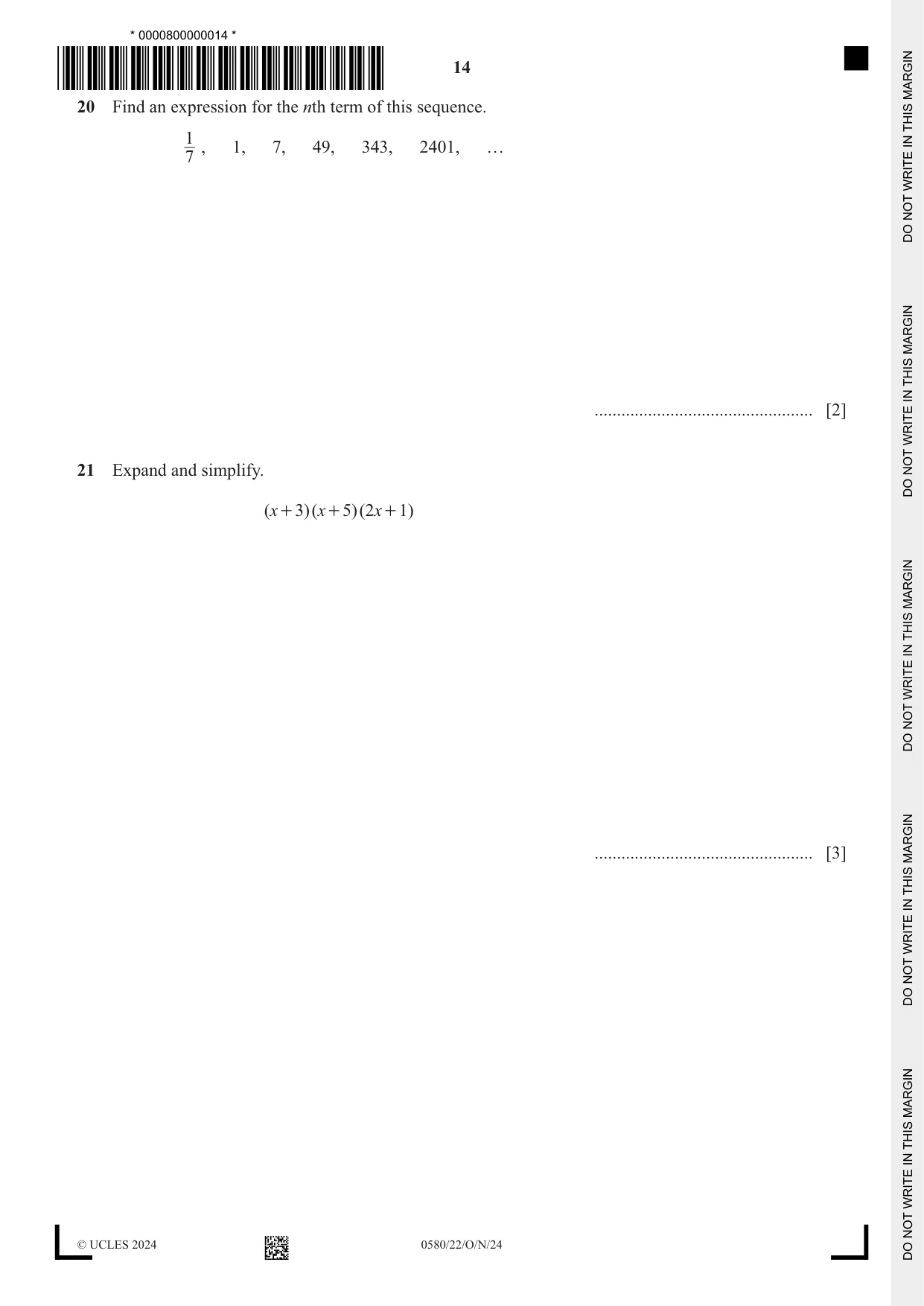
Q20 · Find an expression for the nth term of this sequence
20 Find an expression for the nth term of this sequence. 1 , 1, 7, 49, 343, 2401, … 7 ................................................. [2]
Mark scheme: 20 7n – 2 oe final answer 2 M1 for recognition of terms being powers of 7
Question 21
21 Expand and simplify. ( x + 3)( x + 5)( 2x + 1) ................................................. [3]
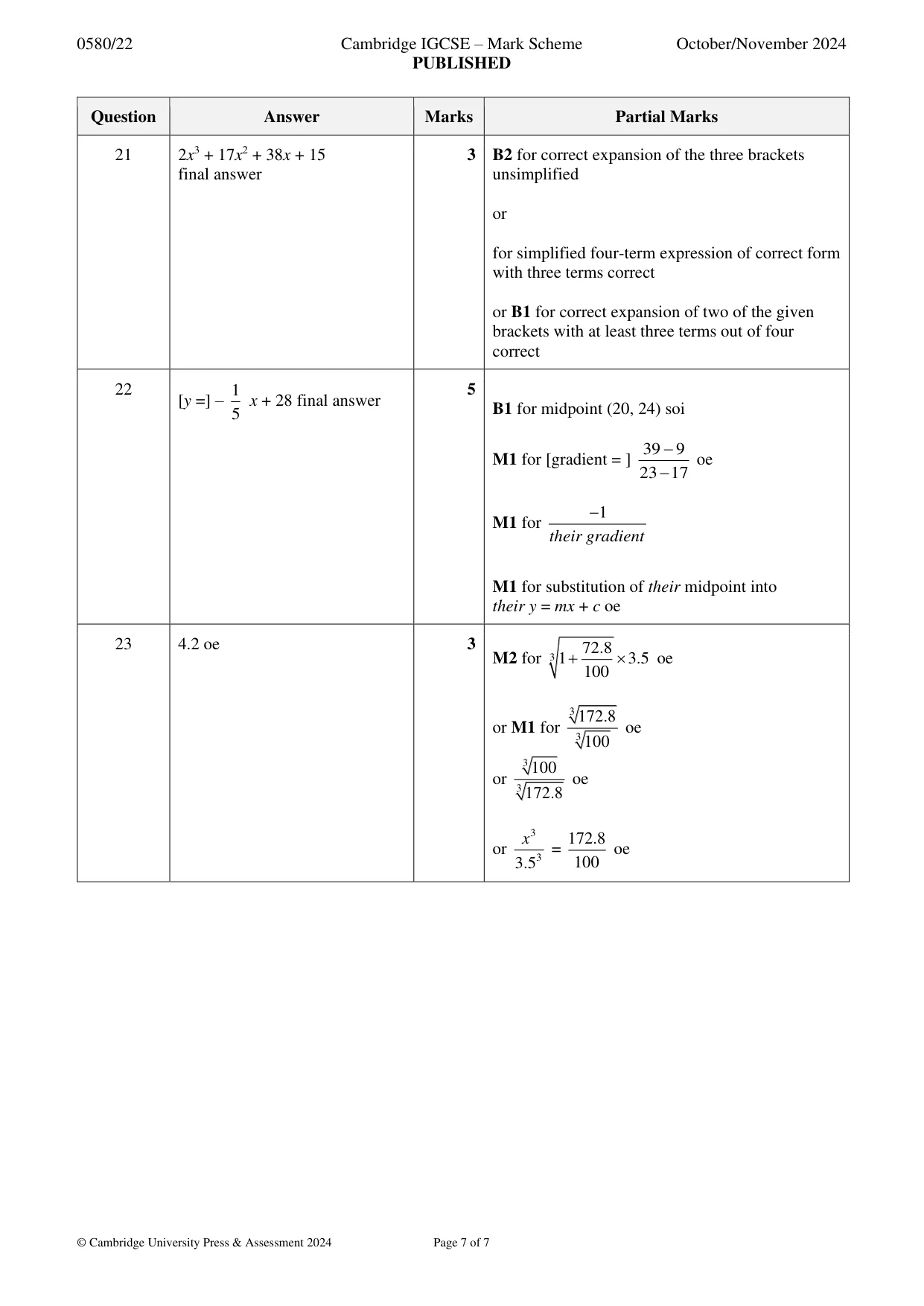
Mark scheme: 21 2x3 + 17x2 + 38x + 15 3 B2 for correct expansion of the three brackets final answer unsimplified or for simplified four-term expression of correct form with three terms correct or B1 for correct expansion of two of the given brackets with at least three terms out of four correct
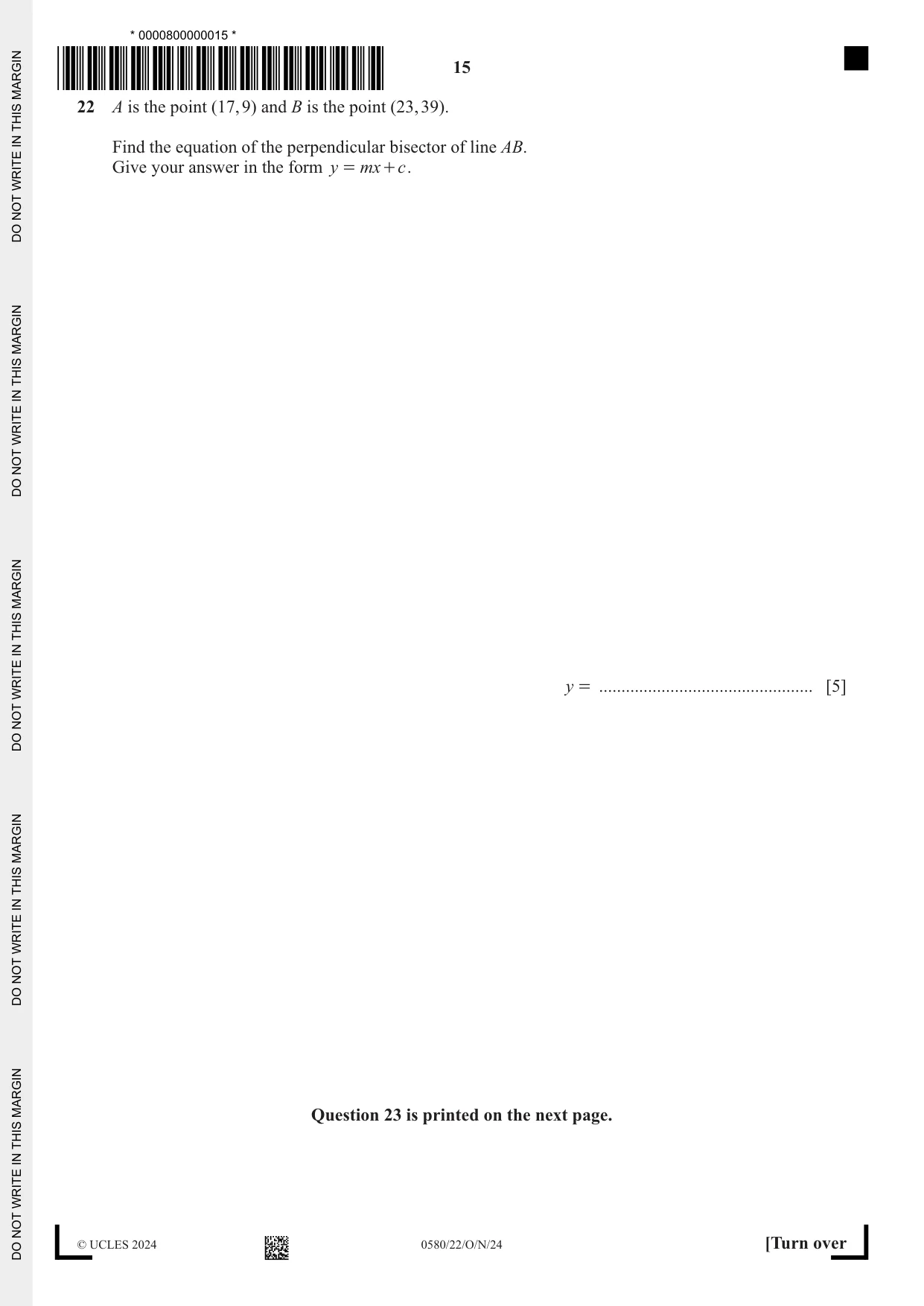
Q22 · A is the point (17, 9) and B is the point (23, 39)
22 A is the point (17, 9) and B is the point (23, 39). Find the equation of the perpendicular bisector of line AB. Give your answer in the form y = mx + c . y = ................................................ [5] Question 23 is printed on the next page.
Mark scheme: 22 1 5 [y =] – x + 28 final answer B1 for midpoint (20, 24) soi 5 39 − 9 M1 for [gradient = ] oe 23 − 17 − 1 M1 for their gradient M1 for substitution of their midpoint into their y = mx + c oe
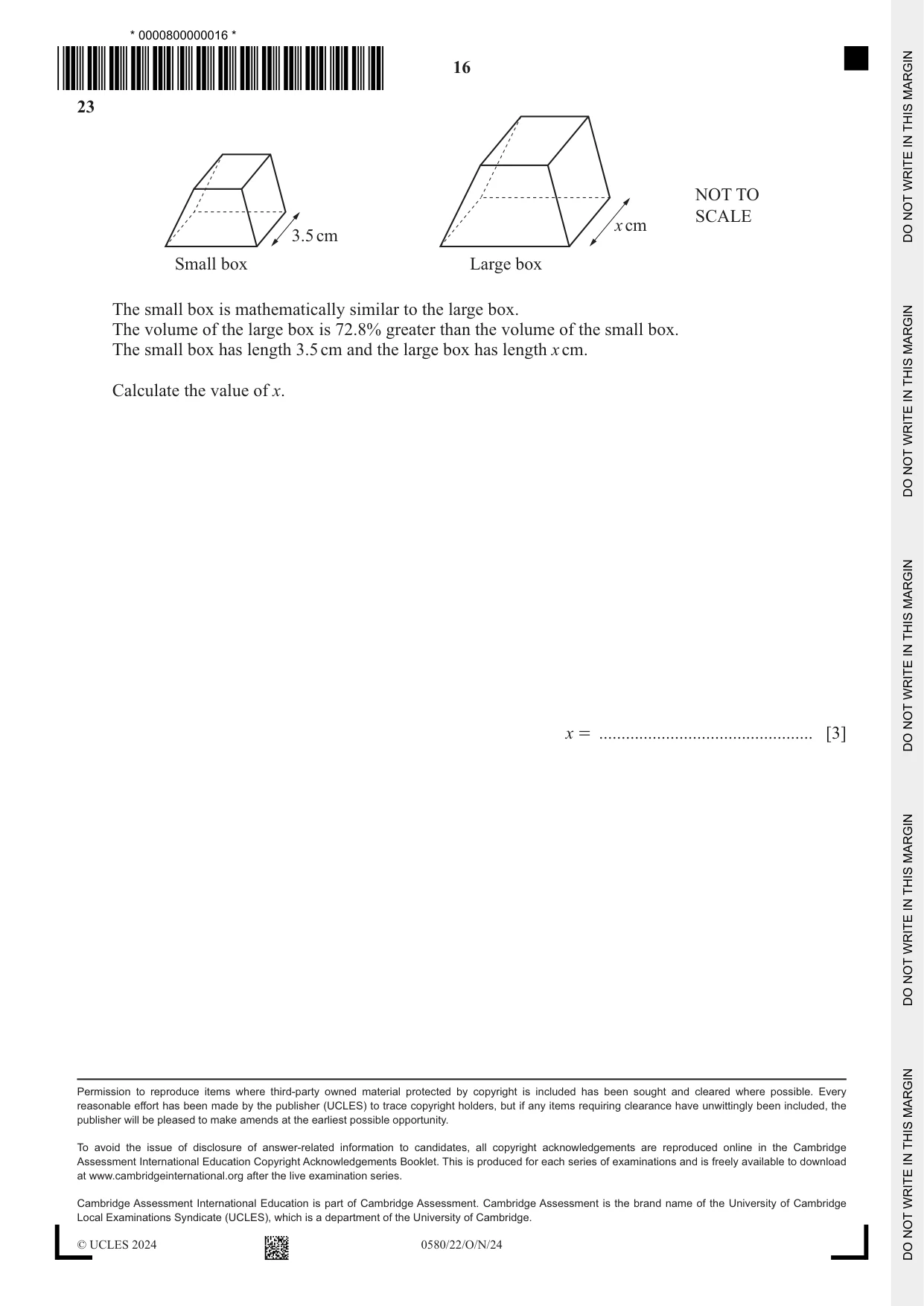
Q23 · NOT TO SCALE x cm 3.5 cm Small box Large box The small box is mathematically similar to…
23 NOT TO SCALE x cm 3.5 cm Small box Large box The small box is mathematically similar to the large box. The volume of the large box is 72.8% greater than the volume of the small box. The small box has length 3.5 cm and the large box has length x cm. Calculate the value of x. x = ................................................ [3]
Mark scheme: 23 4.2 oe 3 72.8 M2 for 3 1 + 3.5 oe 100 3 172.8 or M1 for oe 3 100 3 100 or oe 3 172.8 x 3 172.8 or = oe 3.5 3 100
What was in this paper
The subtopics covered by these 23 questions, and how many questions each got. Open one in a new tab to see every Cambridge question on it.
3Algebraic manipulation2Angles2Fractions, decimals and percentages2Sequences2Circle theorems I1Circles, arcs and sectors1Equations of linear graphs1Inequalities1Introduction to probability1Percentages1Powers and roots1Ratio and proportion1Scatter diagrams1Similarity1Types of number1Units of measure1What you needed in this session
Cambridge’s own grade thresholds for 2024 Oct/Nov, Paper 2 · Variant 2. A higher threshold means an easier paper — the bar moves with how the cohort did.