Cambridge IGCSE Mathematics 0580 — 2025 May/June Paper 2 · Variant 2
0580/22/M/J/25 · 23 questions · 100 marks · 120 min
The question paper and its mark scheme, free to read here and free to download. This is Cambridge’s own paper, exactly as it was sat.
Question paper20 pages
Mark scheme11 pages
Answers below. Sit the paper first if you are practising.
Questions as text
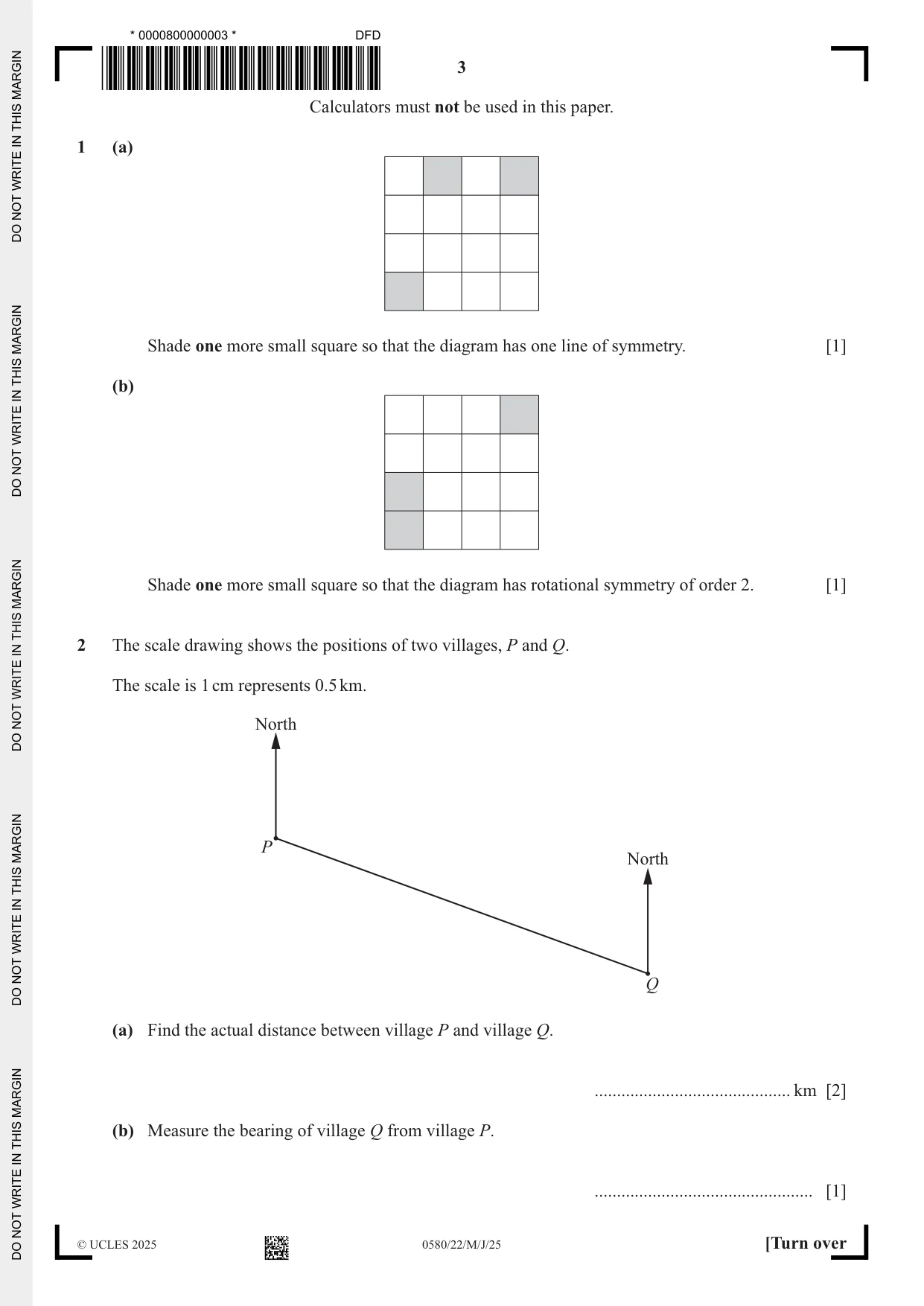
Q1 · Shade one more small square so that the diagram has one line of symmetry
1 (a) Shade one more small square so that the diagram has one line of symmetry. [1] (b) Shade one more small square so that the diagram has rotational symmetry of order 2. [1]
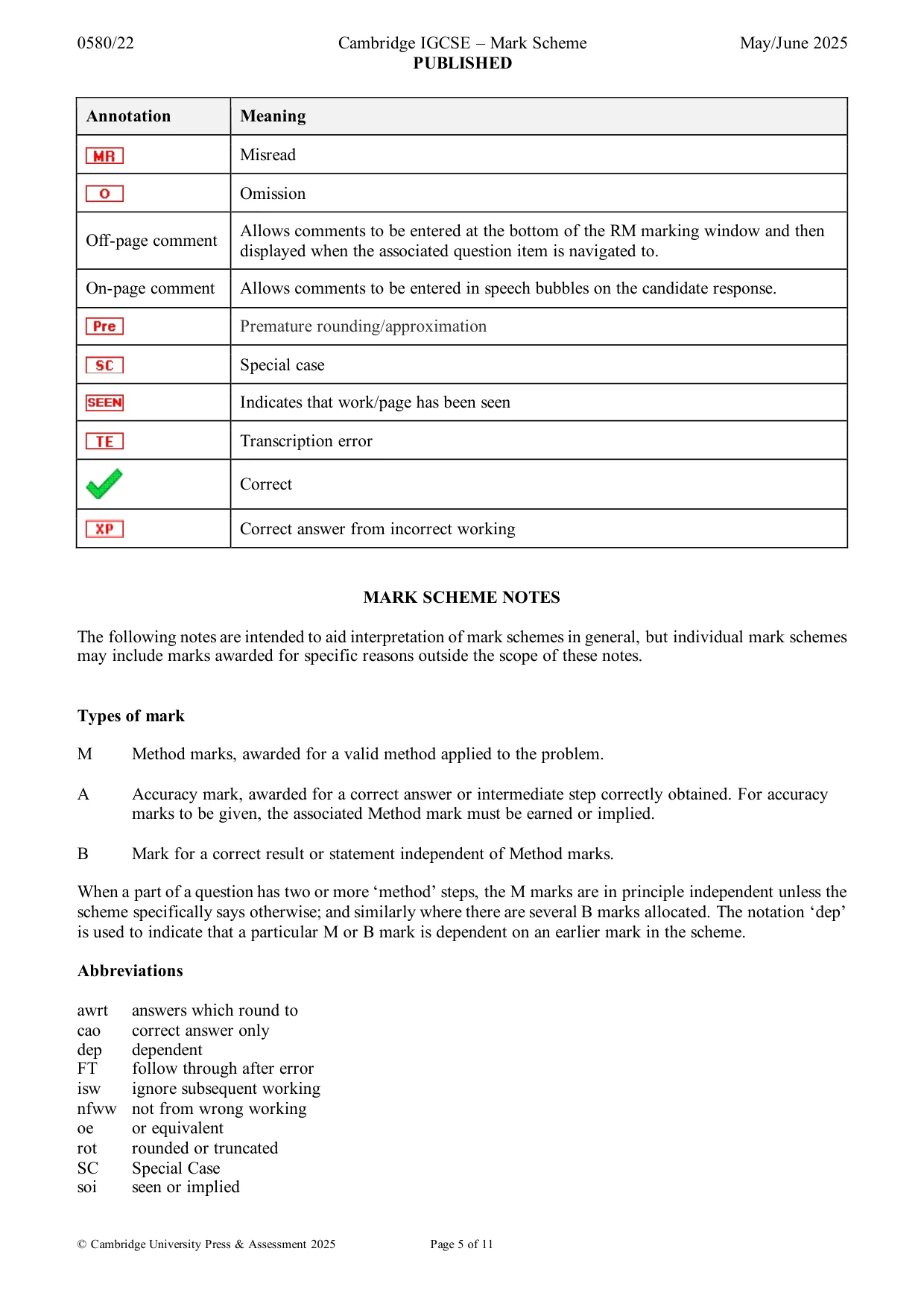
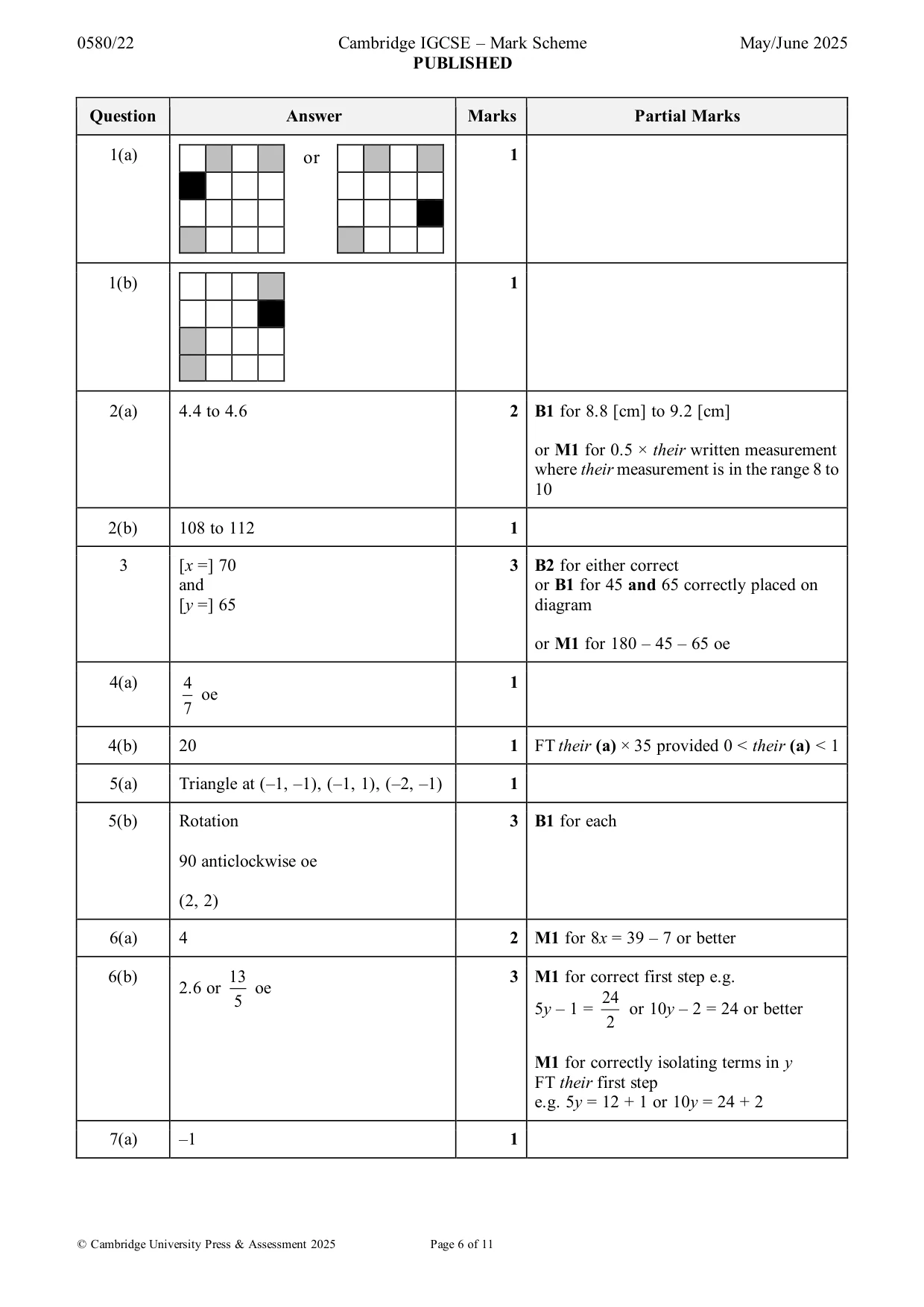
Mark scheme: Question Answer Marks Partial Marks 1(a) or 1 1(b) 1
Q2 · The scale drawing shows the positions of two villages, P and Q
2 The scale drawing shows the positions of two villages, P and Q. The scale is 1 cm represents 0.5 km. North P North Q (a) Find the actual distance between village P and village Q. ............................................ km [2] (b) Measure the bearing of village Q from village P. ................................................. [1]
Mark scheme: 2(a) 4.4 to 4.6 2 B1 for 8.8 [cm] to 9.2 [cm] or M1 for 0.5 × their written measurement where their measurement is in the range 8 to 10 2(b) 108 to 112 1
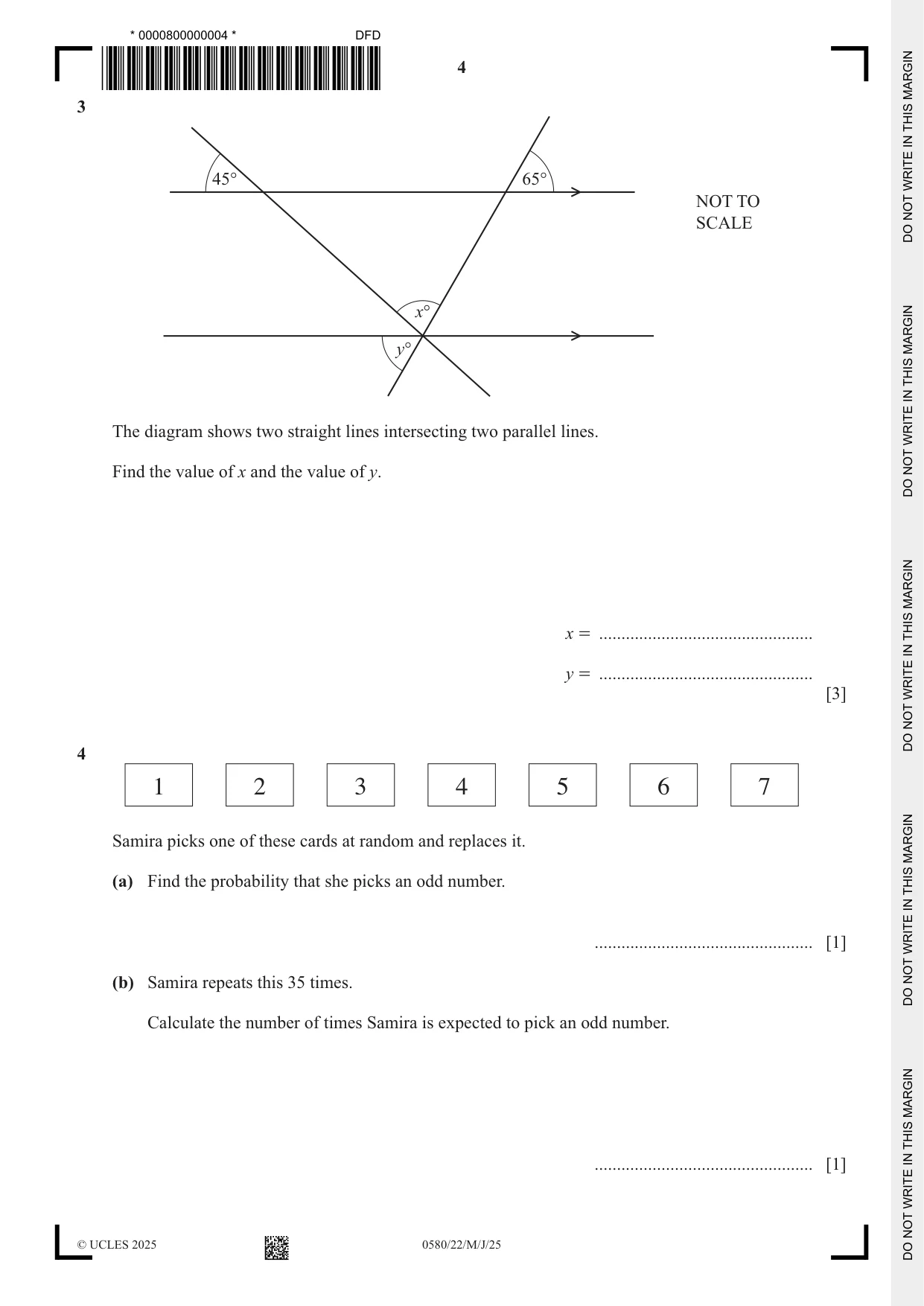
Q3 · 45° 65° NOT TO SCALE x° y° The diagram shows two straight lines intersecting two parallel…
3 45° 65° NOT TO SCALE x° y° The diagram shows two straight lines intersecting two parallel lines. Find the value of x and the value of y. x = ................................................ y = ................................................ [3]
Mark scheme: 3 [x =] 70 3 B2 for either correct and or B1 for 45 and 65 correctly placed on [y =] 65 diagram or M1 for 180 – 45 – 65 oe
Q4 · 1 2 3 4 5 6 7 Samira picks one of these cards at random and replaces it
4 1 2 3 4 5 6 7 Samira picks one of these cards at random and replaces it. (a) Find the probability that she picks an odd number. ................................................. [1] (b) Samira repeats this 35 times. Calculate the number of times Samira is expected to pick an odd number. ................................................. [1]
Mark scheme: 4(a) 4 1 oe 7 4(b) 20 1 FT their (a) × 35 provided 0 < their (a) < 1
Question 6
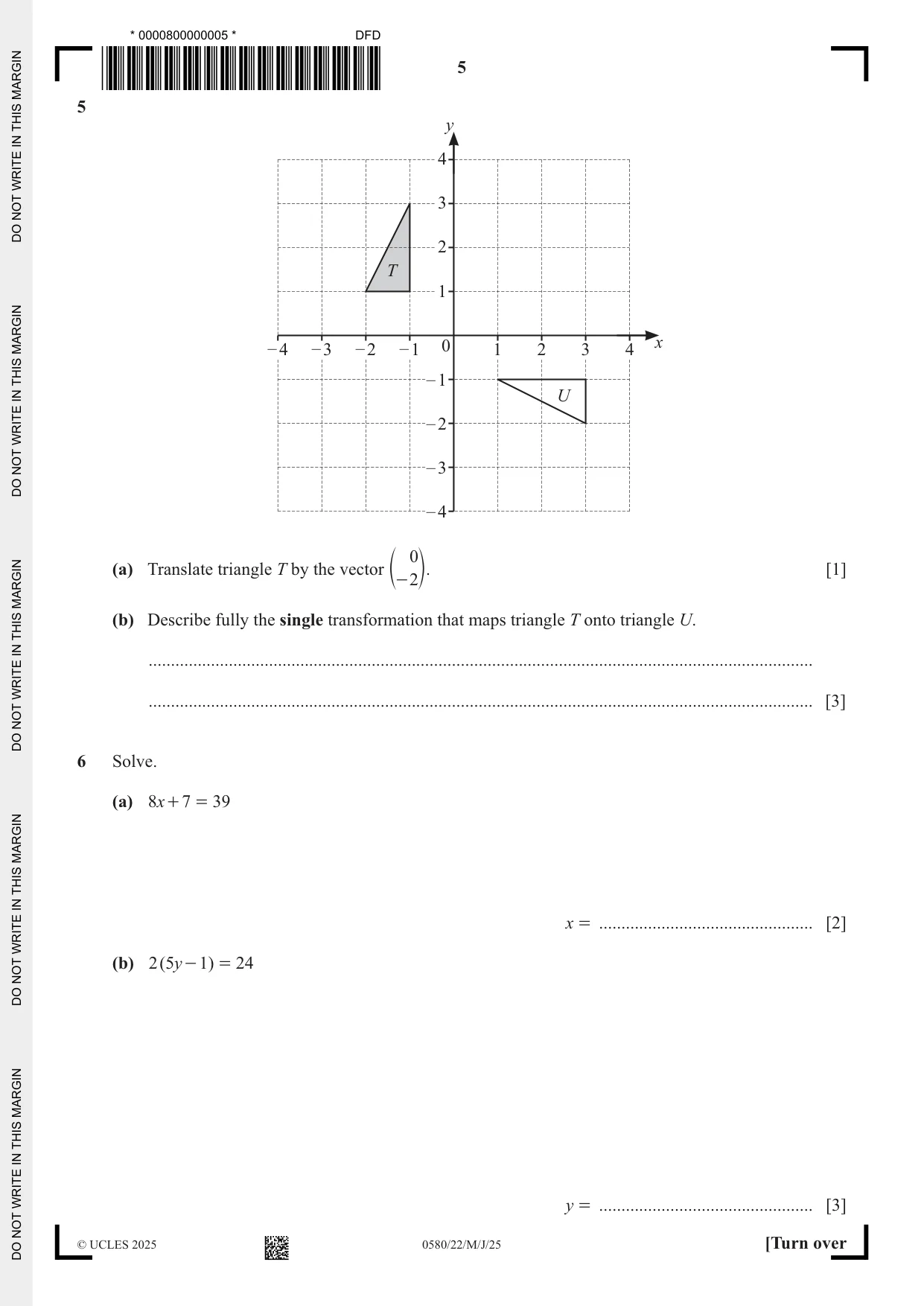
6 Solve. (a) 8x + 7 = 39 x = ................................................ [2] (b) 2 ( 5y - 1 ) = 24 y = ................................................ [3]
Mark scheme: 6(a) 4 2 M1 for 8x = 39 – 7 or better 6(b) 13 3 M1 for correct first step e.g. 2.6 or oe 5 24 5y – 1 = or 10y – 2 = 24 or better 2 M1 for correctly isolating terms in y FT their first step e.g. 5y = 12 + 1 or 10y = 24 + 2
Q7 · These are the first 4 terms of a sequence
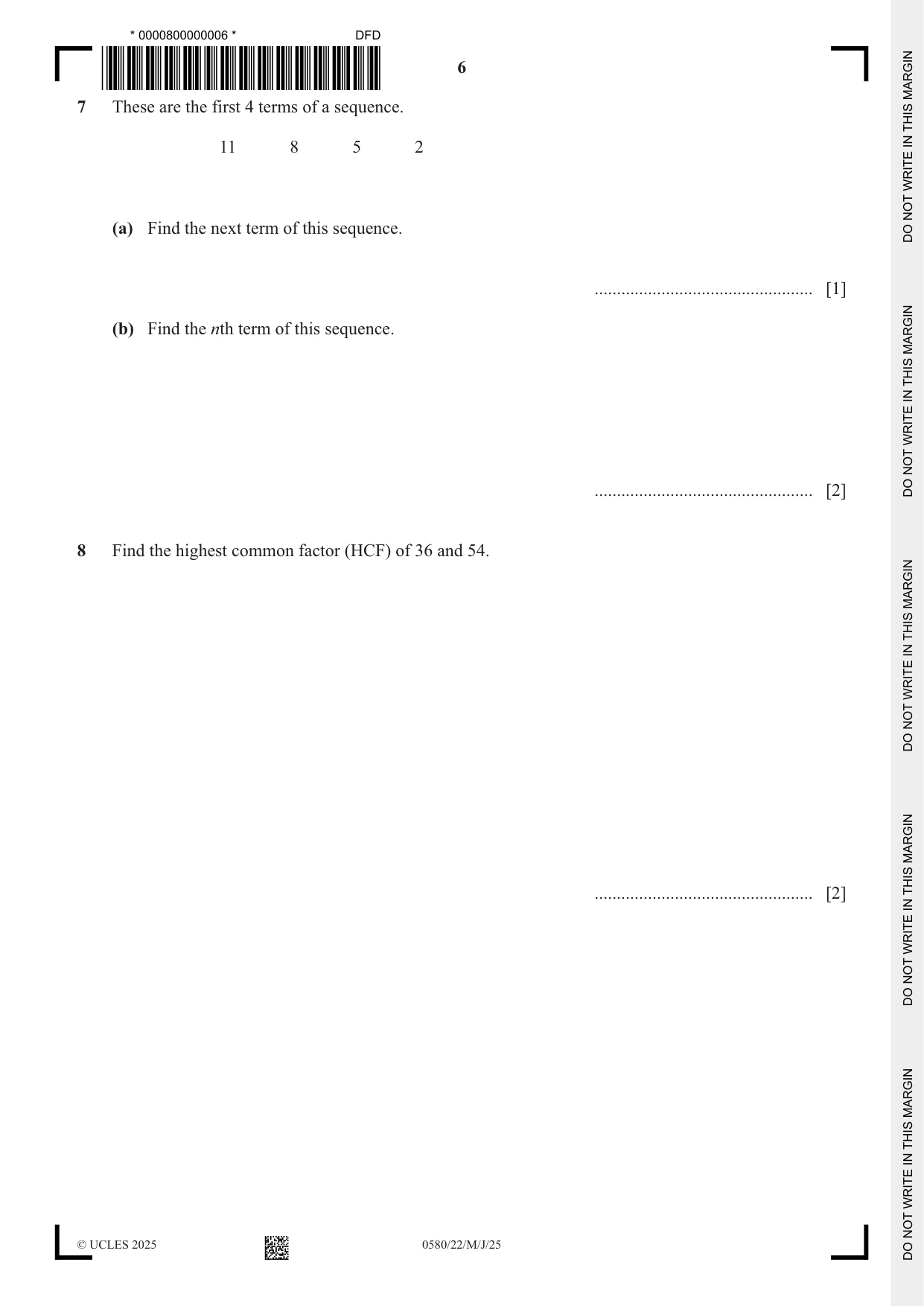
7 These are the first 4 terms of a sequence. 11 8 5 2 (a) Find the next term of this sequence. ................................................. [1] (b) Find the nth term of this sequence. ................................................. [2]
Mark scheme: 7(a) –1 1 7(b) 14 – 3n oe final answer 2 B1 for c – 3n or 14 – kn (k ≠ 0) or 14 – 3n seen then spoilt
Q8 · Find the highest common factor (HCF) of 36 and 54
8 Find the highest common factor (HCF) of 36 and 54. ................................................. [2]
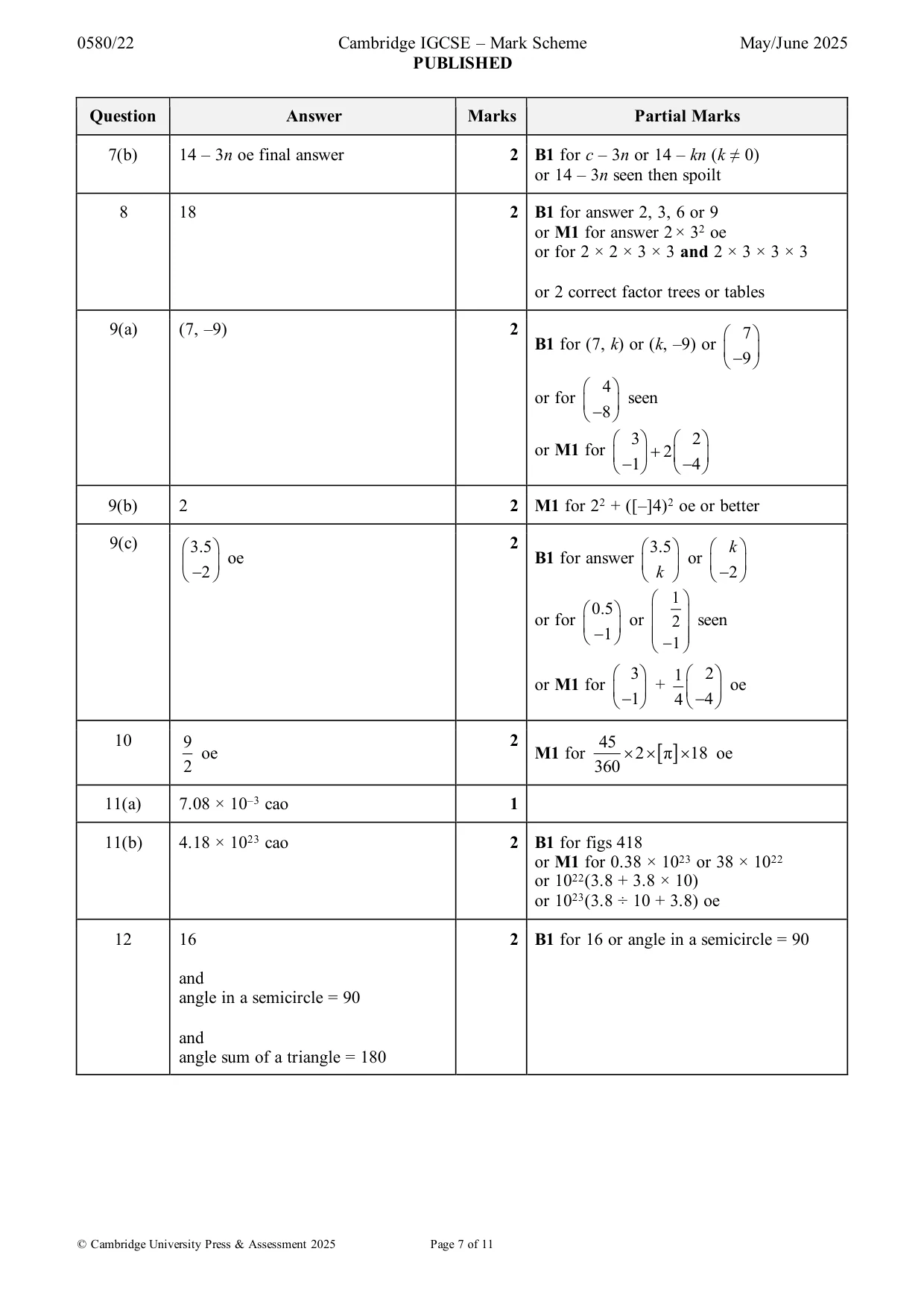
Mark scheme: 8 18 2 B1 for answer 2, 3, 6 or 9 or M1 for answer 2 × 32 oe or for 2 × 2 × 3 × 3 and 2 × 3 × 3 × 3 or 2 correct factor trees or tables
Q9 · A is the point ( 3 , - 1 )
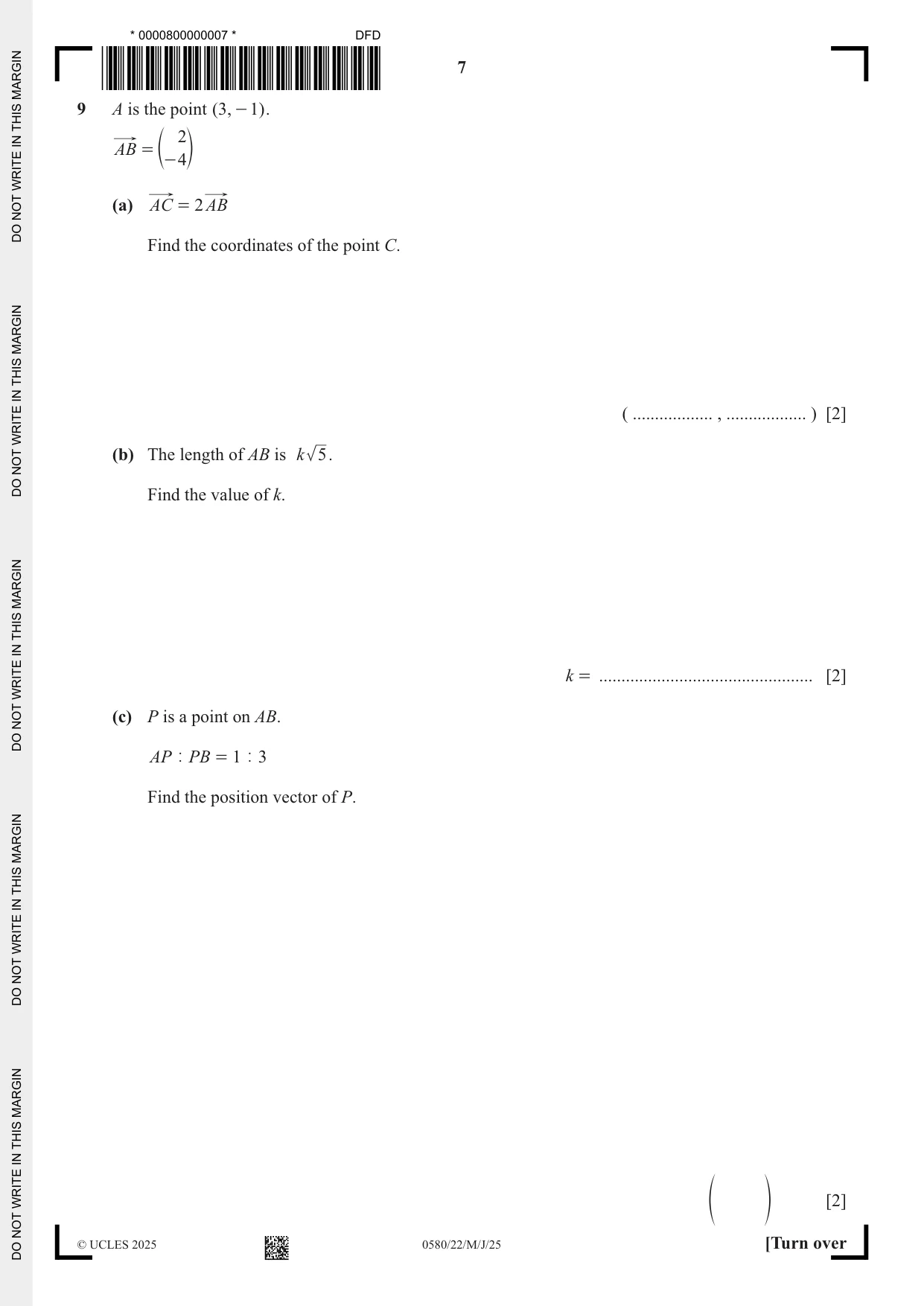
9 A is the point ( 3 , - 1 ) . 2 AB = e o - 4 (a) AC = 2 AB Find the coordinates of the point C. ( .................. , .................. ) [2] (b) The length of AB is k 5. Find the value of k. k = ................................................ [2] (c) P is a point on AB. AP | PB = 1 | 3 Find the position vector of P. f p [2]
Mark scheme: 9(a) (7, –9) 2 7 B1 for (7, k) or (k, –9) or −9 4 or for seen −8 3 2 or M1 for + 2 −1 −4 9(b) 2 2 M1 for 22 + ([–]4)2 oe or better 9(c) 3.5 2 3.5 k oe B1 for answer or −2 k −2 1 0.5 or seen 2 or for −1 1 − 3 1 2 or M1 for + oe −1 4 −4
Q10 · 18 cm NOT TO SCALE 45° O The diagram shows a sector of a circle, centre O
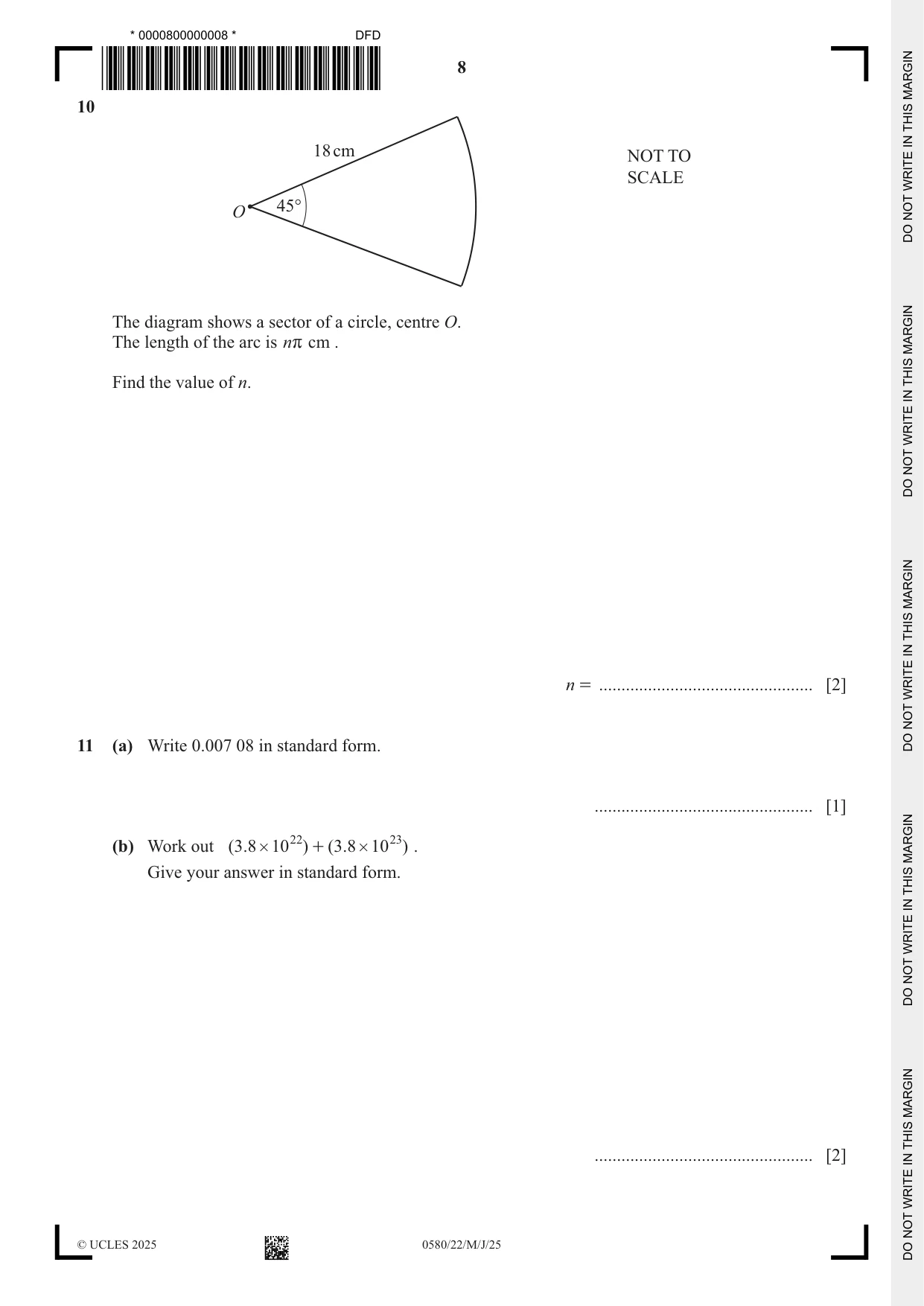
10 18 cm NOT TO SCALE 45° O The diagram shows a sector of a circle, centre O. The length of the arc is nr cm . Find the value of n. n = ................................................ [2]
Mark scheme: 10 9 2 45 oe M1 for 2 π 18 oe 2 360
Q11 · Write 0.007 08 in standard form
11 (a) Write 0.007 08 in standard form. ................................................. [1] (b) Work out ( 3. 8 # 10 22 ) + ( 3. 8 # 10 23 ) . Give your answer in standard form. ................................................. [2]
Mark scheme: 11(a) 7.08 × 10⁻³ cao 1 11(b) 4.18 × 10²³ cao 2 B1 for figs 418 or M1 for 0.38 × 10²³ or 38 × 1022 or 1022(3.8 + 3.8 × 10) or 1023(3.8 ÷ 10 + 3.8) oe
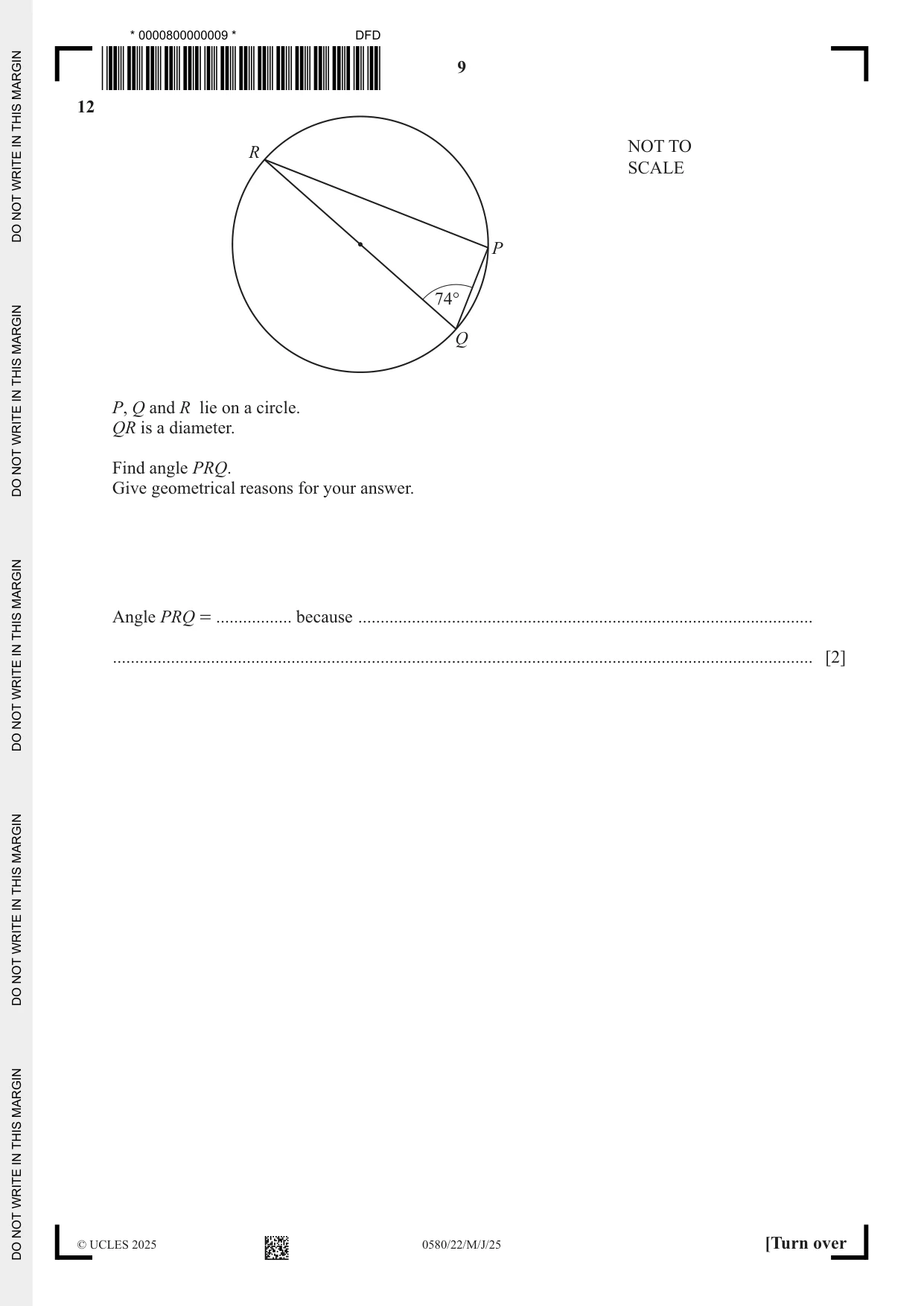
Q12 · NOT TO R SCALE P 74° Q P, Q and R lie on a circle
12 NOT TO R SCALE P 74° Q P, Q and R lie on a circle. QR is a diameter. Find angle PRQ. Give geometrical reasons for your answer. Angle PRQ = ................. because ...................................................................................................... ............................................................................................................................................................. [2]
Mark scheme: 12 16 2 B1 for 16 or angle in a semicircle = 90 and angle in a semicircle = 90 and angle sum of a triangle = 180
Q13 · 100 students solve a puzzle
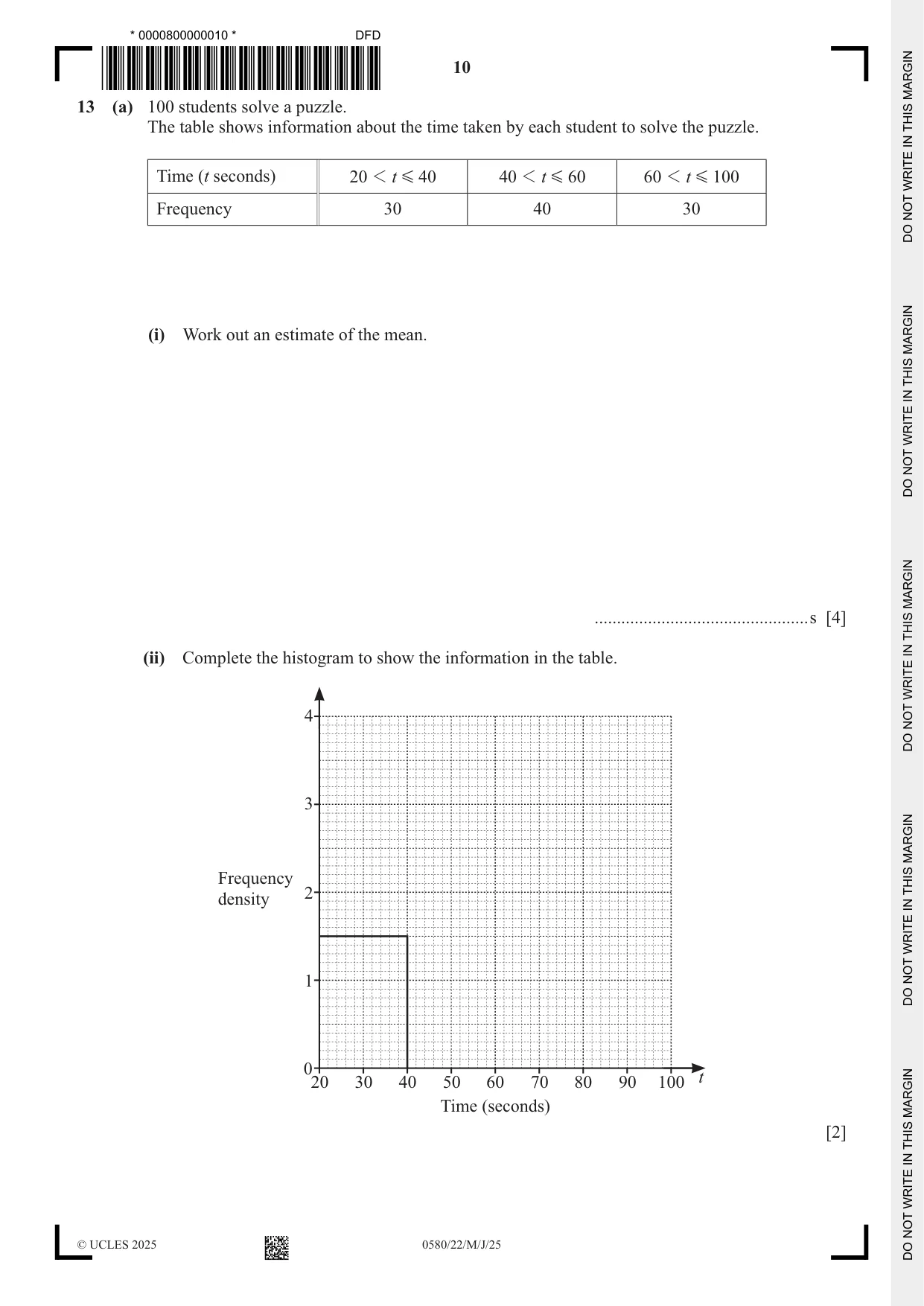
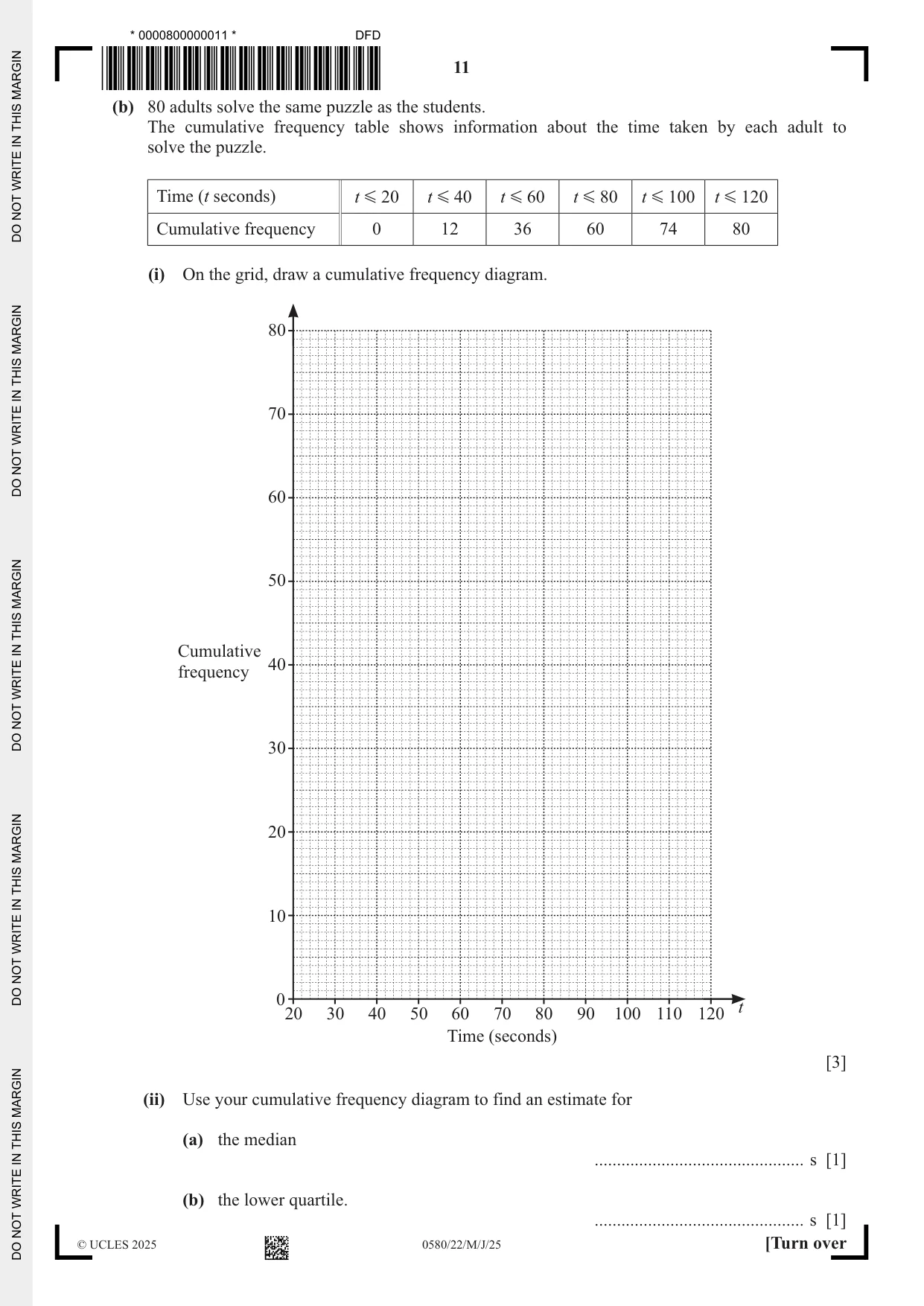
13 (a) 100 students solve a puzzle. The table shows information about the time taken by each student to solve the puzzle. Time (t seconds) 20 1 t G 40 40 1 t G 60 60 1 t G 100 Frequency 30 40 30 (i) Work out an estimate of the mean. ................................................s [4] (ii) Complete the histogram to show the information in the table. 4 3 Frequency 2 density 1 0 t 20 30 40 50 60 70 80 90 100 Time (seconds) [2] (b) 80 adults solve the same puzzle as the students. The cumulative frequency table shows information about the time taken by each adult to solve the puzzle. Time (t seconds) t G 20 t G 40 t G 60 t G 80 t G 100 t G 120 Cumulative frequency 0 12 36 60 74 80 (i) On the grid, draw a cumulative frequency diagram. 80 70 60 50 Cumulative 40 frequency 30 20 10 0 t 20 30 40 50 60 70 80 90 100 110 120 Time (seconds) [3] (ii) Use your cumulative frequency diagram to find an estimate for (a) the median ............................................... s [1] (b) the lower quartile. ............................................... s [1]
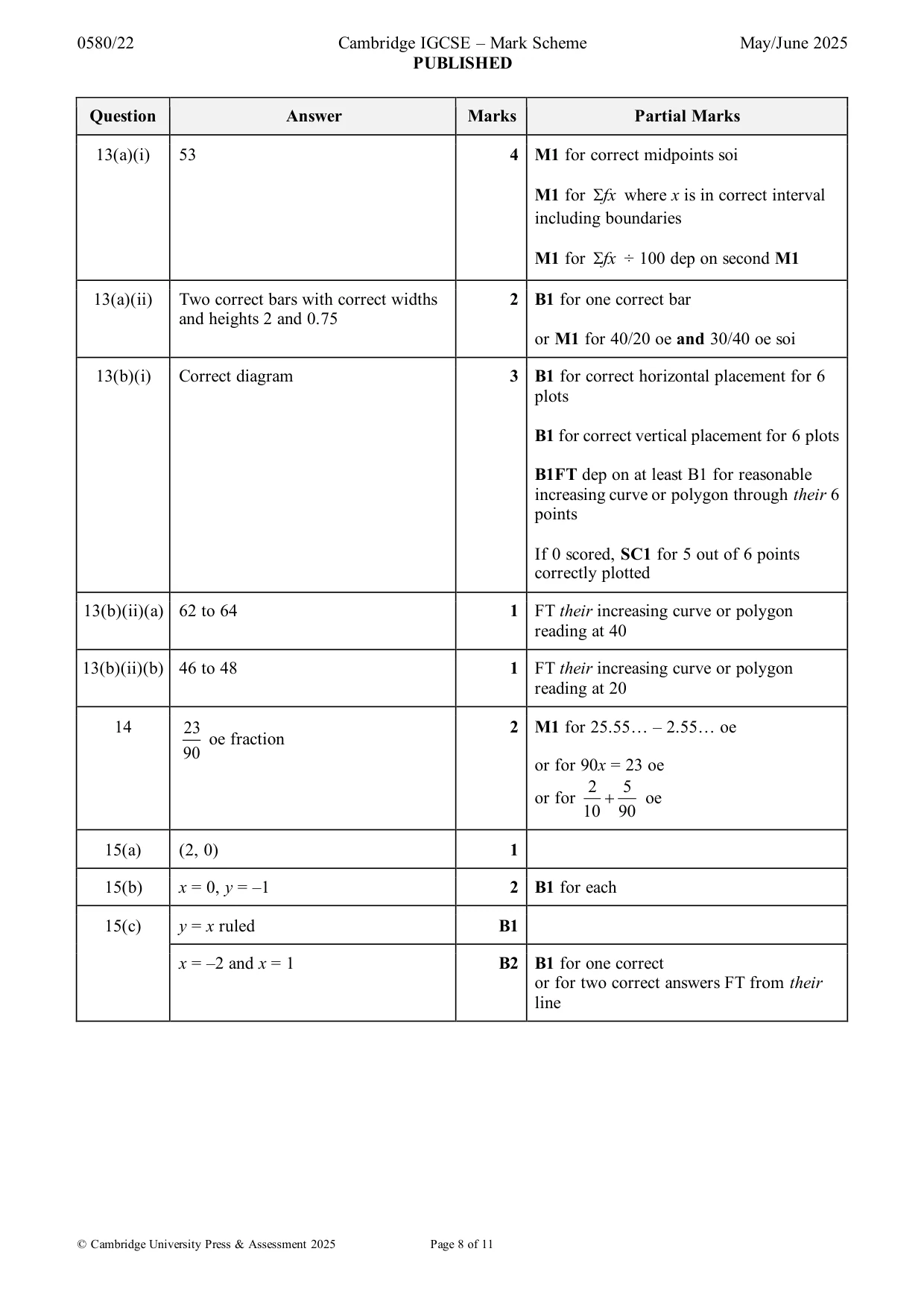
Mark scheme: 13(a)(i) 53 4 M1 for correct midpoints soi M1 for fx where x is in correct interval including boundaries M1 for fx ÷ 100 dep on second M1 13(a)(ii) Two correct bars with correct widths 2 B1 for one correct bar and heights 2 and 0.75 or M1 for 40/20 oe and 30/40 oe soi 13(b)(i) Correct diagram 3 B1 for correct horizontal placement for 6 plots B1 for correct vertical placement for 6 plots B1FT dep on at least B1 for reasonable increasing curve or polygon through their 6 points If 0 scored, SC1 for 5 out of 6 points correctly plotted 13(b)(ii)(a) 62 to 64 1 FT their increasing curve or polygon reading at 40 13(b)(ii)(b) 46 to 48 1 FT their increasing curve or polygon reading at 20
Q14 · Write .025o as a fraction
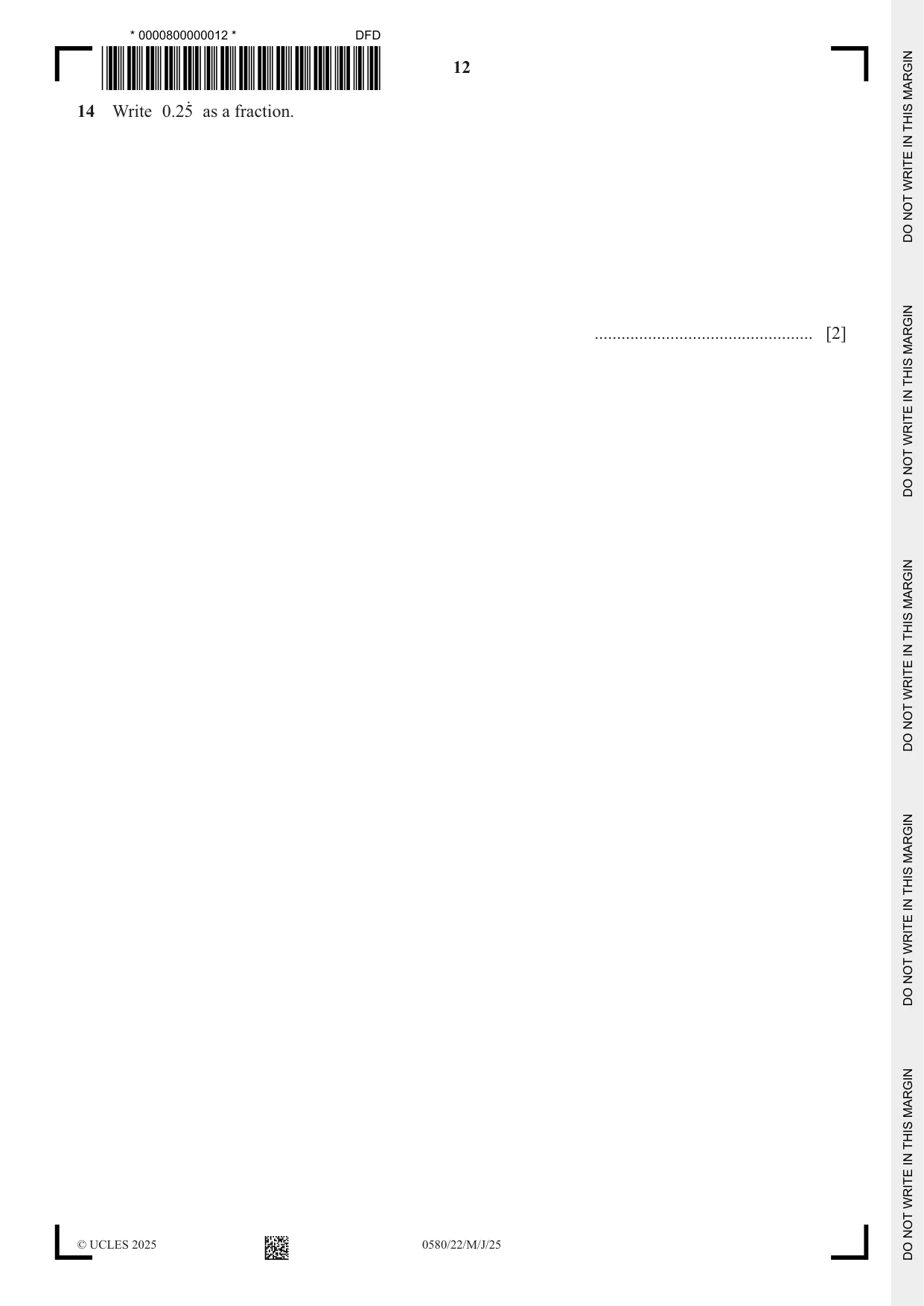
14 Write .025o as a fraction. ................................................. [2]
Mark scheme: 14 23 2 M1 for 25.55… – 2.55… oe oe fraction 90 or for 90x = 23 oe 2 5 or for + oe 10 90
Q15 · Y 5 4 3 2 1 – 8 – 7 – 6 – 5 – 4 – 3 – 2 – 1 0 1 2 3 4 5 6 7 8 x – 1 – 2 – 3 – 4 – 5 2 The…
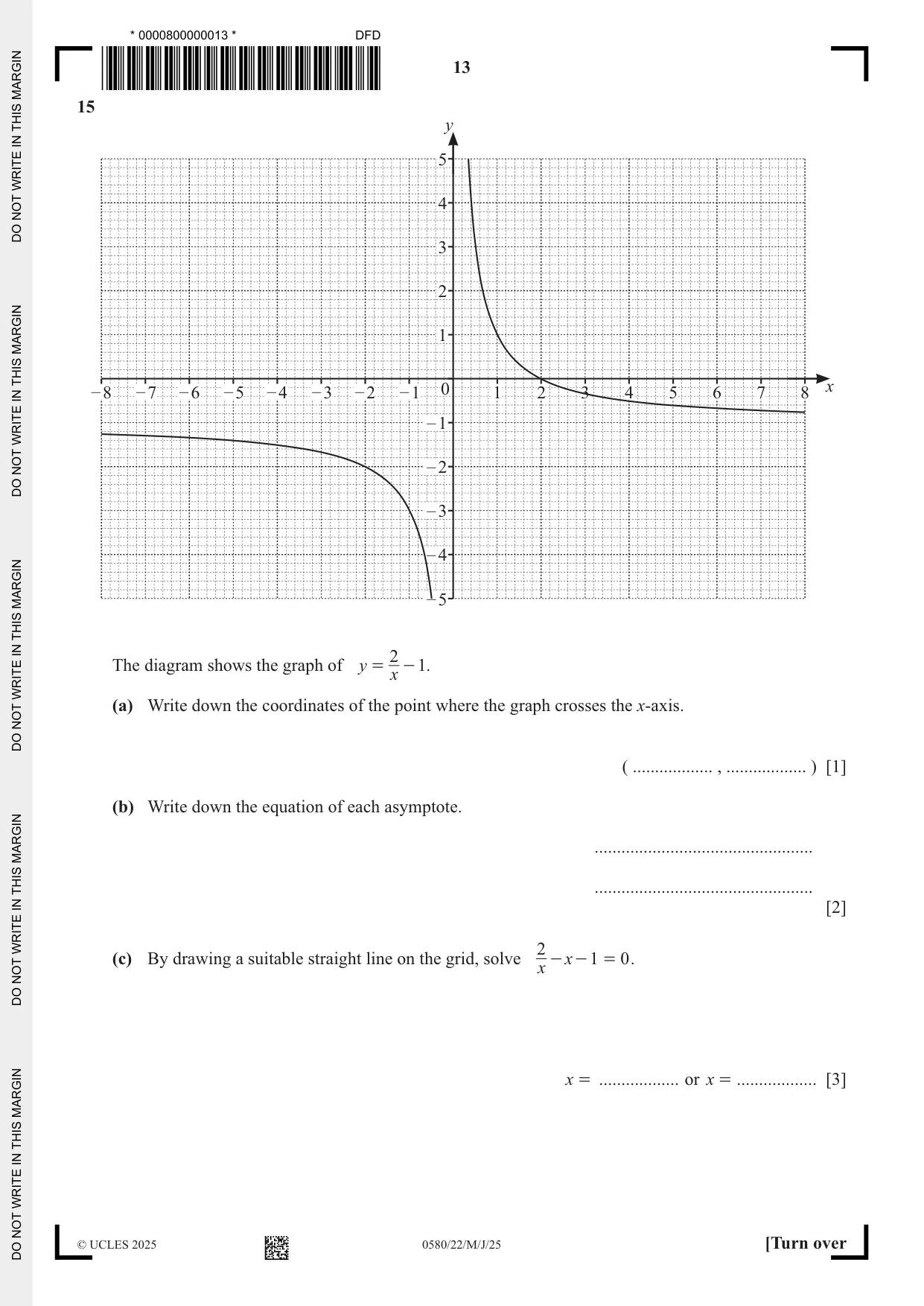
15 y 5 4 3 2 1 – 8 – 7 – 6 – 5 – 4 – 3 – 2 – 1 0 1 2 3 4 5 6 7 8 x – 1 – 2 – 3 – 4 – 5 2 The diagram shows the graph of y = - 1. x (a) Write down the coordinates of the point where the graph crosses the x-axis. ( .................. , .................. ) [1] (b) Write down the equation of each asymptote. ................................................. ................................................. [2] 2 (c) By drawing a suitable straight line on the grid, solve - x - 1 = 0 . x x = .................. or x = .................. [3]
Mark scheme: 15(a) (2, 0) 1 15(b) x = 0, y = –1 2 B1 for each 15(c) y = x ruled B1 x = –2 and x = 1 B2 B1 for one correct or for two correct answers FT from their line
Q16 · NOT TO SCALE 6 cm 5 cm The diagram shows a solid made by joining a hemisphere to a…
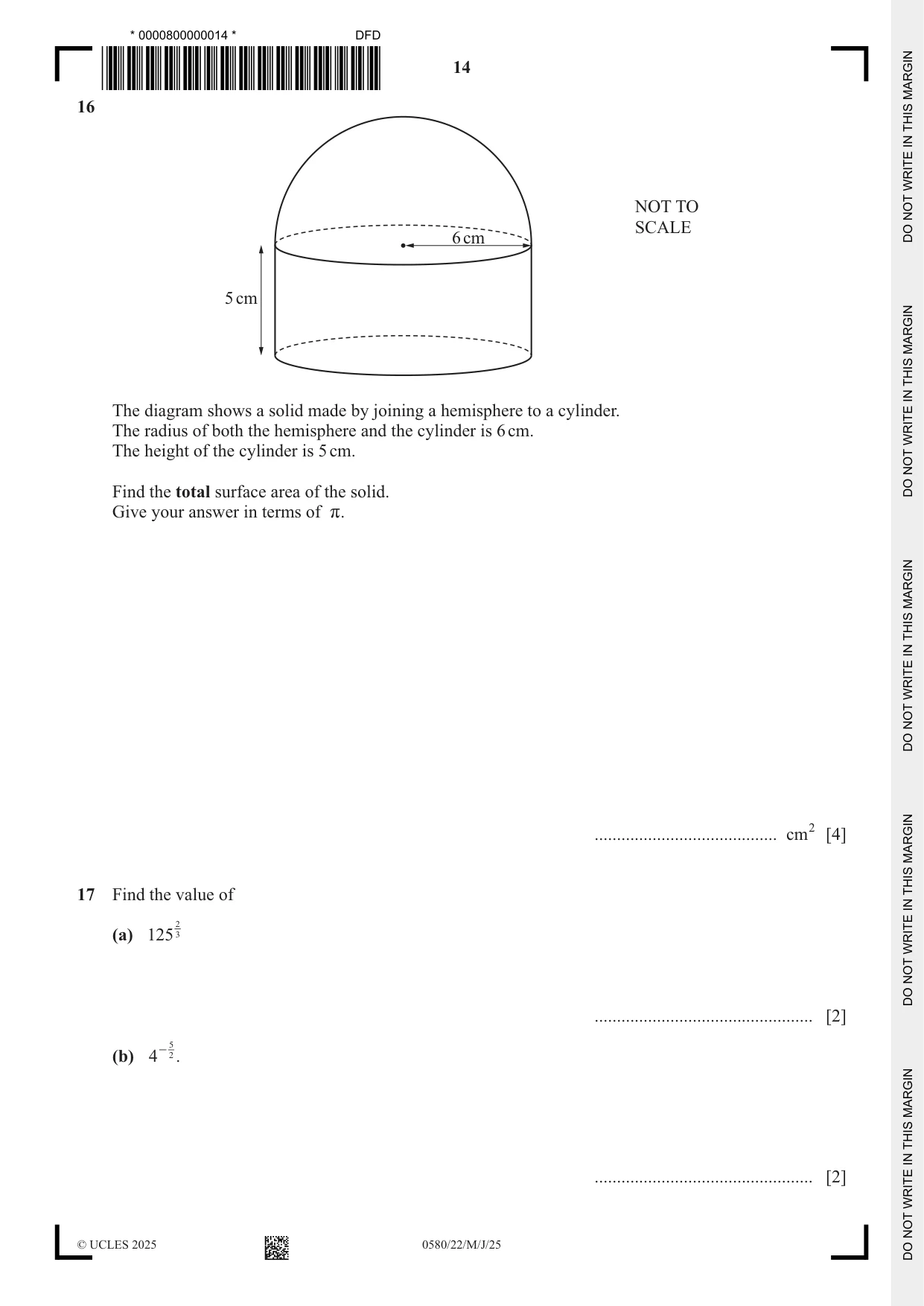
16 NOT TO SCALE 6 cm 5 cm The diagram shows a solid made by joining a hemisphere to a cylinder. The radius of both the hemisphere and the cylinder is 6 cm. The height of the cylinder is 5 cm. Find the total surface area of the solid. Give your answer in terms of r. ......................................... cm2 [4]
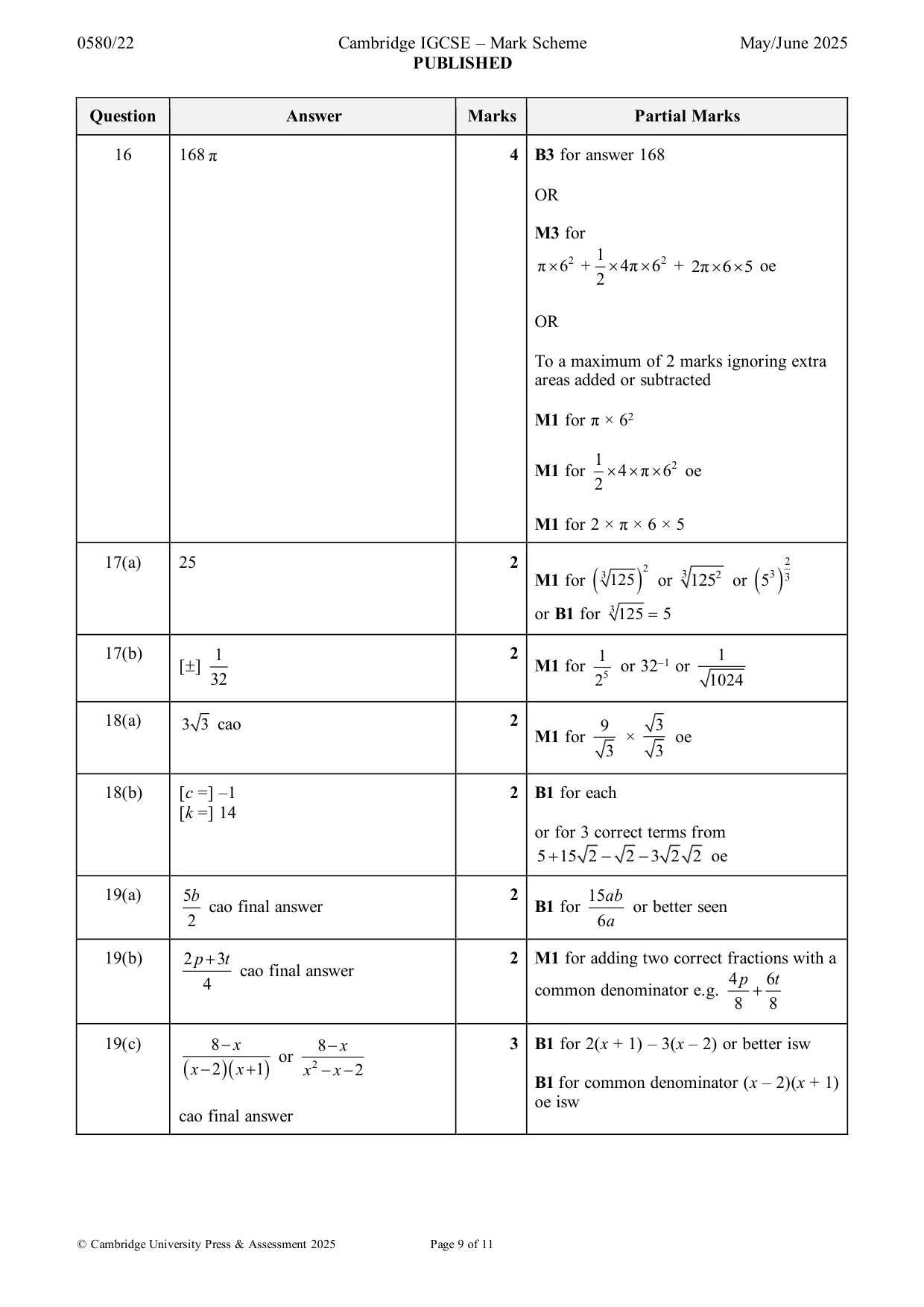
Mark scheme: 16 168 π 4 B3 for answer 168 OR M3 for 2 1 2 π 6 + 4π 6 + 2π 6 5 oe 2 OR To a maximum of 2 marks ignoring extra areas added or subtracted M1 for π × 62 1 2 M1 for 4 π 6 oe 2 M1 for 2 × π × 6 × 5
Q17 · Find the value of 2 (a) 125 3 ................................................
17 Find the value of 2 (a) 125 3 ................................................. [2] - 25 (b) 4 . ................................................. [2]
Mark scheme: 17(a) 25 2 2 2 3 3 125 5 3 M1 for or 3 1252 or ( ) ( ) or B1 for 3 125 = 5 17(b) 1 2 1 1 [] M1 for or 32–1 or 32 2 5 1024
Q18 · 18 (a) 3 Rationalise the denominator
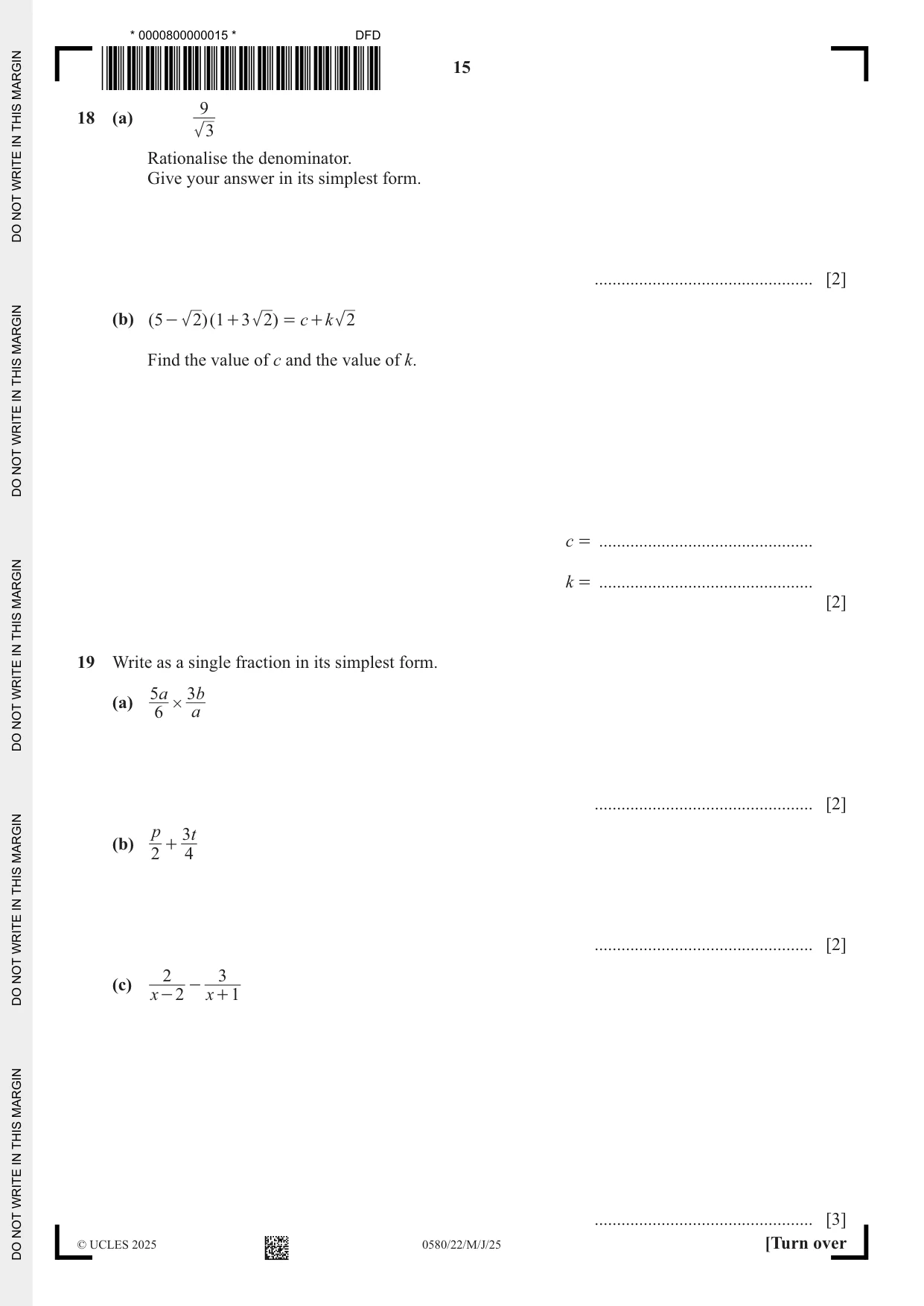
9 18 (a) 3 Rationalise the denominator. Give your answer in its simplest form. ................................................. [2] (b) ( 5 - 2 )( 1 + 3 2 ) = c + k 2 Find the value of c and the value of k. c = ................................................ k = ................................................ [2]
Mark scheme: 18(a) 3 3 cao 2 9 3 M1 for × oe 3 3 18(b) [c =] –1 2 B1 for each [k =] 14 or for 3 correct terms from 5 + 15 2 − 2 − 3 2 2 oe
Q19 · Write as a single fraction in its simplest form
19 Write as a single fraction in its simplest form. 5a 3 b (a) # 6 a ................................................. [2] p 3t (b) + 2 4 ................................................. [2] 2 3 (c) - x - 2 x + 1 ................................................. [3]
Mark scheme: 19(a) 5b 2 15 ab cao final answer B1 for or better seen 2 6 a 19(b) 2 p + 3t 2 M1 for adding two correct fractions with a cao final answer 4 p 6t 4 common denominator e.g. + 8 8 19(c) 8 − x 8 − x 3 B1 for 2(x + 1) – 3(x – 2) or better isw or 2 −−x 2 ( x − 2 )( x + 1) x B1 for common denominator (x – 2)(x + 1) oe isw cao final answer
Q20 · 20 y \ x (a) When x = 9, y = 2
1 20 y \ x (a) When x = 9, y = 2 . Find the value of y when x = 36 . y = .................................................. [3] (b) When x is increased by a factor of 4, the value of y changes by a factor of p. Find the value of p. p = ................................................ [1]
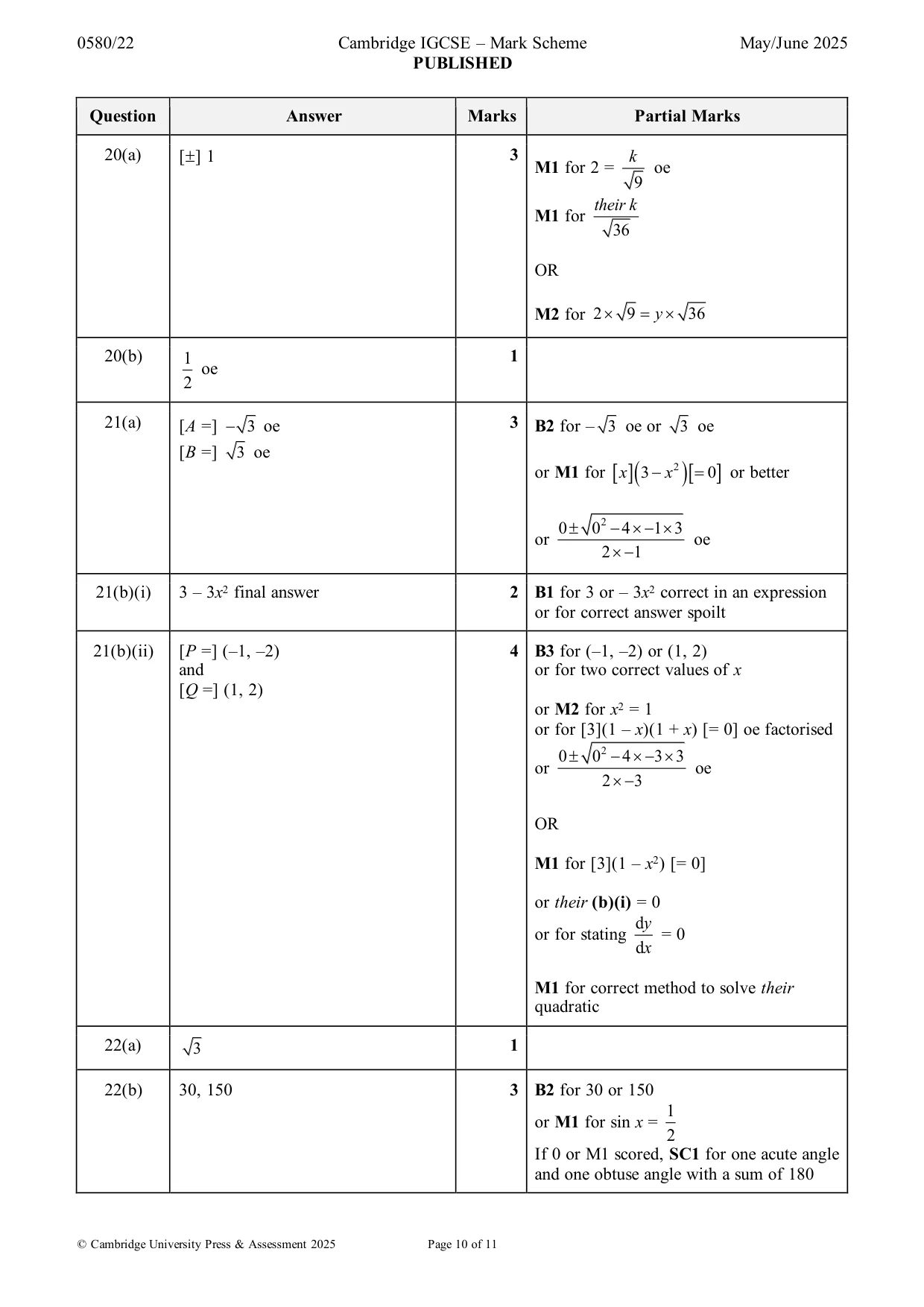
Mark scheme: 20(a) [] 1 3 k M1 for 2 = oe 9 their k M1 for 36 OR M2 for 2 9 = y 36 20(b) 1 1 oe 2
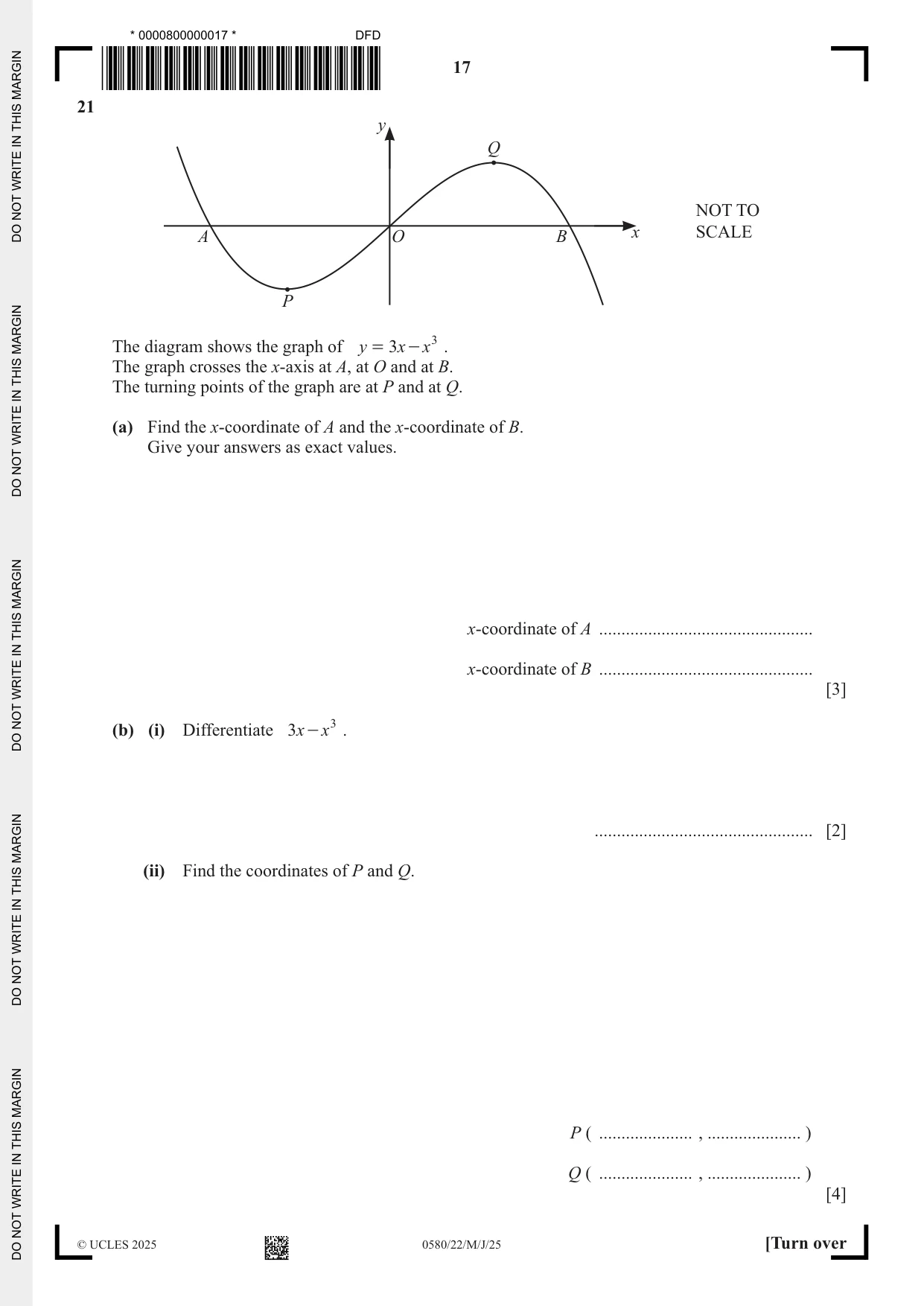
Q21 · Y Q NOT TO A O B x SCALE P The diagram shows the graph of y = 3 x - x 3
21 y Q NOT TO A O B x SCALE P The diagram shows the graph of y = 3 x - x 3 . The graph crosses the x-axis at A, at O and at B. The turning points of the graph are at P and at Q. (a) Find the x-coordinate of A and the x-coordinate of B. Give your answers as exact values. x-coordinate of A ................................................ x-coordinate of B ................................................ [3] (b) (i) Differentiate 3x - x 3 . ................................................. [2] (ii) Find the coordinates of P and Q. P ( ..................... , ..................... ) Q ( ..................... , ..................... ) [4]
Mark scheme: 21(a) [A =] − 3 oe 3 B2 for – 3 oe or 3 oe [B =] 3 oe or M1 for x 3 − x 2 = 0 or better ( ) 0 0 2 −−4 1 3 or oe 2 −1 21(b)(i) 3 – 3x2 final answer 2 B1 for 3 or – 3x2 correct in an expression or for correct answer spoilt 21(b)(ii) [P =] (–1, –2) 4 B3 for (–1, –2) or (1, 2) and or for two correct values of x [Q =] (1, 2) or M2 for x2 = 1 or for [3](1 – x)(1 + x) [= 0] oe factorised 0 0 2 −−4 3 3 or oe 2 − 3 OR M1 for [3](1 – x2) [= 0] or their (b)(i) = 0 d y or for stating = 0 d x M1 for correct method to solve their quadratic
Q22 · Write down the exact value of tan 60°
22 (a) Write down the exact value of tan 60°. ................................................. [1] (b) Solve 2 sinx - 1 = 0 for 0 ° G x G 360° . x = ............... or x = ............... [3]
Mark scheme: 22(a) 3 1 22(b) 30, 150 3 B2 for 30 or 150 1 or M1 for sin x = 2 If 0 or M1 scored, SC1 for one acute angle and one obtuse angle with a sum of 180
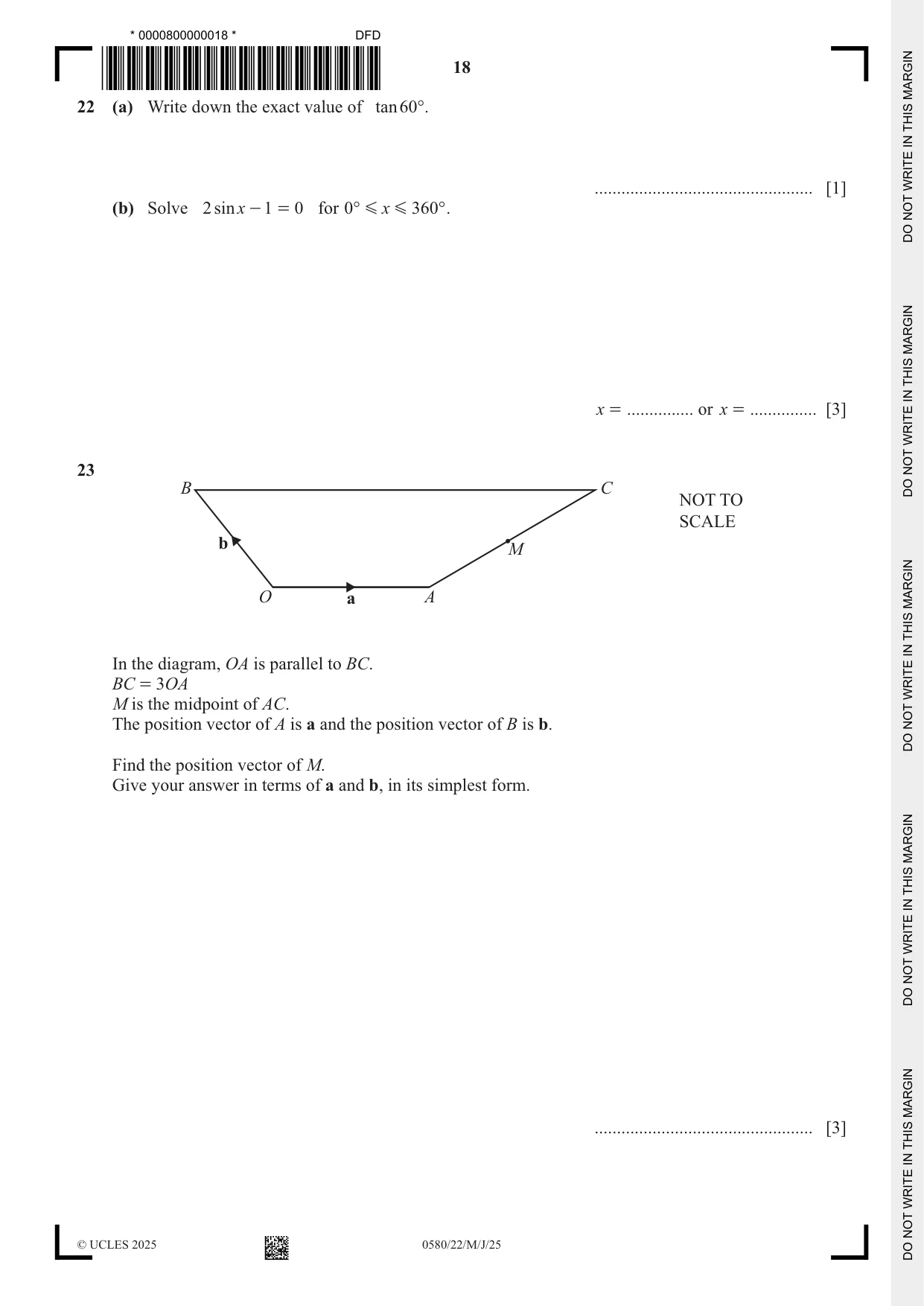
Q23 · B C NOT TO SCALE b M O a A In the diagram, OA is parallel to BC
23 B C NOT TO SCALE b M O a A In the diagram, OA is parallel to BC. BC = 3OA M is the midpoint of AC. The position vector of A is a and the position vector of B is b. Find the position vector of M. Give your answer in terms of a and b, in its simplest form. ................................................. [3]
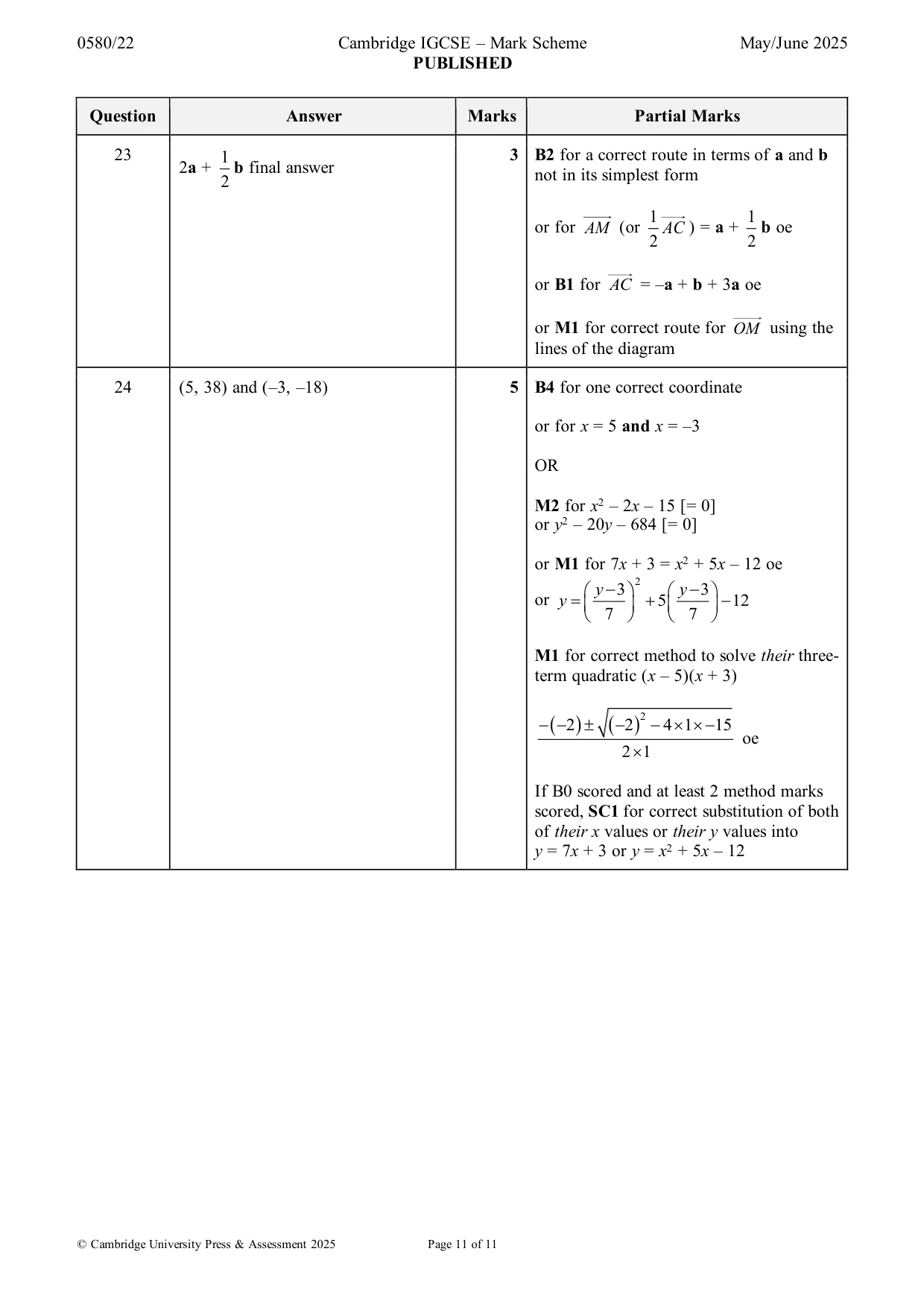
Mark scheme: 23 1 3 B2 for a correct route in terms of a and b 2a + b final answer not in its simplest form 2 1 1 or for AM (or AC ) = a + b oe 2 2 or B1 for AC = –a + b + 3a oe or M1 for correct route for OM using the lines of the diagram
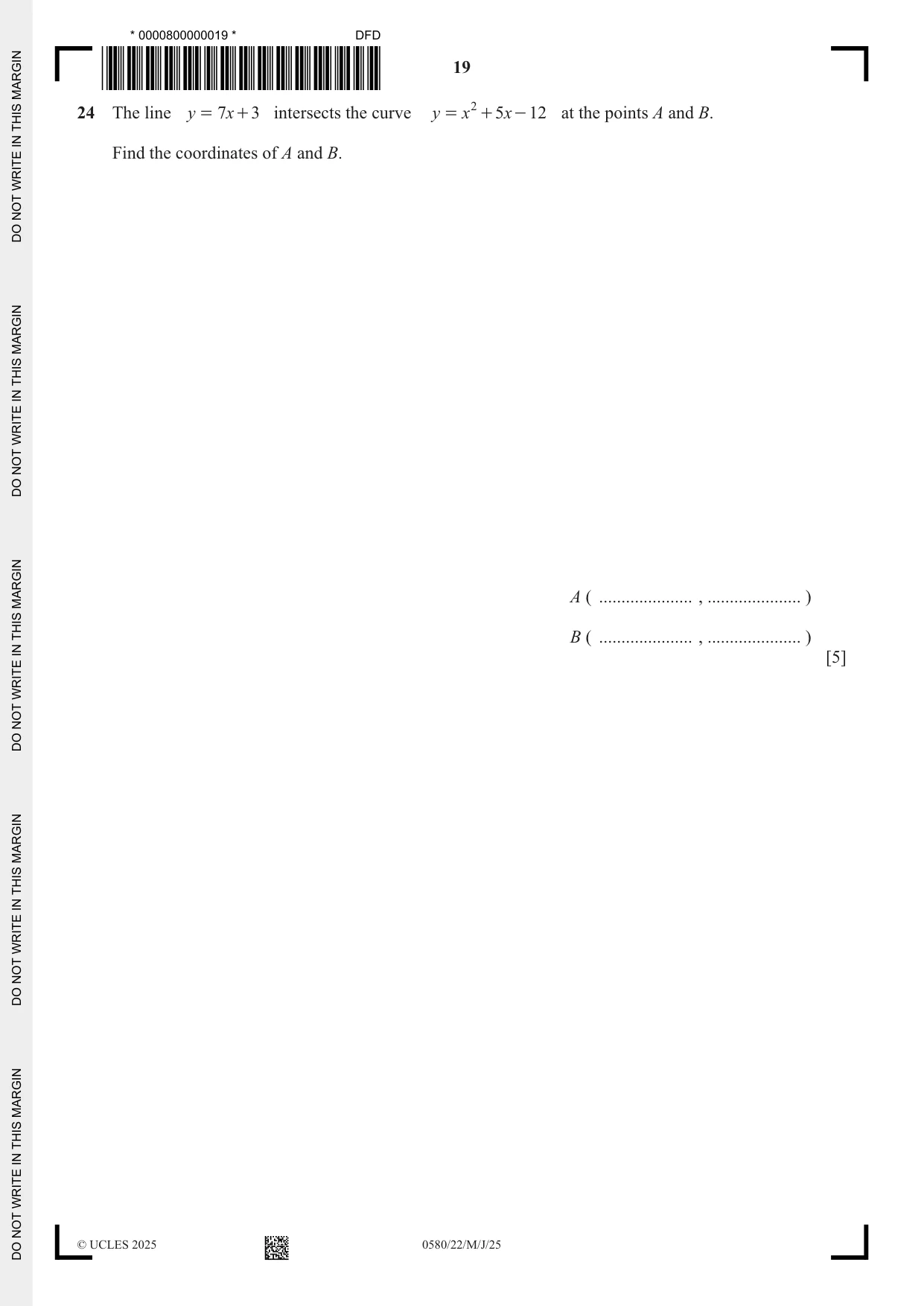
Q24 · The line y = 7x + 3 intersects the curve y = x 2 + 5x - 12 at the points A and B
24 The line y = 7x + 3 intersects the curve y = x 2 + 5x - 12 at the points A and B. Find the coordinates of A and B. A ( ..................... , ..................... ) B ( ..................... , ..................... ) [5]
Mark scheme: 24 (5, 38) and (–3, –18) 5 B4 for one correct coordinate or for x = 5 and x = –3 OR M2 for x2 – 2x – 15 [= 0] or y2 – 20y – 684 [= 0] or M1 for 7x + 3 = x2 + 5x – 12 oe y − 3 2 y − 3 or y = + 5 − 12 7 7 M1 for correct method to solve their three- term quadratic (x – 5)(x + 3) −−( 2 ) ( −2 ) 2 −−4 1 15 oe 2 1 If B0 scored and at least 2 method marks scored, SC1 for correct substitution of both of their x values or their y values into y = 7x + 3 or y = x2 + 5x – 12
What was in this paper
The subtopics covered by these 23 questions, and how many questions each got. Open one in a new tab to see every Cambridge question on it.
2Algebraic fractions1Angles1Circle theorems I1Circles, arcs and sectors1Compound shapes and parts of shapes1Differentiation1Fractions, decimals and percentages1Graphs of functions1Indices II1Powers and roots1Powers and roots1Relative and expected frequencies1Scale drawings1Sequences1Standard form1Statistical charts and diagrams1Symmetry1Trigonometric functions1Types of number1Vector geometry1Vectors in two dimensions1What you needed in this session
Cambridge’s own grade thresholds for 2025 May/June, Paper 2 · Variant 2. A higher threshold means an easier paper — the bar moves with how the cohort did.