Cambridge IGCSE Mathematics 0580 — 2024 May/June Paper 2 · Variant 3
0580/23/M/J/24 · 26 questions · 70 marks · ≈79 min
The question paper and its mark scheme, free to read here and free to download. This is Cambridge’s own paper, exactly as it was sat.
Question paper12 pages
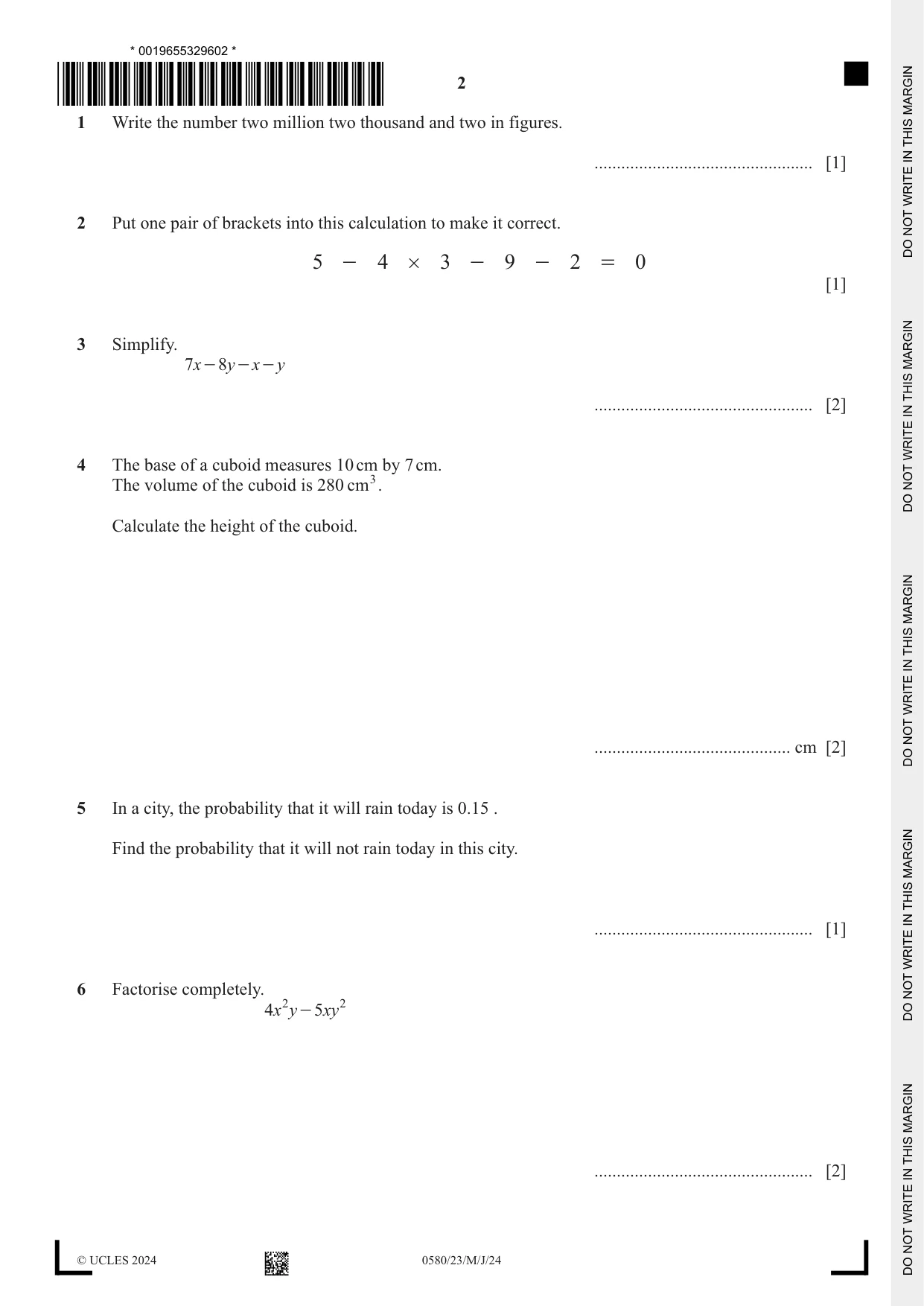
Mark scheme6 pages
Answers below. Sit the paper first if you are practising.
Questions as text
Q1 · Write the number two million two thousand and two in figures
1 Write the number two million two thousand and two in figures. ................................................. [1]
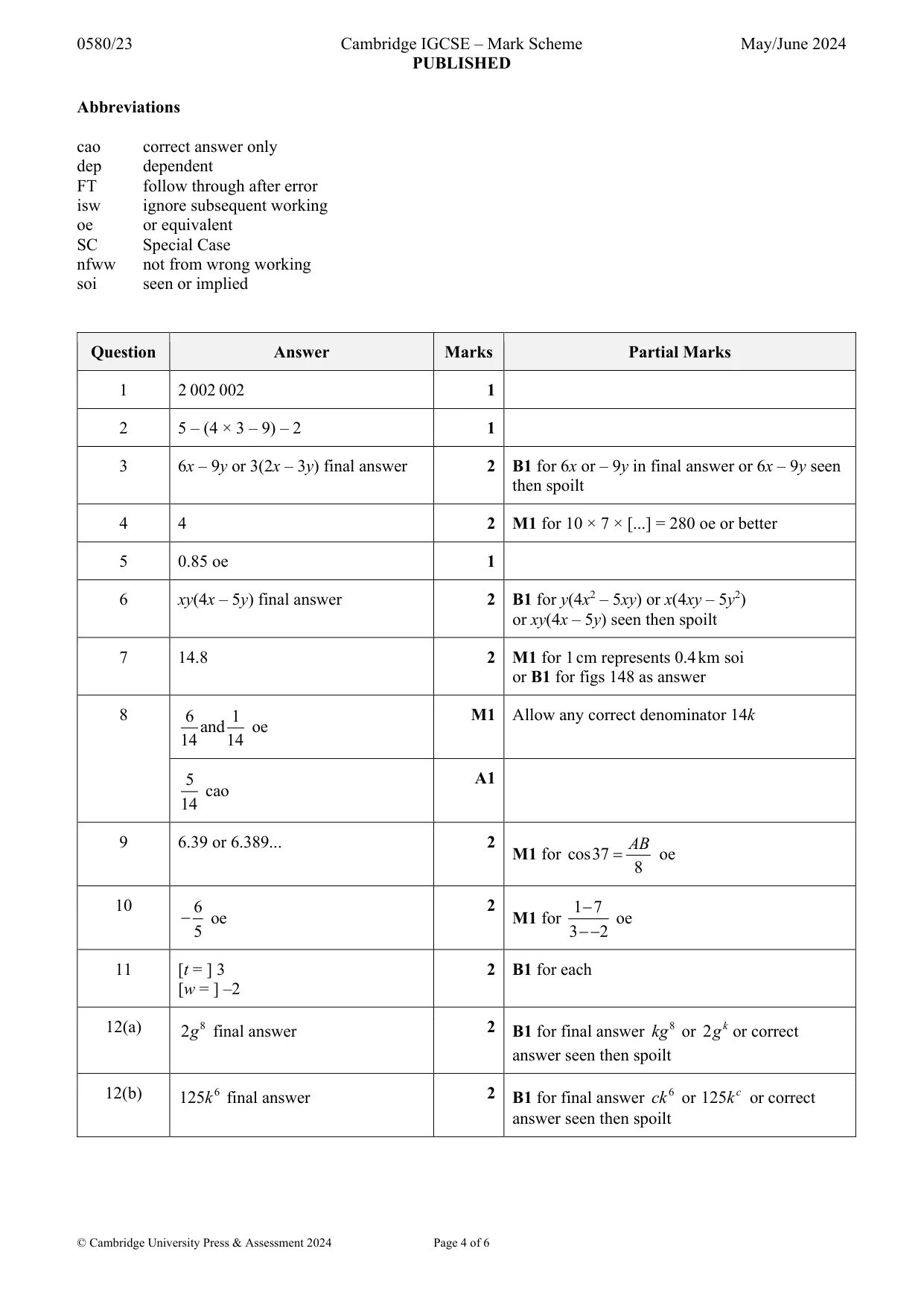
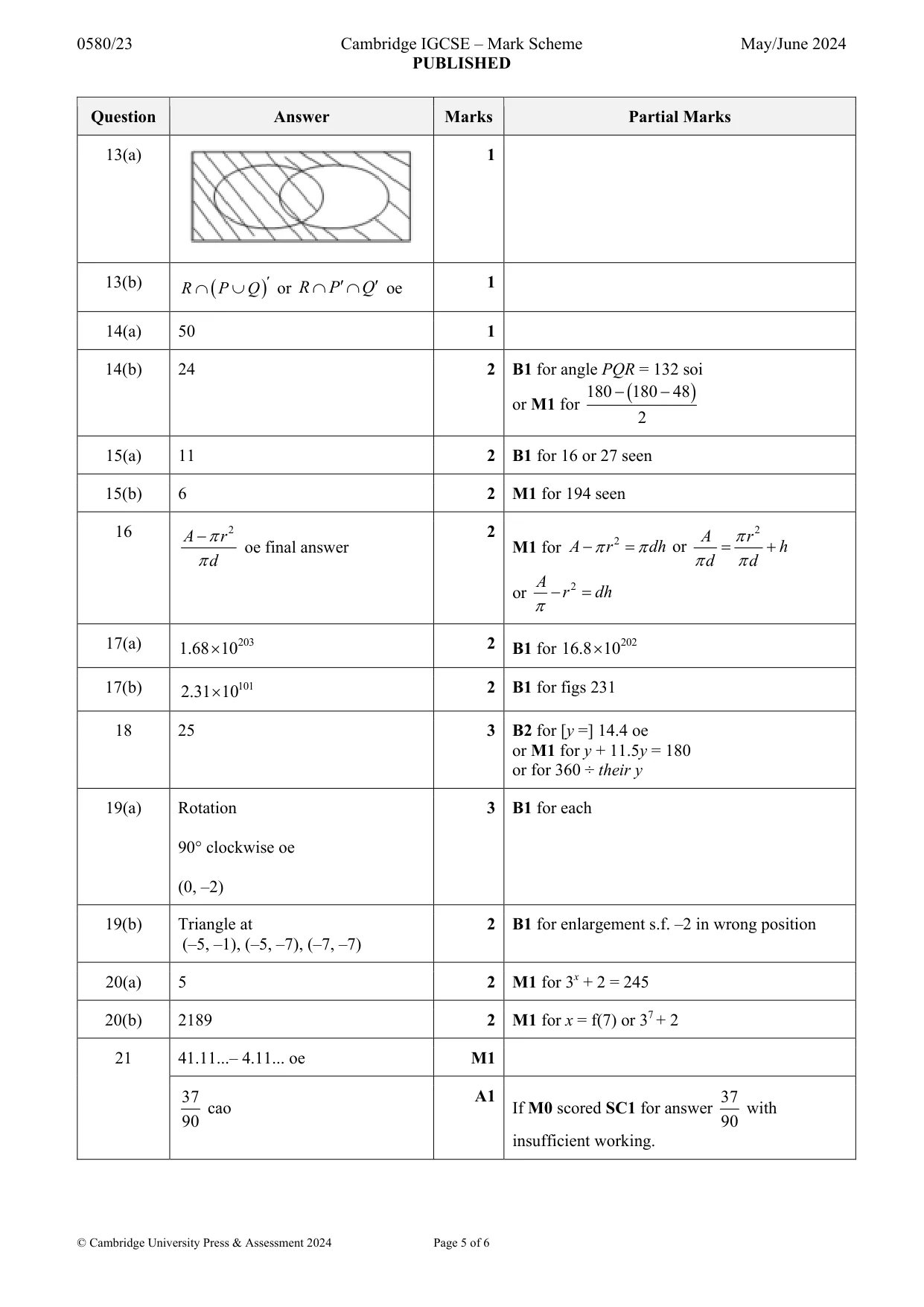
Mark scheme: Question Answer Marks Partial Marks 1 2 002 002 1
Q2 · Put one pair of brackets into this calculation to make it correct
2 Put one pair of brackets into this calculation to make it correct. 5 - 4 # 3 - 9 - 2 = 0 [1]
Mark scheme: 2 5 – (4 × 3 – 9) – 2 1
Question 3
3 Simplify. 7x - 8y - x - y ................................................. [2]
Mark scheme: 3 6x – 9y or 3(2x – 3y) final answer 2 B1 for 6x or – 9y in final answer or 6x – 9y seen then spoilt
Q4 · The base of a cuboid measures 10 cm by 7 cm
4 The base of a cuboid measures 10 cm by 7 cm. The volume of the cuboid is 280 cm3. Calculate the height of the cuboid. ............................................ cm [2]
Mark scheme: 4 4 2 M1 for 10 × 7 × [...] = 280 oe or better
Q5 · In a city, the probability that it will rain today is 0.15
5 In a city, the probability that it will rain today is 0.15 . Find the probability that it will not rain today in this city. ................................................. [1]
Mark scheme: 5 0.85 oe 1
Question 6
6 Factorise completely. 4x 2 y - 5xy 2 ................................................. [2]
Mark scheme: 6 xy(4x – 5y) final answer 2 B1 for y(4x2 – 5xy) or x(4xy – 5y2) or xy(4x – 5y) seen then spoilt
Q7 · The scale of a map is 1 : 40 000
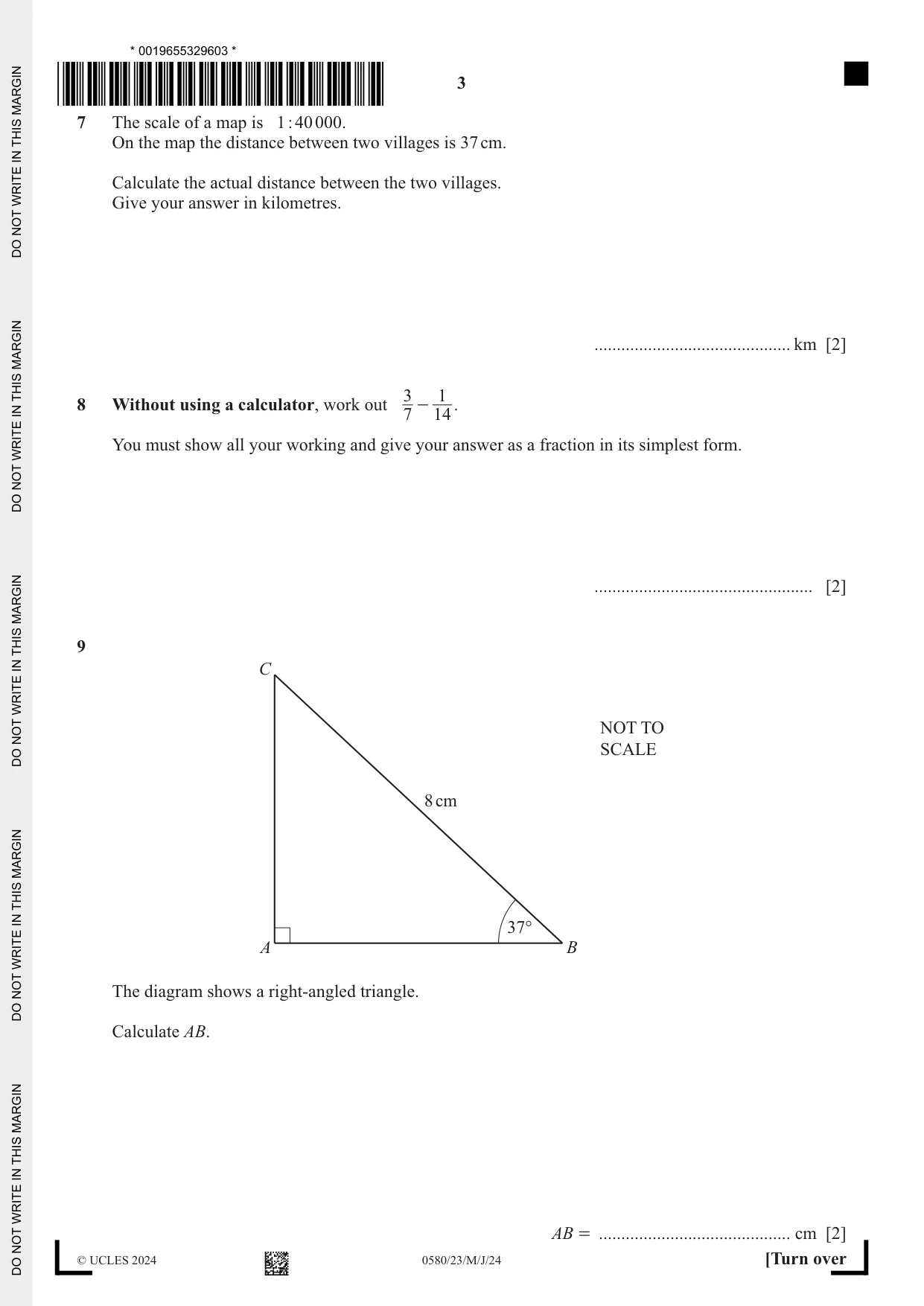
7 The scale of a map is 1 : 40 000. On the map the distance between two villages is 37 cm. Calculate the actual distance between the two villages. Give your answer in kilometres. ............................................ km [2]
Mark scheme: 7 14.8 2 M1 for 1 cm represents 0.4 km soi or B1 for figs 148 as answer
Q8 · 1 8 Without using a calculator, work out -
3 1 8 Without using a calculator, work out - . 7 14 You must show all your working and give your answer as a fraction in its simplest form. ................................................. [2]
Mark scheme: 8 6 1 M1 Allow any correct denominator 14k and oe 14 14 5 A1 cao 14
Q9 · C NOT TO SCALE 8 cm 37° A B The diagram shows a right-angled triangle
9 C NOT TO SCALE 8 cm 37° A B The diagram shows a right-angled triangle. Calculate AB. AB = ........................................... cm [2]
Mark scheme: 9 6.39 or 6.389... 2 M1 for cos37 AB oe 8
Q10 · Find the gradient of the line joining the points ( - 2 , 7) and (3, 1)
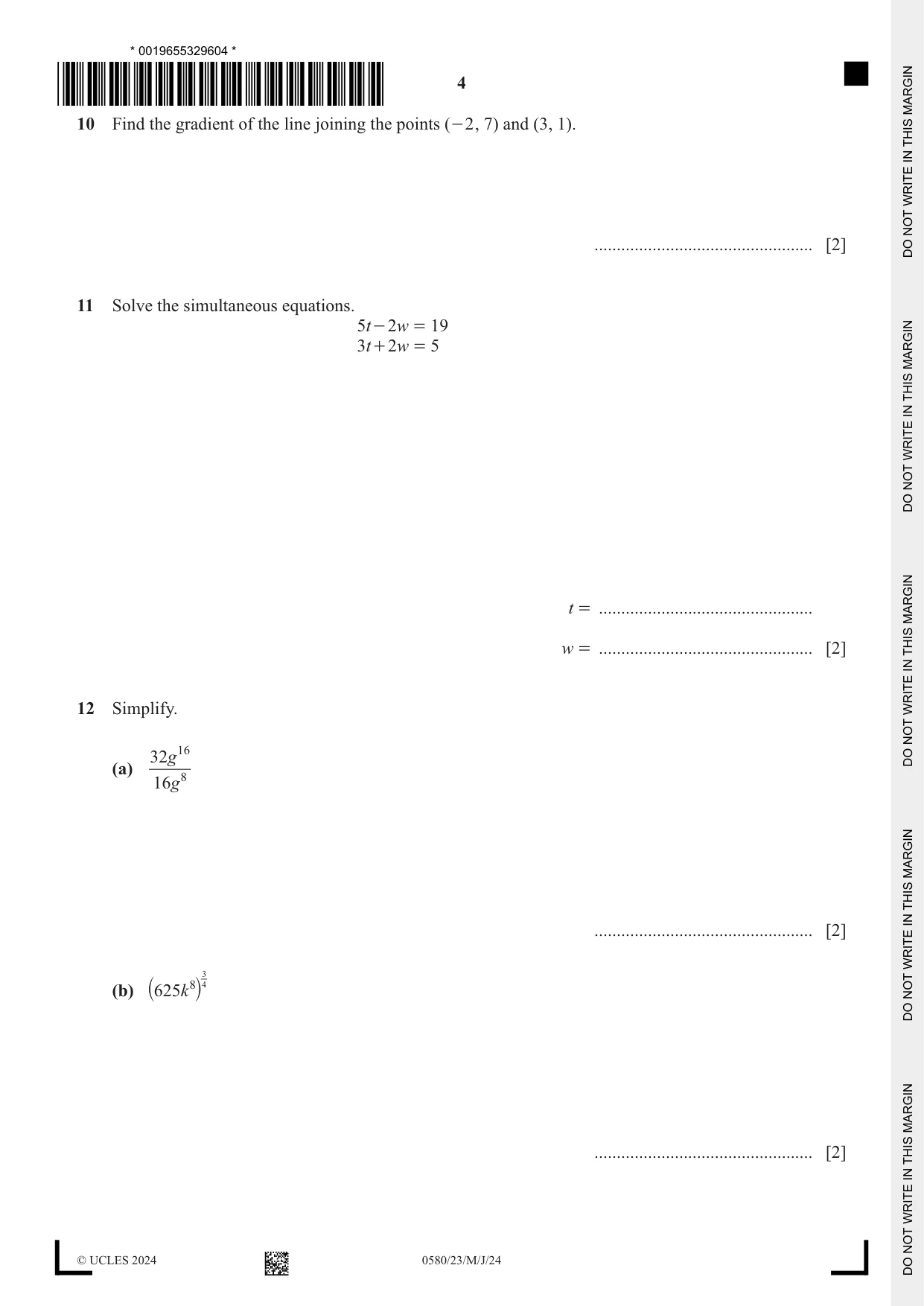
10 Find the gradient of the line joining the points ( - 2 , 7) and (3, 1). ................................................. [2]
Mark scheme: 10 6 2 1 7 oe M1 for oe 5 3 2
Q11 · Solve the simultaneous equations
11 Solve the simultaneous equations. 5t - 2w = 19 3t + 2w = 5 t = ................................................ w = ................................................ [2]
Mark scheme: 11 [t = ] 3 2 B1 for each [w = ] –2
Question 12
12 Simplify. 32g 16 (a) 16g 8 ................................................. [2] 3 (b) `625k 8j4 ................................................. [2]
Mark scheme: 12(a) 2g 8 final answer 2 B1 for final answer kg 8 or 2 g k or correct answer seen then spoilt 12(b) 125k 6 final answer 2 B1 for final answer ck 6 or 125k c or correct answer seen then spoilt
Q13 · A B Shade the region A , B l
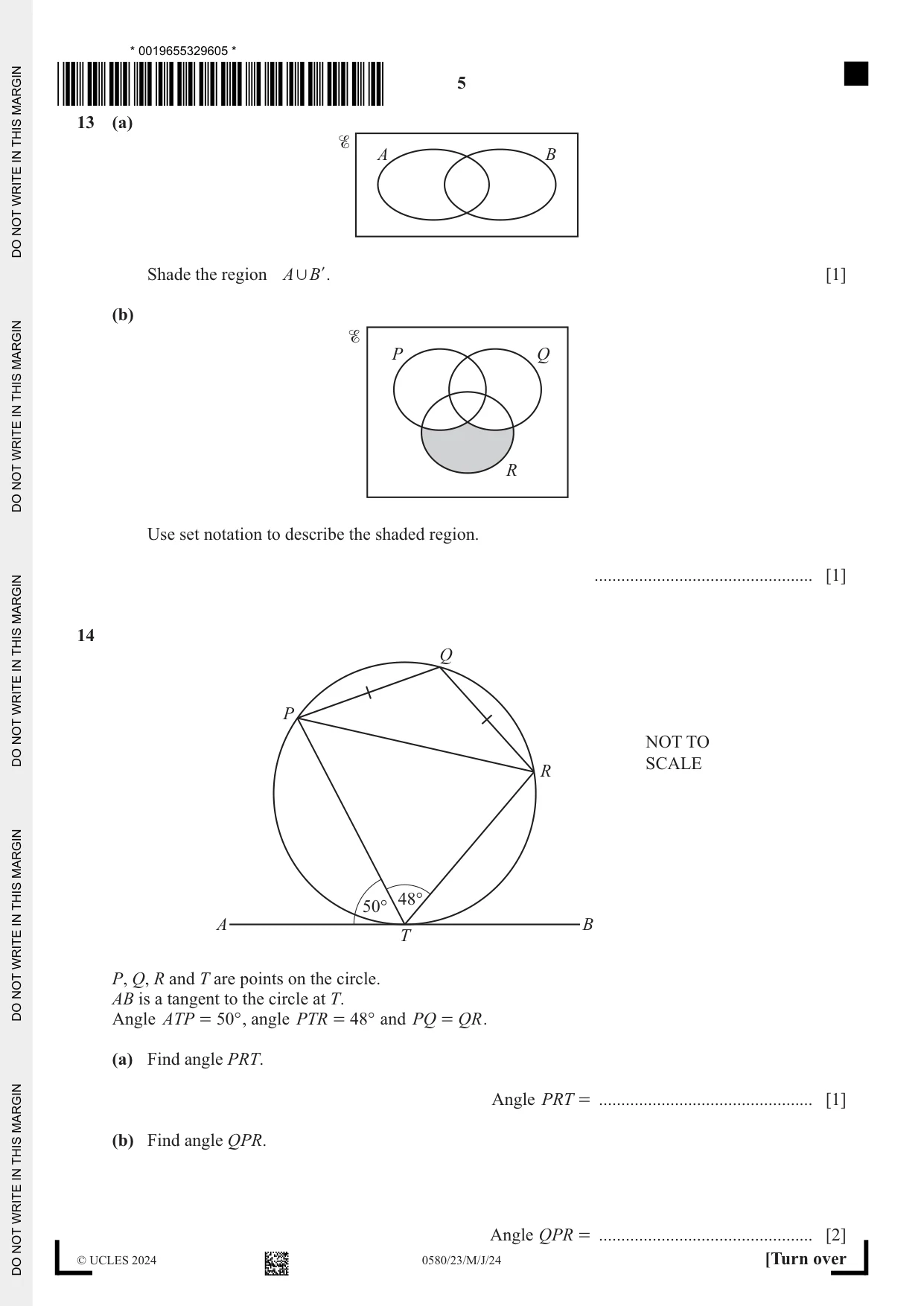
13 (a) A B Shade the region A , B l. [1] (b) P Q R Use set notation to describe the shaded region. ................................................. [1]
Mark scheme: 13(a) 1 13(b) R P Q ' or R P Q oe 1
Q14 · Q P NOT TO SCALE R 48° 50° A B T P, Q, R and T are points on the circle
14 Q P NOT TO SCALE R 48° 50° A B T P, Q, R and T are points on the circle. AB is a tangent to the circle at T. Angle ATP = 50° , angle PTR = 48° and PQ = QR . (a) Find angle PRT. Angle PRT = ................................................ [1] (b) Find angle QPR. Angle QPR = ................................................ [2]
Mark scheme: 14(a) 50 1 14(b) 24 2 B1 for angle PQR = 132 soi 180 180 48 or M1 for 2
Q15 · 200 180 160 140 120 Cumulative 100 frequency 80 60 40 20 0 0 10 20 30 40 50 Time…
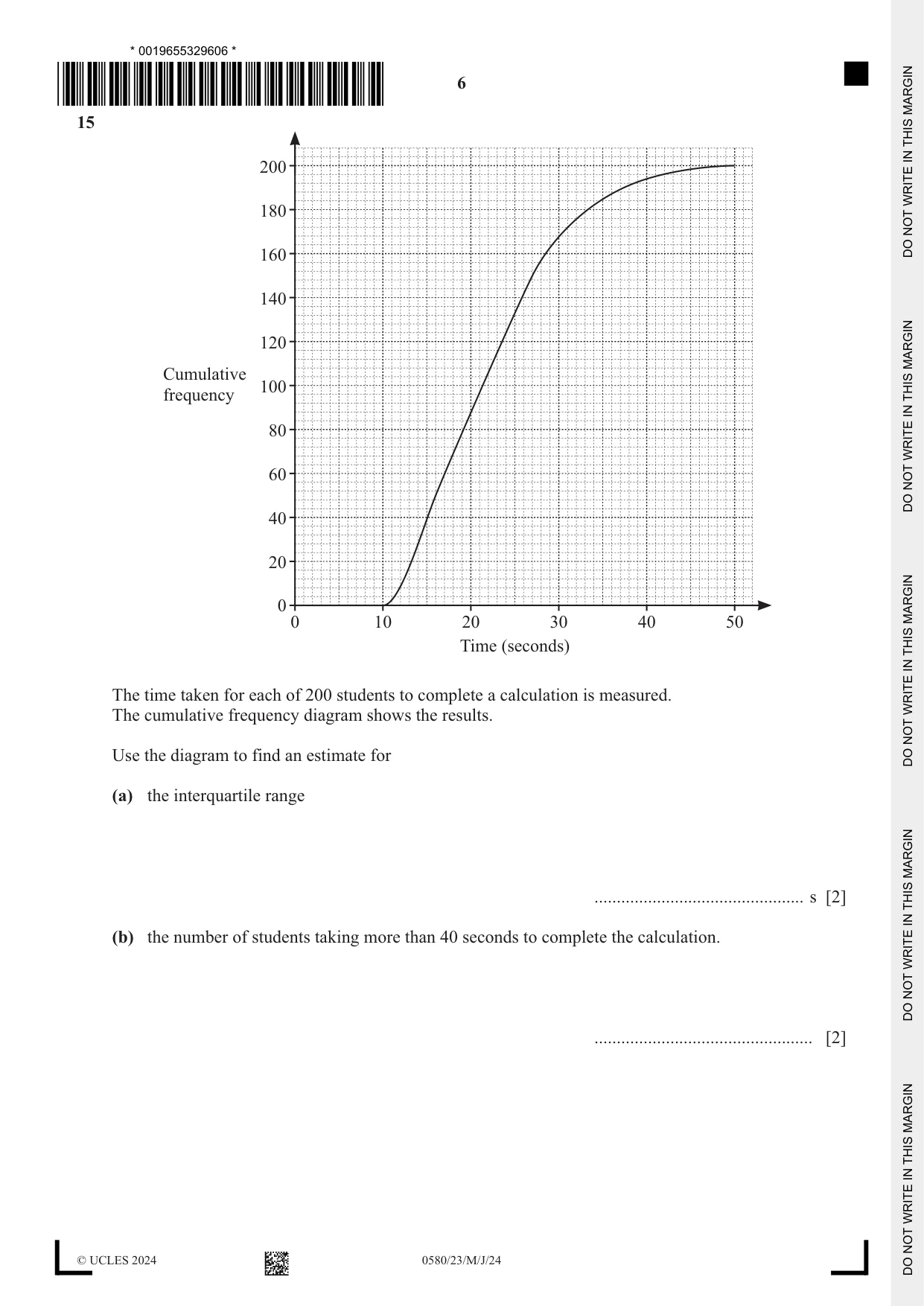
15 200 180 160 140 120 Cumulative 100 frequency 80 60 40 20 0 0 10 20 30 40 50 Time (seconds) The time taken for each of 200 students to complete a calculation is measured. The cumulative frequency diagram shows the results. Use the diagram to find an estimate for (a) the interquartile range ............................................... s [2] (b) the number of students taking more than 40 seconds to complete the calculation. ................................................. [2]
Mark scheme: 15(a) 11 2 B1 for 16 or 27 seen 15(b) 6 2 M1 for 194 seen
Q16 · A = rr 2 + rdh Rearrange the formula to make h the subject
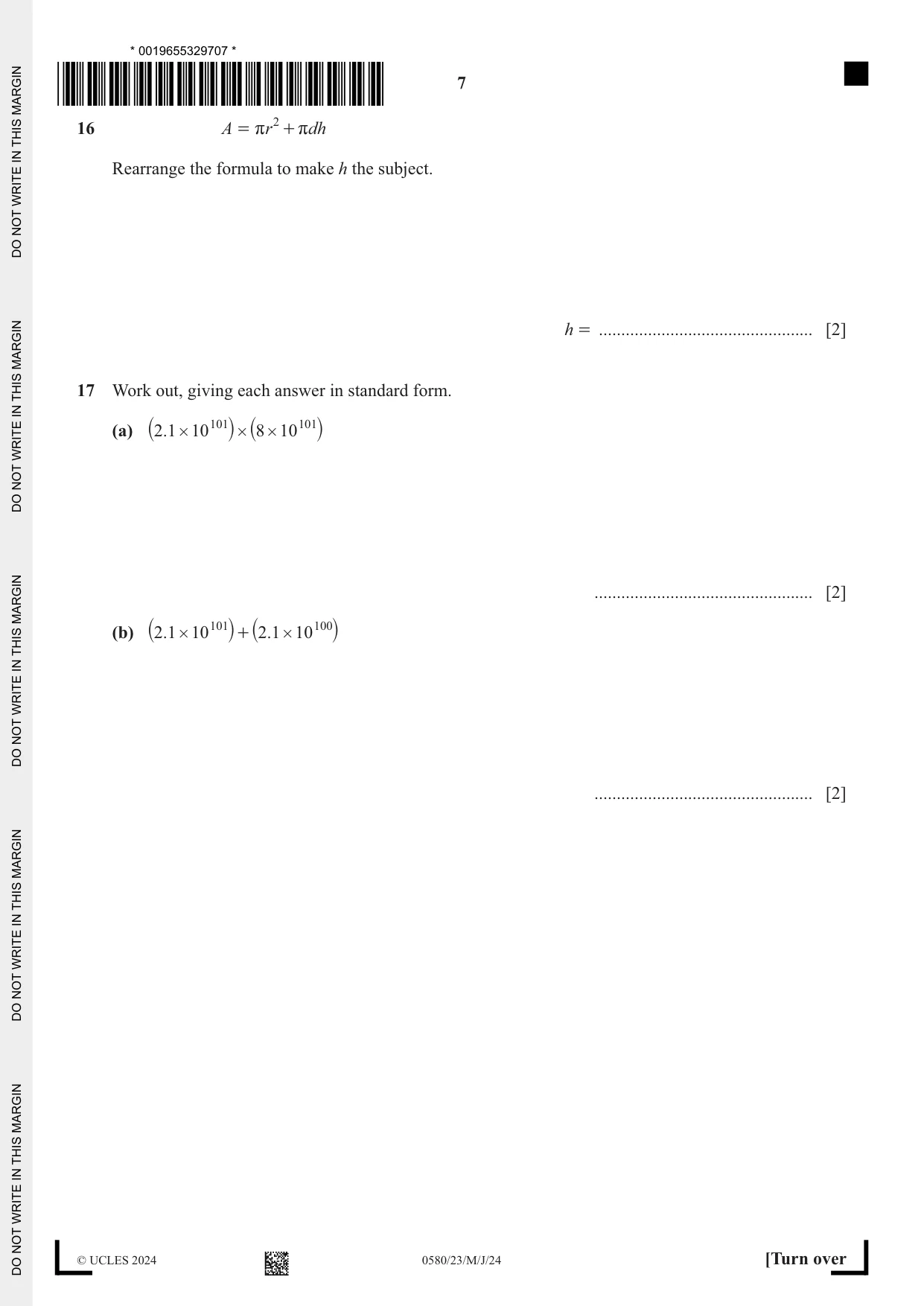
16 A = rr 2 + rdh Rearrange the formula to make h the subject. h = ................................................ [2]
Mark scheme: 16 A r 2 2 2 A r 2 oe final answer M1 for A r dh or h d d d A 2 or r dh
Q17 · Work out, giving each answer in standard form
17 Work out, giving each answer in standard form. (a) `.21 # 10 101j # `8 # 10 101j ................................................. [2] (b) `2.1 # 10 101j + `2.1 # 10 100j ................................................. [2]
Mark scheme: 17(a) 1.68 10 203 2 B1 for 16.8 10 202 17(b) 2.31 10101 2 B1 for figs 231
Q18 · B NOT TO SCALE A X V The diagram shows two sides, VA and VB, of a regular polygon
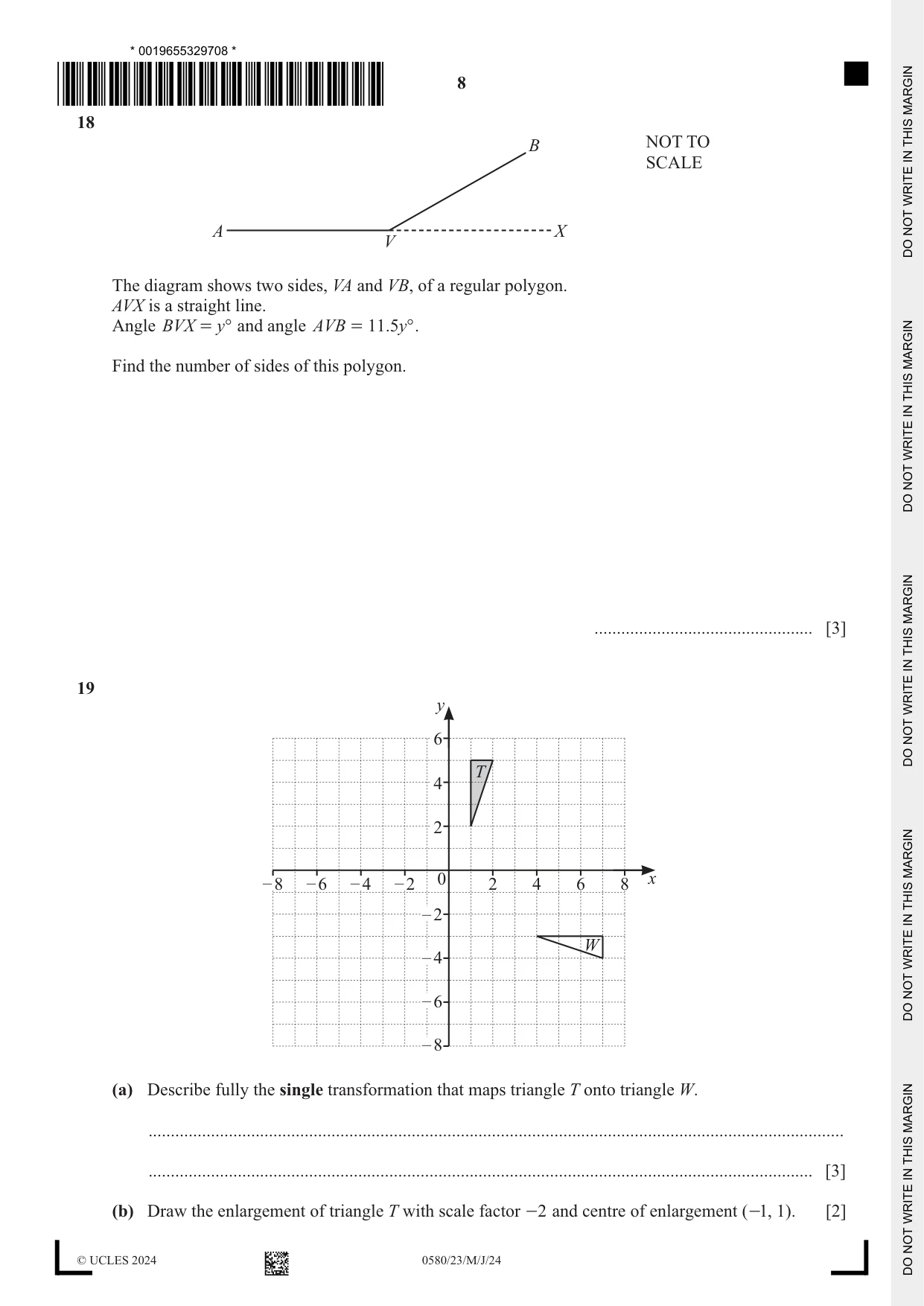
18 B NOT TO SCALE A X V The diagram shows two sides, VA and VB, of a regular polygon. AVX is a straight line. Angle BVX = y° and angle AVB = 11.5 y° . Find the number of sides of this polygon. ................................................. [3]
Mark scheme: 18 25 3 B2 for [y =] 14.4 oe or M1 for y + 11.5y = 180 or for 360 ÷ their y
Q19 · Y 6 T 4 2 – 8 – 6 – 4 – 2 0 2 4 6 8 x – 2 W – 4 – 6 – 8 (a) Describe fully the single…
19 y 6 T 4 2 – 8 – 6 – 4 – 2 0 2 4 6 8 x – 2 W – 4 – 6 – 8 (a) Describe fully the single transformation that maps triangle T onto triangle W. ............................................................................................................................................................ ..................................................................................................................................................... [3] (b) Draw the enlargement of triangle T with scale factor -2 and centre of enlargement ( -1, 1). [2]
Mark scheme: 19(a) Rotation 3 B1 for each 90° clockwise oe (0, –2) 19(b) Triangle at 2 B1 for enlargement s.f. –2 in wrong position (–5, –1), (–5, –7), (–7, –7)
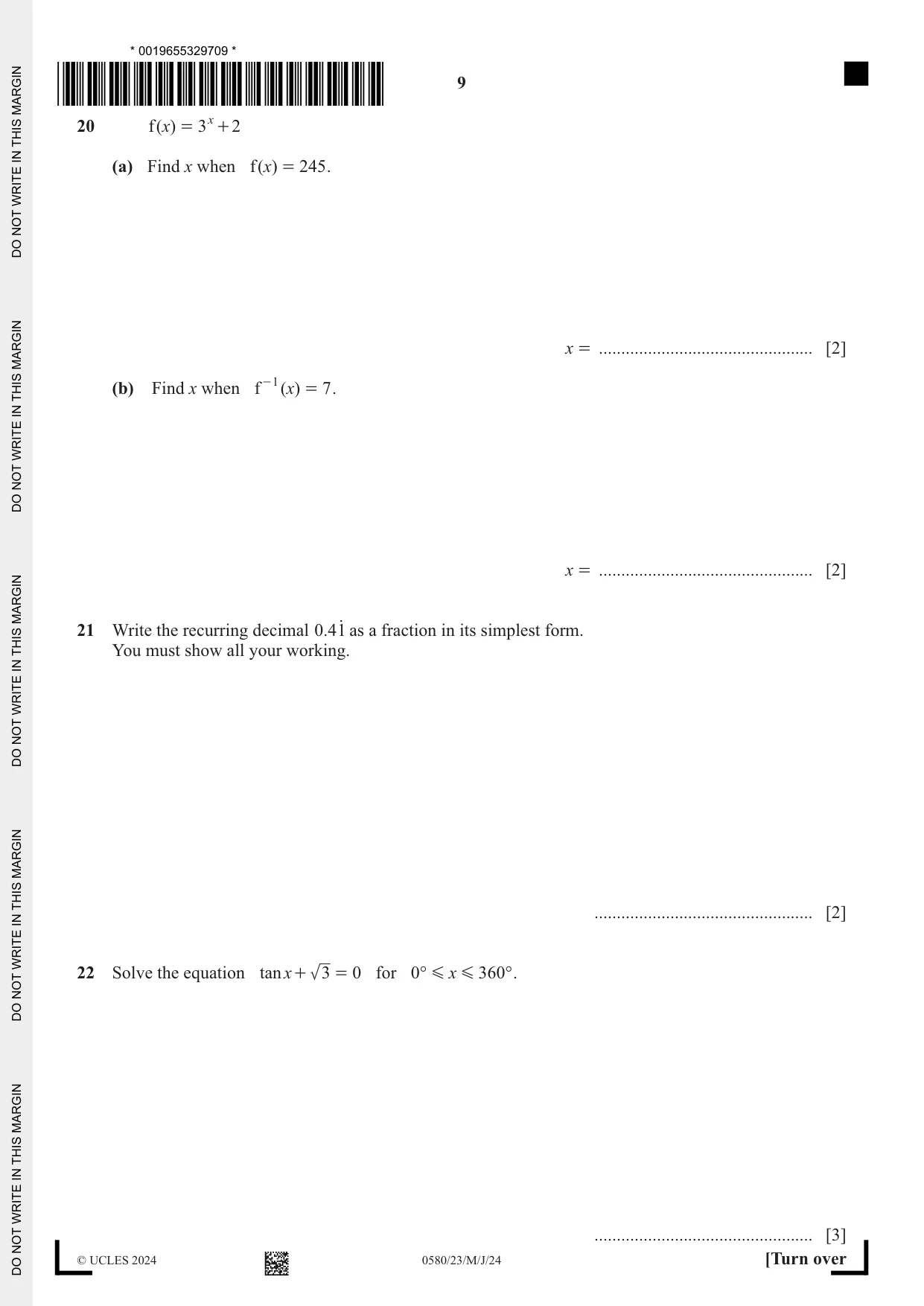
Q20 · F( )x = 3 x + 2 (a) Find x when f ( )x = 245
20 f( )x = 3 x + 2 (a) Find x when f ( )x = 245 . x = ................................................ [2] (b) Find x when f - 1 ( )x = 7 . x = ................................................ [2]
Mark scheme: 20(a) 5 2 M1 for 3x + 2 = 245 20(b) 2189 2 M1 for x = f(7) or 37 + 2
Q21 · Write the recurring decimal .04.1 as a fraction in its simplest form
21 Write the recurring decimal .04.1 as a fraction in its simplest form. You must show all your working. ................................................. [2]
Mark scheme: 21 41.11...– 4.11... oe M1 37 A1 37 cao If M0 scored SC1 for answer with 90 90 insufficient working.
Q22 · Solve the equation tanx + 3 = 0 for 0° G x G 360°
22 Solve the equation tanx + 3 = 0 for 0° G x G 360° . ................................................. [3]
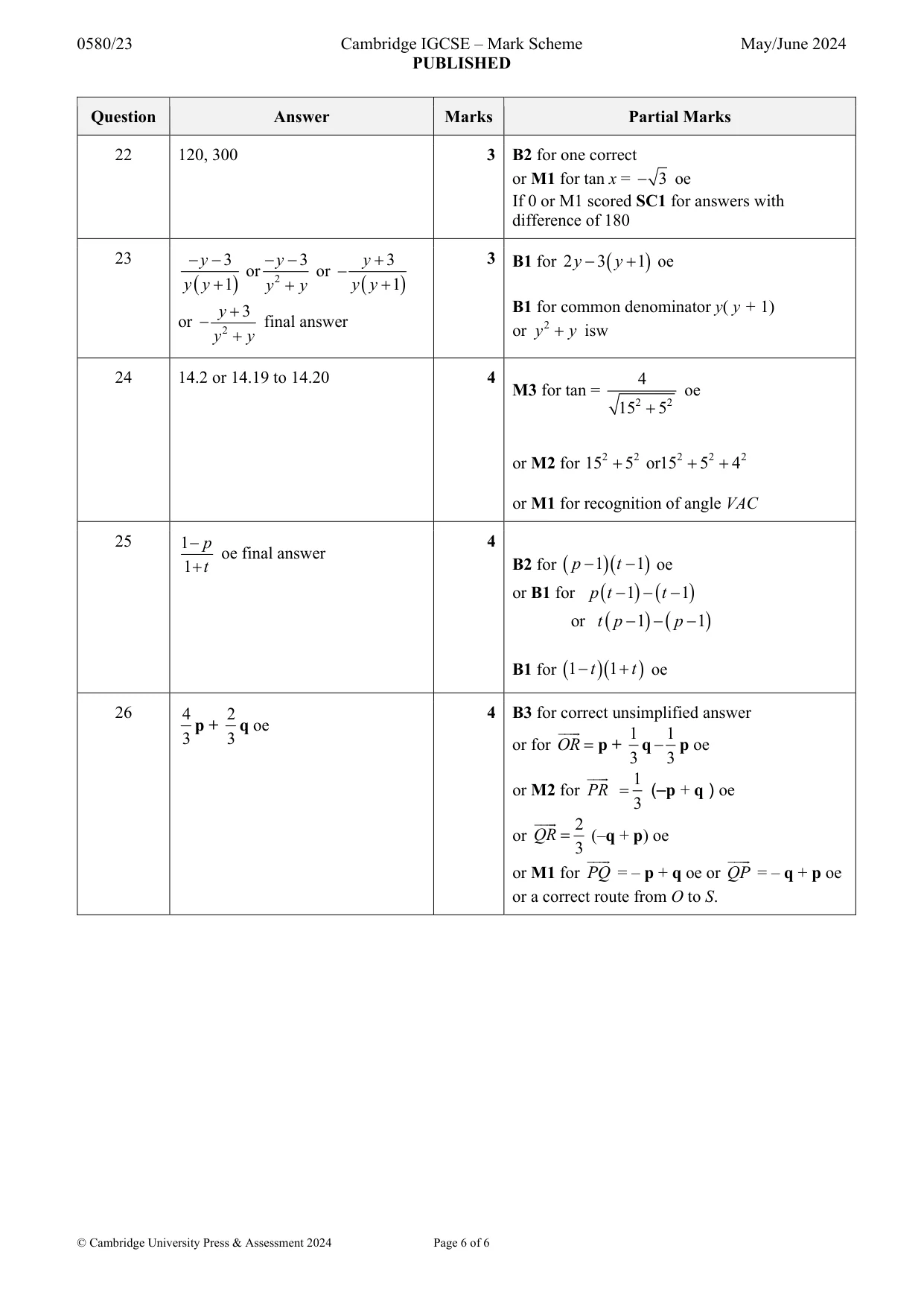
Mark scheme: 22 120, 300 3 B2 for one correct or M1 for tan x = 3 oe If 0 or M1 scored SC1 for answers with difference of 180
Question 23
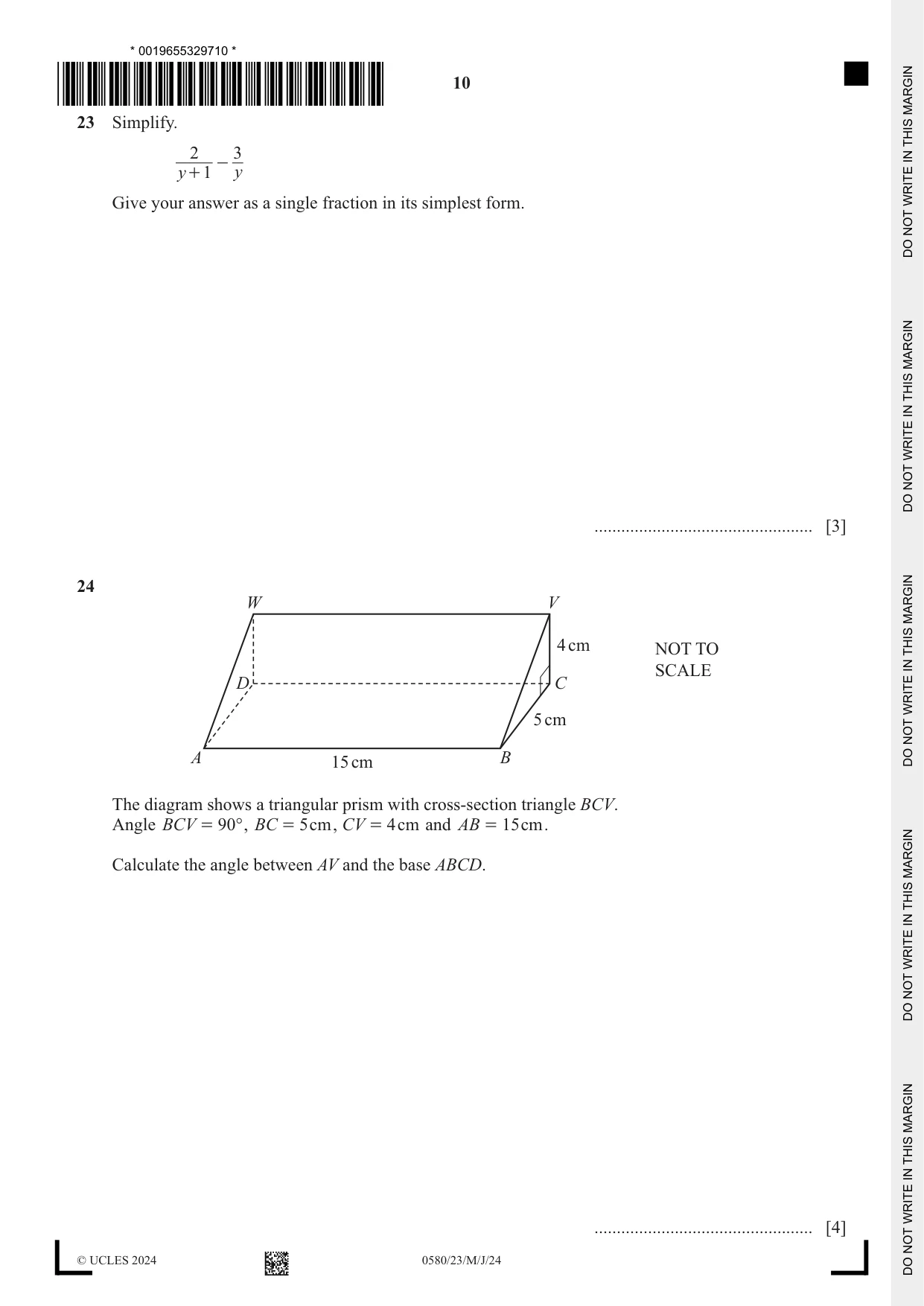
23 Simplify. 2 3 - y + 1 y Give your answer as a single fraction in its simplest form. ................................................. [3]
Mark scheme: 23 y 3 y 3 y 3 3 B1 for 2 y 3 y 1 oe or or y y 1 y 2 y y y 1 B1 for common denominator y( y + 1) y 3 or final answer 2 2 or y y isw y y
Q24 · W V 4 cm NOT TO SCALE D C 5 cm A 15 cm B The diagram shows a triangular prism with…
24 W V 4 cm NOT TO SCALE D C 5 cm A 15 cm B The diagram shows a triangular prism with cross-section triangle BCV. Angle BCV = 90° , BC = 5cm , CV = 4cm and AB = 15cm . Calculate the angle between AV and the base ABCD. ................................................. [4]
Mark scheme: 24 14.2 or 14.19 to 14.20 4 4 M3 for tan = oe 15 2 5 2 or M2 for 15 2 5 2 or15 2 52 4 2 or M1 for recognition of angle VAC
Question 25
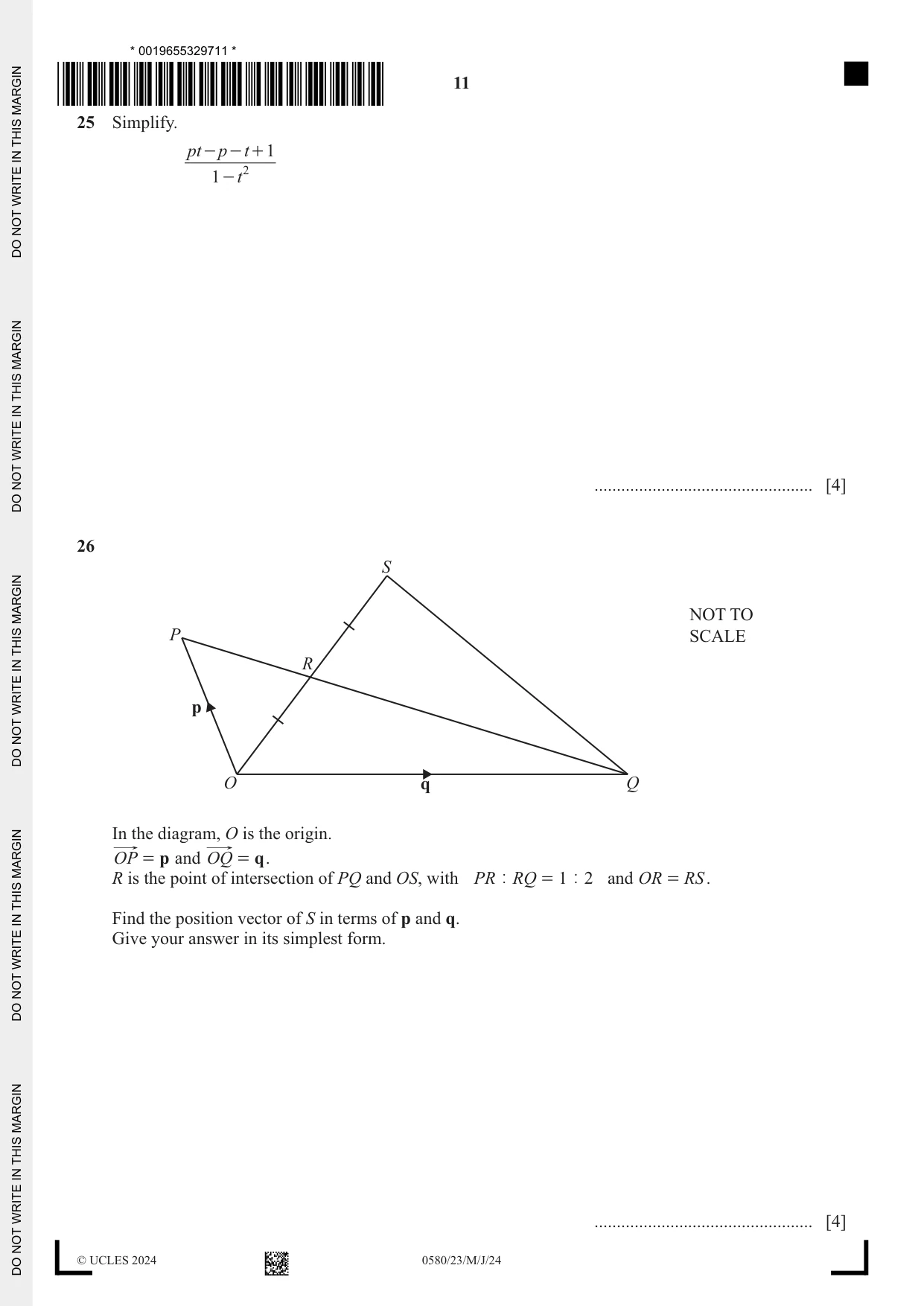
25 Simplify. pt - p - t + 1 1 - t 2 ................................................. [4]
Mark scheme: 25 1 p 4 oe final answer 1 t B2 for p 1 t 1 oe or B1 for p t 1 t 1 or t p 1 p 1 B1 for 1 t 1 t oe
Q26 · S NOT TO P SCALE R p O q Q In the diagram, O is the origin
26 S NOT TO P SCALE R p O q Q In the diagram, O is the origin. OP = p and OQ = q . R is the point of intersection of PQ and OS, with PR | RQ = 1 | 2 and OR = RS . Find the position vector of S in terms of p and q. Give your answer in its simplest form. ................................................. [4]
Mark scheme: 26 4 2 4 B3 for correct unsimplified answer p + q oe 1 1 3 3 or for OR p + q p oe 3 3 1 or M2 for PR (–p + q ) oe 3 2 or QR (–q + p) oe 3 or M1 for PQ = – p + q oe or QP = – q + p oe or a correct route from O to S.
What was in this paper
The subtopics covered by these 26 questions, and how many questions each got. Open one in a new tab to see every Cambridge question on it.
3Algebraic fractions2Equations2Fractions, decimals and percentages2Angles1Area and perimeter1Averages and measures of spread1Circle theorems I1Gradient of linear graphs1Indices I1Introduction to probability1Pythagoras’ theorem and trigonometry1Ratio and proportion1Right-angled triangles1Sets1Standard form1The four operations1Transformations1Trigonometric functions1Types of number1Vectors in two dimensions1What you needed in this session
Cambridge’s own grade thresholds for 2024 May/June, Paper 2 · Variant 3. A higher threshold means an easier paper — the bar moves with how the cohort did.