Cambridge IGCSE Mathematics 0580 — 2004 Oct/Nov Paper 2 · Variant 1
0580/21/O/N/04 · 21 questions · 70 marks · ≈79 min
The question paper and its mark scheme, free to read here and free to download. This is Cambridge’s own paper, exactly as it was sat.
Question paper12 pages
Mark scheme7 pages
Answers below. Sit the paper first if you are practising.
Questions as text
Q1 · A pattern of numbers is shown below
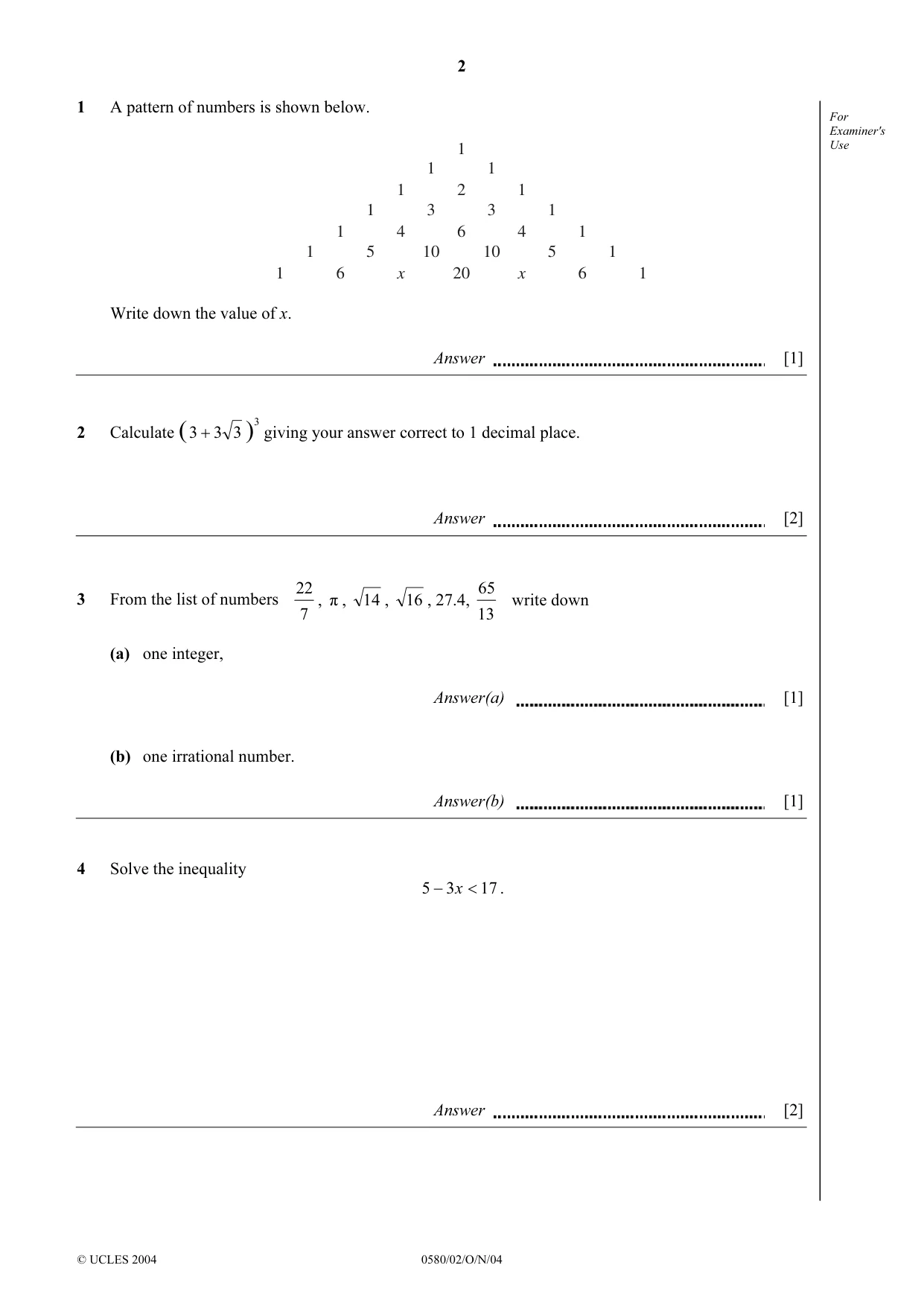
1 A pattern of numbers is shown below. For Examiner's 1 Use 1 1 1 2 1 1 3 3 1 1 4 6 4 1 1 5 10 10 5 1 1 6 x 20 x 6 1 Write down the value of x. Answer [1]
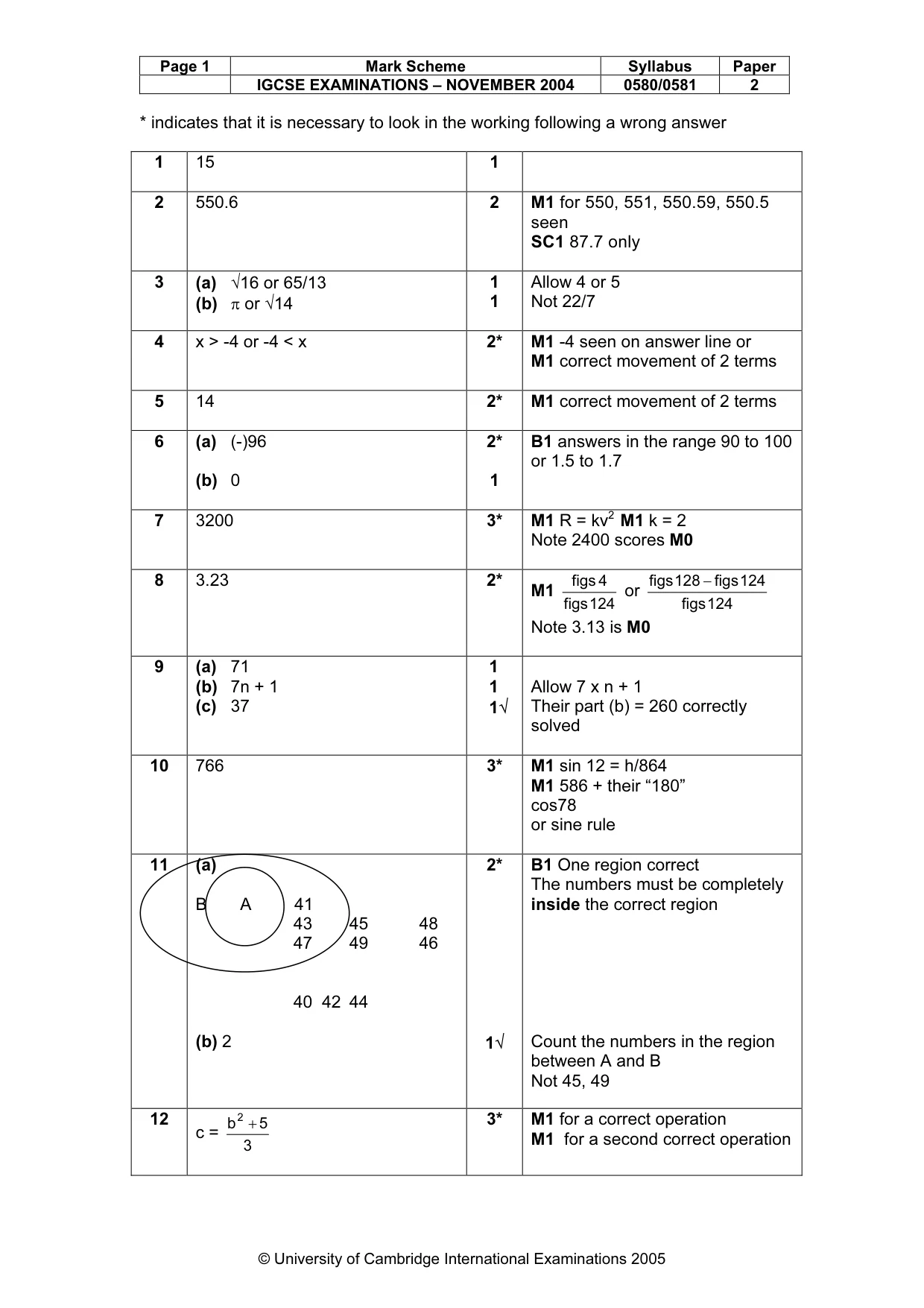
Mark scheme: 1 15 1
Q2 · 2 Calculate ( 3 + 3 3 ) giving your answer correct to 1 decimal place
3 2 Calculate ( 3 + 3 3 ) giving your answer correct to 1 decimal place. Answer [2]
Mark scheme: 2 550.6 2 M1 for 550, 551, 550.59, 550.5 seen SC1 87.7 only
Q3 · 65 3 From the list of numbers , π , 14 , 16 , 27.4, write down 7 13 (a) one integer…
22 65 3 From the list of numbers , π , 14 , 16 , 27.4, write down 7 13 (a) one integer, Answer(a) [1] (b) one irrational number. Answer(b) [1]
Mark scheme: 3 (a) √16 or 65/13 1 Allow 4 or 5 (b) π or √14 1 Not 22/7
Q4 · Solve the inequality 5 −x3 < 17
4 Solve the inequality 5 −x3 < 17 . Answer [2]
Mark scheme: 4 x > -4 or -4 < x 2* M1 -4 seen on answer line or M1 correct movement of 2 terms
Q5 · Solve the equation For 3 x − 2 Examiner's = 8
5 Solve the equation For 3 x − 2 Examiner's = 8 . Use 5 Answer x = [2]
Mark scheme: 5 14 2* M1 correct movement of 2 terms
Q6 · 120 100 80 Distance from 60 Hilltown (km) 40 20 0 08 00 08 30 09 00 09 30 Time The graph…
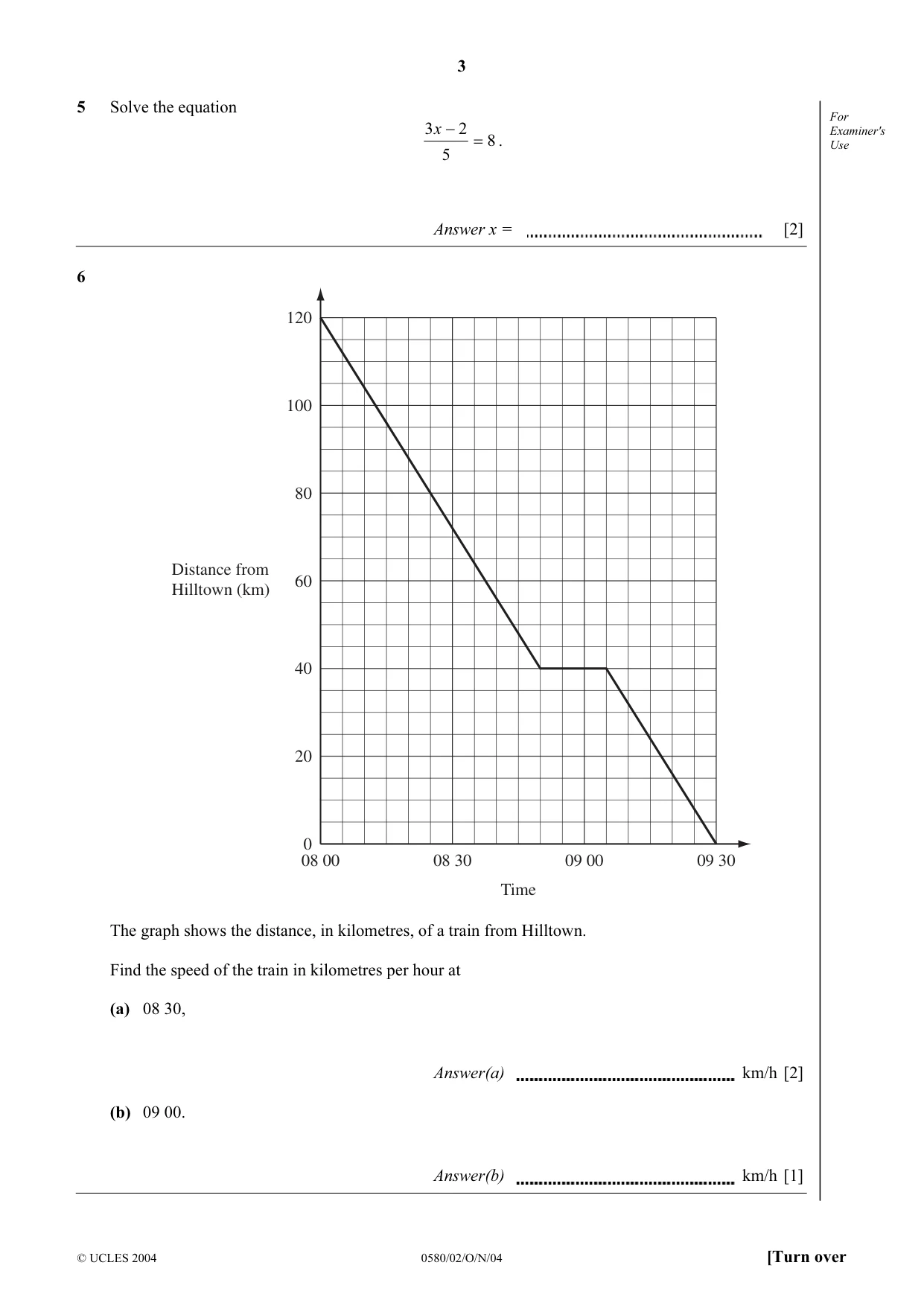
6 120 100 80 Distance from 60 Hilltown (km) 40 20 0 08 00 08 30 09 00 09 30 Time The graph shows the distance, in kilometres, of a train from Hilltown. Find the speed of the train in kilometres per hour at (a) 08 30, Answer(a) km/h [2] (b) 09 00. Answer(b) km/h [1]
Mark scheme: 6 (a) (-)96 2* B1 answers in the range 90 to 100 or 1.5 to 1.7 (b) 0 1
Q7 · The air resistance (R) to a car is proportional to the square of its speed (v)
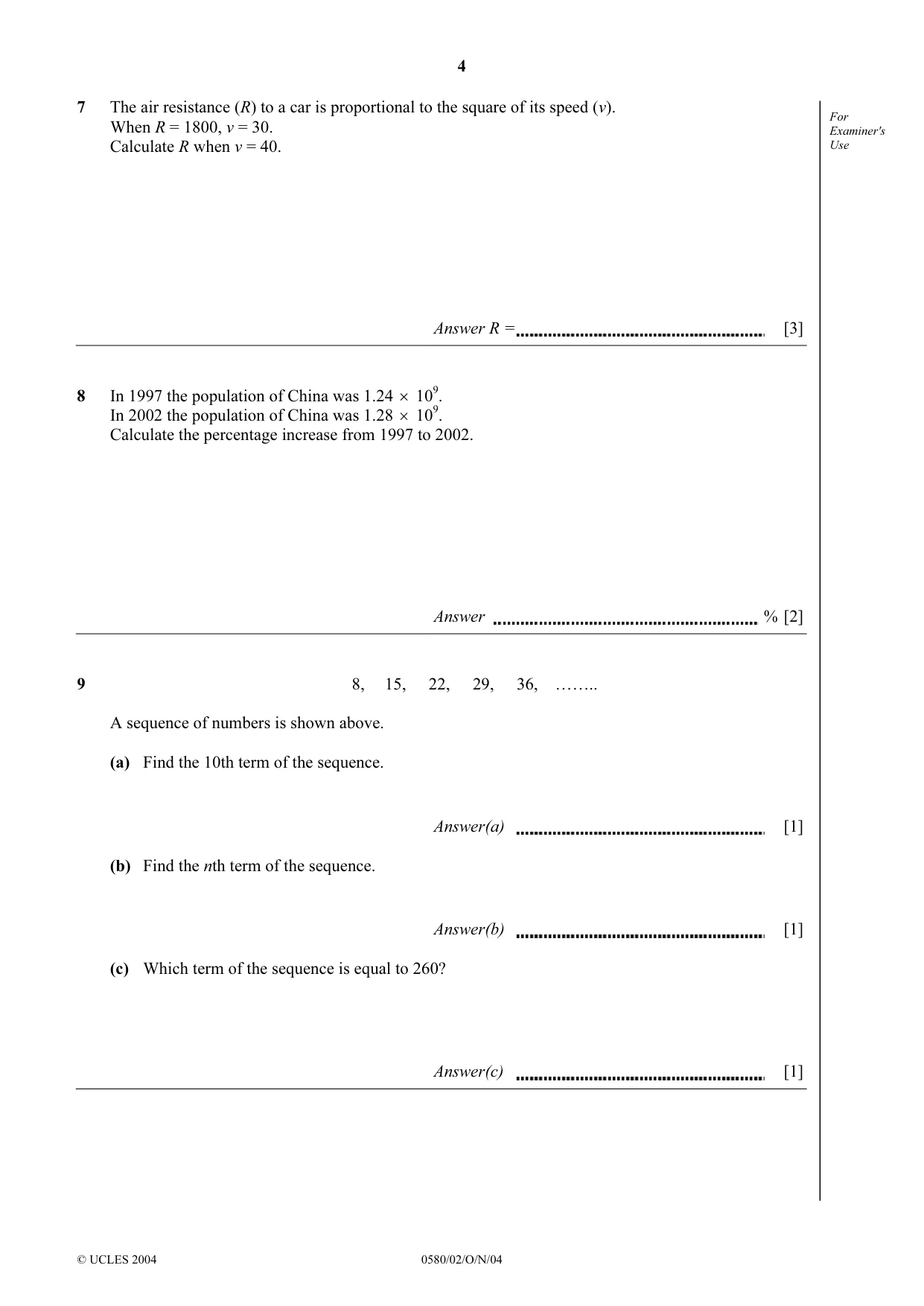
7 The air resistance (R) to a car is proportional to the square of its speed (v). When R = 1800, v = 30. ForExaminer's Calculate R when v = 40. Use Answer R = [3]
Mark scheme: 7 3200 3* M1 R = kv2 M1 k = 2 Note 2400 scores M0
Q8 · In 1997 the population of China was 1.24 × 10⁹
8 In 1997 the population of China was 1.24 × 10⁹. In 2002 the population of China was 1.28 × 10⁹. Calculate the percentage increase from 1997 to 2002. Answer % [2]
Mark scheme: 8 3.23 2* figs 4 figs 128 − figs 124 M1 or figs 124 figs 124 Note 3.13 is M0
Q9 · 8, 15, 22, 29, 36, …….
9 8, 15, 22, 29, 36, …….. A sequence of numbers is shown above. (a) Find the 10th term of the sequence. Answer(a) [1] (b) Find the nth term of the sequence. Answer(b) [1] (c) Which term of the sequence is equal to 260? Answer(c) [1]
Mark scheme: 9 (a) 71 1 (b) 7n + 1 1 Allow 7 x n + 1 (c) 37 1√ Their part (b) = 260 correctly solved
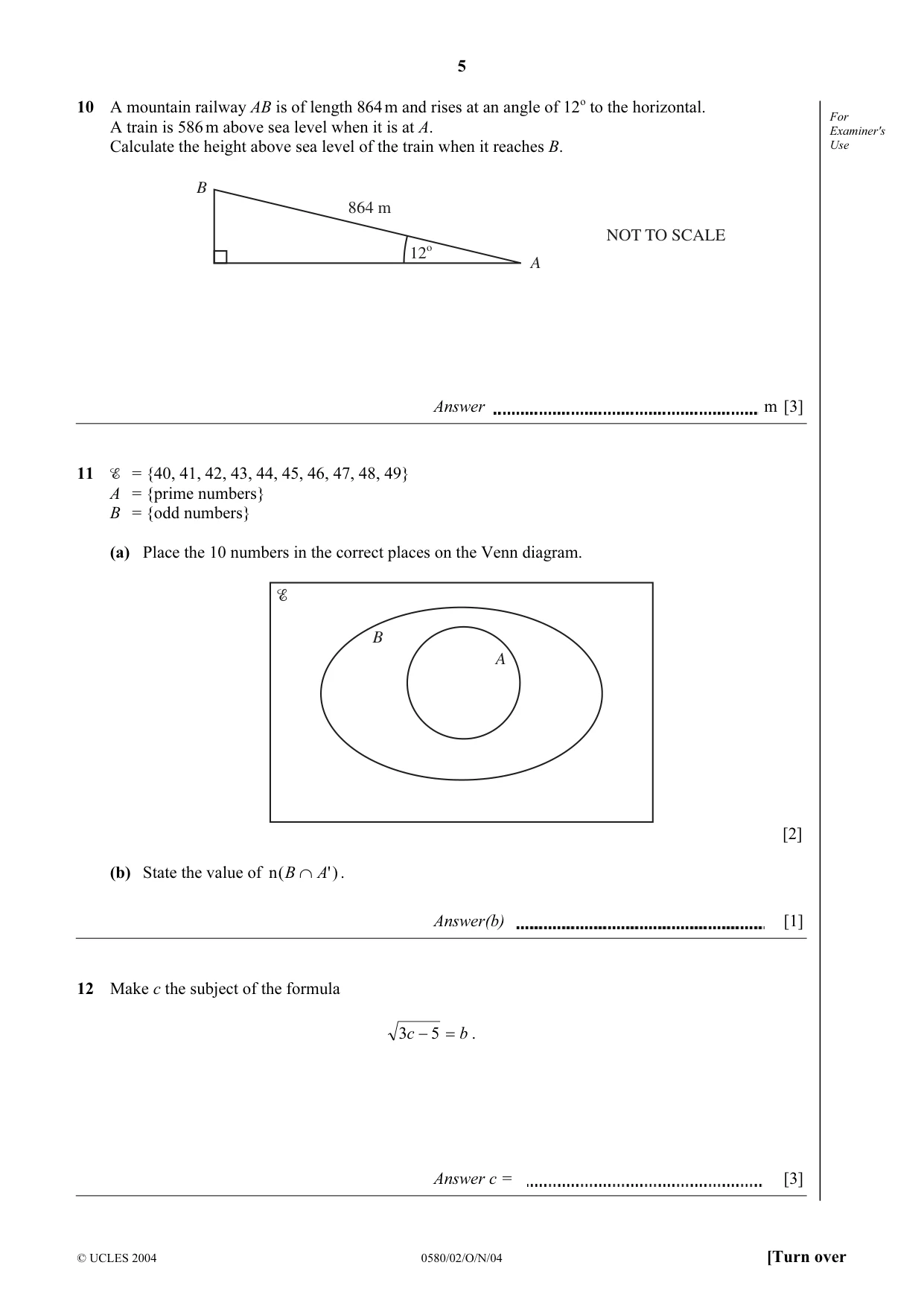
Q10 · A mountain railway AB is of length 864 m and rises at an angle of 12o to the horizontal
10 A mountain railway AB is of length 864 m and rises at an angle of 12o to the horizontal. For A train is 586 m above sea level when it is at A. Examiner's Calculate the height above sea level of the train when it reaches B. Use B 864 m NOT TO SCALE 12o A Answer m [3]
Mark scheme: 10 766 3* M1 sin 12 = h/864 M1 586 + their “180” cos78 or sine rule
Q11 · = {40, 41, 42, 43, 44, 45, 46, 47, 48, 49} A = {prime numbers} B = {odd numbers} (a)…
11 = {40, 41, 42, 43, 44, 45, 46, 47, 48, 49} A = {prime numbers} B = {odd numbers} (a) Place the 10 numbers in the correct places on the Venn diagram. B A [2] (b) State the value of n ( B ∩ A)' . Answer(b) [1]
Mark scheme: 11 (a) 2* B1 One region correct The numbers must be completely B A 41 inside the correct region 43 45 48 47 49 46 40 42 44 (b) 2 1√ Count the numbers in the region between A and B Not 45, 49
Q12 · Make c the subject of the formula 3c −5 = b
12 Make c the subject of the formula 3c −5 = b . Answer c = [3]
Mark scheme: 12 3* M1 for a correct operation b2 + 5 c = M1 for a second correct operation 3 IGCSE EXAMINATIONS – NOVEMBER 2004 0580/0581 2 * indicates that it is necessary to look in the working following a wrong answer
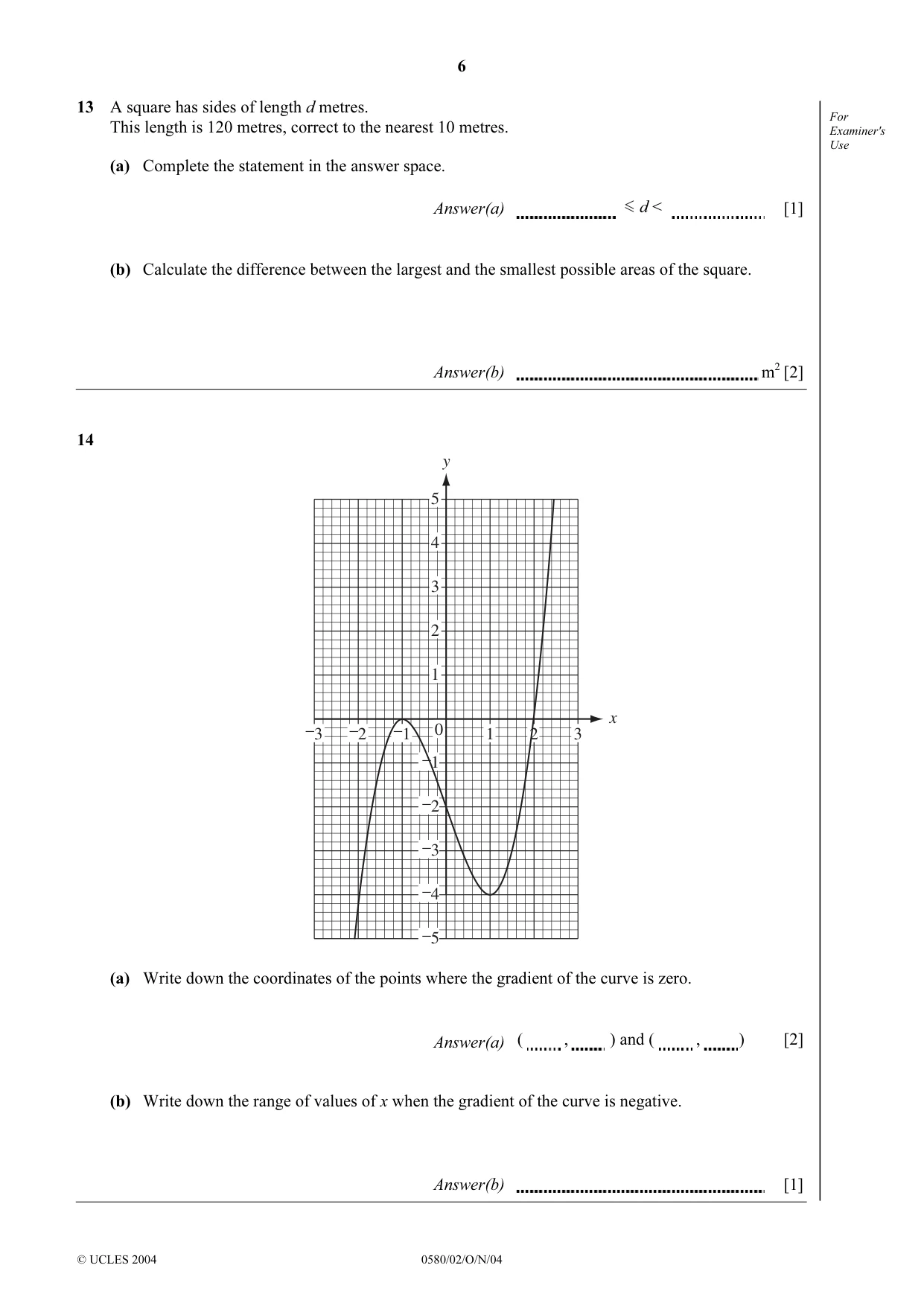
Q13 · A square has sides of length d metres
13 A square has sides of length d metres. For This length is 120 metres, correct to the nearest 10 metres. Examiner's Use (a) Complete the statement in the answer space. Answer(a) d < [1] (b) Calculate the difference between the largest and the smallest possible areas of the square. Answer(b) m2 [2]
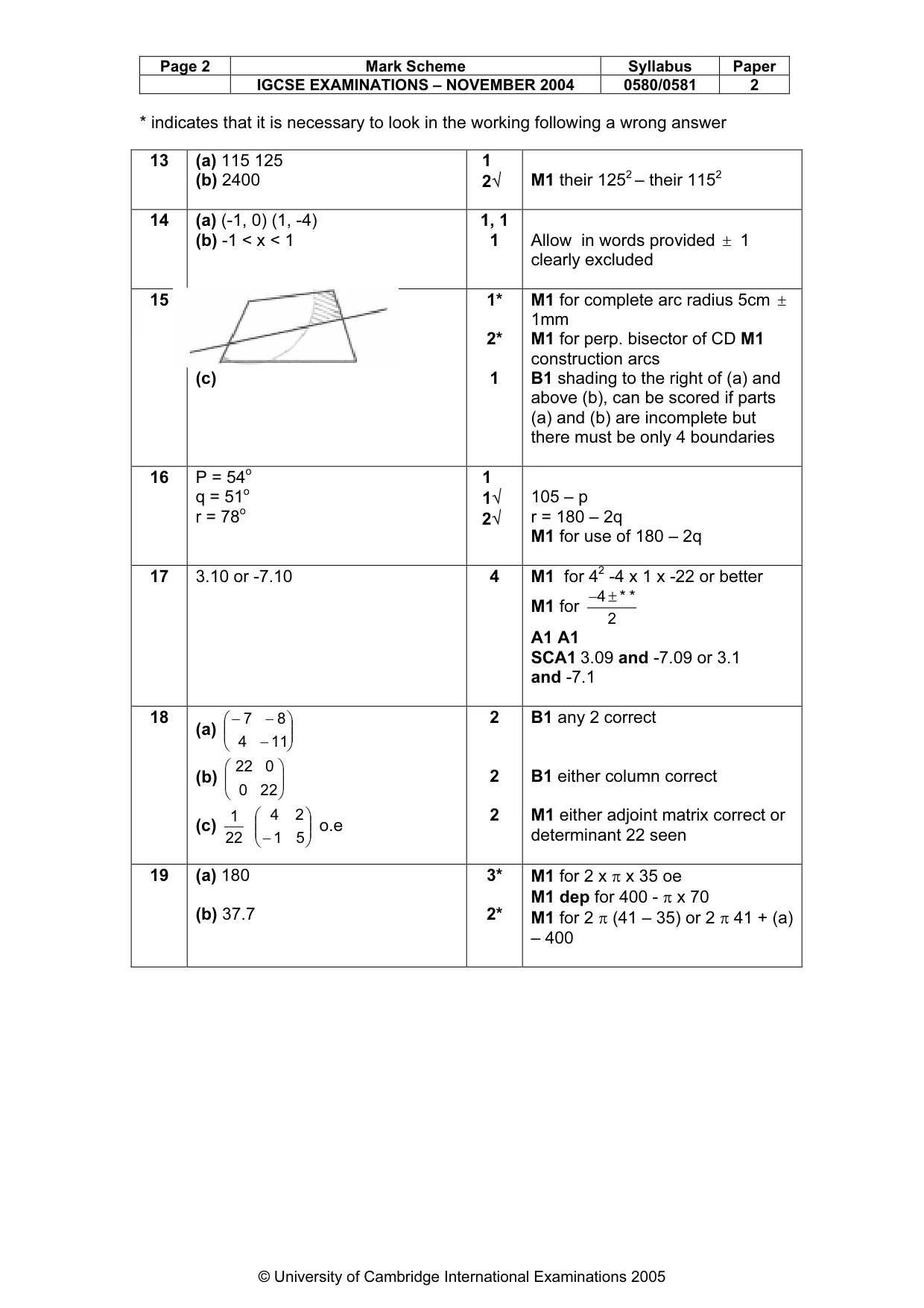
Mark scheme: 13 (a) 115 125 1 (b) 2400 2√ M1 their 1252 – their 1152
Q14 · Y 5 4 3 2 1 _3 _2 _1 0 1 2 3 x _1 _2 _3 _4 _5 (a) Write down the coordinates of the…
14 y 5 4 3 2 1 _3 _2 _1 0 1 2 3 x _1 _2 _3 _4 _5 (a) Write down the coordinates of the points where the gradient of the curve is zero. Answer(a) ( , ) and ( , ) [2] (b) Write down the range of values of x when the gradient of the curve is negative. Answer(b) [1]
Mark scheme: 14 (a) (-1, 0) (1, -4) 1, 1 (b) -1 < x < 1 1 Allow in words provided ± 1 clearly excluded
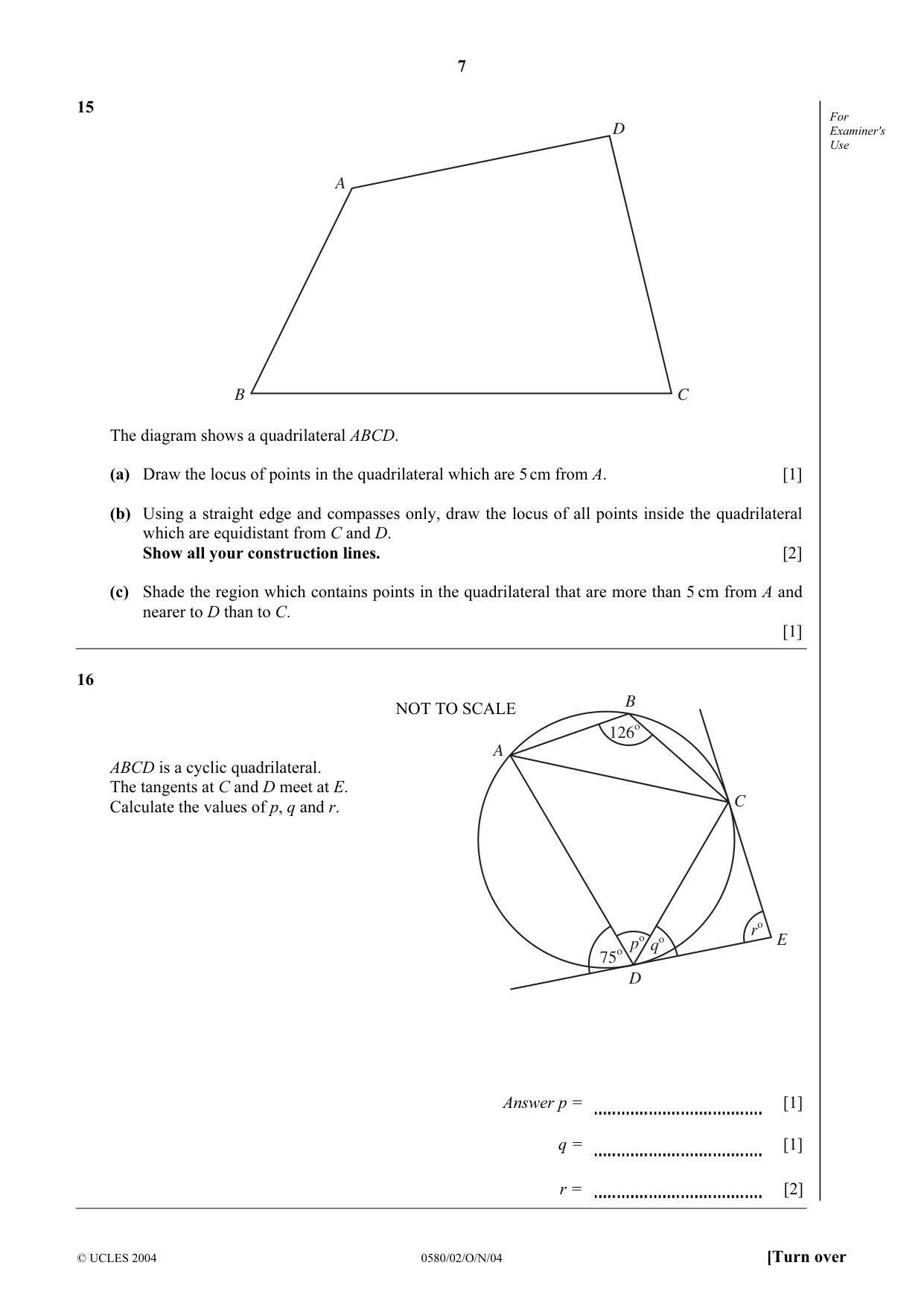
Q15 · For D Examiner's Use A B C The diagram shows a quadrilateral ABCD
15 For D Examiner's Use A B C The diagram shows a quadrilateral ABCD. (a) Draw the locus of points in the quadrilateral which are 5 cm from A. [1] (b) Using a straight edge and compasses only, draw the locus of all points inside the quadrilateral which are equidistant from C and D. Show all your construction lines. [2] (c) Shade the region which contains points in the quadrilateral that are more than 5 cm from A and nearer to D than to C. [1]
Mark scheme: 15 (a) 1* M1 for complete arc radius 5cm ± 1mm (b) 2* M1 for perp. bisector of CD M1 construction arcs (c) 1 B1 shading to the right of (a) and above (b), can be scored if parts (a) and (b) are incomplete but there must be only 4 boundaries
Q16 · B NOT TO SCALE 126o A ABCD is a cyclic quadrilateral
16 B NOT TO SCALE 126o A ABCD is a cyclic quadrilateral. The tangents at C and D meet at E. Calculate the values of p, q and r. C ro po qo E 75o D Answer p = [1] q = [1] r = [2]
Mark scheme: 16 P = 54o 1 q = 51o 1√ 105 – p r = 78o 2√ r = 180 – 2q M1 for use of 180 – 2q
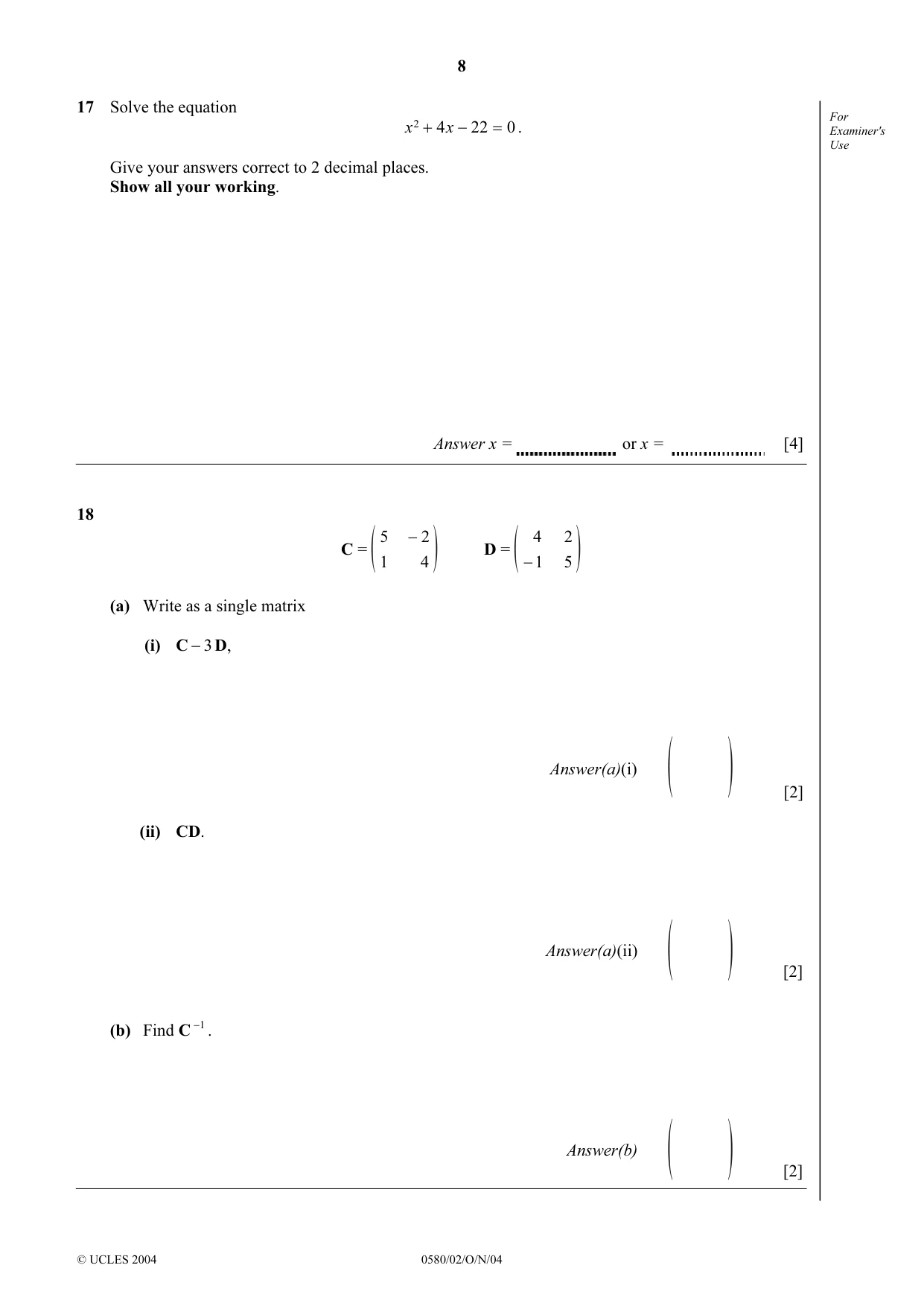
Q17 · Solve the equation For x 2 + 4 x − 22 = 0
17 Solve the equation For x 2 + 4 x − 22 = 0 . Examiner's Use Give your answers correct to 2 decimal places. Show all your working. Answer x = or x = [4]
Mark scheme: 17 3.10 or -7.10 4 M1 for 42 -4 x 1 x -22 or better −4 ± * * M1 for 2 A1 A1 SCA1 3.09 and -7.09 or 3.1 and -7.1
Q18 · 5 − 2 4 2 C = D = 1 4 − 1 5 (a) Write as a single matrix (i) C − 3 D, Answer(a)(i) [2]…
18 5 − 2 4 2 C = D = 1 4 − 1 5 (a) Write as a single matrix (i) C − 3 D, Answer(a)(i) [2] (ii) CD. Answer(a)(ii) [2] (b) Find C −.1 Answer(b) [2]
Mark scheme: 18 − 7 − 8 2 B1 any 2 correct (a) 4 − 11 22 0 (b) 2 B1 either column correct 0 22 1 4 2 2 M1 either adjoint matrix correct or (c) o.e determinant 22 seen 22 − 1 5
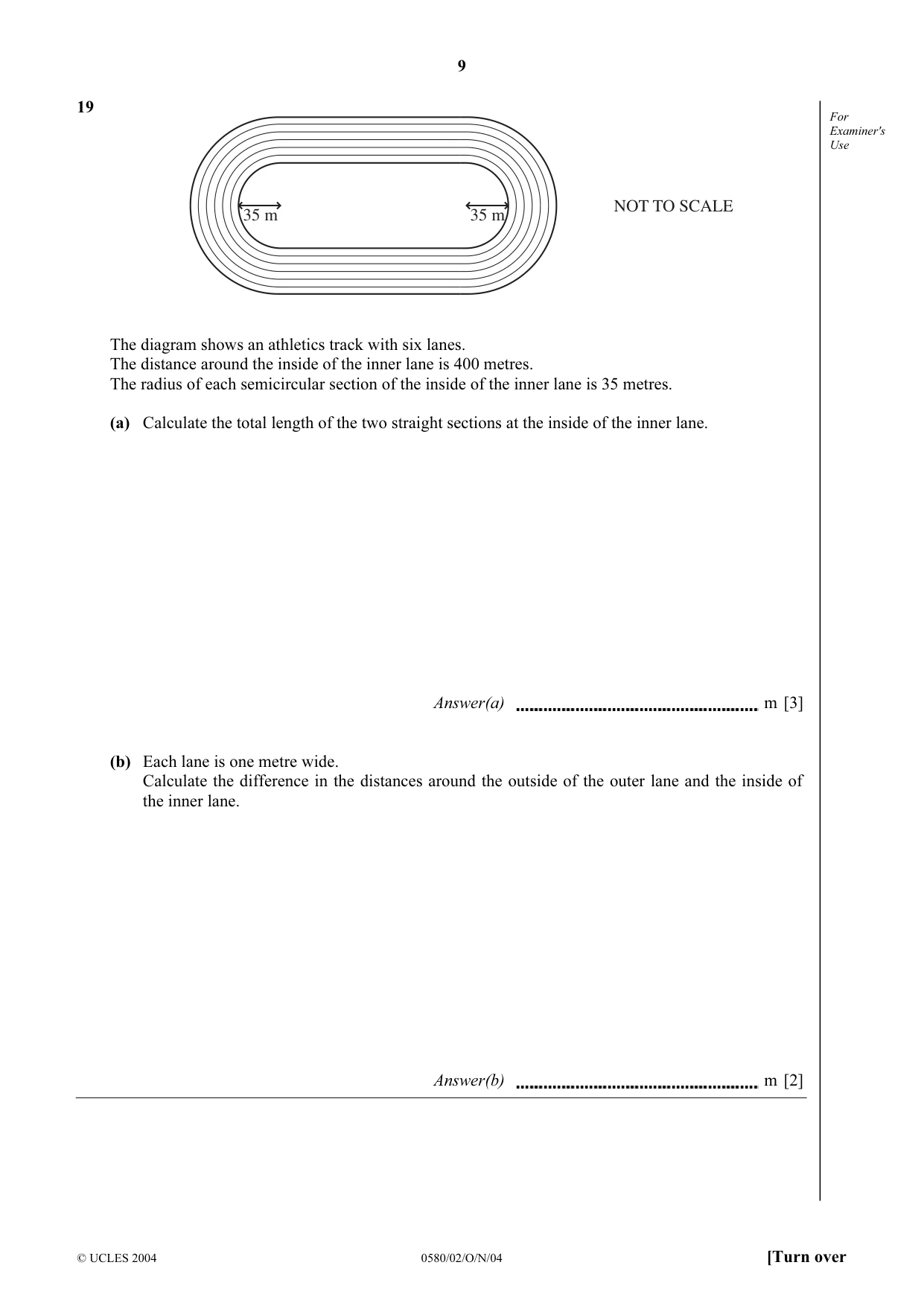
Q19 · For Examiner's Use NOT TO SCALE 35 m 35 m The diagram shows an athletics track with six…
19 For Examiner's Use NOT TO SCALE 35 m 35 m The diagram shows an athletics track with six lanes. The distance around the inside of the inner lane is 400 metres. The radius of each semicircular section of the inside of the inner lane is 35 metres. (a) Calculate the total length of the two straight sections at the inside of the inner lane. Answer(a) m [3] (b) Each lane is one metre wide. Calculate the difference in the distances around the outside of the outer lane and the inside of the inner lane. Answer(b) m [2]
Mark scheme: 19 (a) 180 3* M1 for 2 x π x 35 oe M1 dep for 400 - π x 70 (b) 37.7 2* M1 for 2 π (41 – 35) or 2 π 41 + (a) – 400 IGCSE EXAMINATIONS – NOVEMBER 2004 0580/0581 2 * indicates that it is necessary to look in the working following a wrong answer
Q20 · A gardener plants seeds from a packet of 25 seeds
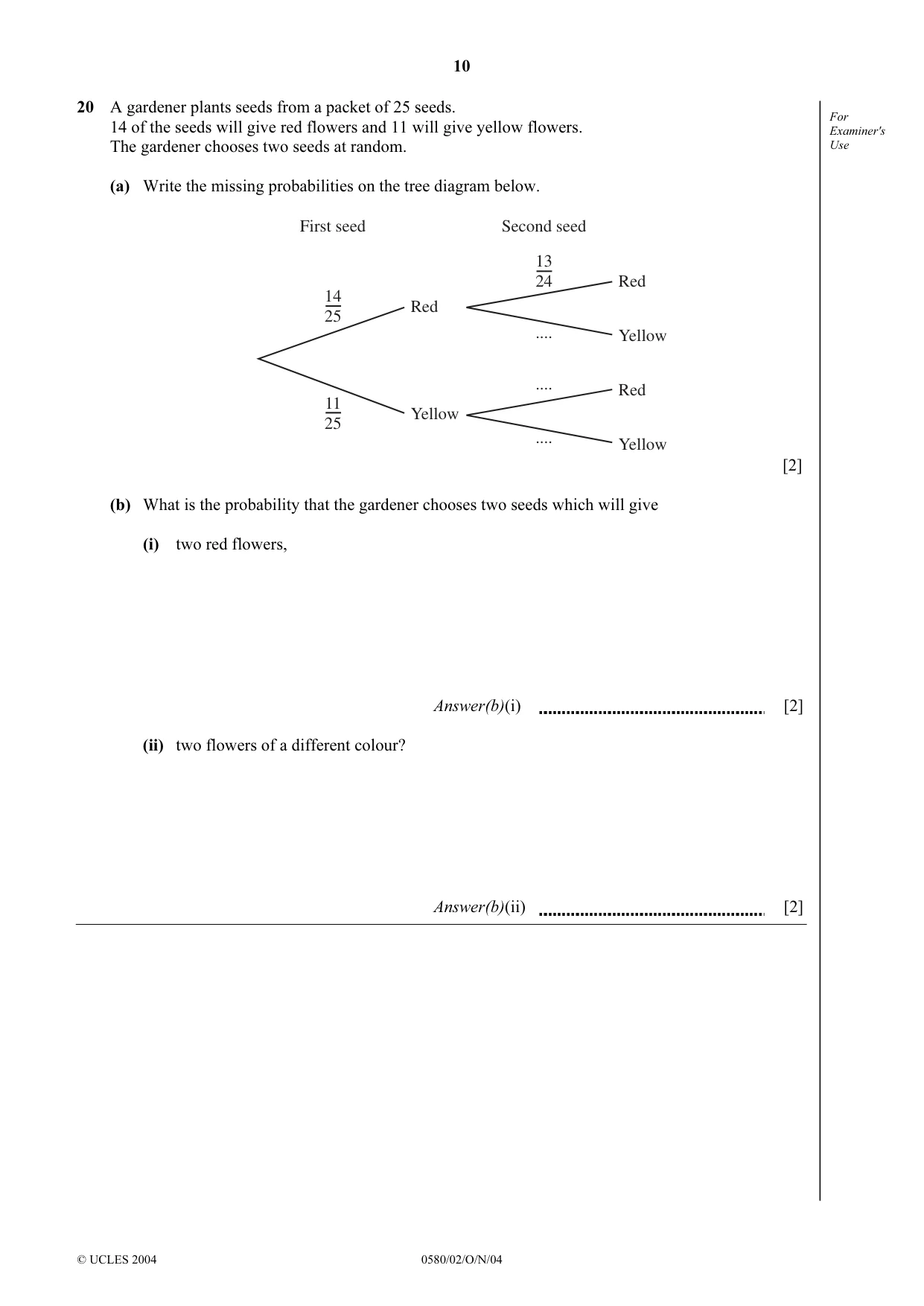
20 A gardener plants seeds from a packet of 25 seeds. For 14 of the seeds will give red flowers and 11 will give yellow flowers. Examiner's The gardener chooses two seeds at random. Use (a) Write the missing probabilities on the tree diagram below. First seed Second seed 13 24 Red 14 Red 25 .... Yellow .... Red 11 Yellow 25 .... Yellow [2] (b) What is the probability that the gardener chooses two seeds which will give (i) two red flowers, Answer(b)(i) [2] (ii) two flowers of a different colour? Answer(b)(ii) [2]
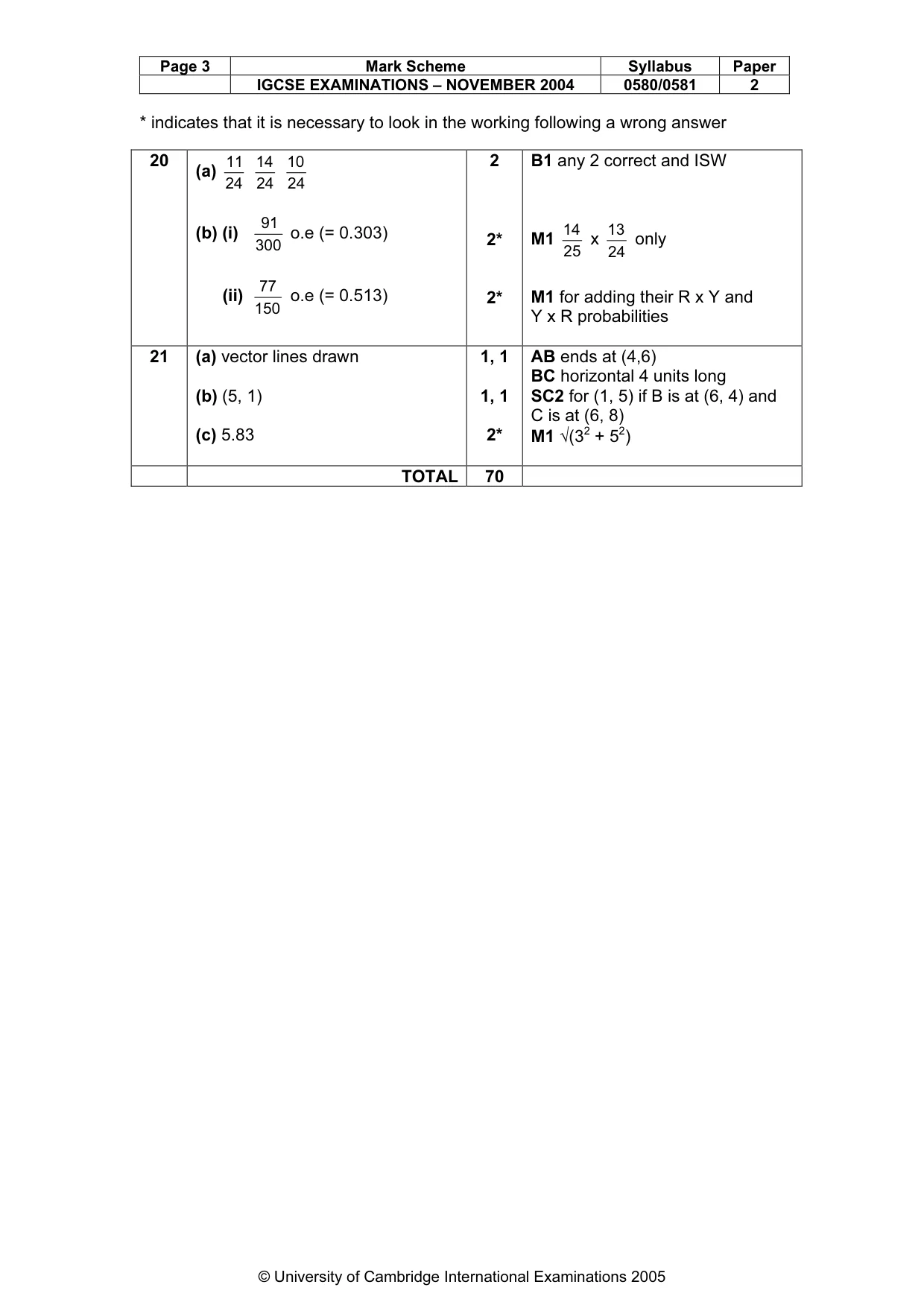
Mark scheme: 20 11 14 10 2 B1 any 2 correct and ISW (a) 24 24 24 91 (b) (i) o.e (= 0.303) 2* M1 14 x 13 only 300 25 24 77 (ii) o.e (= 0.513) 2* M1 for adding their R x Y and 150 Y x R probabilities
Q21 · For y Examiner's Use 8 7 6 5 4 3 2 A 1 0 1 2 3 4 5 6 7 8 x (a) Using a scale of 1cm to…
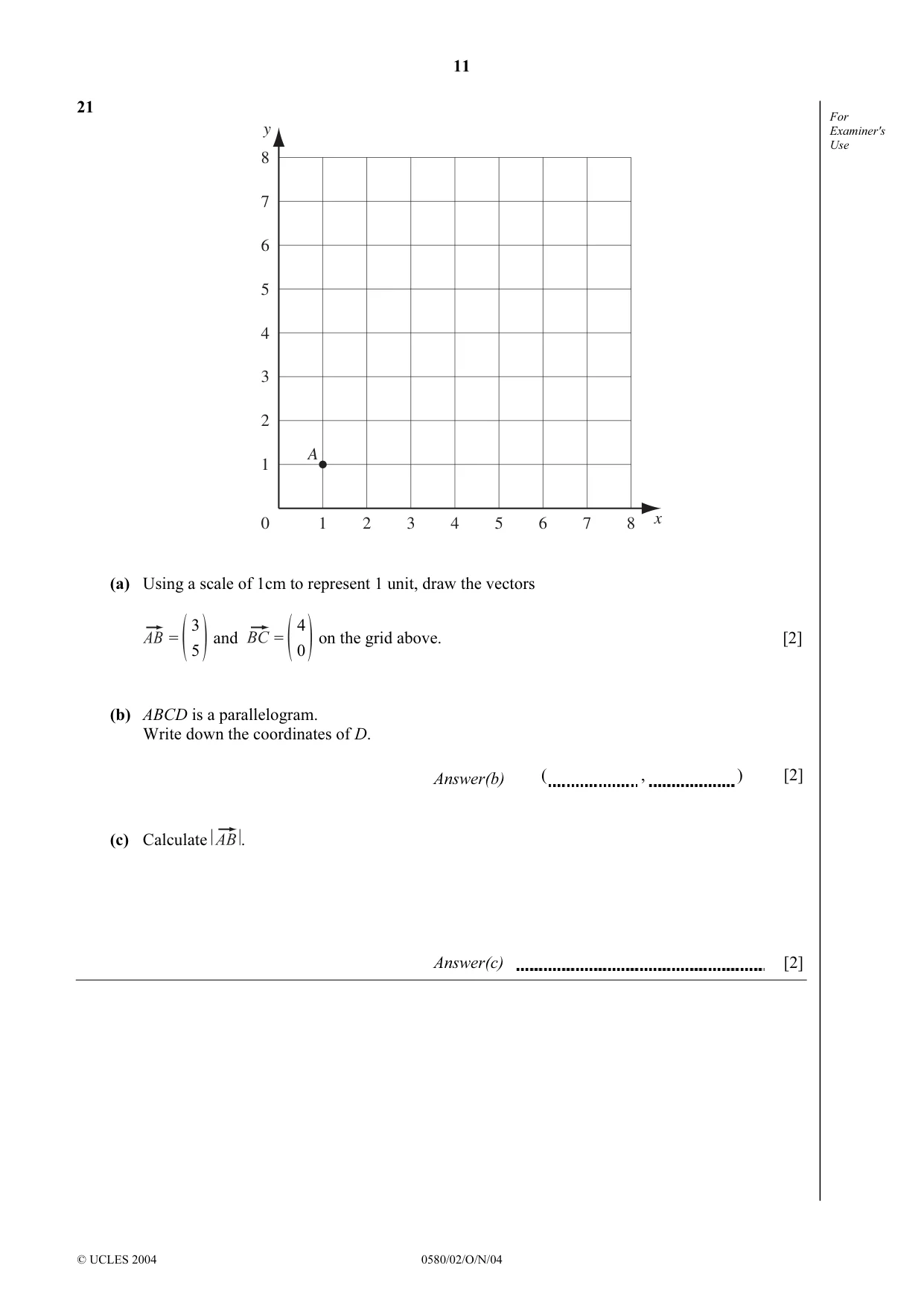
21 For y Examiner's Use 8 7 6 5 4 3 2 A 1 0 1 2 3 4 5 6 7 8 x (a) Using a scale of 1cm to represent 1 unit, draw the vectors 3 4 = and = on the grid above. [2] 5 0 (b) ABCD is a parallelogram. Write down the coordinates of D. Answer(b) ( , ) [2] (c) Calculate . Answer(c) [2]
Mark scheme: 21 (a) vector lines drawn 1, 1 AB ends at (4,6) BC horizontal 4 units long (b) (5, 1) 1, 1 SC2 for (1, 5) if B is at (6, 4) and C is at (6, 8) (c) 5.83 2* M1 √(32 + 52) TOTAL 70
What was in this paper
The subtopics covered by these 21 questions, and how many questions each got. Open one in a new tab to see every Cambridge question on it.
3Types of number2Algebraic manipulation1Area and perimeter1Circle theorems I1Geometrical constructions1Graphs of functions1Inequalities1Limits of accuracy1Percentages1Powers and roots1Probability of combined events1Rates1Ratio and proportion1Right-angled triangles1Sequences1Sets1Vectors in two dimensions1