Cambridge IGCSE Mathematics 0580 — 2012 Oct/Nov Paper 2 · Variant 1
0580/21/O/N/12 · 20 questions · 68 marks · ≈77 min
The question paper and its mark scheme, free to read here and free to download. This is Cambridge’s own paper, exactly as it was sat.
Question paper12 pages
Mark scheme4 pages
Answers below. Sit the paper first if you are practising.
Questions as text
Q1 · On a mountain, the temperature decreases by 6.5 °C for every 1000 metres increase in…
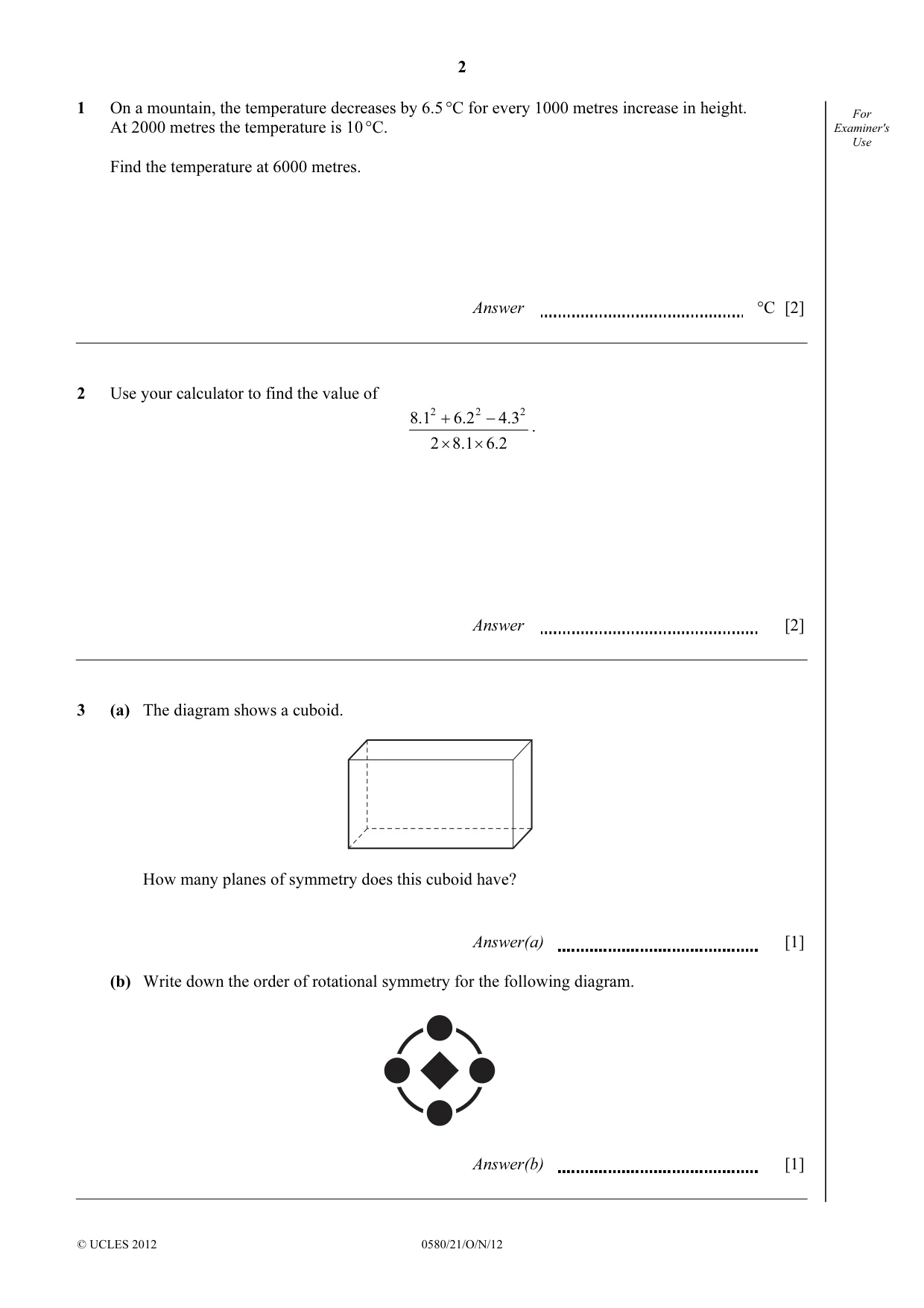
1 On a mountain, the temperature decreases by 6.5 °C for every 1000 metres increase in height. For At 2000 metres the temperature is 10 °C. Examiner's Use Find the temperature at 6000 metres. Answer °C [2]
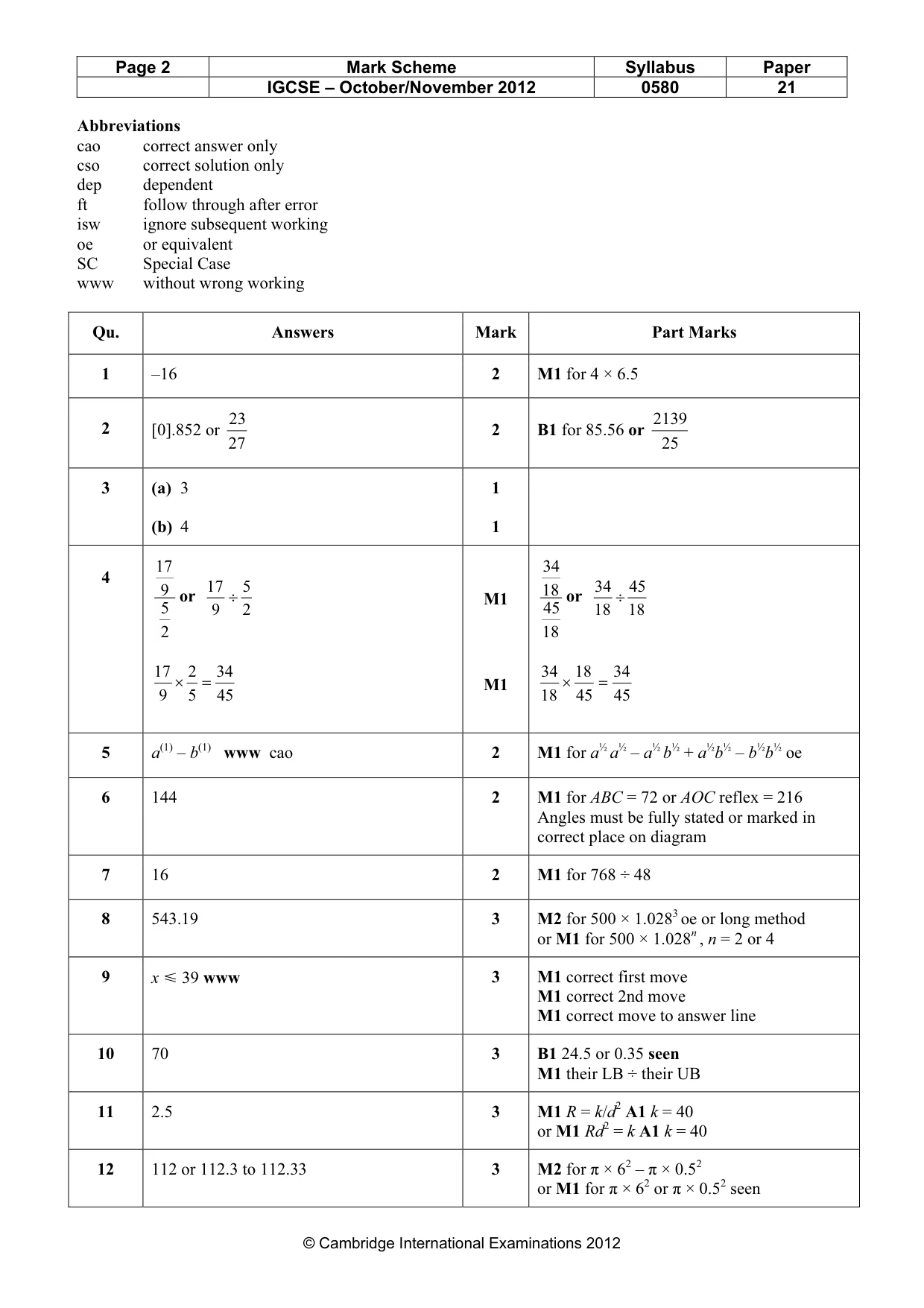
Mark scheme: Qu. Answers Mark Part Marks 1 –16 2 M1 for 4 × 6.5 23 2139
Q2 · Use your calculator to find the value of 8.12 + 6.2 2 − 4.3 2
2 Use your calculator to find the value of 8.12 + 6.2 2 − 4.3 2 . 2 × 8.1 × 6.2 Answer [2]
Mark scheme: 23 2139 2 [0].852 or 2 B1 for 85.56 or 27 25
Q3 · The diagram shows a cuboid
3 (a) The diagram shows a cuboid. How many planes of symmetry does this cuboid have? Answer(a) [1] (b) Write down the order of rotational symmetry for the following diagram. Answer(b) [1]
Mark scheme: 3 (a) 3 1 (b) 4 1 17 34 4 9 17 5 18 34 45 or ÷ M1 or ÷ 5 9 2 45 18 18 2 18 17 2 34 34 18 34 × = × = M1 9 5 45 18 45 45 (1) (1) ½ ½ ½ ½ ½ ½ ½ ½
Question 5
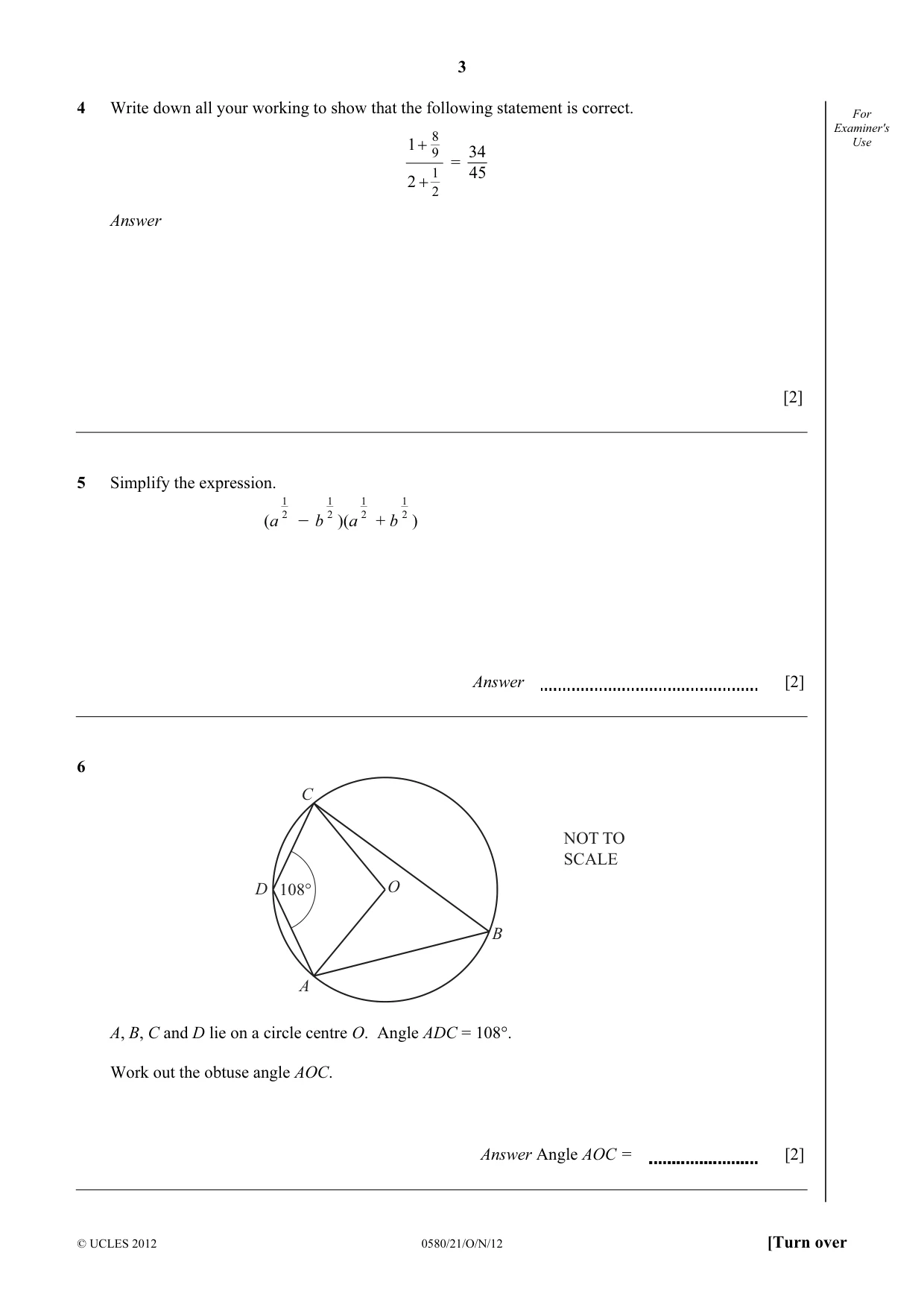
5 Simplify the expression. 1 1 1 1 2 O b 2 )(a 2 + b 2 ) (a Answer [2]
Mark scheme: 5 a(1) – b(1) www cao 2 M1 for a½ a½ – a½ b½ + a½b½ – b½b½ oe
Q6 · C NOT TO SCALE D 108° O B A A, B, C and D lie on a circle centre O
6 C NOT TO SCALE D 108° O B A A, B, C and D lie on a circle centre O. Angle ADC = 108°. Work out the obtuse angle AOC. Answer Angle AOC = [2]
Mark scheme: 6 144 2 M1 for ABC = 72 or AOC reflex = 216 Angles must be fully stated or marked in correct place on diagram
Q7 · The train fare from Bangkok to Chiang Mai is 768 baht
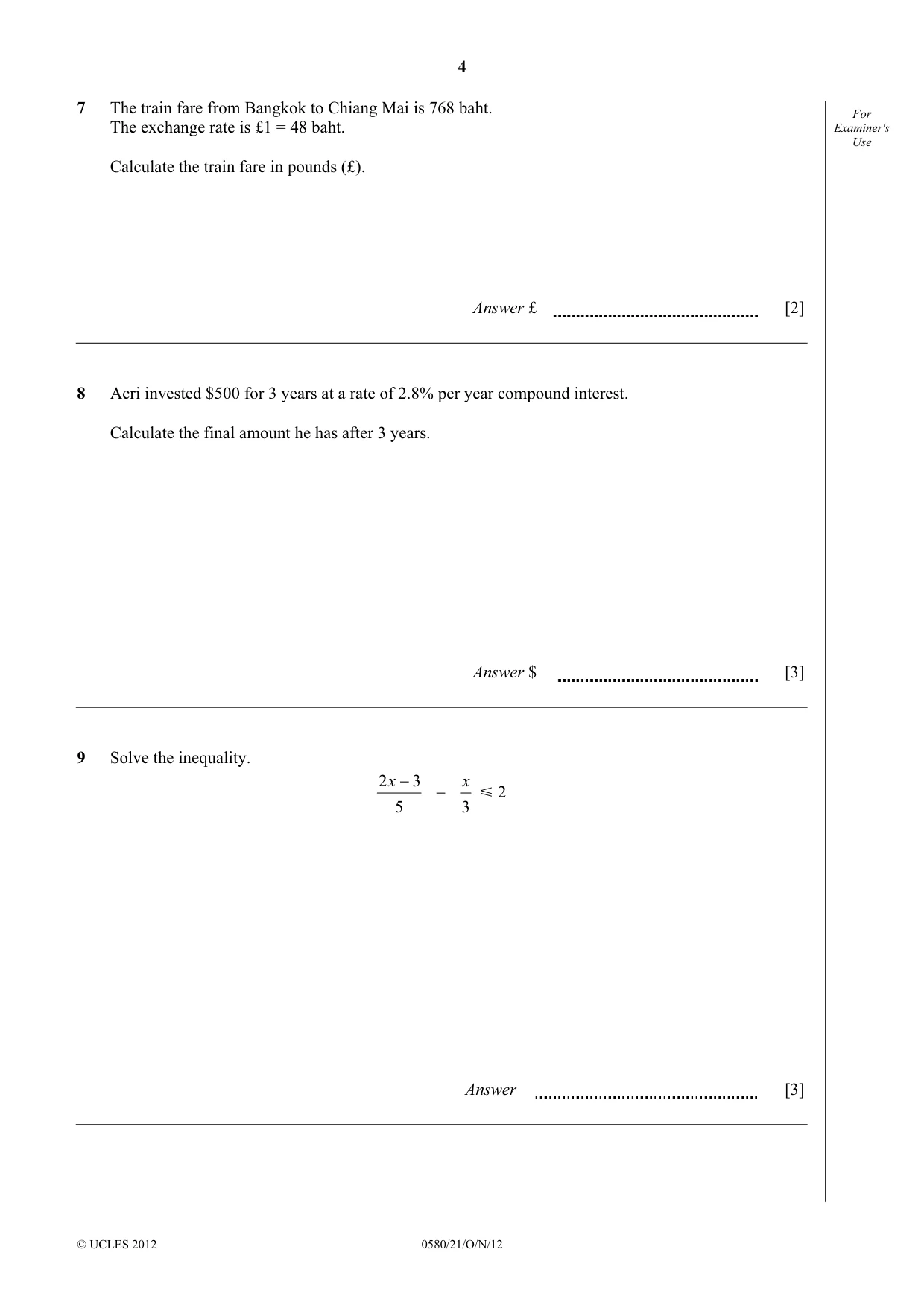
7 The train fare from Bangkok to Chiang Mai is 768 baht. For The exchange rate is £1 = 48 baht. Examiner's Use Calculate the train fare in pounds (£). Answer £ [2]
Mark scheme: 7 16 2 M1 for 768 ÷ 48 3
Q8 · Acri invested $500 for 3 years at a rate of 2.8% per year compound interest
8 Acri invested $500 for 3 years at a rate of 2.8% per year compound interest. Calculate the final amount he has after 3 years. Answer $ [3]
Mark scheme: 8 543.19 3 M2 for 500 × 1.0283 oe or long method or M1 for 500 × 1.028n , n = 2 or 4
Question 9
9 Solve the inequality. 2 x − 3 x − Y=2 5 3 Answer [3]
Mark scheme: 9 x Y 39 www 3 M1 correct first move M1 correct 2nd move M1 correct move to answer line
Q10 · A large water bottle holds 25 litres of water correct to the nearest litre
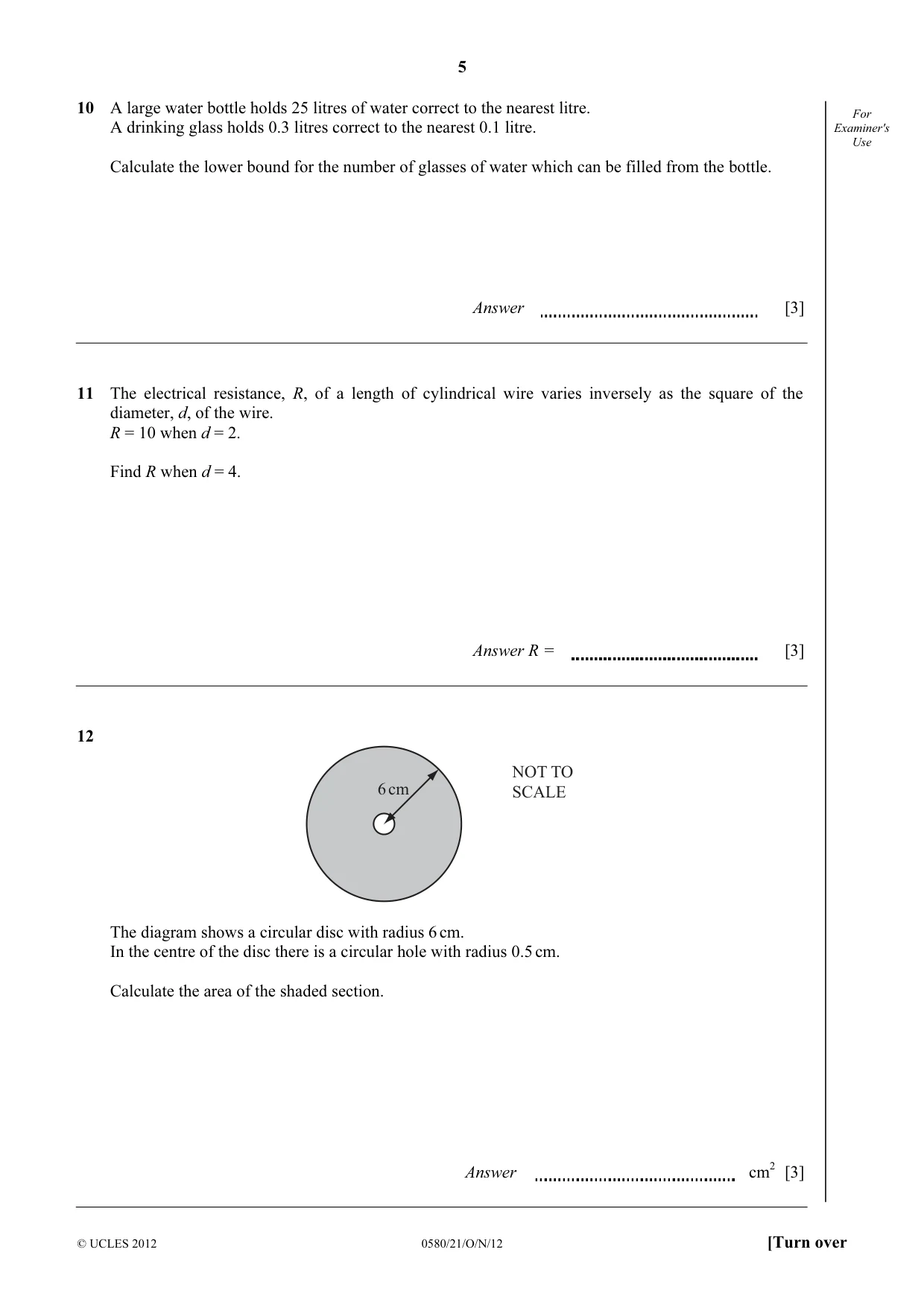
10 A large water bottle holds 25 litres of water correct to the nearest litre. For A drinking glass holds 0.3 litres correct to the nearest 0.1 litre. Examiner's Use Calculate the lower bound for the number of glasses of water which can be filled from the bottle. Answer [3]
Mark scheme: 10 70 3 B1 24.5 or 0.35 seen M1 their LB ÷ their UB 2
Q11 · The electrical resistance, R, of a length of cylindrical wire varies inversely as the…
11 The electrical resistance, R, of a length of cylindrical wire varies inversely as the square of the diameter, d, of the wire. R = 10 when d = 2. Find R when d = 4. Answer R = [3]
Mark scheme: 11 2.5 3 M1 R = k/d2 A1 k = 40 or M1 Rd2 = k A1 k = 40 2 2
Q12 · NOT TO 6 cm SCALE The diagram shows a circular disc with radius 6 cm
12 NOT TO 6 cm SCALE The diagram shows a circular disc with radius 6 cm. In the centre of the disc there is a circular hole with radius 0.5 cm. Calculate the area of the shaded section. Answer cm2 [3]
Mark scheme: 12 112 or 112.3 to 112.33 3 M2 for π × 62 – π × 0.52 or M1 for π × 62 or π × 0.52 seen IGCSE – October/November 2012 0580 21
Q13 · Find the matrix which represents the combined transformation of a reflection in the x…
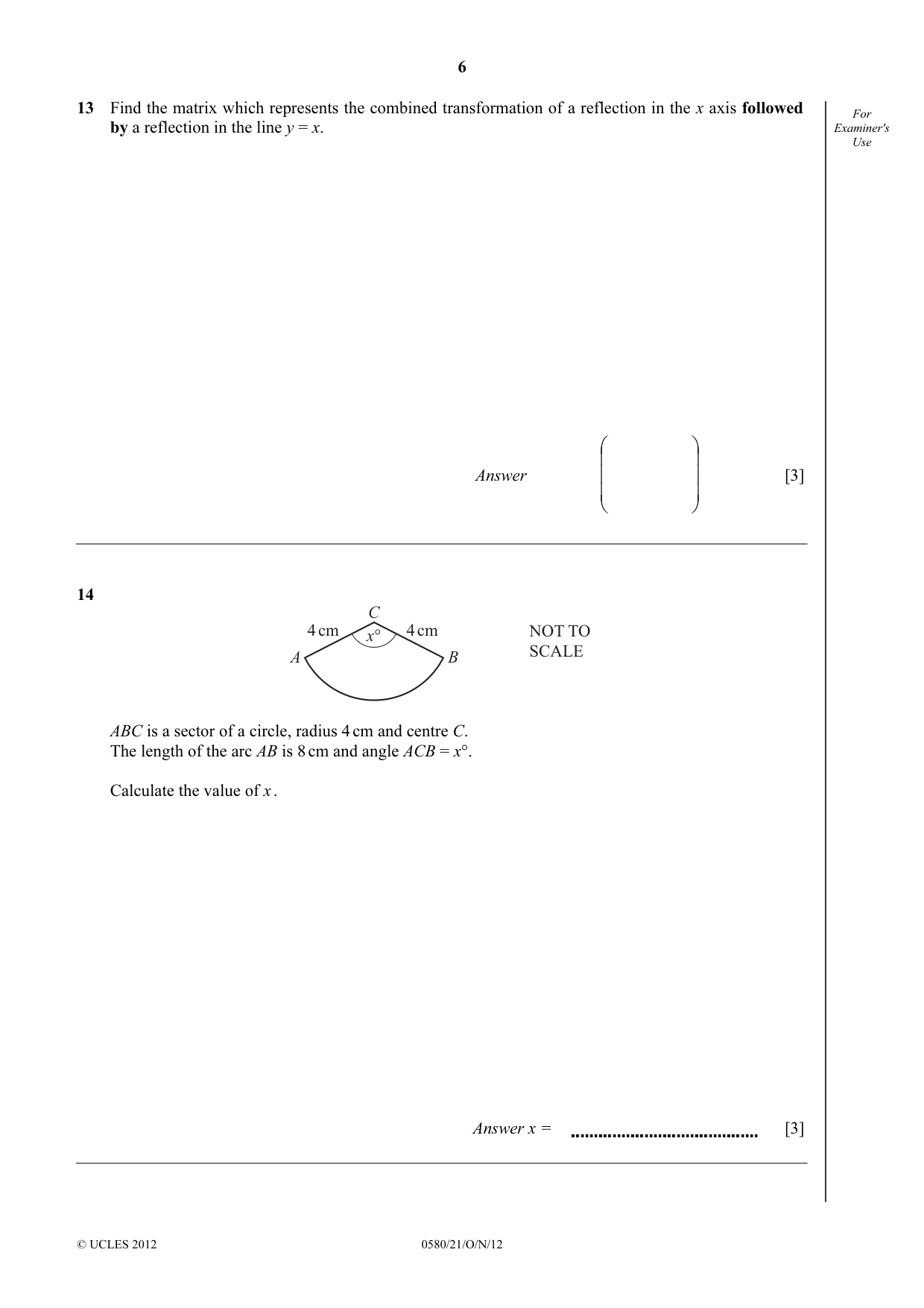
13 Find the matrix which represents the combined transformation of a reflection in the x axis followed For by a reflection in the line y = x. Examiner's Use Answer [3]
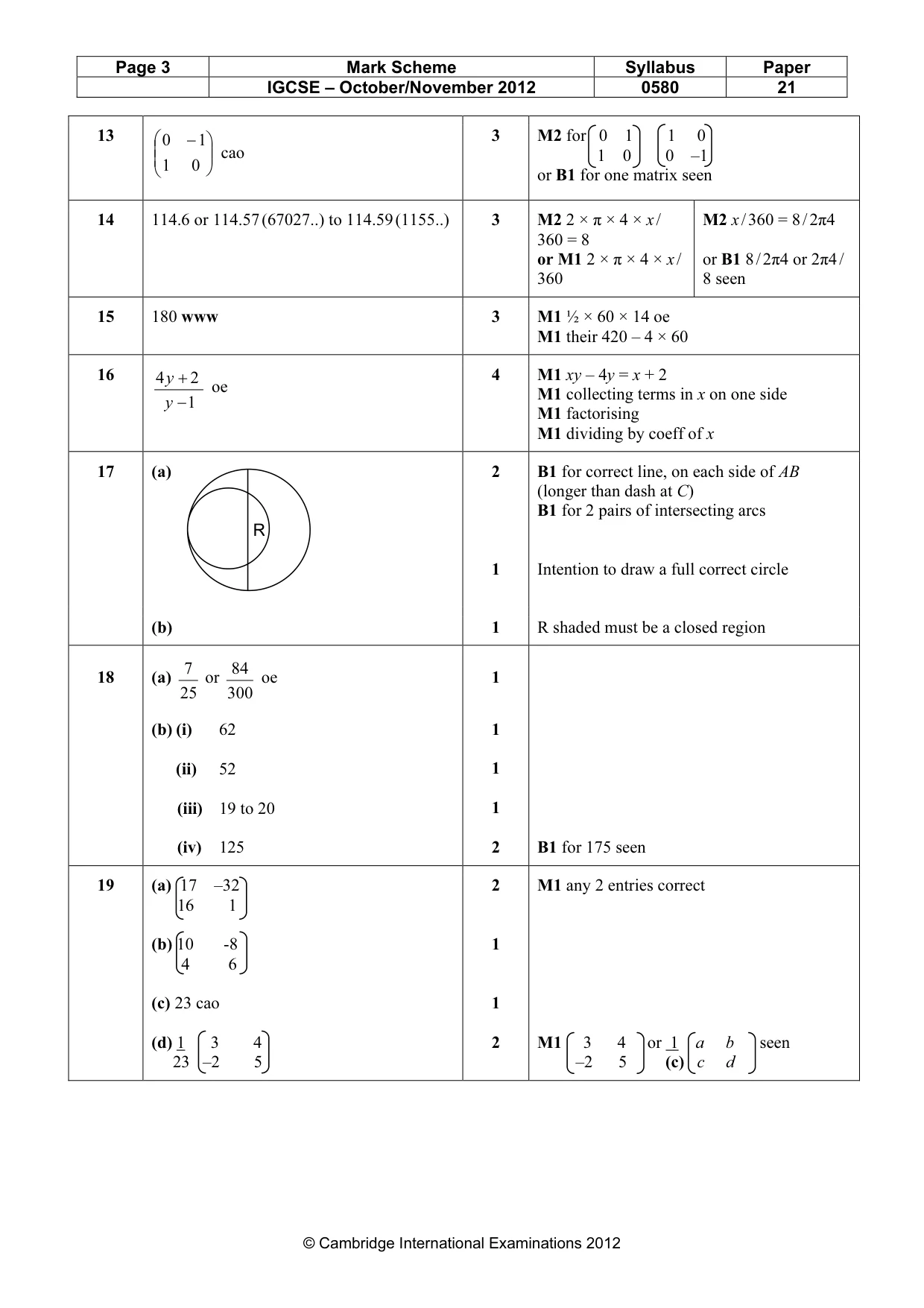
Mark scheme: 13 0 − 1 3 M2 for 0 1 1 0 cao 1 0 0 –1 1 0 or B1 for one matrix seen
Q14 · C 4 cm 4 cm NOT TO x° SCALE A B ABC is a sector of a circle, radius 4 cm and centre C
14 C 4 cm 4 cm NOT TO x° SCALE A B ABC is a sector of a circle, radius 4 cm and centre C. The length of the arc AB is 8 cm and angle ACB = x°. Calculate the value of x . Answer x = [3]
Mark scheme: 14 114.6 or 114.57 (67027..) to 114.59 (1155..) 3 M2 2 × π × 4 × x / M2 x / 360 = 8 / 2π4 360 = 8 or M1 2 × π × 4 × x / or B1 8 / 2π4 or 2π4 / 360 8 seen
Q15 · For Examiner's 14 Use Speed (metres per second) 0 20 40 60 Time (seconds) The diagram…
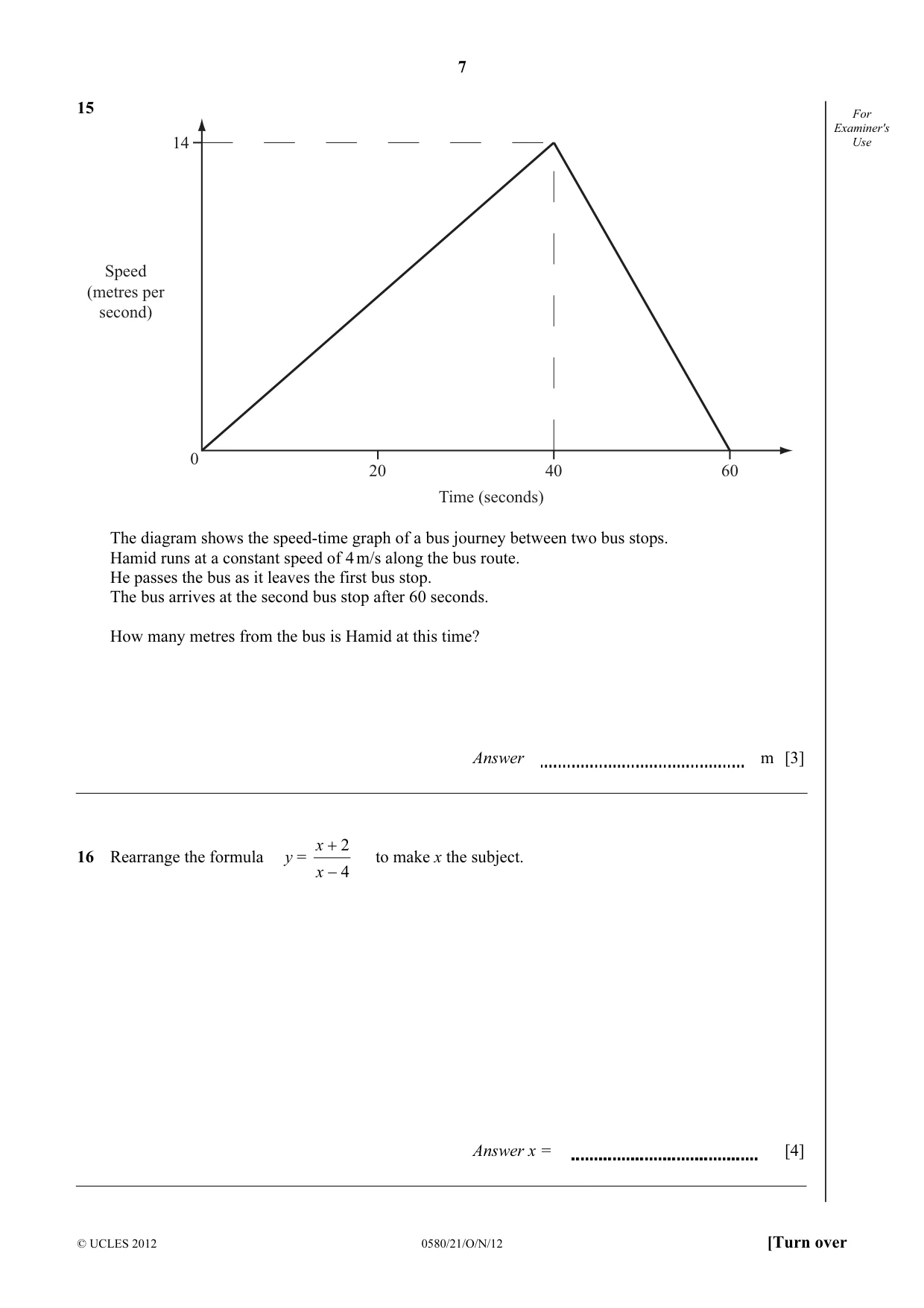
15 For Examiner's 14 Use Speed (metres per second) 0 20 40 60 Time (seconds) The diagram shows the speed-time graph of a bus journey between two bus stops. Hamid runs at a constant speed of 4 m/s along the bus route. He passes the bus as it leaves the first bus stop. The bus arrives at the second bus stop after 60 seconds. How many metres from the bus is Hamid at this time? Answer m [3] x + 2
Mark scheme: 15 180 www 3 M1 ½ × 60 × 14 oe M1 their 420 – 4 × 60
Q16 · Rearrange the formula y = to make x the subject
16 Rearrange the formula y = to make x the subject. x − 4 Answer x = [4]
Mark scheme: 16 4 + 2 4 M1 xy – 4y = x + 2 y oe − 1 M1 collecting terms in x on one side y M1 factorising M1 dividing by coeff of x
Q17 · For Examiner's Use A B C AB is the diameter of a circle
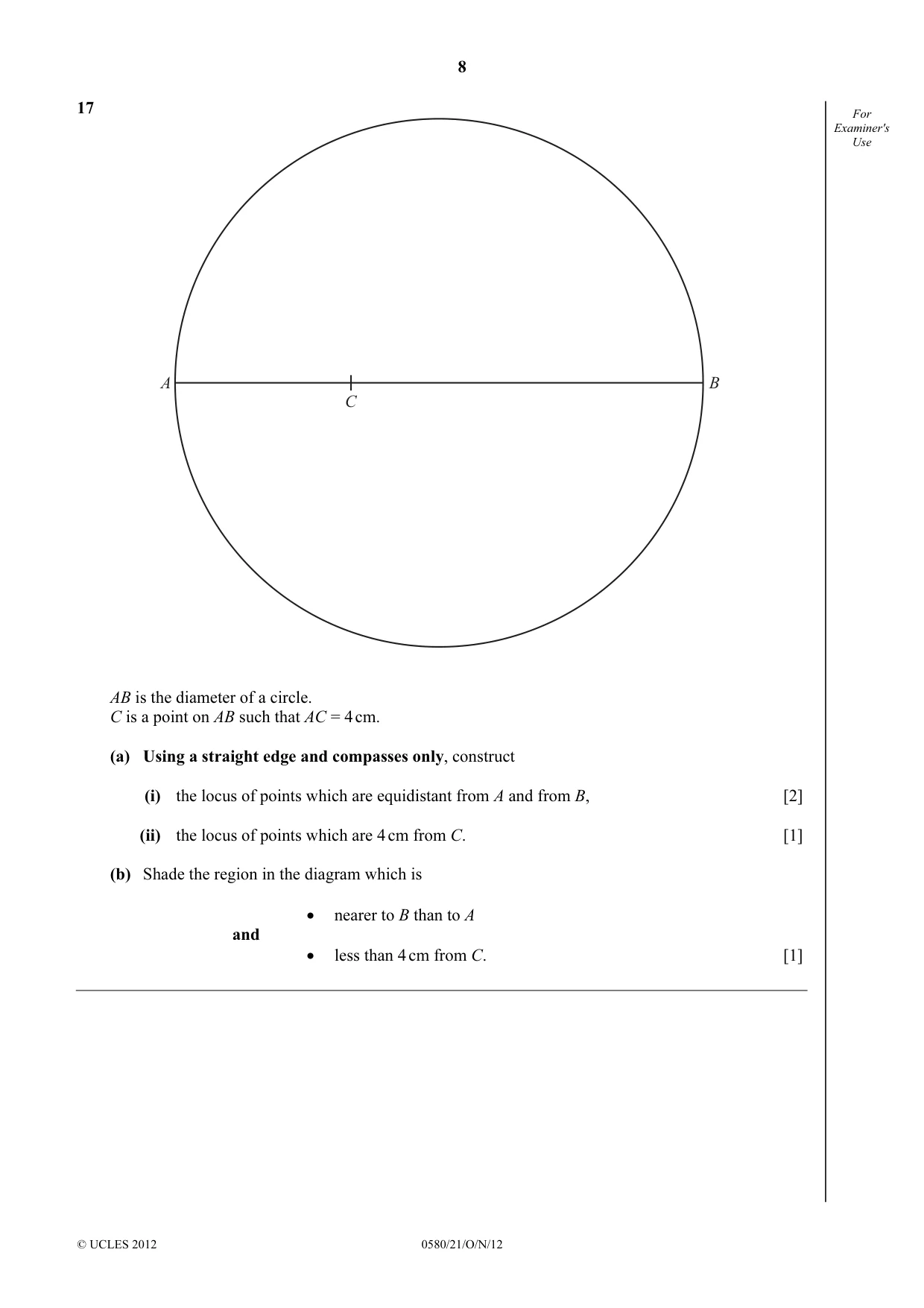
17 For Examiner's Use A B C AB is the diameter of a circle. C is a point on AB such that AC = 4 cm. (a) Using a straight edge and compasses only, construct (i) the locus of points which are equidistant from A and from B, [2] (ii) the locus of points which are 4 cm from C. [1] (b) Shade the region in the diagram which is • nearer to B than to A and • less than 4 cm from C. [1]
Mark scheme: 17 (a) 2 B1 for correct line, on each side of AB (longer than dash at C) B1 for 2 pairs of intersecting arcs R 1 Intention to draw a full correct circle (b) 1 R shaded must be a closed region 7 84
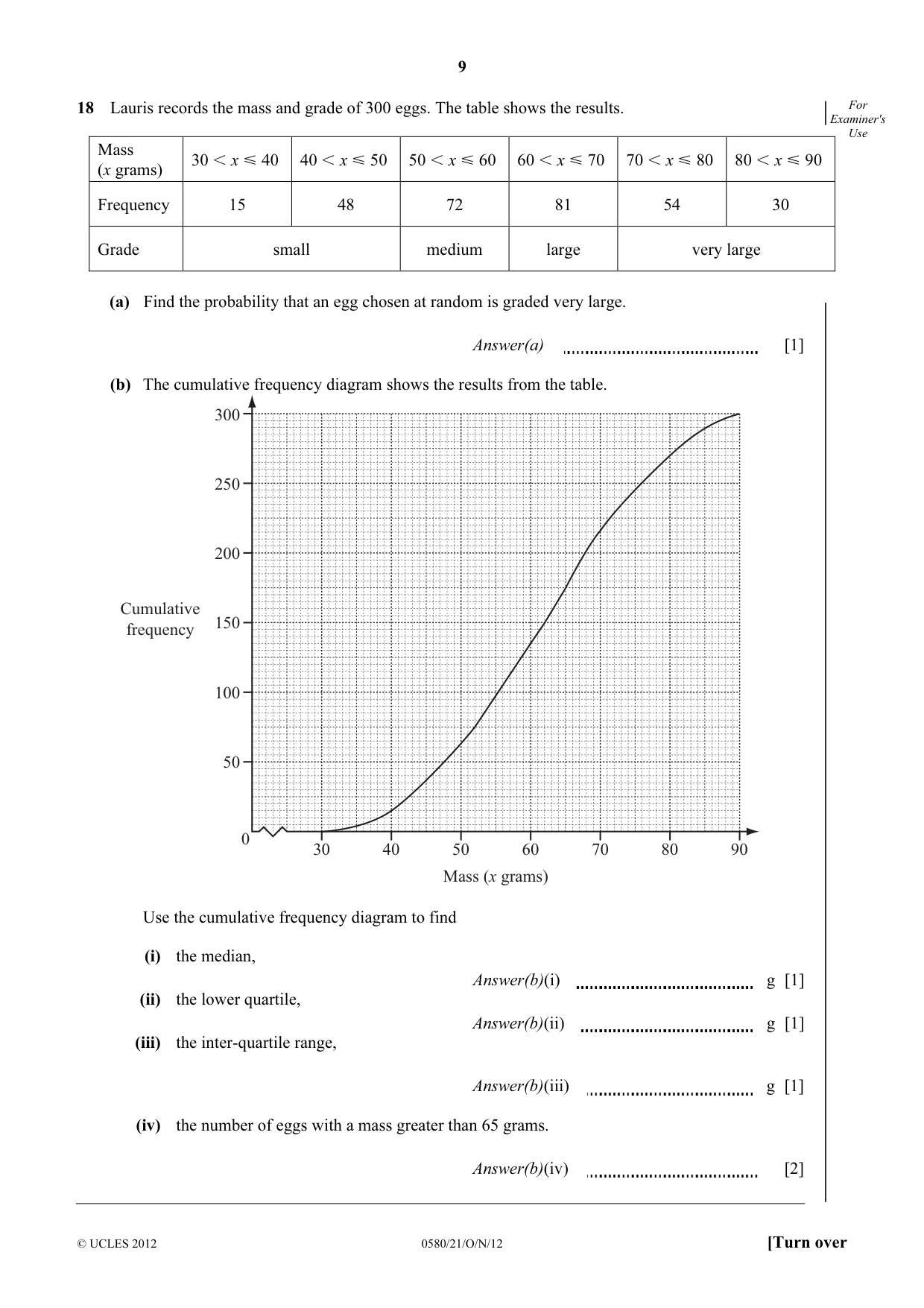
Q18 · Lauris records the mass and grade of 300 eggs
18 Lauris records the mass and grade of 300 eggs. The table shows the results. For Examiner's Use Mass 30 I x Y 40 40 I x Y 50 50 I x Y 60 60 I x Y 70 70 I x Y 80 80 I x Y 90 (x grams) Frequency 15 48 72 81 54 30 Grade small medium large very large (a) Find the probability that an egg chosen at random is graded very large. Answer(a) [1] (b) The cumulative frequency diagram shows the results from the table. 300 250 200 Cumulative 150 frequency 100 50 0 30 40 50 60 70 80 90 Mass (x grams) Use the cumulative frequency diagram to find (i) the median, Answer(b)(i) g [1] (ii) the lower quartile, Answer(b)(ii) g [1] (iii) the inter-quartile range, Answer(b)(iii) g [1] (iv) the number of eggs with a mass greater than 65 grams. Answer(b)(iv) [2]
Mark scheme: 7 84 18 (a) or oe 1 25 300 (b) (i) 62 1 (ii) 52 1 (iii) 19 to 20 1 (iv) 125 2 B1 for 175 seen
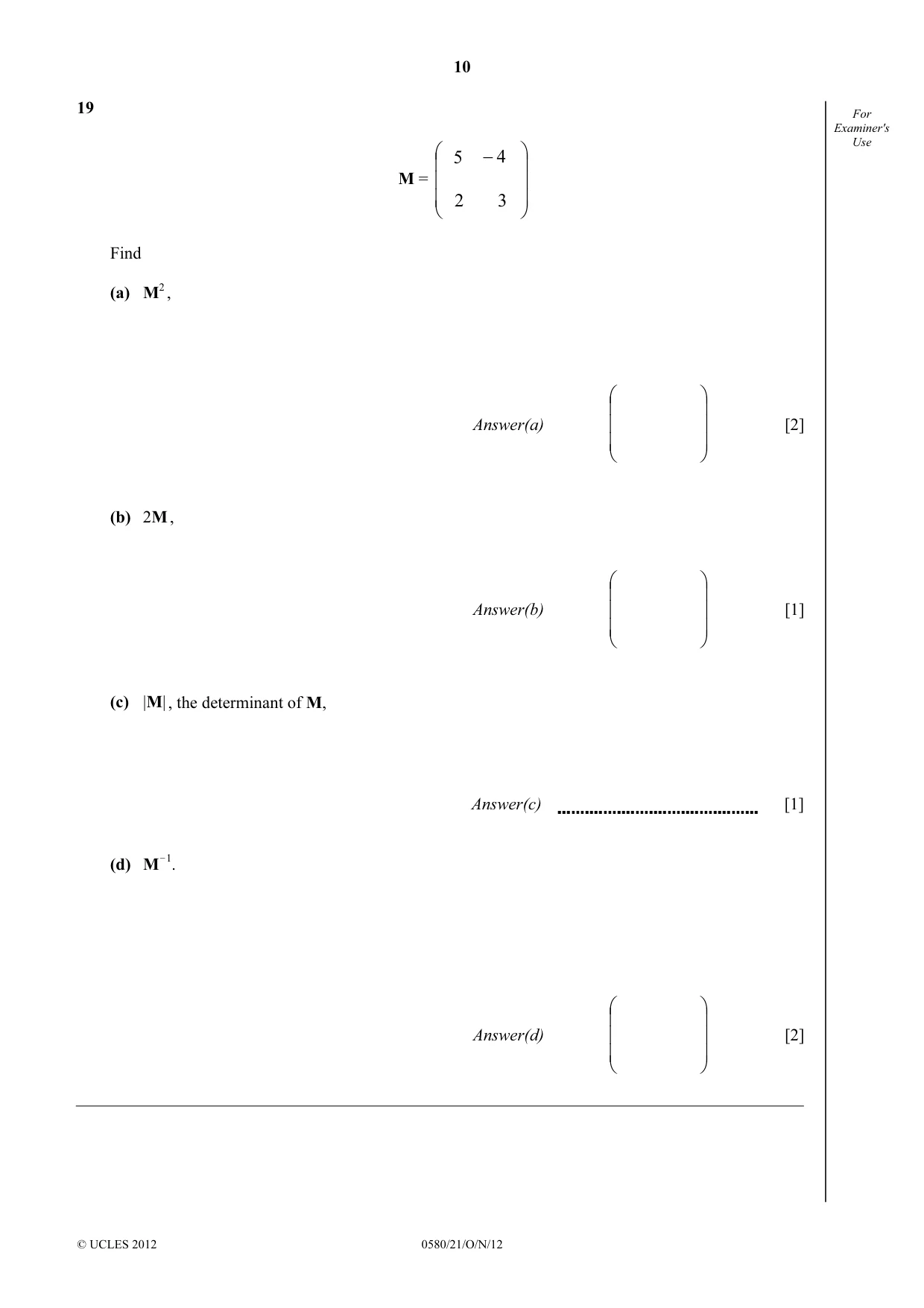
Q19 · For Examiner's Use 5 − 4 M = 2 3 Find (a) M2 , Answer(a) …
19 For Examiner's Use 5 − 4 M = 2 3 Find (a) M2 , Answer(a) [2] (b) 2M , Answer(b) [1] (c) |M| , the determinant of M, Answer(c) [1] (d) MO1. Answer(d) [2]
Mark scheme: 19 (a) 17 –32 2 M1 any 2 entries correct 16 1 (b) 10 -8 1 4 6 (c) 23 cao 1 (d) 1 3 4 2 M1 3 4 or 1 a b seen 23 –2 5 –2 5 (c) c d IGCSE – October/November 2012 0580 21
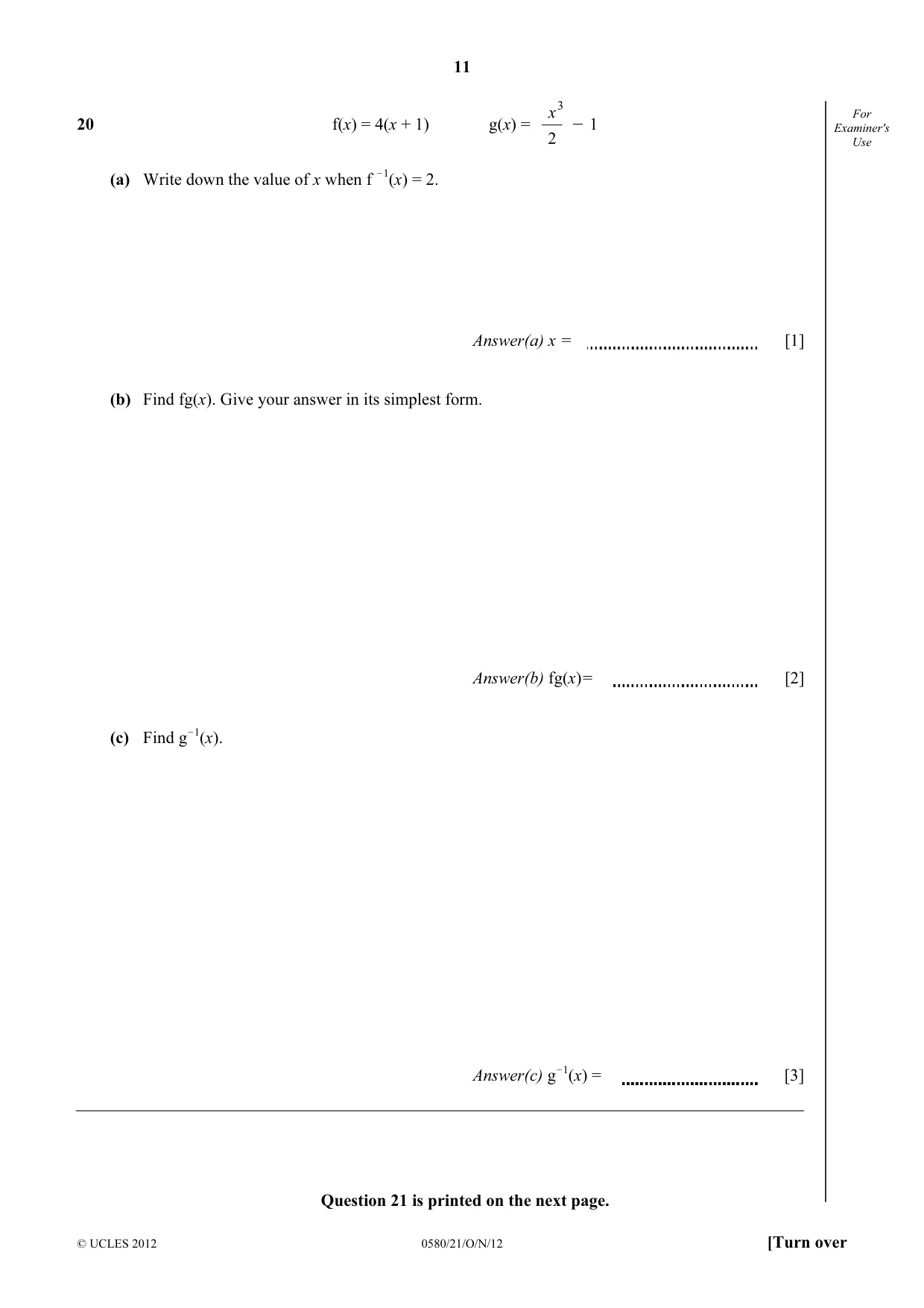
Q20 · X 3 For 20 f(x) = 4(x + 1) g(x) = O 1 Examiner's 2 Use (a) Write down the value of x when…
x 3 For 20 f(x) = 4(x + 1) g(x) = O 1 Examiner's 2 Use (a) Write down the value of x when f O1(x) = 2. Answer(a) x = [1] (b) Find fg(x). Give your answer in its simplest form. Answer(b) fg(x)= [2] (c) Find gO1(x). Answer(c) g O1(x) = [3] Question 21 is printed on the next page.
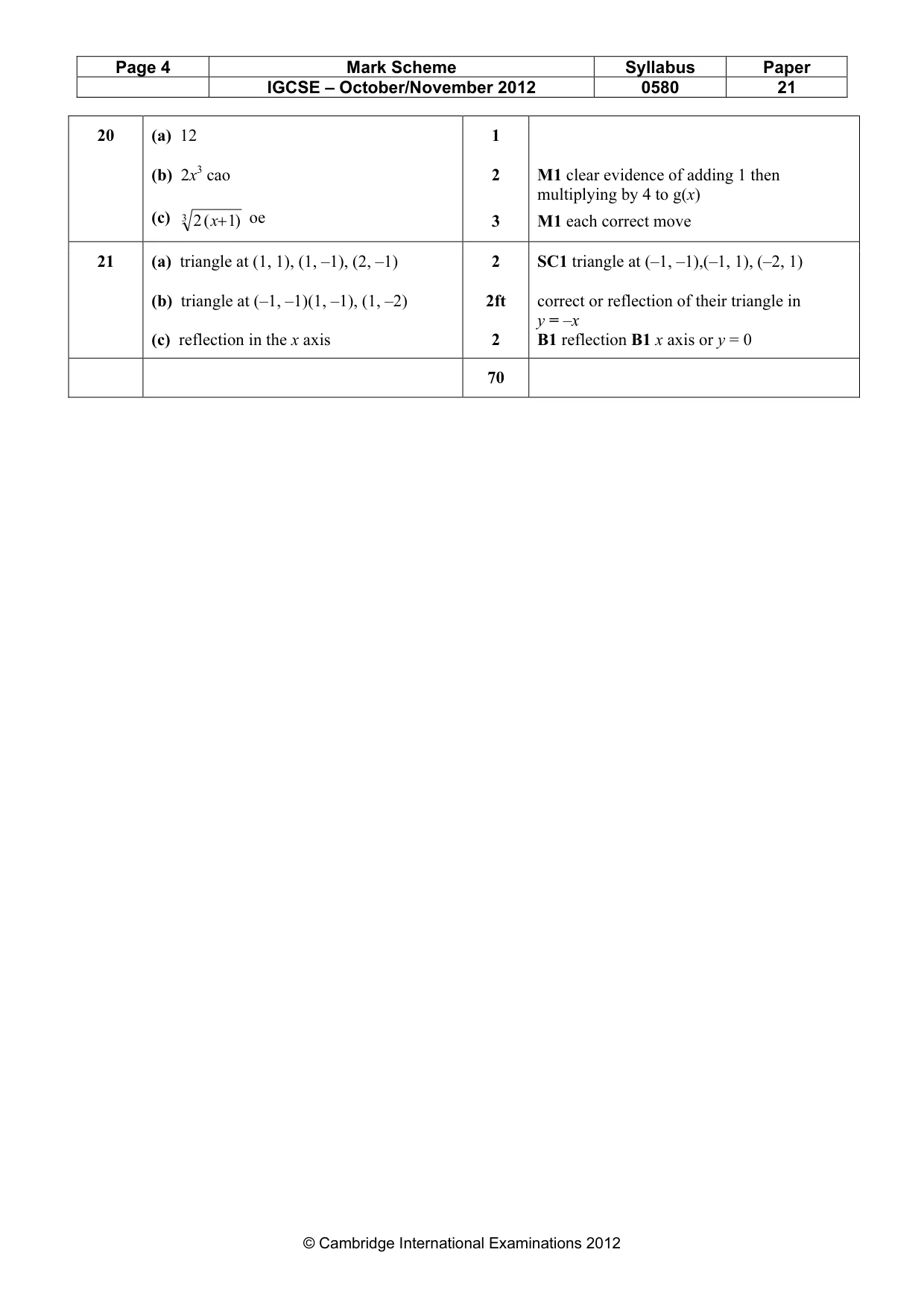
Mark scheme: 20 (a) 12 1 (b) 2x3 cao 2 M1 clear evidence of adding 1 then multiplying by 4 to g(x) (c) 3 2 ( x+ )1 oe 3 M1 each correct move
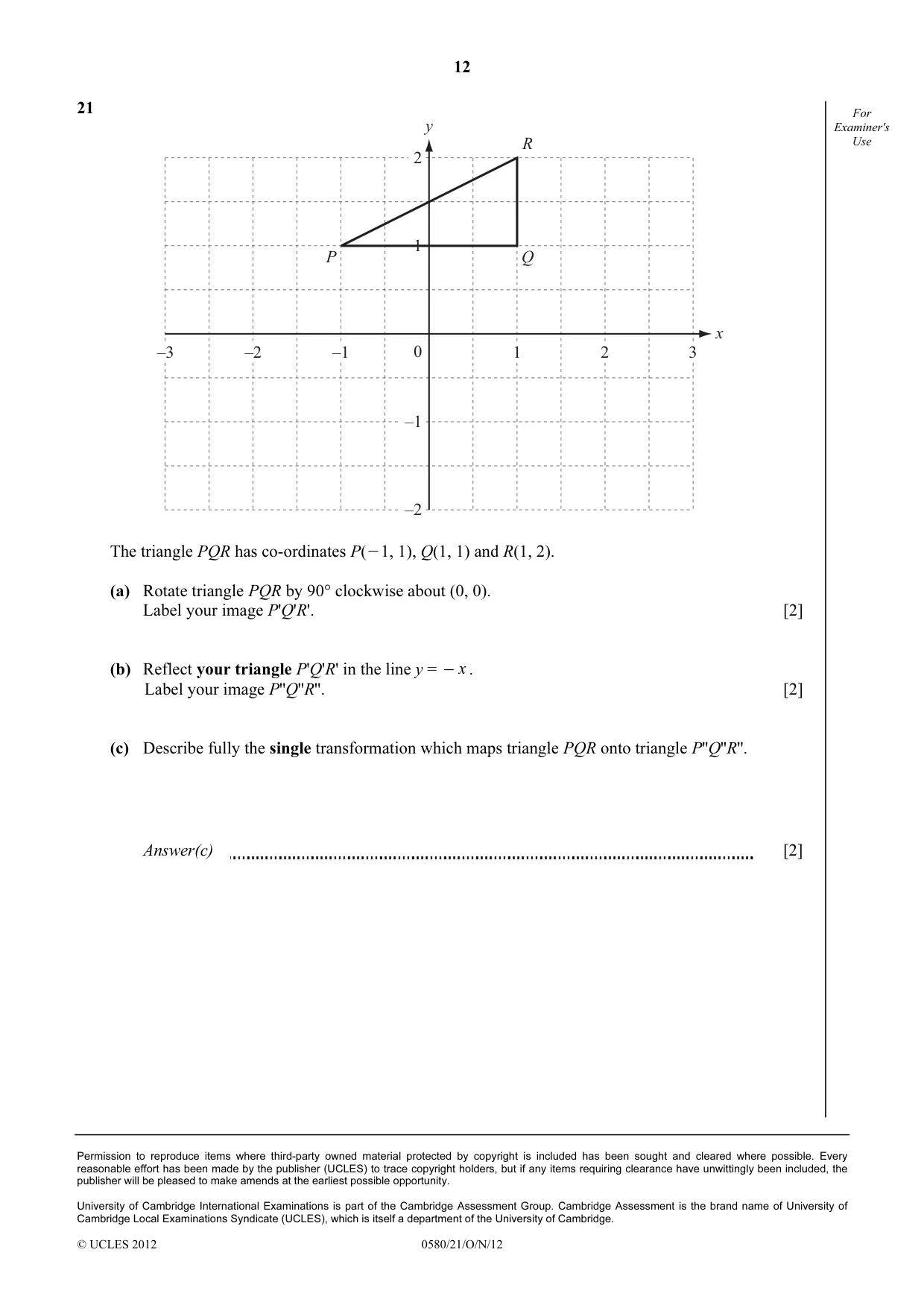
Q21 · For y Examiner's R Use 2 1 P Q x –3 –2 –1 0 1 2 3 –1 –2 The triangle PQR has co-ordinates…
21 For y Examiner's R Use 2 1 P Q x –3 –2 –1 0 1 2 3 –1 –2 The triangle PQR has co-ordinates P(O1, 1), Q(1, 1) and R(1, 2). (a) Rotate triangle PQR by 90° clockwise about (0, 0). Label your image P'Q'R'. [2] (b) Reflect your triangle P'Q'R' in the line y = − x . Label your image P''Q''R''. [2] (c) Describe fully the single transformation which maps triangle PQR onto triangle P''Q''R''. Answer(c) [2]
Mark scheme: 21 (a) triangle at (1, 1), (1, –1), (2, –1) 2 SC1 triangle at (–1, –1),(–1, 1), (–2, 1) (b) triangle at (–1, –1)(1, –1), (1, –2) 2ft correct or reflection of their triangle in y = –x (c) reflection in the x axis 2 B1 reflection B1 x axis or y = 0 70
What was in this paper
The subtopics covered by these 20 questions, and how many questions each got. Open one in a new tab to see every Cambridge question on it.