Cambridge IGCSE Mathematics 0580 — 2014 Oct/Nov Paper 2 · Variant 2
0580/22/O/N/14 · 7 questions · 70 marks · ≈79 min
The question paper and its mark scheme, free to read here and free to download. This is Cambridge’s own paper, exactly as it was sat.
Question paper12 pages
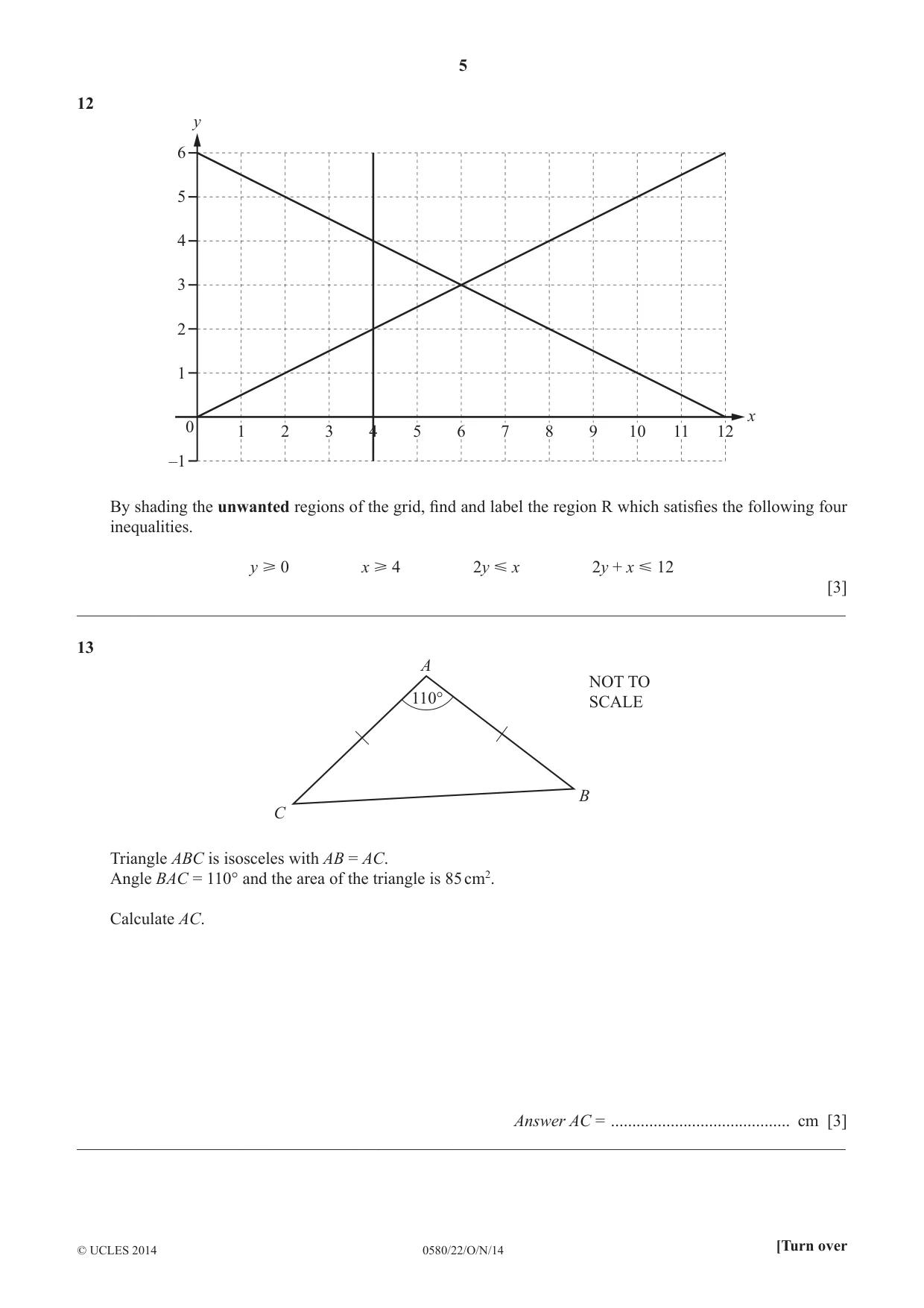
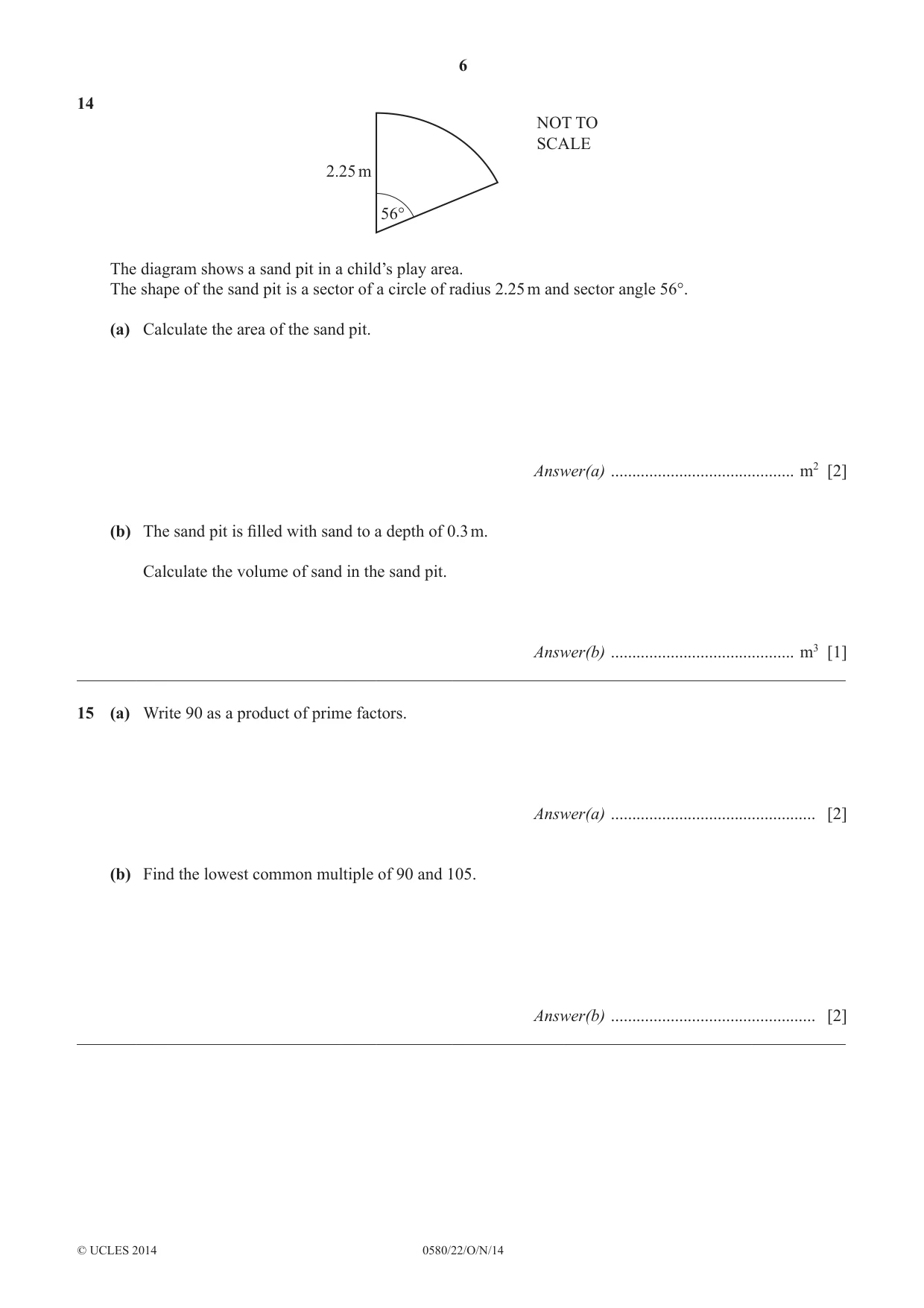
Mark scheme5 pages
Answers below. Sit the paper first if you are practising.
Questions as text
Q15 · Write 90 as a product of prime factors
15 (a) Write 90 as a product of prime factors. Answer(a) ................................................ [2] (b) Find the lowest common multiple of 90 and 105. Answer(b) ................................................ [2] __________________________________________________________________________________________
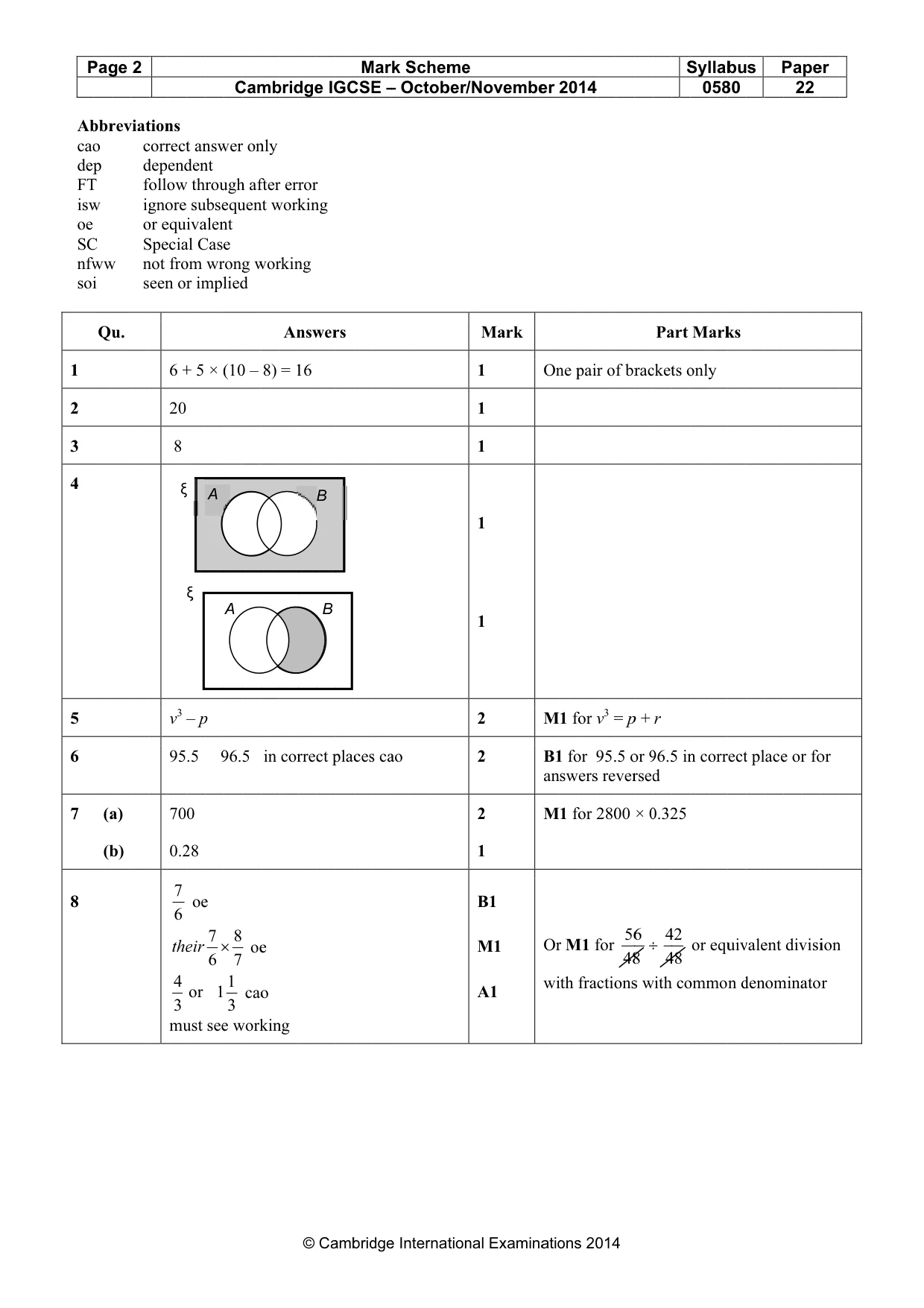
Mark scheme: 15 (a) 2 × 3 × 3 × 5 2 B1 for 2, 3, [3] and 5 identified as only prime factors or M1 for partial prime factorisation 6 × 3 × 5 or 2 × 9 × 5 or 3 × 3 × 10 or 2 × 3 × 15 (b) 630 2 M1 for 2 × 32 × 5 × 7 oe or for listing multiples of 90 and 105 at least up to 630
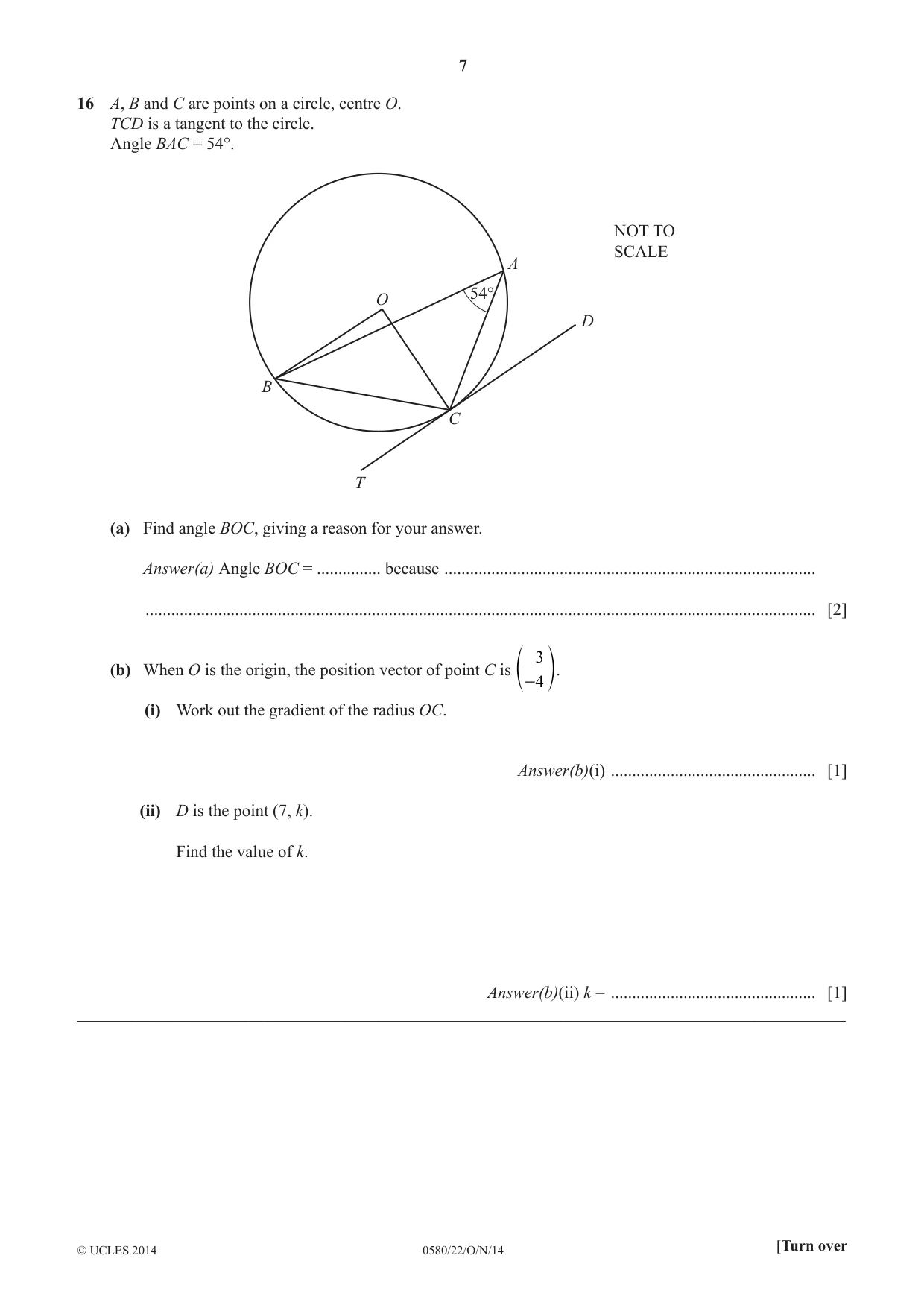
Q16 · A, B and C are points on a circle, centre O
16 A, B and C are points on a circle, centre O. TCD is a tangent to the circle. Angle BAC = 54°. NOT TO SCALE A O 54° D B C T (a) Find angle BOC, giving a reason for your answer. Answer(a) Angle BOC = ............... because ....................................................................................... ............................................................................................................................................................. [2] 3 (b) When O is the origin, the position vector of point C is e-4 o. (i) Work out the gradient of the radius OC. Answer(b)(i) ................................................ [1] (ii) D is the point (7, k). Find the value of k. Answer(b)(ii) k = ................................................ [1] __________________________________________________________________________________________
Mark scheme: 16 (a) 108 1 Angle at centre is twice angle at 1 circumference oe 4 (b) (i) − oe 1 3 (ii) −1 1 2
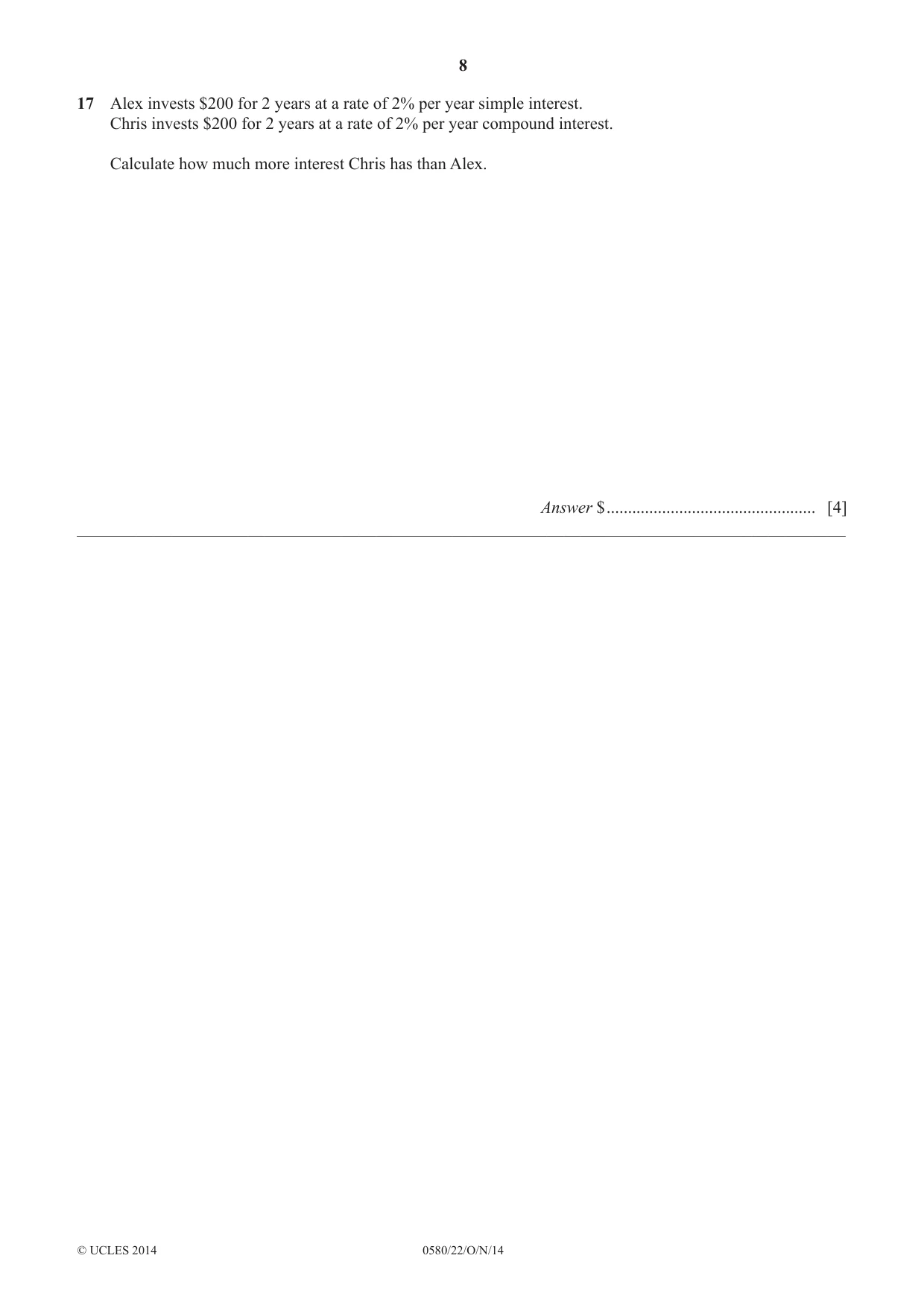
Q17 · Alex invests $200 for 2 years at a rate of 2% per year simple interest
17 Alex invests $200 for 2 years at a rate of 2% per year simple interest. Chris invests $200 for 2 years at a rate of 2% per year compound interest. Calculate how much more interest Chris has than Alex. Answer $ ................................................. [4] __________________________________________________________________________________________
Mark scheme: 17 [0.]08 4 M3 for 200 × + 1 2 2 − 200 − 200 × 2 × 2 oe 100 100 or M1 for 200 × + 1 2 2 100 200 × 2 × 2 and M1 for [+200] 100
Q18 · 72 students are given homework one evening
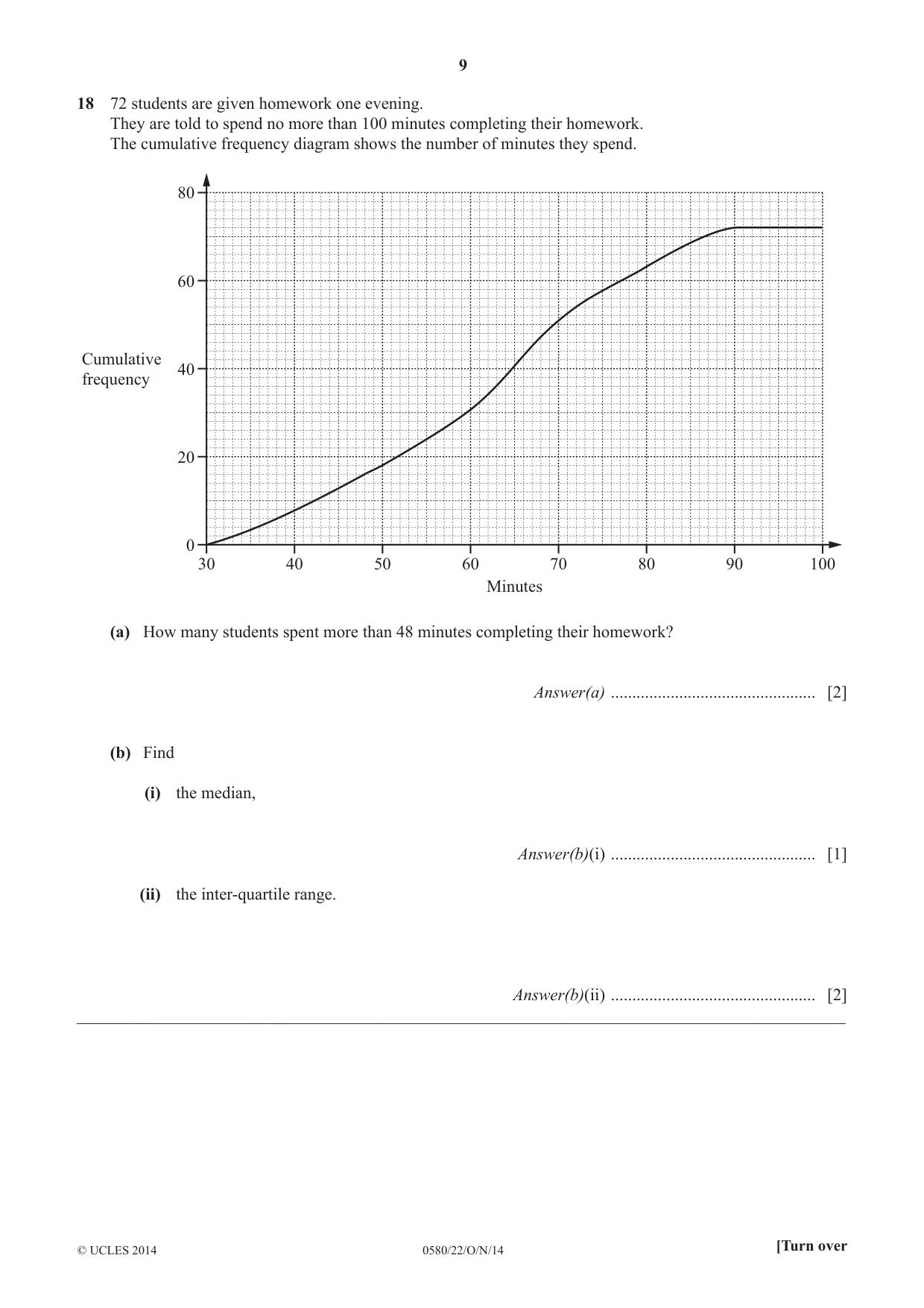
18 72 students are given homework one evening. They are told to spend no more than 100 minutes completing their homework. The cumulative frequency diagram shows the number of minutes they spend. 80 60 Cumulative 40 frequency 20 0 30 40 50 60 70 80 90 100 Minutes (a) How many students spent more than 48 minutes completing their homework? Answer(a) ................................................ [2] (b) Find (i) the median, Answer(b)(i) ................................................ [1] (ii) the inter-quartile range. Answer(b)(ii) ................................................ [2] __________________________________________________________________________________________
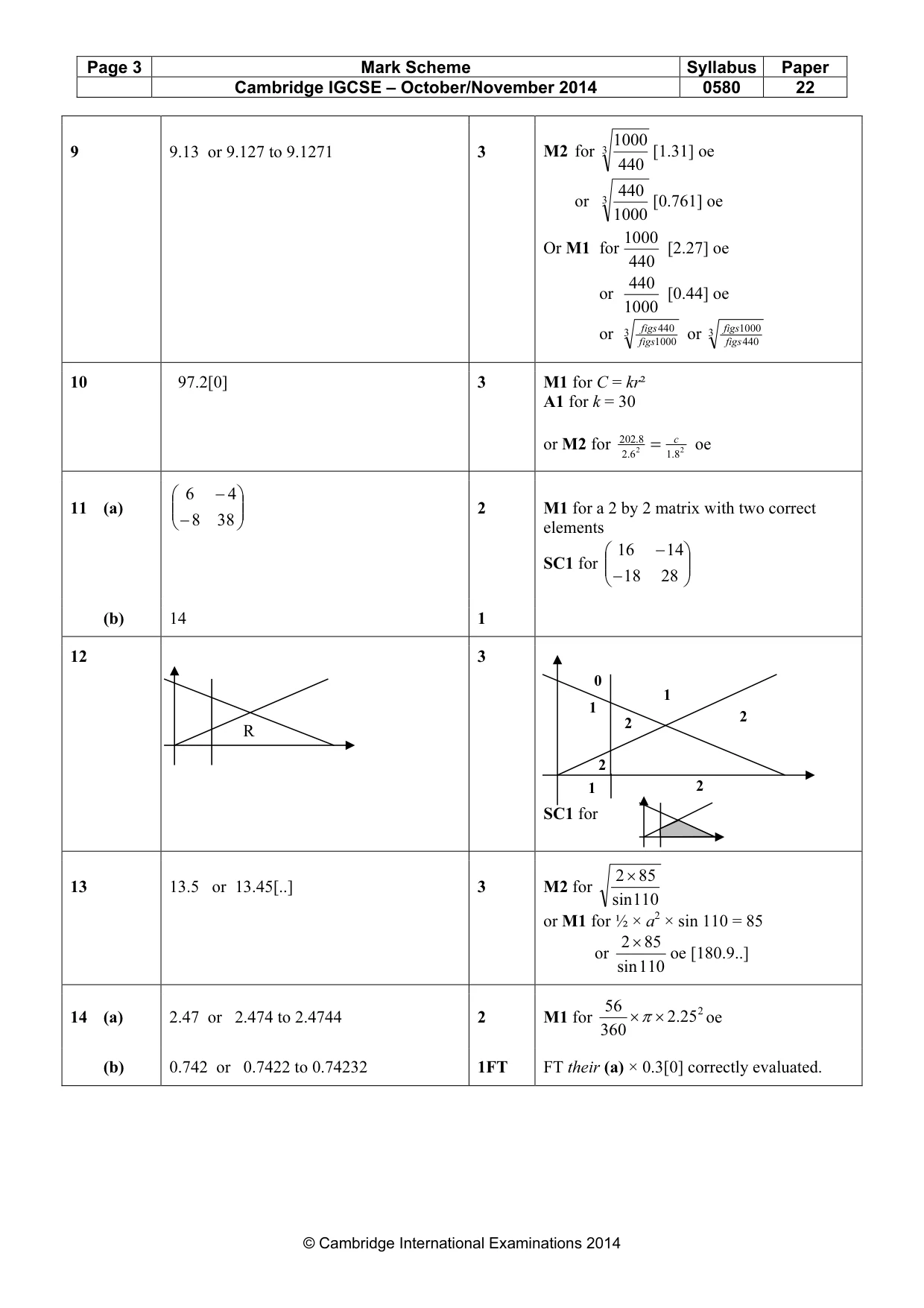
Mark scheme: 18 (a) 56 2 B1 for 16 soi or M1 for 72 – their 16 (b) (i) 63 or 63 to 63.5 1 (ii) 22 or 21.6 to 23 nfww 2 B1 for 49.8 to 50.2 seen or 71.8 to 72.8
Q19 · C B NOT TO c X SCALE O A a The diagram shows a quadrilateral OABC
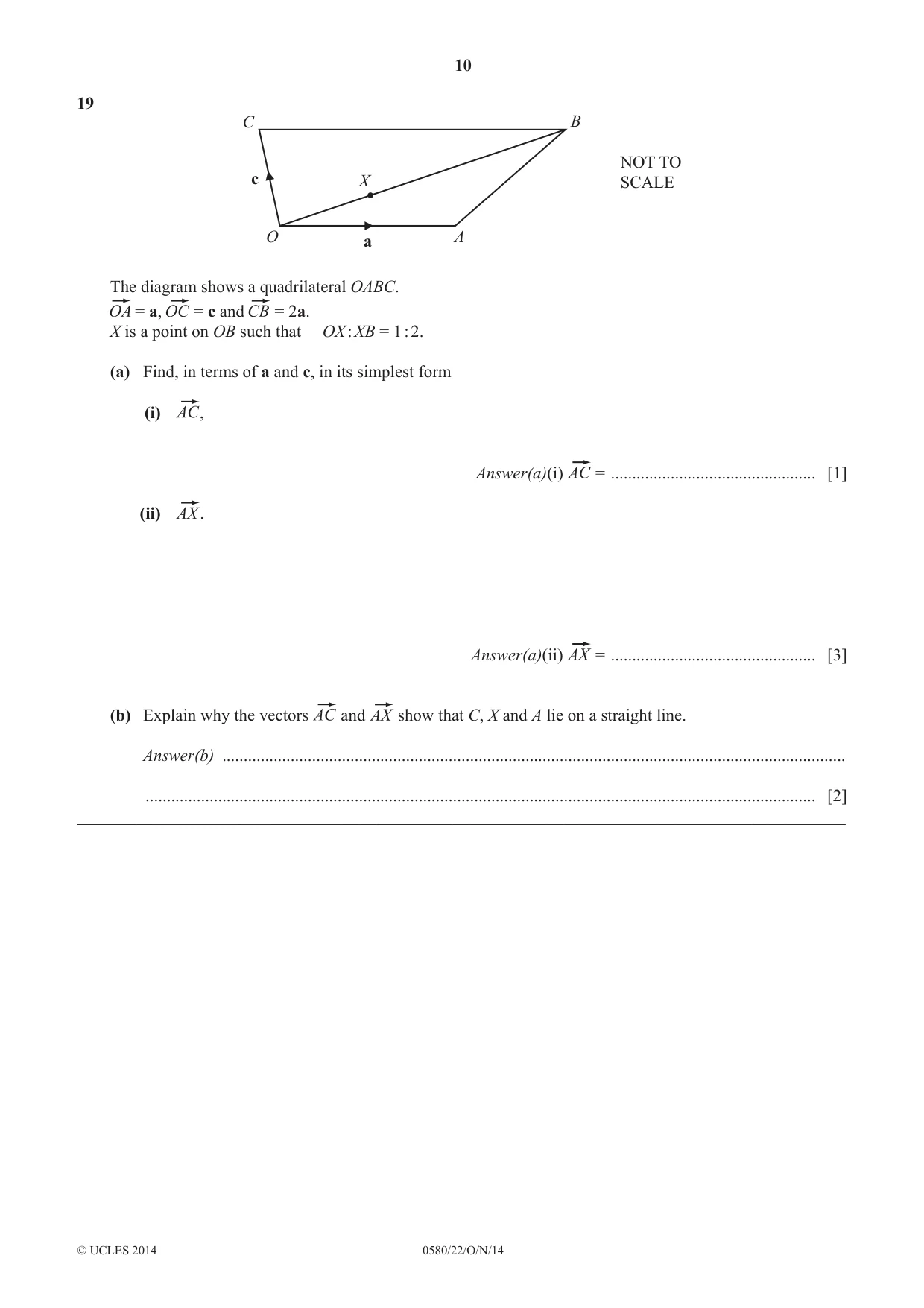
19 C B NOT TO c X SCALE O A a The diagram shows a quadrilateral OABC. = a, = c and = 2a. X is a point on OB such that OX : XB = 1 : 2. (a) Find, in terms of a and c, in its simplest form (i) , Answer(a)(i) = ................................................ [1] (ii) . Answer(a)(ii) = ................................................ [3] (b) Explain why the vectors and show that C, X and A lie on a straight line. Answer(b) .................................................................................................................................................. ............................................................................................................................................................. [2] __________________________________________________________________________________________
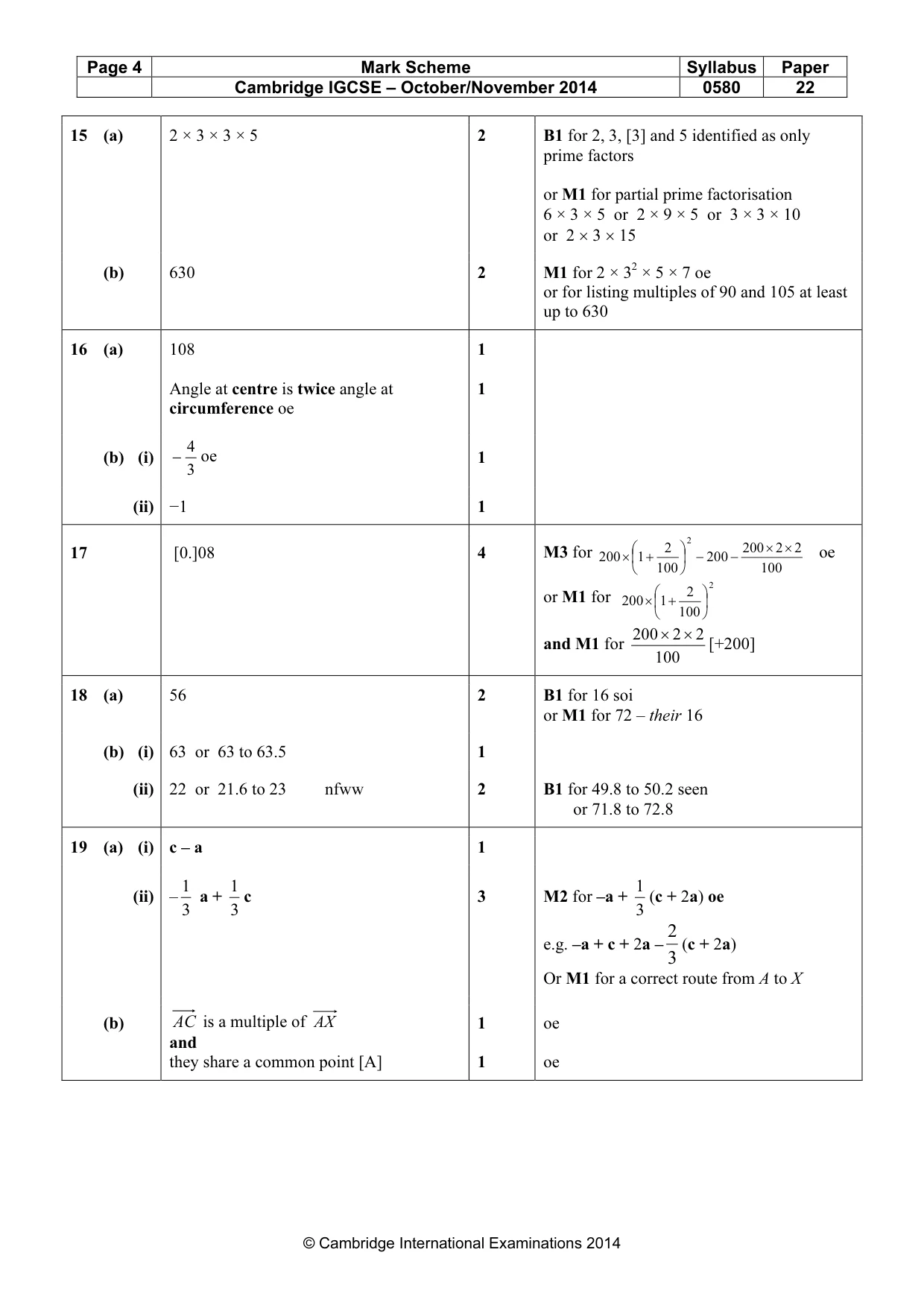
Mark scheme: 19 (a) (i) c – a 1 1 1 1 (ii) – a + c 3 M2 for –a + (c + 2a) oe 3 3 3 2 e.g. –a + c + 2a – (c + 2a) 3 Or M1 for a correct route from A to X (b) AC is a multiple of AX 1 oe and they share a common point [A] 1 oe
Q20 · The diagram shows the plan, ABCD, of a park
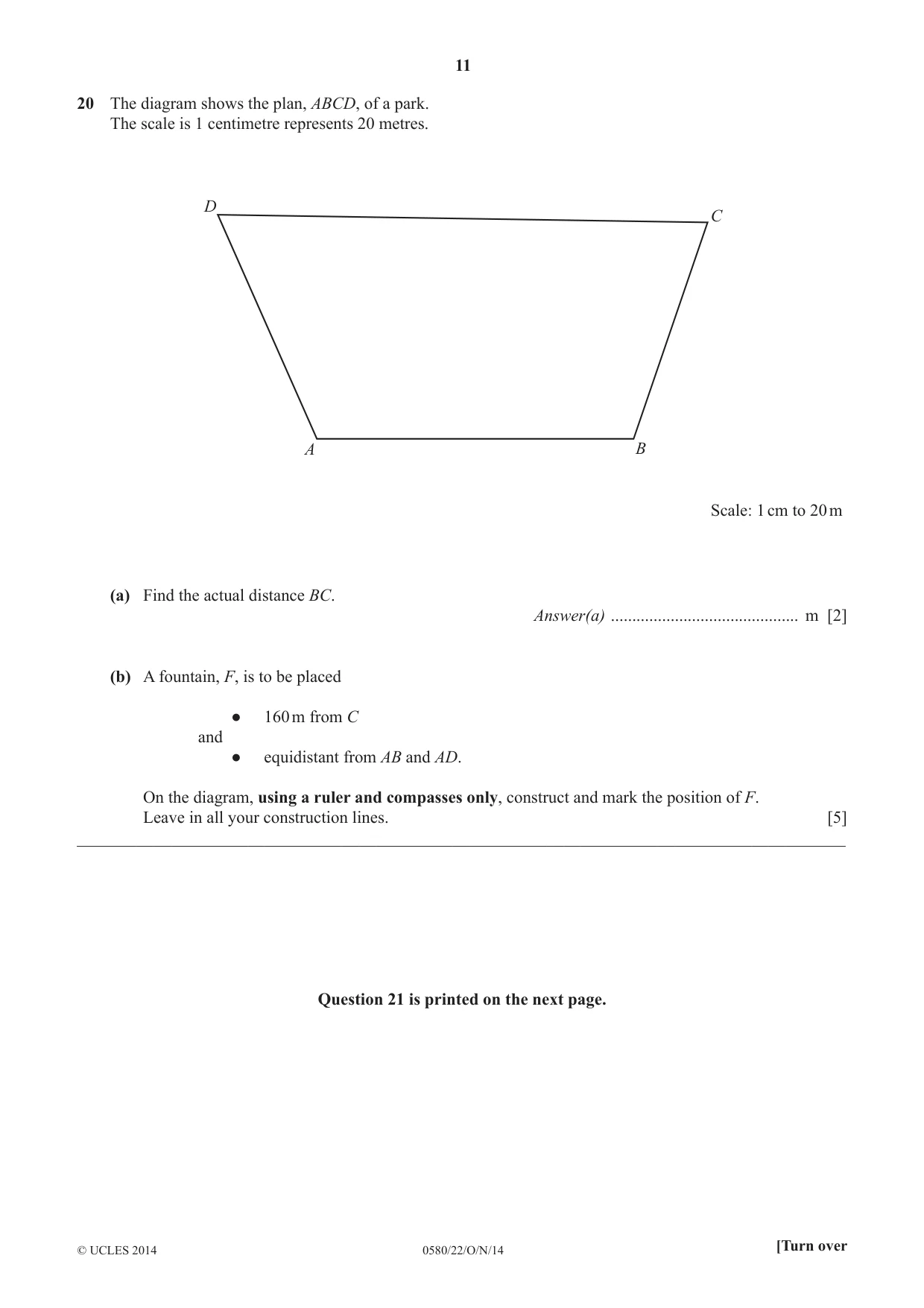
20 The diagram shows the plan, ABCD, of a park. The scale is 1 centimetre represents 20 metres. D C A B Scale: 1 cm to 20 m (a) Find the actual distance BC. Answer(a) ............................................ m [2] (b) A fountain, F, is to be placed ● 160 m from C and ● equidistant from AB and AD. On the diagram, using a ruler and compasses only, construct and mark the position of F. Leave in all your construction lines. [5] __________________________________________________________________________________________ Question 21 is printed on the next page.
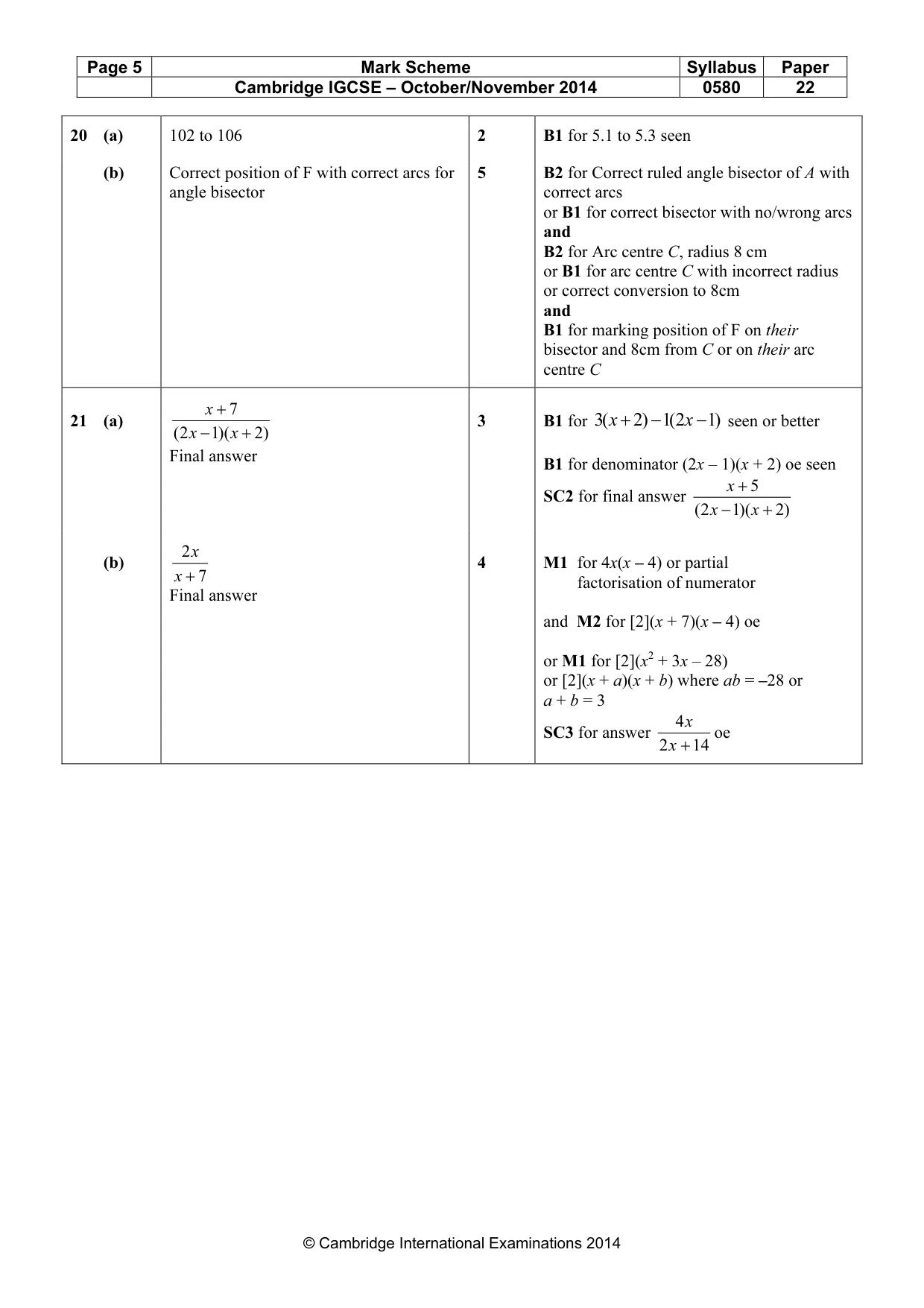
Mark scheme: 20 (a) 102 to 106 2 B1 for 5.1 to 5.3 seen (b) Correct position of F with correct arcs for 5 B2 for Correct ruled angle bisector of A with angle bisector correct arcs or B1 for correct bisector with no/wrong arcs and B2 for Arc centre C, radius 8 cm or B1 for arc centre C with incorrect radius or correct conversion to 8cm and B1 for marking position of F on their bisector and 8cm from C or on their arc centre C x + 7
Q21 · Write as a single fraction in its simplest form
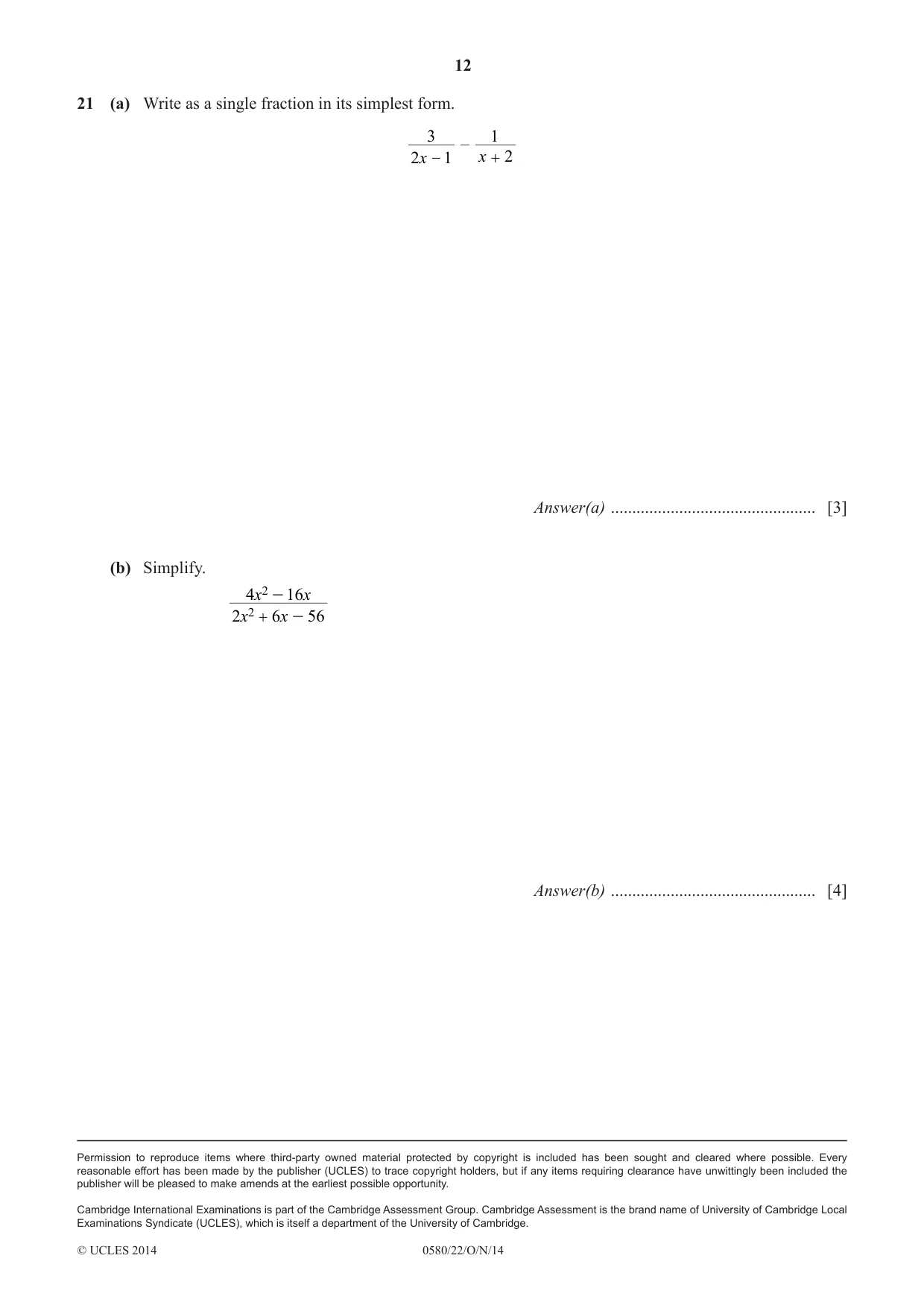
21 (a) Write as a single fraction in its simplest form. 3 1 – 2x - 1 x + 2 Answer(a) ................................................ [3] (b) Simplify. 4x2 - 16 x 2x2 + 6 x - 56 Answer(b) ................................................ [4]
Mark scheme: x + 7 21 (a) 3 B1 for (3 x + )2 − (12 x − )1 seen or better ( 2 x − 1)( x + 2) Final answer B1 for denominator (2x – 1)(x + 2) oe seen x + 5 SC2 for final answer ( 2 x − 1)( x + 2) 2 x (b) 4 M1 for 4x(x – 4) or partial x + 7 factorisation of numerator Final answer and M2 for [2](x + 7)(x – 4) oe or M1 for [2](x2 + 3x – 28) or [2](x + a)(x + b) where ab = –28 or a + b = 3 4 x SC3 for answer oe 2 x + 14
What was in this paper
The subtopics covered by these 7 questions, and how many questions each got. Open one in a new tab to see every Cambridge question on it.
What you needed in this session
Cambridge’s own grade thresholds for 2014 Oct/Nov, Paper 2 · Variant 2. A higher threshold means an easier paper — the bar moves with how the cohort did.