Cambridge IGCSE Mathematics 0580 — 2019 May/June Paper 2 · Variant 3
0580/23/M/J/19 · 25 questions · 70 marks · ≈79 min
The question paper and its mark scheme, free to read here and free to download. This is Cambridge’s own paper, exactly as it was sat.
Question paper16 pages
Mark scheme6 pages
Answers below. Sit the paper first if you are practising.
Questions as text
Q1 · Write 1.8972 correct to 2 decimal places
1 Write 1.8972 correct to 2 decimal places. .................................................... [1]
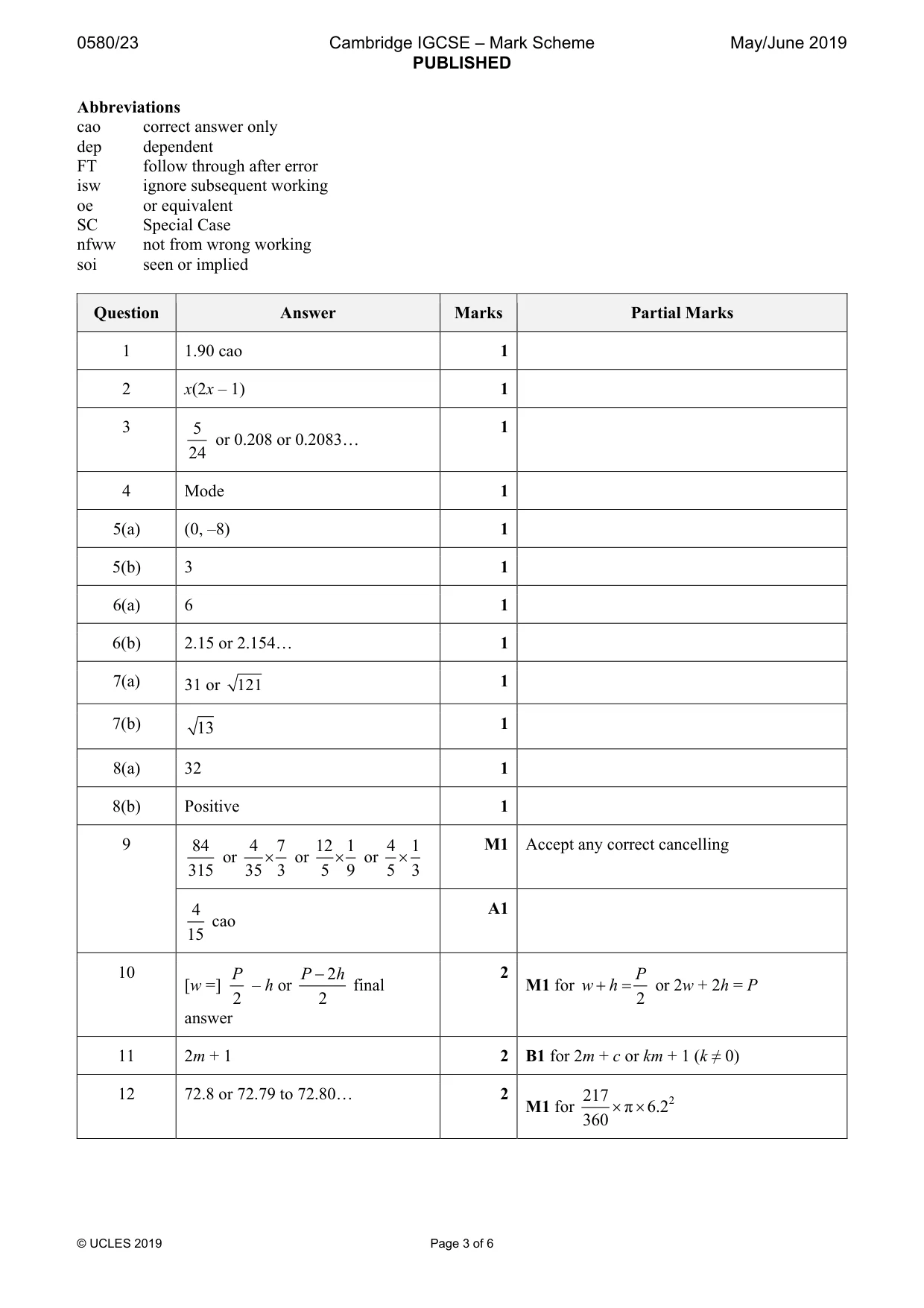
Mark scheme: Question Answer Marks Partial Marks 1 1.90 cao 1
Q2 · Factorise 2x 2 - x
2 Factorise 2x 2 - x . .................................................... [1]
Mark scheme: 2 x(2x – 1) 1
Q3 · Giulio’s reaction times are measured in two games
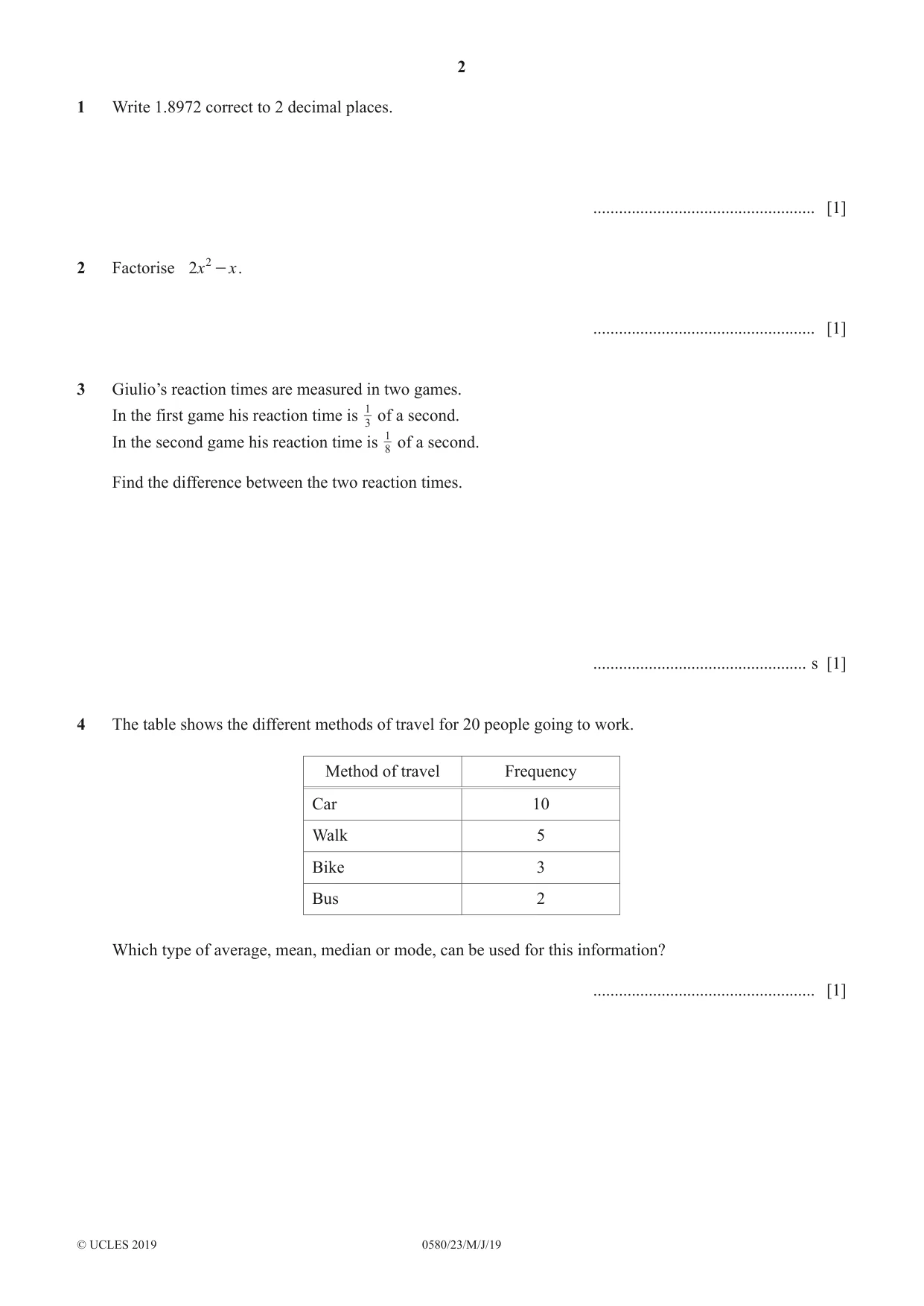
3 Giulio’s reaction times are measured in two games. In the first game his reaction time is 13 of a second. In the second game his reaction time is 18 of a second. Find the difference between the two reaction times. .................................................. s [1]
Mark scheme: 3 5 1 or 0.208 or 0.2083… 24
Q4 · The table shows the different methods of travel for 20 people going to work
4 The table shows the different methods of travel for 20 people going to work. Method of travel Frequency Car 10 Walk 5 Bike 3 Bus 2 Which type of average, mean, median or mode, can be used for this information? .................................................... [1]
Mark scheme: 4 Mode 1
Q5 · Find the co-ordinates of the point where the line y = 3x - 8 crosses the y-axis
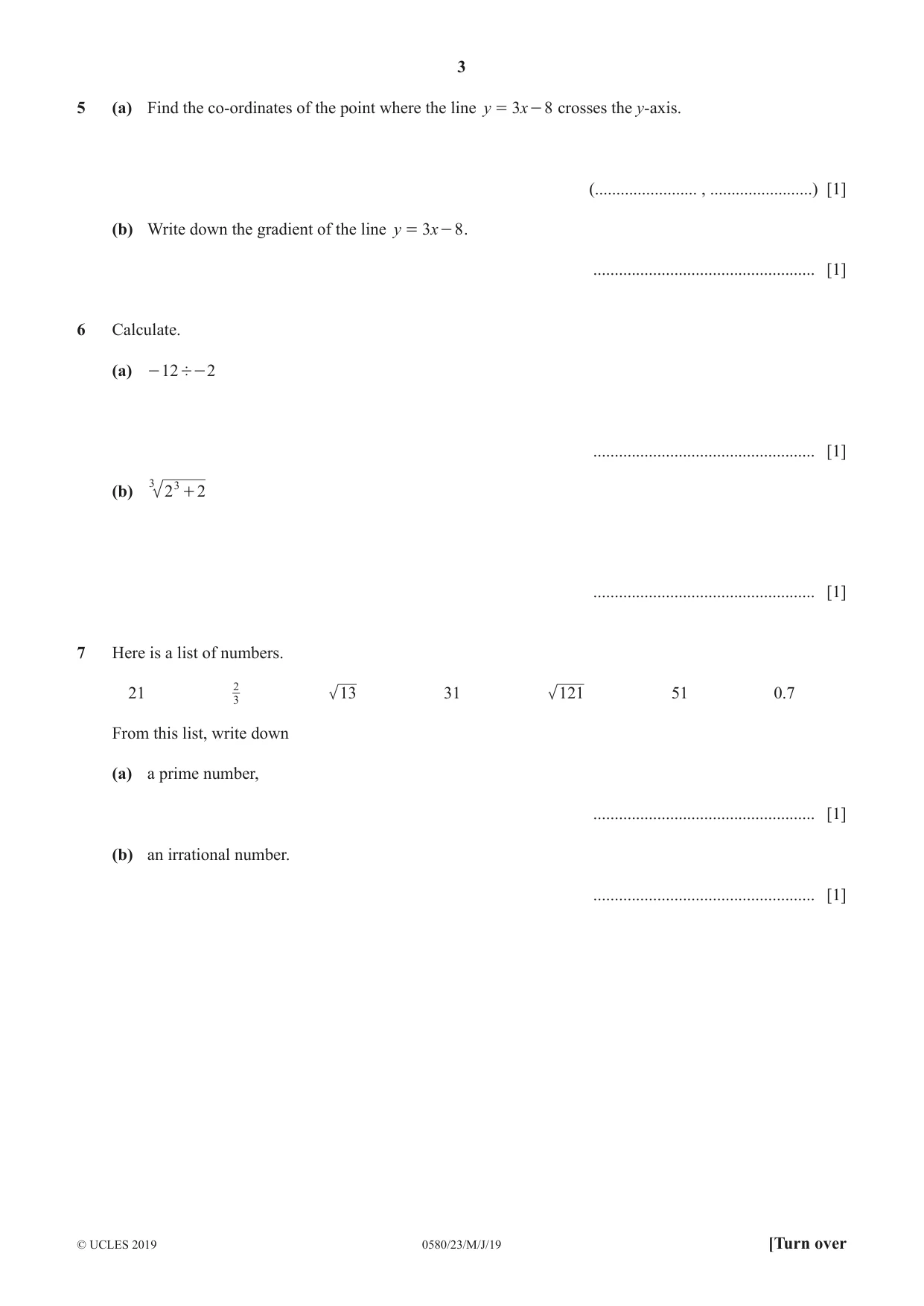
5 (a) Find the co-ordinates of the point where the line y = 3x - 8 crosses the y-axis. (........................ , ........................) [1] (b) Write down the gradient of the line y = 3x - 8 . .................................................... [1]
Mark scheme: 5(a) (0, –8) 1 5(b) 3 1
Question 6
6 Calculate. (a) - 12 ' - 2 .................................................... [1] (b) 3 2 3 + 2 .................................................... [1]
Mark scheme: 6(a) 6 1 6(b) 2.15 or 2.154… 1
Q7 · Here is a list of numbers
7 Here is a list of numbers. 21 23 13 31 121 51 0.7 From this list, write down (a) a prime number, .................................................... [1] (b) an irrational number. .................................................... [1]
Mark scheme: 7(a) 31 or 121 1 7(b) 13 1
Q8 · The scatter diagram shows the number of people and the number of phones in each of 8…
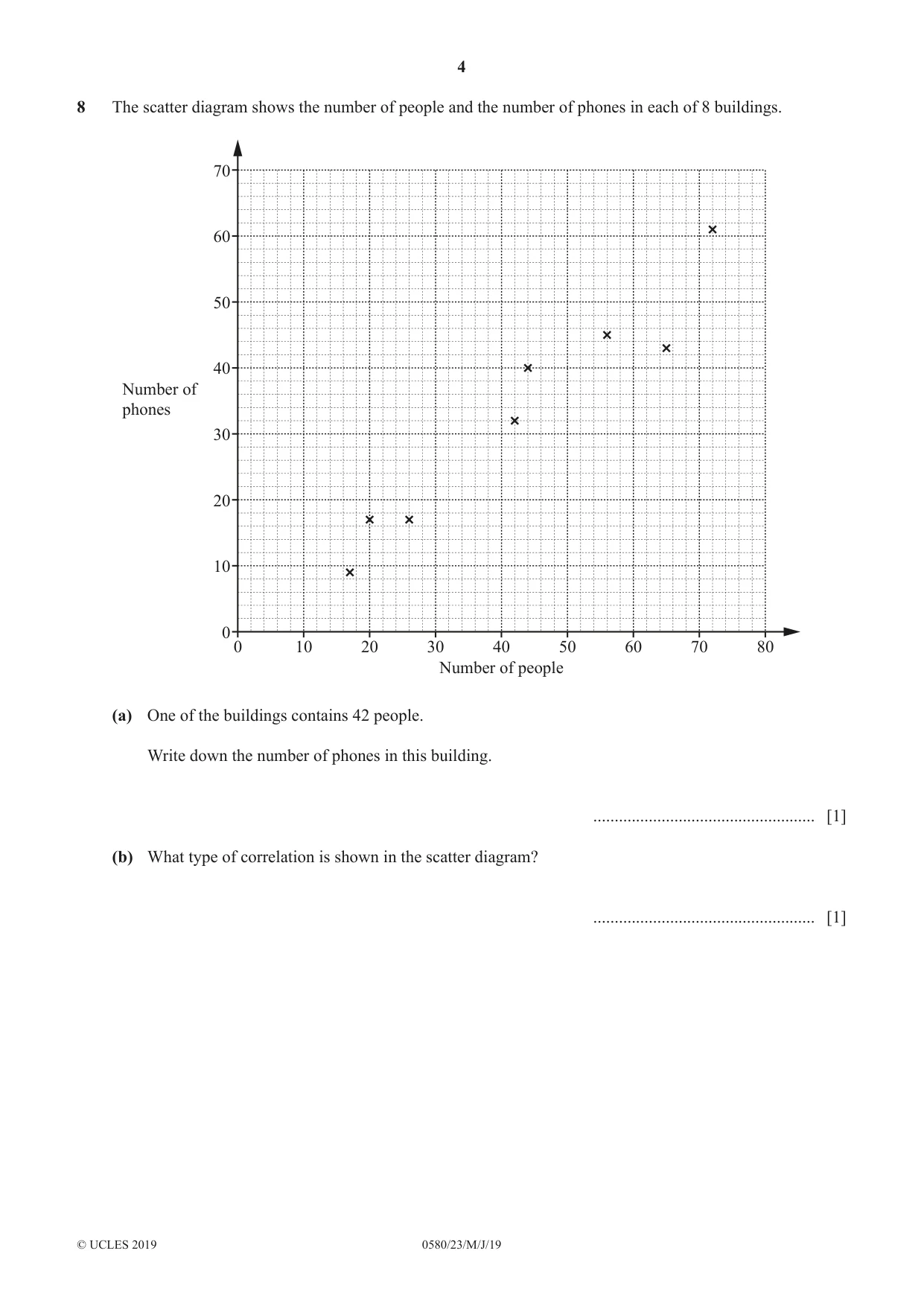
8 The scatter diagram shows the number of people and the number of phones in each of 8 buildings. 70 60 50 40 Number of phones 30 20 10 0 0 10 20 30 40 50 60 70 80 Number of people (a) One of the buildings contains 42 people. Write down the number of phones in this building. .................................................... [1] (b) What type of correlation is shown in the scatter diagram? .................................................... [1]
Mark scheme: 8(a) 32 1 8(b) Positive 1
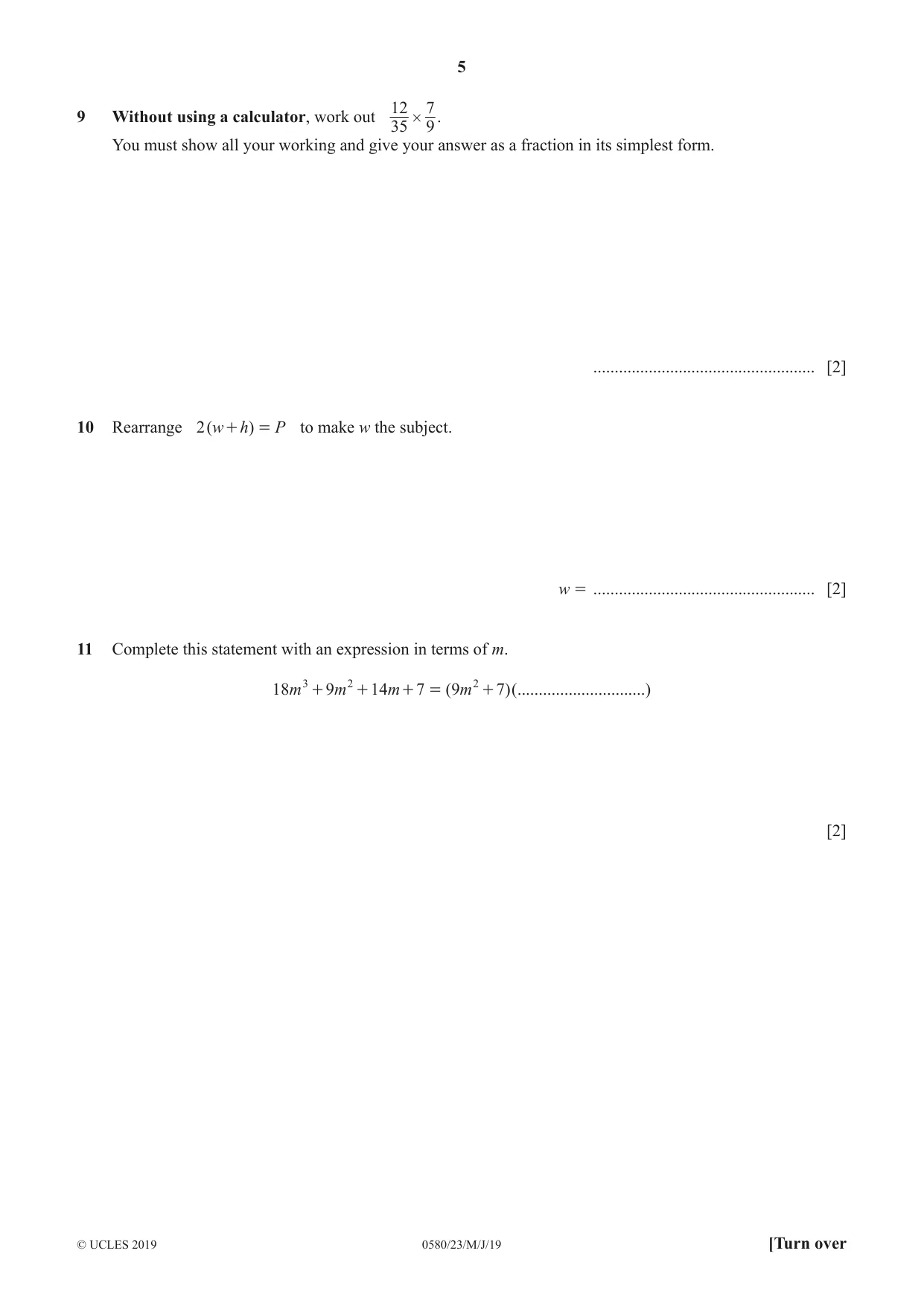
Q9 · 79 Without using a calculator, work out #
12 79 Without using a calculator, work out # . 35 9 You must show all your working and give your answer as a fraction in its simplest form. .................................................... [2]
Mark scheme: 9 84 4 7 12 1 4 1 M1 Accept any correct cancelling or × or × or × 315 35 3 5 9 5 3 4 A1 cao 15
Q10 · Rearrange 2 (w + h ) = P to make w the subject
10 Rearrange 2 (w + h ) = P to make w the subject. w = .................................................... [2]
Mark scheme: 10 P P − 2 h 2 P [w =] – h or final M1 for w + h = or 2w + 2h = P 2 2 2 answer
Q11 · Complete this statement with an expression in terms of m
11 Complete this statement with an expression in terms of m. 18m 3 + 9m 2 + 14m + 7 = (9m 2 + 7) (..............................) [2]
Mark scheme: 11 2m + 1 2 B1 for 2m + c or km + 1 (k ≠ 0)
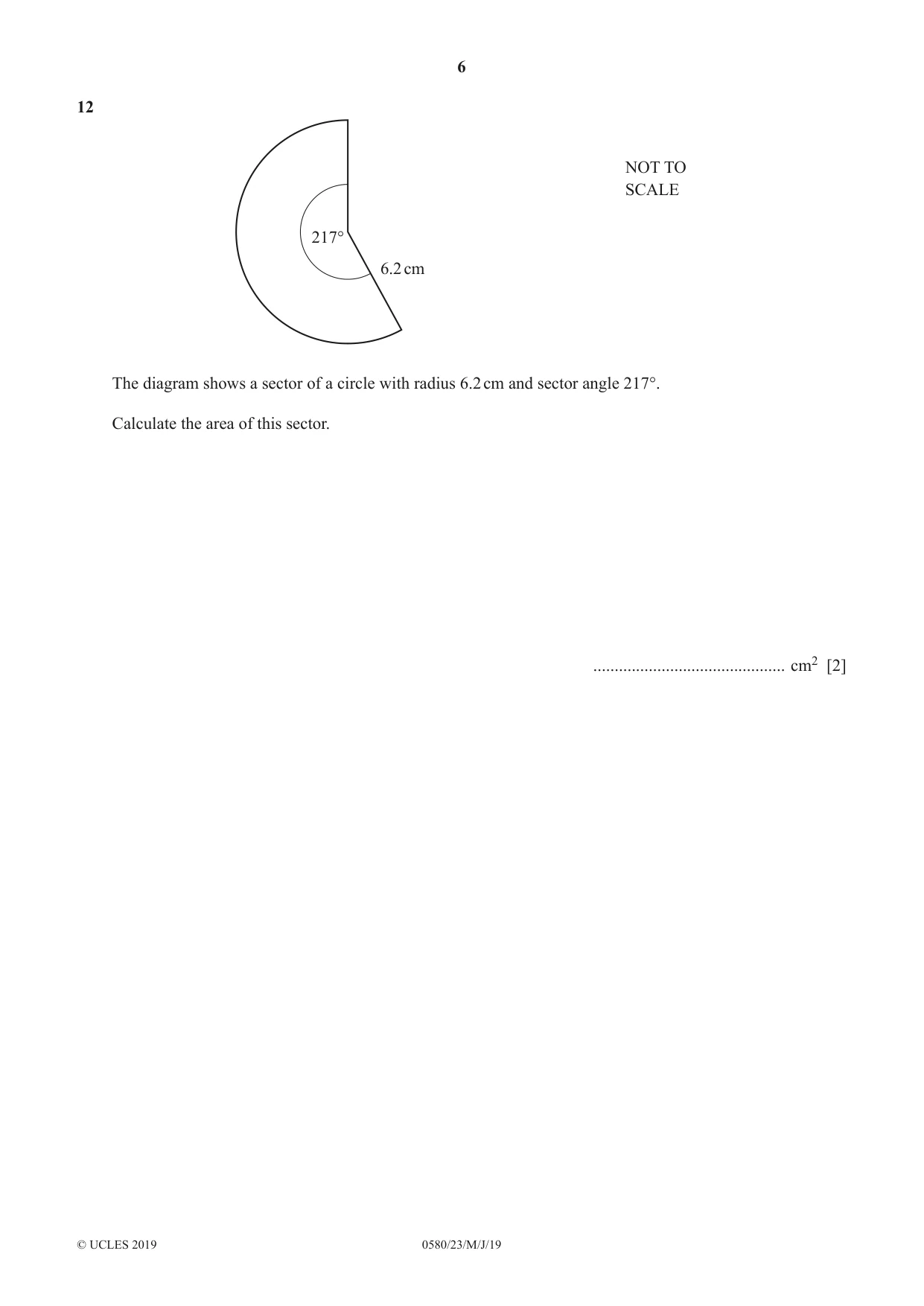
Q12 · NOT TO SCALE 217° 6.2 cm The diagram shows a sector of a circle with radius 6.2 cm and…
12 NOT TO SCALE 217° 6.2 cm The diagram shows a sector of a circle with radius 6.2 cm and sector angle 217°. Calculate the area of this sector. ............................................. cm2 [2]
Mark scheme: 12 72.8 or 72.79 to 72.80… 2 217 2 M1 for × π × 6.2 360
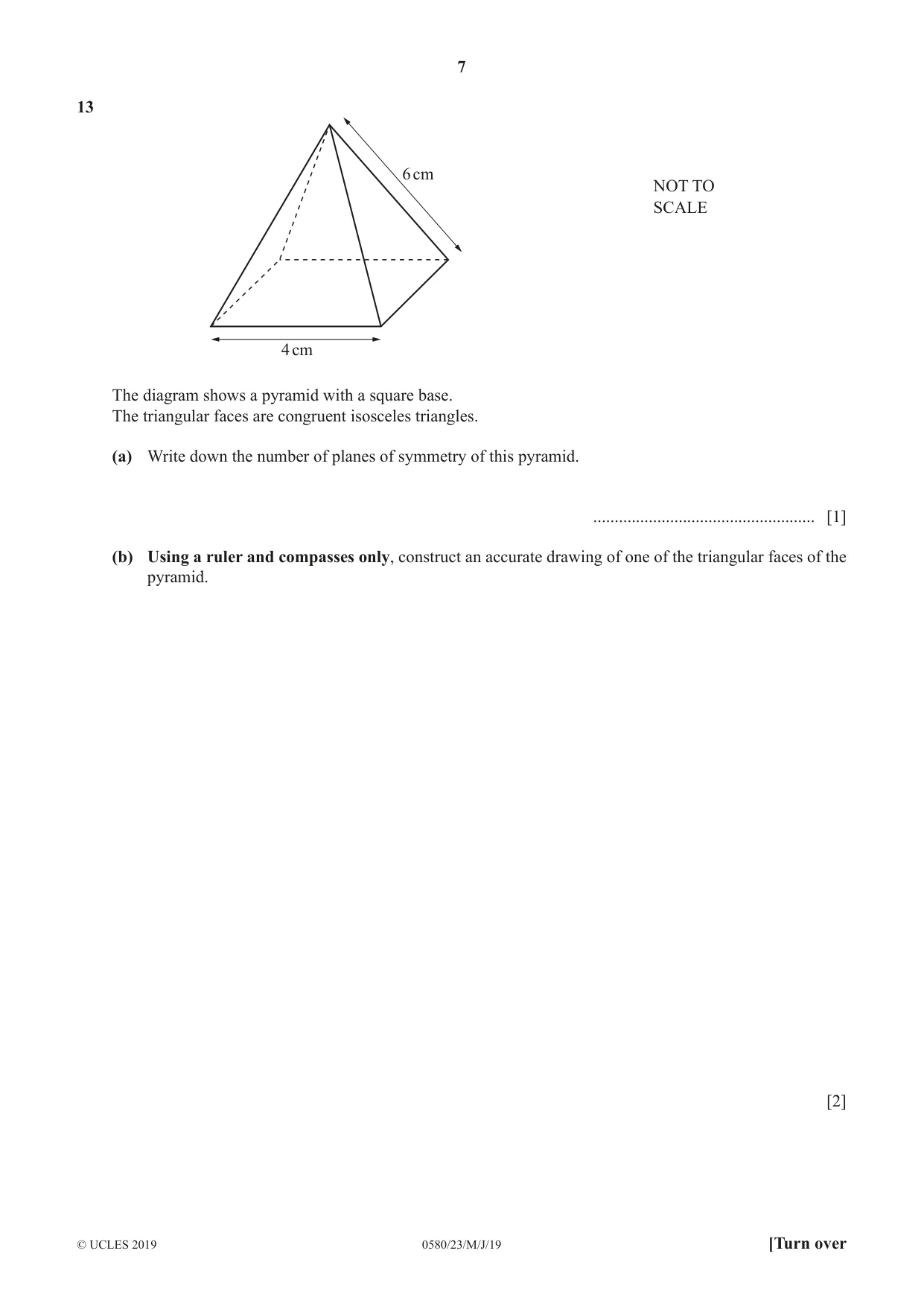
Q13 · 6 cm NOT TO SCALE 4 cm The diagram shows a pyramid with a square base
13 6 cm NOT TO SCALE 4 cm The diagram shows a pyramid with a square base. The triangular faces are congruent isosceles triangles. (a) Write down the number of planes of symmetry of this pyramid. .................................................... [1] (b) Using a ruler and compasses only, construct an accurate drawing of one of the triangular faces of the pyramid. [2]
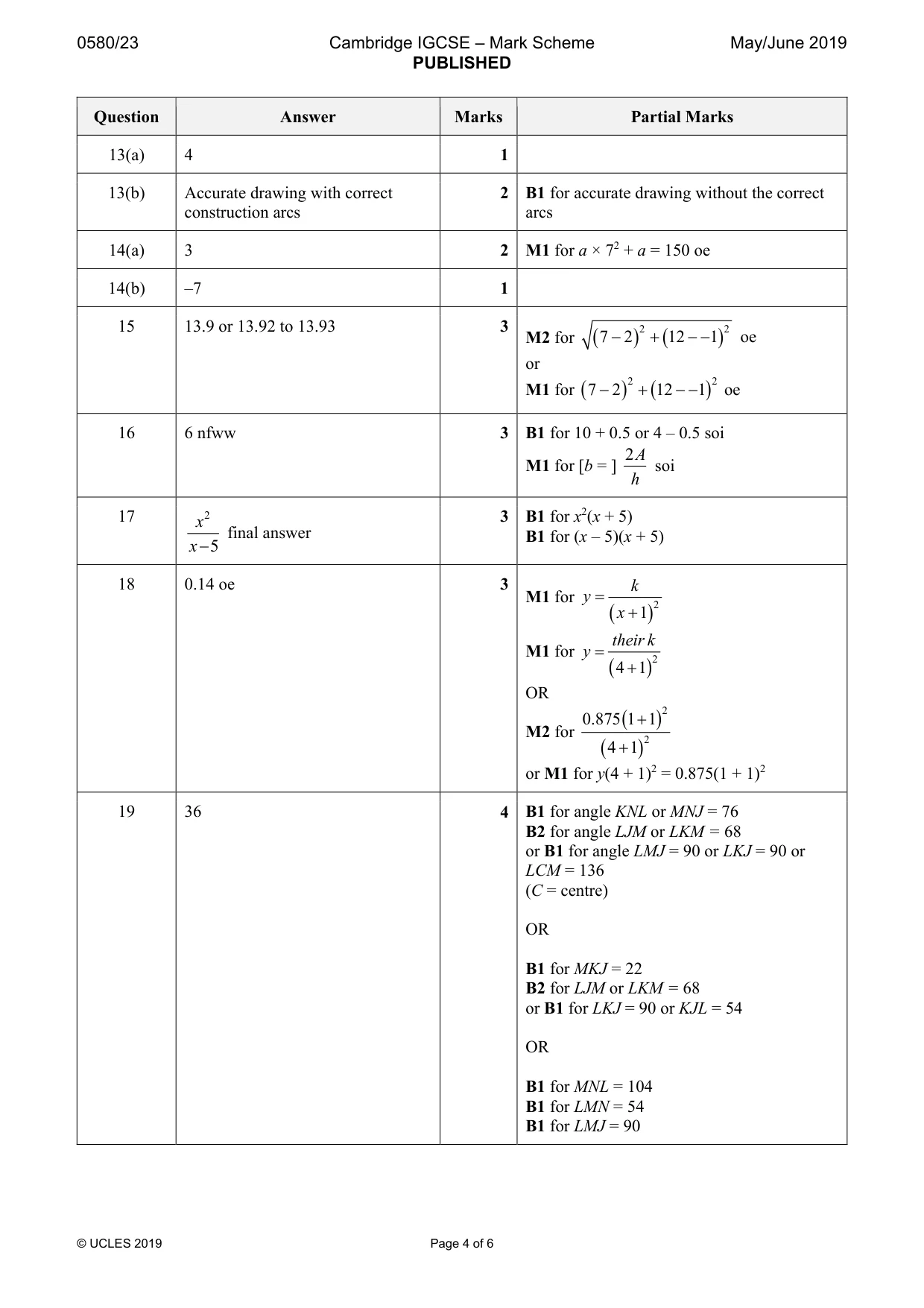
Mark scheme: 13(a) 4 1 13(b) Accurate drawing with correct 2 B1 for accurate drawing without the correct construction arcs arcs
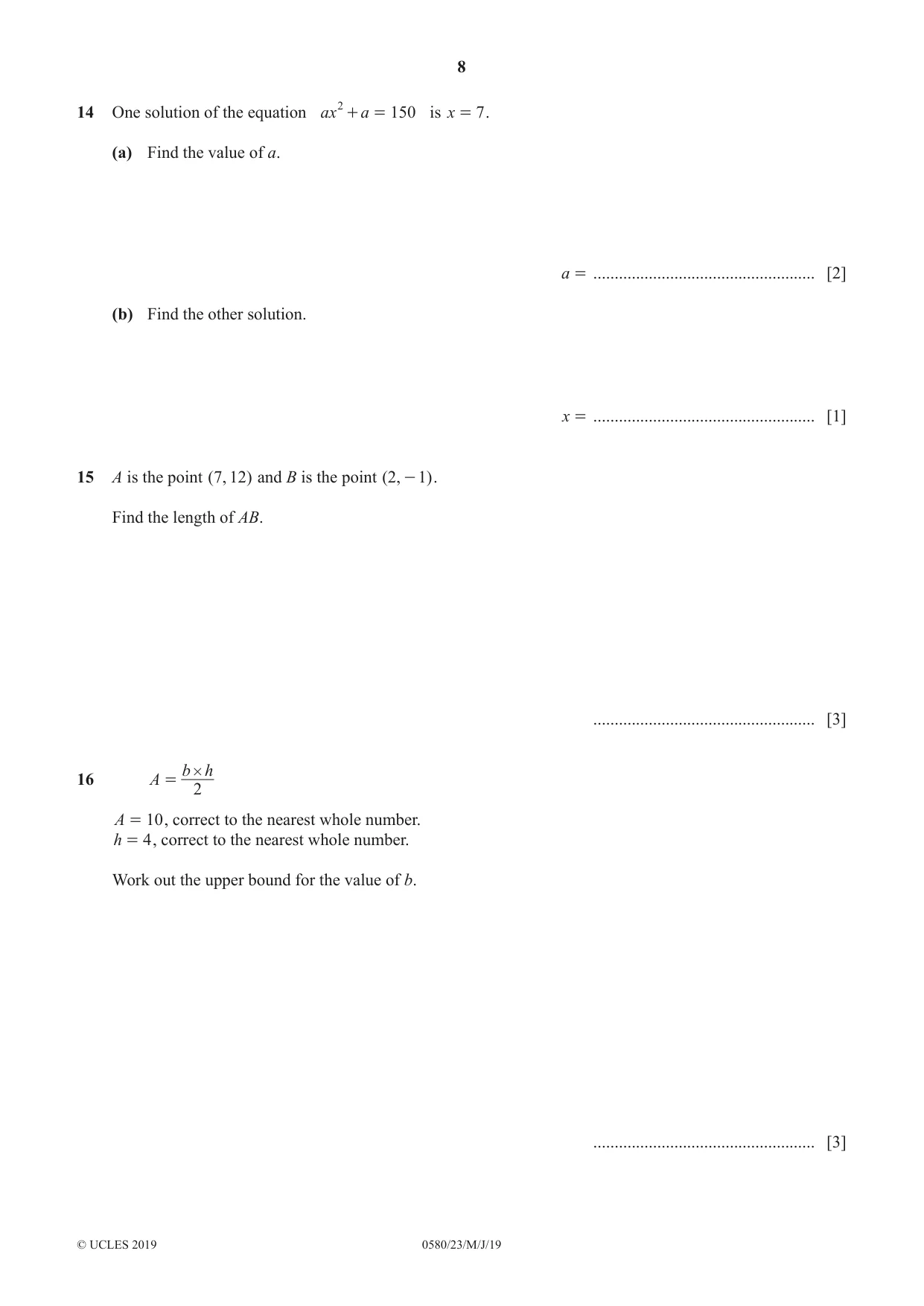
Q14 · One solution of the equation ax 2 + a = 150 is x = 7
14 One solution of the equation ax 2 + a = 150 is x = 7 . (a) Find the value of a. a = .................................................... [2] (b) Find the other solution. x = .................................................... [1]
Mark scheme: 14(a) 3 2 M1 for a × 72 + a = 150 oe 14(b) –7 1
Q15 · A is the point (7, 12) and B is the point (2, - 1)
15 A is the point (7, 12) and B is the point (2, - 1) . Find the length of AB. .................................................... [3]
Mark scheme: 15 13.9 or 13.92 to 13.93 3 2 2 M2 for ( 7 − 2 ) + (12 −−1) oe or M1 for ( 7 − 2 ) 2 + (12 −−1) 2 oe
Q16 · B # h16 A = 2 A = 10 , correct to the nearest whole number
b # h16 A = 2 A = 10 , correct to the nearest whole number. h = 4 , correct to the nearest whole number. Work out the upper bound for the value of b. .................................................... [3]
Mark scheme: 16 6 nfww 3 B1 for 10 + 0.5 or 4 – 0.5 soi 2A M1 for [b = ] soi h
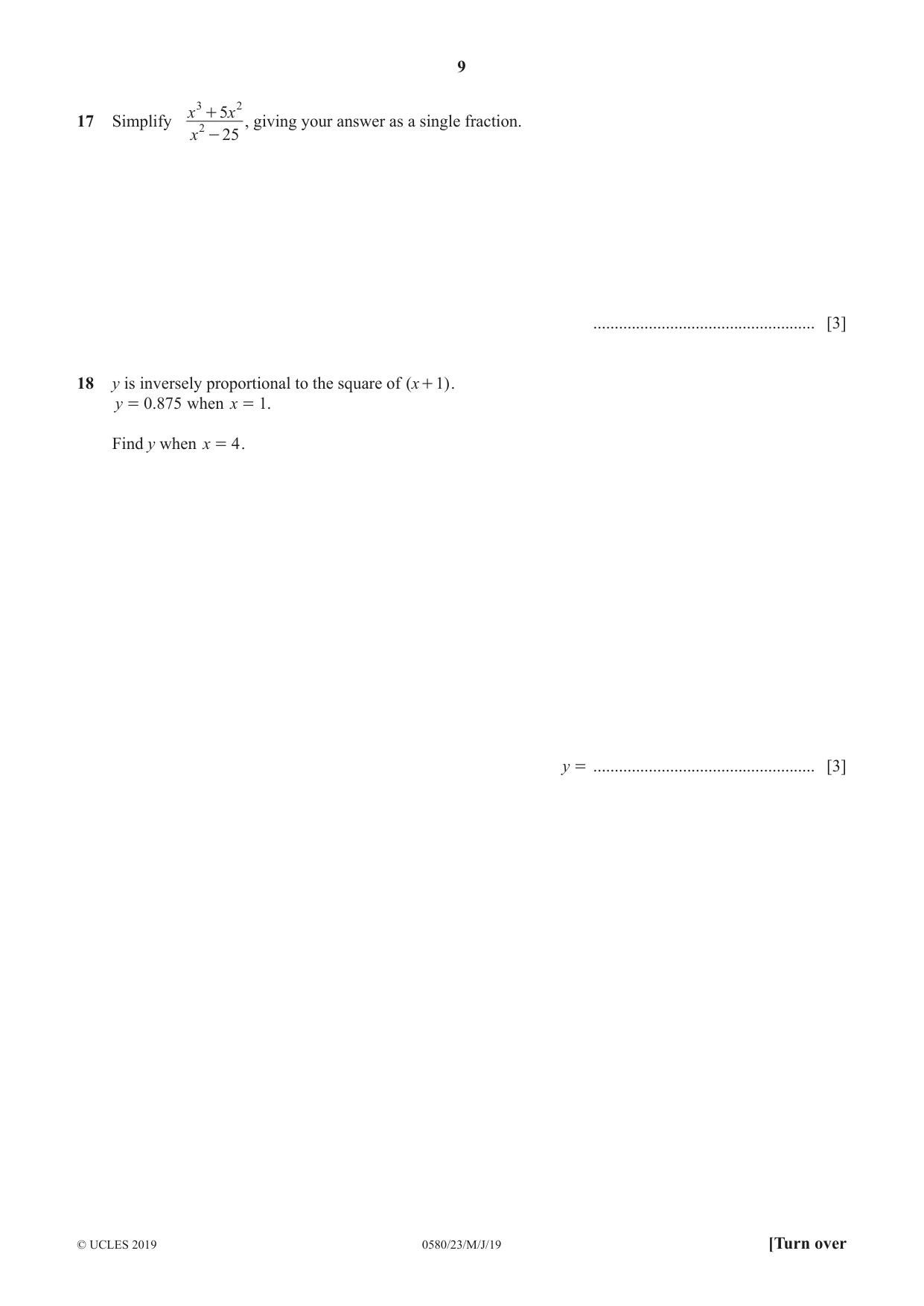
Q17 · X 3 + 5x 217 Simplify 2 , giving your answer as a single fraction
x 3 + 5x 217 Simplify 2 , giving your answer as a single fraction. x - 25 .................................................... [3]
Mark scheme: 17 2 3 B1 for x2(x + 5) x final answer B1 for (x – 5)(x + 5) x − 5
Q18 · Y is inversely proportional to the square of (x + 1 )
18 y is inversely proportional to the square of (x + 1 ) . y = 0.875 when x = 1. Find y when x = 4 . y = .................................................... [3]
Mark scheme: 18 0.14 oe 3 k M1 for y = ( x + 1) 2 their k M1 for y = ( 4 + 1) 2 OR 0.875 (1 + 1) 2 M2 for ( 4 + 1) 2 or M1 for y(4 + 1)2 = 0.875(1 + 1)2
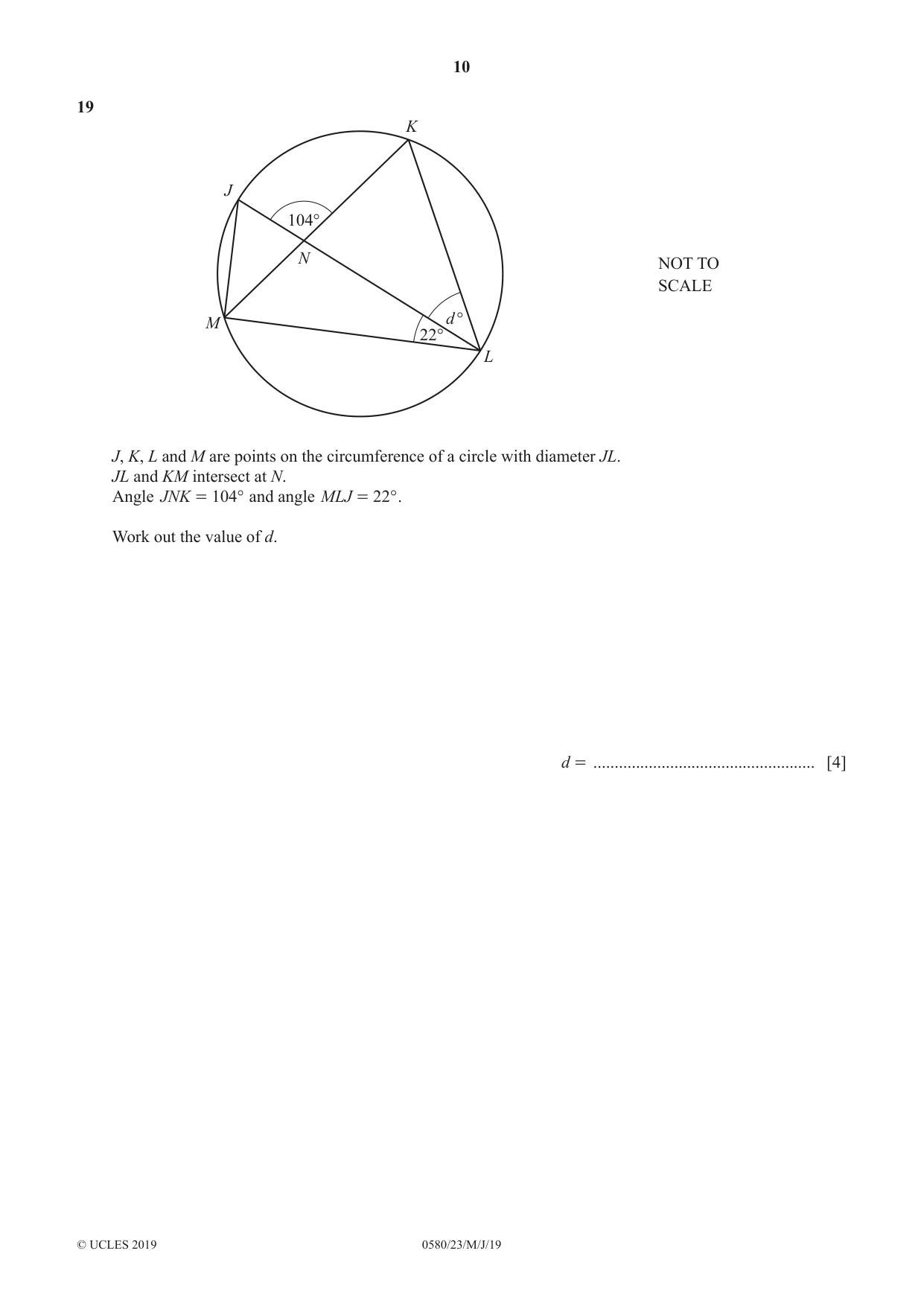
Q19 · K J 104° N NOT TO SCALE d ° M 22° L J, K, L and M are points on the circumference of a…
19 K J 104° N NOT TO SCALE d ° M 22° L J, K, L and M are points on the circumference of a circle with diameter JL. JL and KM intersect at N. Angle JNK = 104° and angle MLJ = 22° . Work out the value of d. d = .................................................... [4]
Mark scheme: 19 36 4 B1 for angle KNL or MNJ = 76 B2 for angle LJM or LKM = 68 or B1 for angle LMJ = 90 or LKJ = 90 or LCM = 136 (C = centre) OR B1 for MKJ = 22 B2 for LJM or LKM = 68 or B1 for LKJ = 90 or KJL = 54 OR B1 for MNL = 104 B1 for LMN = 54 B1 for LMJ = 90
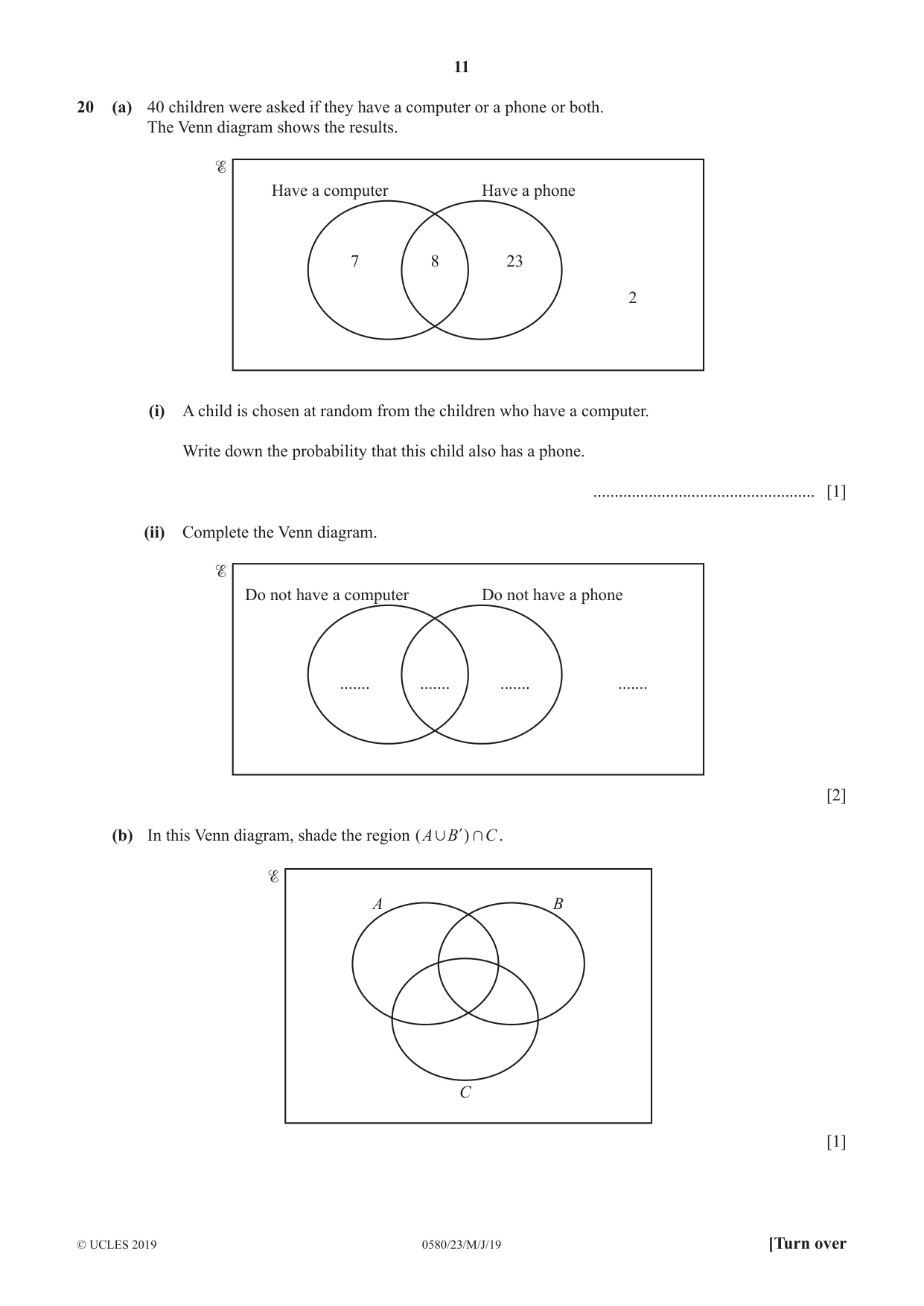
Q20 · 40 children were asked if they have a computer or a phone or both
20 (a) 40 children were asked if they have a computer or a phone or both. The Venn diagram shows the results. Have a computer Have a phone 7 8 23 2 (i) A child is chosen at random from the children who have a computer. Write down the probability that this child also has a phone. .................................................... [1] (ii) Complete the Venn diagram. Do not have a computer Do not have a phone ....... ....... ....... ....... [2] (b) In this Venn diagram, shade the region ( A , B l ) + C . A B C [1]
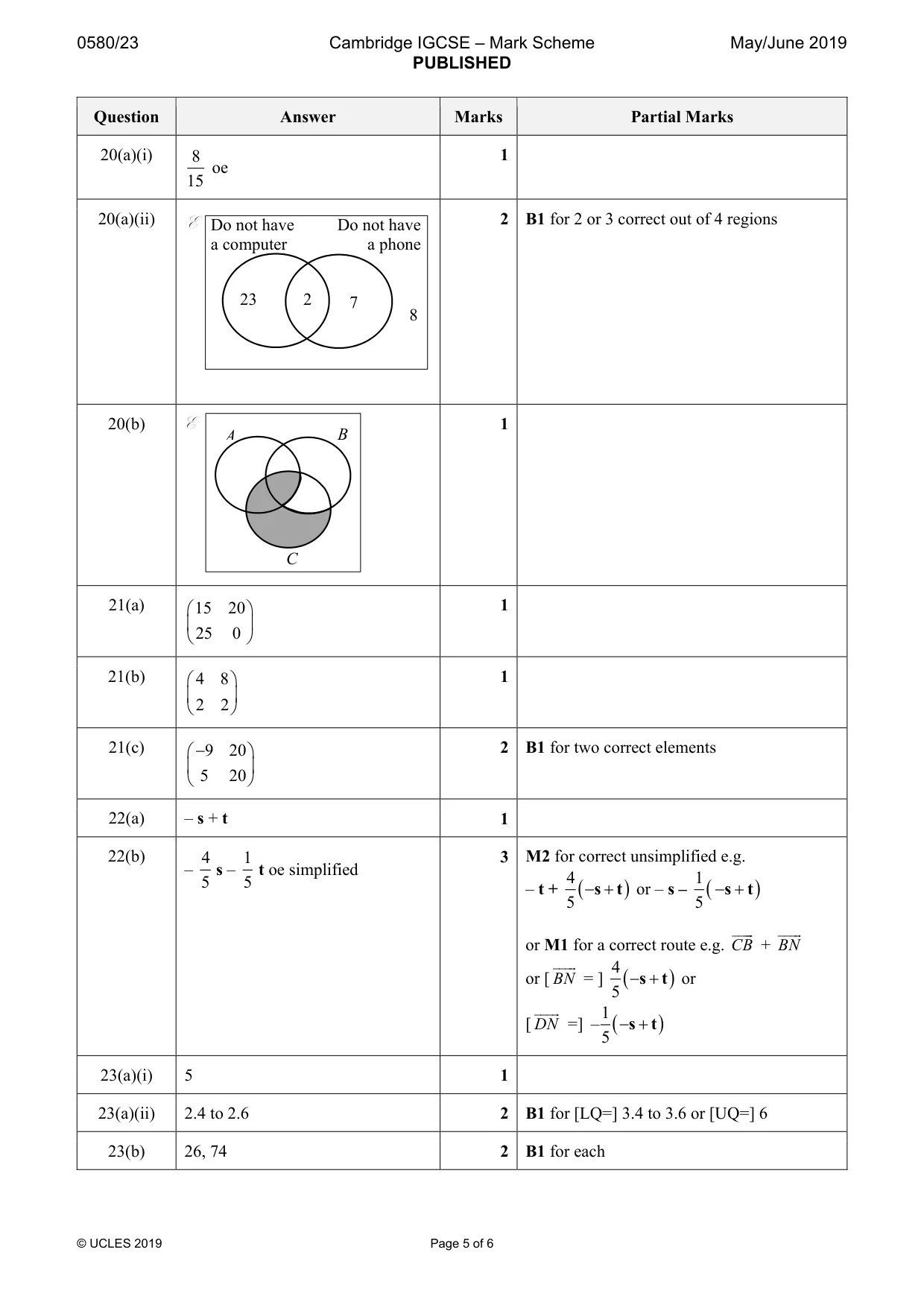
Mark scheme: 20(a)(i) 8 1 oe 15 20(a)(ii) 2 B1 for 2 or 3 correct out of 4 regions E Do not have Do not have a computer a phone 23 2 7 8 20(b) E 1 A B C
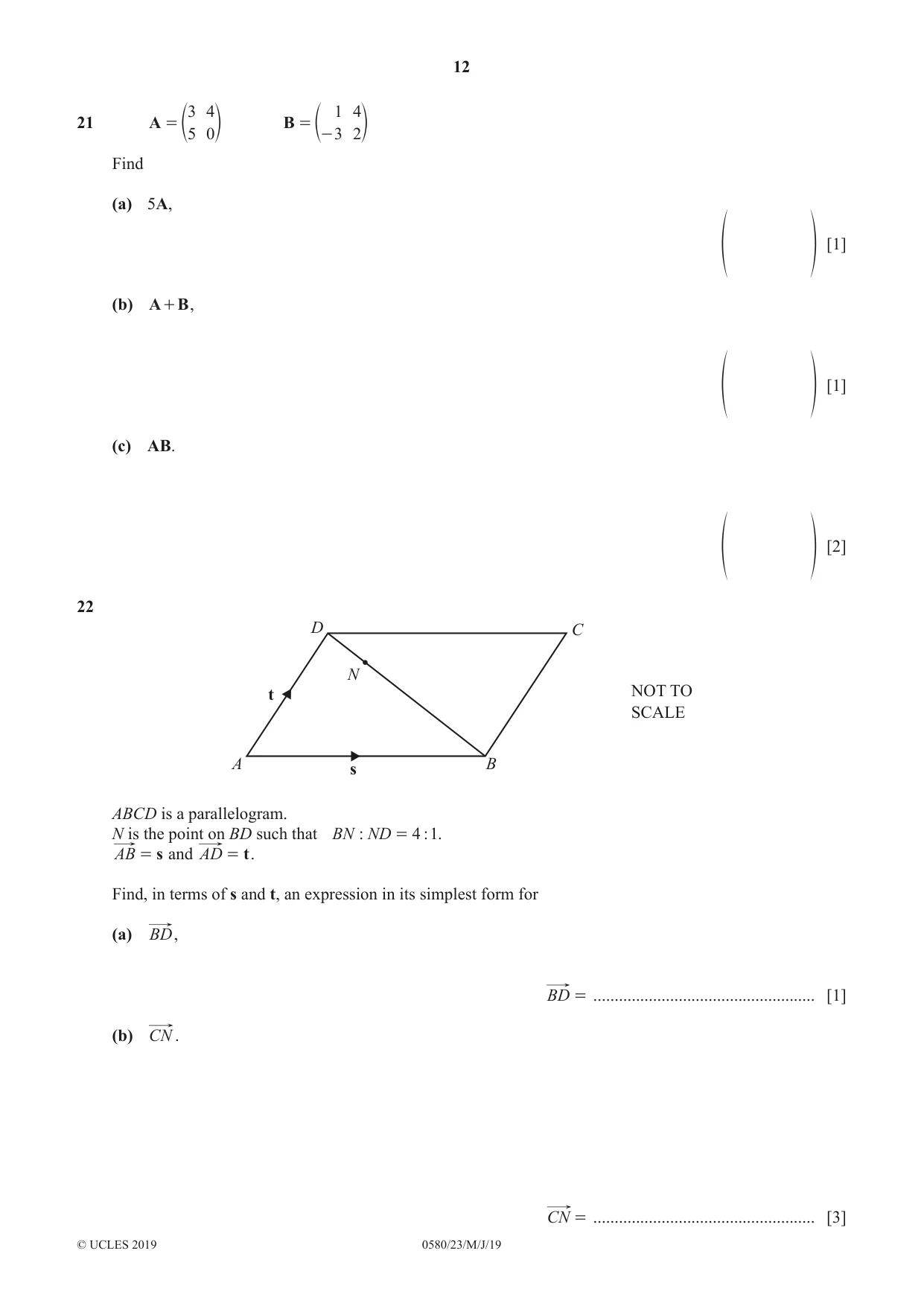
Q21 · 4 1 4 21 A = B = e5 0o e- 3 2o Find (a) 5A, [1] f p (b) A + B , [1] f p (c) AB
3 4 1 4 21 A = B = e5 0o e- 3 2o Find (a) 5A, [1] f p (b) A + B , [1] f p (c) AB. [2] f p
Mark scheme: 21(a) 15 20 1 25 0 21(b) 4 8 1 2 2 21(c) −9 20 2 B1 for two correct elements 5 20
Q22 · D C N t NOT TO SCALE A B s ABCD is a parallelogram
22 D C N t NOT TO SCALE A B s ABCD is a parallelogram. N is the point on BD such that BN : ND = 4 : 1. AB = s and AD = t . Find, in terms of s and t, an expression in its simplest form for (a) BD, BD = .................................................... [1] (b) CN . CN = .................................................... [3]
Mark scheme: 22(a) – s + t 1 22(b) 4 1 3 M2 for correct unsimplified e.g. – s – t oe simplified 4 1 5 5 – t + ( −+s t ) or – s – ( −+s t ) 5 5 JJJG JJJG or M1 for a correct route e.g. CB + BN JJJG 4 or [ BN = ] ( −+s t ) or 5 JJJG 1 [ DN =] – ( −+s t ) 5
Q23 · 160 students record the amount of time, t hours, they each spend playing computer games…
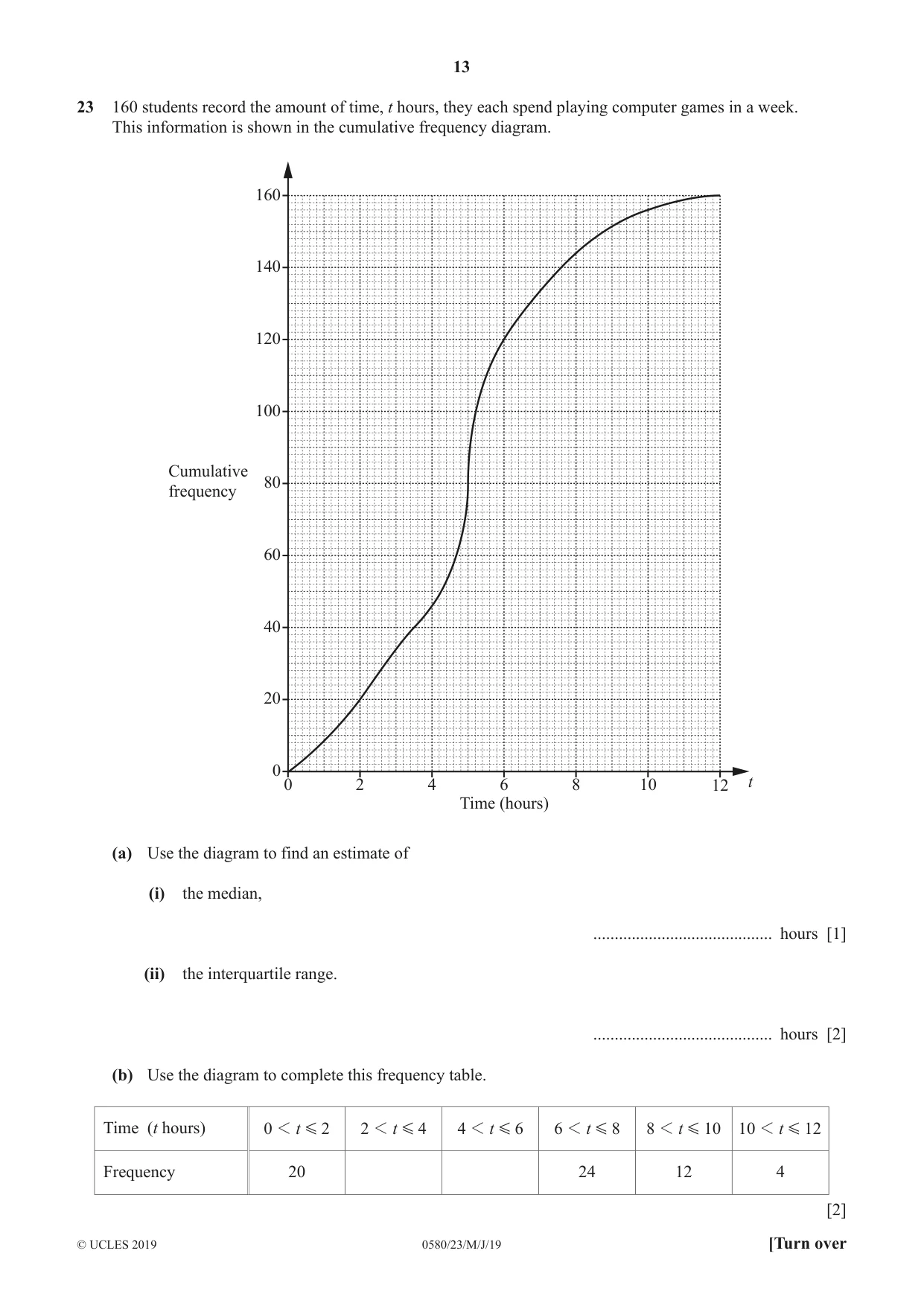
23 160 students record the amount of time, t hours, they each spend playing computer games in a week. This information is shown in the cumulative frequency diagram. 160 140 120 100 Cumulative 80 frequency 60 40 20 0 0 2 4 6 8 10 12 t Time (hours) (a) Use the diagram to find an estimate of (i) the median, .......................................... hours [1] (ii) the interquartile range. .......................................... hours [2] (b) Use the diagram to complete this frequency table. Time (t hours) 0 1 t G 2 2 1 t G 4 4 1 t G 6 6 1 t G 8 8 1 t G 10 10 1 t G 12 Frequency 20 24 12 4 [2]
Mark scheme: 23(a)(i) 5 1 23(a)(ii) 2.4 to 2.6 2 B1 for [LQ=] 3.4 to 3.6 or [UQ=] 6 23(b) 26, 74 2 B1 for each
Q24 · Y 8 7 66 5 4 3 2 1 – 5 – 4 – 3 – 2 – 1 0 1 2 3 4 5 6 7 8 x – 1 – 2 By shading the…
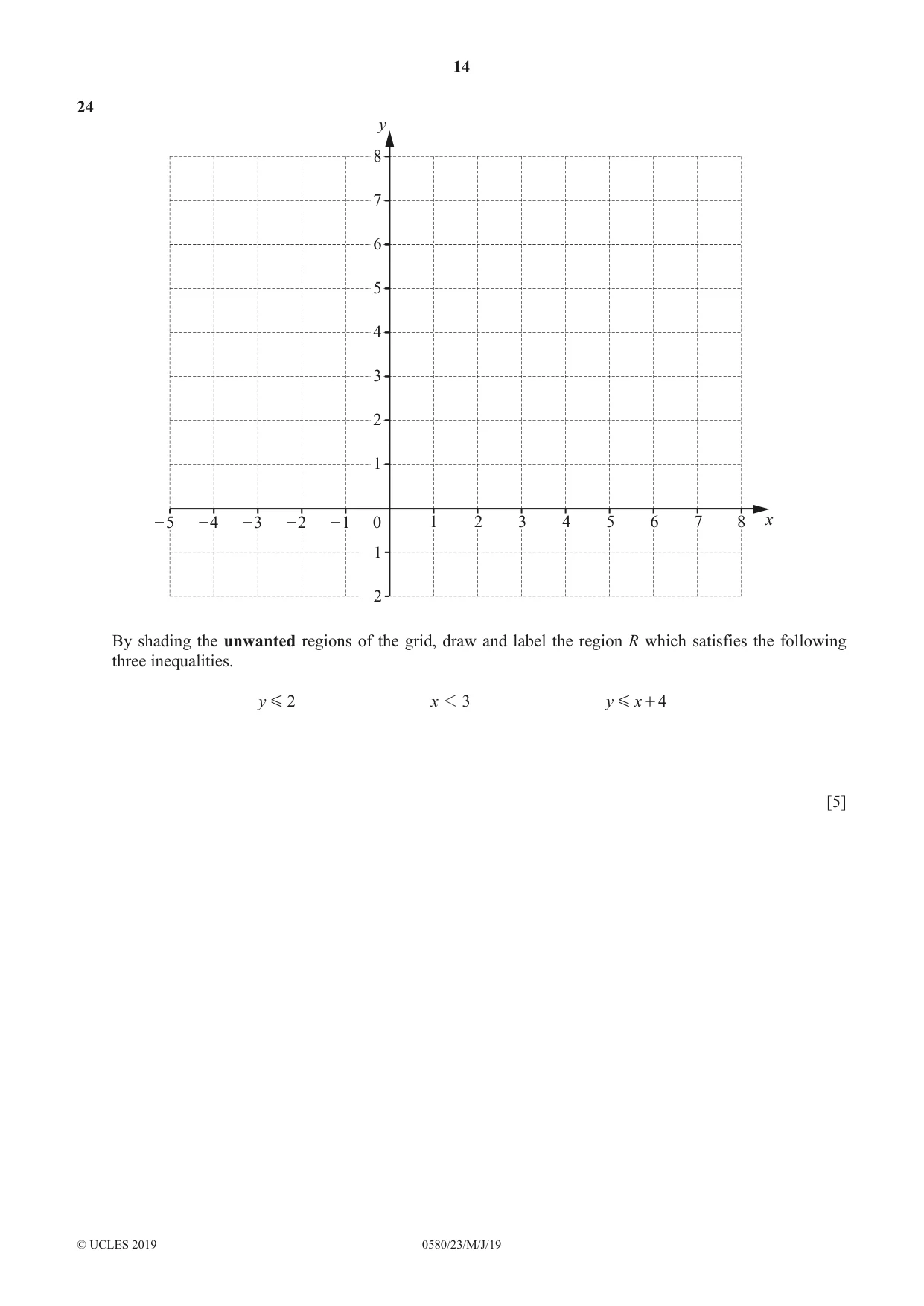
24 y 8 7 66 5 4 3 2 1 – 5 – 4 – 3 – 2 – 1 0 1 2 3 4 5 6 7 8 x – 1 – 2 By shading the unwanted regions of the grid, draw and label the region R which satisfies the following three inequalities. y G 2 x 1 3 y G x + 4 [5]
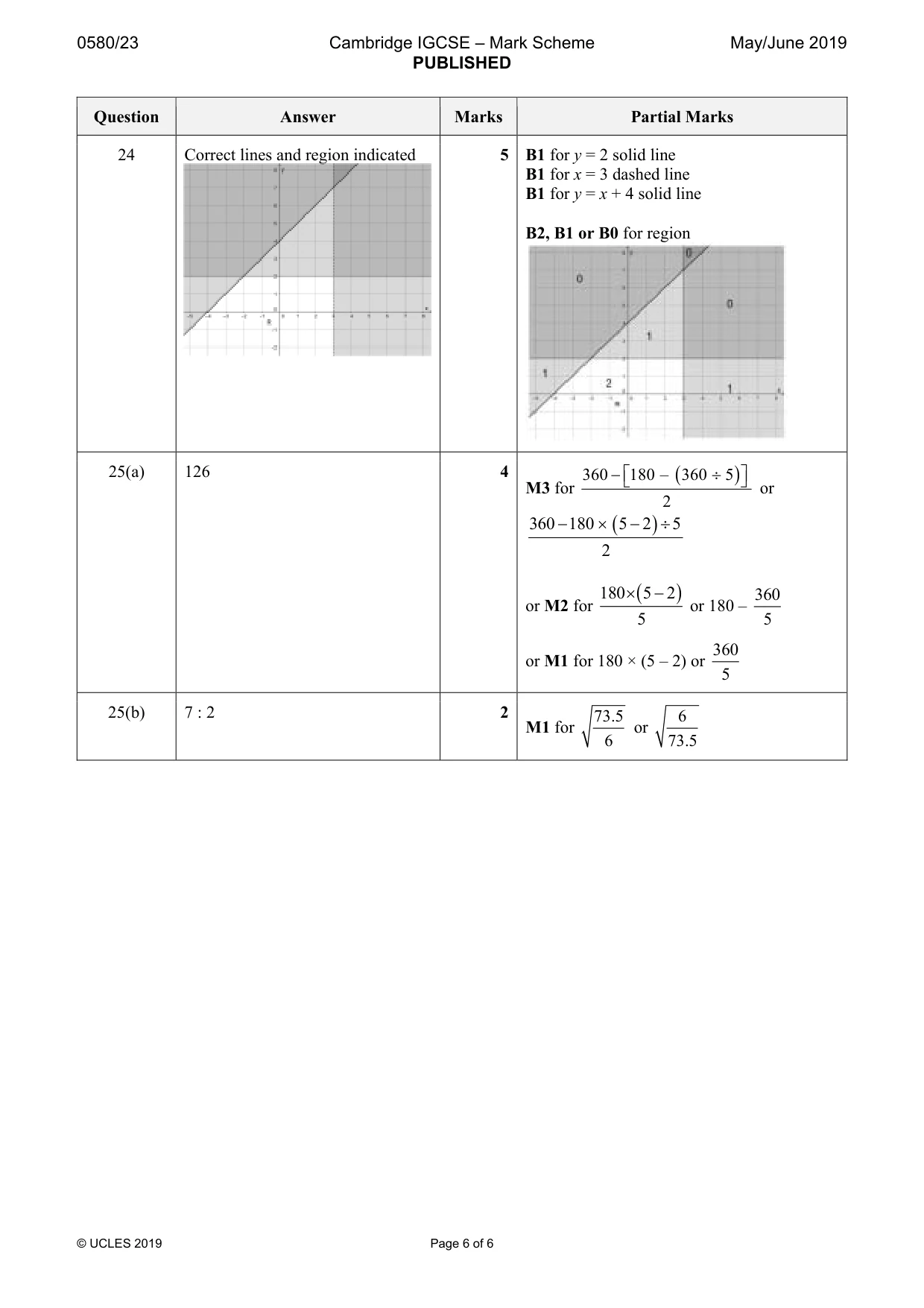
Mark scheme: 24 Correct lines and region indicated 5 B1 for y = 2 solid line B1 for x = 3 dashed line B1 for y = x + 4 solid line B2, B1 or B0 for region
Q25 · K J NOT TO E D SCALE O A C F B H G The diagram shows two regular pentagons
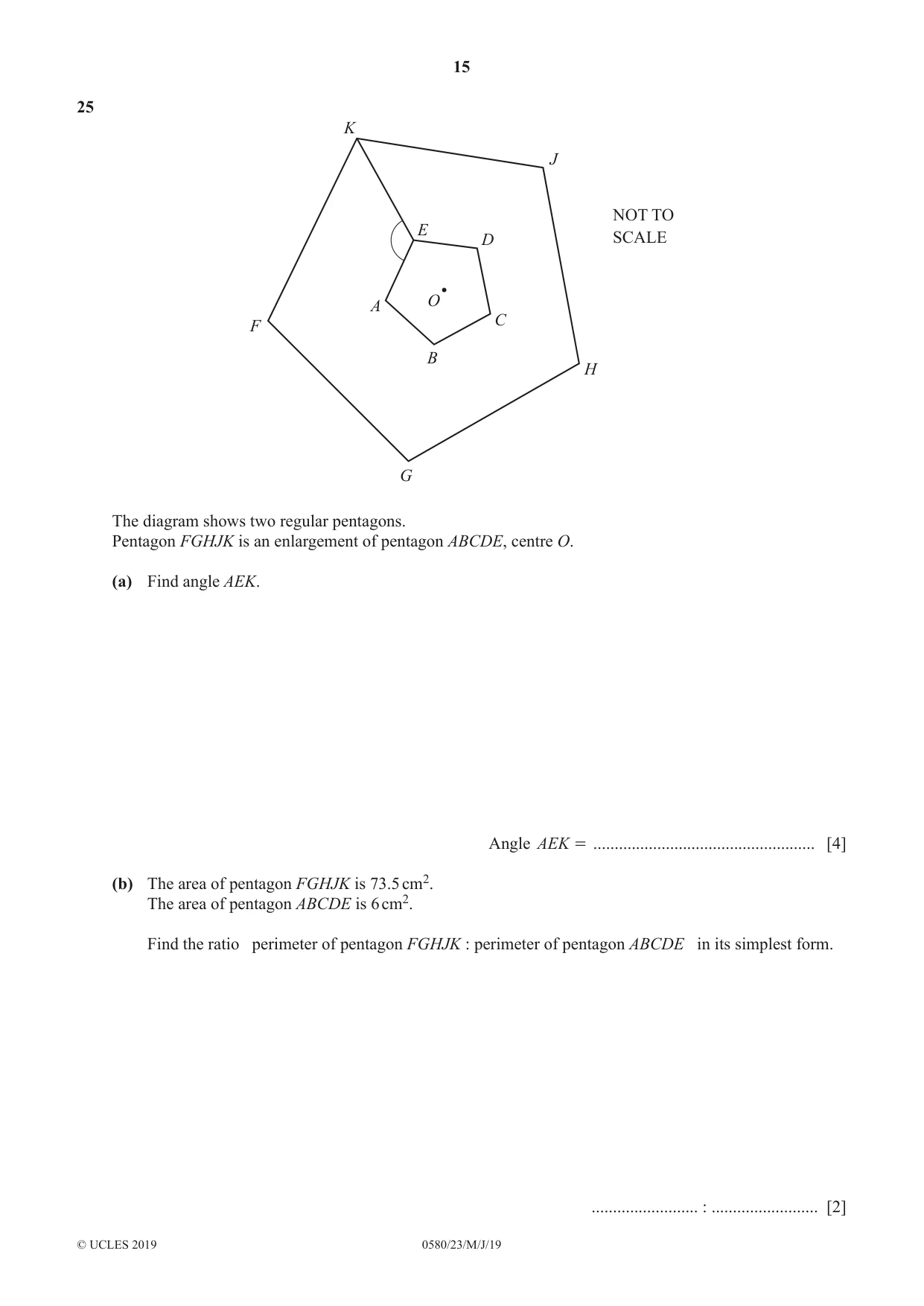
25 K J NOT TO E D SCALE O A C F B H G The diagram shows two regular pentagons. Pentagon FGHJK is an enlargement of pentagon ABCDE, centre O. (a) Find angle AEK. Angle AEK = .................................................... [4] (b) The area of pentagon FGHJK is 73.5 cm2. The area of pentagon ABCDE is 6 cm2. Find the ratio perimeter of pentagon FGHJK : perimeter of pentagon ABCDE in its simplest form. ......................... : ......................... [2]
Mark scheme: 25(a) 126 4 360 − 180 – ( 360 ÷ 5 ) M3 for or 2 360 − 180 × ( 5 − 2 ) ÷ 5 2 180 × ( 5 − 2 ) 360 or M2 for or 180 – 5 5 360 or M1 for 180 × (5 – 2) or 5 25(b) 7 : 2 2 73.5 6 M1 for or 6 73.5
What was in this paper
The subtopics covered by these 25 questions, and how many questions each got. Open one in a new tab to see every Cambridge question on it.
3Equations3Averages and measures of spread2Fractions, decimals and percentages2Limits of accuracy2Algebraic fractions1Angles1Circle theorems I1Circles, arcs and sectors1Coordinates1Equations of linear graphs1Geometrical constructions1Introduction to probability1Ratio and proportion1Scatter diagrams1The four operations1Types of number1Vectors in two dimensions1What you needed in this session
Cambridge’s own grade thresholds for 2019 May/June, Paper 2 · Variant 3. A higher threshold means an easier paper — the bar moves with how the cohort did.