Cambridge IGCSE Mathematics 0580 — 2025 May/June Paper 2 · Variant 1
0580/21/M/J/25 · 23 questions · 100 marks · 120 min
The question paper and its mark scheme, free to read here and free to download. This is Cambridge’s own paper, exactly as it was sat.
Question paper20 pages
Mark scheme10 pages
Answers below. Sit the paper first if you are practising.
Questions as text
Question 1
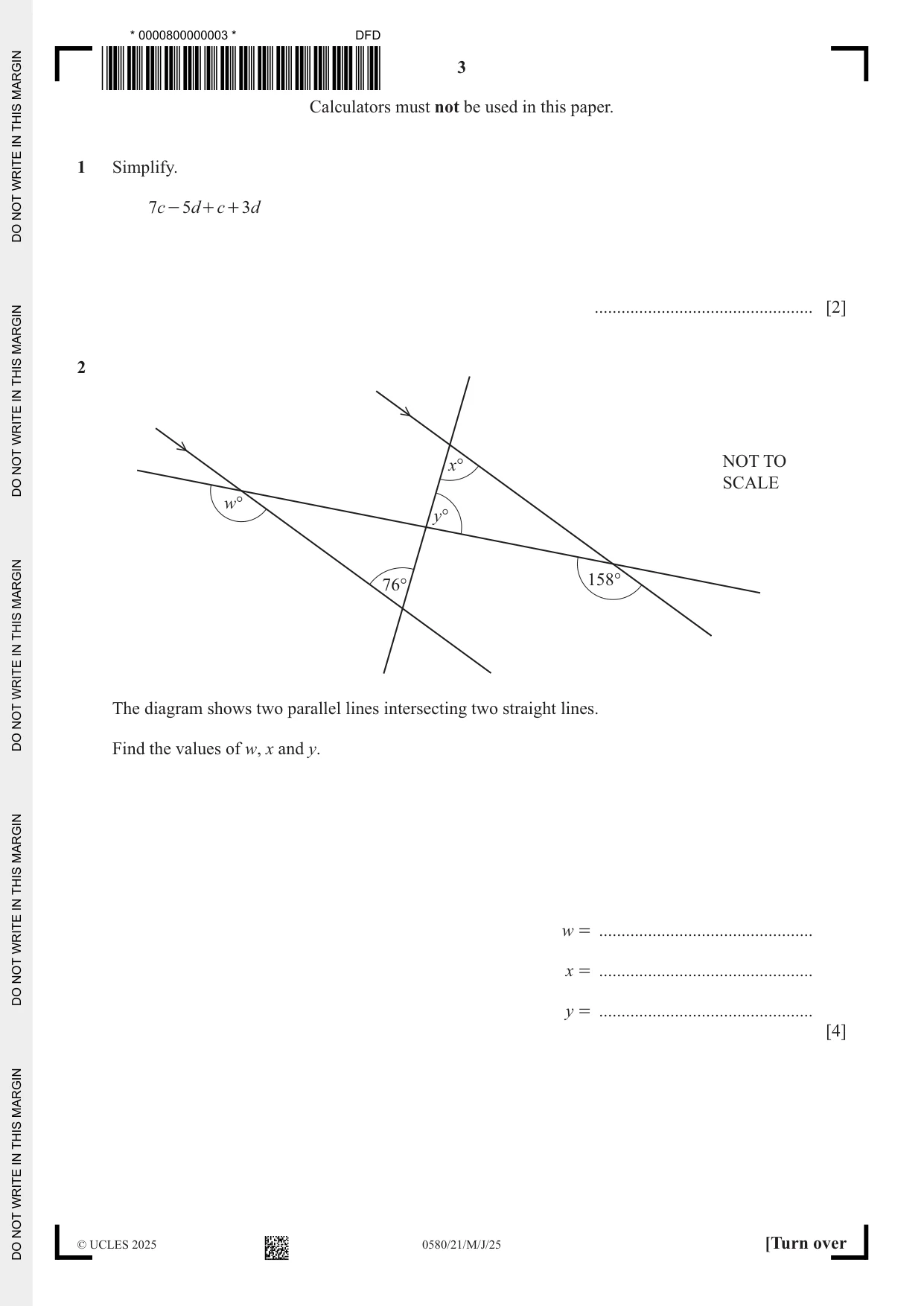
1 Simplify. 7 c - 5 d + c + 3d ................................................. [2]
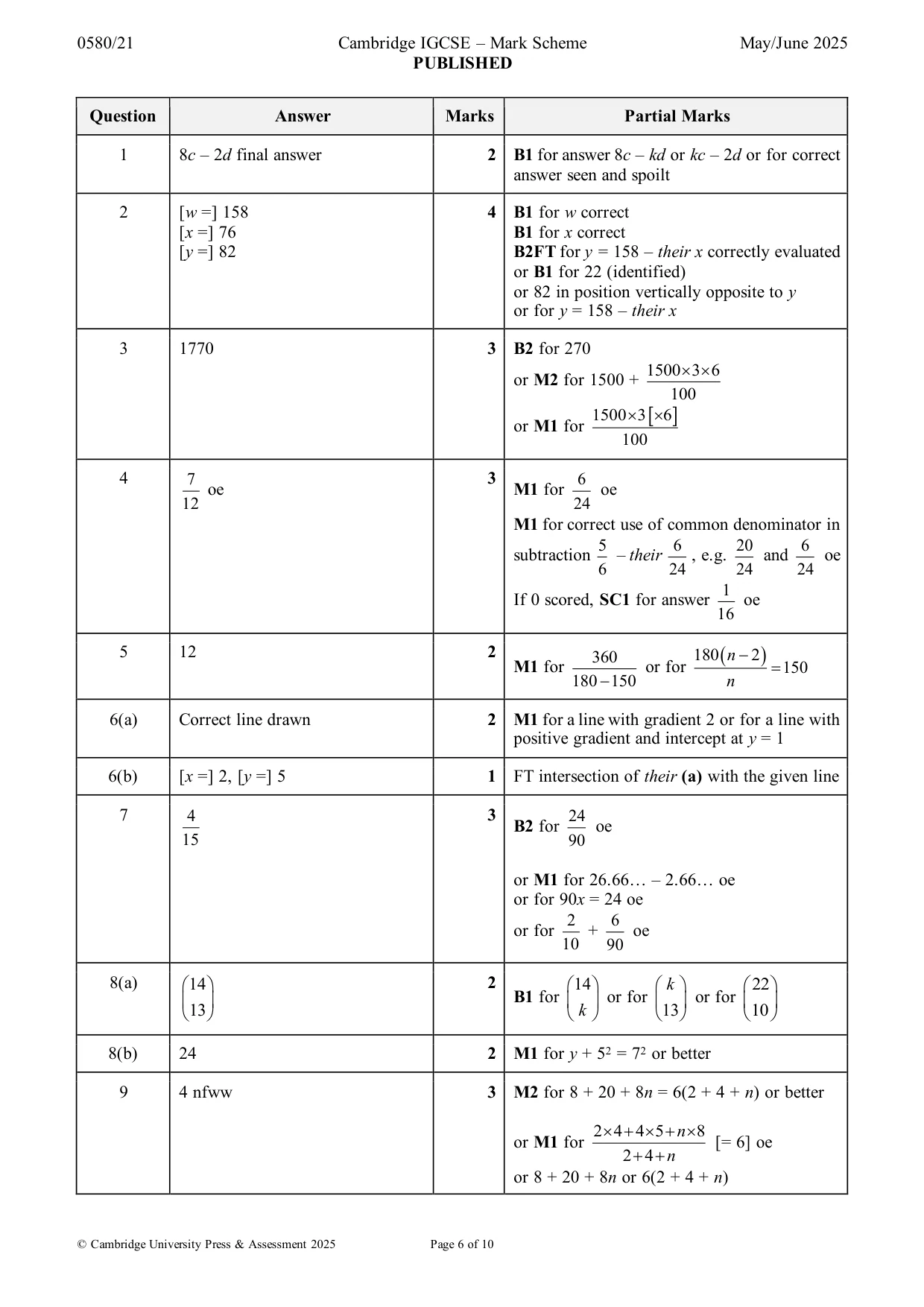
Mark scheme: Question Answer Marks Partial Marks 1 8c – 2d final answer 2 B1 for answer 8c – kd or kc – 2d or for correct answer seen and spoilt
Q2 · X° NOT TO SCALE w° y° 158° 76° The diagram shows two parallel lines intersecting two…
2 x° NOT TO SCALE w° y° 158° 76° The diagram shows two parallel lines intersecting two straight lines. Find the values of w, x and y. w = ................................................ x = ................................................ y = ................................................ [4]
Mark scheme: 2 [w =] 158 4 B1 for w correct [x =] 76 B1 for x correct [y =] 82 B2FT for y = 158 – their x correctly evaluated or B1 for 22 (identified) or 82 in position vertically opposite to y or for y = 158 – their x
Q3 · Sally invests $1500 at 3% per year simple interest
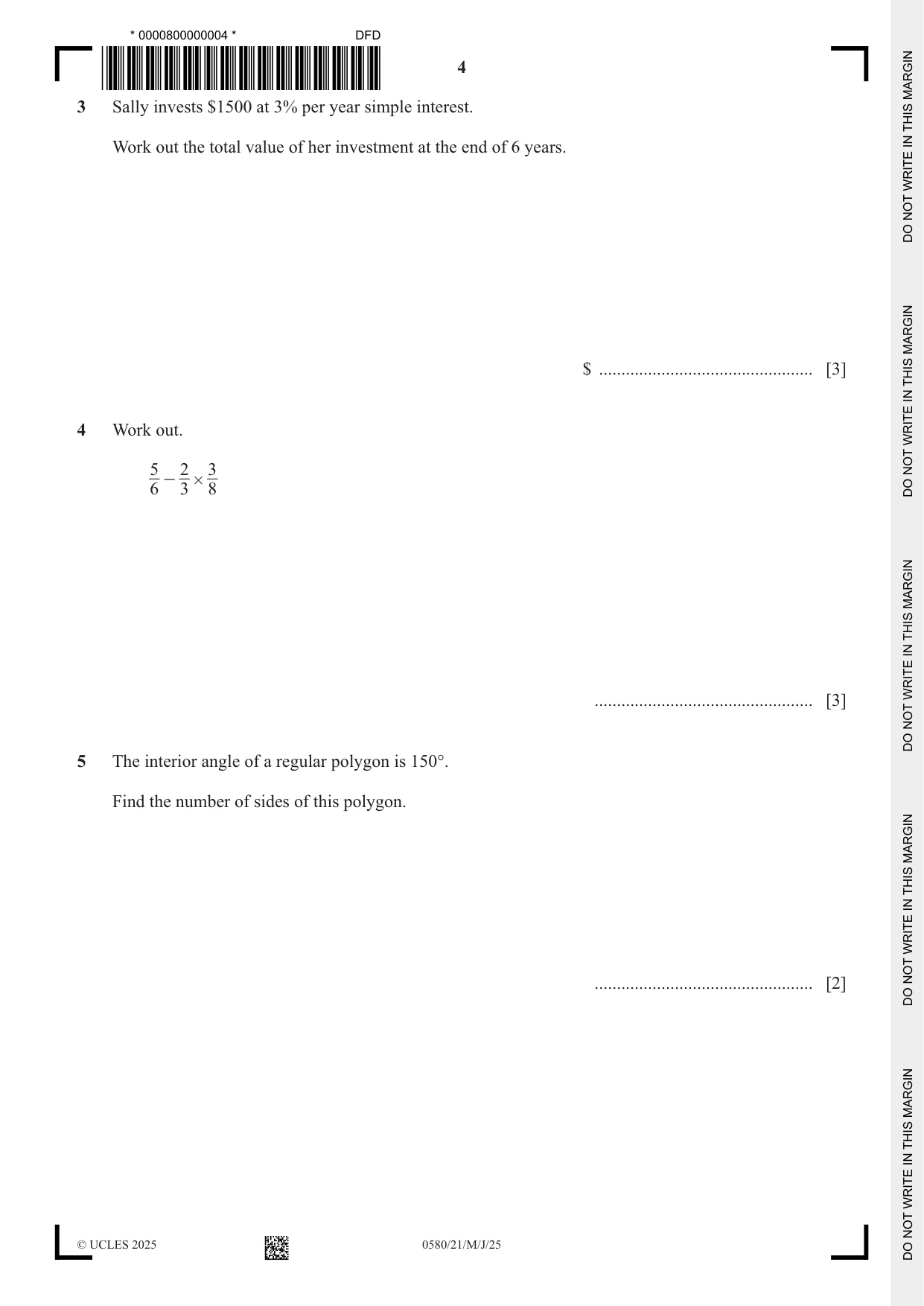
3 Sally invests $1500 at 3% per year simple interest. Work out the total value of her investment at the end of 6 years. $ ................................................ [3]
Mark scheme: 3 1770 3 B2 for 270 1500 3 6 or M2 for 1500 + 100 1500 3 6 or M1 for 100
Question 4
4 Work out. 5 2 3 - # 6 3 8 ................................................. [3]
Mark scheme: 4 7 3 6 oe M1 for oe 12 24 M1 for correct use of common denominator in 5 6 20 6 subtraction – their , e.g. and oe 6 24 24 24 1 If 0 scored, SC1 for answer oe 16
Q5 · The interior angle of a regular polygon is 150°
5 The interior angle of a regular polygon is 150°. Find the number of sides of this polygon. ................................................. [2]
Mark scheme: 5 12 2 360 180 ( n − 2 ) M1 for or for = 150 180 − 150 n
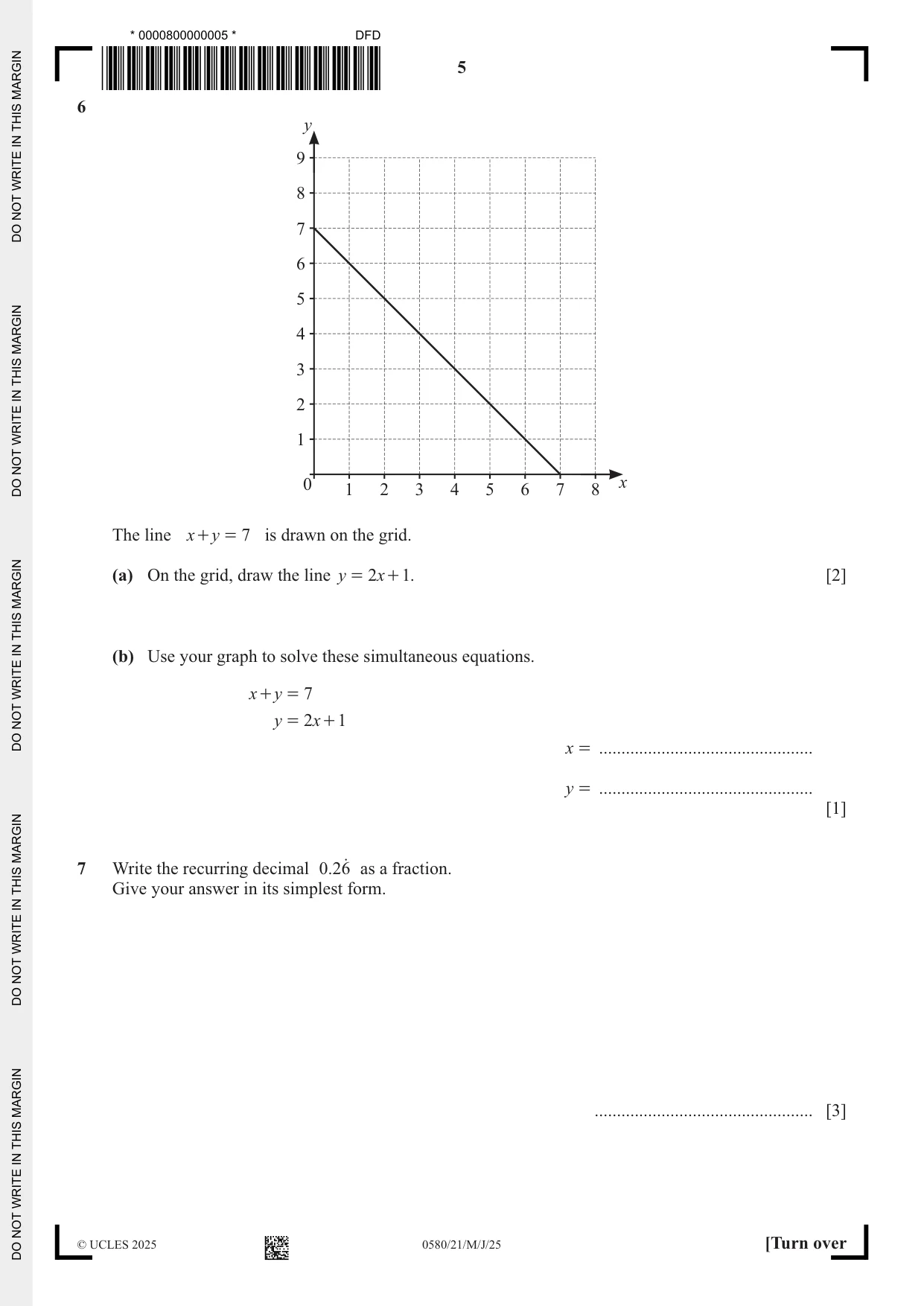
Q6 · Y 9 8 7 6 5 4 3 2 1 0 1 2 3 4 5 6 7 8 x The line x + y = 7 is drawn on the grid
6 y 9 8 7 6 5 4 3 2 1 0 1 2 3 4 5 6 7 8 x The line x + y = 7 is drawn on the grid. (a) On the grid, draw the line y = 2x + 1. [2] (b) Use your graph to solve these simultaneous equations. x + y = 7 y = 2x + 1 x = ................................................ y = ................................................ [1]
Mark scheme: 6(a) Correct line drawn 2 M1 for a line with gradient 2 or for a line with positive gradient and intercept at y = 1 6(b) [x =] 2, [y =] 5 1 FT intersection of their (a) with the given line
Q7 · Write the recurring decimal .026o as a fraction
7 Write the recurring decimal .026o as a fraction. Give your answer in its simplest form. ................................................. [3]
Mark scheme: 7 4 3 24 B2 for oe 15 90 or M1 for 26.66… – 2.66… oe or for 90x = 24 oe 2 6 or for + oe 10 90
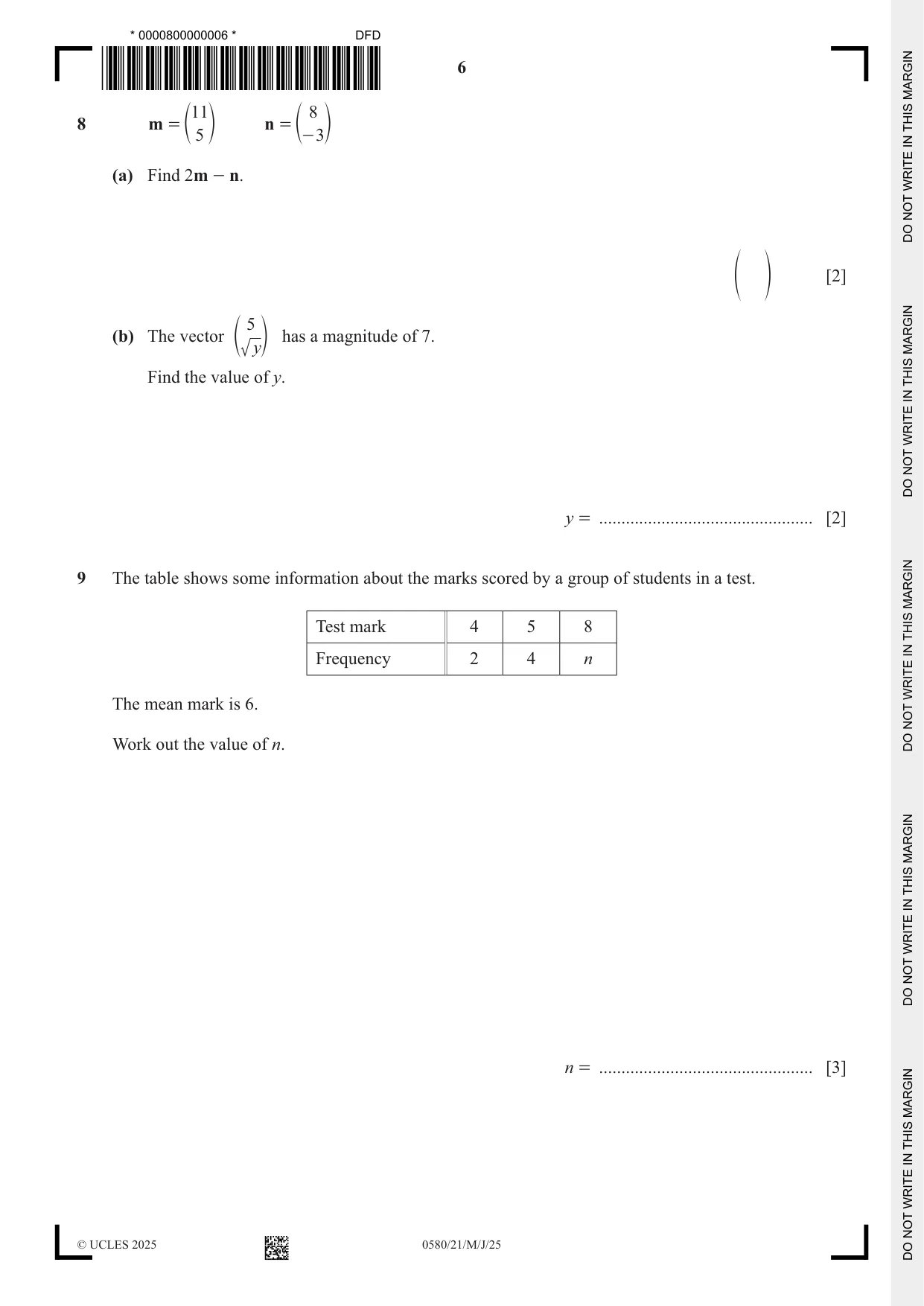
Q8 · 8 8 m = e o n = e o 5 - 3 (a) Find 2m - n
11 8 8 m = e o n = e o 5 - 3 (a) Find 2m - n. f p [2] 5 (b) The vector e o has a magnitude of 7. y Find the value of y. y = ................................................ [2]
Mark scheme: 8(a) 14 2 14 k 22 B1 for or for or for 13 k 13 10 8(b) 24 2 M1 for y + 52 = 72 or better
Q9 · The table shows some information about the marks scored by a group of students in a test
9 The table shows some information about the marks scored by a group of students in a test. Test mark 4 5 8 Frequency 2 4 n The mean mark is 6. Work out the value of n. n = ................................................ [3]
Mark scheme: 9 4 nfww 3 M2 for 8 + 20 + 8n = 6(2 + 4 + n) or better 2 +4 4 +5 n 8 or M1 for [= 6] oe 2 + 4 + n or 8 + 20 + 8n or 6(2 + 4 + n)
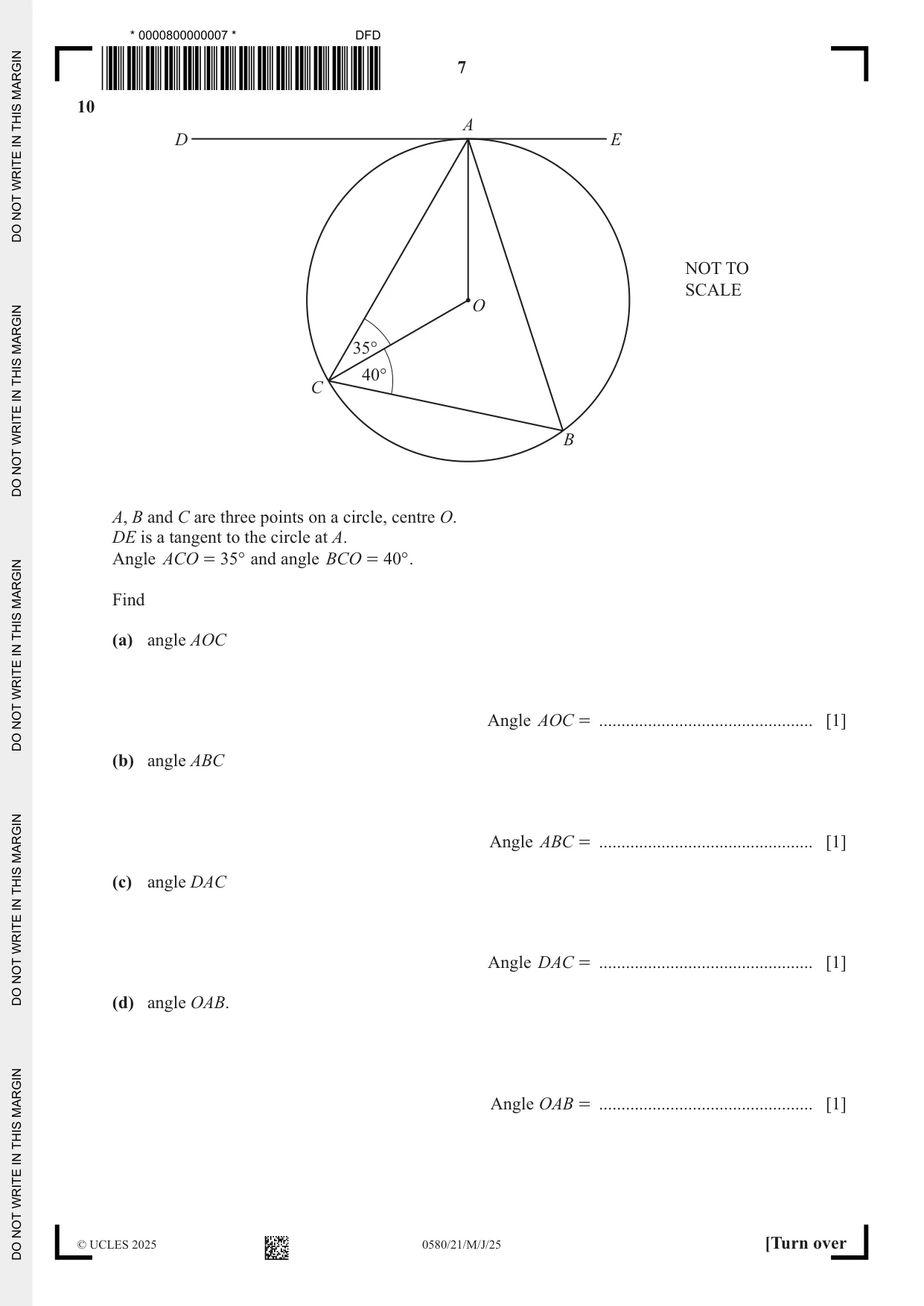
Q10 · A D E NOT TO SCALE O 35° 40° C B A, B and C are three points on a circle, centre O
10 A D E NOT TO SCALE O 35° 40° C B A, B and C are three points on a circle, centre O. DE is a tangent to the circle at A. Angle ACO = 35° and angle BCO = 40° . Find (a) angle AOC Angle AOC = ................................................ [1] (b) angle ABC Angle ABC = ................................................ [1] (c) angle DAC Angle DAC = ................................................ [1] (d) angle OAB. Angle OAB = ................................................ [1]
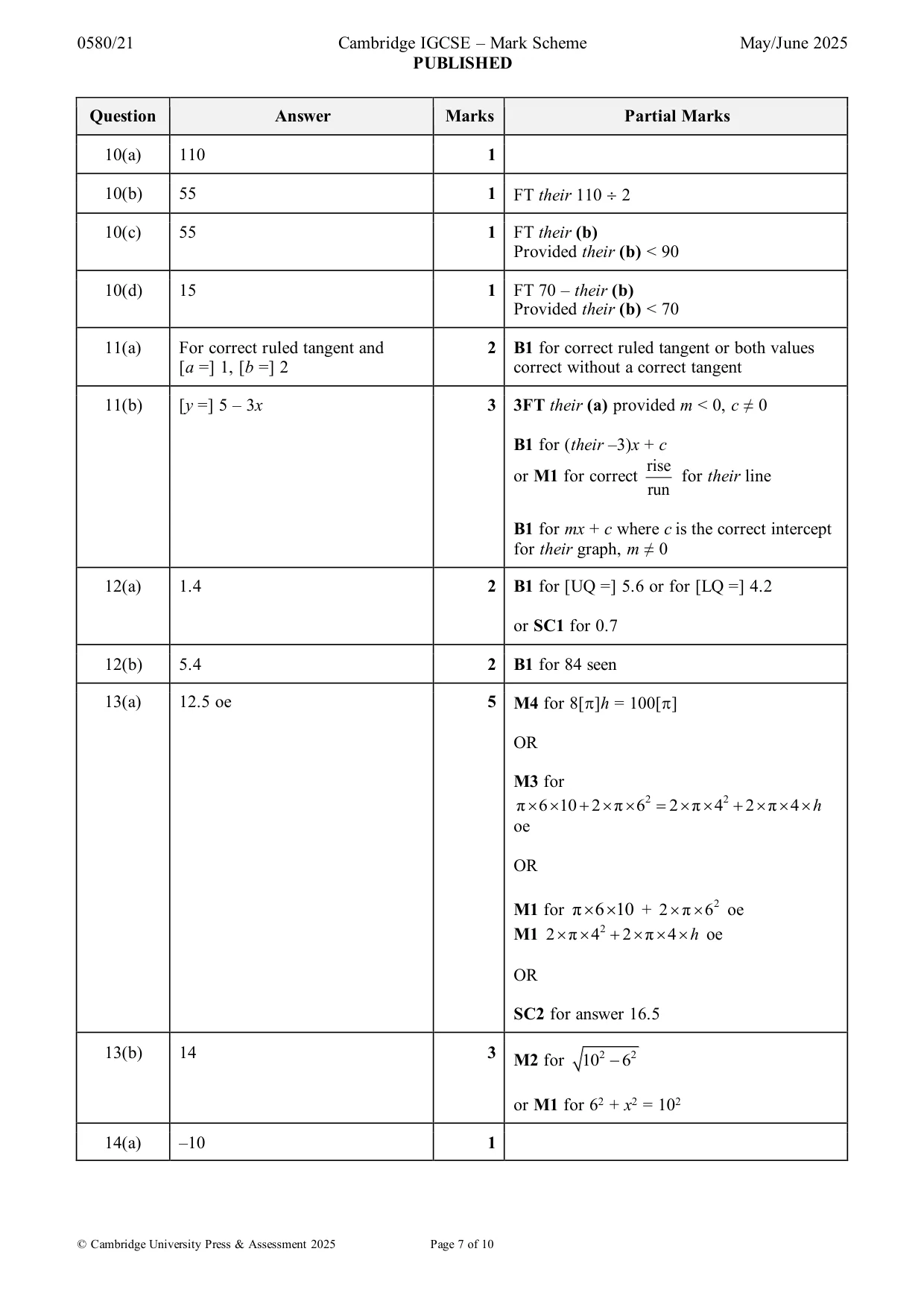
Mark scheme: 10(a) 110 1 10(b) 55 1 FT their 110 2 10(c) 55 1 FT their (b) Provided their (b) < 90 10(d) 15 1 FT 70 – their (b) Provided their (b) < 70
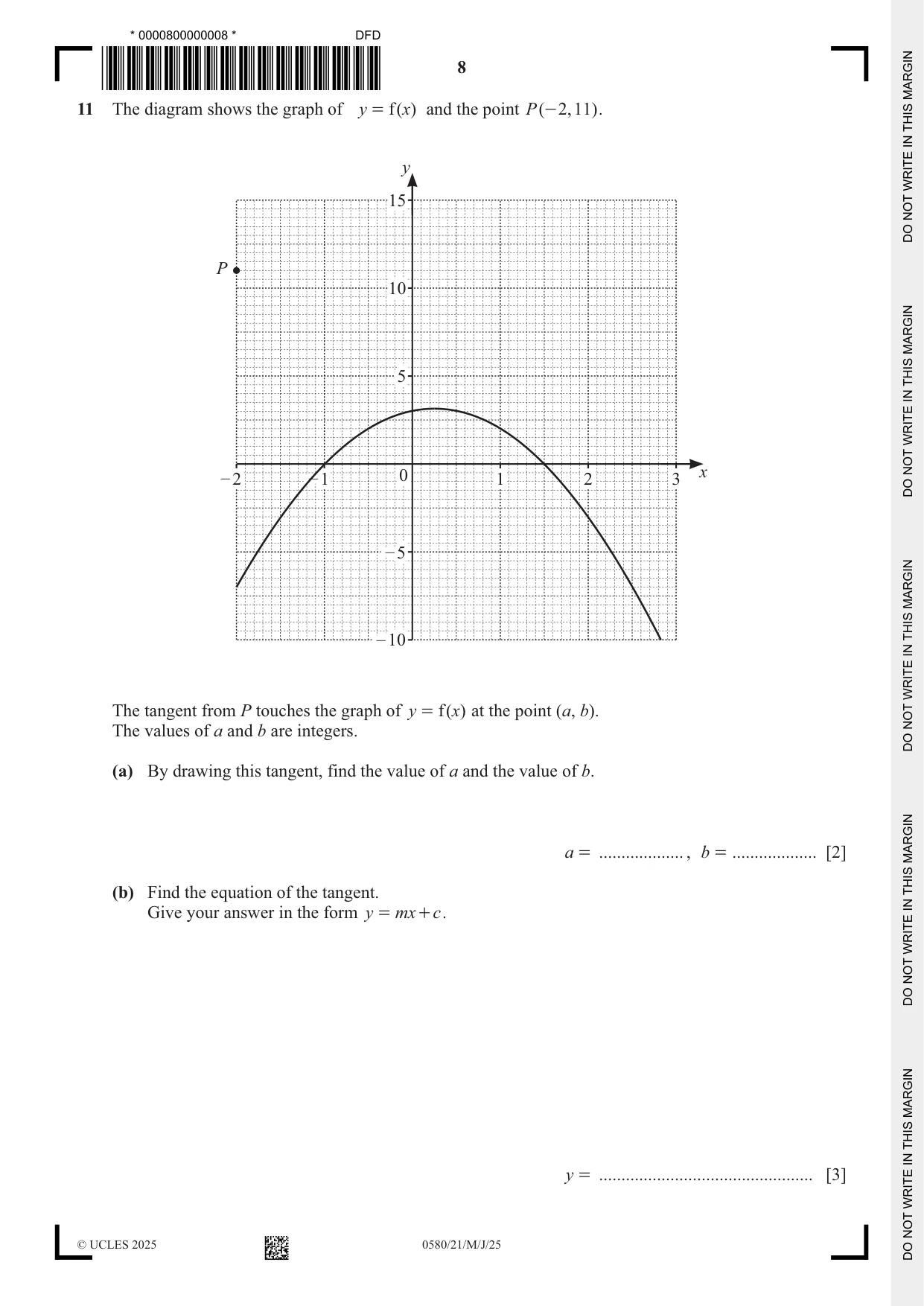
Q11 · The diagram shows the graph of y = f ( x) and the point P ( - 2 , 11)
11 The diagram shows the graph of y = f ( x) and the point P ( - 2 , 11) . y 15 P 10 5 – 2 – 1 0 1 2 3 x – 5 – 10 The tangent from P touches the graph of y = f ( x) at the point (a, b). The values of a and b are integers. (a) By drawing this tangent, find the value of a and the value of b. a = ................... , b = ................... [2] (b) Find the equation of the tangent. Give your answer in the form y = mx + c . y = ................................................ [3]
Mark scheme: 11(a) For correct ruled tangent and 2 B1 for correct ruled tangent or both values [a =] 1, [b =] 2 correct without a correct tangent 11(b) [y =] 5 – 3x 3 3FT their (a) provided m < 0, c ≠ 0 B1 for (their –3)x + c rise or M1 for correct for their line run B1 for mx + c where c is the correct intercept for their graph, m ≠ 0
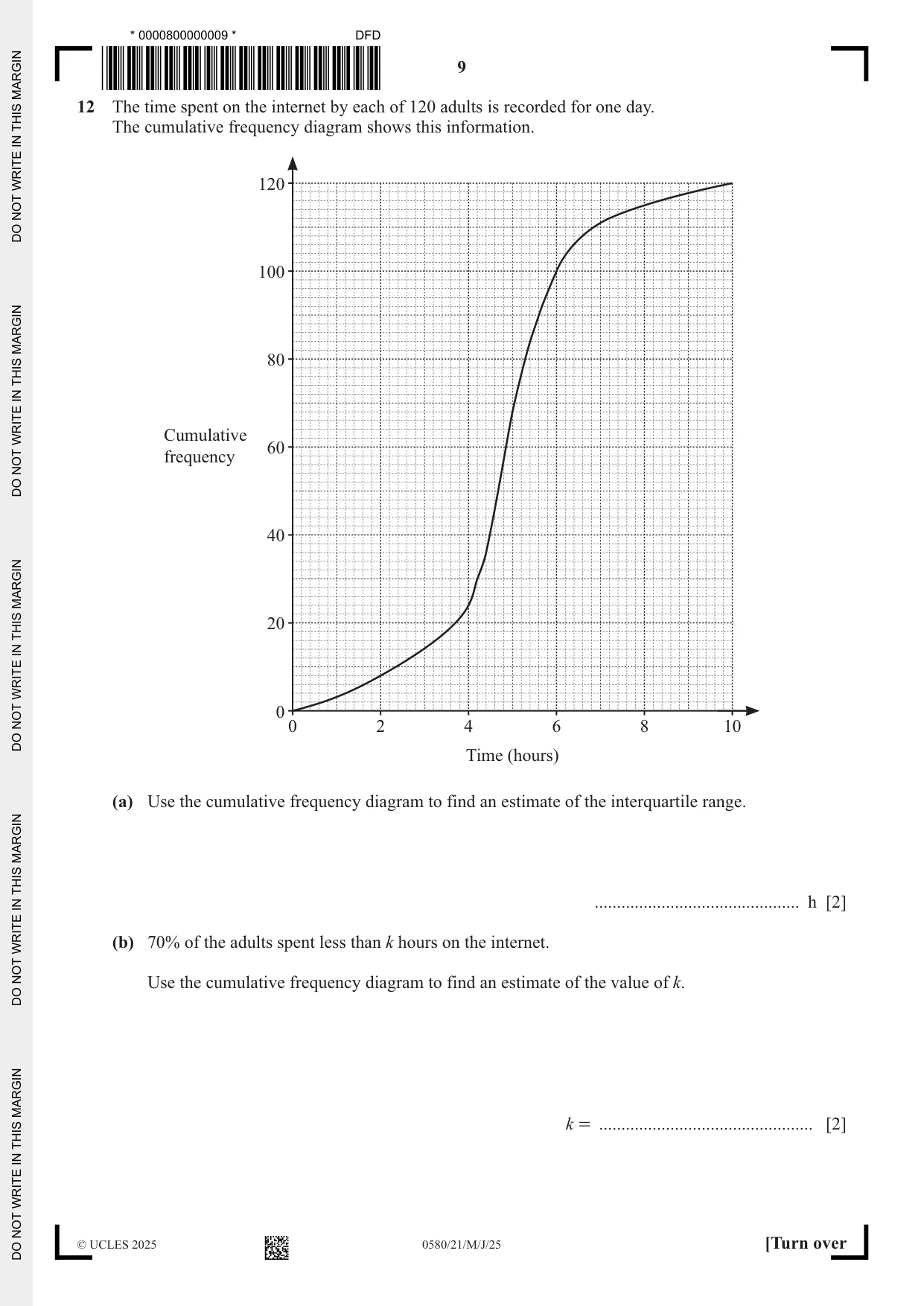
Q12 · The time spent on the internet by each of 120 adults is recorded for one day
12 The time spent on the internet by each of 120 adults is recorded for one day. The cumulative frequency diagram shows this information. 120 100 80 Cumulative 60 frequency 40 20 0 0 2 4 6 8 10 Time (hours) (a) Use the cumulative frequency diagram to find an estimate of the interquartile range. .............................................. h [2] (b) 70% of the adults spent less than k hours on the internet. Use the cumulative frequency diagram to find an estimate of the value of k. k = ................................................ [2]
Mark scheme: 12(a) 1.4 2 B1 for [UQ =] 5.6 or for [LQ =] 4.2 or SC1 for 0.7 12(b) 5.4 2 B1 for 84 seen
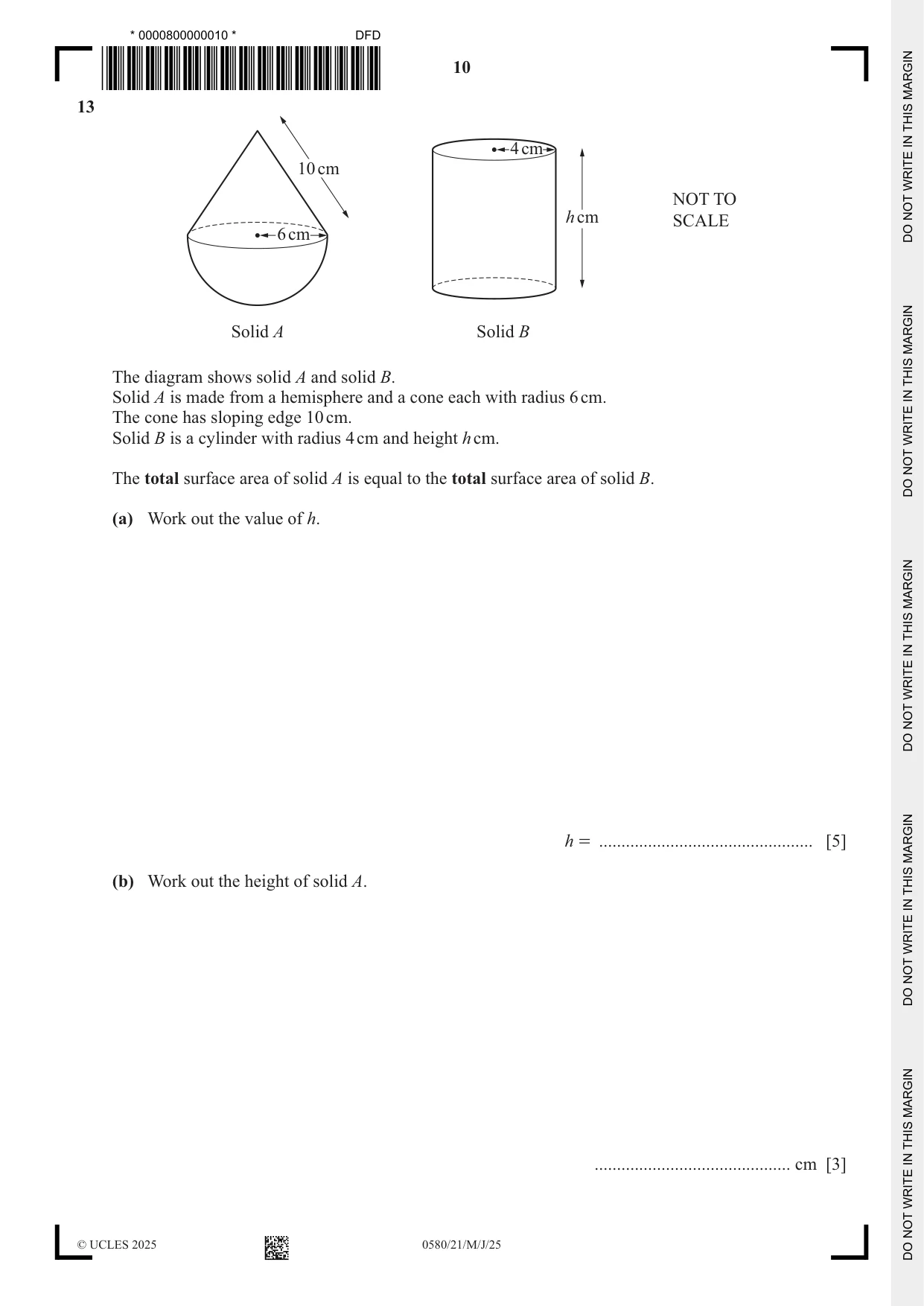
Q13 · 4 cm 10 cm NOT TO h cm SCALE 6 cm Solid A Solid B The diagram shows solid A and solid B
13 4 cm 10 cm NOT TO h cm SCALE 6 cm Solid A Solid B The diagram shows solid A and solid B. Solid A is made from a hemisphere and a cone each with radius 6 cm. The cone has sloping edge 10 cm. Solid B is a cylinder with radius 4 cm and height h cm. The total surface area of solid A is equal to the total surface area of solid B. (a) Work out the value of h. h = ................................................ [5] (b) Work out the height of solid A. ............................................ cm [3]
Mark scheme: 13(a) 12.5 oe 5 M4 for 8[]h = 100[] OR M3 for π 6 10 + 2 π 6 2 = 2 π 4 2 + 2 π 4 h oe OR M1 for π 6 10 + 2 π 6 2 oe M1 2 π 4 2 + 2 π 4 h oe OR SC2 for answer 16.5 13(b) 14 3 2 2 M2 for 10 − 6 or M1 for 62 + x2 = 102
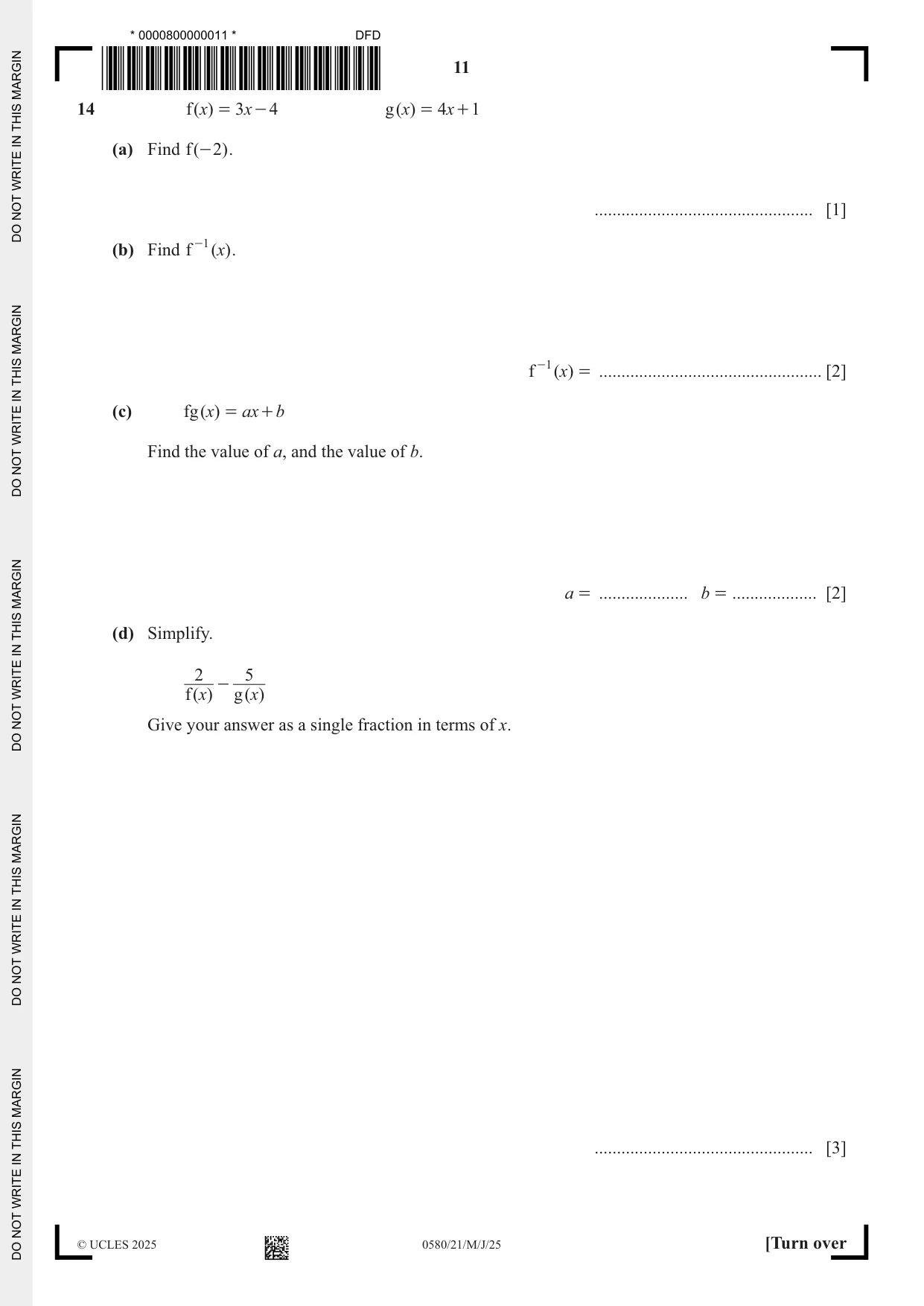
Q14 · F ( x) = 3x - 4 g ( x) = 4x + 1 (a) Find f ( - 2 )
14 f ( x) = 3x - 4 g ( x) = 4x + 1 (a) Find f ( - 2 ) . ................................................. [1] (b) Find f -1 ( x) . f -1 ( x) = .................................................. [2] (c) fg ( x) = ax + b Find the value of a, and the value of b. a = .................... b = ................... [2] (d) Simplify. 2 5 - f ( x) g ( x) Give your answer as a single fraction in terms of x. ................................................. [3]
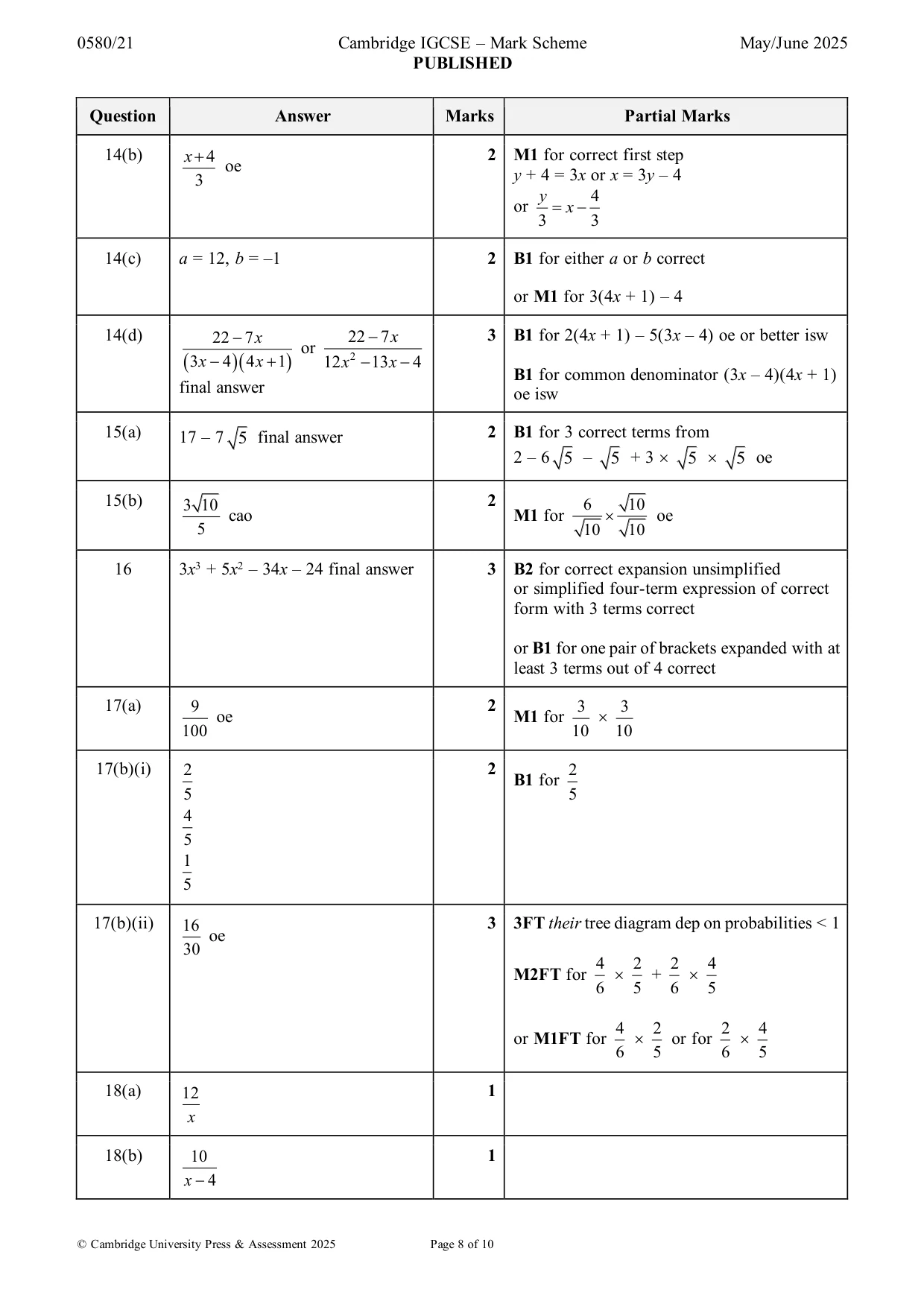
Mark scheme: 14(a) –10 1 14(b) x + 4 2 M1 for correct first step oe y + 4 = 3x or x = 3y – 4 3 y 4 or = x − 3 3 14(c) a = 12, b = –1 2 B1 for either a or b correct or M1 for 3(4x + 1) – 4 14(d) 22 − 7 x 22 − 7 x 3 B1 for 2(4x + 1) – 5(3x – 4) oe or better isw or ( 3 x − 4 )( 4 x + 1) 12 x 2 − 13 x − 4 B1 for common denominator (3x – 4)(4x + 1) final answer oe isw
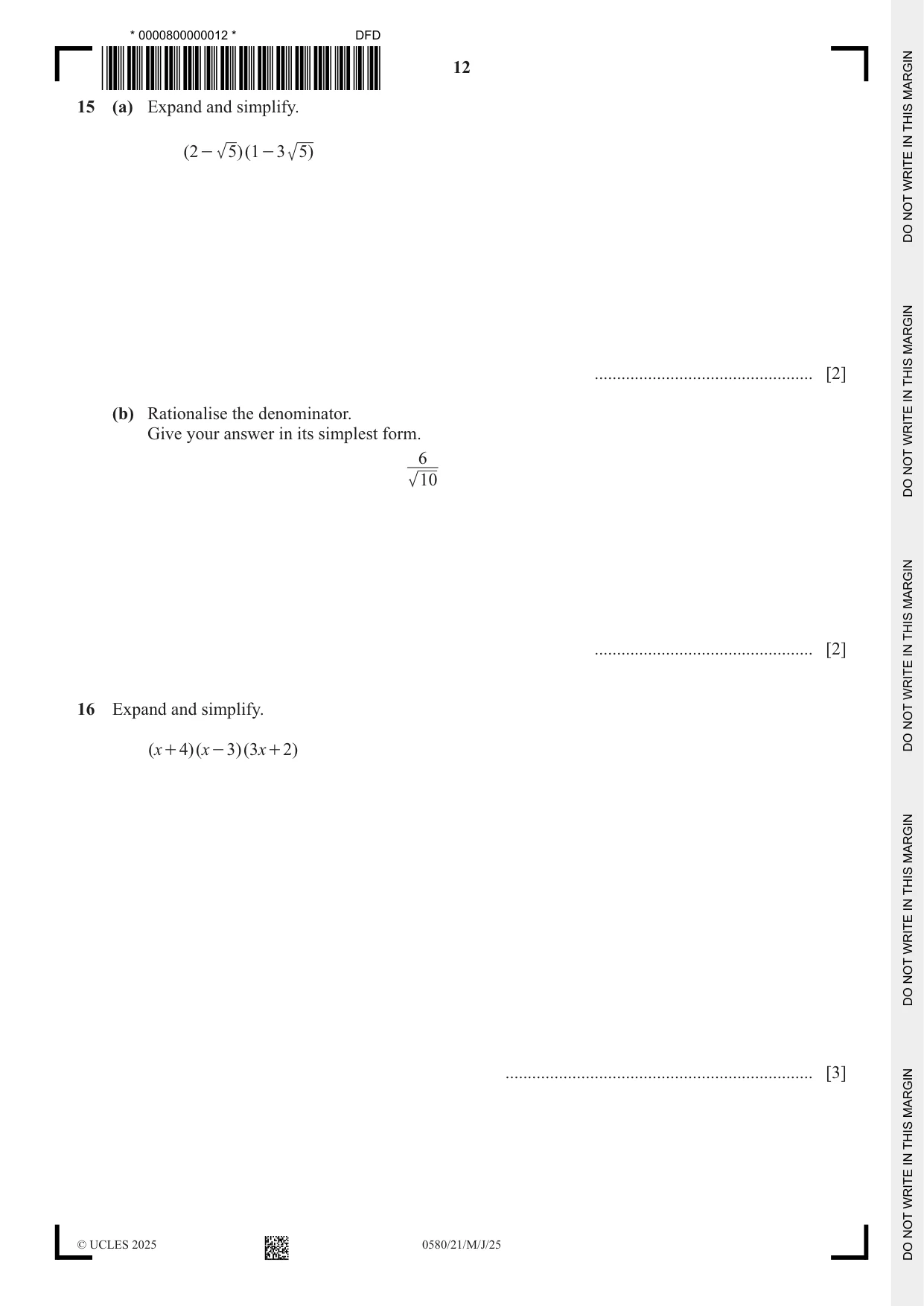
Question 15
15 (a) Expand and simplify. ( 2 - 5 )( 1 - 3 5 ) ................................................. [2] (b) Rationalise the denominator. Give your answer in its simplest form. 6 10 ................................................. [2]
Mark scheme: 15(a) 2 B1 for 3 correct terms from 17 – 7 5 final answer 2 – 6 5 – 5 + 3 5 5 oe 15(b) 3 10 2 6 10 cao M1 for oe 5 10 10
Question 16
16 Expand and simplify. ( x + 4)( x - 3)( 3x + 2 ) ..................................................................... [3]
Mark scheme: 16 3x3 + 5x2 – 34x – 24 final answer 3 B2 for correct expansion unsimplified or simplified four-term expression of correct form with 3 terms correct or B1 for one pair of brackets expanded with at least 3 terms out of 4 correct
Q17 · A bag contains 6 red marbles, 3 green marbles and 1 blue marble
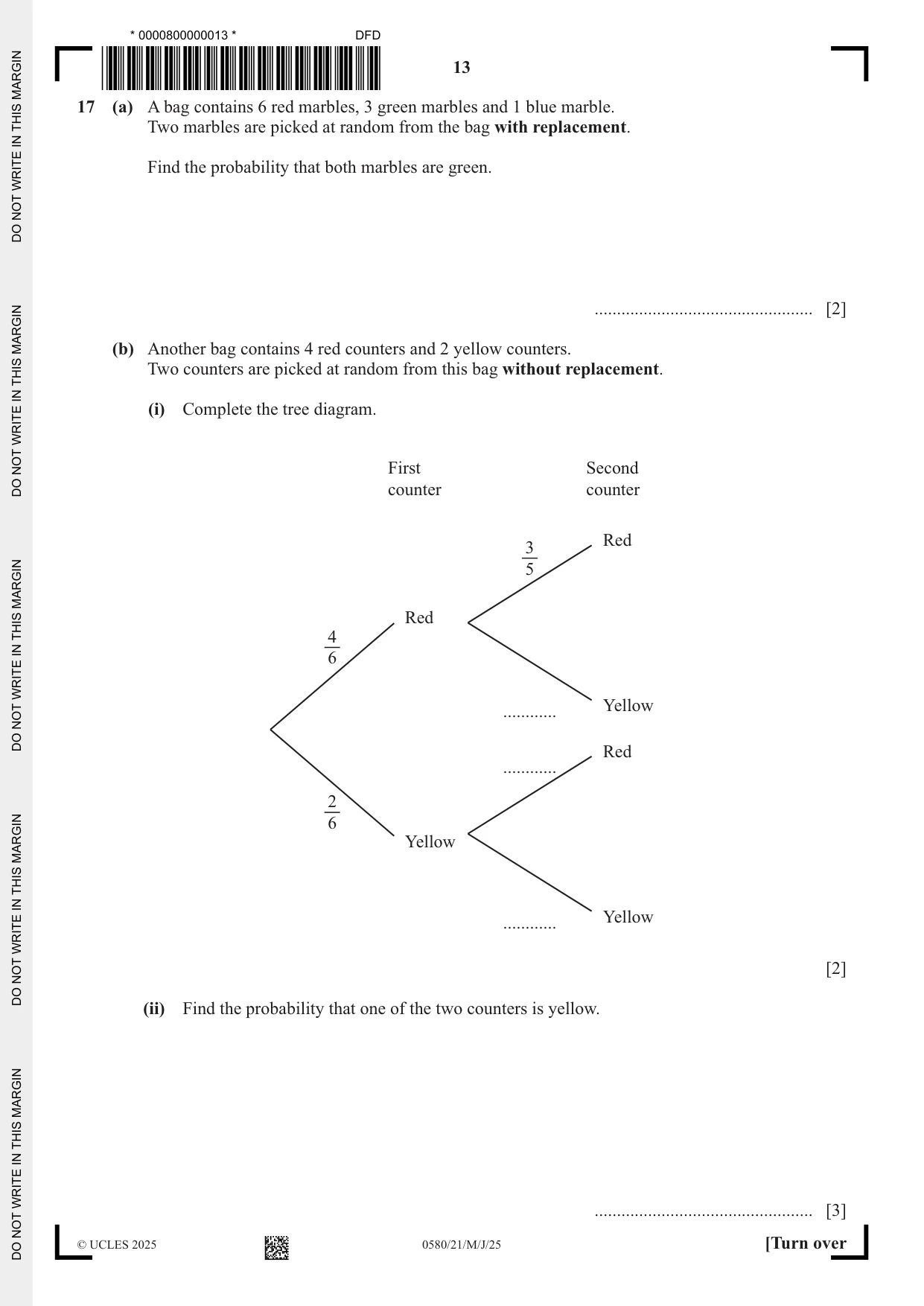
17 (a) A bag contains 6 red marbles, 3 green marbles and 1 blue marble. Two marbles are picked at random from the bag with replacement. Find the probability that both marbles are green. ................................................. [2] (b) Another bag contains 4 red counters and 2 yellow counters. Two counters are picked at random from this bag without replacement. (i) Complete the tree diagram. First Second counter counter Red 3 5 Red 4 6 Yellow ............ Red ............ 2 6 Yellow Yellow ............ [2] (ii) Find the probability that one of the two counters is yellow. ................................................. [3]
Mark scheme: 17(a) 9 2 3 3 oe M1 for 100 10 10 17(b)(i) 2 2 2 B1 for 5 5 4 5 1 5 17(b)(ii) 16 3 3FT their tree diagram dep on probabilities < 1 oe 30 4 2 2 4 M2FT for + 6 5 6 5 4 2 2 4 or M1FT for or for 6 5 6 5
Q18 · One day, Anya runs 12 km at a speed of x km/h
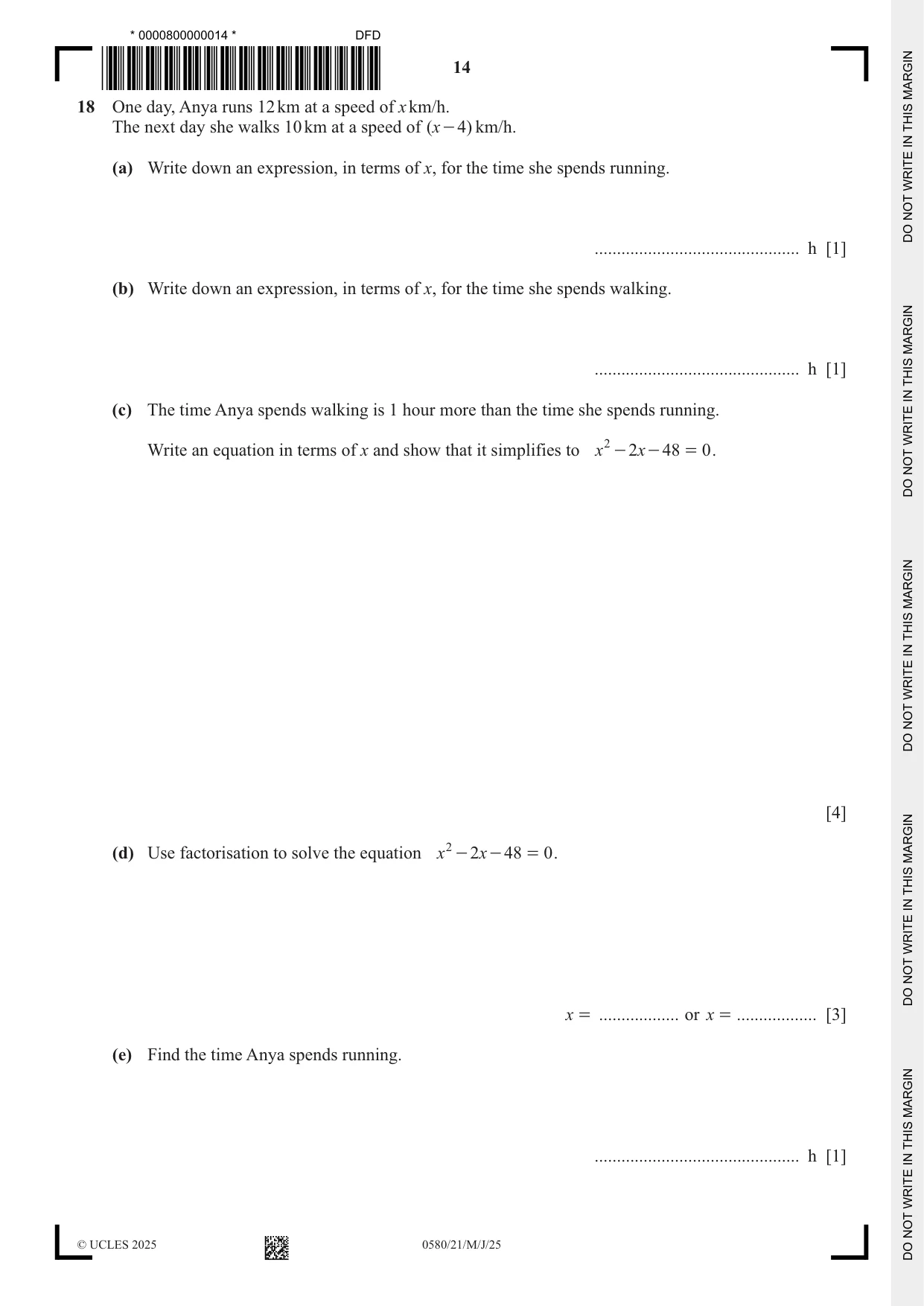
18 One day, Anya runs 12 km at a speed of x km/h. The next day she walks 10 km at a speed of ( x - 4 ) km/h. (a) Write down an expression, in terms of x, for the time she spends running. .............................................. h [1] (b) Write down an expression, in terms of x, for the time she spends walking. .............................................. h [1] (c) The time Anya spends walking is 1 hour more than the time she spends running. Write an equation in terms of x and show that it simplifies to x 2 - 2 x - 48 = 0 . [4] (d) Use factorisation to solve the equation x 2 - 2 x - 48 = 0 . x = .................. or x = .................. [3] (e) Find the time Anya spends running. .............................................. h [1]
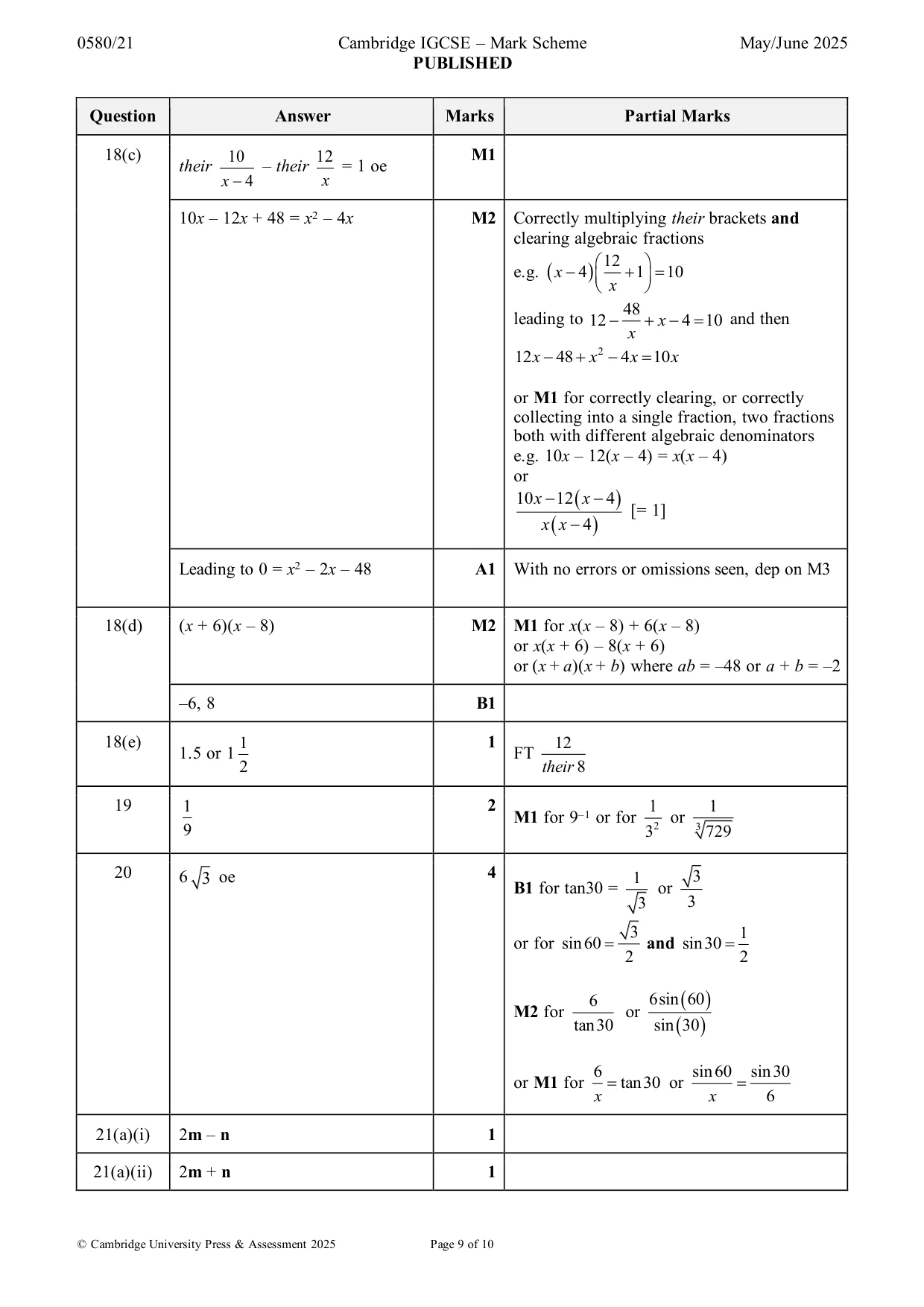
Mark scheme: 18(a) 12 1 x 18(b) 10 1 x − 4 18(c) 10 12 M1 their – their = 1 oe x − 4 x 10x – 12x + 48 = x2 – 4x M2 Correctly multiplying their brackets and clearing algebraic fractions 12 e.g. ( x − 4 ) + 1 = 10 x 48 leading to 12 − + x − 4 = 10 and then x 12 x − 48 + x 2 − 4 x = 10 x or M1 for correctly clearing, or correctly collecting into a single fraction, two fractions both with different algebraic denominators e.g. 10x – 12(x – 4) = x(x – 4) or 10 x − 12 ( x − 4 ) [= 1] x ( x − 4 ) Leading to 0 = x2 – 2x – 48 A1 With no errors or omissions seen, dep on M3 18(d) (x + 6)(x – 8) M2 M1 for x(x – 8) + 6(x – 8) or x(x + 6) – 8(x + 6) or (x + a)(x + b) where ab = –48 or a + b = –2 –6, 8 B1 18(e) 1 1 12 1.5 or 1 FT 2 their 8
Q19 · - 2319 Find the value of 27
- 2319 Find the value of 27 . ................................................. [2]
Mark scheme: 19 1 2 1 1 M1 for 9–1 or for or 9 3 2 3 729
Q20 · NOT TO 6 cm SCALE 30° x cm Find the exact value of x
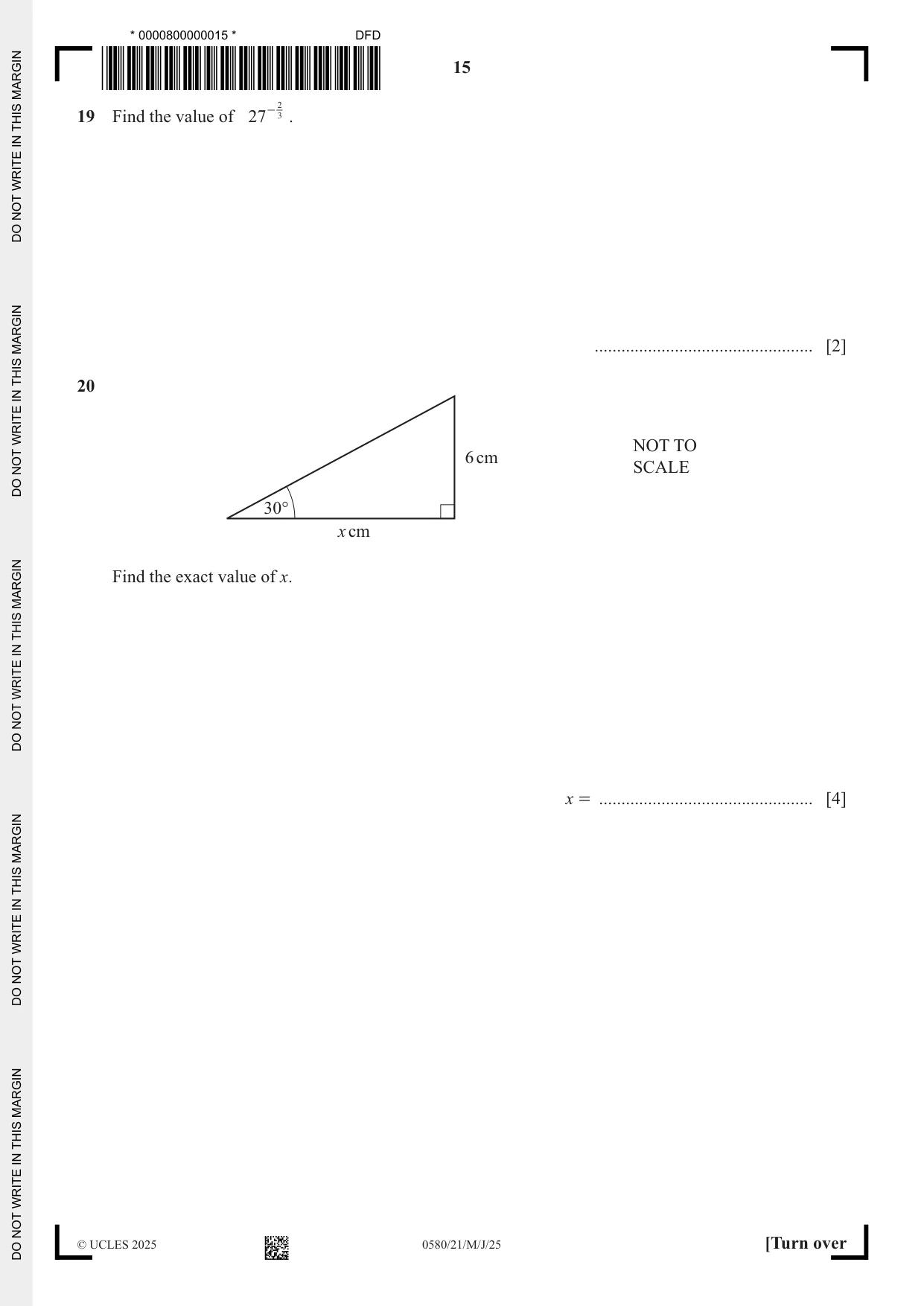
20 NOT TO 6 cm SCALE 30° x cm Find the exact value of x. x = ................................................ [4]
Mark scheme: 20 4 1 3 6 3 oe B1 for tan30 = or 3 3 3 1 or for sin60 = and sin30 = 2 2 6 6sin ( 60 ) M2 for or tan30 sin ( 30 ) 6 sin60 sin30 or M1 for = tan30 or = x x 6
Q21 · A B n NOT TO P 2m SCALE O C OABC is a rhombus and O is the origin
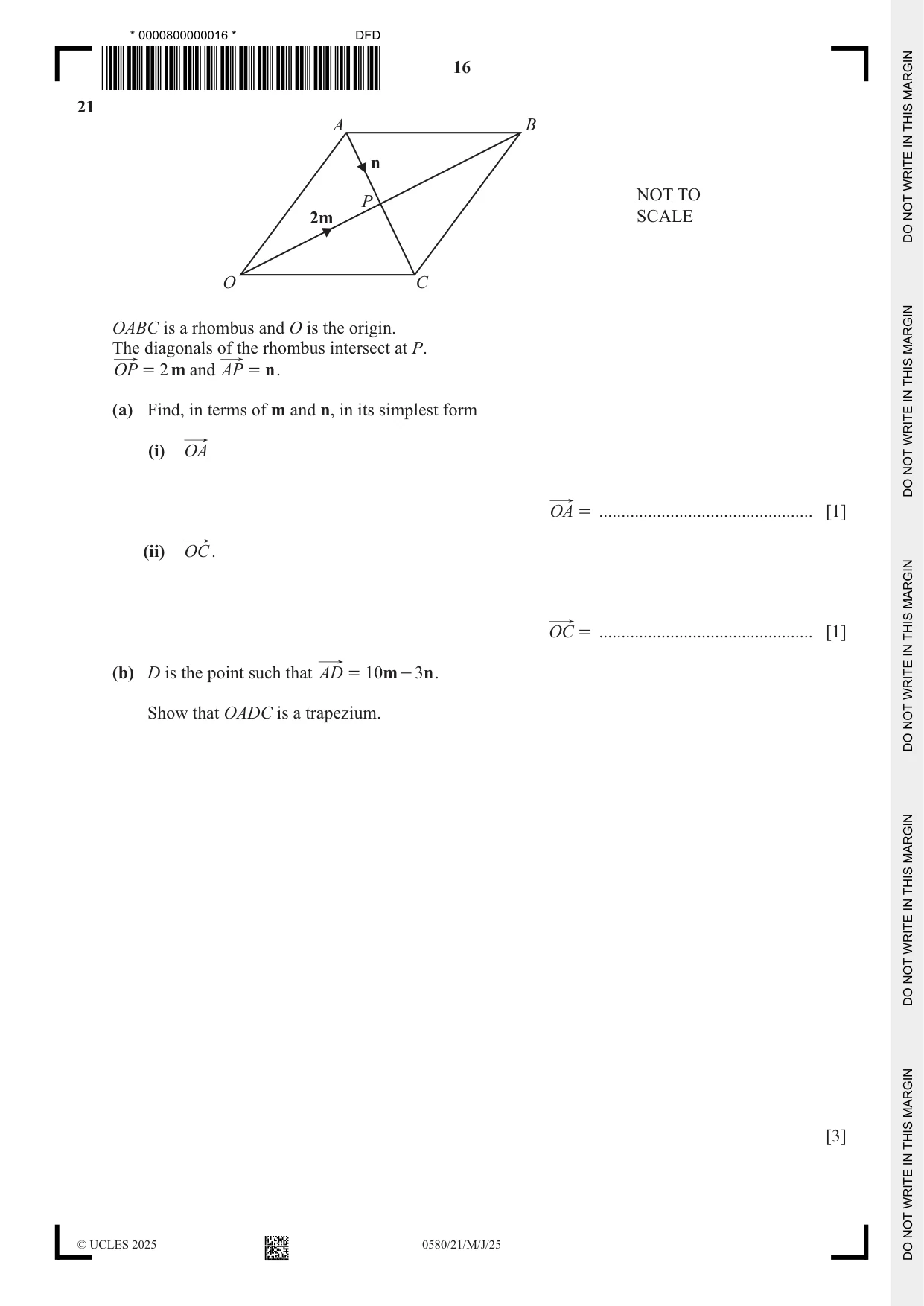
21 A B n NOT TO P 2m SCALE O C OABC is a rhombus and O is the origin. The diagonals of the rhombus intersect at P. OP = 2 m and AP = n . (a) Find, in terms of m and n, in its simplest form (i) OA OA = ................................................ [1] (ii) OC. OC = ................................................ [1] (b) D is the point such that AD = 10m - 3n . Show that OADC is a trapezium. [3]
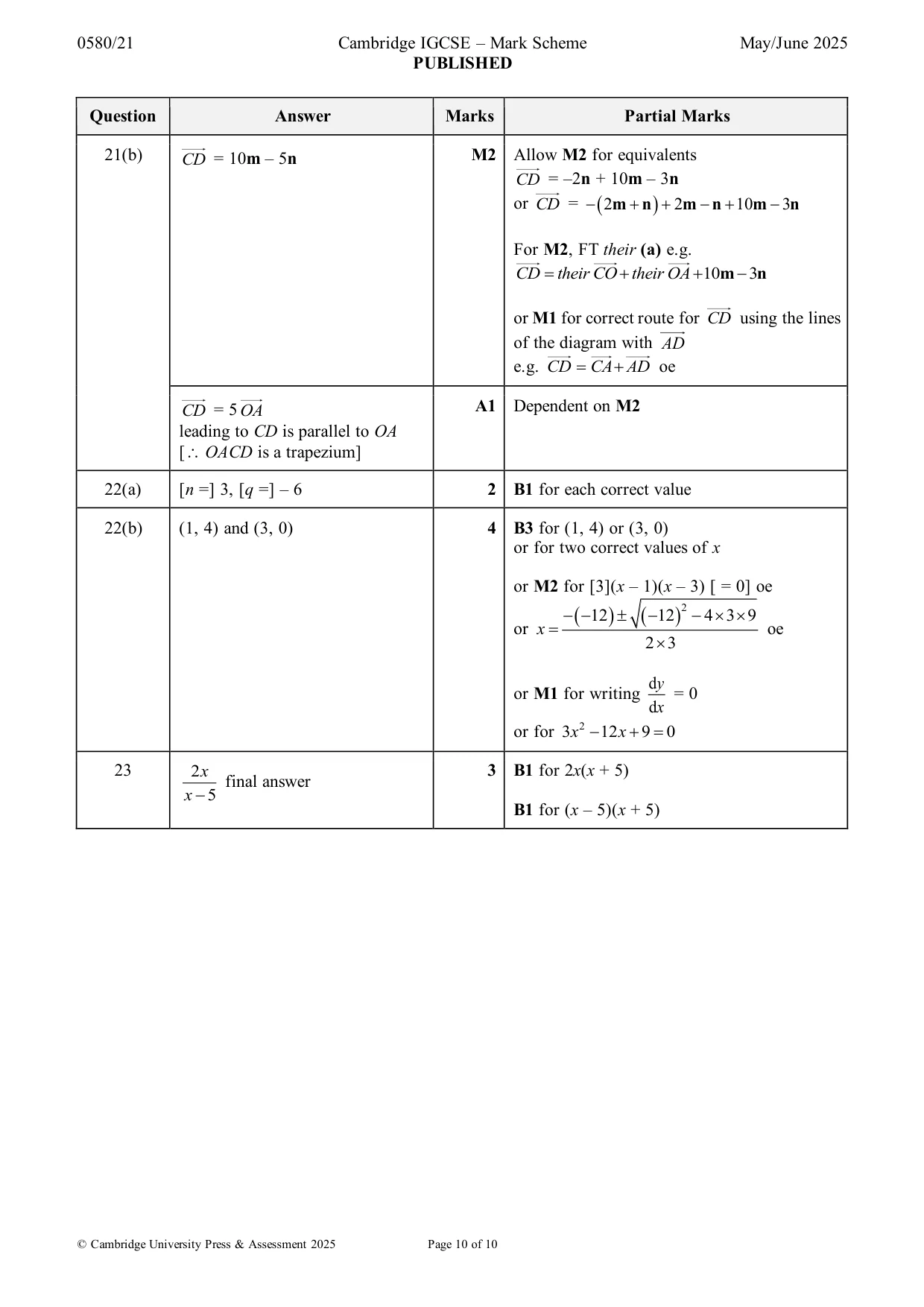
Mark scheme: 21(a)(i) 2m – n 1 21(a)(ii) 2m + n 1 21(b) CD = 10m – 5n M2 Allow M2 for equivalents CD = –2n + 10m – 3n or CD = − ( 2m + n ) + 2m − n + 10m − 3n For M2, FT their (a) e.g. CD = their CO + their OA + 10m − 3n or M1 for correct route for CD using the lines of the diagram with AD e.g. CD = CA + AD oe CD = 5 OA A1 Dependent on M2 leading to CD is parallel to OA [ OACD is a trapezium]
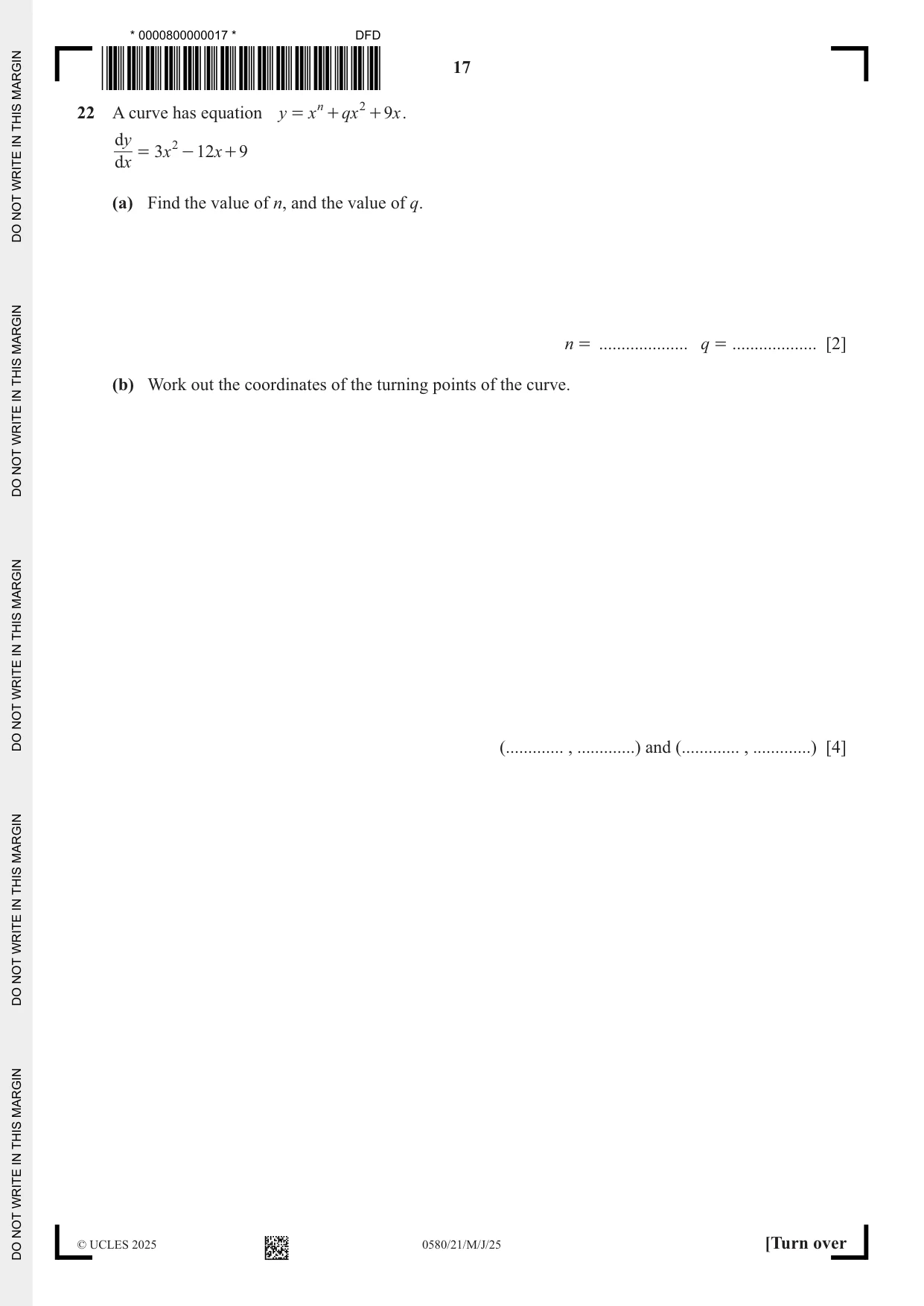
Q22 · A curve has equation y = x n + qx 2 + 9x
22 A curve has equation y = x n + qx 2 + 9x . dy 2 = 3 x - 12 x + 9 dx (a) Find the value of n, and the value of q. n = .................... q = ................... [2] (b) Work out the coordinates of the turning points of the curve. (............. , .............) and (............. , .............) [4]
Mark scheme: 22(a) [n =] 3, [q =] – 6 2 B1 for each correct value 22(b) (1, 4) and (3, 0) 4 B3 for (1, 4) or (3, 0) or for two correct values of x or M2 for [3](x – 1)(x – 3) [ = 0] oe −−( 12 ) ( −12 ) 2 −4 3 9 or x = oe 2 3 d y or M1 for writing = 0 d x or for 3 x 2 − 12 x + 9 = 0
Question 23
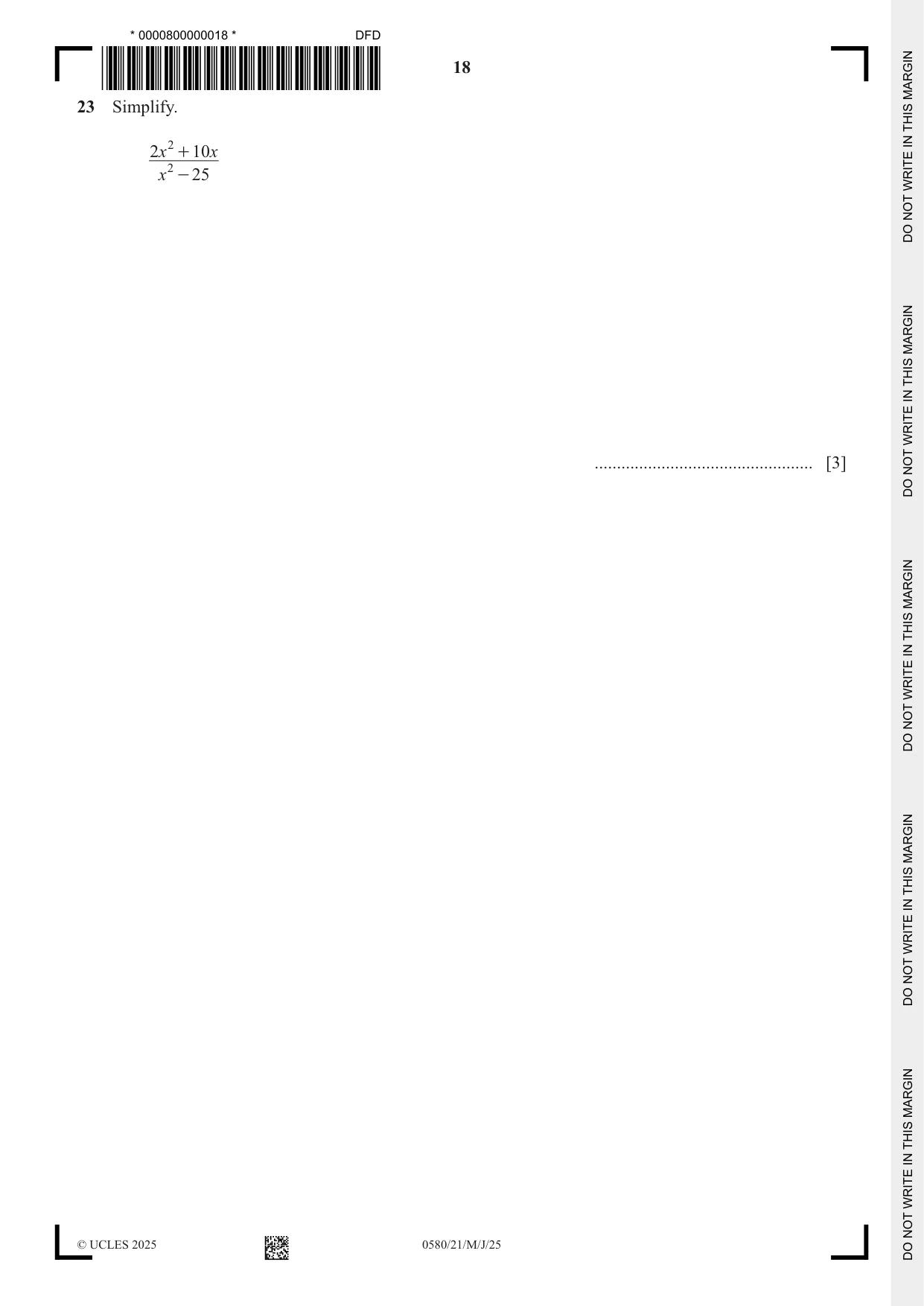
23 Simplify. 2x 2 + 10 x x 2 - 25 ................................................. [3]
Mark scheme: 23 2 x 3 B1 for 2x(x + 5) final answer x − 5 B1 for (x – 5)(x + 5)
What was in this paper
The subtopics covered by these 23 questions, and how many questions each got. Open one in a new tab to see every Cambridge question on it.
3Fractions, decimals and percentages2Vectors in two dimensions2Angles1Averages and measures of spread1Circle theorems I1Drawing linear graphs1Equations1Equations of linear graphs1Functions1Graphs of functions1Interpreting statistical data1Introduction to probability1Money1Powers and roots1Ratio and proportion1Right-angled triangles1Surds1Surface area and volume1What you needed in this session
Cambridge’s own grade thresholds for 2025 May/June, Paper 2 · Variant 1. A higher threshold means an easier paper — the bar moves with how the cohort did.