Cambridge IGCSE Mathematics 0580 — 2025 Oct/Nov Paper 2 · Variant 3
0580/23/O/N/25 · 29 questions · 100 marks · 120 min
The question paper and its mark scheme, free to read here and free to download. This is Cambridge’s own paper, exactly as it was sat.
Question paper20 pages
Mark scheme10 pages
Answers below. Sit the paper first if you are practising.
Questions as text
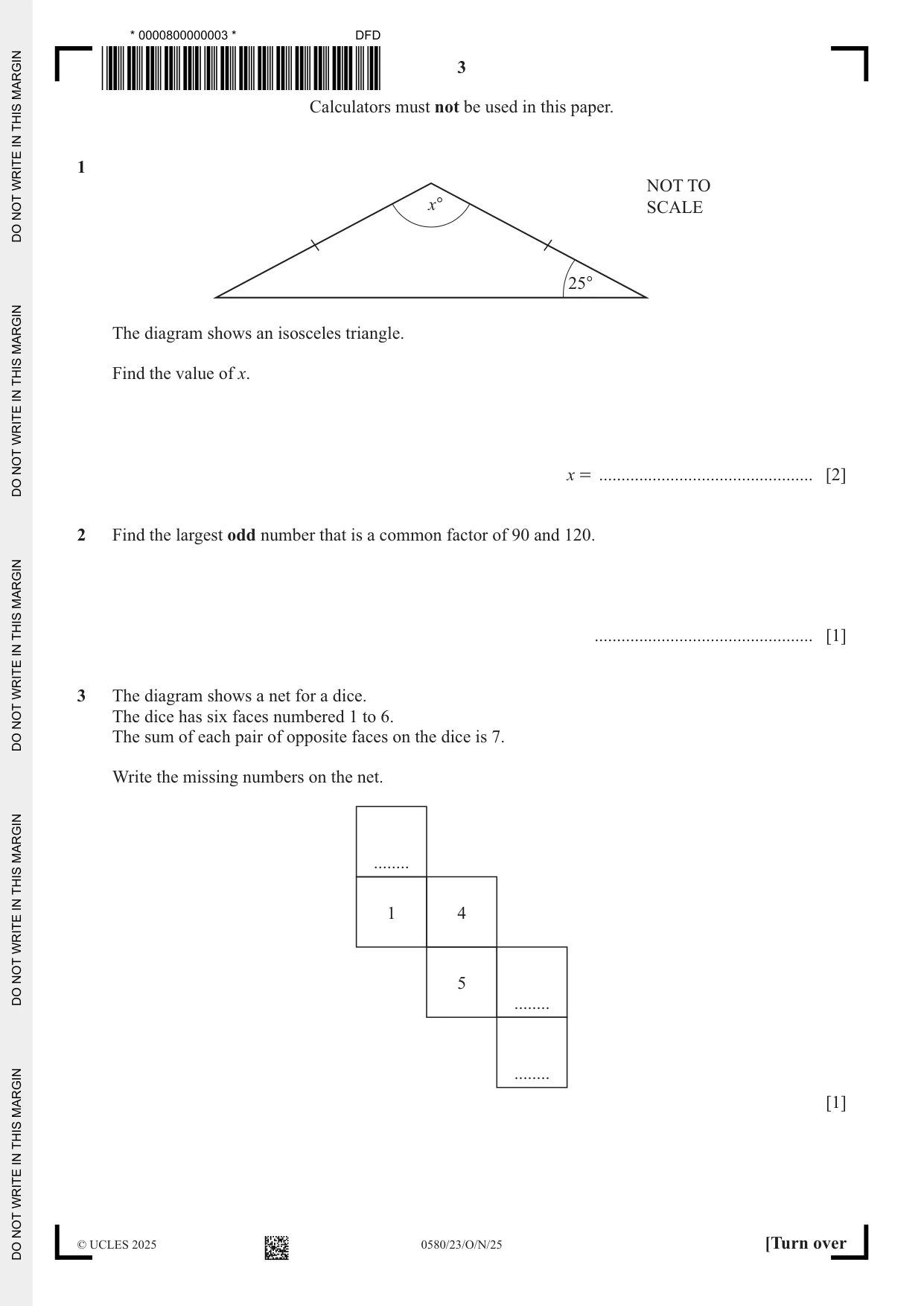
Q1 · NOT TO x° SCALE 25° The diagram shows an isosceles triangle
1 NOT TO x° SCALE 25° The diagram shows an isosceles triangle. Find the value of x. x = ................................................ [2]
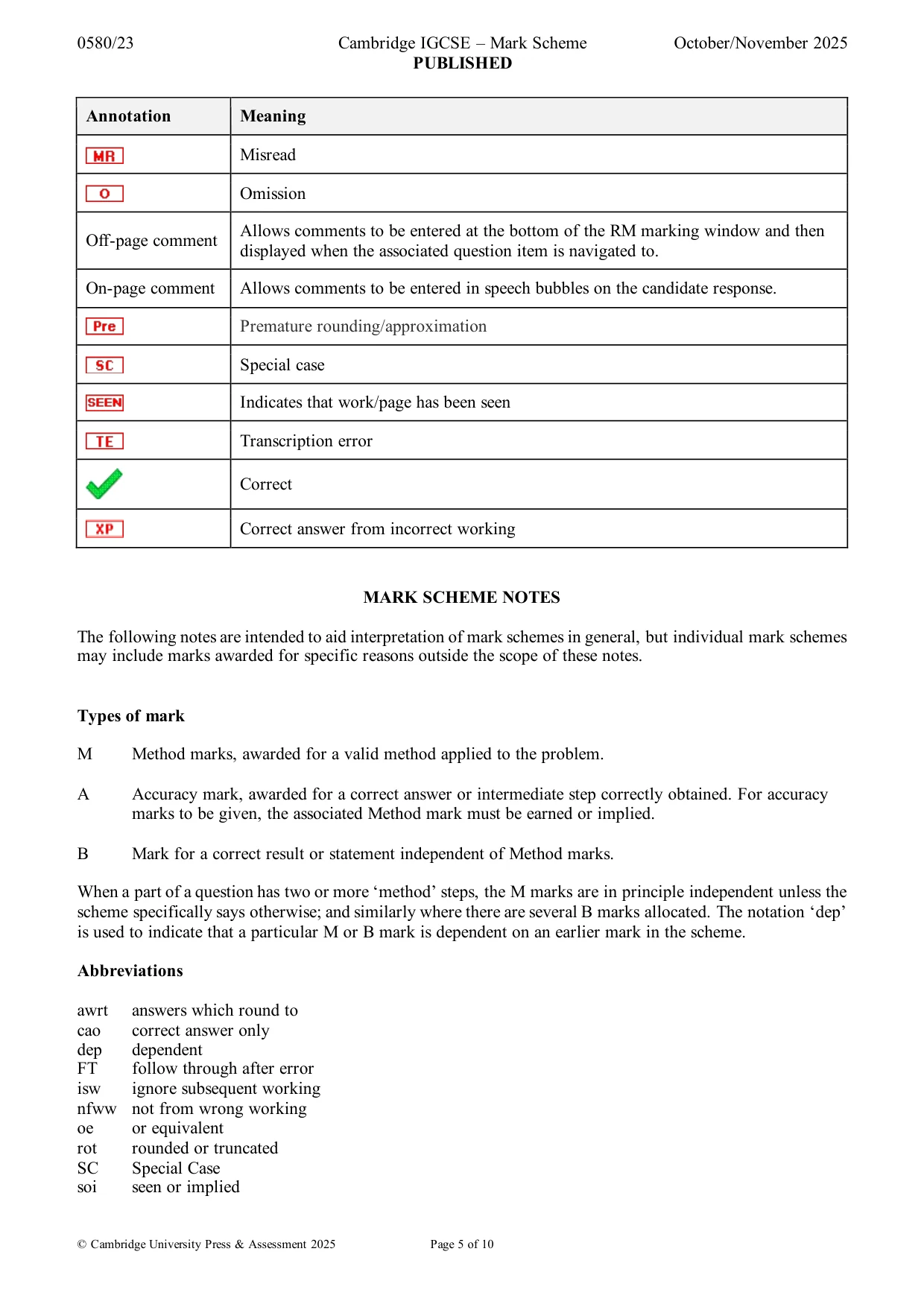
Mark scheme: Question Answer Marks Partial Marks 1 130 2 M1 for 180 – 2 × 25
Q2 · Find the largest odd number that is a common factor of 90 and 120
2 Find the largest odd number that is a common factor of 90 and 120. ................................................. [1]
Mark scheme: 2 15 1
Q3 · The diagram shows a net for a dice
3 The diagram shows a net for a dice. The dice has six faces numbered 1 to 6. The sum of each pair of opposite faces on the dice is 7. Write the missing numbers on the net. ........ 1 4 5 ........ ........ [1]
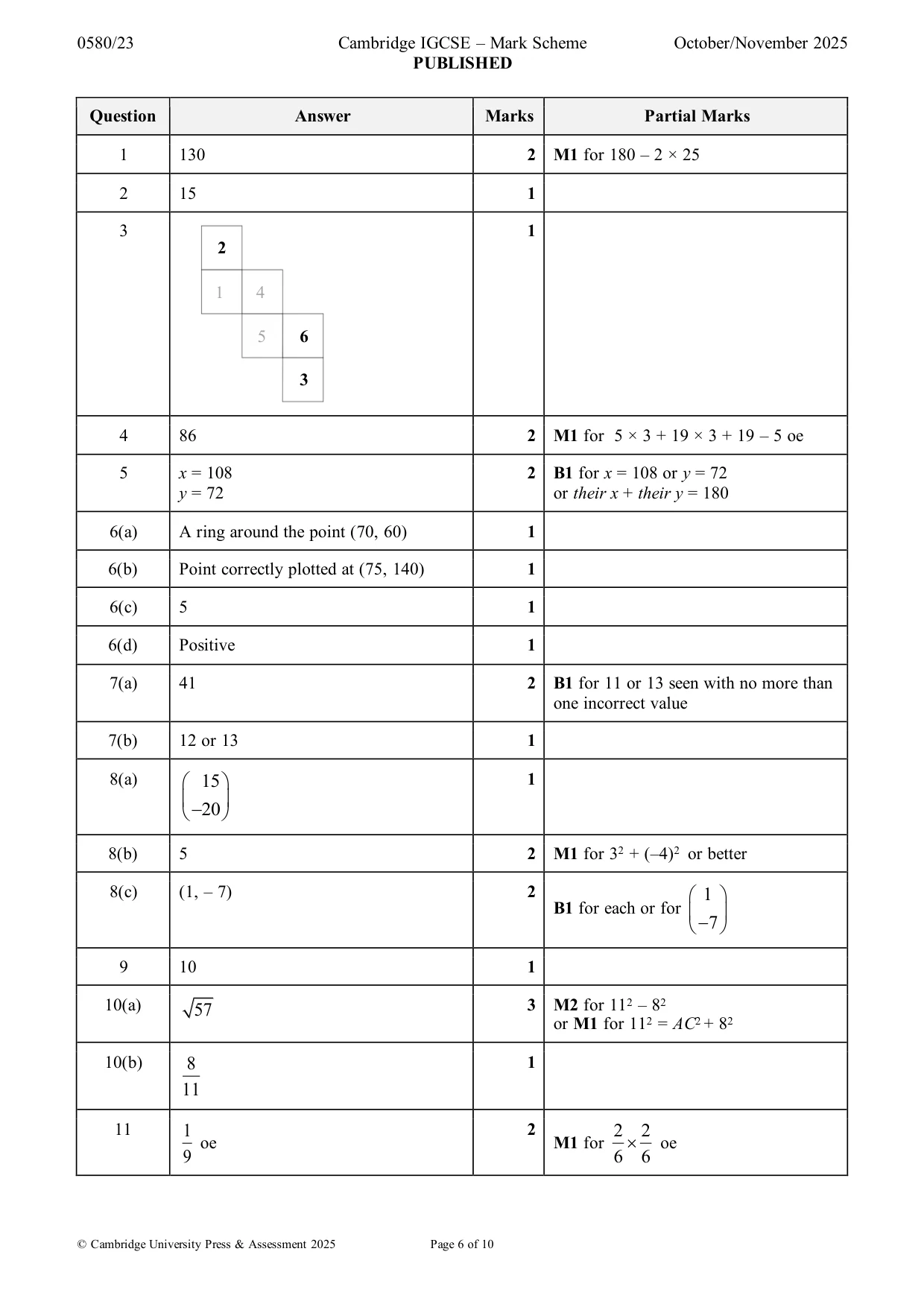
Mark scheme: 3 1 2 1 4 5 6 3
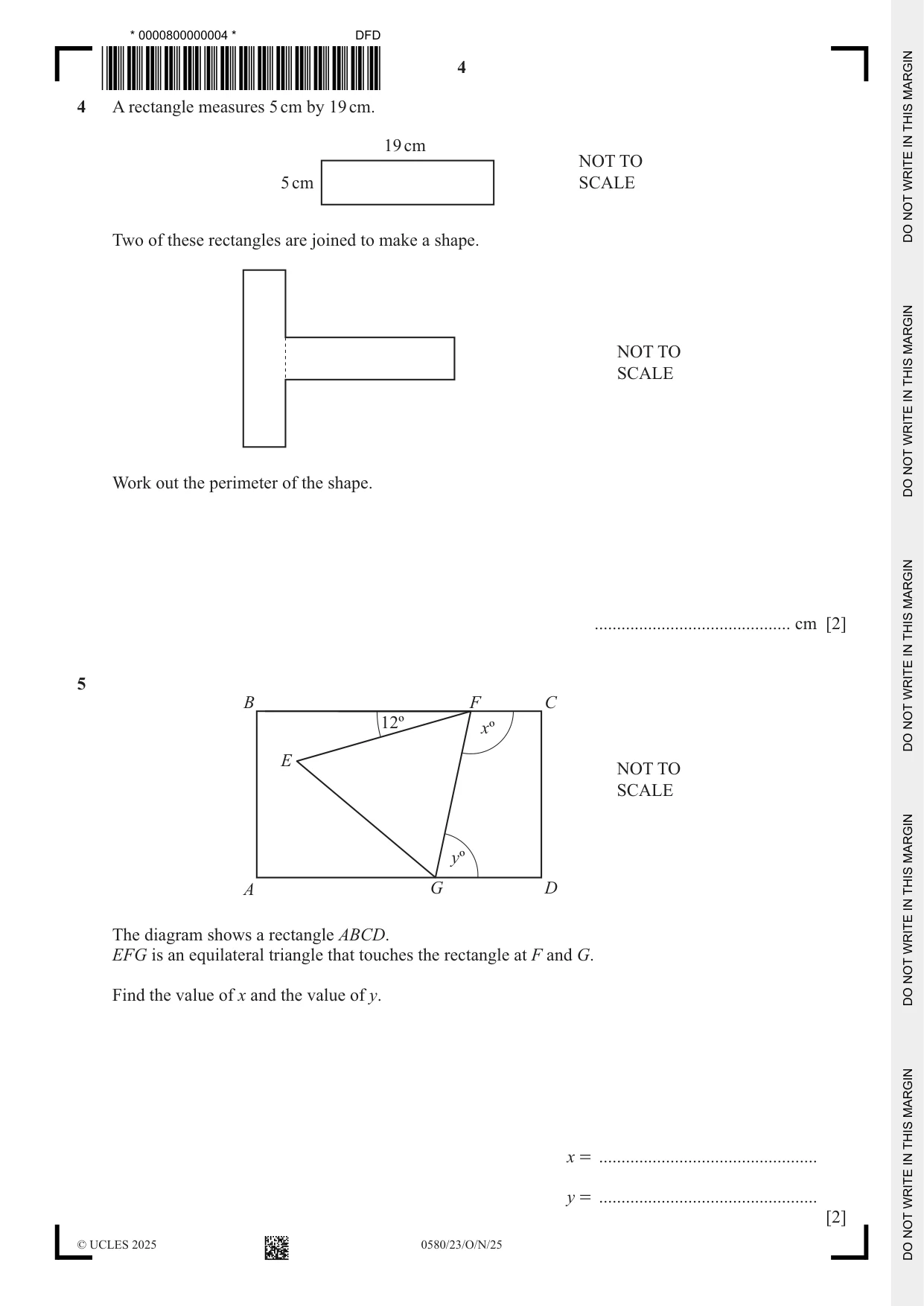
Q4 · A rectangle measures 5 cm by 19 cm
4 A rectangle measures 5 cm by 19 cm. 19 cm NOT TO 5 cm SCALE Two of these rectangles are joined to make a shape. NOT TO SCALE Work out the perimeter of the shape. ............................................ cm [2]
Mark scheme: 4 86 2 M1 for 5 × 3 + 19 × 3 + 19 – 5 oe
Q5 · B F C 12º xº E NOT TO SCALE yº A G D The diagram shows a rectangle ABCD
5 B F C 12º xº E NOT TO SCALE yº A G D The diagram shows a rectangle ABCD. EFG is an equilateral triangle that touches the rectangle at F and G. Find the value of x and the value of y. x = ................................................. y = ................................................. [2]
Mark scheme: 5 x = 108 2 B1 for x = 108 or y = 72 y = 72 or their x + their y = 180
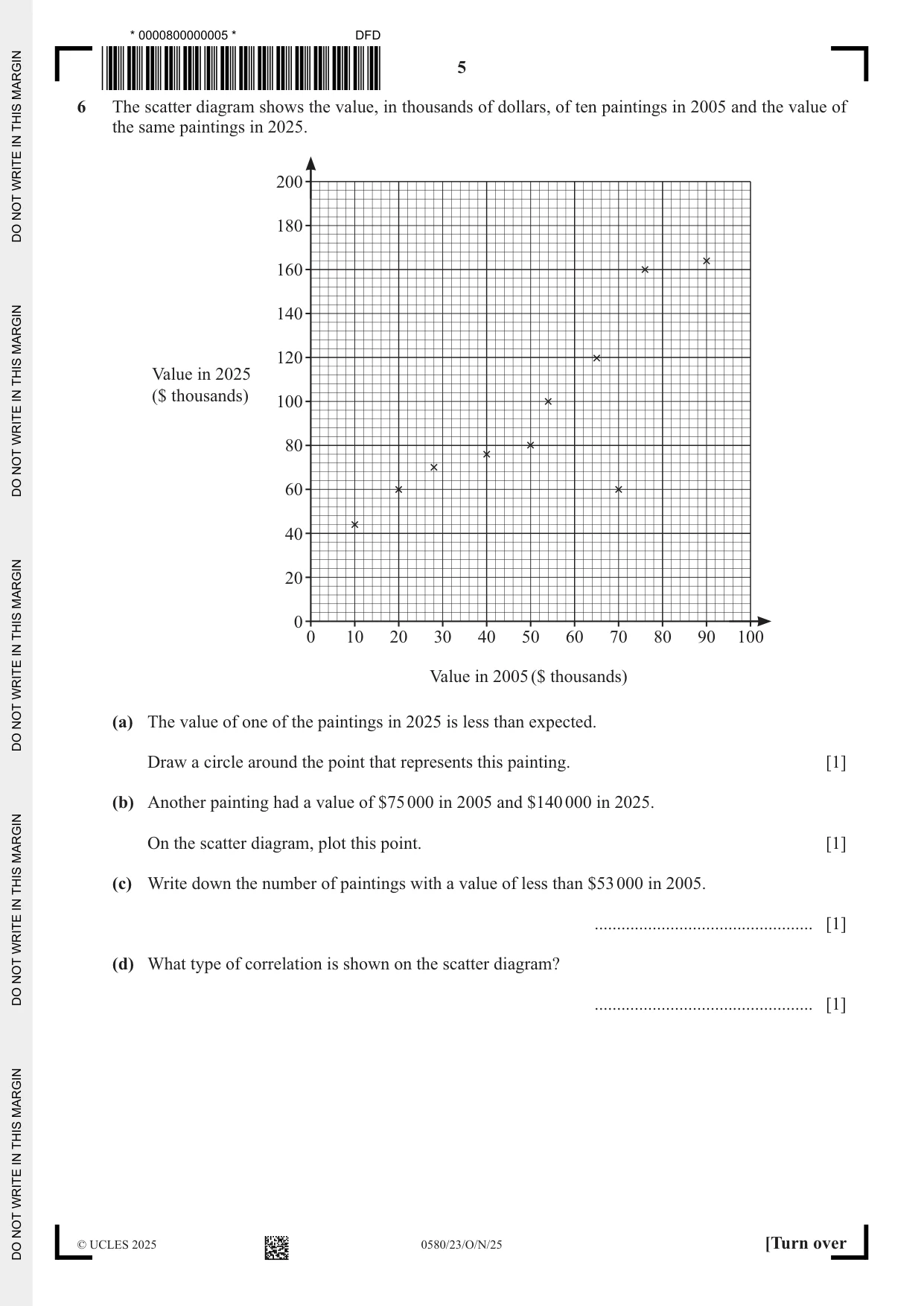
Q6 · The scatter diagram shows the value, in thousands of dollars, of ten paintings in 2005…
6 The scatter diagram shows the value, in thousands of dollars, of ten paintings in 2005 and the value of the same paintings in 2025. 200 180 160 140 120 Value in 2025 ($ thousands) 100 80 60 40 20 0 0 10 20 30 40 50 60 70 80 90 100 Value in 2005 ($ thousands) (a) The value of one of the paintings in 2025 is less than expected. Draw a circle around the point that represents this painting. [1] (b) Another painting had a value of $75 000 in 2005 and $140 000 in 2025. On the scatter diagram, plot this point. [1] (c) Write down the number of paintings with a value of less than $53 000 in 2005. ................................................. [1] (d) What type of correlation is shown on the scatter diagram? ................................................. [1]
Mark scheme: 6(a) A ring around the point (70, 60) 1 6(b) Point correctly plotted at (75, 140) 1 6(c) 5 1 6(d) Positive 1
Q7 · The sum of all the prime numbers less than 10 is equal to 17
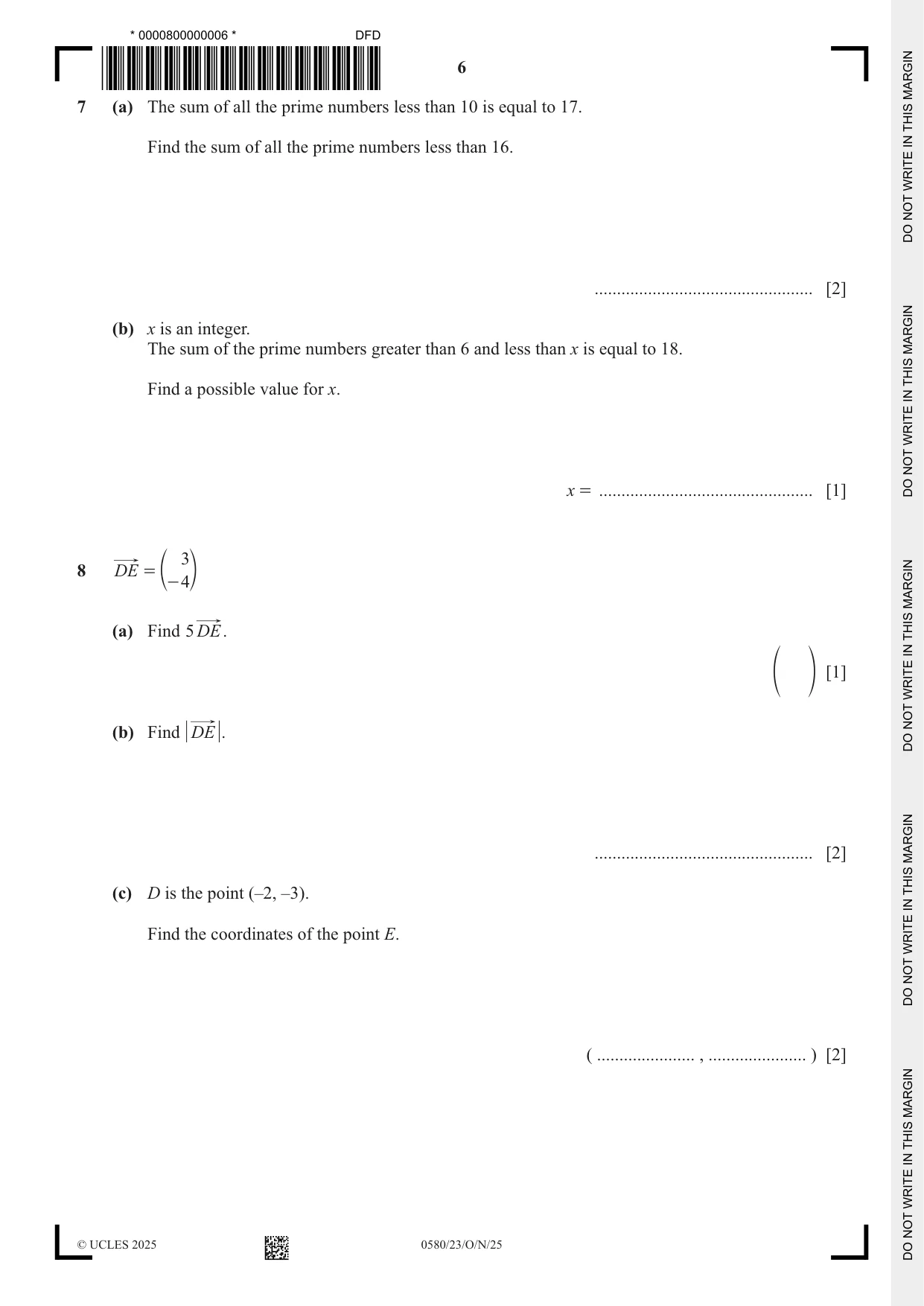
7 (a) The sum of all the prime numbers less than 10 is equal to 17. Find the sum of all the prime numbers less than 16. ................................................. [2] (b) x is an integer. The sum of the prime numbers greater than 6 and less than x is equal to 18. Find a possible value for x. x = ................................................ [1]
Mark scheme: 7(a) 41 2 B1 for 11 or 13 seen with no more than one incorrect value 7(b) 12 or 13 1
Q8 · 8 DE = e o - 4 (a) Find 5DE
3 8 DE = e o - 4 (a) Find 5DE. f p [1] (b) Find DE . ................................................. [2] (c) D is the point (‒2, ‒3). Find the coordinates of the point E. ( ...................... , ...................... ) [2]
Mark scheme: 8(a) 15 1 −20 8(b) 5 2 M1 for 32 + (–4)2 or better 8(c) (1, ‒ 7) 2 1 B1 for each or for − 7
Q9 · N 15 ' n x = n 5 Find the value of x
9 n 15 ' n x = n 5 Find the value of x. x = ................................................ [1]
Mark scheme: 9 10 1
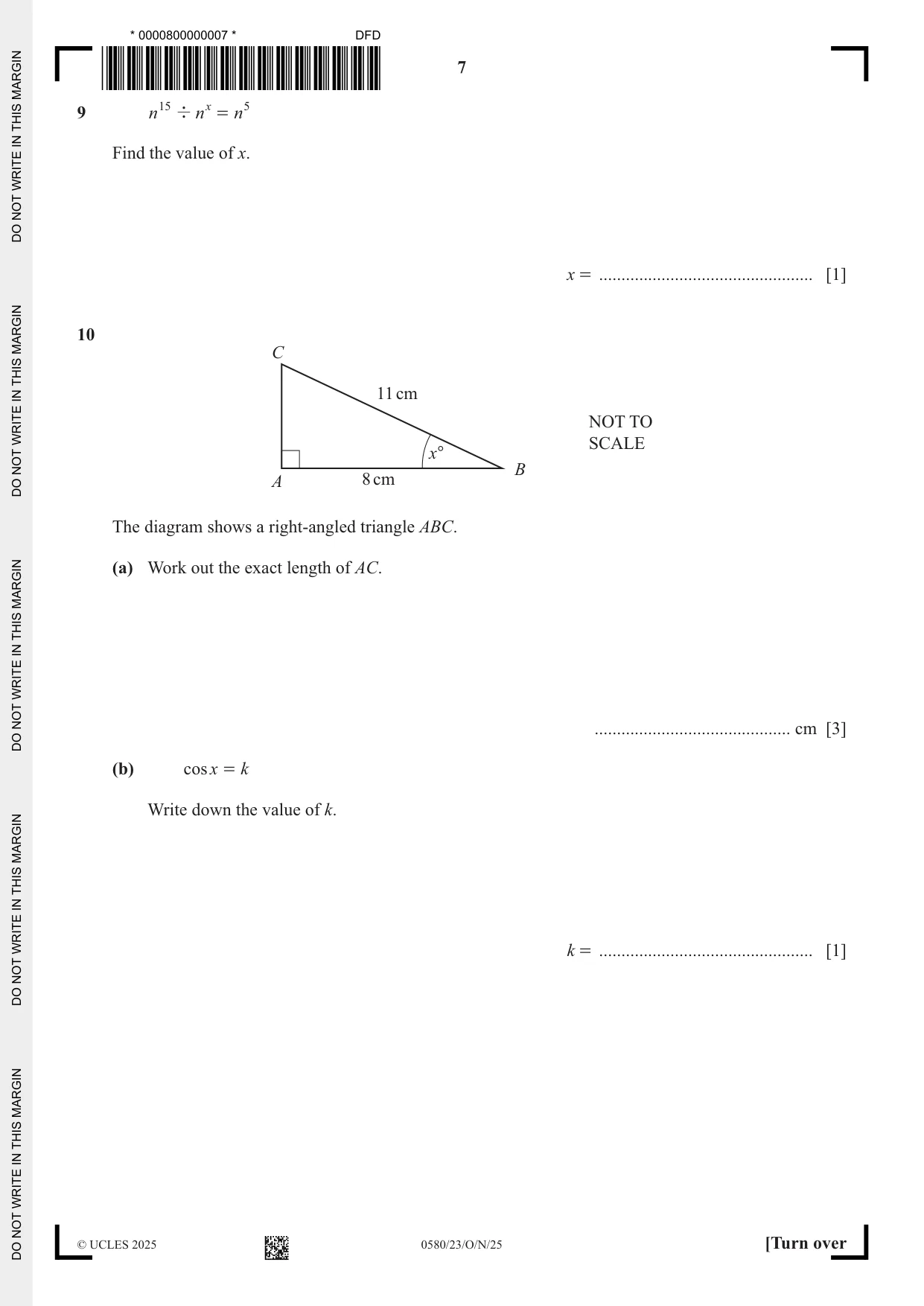
Q10 · C 11 cm NOT TO SCALE x° B A 8 cm The diagram shows a right-angled triangle ABC
10 C 11 cm NOT TO SCALE x° B A 8 cm The diagram shows a right-angled triangle ABC. (a) Work out the exact length of AC. ............................................ cm [3] (b) cos x = k Write down the value of k. k = ................................................ [1]
Mark scheme: 10(a) 57 3 M2 for 112 – 82 or M1 for 112 = AC2 + 82 10(b) 8 1 11
Q11 · Sarah rolls a fair 6-sided dice twice
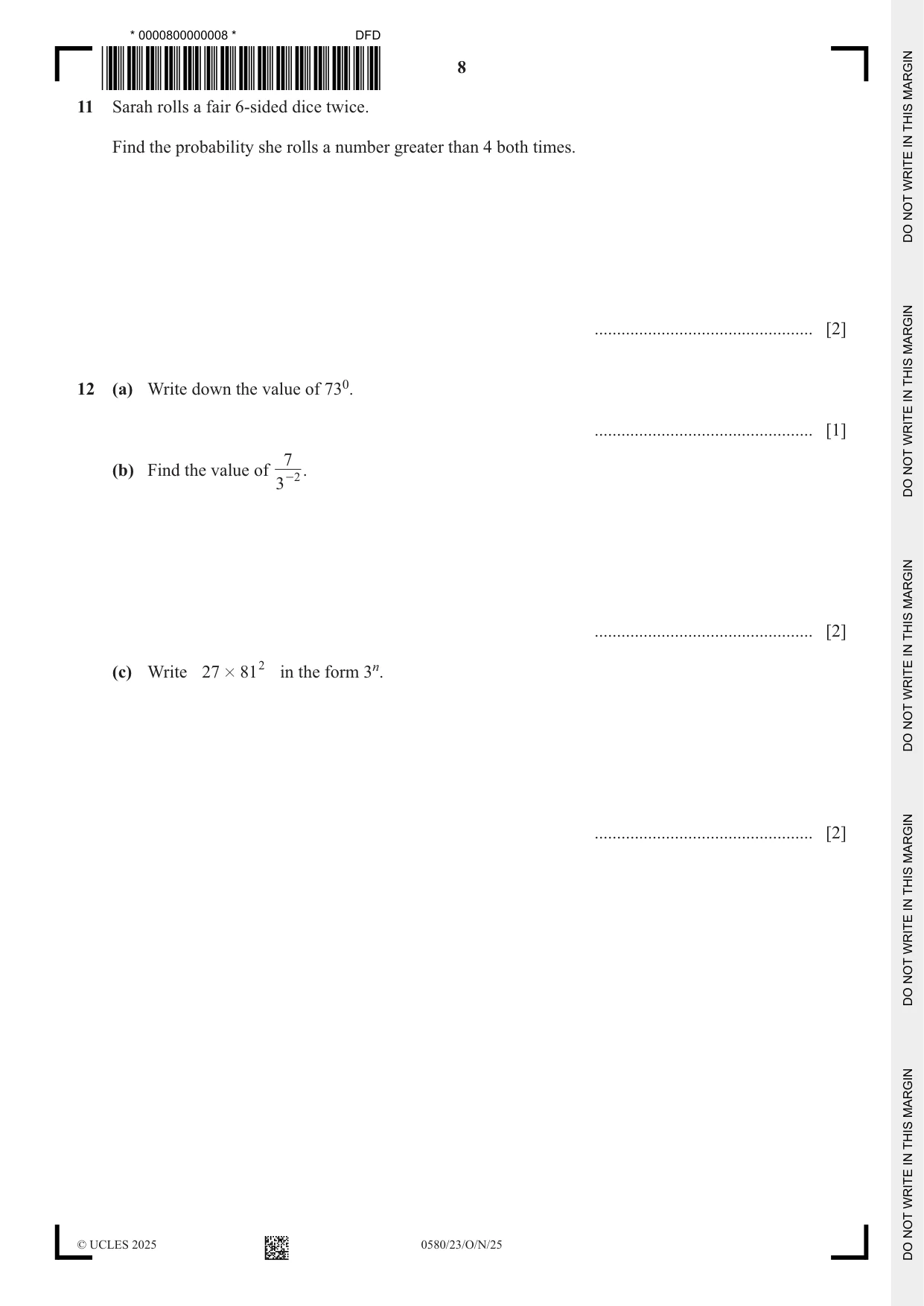
11 Sarah rolls a fair 6-sided dice twice. Find the probability she rolls a number greater than 4 both times. ................................................. [2]
Mark scheme: 11 1 2 2 2 oe M1 for oe 9 6 6
Q12 · Write down the value of 730
12 (a) Write down the value of 730. ................................................. [1] 7 (b) Find the value of -2 . 3 ................................................. [2] (c) Write 27 # 812 in the form 3n. ................................................. [2]
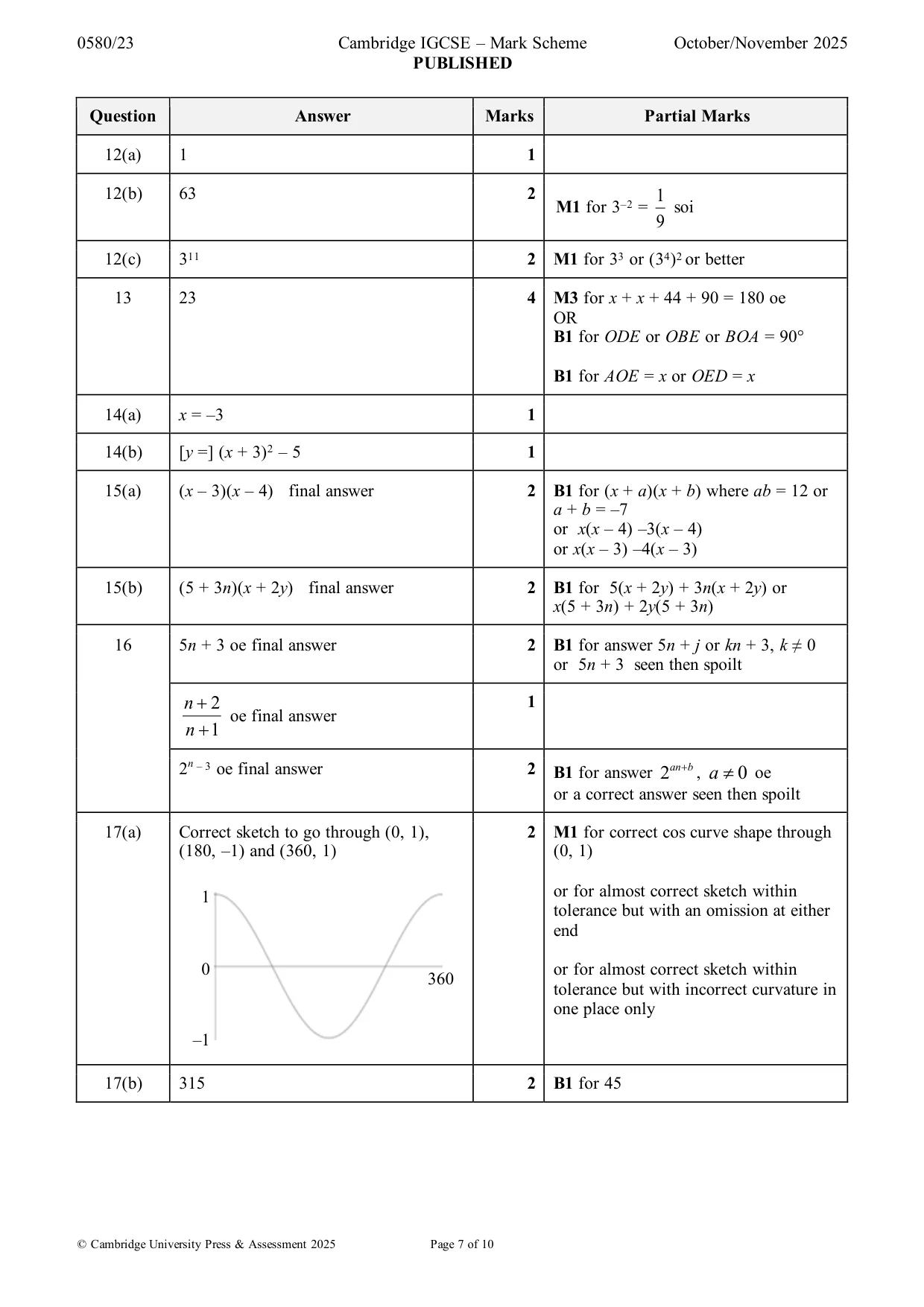
Mark scheme: 12(a) 1 1 12(b) 63 2 1 M1 for 3–2 = soi 9 12(c) 311 2 M1 for 33 or (34)2 or better
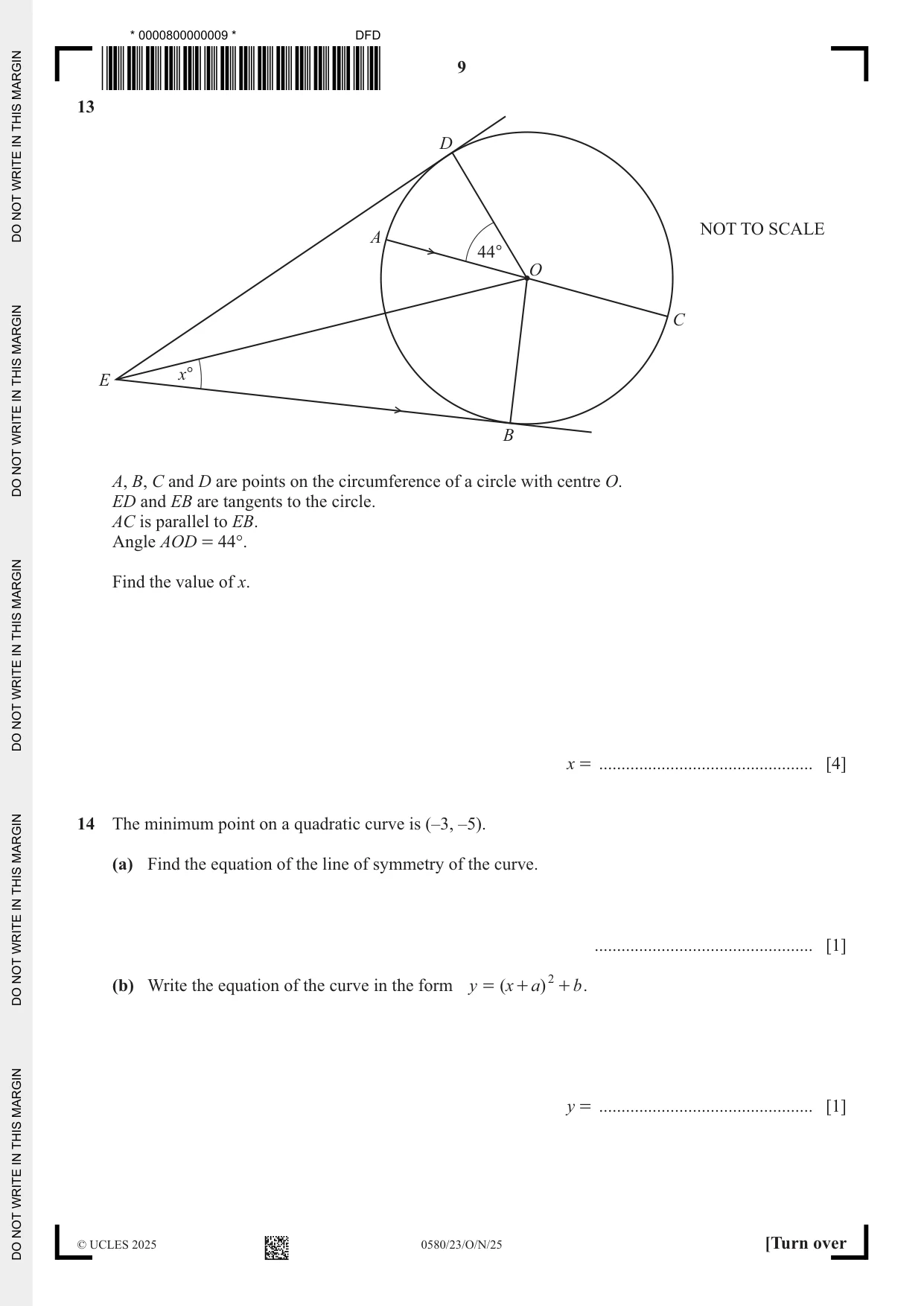
Q13 · D NOT TO SCALE A 44° O C x° E B A, B, C and D are points on the circumference of a circle…
13 D NOT TO SCALE A 44° O C x° E B A, B, C and D are points on the circumference of a circle with centre O. ED and EB are tangents to the circle. AC is parallel to EB. Angle AOD = 44°. Find the value of x. x = ................................................ [4]
Mark scheme: 13 23 4 M3 for x + x + 44 + 90 = 180 oe OR B1 for ODE or OBE or BOA = 90° B1 for AOE = x or OED = x
Q14 · The minimum point on a quadratic curve is (–3, –5)
14 The minimum point on a quadratic curve is (–3, –5). (a) Find the equation of the line of symmetry of the curve. ................................................. [1] (b) Write the equation of the curve in the form y = ( x + a) 2 + b . y = ................................................ [1]
Mark scheme: 14(a) x = –3 1 14(b) [y =] (x + 3)2 – 5 1
Question 15
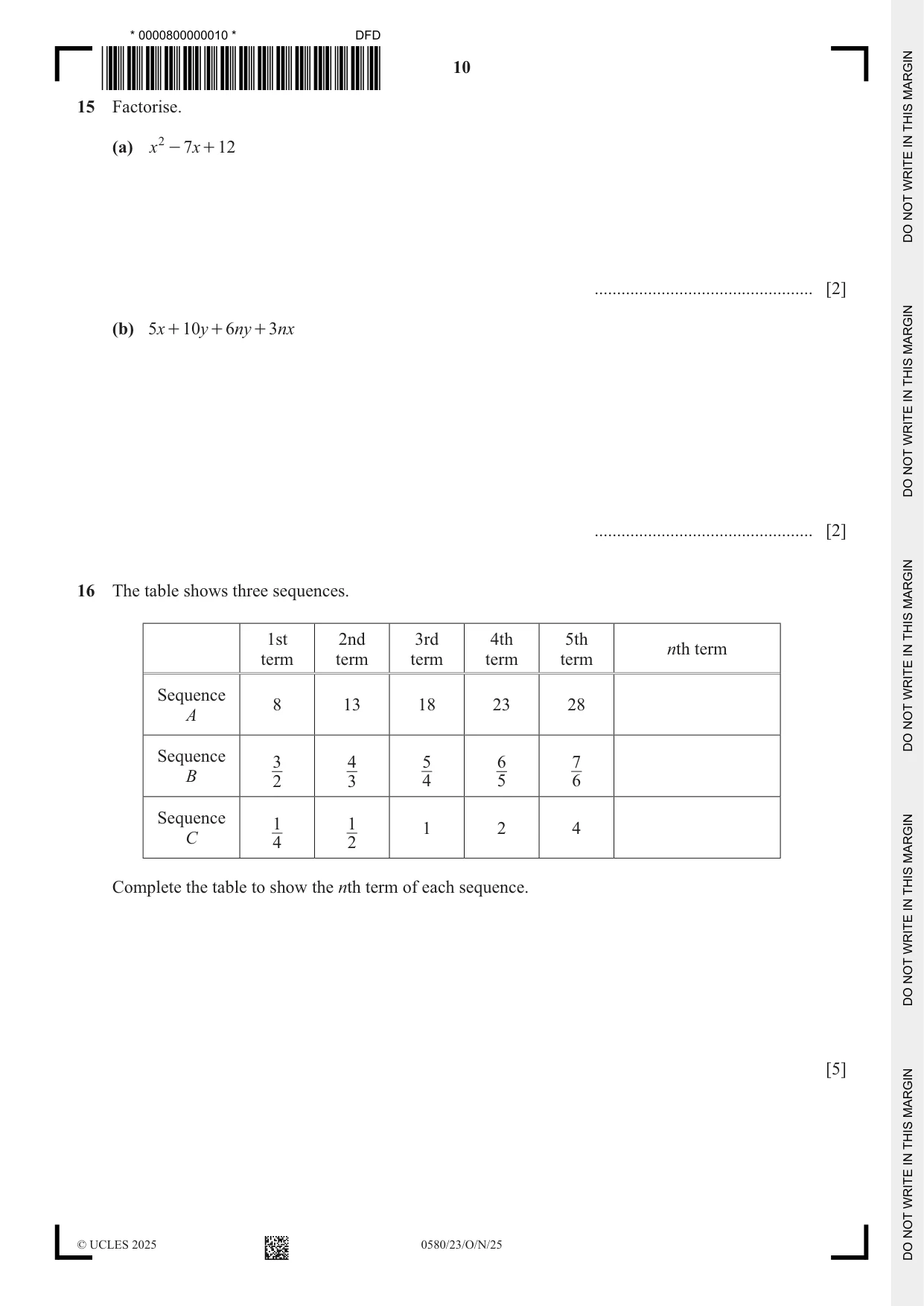
15 Factorise. (a) x 2 - 7x + 12 ................................................. [2] (b) 5 x + 10 y + 6 ny + 3 nx ................................................. [2]
Mark scheme: 15(a) (x – 3)(x – 4) final answer 2 B1 for (x + a)(x + b) where ab = 12 or a + b = –7 or x(x – 4) –3(x – 4) or x(x – 3) –4(x – 3) 15(b) (5 + 3n)(x + 2y) final answer 2 B1 for 5(x + 2y) + 3n(x + 2y) or x(5 + 3n) + 2y(5 + 3n)
Q16 · The table shows three sequences
16 The table shows three sequences. 1st 2nd 3rd 4th 5th nth term term term term term term Sequence 8 13 18 23 28 A Sequence 3 4 5 6 7 B 2 3 4 5 6 Sequence 1 1 1 2 4 C 4 2 Complete the table to show the nth term of each sequence. [5]
Mark scheme: 16 5n + 3 oe final answer 2 B1 for answer 5n + j or kn + 3, k ≠ 0 or 5n + 3 seen then spoilt n + 2 1 oe final answer n + 1 2n – 3 oe final answer 2 B1 for answer 2 an + b , a 0 oe or a correct answer seen then spoilt
Q17 · Sketch the graph of y = cos x for 0 ° G x G 360 °
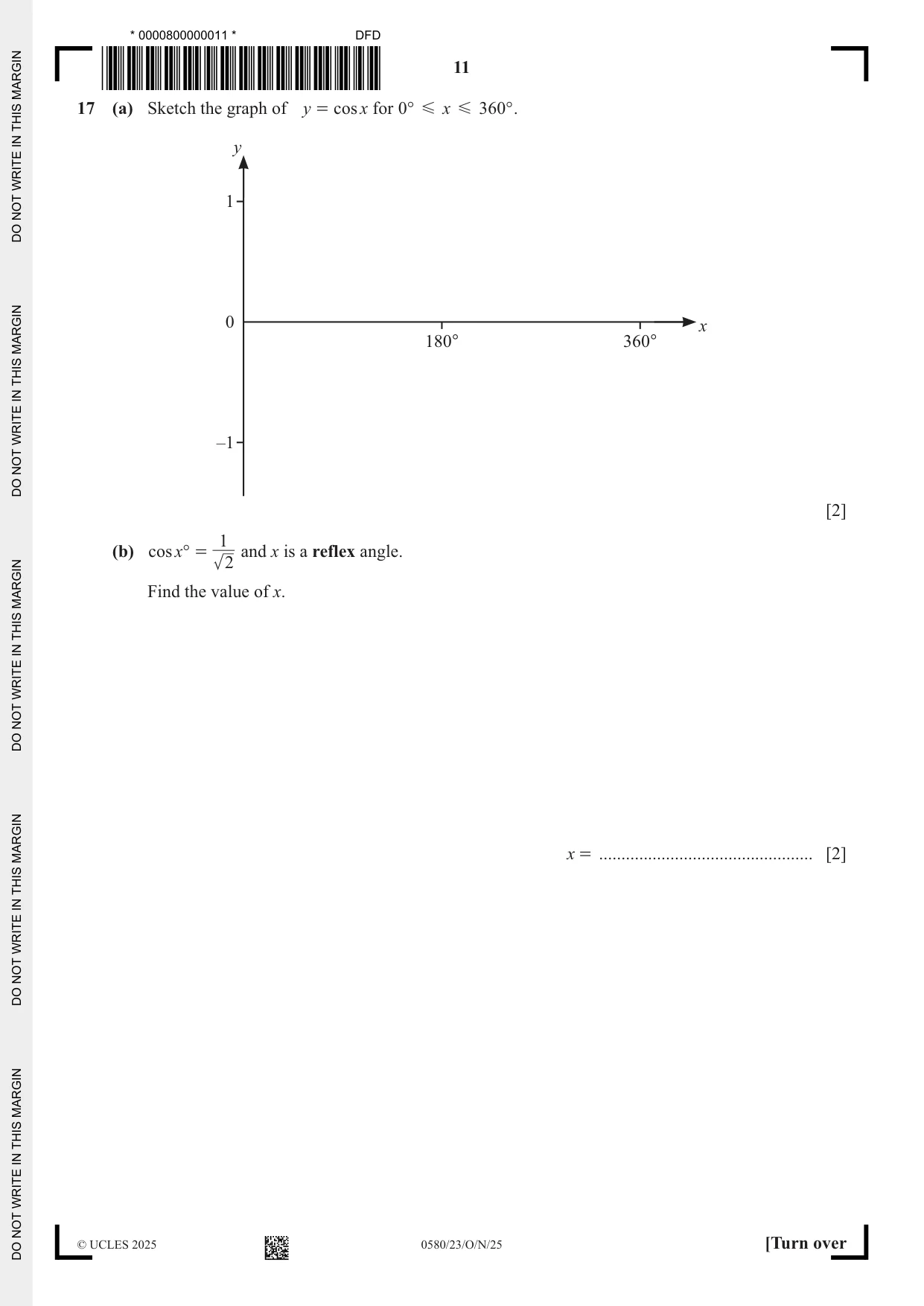
17 (a) Sketch the graph of y = cos x for 0 ° G x G 360 ° . y 1 0 x 180° 360° –1 [2] 1 (b) cos x° = and x is a reflex angle. 2 Find the value of x. x = ................................................ [2]
Mark scheme: 17(a) Correct sketch to go through (0, 1), 2 M1 for correct cos curve shape through (180, –1) and (360, 1) (0, 1) or for almost correct sketch within 1 tolerance but with an omission at either end 0 or for almost correct sketch within 360 tolerance but with incorrect curvature in one place only –1 17(b) 315 2 B1 for 45
Q18 · Shade the region in each Venn diagram
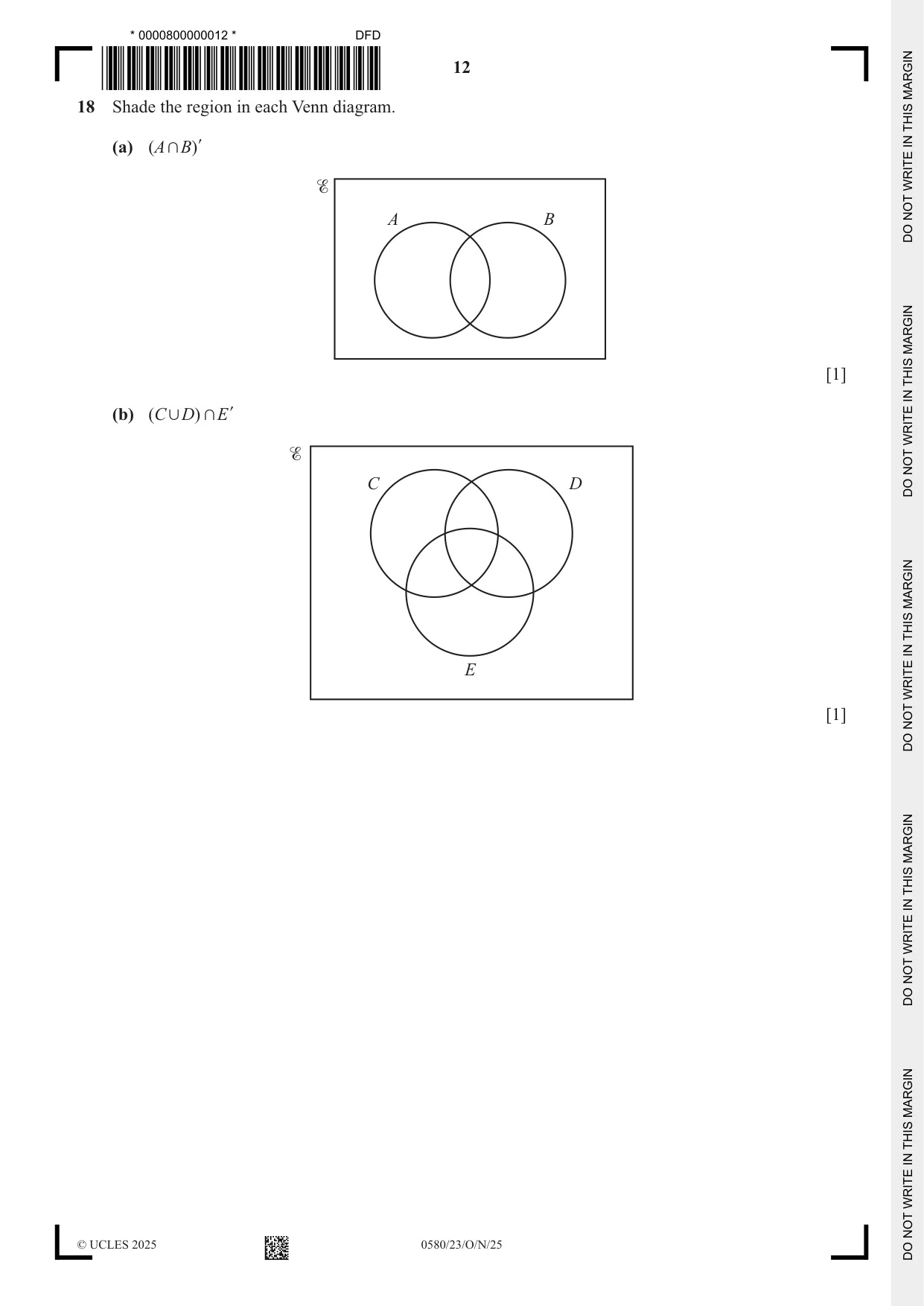
18 Shade the region in each Venn diagram. (a) ( A + B ) l % A B [1] (b) ( C , D ) + E l % C D E [1]
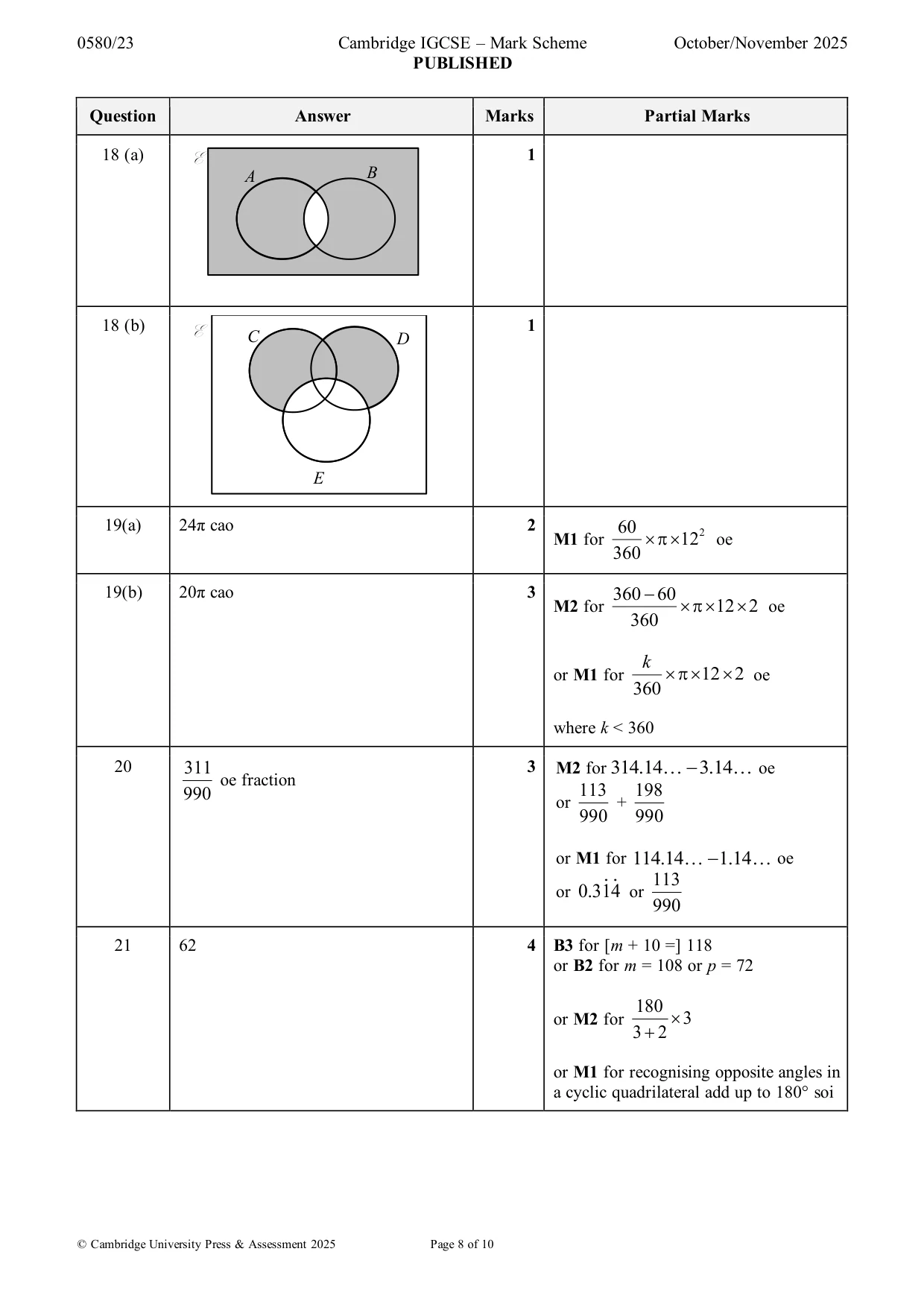
Mark scheme: 18 (a) E 1 A B 18 (b) 1 E C D E
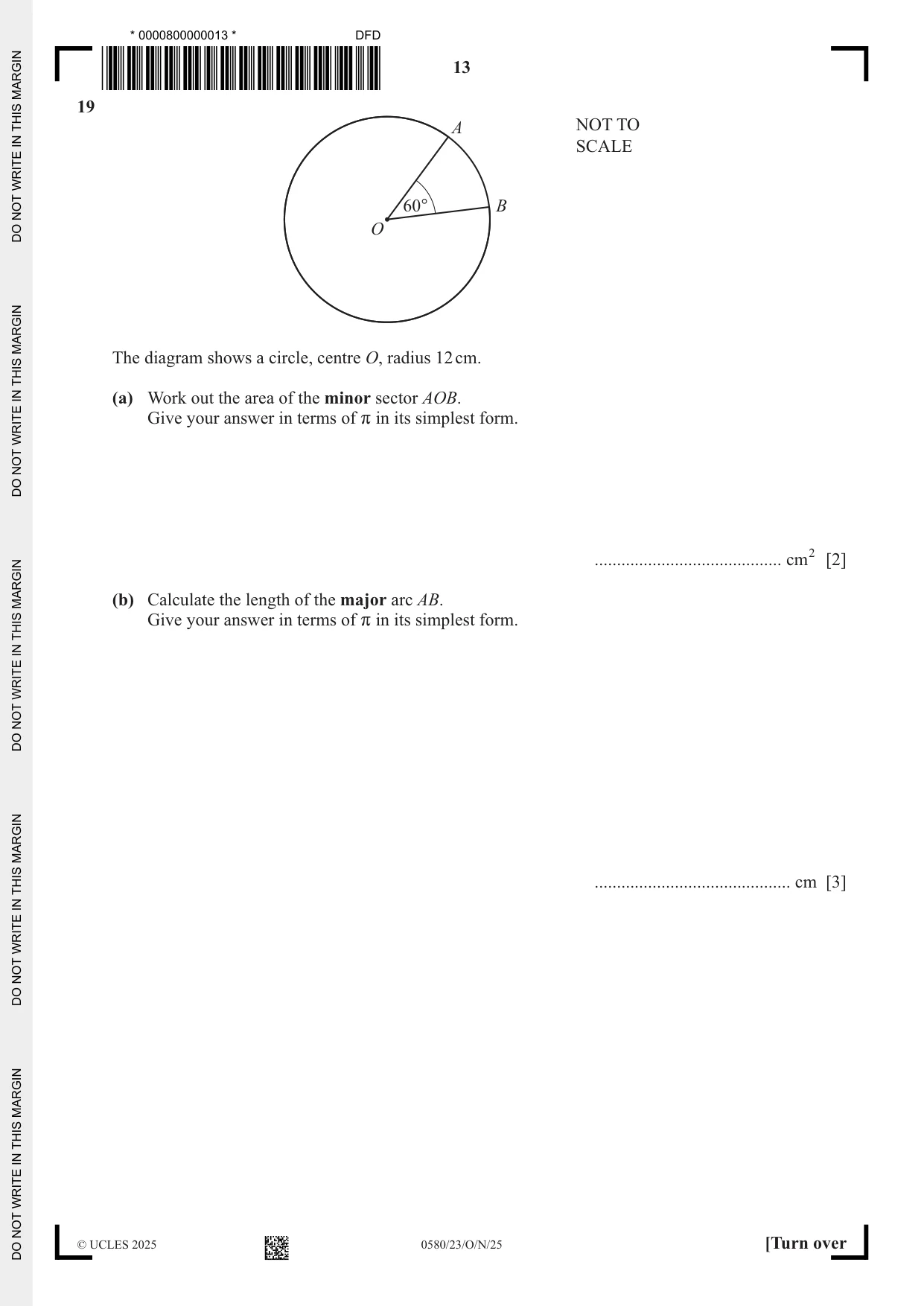
Q19 · A NOT TO SCALE 60° B O The diagram shows a circle, centre O, radius 12 cm
19 A NOT TO SCALE 60° B O The diagram shows a circle, centre O, radius 12 cm. (a) Work out the area of the minor sector AOB. Give your answer in terms of r in its simplest form. .......................................... cm2 [2] (b) Calculate the length of the major arc AB. Give your answer in terms of r in its simplest form. ............................................ cm [3]
Mark scheme: 19(a) 24π cao 2 60 2 M1 for 12 oe 360 19(b) 20π cao 3 360 − 60 M2 for 12 2 oe 360 k or M1 for 12 2 oe 360 where k < 360
Q20 · O o20 Work out 0.114 + 0 .2
o o20 Work out 0.114 + 0 .2 . Give your answer as a fraction. ................................................. [3]
Mark scheme: 20 311 3 M2 for 314.14− 3.14 oe oe fraction 990 113 198 or + 990 990 or M1 for 114.14− 1.14 oe 113 or 0.314 or 990
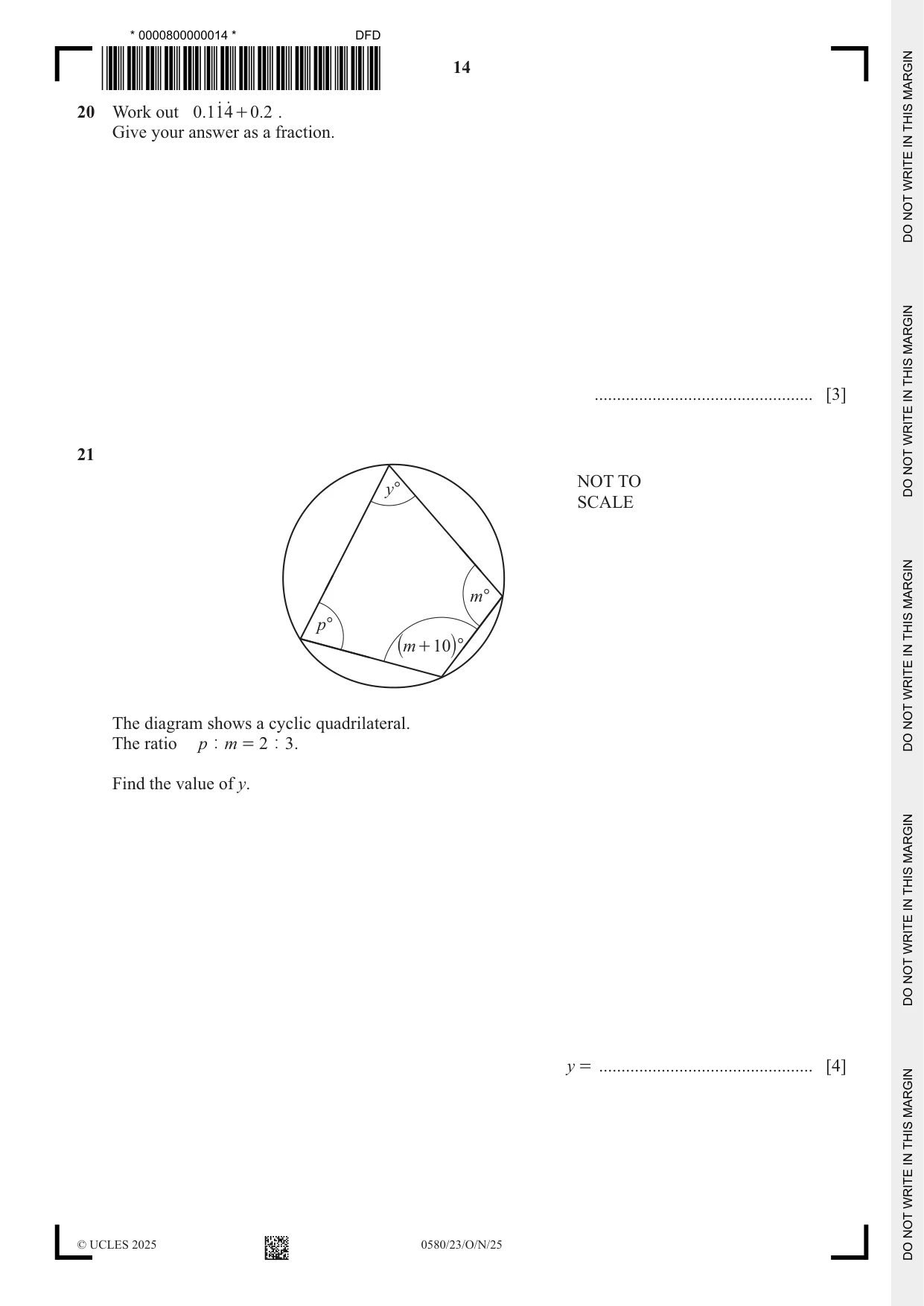
Q21 · NOT TO y° SCALE m° p° `m + 10j°c The diagram shows a cyclic quadrilateral
21 NOT TO y° SCALE m° p° `m + 10j°c The diagram shows a cyclic quadrilateral. The ratio p | m = 2 | 3 . Find the value of y. y = ................................................ [4]
Mark scheme: 21 62 4 B3 for [m + 10 =] 118 or B2 for m = 108 or p = 72 180 or M2 for 3 3 + 2 or M1 for recognising opposite angles in a cyclic quadrilateral add up to 180° soi
Q22 · 22 The equation of line L is y =- x + 7
1 22 The equation of line L is y =- x + 7 . 2 Find an equation of the line perpendicular to line L that passes through the point (3, 5). Give your answer in the form y = mx + c . y = ................................................ [3]
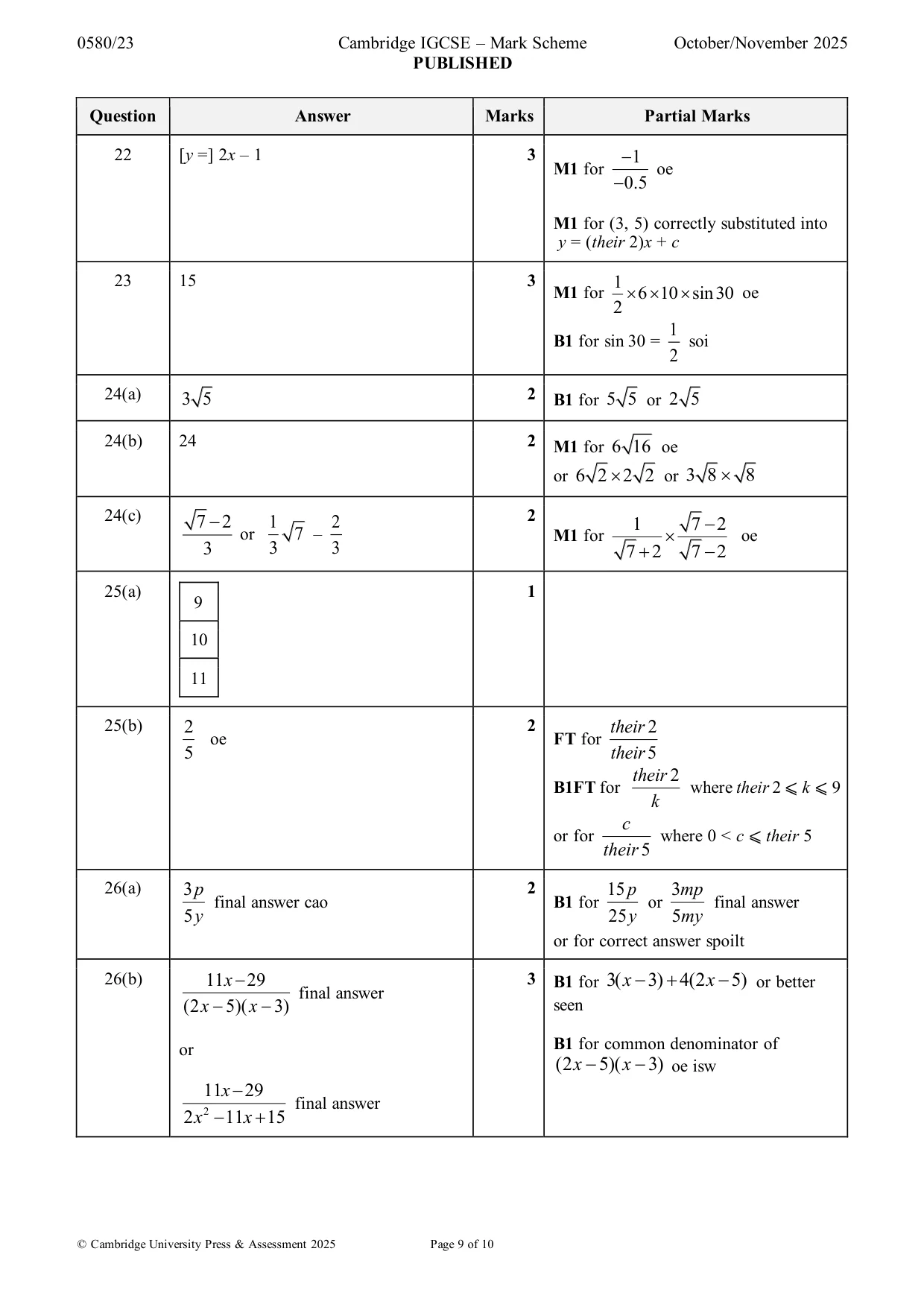
Mark scheme: 22 [y =] 2x – 1 3 − 1 M1 for oe − 0.5 M1 for (3, 5) correctly substituted into y = (their 2)x + c
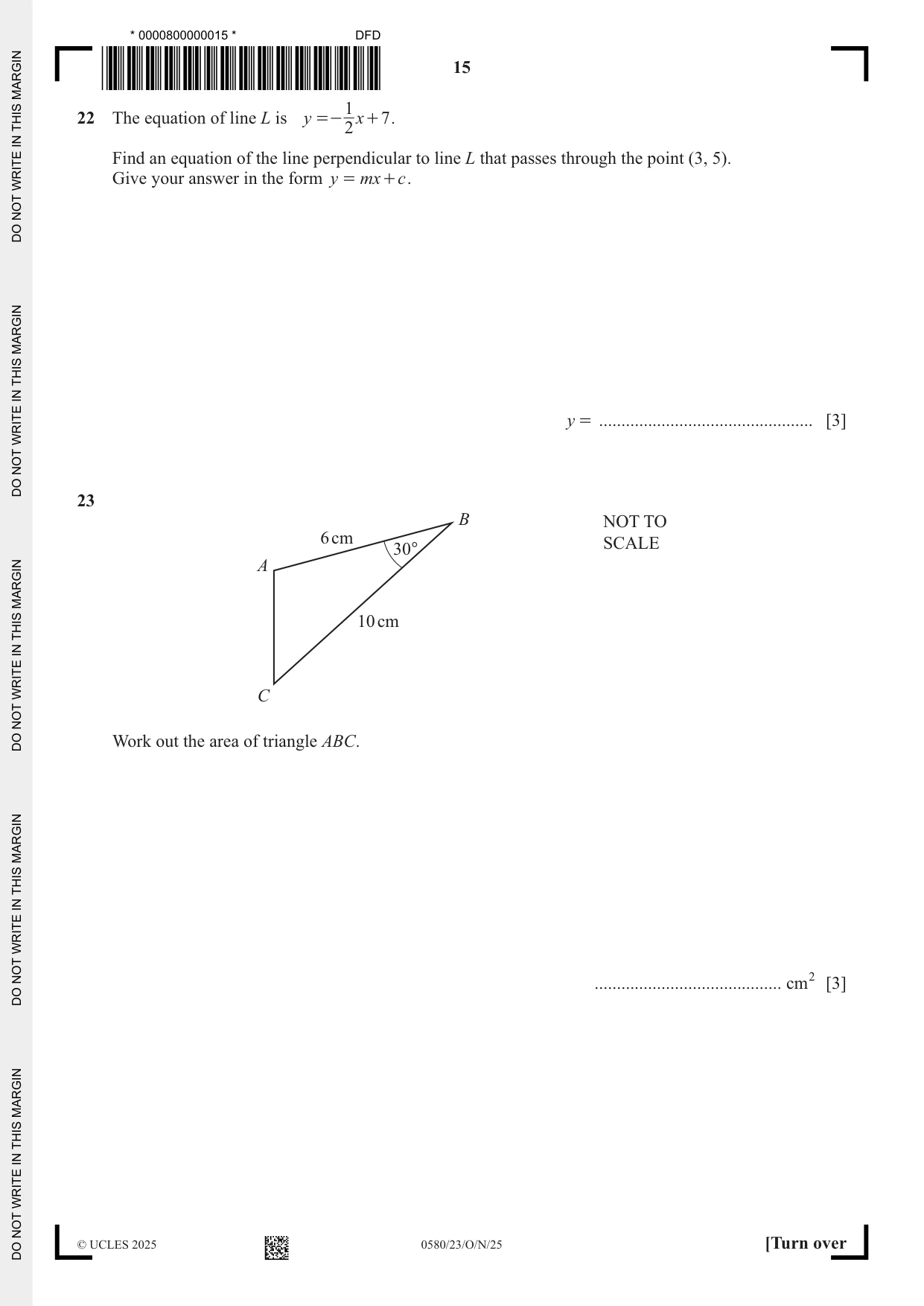
Q23 · B NOT TO 6 cm SCALE 30° A 10 cm C Work out the area of triangle ABC
23 B NOT TO 6 cm SCALE 30° A 10 cm C Work out the area of triangle ABC. .......................................... cm2 [3]
Mark scheme: 23 15 3 1 M1 for 6 10 sin30 oe 2 1 B1 for sin 30 = soi 2
Question 24
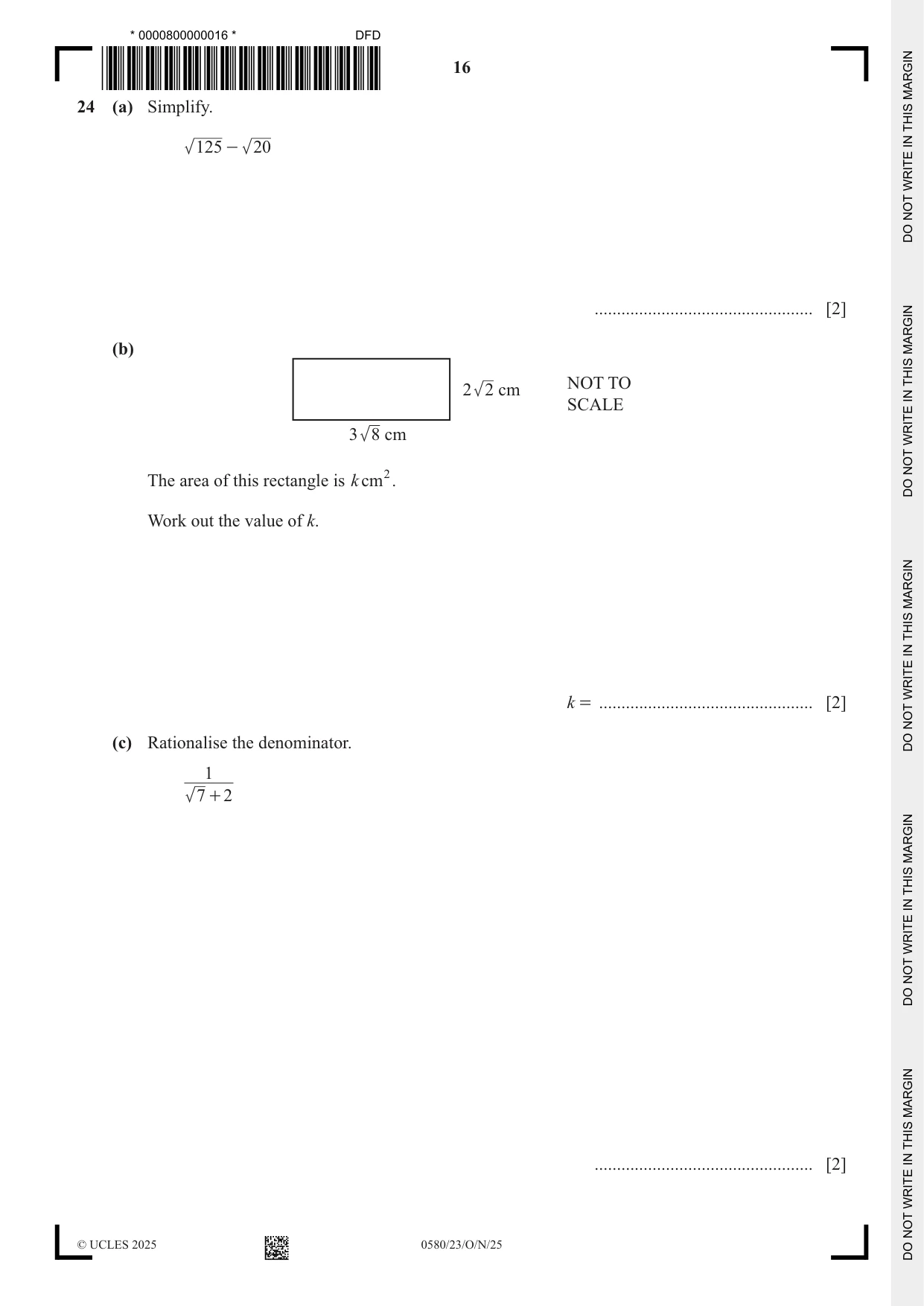
24 (a) Simplify. 125 - 20 ................................................. [2] (b) NOT TO 2 2 cm SCALE 3 8 cm The area of this rectangle is k cm 2. Work out the value of k. k = ................................................ [2] (c) Rationalise the denominator. 1 7 + 2 ................................................. [2]
Mark scheme: 24(a) 2 3 5 B1 for 5 5 or 2 5 24(b) 24 2 M1 for 6 16 oe or 6 2 2 2 or 3 8 8 24(c) 2 7 − 2 1 2 1 7 − 2 or 7 ‒ M1 for oe 3 3 3 7 + 2 7 − 2
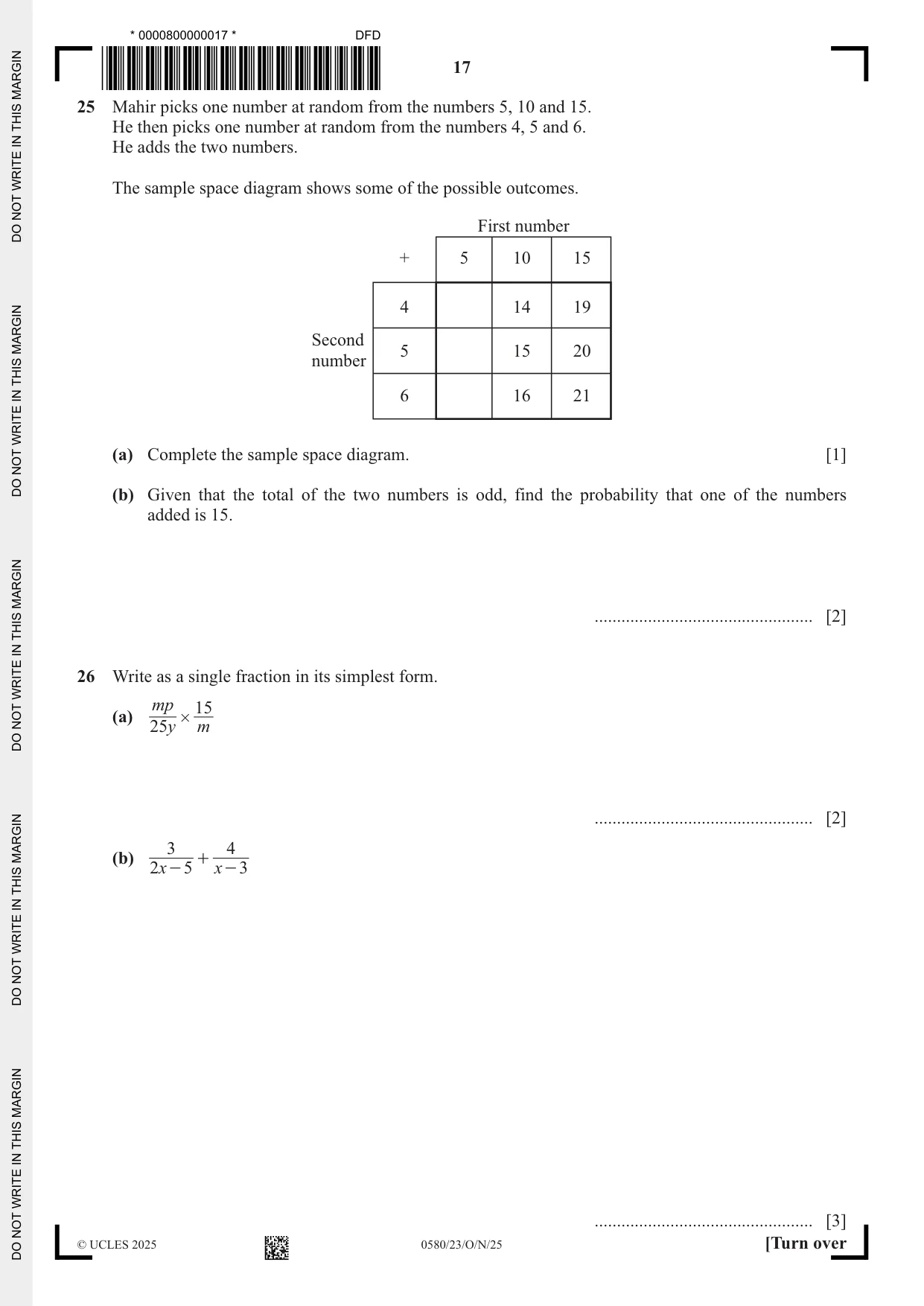
Q25 · Mahir picks one number at random from the numbers 5, 10 and 15
25 Mahir picks one number at random from the numbers 5, 10 and 15. He then picks one number at random from the numbers 4, 5 and 6. He adds the two numbers. The sample space diagram shows some of the possible outcomes. First number + 5 10 15 4 14 19 Second 5 15 20 number 6 16 21 (a) Complete the sample space diagram. [1] (b) Given that the total of the two numbers is odd, find the probability that one of the numbers added is 15. ................................................. [2]
Mark scheme: 25(a) 1 9 10 11 25(b) 2 2 their 2 oe FT for 5 their 5 their 2 B1FT for where their 2 ⩽ k ⩽ 9 k c or for where 0 < c ⩽ their 5 their 5
Q26 · Write as a single fraction in its simplest form
26 Write as a single fraction in its simplest form. mp 15 (a) # 25 y m ................................................. [2] 3 4 (b) + 2x - 5 x - 3 ................................................. [3]
Mark scheme: 26(a) 3 p 2 15 p 3mp final answer cao B1 for or final answer 5 y 25 y 5my or for correct answer spoilt 26(b) 11 x − 29 3 B1 for 3( x − 3) + 4(2 x − 5) or better final answer (2 x − 5)( x − 3) seen B1 for common denominator of or (2 x − 5)( x − 3) oe isw 11x − 29 2 final answer 2 x − 11x + 15
Q27 · Solve the simultaneous equations
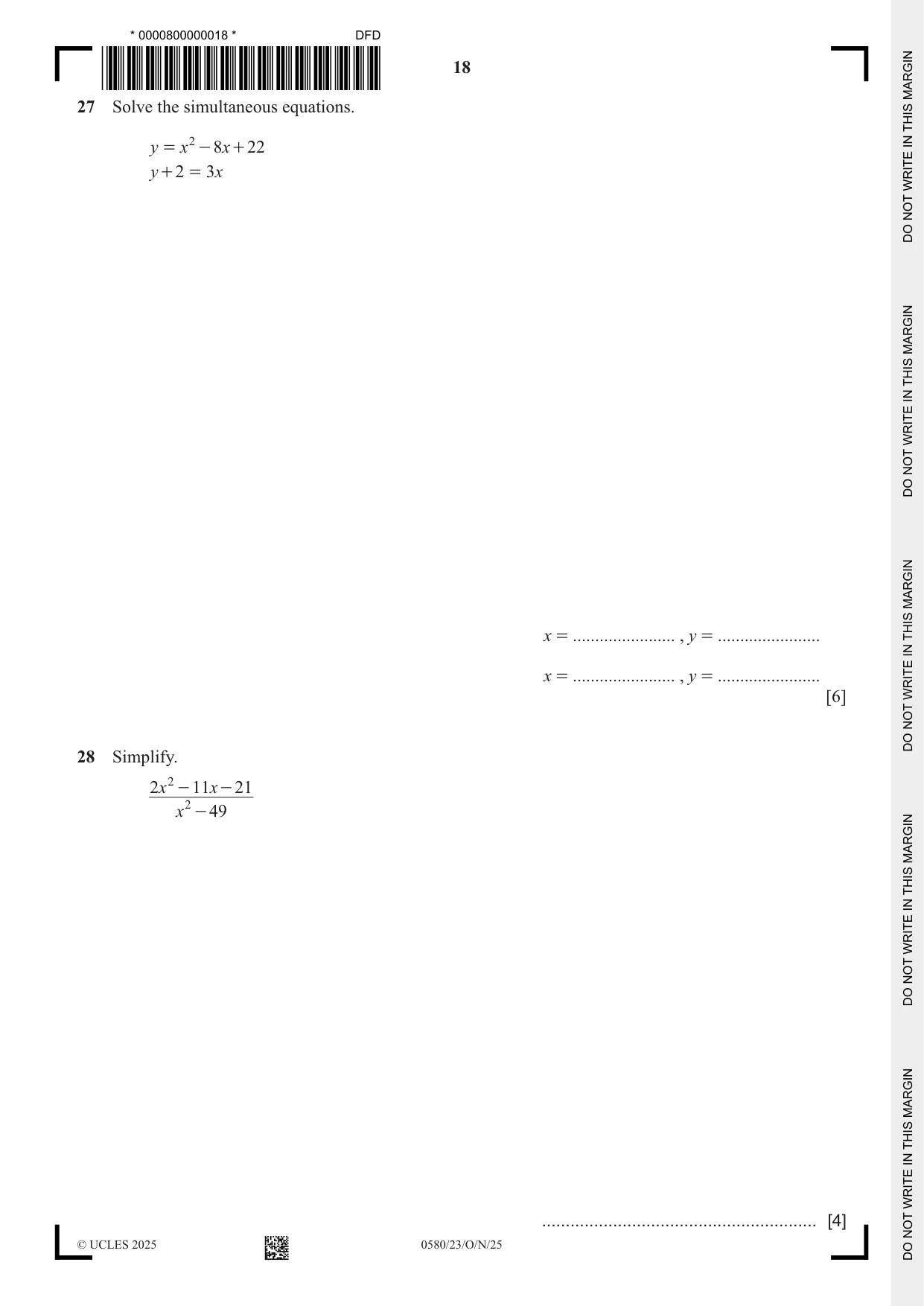
27 Solve the simultaneous equations. y = x 2 - 8x + 22 y + 2 = 3x x = ....................... , y = ....................... x = ....................... , y = ....................... [6]
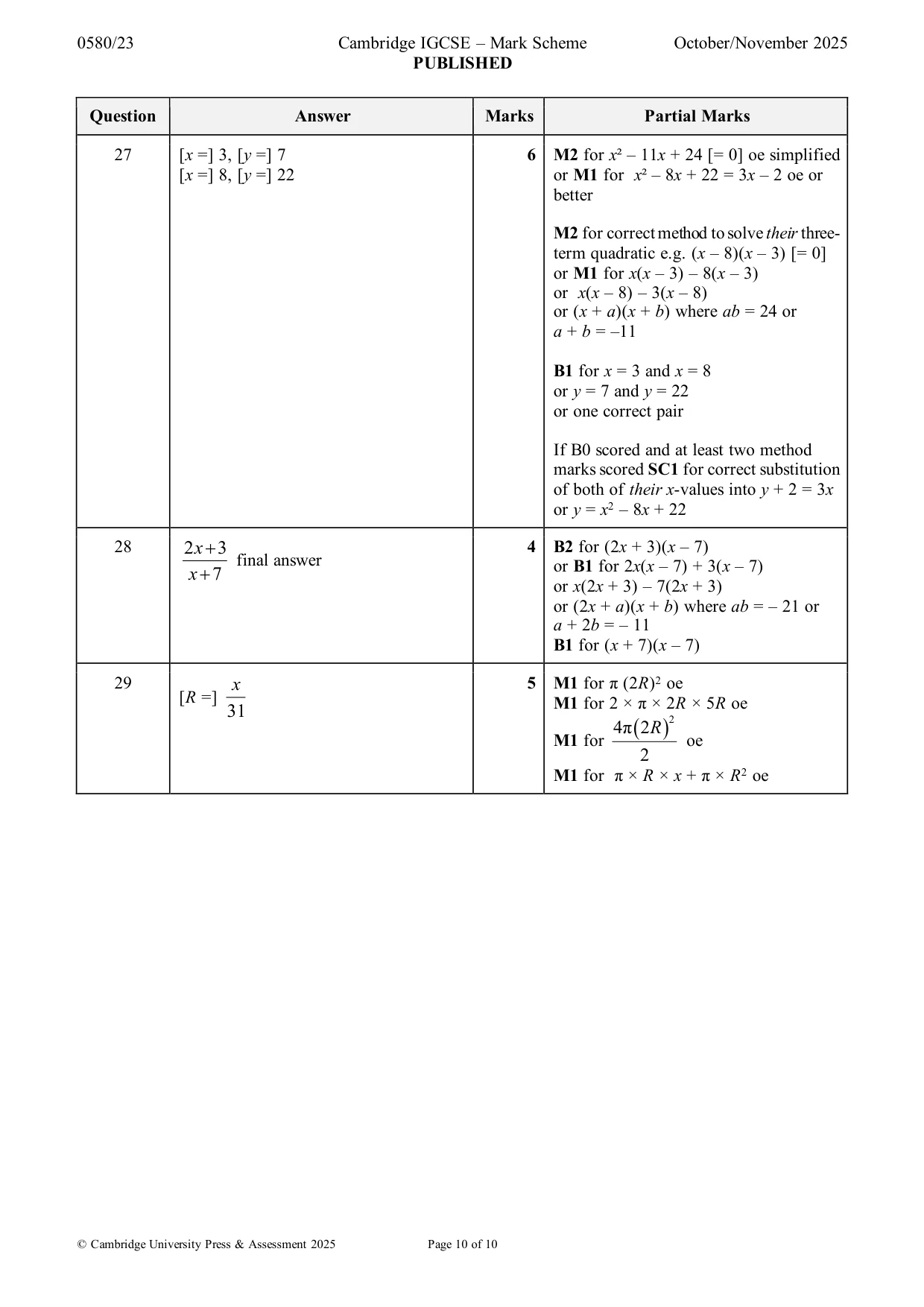
Mark scheme: 27 [x =] 3, [y =] 7 6 M2 for x² – 11x + 24 [= 0] oe simplified [x =] 8, [y =] 22 or M1 for x² – 8x + 22 = 3x – 2 oe or better M2 for correct method to solve their three- term quadratic e.g. (x – 8)(x – 3) [= 0] or M1 for x(x – 3) – 8(x – 3) or x(x – 8) – 3(x – 8) or (x + a)(x + b) where ab = 24 or a + b = –11 B1 for x = 3 and x = 8 or y = 7 and y = 22 or one correct pair If B0 scored and at least two method marks scored SC1 for correct substitution of both of their x-values into y + 2 = 3x or y = x2 – 8x + 22
Question 28
28 Simplify. 2 x 2 - 11 x - 21 x 2 - 49 .......................................................... [4]
Mark scheme: 28 2 x + 3 4 B2 for (2x + 3)(x – 7) final answer or B1 for 2x(x – 7) + 3(x – 7) x + 7 or x(2x + 3) – 7(2x + 3) or (2x + a)(x + b) where ab = – 21 or a + 2b = – 11 B1 for (x + 7)(x – 7)
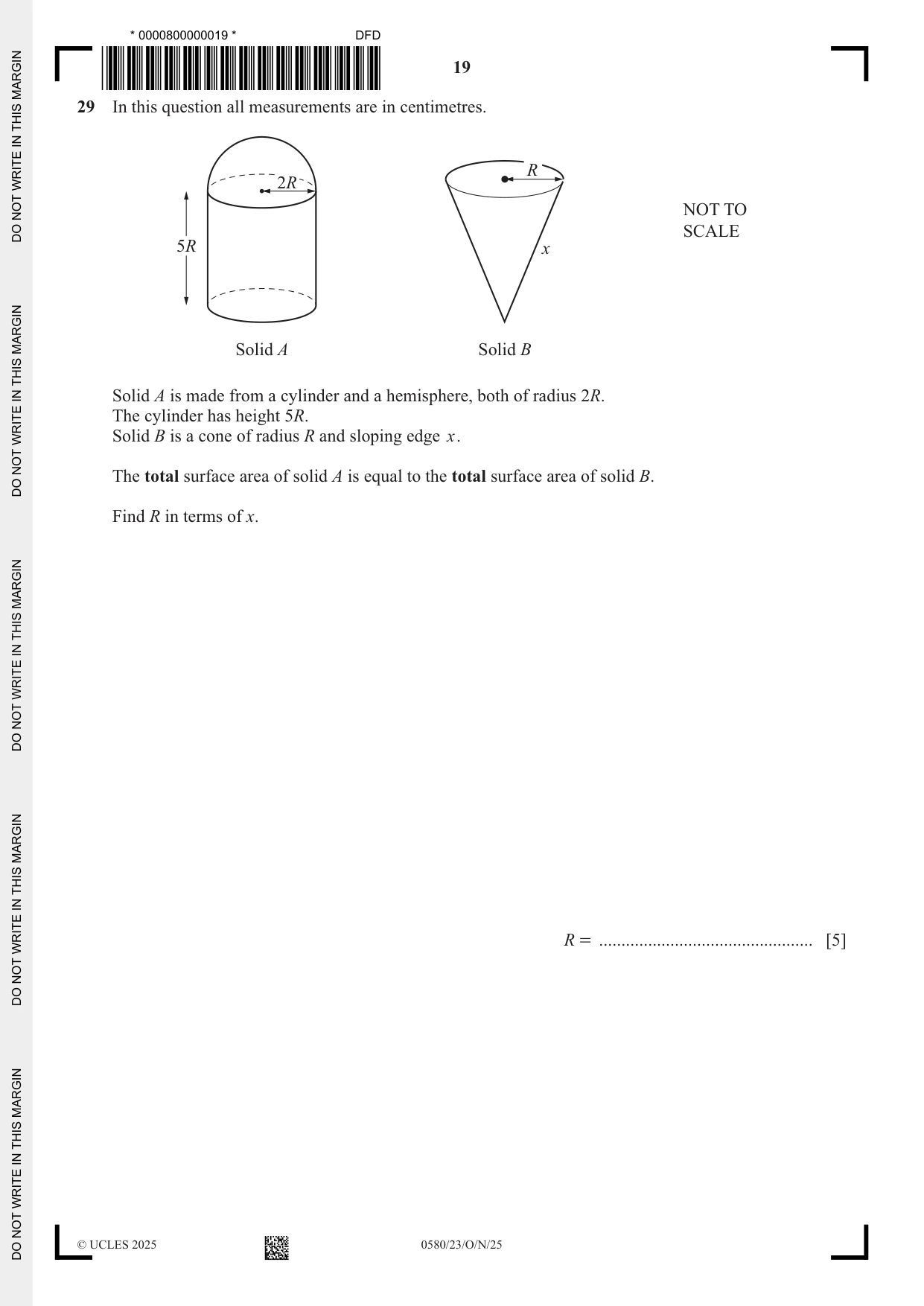
Q29 · In this question all measurements are in centimetres
29 In this question all measurements are in centimetres. R 2R NOT TO SCALE 5R x Solid A Solid B Solid A is made from a cylinder and a hemisphere, both of radius 2R. The cylinder has height 5R. Solid B is a cone of radius R and sloping edge x. The total surface area of solid A is equal to the total surface area of solid B. Find R in terms of x. R = ................................................ [5]
Mark scheme: 29 x 5 M1 for π (2R)2 oe [R =] M1 for 2 × π × 2R × 5R oe 31 2 4π ( 2 R ) M1 for oe 2 M1 for π × R × x + π × R2 oe
What was in this paper
The subtopics covered by these 29 questions, and how many questions each got. Open one in a new tab to see every Cambridge question on it.
3Algebraic fractions2Angles2Area and perimeter2Graphs of functions2Introduction to probability2Powers and roots2Algebraic manipulation1Circle theorems I1Circles, arcs and sectors1Equations1Equations of linear graphs1Fractions, decimals and percentages1Indices I1Non-right-angled triangles1Pythagoras’ theorem1Right-angled triangles1Scatter diagrams1Sequences1Sets1Vectors in two dimensions1What you needed in this session
Cambridge’s own grade thresholds for 2025 Oct/Nov, Paper 2 · Variant 3. A higher threshold means an easier paper — the bar moves with how the cohort did.