Cambridge IGCSE Mathematics 0580 — 2020 Oct/Nov Paper 2 · Variant 1
0580/21/O/N/20 · 23 questions · 70 marks · ≈79 min
The question paper and its mark scheme, free to read here and free to download. This is Cambridge’s own paper, exactly as it was sat.
Question paper12 pages
Mark scheme6 pages
Answers below. Sit the paper first if you are practising.
Questions as text
Question 1
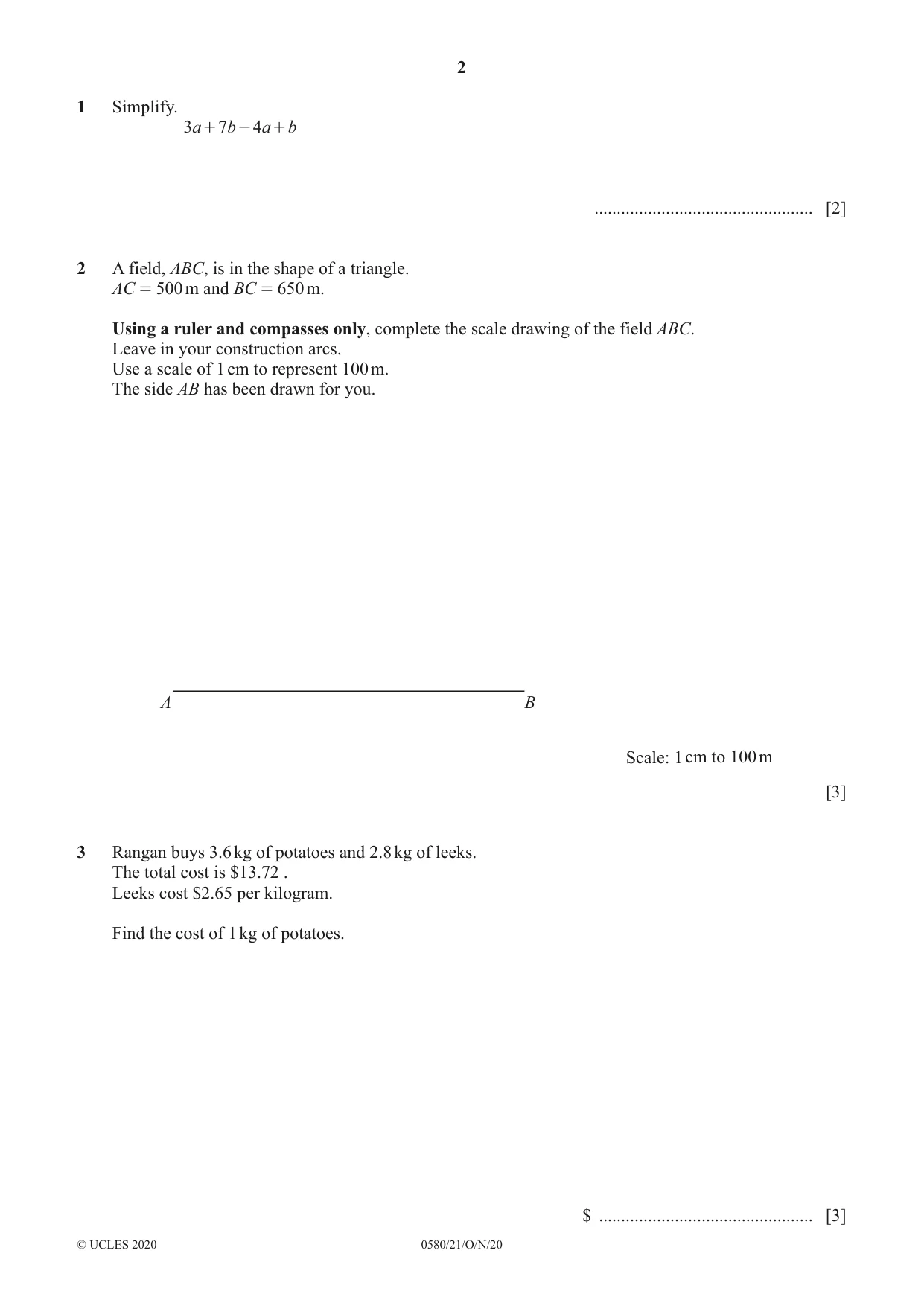
1 Simplify. 3a + 7b - 4a + b ................................................. [2]
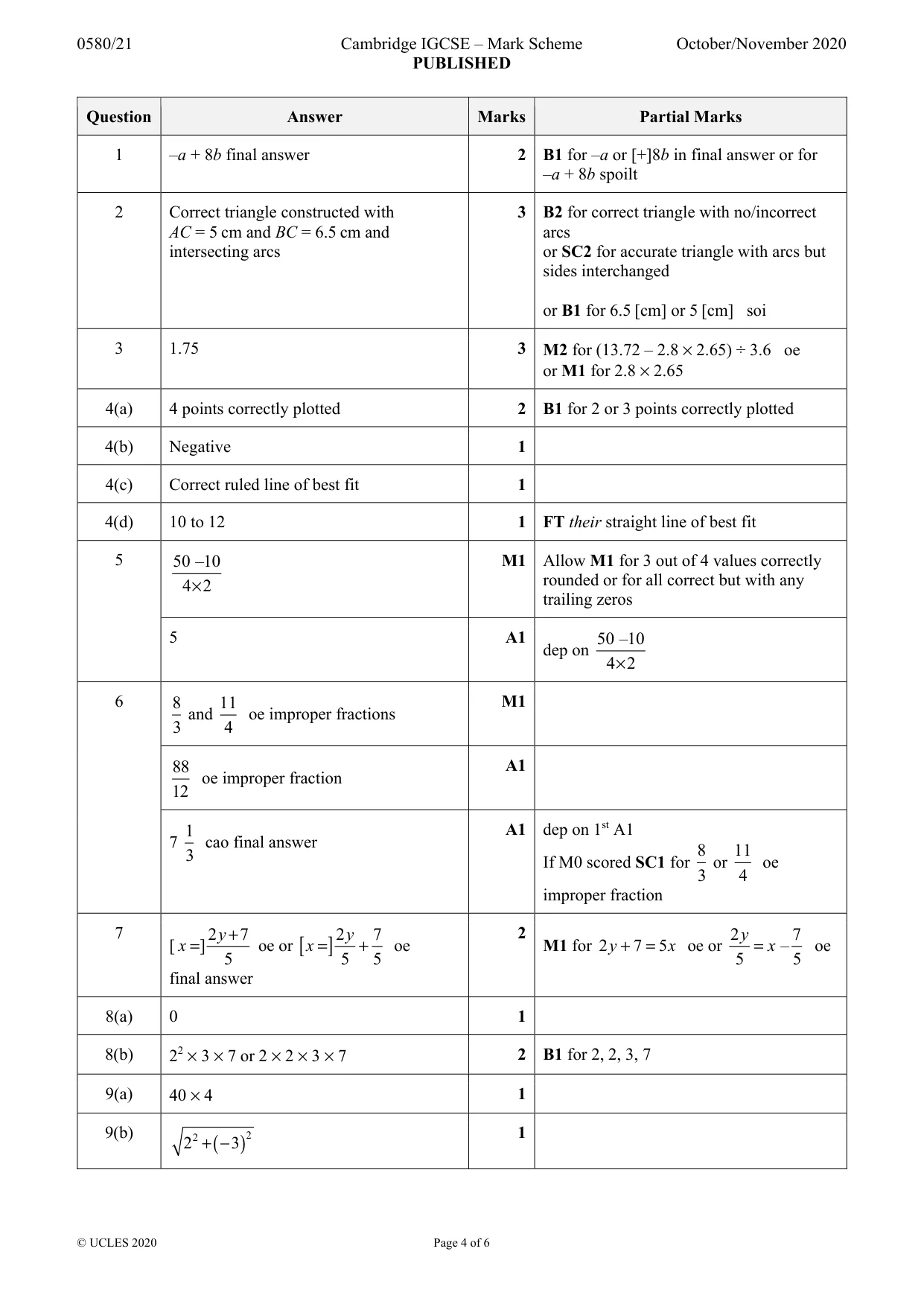
Mark scheme: Question Answer Marks Partial Marks 1 –a + 8b final answer 2 B1 for –a or [+]8b in final answer or for –a + 8b spoilt
Q2 · A field, ABC, is in the shape of a triangle
2 A field, ABC, is in the shape of a triangle. AC = 500 m and BC = 650 m. Using a ruler and compasses only, complete the scale drawing of the field ABC. Leave in your construction arcs. Use a scale of 1 cm to represent 100 m. The side AB has been drawn for you. A B Scale: 1 cm to 100 m [3]
Mark scheme: 2 Correct triangle constructed with 3 B2 for correct triangle with no/incorrect AC = 5 cm and BC = 6.5 cm and arcs intersecting arcs or SC2 for accurate triangle with arcs but sides interchanged or B1 for 6.5 [cm] or 5 [cm] soi
Q3 · Rangan buys 3.6 kg of potatoes and 2.8 kg of leeks
3 Rangan buys 3.6 kg of potatoes and 2.8 kg of leeks. The total cost is $13.72 . Leeks cost $2.65 per kilogram. Find the cost of 1 kg of potatoes. $ ................................................ [3]
Mark scheme: 3 1.75 3 M2 for (13.72 – 2.8 × 2.65) ÷ 3.6 oe or M1 for 2.8 × 2.65
Q4 · Aisha records the distance she runs and her average speed
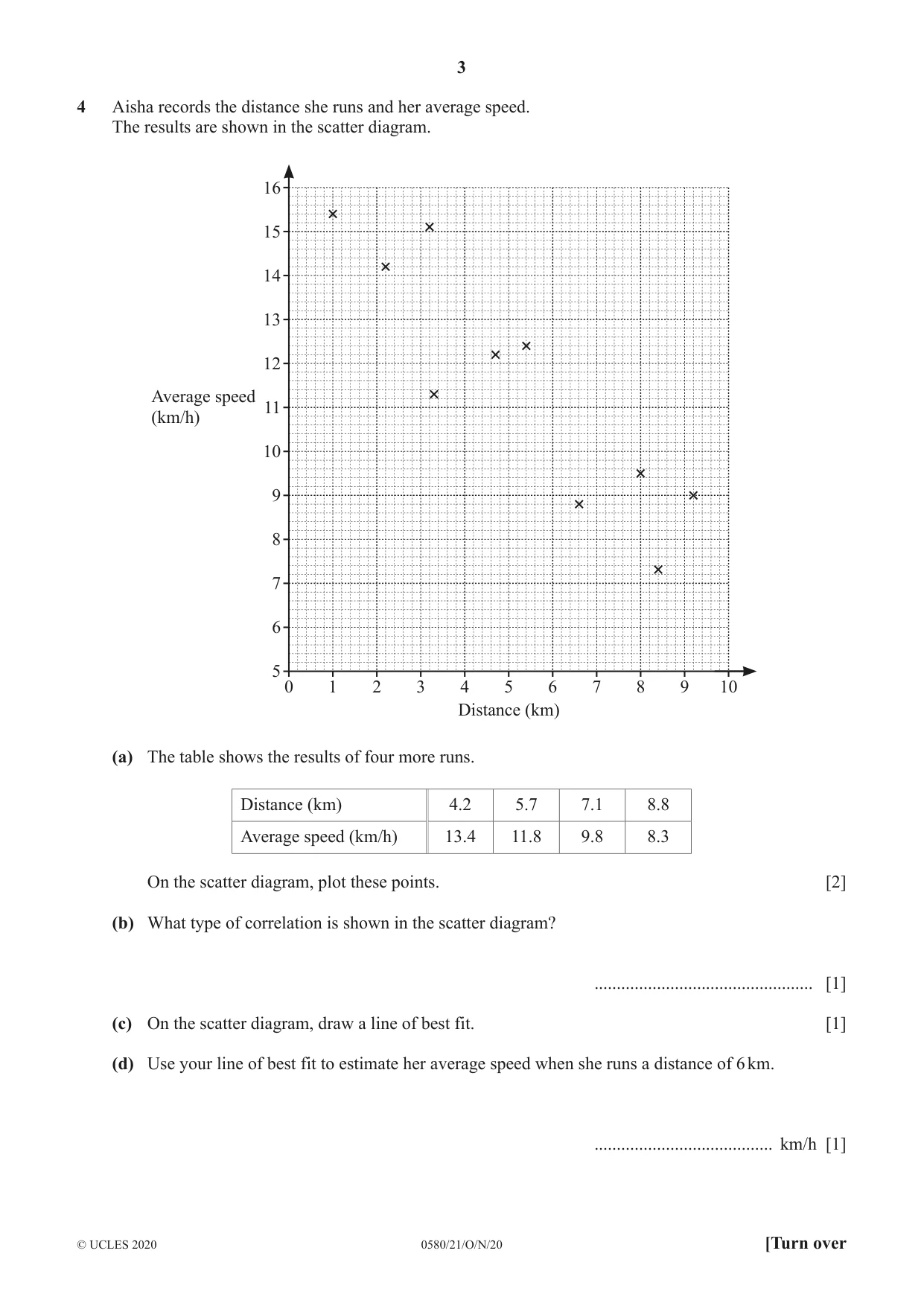
4 Aisha records the distance she runs and her average speed. The results are shown in the scatter diagram. 16 15 14 13 12 Average speed 11 (km/h) 10 9 8 7 6 5 0 1 2 3 4 5 6 7 8 9 10 Distance (km) (a) The table shows the results of four more runs. Distance (km) 4.2 5.7 7.1 8.8 Average speed (km/h) 13.4 11.8 9.8 8.3 On the scatter diagram, plot these points. [2] (b) What type of correlation is shown in the scatter diagram? ................................................. [1] (c) On the scatter diagram, draw a line of best fit. [1] (d) Use your line of best fit to estimate her average speed when she runs a distance of 6 km. ........................................ km/h [1]
Mark scheme: 4(a) 4 points correctly plotted 2 B1 for 2 or 3 points correctly plotted 4(b) Negative 1 4(c) Correct ruled line of best fit 1 4(d) 10 to 12 1 FT their straight line of best fit
Q5 · 2 - 9.595 T = 4.085 # 2.35 By writing each number correct to 1 significant figure, work…
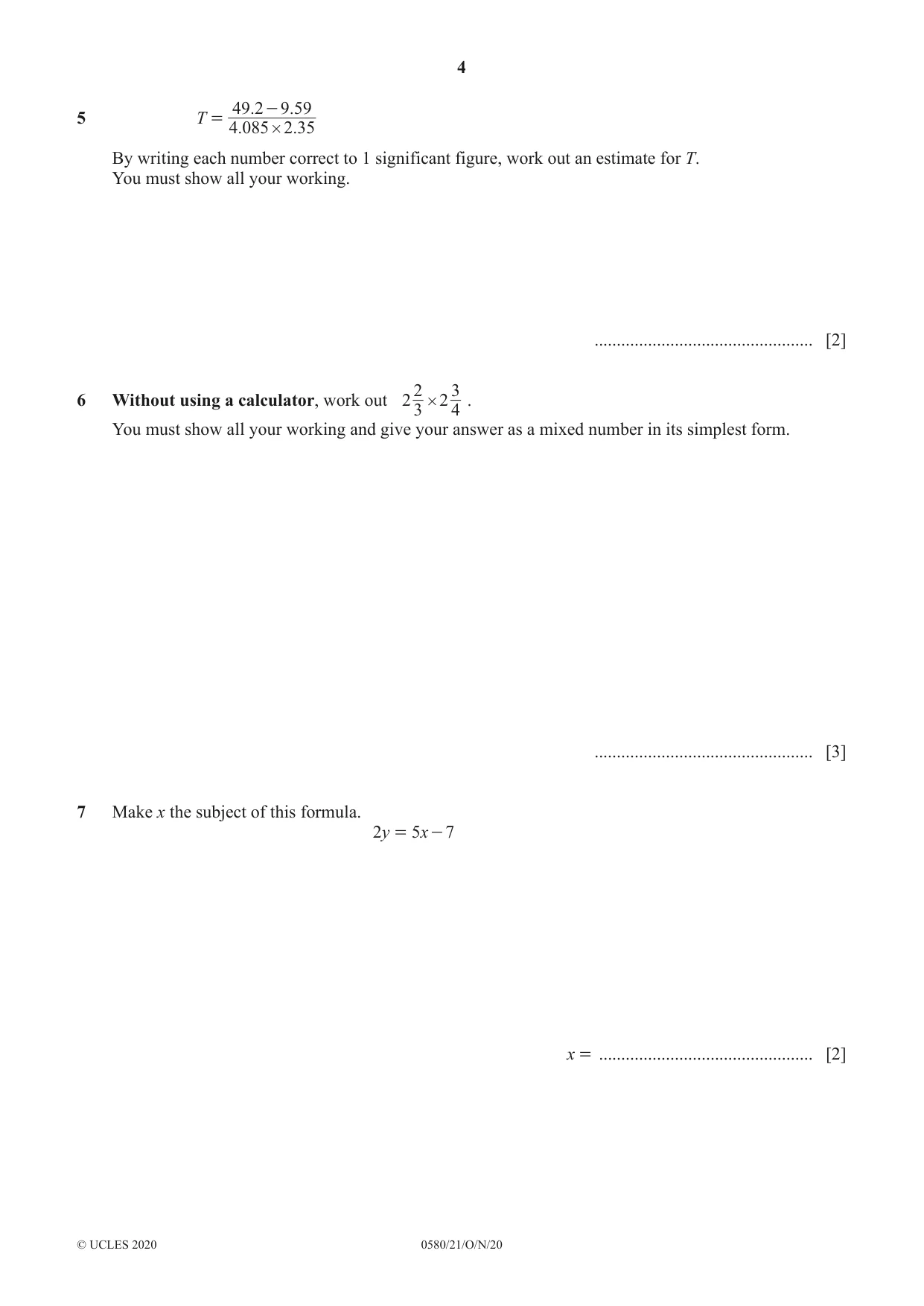
49.2 - 9.595 T = 4.085 # 2.35 By writing each number correct to 1 significant figure, work out an estimate for T. You must show all your working. ................................................. [2]
Mark scheme: 5 50 –10 M1 Allow M1 for 3 out of 4 values correctly rounded or for all correct but with any 4 × 2 trailing zeros 5 A1 50 –10 dep on 4 × 2
Q6 · 36 Without using a calculator, work out 2 # 2
2 36 Without using a calculator, work out 2 # 2 . 3 4 You must show all your working and give your answer as a mixed number in its simplest form. ................................................. [3]
Mark scheme: 6 8 11 M1 and oe improper fractions 3 4 88 A1 oe improper fraction 12 1 A1 dep on 1st A1 7 cao final answer 8 11 3 If M0 scored SC1 for or oe 3 4 improper fraction
Q7 · Make x the subject of this formula
7 Make x the subject of this formula. 2y = 5x - 7 x = ................................................ [2]
Mark scheme: 7 2 y + 7 2 y 7 2 2 y 7 [ x = ] oe or [ x = ] + oe M1 for 2 y + 7 = 5 x oe or = x – oe 5 5 5 5 5 final answer
Q8 · 1, 2, 3, 5 and 7 are all common factors of two numbers
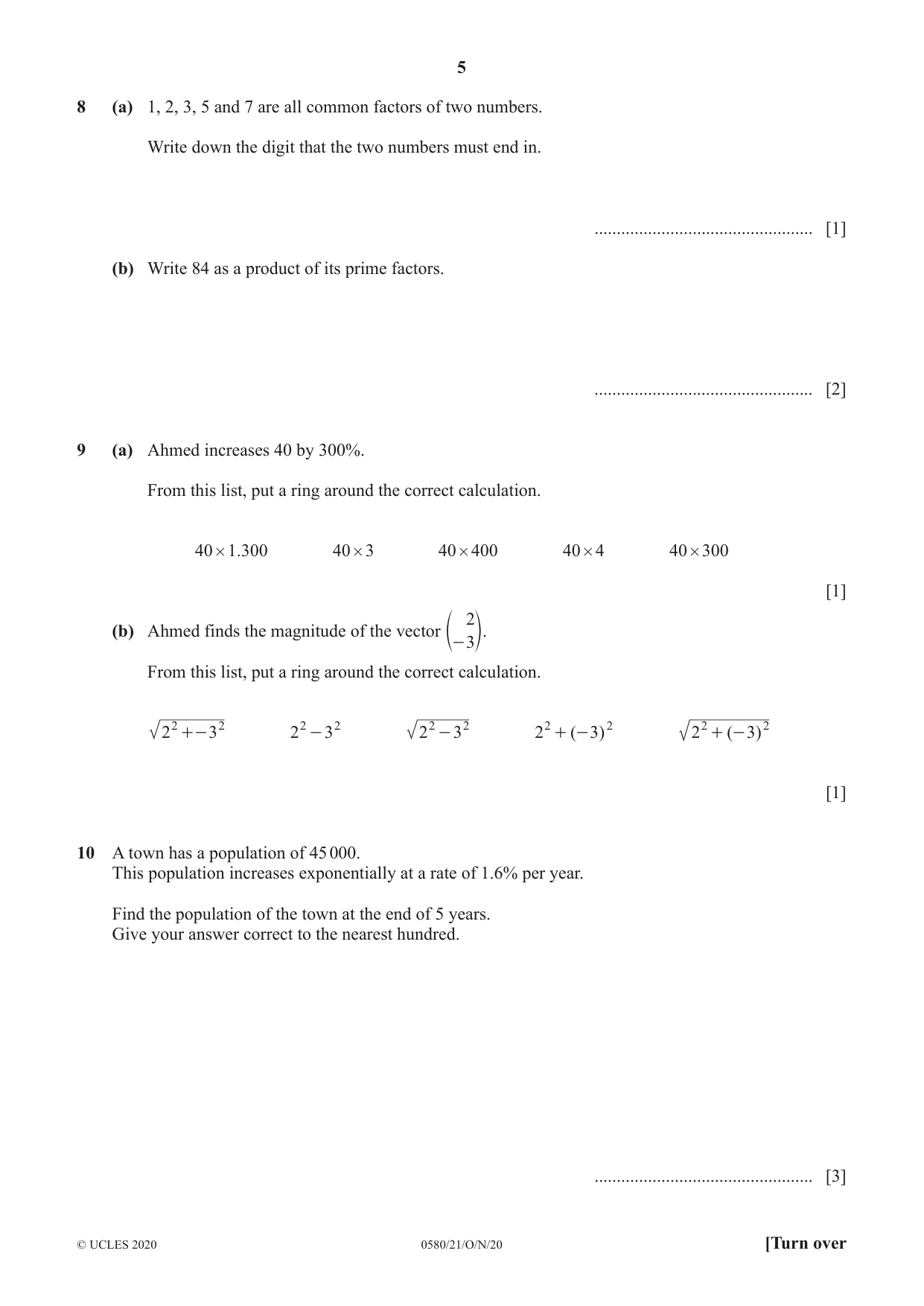
8 (a) 1, 2, 3, 5 and 7 are all common factors of two numbers. Write down the digit that the two numbers must end in. ................................................. [1] (b) Write 84 as a product of its prime factors. ................................................. [2]
Mark scheme: 8(a) 0 1 8(b) 22 × 3 × 7 or 2 × 2 × 3 × 7 2 B1 for 2, 2, 3, 7
Q9 · Ahmed increases 40 by 300%
9 (a) Ahmed increases 40 by 300%. From this list, put a ring around the correct calculation. 40 # 1.300 40 # 3 40 # 400 40 # 4 40 # 300 [1] 2 (b) Ahmed finds the magnitude of the vector e- 3o. From this list, put a ring around the correct calculation. 2 2 +- 3 2 2 2 - 3 2 2 2 - 3 2 2 2 + ( - 3 ) 2 2 2 + ( - 3 ) 2 [1]
Mark scheme: 9(a) 40 × 4 1 9(b) 2 2 1 2 + ( − 3 )
Q10 · A town has a population of 45 000
10 A town has a population of 45 000. This population increases exponentially at a rate of 1.6% per year. Find the population of the town at the end of 5 years. Give your answer correct to the nearest hundred. ................................................. [3]
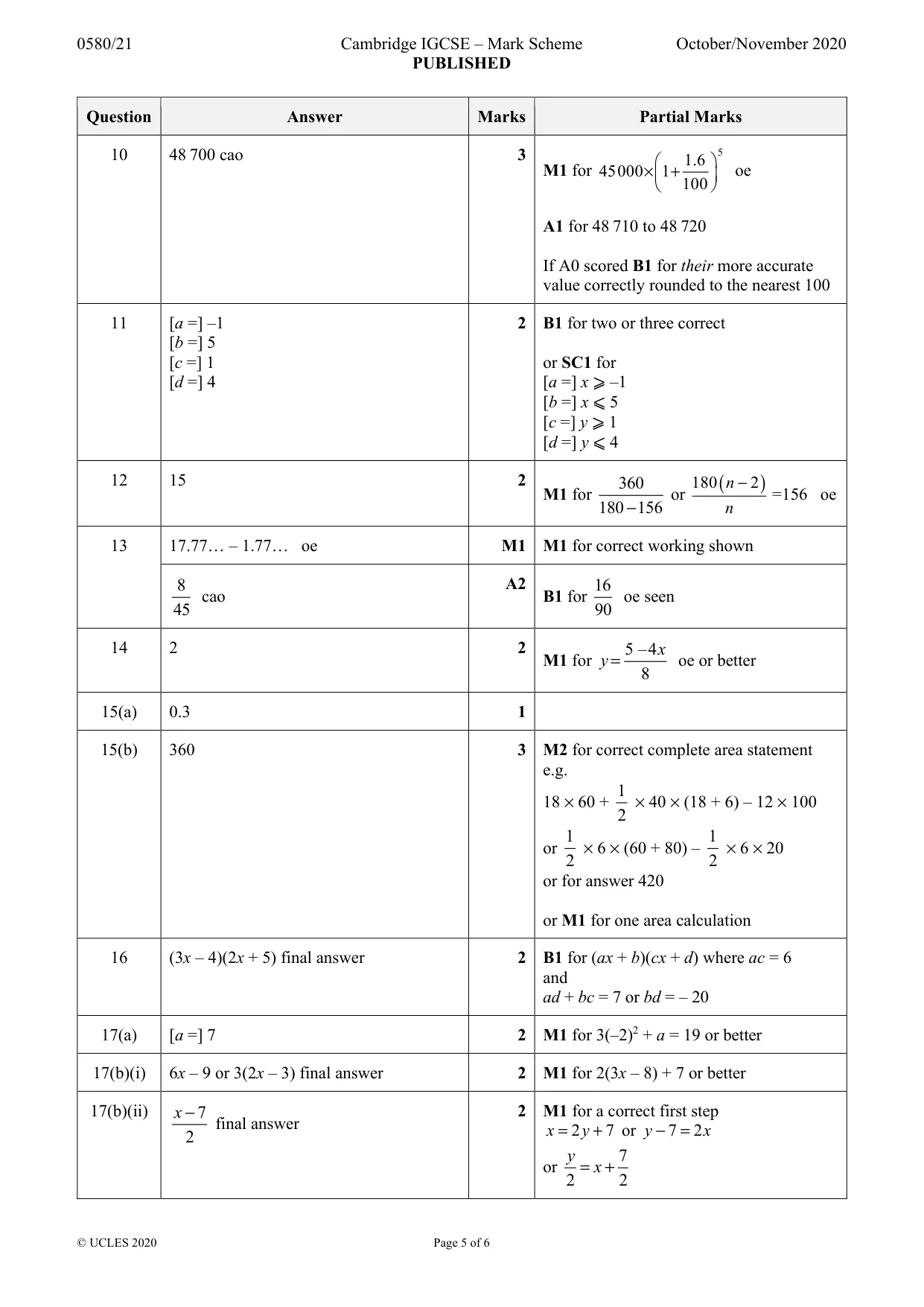
Mark scheme: 10 48 700 cao 3 5 1.6 M1 for 45 000 × 1 + oe 100 A1 for 48 710 to 48 720 If A0 scored B1 for their more accurate value correctly rounded to the nearest 100
Q11 · X = 2 y (-1, 4) NOT TO SCALE (-1, 1) 0 x The diagram shows a rectangle with a line of…
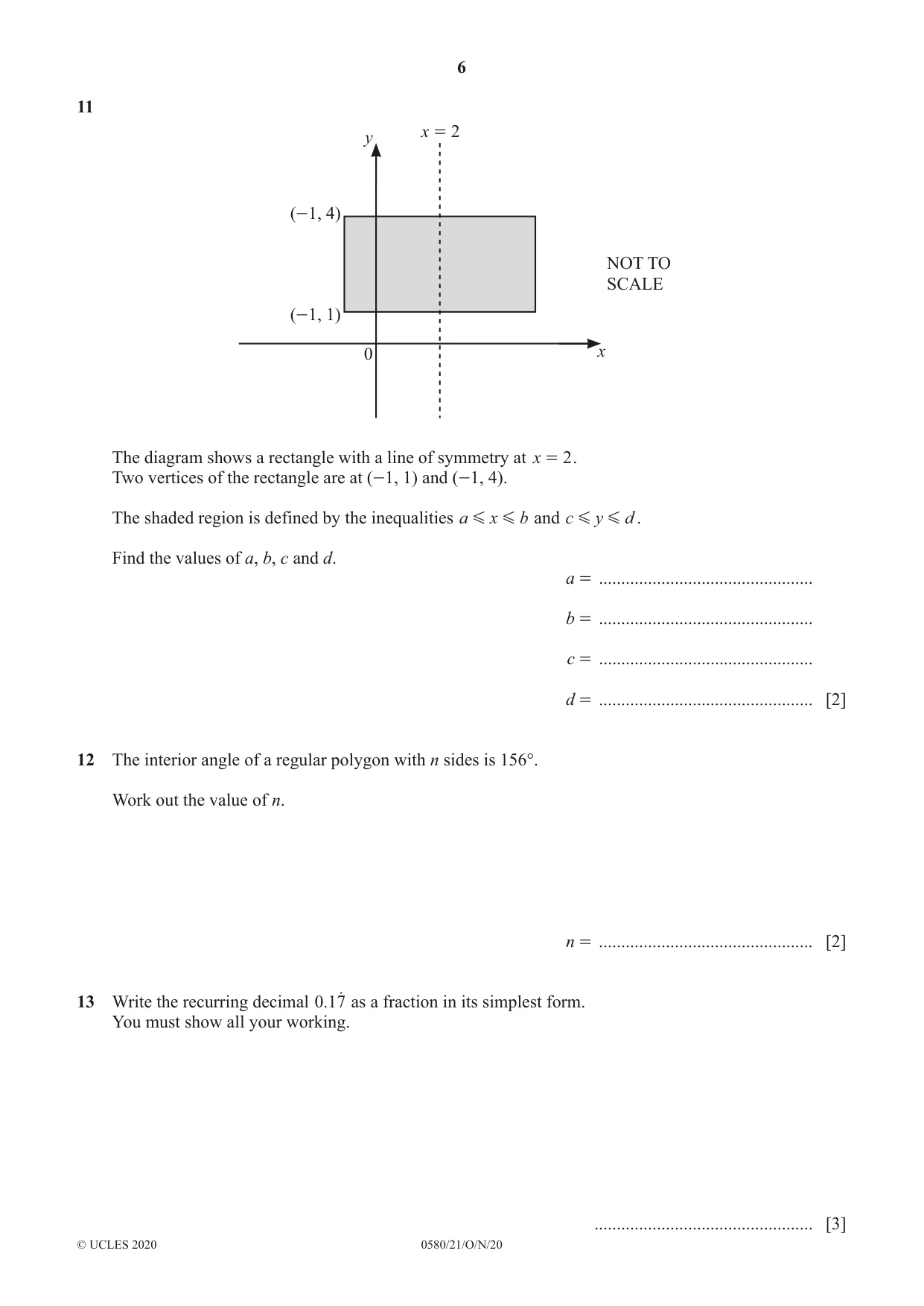
11 x = 2 y (-1, 4) NOT TO SCALE (-1, 1) 0 x The diagram shows a rectangle with a line of symmetry at x = 2 . Two vertices of the rectangle are at (-1, 1) and (-1, 4). The shaded region is defined by the inequalities a G x G b and c G y G d . Find the values of a, b, c and d. a = ................................................ b = ................................................ c = ................................................ d = ................................................ [2]
Mark scheme: 11 [a =] –1 2 B1 for two or three correct [b =] 5 [c =] 1 or SC1 for [d =] 4 [a =] x ⩾ –1 [b =] x ⩽ 5 [c =] y ⩾ 1 [d =] y ⩽ 4
Q12 · The interior angle of a regular polygon with n sides is 156°
12 The interior angle of a regular polygon with n sides is 156°. Work out the value of n. n = ................................................ [2]
Mark scheme: 12 15 2 360 180 ( n − 2 ) M1 for or =156 oe 180 − 156 n
Q13 · Write the recurring decimal .017o as a fraction in its simplest form
13 Write the recurring decimal .017o as a fraction in its simplest form. You must show all your working. ................................................. [3]
Mark scheme: 13 17.77… – 1.77… oe M1 M1 for correct working shown 8 A2 16 cao B1 for oe seen 45 90
Q14 · Find the gradient of a line that is perpendicular to 8y + 4x = 5
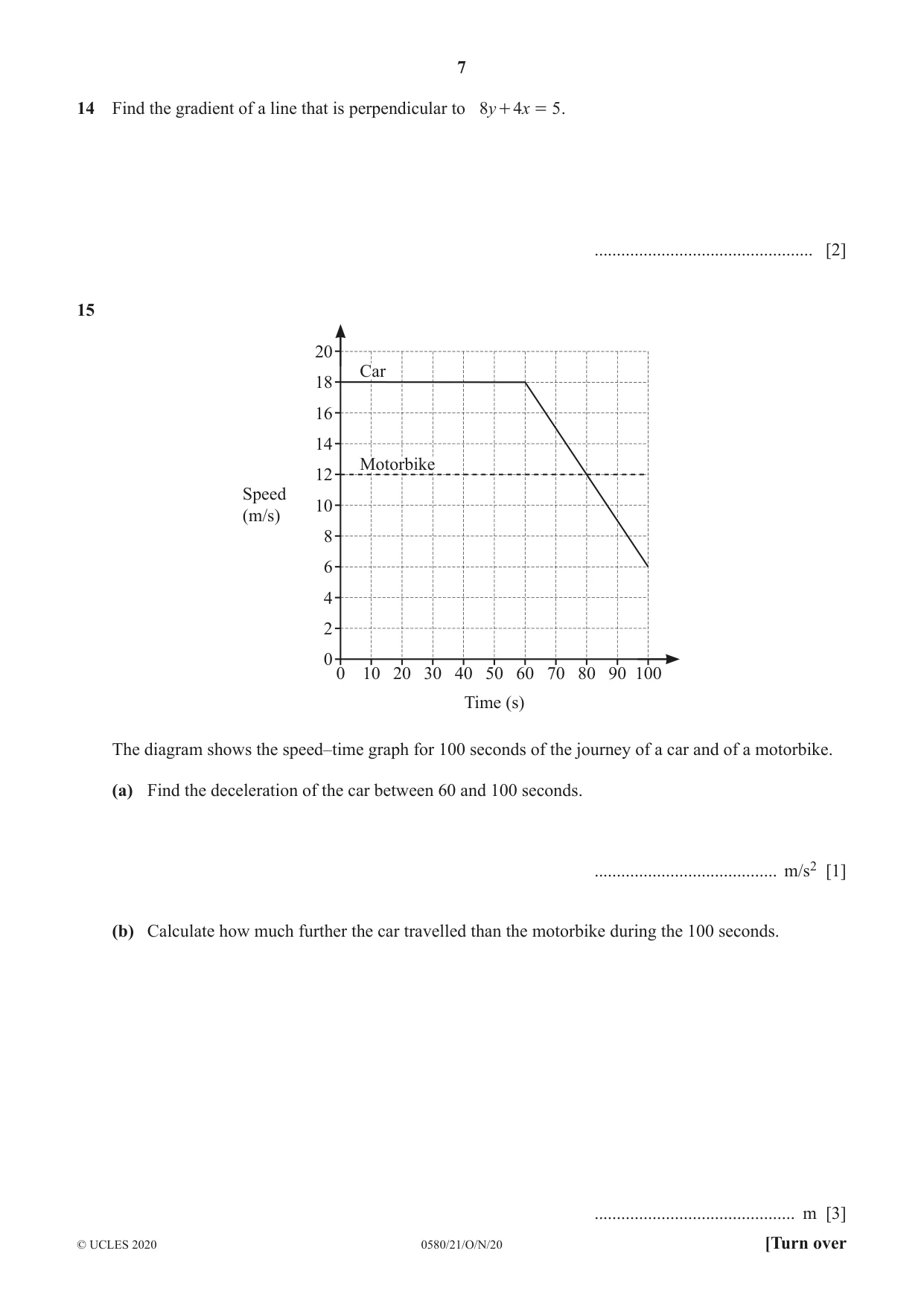
14 Find the gradient of a line that is perpendicular to 8y + 4x = 5 . ................................................. [2]
Mark scheme: 14 2 2 5 – 4 x M1 for y = oe or better 8
Q15 · 20 Car 18 16 14 Motorbike 12 Speed 10 (m/s) 8 6 4 2 0 0 10 20 30 40 50 60 70 80 90 100…
15 20 Car 18 16 14 Motorbike 12 Speed 10 (m/s) 8 6 4 2 0 0 10 20 30 40 50 60 70 80 90 100 Time (s) The diagram shows the speed–time graph for 100 seconds of the journey of a car and of a motorbike. (a) Find the deceleration of the car between 60 and 100 seconds. ......................................... m/s2 [1] (b) Calculate how much further the car travelled than the motorbike during the 100 seconds. ............................................. m [3]
Mark scheme: 15(a) 0.3 1 15(b) 360 3 M2 for correct complete area statement e.g. 1 18 × 60 + × 40 × (18 + 6) – 12 × 100 2 1 1 or × 6 × (60 + 80) – × 6 × 20 2 2 or for answer 420 or M1 for one area calculation
Q16 · Factorise 6x 2 + 7x - 20
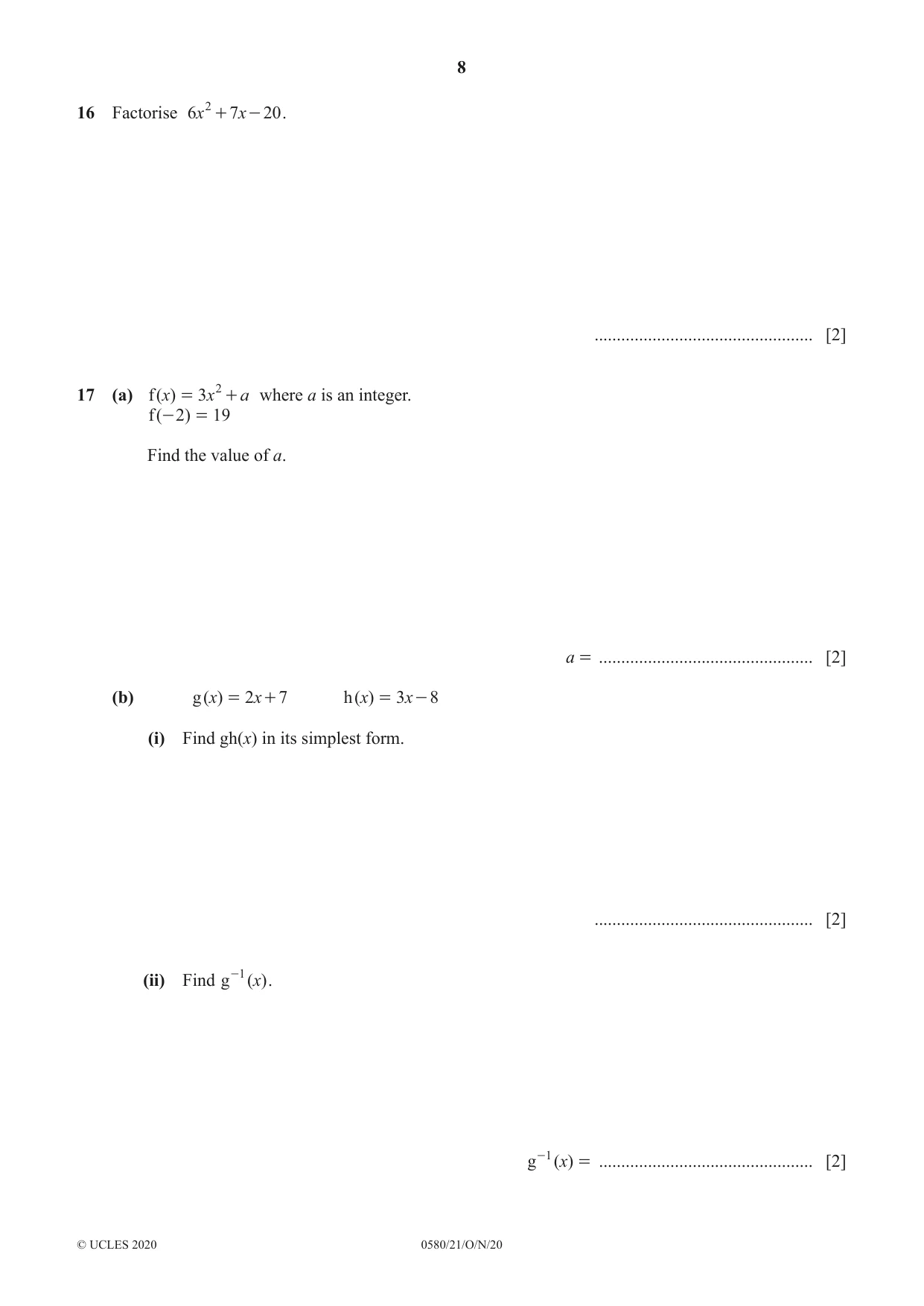
16 Factorise 6x 2 + 7x - 20 . ................................................. [2]
Mark scheme: 16 (3x – 4)(2x + 5) final answer 2 B1 for (ax + b)(cx + d) where ac = 6 and ad + bc = 7 or bd = – 20
Q17 · F ( x) = 3x 2 + a where a is an integer
17 (a) f ( x) = 3x 2 + a where a is an integer. f ( - 2) = 19 Find the value of a. a = ................................................ [2] (b) g ( x) = 2 x + 7 h ( x) = 3 x - 8 (i) Find gh(x) in its simplest form. ................................................. [2] (ii) Find g -1 ( x) . g -1 ( x) = ................................................ [2]
Mark scheme: 17(a) [a =] 7 2 M1 for 3(–2)2 + a = 19 or better 17(b)(i) 6x – 9 or 3(2x – 3) final answer 2 M1 for 2(3x – 8) + 7 or better 17(b)(ii) x − 7 2 M1 for a correct first step final answer x = 2 y + 7 or y − 7 = 2 x 2 y 7 or = x + 2 2
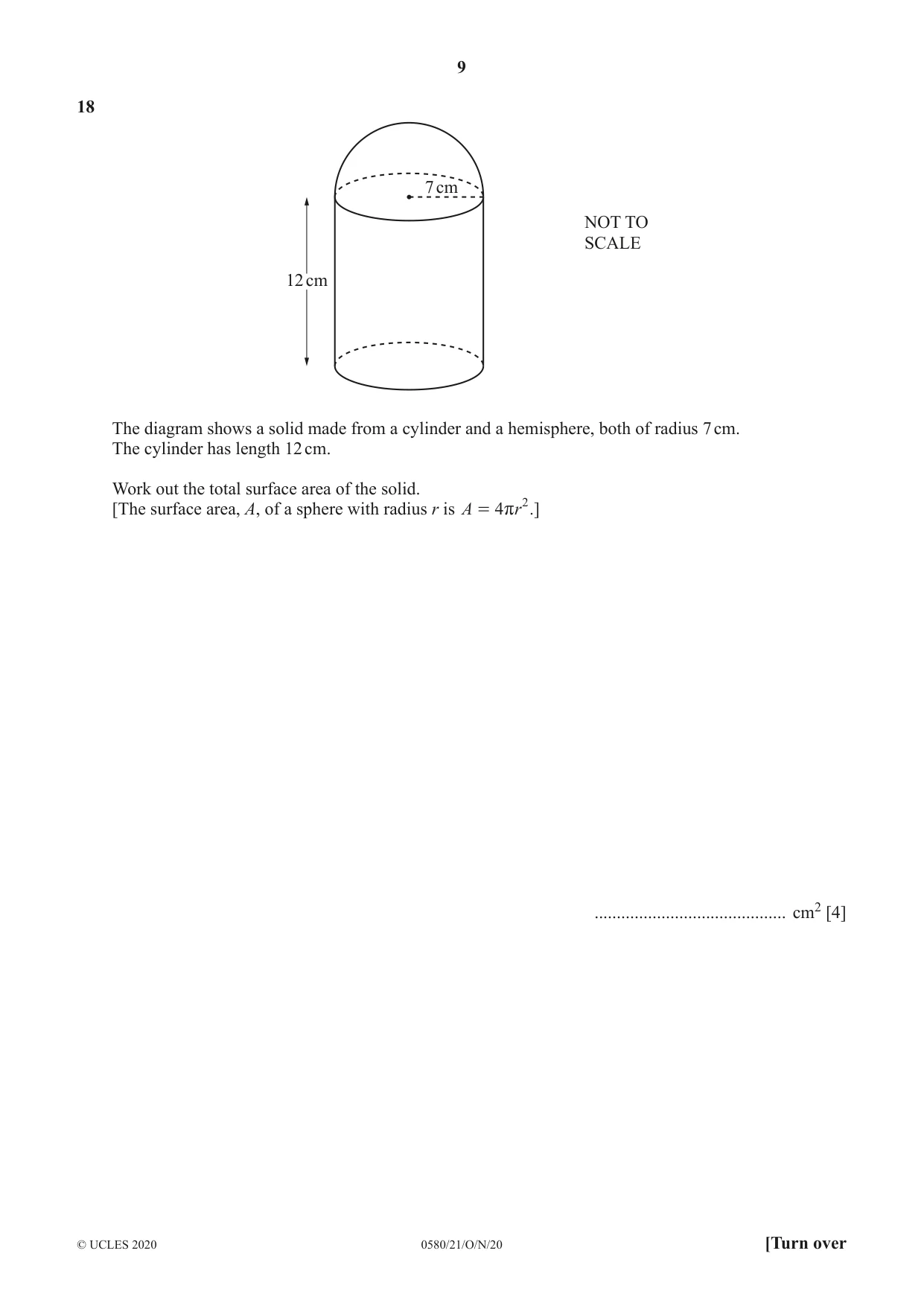
Q18 · 7 cm NOT TO SCALE 12 cm The diagram shows a solid made from a cylinder and a hemisphere…
18 7 cm NOT TO SCALE 12 cm The diagram shows a solid made from a cylinder and a hemisphere, both of radius 7 cm. The cylinder has length 12 cm. Work out the total surface area of the solid. [The surface area, A, of a sphere with radius r is A = 4rr 2 .] ........................................... cm2 [4]
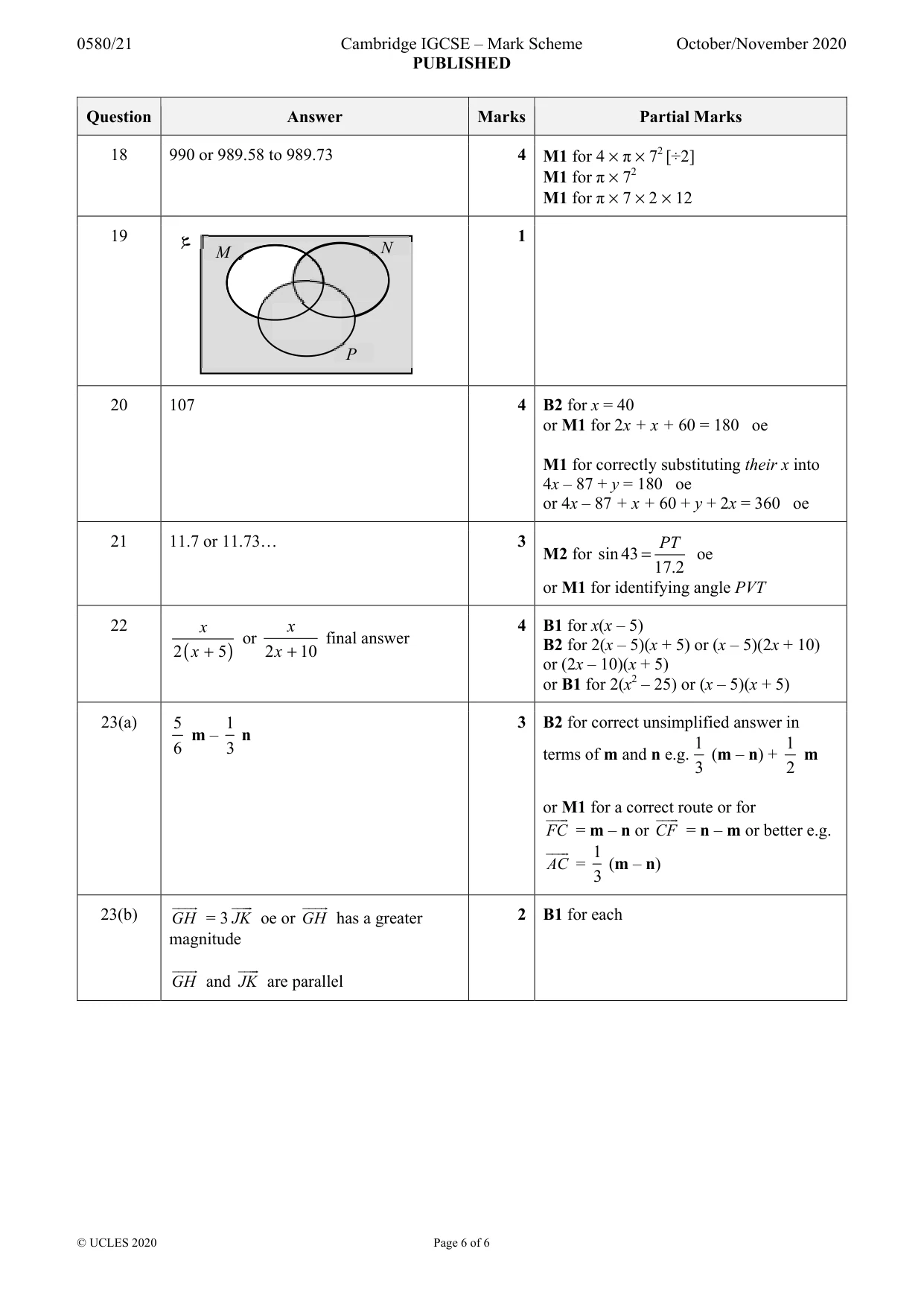
Mark scheme: 18 990 or 989.58 to 989.73 4 M1 for 4 × π × 72 [÷2] M1 for π × 72 M1 for π × 7 × 2 × 12
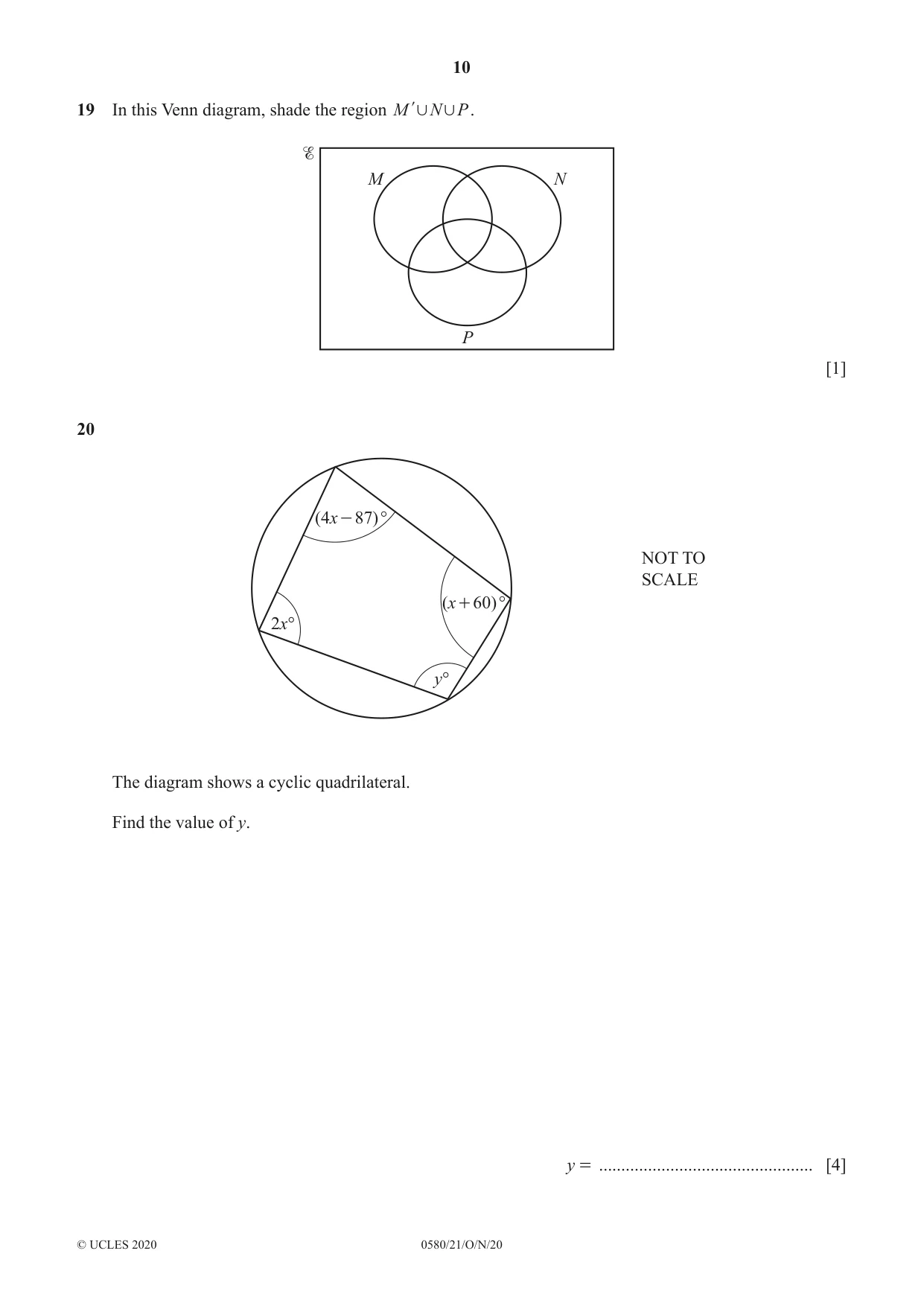
Q19 · In this Venn diagram, shade the region M l , N , P
19 In this Venn diagram, shade the region M l , N , P . M N P [1]
Mark scheme: 19 1 ξ M N P
Q20 · ( 4x - 87)° NOT TO SCALE ( x + 60 ) ° 2x° y° The diagram shows a cyclic quadrilateral
20 ( 4x - 87)° NOT TO SCALE ( x + 60 ) ° 2x° y° The diagram shows a cyclic quadrilateral. Find the value of y. y = ................................................ [4]
Mark scheme: 20 107 4 B2 for x = 40 or M1 for 2x + x + 60 = 180 oe M1 for correctly substituting their x into 4x – 87 + y = 180 oe or 4x – 87 + x + 60 + y + 2x = 360 oe
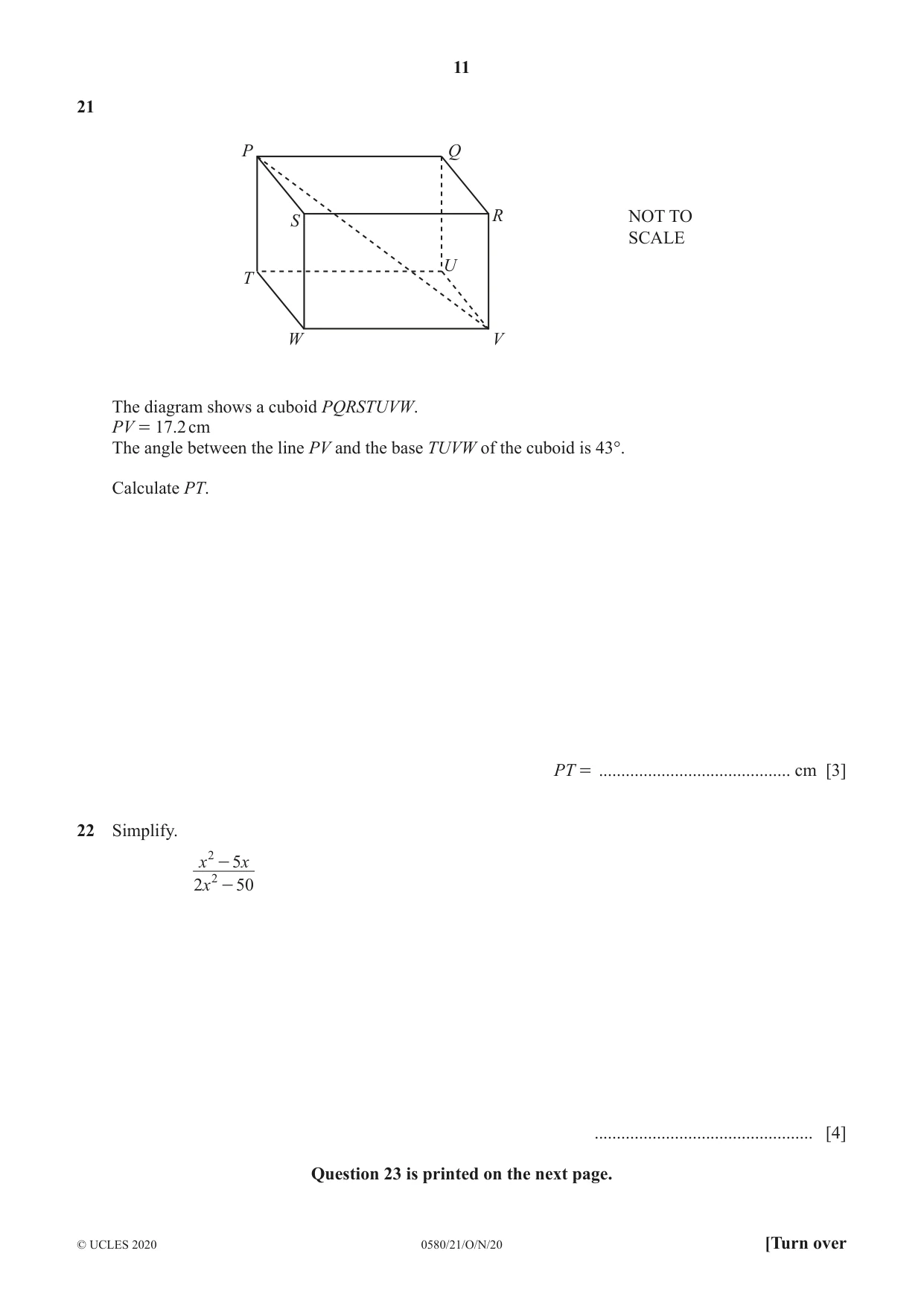
Q21 · P Q R NOT TO S SCALE U T W V The diagram shows a cuboid PQRSTUVW
21 P Q R NOT TO S SCALE U T W V The diagram shows a cuboid PQRSTUVW. PV = 17.2 cm The angle between the line PV and the base TUVW of the cuboid is 43°. Calculate PT. PT = ........................................... cm [3]
Mark scheme: 21 11.7 or 11.73… 3 PT M2 for sin43 = oe 17.2 or M1 for identifying angle PVT
Question 22
22 Simplify. x 2 - 5x 2x 2 - 50 ................................................. [4] Question 23 is printed on the next page.
Mark scheme: 22 x x 4 B1 for x(x – 5) or final answer B2 for 2(x – 5)(x + 5) or (x – 5)(2x + 10) 2 ( x + 5 ) 2 x + 10 or (2x – 10)(x + 5) or B1 for 2(x2 – 25) or (x – 5)(x + 5)
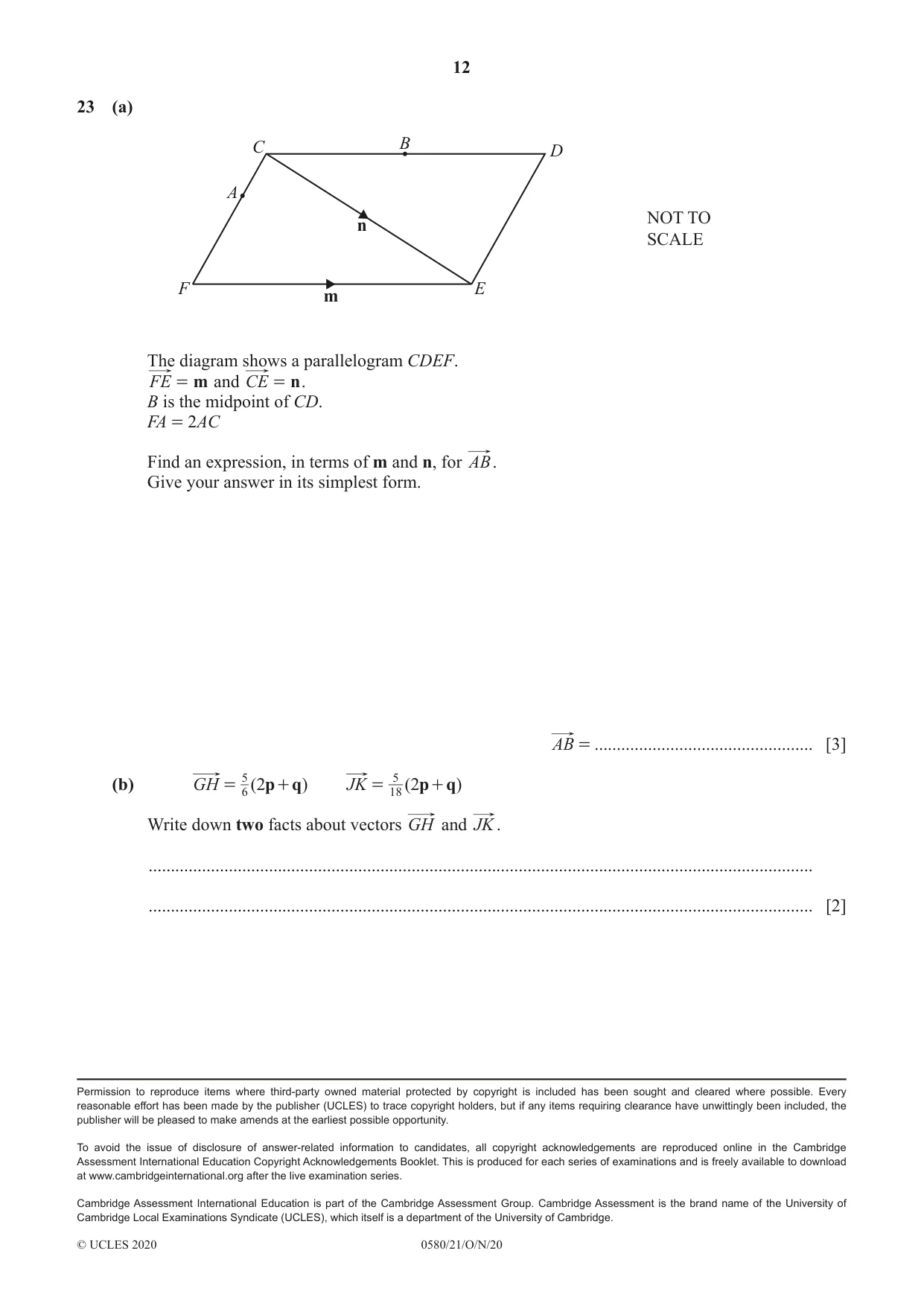
Q23 · C B D A NOT TO n SCALE F E m The diagram shows a parallelogram CDEF
23 (a) C B D A NOT TO n SCALE F E m The diagram shows a parallelogram CDEF. FE = m and CE = n . B is the midpoint of CD. FA = 2AC Find an expression, in terms of m and n, for AB. Give your answer in its simplest form. AB = ................................................. [3] (b) GH = 56 ( 2p 5 + q ) JK = 18 ( 2p + q ) Write down two facts about vectors GH and JK . ..................................................................................................................................................... ..................................................................................................................................................... [2]
Mark scheme: 23(a) 5 1 3 B2 for correct unsimplified answer in m – n 1 1 6 3 terms of m and n e.g. (m – n) + m 3 2 or M1 for a correct route or for FC = m – n or CF = n – m or better e.g. 1 AC = (m – n) 3 23(b) GH = 3 JK oe or GH has a greater 2 B1 for each magnitude GH and JK are parallel
What was in this paper
The subtopics covered by these 23 questions, and how many questions each got. Open one in a new tab to see every Cambridge question on it.
2Fractions, decimals and percentages2Algebraic fractions1Angles1Area and perimeter1Circle theorems I1Compound shapes and parts of shapes1Equations1Estimation1Exponential growth and decay1Functions1Gradient of linear graphs1Introduction to algebra1Percentages1Ratio and proportion1Right-angled triangles1Scale drawings1Scatter diagrams1Sets1Types of number1Vectors in two dimensions1What you needed in this session
Cambridge’s own grade thresholds for 2020 Oct/Nov, Paper 2 · Variant 1. A higher threshold means an easier paper — the bar moves with how the cohort did.