Cambridge IGCSE Mathematics 0580 — 2023 Oct/Nov Paper 2 · Variant 2
0580/22/O/N/23 · 26 questions · 70 marks · ≈79 min
The question paper and its mark scheme, free to read here and free to download. This is Cambridge’s own paper, exactly as it was sat.
Question paper12 pages
Mark scheme7 pages
Answers below. Sit the paper first if you are practising.
Questions as text
Q1 · Write 24.07839 (a) correct to 2 decimal places…
1 Write 24.07839 (a) correct to 2 decimal places ................................................. [1] (b) correct to the nearest 10. ................................................. [1]
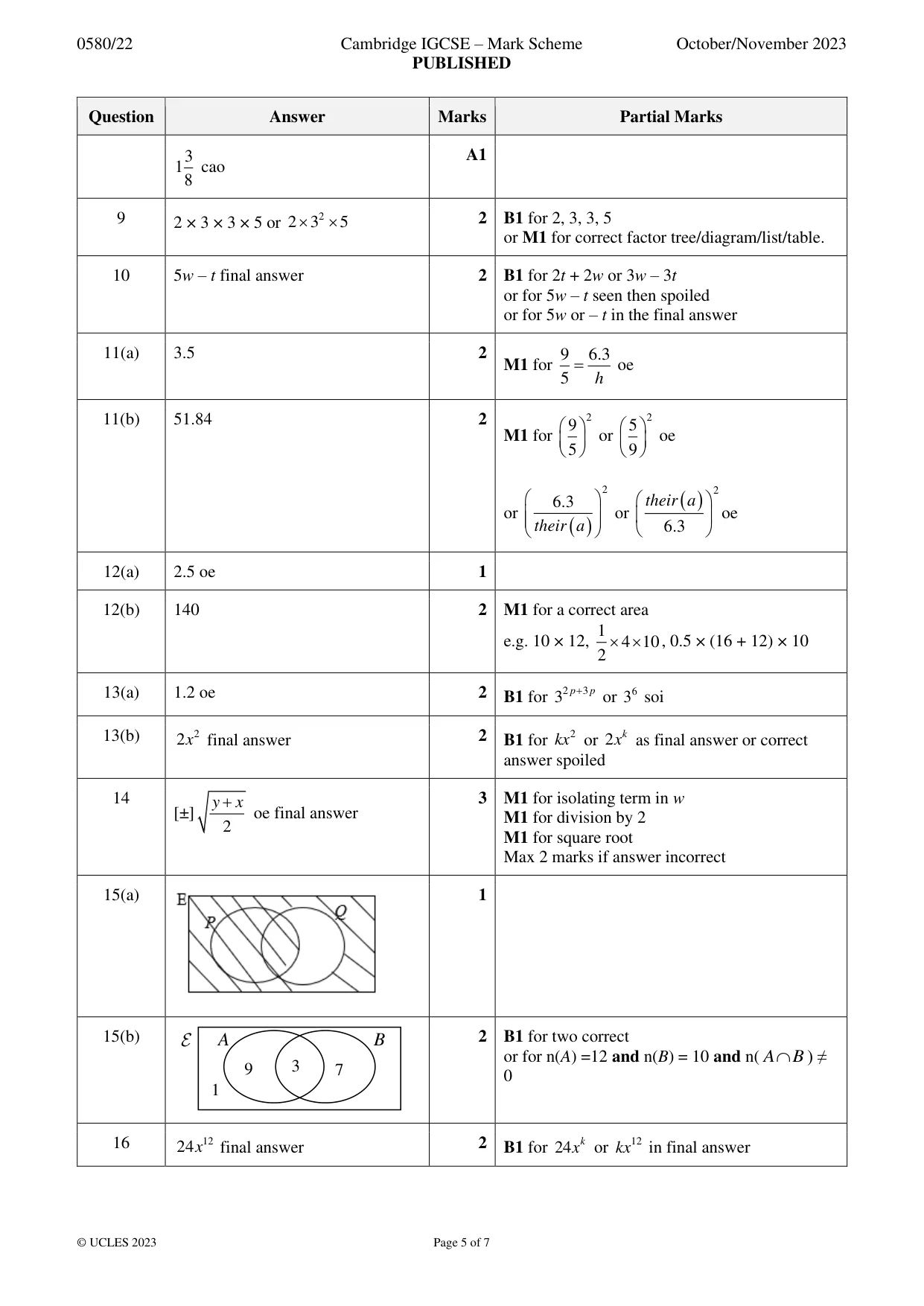
Mark scheme: Question Answer Marks Partial Marks 1(a) 24.08 cao 1 1(b) 20 cao 1
Q2 · Write down the number that is 9 greater than - 23
2 Write down the number that is 9 greater than - 23 . ................................................. [1]
Mark scheme: 2 –14 1
Q3 · V = u + at Find the value of v when u = 30 , a =- 2 and t = 7
3 v = u + at Find the value of v when u = 30 , a =- 2 and t = 7 . v = ................................................. [2]
Mark scheme: 3 16 2 B1 for –14 or M1 for 30 – 2 × 7
Q4 · Change 62 000 millimetres into kilometres
4 Change 62 000 millimetres into kilometres. ............................................ km [1]
Mark scheme: 4 0.062 1
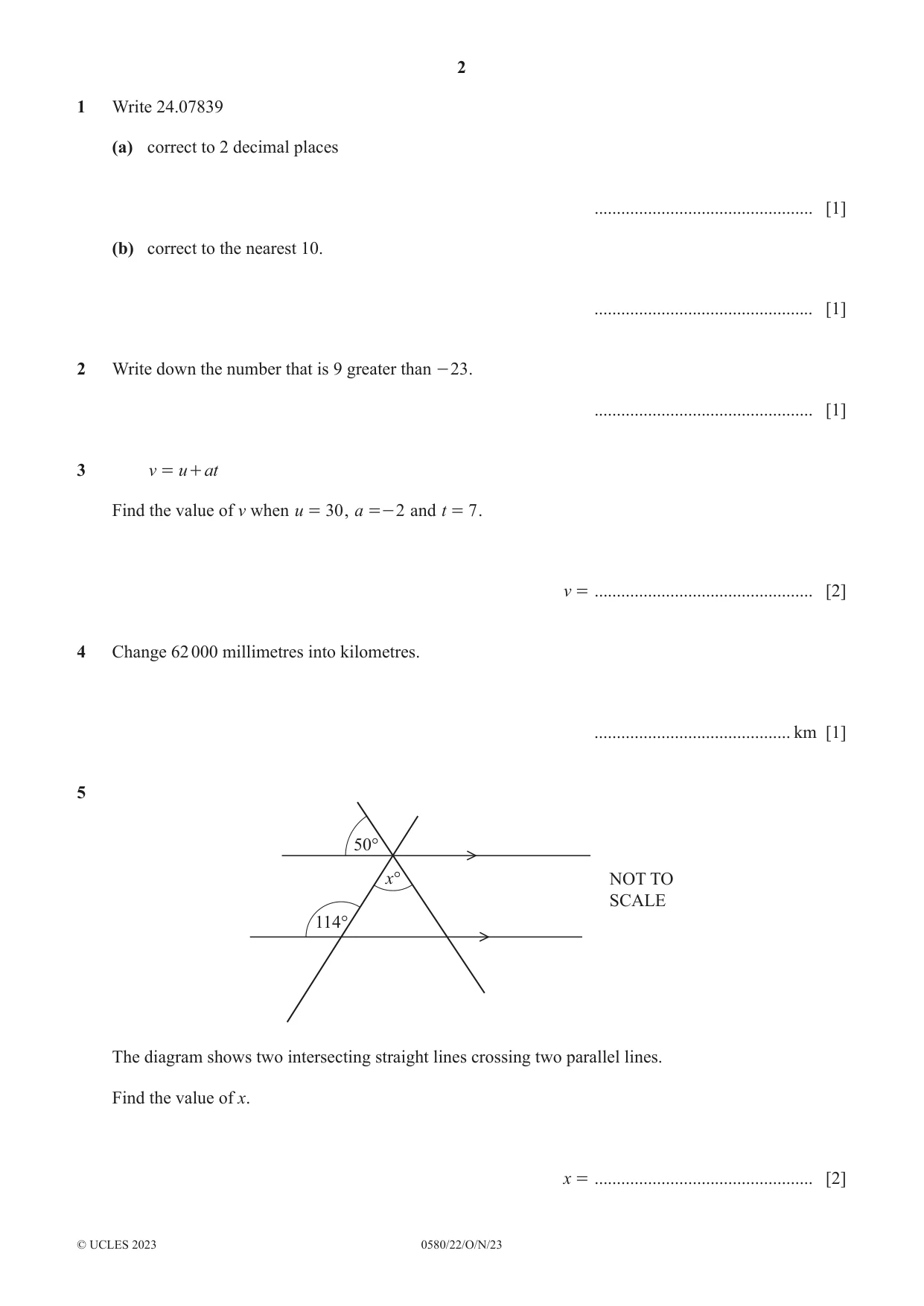
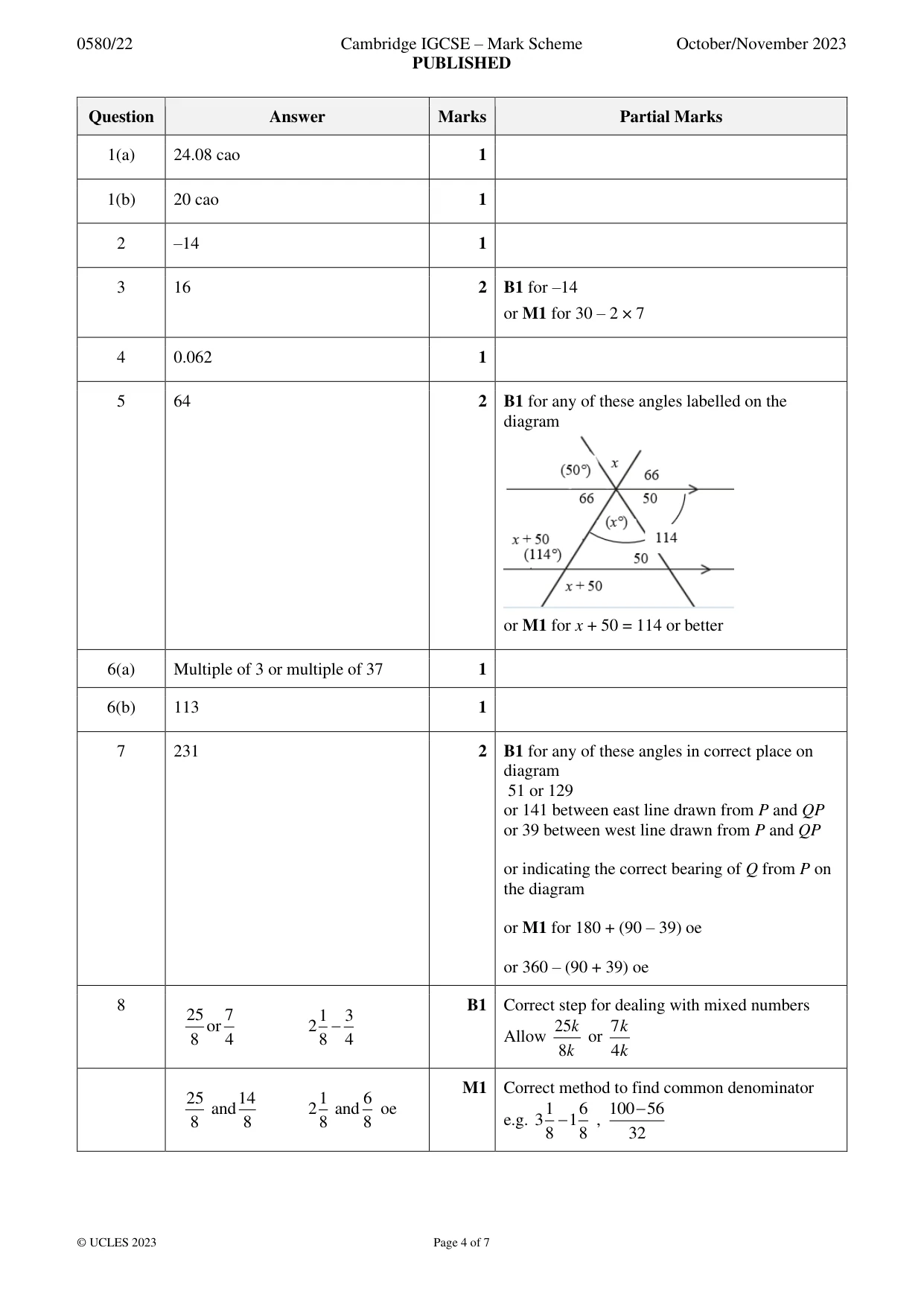
Q5 · 50° x° NOT TO SCALE 114° The diagram shows two intersecting straight lines crossing two…
5 50° x° NOT TO SCALE 114° The diagram shows two intersecting straight lines crossing two parallel lines. Find the value of x. x = ................................................. [2]
Mark scheme: 5 64 2 B1 for any of these angles labelled on the diagram or M1 for x + 50 = 114 or better
Q6 · Explain why 111 is not a prime number
6 (a) Explain why 111 is not a prime number. ..................................................................................................................................................... [1] (b) Find a prime number between 110 and 120. ................................................. [1]
Mark scheme: 6(a) Multiple of 3 or multiple of 37 1 6(b) 113 1
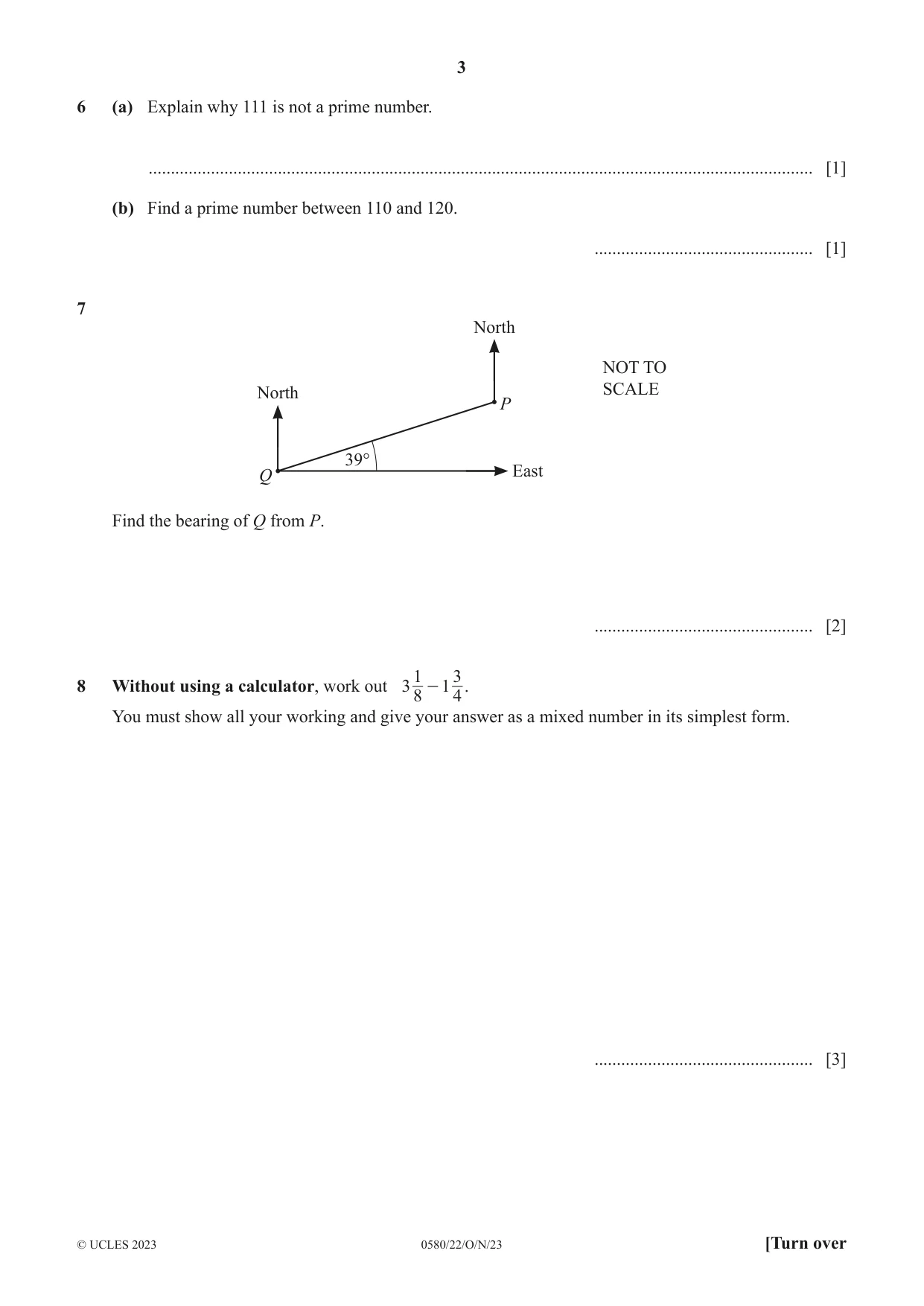
Q7 · North NOT TO North SCALE P 39° Q East Find the bearing of Q from P
7 North NOT TO North SCALE P 39° Q East Find the bearing of Q from P. ................................................. [2]
Mark scheme: 7 231 2 B1 for any of these angles in correct place on diagram 51 or 129 or 141 between east line drawn from P and QP or 39 between west line drawn from P and QP or indicating the correct bearing of Q from P on the diagram or M1 for 180 + (90 – 39) oe or 360 – (90 + 39) oe
Q8 · 38 Without using a calculator, work out 3 - 1
1 38 Without using a calculator, work out 3 - 1 . 8 4 You must show all your working and give your answer as a mixed number in its simplest form. ................................................. [3]
Mark scheme: 8 B1 Correct step for dealing with mixed numbers 25 7 1 3 or − 25 k 7 k 8 4 28 4 Allow or 8 k 4 k M1 Correct method to find common denominator 25 14 1 6 and 2 and oe 1 6 100 − 56 8 8 8 8 e.g. 3 − 1 , 8 8 32
Q9 · Write 90 as a product of its prime factors
9 Write 90 as a product of its prime factors. ................................................. [2]
Mark scheme: 9 2 × 3 × 3 × 5 or 2 32 5 2 B1 for 2, 3, 3, 5 or M1 for correct factor tree/diagram/list/table.
Question 10
10 Expand and simplify. 2 ( t + w) + 3 ( w - t) ................................................. [2]
Mark scheme: 10 5w – t final answer 2 B1 for 2t + 2w or 3w – 3t or for 5w – t seen then spoiled or for 5w or – t in the final answer
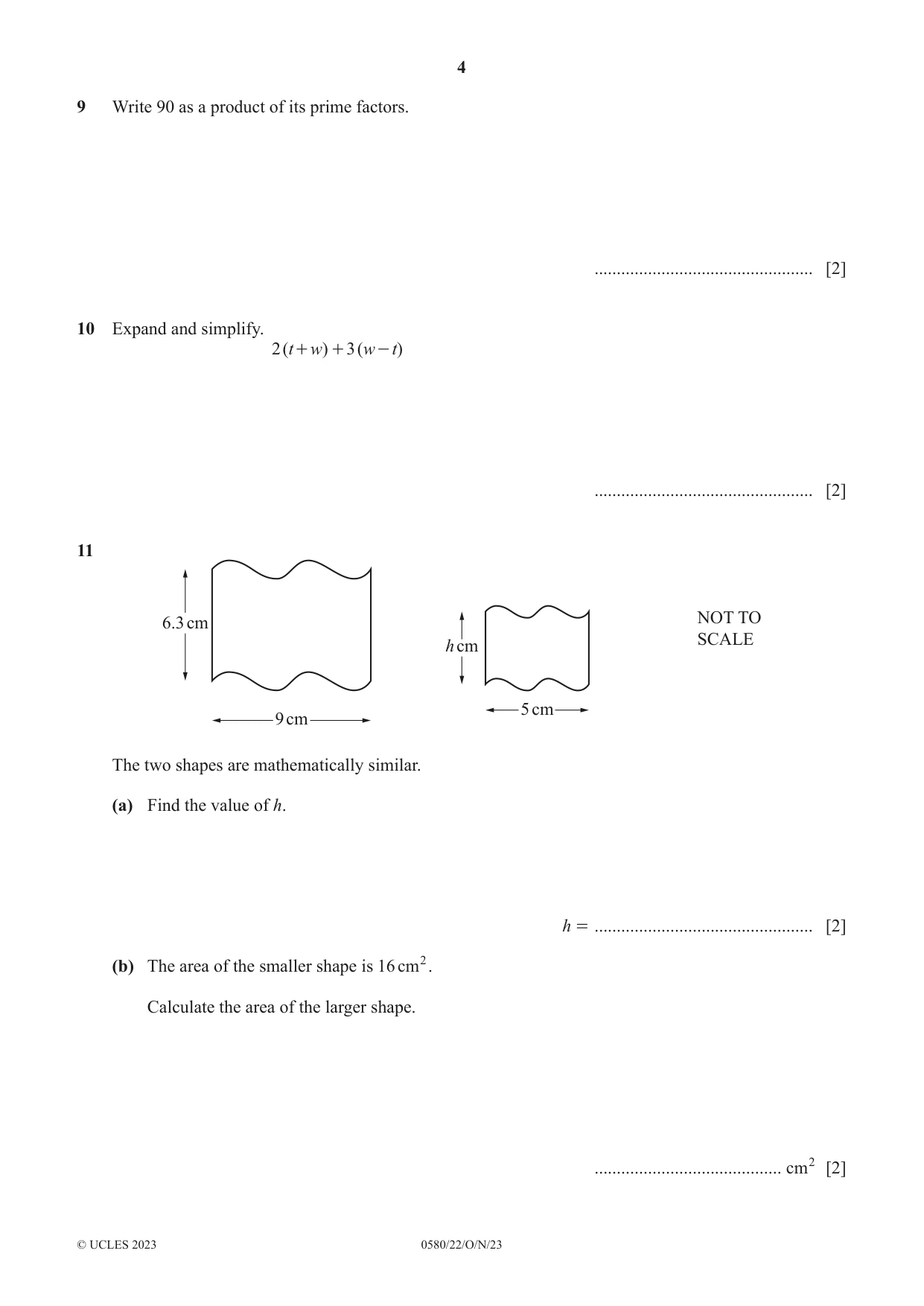
Q11 · NOT TO 6.3 cm SCALE h cm 5 cm 9 cm The two shapes are mathematically similar
11 NOT TO 6.3 cm SCALE h cm 5 cm 9 cm The two shapes are mathematically similar. (a) Find the value of h. h = ................................................. [2] (b) The area of the smaller shape is 16 cm 2. Calculate the area of the larger shape. .......................................... cm2 [2]
Mark scheme: 11(a) 3.5 2 9 6.3 M1 for = oe 5 h 11(b) 51.84 2 2 2 9 5 M1 for or oe 5 9 6.3 2 their ( a ) 2 or or oe 6.3 their ( a )
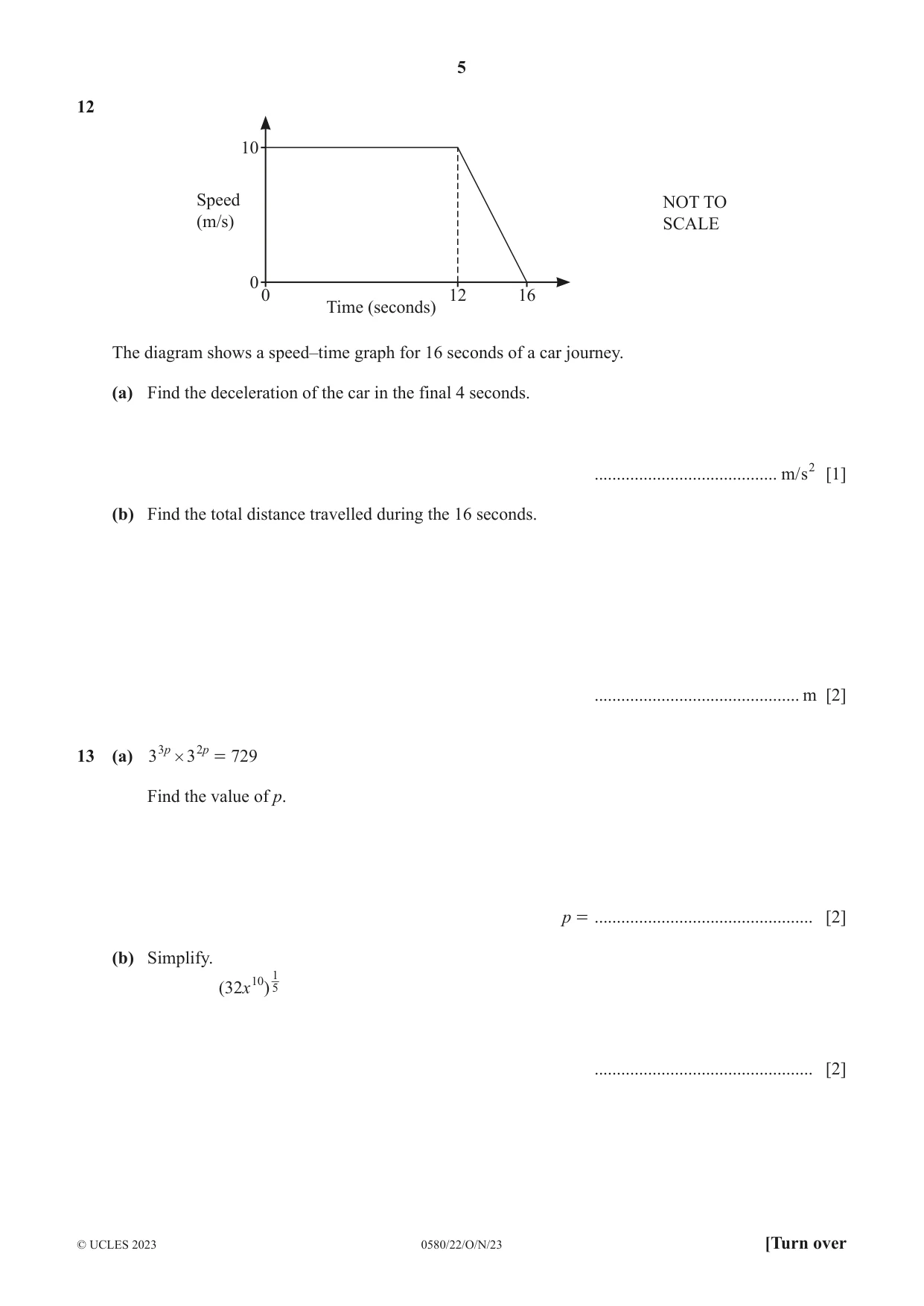
Q12 · 10 Speed NOT TO (m/s) SCALE 00 12 16 Time (seconds) The diagram shows a speed–time graph…
12 10 Speed NOT TO (m/s) SCALE 00 12 16 Time (seconds) The diagram shows a speed–time graph for 16 seconds of a car journey. (a) Find the deceleration of the car in the final 4 seconds. ......................................... m/s2 [1] (b) Find the total distance travelled during the 16 seconds. .............................................. m [2]
Mark scheme: 12(a) 2.5 oe 1 12(b) 140 2 M1 for a correct area 1 e.g. 10 × 12, 4 10 , 0.5 × (16 + 12) × 10 2
Q13 · 3 3 p # 3 2p = 729 Find the value of p
13 (a) 3 3 p # 3 2p = 729 Find the value of p. p = ................................................. [2] (b) Simplify. 1 ( 32x 10 ) 5 ................................................. [2]
Mark scheme: 13(a) 1.2 oe 2 B1 for 32 p + 3 p or 3 6 soi 13(b) 2x 2 final answer 2 B1 for kx 2 or 2 kx as final answer or correct answer spoiled
Q14 · Y = 2w 2 - x Rearrange the formula to make w the subject
14 y = 2w 2 - x Rearrange the formula to make w the subject. w = ................................................. [3]
Mark scheme: 14 y + x 3 M1 for isolating term in w [±] oe final answer M1 for division by 2 2 M1 for square root Max 2 marks if answer incorrect
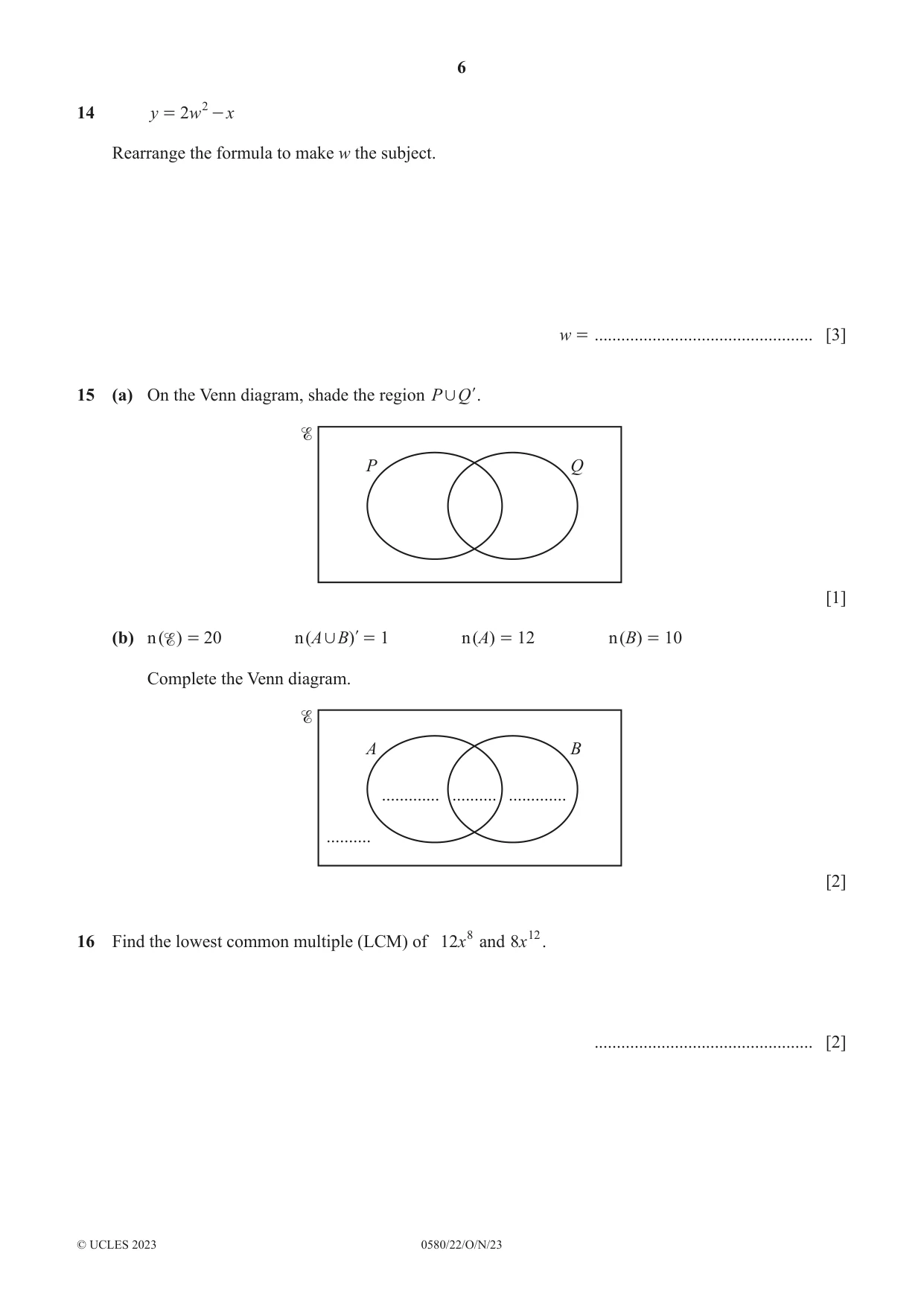
Q15 · On the Venn diagram, shade the region P , Q l
15 (a) On the Venn diagram, shade the region P , Q l. P Q [1] (b) n () = 20 n ( A , B ) l = 1 n ( A ) = 12 n ( B ) = 10 Complete the Venn diagram. A B ............. .......... ............. .......... [2]
Mark scheme: 15(a) 1 15(b) A B 2 B1 for two correct or for n(A) =12 and n(B) = 10 and n( A B ) ≠ 9 3 7 0 1
Q16 · Find the lowest common multiple (LCM) of 12x 8 and 8x 12
16 Find the lowest common multiple (LCM) of 12x 8 and 8x 12. ................................................. [2]
Mark scheme: 16 24x12 final answer 2 B1 for 24 kx or kx12 in final answer
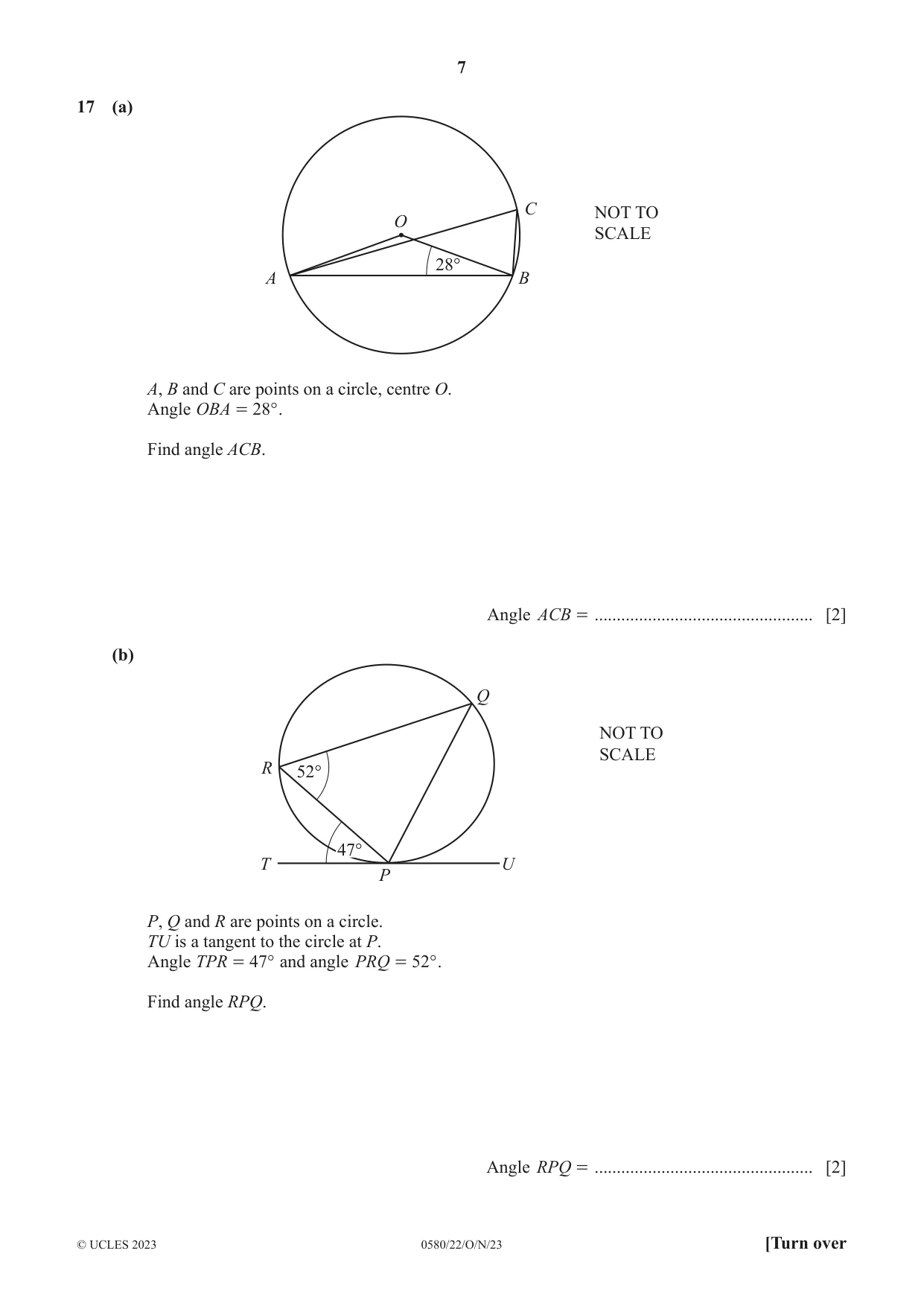
Q17 · C NOT TO O SCALE 28° A B A, B and C are points on a circle, centre O
17 (a) C NOT TO O SCALE 28° A B A, B and C are points on a circle, centre O. Angle OBA = 28° . Find angle ACB. Angle ACB = ................................................. [2] (b) Q NOT TO SCALE R 52° 47°47° T U P P, Q and R are points on a circle. TU is a tangent to the circle at P. Angle TPR = 47° and angle PRQ = 52° . Find angle RPQ. Angle RP Q = ................................................. [2]
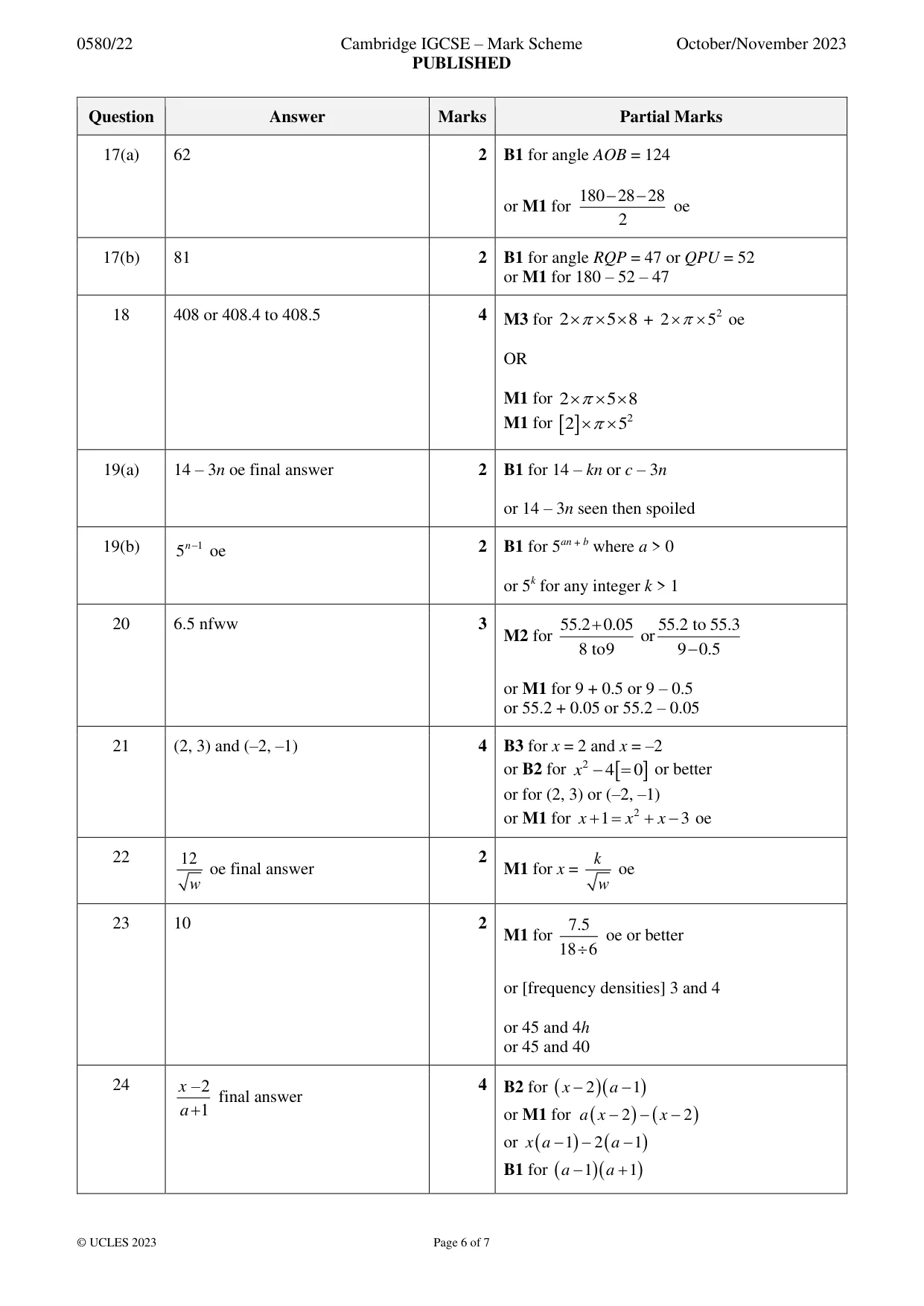
Mark scheme: 17(a) 62 2 B1 for angle AOB = 124 180 − 28 − 28 or M1 for oe 2 17(b) 81 2 B1 for angle RQP = 47 or QPU = 52 or M1 for 180 – 52 – 47
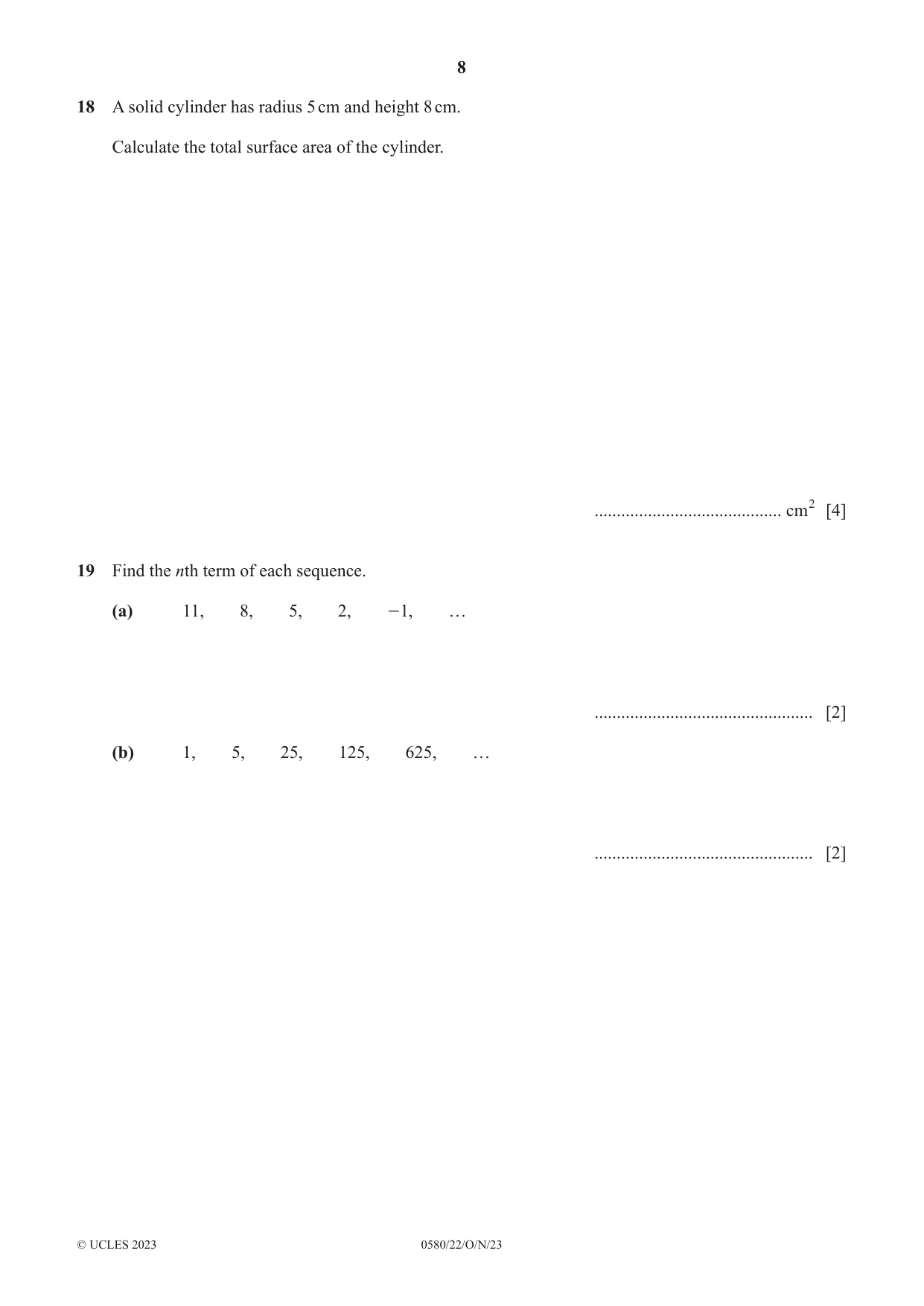
Q18 · A solid cylinder has radius 5 cm and height 8 cm
18 A solid cylinder has radius 5 cm and height 8 cm. Calculate the total surface area of the cylinder. .......................................... cm2 [4]
Mark scheme: 18 408 or 408.4 to 408.5 4 M3 for 2 5 8 + 2 5 2 oe OR M1 for 2 5 8 M1 for 2 52
Q19 · Find the nth term of each sequence
19 Find the nth term of each sequence. (a) 11, 8, 5, 2, - 1, … ................................................. [2] (b) 1, 5, 25, 125, 625, … ................................................. [2]
Mark scheme: 19(a) 14 – 3n oe final answer 2 B1 for 14 – kn or c – 3n or 14 – 3n seen then spoiled 19(b) 5 n −1 oe 2 B1 for 5an + b where a > 0 or 5k for any integer k > 1
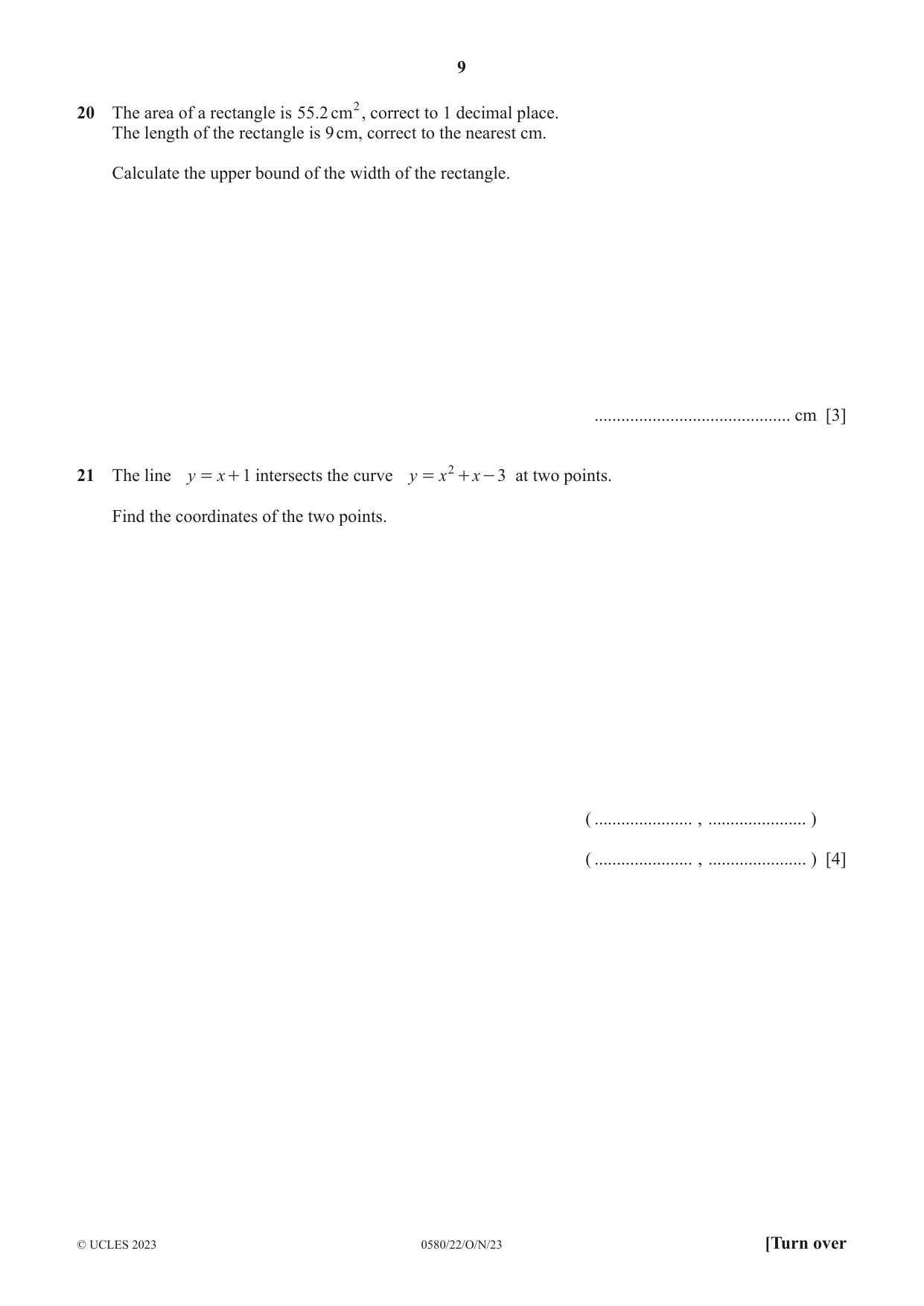
Q20 · The area of a rectangle is 55.2 cm 2, correct to 1 decimal place
20 The area of a rectangle is 55.2 cm 2, correct to 1 decimal place. The length of the rectangle is 9 cm, correct to the nearest cm. Calculate the upper bound of the width of the rectangle. ............................................ cm [3]
Mark scheme: 20 6.5 nfww 3 55.2 + 0.05 55.2 to 55.3 M2 for or 8 to 9 9 − 0.5 or M1 for 9 + 0.5 or 9 – 0.5 or 55.2 + 0.05 or 55.2 – 0.05
Q21 · The line y = x + 1 intersects the curve y = x 2 + x - 3 at two points
21 The line y = x + 1 intersects the curve y = x 2 + x - 3 at two points. Find the coordinates of the two points. ( ...................... , ...................... ) ( ...................... , ...................... ) [4]
Mark scheme: 21 (2, 3) and (–2, –1) 4 B3 for x = 2 and x = –2 or B2 for x 2 − 4 = 0 or better or for (2, 3) or (–2, –1) or M1 for x + 1 = x 2 + x − 3 oe
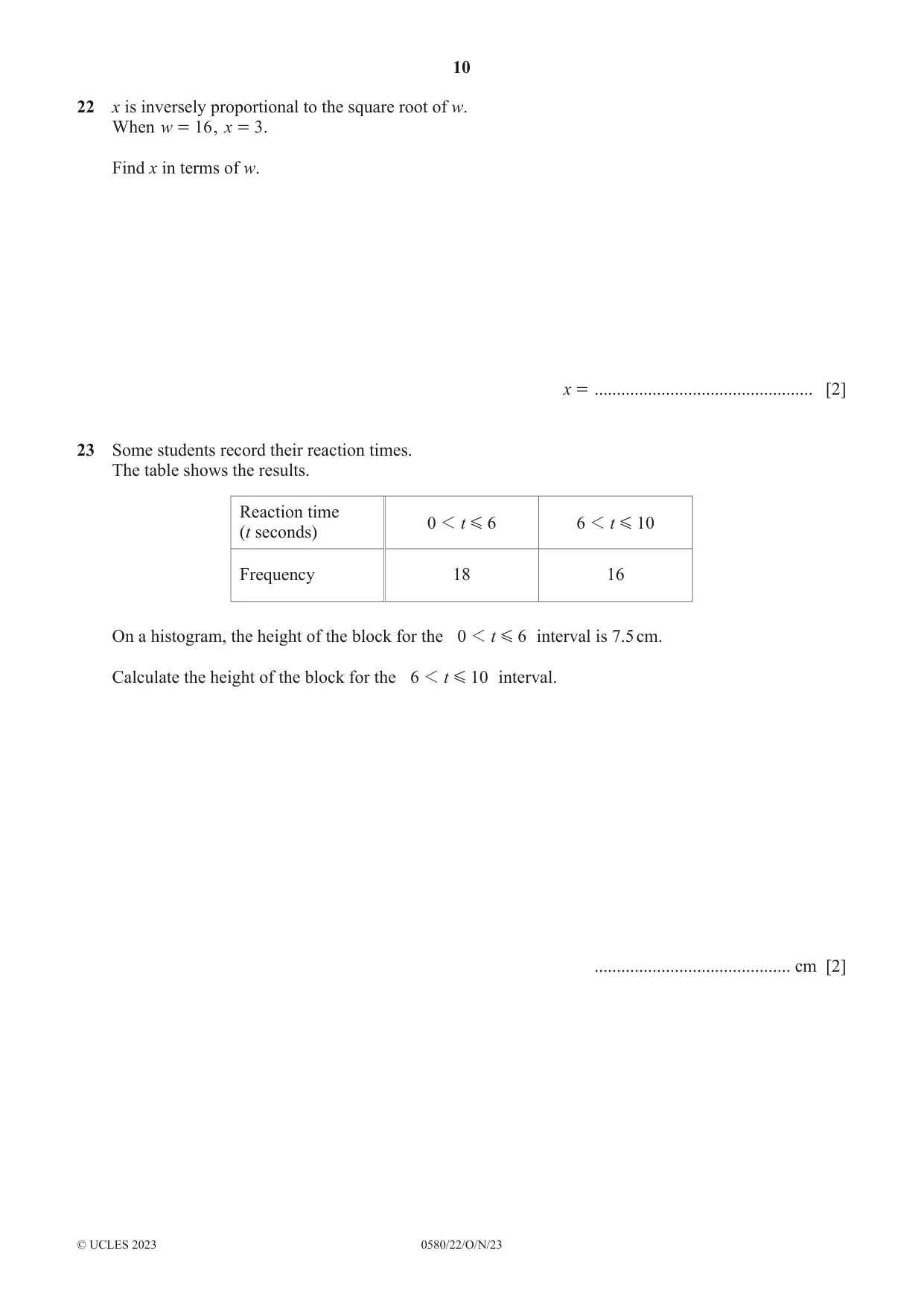
Q22 · X is inversely proportional to the square root of w
22 x is inversely proportional to the square root of w. When w = 16 , x = 3 . Find x in terms of w. x = ................................................. [2]
Mark scheme: 22 12 2 k oe final answer M1 for x = oe w w
Q23 · Some students record their reaction times
23 Some students record their reaction times. The table shows the results. Reaction time 0 1 t G 6 6 1 t G 10 (t seconds) Frequency 18 16 On a histogram, the height of the block for the 0 1 t G 6 interval is 7.5 cm. Calculate the height of the block for the 6 1 t G 10 interval. ............................................ cm [2]
Mark scheme: 23 10 2 7.5 M1 for oe or better 18 6 or [frequency densities] 3 and 4 or 45 and 4h or 45 and 40
Question 24
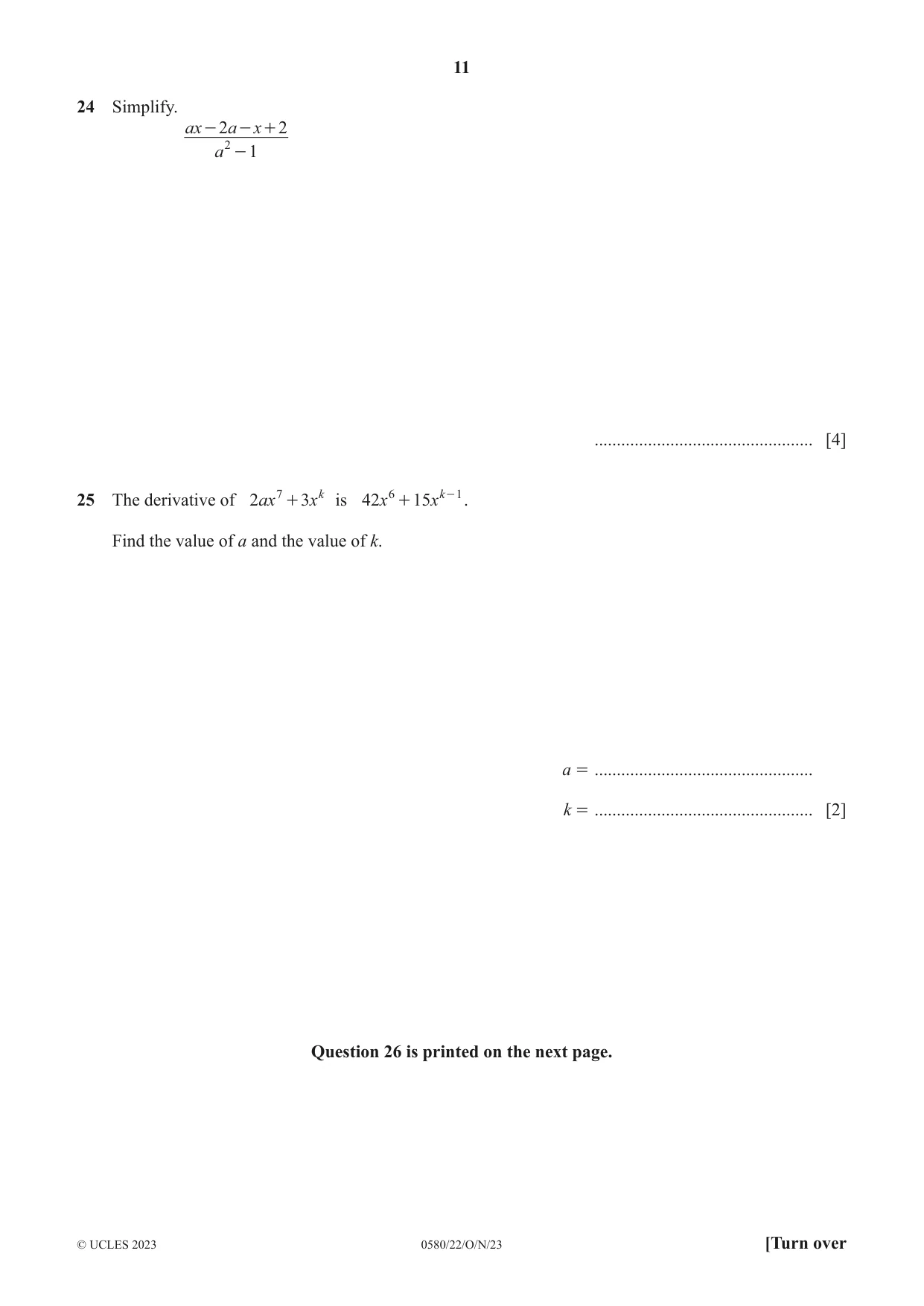
24 Simplify. ax - 2a - x + 2 a 2 - 1 ................................................. [4]
Mark scheme: 24 x – 2 4 B2 for ( x − 2 )( a − 1) final answer a + 1 or M1 for a ( x − 2 ) − ( x − 2 ) or x ( a − 1) − 2 ( a − 1) B1 for ( a − 1)( a + 1)
Q25 · The derivative of 2ax 7 + 3x k is 42x 6 + 15x k - 1
25 The derivative of 2ax 7 + 3x k is 42x 6 + 15x k - 1 . Find the value of a and the value of k. a = ................................................. k = ................................................. [2] Question 26 is printed on the next page.
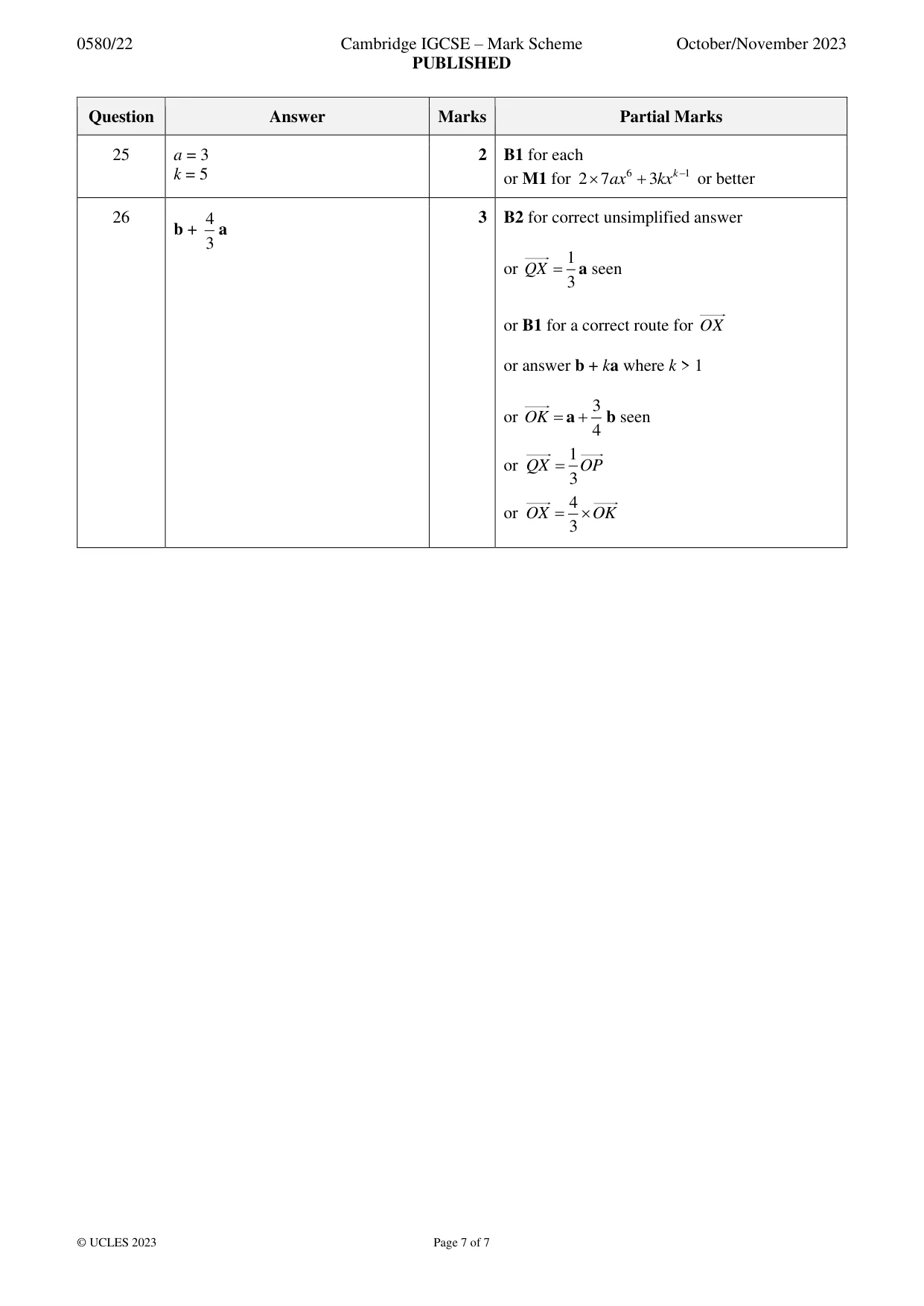
Mark scheme: 25 a = 3 2 B1 for each k = 5 or M1 for 2 7 ax 6 + 3kx k −1 or better
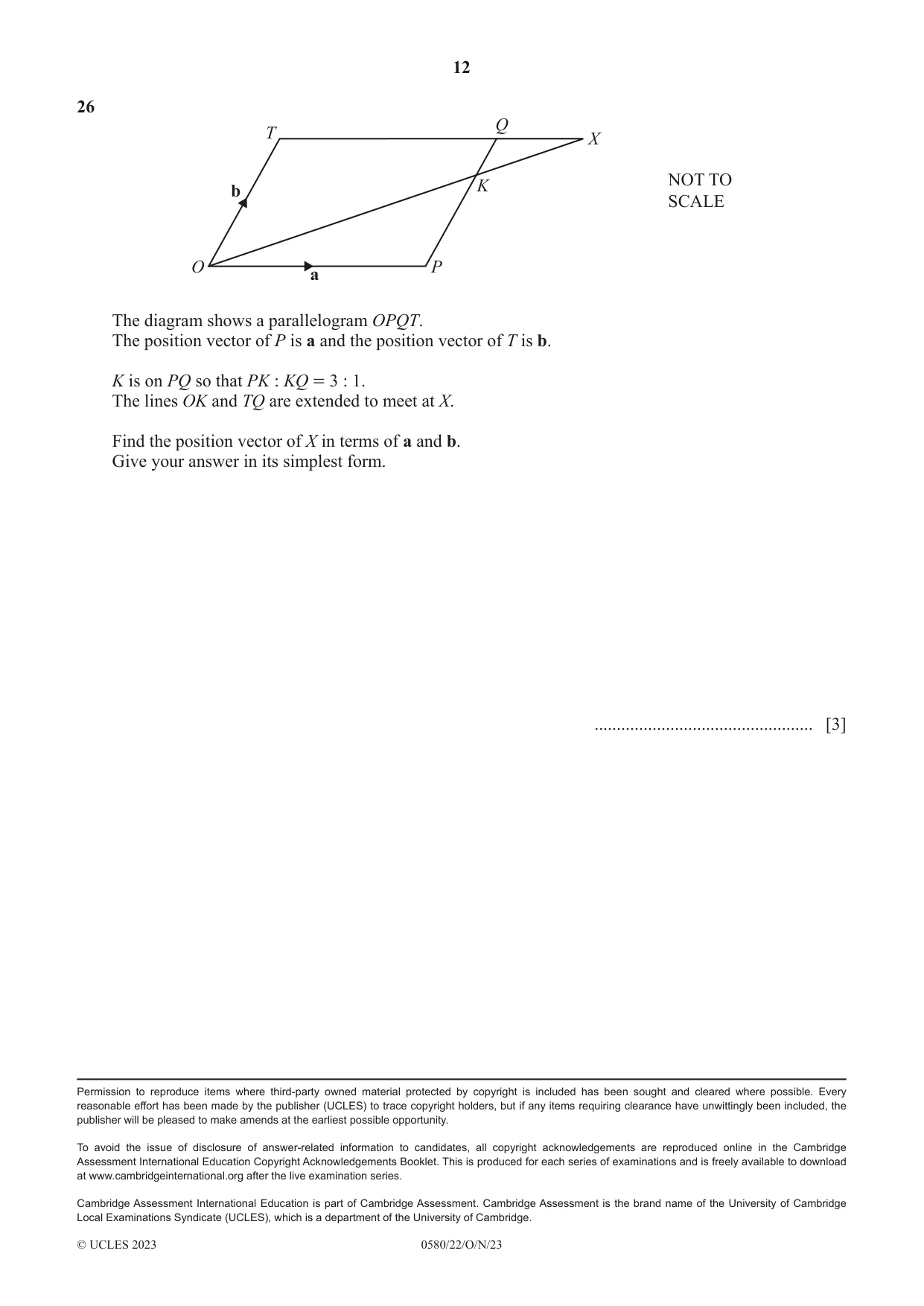
Q26 · Q T X NOT TO K b SCALE O P a The diagram shows a parallelogram OPQT
26 Q T X NOT TO K b SCALE O P a The diagram shows a parallelogram OPQT. The position vector of P is a and the position vector of T is b. K is on PQ so that PK : KQ = 3 : 1. The lines OK and TQ are extended to meet at X. Find the position vector of X in terms of a and b. Give your answer in its simplest form. ................................................. [3]
Mark scheme: 26 4 3 B2 for correct unsimplified answer b + a 3 1 or QX = a seen 3 or B1 for a correct route for OX or answer b + ka where k > 1 3 or OK = a + b seen 4 1 or QX = OP 3 4 or OX = OK 3
What was in this paper
The subtopics covered by these 26 questions, and how many questions each got. Open one in a new tab to see every Cambridge question on it.
2Area and perimeter2Equations2Limits of accuracy2Ratio and proportion2Sets2Types of number2Angles1Circle theorems I1Differentiation1Fractions, decimals and percentages1Indices I1Powers and roots1Sequences1Similarity1Statistical charts and diagrams1The four operations1Units of measure1Vectors in two dimensions1What you needed in this session
Cambridge’s own grade thresholds for 2023 Oct/Nov, Paper 2 · Variant 2. A higher threshold means an easier paper — the bar moves with how the cohort did.