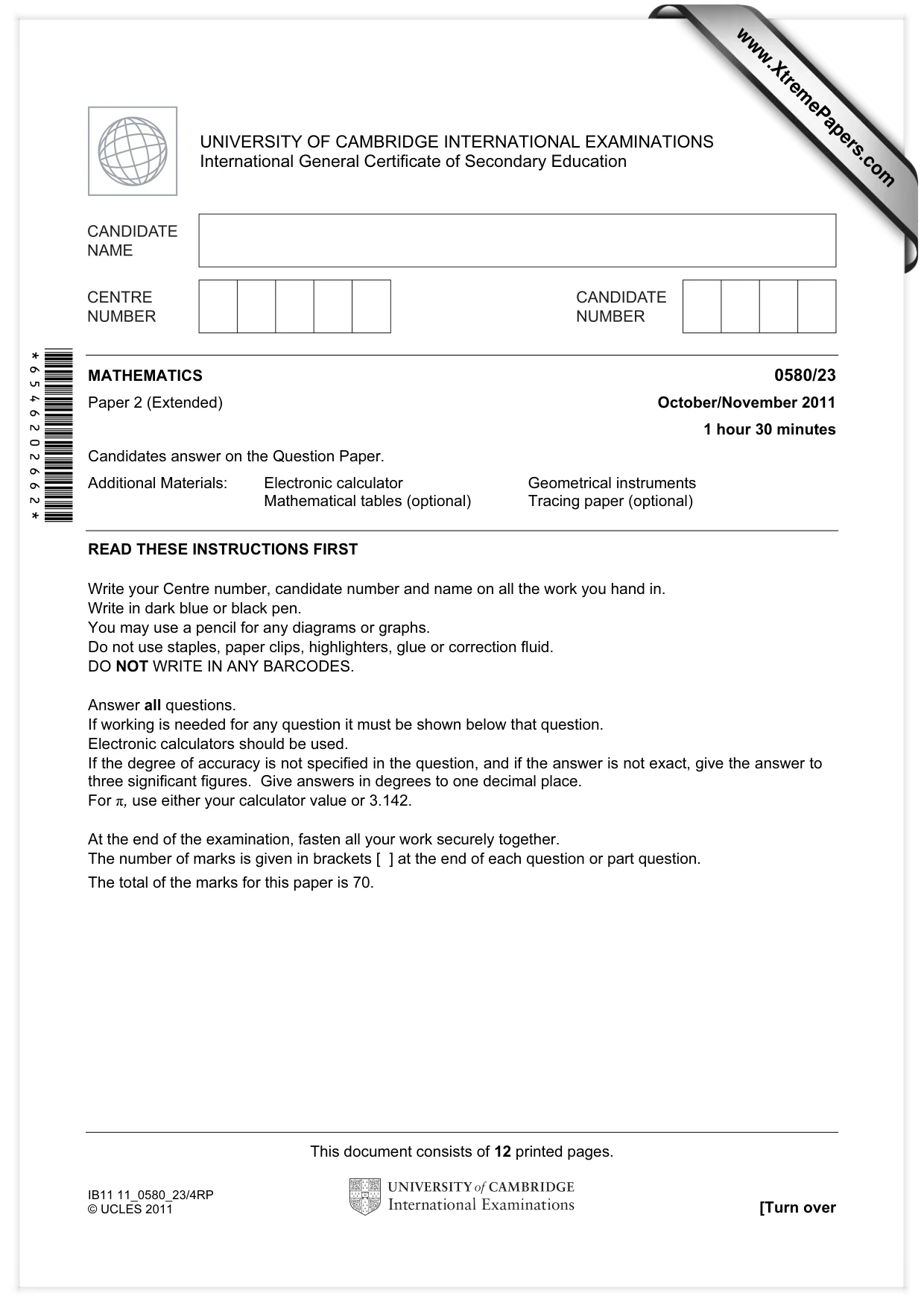
Cambridge IGCSE Mathematics 0580 — 2011 Oct/Nov Paper 2 · Variant 3
0580/23/O/N/11 · 23 questions · 70 marks · ≈79 min
The question paper and its mark scheme, free to read here and free to download. This is Cambridge’s own paper, exactly as it was sat.
Question paper12 pages
Mark scheme3 pages
Answers below. Sit the paper first if you are practising.
Questions as text
Q1 · Martha divides $240 between spending and saving in the ratio For Examiner's spending…
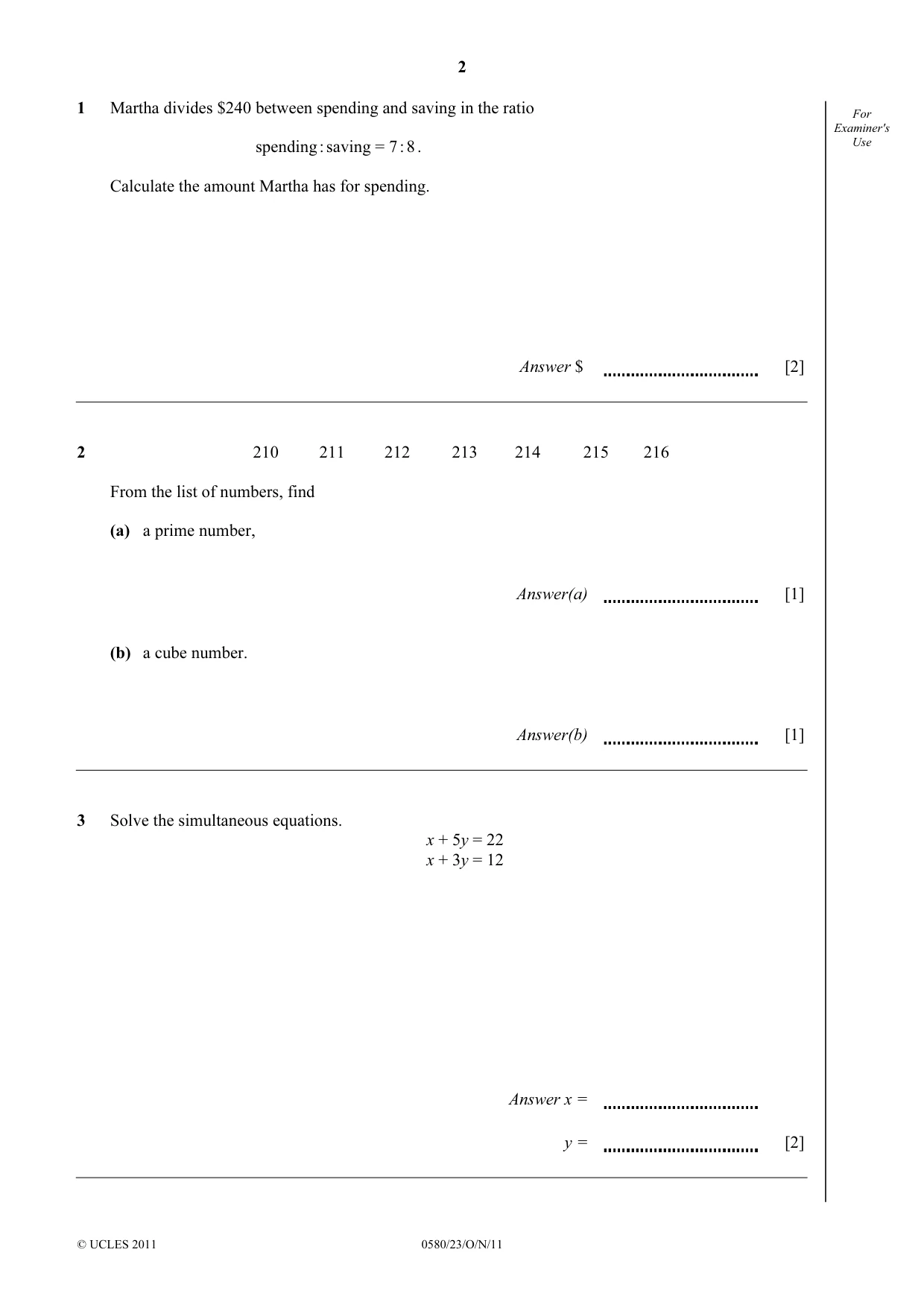
1 Martha divides $240 between spending and saving in the ratio For Examiner's spending : saving = 7 : 8 . Use Calculate the amount Martha has for spending. Answer $ [2]
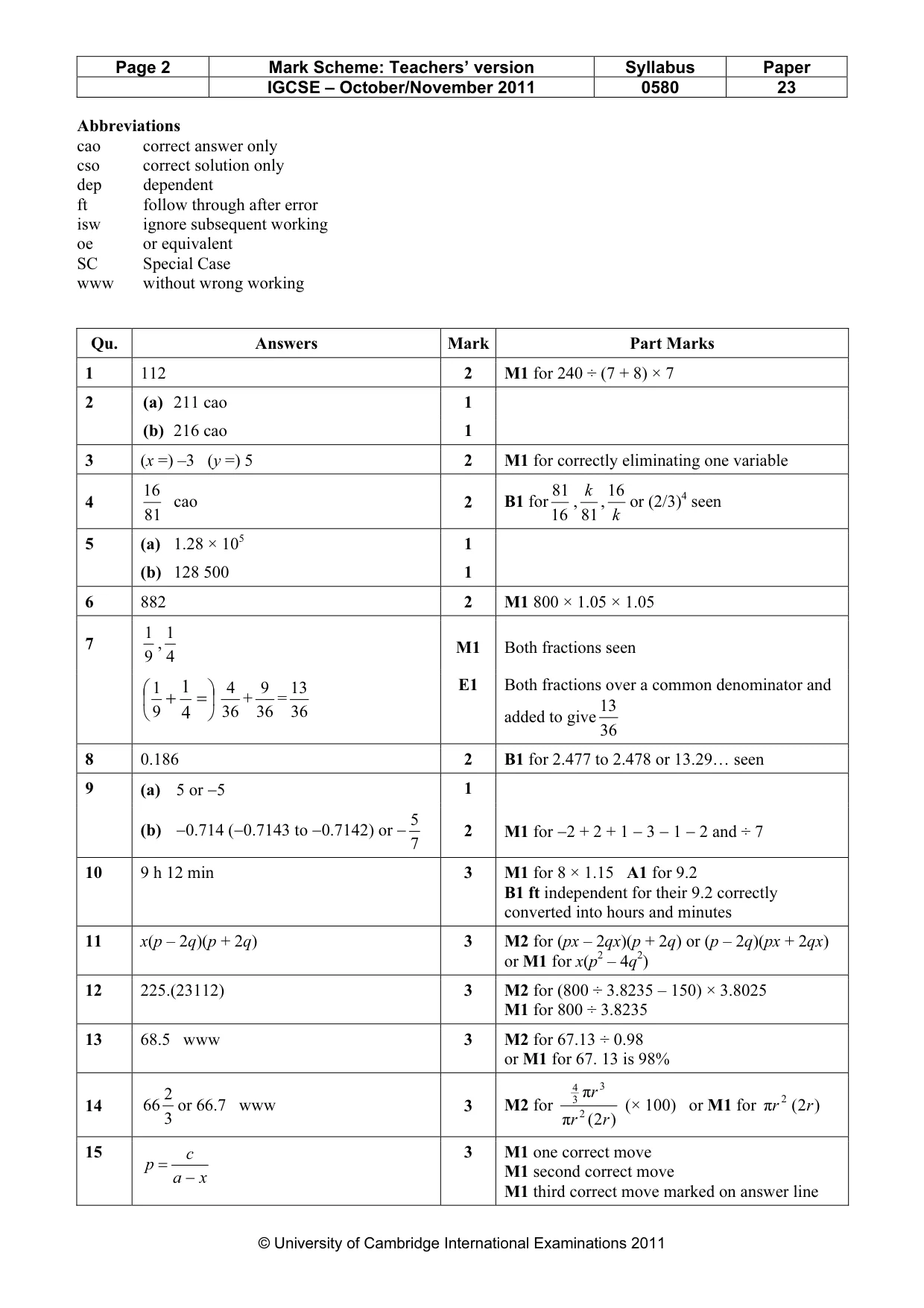
Mark scheme: 1 112 2 M1 for 240 ÷ (7 + 8) × 7
Q2 · 210 211 212 213 214 215 216 From the list of numbers, find (a) a prime number, Answer(a)…
2 210 211 212 213 214 215 216 From the list of numbers, find (a) a prime number, Answer(a) [1] (b) a cube number. Answer(b) [1]
Mark scheme: 2 (a) 211 cao 1 (b) 216 cao 1
Q3 · Solve the simultaneous equations
3 Solve the simultaneous equations. x + 5y = 22 x + 3y = 12 Answer x = y = [2]
Mark scheme: 3 (x =) –3 (y =) 5 2 M1 for correctly eliminating one variable 16 81 k 16 4
Q4 · 27 Examiner's 4 Find the value of
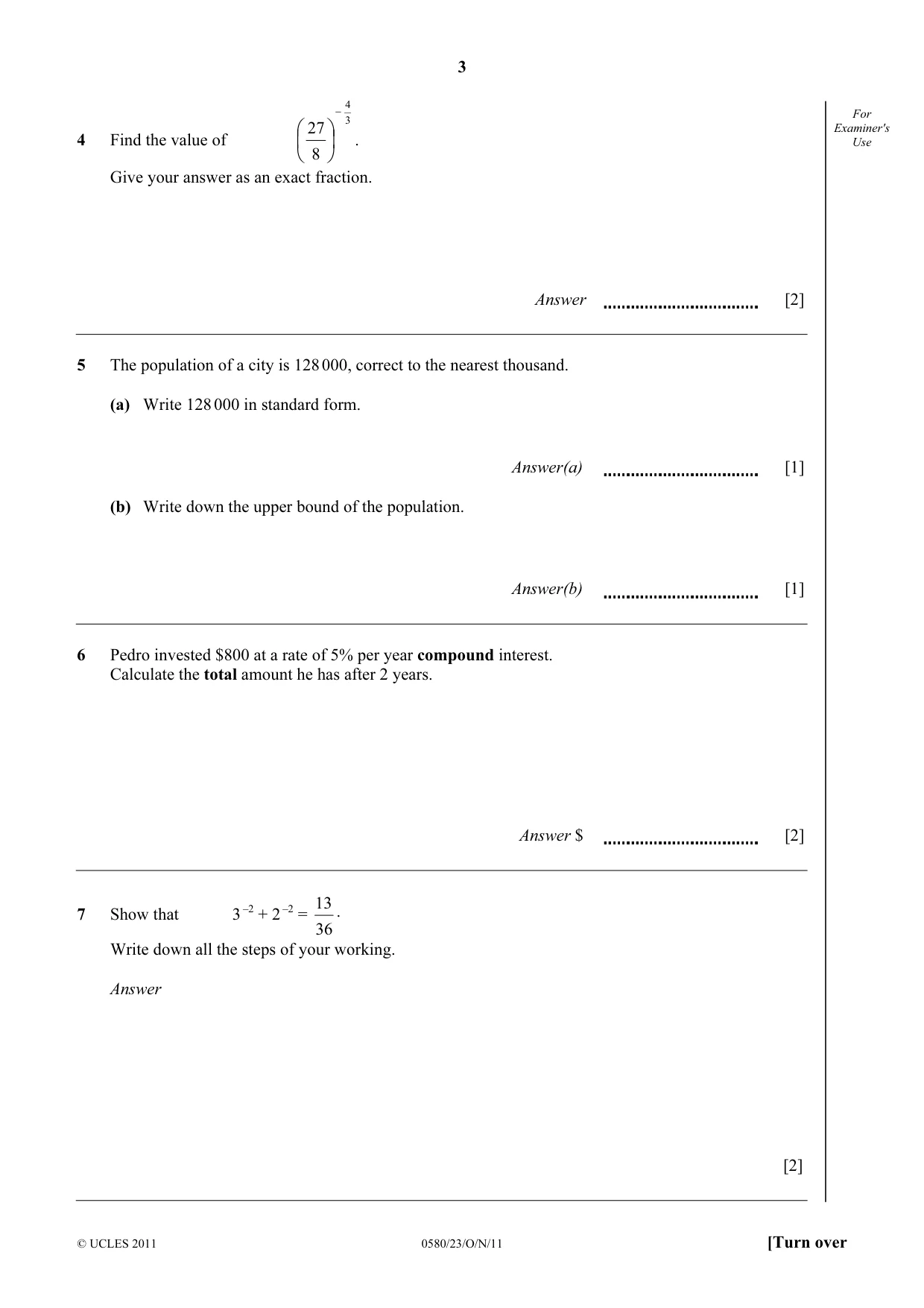
27 Examiner's 4 Find the value of . Use 8 Give your answer as an exact fraction. Answer [2]
Mark scheme: 16 81 k 16 4 cao 2 B1 , , or (2/3)4 seen 81 for16 81 k 5
Q5 · The population of a city is 128 000, correct to the nearest thousand
5 The population of a city is 128 000, correct to the nearest thousand. (a) Write 128 000 in standard form. Answer(a) [1] (b) Write down the upper bound of the population. Answer(b) [1]
Mark scheme: 5 (a) 1.28 × 10⁵ 1 (b) 128 500 1
Q6 · Pedro invested $800 at a rate of 5% per year compound interest
6 Pedro invested $800 at a rate of 5% per year compound interest. Calculate the total amount he has after 2 years. Answer $ [2]
Mark scheme: 6 882 2 M1 800 × 1.05 × 1.05 1 1
Q7 · –2 –2 137 Show that 3 + 2 =
–2 –2 137 Show that 3 + 2 = . 36 Write down all the steps of your working. Answer [2]
Mark scheme: 1 1 7 , M1 Both fractions seen 9 4 1 1 4 9 13 E1 Both fractions over a common denominator and + = + = 13 9 4 36 36 36 added to give 36
Q8 · 17.1 − 1.89 For 8 Find the value of
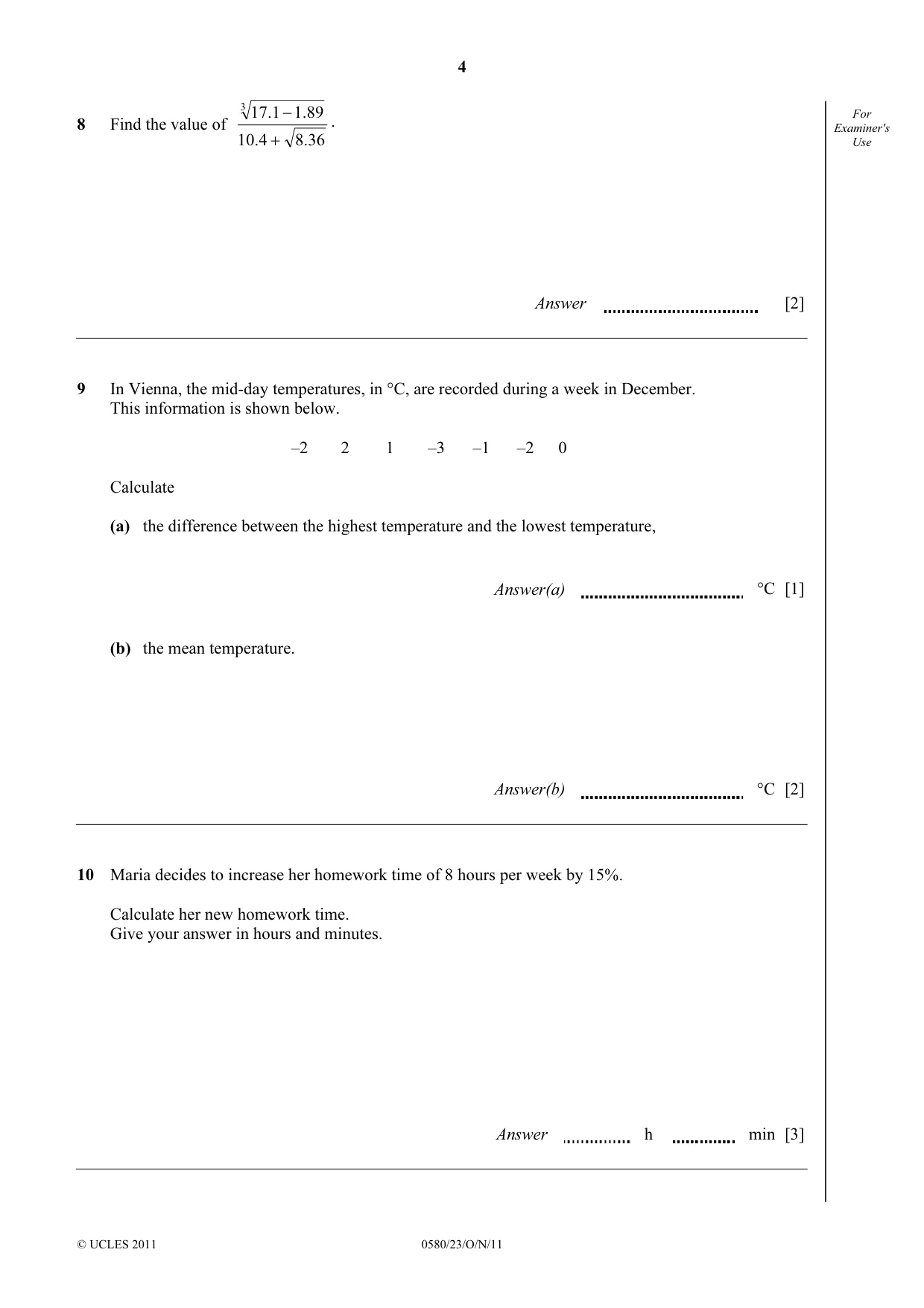
3 17.1 − 1.89 For 8 Find the value of . Examiner's 10.4 + 8.36 Use Answer [2]
Mark scheme: 8 0.186 2 B1 for 2.477 to 2.478 or 13.29… seen
Q9 · In Vienna, the mid-day temperatures, in °C, are recorded during a week in December
9 In Vienna, the mid-day temperatures, in °C, are recorded during a week in December. This information is shown below. –2 2 1 –3 –1 –2 0 Calculate (a) the difference between the highest temperature and the lowest temperature, Answer(a) °C [1] (b) the mean temperature. Answer(b) °C [2]
Mark scheme: 9 (a) 5 or −5 1 5 (b) −0.714 (−0.7143 to −0.7142) or −7 2 M1 for −2 + 2 + 1 − 3 − 1 − 2 and ÷ 7
Q10 · Maria decides to increase her homework time of 8 hours per week by 15%
10 Maria decides to increase her homework time of 8 hours per week by 15%. Calculate her new homework time. Give your answer in hours and minutes. Answer h min [3]
Mark scheme: 10 9 h 12 min 3 M1 for 8 × 1.15 A1 for 9.2 B1 ft independent for their 9.2 correctly converted into hours and minutes
Question 11
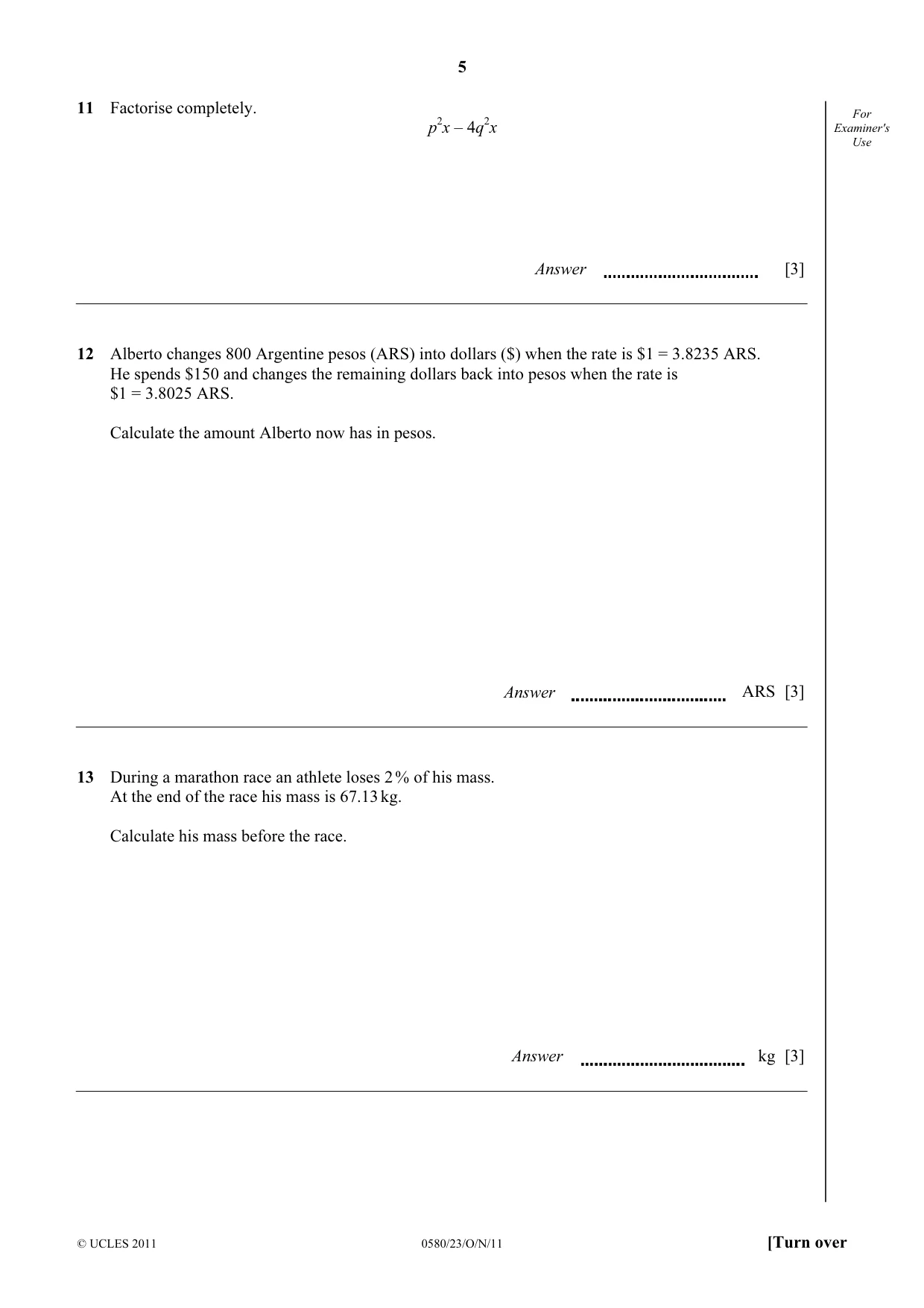
11 Factorise completely. For p2x – 4q2x Examiner's Use Answer [3]
Mark scheme: 11 x(p – 2q)(p + 2q) 3 M2 for (px – 2qx)(p + 2q) or (p – 2q)(px + 2qx) or M1 for x(p2 – 4q2)
Q12 · Alberto changes 800 Argentine pesos (ARS) into dollars ($) when the rate is $1 = 3.8235…
12 Alberto changes 800 Argentine pesos (ARS) into dollars ($) when the rate is $1 = 3.8235 ARS. He spends $150 and changes the remaining dollars back into pesos when the rate is $1 = 3.8025 ARS. Calculate the amount Alberto now has in pesos. Answer ARS [3]
Mark scheme: 12 225.(23112) 3 M2 for (800 ÷ 3.8235 – 150) × 3.8025 M1 for 800 ÷ 3.8235
Q13 · During a marathon race an athlete loses 2 % of his mass
13 During a marathon race an athlete loses 2 % of his mass. At the end of the race his mass is 67.13 kg. Calculate his mass before the race. Answer kg [3]
Mark scheme: 13 68.5 www 3 M2 for 67.13 ÷ 0.98 or M1 for 67. 13 is 98% 2 43 πr 3 2
Q14 · For Examiner's Use NOT TO SCALE r 2r The sphere of radius r fits exactly inside the…
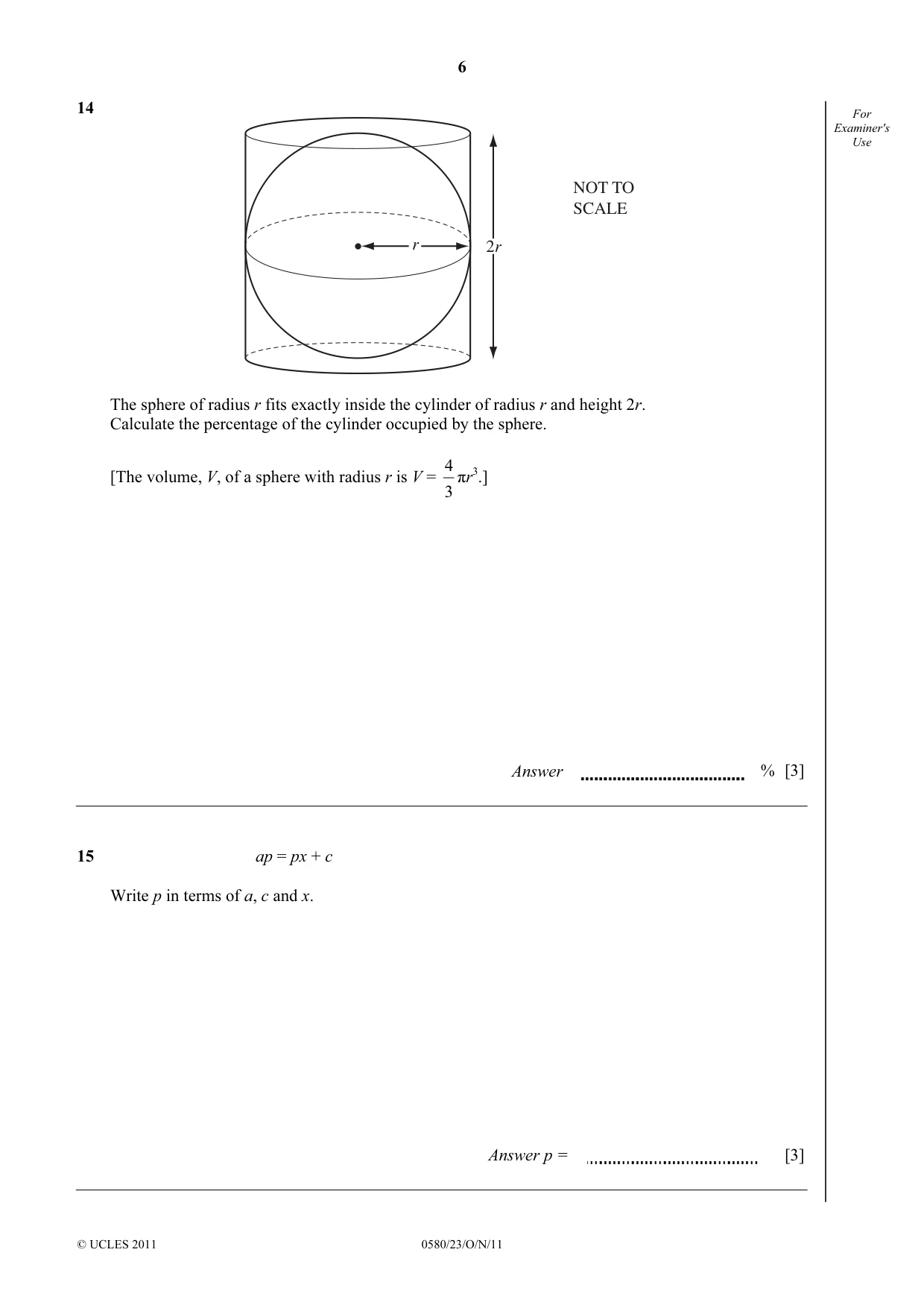
14 For Examiner's Use NOT TO SCALE r 2r The sphere of radius r fits exactly inside the cylinder of radius r and height 2r. Calculate the percentage of the cylinder occupied by the sphere. 4 [The volume, V, of a sphere with radius r is V = πr3.] 3 Answer % [3]
Mark scheme: 2 3 π 2 14 66 or 66.7 www 3 M2 for (× 100) or M1 for πr ( 2 r ) 3 πr 2 ( 2 r )
Q15 · Ap = px + c Write p in terms of a, c and x
15 ap = px + c Write p in terms of a, c and x. Answer p = [3]
Mark scheme: 15 c 3 M1 one correct move p = M1 second correct move a − x M1 third correct move marked on answer line IGCSE – October/November 2011 0580 23
Q16 · The time, t, for a pendulum to swing varies directly as the square root of its length, l
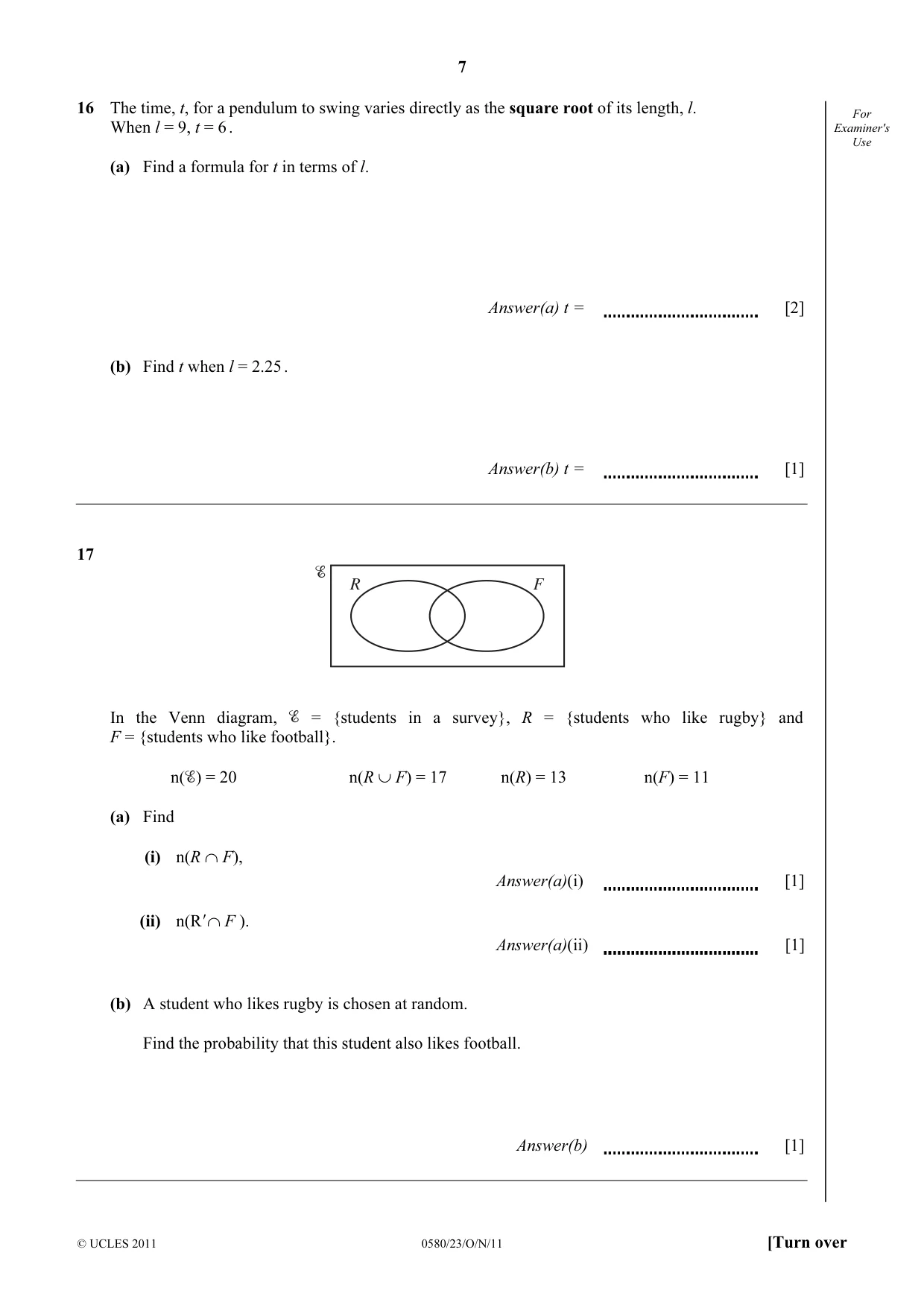
16 The time, t, for a pendulum to swing varies directly as the square root of its length, l. For When l = 9, t = 6 . Examiner's Use (a) Find a formula for t in terms of l. Answer(a) t = [2] (b) Find t when l = 2.25 . Answer(b) t = [1]
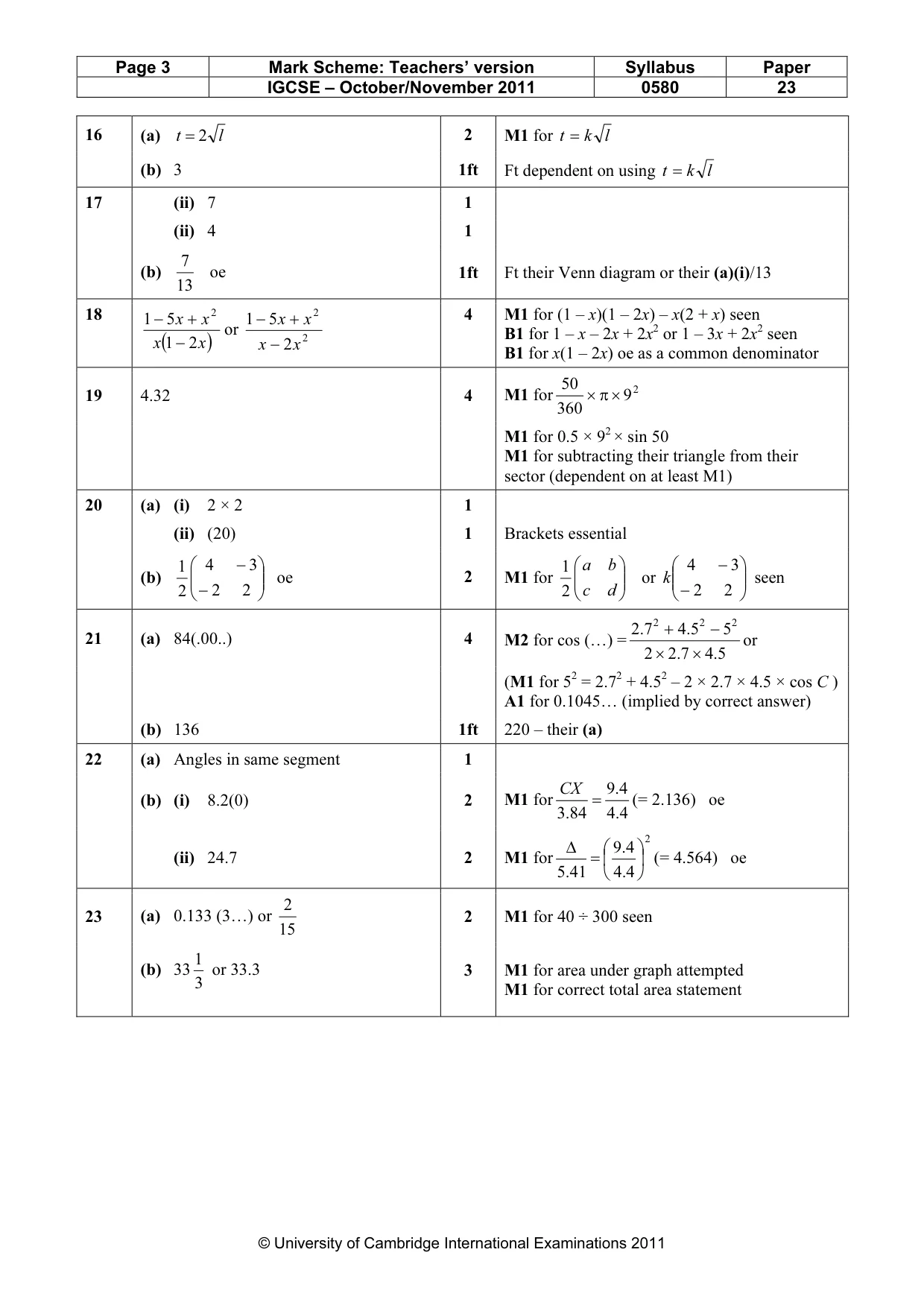
Mark scheme: 16 (a) t = 2 l 2 M1 for t = k l (b) 3 1ft Ft dependent on using t = k l
Q17 · R F In the Venn diagram, = {students in a survey}, R = {students who like rugby} and F =…
17 R F In the Venn diagram, = {students in a survey}, R = {students who like rugby} and F = {students who like football}. n( ) = 20 n(R ∪ F) = 17 n(R) = 13 n(F) = 11 (a) Find (i) n(R ∩ F), Answer(a)(i) [1] (ii) n(RV∩ F=). Answer(a)(ii) [1] (b) A student who likes rugby is chosen at random. Find the probability that this student also likes football. Answer(b) [1]
Mark scheme: 17 (ii) 7 1 (ii) 4 1 7 (b) oe 1ft Ft their Venn diagram or their (a)(i)/13 13
Q18 · Write as a single fraction, in its simplest form
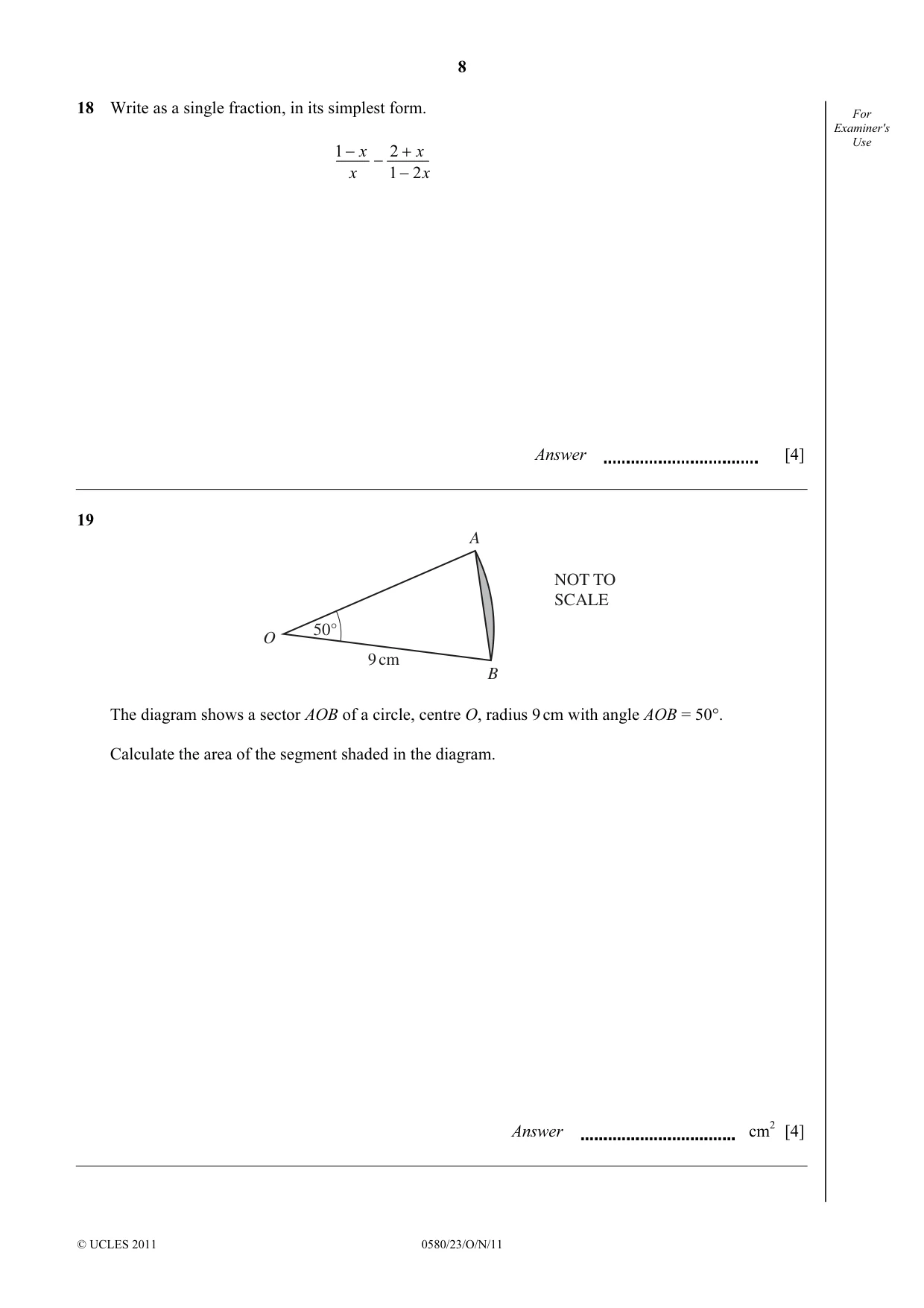
18 Write as a single fraction, in its simplest form. For Examiner's Use 1 − x 2 + x − x 1 − 2 x Answer [4]
Mark scheme: 18 1 − 5 x + x 2 1 − 5 x + x 2 4 M1 for (1 – x)(1 – 2x) – x(2 + x) seen or 2 B1 for 1 – x – 2x + 2x2 or 1 – 3x + 2x2 seen x (1 − 2 x ) x − 2 x B1 for x(1 – 2x) oe as a common denominator 50 2
Q19 · A NOT TO SCALE 50° O 9 cm B The diagram shows a sector AOB of a circle, centre O, radius…
19 A NOT TO SCALE 50° O 9 cm B The diagram shows a sector AOB of a circle, centre O, radius 9 cm with angle AOB = 50°. Calculate the area of the segment shaded in the diagram. Answer cm2 [4]
Mark scheme: 50 2 19 4.32 4 M1 for × π × 9 360 M1 for 0.5 × 92 × sin 50 M1 for subtracting their triangle from their sector (dependent on at least M1)
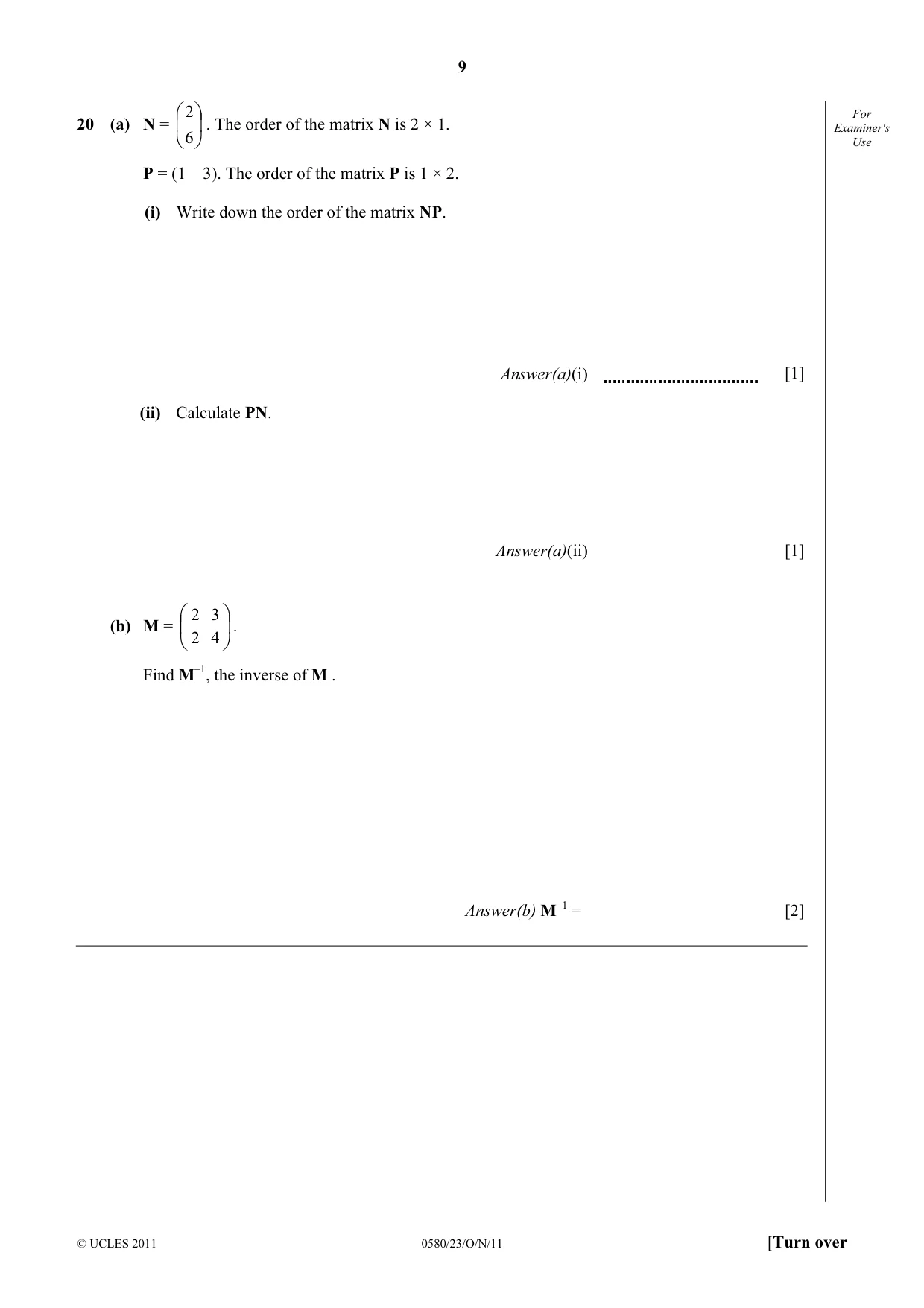
Q20 · 2 For 20 (a) N =
2 For 20 (a) N = . The order of the matrix N is 2 × 1. Examiner's 6 Use P = (1 3). The order of the matrix P is 1 × 2. (i) Write down the order of the matrix NP. Answer(a)(i) [1] (ii) Calculate PN. Answer(a)(ii) [1] 2 3 (b) M = . 2 4 Find M–1, the inverse of M . Answer(b) M–1 = [2]
Mark scheme: 20 (a) (i) 2 × 2 1 (ii) (20) 1 Brackets essential 1 4 − 3 1 a b 4 − 3 (b) seen oe 2 M1 for or k c d 2 2 − 2 2 − 2 2 2 7 2 + 4 5 2 − 5 2
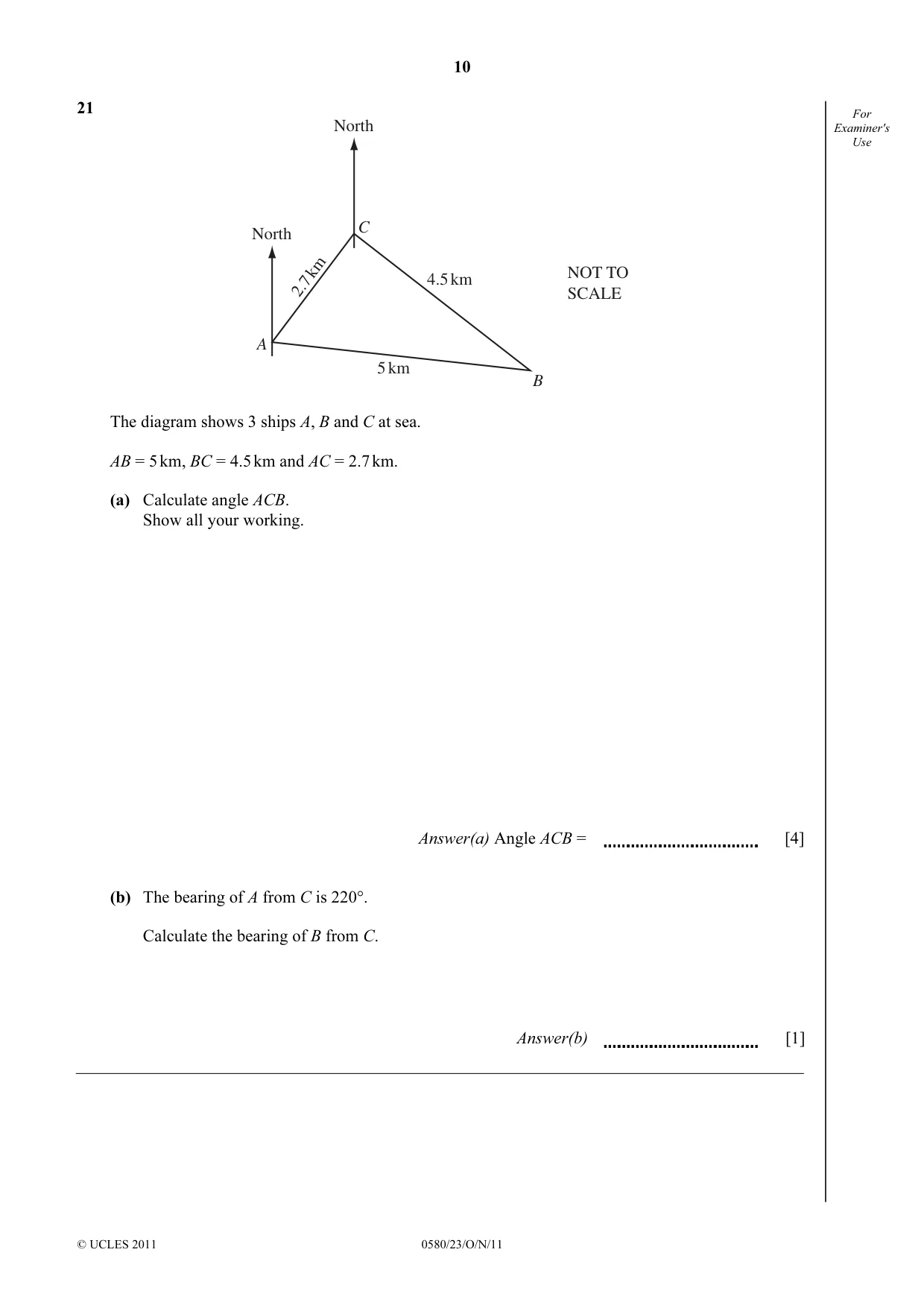
Q21 · For North Examiner's Use North C km NOT TO 2.7 4.5 km SCALE A 5 km B The diagram shows 3…
21 For North Examiner's Use North C km NOT TO 2.7 4.5 km SCALE A 5 km B The diagram shows 3 ships A, B and C at sea. AB = 5 km, BC = 4.5 km and AC = 2.7 km. (a) Calculate angle ACB. Show all your working. Answer(a) Angle ACB = [4] (b) The bearing of A from C is 220°. Calculate the bearing of B from C. Answer(b) [1]
Mark scheme: 7.2 + 5.4 5 21 (a) 84(.00..) 4 M2 for cos (…) = or 2 × 7.2 × 5.4 (M1 for 52 = 2.72 + 4.52 – 2 × 2.7 × 4.5 × cos C ) A1 for 0.1045… (implied by correct answer) (b) 136 1ft 220 – their (a)
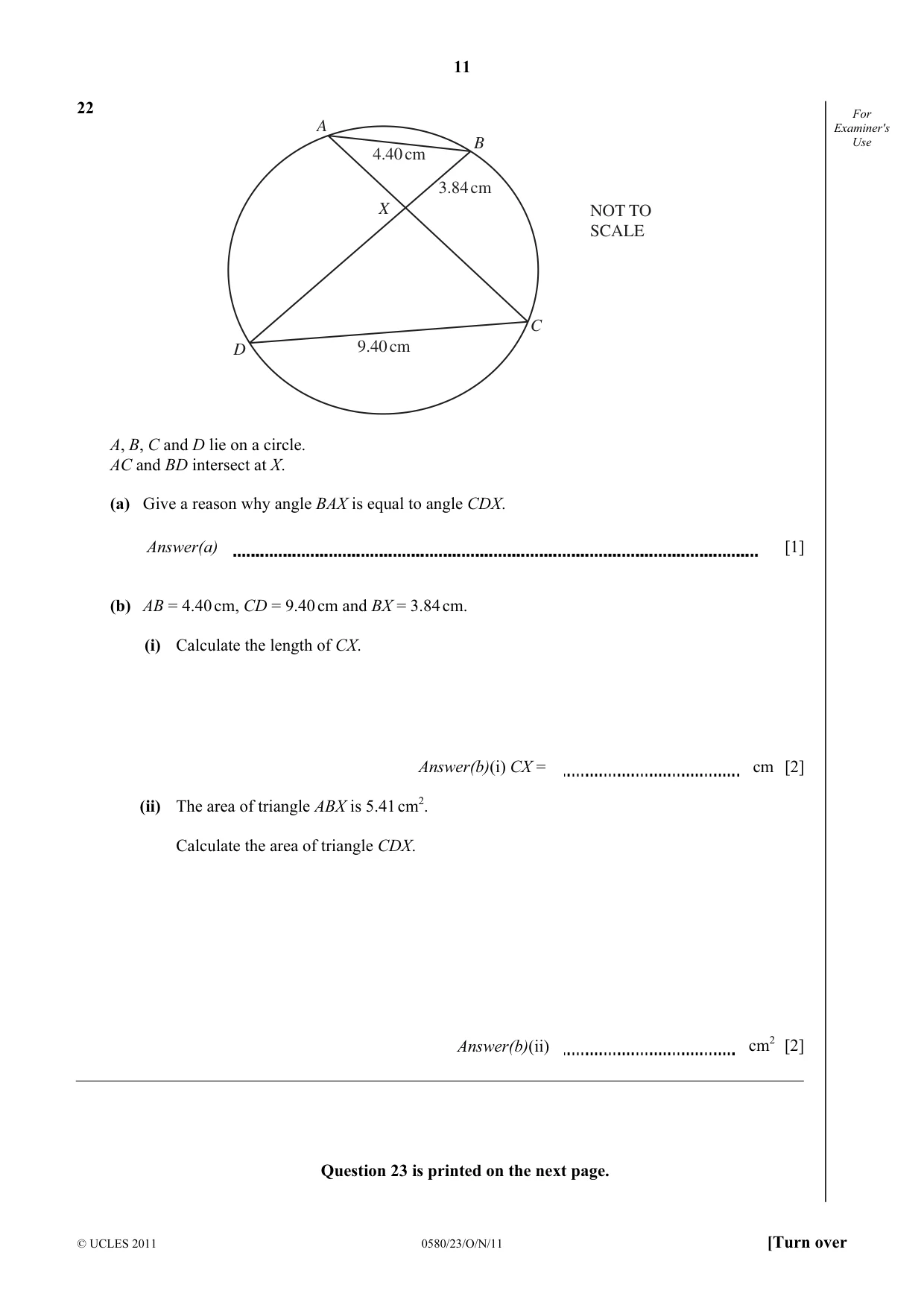
Q22 · For A Examiner's B Use 4.40 cm 3.84 cm X NOT TO SCALE C 9.40 cm D A, B, C and D lie on a…
22 For A Examiner's B Use 4.40 cm 3.84 cm X NOT TO SCALE C 9.40 cm D A, B, C and D lie on a circle. AC and BD intersect at X. (a) Give a reason why angle BAX is equal to angle CDX. Answer(a) [1] (b) AB = 4.40 cm, CD = 9.40 cm and BX = 3.84 cm. (i) Calculate the length of CX. Answer(b)(i) CX = cm [2] (ii) The area of triangle ABX is 5.41 cm2. Calculate the area of triangle CDX. Answer(b)(ii) cm2 [2] Question 23 is printed on the next page.
Mark scheme: 22 (a) Angles in same segment 1 CX 4.9 (b) (i) 8.2(0) 2 M1 for = (= 2.136) oe .384 4.4 2 ∆ 4.9 (ii) 24.7 2 M1 for = (= 4.564) oe .541 4.4 2
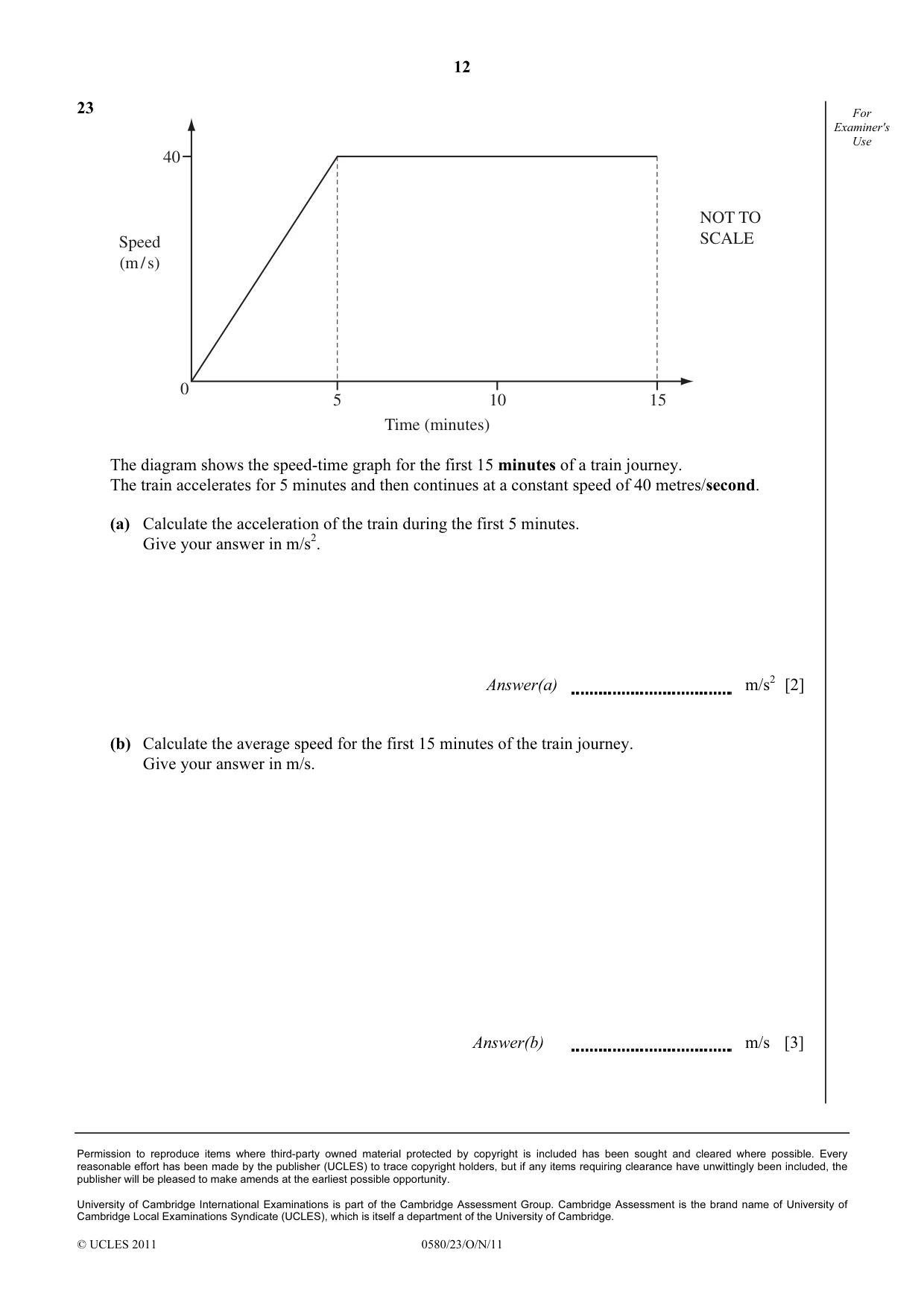
Q23 · For Examiner's Use 40 NOT TO Speed SCALE (m / s) 0 5 10 15 Time (minutes) The diagram…
23 For Examiner's Use 40 NOT TO Speed SCALE (m / s) 0 5 10 15 Time (minutes) The diagram shows the speed-time graph for the first 15 minutes of a train journey. The train accelerates for 5 minutes and then continues at a constant speed of 40 metres/second. (a) Calculate the acceleration of the train during the first 5 minutes. Give your answer in m/s2. Answer(a) m/s2 [2] (b) Calculate the average speed for the first 15 minutes of the train journey. Give your answer in m/s. Answer(b) m/s [3]
Mark scheme: 2 23 (a) 0.133 (3…) or 2 M1 for 40 ÷ 300 seen 15 1 (b) 33 or 33.3 3 M1 for area under graph attempted 3 M1 for correct total area statement
What was in this paper
The subtopics covered by these 23 questions, and how many questions each got. Open one in a new tab to see every Cambridge question on it.
What you needed in this session
Cambridge’s own grade thresholds for 2011 Oct/Nov, Paper 2 · Variant 3. A higher threshold means an easier paper — the bar moves with how the cohort did.