Cambridge IGCSE Mathematics 0580 — 2020 May/June Paper 2 · Variant 1
0580/21/M/J/20 · 22 questions · 70 marks · ≈79 min
The question paper and its mark scheme, free to read here and free to download. This is Cambridge’s own paper, exactly as it was sat.
Question paper16 pages
Mark scheme7 pages
Answers below. Sit the paper first if you are practising.
Questions as text
Q1 · Rectangle A measures 3 cm by 8 cm
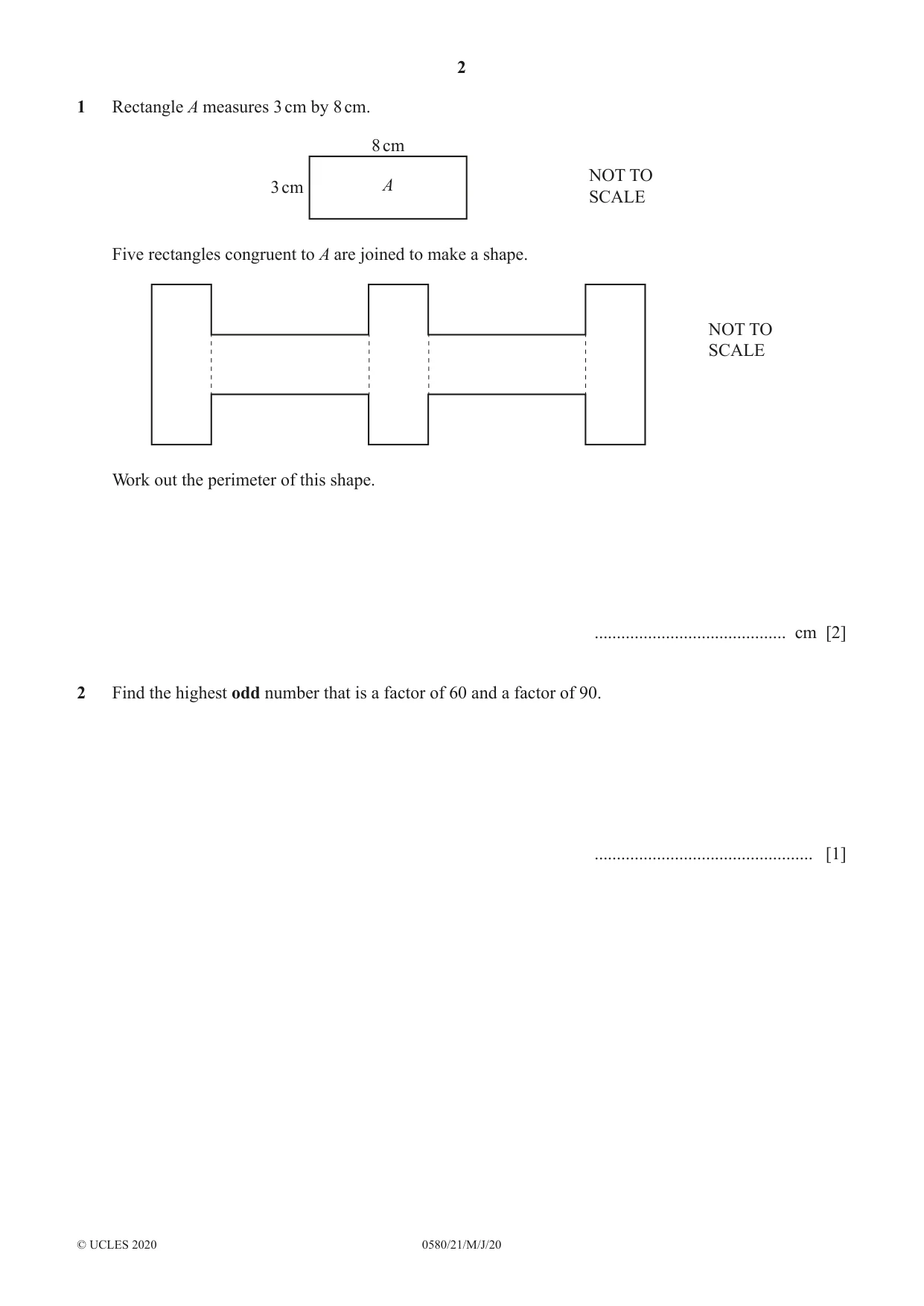
1 Rectangle A measures 3 cm by 8 cm. 8 cm NOT TO 3 cm A SCALE Five rectangles congruent to A are joined to make a shape. NOT TO SCALE Work out the perimeter of this shape. ........................................... cm [2]
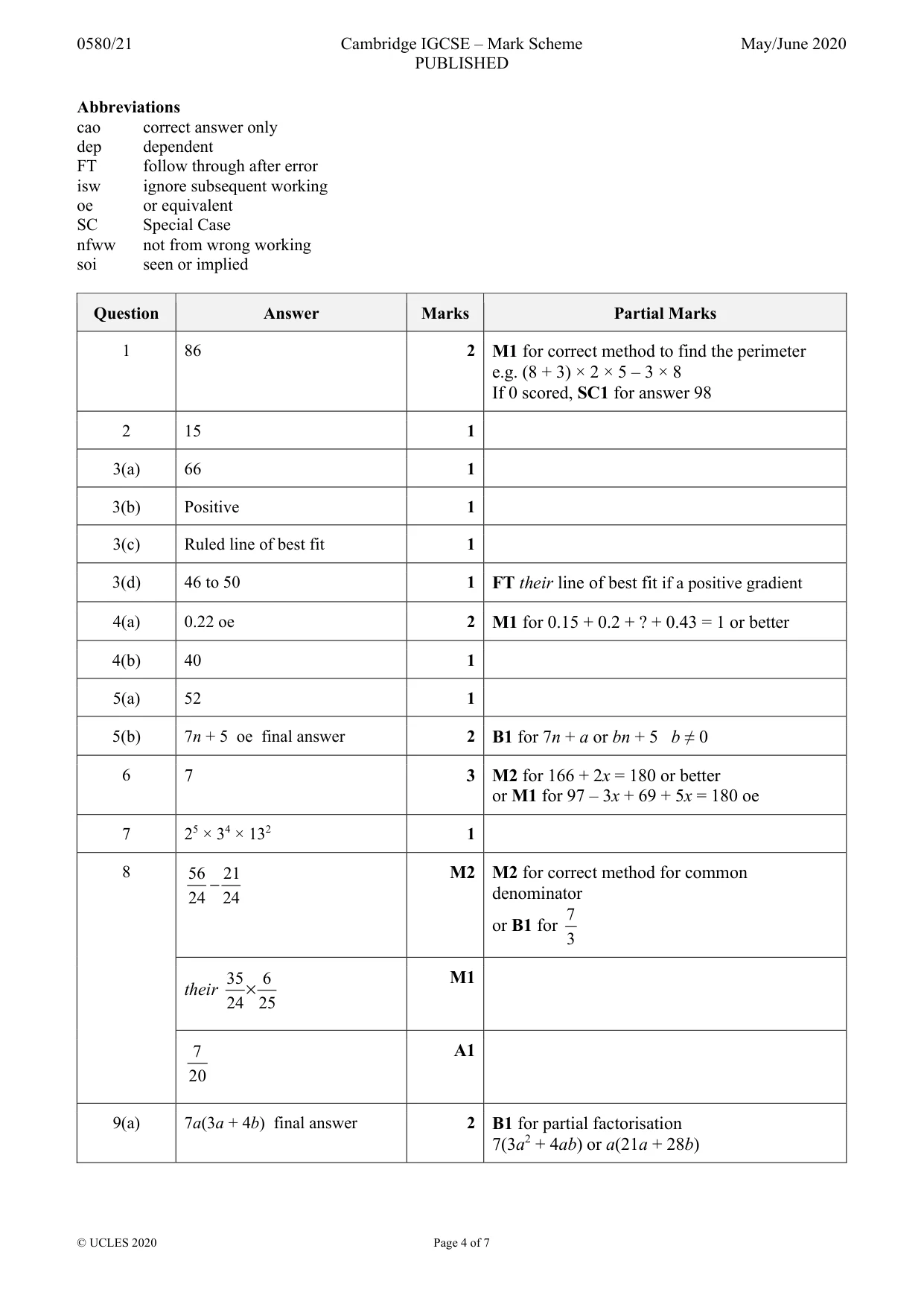
Mark scheme: Question Answer Marks Partial Marks 1 86 2 M1 for correct method to find the perimeter e.g. (8 + 3) × 2 × 5 – 3 × 8 If 0 scored, SC1 for answer 98
Q2 · Find the highest odd number that is a factor of 60 and a factor of 90
2 Find the highest odd number that is a factor of 60 and a factor of 90. ................................................. [1]
Mark scheme: 2 15 1
Q3 · Mrs Salaman gives her class two mathematics tests
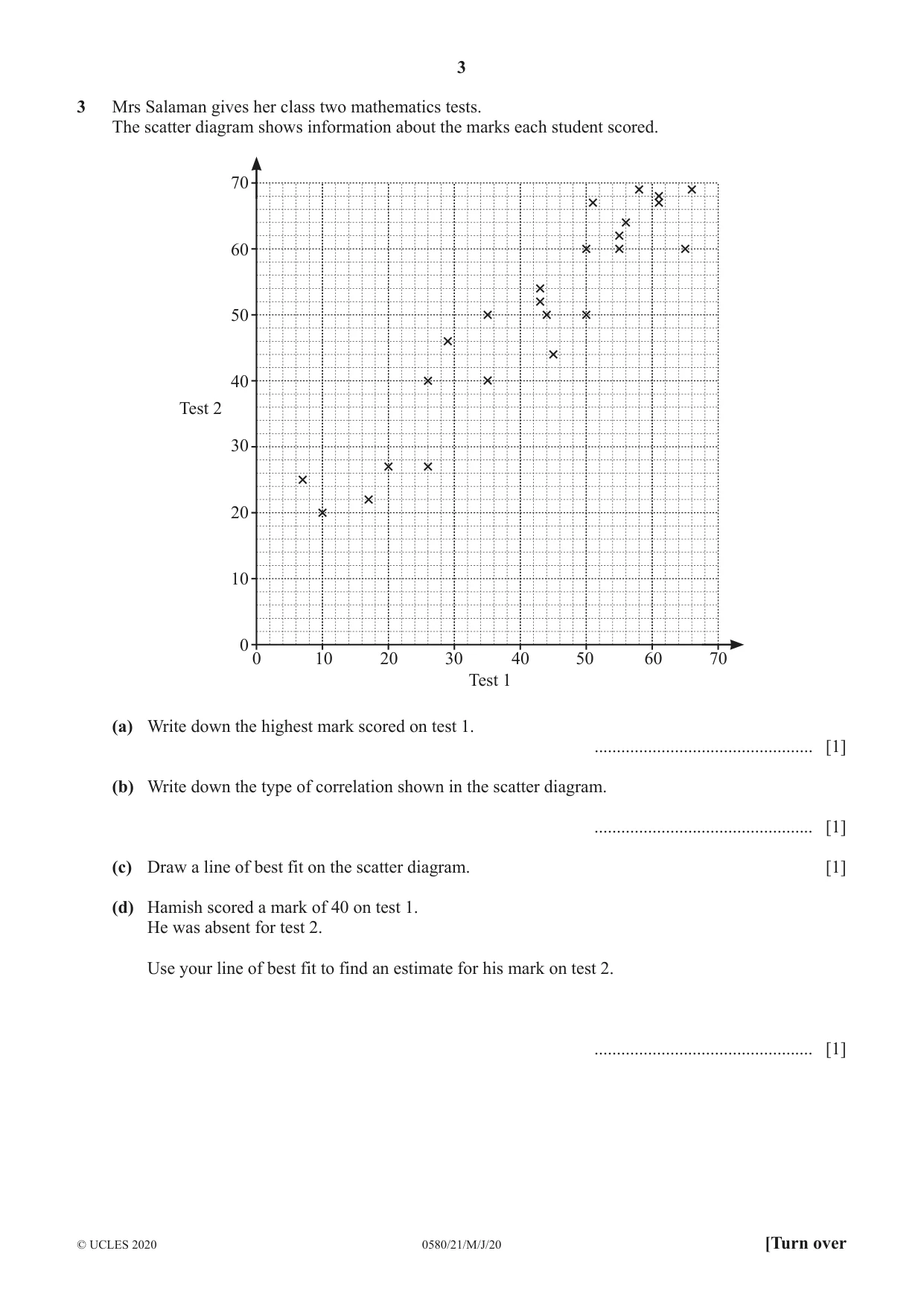
3 Mrs Salaman gives her class two mathematics tests. The scatter diagram shows information about the marks each student scored. 70 60 50 40 Test 2 30 20 10 0 0 10 20 30 40 50 60 70 Test 1 (a) Write down the highest mark scored on test 1. ................................................. [1] (b) Write down the type of correlation shown in the scatter diagram. ................................................. [1] (c) Draw a line of best fit on the scatter diagram. [1] (d) Hamish scored a mark of 40 on test 1. He was absent for test 2. Use your line of best fit to find an estimate for his mark on test 2. ................................................. [1]
Mark scheme: 3(a) 66 1 3(b) Positive 1 3(c) Ruled line of best fit 1 3(d) 46 to 50 1 FT their line of best fit if a positive gradient
Q4 · A bag contains blue, red, yellow and green balls only
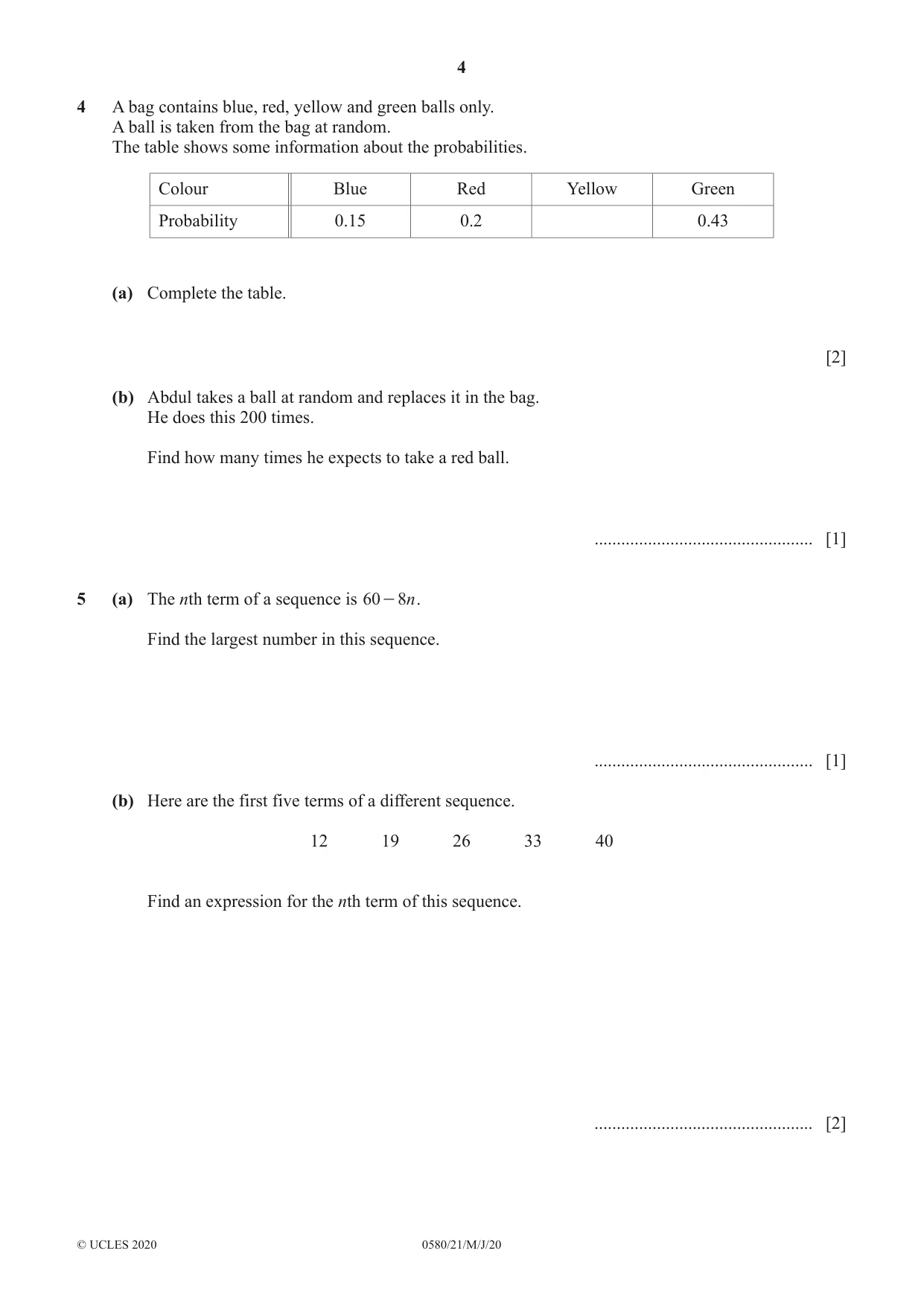
4 A bag contains blue, red, yellow and green balls only. A ball is taken from the bag at random. The table shows some information about the probabilities. Colour Blue Red Yellow Green Probability 0.15 0.2 0.43 (a) Complete the table. [2] (b) Abdul takes a ball at random and replaces it in the bag. He does this 200 times. Find how many times he expects to take a red ball. ................................................. [1]
Mark scheme: 4(a) 0.22 oe 2 M1 for 0.15 + 0.2 + ? + 0.43 = 1 or better 4(b) 40 1
Q5 · The nth term of a sequence is 60 - 8n
5 (a) The nth term of a sequence is 60 - 8n . Find the largest number in this sequence. ................................................. [1] (b) Here are the first five terms of a different sequence. 12 19 26 33 40 Find an expression for the nth term of this sequence. ................................................. [2]
Mark scheme: 5(a) 52 1 5(b) 7n + 5 oe final answer 2 B1 for 7n + a or bn + 5 b ≠ 0
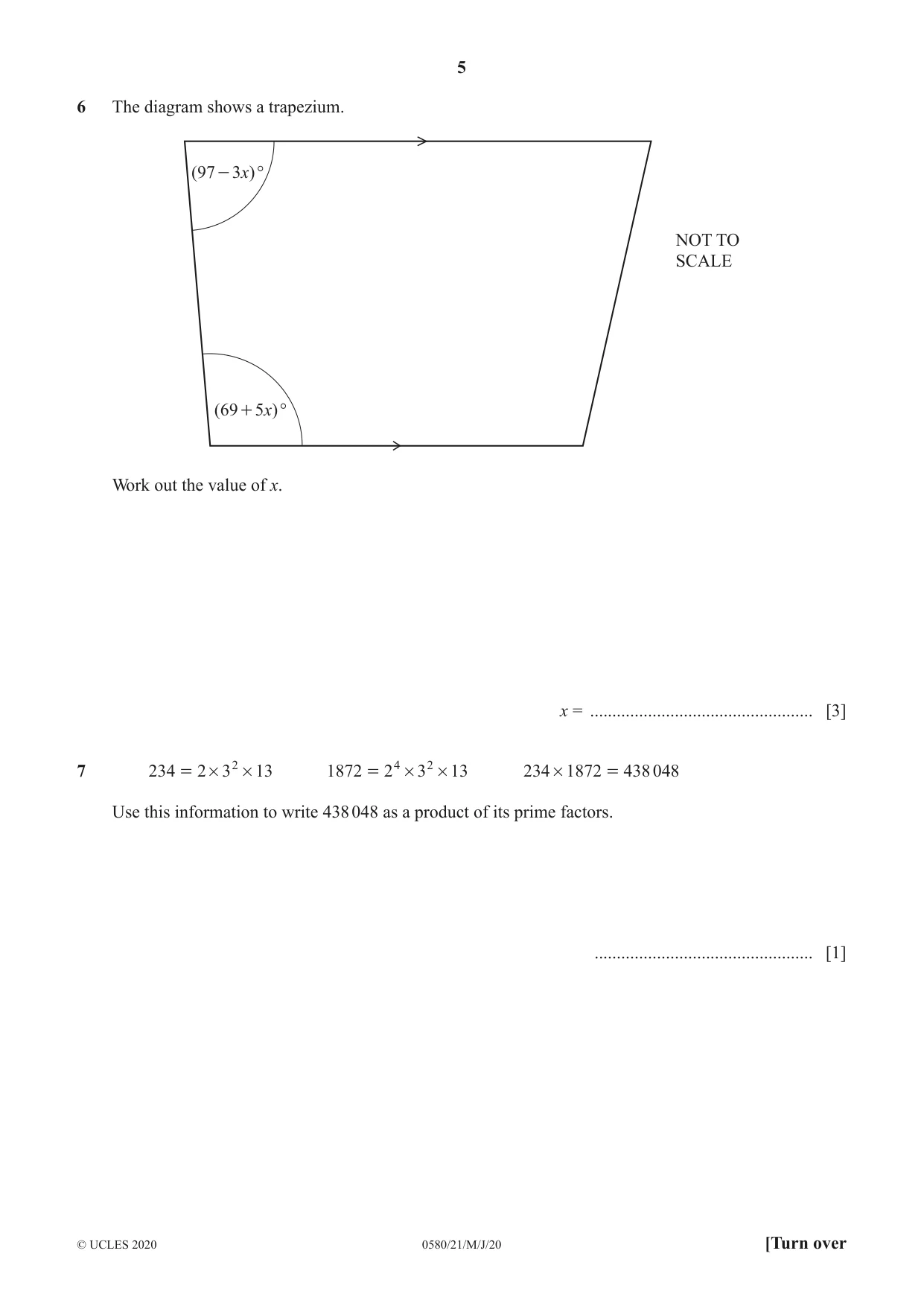
Q6 · The diagram shows a trapezium
6 The diagram shows a trapezium. ( 97 - 3x)° NOT TO SCALE ( 69 + 5x)° Work out the value of x. x = .................................................. [3]
Mark scheme: 6 7 3 M2 for 166 + 2x = 180 or better or M1 for 97 – 3x + 69 + 5x = 180 oe
Q7 · 234 = 2 # 3 2 # 13 1872 = 2 4 # 3 2 # 13 234 # 1872 = 438048 Use this information to…
7 234 = 2 # 3 2 # 13 1872 = 2 4 # 3 2 # 13 234 # 1872 = 438048 Use this information to write 438 048 as a product of its prime factors. ................................................. [1]
Mark scheme: 7 25 × 34 × 132 1
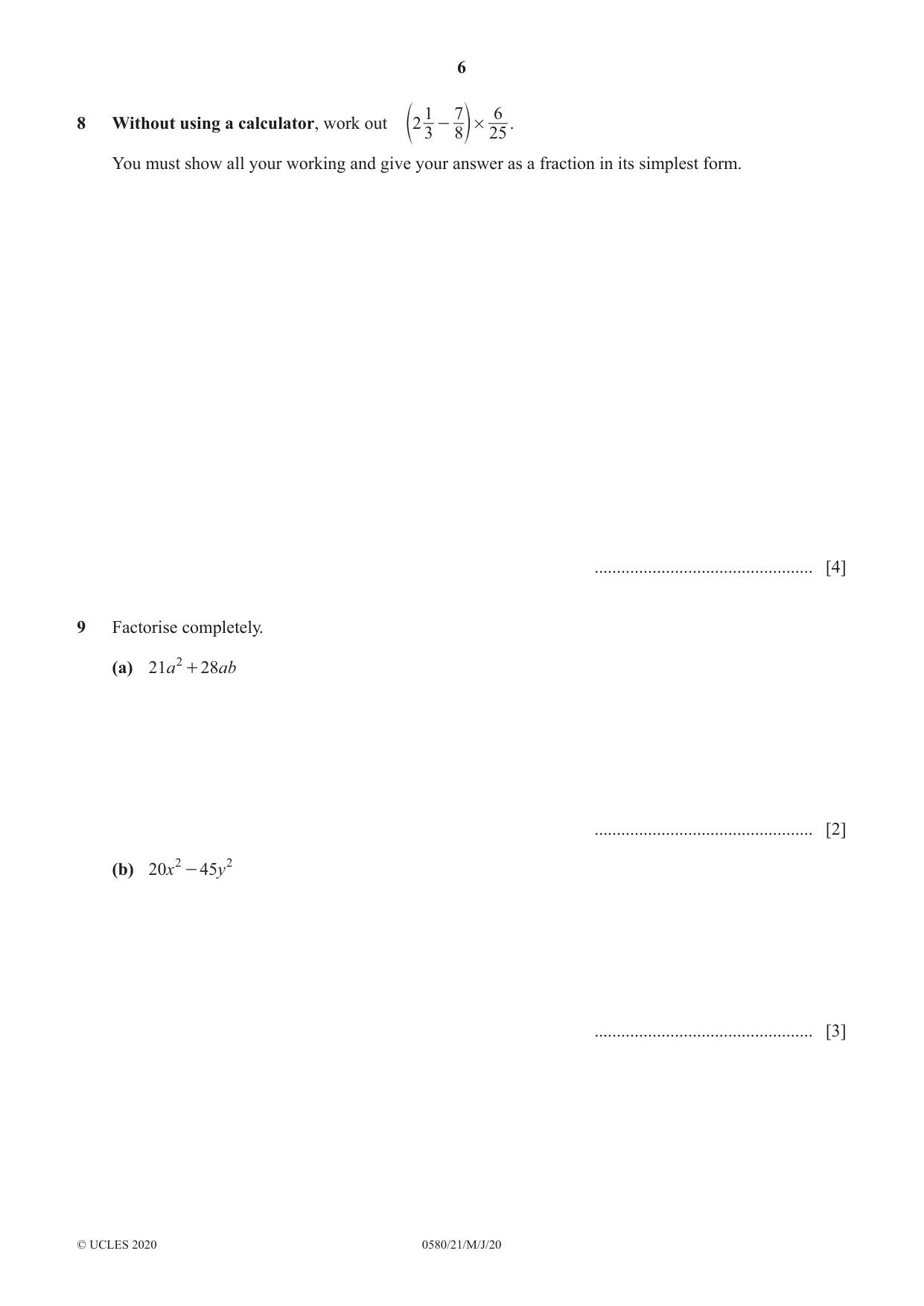
Q8 · 7 68 Without using a calculator, work out 2 - #
1 7 68 Without using a calculator, work out 2 - # . e 3 8 o 25 You must show all your working and give your answer as a fraction in its simplest form. ................................................. [4]
Mark scheme: 8 56 21 M2 M2 for correct method for common − 24 24 denominator 7 or B1 for 3 35 6 M1 their × 24 25 7 A1 20
Question 9
9 Factorise completely. (a) 21a 2 + 28ab ................................................. [2] (b) 20x 2 - 45y 2 ................................................. [3]
Mark scheme: 9(a) 7a(3a + 4b) final answer 2 B1 for partial factorisation 7(3a2 + 4ab) or a(21a + 28b) 9(b) 5(2x + 3y)(2x – 3y) final 3 B2 for (2x + 3y)(2x – 3y) answer or (10x + 15y)(2x – 3y) or (2x + 3y)(10x – 15y) or B1 for 5(4x2 – 9y2)
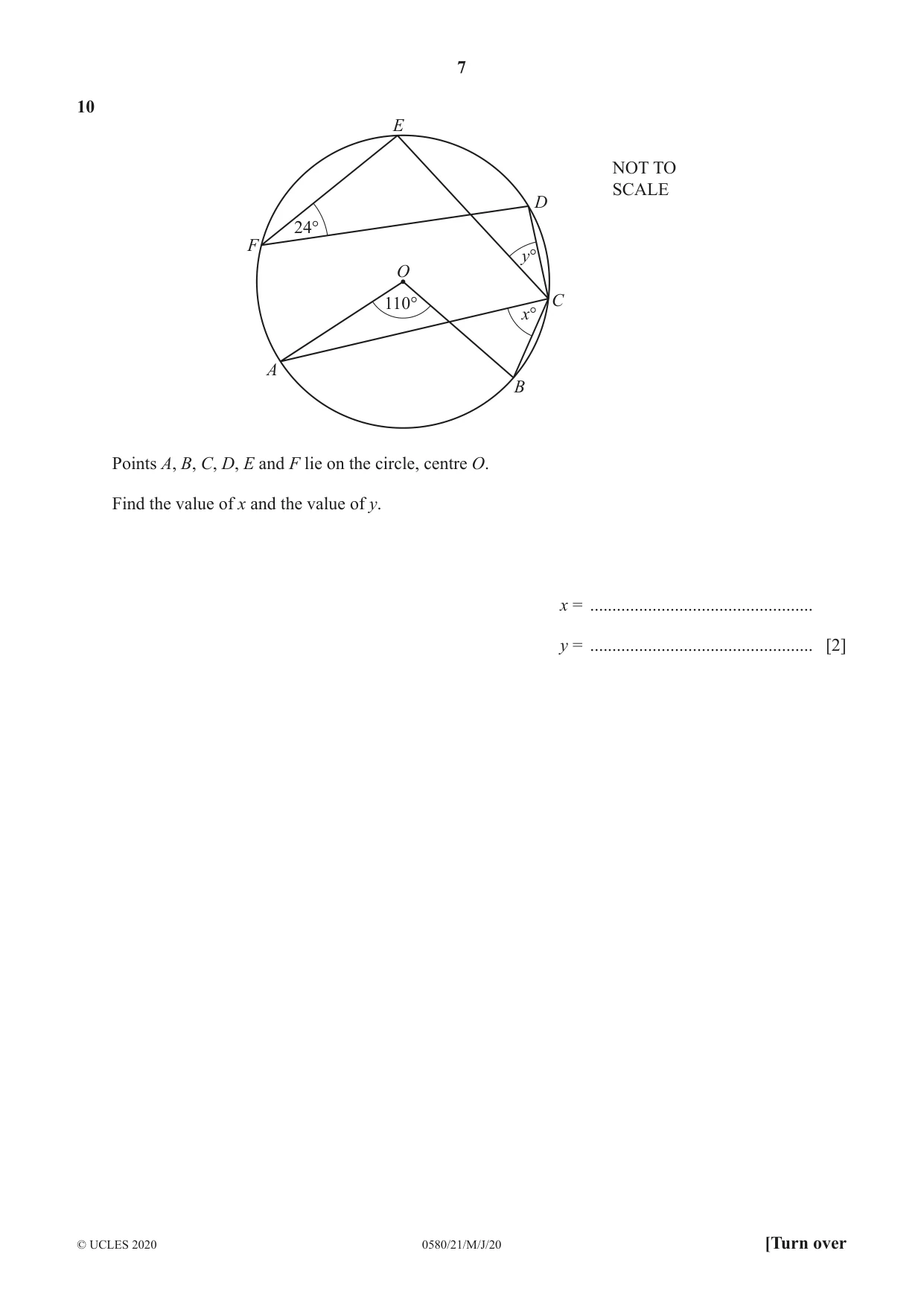
Q10 · E NOT TO SCALE D 24° F y° O 110° C x° A B Points A, B, C, D, E and F lie on the circle…
10 E NOT TO SCALE D 24° F y° O 110° C x° A B Points A, B, C, D, E and F lie on the circle, centre O. Find the value of x and the value of y. x = .................................................. y = .................................................. [2]
Mark scheme: 10 [x =] 55 2 B1 for each [y = ] 24
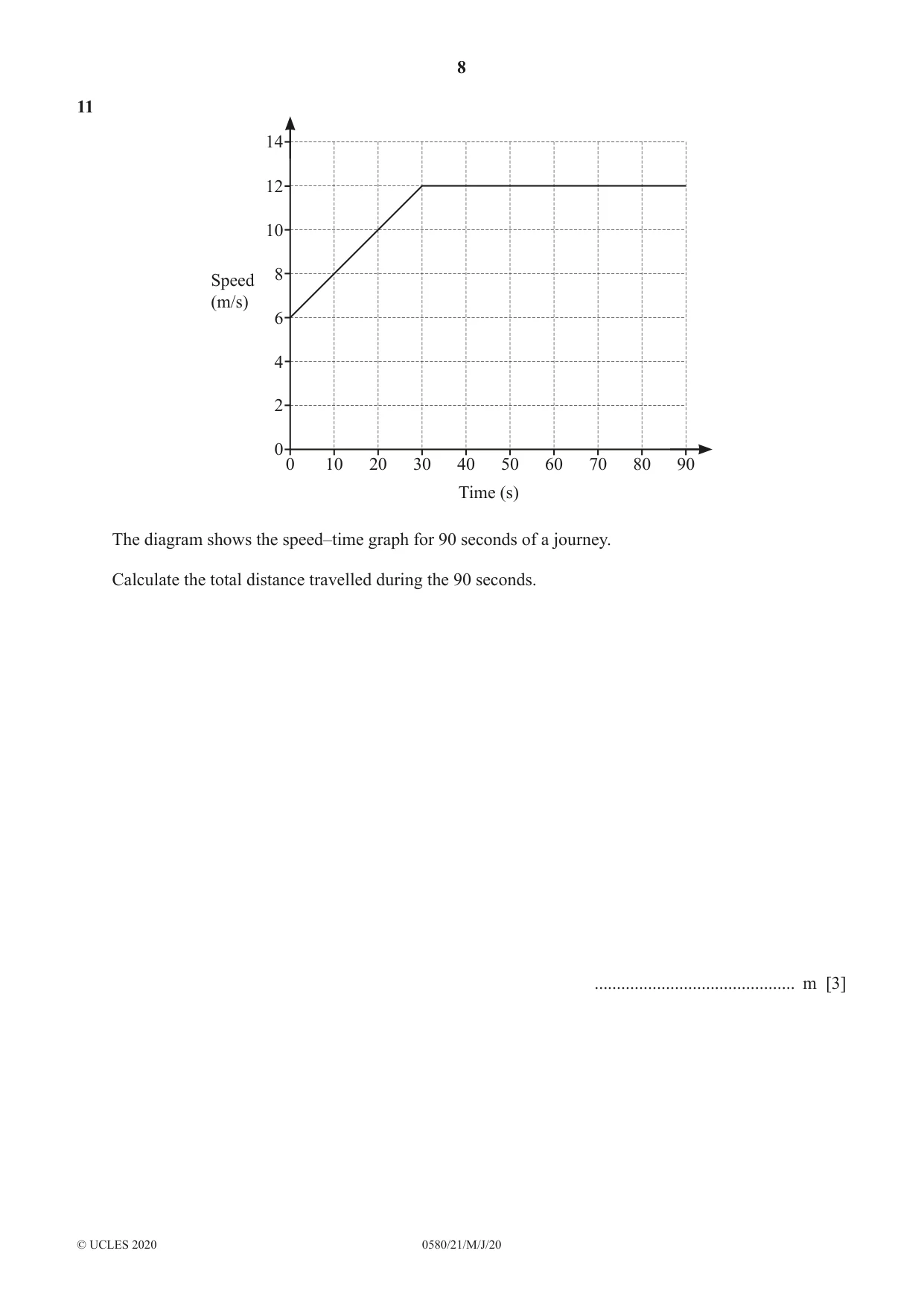
Q11 · 14 12 10 8 Speed (m/s) 6 4 2 0 0 10 20 30 40 50 60 70 80 90 Time (s) The diagram shows…
11 14 12 10 8 Speed (m/s) 6 4 2 0 0 10 20 30 40 50 60 70 80 90 Time (s) The diagram shows the speed–time graph for 90 seconds of a journey. Calculate the total distance travelled during the 90 seconds. ............................................. m [3]
Mark scheme: 11 990 3 M2 for correct complete area statement ଵ e.g. × 30 × (6 + 12) + 60 × 12 oe ଶ or M1 for one area calculation
Q12 · Gemma records the times, in seconds, taken for a group of children and a group of adults…
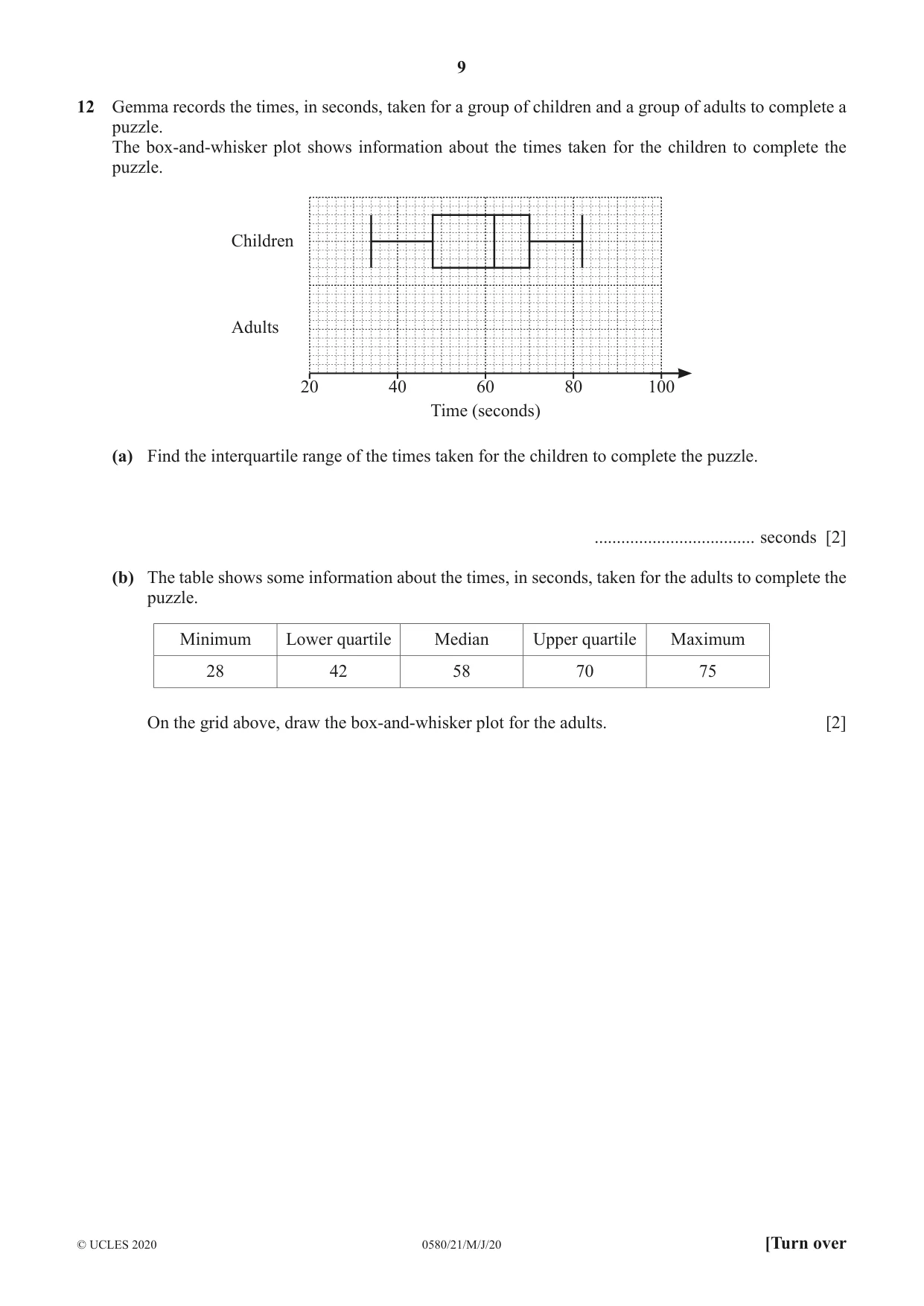
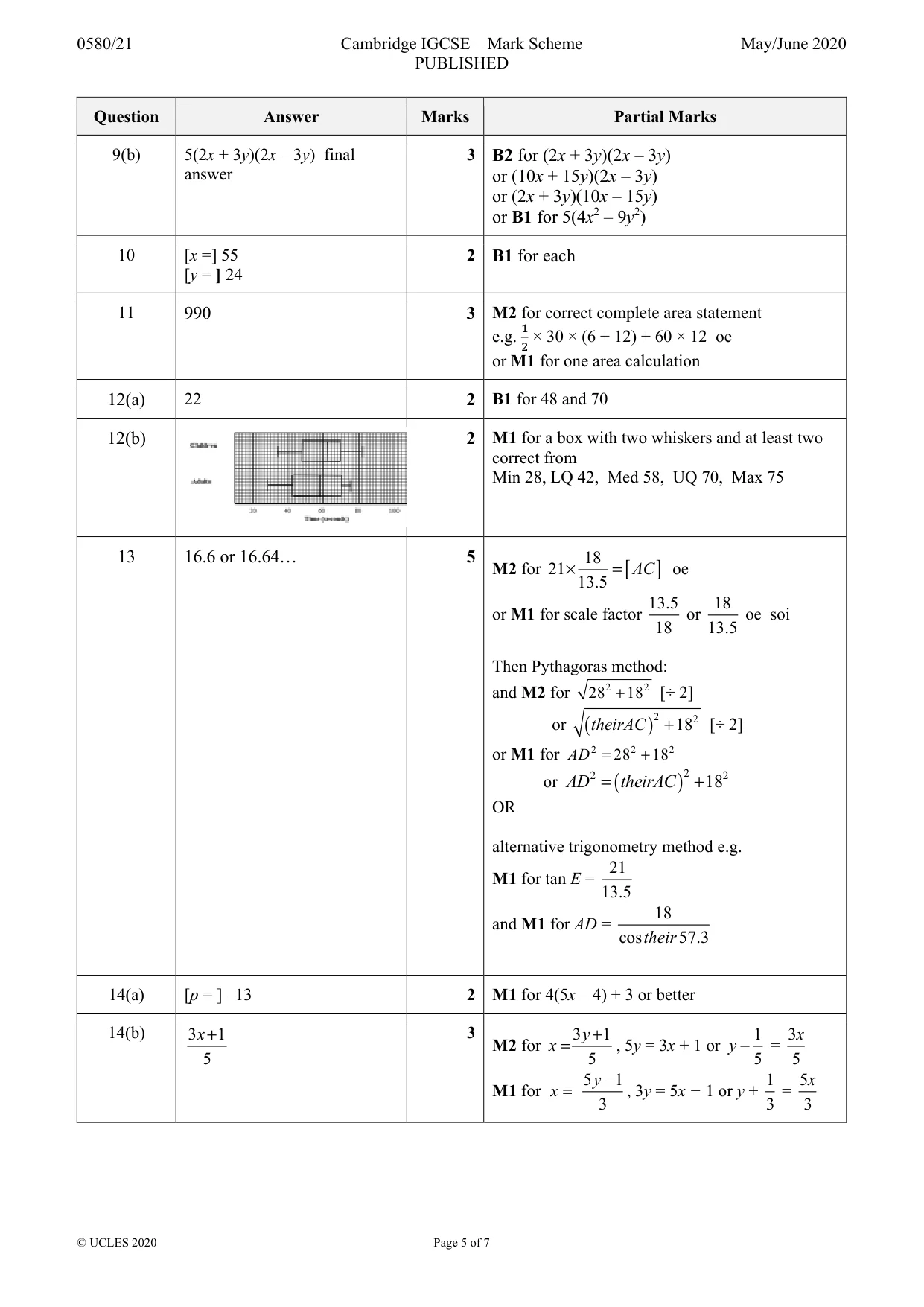
12 Gemma records the times, in seconds, taken for a group of children and a group of adults to complete a puzzle. The box-and-whisker plot shows information about the times taken for the children to complete the puzzle. Children Adults 20 40 60 80 100 Time (seconds) (a) Find the interquartile range of the times taken for the children to complete the puzzle. .................................... seconds [2] (b) The table shows some information about the times, in seconds, taken for the adults to complete the puzzle. Minimum Lower quartile Median Upper quartile Maximum 28 42 58 70 75 On the grid above, draw the box-and-whisker plot for the adults. [2]
Mark scheme: 12(a) 22 2 B1 for 48 and 70 12(b) 2 M1 for a box with two whiskers and at least two correct from Min 28, LQ 42, Med 58, UQ 70, Max 75
Q13 · C B 18 cm NOT TO SCALE 13.5 cm 21 cm D E A C lies on a circle with diameter AD
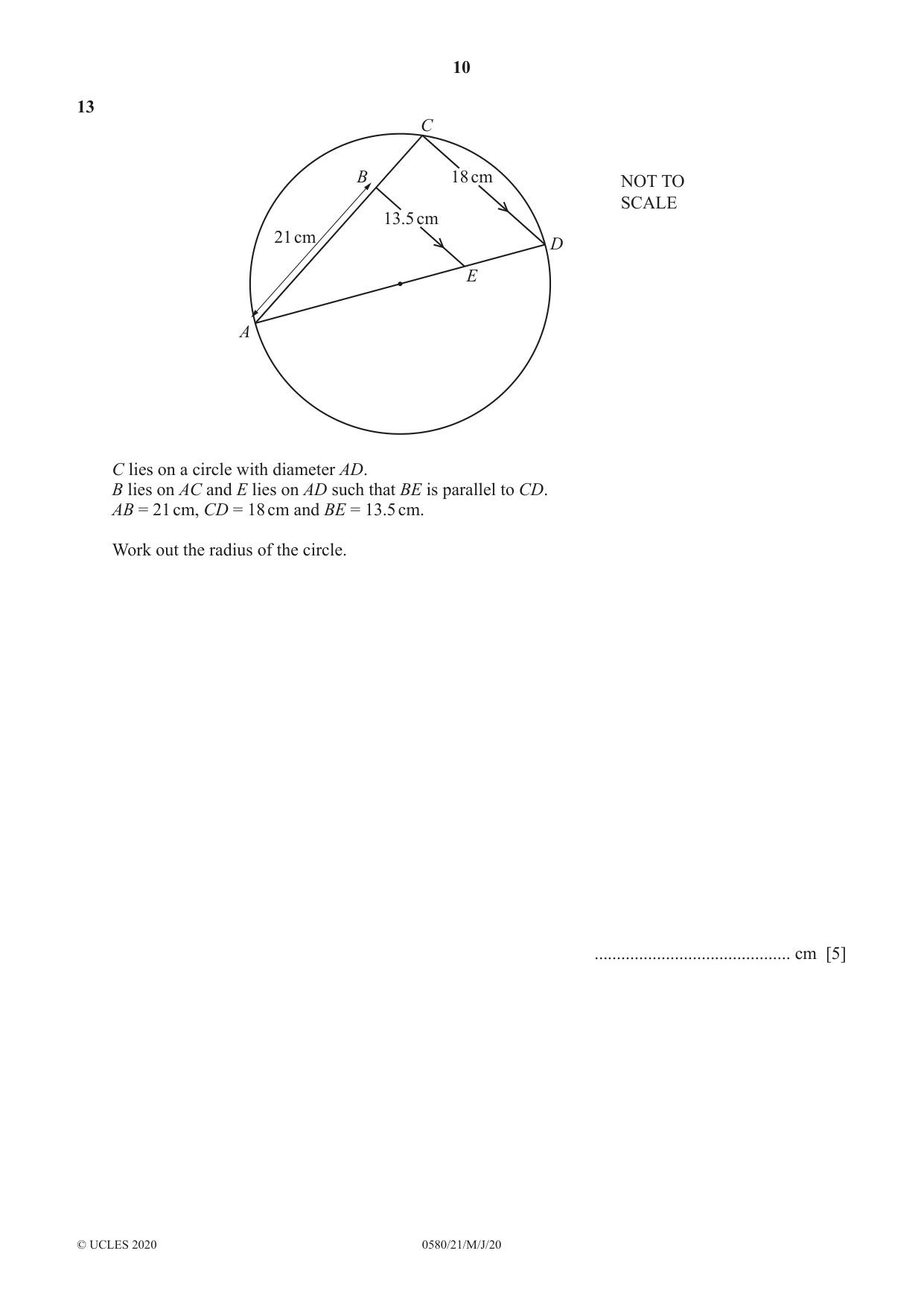
13 C B 18 cm NOT TO SCALE 13.5 cm 21 cm D E A C lies on a circle with diameter AD. B lies on AC and E lies on AD such that BE is parallel to CD. AB = 21 cm, CD = 18 cm and BE = 13.5 cm. Work out the radius of the circle. ............................................ cm [5]
Mark scheme: 13 16.6 or 16.64… 5 18 M2 for 21× = [ AC ] oe 13.5 13.5 18 or M1 for scale factor or oe soi 18 13.5 Then Pythagoras method: and M2 for 28 2 + 18 2 [÷ 2] or ( theirAC ) 2 + 18 2 [÷ 2] or M1 for AD 2 = 28 2 + 18 2 2 2 2 or AD = ( theirAC ) + 18 OR alternative trigonometry method e.g. 21 M1 for tan E = 13.5 18 and M1 for AD = cos their 57.3
Q14 · F ( x) = 4 x + 3 g ( x) = 5 x - 4 fg ( x) = 20 x + p Find the value of p
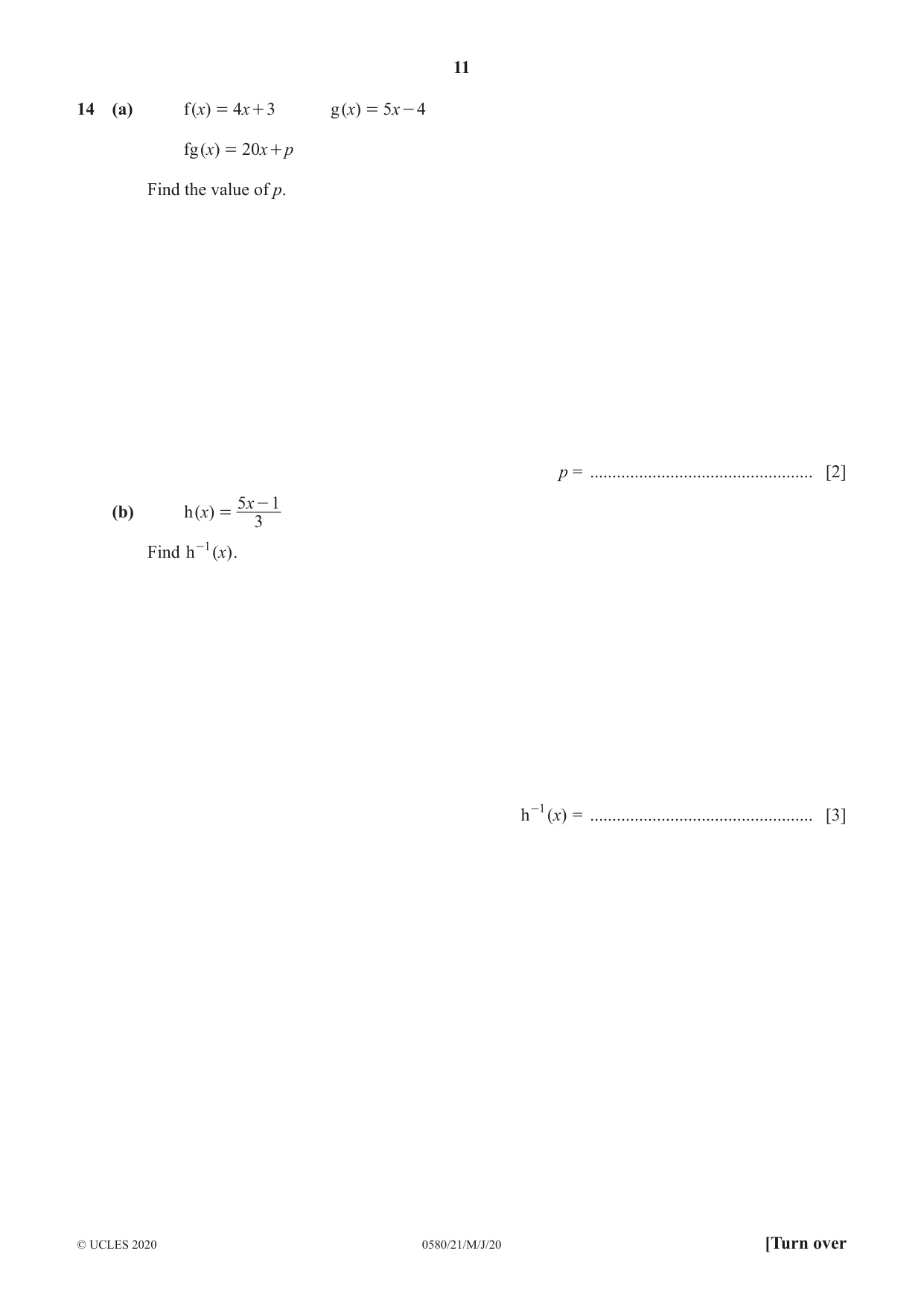
14 (a) f ( x) = 4 x + 3 g ( x) = 5 x - 4 fg ( x) = 20 x + p Find the value of p. p = .................................................. [2] 5x - 1 (b) h ( x) = 3 Find h -1 ( x) . h -1 ( x) = .................................................. [3]
Mark scheme: 14(a) [p = ] –13 2 M1 for 4(5x – 4) + 3 or better 14(b) 3 x + 1 3 3 y + 1 1 3x M2 for x = , 5y = 3x + 1 or y − = 5 5 5 5 5 y –1 1 5 x M1 for x = , 3y = 5x − 1 or y + = 3 3 3
Q15 · A Q NOT TO x° SCALE B P R P, R and Q are points on the circle
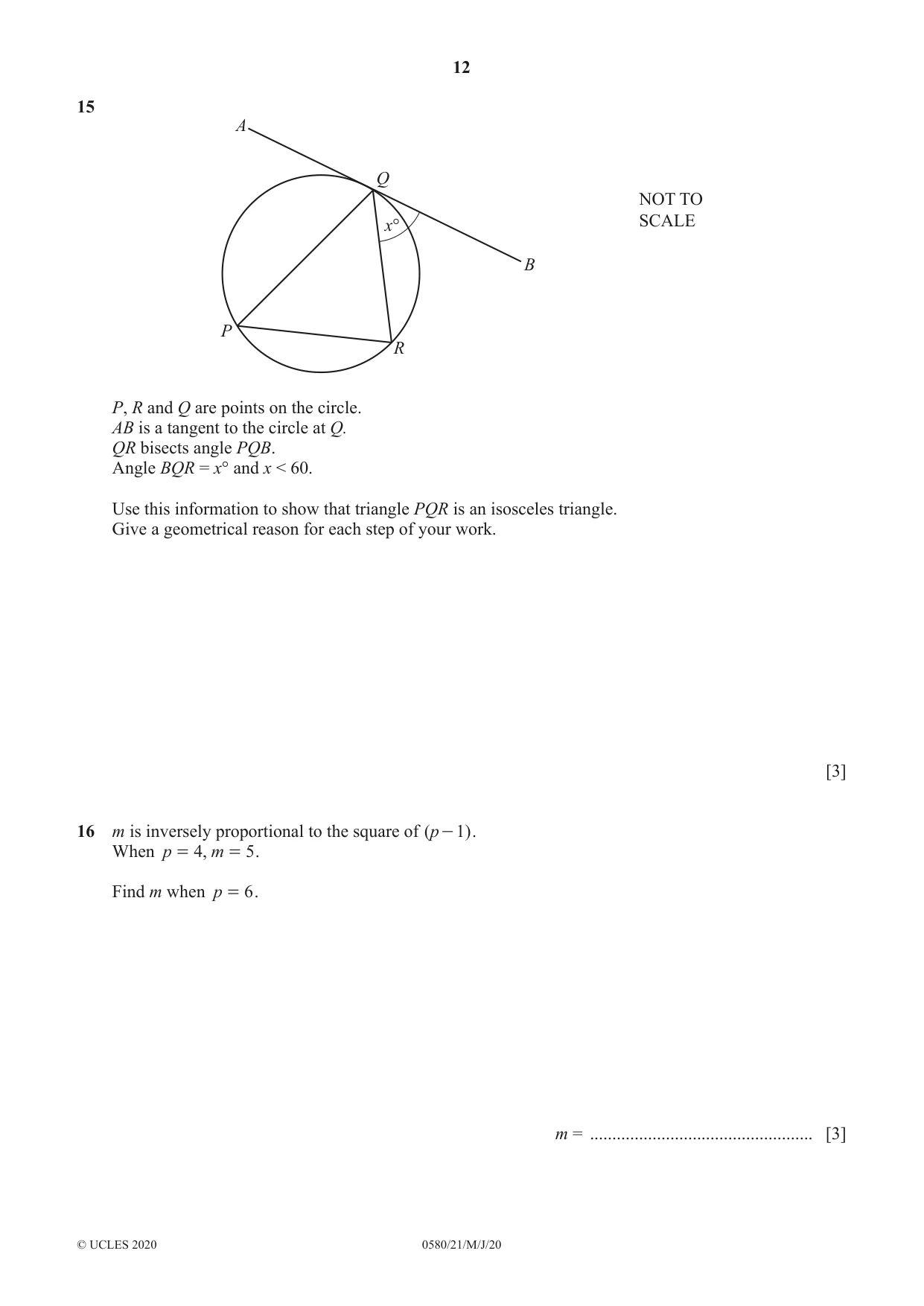
15 A Q NOT TO x° SCALE B P R P, R and Q are points on the circle. AB is a tangent to the circle at Q. QR bisects angle PQB. Angle BQR = x° and x < 60. Use this information to show that triangle PQR is an isosceles triangle. Give a geometrical reason for each step of your work. [3]
Mark scheme: 15 Complete explanation with 3 B1 for RQP = x° QR bisects angle PQB geometrical reasons B1 for RPQ = x° alternate segment theorem B1 for triangle PQR has two equal angles both less than 60 (so can’t be equilateral) so must be isosceles
Q16 · M is inversely proportional to the square of ( p - 1)
16 m is inversely proportional to the square of ( p - 1) . When p = 4, m = 5 . Find m when p = 6 . m = .................................................. [3]
Mark scheme: 16 4 3 k 1.8 or 1 M2 for m = 2 5 ( p − 1) theirk or M1 for m = ( 6 − 1) 2 OR M2 for 5(4 − 1) 2 = m (6 − 1) 2 oe
Q17 · 17 (a) (i) m = e7o Find 3m
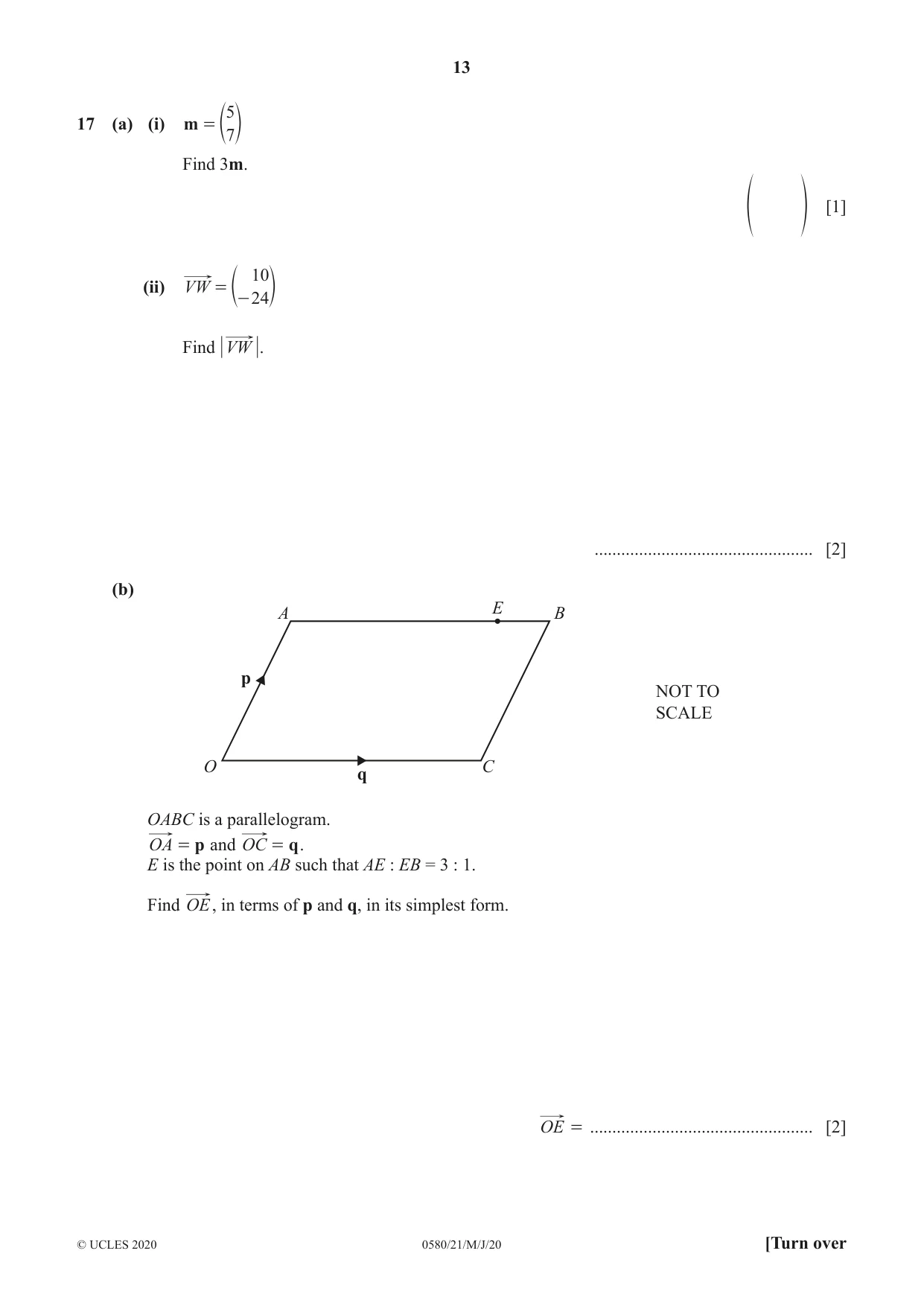
5 17 (a) (i) m = e7o Find 3m. [1] f p 10 (ii) VW = e- 24o Find VW . ................................................. [2] (b) E A B p NOT TO SCALE O C q OABC is a parallelogram. OA = p and OC = q . E is the point on AB such that AE : EB = 3 : 1. Find OE, in terms of p and q, in its simplest form. OE = .................................................. [2]
Mark scheme: 17(a)(i) 15 1 21 17(a)(ii) 26 2 M1 for 102 + (−24)2 or better 17(b) 3 2 3 p + q M1 for a correct route or for AE = q 4 4
Q18 · P = 2(w + h) w = 12 correct to the nearest whole number
18 P = 2(w + h) w = 12 correct to the nearest whole number. h = 4 correct to the nearest whole number. Work out the upper bound for the value of P. ................................................. [2]
Mark scheme: 18 34 2 M1 for 12 + 0.5 or 4 + 0.5 or better seen
Q19 · F G NOT TO SCALE E H B C 5.5 cm A 20 cm D The diagram shows cuboid ABCDEFGH of length 20…
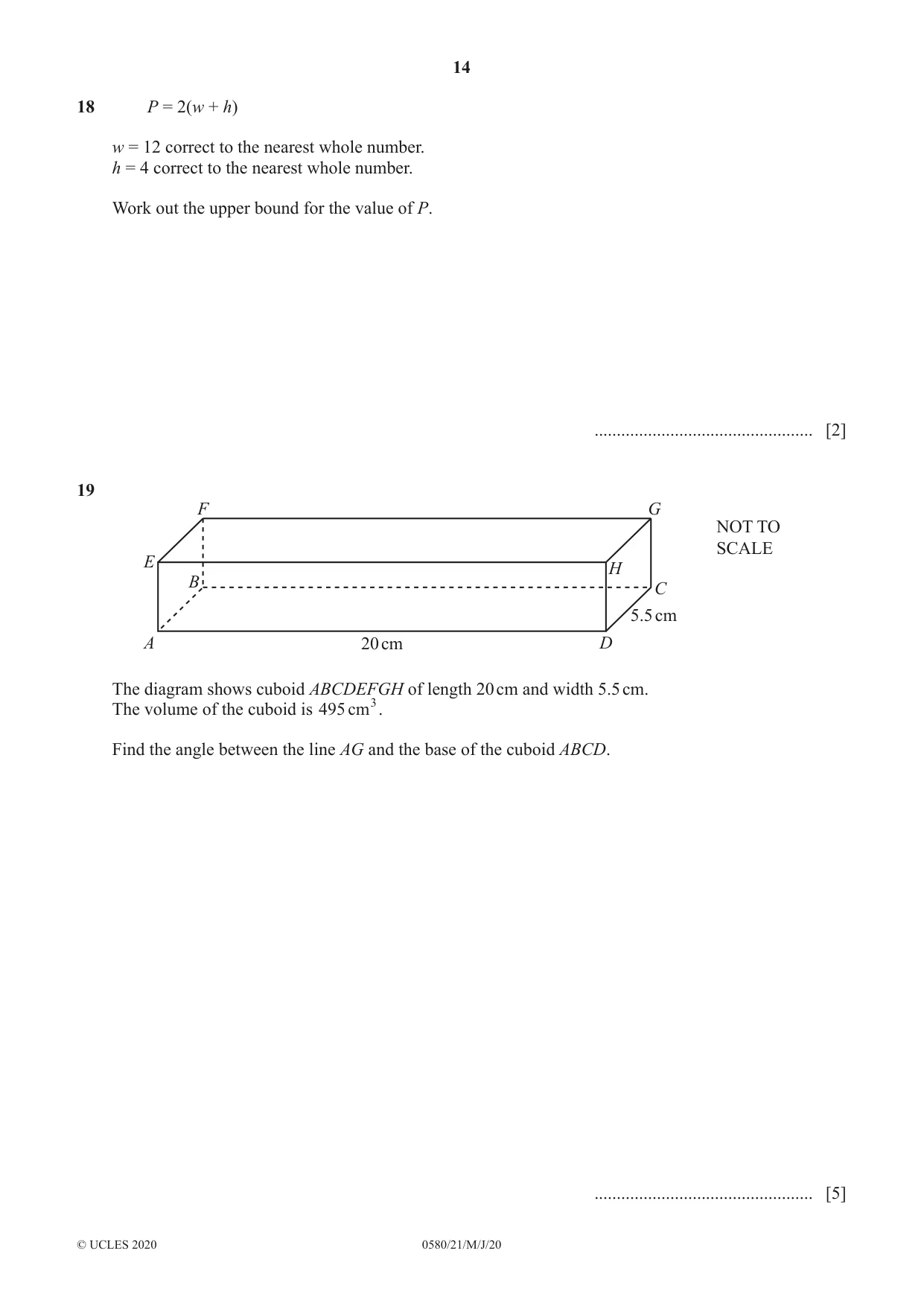
19 F G NOT TO SCALE E H B C 5.5 cm A 20 cm D The diagram shows cuboid ABCDEFGH of length 20 cm and width 5.5 cm. The volume of the cuboid is 495 cm 3. Find the angle between the line AG and the base of the cuboid ABCD. ................................................. [5]
Mark scheme: 19 12.2 or 12.24… 5 4.5 M4 for tan = oe 20 2 + 5.5 2 or M1 for recognising angle GAC 495 M1 for 20 × 5.5 M1 for 20 2 + 5.5 2 or 20 2 + 5.5 2 + (their 4. 5) 2 their 4.5 M1 for tan = oe 20 2 + 5.5 2
Q20 · The curve y = x 2 - 2x + 1 is drawn on a grid
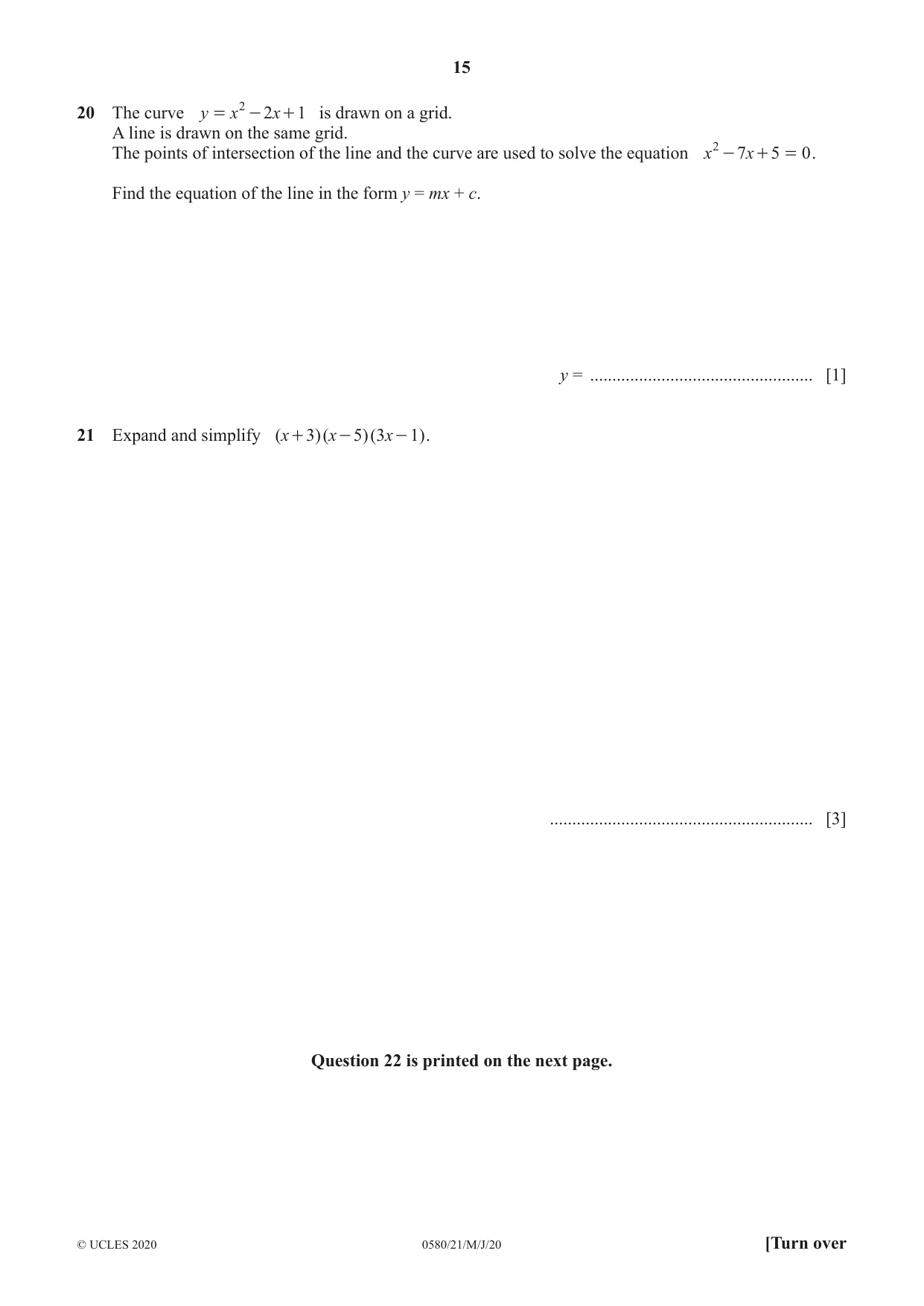
20 The curve y = x 2 - 2x + 1 is drawn on a grid. A line is drawn on the same grid. The points of intersection of the line and the curve are used to solve the equation x 2 - 7 x + 5 = 0 . Find the equation of the line in the form y = mx + c. y = .................................................. [1]
Mark scheme: 20 [y = ] 5x – 4 1
Q21 · Expand and simplify ( x + 3)( x - 5)( 3x - 1)
21 Expand and simplify ( x + 3)( x - 5)( 3x - 1) . ........................................................... [3] Question 22 is printed on the next page.
Mark scheme: 21 3x3 – 7x2 – 43x + 15 3 B2 for correct expansion and simplification of two of the brackets or B1 for correct expansion of two brackets with at least 3 terms correct
Q22 · Find the area of a regular hexagon with side length 7.4 cm
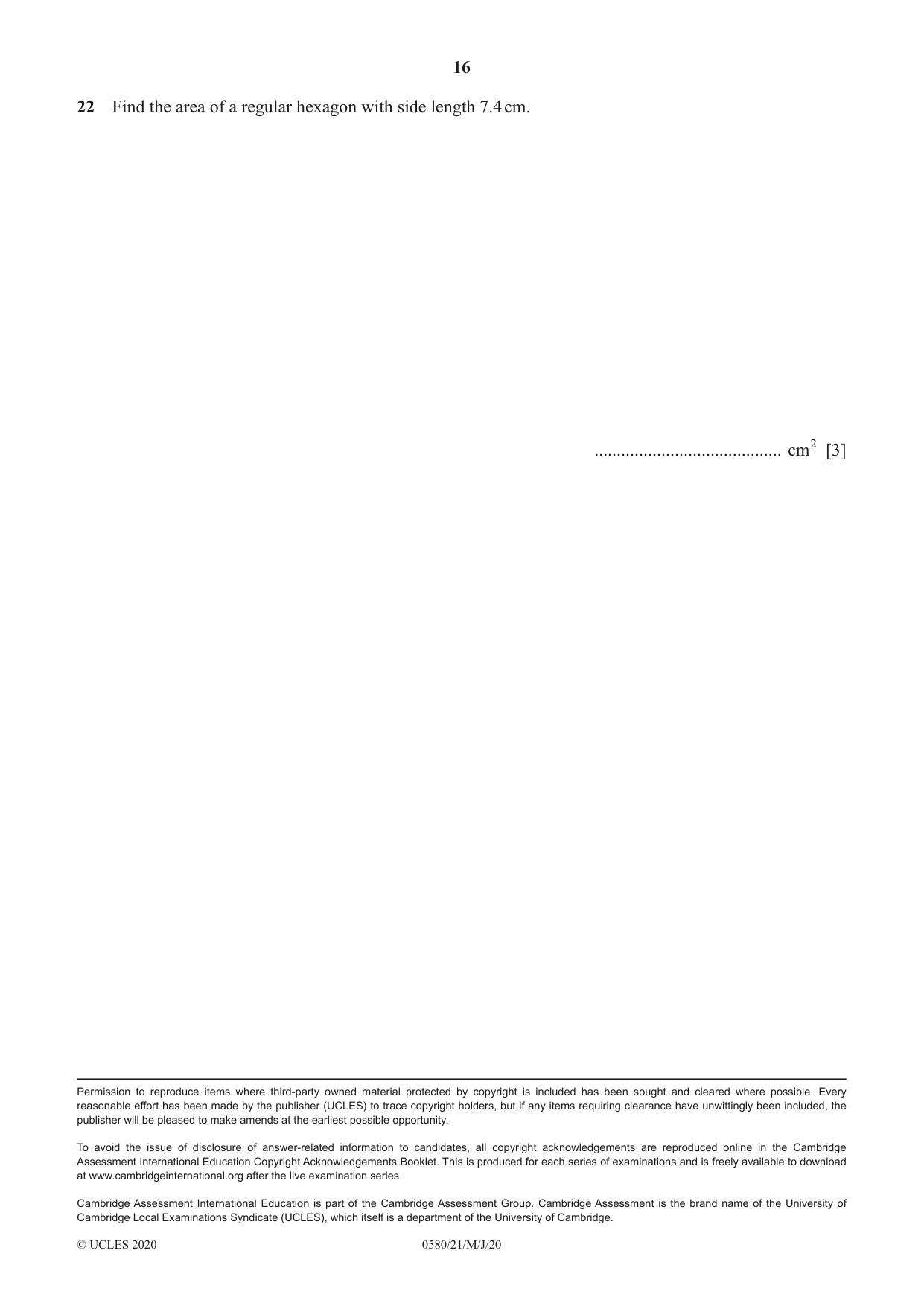
22 Find the area of a regular hexagon with side length 7.4 cm. .......................................... cm2 [3]
Mark scheme: 22 142 or 142.2 to 142.3 3 1 M2 for × 7.4 × 7.4 × sin60 × 6 2 7.4 7.4 or tan60 × × × 6 2 2 1 7.4 or M1 for × 7.4 × 7.4 × sin60 or tan60 × 2 2
What was in this paper
The subtopics covered by these 22 questions, and how many questions each got. Open one in a new tab to see every Cambridge question on it.
2Area and perimeter2Circle theorems I2Pythagoras’ theorem and trigonometry2Types of number2Angles1Averages and measures of spread1Equations1Fractions, decimals and percentages1Functions1Introduction to probability1Limits of accuracy1Rates1Ratio and proportion1Scatter diagrams1Sequences1Vectors in two dimensions1