Questions as text
Q1 · F(x) = x2 – 4x + 3 and g(x) = 2x – 1 0580/41 May/June 2005
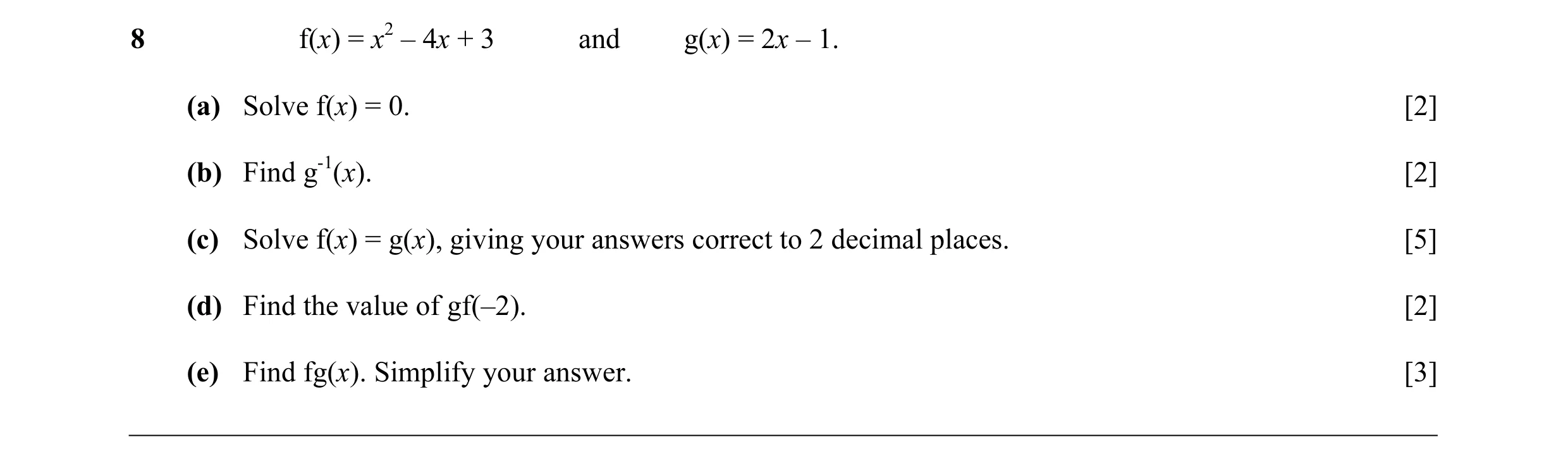
8 f(x) = x2 – 4x + 3 and g(x) = 2x – 1. (a) Solve f(x) = 0. [2] (b) Find g-1(x). [2] (c) Solve f(x) = g(x), giving your answers correct to 2 decimal places. [5] (d) Find the value of gf(–2). [2] (e) Find fg(x). Simplify your answer. [3]
14 marks
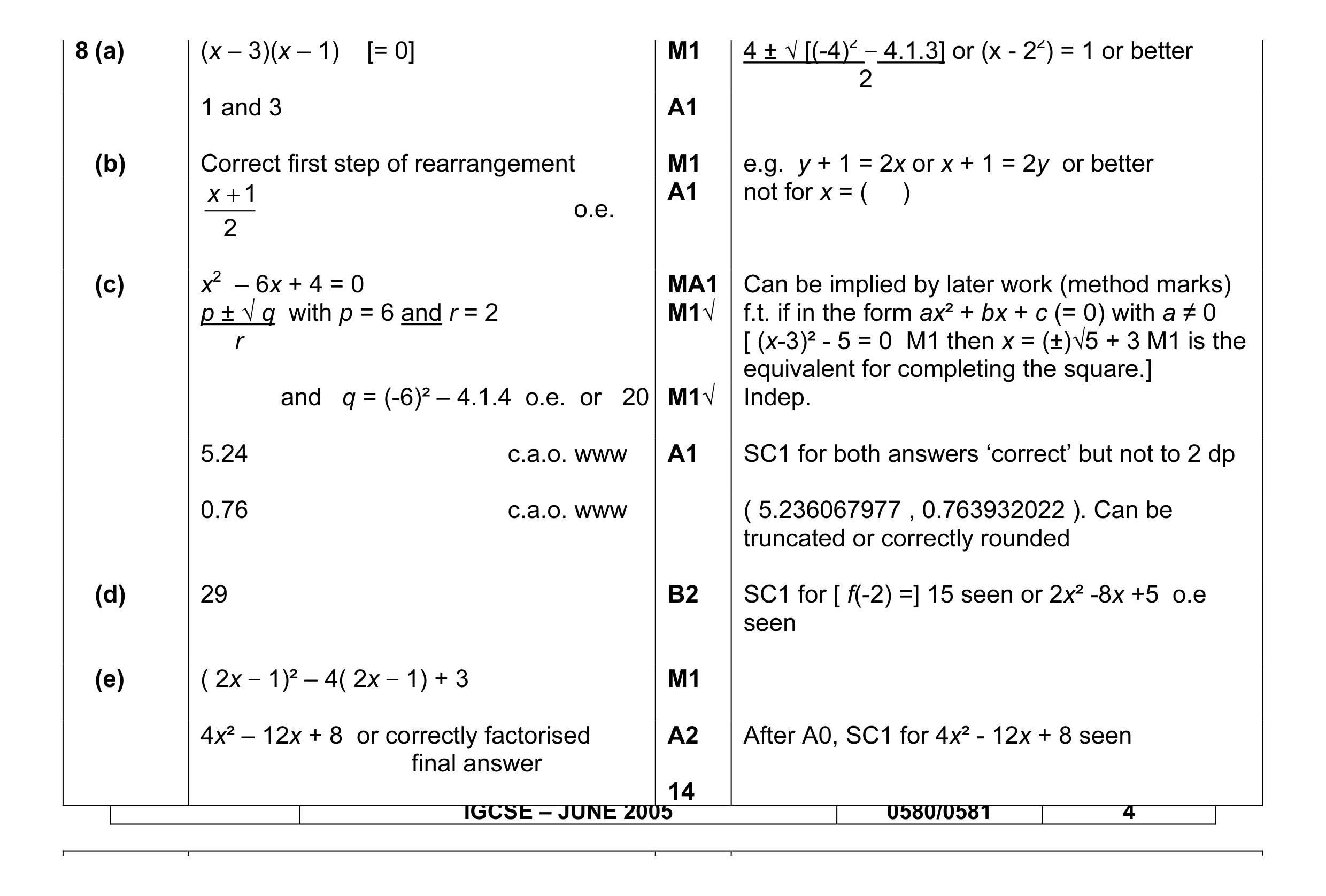
Mark scheme: 8 (a) (x – 3)(x – 1) [= 0] M1 4 ± √ [(-4)2 − 4.1.3] or (x - 22) = 1 or better 2 1 and 3 A1 (b) Correct first step of rearrangement M1 e.g. y + 1 = 2x or x + 1 = 2y or better x + 1 A1 not for x = ( ) o.e. 2 (c) x2 – 6x + 4 = 0 MA1 Can be implied by later work (method marks) p ± √ q with p = 6 and r = 2 M1√ f.t. if in the form ax² + bx + c (= 0) with a ≠ 0 r [ (x-3)² - 5 = 0 M1 then x = (±)√5 + 3 M1 is the equivalent for completing the square.] and q = (-6)² – 4.1.4 o.e. or 20 M1√ Indep. 5.24 c.a.o. www A1 SC1 for both answers ‘correct’ but not to 2 dp 0.76 c.a.o. www ( 5.236067977 , 0.763932022 ). Can be truncated or correctly rounded (d) 29 B2 SC1 for [ f(-2) =] 15 seen or 2x² -8x +5 o.e seen (e) ( 2x − 1)² – 4( 2x − 1) + 3 M1 4x² – 12x + 8 or correctly factorised A2 After A0, SC1 for 4x² - 12x + 8 seen final answer 14 IGCSE – JUNE 2005 0580/0581 4
This question in 0580/41 May/June 2005
Q2 · F(x) = 2x – 1, g(x) = +1 , h(x) = 2x 0580/41 Oct/Nov 2007
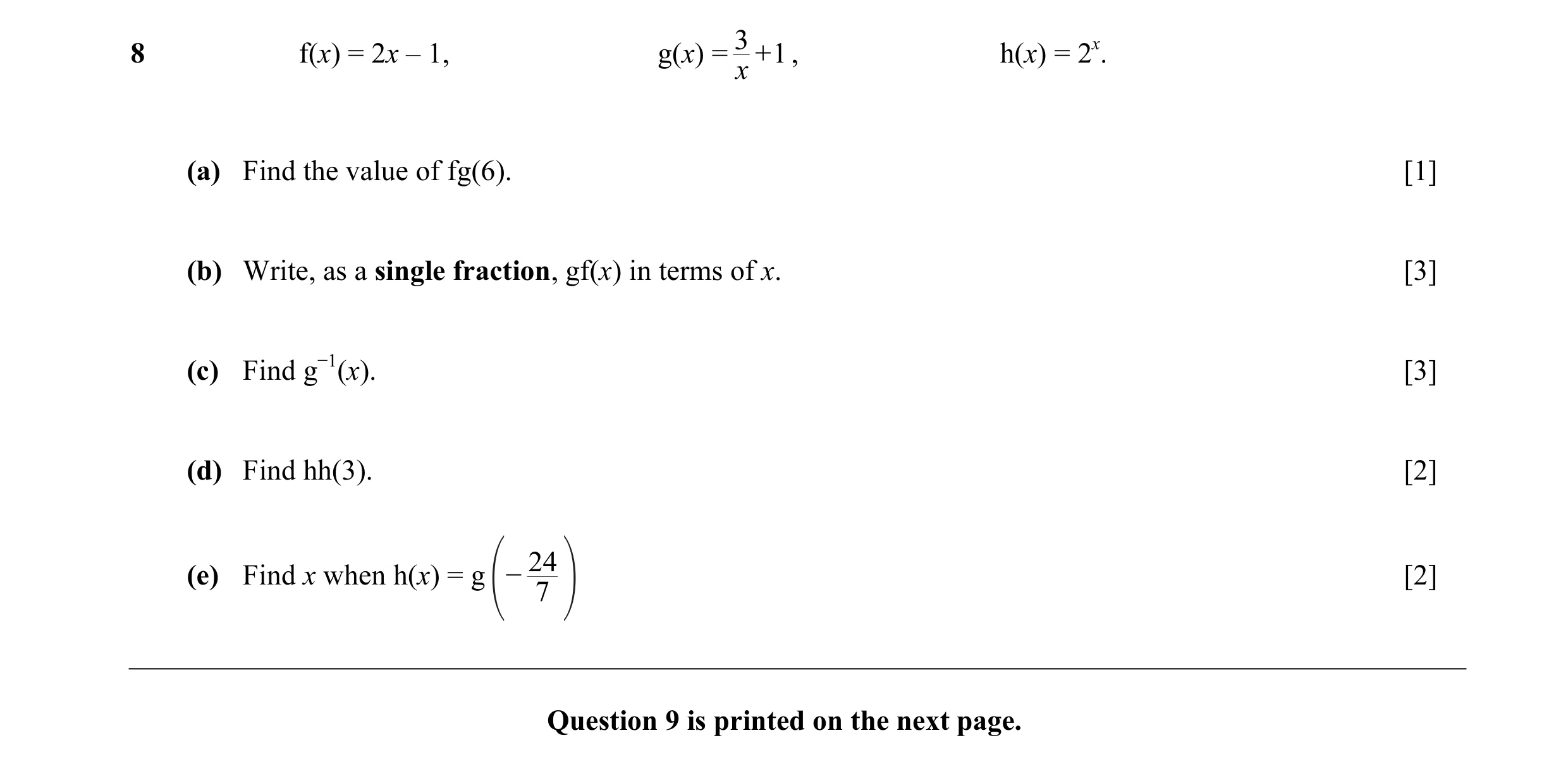
38 f(x) = 2x – 1, g(x) = +1 , h(x) = 2x. x (a) Find the value of fg(6). [1] (b) Write, as a single fraction, gf(x) in terms of x. [3] (c) Find g−1(x). [3] (d) Find hh(3). [2] (e) Find x when h(x) = g −24 [2] 7 Question 9 is printed on the next page.
11 marks
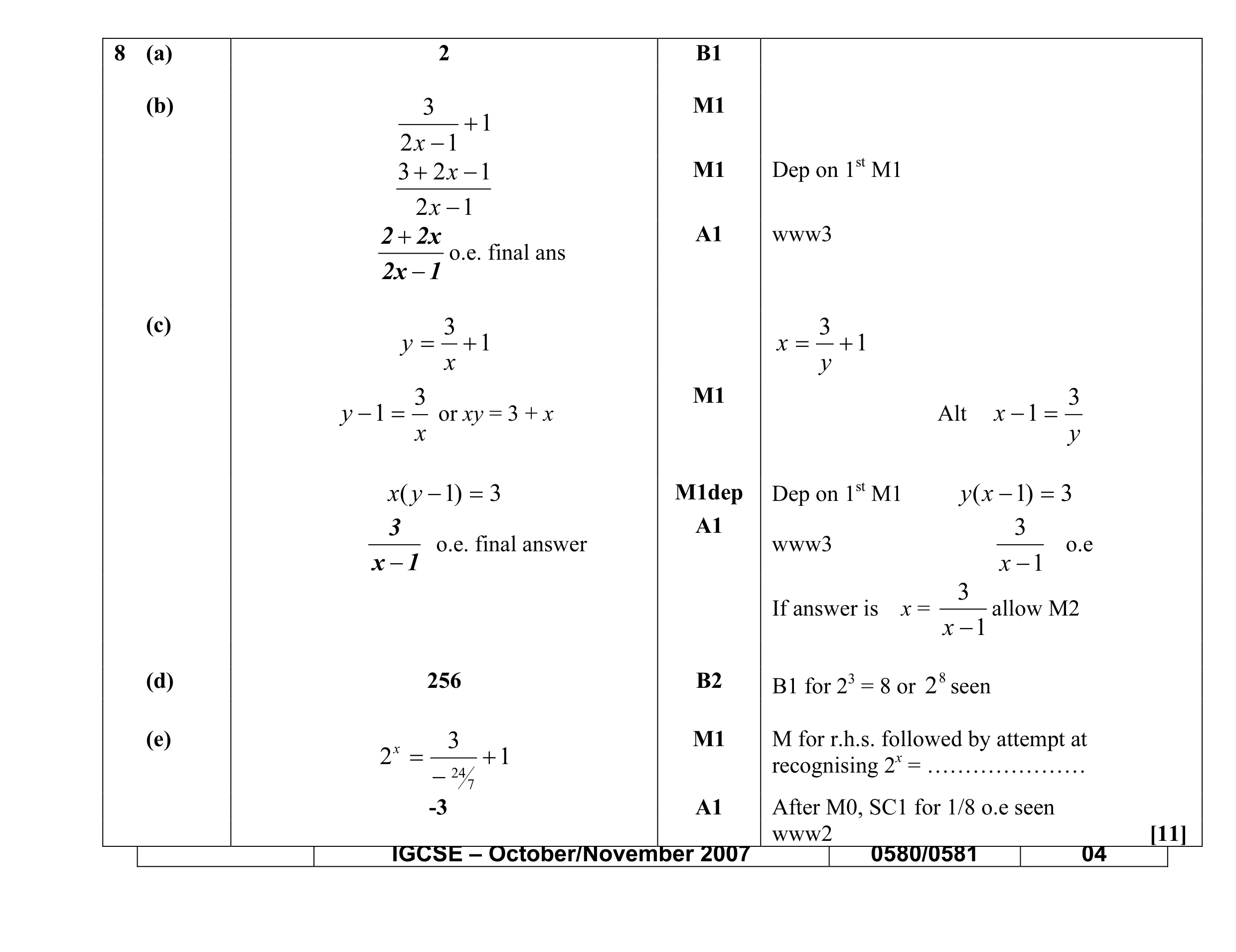
Mark scheme: 8 (a) 2 B1 (b) 3 M1 + 1 2 x − 1 3 + 2 x − 1 M1 Dep on 1st M1 2 x − 1 2 + 2x A1 www3 o.e. final ans 2x − 1 (c) 3 3 y = + 1 x = + 1 x y 3 M1 3 y − 1 = or xy = 3 + x Alt x − 1 = x y x ( y − )1 = 3 M1dep Dep on 1st M1 y ( x − )1 = 3 3 A1 3 o.e. final answer www3 o.e x − 1 x − 1 3 If answer is x = allow M2 x − 1 (d) 256 B2 8 B1 for 23 = 8 or 2 seen (e) x 3 M1 M for r.h.s. followed by attempt at 2 = + 1 24 recognising 2x = ………………… − 7 -3 A1 After M0, SC1 for 1/8 o.e seen www2 [11] IGCSE – October/November 2007 0580/0581 04
This question in 0580/41 Oct/Nov 2007
Q3 · F(x) = 2x – 1 g(x) = x2 + 1 h(x) = 2x For Examiner's Use (a) Find the value of _ 1 (i)… 0580/41 May/June 2009
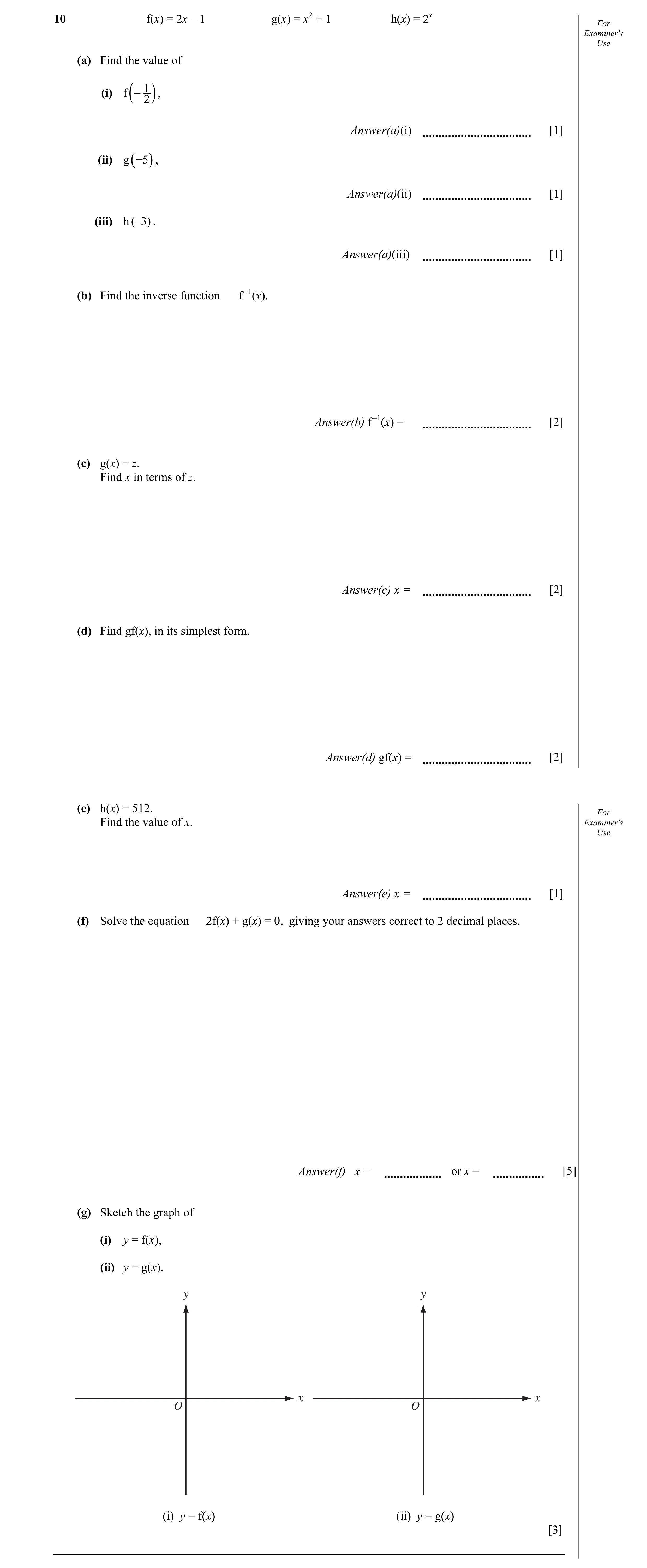
10 f(x) = 2x – 1 g(x) = x2 + 1 h(x) = 2x For Examiner's Use (a) Find the value of _ 1 (i) , f( 2 ) Answer(a)(i) [1] (ii) g( _5 ) , Answer(a)(ii) [1] _ (iii) h ( 3) . Answer(a)(iii) [1] (b) Find the inverse function f –1(x). Answer(b) f –1(x) = [2] (c) g(x) = z. Find x in terms of z. Answer(c) x = [2] (d) Find gf(x), in its simplest form. Answer(d) gf(x) = [2] (e) h(x) = 512. For Find the value of x. Examiner's Use Answer(e) x = [1] (f) Solve the equation 2f(x) + g(x) = 0, giving your answers correct to 2 decimal places. Answer(f) x = or x = [5] (g) Sketch the graph of (i) y = f(x), (ii) y = g(x). y y x x O O (i) y = f(x) (ii) y = g(x) [3]
18 marks
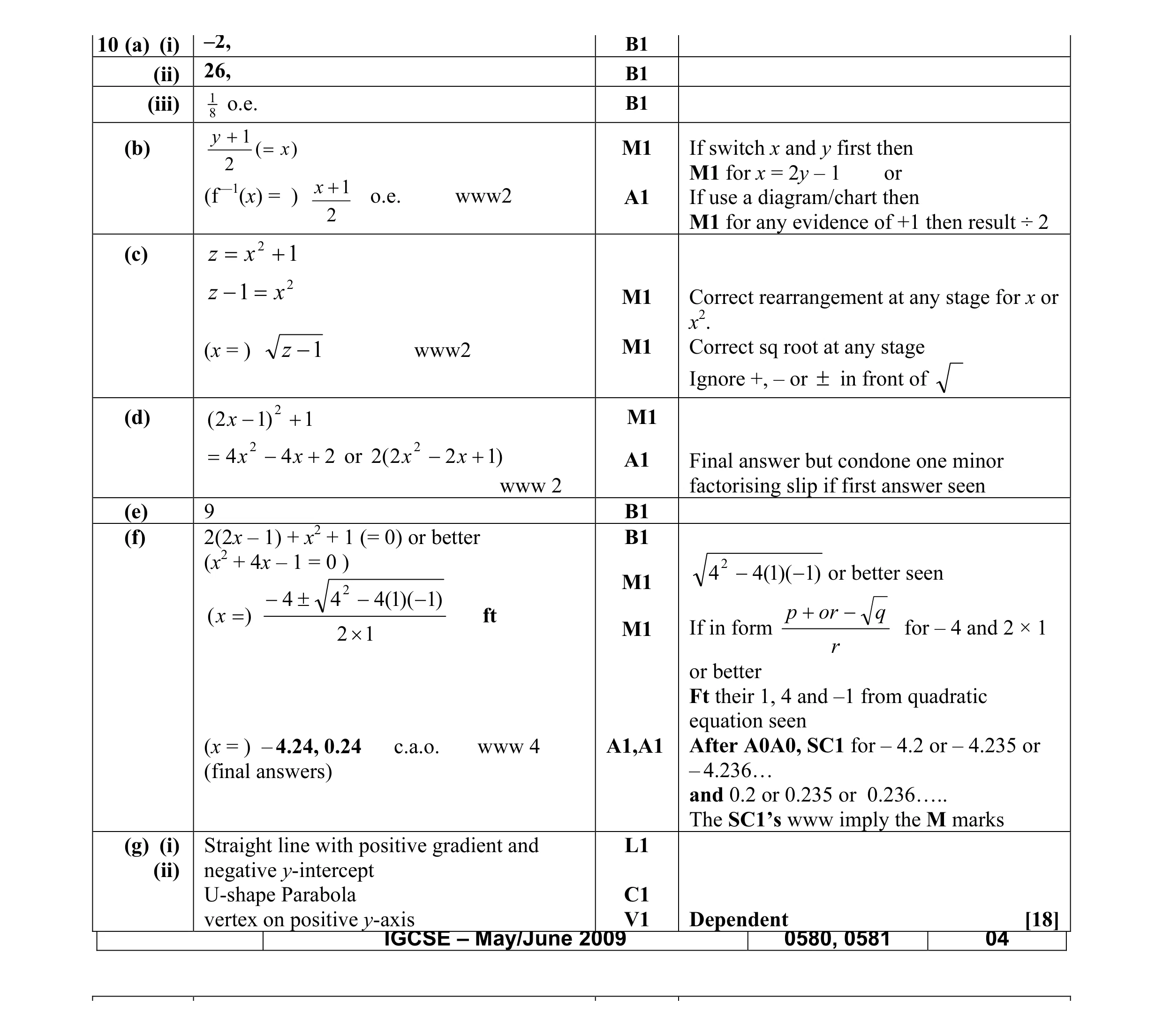
Mark scheme: 10 (a) (i) –2, B1 (ii) 26, B1 (iii) 18 o.e. B1 y + 1 (b) ( = x ) M1 If switch x and y first then 2 M1 for x = 2y – 1 or (f—1(x) = ) x + 1 o.e. www2 A1 If use a diagram/chart then 2 M1 for any evidence of +1 then result ÷ 2 (c) z = x 2 + 1 z − 1 = x 2 M1 Correct rearrangement at any stage for x or x2. (x = ) z − 1 www2 M1 Correct sq root at any stage Ignore +, – or ± in front of (d) ( 2 x − )1 2 + 1 M1 = 4 x 2 − 4 x + 2 or 2 ( 2 x 2 −x2 + )1 A1 Final answer but condone one minor www 2 factorising slip if first answer seen (e) 9 B1 (f) 2(2x – 1) + x2 + 1 (= 0) or better B1 (x2 + 4x – 1 = 0 ) 2 4 − 4 1()( −)1 or better seen 2 M1 − 4 ± 4 − 4 1()( −)1 ( x = ) ft p + or − q 2 × 1 M1 If in form for – 4 and 2 × 1 r or better Ft their 1, 4 and –1 from quadratic equation seen (x = ) – 4.24, 0.24 c.a.o. www 4 A1,A1 After A0A0, SC1 for – 4.2 or – 4.235 or (final answers) – 4.236… and 0.2 or 0.235 or 0.236….. The SC1’s www imply the M marks (g) (i) Straight line with positive gradient and L1 (ii) negative y-intercept U-shape Parabola C1 vertex on positive y-axis V1 Dependent [18] IGCSE – May/June 2009 0580, 0581 04
This question in 0580/41 May/June 2009
Q4 · F(x) = 6 + x2 g(x) = 4x –1 For Examiner's (a) Find Use (i) g(3), Answer(a)(i) [1] (ii) f… 0580/42 Oct/Nov 2010
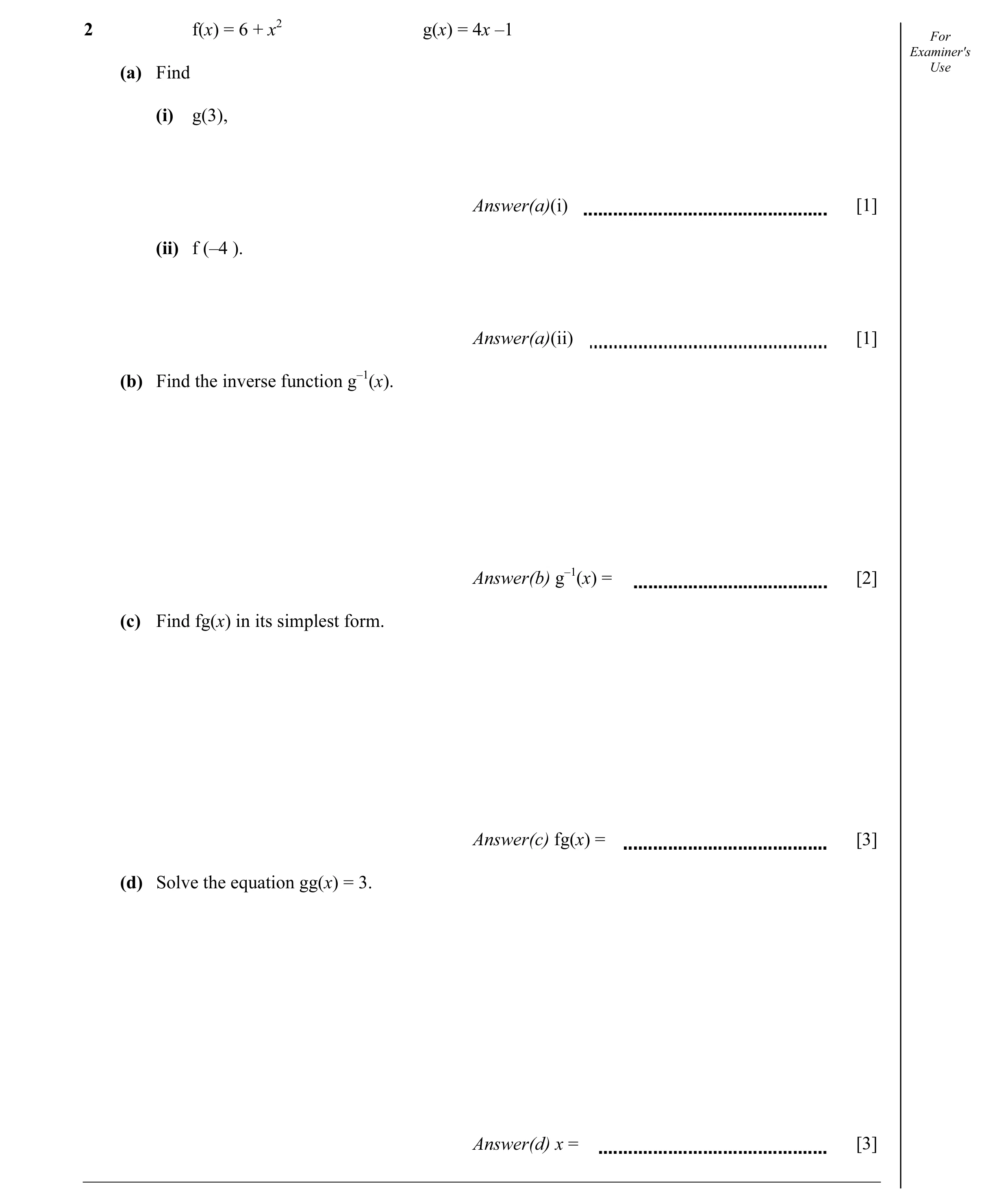
2 f(x) = 6 + x2 g(x) = 4x –1 For Examiner's (a) Find Use (i) g(3), Answer(a)(i) [1] (ii) f (–4 ). Answer(a)(ii) [1] (b) Find the inverse function g–1(x). Answer(b) g–1(x) = [2] (c) Find fg(x) in its simplest form. Answer(c) fg(x) = [3] (d) Solve the equation gg(x) = 3. Answer(d) x = [3]
10 marks
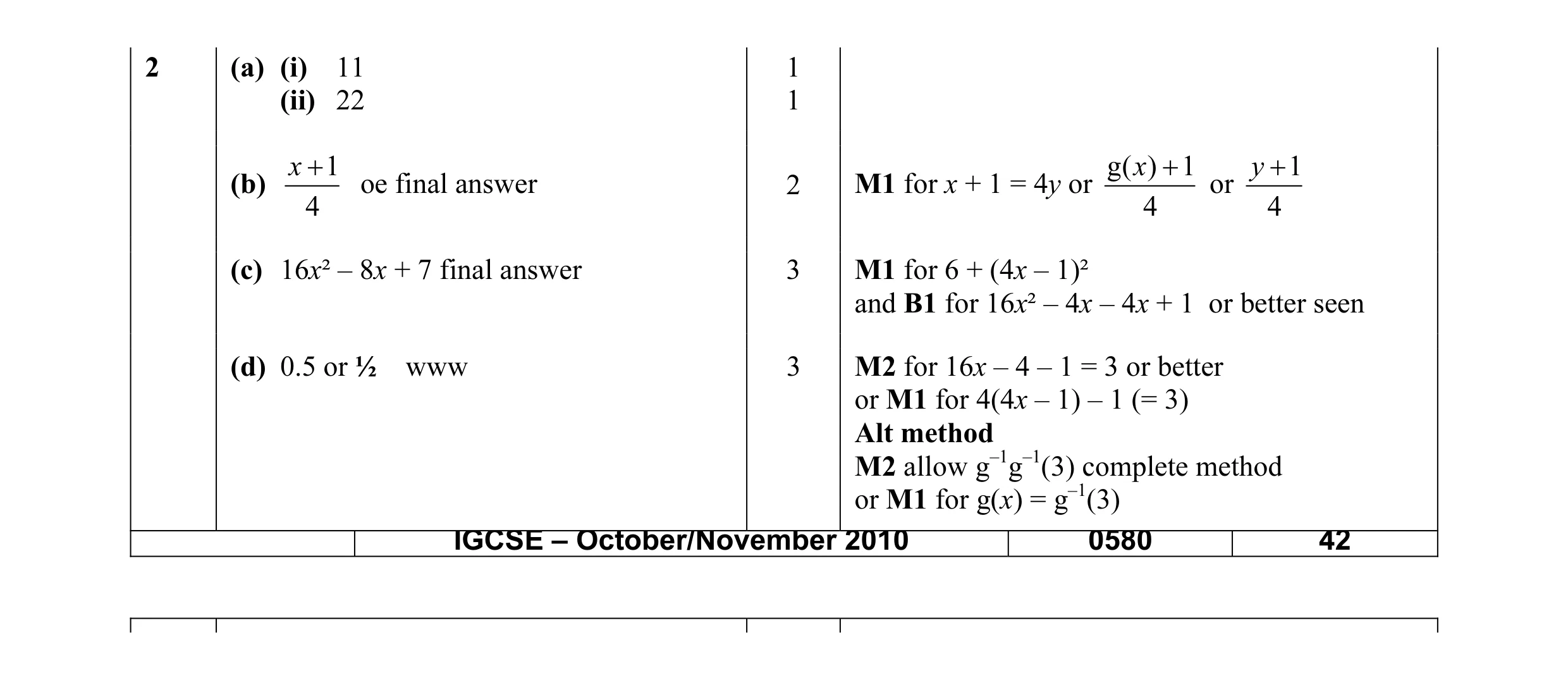
Mark scheme: 2 (a) (i) 11 1 (ii) 22 1 x + 1 g ( x ) + 1 y + 1 (b) oe final answer 2 M1 for x + 1 = 4y or or 4 4 4 (c) 16x² – 8x + 7 final answer 3 M1 for 6 + (4x – 1)² and B1 for 16x² – 4x – 4x + 1 or better seen (d) 0.5 or ½ www 3 M2 for 16x – 4 – 1 = 3 or better or M1 for 4(4x – 1) – 1 (= 3) Alt method M2 allow g–1g–1(3) complete method or M1 for g(x) = g–1(3) IGCSE – October/November 2010 0580 42
This question in 0580/42 Oct/Nov 2010
Q5 · For 9 f(x) = 1 – 2x g(x) = , x ≠ 0 h(x) = x3 + 1 Examiner's x Use (a) Find the value of… 0580/43 May/June 2012
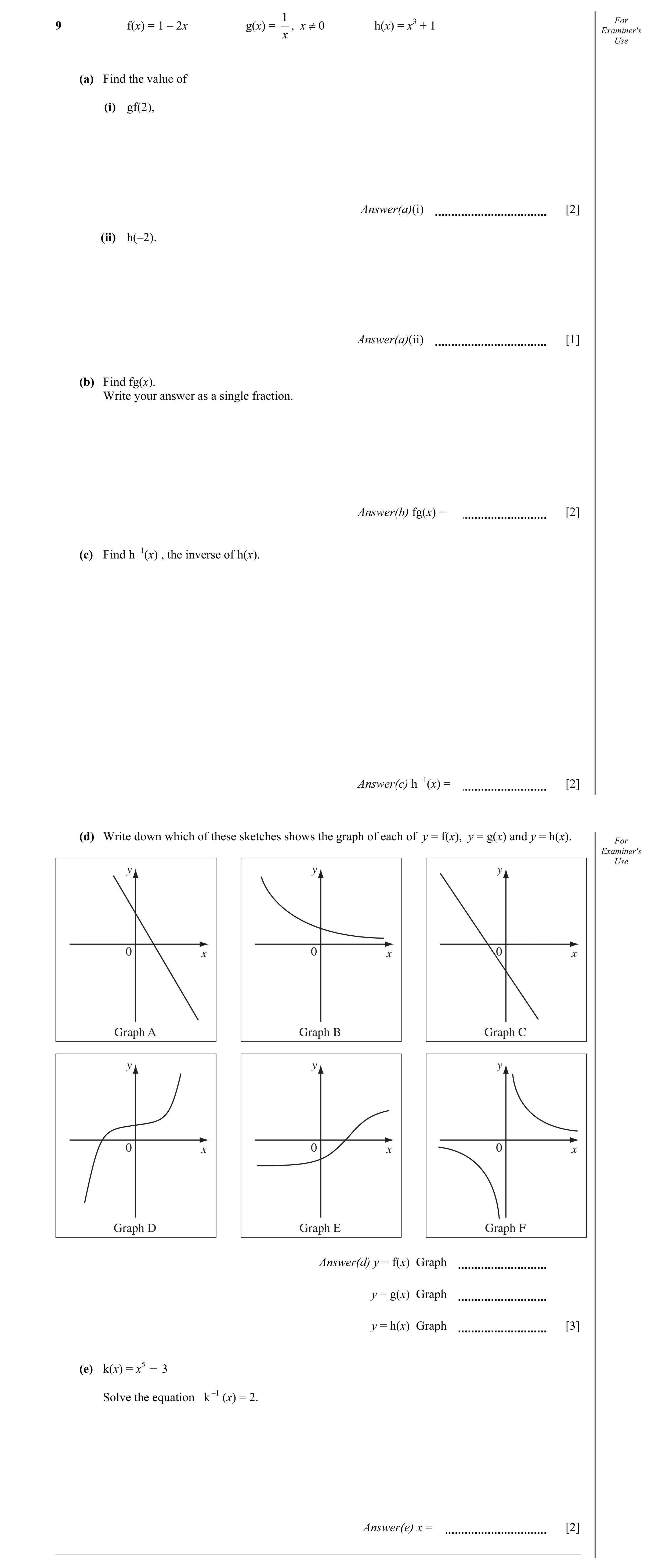
1 For 9 f(x) = 1 – 2x g(x) = , x ≠ 0 h(x) = x3 + 1 Examiner's x Use (a) Find the value of (i) gf(2), Answer(a)(i) [2] (ii) h(–2). Answer(a)(ii) [1] (b) Find fg(x). Write your answer as a single fraction. Answer(b) fg(x) = [2] (c) Find h –1(x) , the inverse of h(x). Answer(c) h –1(x) = [2] (d) Write down which of these sketches shows the graph of each of y = f(x), y = g(x) and y = h(x). For Examiner's Use y y y 0 x 0 x 0 x Graph A Graph B Graph C y y y 0 x 0 x 0 x Graph D Graph E Graph F Answer(d) y = f(x) Graph y = g(x) Graph y = h(x) Graph [3] (e) k(x) = x5 O=3 Solve the equation k –1 (x) = 2. Answer(e) x = [2]
12 marks
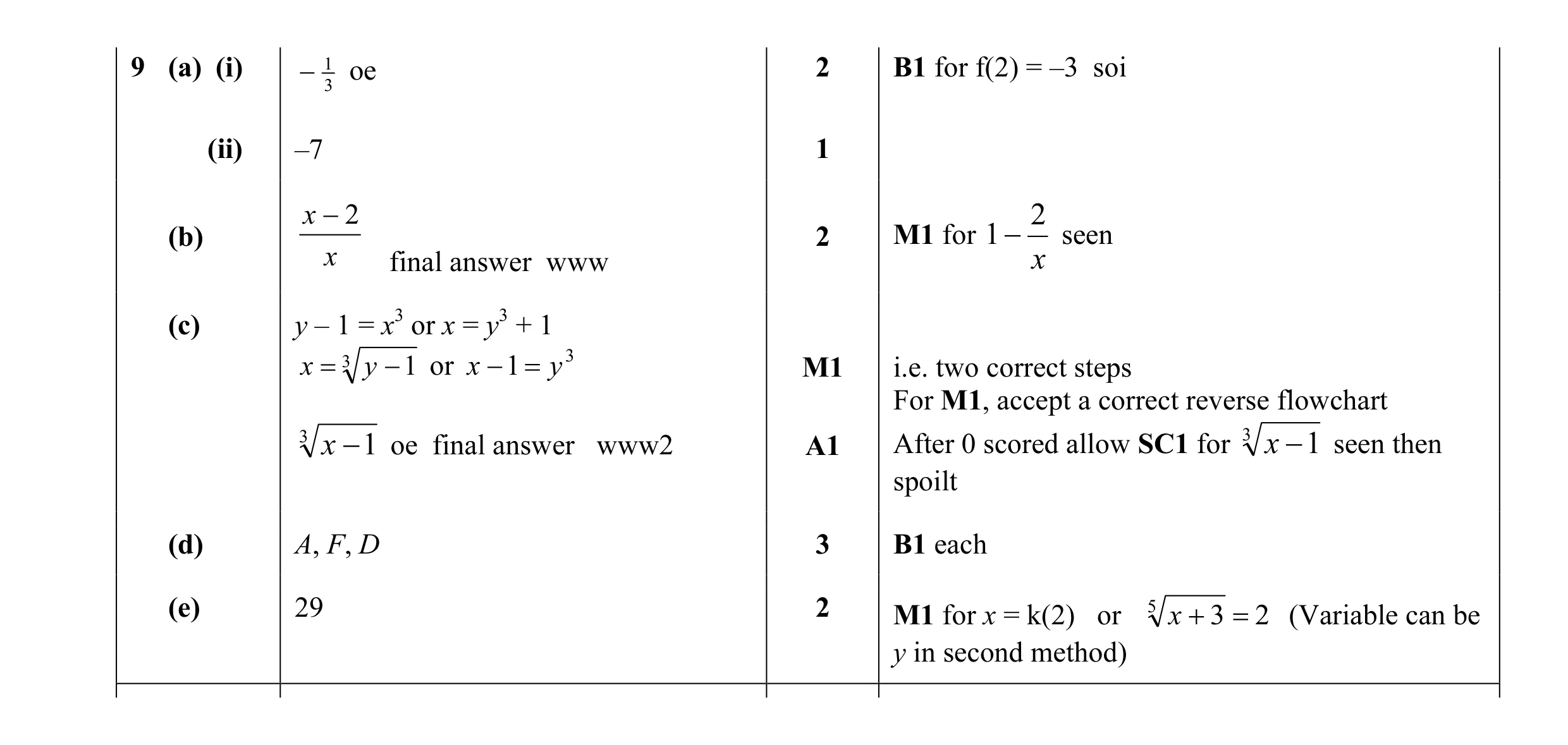
Mark scheme: 9 (a) (i) 2 B1 for f(2) = –3 soi − 1 3 oe (ii) –7 1 x − 2 2 (b) 2 M1 for 1− seen x final answer www x (c) y – 1 = x3 or x = y3 + 1 x = 3 y − 1 or x − 1 = y 3 M1 i.e. two correct steps For M1, accept a correct reverse flowchart 3 x − 1 oe final answer www2 A1 After 0 scored allow SC1 for 3 x − 1 seen then spoilt (d) A, F, D 3 B1 each 5 x + 3 = 2 (Variable can be (e) 29 2 M1 for x = k(2) or y in second method)
This question in 0580/43 May/June 2012
Q6 · F(x) = x2 + x – 3 g(x) = 2x + 7 h(x) = 2x Examiner′s Use (a) Solve the equation f(x) = 0 0580/41 May/June 2013
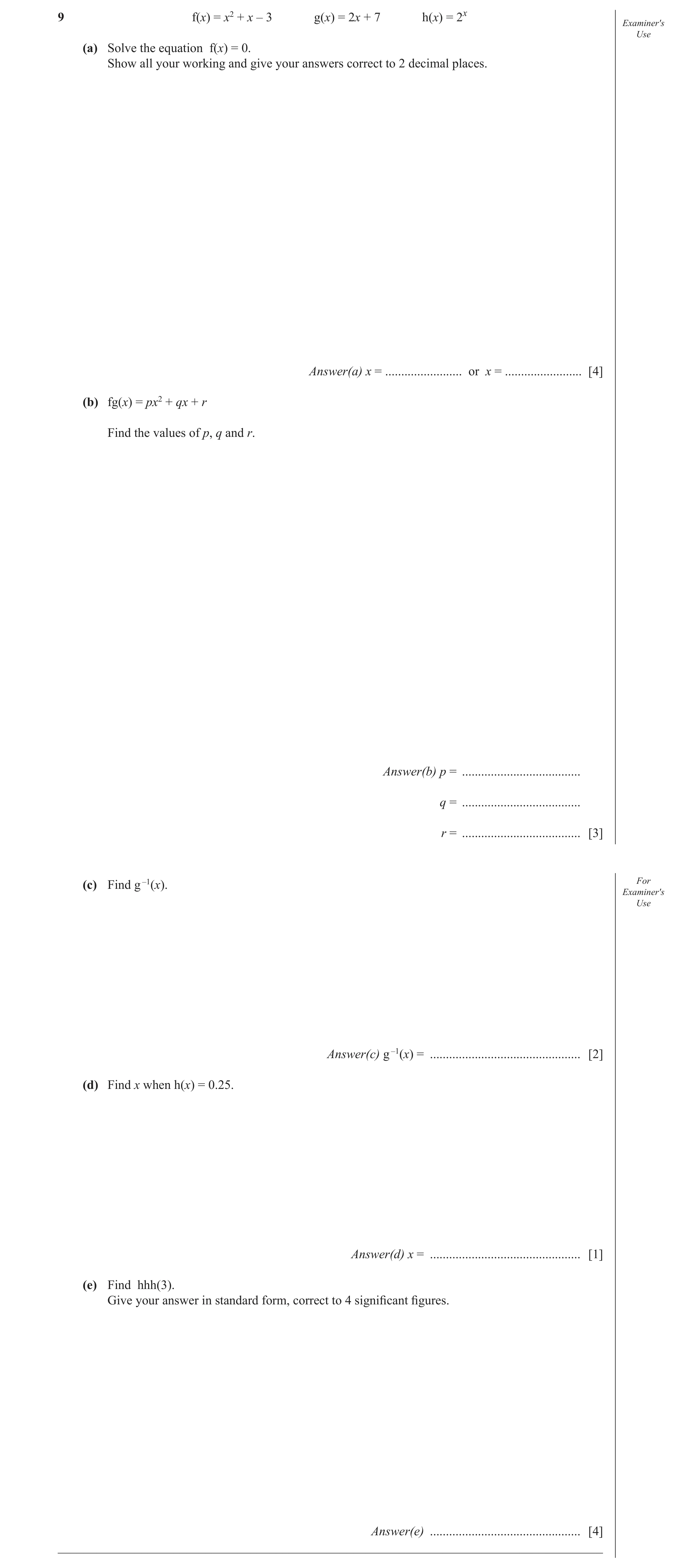
9 f(x) = x2 + x – 3 g(x) = 2x + 7 h(x) = 2x Examiner′s Use (a) Solve the equation f(x) = 0. Show all your working and give your answers correct to 2 decimal places. Answer(a) x = … or x = … [4] (b) fg(x) = px2 + qx + r Find the values of p, q and r. Answer(b) p = … q = … r = … [3] (c) Find g –1(x). For Examiner′s Use Answer(c) g –1(x) = … [2] (d) Find x when h(x) = 0.25. Answer(d) x = … [1] (e) Find hhh(3). Give your answer in standard form, correct to 4 signifi cant fi gures. Answer(e) … [4] _____________________________________________________________________________________
14 marks
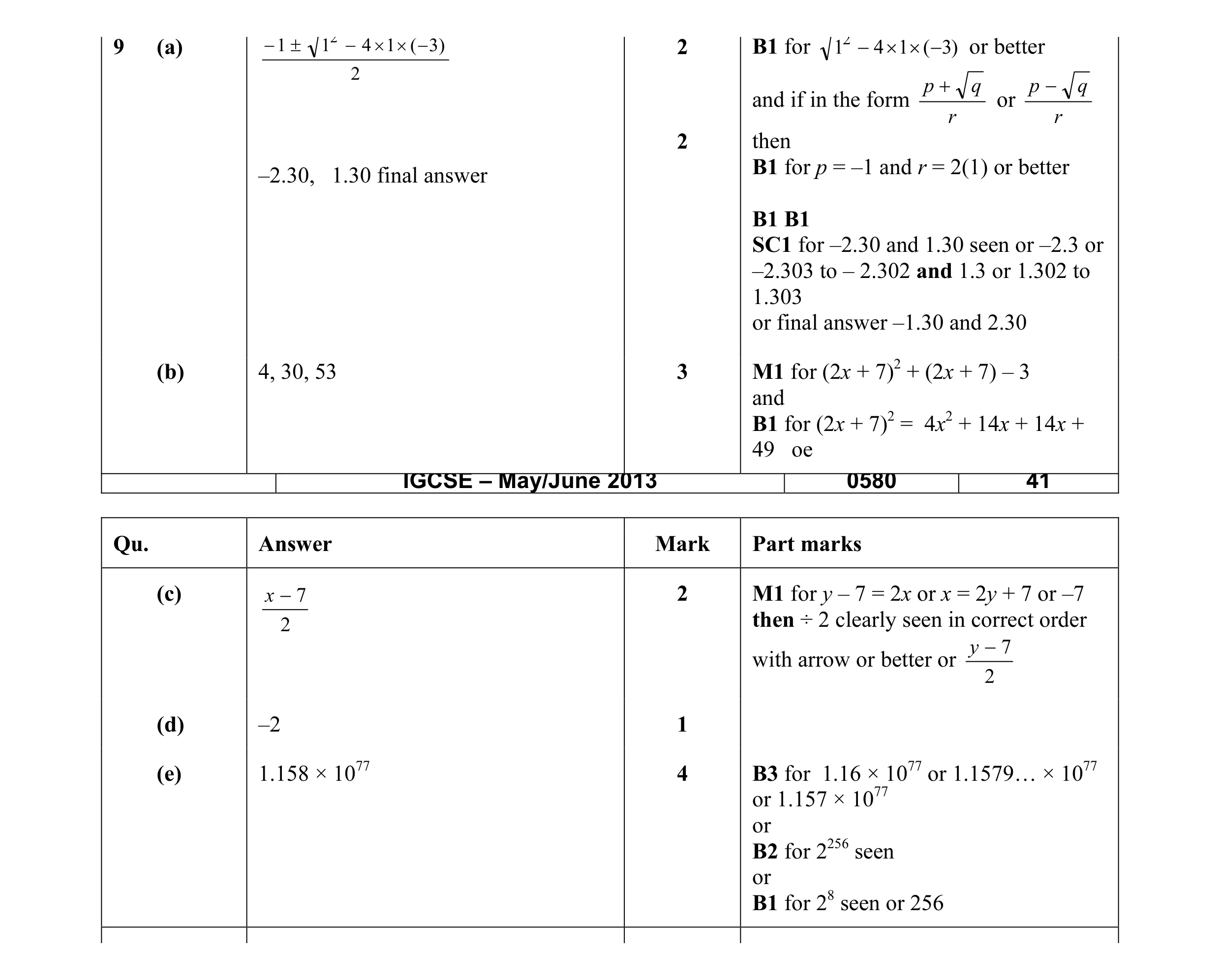
Mark scheme: 9 (a) − 1 ± 12 − 4 × 1 × ( − 3 ) 2 B1 for 12 − 4 × 1 × ( − )3 or better 2 + − p q p q and if in the form or r r 2 then B1 for p = –1 and r = 2(1) or better –2.30, 1.30 final answer B1 B1 SC1 for –2.30 and 1.30 seen or –2.3 or –2.303 to – 2.302 and 1.3 or 1.302 to 1.303 or final answer –1.30 and 2.30 (b) 4, 30, 53 3 M1 for (2x + 7)2 + (2x + 7) – 3 and B1 for (2x + 7)2 = 4x2 + 14x + 14x + 49 oe IGCSE – May/June 2013 0580 41 Qu. Answer Mark Part marks (c) x − 7 2 M1 for y – 7 = 2x or x = 2y + 7 or –7 2 then ÷ 2 clearly seen in correct order − 7 y with arrow or better or 2 (d) –2 1 (e) 1.158 × 1077 4 B3 for 1.16 × 1077 or 1.1579… × 1077 or 1.157 × 1077 or B2 for 2256 seen or B1 for 28 seen or 256
This question in 0580/41 May/June 2013
Q7 · (x ¸ –1) h(x) = x2 + 5x Examiner′s8 f(x) = 4x + 3 g(x) = x + 1 Use (a) Work out (i)… 0580/42 Oct/Nov 2013
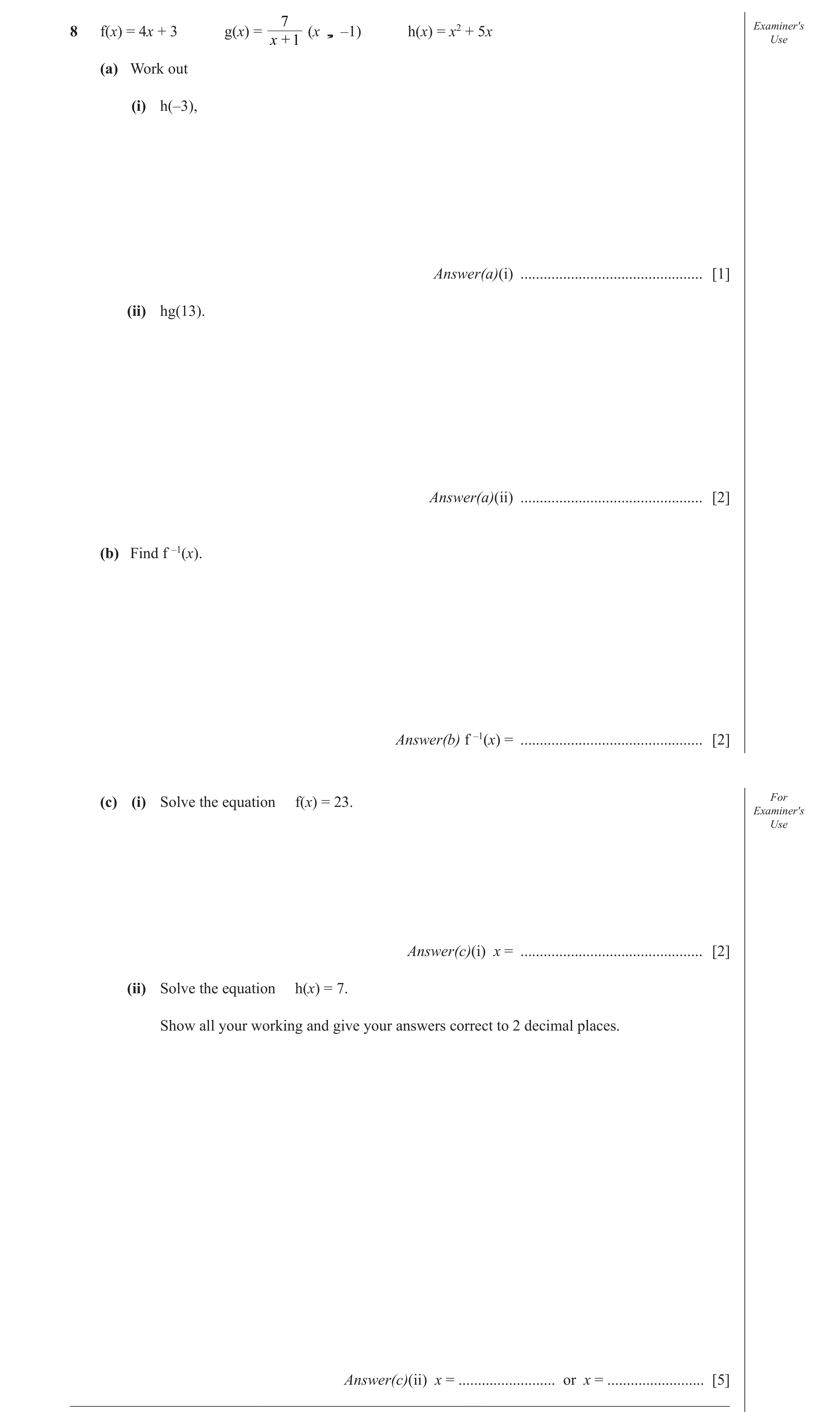
7 (x ¸ –1) h(x) = x2 + 5x Examiner′s8 f(x) = 4x + 3 g(x) = x + 1 Use (a) Work out (i) h(–3), Answer(a)(i) … [1] (ii) hg(13). Answer(a)(ii) … [2] (b) Find f –1(x). Answer(b) f –1(x) = … [2] (c) (i) Solve the equation f(x) = 23. For Examiner′s Use Answer(c)(i) x = … [2] (ii) Solve the equation h(x) = 7. Show all your working and give your answers correct to 2 decimal places. Answer(c)(ii) x = … or x = … [5] _____________________________________________________________________________________
12 marks
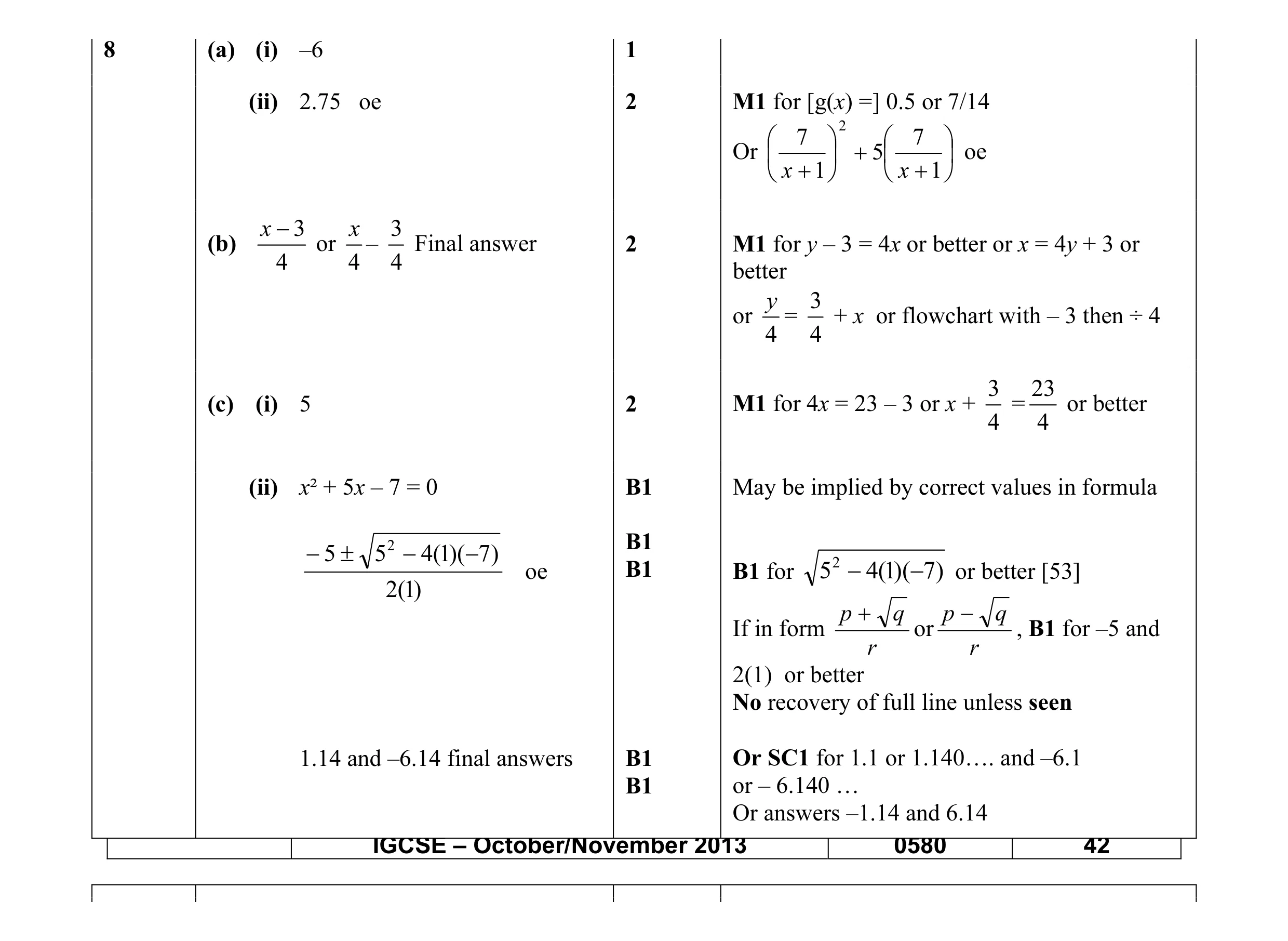
Mark scheme: 8 (a) (i) –6 1 (ii) 2.75 oe 2 M1 for [g(x) =] 0.5 or 7/14 7 2 7 Or + 5 oe x + 1 x + 1 x − 3 x 3 (b) or – Final answer 2 M1 for y – 3 = 4x or better or x = 4y + 3 or 4 4 4 better 3 y or = + x or flowchart with – 3 then ÷ 4 4 4 3 23 (c) (i) 5 2 M1 for 4x = 23 – 3 or x + = or better 4 4 (ii) x² + 5x – 7 = 0 B1 May be implied by correct values in formula − 5 ± 5 2 − 41()( −7 ) B1 oe B1 B1 for 52 − 41()(−7) or better [53] 2)1( + − p q p q If in form or , B1 for –5 and r r 2(1) or better No recovery of full line unless seen 1.14 and –6.14 final answers B1 Or SC1 for 1.1 or 1.140…. and –6.1 B1 or – 6.140 … Or answers –1.14 and 6.14 IGCSE – October/November 2013 0580 42
This question in 0580/42 Oct/Nov 2013
Q8 · 0 (a) f(x) = 2x – 3 g(x) = + 2 h(x) = 3x x + 1 (i) Work out f(4) 0580/41 May/June 2014
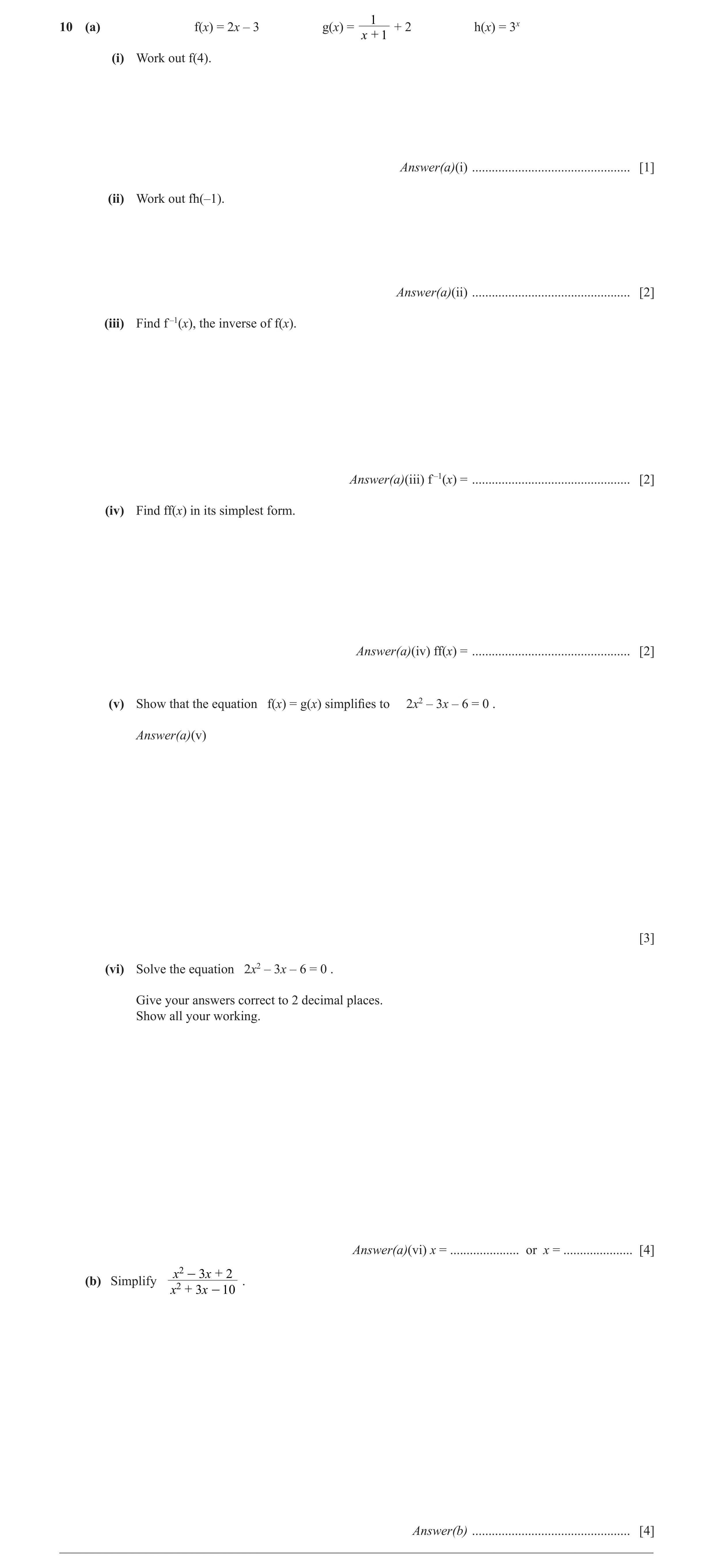
110 (a) f(x) = 2x – 3 g(x) = + 2 h(x) = 3x x + 1 (i) Work out f(4). Answer(a)(i) … [1] (ii) Work out fh(–1). Answer(a)(ii) … [2] (iii) Find f –1(x), the inverse of f(x). Answer(a)(iii) f –1(x) = … [2] (iv) Find ff(x) in its simplest form. Answer(a)(iv) ff(x) = … [2] (v) Show that the equation f(x) = g(x) simplifi es to 2x2 – 3x – 6 = 0 . Answer(a)(v) [3] (vi) Solve the equation 2x2 – 3x – 6 = 0 . Give your answers correct to 2 decimal places. Show all your working. Answer(a)(vi) x = … or x = … [4] x2 - 3 x + 2 (b) Simplify 2 . x + 3 x - 10 Answer(b) … [4] __________________________________________________________________________________________
18 marks
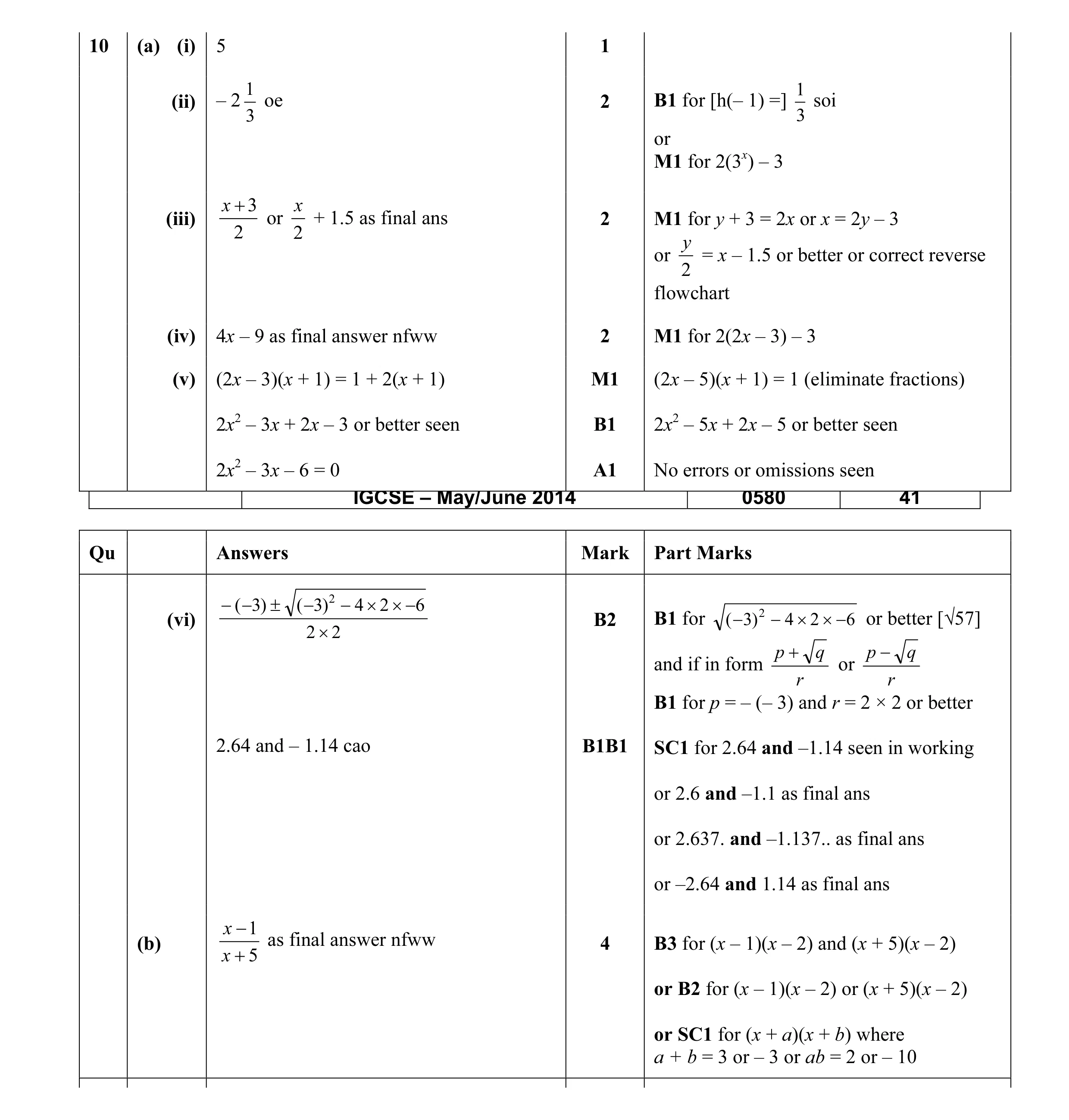
Mark scheme: 10 (a) (i) 5 1 1 1 (ii) – 2 oe 2 B1 for [h(– 1) =] soi 3 3 or M1 for 2(3x) – 3 x + 3 x (iii) or + 1.5 as final ans 2 M1 for y + 3 = 2x or x = 2y – 3 2 2 y or = x – 1.5 or better or correct reverse 2 flowchart (iv) 4x – 9 as final answer nfww 2 M1 for 2(2x – 3) – 3 (v) (2x – 3)(x + 1) = 1 + 2(x + 1) M1 (2x – 5)(x + 1) = 1 (eliminate fractions) 2x2 – 3x + 2x – 3 or better seen B1 2x2 – 5x + 2x – 5 or better seen 2x2 – 3x – 6 = 0 A1 No errors or omissions seen IGCSE – May/June 2014 0580 41 Qu Answers Mark Part Marks − ( −3) ± ( −3) 2 − 4 × 2 × −6 (vi) B2 B1 for ( − 3) 2 − 4 × 2 × − 6 or better [√57] 2 × 2 p + q p − q and if in form or r r B1 for p = – (– 3) and r = 2 × 2 or better 2.64 and – 1.14 cao B1B1 SC1 for 2.64 and –1.14 seen in working or 2.6 and –1.1 as final ans or 2.637. and –1.137.. as final ans or –2.64 and 1.14 as final ans x − 1 (b) as final answer nfww 4 B3 for (x – 1)(x – 2) and (x + 5)(x – 2) x + 5 or B2 for (x – 1)(x – 2) or (x + 5)(x – 2) or SC1 for (x + a)(x + b) where a + b = 3 or – 3 or ab = 2 or – 10
This question in 0580/41 May/June 2014
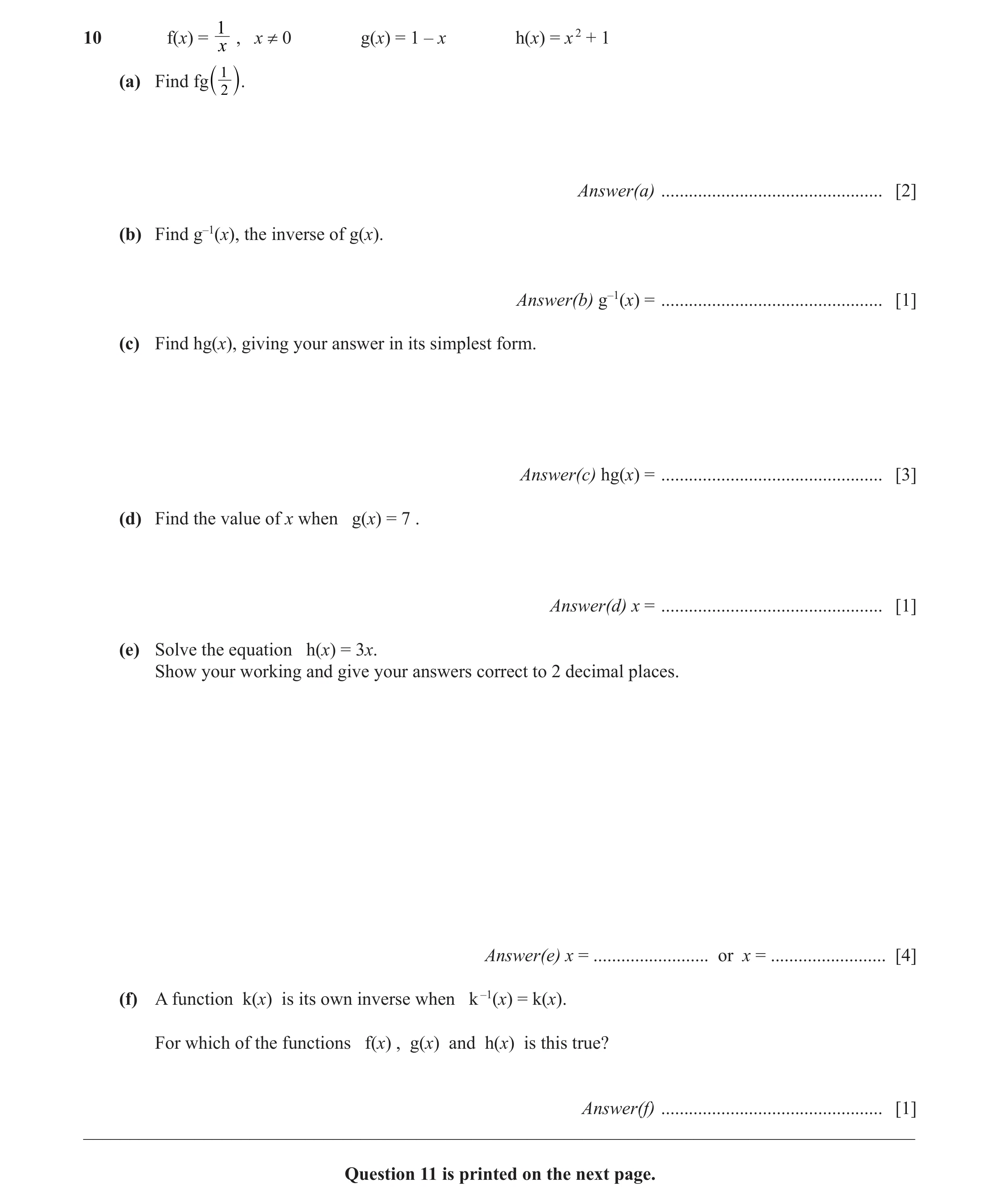
Q9 · 210 f(x) = , x ≠ 0 g(x) = 1 – x h(x) = x + 1 x 1 (a) Find fg 2 ` j 0580/42 May/June 2014
1 210 f(x) = , x ≠ 0 g(x) = 1 – x h(x) = x + 1 x 1 (a) Find fg 2 ` j. Answer(a) … [2] (b) Find g–1(x), the inverse of g(x). Answer(b) g–1(x) = … [1] (c) Find hg(x), giving your answer in its simplest form. Answer(c) hg(x) = … [3] (d) Find the value of x when g(x) = 7 . Answer(d) x = … [1] (e) Solve the equation h(x) = 3x. Show your working and give your answers correct to 2 decimal places. Answer(e) x = … or x = … [4] (f) A function k(x) is its own inverse when k –1(x) = k(x). For which of the functions f(x) , g(x) and h(x) is this true? Answer(f) … [1] __________________________________________________________________________________________ Question 11 is printed on the next page.
12 marks
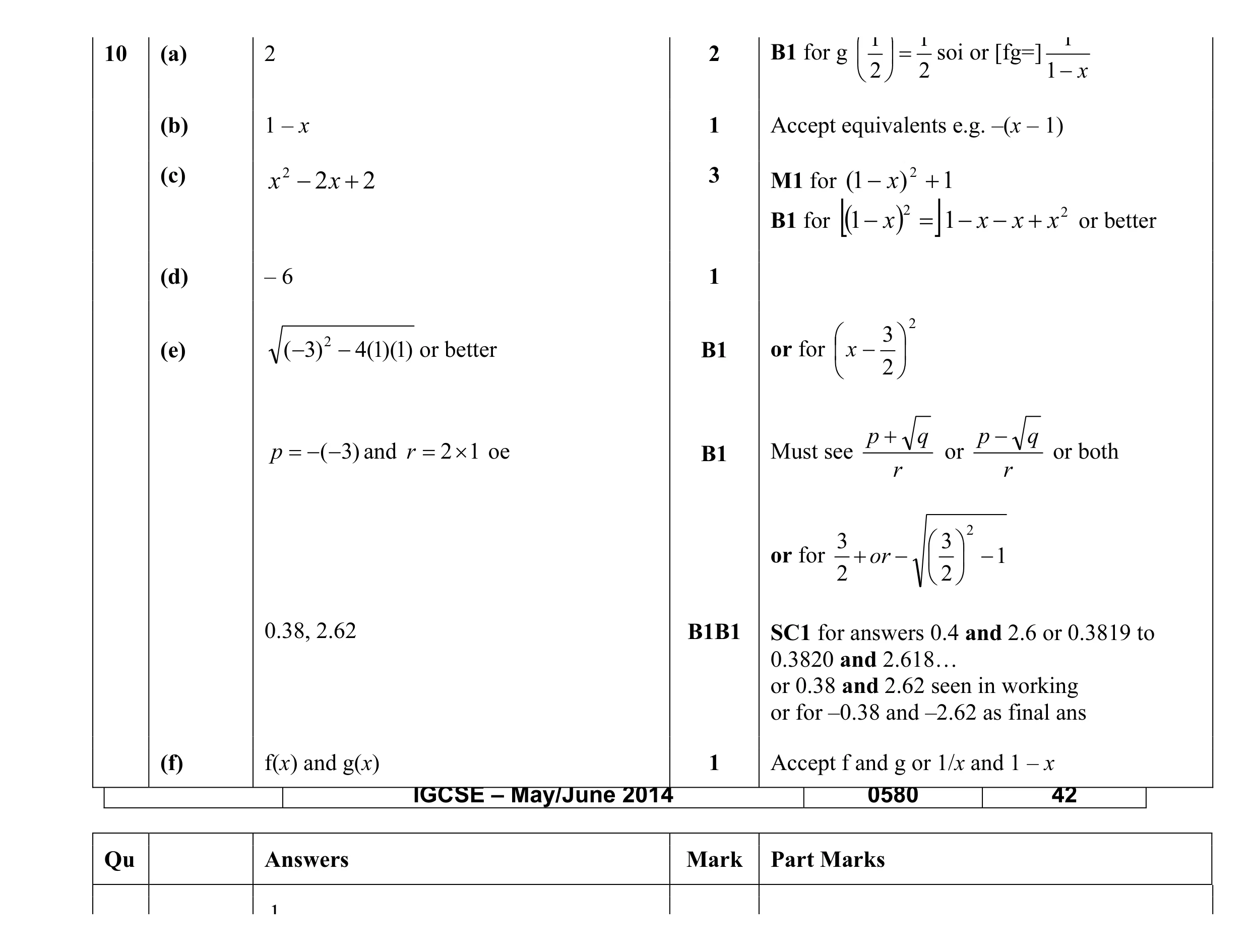
Mark scheme: 1 1 110 (a) 2 2 B1 for g = soi or [fg=] 2 2 1 − x (b) 1 – x 1 Accept equivalents e.g. –(x – 1) (c) x 2 −x2 + 2 3 M1 for 1( −x ) 2 + 1 2 or better B1 for [(1 − x ) 2 = ] 1 − x − x + x (d) – 6 1 2 2 3 (e) ( −3) − 41()()1 or better B1 or for x − 2 p + q p − q p = − (−3) and r = 2× 1 oe B1 Must see or or both r r 2 3 3 or for + or − − 1 2 2 0.38, 2.62 B1B1 SC1 for answers 0.4 and 2.6 or 0.3819 to 0.3820 and 2.618… or 0.38 and 2.62 seen in working or for –0.38 and –2.62 as final ans (f) f(x) and g(x) 1 Accept f and g or 1/x and 1 – x IGCSE – May/June 2014 0580 42 Qu Answers Mark Part Marks 1
This question in 0580/42 May/June 2014
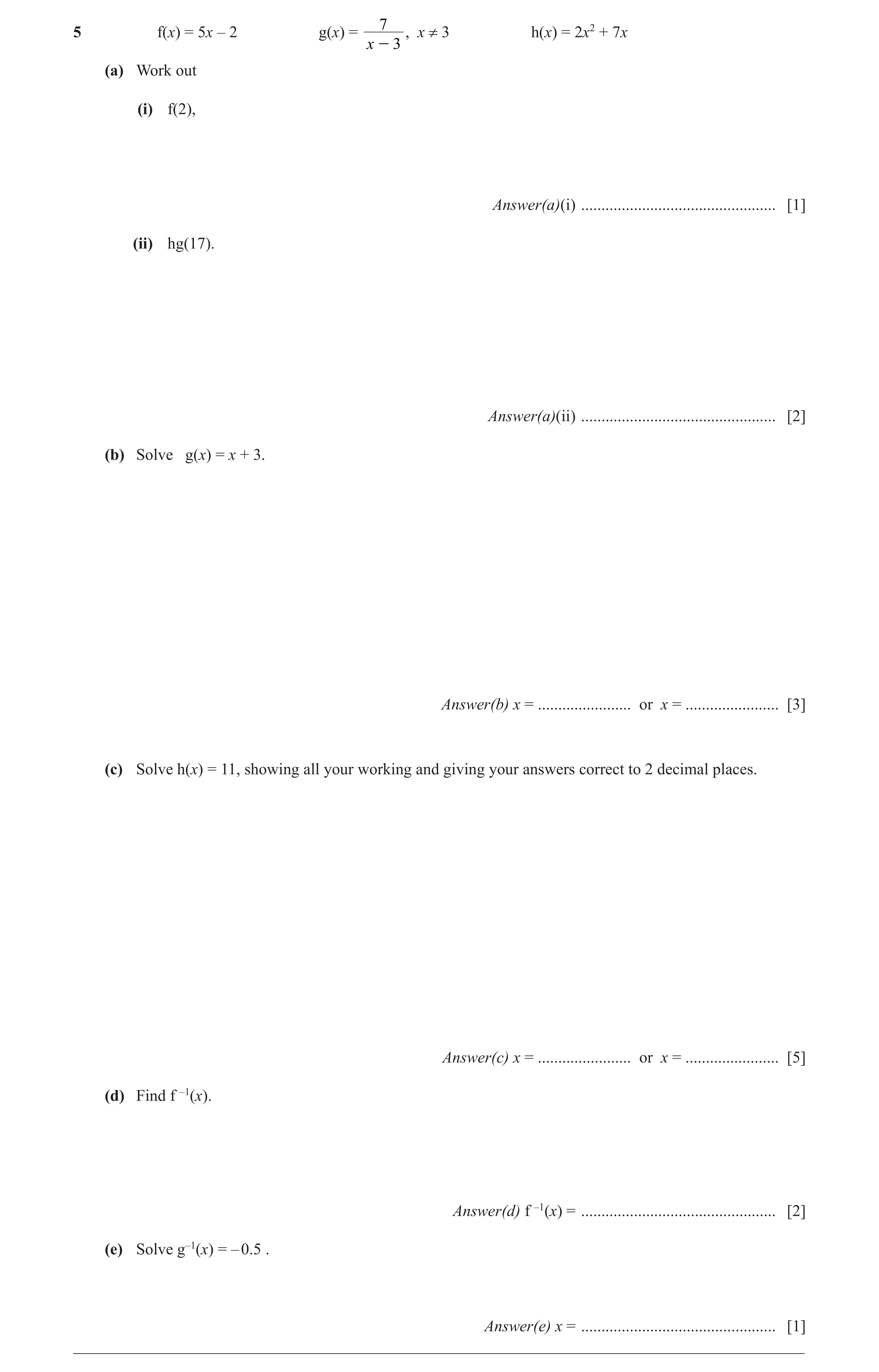
Q10 · F(x) = 5x – 2 g(x) = , x ≠ 3 h(x) = 2x2 + 7x x - 3 (a) Work out (i) f(2), Answer(a)(i) …… 0580/42 Oct/Nov 2014
75 f(x) = 5x – 2 g(x) = , x ≠ 3 h(x) = 2x2 + 7x x - 3 (a) Work out (i) f(2), Answer(a)(i) … [1] (ii) hg(17). Answer(a)(ii) … [2] (b) Solve g(x) = x + 3. Answer(b) x = … or x = … [3] (c) Solve h(x) = 11, showing all your working and giving your answers correct to 2 decimal places. Answer(c) x = … or x = … [5] (d) Find f –1(x). Answer(d) f –1(x) = … [2] (e) Solve g–1(x) = – 0.5 . Answer(e) x = … [1] __________________________________________________________________________________________
14 marks
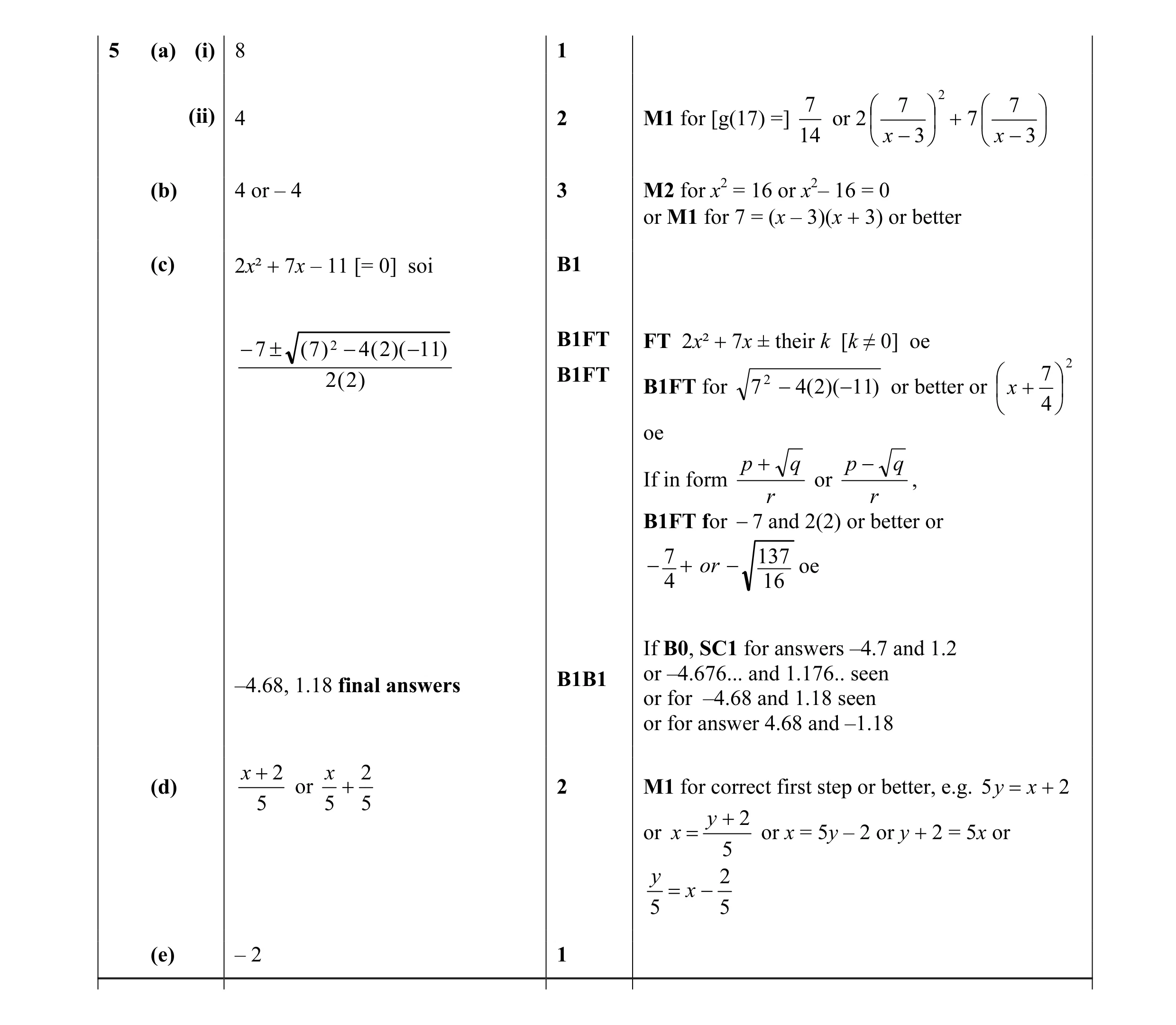
Mark scheme: 5 (a) (i) 8 1 2 7 7 7 (ii) or 2 + 7 4 2 M1 for [g(17) =] 14 x − 3 x −3 (b) 4 or – 4 3 M2 for x2 = 16 or x2– 16 = 0 or M1 for 7 = (x – 3)(x + 3) or better (c) 2x² + 7x – 11 [= 0] soi B1 2 B1FT FT 2x² + 7x ± their k [k ≠ 0] oe − 7 ± ( 7 ) − 4 ( 2 )( −11) 2 B1FT 7 2 ( 2 ) B1FT for 7 2 − 4 ( 2)( −11) or better or x + 4 oe p + q p − q If in form or , r r B1FT for − 7 and 2(2) or better or 7 137 − + or − oe 4 16 If B0, SC1 for answers –4.7 and 1.2 B1B1 or –4.676... and 1.176.. seen –4.68, 1.18 final answers or for –4.68 and 1.18 seen or for answer 4.68 and –1.18 x + 2 x 2 (d) or + 2 M1 for correct first step or better, e.g. 5 y = x + 2 5 5 5 y + 2 or x = or x = 5y – 2 or y + 2 = 5x or 5 y 2 = x − 5 5 (e) – 2 1
This question in 0580/42 Oct/Nov 2014
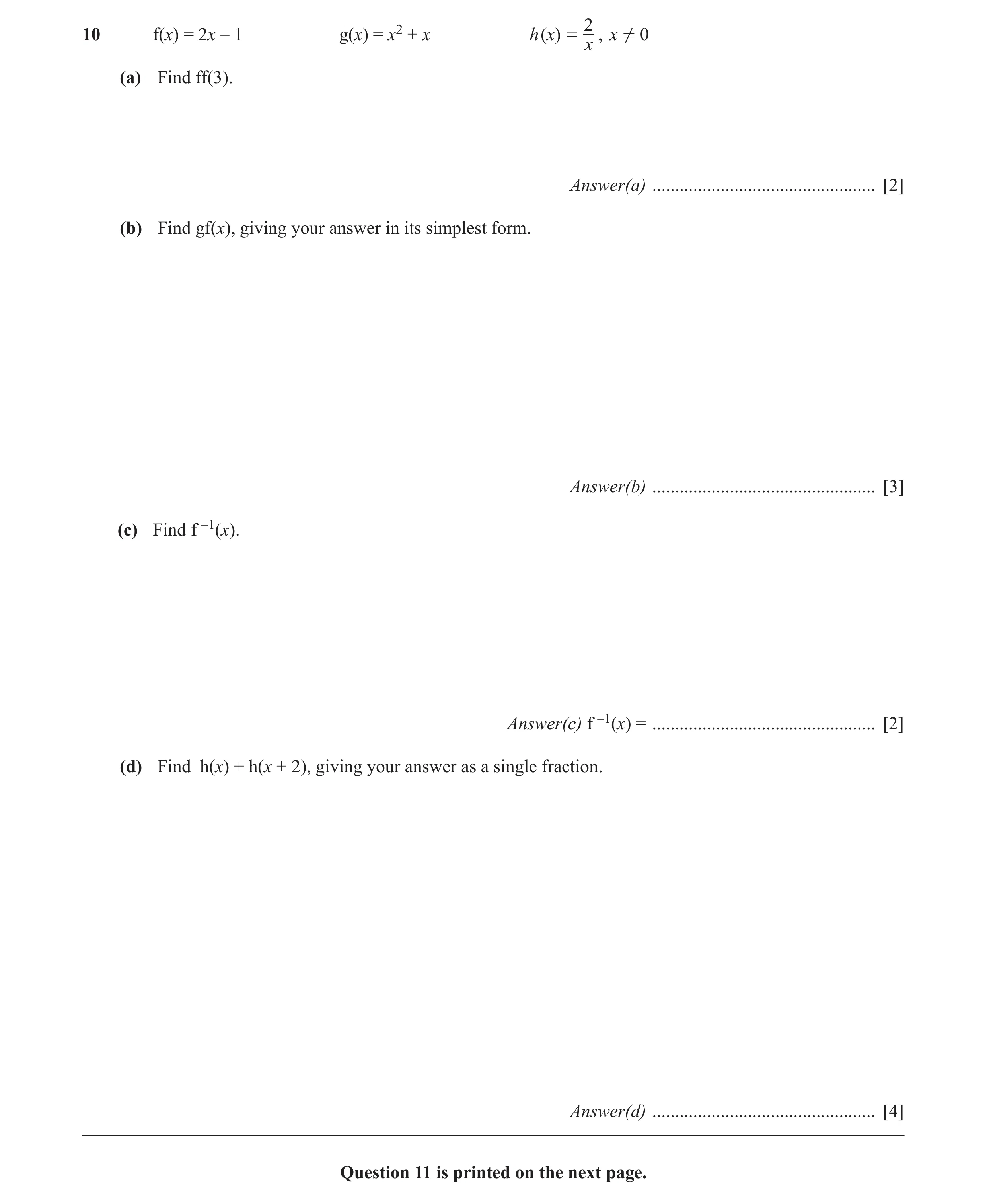
Q11 · F(x) = 2x – 1 g(x) = x2 + x h ( x) = 2 , x ! 0580/43 May/June 2015
10 f(x) = 2x – 1 g(x) = x2 + x h ( x) = 2 , x ! 0 x (a) Find ff(3). Answer(a) … [2] (b) Find gf(x), giving your answer in its simplest form. Answer(b) … [3] (c) Find f –1(x). Answer(c) f –1(x) = … [2] (d) Find h(x) + h(x + 2), giving your answer as a single fraction. Answer(d) … [4] Question 11 is printed on the next page.
11 marks
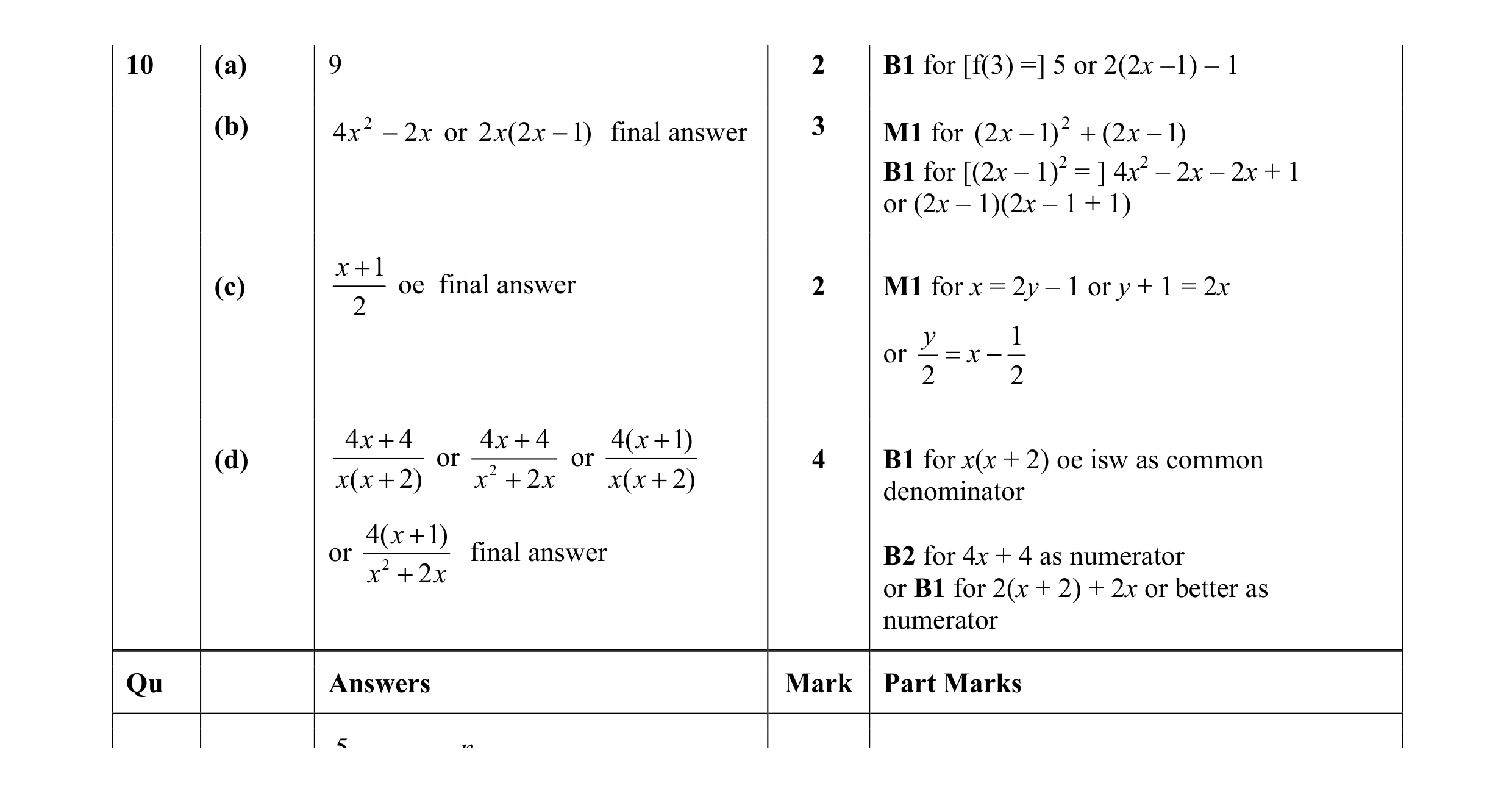
Mark scheme: 10 (a) 9 2 B1 for [f(3) =] 5 or 2(2x –1) – 1 (b) 2 + ( 2 x − )1 4 x 2 − 2 x or 2 x ( 2 x − )1 final answer 3 M1 for ( 2 x − )1 B1 for [(2x – 1)2 = ] 4x2 – 2x – 2x + 1 or (2x – 1)(2x – 1 + 1) x + 1 (c) oe final answer 2 M1 for x = 2y – 1 or y + 1 = 2x 2 y 1 or = x − 2 2 4 x + 4 4 x + 4 4( x + )1 (d) or 2 or 4 B1 for x(x + 2) oe isw as common x ( x + 2) x + 2 x x ( x + 2) denominator 4 ( x + )1 or 2 final answer B2 for 4x + 4 as numerator x + 2 x or B1 for 2(x + 2) + 2x or better as numerator Qu Answers Mark Part Marks 5 n
This question in 0580/43 May/June 2015
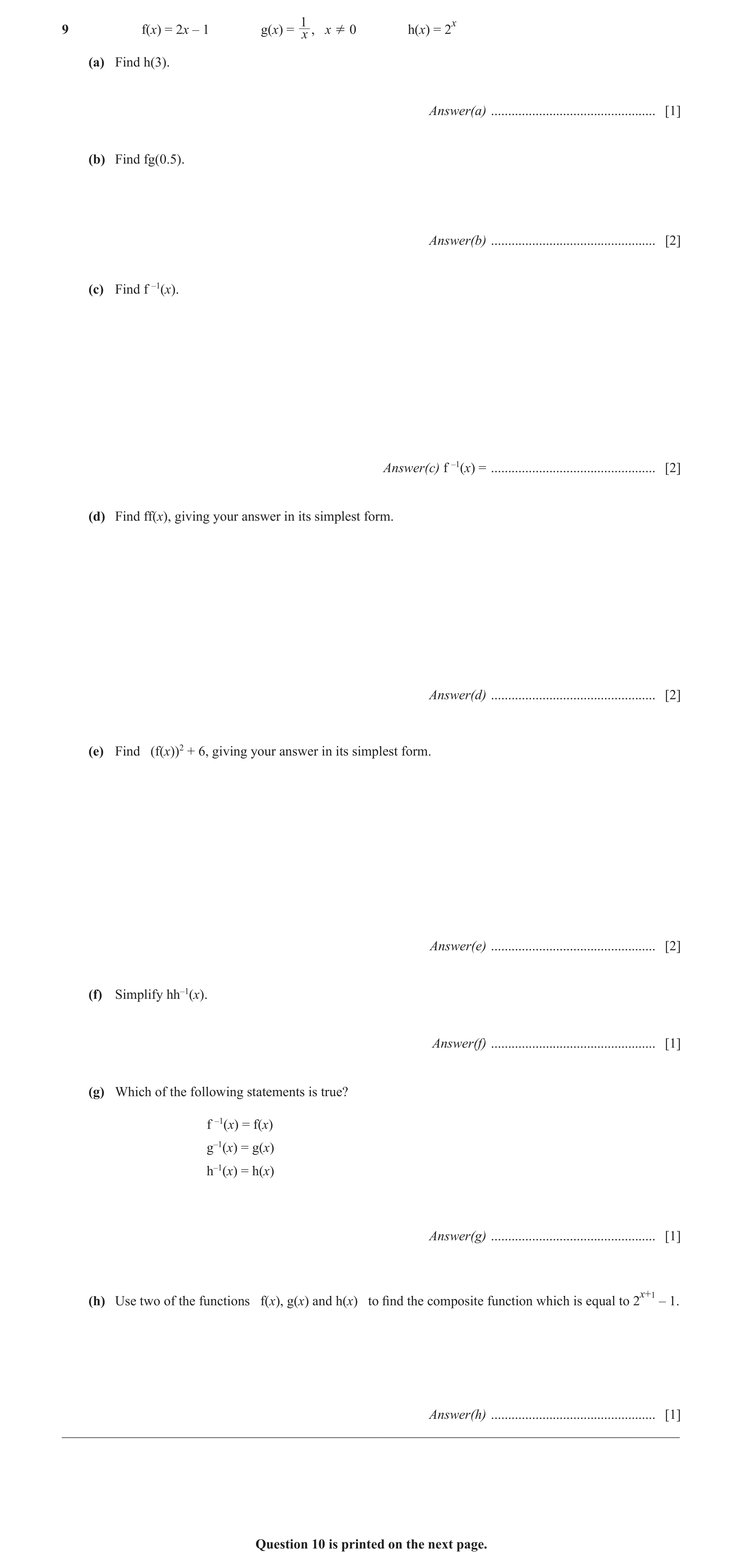
Q12 · F(x) = 2x – 1 g(x) = , x 0 h(x) = 2x x (a) Find h(3) 0580/43 Oct/Nov 2015
19 f(x) = 2x – 1 g(x) = , x 0 h(x) = 2x x (a) Find h(3). Answer(a) … [1] (b) Find fg(0.5). Answer(b) … [2] (c) Find f –1(x). Answer(c) f –1(x) = … [2] (d) Find ff(x), giving your answer in its simplest form. Answer(d) … [2] (e) Find (f(x))2 + 6, giving your answer in its simplest form. Answer(e) … [2] (f) Simplify hh–1(x). Answer(f) … [1] (g) Which of the following statements is true? f –1(x) = f(x) g–1(x) = g(x) h–1(x) = h(x) Answer(g) … [1] (h) Use two of the functions f(x), g(x) and h(x) to find the composite function which is equal to 2x+1 – 1. Answer(h) … [1] __________________________________________________________________________________________ Question 10 is printed on the next page.
12 marks
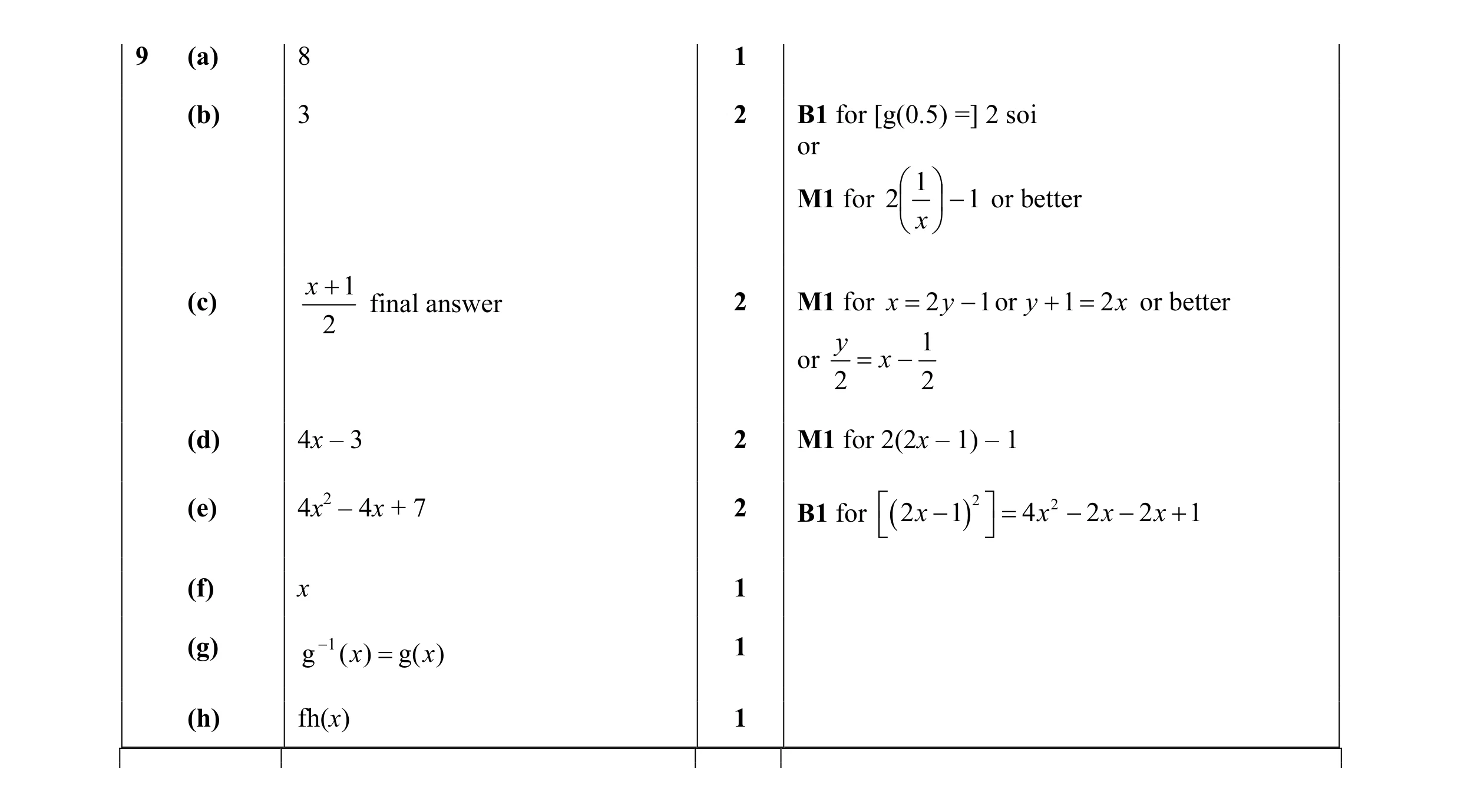
Mark scheme: 9 (a) 8 1 (b) 3 2 B1 for [g(0.5) =] 2 soi or 1 M1 for 2 − 1 or better x x + 1 (c) final answer 2 M1 for x = 2 y − 1 or y + 1 = 2 x or better 2 y 1 or = x − 2 2 (d) 4x – 3 2 M1 for 2(2x – 1) – 1 (e) 4x2 – 4x + 7 2 B1 for ( 2 x − 1) 2 = 4 x 2 − 2 x − 2 x + 1 (f) x 1 (g) g − 1 ( x ) = g( x ) 1 (h) fh(x) 1
This question in 0580/43 Oct/Nov 2015
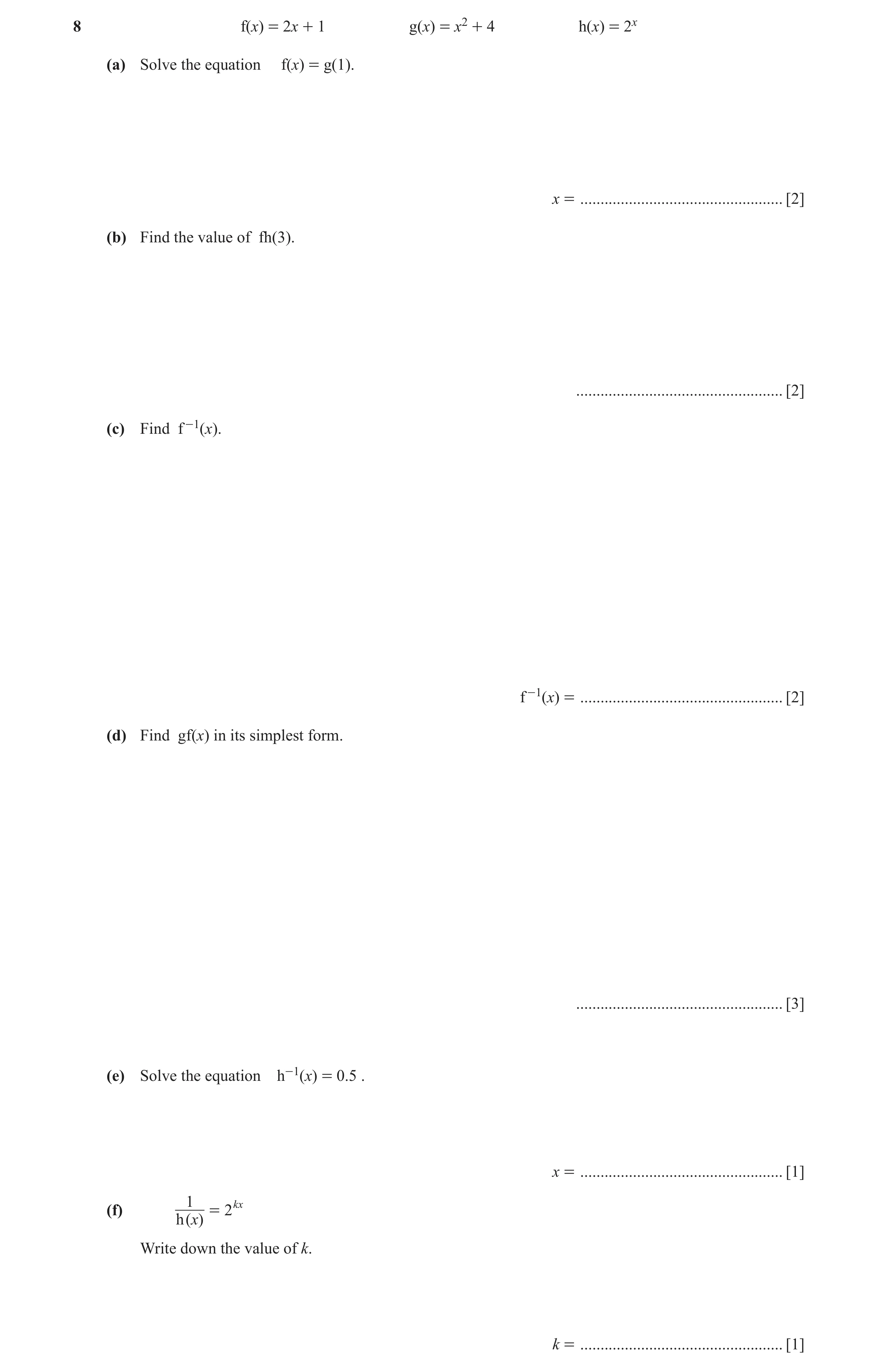
Q13 · F(x) = 2x + 1 g(x) = x2 + 4 h(x) = 2x (a) Solve the equation f(x) = g(1) 0580/41 May/June 2016
8 f(x) = 2x + 1 g(x) = x2 + 4 h(x) = 2x (a) Solve the equation f(x) = g(1). x = … [2] (b) Find the value of fh(3). … [2] (c) Find f -1(x). f -1(x) = … [2] (d) Find gf(x) in its simplest form. … [3] (e) Solve the equation h-1(x) = 0.5 . x = … [1] (f) 1 = 2 kx h ()x Write down the value of k. k = … [1]
11 marks
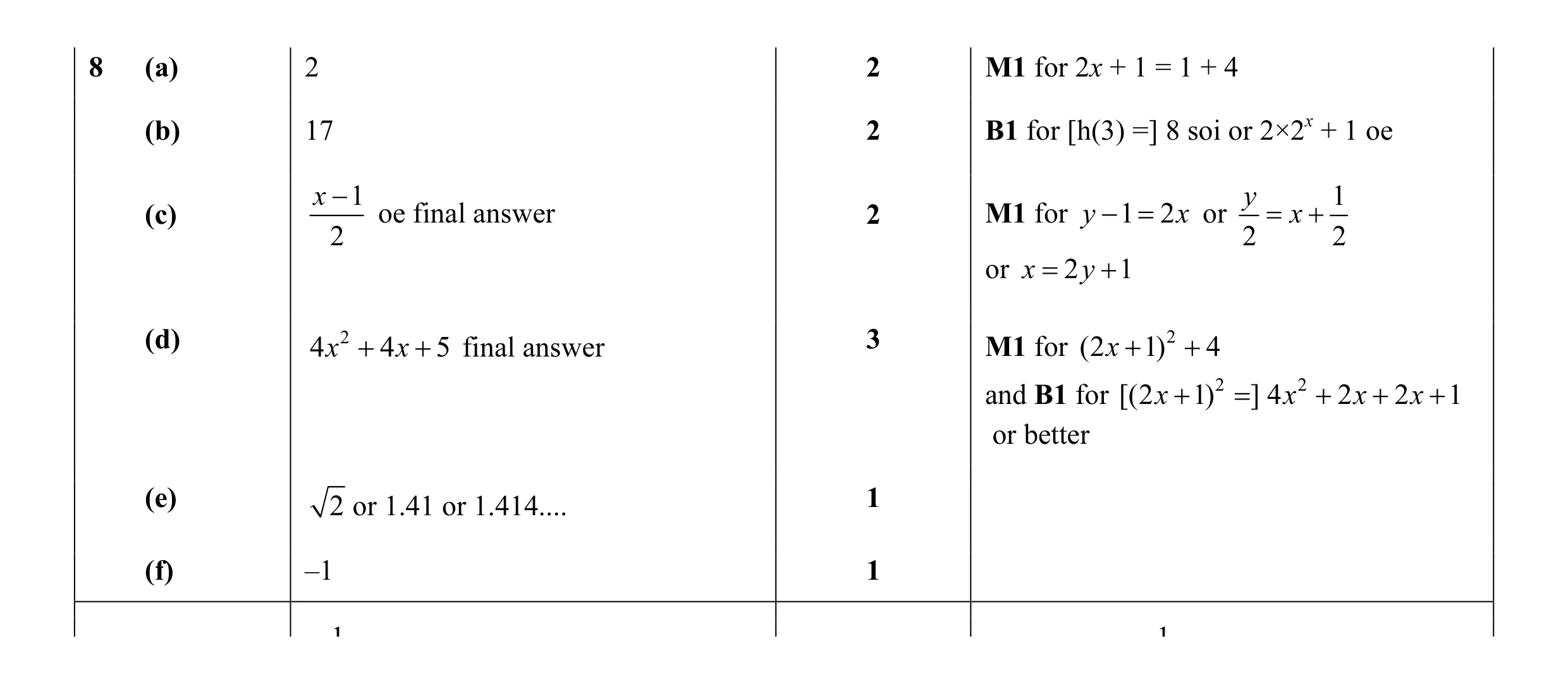
Mark scheme: 8 (a) 2 2 M1 for 2x + 1 = 1 + 4 (b) 17 2 B1 for [h(3) =] 8 soi or 2×2x + 1 oe x − 1 y 1 (c) oe final answer 2 M1 for y −=1 2 x or = x + 2 2 2 or x = 2 y + 1 (d) 2 + 4 3 M1 for (2 x + 1) 4 x 2 + 4 x + 5 final answer and B1 for [(2 x + 1) 2 = ] 4 x 2 + 2 x + 2 x + 1 or better (e) 1 2 or 1.41 or 1.414 … (f) –1 1 1 1
This question in 0580/41 May/June 2016
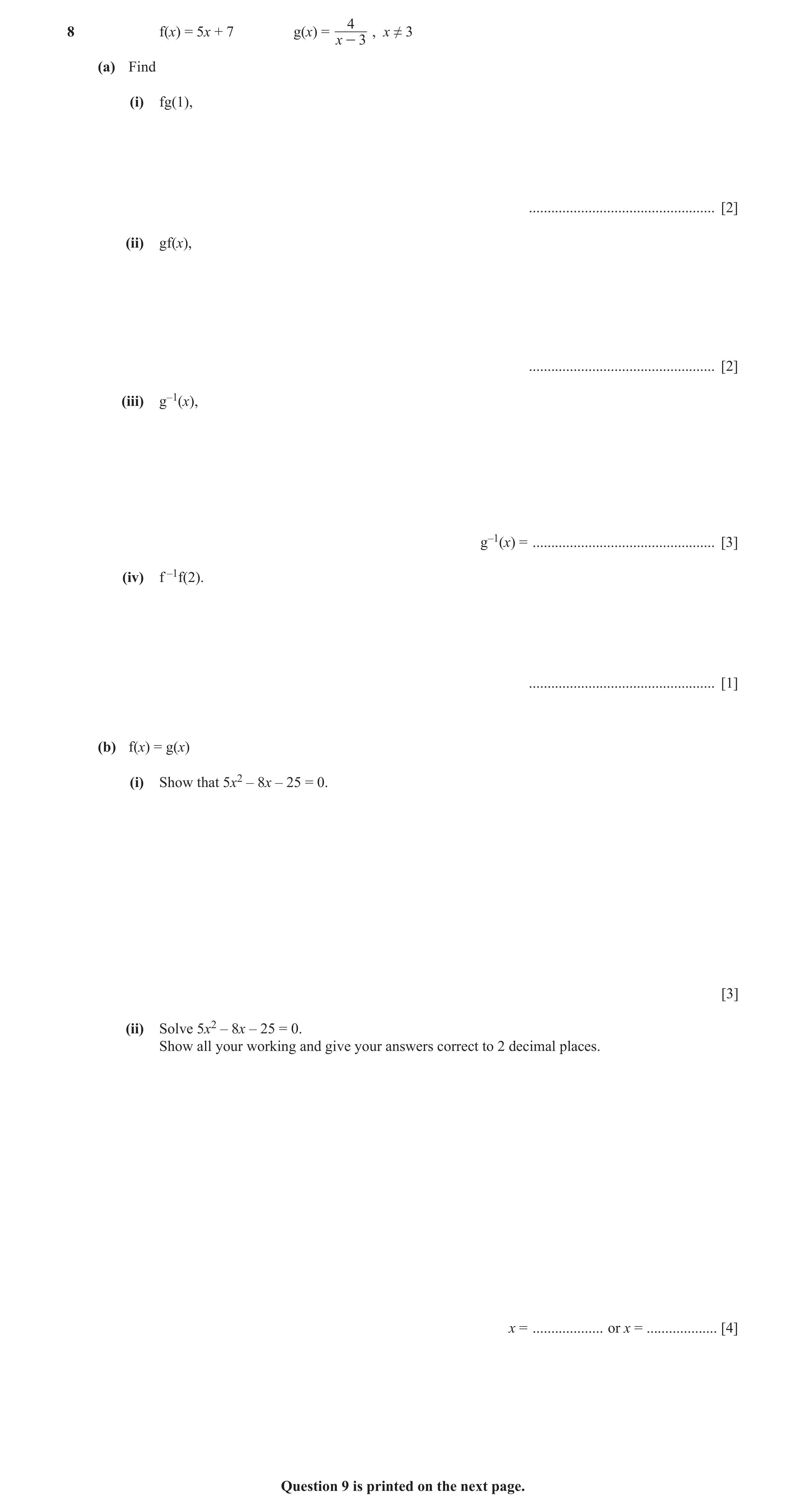
Q14 · F(x) = 5x + 7 g(x) = , x ≠ 3 x - 3 (a) Find (i) fg(1), … [2] (ii) gf(x), … [2] (iii)… 0580/42 May/June 2016
48 f(x) = 5x + 7 g(x) = , x ≠ 3 x - 3 (a) Find (i) fg(1), … [2] (ii) gf(x), … [2] (iii) g–1(x), g–1(x) = … [3] (iv) f –1f(2). … [1] (b) f(x) = g(x) (i) Show that 5x2 – 8x – 25 = 0. [3] (ii) Solve 5x2 – 8x – 25 = 0. Show all your working and give your answers correct to 2 decimal places. x = … or x = … [4] Question 9 is printed on the next page.
15 marks
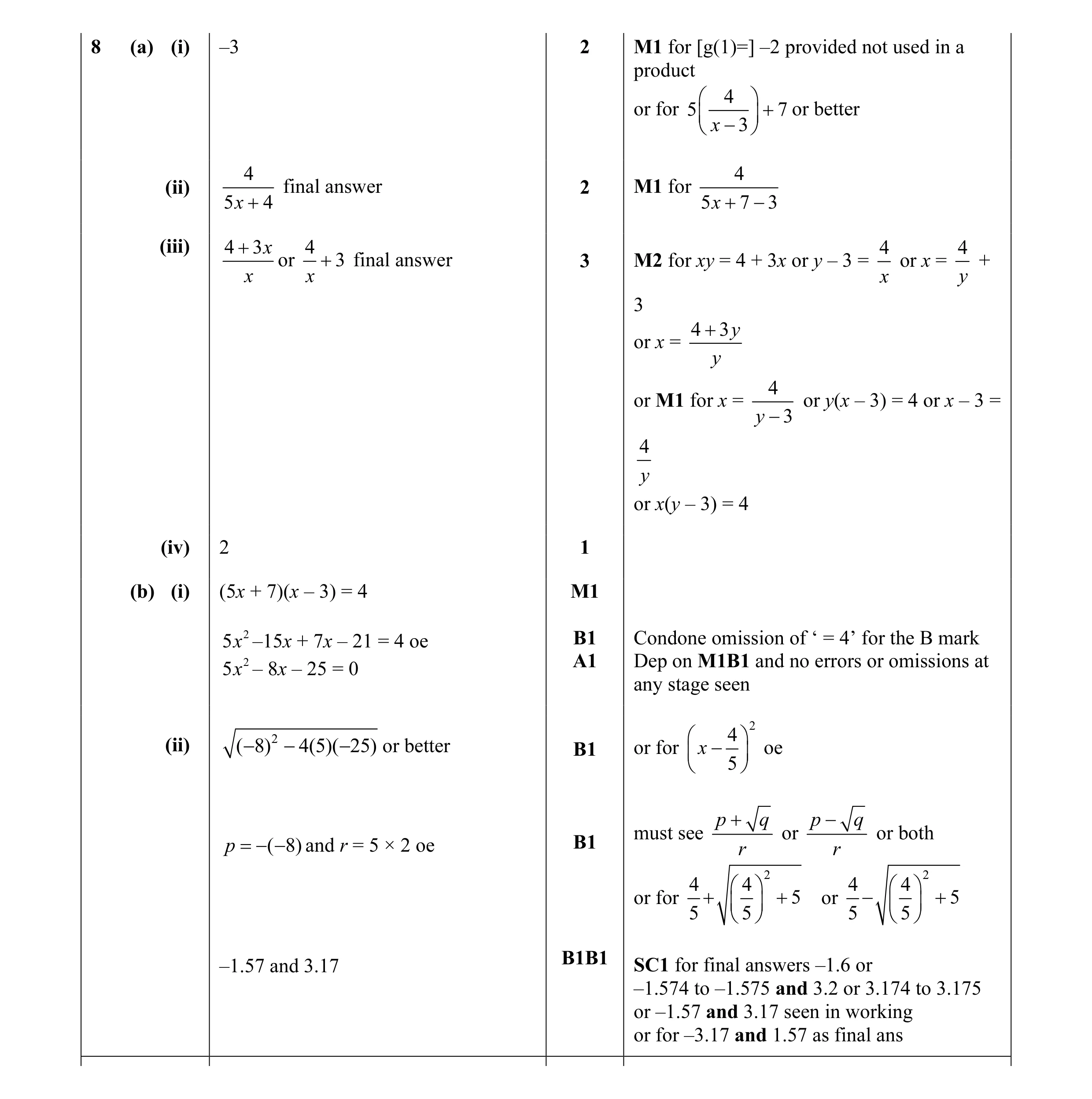
Mark scheme: 8 (a) (i) –3 2 M1 for [g(1)=] –2 provided not used in a product 4 or for 5 + 7 or better x − 3 4 4 (ii) final answer 2 M1 for 5 x + 4 5 x + 7 − 3 (iii) 4 + 3x 4 4 4 or + 3 final answer 3 M2 for xy = 4 + 3x or y – 3 = or x = + x x x y 3 4 + 3y or x = y 4 or M1 for x = or y(x – 3) = 4 or x – 3 = y − 3 4 y or x(y – 3) = 4 (iv) 2 1 (b) (i) (5x + 7)(x – 3) = 4 M1 5x 2 –15x + 7x – 21 = 4 oe B1 Condone omission of ‘ = 4’ for the B mark 2 A1 Dep on M1B1 and no errors or omissions at 5x – 8x – 25 = 0 any stage seen 2 (ii) ( −8) 2 − 4(5)( −25) or better B1 or for x − 4 oe 5 p + q p − q B1 must see or or both p = −−( 8) and r = 5 × 2 oe r r 2 2 4 4 4 4 or for + + 5 or − + 5 5 5 5 5 B1B1 SC1 for final answers –1.6 or –1.57 and 3.17 –1.574 to –1.575 and 3.2 or 3.174 to 3.175 or –1.57 and 3.17 seen in working or for –3.17 and 1.57 as final ans
This question in 0580/42 May/June 2016
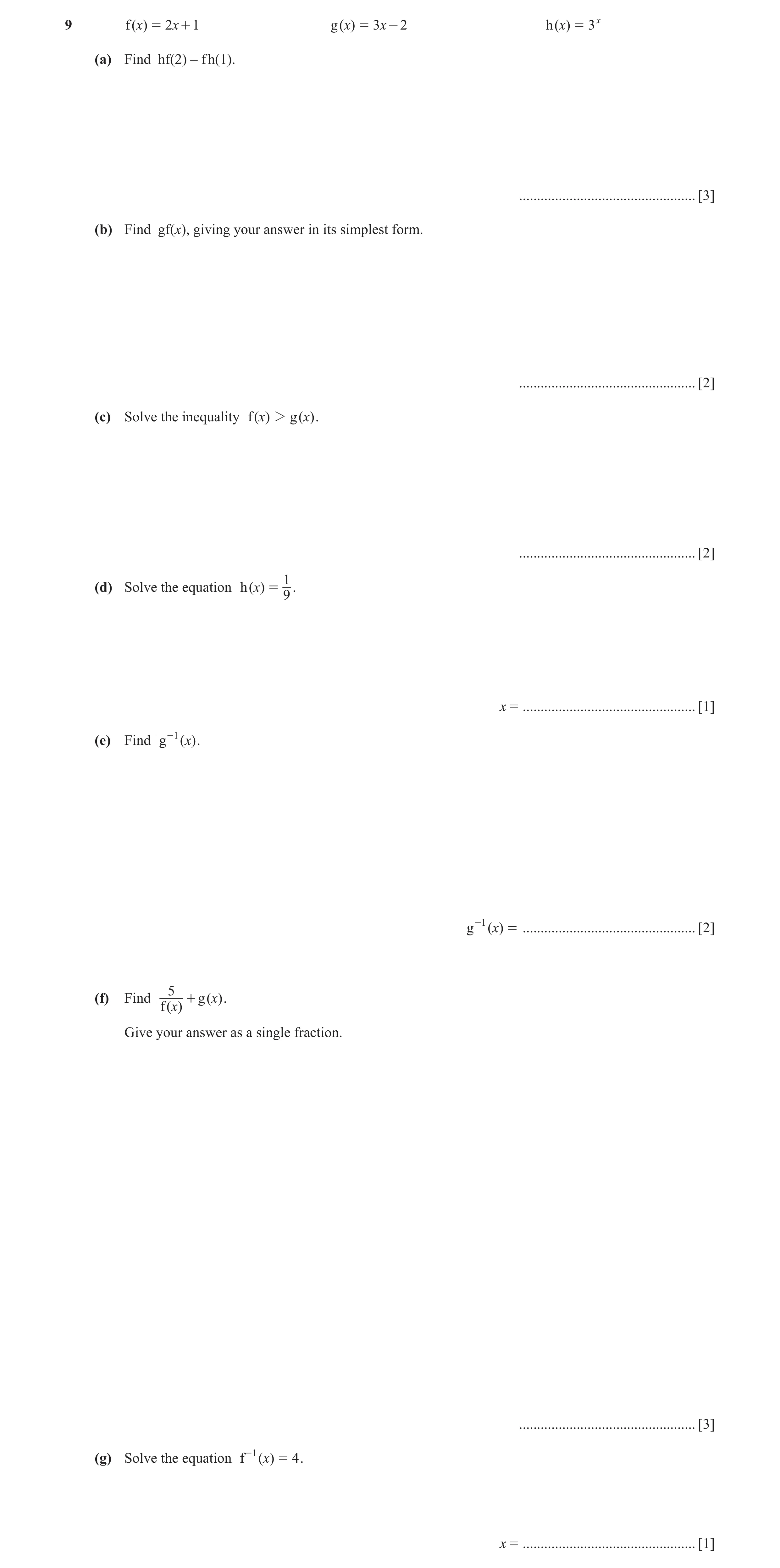
Q15 · F(x) = 2x + 1 g(x) = 3x - 2 h(x) = 3 x (a) Find hf(2) – f h(1) 0580/41 Oct/Nov 2016
9 f(x) = 2x + 1 g(x) = 3x - 2 h(x) = 3 x (a) Find hf(2) – f h(1). … [3] (b) Find gf(x), giving your answer in its simplest form. … [2] (c) Solve the inequality f(x) 2 g (x) . … [2] 1 (d) Solve the equation h(x) = . 9 x = … [1] (e) Find g -1 ()x . g -1 ()x = … [2] 5(f) Find + g(x) . f(x) Give your answer as a single fraction. … [3] (g) Solve the equation f -1 (x) = 4 . x = … [1]
14 marks
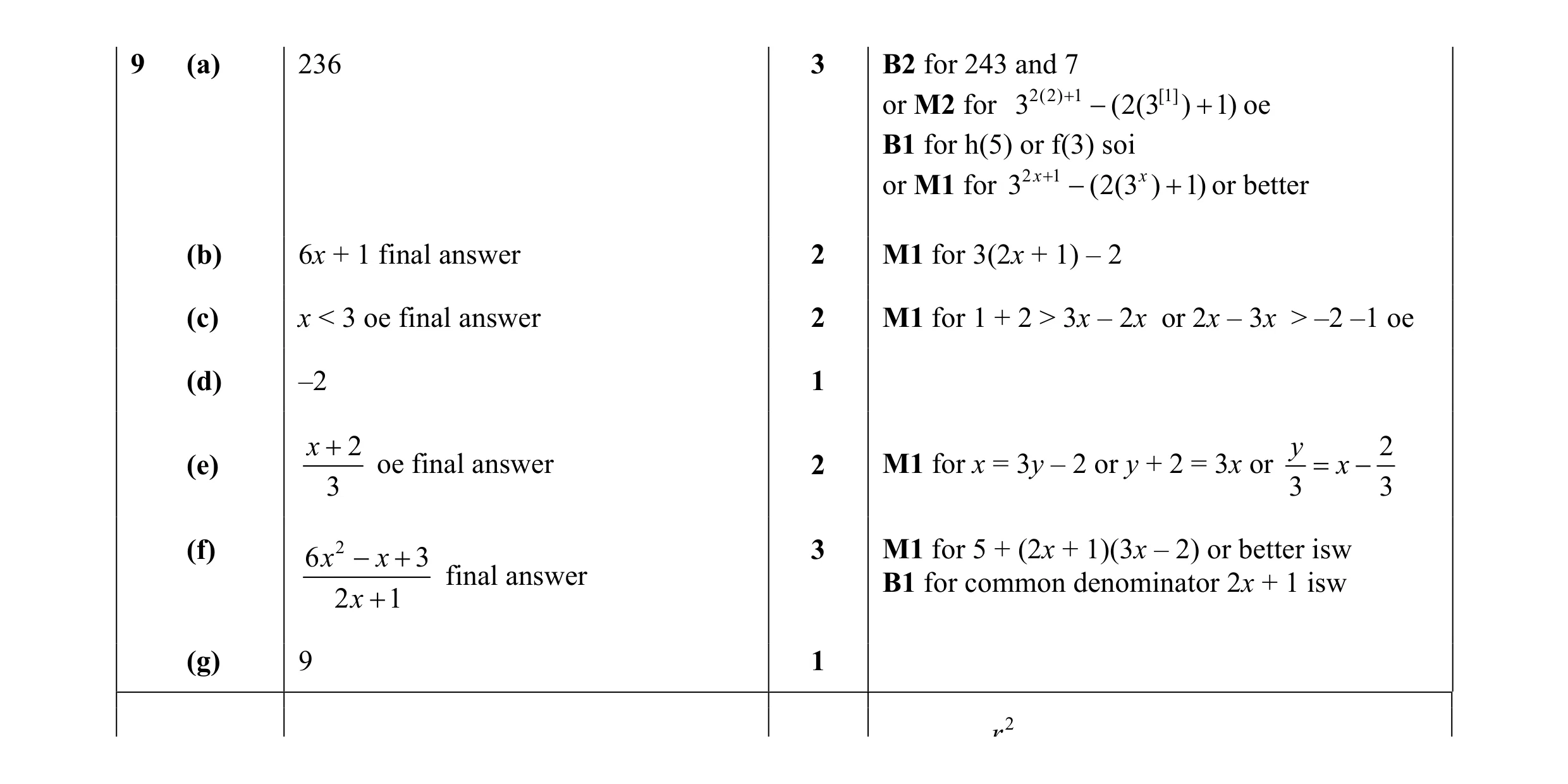
Mark scheme: 9 (a) 236 3 B2 for 243 and 7 or M2 for 32(2) +1 − (2(3[1] ) + 1) oe B1 for h(5) or f(3) soi or M1 for 32 x +1 − (2(3 x ) + 1) or better (b) 6x + 1 final answer 2 M1 for 3(2x + 1) – 2 (c) x < 3 oe final answer 2 M1 for 1 + 2 > 3x – 2x or 2x – 3x > –2 –1 oe (d) –2 1 x + 2 y 2 (e) oe final answer 2 M1 for x = 3y – 2 or y + 2 = 3x or = x − 3 3 3 (f) 6 x 2 − x + 3 3 M1 for 5 + (2x + 1)(3x – 2) or better isw final answer B1 for common denominator 2x + 1 isw 2 x + 1 (g) 9 1 2r
This question in 0580/41 Oct/Nov 2016
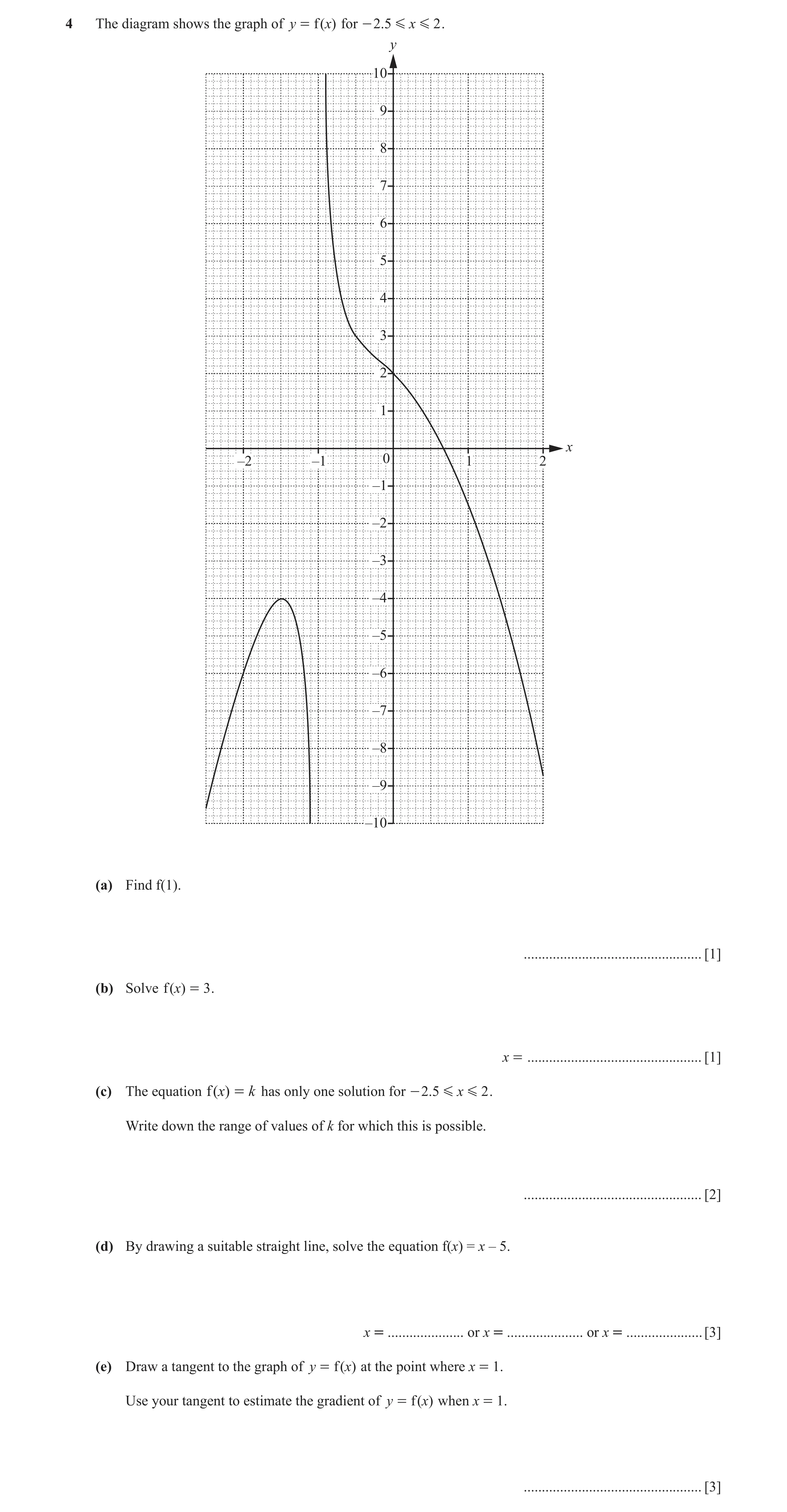
Q16 · The diagram shows the graph of y = f (x) for - 2.5 G x G 2 0580/41 May/June 2017
4 The diagram shows the graph of y = f (x) for - 2.5 G x G 2 . y 10 9 8 7 6 5 4 3 2 1 x –2 –1 0 1 2 –1 –2 –3 –4 –5 –6 –7 –8 –9 –10 (a) Find f(1). … [1] (b) Solve f (x) = 3 . x = … [1] (c) The equation f ( x) = k has only one solution for - 2.5 G x G 2 . Write down the range of values of k for which this is possible. … [2] (d) By drawing a suitable straight line, solve the equation f(x) = x – 5. x = … or x = … or x = … [3] (e) Draw a tangent to the graph of y = f (x ) at the point where x = 1. Use your tangent to estimate the gradient of y = f (x) when x = 1. … [3]
10 marks
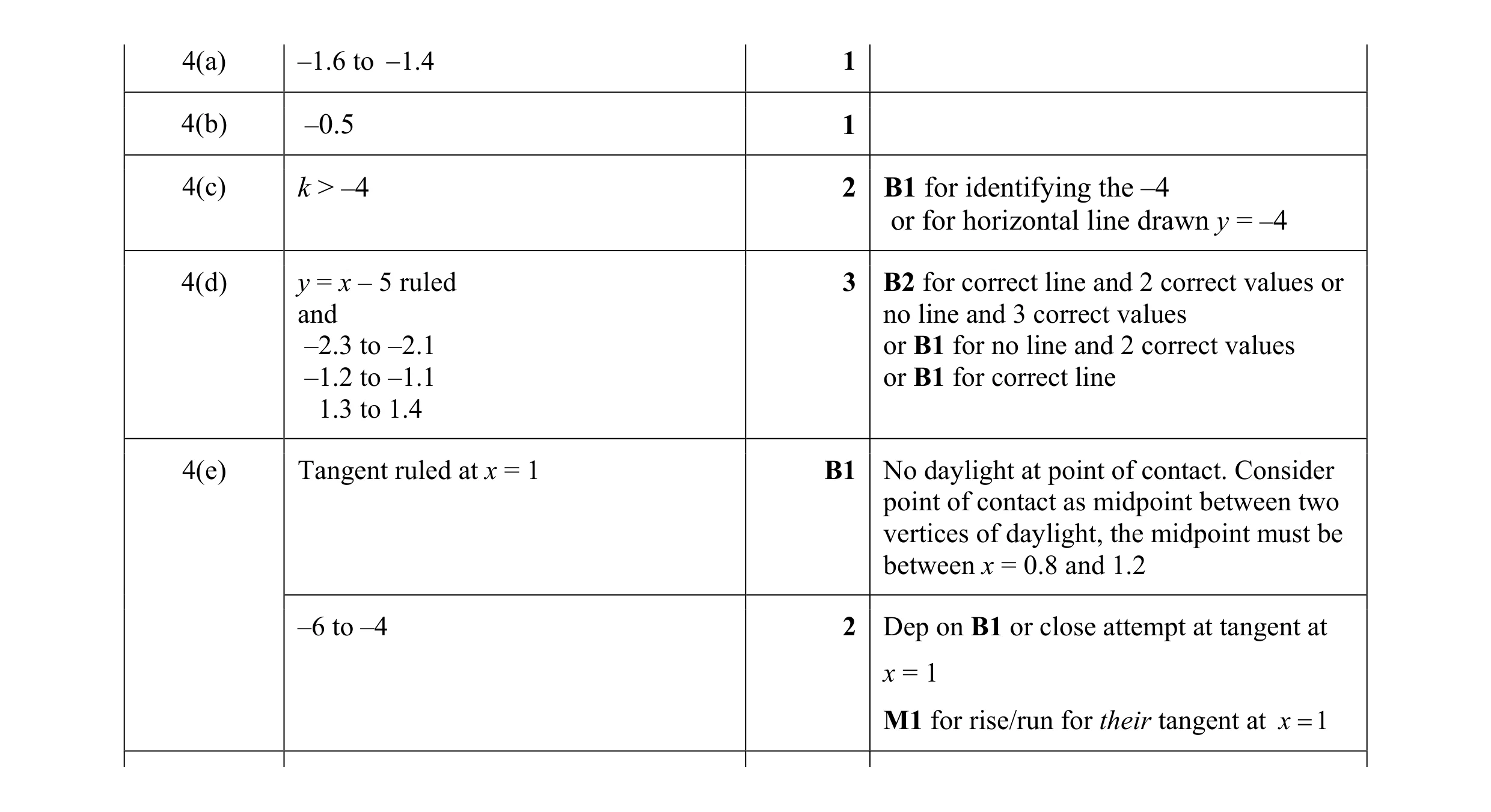
Mark scheme: 4(a) –1.6 to − 1.4 1 4(b) –0.5 1 4(c) k > –4 2 B1 for identifying the –4 or for horizontal line drawn y = –4 4(d) y = x – 5 ruled 3 B2 for correct line and 2 correct values or and no line and 3 correct values –2.3 to –2.1 or B1 for no line and 2 correct values –1.2 to –1.1 or B1 for correct line 1.3 to 1.4 4(e) Tangent ruled at x = 1 B1 No daylight at point of contact. Consider point of contact as midpoint between two vertices of daylight, the midpoint must be between x = 0.8 and 1.2 –6 to –4 2 Dep on B1 or close attempt at tangent at x = 1 M1 for rise/run for their tangent at x = 1
This question in 0580/41 May/June 2017
Q17 · F (x) = 3x - 2 g (x) = x2 h (x) = 3x (a) Find f (-3) 0580/42 May/June 2017
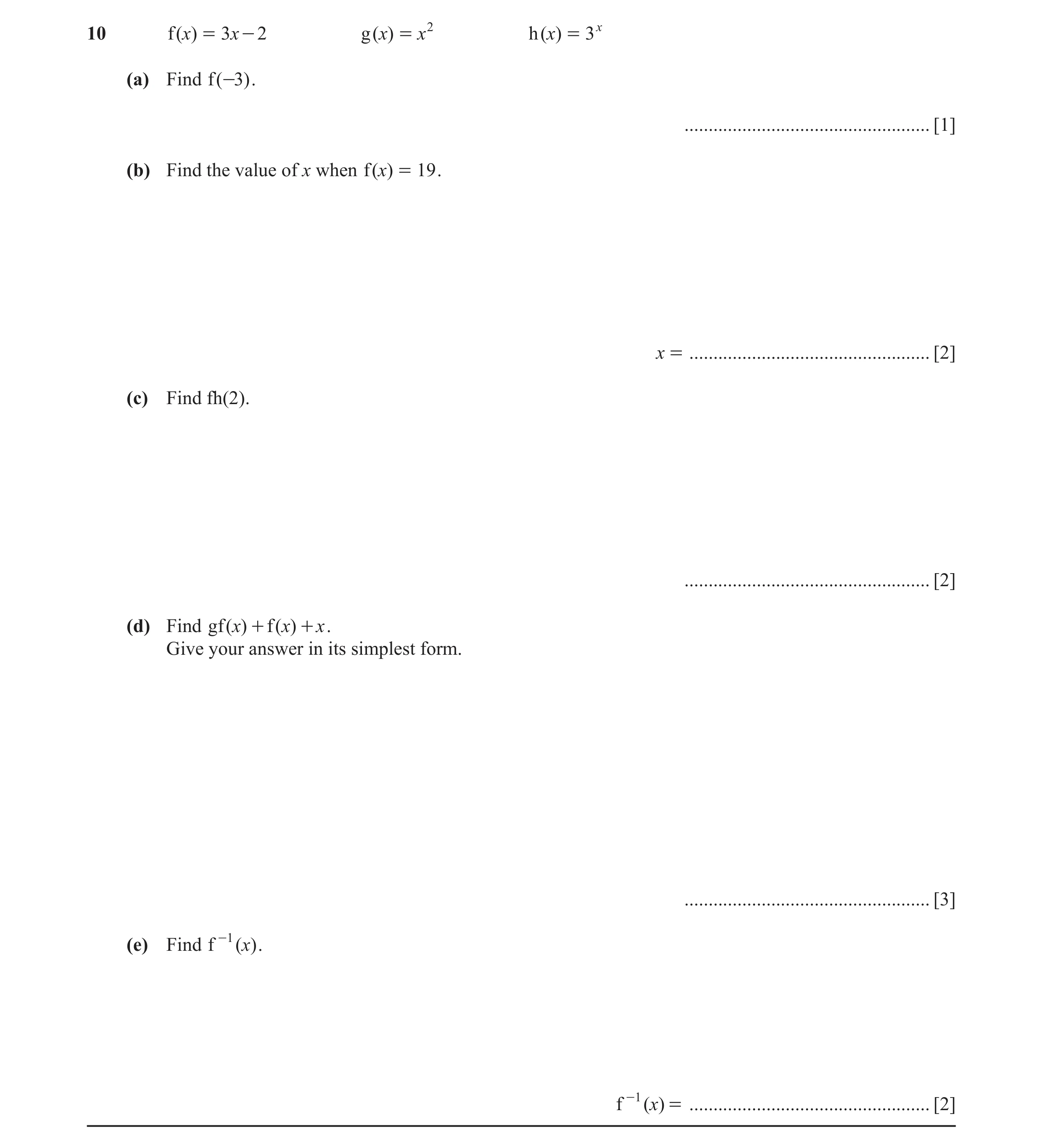
10 f (x) = 3x - 2 g (x) = x2 h (x) = 3x (a) Find f (-3) . … [1] (b) Find the value of x when f (x) = 19 . x = … [2] (c) Find fh(2). … [2] (d) Find gf ( x) + f ( x) + x . Give your answer in its simplest form. … [3] (e) Find f -1 (x) . f -1 (x) = … [2]
10 marks
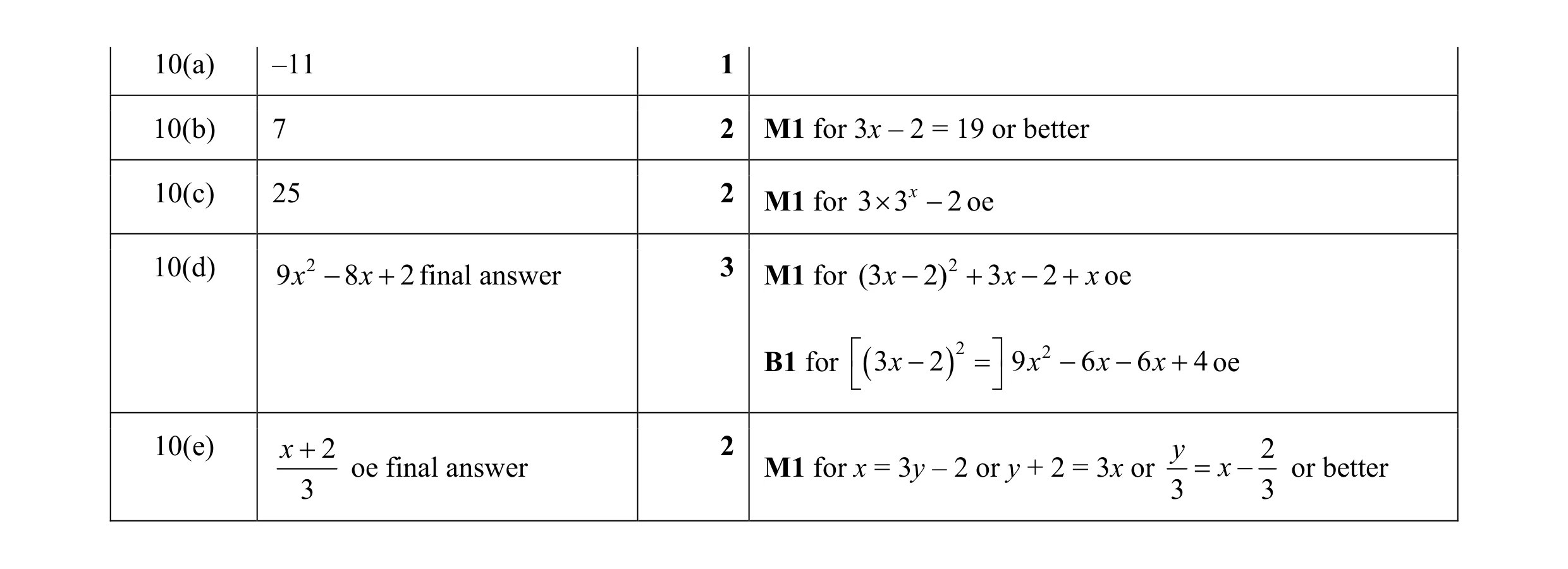
Mark scheme: 10(a) –11 1 10(b) 7 2 M1 for 3x – 2 = 19 or better 10(c) 25 2 M1 for 3 × 3 x − 2 oe 10(d) 9 x 2 − 8 x + 2 final answer 3 M1 for (3 x − 2) 2 + 3 x − 2 + x oe B1 for ( 3 x − 2 ) 2 = 9 x 2 − 6 x − 6 x + 4 oe 10(e) x + 2 2 y 2 oe final answer M1 for x = 3y – 2 or y + 2 = 3x or = x − or better 3 3 3
This question in 0580/42 May/June 2017
Q18 · F(x) = 3 – 2x g(x) = , x ≠ 0 h(x) = 4x x (a) Find f(5) 0580/41 Oct/Nov 2017
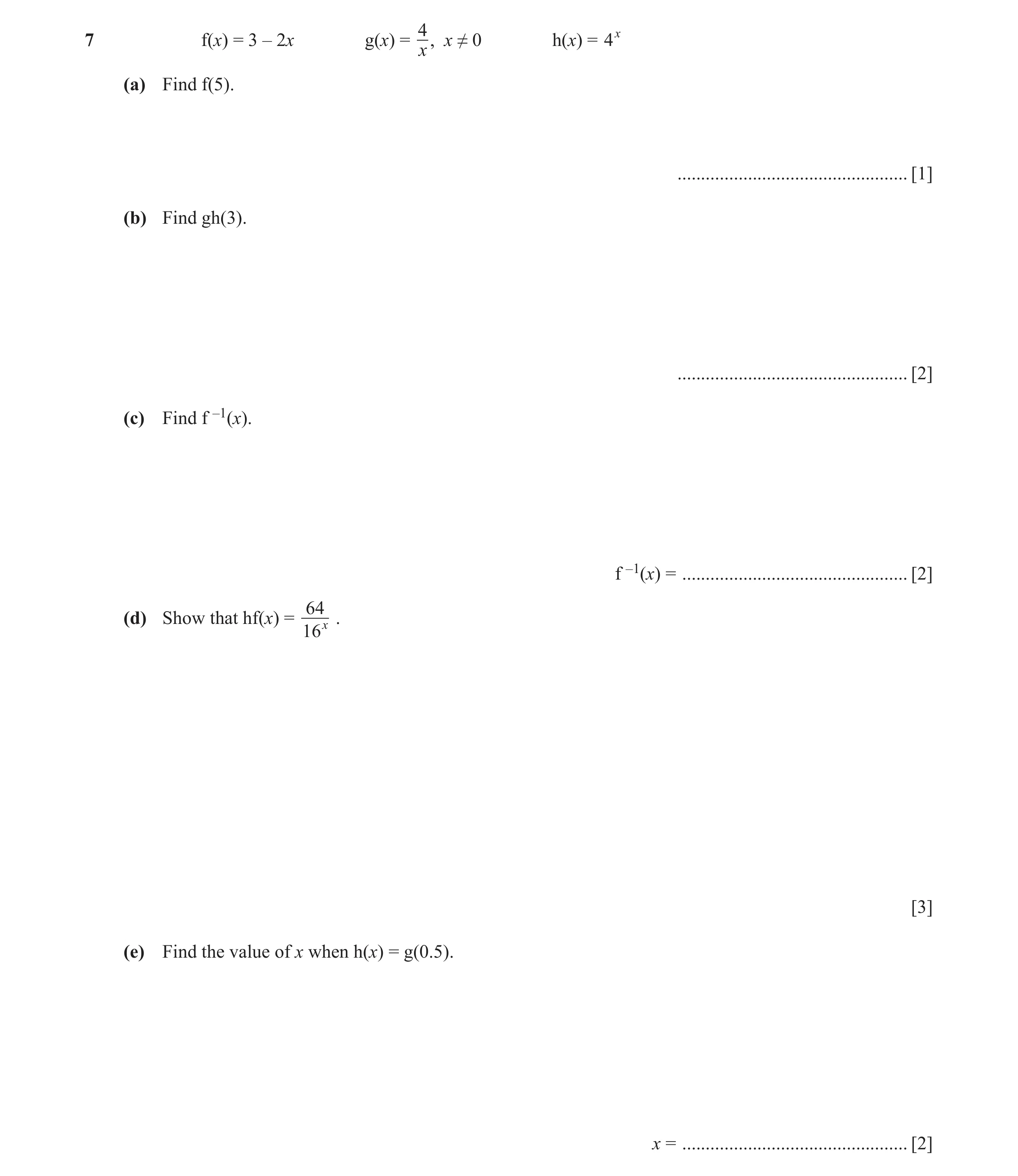
47 f(x) = 3 – 2x g(x) = , x ≠ 0 h(x) = 4x x (a) Find f(5). … [1] (b) Find gh(3). … [2] (c) Find f –1(x). f –1(x) = … [2] 64 (d) Show that hf(x) = x . 16 [3] (e) Find the value of x when h(x) = g(0.5). x = … [2]
10 marks
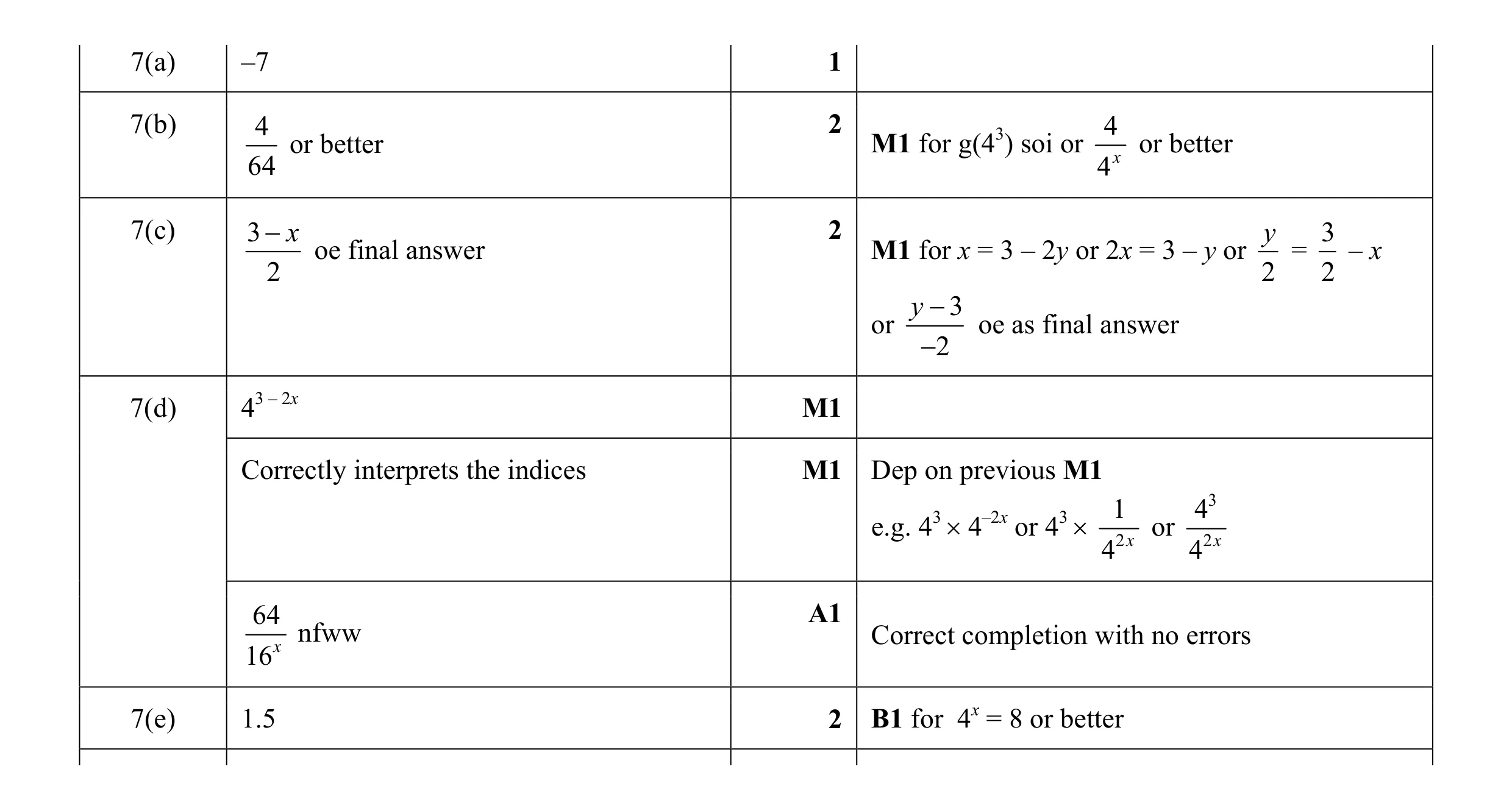
Mark scheme: 7(a) –7 1 7(b) 4 2 4 or better M1 for g(43) soi or or better 64 4x 7(c) 3 − x 2 y 3 oe final answer M1 for x = 3 – 2y or 2x = 3 – y or = – x 2 2 2 y − 3 or oe as final answer −2 7(d) 43 – 2x M1 Correctly interprets the indices M1 Dep on previous M1 1 43 e.g. 43 × 4–2x or 43 × or 4 2 x 4 2 x 64 A1 nfww Correct completion with no errors 16x 7(e) 1.5 2 B1 for 4x = 8 or better
This question in 0580/41 Oct/Nov 2017
Q19 · F ()x = 1 - 2x g ()x = x + 4 h ()x = x 2 + 1 (a) Find (f-1) 0580/42 Oct/Nov 2017
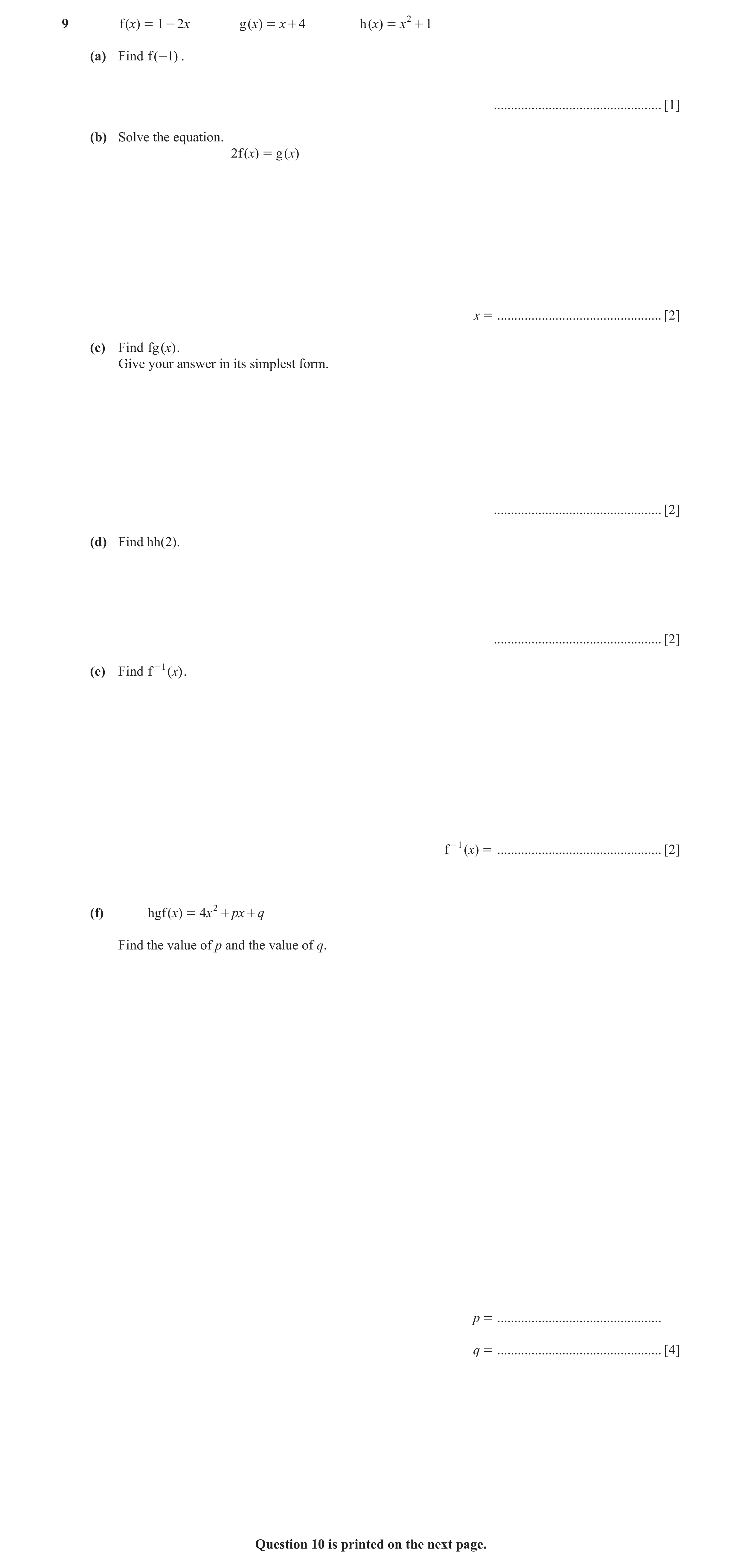
9 f ()x = 1 - 2x g ()x = x + 4 h ()x = x 2 + 1 (a) Find (f-1) . … [1] (b) Solve the equation. 2f ( x) = g ( x) x = … [2] (c) Find fg ()x . Give your answer in its simplest form. … [2] (d) Find hh(2). … [2] (e) Find f - 1 ()x . f - 1 ()x = … [2] (f) hgf ()x = 4x 2 + px + q Find the value of p and the value of q. p = … q = … [4] Question 10 is printed on the next page.
13 marks
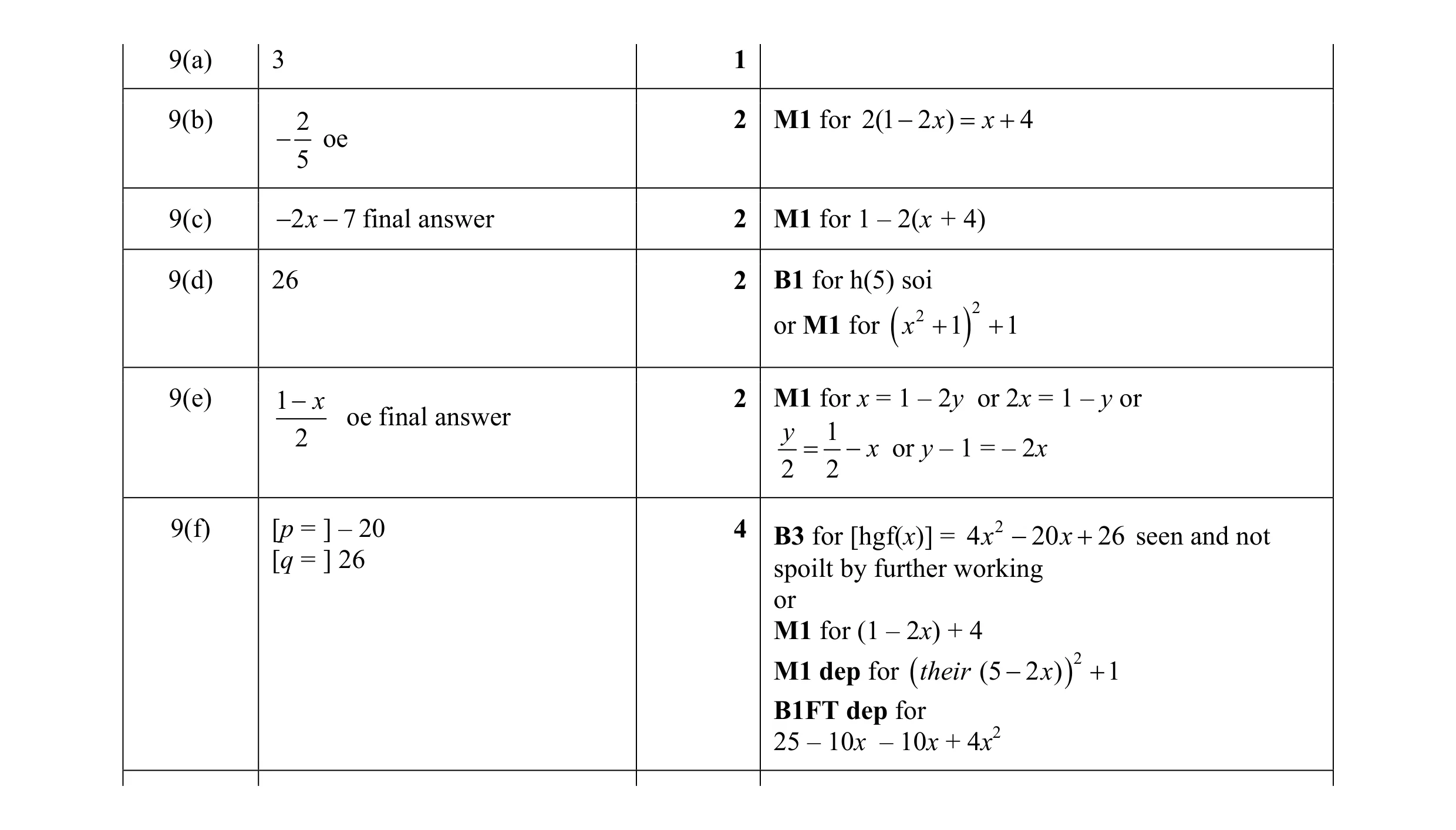
Mark scheme: 9(a) 3 1 9(b) 2 2 M1 for 2(1 − 2 x ) = x + 4 − oe 5 9(c) −2 x − 7 final answer 2 M1 for 1 – 2(x + 4) 9(d) 26 2 B1 for h(5) soi 2 or M1 for x 2 + 1 + 1 ( ) 9(e) 1 −x 2 M1 for x = 1 – 2y or 2x = 1 – y or oe final answer 2 y 1 = − x or y – 1 = – 2x 2 2 9(f) [p = ] – 20 4 B3 for [hgf(x)] = 4 x 2 − 20 x + 26 seen and not [q = ] 26 spoilt by further working or M1 for (1 – 2x) + 4 M1 dep for ( their (5 − 2 x ) ) 2 + 1 B1FT dep for 25 – 10x – 10x + 4x2
This question in 0580/42 Oct/Nov 2017
Q20 · X8 f ()x = 8 - 3x g (x) = , x ! 0580/42 May/June 2018
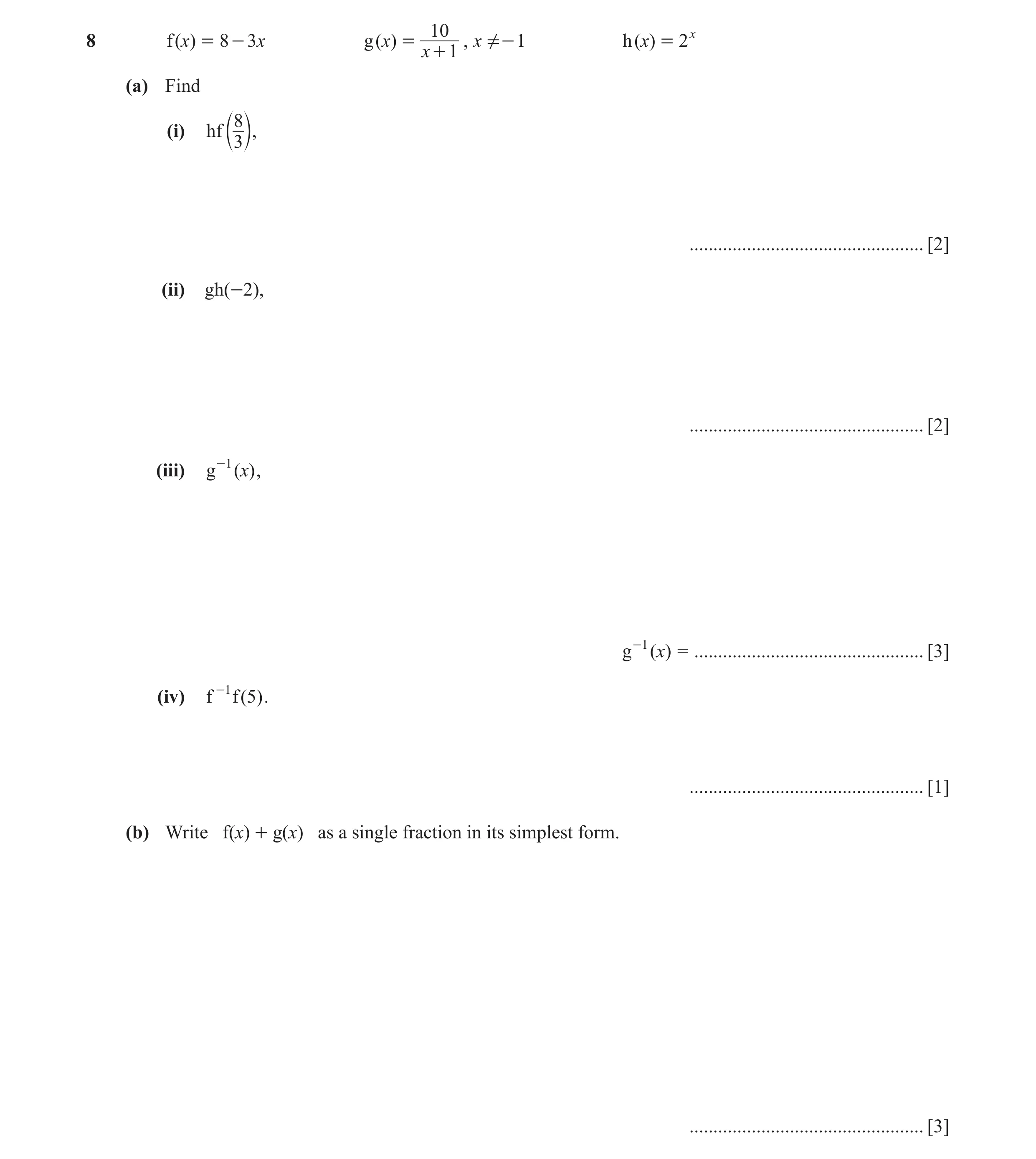
10 x8 f ()x = 8 - 3x g (x) = , x ! - 1 h ()x = 2 x + 1 (a) Find 8 (i) hf c 3 m, … [2] (ii) gh(-2), … [2] (iii) g -1 ()x , g -1 ()x = … [3] (iv) f -1 f (5 ) . … [1] (b) Write f(x) + g(x) as a single fraction in its simplest form. … [3]
11 marks
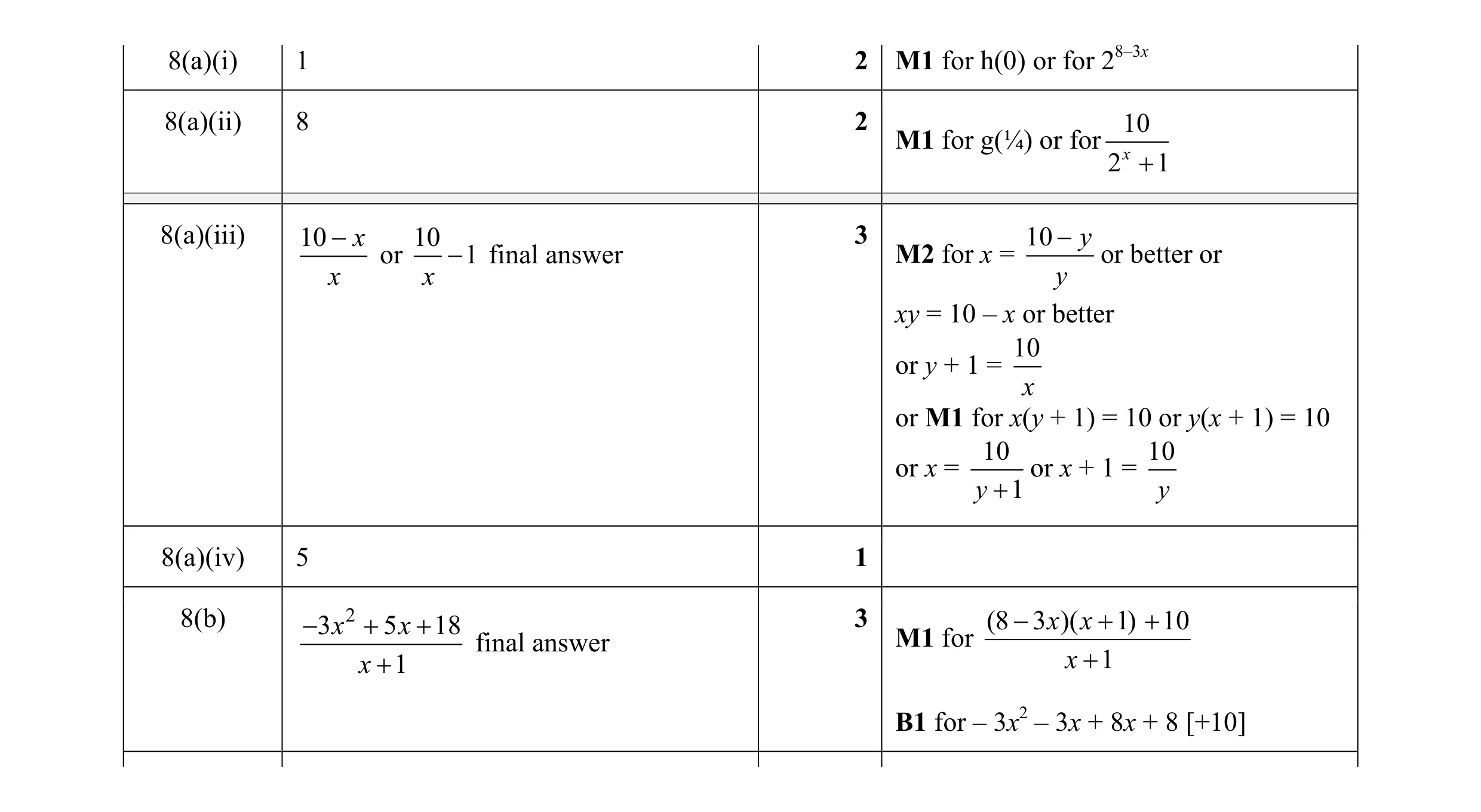
Mark scheme: 8(a)(i) 1 2 M1 for h(0) or for 28–3x 8(a)(ii) 8 2 10 M1 for g(¼) or for 2 x + 1 8(a)(iii) 10 −x 10 3 10 −y or − 1 final answer M2 for x = or better or x x y xy = 10 – x or better 10 or y + 1 = x or M1 for x(y + 1) = 10 or y(x + 1) = 10 10 10 or x = or x + 1 = y + 1 y 8(a)(iv) 5 1 8(b) −3 x 2 + 5 x + 18 3 (8 − 3 x )( x + 1) + 10 final answer M1 for x + 1 x + 1 B1 for – 3x2 – 3x + 8x + 8 [+10]
This question in 0580/42 May/June 2018
Q21 · F (x) = 2x - 3 g (x) = x 2 + 1 (i) Find gg(2) 0580/43 May/June 2018
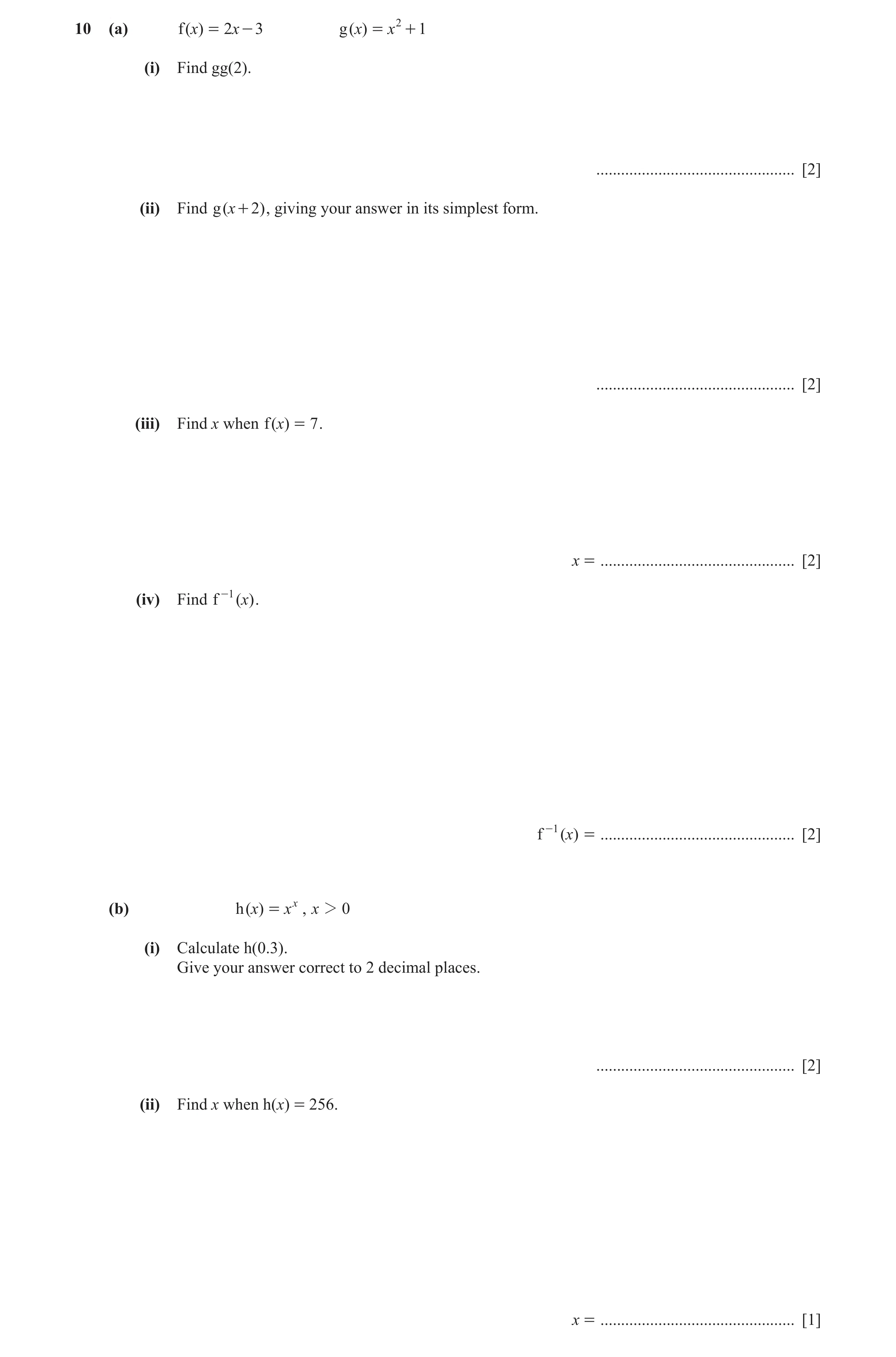
10 (a) f (x) = 2x - 3 g (x) = x 2 + 1 (i) Find gg(2). … [2] (ii) Find g (x + 2) , giving your answer in its simplest form. … [2] (iii) Find x when f ()x = 7 . x = … [2] (iv) Find f -1 ()x . f -1 ()x = … [2] (b) h (x) = x x , x 2 0 (i) Calculate h(0.3). Give your answer correct to 2 decimal places. … [2] (ii) Find x when h(x) = 256. x = … [1]
11 marks
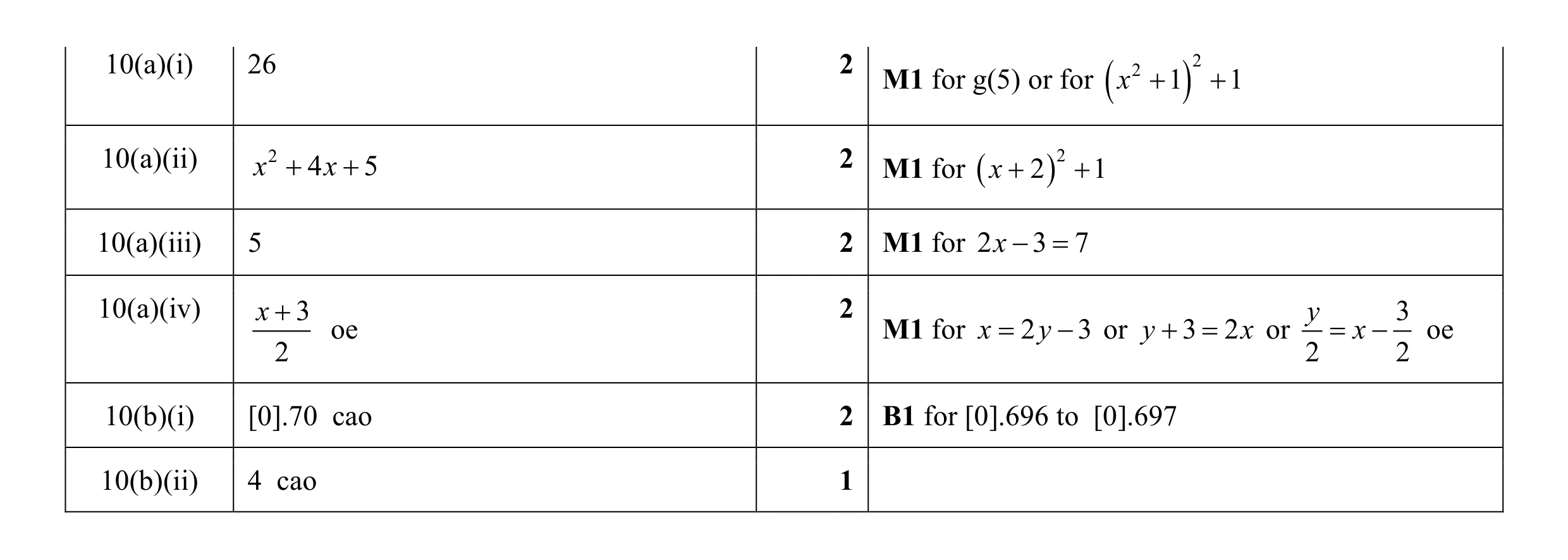
Mark scheme: 10(a)(i) 26 2 2 2 M1 for g(5) or for x + 1 + 1 ( ) 10(a)(ii) x 2 + 4 x + 5 2 M1 for ( x + 2 ) 2 + 1 10(a)(iii) 5 2 M1 for 2 x − 3 = 7 10(a)(iv) x + 3 2 y 3 oe M1 for x = 2 y − 3 or y + 3 = 2 x or = x − oe 2 2 2 10(b)(i) [0].70 cao 2 B1 for [0].696 to [0].697 10(b)(ii) 4 cao 1
This question in 0580/43 May/June 2018
Q22 · F (x) = 3x + 4 g (x) = 2x - 1 h ()x = 3 x 1 (a) Find ge 2 o 0580/43 Oct/Nov 2018
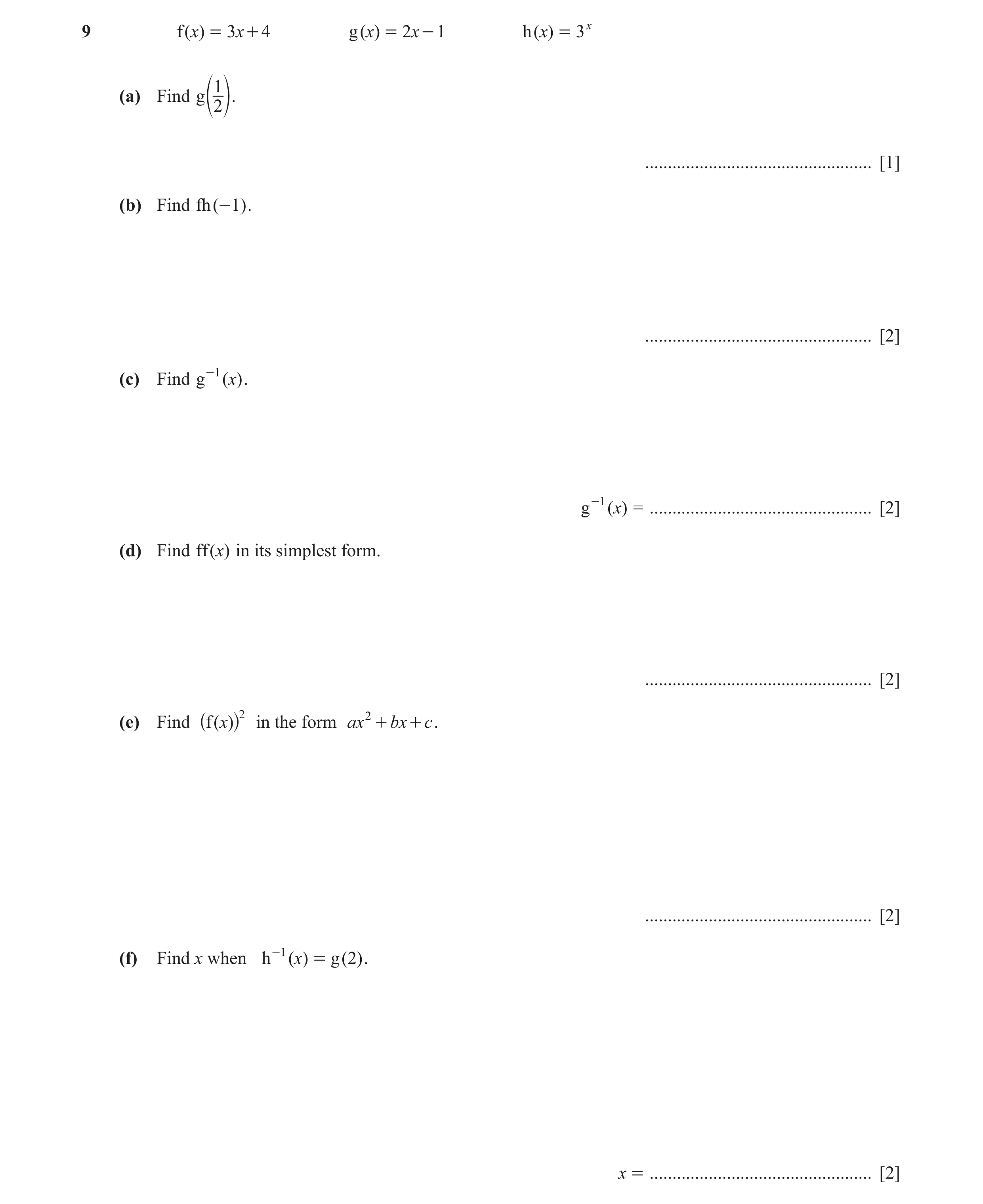
9 f (x) = 3x + 4 g (x) = 2x - 1 h ()x = 3 x 1 (a) Find ge 2 o. … [1] (b) Find fh (- 1) . … [2] (c) Find g -1 ()x . g -1 ()x = … [2] (d) Find ff ()x in its simplest form. … [2] (e) Find f ()x 2 in the form ax 2 + bx + c . ^ h … [2] (f) Find x when h -1 ( x) = g (2) . x = … [2]
11 marks
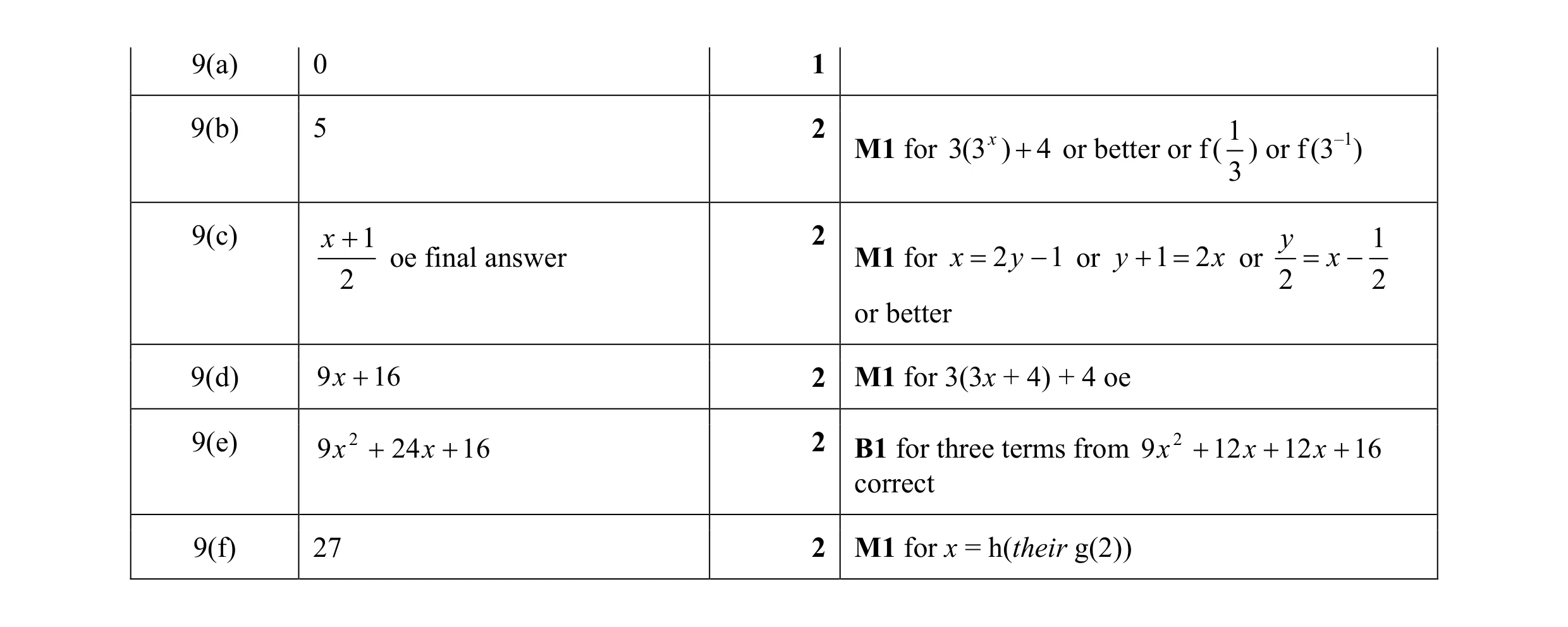
Mark scheme: 9(a) 0 1 9(b) 5 2 x 1 M1 for (33 ) + 4 or better or f ( ) or f (3–1) 3 9(c) x + 1 2 y 1 oe final answer M1 for x = 2 y − 1 or y + 1= 2 x or = x − 2 2 2 or better 9(d) 9 x + 16 2 M1 for 3(3x + 4) + 4 oe 9(e) 9 x 2 + 24 x + 16 2 B1 for three terms from 9 x 2 + 12 x + 12 x + 16 correct 9(f) 27 2 M1 for x = h(their g(2))
This question in 0580/43 Oct/Nov 2018
Q23 · 28 f (x) = , x ! 0580/42 Feb/March 2019
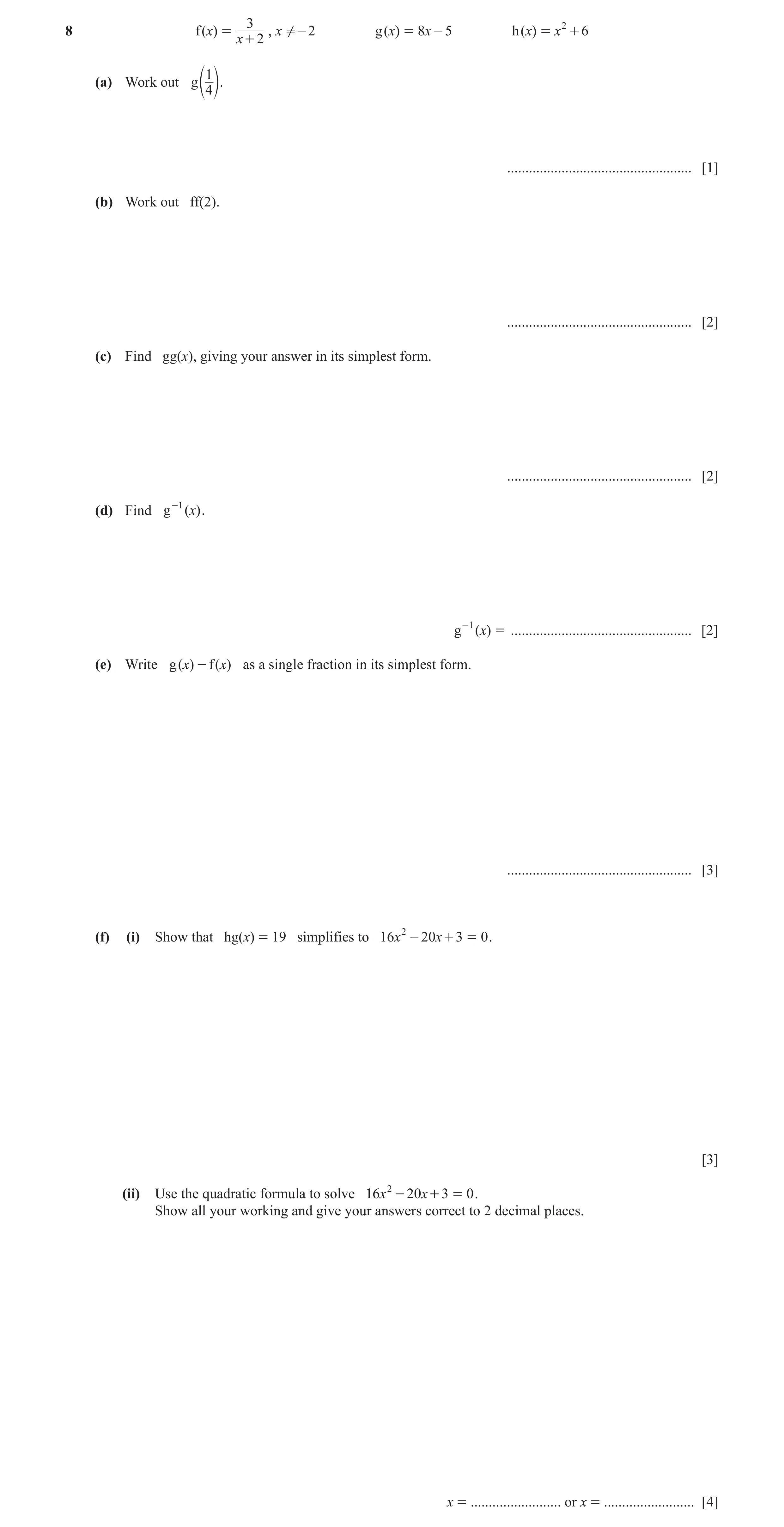
3 28 f (x) = , x ! - 2 g (x) = 8x - 5 h (x) = x + 6 x + 2 1 (a) Work out g e 4 o. … [1] (b) Work out ff(2). … [2] (c) Find gg(x), giving your answer in its simplest form. … [2] (d) Find g -1 (x) . g -1 ( x) = … [2] (e) Write g (x) - f (x) as a single fraction in its simplest form. … [3] (f) (i) Show that hg(x) = 19 simplifies to 16x 2 - 20x + 3 = 0 . [3] (ii) Use the quadratic formula to solve 16x 2 - 20x + 3 = 0 . Show all your working and give your answers correct to 2 decimal places. x = … or x = … [4]
17 marks
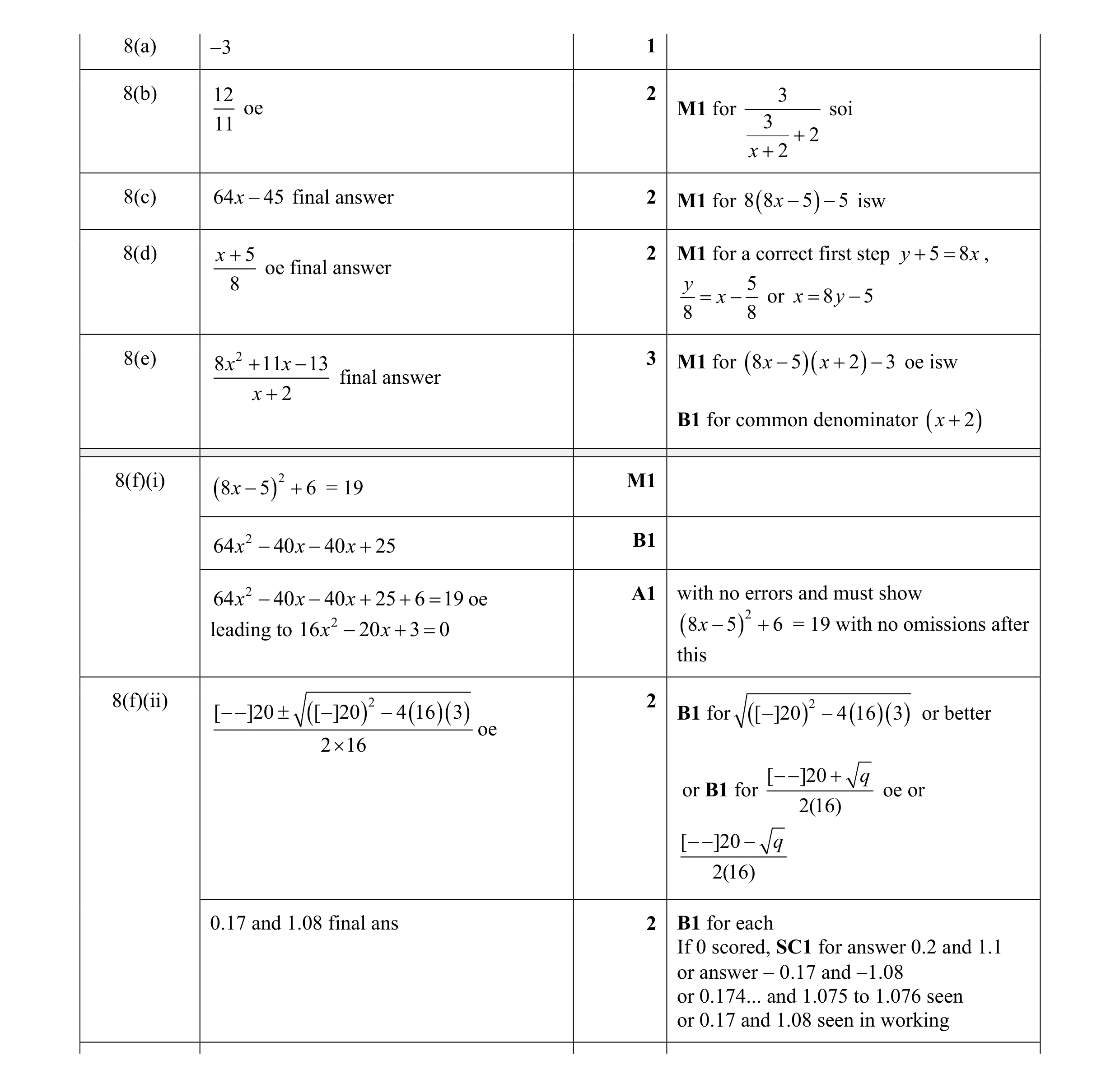
Mark scheme: 8(a) −3 1 8(b) 12 2 3 oe M1 for soi 11 3 + 2 x + 2 8(c) 64 x − 45 final answer 2 M1 for 8 ( 8 x − 5 ) − 5 isw 8(d) x + 5 2 M1 for a correct first step y + 5 = 8 x , oe final answer 8 y 5 = x − or x = 8 y − 5 8 8 8(e) 8 x 2 + 11x − 13 3 M1 for ( 8 x − 5 )( x + 2 ) − 3 oe isw final answer x + 2 B1 for common denominator ( x + 2 ) 8(f)(i) ( 8 x − 5 ) 2 + 6 = 19 M1 64 x 2 − 40 x − 40 x + 25 B1 64 x 2 − 40 x − 40 x + 25 + 6 = 19 oe A1 with no errors and must show 2 leading to 16 x 2 − 20 x + 3 = 0 ( 8 x − 5 ) + 6 = 19 with no omissions after this 8(f)(ii) 2 2 2 [ −− ]20 ± ( [ − ]20 ) − 4 (16 )( 3 ) B1 for ( [ − ]20 ) − 4 (16 )( 3 ) or better oe 2 × 16 [ −− ]20 + q or B1 for oe or 2(16) [ −− ]20 − q 2(16) 0.17 and 1.08 final ans 2 B1 for each If 0 scored, SC1 for answer 0.2 and 1.1 or answer − 0.17 and −1.08 or 0.174... and 1.075 to 1.076 seen or 0.17 and 1.08 seen in working
This question in 0580/42 Feb/March 2019
Q24 · F (x) = 7x - 2 g ( x) = x 2 + 1 h (x) = 3x (a) Find gh(2) 0580/41 May/June 2019
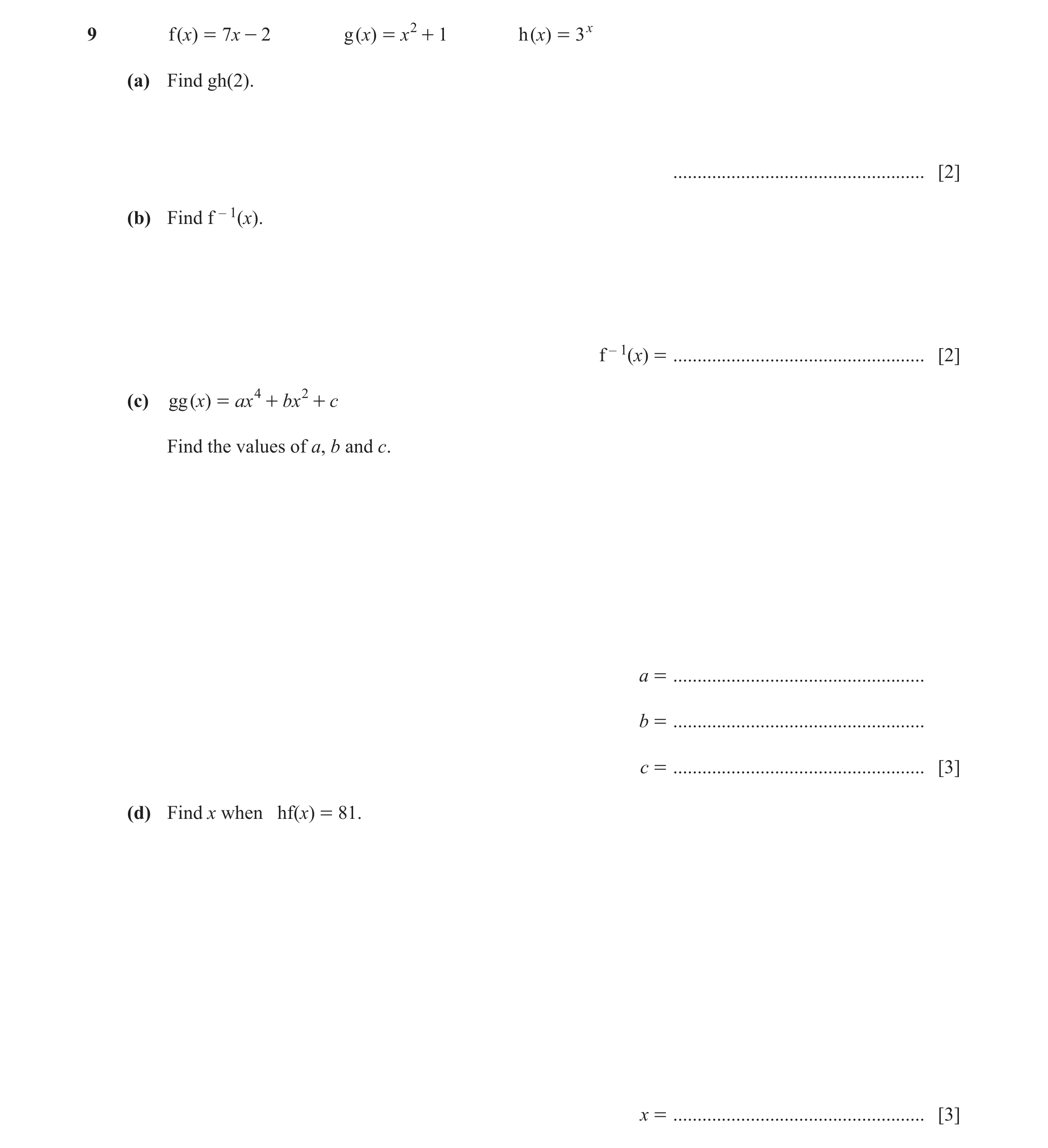
9 f (x) = 7x - 2 g ( x) = x 2 + 1 h (x) = 3x (a) Find gh(2). … [2] (b) Find f – 1(x). f – 1(x) = … [2] (c) gg (x) = ax 4 + bx 2 + c Find the values of a, b and c. a = … b = … c = … [3] (d) Find x when hf(x) = 81. x = … [3]
10 marks
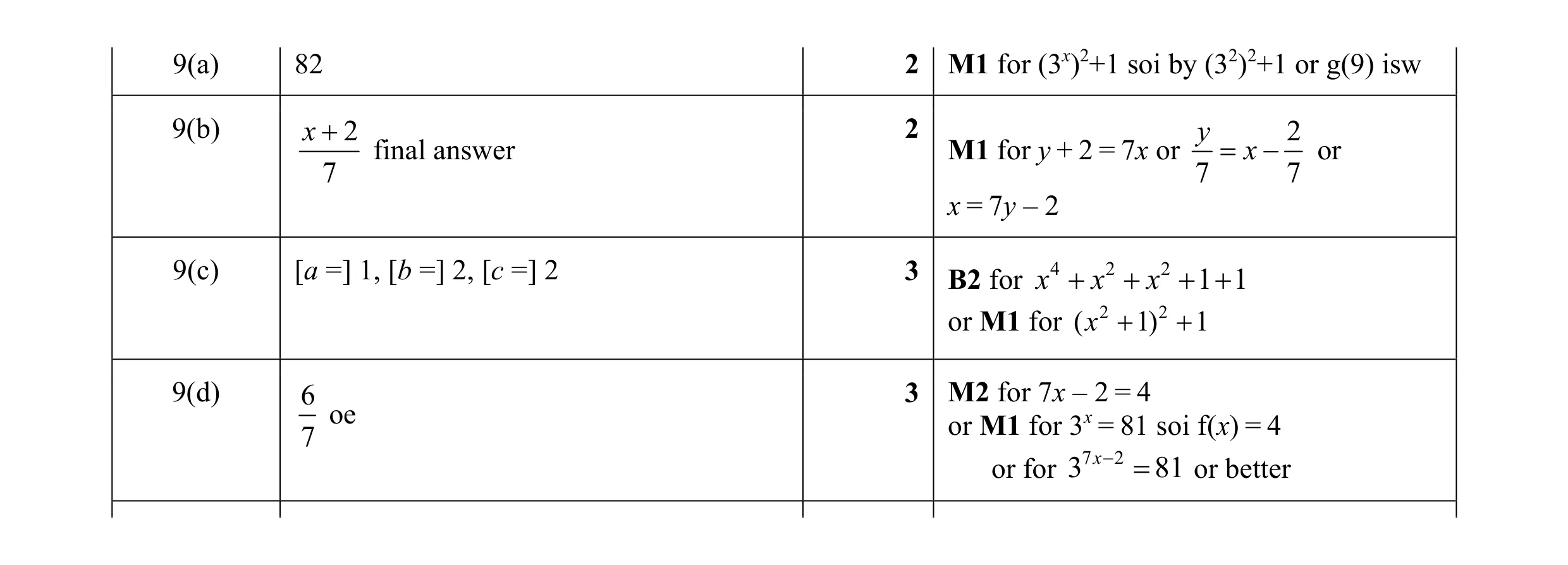
Mark scheme: 9(a) 82 2 M1 for (3x)2+1 soi by (32)2+1 or g(9) isw 9(b) x + 2 2 y 2 final answer M1 for y + 2 = 7x or = x − or 7 7 7 x = 7y – 2 9(c) [a =] 1, [b =] 2, [c =] 2 3 B2 for x 4 + x 2 + x 2 + 1 + 1 or M1 for ( x 2 + 1) 2 + 1 9(d) 6 3 M2 for 7x – 2 = 4 oe or M1 for 3x = 81 soi f(x) = 4 7 or for 37 x −=2 81 or better
This question in 0580/41 May/June 2019
Q25 · 25 The diagram shows the graph of y = f (x) where f ( x) = x - - 2 , x ! 0580/43 May/June 2019
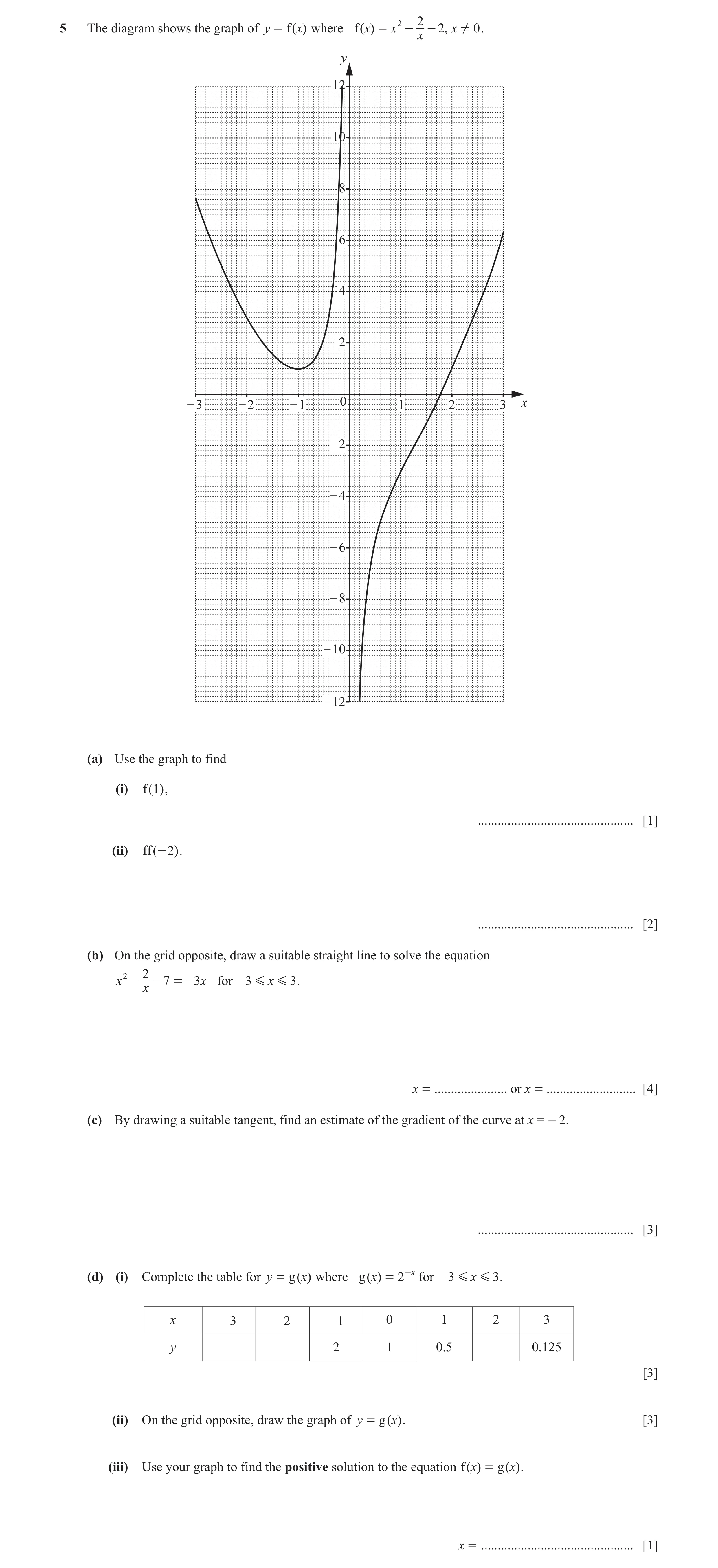
2 25 The diagram shows the graph of y = f (x) where f ( x) = x - - 2 , x ! 0 . x y 12 10 8 6 4 2 – 3 – 2 – 1 0 1 2 3 x – 2 – 4 – 6 – 8 – 10 – 12 (a) Use the graph to find (i) f (1 ) , … [1] (ii) ff (- 2) . … [2] (b) On the grid opposite, draw a suitable straight line to solve the equation 2 2 x - - 7 =- 3x for - 3 G x G 3 . x x = … or x = … [4] (c) By drawing a suitable tangent, find an estimate of the gradient of the curve at x = - 2. … [3] (d) (i) Complete the table for y = g (x) where g ()x = 2 -x for - 3 G x G 3 . x -3 -2 -1 0 1 2 3 y 2 1 0.5 0.125 [3] (ii) On the grid opposite, draw the graph of y = g (x) . [3] (iii) Use your graph to find the positive solution to the equation f (x) = g ( x) . x = … [1]
17 marks
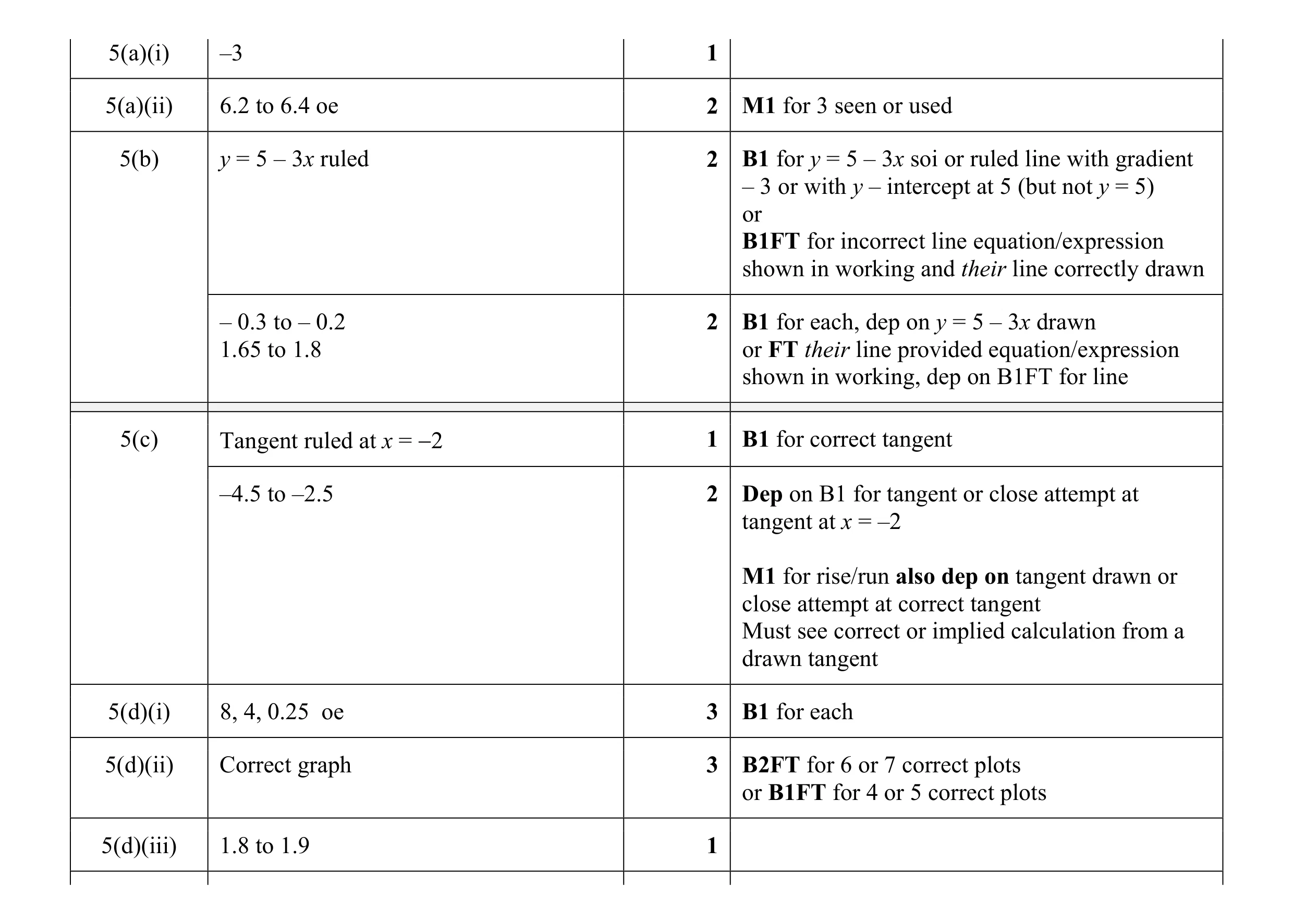
Mark scheme: 5(a)(i) –3 1 5(a)(ii) 6.2 to 6.4 oe 2 M1 for 3 seen or used 5(b) y = 5 – 3x ruled 2 B1 for y = 5 – 3x soi or ruled line with gradient – 3 or with y – intercept at 5 (but not y = 5) or B1FT for incorrect line equation/expression shown in working and their line correctly drawn – 0.3 to – 0.2 2 B1 for each, dep on y = 5 – 3x drawn 1.65 to 1.8 or FT their line provided equation/expression shown in working, dep on B1FT for line 5(c) Tangent ruled at x = −2 1 B1 for correct tangent –4.5 to –2.5 2 Dep on B1 for tangent or close attempt at tangent at x = –2 M1 for rise/run also dep on tangent drawn or close attempt at correct tangent Must see correct or implied calculation from a drawn tangent 5(d)(i) 8, 4, 0.25 oe 3 B1 for each 5(d)(ii) Correct graph 3 B2FT for 6 or 7 correct plots or B1FT for 4 or 5 correct plots 5(d)(iii) 1.8 to 1.9 1
This question in 0580/43 May/June 2019
Q26 · 7 f (x) = 7 - 2x g ( x) = , x ! 0580/42 Oct/Nov 2019
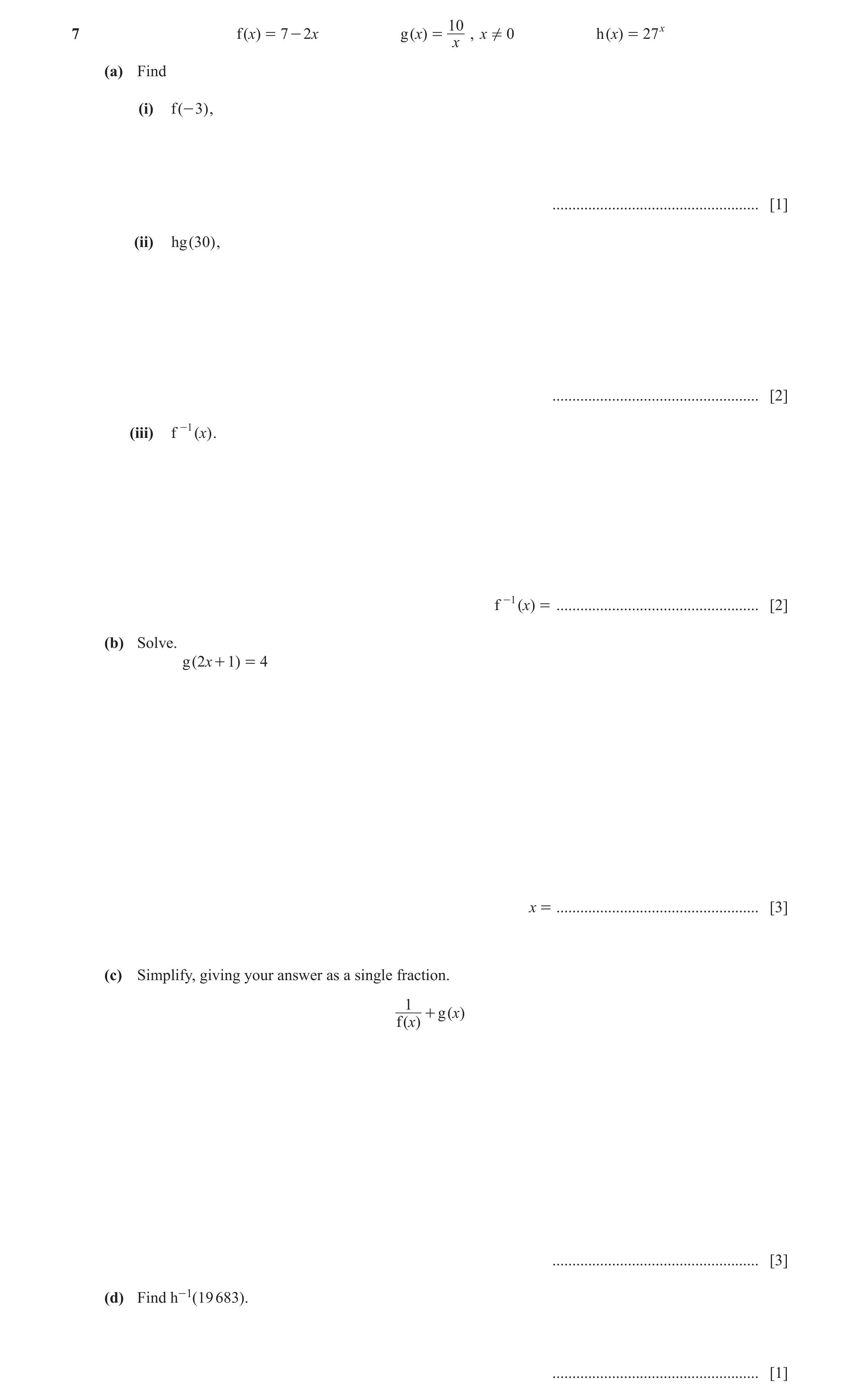
107 f (x) = 7 - 2x g ( x) = , x ! 0 h (x) = 27x x (a) Find (i) f (- 3 ) , … [1] (ii) hg ( 30) , … [2] (iii) f - 1 (x) . f - 1 (x) = … [2] (b) Solve. g (2x + 1) = 4 x = … [3] (c) Simplify, giving your answer as a single fraction. 1 + g (x) f (x) … [3] (d) Find h-1(19 683). … [1]
12 marks
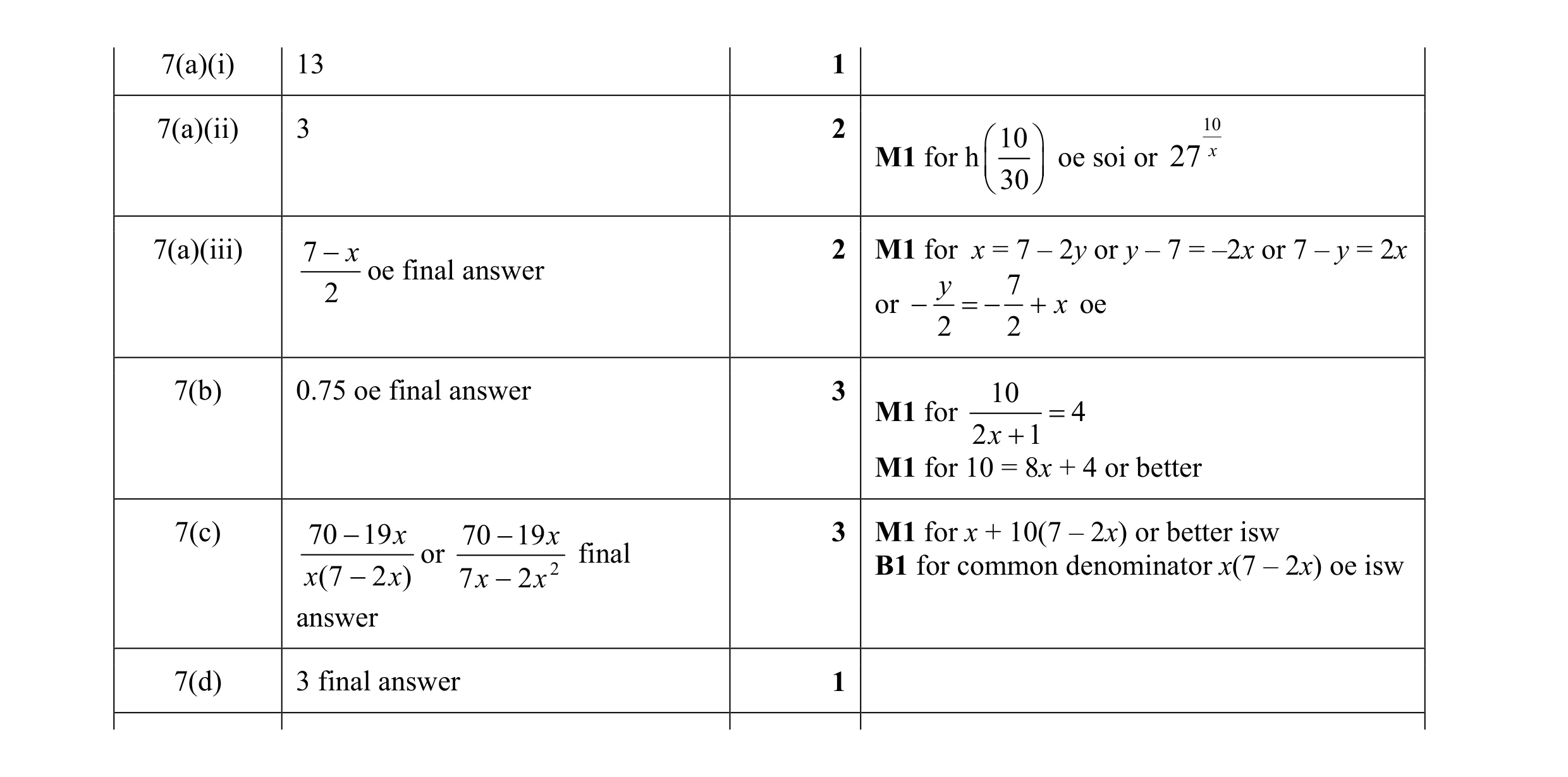
Mark scheme: 7(a)(i) 13 1 7(a)(ii) 3 2 10 10 x M1 for h oe soi or 27 30 7(a)(iii) 7 − x 2 M1 for x = 7 – 2y or y – 7 = –2x or 7 – y = 2x oe final answer y 7 2 or − = − + x oe 2 2 7(b) 0.75 oe final answer 3 10 M1 for = 4 2 x + 1 M1 for 10 = 8x + 4 or better 7(c) 70 − 19 x 70 − 19 x 3 M1 for x + 10(7 – 2x) or better isw or final 2 B1 for common denominator x(7 – 2x) oe isw x ( 7 − 2 x ) 7 x − 2 x answer 7(d) 3 final answer 1
This question in 0580/42 Oct/Nov 2019
Q27 · F (x) = 2x - 3 g (x) = 9 - x 2 h (x) = 3x (a) Find (i) f (4 ) , … [1] (ii) hg ( 3) , …… 0580/43 Oct/Nov 2019
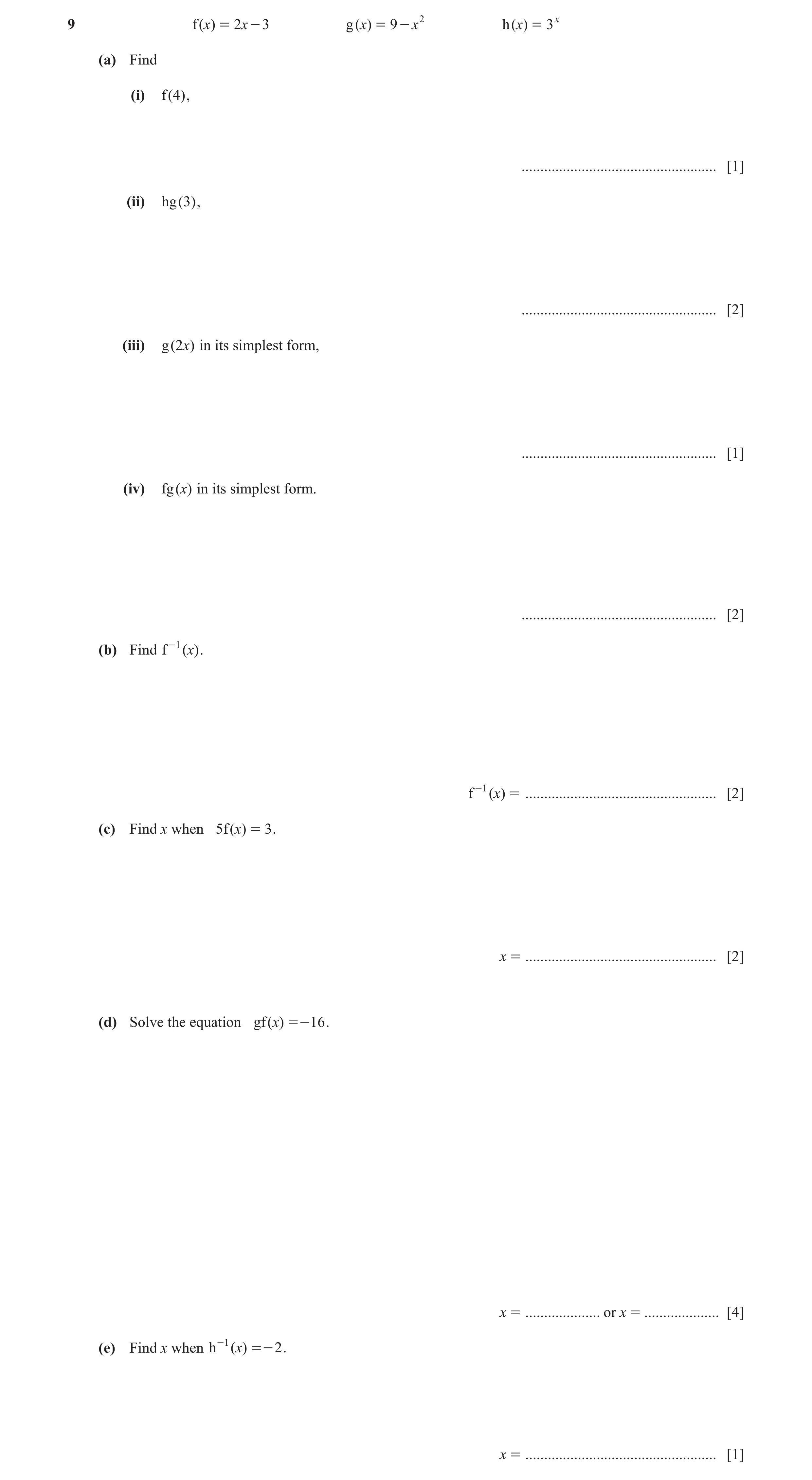
9 f (x) = 2x - 3 g (x) = 9 - x 2 h (x) = 3x (a) Find (i) f (4 ) , … [1] (ii) hg ( 3) , … [2] (iii) g (2x) in its simplest form, … [1] (iv) fg (x) in its simplest form. … [2] (b) Find f - 1 ( x) . f - 1 ( x) = … [2] (c) Find x when 5f ()x = 3 . x = … [2] (d) Solve the equation gf (x) =- 16 . x = … or x = … [4] (e) Find x when h - 1 (x) =- 2 . x = … [1]
15 marks
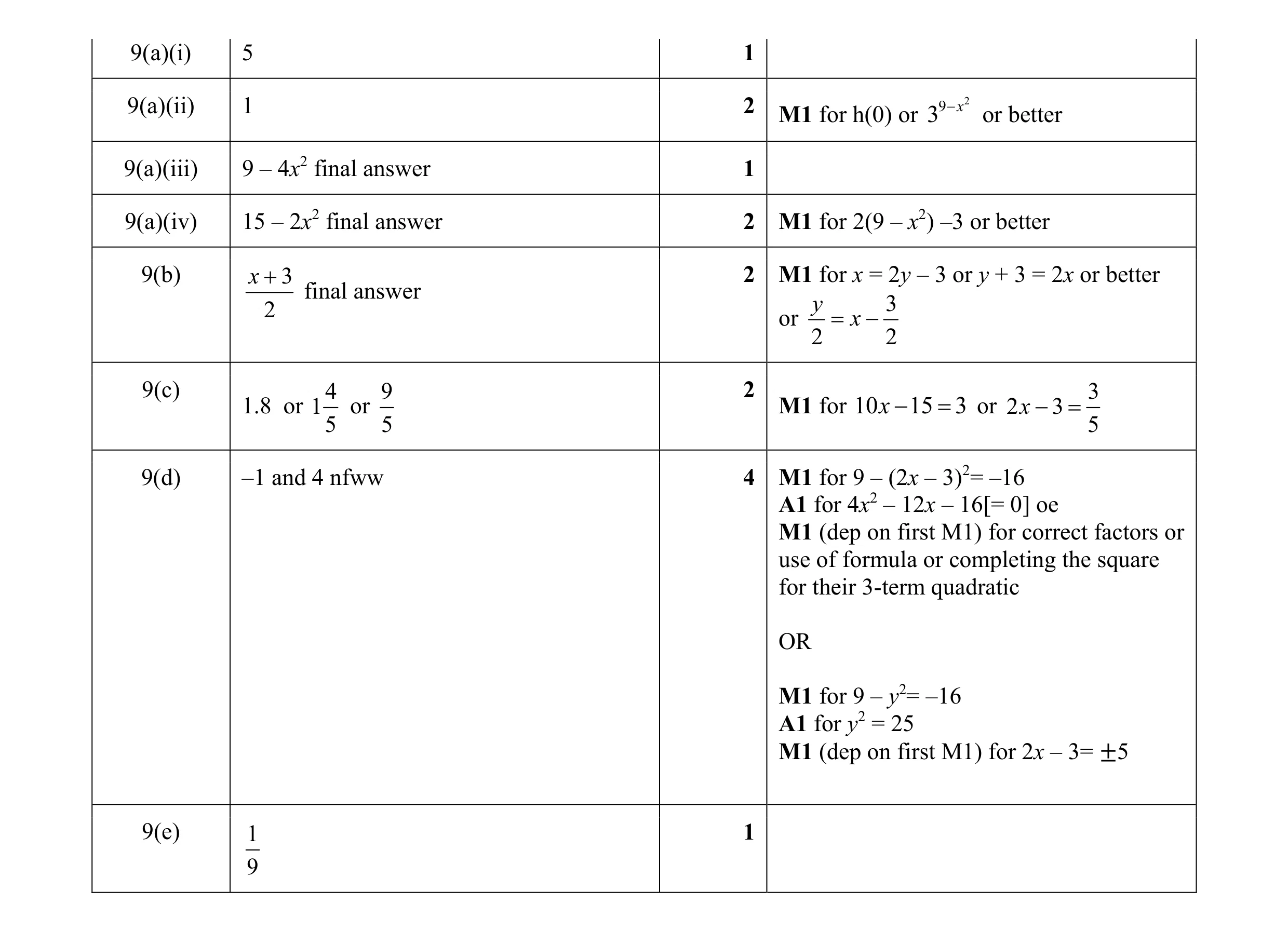
Mark scheme: 9(a)(i) 5 1 9(a)(ii) 1 2 M1 for h(0) or 93 −x 2 or better 9(a)(iii) 9 – 4x2 final answer 1 9(a)(iv) 15 – 2x2 final answer 2 M1 for 2(9 – x2) –3 or better 9(b) x + 3 2 M1 for x = 2y – 3 or y + 3 = 2x or better final answer 2 y 3 or = x − 2 2 9(c) 4 9 2 3 1.8 or 15 or 5 M1 for 10 x − 15 = 3 or 2 x − 3 = 5 9(d) –1 and 4 nfww 4 M1 for 9 – (2x – 3)2= –16 A1 for 4x2 – 12x – 16[= 0] oe M1 (dep on first M1) for correct factors or use of formula or completing the square for their 3-term quadratic OR M1 for 9 – y2= –16 A1 for y2 = 25 M1 (dep on first M1) for 2x – 3= ±5 9(e) 1 1 9
This question in 0580/43 Oct/Nov 2019
Q28 · F ( x) = 4 x - 1 g ( x) = x 2 h ( x) = 3 -x (a) Find in its simplest form (i) f ( x - 3)… 0580/42 Feb/March 2020
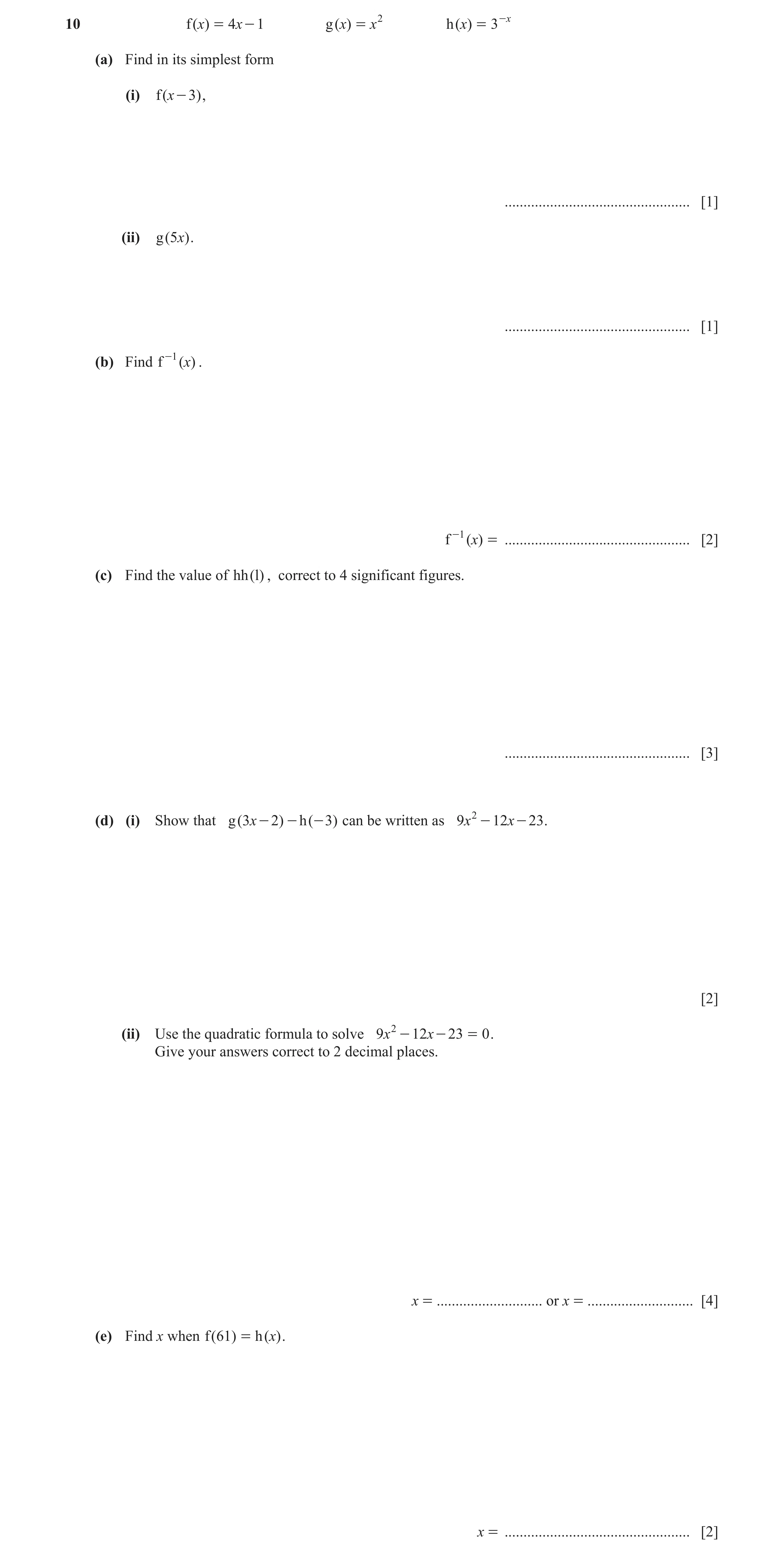
10 f ( x) = 4 x - 1 g ( x) = x 2 h ( x) = 3 -x (a) Find in its simplest form (i) f ( x - 3) , … [1] (ii) g ( 5x) . … [1] (b) Find f -1 ( x) . f -1 ( x) = … [2] (c) Find the value of hh(l) , correct to 4 significant figures. … [3] (d) (i) Show that g ( 3x - 2) - h ( - 3) can be written as 9x 2 - 12x - 23 . [2] (ii) Use the quadratic formula to solve 9x 2 - 12 x - 23 = 0 . Give your answers correct to 2 decimal places. x = … or x = … [4] (e) Find x when f ( 61) = h ( x) . x = … [2]
15 marks
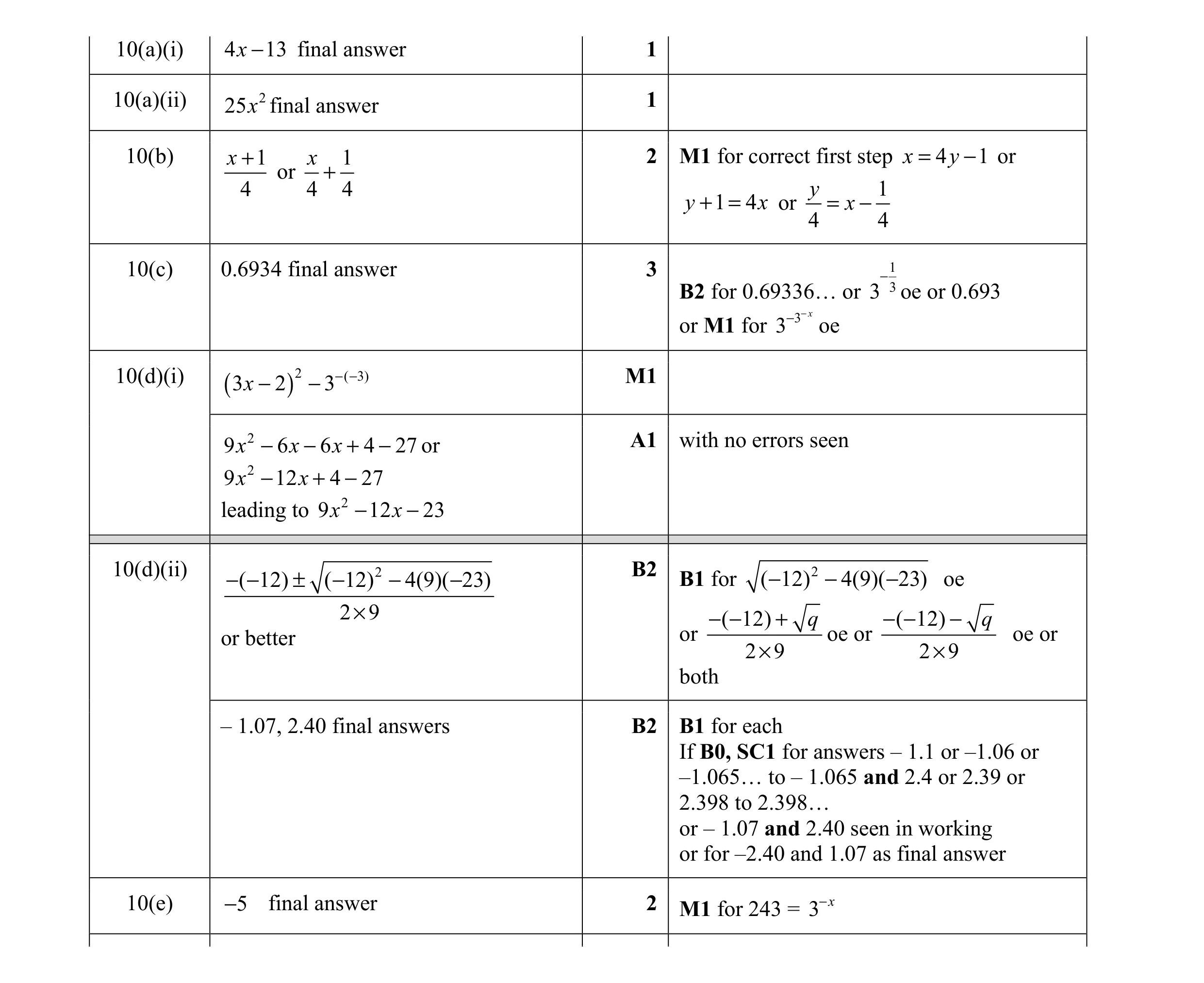
Mark scheme: 10(a)(i) 4 x − 13 final answer 1 10(a)(ii) 25x 2 final answer 1 10(b) x + 1 x 1 2 M1 for correct first step x = 4 y − 1 or or + 4 4 4 y 1 y + 1 = 4 x or = x − 4 4 10(c) 0.6934 final answer 3 1 3 or 0.693 B2 for 0.69336… or 3−oe or M1 for 3−3− x oe 10(d)(i) ( 3 x − 2 ) 2 − 3−−( 3) M1 9 x 2 − 6 x − 6 x + 4 − 27 or A1 with no errors seen 9 x 2 − 12 x + 4 − 27 leading to 9 x 2 − 12 x − 23 10(d)(ii) 2 B2 2 −−( 12) ± ( − 12) − 4(9)( −23) B1 for ( −12) − 4(9)( −23) oe 2 × 9 −−( 12) + q −−( 12) − q or better or oe or oe or 2 × 9 2 × 9 both – 1.07, 2.40 final answers B2 B1 for each If B0, SC1 for answers – 1.1 or –1.06 or –1.065… to – 1.065 and 2.4 or 2.39 or 2.398 to 2.398… or – 1.07 and 2.40 seen in working or for –2.40 and 1.07 as final answer 10(e) − 5 final answer 2 M1 for 243 = 3−x
This question in 0580/42 Feb/March 2020
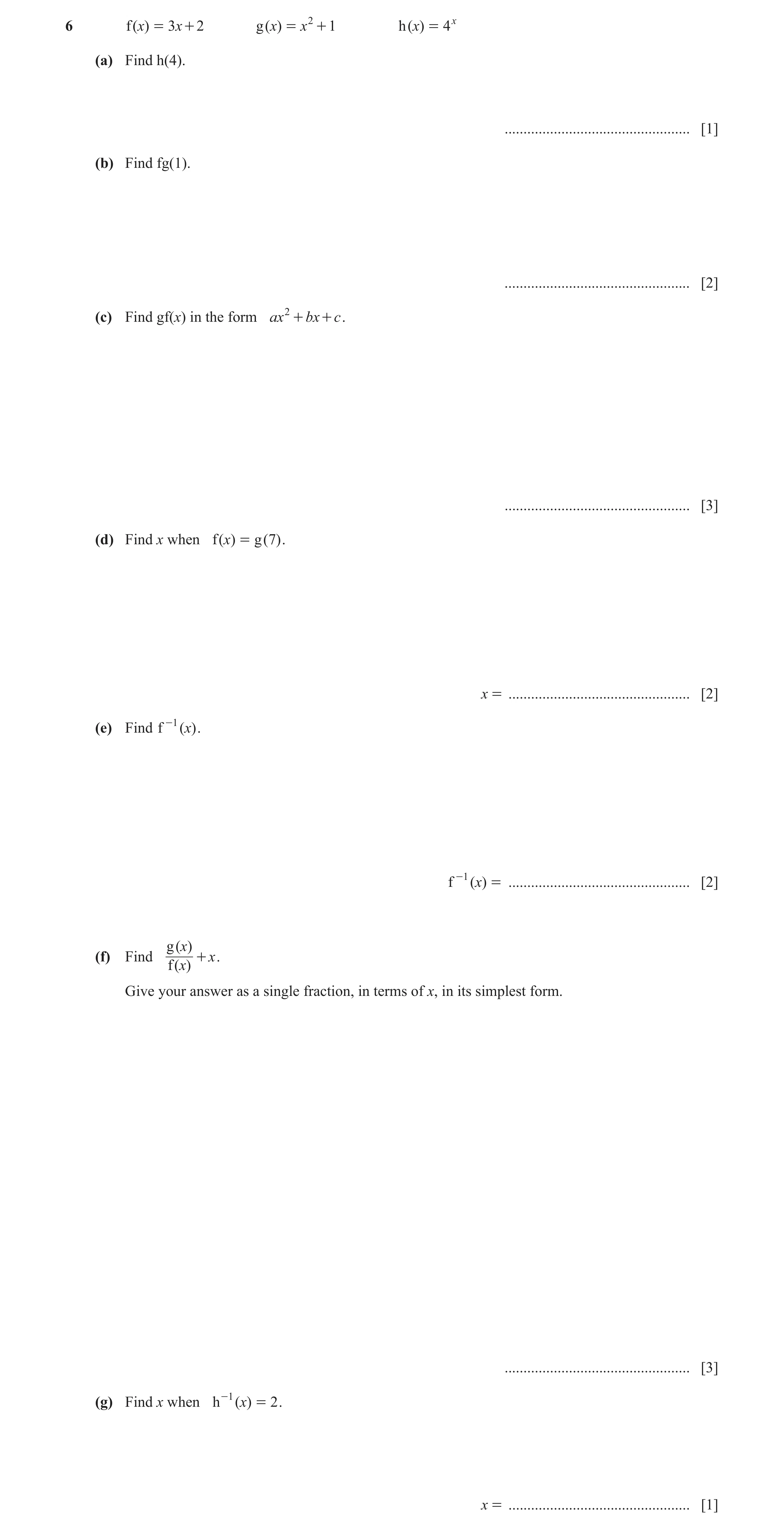
Q29 · F ( x) = 3x + 2 g ( x) = x 2 + 1 h ( x) = 4x (a) Find h(4) 0580/42 May/June 2020
6 f ( x) = 3x + 2 g ( x) = x 2 + 1 h ( x) = 4x (a) Find h(4). … [1] (b) Find fg(1). … [2] (c) Find gf(x) in the form ax 2 + bx + c . … [3] (d) Find x when f ( x) = g ( 7) . x = … [2] (e) Find f -1 ( x) . f -1 ( x) = … [2] g (x) (f) Find + x . f (x) Give your answer as a single fraction, in terms of x, in its simplest form. … [3] (g) Find x when h -1 ( x) = 2 . x = … [1]
14 marks
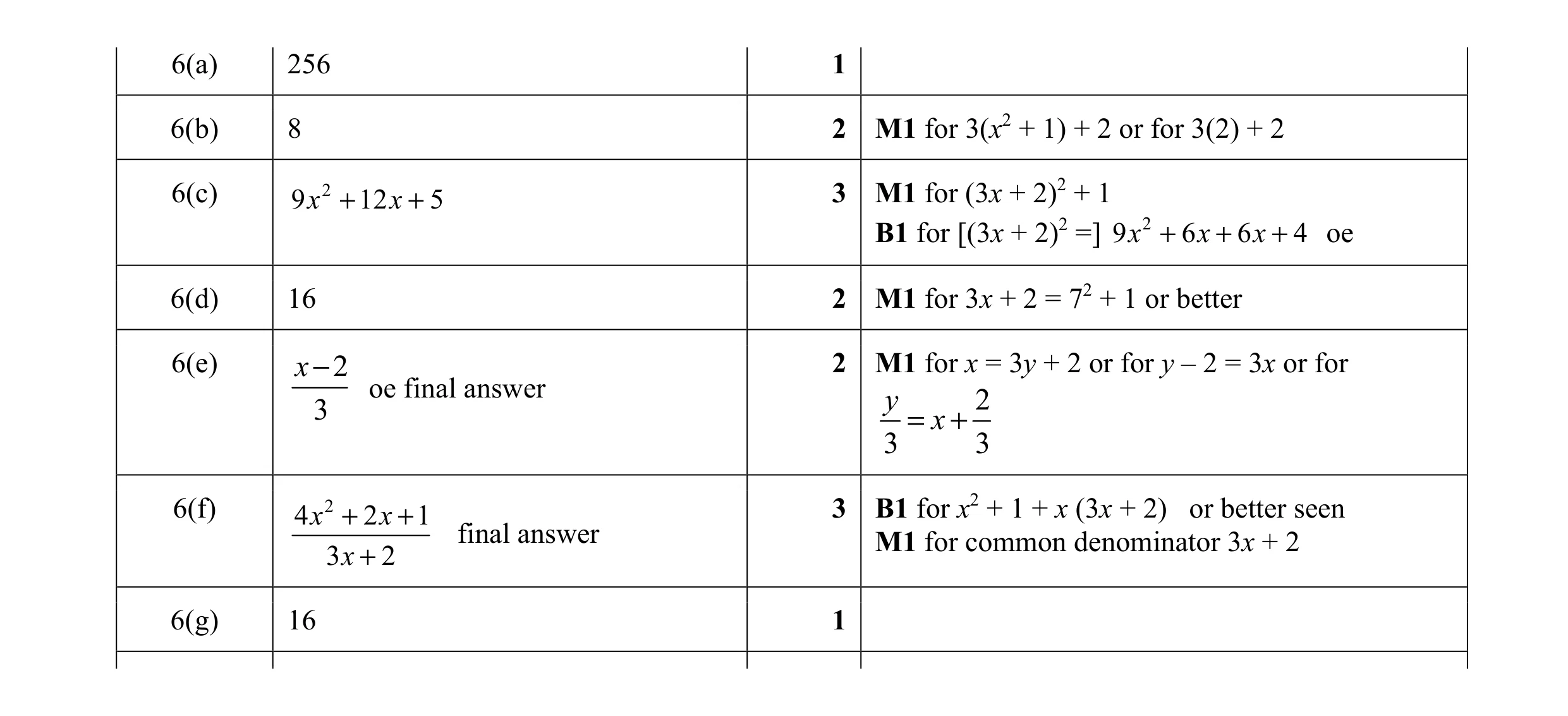
Mark scheme: 6(a) 256 1 6(b) 8 2 M1 for 3(x2 + 1) + 2 or for 3(2) + 2 6(c) 9 x 2 + 12 x + 5 3 M1 for (3x + 2)2 + 1 B1 for [(3x + 2)2 =] 9 x 2 + 6 x + 6 x + 4 oe 6(d) 16 2 M1 for 3x + 2 = 72 + 1 or better 6(e) x− 2 2 M1 for x = 3y + 2 or for y – 2 = 3x or for oe final answer y 2 3 = x + 3 3 6(f) 4 x 2 + 2 x + 1 3 B1 for x2 + 1 + x (3x + 2) or better seen final answer M1 for common denominator 3x + 2 3 x + 2 6(g) 16 1
This question in 0580/42 May/June 2020
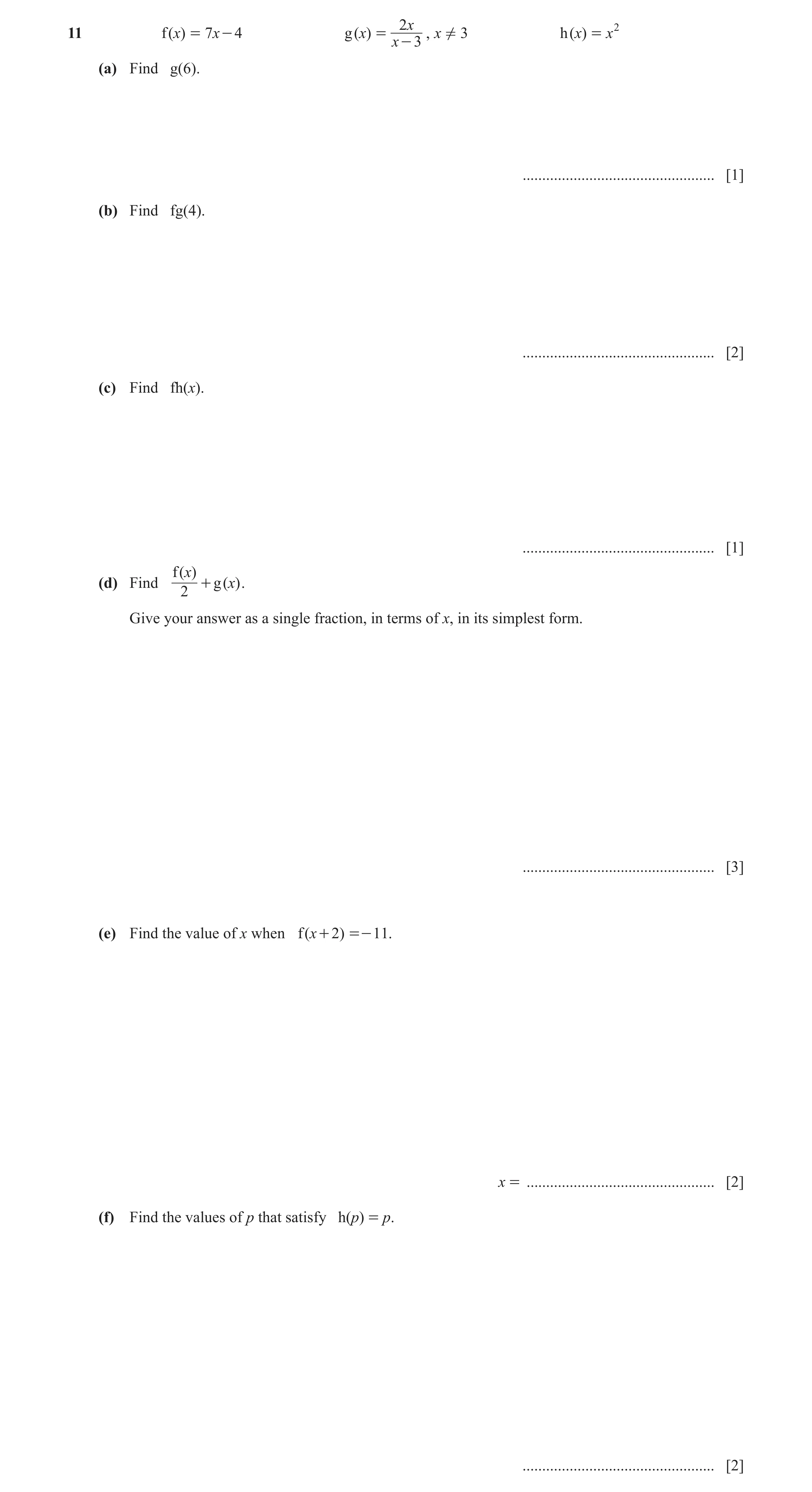
Q30 · X11 f ( x) = 7 x - 4 g ( x) = , x ! 0580/43 May/June 2020
2x11 f ( x) = 7 x - 4 g ( x) = , x ! 3 h ( x) = x2 x - 3 (a) Find g(6). … [1] (b) Find fg(4). … [2] (c) Find fh(x). … [1] f ( x) (d) Find + g ( x) . 2 Give your answer as a single fraction, in terms of x, in its simplest form. … [3] (e) Find the value of x when f ( x + 2) =- 11. x = … [2] (f) Find the values of p that satisfy h(p) = p. … [2]
11 marks
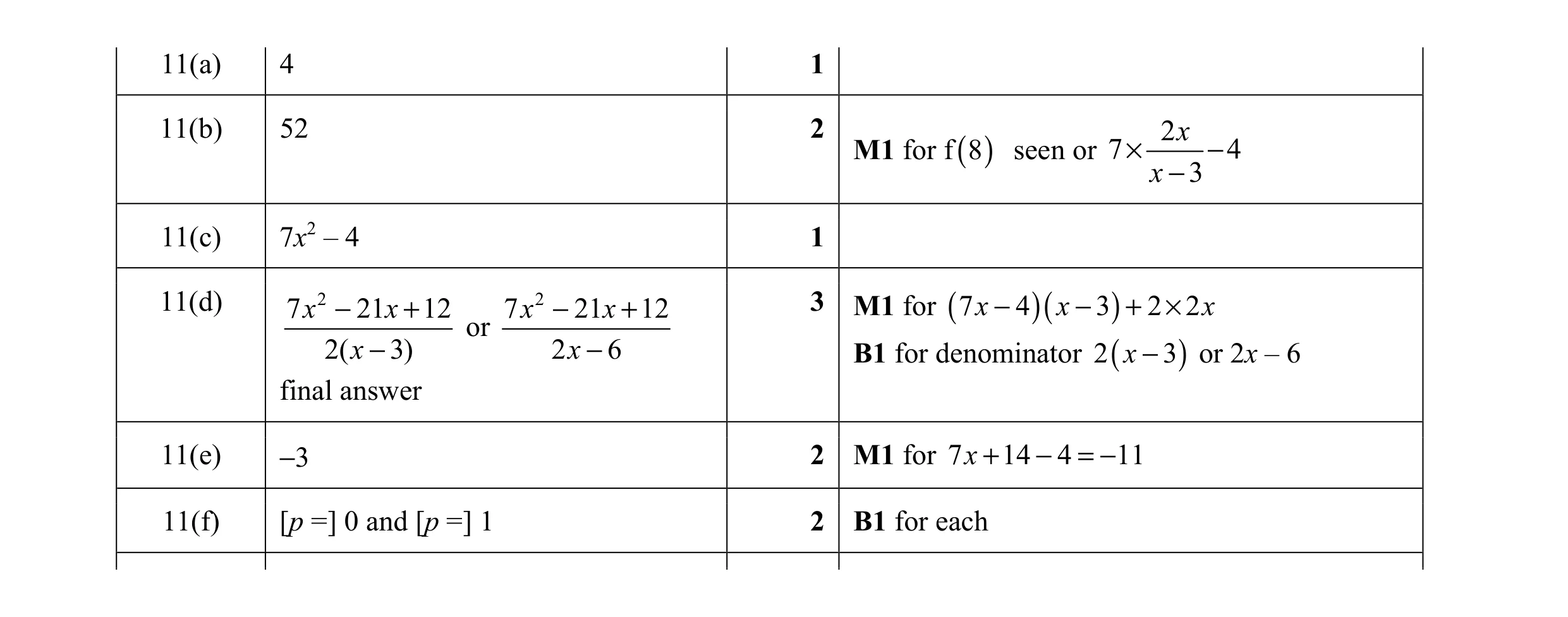
Mark scheme: 11(a) 4 1 11(b) 52 2 2 x M1 for f( 8 ) seen or 7 × − 4 x − 3 11(c) 7x2 – 4 1 11(d) 7 x 2 − 21x + 12 7 x 2 − 21x + 12 3 M1 for ( 7 x − 4 )( x − 3 ) + 2 × 2 x or 2( x − 3) 2 x − 6 B1 for denominator 2 ( x − 3 ) or 2x – 6 final answer 11(e) −3 2 M1 for 7 x + 14 − 4 = −11 11(f) [p =] 0 and [p =] 1 2 B1 for each
This question in 0580/43 May/June 2020
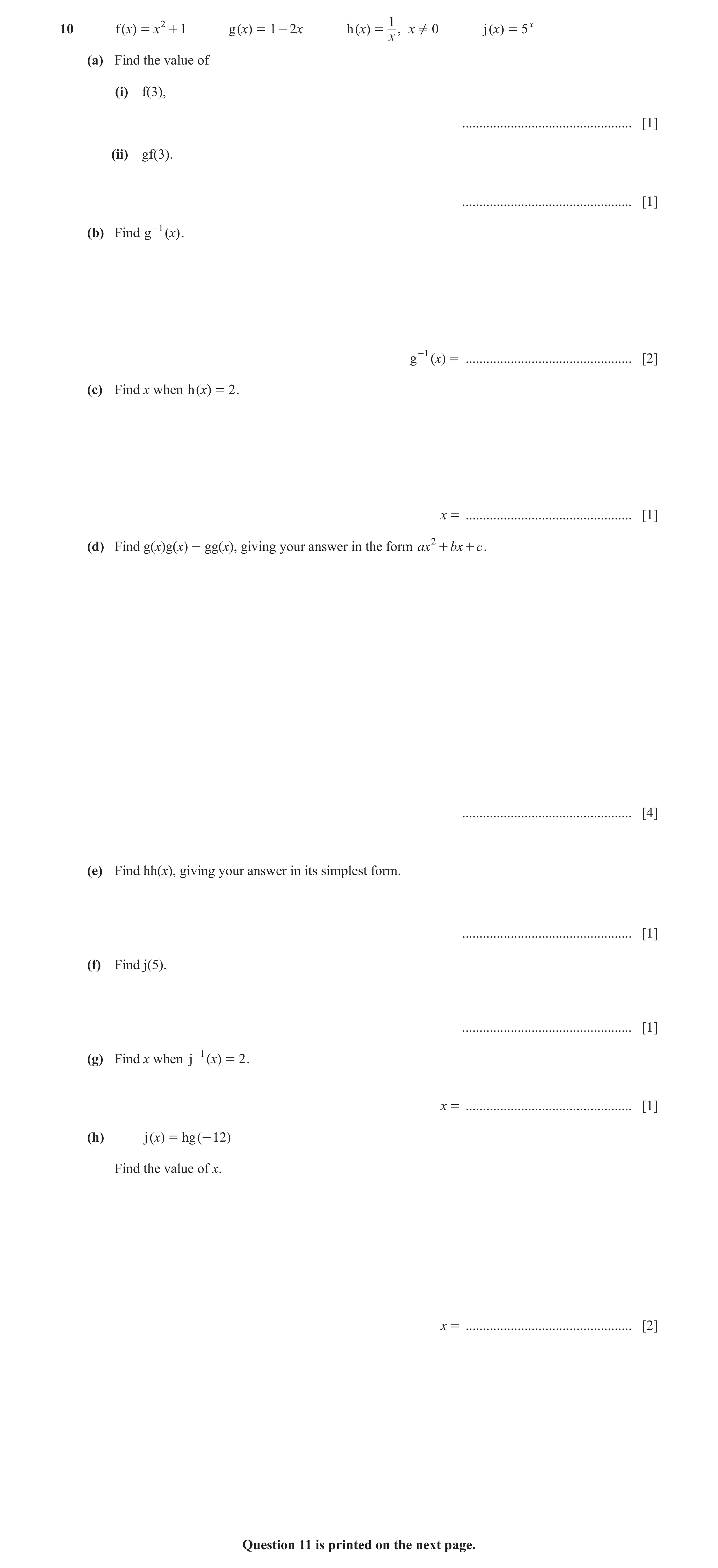
Q31 · 110 f ( x) = x + 1 g ( x) = 1 - 2 x h ( x) = , x ! 0580/42 Oct/Nov 2020
2 110 f ( x) = x + 1 g ( x) = 1 - 2 x h ( x) = , x ! 0 j ( x) = 5x x (a) Find the value of (i) f(3), … [1] (ii) gf(3). … [1] (b) Find g -1 ( x) . g -1 ( x) = … [2] (c) Find x when h ( x) = 2 . x = … [1] (d) Find g(x)g(x) - gg(x), giving your answer in the form ax 2 + bx + c . … [4] (e) Find hh(x), giving your answer in its simplest form. … [1] (f) Find j(5). … [1] (g) Find x when j -1 ( x) = 2 . x = … [1] (h) j ( x) = hg ( - 12) Find the value of x. x = … [2] Question 11 is printed on the next page.
14 marks
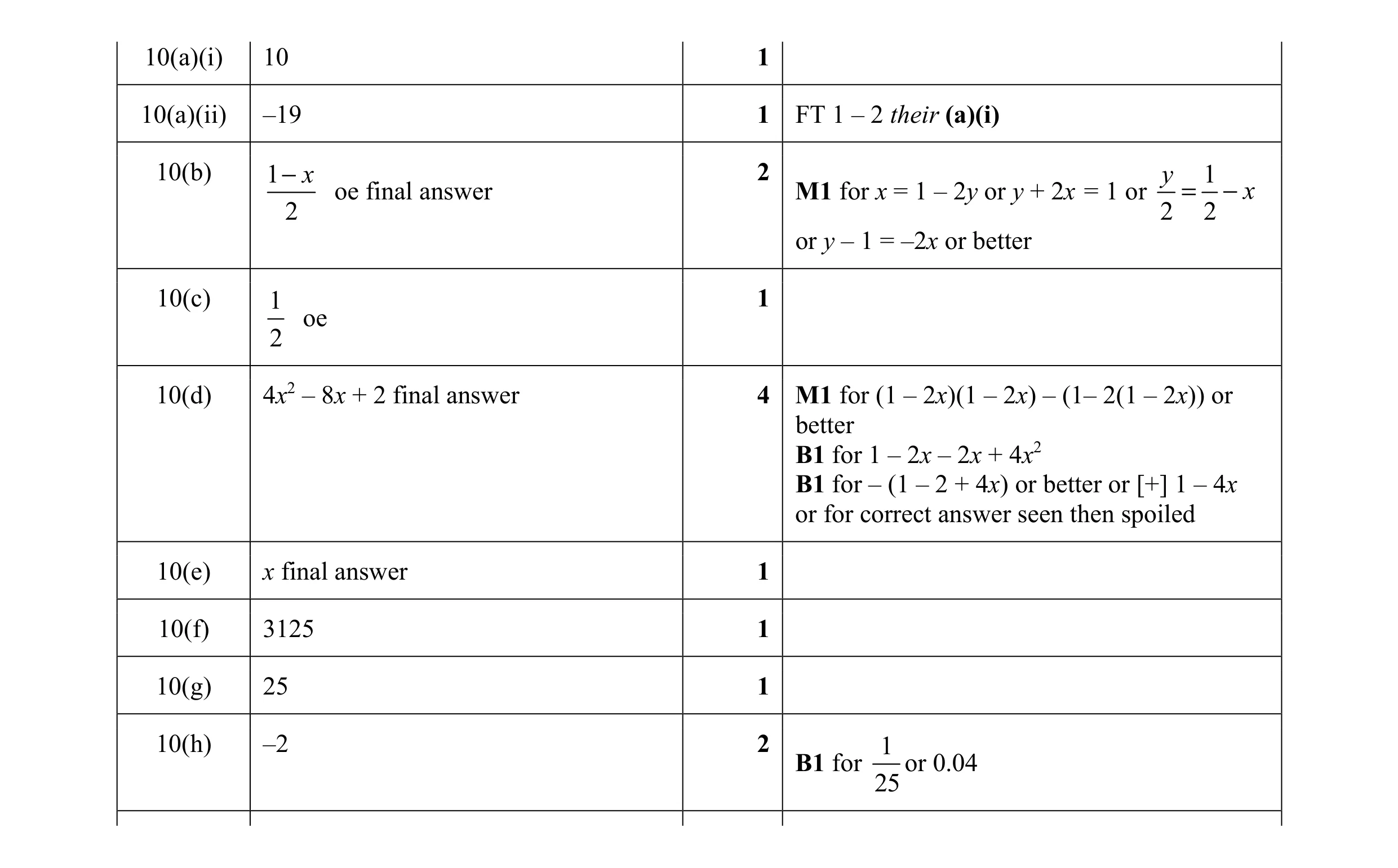
Mark scheme: 10(a)(i) 10 1 10(a)(ii) –19 1 FT 1 – 2 their (a)(i) 10(b) 1 −x 2 y 1 oe final answer M1 for x = 1 – 2y or y + 2x = 1 or = − x 2 2 2 or y – 1 = –2x or better 10(c) 1 1 oe 2 10(d) 4x2 – 8x + 2 final answer 4 M1 for (1 – 2x)(1 – 2x) – (1– 2(1 – 2x)) or better B1 for 1 – 2x – 2x + 4x2 B1 for – (1 – 2 + 4x) or better or [+] 1 – 4x or for correct answer seen then spoiled 10(e) x final answer 1 10(f) 3125 1 10(g) 25 1 10(h) –2 2 1 B1 for or 0.04 25
This question in 0580/42 Oct/Nov 2020
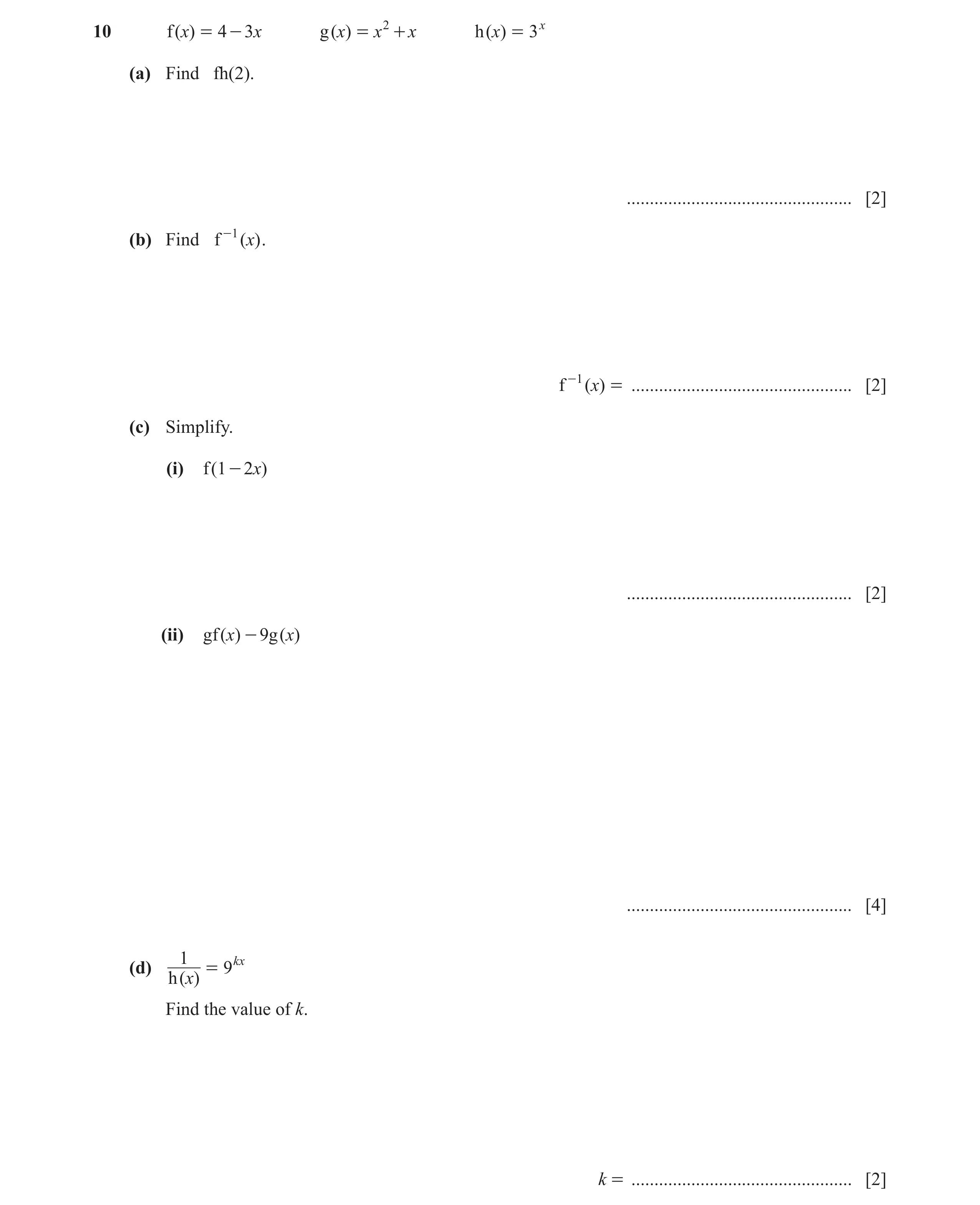
Q32 · F ( x) = 4 - 3 x g ( x) = x2 + x h ( x) = 3x (a) Find fh(2) 0580/43 Oct/Nov 2020
10 f ( x) = 4 - 3 x g ( x) = x2 + x h ( x) = 3x (a) Find fh(2). … [2] (b) Find f -1 ( x) . f -1 ( x) = … [2] (c) Simplify. (i) f ( 1 - 2 x) … [2] (ii) gf ( x) - 9g ( x) … [4] 1 (d) = 9kx h ( x) Find the value of k. k = … [2]
12 marks
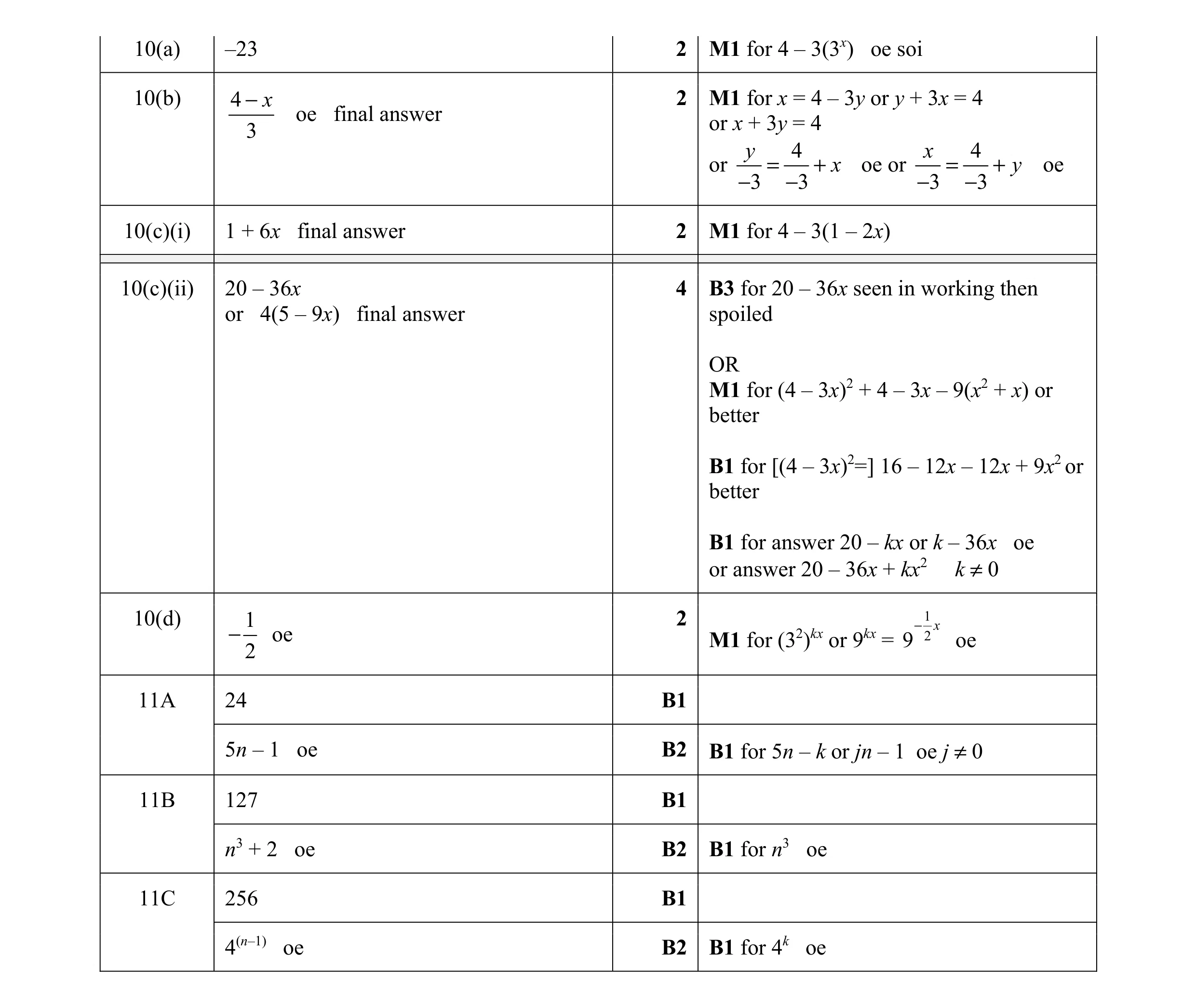
Mark scheme: 10(a) –23 2 M1 for 4 – 3(3x) oe soi 10(b) 4 − x 2 M1 for x = 4 – 3y or y + 3x = 4 oe final answer or x + 3y = 4 3 y 4 x 4 or = + x oe or = + y oe −3 −3 −3 −3 10(c)(i) 1 + 6x final answer 2 M1 for 4 – 3(1 – 2x) 10(c)(ii) 20 – 36x 4 B3 for 20 – 36x seen in working then or 4(5 – 9x) final answer spoiled OR M1 for (4 – 3x)2 + 4 – 3x – 9(x2 + x) or better B1 for [(4 – 3x)2=] 16 – 12x – 12x + 9x2 or better B1 for answer 20 – kx or k – 36x oe or answer 20 – 36x + kx2 k ≠ 0 10(d) 1 2 − 1 x 2 oe − oe M1 for (32)kx or 9kx = 9 2 11A 24 B1 5n – 1 oe B2 B1 for 5n – k or jn – 1 oe j ≠ 0 11B 127 B1 n3 + 2 oe B2 B1 for n3 oe 11C 256 B1 4(n–1) oe B2 B1 for 4k oe
This question in 0580/43 Oct/Nov 2020
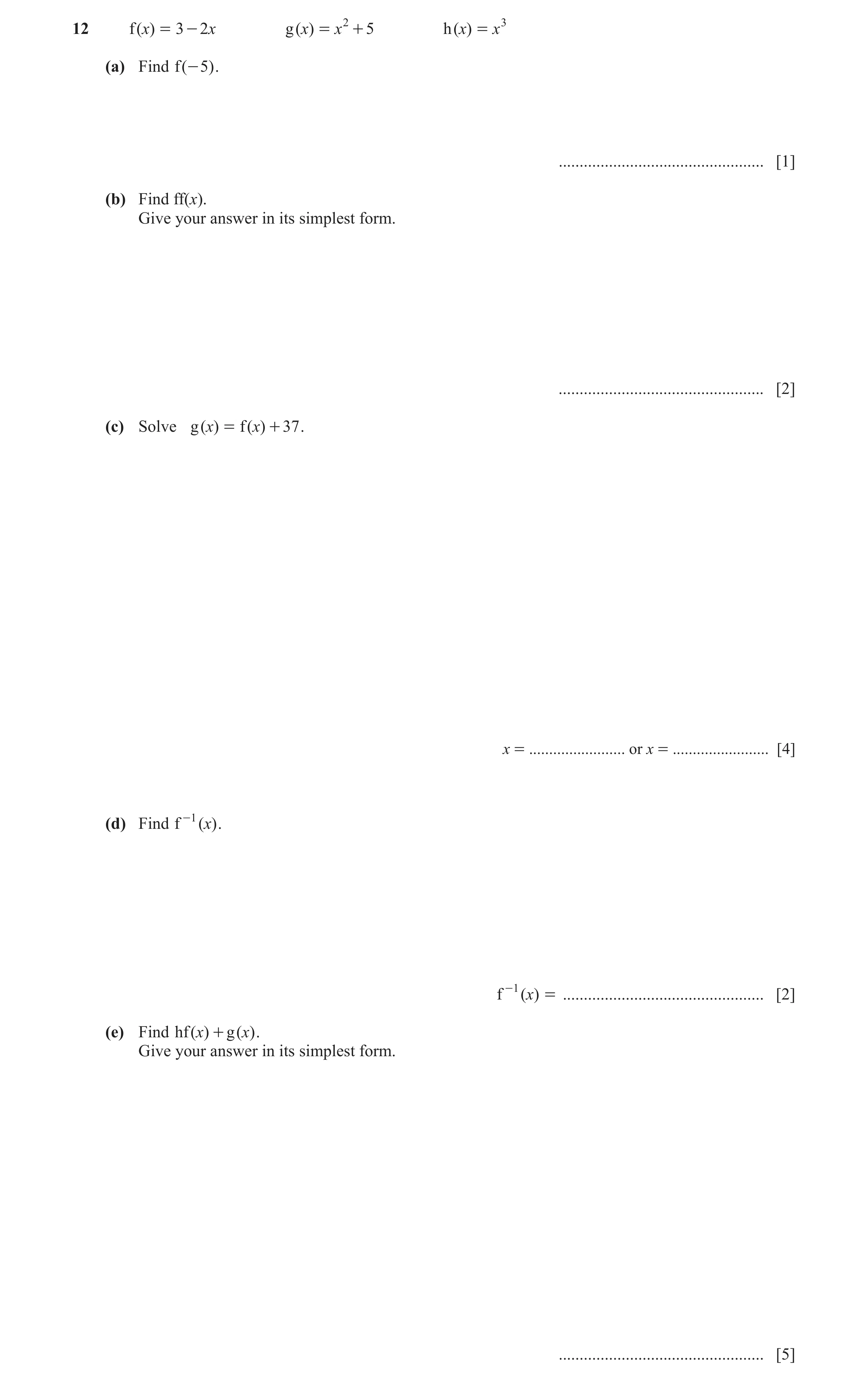
Q33 · F ( )x = 3 - 2 x g ( )x = x 2 + 5 h ( )x = x 3 (a) Find f ( - 5) 0580/41 May/June 2021
12 f ( )x = 3 - 2 x g ( )x = x 2 + 5 h ( )x = x 3 (a) Find f ( - 5) . … [1] (b) Find ff(x). Give your answer in its simplest form. … [2] (c) Solve g ( x) = f ( x) + 37 . x = … or x = … [4] (d) Find f -1 ( )x . f -1 ( )x = … [2] (e) Find hf ( x) + g ( x) . Give your answer in its simplest form. … [5]
14 marks
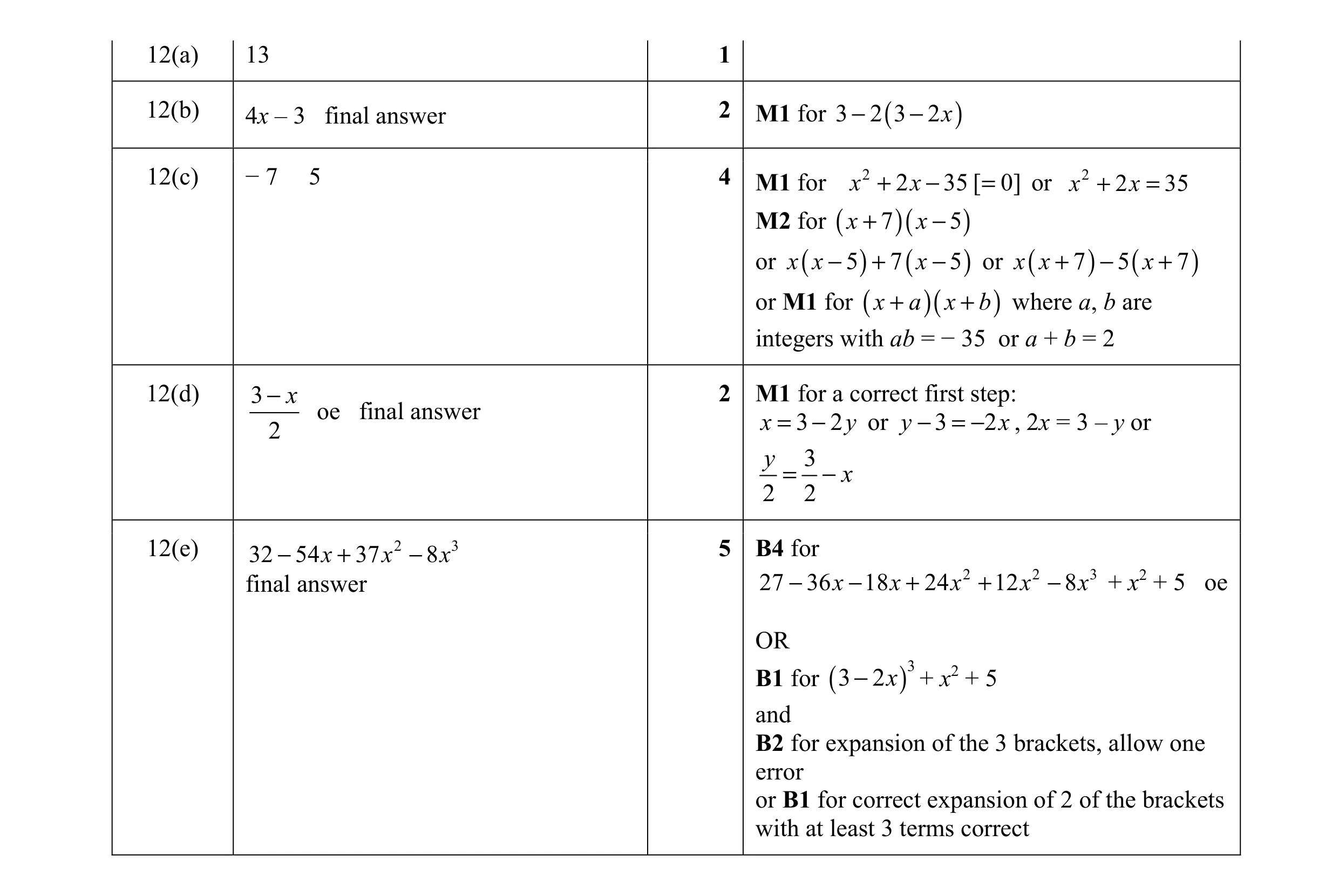
Mark scheme: 12(a) 13 1 12(b) 4x – 3 final answer 2 M1 for 3 − 2 ( 3 − 2x ) 12(c) − 7 5 4 M1 for x 2 + 2 x − 35 [ = 0] or x 2 + 2 x = 35 M2 for ( x + 7 )( x − 5 ) or x ( x − 5 ) + 7 ( x − 5 ) or x ( x + 7 ) − 5 ( x + 7 ) or M1 for ( x + a )( x + b ) where a, b are integers with ab = − 35 or a + b = 2 12(d) 3 − x 2 M1 for a correct first step: oe final answer x = 3 − 2 y or y − 3 = −2 x , 2x = 3 – y or 2 y 3 = − x 2 2 12(e) 32 − 54 x + 37 x 2 − 8 x 3 5 B4 for final answer 27 − 36 x − 18 x + 24 x 2 + 12 x 2 − 8 x 3 + x2 + 5 oe OR 3 B1 for ( 3 − 2x ) + x2 + 5 and B2 for expansion of the 3 brackets, allow one error or B1 for correct expansion of 2 of the brackets with at least 3 terms correct
This question in 0580/41 May/June 2021
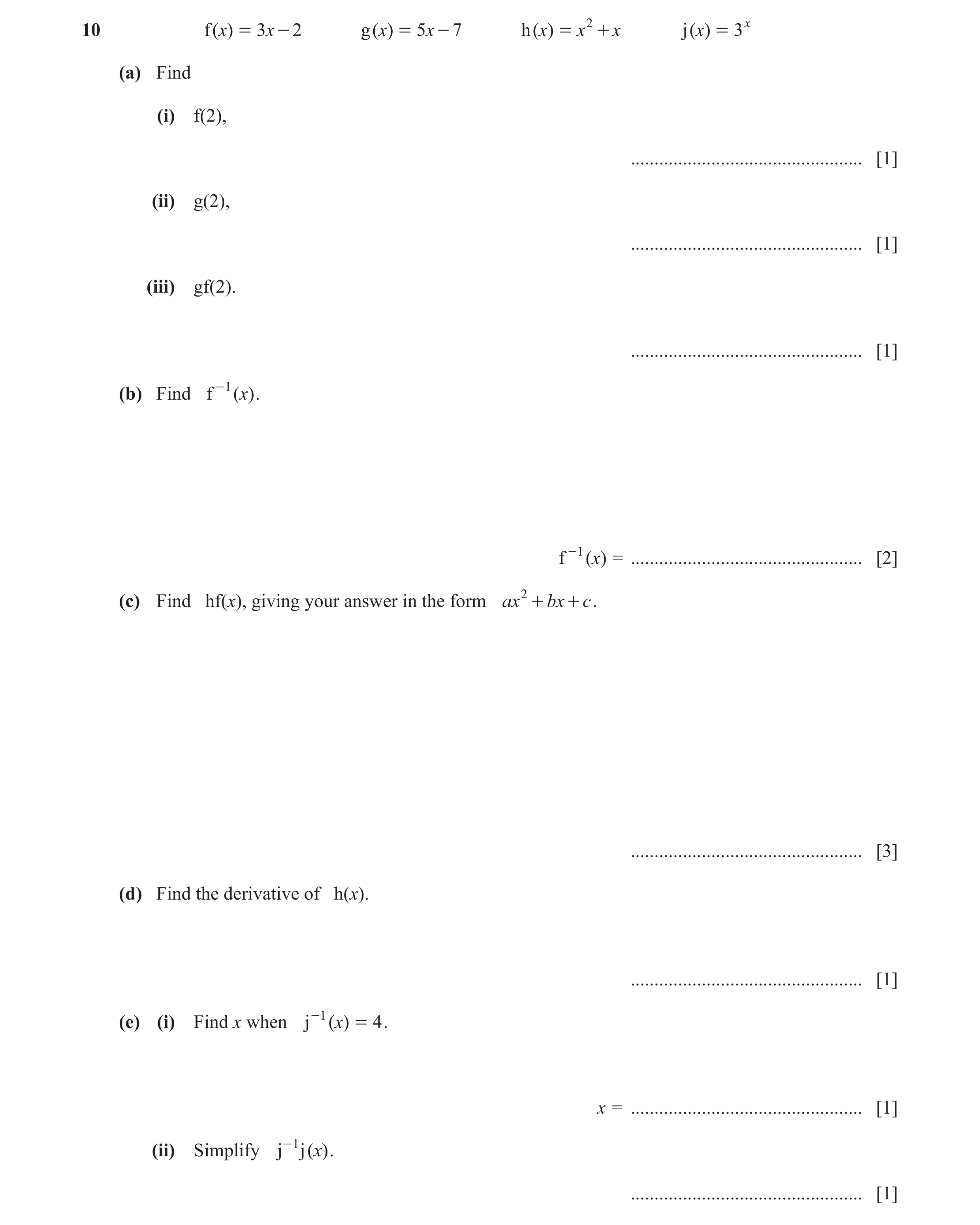
Q34 · F ( )x = 3 x - 2 g ( )x = 5 x - 7 h ( )x = x 2 + x j ( )x = 3 x (a) Find (i) f(2), … [1]… 0580/43 May/June 2021
10 f ( )x = 3 x - 2 g ( )x = 5 x - 7 h ( )x = x 2 + x j ( )x = 3 x (a) Find (i) f(2), … [1] (ii) g(2), … [1] (iii) gf(2). … [1] (b) Find f -1 ( )x . f -1 ( )x = … [2] (c) Find hf(x), giving your answer in the form ax 2 + bx + c . … [3] (d) Find the derivative of h(x). … [1] (e) (i) Find x when j -1 ( )x = 4 . x = … [1] (ii) Simplify j -1 j ( )x . … [1]
11 marks
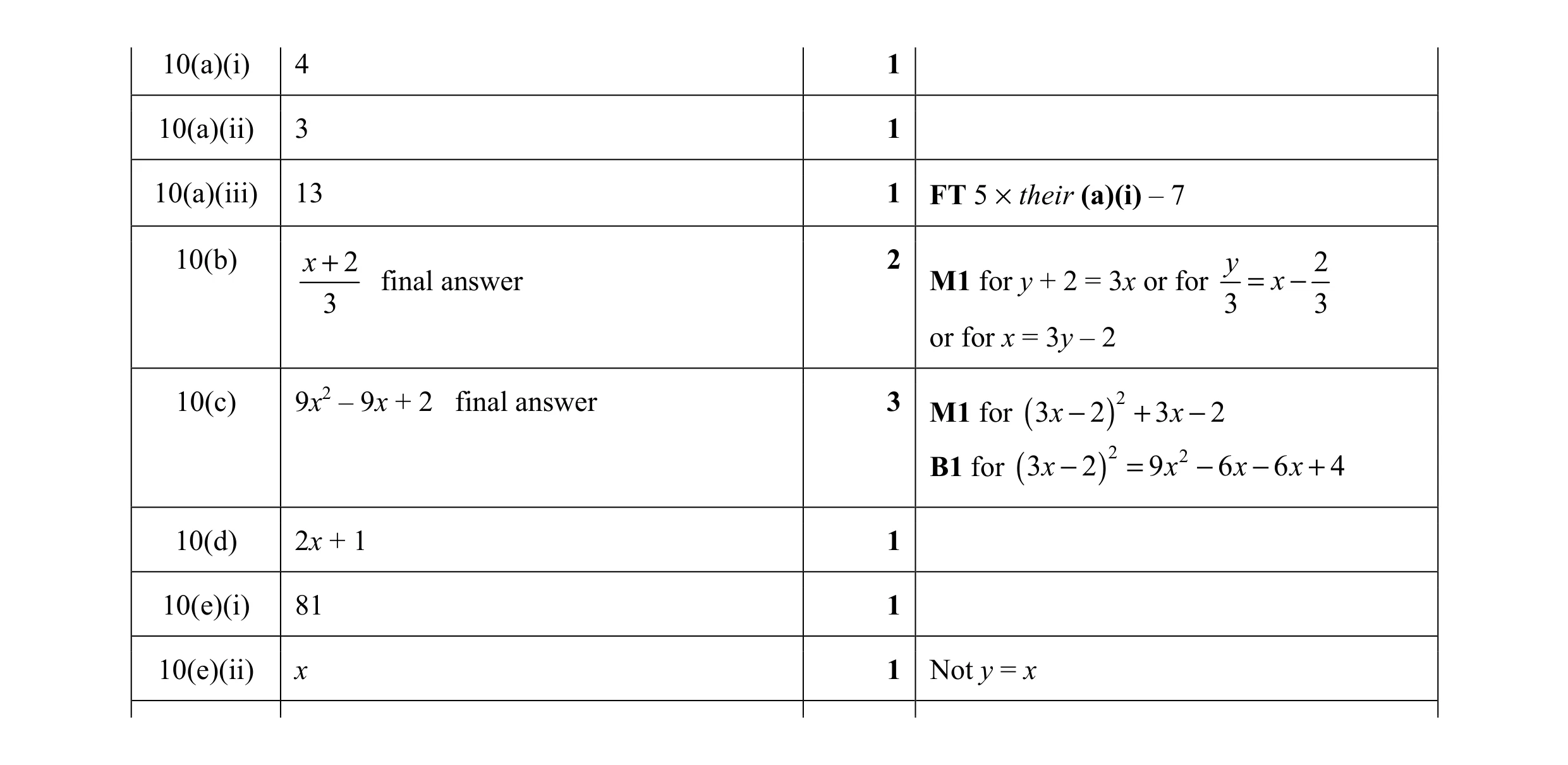
Mark scheme: 10(a)(i) 4 1 10(a)(ii) 3 1 10(a)(iii) 13 1 FT 5 × their (a)(i) – 7 10(b) x + 2 2 y 2 final answer M1 for y + 2 = 3x or for = x − 3 3 3 or for x = 3y – 2 10(c) 9x2 – 9x + 2 final answer 3 2 M1 for ( 3 x − 2 ) + 3 x − 2 2 2 B1 for ( 3 x − 2 ) = 9 x − 6 x − 6 x + 4 10(d) 2x + 1 1 10(e)(i) 81 1 10(e)(ii) x 1 Not y = x
This question in 0580/43 May/June 2021
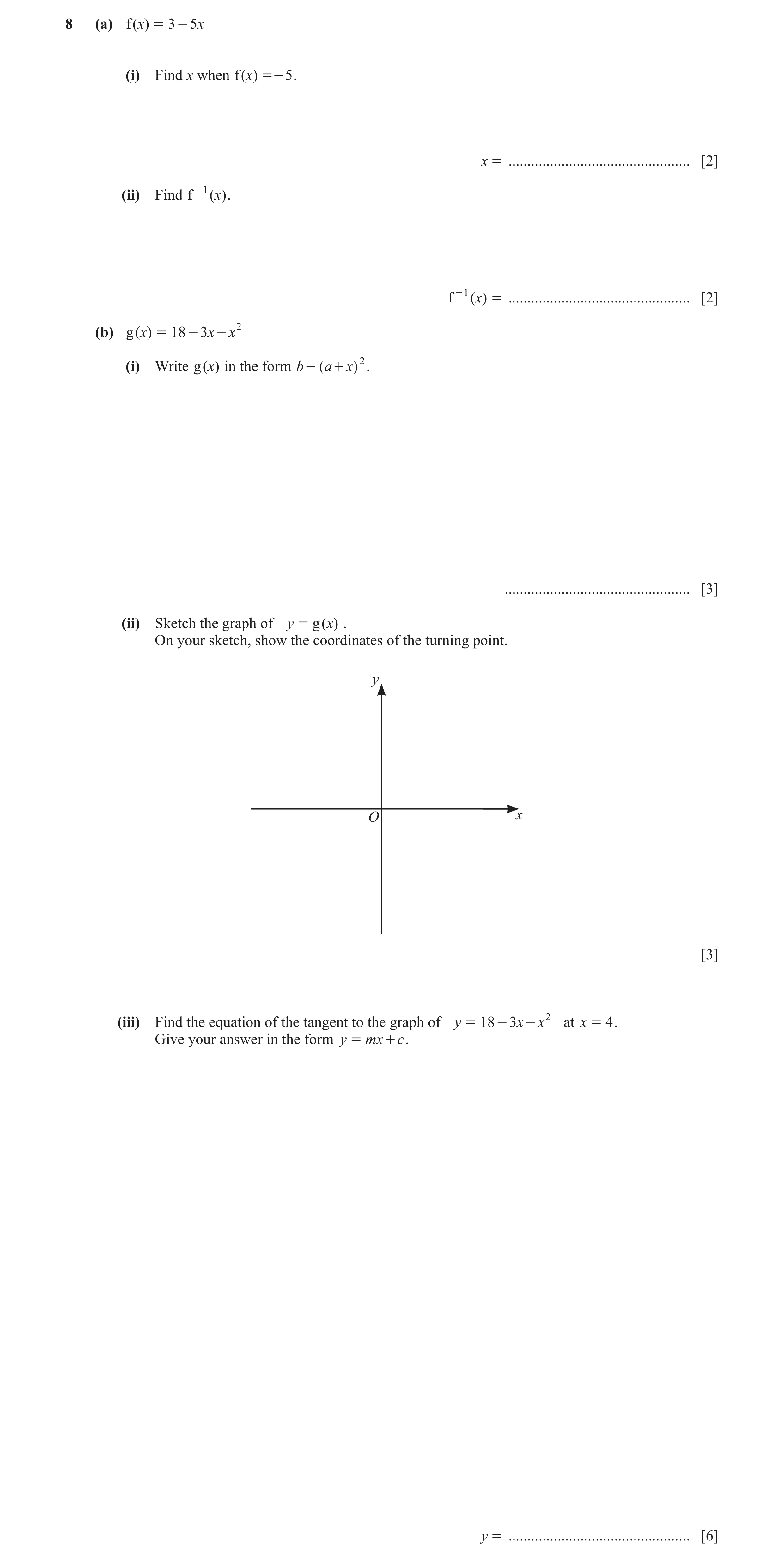
Q35 · F ( )x = 3 - 5 x (i) Find x when f ( )x =- 5 0580/41 Oct/Nov 2021
8 (a) f ( )x = 3 - 5 x (i) Find x when f ( )x =- 5 . x = … [2] (ii) Find f - 1 ( )x . f - 1 ( )x = … [2] (b) g ( )x = 18 - 3x - x 2 (i) Write g ( )x in the form b - ( a + x) 2 . … [3] (ii) Sketch the graph of y = g ( x) . On your sketch, show the coordinates of the turning point. y O x [3] (iii) Find the equation of the tangent to the graph of y = 18 - 3 x - x 2 at x = 4 . Give your answer in the form y = mx + c . y = … [6]
16 marks
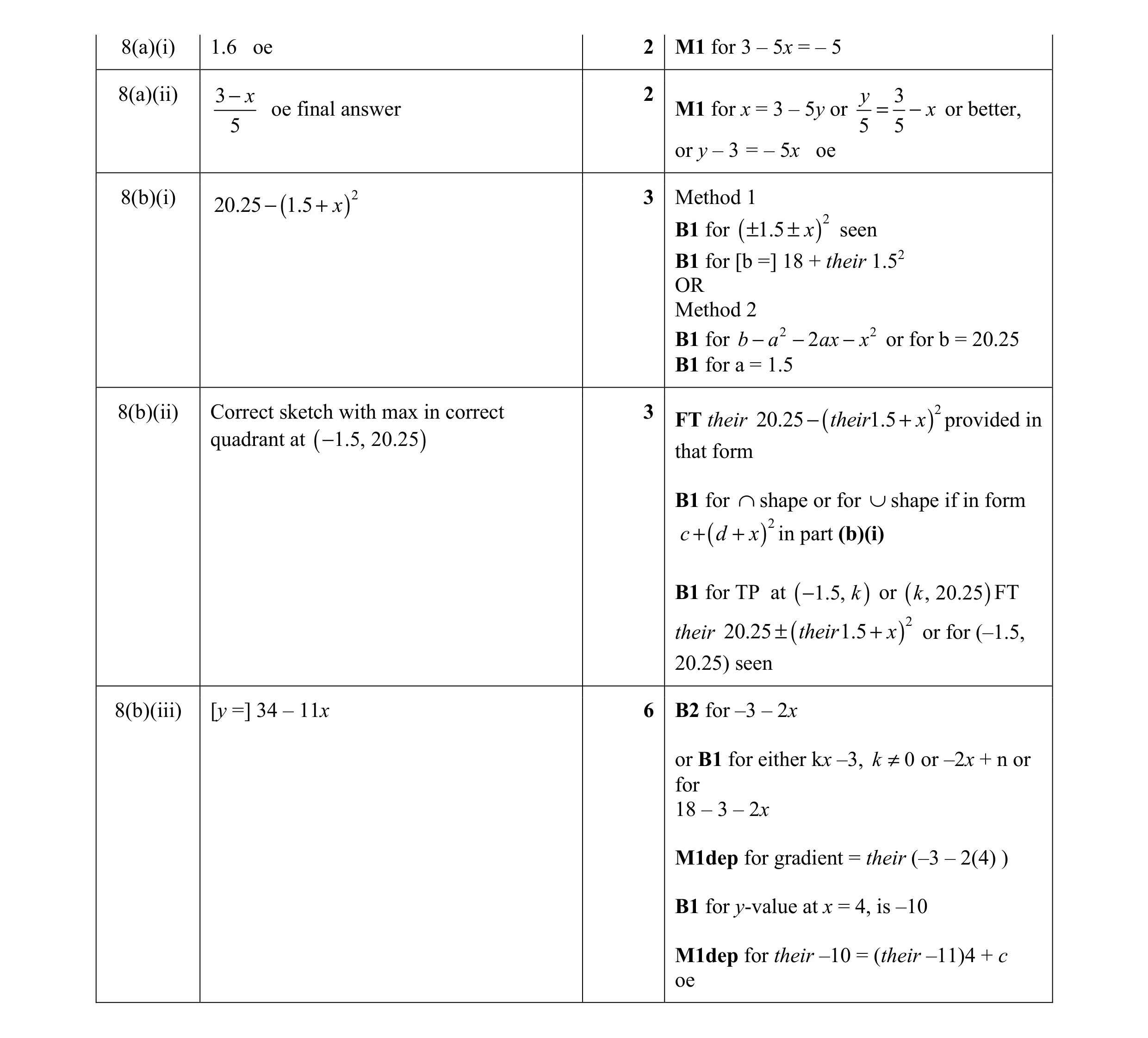
Mark scheme: 8(a)(i) 1.6 oe 2 M1 for 3 – 5x = – 5 8(a)(ii) 3 − x 2 y 3 oe final answer M1 for x = 3 – 5y or = − x or better, 5 5 5 or y – 3 = – 5x oe 8(b)(i) 2 3 Method 1 20.25 − (1.5 + x ) 2 B1 for ( ±1.5 ± x ) seen B1 for [b =] 18 + their 1.52 OR Method 2 B1 for b − a 2 − 2 ax − x 2 or for b = 20.25 B1 for a = 1.5 8(b)(ii) Correct sketch with max in correct 3 2 FT their 20.25 − ( their1.5 + x ) provided in quadrant at ( − 1.5, 20.25 ) that form B1 for ∩shape or for ∪shape if in form 2 c + ( d + x ) in part (b)(i) B1 for TP at ( − 1.5, k ) or ( k , 20.25 ) FT 2 their 20.25 ± ( their 1.5 + x ) or for (–1.5, 20.25) seen 8(b)(iii) [y =] 34 – 11x 6 B2 for –3 – 2x or B1 for either kx –3, k ≠ 0 or –2x + n or for 18 – 3 – 2x M1dep for gradient = their (–3 – 2(4) ) B1 for y-value at x = 4, is –10 M1dep for their –10 = (their –11)4 + c oe
This question in 0580/41 Oct/Nov 2021
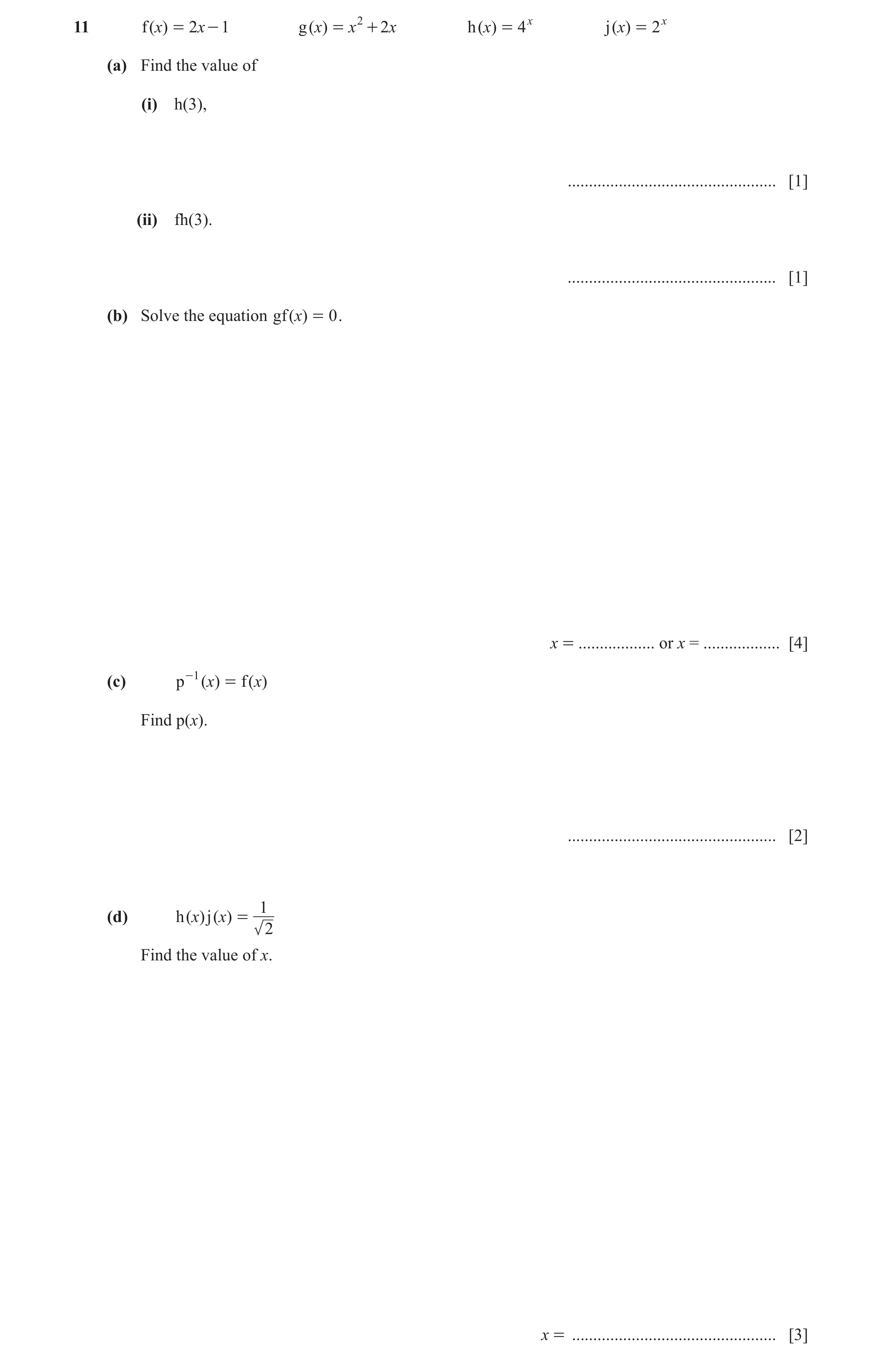
Q36 · F ( x) = 2 x - 1 g ( x) = x 2 + 2x h ( x) = 4x j ( x) = 2x (a) Find the value of (i)… 0580/43 Oct/Nov 2021
11 f ( x) = 2 x - 1 g ( x) = x 2 + 2x h ( x) = 4x j ( x) = 2x (a) Find the value of (i) h(3), … [1] (ii) fh(3). … [1] (b) Solve the equation gf ( x) = 0 . x = … or x = … [4] (c) p -1 ( x) = f ( x) Find p(x). … [2] 1(d) h ( x) j ( x) = 2 Find the value of x. x = … [3]
11 marks
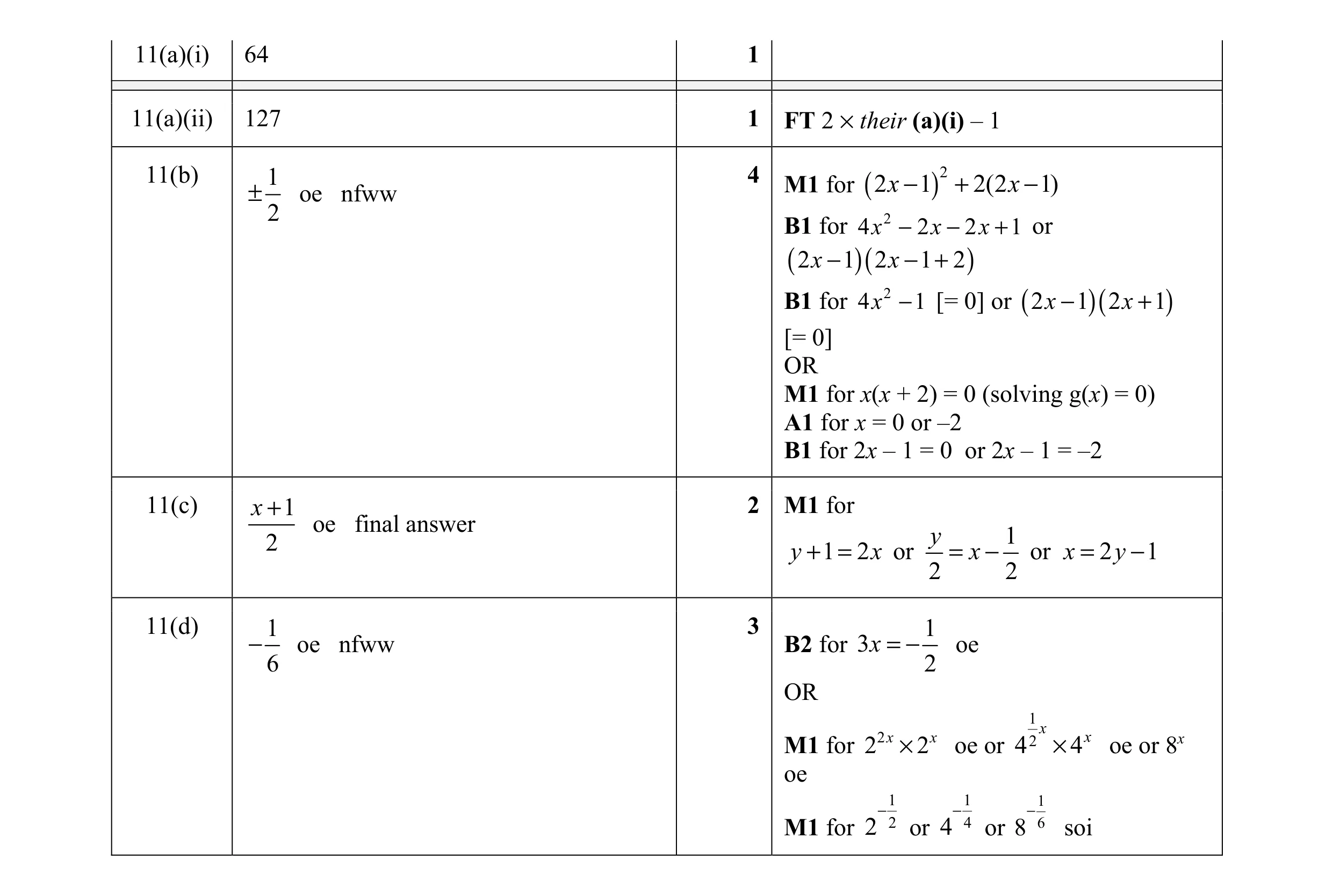
Mark scheme: 11(a)(i) 64 1 11(a)(ii) 127 1 FT 2 × their (a)(i) – 1 4 11(b) 1 M1 for ( 2 x − 1) 2 + 2(2 x − 1) ± oe nfww 2 2 B1 for 4 x − 2 x − 2 x + 1 or ( 2 x − 1)( 2 x −+1 2 ) B1 for 4 x 2 − 1 [= 0] or ( 2 x − 1)( 2 x + 1) [= 0] OR M1 for x(x + 2) = 0 (solving g(x) = 0) A1 for x = 0 or –2 B1 for 2x – 1 = 0 or 2x – 1 = –2 11(c) x + 1 2 M1 for oe final answer y 1 2 y + 1 = 2 x or = x − or x = 2 y − 1 2 2 11(d) 1 3 1 − oe nfww B2 for 3 x = − oe 6 2 OR 1 x M1 for 2 2 x × 2 x oe or 4 2 × 4 x oe or 8x oe 1 1 1 − − − M1 for 2 2 or 4 4 or 8 6 soi
This question in 0580/43 Oct/Nov 2021
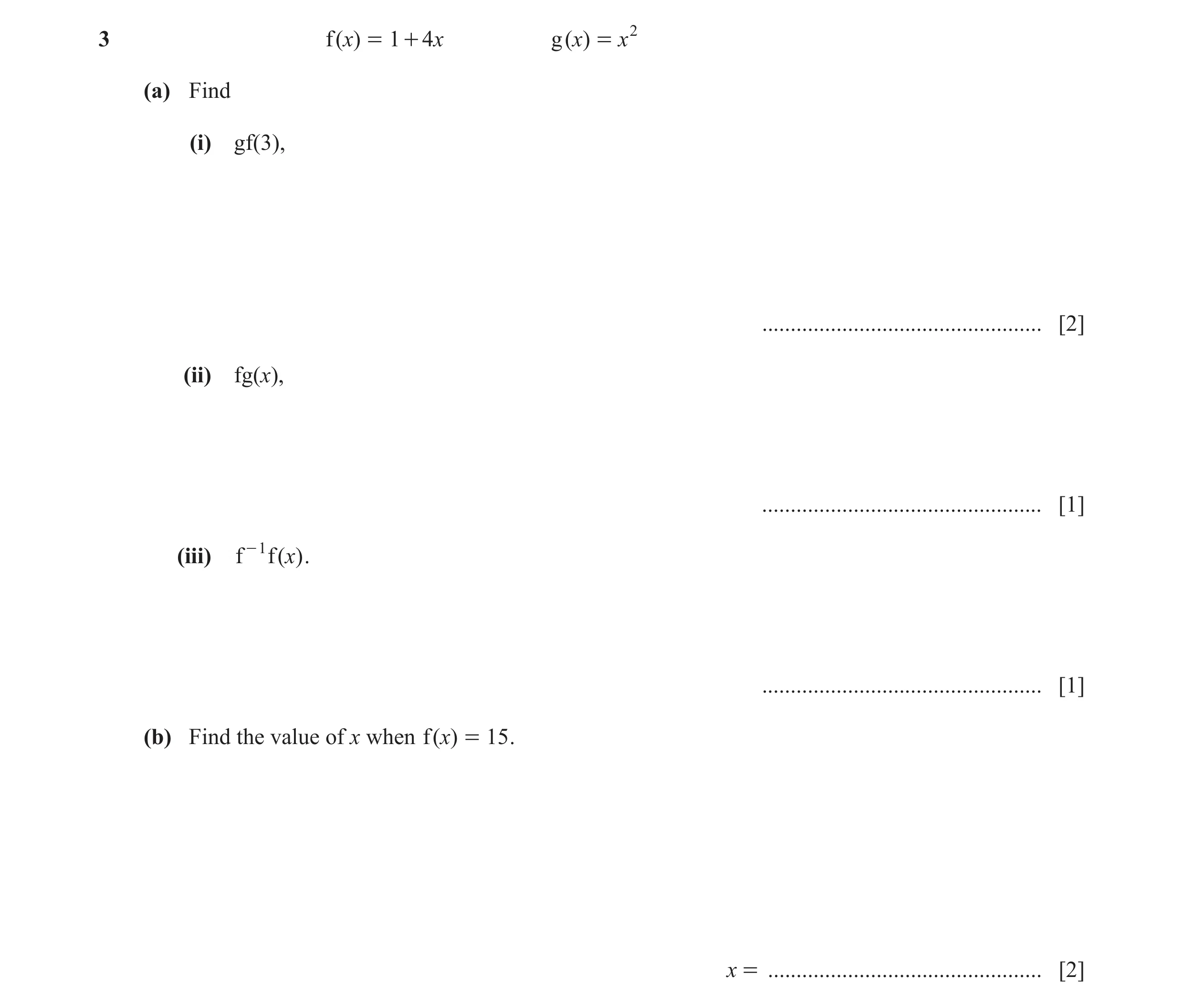
Q37 · F ( )x = 1 + 4 x g ( )x = x 2 (a) Find (i) gf(3), … [2] (ii) fg(x), … [1] (iii) f - 1 f (… 0580/42 Feb/March 2022
3 f ( )x = 1 + 4 x g ( )x = x 2 (a) Find (i) gf(3), … [2] (ii) fg(x), … [1] (iii) f - 1 f ( )x . … [1] (b) Find the value of x when f ( )x = 15 . x = … [2]
6 marks
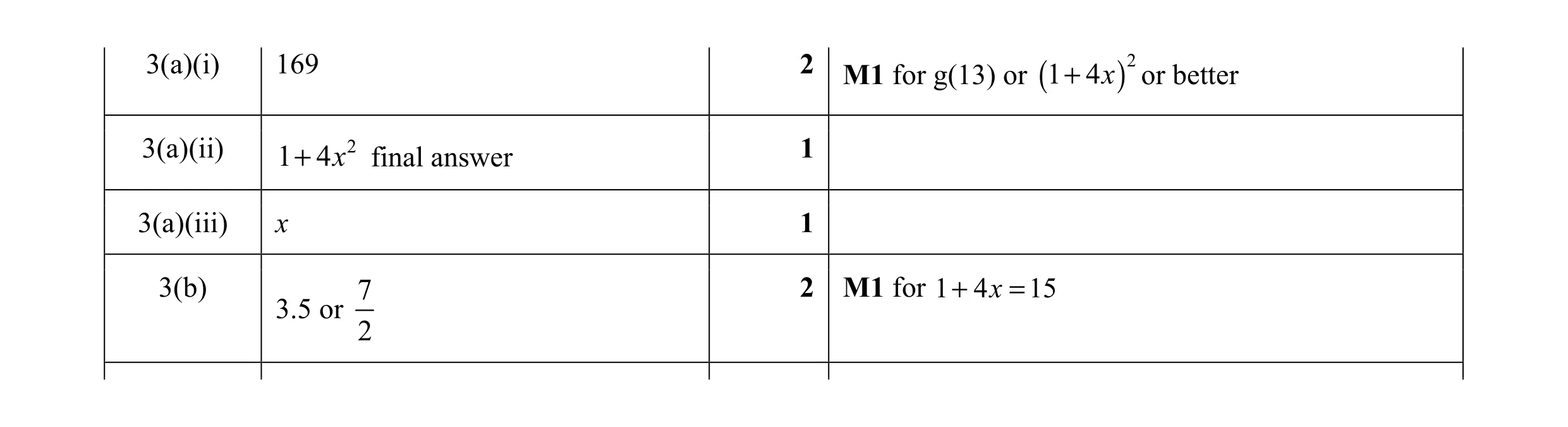
Mark scheme: 3(a)(i) 169 2 2 M1 for g(13) or (1 + 4 x ) or better 3(a)(ii) 1 + 4 x 2 final answer 1 3(a)(iii) x 1 3(b) 7 2 M1 for 1 + 4 x = 15 3.5 or 2
This question in 0580/42 Feb/March 2022
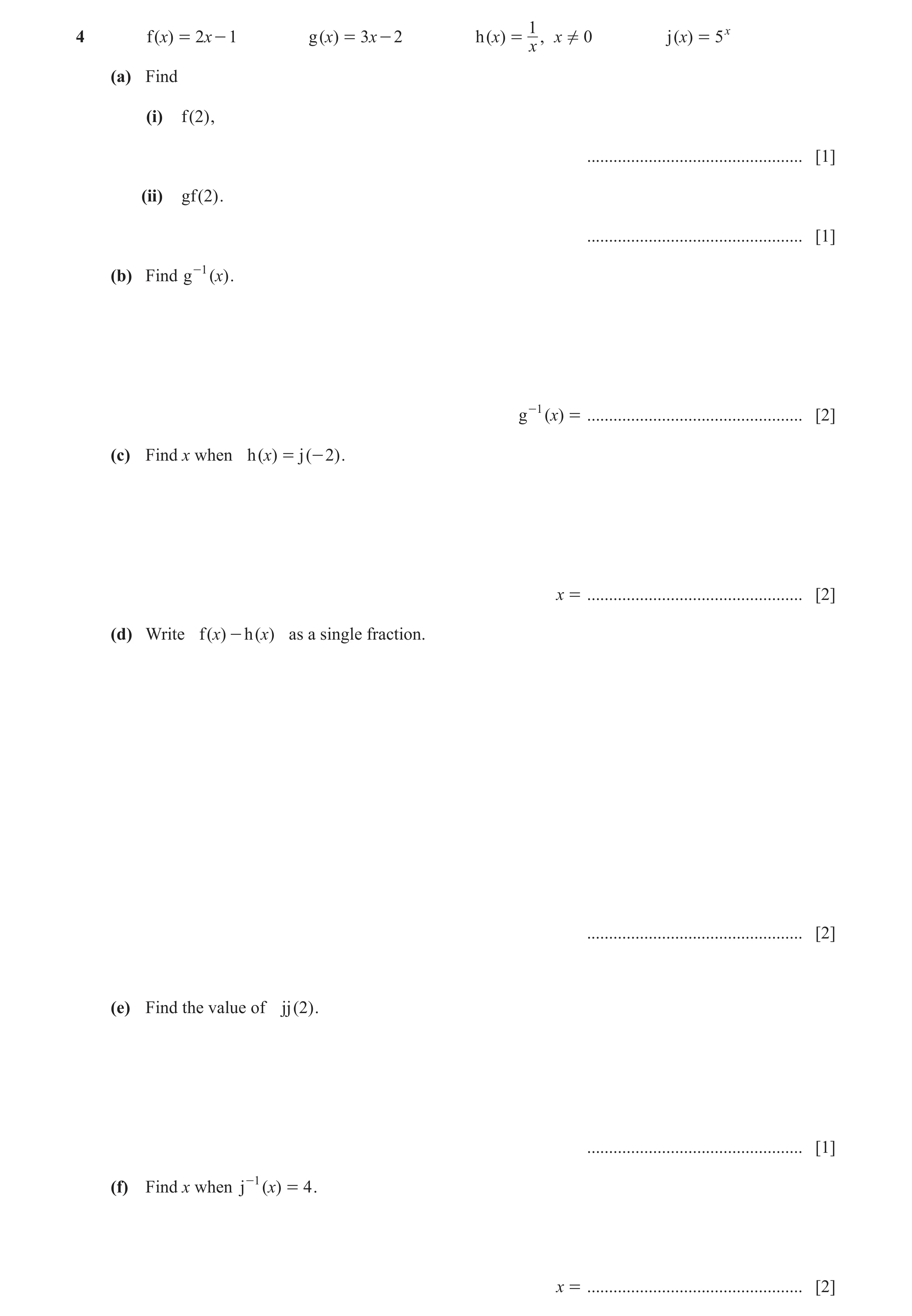
Q38 · F ( x) = 2 x - 1 g ( x) = 3 x - 2 h ( x) = , x ! 0580/41 May/June 2022
14 f ( x) = 2 x - 1 g ( x) = 3 x - 2 h ( x) = , x ! 0 j ( x) = 5x x (a) Find (i) f ( 2) , … [1] (ii) gf ( 2) . … [1] (b) Find g -1 ( x) . g -1 ( x) = … [2] (c) Find x when h ( x) = j (- 2) . x = … [2] (d) Write f ( x) - h ( x) as a single fraction. … [2] (e) Find the value of jj ( 2 ) . … [1] (f) Find x when j -1 ( x) = 4 . x = … [2]
11 marks
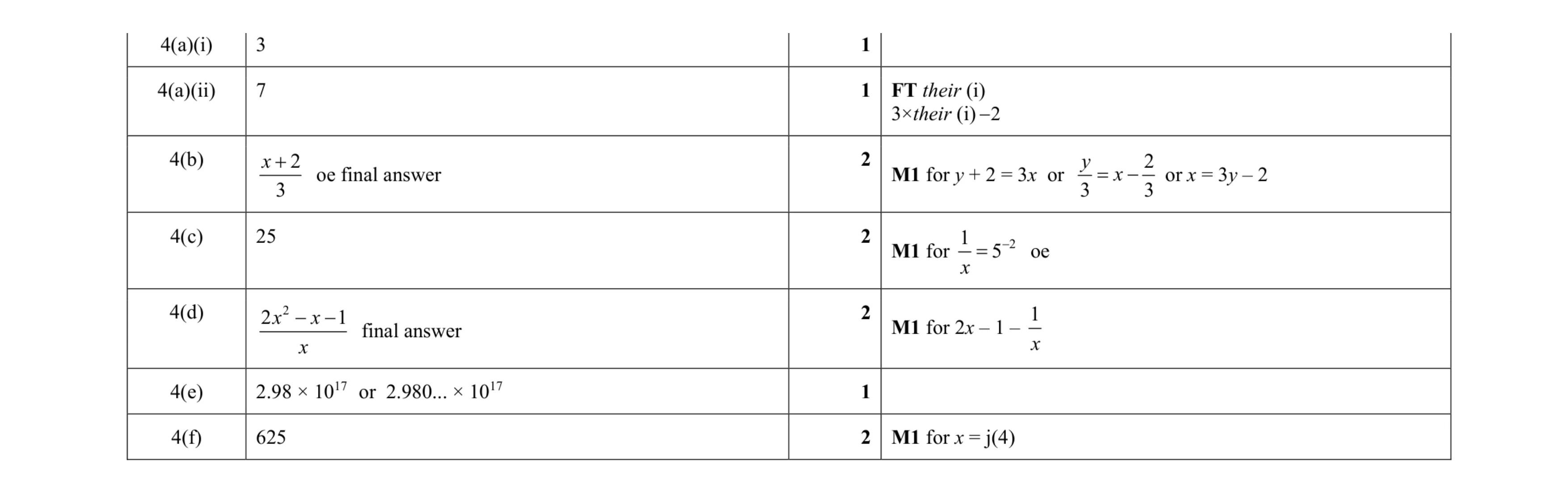
Mark scheme: 4(a)(i) 3 1 4(a)(ii) 7 1 FT their (i) 3×their (i) 2 4(b) 2 3 x oe final answer 2 M1 for y + 2 = 3x or 2 3 3 y x or x = 3y – 2 4(c) 25 2 M1 for 2 1 5 x oe 4(d) 2 2 1 x x x final answer 2 M1 for 2x – 1 – 1 x 4(e) 2.98 × 10¹⁷ or 2.980... × 1017 1 4(f) 625 2 M1 for x = j(4)
This question in 0580/41 May/June 2022
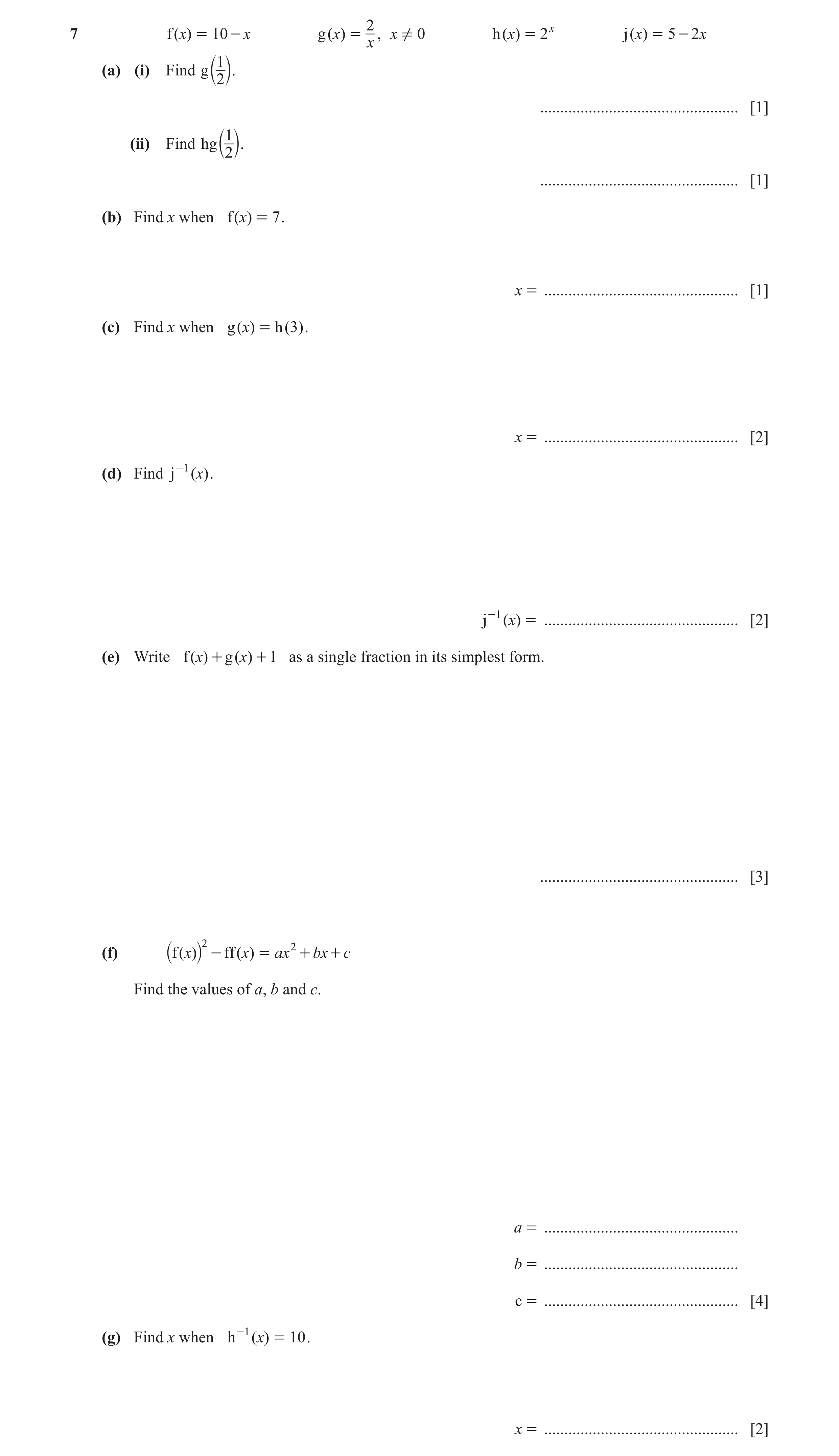
Q39 · F ( x) = 10 - x g ( x) = , x ! 0580/41 Oct/Nov 2022
27 f ( x) = 10 - x g ( x) = , x ! 0 h ( x) = 2x j ( x) = 5 - 2 x x 1 (a) (i) Find g b 2 l. … [1] 1 (ii) Find hg b 2 l. … [1] (b) Find x when f ( x) = 7 . x = … [1] (c) Find x when g ( x) = h ( 3) . x = … [2] (d) Find j -1 ( x) . j -1 ( x) = … [2] (e) Write f ( x) + g ( x) + 1 as a single fraction in its simplest form. … [3] 2 2(f) f ( x) - ff ( x) = ax + bx + c ` j Find the values of a, b and c. a = … b = … c = … [4] (g) Find x when h -1 ( x) = 10 . x = … [2]
16 marks
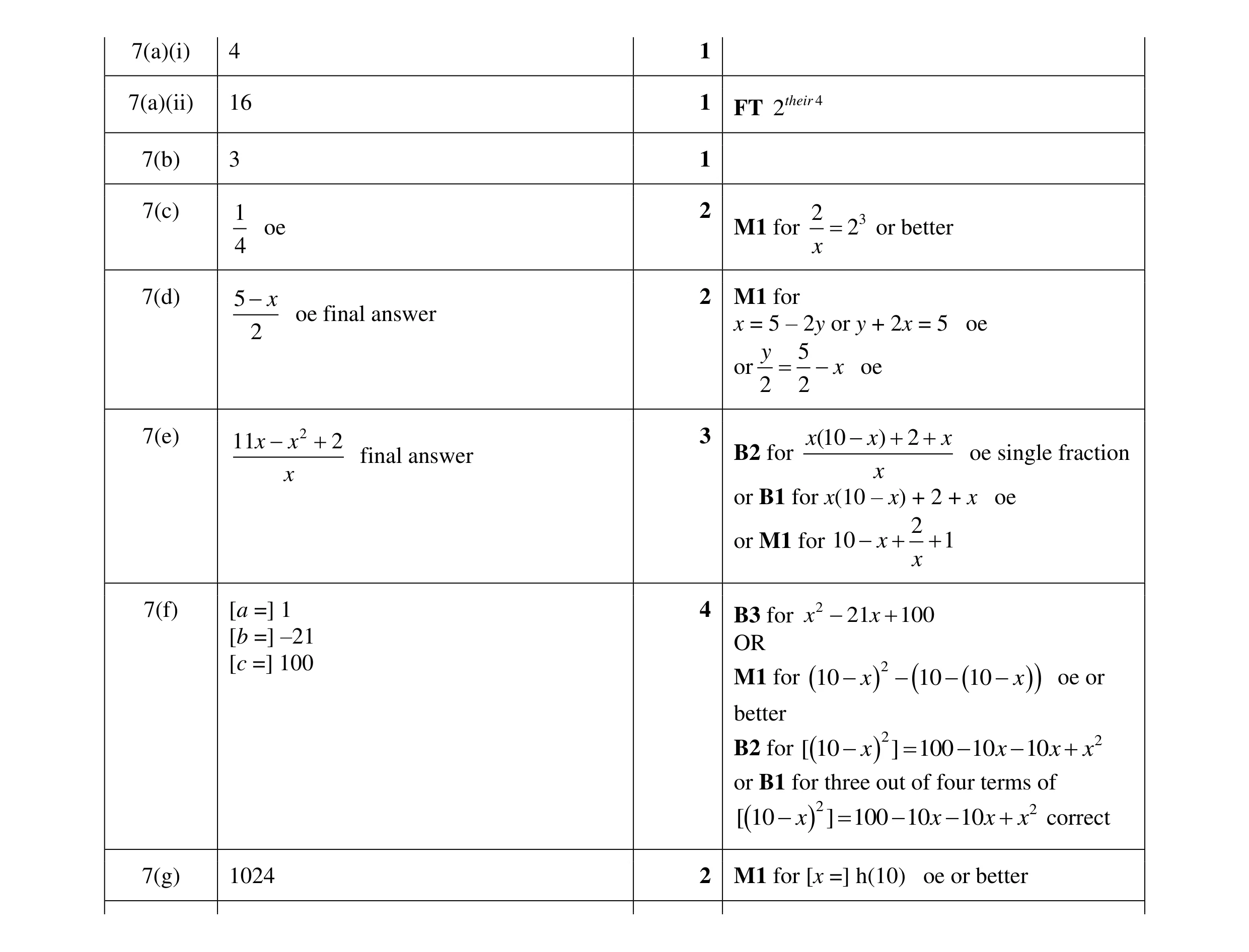
Mark scheme: 7(a)(i) 4 1 7(a)(ii) 16 1 FT 2their 4 7(b) 3 1 7(c) 1 2 2 3 oe M1 for = 2 or better 4 x 7(d) 5 −x 2 M1 for oe final answer x = 5 – 2y or y + 2x = 5 oe 2 y 5 or = − x oe 2 2 7(e) 11x − x 2 + 2 3 x (10 − x ) + 2 + x final answer B2 for oe single fraction x x or B1 for x(10 – x) + 2 + x oe 2 or M1 for 10 − x + + 1 x 7(f) [a =] 1 4 B3 for x 2 − 21x + 100 [b =] –21 OR [c =] 100 2 M1 for (10 − x ) − (10 − (10 − x ) ) oe or better 2 2 B2 for [(10 − x ) ] = 100 − 10 x − 10 x + x or B1 for three out of four terms of [(10 − x ) 2 ] = 100 − 10 x − 10 x + x 2 correct 7(g) 1024 2 M1 for [x =] h(10) oe or better
This question in 0580/41 Oct/Nov 2022
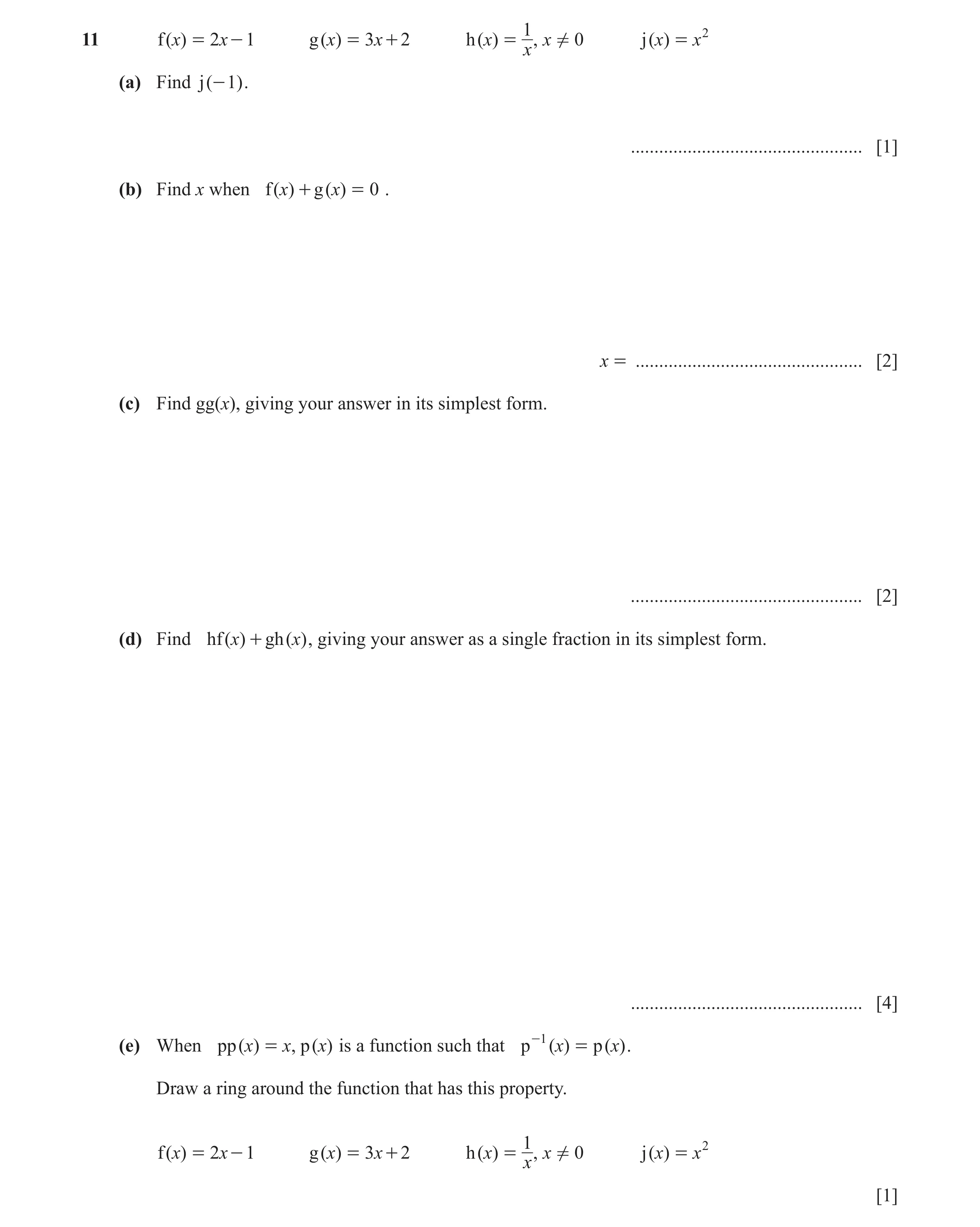
Q40 · 211 f ( x) = 2 x - 1 g ( x) = 3x + 2 h ( x) = , x ! 0580/42 Feb/March 2023
1 211 f ( x) = 2 x - 1 g ( x) = 3x + 2 h ( x) = , x ! 0 j ( x) = x x (a) Find j ( - 1) . … [1] (b) Find x when f ( x) + g ( x) = 0 . x = … [2] (c) Find gg(x), giving your answer in its simplest form. … [2] (d) Find hf ( x) + gh ( x) , giving your answer as a single fraction in its simplest form. … [4] (e) When pp ( x) = x, p ( x) is a function such that p -1 ( x) = p ( x) . Draw a ring around the function that has this property. 1 2 f ( x) = 2 x - 1 g ( x) = 3x + 2 h ( x) = , x ! 0 j ( x) = x x [1]
10 marks
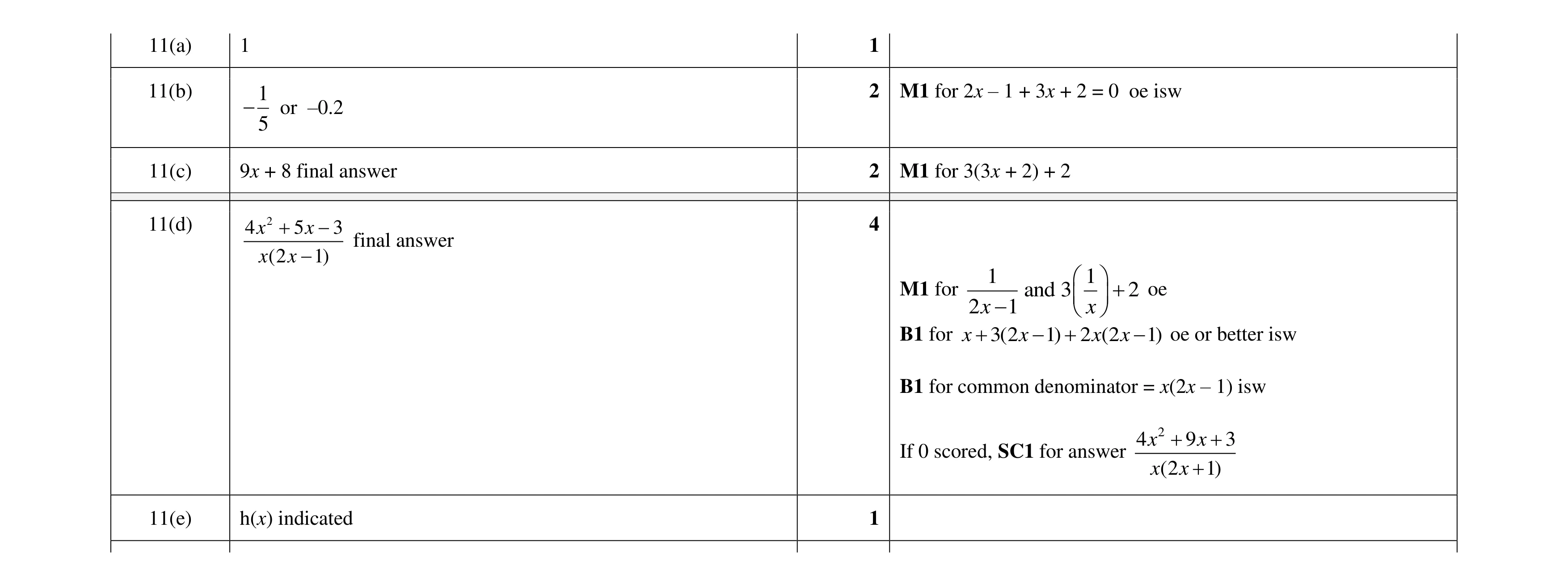
Mark scheme: 11(a) 1 1 11(b) 1 2 M1 for 2x – 1 + 3x + 2 = 0 oe isw − or –0.2 5 11(c) 9x + 8 final answer 2 M1 for 3(3x + 2) + 2 11(d) 4 x 2 + 5 x − 3 4 final answer x (2 x − 1) 1 1 M1 for and 3 + 2 oe 2 x − 1 x B1 for x + 3(2 x − 1) + 2 x (2 x − 1) oe or better isw B1 for common denominator = x(2x – 1) isw 4 x 2 + 9 x + 3 If 0 scored, SC1 for answer x (2 x + 1) 11(e) h(x) indicated 1
This question in 0580/42 Feb/March 2023
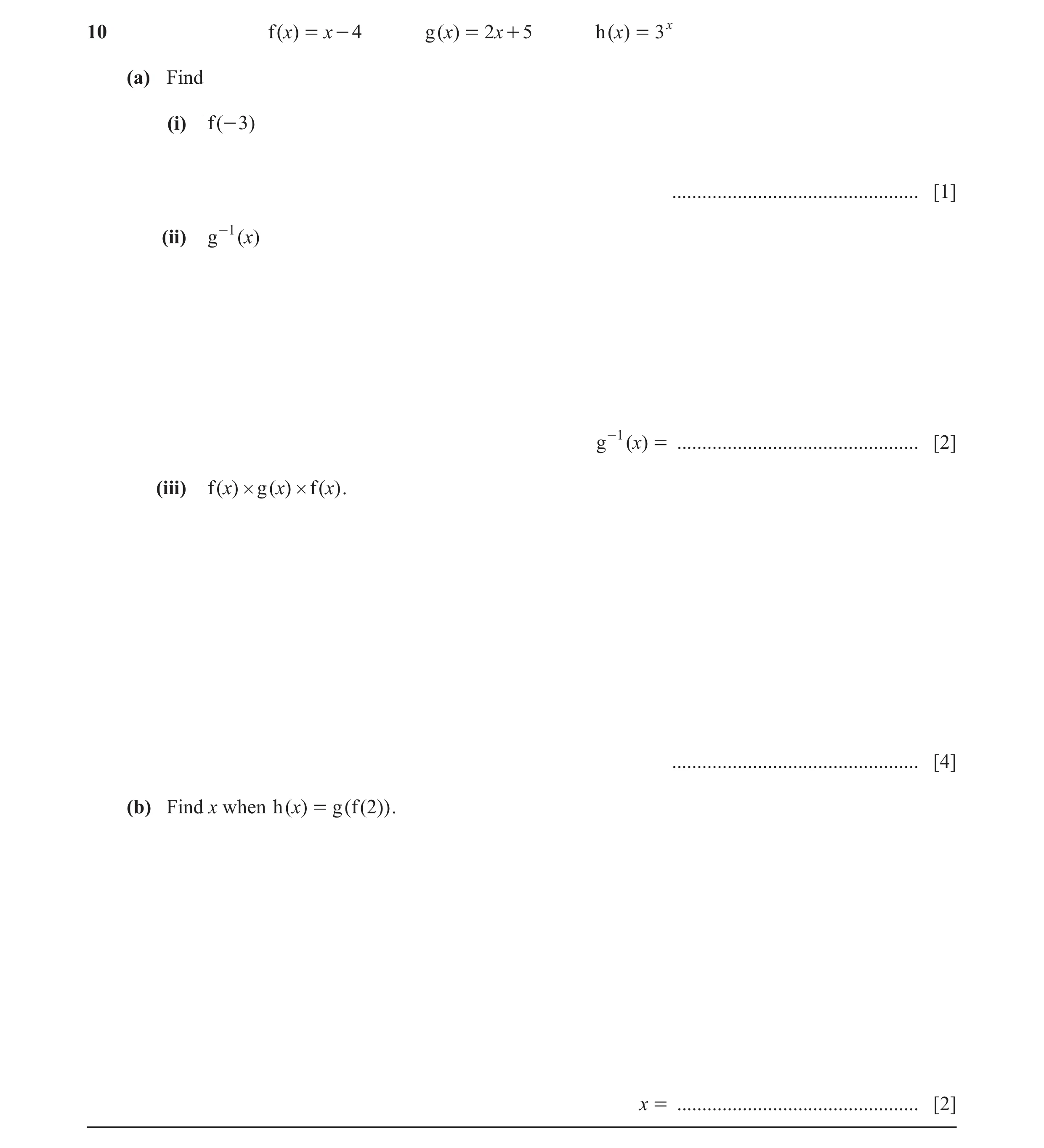
Q41 · F ( )x = x - 4 g ( )x = 2 x + 5 h ( )x = 3 x (a) Find (i) f ( - 3) … [1] (ii) g -1 ( )x g… 0580/41 May/June 2023
10 f ( )x = x - 4 g ( )x = 2 x + 5 h ( )x = 3 x (a) Find (i) f ( - 3) … [1] (ii) g -1 ( )x g -1 ( )x = … [2] (iii) f ( x) # g ( x) # f ( x) . … [4] (b) Find x when h ( x) = g ( f ( 2) ) . x = … [2]
9 marks
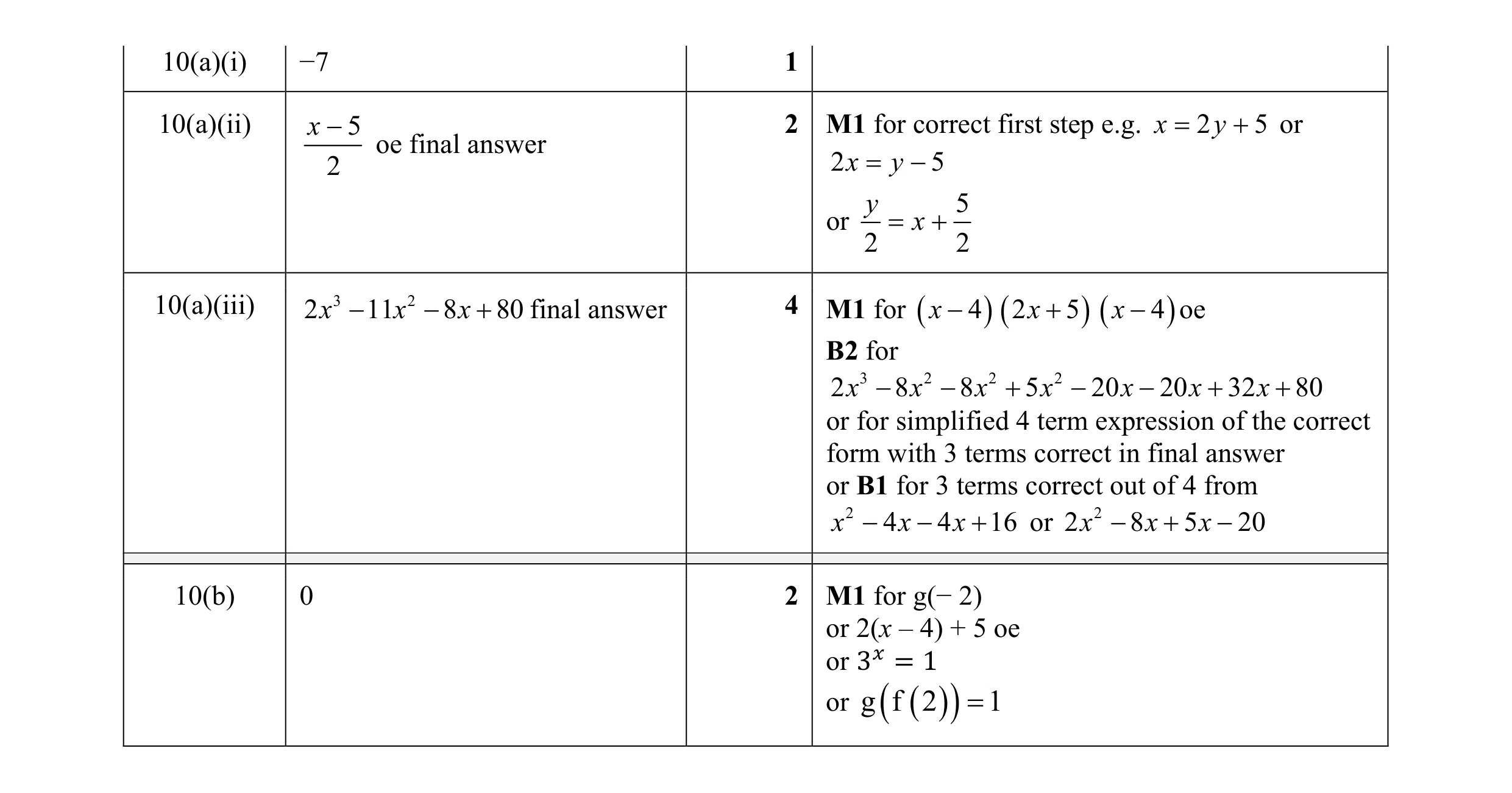
Mark scheme: 10(a)(i) −7 1 10(a)(ii) x 5 2 M1 for correct first step e.g. x 2 y 5 or oe final answer 2 2 x y 5 y 5 or x 2 2 10(a)(iii) 2 x 3 11x 2 8 x 80 final answer 4 M1 for x 4 2 x 5 x 4 oe B2 for 2 x 3 8 x 2 8 x 2 5 x 2 20 x 20 x 32 x 80 or for simplified 4 term expression of the correct form with 3 terms correct in final answer or B1 for 3 terms correct out of 4 from x 2 4 x 4 x 16 or 2 x 2 8 x 5 x 20 10(b) 0 2 M1 for g(− 2) or 2(x – 4) + 5 oe or 3௫= 1 or g f 2 1
This question in 0580/41 May/June 2023
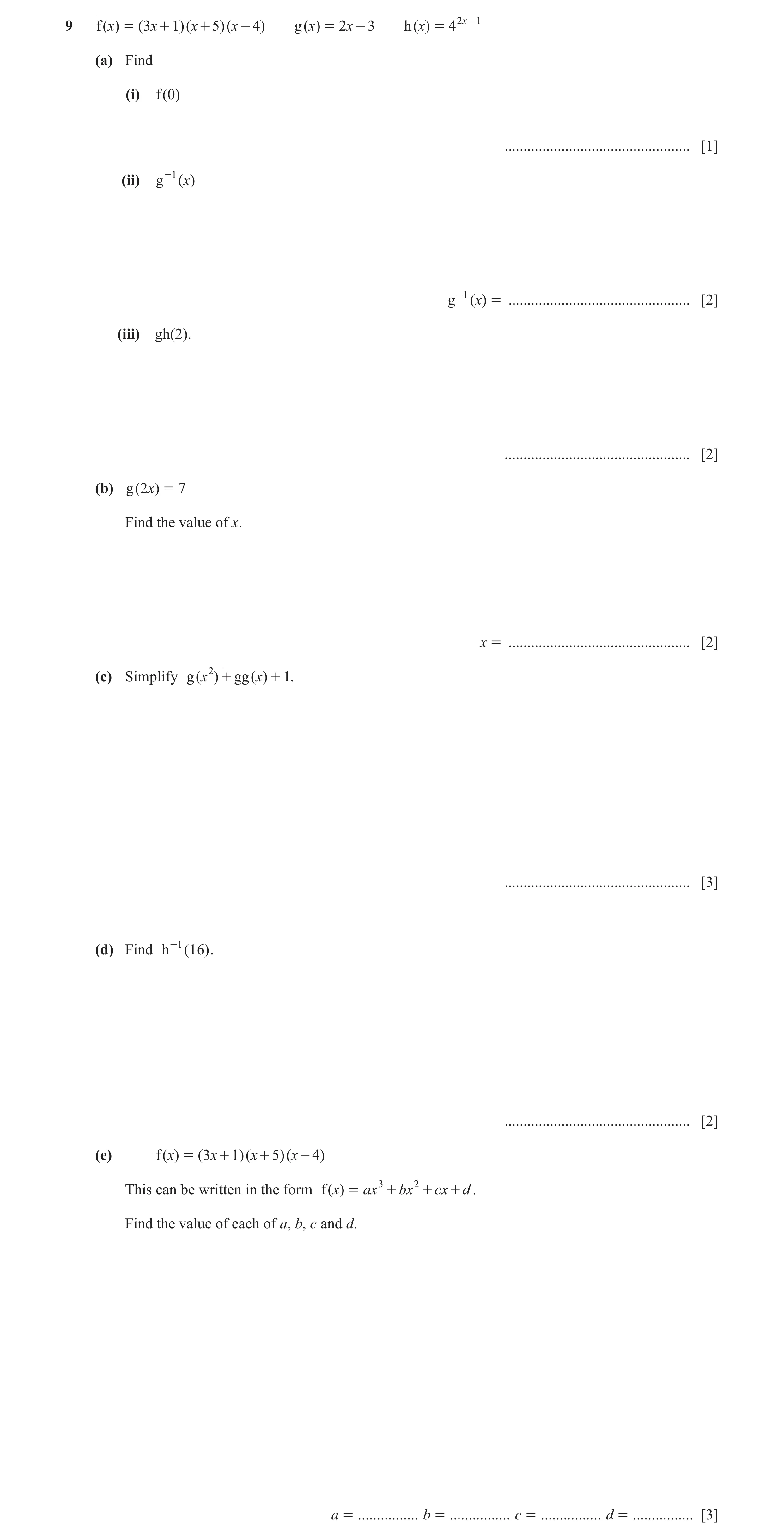
Q42 · F ( x) = ( 3 x + 1)( x + 5)( x - 4) g ( x) = 2x - 3 h ( x) = 4 2 x - 1 (a) Find (i) f (… 0580/41 Oct/Nov 2023
9 f ( x) = ( 3 x + 1)( x + 5)( x - 4) g ( x) = 2x - 3 h ( x) = 4 2 x - 1 (a) Find (i) f ( 0) … [1] (ii) g -1 ( )x g -1 ( )x = … [2] (iii) gh(2). … [2] (b) g( 2)x = 7 Find the value of x. x = … [2] (c) Simplify g ( x 2 ) + gg ( x) + 1. … [3] (d) Find h -1 ( 16) . … [2] (e) f ( x) = ( 3 x + 1)( x + 5)( x - 4) This can be written in the form f ( x) = ax 3 + bx 2 + cx + d . Find the value of each of a, b, c and d. a = … b = … c = … d = … [3]
15 marks
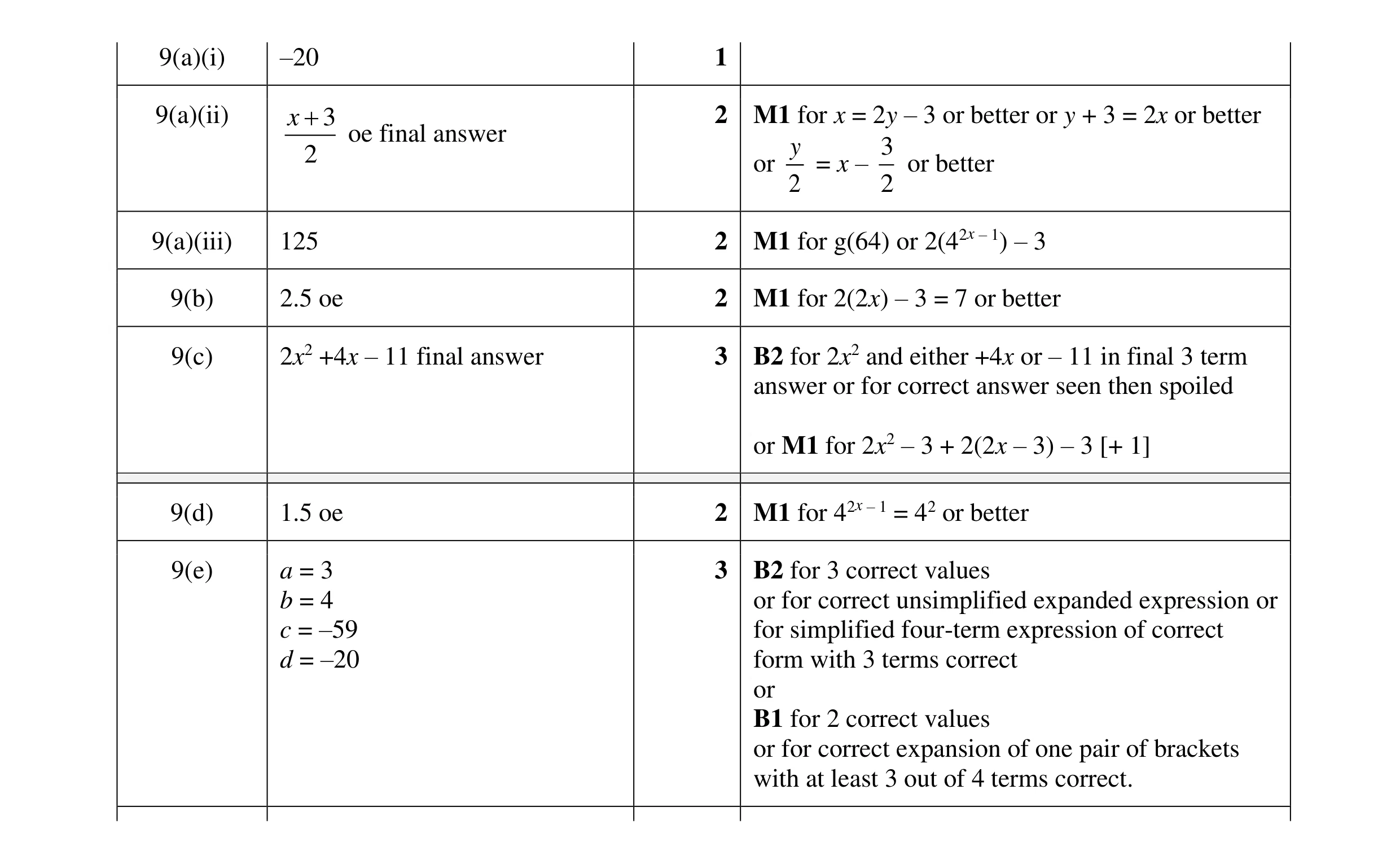
Mark scheme: 9(a)(i) –20 1 9(a)(ii) x + 3 2 M1 for x = 2y – 3 or better or y + 3 = 2x or better oe final answer y 3 2 or = x – or better 2 2 9(a)(iii) 125 2 M1 for g(64) or 2(42x – 1) – 3 9(b) 2.5 oe 2 M1 for 2(2x) – 3 = 7 or better 9(c) 2x2 +4x – 11 final answer 3 B2 for 2x2 and either +4x or – 11 in final 3 term answer or for correct answer seen then spoiled or M1 for 2x2 – 3 + 2(2x – 3) – 3 [+ 1] 9(d) 1.5 oe 2 M1 for 42x – 1 = 42 or better 9(e) a = 3 3 B2 for 3 correct values b = 4 or for correct unsimplified expanded expression or c = –59 for simplified four-term expression of correct d = –20 form with 3 terms correct or B1 for 2 correct values or for correct expansion of one pair of brackets with at least 3 out of 4 terms correct.
This question in 0580/41 Oct/Nov 2023
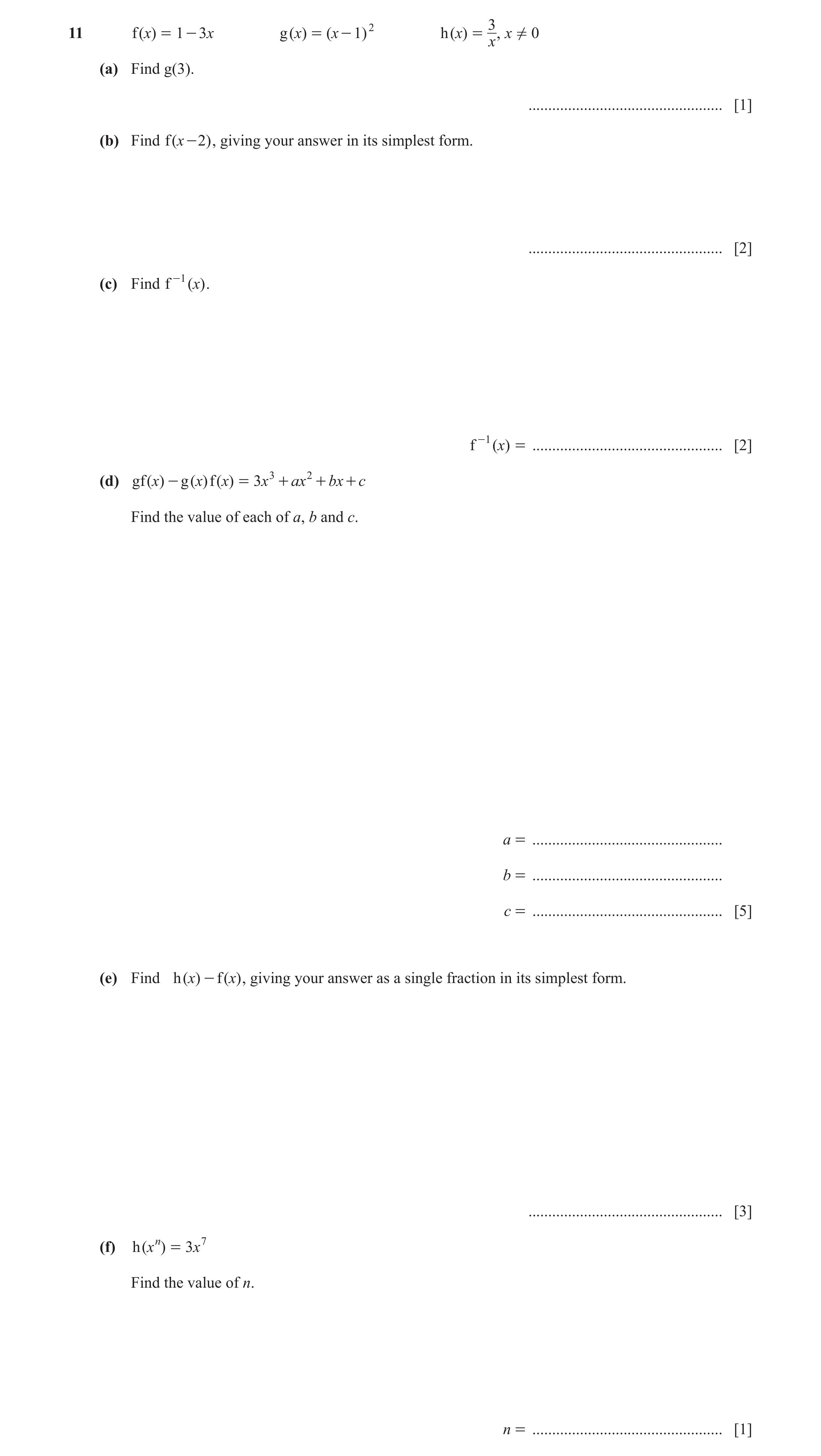
Q43 · 311 f ( )x = 1 - 3 x g ( x) = ( x - 1) h ( x) = , x ! 0580/42 Oct/Nov 2023
2 311 f ( )x = 1 - 3 x g ( x) = ( x - 1) h ( x) = , x ! 0 x (a) Find g(3). … [1] (b) Find f ( x - 2 ) , giving your answer in its simplest form. … [2] (c) Find f -1 ( )x . f -1 ( )x = … [2] (d) gf ( x) - g ( x) f ( x) = 3x 3 + ax 2 + bx + c Find the value of each of a, b and c. a = … b = … c = … [5] (e) Find h ( x) - f ( x) , giving your answer as a single fraction in its simplest form. … [3] (f) h ( x n ) = 3x 7 Find the value of n. n = … [1]
14 marks
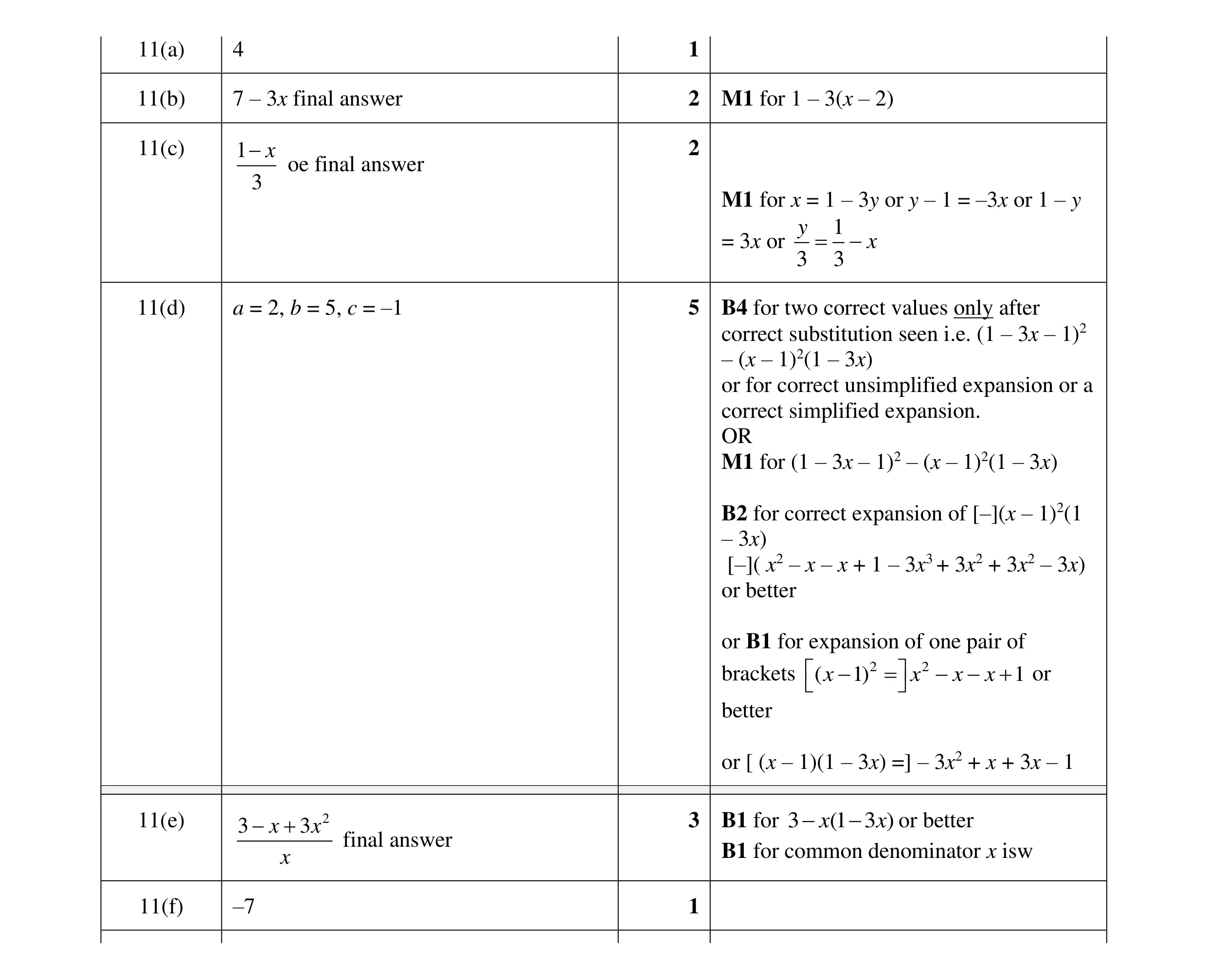
Mark scheme: 11(a) 4 1 11(b) 7 – 3x final answer 2 M1 for 1 – 3(x – 2) 11(c) 1 −x 2 oe final answer 3 M1 for x = 1 – 3y or y – 1 = –3x or 1 – y y 1 = 3x or = − x 3 3 11(d) a = 2, b = 5, c = –1 5 B4 for two correct values only after correct substitution seen i.e. (1 – 3x – 1)2 – (x – 1)2(1 – 3x) or for correct unsimplified expansion or a correct simplified expansion. OR M1 for (1 – 3x – 1)2 – (x – 1)2(1 – 3x) B2 for correct expansion of [–](x – 1)2(1 – 3x) [–]( x2 – x – x + 1 – 3x3 + 3x2 + 3x2 – 3x) or better or B1 for expansion of one pair of brackets ( x − 1) 2 = x 2 − x − x + 1 or better or [ (x – 1)(1 – 3x) =] – 3x2 + x + 3x – 1 11(e) 3 − x + 3 x 2 3 B1 for 3 − x(1 − 3 x) or better final answer x B1 for common denominator x isw 11(f) –7 1
This question in 0580/42 Oct/Nov 2023
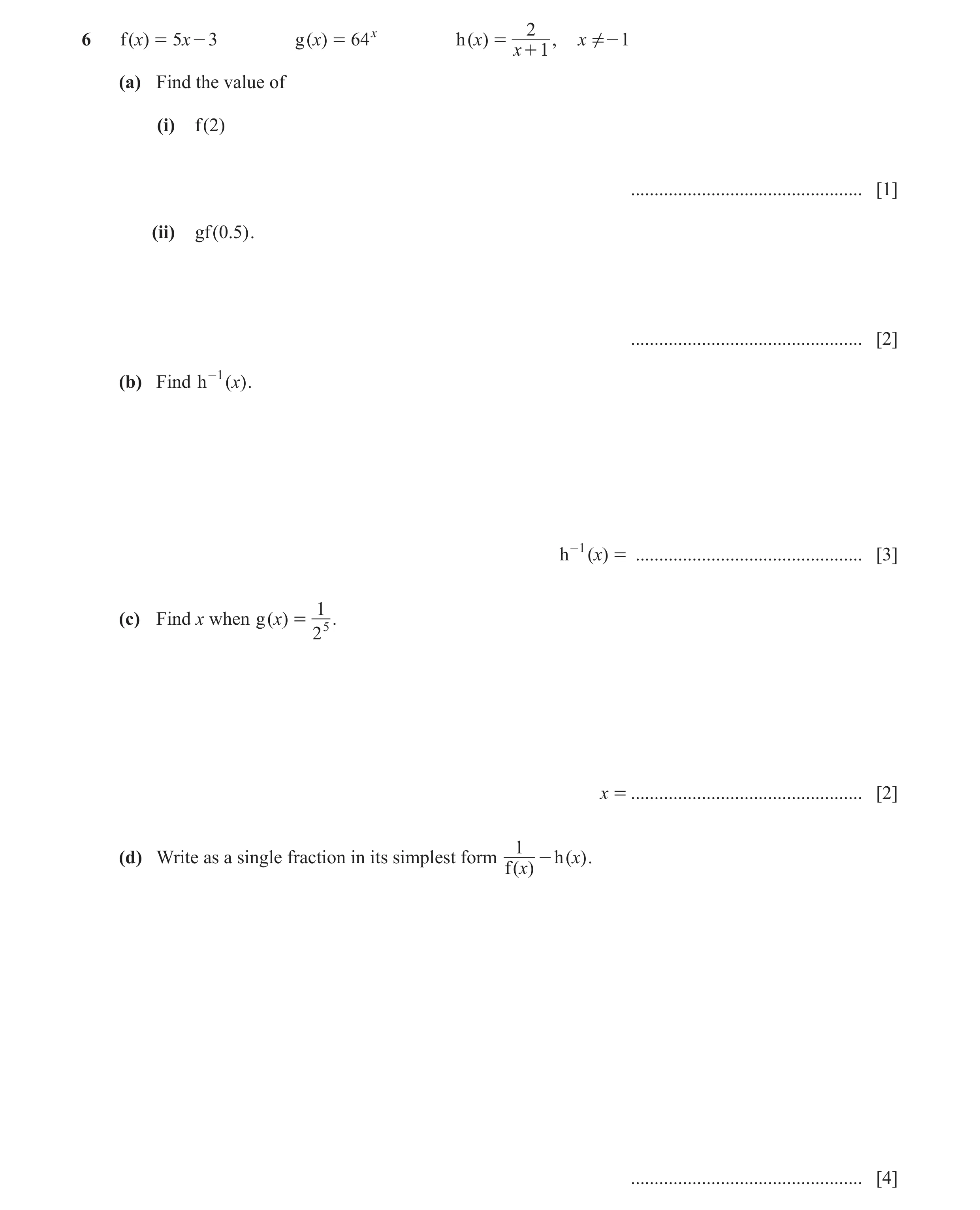
Q44 · X 26 f ( )x = 5 x - 3 g ( )x = 64 h ( )x = , x !- 1 x + 1 (a) Find the value of (i) f (… 0580/43 Oct/Nov 2023
x 26 f ( )x = 5 x - 3 g ( )x = 64 h ( )x = , x !- 1 x + 1 (a) Find the value of (i) f ( 2) … [1] (ii) gf ( 0.5) . … [2] (b) Find h -1 ( )x . h -1 ( )x = … [3] 1 (c) Find x when g ( )x = 5 . 2 x = … [2] 1 (d) Write as a single fraction in its simplest form - h ( x) . f ( x) … [4]
12 marks
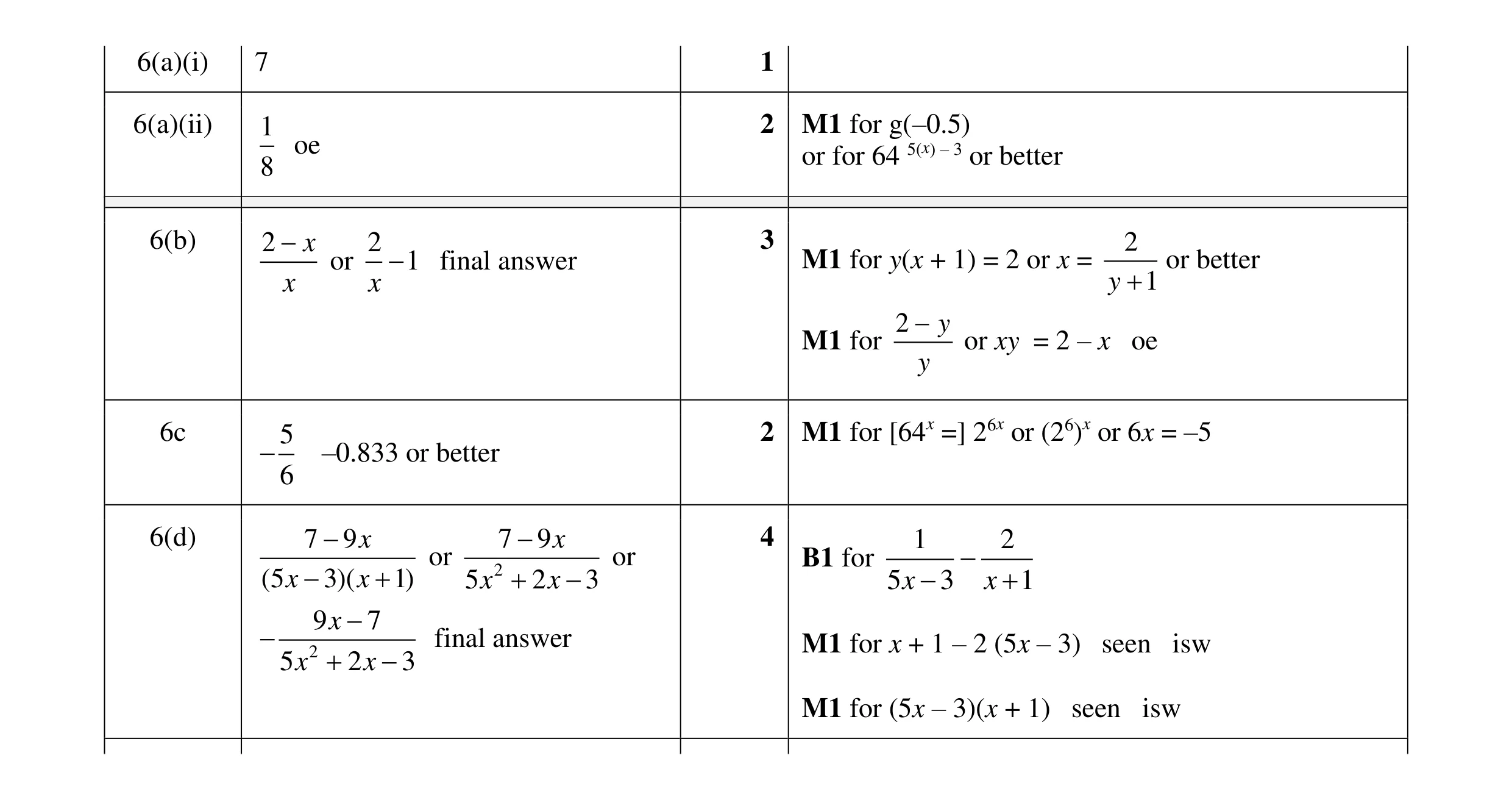
Mark scheme: 6(a)(i) 7 1 6(a)(ii) 1 2 M1 for g(–0.5) oe 5(x) – 3 or for 64 or better 8 6(b) 2 −x 2 3 2 or − 1 final answer M1 for y(x + 1) = 2 or x = or better x x y + 1 2 −y M1 for or xy = 2 – x oe y 6c 5 2 M1 for [64x =] 26x or (26)x or 6x = –5 − –0.833 or better 6 6(d) 7 − 9 x 7 − 9 x 4 1 2 or or B1 for − 2 (5 x − 3)( x + 1) 5 x + 2 x − 3 5 x − 3 x + 1 9 x − 7 − final answer M1 for x + 1 – 2 (5x – 3) seen isw 2 5 x + 2 x − 3 M1 for (5x – 3)(x + 1) seen isw
This question in 0580/43 Oct/Nov 2023
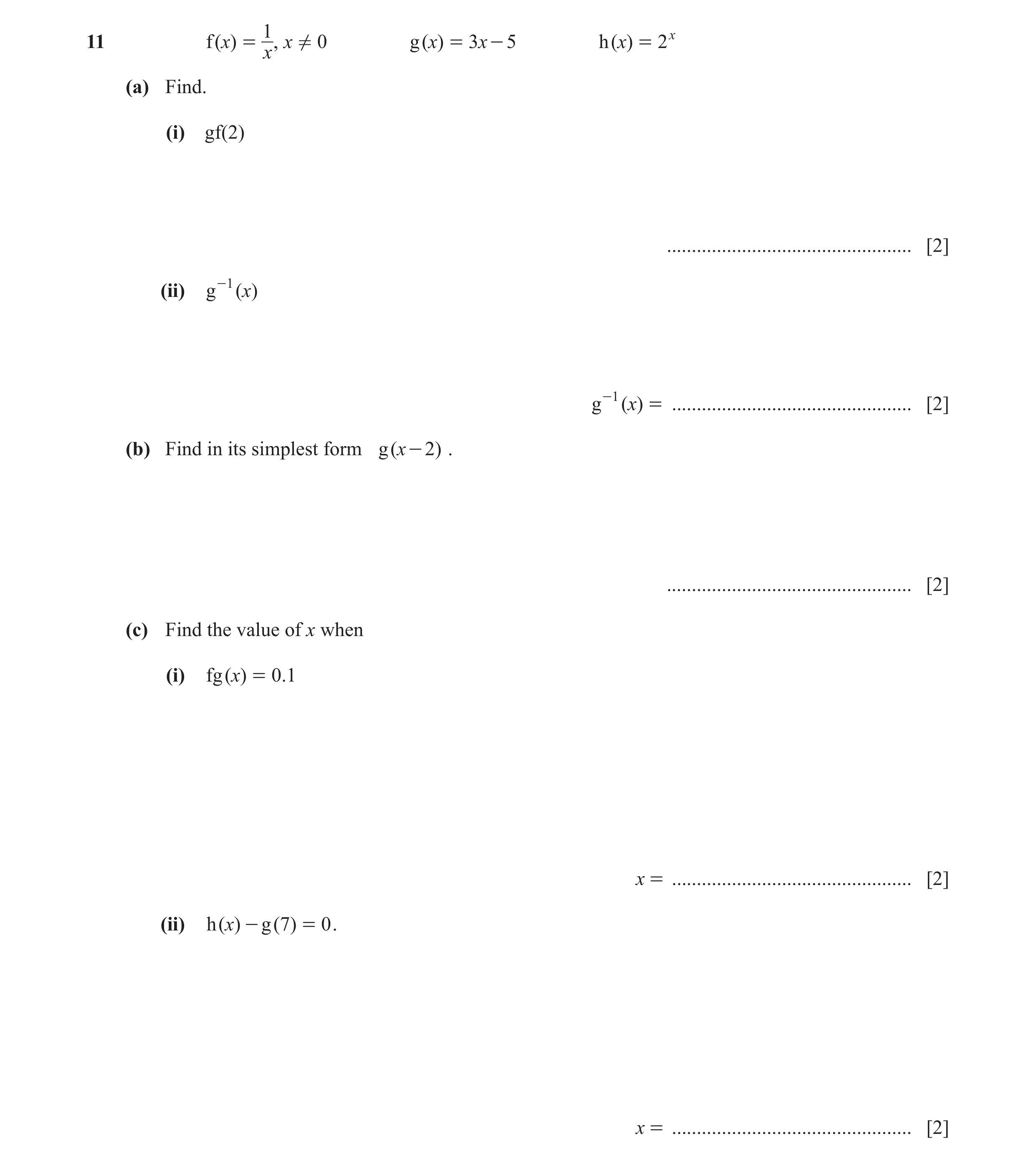
Q45 · X11 f ( x) = , x ! 0580/42 Feb/March 2024
1 x11 f ( x) = , x ! 0 g ( )x = 3 x - 5 h ( )x = 2 x (a) Find. (i) gf(2) … [2] (ii) g -1 ( )x g -1 ( )x = … [2] (b) Find in its simplest form g ( x - 2) . … [2] (c) Find the value of x when (i) fg ( x) = 0.1 x = … [2] (ii) h ( x) - g ( 7) = 0 . x = … [2]
10 marks
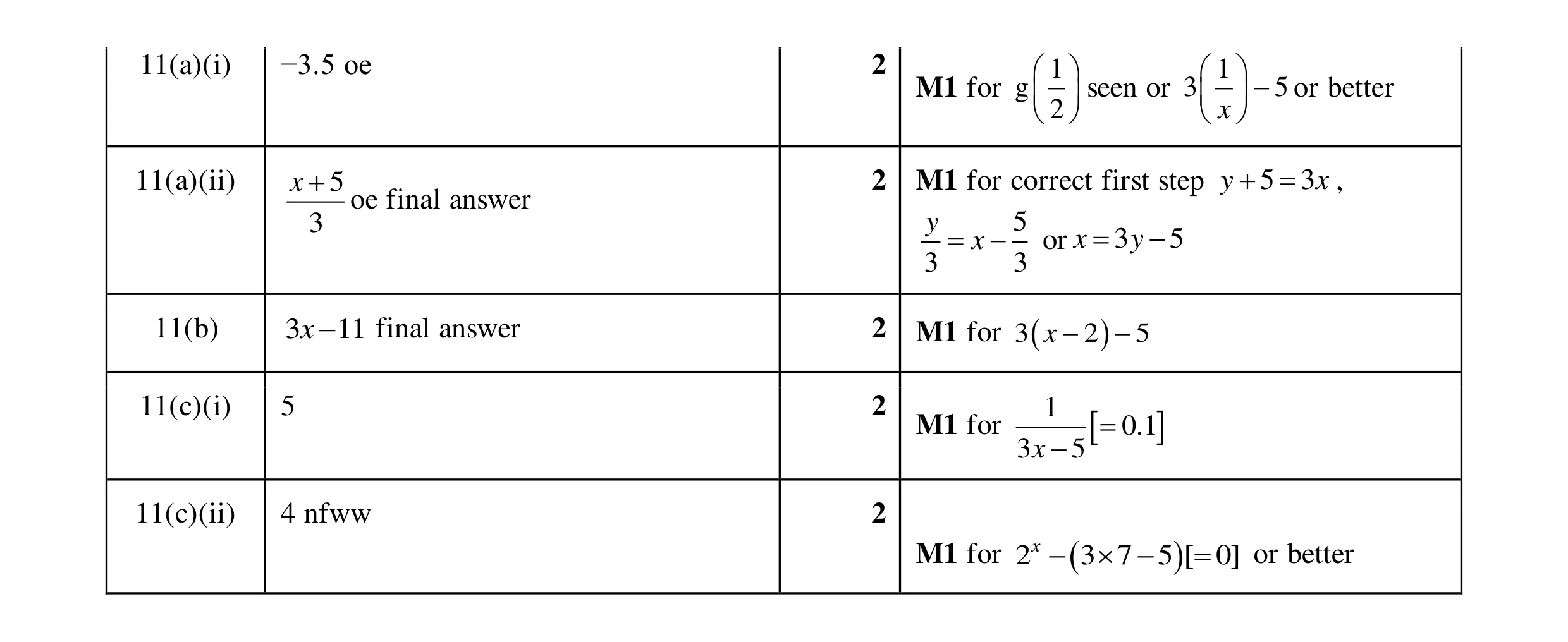
Mark scheme: 11(a)(i) −3.5 oe 2 1 1 M1 for g seen or 3 − 5 or better 2 x 11(a)(ii) x + 5 2 M1 for correct first step y + 5 = 3 x , oe final answer 3 y 5 = x − or x = 3 y − 5 3 3 11(b) 3x− 11 final answer 2 M1 for 3 ( x − 2 ) − 5 11(c)(i) 5 2 1 M1 for = 0.1 3 x − 5 11(c)(ii) 4 nfww 2 M1 for 2 x − ( 3 −7 5 ) [ = 0] or better
This question in 0580/42 Feb/March 2024
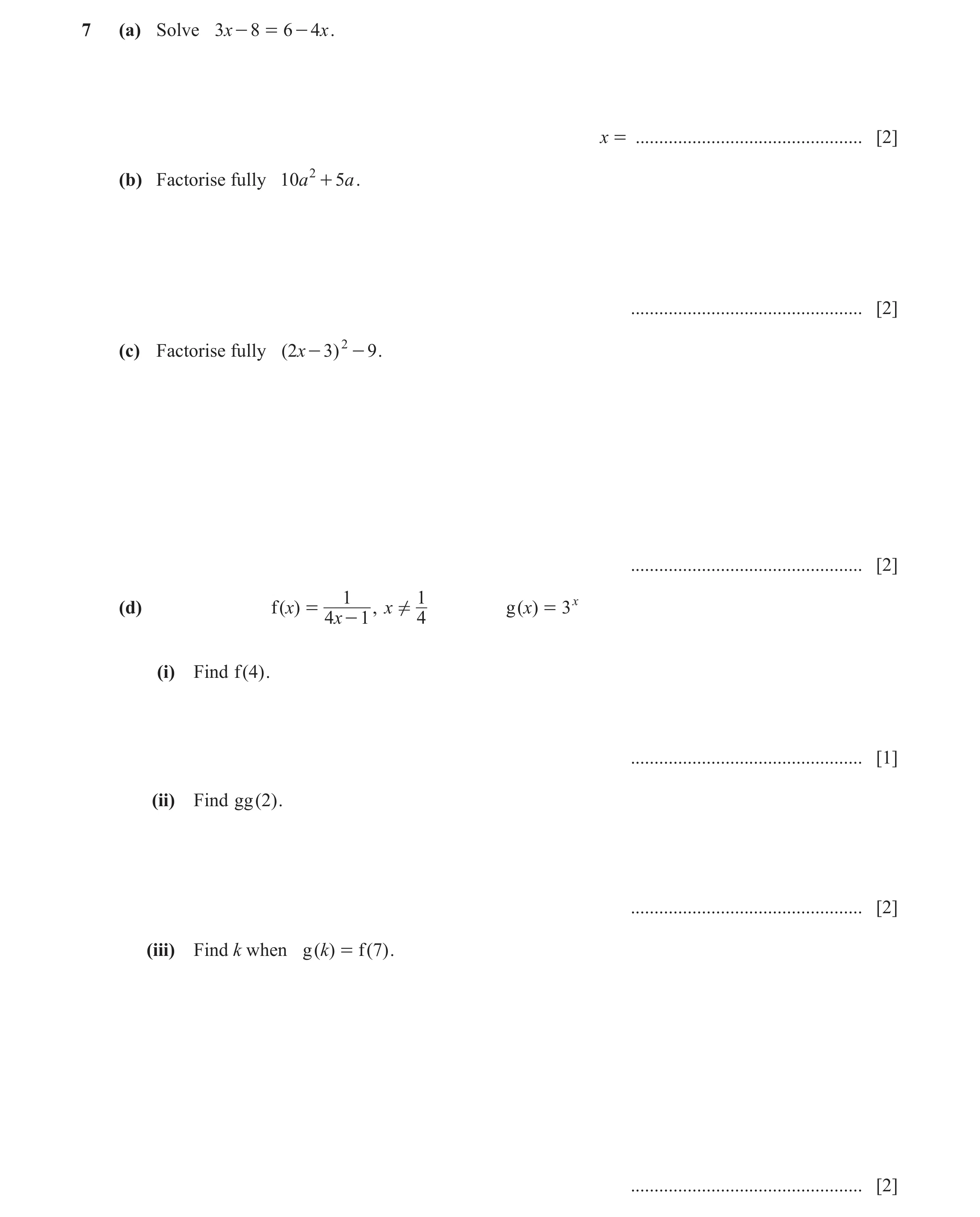
Q46 · Solve 3x - 8 = 6 - 4x 0580/42 May/June 2024
7 (a) Solve 3x - 8 = 6 - 4x . x = … [2] (b) Factorise fully 10a 2 + 5a . … [2] (c) Factorise fully ( 2x - 3) 2 - 9 . … [2] 1 1 x (d) f ( )x = , x ! g ( )x = 3 4x - 1 4 (i) Find f ( 4) . … [1] (ii) Find gg ( 2) . … [2] (iii) Find k when g ( k) = f ( 7) . … [2]
11 marks
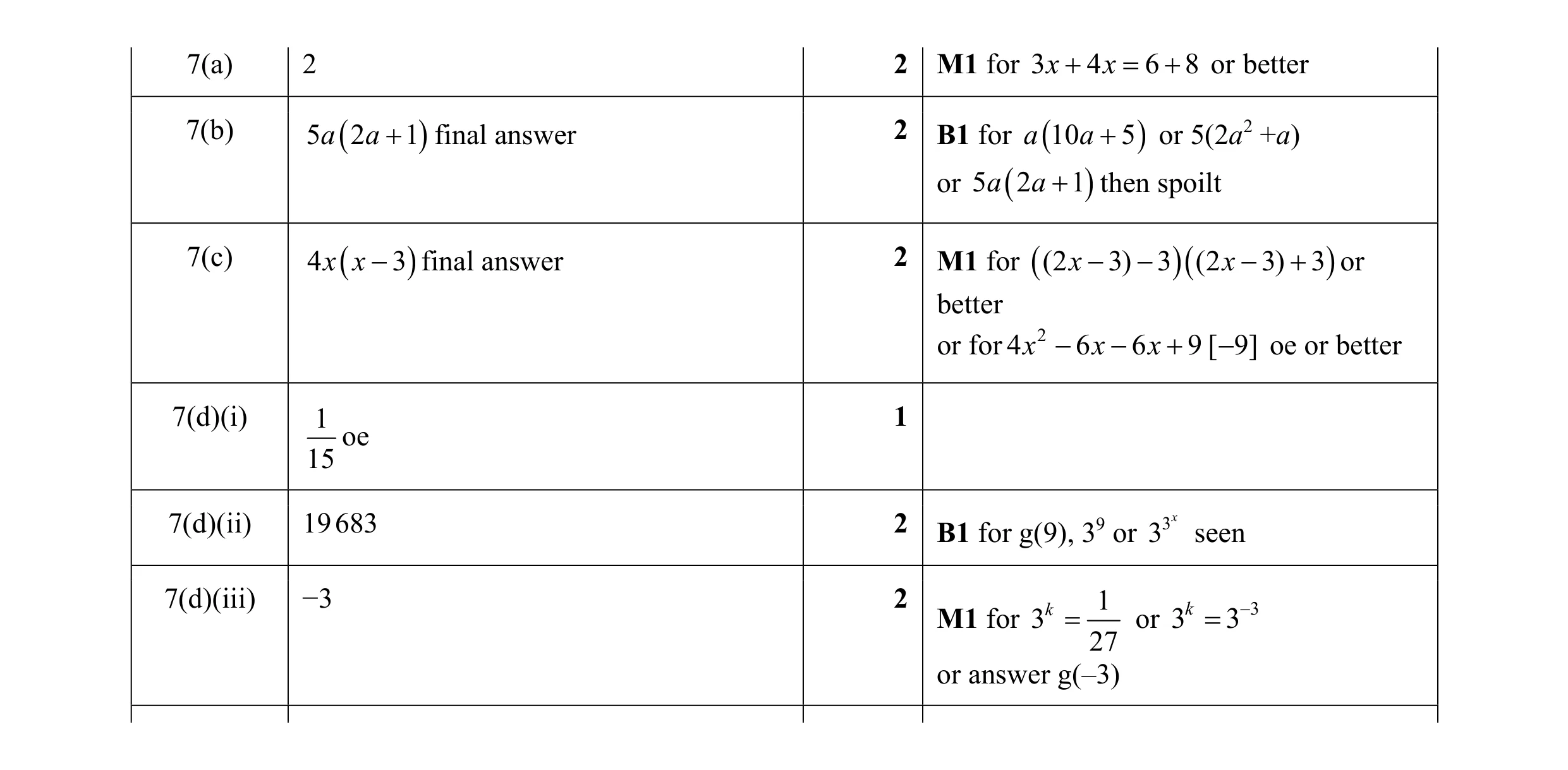
Mark scheme: 7(a) 2 2 M1 for 3 x 4 x 6 8 or better 7(b) 5a 2 a 1 final answer 2 B1 for a 10 a 5 or 5(2a2 +a) or 5a 2 a 1 then spoilt 7(c) 4 x x 3 final answer 2 M1 for (2 x 3) 3 (2 x 3) 3 or better or for 4 x 2 6 x 6 x 9 [ 9] oe or better 7(d)(i) 1 1 oe 15 7(d)(ii) 19 683 2 3 x B1 for g(9), 39 or 3 seen 7(d)(iii) −3 2 k 1 k 3 M1 for 3 or 3 3 27 or answer g(–3)
This question in 0580/42 May/June 2024
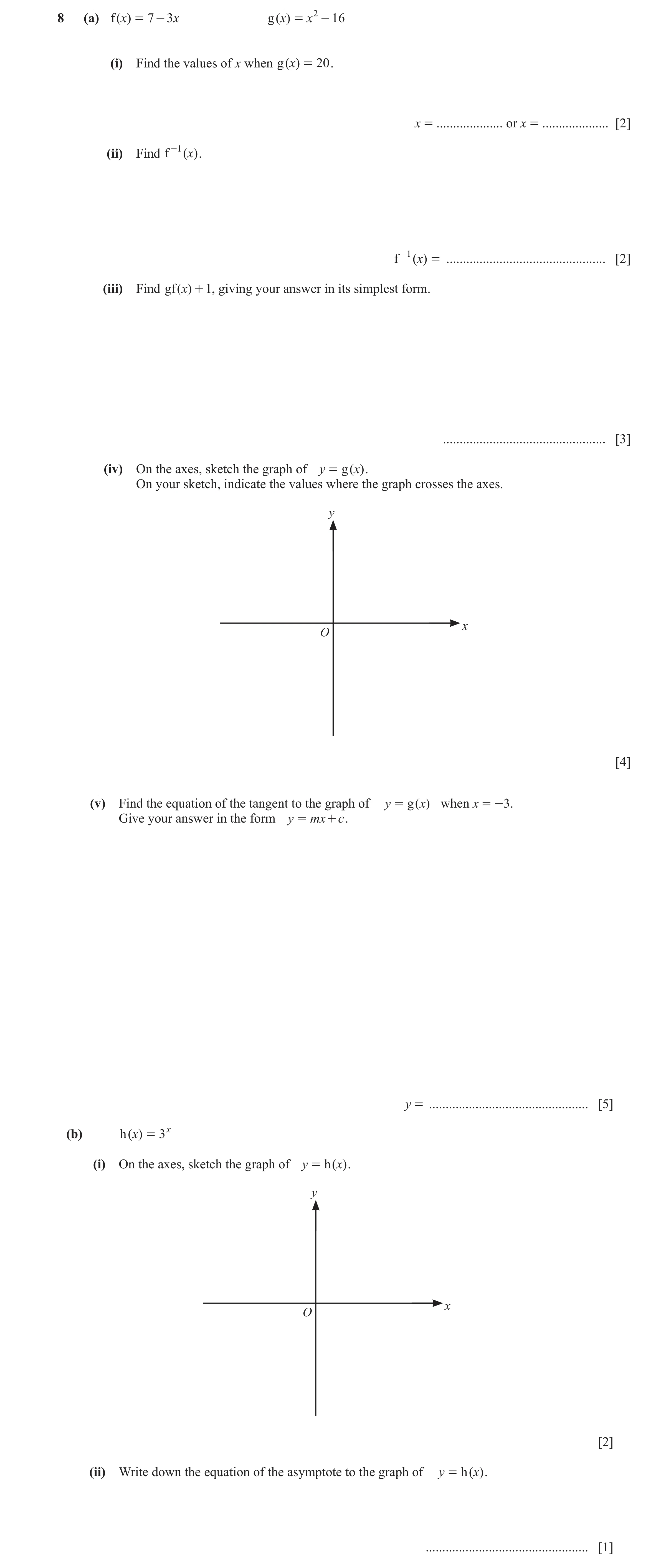
Q47 · F ( x) = 7 - 3 x g ( x) = x 2 - 16 (i) Find the values of x when g ( x) = 20 0580/41 Oct/Nov 2024
8 (a) f ( x) = 7 - 3 x g ( x) = x 2 - 16 (i) Find the values of x when g ( x) = 20 . x = … or x = … [2] (ii) Find f -1 ( )x . f -1 ( )x = … [2] (iii) Find gf ( x) + 1, giving your answer in its simplest form. … [3] (iv) On the axes, sketch the graph of y = g ( x) . On your sketch, indicate the values where the graph crosses the axes. y x O [4] (v) Find the equation of the tangent to the graph of y = g ( x) when x = -3. Give your answer in the form y = mx + c . y = … [5] (b) h ( x) = 3x (i) On the axes, sketch the graph of y = h ( x) . y x O [2] (ii) Write down the equation of the asymptote to the graph of y = h ( x) . … [1]
19 marks
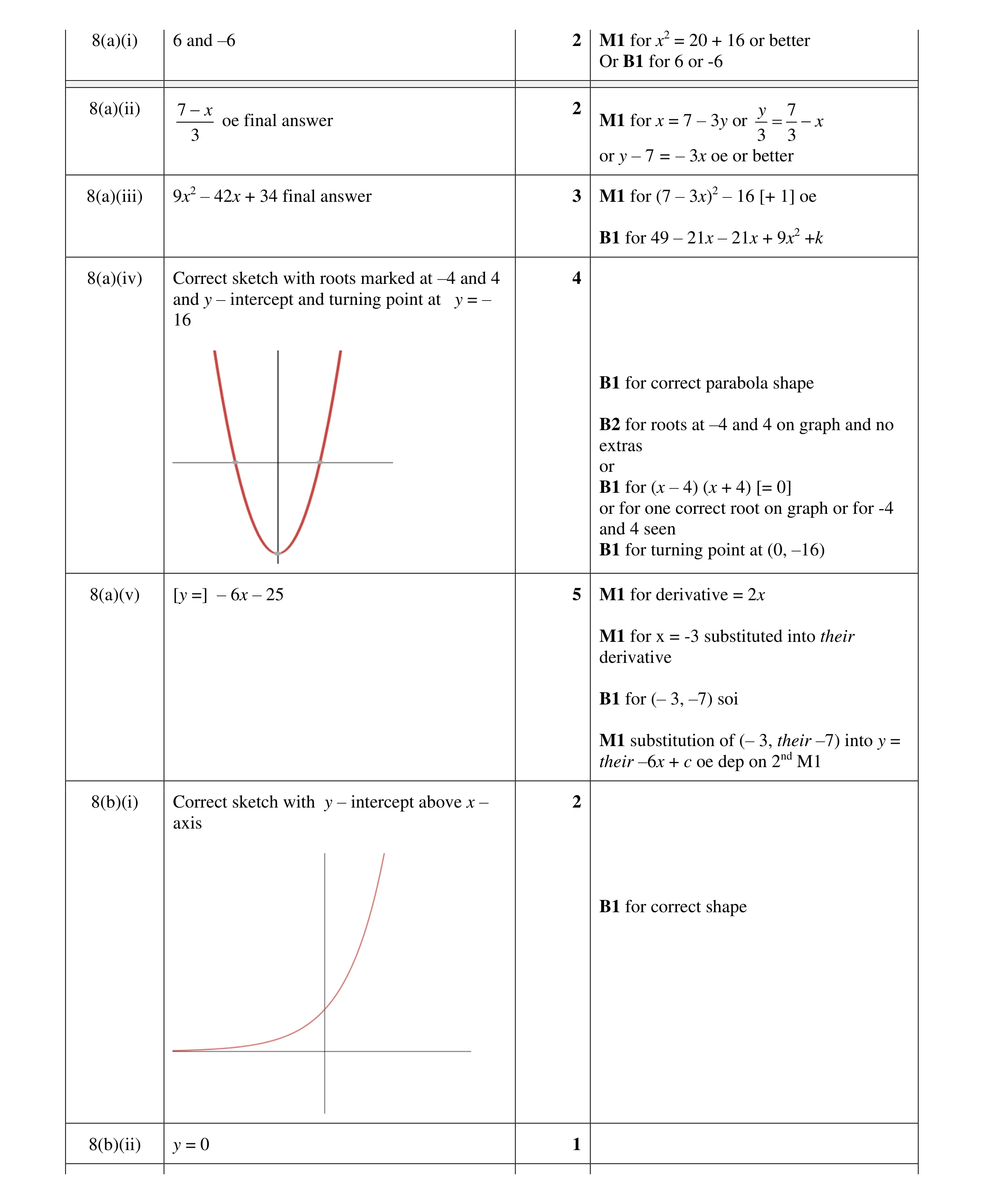
Mark scheme: 8(a)(i) 6 and –6 2 M1 for x2 = 20 + 16 or better Or B1 for 6 or -6 8(a)(ii) 7 − x 2 y 7 oe final answer M1 for x = 7 – 3y or = − x 3 3 3 or y – 7 = – 3x oe or better 8(a)(iii) 9x2 – 42x + 34 final answer 3 M1 for (7 – 3x)2 – 16 [+ 1] oe B1 for 49 – 21x – 21x + 9x2 +k 8(a)(iv) Correct sketch with roots marked at –4 and 4 4 and y – intercept and turning point at y = – 16 B1 for correct parabola shape B2 for roots at –4 and 4 on graph and no extras or B1 for (x – 4) (x + 4) [= 0] or for one correct root on graph or for -4 and 4 seen B1 for turning point at (0, –16) 8(a)(v) [y =] – 6x – 25 5 M1 for derivative = 2x M1 for x = -3 substituted into their derivative B1 for (– 3, –7) soi M1 substitution of (– 3, their –7) into y = their –6x + c oe dep on 2nd M1 8(b)(i) Correct sketch with y – intercept above x – 2 axis B1 for correct shape 8(b)(ii) y = 0 1
This question in 0580/41 Oct/Nov 2024
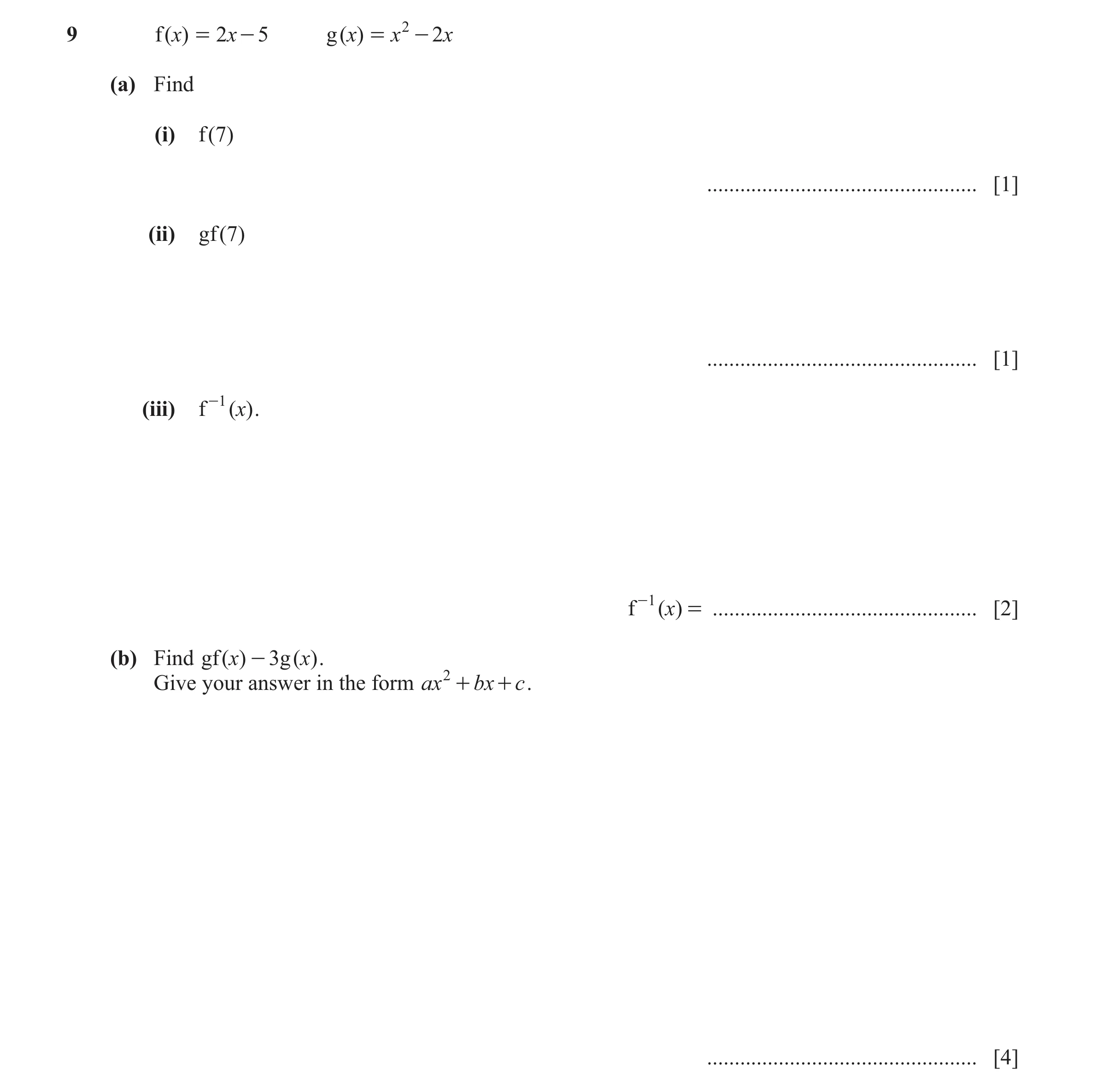
Q48 · F ( )x = 2x - 5 g ( )x = x 2 - 2x (a) Find (i) f ( 7 ) … [1] (ii) gf ( 7 ) … [1] (iii) f… 0580/42 Oct/Nov 2024
9 f ( )x = 2x - 5 g ( )x = x 2 - 2x (a) Find (i) f ( 7 ) … [1] (ii) gf ( 7 ) … [1] (iii) f -1 ( )x . f -1 ( )x = … [2] (b) Find gf ( x) - 3g ( )x . Give your answer in the form ax 2 + bx + c . … [4]
8 marks
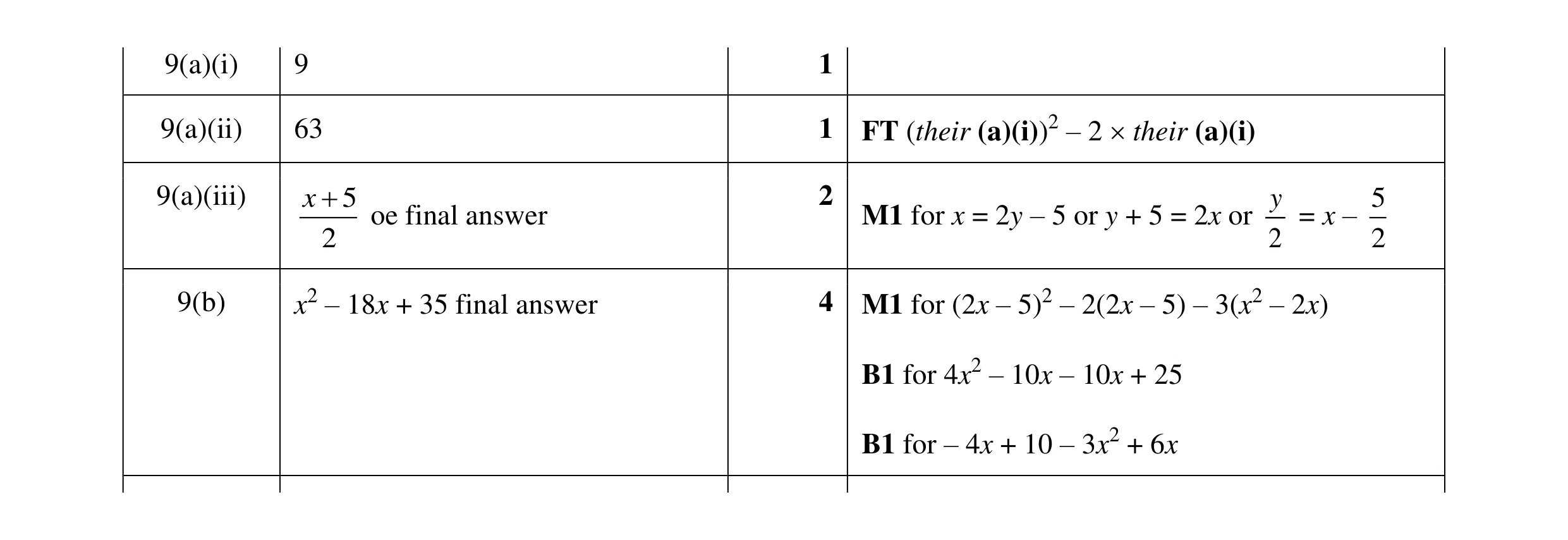
Mark scheme: 9(a)(i) 9 1 9(a)(ii) 63 1 FT (their (a)(i))2 – 2 their (a)(i) 9(a)(iii) x + 5 2 y 5 oe final answer M1 for x = 2y – 5 or y + 5 = 2x or = x – 2 2 2 9(b) x2 – 18x + 35 final answer 4 M1 for (2x – 5)2 – 2(2x – 5) – 3(x2 – 2x) B1 for 4x2 – 10x – 10x + 25 B1 for – 4x + 10 – 3x2 + 6x
This question in 0580/42 Oct/Nov 2024
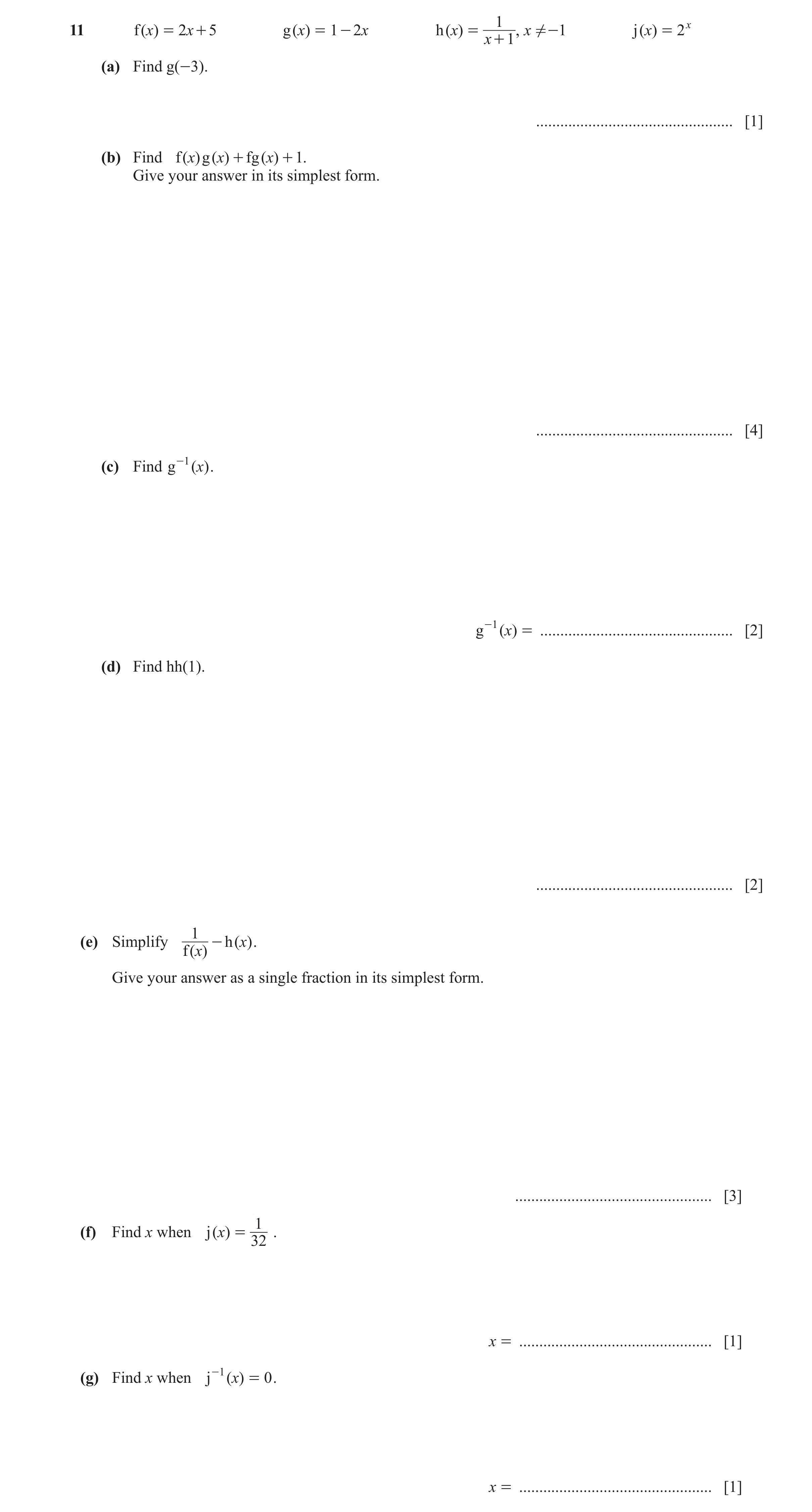
Q49 · X 11 f ( )x = 2x + 5 g ( )x = 1 - 2x h ( x) = , x ! 0580/43 Oct/Nov 2024
1 x 11 f ( )x = 2x + 5 g ( )x = 1 - 2x h ( x) = , x ! -1 j ( )x = 2 x + 1 (a) Find g(-3). … [1] (b) Find f ( x) g ( x) + fg ( x) + 1. Give your answer in its simplest form. … [4] (c) Find g -1 ( )x . g -1 ( )x = … [2] (d) Find hh(1). … [2] 1 (e) Simplify - h ( x) . f ( x) Give your answer as a single fraction in its simplest form. … [3] 1 (f) Find x when j ( )x = . 32 x = … [1] (g) Find x when j -1 ( )x = 0 . x = … [1]
14 marks
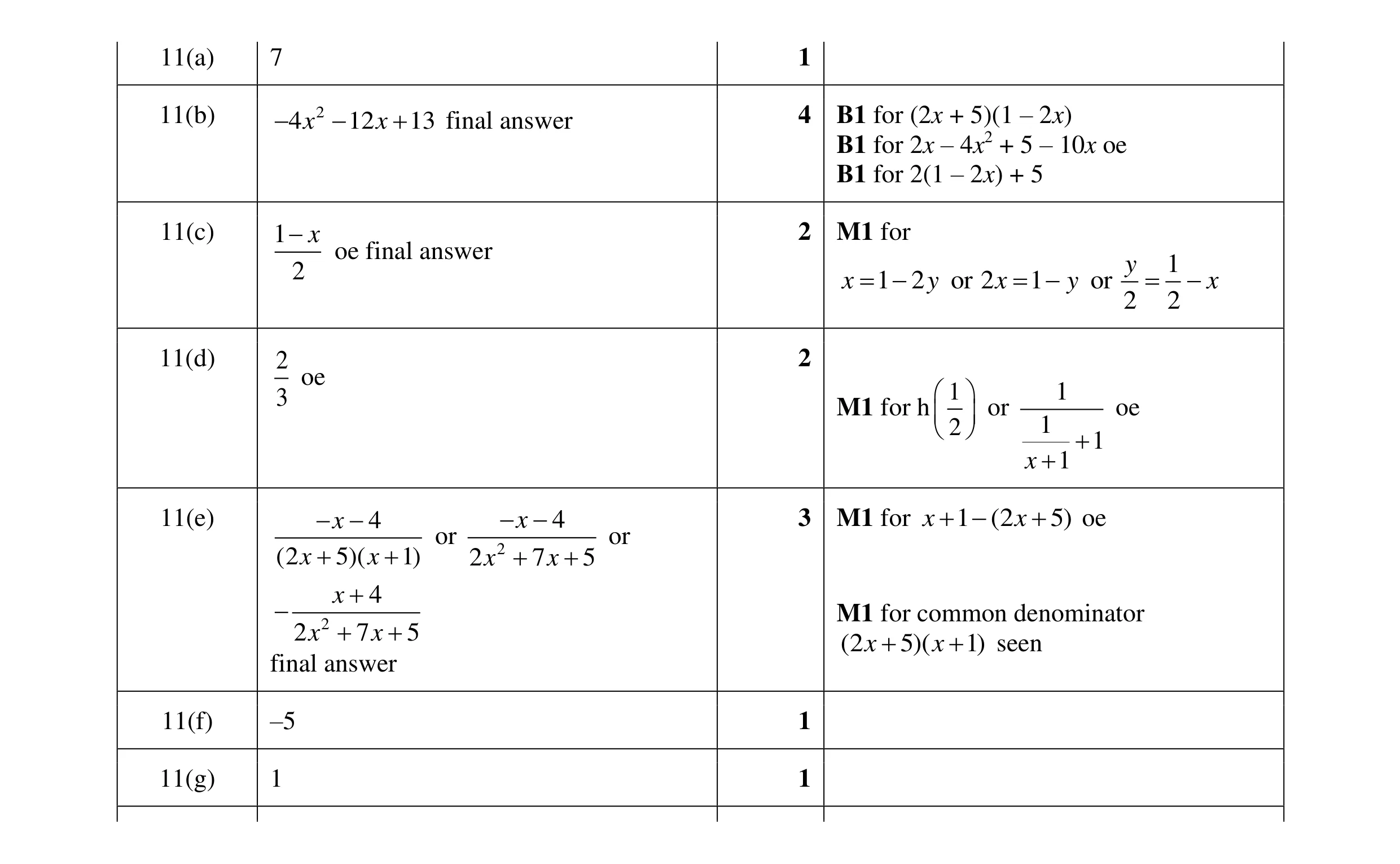
Mark scheme: 11(a) 7 1 11(b) −4 x 2 − 12 x + 13 final answer 4 B1 for (2x + 5)(1 – 2x) B1 for 2x – 4x2 + 5 – 10x oe B1 for 2(1 – 2x) + 5 11(c) 1 −x 2 M1 for oe final answer y 1 2 x = 1 − 2 y or 2 x = 1 − y or = − x 2 2 11(d) 2 2 oe 3 1 1 M1 for h or oe 2 1 + 1 x + 1 11(e) −−x 4 −−x 4 3 M1 for x + 1 − (2 x + 5) oe or or (2 x + 5)( x + 1) 2 x 2 + 7 x + 5 x + 4 − 2 M1 for common denominator 2 x + 7 x + 5 (2 x + 5)( x + 1) seen final answer 11(f) –5 1 11(g) 1 1
This question in 0580/43 Oct/Nov 2024
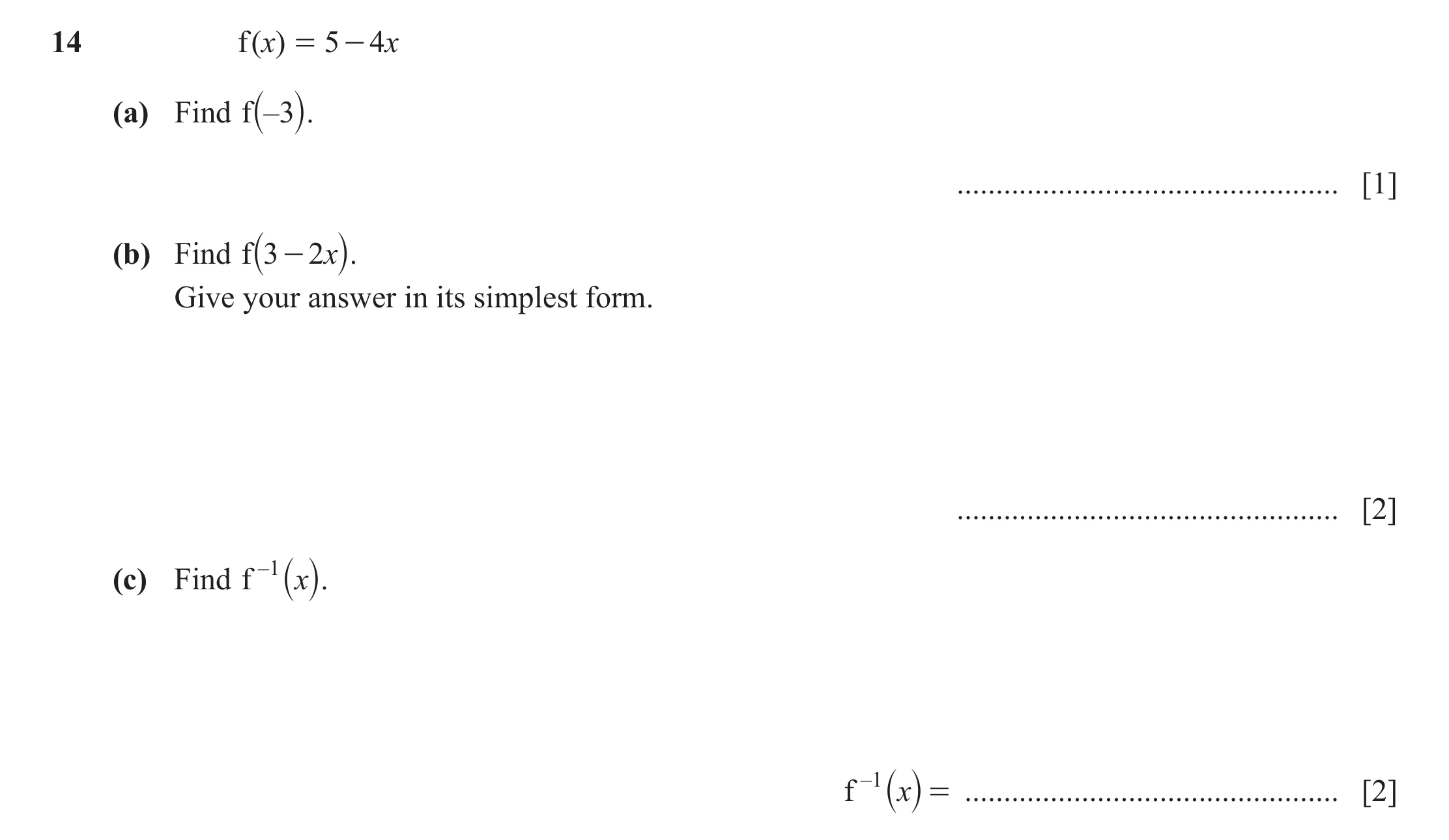
Q50 · F ( x) = 5 - 4x (a) Find f `– 3j 0580/42 Feb/March 2025
14 f ( x) = 5 - 4x (a) Find f `– 3j. … [1] (b) Find f `3 - 2 xj. Give your answer in its simplest form. … [2] (c) Find f – 1 `xj. f – 1 `xj = … [2]
5 marks
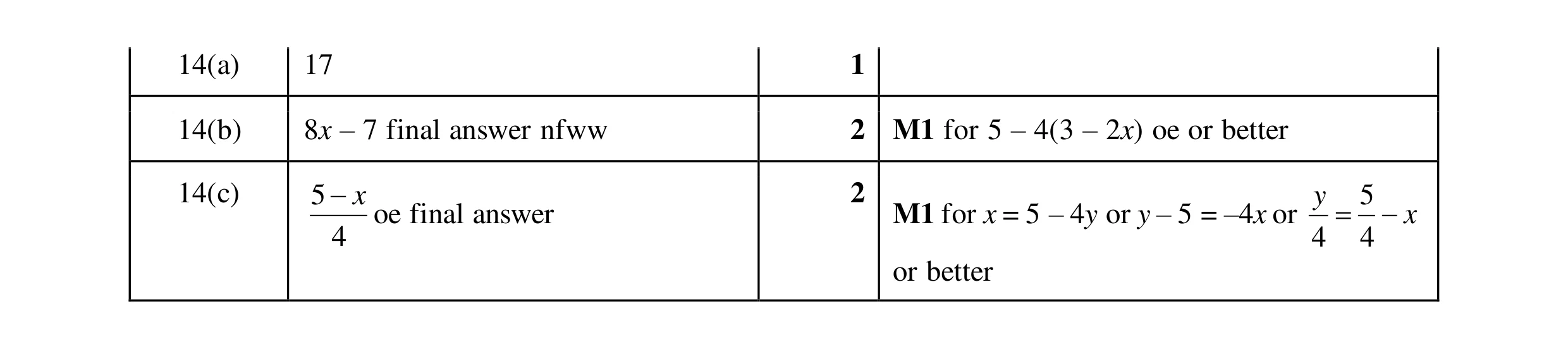
Mark scheme: 14(a) 17 1 14(b) 8x – 7 final answer nfww 2 M1 for 5 – 4(3 – 2x) oe or better 14(c) 5 −x 2 y 5 oe final answer M1 for x = 5 – 4y or y – 5 = –4x or = − x 4 4 4 or better
This question in 0580/42 Feb/March 2025
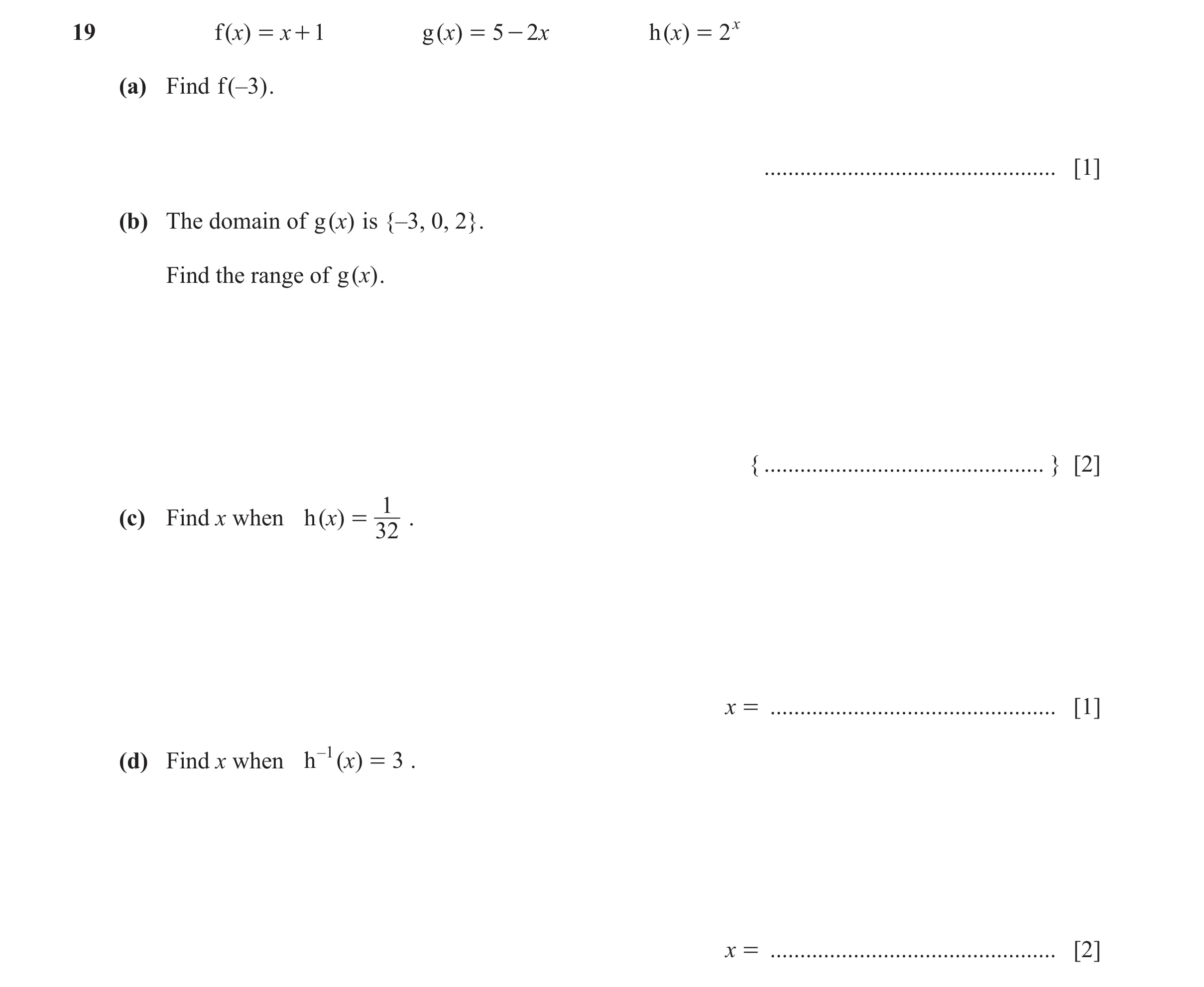
Q51 · F ( x) = x + 1 g ( x) = 5 - 2 x h ( x) = 2x (a) Find f ( –3) 0580/42 May/June 2025
19 f ( x) = x + 1 g ( x) = 5 - 2 x h ( x) = 2x (a) Find f ( –3) . … [1] (b) The domain of g ( x) is {–3, 0, 2}. Find the range of g ( x) . { … } [2] 1 (c) Find x when h ( x) = . 32 x = … [1] (d) Find x when h – 1 ( )x = 3 . x = … [2]
6 marks
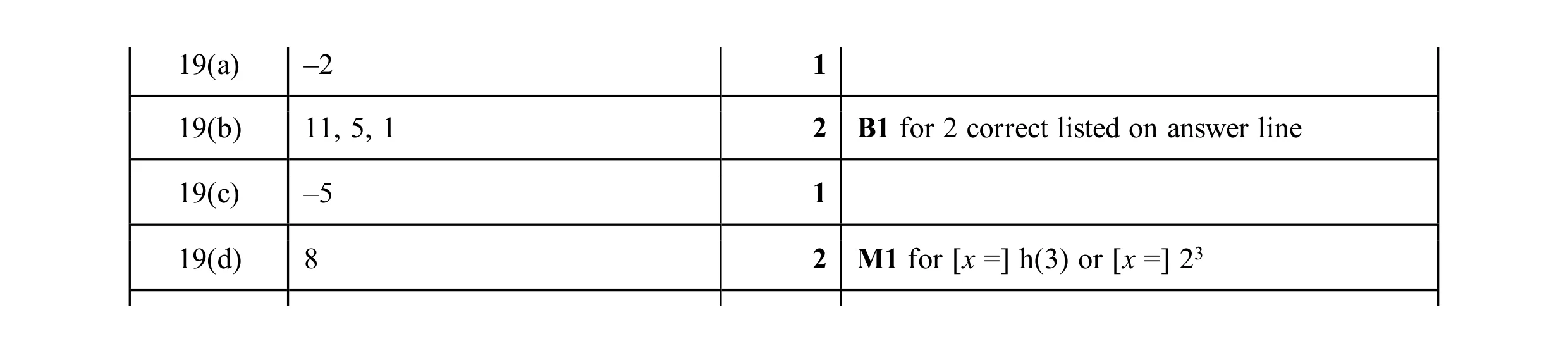
Mark scheme: 19(a) –2 1 19(b) 11, 5, 1 2 B1 for 2 correct listed on answer line 19(c) –5 1 19(d) 8 2 M1 for [x =] h(3) or [x =] 23
This question in 0580/42 May/June 2025
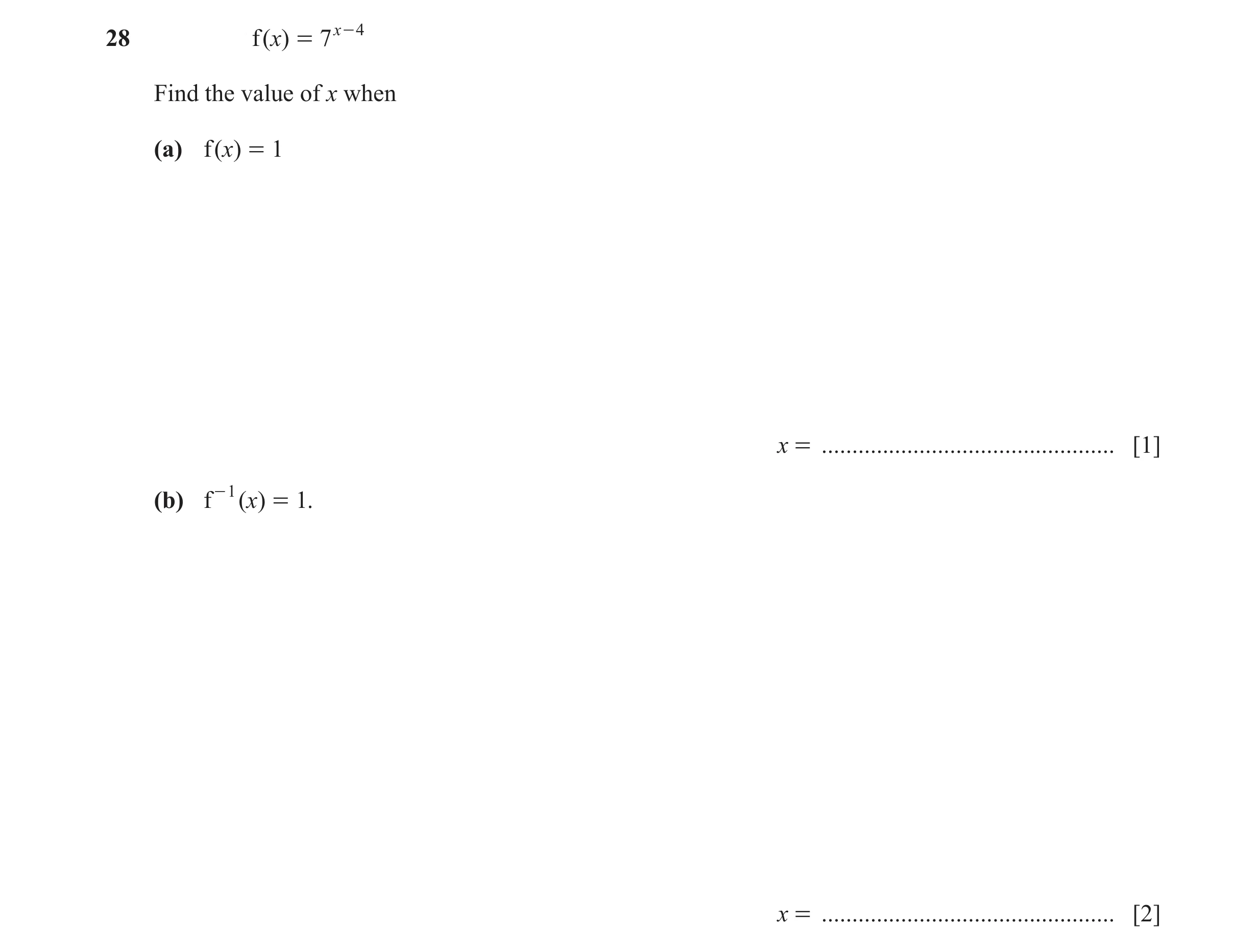
Q52 · F ( )x = 7 x - 4 Find the value of x when (a) f ( )x = 1 x = … [1] (b) f - 1 ( )x = 1 0580/41 Oct/Nov 2025
28 f ( )x = 7 x - 4 Find the value of x when (a) f ( )x = 1 x = … [1] (b) f - 1 ( )x = 1. x = … [2]
3 marks
Mark scheme: 28(a) 4 1 28(b) 1 2 M1 for [x =] f(1) or better 343
This question in 0580/41 Oct/Nov 2025
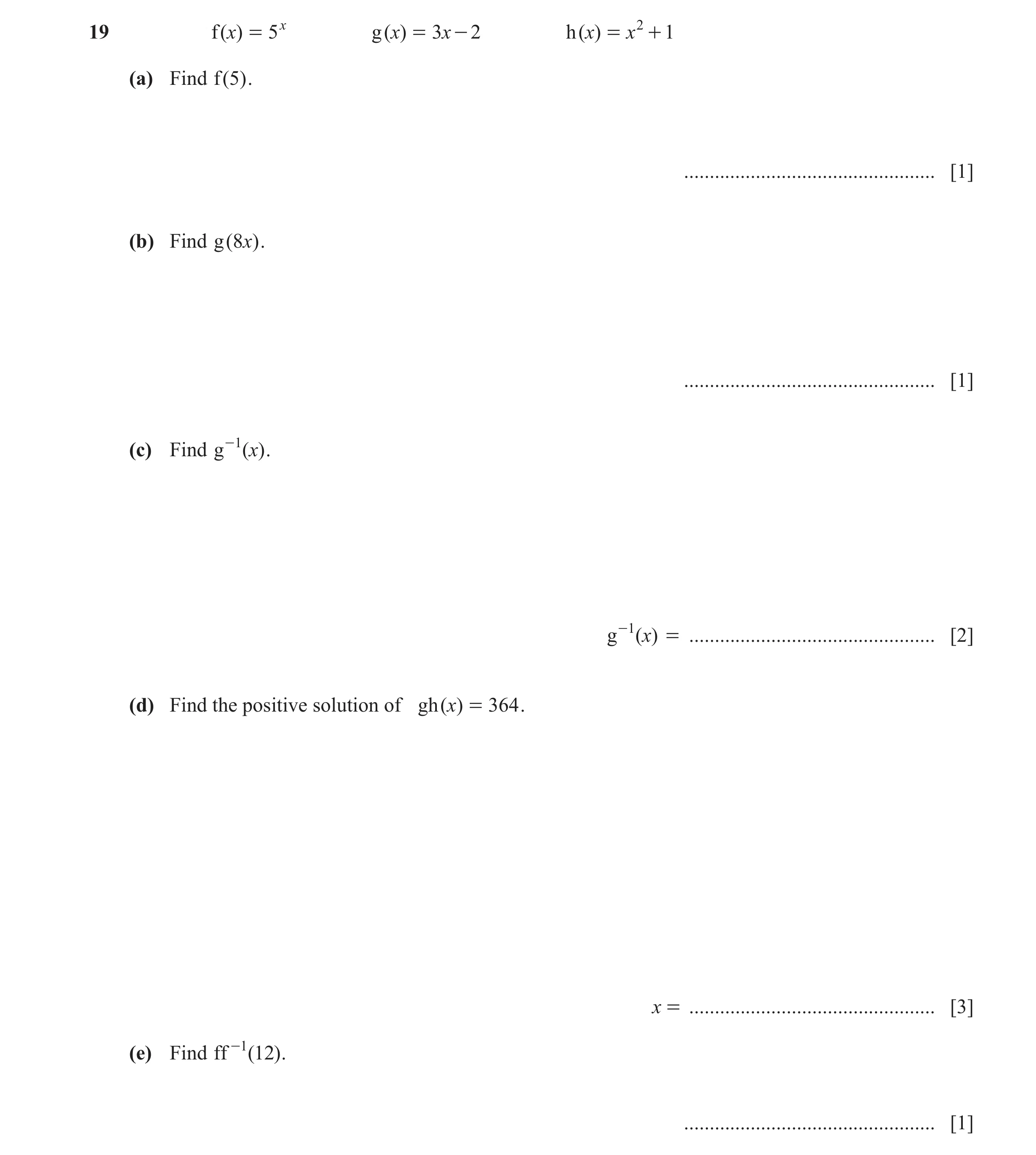
Q53 · F ( )x = 5 x g ( )x = 3x - 2 h ( )x = x 2 + 1 (a) Find f ( 5 ) 0580/43 Oct/Nov 2025
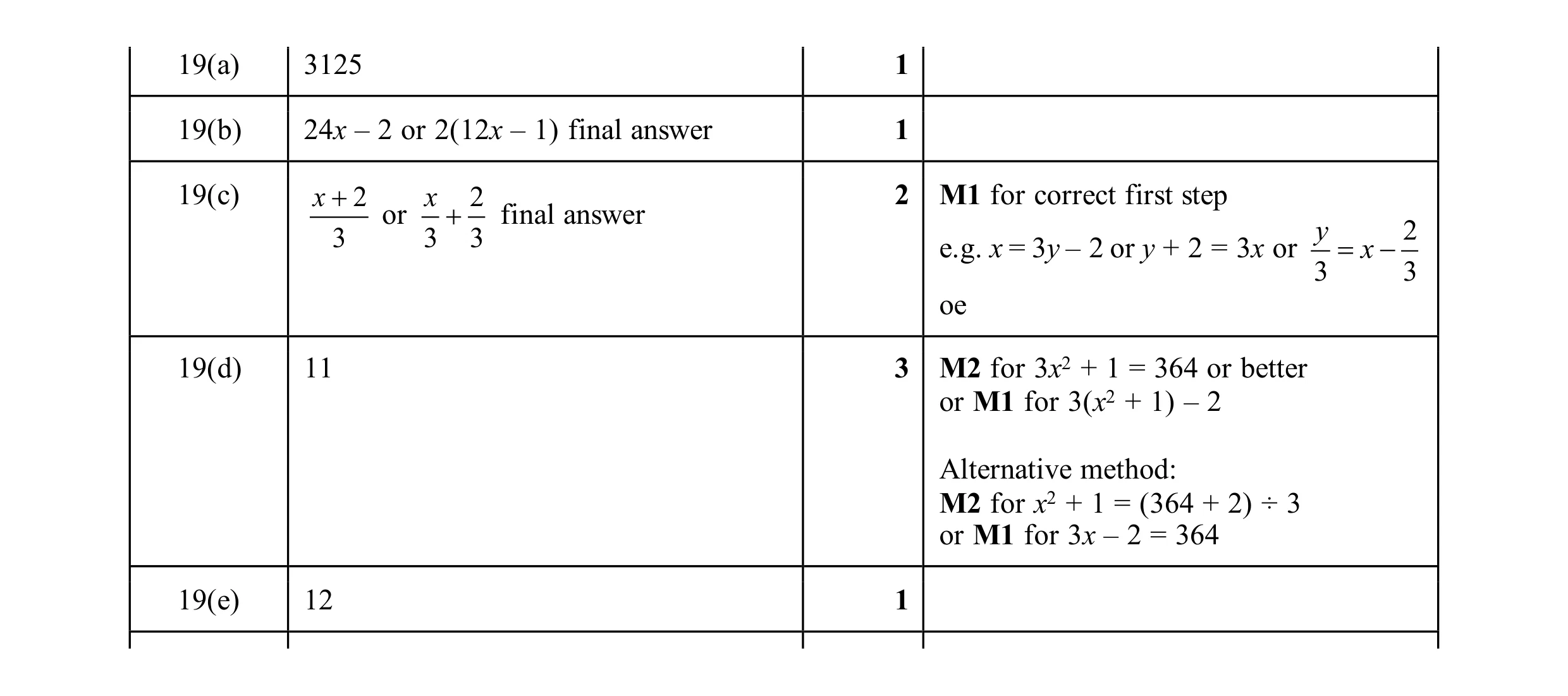
19 f ( )x = 5 x g ( )x = 3x - 2 h ( )x = x 2 + 1 (a) Find f ( 5 ) . … [1] (b) Find g ( 8)x . … [1] (c) Find g -1 ( )x . g -1 ( )x = … [2] (d) Find the positive solution of gh ( )x = 364 . x = … [3] (e) Find ff -1 (12.) … [1]
8 marks
Mark scheme: 19(a) 3125 1 19(b) 24x – 2 or 2(12x – 1) final answer 1 19(c) x + 2 x 2 2 M1 for correct first step or + final answer 3 3 3 y 2 e.g. x = 3y – 2 or y + 2 = 3x or = x − 3 3 oe 19(d) 11 3 M2 for 3x2 + 1 = 364 or better or M1 for 3(x2 + 1) – 2 Alternative method: M2 for x2 + 1 = (364 + 2) ÷ 3 or M1 for 3x – 2 = 364 19(e) 12 1
This question in 0580/43 Oct/Nov 2025
 1 / 73
 4 / 73
 13 / 73
 16 / 73
 25 / 73
 26 / 73
 29 / 73
 32 / 73
 35 / 73
 47 / 73
 50 / 73
 54 / 73
 55 / 73
 58 / 73
 59 / 73
 63 / 73
 64 / 73
 65 / 73
 68 / 73
 70 / 73
 71 / 73
 72 / 73
 73 / 73
 14
 11
 18
 10
 12
 14
 12
 18
 12
 14
 11
 12
 11
 15
 14
 10
 10
 10
 13
 11
 11
 11
 17
 10
 17
 12
 15
 15
 14
 11
 14
 12
 14
 11
 16
 11
 6
 11
 16
 10
 9
 15
 14
 12
 10
 11
 19
 8
 14
 5
 6
 3
 8