Cambridge IGCSE Mathematics 0580 — 2020 Feb/March Paper 4 · Variant 2
0580/42/F/M/20 · 11 questions · 130 marks · ≈146 min
The question paper and its mark scheme, free to read here and free to download. This is Cambridge’s own paper, exactly as it was sat.
Question paper20 pages
Mark scheme9 pages
Answers below. Sit the paper first if you are practising.
Questions as text
Q1 · Dhanu has a model railway
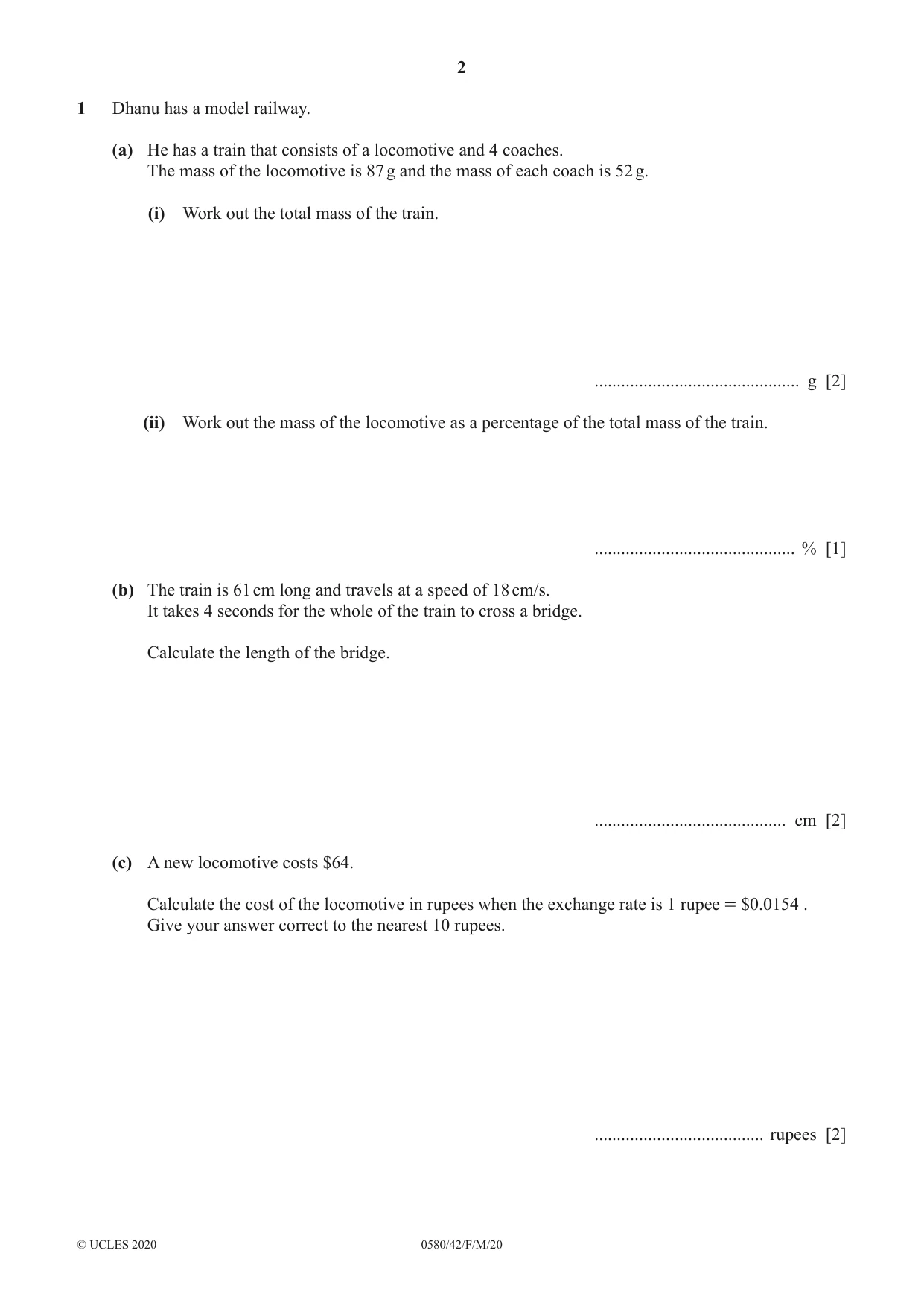
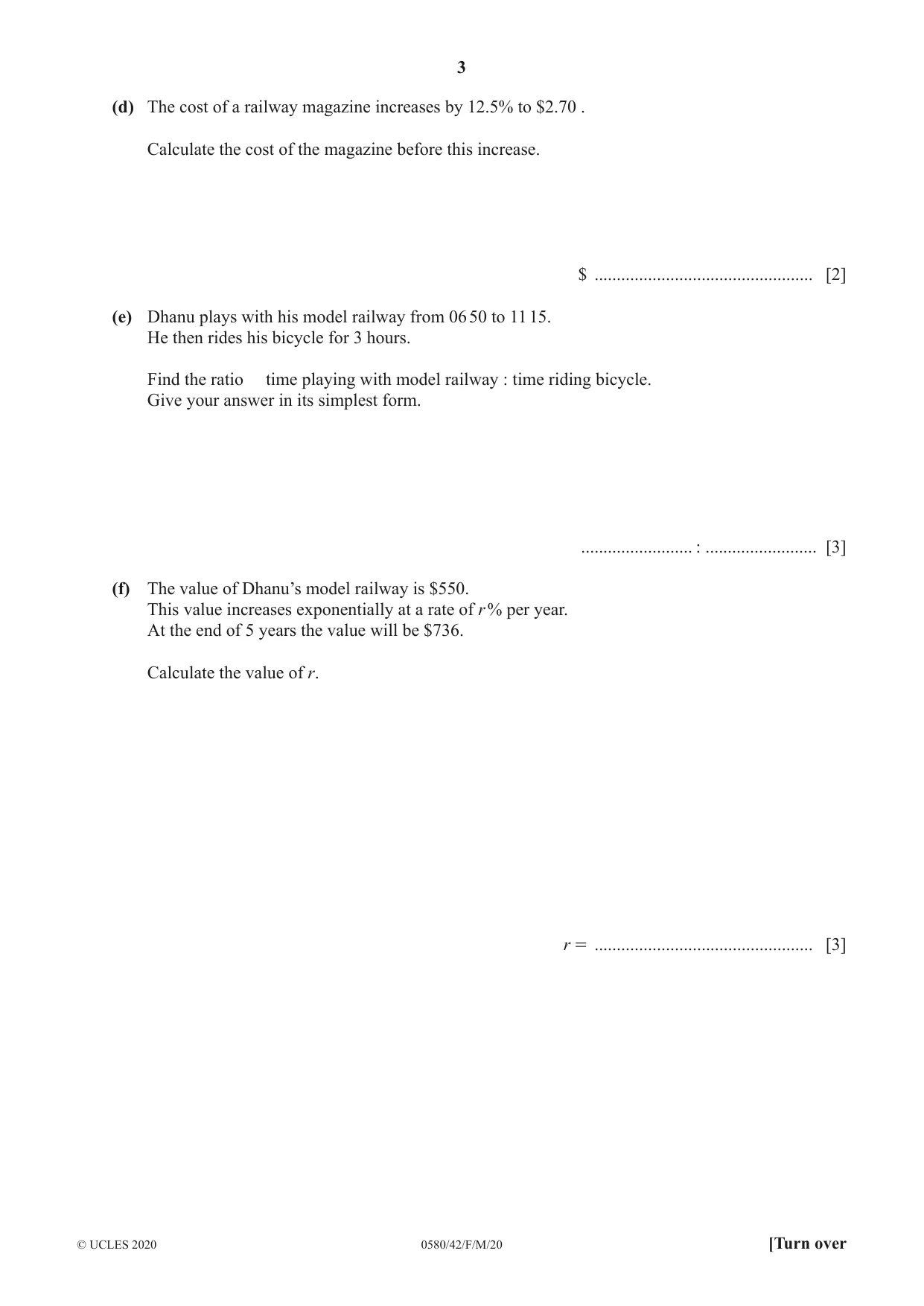
1 Dhanu has a model railway. (a) He has a train that consists of a locomotive and 4 coaches. The mass of the locomotive is 87 g and the mass of each coach is 52 g. (i) Work out the total mass of the train. .............................................. g [2] (ii) Work out the mass of the locomotive as a percentage of the total mass of the train. ............................................. % [1] (b) The train is 61 cm long and travels at a speed of 18 cm/s. It takes 4 seconds for the whole of the train to cross a bridge. Calculate the length of the bridge. ........................................... cm [2] (c) A new locomotive costs $64. Calculate the cost of the locomotive in rupees when the exchange rate is 1 rupee = $0.0154 . Give your answer correct to the nearest 10 rupees. ...................................... rupees [2] (d) The cost of a railway magazine increases by 12.5% to $2.70 . Calculate the cost of the magazine before this increase. $ ................................................. [2] (e) Dhanu plays with his model railway from 06 50 to 11 15. He then rides his bicycle for 3 hours. Find the ratio time playing with model railway : time riding bicycle. Give your answer in its simplest form. ......................... : ......................... [3] (f) The value of Dhanu’s model railway is $550. This value increases exponentially at a rate of r % per year. At the end of 5 years the value will be $736. Calculate the value of r. r = ................................................. [3]
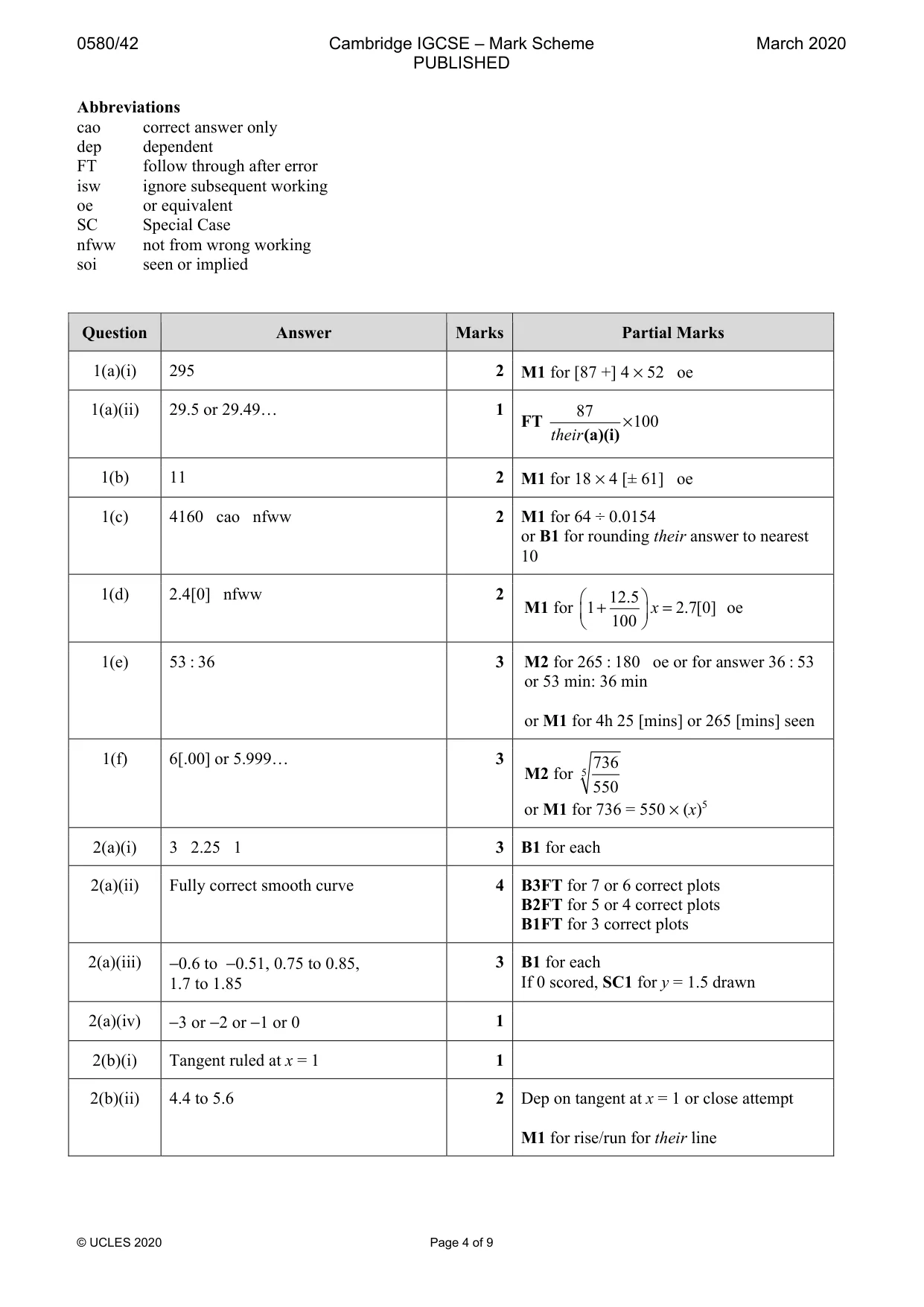
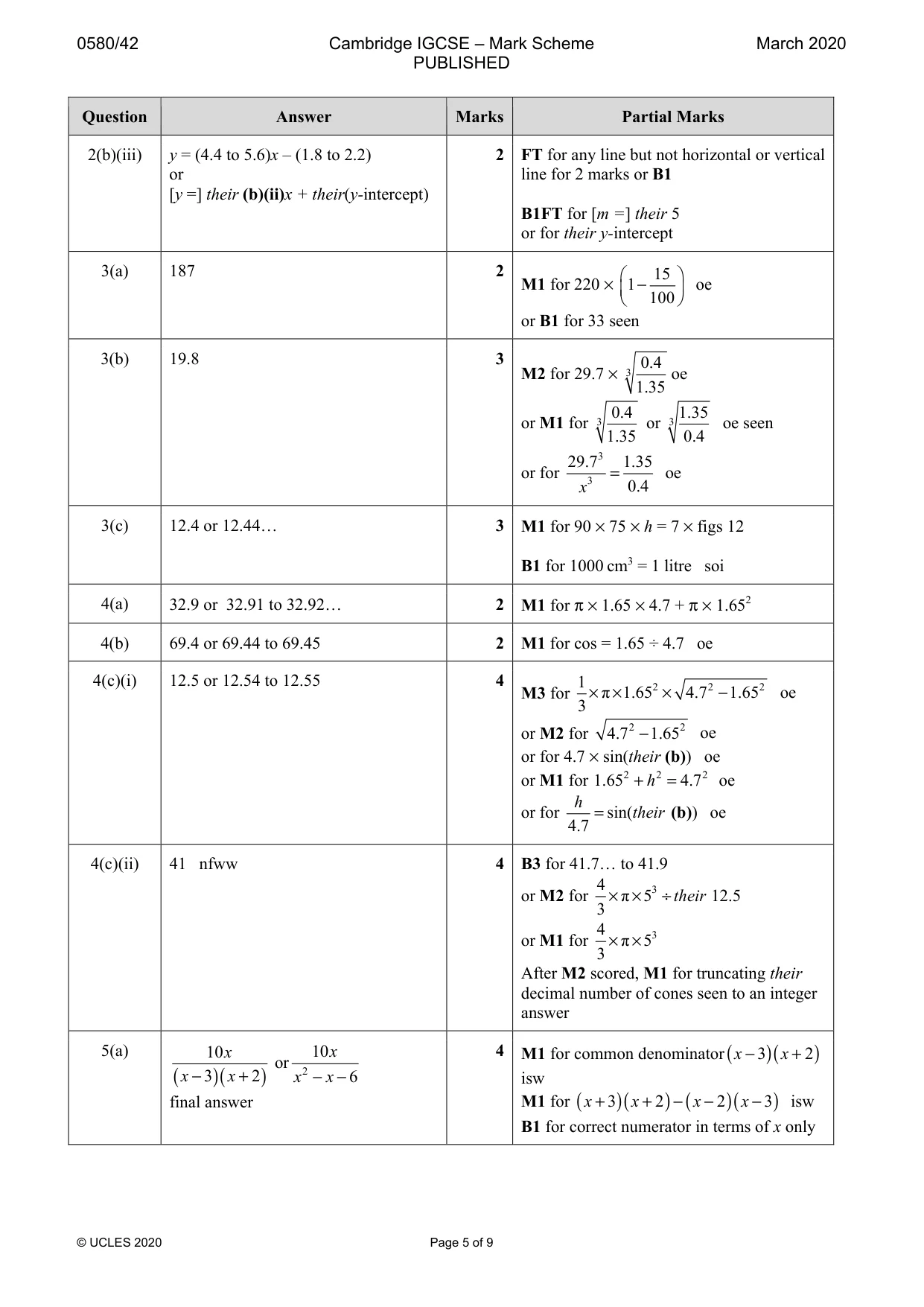
Mark scheme: Question Answer Marks Partial Marks 1(a)(i) 295 2 M1 for [87 +] 4 × 52 oe 1(a)(ii) 29.5 or 29.49… 1 87 FT × 100 their(a)(i) 1(b) 11 2 M1 for 18 × 4 [± 61] oe 1(c) 4160 cao nfww 2 M1 for 64 ÷ 0.0154 or B1 for rounding their answer to nearest 10 1(d) 2.4[0] nfww 2 12.5 M1 for 1 + x = 2.7[0] oe 100 1(e) 53 : 36 3 M2 for 265 : 180 oe or for answer 36 : 53 or 53 min: 36 min or M1 for 4h 25 [mins] or 265 [mins] seen 1(f) 6[.00] or 5.999… 3 736 M2 for 5 550 or M1 for 736 = 550 × (x)5
Q2 · The table shows some values for y = 2x 3 - 4x 2 + 3
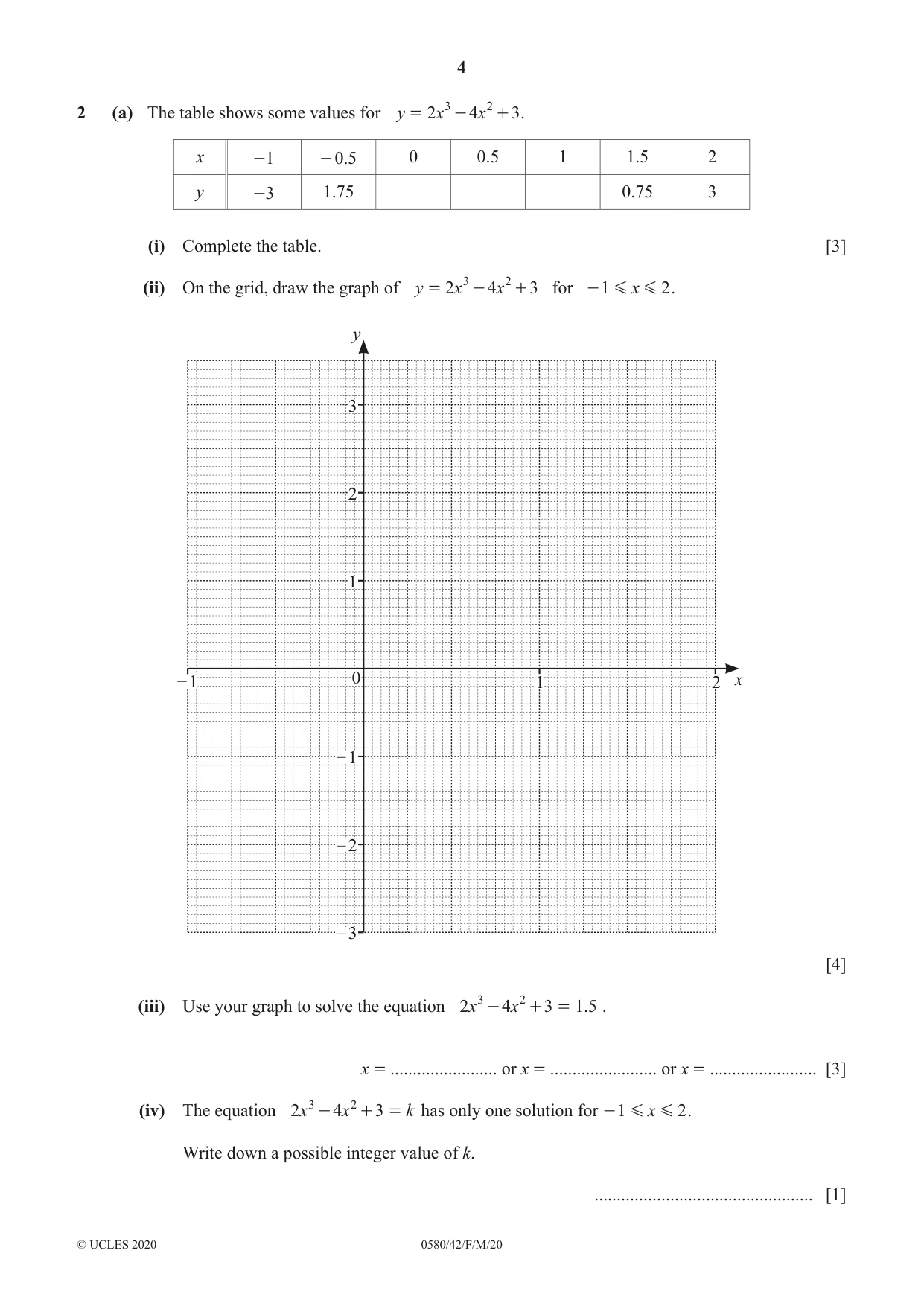
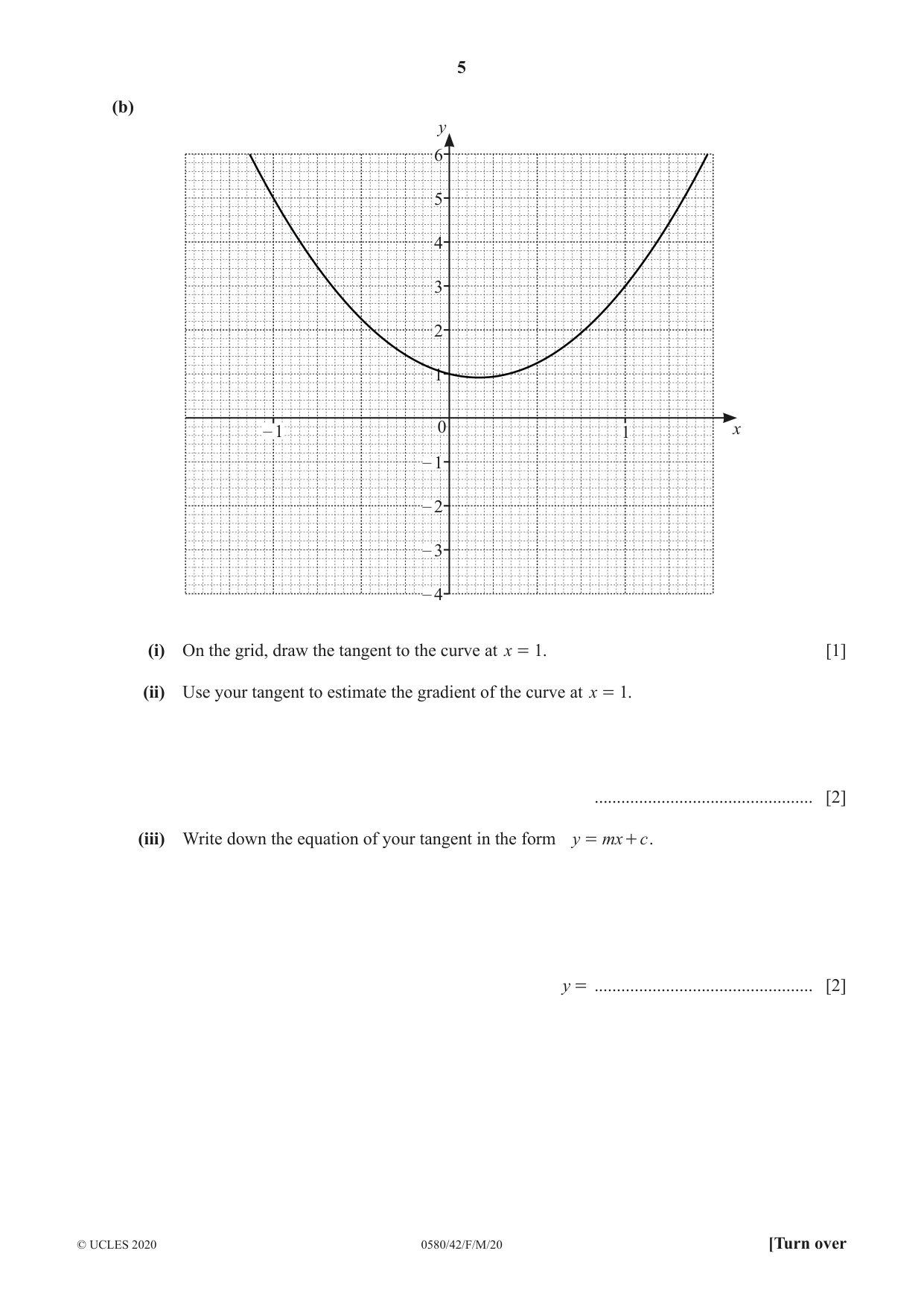
2 (a) The table shows some values for y = 2x 3 - 4x 2 + 3 . x -1 - 0.5 0 0.5 1 1.5 2 y -3 1.75 0.75 3 (i) Complete the table. [3] (ii) On the grid, draw the graph of y = 2x 3 - 4x 2 + 3 for - 1 G x G 2 . y 3 2 1 – 1 0 1 2 x – 1 – 2 – 3 [4] (iii) Use your graph to solve the equation 2x 3 - 4x 2 + 3 = 1 .5 . x = ........................ or x = ........................ or x = ........................ [3] (iv) The equation 2x 3 - 4x 2 + 3 = k has only one solution for - 1 G x G 2 . Write down a possible integer value of k. ................................................. [1] (b) y 6 5 4 3 2 1 – 1 0 1 x – 1 – 2 – 3 – 4 (i) On the grid, draw the tangent to the curve at x = 1. [1] (ii) Use your tangent to estimate the gradient of the curve at x = 1. ................................................. [2] (iii) Write down the equation of your tangent in the form y = mx + c . y = ................................................. [2]
Mark scheme: 2(a)(i) 3 2.25 1 3 B1 for each 2(a)(ii) Fully correct smooth curve 4 B3FT for 7 or 6 correct plots B2FT for 5 or 4 correct plots B1FT for 3 correct plots 2(a)(iii) −0.6 to −0.51, 0.75 to 0.85, 3 B1 for each 1.7 to 1.85 If 0 scored, SC1 for y = 1.5 drawn 2(a)(iv) −3 or −2 or −1 or 0 1 2(b)(i) Tangent ruled at x = 1 1 2(b)(ii) 4.4 to 5.6 2 Dep on tangent at x = 1 or close attempt M1 for rise/run for their line 2(b)(iii) y = (4.4 to 5.6)x – (1.8 to 2.2) 2 FT for any line but not horizontal or vertical or line for 2 marks or B1 [y =] their (b)(ii)x + their(y-intercept) B1FT for [m =] their 5 or for their y-intercept
Q3 · Manjeet uses 220 litres of water each day
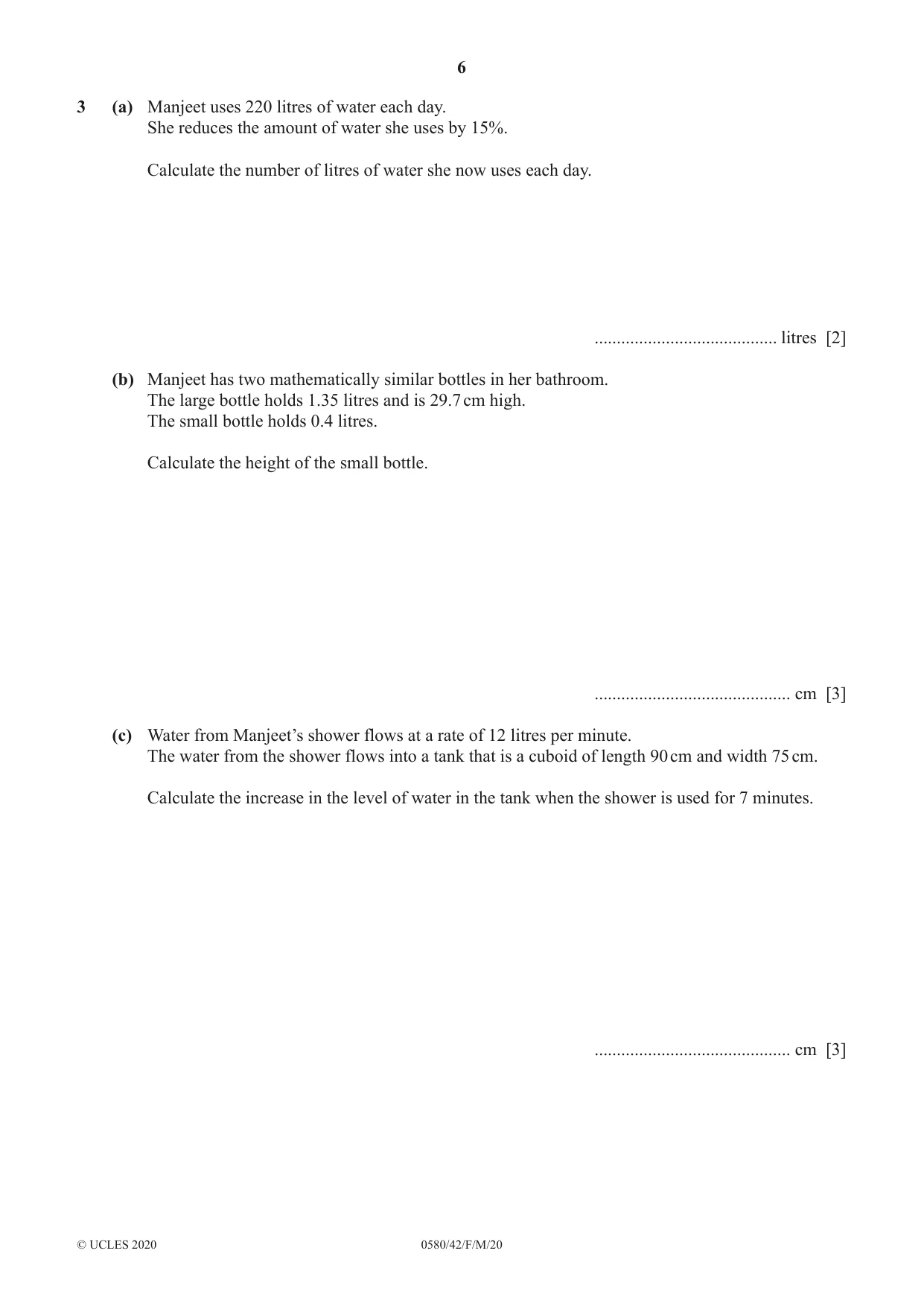
3 (a) Manjeet uses 220 litres of water each day. She reduces the amount of water she uses by 15%. Calculate the number of litres of water she now uses each day. ......................................... litres [2] (b) Manjeet has two mathematically similar bottles in her bathroom. The large bottle holds 1.35 litres and is 29.7 cm high. The small bottle holds 0.4 litres. Calculate the height of the small bottle. ............................................ cm [3] (c) Water from Manjeet’s shower flows at a rate of 12 litres per minute. The water from the shower flows into a tank that is a cuboid of length 90 cm and width 75 cm. Calculate the increase in the level of water in the tank when the shower is used for 7 minutes. ............................................ cm [3]
Mark scheme: 3(a) 187 2 15 M1 for 220 × 1 − oe 100 or B1 for 33 seen 3(b) 19.8 3 0.4 M2 for 29.7 × 3 oe 1.35 0.4 1.35 or M1 for 3 or 3 oe seen 1.35 0.4 29.7 3 1.35 or for = oe x 3 0.4 3(c) 12.4 or 12.44… 3 M1 for 90 × 75 × h = 7 × figs 12 B1 for 1000 cm3 = 1 litre soi
Q4 · A solid metal cone has radius 1.65 cm and slant height 4.70 cm
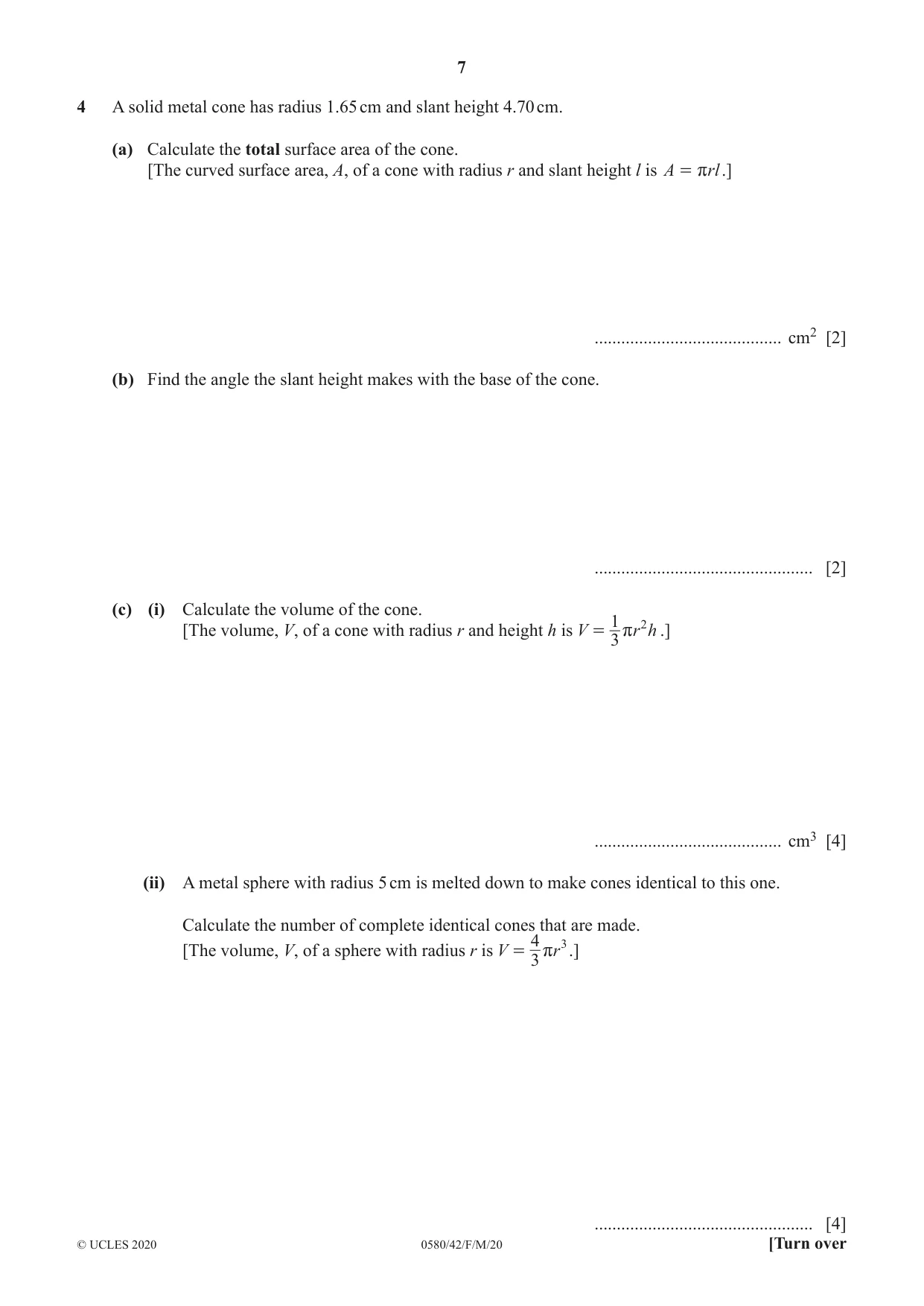
4 A solid metal cone has radius 1.65 cm and slant height 4.70 cm. (a) Calculate the total surface area of the cone. [The curved surface area, A, of a cone with radius r and slant height l is A = rrl .] .......................................... cm2 [2] (b) Find the angle the slant height makes with the base of the cone. ................................................. [2] (c) (i) Calculate the volume of the cone. 1 2 [The volume, V, of a cone with radius r and height h is V = rr h .] 3 .......................................... cm3 [4] (ii) A metal sphere with radius 5 cm is melted down to make cones identical to this one. Calculate the number of complete identical cones that are made. 4 3 [The volume, V, of a sphere with radius r is V = rr .] 3
Mark scheme: 4(a) 32.9 or 32.91 to 32.92… 2 M1 for π × 1.65 × 4.7 + π × 1.652 4(b) 69.4 or 69.44 to 69.45 2 M1 for cos = 1.65 ÷ 4.7 oe 4(c)(i) 12.5 or 12.54 to 12.55 4 1 2 2 2 M3 for × π × 1.65 × 4.7 − 1.65 oe 3 or M2 for 4.7 2 − 1.65 2 oe or for 4.7 × sin(their (b)) oe or M1 for 1.65 2 + h 2 = 4.7 2 oe h or for = sin(their (b)) oe 4.7 4(c)(ii) 41 nfww 4 B3 for 41.7… to 41.9 4 3 or M2 for × π × 5 ÷their 12.5 3 4 3 or M1 for × π × 5 3 After M2 scored, M1 for truncating their decimal number of cones seen to an integer answer
Q5 · Write as a single fraction in its simplest form
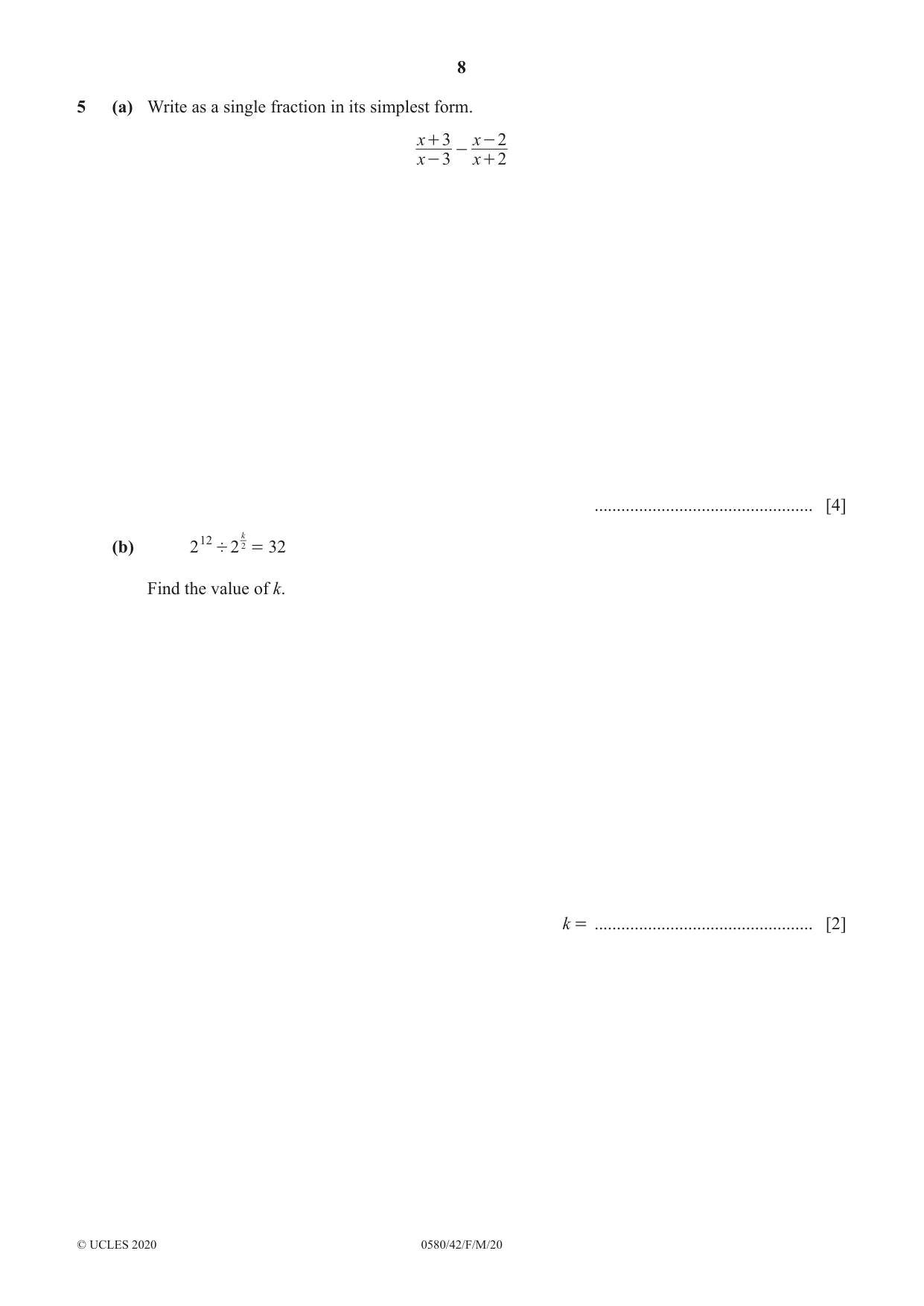
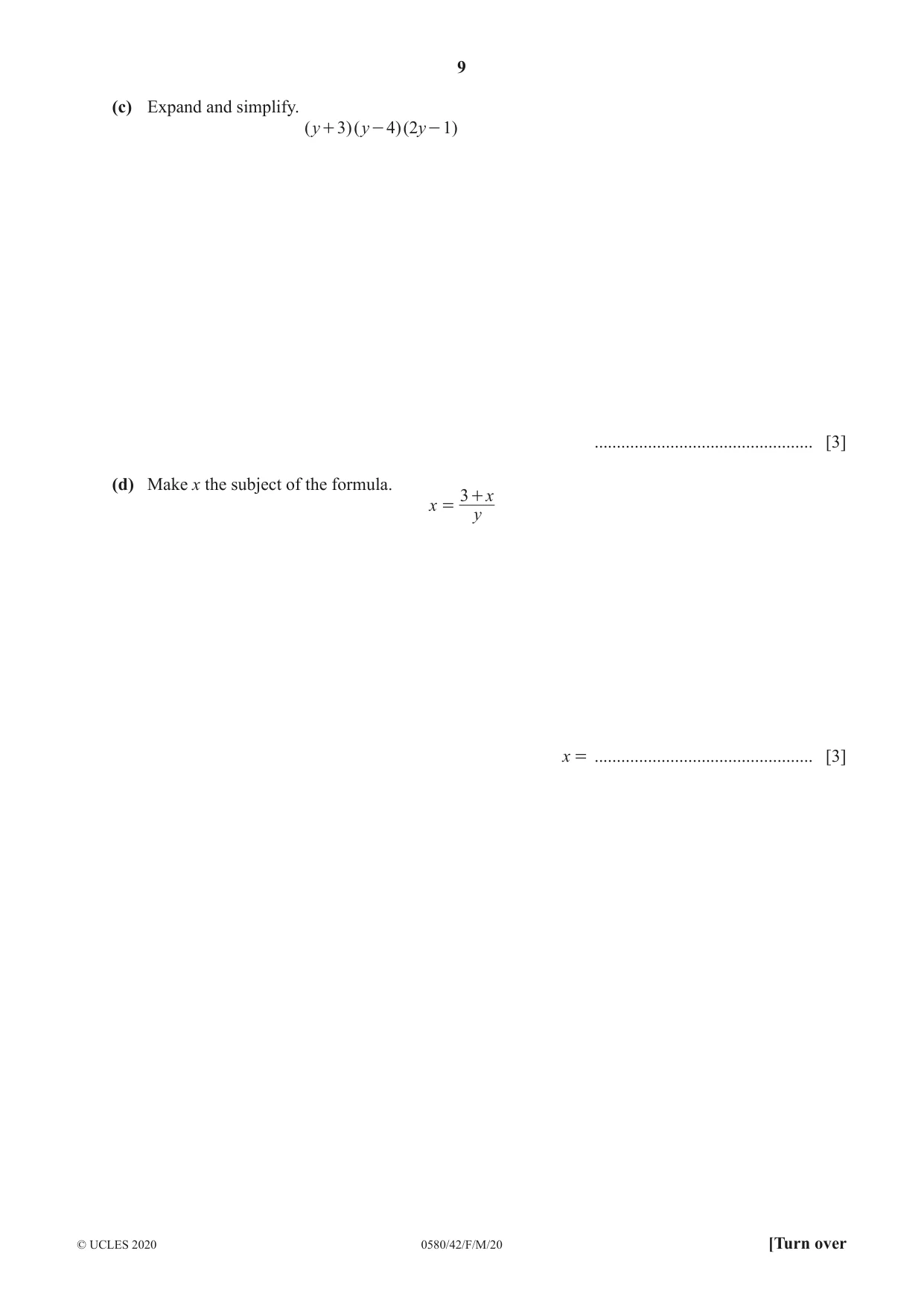
5 (a) Write as a single fraction in its simplest form. x + 3 x - 2 - x - 3 x + 2 ................................................. [4] 12 2k (b) 2 ' 2 = 32 Find the value of k. k = ................................................. [2] (c) Expand and simplify. ( y + 3 )( y - 4 )( 2y - 1) ................................................. [3] (d) Make x the subject of the formula. 3 + x x = y x = ................................................. [3]
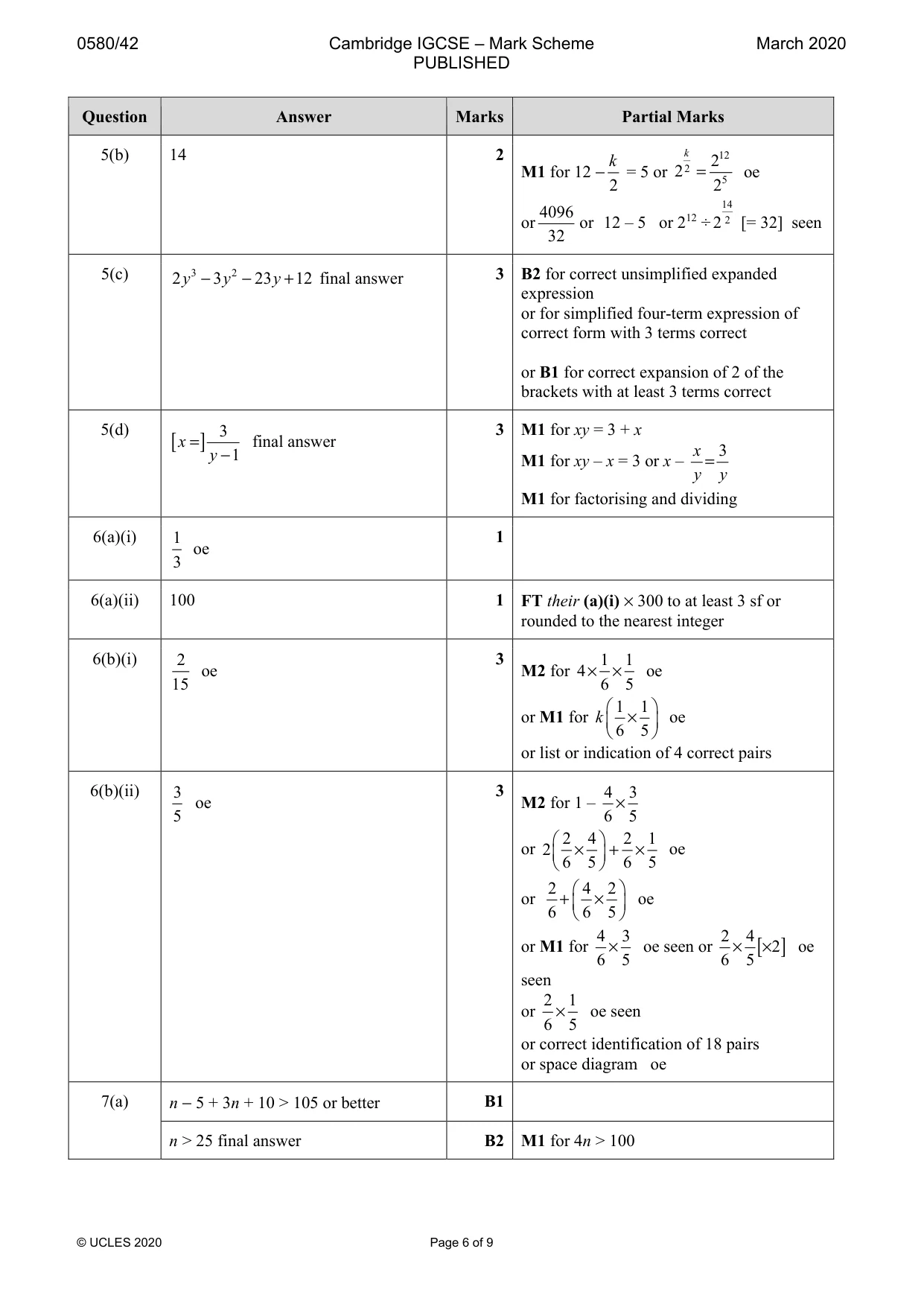
Mark scheme: 5(a) 10 x 10 x 4 M1 for common denominator( x − 3 )( x + 2 ) or ( x − 3 )( x + 2 ) x 2 − x − 6 isw final answer M1 for ( x + 3 )( x + 2 ) − ( x − 2 )( x − 3 ) isw B1 for correct numerator in terms of x only 5(b) 14 2 k 12 k 2 2 M1 for 12 = 5 or 2 = oe 5 −2 2 4096 142 or or 12 – 5 or 212 ÷ 2 [= 32] seen 32 5(c) 2 y 3 − 3 y 2 − 23 y + 12 final answer 3 B2 for correct unsimplified expanded expression or for simplified four-term expression of correct form with 3 terms correct or B1 for correct expansion of 2 of the brackets with at least 3 terms correct 5(d) 3 3 M1 for xy = 3 + x [ x = ] final answer y − 1 x 3 M1 for xy – x = 3 or x – = y y M1 for factorising and dividing
Q6 · Suleika has six cards numbered 1 to 6
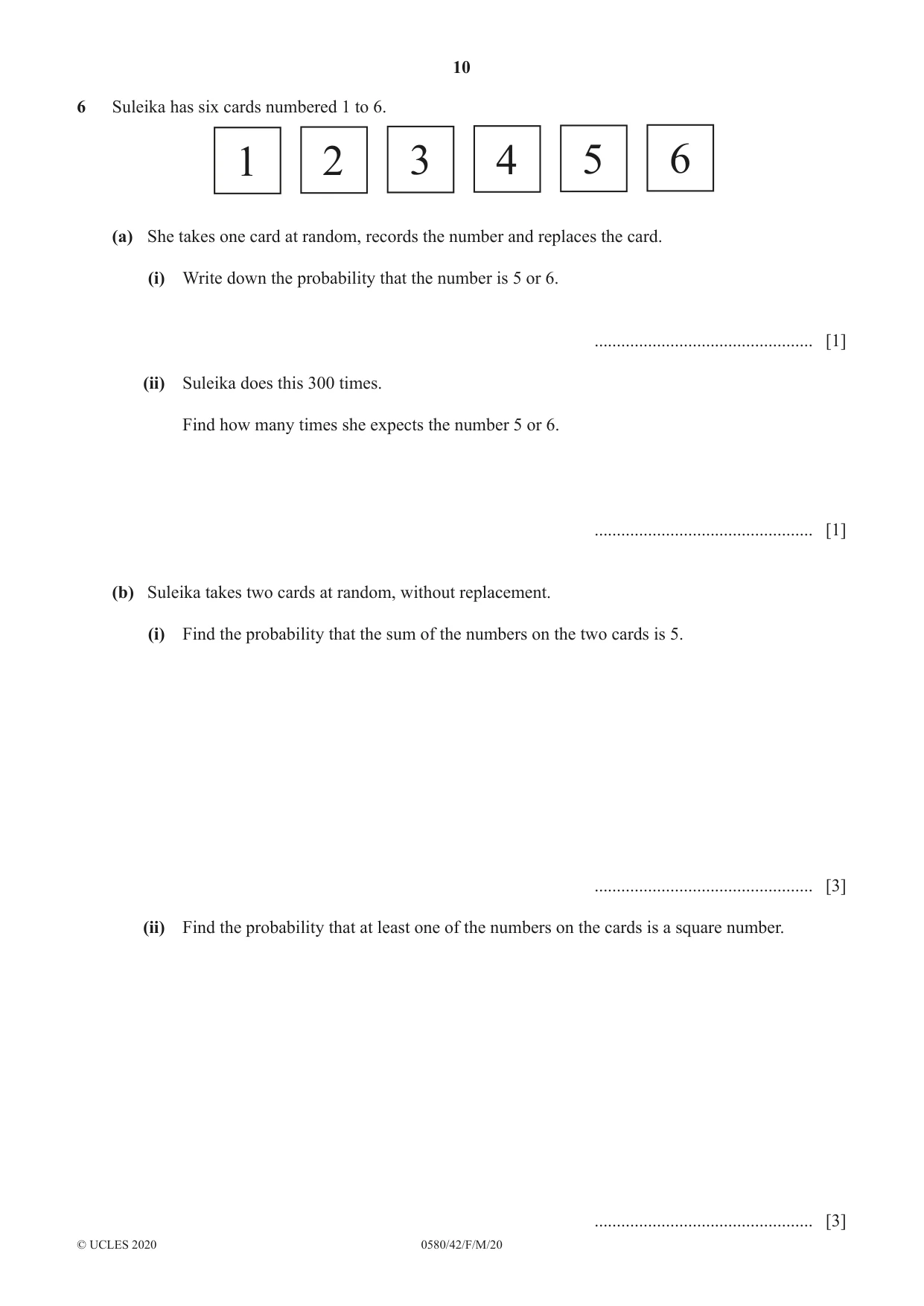
6 Suleika has six cards numbered 1 to 6. 1 2 3 4 5 6 (a) She takes one card at random, records the number and replaces the card. (i) Write down the probability that the number is 5 or 6. ................................................. [1] (ii) Suleika does this 300 times. Find how many times she expects the number 5 or 6. ................................................. [1] (b) Suleika takes two cards at random, without replacement. (i) Find the probability that the sum of the numbers on the two cards is 5. ................................................. [3] (ii) Find the probability that at least one of the numbers on the cards is a square number. ................................................. [3]
Mark scheme: 6(a)(i) 1 1 oe 3 6(a)(ii) 100 1 FT their (a)(i) × 300 to at least 3 sf or rounded to the nearest integer 6(b)(i) 2 3 1 1 oe M2 for 4 × × oe 15 6 5 1 1 or M1 for k × oe 6 5 or list or indication of 4 correct pairs 6(b)(ii) 3 3 4 3 oe M2 for 1 – × 5 6 5 2 4 2 1 or 2 × + × oe 6 5 6 5 2 4 2 or + × oe 6 6 5 4 3 2 4 or M1 for × oe seen or × [× 2 ] oe 6 5 6 5 seen 2 1 or × oe seen 6 5 or correct identification of 18 pairs or space diagram oe
Q7 · Naga has n marbles
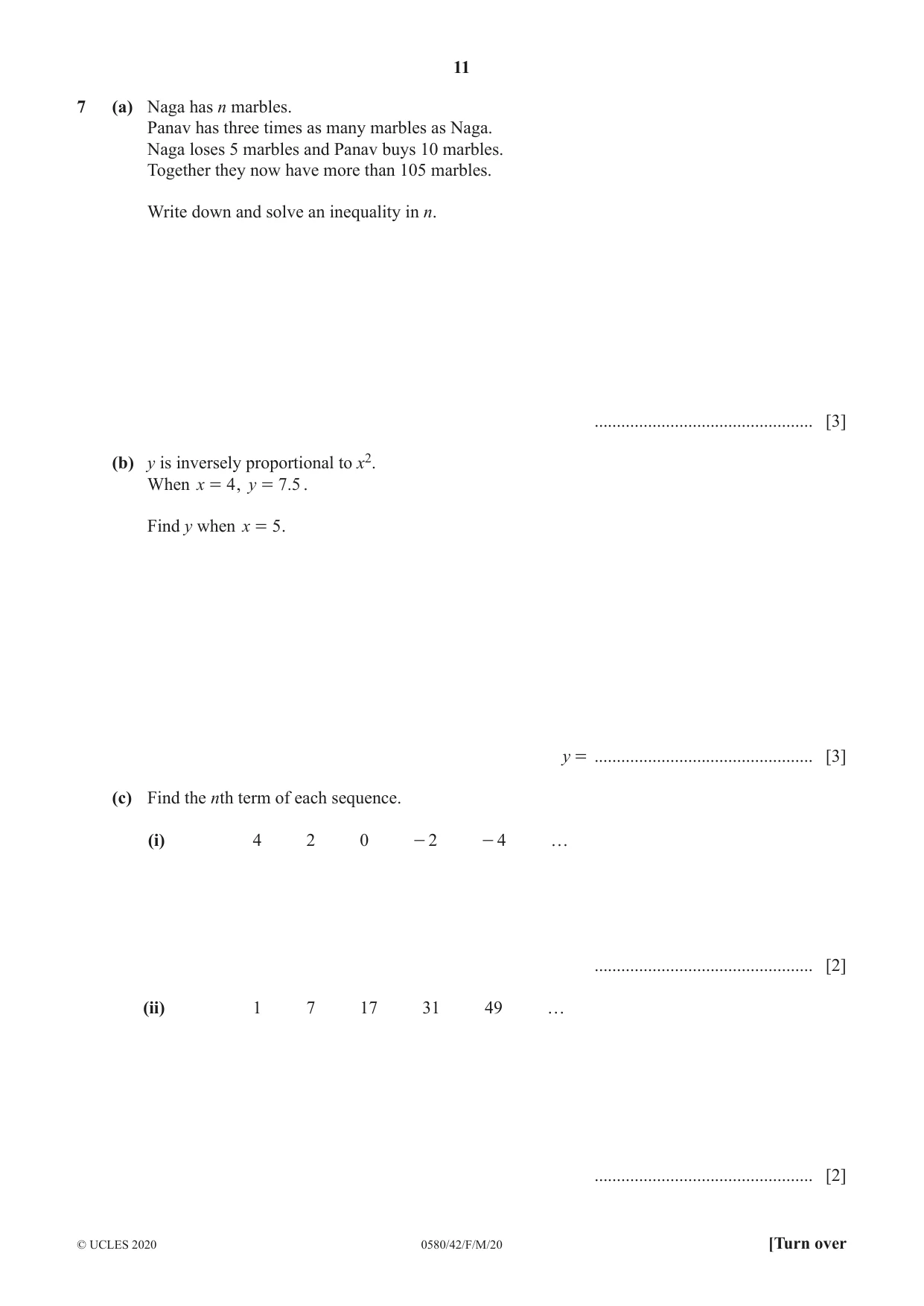
7 (a) Naga has n marbles. Panav has three times as many marbles as Naga. Naga loses 5 marbles and Panav buys 10 marbles. Together they now have more than 105 marbles. Write down and solve an inequality in n. ................................................. [3] (b) y is inversely proportional to x2. When x = 4 , y = 7.5 . Find y when x = 5 . y = ................................................. [3] (c) Find the nth term of each sequence. (i) 4 2 0 - 2 - 4 … ................................................. [2] (ii) 1 7 17 31 49 … ................................................. [2]
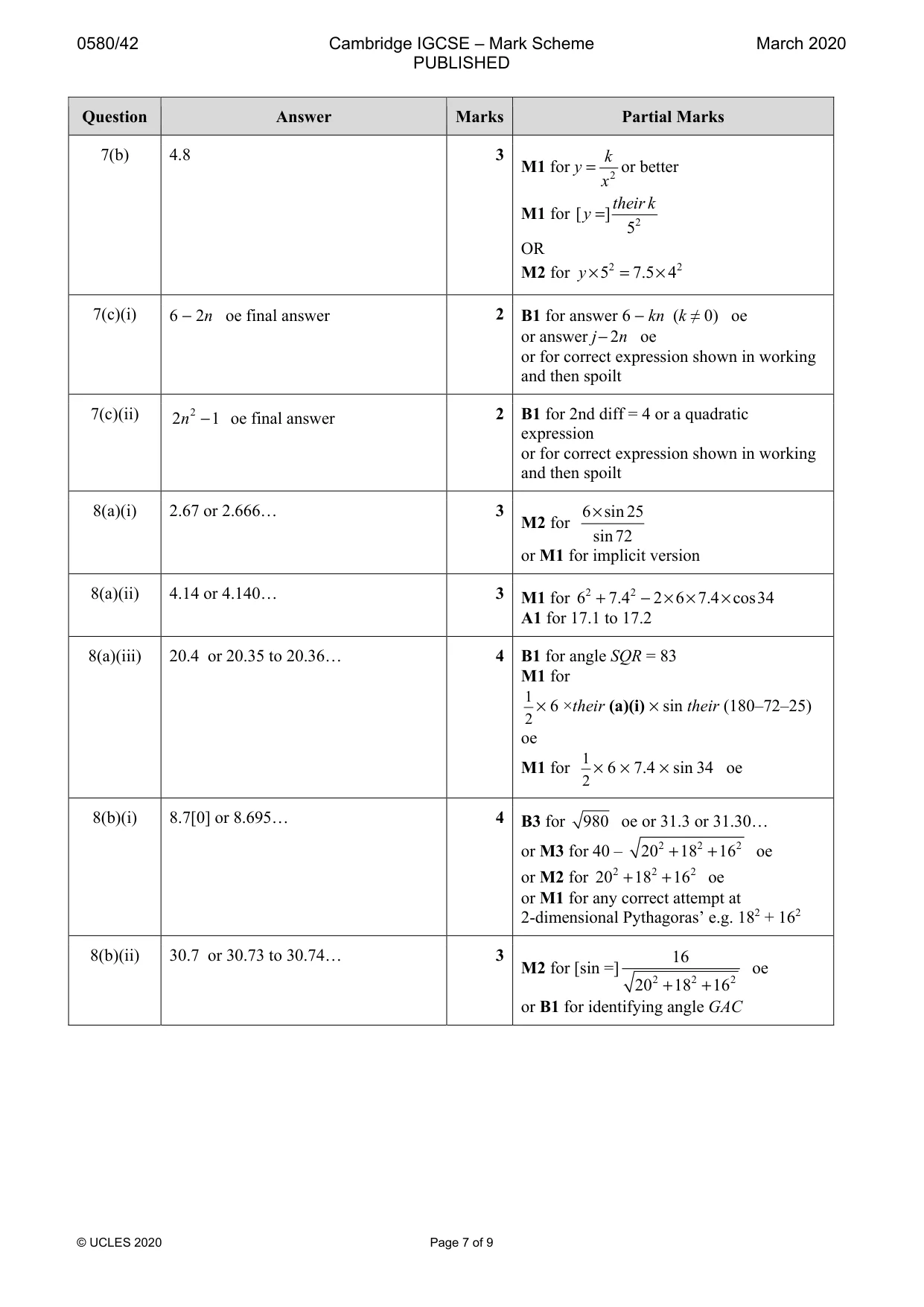
Mark scheme: 7(a) n − 5 + 3n + 10 > 105 or better B1 n > 25 final answer B2 M1 for 4n > 100 7(b) 4.8 3 k M1 for y = or better x 2 their k M1 for [ y = ] 5 2 OR M2 for y × 5 2 = 7.5 × 4 2 7(c)(i) 6 − 2n oe final answer 2 B1 for answer 6 − kn (k ≠ 0) oe or answer j−2n oe or for correct expression shown in working and then spoilt 7(c)(ii) 2 n 2 − 1 oe final answer 2 B1 for 2nd diff = 4 or a quadratic expression or for correct expression shown in working and then spoilt
Q8 · S 25° R 72° NOT TO SCALE 6 cm 34° Q 7.4 cm P The diagram shows a quadrilateral PQRS…
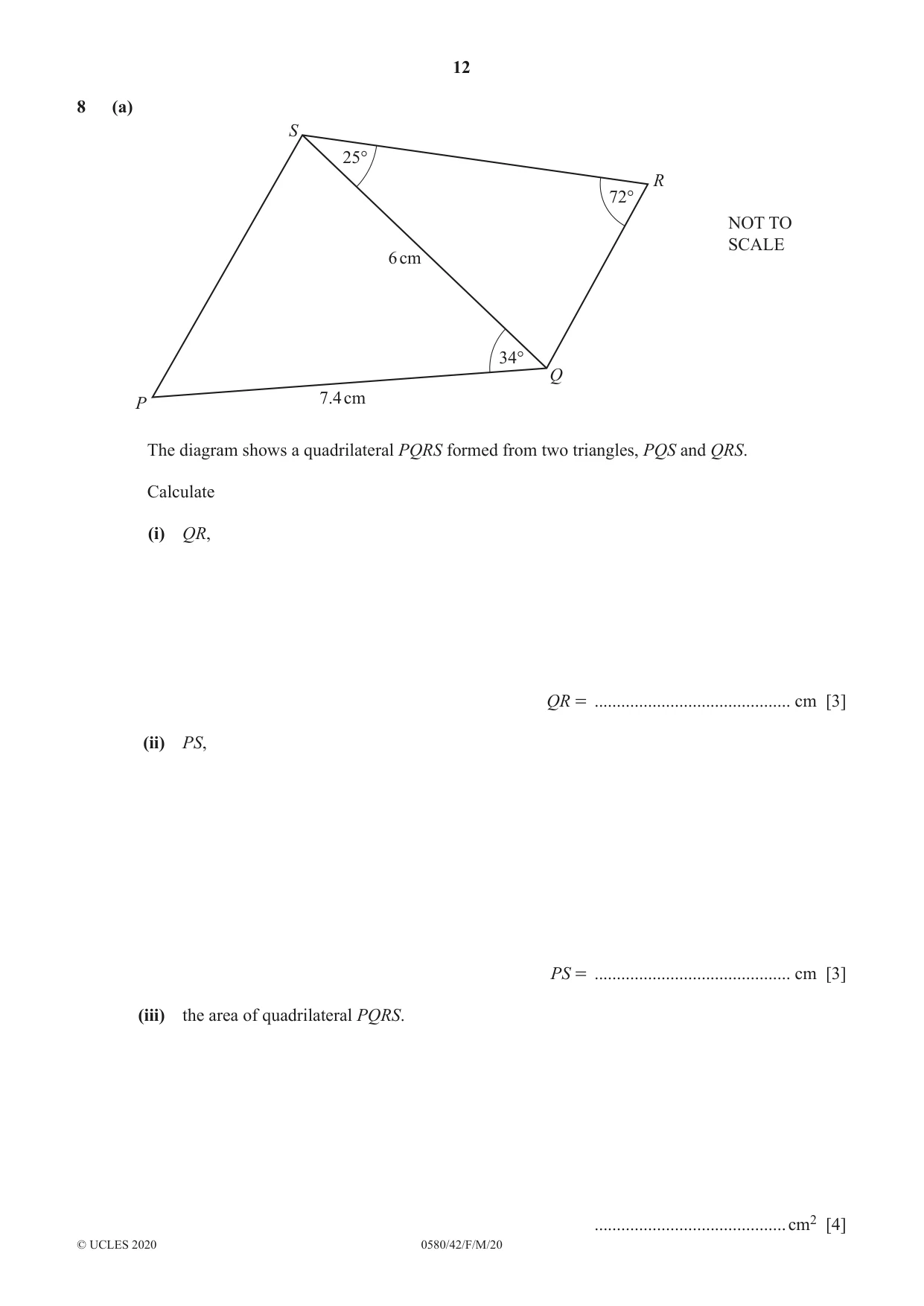
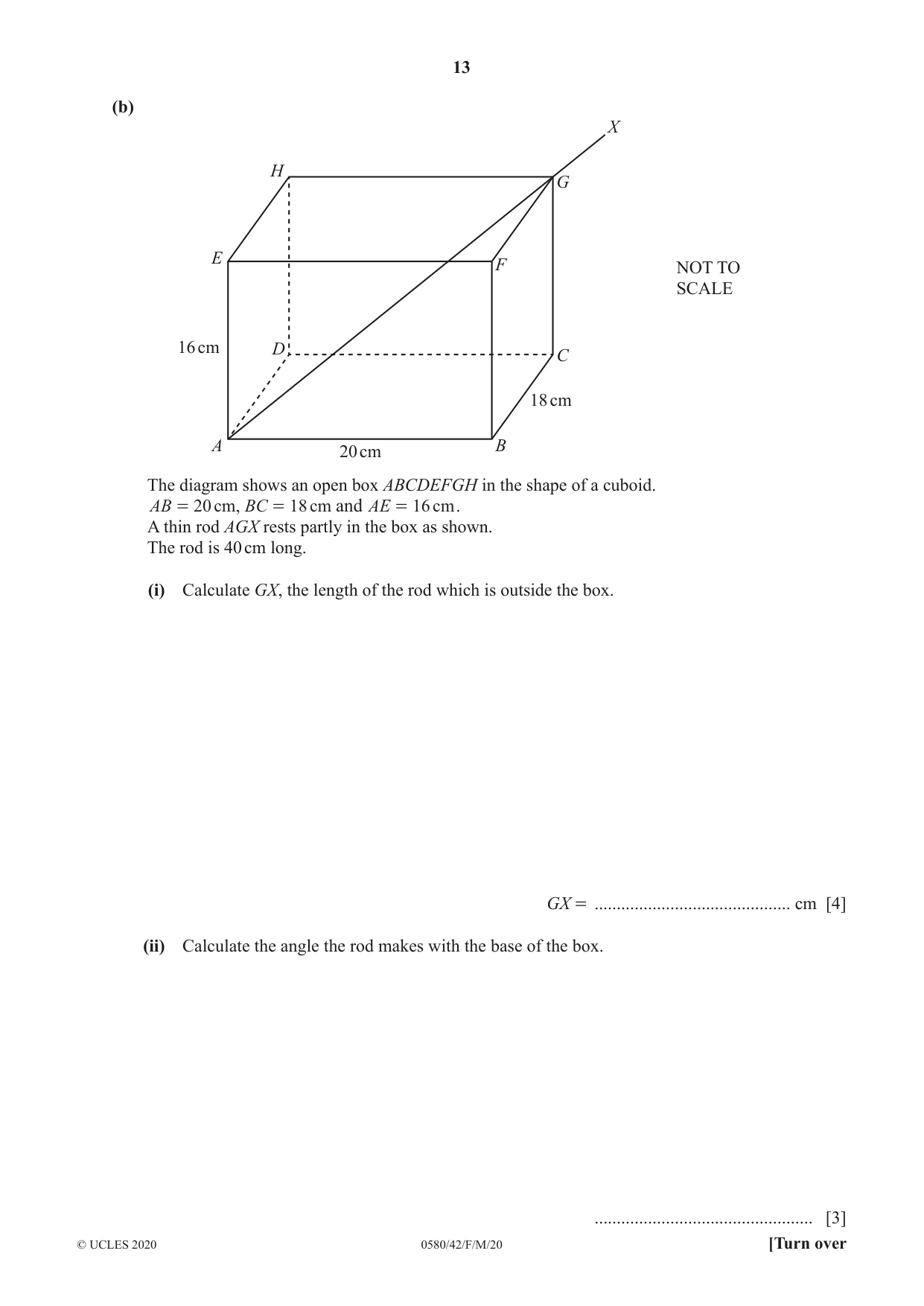
8 (a) S 25° R 72° NOT TO SCALE 6 cm 34° Q 7.4 cm P The diagram shows a quadrilateral PQRS formed from two triangles, PQS and QRS. Calculate (i) QR, QR = ............................................ cm [3] (ii) PS, PS = ............................................ cm [3] (iii) the area of quadrilateral PQRS. ...........................................cm2 [4] (b) X H G E F NOT TO SCALE 16 cm D C 18 cm A B 20 cm The diagram shows an open box ABCDEFGH in the shape of a cuboid. AB = 20 cm, BC = 18 cm and AE = 16 cm . A thin rod AGX rests partly in the box as shown. The rod is 40 cm long. (i) Calculate GX, the length of the rod which is outside the box. GX = ............................................ cm [4] (ii) Calculate the angle the rod makes with the base of the box. ................................................. [3]
Mark scheme: 8(a)(i) 2.67 or 2.666… 3 6 × sin 25 M2 for sin72 or M1 for implicit version 8(a)(ii) 4.14 or 4.140… 3 M1 for 6 2 + 7.4 2 − 2 × 6 × 7.4 × cos34 A1 for 17.1 to 17.2 8(a)(iii) 20.4 or 20.35 to 20.36… 4 B1 for angle SQR = 83 M1 for 1 × 6 ×their (a)(i) × sin their (180–72–25) 2 oe 1 M1 for × 6 × 7.4 × sin 34 oe 2 8(b)(i) 8.7[0] or 8.695… 4 B3 for 980 oe or 31.3 or 31.30… or M3 for 40 – 20 2 + 18 2 + 16 2 oe or M2 for 20 2 + 18 2 + 16 2 oe or M1 for any correct attempt at 2-dimensional Pythagoras’ e.g. 182 + 162 8(b)(ii) 30.7 or 30.73 to 30.74… 3 16 M2 for [sin =] oe 20 2 + 18 2 + 16 2 or B1 for identifying angle GAC
Q9 · This year, 40 students have each travelled by one or more of plane (P), train (T) or boat…
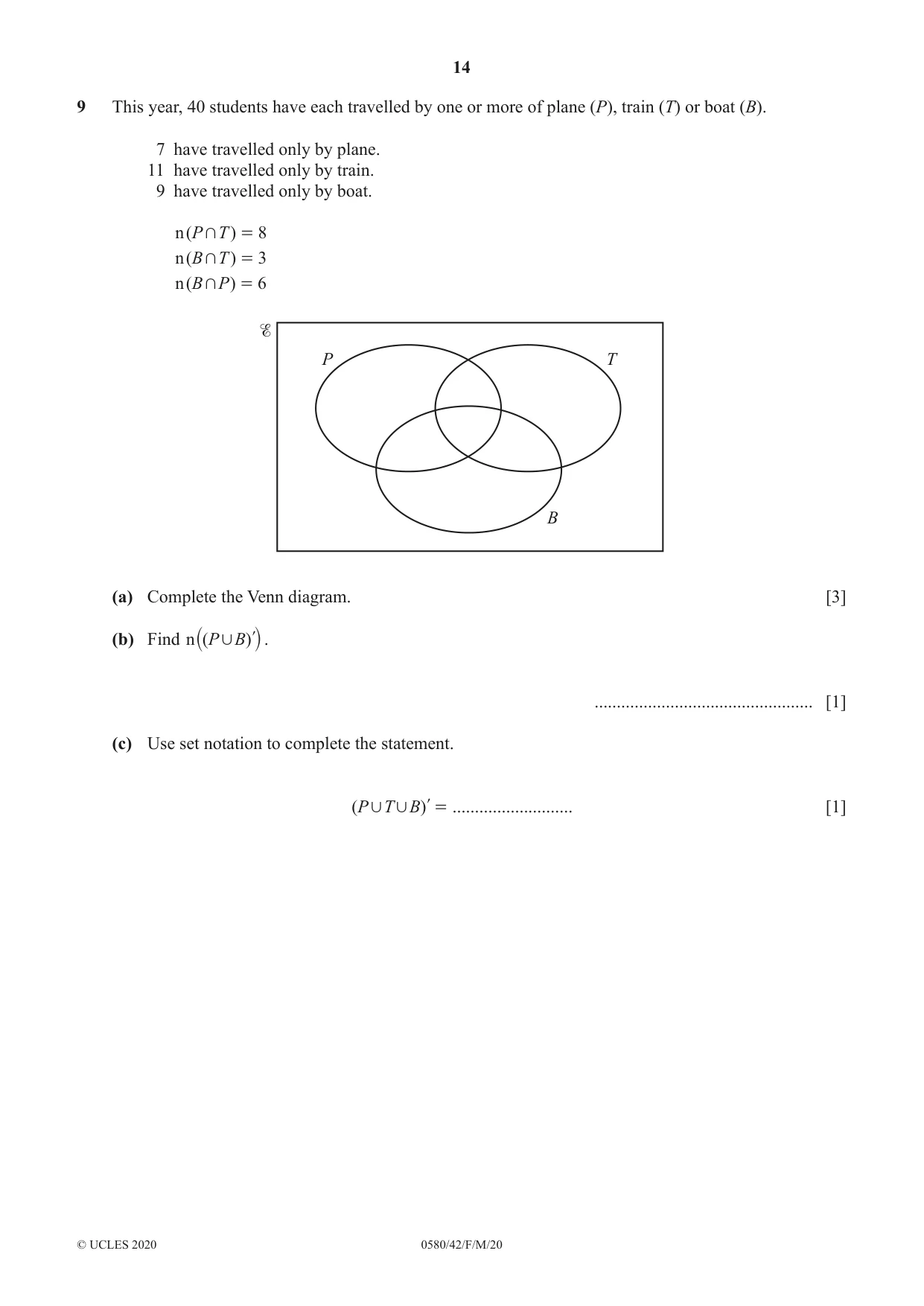
9 This year, 40 students have each travelled by one or more of plane (P), train (T) or boat (B). 7 have travelled only by plane. 11 have travelled only by train. 9 have travelled only by boat. n ( P + T ) = 8 n ( B + T ) = 3 n ( B + P ) = 6 P T B (a) Complete the Venn diagram. [3] (b) Find n ( P , B ) l . ` j ................................................. [1] (c) Use set notation to complete the statement. ( P , T , B ) l = ........................... [1] (d) Two students are chosen at random. Calculate the probability that they both have travelled only by plane. ................................................. [2] (e) Two students are chosen at random from those who have travelled by train. Calculate the probability that they both have also travelled by plane. ................................................. [2]
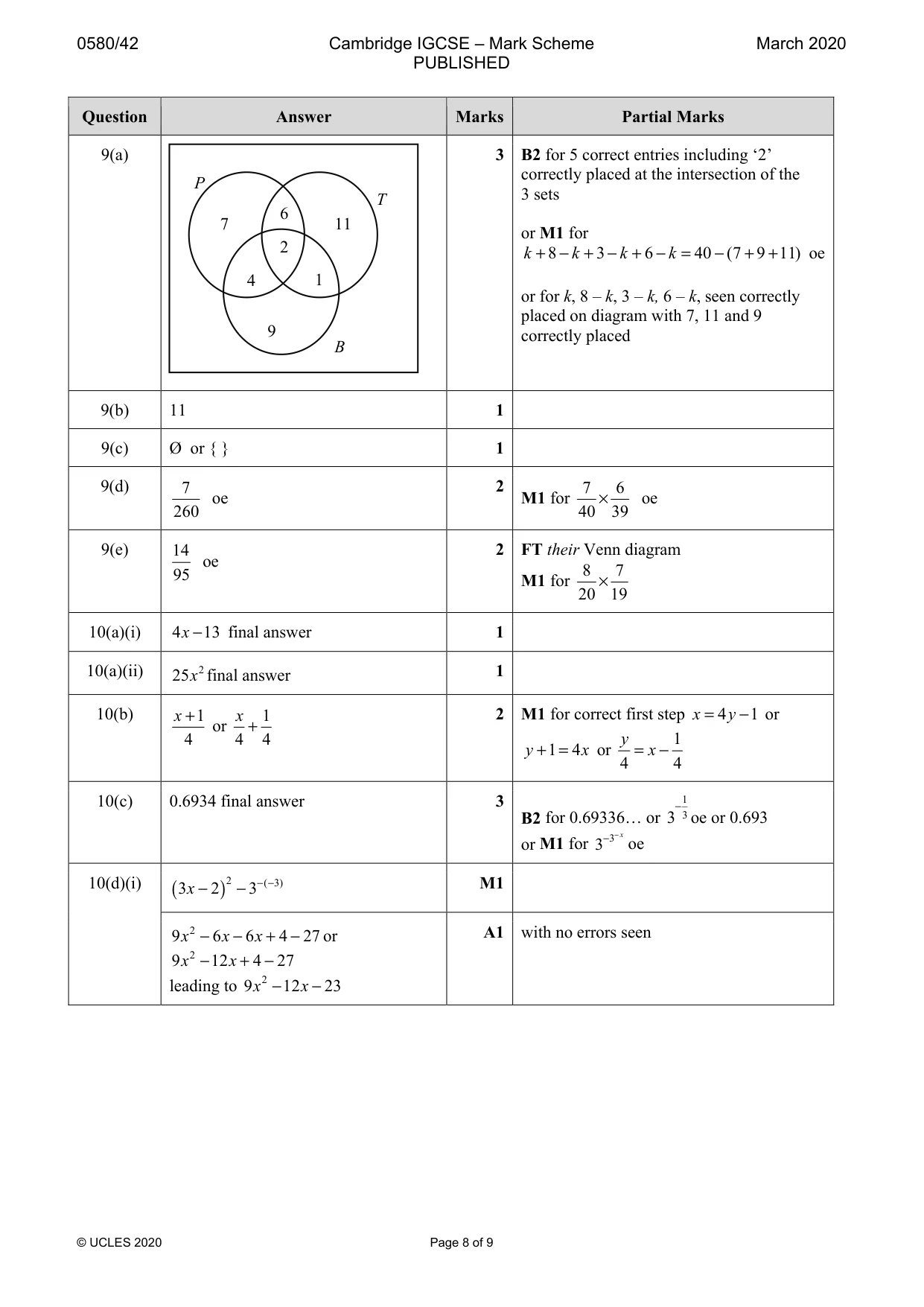
Mark scheme: 9(a) 3 B2 for 5 correct entries including ‘2’ correctly placed at the intersection of the P 3 sets T 6 7 11 or M1 for 2 k + 8 − k + 3 − k + 6 − k = 40 − (7 + 9 + 11) oe 4 1 or for k, 8 – k, 3 – k, 6 – k, seen correctly placed on diagram with 7, 11 and 9 9 correctly placed B 9(b) 11 1 9(c) Ø or { } 1 9(d) 7 2 7 6 oe M1 for × oe 260 40 39 9(e) 14 2 FT their Venn diagram oe 95 8 7 M1 for × 20 19
Q10 · F ( x) = 4 x - 1 g ( x) = x 2 h ( x) = 3 -x (a) Find in its simplest form (i) f ( x - 3)…
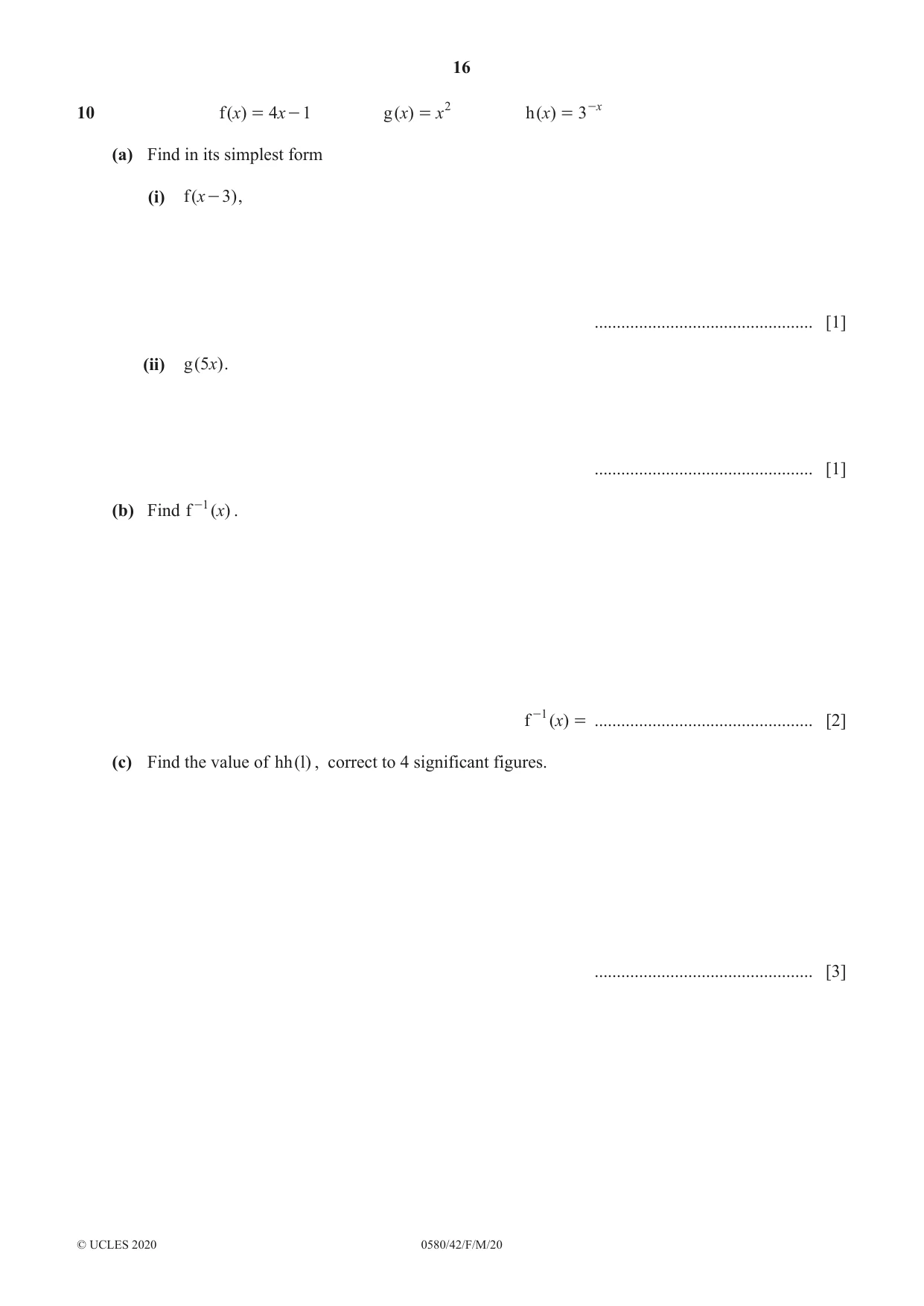
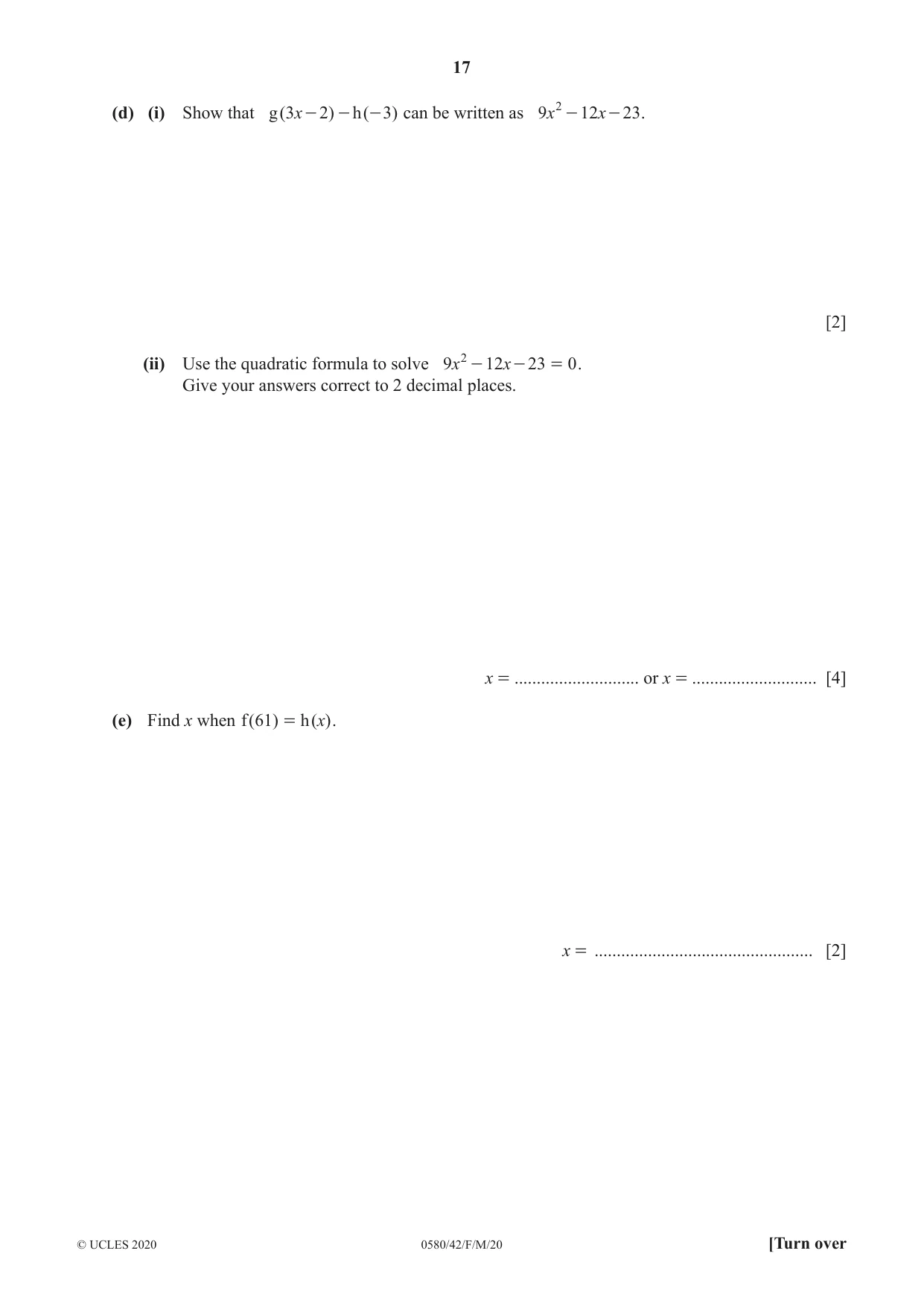
10 f ( x) = 4 x - 1 g ( x) = x 2 h ( x) = 3 -x (a) Find in its simplest form (i) f ( x - 3) , ................................................. [1] (ii) g ( 5x) . ................................................. [1] (b) Find f -1 ( x) . f -1 ( x) = ................................................. [2] (c) Find the value of hh(l) , correct to 4 significant figures. ................................................. [3] (d) (i) Show that g ( 3x - 2) - h ( - 3) can be written as 9x 2 - 12x - 23 . [2] (ii) Use the quadratic formula to solve 9x 2 - 12 x - 23 = 0 . Give your answers correct to 2 decimal places. x = ............................ or x = ............................ [4] (e) Find x when f ( 61) = h ( x) . x = ................................................. [2]
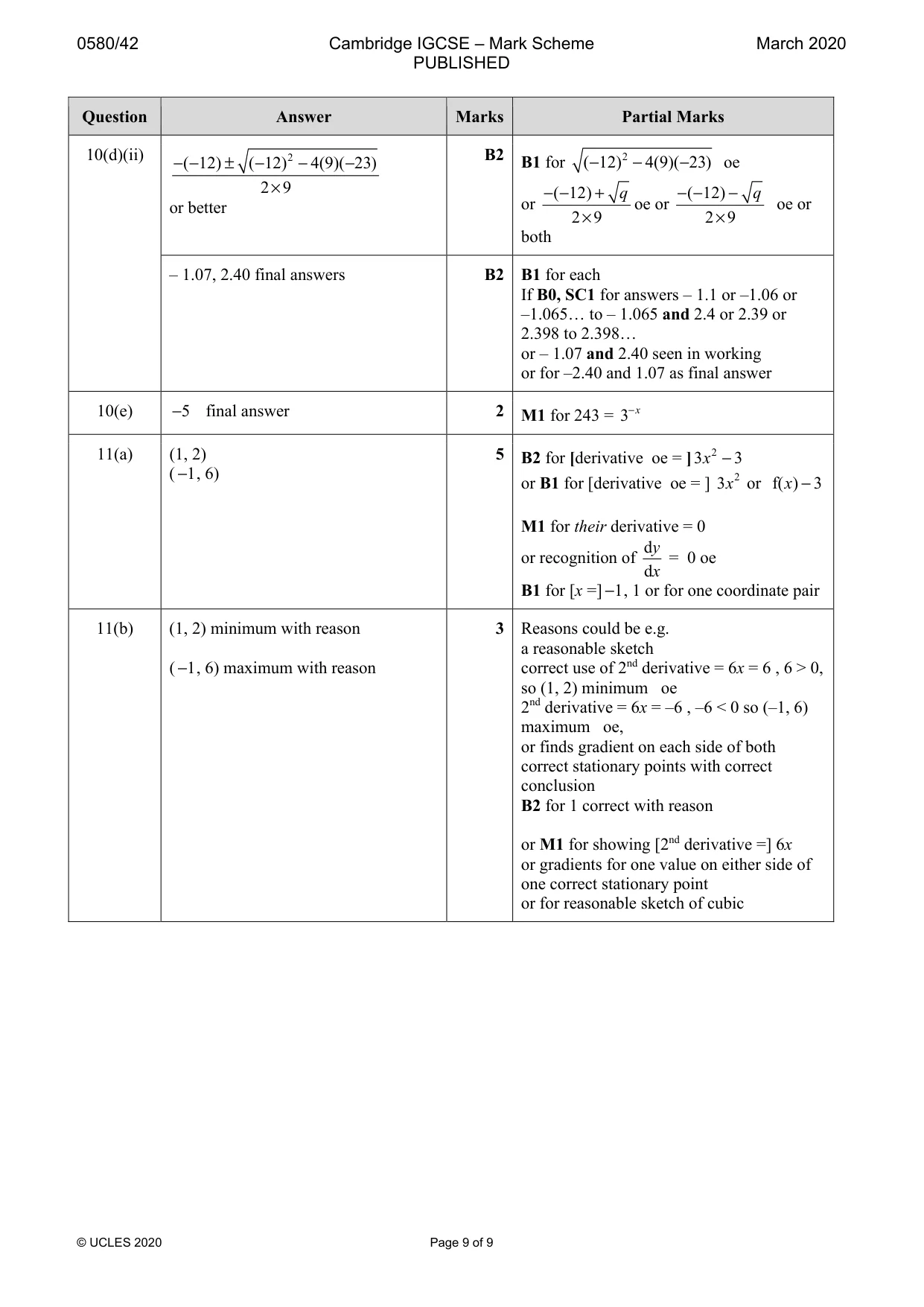
Mark scheme: 10(a)(i) 4 x − 13 final answer 1 10(a)(ii) 25x 2 final answer 1 10(b) x + 1 x 1 2 M1 for correct first step x = 4 y − 1 or or + 4 4 4 y 1 y + 1 = 4 x or = x − 4 4 10(c) 0.6934 final answer 3 1 3 or 0.693 B2 for 0.69336… or 3−oe or M1 for 3−3− x oe 10(d)(i) ( 3 x − 2 ) 2 − 3−−( 3) M1 9 x 2 − 6 x − 6 x + 4 − 27 or A1 with no errors seen 9 x 2 − 12 x + 4 − 27 leading to 9 x 2 − 12 x − 23 10(d)(ii) 2 B2 2 −−( 12) ± ( − 12) − 4(9)( −23) B1 for ( −12) − 4(9)( −23) oe 2 × 9 −−( 12) + q −−( 12) − q or better or oe or oe or 2 × 9 2 × 9 both – 1.07, 2.40 final answers B2 B1 for each If B0, SC1 for answers – 1.1 or –1.06 or –1.065… to – 1.065 and 2.4 or 2.39 or 2.398 to 2.398… or – 1.07 and 2.40 seen in working or for –2.40 and 1.07 as final answer 10(e) − 5 final answer 2 M1 for 243 = 3−x
Q11 · A curve has equation y = x 3 - 3x + 4
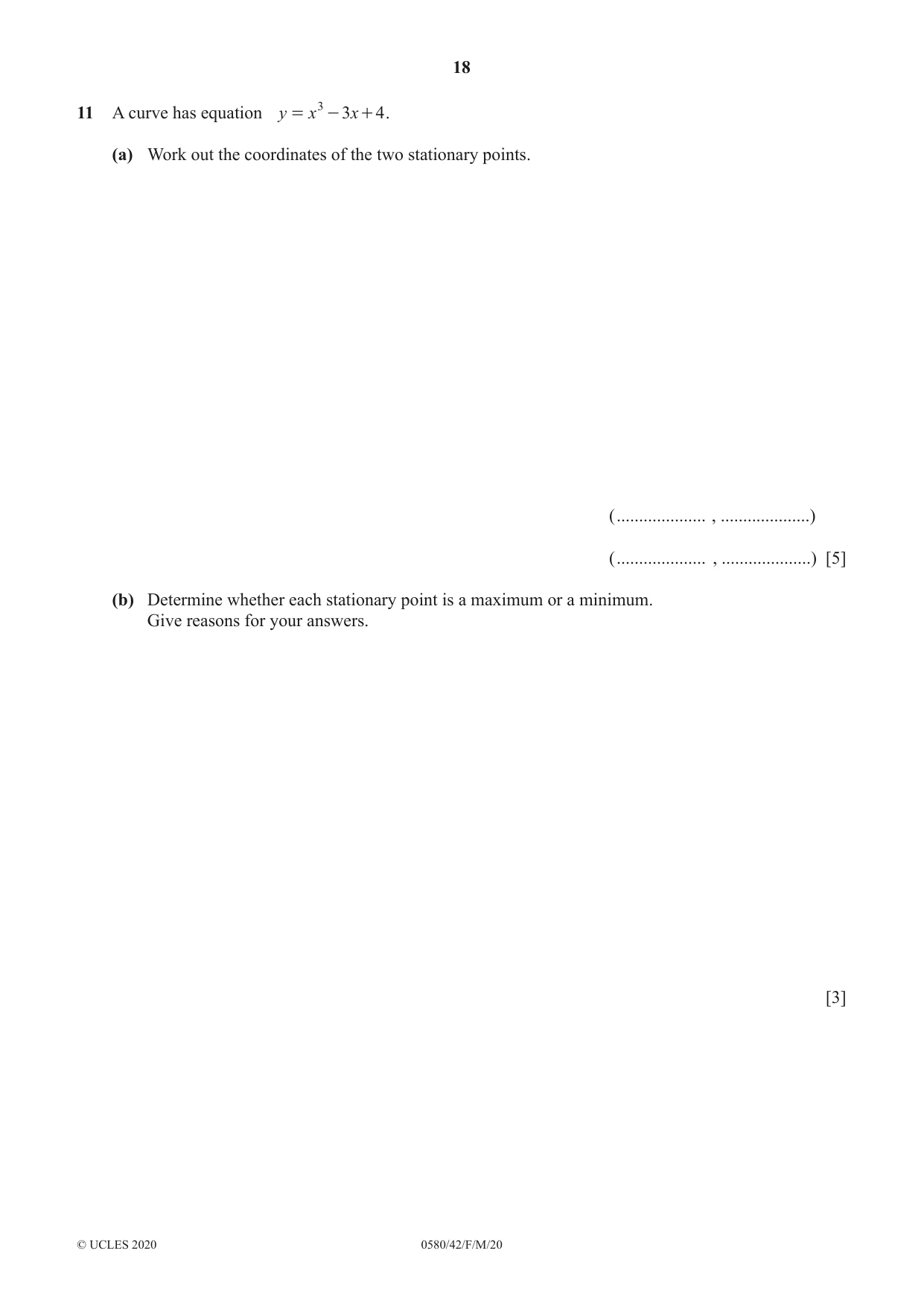
11 A curve has equation y = x 3 - 3x + 4 . (a) Work out the coordinates of the two stationary points. ( .................... , ....................) ( .................... , ....................) [5] (b) Determine whether each stationary point is a maximum or a minimum. Give reasons for your answers. [3]
Mark scheme: 11(a) (1, 2) 5 B2 for [derivative oe = ] 3 x 2 − 3 ( −,1 6) 2 or B1 for [derivative oe = ] 3x or f( x ) − 3 M1 for their derivative = 0 d y or recognition of = 0 oe dx B1 for [x =] −,1 1 or for one coordinate pair 11(b) (1, 2) minimum with reason 3 Reasons could be e.g. a reasonable sketch ( −,1 6) maximum with reason correct use of 2nd derivative = 6x = 6 , 6 > 0, so (1, 2) minimum oe 2nd derivative = 6x = –6 , –6 < 0 so (–1, 6) maximum oe, or finds gradient on each side of both correct stationary points with correct conclusion B2 for 1 correct with reason or M1 for showing [2nd derivative =] 6x or gradients for one value on either side of one correct stationary point or for reasonable sketch of cubic
What was in this paper
The subtopics covered by these 11 questions, and how many questions each got. Open one in a new tab to see every Cambridge question on it.
What you needed in this session
Cambridge’s own grade thresholds for 2020 Feb/March, Paper 4 · Variant 2. A higher threshold means an easier paper — the bar moves with how the cohort did.