Cambridge IGCSE Mathematics 0580 — 2017 May/June Paper 4 · Variant 2
0580/42/M/J/17 · 10 questions · 130 marks · ≈146 min
The question paper and its mark scheme, free to read here and free to download. This is Cambridge’s own paper, exactly as it was sat.
Question paper20 pages
Mark scheme7 pages
Answers below. Sit the paper first if you are practising.
Questions as text
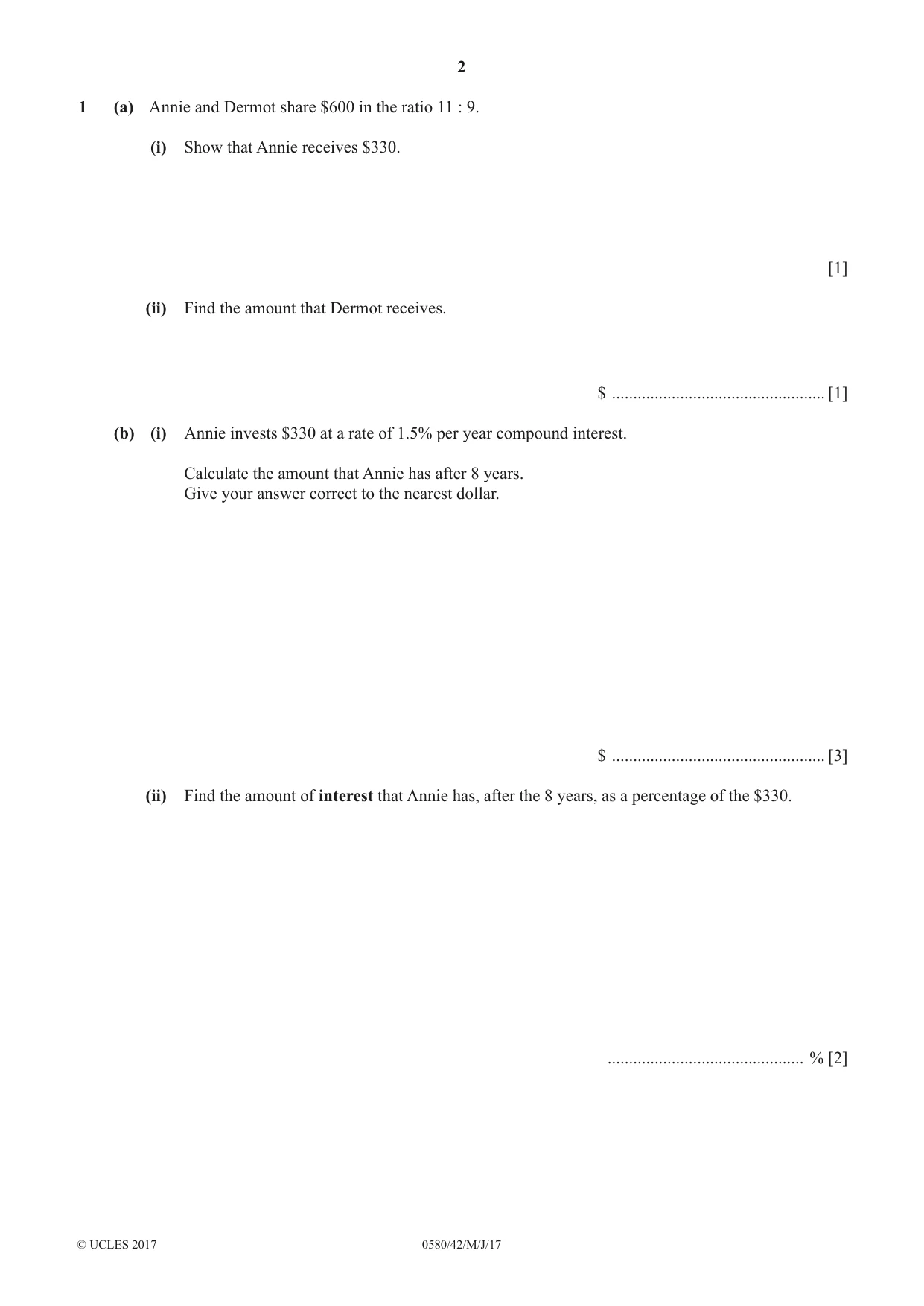
Q1 · Annie and Dermot share $600 in the ratio 11 : 9
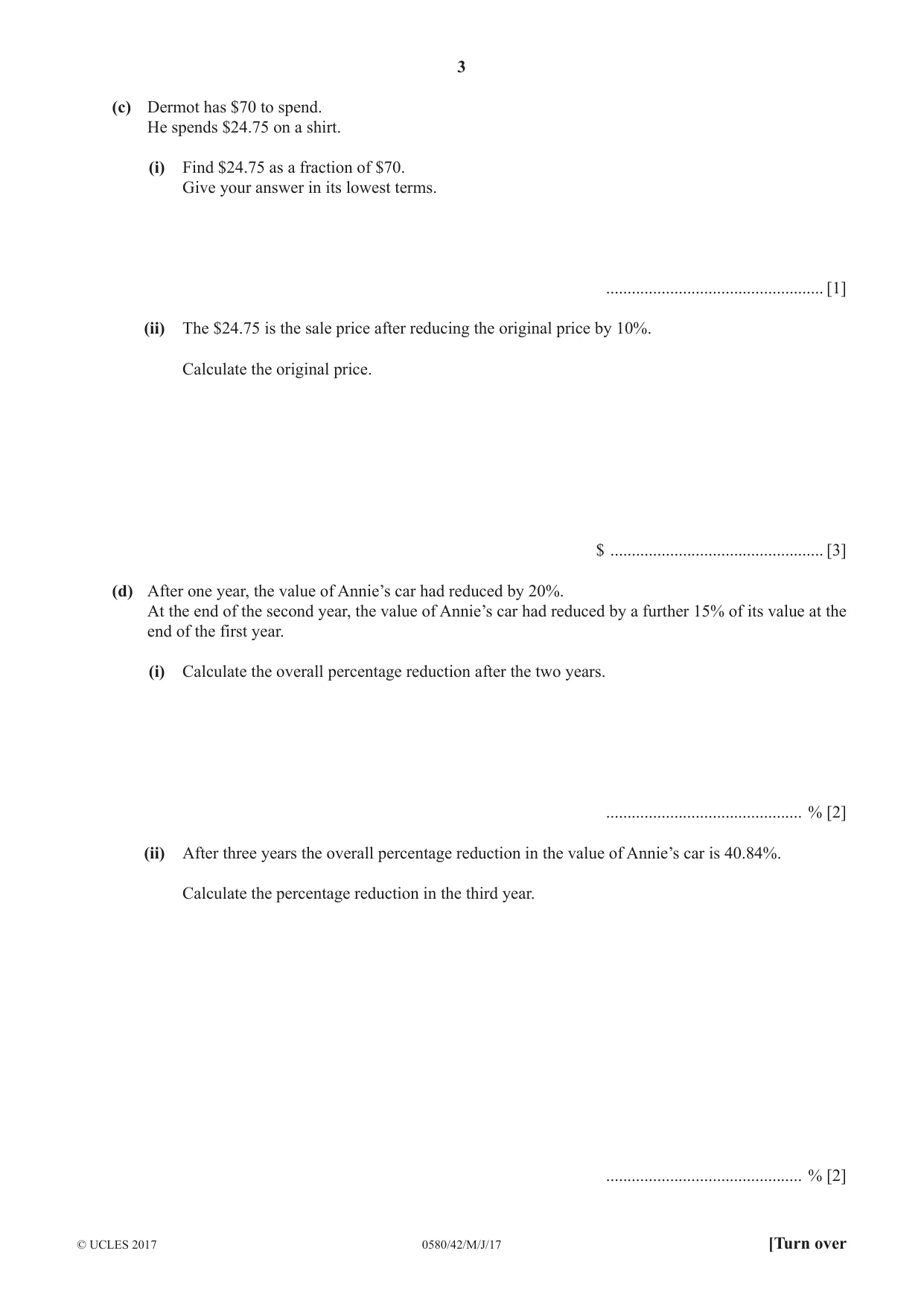
1 (a) Annie and Dermot share $600 in the ratio 11 : 9. (i) Show that Annie receives $330. [1] (ii) Find the amount that Dermot receives. $ .................................................. [1] (b) (i) Annie invests $330 at a rate of 1.5% per year compound interest. Calculate the amount that Annie has after 8 years. Give your answer correct to the nearest dollar. $ .................................................. [3] (ii) Find the amount of interest that Annie has, after the 8 years, as a percentage of the $330. .............................................. % [2] (c) Dermot has $70 to spend. He spends $24.75 on a shirt. (i) Find $24.75 as a fraction of $70. Give your answer in its lowest terms. ................................................... [1] (ii) The $24.75 is the sale price after reducing the original price by 10%. Calculate the original price. $ .................................................. [3] (d) After one year, the value of Annie’s car had reduced by 20%. At the end of the second year, the value of Annie’s car had reduced by a further 15% of its value at the end of the first year. (i) Calculate the overall percentage reduction after the two years. .............................................. % [2] (ii) After three years the overall percentage reduction in the value of Annie’s car is 40.84%. Calculate the percentage reduction in the third year. .............................................. % [2]
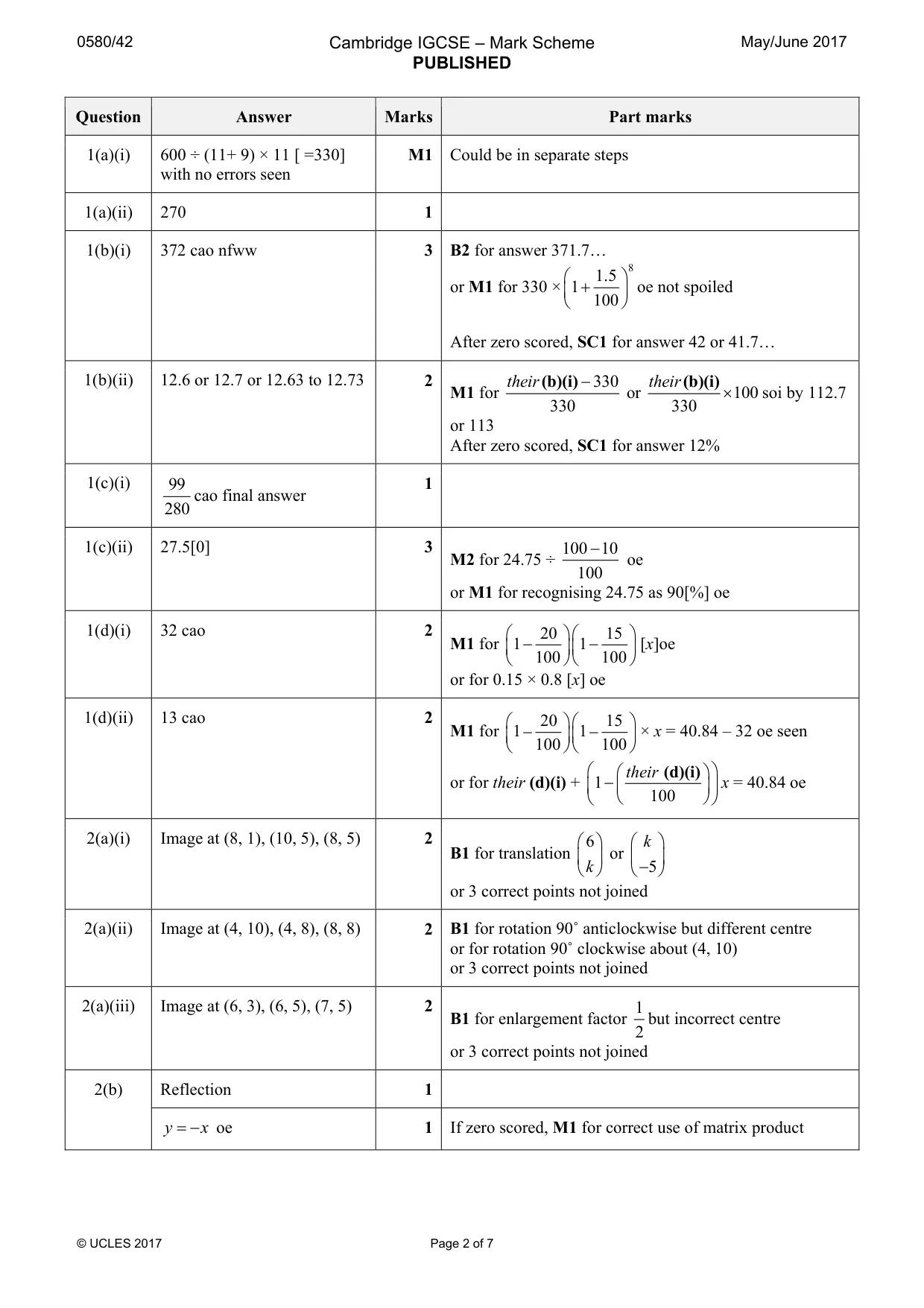
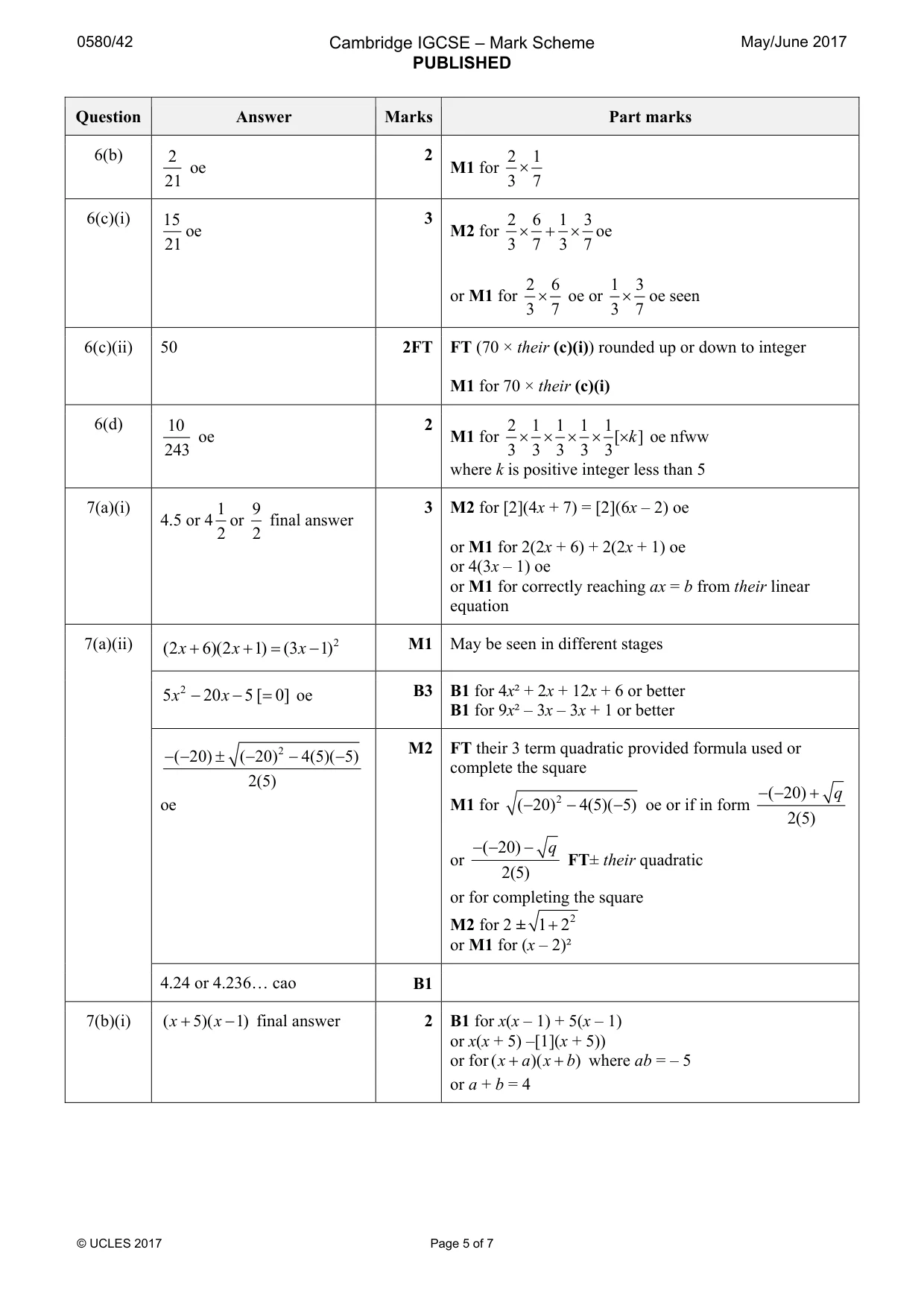
Mark scheme: Question Answer Marks Part marks 1(a)(i) 600 ÷ (11+ 9) × 11 [ =330] M1 Could be in separate steps with no errors seen 1(a)(ii) 270 1 1(b)(i) 372 cao nfww 3 B2 for answer 371.7… 1.5 8 or M1 for 330 × 1 + oe not spoiled 100 After zero scored, SC1 for answer 42 or 41.7… 1(b)(ii) 12.6 or 12.7 or 12.63 to 12.73 2 their (b)(i) − 330 their (b)(i) M1 for or × 100 soi by 112.7 330 330 or 113 After zero scored, SC1 for answer 12% 1(c)(i) 99 1 cao final answer 280 1(c)(ii) 27.5[0] 3 100 − 10 M2 for 24.75 ÷ oe 100 or M1 for recognising 24.75 as 90[%] oe 1(d)(i) 32 cao 2 20 15 M1 for 1 − 1 − [x]oe 100 100 or for 0.15 × 0.8 [x] oe 1(d)(ii) 13 cao 2 20 15 M1 for 1 − 1 − × x = 40.84 – 32 oe seen 100 100 their (d)(i) or for their (d)(i) + 1 − x = 40.84 oe 100
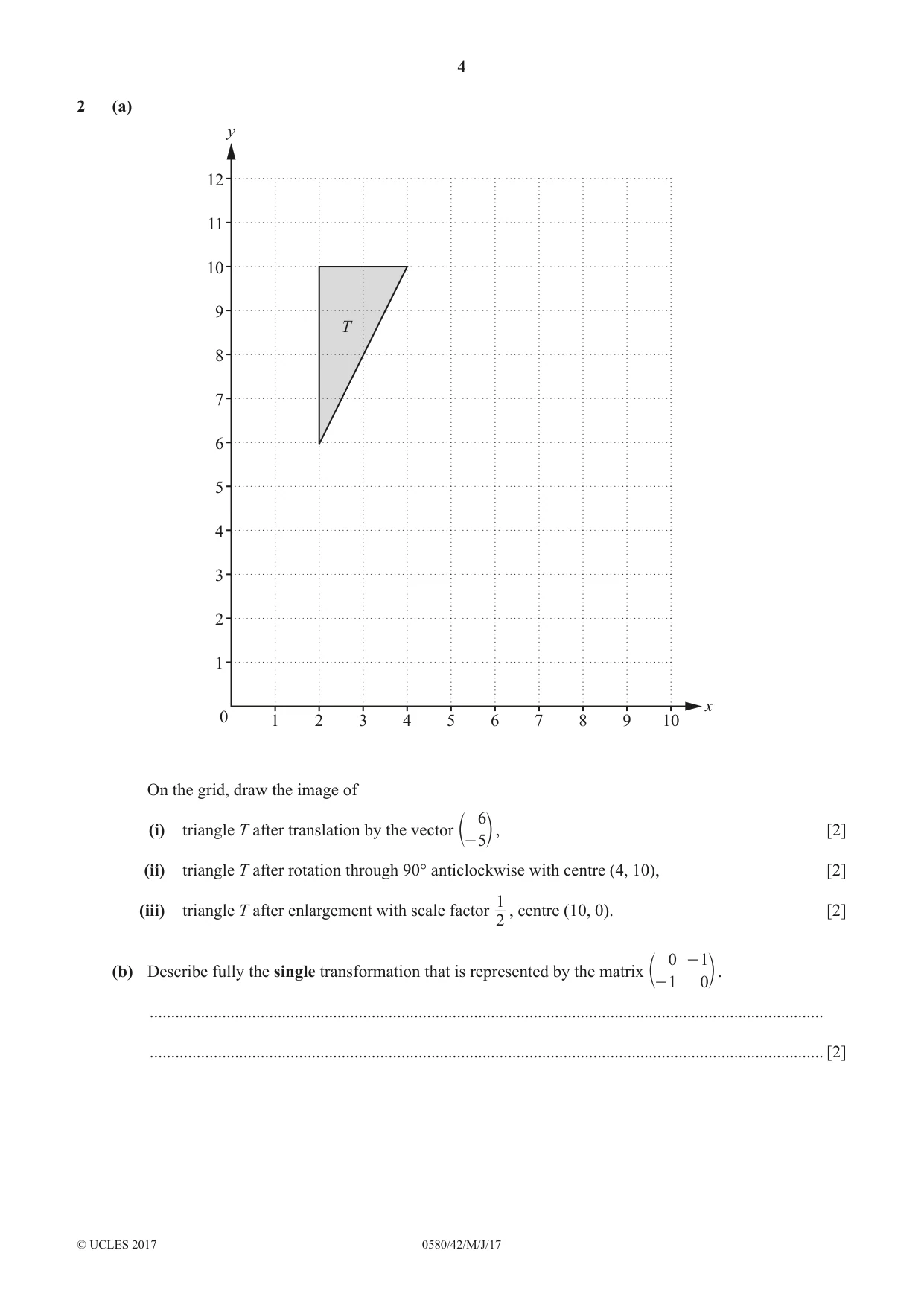
Q2 · Y 12 11 10 9 T 8 7 6 5 4 3 2 1 x 0 1 2 3 4 5 6 7 8 9 10 On the grid, draw the image of 6…
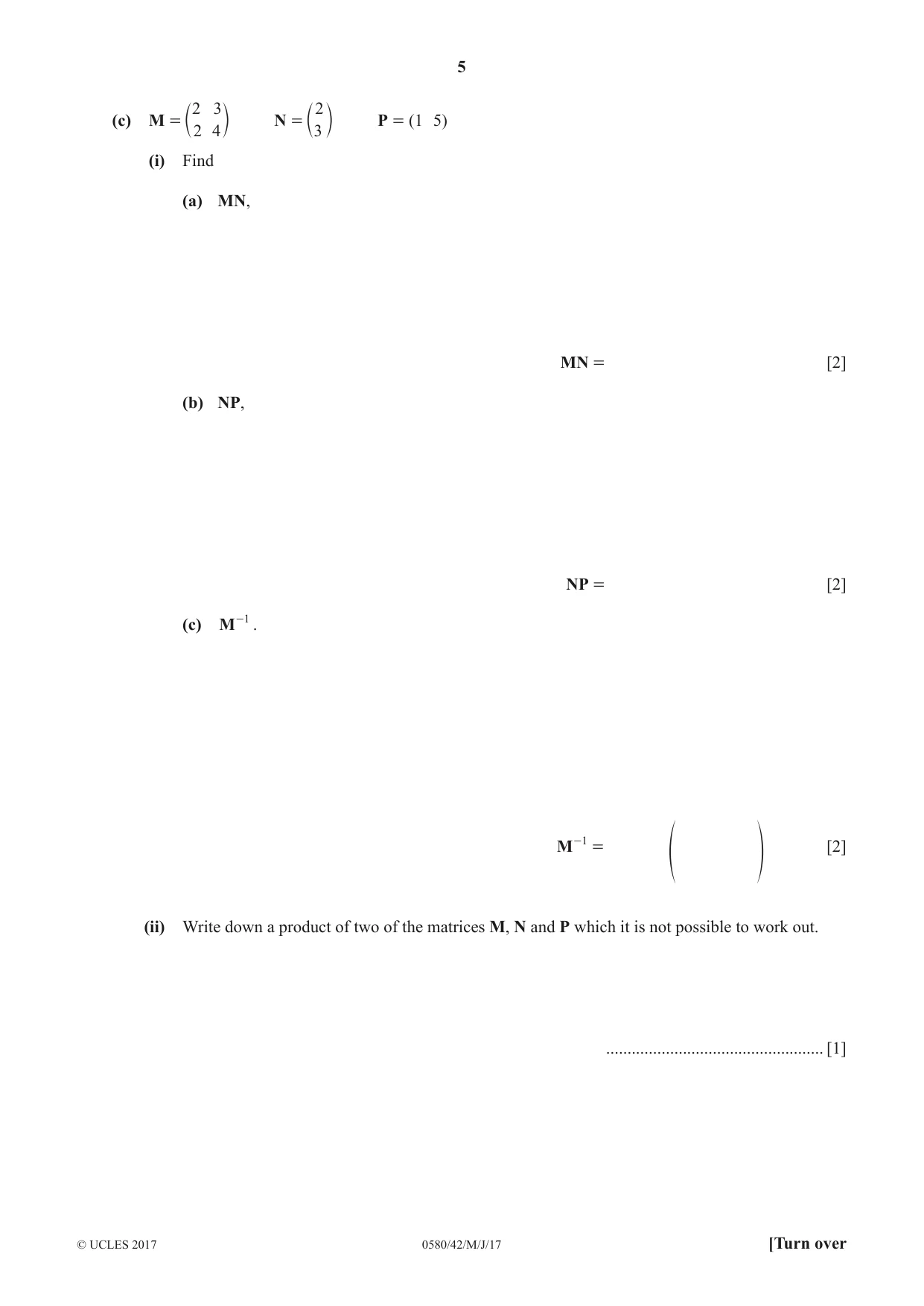
2 (a) y 12 11 10 9 T 8 7 6 5 4 3 2 1 x 0 1 2 3 4 5 6 7 8 9 10 On the grid, draw the image of 6 (i) triangle T after translation by the vector , [2] c- 5m (ii) triangle T after rotation through 90° anticlockwise with centre (4, 10), [2] 1 (iii) triangle T after enlargement with scale factor , centre (10, 0). [2] 2 0 - 1 (b) Describe fully the single transformation that is represented by the matrix . c- 1 0m .............................................................................................................................................................. .............................................................................................................................................................. [2] 2 3 2 (c) M = N = P = ( 1 5) c 2 4 m c 3 m (i) Find (a) MN, MN = [2] (b) NP, NP = [2] (c) M -1 . M -1 = [2] f p (ii) Write down a product of two of the matrices M, N and P which it is not possible to work out. ................................................... [1]
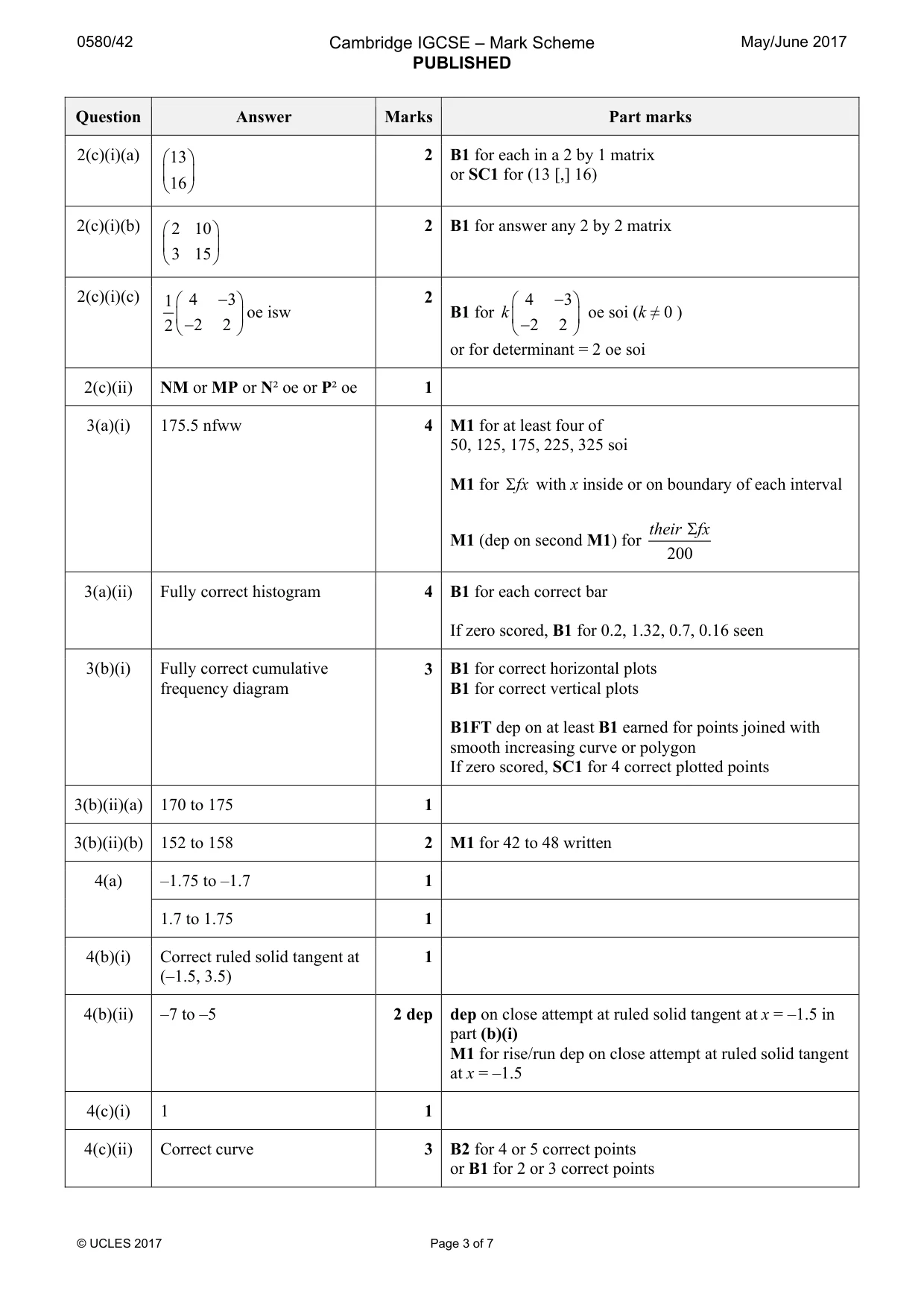
Mark scheme: 2(a)(i) Image at (8, 1), (10, 5), (8, 5) 2 6 k B1 for translation or k −5 or 3 correct points not joined 2(a)(ii) Image at (4, 10), (4, 8), (8, 8) 2 B1 for rotation 90˚ anticlockwise but different centre or for rotation 90˚ clockwise about (4, 10) or 3 correct points not joined 2(a)(iii) Image at (6, 3), (6, 5), (7, 5) 2 1 B1 for enlargement factor but incorrect centre 2 or 3 correct points not joined 2(b) Reflection 1 y = − x oe 1 If zero scored, M1 for correct use of matrix product 2(c)(i)(a) 13 2 B1 for each in a 2 by 1 matrix or SC1 for (13 [,] 16) 16 2(c)(i)(b) 2 10 2 B1 for answer any 2 by 2 matrix 3 15 2(c)(i)(c) 1 4 −3 2 4 − 3 oe isw B1 for k oe soi (k ≠ 0 ) 2 −2 2 − 2 2 or for determinant = 2 oe soi 2(c)(ii) NM or MP or N² oe or P² oe 1
Q3 · 200 students estimate the capacity, x millilitres, of a cup
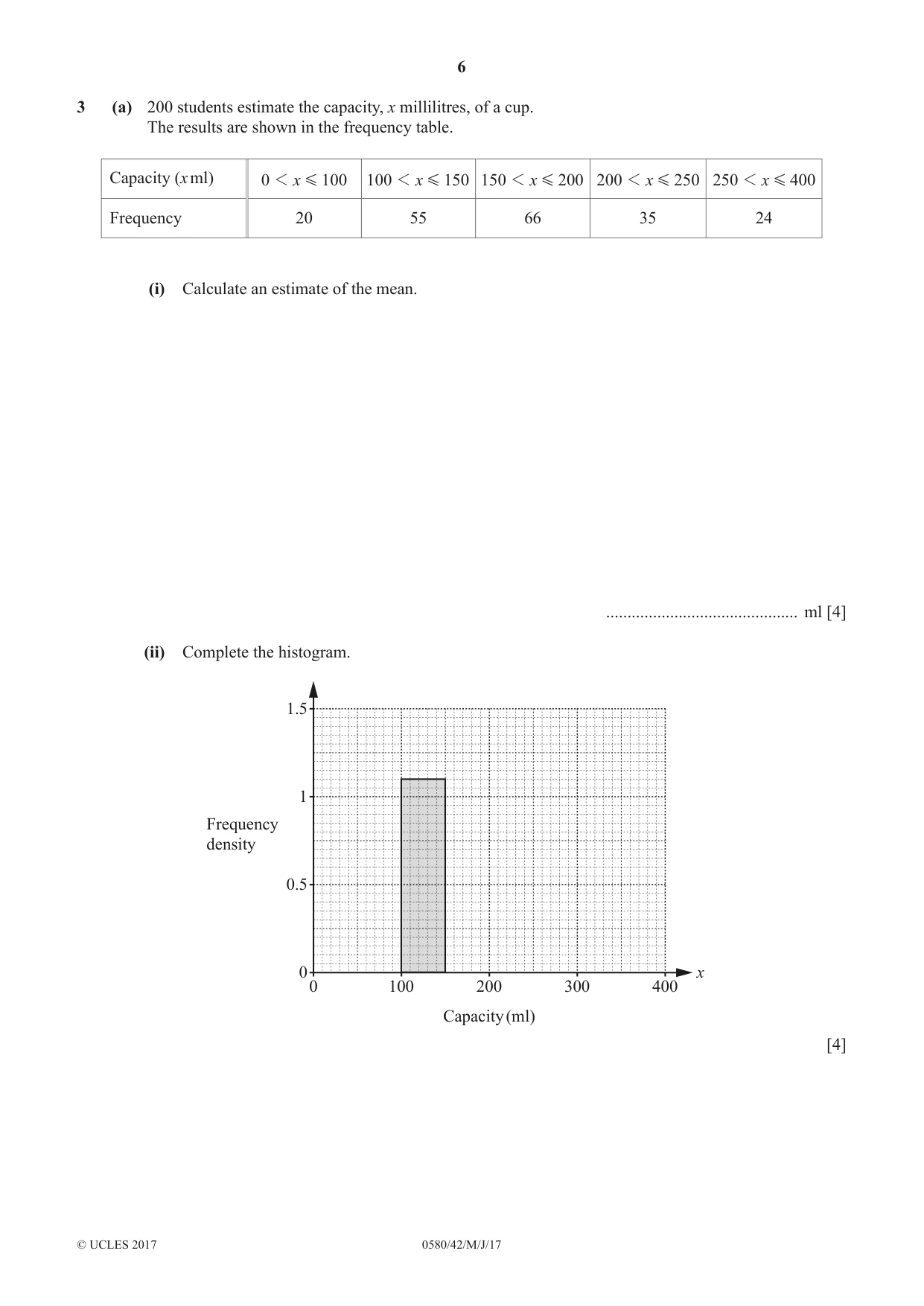
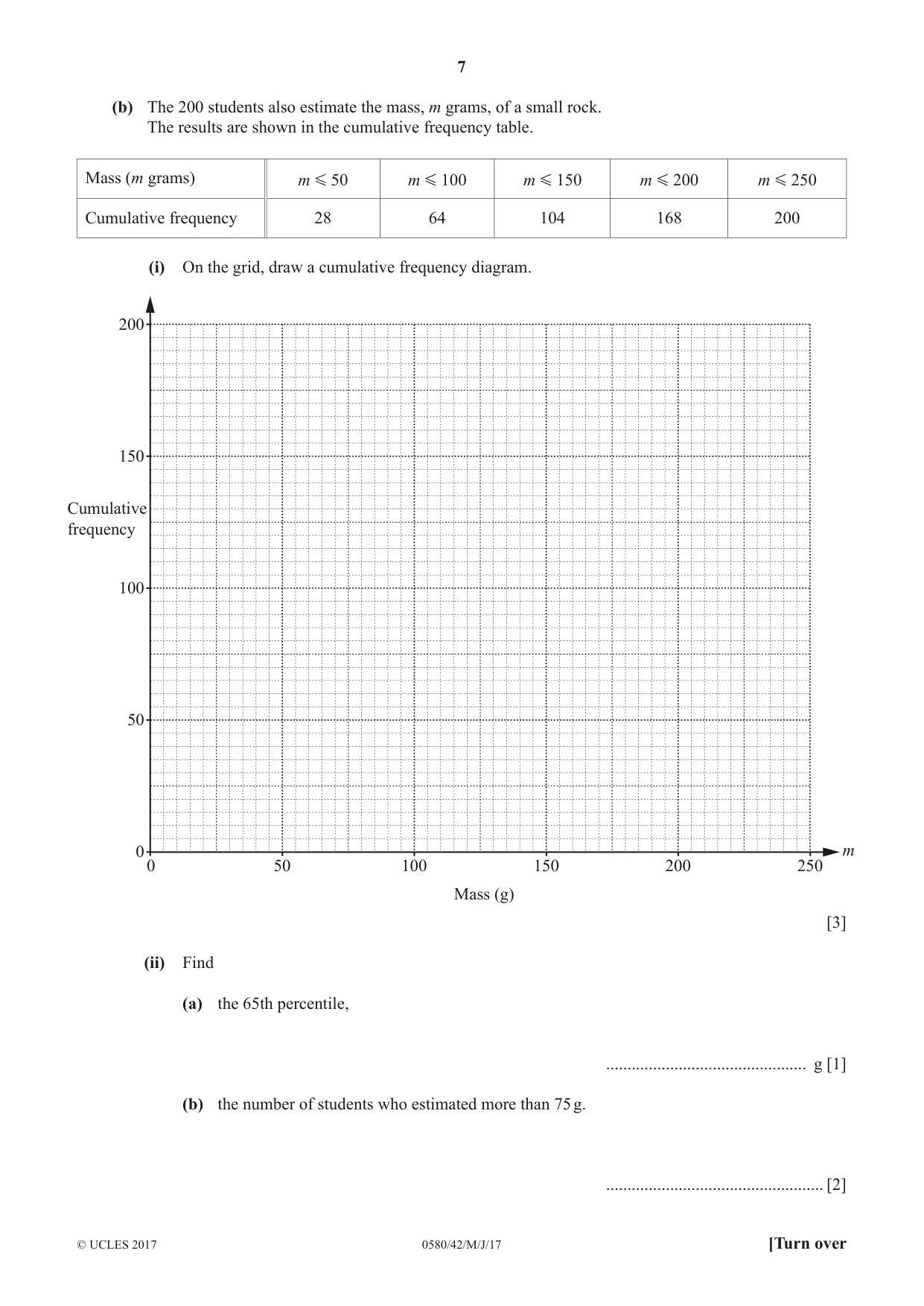
3 (a) 200 students estimate the capacity, x millilitres, of a cup. The results are shown in the frequency table. Capacity (x ml) 0 1 x G 100 100 1 x G 150 150 1 x G 200 200 1 x G 250 250 1 x G 400 Frequency 20 55 66 35 24 (i) Calculate an estimate of the mean. ............................................. ml [4] (ii) Complete the histogram. 1.5 1 Frequency density 0.5 0 x 0 100 200 300 400 Capacity (ml) [4] (b) The 200 students also estimate the mass, m grams, of a small rock. The results are shown in the cumulative frequency table. Mass (m grams) m G 50 m G 100 m G 150 m G 200 m G 250 Cumulative frequency 28 64 104 168 200 (i) On the grid, draw a cumulative frequency diagram. 200 150 Cumulative frequency 100 50 0 m 0 50 100 150 200 250 Mass (g) [3] (ii) Find (a) the 65th percentile, ............................................... g [1] (b) the number of students who estimated more than 75 g. ................................................... [2]
Mark scheme: 3(a)(i) 175.5 nfww 4 M1 for at least four of 50, 125, 175, 225, 325 soi M1 for Σ fx with x inside or on boundary of each interval their Σ fx M1 (dep on second M1) for 200 3(a)(ii) Fully correct histogram 4 B1 for each correct bar If zero scored, B1 for 0.2, 1.32, 0.7, 0.16 seen 3(b)(i) Fully correct cumulative 3 B1 for correct horizontal plots frequency diagram B1 for correct vertical plots B1FT dep on at least B1 earned for points joined with smooth increasing curve or polygon If zero scored, SC1 for 4 correct plotted points 3(b)(ii)(a) 170 to 175 1 3(b)(ii)(b) 152 to 158 2 M1 for 42 to 48 written
Q4 · F (x) = 2 x 2 - 1 The graph of y = f (x) , for - 2 G x G 2 , is drawn on the grid
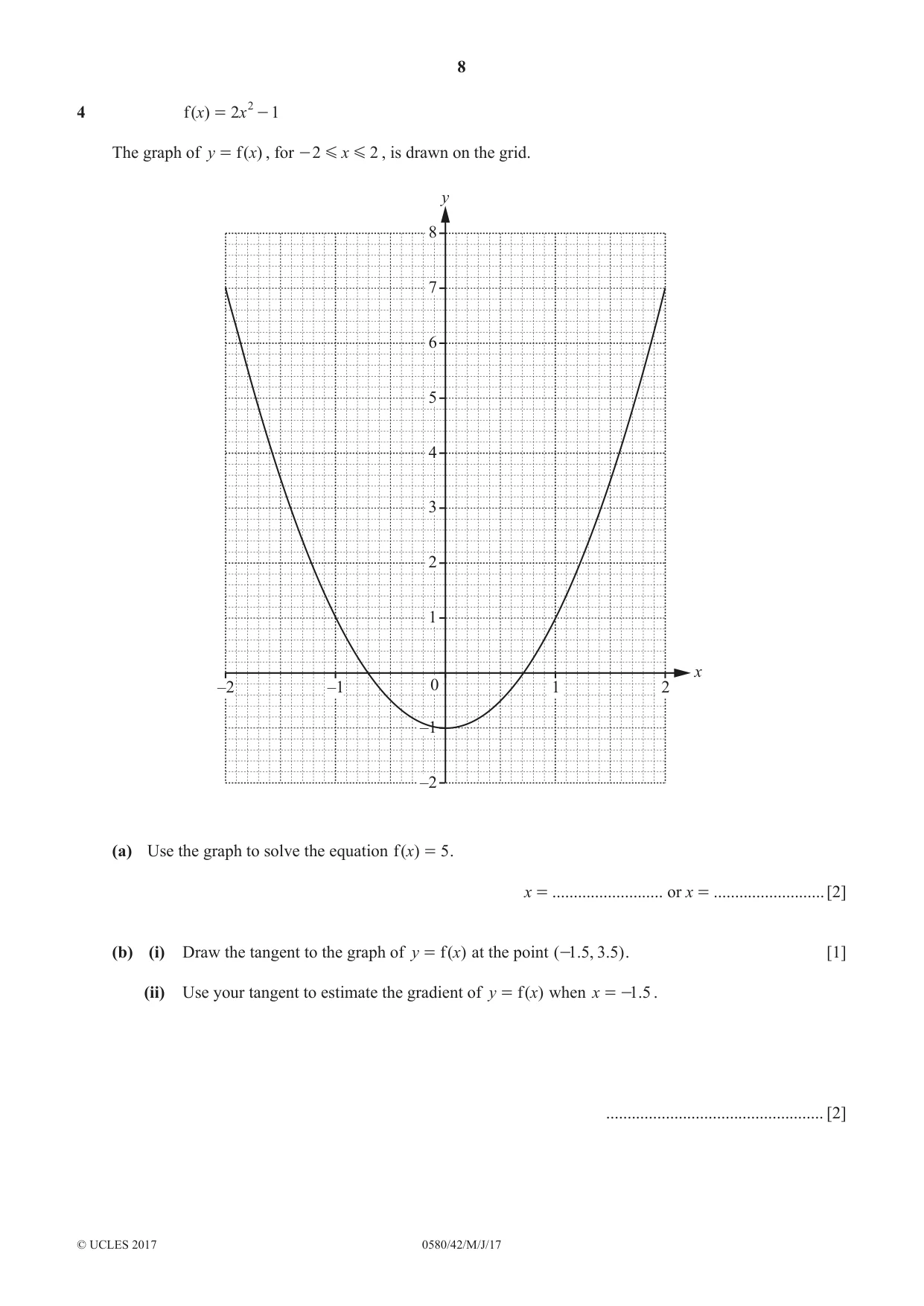
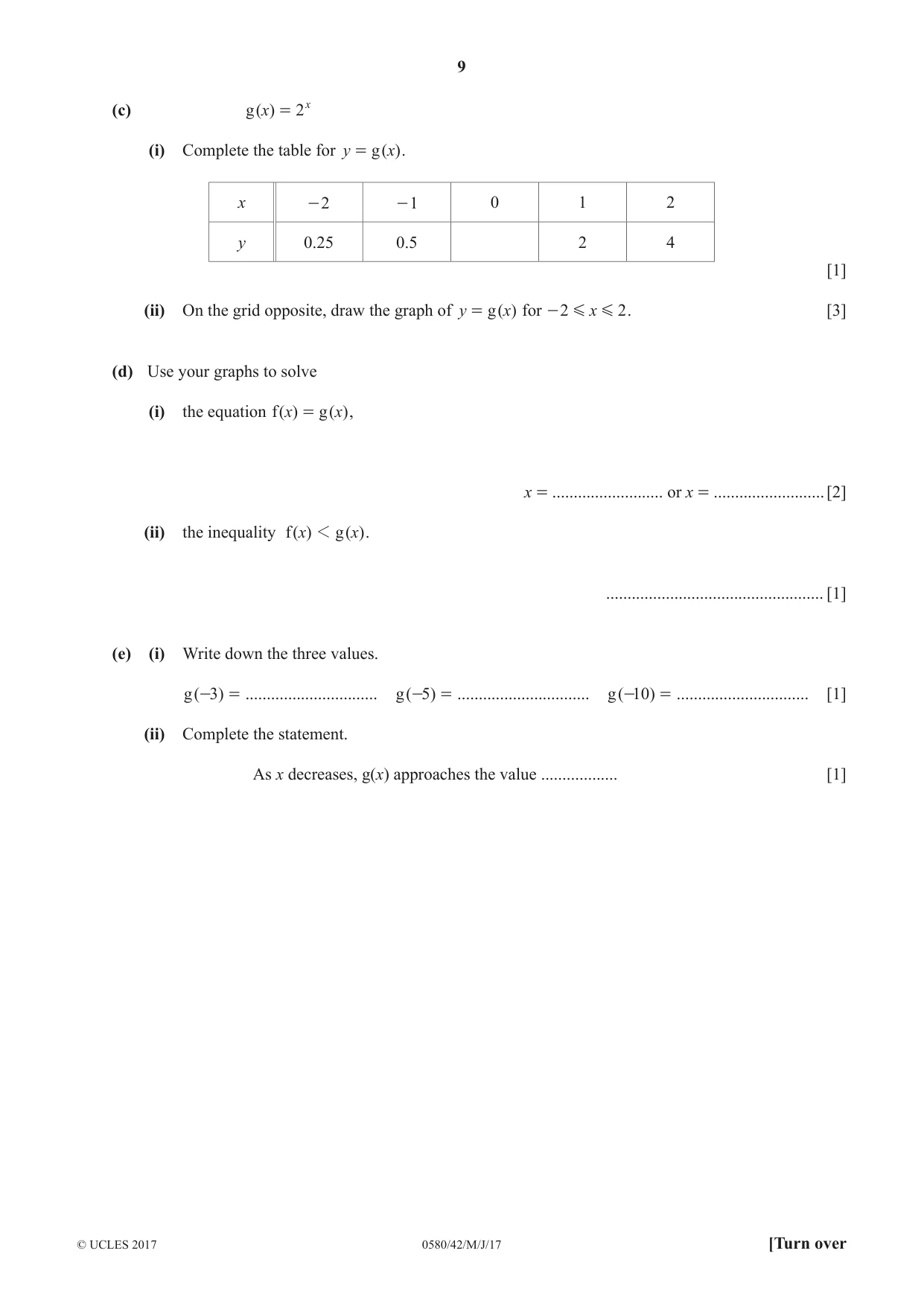
4 f (x) = 2 x 2 - 1 The graph of y = f (x) , for - 2 G x G 2 , is drawn on the grid. y 8 7 6 5 4 3 2 1 x –2 –1 0 1 2 –1 –2 (a) Use the graph to solve the equation f (x) = 5 . x = .......................... or x = .......................... [2] (b) (i) Draw the tangent to the graph of y = f (x) at the point (-1.5, 3.5) . [1] (ii) Use your tangent to estimate the gradient of y = f (x ) when x = -1.5 . ................................................... [2] (c) g (x) = 2x (i) Complete the table for y = g (x) . x - 2 - 1 0 1 2 y 0.25 0.5 2 4 [1] (ii) On the grid opposite, draw the graph of y = g (x) for - 2 G x G 2 . [3] (d) Use your graphs to solve (i) the equation f (x) = g ( x) , x = .......................... or x = .......................... [2] (ii) the inequality f (x) 1 g (x) . ................................................... [1] (e) (i) Write down the three values. g (-3) = ............................... g ( -5) = ............................... g ( -10) = ............................... [1] (ii) Complete the statement. As x decreases, g(x) approaches the value .................. [1]
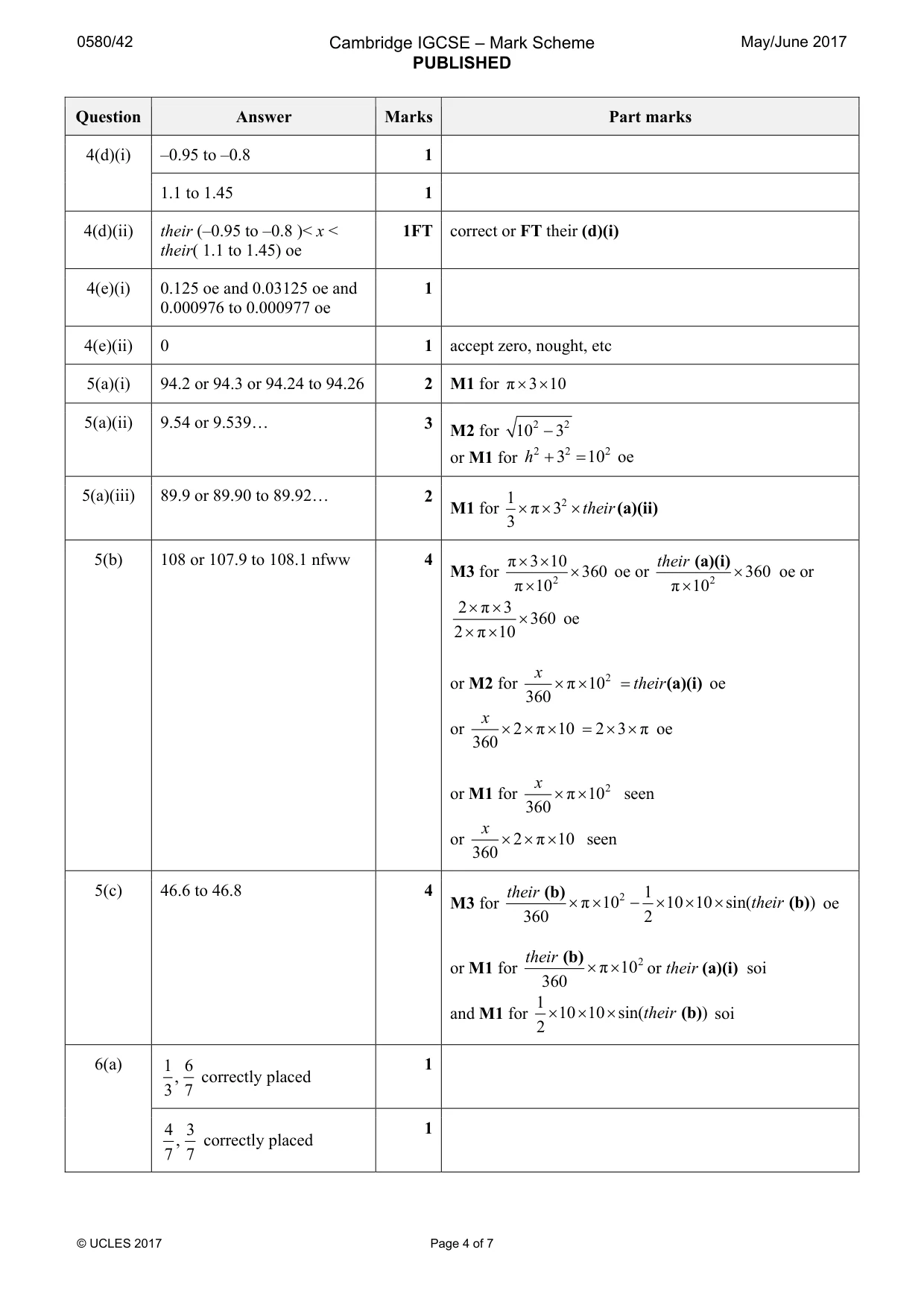
Mark scheme: 4(a) –1.75 to –1.7 1 1.7 to 1.75 1 4(b)(i) Correct ruled solid tangent at 1 (–1.5, 3.5) 4(b)(ii) –7 to –5 2 dep dep on close attempt at ruled solid tangent at x = –1.5 in part (b)(i) M1 for rise/run dep on close attempt at ruled solid tangent at x = –1.5 4(c)(i) 1 1 4(c)(ii) Correct curve 3 B2 for 4 or 5 correct points or B1 for 2 or 3 correct points 4(d)(i) –0.95 to –0.8 1 1.1 to 1.45 1 4(d)(ii) their (–0.95 to –0.8 )< x < 1FT correct or FT their (d)(i) their( 1.1 to 1.45) oe 4(e)(i) 0.125 oe and 0.03125 oe and 1 0.000976 to 0.000977 oe 4(e)(ii) 0 1 accept zero, nought, etc
Q5 · NOT TO SCALE 10 cm 3 cm The diagram shows a hollow cone with radius 3 cm and slant height…
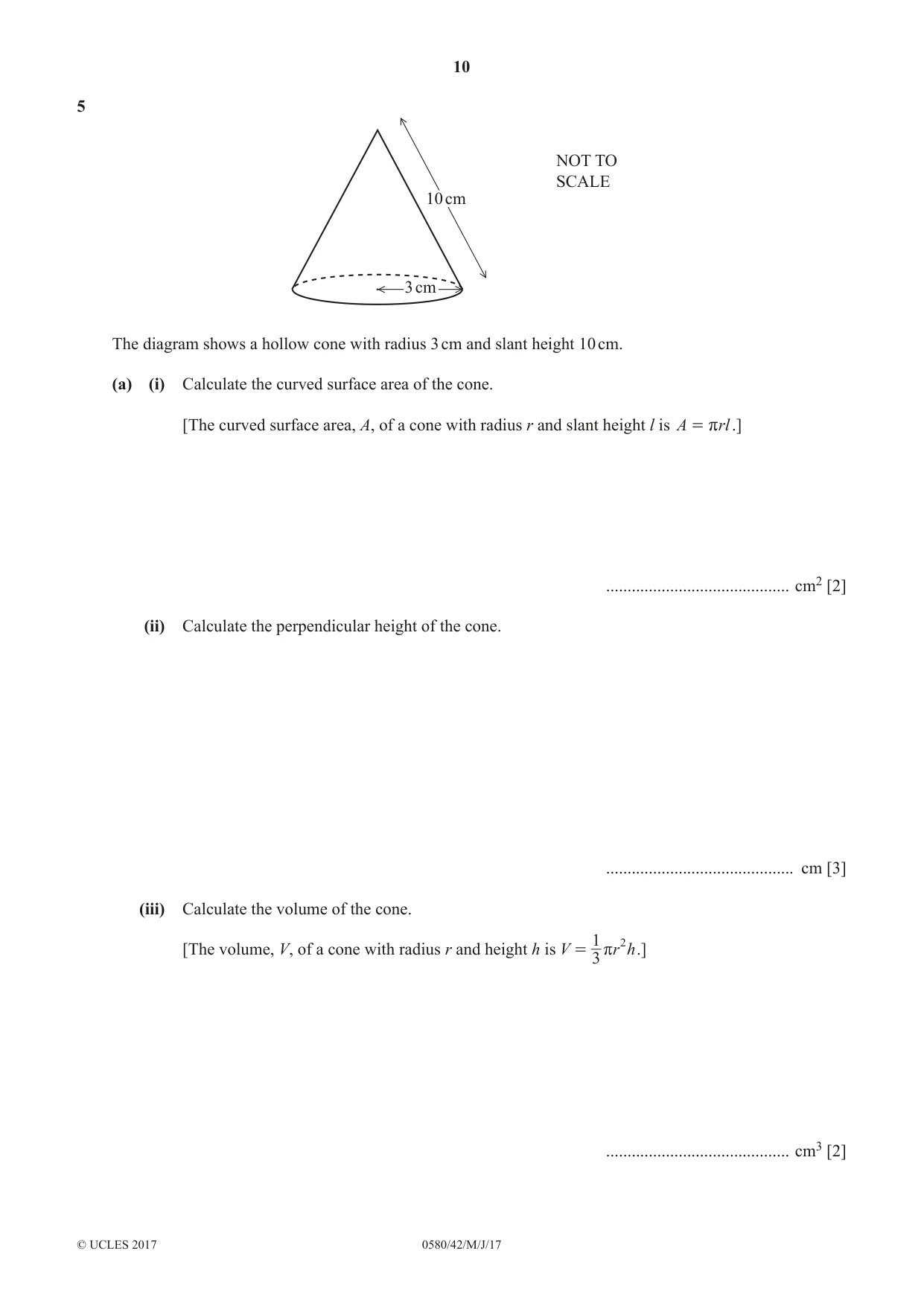
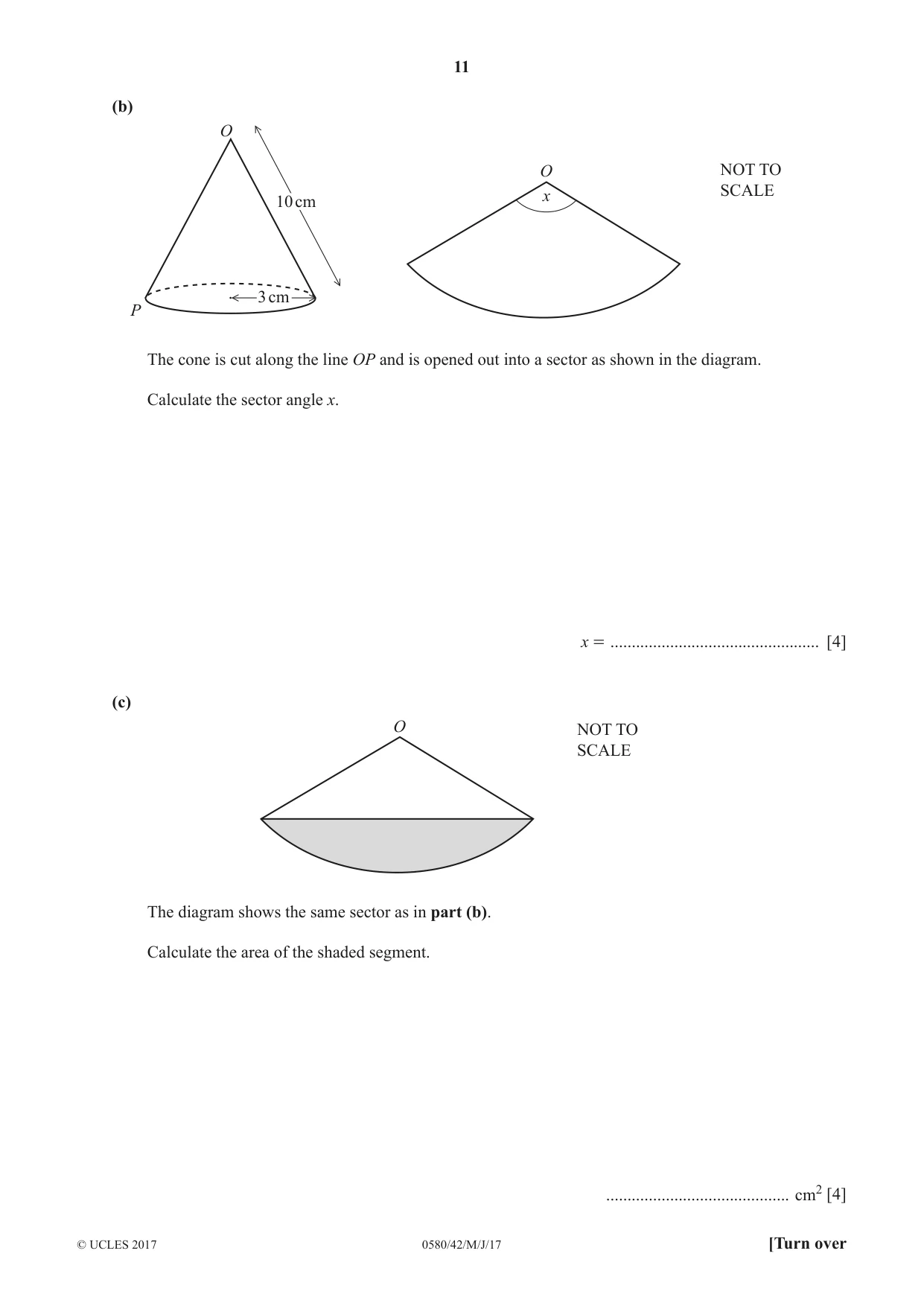
5 NOT TO SCALE 10 cm 3 cm The diagram shows a hollow cone with radius 3 cm and slant height 10 cm. (a) (i) Calculate the curved surface area of the cone. [The curved surface area, A, of a cone with radius r and slant height l is A = r rl .] ........................................... cm2 [2] (ii) Calculate the perpendicular height of the cone. ............................................ cm [3] (iii) Calculate the volume of the cone. 1 2 [The volume, V, of a cone with radius r and height h is V = r r h .] 3 ........................................... cm3 [2] (b) O O NOT TO SCALE x 10 cm 3 cm P The cone is cut along the line OP and is opened out into a sector as shown in the diagram. Calculate the sector angle x. x = ................................................. [4] (c) O NOT TO SCALE The diagram shows the same sector as in part (b). Calculate the area of the shaded segment. ........................................... cm2 [4]
Mark scheme: 5(a)(i) 94.2 or 94.3 or 94.24 to 94.26 2 M1 for π × 3 × 10 5(a)(ii) 9.54 or 9.539… 3 2 2 M2 for 10 − 3 or M1 for h 2 + 32 = 10 2 oe 5(a)(iii) 89.9 or 89.90 to 89.92… 2 1 2 M1 for × π × 3 × their (a)(ii) 3 5(b) 108 or 107.9 to 108.1 nfww 4 π × 3 × 10 their (a)(i) M3 for × 360 oe or × 360 oe or π × 10 2 π × 10 2 2 × π × 3 × 360 oe 2 × π × 10 x 2 or M2 for × π × 10 = their (a)(i) oe 360 x or × 2 × π × 10 = 2 × 3 × π oe 360 x 2 or M1 for × π × 10 seen 360 x or × 2 × π × 10 seen 360 5(c) 46.6 to 46.8 4 their (b) 2 1 M3 for × π × 10 − × 10 × 10 × sin(their (b)) oe 360 2 their (b) 2 or M1 for × π × 10 or their (a)(i) soi 360 1 and M1 for × 10 × 10 × sin(their (b)) soi 2
Q6 · Each morning the probability that it rains is
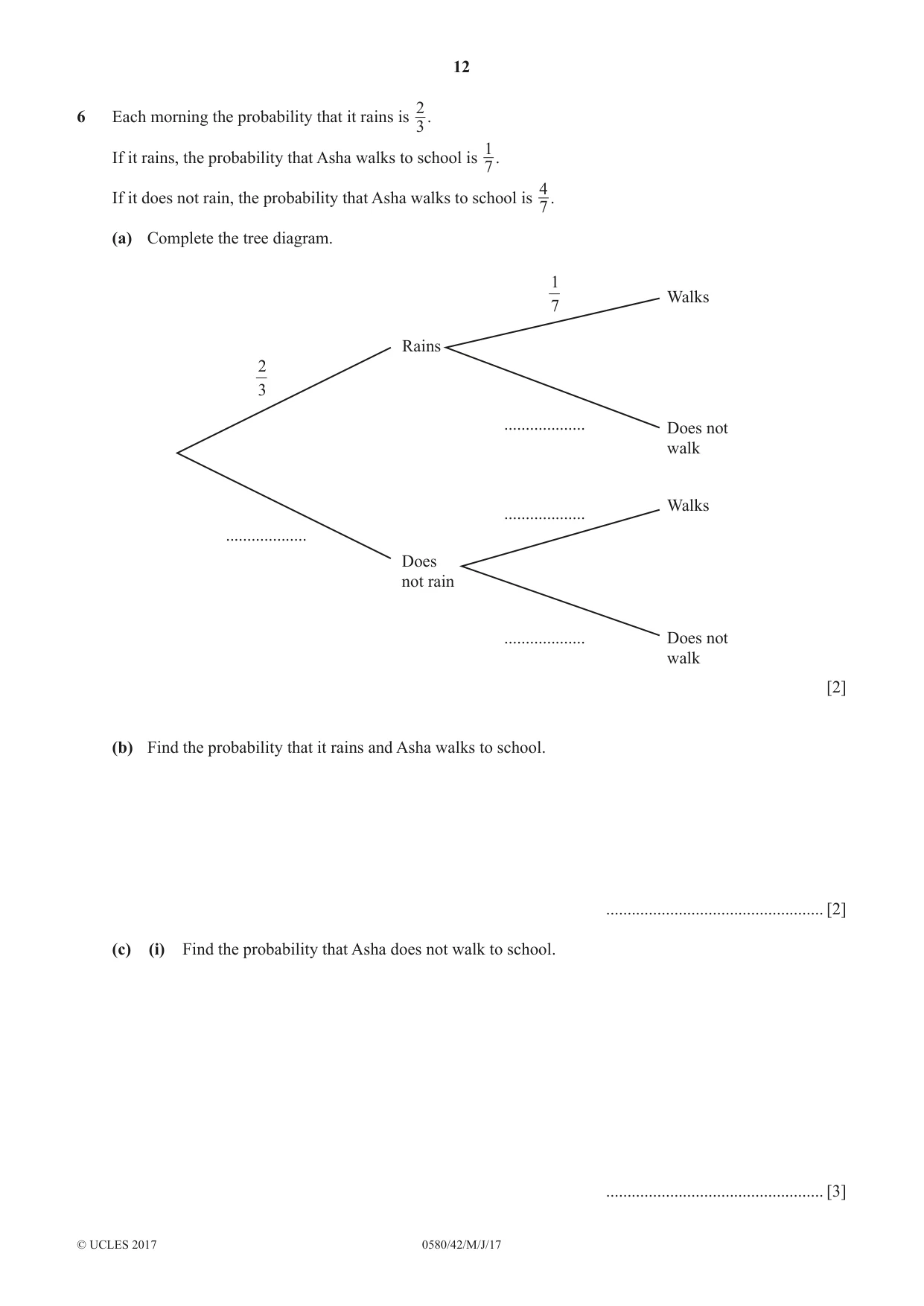
26 Each morning the probability that it rains is . 3 1 If it rains, the probability that Asha walks to school is . 7 4 If it does not rain, the probability that Asha walks to school is . 7 (a) Complete the tree diagram. 1 Walks 7 Rains 2 3 ................... Does not walk Walks ................... ................... Does not rain ................... Does not walk [2] (b) Find the probability that it rains and Asha walks to school. ................................................... [2] (c) (i) Find the probability that Asha does not walk to school. ................................................... [3] (ii) Find the expected number of days Asha does not walk to school in a term of 70 days. ................................................... [2] (d) Find the probability that it rains on exactly one morning in a school week of 5 days. ................................................... [2]
Mark scheme: 6(a) 1 6 1 , correctly placed 3 7 4 3 1 , correctly placed 7 7 6(b) 2 2 2 1 oe M1 for × 21 3 7 6(c)(i) 15 3 2 6 1 3 oe M2 for × + × oe 21 3 7 3 7 2 6 1 3 or M1 for × oe or × oe seen 3 7 3 7 6(c)(ii) 50 2FT FT (70 × their (c)(i)) rounded up or down to integer M1 for 70 × their (c)(i) 2 6(d) 10 2 1 1 1 × × × oe M1 for × 1[×k ] oe nfww 243 3 3 3 3 3 where k is positive integer less than 5
Q7 · In this part, all lengths are in centimetres
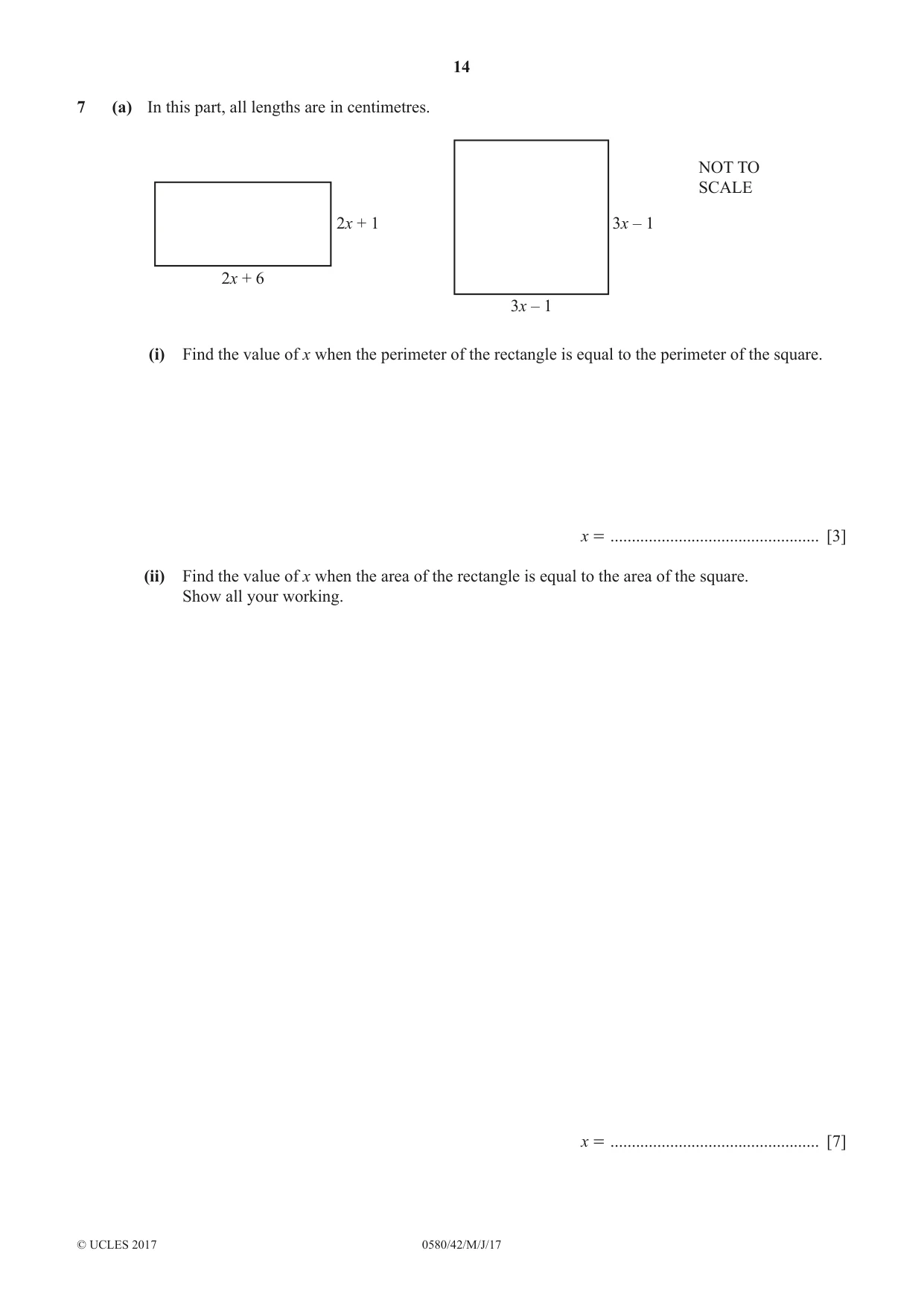
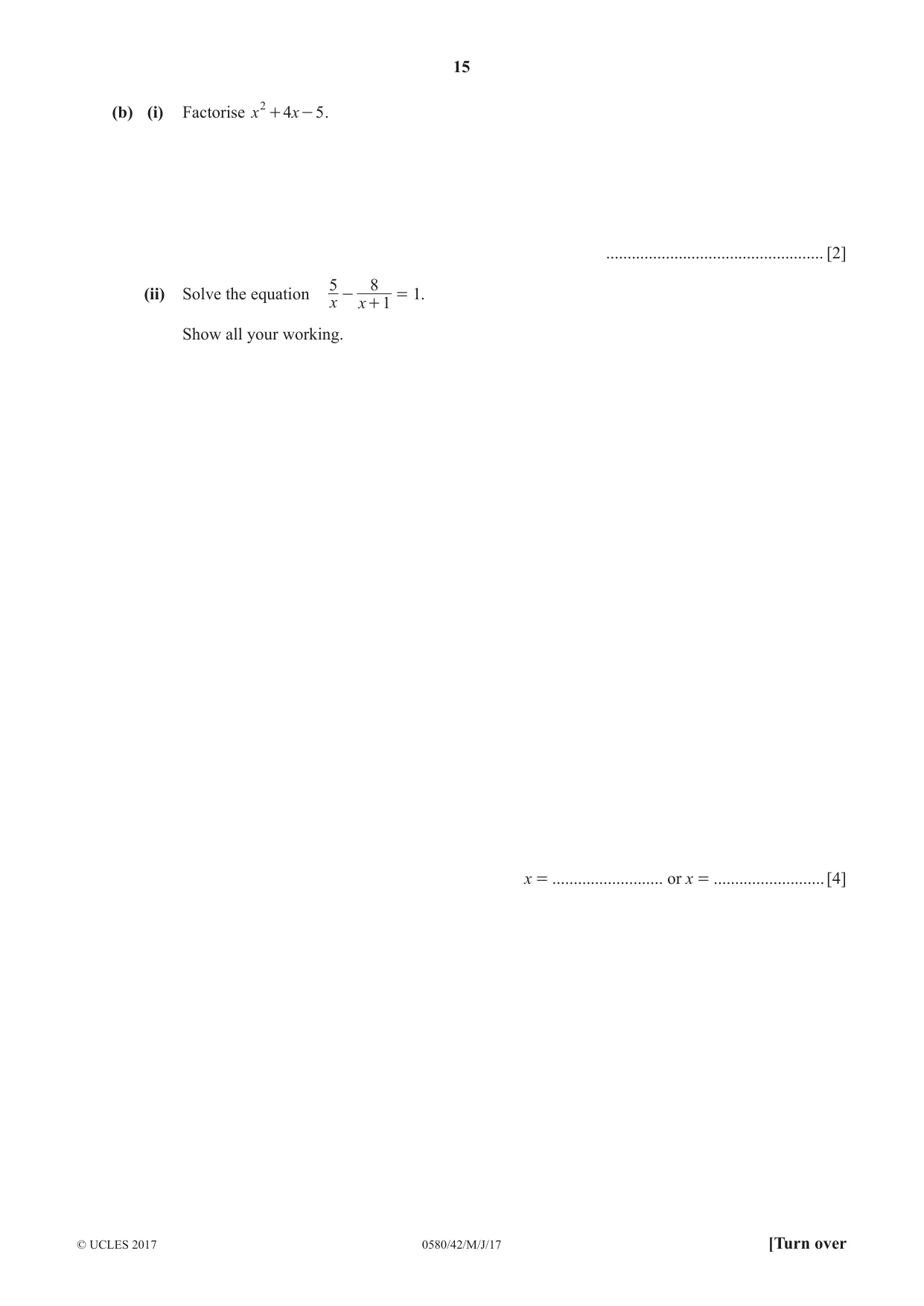
7 (a) In this part, all lengths are in centimetres. NOT TO SCALE 2x + 1 3x – 1 2x + 6 3x – 1 (i) Find the value of x when the perimeter of the rectangle is equal to the perimeter of the square. x = ................................................. [3] (ii) Find the value of x when the area of the rectangle is equal to the area of the square. Show all your working. x = ................................................. [7] (b) (i) Factorise x 2 + 4x - 5 . ................................................... [2] 5 8 (ii) Solve the equation - = 1. x x + 1 Show all your working. x = .......................... or x = .......................... [4]
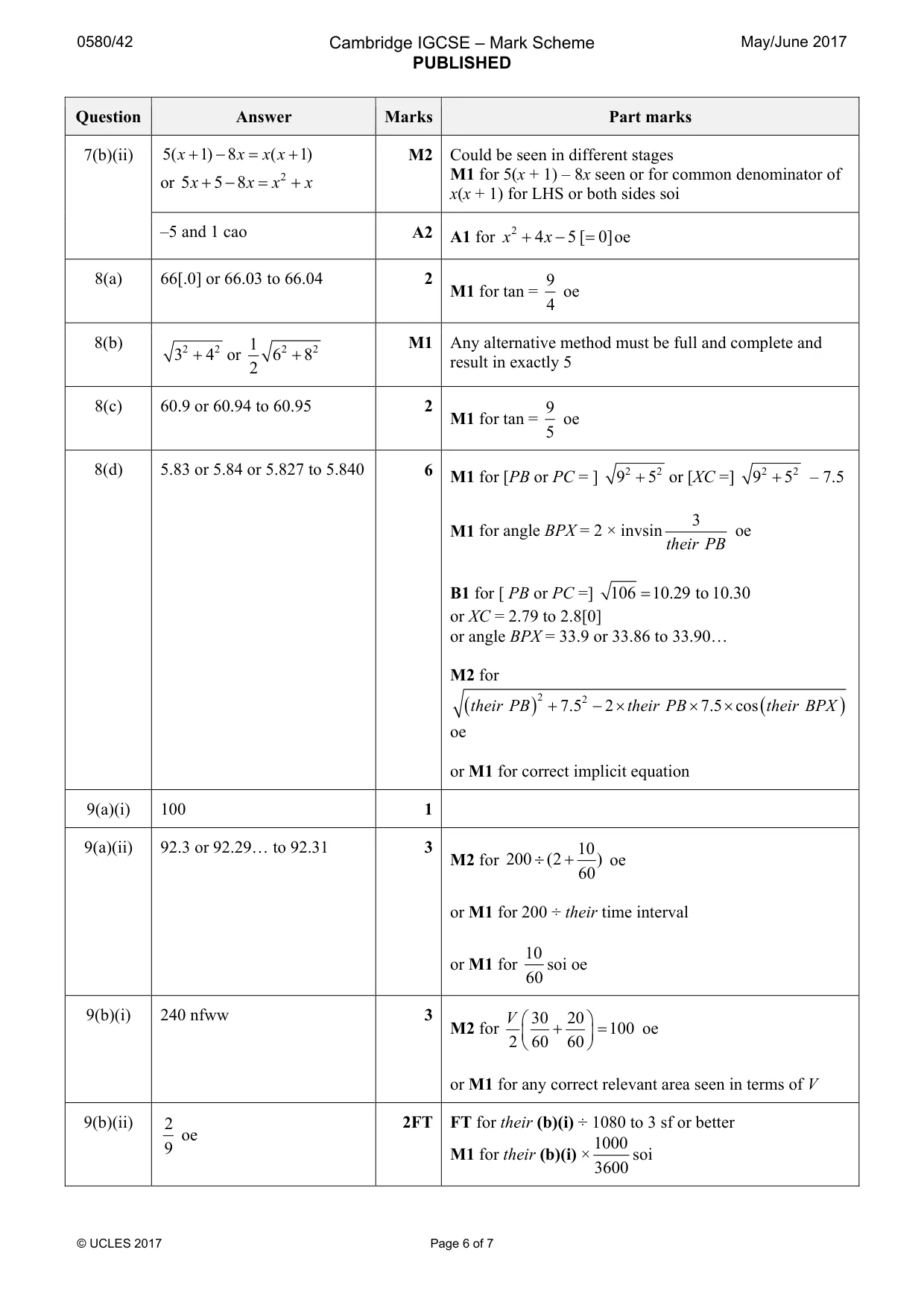
Mark scheme: 7(a)(i) 1 9 3 M2 for [2](4x + 7) = [2](6x – 2) oe 4.5 or 4 or final answer 2 2 or M1 for 2(2x + 6) + 2(2x + 1) oe or 4(3x – 1) oe or M1 for correctly reaching ax = b from their linear equation 7(a)(ii) (2 x + 6)(2 x + 1) = (3 x − 1) 2 M1 May be seen in different stages 5 x 2 − 20 x − 5 [ = 0] oe B3 B1 for 4x² + 2x + 12x + 6 or better B1 for 9x² – 3x – 3x + 1 or better 2 M2 FT their 3 term quadratic provided formula used or −−( 20) ± ( −20) − 4(5)( −5) complete the square 2(5) 2 −−( 20) + q oe M1 for ( −20) − 4(5)( −5) oe or if in form 2(5) −−( 20) − q or FT± their quadratic 2(5) or for completing the square M2 for 2 ± 1 + 2 2 or M1 for (x – 2)² 4.24 or 4.236… cao B1 7(b)(i) ( x + 5)( x − 1) final answer 2 B1 for x(x – 1) + 5(x – 1) or x(x + 5) –[1](x + 5)) or for( x + a )( x + b ) where ab = – 5 or a + b = 4 7(b)(ii) 5( x + 1) − 8 x = x ( x + 1) M2 Could be seen in different stages 2 M1 for 5(x + 1) – 8x seen or for common denominator of or 5 x + 5 − 8 x = x + x x(x + 1) for LHS or both sides soi –5 and 1 cao A2 A1 for x 2 + 4 x − 5 [ = 0] oe
Q8 · P NOT TO SCALE 9 cm D C N 6 cm M A 8 cm B The diagram shows a pyramid on a rectangular…
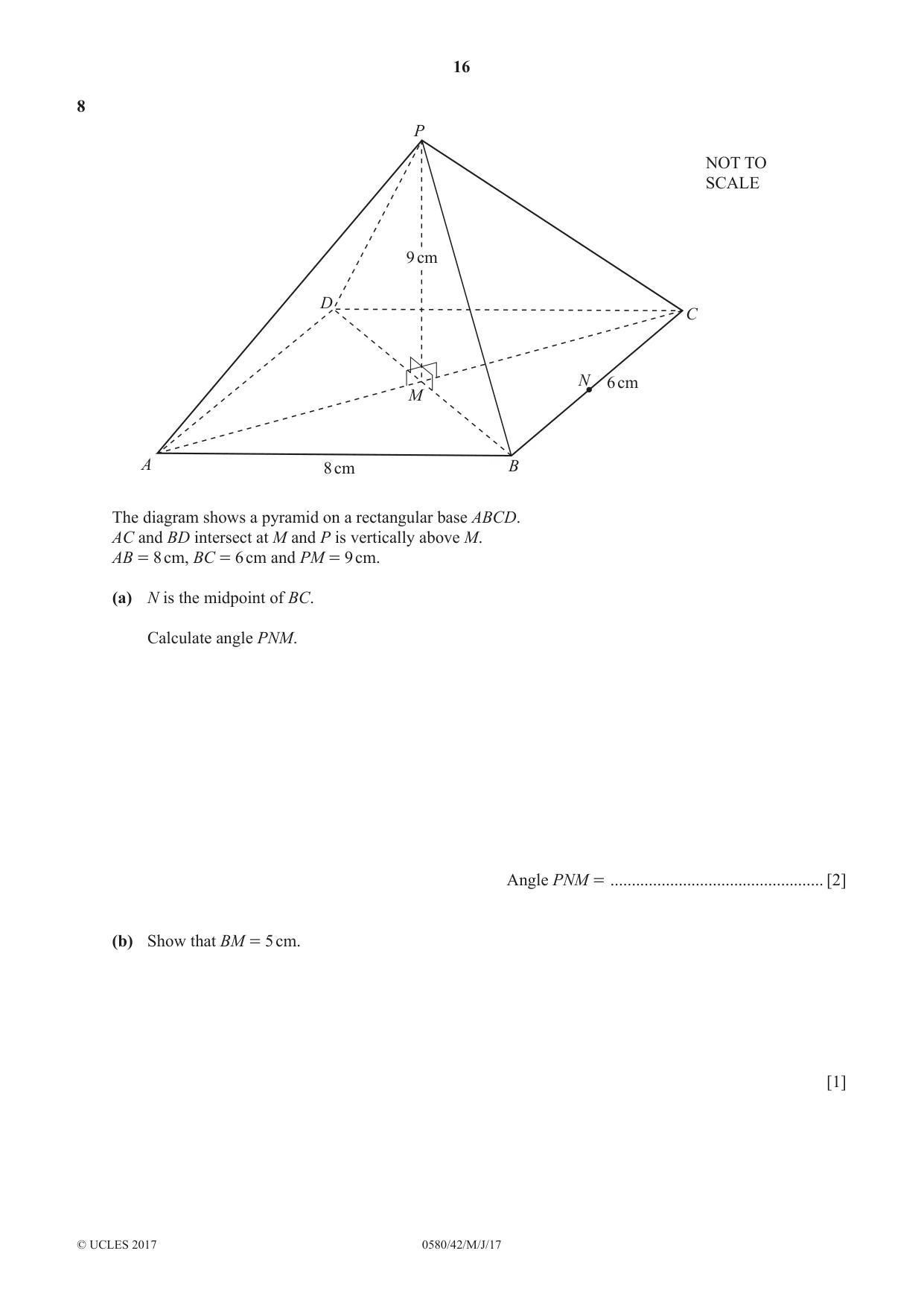
8 P NOT TO SCALE 9 cm D C N 6 cm M A 8 cm B The diagram shows a pyramid on a rectangular base ABCD. AC and BD intersect at M and P is vertically above M. AB = 8 cm, BC = 6 cm and PM = 9 cm. (a) N is the midpoint of BC. Calculate angle PNM. Angle PNM = .................................................. [2] (b) Show that BM = 5 cm. [1] (c) Calculate the angle between the edge PB and the base ABCD. ................................................... [2] (d) A point X is on PC so that PX = 7.5 cm. Calculate BX. BX = ........................................... cm [6]
Mark scheme: 8(a) 66[.0] or 66.03 to 66.04 2 9 M1 for tan = oe 4 8(b) 2 2 1 2 2 M1 Any alternative method must be full and complete and 3 + 4 or 6 + 8 result in exactly 5 2 8(c) 60.9 or 60.94 to 60.95 2 9 M1 for tan = oe 5 8(d) 5.83 or 5.84 or 5.827 to 5.840 6 2 2 2 2 M1 for [PB or PC = ] 9 + 5 or [XC =] 9 + 5 – 7.5 3 M1 for angle BPX = 2 × invsin oe their PB B1 for [ PB or PC =] 106 = 10.29 to 10.30 or XC = 2.79 to 2.8[0] or angle BPX = 33.9 or 33.86 to 33.90… M2 for ( their PB ) 2 + 7.5 2 − 2 × their PB × 7.5 × cos ( their BPX ) oe or M1 for correct implicit equation
Q9 · 200 NOT TO SCALE 150 Distance (km) 50 0 07 00 07 30 07 40 08 10 09 10 Time The…
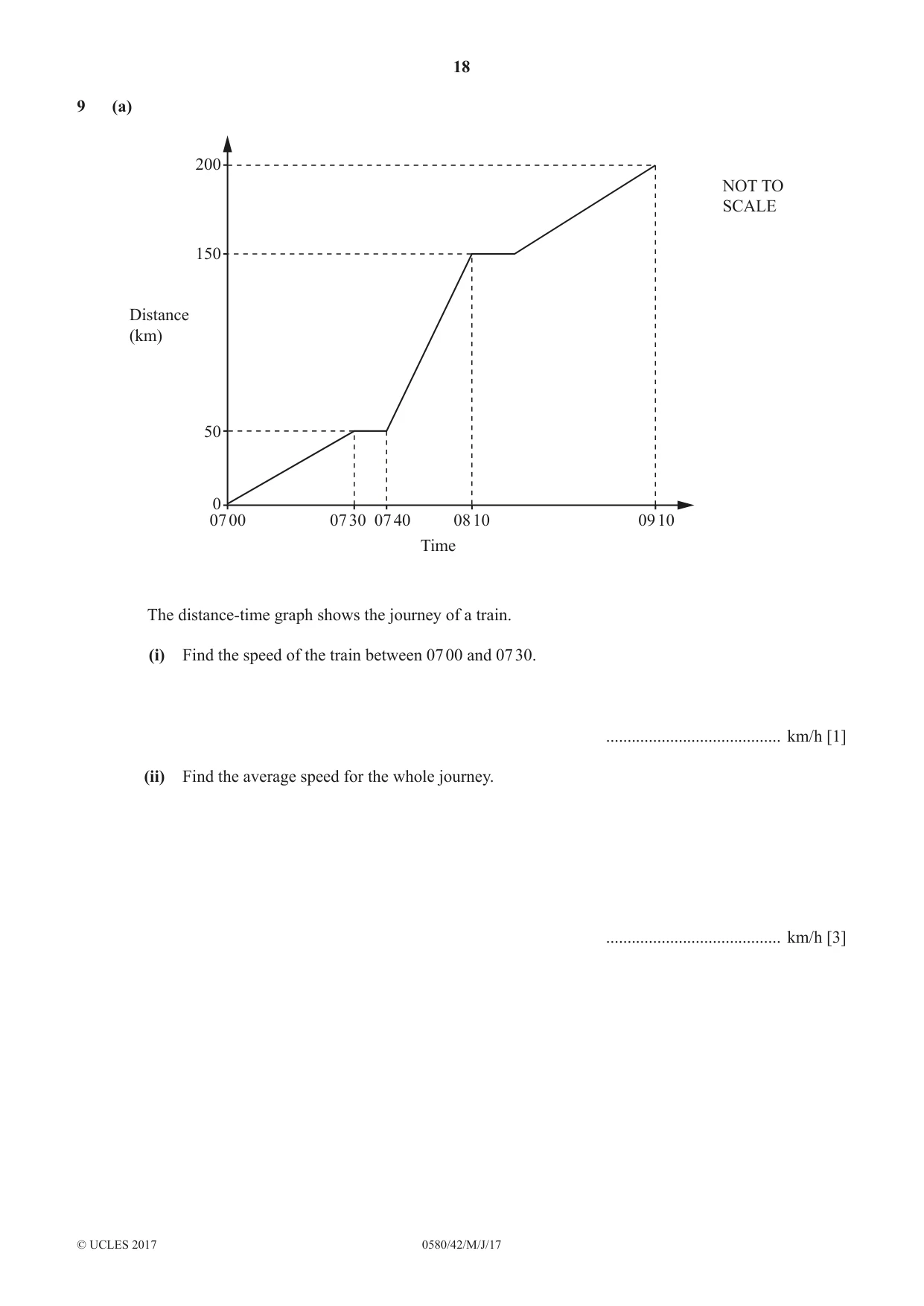
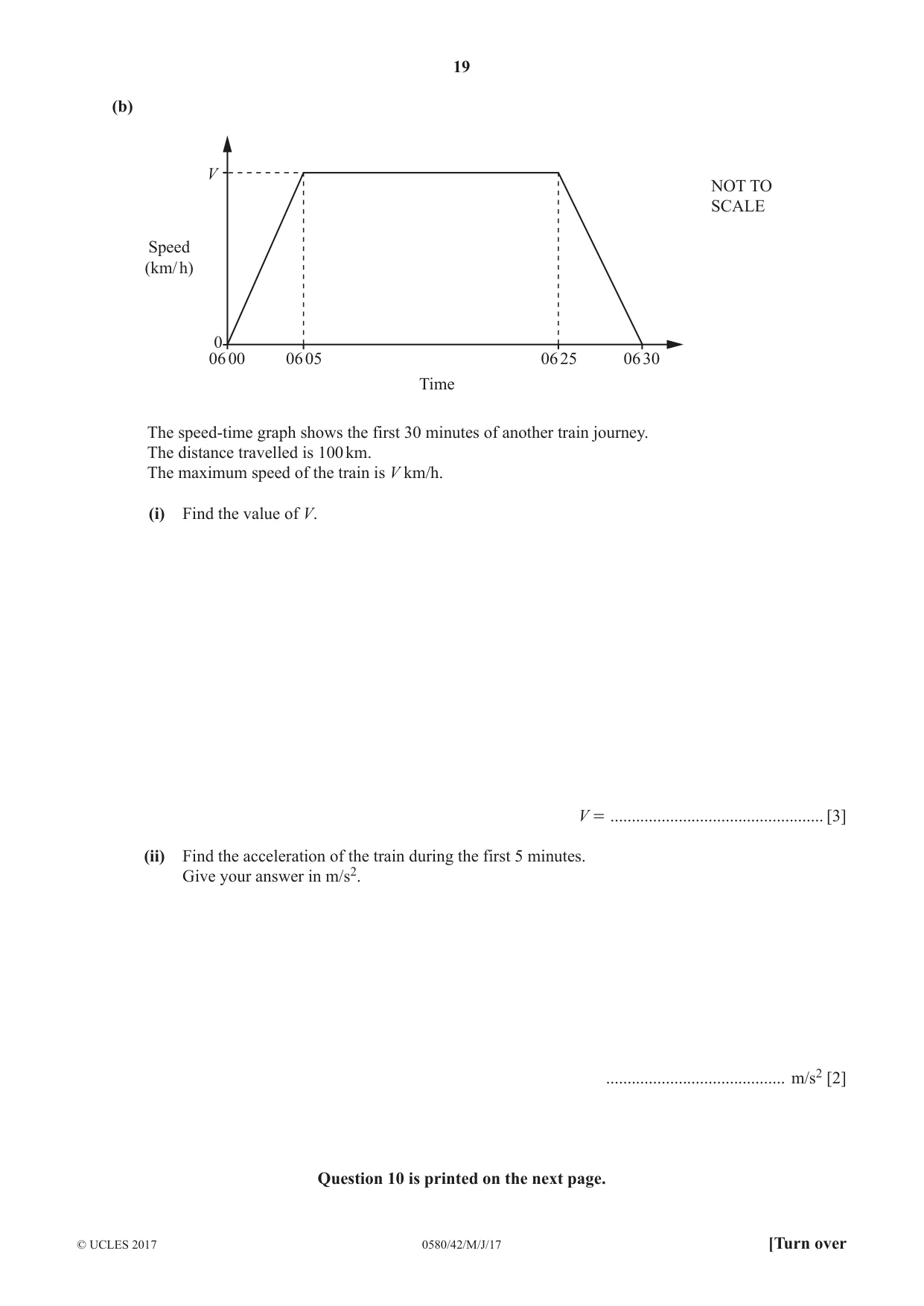
9 (a) 200 NOT TO SCALE 150 Distance (km) 50 0 07 00 07 30 07 40 08 10 09 10 Time The distance-time graph shows the journey of a train. (i) Find the speed of the train between 07 00 and 07 30. ......................................... km/h [1] (ii) Find the average speed for the whole journey. ......................................... km/h [3] (b) V NOT TO SCALE Speed (km/ h) 0 06 00 06 05 06 25 06 30 Time The speed-time graph shows the first 30 minutes of another train journey. The distance travelled is 100 km. The maximum speed of the train is V km/h. (i) Find the value of V. V = .................................................. [3] (ii) Find the acceleration of the train during the first 5 minutes. Give your answer in m/s2. .......................................... m/s2 [2] Question 10 is printed on the next page.
Mark scheme: 9(a)(i) 100 1 9(a)(ii) 92.3 or 92.29… to 92.31 3 10 M2 for 200 ÷ (2 + ) oe 60 or M1 for 200 ÷ their time interval 10 or M1 for soi oe 60 9(b)(i) 240 nfww 3 V 30 20 M2 for + = 100 oe 2 60 60 or M1 for any correct relevant area seen in terms of V 9(b)(ii) 2 2FT FT for their (b)(i) ÷ 1080 to 3 sf or better oe 1000 9 M1 for their (b)(i) × soi 3600
Q10 · F (x) = 3x - 2 g (x) = x2 h (x) = 3x (a) Find f (-3)
10 f (x) = 3x - 2 g (x) = x2 h (x) = 3x (a) Find f (-3) . ................................................... [1] (b) Find the value of x when f (x) = 19 . x = .................................................. [2] (c) Find fh(2). ................................................... [2] (d) Find gf ( x) + f ( x) + x . Give your answer in its simplest form. ................................................... [3] (e) Find f -1 (x) . f -1 (x) = .................................................. [2]
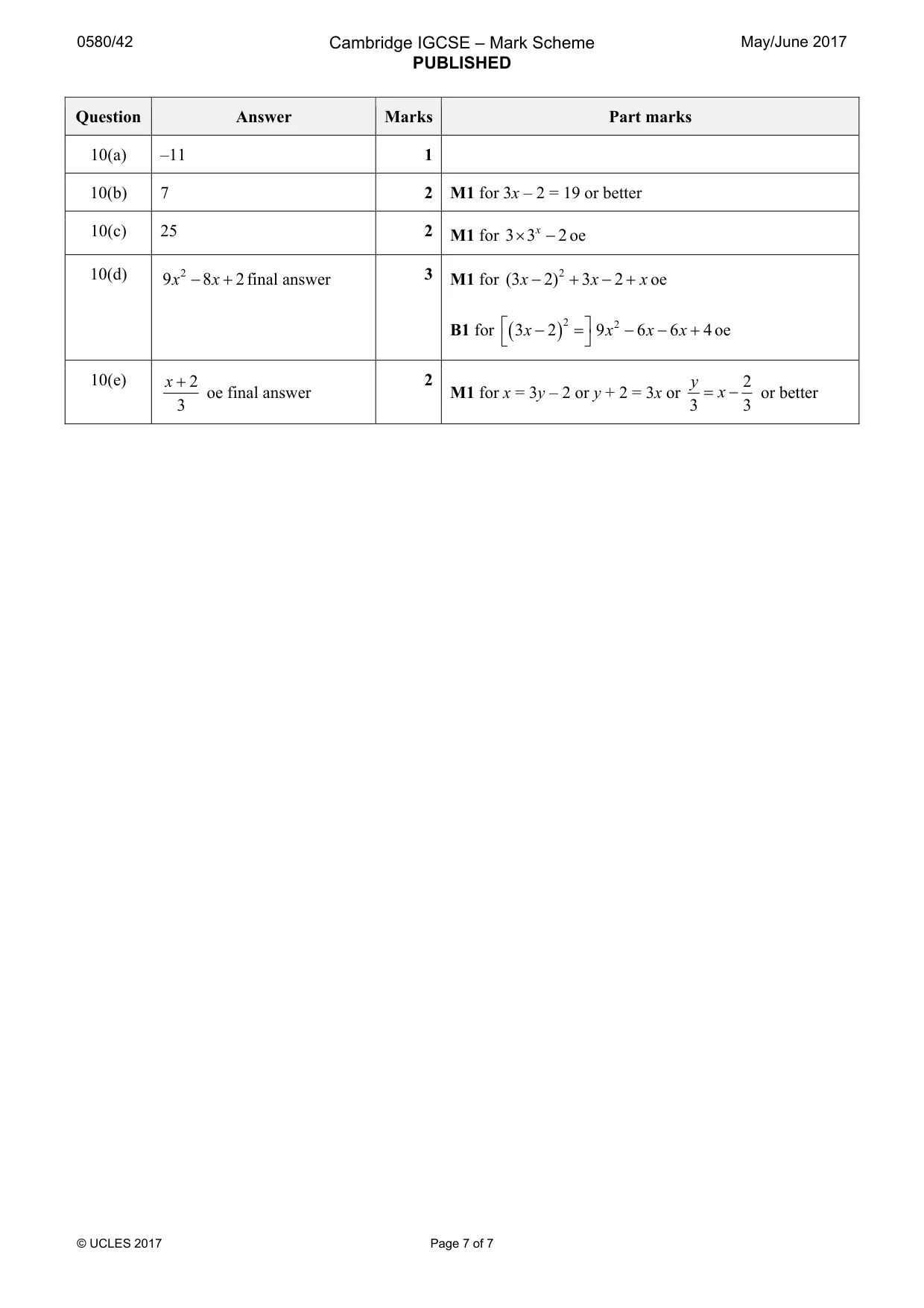
Mark scheme: 10(a) –11 1 10(b) 7 2 M1 for 3x – 2 = 19 or better 10(c) 25 2 M1 for 3 × 3 x − 2 oe 10(d) 9 x 2 − 8 x + 2 final answer 3 M1 for (3 x − 2) 2 + 3 x − 2 + x oe B1 for ( 3 x − 2 ) 2 = 9 x 2 − 6 x − 6 x + 4 oe 10(e) x + 2 2 y 2 oe final answer M1 for x = 3y – 2 or y + 2 = 3x or = x − or better 3 3 3
What was in this paper
The subtopics covered by these 10 questions, and how many questions each got. Open one in a new tab to see every Cambridge question on it.
What you needed in this session
Cambridge’s own grade thresholds for 2017 May/June, Paper 4 · Variant 2. A higher threshold means an easier paper — the bar moves with how the cohort did.