Cambridge IGCSE Mathematics 0580 — 2019 Feb/March Paper 4 · Variant 2
0580/42/F/M/19 · 11 questions · 130 marks · ≈146 min
The question paper and its mark scheme, free to read here and free to download. This is Cambridge’s own paper, exactly as it was sat.
Question paper20 pages
Mark scheme8 pages
Answers below. Sit the paper first if you are practising.
Questions as text
Q1 · Amol and Priya deliver 645 parcels in the ratio Amol : Priya = 11 : 4
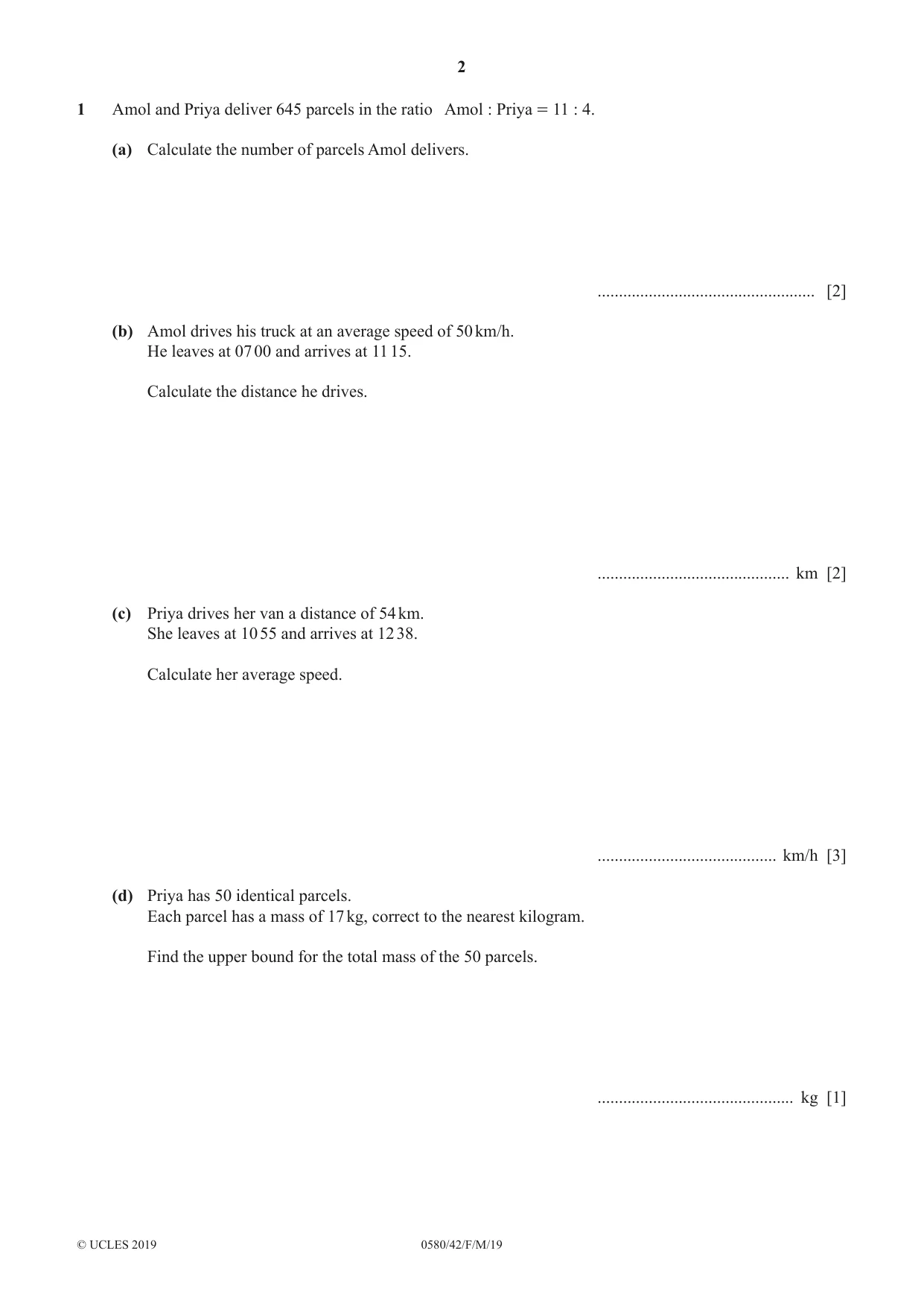
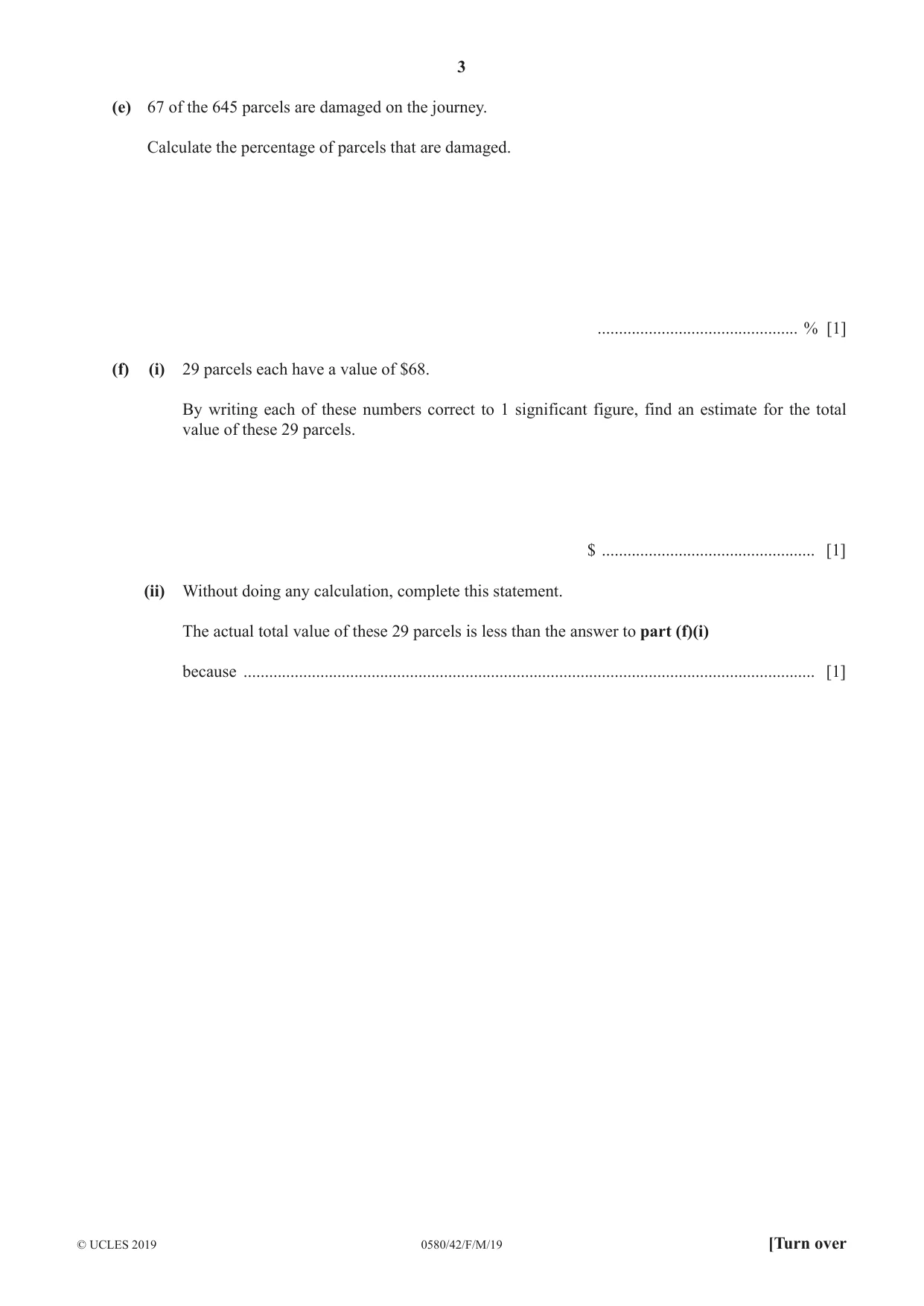
1 Amol and Priya deliver 645 parcels in the ratio Amol : Priya = 11 : 4. (a) Calculate the number of parcels Amol delivers. ................................................... [2] (b) Amol drives his truck at an average speed of 50 km/h. He leaves at 07 00 and arrives at 11 15. Calculate the distance he drives. ............................................. km [2] (c) Priya drives her van a distance of 54 km. She leaves at 10 55 and arrives at 12 38. Calculate her average speed. .......................................... km/h [3] (d) Priya has 50 identical parcels. Each parcel has a mass of 17 kg, correct to the nearest kilogram. Find the upper bound for the total mass of the 50 parcels. .............................................. kg [1] (e) 67 of the 645 parcels are damaged on the journey. Calculate the percentage of parcels that are damaged. ............................................... % [1] (f) (i) 29 parcels each have a value of $68. By writing each of these numbers correct to 1 significant figure, find an estimate for the total value of these 29 parcels. $ .................................................. [1] (ii) Without doing any calculation, complete this statement. The actual total value of these 29 parcels is less than the answer to part (f)(i) because ...................................................................................................................................... [1]
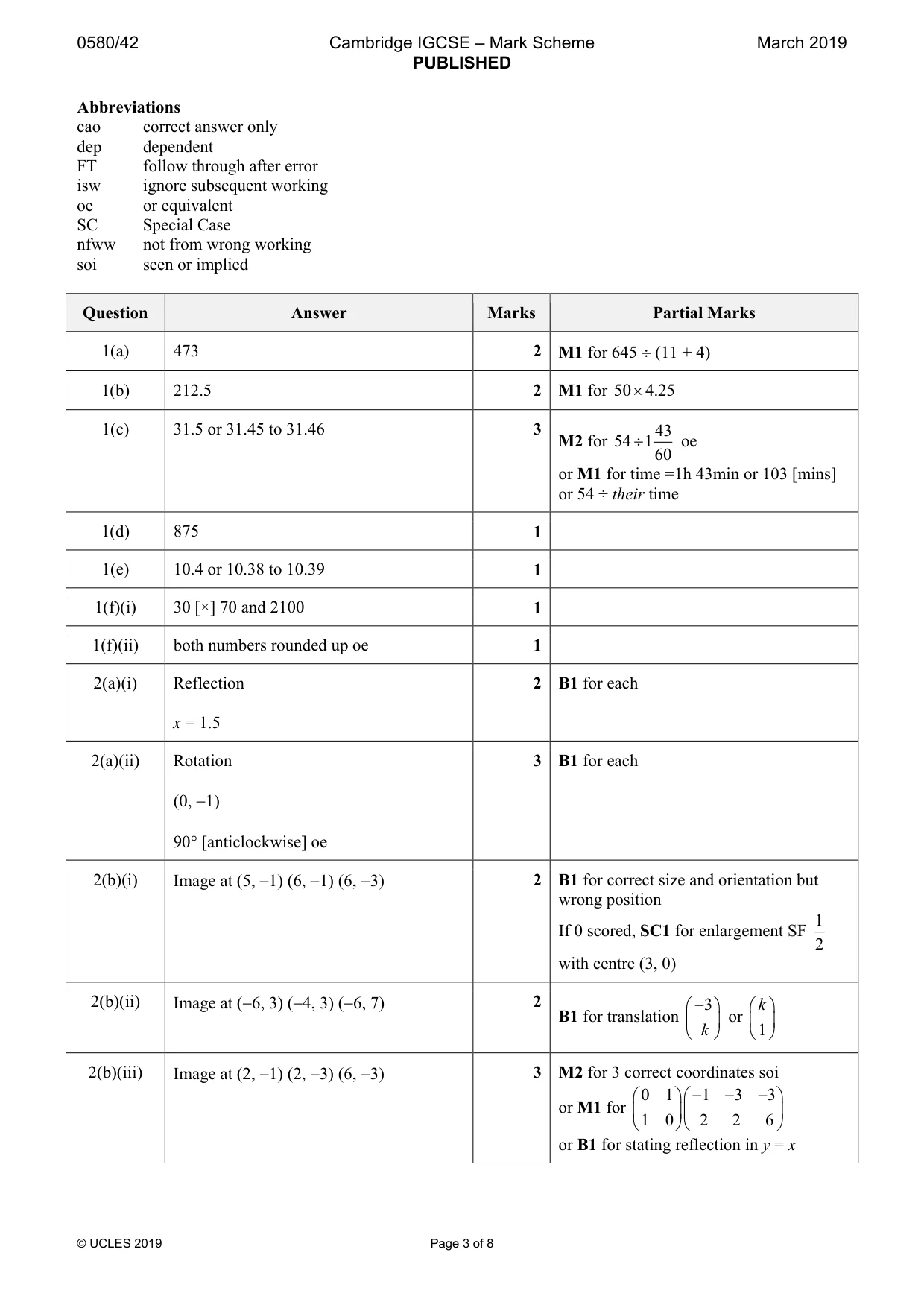
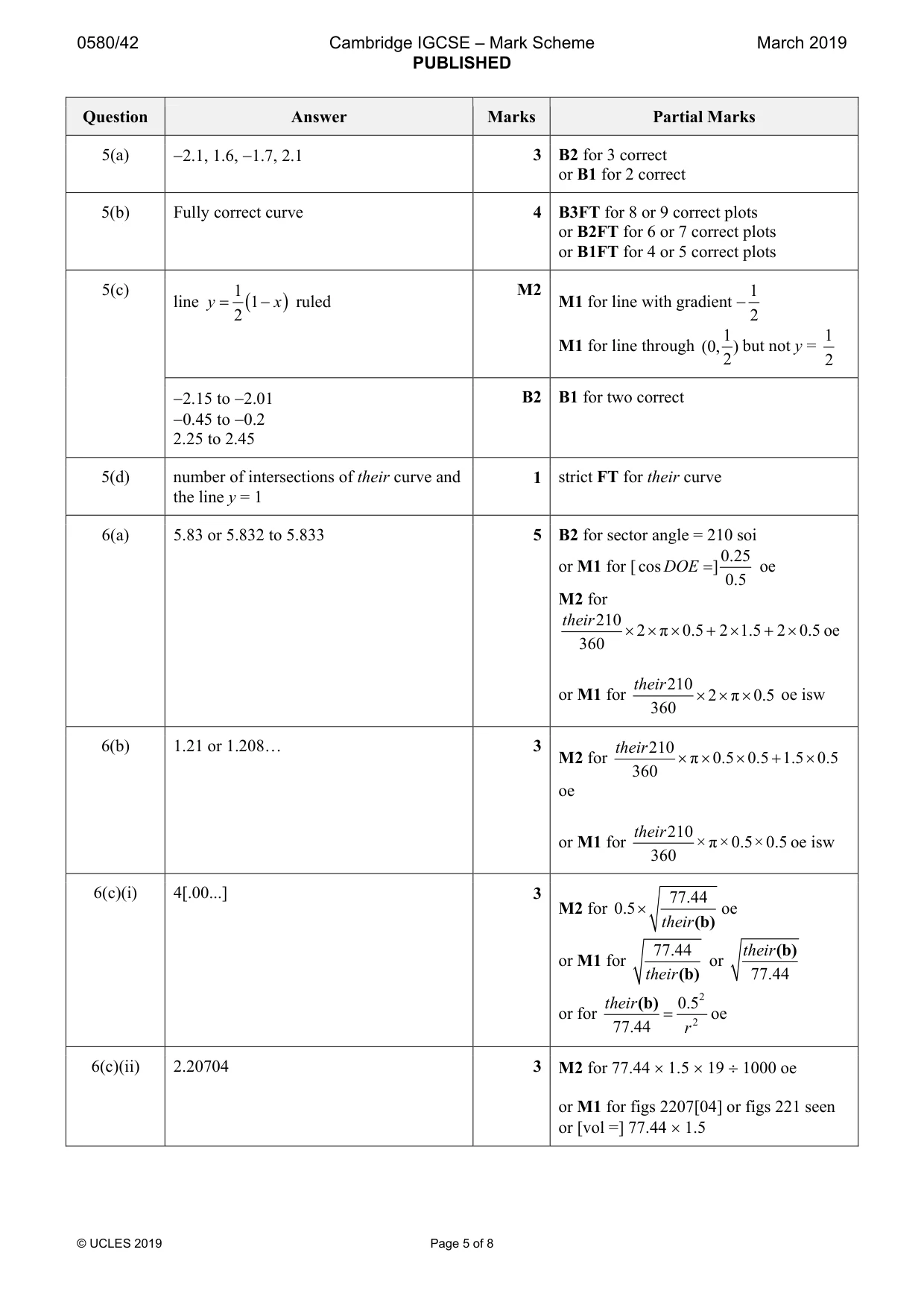
Mark scheme: Question Answer Marks Partial Marks 1(a) 473 2 M1 for 645 ÷ (11 + 4) 1(b) 212.5 2 M1 for 50 × 4.25 1(c) 31.5 or 31.45 to 31.46 3 43 M2 for 54 ÷ 160 oe or M1 for time =1h 43min or 103 [mins] or 54 ÷ their time 1(d) 875 1 1(e) 10.4 or 10.38 to 10.39 1 1(f)(i) 30 [×] 70 and 2100 1 1(f)(ii) both numbers rounded up oe 1
Q2 · Y 8 7 6 5 4 A B 3 2 1 –8 –7 –6 –5 –4 –3 –2 –1 0 1 2 3 4 5 6 7 x –1 –2 –3 C –4 –5 (a)…
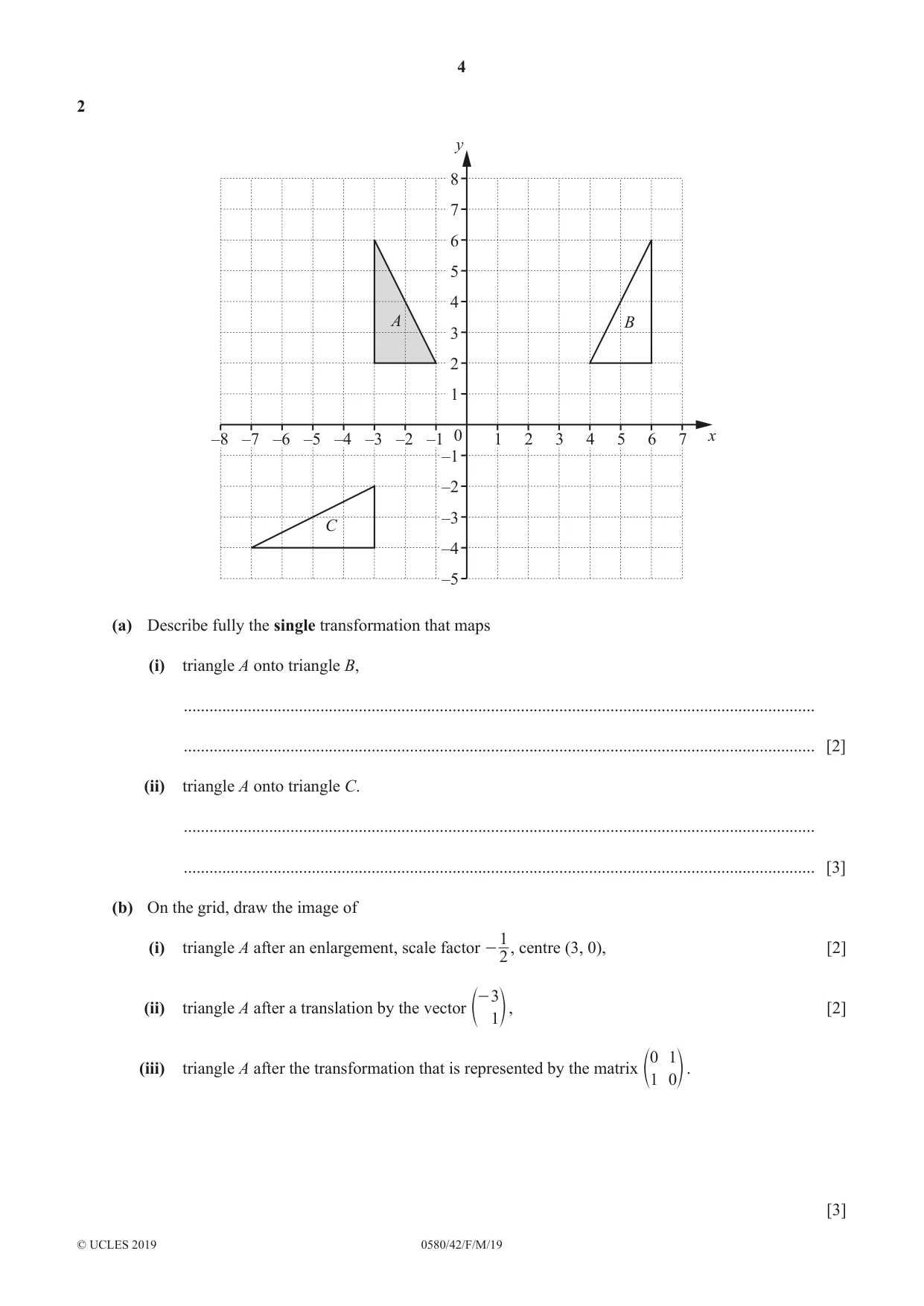
2 y 8 7 6 5 4 A B 3 2 1 –8 –7 –6 –5 –4 –3 –2 –1 0 1 2 3 4 5 6 7 x –1 –2 –3 C –4 –5 (a) Describe fully the single transformation that maps (i) triangle A onto triangle B, .................................................................................................................................................... .................................................................................................................................................... [2] (ii) triangle A onto triangle C. .................................................................................................................................................... .................................................................................................................................................... [3] (b) On the grid, draw the image of 1 (i) triangle A after an enlargement, scale factor - , centre (3, 0), [2] 2 - 3 (ii) triangle A after a translation by the vector , [2] e 1o 0 1 (iii) triangle A after the transformation that is represented by the matrix . e1 0o [3]
Mark scheme: 2(a)(i) Reflection 2 B1 for each x = 1.5 2(a)(ii) Rotation 3 B1 for each (0, −1) 90° [anticlockwise] oe 2(b)(i) Image at (5, −1) (6, −1) (6, −3) 2 B1 for correct size and orientation but wrong position 1 If 0 scored, SC1 for enlargement SF 2 with centre (3, 0) 2(b)(ii) Image at (−6, 3) (−4, 3) (−6, 7) 2 − 3 k B1 for translation or k 1 2(b)(iii) Image at (2, −1) (2, −3) (6, −3) 3 M2 for 3 correct coordinates soi 0 1 − 1 − 3 − 3 or M1 for 1 0 2 2 6 or B1 for stating reflection in y = x
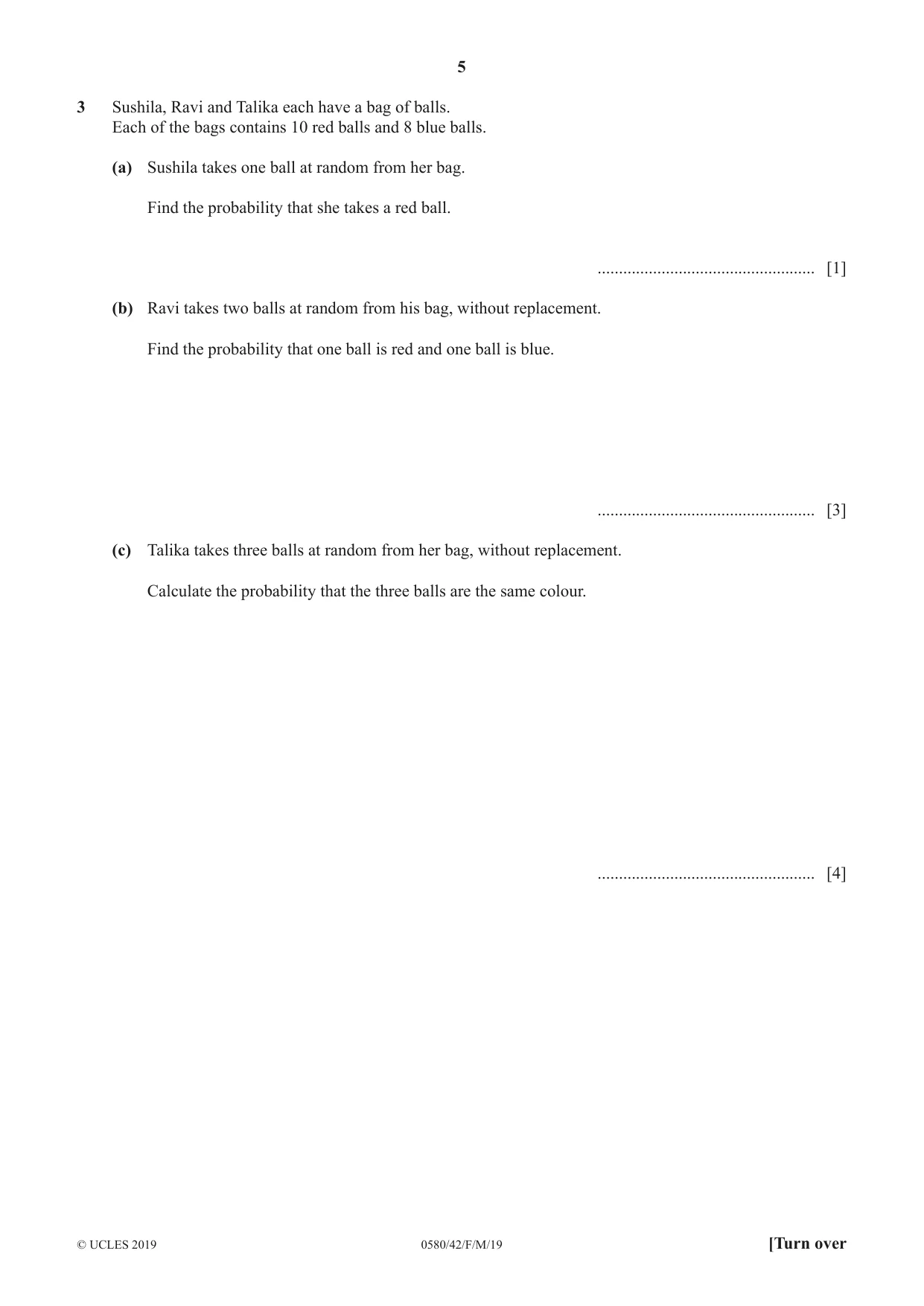
Q3 · Sushila, Ravi and Talika each have a bag of balls
3 Sushila, Ravi and Talika each have a bag of balls. Each of the bags contains 10 red balls and 8 blue balls. (a) Sushila takes one ball at random from her bag. Find the probability that she takes a red ball. ................................................... [1] (b) Ravi takes two balls at random from his bag, without replacement. Find the probability that one ball is red and one ball is blue. ................................................... [3] (c) Talika takes three balls at random from her bag, without replacement. Calculate the probability that the three balls are the same colour. ................................................... [4]
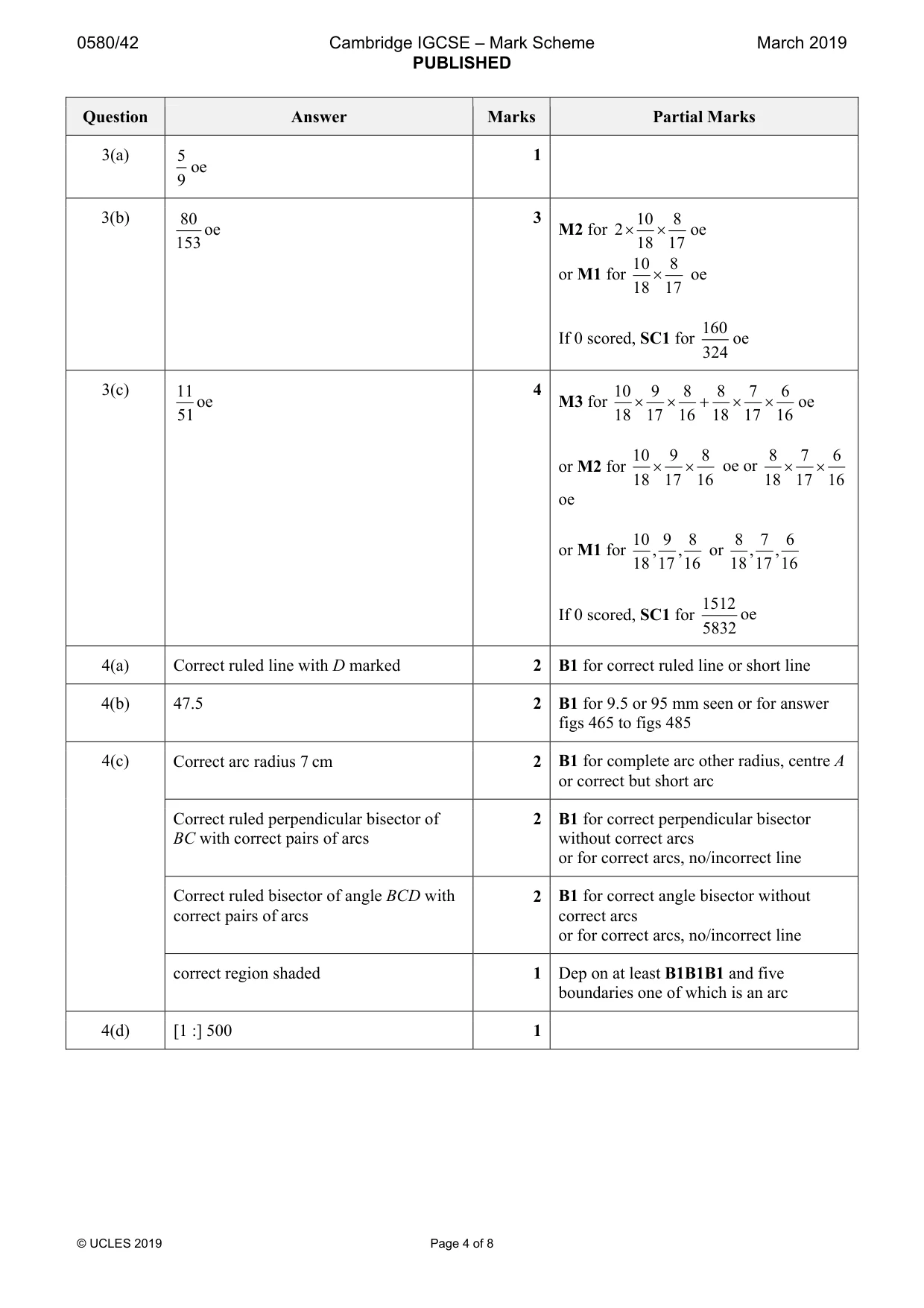
Mark scheme: 3(a) 5 1 oe 9 3(b) 80 3 10 8 oe M2 for 2 × × oe 153 18 17 10 8 or M1 for × oe 18 17 160 If 0 scored, SC1 for oe 324 3(c) 11 4 10 9 8 8 7 6 oe M3 for × × + × × oe 51 18 17 16 18 17 16 10 9 8 8 7 6 or M2 for × × oe or × × 18 17 16 18 17 16 oe 10 9 8 8 7 6 or M1 for , , or , , 18 17 16 18 17 16 1512 If 0 scored, SC1 for oe 5832
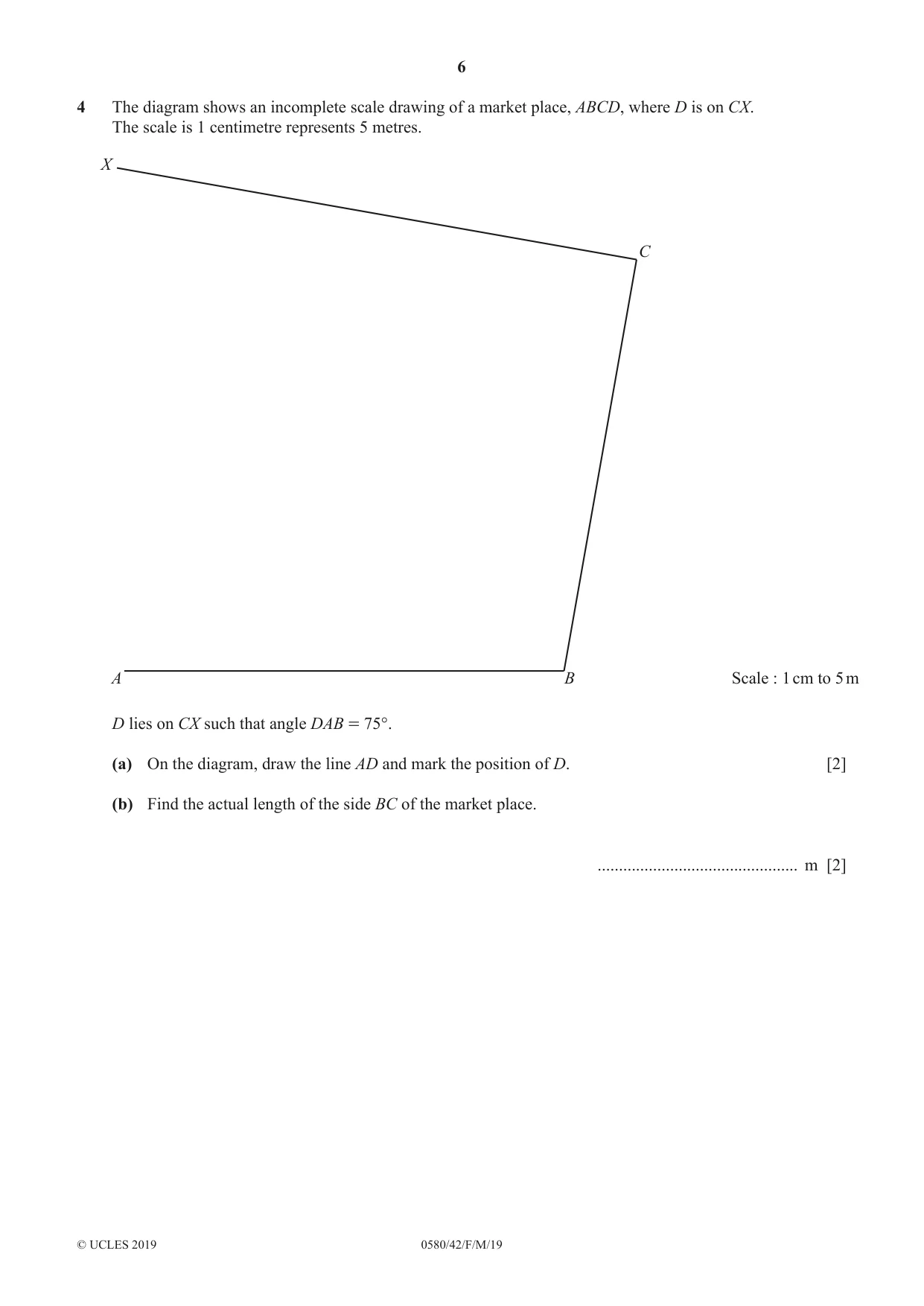
Q4 · The diagram shows an incomplete scale drawing of a market place, ABCD, where D is on CX
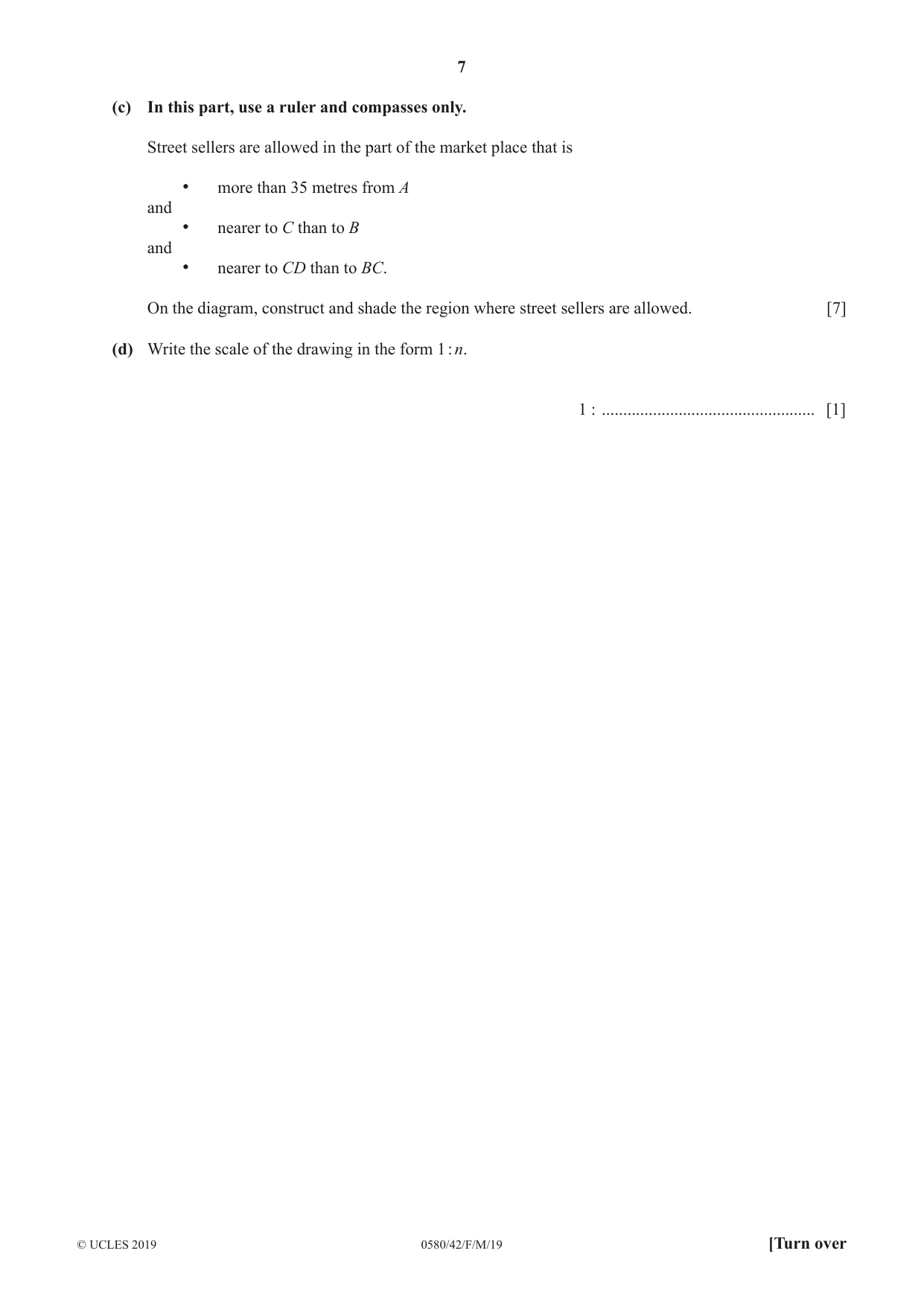
4 The diagram shows an incomplete scale drawing of a market place, ABCD, where D is on CX. The scale is 1 centimetre represents 5 metres. X C A B Scale : 1 cm to 5 m D lies on CX such that angle DAB = 75°. (a) On the diagram, draw the line AD and mark the position of D. [2] (b) Find the actual length of the side BC of the market place. ............................................... m [2] (c) In this part, use a ruler and compasses only. Street sellers are allowed in the part of the market place that is • more than 35 metres from A and • nearer to C than to B and • nearer to CD than to BC. On the diagram, construct and shade the region where street sellers are allowed. [7] (d) Write the scale of the drawing in the form 1 : n. 1 : .................................................. [1]
Mark scheme: 4(a) Correct ruled line with D marked 2 B1 for correct ruled line or short line 4(b) 47.5 2 B1 for 9.5 or 95 mm seen or for answer figs 465 to figs 485 4(c) Correct arc radius 7 cm 2 B1 for complete arc other radius, centre A or correct but short arc Correct ruled perpendicular bisector of 2 B1 for correct perpendicular bisector BC with correct pairs of arcs without correct arcs or for correct arcs, no/incorrect line Correct ruled bisector of angle BCD with 2 B1 for correct angle bisector without correct pairs of arcs correct arcs or for correct arcs, no/incorrect line correct region shaded 1 Dep on at least B1B1B1 and five boundaries one of which is an arc 4(d) [1 :] 500 1
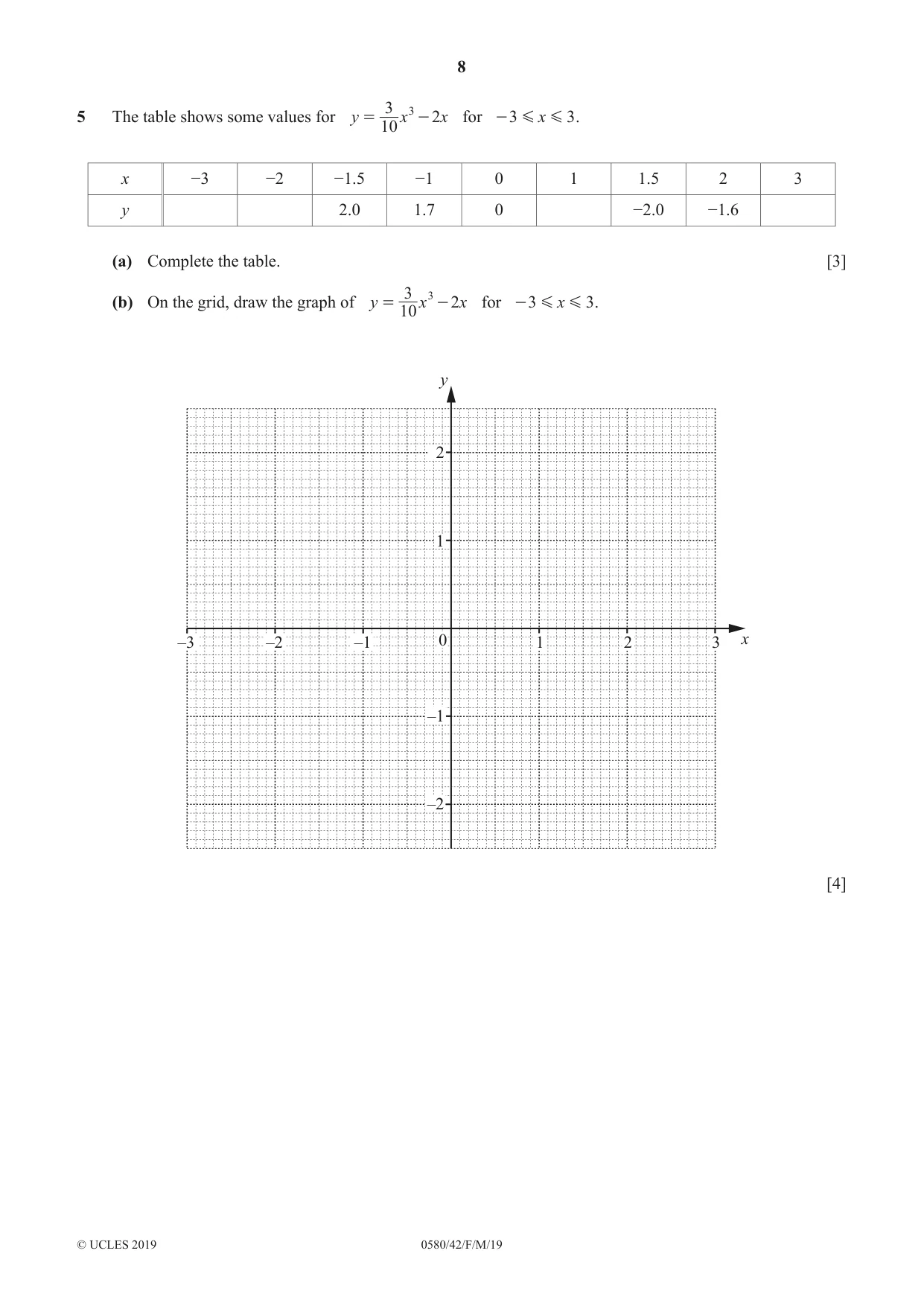
Q5 · 35 The table shows some values for y = x - 2x for - 3 G x G 3
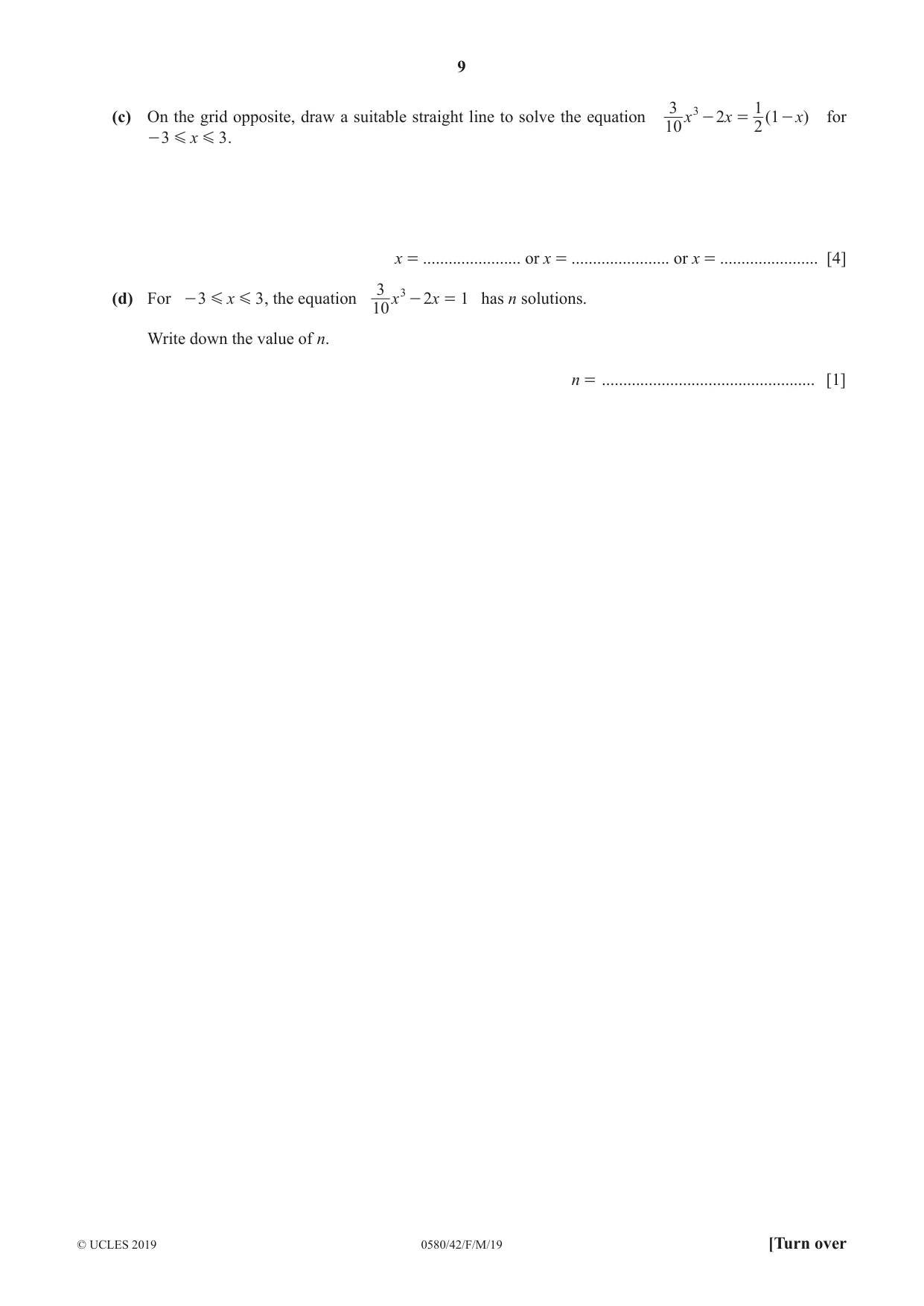
3 35 The table shows some values for y = x - 2x for - 3 G x G 3 . 10 x −3 −2 −1.5 −1 0 1 1.5 2 3 y 2.0 1.7 0 −2.0 −1.6 (a) Complete the table. [3] 3 3 (b) On the grid, draw the graph of y = x - 2x for - 3 G x G 3 . 10 y 2 1 –3 –2 –1 0 1 2 3 x –1 –2 [4] 3 3 1(c) On the grid opposite, draw a suitable straight line to solve the equation x - 2x = (1 - x) for 10 2 - 3 G x G 3 . x = ....................... or x = ....................... or x = ....................... [4] 3 3(d) For - 3 G x G 3 , the equation x - 2x = 1 has n solutions. 10 Write down the value of n. n = .................................................. [1]
Mark scheme: 5(a) −2.1, 1.6, −1.7, 2.1 3 B2 for 3 correct or B1 for 2 correct 5(b) Fully correct curve 4 B3FT for 8 or 9 correct plots or B2FT for 6 or 7 correct plots or B1FT for 4 or 5 correct plots 5(c) 1 M2 line y = (1 − x ) ruled M1 for line with gradient −1 2 2 1 1 M1 for line through (0, ) but not y = 2 2 −2.15 to −2.01 B2 B1 for two correct −0.45 to −0.2 2.25 to 2.45 5(d) number of intersections of their curve and 1 strict FT for their curve the line y = 1
Q6 · C B NOT TO SCALE 1.5 cm D E 0.25 cm A O 0.5 cm The diagram shows a company logo made from…
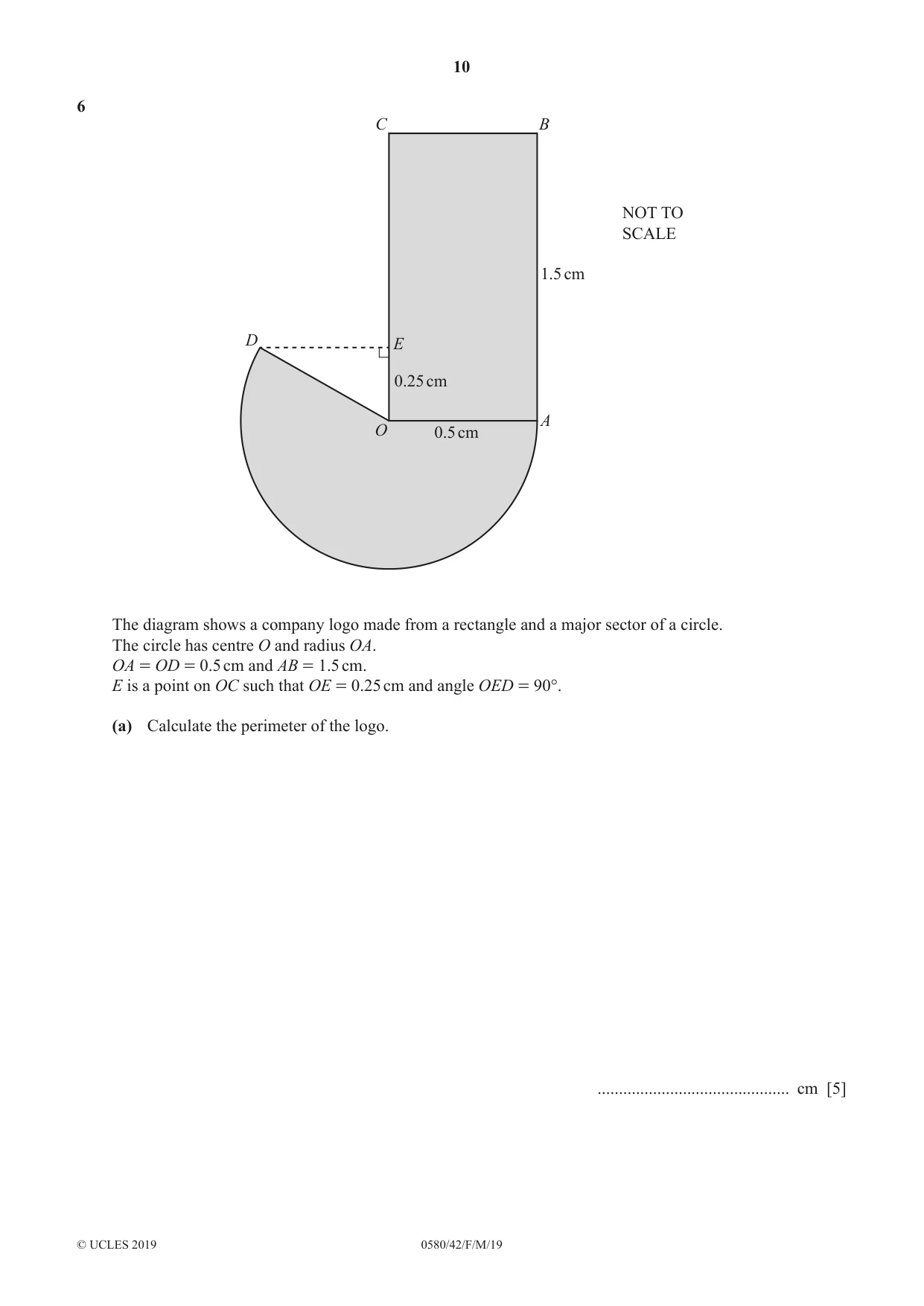
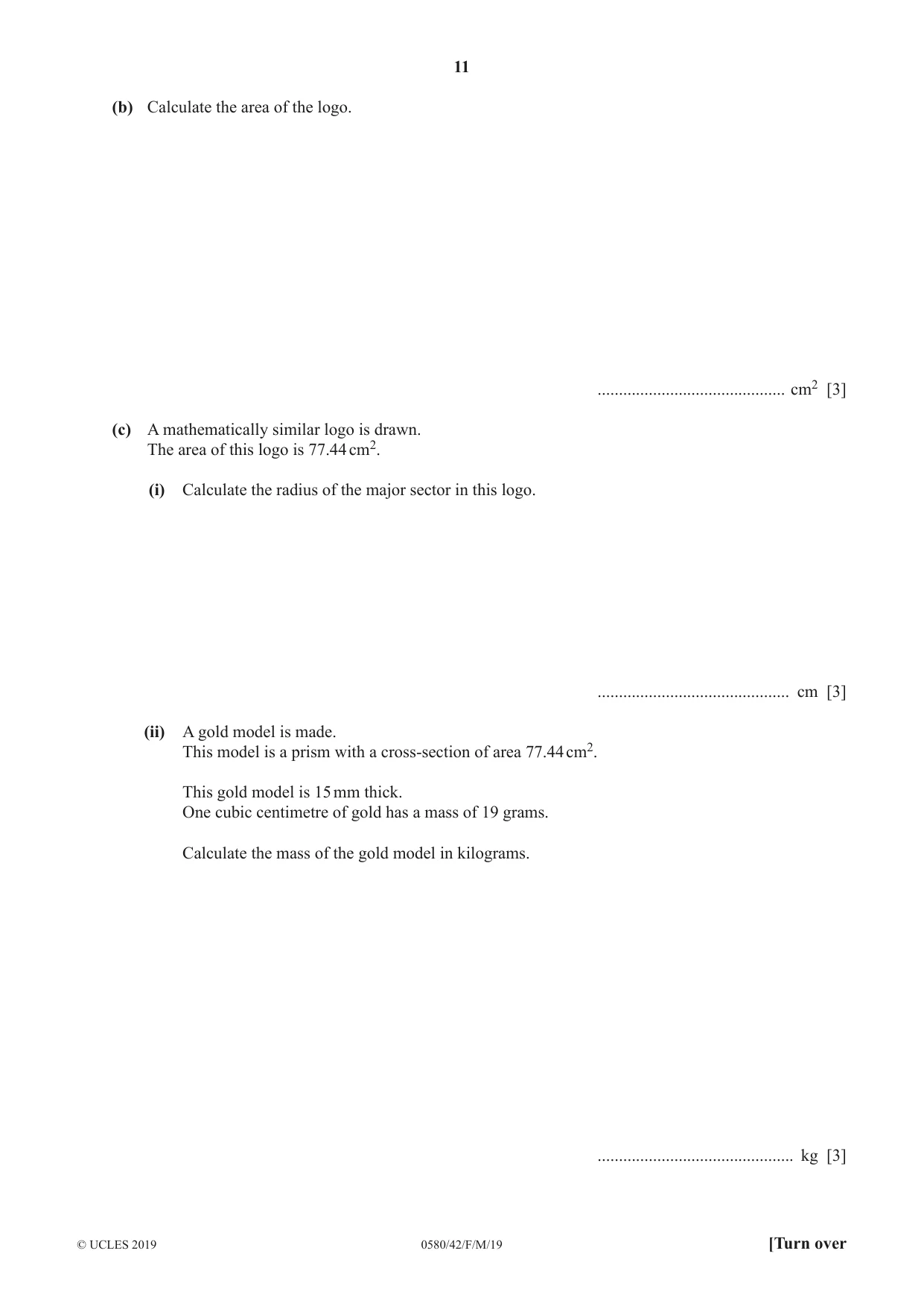
6 C B NOT TO SCALE 1.5 cm D E 0.25 cm A O 0.5 cm The diagram shows a company logo made from a rectangle and a major sector of a circle. The circle has centre O and radius OA. OA = OD = 0.5 cm and AB = 1.5 cm. E is a point on OC such that OE = 0.25 cm and angle OED = 90°. (a) Calculate the perimeter of the logo. ............................................. cm [5] (b) Calculate the area of the logo. ............................................ cm2 [3] (c) A mathematically similar logo is drawn. The area of this logo is 77.44 cm2. (i) Calculate the radius of the major sector in this logo. ............................................. cm [3] (ii) A gold model is made. This model is a prism with a cross-section of area 77.44 cm2. This gold model is 15 mm thick. One cubic centimetre of gold has a mass of 19 grams. Calculate the mass of the gold model in kilograms. .............................................. kg [3]
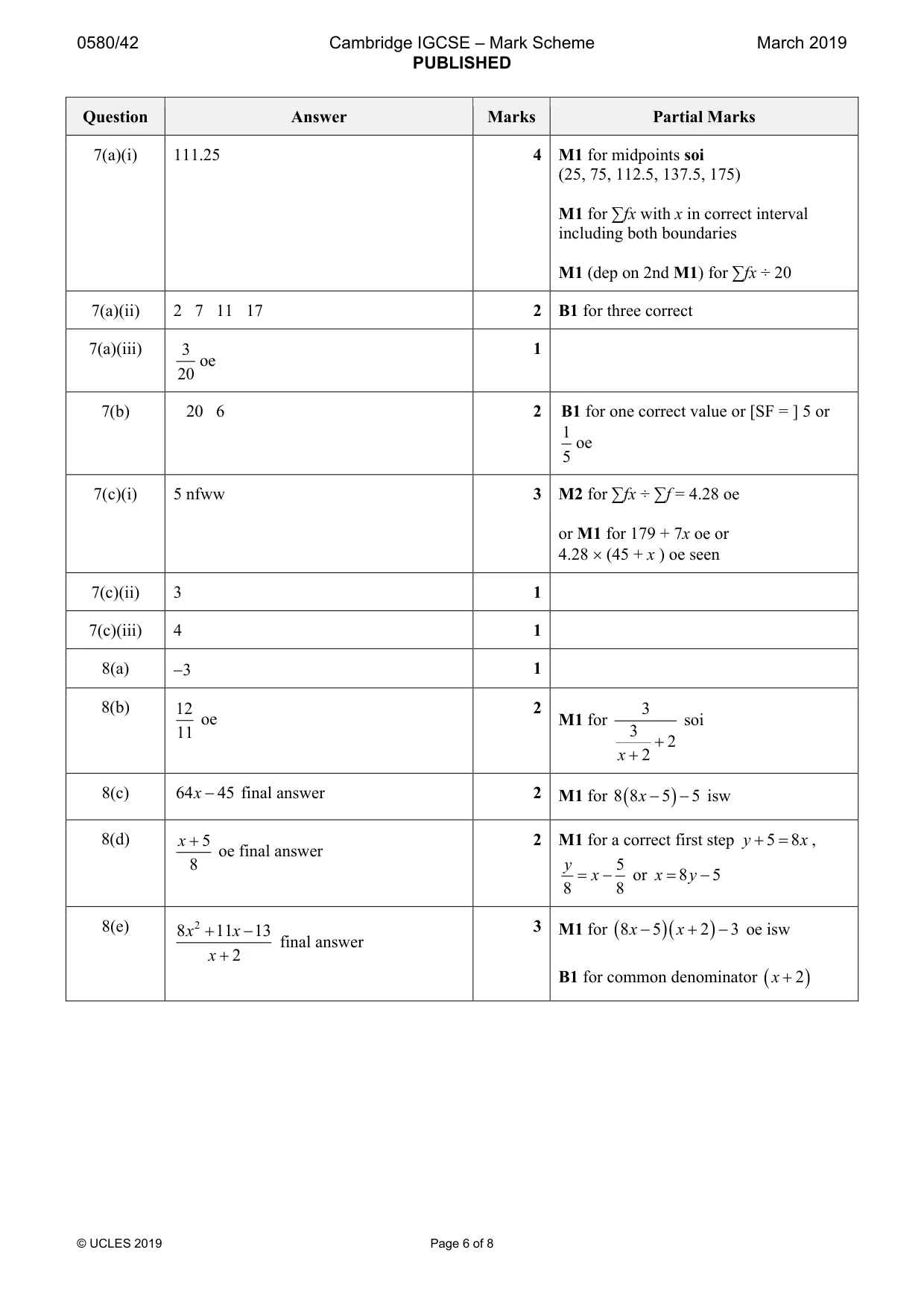
Mark scheme: 6(a) 5.83 or 5.832 to 5.833 5 B2 for sector angle = 210 soi 0.25 or M1 for [ cos DOE = ] oe 0.5 M2 for their 210 × 2 × π × 0.5 + 2 × 1.5 + 2 × 0.5 oe 360 their 210 or M1 for × 2 × π × 0.5 oe isw 360 6(b) 1.21 or 1.208… 3 their 210 M2 for × π × 0.5 × 0.5 + 1.5 × 0.5 360 oe their 210 or M1 for × π×0.5×0.5 oe isw 360 6(c)(i) 4[.00...] 3 77.44 M2 for 0.5× oe their (b) 77.44 their (b) or M1 for or their (b) 77.44 their (b) 0.5 2 or for = oe 77.44 r 2 6(c)(ii) 2.20704 3 M2 for 77.44 × 1.5 × 19 ÷ 1000 oe or M1 for figs 2207[04] or figs 221 seen or [vol =] 77.44 × 1.5
Q7 · 20 students each record the mass, p grams, of their pencil case
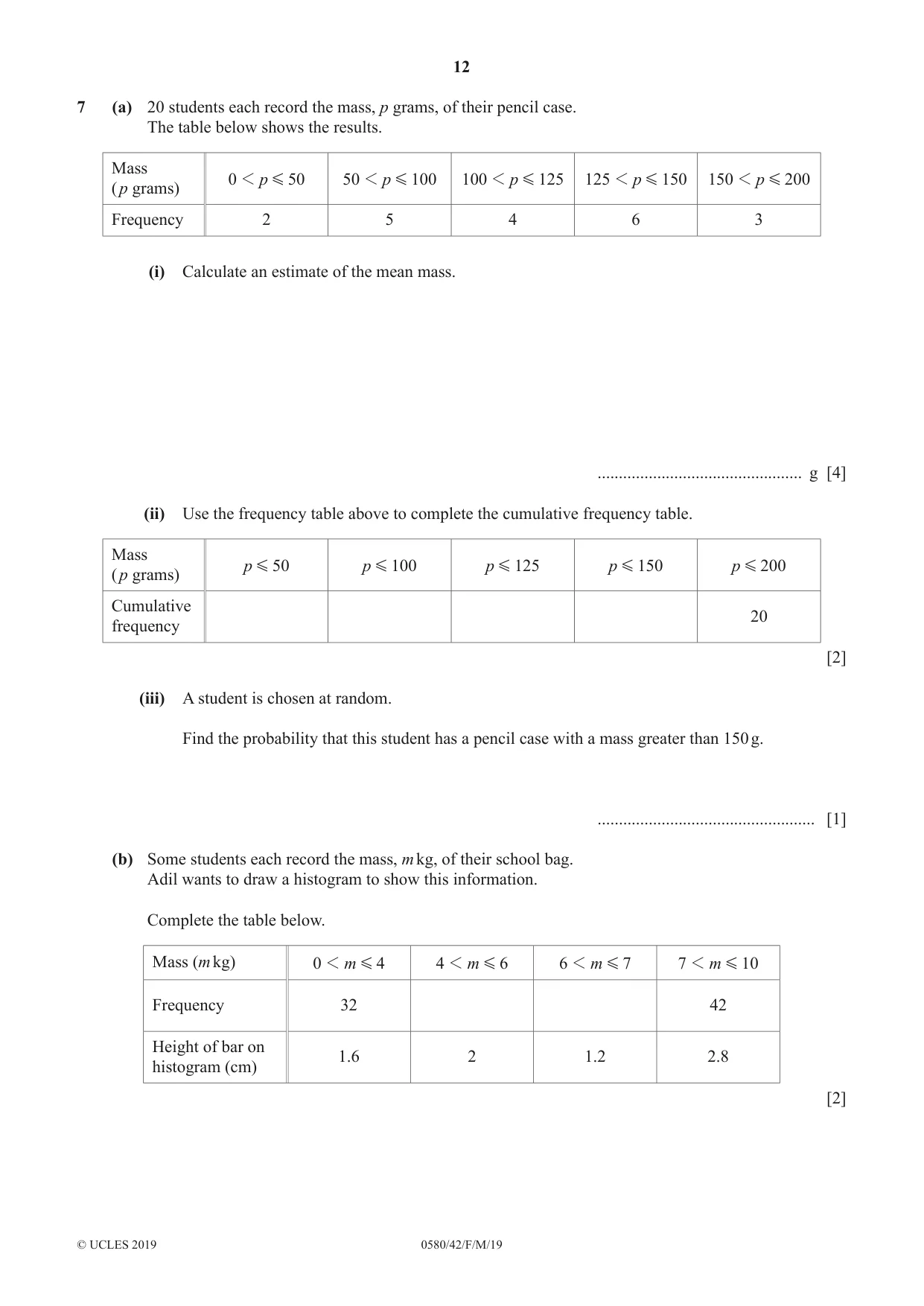
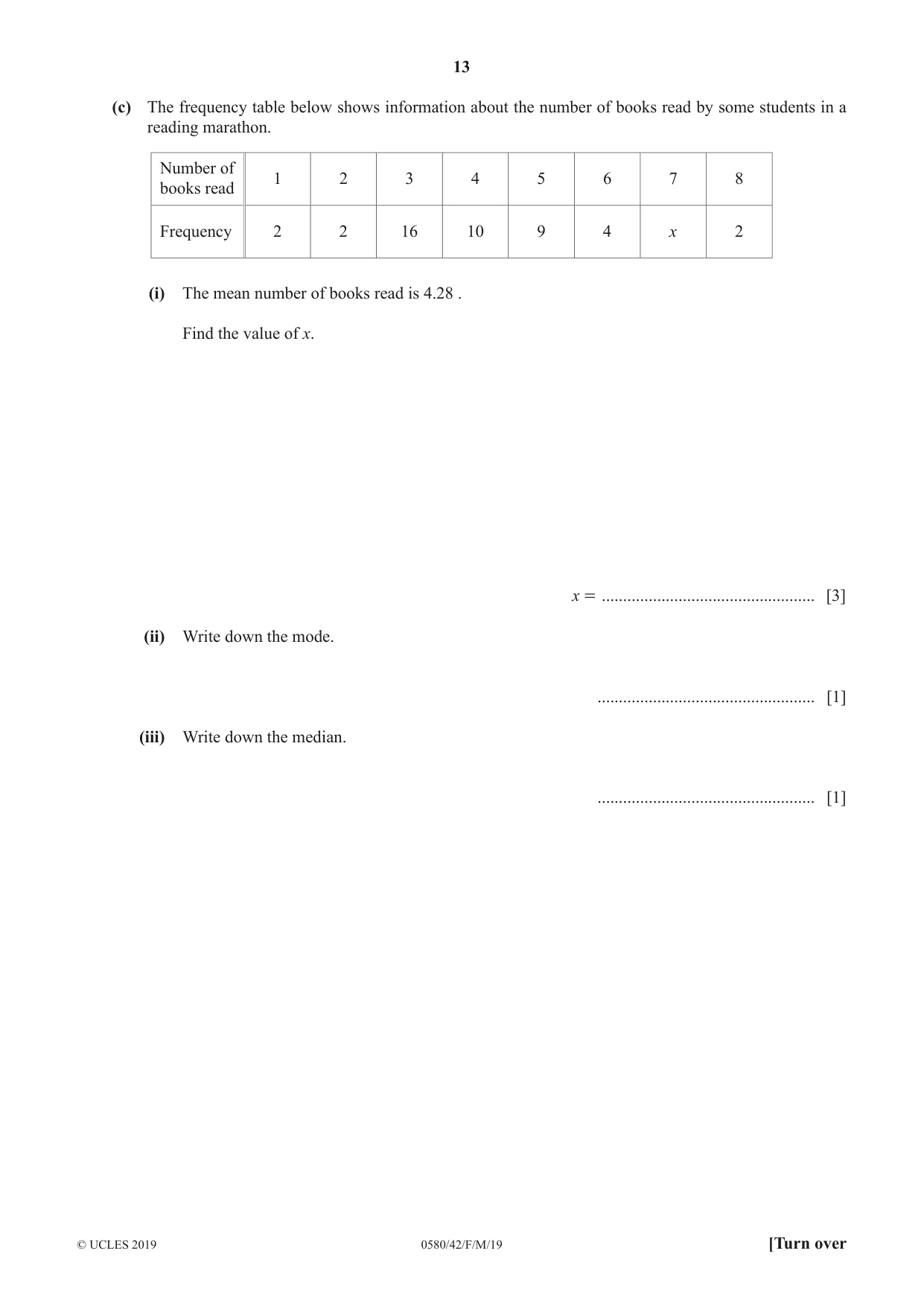
7 (a) 20 students each record the mass, p grams, of their pencil case. The table below shows the results. Mass 0 1 p G 50 50 1 p G 100 100 1 p G 125 125 1 p G 150 150 1 p G 200 ( p grams) Frequency 2 5 4 6 3 (i) Calculate an estimate of the mean mass. ................................................ g [4] (ii) Use the frequency table above to complete the cumulative frequency table. Mass p G 50 p G 100 p G 125 p G 150 p G 200 ( p grams) Cumulative 20 frequency [2] (iii) A student is chosen at random. Find the probability that this student has a pencil case with a mass greater than 150 g. ................................................... [1] (b) Some students each record the mass, m kg, of their school bag. Adil wants to draw a histogram to show this information. Complete the table below. Mass (m kg) 0 1 m G 4 4 1 m G 6 6 1 m G 7 7 1 m G 10 Frequency 32 42 Height of bar on 1.6 2 1.2 2.8 histogram (cm) [2] (c) The frequency table below shows information about the number of books read by some students in a reading marathon. Number of 1 2 3 4 5 6 7 8 books read Frequency 2 2 16 10 9 4 x 2 (i) The mean number of books read is 4.28 . Find the value of x. x = .................................................. [3] (ii) Write down the mode. ................................................... [1] (iii) Write down the median. ................................................... [1]
Mark scheme: 7(a)(i) 111.25 4 M1 for midpoints soi (25, 75, 112.5, 137.5, 175) M1 for ∑fx with x in correct interval including both boundaries M1 (dep on 2nd M1) for ∑fx ÷ 20 7(a)(ii) 2 7 11 17 2 B1 for three correct 7(a)(iii) 3 1 oe 20 7(b) 20 6 2 B1 for one correct value or [SF = ] 5 or 1 oe 5 7(c)(i) 5 nfww 3 M2 for ∑fx ÷ ∑f = 4.28 oe or M1 for 179 + 7x oe or 4.28 × (45 + x ) oe seen 7(c)(ii) 3 1 7(c)(iii) 4 1
Q8 · 28 f (x) = , x !
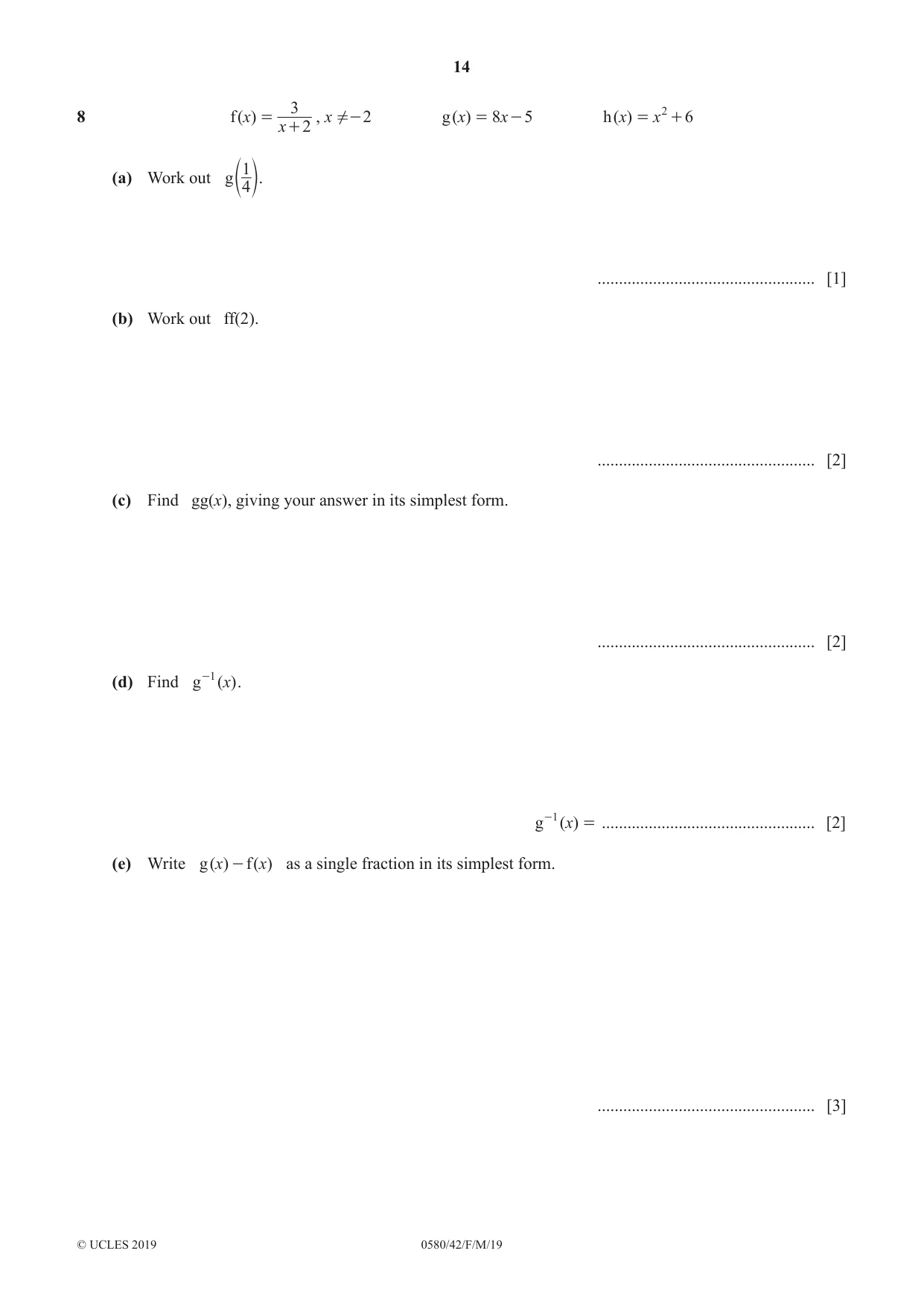
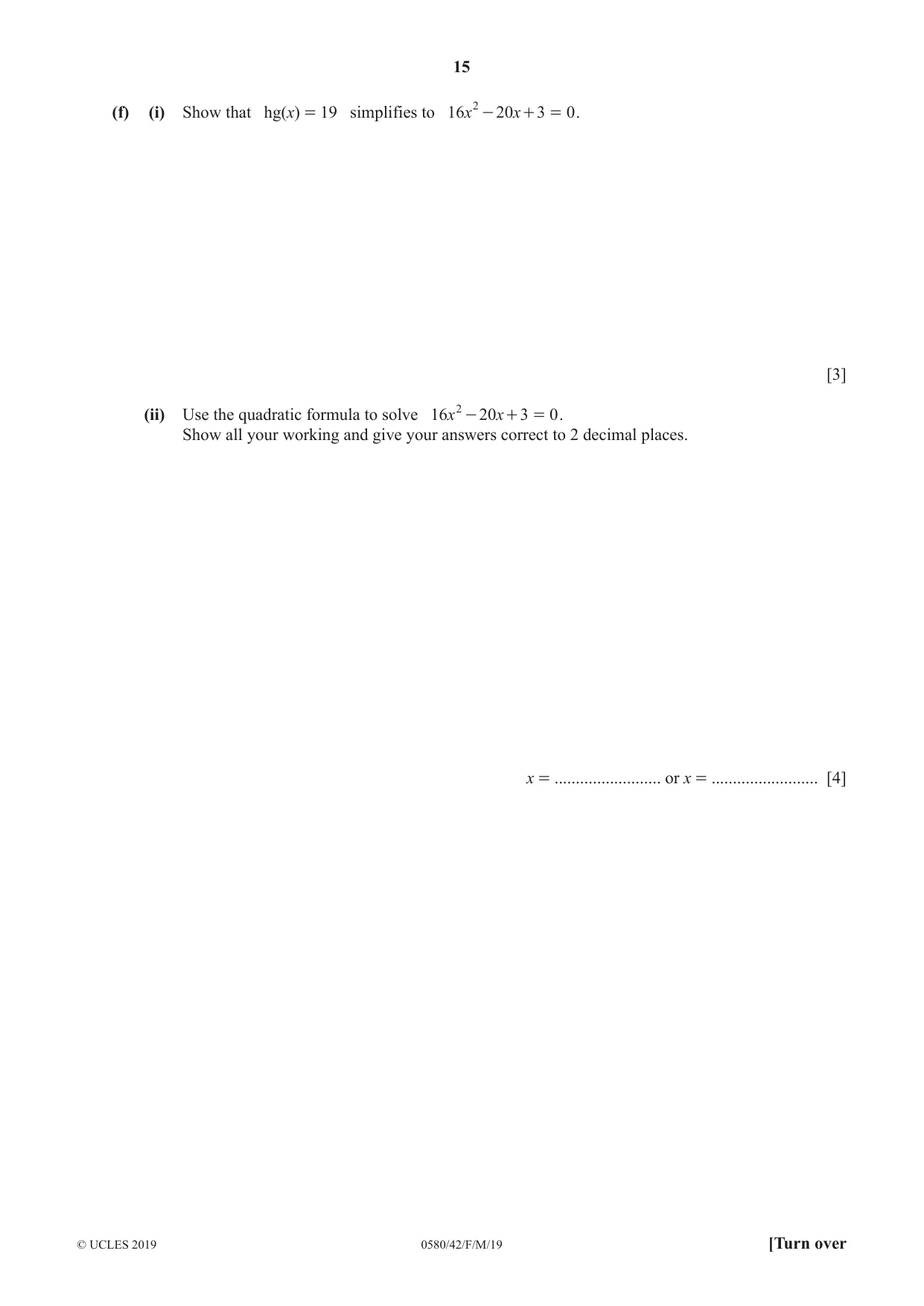
3 28 f (x) = , x ! - 2 g (x) = 8x - 5 h (x) = x + 6 x + 2 1 (a) Work out g e 4 o. ................................................... [1] (b) Work out ff(2). ................................................... [2] (c) Find gg(x), giving your answer in its simplest form. ................................................... [2] (d) Find g -1 (x) . g -1 ( x) = .................................................. [2] (e) Write g (x) - f (x) as a single fraction in its simplest form. ................................................... [3] (f) (i) Show that hg(x) = 19 simplifies to 16x 2 - 20x + 3 = 0 . [3] (ii) Use the quadratic formula to solve 16x 2 - 20x + 3 = 0 . Show all your working and give your answers correct to 2 decimal places. x = ......................... or x = ......................... [4]
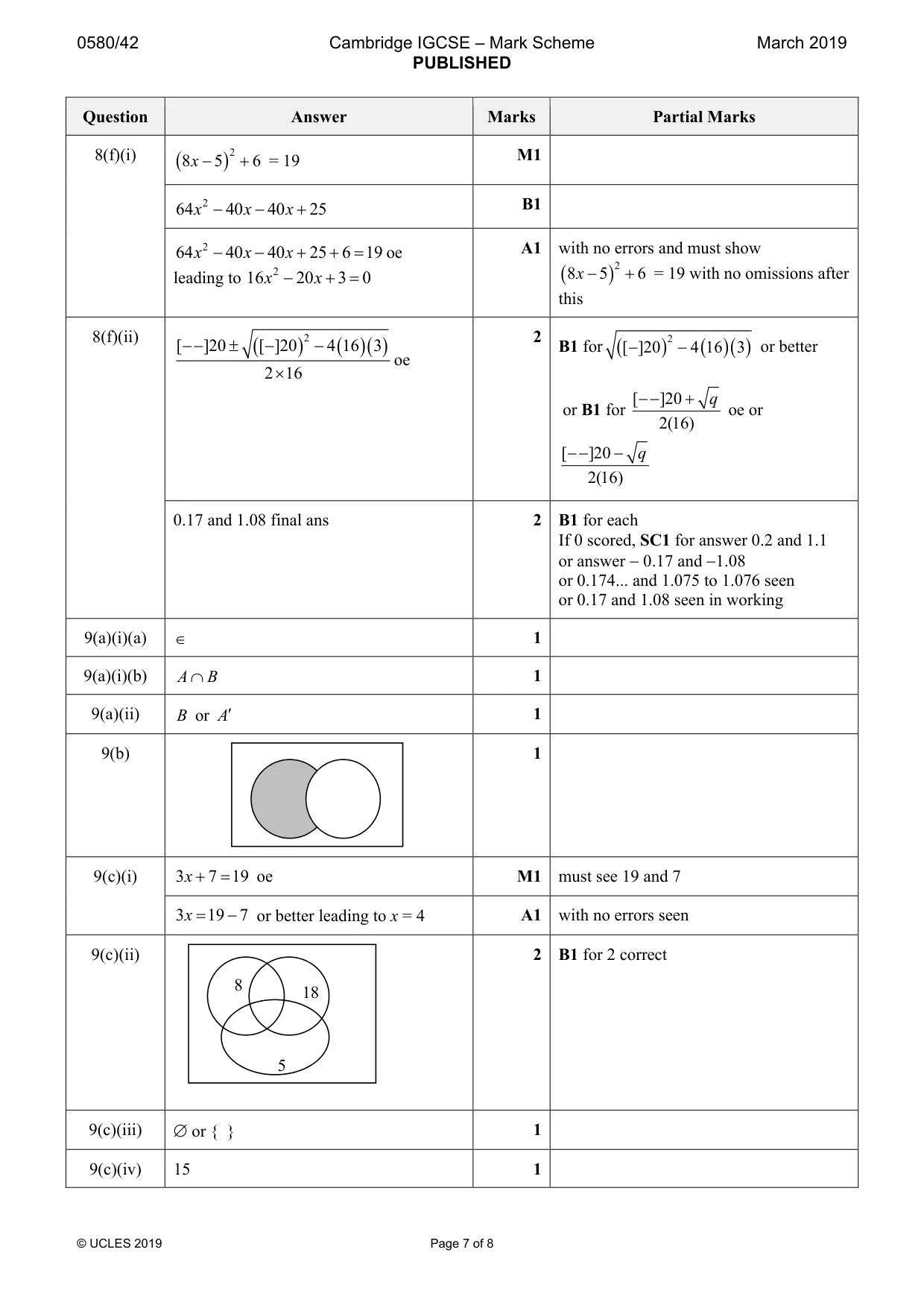
Mark scheme: 8(a) −3 1 8(b) 12 2 3 oe M1 for soi 11 3 + 2 x + 2 8(c) 64 x − 45 final answer 2 M1 for 8 ( 8 x − 5 ) − 5 isw 8(d) x + 5 2 M1 for a correct first step y + 5 = 8 x , oe final answer 8 y 5 = x − or x = 8 y − 5 8 8 8(e) 8 x 2 + 11x − 13 3 M1 for ( 8 x − 5 )( x + 2 ) − 3 oe isw final answer x + 2 B1 for common denominator ( x + 2 ) 8(f)(i) ( 8 x − 5 ) 2 + 6 = 19 M1 64 x 2 − 40 x − 40 x + 25 B1 64 x 2 − 40 x − 40 x + 25 + 6 = 19 oe A1 with no errors and must show 2 leading to 16 x 2 − 20 x + 3 = 0 ( 8 x − 5 ) + 6 = 19 with no omissions after this 8(f)(ii) 2 2 2 [ −− ]20 ± ( [ − ]20 ) − 4 (16 )( 3 ) B1 for ( [ − ]20 ) − 4 (16 )( 3 ) or better oe 2 × 16 [ −− ]20 + q or B1 for oe or 2(16) [ −− ]20 − q 2(16) 0.17 and 1.08 final ans 2 B1 for each If 0 scored, SC1 for answer 0.2 and 1.1 or answer − 0.17 and −1.08 or 0.174... and 1.075 to 1.076 seen or 0.17 and 1.08 seen in working
Q9 · The Venn diagram shows two sets, A and B
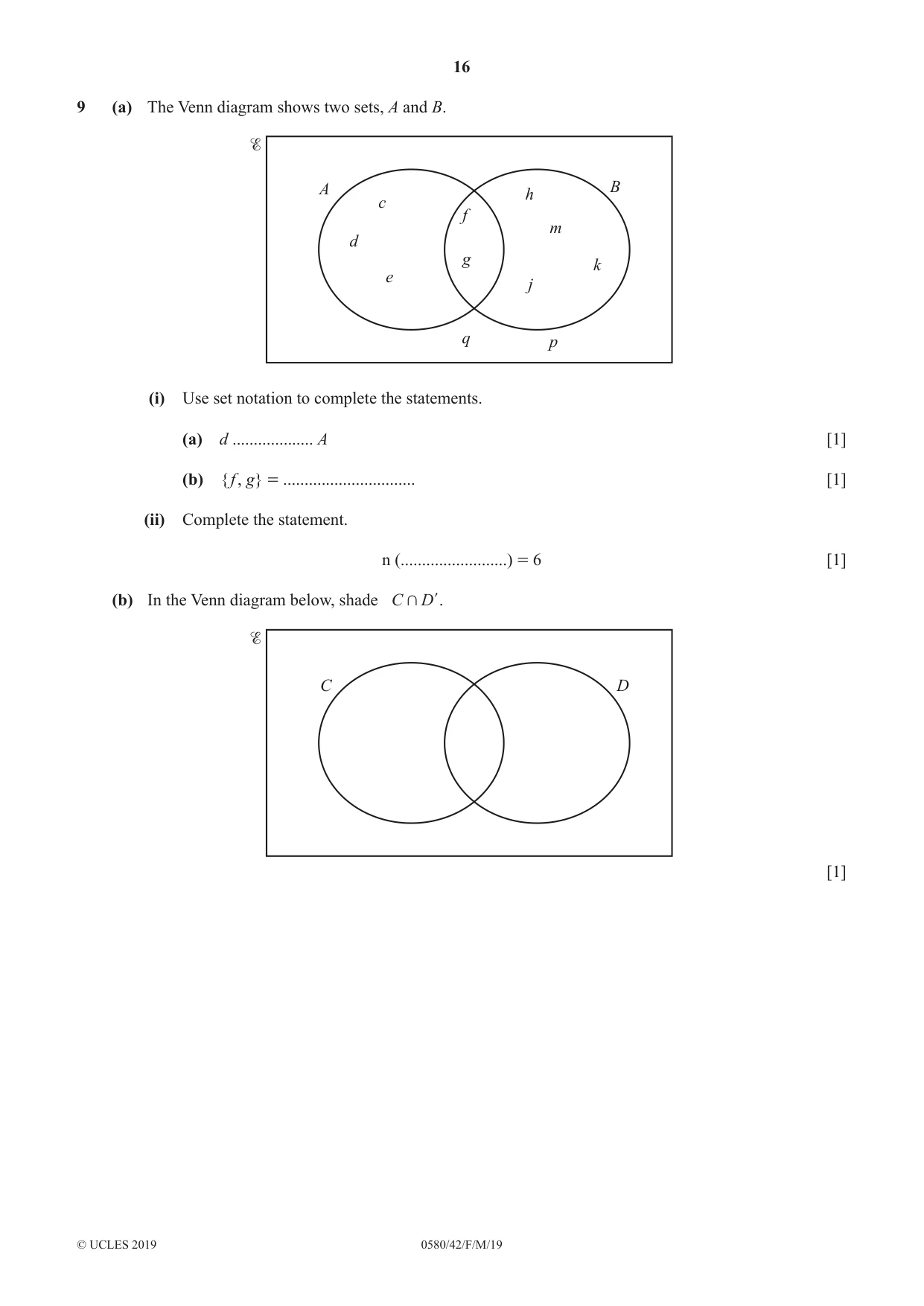
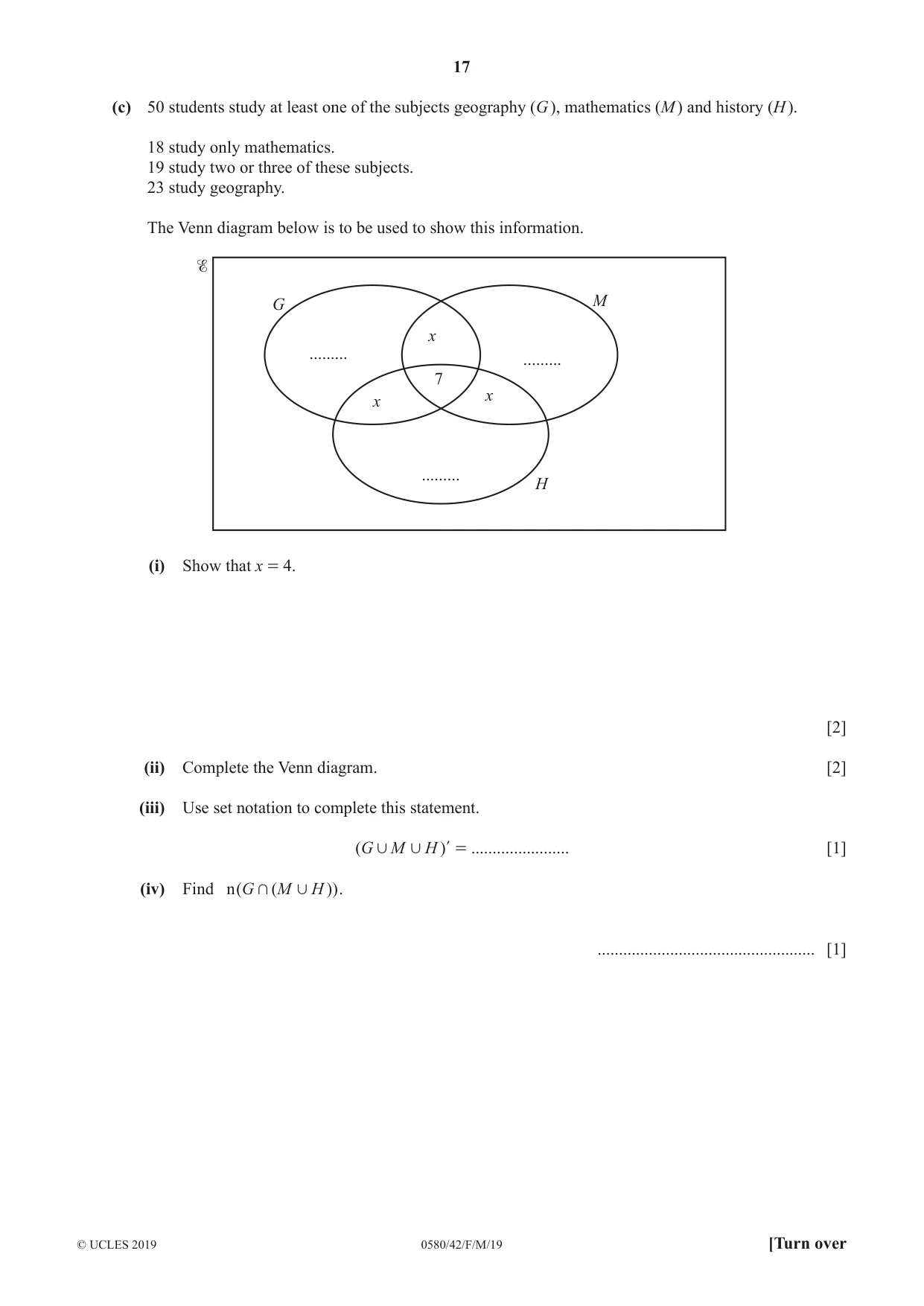
9 (a) The Venn diagram shows two sets, A and B. A B h c f m d g k e j q p (i) Use set notation to complete the statements. (a) d ................... A [1] (b) { f , g} = ............................... [1] (ii) Complete the statement. n (.........................) = 6 [1] (b) In the Venn diagram below, shade C + D l. C D [1] (c) 50 students study at least one of the subjects geography (G ), mathematics (M ) and history (H ). 18 study only mathematics. 19 study two or three of these subjects. 23 study geography. The Venn diagram below is to be used to show this information. G M x ......... ......... 7 x x ......... H (i) Show that x = 4. [2] (ii) Complete the Venn diagram. [2] (iii) Use set notation to complete this statement. (G , M , H ) l = ....................... [1] (iv) Find n(G + (M , H )) . ................................................... [1]
Mark scheme: 9(a)(i)(a) ∈ 1 9(a)(i)(b) A ∩ B 1 9(a)(ii) B or A′ 1 9(b) 1 9(c)(i) 3 x + 7 = 19 oe M1 must see 19 and 7 3 x = 19 − 7 or better leading to x = 4 A1 with no errors seen 9(c)(ii) 2 B1 for 2 correct 8 18 5 9(c)(iii) ∅ or { } 1 9(c)(iv) 15 1
Q10 · Solve the simultaneous equations
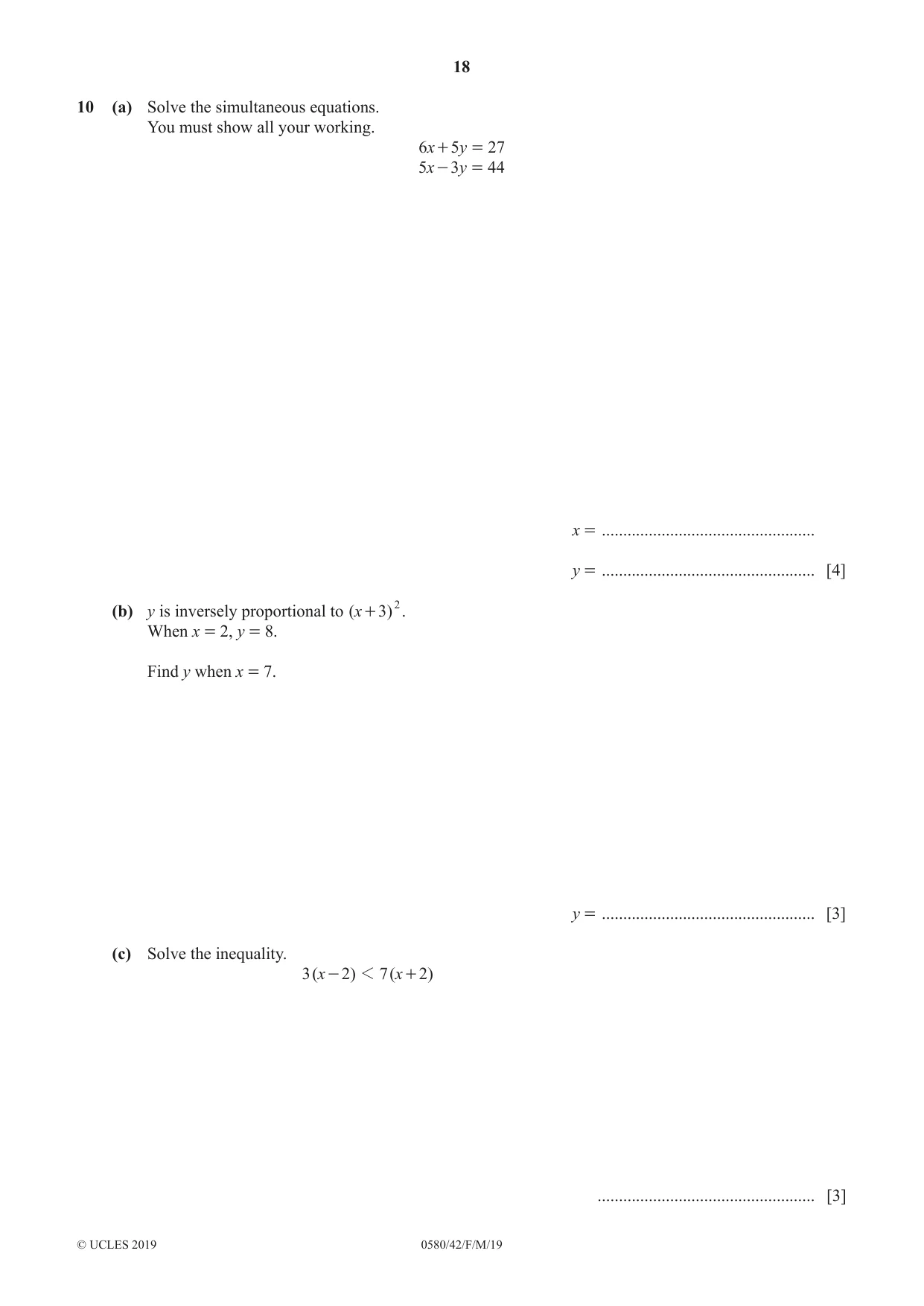
10 (a) Solve the simultaneous equations. You must show all your working. 6x + 5y = 27 5x - 3y = 44 x = .................................................. y = .................................................. [4] (b) y is inversely proportional to (x + 3) 2 . When x = 2, y = 8. Find y when x = 7. y = .................................................. [3] (c) Solve the inequality. 3 (x - 2) 1 7 (x + 2) ................................................... [3]
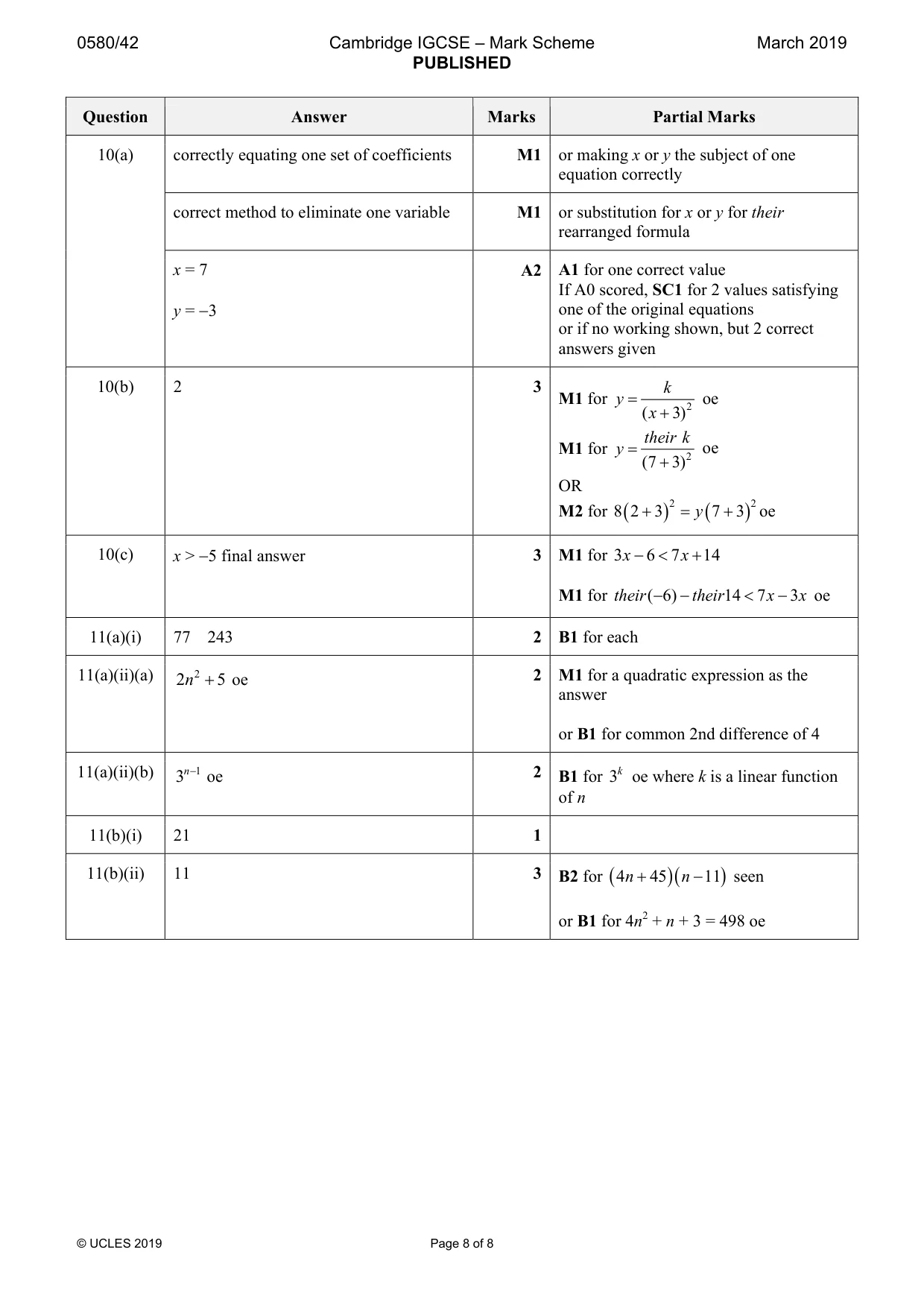
Mark scheme: 10(a) correctly equating one set of coefficients M1 or making x or y the subject of one equation correctly correct method to eliminate one variable M1 or substitution for x or y for their rearranged formula x = 7 A2 A1 for one correct value If A0 scored, SC1 for 2 values satisfying y = −3 one of the original equations or if no working shown, but 2 correct answers given 10(b) 2 3 k M1 for y = oe ( x + 3) 2 their k M1 for y = oe (7 + 3) 2 OR M2 for 8 ( 2 + 3 ) 2 = y ( 7 + 3 ) 2 oe 10(c) x > −5 final answer 3 M1 for 3 x − 6 < 7 x + 14 M1 for their ( −6) − their14 < 7 x − 3 x oe
Q11 · The table shows the first five terms of sequence A and sequence B
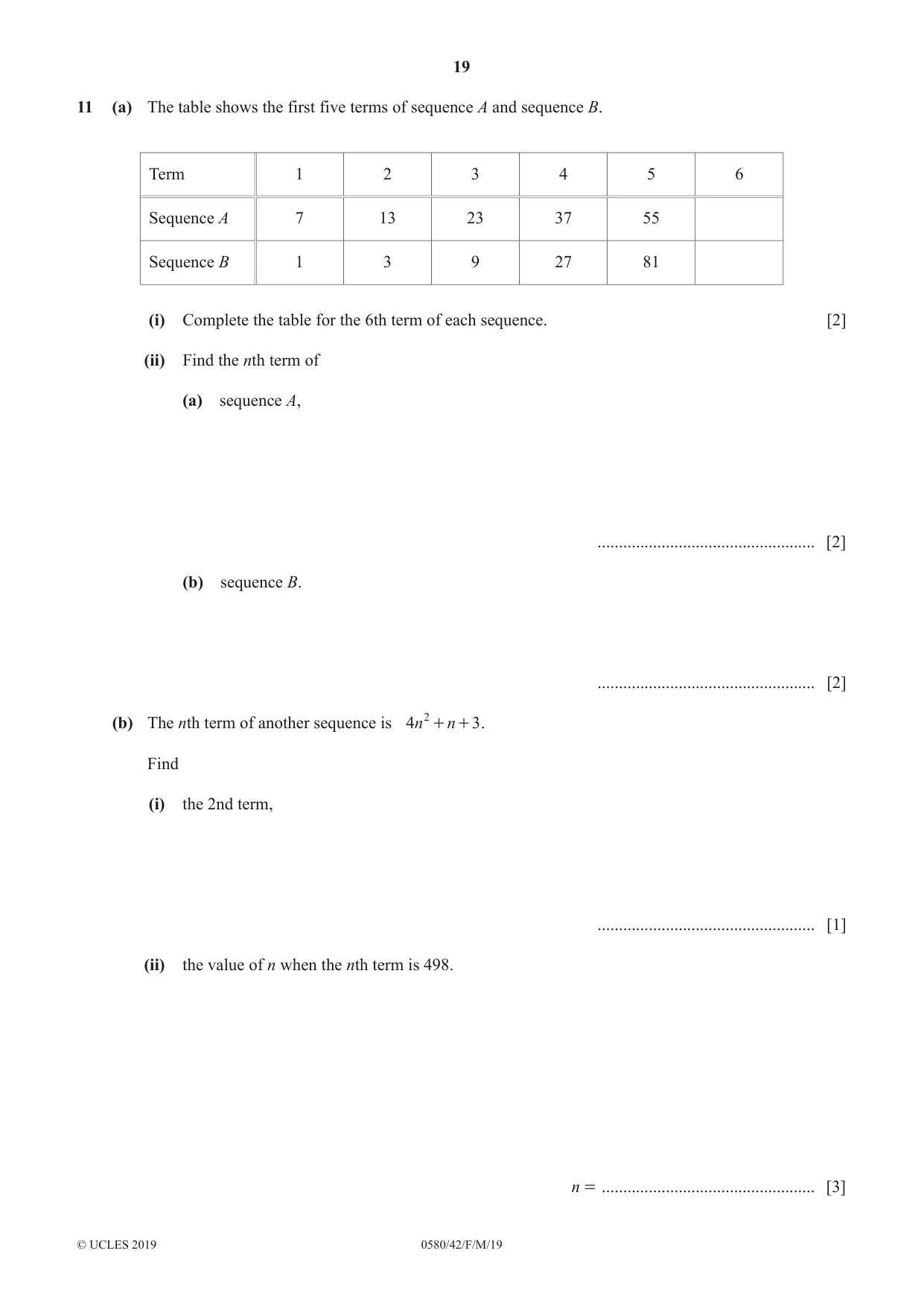
11 (a) The table shows the first five terms of sequence A and sequence B. Term 1 2 3 4 5 6 Sequence A 7 13 23 37 55 Sequence B 1 3 9 27 81 (i) Complete the table for the 6th term of each sequence. [2] (ii) Find the nth term of (a) sequence A, ................................................... [2] (b) sequence B. ................................................... [2] (b) The nth term of another sequence is 4n 2 + n + 3 . Find (i) the 2nd term, ................................................... [1] (ii) the value of n when the nth term is 498. n = .................................................. [3]
Mark scheme: 11(a)(i) 77 243 2 B1 for each 11(a)(ii)(a) 2 n 2 + 5 oe 2 M1 for a quadratic expression as the answer or B1 for common 2nd difference of 4 11(a)(ii)(b) 3n −1 oe 2 B1 for 3k oe where k is a linear function of n 11(b)(i) 21 1 11(b)(ii) 11 3 B2 for ( 4 n + 45 )( n − 11) seen or B1 for 4n2 + n + 3 = 498 oe
What was in this paper
The subtopics covered by these 11 questions, and how many questions each got. Open one in a new tab to see every Cambridge question on it.
What you needed in this session
Cambridge’s own grade thresholds for 2019 Feb/March, Paper 4 · Variant 2. A higher threshold means an easier paper — the bar moves with how the cohort did.