Cambridge IGCSE Mathematics 0580 — 2025 Oct/Nov Paper 4 · Variant 3
0580/43/O/N/25 · 26 questions · 100 marks · 120 min
The question paper and its mark scheme, free to read here and free to download. This is Cambridge’s own paper, exactly as it was sat.
Question paper20 pages
Mark scheme10 pages
Answers below. Sit the paper first if you are practising.
Questions as text
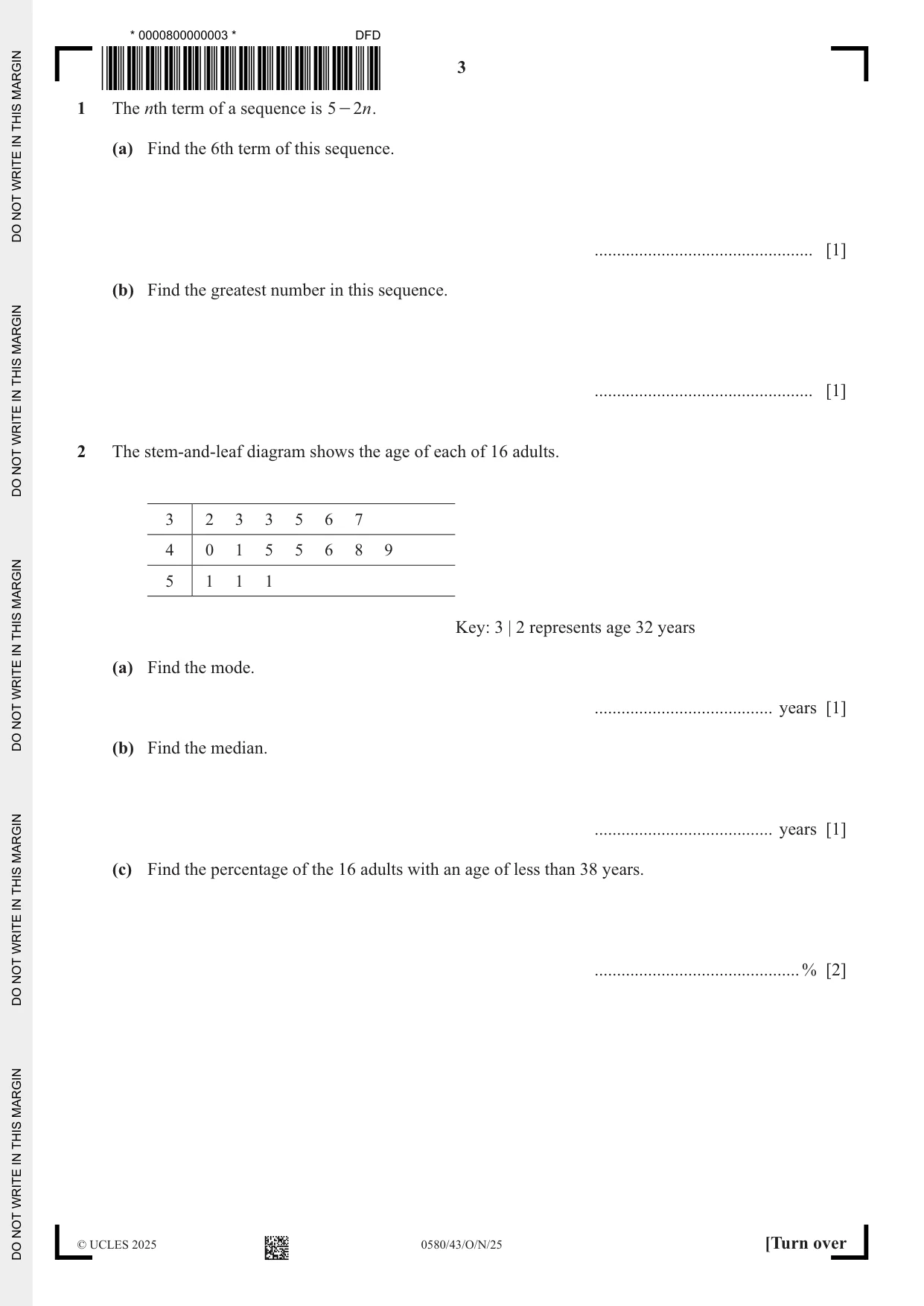
Q1 · The nth term of a sequence is 5 - 2n
1 The nth term of a sequence is 5 - 2n . (a) Find the 6th term of this sequence. ................................................. [1] (b) Find the greatest number in this sequence. ................................................. [1]
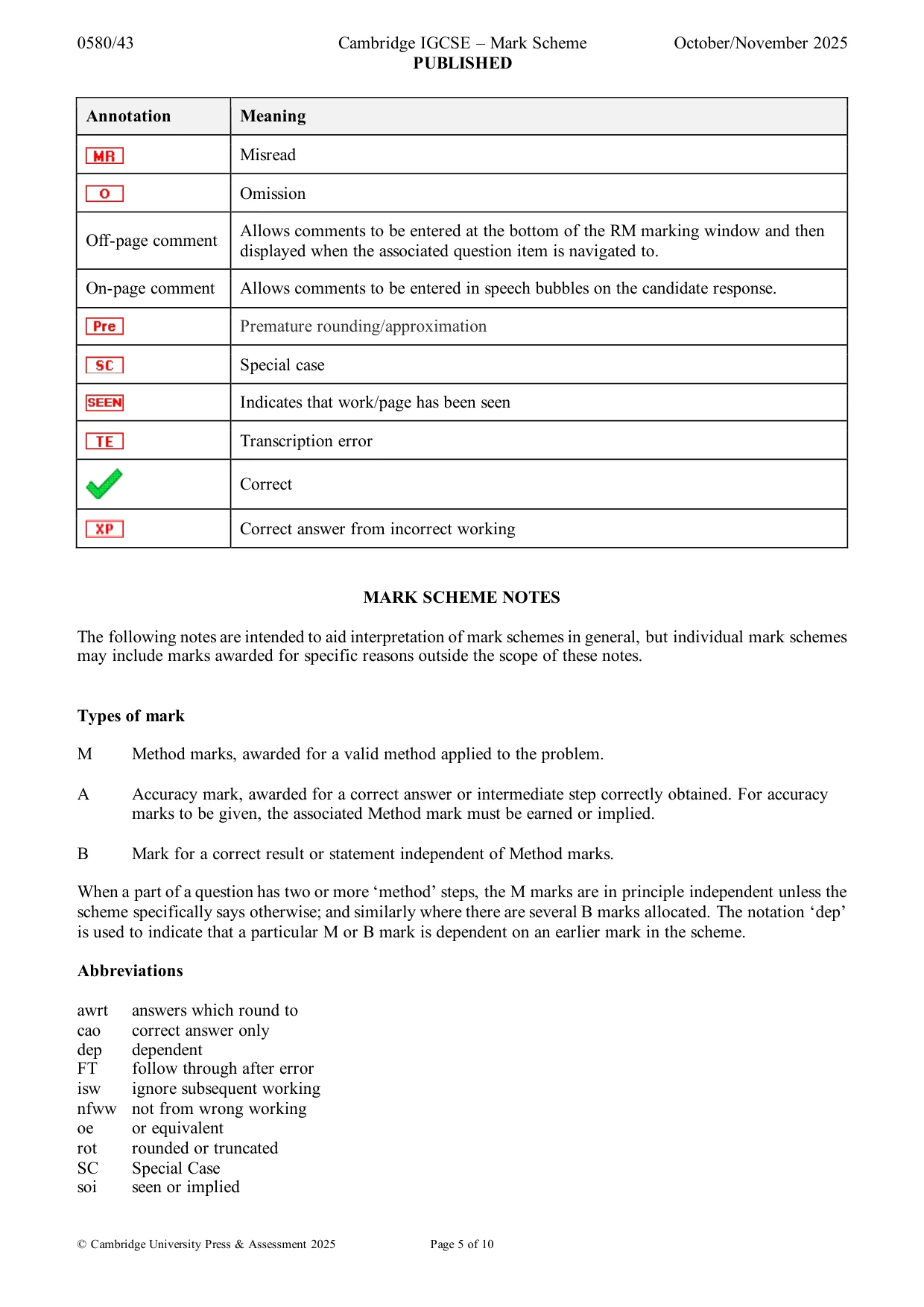
Mark scheme: Question Answer Marks Partial Marks 1(a) –7 1 1(b) 3 1
Q2 · The stem-and-leaf diagram shows the age of each of 16 adults
2 The stem-and-leaf diagram shows the age of each of 16 adults. 3 2 3 3 5 6 7 4 0 1 5 5 6 8 9 5 1 1 1 Key: 3 | 2 represents age 32 years (a) Find the mode. ........................................ years [1] (b) Find the median. ........................................ years [1] (c) Find the percentage of the 16 adults with an age of less than 38 years. ..............................................% [2]
Mark scheme: 2(a) 51 1 2(b) 43 1 2(c) 37.5 2 6 M1 for oe 16
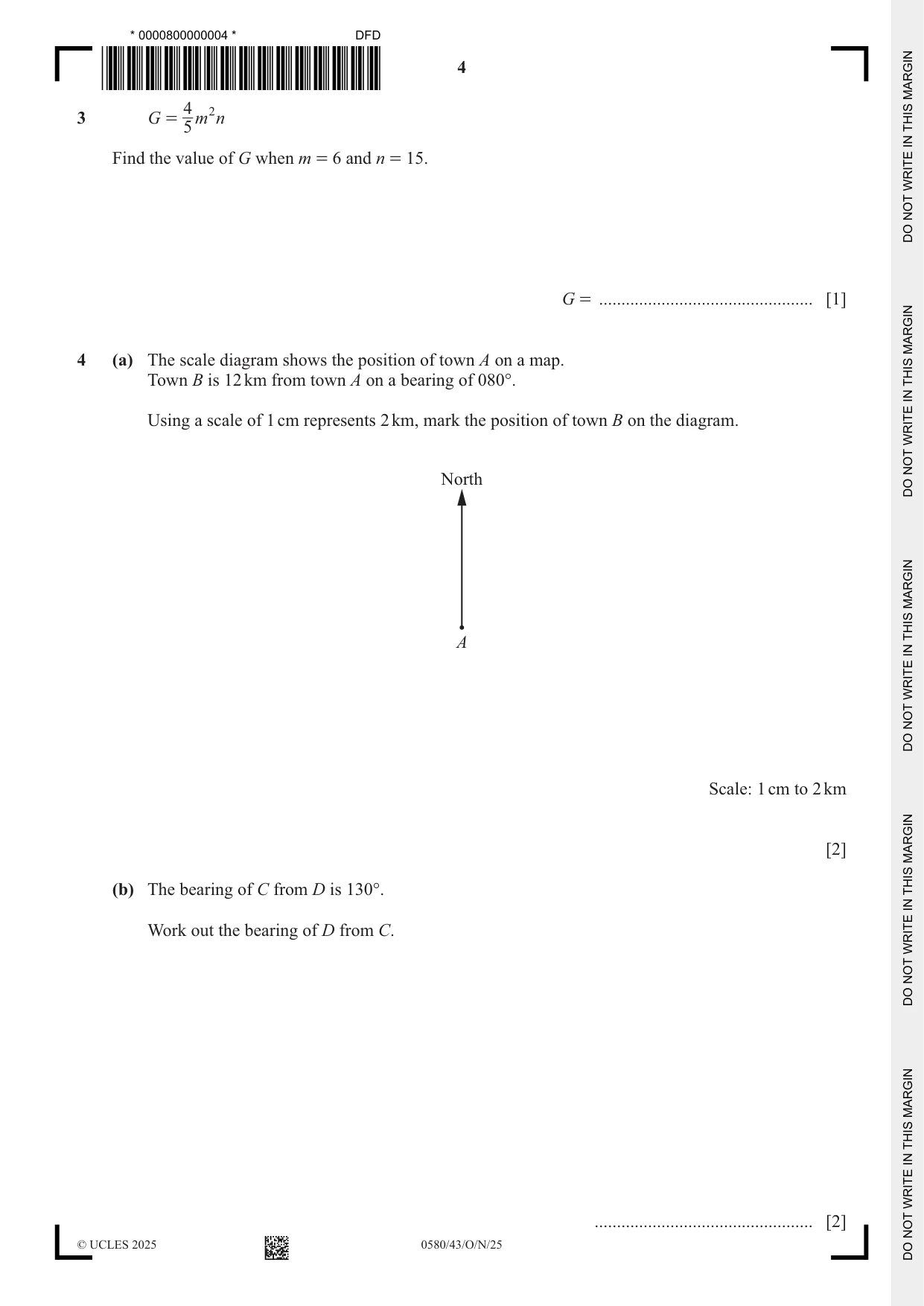
Q3 · 2 3 G = m n 5 Find the value of G when m = 6 and n = 15
4 2 3 G = m n 5 Find the value of G when m = 6 and n = 15. G = ................................................ [1]
Mark scheme: 3 432 1
Q4 · The scale diagram shows the position of town A on a map
4 (a) The scale diagram shows the position of town A on a map. Town B is 12 km from town A on a bearing of 080°. Using a scale of 1 cm represents 2 km, mark the position of town B on the diagram. North A Scale: 1 cm to 2 km [2] (b) The bearing of C from D is 130°. Work out the bearing of D from C. ................................................. [2]
Mark scheme: 4(a) B marked 6 cm from A on a bearing of 2 M1 for a correct bearing of 080° but 080°. incorrect length or for a 6 cm line from A 4(b) 310 2 M1 for 180 + 130 oe or indicates required bearing on a sketch
Q5 · The diagram shows a regular decagon
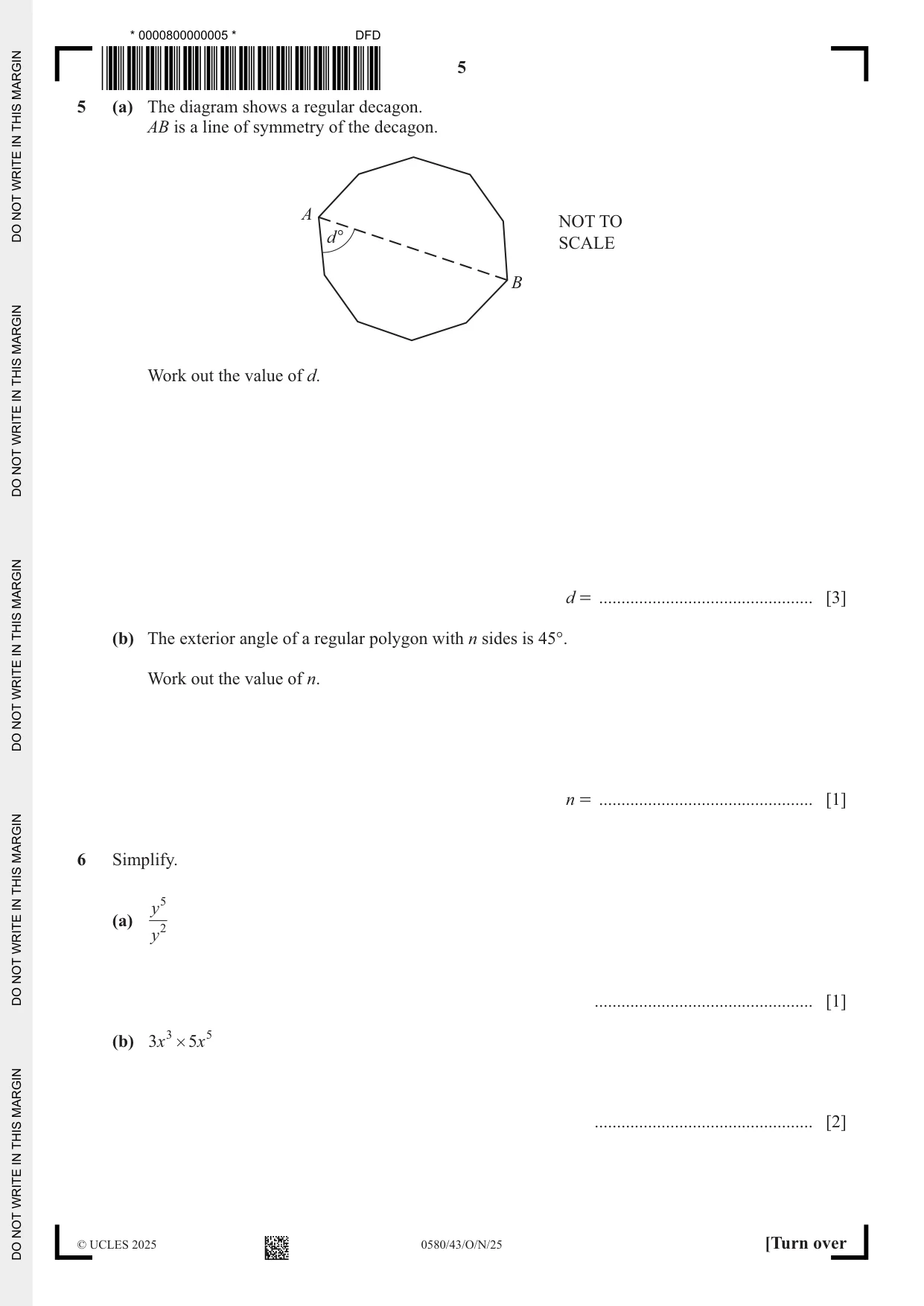
5 (a) The diagram shows a regular decagon. AB is a line of symmetry of the decagon. A NOT TO d ° SCALE B Work out the value of d. d = ................................................ [3] (b) The exterior angle of a regular polygon with n sides is 45°. Work out the value of n. n = ................................................ [1]
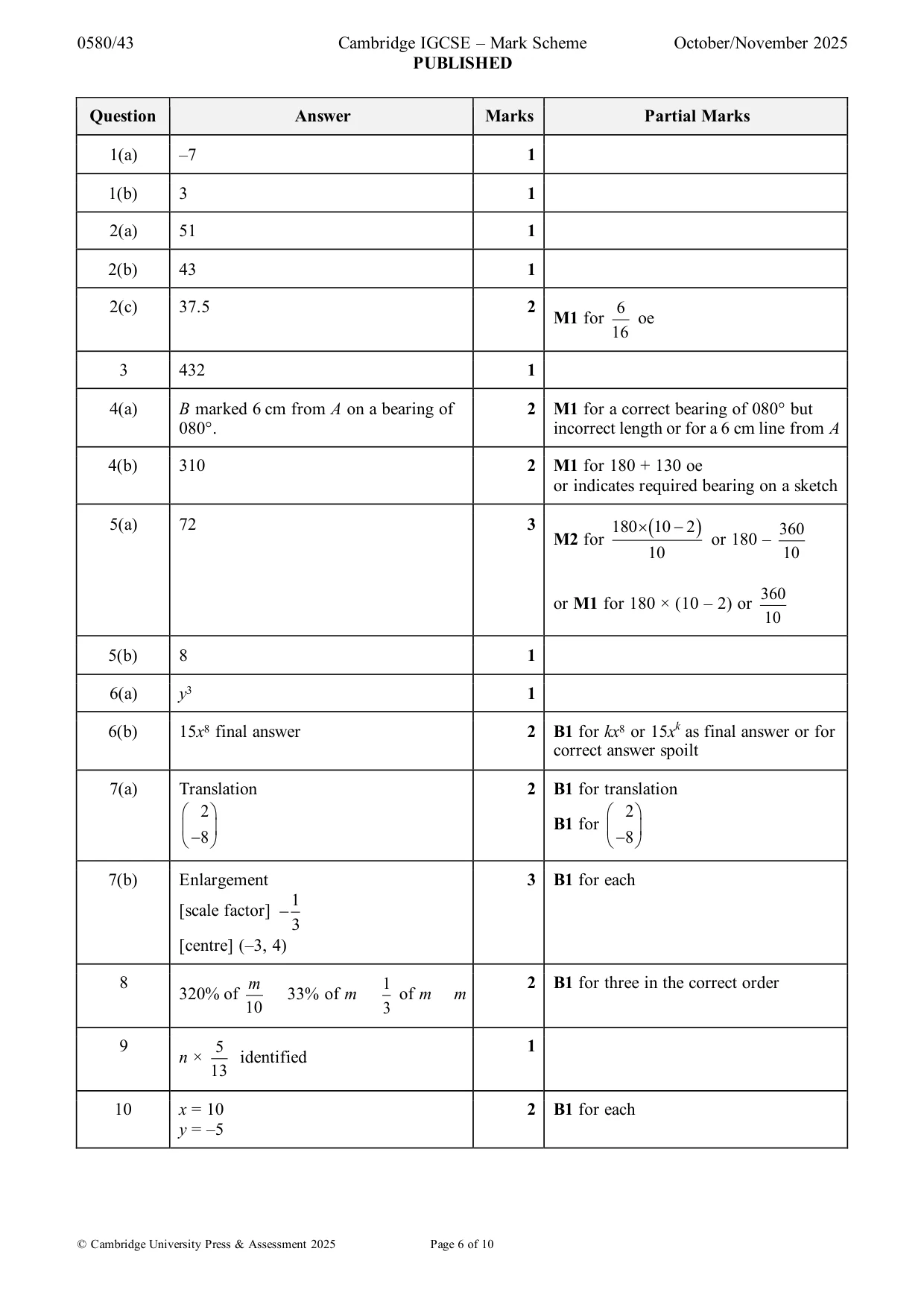
Mark scheme: 5(a) 72 3 180 (10 − 2 ) 360 M2 for or 180 – 10 10 360 or M1 for 180 × (10 – 2) or 10 5(b) 8 1
Question 6
6 Simplify. y 5 (a) y 2 ................................................. [1] (b) 3x 3 # 5x 5 ................................................. [2]
Mark scheme: 6(a) y3 1 6(b) 15x8 final answer 2 B1 for kx8 or 15xk as final answer or for correct answer spoilt
Q7 · Y 12 11 10 9 8 D 7 6 5 4 F 3 2 1 x 0 – 8 – 7 – 6 – 5 – 4 – 3 – 2 – 1 1 2 3 4 5 6 7 8 9 10…
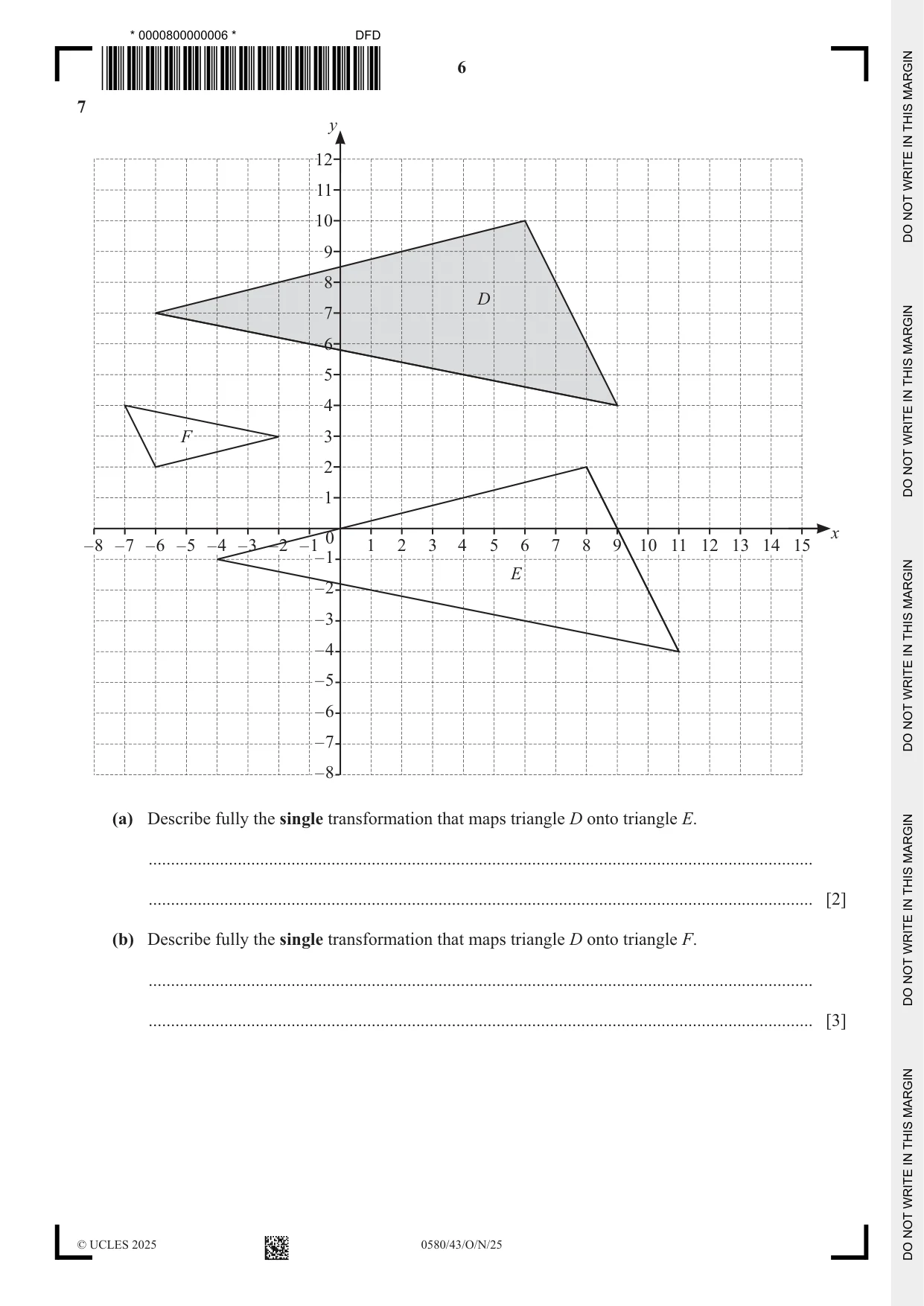
7 y 12 11 10 9 8 D 7 6 5 4 F 3 2 1 x 0 – 8 – 7 – 6 – 5 – 4 – 3 – 2 – 1 1 2 3 4 5 6 7 8 9 10 11 12 13 14 15 – 1 E – 2 – 3 – 4 – 5 – 6 – 7 – 8 (a) Describe fully the single transformation that maps triangle D onto triangle E. ..................................................................................................................................................... ..................................................................................................................................................... [2] (b) Describe fully the single transformation that maps triangle D onto triangle F. ..................................................................................................................................................... ..................................................................................................................................................... [3]
Mark scheme: 7(a) Translation 2 B1 for translation 2 2 B1 for −8 −8 7(b) Enlargement 3 B1 for each 1 [scale factor] − 3 [centre] (–3, 4)
Q8 · M is a positive integer
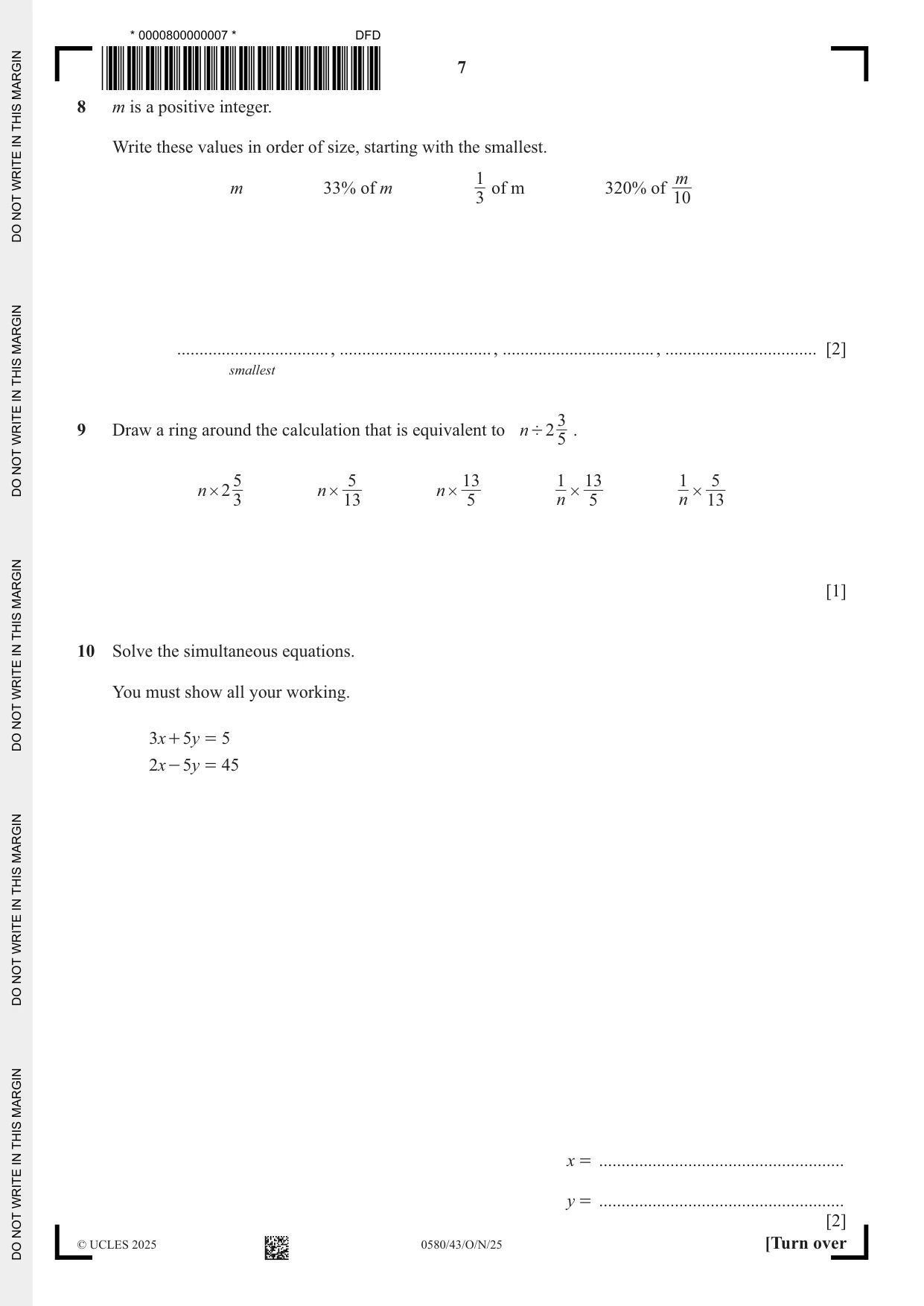
8 m is a positive integer. Write these values in order of size, starting with the smallest. 1 m m 33% of m of m 320% of 3 10 .................................. , .................................. , .................................. , .................................. [2] smallest
Mark scheme: 8 m 1 2 B1 for three in the correct order 320% of 33% of m of m m 10 3
Q9 · Draw a ring around the calculation that is equivalent to n ' 2
9 Draw a ring around the calculation that is equivalent to n ' 2 . 5 5 5 13 1 13 1 5 n # 2 n # n # # # 3 13 5 n 5 n 13 [1]
Mark scheme: 9 5 1 n × identified 13
Q10 · Solve the simultaneous equations
10 Solve the simultaneous equations. You must show all your working. 3x + 5y = 5 2x - 5y = 45 x = ....................................................... y = ....................................................... [2]
Mark scheme: 10 x = 10 2 B1 for each y = –5
Q11 · 289 # 10 -1 1.3 # 10 12 8.3 # 10 1 9 # 10 1 1 .203 # 10 -5 0.3 # 10 -2 Use a number from…
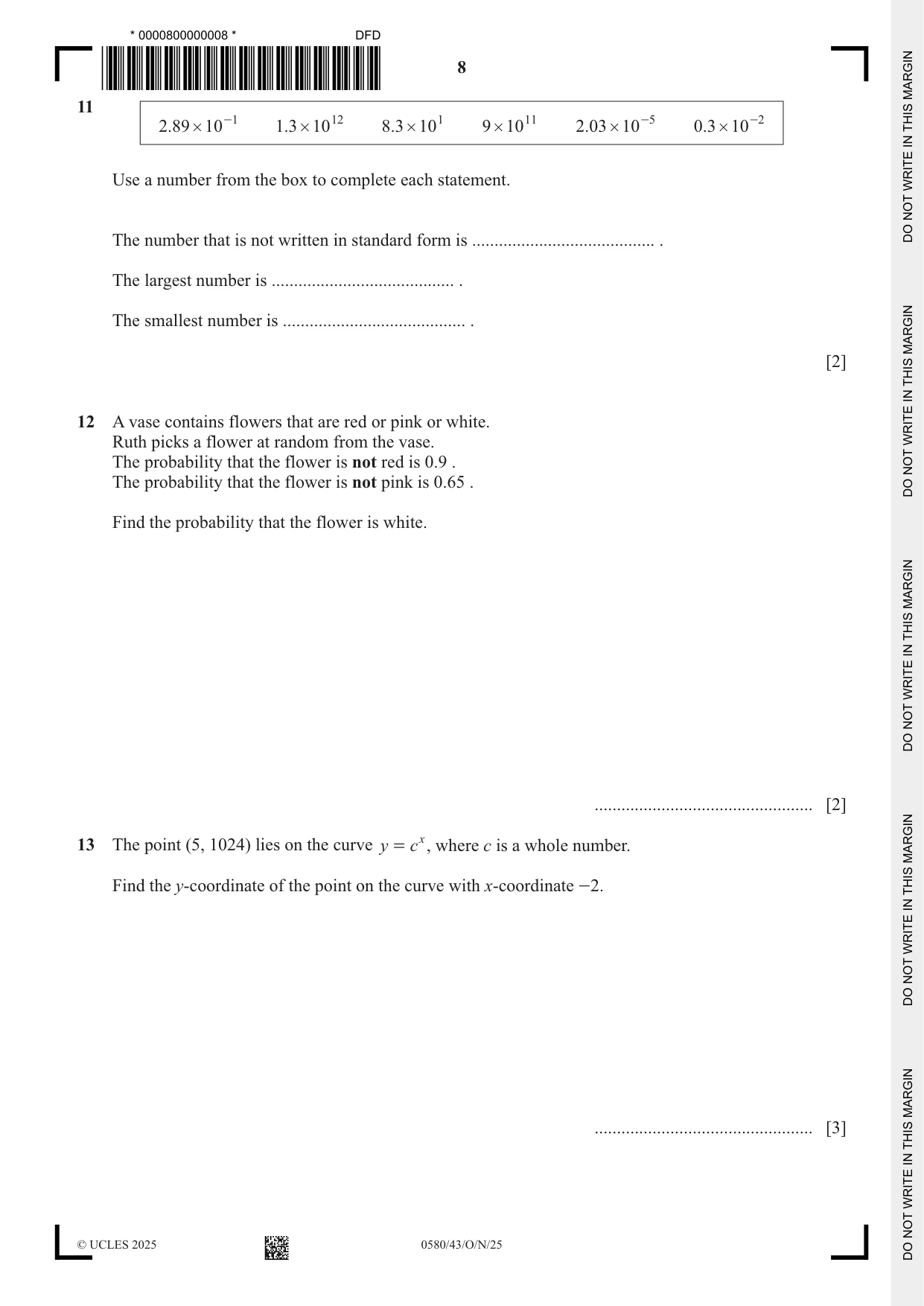
11 .289 # 10 -1 1.3 # 10 12 8.3 # 10 1 9 # 10 1 1 .203 # 10 -5 0.3 # 10 -2 Use a number from the box to complete each statement. The number that is not written in standard form is ......................................... . The largest number is ......................................... . The smallest number is ......................................... . [2]
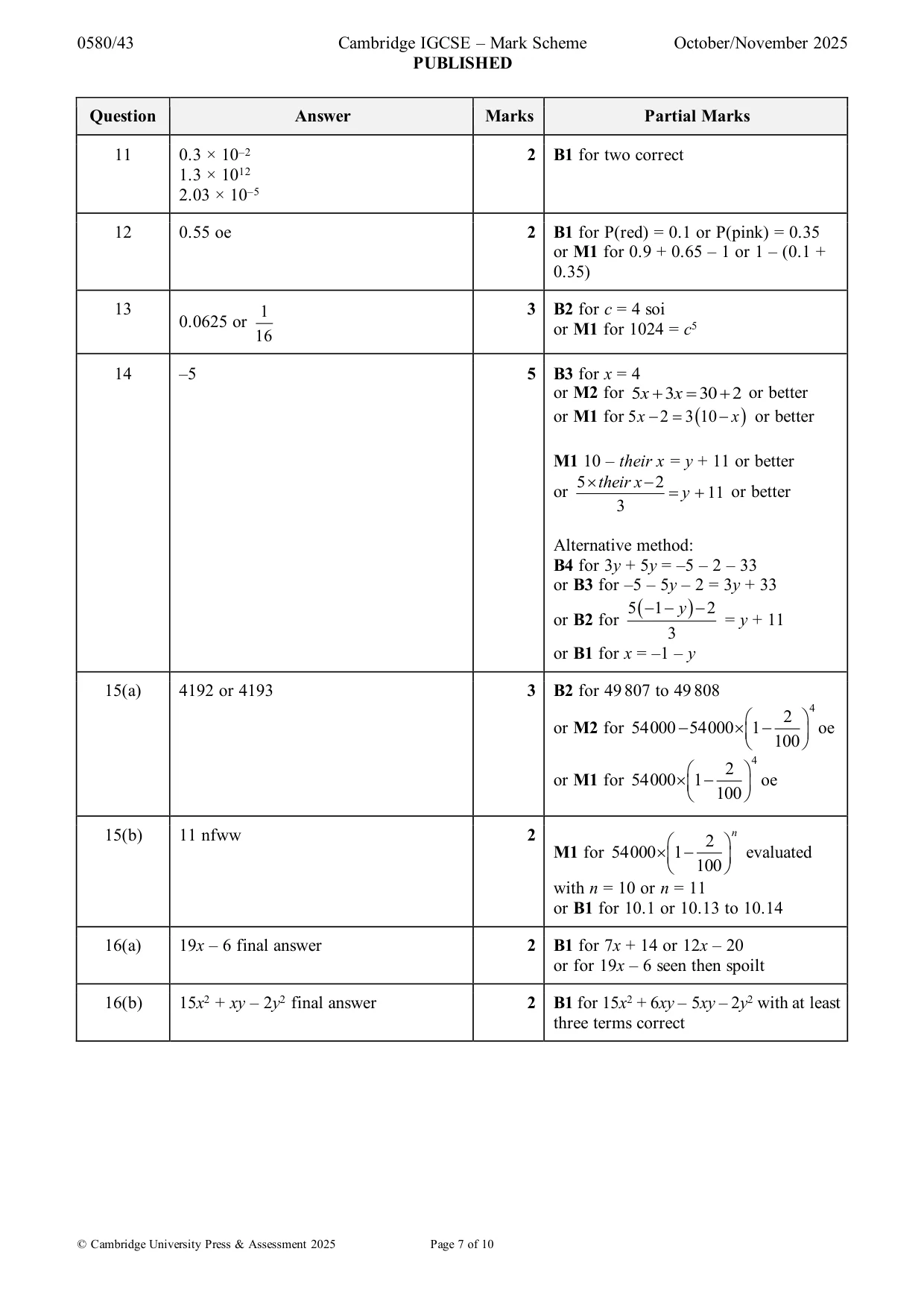
Mark scheme: 11 0.3 × 10⁻² 2 B1 for two correct 1.3 × 10¹² 2.03 × 10⁻⁵
Q12 · A vase contains flowers that are red or pink or white
12 A vase contains flowers that are red or pink or white. Ruth picks a flower at random from the vase. The probability that the flower is not red is 0.9 . The probability that the flower is not pink is 0.65 . Find the probability that the flower is white. ................................................. [2]
Mark scheme: 12 0.55 oe 2 B1 for P(red) = 0.1 or P(pink) = 0.35 or M1 for 0.9 + 0.65 – 1 or 1 – (0.1 + 0.35)
Q13 · The point (5, 1024) lies on the curve y = cx , where c is a whole number
13 The point (5, 1024) lies on the curve y = cx , where c is a whole number. Find the y-coordinate of the point on the curve with x-coordinate -2. ................................................. [3]
Mark scheme: 13 1 3 B2 for c = 4 soi 0.0625 or or M1 for 1024 = c5 16
Q14 · These expressions are all equal in value
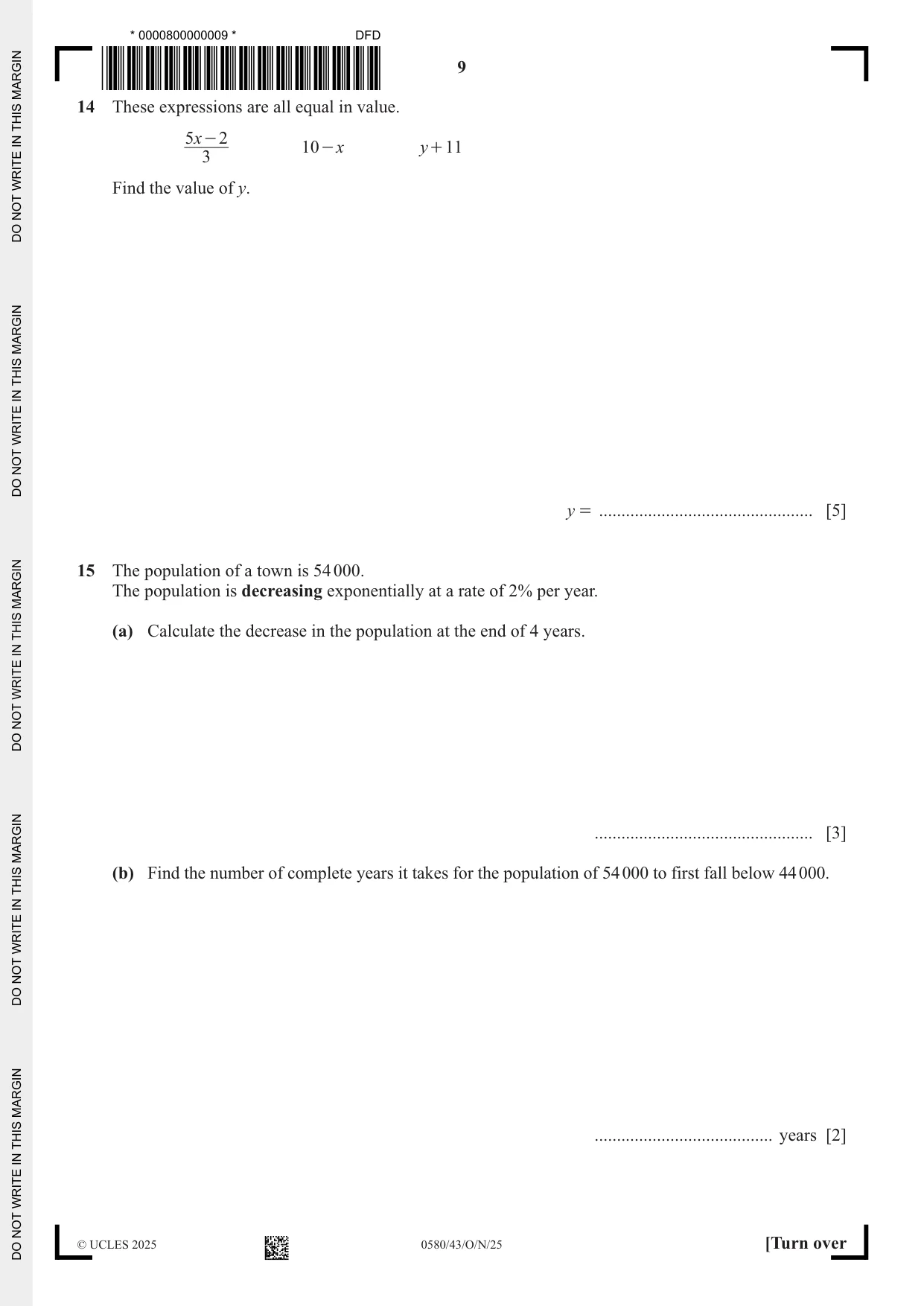
14 These expressions are all equal in value. 5x - 2 10- x y + 11 3 Find the value of y. y = ................................................ [5]
Mark scheme: 14 –5 5 B3 for x = 4 or M2 for 5 x + 3x = 30 + 2 or better or M1 for 5 x − 2 = 3 (10 − x ) or better M1 10 – their x = y + 11 or better 5 their x − 2 or = y + 11 or better 3 Alternative method: B4 for 3y + 5y = –5 – 2 – 33 or B3 for –5 – 5y – 2 = 3y + 33 5 ( −−1 y ) − 2 or B2 for = y + 11 3 or B1 for x = –1 – y
Q15 · The population of a town is 54 000
15 The population of a town is 54 000. The population is decreasing exponentially at a rate of 2% per year. (a) Calculate the decrease in the population at the end of 4 years. ................................................. [3] (b) Find the number of complete years it takes for the population of 54 000 to first fall below 44 000. ........................................ years [2]
Mark scheme: 15(a) 4192 or 4193 3 B2 for 49 807 to 49 808 2 4 or M2 for 54 000 − 54 000 1 − oe 100 2 4 or M1 for 54 000 1 − oe 100 15(b) 11 nfww 2 n 2 M1 for 54 000 1 − evaluated 100 with n = 10 or n = 11 or B1 for 10.1 or 10.13 to 10.14
Question 16
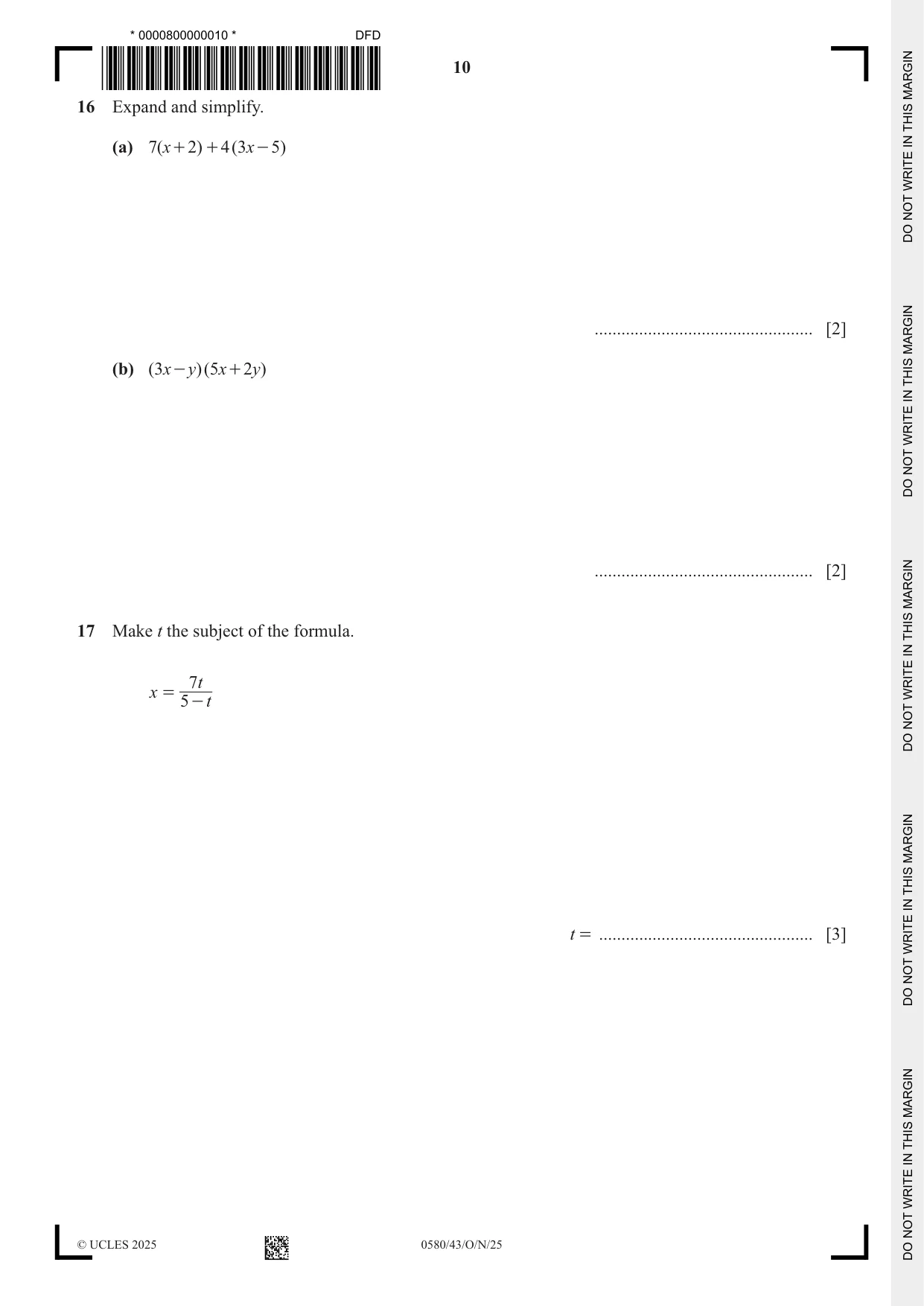
16 Expand and simplify. (a) 7( x + 2 ) + 4 ( 3x - 5 ) ................................................. [2] (b) ( 3x - y)( 5 x + 2y) ................................................. [2]
Mark scheme: 16(a) 19x – 6 final answer 2 B1 for 7x + 14 or 12x – 20 or for 19x – 6 seen then spoilt 16(b) 15x2 + xy – 2y2 final answer 2 B1 for 15x2 + 6xy – 5xy – 2y2 with at least three terms correct
Q17 · Make t the subject of the formula
17 Make t the subject of the formula. 7t x = 5 - t t = ................................................ [3]
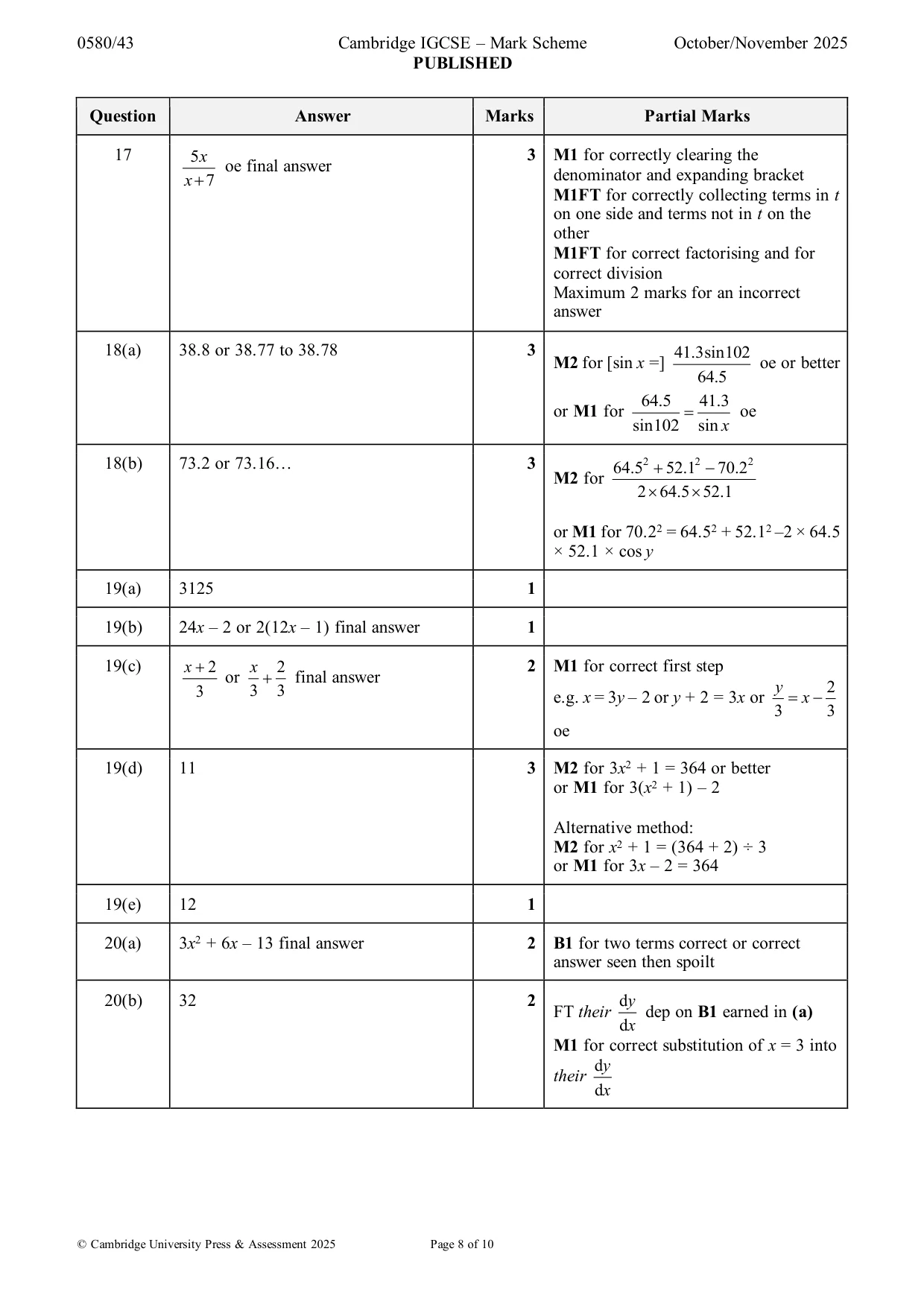
Mark scheme: 17 5 x 3 M1 for correctly clearing the oe final answer denominator and expanding bracket x + 7 M1FT for correctly collecting terms in t on one side and terms not in t on the other M1FT for correct factorising and for correct division Maximum 2 marks for an incorrect answer
Q18 · 102° 41.3 cm x° y° 64.5 cm NOT TO SCALE 52.1 cm 70.2 cm (a) Calculate the value of x
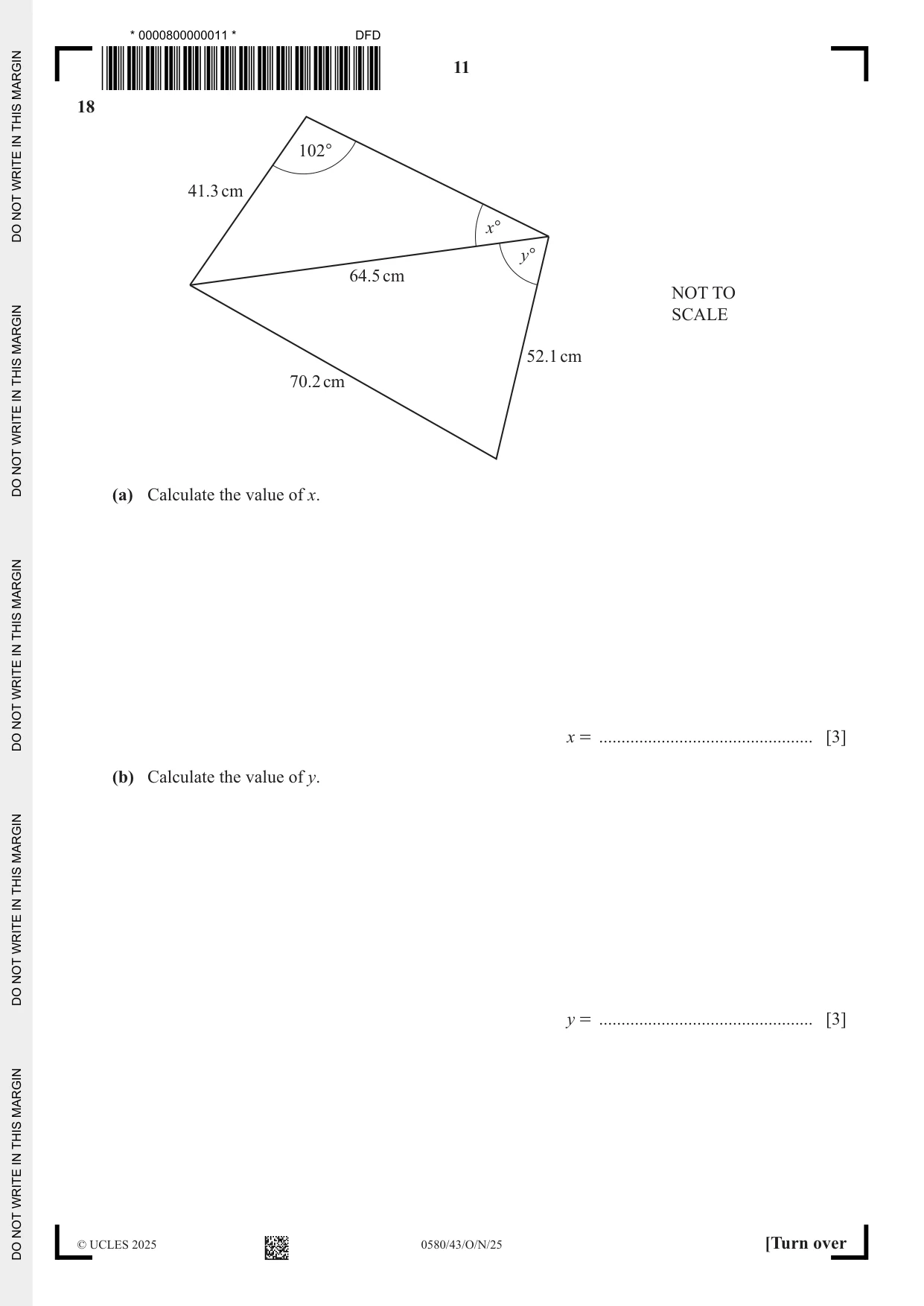
18 102° 41.3 cm x° y° 64.5 cm NOT TO SCALE 52.1 cm 70.2 cm (a) Calculate the value of x. x = ................................................ [3] (b) Calculate the value of y. y = ................................................ [3]
Mark scheme: 18(a) 38.8 or 38.77 to 38.78 3 41.3sin102 M2 for [sin x =] oe or better 64.5 64.5 41.3 or M1 for = oe sin102 sin x 18(b) 73.2 or 73.16… 3 64.5 2 + 52.12 − 70.2 2 M2 for 2 64.5 52.1 or M1 for 70.22 = 64.52 + 52.12 –2 × 64.5 × 52.1 × cos y
Q19 · F ( )x = 5 x g ( )x = 3x - 2 h ( )x = x 2 + 1 (a) Find f ( 5 )
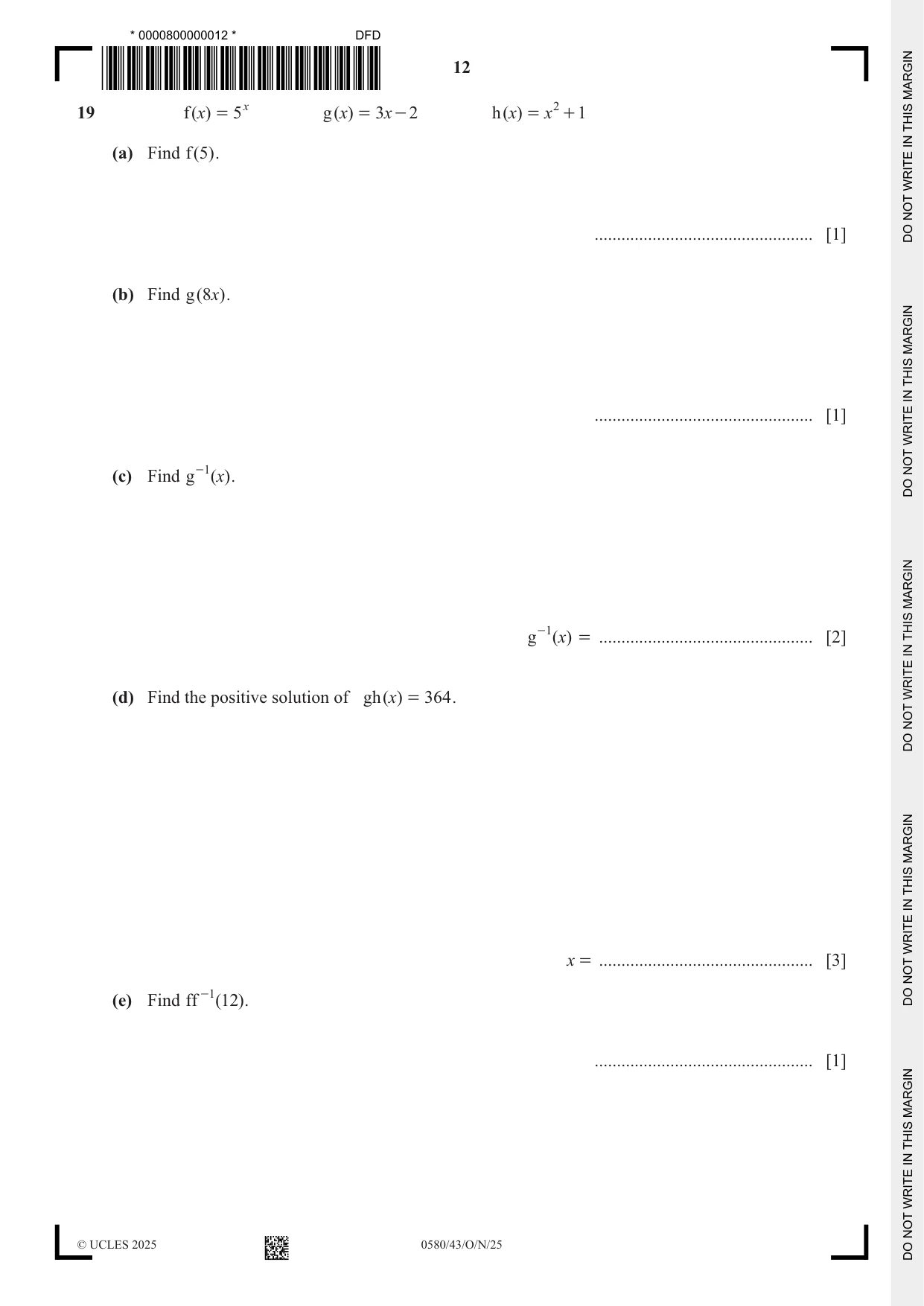
19 f ( )x = 5 x g ( )x = 3x - 2 h ( )x = x 2 + 1 (a) Find f ( 5 ) . ................................................. [1] (b) Find g ( 8)x . ................................................. [1] (c) Find g -1 ( )x . g -1 ( )x = ................................................ [2] (d) Find the positive solution of gh ( )x = 364 . x = ................................................ [3] (e) Find ff -1 (12.) ................................................. [1]
Mark scheme: 19(a) 3125 1 19(b) 24x – 2 or 2(12x – 1) final answer 1 19(c) x + 2 x 2 2 M1 for correct first step or + final answer 3 3 3 y 2 e.g. x = 3y – 2 or y + 2 = 3x or = x − 3 3 oe 19(d) 11 3 M2 for 3x2 + 1 = 364 or better or M1 for 3(x2 + 1) – 2 Alternative method: M2 for x2 + 1 = (364 + 2) ÷ 3 or M1 for 3x – 2 = 364 19(e) 12 1
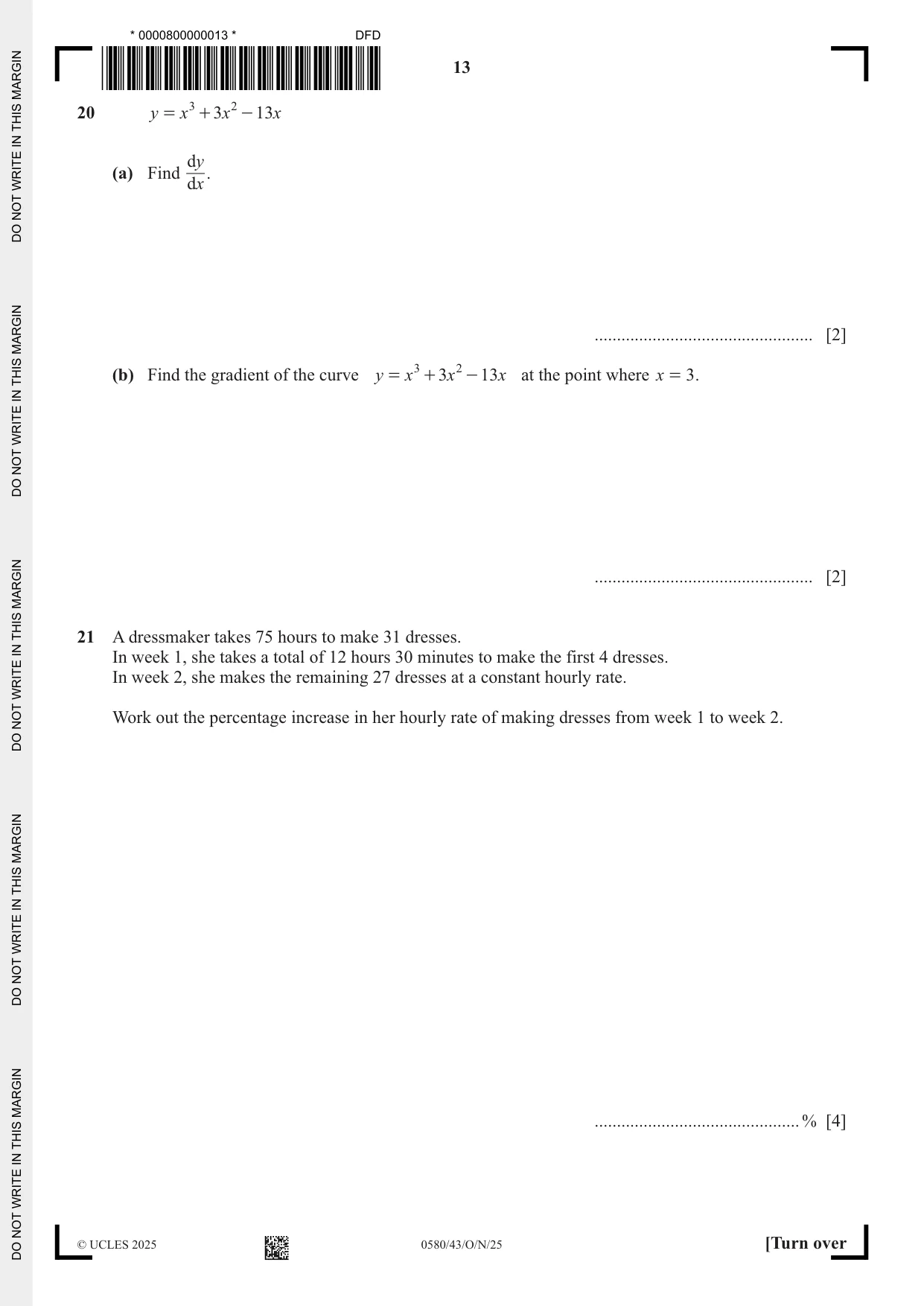
Q20 · Y = x 3 + 3x 2 - 13 x dy (a) Find
20 y = x 3 + 3x 2 - 13 x dy (a) Find . dx ................................................. [2] (b) Find the gradient of the curve y = x 3 + 3x 2 - 13 x at the point where x = 3 . ................................................. [2]
Mark scheme: 20(a) 3x2 + 6x – 13 final answer 2 B1 for two terms correct or correct answer seen then spoilt 20(b) 32 2 d y FT their dep on B1 earned in (a) d x M1 for correct substitution of x = 3 into d y their d x
Q21 · A dressmaker takes 75 hours to make 31 dresses
21 A dressmaker takes 75 hours to make 31 dresses. In week 1, she takes a total of 12 hours 30 minutes to make the first 4 dresses. In week 2, she makes the remaining 27 dresses at a constant hourly rate. Work out the percentage increase in her hourly rate of making dresses from week 1 to week 2. ..............................................% [4]
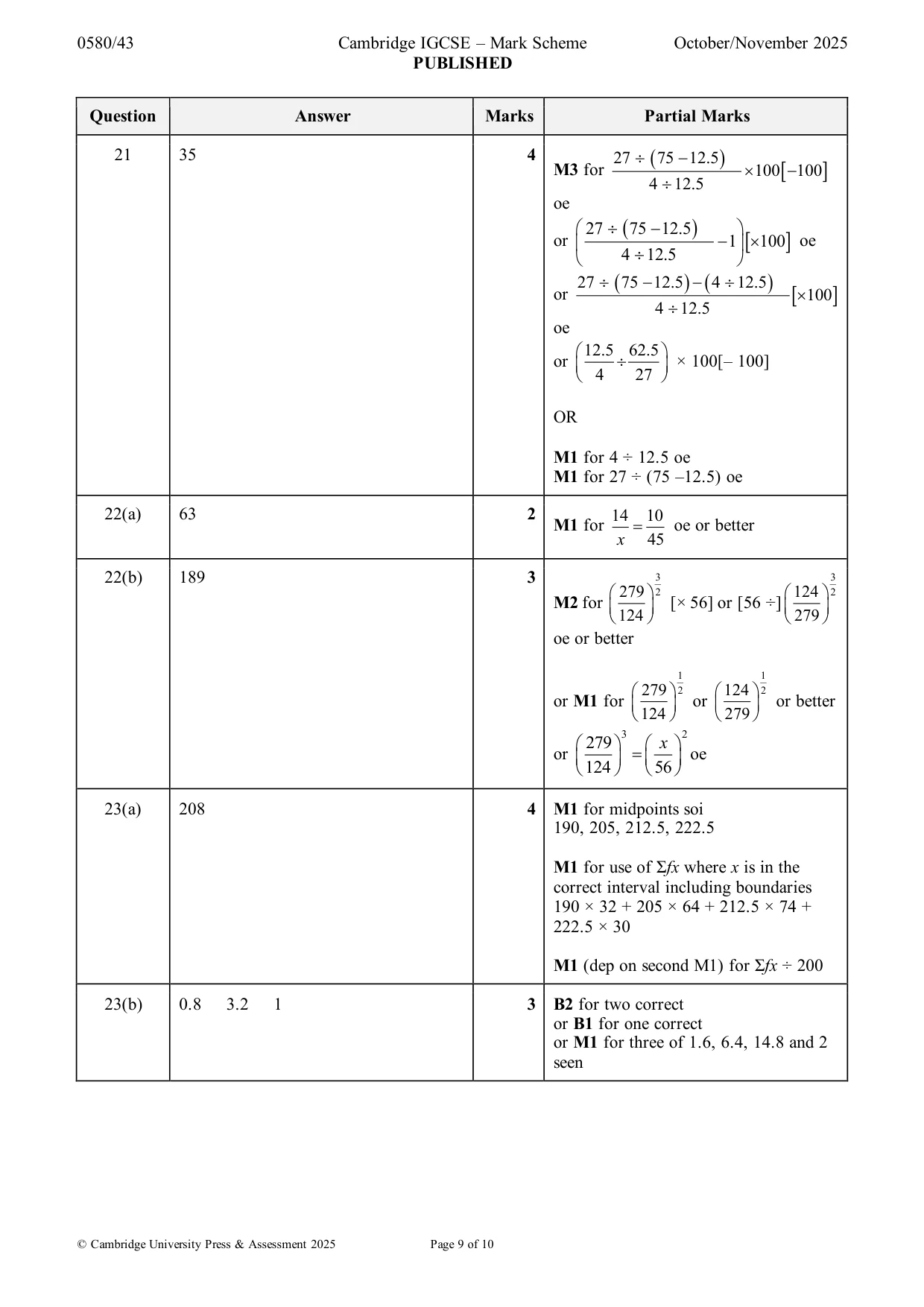
Mark scheme: 21 35 4 27 ( 75 − 12.5 ) M3 for 100 −100 4 12.5 oe 27 ( 75 − 12.5 ) or − 1 100 oe 4 12.5 27 ( 75 − 12.5 ) − ( 4 12.5 ) or 100 4 12.5 oe 12.5 62.5 or × 100[– 100] 4 27 OR M1 for 4 ÷ 12.5 oe M1 for 27 ÷ (75 –12.5) oe
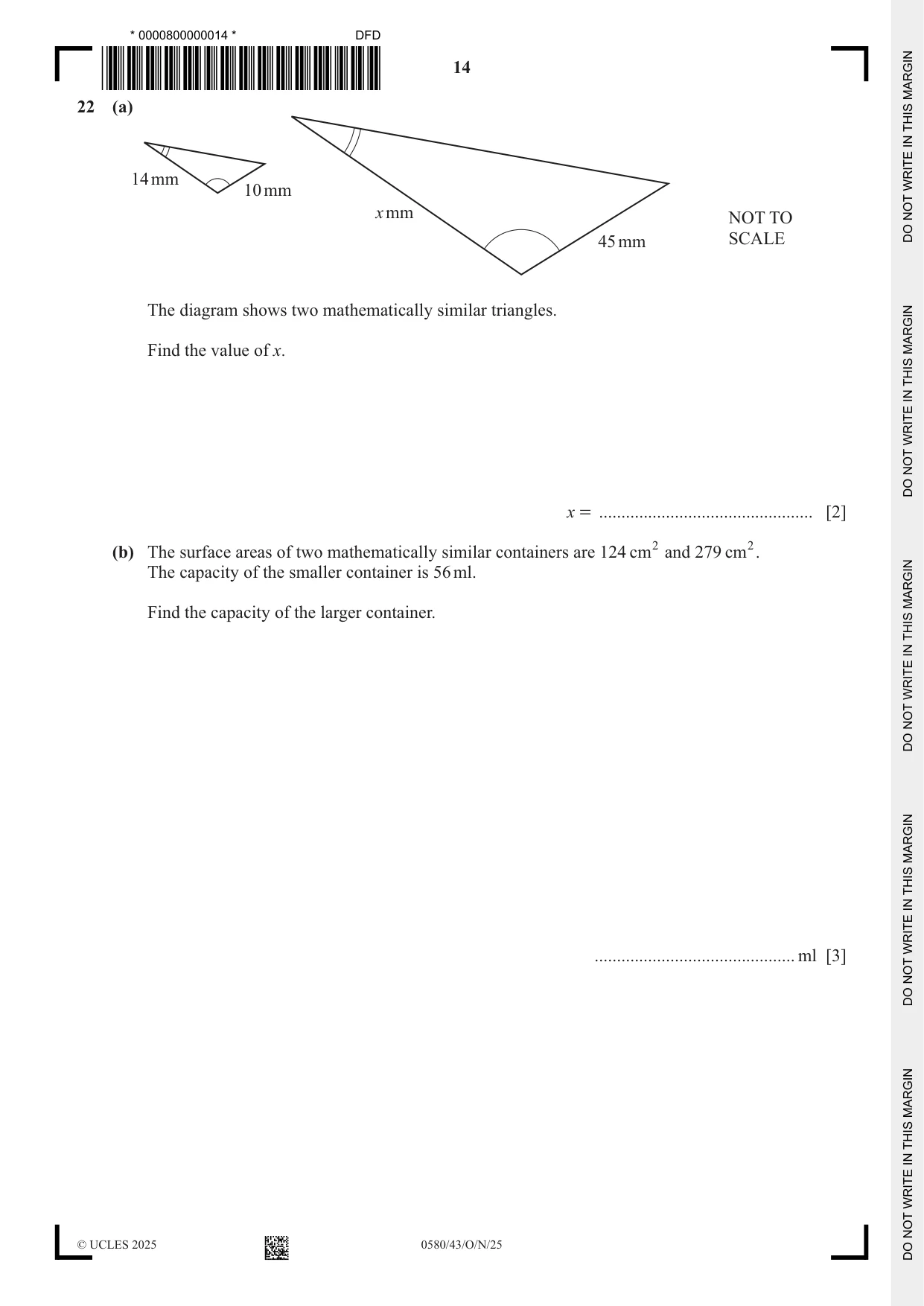
Q22 · 14 mm 10 mm x mm NOT TO 45 mm SCALE The diagram shows two mathematically similar triangles
22 (a) 14 mm 10 mm x mm NOT TO 45 mm SCALE The diagram shows two mathematically similar triangles. Find the value of x. x = ................................................ [2] (b) The surface areas of two mathematically similar containers are 124 cm2 and 279 cm2. The capacity of the smaller container is 56 ml. Find the capacity of the larger container. ............................................. ml [3]
Mark scheme: 22(a) 63 2 14 10 M1 for = oe or better x 45 22(b) 189 3 3 3 279 2 124 2 M2 for [× 56] or [56 ÷] 124 279 oe or better 1 1 279 2 124 2 or M1 for or or better 124 279 279 3 x 2 or = oe 124 56
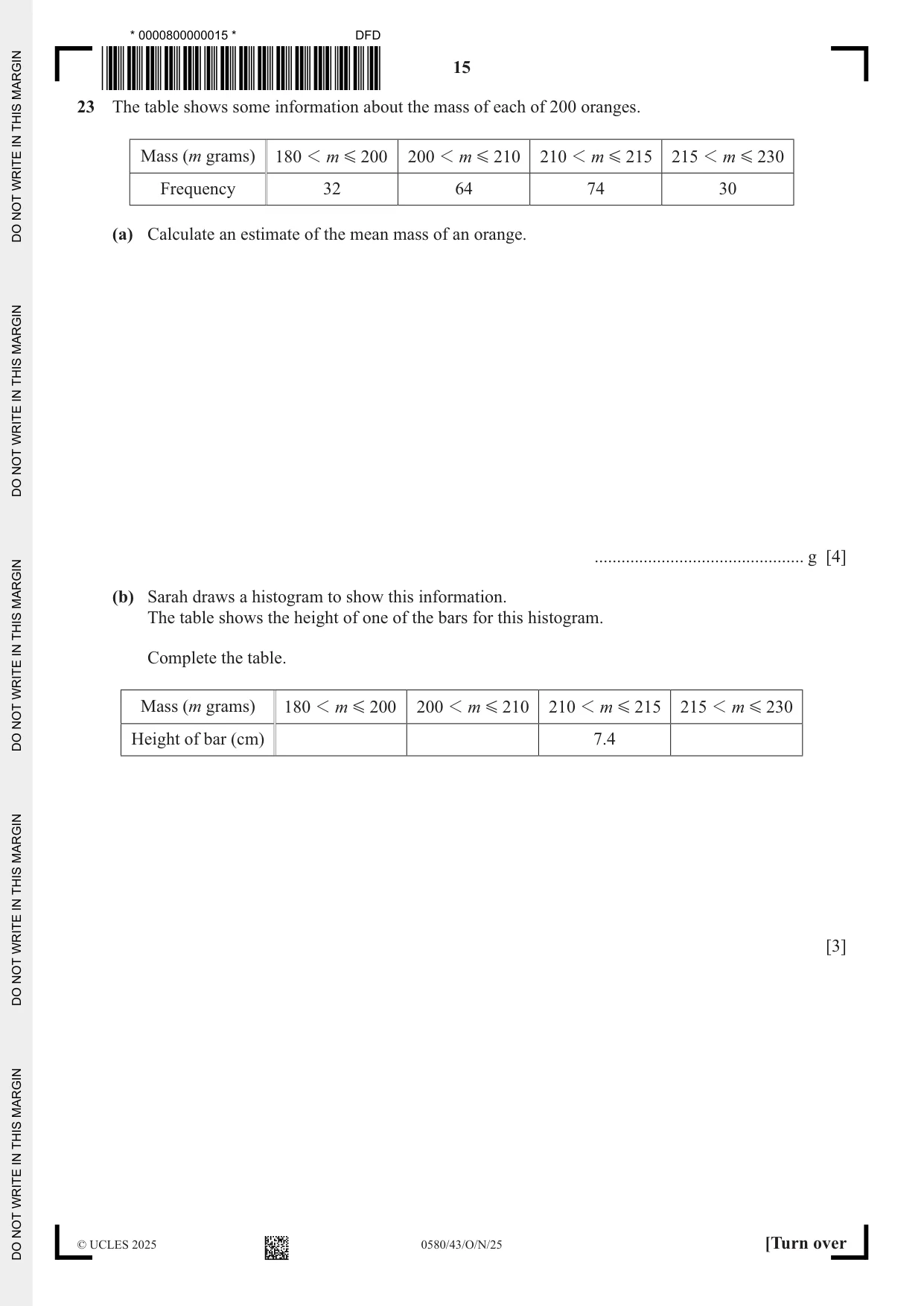
Q23 · The table shows some information about the mass of each of 200 oranges
23 The table shows some information about the mass of each of 200 oranges. Mass (m grams) 180 1 m G 200 200 1 m G 2 10 210 1 m G 215 215 1 m G 230 Frequency 32 64 74 30 (a) Calculate an estimate of the mean mass of an orange. ............................................... g [4] (b) Sarah draws a histogram to show this information. The table shows the height of one of the bars for this histogram. Complete the table. Mass (m grams) 180 1 m G 200 200 1 m G 2 10 210 1 m G 215 215 1 m G 230 Height of bar (cm) 7.4 [3]
Mark scheme: 23(a) 208 4 M1 for midpoints soi 190, 205, 212.5, 222.5 M1 for use of Σfx where x is in the correct interval including boundaries 190 × 32 + 205 × 64 + 212.5 × 74 + 222.5 × 30 M1 (dep on second M1) for Σfx ÷ 200 23(b) 0.8 3.2 1 3 B2 for two correct or B1 for one correct or M1 for three of 1.6, 6.4, 14.8 and 2 seen
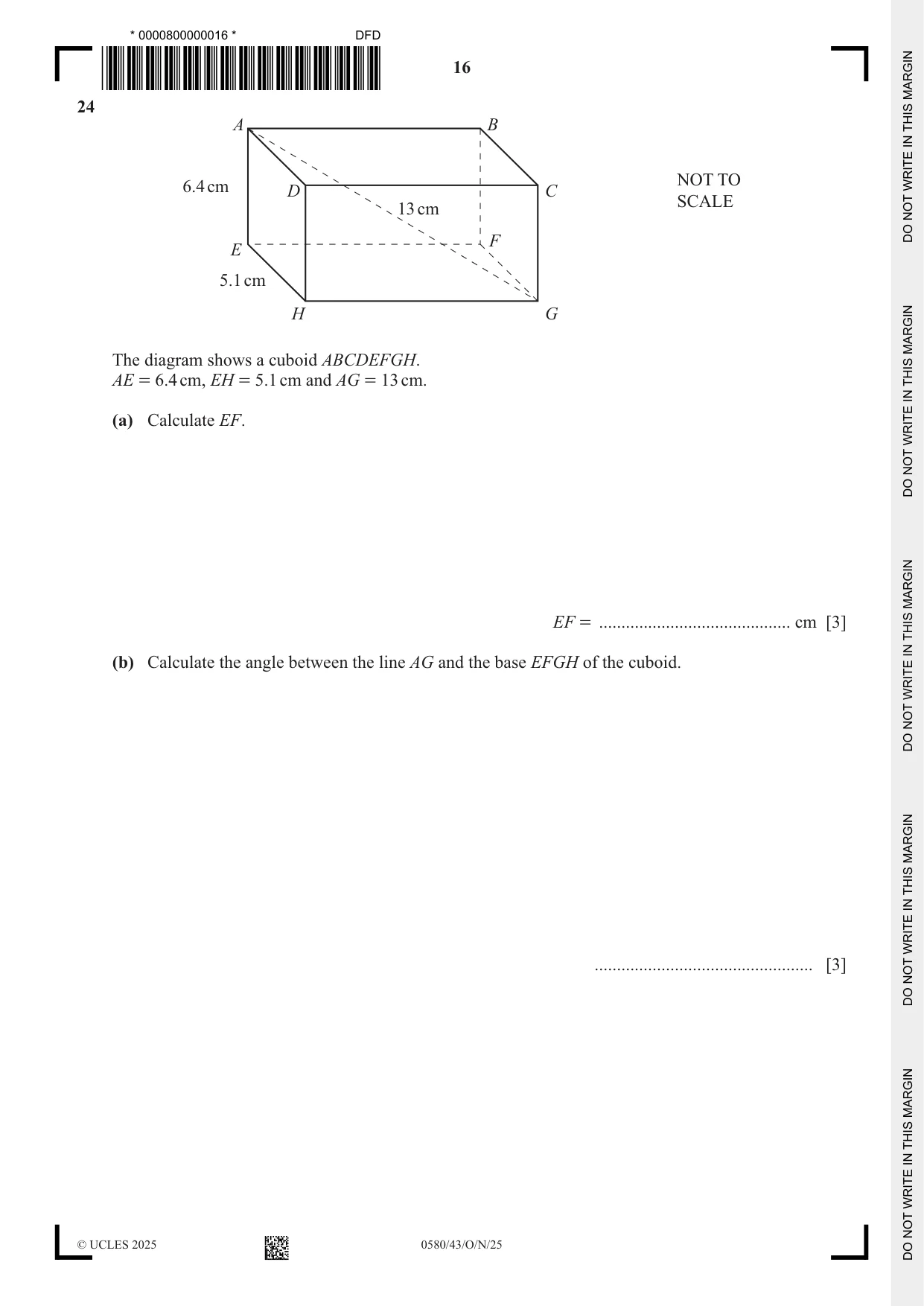
Q24 · A B NOT TO 6.4 cm D C SCALE 13 cm F E 5.1 cm H G The diagram shows a cuboid ABCDEFGH
24 A B NOT TO 6.4 cm D C SCALE 13 cm F E 5.1 cm H G The diagram shows a cuboid ABCDEFGH. AE = 6.4 cm, EH = 5.1 cm and AG = 13 cm. (a) Calculate EF. EF = ........................................... cm [3] (b) Calculate the angle between the line AG and the base EFGH of the cuboid. ................................................. [3]
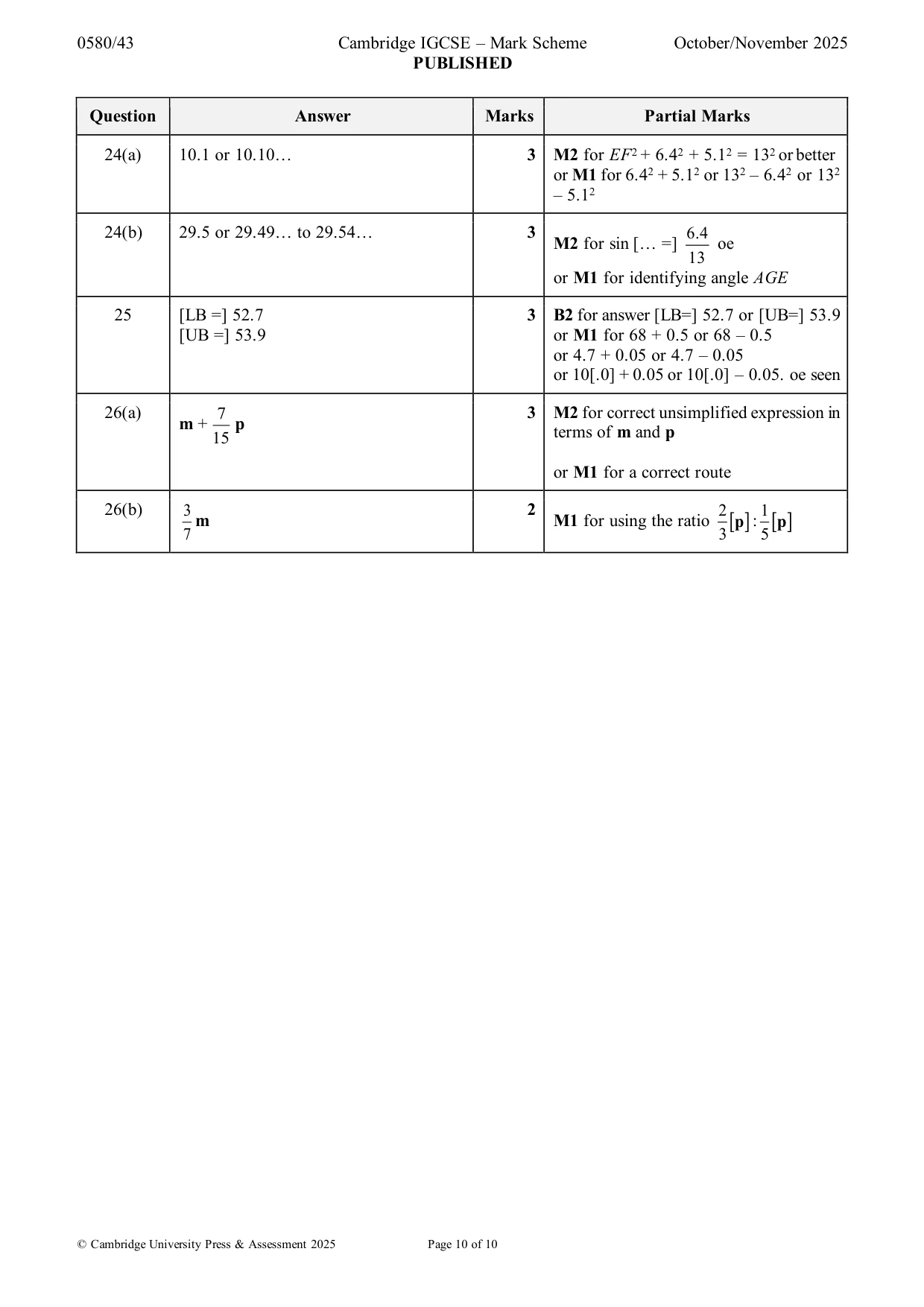
Mark scheme: 24(a) 10.1 or 10.10… 3 M2 for EF2 + 6.42 + 5.12 = 132 or better or M1 for 6.42 + 5.12 or 132 – 6.42 or 132 – 5.12 24(b) 29.5 or 29.49… to 29.54… 3 6.4 M2 for sin [… =] oe 13 or M1 for identifying angle AGE
Q25 · Jenna has a length of wire measuring 68 cm, correct to the nearest cm
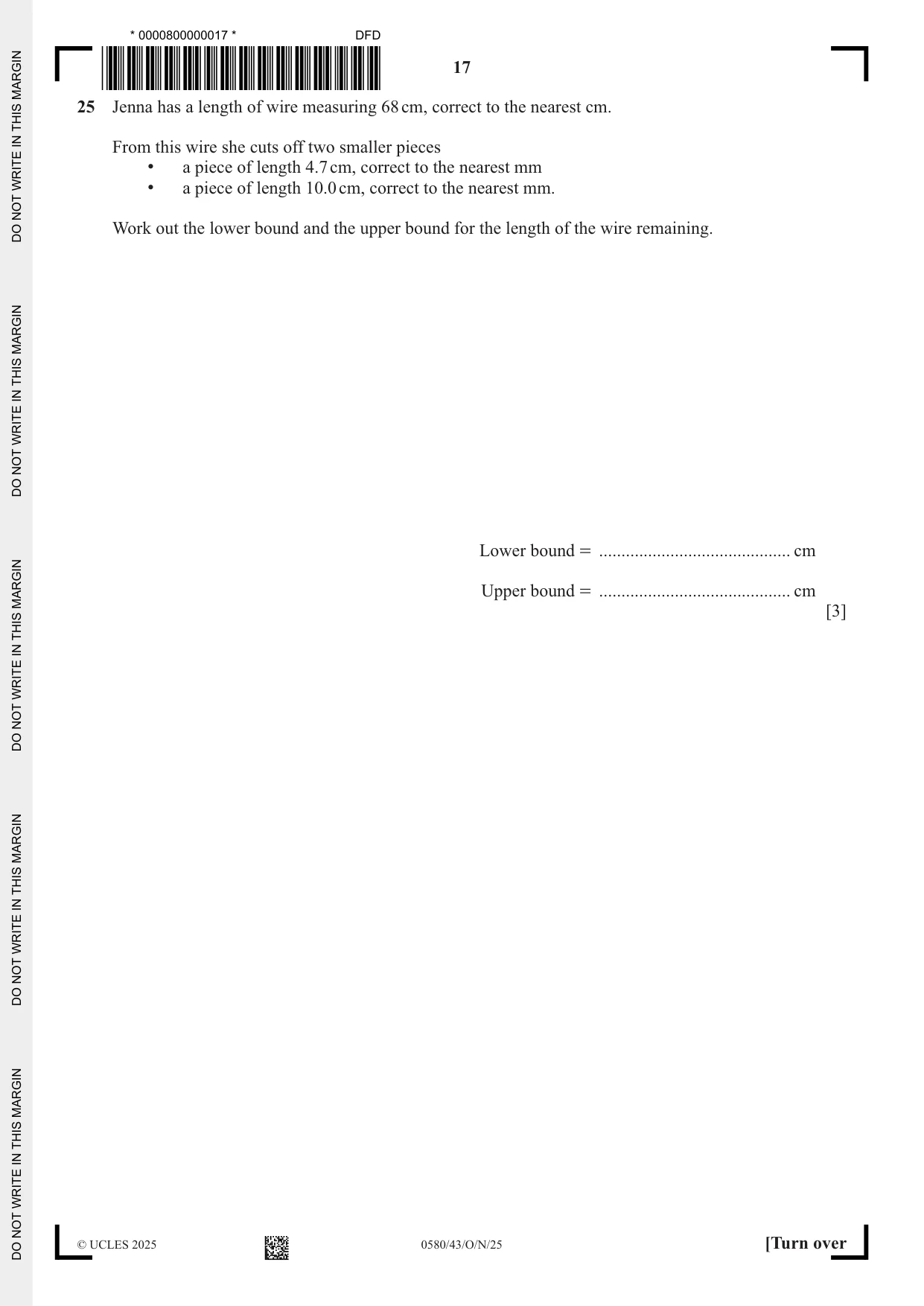
25 Jenna has a length of wire measuring 68 cm, correct to the nearest cm. From this wire she cuts off two smaller pieces • a piece of length 4.7 cm, correct to the nearest mm • a piece of length 10.0 cm, correct to the nearest mm. Work out the lower bound and the upper bound for the length of the wire remaining. Lower bound = ........................................... cm Upper bound = ........................................... cm [3]
Mark scheme: 25 [LB =] 52.7 3 B2 for answer [LB=] 52.7 or [UB=] 53.9 [UB =] 53.9 or M1 for 68 + 0.5 or 68 – 0.5 or 4.7 + 0.05 or 4.7 – 0.05 or 10[.0] + 0.05 or 10[.0] – 0.05. oe seen
Q26 · F B C m NOT TO SCALE A E D p ABCD is a parallelogram
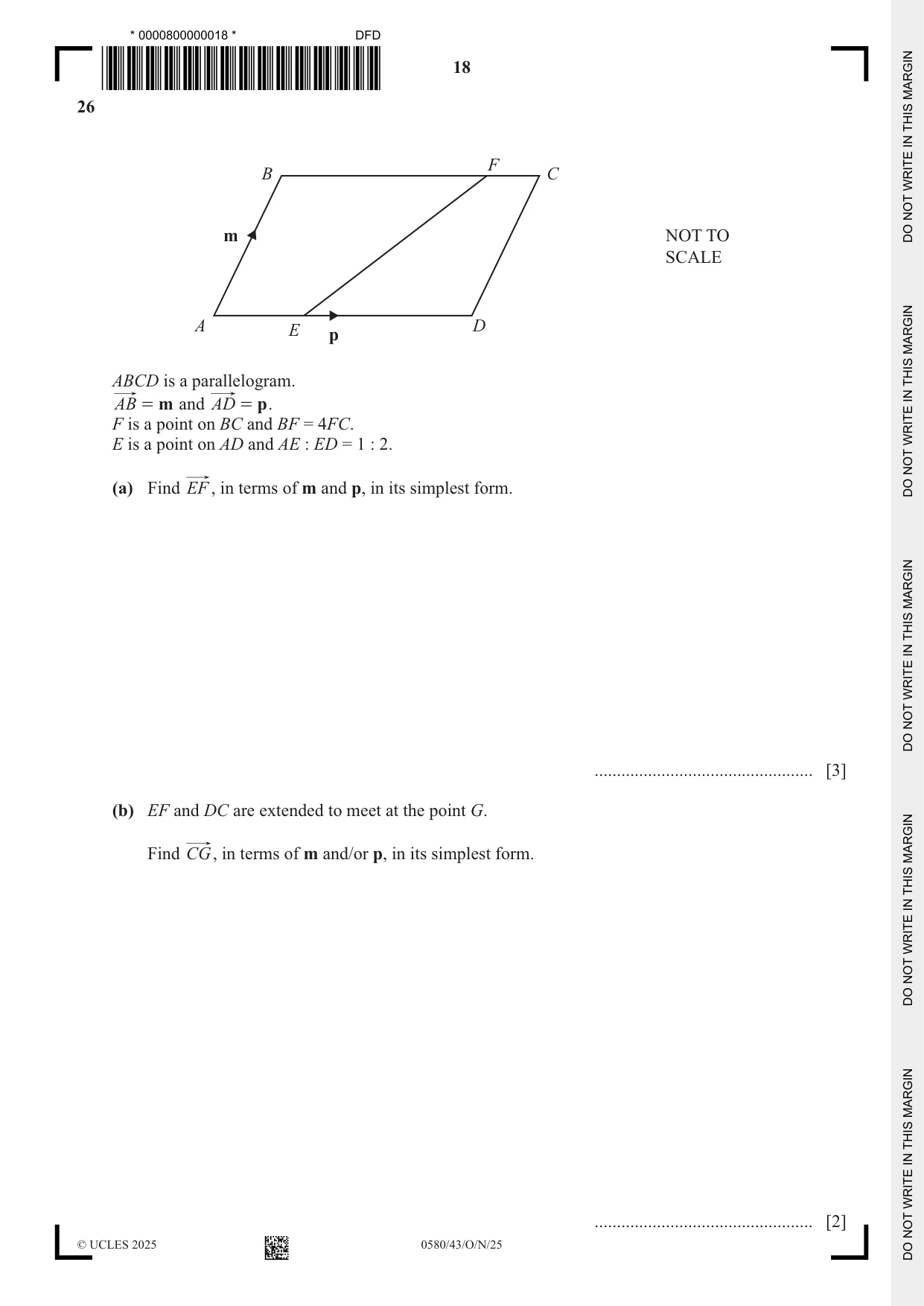
26 F B C m NOT TO SCALE A E D p ABCD is a parallelogram. AB = m and AD = p . F is a point on BC and BF = 4FC. E is a point on AD and AE : ED = 1 : 2. (a) Find EF , in terms of m and p, in its simplest form. ................................................. [3] (b) EF and DC are extended to meet at the point G. Find CG, in terms of m and/or p, in its simplest form. ................................................. [2]
Mark scheme: 26(a) 7 3 M2 for correct unsimplified expression in m + p terms of m and p 15 or M1 for a correct route 26(b) 3 2 2 1 m M1 for using the ratio p : p 7 3 5
What was in this paper
The subtopics covered by these 26 questions, and how many questions each got. Open one in a new tab to see every Cambridge question on it.
3Algebraic manipulation2Fractions, decimals and percentages2Algebraic manipulation1Angles1Differentiation1Exponential growth and decay1Functions1Histograms1Indices I1Introduction to probability1Limits of accuracy1Non-right-angled triangles1Percentages1Pythagoras’ theorem and trigonometry1Scale drawings1Sequences1Similarity1Standard form1The four operations1Transformations1Vector geometry1What you needed in this session
Cambridge’s own grade thresholds for 2025 Oct/Nov, Paper 4 · Variant 3. A higher threshold means an easier paper — the bar moves with how the cohort did.