Cambridge IGCSE Mathematics 0580 — 2017 Oct/Nov Paper 4 · Variant 2
0580/42/O/N/17 · 10 questions · 130 marks · ≈146 min
The question paper and its mark scheme, free to read here and free to download. This is Cambridge’s own paper, exactly as it was sat.
Question paper20 pages
Mark scheme7 pages
Answers below. Sit the paper first if you are practising.
Questions as text
Q1 · Alex has $20 and Bobbie has $25
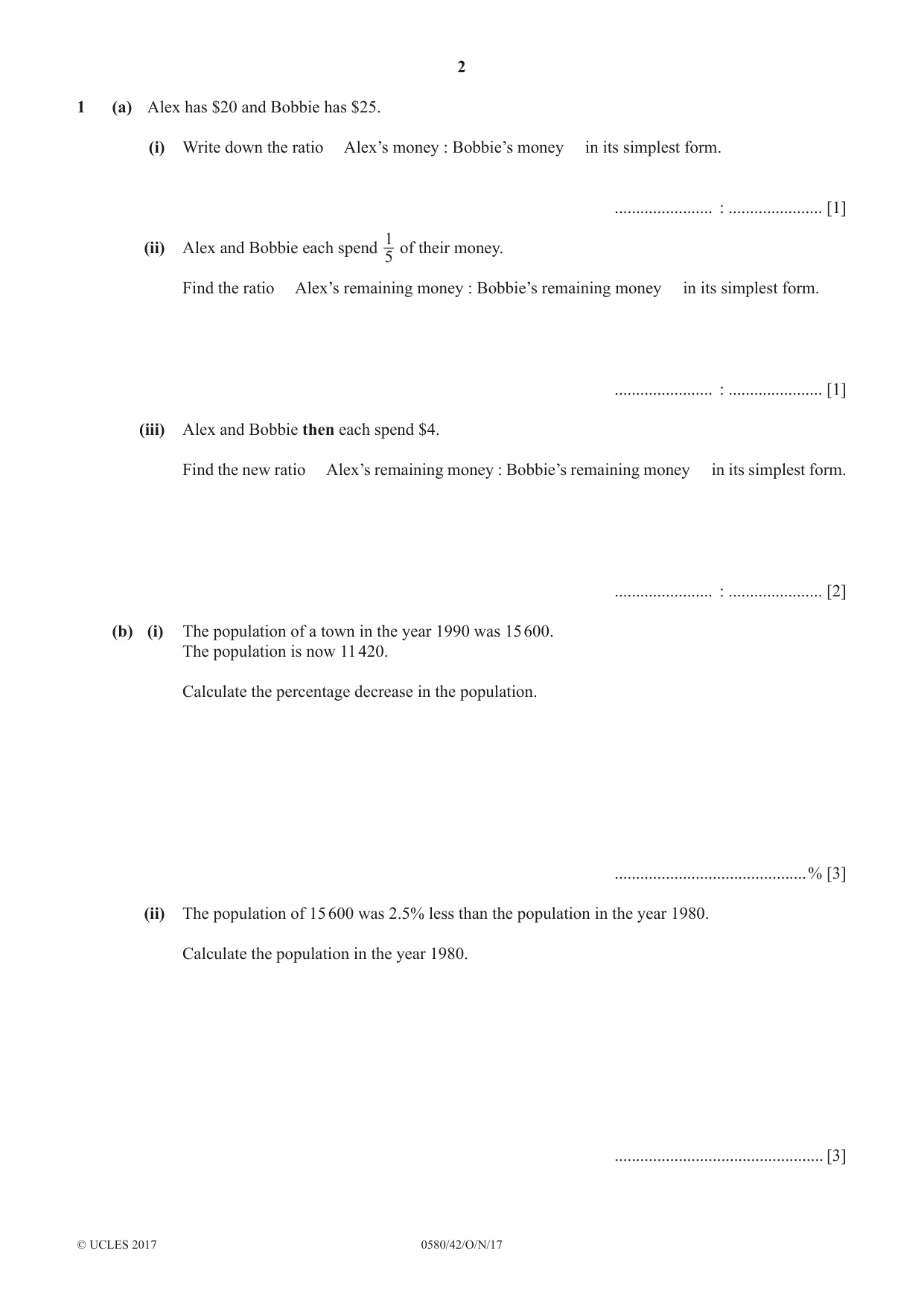
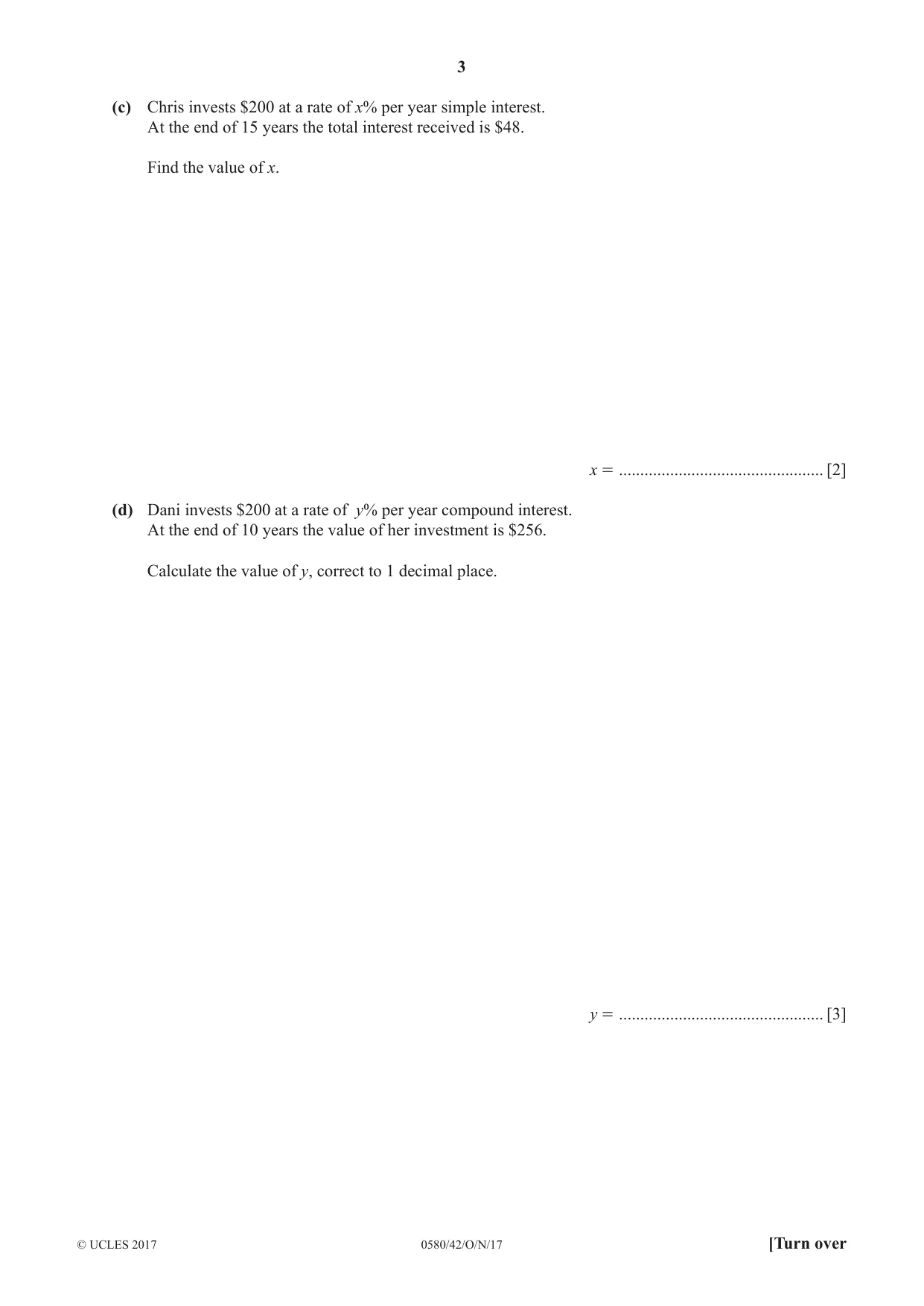
1 (a) Alex has $20 and Bobbie has $25. (i) Write down the ratio Alex’s money : Bobbie’s money in its simplest form. ....................... : ...................... [1] 1 (ii) Alex and Bobbie each spend of their money. 5 Find the ratio Alex’s remaining money : Bobbie’s remaining money in its simplest form. ....................... : ...................... [1] (iii) Alex and Bobbie then each spend $4. Find the new ratio Alex’s remaining money : Bobbie’s remaining money in its simplest form. ....................... : ...................... [2] (b) (i) The population of a town in the year 1990 was 15 600. The population is now 11 420. Calculate the percentage decrease in the population. .............................................% [3] (ii) The population of 15 600 was 2.5% less than the population in the year 1980. Calculate the population in the year 1980. ................................................. [3] (c) Chris invests $200 at a rate of x% per year simple interest. At the end of 15 years the total interest received is $48. Find the value of x. x = ................................................ [2] (d) Dani invests $200 at a rate of y% per year compound interest. At the end of 10 years the value of her investment is $256. Calculate the value of y, correct to 1 decimal place. y = ................................................ [3]
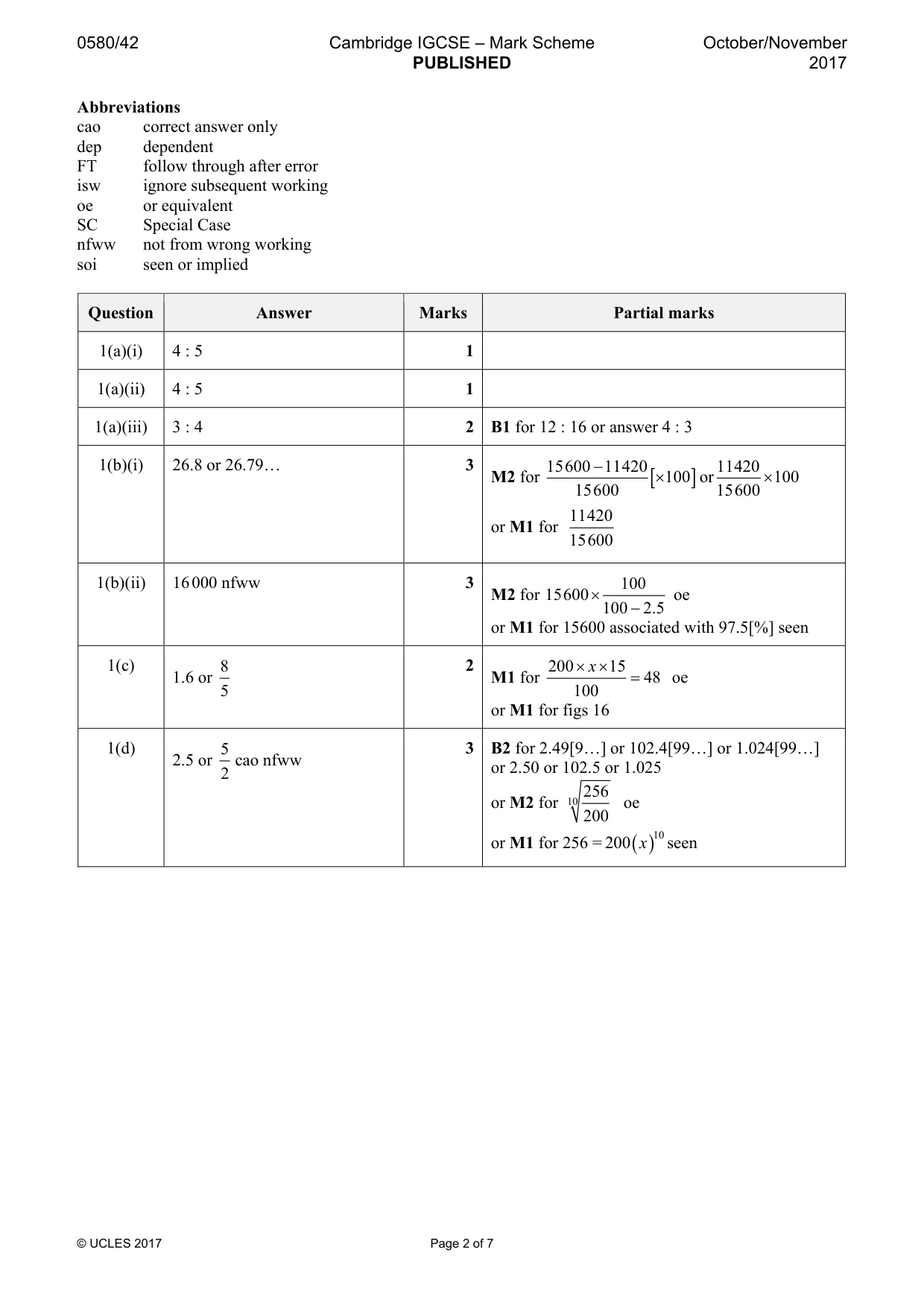
Mark scheme: Question Answer Marks Partial marks 1(a)(i) 4 : 5 1 1(a)(ii) 4 : 5 1 1(a)(iii) 3 : 4 2 B1 for 12 : 16 or answer 4 : 3 1(b)(i) 26.8 or 26.79… 3 15600 − 11420 11420 M2 for [× 100 ] or × 100 15600 15600 11420 or M1 for 15600 1(b)(ii) 16 000 nfww 3 100 M2 for 15600 × oe 100 − 2.5 or M1 for 15600 associated with 97.5[%] seen 1(c) 8 2 200 × x × 15 1.6 or M1 for = 48 oe 5 100 or M1 for figs 16 1(d) 5 3 B2 for 2.49[9…] or 102.4[99…] or 1.024[99…] 2.5 or cao nfww or 2.50 or 102.5 or 1.025 2 256 or M2 for 10 oe 200 or M1 for 256 = 200 ( x )10 seen
Q2 · NOT TO r 2r SCALE A sphere of radius r is inside a closed cylinder of radius r and height…
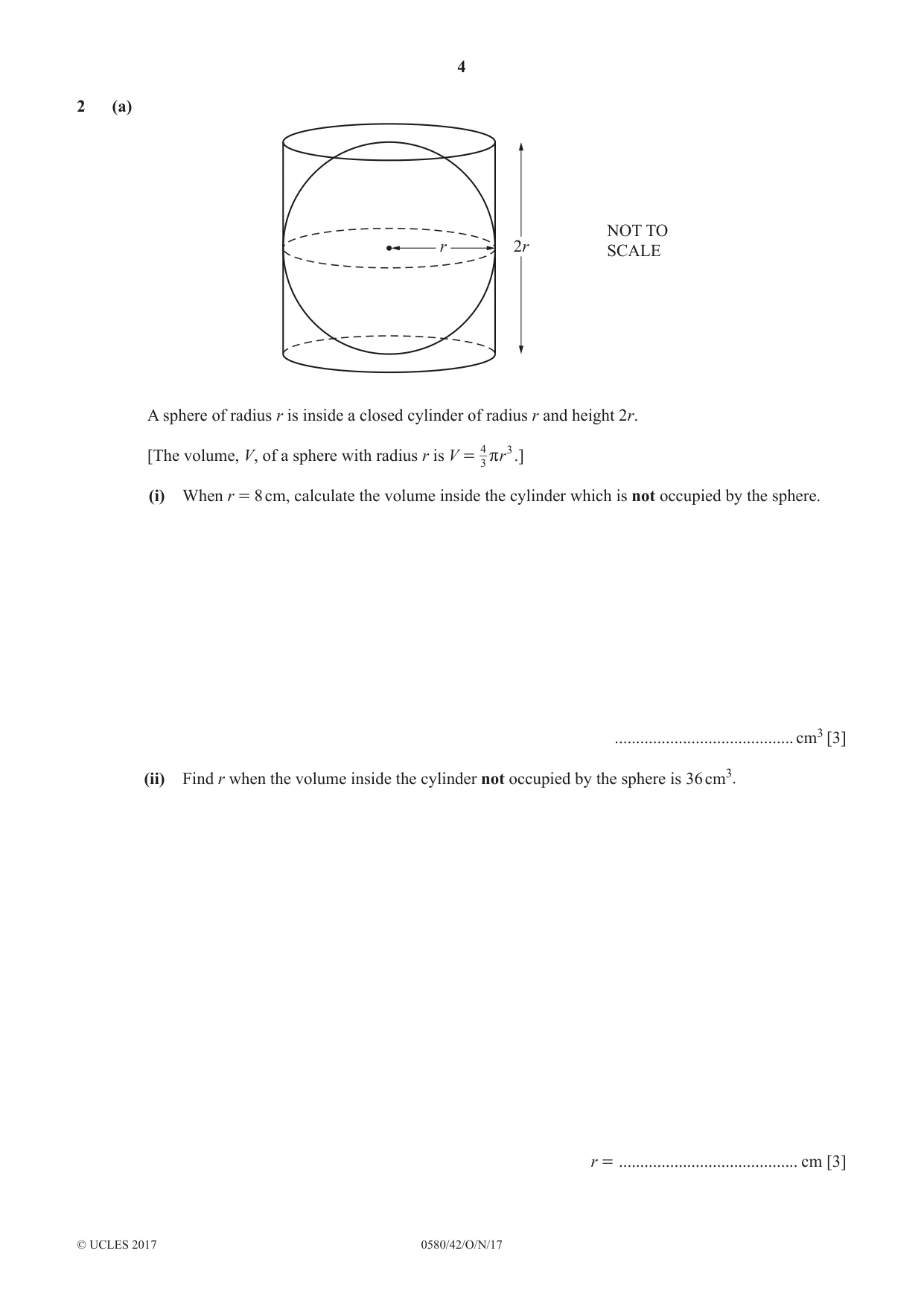
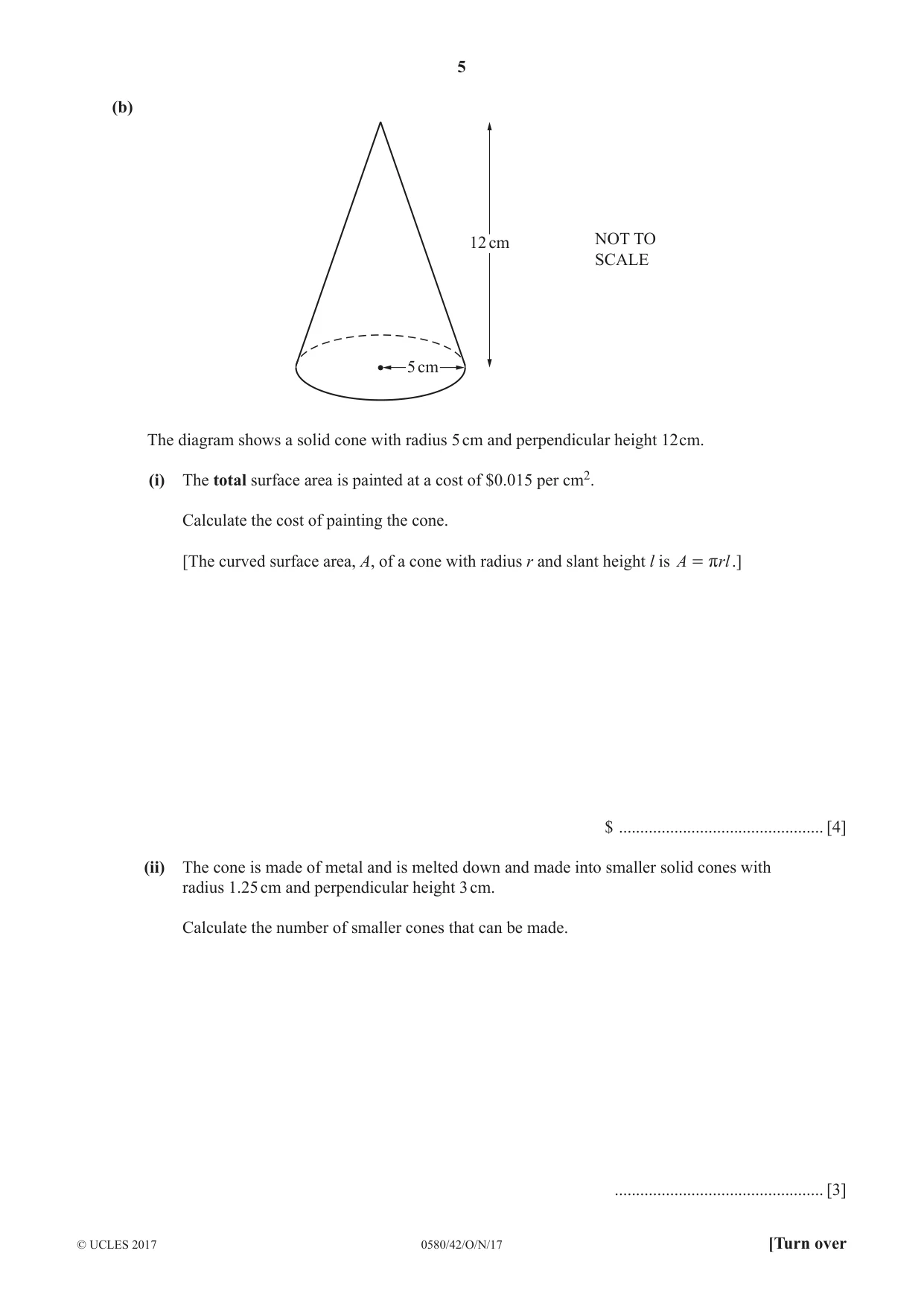
2 (a) NOT TO r 2r SCALE A sphere of radius r is inside a closed cylinder of radius r and height 2r. r r .] [The volume, V, of a sphere with radius r is V = 43 3 (i) When r = 8 cm, calculate the volume inside the cylinder which is not occupied by the sphere. ..........................................cm3 [3] (ii) Find r when the volume inside the cylinder not occupied by the sphere is 36 cm3. r = .......................................... cm [3] (b) 12 cm NOT TO SCALE 5 cm The diagram shows a solid cone with radius 5 cm and perpendicular height 12 cm. (i) The total surface area is painted at a cost of $0.015 per cm2. Calculate the cost of painting the cone. [The curved surface area, A, of a cone with radius r and slant height l is A = r rl .] $ ................................................ [4] (ii) The cone is made of metal and is melted down and made into smaller solid cones with radius 1.25 cm and perpendicular height 3 cm. Calculate the number of smaller cones that can be made. ................................................. [3]
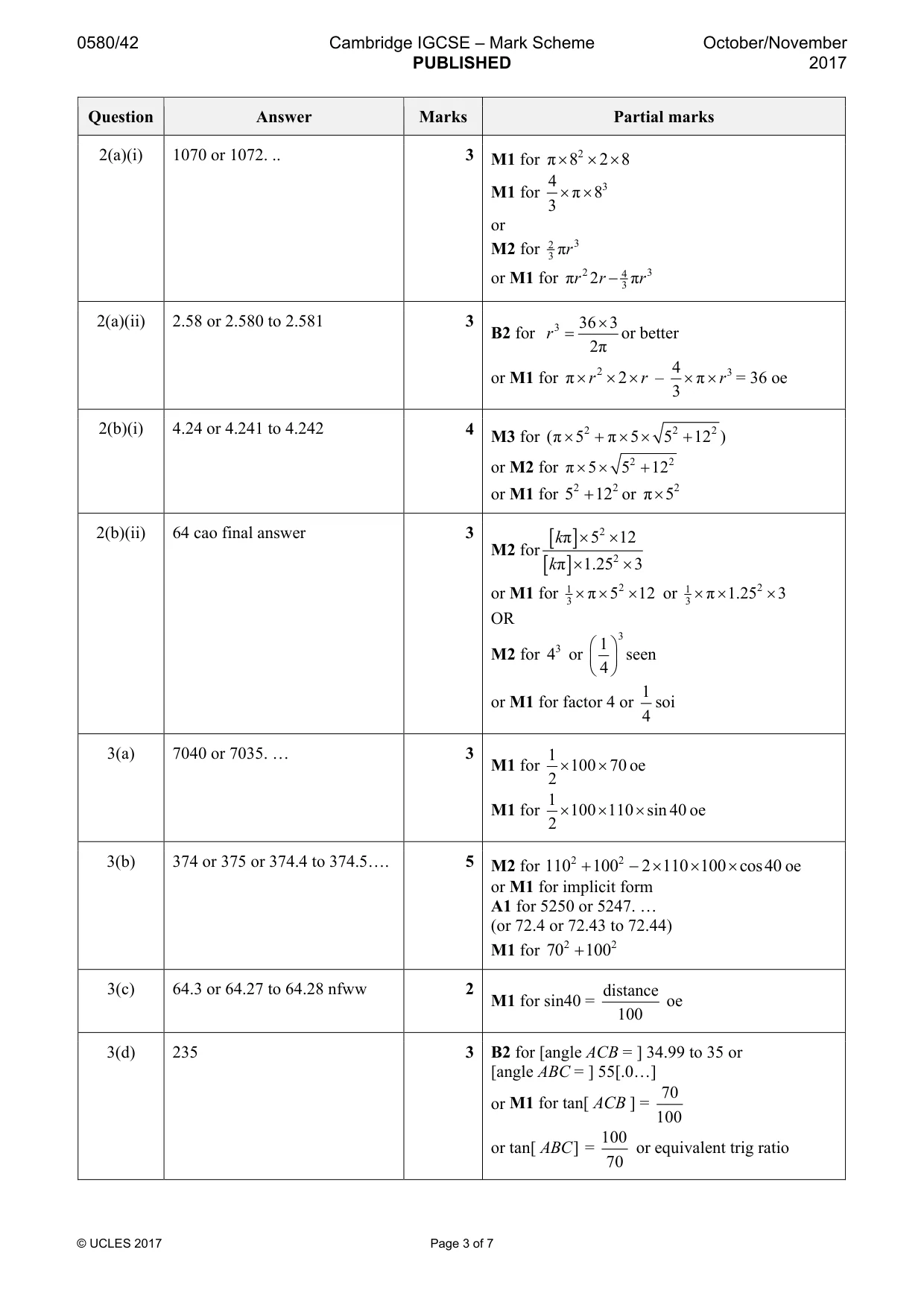
Mark scheme: 2(a)(i) 1070 or 1072. .. 3 M1 for π × 82 × 2 × 8 4 3 M1 for × π × 8 3 or M2 for 23 πr 3 or M1 for π r 2 2 r − 43 π r 3 2(a)(ii) 2.58 or 2.580 to 2.581 3 3 36 × 3 B2 for r = or better 2π 2 4 3 or M1 for π × r × 2 × r – × π × r = 36 oe 3 2(b)(i) 4.24 or 4.241 to 4.242 4 2 2 2 M3 for (π × 5 + π × 5 × 5 + 12 ) or M2 for π × 5 × 5 2 + 12 2 or M1 for 5 2 + 12 2 or π × 52 2(b)(ii) 64 cao final answer 3 [ kπ ] × 5 2 × 12 M2 for [ kπ ] × 1.25 2 × 3 or M1 for 13 × π × 5 2 × 12 or 13 × π × 1.25 2 × 3 OR 3 1 3 M2 for 4 or seen 4 1 or M1 for factor 4 or soi 4
Q3 · B North NOT TO 70 m SCALE 100 m C A 40° 110 m D The diagram shows a field ABCD
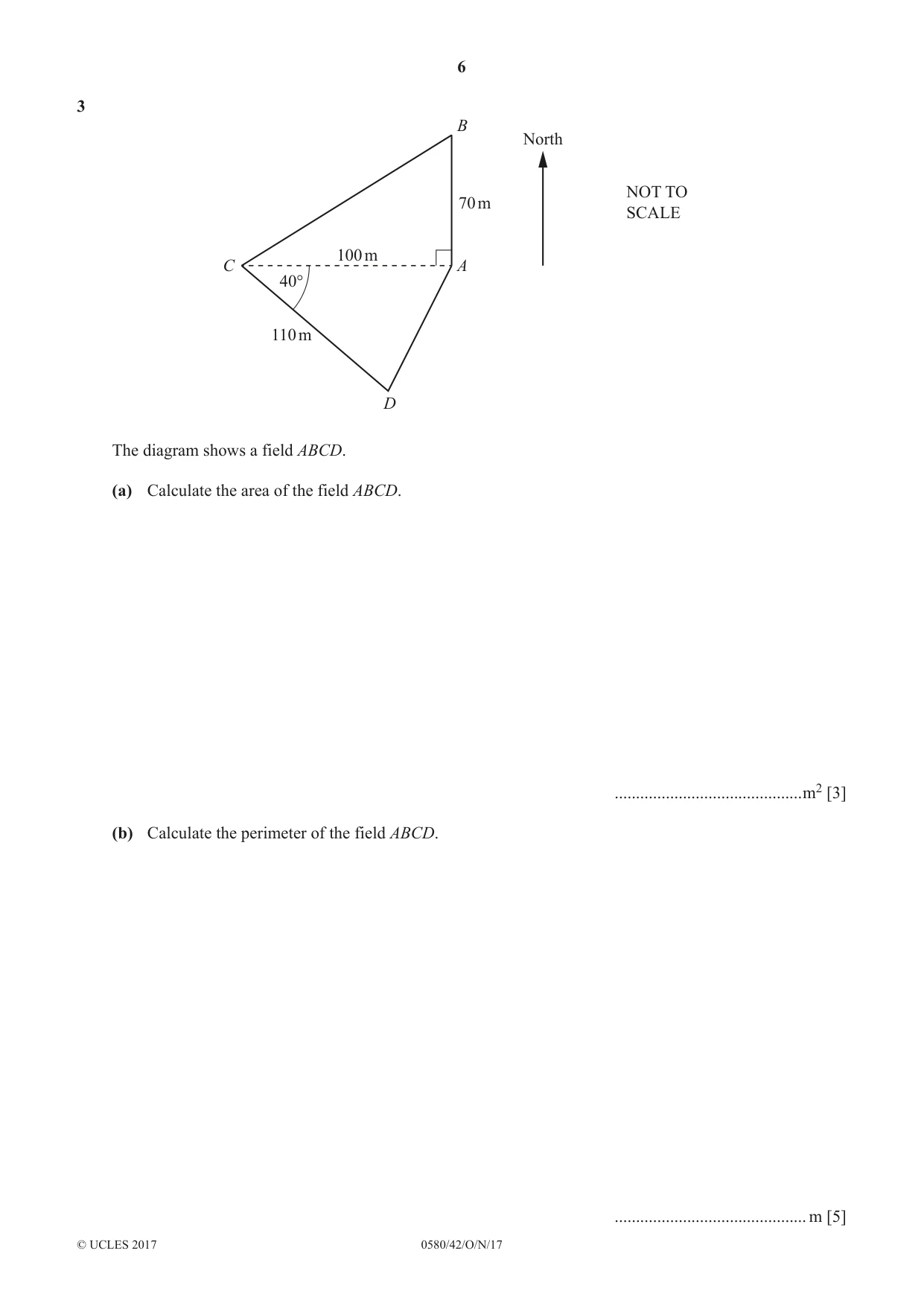
3 B North NOT TO 70 m SCALE 100 m C A 40° 110 m D The diagram shows a field ABCD. (a) Calculate the area of the field ABCD. ............................................m2 [3] (b) Calculate the perimeter of the field ABCD. ............................................. m [5] (c) Calculate the shortest distance from A to CD. ............................................. m [2] (d) B is due north of A. Find the bearing of C from B. ................................................. [3]
Mark scheme: 3(a) 7040 or 7035. … 3 1 M1 for × 100 × 70 oe 2 1 M1 for × 100 × 110 × sin 40 oe 2 3(b) 374 or 375 or 374.4 to 374.5…. 5 2 2 M2 for 110 + 100 −×2 110 × 100 × cos40 oe or M1 for implicit form A1 for 5250 or 5247. … (or 72.4 or 72.43 to 72.44) M1 for 70 2 + 100 2 3(c) 64.3 or 64.27 to 64.28 nfww 2 distance M1 for sin40 = oe 100 3(d) 235 3 B2 for [angle ACB = ] 34.99 to 35 or [angle ABC = ] 55[.0…] 70 or M1 for tan[ ACB ] = 100 100 or tan[ ABC ] = or equivalent trig ratio 70
Q4 · Y 6 5 4 3 2 1 x –7 –6 –5 –4 –3 –2 –1 0 1 2 3 4 5 6 –1 F –2 –3 –4 –5 –6 –7 Draw the image…
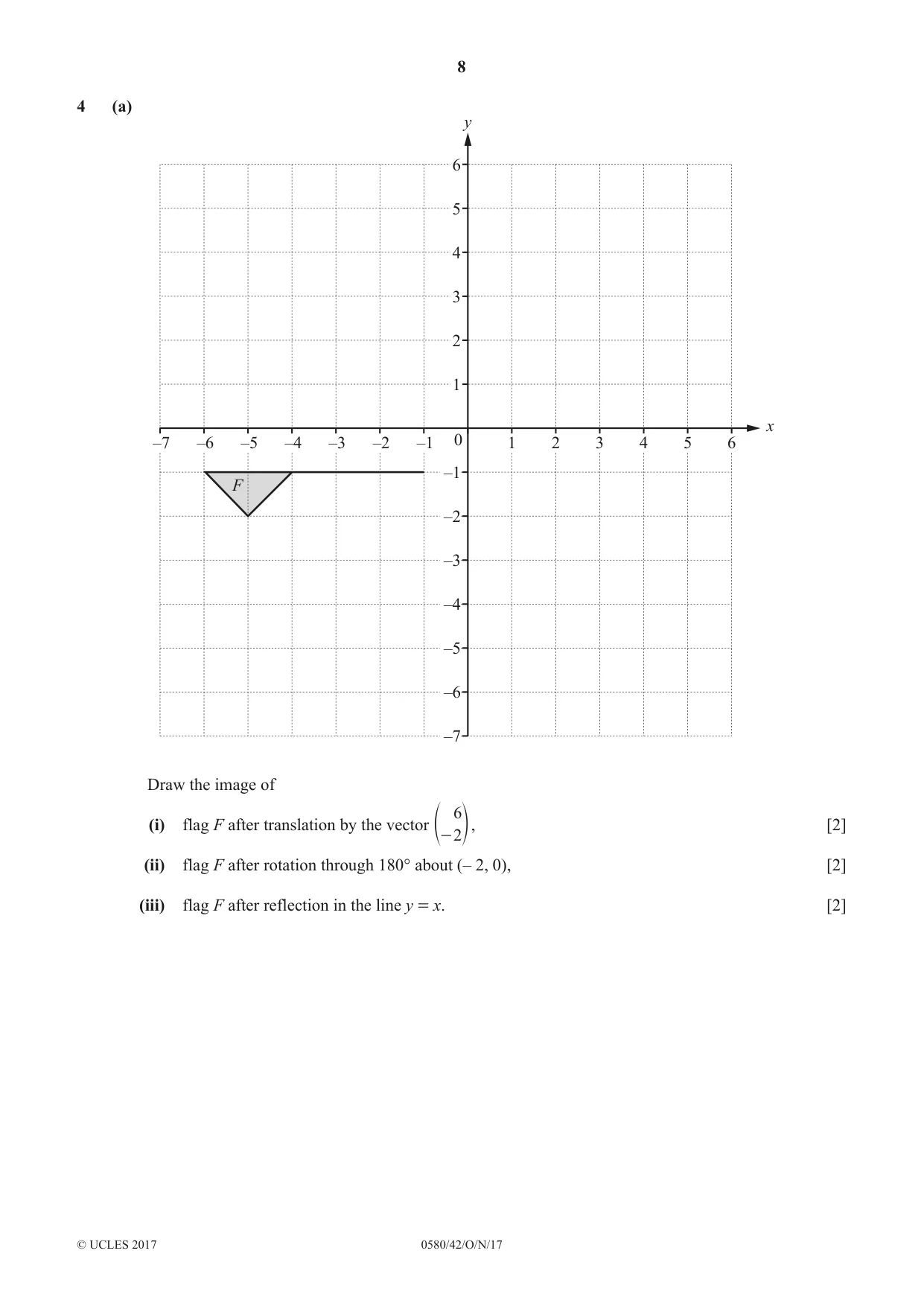
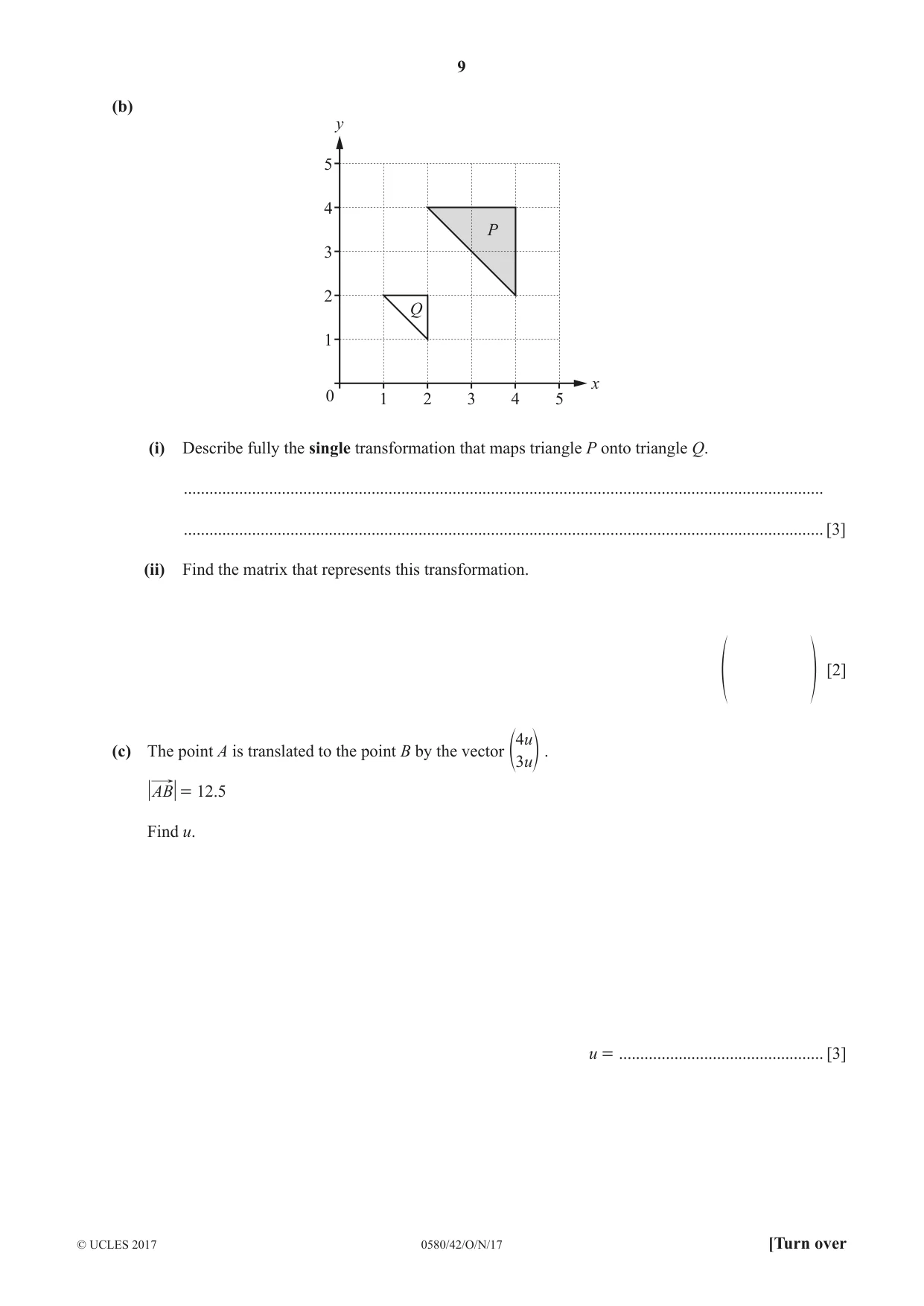
4 (a) y 6 5 4 3 2 1 x –7 –6 –5 –4 –3 –2 –1 0 1 2 3 4 5 6 –1 F –2 –3 –4 –5 –6 –7 Draw the image of 6 (i) flag F after translation by the vector [2] f- 2p, (ii) flag F after rotation through 180° about (– 2, 0), [2] (iii) flag F after reflection in the line y = x. [2] (b) y 5 4 P 3 2 Q 1 x 0 1 2 3 4 5 (i) Describe fully the single transformation that maps triangle P onto triangle Q. ...................................................................................................................................................... ...................................................................................................................................................... [3] (ii) Find the matrix that represents this transformation. [2] f p 4u (c) The point A is translated to the point B by the vector . f3up AB = 12.5 Find u. u = ................................................ [3]
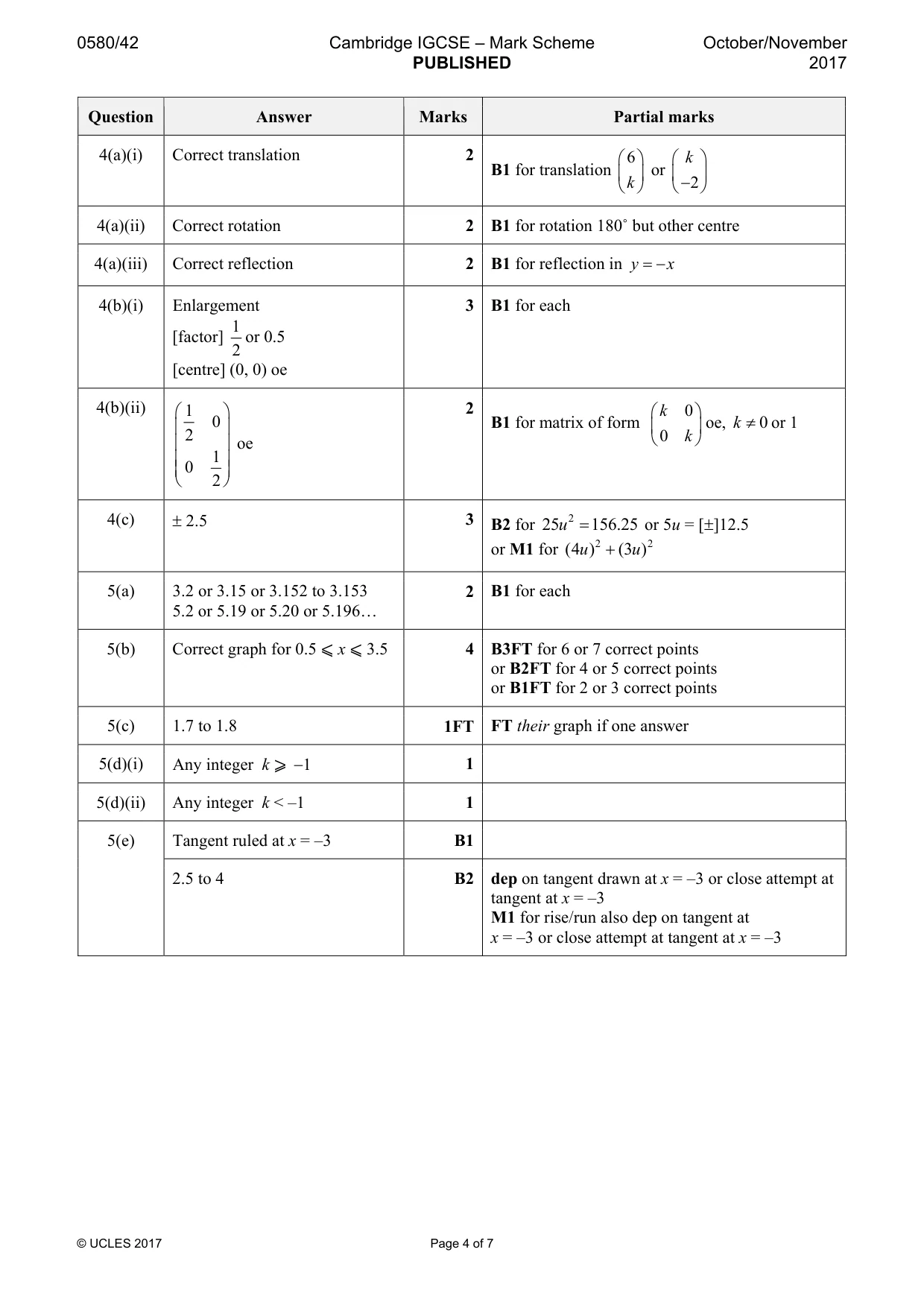
Mark scheme: 4(a)(i) Correct translation 2 6 k B1 for translation or k − 2 4(a)(ii) Correct rotation 2 B1 for rotation 180˚ but other centre 4(a)(iii) Correct reflection 2 B1 for reflection in y = − x 4(b)(i) Enlargement 3 B1 for each 1 [factor] or 0.5 2 [centre] (0, 0) oe 4(b)(ii) 1 2 k 0 0 B1 for matrix of form oe, k ≠ 0 or 1 2 oe 0 k 1 0 2 4(c) ± 2.5 3 B2 for 25u 2 = 156.25 or 5u = [±]12.5 or M1 for (4u ) 2 + (3u ) 2
Q5 · X 3 25 y = - 2 , x =Y 0 8 x (a) Complete the table of values
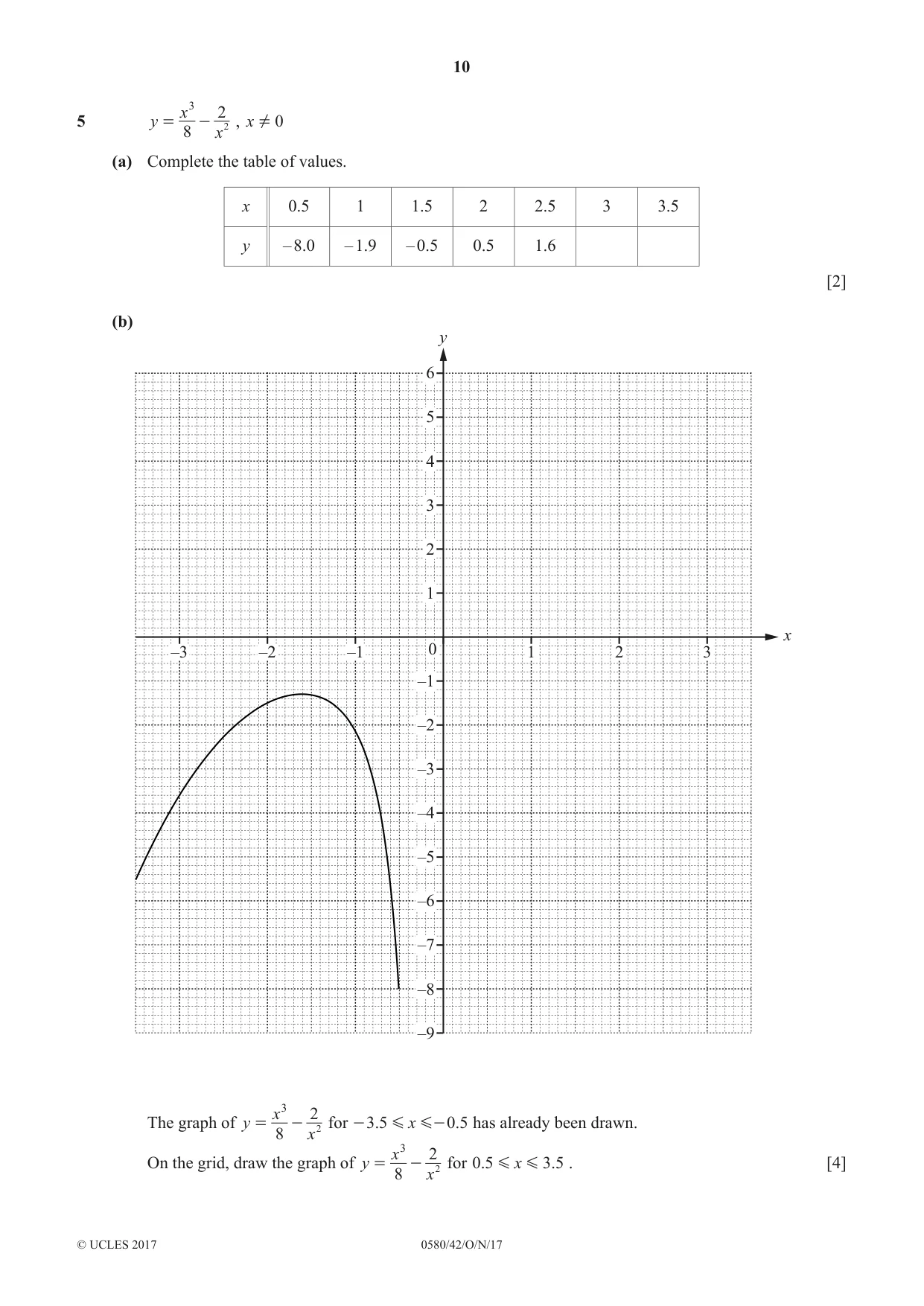
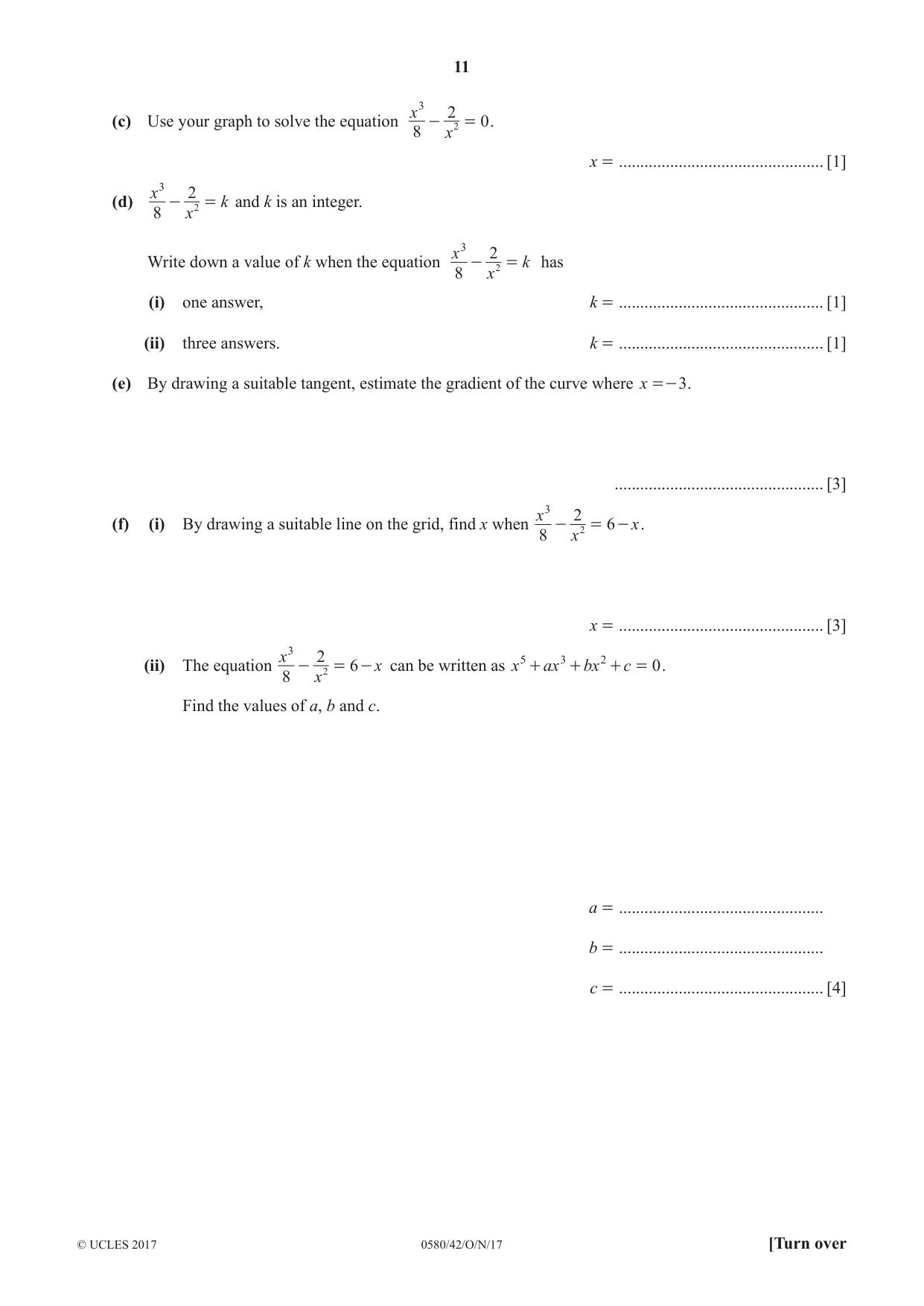
x 3 25 y = - 2 , x =Y 0 8 x (a) Complete the table of values. x 0.5 1 1.5 2 2.5 3 3.5 y – 8.0 – 1.9 – 0.5 0.5 1.6 [2] (b) y 6 5 4 3 2 1 x –3 –2 –1 0 1 2 3 –1 –2 –3 –4 –5 –6 –7 –8 –9 x 3 2 The graph of y = - 2 for - 3.5 G x G - 0. 5 has already been drawn. 8 x x 3 2 On the grid, draw the graph of y = - 2 for 0.5 G x G 3.5 . [4] 8 x x 3 2(c) Use your graph to solve the equation - 2 = 0 . 8 x x = ................................................ [1] x 3 2(d) - 2 = k and k is an integer. 8 x x 3 2 Write down a value of k when the equation - 2 = k has 8 x (i) one answer, k = ................................................ [1] (ii) three answers. k = ................................................ [1] (e) By drawing a suitable tangent, estimate the gradient of the curve where x =- 3 . ................................................. [3] x 3 2(f) (i) By drawing a suitable line on the grid, find x when - 2 = 6 - x . 8 x x = ................................................ [3] x 3 2 5 3 2 (ii) The equation - 2 = 6 - x can be written as x + ax + bx + c = 0 . 8 x Find the values of a, b and c. a = ................................................ b = ................................................ c = ................................................ [4]
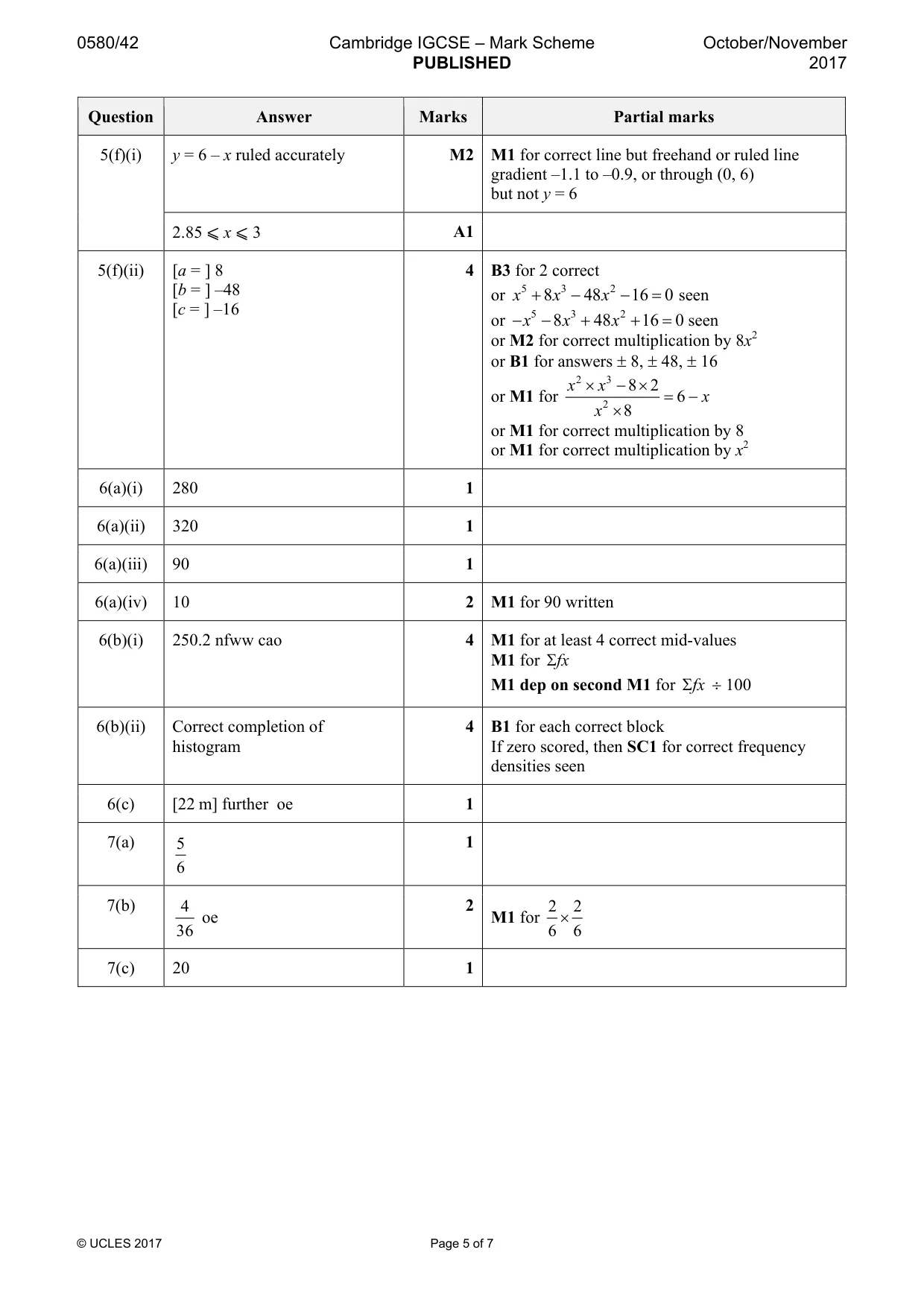
Mark scheme: 5(a) 3.2 or 3.15 or 3.152 to 3.153 2 B1 for each 5.2 or 5.19 or 5.20 or 5.196… 5(b) Correct graph for 0.5 ⩽ x ⩽ 3.5 4 B3FT for 6 or 7 correct points or B2FT for 4 or 5 correct points or B1FT for 2 or 3 correct points 5(c) 1.7 to 1.8 1FT FT their graph if one answer 5(d)(i) Any integer k ⩾ −1 1 5(d)(ii) Any integer k < –1 1 5(e) Tangent ruled at x = –3 B1 2.5 to 4 B2 dep on tangent drawn at x = –3 or close attempt at tangent at x = –3 M1 for rise/run also dep on tangent at x = –3 or close attempt at tangent at x = –3 5(f)(i) y = 6 – x ruled accurately M2 M1 for correct line but freehand or ruled line gradient –1.1 to –0.9, or through (0, 6) but not y = 6 2.85 ⩽ x ⩽ 3 A1 5(f)(ii) [a = ] 8 4 B3 for 2 correct [b = ] –48 or x 5 + 8 x 3 − 48 x 2 − 16 = 0 seen [c = ] –16 5 3 2 or − x − 8 x + 48 x + 16 = 0 seen or M2 for correct multiplication by 8x2 or B1 for answers ± 8, ± 48, ± 16 x 2 × x 3 −×8 2 or M1 for = 6 − x x 2 × 8 or M1 for correct multiplication by 8 or M1 for correct multiplication by x2
Q6 · There are 100 students in group A
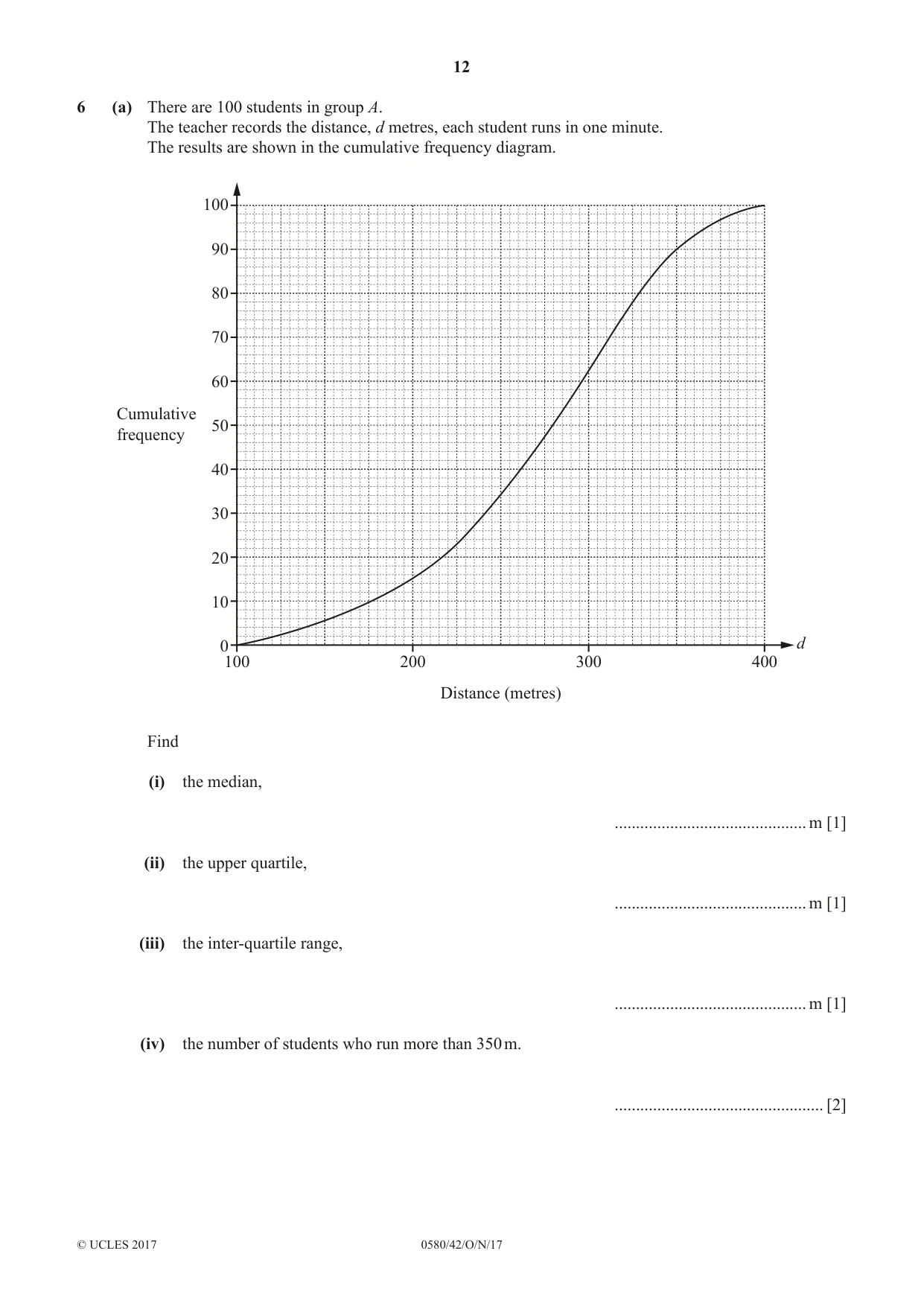
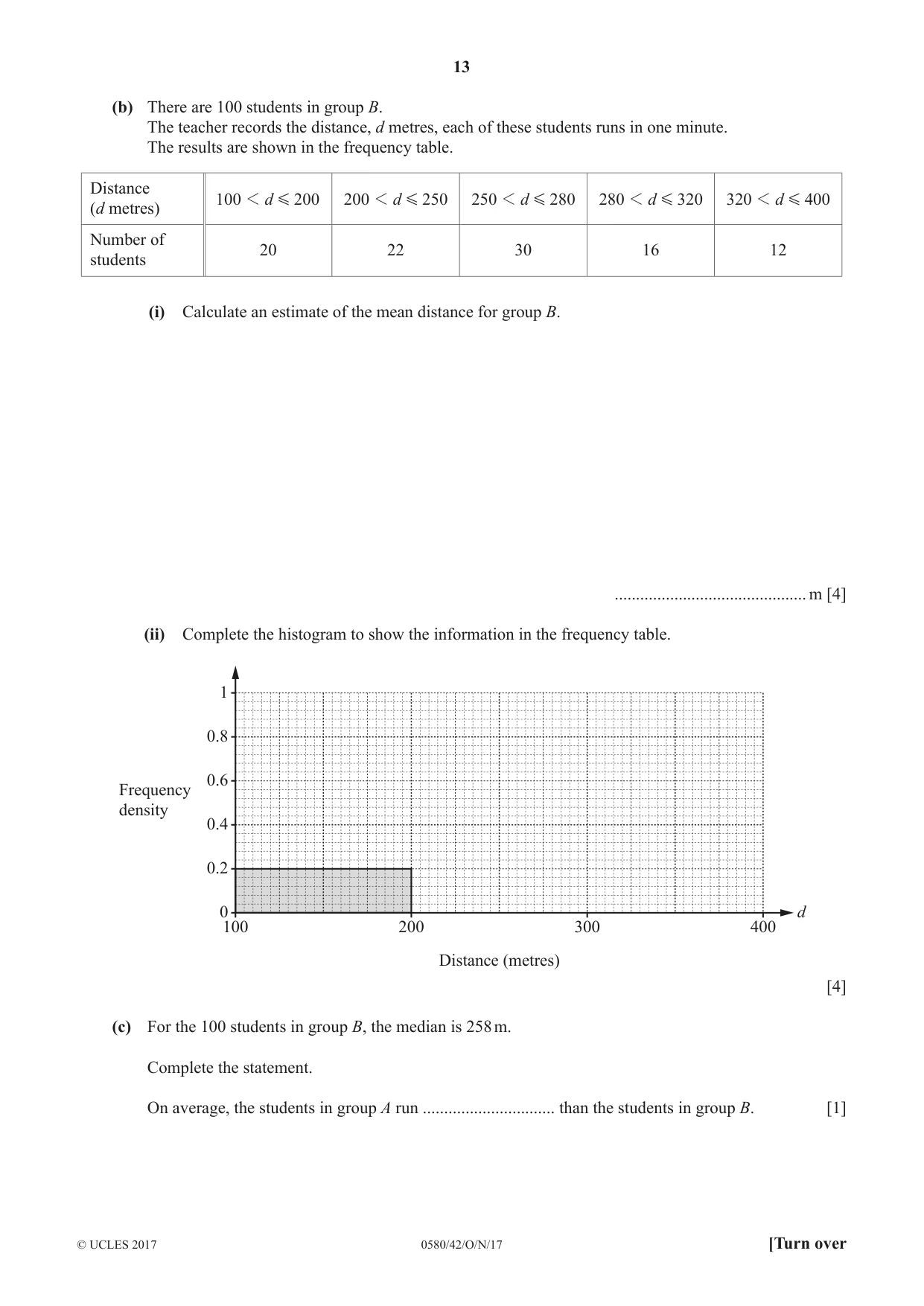
6 (a) There are 100 students in group A. The teacher records the distance, d metres, each student runs in one minute. The results are shown in the cumulative frequency diagram. 100 90 80 70 60 Cumulative 50 frequency 40 30 20 10 0 d 100 200 300 400 Distance (metres) Find (i) the median, ............................................. m [1] (ii) the upper quartile, ............................................. m [1] (iii) the inter-quartile range, ............................................. m [1] (iv) the number of students who run more than 350 m. ................................................. [2] (b) There are 100 students in group B. The teacher records the distance, d metres, each of these students runs in one minute. The results are shown in the frequency table. Distance 100 1 d G 200 200 1 d G 250 250 1 d G 280 280 1 d G 32 0 320 1 d G 400(d metres) Number of 20 22 30 16 12students (i) Calculate an estimate of the mean distance for group B. ............................................. m [4] (ii) Complete the histogram to show the information in the frequency table. 1 0.8 0.6 Frequency density 0.4 0.2 0 d 100 200 300 400 Distance (metres) [4] (c) For the 100 students in group B, the median is 258 m. Complete the statement. On average, the students in group A run ............................... than the students in group B. [1]
Mark scheme: 6(a)(i) 280 1 6(a)(ii) 320 1 6(a)(iii) 90 1 6(a)(iv) 10 2 M1 for 90 written 6(b)(i) 250.2 nfww cao 4 M1 for at least 4 correct mid-values M1 for Σfx M1 dep on second M1 for Σfx ÷ 100 6(b)(ii) Correct completion of 4 B1 for each correct block histogram If zero scored, then SC1 for correct frequency densities seen 6(c) [22 m] further oe 1
Q7 · 0 1 0 1 1 2 A B The diagram shows two fair dice
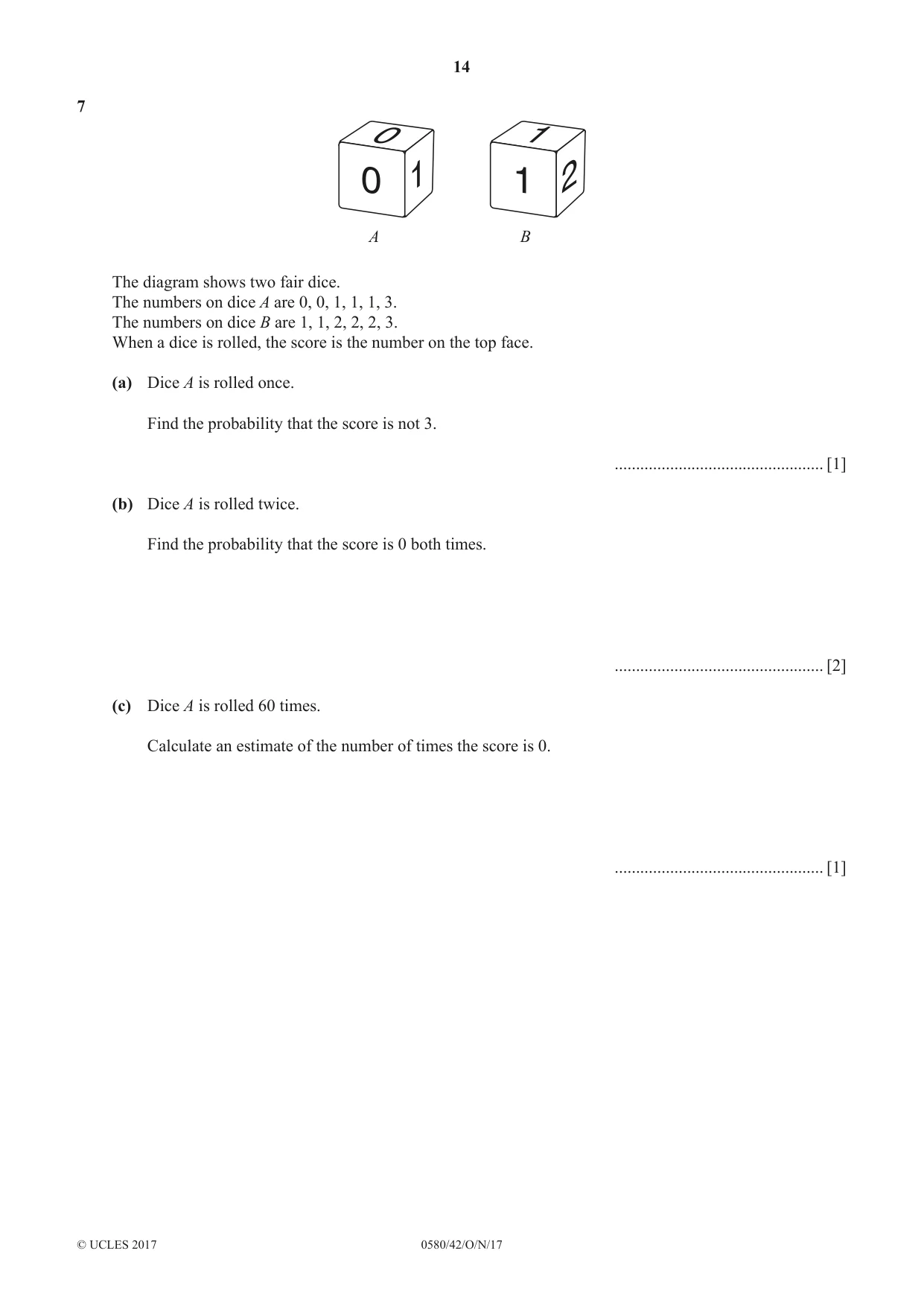
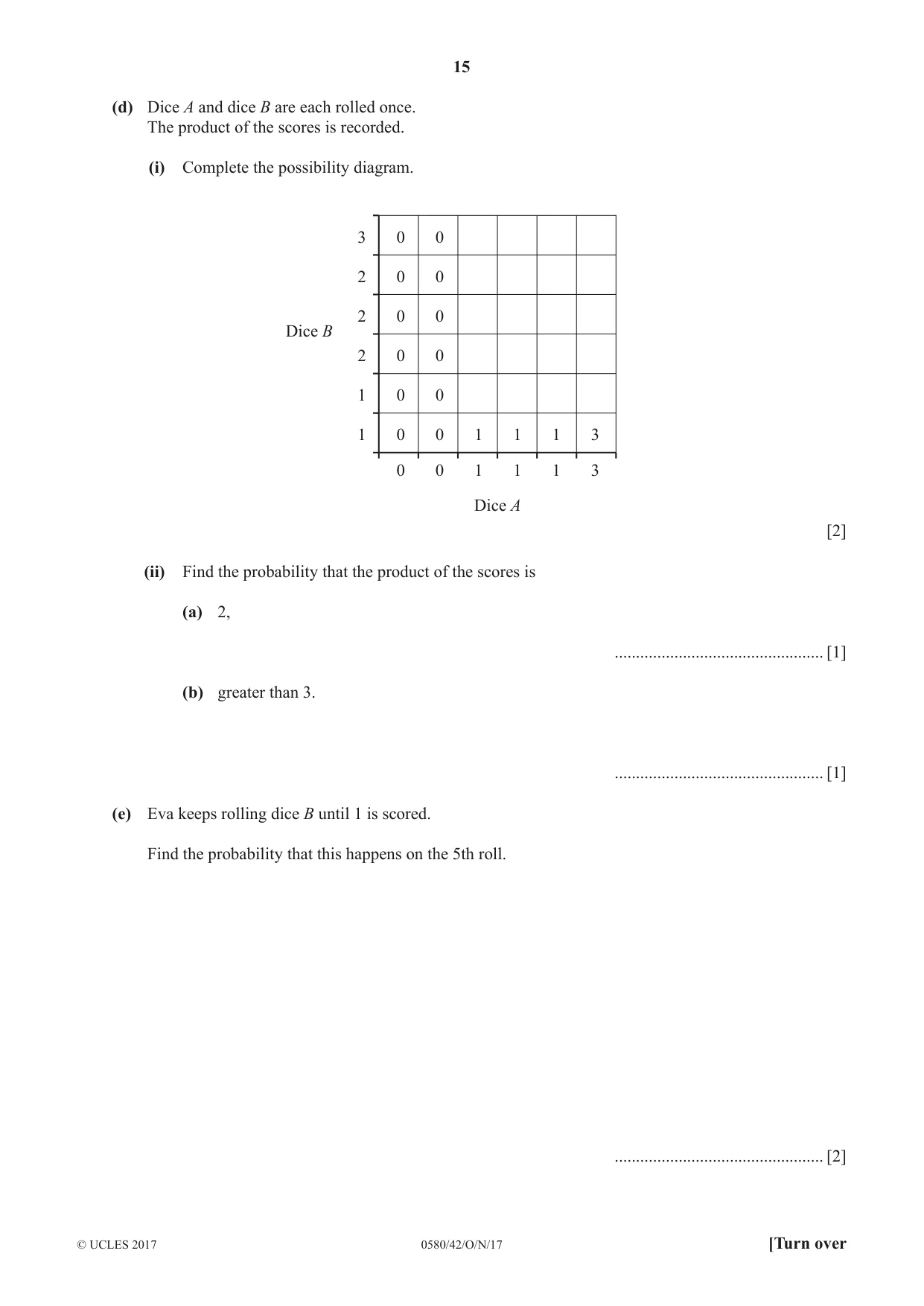
7 0 1 0 1 1 2 A B The diagram shows two fair dice. The numbers on dice A are 0, 0, 1, 1, 1, 3. The numbers on dice B are 1, 1, 2, 2, 2, 3. When a dice is rolled, the score is the number on the top face. (a) Dice A is rolled once. Find the probability that the score is not 3. ................................................. [1] (b) Dice A is rolled twice. Find the probability that the score is 0 both times. ................................................. [2] (c) Dice A is rolled 60 times. Calculate an estimate of the number of times the score is 0. ................................................. [1] (d) Dice A and dice B are each rolled once. The product of the scores is recorded. (i) Complete the possibility diagram. 3 0 0 2 0 0 2 0 0 Dice B 2 0 0 1 0 0 1 0 0 1 1 1 3 0 0 1 1 1 3 Dice A [2] (ii) Find the probability that the product of the scores is (a) 2, ................................................. [1] (b) greater than 3. ................................................. [1] (e) Eva keeps rolling dice B until 1 is scored. Find the probability that this happens on the 5th roll. ................................................. [2]
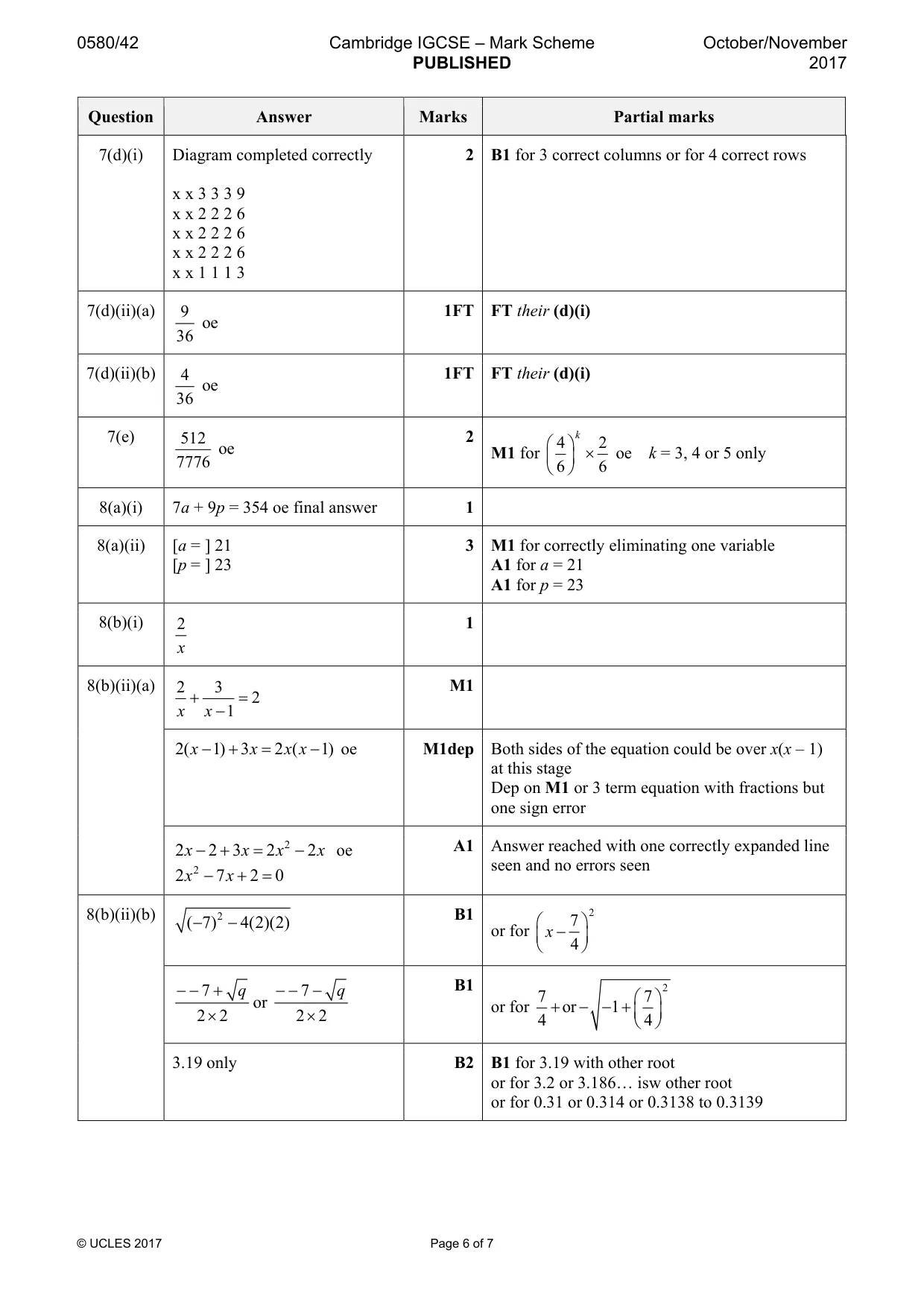
Mark scheme: 7(a) 5 1 6 7(b) 4 2 2 2 oe M1 for × 36 6 6 7(c) 20 1 7(d)(i) Diagram completed correctly 2 B1 for 3 correct columns or for 4 correct rows x x 3 3 3 9 x x 2 2 2 6 x x 2 2 2 6 x x 2 2 2 6 x x 1 1 1 3 7(d)(ii)(a) 9 1FT FT their (d)(i) oe 36 7(d)(ii)(b) 4 1FT FT their (d)(i) oe 36 7(e) 512 2 4 k 2 oe M1 for oe k = 3, 4 or 5 only × 7776 6 6
Q8 · The cost of 1 apple is a cents
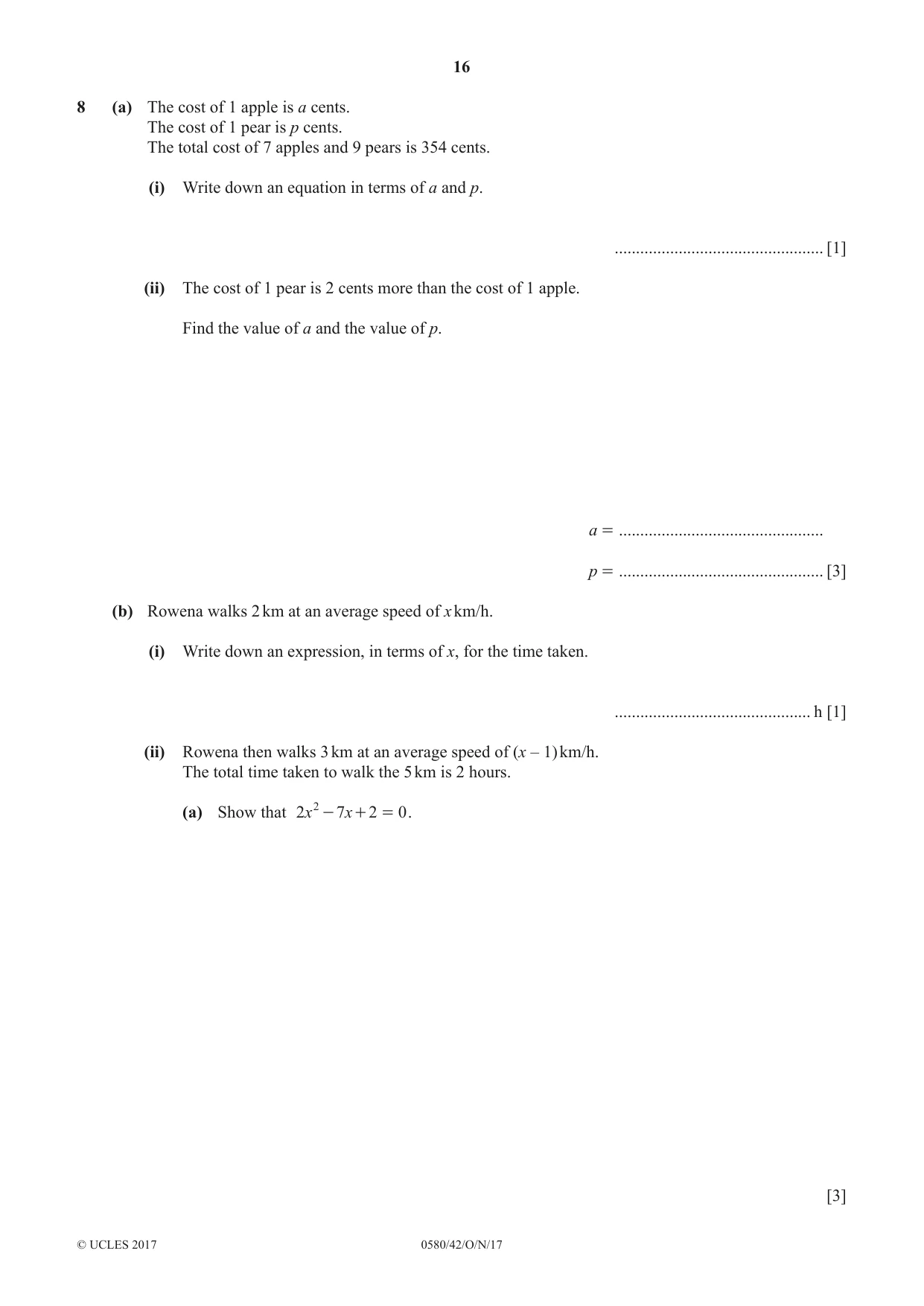
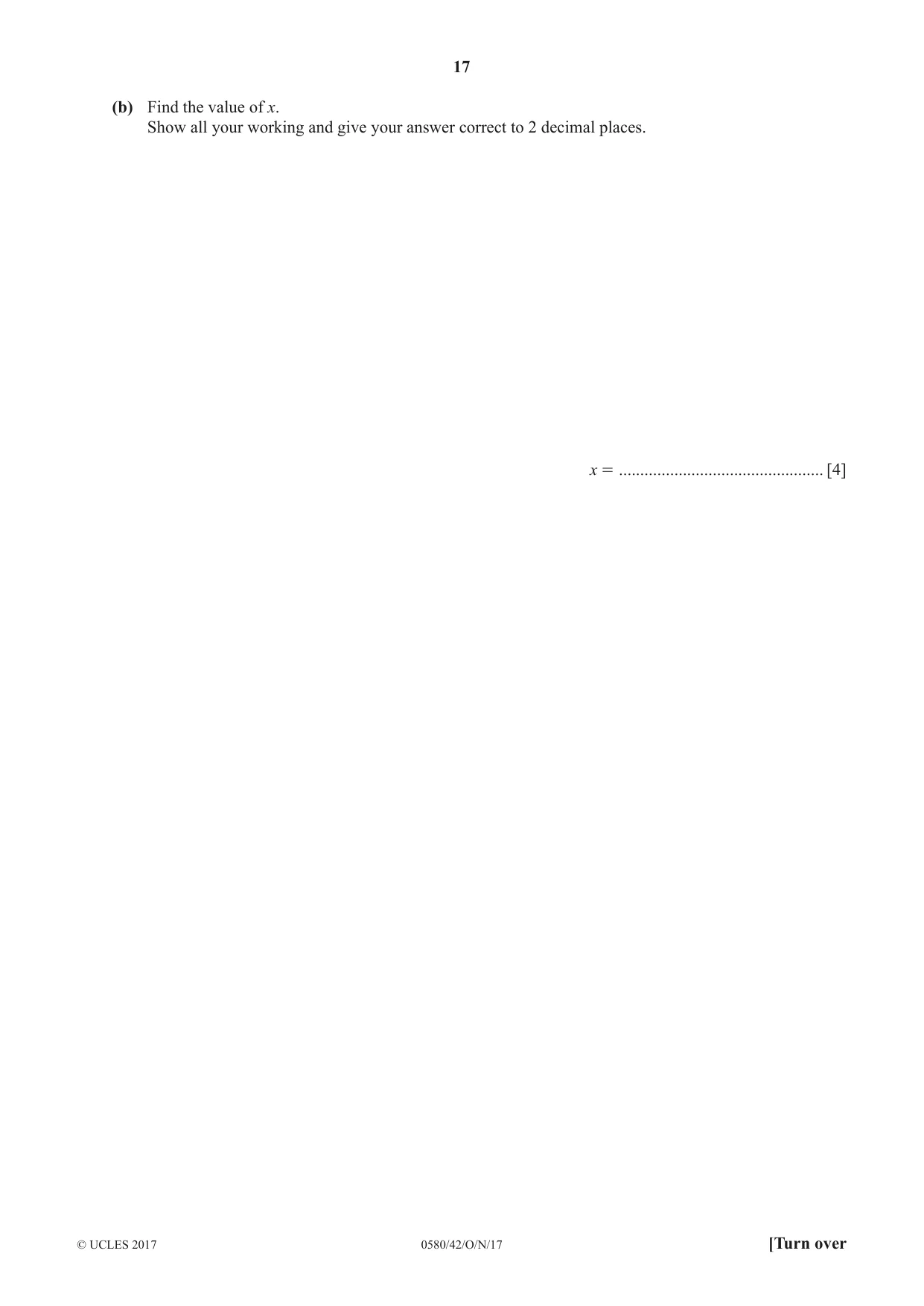
8 (a) The cost of 1 apple is a cents. The cost of 1 pear is p cents. The total cost of 7 apples and 9 pears is 354 cents. (i) Write down an equation in terms of a and p. ................................................. [1] (ii) The cost of 1 pear is 2 cents more than the cost of 1 apple. Find the value of a and the value of p. a = ................................................ p = ................................................ [3] (b) Rowena walks 2 km at an average speed of x km/h. (i) Write down an expression, in terms of x, for the time taken. .............................................. h [1] (ii) Rowena then walks 3 km at an average speed of (x – 1) km/h. The total time taken to walk the 5 km is 2 hours. (a) Show that 2x 2 - 7x + 2 = 0 . [3] (b) Find the value of x. Show all your working and give your answer correct to 2 decimal places. x = ................................................ [4]
Mark scheme: 8(a)(i) 7a + 9p = 354 oe final answer 1 8(a)(ii) [a = ] 21 3 M1 for correctly eliminating one variable [p = ] 23 A1 for a = 21 A1 for p = 23 8(b)(i) 2 1 x 8(b)(ii)(a) 2 3 M1 + = 2 x x − 1 2( x − 1) + 3 x = 2 x ( x − 1) oe M1dep Both sides of the equation could be over x(x – 1) at this stage Dep on M1 or 3 term equation with fractions but one sign error 2 x − 2 + 3 x = 2 x 2 − 2 x oe A1 Answer reached with one correctly expanded line 2 seen and no errors seen 2 x − 7 x + 2 = 0 8(b)(ii)(b) 2 B1 2 ( −7) − 4(2)(2) 7 or for x − 4 −− 7 + q −− 7 − q B1 2 7 7 or or for + or −−+1 2 × 2 2 × 2 4 4 3.19 only B2 B1 for 3.19 with other root or for 3.2 or 3.186… isw other root or for 0.31 or 0.314 or 0.3138 to 0.3139
Q9 · F ()x = 1 - 2x g ()x = x + 4 h ()x = x 2 + 1 (a) Find (f-1)
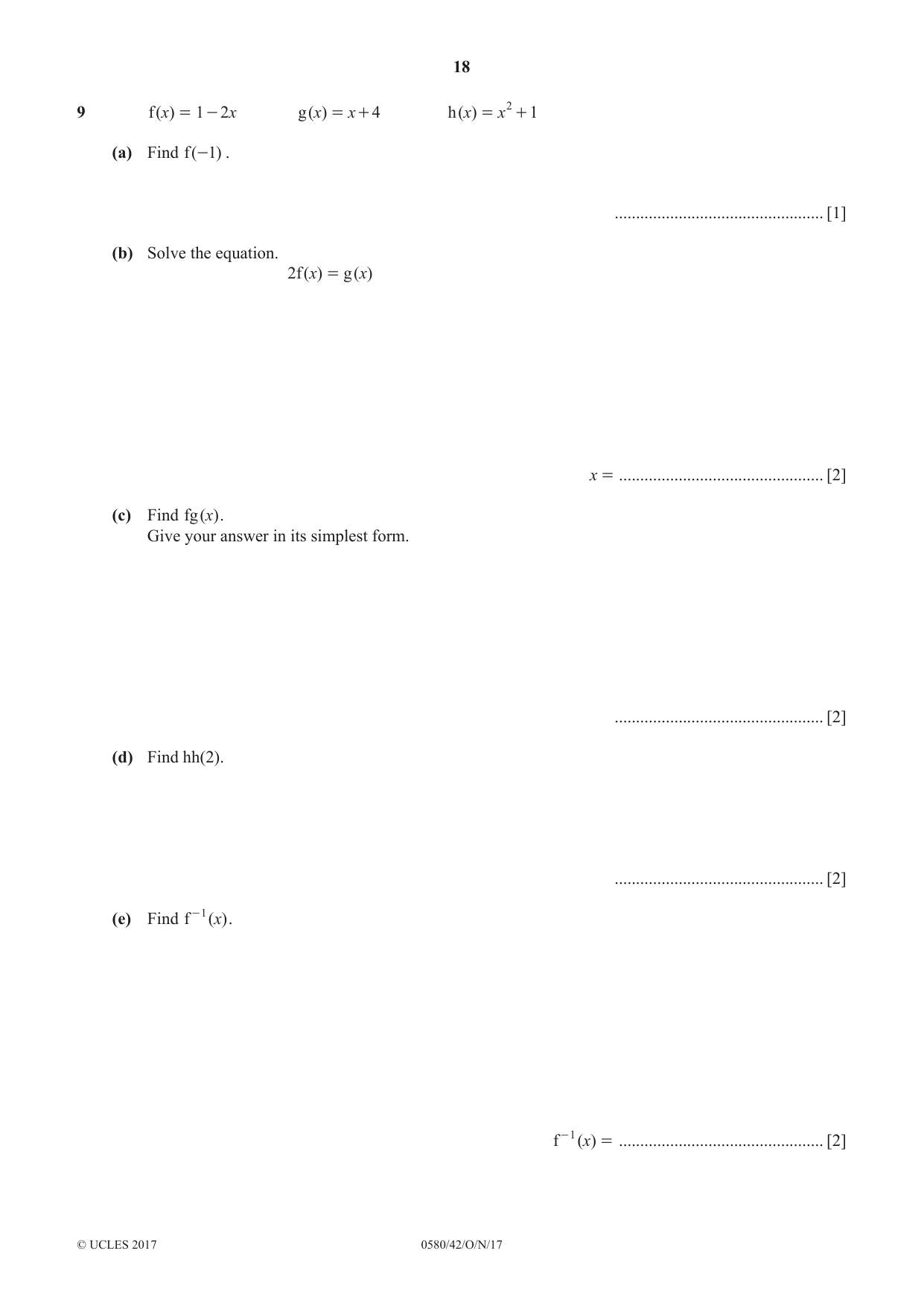
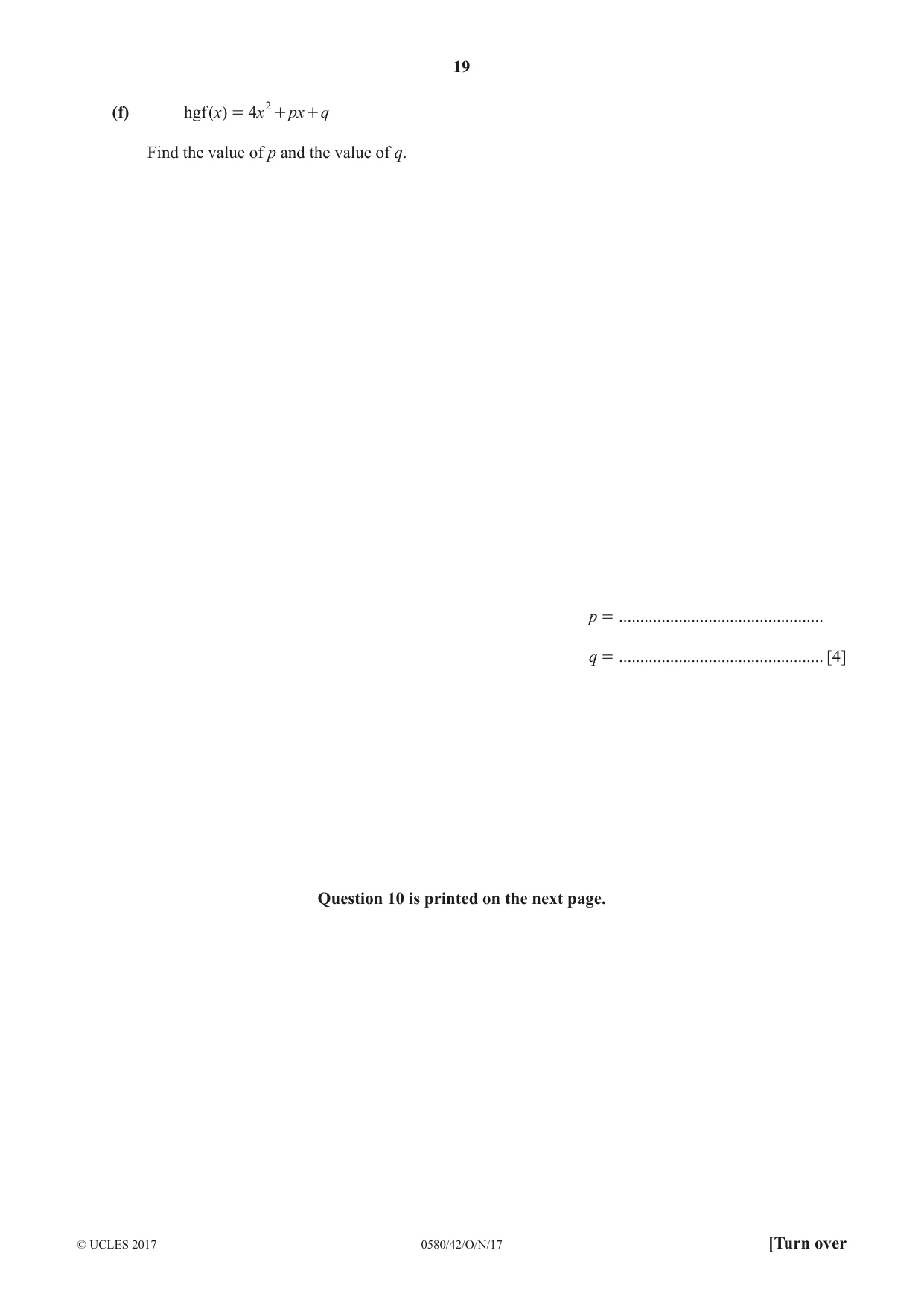
9 f ()x = 1 - 2x g ()x = x + 4 h ()x = x 2 + 1 (a) Find (f-1) . ................................................. [1] (b) Solve the equation. 2f ( x) = g ( x) x = ................................................ [2] (c) Find fg ()x . Give your answer in its simplest form. ................................................. [2] (d) Find hh(2). ................................................. [2] (e) Find f - 1 ()x . f - 1 ()x = ................................................ [2] (f) hgf ()x = 4x 2 + px + q Find the value of p and the value of q. p = ................................................ q = ................................................ [4] Question 10 is printed on the next page.
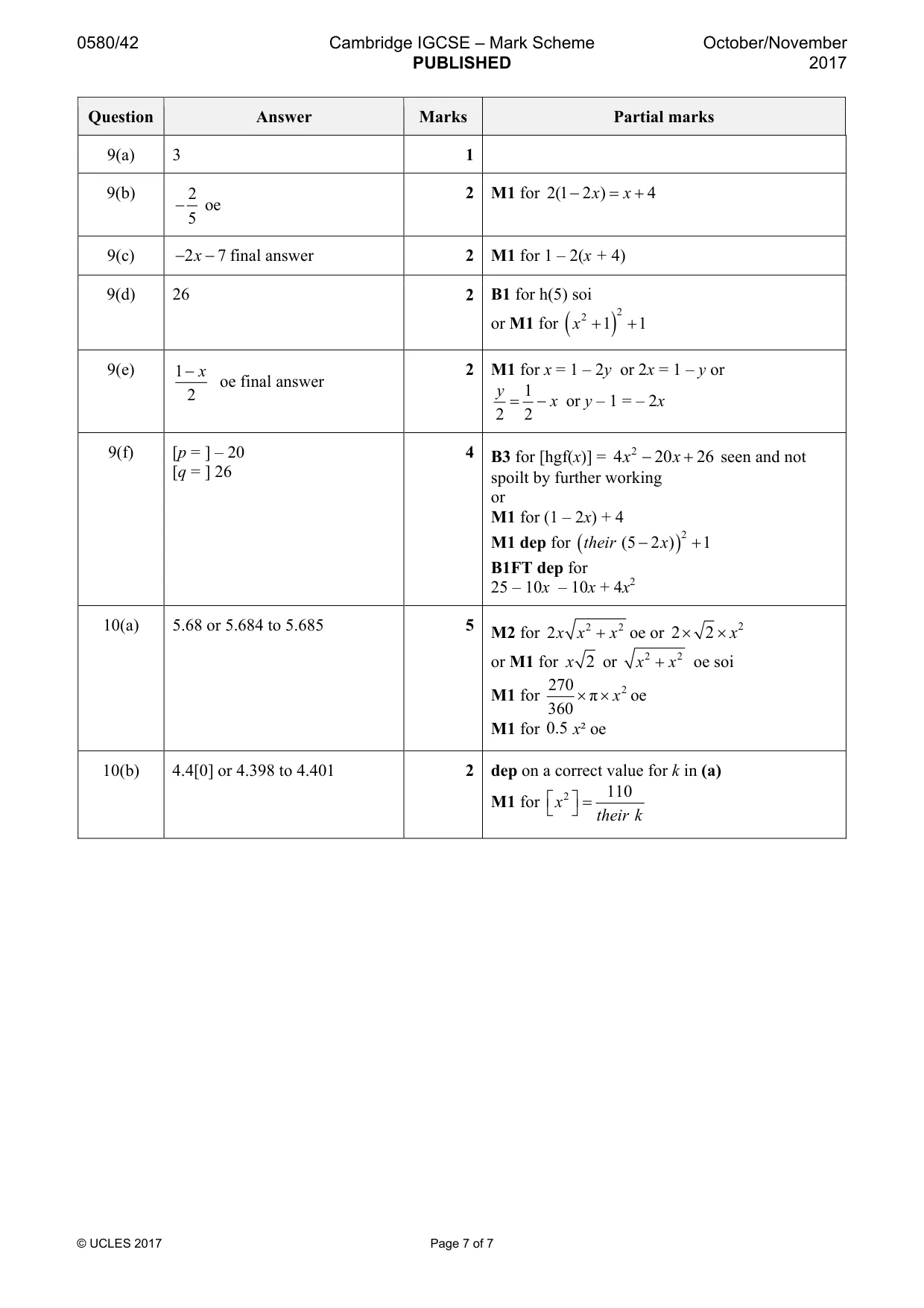
Mark scheme: 9(a) 3 1 9(b) 2 2 M1 for 2(1 − 2 x ) = x + 4 − oe 5 9(c) −2 x − 7 final answer 2 M1 for 1 – 2(x + 4) 9(d) 26 2 B1 for h(5) soi 2 or M1 for x 2 + 1 + 1 ( ) 9(e) 1 −x 2 M1 for x = 1 – 2y or 2x = 1 – y or oe final answer 2 y 1 = − x or y – 1 = – 2x 2 2 9(f) [p = ] – 20 4 B3 for [hgf(x)] = 4 x 2 − 20 x + 26 seen and not [q = ] 26 spoilt by further working or M1 for (1 – 2x) + 4 M1 dep for ( their (5 − 2 x ) ) 2 + 1 B1FT dep for 25 – 10x – 10x + 4x2
Q10 · 270° O x cm NOT TO SCALE 2x cm The diagram shows a sector of a circle, a triangle and a…
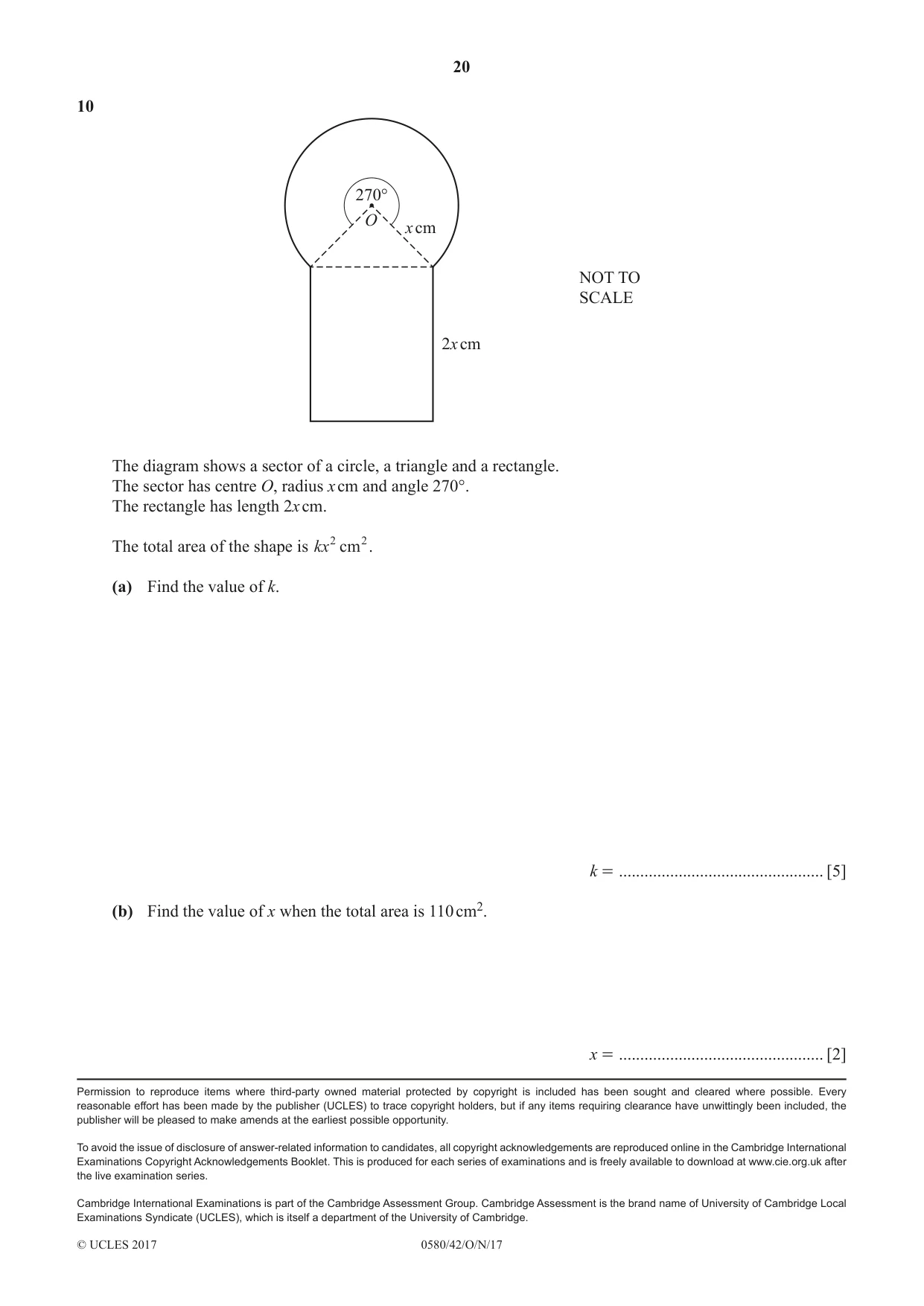
10 270° O x cm NOT TO SCALE 2x cm The diagram shows a sector of a circle, a triangle and a rectangle. The sector has centre O, radius x cm and angle 270°. The rectangle has length 2x cm. The total area of the shape is kx2 cm 2. (a) Find the value of k. k = ................................................ [5] (b) Find the value of x when the total area is 110 cm2. x = ................................................ [2]
Mark scheme: 10(a) 5.68 or 5.684 to 5.685 5 2 2 2 M2 for 2 x x + x oe or 2 × 2 × x or M1 for x 2 or x 2 + x 2 oe soi 270 2 M1 for × π × x oe 360 M1 for 0.5 x² oe 10(b) 4.4[0] or 4.398 to 4.401 2 dep on a correct value for k in (a) 2 110 M1 for x = their k
What was in this paper
The subtopics covered by these 10 questions, and how many questions each got. Open one in a new tab to see every Cambridge question on it.
What you needed in this session
Cambridge’s own grade thresholds for 2017 Oct/Nov, Paper 4 · Variant 2. A higher threshold means an easier paper — the bar moves with how the cohort did.