Cambridge IGCSE Mathematics 0580 — 2021 May/June Paper 4 · Variant 3
0580/43/M/J/21 · 11 questions · 130 marks · ≈146 min
The question paper and its mark scheme, free to read here and free to download. This is Cambridge’s own paper, exactly as it was sat.
Question paper20 pages
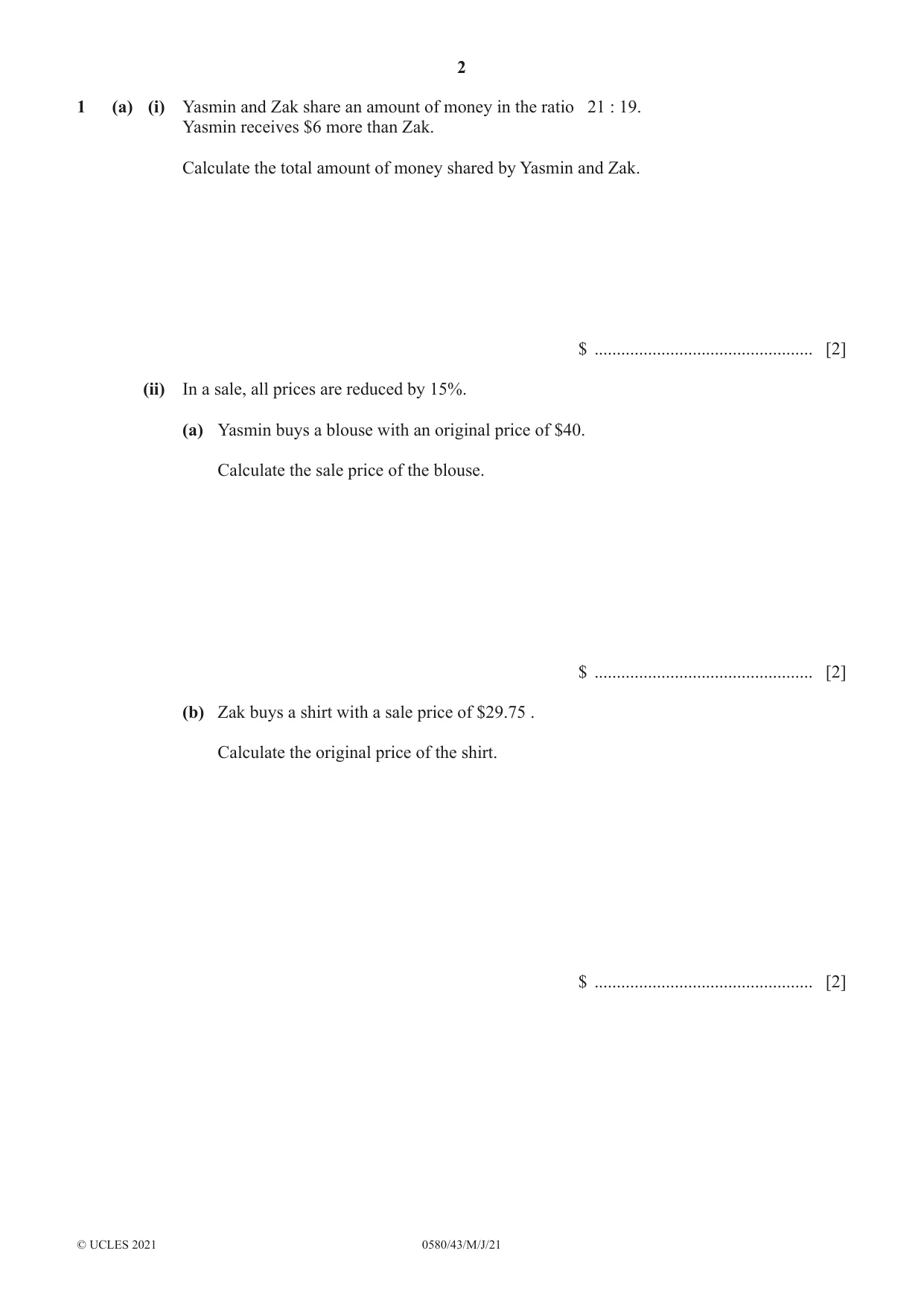
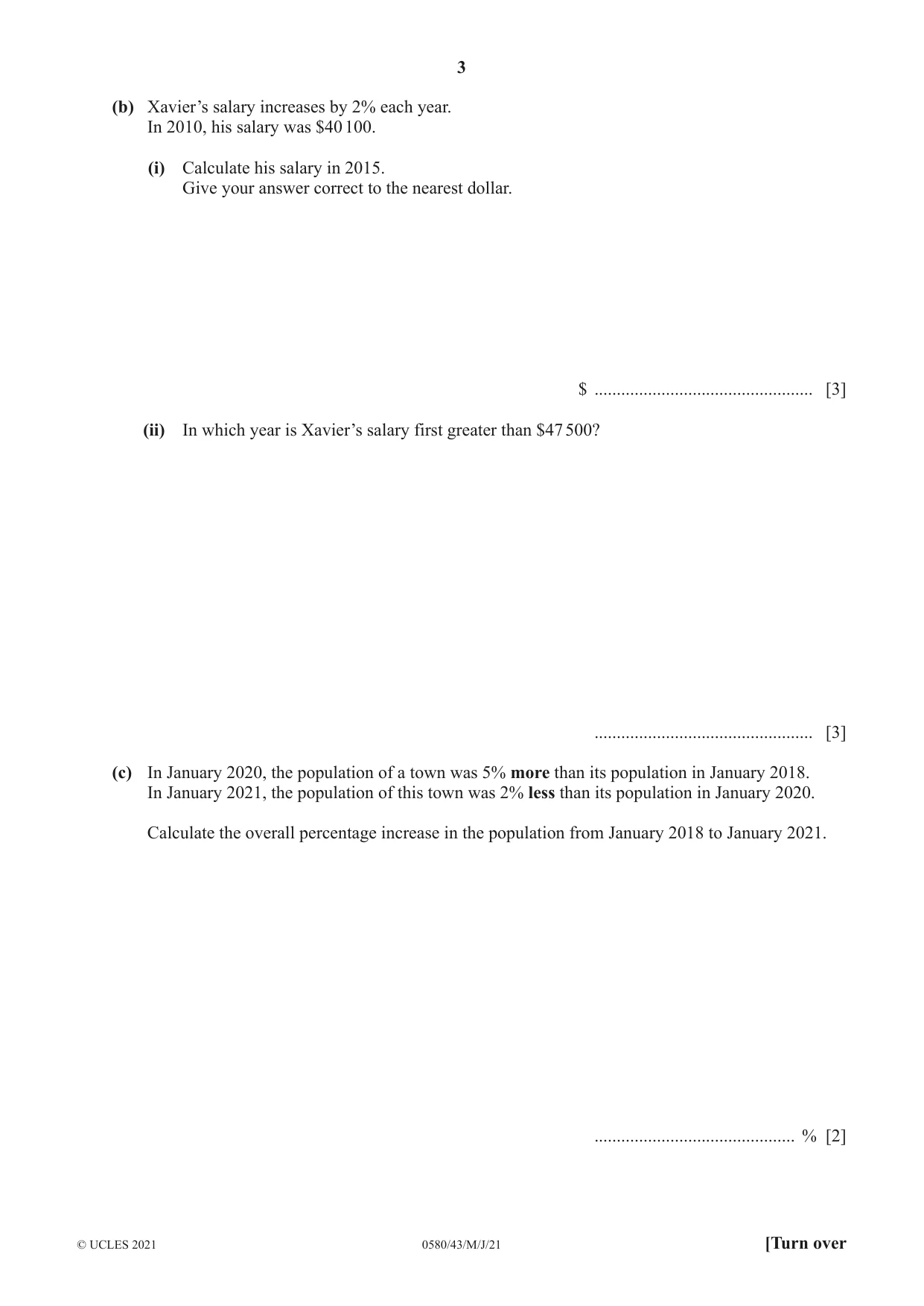
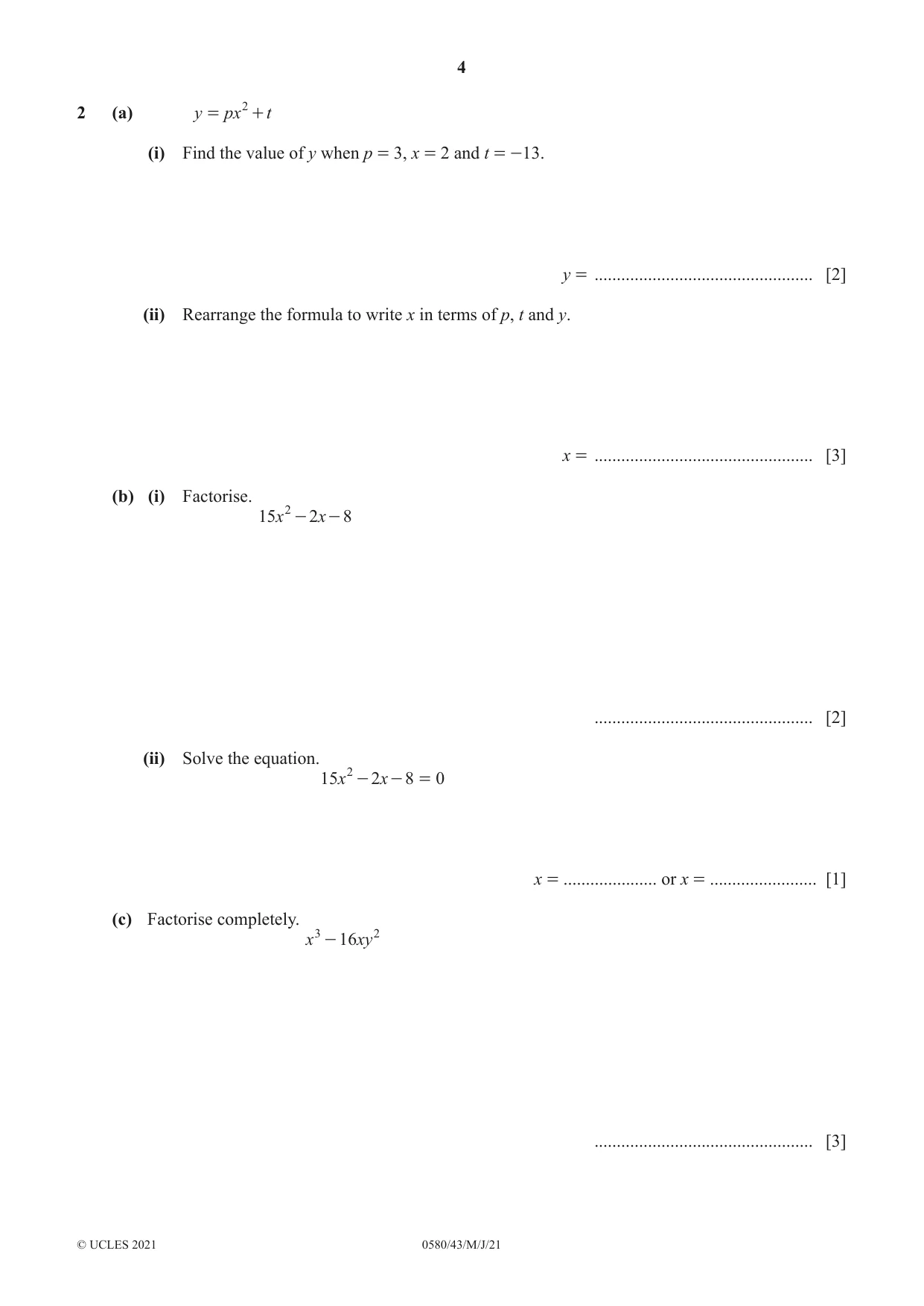
Mark scheme9 pages
Answers below. Sit the paper first if you are practising.
Questions as text
Q1 · Yasmin and Zak share an amount of money in the ratio 21 : 19
1 (a) (i) Yasmin and Zak share an amount of money in the ratio 21 : 19. Yasmin receives $6 more than Zak. Calculate the total amount of money shared by Yasmin and Zak. $ ................................................. [2] (ii) In a sale, all prices are reduced by 15%. (a) Yasmin buys a blouse with an original price of $40. Calculate the sale price of the blouse. $ ................................................. [2] (b) Zak buys a shirt with a sale price of $29.75 . Calculate the original price of the shirt. $ ................................................. [2] (b) Xavier’s salary increases by 2% each year. In 2010, his salary was $40 100. (i) Calculate his salary in 2015. Give your answer correct to the nearest dollar. $ ................................................. [3] (ii) In which year is Xavier’s salary first greater than $47 500? ................................................. [3] (c) In January 2020, the population of a town was 5% more than its population in January 2018. In January 2021, the population of this town was 2% less than its population in January 2020. Calculate the overall percentage increase in the population from January 2018 to January 2021. ............................................. % [2]
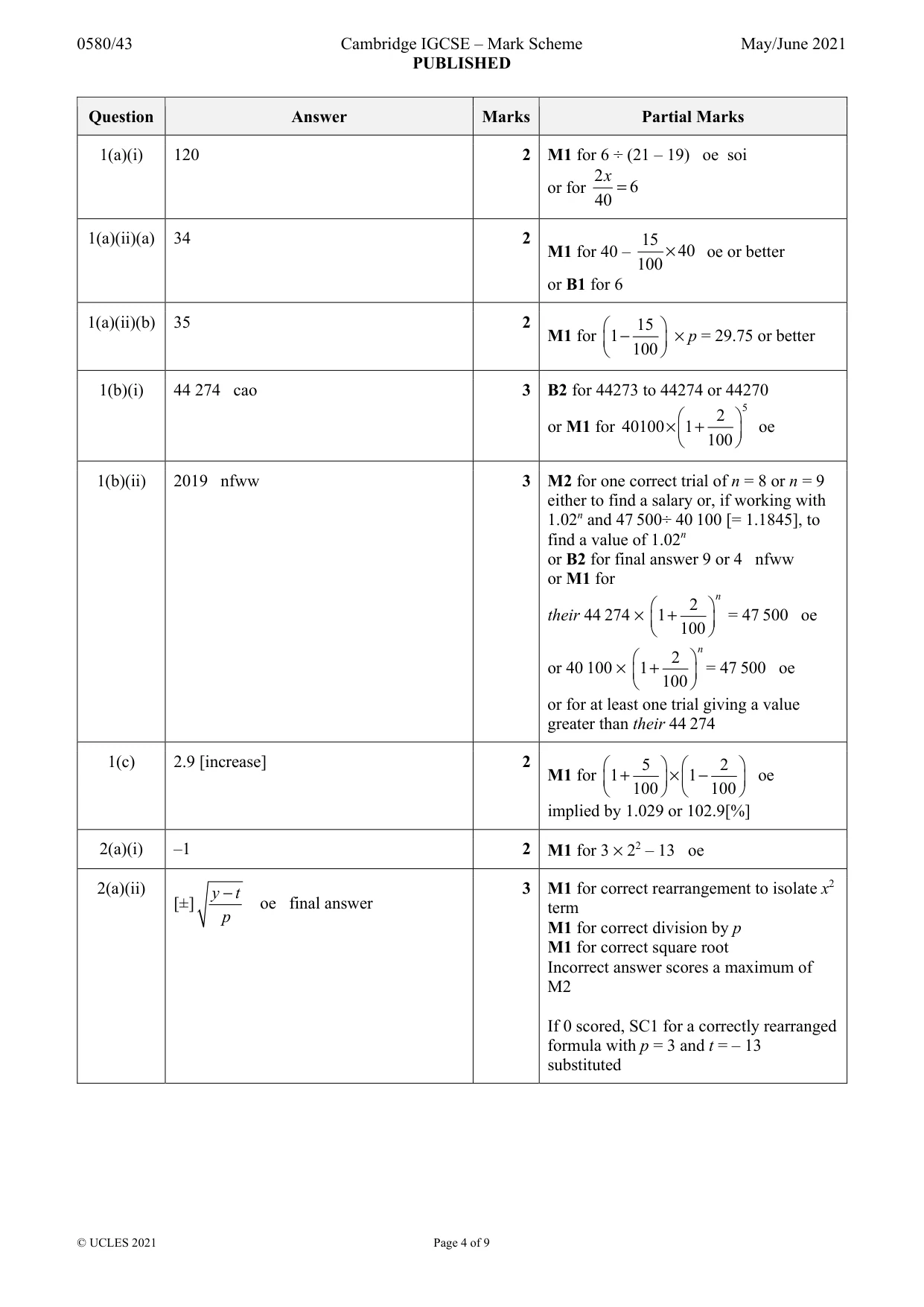
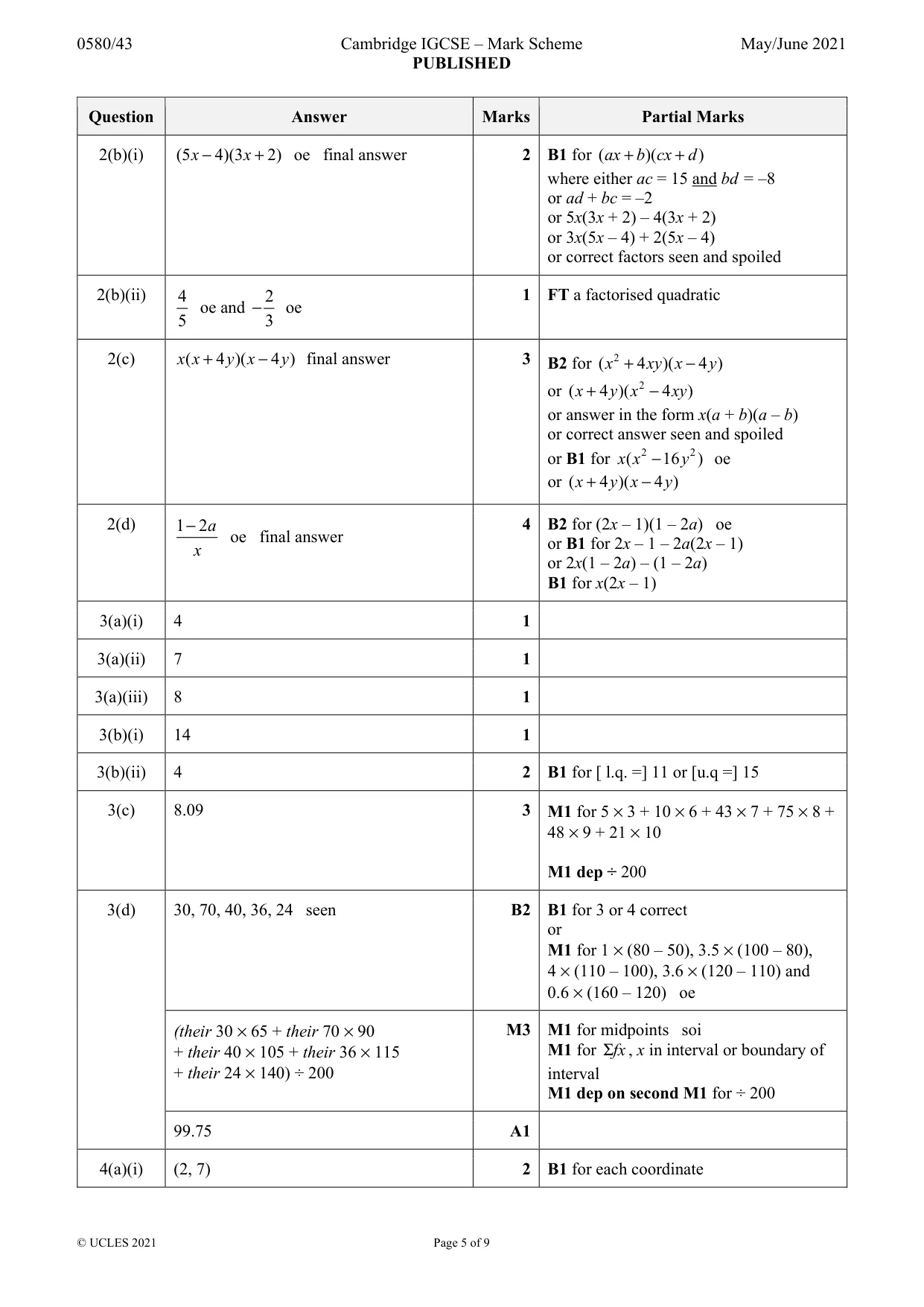
Mark scheme: Question Answer Marks Partial Marks 1(a)(i) 120 2 M1 for 6 ÷ (21 – 19) oe soi 2 x or for = 6 40 1(a)(ii)(a) 34 2 15 M1 for 40 – × 40 oe or better 100 or B1 for 6 1(a)(ii)(b) 35 2 15 M1 for 1 − × p = 29.75 or better 100 1(b)(i) 44 274 cao 3 B2 for 44273 to 44274 or 44270 2 5 or M1 for 40100 × 1 + oe 100 1(b)(ii) 2019 nfww 3 M2 for one correct trial of n = 8 or n = 9 either to find a salary or, if working with 1.02n and 47 500÷ 40 100 [= 1.1845], to find a value of 1.02n or B2 for final answer 9 or 4 nfww or M1 for 2 n their 44 274 × 1 + = 47 500 oe 100 2 n or 40 100 × 1 + = 47 500 oe 100 or for at least one trial giving a value greater than their 44 274 1(c) 2.9 [increase] 2 5 2 M1 for 1 + × 1 − oe 100 100 implied by 1.029 or 102.9[%]
Q2 · Y = px 2 + t (i) Find the value of y when p = 3, x = 2 and t = -13
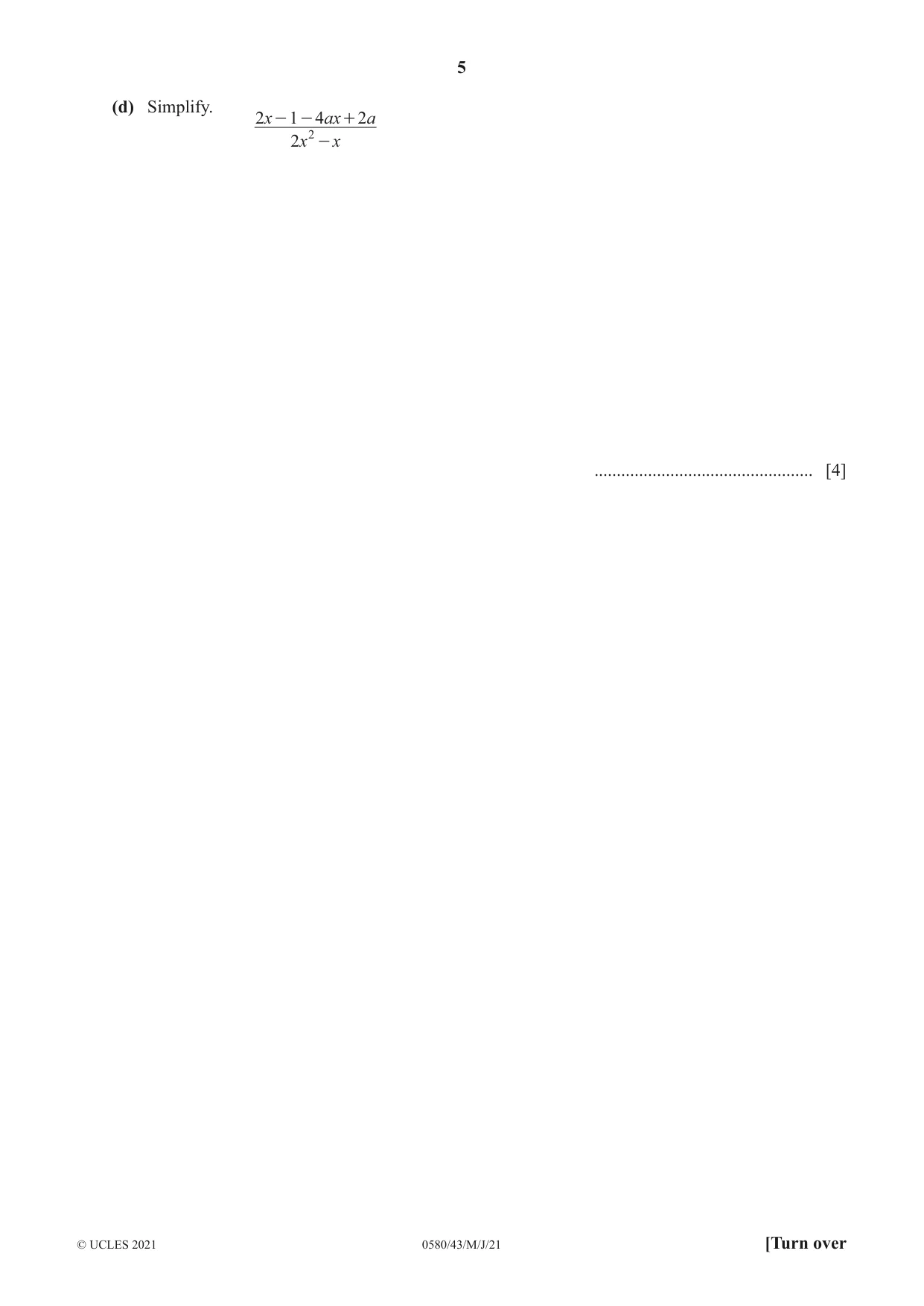
2 (a) y = px 2 + t (i) Find the value of y when p = 3, x = 2 and t = -13. y = ................................................. [2] (ii) Rearrange the formula to write x in terms of p, t and y. x = ................................................. [3] (b) (i) Factorise. 15x 2 - 2x - 8 ................................................. [2] (ii) Solve the equation. 15x 2 - 2x - 8 = 0 x = ..................... or x = ........................ [1] (c) Factorise completely. x 3 - 16xy 2 ................................................. [3] (d) Simplify. 2x - 1 - 4ax + 2a 2x 2 - x ................................................. [4]
Mark scheme: 2(a)(i) –1 2 M1 for 3 × 22 – 13 oe 2(a)(ii) y − t 3 M1 for correct rearrangement to isolate x2 [±] oe final answer term p M1 for correct division by p M1 for correct square root Incorrect answer scores a maximum of M2 If 0 scored, SC1 for a correctly rearranged formula with p = 3 and t = – 13 substituted 2(b)(i) (5 x − 4)(3 x + 2) oe final answer 2 B1 for ( ax + b )( cx + d ) where either ac = 15 and bd = –8 or ad + bc = –2 or 5x(3x + 2) – 4(3x + 2) or 3x(5x – 4) + 2(5x – 4) or correct factors seen and spoiled 2(b)(ii) 4 2 1 FT a factorised quadratic oe and − oe 5 3 2(c) x ( x + 4 y )( x − 4 y ) final answer 3 B2 for ( x 2 + 4 xy )( x − 4 y ) or ( x + 4 y )( x 2 − 4 xy ) or answer in the form x(a + b)(a – b) or correct answer seen and spoiled or B1 for x ( x 2 − 16 y 2 ) oe or ( x + 4 y )( x − 4 y ) 2(d) 1 −a2 4 B2 for (2x – 1)(1 – 2a) oe oe final answer or B1 for 2x – 1 – 2a(2x – 1) x or 2x(1 – 2a) – (1 – 2a) B1 for x(2x – 1)
Q3 · Zoe’s test scores last term were 6 7 7 7 8 9 9 10 10
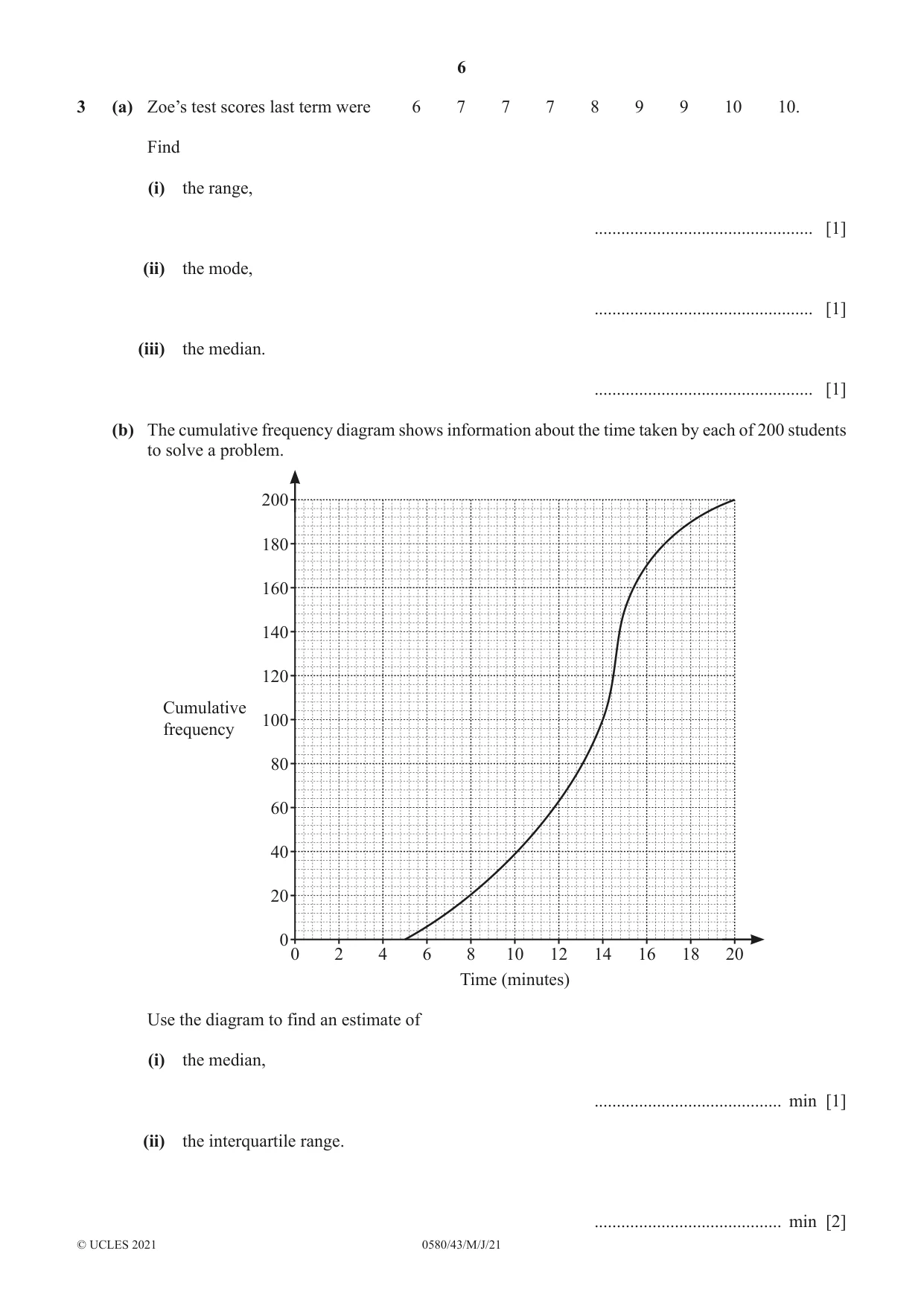
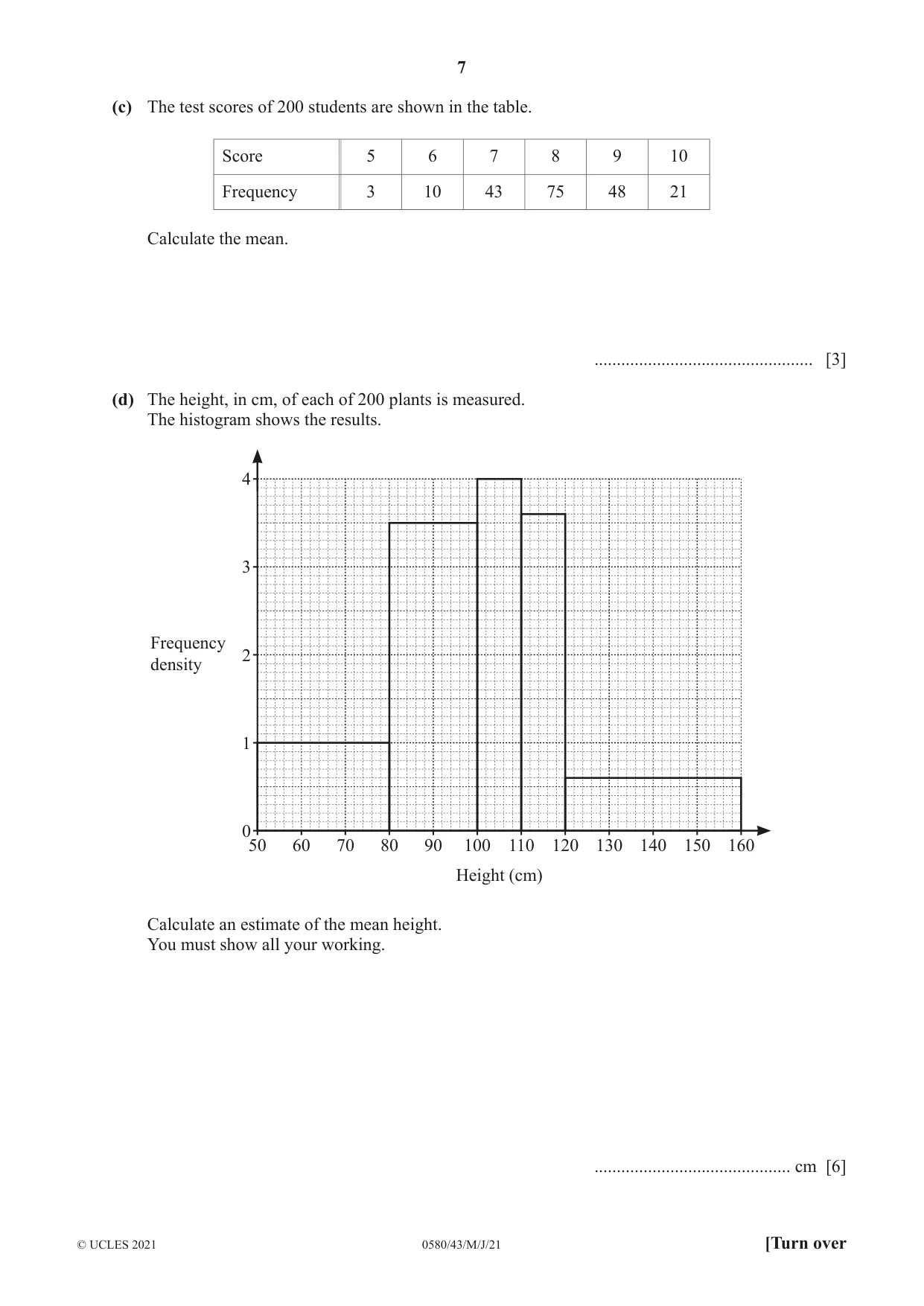
3 (a) Zoe’s test scores last term were 6 7 7 7 8 9 9 10 10. Find (i) the range, ................................................. [1] (ii) the mode, ................................................. [1] (iii) the median. ................................................. [1] (b) The cumulative frequency diagram shows information about the time taken by each of 200 students to solve a problem. 200 180 160 140 120 Cumulative 100 frequency 80 60 40 20 0 0 2 4 6 8 10 12 14 16 18 20 Time (minutes) Use the diagram to find an estimate of (i) the median, .......................................... min [1] (ii) the interquartile range. .......................................... min [2] (c) The test scores of 200 students are shown in the table. Score 5 6 7 8 9 10 Frequency 3 10 43 75 48 21 Calculate the mean. ................................................. [3] (d) The height, in cm, of each of 200 plants is measured. The histogram shows the results. 4 3 Frequency 2 density 1 0 50 60 70 80 90 100 110 120 130 140 150 160 Height (cm) Calculate an estimate of the mean height. You must show all your working. ............................................ cm [6]
Mark scheme: 3(a)(i) 4 1 3(a)(ii) 7 1 3(a)(iii) 8 1 3(b)(i) 14 1 3(b)(ii) 4 2 B1 for [ l.q. =] 11 or [u.q =] 15 3(c) 8.09 3 M1 for 5 × 3 + 10 × 6 + 43 × 7 + 75 × 8 + 48 × 9 + 21 × 10 M1 dep ÷ 200 3(d) 30, 70, 40, 36, 24 seen B2 B1 for 3 or 4 correct or M1 for 1 × (80 – 50), 3.5 × (100 – 80), 4 × (110 – 100), 3.6 × (120 – 110) and 0.6 × (160 – 120) oe (their 30 × 65 + their 70 × 90 M3 M1 for midpoints soi + their 40 × 105 + their 36 × 115 M1 for Σfx , x in interval or boundary of + their 24 × 140) ÷ 200 interval M1 dep on second M1 for ÷ 200 99.75 A1
Q4 · A is the point (1, 5) and B is the point (3, 9)
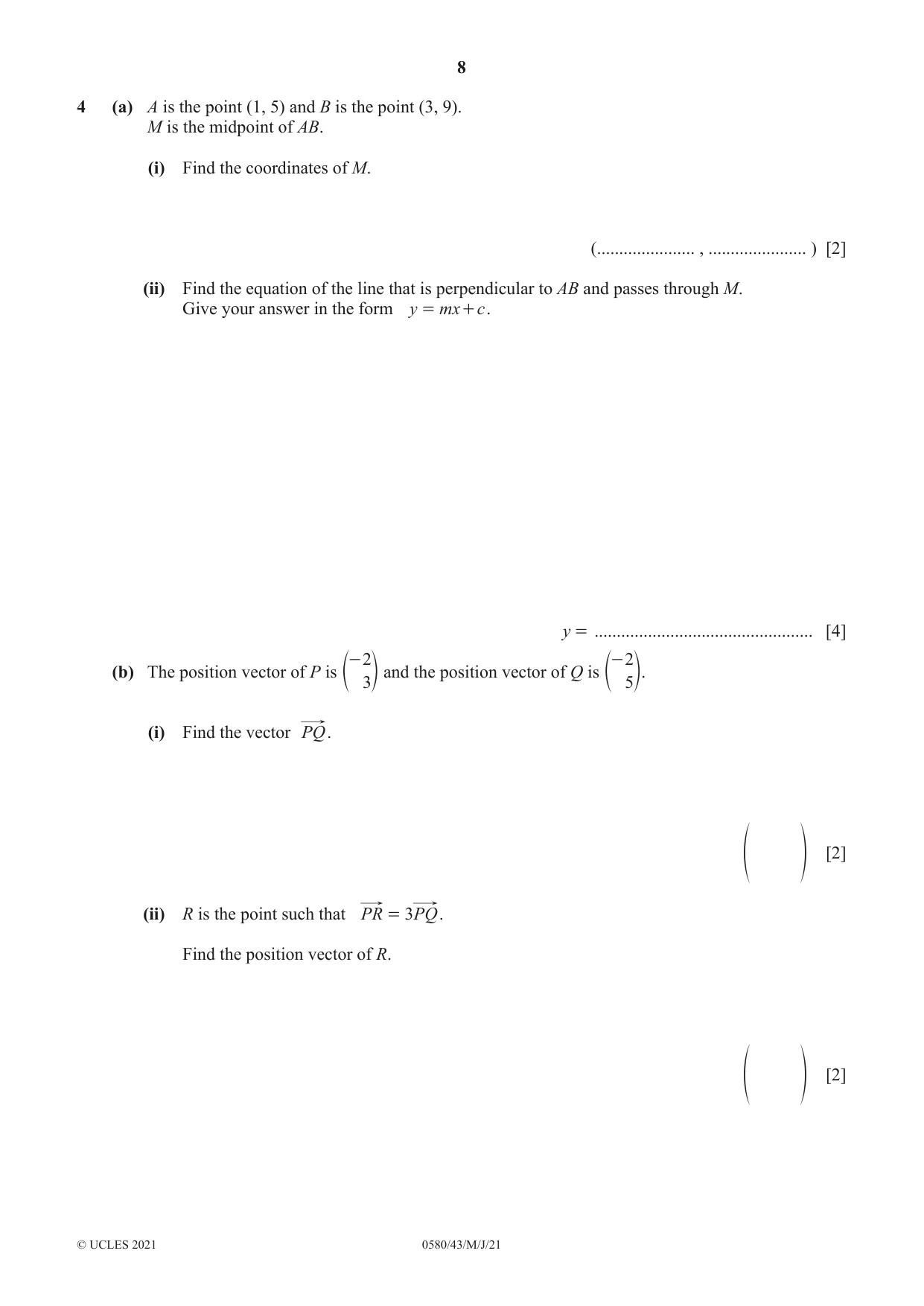
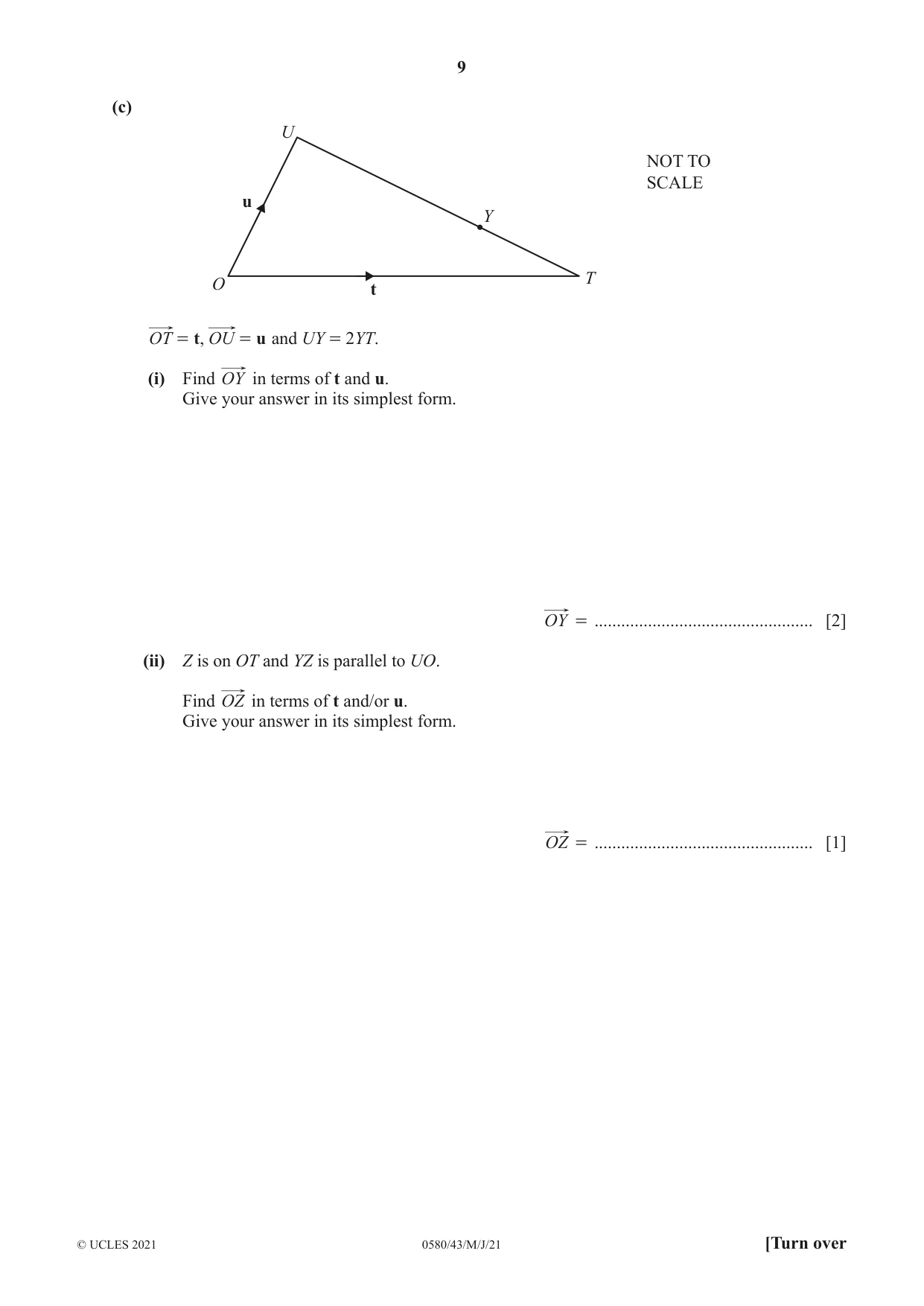
4 (a) A is the point (1, 5) and B is the point (3, 9). M is the midpoint of AB. (i) Find the coordinates of M. (...................... , ...................... ) [2] (ii) Find the equation of the line that is perpendicular to AB and passes through M. Give your answer in the form y = mx + c . y = ................................................. [4] - 2 - 2 (b) The position vector of P is and the position vector of Q is e 3o e 5o. (i) Find the vector PQ. [2] f p (ii) R is the point such that PR = 3PQ . Find the position vector of R. [2] f p (c) U NOT TO SCALE u Y T O t OT = t , OU = u and UY = 2YT. (i) Find OY in terms of t and u. Give your answer in its simplest form. OY = ................................................. [2] (ii) Z is on OT and YZ is parallel to UO. Find OZ in terms of t and/or u. Give your answer in its simplest form. OZ = ................................................. [1]
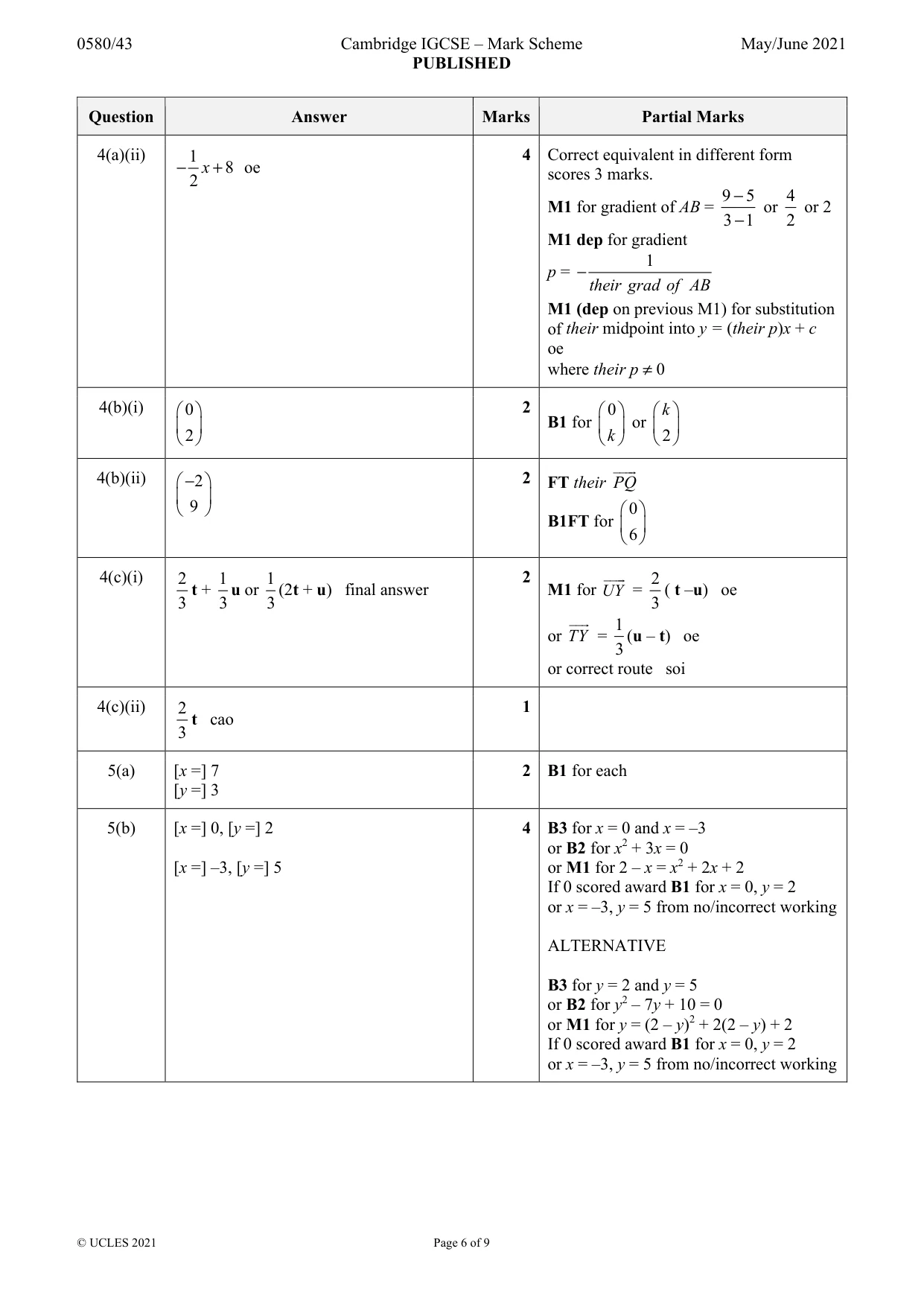
Mark scheme: 4(a)(i) (2, 7) 2 B1 for each coordinate 4(a)(ii) 1 4 Correct equivalent in different form − x + 8 oe scores 3 marks. 2 9 − 5 4 M1 for gradient of AB = or or 2 3 − 1 2 M1 dep for gradient 1 p = −their grad of AB M1 (dep on previous M1) for substitution of their midpoint into y = (their p)x + c oe where their p ≠ 0 4(b)(i) 0 2 0 k B1 for or 2 k 2 4(b)(ii) − 2 2 FT their PQ 9 0 B1FT for 6 4(c)(i) 2 1 1 2 2 t + u or (2t + u) final answer M1 for UY = ( t –u) oe 3 3 3 3 1 or TY = (u – t) oe 3 or correct route soi 4(c)(ii) 2 1 t cao 3
Q5 · Solve the simultaneous equations
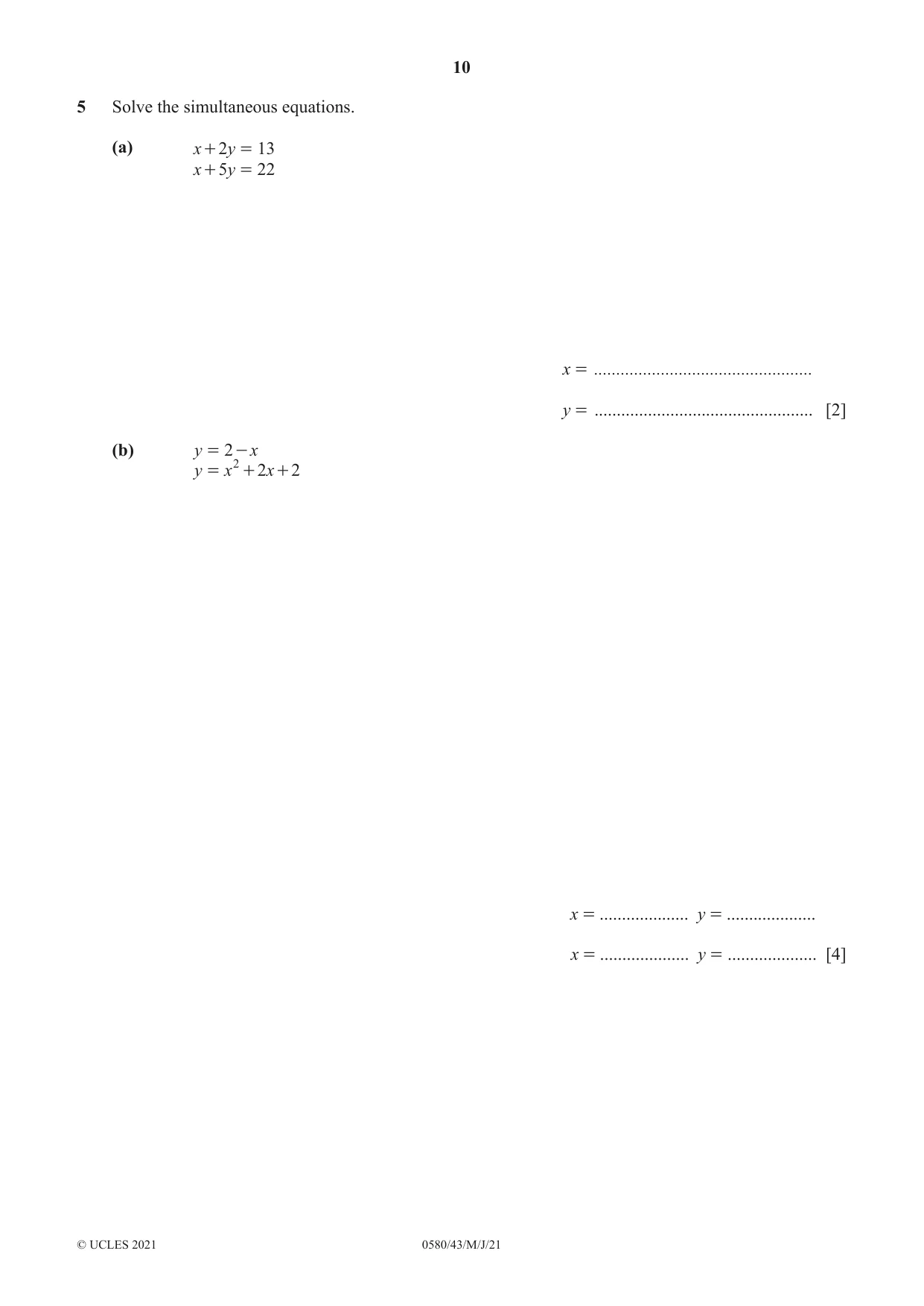
5 Solve the simultaneous equations. (a) x + 2y = 13 x + 5y = 22 x = ................................................. y = ................................................. [2] (b) y = 2 - x y = x 2 + 2x + 2 x = .................... y = .................... x = .................... y = .................... [4]
Mark scheme: 5(a) [x =] 7 2 B1 for each [y =] 3 5(b) [x =] 0, [y =] 2 4 B3 for x = 0 and x = –3 or B2 for x2 + 3x = 0 [x =] –3, [y =] 5 or M1 for 2 – x = x2 + 2x + 2 If 0 scored award B1 for x = 0, y = 2 or x = –3, y = 5 from no/incorrect working ALTERNATIVE B3 for y = 2 and y = 5 or B2 for y2 – 7y + 10 = 0 or M1 for y = (2 – y)2 + 2(2 – y) + 2 If 0 scored award B1 for x = 0, y = 2 or x = –3, y = 5 from no/incorrect working
Q6 · In a class of 24 students, 18 students like homework (H ), 15 students like tests (T )…
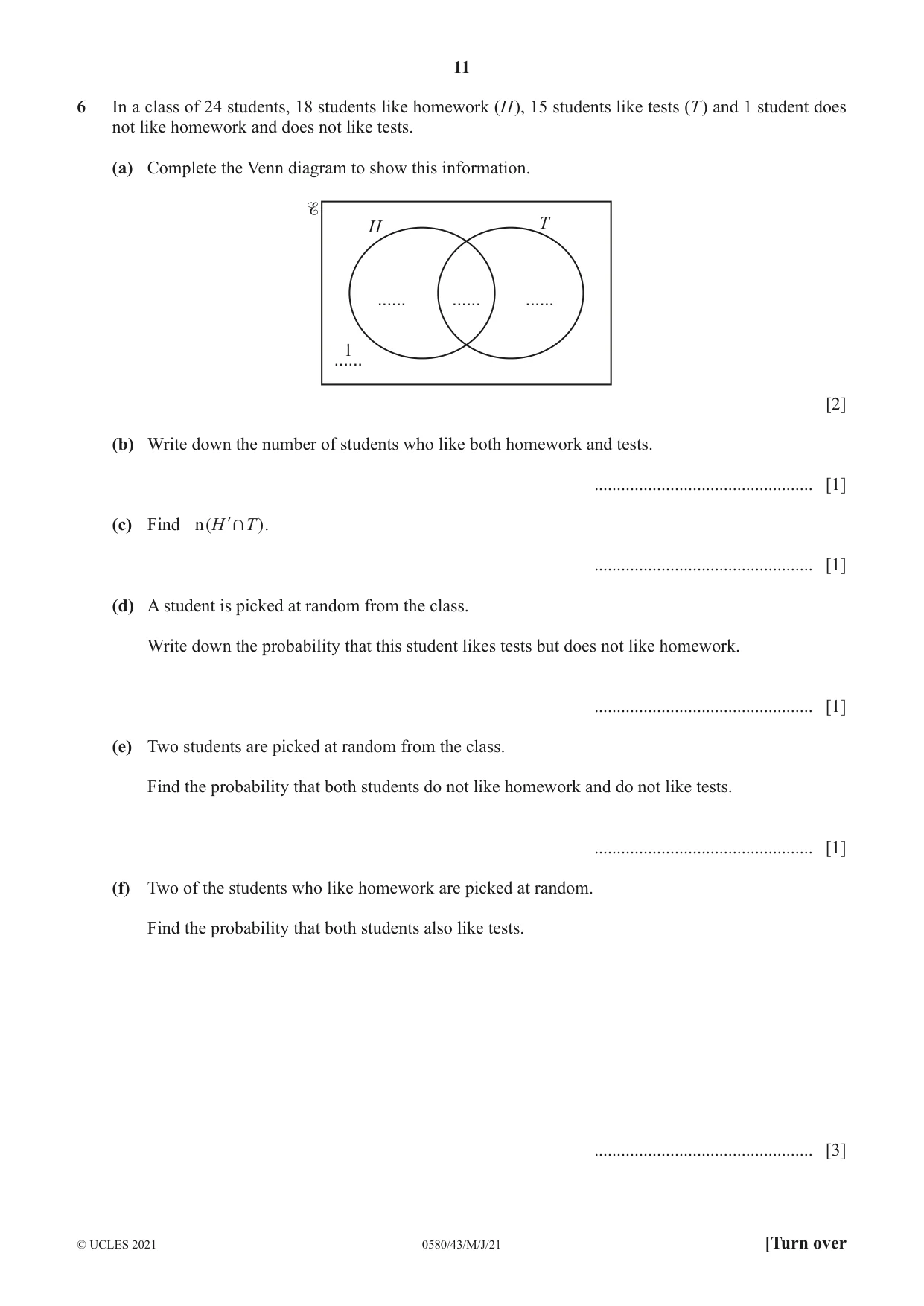
6 In a class of 24 students, 18 students like homework (H ), 15 students like tests (T ) and 1 student does not like homework and does not like tests. (a) Complete the Venn diagram to show this information. H T ...... ...... ...... 1 ...... [2] (b) Write down the number of students who like both homework and tests. ................................................. [1] (c) Find n (H l + T ) . ................................................. [1] (d) A student is picked at random from the class. Write down the probability that this student likes tests but does not like homework. ................................................. [1] (e) Two students are picked at random from the class. Find the probability that both students do not like homework and do not like tests. ................................................. [1] (f) Two of the students who like homework are picked at random. Find the probability that both students also like tests. ................................................. [3]
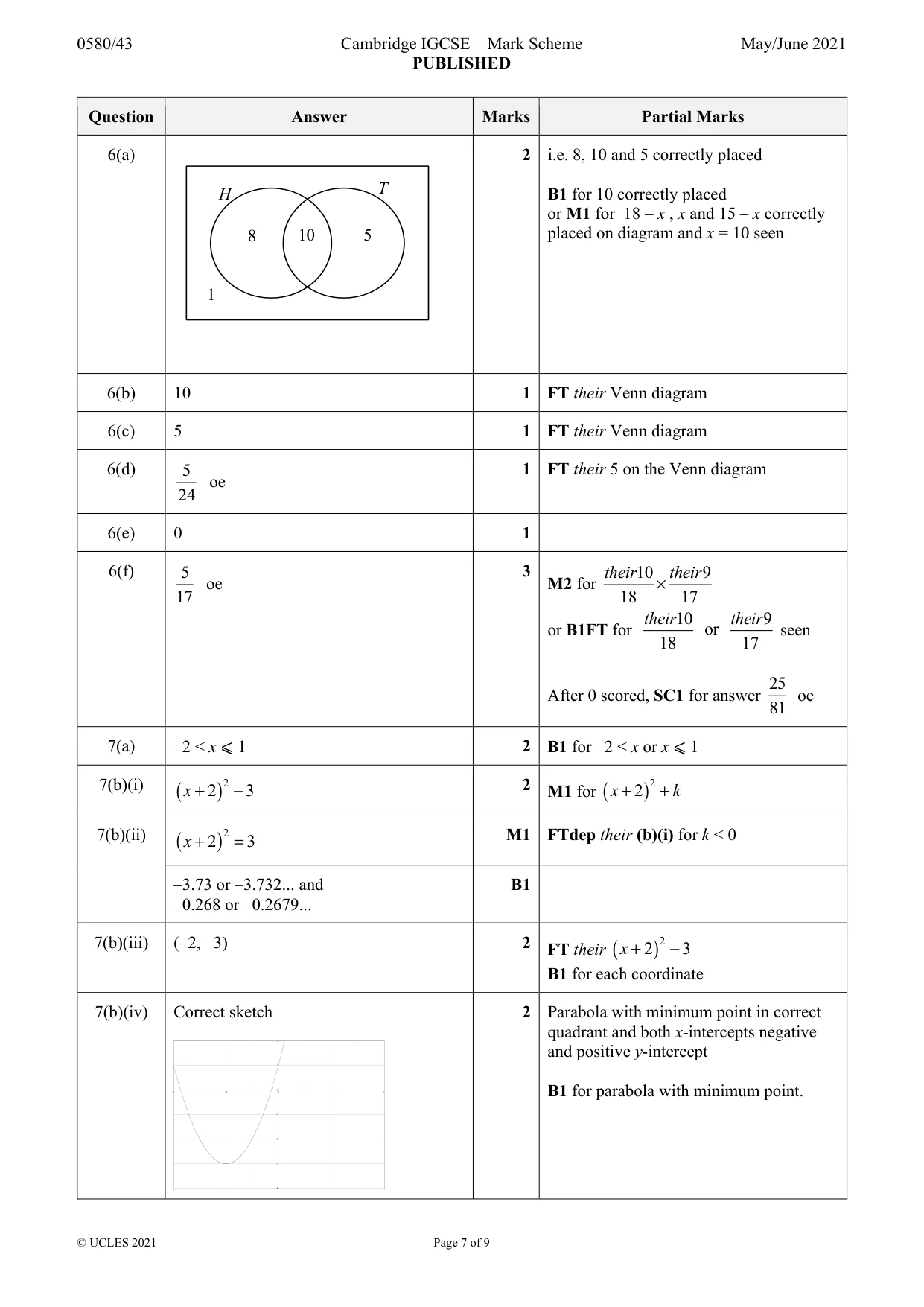
Mark scheme: 6(a) 2 i.e. 8, 10 and 5 correctly placed T H B1 for 10 correctly placed or M1 for 18 – x , x and 15 – x correctly 8 10 5 placed on diagram and x = 10 seen 1 6(b) 10 1 FT their Venn diagram 6(c) 5 1 FT their Venn diagram 6(d) 5 1 FT their 5 on the Venn diagram oe 24 6(e) 0 1 6(f) 5 3 their10 their 9 oe M2 for × 17 18 17 their10 their 9 or B1FT for or seen 18 17 25 After 0 scored, SC1 for answer oe 81
Q7 · X –2 1 Write down the inequality in x shown by the number line
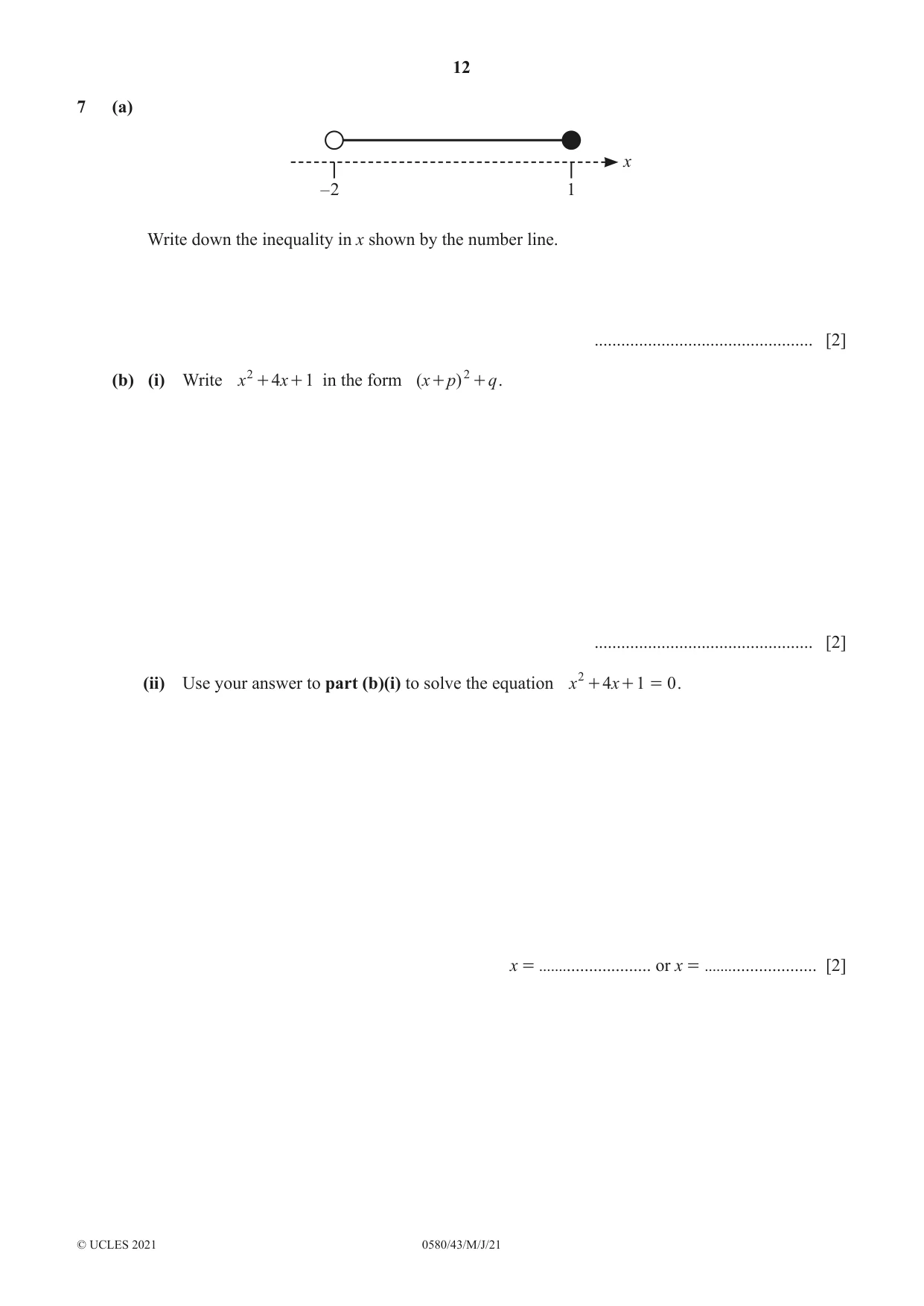
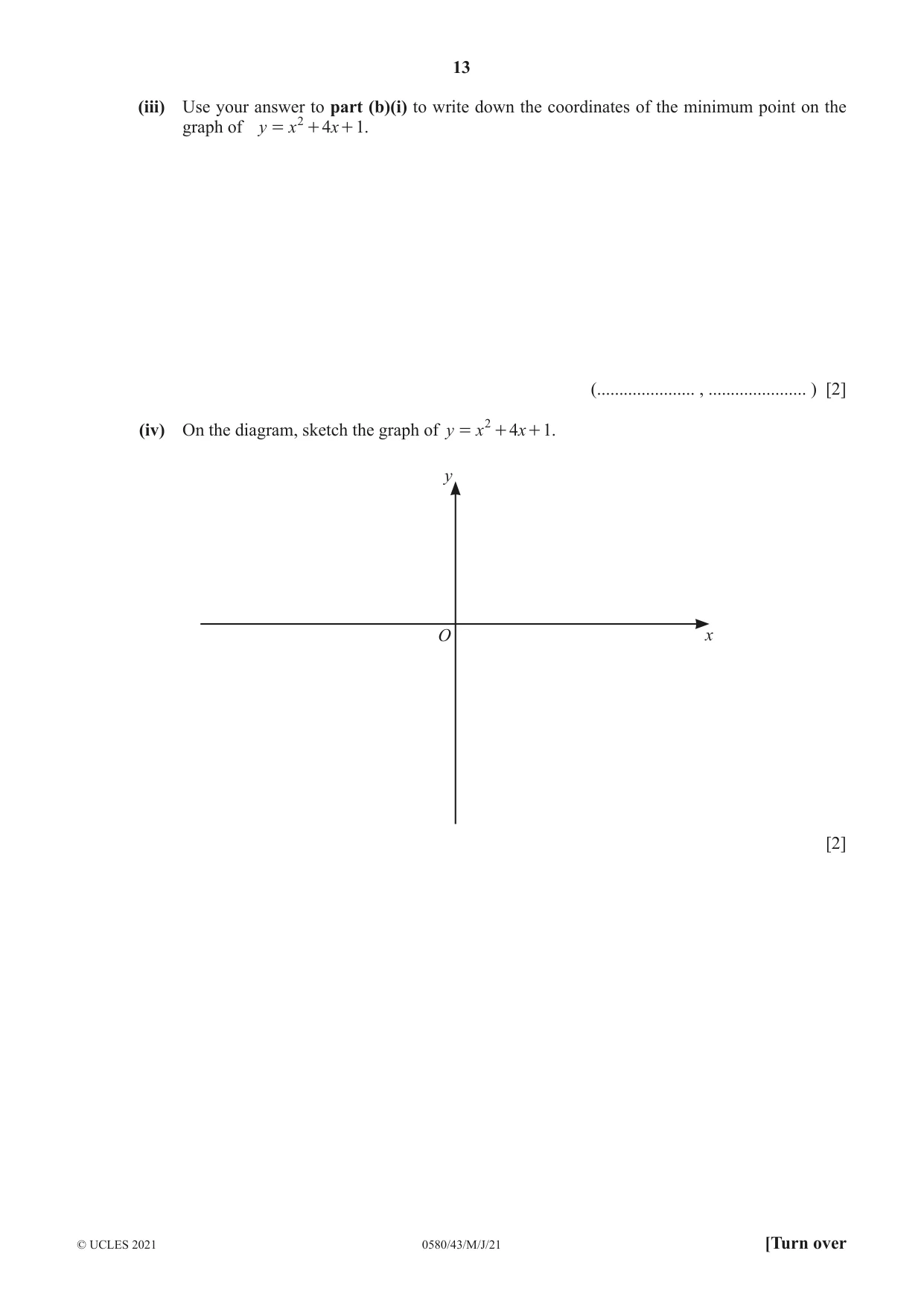
7 (a) x –2 1 Write down the inequality in x shown by the number line. ................................................. [2] (b) (i) Write x 2 + 4x + 1 in the form ( x + p) 2 + q . ................................................. [2] (ii) Use your answer to part (b)(i) to solve the equation x 2 + 4x + 1 = 0 . x = .......................... or x = .......................... [2] (iii) Use your answer to part (b)(i) to write down the coordinates of the minimum point on the graph of y = x 2 + 4x + 1. (...................... , ...................... ) [2] (iv) On the diagram, sketch the graph of y = x 2 + 4x + 1. y O x [2]
Mark scheme: 7(a) –2 < x ⩽ 1 2 B1 for –2 < x or x ⩽ 1 7(b)(i) ( x + 2 ) 2 − 3 2 M1 for ( x + 2 ) 2 + k 7(b)(ii) ( x + 2 ) 2 = 3 M1 FTdep their (b)(i) for k < 0 –3.73 or –3.732... and B1 –0.268 or –0.2679... 7(b)(iii) (–2, –3) 2 2 FT their ( x + 2 ) − 3 B1 for each coordinate 7(b)(iv) Correct sketch 2 Parabola with minimum point in correct 2222 quadrant and both x-intercepts negative and positive y-intercept 1111 4444 -2-2-2-2 0000 0000 2222 4444 B1 for parabola with minimum point. -1-1-1-1 -2-2-2-2 -3-3-3-3 -4-4-4-4
Q8 · A solid cuboid measures 20 cm by 12 cm by 5 cm
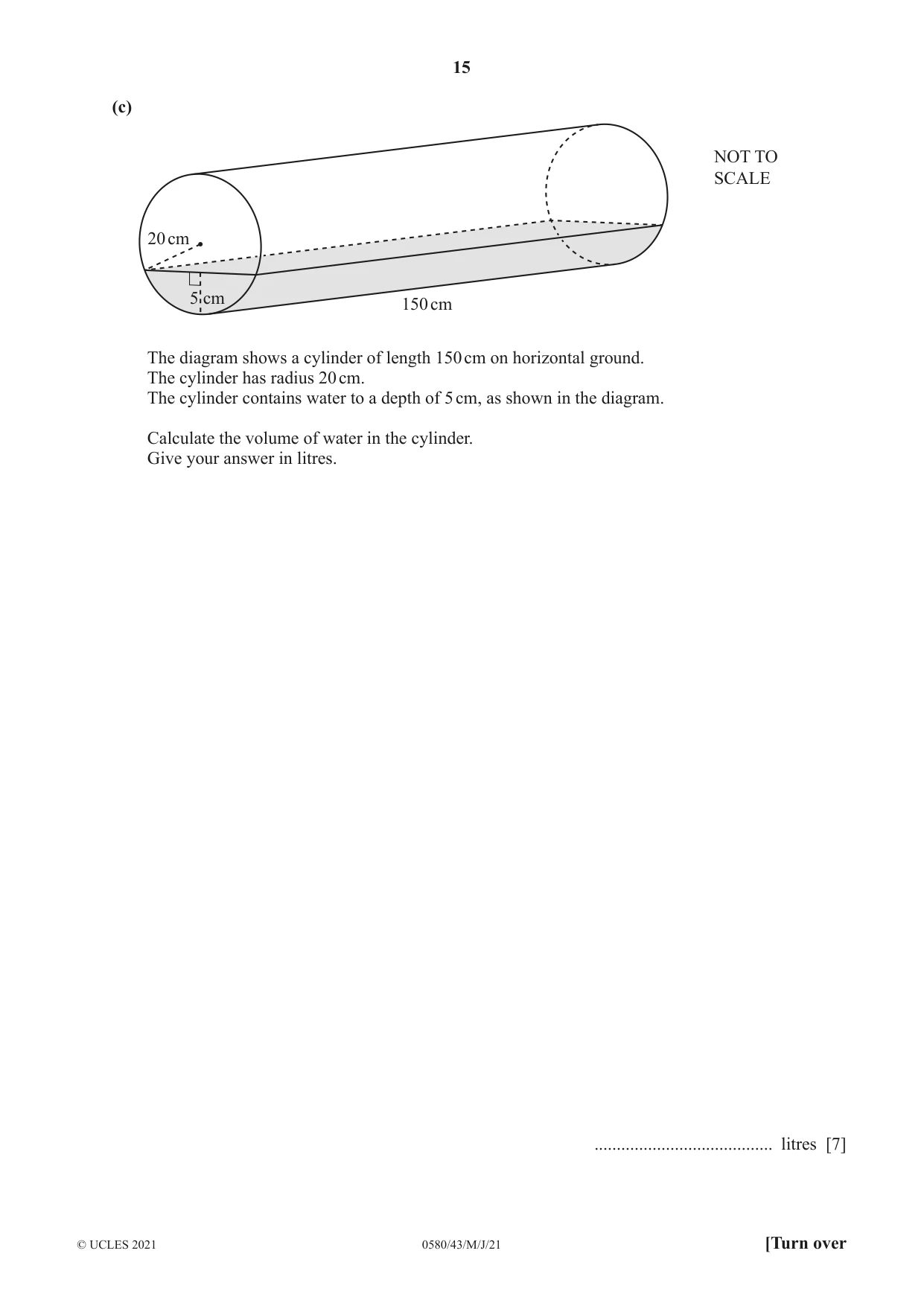
8 (a) A solid cuboid measures 20 cm by 12 cm by 5 cm. (i) Calculate the volume of the cuboid. .......................................... cm3 [1] (ii) (a) Calculate the total surface area of the cuboid. .......................................... cm2 [3] (b) The surface of the cuboid is painted. The cost of the paint used is $1.52 . Find the cost to paint 1 cm 2 of the cuboid. Give your answer in cents. ........................................ cents [1] 9x (b) A solid metal cylinder with radius x and height is melted. 2 All the metal is used to make a sphere with radius r. Find r in terms of x. 4 3 [The volume, V, of a sphere with radius r is V = rr .] 3 r = ................................................. [3] (c) NOT TO SCALE 20 cm 5 cm 150 cm The diagram shows a cylinder of length 150 cm on horizontal ground. The cylinder has radius 20 cm. The cylinder contains water to a depth of 5 cm, as shown in the diagram. Calculate the volume of water in the cylinder. Give your answer in litres. ........................................ litres [7]
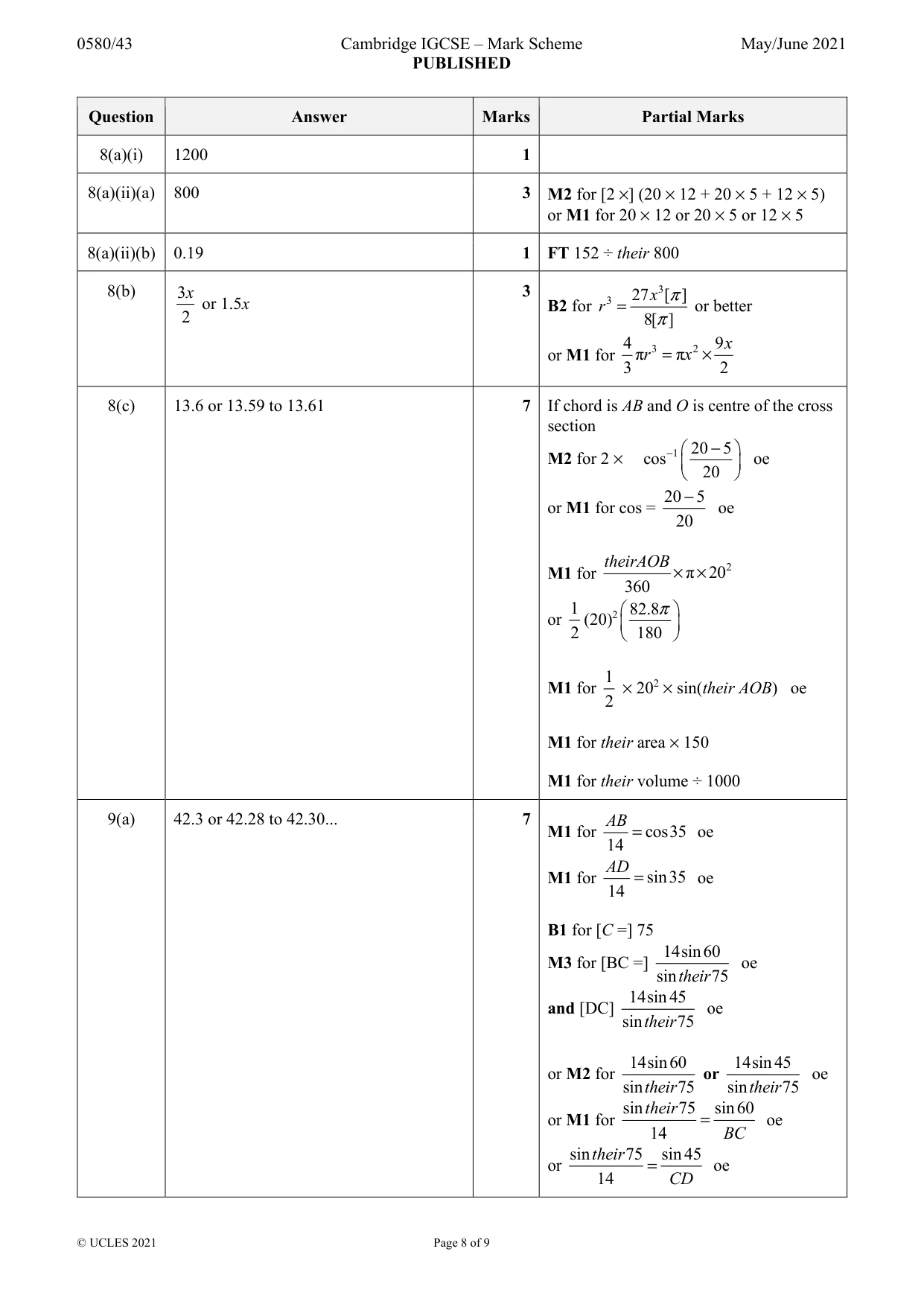
Mark scheme: 8(a)(i) 1200 1 8(a)(ii)(a) 800 3 M2 for [2 ×] (20 × 12 + 20 × 5 + 12 × 5) or M1 for 20 × 12 or 20 × 5 or 12 × 5 8(a)(ii)(b) 0.19 1 FT 152 ÷ their 800 8(b) 3 x 3 3 27 x 3 [π] or 1.5x B2 for r = or better 2 8[π] 4 3 2 9 x or M1 for πr = πx × 3 2 8(c) 13.6 or 13.59 to 13.61 7 If chord is AB and O is centre of the cross section −1 20 − 5 M2 for 2 × cos oe 20 20 − 5 or M1 for cos = oe 20 theirAOB 2 M1 for × π × 20 360 1 82.8π or (20)2 2 180 1 M1 for × 202 × sin(their AOB) oe 2 M1 for their area × 150 M1 for their volume ÷ 1000
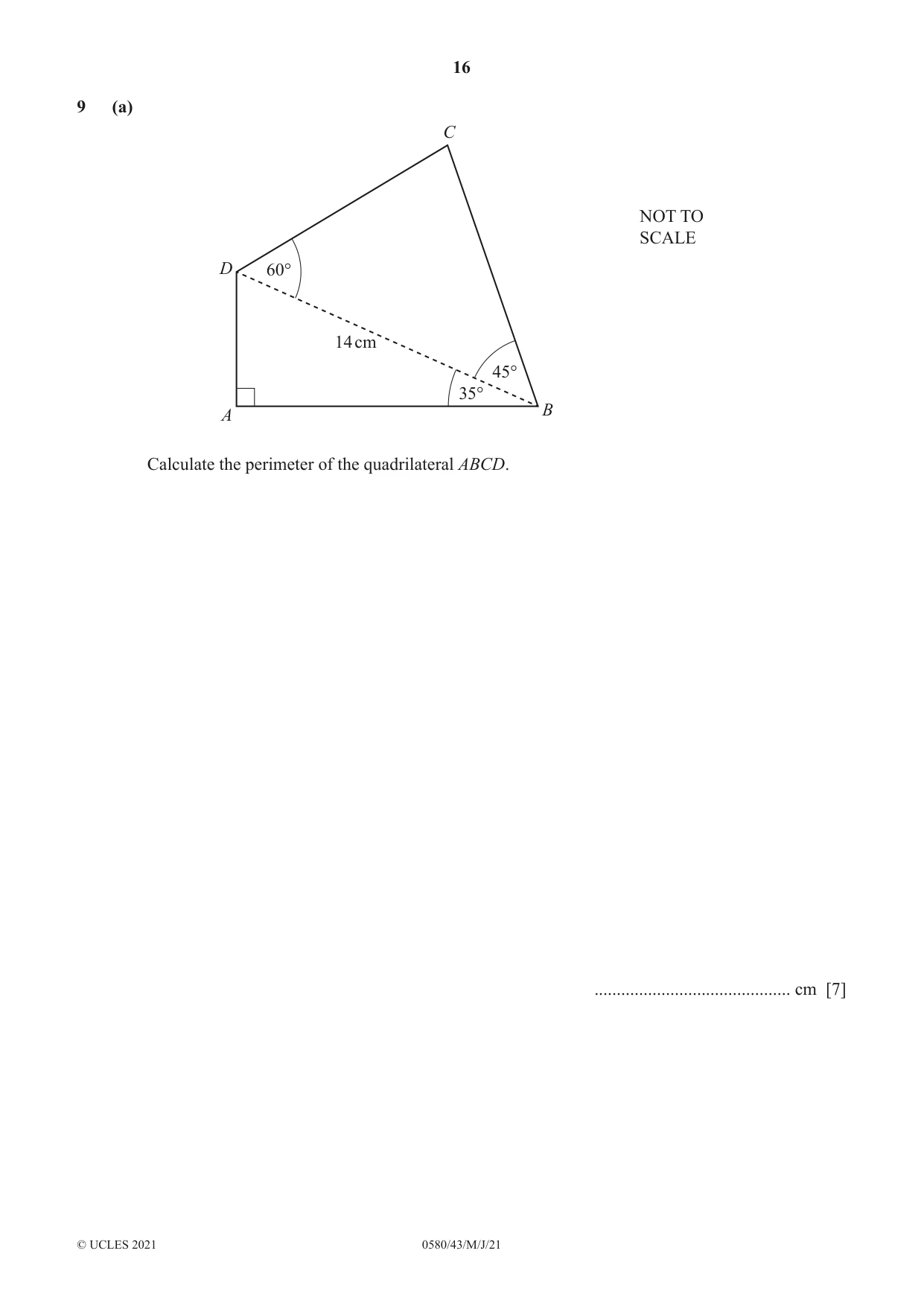
Q9 · C NOT TO SCALE D 60° 14 cm 45° 35° B A Calculate the perimeter of the quadrilateral ABCD
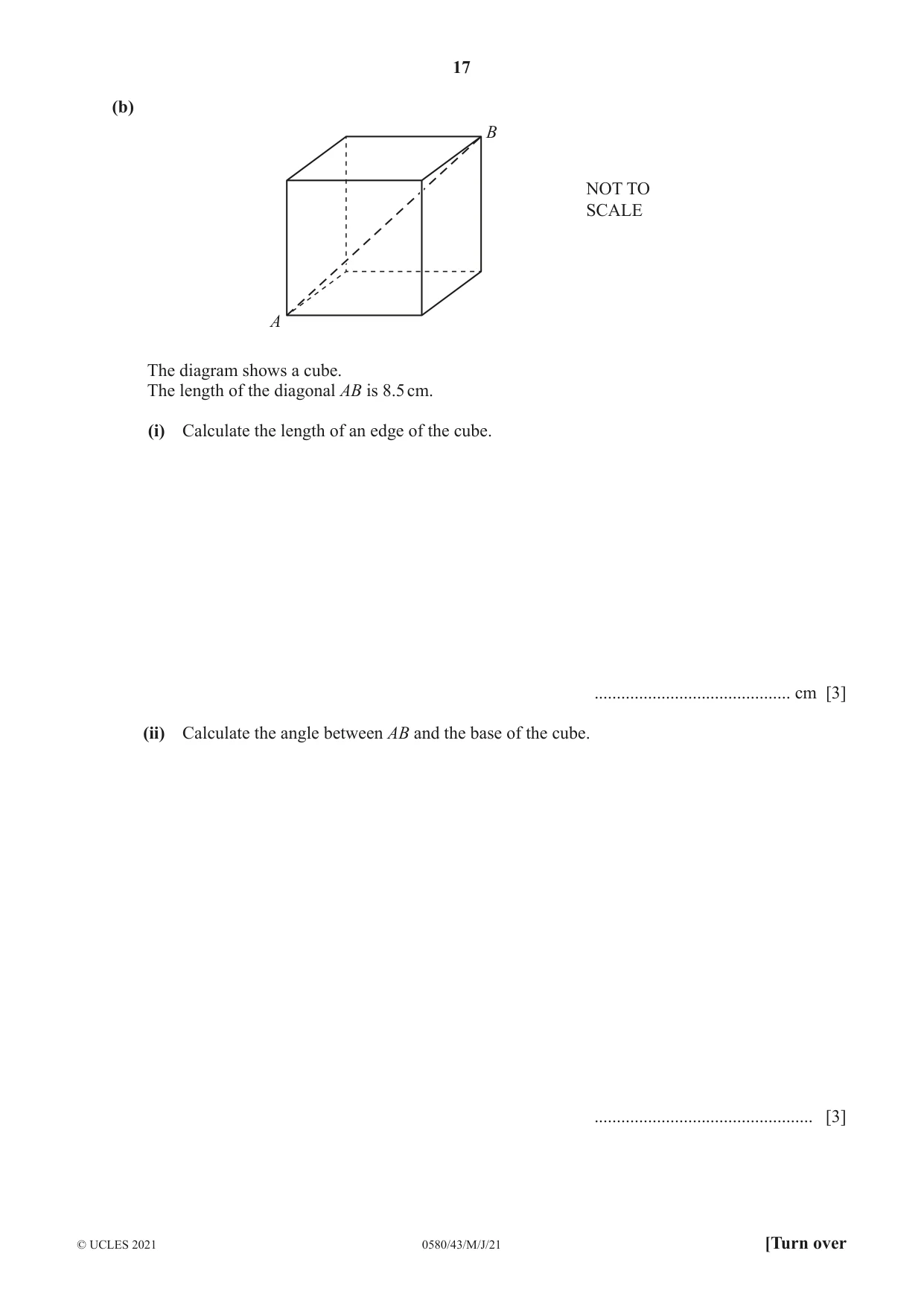
9 (a) C NOT TO SCALE D 60° 14 cm 45° 35° B A Calculate the perimeter of the quadrilateral ABCD. ............................................ cm [7] (b) B NOT TO SCALE A The diagram shows a cube. The length of the diagonal AB is 8.5 cm. (i) Calculate the length of an edge of the cube. ............................................ cm [3] (ii) Calculate the angle between AB and the base of the cube. ................................................. [3]
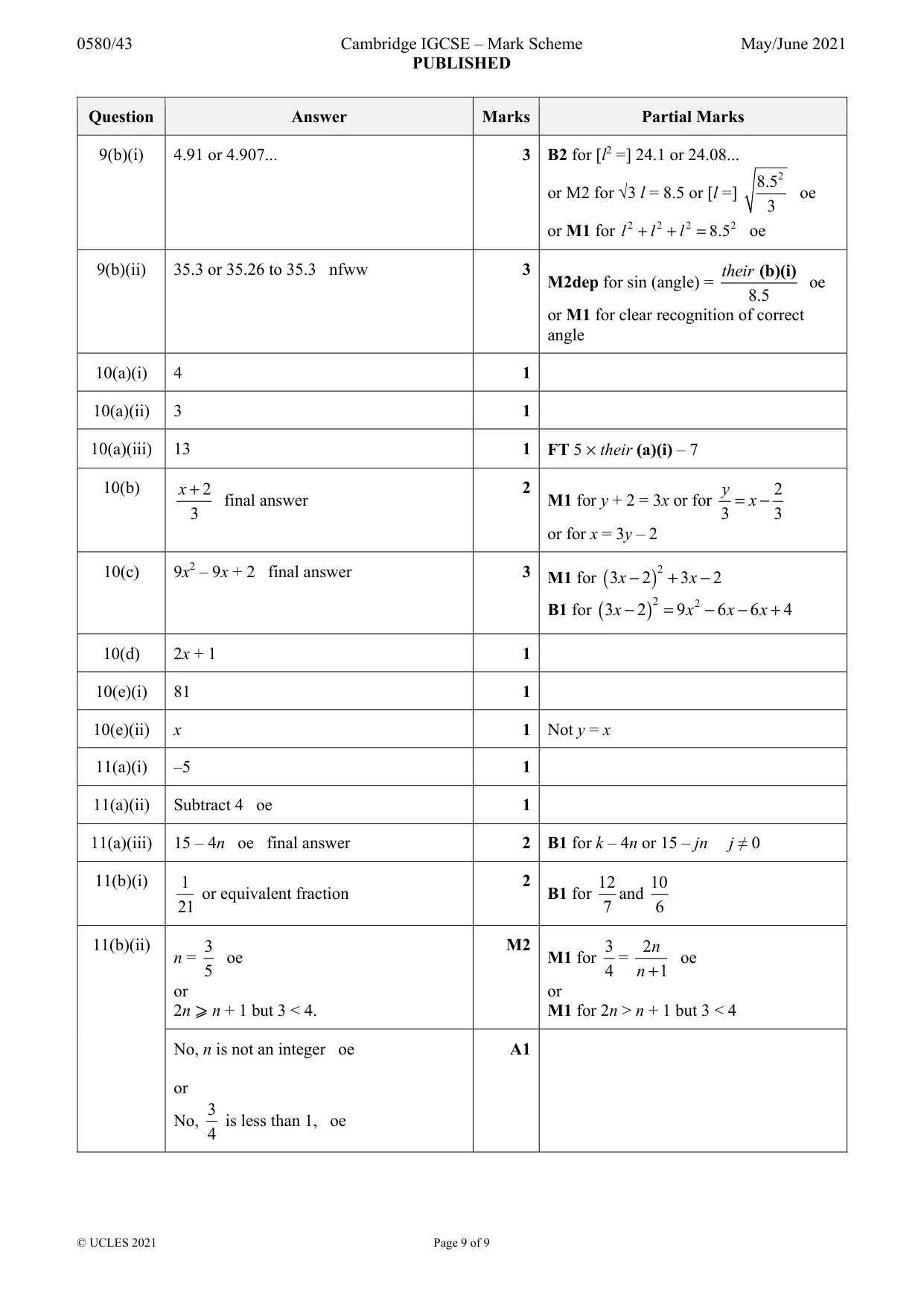
Mark scheme: 9(a) 42.3 or 42.28 to 42.30... 7 AB M1 for = cos35 oe 14 AD M1 for = sin35 oe 14 B1 for [C =] 75 14sin60 M3 for [BC =] oe sin their 75 14sin45 and [DC] oe sin their 75 14sin60 14sin45 or M2 for or oe sin their 75 sin their 75 sin their 75 sin60 or M1 for = oe 14 BC sin their 75 sin45 or = oe 14 CD 9(b)(i) 4.91 or 4.907... 3 B2 for [l2 =] 24.1 or 24.08... 8.5 2 or M2 for √3 l = 8.5 or [l =] oe 3 or M1 for l 2 + l 2 + l 2 = 8.5 2 oe 9(b)(ii) 35.3 or 35.26 to 35.3 nfww 3 their (b)(i) M2dep for sin (angle) = oe 8.5 or M1 for clear recognition of correct angle
Q10 · F ( )x = 3 x - 2 g ( )x = 5 x - 7 h ( )x = x 2 + x j ( )x = 3 x (a) Find (i) f(2)…
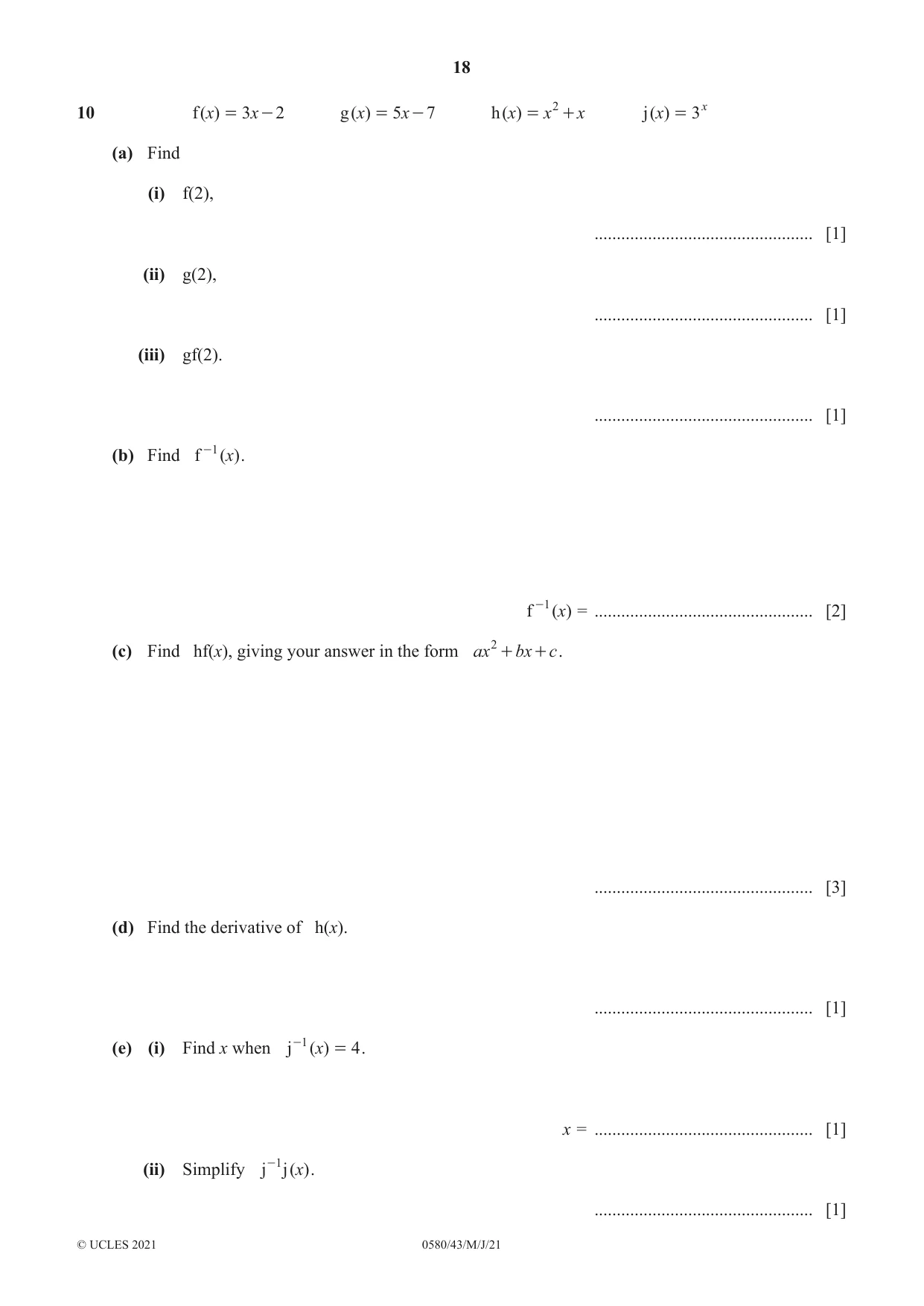
10 f ( )x = 3 x - 2 g ( )x = 5 x - 7 h ( )x = x 2 + x j ( )x = 3 x (a) Find (i) f(2), ................................................. [1] (ii) g(2), ................................................. [1] (iii) gf(2). ................................................. [1] (b) Find f -1 ( )x . f -1 ( )x = ................................................. [2] (c) Find hf(x), giving your answer in the form ax 2 + bx + c . ................................................. [3] (d) Find the derivative of h(x). ................................................. [1] (e) (i) Find x when j -1 ( )x = 4 . x = ................................................. [1] (ii) Simplify j -1 j ( )x . ................................................. [1]
Mark scheme: 10(a)(i) 4 1 10(a)(ii) 3 1 10(a)(iii) 13 1 FT 5 × their (a)(i) – 7 10(b) x + 2 2 y 2 final answer M1 for y + 2 = 3x or for = x − 3 3 3 or for x = 3y – 2 10(c) 9x2 – 9x + 2 final answer 3 2 M1 for ( 3 x − 2 ) + 3 x − 2 2 2 B1 for ( 3 x − 2 ) = 9 x − 6 x − 6 x + 4 10(d) 2x + 1 1 10(e)(i) 81 1 10(e)(ii) x 1 Not y = x
Q11 · These are the first four terms of a sequence
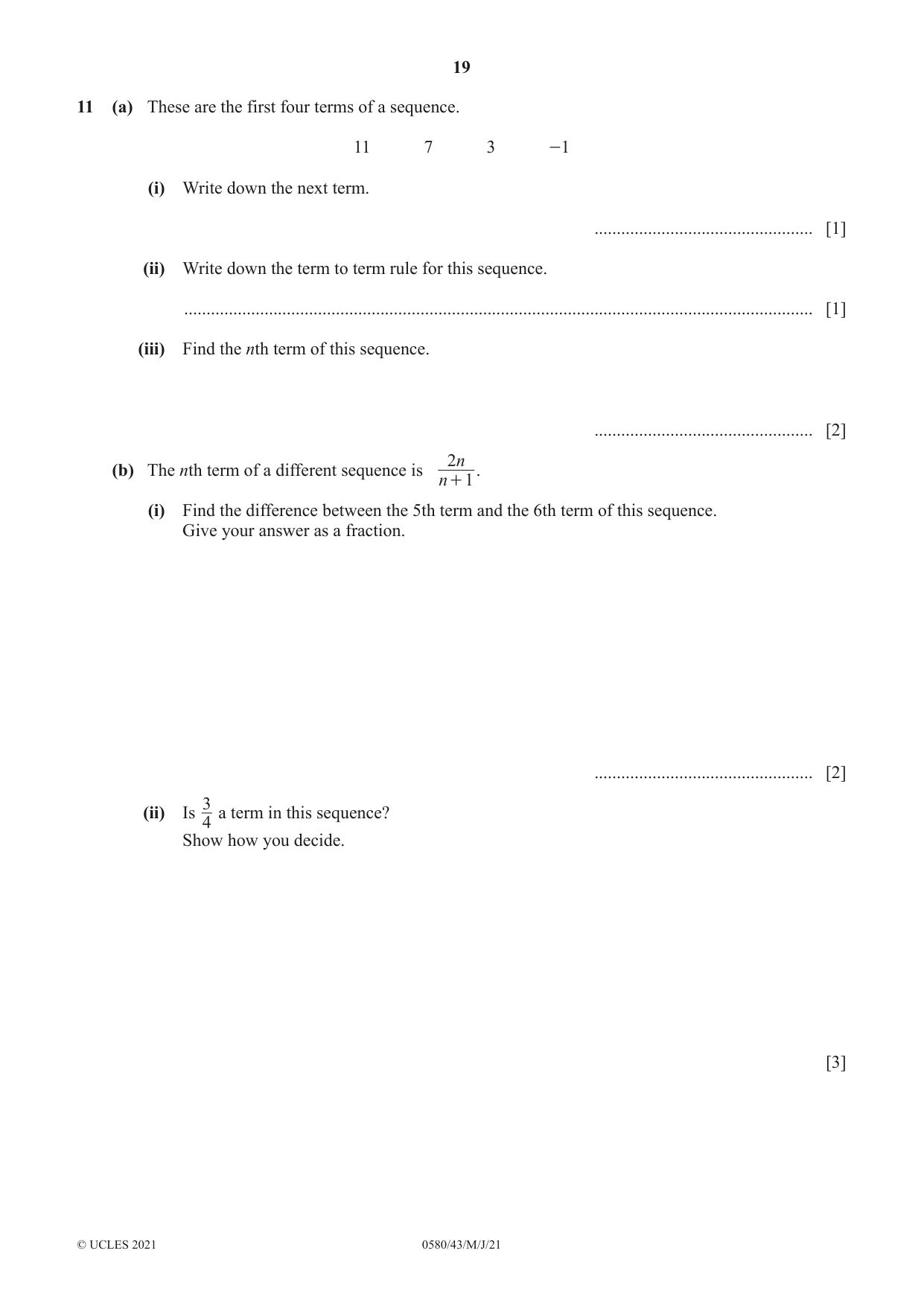
11 (a) These are the first four terms of a sequence. 11 7 3 -1 (i) Write down the next term. ................................................. [1] (ii) Write down the term to term rule for this sequence. ............................................................................................................................................. [1] (iii) Find the nth term of this sequence. ................................................. [2] 2n (b) The nth term of a different sequence is . n + 1 (i) Find the difference between the 5th term and the 6th term of this sequence. Give your answer as a fraction. ................................................. [2] 3 (ii) Is a term in this sequence? 4 Show how you decide. [3]
Mark scheme: 11(a)(i) –5 1 11(a)(ii) Subtract 4 oe 1 11(a)(iii) 15 – 4n oe final answer 2 B1 for k – 4n or 15 – jn j ≠ 0 11(b)(i) 1 2 12 10 or equivalent fraction B1 for and 21 7 6 11(b)(ii) 3 M2 3 2 n n = oe M1 for = oe 5 4 n + 1 or or 2n ⩾ n + 1 but 3 < 4. M1 for 2n > n + 1 but 3 < 4 No, n is not an integer oe A1 or 3 No, is less than 1, oe 4
What was in this paper
The subtopics covered by these 11 questions, and how many questions each got. Open one in a new tab to see every Cambridge question on it.
What you needed in this session
Cambridge’s own grade thresholds for 2021 May/June, Paper 4 · Variant 3. A higher threshold means an easier paper — the bar moves with how the cohort did.