Cambridge IGCSE Mathematics 0580 — 2023 Oct/Nov Paper 4 · Variant 3
0580/43/O/N/23 · 11 questions · 130 marks · ≈146 min
The question paper and its mark scheme, free to read here and free to download. This is Cambridge’s own paper, exactly as it was sat.
Question paper20 pages

Mark scheme9 pages
Answers below. Sit the paper first if you are practising.
Questions as text
Q1 · The table shows the amount received when exchanging $100 in some countries
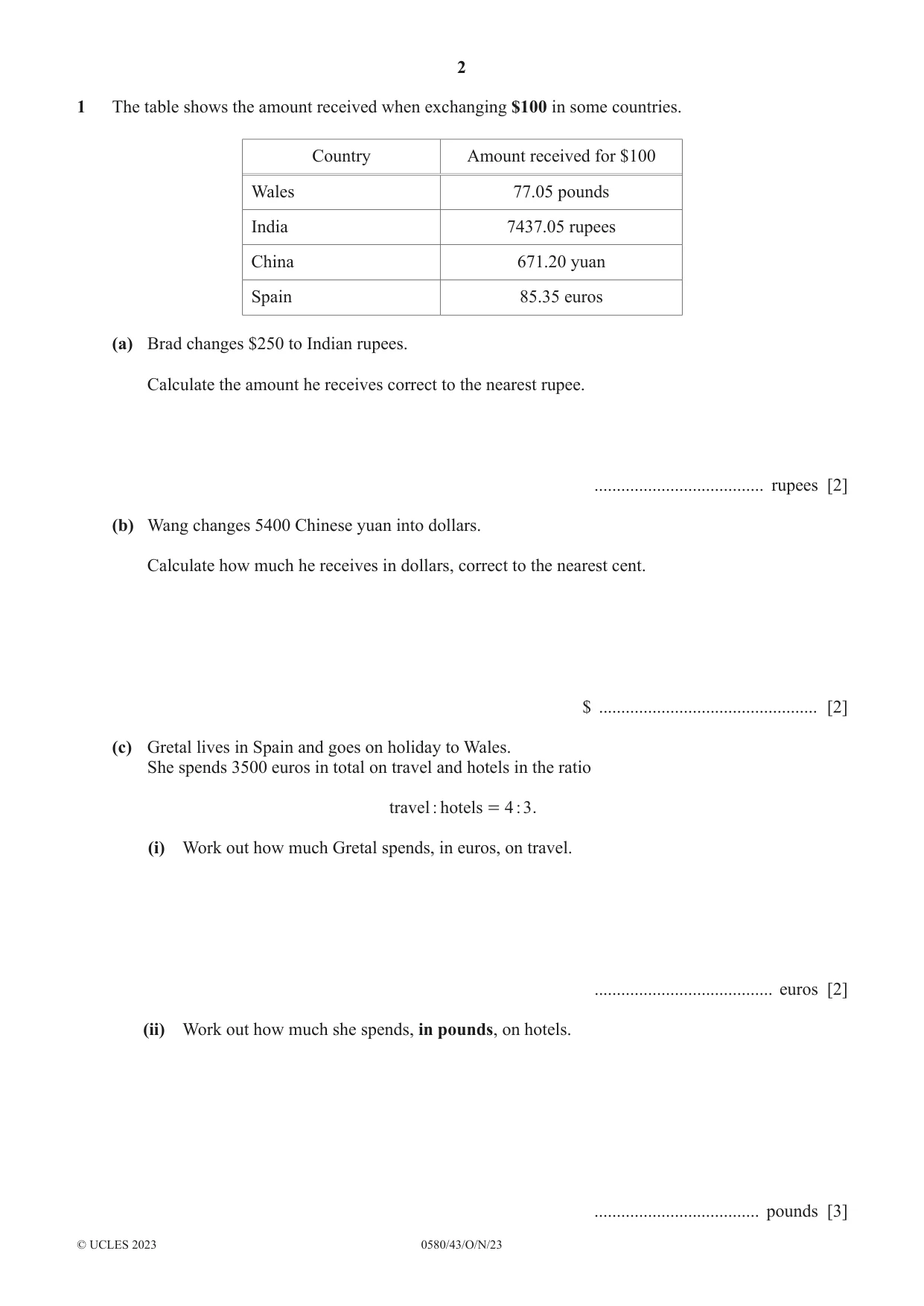
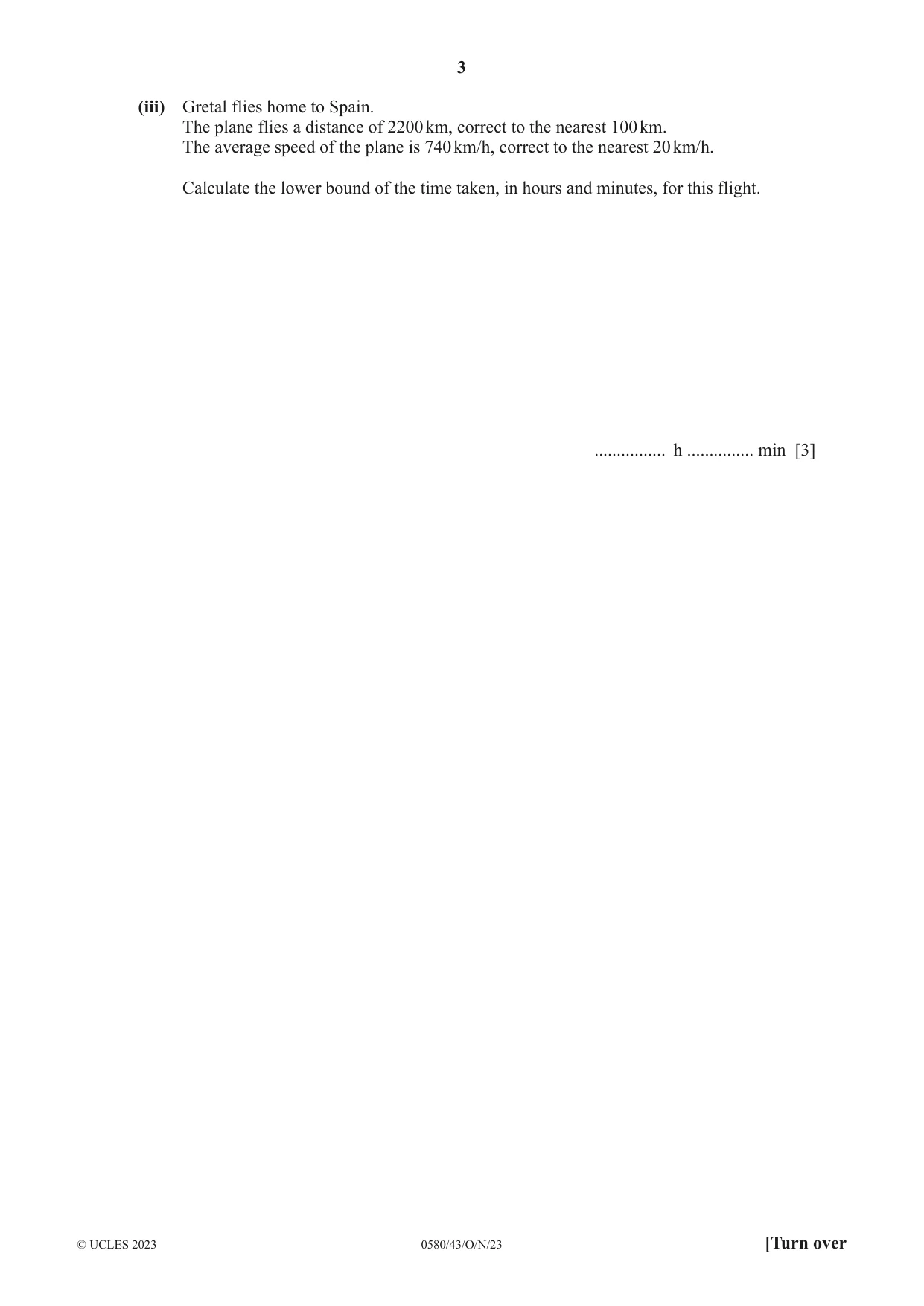
1 The table shows the amount received when exchanging $100 in some countries. Country Amount received for $100 Wales 77.05 pounds India 7437.05 rupees China 671.20 yuan Spain 85.35 euros (a) Brad changes $250 to Indian rupees. Calculate the amount he receives correct to the nearest rupee. ...................................... rupees [2] (b) Wang changes 5400 Chinese yuan into dollars. Calculate how much he receives in dollars, correct to the nearest cent. $ ................................................. [2] (c) Gretal lives in Spain and goes on holiday to Wales. She spends 3500 euros in total on travel and hotels in the ratio travel: hotels = 4 : 3 . (i) Work out how much Gretal spends, in euros, on travel. ........................................ euros [2] (ii) Work out how much she spends, in pounds, on hotels. ..................................... pounds [3] (iii) Gretal flies home to Spain. The plane flies a distance of 2200 km, correct to the nearest 100 km. The average speed of the plane is 740 km/h, correct to the nearest 20 km/h. Calculate the lower bound of the time taken, in hours and minutes, for this flight. ................ h ............... min [3]
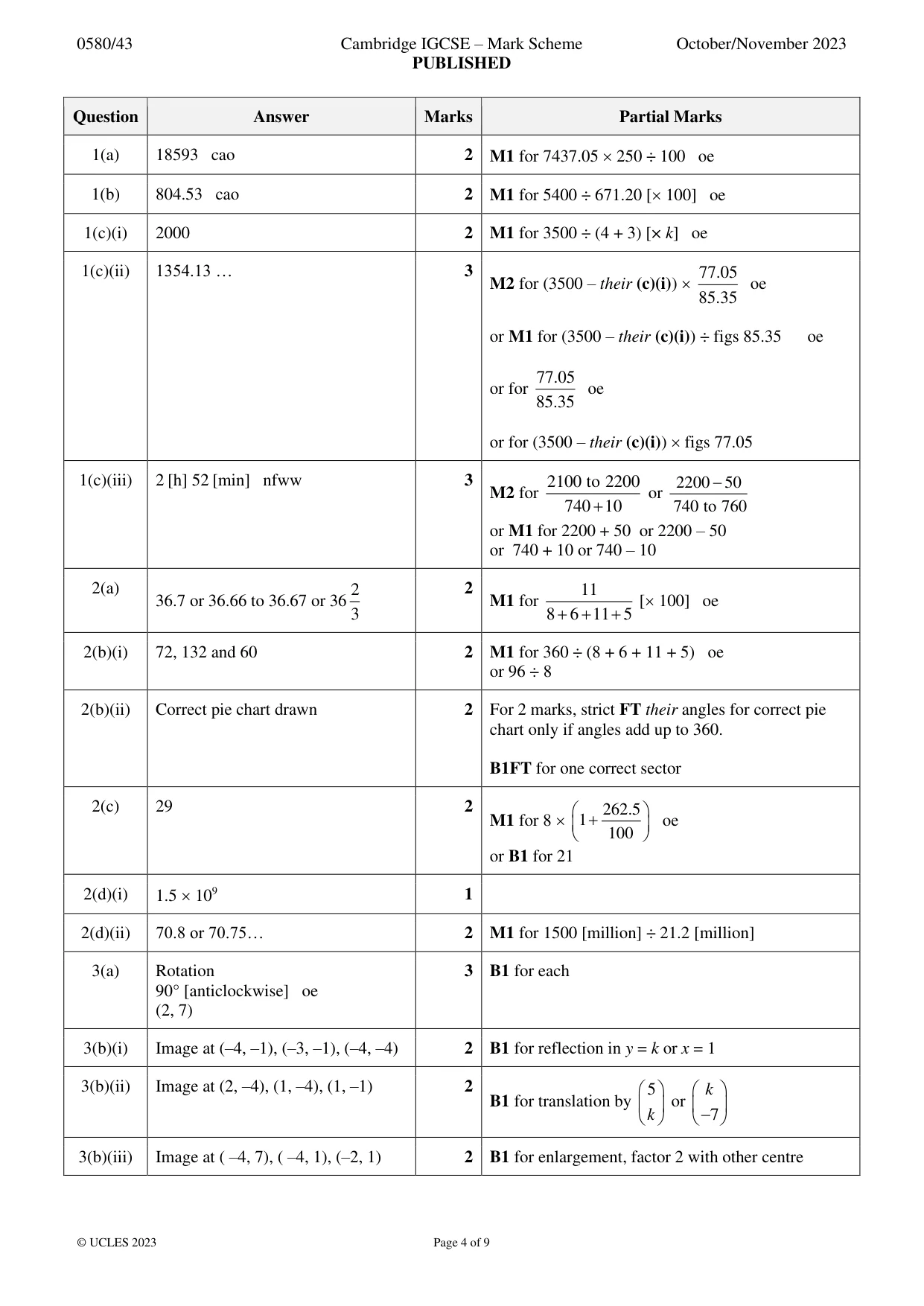
Mark scheme: Question Answer Marks Partial Marks 1(a) 18593 cao 2 M1 for 7437.05 250 ÷ 100 oe 1(b) 804.53 cao 2 M1 for 5400 ÷ 671.20 [ 100] oe 1(c)(i) 2000 2 M1 for 3500 ÷ (4 + 3) [× k] oe 1(c)(ii) 1354.13 … 3 77.05 M2 for (3500 – their (c)(i)) oe 85.35 or M1 for (3500 – their (c)(i)) ÷ figs 85.35 oe 77.05 or for oe 85.35 or for (3500 – their (c)(i)) figs 77.05 1(c)(iii) 2 [h] 52 [min] nfww 3 2100 to 2200 2200 − 50 M2 for or 740 + 10 740 to 760 or M1 for 2200 + 50 or 2200 – 50 or 740 + 10 or 740 – 10
Q2 · The table shows the number of each type of bird seen in a garden on Monday
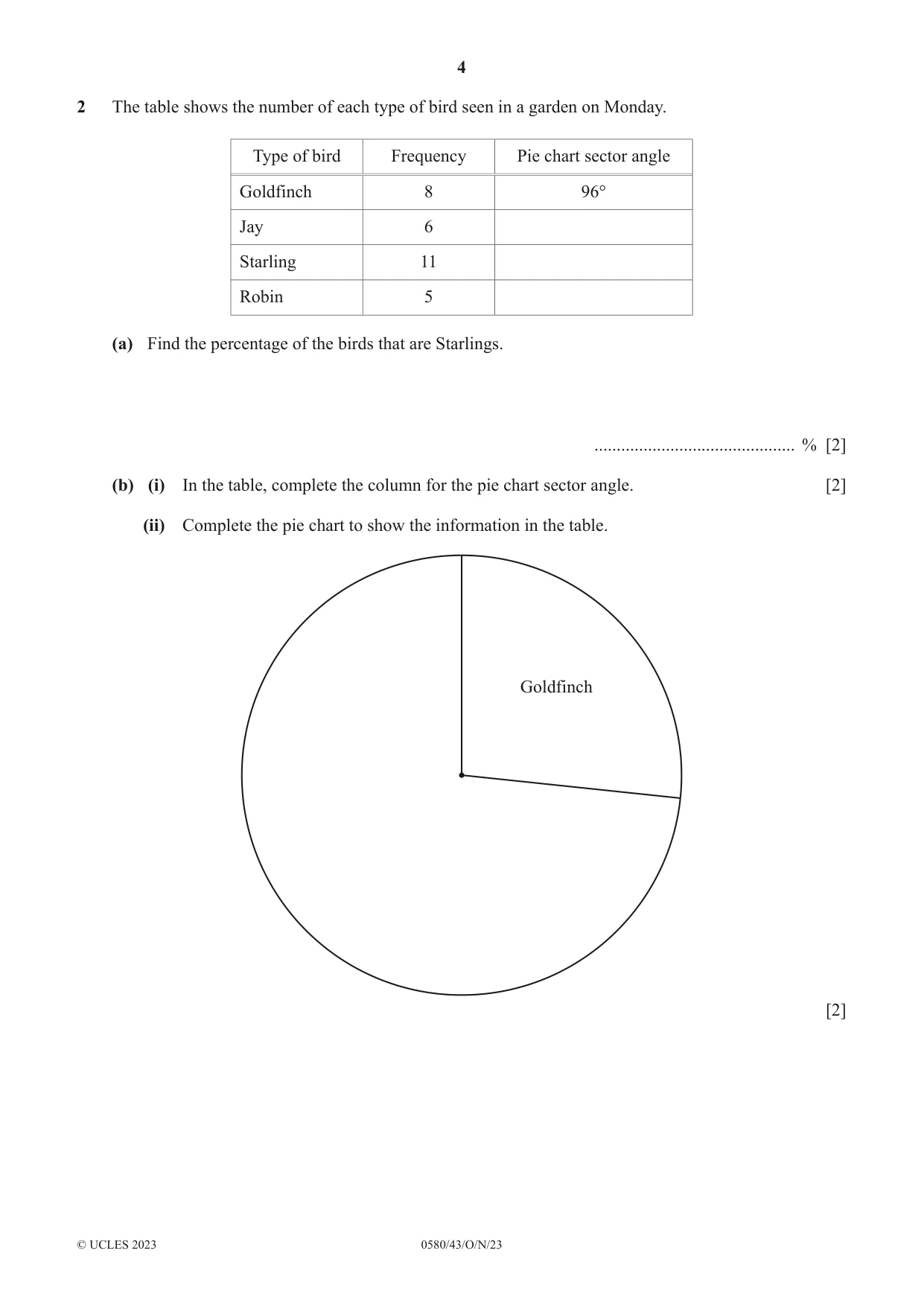
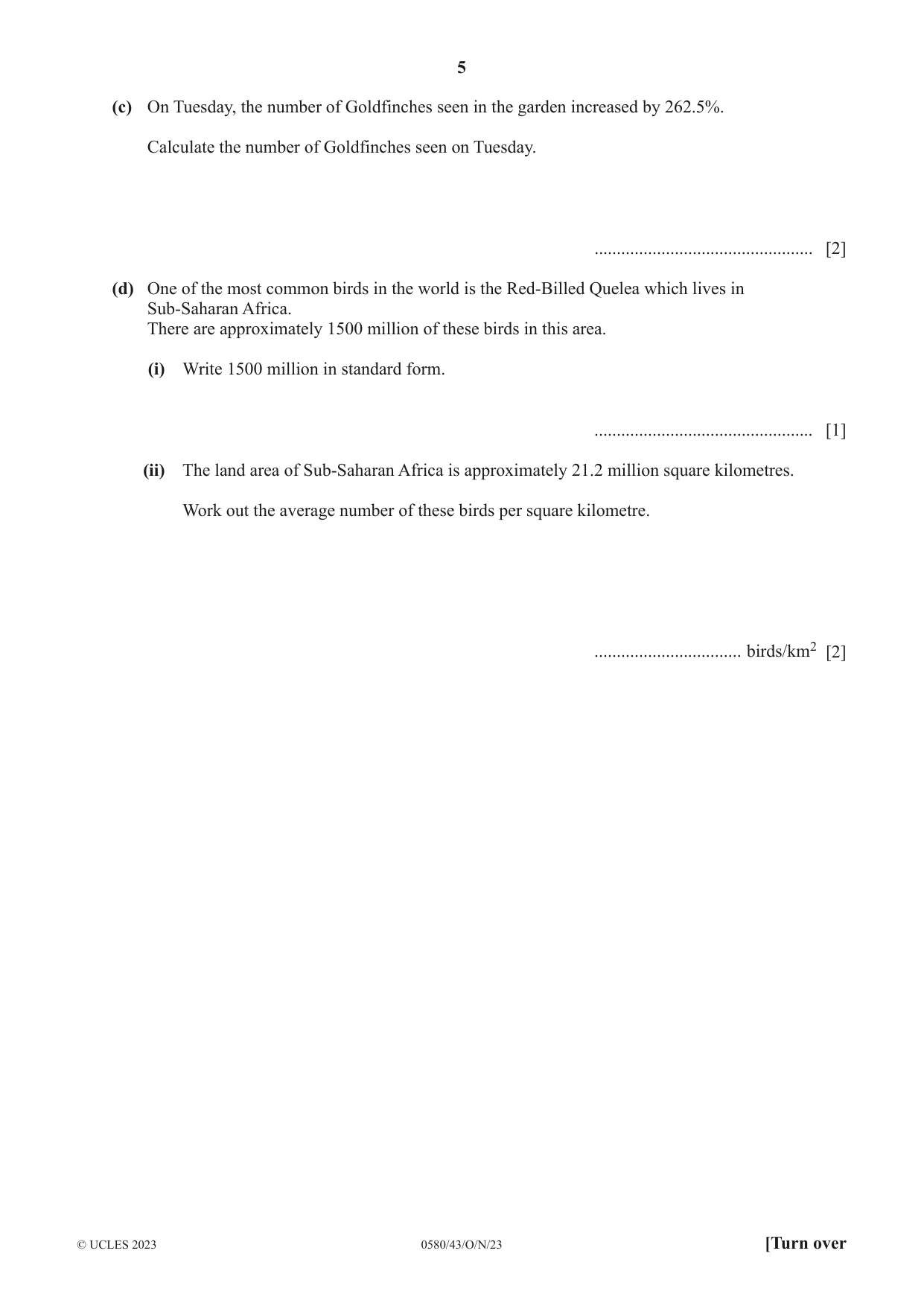
2 The table shows the number of each type of bird seen in a garden on Monday. Type of bird Frequency Pie chart sector angle Goldfinch 8 96° Jay 6 Starling 11 Robin 5 (a) Find the percentage of the birds that are Starlings. ............................................. % [2] (b) (i) In the table, complete the column for the pie chart sector angle. [2] (ii) Complete the pie chart to show the information in the table. Goldfinch [2] (c) On Tuesday, the number of Goldfinches seen in the garden increased by 262.5%. Calculate the number of Goldfinches seen on Tuesday. ................................................. [2] (d) One of the most common birds in the world is the Red-Billed Quelea which lives in Sub-Saharan Africa. There are approximately 1500 million of these birds in this area. (i) Write 1500 million in standard form. ................................................. [1] (ii) The land area of Sub-Saharan Africa is approximately 21.2 million square kilometres. Work out the average number of these birds per square kilometre. ................................. birds/km2 [2]
Mark scheme: 2(a) 2 2 11 36.7 or 36.66 to 36.67 or 36 M1 for [ 100] oe 3 8 + 6 + 11 + 5 2(b)(i) 72, 132 and 60 2 M1 for 360 ÷ (8 + 6 + 11 + 5) oe or 96 ÷ 8 2(b)(ii) Correct pie chart drawn 2 For 2 marks, strict FT their angles for correct pie chart only if angles add up to 360. B1FT for one correct sector 2(c) 29 2 262.5 M1 for 8 1 + oe 100 or B1 for 21 2(d)(i) 1.5 109 1 2(d)(ii) 70.8 or 70.75… 2 M1 for 1500 [million] ÷ 21.2 [million]
Q3 · Y 8 7 6 5 4 A 3 2 B 1 - 6 - 5 - 4 - 3 - 2 - 1 0 1 2 3 4 5 6 7 8 x - 1 - 2 - 3 - 4 - 5 - 6…
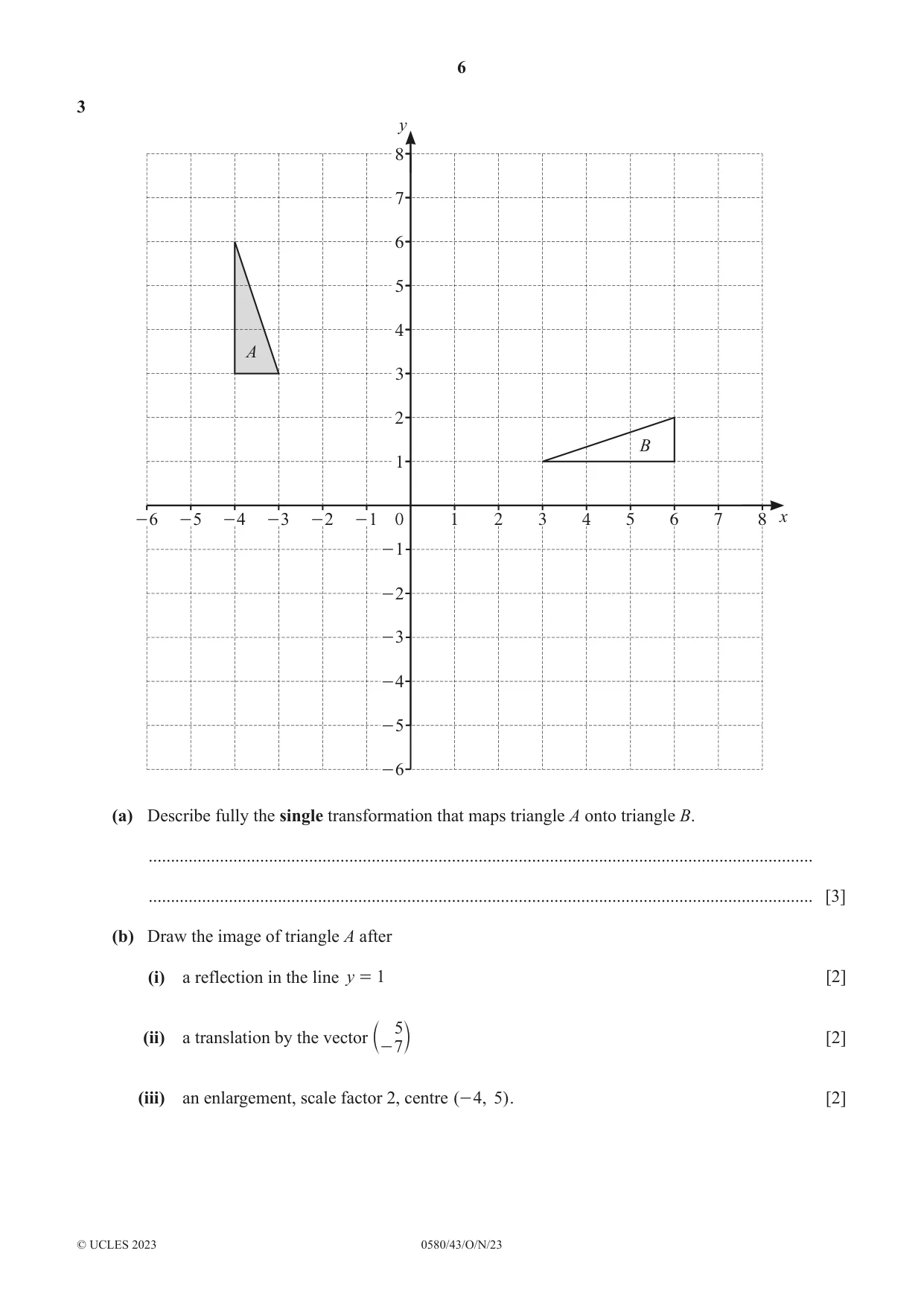
3 y 8 7 6 5 4 A 3 2 B 1 - 6 - 5 - 4 - 3 - 2 - 1 0 1 2 3 4 5 6 7 8 x - 1 - 2 - 3 - 4 - 5 - 6 (a) Describe fully the single transformation that maps triangle A onto triangle B. ..................................................................................................................................................... ..................................................................................................................................................... [3] (b) Draw the image of triangle A after (i) a reflection in the line y = 1 [2] 5 (ii) a translation by the vector [2] b - 7 l (iii) an enlargement, scale factor 2, centre ( - 4 , 5) . [2]
Mark scheme: 3(a) Rotation 3 B1 for each 90° [anticlockwise] oe (2, 7) 3(b)(i) Image at (–4, –1), (–3, –1), (–4, –4) 2 B1 for reflection in y = k or x = 1 3(b)(ii) Image at (2, –4), (1, –4), (1, –1) 2 5 k B1 for translation by or k −7 3(b)(iii) Image at ( –4, 7), ( –4, 1), (–2, 1) 2 B1 for enlargement, factor 2 with other centre
Q4 · Find the size of one interior angle of a regular 10-sided polygon
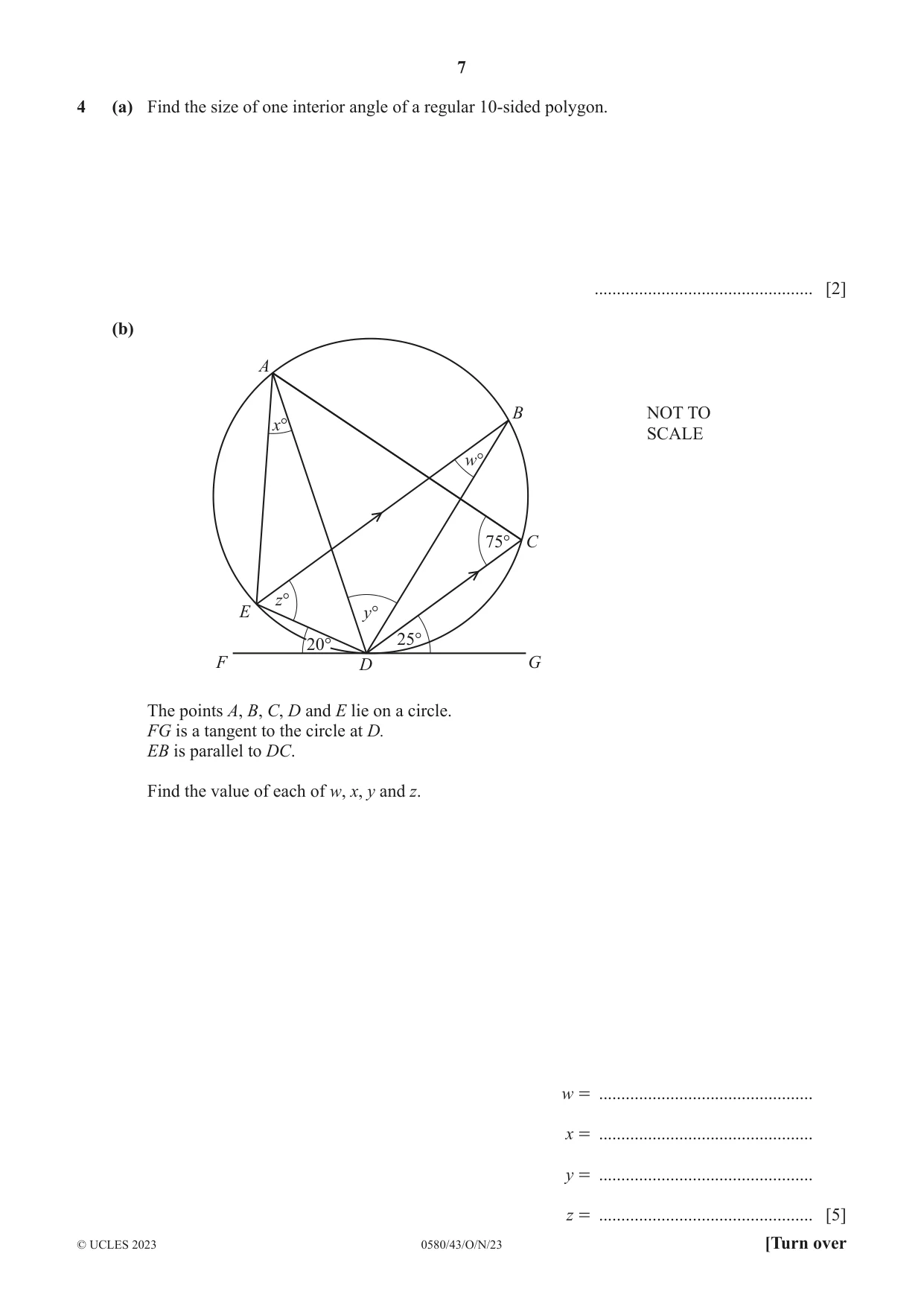
4 (a) Find the size of one interior angle of a regular 10-sided polygon. ................................................. [2] (b) A B NOT TO x° SCALE w° 75° C z° E y° 25° 20°20° F D G The points A, B, C, D and E lie on a circle. FG is a tangent to the circle at D. EB is parallel to DC. Find the value of each of w, x, y and z. w = ................................................ x = ................................................ y = ................................................ z = ................................................ [5]
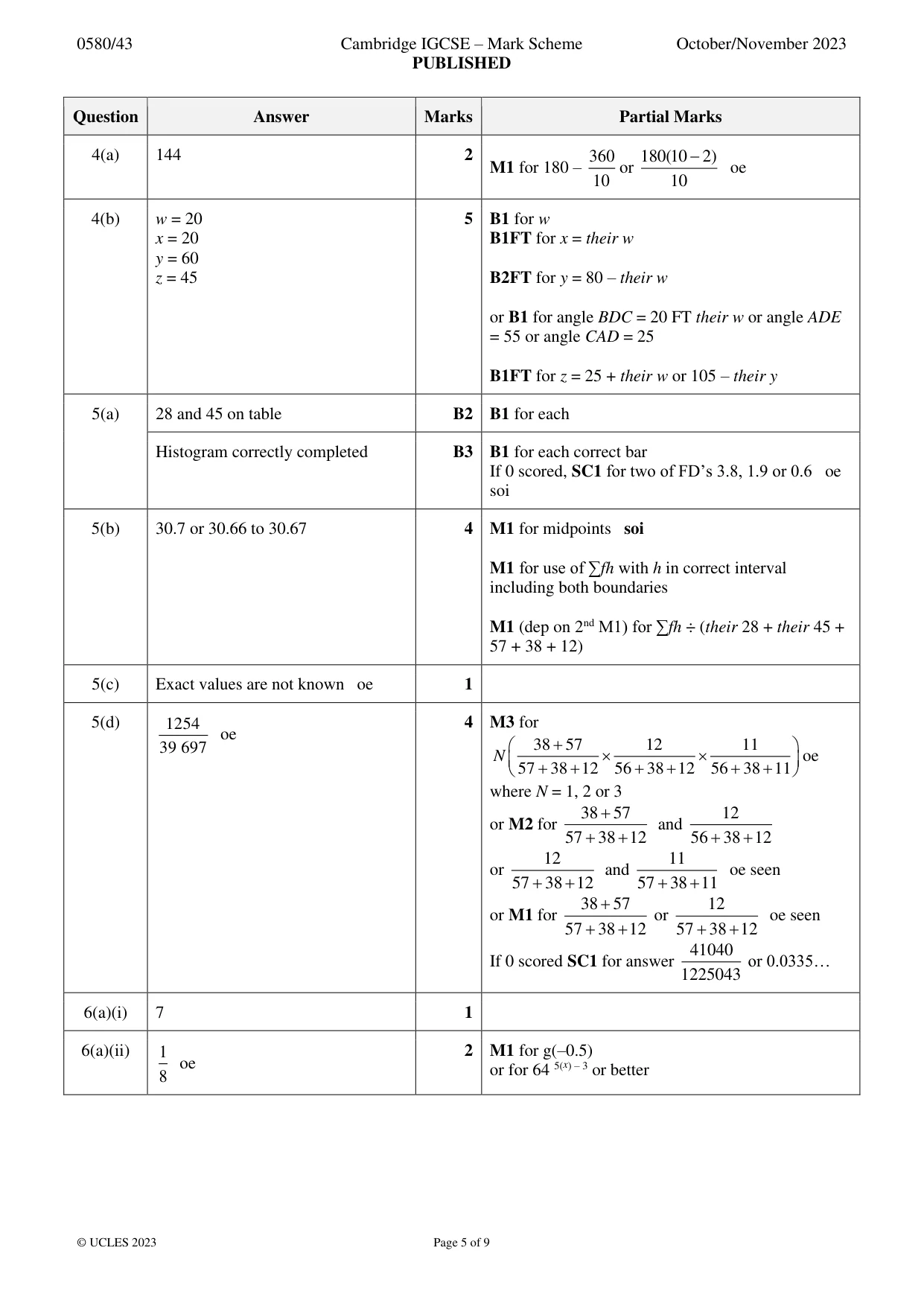
Mark scheme: 4(a) 144 2 360 180(10 − 2) M1 for 180 – or oe 10 10 4(b) w = 20 5 B1 for w x = 20 B1FT for x = their w y = 60 z = 45 B2FT for y = 80 – their w or B1 for angle BDC = 20 FT their w or angle ADE = 55 or angle CAD = 25 B1FT for z = 25 + their w or 105 – their y
Q5 · Indira records the time taken for workers in her company to travel to work
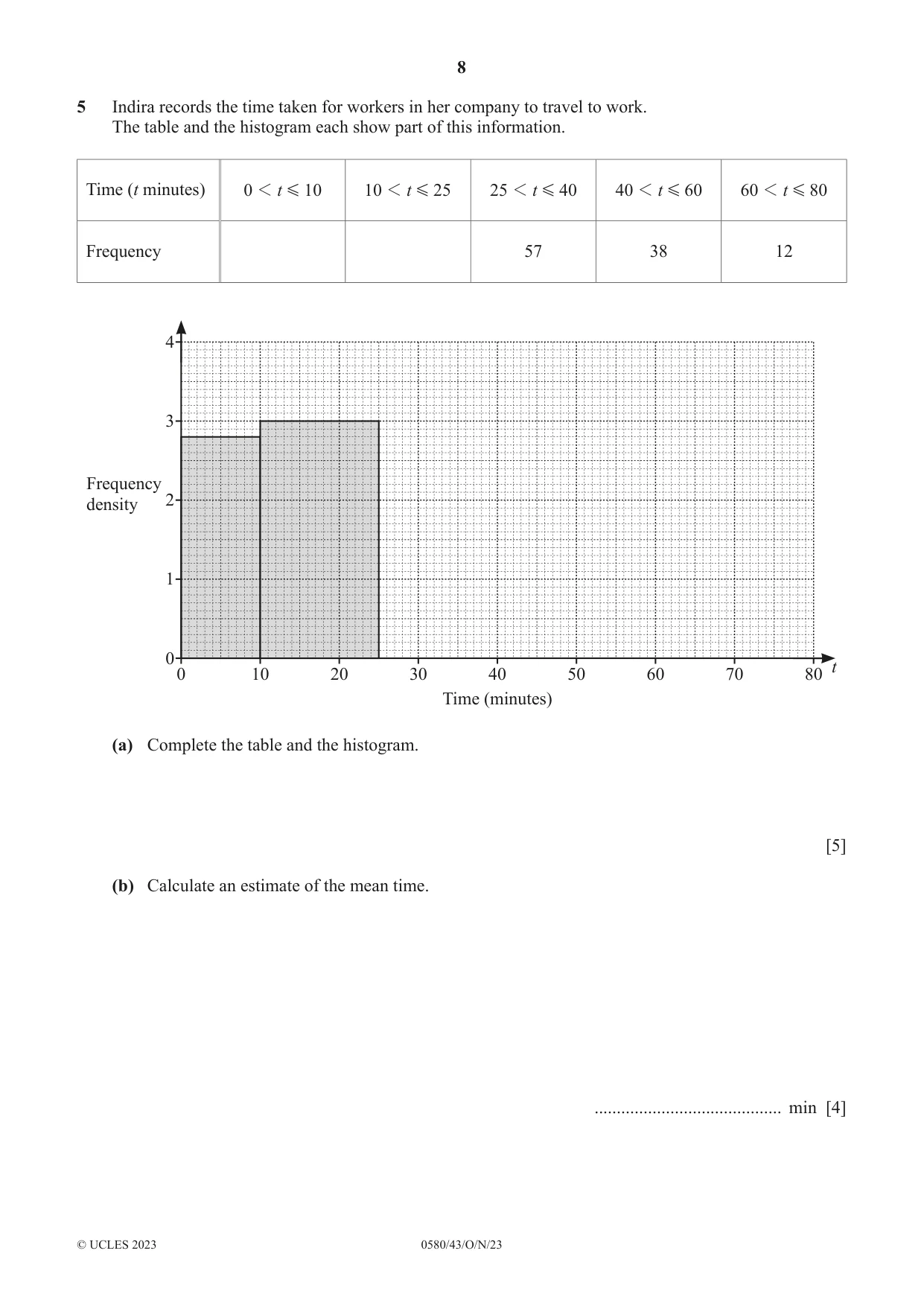
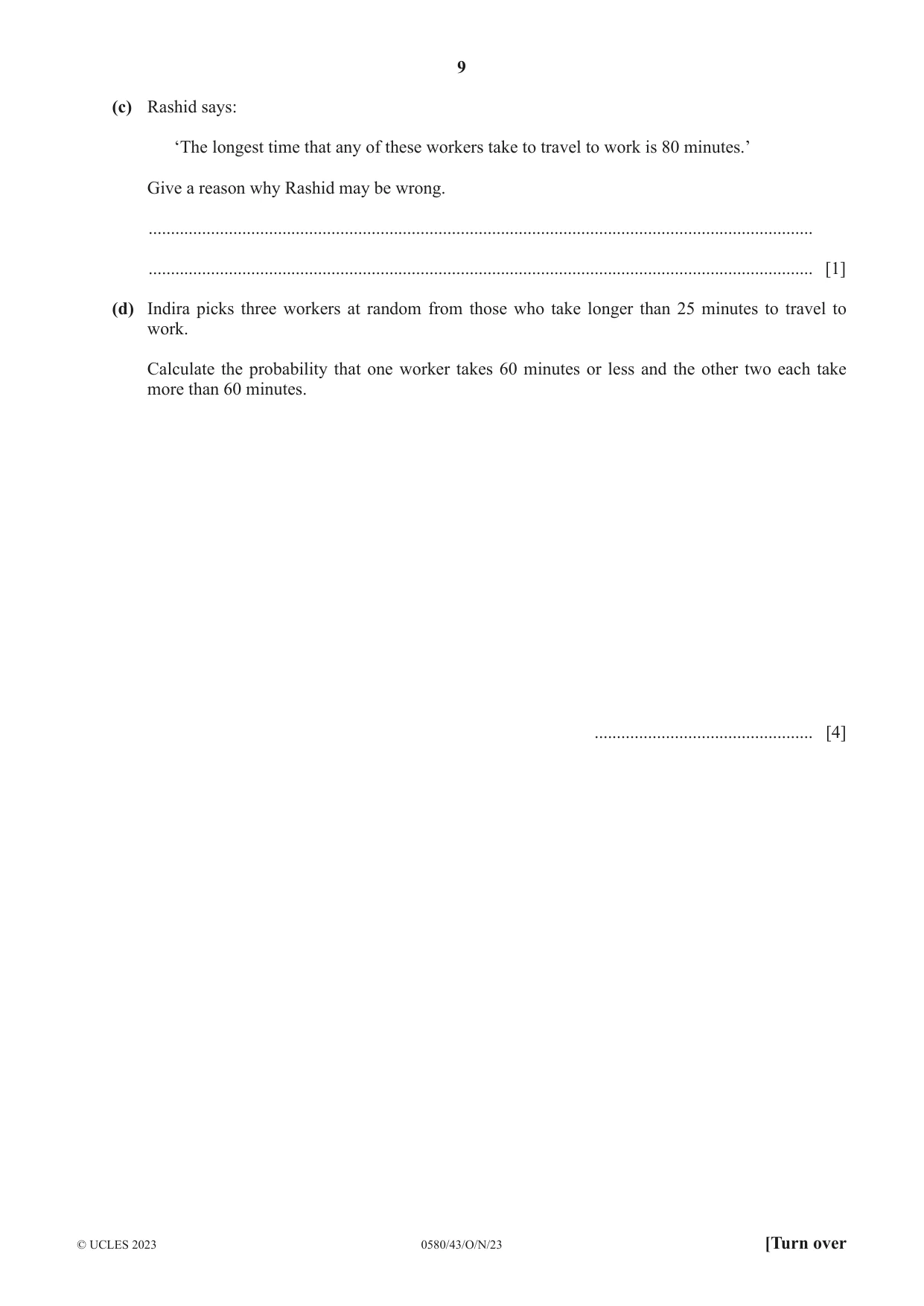
5 Indira records the time taken for workers in her company to travel to work. The table and the histogram each show part of this information. Time (t minutes) 0 1 t G 10 10 1 t G 25 25 1 t G 40 40 1 t G 60 60 1 t G 80 Frequency 57 38 12 4 3 Frequency 2 density 1 0 t 0 10 20 30 40 50 60 70 80 Time (minutes) (a) Complete the table and the histogram. [5] (b) Calculate an estimate of the mean time. .......................................... min [4] (c) Rashid says: ‘The longest time that any of these workers take to travel to work is 80 minutes.’ Give a reason why Rashid may be wrong. ..................................................................................................................................................... ..................................................................................................................................................... [1] (d) Indira picks three workers at random from those who take longer than 25 minutes to travel to work. Calculate the probability that one worker takes 60 minutes or less and the other two each take more than 60 minutes. ................................................. [4]
Mark scheme: 5(a) 28 and 45 on table B2 B1 for each Histogram correctly completed B3 B1 for each correct bar If 0 scored, SC1 for two of FD’s 3.8, 1.9 or 0.6 oe soi 5(b) 30.7 or 30.66 to 30.67 4 M1 for midpoints soi M1 for use of ∑fh with h in correct interval including both boundaries M1 (dep on 2nd M1) for ∑fh ÷ (their 28 + their 45 + 57 + 38 + 12) 5(c) Exact values are not known oe 1 5(d) 1254 4 M3 for oe 39 697 38 + 57 12 11 N oe 57 + 38 + 12 56 + 38 + 12 56 + 38 + 11 where N = 1, 2 or 3 38 + 57 12 or M2 for and 57 + 38 + 12 56 + 38 + 12 12 11 or and oe seen 57 + 38 + 12 57 + 38 + 11 38 + 57 12 or M1 for or oe seen 57 + 38 + 12 57 + 38 + 12 41040 If 0 scored SC1 for answer or 0.0335… 1225043
Q6 · X 26 f ( )x = 5 x - 3 g ( )x = 64 h ( )x = , x !- 1 x + 1 (a) Find the value of (i) f (…
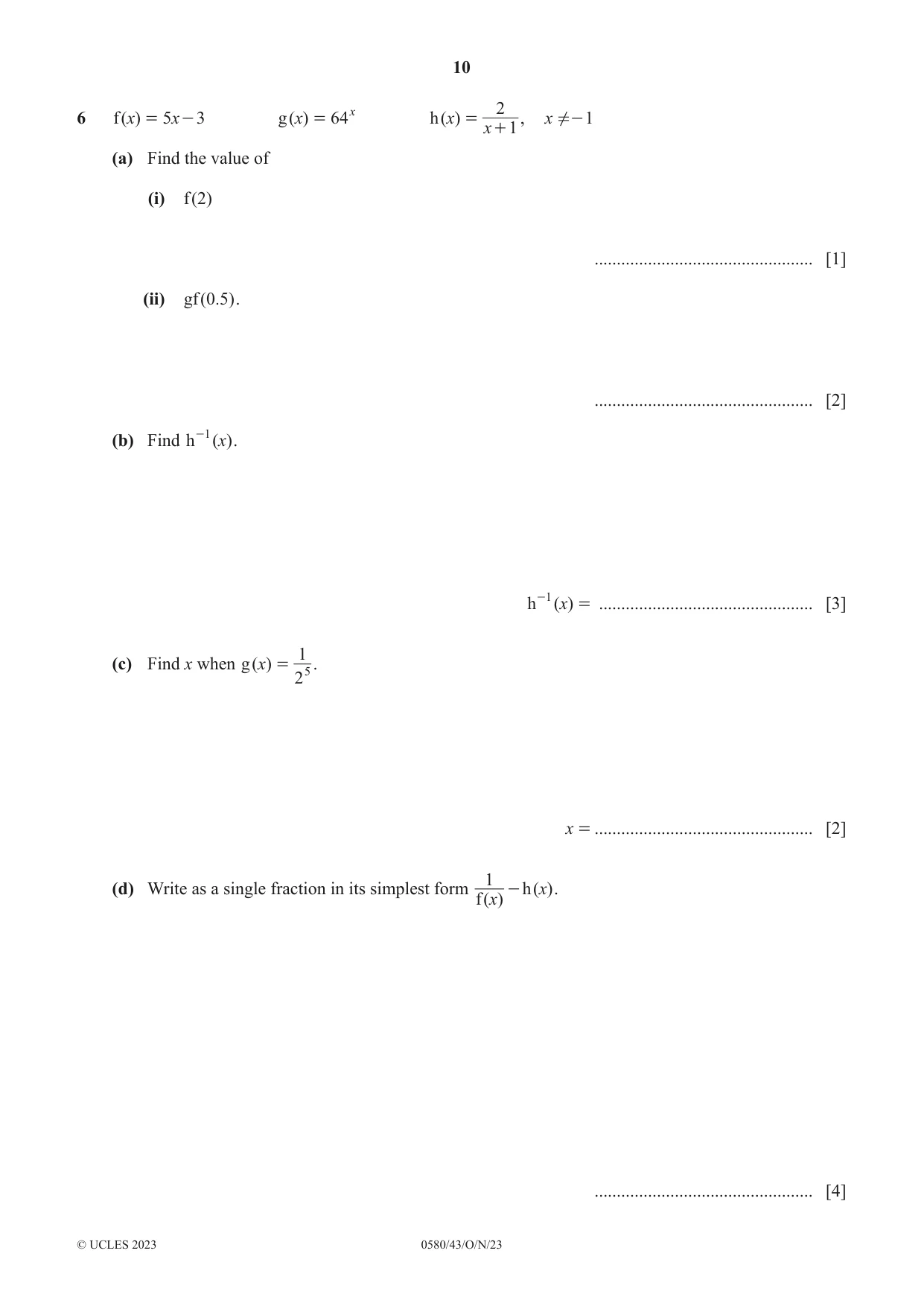
x 26 f ( )x = 5 x - 3 g ( )x = 64 h ( )x = , x !- 1 x + 1 (a) Find the value of (i) f ( 2) ................................................. [1] (ii) gf ( 0.5) . ................................................. [2] (b) Find h -1 ( )x . h -1 ( )x = ................................................ [3] 1 (c) Find x when g ( )x = 5 . 2 x = ................................................. [2] 1 (d) Write as a single fraction in its simplest form - h ( x) . f ( x) ................................................. [4]
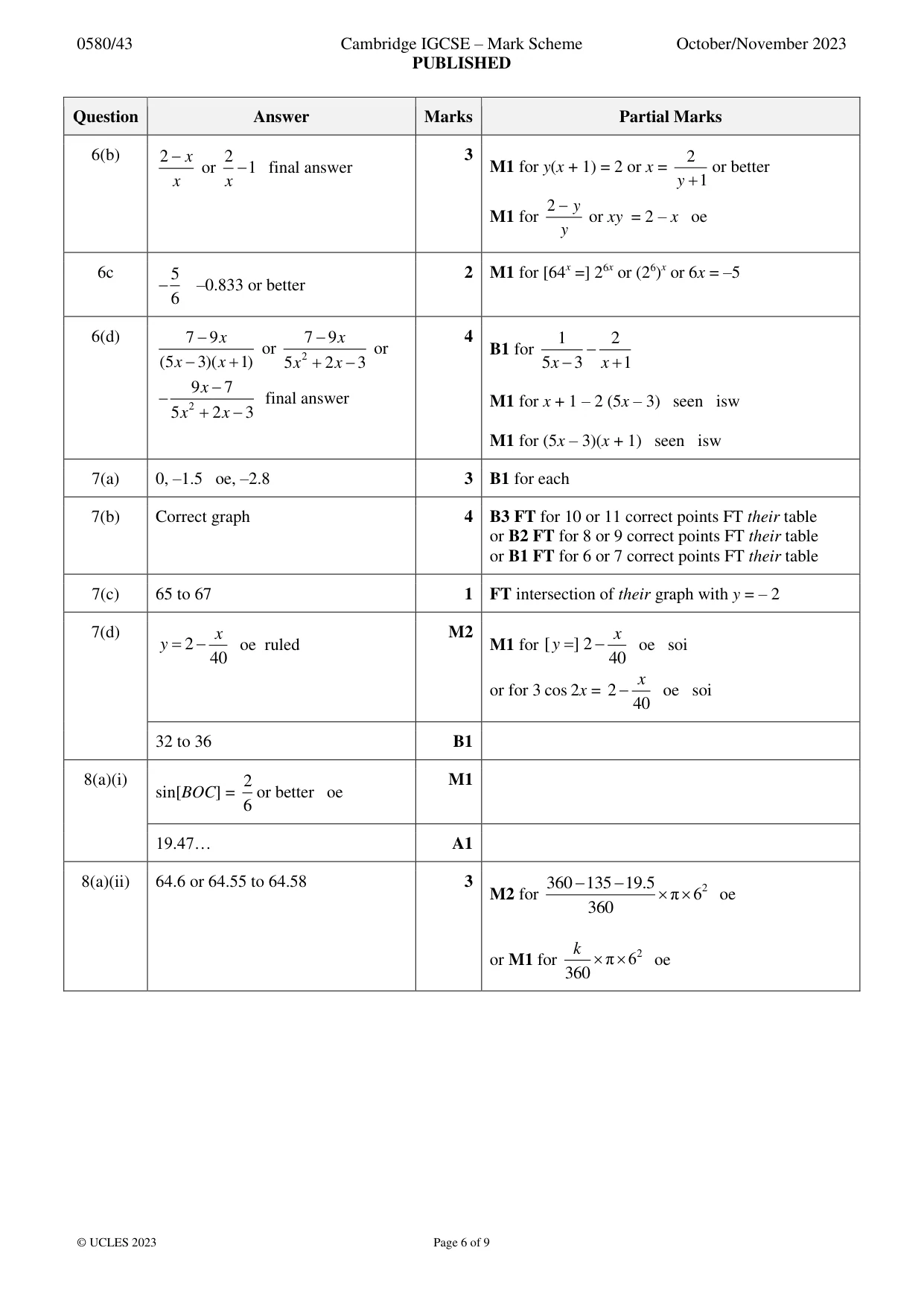
Mark scheme: 6(a)(i) 7 1 6(a)(ii) 1 2 M1 for g(–0.5) oe 5(x) – 3 or for 64 or better 8 6(b) 2 −x 2 3 2 or − 1 final answer M1 for y(x + 1) = 2 or x = or better x x y + 1 2 −y M1 for or xy = 2 – x oe y 6c 5 2 M1 for [64x =] 26x or (26)x or 6x = –5 − –0.833 or better 6 6(d) 7 − 9 x 7 − 9 x 4 1 2 or or B1 for − 2 (5 x − 3)( x + 1) 5 x + 2 x − 3 5 x − 3 x + 1 9 x − 7 − final answer M1 for x + 1 – 2 (5x – 3) seen isw 2 5 x + 2 x − 3 M1 for (5x – 3)(x + 1) seen isw
Q7 · Complete the table of values for y = 3 cos 2x°
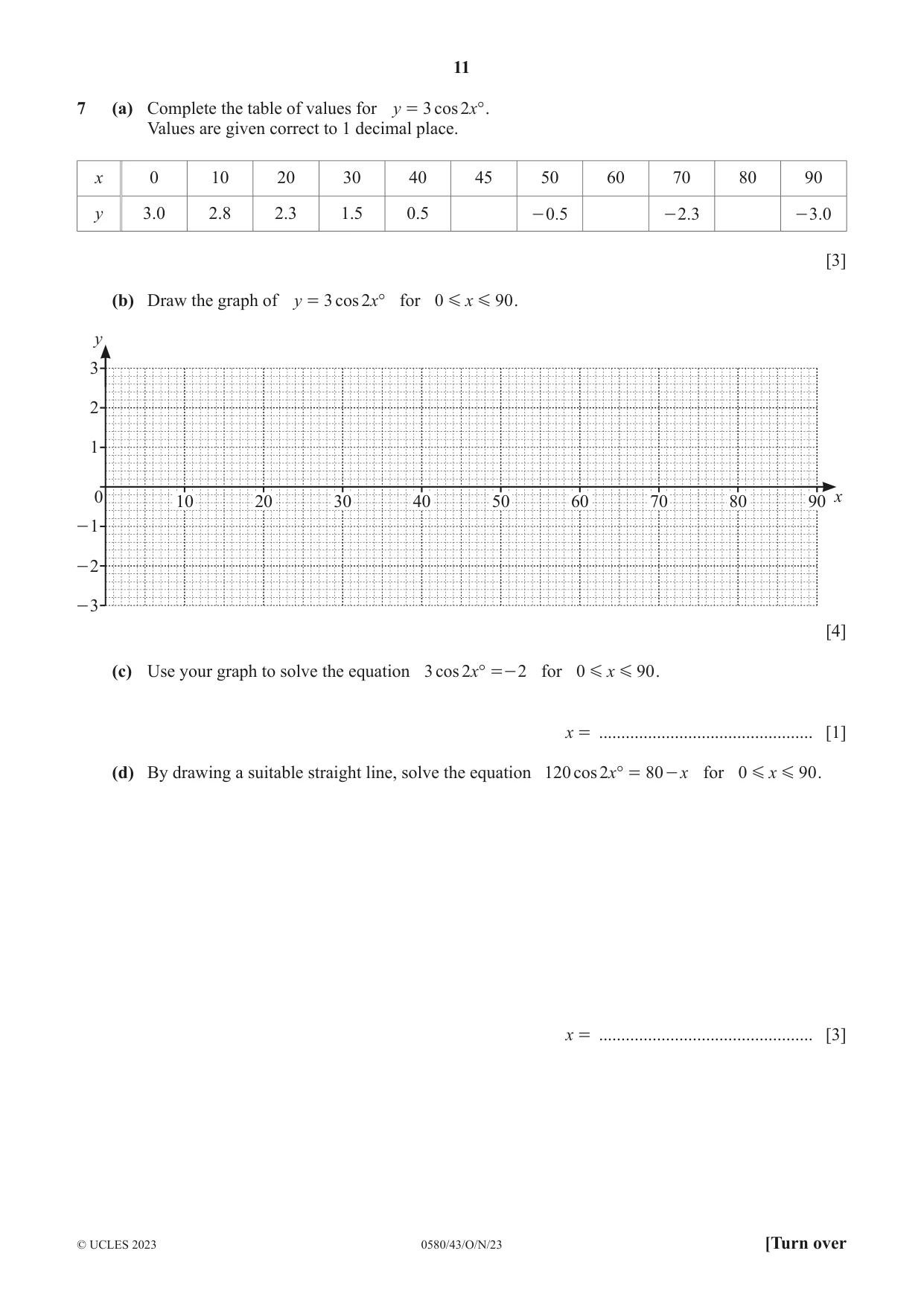
7 (a) Complete the table of values for y = 3 cos 2x° . Values are given correct to 1 decimal place. x 0 10 20 30 40 45 50 60 70 80 90 y 3.0 2.8 2.3 1.5 0.5 - .05 - .23 - .30 [3] (b) Draw the graph of y = 3 cos 2x° for 0 G x G 90 . y 3 2 1 0 x 10 20 30 40 50 60 70 80 90 - 1 - 2 - 3 [4] (c) Use your graph to solve the equation 3 cos 2x° =- 2 for 0 G x G 90 . x = ................................................ [1] (d) By drawing a suitable straight line, solve the equation 120 cos 2x° = 80 - x for 0 G x G 90 . x = ................................................ [3]
Mark scheme: 7(a) 0, –1.5 oe, –2.8 3 B1 for each 7(b) Correct graph 4 B3 FT for 10 or 11 correct points FT their table or B2 FT for 8 or 9 correct points FT their table or B1 FT for 6 or 7 correct points FT their table 7(c) 65 to 67 1 FT intersection of their graph with y = – 2 7(d) M2 y = 2 −x oe ruled M1 for [ y =] 2 −x oe soi 40 40 or for 3 cos 2x = 2 −x oe soi 40 32 to 36 B1
Q8 · NOT TO SCALE O 6 cm 135° B A 2 cm C D The diagram shows a shape made from a major sector…
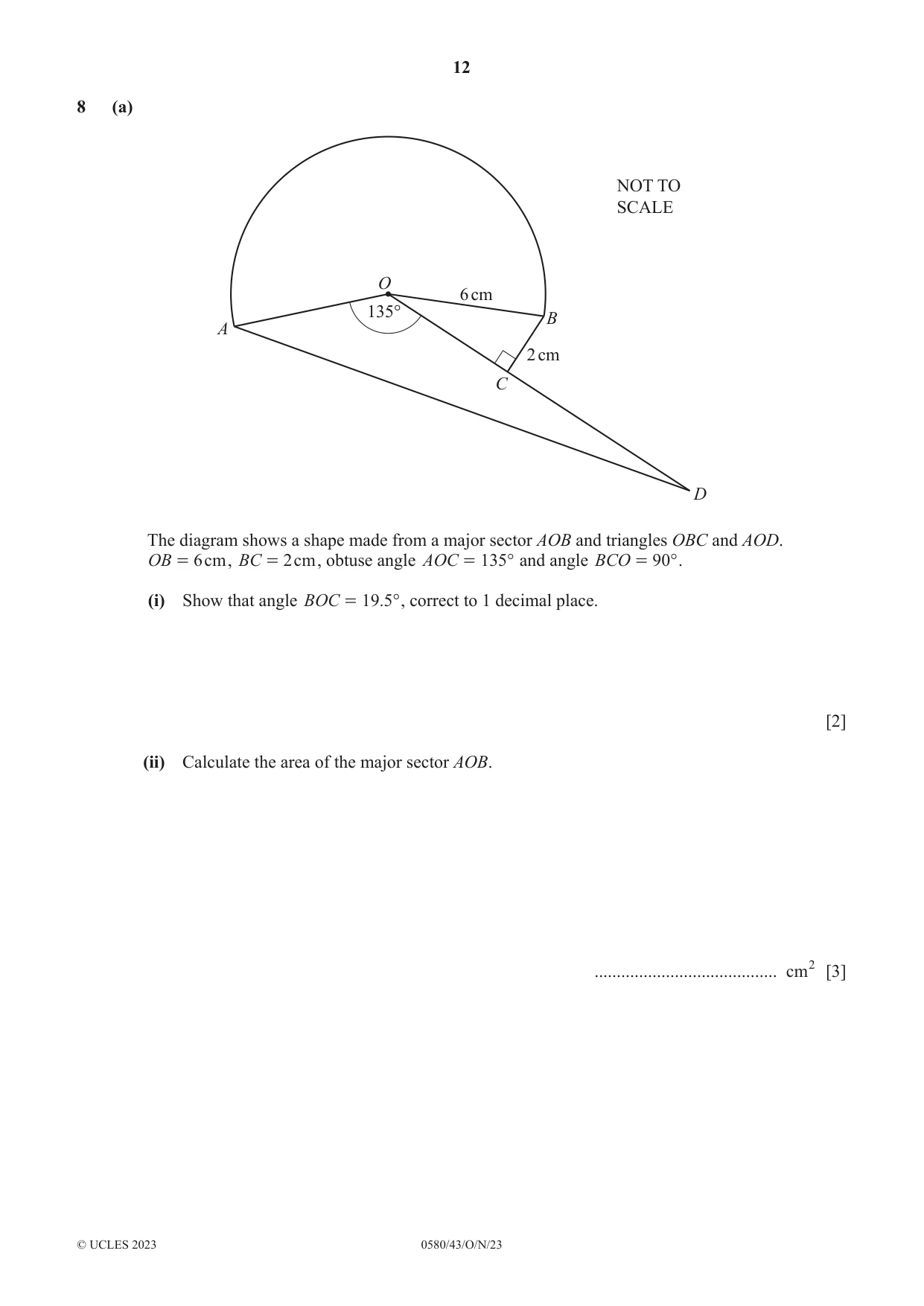
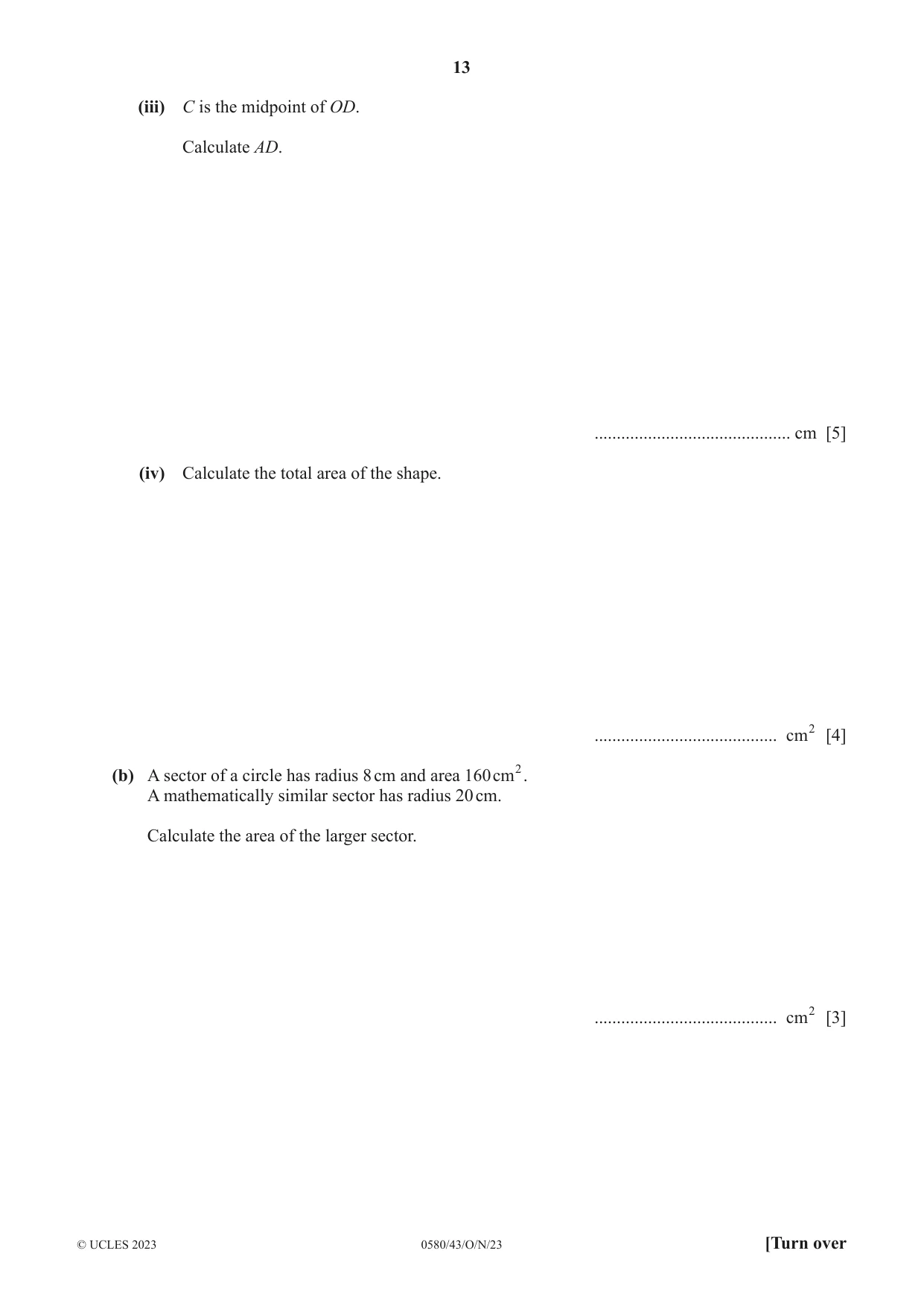
8 (a) NOT TO SCALE O 6 cm 135° B A 2 cm C D The diagram shows a shape made from a major sector AOB and triangles OBC and AOD. OB = 6cm , BC = 2cm , obtuse angle AOC = 135° and angle BCO = 90° . (i) Show that angle BOC = 19.5° , correct to 1 decimal place. [2] (ii) Calculate the area of the major sector AOB. ......................................... cm2 [3] (iii) C is the midpoint of OD. Calculate AD. ............................................ cm [5] (iv) Calculate the total area of the shape. ......................................... cm2 [4] (b) A sector of a circle has radius 8 cm and area 160cm2. A mathematically similar sector has radius 20 cm. Calculate the area of the larger sector. ......................................... cm2 [3]
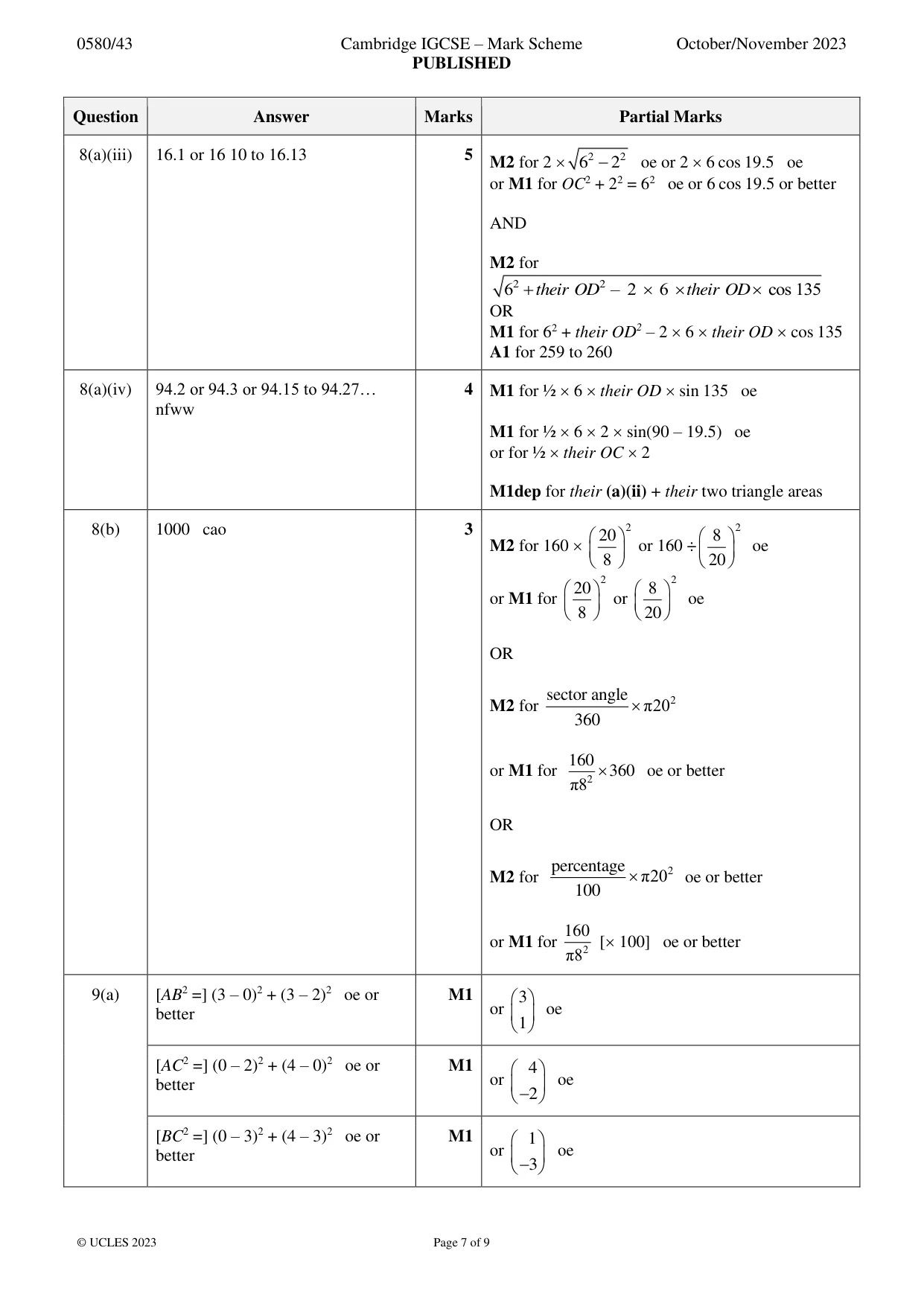
Mark scheme: 8(a)(i) 2 M1 sin[BOC] = or better oe 6 19.47… A1 8(a)(ii) 64.6 or 64.55 to 64.58 3 360 − 135 − 19.5 2 M2 for π 6 oe 360 k 2 or M1 for π 6 oe 360 8(a)(iii) 16.1 or 16 10 to 16.13 5 2 2 M2 for 2 6 − 2 oe or 2 6 cos 19.5 oe or M1 for OC2 + 22 = 62 oe or 6 cos 19.5 or better AND M2 for 62 + their OD2 – 2 6 their OD cos 135 OR M1 for 62 + their OD2 – 2 6 their OD cos 135 A1 for 259 to 260 8(a)(iv) 94.2 or 94.3 or 94.15 to 94.27… 4 M1 for ½ 6 their OD sin 135 oe nfww M1 for ½ 6 2 sin(90 – 19.5) oe or for ½ their OC 2 M1dep for their (a)(ii) + their two triangle areas 8(b) 1000 cao 3 2 2 20 8 M2 for 160 or 160 ÷ oe 8 20 20 2 8 2 or M1 for or oe 8 20 OR sector angle 2 M2 for π20 360 160 or M1 for 360 oe or better π82 OR percentage 2 M2 for π20 oe or better 100 160 or M1 for [ 100] oe or better π8 2
Q9 · A is the point (0, 2), B is the point (3, 3) and C is the point (4, 0)
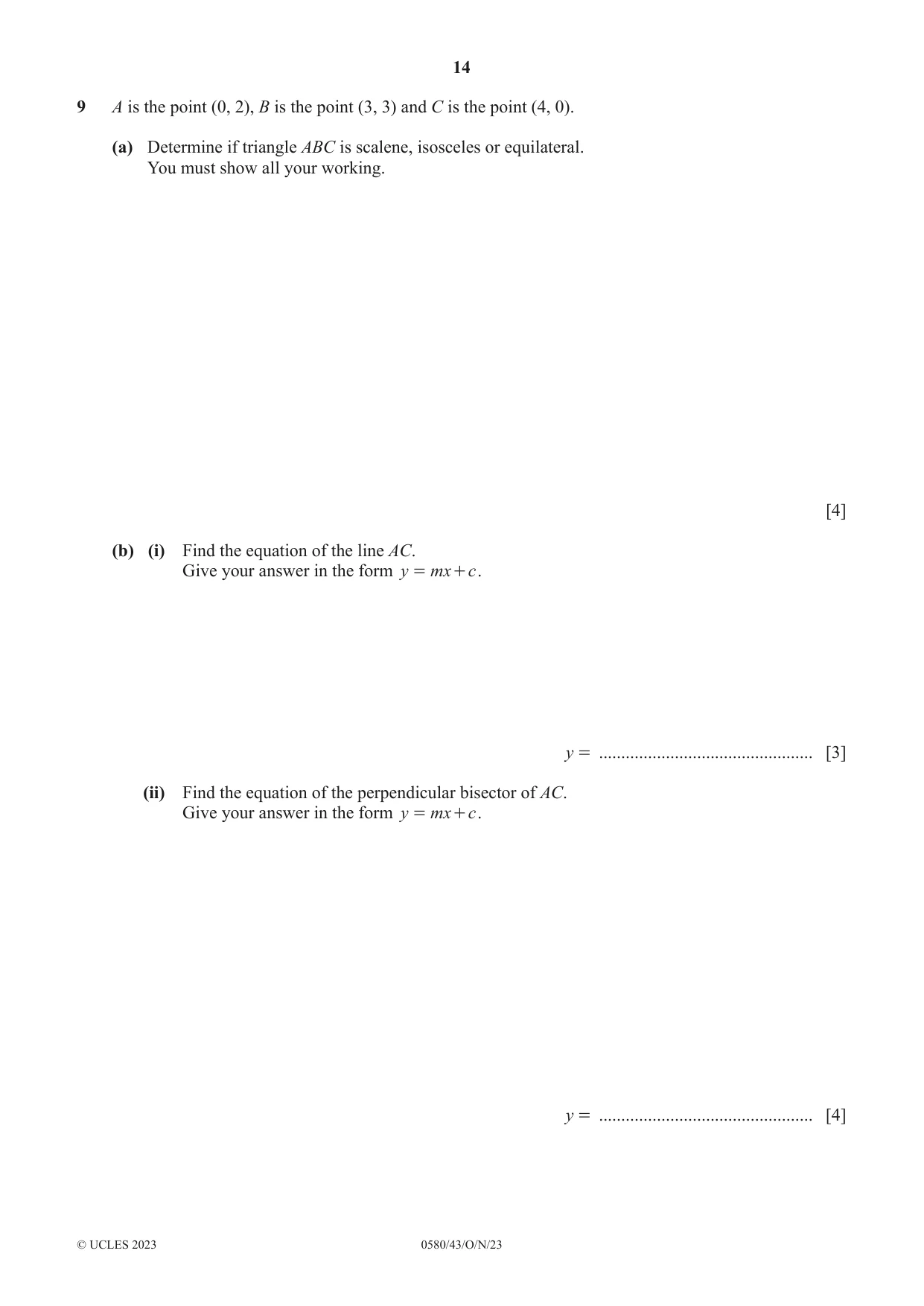
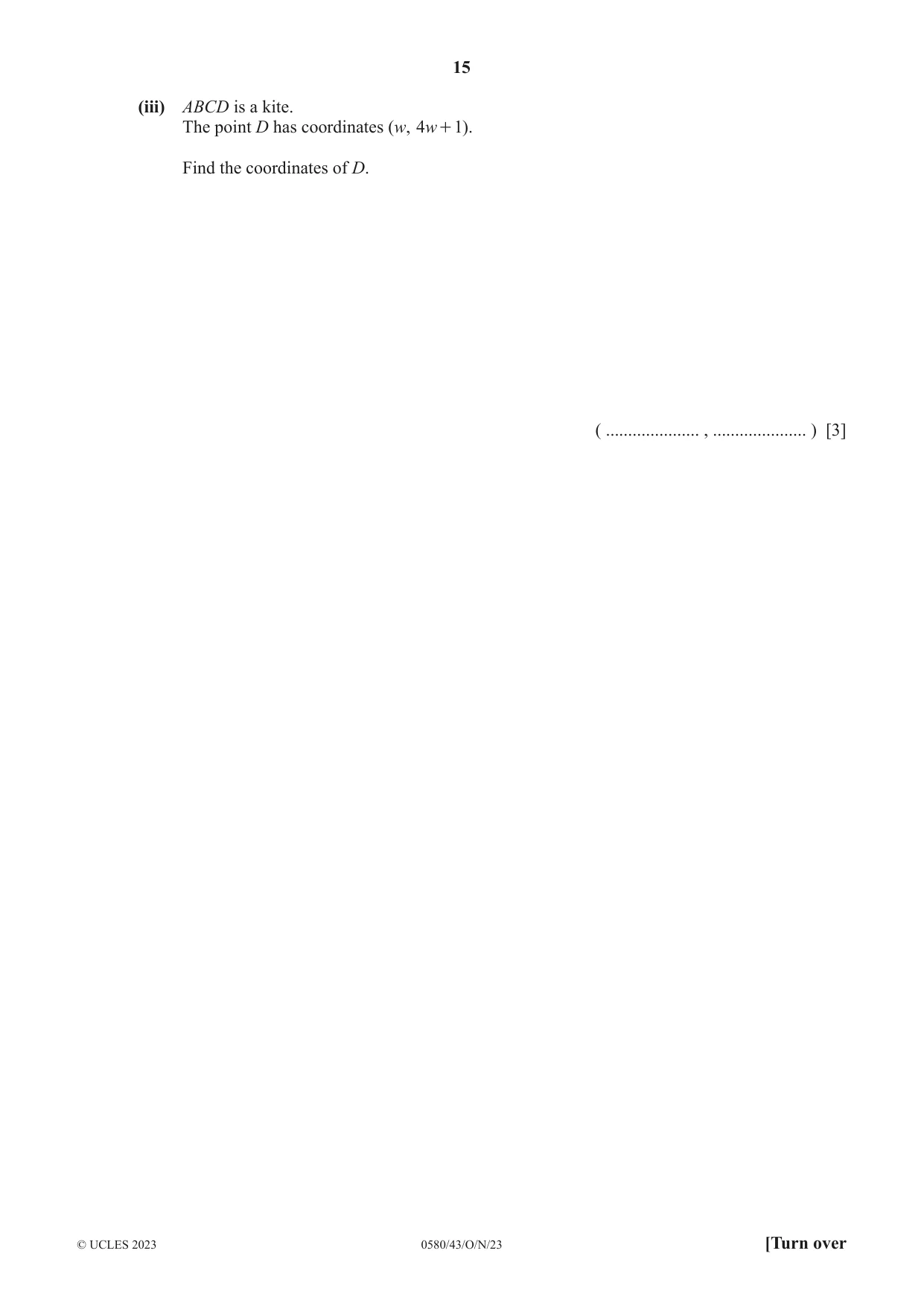
9 A is the point (0, 2), B is the point (3, 3) and C is the point (4, 0). (a) Determine if triangle ABC is scalene, isosceles or equilateral. You must show all your working. [4] (b) (i) Find the equation of the line AC. Give your answer in the form y = mx + c . y = ................................................ [3] (ii) Find the equation of the perpendicular bisector of AC. Give your answer in the form y = mx + c . y = ................................................ [4] (iii) ABCD is a kite. The point D has coordinates (w, 4w + 1). Find the coordinates of D. ( ..................... , ..................... ) [3]
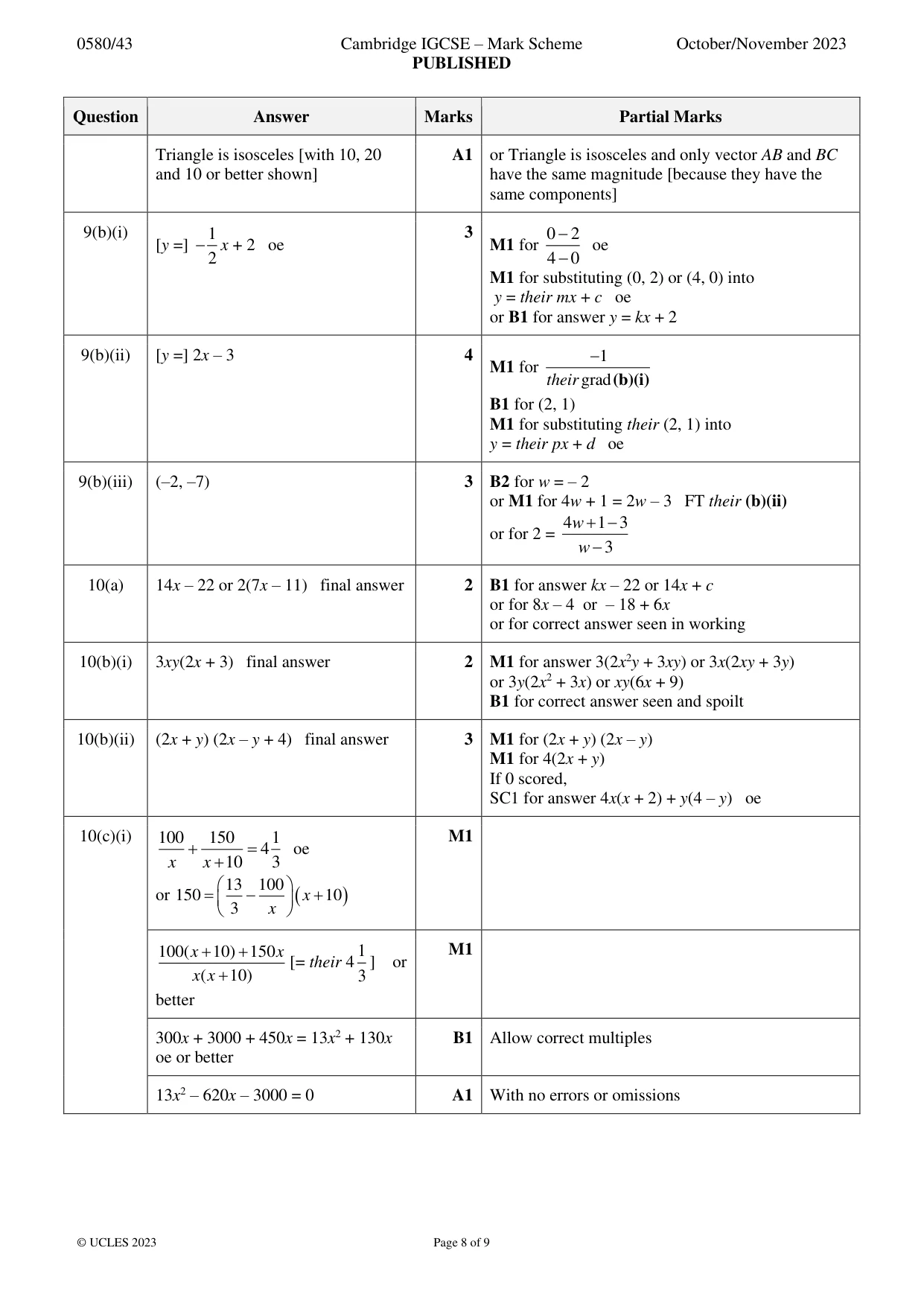
Mark scheme: 9(a) [AB2 =] (3 – 0)2 + (3 – 2)2 oe or M1 3 or oe better 1 [AC2 =] (0 – 2)2 + (4 – 0)2 oe or M1 4 or oe better −2 [BC2 =] (0 – 3)2 + (4 – 3)2 oe or M1 1 or oe better −3 Triangle is isosceles [with 10, 20 A1 or Triangle is isosceles and only vector AB and BC and 10 or better shown] have the same magnitude [because they have the same components] 9(b)(i) 1 3 0 − 2 [y =] − x + 2 oe M1 for oe 2 4 − 0 M1 for substituting (0, 2) or (4, 0) into y = their mx + c oe or B1 for answer y = kx + 2 9(b)(ii) [y =] 2x – 3 4 −1 M1 for their grad (b)(i) B1 for (2, 1) M1 for substituting their (2, 1) into y = their px + d oe 9(b)(iii) (–2, –7) 3 B2 for w = – 2 or M1 for 4w + 1 = 2w – 3 FT their (b)(ii) 4 w + 1 − 3 or for 2 = w − 3
Question 10
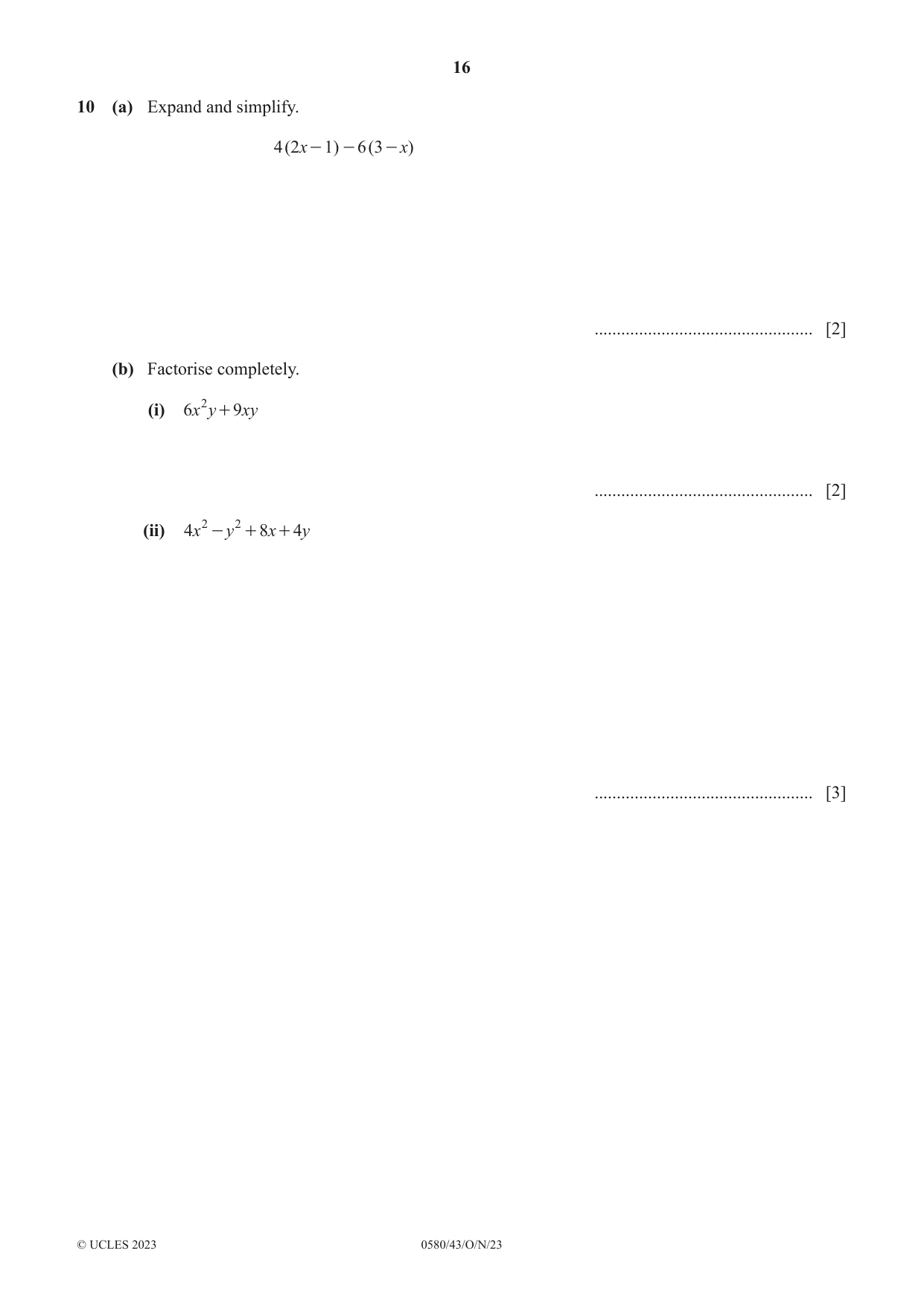
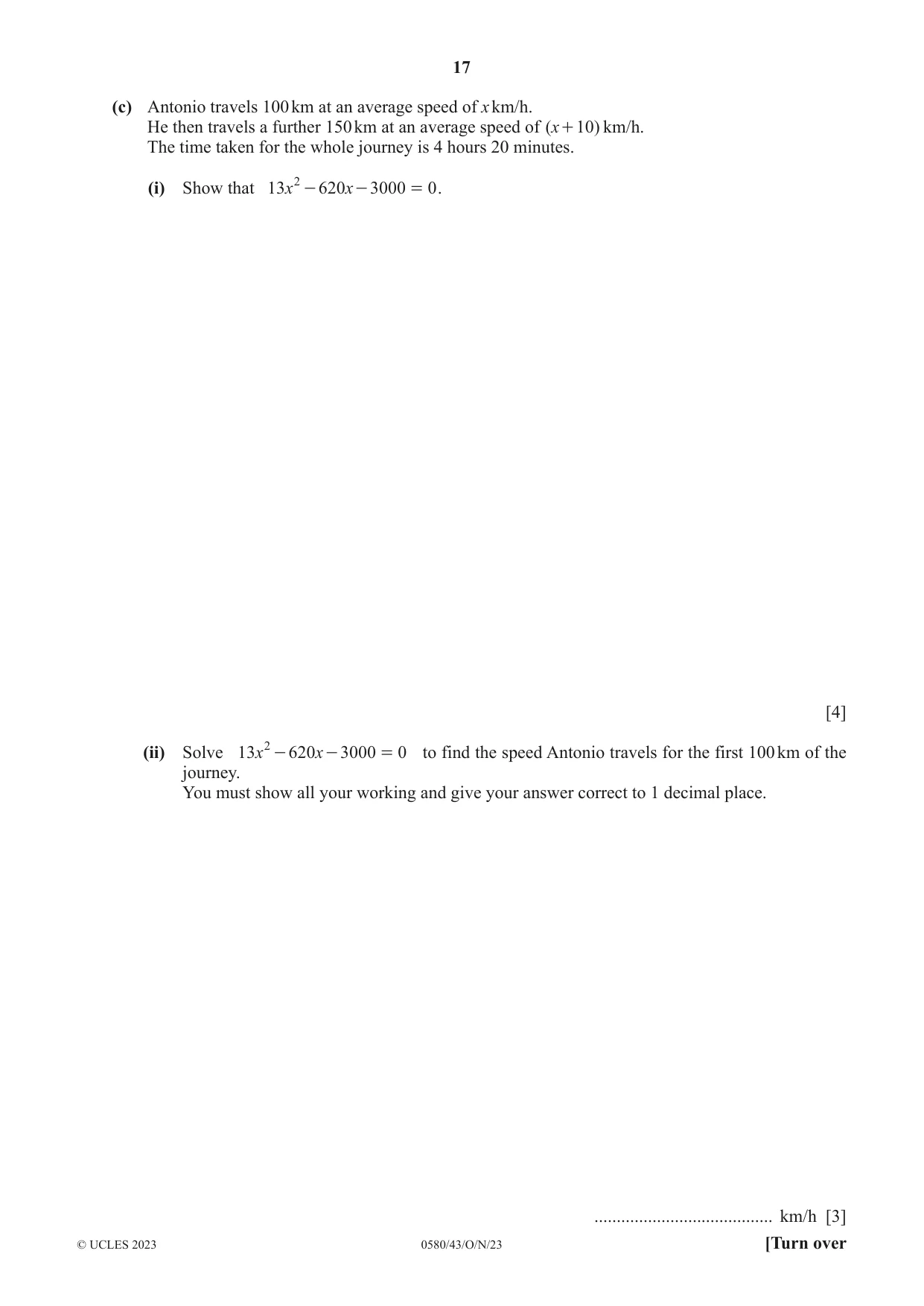
10 (a) Expand and simplify. 4 ( 2x - 1) - 6 ( 3 - x) ................................................. [2] (b) Factorise completely. (i) 6x 2 y + 9xy ................................................. [2] (ii) 4x 2 - y 2 + 8x + 4y ................................................. [3] (c) Antonio travels 100 km at an average speed of x km/h. He then travels a further 150 km at an average speed of ( x + 10) km/h. The time taken for the whole journey is 4 hours 20 minutes. (i) Show that 13x 2 - 620x - 3000 = 0 . [4] (ii) Solve 13x 2 - 620x - 3000 = 0 to find the speed Antonio travels for the first 100 km of the journey. You must show all your working and give your answer correct to 1 decimal place. ........................................ km/h [3]
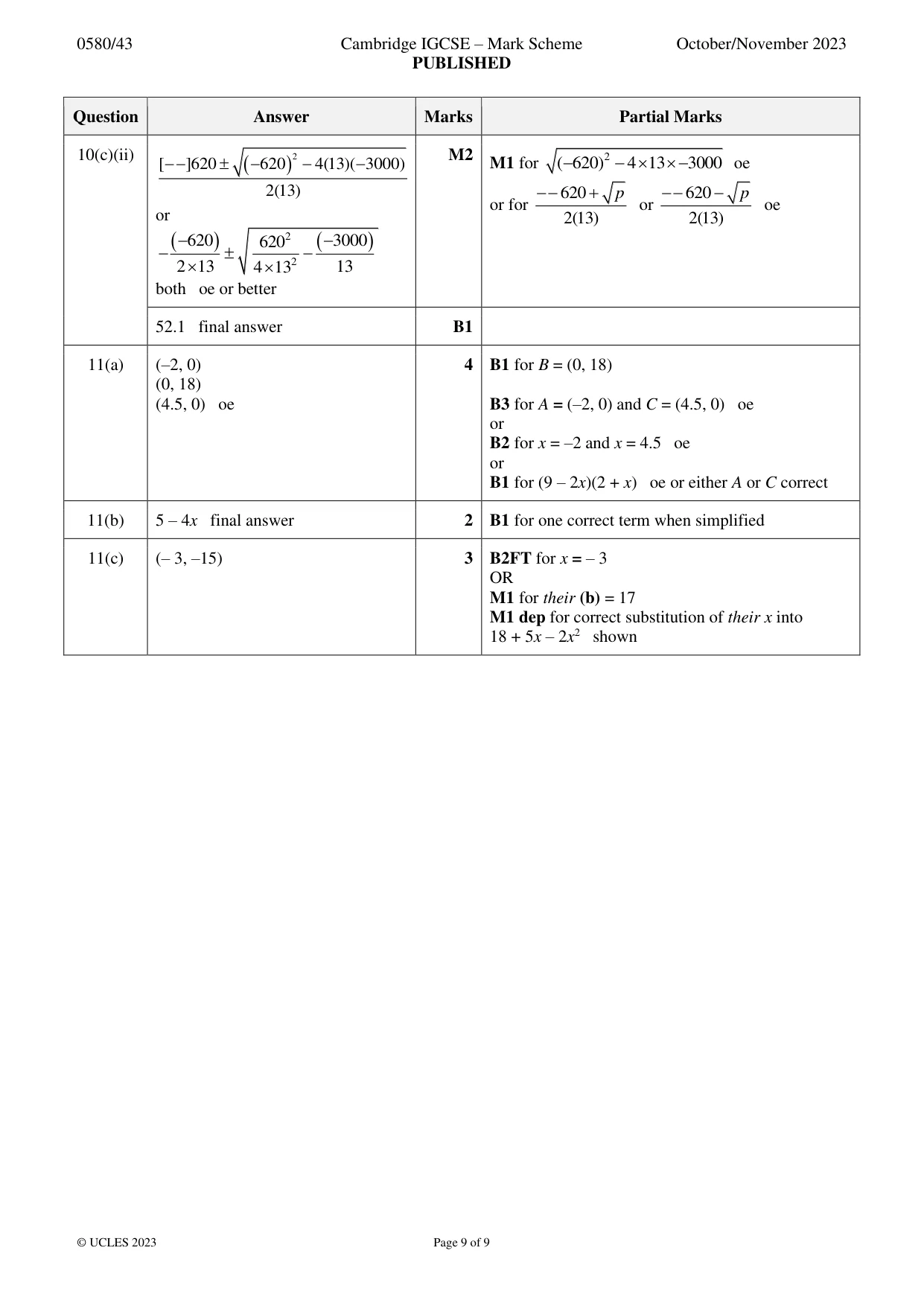
Mark scheme: 10(a) 14x – 22 or 2(7x – 11) final answer 2 B1 for answer kx – 22 or 14x + c or for 8x – 4 or – 18 + 6x or for correct answer seen in working 10(b)(i) 3xy(2x + 3) final answer 2 M1 for answer 3(2x2y + 3xy) or 3x(2xy + 3y) or 3y(2x2 + 3x) or xy(6x + 9) B1 for correct answer seen and spoilt 10(b)(ii) (2x + y) (2x – y + 4) final answer 3 M1 for (2x + y) (2x – y) M1 for 4(2x + y) If 0 scored, SC1 for answer 4x(x + 2) + y(4 – y) oe 10(c)(i) 100 150 1 M1 + = 4 oe x x + 10 3 13 100 or 150 = − ( x + 10 ) 3 x 100( x + 10) + 150 x 1 M1 [= their 4 ] or x ( x + 10) 3 better 300x + 3000 + 450x = 13x2 + 130x B1 Allow correct multiples oe or better 13x2 – 620x – 3000 = 0 A1 With no errors or omissions 10(c)(ii) 2 M2 2 [ −− ]620 ( −620 ) − 4(13)( −3000) M1 for ( −620) −4 13 −3000 oe 2(13) −− 620 + p −− 620 − p or for or oe or 2(13) 2(13) 2 ( −620 ) 620 ( −3000 ) − − 2 13 4 132 13 both oe or better 52.1 final answer B1
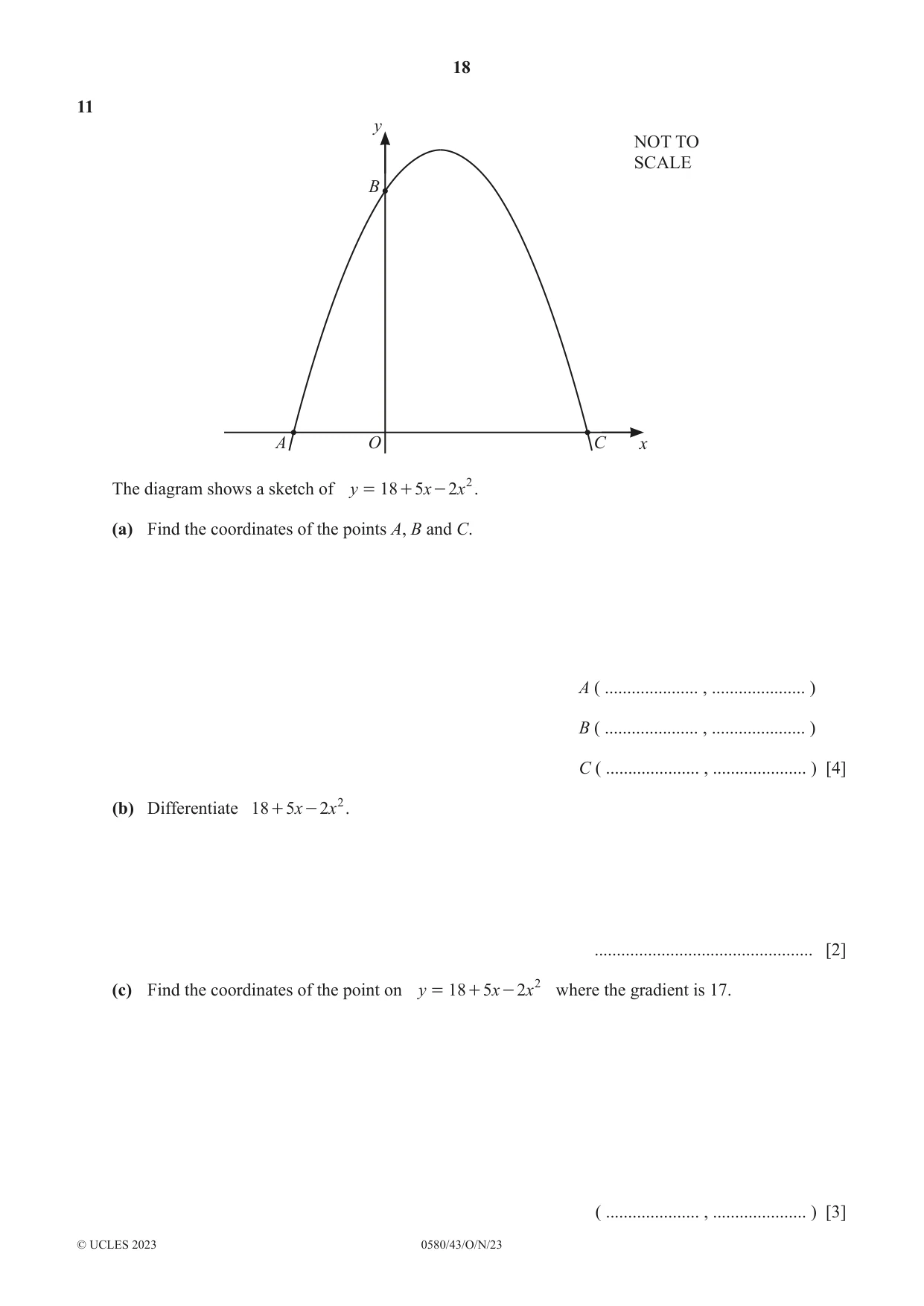
Q11 · Y NOT TO SCALE B A O C x The diagram shows a sketch of y = 18 + 5 x - 2x 2
11 y NOT TO SCALE B A O C x The diagram shows a sketch of y = 18 + 5 x - 2x 2 . (a) Find the coordinates of the points A, B and C. A ( ..................... , ..................... ) B ( ..................... , ..................... ) C ( ..................... , ..................... ) [4] (b) Differentiate 18 + 5x - 2x 2 . ................................................. [2] (c) Find the coordinates of the point on y = 18 + 5x - 2x 2 where the gradient is 17. ( ..................... , ..................... ) [3]
Mark scheme: 11(a) (–2, 0) 4 B1 for B = (0, 18) (0, 18) (4.5, 0) oe B3 for A = (–2, 0) and C = (4.5, 0) oe or B2 for x = –2 and x = 4.5 oe or B1 for (9 – 2x)(2 + x) oe or either A or C correct 11(b) 5 – 4x final answer 2 B1 for one correct term when simplified 11(c) (– 3, –15) 3 B2FT for x = – 3 OR M1 for their (b) = 17 M1 dep for correct substitution of their x into 18 + 5x – 2x2 shown
What was in this paper
The subtopics covered by these 11 questions, and how many questions each got. Open one in a new tab to see every Cambridge question on it.
What you needed in this session
Cambridge’s own grade thresholds for 2023 Oct/Nov, Paper 4 · Variant 3. A higher threshold means an easier paper — the bar moves with how the cohort did.