Cambridge IGCSE Mathematics 0580 — 2020 May/June Paper 4 · Variant 2
0580/42/M/J/20 · 10 questions · 130 marks · ≈146 min
The question paper and its mark scheme, free to read here and free to download. This is Cambridge’s own paper, exactly as it was sat.
Question paper20 pages
Mark scheme8 pages
Answers below. Sit the paper first if you are practising.
Questions as text
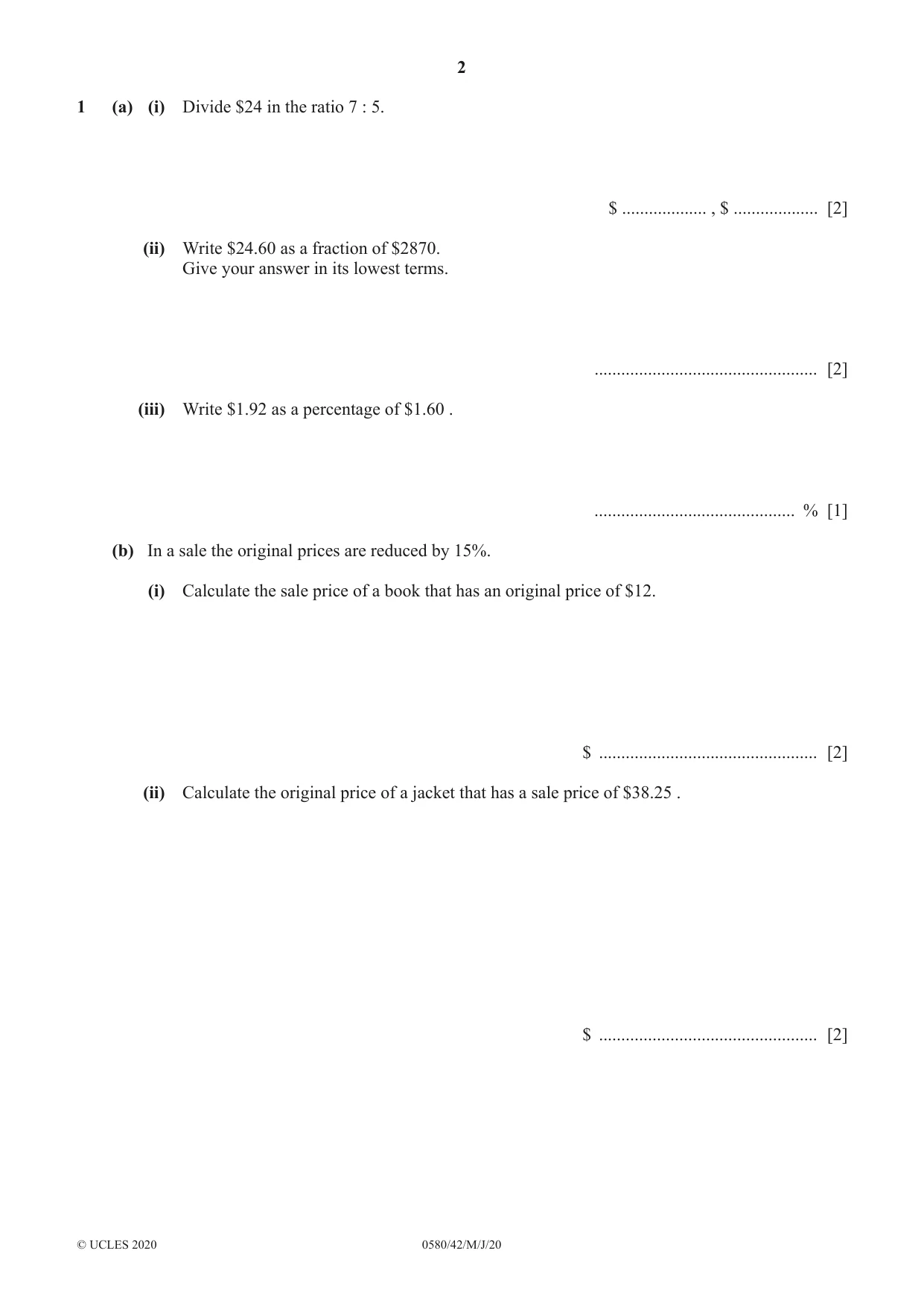
Q1 · Divide $24 in the ratio 7 : 5
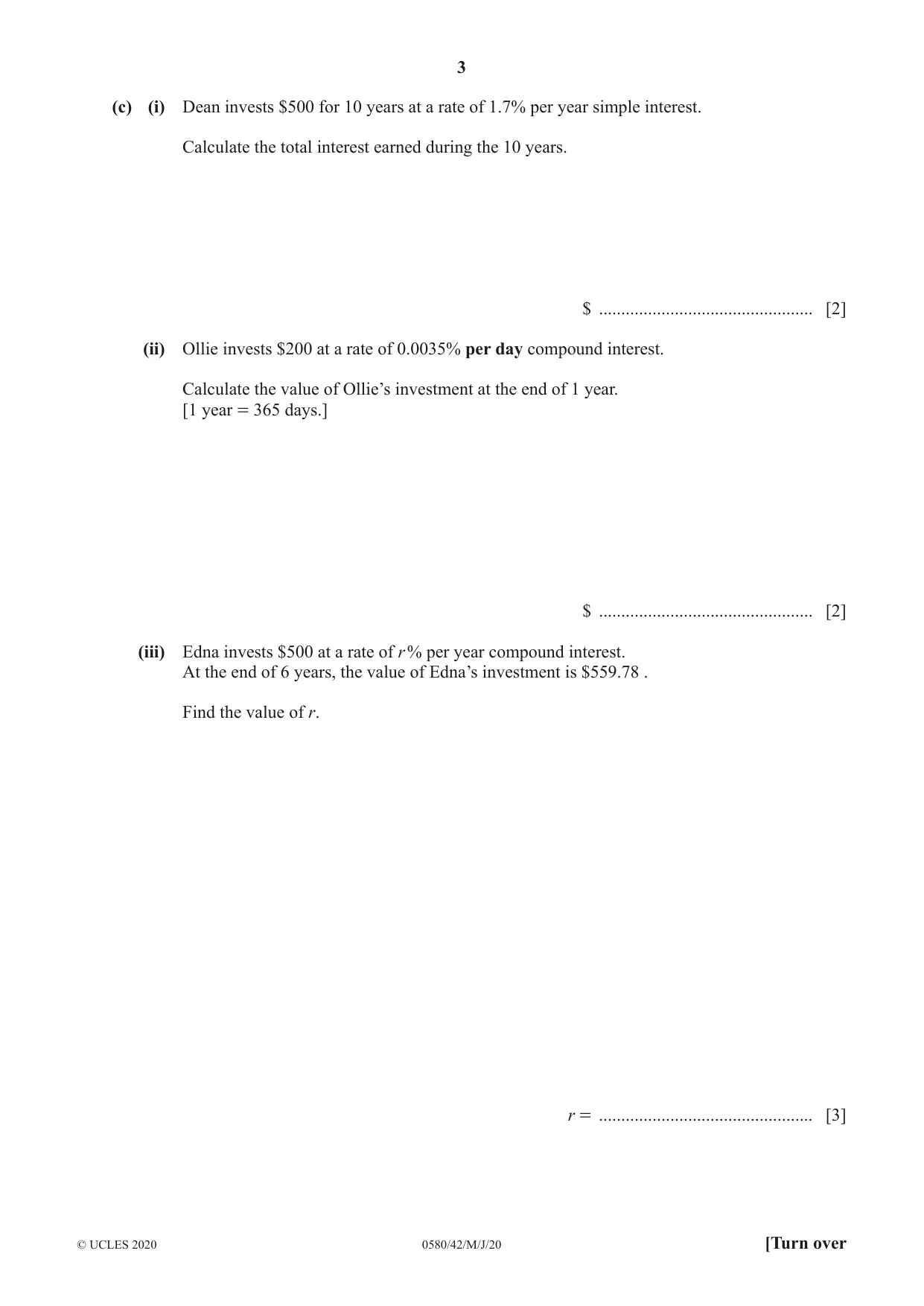
1 (a) (i) Divide $24 in the ratio 7 : 5. $ ................... , $ ................... [2] (ii) Write $24.60 as a fraction of $2870. Give your answer in its lowest terms. .................................................. [2] (iii) Write $1.92 as a percentage of $1.60 . ............................................. % [1] (b) In a sale the original prices are reduced by 15%. (i) Calculate the sale price of a book that has an original price of $12. $ ................................................. [2] (ii) Calculate the original price of a jacket that has a sale price of $38.25 . $ ................................................. [2] (c) (i) Dean invests $500 for 10 years at a rate of 1.7% per year simple interest. Calculate the total interest earned during the 10 years. $ ................................................ [2] (ii) Ollie invests $200 at a rate of 0.0035% per day compound interest. Calculate the value of Ollie’s investment at the end of 1 year. [1 year = 365 days.] $ ................................................ [2] (iii) Edna invests $500 at a rate of r % per year compound interest. At the end of 6 years, the value of Edna’s investment is $559.78 . Find the value of r. r = ................................................ [3]
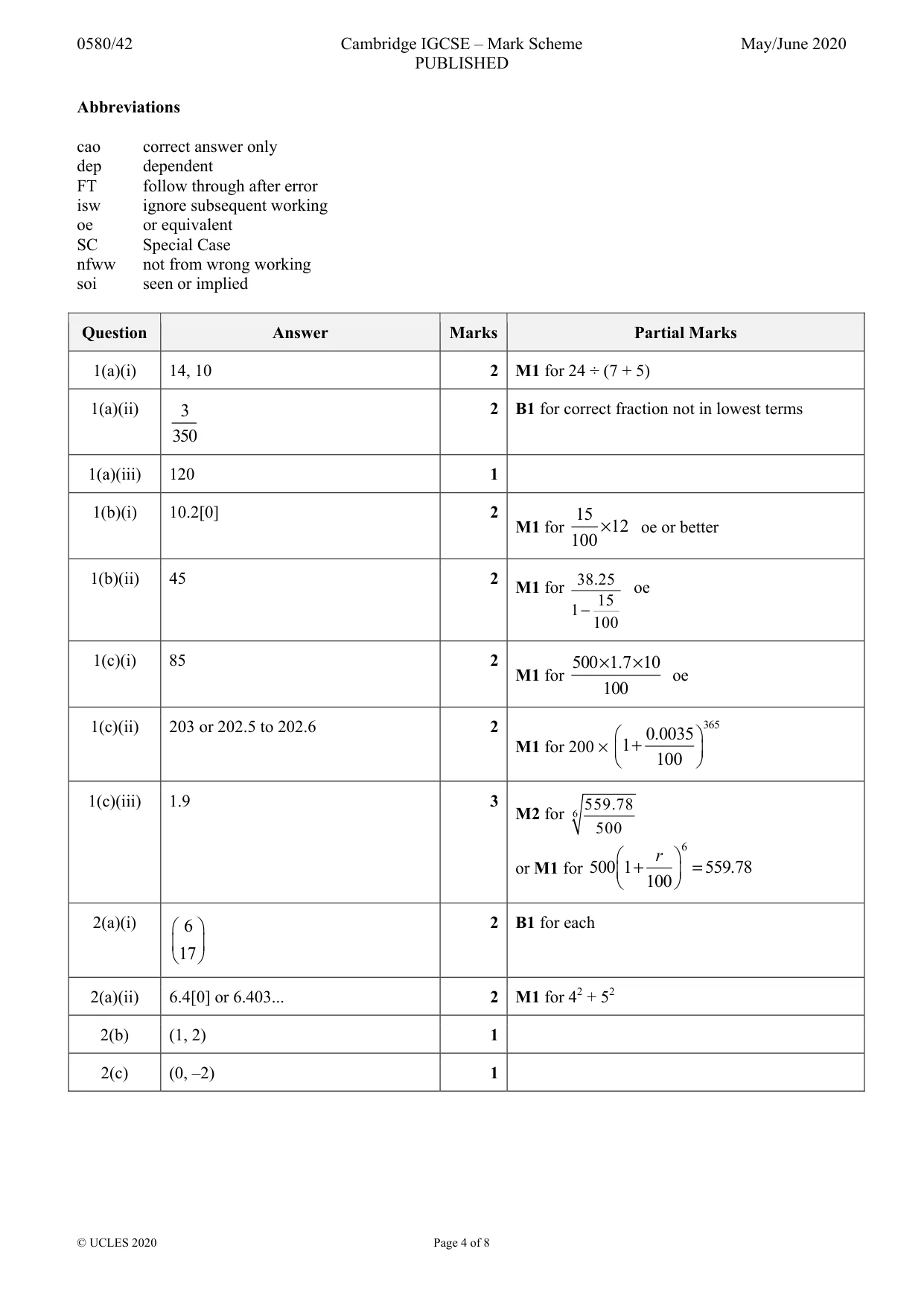
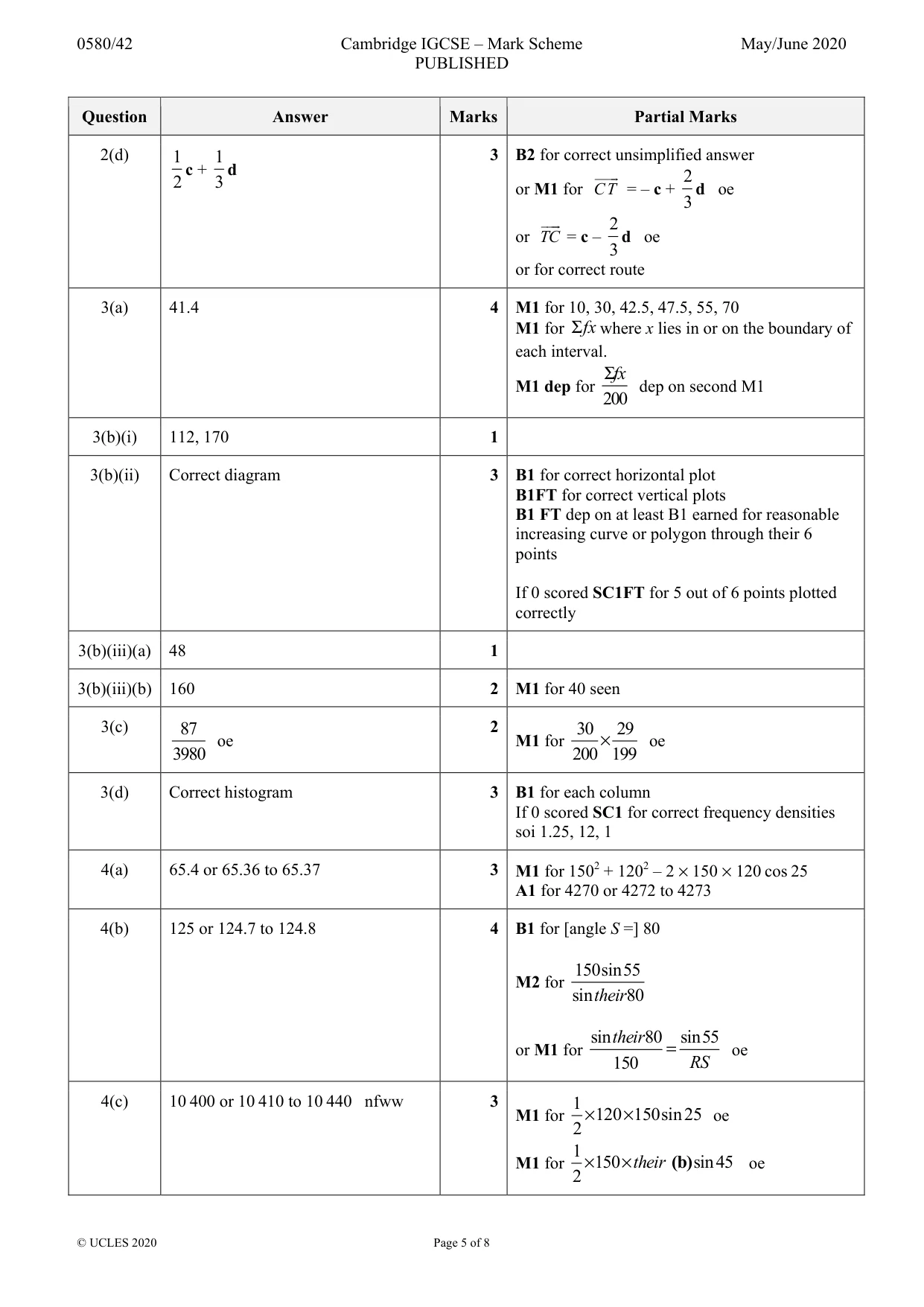
Mark scheme: Question Answer Marks Partial Marks 1(a)(i) 14, 10 2 M1 for 24 ÷ (7 + 5) 1(a)(ii) 3 2 B1 for correct fraction not in lowest terms 350 1(a)(iii) 120 1 1(b)(i) 10.2[0] 2 15 M1 for × 12 oe or better 100 1(b)(ii) 45 2 38.25 M1 for oe 15 1 − 100 1(c)(i) 85 2 500 × 1.7 × 10 M1 for oe 100 1(c)(ii) 203 or 202.5 to 202.6 2 365 0.0035 M1 for 200 × 1 + 100 1(c)(iii) 1.9 3 559.78 M2 for 6 500 r 6 or M1 for 500 1 + = 559.78 100
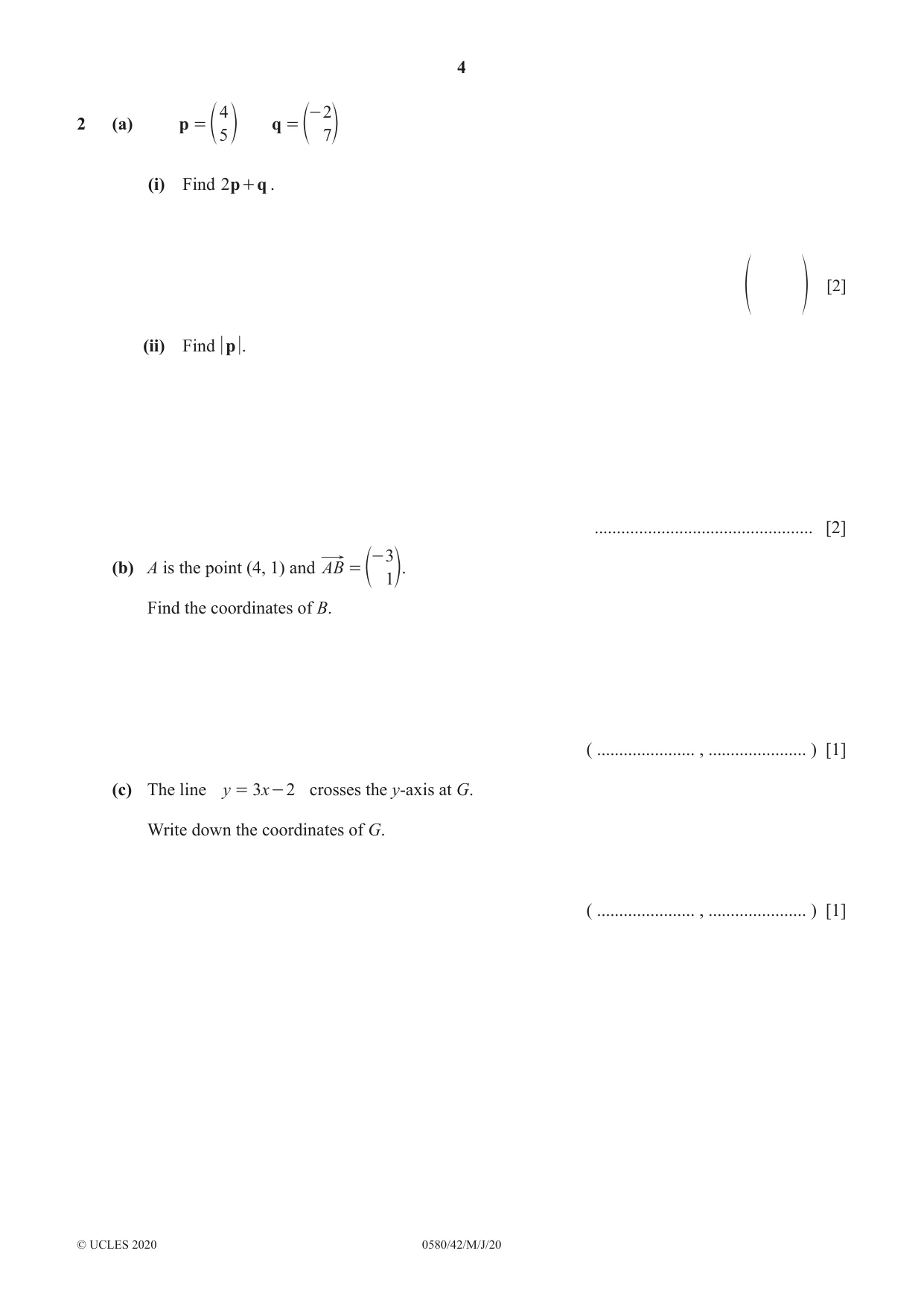
Q2 · - 2 2 (a) p = q = e 5 o e 7o (i) Find 2 p + q
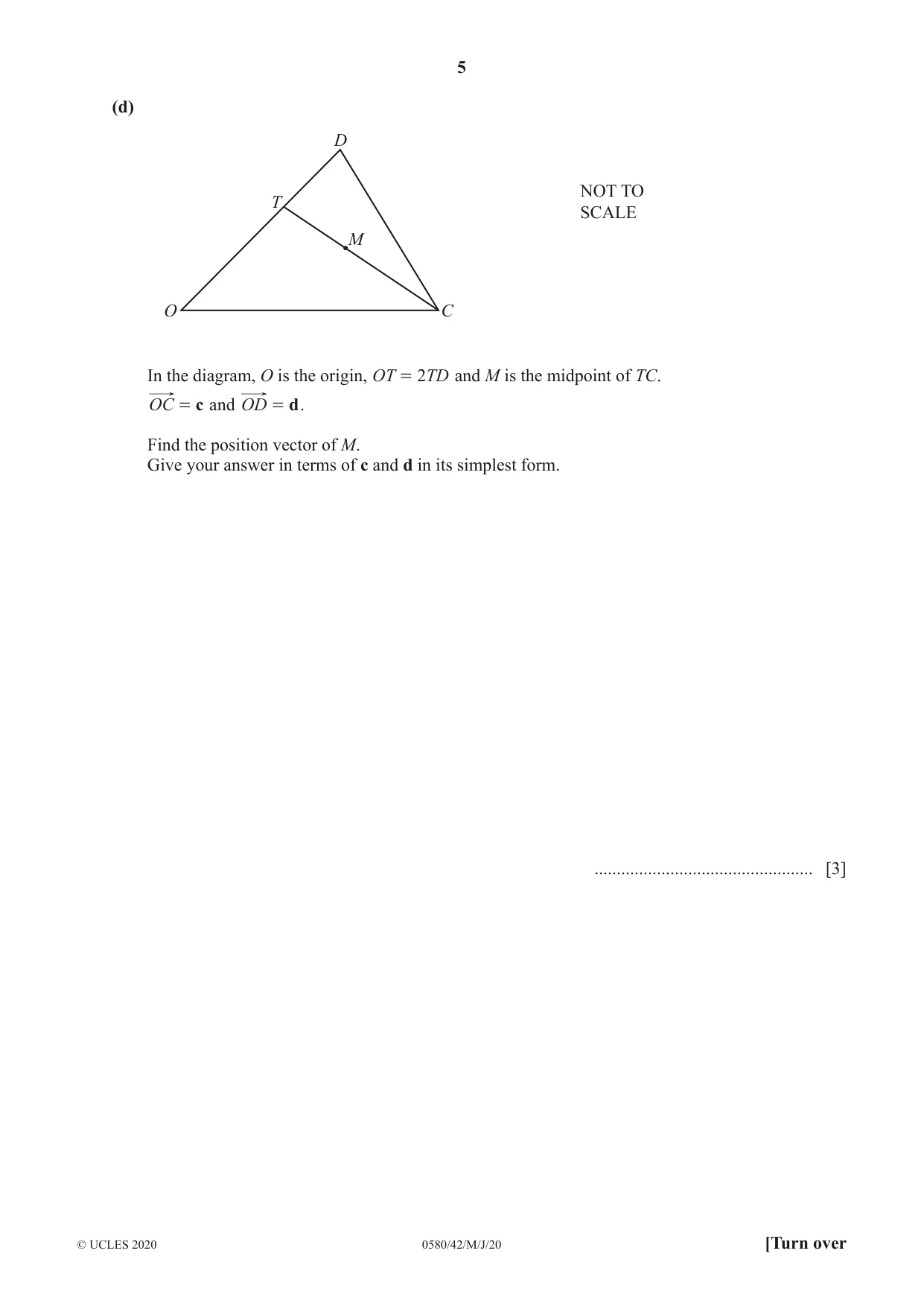
4 - 2 2 (a) p = q = e 5 o e 7o (i) Find 2 p + q . [2] f p (ii) Find p . ................................................. [2] - 3 (b) A is the point (4, 1) and AB = e 1o. Find the coordinates of B. ( ...................... , ...................... ) [1] (c) The line y = 3 x - 2 crosses the y-axis at G. Write down the coordinates of G. ( ...................... , ...................... ) [1] (d) D NOT TO T SCALE M O C In the diagram, O is the origin, OT = 2TD and M is the midpoint of TC. OC = c and OD = d . Find the position vector of M. Give your answer in terms of c and d in its simplest form. ................................................. [3]
Mark scheme: 2(a)(i) 6 2 B1 for each 17 2(a)(ii) 6.4[0] or 6.403... 2 M1 for 42 + 52 2(b) (1, 2) 1 2(c) (0, –2) 1 2(d) 1 1 3 B2 for correct unsimplified answer c + d 2 2 3 or M1 for CT = – c + d oe 3 2 or TC = c – d oe 3 or for correct route
Q3 · The speed, v km/h, of each of 200 cars passing a building is measured
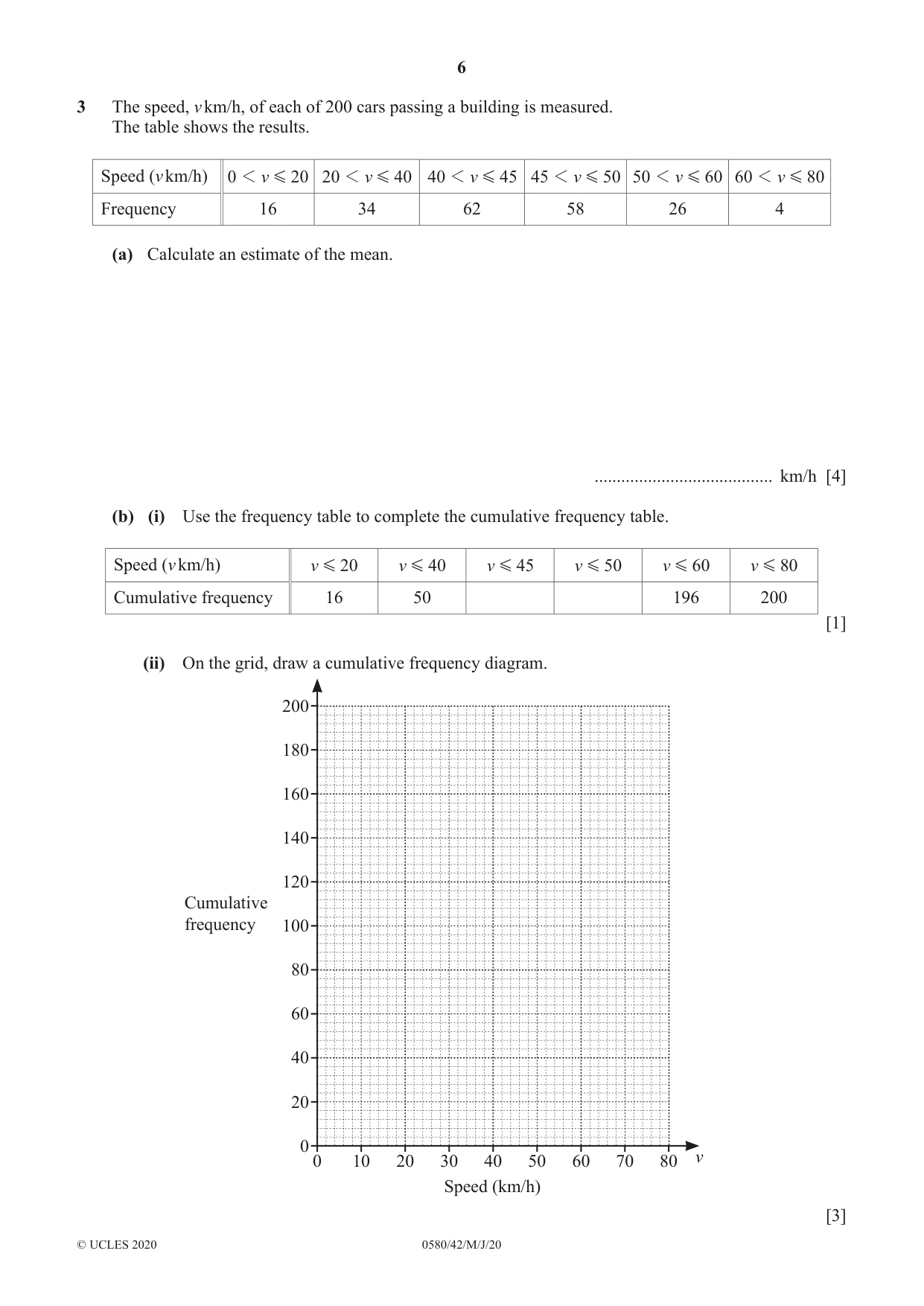
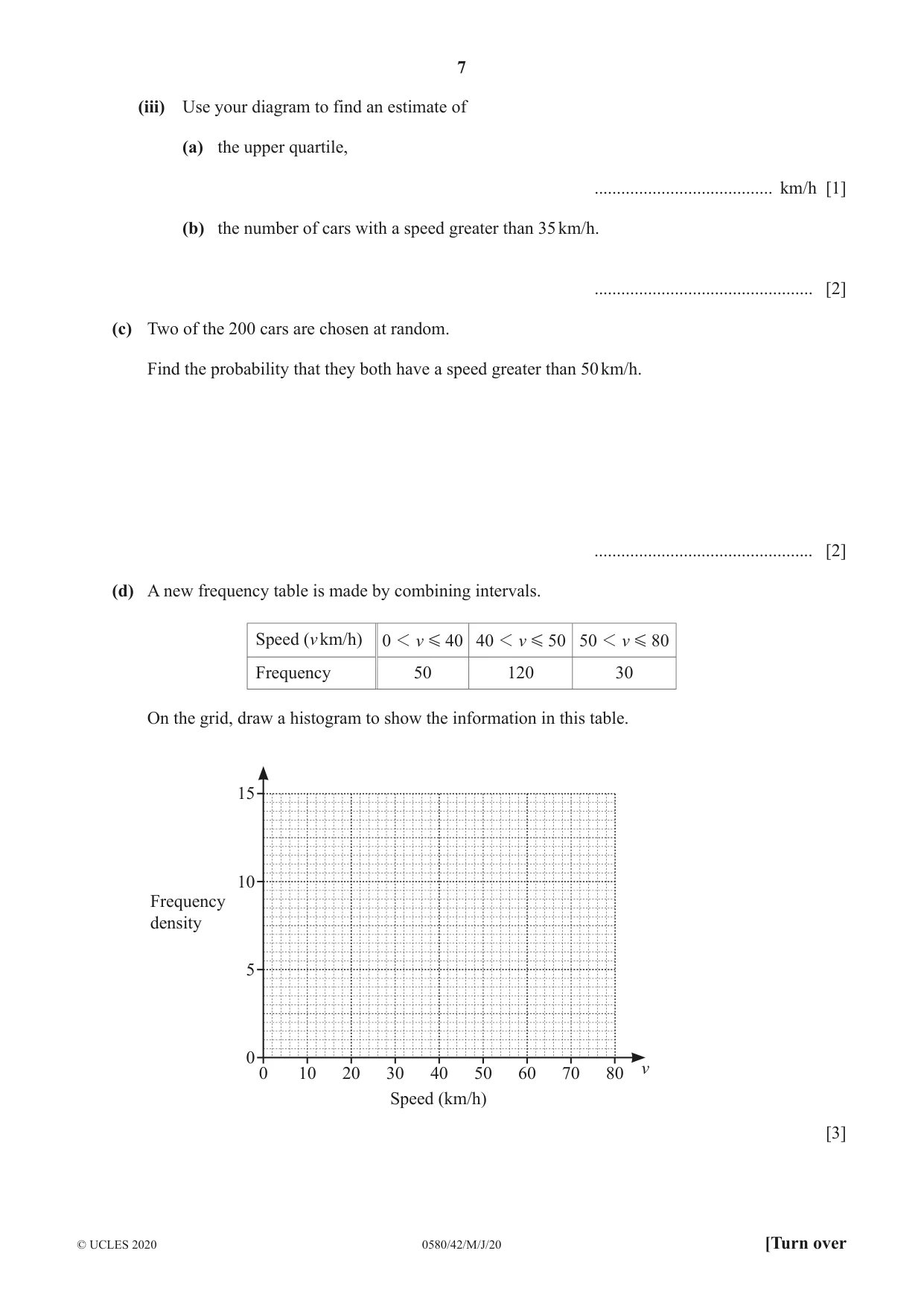
3 The speed, v km/h, of each of 200 cars passing a building is measured. The table shows the results. Speed (v km/h) 0 1 v G 20 20 1 v G 40 40 1 v G 45 45 1 v G 50 50 1 v G 60 60 1 v G 80 Frequency 16 34 62 58 26 4 (a) Calculate an estimate of the mean. ........................................ km/h [4] (b) (i) Use the frequency table to complete the cumulative frequency table. Speed (v km/h) v G 20 v G 40 v G 45 v G 50 v G 60 v G 80 Cumulative frequency 16 50 196 200 [1] (ii) On the grid, draw a cumulative frequency diagram. 200 180 160 140 120 Cumulative frequency 100 80 60 40 20 0 v 0 10 20 30 40 50 60 70 80 Speed (km/h) [3] (iii) Use your diagram to find an estimate of (a) the upper quartile, ........................................ km/h [1] (b) the number of cars with a speed greater than 35 km/h. ................................................. [2] (c) Two of the 200 cars are chosen at random. Find the probability that they both have a speed greater than 50 km/h. ................................................. [2] (d) A new frequency table is made by combining intervals. Speed (v km/h) 0 1 v G 40 40 1 v G 50 50 1 v G 80 Frequency 50 120 30 On the grid, draw a histogram to show the information in this table. 15 10 Frequency density 5 0 v 0 10 20 30 40 50 60 70 80 Speed (km/h) [3]
Mark scheme: 3(a) 41.4 4 M1 for 10, 30, 42.5, 47.5, 55, 70 M1 for Σ fx where x lies in or on the boundary of each interval. Σfx M1 dep for dep on second M1 200 3(b)(i) 112, 170 1 3(b)(ii) Correct diagram 3 B1 for correct horizontal plot B1FT for correct vertical plots B1 FT dep on at least B1 earned for reasonable increasing curve or polygon through their 6 points If 0 scored SC1FT for 5 out of 6 points plotted correctly 3(b)(iii)(a) 48 1 3(b)(iii)(b) 160 2 M1 for 40 seen 3(c) 87 2 30 29 oe M1 for × oe 3980 200 199 3(d) Correct histogram 3 B1 for each column If 0 scored SC1 for correct frequency densities soi 1.25, 12, 1
Q4 · S NOT TO SCALE 55° P 150 m 25° 45° R 120 m Q The diagram shows two triangles
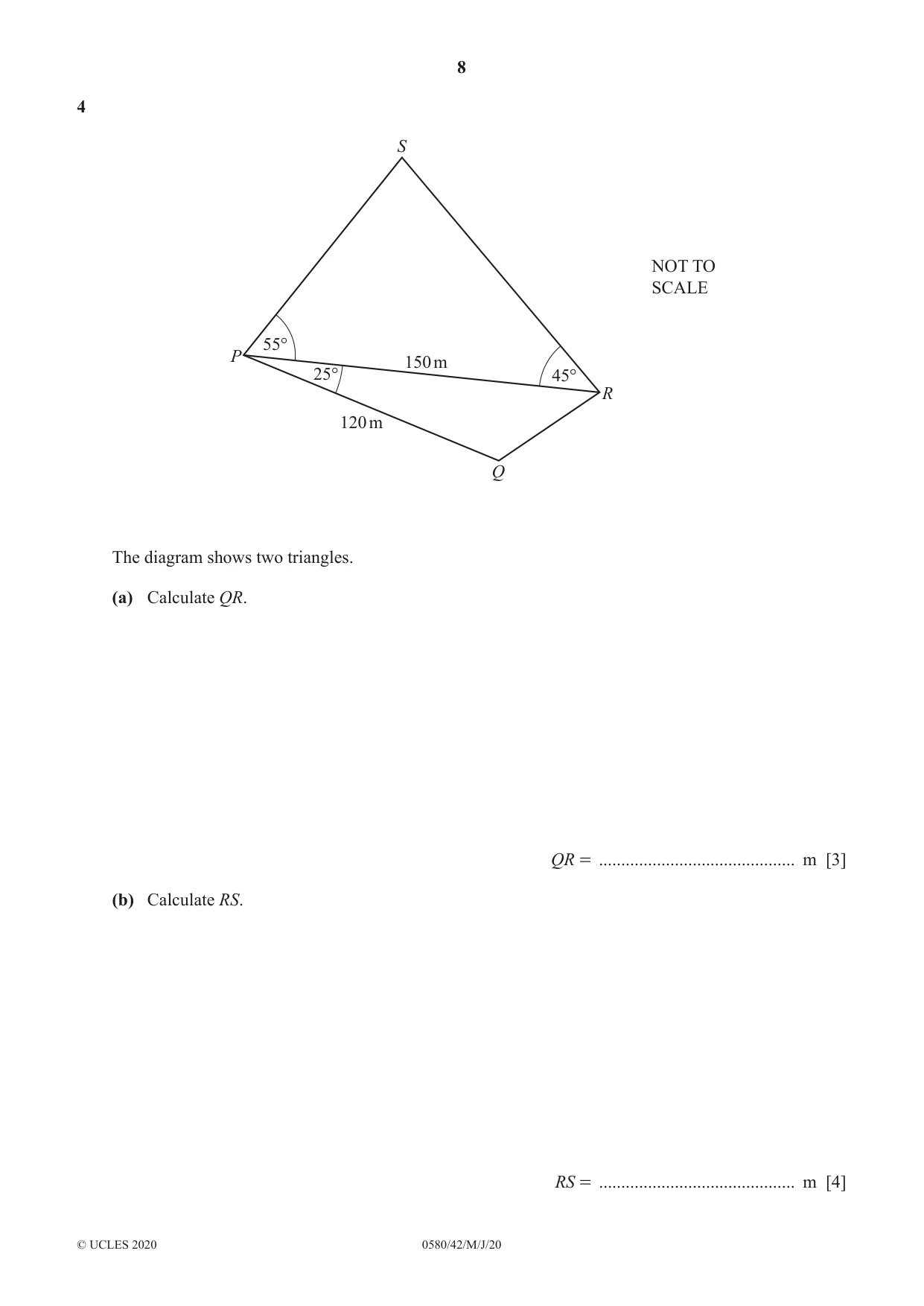
4 S NOT TO SCALE 55° P 150 m 25° 45° R 120 m Q The diagram shows two triangles. (a) Calculate QR. QR = ............................................ m [3] (b) Calculate RS. RS = ............................................ m [4] (c) Calculate the total area of the two triangles. ............................................ m2 [3]
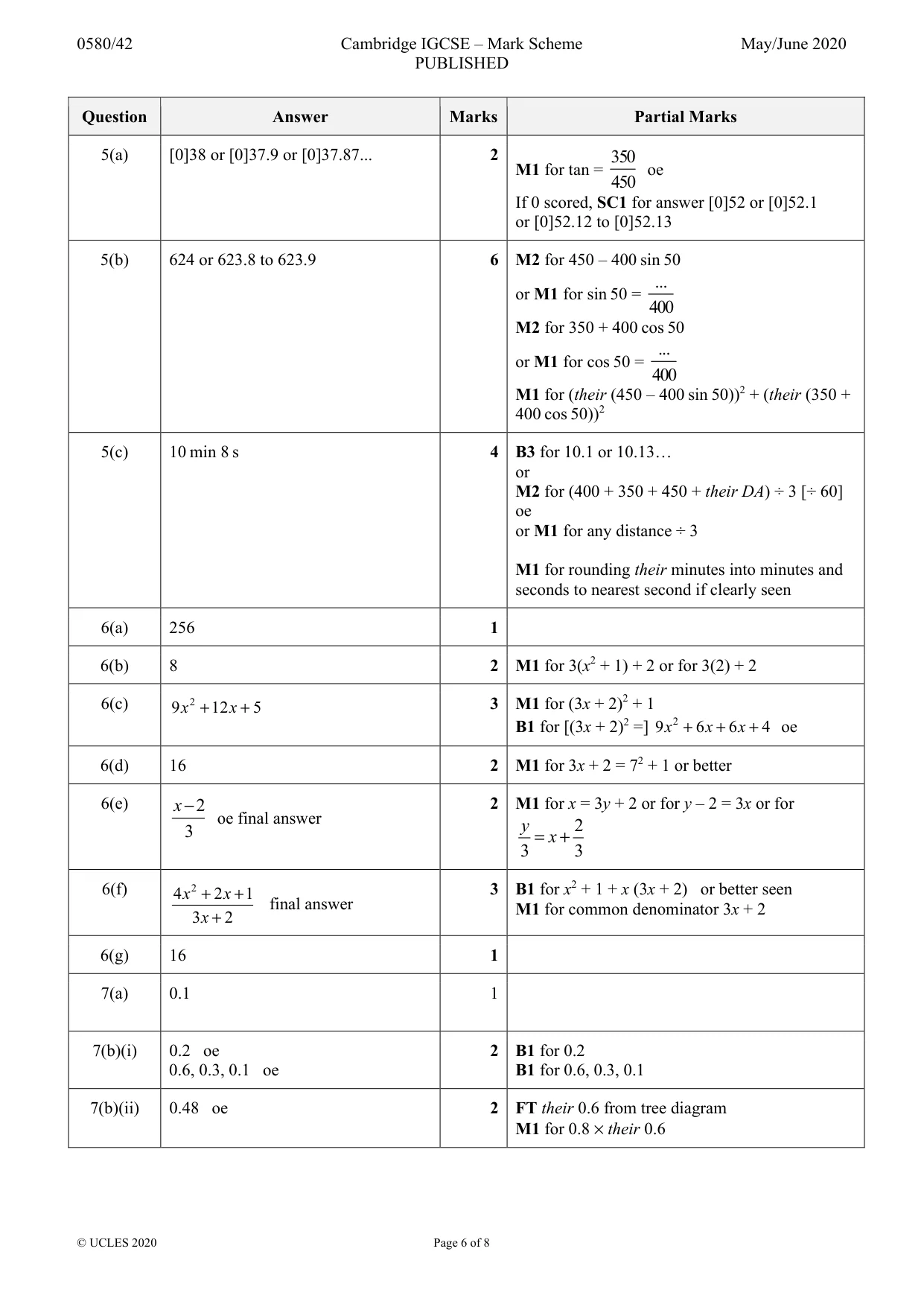
Mark scheme: 4(a) 65.4 or 65.36 to 65.37 3 M1 for 1502 + 1202 – 2 × 150 × 120 cos 25 A1 for 4270 or 4272 to 4273 4(b) 125 or 124.7 to 124.8 4 B1 for [angle S =] 80 150sin55 M2 for sin their 80 sin their 80 sin55 or M1 for = oe 150 RS 4(c) 10 400 or 10 410 to 10 440 nfww 3 1 M1 for × 120 × 150sin25 oe 2 1 M1 for × 150 × their (b) sin45 oe 2
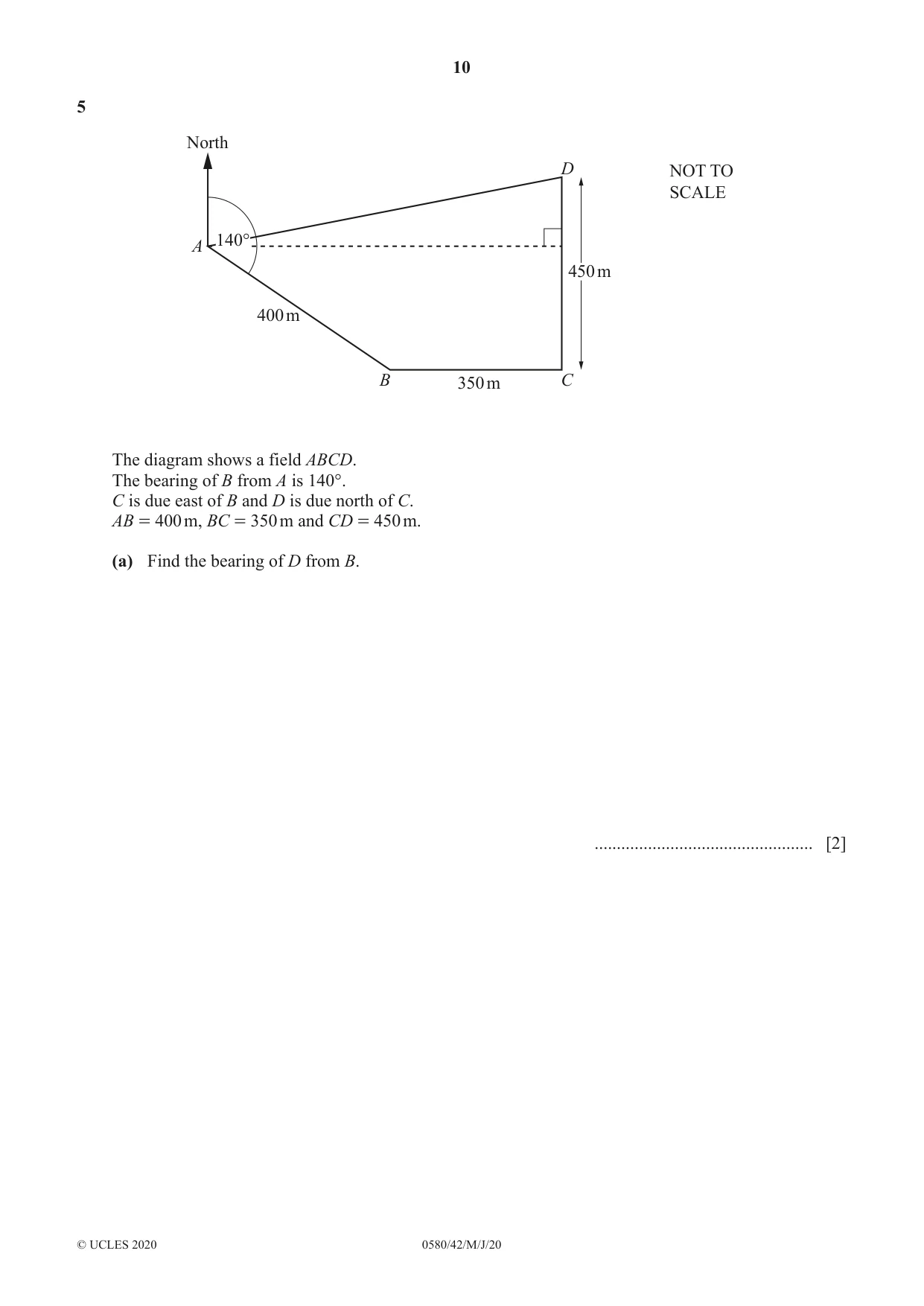
Q5 · North D NOT TO SCALE 140° A 450 m 400 m B 350 m C The diagram shows a field ABCD
5 North D NOT TO SCALE 140° A 450 m 400 m B 350 m C The diagram shows a field ABCD. The bearing of B from A is 140°. C is due east of B and D is due north of C. AB = 400 m, BC = 350 m and CD = 450 m. (a) Find the bearing of D from B. ................................................. [2] (b) Calculate the distance from D to A. ............................................. m [6] (c) Jono runs around the field from A to B, B to C, C to D and D to A. He runs at a speed of 3 m/s. Calculate the total time Jono takes to run around the field. Give your answer in minutes and seconds, correct to the nearest second. .................. min .................. s [4]
Mark scheme: 5(a) [0]38 or [0]37.9 or [0]37.87... 2 350 M1 for tan = oe 450 If 0 scored, SC1 for answer [0]52 or [0]52.1 or [0]52.12 to [0]52.13 5(b) 624 or 623.8 to 623.9 6 M2 for 450 – 400 sin 50 ... or M1 for sin 50 = 400 M2 for 350 + 400 cos 50 ... or M1 for cos 50 = 400 M1 for (their (450 – 400 sin 50))2 + (their (350 + 400 cos 50))2 5(c) 10 min 8 s 4 B3 for 10.1 or 10.13… or M2 for (400 + 350 + 450 + their DA) ÷ 3 [÷ 60] oe or M1 for any distance ÷ 3 M1 for rounding their minutes into minutes and seconds to nearest second if clearly seen
Q6 · F ( x) = 3x + 2 g ( x) = x 2 + 1 h ( x) = 4x (a) Find h(4)
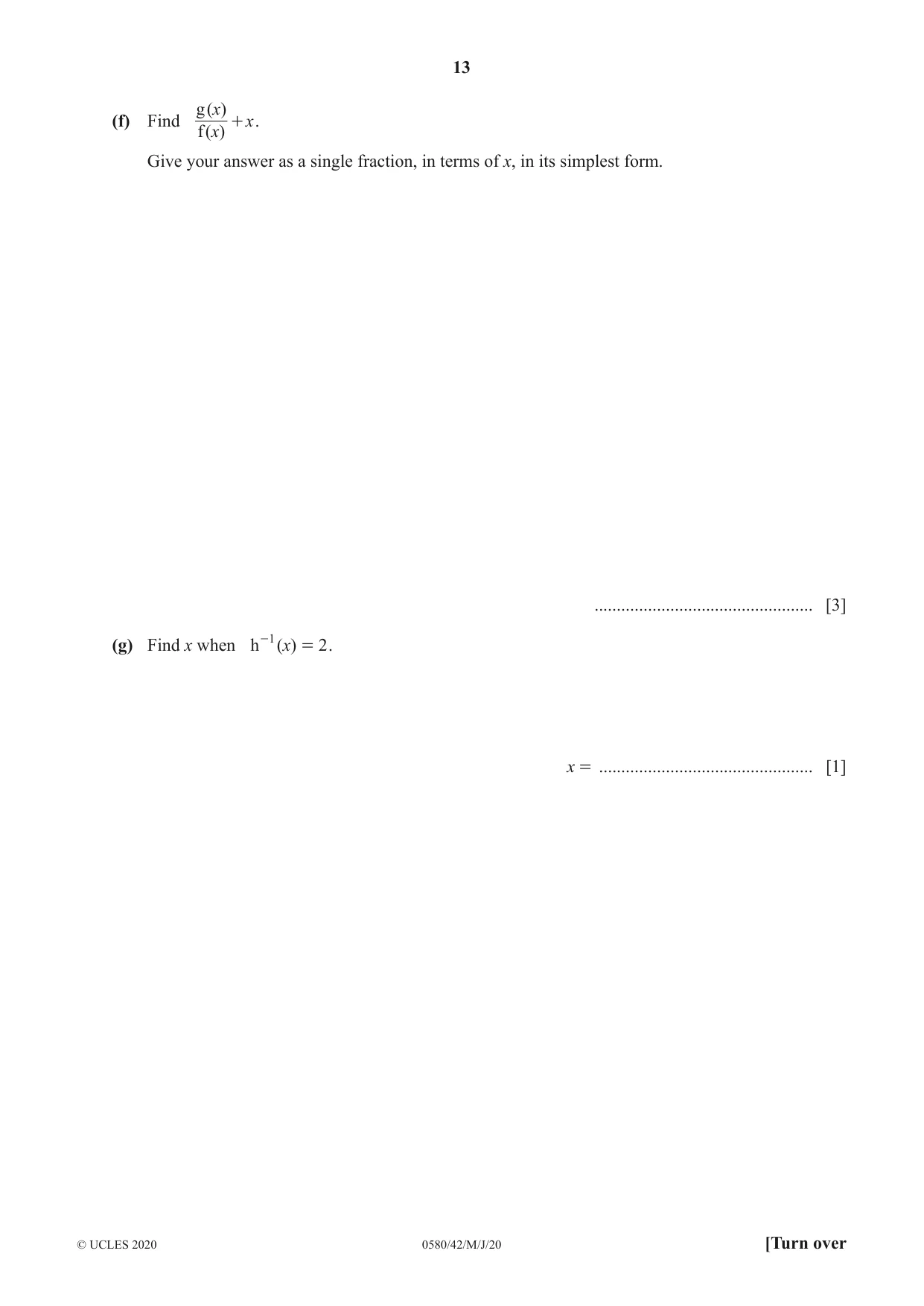
6 f ( x) = 3x + 2 g ( x) = x 2 + 1 h ( x) = 4x (a) Find h(4). ................................................. [1] (b) Find fg(1). ................................................. [2] (c) Find gf(x) in the form ax 2 + bx + c . ................................................. [3] (d) Find x when f ( x) = g ( 7) . x = ................................................ [2] (e) Find f -1 ( x) . f -1 ( x) = ................................................ [2] g (x) (f) Find + x . f (x) Give your answer as a single fraction, in terms of x, in its simplest form. ................................................. [3] (g) Find x when h -1 ( x) = 2 . x = ................................................ [1]
Mark scheme: 6(a) 256 1 6(b) 8 2 M1 for 3(x2 + 1) + 2 or for 3(2) + 2 6(c) 9 x 2 + 12 x + 5 3 M1 for (3x + 2)2 + 1 B1 for [(3x + 2)2 =] 9 x 2 + 6 x + 6 x + 4 oe 6(d) 16 2 M1 for 3x + 2 = 72 + 1 or better 6(e) x− 2 2 M1 for x = 3y + 2 or for y – 2 = 3x or for oe final answer y 2 3 = x + 3 3 6(f) 4 x 2 + 2 x + 1 3 B1 for x2 + 1 + x (3x + 2) or better seen final answer M1 for common denominator 3x + 2 3 x + 2 6(g) 16 1
Q7 · Tanya plants some seeds
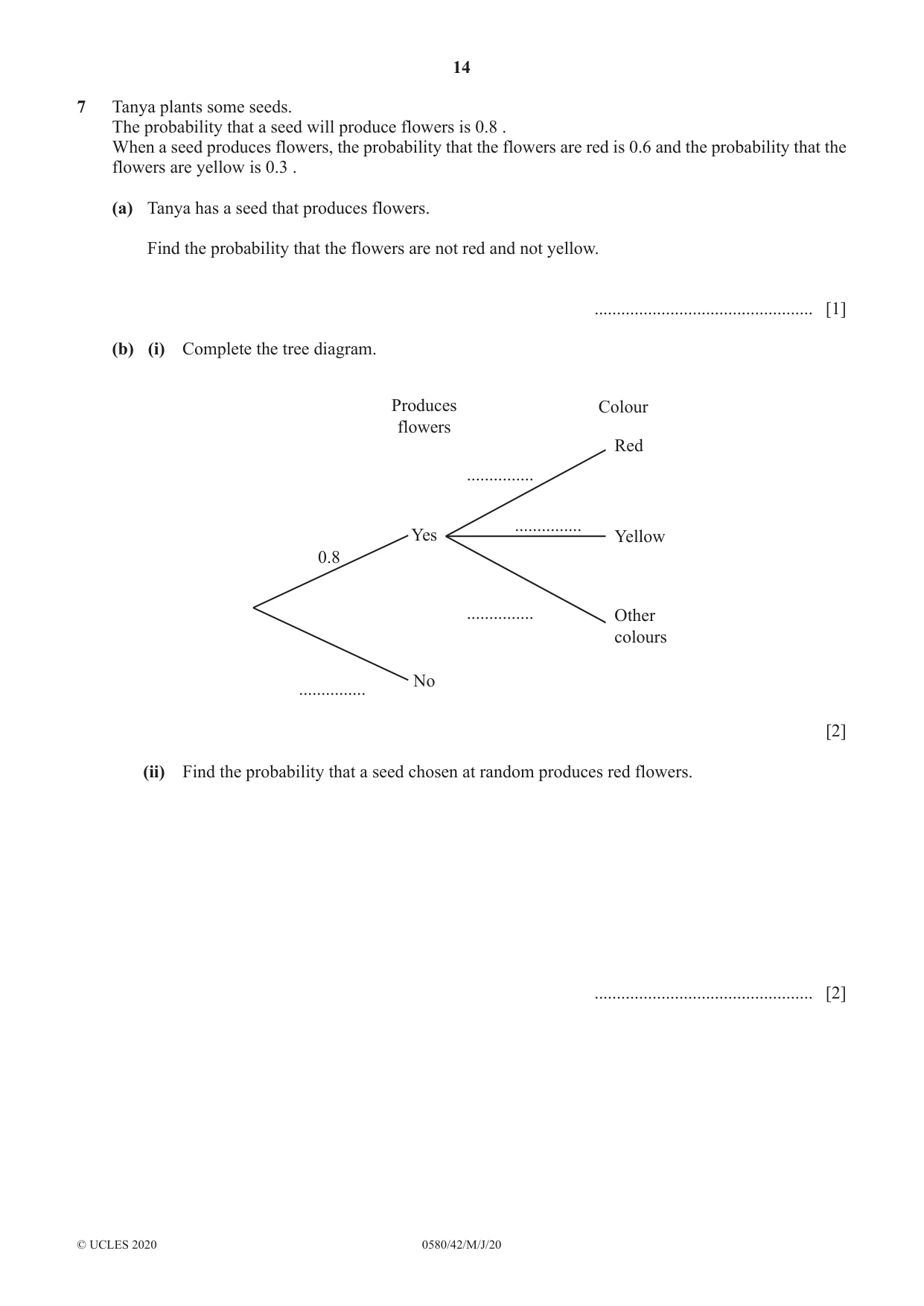
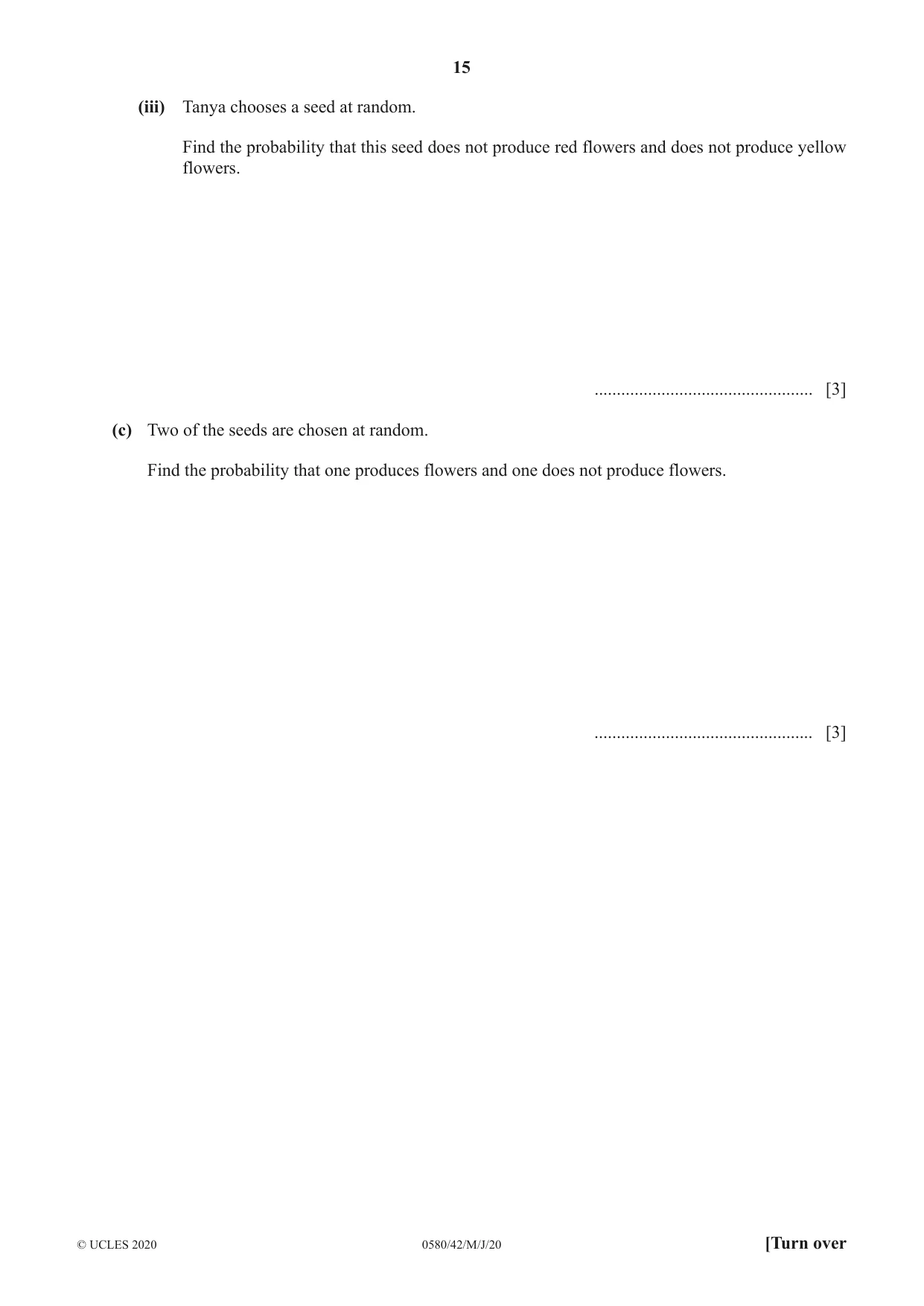
7 Tanya plants some seeds. The probability that a seed will produce flowers is 0.8 . When a seed produces flowers, the probability that the flowers are red is 0.6 and the probability that the flowers are yellow is 0.3 . (a) Tanya has a seed that produces flowers. Find the probability that the flowers are not red and not yellow. ................................................. [1] (b) (i) Complete the tree diagram. Produces Colour flowers Red ............... ............... Yes Yellow 0.8 ............... Other colours No ............... [2] (ii) Find the probability that a seed chosen at random produces red flowers. ................................................. [2] (iii) Tanya chooses a seed at random. Find the probability that this seed does not produce red flowers and does not produce yellow flowers. ................................................. [3] (c) Two of the seeds are chosen at random. Find the probability that one produces flowers and one does not produce flowers. ................................................. [3]
Mark scheme: 7(a) 0.1 1 7(b)(i) 0.2 oe 2 B1 for 0.2 0.6, 0.3, 0.1 oe B1 for 0.6, 0.3, 0.1 7(b)(ii) 0.48 oe 2 FT their 0.6 from tree diagram M1 for 0.8 × their 0.6 7(b)(iii) 0.28 oe 3 M2 for 0.2 + 0.8 × 0.1 oe or M1 for 0.2 or 0.8 × 0.1 or 0.8 × (0.6 + 0.3) 7(c) 0.32 oe 3 M2 for 0.8 × 0.2 + 0.2 × 0.8 oe M1 for one of these products
Q8 · C R NOT TO SCALE A B 8 cm P Q 12 cm Triangle ABC is mathematically similar to triangle PQR
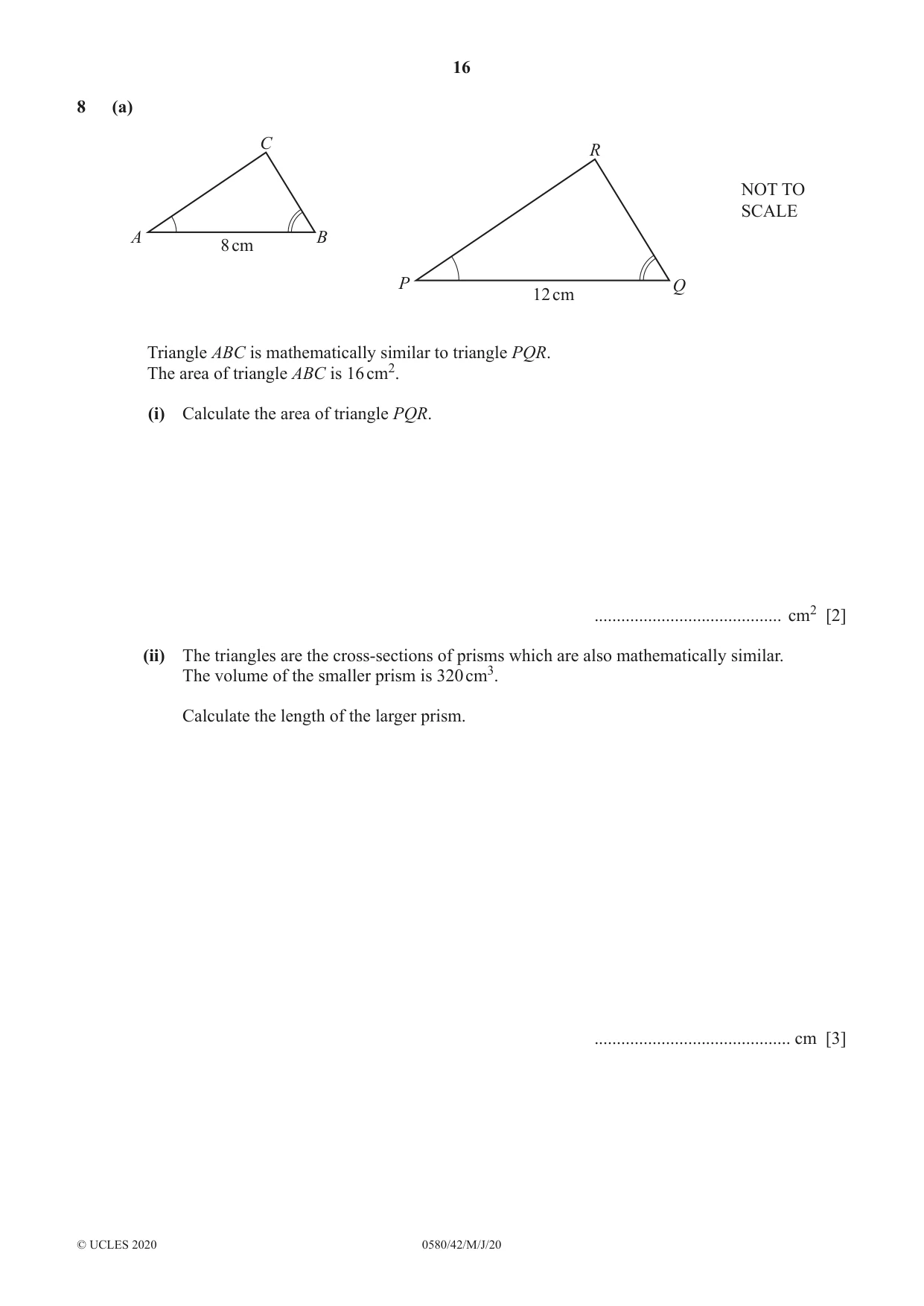
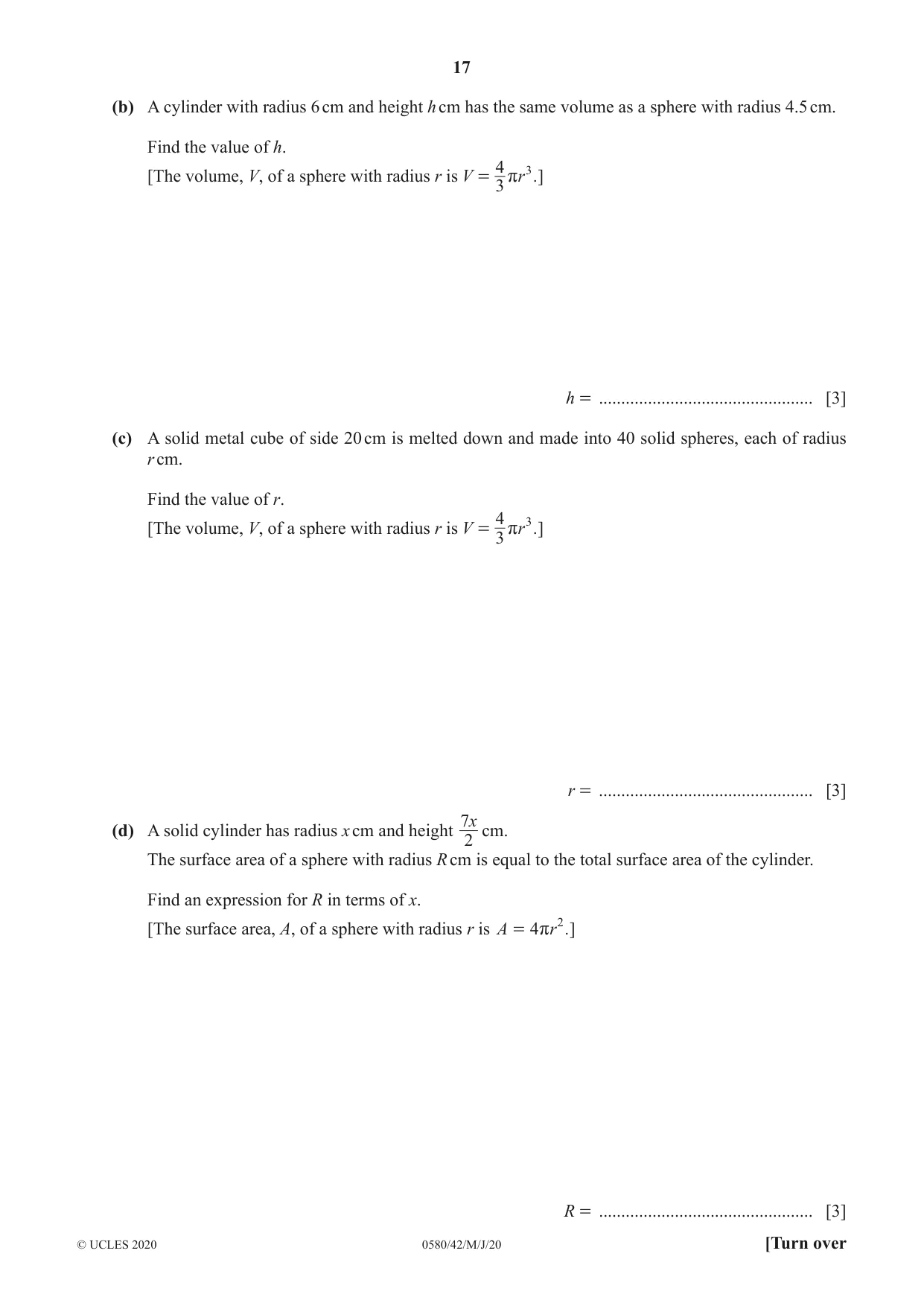
8 (a) C R NOT TO SCALE A B 8 cm P Q 12 cm Triangle ABC is mathematically similar to triangle PQR. The area of triangle ABC is 16 cm2. (i) Calculate the area of triangle PQR. .......................................... cm2 [2] (ii) The triangles are the cross-sections of prisms which are also mathematically similar. The volume of the smaller prism is 320 cm3. Calculate the length of the larger prism. ............................................ cm [3] (b) A cylinder with radius 6 cm and height h cm has the same volume as a sphere with radius 4.5 cm. Find the value of h. 4 3 [The volume, V, of a sphere with radius r is V = rr . ] 3 h = ................................................ [3] (c) A solid metal cube of side 20 cm is melted down and made into 40 solid spheres, each of radius r cm. Find the value of r. 4 3 [The volume, V, of a sphere with radius r is V = rr . ] 3 r = ................................................ [3] 7x(d) A solid cylinder has radius x cm and height cm. 2 The surface area of a sphere with radius R cm is equal to the total surface area of the cylinder. Find an expression for R in terms of x. [The surface area, A, of a sphere with radius r is A = 4rr 2 . ] R = ................................................ [3]
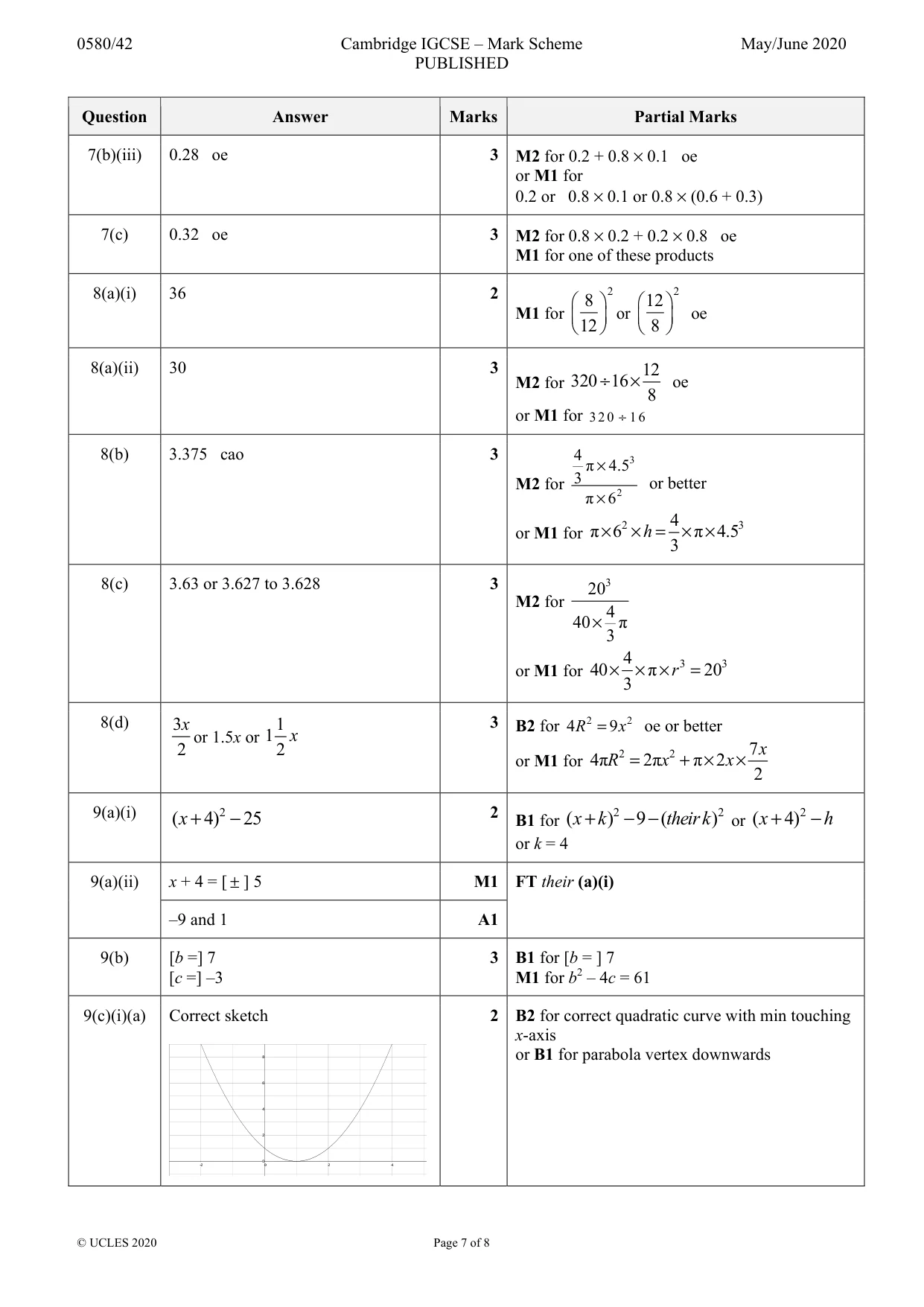
Mark scheme: 8(a)(i) 36 2 2 2 8 12 M1 for or oe 12 8 8(a)(ii) 30 3 12 M2 for 320 ÷ 16 × oe 8 or M1 for 320 ÷ 16 8(b) 3.375 cao 3 4 3 π × 4.5 3 M2 for or better π × 6 2 2 4 3 or M1 for π × 6 × h = × π × 4.5 3 8(c) 3.63 or 3.627 to 3.628 3 20 3 M2 for 4 40 × π 3 4 3 3 or M1 for 40 × × π × r = 20 3 8(d) 3x 1 3 B2 for 4 R 2 = 9 x 2 oe or better or 1.5x or x 2 12 2 2 7 x or M1 for 4πR = 2πx + π × 2 x × 2
Q9 · Write x 2 + 8x - 9 in the form ( x + k) 2 + h
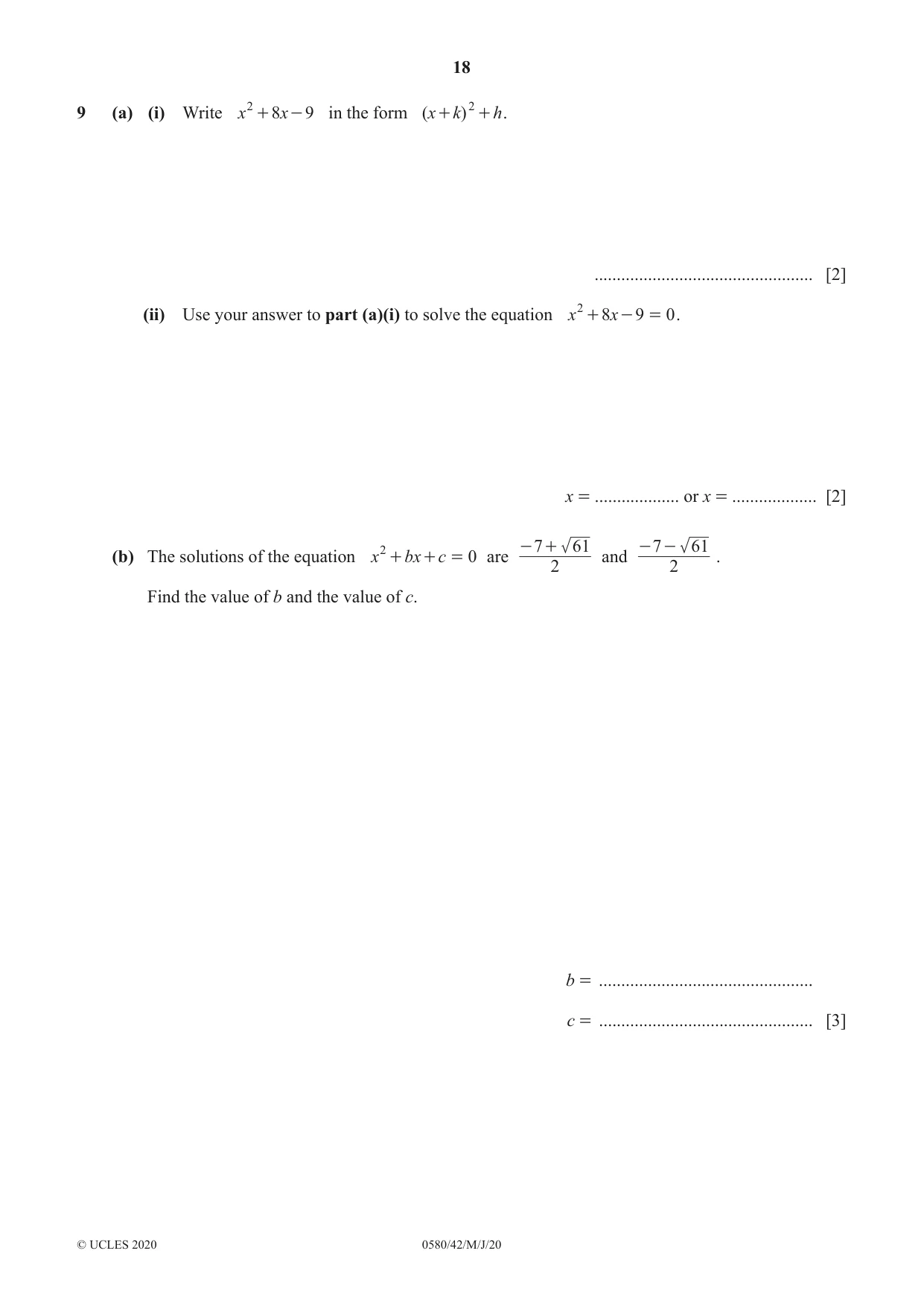
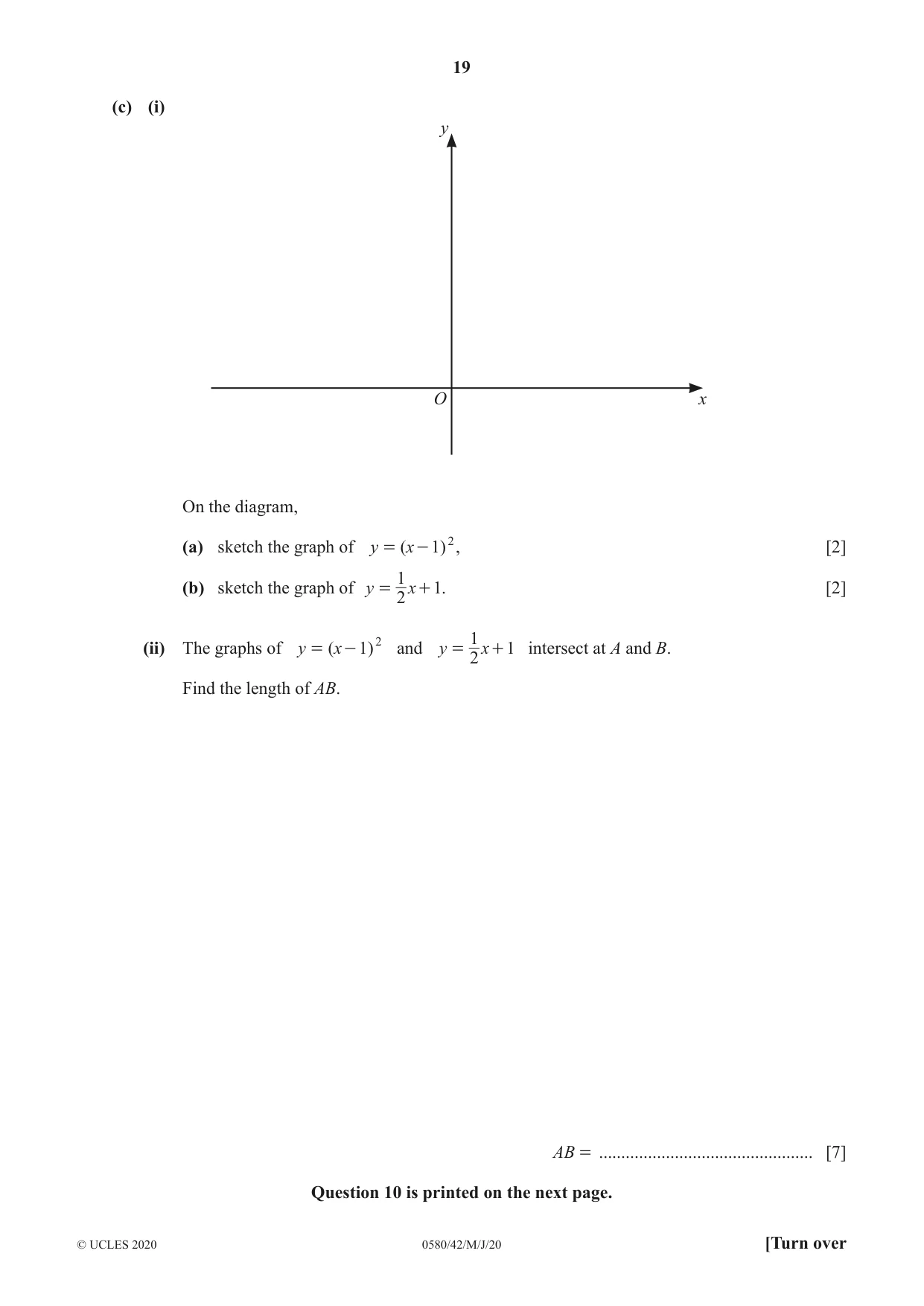
9 (a) (i) Write x 2 + 8x - 9 in the form ( x + k) 2 + h . ................................................. [2] (ii) Use your answer to part (a)(i) to solve the equation x 2 + 8x - 9 = 0 . x = ................... or x = ................... [2] 2 - 7 + 61 - 7 - 61 (b) The solutions of the equation x + bx + c = 0 are and . 2 2 Find the value of b and the value of c. b = ................................................ c = ................................................ [3] (c) (i) y O x On the diagram, (a) sketch the graph of y = ( x - 1) 2 , [2] 1 (b) sketch the graph of y = x + 1. [2] 2 2 1 (ii) The graphs of y = ( x - 1) and y = x + 1 intersect at A and B. 2 Find the length of AB. AB = ................................................ [7] Question 10 is printed on the next page.
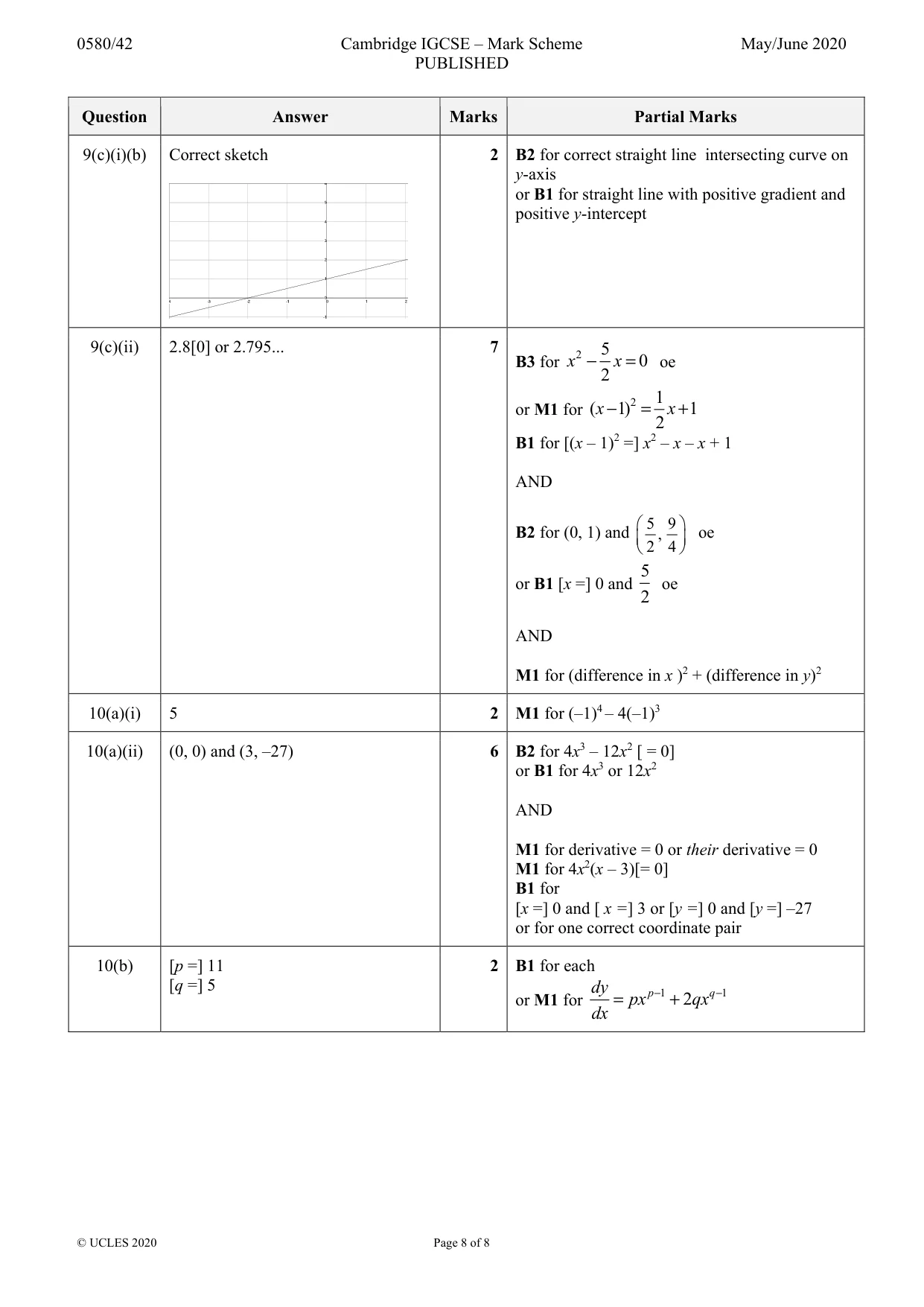
Mark scheme: 9(a)(i) 2 2 2 2 2 ( x + 4) − 25 B1 for ( x + k ) −−9 (theirk ) or ( x + 4) − h or k = 4 9(a)(ii) x + 4 = [ ± ] 5 M1 FT their (a)(i) –9 and 1 A1 9(b) [b =] 7 3 B1 for [b = ] 7 [c =] –3 M1 for b2 – 4c = 61 9(c)(i)(a) Correct sketch 2 B2 for correct quadratic curve with min touching x-axis 8888 or B1 for parabola vertex downwards 6666 4444 2222 -2-2-2-2 00000000 2222 4444 9(c)(i)(b) Correct sketch 2 B2 for correct straight line intersecting curve on 6666 y-axis 5555 or B1 for straight line with positive gradient and 4444 positive y-intercept 3333 2222 1111 4444 -3-3-3-3 -2-2-2-2 -1-1-1-1 00000000 1111 2222 -1-1-1-1 9(c)(ii) 2.8[0] or 2.795... 7 2 5 B3 for x − x = 0 oe 2 2 1 or M1 for ( x − 1) = x + 1 2 B1 for [(x – 1)2 =] x2 – x – x + 1 AND 5 9 B2 for (0, 1) and , oe 2 4 5 or B1 [x =] 0 and oe 2 AND M1 for (difference in x )2 + (difference in y)2
Q10 · Y = x 4 - 4x 3 (i) Find the value of y when x =- 1
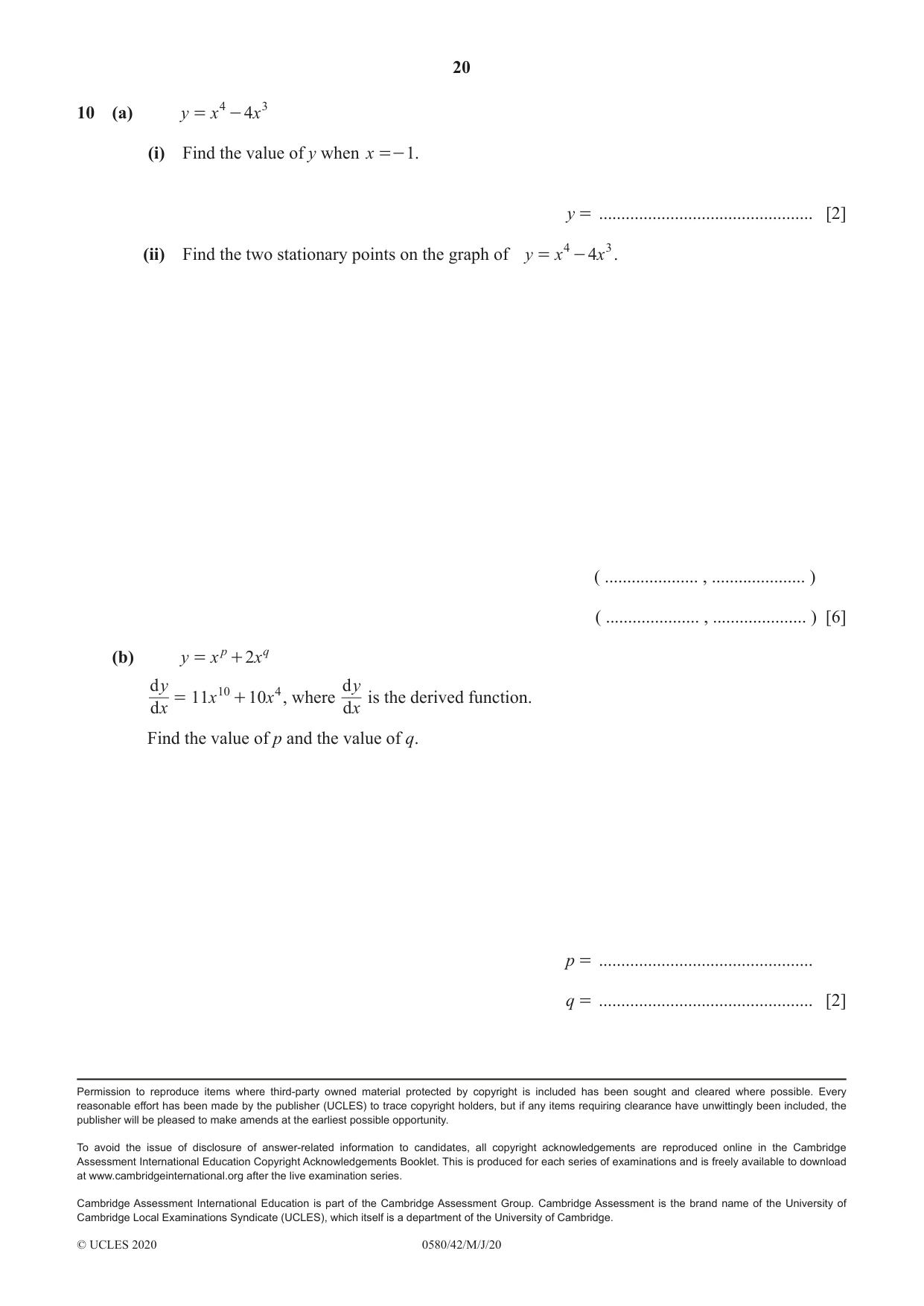
10 (a) y = x 4 - 4x 3 (i) Find the value of y when x =- 1. y = ................................................ [2] (ii) Find the two stationary points on the graph of y = x 4 - 4x 3 . ( ..................... , ..................... ) ( ..................... , ..................... ) [6] (b) y = x p + 2x q d y 10 4 d y = 11x + 10x , where is the derived function. d x d x Find the value of p and the value of q. p = ................................................ q = ................................................ [2]
Mark scheme: 10(a)(i) 5 2 M1 for (–1)4 – 4(–1)3 10(a)(ii) (0, 0) and (3, –27) 6 B2 for 4x3 – 12x2 [ = 0] or B1 for 4x3 or 12x2 AND M1 for derivative = 0 or their derivative = 0 M1 for 4x2(x – 3)[= 0] B1 for [x =] 0 and [ x =] 3 or [y =] 0 and [y =] –27 or for one correct coordinate pair 10(b) [p =] 11 2 B1 for each [q =] 5 dy p −1 q −1 or M1 for = px + 2qx dx
What was in this paper
The subtopics covered by these 10 questions, and how many questions each got. Open one in a new tab to see every Cambridge question on it.