Cambridge IGCSE Mathematics 0580 — 2019 Oct/Nov Paper 4 · Variant 2
0580/42/O/N/19 · 9 questions · 130 marks · ≈146 min
The question paper and its mark scheme, free to read here and free to download. This is Cambridge’s own paper, exactly as it was sat.
Question paper20 pages

Mark scheme8 pages
Answers below. Sit the paper first if you are practising.
Questions as text
Q1 · Mohsin has 600 pear trees and 720 apple trees on his farm
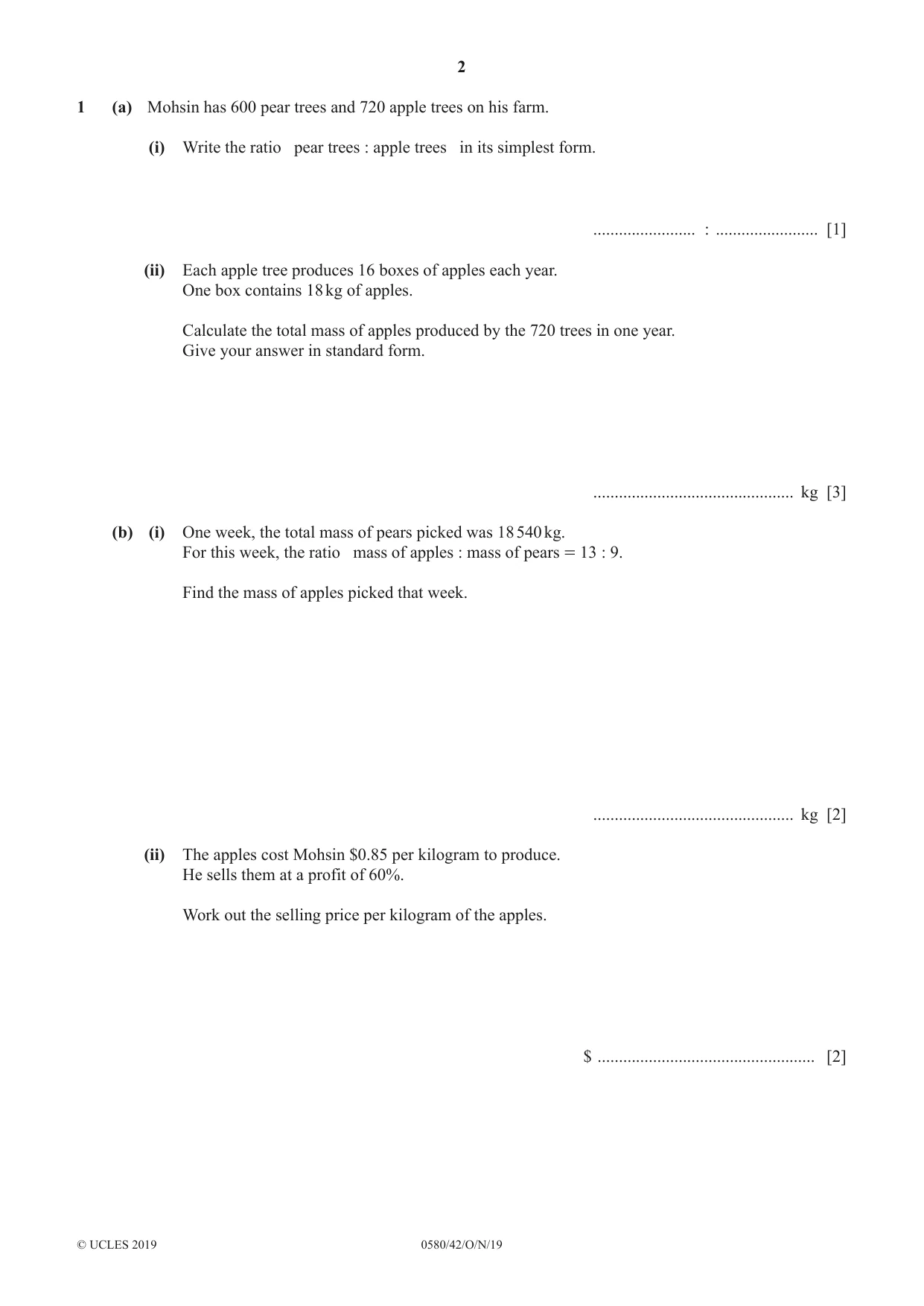
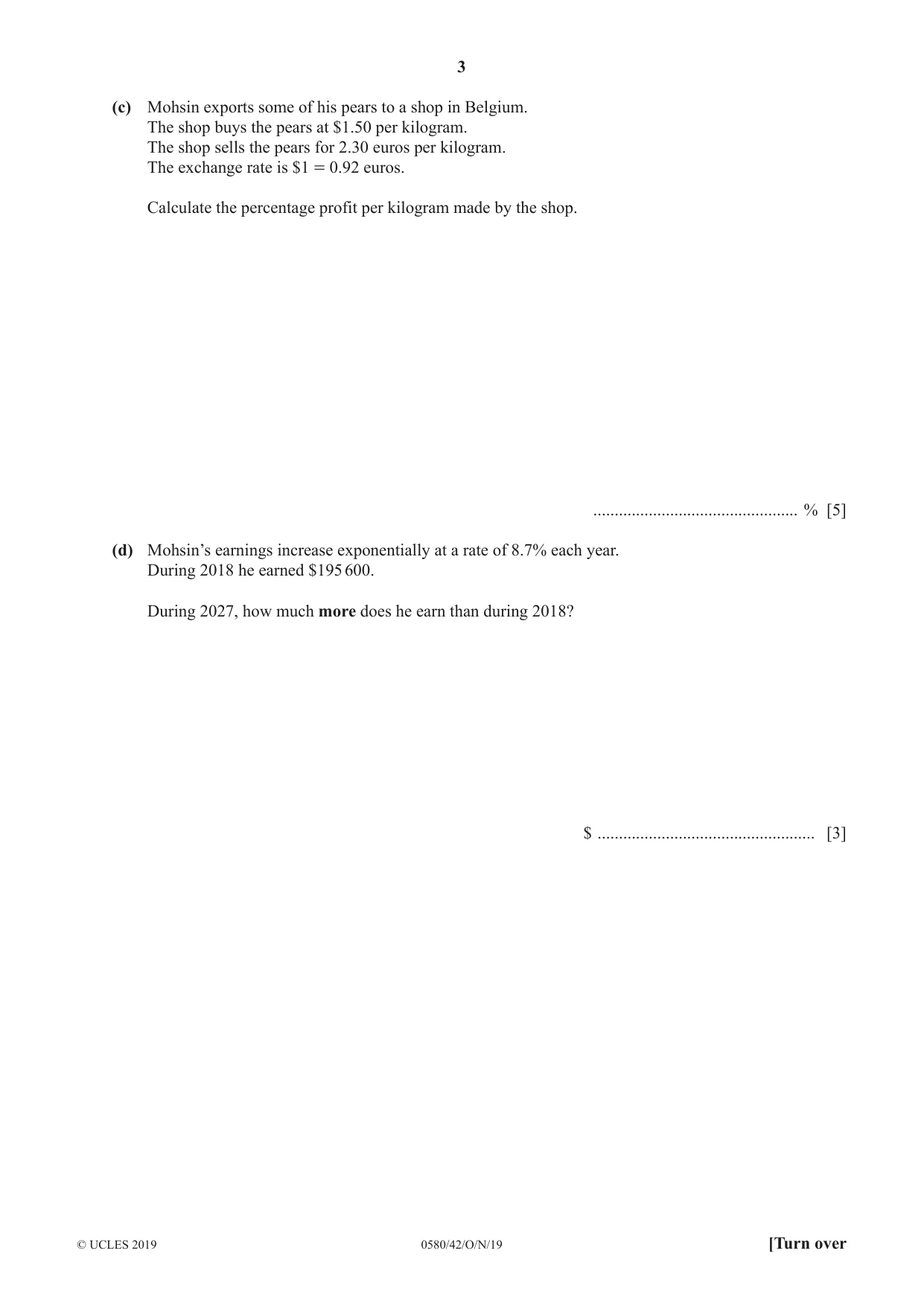
1 (a) Mohsin has 600 pear trees and 720 apple trees on his farm. (i) Write the ratio pear trees : apple trees in its simplest form. ........................ : ........................ [1] (ii) Each apple tree produces 16 boxes of apples each year. One box contains 18 kg of apples. Calculate the total mass of apples produced by the 720 trees in one year. Give your answer in standard form. ............................................... kg [3] (b) (i) One week, the total mass of pears picked was 18 540 kg. For this week, the ratio mass of apples : mass of pears = 13 : 9. Find the mass of apples picked that week. ............................................... kg [2] (ii) The apples cost Mohsin $0.85 per kilogram to produce. He sells them at a profit of 60%. Work out the selling price per kilogram of the apples. $ ................................................... [2] (c) Mohsin exports some of his pears to a shop in Belgium. The shop buys the pears at $1.50 per kilogram. The shop sells the pears for 2.30 euros per kilogram. The exchange rate is $1 = 0.92 euros. Calculate the percentage profit per kilogram made by the shop. ................................................ % [5] (d) Mohsin’s earnings increase exponentially at a rate of 8.7% each year. During 2018 he earned $195 600. During 2027, how much more does he earn than during 2018? $ ................................................... [3]
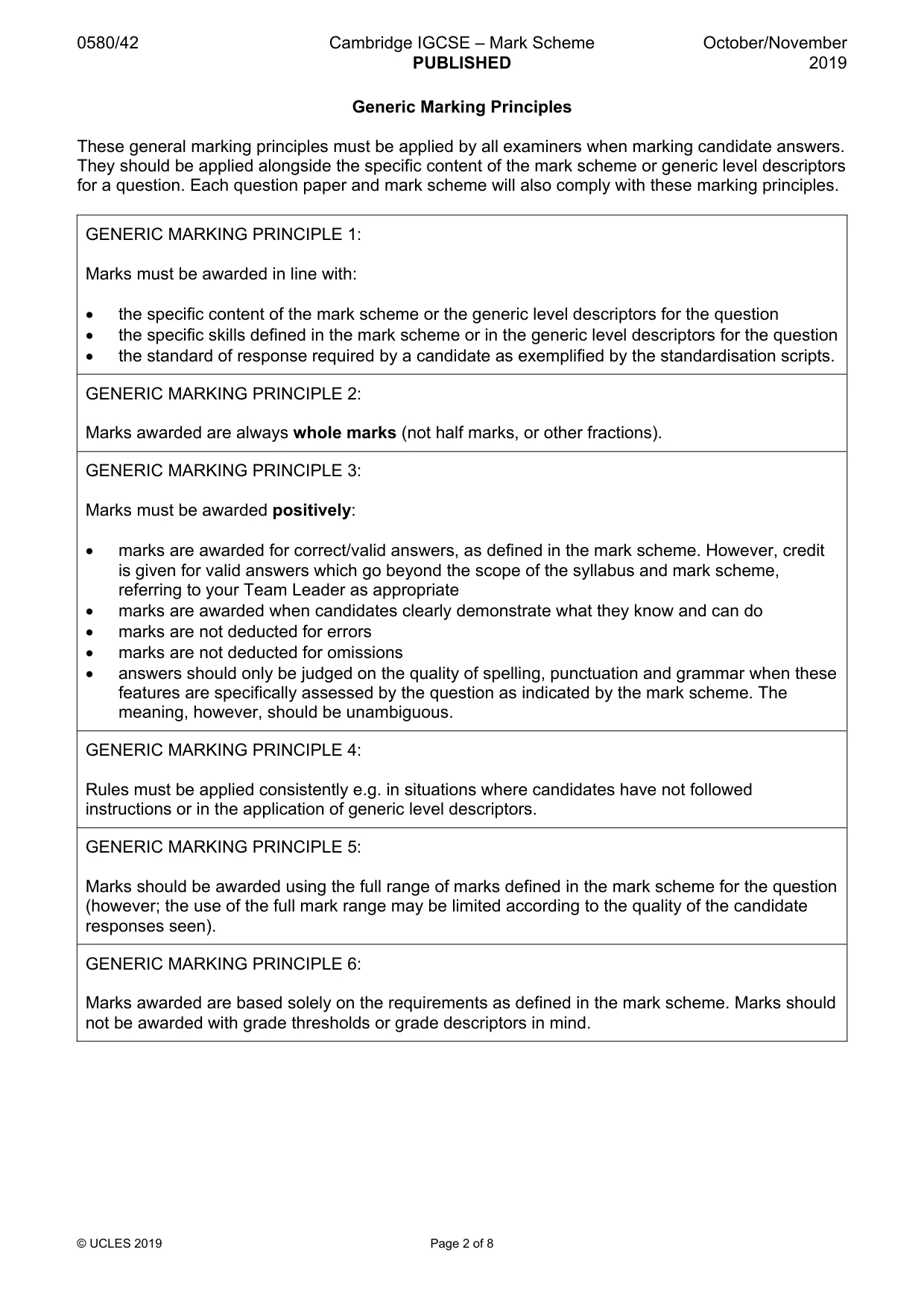
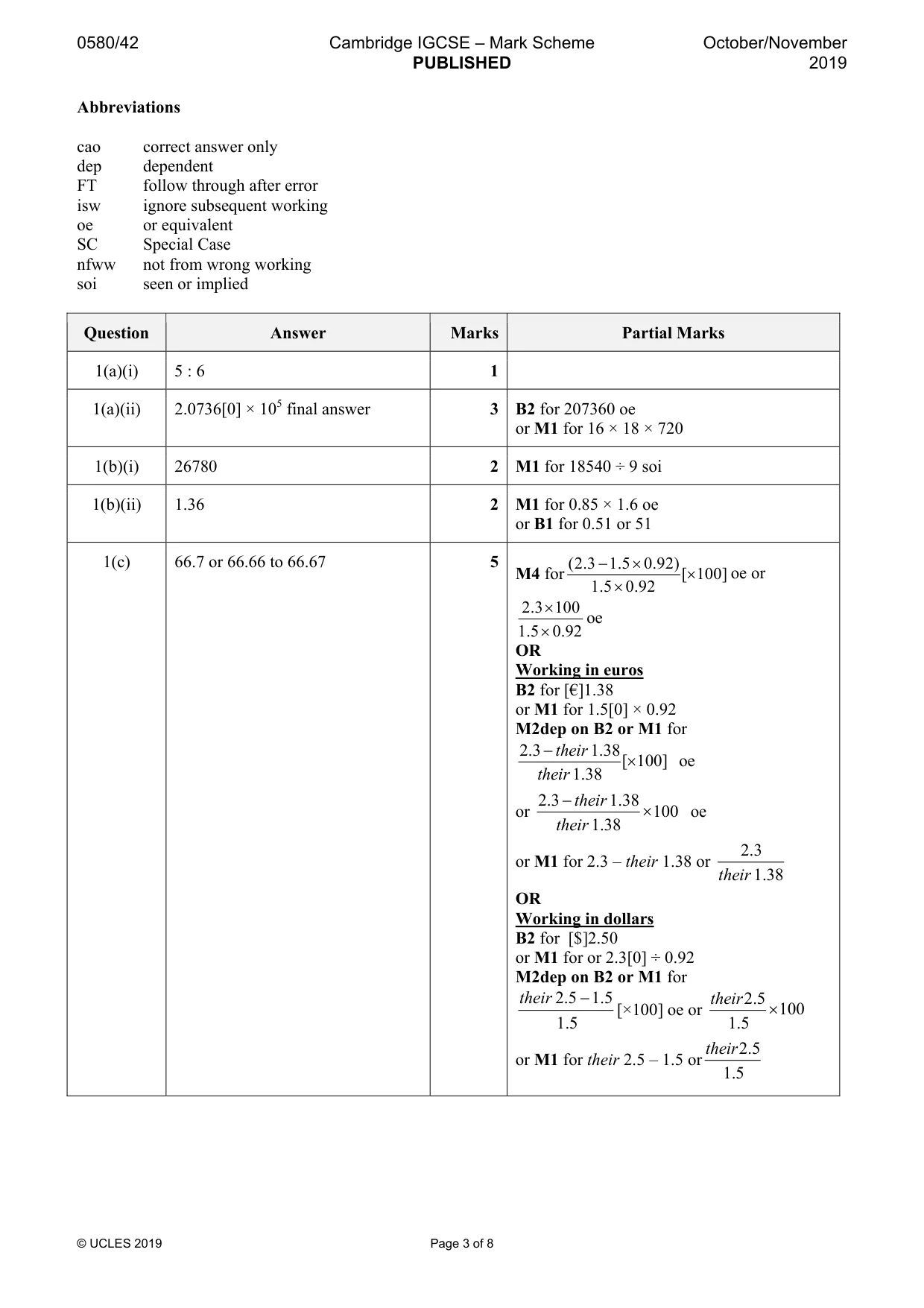
Mark scheme: Question Answer Marks Partial Marks 1(a)(i) 5 : 6 1 1(a)(ii) 2.0736[0] × 105 final answer 3 B2 for 207360 oe or M1 for 16 × 18 × 720 1(b)(i) 26780 2 M1 for 18540 ÷ 9 soi 1(b)(ii) 1.36 2 M1 for 0.85 × 1.6 oe or B1 for 0.51 or 51 1(c) 66.7 or 66.66 to 66.67 5 (2.3 − 1.5 × M4 for 0.92)[× 100] oe or 1.5 × 0.92 2.3 × 100 oe 1.5 × 0.92 OR Working in euros B2 for [€]1.38 or M1 for 1.5[0] × 0.92 M2dep on B2 or M1 for 2.3 − their 1.38[× 100] oe their 1.38 2.3 − their 1.38 or × 100 oe their 1.38 2.3 or M1 for 2.3 – their 1.38 or their 1.38 OR Working in dollars B2 for [$]2.50 or M1 for or 2.3[0] ÷ 0.92 M2dep on B2 or M1 for their 5.2 − 5.1 their 2.5 [×100] oe or × 100 5.1 1.5 their 2.5 or M1 for their 2.5 – 1.5 or 1.5 1(d) 219 000 3 B2 for 414000 or 414414[.3.…] rounded to 4 or 218814[.3.…] rounded to 4 sf or sf or more more 9 8.7 or M2 for 195600 × 1 + [– 195600] 100 8.7 k or M1 for 195600 × 1 + or better 100 (k >1 and an integer)
Q2 · The cumulative frequency diagram shows information about the time taken, t seconds, for a…
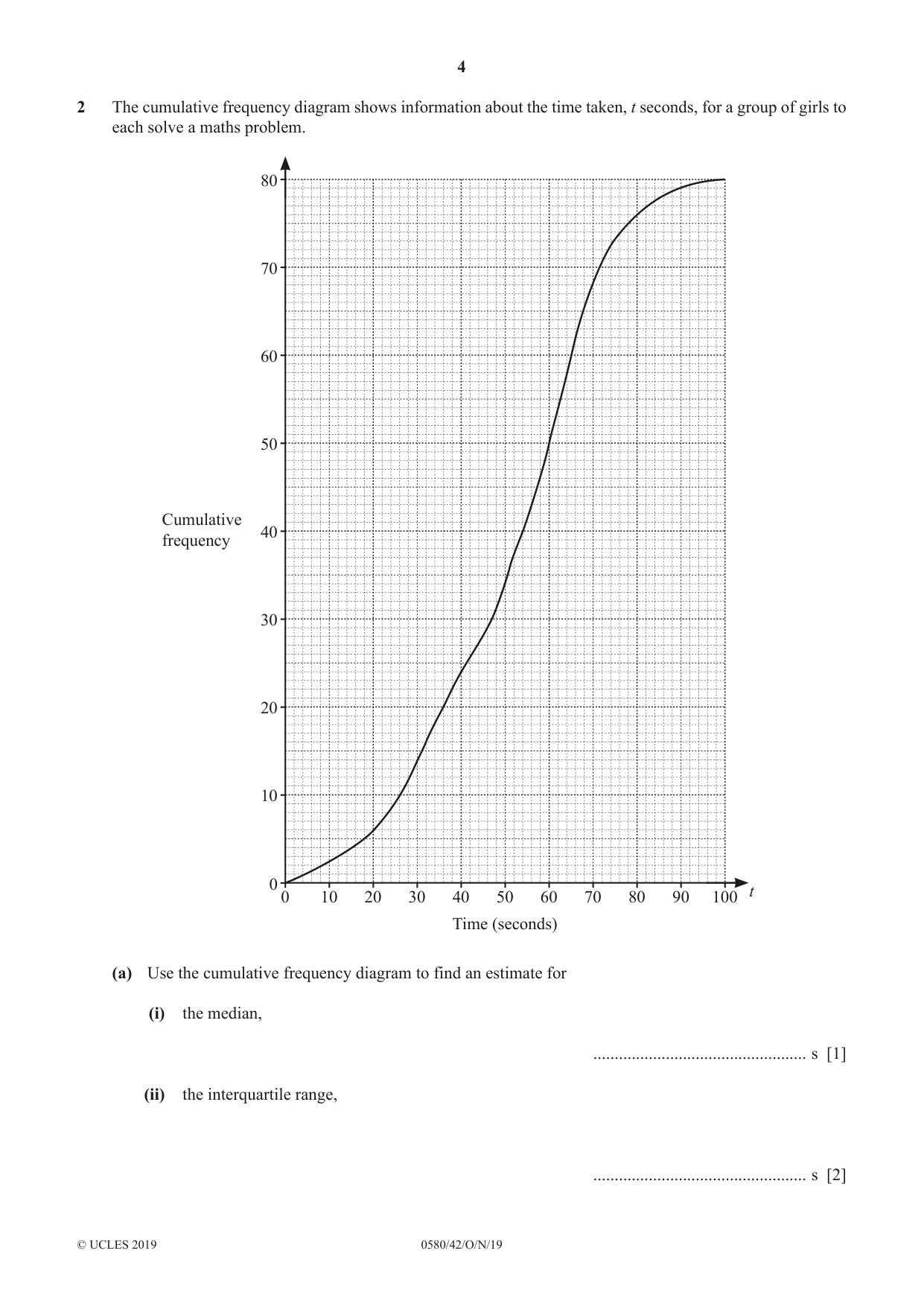
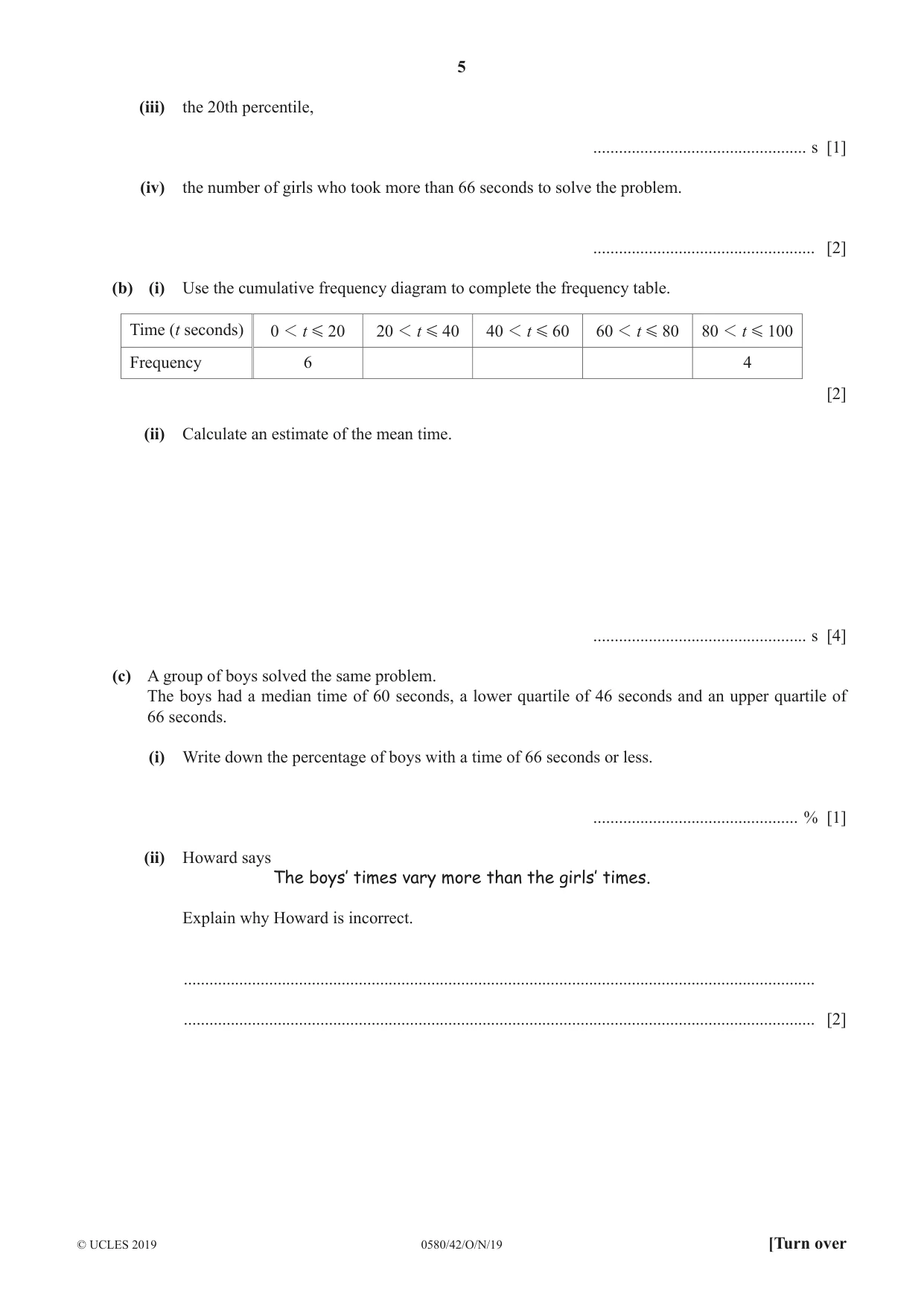
2 The cumulative frequency diagram shows information about the time taken, t seconds, for a group of girls to each solve a maths problem. 80 70 60 50 Cumulative 40 frequency 30 20 10 0 t 0 10 20 30 40 50 60 70 80 90 100 Time (seconds) (a) Use the cumulative frequency diagram to find an estimate for (i) the median, .................................................. s [1] (ii) the interquartile range, .................................................. s [2] (iii) the 20th percentile, .................................................. s [1] (iv) the number of girls who took more than 66 seconds to solve the problem. .................................................... [2] (b) (i) Use the cumulative frequency diagram to complete the frequency table. Time (t seconds) 0 1 t G 20 20 1 t G 40 40 1 t G 60 60 1 t G 80 80 1 t G 100 Frequency 6 4 [2] (ii) Calculate an estimate of the mean time. .................................................. s [4] (c) A group of boys solved the same problem. The boys had a median time of 60 seconds, a lower quartile of 46 seconds and an upper quartile of 66 seconds. (i) Write down the percentage of boys with a time of 66 seconds or less. ................................................ % [1] (ii) Howard says The boys’ times vary more than the girls’ times. Explain why Howard is incorrect. .................................................................................................................................................... .................................................................................................................................................... [2]
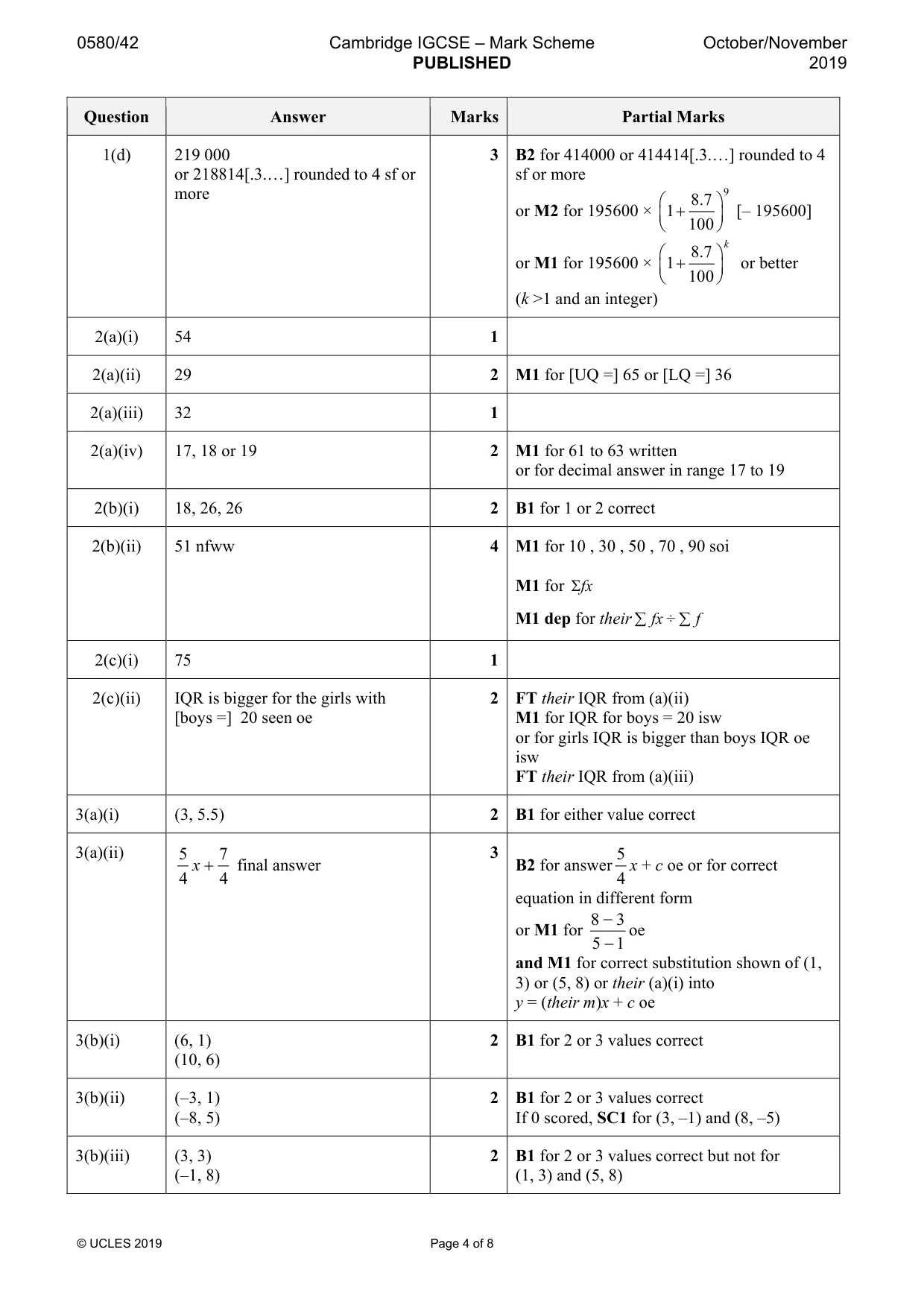
Mark scheme: 2(a)(i) 54 1 2(a)(ii) 29 2 M1 for [UQ =] 65 or [LQ =] 36 2(a)(iii) 32 1 2(a)(iv) 17, 18 or 19 2 M1 for 61 to 63 written or for decimal answer in range 17 to 19 2(b)(i) 18, 26, 26 2 B1 for 1 or 2 correct 2(b)(ii) 51 nfww 4 M1 for 10 , 30 , 50 , 70 , 90 soi M1 for Σ fx M1 dep for their ∑ fx ÷ ∑ f 2(c)(i) 75 1 2(c)(ii) IQR is bigger for the girls with 2 FT their IQR from (a)(ii) [boys =] 20 seen oe M1 for IQR for boys = 20 isw or for girls IQR is bigger than boys IQR oe isw FT their IQR from (a)(iii)
Q3 · A line joins A (1, 3) to B (5, 8)
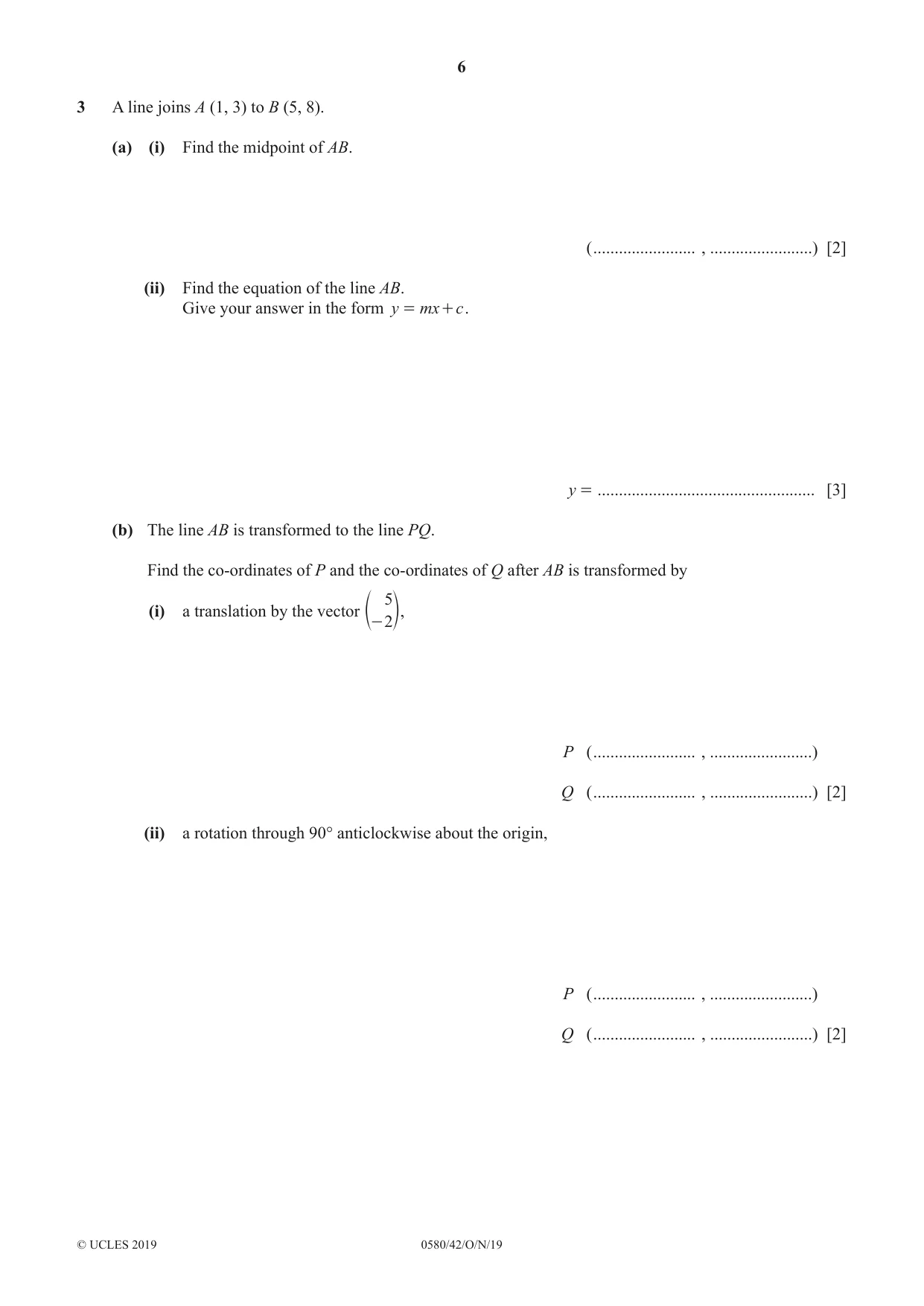
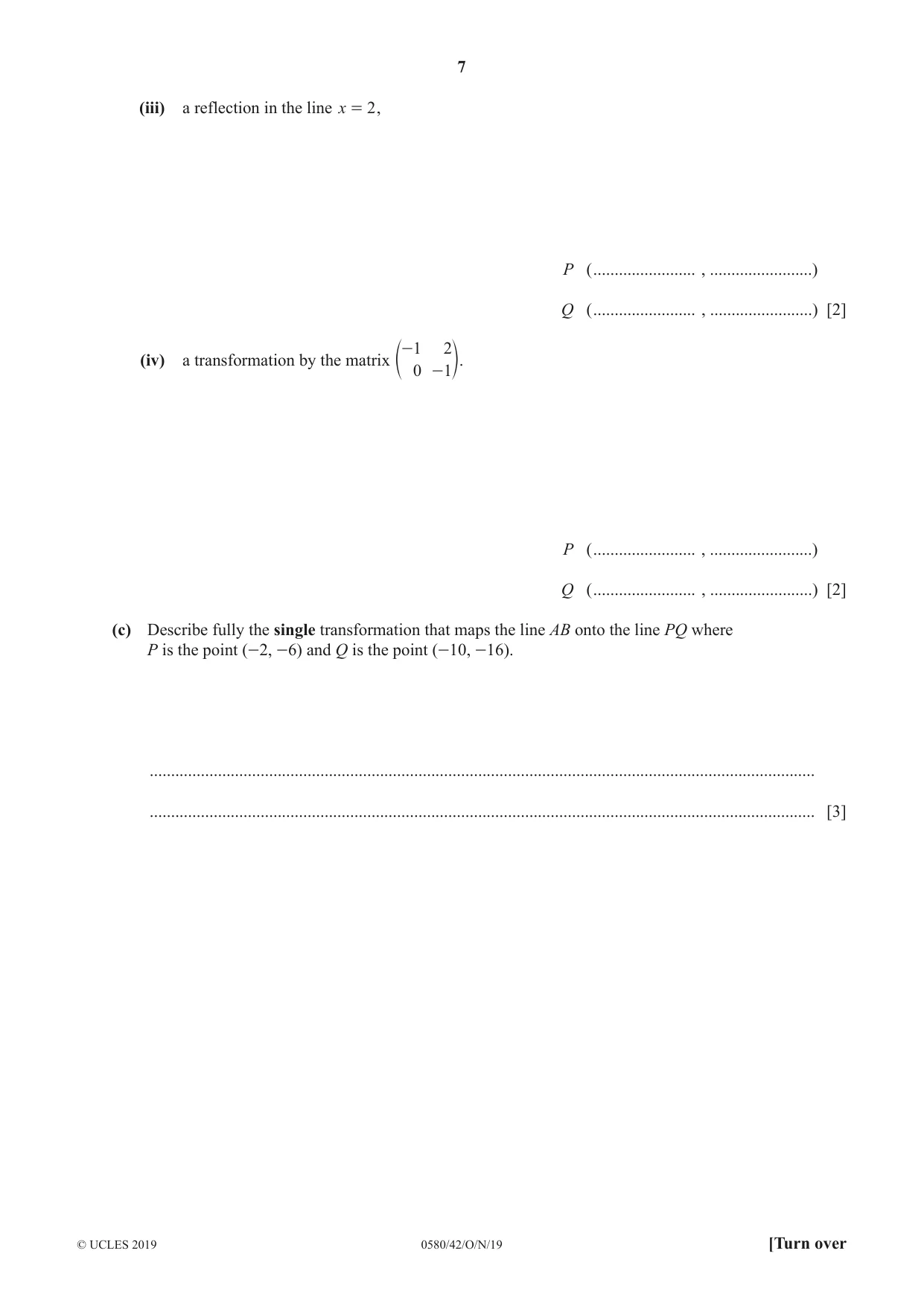
3 A line joins A (1, 3) to B (5, 8). (a) (i) Find the midpoint of AB. ( ........................ , ........................) [2] (ii) Find the equation of the line AB. Give your answer in the form y = mx + c . y = ................................................... [3] (b) The line AB is transformed to the line PQ. Find the co-ordinates of P and the co-ordinates of Q after AB is transformed by 5 (i) a translation by the vector e- 2o, P ( ........................ , ........................) Q ( ........................ , ........................) [2] (ii) a rotation through 90° anticlockwise about the origin, P ( ........................ , ........................) Q ( ........................ , ........................) [2] (iii) a reflection in the line x = 2 , P ( ........................ , ........................) Q ( ........................ , ........................) [2] - 1 2 (iv) a transformation by the matrix e 0 - 1o. P ( ........................ , ........................) Q ( ........................ , ........................) [2] (c) Describe fully the single transformation that maps the line AB onto the line PQ where P is the point (-2, -6) and Q is the point (-10, -16). ............................................................................................................................................................ ............................................................................................................................................................ [3]
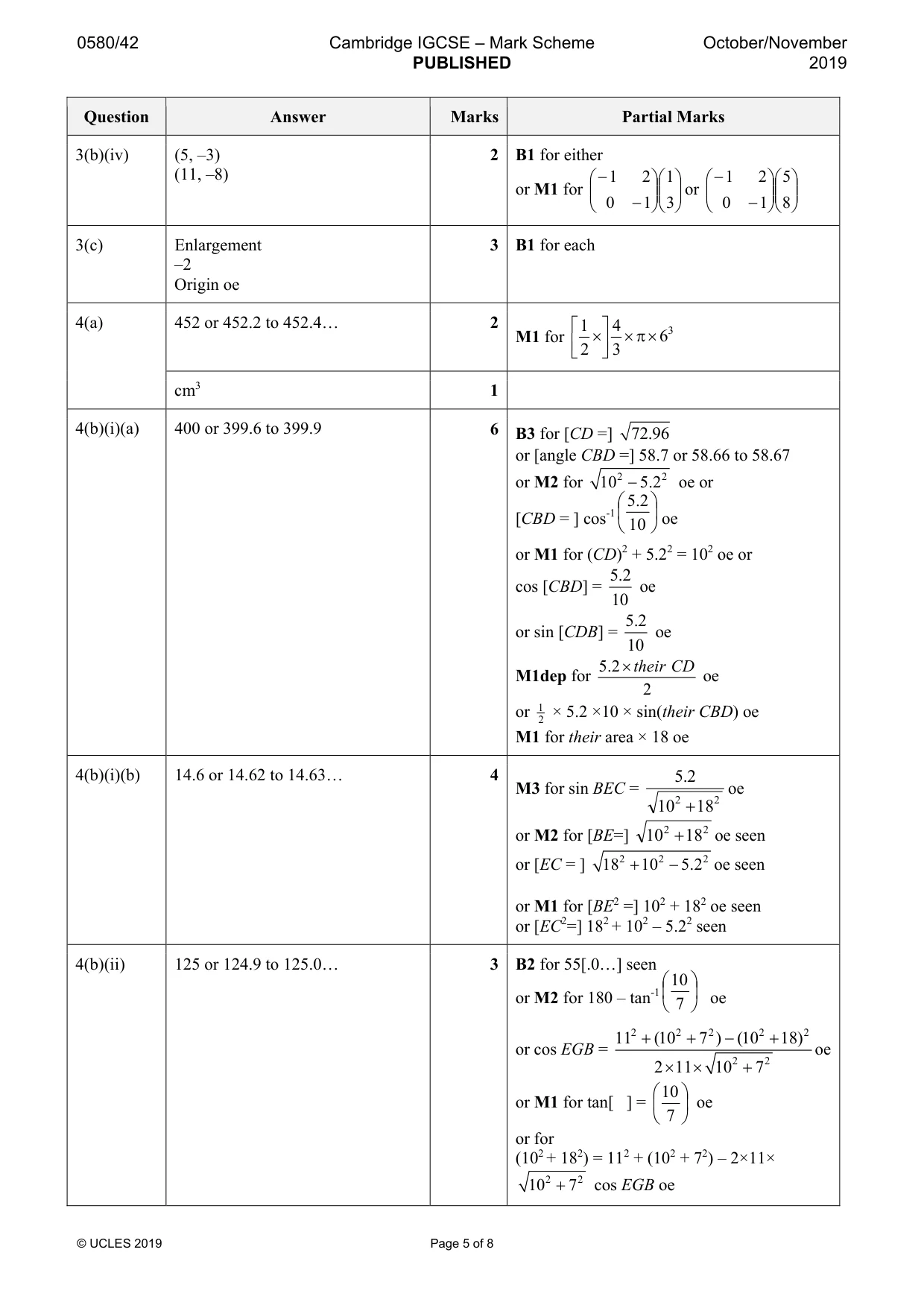
Mark scheme: 3(a)(i) (3, 5.5) 2 B1 for either value correct 3(a)(ii) 5 7 3 5 x + final answer B2 for answer x + c oe or for correct 4 4 4 equation in different form 8 − 3 or M1 for oe 5 − 1 and M1 for correct substitution shown of (1, 3) or (5, 8) or their (a)(i) into y = (their m)x + c oe 3(b)(i) (6, 1) 2 B1 for 2 or 3 values correct (10, 6) 3(b)(ii) (–3, 1) 2 B1 for 2 or 3 values correct (–8, 5) If 0 scored, SC1 for (3, –1) and (8, –5) 3(b)(iii) (3, 3) 2 B1 for 2 or 3 values correct but not for (–1, 8) (1, 3) and (5, 8) 3(b)(iv) (5, –3) 2 B1 for either (11, –8) − 1 2 1 − 1 2 5 or M1 for or 0 − 1 3 0 − 1 8 3(c) Enlargement 3 B1 for each –2 Origin oe
Q4 · NOT TO SCALE 6 cm The diagram shows a hemisphere with radius 6 cm
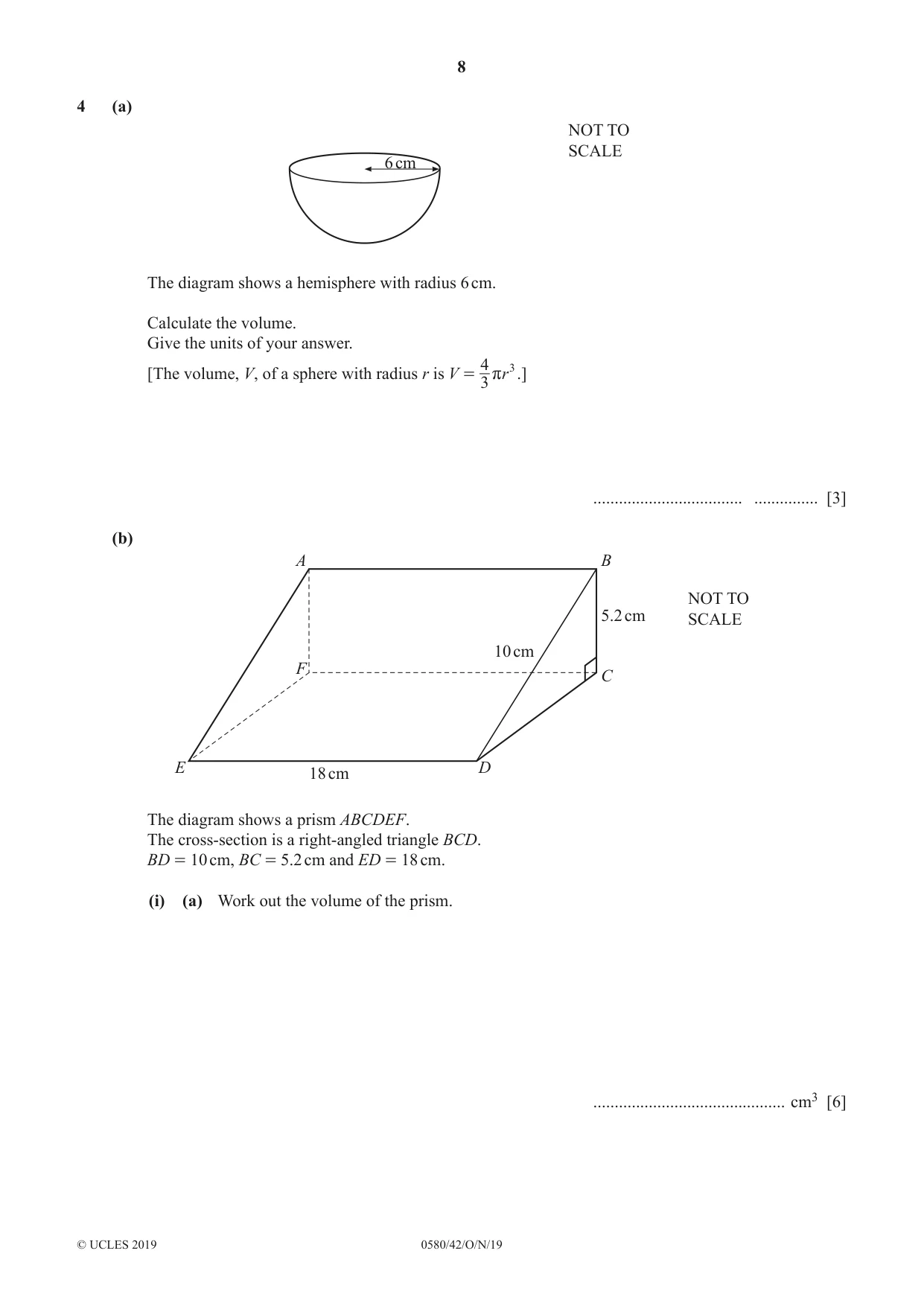
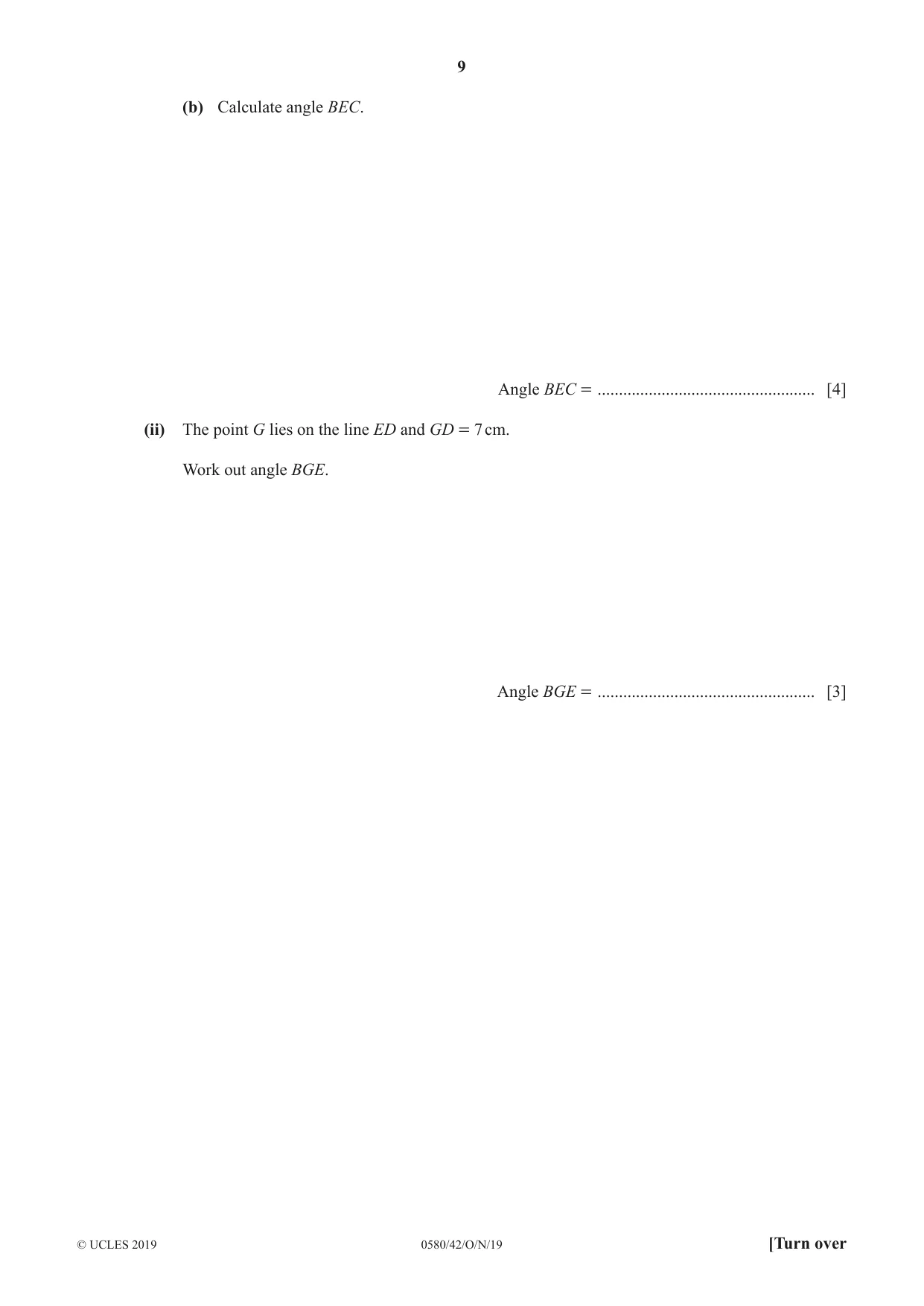
4 (a) NOT TO SCALE 6 cm The diagram shows a hemisphere with radius 6 cm. Calculate the volume. Give the units of your answer. 4 3 [The volume, V, of a sphere with radius r is V = r r .] 3 ................................... ............... [3] (b) A B NOT TO 5.2 cm SCALE 10 cm F C E D 18 cm The diagram shows a prism ABCDEF. The cross-section is a right-angled triangle BCD. BD = 10 cm, BC = 5.2 cm and ED = 18 cm. (i) (a) Work out the volume of the prism. ............................................. cm3 [6] (b) Calculate angle BEC. Angle BEC = ................................................... [4] (ii) The point G lies on the line ED and GD = 7 cm. Work out angle BGE. Angle BGE = ................................................... [3]
Mark scheme: 4(a) 452 or 452.2 to 452.4… 2 1 4 3 M1 for × × π× 6 2 3 cm3 1 4(b)(i)(a) 400 or 399.6 to 399.9 6 B3 for [CD =] 72.96 or [angle CBD =] 58.7 or 58.66 to 58.67 or M2 for 10 2 − 5.2 2 oe or 2.5 [CBD = ] cos-1 oe 10 or M1 for (CD)2 + 5.22 = 102 oe or 5.2 cos [CBD] = oe 10 5.2 or sin [CDB] = oe 10 5.2 × their CD M1dep for oe 2 or 12 × 5.2 ×10 × sin(their CBD) oe M1 for their area × 18 oe 4(b)(i)(b) 14.6 or 14.62 to 14.63… 4 2.5 M3 for sin BEC = oe 10 2 + 18 2 or M2 for [BE=] 10 2 + 18 2 oe seen or [EC = ] 18 2 + 10 2 − 5.2 2 oe seen or M1 for [BE2 =] 102 + 182 oe seen or [EC2=] 182 + 102 – 5.22 seen 4(b)(ii) 125 or 124.9 to 125.0… 3 B2 for 55[.0…] seen 10 or M2 for 180 – tan-1 oe 7 112 + (10 2 + 7 2 ) − (10 2 + 18) 2 or cos EGB = oe 2 × 11 × 10 2 + 7 2 10 or M1 for tan[ ] = oe 7 or for (102 + 182) = 112 + (102 + 72) – 2×11× 10 2 + 7 2 cos EGB oe
Q5 · X 2 1 25 The table shows some values of y = + 2 - , x !
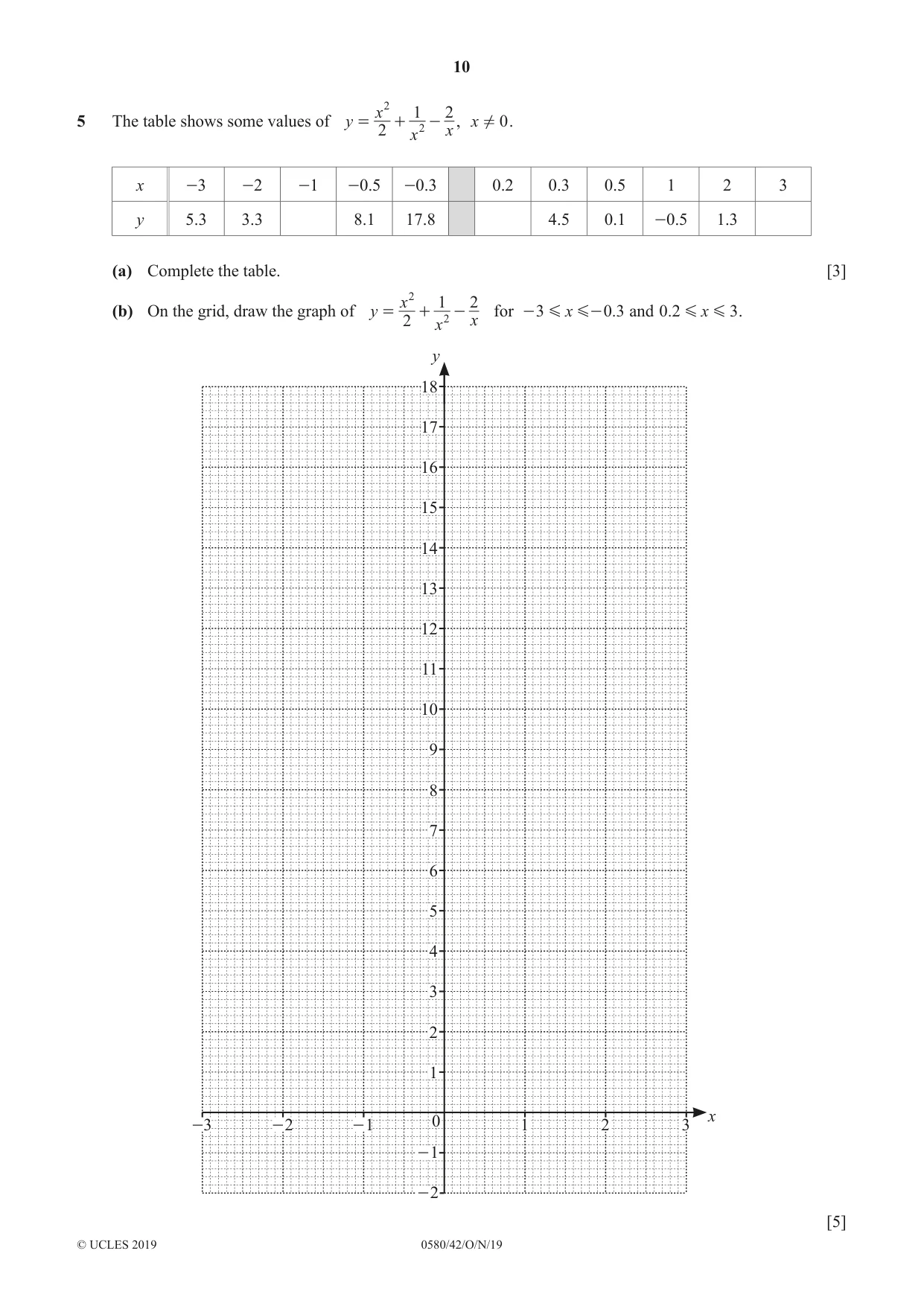
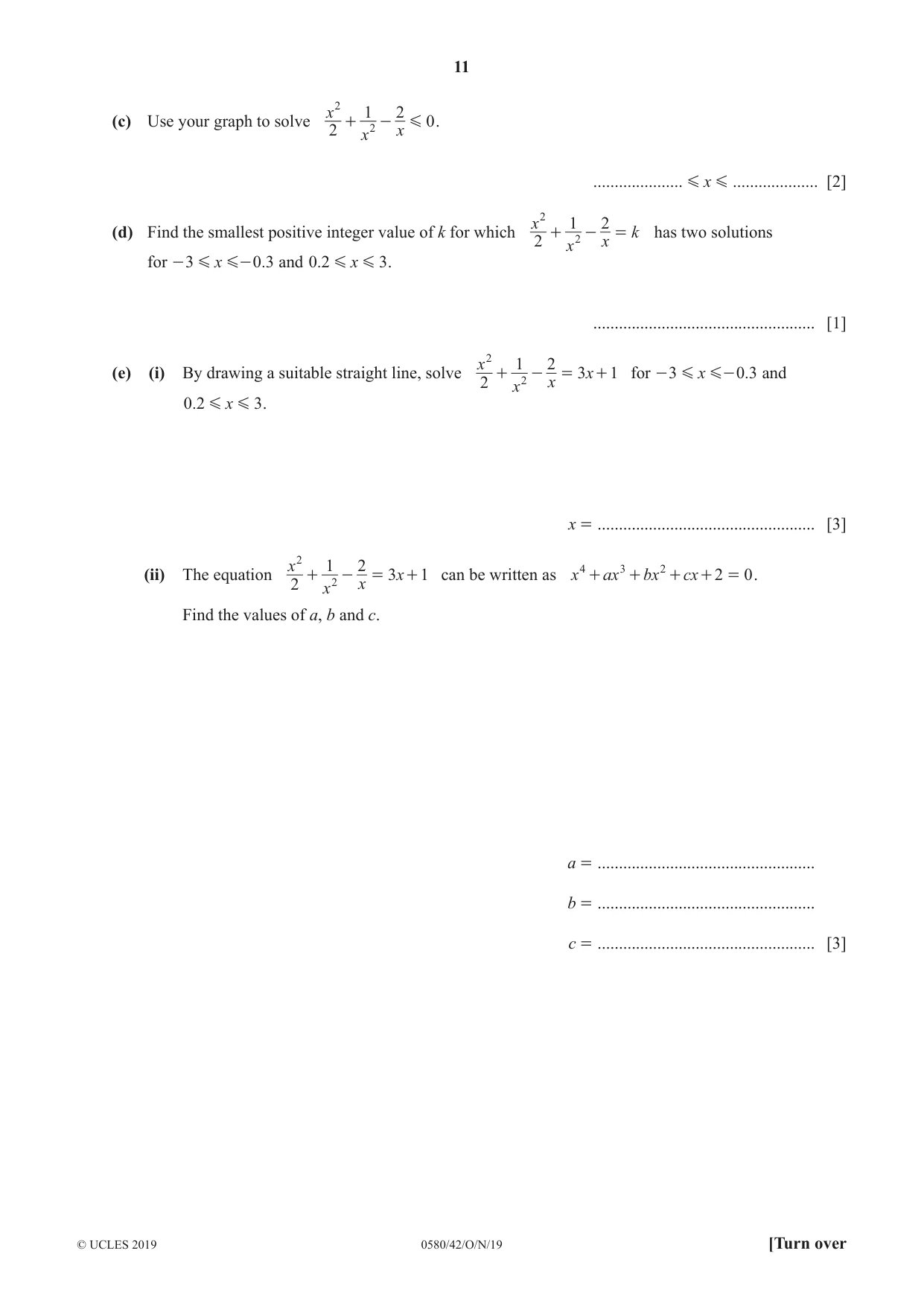
x 2 1 25 The table shows some values of y = + 2 - , x ! 0 . 2 x x x -3 -2 -1 -0.5 -0.3 0.2 0.3 0.5 1 2 3 y 5.3 3.3 8.1 17.8 4.5 0.1 -0.5 1.3 (a) Complete the table. [3] x 2 1 2 (b) On the grid, draw the graph of y = + 2 - for - 3 G x G - 0 .3 and 0.2 G x G 3 . 2 x x y 18 17 16 15 14 13 12 11 10 9 8 7 6 5 4 3 2 1 x -3 - 2 - 1 0 1 2 3 - 1 - 2 [5] x 2 1 2(c) Use your graph to solve + 2 - G 0 . 2 x x ..................... G x G .................... [2] x 2 1 2(d) Find the smallest positive integer value of k for which + 2 - = k has two solutions 2 x x for - 3 G x G - 0.3 and 0.2 G x G 3 . .................................................... [1] x 2 1 2(e) (i) By drawing a suitable straight line, solve + 2 - = 3x + 1 for - 3 G x G - 0.3 and 2 x x 0.2 G x G 3 . x = ................................................... [3] x 2 1 2 4 3 2 (ii) The equation + 2 - = 3x + 1 can be written as x + ax + bx + cx + 2 = 0 . 2 x x Find the values of a, b and c. a = ................................................... b = ................................................... c = ................................................... [3]
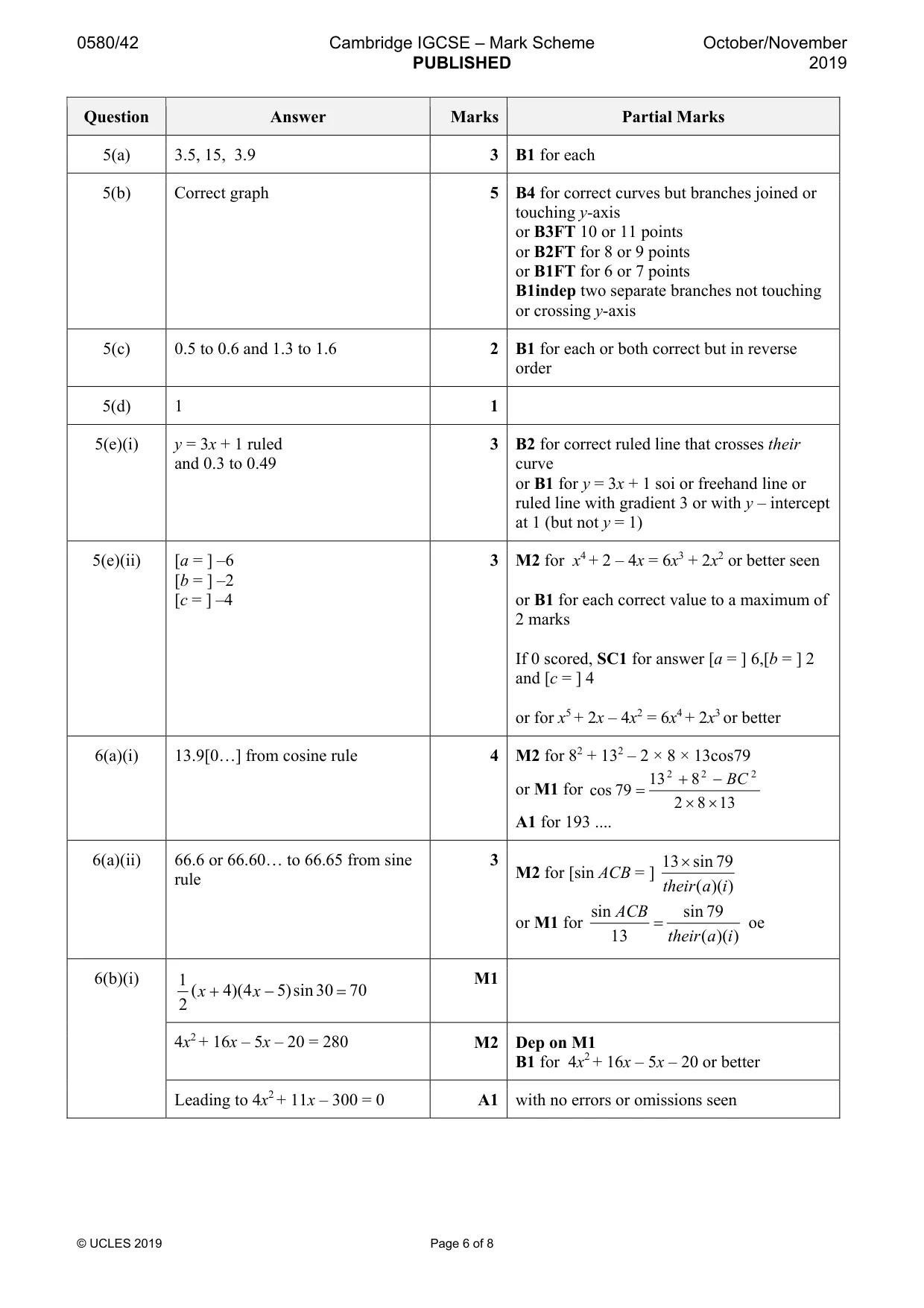
Mark scheme: 5(a) 3.5, 15, 3.9 3 B1 for each 5(b) Correct graph 5 B4 for correct curves but branches joined or touching y-axis or B3FT 10 or 11 points or B2FT for 8 or 9 points or B1FT for 6 or 7 points B1indep two separate branches not touching or crossing y-axis 5(c) 0.5 to 0.6 and 1.3 to 1.6 2 B1 for each or both correct but in reverse order 5(d) 1 1 5(e)(i) y = 3x + 1 ruled 3 B2 for correct ruled line that crosses their and 0.3 to 0.49 curve or B1 for y = 3x + 1 soi or freehand line or ruled line with gradient 3 or with y – intercept at 1 (but not y = 1) 5(e)(ii) [a = ] –6 3 M2 for x4 + 2 – 4x = 6x3 + 2x2 or better seen [b = ] –2 [c = ] –4 or B1 for each correct value to a maximum of 2 marks If 0 scored, SC1 for answer [a = ] 6,[b = ] 2 and [c = ] 4 or for x5 + 2x – 4x2 = 6x4 + 2x3 or better
Q6 · A NOT TO 79° SCALE 8 m 13 m C B The diagram shows triangle ABC
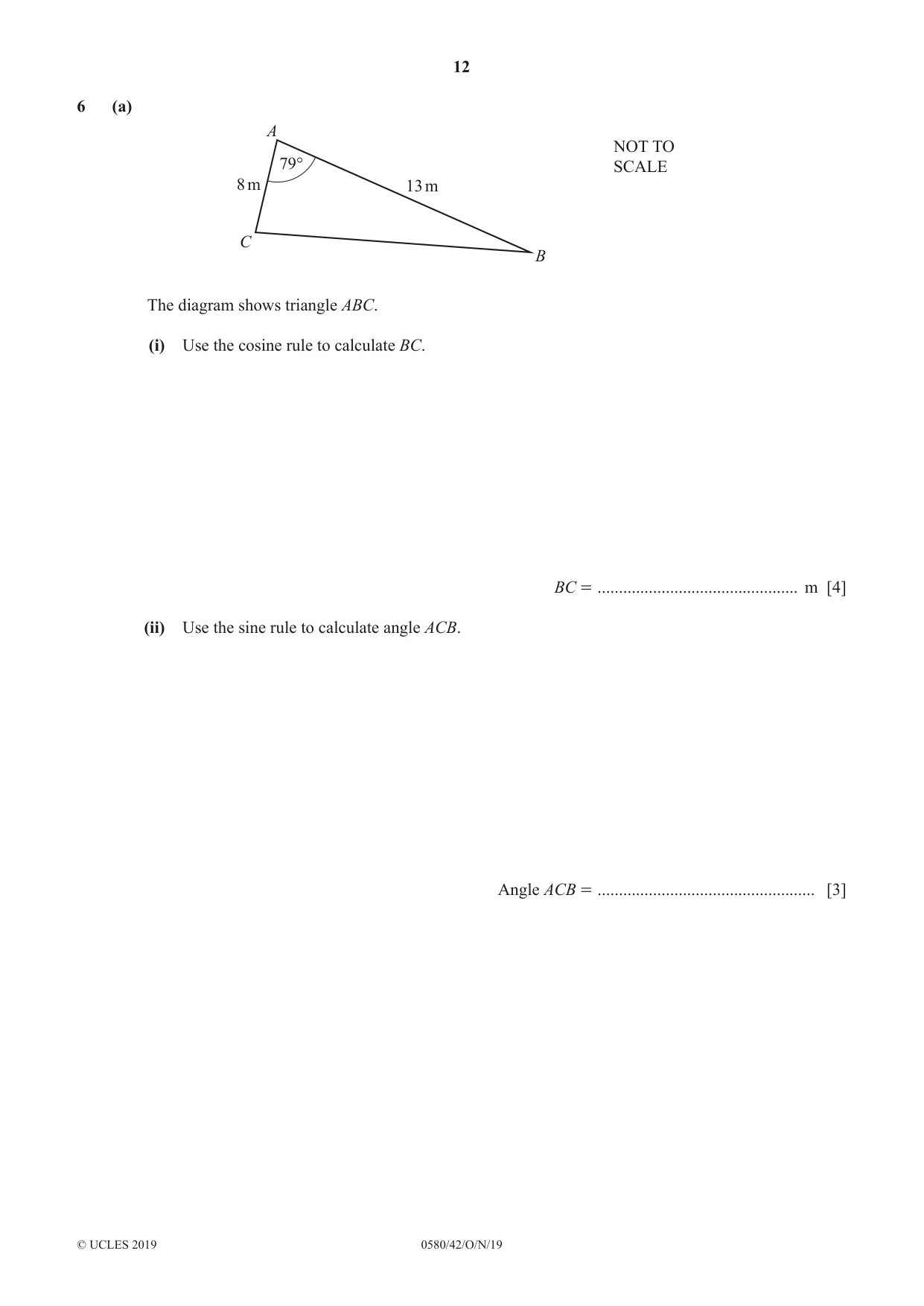
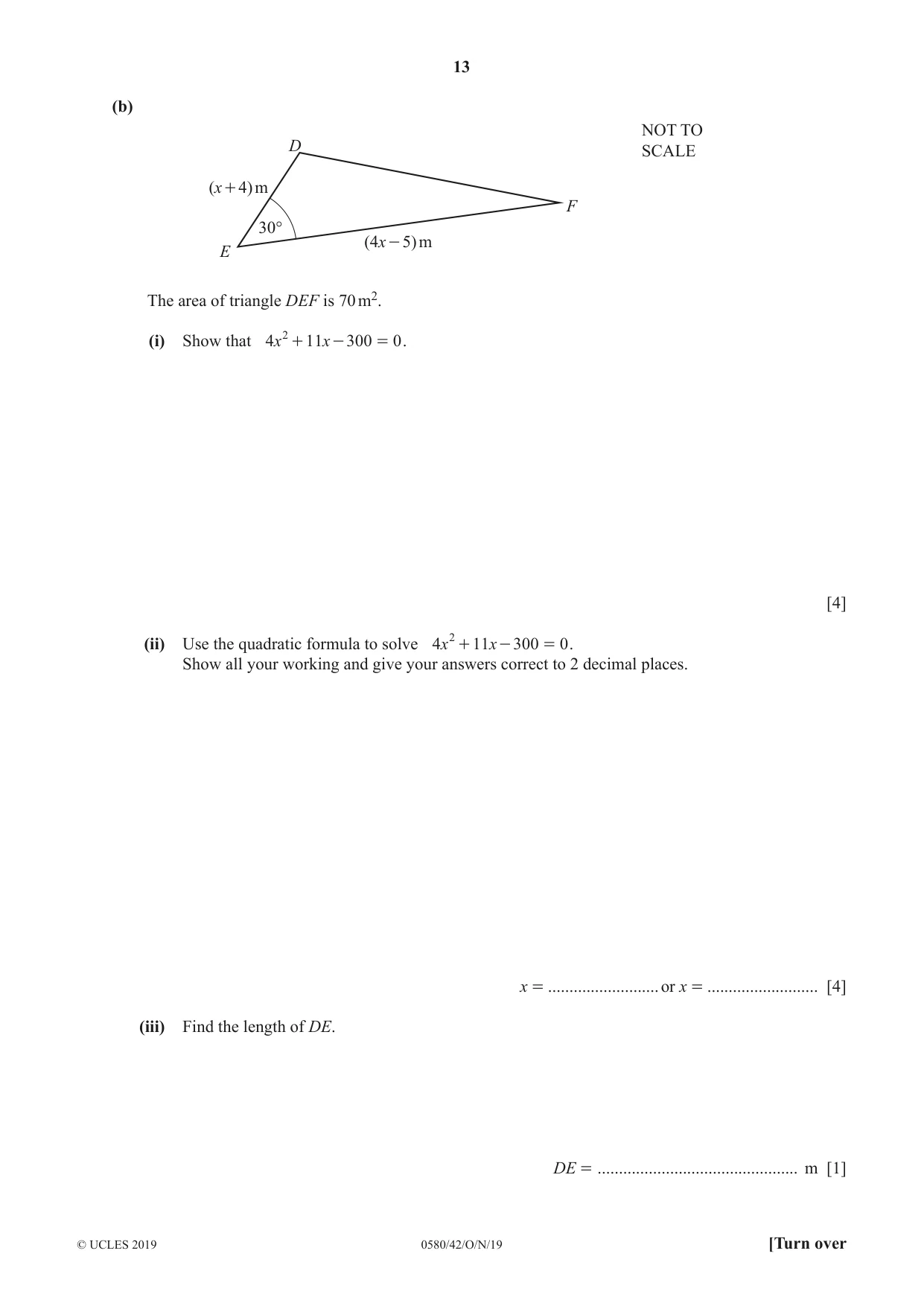
6 (a) A NOT TO 79° SCALE 8 m 13 m C B The diagram shows triangle ABC. (i) Use the cosine rule to calculate BC. BC = ............................................... m [4] (ii) Use the sine rule to calculate angle ACB. Angle ACB = ................................................... [3] (b) NOT TO D SCALE (x + 4) m F 30° (4x - 5) m E The area of triangle DEF is 70 m2. (i) Show that 4x 2 + 11x - 300 = 0 . [4] (ii) Use the quadratic formula to solve 4x 2 + 11x - 300 = 0 . Show all your working and give your answers correct to 2 decimal places. x = .......................... or x = .......................... [4] (iii) Find the length of DE. DE = ............................................... m [1]
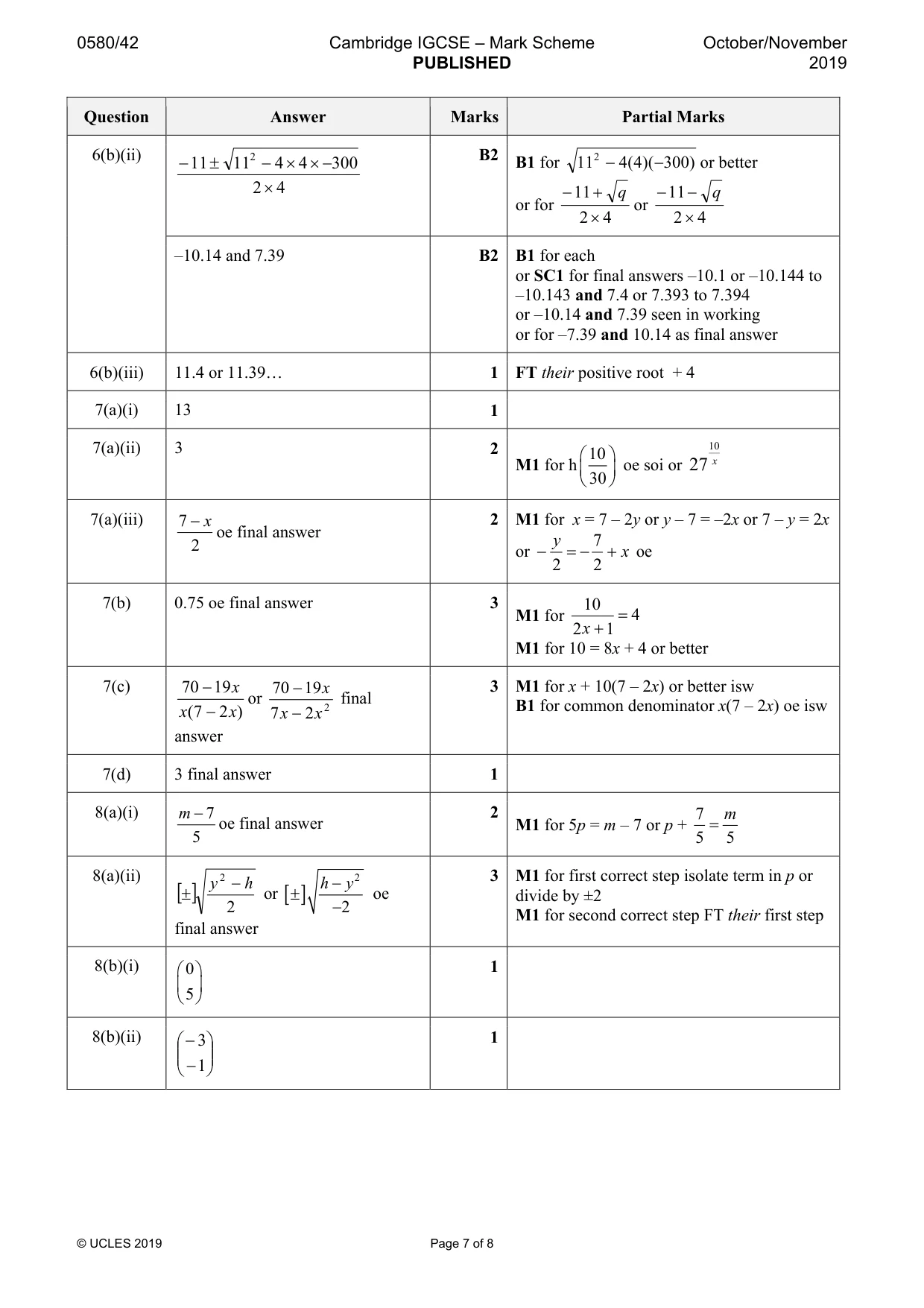
Mark scheme: 6(a)(i) 13.9[0…] from cosine rule 4 M2 for 82 + 132 – 2 × 8 × 13cos79 13 2 + 8 2 − BC 2 or M1 for cos 79 = 2 × 8 × 13 A1 for 193 .... 6(a)(ii) 66.6 or 66.60… to 66.65 from sine 3 13 × sin 79 M2 for [sin ACB = ] rule their ( a )(i ) sin ACB sin 79 or M1 for = oe 13 their ( a )(i ) 6(b)(i) 1 M1 ( x + 4)( 4 x − 5) sin 30 = 70 2 4x2 + 16x – 5x – 20 = 280 M2 Dep on M1 B1 for 4x2 + 16x – 5x – 20 or better Leading to 4x2 + 11x – 300 = 0 A1 with no errors or omissions seen 6(b)(ii) 2 B2 − 11 ± 11 − 4 × 4 × −300 B1 for 112 − 4 ( 4 )( − 300 ) or better 2 × 4 − 11 + q − 11 − q or for or 2 × 4 2 × 4 –10.14 and 7.39 B2 B1 for each or SC1 for final answers –10.1 or –10.144 to –10.143 and 7.4 or 7.393 to 7.394 or –10.14 and 7.39 seen in working or for –7.39 and 10.14 as final answer 6(b)(iii) 11.4 or 11.39… 1 FT their positive root + 4
Q7 · 7 f (x) = 7 - 2x g ( x) = , x !
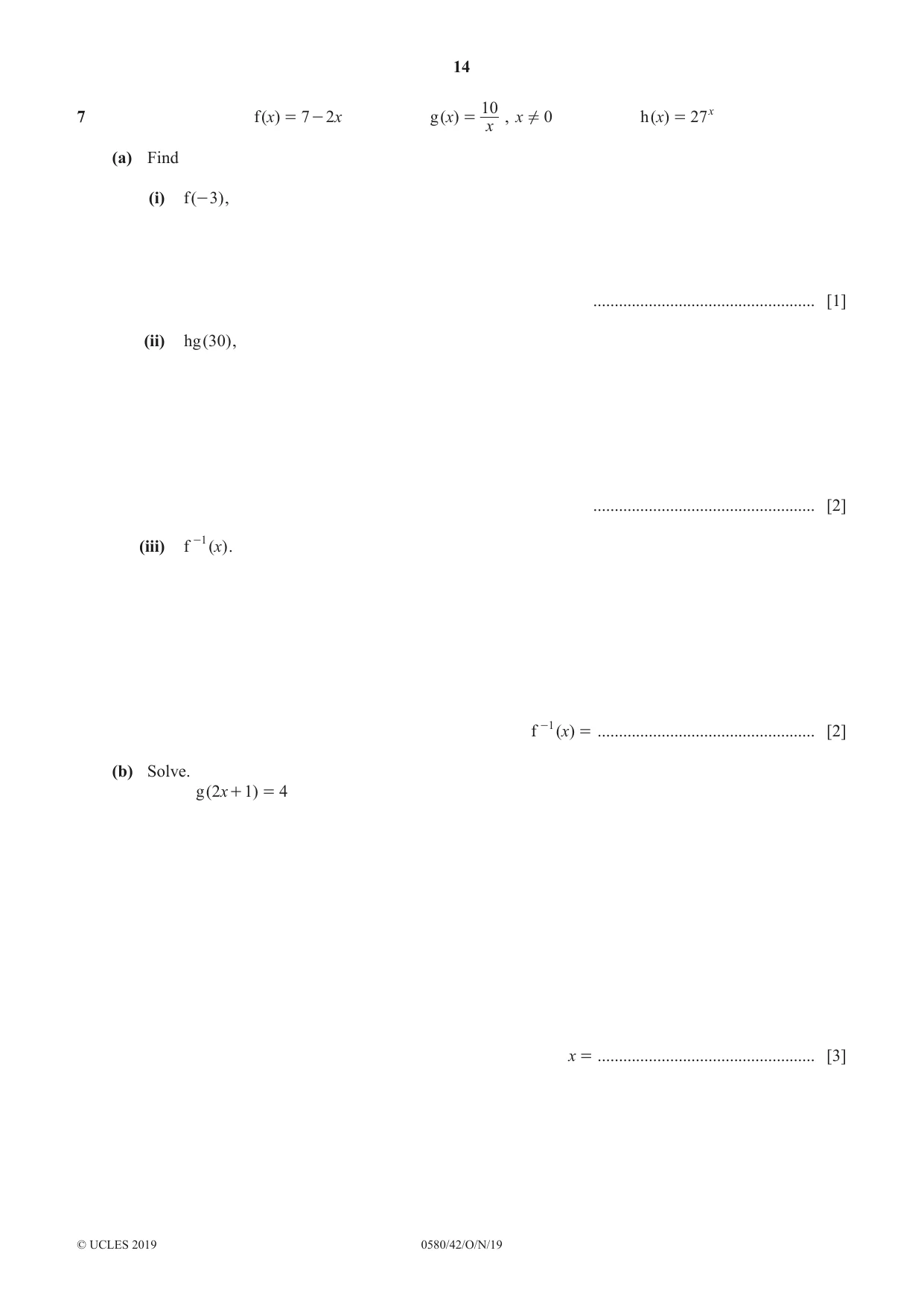
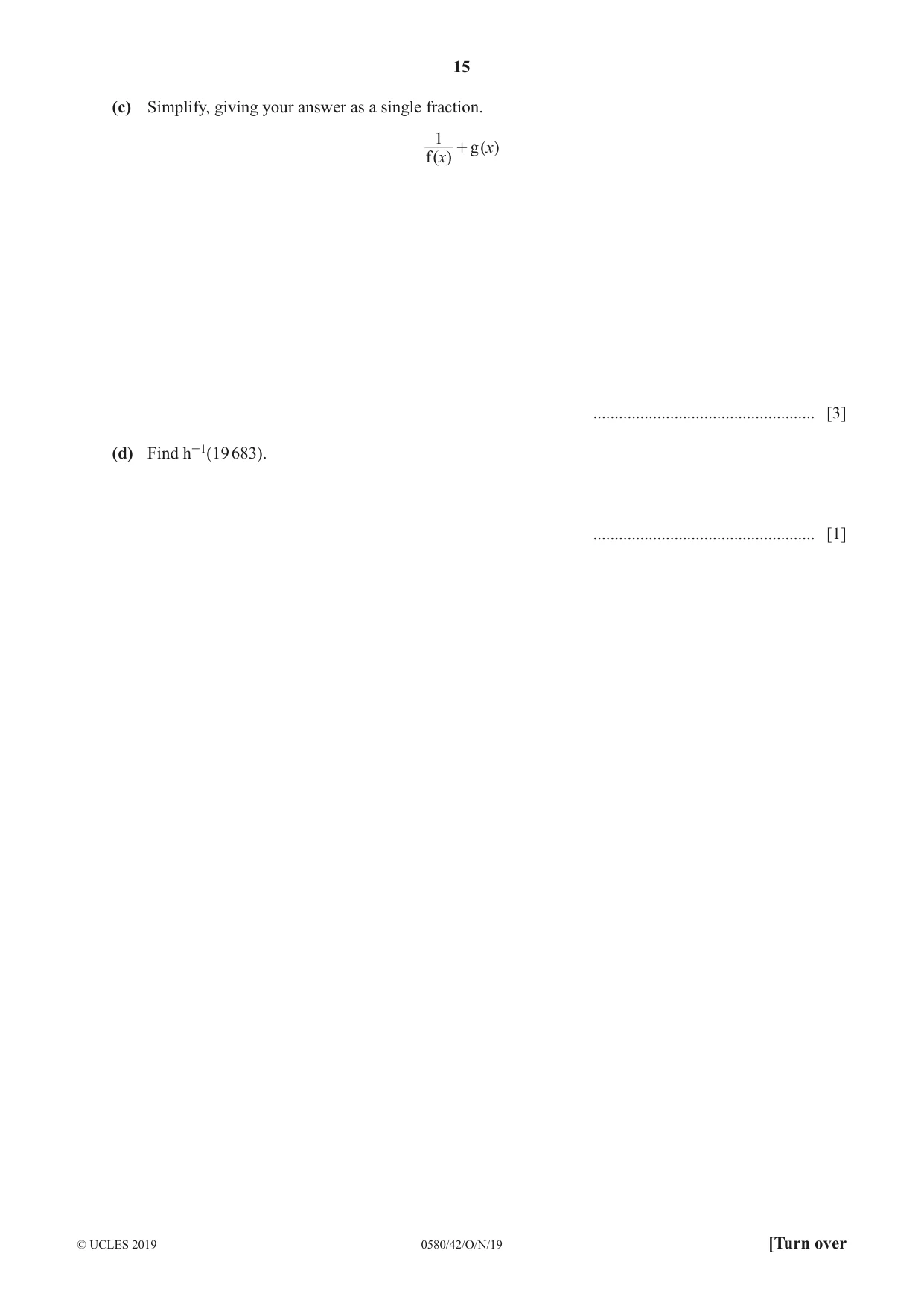
107 f (x) = 7 - 2x g ( x) = , x ! 0 h (x) = 27x x (a) Find (i) f (- 3 ) , .................................................... [1] (ii) hg ( 30) , .................................................... [2] (iii) f - 1 (x) . f - 1 (x) = ................................................... [2] (b) Solve. g (2x + 1) = 4 x = ................................................... [3] (c) Simplify, giving your answer as a single fraction. 1 + g (x) f (x) .................................................... [3] (d) Find h-1(19 683). .................................................... [1]
Mark scheme: 7(a)(i) 13 1 7(a)(ii) 3 2 10 10 x M1 for h oe soi or 27 30 7(a)(iii) 7 − x 2 M1 for x = 7 – 2y or y – 7 = –2x or 7 – y = 2x oe final answer y 7 2 or − = − + x oe 2 2 7(b) 0.75 oe final answer 3 10 M1 for = 4 2 x + 1 M1 for 10 = 8x + 4 or better 7(c) 70 − 19 x 70 − 19 x 3 M1 for x + 10(7 – 2x) or better isw or final 2 B1 for common denominator x(7 – 2x) oe isw x ( 7 − 2 x ) 7 x − 2 x answer 7(d) 3 final answer 1
Q8 · Make p the subject of (i) 5p + 7 = m , p =…
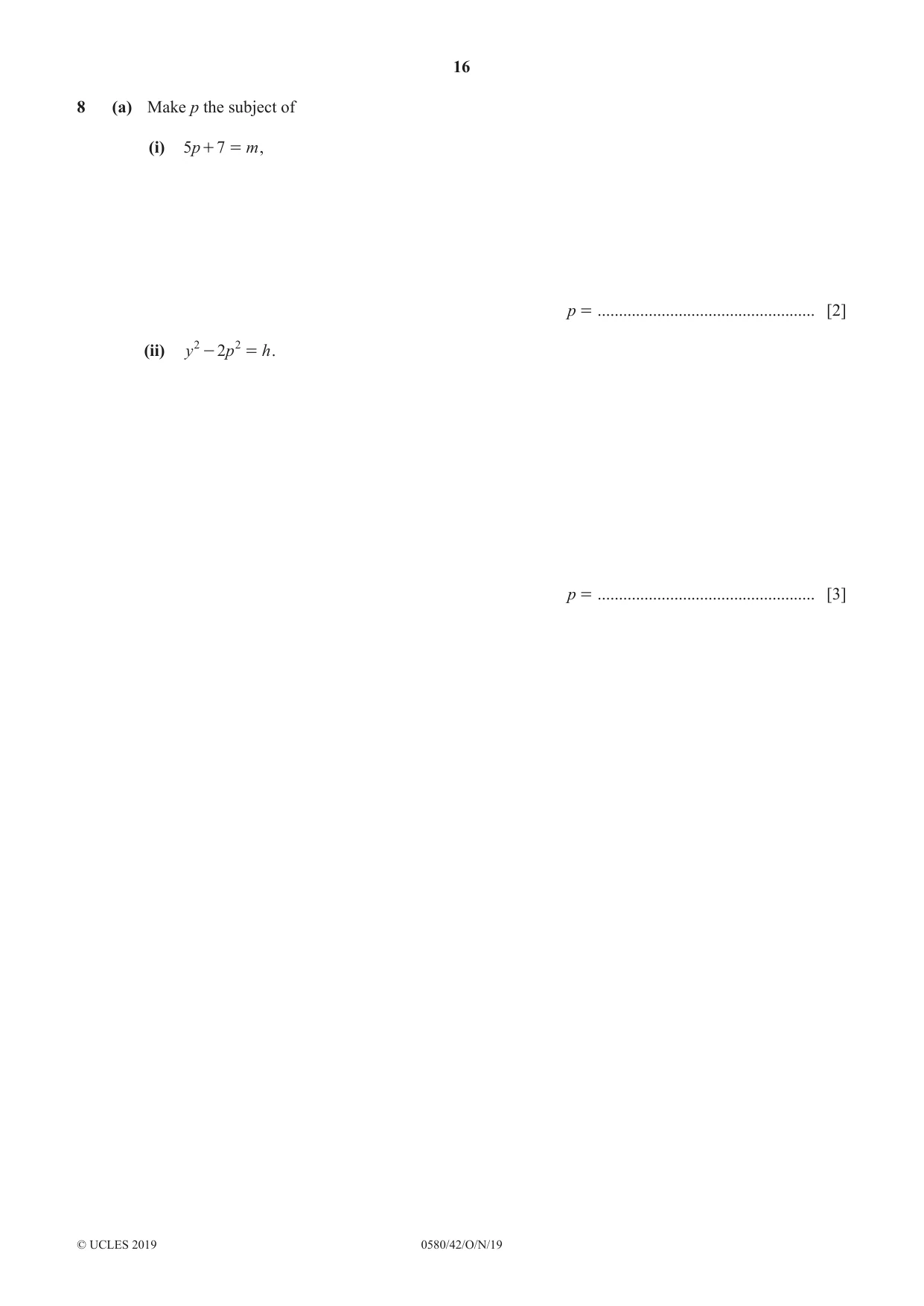
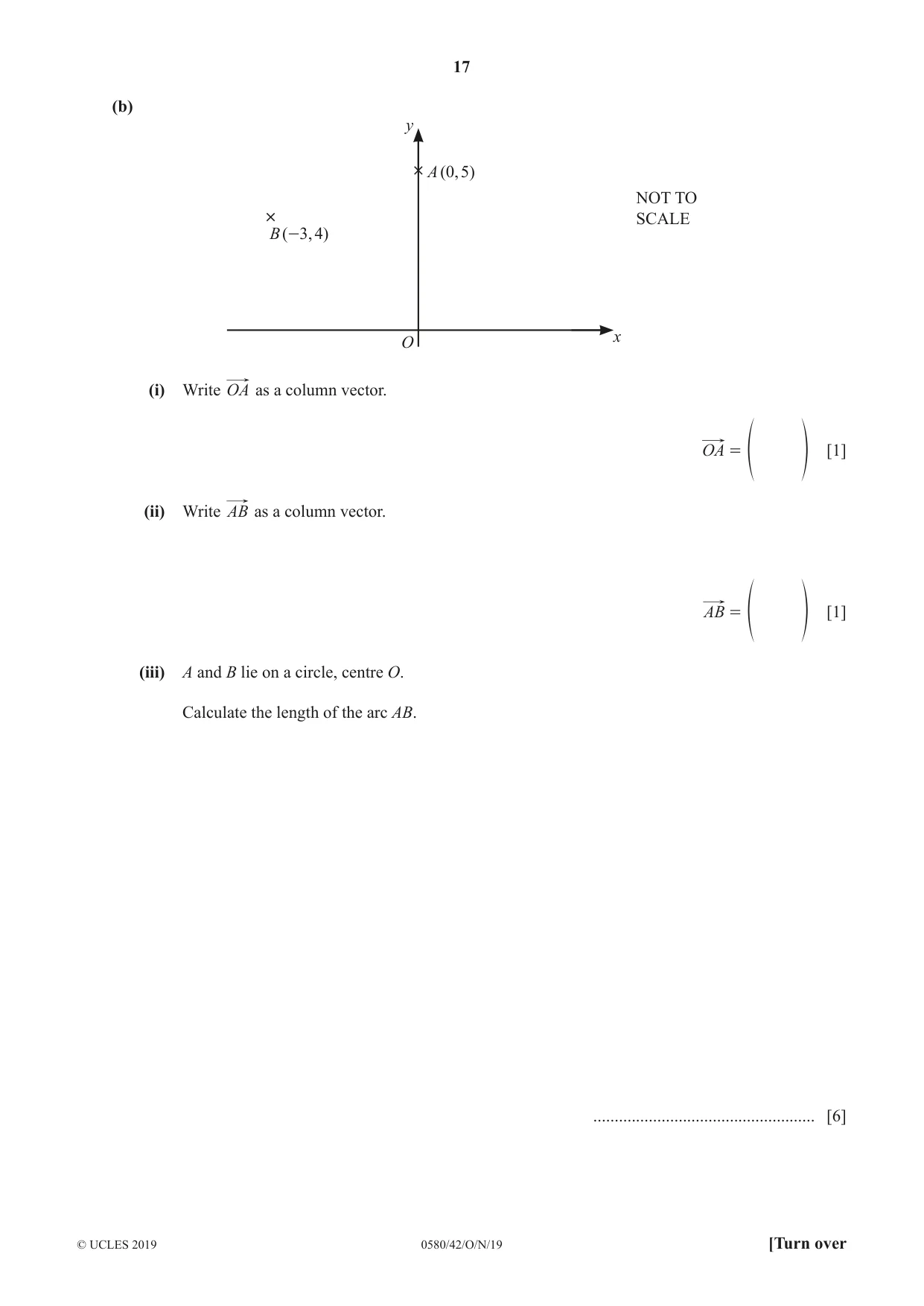
8 (a) Make p the subject of (i) 5p + 7 = m , p = ................................................... [2] (ii) y 2 - 2p 2 = h . p = ................................................... [3] (b) y A (0, 5) NOT TO SCALE B (-3, 4) x O (i) Write OA as a column vector. OA = [1] f p (ii) Write AB as a column vector. AB = [1] f p (iii) A and B lie on a circle, centre O. Calculate the length of the arc AB. .................................................... [6]
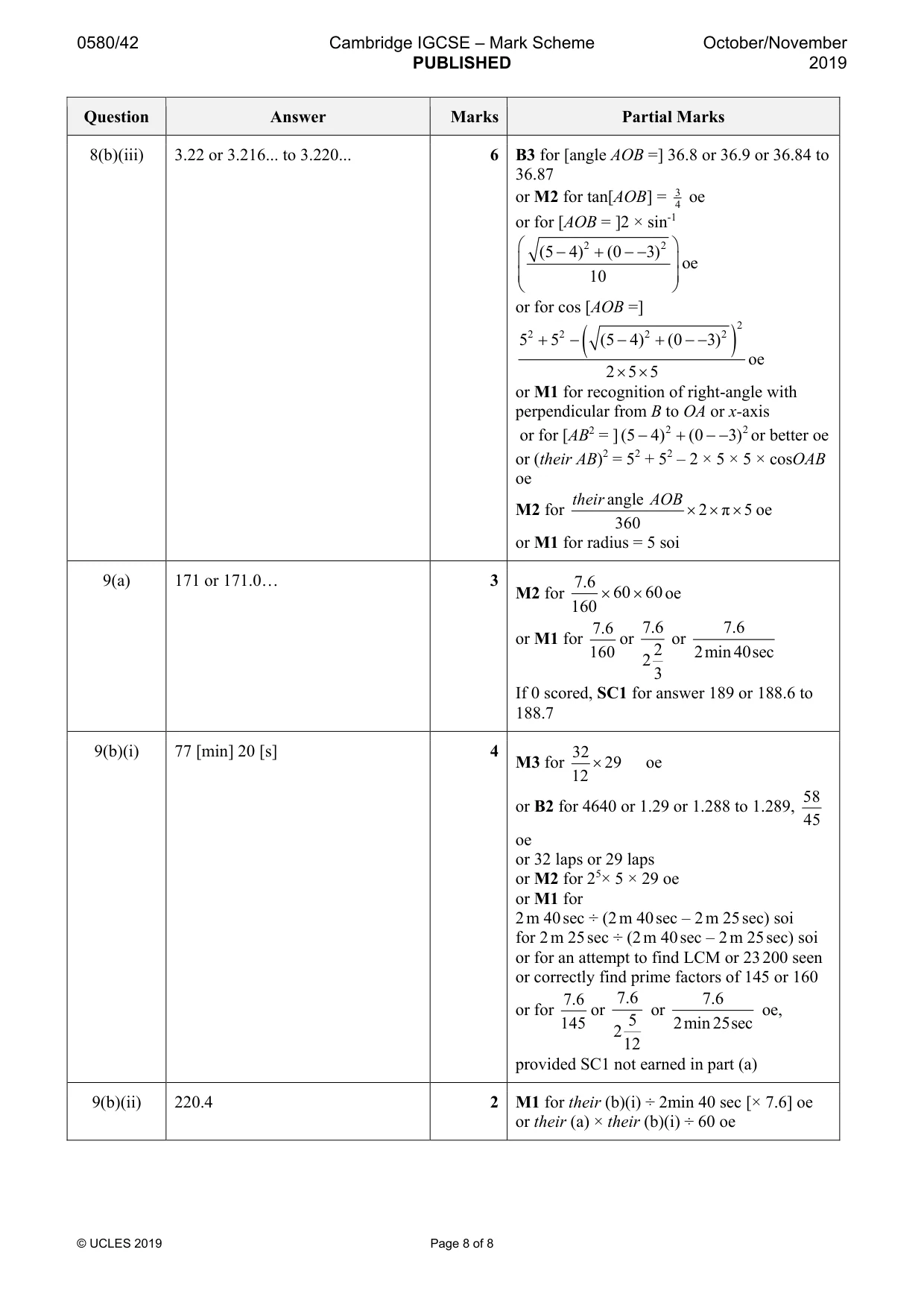
Mark scheme: 8(a)(i) m − 7 2 7 m oe final answer M1 for 5p = m – 7 or p + = 5 5 5 8(a)(ii) 2 2 3 M1 for first correct step isolate term in p or [± ] y − h or [ ± ] h − y oe divide by ±2 2 −2 M1 for second correct step FT their first step final answer 8(b)(i) 0 1 5 8(b)(ii) − 3 1 − 1 8(b)(iii) 3.22 or 3.216... to 3.220... 6 B3 for [angle AOB =] 36.8 or 36.9 or 36.84 to 36.87 or M2 for tan[AOB] = 34 oe or for [AOB = ]2 × sin-1 2 2 (5 − 4) + (0 −−3) oe 10 or for cos [AOB =] 2 5 2 + 5 2 − (5 − 4) 2 + (0 −−3) 2 ( ) oe 2 × 5 × 5 or M1 for recognition of right-angle with perpendicular from B to OA or x-axis or for [AB2 = ] (5 − 4) 2 + (0 −− 3) 2 or better oe or (their AB)2 = 52 + 52 – 2 × 5 × 5 × cosOAB oe their angle AOB M2 for × 2 × π × 5 oe 360 or M1 for radius = 5 soi
Q9 · Car A and car B take part in a race around a circular track
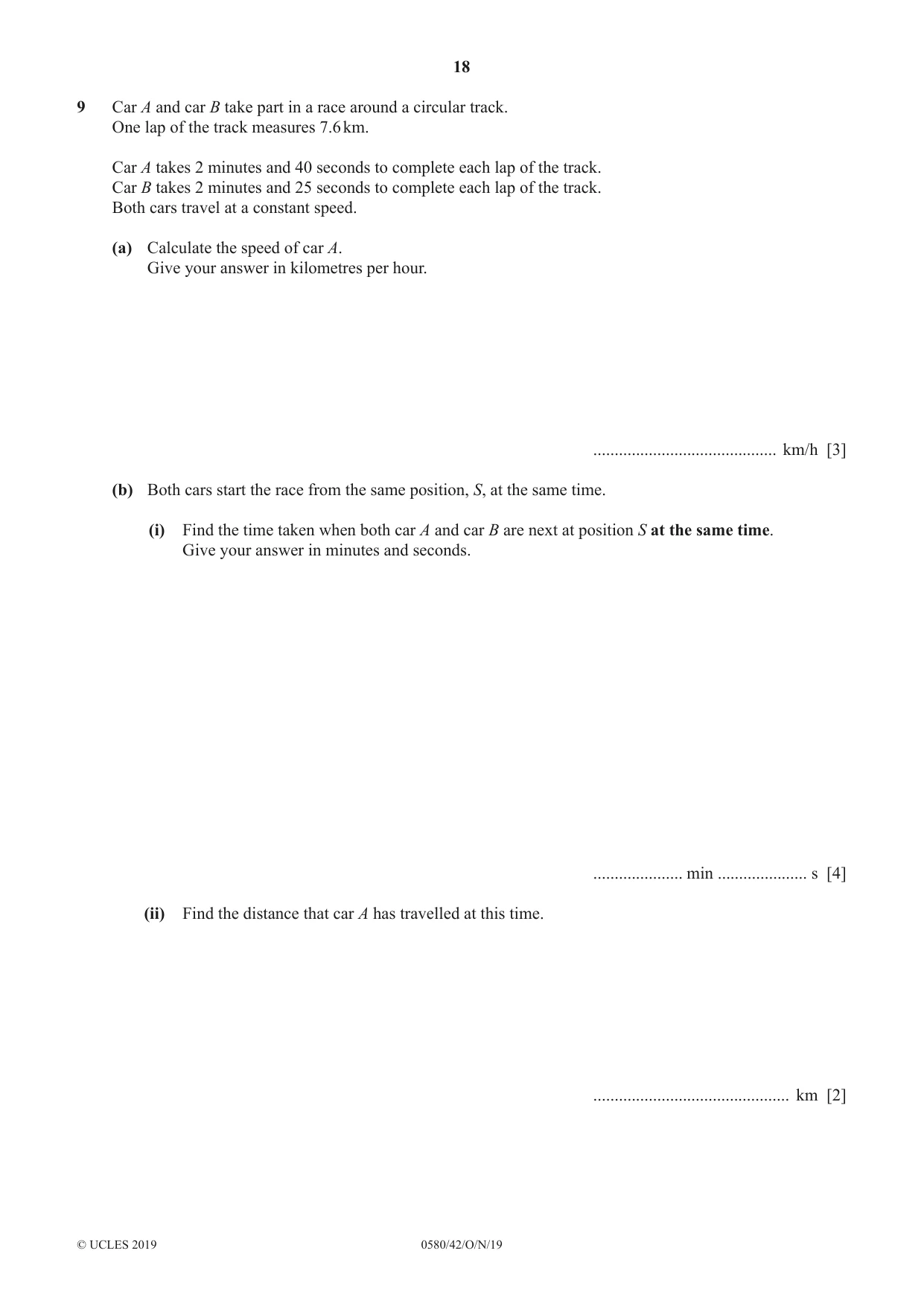
9 Car A and car B take part in a race around a circular track. One lap of the track measures 7.6 km. Car A takes 2 minutes and 40 seconds to complete each lap of the track. Car B takes 2 minutes and 25 seconds to complete each lap of the track. Both cars travel at a constant speed. (a) Calculate the speed of car A. Give your answer in kilometres per hour. ........................................... km/h [3] (b) Both cars start the race from the same position, S, at the same time. (i) Find the time taken when both car A and car B are next at position S at the same time. Give your answer in minutes and seconds. ..................... min ..................... s [4] (ii) Find the distance that car A has travelled at this time. .............................................. km [2]
Mark scheme: 9(a) 171 or 171.0… 3 6.7 M2 for × 60 × 60 oe 160 7.6 7.6 7.6 or M1 for or or 160 2 2min 40sec 2 3 If 0 scored, SC1 for answer 189 or 188.6 to 188.7 9(b)(i) 77 [min] 20 [s] 4 32 M3 for × 29 oe 12 58 or B2 for 4640 or 1.29 or 1.288 to 1.289, 45 oe or 32 laps or 29 laps or M2 for 25× 5 × 29 oe or M1 for 2 m 40 sec ÷ (2 m 40 sec – 2 m 25 sec) soi for 2 m 25 sec ÷ (2 m 40 sec – 2 m 25 sec) soi or for an attempt to find LCM or 23 200 seen or correctly find prime factors of 145 or 160 7.6 7.6 7.6 or for or or oe, 145 5 2min 25sec 212 provided SC1 not earned in part (a) 9(b)(ii) 220.4 2 M1 for their (b)(i) ÷ 2min 40 sec [× 7.6] oe or their (a) × their (b)(i) ÷ 60 oe
What was in this paper
The subtopics covered by these 9 questions, and how many questions each got. Open one in a new tab to see every Cambridge question on it.
What you needed in this session
Cambridge’s own grade thresholds for 2019 Oct/Nov, Paper 4 · Variant 2. A higher threshold means an easier paper — the bar moves with how the cohort did.