Cambridge IGCSE Mathematics 0580 — 2018 May/June Paper 4 · Variant 3
0580/43/M/J/18 · 10 questions · 130 marks · ≈146 min
The question paper and its mark scheme, free to read here and free to download. This is Cambridge’s own paper, exactly as it was sat.
Question paper20 pages
Mark scheme8 pages
Answers below. Sit the paper first if you are practising.
Questions as text
Q1 · Rowena buys and sells clothes
1 (a) Rowena buys and sells clothes. (i) She buys a jacket for $40 and sells it for $45.40 . Calculate the percentage profit. ............................................ % [3] (ii) She sells a dress for $42.60 after making a profit of 20% on the cost price. Calculate the cost price. $ ............................................... [3] (b) Sara invests $500 for 15 years at a rate of 2% per year simple interest. Calculate the total interest Sara receives. $ ............................................... [2] (c) Tomas has two cars. (i) The value, today, of one car is $21 000. The value of this car decreases exponentially by 18% each year. Calculate the value of this car after 5 years. Give your answer correct to the nearest hundred dollars. $ ............................................... [3] (ii) The value, today, of the other car is $15 000. The value of this car increases exponentially by x % each year. After 12 years the value of the car will be $42 190. Calculate the value of x. x = ............................................... [3]
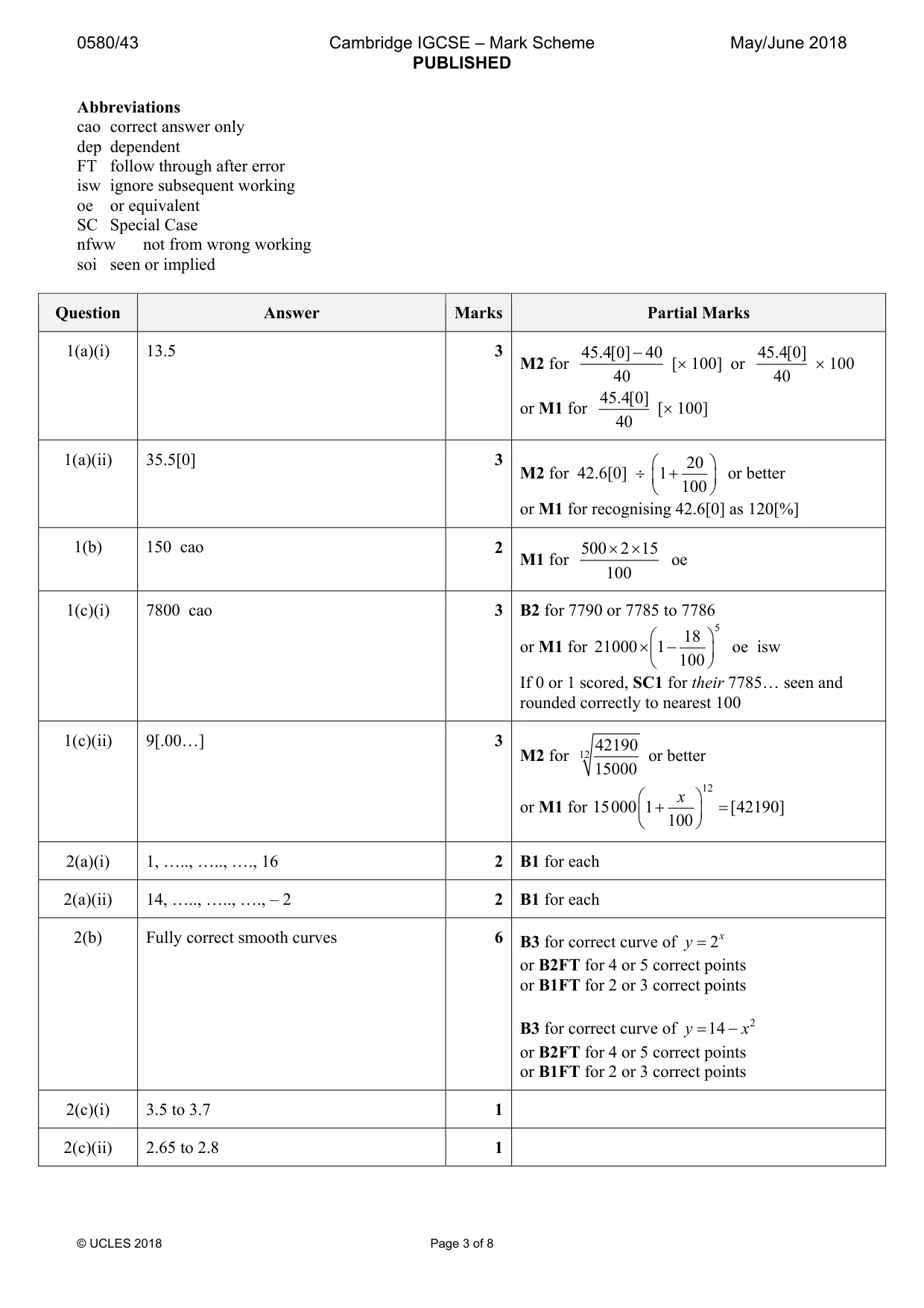
Mark scheme: Question Answer Marks Partial Marks 1(a)(i) 13.5 3 45.4[0] − 40 45.4[0] M2 for [× 100] or × 100 40 40 45.4[0] or M1 for [× 100] 40 1(a)(ii) 35.5[0] 3 20 M2 for 42.6[0] ÷ 1 + or better 100 or M1 for recognising 42.6[0] as 120[%] 1(b) 150 cao 2 500 × 2 × 15 M1 for oe 100 1(c)(i) 7800 cao 3 B2 for 7790 or 7785 to 7786 18 5 or M1 for 21000 × 1 − oe isw 100 If 0 or 1 scored, SC1 for their 7785… seen and rounded correctly to nearest 100 1(c)(ii) 9[.00…] 3 42190 M2 for 12 or better 15000 x 12 or M1 for 15000 1 + = [42190] 100
Q2 · Y = 2x Complete the table
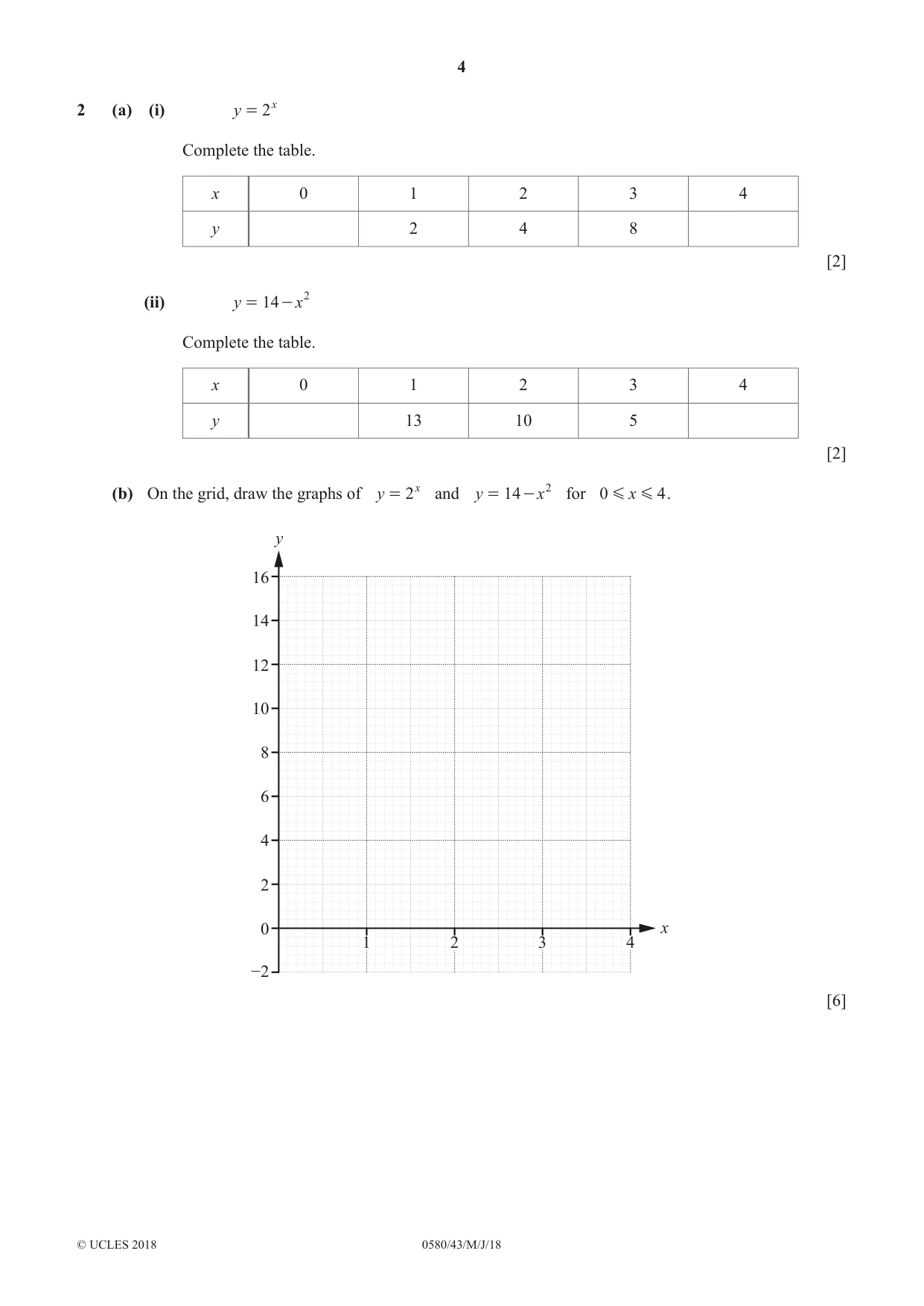
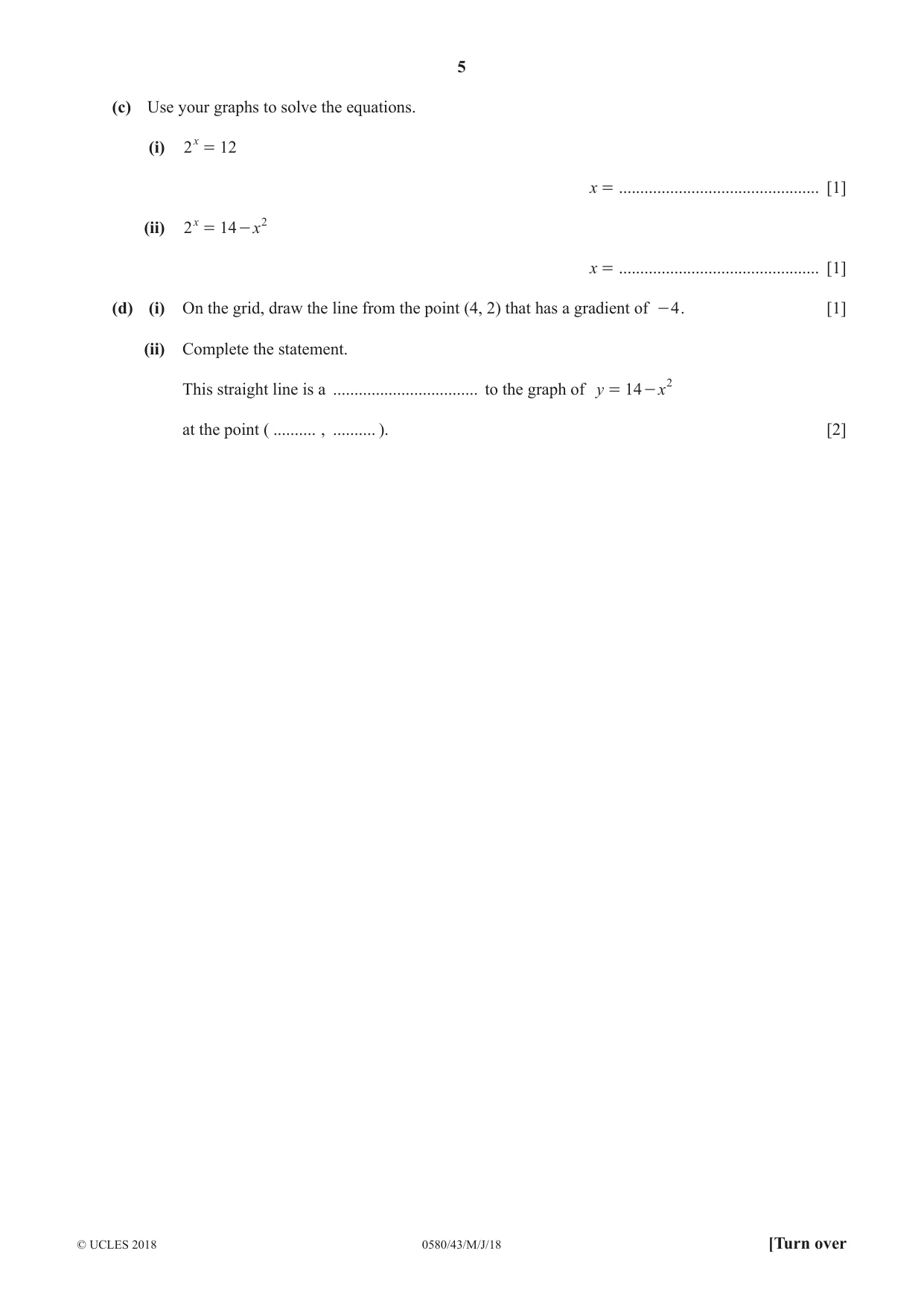
2 (a) (i) y = 2x Complete the table. x 0 1 2 3 4 y 2 4 8 [2] (ii) y = 14 - x 2 Complete the table. x 0 1 2 3 4 y 13 10 5 [2] (b) On the grid, draw the graphs of y = 2x and y = 14 - x 2 for 0 G x G 4 . y 16 14 12 10 8 6 4 2 0 x 1 2 3 4 −2 [6] (c) Use your graphs to solve the equations. (i) 2 x = 12 x = ............................................... [1] (ii) 2 x = 14 - x 2 x = ............................................... [1] (d) (i) On the grid, draw the line from the point (4, 2) that has a gradient of - 4 . [1] (ii) Complete the statement. This straight line is a .................................. to the graph of y = 14 - x 2 at the point ( .......... , .......... ). [2]
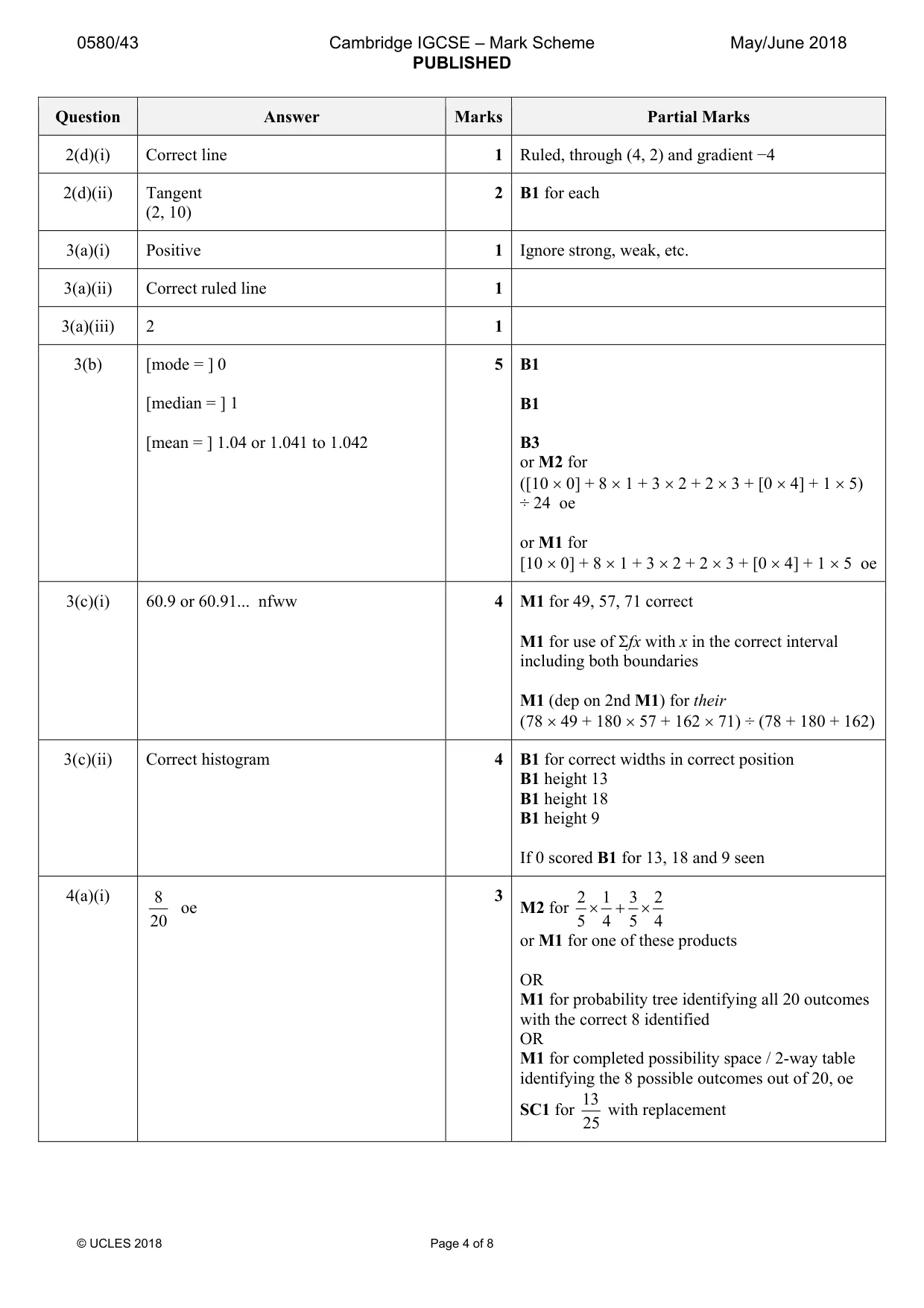
Mark scheme: 2(a)(i) 1, ….., ….., …., 16 2 B1 for each 2(a)(ii) 14, ….., ….., …., – 2 2 B1 for each 2(b) Fully correct smooth curves 6 B3 for correct curve of y = 2 x or B2FT for 4 or 5 correct points or B1FT for 2 or 3 correct points B3 for correct curve of y = 14 − x 2 or B2FT for 4 or 5 correct points or B1FT for 2 or 3 correct points 2(c)(i) 3.5 to 3.7 1 2(c)(ii) 2.65 to 2.8 1 2(d)(i) Correct line 1 Ruled, through (4, 2) and gradient −4 2(d)(ii) Tangent 2 B1 for each (2, 10)
Q3 · The scatter diagram shows the physics mark and the chemistry mark for each of 12 students
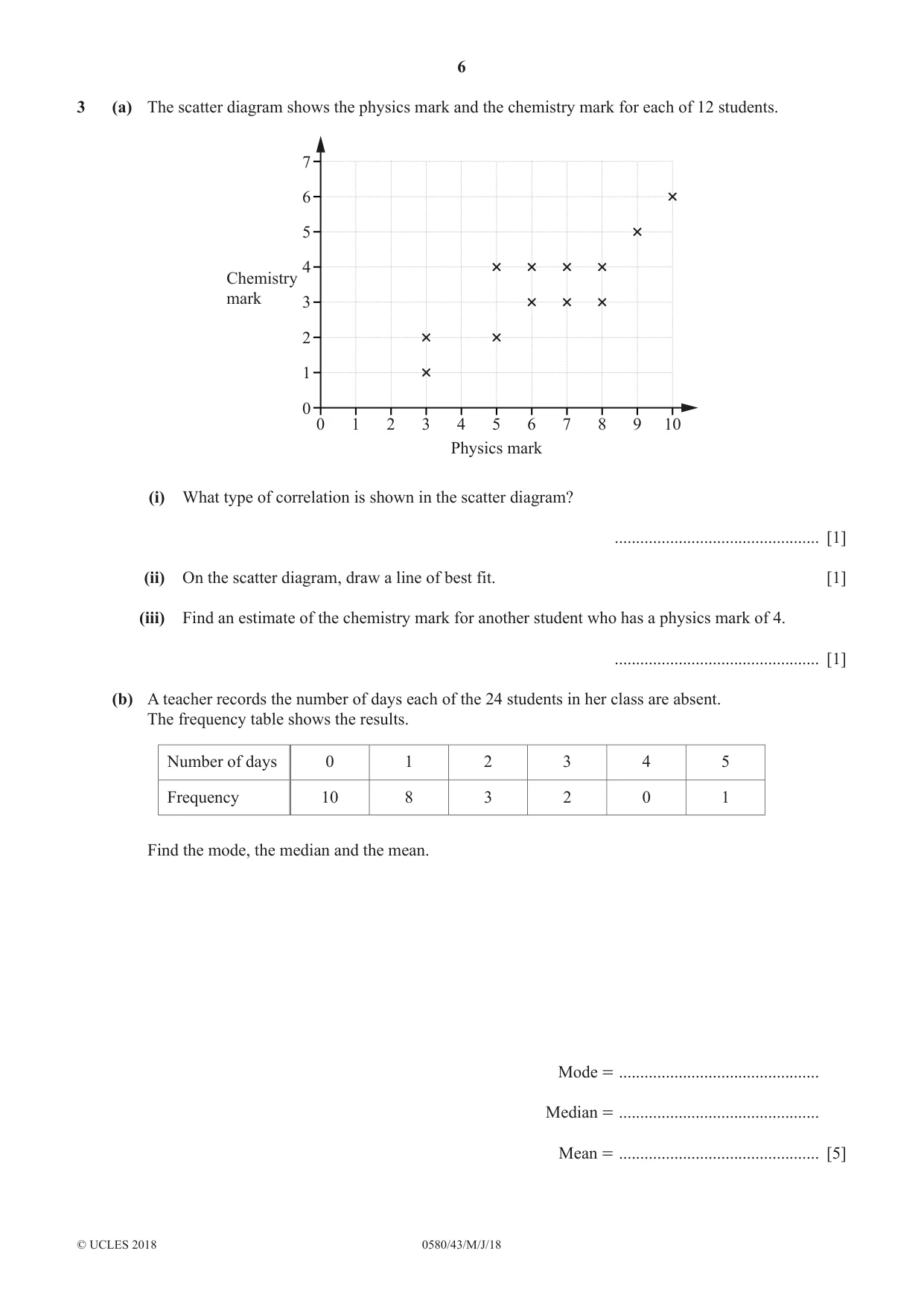
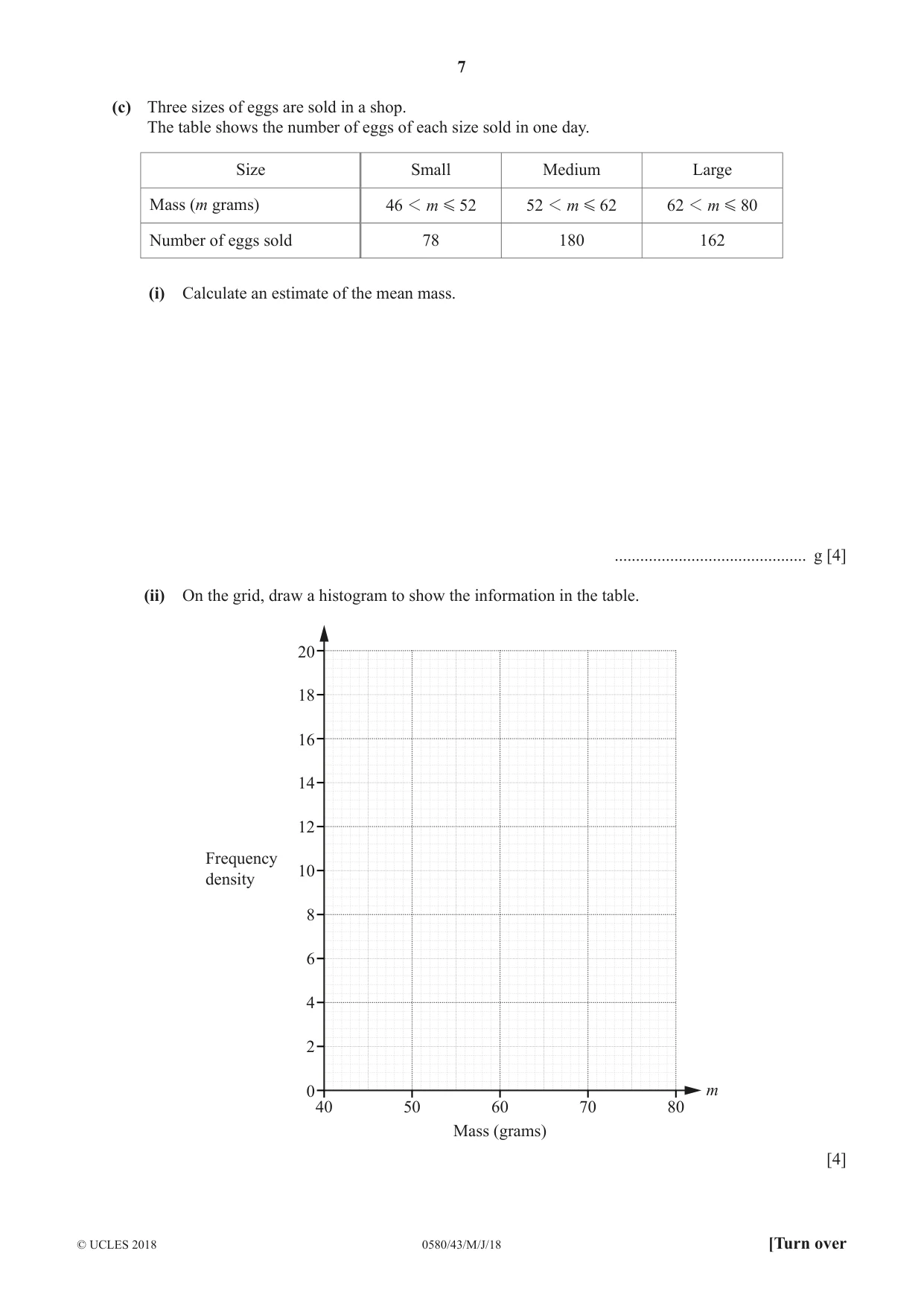
3 (a) The scatter diagram shows the physics mark and the chemistry mark for each of 12 students. 7 6 5 4 Chemistry mark 3 2 1 0 0 1 2 3 4 5 6 7 8 9 10 Physics mark (i) What type of correlation is shown in the scatter diagram? ................................................ [1] (ii) On the scatter diagram, draw a line of best fit. [1] (iii) Find an estimate of the chemistry mark for another student who has a physics mark of 4. ................................................ [1] (b) A teacher records the number of days each of the 24 students in her class are absent. The frequency table shows the results. Number of days 0 1 2 3 4 5 Frequency 10 8 3 2 0 1 Find the mode, the median and the mean. Mode = ............................................... Median = ............................................... Mean = ............................................... [5] (c) Three sizes of eggs are sold in a shop. The table shows the number of eggs of each size sold in one day. Size Small Medium Large Mass (m grams) 46 1 m G 52 52 1 m G 62 62 1 m G 80 Number of eggs sold 78 180 162 (i) Calculate an estimate of the mean mass. ............................................. g [4] (ii) On the grid, draw a histogram to show the information in the table. 20 18 16 14 12 Frequency 10 density 8 6 4 2 0 m 40 50 60 70 80 Mass (grams) [4]
Mark scheme: 3(a)(i) Positive 1 Ignore strong, weak, etc. 3(a)(ii) Correct ruled line 1 3(a)(iii) 2 1 3(b) [mode = ] 0 5 B1 [median = ] 1 B1 [mean = ] 1.04 or 1.041 to 1.042 B3 or M2 for ([10 × 0] + 8 × 1 + 3 × 2 + 2 × 3 + [0 × 4] + 1 × 5) ÷ 24 oe or M1 for [10 × 0] + 8 × 1 + 3 × 2 + 2 × 3 + [0 × 4] + 1 × 5 oe 3(c)(i) 60.9 or 60.91... nfww 4 M1 for 49, 57, 71 correct M1 for use of Σfx with x in the correct interval including both boundaries M1 (dep on 2nd M1) for their (78 × 49 + 180 × 57 + 162 × 71) ÷ (78 + 180 + 162) 3(c)(ii) Correct histogram 4 B1 for correct widths in correct position B1 height 13 B1 height 18 B1 height 9 If 0 scored B1 for 13, 18 and 9 seen
Q4 · The diagram shows two sets of cards
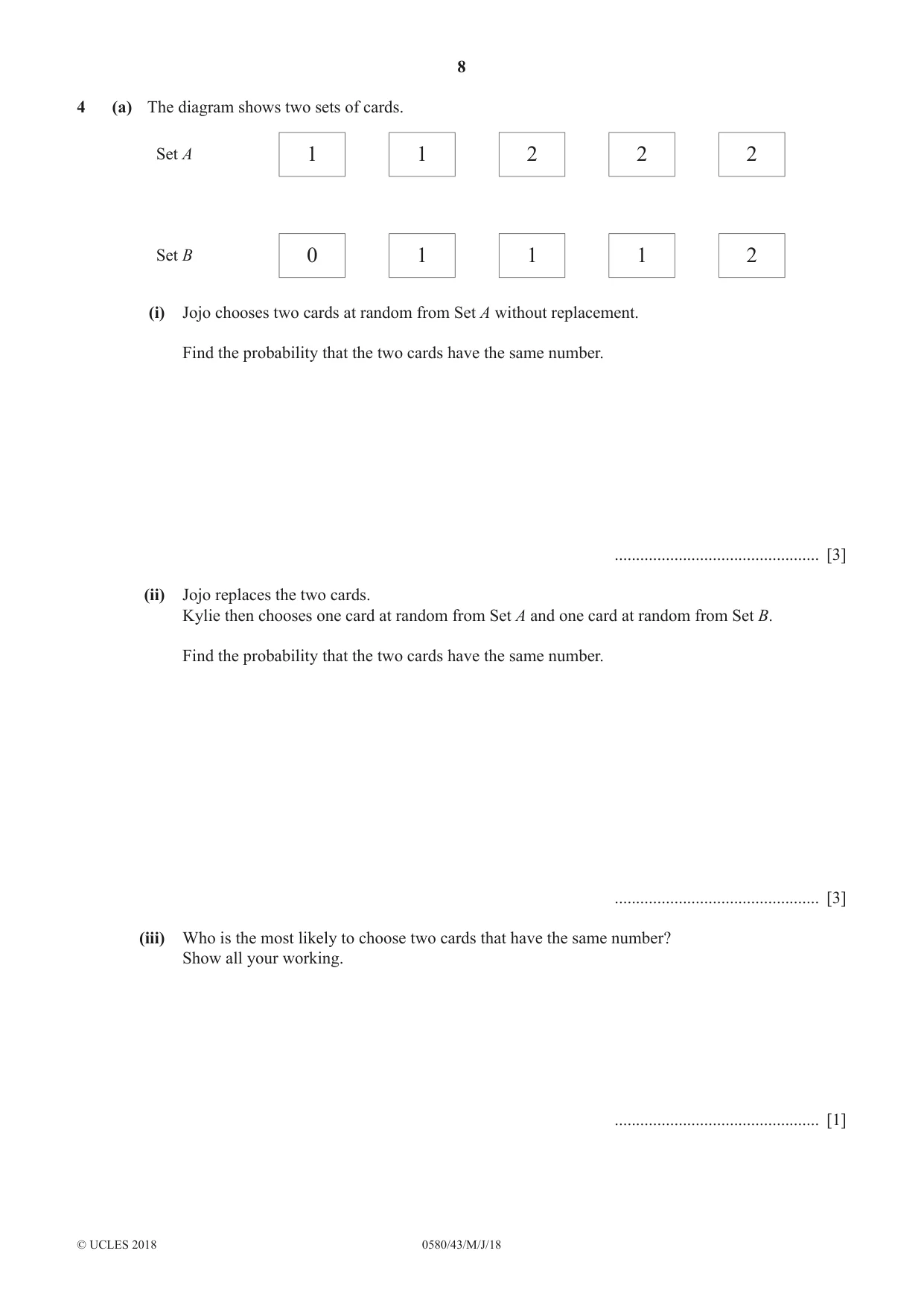
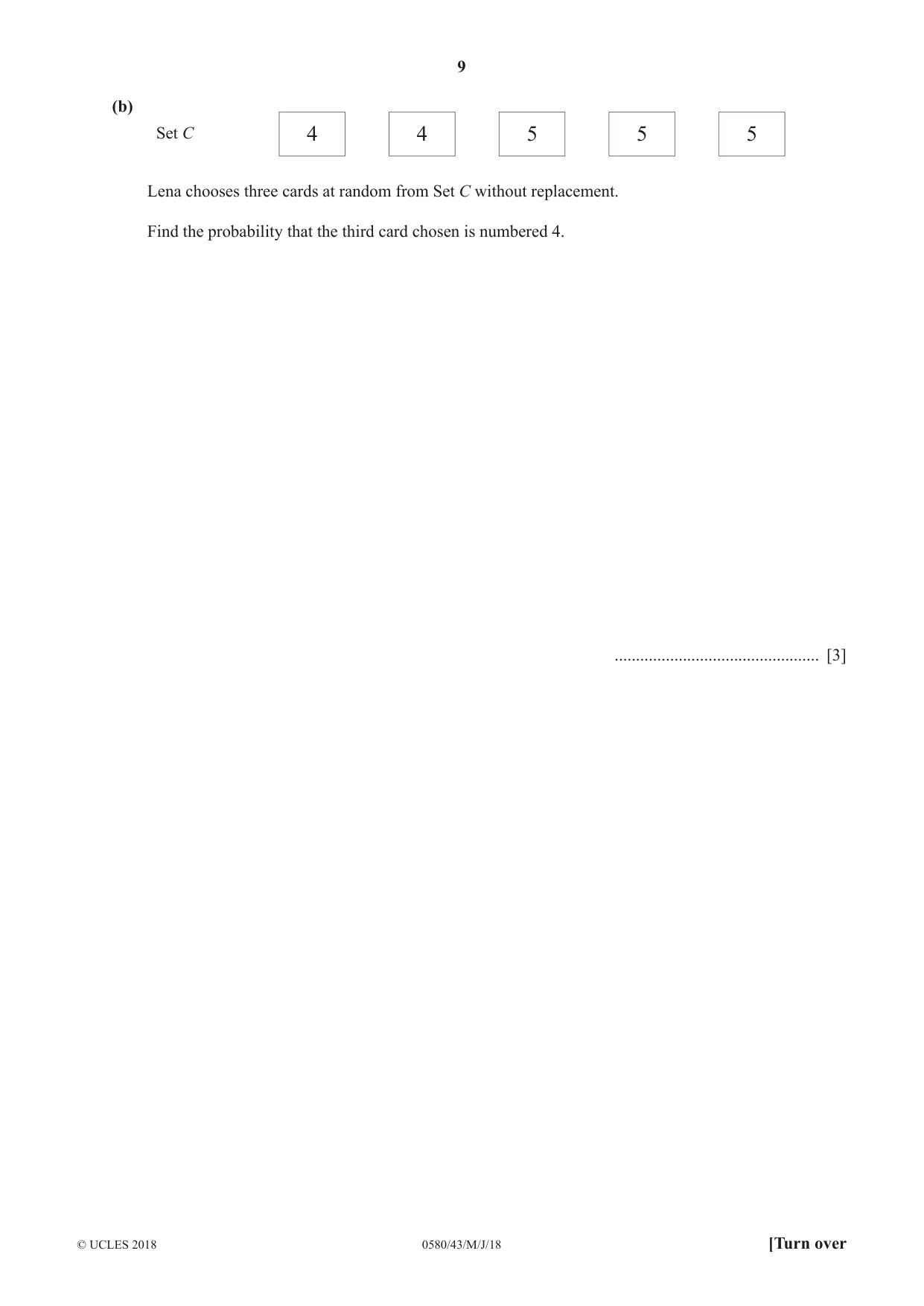
4 (a) The diagram shows two sets of cards. Set A 1 1 2 2 2 Set B 0 1 1 1 2 (i) Jojo chooses two cards at random from Set A without replacement. Find the probability that the two cards have the same number. ................................................ [3] (ii) Jojo replaces the two cards. Kylie then chooses one card at random from Set A and one card at random from Set B. Find the probability that the two cards have the same number. ................................................ [3] (iii) Who is the most likely to choose two cards that have the same number? Show all your working. ................................................ [1] (b) Set C 4 4 5 5 5 Lena chooses three cards at random from Set C without replacement. Find the probability that the third card chosen is numbered 4. ................................................ [3]
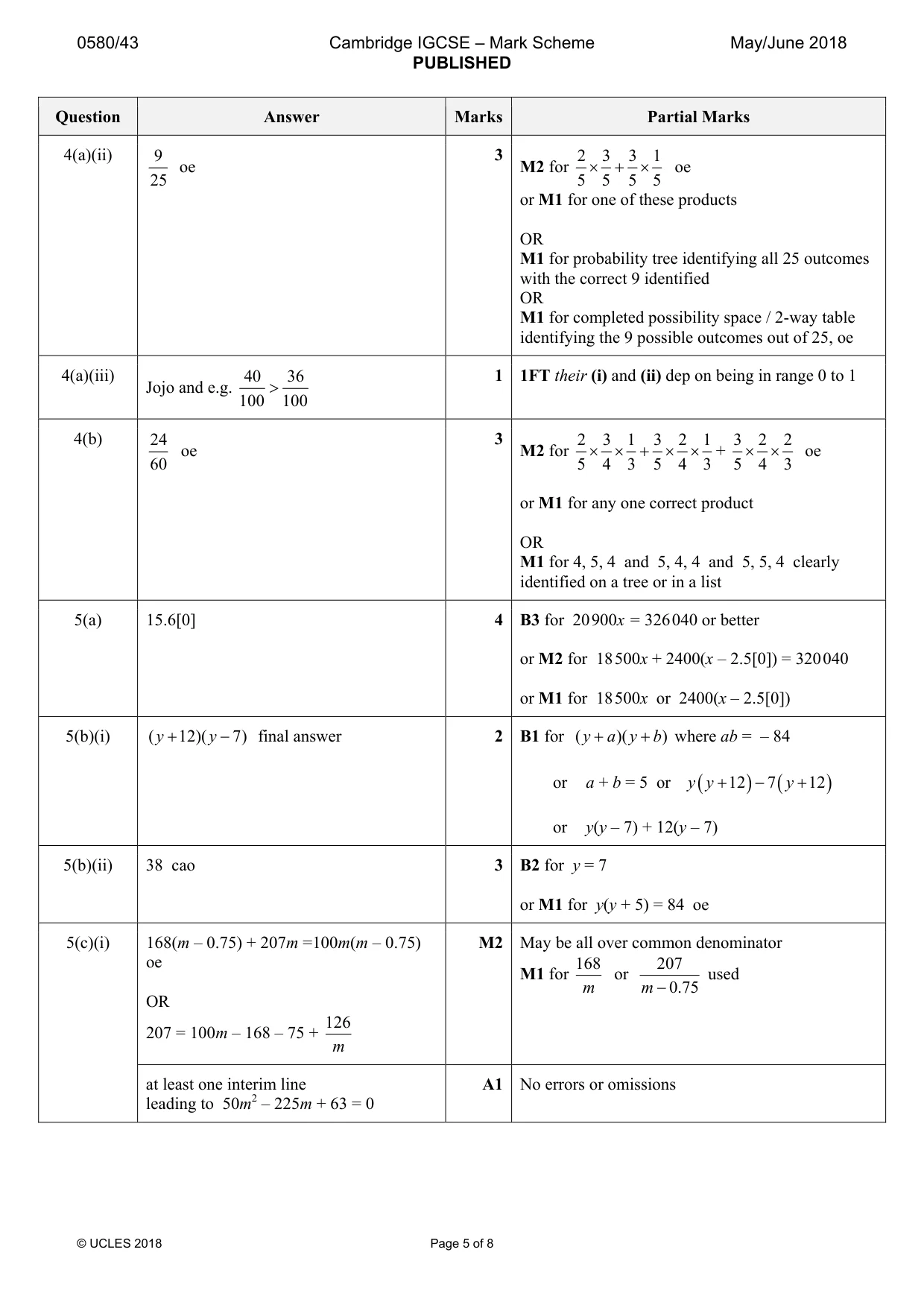
Mark scheme: 4(a)(i) 8 3 2 1 3 2 oe M2 for × + × 20 5 4 5 4 or M1 for one of these products OR M1 for probability tree identifying all 20 outcomes with the correct 8 identified OR M1 for completed possibility space / 2-way table identifying the 8 possible outcomes out of 20, oe 13 SC1 for with replacement 25 4(a)(ii) 9 3 2 3 3 1 oe M2 for × + × oe 25 5 5 5 5 or M1 for one of these products OR M1 for probability tree identifying all 25 outcomes with the correct 9 identified OR M1 for completed possibility space / 2-way table identifying the 9 possible outcomes out of 25, oe 4(a)(iii) 40 36 1 1FT their (i) and (ii) dep on being in range 0 to 1 Jojo and e.g. > 100 100 4(b) 24 3 2 3 1 3 2 1 3 2 2 oe M2 for × × + × × + × × oe 60 5 4 3 5 4 3 5 4 3 or M1 for any one correct product OR M1 for 4, 5, 4 and 5, 4, 4 and 5, 5, 4 clearly identified on a tree or in a list
Q5 · At a football match, the price of an adult ticket is $x and the price of a child ticket…
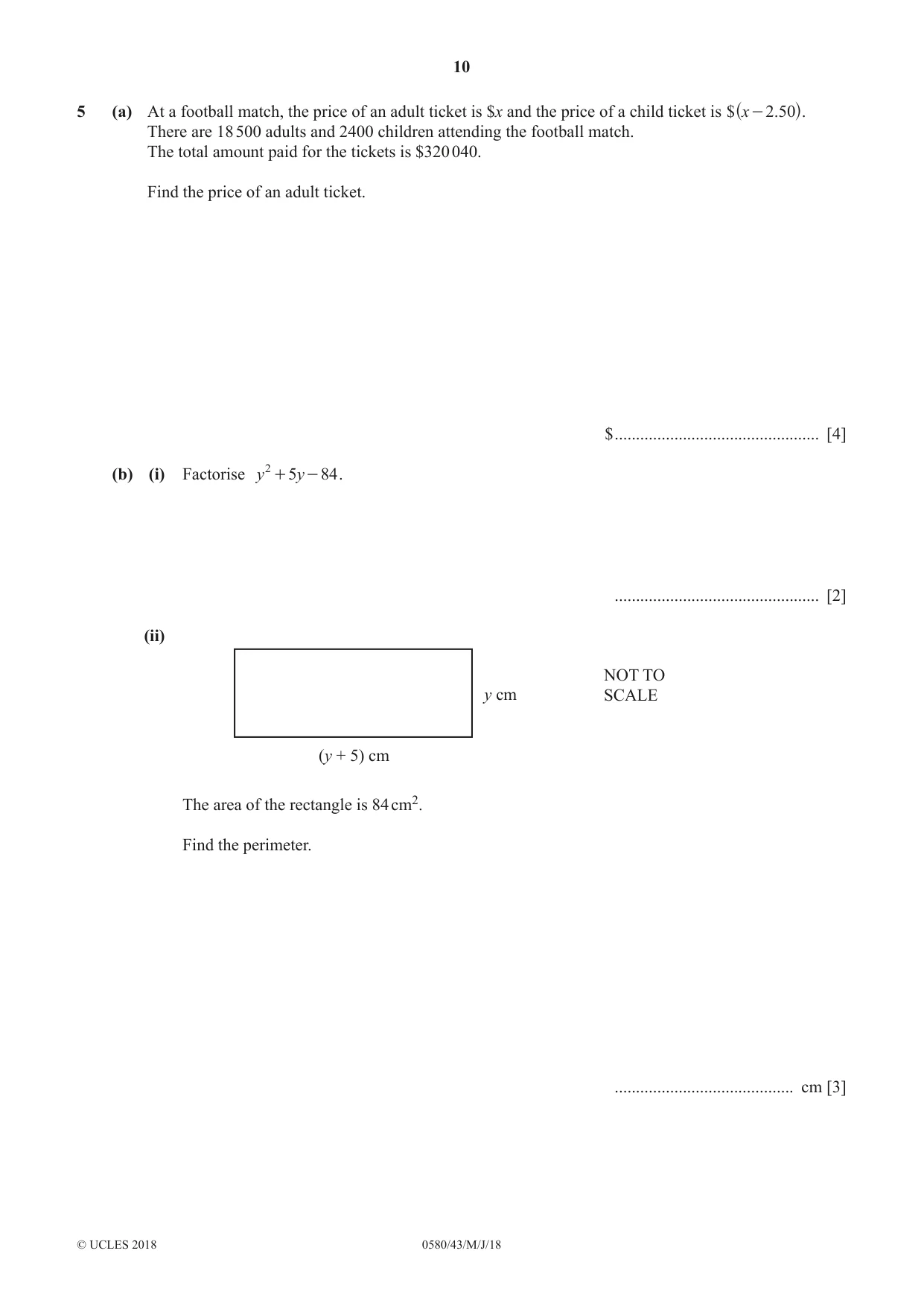
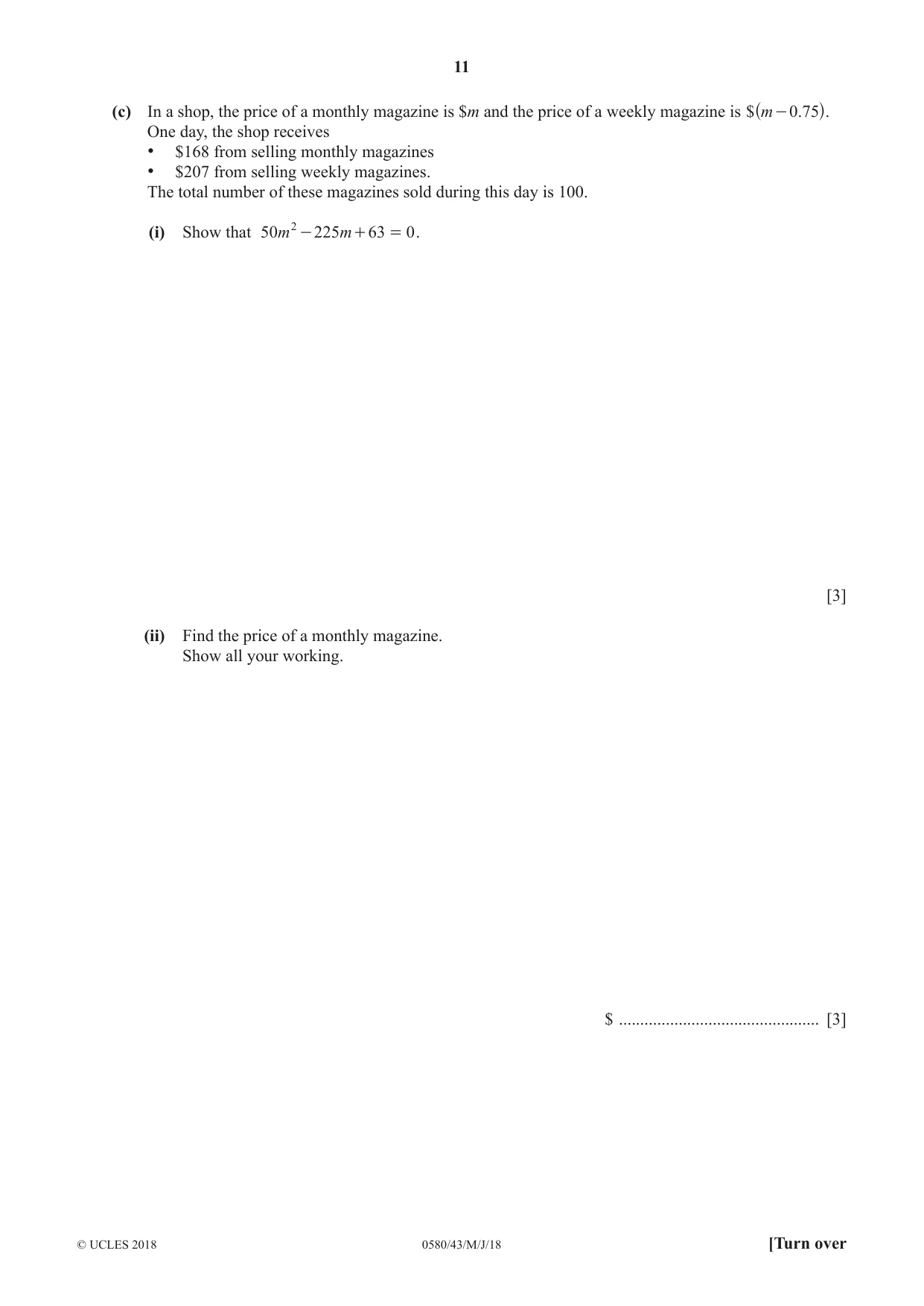
5 (a) At a football match, the price of an adult ticket is $x and the price of a child ticket is $ x - 2.50 ^ h. There are 18 500 adults and 2400 children attending the football match. The total amount paid for the tickets is $320 040. Find the price of an adult ticket. $ ................................................ [4] (b) (i) Factorise y 2 + 5y - 84 . ................................................ [2] (ii) NOT TO y cm SCALE (y + 5) cm The area of the rectangle is 84 cm2. Find the perimeter. .......................................... cm [3] (c) In a shop, the price of a monthly magazine is $m and the price of a weekly magazine is $ m - 0.75 ^ h. One day, the shop receives • $168 from selling monthly magazines • $207 from selling weekly magazines. The total number of these magazines sold during this day is 100. (i) Show that 50m 2 - 225m + 63 = 0 . [3] (ii) Find the price of a monthly magazine. Show all your working. $ ............................................... [3]
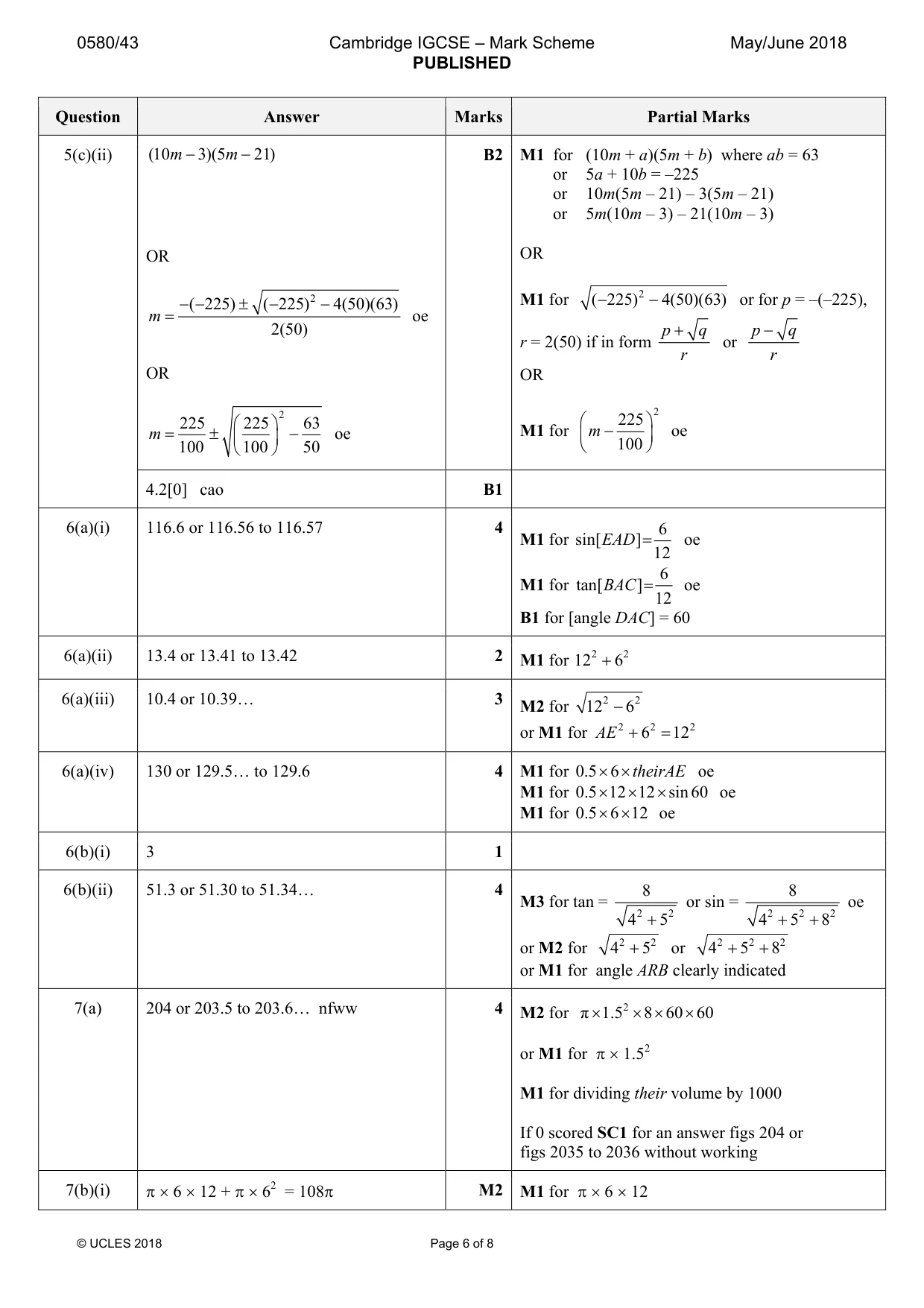
Mark scheme: 5(a) 15.6[0] 4 B3 for 20 900x = 326 040 or better or M2 for 18 500x + 2400(x – 2.5[0]) = 320 040 or M1 for 18 500x or 2400(x – 2.5[0]) 5(b)(i) ( y + 12)( y − 7) final answer 2 B1 for ( y + a )( y + b ) where ab = – 84 or a + b = 5 or y ( y + 12 ) − 7 ( y + 12 ) or y(y – 7) + 12(y – 7) 5(b)(ii) 38 cao 3 B2 for y = 7 or M1 for y(y + 5) = 84 oe 5(c)(i) 168(m – 0.75) + 207m =100m(m – 0.75) M2 May be all over common denominator oe 168 207 M1 for or used m m − 0.75 OR 126 207 = 100m – 168 – 75 + m at least one interim line A1 No errors or omissions leading to 50m2 – 225m + 63 = 0 5(c)(ii) (10 m − 3)(5 m − 21) B2 M1 for (10m + a)(5m + b) where ab = 63 or 5a + 10b = –225 or 10m(5m – 21) – 3(5m – 21) or 5m(10m – 3) – 21(10m – 3) OR OR −−( 225) ± ( −225) 2 − 4(50)(63) M1 for ( −225) 2 − 4(50)(63) or for p = –(–225), m = oe 2(50) p + q p − q r = 2(50) if in form or r r OR OR 225 225 2 63 225 2 m = ± − oe M1 for m − oe 100 100 50 100 4.2[0] cao B1
Q6 · E 6 cm D NOT TO SCALE A 12 cm C 6 cm B In the pentagon ABCDE, angle ACB = angle AED = 90°
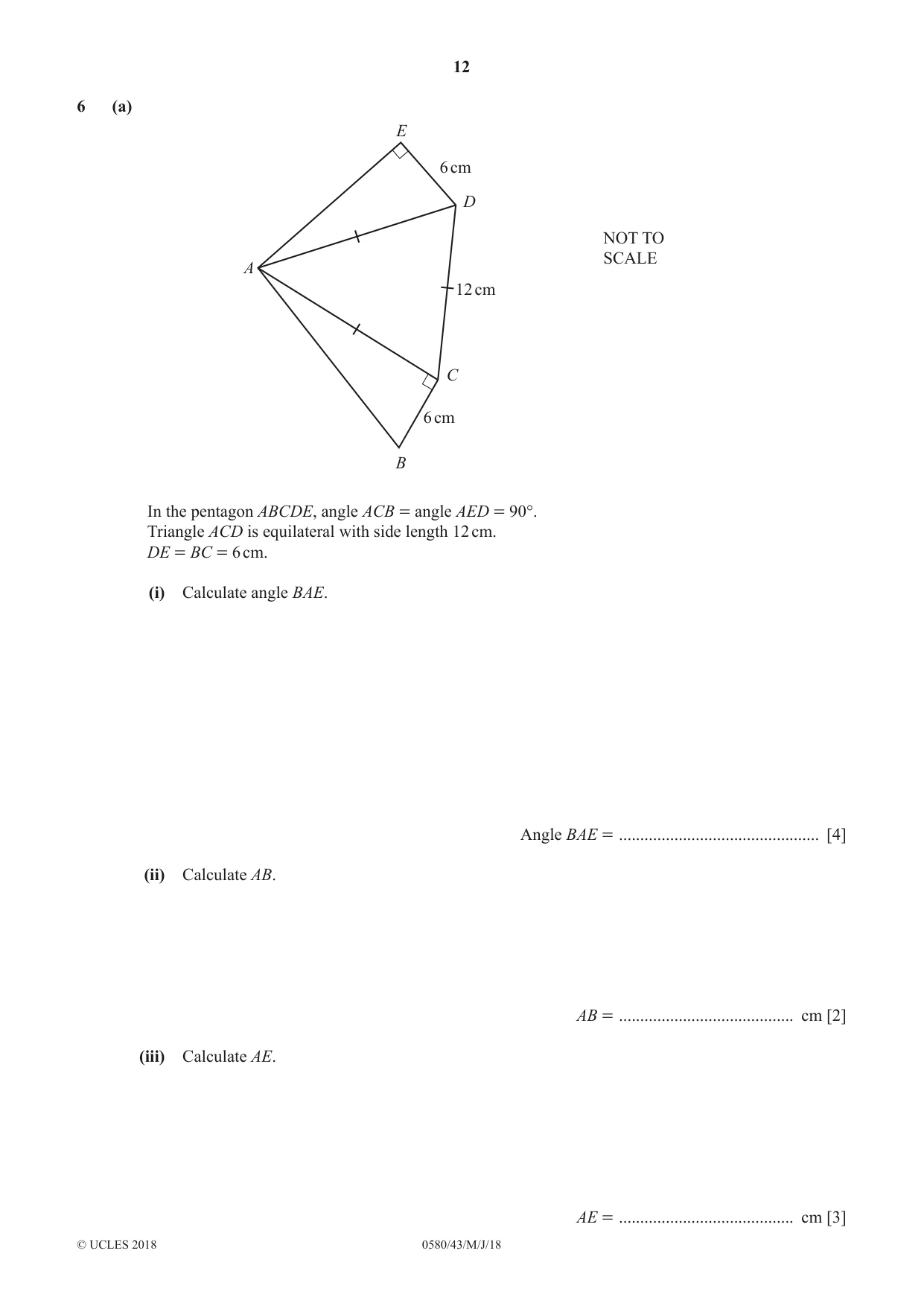
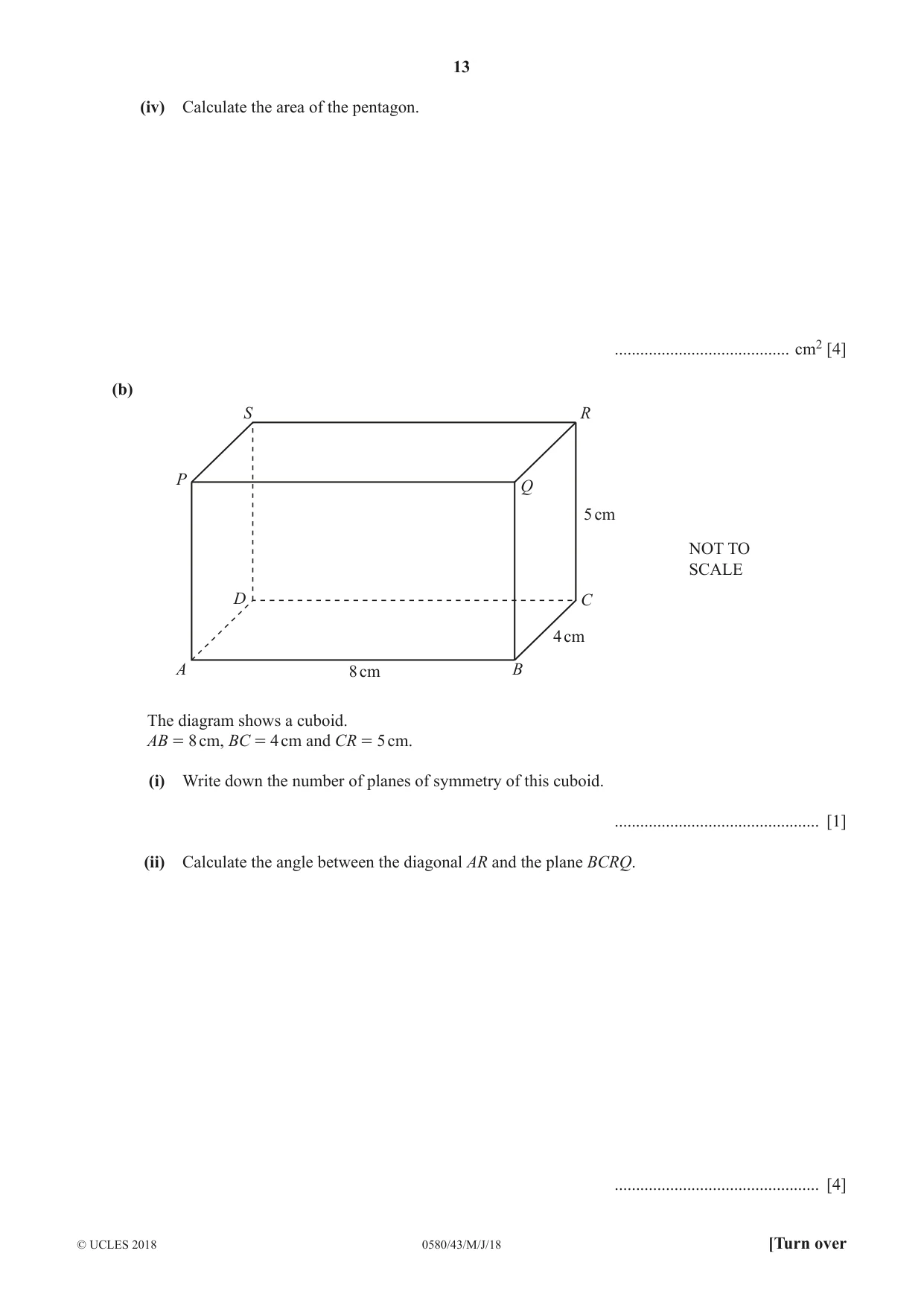
6 (a) E 6 cm D NOT TO SCALE A 12 cm C 6 cm B In the pentagon ABCDE, angle ACB = angle AED = 90°. Triangle ACD is equilateral with side length 12 cm. DE = BC = 6 cm. (i) Calculate angle BAE. Angle BAE = ............................................... [4] (ii) Calculate AB. AB = ......................................... cm [2] (iii) Calculate AE. AE = ......................................... cm [3] (iv) Calculate the area of the pentagon. ......................................... cm2 [4] (b) S R P Q 5 cm NOT TO SCALE D C 4 cm A 8 cm B The diagram shows a cuboid. AB = 8 cm, BC = 4 cm and CR = 5 cm. (i) Write down the number of planes of symmetry of this cuboid. ................................................ [1] (ii) Calculate the angle between the diagonal AR and the plane BCRQ. ................................................ [4]
Mark scheme: 6(a)(i) 116.6 or 116.56 to 116.57 4 6 M1 for sin[ EAD ] = oe 12 6 M1 for tan[ BAC ] = oe 12 B1 for [angle DAC] = 60 6(a)(ii) 13.4 or 13.41 to 13.42 2 M1 for 12 2 + 6 2 6(a)(iii) 10.4 or 10.39… 3 2 2 M2 for 12 − 6 or M1 for AE 2 + 6 2 = 12 2 6(a)(iv) 130 or 129.5… to 129.6 4 M1 for 0.5 × 6 ×theirAE oe M1 for 0.5 × 12 × 12 × sin60 oe M1 for 0.5 × 6 × 12 oe 6(b)(i) 3 1 6(b)(ii) 51.3 or 51.30 to 51.34… 4 8 8 M3 for tan = or sin = oe 4 2 + 5 2 4 2 + 5 2 + 8 2 or M2 for 4 2 + 5 2 or 4 2 + 5 2 + 8 2 or M1 for angle ARB clearly indicated
Q7 · NOT TO SCALE 1.5 cm Water flows through a cylindrical pipe at a speed of 8 cm/s
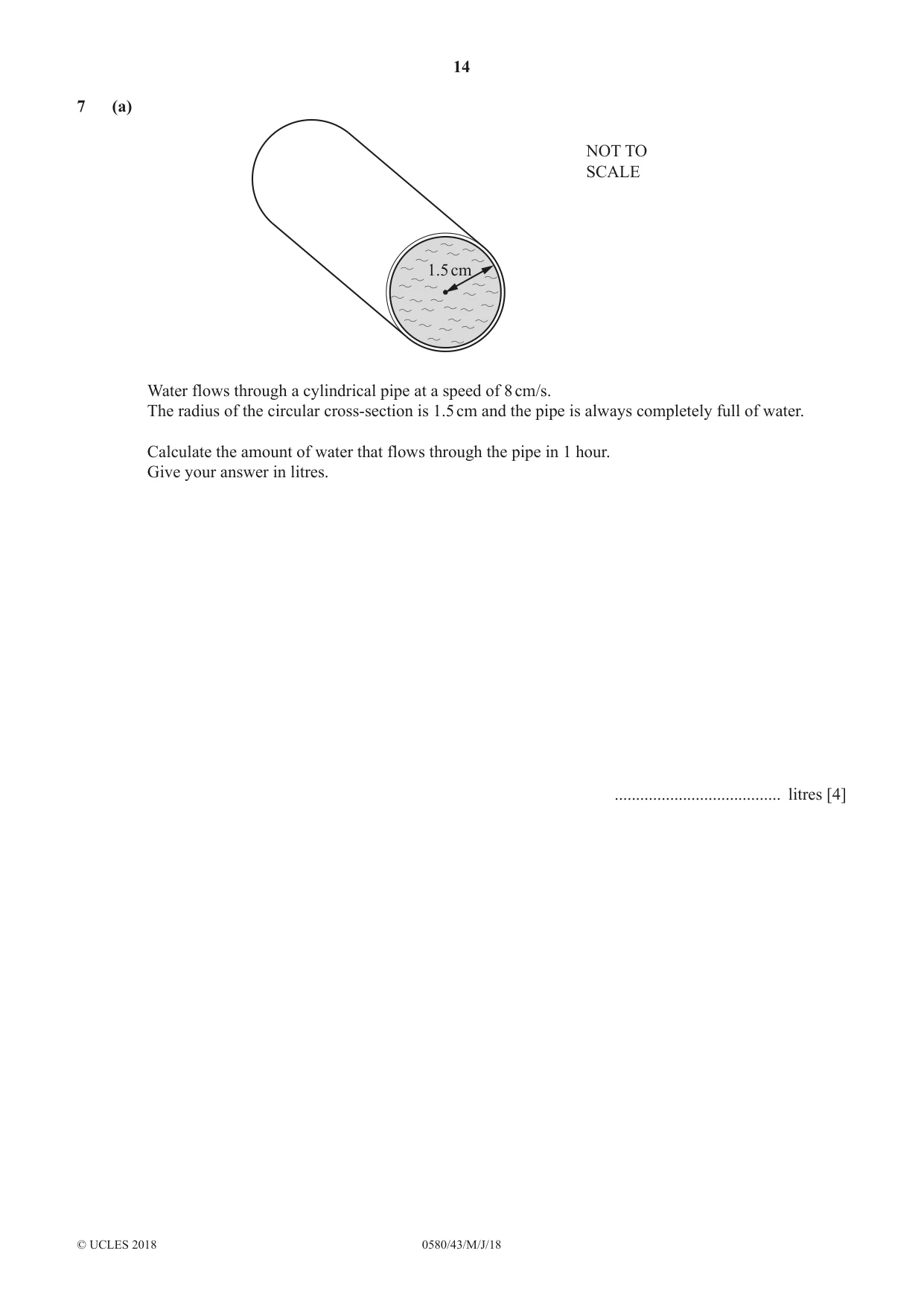
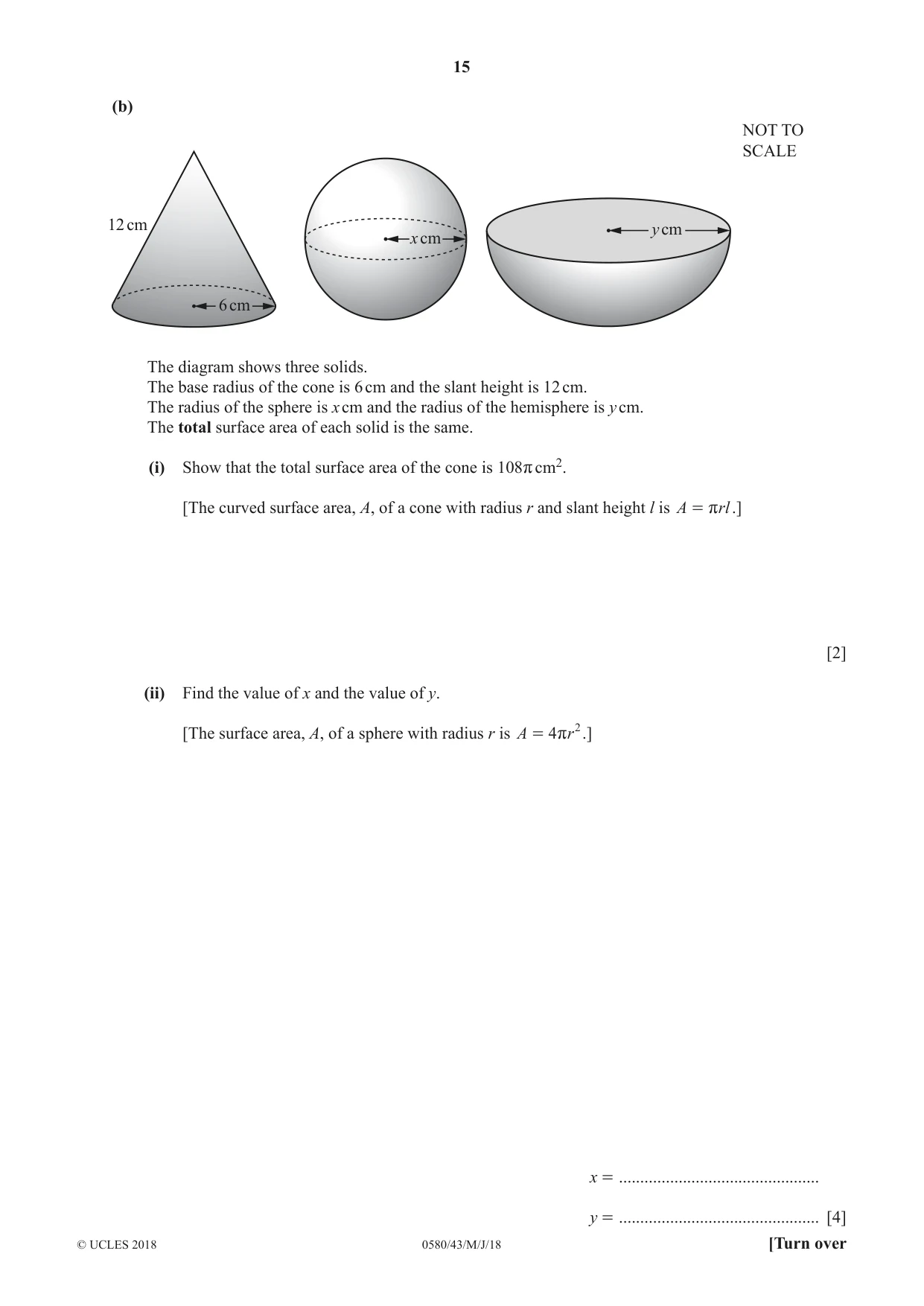
7 (a) NOT TO SCALE 1.5 cm Water flows through a cylindrical pipe at a speed of 8 cm/s. The radius of the circular cross-section is 1.5 cm and the pipe is always completely full of water. Calculate the amount of water that flows through the pipe in 1 hour. Give your answer in litres. ....................................... litres [4] (b) NOT TO SCALE 12 cm y cm x cm 6 cm The diagram shows three solids. The base radius of the cone is 6 cm and the slant height is 12 cm. The radius of the sphere is x cm and the radius of the hemisphere is y cm. The total surface area of each solid is the same. (i) Show that the total surface area of the cone is 108r cm2. [The curved surface area, A, of a cone with radius r and slant height l is A = r rl .] [2] (ii) Find the value of x and the value of y. [The surface area, A, of a sphere with radius r is A = 4 r r 2 .] x = ............................................... y = ............................................... [4]
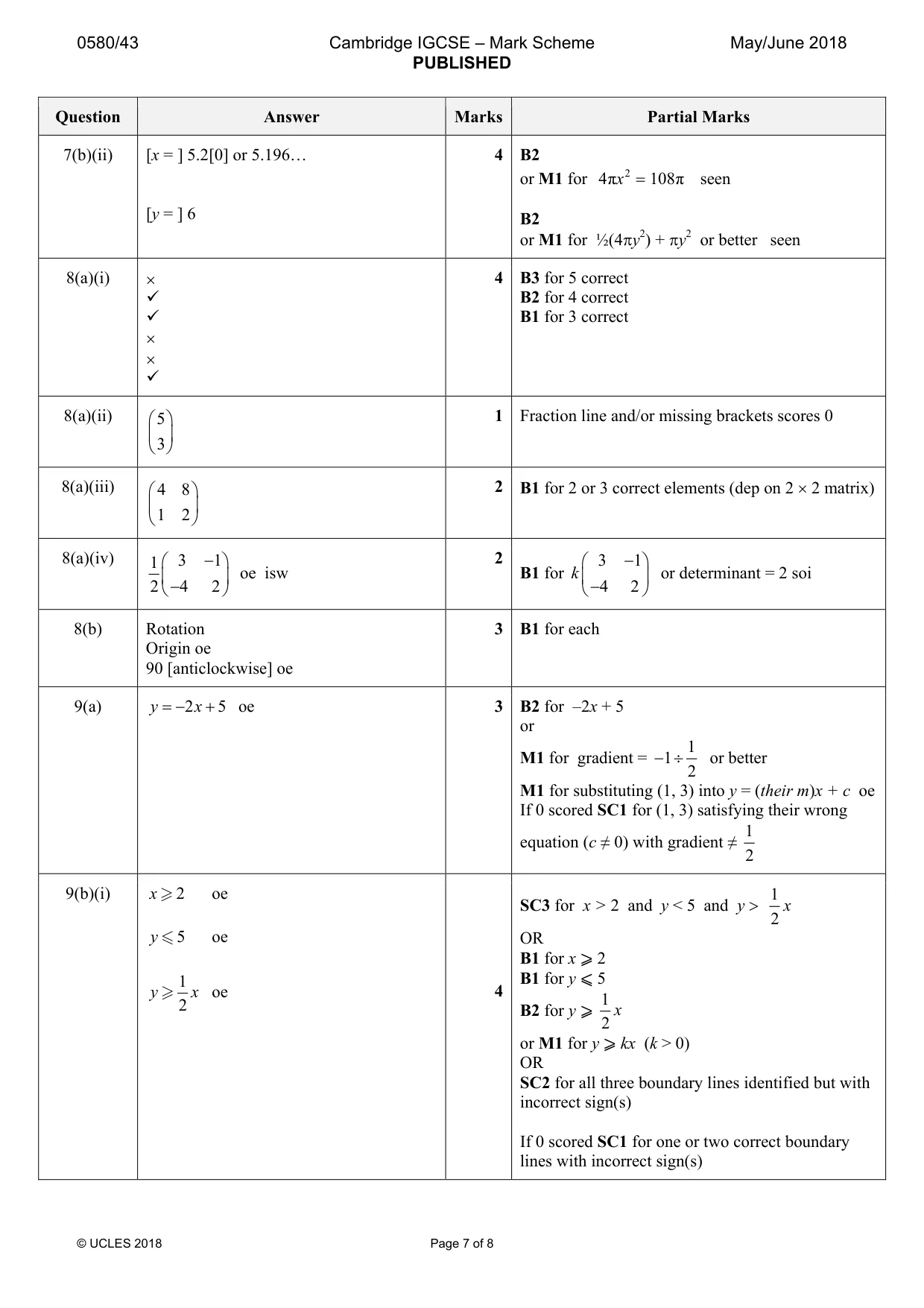
Mark scheme: 7(a) 204 or 203.5 to 203.6… nfww 4 M2 for π × 1.5 2 × 8 × 60 × 60 or M1 for π × 1.52 M1 for dividing their volume by 1000 If 0 scored SC1 for an answer figs 204 or figs 2035 to 2036 without working 7(b)(i) π × 6 × 12 + π × 62 = 108π M2 M1 for π × 6 × 12 7(b)(ii) [x = ] 5.2[0] or 5.196… 4 B2 or M1 for 4πx 2 = 108π seen [y = ] 6 B2 or M1 for ½(4πy2) + πy2 or better seen
Q8 · 1 4 8 (a) M = N = 1 2 P = c4 3m ^ h f 1 p (i) For the following calculations, put a tick…
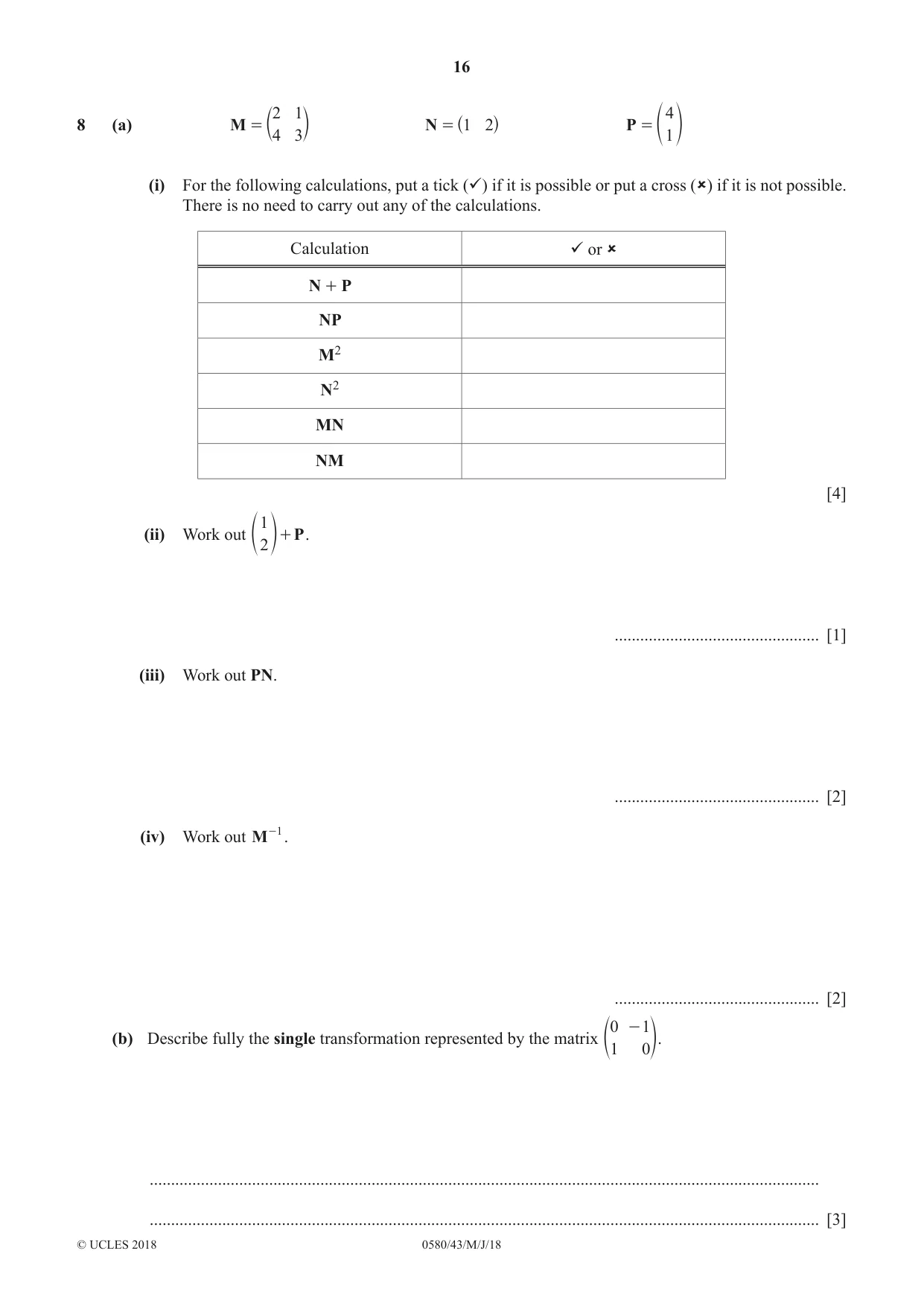
2 1 4 8 (a) M = N = 1 2 P = c4 3m ^ h f 1 p (i) For the following calculations, put a tick (ü) if it is possible or put a cross (û) if it is not possible. There is no need to carry out any of the calculations. Calculation ü or û N + P NP M2 N2 MN NM [4] 1 (ii) Work out + P . f 2 p ................................................ [1] (iii) Work out PN. ................................................ [2] (iv) Work out M -1 . ................................................ [2] 0 - 1 (b) Describe fully the single transformation represented by the matrix f1 0p. ............................................................................................................................................................. ............................................................................................................................................................. [3]
Mark scheme: 8(a)(i) × 4 B3 for 5 correct 9 B2 for 4 correct 9 B1 for 3 correct × × 9 8(a)(ii) 5 1 Fraction line and/or missing brackets scores 0 3 8(a)(iii) 4 8 2 B1 for 2 or 3 correct elements (dep on 2 × 2 matrix) 1 2 8(a)(iv) 1 3 −1 2 3 −1 oe isw B1 for k or determinant = 2 soi 2 −4 2 −4 2 8(b) Rotation 3 B1 for each Origin oe 90 [anticlockwise] oe
Q9 · Find the equation of the straight line that is perpendicular to the line y = x + 1 and…
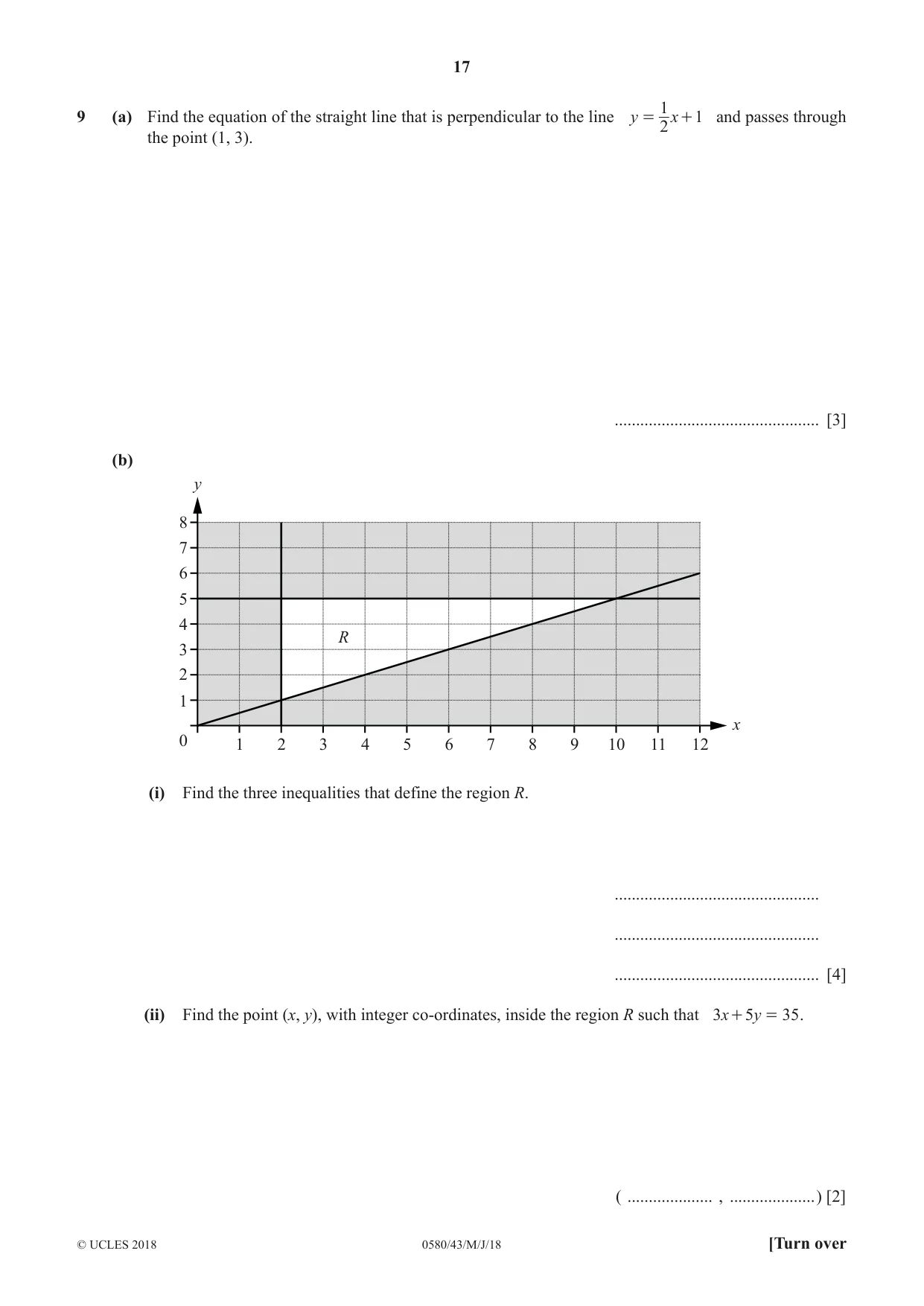
19 (a) Find the equation of the straight line that is perpendicular to the line y = x + 1 and passes through 2 the point (1, 3). ................................................ [3] (b) y 8 7 6 5 4 R 3 2 1 x 0 1 2 3 4 5 6 7 8 9 10 11 12 (i) Find the three inequalities that define the region R. ................................................ ................................................ ................................................ [4] (ii) Find the point (x, y), with integer co-ordinates, inside the region R such that 3x + 5y = 35 . ( .................... , ....................) [2]
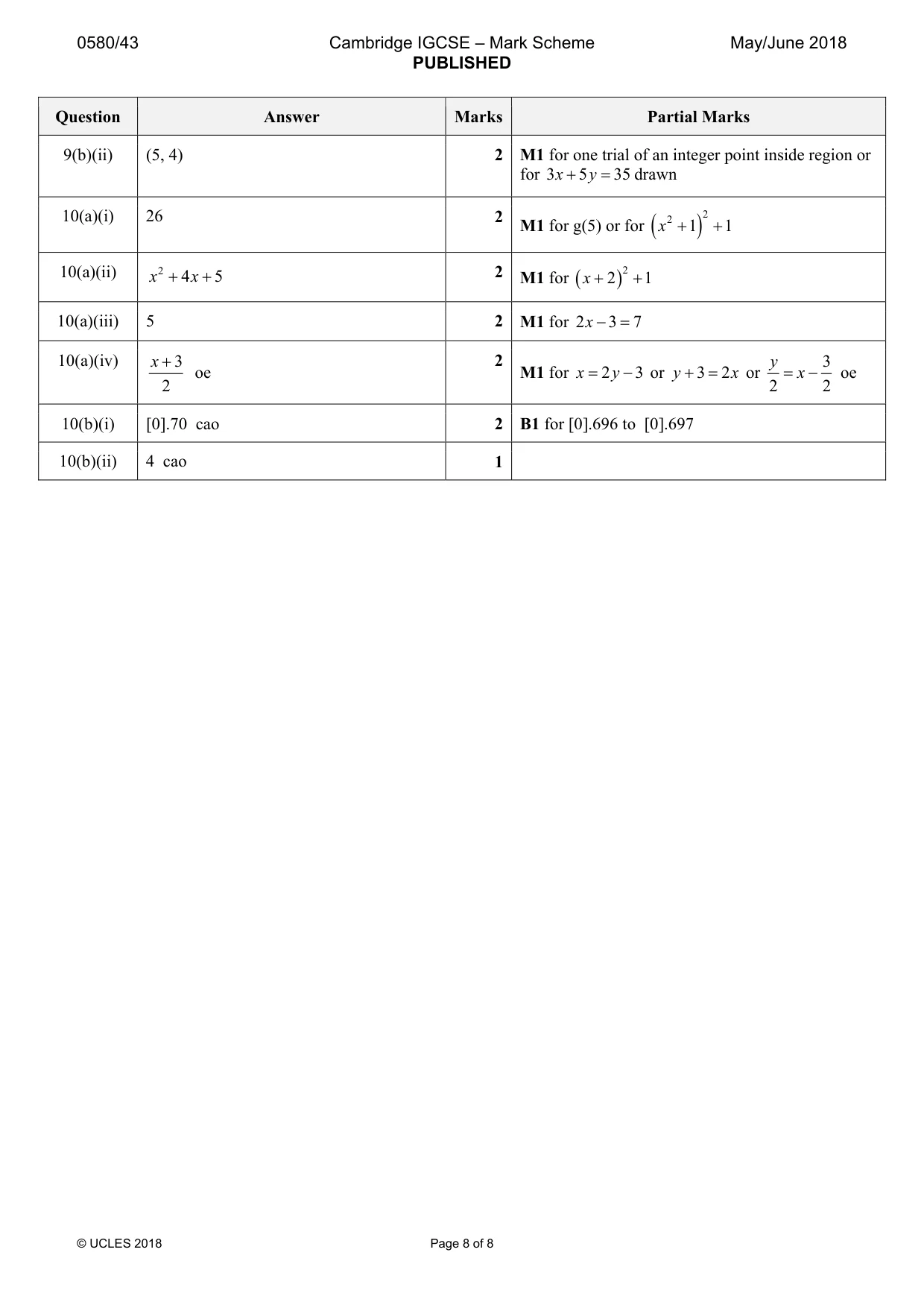
Mark scheme: 9(a) y = −2 x + 5 oe 3 B2 for –2x + 5 or 1 M1 for gradient = −÷1 or better 2 M1 for substituting (1, 3) into y = (their m)x + c oe If 0 scored SC1 for (1, 3) satisfying their wrong 1 equation (c ≠ 0) with gradient ≠ 2 9(b)(i) x . 2 oe 1 SC3 for x > 2 and y < 5 and y > x 2 y - 5 oe OR B1 for x ⩾ 2 1 B1 for y ⩽ 5 y . x oe 4 1 2 B2 for y ⩾ x 2 or M1 for y ⩾ kx (k > 0) OR SC2 for all three boundary lines identified but with incorrect sign(s) If 0 scored SC1 for one or two correct boundary lines with incorrect sign(s) 9(b)(ii) (5, 4) 2 M1 for one trial of an integer point inside region or for 3 x + 5 y = 35 drawn
Q10 · F (x) = 2x - 3 g (x) = x 2 + 1 (i) Find gg(2)
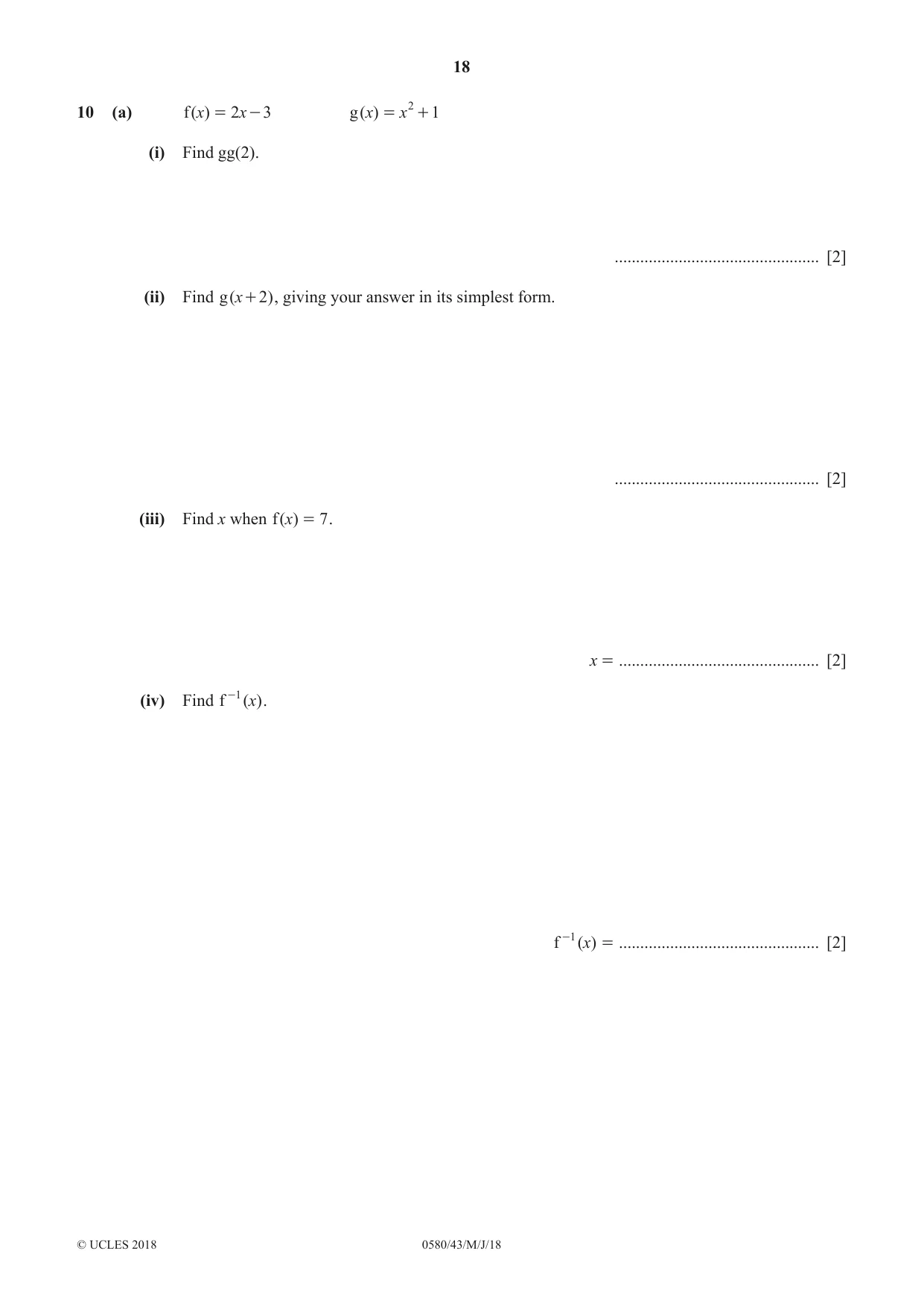
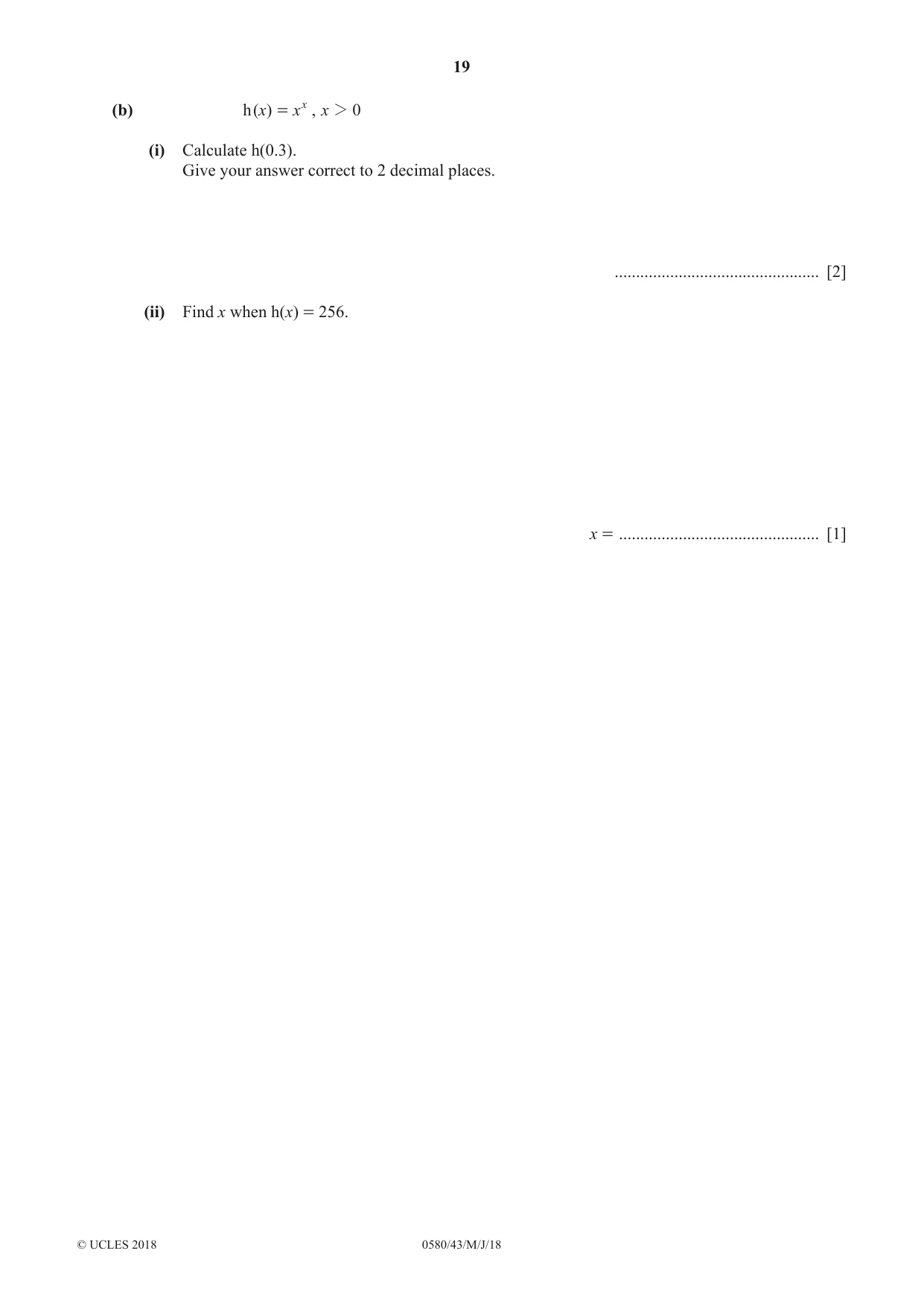
10 (a) f (x) = 2x - 3 g (x) = x 2 + 1 (i) Find gg(2). ................................................ [2] (ii) Find g (x + 2) , giving your answer in its simplest form. ................................................ [2] (iii) Find x when f ()x = 7 . x = ............................................... [2] (iv) Find f -1 ()x . f -1 ()x = ............................................... [2] (b) h (x) = x x , x 2 0 (i) Calculate h(0.3). Give your answer correct to 2 decimal places. ................................................ [2] (ii) Find x when h(x) = 256. x = ............................................... [1]
Mark scheme: 10(a)(i) 26 2 2 2 M1 for g(5) or for x + 1 + 1 ( ) 10(a)(ii) x 2 + 4 x + 5 2 M1 for ( x + 2 ) 2 + 1 10(a)(iii) 5 2 M1 for 2 x − 3 = 7 10(a)(iv) x + 3 2 y 3 oe M1 for x = 2 y − 3 or y + 3 = 2 x or = x − oe 2 2 2 10(b)(i) [0].70 cao 2 B1 for [0].696 to [0].697 10(b)(ii) 4 cao 1
What was in this paper
The subtopics covered by these 10 questions, and how many questions each got. Open one in a new tab to see every Cambridge question on it.
What you needed in this session
Cambridge’s own grade thresholds for 2018 May/June, Paper 4 · Variant 3. A higher threshold means an easier paper — the bar moves with how the cohort did.