Cambridge IGCSE Mathematics 0580 — 2019 May/June Paper 4 · Variant 3
0580/43/M/J/19 · 10 questions · 130 marks · ≈146 min
The question paper and its mark scheme, free to read here and free to download. This is Cambridge’s own paper, exactly as it was sat.
Question paper16 pages
Mark scheme8 pages
Answers below. Sit the paper first if you are practising.
Questions as text
Q1 · Here is part of a train timetable for a journey from London to Marseille
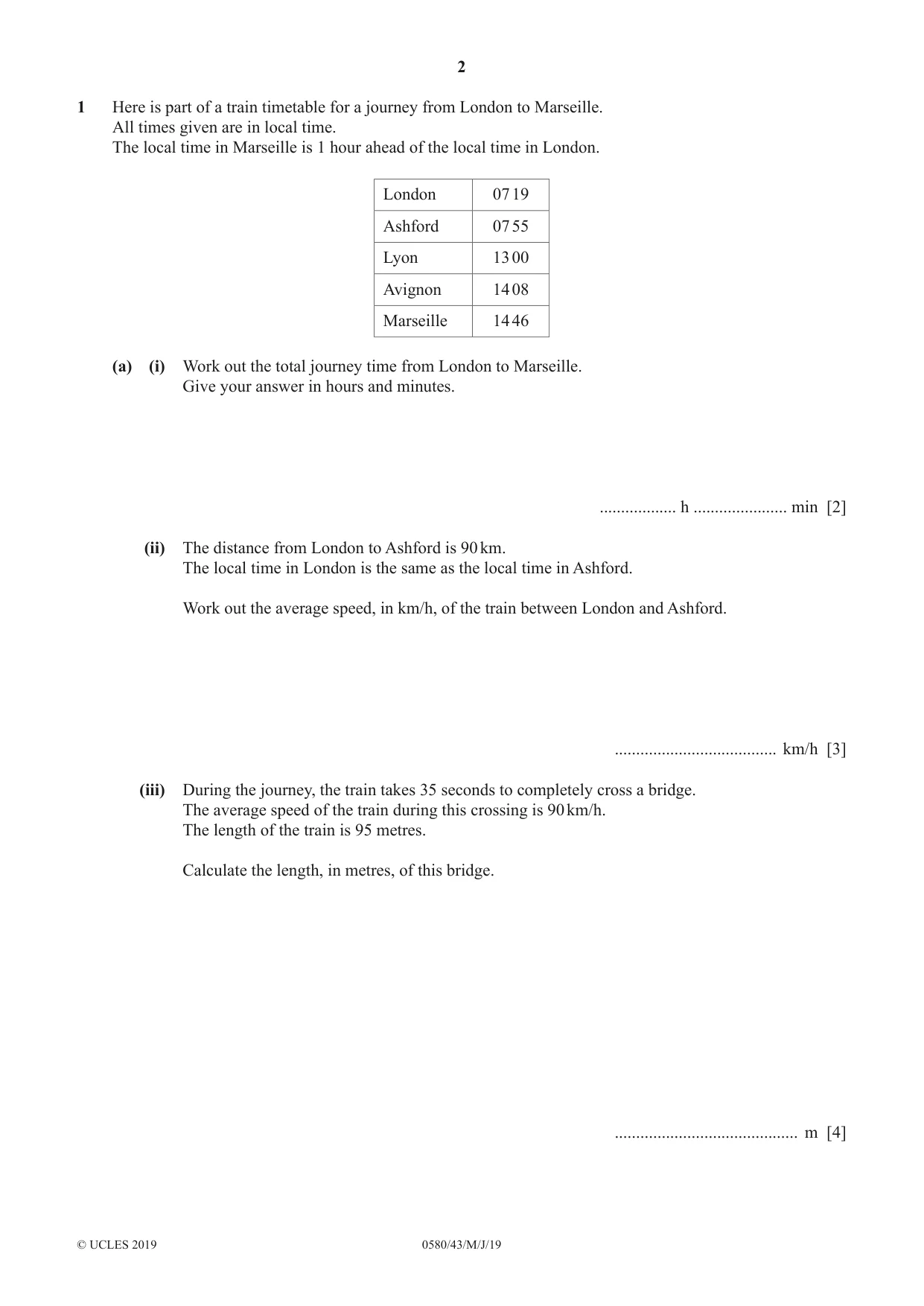
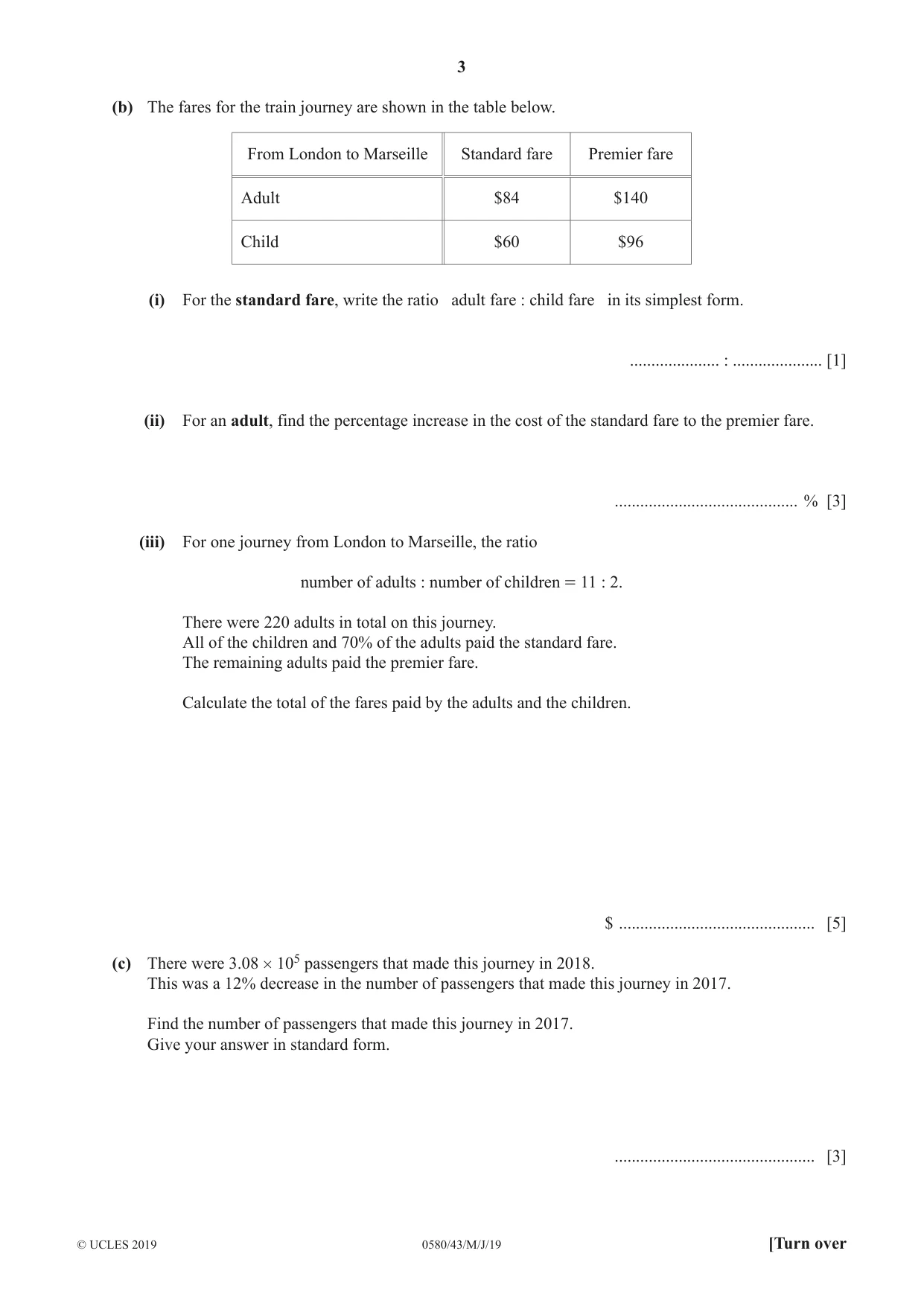
1 Here is part of a train timetable for a journey from London to Marseille. All times given are in local time. The local time in Marseille is 1 hour ahead of the local time in London. London 07 19 Ashford 07 55 Lyon 13 00 Avignon 14 08 Marseille 14 46 (a) (i) Work out the total journey time from London to Marseille. Give your answer in hours and minutes. .................. h ...................... min [2] (ii) The distance from London to Ashford is 90 km. The local time in London is the same as the local time in Ashford. Work out the average speed, in km/h, of the train between London and Ashford. ...................................... km/h [3] (iii) During the journey, the train takes 35 seconds to completely cross a bridge. The average speed of the train during this crossing is 90 km/h. The length of the train is 95 metres. Calculate the length, in metres, of this bridge. ........................................... m [4] (b) The fares for the train journey are shown in the table below. From London to Marseille Standard fare Premier fare Adult $84 $140 Child $60 $96 (i) For the standard fare, write the ratio adult fare : child fare in its simplest form. ..................... : ..................... [1] (ii) For an adult, find the percentage increase in the cost of the standard fare to the premier fare. ........................................... % [3] (iii) For one journey from London to Marseille, the ratio number of adults : number of children = 11 : 2. There were 220 adults in total on this journey. All of the children and 70% of the adults paid the standard fare. The remaining adults paid the premier fare. Calculate the total of the fares paid by the adults and the children. $ .............................................. [5] (c) There were 3.08 # 105 passengers that made this journey in 2018. This was a 12% decrease in the number of passengers that made this journey in 2017. Find the number of passengers that made this journey in 2017. Give your answer in standard form. ............................................... [3]
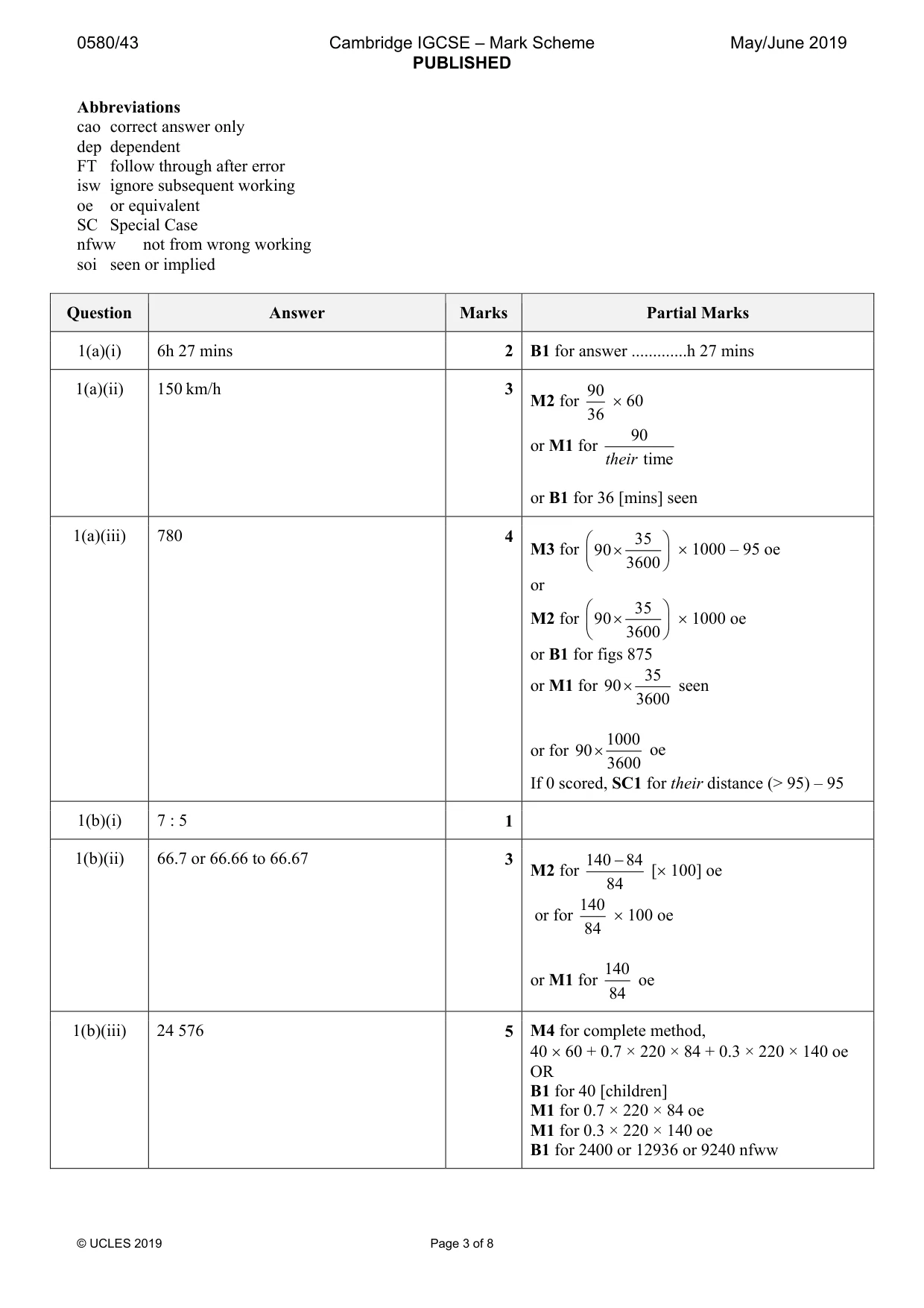
Mark scheme: Question Answer Marks Partial Marks 1(a)(i) 6h 27 mins 2 B1 for answer .............h 27 mins 1(a)(ii) 150 km/h 3 90 M2 for × 60 36 90 or M1 for their time or B1 for 36 [mins] seen 1(a)(iii) 780 4 35 M3 for 90 × × 1000 – 95 oe 3600 or 35 M2 for 90 × × 1000 oe 3600 or B1 for figs 875 35 or M1 for 90 × seen 3600 1000 or for 90 × oe 3600 If 0 scored, SC1 for their distance (> 95) – 95 1(b)(i) 7 : 5 1 1(b)(ii) 66.7 or 66.66 to 66.67 3 140 − 84 M2 for [× 100] oe 84 140 or for × 100 oe 84 140 or M1 for oe 84 1(b)(iii) 24 576 5 M4 for complete method, 40 × 60 + 0.7 × 220 × 84 + 0.3 × 220 × 140 oe OR B1 for 40 [children] M1 for 0.7 × 220 × 84 oe M1 for 0.3 × 220 × 140 oe B1 for 2400 or 12936 or 9240 nfww 1(c) 3.5 × 10⁵ nfww 3 100 − 12 M2 for 3.08 × 10⁵ ÷ oe 100 or M1 for 3.08 [× 105] associated with (100–12)%
Question 2
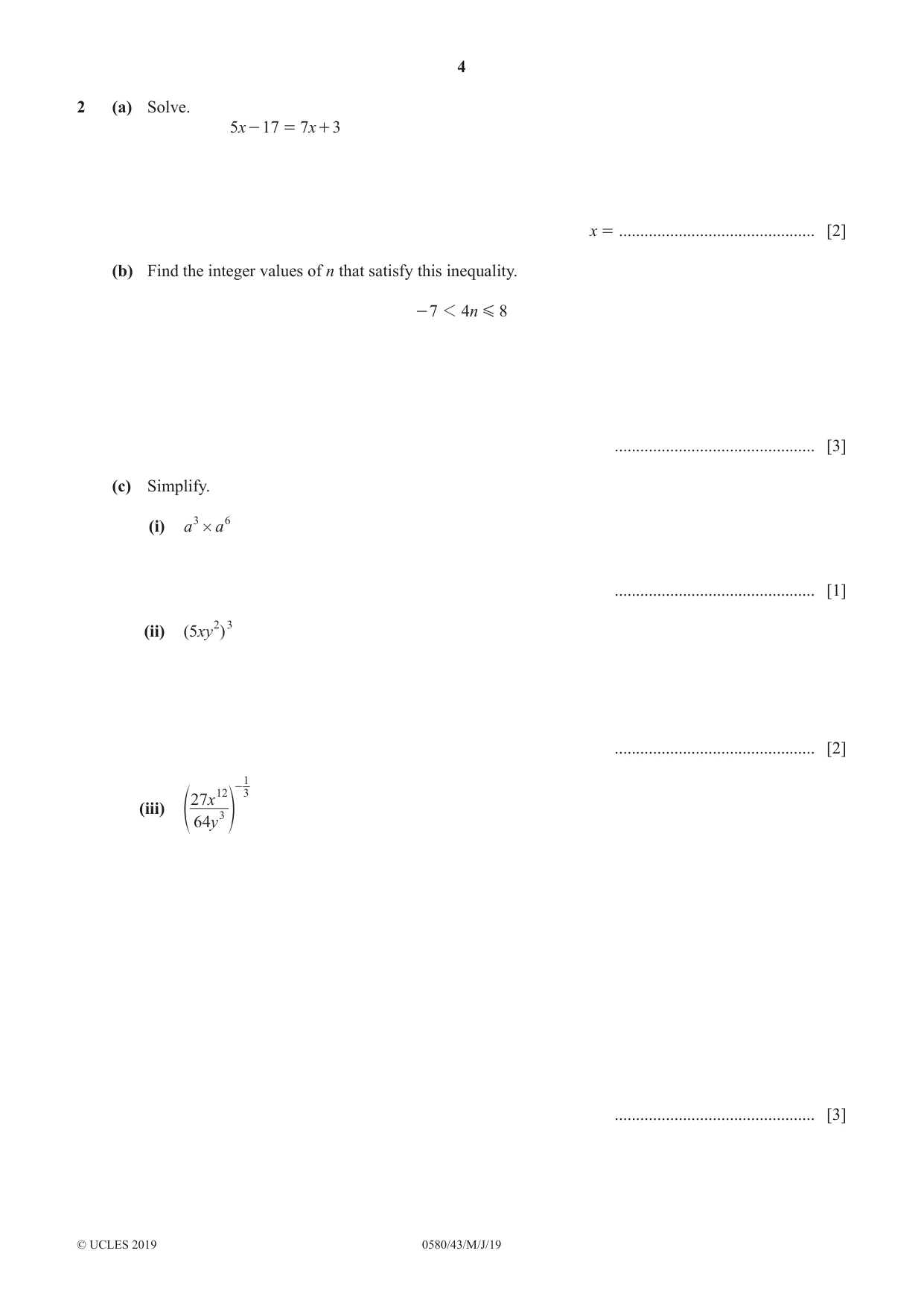
2 (a) Solve. 5x - 17 = 7x + 3 x = .............................................. [2] (b) Find the integer values of n that satisfy this inequality. - 7 1 4n G 8 ............................................... [3] (c) Simplify. (i) a 3 # a 6 ............................................... [1] (ii) (5xy 2 ) 3 ............................................... [2] 1 12 - 3 27x (iii) 3 f 64y p ............................................... [3]
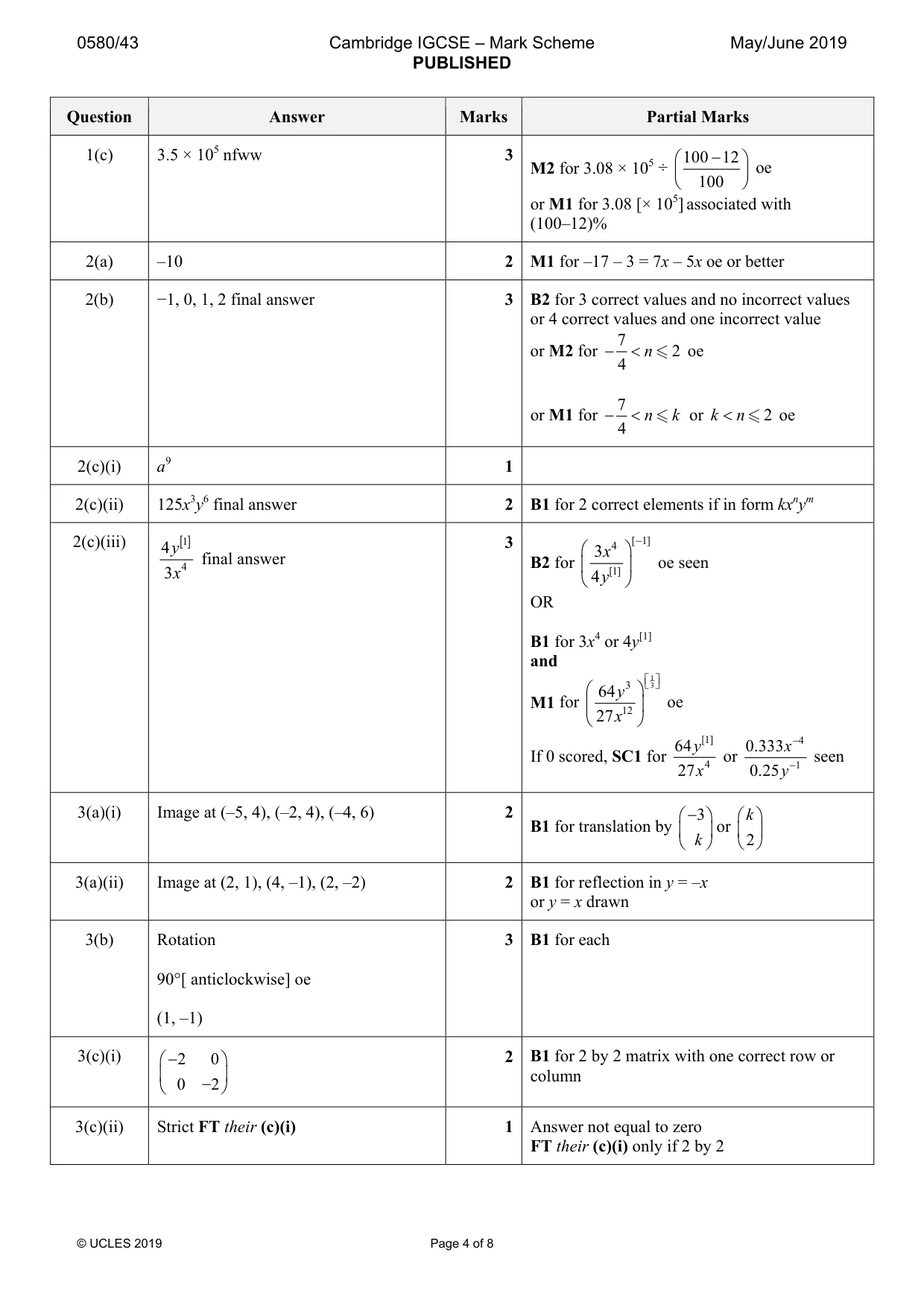
Mark scheme: 2(a) –10 2 M1 for –17 – 3 = 7x – 5x oe or better 2(b) −1, 0, 1, 2 final answer 3 B2 for 3 correct values and no incorrect values or 4 correct values and one incorrect value 7 or M2 for − < n - 2 oe 4 7 or M1 for − < n - k or k < n- 2 oe 4 2(c)(i) a9 1 2(c)(ii) 125x3y6 final answer 2 B1 for 2 correct elements if in form kxnym 2(c)(iii) []1 3 4 [ −1] 4 y 3 x 4 final answer B2 for [1] oe seen 3 x 4 y OR B1 for 3x4 or 4y[1] and 13 3 64 y M1 for 12 oe 27 x 64 y [1] 0.333 x − 4 If 0 scored, SC1 for or seen 27 x 4 0.25 y − 1
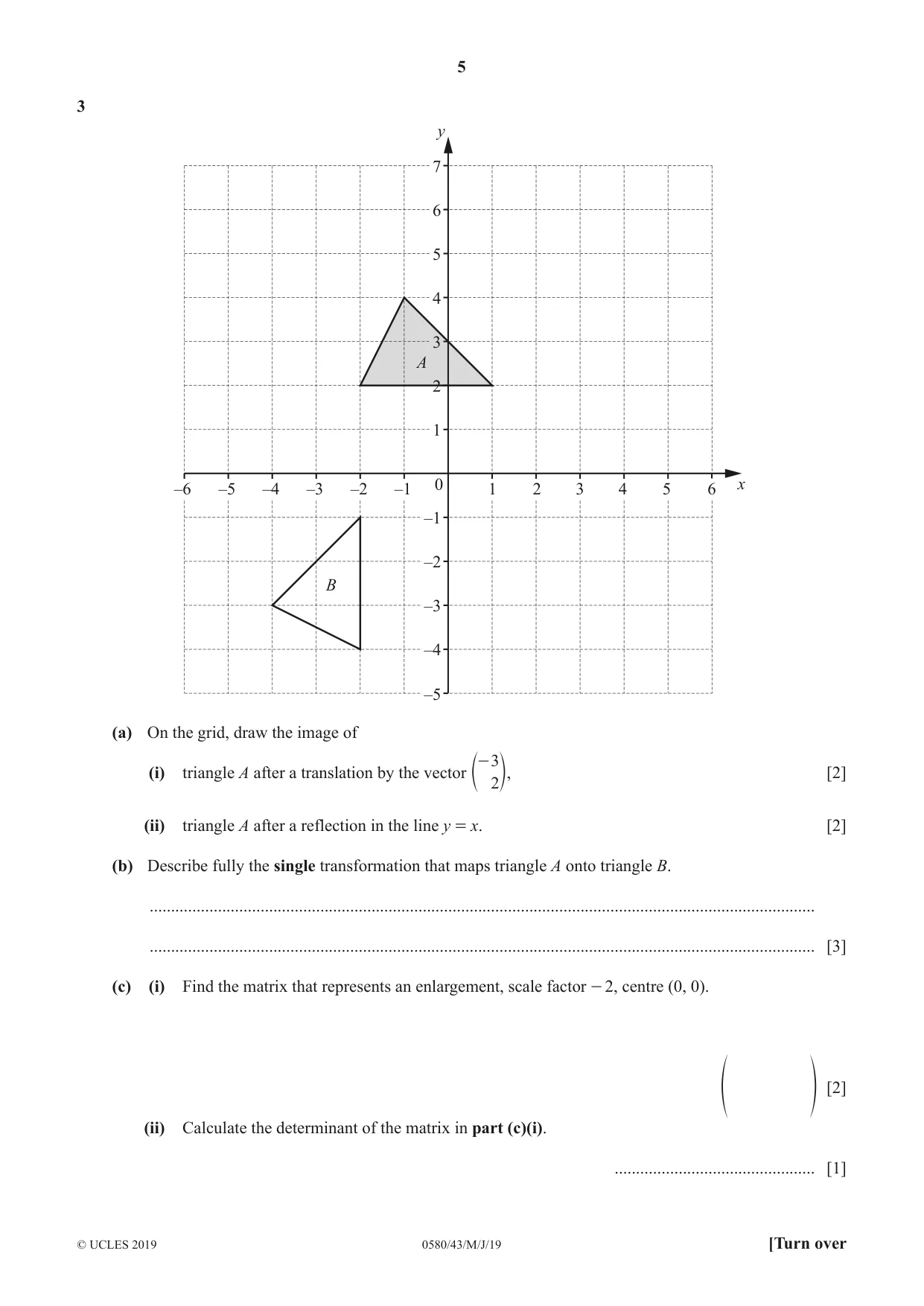
Q3 · Y 7 6 5 4 3 A 2 1 –6 –5 –4 –3 –2 –1 0 1 2 3 4 5 6 x –1 –2 B –3 –4 –5 (a) On the grid…
3 y 7 6 5 4 3 A 2 1 –6 –5 –4 –3 –2 –1 0 1 2 3 4 5 6 x –1 –2 B –3 –4 –5 (a) On the grid, draw the image of - 3 (i) triangle A after a translation by the vector [2] e 2o, (ii) triangle A after a reflection in the line y = x. [2] (b) Describe fully the single transformation that maps triangle A onto triangle B. ............................................................................................................................................................ ............................................................................................................................................................ [3] (c) (i) Find the matrix that represents an enlargement, scale factor - 2, centre (0, 0). [2] f p (ii) Calculate the determinant of the matrix in part (c)(i). ............................................... [1]
Mark scheme: 3(a)(i) Image at (–5, 4), (–2, 4), (–4, 6) 2 − 3 k B1 for translation by or k 2 3(a)(ii) Image at (2, 1), (4, –1), (2, –2) 2 B1 for reflection in y = –x or y = x drawn 3(b) Rotation 3 B1 for each 90°[ anticlockwise] oe (1, –1) 3(c)(i) − 2 0 2 B1 for 2 by 2 matrix with one correct row or column 0 − 2 3(c)(ii) Strict FT their (c)(i) 1 Answer not equal to zero FT their (c)(i) only if 2 by 2
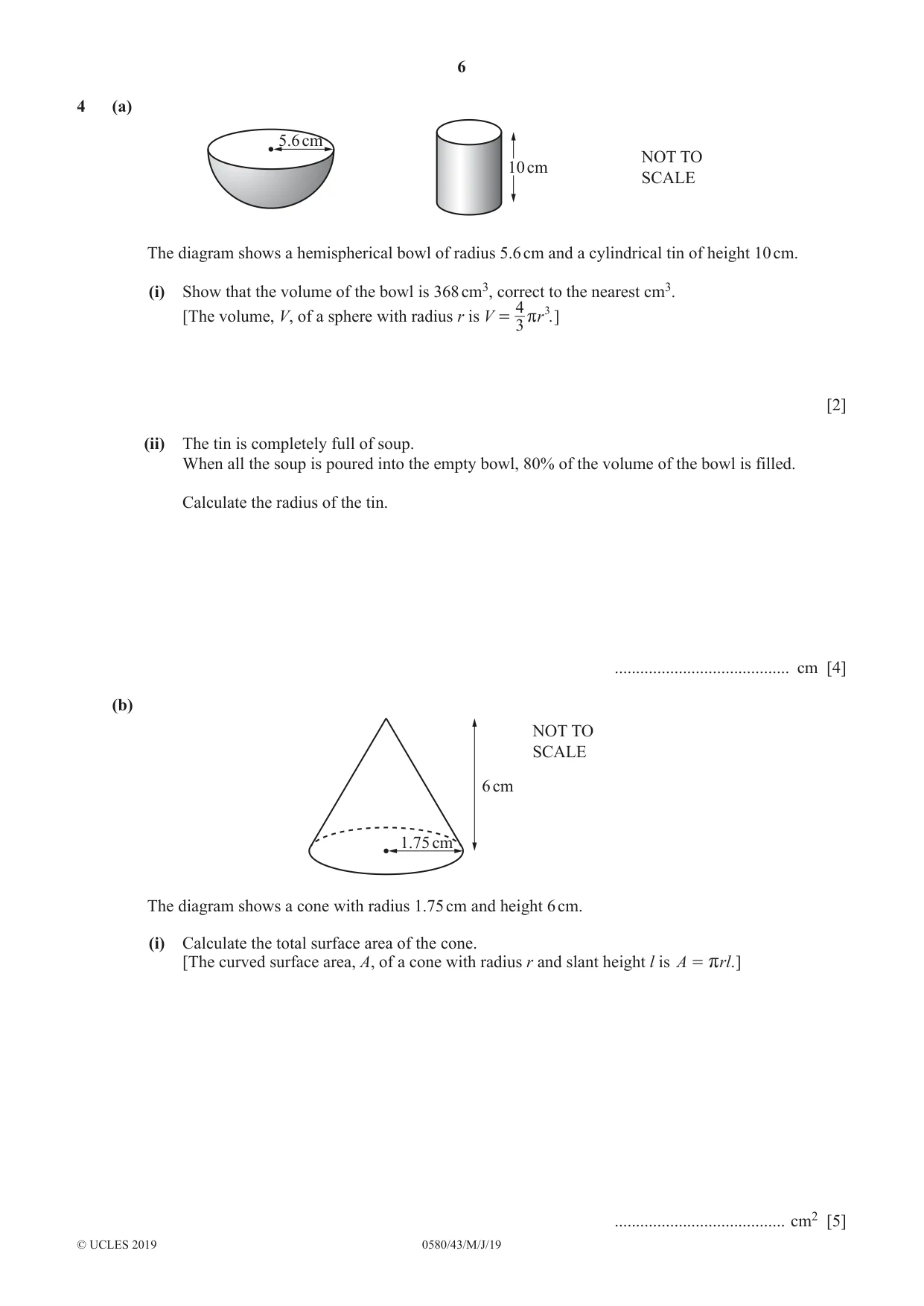
Q4 · 5.6 cm NOT TO 10 cm SCALE The diagram shows a hemispherical bowl of radius 5.6 cm and a…
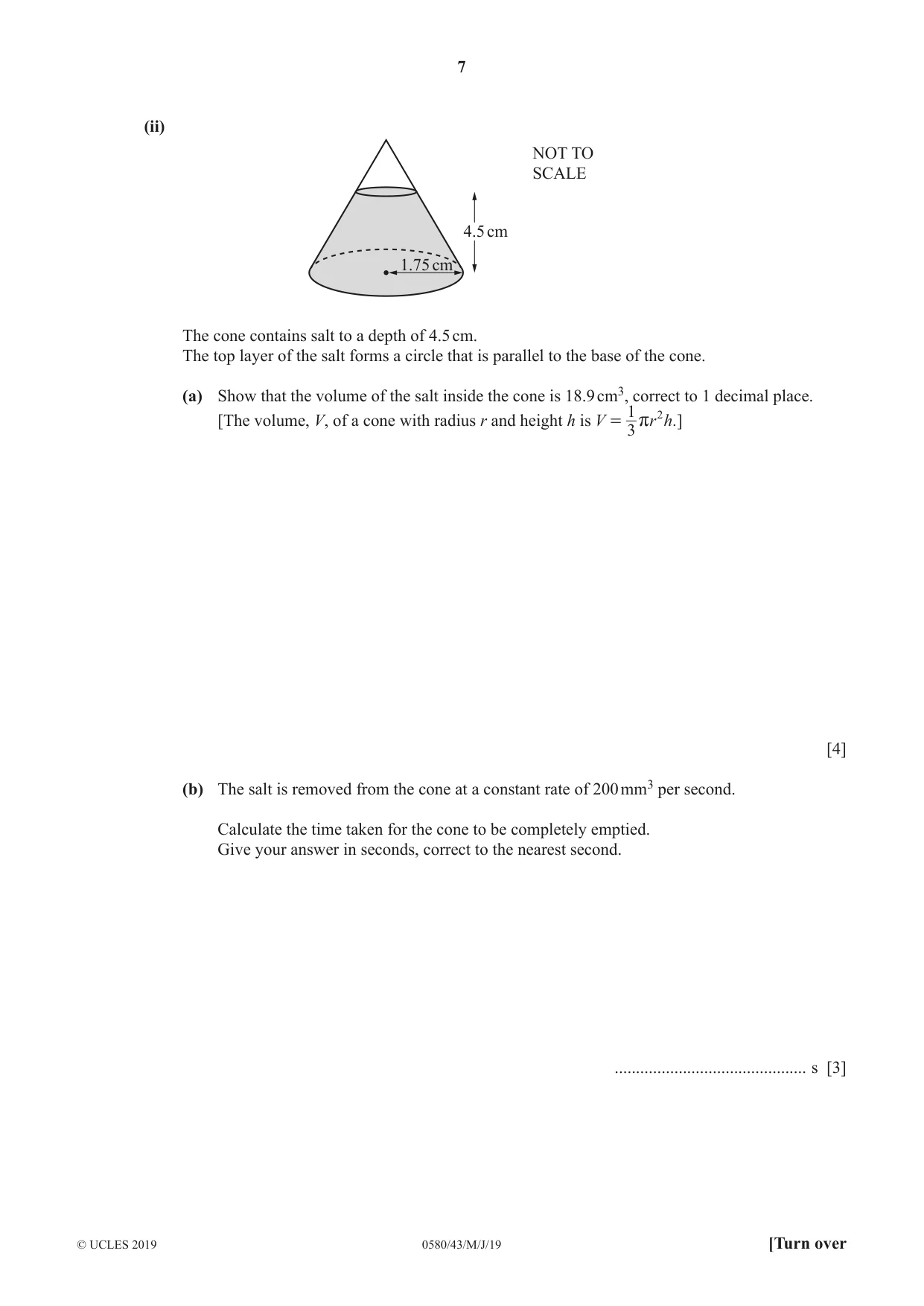
4 (a) 5.6 cm NOT TO 10 cm SCALE The diagram shows a hemispherical bowl of radius 5.6 cm and a cylindrical tin of height 10 cm. (i) Show that the volume of the bowl is 368 cm3, correct to the nearest cm3. 4 3 [The volume, V, of a sphere with radius r is V = r r . ] 3 [2] (ii) The tin is completely full of soup. When all the soup is poured into the empty bowl, 80% of the volume of the bowl is filled. Calculate the radius of the tin. ......................................... cm [4] (b) NOT TO SCALE 6 cm 1.75 cm The diagram shows a cone with radius 1.75 cm and height 6 cm. (i) Calculate the total surface area of the cone. [The curved surface area, A, of a cone with radius r and slant height l is A = r rl . ] ........................................ cm2 [5] (ii) NOT TO SCALE 4.5 cm 1.75 cm The cone contains salt to a depth of 4.5 cm. The top layer of the salt forms a circle that is parallel to the base of the cone. (a) Show that the volume of the salt inside the cone is 18.9 cm3, correct to 1 decimal place. 1 2 [The volume, V, of a cone with radius r and height h is V = r r h. ] 3 [4] (b) The salt is removed from the cone at a constant rate of 200 mm3 per second. Calculate the time taken for the cone to be completely emptied. Give your answer in seconds, correct to the nearest second. ............................................. s [3]
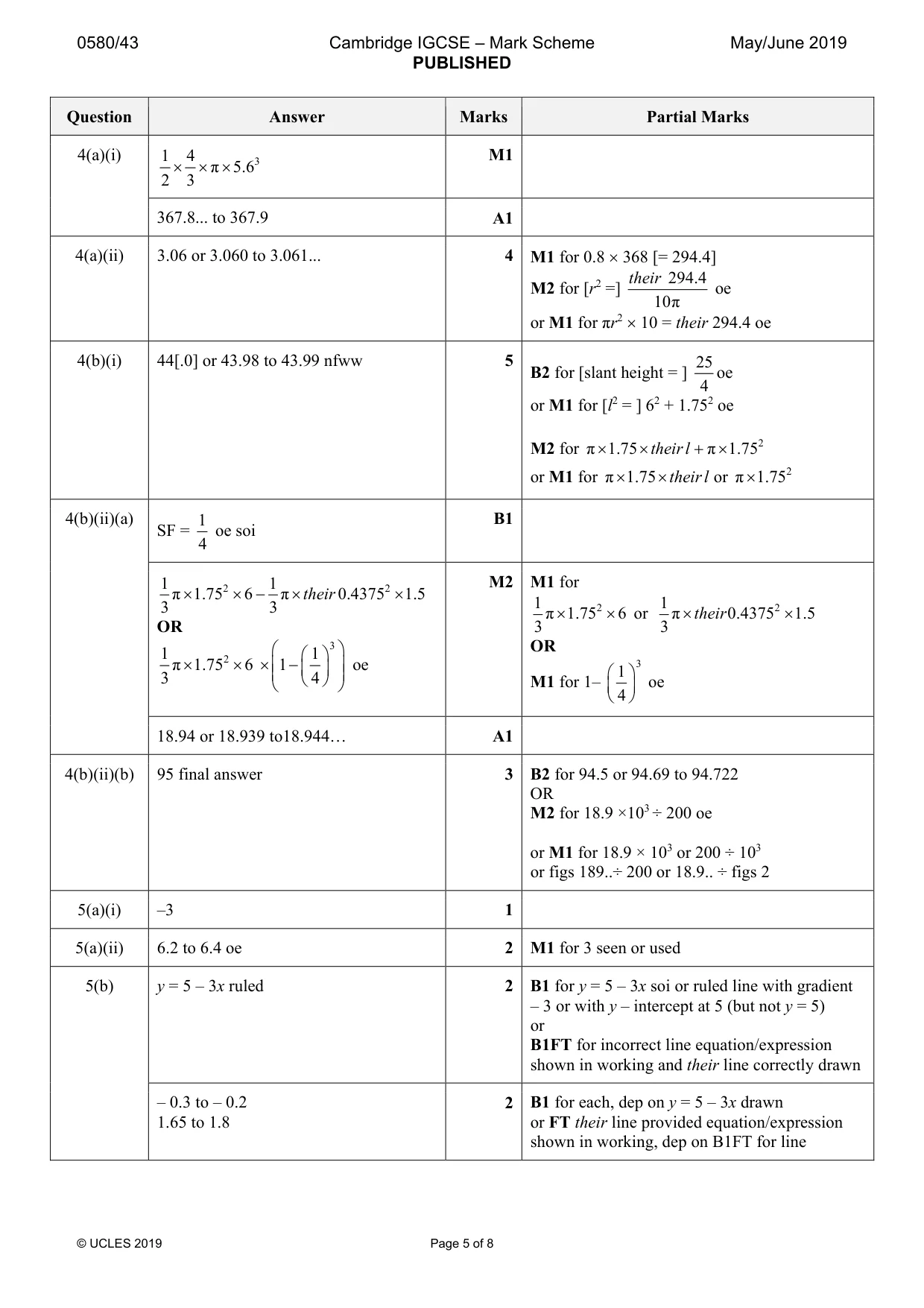
Mark scheme: 4(a)(i) 1 4 3 M1 × × π × 5.6 2 3 367.8... to 367.9 A1 4(a)(ii) 3.06 or 3.060 to 3.061... 4 M1 for 0.8 × 368 [= 294.4] their 294.4 M2 for [r2 =] oe 10π or M1 for πr2 × 10 = their 294.4 oe 4(b)(i) 44[.0] or 43.98 to 43.99 nfww 5 25 B2 for [slant height = ] oe 4 or M1 for [l2 = ] 62 + 1.752 oe M2 for π × 1.75 × theirl + π × 1.75 2 or M1 for π × 1.75 ×theirl or π × 1.75 2 4(b)(ii)(a) 1 B1 SF = oe soi 4 1 2 1 2 M2 M1 for π × 1.75 × 6 − π × their 0.4375 × 1.5 3 3 1 2 1 2 π × 1.75 × 6 or π × their 0.4375 × 1.5 OR 3 3 OR 3 1 1 3 π × 1.75 2 × 6 × 1 − oe 1 3 4 oe M1 for 1– 4 18.94 or 18.939 to18.944… A1 4(b)(ii)(b) 95 final answer 3 B2 for 94.5 or 94.69 to 94.722 OR M2 for 18.9 ×10³ ÷ 200 oe or M1 for 18.9 × 10³ or 200 ÷ 103 or figs 189..÷ 200 or 18.9.. ÷ figs 2
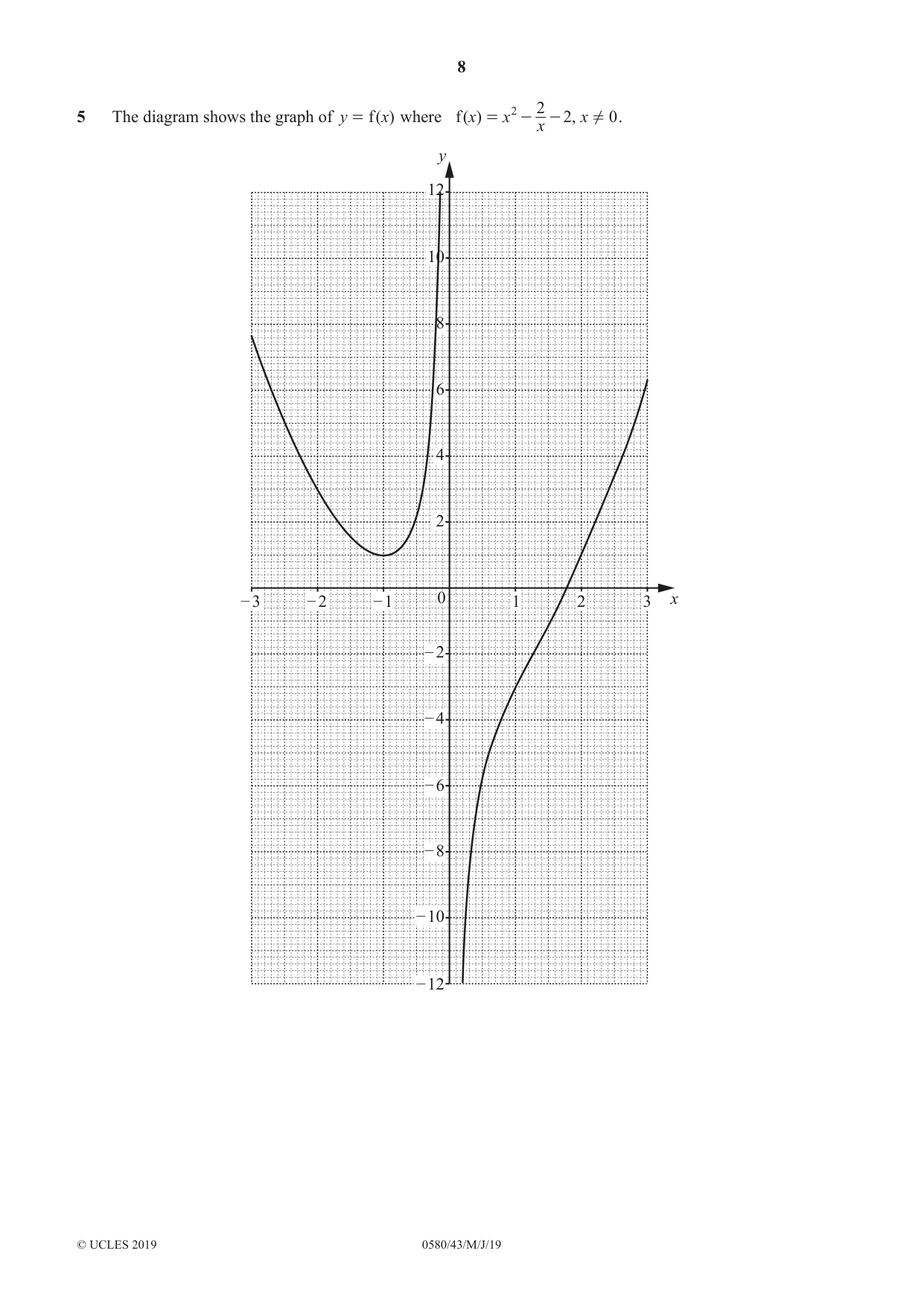
Q5 · 25 The diagram shows the graph of y = f (x) where f ( x) = x - - 2 , x !
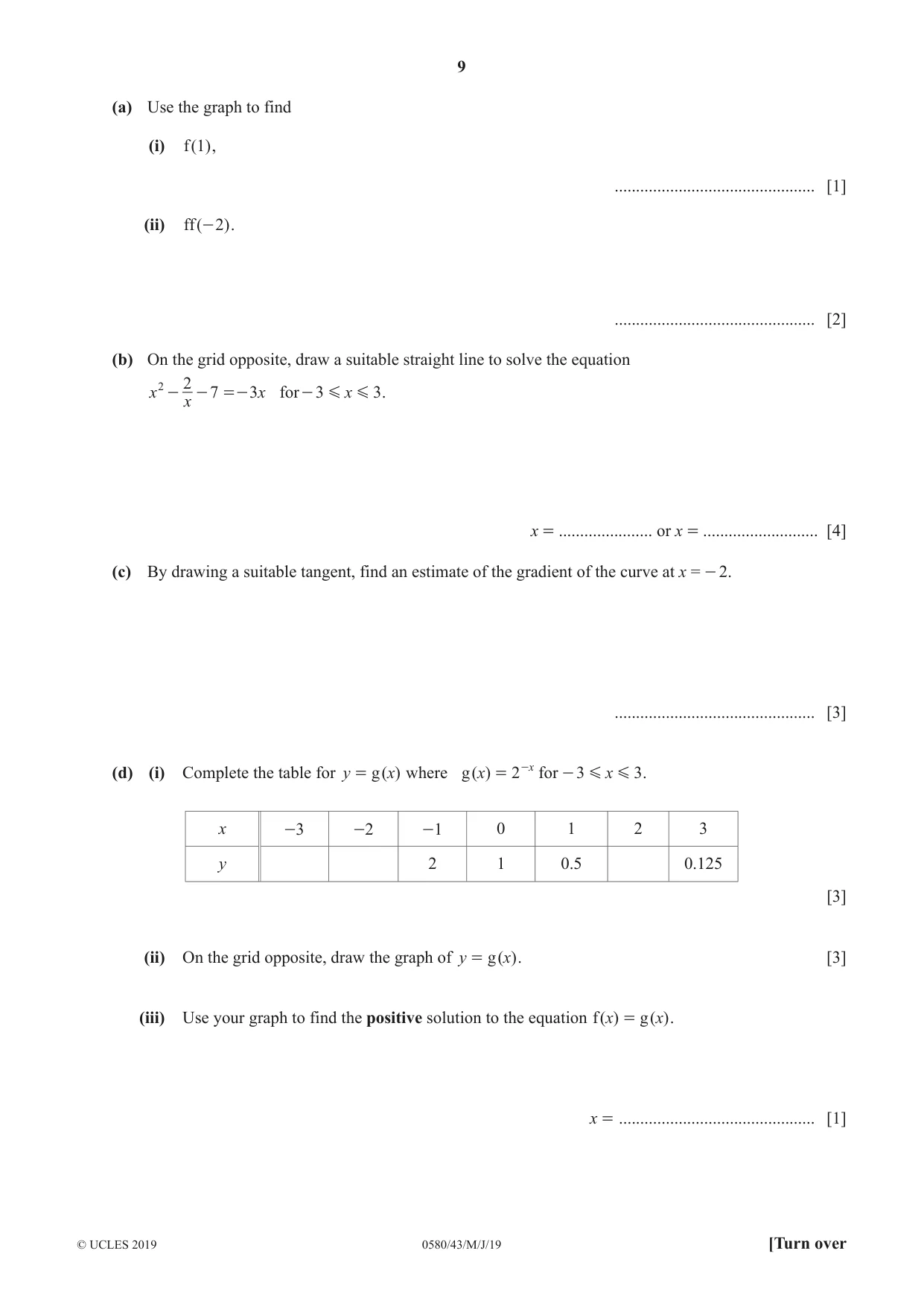
2 25 The diagram shows the graph of y = f (x) where f ( x) = x - - 2 , x ! 0 . x y 12 10 8 6 4 2 – 3 – 2 – 1 0 1 2 3 x – 2 – 4 – 6 – 8 – 10 – 12 (a) Use the graph to find (i) f (1 ) , ............................................... [1] (ii) ff (- 2) . ............................................... [2] (b) On the grid opposite, draw a suitable straight line to solve the equation 2 2 x - - 7 =- 3x for - 3 G x G 3 . x x = ...................... or x = ........................... [4] (c) By drawing a suitable tangent, find an estimate of the gradient of the curve at x = - 2. ............................................... [3] (d) (i) Complete the table for y = g (x) where g ()x = 2 -x for - 3 G x G 3 . x -3 -2 -1 0 1 2 3 y 2 1 0.5 0.125 [3] (ii) On the grid opposite, draw the graph of y = g (x) . [3] (iii) Use your graph to find the positive solution to the equation f (x) = g ( x) . x = .............................................. [1]
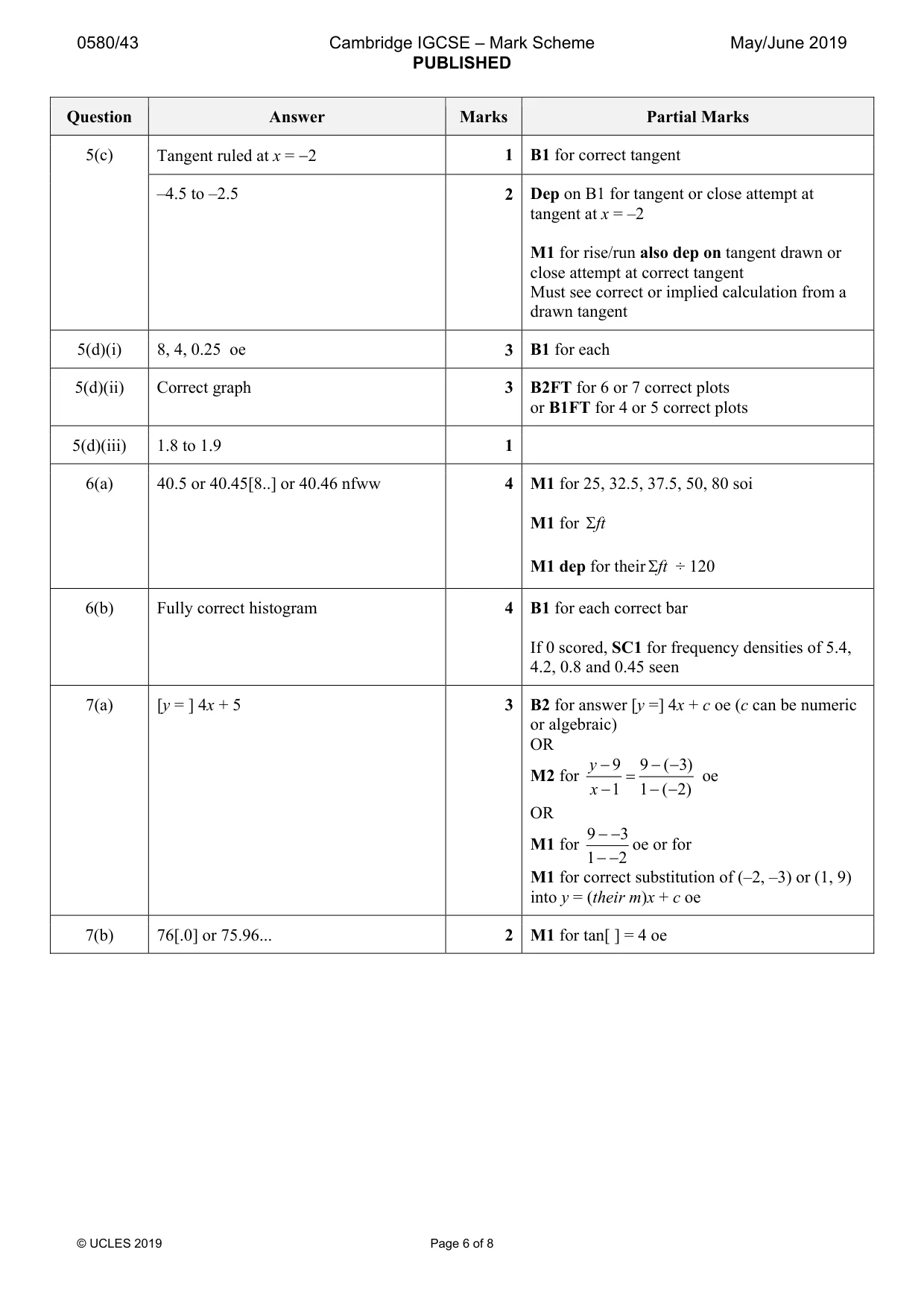
Mark scheme: 5(a)(i) –3 1 5(a)(ii) 6.2 to 6.4 oe 2 M1 for 3 seen or used 5(b) y = 5 – 3x ruled 2 B1 for y = 5 – 3x soi or ruled line with gradient – 3 or with y – intercept at 5 (but not y = 5) or B1FT for incorrect line equation/expression shown in working and their line correctly drawn – 0.3 to – 0.2 2 B1 for each, dep on y = 5 – 3x drawn 1.65 to 1.8 or FT their line provided equation/expression shown in working, dep on B1FT for line 5(c) Tangent ruled at x = −2 1 B1 for correct tangent –4.5 to –2.5 2 Dep on B1 for tangent or close attempt at tangent at x = –2 M1 for rise/run also dep on tangent drawn or close attempt at correct tangent Must see correct or implied calculation from a drawn tangent 5(d)(i) 8, 4, 0.25 oe 3 B1 for each 5(d)(ii) Correct graph 3 B2FT for 6 or 7 correct plots or B1FT for 4 or 5 correct plots 5(d)(iii) 1.8 to 1.9 1
Q6 · The table shows the time, t seconds, taken by each of 120 boys to solve a puzzle
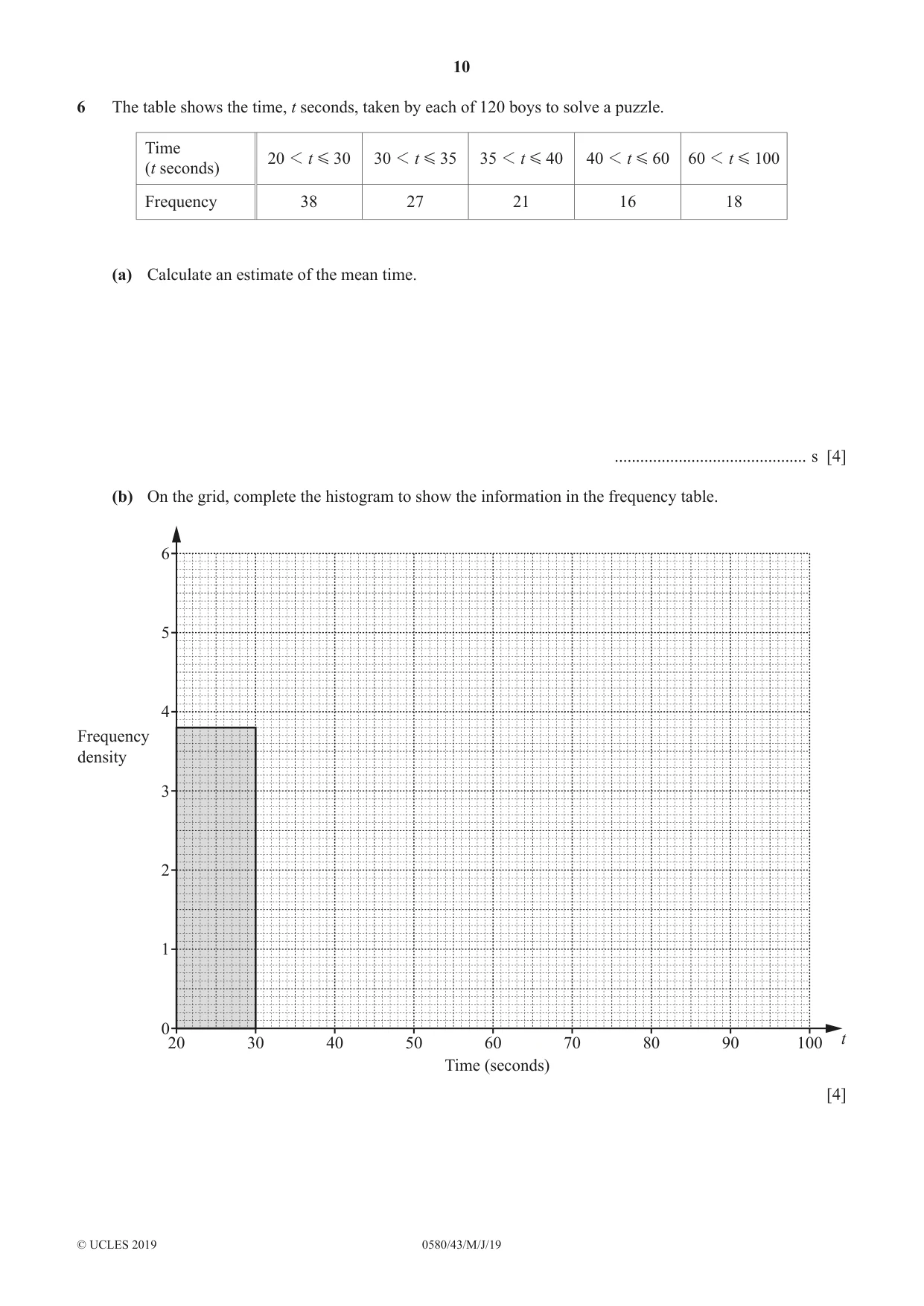
6 The table shows the time, t seconds, taken by each of 120 boys to solve a puzzle. Time 20 1 t G 30 30 1 t G 35 35 1 t G 40 40 1 t G 60 60 1 t G 100 (t seconds) Frequency 38 27 21 16 18 (a) Calculate an estimate of the mean time. ............................................. s [4] (b) On the grid, complete the histogram to show the information in the frequency table. 6 5 4 Frequency density 3 2 1 0 20 30 40 50 60 70 80 90 100 t Time (seconds) [4]
Mark scheme: 6(a) 40.5 or 40.45[8..] or 40.46 nfww 4 M1 for 25, 32.5, 37.5, 50, 80 soi M1 for Σft M1 dep for theirΣft ÷ 120 6(b) Fully correct histogram 4 B1 for each correct bar If 0 scored, SC1 for frequency densities of 5.4, 4.2, 0.8 and 0.45 seen
Q7 · A straight line joins the points A (-2, -3) and C (1, 9)
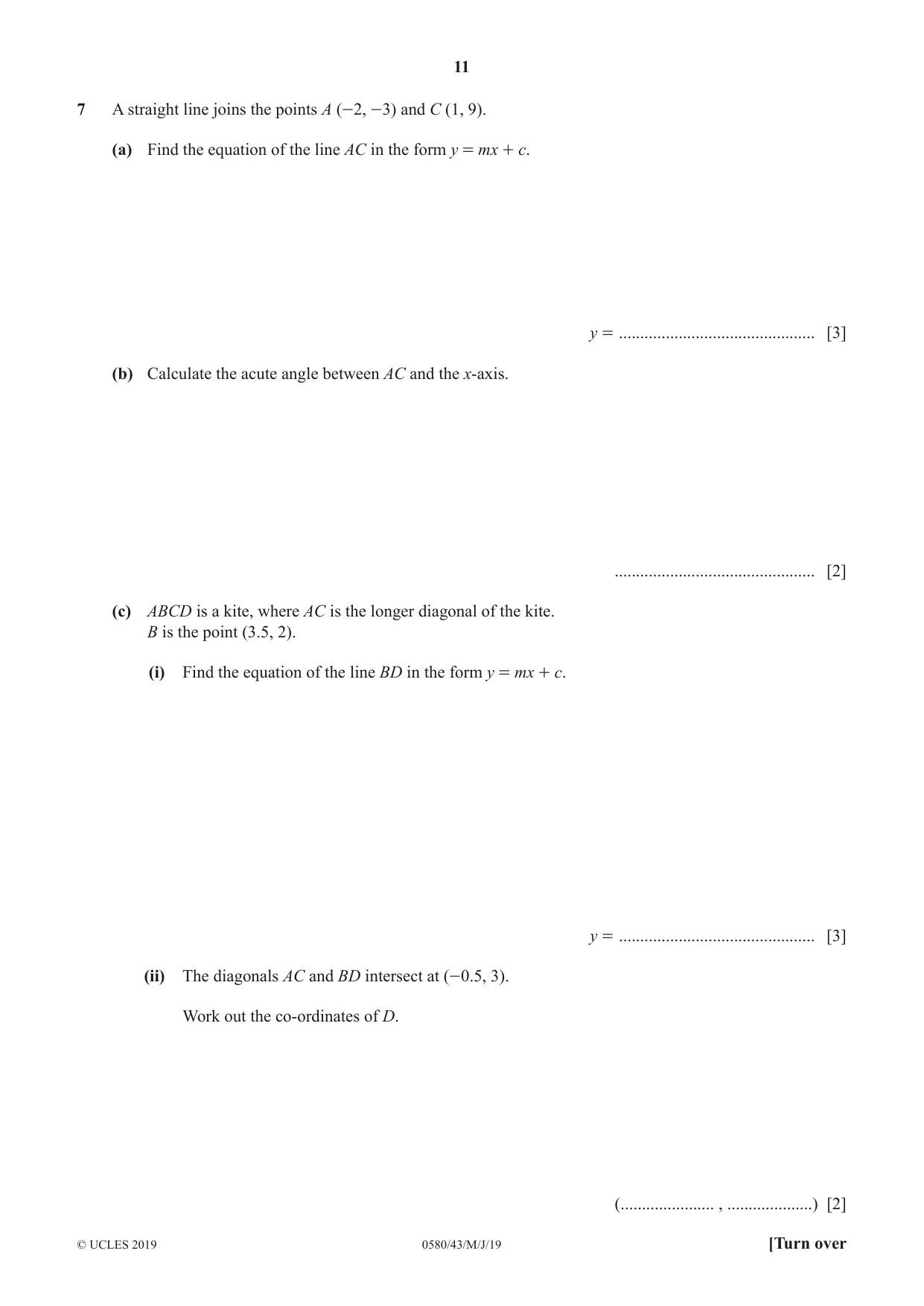
7 A straight line joins the points A (-2, -3) and C (1, 9). (a) Find the equation of the line AC in the form y = mx + c. y = .............................................. [3] (b) Calculate the acute angle between AC and the x-axis. ............................................... [2] (c) ABCD is a kite, where AC is the longer diagonal of the kite. B is the point (3.5, 2). (i) Find the equation of the line BD in the form y = mx + c. y = .............................................. [3] (ii) The diagonals AC and BD intersect at (-0.5, 3). Work out the co-ordinates of D. (...................... , ....................) [2]
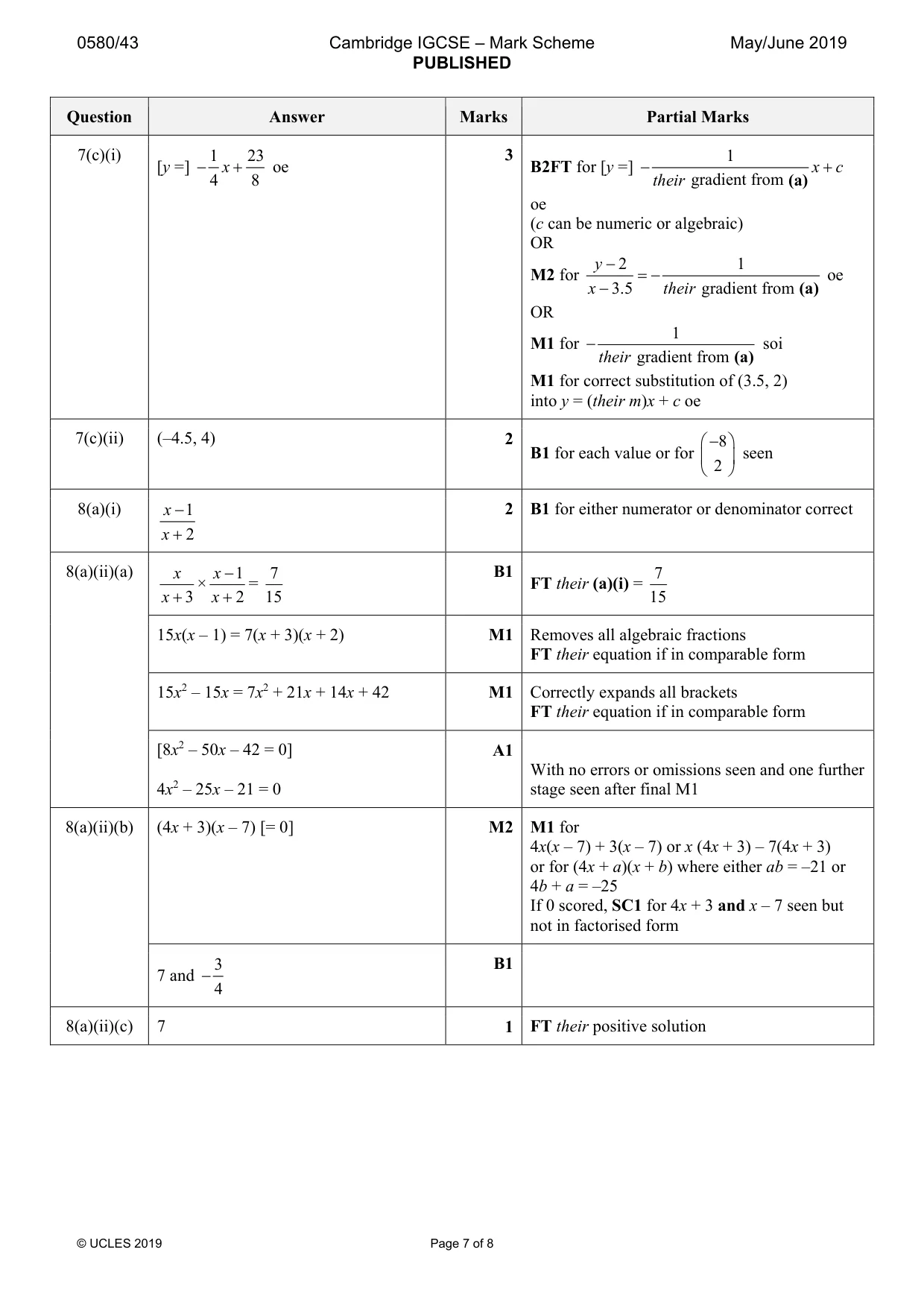
Mark scheme: 7(a) [y = ] 4x + 5 3 B2 for answer [y =] 4x + c oe (c can be numeric or algebraic) OR y − 9 9 −−( 3) M2 for = oe x − 1 1 −−( 2) OR 9 −−3 M1 for oe or for 1 −−2 M1 for correct substitution of (–2, –3) or (1, 9) into y = (their m)x + c oe 7(b) 76[.0] or 75.96... 2 M1 for tan[ ] = 4 oe 7(c)(i) 1 23 3 1 [y =] − x + oe B2FT for [y =] − x + c 4 8 their gradient from (a) oe (c can be numeric or algebraic) OR y − 2 1 M2 for = − oe x − 3.5 their gradient from (a) OR 1 M1 for −their gradient from (a) soi M1 for correct substitution of (3.5, 2) into y = (their m)x + c oe 7(c)(ii) (–4.5, 4) 2 − 8 B1 for each value or for seen 2
Q8 · Angelo has a bag containing 3 white counters and x black counters
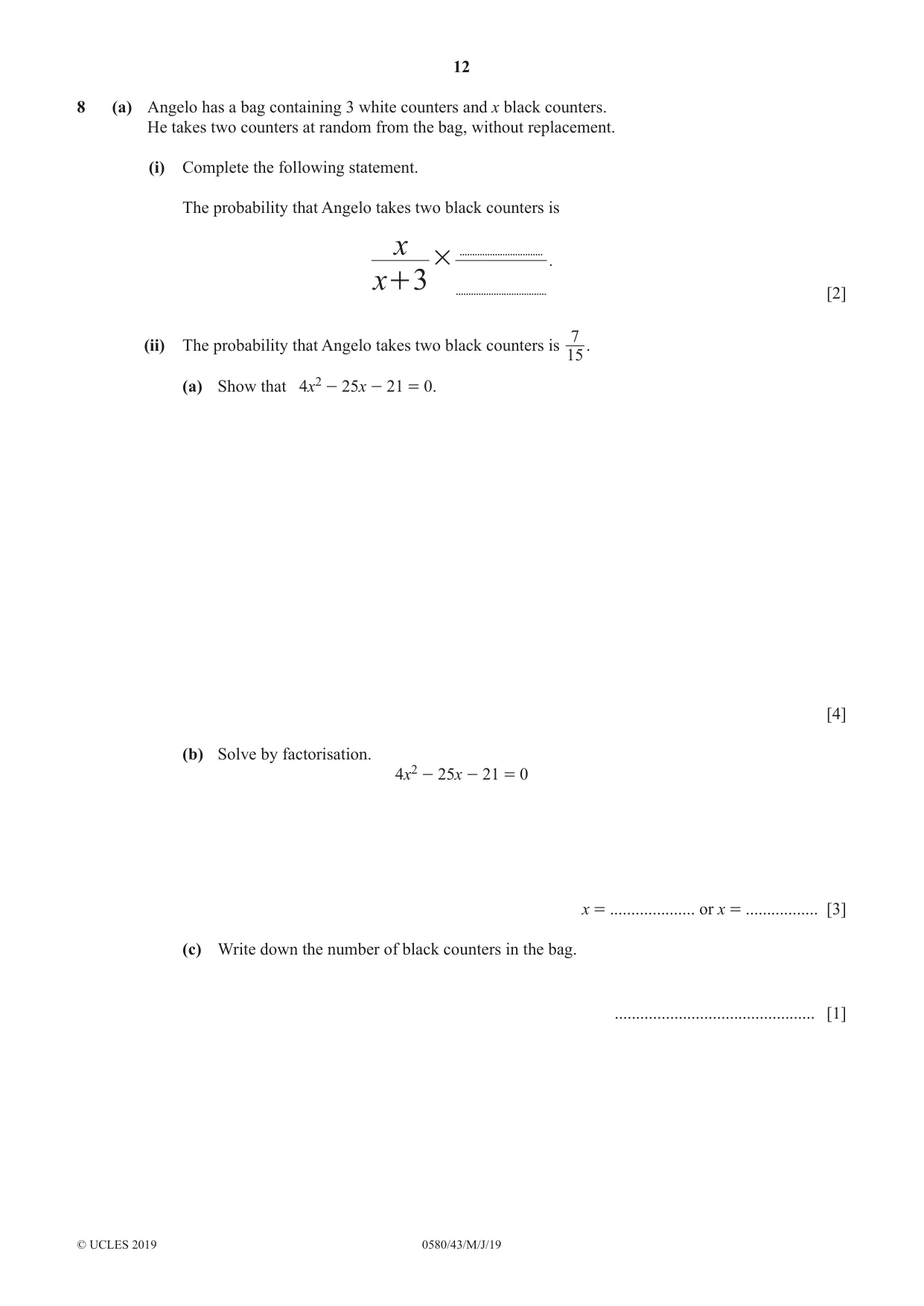
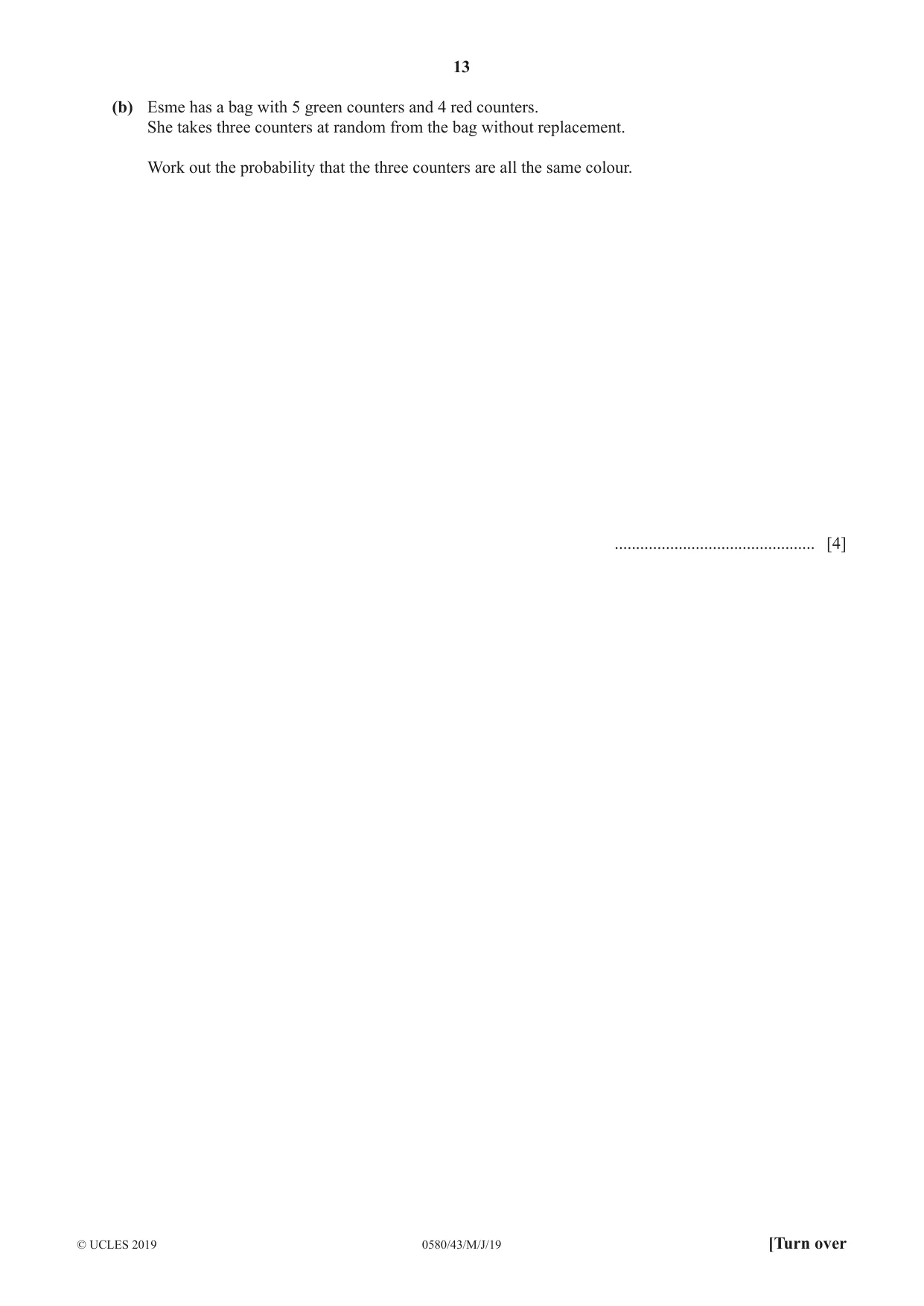
8 (a) Angelo has a bag containing 3 white counters and x black counters. He takes two counters at random from the bag, without replacement. (i) Complete the following statement. The probability that Angelo takes two black counters is x # . x + 3 [2] 7 (ii) The probability that Angelo takes two black counters is . 15 (a) Show that 4x2 - 25x - 21 = 0. [4] (b) Solve by factorisation. 4x2 - 25x - 21 = 0 x = .................... or x = ................. [3] (c) Write down the number of black counters in the bag. ............................................... [1] (b) Esme has a bag with 5 green counters and 4 red counters. She takes three counters at random from the bag without replacement. Work out the probability that the three counters are all the same colour. ............................................... [4]
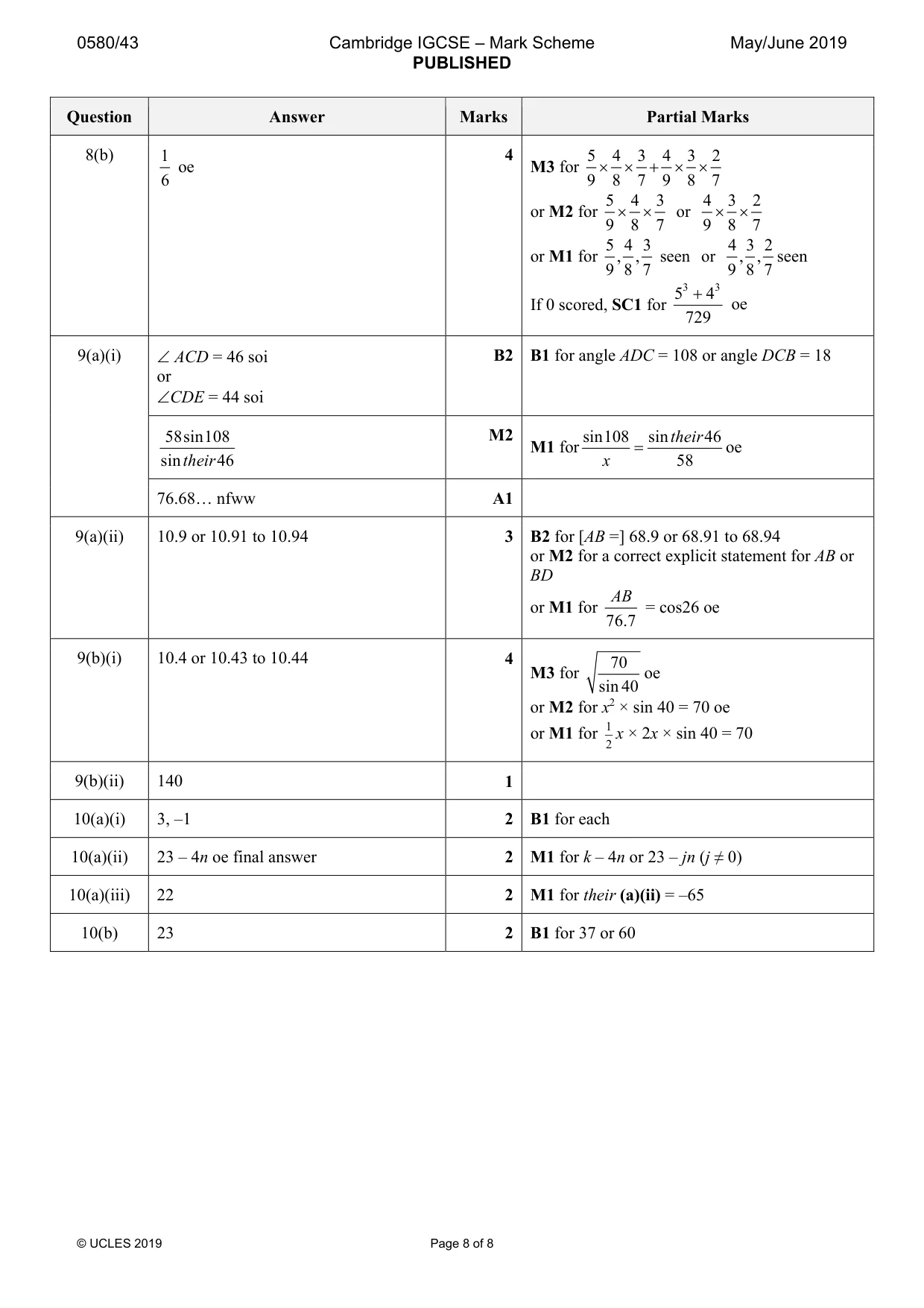
Mark scheme: 8(a)(i) x − 1 2 B1 for either numerator or denominator correct x + 2 8(a)(ii)(a) x x − 1 7 B1 7 × = FT their (a)(i) = x + 3 x + 2 15 15 15x(x – 1) = 7(x + 3)(x + 2) M1 Removes all algebraic fractions FT their equation if in comparable form 15x2 – 15x = 7x2 + 21x + 14x + 42 M1 Correctly expands all brackets FT their equation if in comparable form [8x2 – 50x – 42 = 0] A1 With no errors or omissions seen and one further 4x2 – 25x – 21 = 0 stage seen after final M1 8(a)(ii)(b) (4x + 3)(x – 7) [= 0] M2 M1 for 4x(x – 7) + 3(x – 7) or x (4x + 3) – 7(4x + 3) or for (4x + a)(x + b) where either ab = –21 or 4b + a = –25 If 0 scored, SC1 for 4x + 3 and x – 7 seen but not in factorised form 3 B1 7 and − 4 8(a)(ii)(c) 7 1 FT their positive solution 8(b) 1 4 5 4 3 4 3 2 oe M3 for × × + × × 6 9 8 7 9 8 7 5 4 3 4 3 2 or M2 for × × or × × 9 8 7 9 8 7 5 4 3 4 3 2 or M1 for , , seen or , , seen 9 8 7 9 8 7 53 + 4 3 If 0 scored, SC1 for oe 729
Q9 · C NOT TO SCALE A D B 58 m In the diagram, BC is a vertical wall standing on horizontal…
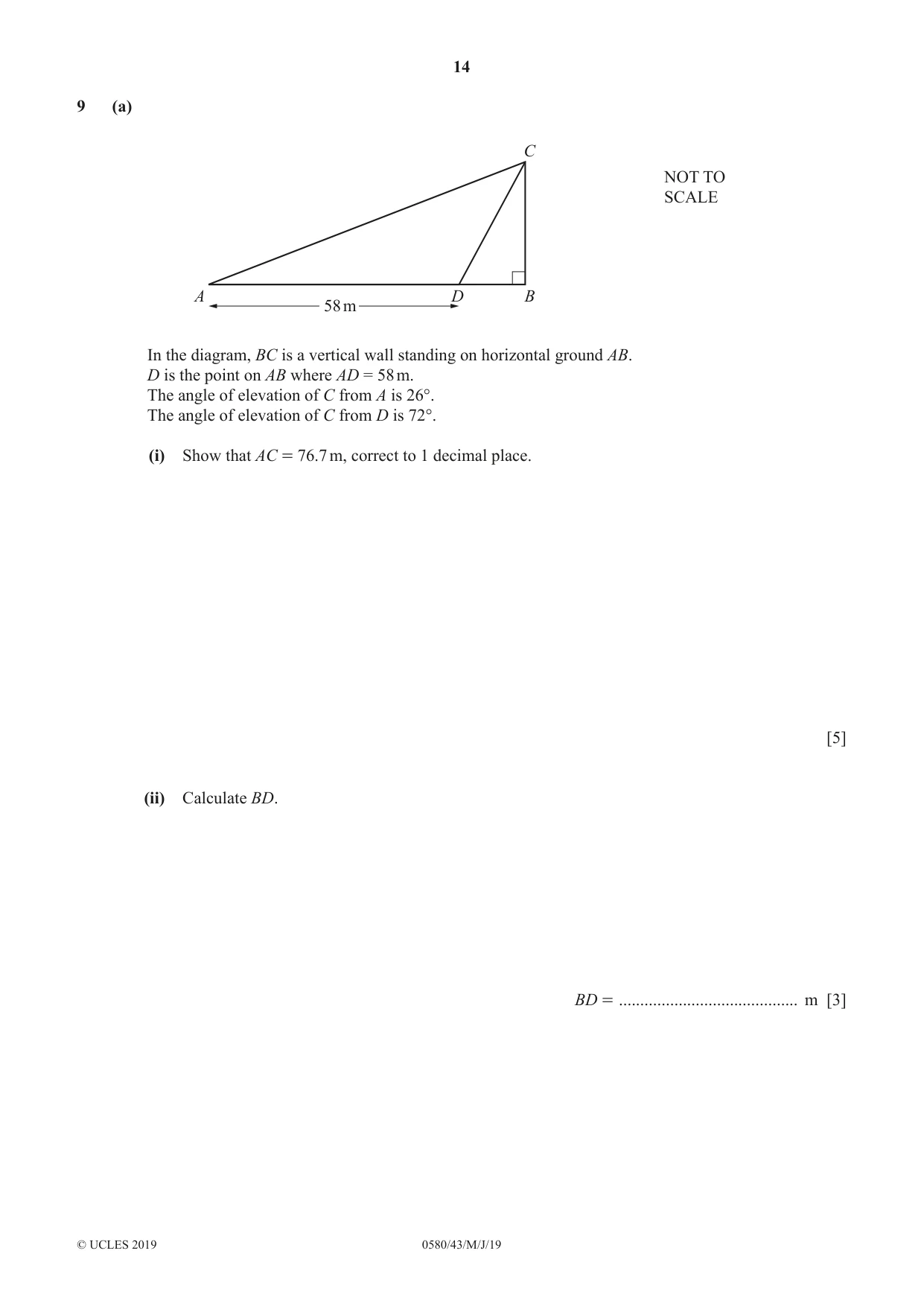
9 (a) C NOT TO SCALE A D B 58 m In the diagram, BC is a vertical wall standing on horizontal ground AB. D is the point on AB where AD = 58 m. The angle of elevation of C from A is 26°. The angle of elevation of C from D is 72°. (i) Show that AC = 76.7 m, correct to 1 decimal place. [5] (ii) Calculate BD. BD = .......................................... m [3] (b) Triangle EFG has an area of 70 m2. EF : FG = 1 : 2 and angle EFG = 40°. (i) Calculate EF. EF = .......................................... m [4] (ii) A different triangle PQR also has an area of 70 m2. PQ : QR = 1 : 2 and PQ = EF. Find angle PQR. Angle PQR = .............................................. [1] Question 10 is printed on the next page.
Mark scheme: 9(a)(i) ∠ ACD = 46 soi B2 B1 for angle ADC = 108 or angle DCB = 18 or ∠CDE = 44 soi 58sin108 M2 sin108 sin their 46 M1 for = oe sin their 46 x 58 76.68… nfww A1 9(a)(ii) 10.9 or 10.91 to 10.94 3 B2 for [AB =] 68.9 or 68.91 to 68.94 or M2 for a correct explicit statement for AB or BD AB or M1 for = cos26 oe 76.7 9(b)(i) 10.4 or 10.43 to 10.44 4 70 M3 for oe sin 40 or M2 for x2 × sin 40 = 70 oe or M1 for 1 x × 2x × sin 40 = 70 2 9(b)(ii) 140 1
Q10 · 19, 15, 11, 7, ...
10 (a) 19, 15, 11, 7, .... (i) Write down the next two terms of the sequence. ...................... , .................. [2] (ii) Find the nth term of this sequence. ............................................... [2] (iii) Find the value of n when the nth term is -65. n = .............................................. [2] (b) Another sequence has nth term 2n2 + 5n - 15. Find the difference between the 4th term and the 5th term of this sequence. ............................................... [2]
Mark scheme: 10(a)(i) 3, –1 2 B1 for each 10(a)(ii) 23 – 4n oe final answer 2 M1 for k – 4n or 23 – jn (j ≠ 0) 10(a)(iii) 22 2 M1 for their (a)(ii) = –65 10(b) 23 2 B1 for 37 or 60
What was in this paper
The subtopics covered by these 10 questions, and how many questions each got. Open one in a new tab to see every Cambridge question on it.
What you needed in this session
Cambridge’s own grade thresholds for 2019 May/June, Paper 4 · Variant 3. A higher threshold means an easier paper — the bar moves with how the cohort did.