Cambridge IGCSE Mathematics 0580 — 2023 Feb/March Paper 4 · Variant 2
0580/42/F/M/23 · 12 questions · 130 marks · ≈146 min
The question paper and its mark scheme, free to read here and free to download. This is Cambridge’s own paper, exactly as it was sat.
Question paper20 pages
Mark scheme15 pages
Answers below. Sit the paper first if you are practising.
Questions as text
Q1 · Alain and Beatrice share $750 in the ratio Alain : Beatrice = 8 : 7
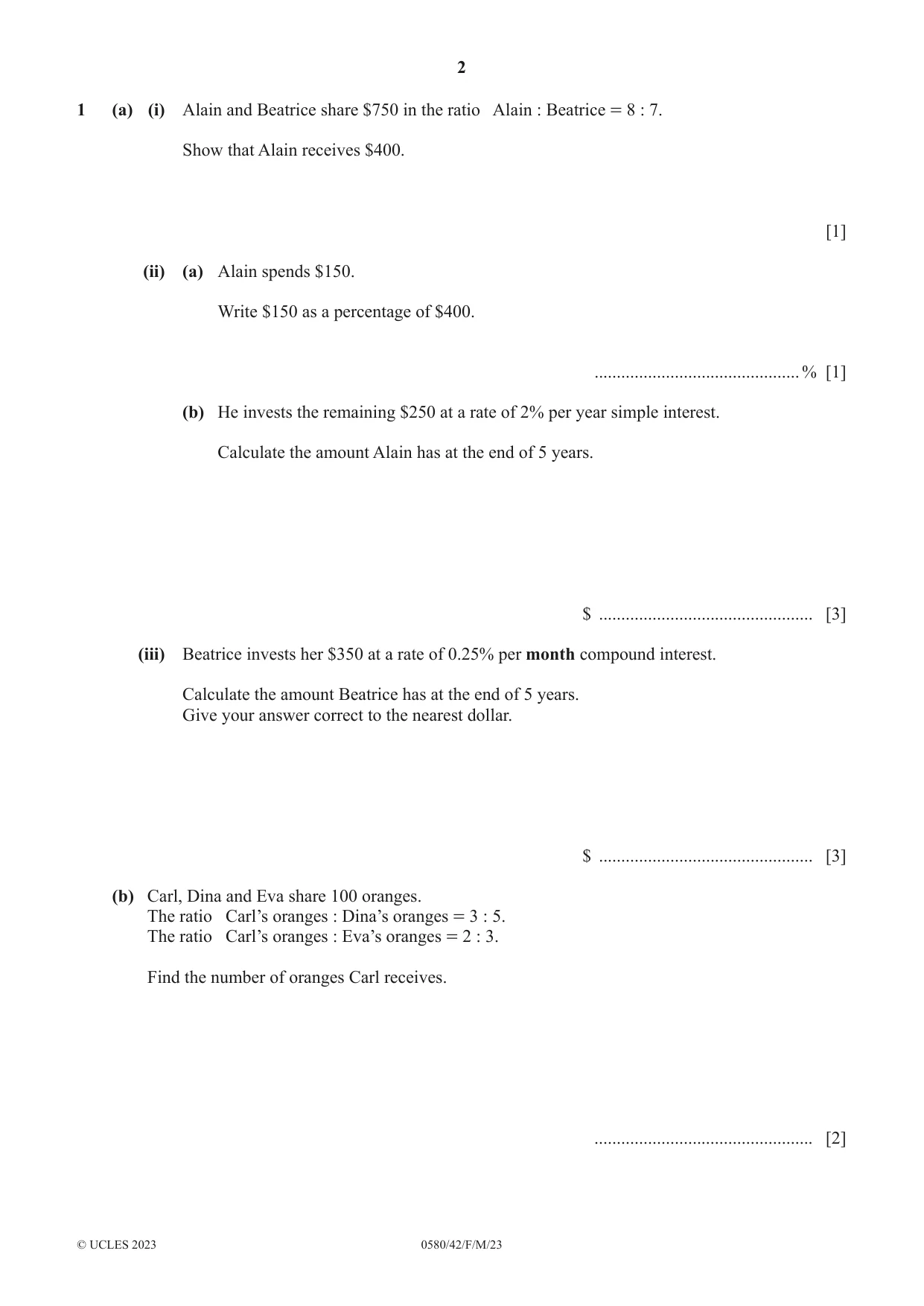
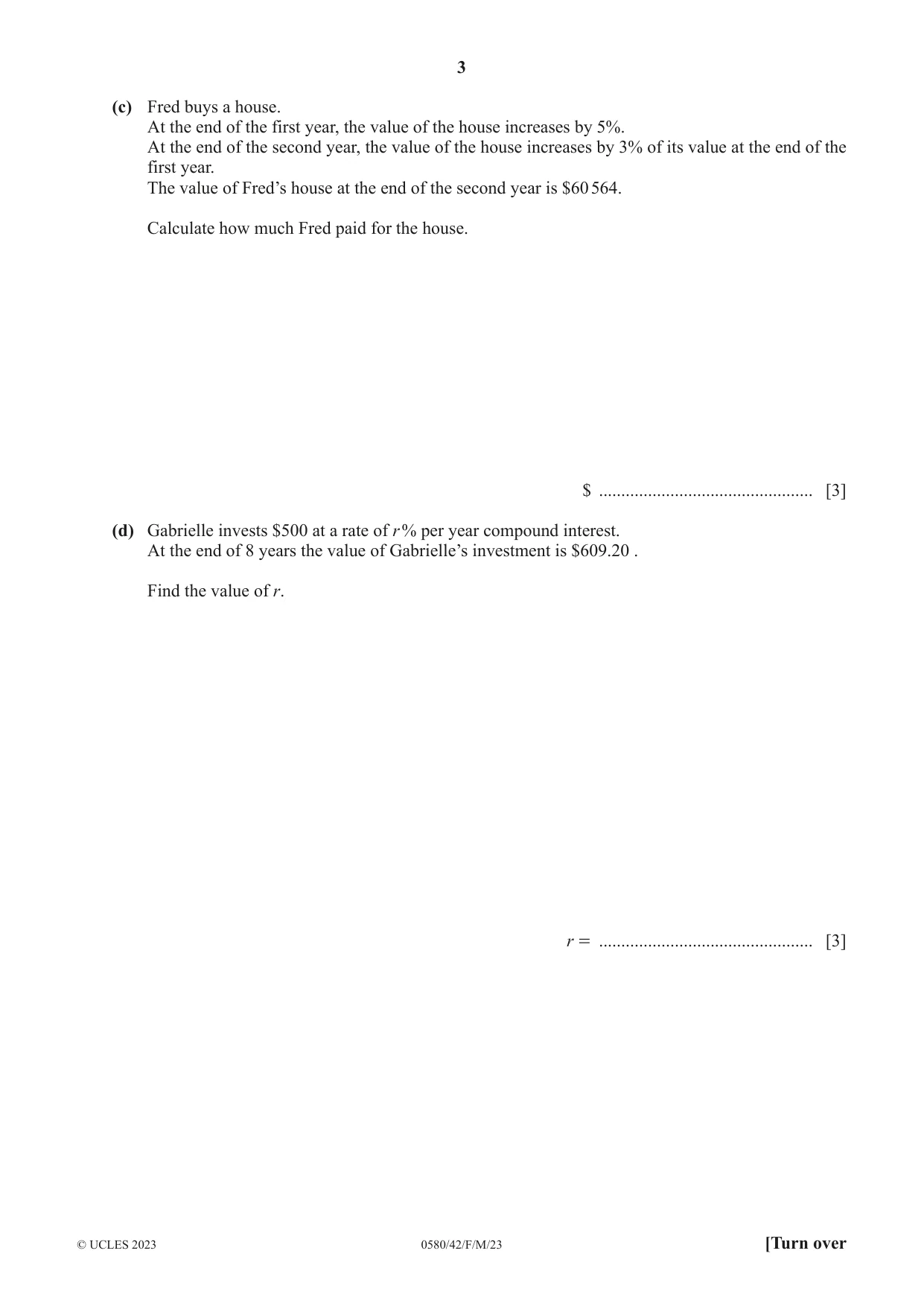
1 (a) (i) Alain and Beatrice share $750 in the ratio Alain : Beatrice = 8 : 7. Show that Alain receives $400. [1] (ii) (a) Alain spends $150. Write $150 as a percentage of $400. ..............................................% [1] (b) He invests the remaining $250 at a rate of 2% per year simple interest. Calculate the amount Alain has at the end of 5 years. $ ................................................ [3] (iii) Beatrice invests her $350 at a rate of 0.25% per month compound interest. Calculate the amount Beatrice has at the end of 5 years. Give your answer correct to the nearest dollar. $ ................................................ [3] (b) Carl, Dina and Eva share 100 oranges. The ratio Carl’s oranges : Dina’s oranges = 3 : 5. The ratio Carl’s oranges : Eva’s oranges = 2 : 3. Find the number of oranges Carl receives. ................................................. [2] (c) Fred buys a house. At the end of the first year, the value of the house increases by 5%. At the end of the second year, the value of the house increases by 3% of its value at the end of the first year. The value of Fred’s house at the end of the second year is $60 564. Calculate how much Fred paid for the house. $ ................................................ [3] (d) Gabrielle invests $500 at a rate of r % per year compound interest. At the end of 8 years the value of Gabrielle’s investment is $609.20 . Find the value of r. r = ................................................ [3]
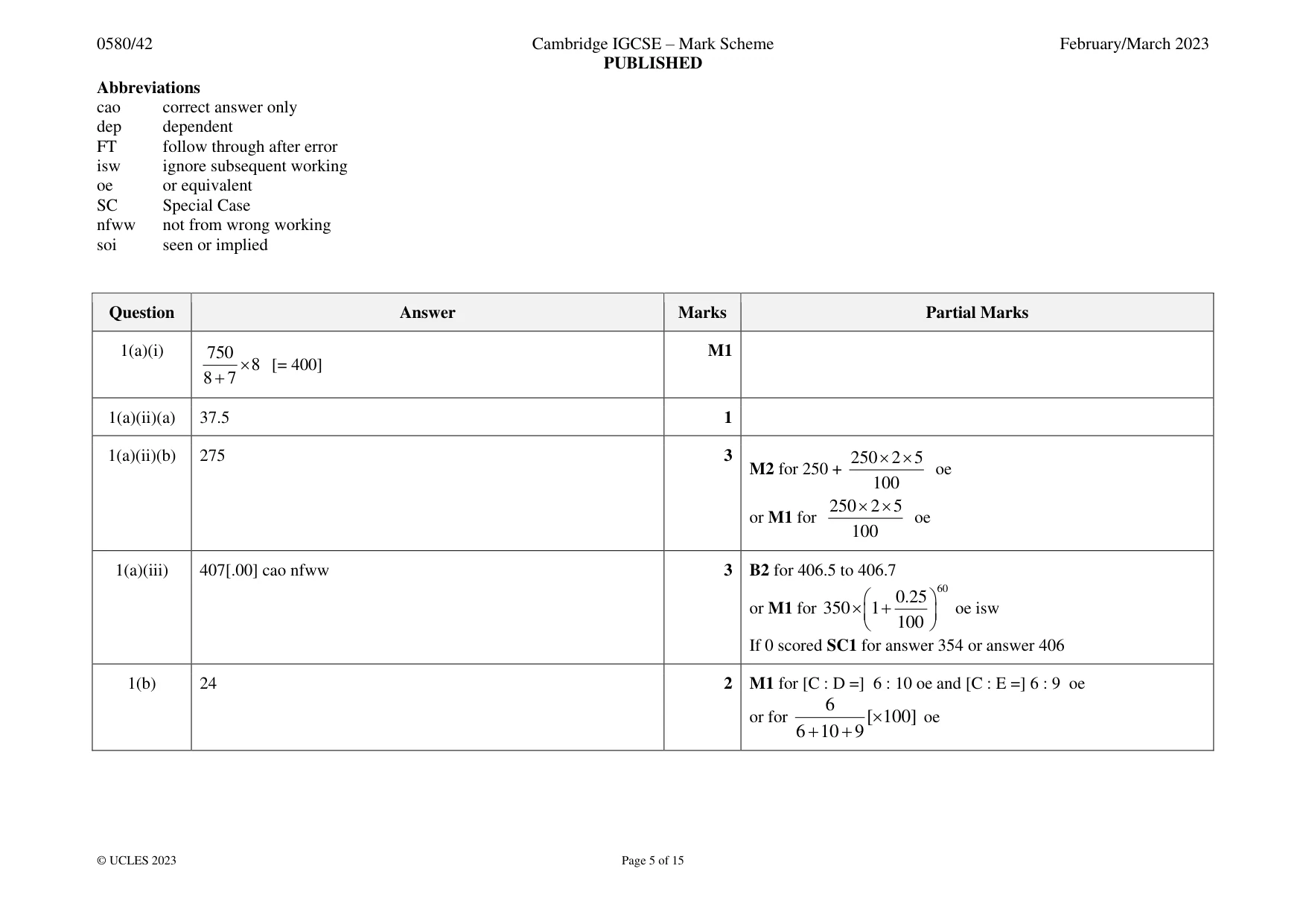
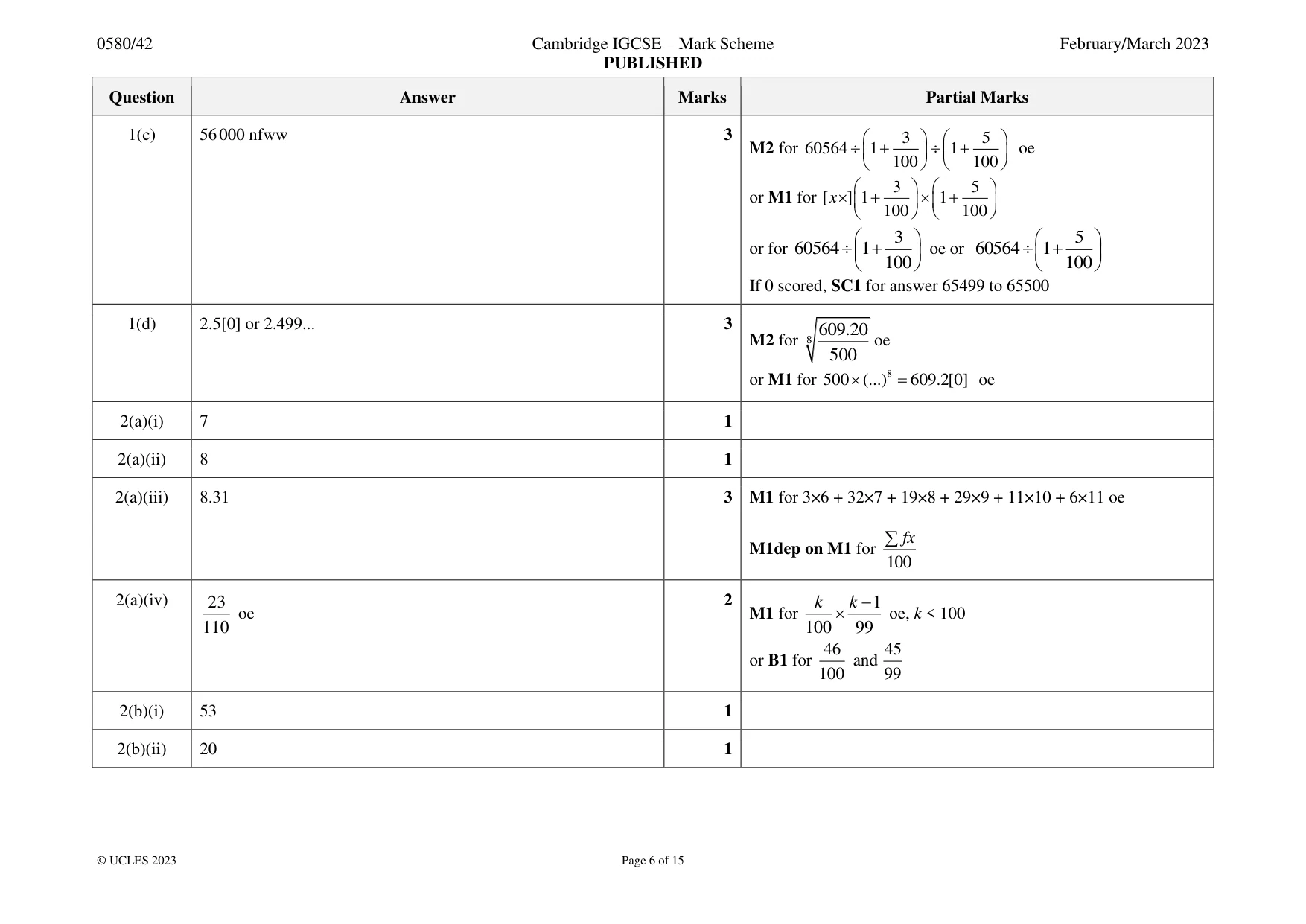
Mark scheme: Question Answer Marks Partial Marks 1(a)(i) 750 M1 8 [= 400] 8 + 7 1(a)(ii)(a) 37.5 1 1(a)(ii)(b) 275 3 250 2 5 M2 for 250 + oe 100 250 2 5 or M1 for oe 100 1(a)(iii) 407[.00] cao nfww 3 B2 for 406.5 to 406.7 0.25 60 or M1 for 350 1 + oe isw 100 If 0 scored SC1 for answer 354 or answer 406 1(b) 24 2 M1 for [C : D =] 6 : 10 oe and [C : E =] 6 : 9 oe 6 or for [ 100] oe 6 + 10 + 9 1(c) 56 000 nfww 3 3 5 M2 for 60564 1 + 1 + oe 100 100 3 5 or M1 for [ x ] 1 + 1 + 100 100 3 5 or for 60564 1 + oe or 60564 1 + 100 100 If 0 scored, SC1 for answer 65499 to 65500 1(d) 2.5[0] or 2.499... 3 609.20 M2 for 8 oe 500 or M1 for 500 (...)8 = 609.2[0] oe
Q2 · 100 students take part in a reaction test
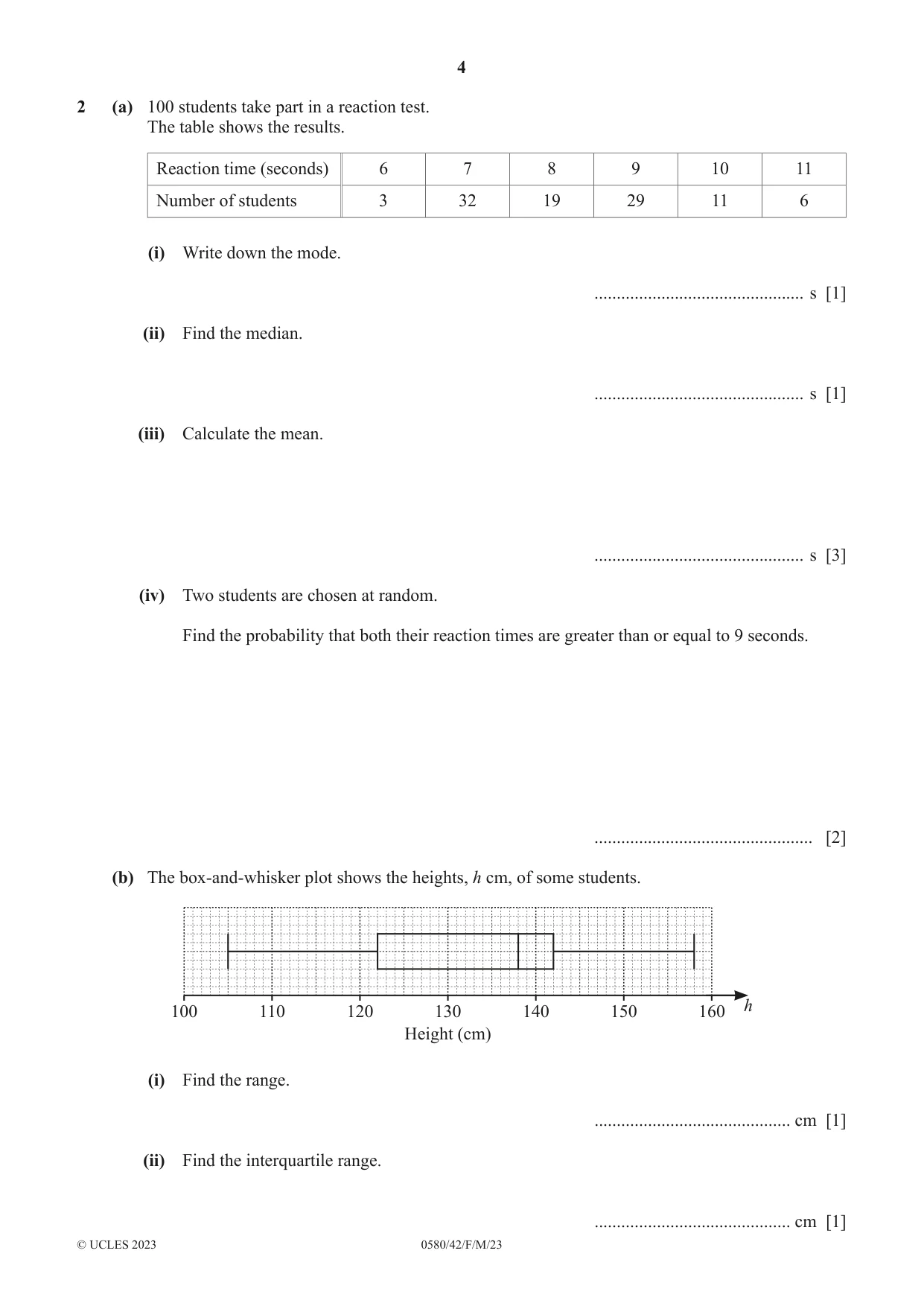
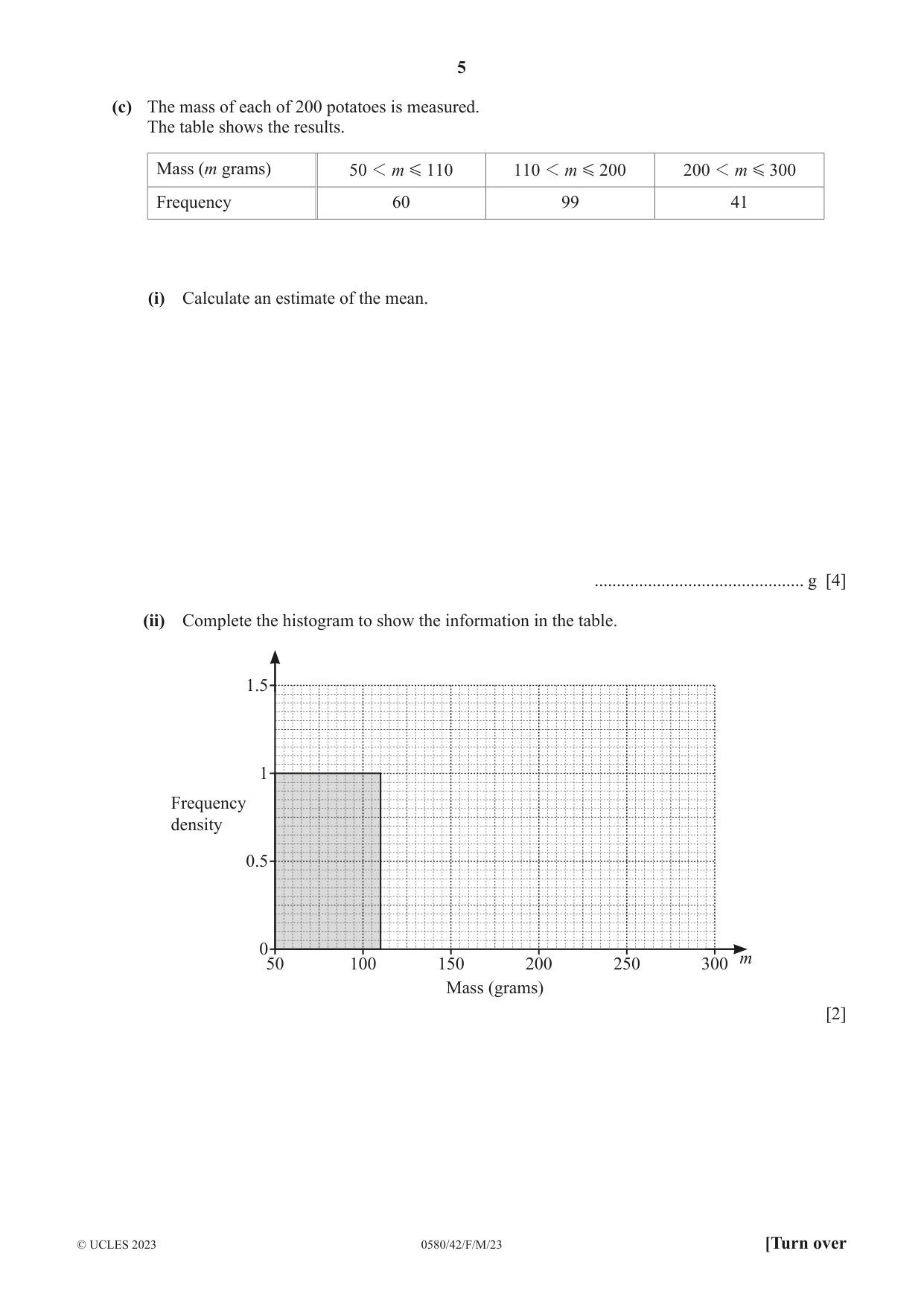
2 (a) 100 students take part in a reaction test. The table shows the results. Reaction time (seconds) 6 7 8 9 10 11 Number of students 3 32 19 29 11 6 (i) Write down the mode. ............................................... s [1] (ii) Find the median. ............................................... s [1] (iii) Calculate the mean. ............................................... s [3] (iv) Two students are chosen at random. Find the probability that both their reaction times are greater than or equal to 9 seconds. ................................................. [2] (b) The box-and-whisker plot shows the heights, h cm, of some students. h 100 110 120 130 140 150 160 Height (cm) (i) Find the range. ............................................ cm [1] (ii) Find the interquartile range. ............................................ cm [1] (c) The mass of each of 200 potatoes is measured. The table shows the results. Mass (m grams) 50 1 m G 110 110 1 m G 200 200 1 m G 300 Frequency 60 99 41 (i) Calculate an estimate of the mean. ............................................... g [4] (ii) Complete the histogram to show the information in the table. 1.5 1 Frequency density 0.5 0 m 50 100 150 200 250 300 Mass (grams) [2]
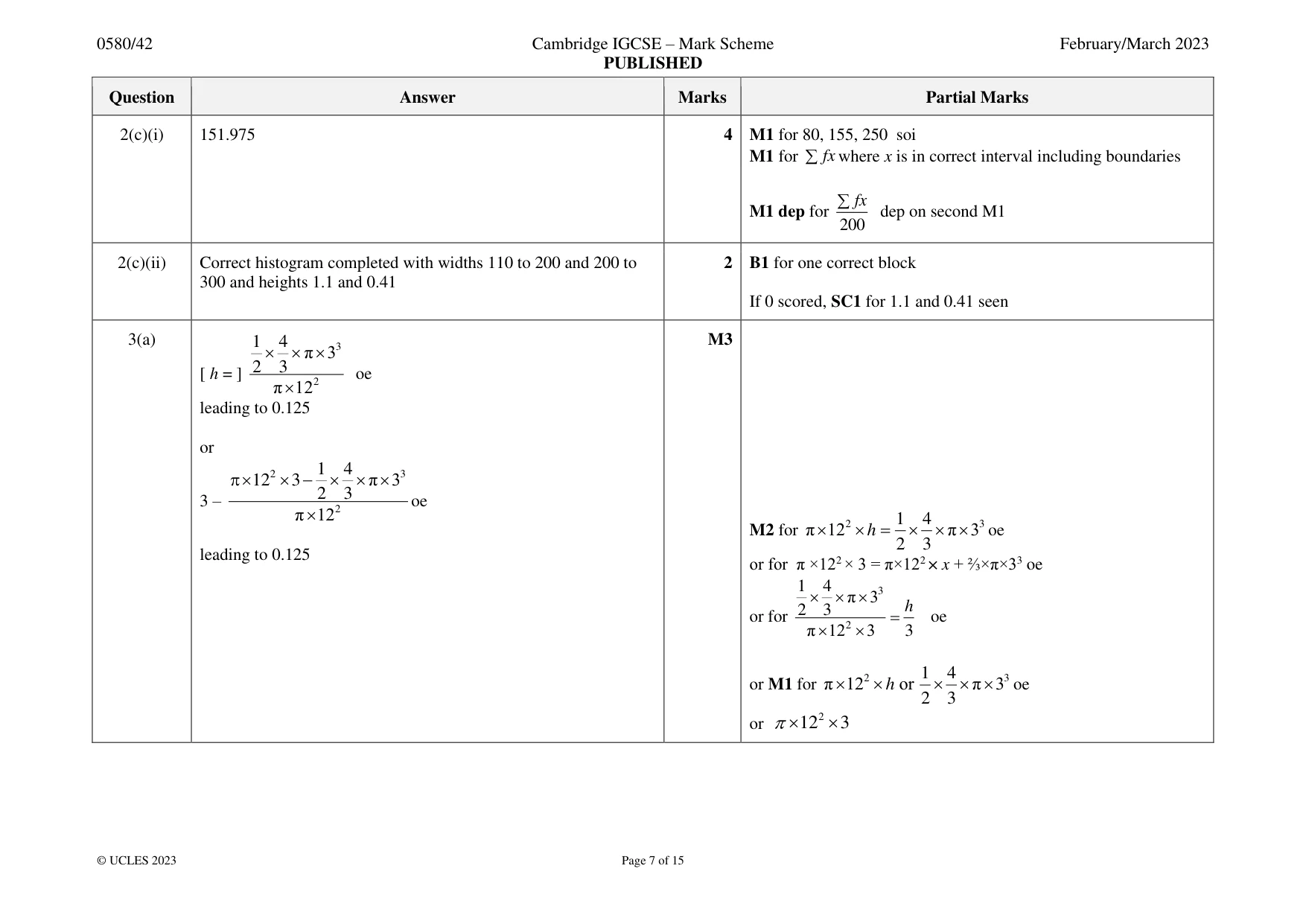
Mark scheme: 2(a)(i) 7 1 2(a)(ii) 8 1 2(a)(iii) 8.31 3 M1 for 3×6 + 32×7 + 19×8 + 29×9 + 11×10 + 6×11 oe fx M1dep on M1 for 100 2(a)(iv) 23 2 k k − 1 oe M1 for oe, k < 100 110 100 99 46 45 or B1 for and 100 99 2(b)(i) 53 1 2(b)(ii) 20 1 2(c)(i) 151.975 4 M1 for 80, 155, 250 soi M1 for fx where x is in correct interval including boundaries fx M1 dep for dep on second M1 200 2(c)(ii) Correct histogram completed with widths 110 to 200 and 200 to 2 B1 for one correct block 300 and heights 1.1 and 0.41 If 0 scored, SC1 for 1.1 and 0.41 seen
Q3 · 12 cm NOT TO SCALE 3 cm The diagram shows a cylinder containing water
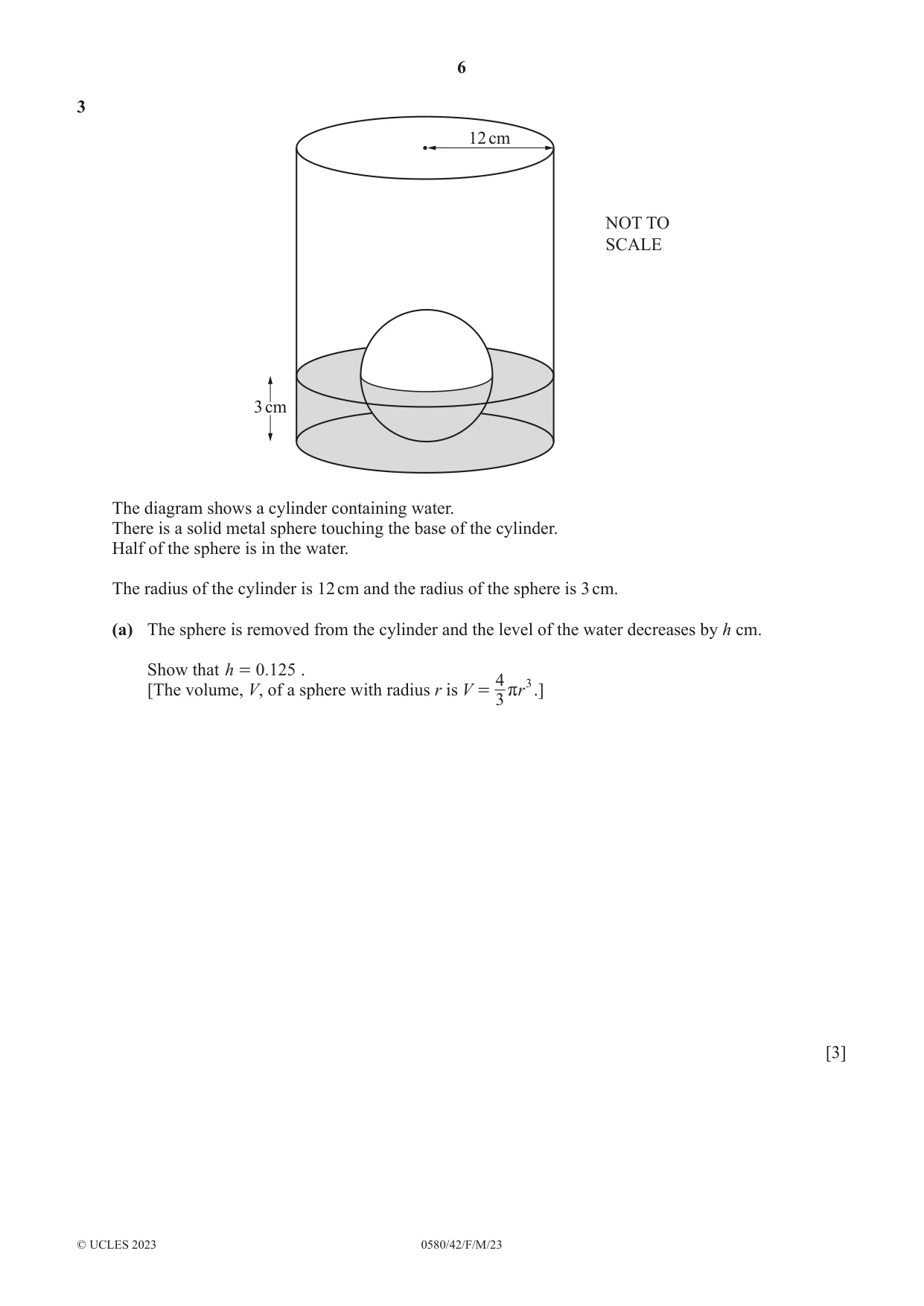
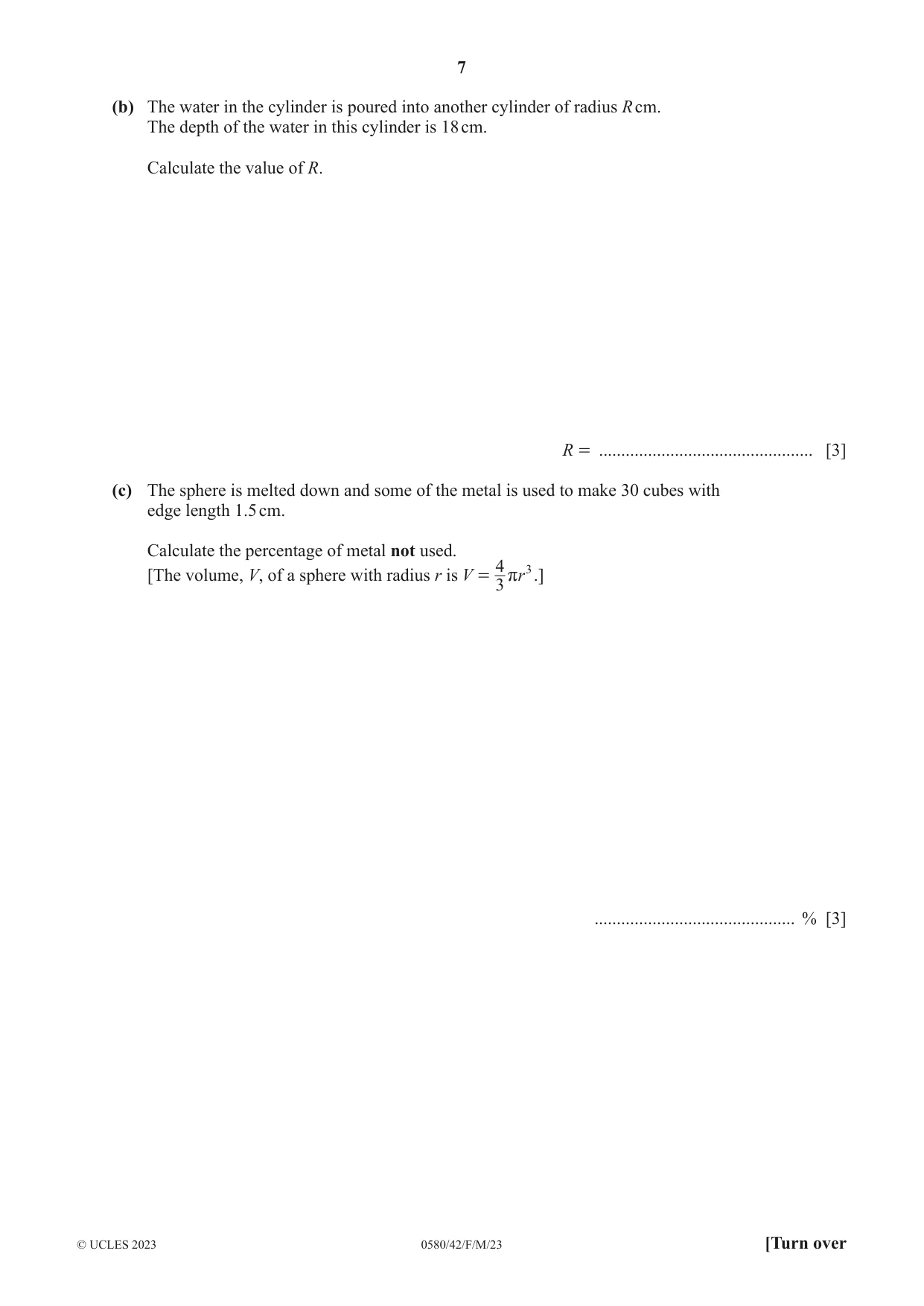
3 12 cm NOT TO SCALE 3 cm The diagram shows a cylinder containing water. There is a solid metal sphere touching the base of the cylinder. Half of the sphere is in the water. The radius of the cylinder is 12 cm and the radius of the sphere is 3 cm. (a) The sphere is removed from the cylinder and the level of the water decreases by h cm. Show that h = 0.125 . 4 3 [The volume, V, of a sphere with radius r is V = rr .] 3 [3] (b) The water in the cylinder is poured into another cylinder of radius R cm. The depth of the water in this cylinder is 18 cm. Calculate the value of R. R = ................................................ [3] (c) The sphere is melted down and some of the metal is used to make 30 cubes with edge length 1.5 cm. Calculate the percentage of metal not used. 4 3 [The volume, V, of a sphere with radius r is V = rr .] 3 ............................................. % [3]
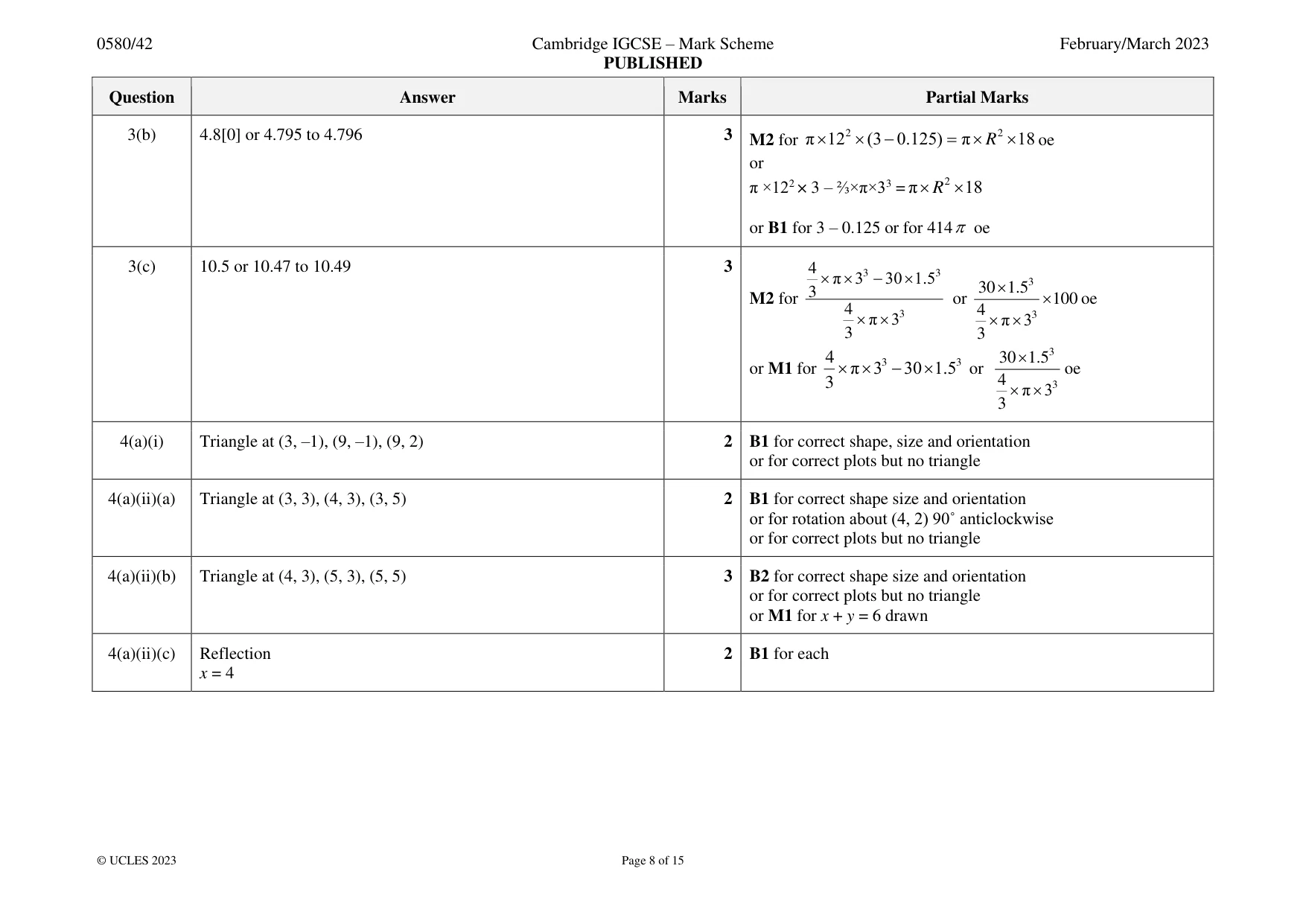
Mark scheme: 3(a) 1 4 3 M3 π 3 2 3 [ h = ] oe π 12 2 leading to 0.125 or 2 1 4 3 12 −3 π 3 2 3 3 – oe π 12 2 2 1 4 3 M2 for π 12 h = π 3 oe 2 3 leading to 0.125 or for π ×122 × 3 = π×122 × x + ⅔×π×33 oe 1 4 3 π 3 2 3 h or for = oe π 12 2 3 3 2 1 4 3 or M1 for π 12 h or π 3 oe 2 3 or 12 2 3 3(b) 4.8[0] or 4.795 to 4.796 3 M2 for π 12 2 (3 − 0.125) = π R 2 18 oe or π ×122 × 3 – ⅔×π×33 = π R 2 18 or B1 for 3 – 0.125 or for 414 oe 3(c) 10.5 or 10.47 to 10.49 3 4 3 3 π 3 − 30 1.5 3 3 30 1.5 M2 for or 100 oe 4 3 4 3 π 3 π 3 3 3 4 3 3 30 1.53 or M1 for π 3 − 30 1.5 or oe 3 4 3 π 3 3
Q4 · Y 6 5 4 3 2 T 1 0 x 1 2 3 4 5 6 7 8 9 10 – 1 – 2 (i) Enlarge triangle T by scale factor…
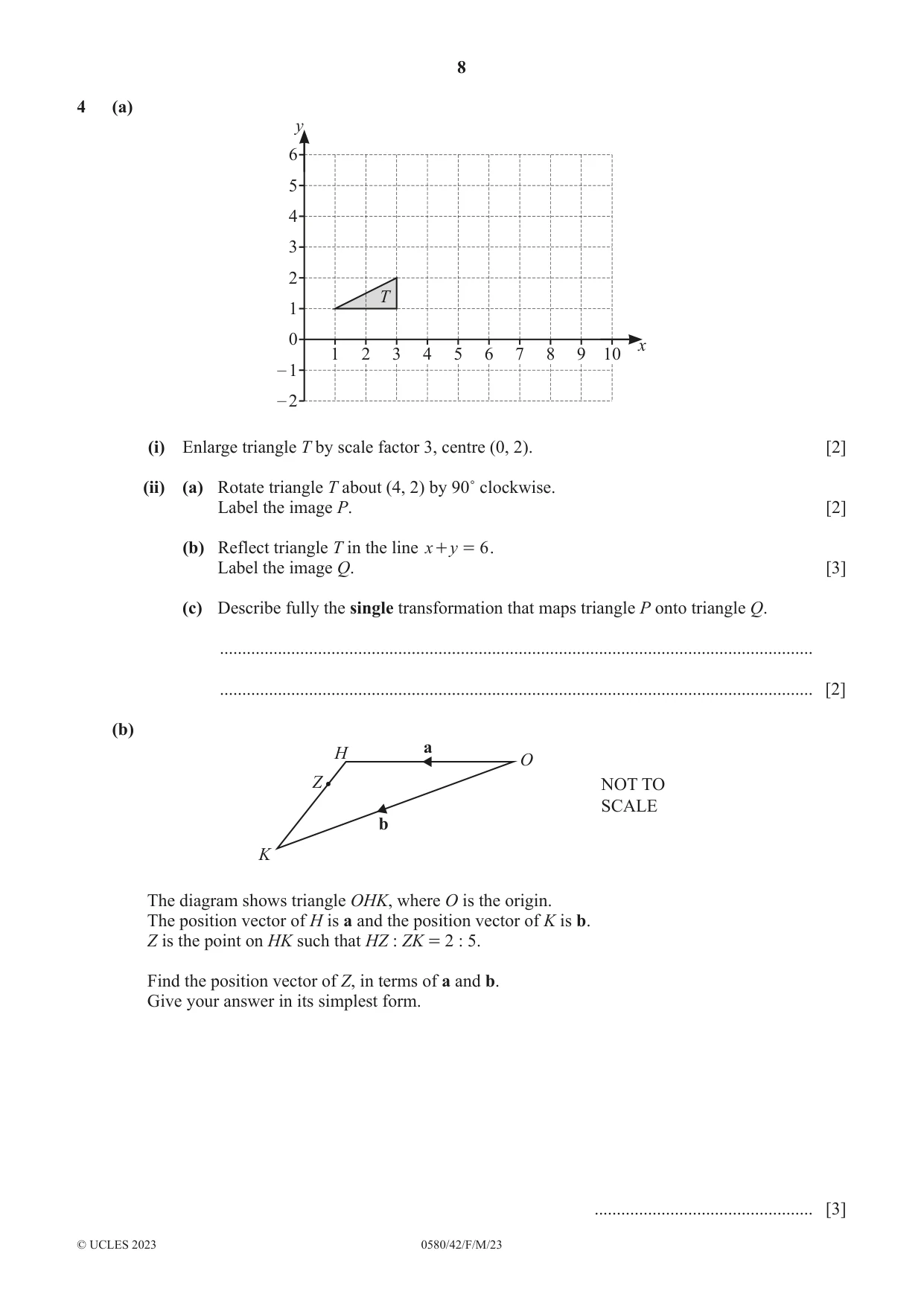
4 (a) y 6 5 4 3 2 T 1 0 x 1 2 3 4 5 6 7 8 9 10 – 1 – 2 (i) Enlarge triangle T by scale factor 3, centre (0, 2). [2] (ii) (a) Rotate triangle T about (4, 2) by 90˚ clockwise. Label the image P. [2] (b) Reflect triangle T in the line x + y = 6 . Label the image Q. [3] (c) Describe fully the single transformation that maps triangle P onto triangle Q. ..................................................................................................................................... ..................................................................................................................................... [2] (b) a H O Z NOT TO SCALE b K The diagram shows triangle OHK, where O is the origin. The position vector of H is a and the position vector of K is b. Z is the point on HK such that HZ : ZK = 2 : 5. Find the position vector of Z, in terms of a and b. Give your answer in its simplest form. ................................................. [3]
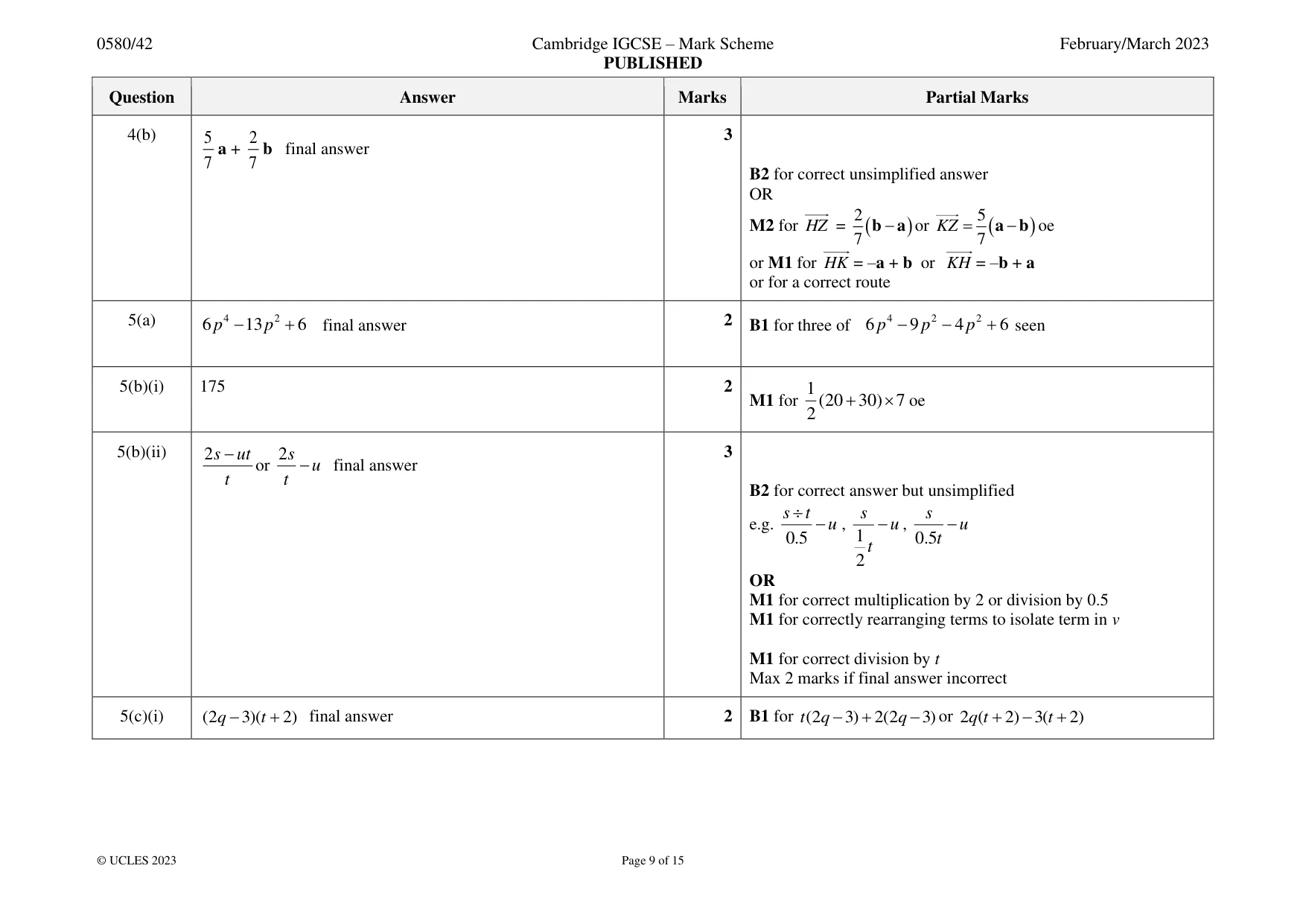
Mark scheme: 4(a)(i) Triangle at (3, –1), (9, –1), (9, 2) 2 B1 for correct shape, size and orientation or for correct plots but no triangle 4(a)(ii)(a) Triangle at (3, 3), (4, 3), (3, 5) 2 B1 for correct shape size and orientation or for rotation about (4, 2) 90˚ anticlockwise or for correct plots but no triangle 4(a)(ii)(b) Triangle at (4, 3), (5, 3), (5, 5) 3 B2 for correct shape size and orientation or for correct plots but no triangle or M1 for x + y = 6 drawn 4(a)(ii)(c) Reflection 2 B1 for each x = 4 4(b) 5 2 3 a + b final answer 7 7 B2 for correct unsimplified answer OR 2 5 M2 for HZ = ( b − a ) or KZ = ( a − b ) oe 7 7 or M1 for HK = –a + b or KH = –b + a or for a correct route
Question 5
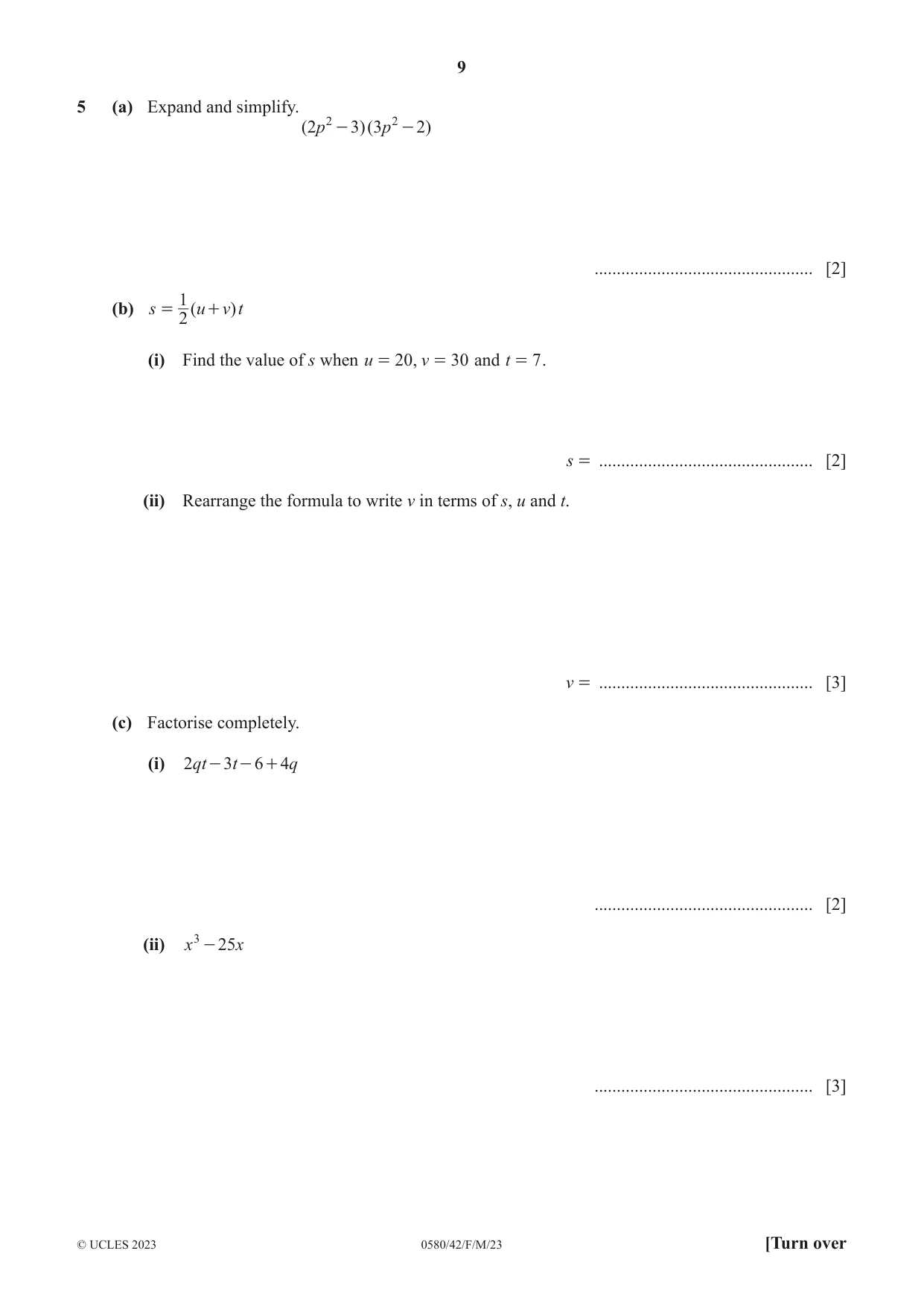
5 (a) Expand and simplify. ( 2p 2 - 3 )( 3p 2 - 2) ................................................. [2] 1 (b) s = ( u + v) t 2 (i) Find the value of s when u = 20, v = 30 and t = 7 . s = ................................................ [2] (ii) Rearrange the formula to write v in terms of s, u and t. v = ................................................ [3] (c) Factorise completely. (i) 2qt - 3t - 6 + 4q ................................................. [2] (ii) x 3 - 25x ................................................. [3]
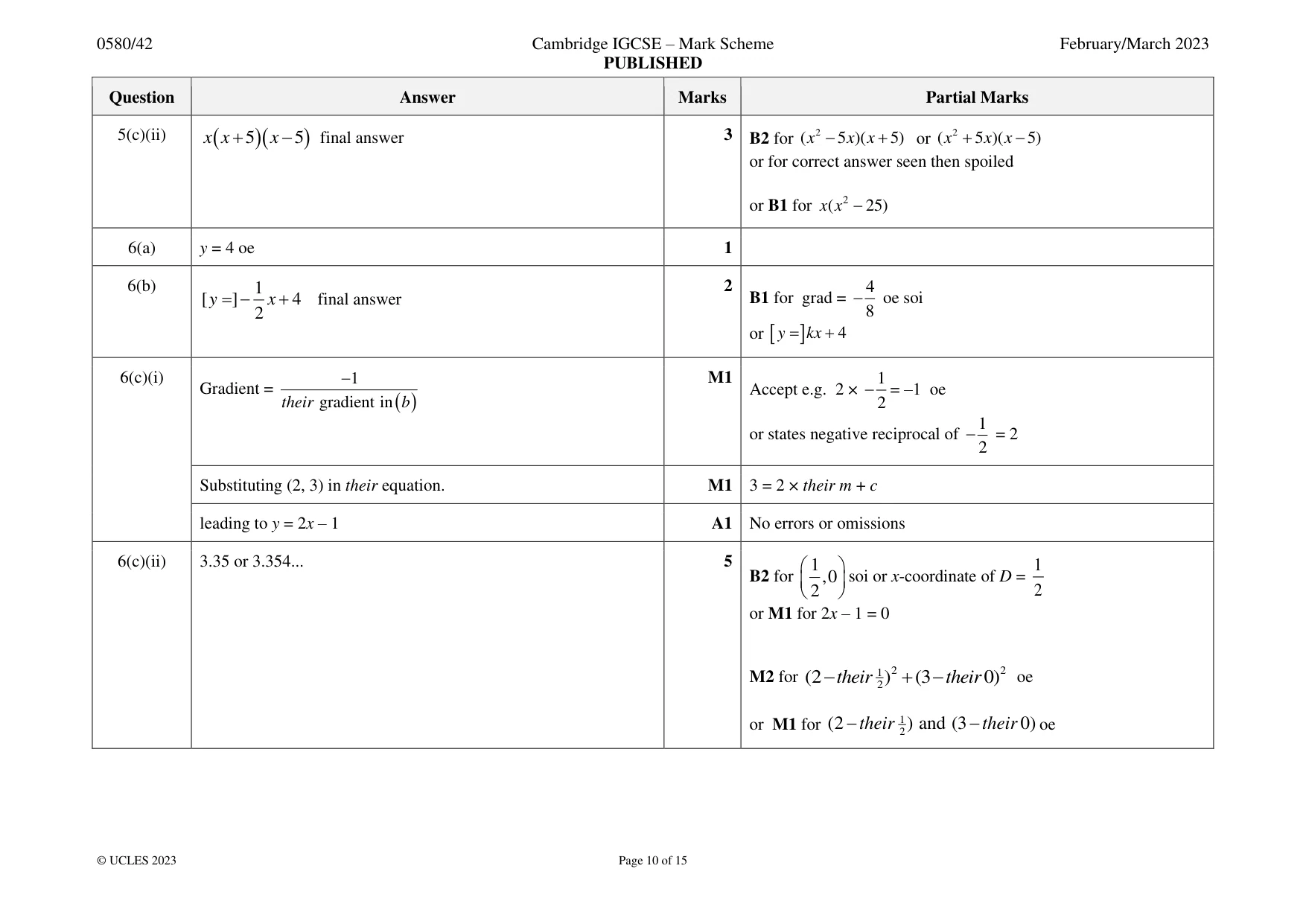
Mark scheme: 5(a) 6 p 4 − 13 p 2 + 6 final answer 2 B1 for three of 6 p 4 − 9 p 2 − 4 p 2 + 6 seen 5(b)(i) 175 2 1 M1 for (20 + 30) 7 oe 2 5(b)(ii) 2s − ut 2s 3 or − u final answer t t B2 for correct answer but unsimplified e.g. s −t u , s − u , s − u 0.5 1 0.5t t 2 OR M1 for correct multiplication by 2 or division by 0.5 M1 for correctly rearranging terms to isolate term in v M1 for correct division by t Max 2 marks if final answer incorrect 5(c)(i) (2 q − 3)(t + 2) final answer 2 B1 for t (2q − 3) + 2(2q − 3) or 2q (t + 2) − 3(t + 2) 2 − 5 x )( x + 5) or ( x 2 + 5 x )( x − 5)5(c)(ii) x ( x + 5 )( x − 5) final answer 3 B2 for ( x or for correct answer seen then spoiled or B1 for x ( x 2 − 25)
Q6 · Y A 4 L1 NOT TO SCALE B 0 8 x L2 A is the point (0, 4) and B is the point (8, 0)
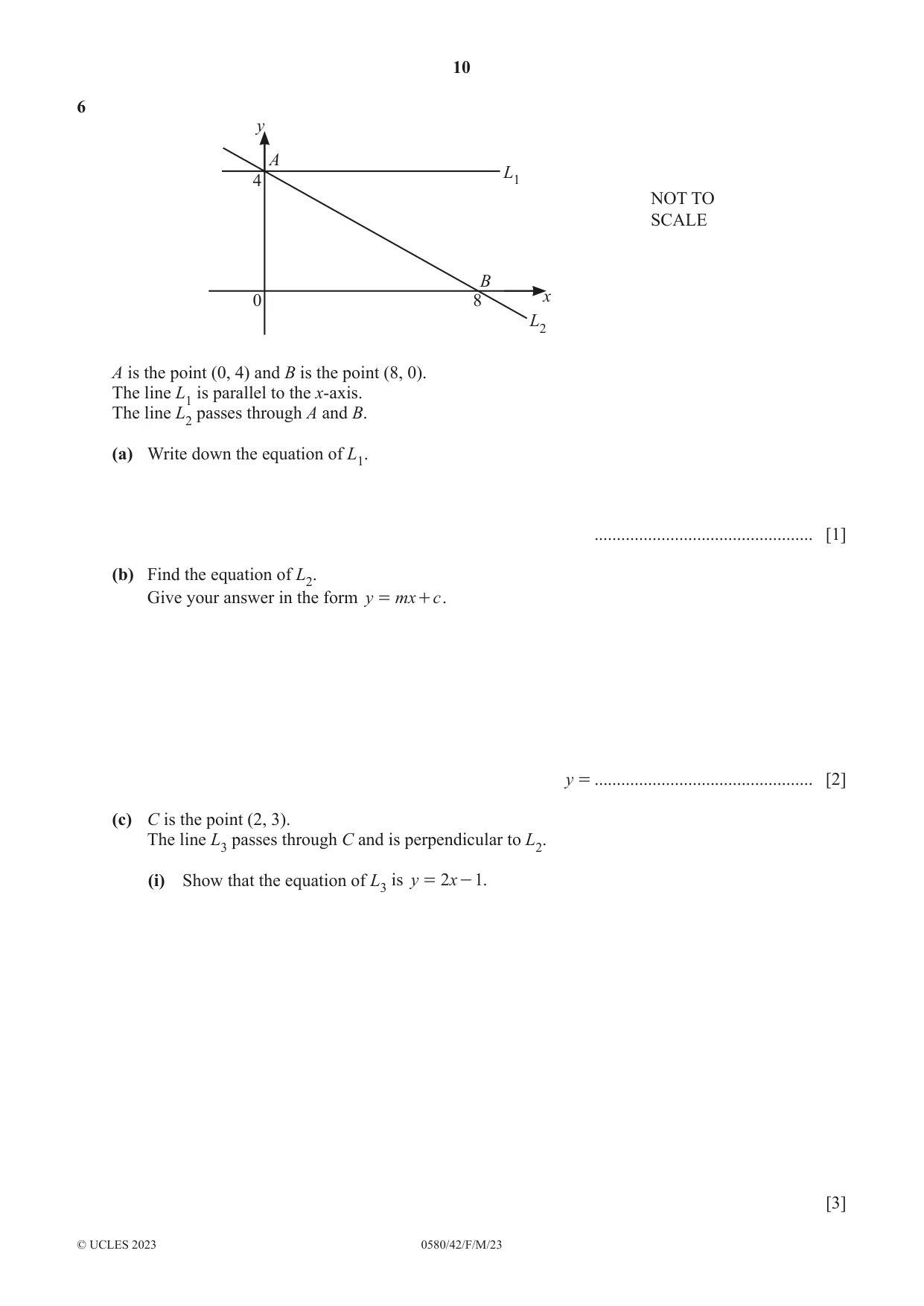
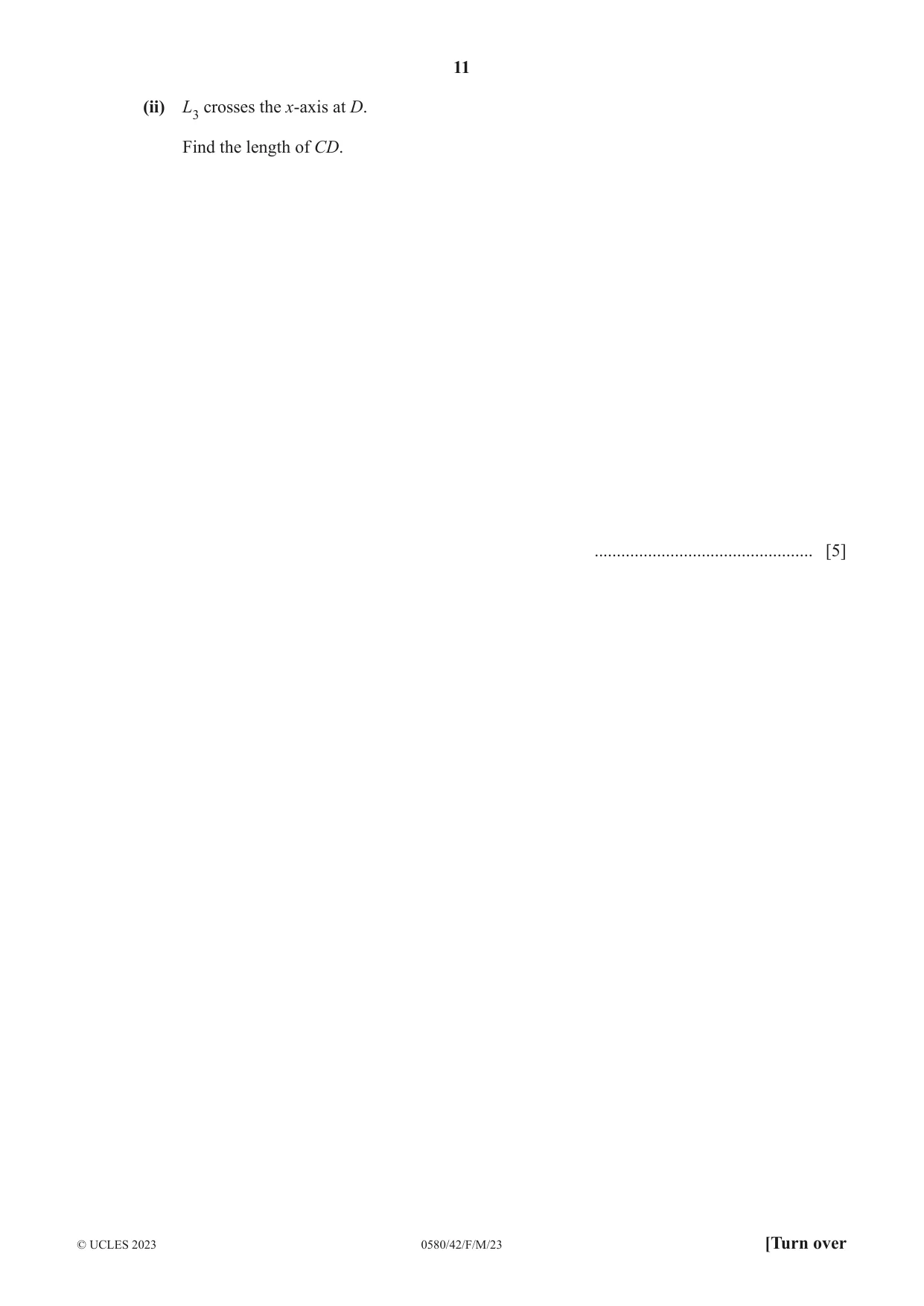
6 y A 4 L1 NOT TO SCALE B 0 8 x L2 A is the point (0, 4) and B is the point (8, 0). The line L1 is parallel to the x-axis. The line L2 passes through A and B. (a) Write down the equation of L1. ................................................. [1] (b) Find the equation of L2. Give your answer in the form y = mx + c . y = ................................................. [2] (c) C is the point (2, 3). The line L3 passes through C and is perpendicular to L2. (i) Show that the equation of L3 is y = 2x - 1. [3] (ii) L3 crosses the x-axis at D. Find the length of CD. ................................................. [5]
Mark scheme: 6(a) y = 4 oe 1 6(b) 1 2 4 [ y = ] − x + 4 final answer B1 for grad = − oe soi 2 8 or y = kx + 4 6(c)(i) −1 M1 1 Gradient = Accept e.g. 2 × − = –1 oe their gradient in ( b ) 2 1 or states negative reciprocal of − = 2 2 Substituting (2, 3) in their equation. M1 3 = 2 × their m + c leading to y = 2x – 1 A1 No errors or omissions 6(c)(ii) 3.35 or 3.354... 5 1 B2 for 1,0 soi or x-coordinate of D = 2 2 or M1 for 2x – 1 = 0 M2 for (2 − their 12 ) 2 + (3 − their 0) 2 oe or M1 for (2 − their 12 ) and (3 − their 0) oe
Q7 · = {students in a class} P = {students who study Physics} C = {students who study…
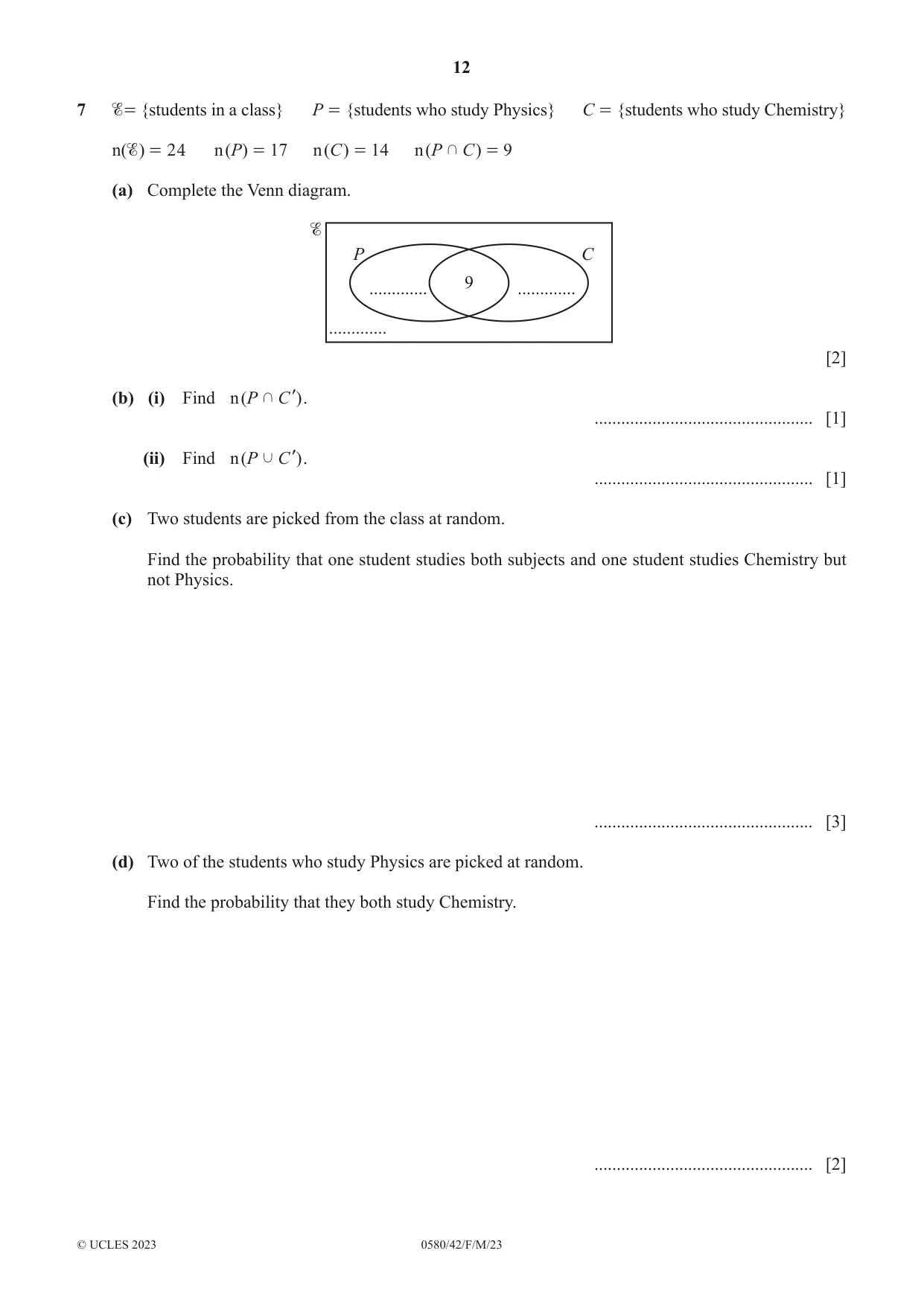
7 = {students in a class} P = {students who study Physics} C = {students who study Chemistry} n() = 24 n ( P) = 17 n ( C ) = 14 n ( P k C ) = 9 (a) Complete the Venn diagram. P C 9 ............. ............. ............. [2] (b) (i) Find n ( P k C l) . ................................................. [1] (ii) Find n ( P j C l) . ................................................. [1] (c) Two students are picked from the class at random. Find the probability that one student studies both subjects and one student studies Chemistry but not Physics. ................................................. [3] (d) Two of the students who study Physics are picked at random. Find the probability that they both study Chemistry. ................................................. [2]
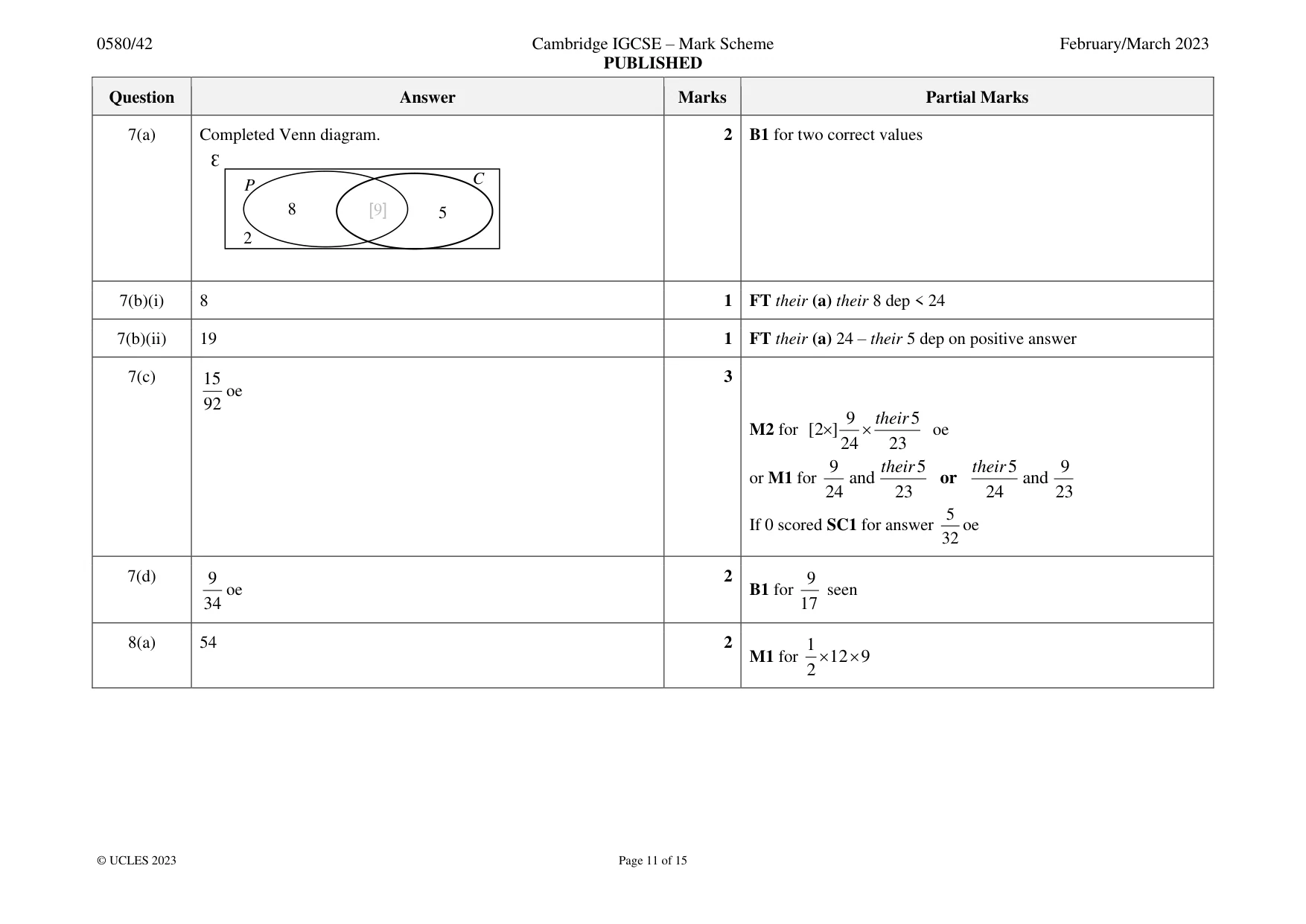
Mark scheme: 7(a) Completed Venn diagram. 2 B1 for two correct values Ɛ C P 8 [9] 5 2 7(b)(i) 8 1 FT their (a) their 8 dep < 24 7(b)(ii) 19 1 FT their (a) 24 – their 5 dep on positive answer 7(c) 15 3 oe 92 9 their 5 M2 for [2]24 23 oe 9 their 5 their 5 9 or M1 for and or and 24 23 24 23 5 If 0 scored SC1 for answer oe 32 7(d) 9 2 9 oe B1 for seen 34 17
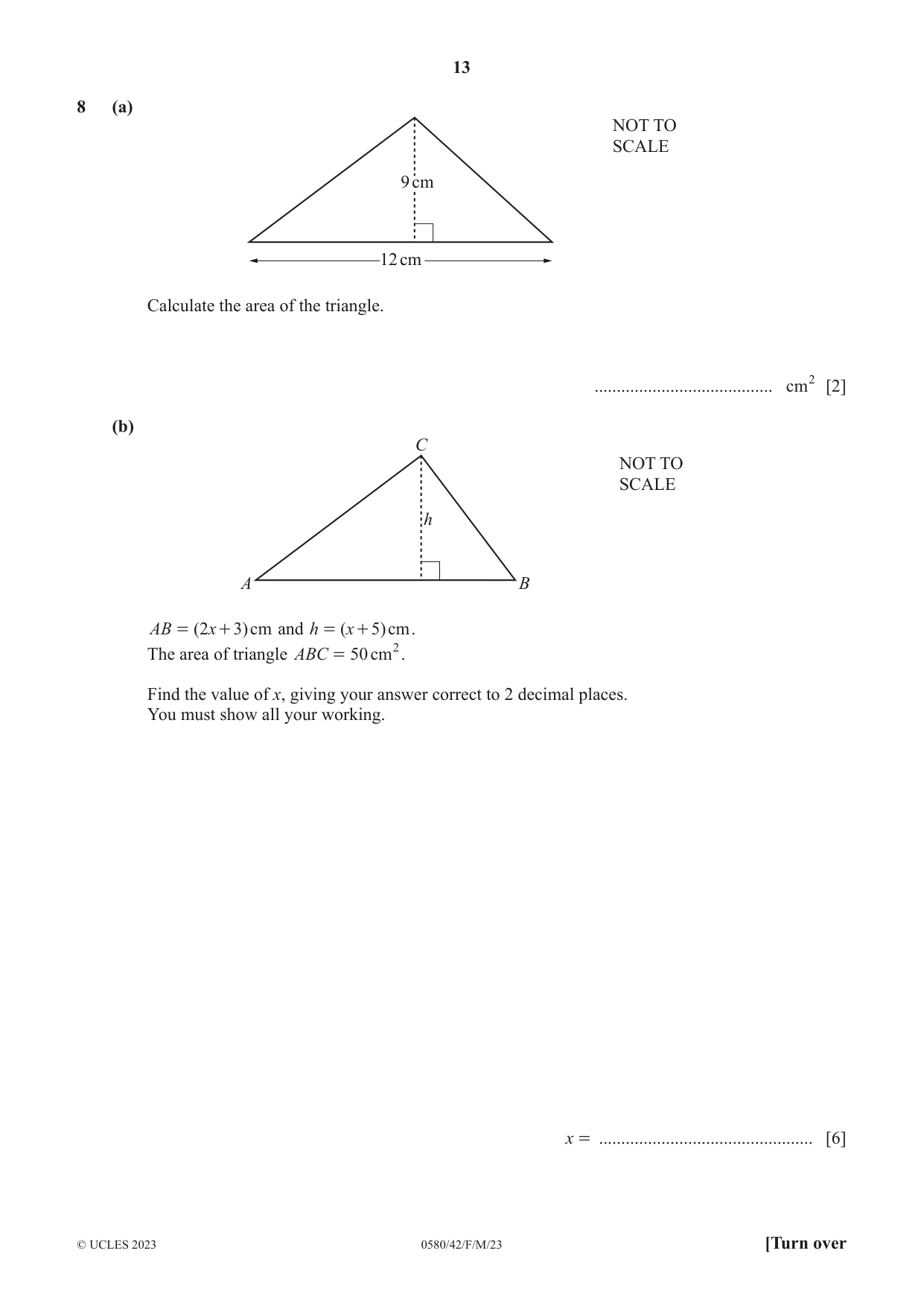
Q8 · NOT TO SCALE 9 cm 12 cm Calculate the area of the triangle
8 (a) NOT TO SCALE 9 cm 12 cm Calculate the area of the triangle. ........................................ cm2 [2] (b) C NOT TO SCALE h A B AB = ( 2x + 3)cm and h = ( x + 5)cm . The area of triangle ABC = 50 cm 2 . Find the value of x, giving your answer correct to 2 decimal places. You must show all your working. x = ................................................ [6]
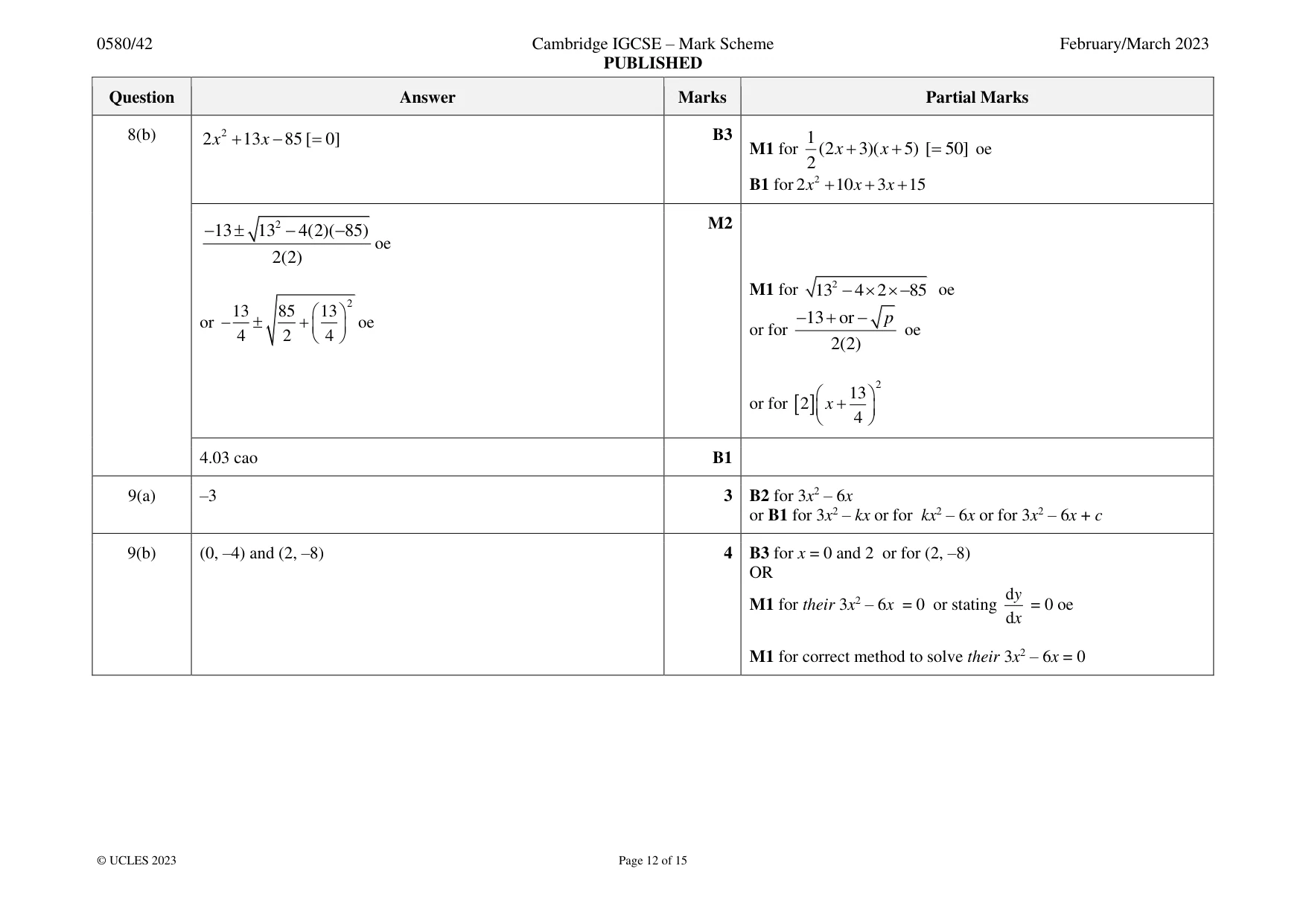
Mark scheme: 8(a) 54 2 1 M1 for 12 9 2 8(b) 2 x 2 + 13 x − 85 [ = 0] B3 1 M1 for (2 x + 3)( x + 5) [ = 50] oe 2 B1 for 2 x 2 + 10 x + 3 x + 15 2 M2 −13 13 − 4(2)( −85) oe 2(2) M1 for 132 −−4 2 85 oe 13 85 13 2 −13 + or − p or − + oe or for oe 4 2 4 2(2) 13 2 x + or for 2 4 4.03 cao B1
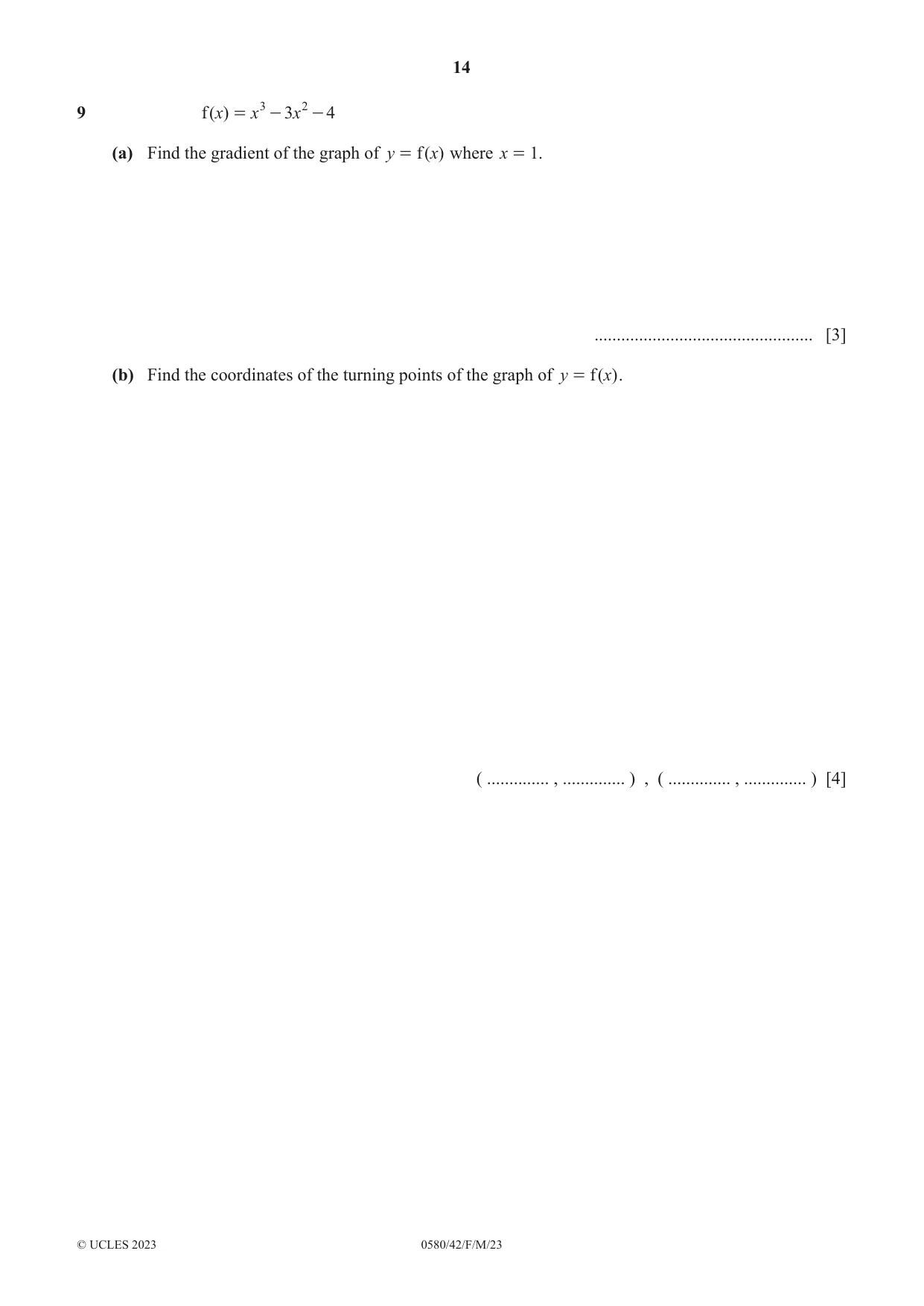
Q9 · F ( x) = x 3 - 3x 2 - 4 (a) Find the gradient of the graph of y = f ( x) where x = 1
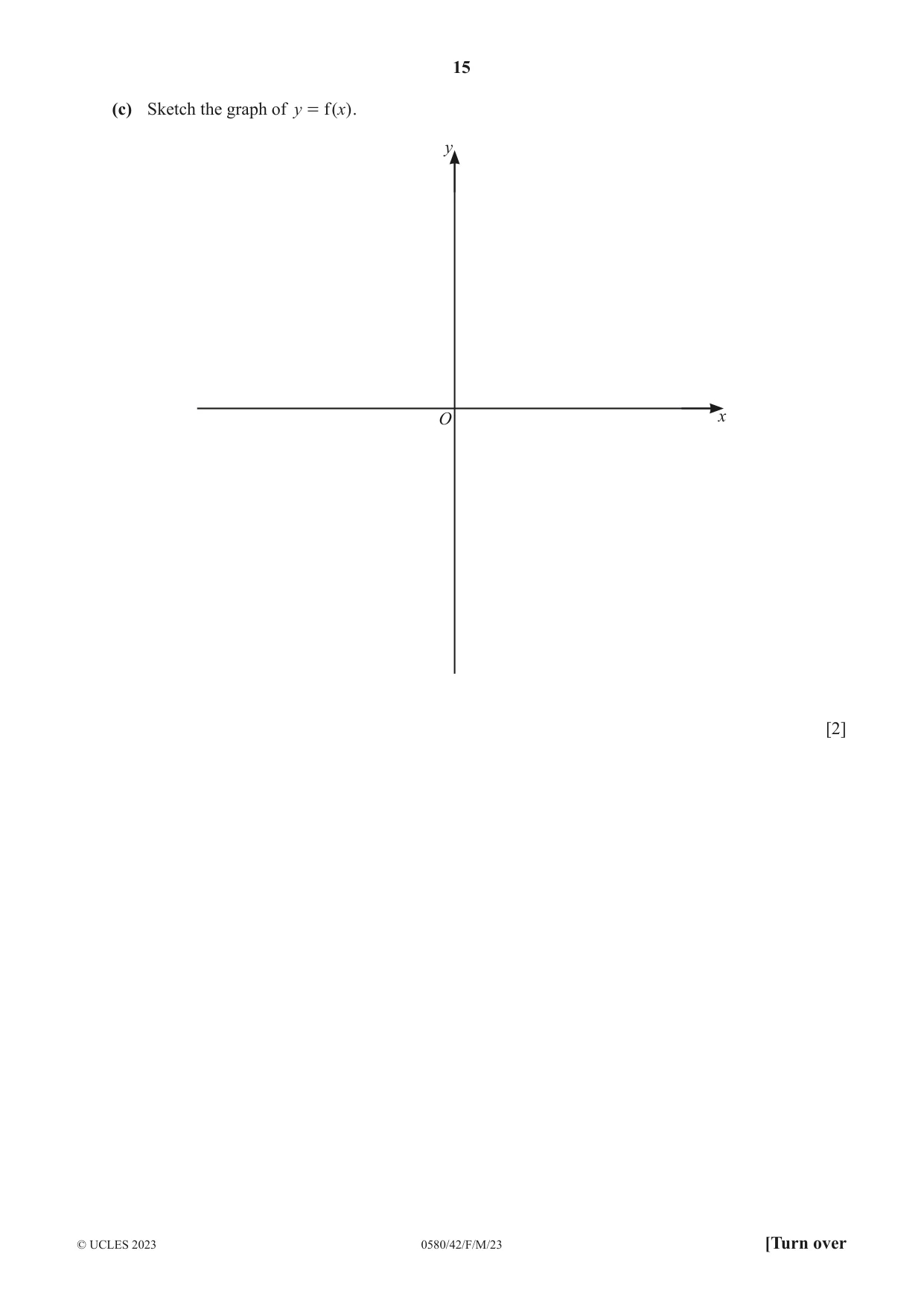
9 f ( x) = x 3 - 3x 2 - 4 (a) Find the gradient of the graph of y = f ( x) where x = 1. ................................................. [3] (b) Find the coordinates of the turning points of the graph of y = f ( x) . ( .............. , .............. ) , ( .............. , .............. ) [4] (c) Sketch the graph of y = f ( x) . y O x [2]
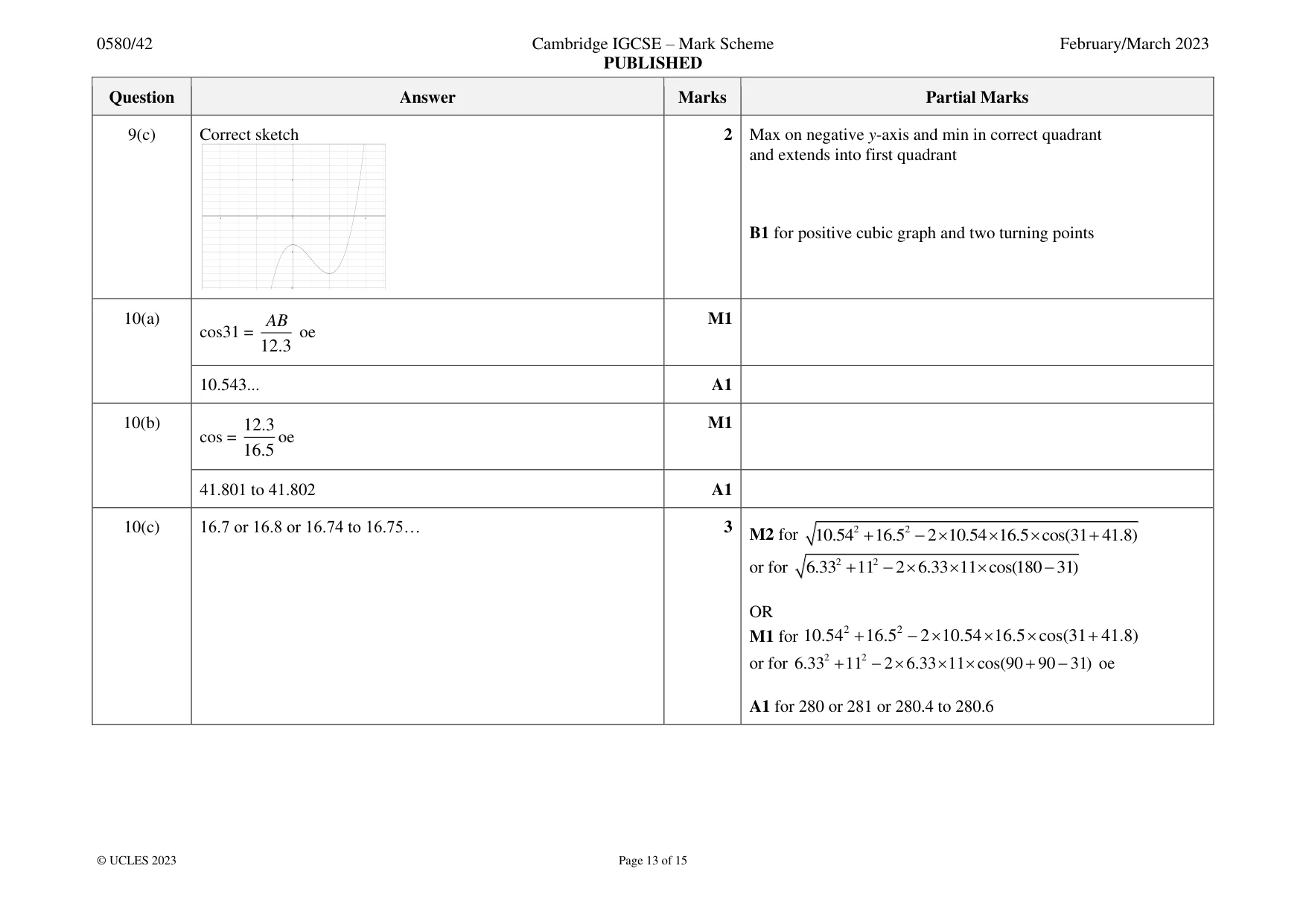
Mark scheme: 9(a) –3 3 B2 for 3x2 – 6x or B1 for 3x2 – kx or for kx2 – 6x or for 3x2 – 6x + c 9(b) (0, –4) and (2, –8) 4 B3 for x = 0 and 2 or for (2, –8) OR d y M1 for their 3x2 – 6x = 0 or stating = 0 oe d x M1 for correct method to solve their 3x2 – 6x = 0 9(c) Correct sketch10101010 2 Max on negative y-axis and min in correct quadrant and extends into first quadrant 5555 -4-4-4-4 -2-2-2-2 0000 0000 2222 4444 B1 for positive cubic graph and two turning points -5-5-5-5 -10-10-10-10
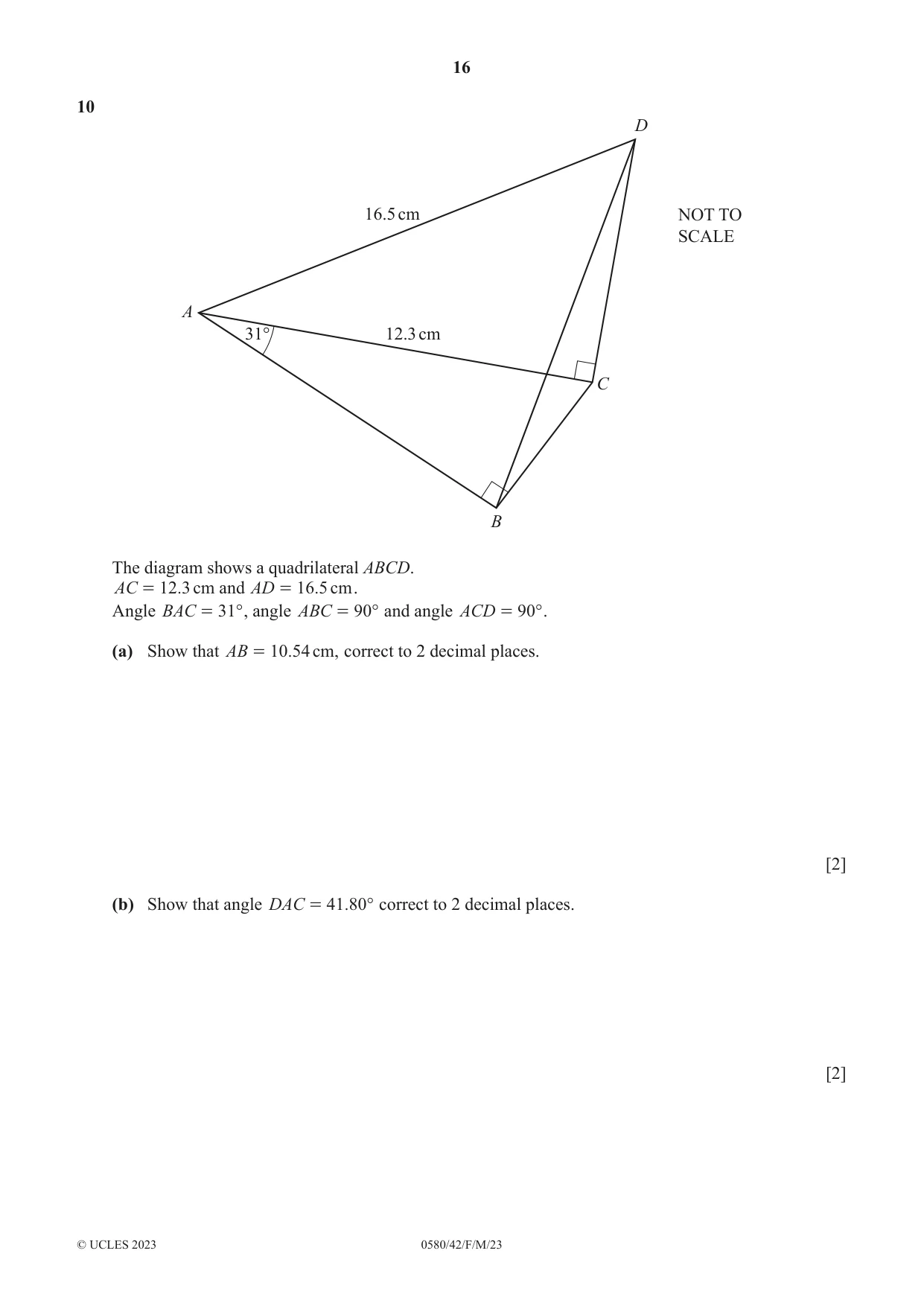
Q10 · D 16.5 cm NOT TO SCALE A 31° 12.3 cm C B The diagram shows a quadrilateral ABCD
10 D 16.5 cm NOT TO SCALE A 31° 12.3 cm C B The diagram shows a quadrilateral ABCD. AC = 12.3 cm and AD = 16. 5 cm . Angle BAC = 31° , angle ABC = 90° and angle ACD = 90° . (a) Show that AB = 10.54 cm, correct to 2 decimal places. [2] (b) Show that angle DAC = 41.80° correct to 2 decimal places. [2] (c) Calculate BD. BD = ............................................cm [3] (d) Calculate angle CBD. Angle CBD = ................................................ [4] (e) Calculate the shortest distance from C to BD. ............................................ cm [4]
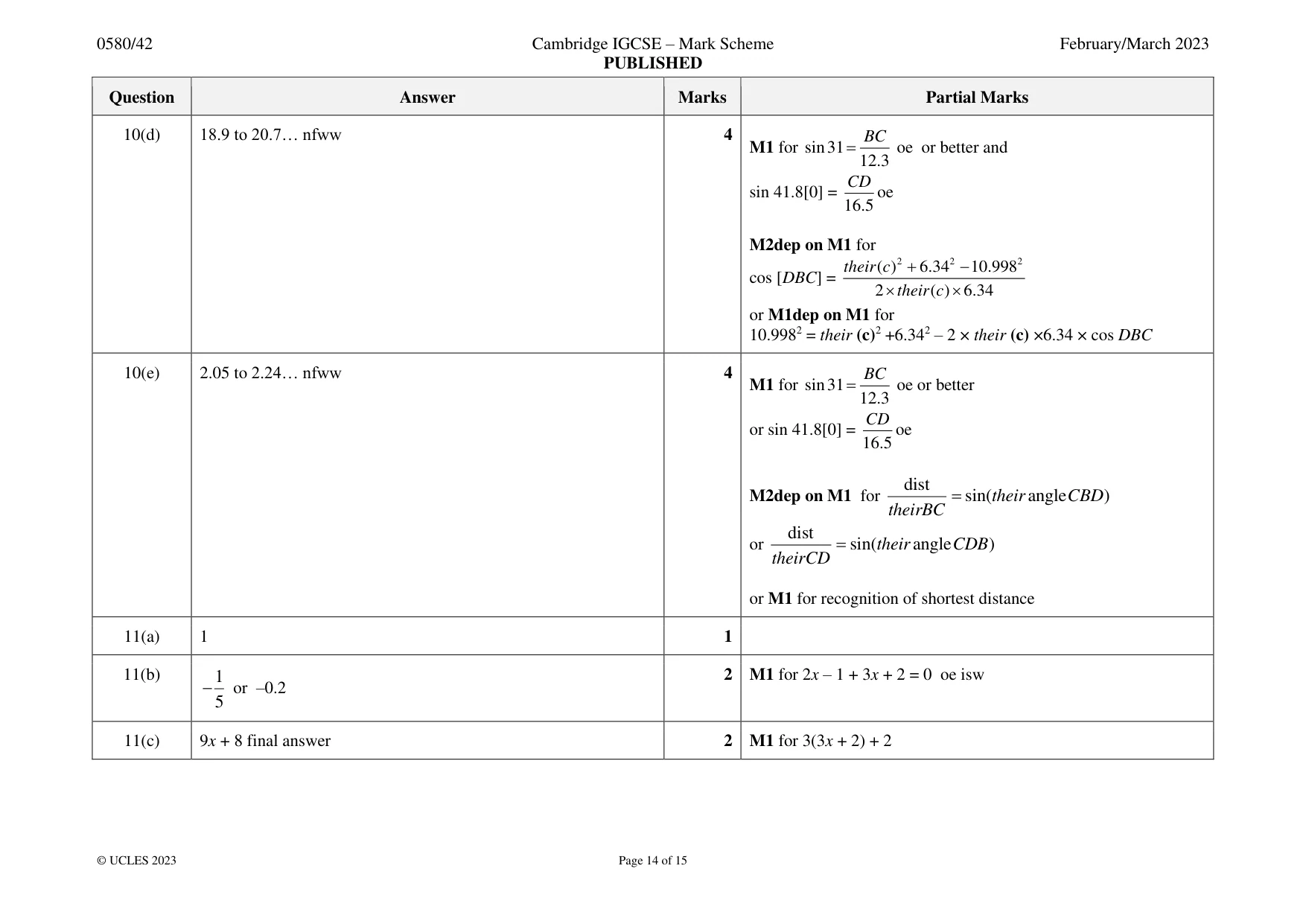
Mark scheme: 10(a) AB M1 cos31 = oe 12.3 10.543... A1 10(b) 12.3 M1 cos = oe 16.5 41.801 to 41.802 A1 10(c) 16.7 or 16.8 or 16.74 to 16.75… 3 2 2 M2 for 10.54 + 16.5 −2 10.54 16.5 cos(31 + 41.8) or for 6.332 + 112 −2 6.33 11 cos(180 − 31) OR M1 for 10.54 2 + 16.5 2 −2 10.54 16.5 cos(31 + 41.8) or for 6.332 + 112 −2 6.33 11 cos(90 + 90 − 31) oe A1 for 280 or 281 or 280.4 to 280.6 10(d) 18.9 to 20.7… nfww 4 BC M1 for sin31 = oe or better and 12.3 CD sin 41.8[0] = oe 16.5 M2dep on M1 for their ( c ) 2 + 6.34 2 − 10.998 2 cos [DBC] = 2 their ( c ) 6.34 or M1dep on M1 for 10.9982 = their (c)2 +6.342 – 2 × their (c) ×6.34 × cos DBC 10(e) 2.05 to 2.24… nfww 4 BC M1 for sin31 = oe or better 12.3 CD or sin 41.8[0] = oe 16.5 dist M2dep on M1 for = sin(their angle CBD ) theirBC dist or = sin(their angle CDB ) theirCD or M1 for recognition of shortest distance
Q11 · 211 f ( x) = 2 x - 1 g ( x) = 3x + 2 h ( x) = , x !
1 211 f ( x) = 2 x - 1 g ( x) = 3x + 2 h ( x) = , x ! 0 j ( x) = x x (a) Find j ( - 1) . ................................................. [1] (b) Find x when f ( x) + g ( x) = 0 . x = ................................................ [2] (c) Find gg(x), giving your answer in its simplest form. ................................................. [2] (d) Find hf ( x) + gh ( x) , giving your answer as a single fraction in its simplest form. ................................................. [4] (e) When pp ( x) = x, p ( x) is a function such that p -1 ( x) = p ( x) . Draw a ring around the function that has this property. 1 2 f ( x) = 2 x - 1 g ( x) = 3x + 2 h ( x) = , x ! 0 j ( x) = x x [1]
Mark scheme: 11(a) 1 1 11(b) 1 2 M1 for 2x – 1 + 3x + 2 = 0 oe isw − or –0.2 5 11(c) 9x + 8 final answer 2 M1 for 3(3x + 2) + 2 11(d) 4 x 2 + 5 x − 3 4 final answer x (2 x − 1) 1 1 M1 for and 3 + 2 oe 2 x − 1 x B1 for x + 3(2 x − 1) + 2 x (2 x − 1) oe or better isw B1 for common denominator = x(2x – 1) isw 4 x 2 + 9 x + 3 If 0 scored, SC1 for answer x (2 x + 1) 11(e) h(x) indicated 1
Q12 · Sketch the graph of y = tan x for 0 ° G x G 360°
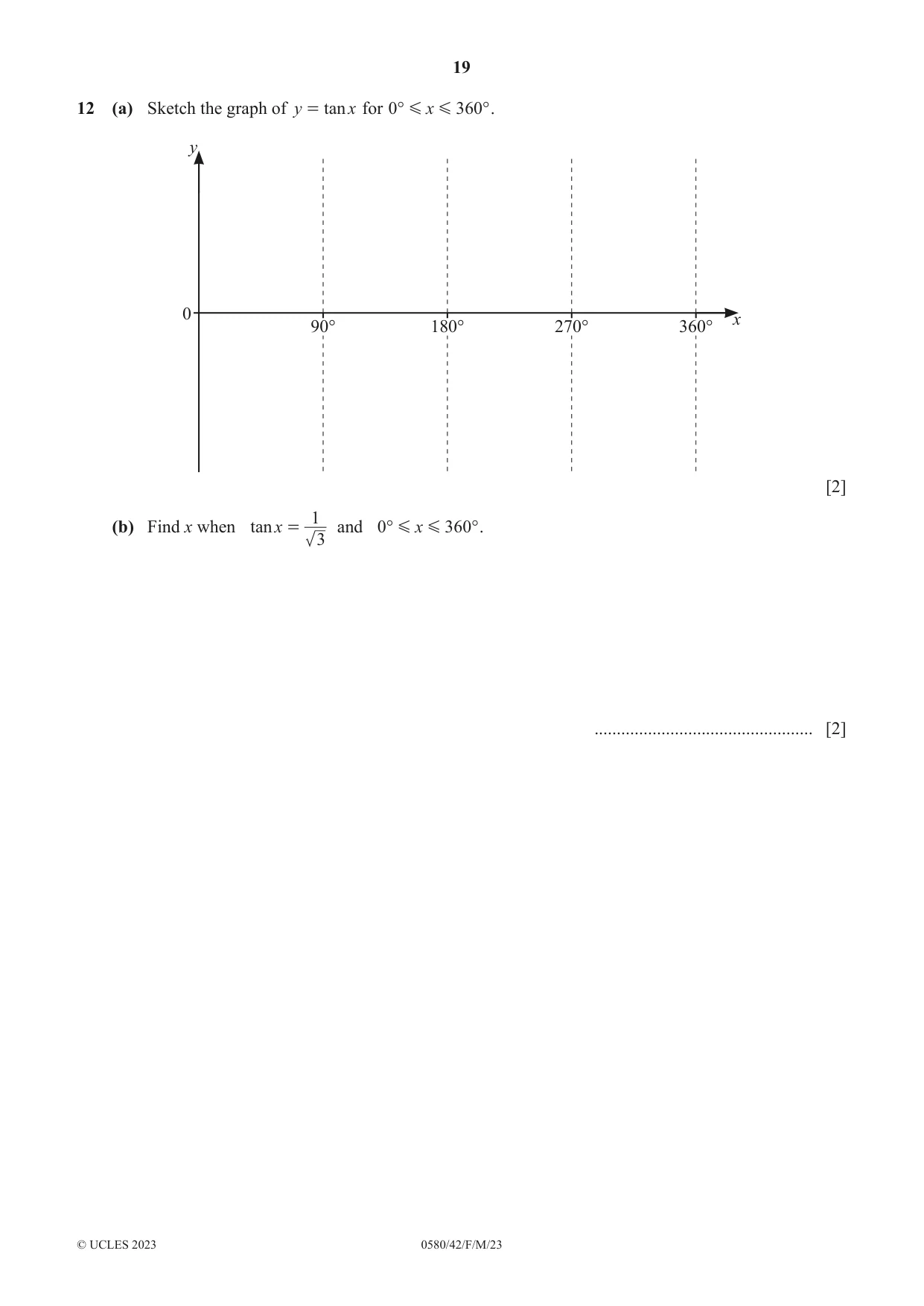
12 (a) Sketch the graph of y = tan x for 0 ° G x G 360° . y 0 x 90° 180° 270° 360° [2] 1 (b) Find x when tanx = and 0° G x G 360° . 3 ................................................. [2]
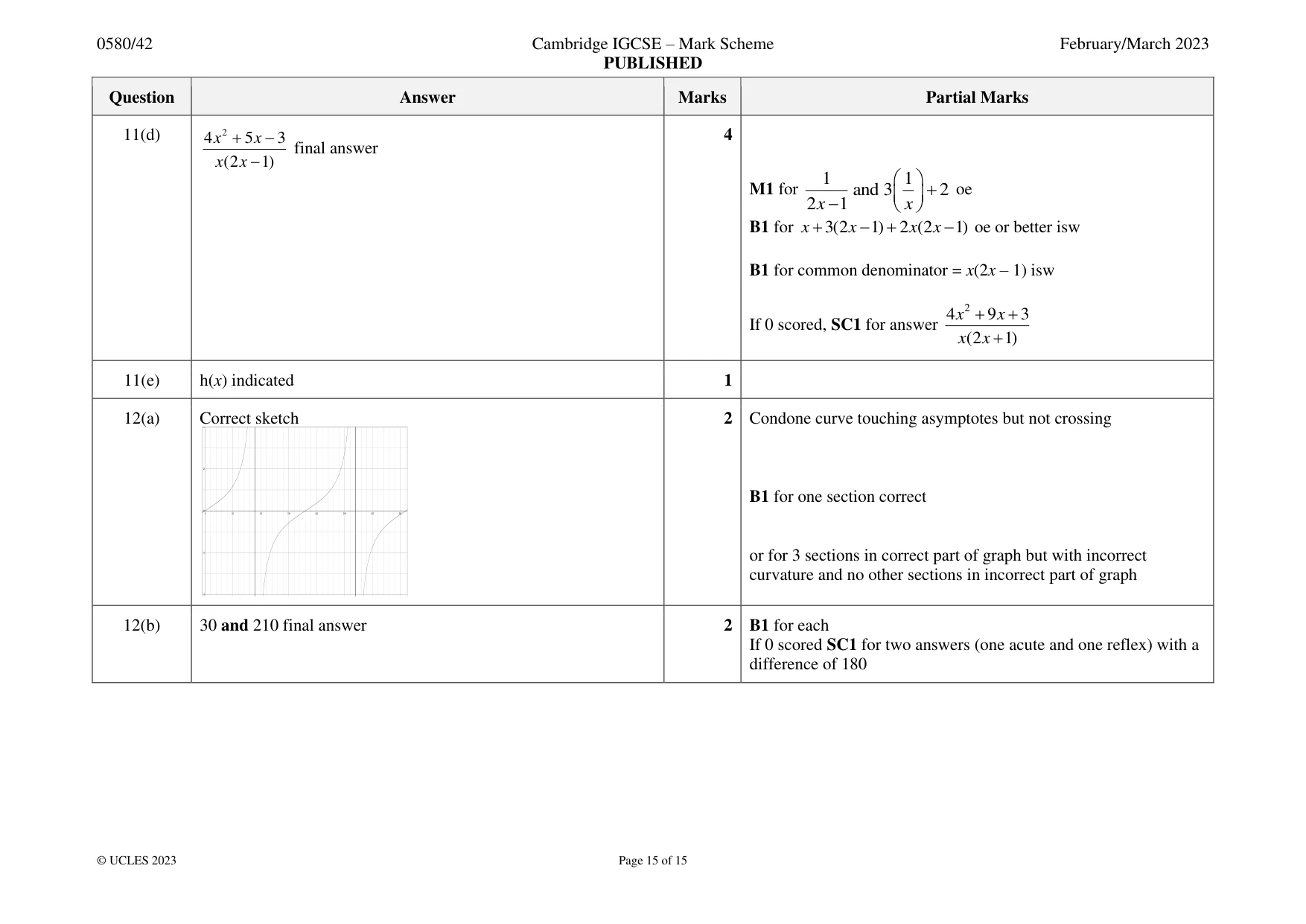
Mark scheme: 12(a) Correct4444 sketch 2 Condone curve touching asymptotes but not crossing 2222 B1 for one section correct 0000 0000 50505050 100100100100 150150150150 200200200200 250250250250 300300300300 350350350350 -2-2-2-2 or for 3 sections in correct part of graph but with incorrect curvature and no other sections in incorrect part of graph -4-4-4-4 12(b) 30 and 210 final answer 2 B1 for each If 0 scored SC1 for two answers (one acute and one reflex) with a difference of 180
What was in this paper
The subtopics covered by these 12 questions, and how many questions each got. Open one in a new tab to see every Cambridge question on it.
What you needed in this session
Cambridge’s own grade thresholds for 2023 Feb/March, Paper 4 · Variant 2. A higher threshold means an easier paper — the bar moves with how the cohort did.