Cambridge IGCSE Mathematics 0580 — 2018 Oct/Nov Paper 4 · Variant 3
0580/43/O/N/18 · 10 questions · 130 marks · ≈146 min
The question paper and its mark scheme, free to read here and free to download. This is Cambridge’s own paper, exactly as it was sat.
Question paper20 pages
Mark scheme8 pages
Answers below. Sit the paper first if you are practising.
Questions as text
Q1 · Y 7 6 5 4 3 T 2 1 –7 –6 –5 –4 –3 –2 –1 0 1 2 3 4 5 6 7 x –1 –2 –3 –4 P –5 –6 –7 (i)…
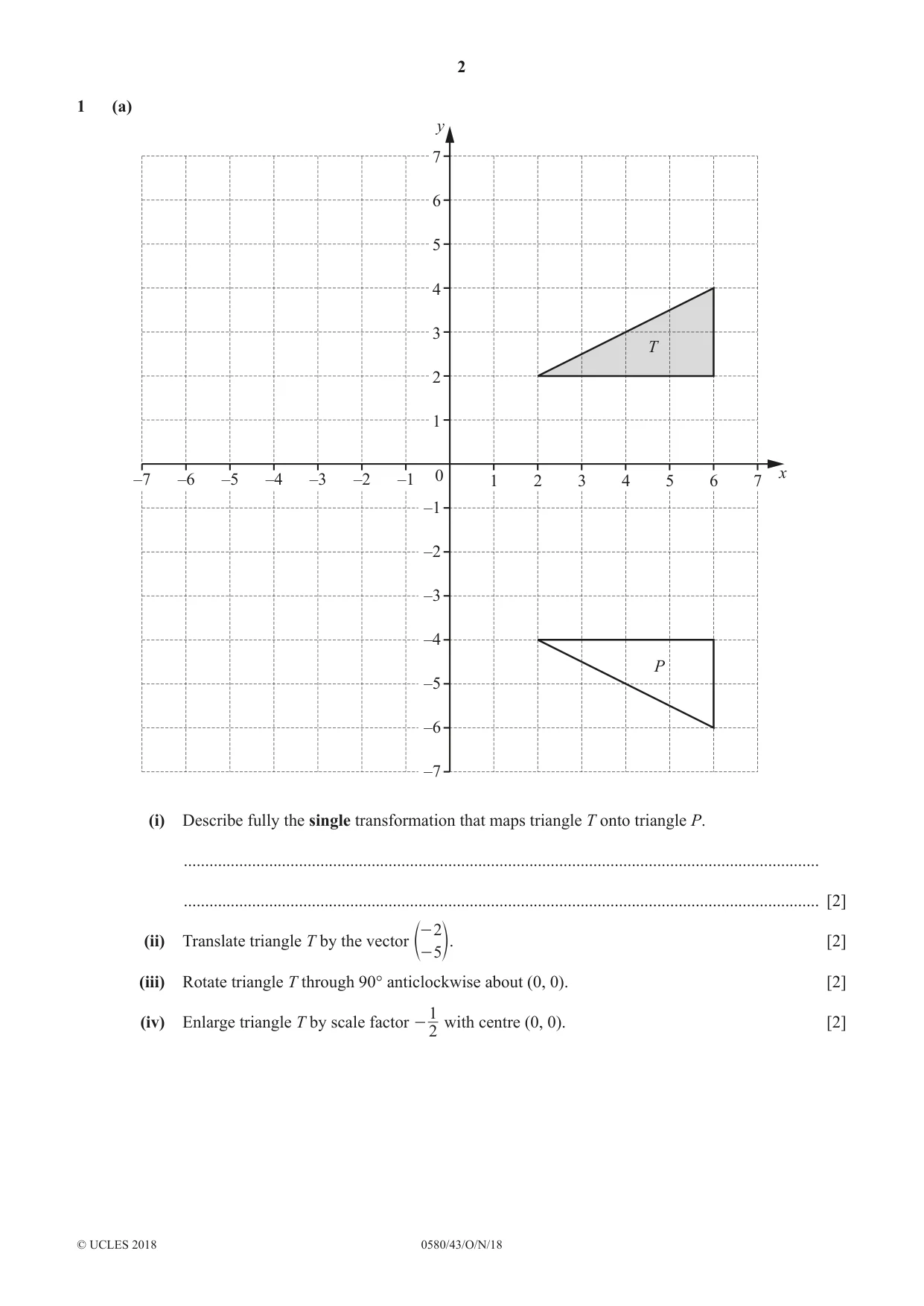
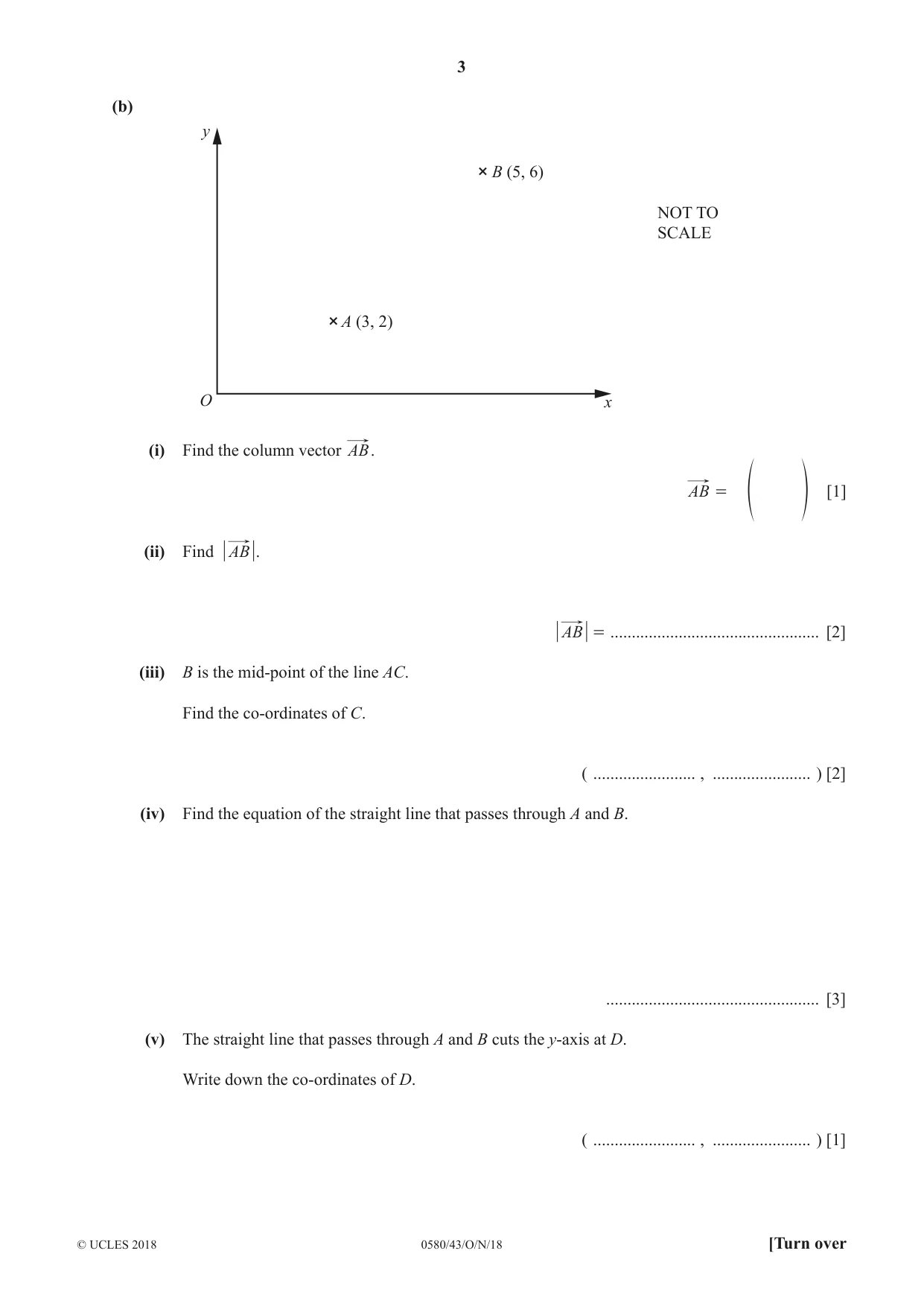
1 (a) y 7 6 5 4 3 T 2 1 –7 –6 –5 –4 –3 –2 –1 0 1 2 3 4 5 6 7 x –1 –2 –3 –4 P –5 –6 –7 (i) Describe fully the single transformation that maps triangle T onto triangle P. ..................................................................................................................................................... ..................................................................................................................................................... [2] - 2 (ii) Translate triangle T by the vector [2] e - 5o. (iii) Rotate triangle T through 90° anticlockwise about (0, 0). [2] 1 (iv) Enlarge triangle T by scale factor - with centre (0, 0). [2] 2 (b) y B (5, 6) NOT TO SCALE A (3, 2) O x (i) Find the column vector AB. AB = [1] f p (ii) Find AB . AB = ................................................. [2] (iii) B is the mid-point of the line AC. Find the co-ordinates of C. ( ........................ , ....................... ) [2] (iv) Find the equation of the straight line that passes through A and B. .................................................. [3] (v) The straight line that passes through A and B cuts the y-axis at D. Write down the co-ordinates of D. ( ........................ , ....................... ) [1]
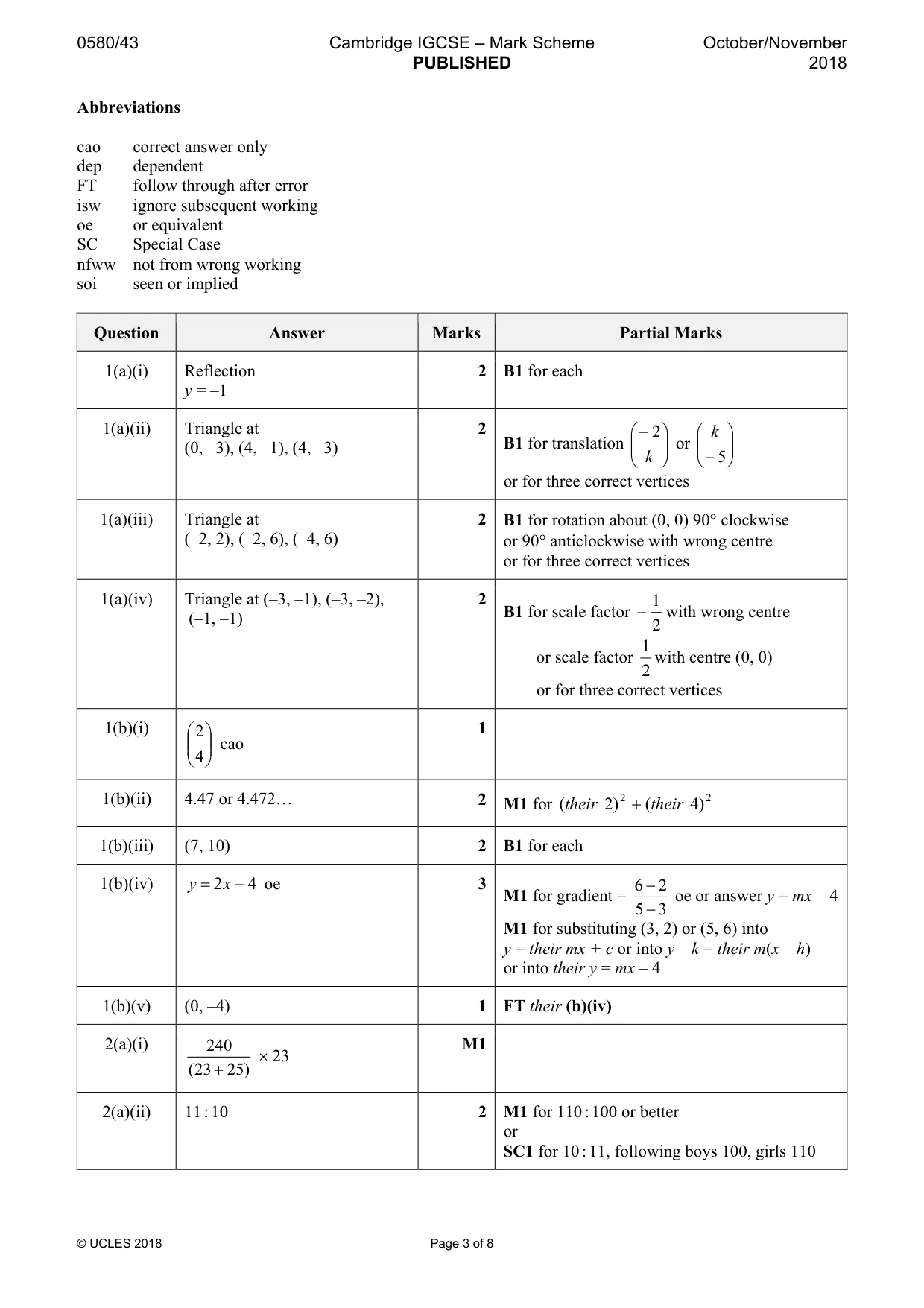
Mark scheme: Question Answer Marks Partial Marks 1(a)(i) Reflection 2 B1 for each y = –1 1(a)(ii) Triangle at 2 − 2 k (0, –3), (4, –1), (4, –3) B1 for translation or k −5 or for three correct vertices 1(a)(iii) Triangle at 2 B1 for rotation about (0, 0) 90° clockwise (–2, 2), (–2, 6), (–4, 6) or 90° anticlockwise with wrong centre or for three correct vertices 1(a)(iv) Triangle at (–3, –1), (–3, –2), 2 1 B1 for scale factor − with wrong centre (–1, –1) 2 1 or scale factor with centre (0, 0) 2 or for three correct vertices 1(b)(i) 2 1 cao 4 1(b)(ii) 4.47 or 4.472… 2 M1 for (their 2) 2 + (their 4) 2 1(b)(iii) (7, 10) 2 B1 for each 1(b)(iv) y = 2 x − 4 oe 3 6 − 2 M1 for gradient = oe or answer y = mx – 4 5 − 3 M1 for substituting (3, 2) or (5, 6) into y = their mx + c or into y – k = their m(x – h) or into their y = mx – 4 1(b)(v) (0, –4) 1 FT their (b)(iv)
Q2 · A school has 240 students
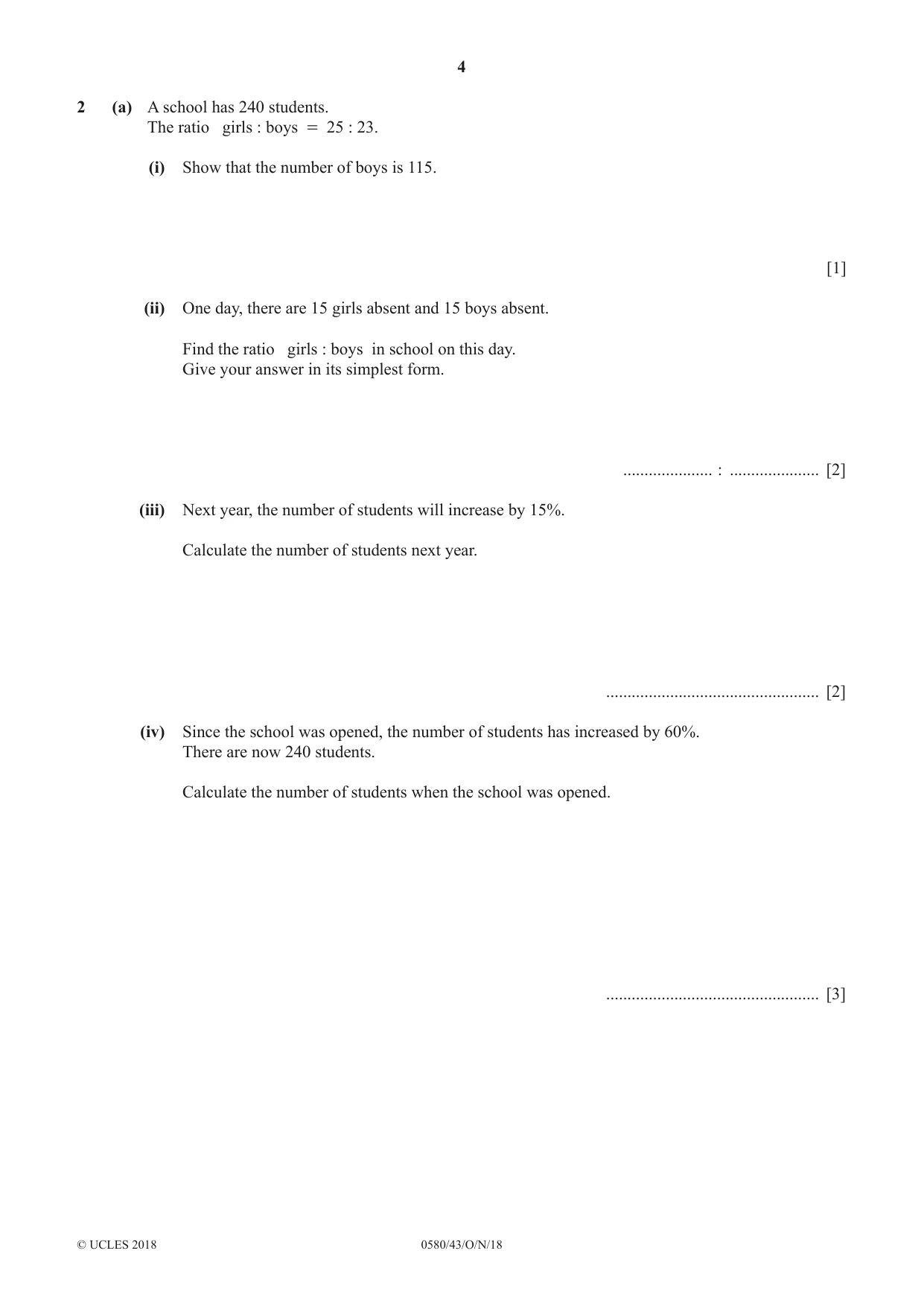
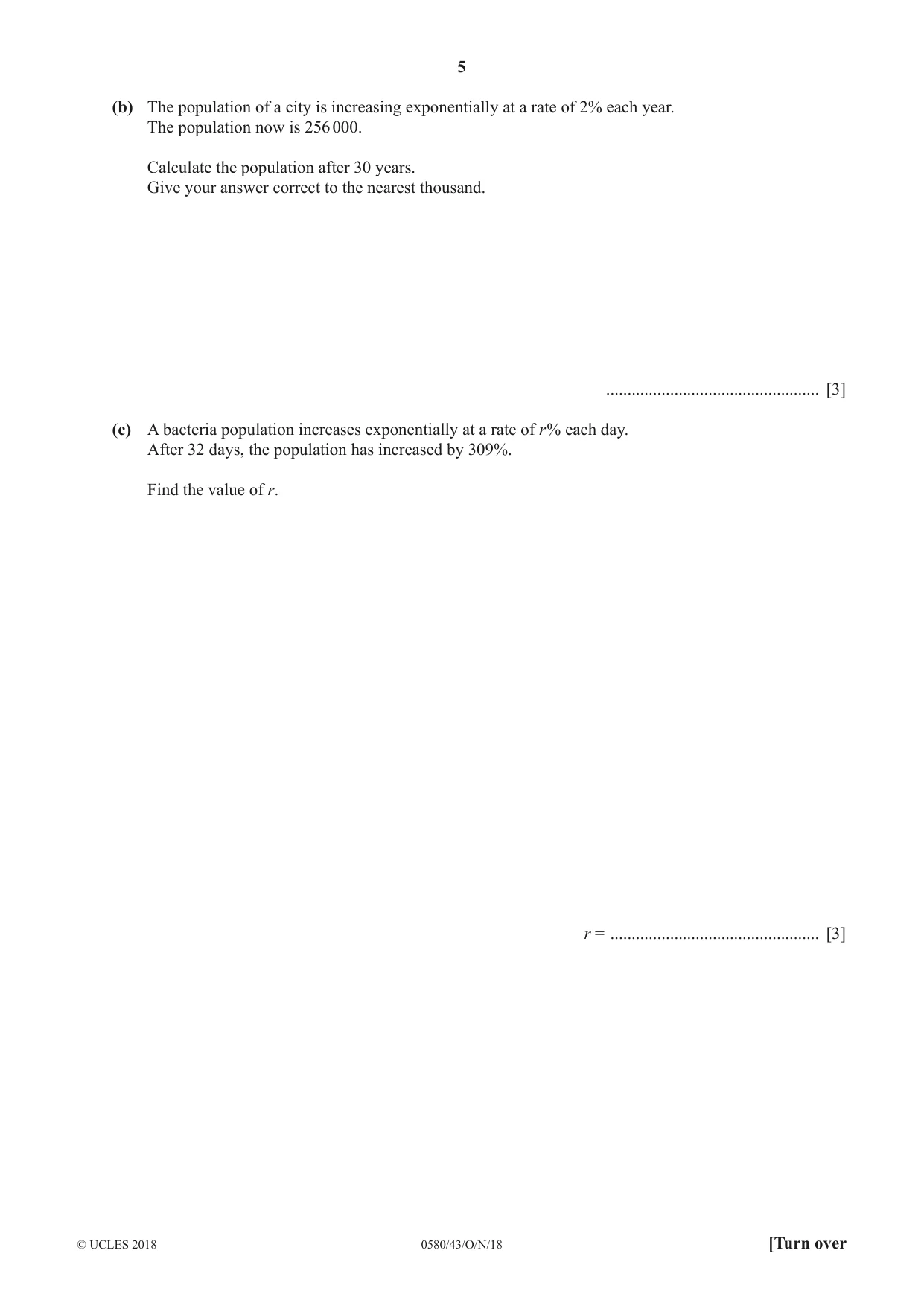
2 (a) A school has 240 students. The ratio girls : boys = 25 : 23. (i) Show that the number of boys is 115. [1] (ii) One day, there are 15 girls absent and 15 boys absent. Find the ratio girls : boys in school on this day. Give your answer in its simplest form. ..................... : ..................... [2] (iii) Next year, the number of students will increase by 15%. Calculate the number of students next year. .................................................. [2] (iv) Since the school was opened, the number of students has increased by 60%. There are now 240 students. Calculate the number of students when the school was opened. .................................................. [3] (b) The population of a city is increasing exponentially at a rate of 2% each year. The population now is 256 000. Calculate the population after 30 years. Give your answer correct to the nearest thousand. .................................................. [3] (c) A bacteria population increases exponentially at a rate of r% each day. After 32 days, the population has increased by 309%. Find the value of r. r = ................................................. [3]
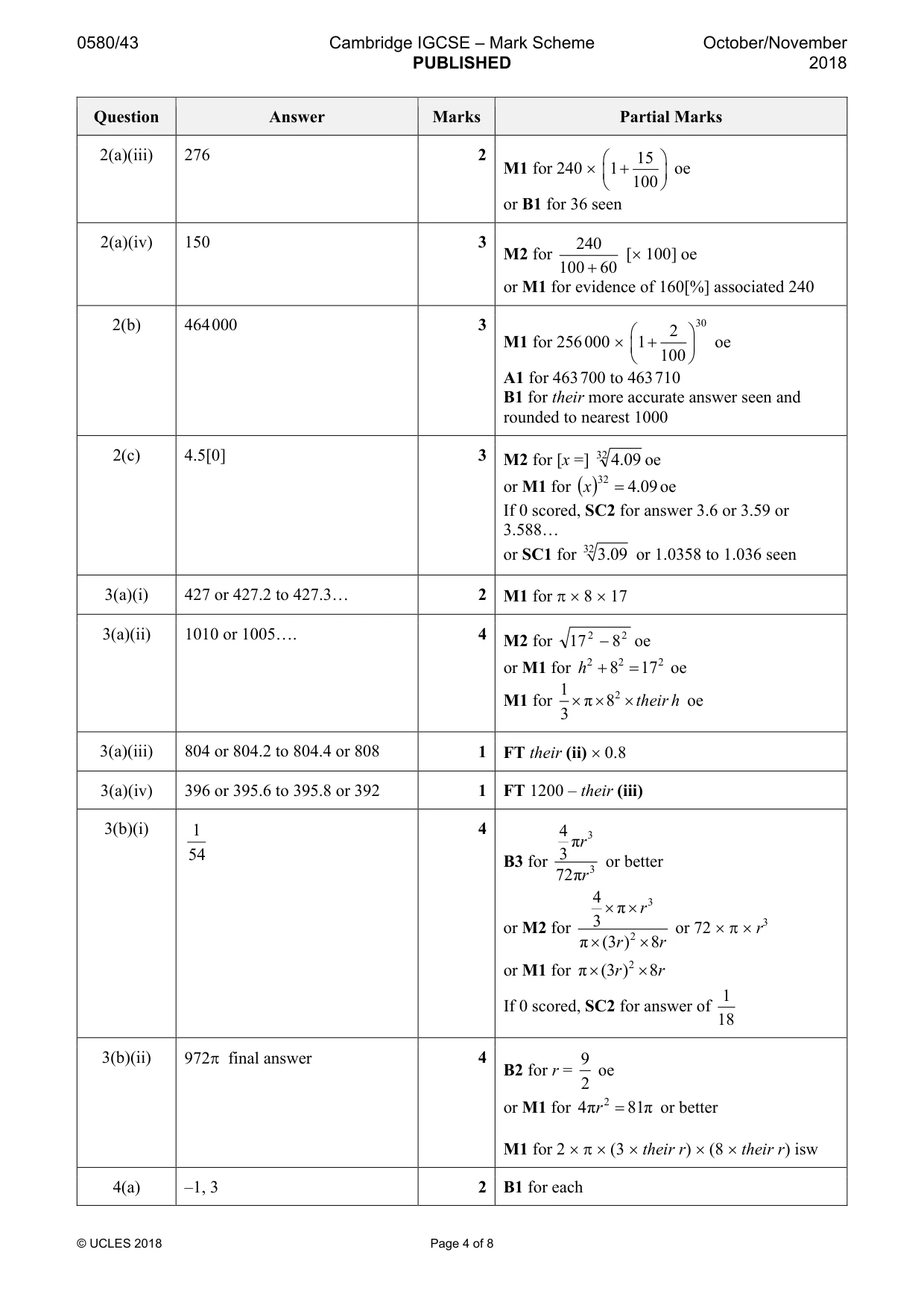
Mark scheme: 2(a)(i) 240 M1 × 23 (23 + 25) 2(a)(ii) 11 : 10 2 M1 for 110 : 100 or better or SC1 for 10 : 11, following boys 100, girls 110 2(a)(iii) 276 2 15 M1 for 240 × 1 + oe 100 or B1 for 36 seen 2(a)(iv) 150 3 240 M2 for [× 100] oe 100 + 60 or M1 for evidence of 160[%] associated 240 2(b) 464 000 3 30 2 M1 for 256 000 × 1 + oe 100 A1 for 463 700 to 463 710 B1 for their more accurate answer seen and rounded to nearest 1000 2(c) 4.5[0] 3 M2 for [x =] 32 .409 oe 32 = .409 oe or M1 for ( x ) If 0 scored, SC2 for answer 3.6 or 3.59 or 3.588… or SC1 for 32 3.09 or 1.0358 to 1.036 seen
Q3 · NOT TO 17 cm SCALE 8 cm The diagram shows a solid cone
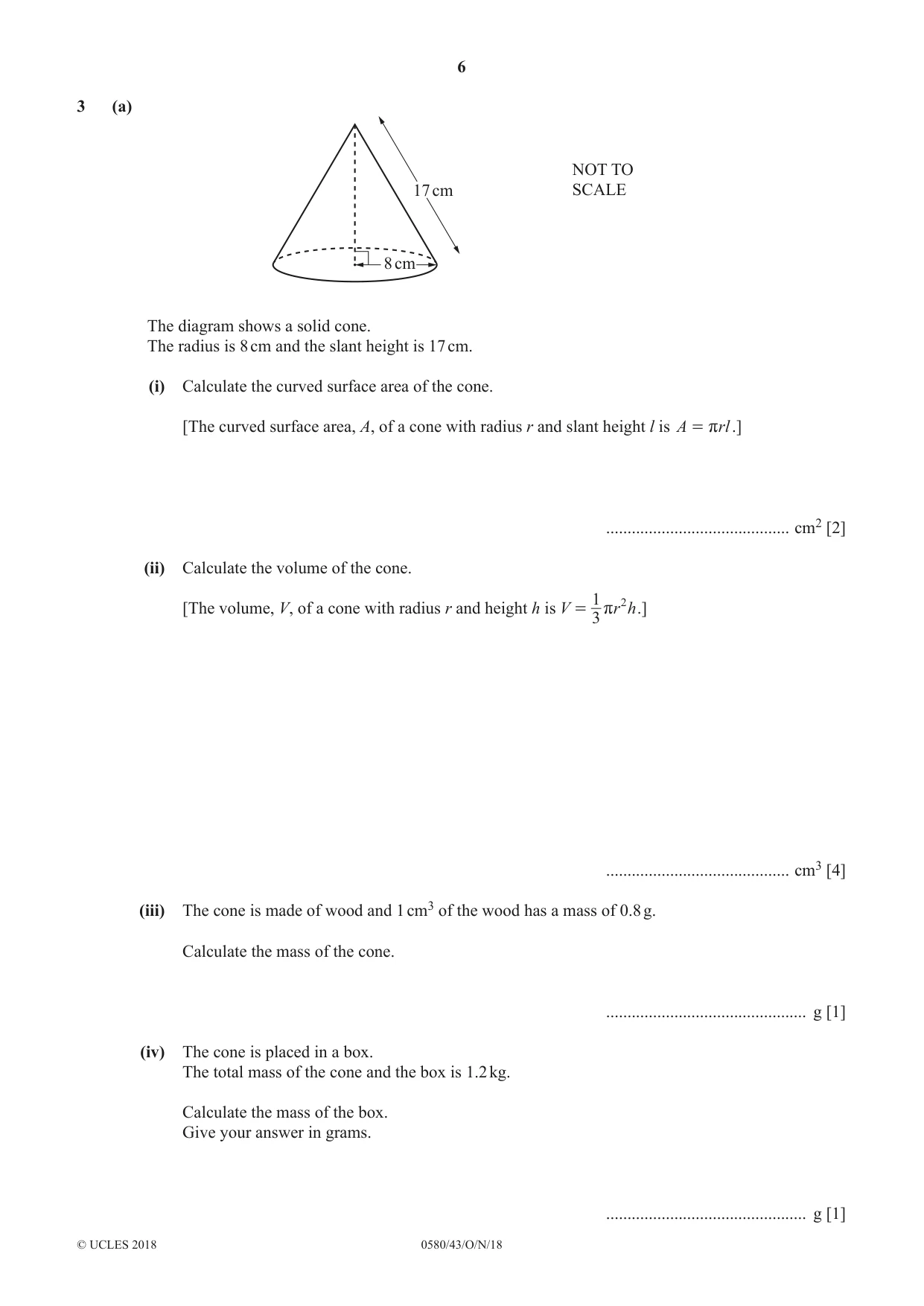
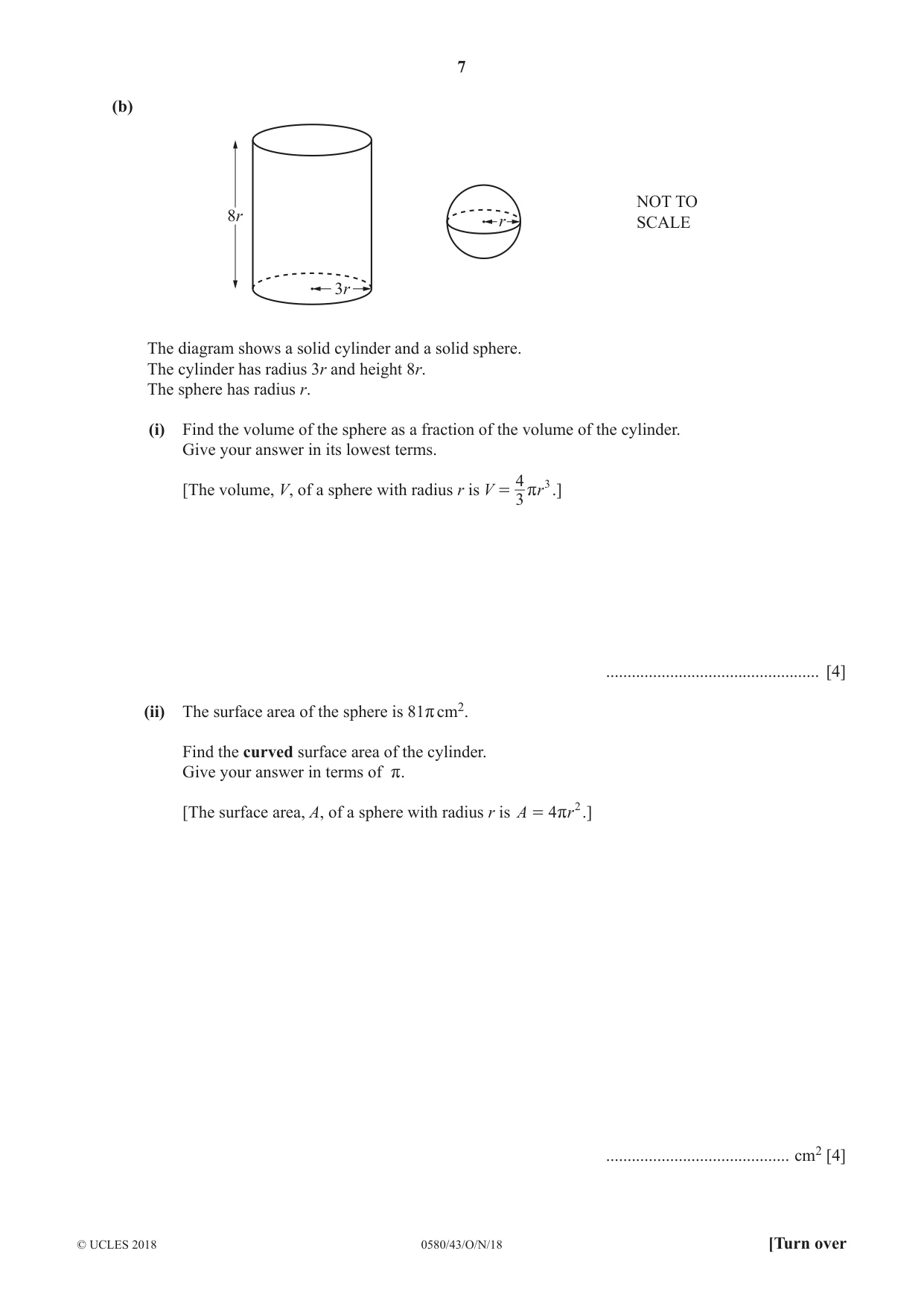
3 (a) NOT TO 17 cm SCALE 8 cm The diagram shows a solid cone. The radius is 8 cm and the slant height is 17 cm. (i) Calculate the curved surface area of the cone. [The curved surface area, A, of a cone with radius r and slant height l is A = r rl .] ........................................... cm2 [2] (ii) Calculate the volume of the cone. 1 2 [The volume, V, of a cone with radius r and height h is V = r r h .] 3 ........................................... cm3 [4] (iii) The cone is made of wood and 1 cm3 of the wood has a mass of 0.8 g. Calculate the mass of the cone. ............................................... g [1] (iv) The cone is placed in a box. The total mass of the cone and the box is 1.2 kg. Calculate the mass of the box. Give your answer in grams. ............................................... g [1] (b) NOT TO 8r r SCALE 3r The diagram shows a solid cylinder and a solid sphere. The cylinder has radius 3r and height 8r. The sphere has radius r. (i) Find the volume of the sphere as a fraction of the volume of the cylinder. Give your answer in its lowest terms. 4 3 [The volume, V, of a sphere with radius r is V = r r .] 3 .................................................. [4] (ii) The surface area of the sphere is 81r cm2. Find the curved surface area of the cylinder. Give your answer in terms of r. [The surface area, A, of a sphere with radius r is A = 4 r r 2 .] ........................................... cm2 [4]
Mark scheme: 3(a)(i) 427 or 427.2 to 427.3… 2 M1 for π × 8 × 17 3(a)(ii) 1010 or 1005…. 4 2 2 M2 for 17 − 8 oe or M1 for h 2 + 82 = 17 2 oe 1 2 M1 for × π × 8 × their h oe 3 3(a)(iii) 804 or 804.2 to 804.4 or 808 1 FT their (ii) × 0.8 3(a)(iv) 396 or 395.6 to 395.8 or 392 1 FT 1200 – their (iii) 3(b)(i) 1 4 4 3 πr 54 3 B3 for or better 72πr 3 4 3 × π × r 3 or M2 for or 72 × π × r3 π × (3r ) 2 × 8 r or M1 for π × (3r ) 2 × 8r 1 If 0 scored, SC2 for answer of 18 3(b)(ii) 972π final answer 4 9 B2 for r = oe 2 or M1 for 4πr 2 = 81π or better M1 for 2 × π × (3 × their r) × (8 × their r) isw
Q4 · X 2 44 f (x) = - , x =Y 0 4 x (a) Complete the table for f ()x
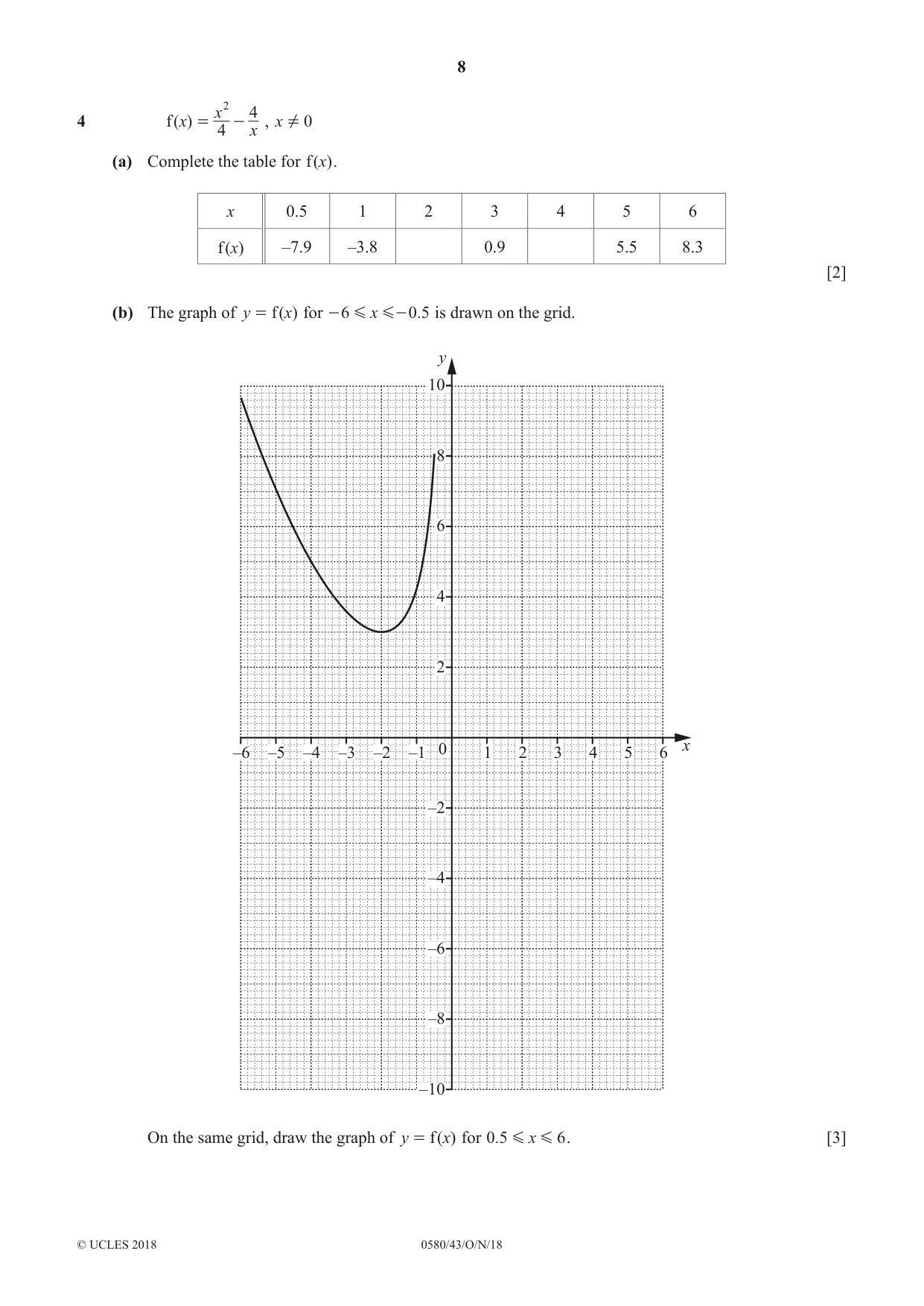
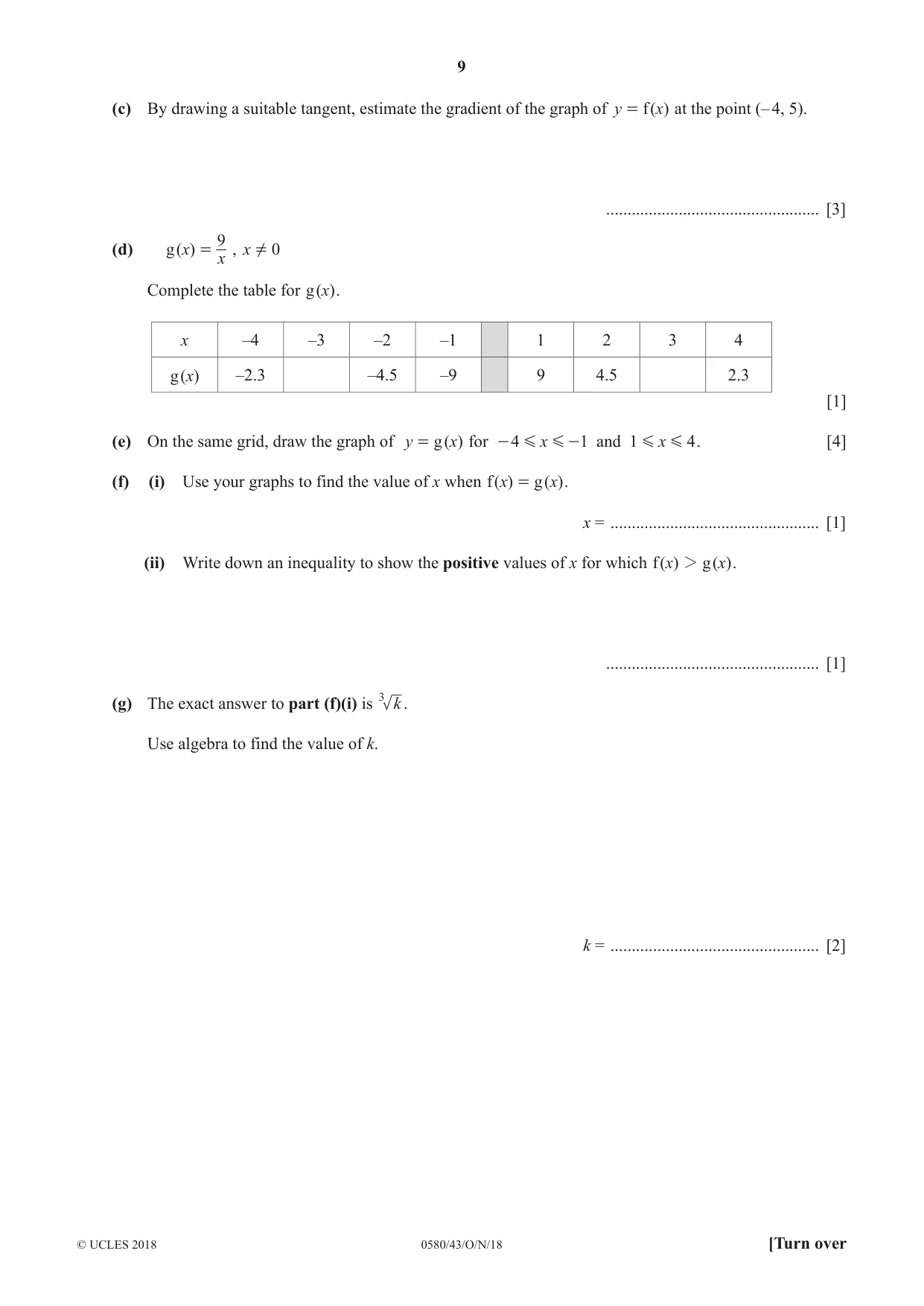
x 2 44 f (x) = - , x =Y 0 4 x (a) Complete the table for f ()x . x 0.5 1 2 3 4 5 6 f ()x –7.9 –3.8 0.9 5.5 8.3 [2] (b) The graph of y = f (x) for - 6 G x G - 0.5 is drawn on the grid. y 10 8 6 4 2 –6 –5 –4 –3 –2 –1 0 1 2 3 4 5 6 x –2 –4 –6 –8 –10 On the same grid, draw the graph of y = f (x) for 0.5 G x G 6 . [3] (c) By drawing a suitable tangent, estimate the gradient of the graph of y = f (x) at the point (– 4, 5). .................................................. [3] 9(d) g (x) = , x =Y 0 x Complete the table for g ()x . x –4 –3 –2 –1 1 2 3 4 g ()x –2.3 –4.5 –9 9 4.5 2.3 [1] (e) On the same grid, draw the graph of y = g (x) for - 4 G x G - 1 and 1 G x G 4 . [4] (f) (i) Use your graphs to find the value of x when f (x) = g ( x) . x = ................................................. [1] (ii) Write down an inequality to show the positive values of x for which f (x) 2 g (x) . .................................................. [1] (g) The exact answer to part (f)(i) is 3 k . Use algebra to find the value of k. k = ................................................. [2]
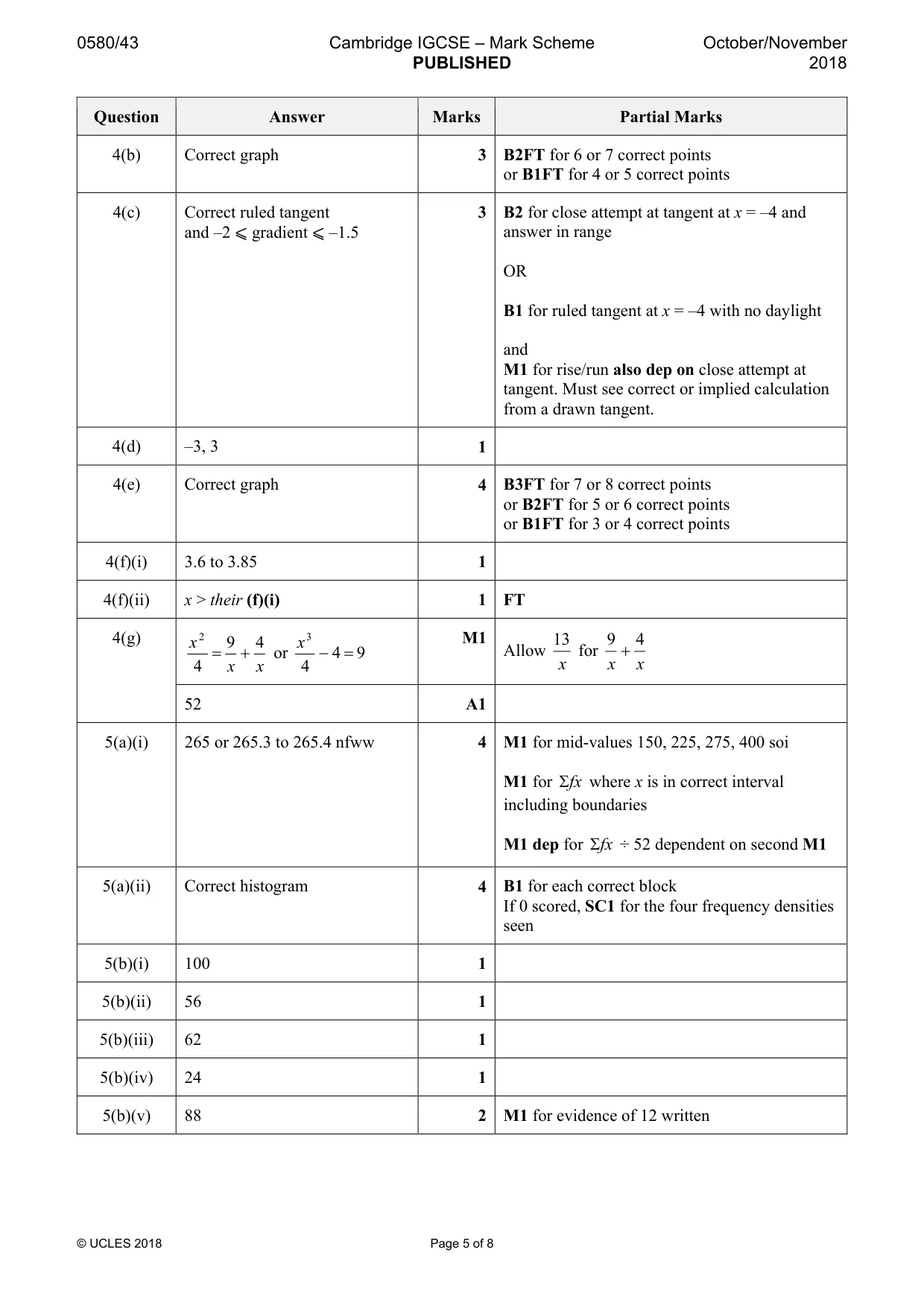
Mark scheme: 4(a) –1, 3 2 B1 for each 4(b) Correct graph 3 B2FT for 6 or 7 correct points or B1FT for 4 or 5 correct points 4(c) Correct ruled tangent 3 B2 for close attempt at tangent at x = –4 and and –2 ⩽ gradient ⩽ –1.5 answer in range OR B1 for ruled tangent at x = –4 with no daylight and M1 for rise/run also dep on close attempt at tangent. Must see correct or implied calculation from a drawn tangent. 4(d) –3, 3 1 4(e) Correct graph 4 B3FT for 7 or 8 correct points or B2FT for 5 or 6 correct points or B1FT for 3 or 4 correct points 4(f)(i) 3.6 to 3.85 1 4(f)(ii) x > their (f)(i) 1 FT 4(g) x 2 9 4 x 3 M1 13 9 4 = + or − 4 = 9 Allow for + 4 x x 4 x x x 52 A1
Q5 · A factory recycles metal
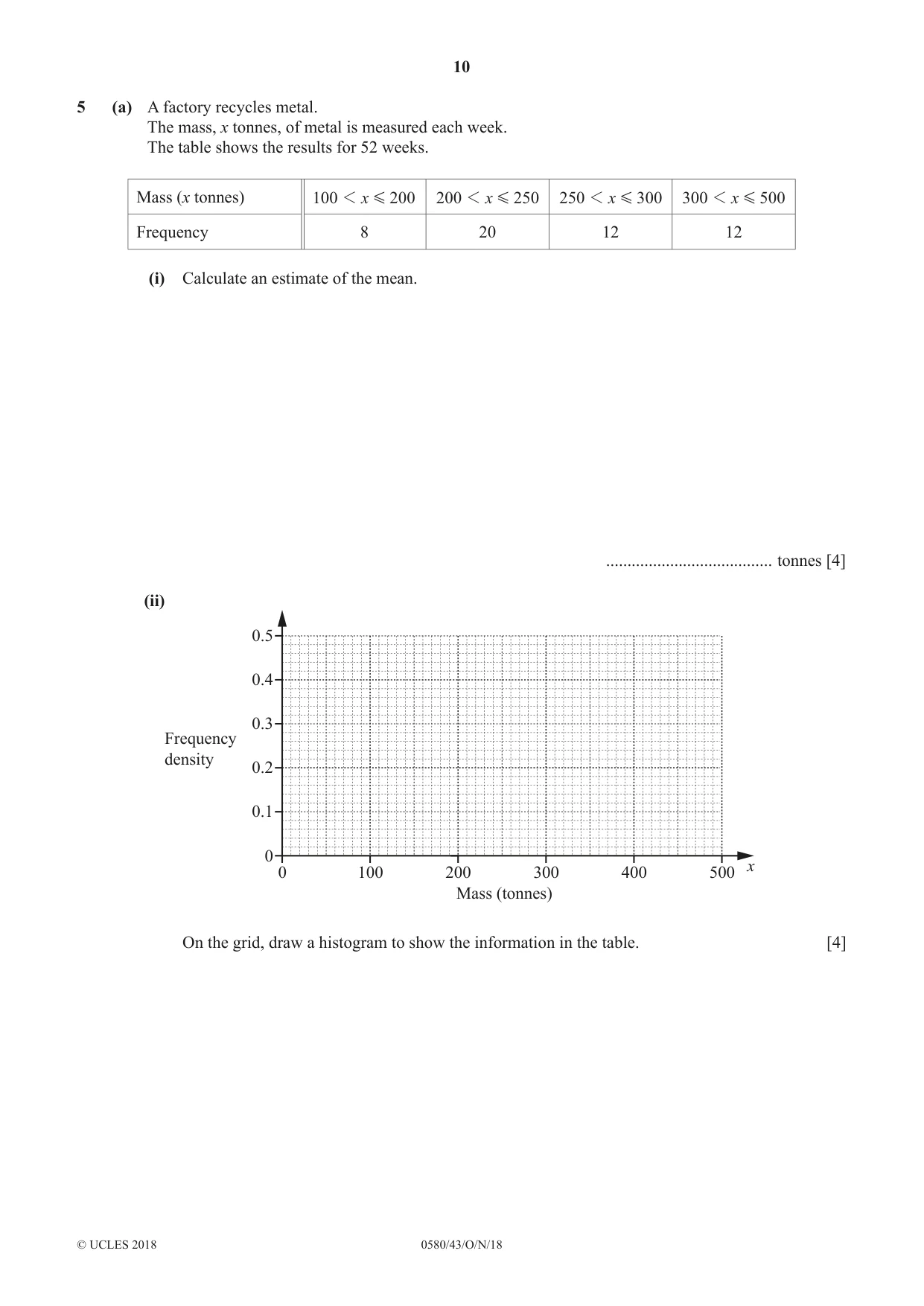
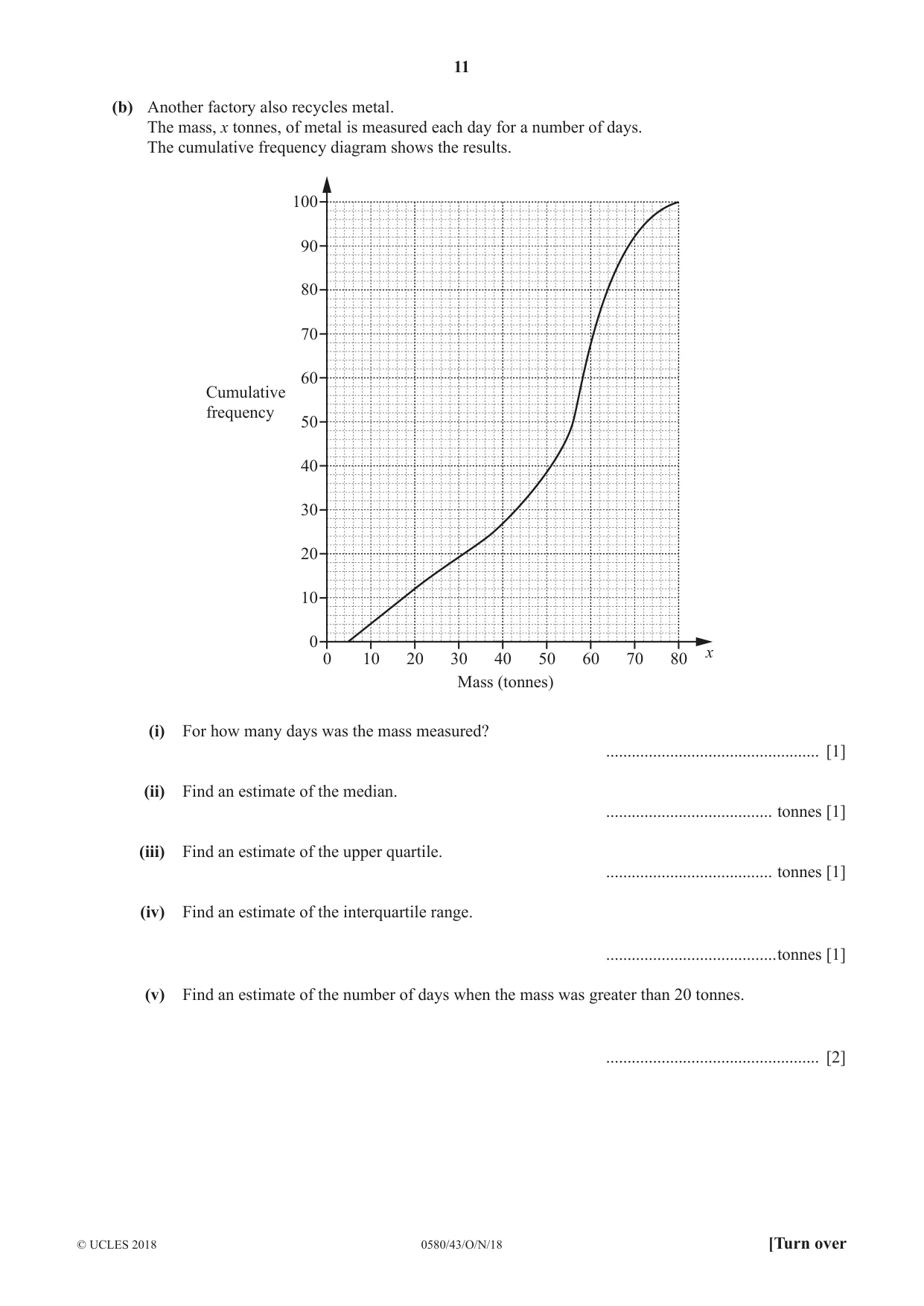
5 (a) A factory recycles metal. The mass, x tonnes, of metal is measured each week. The table shows the results for 52 weeks. Mass (x tonnes) 100 1 x G 200 200 1 x G 250 250 1 x G 300 300 1 x G 500 Frequency 8 20 12 12 (i) Calculate an estimate of the mean. ....................................... tonnes [4] (ii) 0.5 0.4 0.3 Frequency density 0.2 0.1 0 x 0 100 200 300 400 500 Mass (tonnes) On the grid, draw a histogram to show the information in the table. [4] (b) Another factory also recycles metal. The mass, x tonnes, of metal is measured each day for a number of days. The cumulative frequency diagram shows the results. 100 90 80 70 60 Cumulative frequency 50 40 30 20 10 0 x 0 10 20 30 40 50 60 70 80 Mass (tonnes) (i) For how many days was the mass measured? .................................................. [1] (ii) Find an estimate of the median. ....................................... tonnes [1] (iii) Find an estimate of the upper quartile. ....................................... tonnes [1] (iv) Find an estimate of the interquartile range. ........................................tonnes [1] (v) Find an estimate of the number of days when the mass was greater than 20 tonnes. .................................................. [2]
Mark scheme: 5(a)(i) 265 or 265.3 to 265.4 nfww 4 M1 for mid-values 150, 225, 275, 400 soi M1 for Σ fx where x is in correct interval including boundaries M1 dep for Σ fx ÷ 52 dependent on second M1 5(a)(ii) Correct histogram 4 B1 for each correct block If 0 scored, SC1 for the four frequency densities seen 5(b)(i) 100 1 5(b)(ii) 56 1 5(b)(iii) 62 1 5(b)(iv) 24 1 5(b)(v) 88 2 M1 for evidence of 12 written
Q6 · D 80° NOT TO 8 cm SCALE C 13 cm 4 cm A 11 cm B (a) Calculate angle ACB
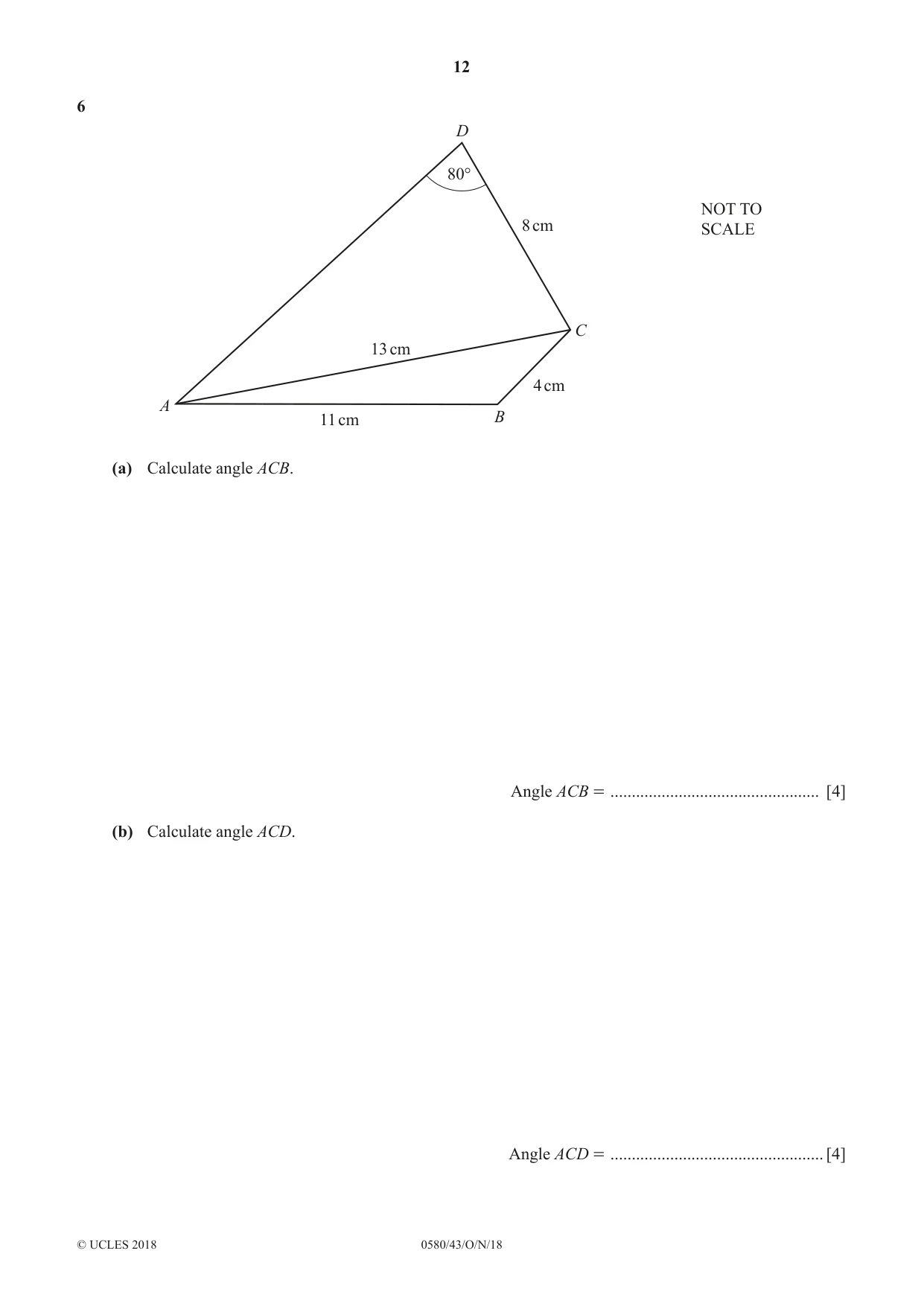
6 D 80° NOT TO 8 cm SCALE C 13 cm 4 cm A 11 cm B (a) Calculate angle ACB. Angle ACB = ................................................. [4] (b) Calculate angle ACD. Angle ACD = .................................................. [4] (c) Calculate the area of the quadrilateral ABCD. ........................................... cm2 [3]
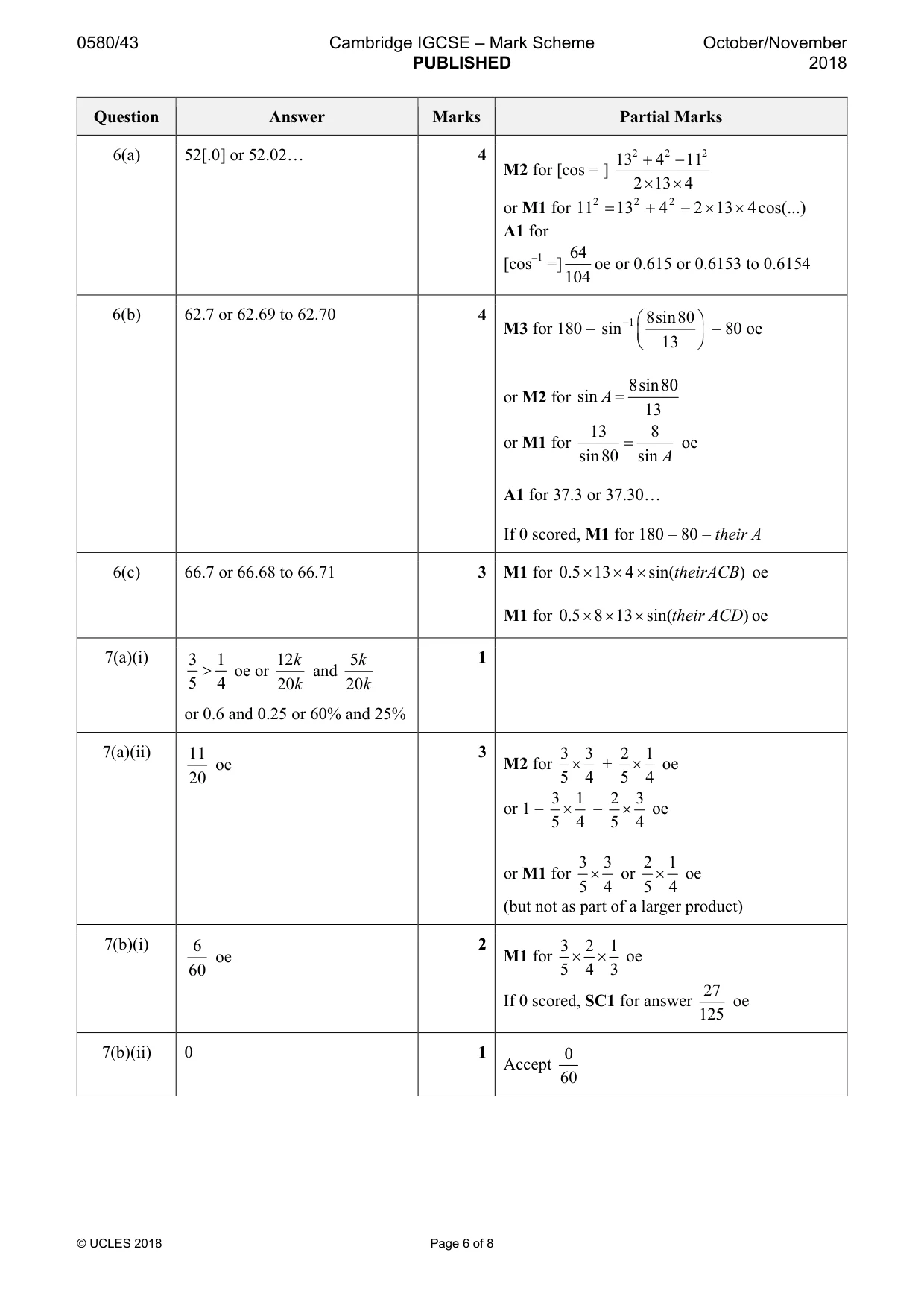
Mark scheme: 6(a) 52[.0] or 52.02… 4 132 + 4 2 − 112 M2 for [cos = ] 2 × 13 × 4 or M1 for 112 = 13 2 + 4 2 − 2 × 13 × 4 cos(...) A1 for 64 [cos–1 =]104 oe or 0.615 or 0.6153 to 0.6154 6(b) 62.7 or 62.69 to 62.70 4 −1 8sin80 M3 for 180 – sin – 80 oe 13 8 sin 80 or M2 for sin A = 13 13 8 or M1 for = oe sin 80 sin A A1 for 37.3 or 37.30… If 0 scored, M1 for 180 – 80 – their A 6(c) 66.7 or 66.68 to 66.71 3 M1 for 5.0 × 13 × 4 × sin(theirACB) oe M1 for 5.0 × 8 × 13 × sin(their ACD) oe
Q7 · Bag A Bag B Bag A contains 3 black balls and 2 white balls
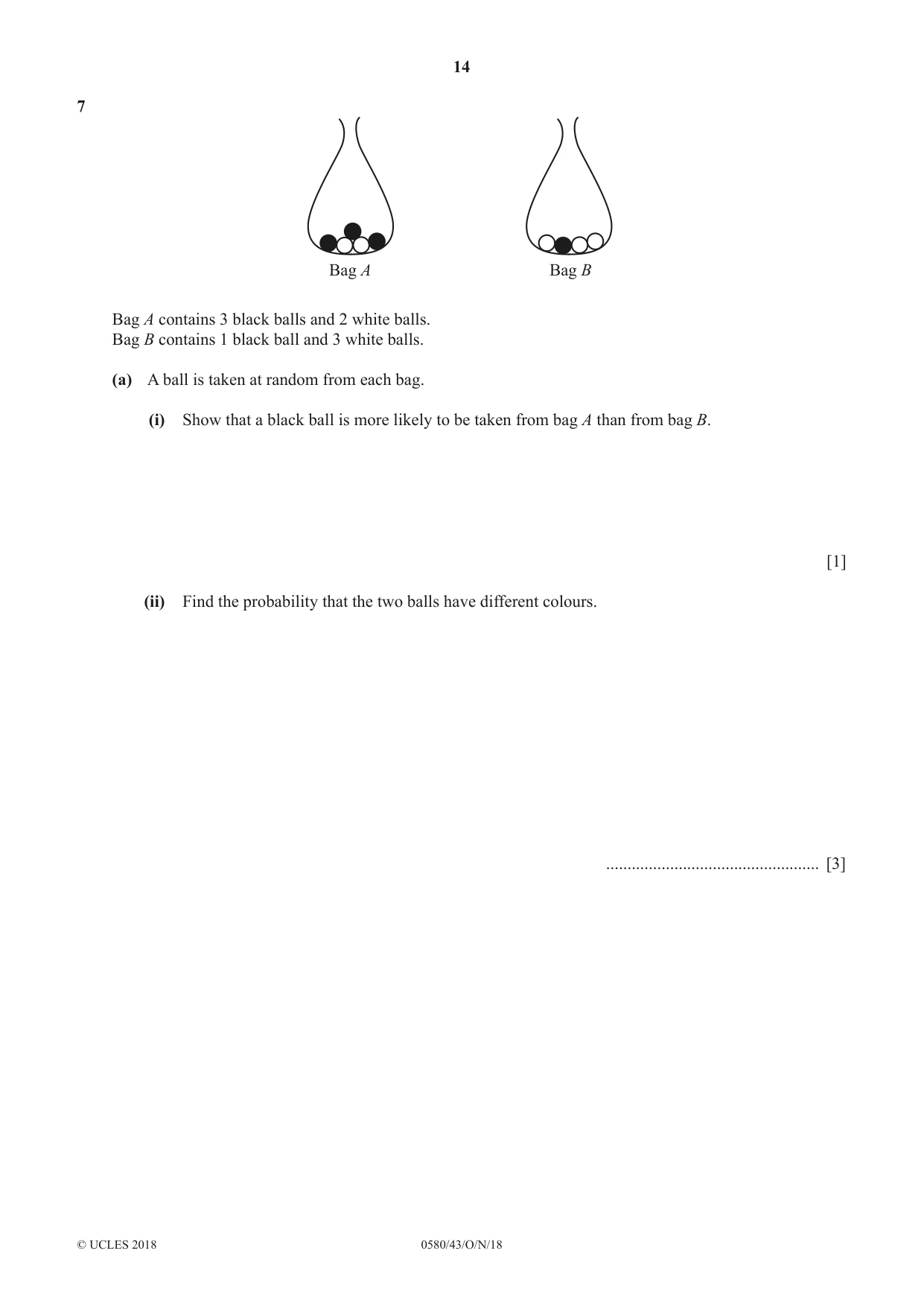
7 Bag A Bag B Bag A contains 3 black balls and 2 white balls. Bag B contains 1 black ball and 3 white balls. (a) A ball is taken at random from each bag. (i) Show that a black ball is more likely to be taken from bag A than from bag B. [1] (ii) Find the probability that the two balls have different colours. .................................................. [3] (b) The balls are returned to their original bags. Three balls are taken at random from bag A, without replacement. Find the probability that (i) they are all black, .................................................. [2] (ii) they are all white. .................................................. [1] (c) The balls are returned to their original bags. A ball is taken at random from bag A and its colour is recorded. This ball is then placed in bag B. A ball is then taken at random from bag B. Find the probability that the ball taken from bag B has a different colour to the ball taken from bag A. .................................................. [3]
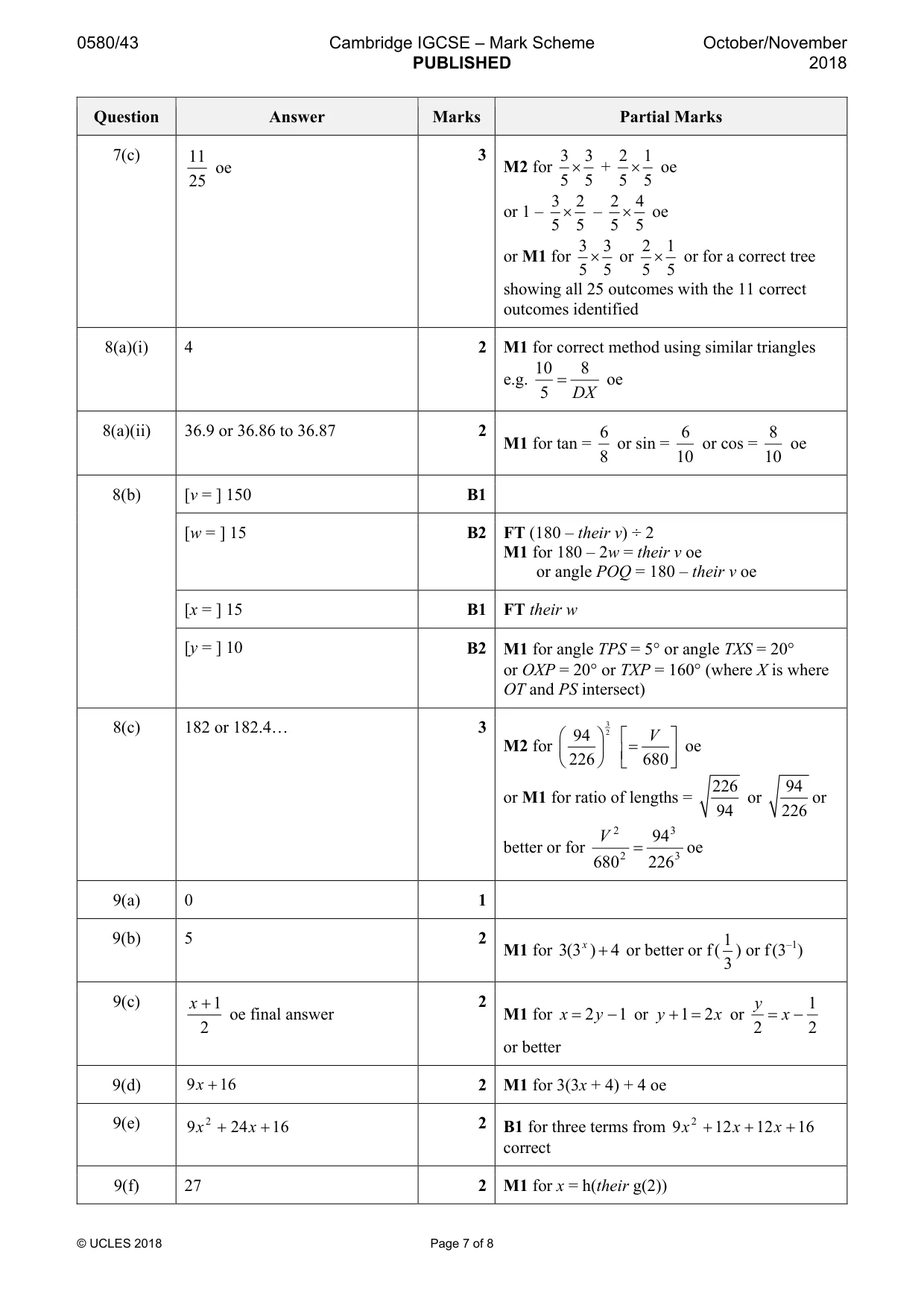
Mark scheme: 7(a)(i) 3 1 12 k 5k 1 > oe or and 5 4 20 k 20 k or 0.6 and 0.25 or 60% and 25% 7(a)(ii) 11 3 3 3 2 1 oe M2 for × + × oe 20 5 4 5 4 3 1 2 3 or 1 – × – × oe 5 4 5 4 3 3 2 1 or M1 for × or × oe 5 4 5 4 (but not as part of a larger product) 7(b)(i) 6 2 3 2 1 oe M1 for × × oe 60 5 4 3 27 If 0 scored, SC1 for answer oe 125 7(b)(ii) 0 1 0 Accept 60 7(c) 11 3 3 3 2 1 oe M2 for × + × oe 25 5 5 5 5 3 2 2 4 or 1 – × – × oe 5 5 5 5 3 3 2 1 or M1 for × or × or for a correct tree 5 5 5 5 showing all 25 outcomes with the 11 correct outcomes identified
Q8 · D 5 cm 6 cm NOT TO B C X SCALE 8 cm 10 cm A In the diagram, AB and CD are parallel
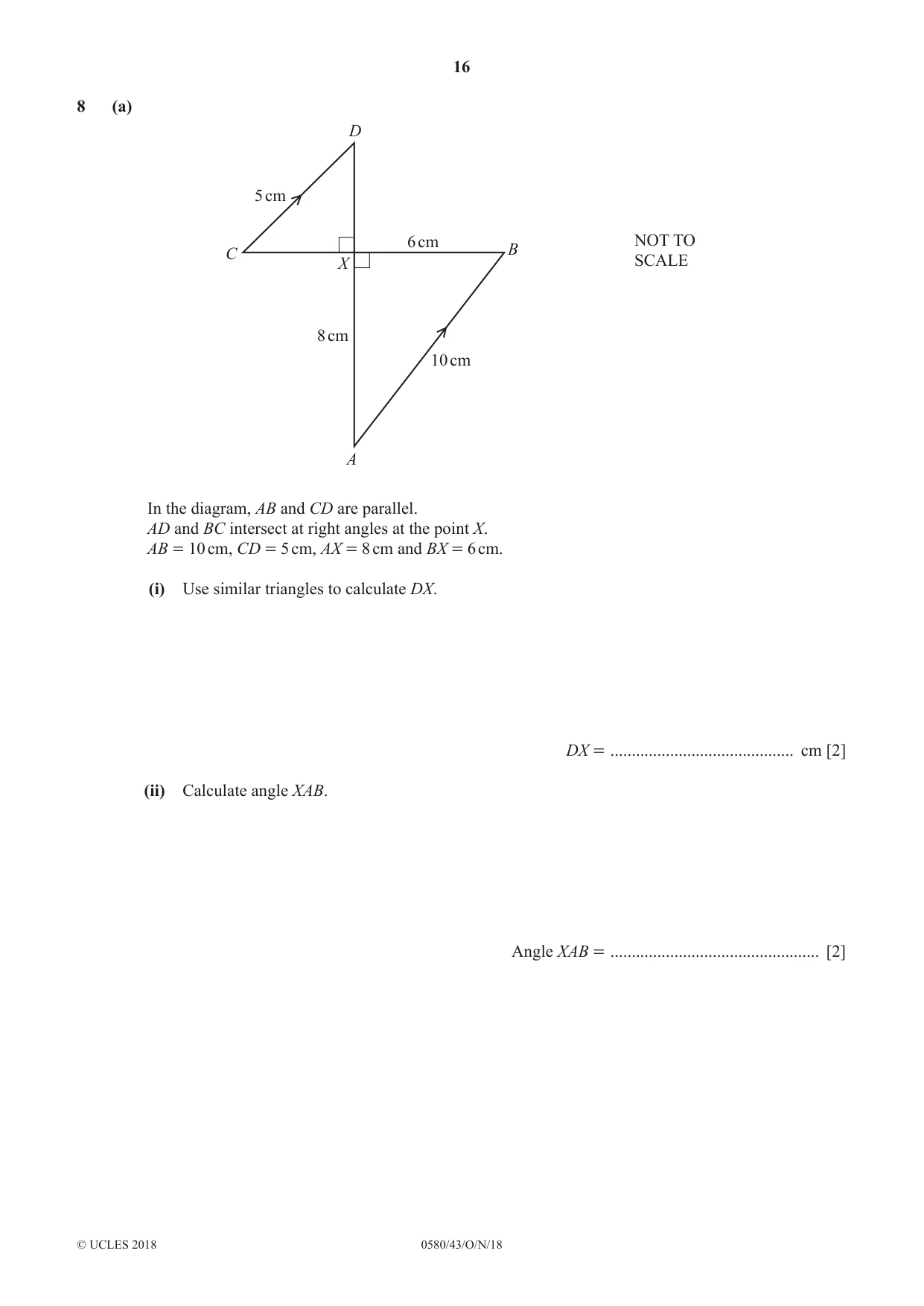
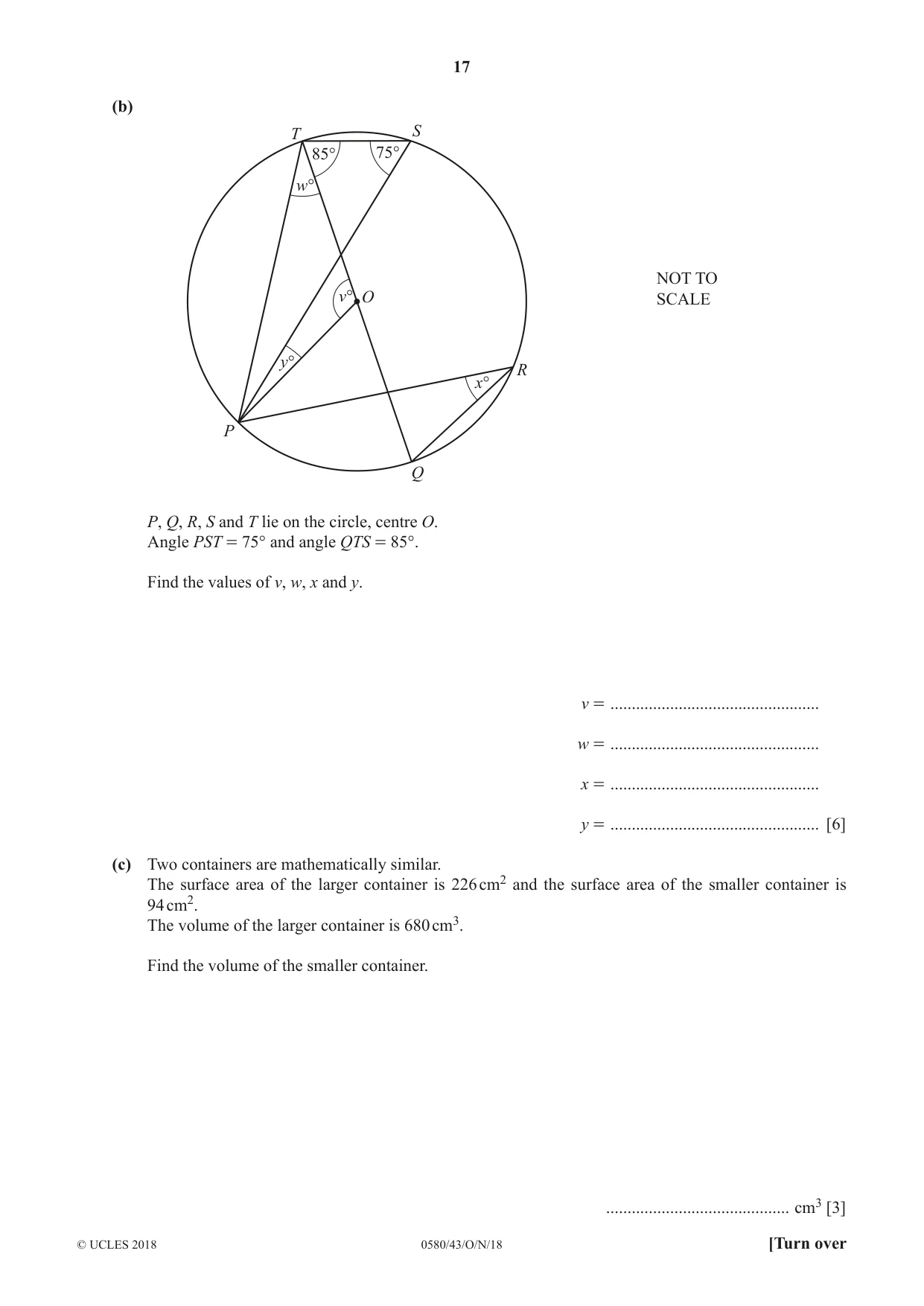
8 (a) D 5 cm 6 cm NOT TO B C X SCALE 8 cm 10 cm A In the diagram, AB and CD are parallel. AD and BC intersect at right angles at the point X. AB = 10 cm, CD = 5 cm, AX = 8 cm and BX = 6 cm. (i) Use similar triangles to calculate DX. DX = ........................................... cm [2] (ii) Calculate angle XAB. Angle XAB = ................................................. [2] (b) T S 85° 75° w° NOT TO v° O SCALE y° R x° P Q P, Q, R, S and T lie on the circle, centre O. Angle PST = 75° and angle QTS = 85°. Find the values of v, w, x and y. v = ................................................. w = ................................................. x = ................................................. y = ................................................. [6] (c) Two containers are mathematically similar. The surface area of the larger container is 226 cm2 and the surface area of the smaller container is 94 cm2. The volume of the larger container is 680 cm3. Find the volume of the smaller container. ........................................... cm3 [3]
Mark scheme: 8(a)(i) 4 2 M1 for correct method using similar triangles 10 8 e.g. = oe 5 DX 8(a)(ii) 36.9 or 36.86 to 36.87 2 6 6 8 M1 for tan = or sin = or cos = oe 8 10 10 8(b) [v = ] 150 B1 [w = ] 15 B2 FT (180 – their v) ÷ 2 M1 for 180 – 2w = their v oe or angle POQ = 180 – their v oe [x = ] 15 B1 FT their w [y = ] 10 B2 M1 for angle TPS = 5° or angle TXS = 20° or OXP = 20° or TXP = 160° (where X is where OT and PS intersect) 8(c) 182 or 182.4… 3 32 94 V M2 for = oe 226 680 226 94 or M1 for ratio of lengths = or or 94 226 V 2 94 3 better or for = oe 680 2 226 3
Q9 · F (x) = 3x + 4 g (x) = 2x - 1 h ()x = 3 x 1 (a) Find ge 2 o
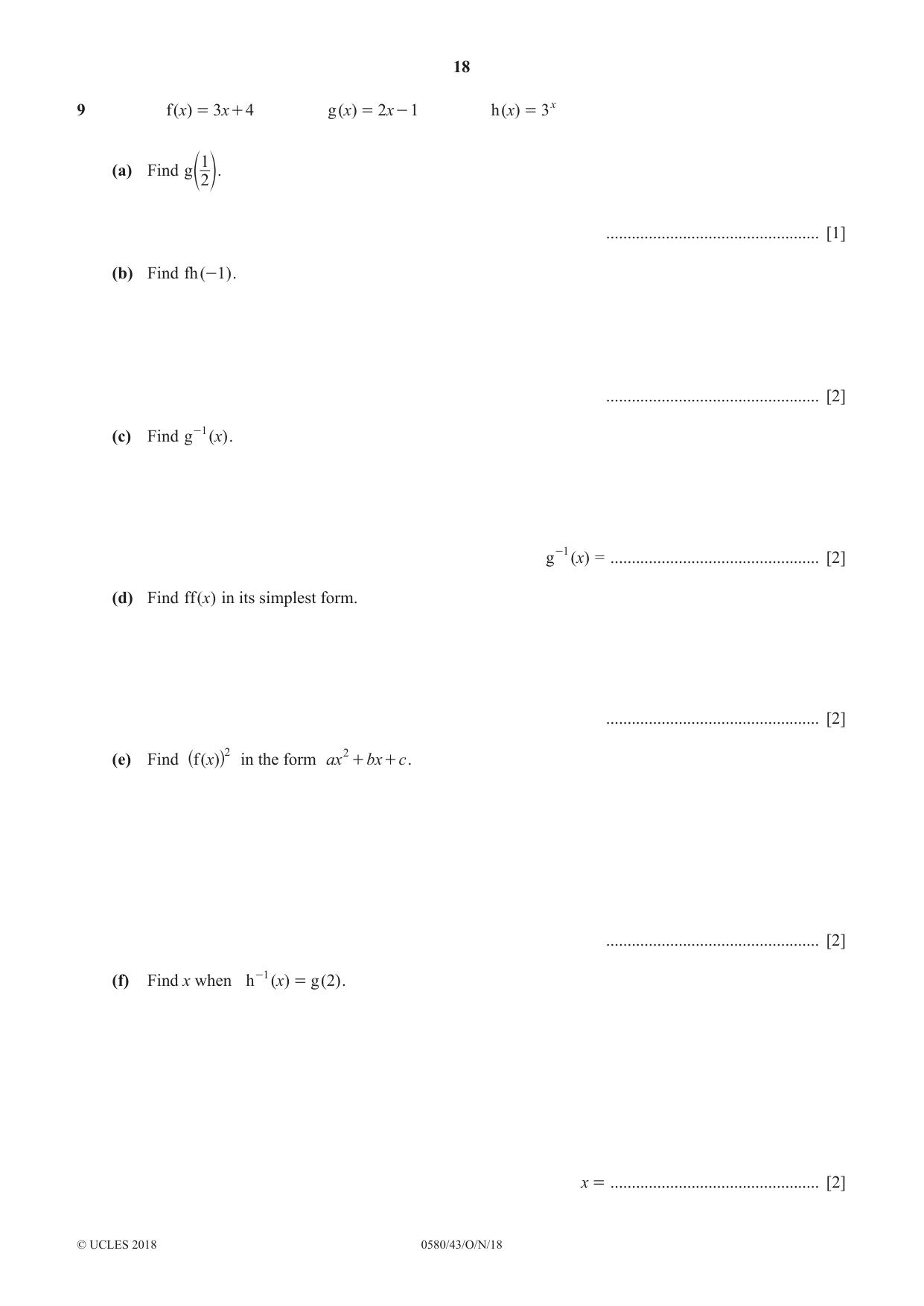
9 f (x) = 3x + 4 g (x) = 2x - 1 h ()x = 3 x 1 (a) Find ge 2 o. .................................................. [1] (b) Find fh (- 1) . .................................................. [2] (c) Find g -1 ()x . g -1 ()x = ................................................. [2] (d) Find ff ()x in its simplest form. .................................................. [2] (e) Find f ()x 2 in the form ax 2 + bx + c . ^ h .................................................. [2] (f) Find x when h -1 ( x) = g (2) . x = ................................................. [2]
Mark scheme: 9(a) 0 1 9(b) 5 2 x 1 M1 for (33 ) + 4 or better or f ( ) or f (3–1) 3 9(c) x + 1 2 y 1 oe final answer M1 for x = 2 y − 1 or y + 1= 2 x or = x − 2 2 2 or better 9(d) 9 x + 16 2 M1 for 3(3x + 4) + 4 oe 9(e) 9 x 2 + 24 x + 16 2 B1 for three terms from 9 x 2 + 12 x + 12 x + 16 correct 9(f) 27 2 M1 for x = h(their g(2))
Q10 · Find the next term and the nth term of this sequence
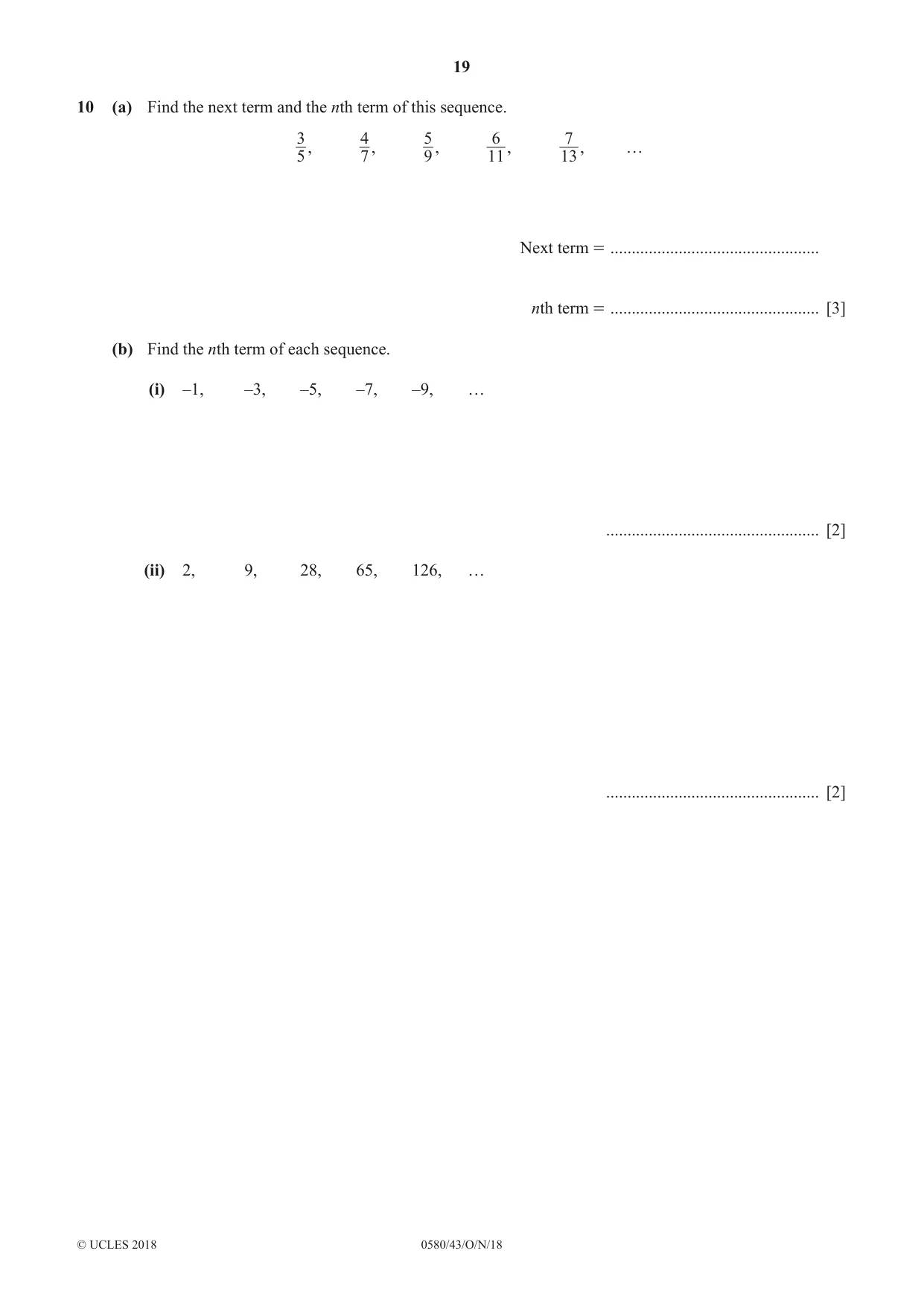
10 (a) Find the next term and the nth term of this sequence. 3 4 5 6 7 , , , , , … 5 7 9 11 13 Next term = ................................................. nth term = ................................................. [3] (b) Find the nth term of each sequence. (i) –1, –3, –5, –7, –9, … .................................................. [2] (ii) 2, 9, 28, 65, 126, … .................................................. [2]
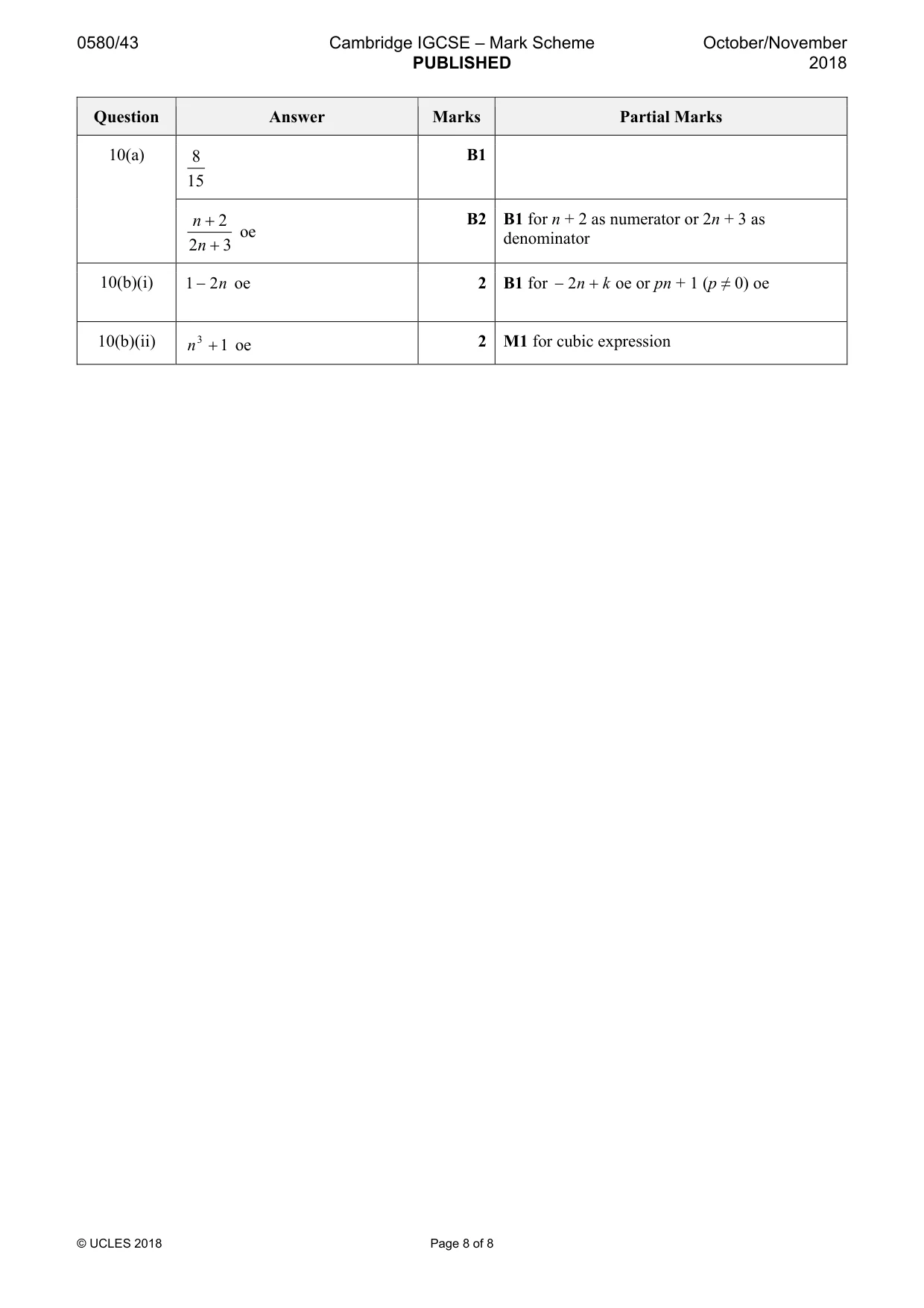
Mark scheme: 10(a) 8 B1 15 n + 2 B2 B1 for n + 2 as numerator or 2n + 3 as oe denominator 2 n + 3 10(b)(i) 1 − 2 n oe 2 B1 for −2 n + k oe or pn + 1 (p ≠ 0) oe 10(b)(ii) n 3 + 1 oe 2 M1 for cubic expression
What was in this paper
The subtopics covered by these 10 questions, and how many questions each got. Open one in a new tab to see every Cambridge question on it.
What you needed in this session
Cambridge’s own grade thresholds for 2018 Oct/Nov, Paper 4 · Variant 3. A higher threshold means an easier paper — the bar moves with how the cohort did.