Cambridge IGCSE Mathematics 0580 — 2021 May/June Paper 4 · Variant 1
0580/41/M/J/21 · 12 questions · 130 marks · ≈146 min
The question paper and its mark scheme, free to read here and free to download. This is Cambridge’s own paper, exactly as it was sat.
Question paper20 pages
Mark scheme9 pages
Answers below. Sit the paper first if you are practising.
Questions as text
Q1 · The total cost of a taxi journey is calculated as • $0.50 per kilometre plus • $0.40 per…
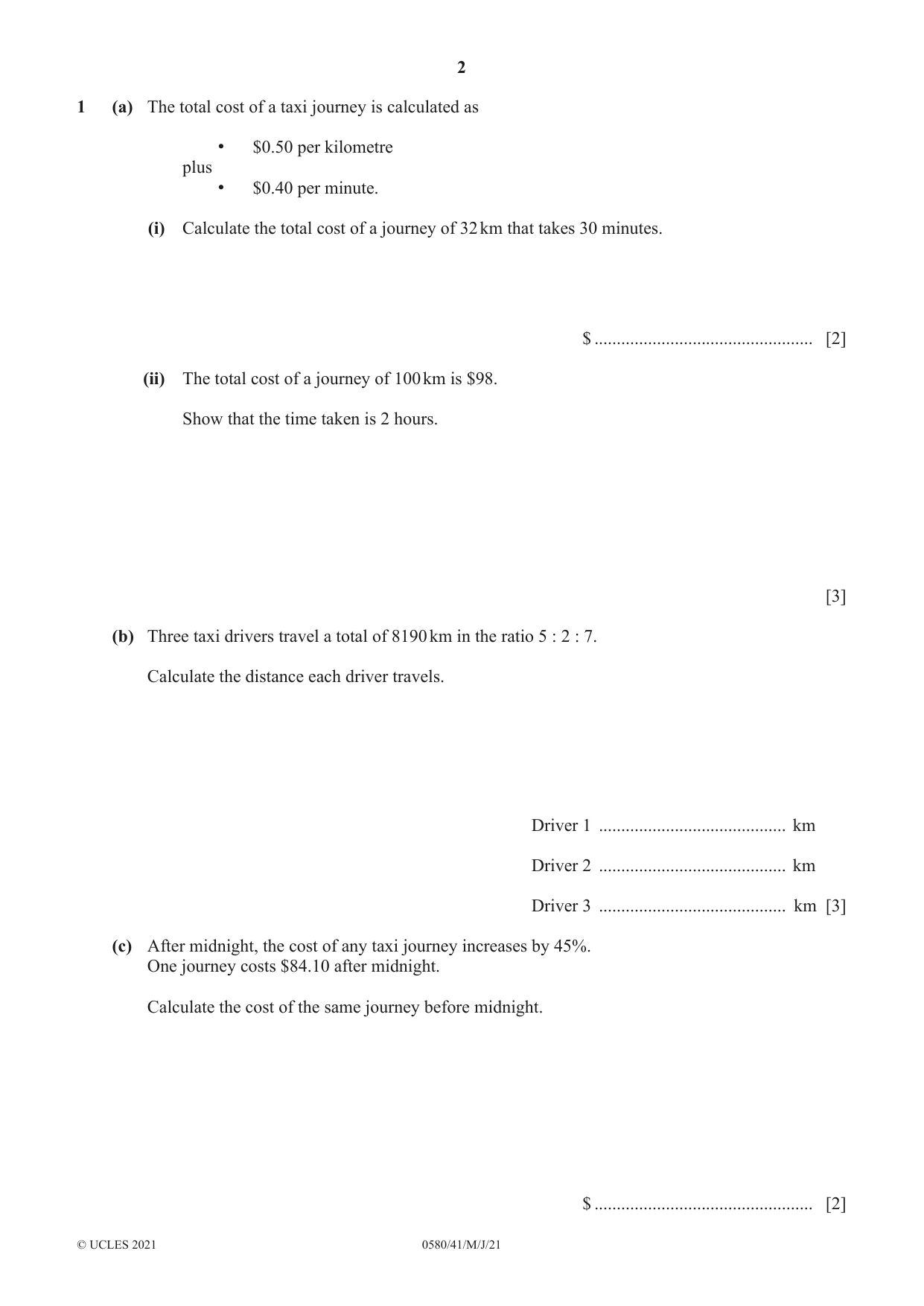
1 (a) The total cost of a taxi journey is calculated as • $0.50 per kilometre plus • $0.40 per minute. (i) Calculate the total cost of a journey of 32 km that takes 30 minutes. $ ................................................. [2] (ii) The total cost of a journey of 100 km is $98. Show that the time taken is 2 hours. [3] (b) Three taxi drivers travel a total of 8190 km in the ratio 5 : 2 : 7. Calculate the distance each driver travels. Driver 1 .......................................... km Driver 2 .......................................... km Driver 3 .......................................... km [3] (c) After midnight, the cost of any taxi journey increases by 45%. One journey costs $84.10 after midnight. Calculate the cost of the same journey before midnight. $ ................................................. [2]
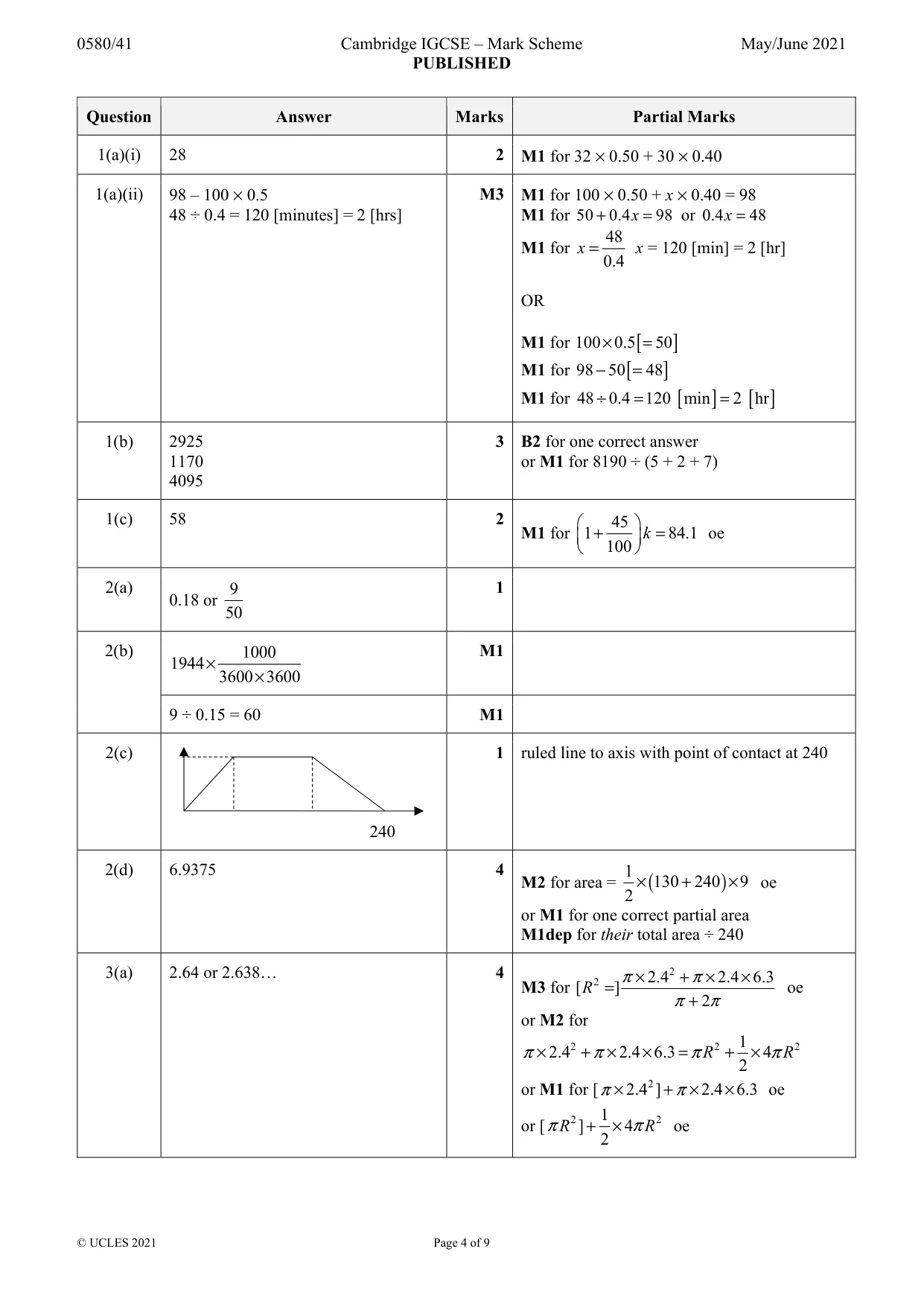
Mark scheme: Question Answer Marks Partial Marks 1(a)(i) 28 2 M1 for 32 × 0.50 + 30 × 0.40 1(a)(ii) 98 – 100 × 0.5 M3 M1 for 100 × 0.50 + x × 0.40 = 98 48 ÷ 0.4 = 120 [minutes] = 2 [hrs] M1 for 50 + 0.4 x = 98 or 0.4 x = 48 48 M1 for x = x = 120 [min] = 2 [hr] 0.4 OR M1 for 100 × 0.5 [ = 50 ] M1 for 98 − 50 [ = 48 ] M1 for 48 ÷ 0.4 = 120 [ min ] = 2 [ hr ] 1(b) 2925 3 B2 for one correct answer 1170 or M1 for 8190 ÷ (5 + 2 + 7) 4095 1(c) 58 2 45 M1 for 1 + k = 84.1 oe 100
Q2 · The diagram shows the speed−time graph for the first 180 seconds of a train journey
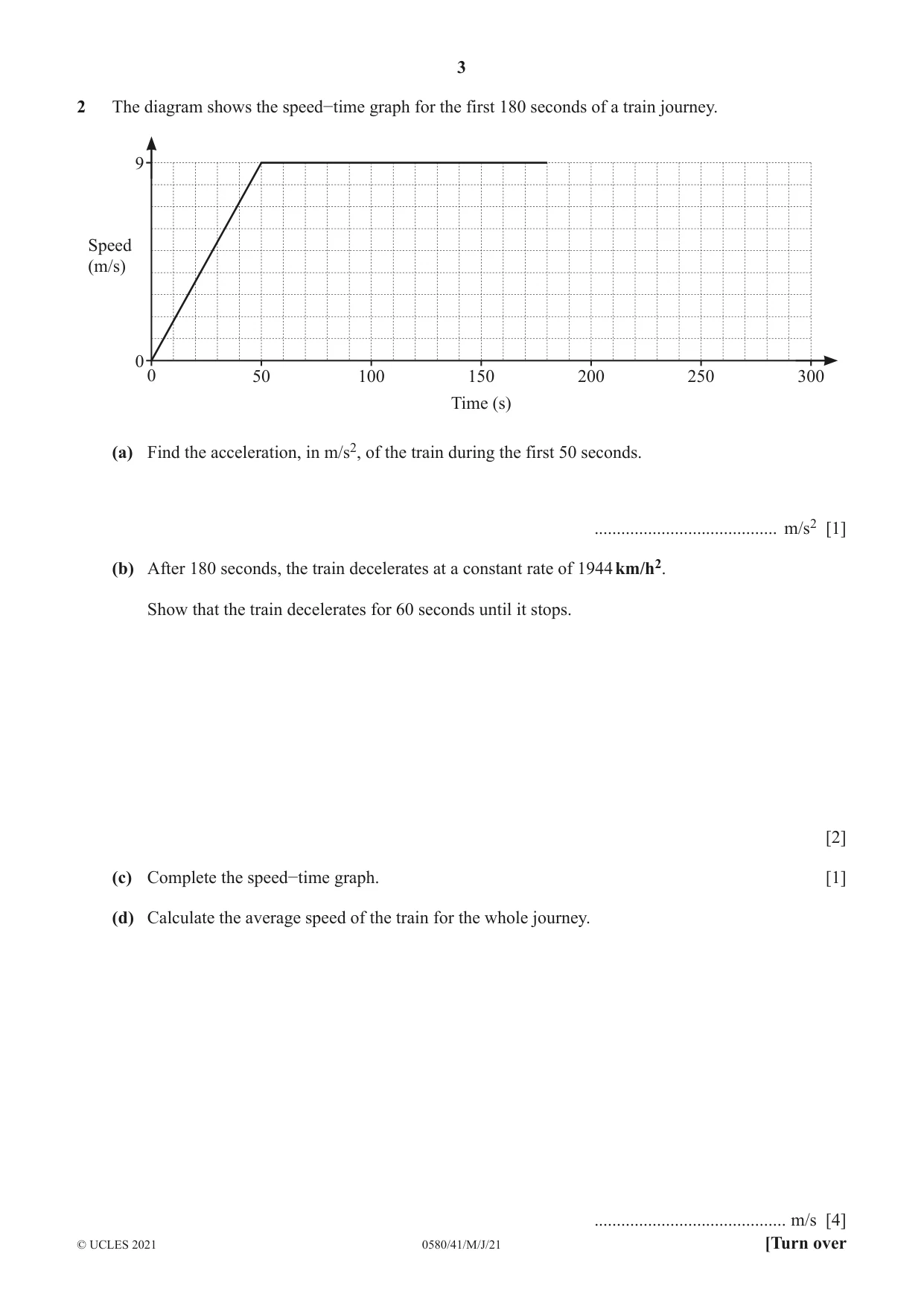
2 The diagram shows the speed−time graph for the first 180 seconds of a train journey. 9 Speed (m/s) 0 0 50 100 150 200 250 300 Time (s) (a) Find the acceleration, in m/s2, of the train during the first 50 seconds. ......................................... m/s2 [1] (b) After 180 seconds, the train decelerates at a constant rate of 1944 km/h2. Show that the train decelerates for 60 seconds until it stops. [2] (c) Complete the speed−time graph. [1] (d) Calculate the average speed of the train for the whole journey. ........................................... m/s [4]
Mark scheme: 2(a) 9 1 0.18 or 50 2(b) 1000 M1 1944 × 3600 × 3600 9 ÷ 0.15 = 60 M1 2(c) 1 ruled line to axis with point of contact at 240 240 2(d) 6.9375 4 1 M2 for area = × (130 + 240 ) × 9 oe 2 or M1 for one correct partial area M1dep for their total area ÷ 240
Q3 · NOT TO SCALE 6.3 cm R cm 2.4 cm The diagram shows a solid cone and a solid hemisphere
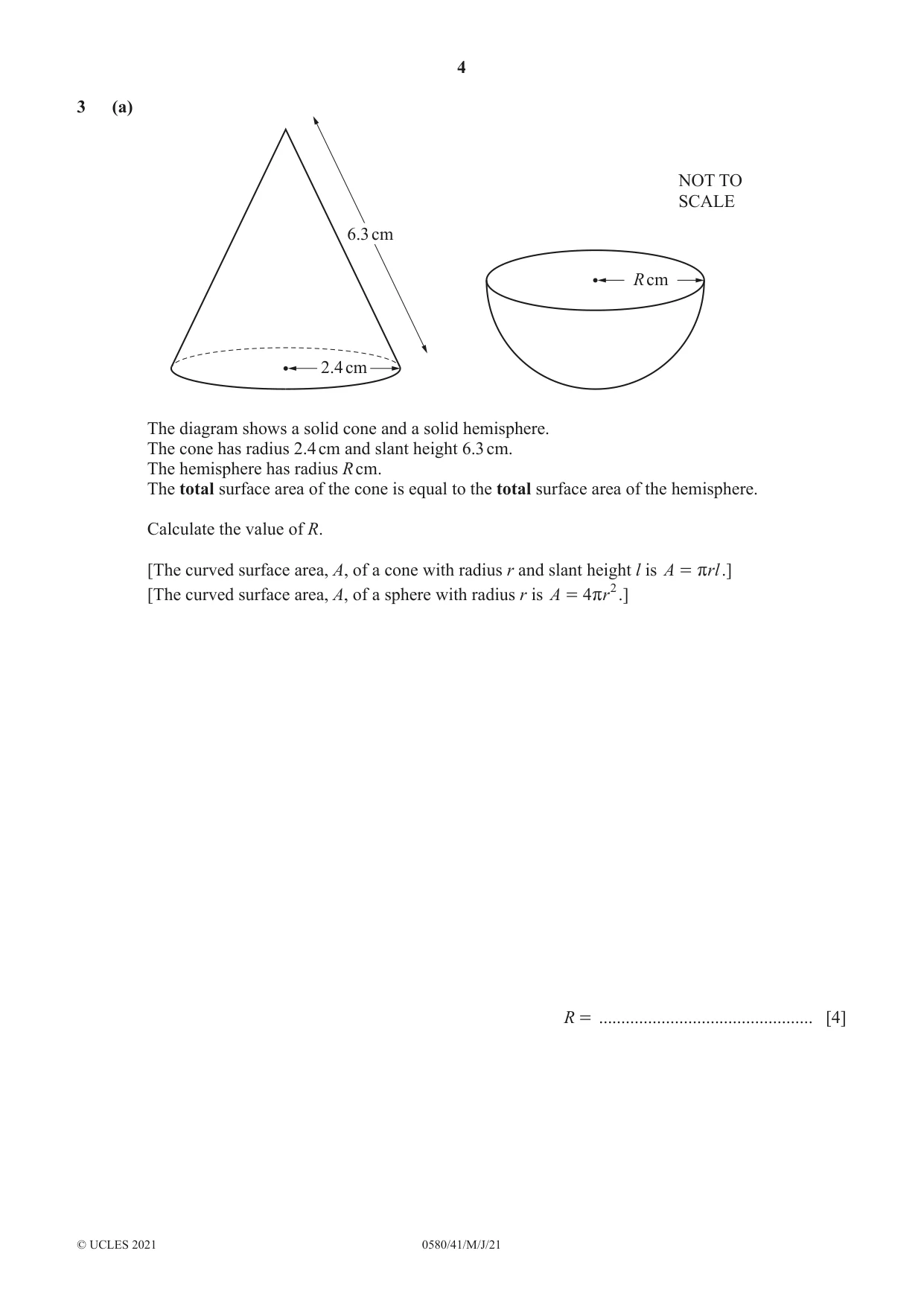
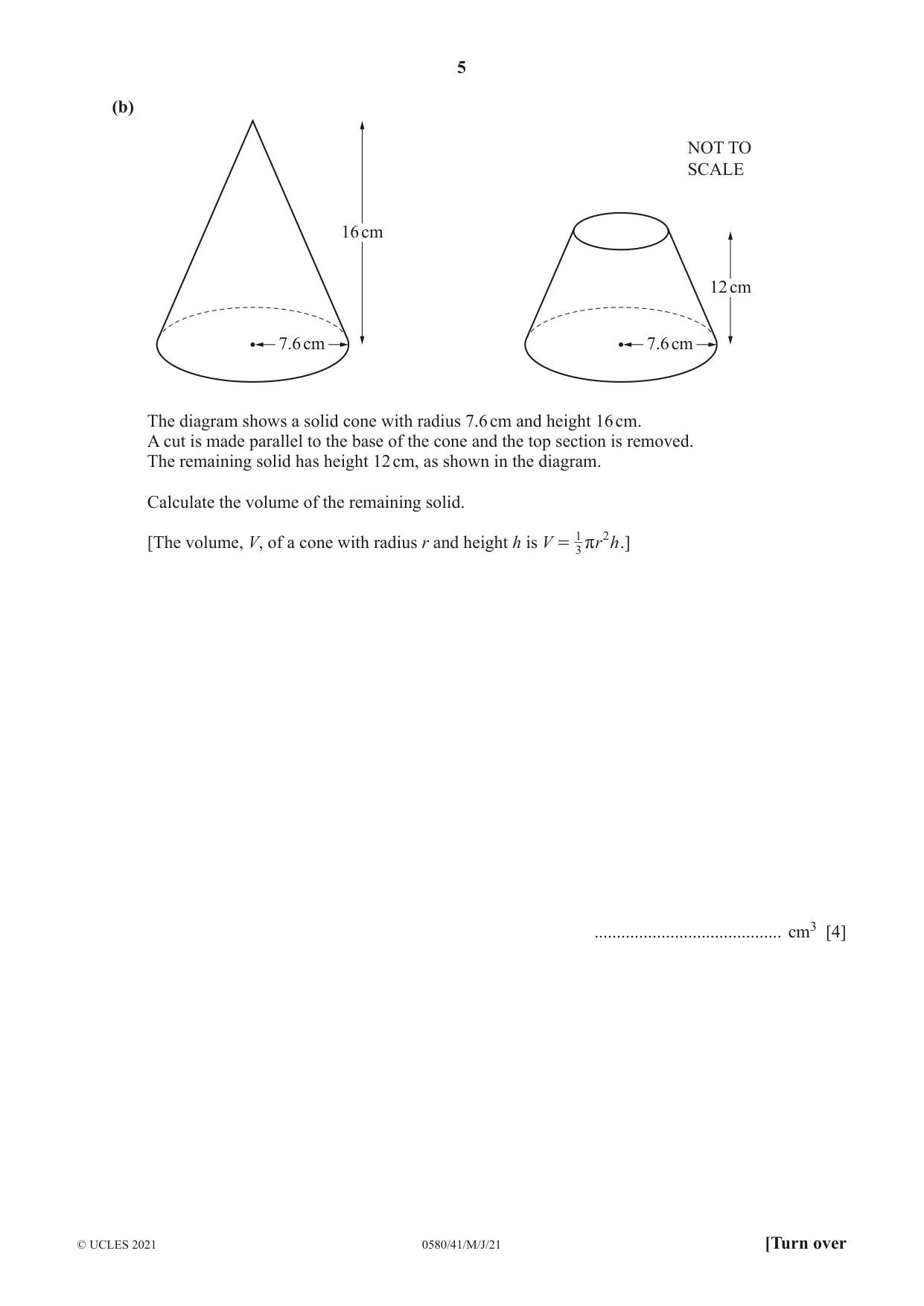
3 (a) NOT TO SCALE 6.3 cm R cm 2.4 cm The diagram shows a solid cone and a solid hemisphere. The cone has radius 2.4 cm and slant height 6.3 cm. The hemisphere has radius R cm. The total surface area of the cone is equal to the total surface area of the hemisphere. Calculate the value of R. [The curved surface area, A, of a cone with radius r and slant height l is A = rrl .] [The curved surface area, A, of a sphere with radius r is A = 4rr 2 .] R = ................................................ [4] (b) NOT TO SCALE 16 cm 12 cm 7.6 cm 7.6 cm The diagram shows a solid cone with radius 7.6 cm and height 16 cm. A cut is made parallel to the base of the cone and the top section is removed. The remaining solid has height 12 cm, as shown in the diagram. Calculate the volume of the remaining solid. r r h .] [The volume, V, of a cone with radius r and height h is V = 13 2 .......................................... cm3 [4]
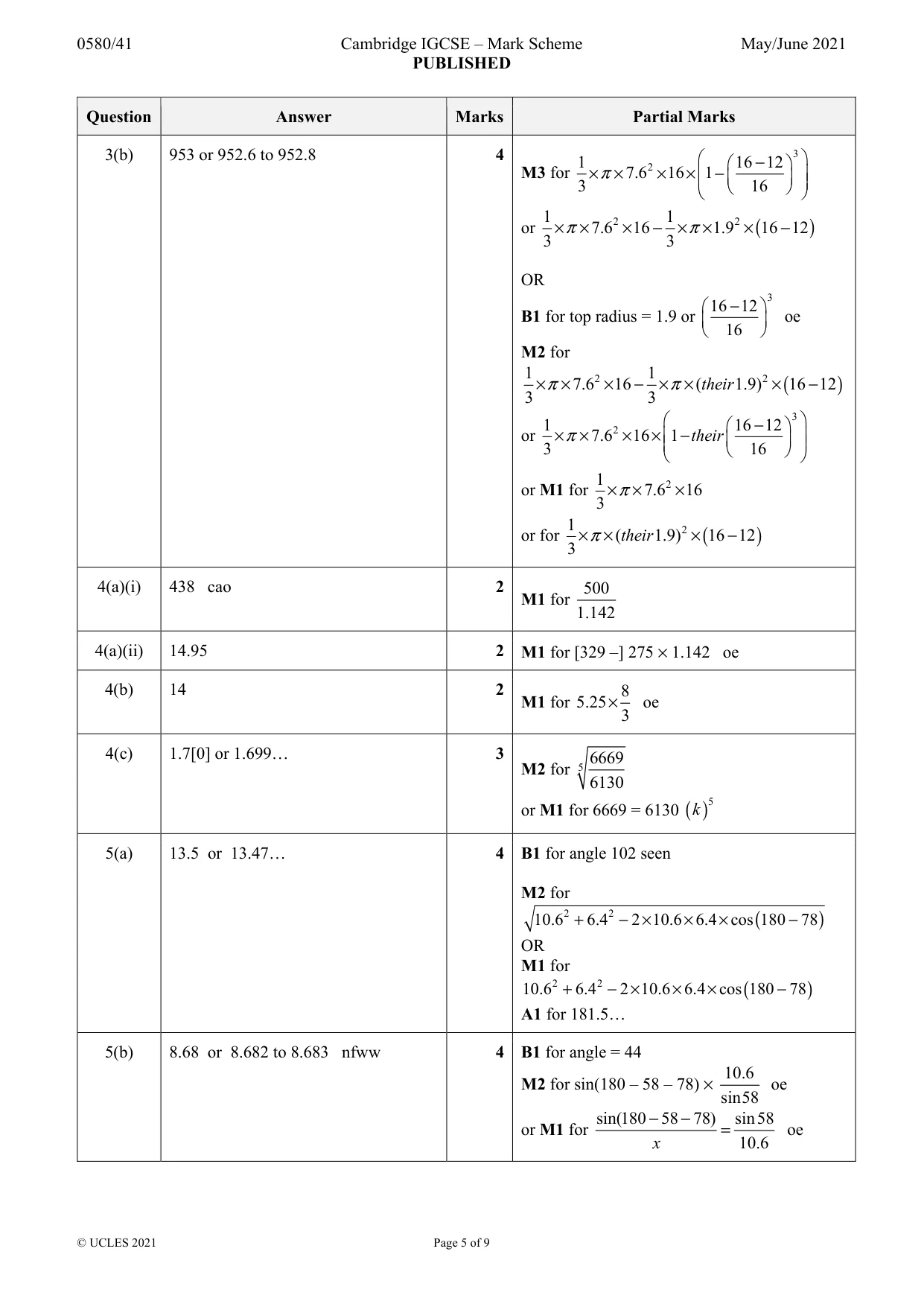
Mark scheme: 3(a) 2.64 or 2.638… 4 2 π × 2.4 2 + π × 2.4 × 6.3 M3 for [ R = ] oe π + 2π or M2 for 2 2 1 2 π× 2.4 + π× 2.4 × 6.3 = πR + × 4πR 2 or M1 for [ π × 2.4 2 ] + π× 2.4 × 6.3 oe 2 1 2 or [ πR ] + × 4πR oe 2 3(b) 953 or 952.6 to 952.8 4 16 − 12 3 1 2 M3 for × π× 7.6 × 16 × 1 − 3 16 1 2 1 2 or × π× 7.6 × 16 − × π× 1.9 × (16 − 12 ) 3 3 OR 16 − 12 3 B1 for top radius = 1.9 or oe 16 M2 for 1 2 1 2 × π× 7.6 × 16 − × π× (their 1.9) × (16 − 12 ) 3 3 16 − 12 3 1 2 or × π× 7.6 × 16 × 1 − their 3 16 1 2 or M1 for × π× 7.6 × 16 3 1 2 or for × π× (their 1.9) × (16 − 12 ) 3
Q4 · The exchange rate is 1 euro = $1.142
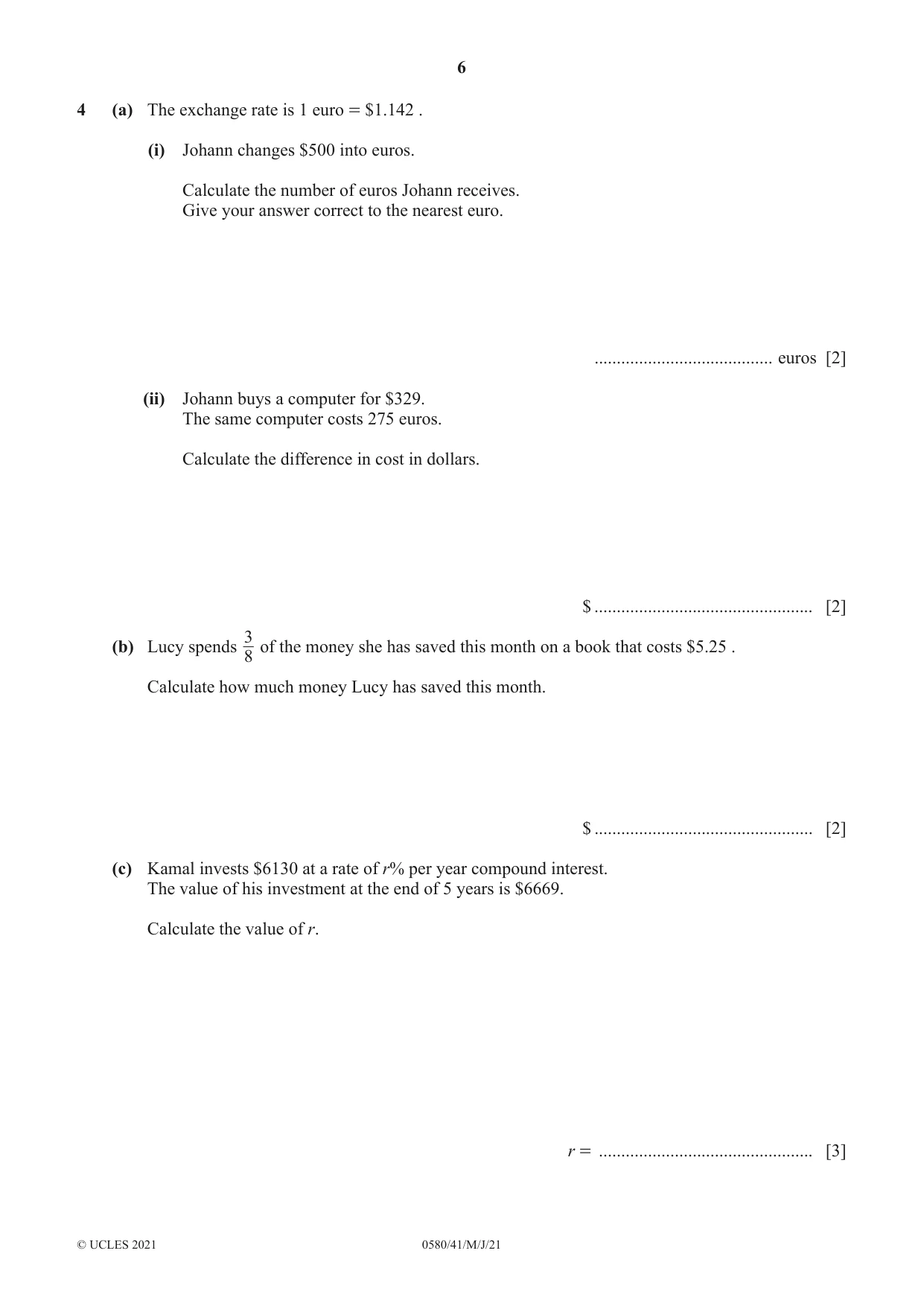
4 (a) The exchange rate is 1 euro = $1.142 . (i) Johann changes $500 into euros. Calculate the number of euros Johann receives. Give your answer correct to the nearest euro. ........................................ euros [2] (ii) Johann buys a computer for $329. The same computer costs 275 euros. Calculate the difference in cost in dollars. $ ................................................. [2] 3 (b) Lucy spends of the money she has saved this month on a book that costs $5.25 . 8 Calculate how much money Lucy has saved this month. $ ................................................. [2] (c) Kamal invests $6130 at a rate of r% per year compound interest. The value of his investment at the end of 5 years is $6669. Calculate the value of r. r = ................................................ [3]
Mark scheme: 4(a)(i) 438 cao 2 500 M1 for 1.142 4(a)(ii) 14.95 2 M1 for [329 –] 275 × 1.142 oe 4(b) 14 2 8 M1 for 5.25 × oe 3 4(c) 1.7[0] or 1.699… 3 6669 M2 for 5 6130 or M1 for 6669 = 6130 ( k ) 5
Q5 · A NOT TO SCALE 10.6 cm 58° 78° B C X 6.4 cm The diagram shows triangle ABC
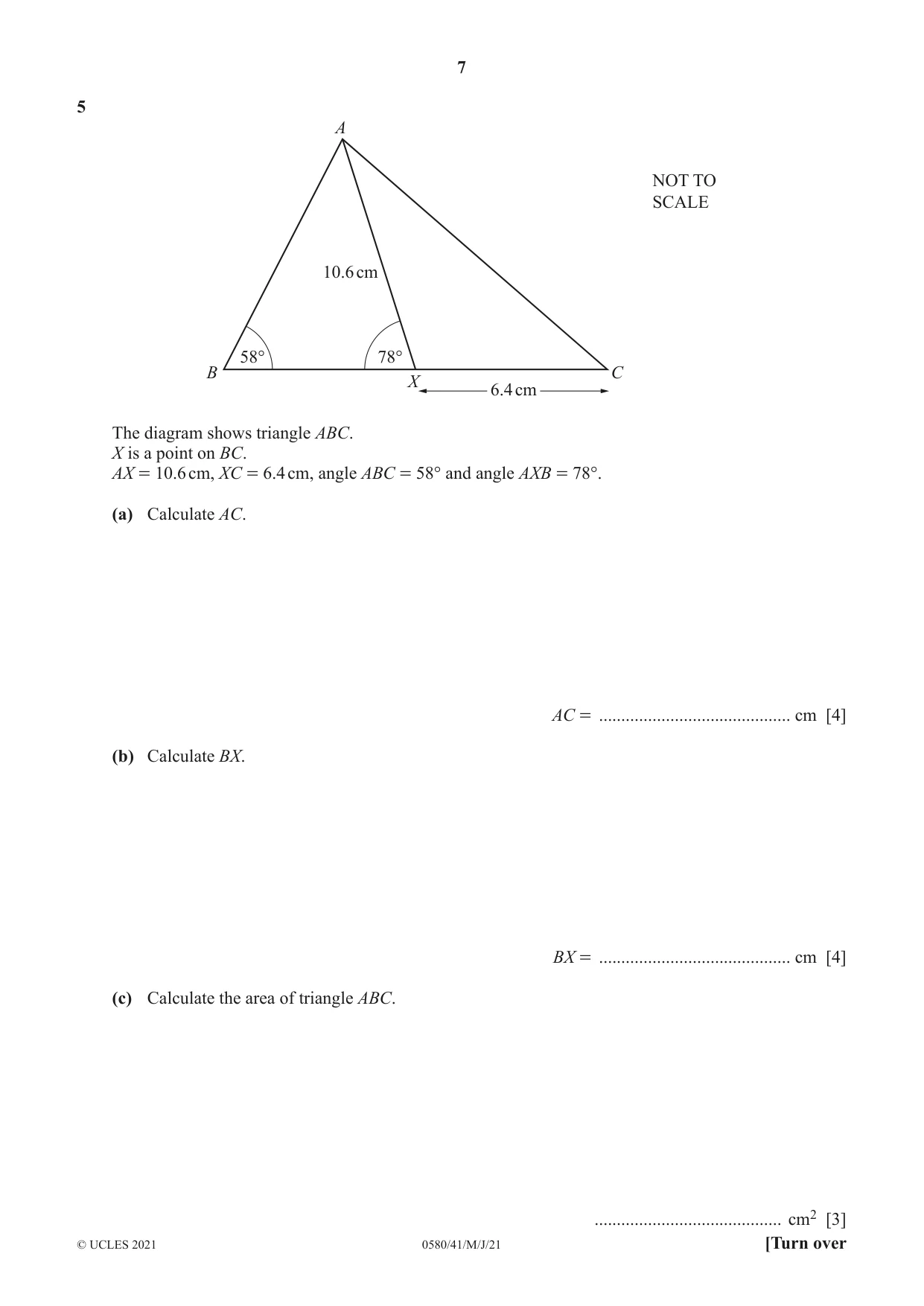
5 A NOT TO SCALE 10.6 cm 58° 78° B C X 6.4 cm The diagram shows triangle ABC. X is a point on BC. AX = 10.6 cm, XC = 6.4 cm, angle ABC = 58° and angle AXB = 78°. (a) Calculate AC. AC = ........................................... cm [4] (b) Calculate BX. BX = ........................................... cm [4] (c) Calculate the area of triangle ABC. .......................................... cm2 [3]
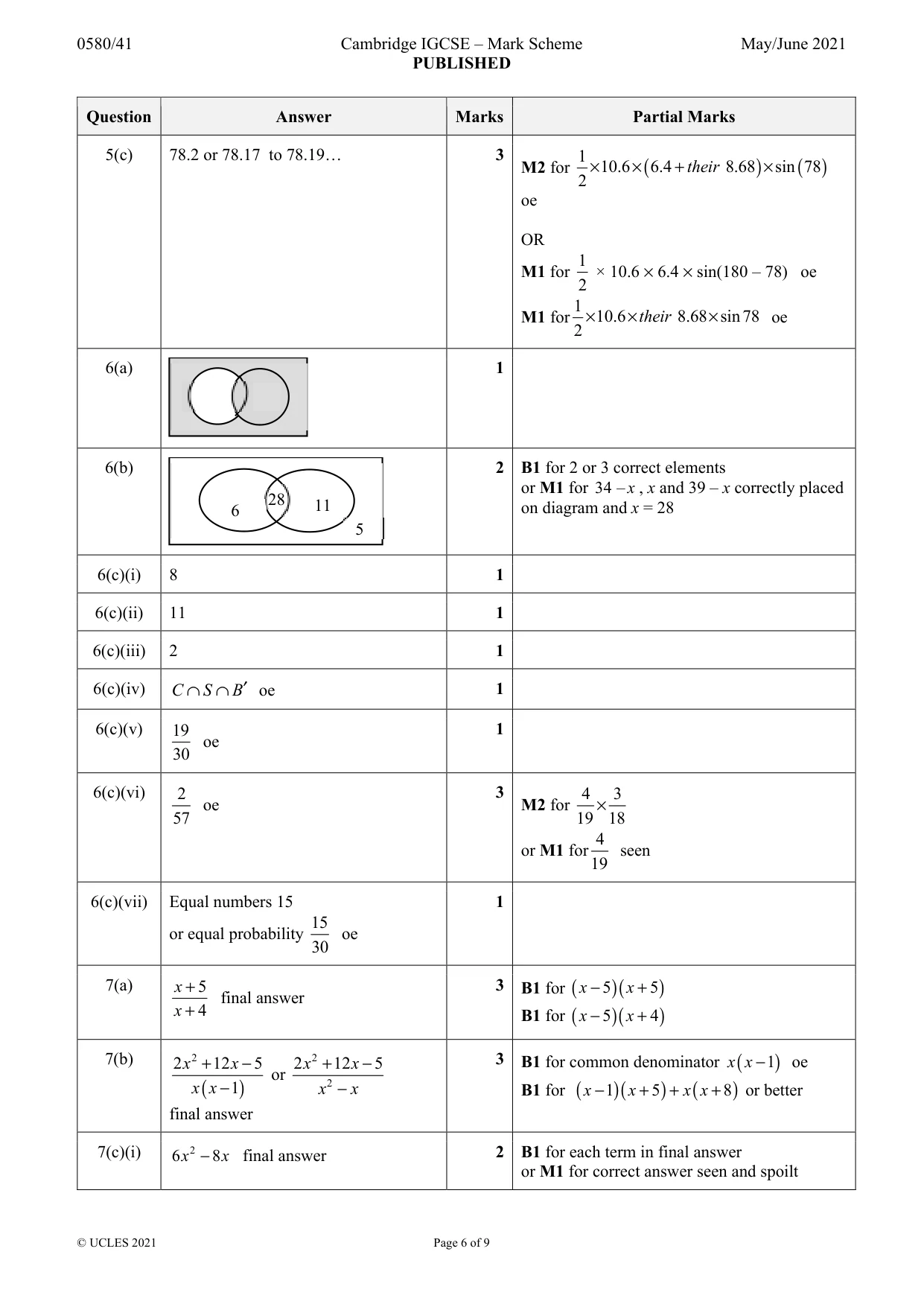
Mark scheme: 5(a) 13.5 or 13.47… 4 B1 for angle 102 seen M2 for 10.6 2 + 6.4 2 − 2 × 10.6 × 6.4 × cos (180 − 78 ) OR M1 for 10.6 2 + 6.4 2 − 2 × 10.6 × 6.4 × cos (180 − 78 ) A1 for 181.5… 5(b) 8.68 or 8.682 to 8.683 nfww 4 B1 for angle = 44 10.6 M2 for sin(180 – 58 – 78) × oe sin 58 sin(180 − 58 − 78) sin58 or M1 for = oe x 10.6 5(c) 78.2 or 78.17 to 78.19… 3 1 M2 for × 10.6 × ( 6.4 + their 8.68 ) × sin ( 78 ) 2 oe OR 1 M1 for × 10.6 × 6.4 × sin(180 – 78) oe 2 1 M1 for × 10.6 × their 8.68 × sin78 oe 2
Q6 · In the Venn diagram, shade the region P l , Q
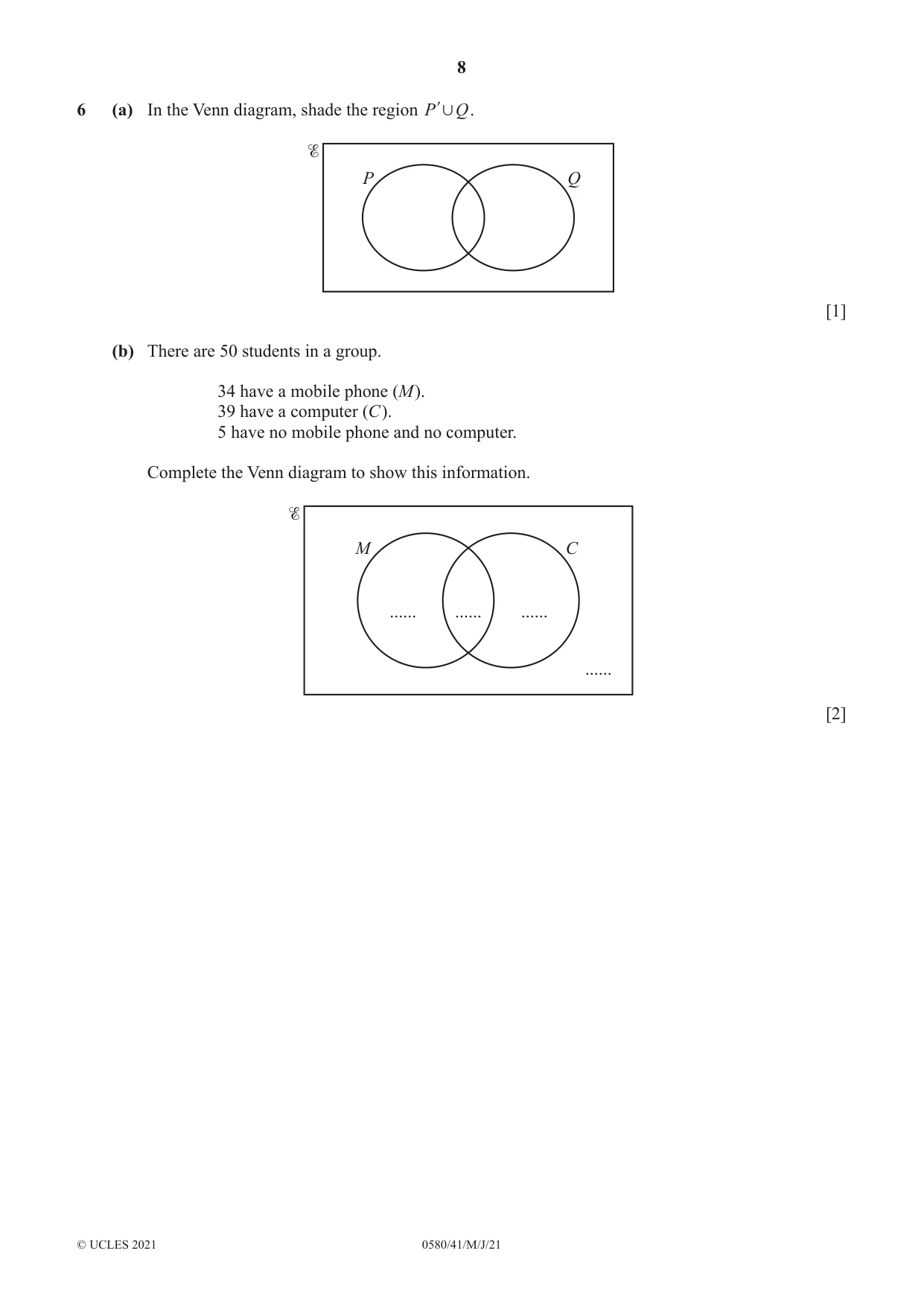
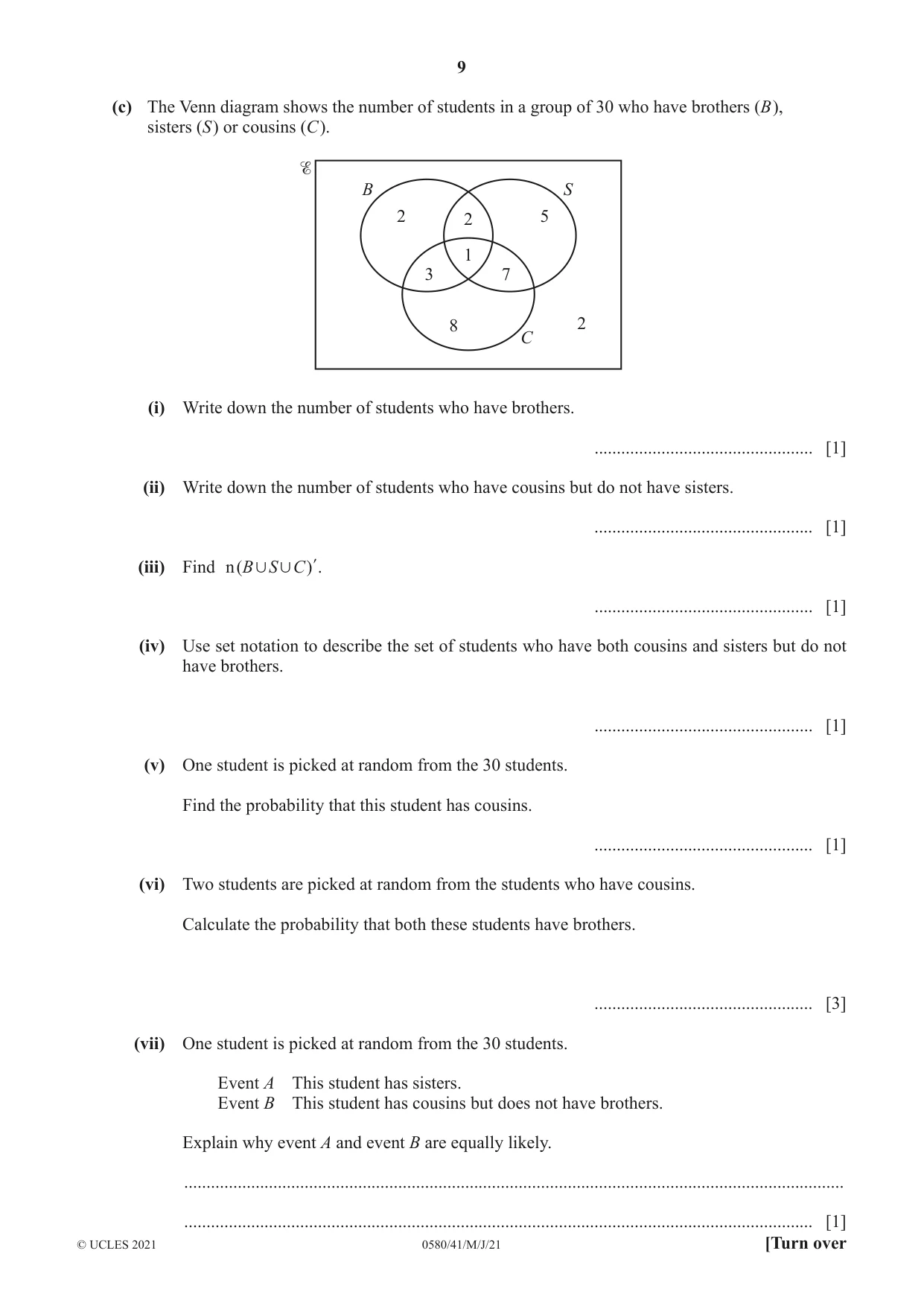
6 (a) In the Venn diagram, shade the region P l , Q . P Q [1] (b) There are 50 students in a group. 34 have a mobile phone (M ). 39 have a computer (C ). 5 have no mobile phone and no computer. Complete the Venn diagram to show this information. M C ...... ...... ...... ...... [2] (c) The Venn diagram shows the number of students in a group of 30 who have brothers (B ), sisters (S ) or cousins (C ). B S 2 2 5 1 3 7 8 2 C (i) Write down the number of students who have brothers. ................................................. [1] (ii) Write down the number of students who have cousins but do not have sisters. ................................................. [1] (iii) Find n ( B , S , C ) l. ................................................. [1] (iv) Use set notation to describe the set of students who have both cousins and sisters but do not have brothers. ................................................. [1] (v) One student is picked at random from the 30 students. Find the probability that this student has cousins. ................................................. [1] (vi) Two students are picked at random from the students who have cousins. Calculate the probability that both these students have brothers. ................................................. [3] (vii) One student is picked at random from the 30 students. Event A This student has sisters. Event B This student has cousins but does not have brothers. Explain why event A and event B are equally likely. .................................................................................................................................................... ............................................................................................................................................. [1]
Mark scheme: 6(a) 1 6(b) 2 B1 for 2 or 3 correct elements or M1 for 34 – x , x and 39 – x correctly placed 28 11 on diagram and x = 28 6 5 6(c)(i) 8 1 6(c)(ii) 11 1 6(c)(iii) 2 1 6(c)(iv) C ∩ S ∩ B′ oe 1 6(c)(v) 19 1 oe 30 6(c)(vi) 2 3 4 3 oe M2 for × 57 19 18 4 or M1 for seen 19 6(c)(vii) Equal numbers 15 1 15 or equal probability oe 30
Question 7
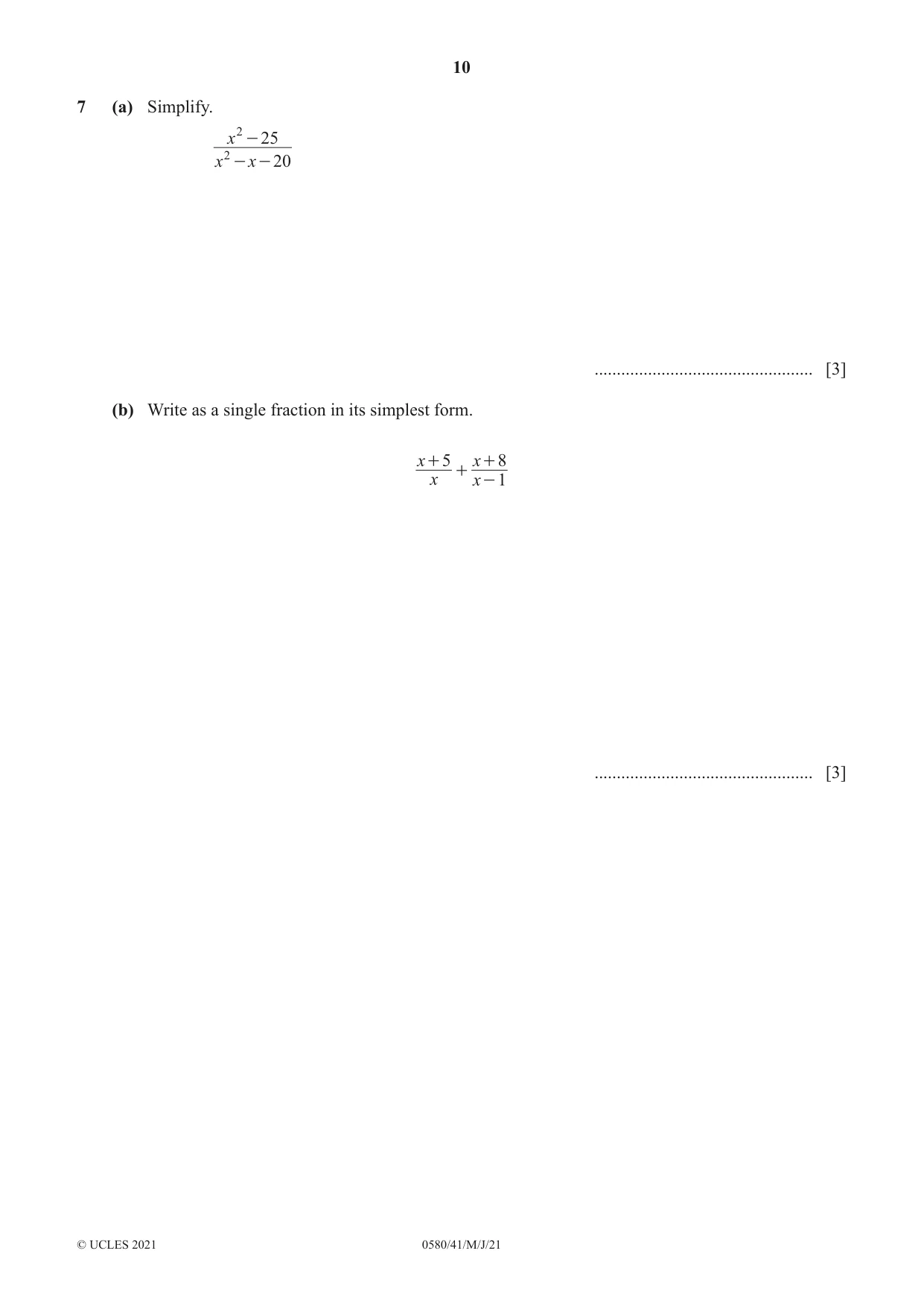
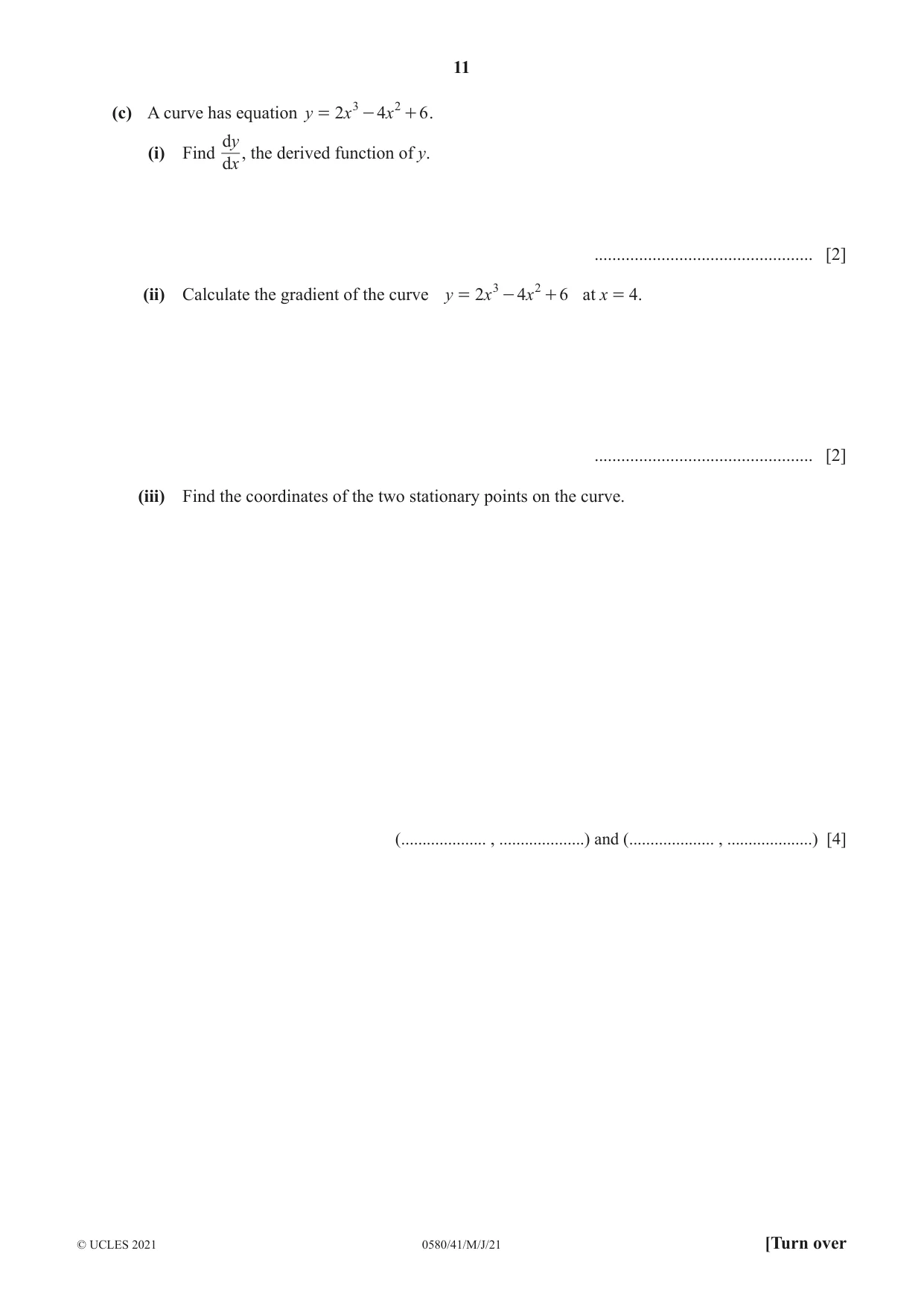
7 (a) Simplify. x 2 - 25 x 2 - x - 20 ................................................. [3] (b) Write as a single fraction in its simplest form. x + 5 x + 8 + x x - 1 ................................................. [3] (c) A curve has equation y = 2 x 3 - 4x 2 + 6 . dy (i) Find , the derived function of y. dx ................................................. [2] (ii) Calculate the gradient of the curve y = 2x 3 - 4x 2 + 6 at x = 4. ................................................. [2] (iii) Find the coordinates of the two stationary points on the curve. (.................... , ....................) and (.................... , ....................) [4]
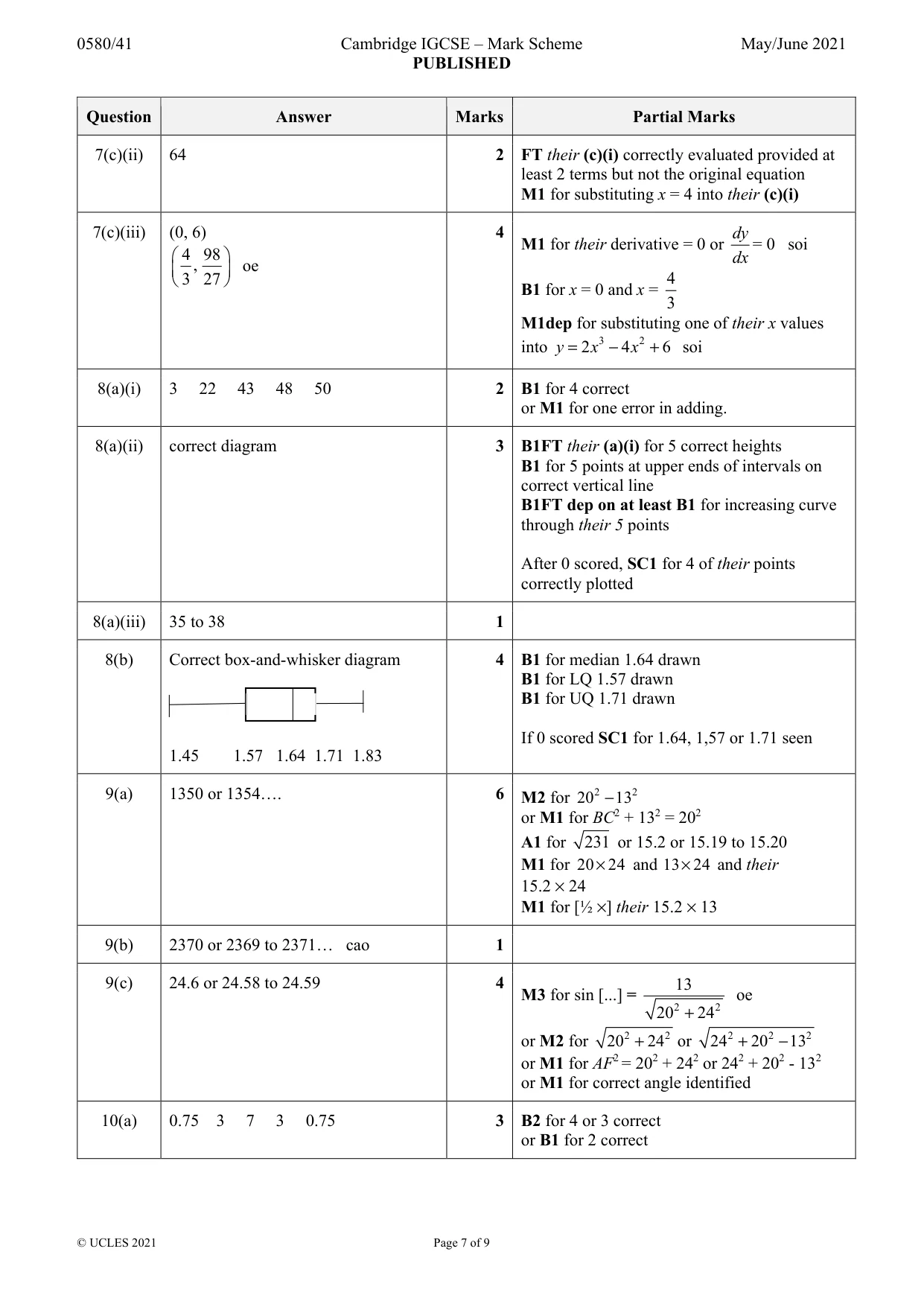
Mark scheme: 7(a) x + 5 3 B1 for ( x − 5 )( x + 5 ) final answer x + 4 B1 for ( x − 5 )( x + 4 ) 7(b) 2 x 2 + 12 x − 5 2 x 2 + 12 x − 5 3 B1 for common denominator x ( x − 1) oe or x ( x − 1) x 2 − x B1 for ( x − 1)( x + 5 ) + x ( x + 8 ) or better final answer 7(c)(i) 6 x 2 − 8 x final answer 2 B1 for each term in final answer or M1 for correct answer seen and spoilt 7(c)(ii) 64 2 FT their (c)(i) correctly evaluated provided at least 2 terms but not the original equation M1 for substituting x = 4 into their (c)(i) 7(c)(iii) (0, 6) 4 dy M1 for their derivative = 0 or = 0 soi 4 98 dx , oe 3 27 4 B1 for x = 0 and x = 3 M1dep for substituting one of their x values into y = 2 x 3 − 4 x 2 + 6 soi
Q8 · The table shows information about the mass, in kilograms, of each of 50 children
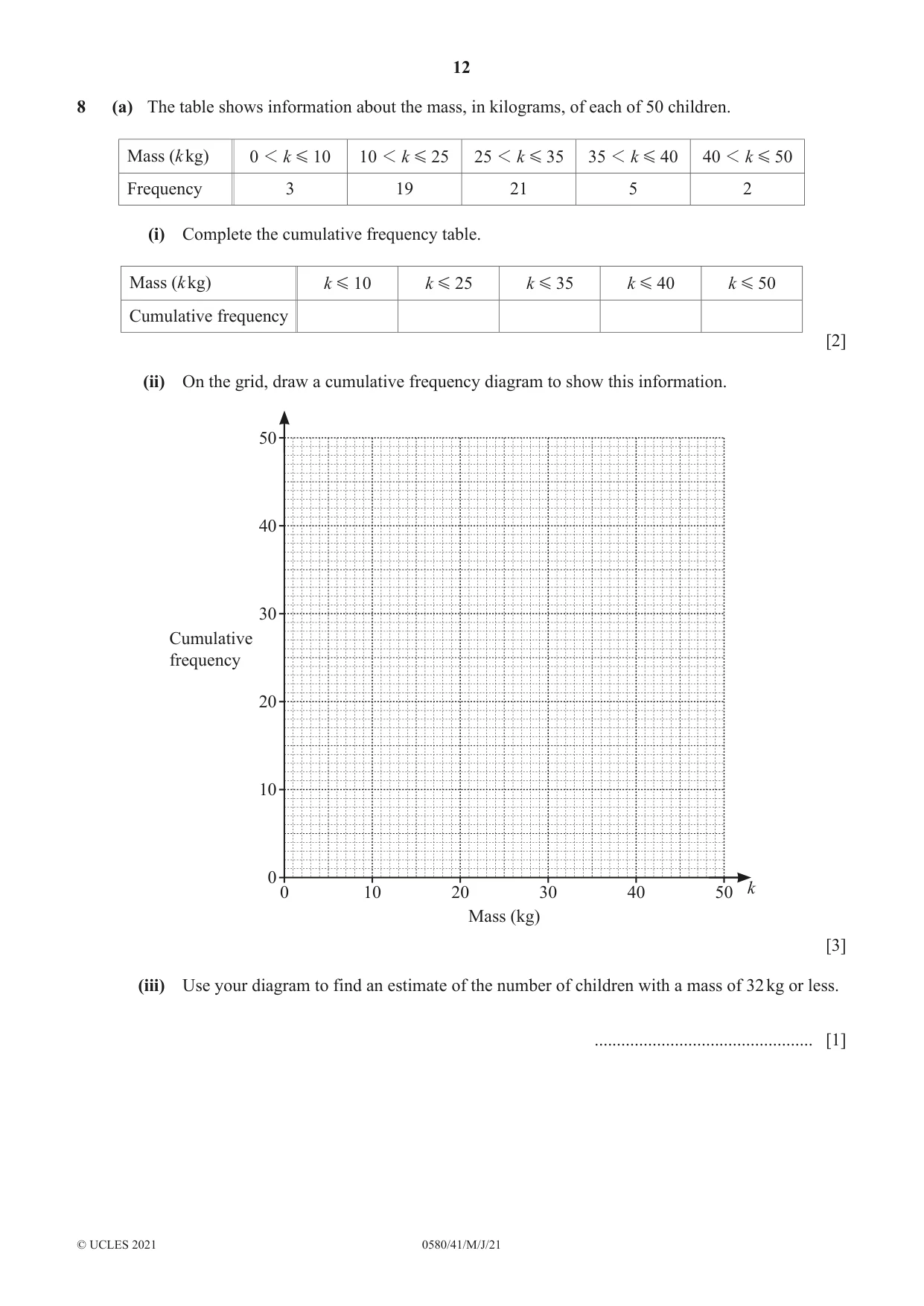
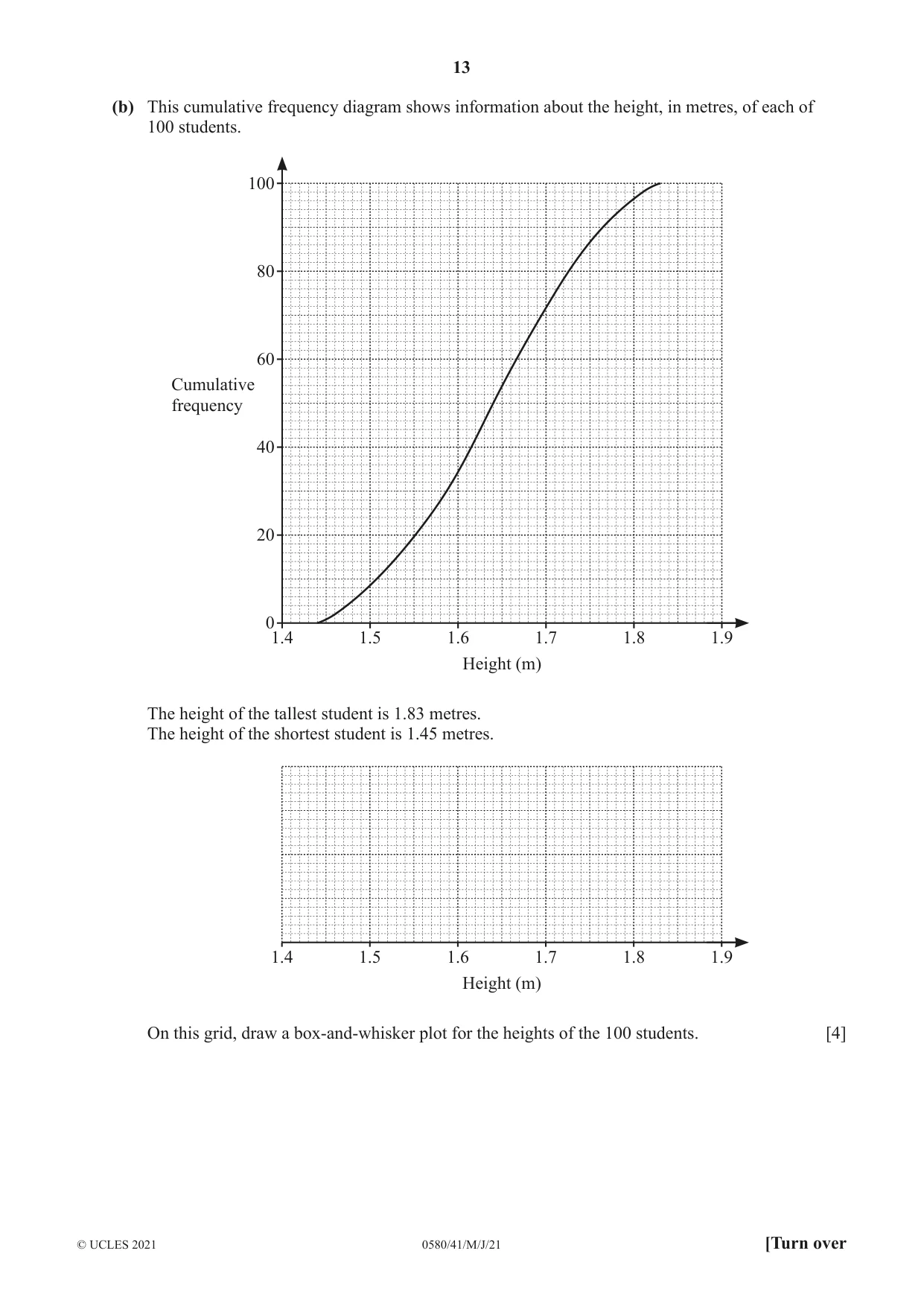
8 (a) The table shows information about the mass, in kilograms, of each of 50 children. Mass (k kg) 0 1 k G 10 10 1 k G 25 25 1 k G 35 35 1 k G 40 40 1 k G 50 Frequency 3 19 21 5 2 (i) Complete the cumulative frequency table. Mass (k kg) k G 10 k G 25 k G 35 k G 40 k G 50 Cumulative frequency [2] (ii) On the grid, draw a cumulative frequency diagram to show this information. 50 40 30 Cumulative frequency 20 10 0 0 10 20 30 40 50 k Mass (kg) [3] (iii) Use your diagram to find an estimate of the number of children with a mass of 32 kg or less. ................................................. [1] (b) This cumulative frequency diagram shows information about the height, in metres, of each of 100 students. 100 80 60 Cumulative frequency 40 20 0 1.4 1.5 1.6 1.7 1.8 1.9 Height (m) The height of the tallest student is 1.83 metres. The height of the shortest student is 1.45 metres. 1.4 1.5 1.6 1.7 1.8 1.9 Height (m) On this grid, draw a box-and-whisker plot for the heights of the 100 students. [4]
Mark scheme: 8(a)(i) 3 22 43 48 50 2 B1 for 4 correct or M1 for one error in adding. 8(a)(ii) correct diagram 3 B1FT their (a)(i) for 5 correct heights B1 for 5 points at upper ends of intervals on correct vertical line B1FT dep on at least B1 for increasing curve through their 5 points After 0 scored, SC1 for 4 of their points correctly plotted 8(a)(iii) 35 to 38 1 8(b) Correct box-and-whisker diagram 4 B1 for median 1.64 drawn B1 for LQ 1.57 drawn B1 for UQ 1.71 drawn If 0 scored SC1 for 1.64, 1,57 or 1.71 seen 1.45 1.57 1.64 1.71 1.83
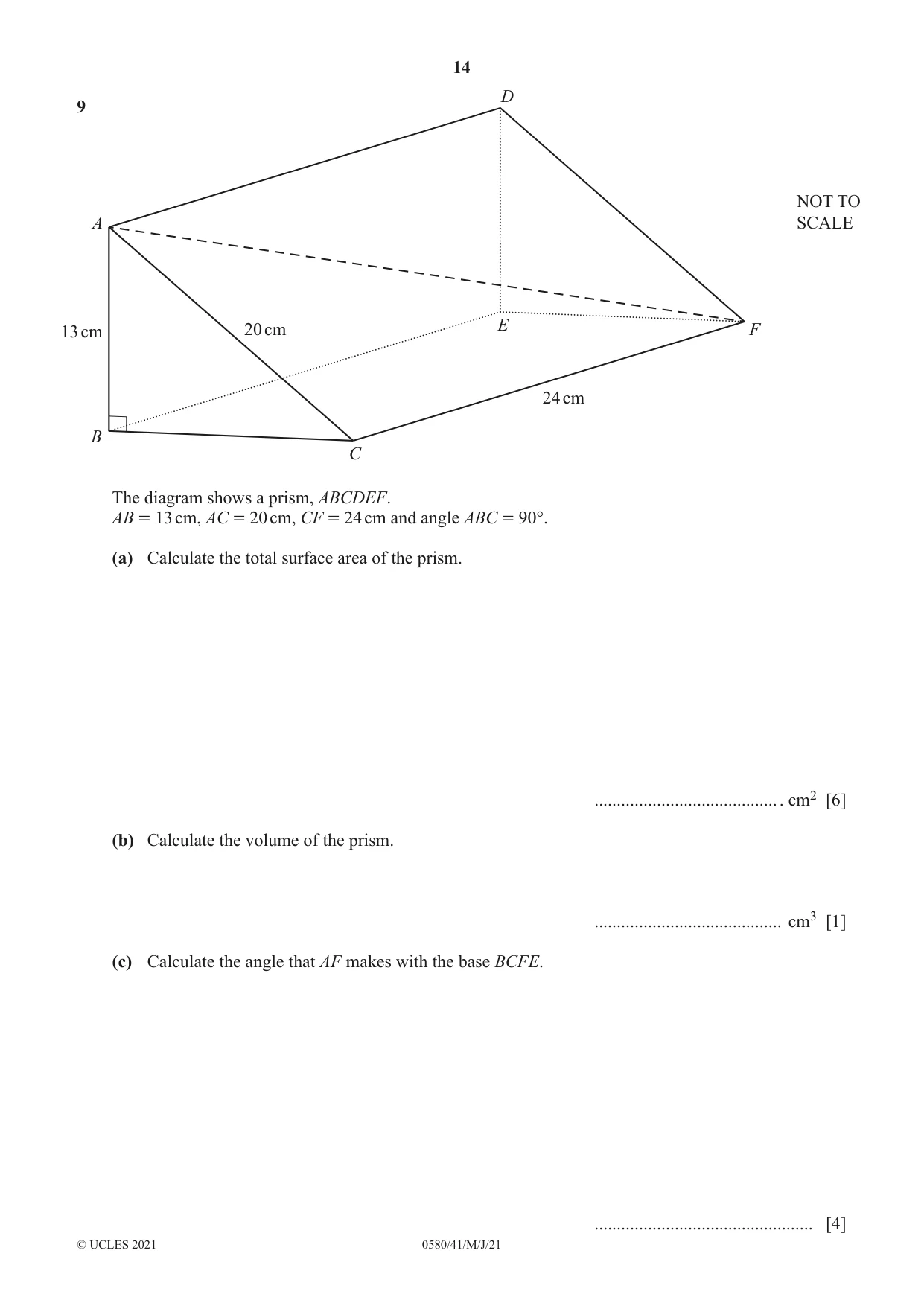
Q9 · D 9 NOT TO A SCALE 13 cm 20 cm E F 24 cm B C The diagram shows a prism, ABCDEF
D 9 NOT TO A SCALE 13 cm 20 cm E F 24 cm B C The diagram shows a prism, ABCDEF. AB = 13 cm, AC = 20 cm, CF = 24 cm and angle ABC = 90°. (a) Calculate the total surface area of the prism. .......................................... cm2 [6] (b) Calculate the volume of the prism. .......................................... cm3 [1] (c) Calculate the angle that AF makes with the base BCFE. ................................................. [4]
Mark scheme: 9(a) 1350 or 1354…. 6 M2 for 20 2 − 132 or M1 for BC2 + 132 = 202 A1 for 231 or 15.2 or 15.19 to 15.20 M1 for 20 × 24 and 13 × 24 and their 15.2 × 24 M1 for [½ ×] their 15.2 × 13 9(b) 2370 or 2369 to 2371… cao 1 9(c) 24.6 or 24.58 to 24.59 4 13 M3 for sin [...] = oe 20 2 + 24 2 or M2 for 20 2 + 24 2 or 24 2 + 20 2 − 132 or M1 for AF2 = 202 + 242 or 242 + 202 - 132 or M1 for correct angle identified
Q10 · The table shows some values of y = 3 + 4x - x 2 for - 1 G x G 5
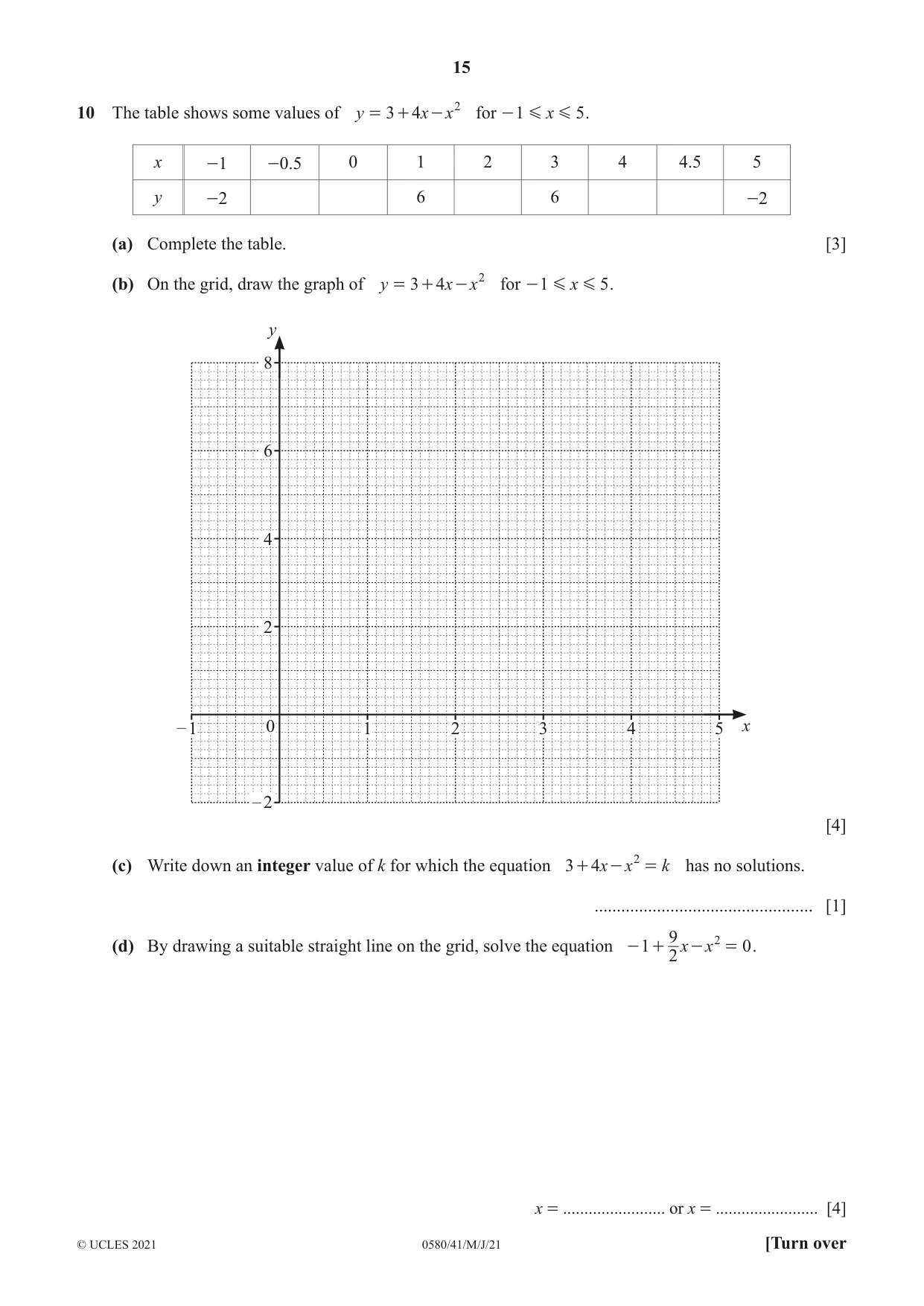
10 The table shows some values of y = 3 + 4x - x 2 for - 1 G x G 5 . x -1 -0.5 0 1 2 3 4 4.5 5 y -2 6 6 -2 (a) Complete the table. [3] (b) On the grid, draw the graph of y = 3 + 4x - x 2 for - 1 G x G 5 . y 8 6 4 2 – 1 0 1 2 3 4 5 x – 2 [4] (c) Write down an integer value of k for which the equation 3 + 4x - x 2 = k has no solutions. ................................................. [1] 9 2 (d) By drawing a suitable straight line on the grid, solve the equation - 1 + x - x = 0 . 2 x = ........................ or x = ........................ [4]
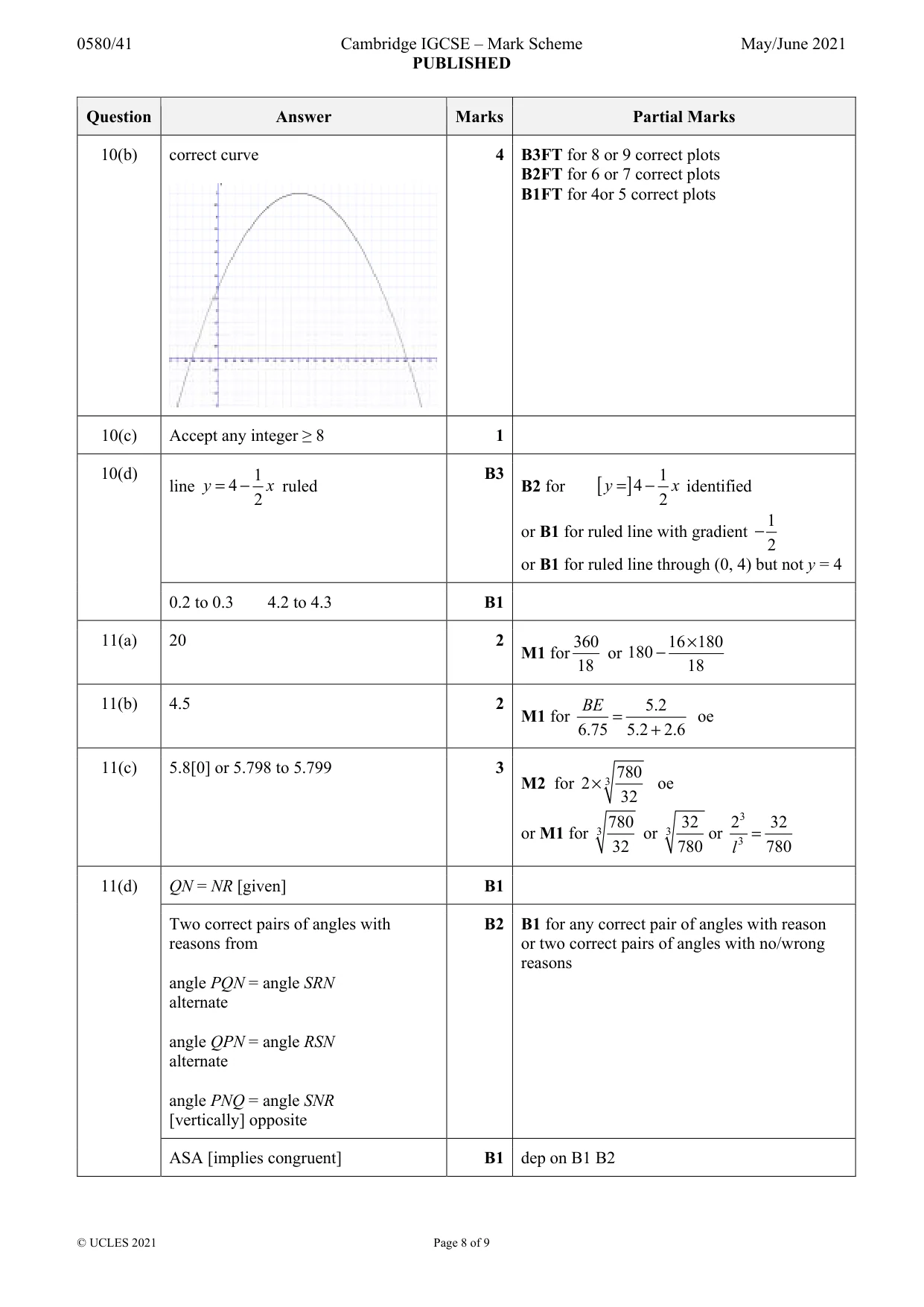
Mark scheme: 10(a) 0.75 3 7 3 0.75 3 B2 for 4 or 3 correct or B1 for 2 correct 10(b) correct curve 4 B3FT for 8 or 9 correct plots B2FT for 6 or 7 correct plots B1FT for 4or 5 correct plots 10(c) Accept any integer ≥ 8 1 10(d) 1 B3 1 line y = 4 − x ruled B2 for [ y = ] 4 − x identified 2 2 1 or B1 for ruled line with gradient − 2 or B1 for ruled line through (0, 4) but not y = 4 0.2 to 0.3 4.2 to 4.3 B1
Q11 · Find the size of an exterior angle of a regular polygon with 18 sides
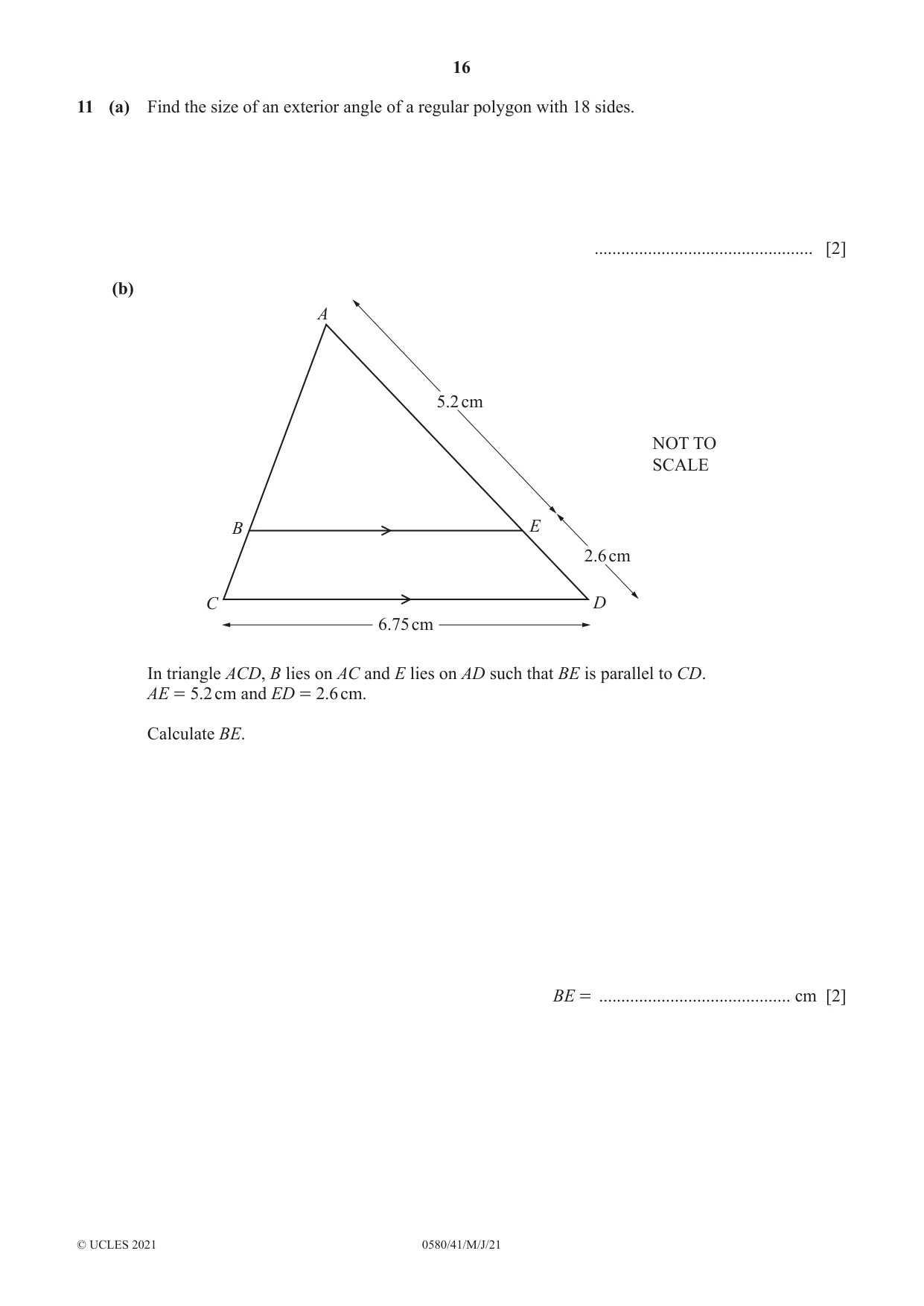
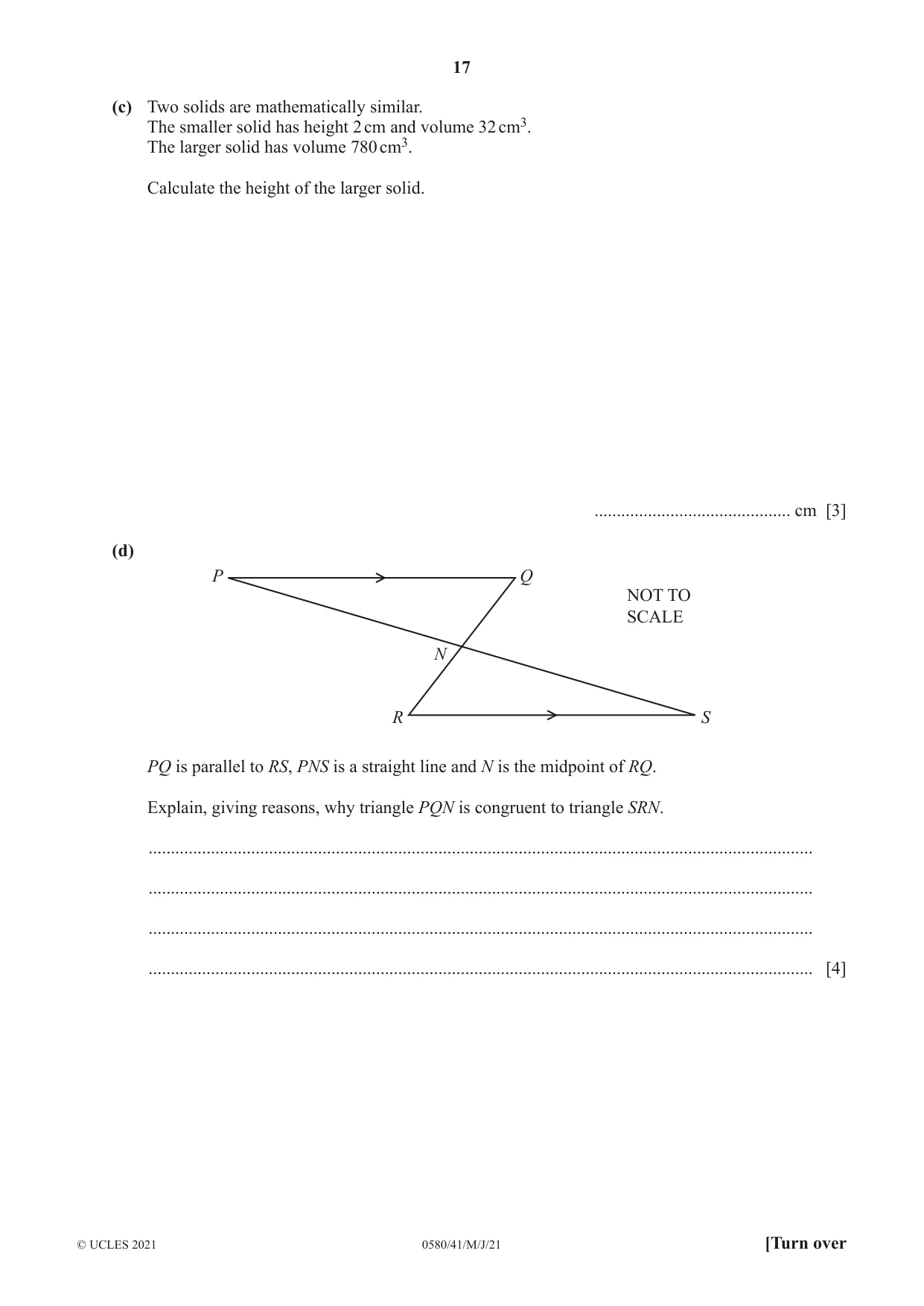
11 (a) Find the size of an exterior angle of a regular polygon with 18 sides. ................................................. [2] (b) A 5.2 cm NOT TO SCALE B E 2.6 cm C D 6.75 cm In triangle ACD, B lies on AC and E lies on AD such that BE is parallel to CD. AE = 5.2 cm and ED = 2.6 cm. Calculate BE. BE = ........................................... cm [2] (c) Two solids are mathematically similar. The smaller solid has height 2 cm and volume 32 cm3. The larger solid has volume 780 cm3. Calculate the height of the larger solid. ............................................ cm [3] (d) P Q NOT TO SCALE N R S PQ is parallel to RS, PNS is a straight line and N is the midpoint of RQ. Explain, giving reasons, why triangle PQN is congruent to triangle SRN. ..................................................................................................................................................... ..................................................................................................................................................... ..................................................................................................................................................... ..................................................................................................................................................... [4]
Mark scheme: 11(a) 20 2 360 16 × 180 M1 for or 180 − 18 18 11(b) 4.5 2 BE 5.2 M1 for = oe 6.75 5.2 + 2.6 11(c) 5.8[0] or 5.798 to 5.799 3 780 M2 for 2 × 3 oe 32 780 32 2 3 32 or M1 for 3 or 3 or = 32 780 l 3 780 11(d) QN = NR [given] B1 Two correct pairs of angles with B2 B1 for any correct pair of angles with reason reasons from or two correct pairs of angles with no/wrong reasons angle PQN = angle SRN alternate angle QPN = angle RSN alternate angle PNQ = angle SNR [vertically] opposite ASA [implies congruent] B1 dep on B1 B2
Q12 · F ( )x = 3 - 2 x g ( )x = x 2 + 5 h ( )x = x 3 (a) Find f ( - 5)
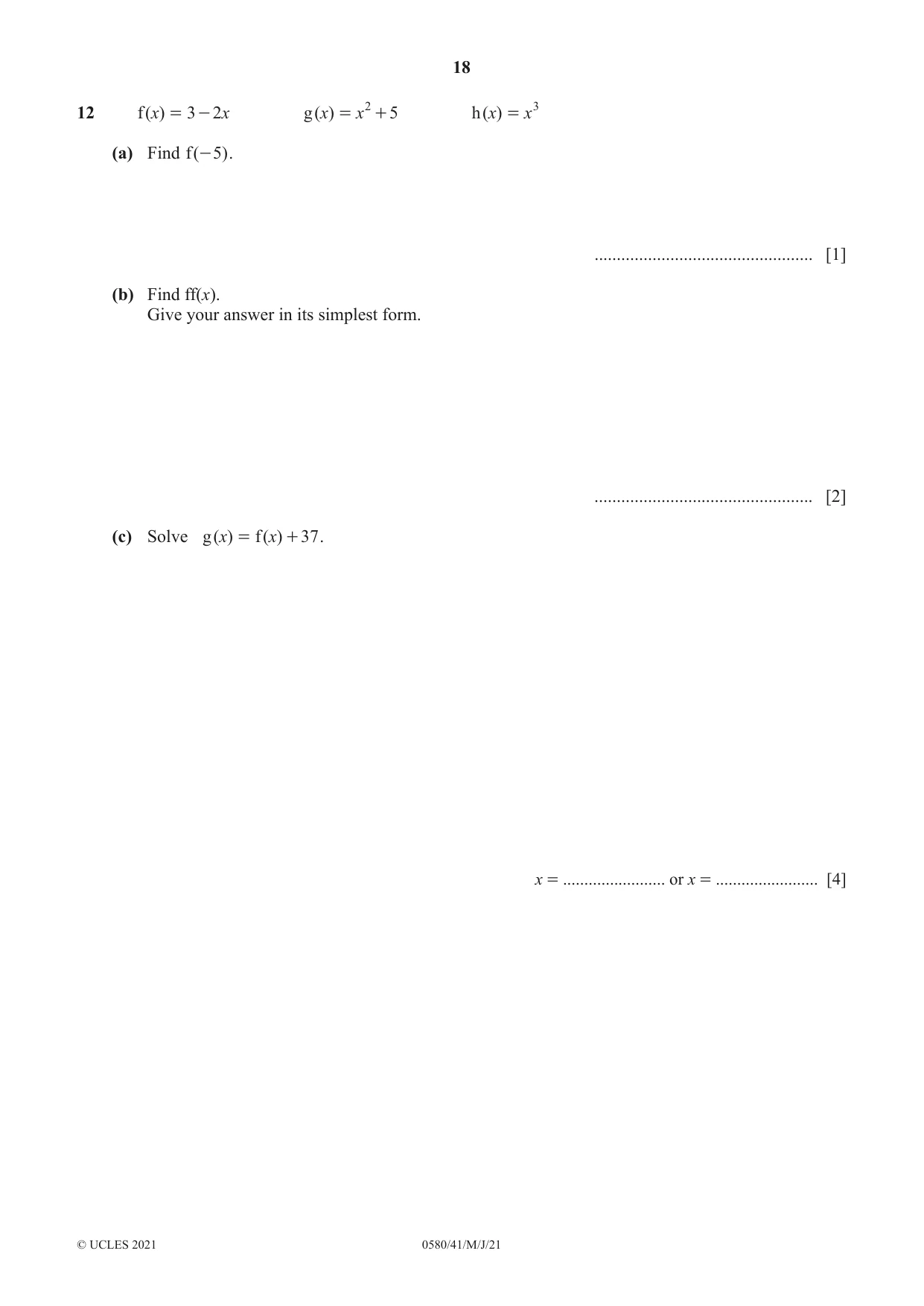
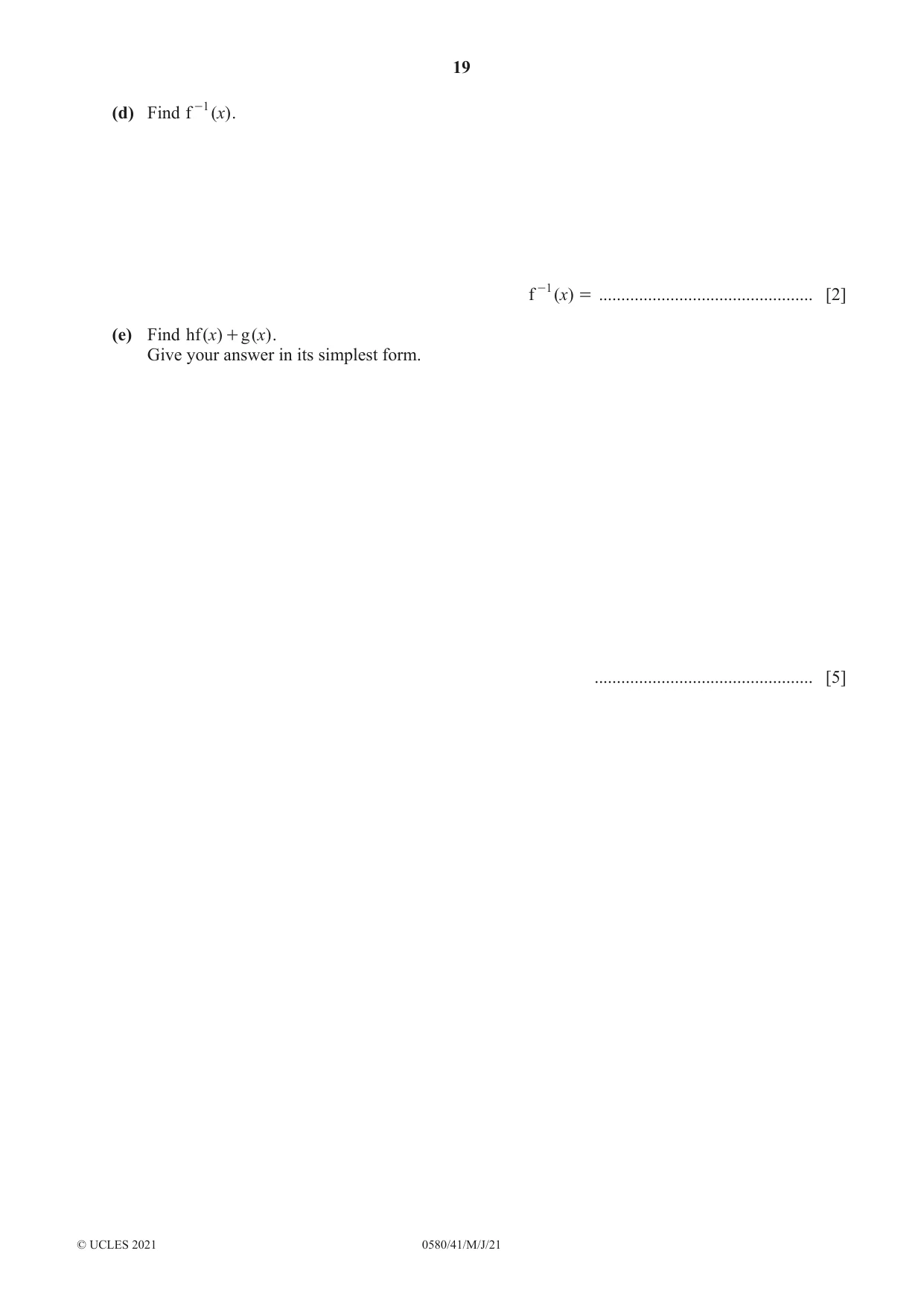
12 f ( )x = 3 - 2 x g ( )x = x 2 + 5 h ( )x = x 3 (a) Find f ( - 5) . ................................................. [1] (b) Find ff(x). Give your answer in its simplest form. ................................................. [2] (c) Solve g ( x) = f ( x) + 37 . x = ........................ or x = ........................ [4] (d) Find f -1 ( )x . f -1 ( )x = ................................................ [2] (e) Find hf ( x) + g ( x) . Give your answer in its simplest form. ................................................. [5]
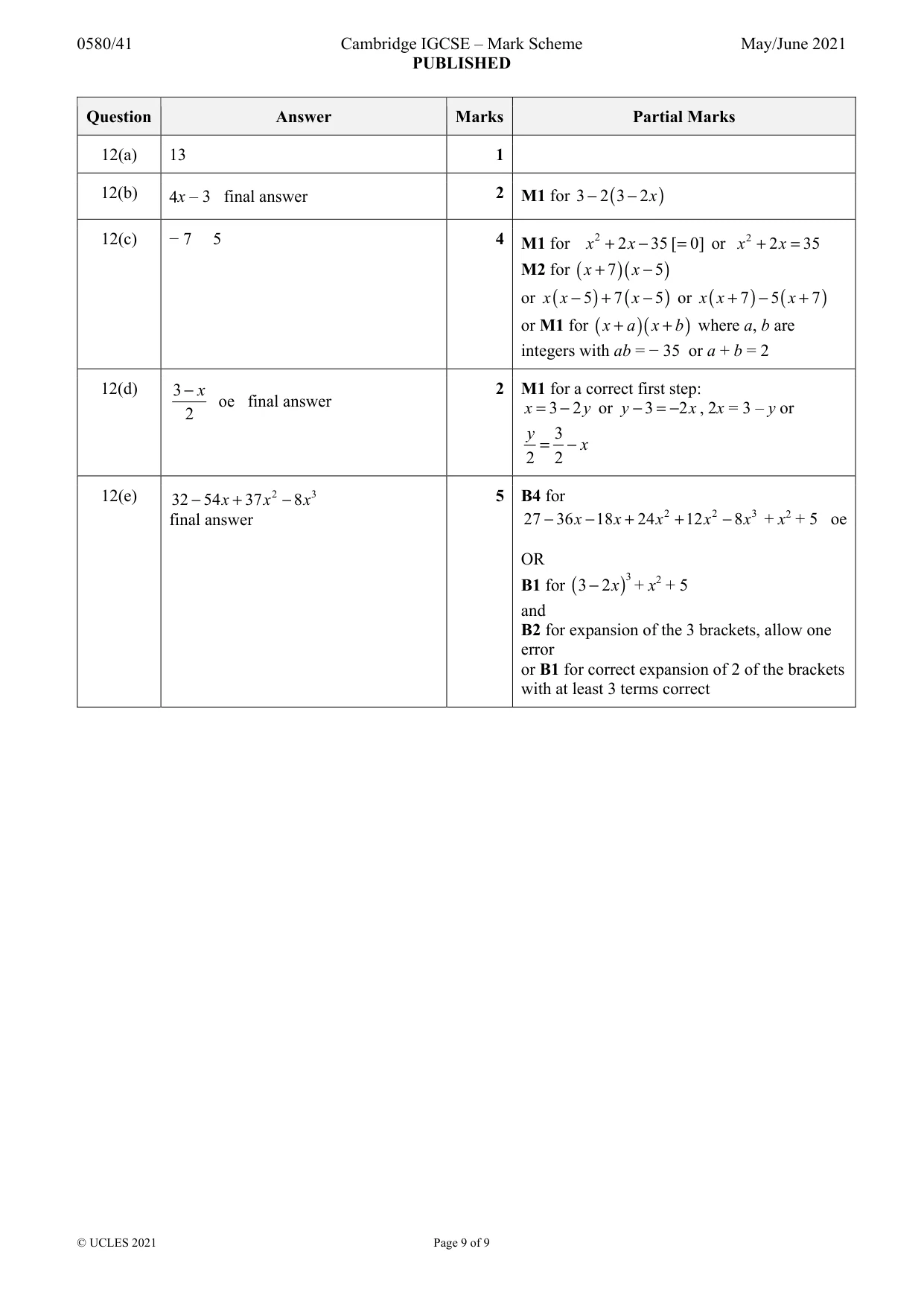
Mark scheme: 12(a) 13 1 12(b) 4x – 3 final answer 2 M1 for 3 − 2 ( 3 − 2x ) 12(c) − 7 5 4 M1 for x 2 + 2 x − 35 [ = 0] or x 2 + 2 x = 35 M2 for ( x + 7 )( x − 5 ) or x ( x − 5 ) + 7 ( x − 5 ) or x ( x + 7 ) − 5 ( x + 7 ) or M1 for ( x + a )( x + b ) where a, b are integers with ab = − 35 or a + b = 2 12(d) 3 − x 2 M1 for a correct first step: oe final answer x = 3 − 2 y or y − 3 = −2 x , 2x = 3 – y or 2 y 3 = − x 2 2 12(e) 32 − 54 x + 37 x 2 − 8 x 3 5 B4 for final answer 27 − 36 x − 18 x + 24 x 2 + 12 x 2 − 8 x 3 + x2 + 5 oe OR 3 B1 for ( 3 − 2x ) + x2 + 5 and B2 for expansion of the 3 brackets, allow one error or B1 for correct expansion of 2 of the brackets with at least 3 terms correct
What was in this paper
The subtopics covered by these 12 questions, and how many questions each got. Open one in a new tab to see every Cambridge question on it.
What you needed in this session
Cambridge’s own grade thresholds for 2021 May/June, Paper 4 · Variant 1. A higher threshold means an easier paper — the bar moves with how the cohort did.