Questions as text
Q1 · Changes in demand mean that the government of Bangladesh hopes to switch some production… 0455/11 May/June 2009
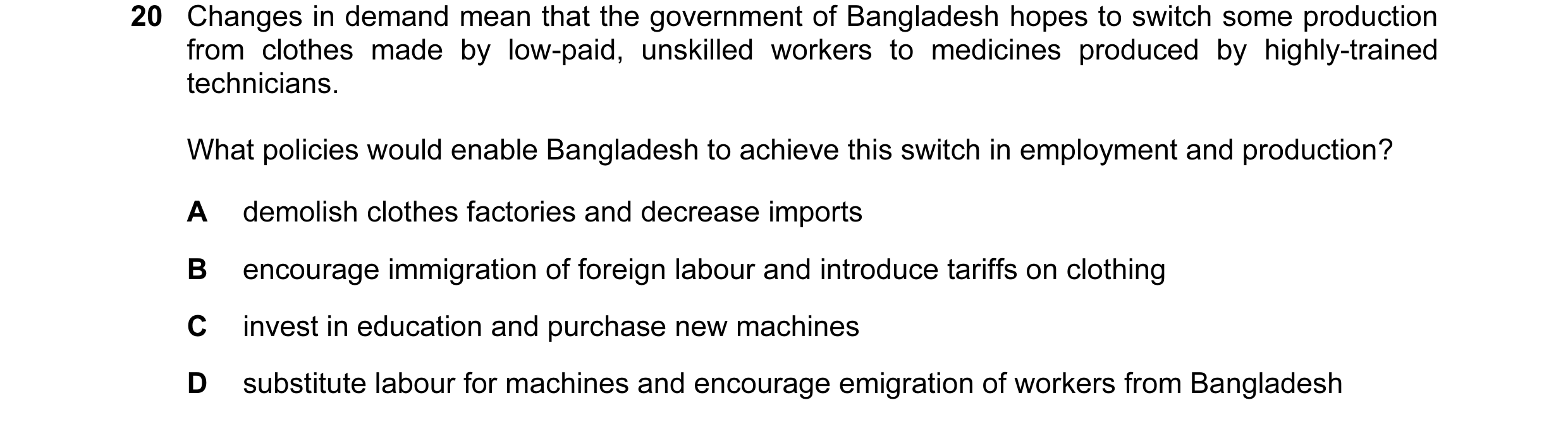
20 Changes in demand mean that the government of Bangladesh hopes to switch some production from clothes made by low-paid, unskilled workers to medicines produced by highly-trained technicians. What policies would enable Bangladesh to achieve this switch in employment and production? A demolish clothes factories and decrease imports B encourage immigration of foreign labour and introduce tariffs on clothing C invest in education and purchase new machines D substitute labour for machines and encourage emigration of workers from Bangladesh
1 marks
Answer: C
This question in 0455/11 May/June 2009
Q2 · The government pays a subsidy for each worker employed by a firm in an area of high… 0455/11 Oct/Nov 2009
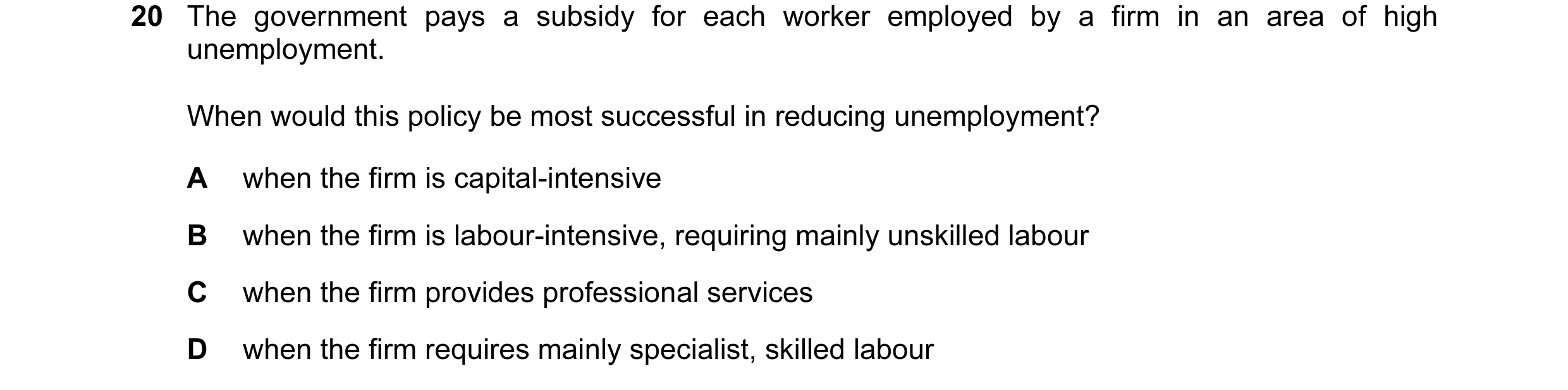
20 The government pays a subsidy for each worker employed by a firm in an area of high unemployment. When would this policy be most successful in reducing unemployment? A when the firm is capital-intensive B when the firm is labour-intensive, requiring mainly unskilled labour C when the firm provides professional services D when the firm requires mainly specialist, skilled labour
1 marks
Answer: B
This question in 0455/11 Oct/Nov 2009
Q3 · Brazil is a highly taxed economy 0455/12 Oct/Nov 2010
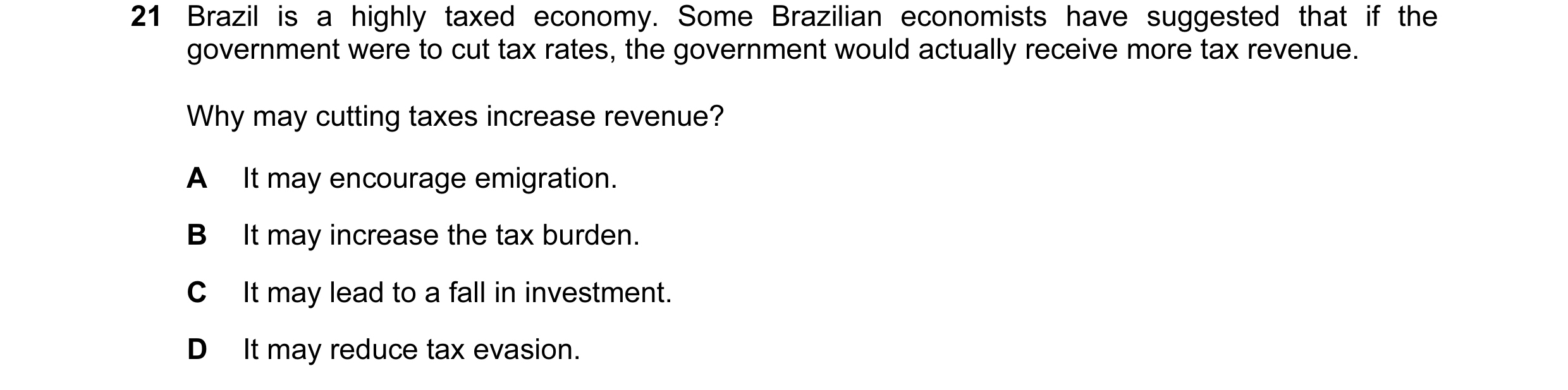
21 Brazil is a highly taxed economy. Some Brazilian economists have suggested that if the government were to cut tax rates, the government would actually receive more tax revenue. Why may cutting taxes increase revenue? A It may encourage emigration. B It may increase the tax burden. C It may lead to a fall in investment. D It may reduce tax evasion.
1 marks
Answer: D
This question in 0455/12 Oct/Nov 2010
Q4 · Which government policy would be likely to help local companies expand? 0455/11 Oct/Nov 2011
22 Which government policy would be likely to help local companies expand? A encouraging investment by foreign companies B increasing income tax C providing a subsidy D raising interest rates
1 marks
Answer: C
This question in 0455/11 Oct/Nov 2011
Q5 · Which government policy would be likely to help local companies expand? 0455/12 Oct/Nov 2011
21 Which government policy would be likely to help local companies expand? A encouraging investment by foreign companies B increasing income tax C providing a subsidy D raising interest rates
1 marks
Answer: C
This question in 0455/12 Oct/Nov 2011
Q6 · Which government policy would be likely to help local companies expand? 0455/13 Oct/Nov 2011
20 Which government policy would be likely to help local companies expand? A encouraging investment by foreign companies B increasing income tax C providing a subsidy D raising interest rates
1 marks
Answer: C
This question in 0455/13 Oct/Nov 2011
Q7 · Changes in demand mean that the government of Bangladesh hopes to switch some production… 0455/11 May/June 2012
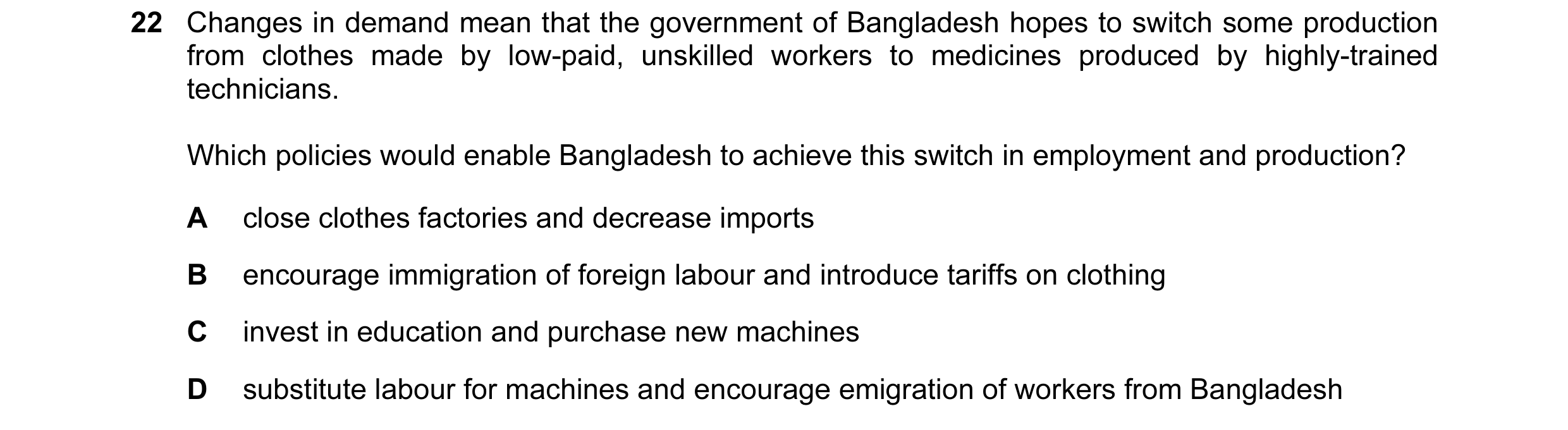
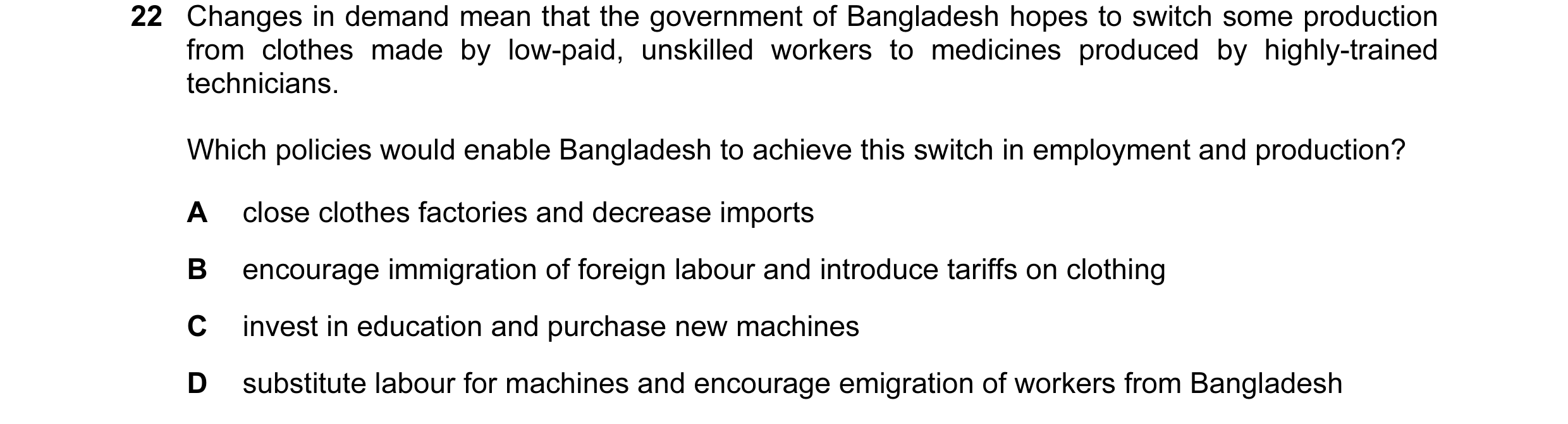
22 Changes in demand mean that the government of Bangladesh hopes to switch some production from clothes made by low-paid, unskilled workers to medicines produced by highly-trained technicians. Which policies would enable Bangladesh to achieve this switch in employment and production? A close clothes factories and decrease imports B encourage immigration of foreign labour and introduce tariffs on clothing C invest in education and purchase new machines D substitute labour for machines and encourage emigration of workers from Bangladesh
1 marks
Answer: C
This question in 0455/11 May/June 2012
Q8 · Which combination of government policies would most likely increase the rate of growth of… 0455/12 May/June 2012
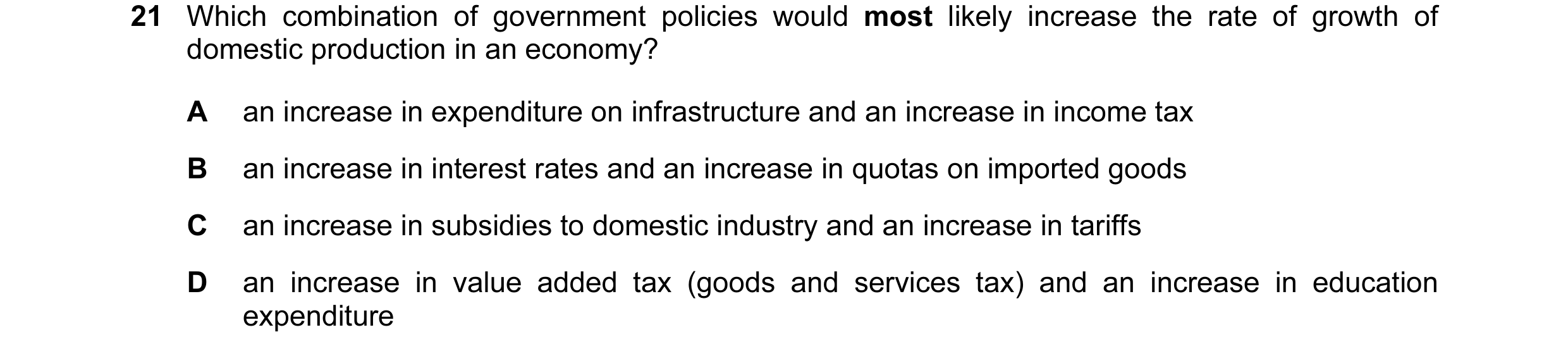
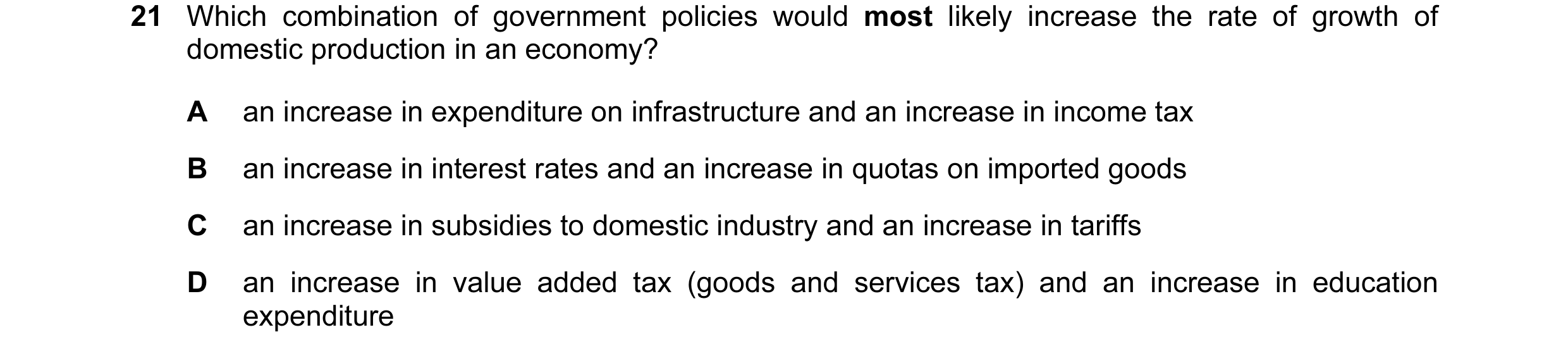
21 Which combination of government policies would most likely increase the rate of growth of domestic production in an economy? A an increase in expenditure on infrastructure and an increase in income tax B an increase in interest rates and an increase in quotas on imported goods C an increase in subsidies to domestic industry and an increase in tariffs D an increase in value added tax (goods and services tax) and an increase in education expenditure
1 marks
Answer: C
This question in 0455/12 May/June 2012
Q9 · Changes in demand mean that the government of Bangladesh hopes to switch some production… 0455/12 May/June 2012
22 Changes in demand mean that the government of Bangladesh hopes to switch some production from clothes made by low-paid, unskilled workers to medicines produced by highly-trained technicians. Which policies would enable Bangladesh to achieve this switch in employment and production? A close clothes factories and decrease imports B encourage immigration of foreign labour and introduce tariffs on clothing C invest in education and purchase new machines D substitute labour for machines and encourage emigration of workers from Bangladesh
1 marks
Answer: C
This question in 0455/12 May/June 2012
Q10 · Which combination of government policies would most likely increase the rate of growth of… 0455/13 May/June 2012
21 Which combination of government policies would most likely increase the rate of growth of domestic production in an economy? A an increase in expenditure on infrastructure and an increase in income tax B an increase in interest rates and an increase in quotas on imported goods C an increase in subsidies to domestic industry and an increase in tariffs D an increase in value added tax (goods and services tax) and an increase in education expenditure
1 marks
Answer: C
This question in 0455/13 May/June 2012
Q11 · Changes in demand mean that the government of Bangladesh hopes to switch some production… 0455/13 May/June 2012
22 Changes in demand mean that the government of Bangladesh hopes to switch some production from clothes made by low-paid, unskilled workers to medicines produced by highly-trained technicians. Which policies would enable Bangladesh to achieve this switch in employment and production? A close clothes factories and decrease imports B encourage immigration of foreign labour and introduce tariffs on clothing C invest in education and purchase new machines D substitute labour for machines and encourage emigration of workers from Bangladesh
1 marks
Answer: C
This question in 0455/13 May/June 2012
Q12 · Developing countries often wish to prevent the population in rural areas moving to the… 0455/11 May/June 2014
25 Developing countries often wish to prevent the population in rural areas moving to the towns. Investment grants are given to companies if they set up their businesses in rural areas. What is this policy intended to achieve? A decreased transport costs B decreased external cost C increased economies of scale D increased use of labour
1 marks
Answer: D
This question in 0455/11 May/June 2014
Q13 · Which pair of government actions combines a fiscal policy with a supply-side policy? 0455/12 May/June 2014
18 Which pair of government actions combines a fiscal policy with a supply-side policy? A changing government spending with changing interest rates B cutting tax rates with providing information on job vacancies C limiting bank lending with the privatisation of industry D restricting credit with less control over labour markets
1 marks
Answer: B
This question in 0455/12 May/June 2014
Q14 · The Sri Lankan government decides to offer financial support to local firms 0455/13 May/June 2014
26 The Sri Lankan government decides to offer financial support to local firms. Of what is this an example? A a quota B a subsidy C a tariff D exchange control
1 marks
Answer: B
This question in 0455/13 May/June 2014
Q15 · Developing countries often wish to prevent the population in rural areas moving to the… 0455/13 May/June 2014
29 Developing countries often wish to prevent the population in rural areas moving to the towns. Investment grants are given to companies if they set up their businesses in rural areas. What is this policy intended to achieve? A decreased transport costs B decreased external cost C increased economies of scale D increased use of labour
1 marks
Answer: D
This question in 0455/13 May/June 2014
Q16 · Which is a supply-side policy that would increase output in the long-run? 0455/11 May/June 2015
17 Which is a supply-side policy that would increase output in the long-run? A an increase in benefit payments B an increase in places at training colleges C an increase in the rate of income tax D an increase in the rate of tax employers pay
1 marks
Answer: B
This question in 0455/11 May/June 2015
Q17 · What is most likely to cause economic growth? 0455/11 May/June 2015
20 What is most likely to cause economic growth? A a better educated workforce B a reduction in the right to own property C decreased wages D higher taxation
1 marks
Answer: A
This question in 0455/11 May/June 2015
Q18 · In recent years, governments have had to manage the effects of a world recession 0455/12 May/June 2015
17 In recent years, governments have had to manage the effects of a world recession. Which supply-side policy could have been used to stimulate economic growth? A increases in income tax B investment in skills training schemes C payments of unemployment benefits D reduction in interest rates
1 marks
Answer: B
This question in 0455/12 May/June 2015
Q19 · An economy with few resources is encouraged to improve the quality of its human resources 0455/12 Feb/March 2016
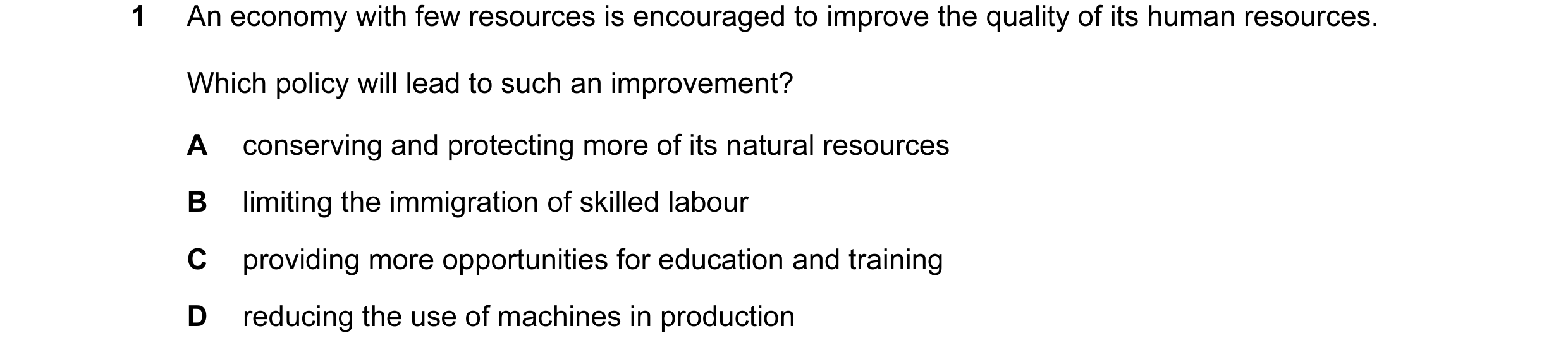
1 An economy with few resources is encouraged to improve the quality of its human resources. Which policy will lead to such an improvement? A conserving and protecting more of its natural resources B limiting the immigration of skilled labour C providing more opportunities for education and training D reducing the use of machines in production
1 marks
Answer: C
This question in 0455/12 Feb/March 2016
Q20 · A government introduces a law to reduce the restrictive practices of trade unions 0455/12 May/June 2016
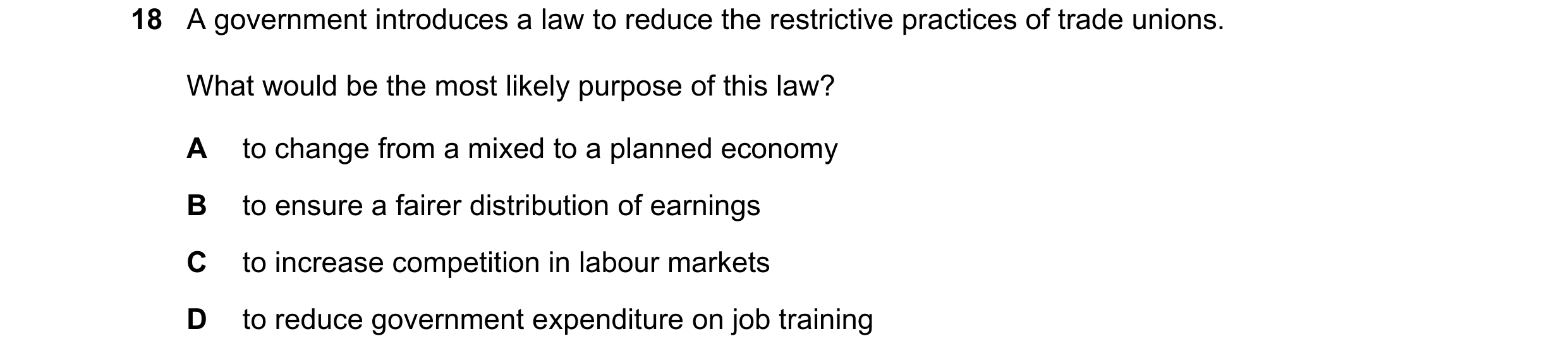
18 A government introduces a law to reduce the restrictive practices of trade unions. What would be the most likely purpose of this law? A to change from a mixed to a planned economy B to ensure a fairer distribution of earnings C to increase competition in labour markets D to reduce government expenditure on job training
1 marks
Answer: C
This question in 0455/12 May/June 2016
Q21 · When a government aims to encourage economic growth it may adopt supply-side policies 0455/13 May/June 2016
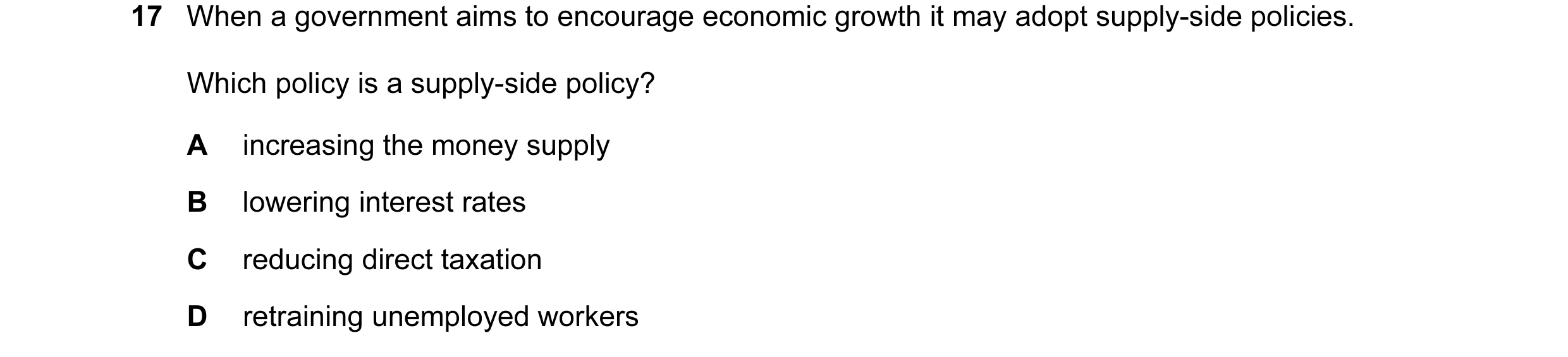
17 When a government aims to encourage economic growth it may adopt supply-side policies. Which policy is a supply-side policy? A increasing the money supply B lowering interest rates C reducing direct taxation D retraining unemployed workers
1 marks
Answer: D
This question in 0455/13 May/June 2016
Q22 · A government decides to increase the rate of income tax and spend the extra revenue on… 0455/13 Oct/Nov 2016
17 A government decides to increase the rate of income tax and spend the extra revenue on providing training colleges. How might this be described? A as fiscal and monetary policy B as fiscal and supply-side policy C as fiscal, monetary and supply-side policy D as monetary and supply-side policy
1 marks
Answer: B
This question in 0455/13 Oct/Nov 2016
Q23 · Developing countries often wish to prevent the population in rural areas moving to the… 0455/12 Feb/March 2017
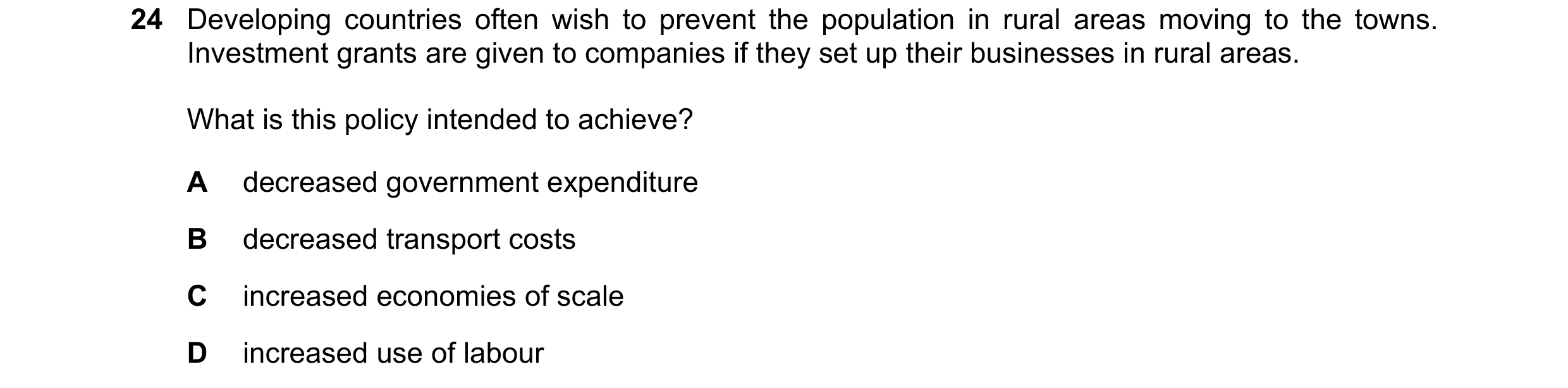
24 Developing countries often wish to prevent the population in rural areas moving to the towns. Investment grants are given to companies if they set up their businesses in rural areas. What is this policy intended to achieve? A decreased government expenditure B decreased transport costs C increased economies of scale D increased use of labour
1 marks
Answer: D
This question in 0455/12 Feb/March 2017
Q24 · A government intends to improve skills by offering free training to school leavers at age… 0455/11 May/June 2017
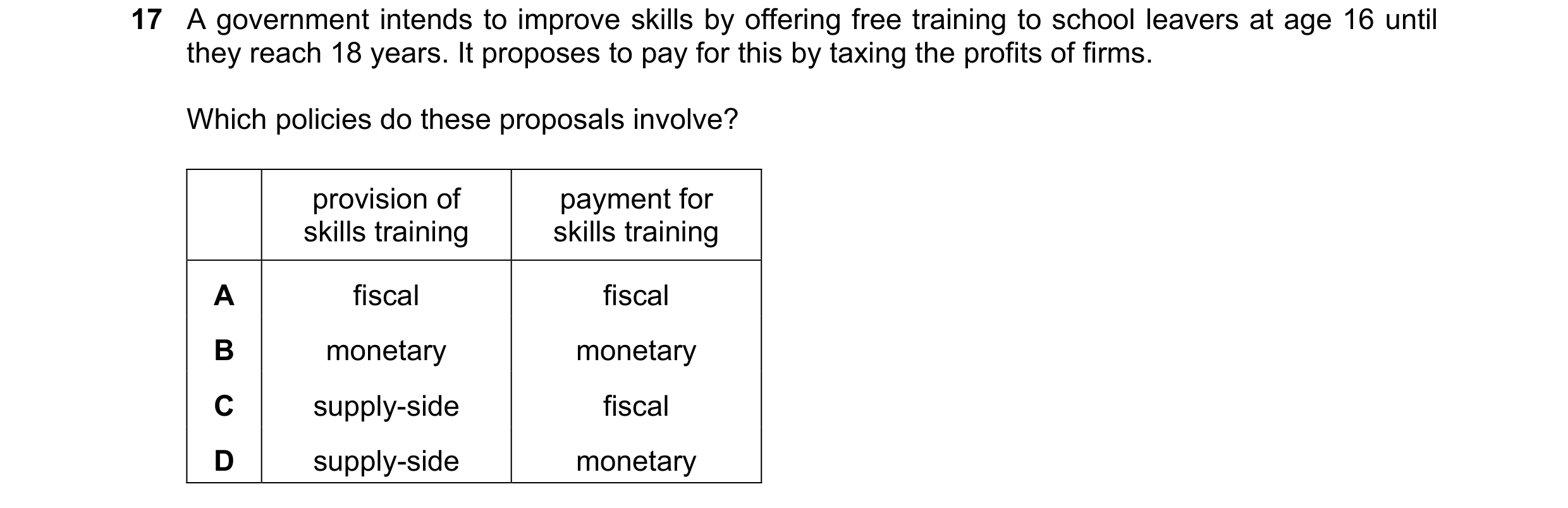
17 A government intends to improve skills by offering free training to school leavers at age 16 until they reach 18 years. It proposes to pay for this by taxing the profits of firms. Which policies do these proposals involve? provision of payment for skills training skills training A fiscal fiscal B monetary monetary C supply-side fiscal D supply-side monetary
1 marks
Answer: C
This question in 0455/11 May/June 2017
Q25 · Why can government spending be described both as a fiscal policy and a supply-side policy? 0455/13 May/June 2017
17 Why can government spending be described both as a fiscal policy and a supply-side policy? A It has a nationwide effect and can control firms’ production possibility curves. B It is announced in the budget and can increase the economy’s ability to produce. C It is determined by the central bank and can raise the cost of production of firms. D It must equal tax revenue and can regulate the amount of the money supply.
1 marks
Answer: B
This question in 0455/13 May/June 2017
Q26 · Which is a supply-side policy? 0455/12 May/June 2018
16 Which is a supply-side policy? A increasing interest rates B increasing taxation C providing training courses D selling government bonds
1 marks
Answer: C
This question in 0455/12 May/June 2018
Q27 · A government aims to reduce unemployment through a supply-side policy measure 0455/12 Oct/Nov 2018
16 A government aims to reduce unemployment through a supply-side policy measure. Which measure would it use? A It would increase government spending. B It would increase tariffs on imported goods and services. C It would introduce retraining schemes. D It would reduce the rate of interest.
1 marks
Answer: C
This question in 0455/12 Oct/Nov 2018
Q28 · The government increases taxation in order to fund an increase in spending on government… 0455/12 May/June 2019
17 The government increases taxation in order to fund an increase in spending on government training schemes. Which policy combination would this involve? A fiscal policy and monetary policy only B fiscal policy and supply-side policy only C monetary policy and supply-side policy only D monetary policy, supply-side policy and fiscal policy
1 marks
Answer: B
This question in 0455/12 May/June 2019
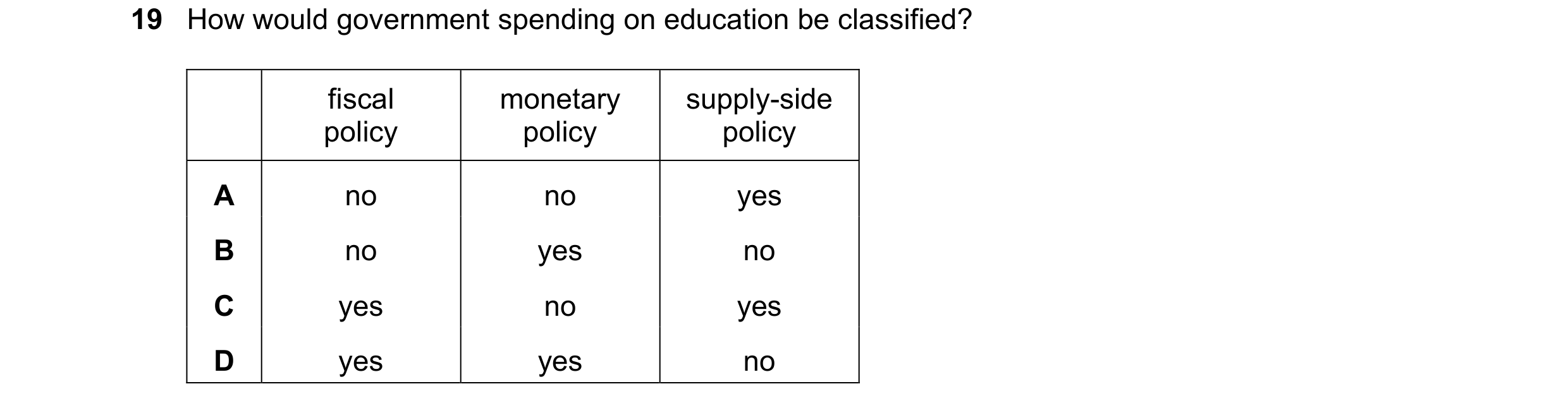
Q29 · How would government spending on education be classified? 0455/12 Oct/Nov 2019
19 How would government spending on education be classified? fiscal monetary supply-side policy policy policy A no no yes B no yes no C yes no yes D yes yes no
1 marks
Answer: C
This question in 0455/12 Oct/Nov 2019
Q30 · What is most likely to increase the occupational mobility of labour? 0455/13 Oct/Nov 2019
8 What is most likely to increase the occupational mobility of labour? A building more houses B increased spending on re-training schemes C increased total government spending D increasing the information on job availability
1 marks
Answer: B
This question in 0455/13 Oct/Nov 2019
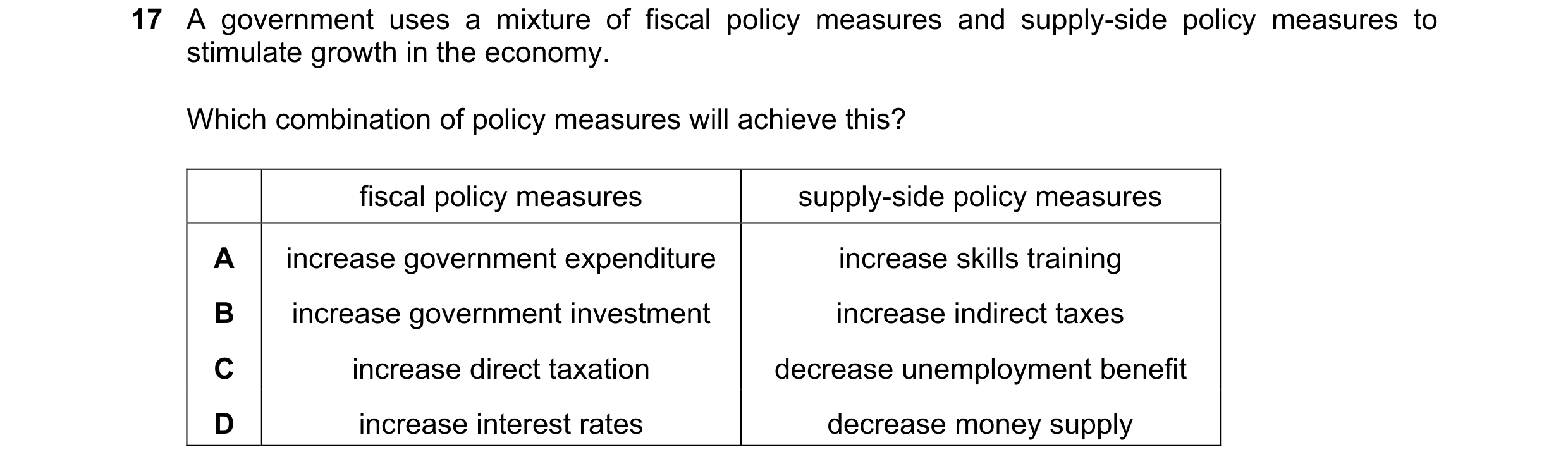
Q31 · A government uses a mixture of fiscal policy measures and supply-side policy measures to… 0455/13 Oct/Nov 2019
17 A government uses a mixture of fiscal policy measures and supply-side policy measures to stimulate growth in the economy. Which combination of policy measures will achieve this? fiscal policy measures supply-side policy measures A increase government expenditure increase skills training B increase government investment increase indirect taxes C increase direct taxation decrease unemployment benefit D increase interest rates decrease money supply
1 marks
Answer: A
This question in 0455/13 Oct/Nov 2019
Q32 · Why does more emphasis on education and training lead to an increase in national output? 0455/12 Feb/March 2020
18 Why does more emphasis on education and training lead to an increase in national output? A It improves the productivity of the labour force. B It lowers the inputs of capital investment. C It reduces demands for higher pay. D It reduces the power of trade unions.
1 marks
This question in 0455/12 Feb/March 2020
Q33 · What is the main aim of supply-side policy? 0455/13 May/June 2020
18 What is the main aim of supply-side policy? A increasing economic growth by raising productivity B increasing the balance of payments surplus by restricting free trade C reducing the government’s budget deficit by increasing taxation D reducing the money supply by increasing the rate of interest
1 marks
Answer: A
This question in 0455/13 May/June 2020
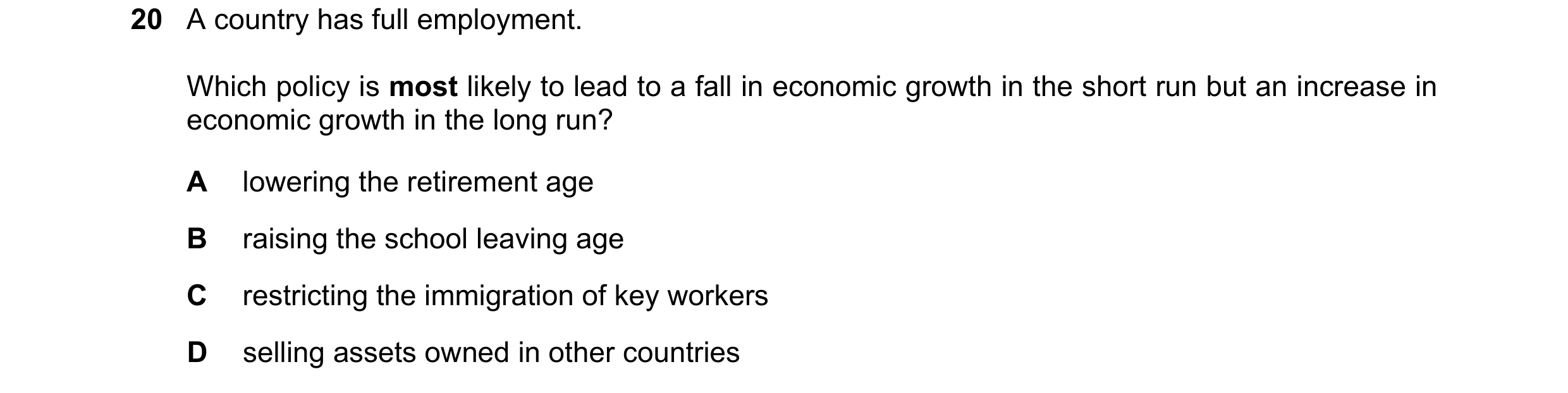
Q34 · A country has full employment 0455/13 May/June 2020
20 A country has full employment. Which policy is most likely to lead to a fall in economic growth in the short run but an increase in economic growth in the long run? A lowering the retirement age B raising the school leaving age C restricting the immigration of key workers D selling assets owned in other countries
1 marks
Answer: B
This question in 0455/13 May/June 2020
Q35 · Which government policy measure would cause an increase in a country’s supply of labour? 0455/13 Oct/Nov 2020
19 Which government policy measure would cause an increase in a country’s supply of labour? A increasing unemployment benefits B lowering interest rates C raising income tax D raising the age of retirement
1 marks
Answer: D
This question in 0455/13 Oct/Nov 2020
Q36 · Which statement about supply-side policy is correct? 0455/11 Oct/Nov 2021
20 Which statement about supply-side policy is correct? A It aims to increase the productive potential of the economy. B It aims to increase total demand in the economy. C It involves changes in the equilibrium foreign exchange rate. D It involves changes in the rate of interest.
1 marks
Answer: A
This question in 0455/11 Oct/Nov 2021
Q37 · Which government policy will increase productivity? 0455/12 Oct/Nov 2021
9 Which government policy will increase productivity? A decreasing the number of training programmes B encouraging labour-intensive production C promoting good industrial relations D reducing private sector investment
1 marks
Answer: C
This question in 0455/12 Oct/Nov 2021
Q38 · Which supply-side policy measure would help to match the skills of workers to job… 0455/12 Oct/Nov 2021
20 Which supply-side policy measure would help to match the skills of workers to job vacancies? A encouraging the modernisation of factories B offering retraining to unemployed workers C reducing taxes to provide incentives to work D replacing government enterprises with private enterprises
1 marks
Answer: D
This question in 0455/12 Oct/Nov 2021
Q39 · Which statement relating to supply-side policies is correct? 0455/13 Oct/Nov 2021
20 Which statement relating to supply-side policies is correct? A They aim to increase aggregate demand. B They aim to increase the long-run capacity of the economy. C They aim to reduce cyclical unemployment. D They aim to work in the short term.
1 marks
Answer: B
This question in 0455/13 Oct/Nov 2021
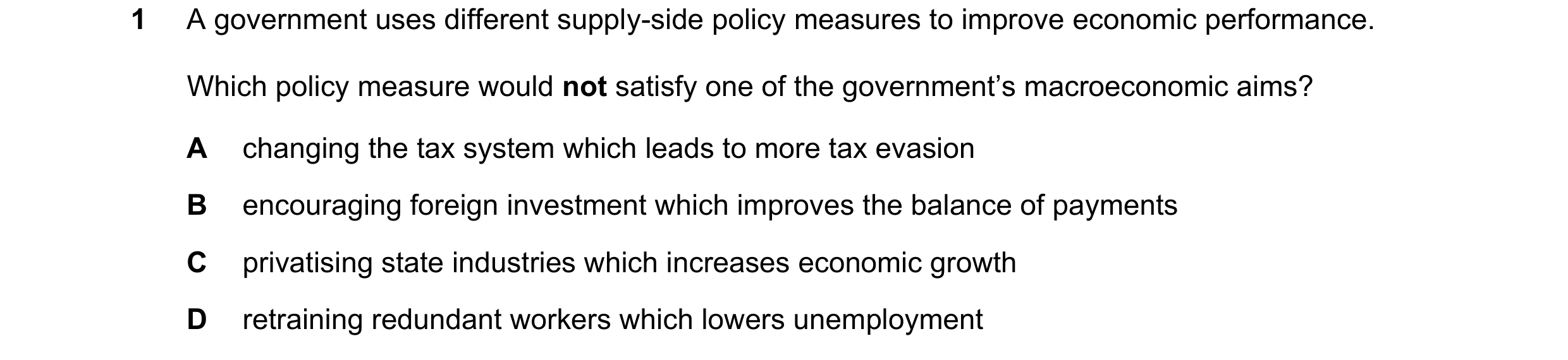
Q40 · A government uses different supply-side policy measures to improve economic performance 0455/11 May/June 2022
1 A government uses different supply-side policy measures to improve economic performance. Which policy measure would not satisfy one of the government’s macroeconomic aims? A changing the tax system which leads to more tax evasion B encouraging foreign investment which improves the balance of payments C privatising state industries which increases economic growth D retraining redundant workers which lowers unemployment
1 marks
Answer: A
This question in 0455/11 May/June 2022
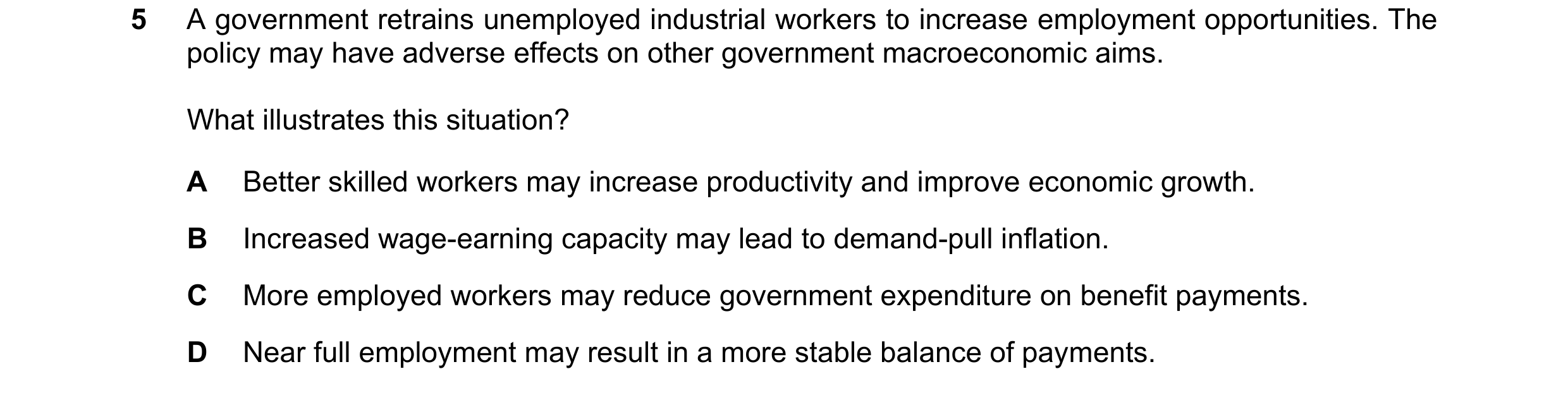
Q41 · A government retrains unemployed industrial workers to increase employment opportunities 0455/11 May/June 2022
5 A government retrains unemployed industrial workers to increase employment opportunities. The policy may have adverse effects on other government macroeconomic aims. What illustrates this situation? A Better skilled workers may increase productivity and improve economic growth. B Increased wage-earning capacity may lead to demand-pull inflation. C More employed workers may reduce government expenditure on benefit payments. D Near full employment may result in a more stable balance of payments.
1 marks
Answer: B
This question in 0455/11 May/June 2022
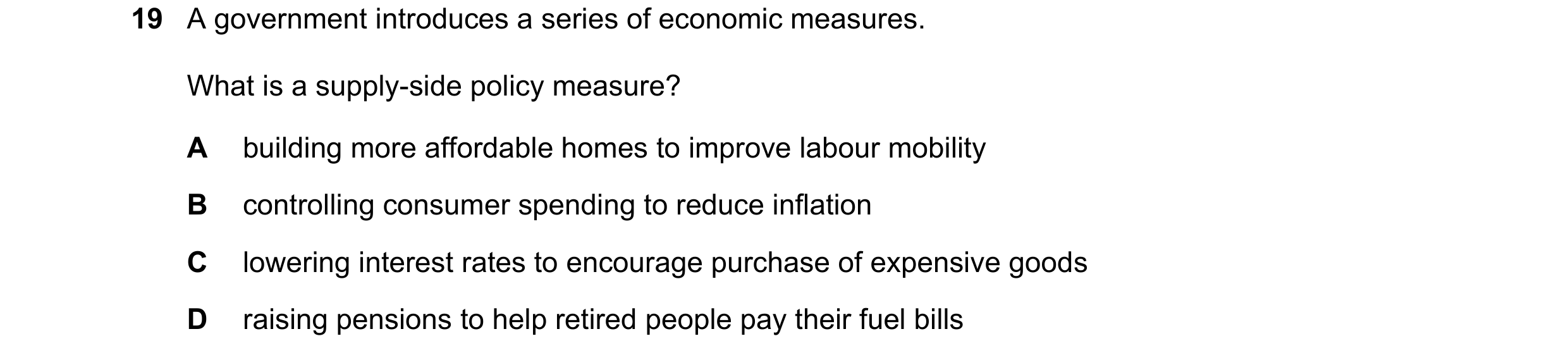
Q42 · A government introduces a series of economic measures 0455/12 May/June 2022
19 A government introduces a series of economic measures. What is a supply-side policy measure? A building more affordable homes to improve labour mobility B controlling consumer spending to reduce inflation C lowering interest rates to encourage purchase of expensive goods D raising pensions to help retired people pay their fuel bills
1 marks
Answer: A
This question in 0455/12 May/June 2022
Q43 · A government significantly increases its spending on education and training over several… 0455/13 May/June 2022
19 A government significantly increases its spending on education and training over several years. What will be the likely effect of this policy measure on the rate of inflation in both the short run and the long run? short-run effect long-run effect A decreases decreases B decreases increases C increases decreases D increases increases
1 marks
Answer: C
This question in 0455/13 May/June 2022
Q44 · What is the most effective way for a government to raise national output? 0455/11 Oct/Nov 2022
19 What is the most effective way for a government to raise national output? A encourage a period of deflation B improve the productivity of resources C limit the size of its population D restrict its trade with other countries
1 marks
Answer: B
This question in 0455/11 Oct/Nov 2022
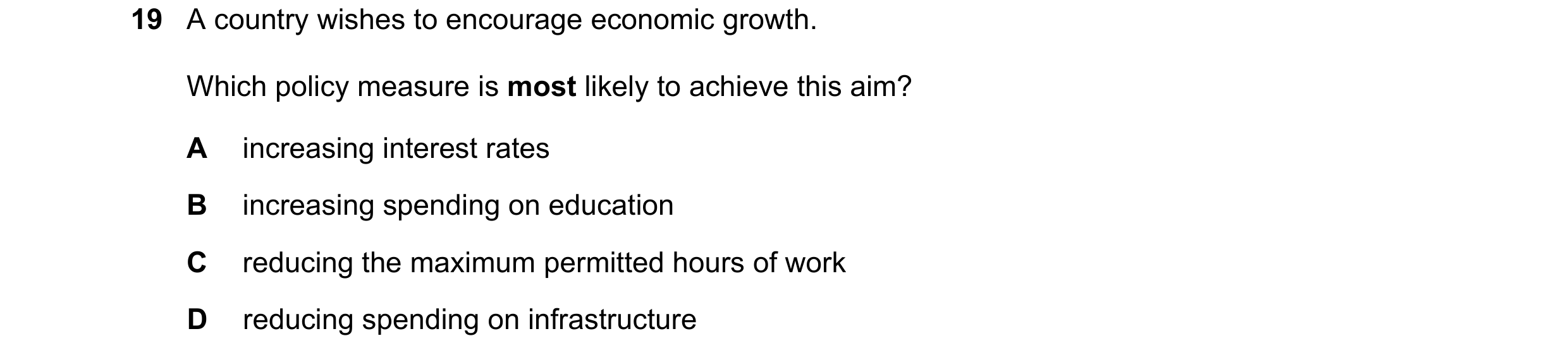
Q45 · A country wishes to encourage economic growth 0455/13 Oct/Nov 2022
19 A country wishes to encourage economic growth. Which policy measure is most likely to achieve this aim? A increasing interest rates B increasing spending on education C reducing the maximum permitted hours of work D reducing spending on infrastructure
1 marks
Answer: B
This question in 0455/13 Oct/Nov 2022
Q46 · Which government policy would be most likely to reduce structural unemployment? 0455/12 Feb/March 2023
23 Which government policy would be most likely to reduce structural unemployment? A a decrease in the rate of interest B a decrease in the tax on goods and services C an increase in spending on education and training D an increase in tariffs on imported goods and services
1 marks
Answer: C
This question in 0455/12 Feb/March 2023
Q47 · What is most likely to increase enterprise as a factor of production in an economy? 0455/11 May/June 2023
3 What is most likely to increase enterprise as a factor of production in an economy? A a decrease in government spending on education B a decrease in regulation on firms C an increase in emigration D an increase in taxation on firms
1 marks
Answer: B
This question in 0455/11 May/June 2023
Q48 · The government of a country operating at full employment increases its spending on… 0455/11 May/June 2023
20 The government of a country operating at full employment increases its spending on education and training. How does this affect the likelihood of achieving low inflation in the short run and the long run? short run long run A less likely less likely B less likely more likely C more likely less likely D more likely more likely
1 marks
Answer: B
This question in 0455/11 May/June 2023
Q49 · The government of country Z announces an increase in spending on work-place training 0455/12 May/June 2023
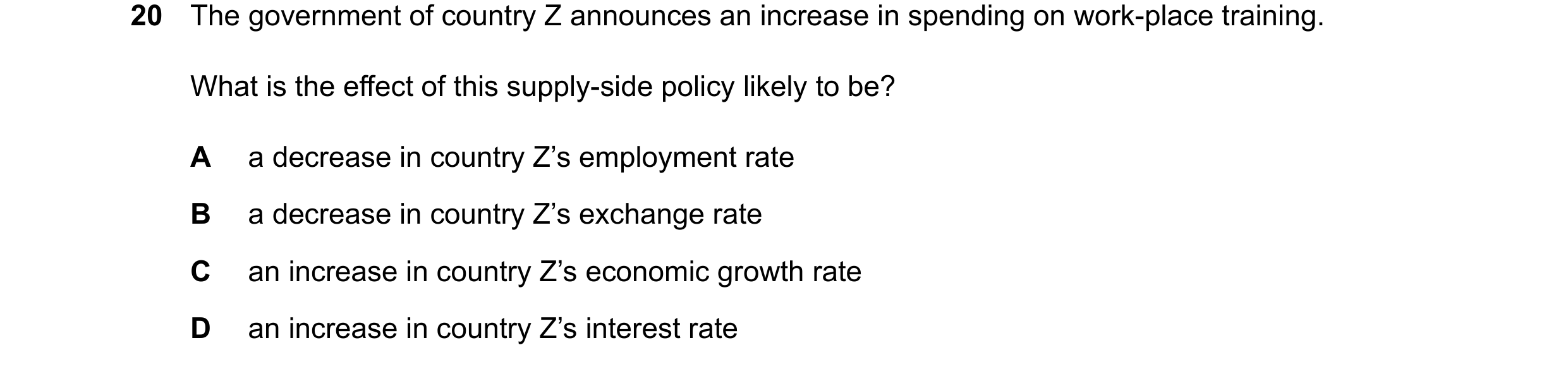
20 The government of country Z announces an increase in spending on work-place training. What is the effect of this supply-side policy likely to be? A a decrease in country Z’s employment rate B a decrease in country Z’s exchange rate C an increase in country Z’s economic growth rate D an increase in country Z’s interest rate
1 marks
Answer: C
This question in 0455/12 May/June 2023
Q50 · What is the most likely effect on an economy of a successful supply-side policy? 0455/13 May/June 2023
20 What is the most likely effect on an economy of a successful supply-side policy? A an increase in the general price level B an increase in the interest rate C an increase in the money supply D an increase in the potential GDP
1 marks
Answer: D
This question in 0455/13 May/June 2023
Q51 · What is a likely objective of supply-side policy? 0455/11 Oct/Nov 2023
20 What is a likely objective of supply-side policy? A improving productive potential B increasing direct taxation C increasing the power of trade unions D promoting the public sector
1 marks
Answer: A
This question in 0455/11 Oct/Nov 2023
Q52 · What is not a supply-side policy measure? 0455/12 Oct/Nov 2023
20 What is not a supply-side policy measure? A control of trade union power B higher indirect taxation C privatisation D skills training for workers
1 marks
Answer: B
This question in 0455/12 Oct/Nov 2023
Q53 · What is a supply-side policy measure? 0455/13 Oct/Nov 2023
20 What is a supply-side policy measure? A a tariff on imported goods B an increase in indirect taxes C a contractionary monetary policy D the removal of barriers to entry to a market
1 marks
Answer: D
This question in 0455/13 Oct/Nov 2023
Q54 · Three statements about policy measures are listed 0455/12 Feb/March 2024
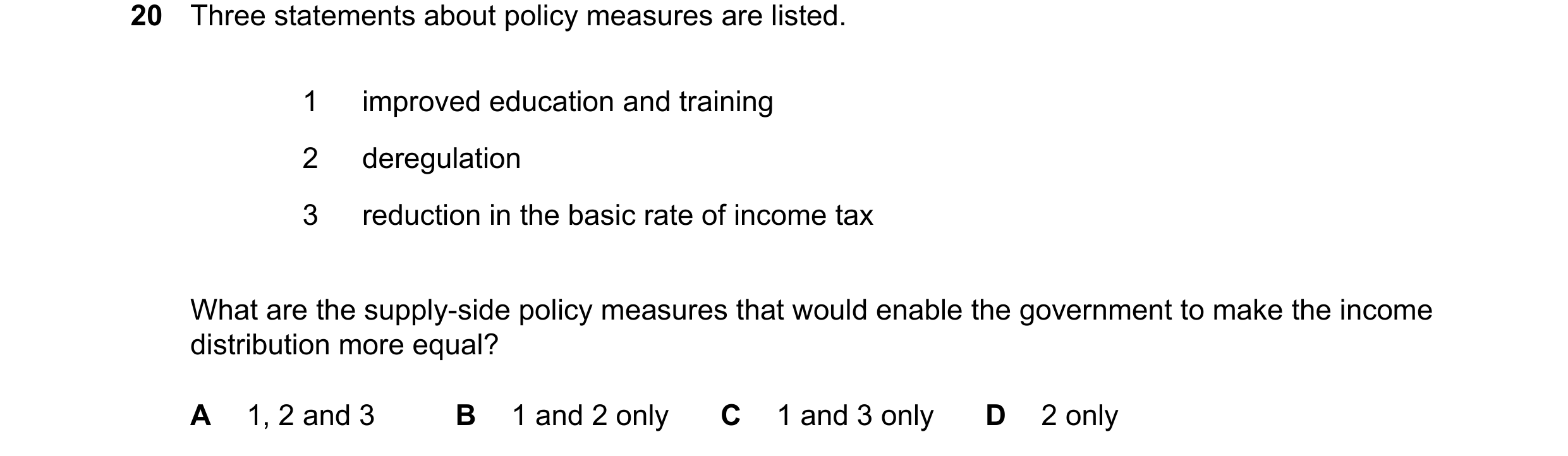
20 Three statements about policy measures are listed. 1 improved education and training 2 deregulation 3 reduction in the basic rate of income tax What are the supply-side policy measures that would enable the government to make the income distribution more equal? A 1, 2 and 3 B 1 and 2 only C 1 and 3 only D 2 only
1 marks
Answer: C
This question in 0455/12 Feb/March 2024
Q55 · Which statement about supply-side policy is correct? 0455/12 May/June 2024
20 Which statement about supply-side policy is correct? A It aims to increase the productive potential of the economy. B It aims to increase total demand in the economy. C It involves changes in the equilibrium foreign exchange rate. D It involves changes in the rate of interest.
1 marks
Answer: A
This question in 0455/12 May/June 2024
Q56 · What is the most likely impact of lower direct taxes on demand and on supply? 0455/13 May/June 2024
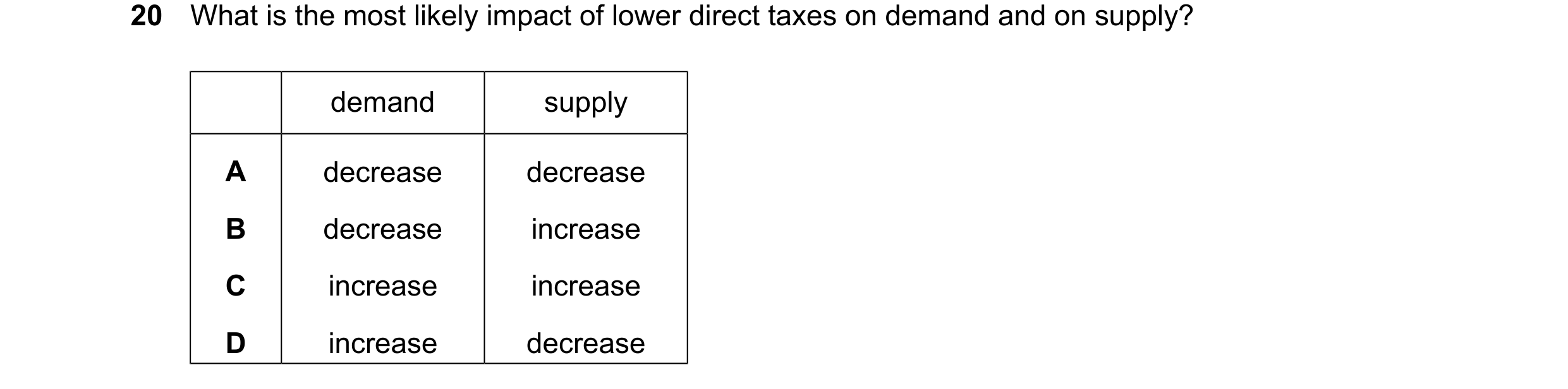
20 What is the most likely impact of lower direct taxes on demand and on supply? demand supply A decrease decrease B decrease increase C increase increase D increase decrease
1 marks
Answer: C
This question in 0455/13 May/June 2024
Q57 · What is most likely to result from a successful supply-side policy? 0455/11 Oct/Nov 2024
20 What is most likely to result from a successful supply-side policy? A a deterioration in the current account of the balance of payments B economic growth C increased inflation D increased structural unemployment
1 marks
Answer: B
This question in 0455/11 Oct/Nov 2024
Q58 · Which supply-side policy measure is most likely to enable a government to achieve its aim… 0455/11 May/June 2025
20 Which supply-side policy measure is most likely to enable a government to achieve its aim of full employment? A decreasing government spending on school buildings B decreasing the number of teachers in schools C increasing taxation on private school fees D increasing the provision of enterprise skills in schools
1 marks
Answer: D
This question in 0455/11 May/June 2025
Q59 · Which policy decision is most likely to cause economic growth? 0455/11 May/June 2025
21 Which policy decision is most likely to cause economic growth? A an increase in corporation tax rates B an increase in interest rates C an increase in the amount workers can earn before paying income tax D an increase in the government's regulations for starting a new business
1 marks
Answer: C
This question in 0455/11 May/June 2025
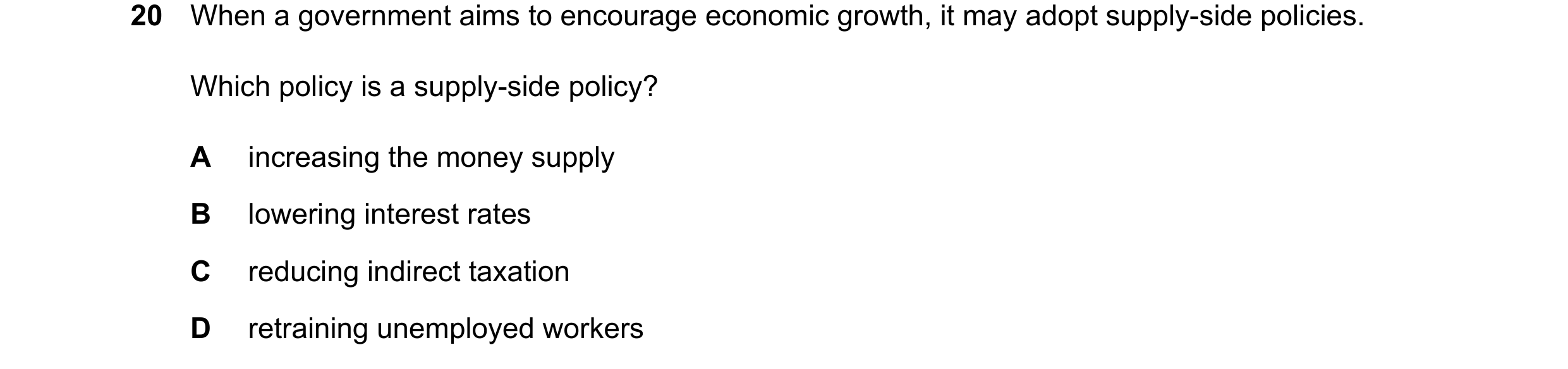
Q60 · When a government aims to encourage economic growth, it may adopt supply-side policies 0455/12 May/June 2025
20 When a government aims to encourage economic growth, it may adopt supply-side policies. Which policy is a supply-side policy? A increasing the money supply B lowering interest rates C reducing indirect taxation D retraining unemployed workers
1 marks
Answer: D
This question in 0455/12 May/June 2025
Q61 · Which government action would not be included as part of a supply-side policy? 0455/11 Oct/Nov 2025
20 Which government action would not be included as part of a supply-side policy? A increasing the privatisation of industries B lowering national minimum wage rates C raising tariffs on international trade D reducing state benefits
1 marks
Answer: C
This question in 0455/11 Oct/Nov 2025
Q62 · What does a successful supply-side policy increase in an economy? 0455/12 Oct/Nov 2025
21 What does a successful supply-side policy increase in an economy? A the level of unemployment B the production possibilities C the rate of inflation D the rate of interest
1 marks
Answer: B
This question in 0455/12 Oct/Nov 2025
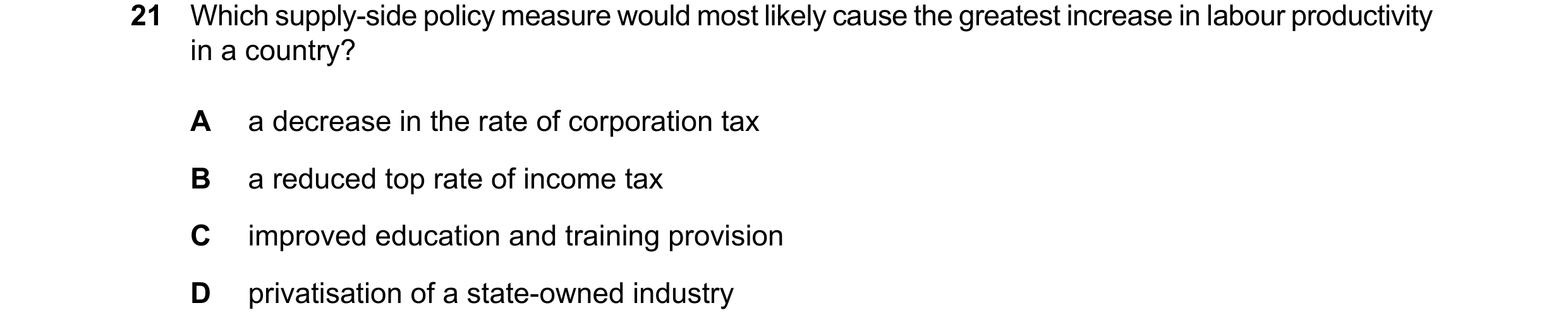
Q63 · Which supply-side policy measure would most likely cause the greatest increase in labour… 0455/13 Oct/Nov 2025
21 Which supply-side policy measure would most likely cause the greatest increase in labour productivity in a country? A a decrease in the rate of corporation tax B a reduced top rate of income tax C improved education and training provision D privatisation of a state-owned industry
1 marks
Answer: C
This question in 0455/13 Oct/Nov 2025

 1 / 12
 2 / 12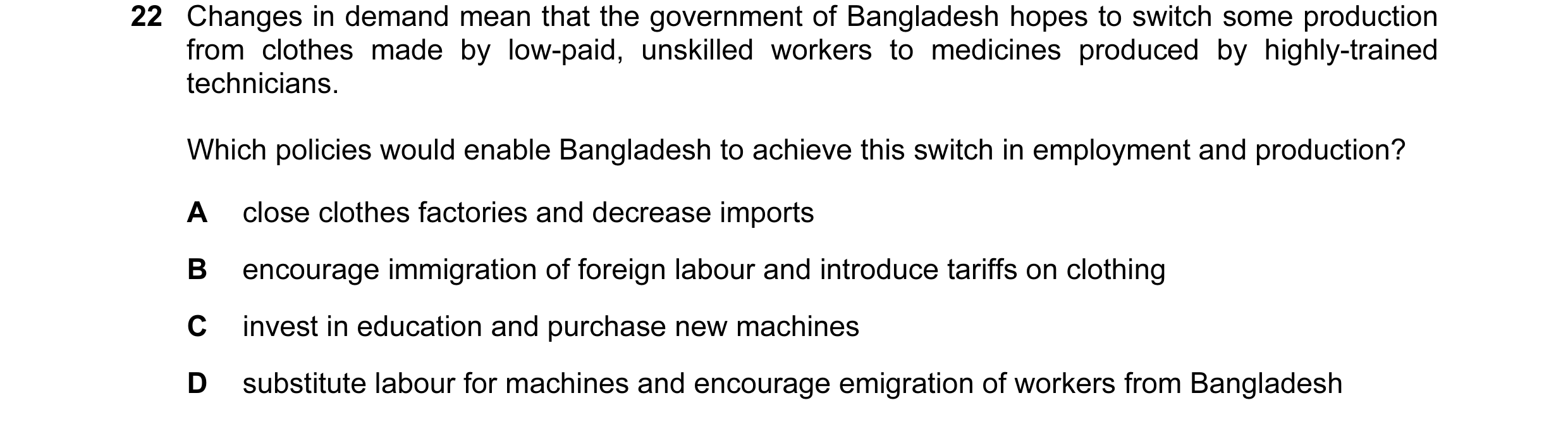

 3 / 12

 4 / 12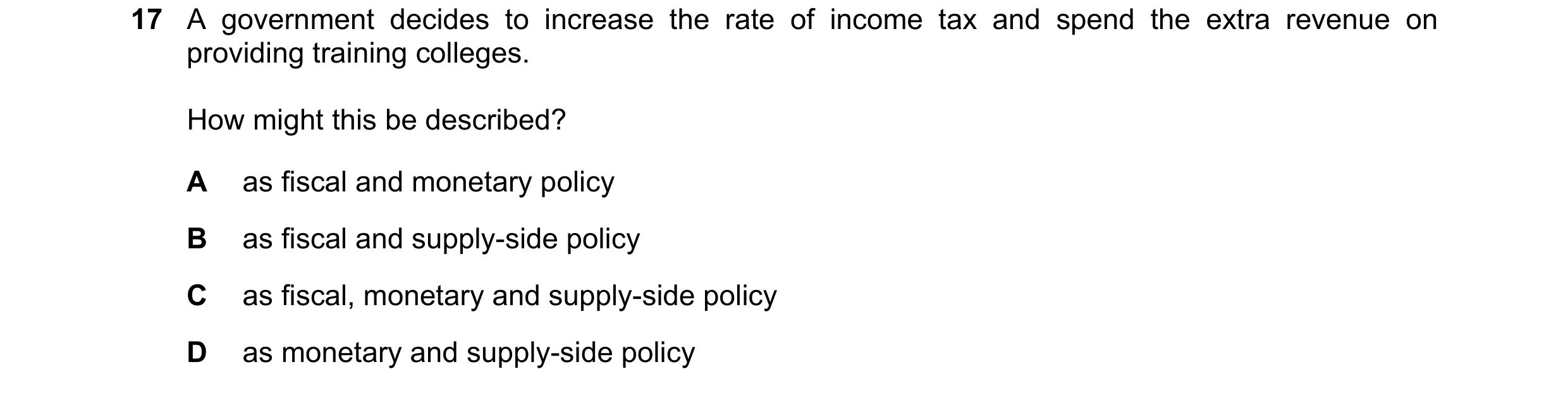

 5 / 12

 6 / 12



 7 / 12

 8 / 12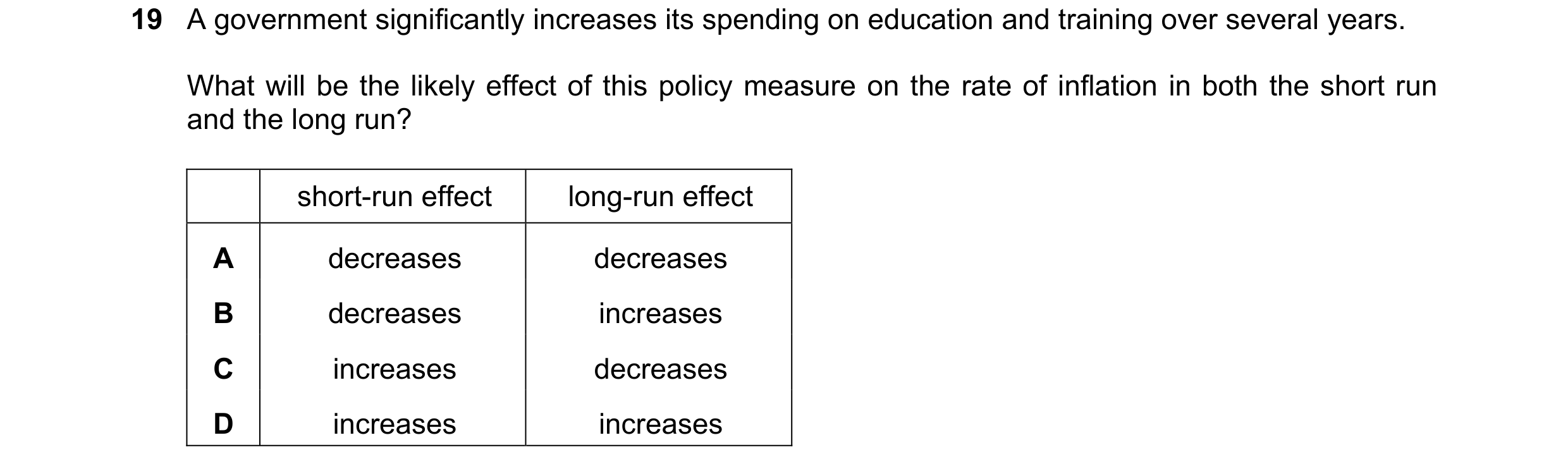


 9 / 12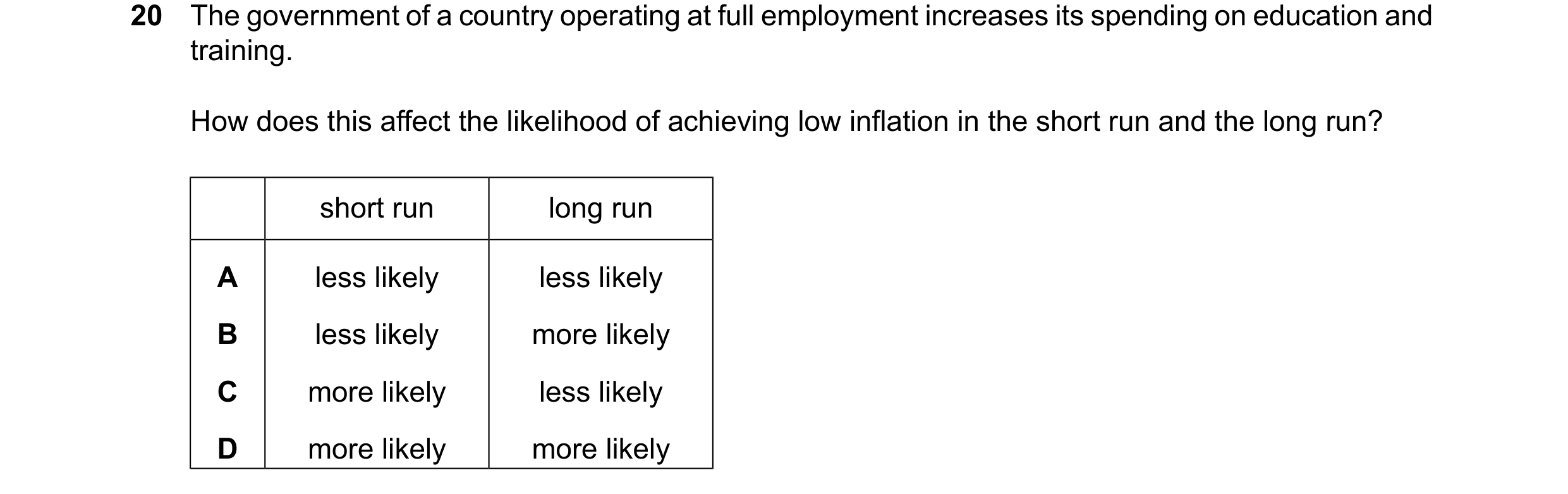


 10 / 12

 11 / 12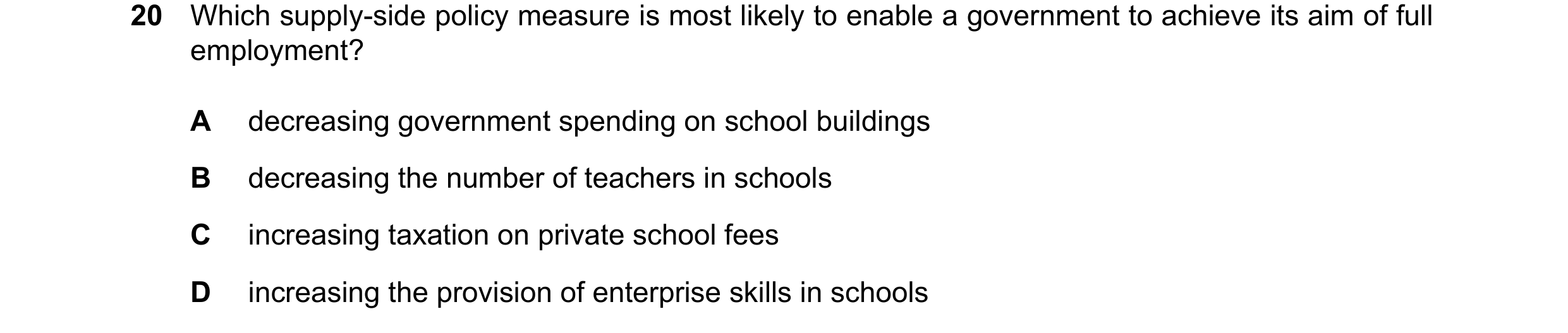



 12 / 12