Questions as text
Q1 · Every day Eduardo tries to phone his friend 9709/61 May/June 2008
6 Every day Eduardo tries to phone his friend. Every time he phones there is a 50% chance that his friend will answer. If his friend answers, Eduardo does not phone again on that day. If his friend does not answer, Eduardo tries again in a few minutes’ time. If his friend has not answered after 4 attempts, Eduardo does not try again on that day. (i) Draw a tree diagram to illustrate this situation. [3] (ii) Let X be the number of unanswered phone calls made by Eduardo on a day. Copy and complete the table showing the probability distribution of X. [4] x 0 1 2 3 4 P(X = x) 1 4 (iii) Calculate the expected number of unanswered phone calls on a day. [2]
9 marks
Mark scheme: 6 (i) A M1 4 or 5 pairs A and U seen no extra bits 0.5 but condone (0, 1) branches after any or A all As. 0.5 0.5 A A1 Exactly 4 pairs of A and U, must be U 0.5 labelled 0.5 A U 0.5 A1 3 Correct diagram with all probs correct, 0.5 allow A1ft for 4 correct pairs and (0,1) U branch(es) or A1ft for 5 correct pairs and 0.5 no (0, 1) branch(es) U (ii) x 0 1 2 3 4 B1 P(0) correct P(X=x) ½ ¼ 1/8 1/16 1/16 B1 P(2) correct B1 P(3) correct B1 4 P(4) correct (iii) E(X) = 15/16 (0.938 or 0.9375) M1 attempt at Σ(xp) only with no other numbers A1 2 correct answer GCE A/AS LEVEL – May/June 2008 9709 06
This question in 9709/61 May/June 2008
Q2 · A die is biased so that the probability of throwing a 5 is 0.75 and the probabilities of… 9709/61 May/June 2008
7 A die is biased so that the probability of throwing a 5 is 0.75 and the probabilities of throwing a 1, 2, 3, 4 or 6 are all equal. (i) The die is thrown three times. Find the probability that the result is a 1 followed by a 5 followed by any even number. [3] (ii) Find the probability that, out of 10 throws of this die, at least 8 throws result in a 5. [3] (iii) The die is thrown 90 times. Using an appropriate approximation, find the probability that a 5 is thrown more than 60 times. [5]
11 marks
Mark scheme: 7 (i) (0.05)(0.75)(0.15) M1 Multiplying 3 probs only, no Cs = 0.00563 (9 / 1600) B1 0.05 or 0.15 or 1/5 × ¼ seen A1 3 Correct answer (ii) P(at least 8) = P(8, 9, 10) B1 Binomial expression involving (0.75)r(0.25)10 - r and a C , r ≠ 0 or 10 =10C8(0.75)8(0.25)2+10C9(0.75)9(0.25)+(0.75)10 M1 Correct unsimplified expression can be implied = 0.526 A1 3 Correct answer (iii) µ = 90 × .075 = 67 5. B1 90× .075 (67.5) and 2 90 × .075 × .025 (16.875 or 16.9) seen σ = 90 × .0 75 × .0 25 = 16 . 875 P(X > 60) M1 For standardising , with or without cc, 605. − 67 5. = 1 − Φ = Φ .1(704) must have on denom 16.875 M1 For use of continuity correction 60.5 or 59.5 M1 For finding an area > 0.5 from their z = 0.956 A1 5 For answer rounding to 0.956
This question in 9709/61 May/June 2008
Q3 · A fair die has one face numbered 1, one face numbered 3, two faces numbered 5 and two… 9709/61 Oct/Nov 2008
7 A fair die has one face numbered 1, one face numbered 3, two faces numbered 5 and two faces numbered 6. (i) Find the probability of obtaining at least 7 odd numbers in 8 throws of the die. [4] The die is thrown twice. Let X be the sum of the two scores. The following table shows the possible values of X. Second throw 1 3 5 5 6 6 1 2 4 6 6 7 7 3 4 6 8 8 9 9 First 5 6 8 10 10 11 11 throw 5 6 8 10 10 11 11 6 7 9 11 11 12 12 6 7 9 11 11 12 12 (ii) Draw up a table showing the probability distribution of X. [3] (iii) Calculate E(X). [2] (iv) Find the probability that X is greater than E(X). [2]
11 marks
Mark scheme: 7 (i) P(odd) = 2/3 or 0.667 B1 Can be implied if normal approx used with P(7) = 8C7 × ( 2 / 3) 7 1( / 3) µ = 5.333(= 8× 2/3) M1 Binomial expression with C in and 2/3 and 1/3 in = 0.156 powers summing to 8 P(8) = (2/3)8 = 0.0390 M1 Summing P(7) + P(8) binomial expressions P(7 or 8) = 0.195 (1280/6561) A1 [4] Correct answer (ii) x 2 4 6 7 8 B1 Values of x all correct in table of probabilities P(X=x) 1/36 2/36 5/36 4/36 4/36 x 9 10 11 12 B2 [3] All probs correct and not duplicated, –1 ee P(X=x) 4/36 4/36 8/36 4/36 (iii) E(X) = ∑ p ix i , all p < 1 and no further = 2×1/36 + 4×2/36 + … M1 attempt to find ∑ p ix i division of any sort = 312/36 (26/3) (8.67) A1 [2] correct answer (iv) P(X > E(X)) = P(X = 9, 10, 11, 12) M1 attempt to add their relevant probs = 20/36 (5/9) (0.556) A1 [2] correct answer
This question in 9709/61 Oct/Nov 2008
Q4 · Gohan throws a fair tetrahedral die with faces numbered 1, 2, 3, 4 9709/61 May/June 2009
2 Gohan throws a fair tetrahedral die with faces numbered 1, 2, 3, 4. If she throws an even number then her score is the number thrown. If she throws an odd number then she throws again and her score is the sum of both numbers thrown. Let the random variable X denote Gohan’s score. (i) Show that P(X = 2) = 16.5 [2] (ii) The table below shows the probability distribution of X. x 2 3 4 5 6 7 P(X = x) 5 1 3 1 1 1 16 16 8 8 16 16 Calculate E(X) and Var(X). [4]
6 marks
Mark scheme: 2 (i) P(X = 2) = 1/4 × 1/4 + 1/4 = 5/16 AG M1 Considering cases (1, 1) and (2) 1 2 3 4 OR can use a table 1 2 2 4 4 2 3 2 5 4 3 4 2 6 4 A1 [2] Correct given answer legitimately obtained 4 5 2 7 4 (1/16 + 4/16 needs some justification but 1/16 + 1/4 is acceptable) (ii) E(X) = Σxp M1 Using correct formula for E(X), no extra division = 15/4 (3.75) A1 Correct answer Var(X) = 22 × 5/16 + 32 × 1/16 + M1 Using a variance formula correctly with mean2 42 × 3/8 +... – (15/4)2 subtracted numerically, no extra division = 260/16 – 225/16 = 35/16 (2.19) A1 [4] Correct final answer 11 11
This question in 9709/61 May/June 2009
Q5 · The mean number of defective batteries in packs of 20 is 1.6 9709/61 Oct/Nov 2009
1 The mean number of defective batteries in packs of 20 is 1.6. Use a binomial distribution to calculate the probability that a randomly chosen pack of 20 will have more than 2 defective batteries. [5]
5 marks
Mark scheme: 1 20p = 1.6 p = 0.08 M1 Equation relating 20p to the mean A1 Correct p can be implied P(X > 2) = 1 – {(0.92)20 + 20C1(0.08)(0.92)19 +20C2 (0.08)2 (0.92)18} M1 Bin expression involving px(1 – p)20–x 20Cx any p = 1 – (0.1887 + 0.3281 + 0.2711) M1 Subtracting 2 or 3 binomial probs from 1, one of which is P(0) = 0.212 A1 [5] Correct answer
This question in 9709/61 Oct/Nov 2009
Q6 · The probability distribution of the random variable X is shown in the following table 9709/61 Oct/Nov 2009
2 The probability distribution of the random variable X is shown in the following table. x −2 −1 0 1 2 3 P(X = x) 0.08 p 0.12 0.16 q 0.22 The mean of X is 1.05. (i) Write down two equations involving p and q and hence find the values of p and q. [4] (ii) Find the variance of X. [2]
6 marks
Mark scheme: 2 (i) –0.16 – p + 0.16 + 2q + 0.66 = 1.05 M1 Attempt at Σpx = 1.05 no dividing – p + 2q = 0.39 A1 Correct simplified equation p + q = 0.42 B1 Accept p = 0.42 – q oe q = 0.27 p = 0.15 A1 [4] Both answers correct (ii) Var (X) = 4 × 0.08 + p + 0.16 + 4q + 1.98 – (1.05)2 M1 Subst in Σpx2 – mean2 formula, mean2 subt numerically, p +ve and < 1 = 2.59 A1 [2] Correct answer
This question in 9709/61 Oct/Nov 2009
Q7 · The probability distribution of the discrete random variable X is shown in the table below 9709/61 May/June 2010
1 The probability distribution of the discrete random variable X is shown in the table below. x −3 −1 0 4 P(X = x) a b 0.15 0.4 Given that E(X) = 0.75, find the values of a and b. [4]
4 marks
Mark scheme: 1 a + b = 0.45 B1 Correct sum probs = 1 o.e. –3a – b + 1.6 = 0.75 M1 Attempt at Σxp = 0.75 A1 Correct a a = 0.2 b = 0.25 A1 Correct b [4]
This question in 9709/61 May/June 2010
Q8 · In the holidays Martin spends 25% of the day playing computer games 9709/61 May/June 2010
5 In the holidays Martin spends 25% of the day playing computer games. Martin’s friend phones him once a day at a randomly chosen time. (i) Find the probability that, in one holiday period of 8 days, there are exactly 2 days on which Martin is playing computer games when his friend phones. [2] (ii) Another holiday period lasts for 12 days. State with a reason whether it is appropriate to use a normal approximation to find the probability that there are fewer than 7 days on which Martin is playing computer games when his friend phones. [1] (iii) Find the probability that there are at least 13 days of a 40-day holiday period on which Martin is playing computer games when his friend phones. [5]
8 marks
Mark scheme: 5 (i) P(X = 2)) = (0.25)2 × (0.75)6 × 8C2 M1 3 term binomial expression involving 8C something, powers summing to 8 = 0.311 A1 correct answer [2] (ii) 12 × 0.25 = 3, < 5 so not possible B1 [1] (iii) mean = 40 × 0.25 (= 10) variance = 40 × 0.25 × 0.75 ( = 7.5) B1 40 × 0.25 and 40 × 0.25 × 0.75 seen, o.e. 125. − 10 standardising, ±, with or without cc, must P(X at least 13) = P z > M1 5.7 have sq rt = P(z > 0.913) M1 continuity correction 12.5 or 13.5 = 1 – Φ(0.913) M1 correct area, i.e. < 0.5 legit = 1 – 0.8194 = 0.181 A1 correct answer [5] 10 10 10 10 10 10
This question in 9709/61 May/June 2010
Q9 · Christa takes her dog for a walk every day 9709/63 May/June 2010
3 Christa takes her dog for a walk every day. The probability that they go to the park on any day is 0.6. If they go to the park there is a probability of 0.35 that the dog will bark. If they do not go to the park there is a probability of 0.75 that the dog will bark. (i) Find the probability that they go to the park on more than 5 of the next 7 days. [2] (ii) Find the probability that the dog barks on any particular day. [2] (iii) Find the variance of the number of times they go to the park in 30 days. [1]
5 marks
Mark scheme: 3 (i) P(> 5) = 7C6(0.6)6(0.4) + (0.6)7 M1 Summing 2 or 3 binomial probs of the form = 0.1306 + 0.02799 7Cr(0.6)r(0.4)7–r = 0.159 A1 Correct answer [2] (ii) P(bark) = P(park, bark) + P(not park, bark) M1 Summing two appropriate 2-factor = 0.6 × 0.35 + 0.4 × 0.75 probabilities = 0.51 A1 Correct answer [2] (iii) Variance (number of times) = 7.2 B1 Correct final answer [1] GCE AS/A LEVEL – May/June 2010 9709 63
This question in 9709/63 May/June 2010
Q10 · Set A consists of the ten digits 0, 0, 0, 0, 0, 0, 2, 2, 2, 4 9709/63 May/June 2010
5 Set A consists of the ten digits 0, 0, 0, 0, 0, 0, 2, 2, 2, 4. Set B consists of the seven digits 0, 0, 0, 0, 2, 2, 2. One digit is chosen at random from each set. The random variable X is defined as the sum of these two digits. (i) Show that P(X = 2) = 37. [2] (ii) Tabulate the probability distribution of X. [2] (iii) Find E(X) and Var(X). [3] (iv) Given that X = 2, find the probability that the digit chosen from set A was 2. [2]
9 marks
Mark scheme: 5 (i) P(2) = P(0,2) + P(2,0) M1 Summing two 2-factor probabilities = 6/10 × 3/7 + 3/10 × 4/7 = 30/70 = 3/7 AG A1 Correct answer legit obtained [2] (ii) x 0 2 4 6 B1 Correct values for rv X P(X = x) 24/70 30/70 13/70 3/70 B1 Correct probs [2] (iii) E(X) = 13/7 B1ft Var(X) = 120/70 + 208/70 + 108/70 – (13/7)2 M1 Using variance formula correctly with mean2 subtracted numerically, no extra division = 2.78 A1 Correct final answer [3] 3 / 10 × 4 / 7 (iv) P(A2│Sum 2) = M1 Correct numerator with a 0 < denom < 1 30 / 70 = 0.4 A1 Correct answer [2] GCE AS/A LEVEL – May/June 2010 9709 63
This question in 9709/63 May/June 2010
Q11 · On average, 2 apples out of 15 are classified as being underweight 9709/61 Oct/Nov 2010
2 On average, 2 apples out of 15 are classified as being underweight. Find the probability that in a random sample of 200 apples, the number of apples which are underweight is more than 21 and less than 35. [5]
5 marks
Mark scheme: 2 mean = 200 × 2/15 (= 26.67) (80/3) B1 mean and variance correct variance = 200 × 2/15 × 13/15 (= 23.11)(208/9) P(21 < X < 35) = M1 standardising, ±, with or without cc, must 215. − 26.67 345. − 26.67 have sq rts P < z < M1 continuity corrections 20.5 or 21.5, 34.5 23.11 23.11 or 35.5 = P(–1.075 < z < 1.629) M1 Φ1 + Φ2 – 1 = 0.8589 + 0.9483 – 1 = 0.807 A1 answer rounding to 0.807 [5]
This question in 9709/61 Oct/Nov 2010
Q12 · Sanket plays a game using a biased die which is twice as likely to land on an even number… 9709/61 Oct/Nov 2010
7 Sanket plays a game using a biased die which is twice as likely to land on an even number as on an odd number. The probabilities for the three even numbers are all equal and the probabilities for the three odd numbers are all equal. (i) Find the probability of throwing an odd number with this die. [2] Sanket throws the die once and calculates his score by the following method. • If the number thrown is 3 or less he multiplies the number thrown by 3 and adds 1. • If the number thrown is more than 3 he multiplies the number thrown by 2 and subtracts 4. The random variable X is Sanket’s score. (ii) Show that P(X = 8) = 29. [2] The table shows the probability distribution of X. x 4 6 7 8 10 P(X = x) 39 19 29 29 19 (iii) Given that E(X) = 589 , find Var(X). [2] Sanket throws the die twice. (iv) Find the probability that the total of the scores on the two throws is 16. [2] (v) Given that the total of the scores on the two throws is 16, find the probability that the score on the first throw was 6. [3]
11 marks
Mark scheme: 7 (i) If y = P(odd number) then P(even number) = 2y M1 2P(Odd) shown = P(Even) and summed to 1 3y + 6y = 1 so y = 1/9 oe. OR prob = 1/3 A1 correct answer accept either [2] (ii) Score of 8 means throwing a 6 B1 6 is even so P(8) = 2/9 (AG) B1 legit justification of use of 2/9 [2] (iii) Var(X) = (48 + 36 + 98 + 128 + 100)/9 – (58/9)2 M1 Correct method no dividings, 6.44 squared subt numerically = 4.02 accept 4.025 (326/81) A1 Correct answer [2] (iv) P(score 6,10) + P(score 10,6) + P(score 8,8) M1 Summing two different 2-factor = 1/81 + 1/81 + 4/81 probabilities = 6/81 (2/27) (0.0741) A1 Correct answer [2] (v) P(score 6, 10) = 1/81 B1 1/81 seen in numerator P(1st score 6 given total 16) = (1/81) ÷ (6/81) M1 Dividing by their (iv) = 1/6 A1 Correct answer [3]
This question in 9709/61 Oct/Nov 2010
Q13 · In a probability distribution the random variable X takes the value x with probability… 9709/63 Oct/Nov 2010
2 In a probability distribution the random variable X takes the value x with probability kx, where x takes values 1, 2, 3, 4, 5 only. (i) Draw up a probability distribution table for X, in terms of k, and find the value of k. [3] (ii) Find E(X). [2]
5 marks
Mark scheme: 2 (i) x 1 2 3 4 5 M1 1, 2, 3, 4, 5 seen, together with some Prob k 2k 3k 4k 5k probabilities involving k but not x M1 summing probs involving k to 1 15k = 1 k = 1/15 (0.0667) A1 correct answer [3] (ii) E(X) M1 using Σpx no dividing = k + 4k + 9k + 16k + 25k = 55k = 11/3 (3.67) A1ft correct answer, ft on 55k, 0 < k < 1 [2]
This question in 9709/63 Oct/Nov 2010
Q14 · The times spent by people visiting a certain dentist are independent and normally… 9709/63 Oct/Nov 2010
7 The times spent by people visiting a certain dentist are independent and normally distributed with a mean of 8.2 minutes. 79% of people who visit this dentist have visits lasting less than 10 minutes. (i) Find the standard deviation of the times spent by people visiting this dentist. [3] (ii) Find the probability that the time spent visiting this dentist by a randomly chosen person deviates from the mean by more than 1 minute. [3] (iii) Find the probability that, of 6 randomly chosen people, more than 2 have visits lasting longer than 10 minutes. [3] (iv) Find the probability that, of 35 randomly chosen people, fewer than 16 have visits lasting less than 8.2 minutes. [5]
14 marks
Mark scheme: 7 (i) z = 0.807 B1 0.807 seen 10 − 2.8 0.807 = M1 standardising, must have σ, no sq rt, no σ cc and a z-value s = 2.23 A1 correct answer [3] 1 (ii) P(> 1 min from mean) = P(mod z > ) M1 standardising, their sd, no cc and adding .223 two areas = P( z > .04484 ) M1 using 1 – Φ(z) = (1 – 0.6729) × 2 = 0.654 A1 correct answer [3] (iii) P(> 2 longer) = 1 – P(0, 1, 2 longer) M1 binomial term 6Cxpx(1 − p)6 − x = 1 – {(0.79)6 + 6C1(0.21)(0.79)5 + A1 correct unsimplified answer 6C2(0.21)2(0.79)4} = 0.112 A1 correct answer [3] (iv) µ = 35 × 0.5 = 17.5 B1 17.5 and 8.75 or .8 75 seen σ2 = 35 × 0.5 × 0.5 = 8.75 15 5. − 175. P(X < 16) = Φ M1 standardising, with or without cc, must .875 have sd in denom M1 continuity correction 15.5 or 16.5 only, seen = 1 – Φ(0.676) M1 using 1 – Φ(z) = 1 – 0.7505 = 0.2495 (0.249 or 0.250) A1 correct answer [5] OR 35C00.500.535 + 35C10.510.534 + 35C20.520.533 +... M1 binomial term 35Cx0.5x0.535 − x = 8582372584/235 = 0.250 A1 at least 2 correct terms (x Þ 0) seen M1 summing 16 or 17 terms A1 correct expression A1 correct answer
This question in 9709/63 Oct/Nov 2010
Q15 · In Scotland, in November, on average 80% of days are cloudy 9709/62 May/June 2011
2 In Scotland, in November, on average 80% of days are cloudy. Assume that the weather on any one day is independent of the weather on other days. (i) Use a normal approximation to find the probability of there being fewer than 25 cloudy days in Scotland in November (30 days). [4] (ii) Give a reason why the use of a normal approximation is justified. [1]
5 marks
Mark scheme: x 0 1 2 3 4 5 6 M1 Values 0 – 6 seen could be in list Prob 0.2 0.24 0.08 0.08 0.16 0.16 0.08 A1 [2] All correct (iii) Mean = Σxp = 2.56 (64/25) B1 [1] (iv) P(4, 5, 6) = 0.4(10/25) or 0.16 + 0.16 + 0.08 B1 ft ft their P(4, 5, 6) providing p < 1 = P(draw) × 0.4 M1 Multiplying by their P(draw) providing p < 1 = 0.2 × 0.4 = 0.08 (2/25) A1ft [3] Correct answer (v) P(J wins on nth go) M1 Mult by any pn or pn – 1, p < 1 = (0.2)n – 1 × 0.4 oe A1ft [2] ft their probs
This question in 9709/62 May/June 2011
Q16 · When a butternut squash seed is sown the probability that it will germinate is 0.86… 9709/61 Oct/Nov 2011
1 When a butternut squash seed is sown the probability that it will germinate is 0.86, independently of any other seeds. A market gardener sows 250 of these seeds. Use a suitable approximation to find the probability that more than 210 germinate. [5]
5 marks
Mark scheme: 1 µ = 250 × 0.86 = 215 B1 250 × 0.86 and 250 × 0.86 × 0.14 seen o.e σ2 = 250 × 0.86 × 0.14 = 30.1 M1 Standardising, with or without cc, must have sq rt in denom 2105. − 215 M1 Continuity correction 210.5 or 209.5 P(X > 210) = 1 – Φ 301. only = Φ(0.820) M1 Correct region (> 0.5) ft their mean = 0.794 A1 [5] Correct answer
This question in 9709/61 Oct/Nov 2011
Q17 · A team of 4 is to be randomly chosen from 3 boys and 5 girls 9709/61 Oct/Nov 2011
3 A team of 4 is to be randomly chosen from 3 boys and 5 girls. The random variable X is the number of girls in the team. (i) Draw up a probability distribution table for X. [4] (ii) Given that E(X) = 52, calculate Var(X). [2]
6 marks
Mark scheme: 3 (i) P(X = 1) = P(GBBB) 4 × C1 M1 Considering values of X of 1, 2, 3, 4 = 5/8× 3/7 × 2/6 × 1/5 × 4 = 1/14 M1 Attempting to find the probability of at least 2 values of X P(X = 2) = P(GGBB) × 4C2 = 3/7 P(X = 3) = P(GGGB) × 4C3 = 3/7 A1 One correct probability P(X = 4) = P(GGGG) × 4C4 = 1/14 A1 All correct OR P(1) = 5C1 / 8C4 = 1/14 M1 Considering values of X of 1, 2, 3, 4 P(2) = 3C2 × 5C2 / 8C4 = 3/7 M1 Dividing by 8C4 P(3) = 3C1 × 5C3 / 8C4 = 3/7 A1 One correct probability P(4) = 5C4 / 8C4 = 1/14 A1 [4] All correct (ii) Var(X) = 1/14 + 12/7 + 27/7 + 16/14 – (5/2)2 M1 Using a variance formula correctly with mean2 subtracted numerically, no extra division = 15/28 (0.536) A1 [2] Correct final answer GCE AS/A LEVEL – October/November 2011 9709 61
This question in 9709/61 Oct/Nov 2011
Q18 · A triangular spinner has one red side, one blue side and one green side 9709/62 Oct/Nov 2011
5 A triangular spinner has one red side, one blue side and one green side. The red side is weighted so that the spinner is four times more likely to land on the red side than on the blue side. The green side is weighted so that the spinner is three times more likely to land on the green side than on the blue side. (i) Show that the probability that the spinner lands on the blue side is 8.1 [1] (ii) The spinner is spun 3 times. Find the probability that it lands on a different coloured side each time. [3] (iii) The spinner is spun 136 times. Use a suitable approximation to find the probability that it lands on the blue side fewer than 20 times. [5]
9 marks
Mark scheme: 5 (i) 4p + p + 3p = 1 so P(blue) = 1/8 AG B1 [1] Must show something (ii) P(R) = ½, P(B) = 1/8, P(G) = 3/8 M1 [3] Multiplying P (R, B, G) together P(all different) = ½ × 1/8 × 3/8 × 3! M1 Mult by 3! =9/64 (0.141) A1 Correct answer GCE AS/A LEVEL – October/November 2011 9709 62 (iii) mean = 136 × 1/8 = 17, var = 14.875 B1 Unsimplified mean and variance 19.5 − 17 correct P(<20) = P z < M1 Standardising, need sq rt 14.875 M1 Cont correction 19.5 or 20.5 = Ф(0.648) M1 Correct area, > 0.5 legit = 0.742 A1 [5] Correct answer
This question in 9709/62 Oct/Nov 2011
Q19 · A factory makes a large number of ropes with lengths either 3 m or 5 m 9709/63 Oct/Nov 2011
3 A factory makes a large number of ropes with lengths either 3 m or 5 m. There are four times as many ropes of length 3 m as there are ropes of length 5 m. (i) One rope is chosen at random. Find the expectation and variance of its length. [4] (ii) Two ropes are chosen at random. Find the probability that they have different lengths. [2] (iii) Three ropes are chosen at random. Find the probability that their total length is 11 m. [3]
9 marks
Mark scheme: 3 (i) P(3m) = 4/5 (0.8) P(5m) = 1/5 (0.2) B1 P(3m) = 4/5 or P(5m) = 1/5 seen or implied E(X) = 17/5 (3.4) B1 Correct E(X) M1 Subtract their mean2 numerically from ∑x2p, no extra dividing Var(X) = 16/25 (0.64) A1 [4] Correct answer (ii) P(3, 5) + P(5, 3) = 0.8 × 0.2 +0.2 × 0.8 M1 Summing two 2-factor terms = 8/25 (0.32) A1√ Correct answer, ft on 2 × p × (1 − p), [2] their p (iii) P(11) = P(3, 3, 5) + P(3, 5, 3) + P(5, 3, 3) M1 Mult 2 probs for 3 with 1 prob for 5 = ( 4/5 × 4/5 × 1/5 ) × 3 M1 Multiplying probs for 11 by 3 or summing 3 options = 48/125 (0.384) A1 [3] Correct final answer
This question in 9709/63 Oct/Nov 2011
Q20 · The random variable X has the probability distribution shown in the table 9709/62 May/June 2012
2 The random variable X has the probability distribution shown in the table. x 2 4 6 P(X = x) 0.5 0.4 0.1 Two independent values of X are chosen at random. The random variable Y takes the value 0 if the two values of X are the same. Otherwise the value of Y is the larger value of X minus the smaller value of X. (i) Draw up the probability distribution table for Y. [4] (ii) Find the expected value of Y. [1]
5 marks
Mark scheme: 2 (i) B1 0, 2, 4 only seen for Y no probs needed. y 0 2 4 Accept other vals if P(value) = 0 seen in P(Y = y) 0.42 0.48 0.1 table, allow 0002244 with probs M1 Summing two or more 2-factor probs (can be implied) A1 One correct prob A1 [4] Correct table or list (ii) 0.96 + 0.4 = 1.36 B1ft [1] Ft their table for Y or X Σp = 1
This question in 9709/62 May/June 2012
Q21 · A company set up a display consisting of 20 fireworks 9709/61 Oct/Nov 2012
5 A company set up a display consisting of 20 fireworks. For each firework, the probability that it fails to work is 0.05, independently of other fireworks. (i) Find the probability that more than 1 firework fails to work. [3] The 20 fireworks cost the company $24 each. 450 people pay the company $10 each to watch the display. If more than 1 firework fails to work they get their money back. (ii) Calculate the expected profit for the company. [4]
7 marks
Mark scheme: 5 (i) P(> 1) = 1 – (0.95)20 – (0.95)19(0.05)120C1 M1 Binomial term 20Cx(0.05)x(0.95)20–x M1 Correct unsimplified expression = 0.264 A1 [3] Correct answer GCE AS/A LEVEL – October/November 2012 9709 61 (ii) Profit 19 or 20 work = 450×10 – 480 B1 4020 seen = 4020 Profit < 19 work = – 480 M1 Multiplying 4020 by their (i) or their 4020 × 1( − .0264) − M1 (1 – (i)) Expected profit = 480 × .0264 Multiplying 480 by [1 – their (i)] and subtracting A1 [4] Rounding to correct answer = $2830 ($2832) Or –480 + 4500 (1 – 0.264) = 2830 6 (i) p = 0.2 µ= 96× 0.2 = 19.2 σ2 = 96× 0.2× 0.8 =15.36 B1 96× 0.2 and 96× 0.2× 0.8 seen M1 d di i h
This question in 9709/61 Oct/Nov 2012
Q22 · Fiona uses her calculator to produce 12 random integers between 7 and 21 inclusive 9709/61 May/June 2013
5 Fiona uses her calculator to produce 12 random integers between 7 and 21 inclusive. The random variable X is the number of these 12 integers which are multiples of 5. (i) State the distribution of X and give its parameters. [3] (ii) Calculate the probability that X is between 3 and 5 inclusive. [3] Fiona now produces n random integers between 7 and 21 inclusive. (iii) Find the least possible value of n if the probability that none of these integers is a multiple of 5 is less than 0.01. [3]
9 marks
Mark scheme: 5 (i) X ~ Bin (12, 0.2) B1 Bin or B B1 12 B1 [3] 0.2 or 1/5 (ii) P ( X = 3, 4, 5) = 0.230.8912C3 + 0.240.8812C4 M1 Bin exprerssion with any p + 0.250.8712C5 = 0.23622 + 0.13287 + 0.05315 A1ft Correct unsimplified expression, their p = 0.422 A1 [3] Correct answer GCE AS/A LEVEL – May/June 2013 9709 61 (iii) P (X = 0) < 0.01 M1 [3] Statement involving P(X = 0) and 0.01 can be implied 0.8n < 0.01 M1 Equn involving ‘0.8’, 0.01 or 0.99 n = 21 A1 Correct answer
This question in 9709/61 May/June 2013
Q23 · Robert uses his calculator to generate 5 random integers between 1 and 9 inclusive 9709/62 May/June 2013
4 Robert uses his calculator to generate 5 random integers between 1 and 9 inclusive. (i) Find the probability that at least 2 of the 5 integers are less than or equal to 4. [3] Robert now generates n random integers between 1 and 9 inclusive. The random variable X is the number of these n integers which are less than or equal to a certain integer k between 1 and 9 inclusive. It is given that the mean of X is 96 and the variance of X is 32. (ii) Find the values of n and k. [4]
7 marks
Mark scheme: 4 (i) p = 4/9 or 5/9 B1 Binomial term 5Cxpx(1 – p)5 – x seen P(at least 2) = 1 – P(0, 1) M1 = 1 – (5/9)5 – (4/9)(5/9)4 5C1 = 0.735 A1 [3] Correct answer (ii) np = 96 npq = 32 p = P ( ≤ k) M1 Using np = 96 npq = 32 to obtain eqn in 1 variable p = 2/3 q = 1/3 n = 144 A1 1/3 or 2/3 seen or implied k = 6 A1ft Correct k ft k = 9p n = 144 A1 [4] correct n GCE AS/A LEVEL – May/June 2013 9709 62 5 (i) Stem leaf B1 Correct stem condone a space under the 1
This question in 9709/62 May/June 2013
Q24 · Susan has a bag of sweets containing 7 chocolates and 5 toffees 9709/62 May/June 2013
7 Susan has a bag of sweets containing 7 chocolates and 5 toffees. Ahmad has a bag of sweets containing 3 chocolates, 4 toffees and 2 boiled sweets. A sweet is taken at random from Susan’s bag and put in Ahmad’s bag. A sweet is then taken at random from Ahmad’s bag. (i) Find the probability that the two sweets taken are a toffee from Susan’s bag and a boiled sweet from Ahmad’s bag. [2] (ii) Given that the sweet taken from Ahmad’s bag is a chocolate, find the probability that the sweet taken from Susan’s bag was also a chocolate. [4] (iii) The random variable X is the number of times a chocolate is taken. State the possible values of X and draw up a table to show the probability distribution of X. [5]
11 marks
Mark scheme: 7 (i) 5 2 1 M1 Mult their P(T) by 2/9 or 2/10 only P(T,B) = × = (0.0833) A1 Correct answer 12 10 12 [2] (ii) 7 4 28 P (C S ∩ C A ) = × = (0.2333) M1 Mult their P(CS) by 3/9 or 4/10 seen as 12 10 120 num or denom of a fraction 7 4 5 3 43 P(CA) = × + × = (0.3583) M1 Summing 2 two-factor products to find 12 10 12 10 120 P(CA) seen anywhere P (C ∩ C ) 28 / 120 P(CS CA) = = A1 Correct unsimplified P(CA) seen as num P (C A ) 43 / 120 or denom of a fraction 28 = (0.651) 43 A1 [4] Correct answer (iii) x 0 1 2 B1 x = 0, 1, 2, can be implied from table or Prob 7/24 19/40 7/30 working P(X = 0) = P(T, B) + P(T, T) M1 1 or 2 two-factor products, denoms 12 and 10 or 12 and 9, implied if ans is correct 5 2 5 5 7 = × + × = (0.292) A1 One correct unsimplified 12 10 12 10 24 7 4 28 P(X = 2) = P(C, C) = × = (0.233) B1 One other correct unsimplified 12 10 120 19 P(X = 1) = 1 – 7/24 – 28/120 = (0.475) B1ft [5] Third correct ft 1 – P(2 of their probs)) 40
This question in 9709/62 May/June 2013
Q25 · In a certain country, on average one student in five has blue eyes 9709/63 May/June 2013
4 In a certain country, on average one student in five has blue eyes. (i) For a random selection of n students, the probability that none of the students has blue eyes is less than 0.001. Find the least possible value of n. [3] (ii) For a random selection of 120 students, find the probability that fewer than 33 have blue eyes. [4]
7 marks
Mark scheme: M1 Mult two probabilities, one containing x and 15 x + 4 18 7 equating to 18 A1 Correct unsimplified equation x = 8 A1 [4] Correct answer 6 (i) (40, 0), (50, 12) etc. up to (90, 144) B1 Axes, (cf) and labels (kg), uniform scales from at least 0–140 and 40.5–69.5 either way round B1 [2] All points correct, sensible scale (not 12), polygon or smooth curve (ii) 80 weigh less than 67.2 kg M1 Subt 64 from 144 c = 67.2 A1 ft [2] Accept anything between 67 and 68 ft from incorrect graph GCE AS/A LEVEL – May/June 2013 9709 63 (iii) freqs 12, 22, 30, 28, 52 M1 frequencies attempt not cf A1 Correct freqs mean wt = (45 × 12 + 55 × 22 + 62.5 M1 Using mid points attempt, i.e. 44.5, 45, 45.5, in correct mean formula, unsimplified, no cfs, × 30 + 67.5 × 28 + 80 × 52) condone 1 error. / 144 = 9675 / 144 A1 Correct mean = 67.2 kg Var (452 × 12 + 552 × 22 + M1 Substituting their mid-pts squared (may be class 62.52 × 30 + 67.52 × 28 + 802 × widths, lower or upper bound) in correct var 52) / 144 formula even with cfs with their mean2 – (9675/144)2 = 127.59 sd = 11.3, allow 11.2 A1 [6] Correct answer 7 (i) S(10) R(14) P(6) M1 Summing 2 or more 3-factor options perms or 1 2 4 = 10C1×14C2×6C4= 13650 combs 1 3 3 = 10C1×14C3×6C3= 72800 M1 Mult 3 combs or 4 combs with Σr=7 2 2 3 = 10C2×14C2×6C3= 81900 B1 2 options correct, unsimplified Total = 168350 or 168000 A1 [4] Correct answer (ii) 2! × 2! × 5! M1 2! × 2! oe, seen mult by an integer ≥1, no division M1 Mult by 5!, or 5! alone, seen mult by an integer ≥ 1 no division = 480 A1 [3] Correct answer !2× !2 !5 If M0 earned or or both, SCM1 !2× !2 !3 seen mult by an integer ≥1 Or 2!×2!×5! divided by a value (iii) spaniels and retrievers in 4! ways M1 4! seen multiplied by an integer >1 M1 Mult by 5P3 oe gaps in 5P3 or 5 × 4 × 3 ways A1 [3] Correct answer = 1440 If M0 earned SCM1 5C3 oe
This question in 9709/63 May/June 2013
Q26 · Dayo chooses two digits at random, without replacement, from the 9-digit number 113 333… 9709/63 Oct/Nov 2013
7 Dayo chooses two digits at random, without replacement, from the 9-digit number 113 333 555. (i) Find the probability that the two digits chosen are equal. [3] (ii) Find the probability that one digit is a 5 and one digit is not a 5. [3] (iii) Find the probability that the first digit Dayo chose was a 5, given that the second digit he chose is not a 5. [4] (iv) The random variable X is the number of 5s that Dayo chooses. Draw up a table to show the probability distribution of X. [3]
13 marks
Mark scheme: 7 (i) P(same) = P(1, 1)+ P(3, 3) + P(5, 5) M1 Summing 3 two-factor options 2 1 4 3 3 2 = × + × + × M1 Multiplying terms by one less in the numerator 9 8 9 8 9 8 or denominator = 5/18 (0.278) A1 3 Correct answer Alt. method: 2C 2 + 4C2 + 3C2 M1 for numerator, M1 for denominator, A1 correct answer 9C2 2 × 1 + 3 × 4 + 2 × 3 or oe 9C2 × 2 (ii) P( ,5 5 ) + P( ,5 5 ) M1 Mult 2 probs whose numerators sum to 9 o.e. M1 Summing 2 options or mult by 2 (may be 4 options) 3 6 6 3 36 = × + × = = ½ or 0.5 A1 3 Correct answer 9 8 9 8 72 Alt. method: 6C1 × 3C1 (× 2) oe M1 for numerator, M1 for denominator, 9C2 (× 2) A1 correct answer 3 6 1 (iii) P( 5∩ 5 ) = × = M1 Attempt at P(5 and not 5) seen as numerator or 9 8 4 denominator of a fraction 1 6 5 P( 5 ) = + × = 48/72 = 0.6666 M1 Attempt at P(not 5) sum of 2 two-factor terms 4 9 8 seen anywhere A1 Correct P( 5 ) as numerator or denominator 1 / 4 P( 51 52 ) = = 3/8 in fraction 48 / 72 = 0.375 A1 4 Correct answer (iv) x 0 1 2 B1 Values 0, 1, 2 seen in table with at least 1 prob P(X = x) 5/12 1/2 1/12 6 5 P(0) = P( ,5 5 ) = × = 30/72 (5/12) B1 Correct P(0) unsimplified 9 8 (0.4166) P(1) = 0.5 from part (ii) P(2) = 6/72 (1/12) (0.0833) from part (i) B1ft 3 If x=0,1,2(,3) ft Σp = 1, no –ve values, all probabilities <1
This question in 9709/63 Oct/Nov 2013
Q27 · State three conditions which must be satisfied for a situation to be modelled by a… 9709/61 May/June 2014
3 (i) State three conditions which must be satisfied for a situation to be modelled by a binomial distribution. [2] George wants to invest some of his monthly salary. He invests a certain amount of this every month for 18 months. For each month there is a probability of 0.25 that he will buy shares in a large company, there is a probability of 0.15 that he will buy shares in a small company and there is a probability of 0.6 that he will invest in a savings account. (ii) Find the probability that George will buy shares in a small company in at least 3 of these 18 months. [3]
5 marks
Mark scheme: 3 (i) constant / given p, independent trials, B1 Any one correct fixed / given no. of trials, only two outcomes B1 2 Any 3 correct (ii) P (x [ 3) = 1 – P (0, 1, 2) M1 Any binomial expression pr (1 – p) 18–r 18Cr seen = 1 – [(0.85)18 + (0.85)17(0.15) × 18 + (0.85)16(0.15)2 × 18C2] M1 1 – P (0, 1, 2 ), any n,p,q = 0.520 A1 3 Correct answer 6C 2 15 3 M1 6C / 8C 4C lt b 4 f ti
This question in 9709/61 May/June 2014
Q28 · Coin A is weighted so that the probability of throwing a head is 2 Coin B is weighted so… 9709/62 May/June 2014
4 Coin A is weighted so that the probability of throwing a head is 2 Coin B is weighted so that the 3. probability of throwing a head is 1 Coin A is thrown twice and coin B is thrown once. 4. (i) Show that the probability of obtaining exactly 1 head and 2 tails is 36.13 [3] (ii) Draw up the probability distribution table for the number of heads obtained. [4] (iii) Find the expectation of the number of heads obtained. [2]
9 marks
Mark scheme: 4 (i) A:P(H) = 2/3, P(T) = 1/3 M1 Using some of 2/3, 1/3, ¼ or 3/4 in a calculation B: P(H) = ¼, P(T) = 3/4 involving prod of 3 probs P(1H) = P(HTT) + P(THT) + P(TTH) M1 Summing 3 options not all the same = (2/3 × 1/3 × 3/4) + (1/3 × 2/3 × 3/4) + (1/3 × 1/3 × 1/4) = 13/36 AG A1 3 Correct answer x 0 1 2 3 (ii) B1 0, 1, 2, 3 seen for table no probs needed, table P 3/36 13/36 16/36 4/36 not absolutely necessary if calcs shown P(0H) = P(TTT) = 1/3 × 1/3 × 3/4 = 1/12 B1 One prob correct other than (i) condone 0.083 for 0.0833 P(2H) = P(HHT) + P(HTH) + P(THH) B1 A second prob correct need 3 factors can be = (2/3 × 2/3 × 3/4) + (2/3 × 1/3 × 1/4) implied + (1/3 × 2/3 × 1/4) = 4/9 not 2/3 × 2/3 P(3H) = P(HHH) = 2/3 × 2/3 × 1/4 = 1/9 B1 4 A third prob correct ft 23/36 – Σ their 2 probs (iii) E(X) = 13/36 + 32/36 + 12/36 M1 Attempt to evaluate Σxp at least 3 vals of x in table = 57/36 (19/12) (1.58) A1 2 Correct answer GCE AS/A LEVEL – May/June 2014 9709 62
This question in 9709/62 May/June 2014
Q29 · The number of phone calls, X, received per day by Sarah has the following probability… 9709/61 Oct/Nov 2014
2 The number of phone calls, X, received per day by Sarah has the following probability distribution. x 0 1 2 3 4 ≥5 P X = x 0.24 0.35 2k k 0.05 0 (i) Find the value of k. [2] (ii) Find the mode of X. [1] (iii) Find the probability that the number of phone calls received by Sarah on any particular day is more than the mean number of phone calls received per day. [3]
6 marks
Mark scheme: 2 (i) 0.24 + 0.35 + 2k + k +0.05 = 1 M1 Summing probs = 1 k = 0.12 A1 2 Correct answer (ii) model number is 1 B1 1 (iii) mean = 1 × 0.35 + 2 × 0.24 + 3 × 0.12 + B1 1.39 seen 4 × 0.05 M1 Finding P(X > their mean) P(>1.39) = P(2, 3, 4) = 0.41 B1 3 Correct ans following mean or mode only 1 2 l b di l d b
This question in 9709/61 Oct/Nov 2014
Q30 · The number of books read by members of a book club each year has the binomial… 9709/63 Oct/Nov 2014
3 The number of books read by members of a book club each year has the binomial distribution B 12, 0.7 . (i) State the greatest number of books that could be read by a member of the book club in a particular year and find the probability that a member reads this number of books. [2] (ii) Find the probability that a member reads fewer than 10 books in a particular year. [3]
5 marks
Mark scheme: 3 (i) max = 12 B1 (Implied by P(12) with power 12) P(12) = (0.7)12 = 0.0138 B1 2 Accept 0.014 (ii) P(fewer than 10) = 1– P (10, 11, 12) M1 Binomial term 12Cr(0.7)r(0.3)12–r or = 1– 12C10 × (0.7)10(0.3)2 – 12 × (0.7)11(0.3) 12Cr(p)r(q)12–r, 0.99 < p + q < 1.00 – (0.7)12 = 1 – 0.2528 A1 Correct unsimplified expression oe = 0.747 A1 3 Correct answer
This question in 9709/63 Oct/Nov 2014
Q31 · On a production line making cameras, the probability of a randomly chosen camera being… 9709/63 May/June 2015
3 On a production line making cameras, the probability of a randomly chosen camera being substandard is 0.072. A random sample of 300 cameras is checked. Find the probability that there are fewer than 18 cameras which are substandard. [5]
5 marks
Mark scheme: 3
This question in 9709/63 May/June 2015
Q32 · Two ordinary fair dice are thrown 9709/63 May/June 2016
3 Two ordinary fair dice are thrown. The resulting score is found as follows. • If the two dice show different numbers, the score is the smaller of the two numbers. • If the two dice show equal numbers, the score is 0. (i) Draw up the probability distribution table for the score. [4] (ii) Calculate the expected score. [2]
6 marks
Mark scheme: 3 (i) P(0) = 6/36, P(1) = 10/36, P(2) = 8/36 B1 Table oe seen with 0, 1, 2, 3, 4, 5 (6 if P(6) = 0) B1 Any three probs correct M1 Σ p = 1 and at least 3 outcomes P(3) = 6/36, P(4) = 4/36, P(5) = 2/36 A1 [4] All probs correct (ii) mean score = (0×6+1×10 +16 +18 +16+10)/36 M1 Using Σxp (unsimplified) on its own – condone Σ p not =1 = 70/36 (35/18, 1.94) A1 [2]
This question in 9709/63 May/June 2016
Q33 · Passengers are travelling to Picton by minibus 9709/63 May/June 2016
7 Passengers are travelling to Picton by minibus. The probability that each passenger carries a backpack is 0.65, independently of other passengers. Each minibus has seats for 12 passengers. (i) Find the probability that, in a full minibus travelling to Picton, between 8 passengers and 10 passengers inclusive carry a backpack. [3] (ii) Passengers get on to an empty minibus. Find the probability that the fourth passenger who gets on to the minibus will be the first to be carrying a backpack. [2] (iii) Find the probability that, of a random sample of 250 full minibuses travelling to Picton, more than 54 will contain exactly 7 passengers carrying backpacks. [6]
11 marks
Mark scheme: 7 (i) 12C8 ( 0.65)8(0.35)4 + 12C9 (0.65)9(0.35)3 + 12C10 M1 Bin term with 12Cr pr (1 – p)12-r seen r≠0 (0.65)10(0.35)2 any p<1 M1 Summing 2 or 3 bin probs p = 0.65 or 0.35, n = 12 = 0.541 A1 [3] (ii) P( RRRR ) = 0.35× 0.35 × 0.35 × 0.65 M1 Mult 4 probs either (0.35)3(0.65) or (0.65)3(0.35) A1 [2] = 0.0279 (iii) P(7) = 0.2039 (unsimplified) B1 12C7 (0.65)7(0.35)5 Mean = 250×’0.2039’ (= 50.9798) Correct unsimplified np and npq using Var = 250×’0.2039’ × ‘(1 – 0.2039)’ B1 ‘their 0.2039’ but not 0.65 or 0.35 ( = 40.5851) 54.5 − 50.9798 M1 Standardising need sq rt – must be from P(> 54) = P 40.5851 working with 54 M1 cc either 53.5 or 54.5 = P(z > 0.5526) = 1 – Φ(0.5526) = 1 – 0.7098 M1 correct area < 0.5 i.e. 1 – Φ - must be from working with 54 A1 [6] = 0.290
This question in 9709/63 May/June 2016
Q34 · Visitors to a Wildlife Park in Africa have independent probabilities of 0.9 of seeing… 9709/61 Oct/Nov 2016
3 Visitors to a Wildlife Park in Africa have independent probabilities of 0.9 of seeing giraffes, 0.95 of seeing elephants, 0.85 of seeing zebras and 0.1 of seeing lions. (i) Find the probability that a visitor to the Wildlife Park sees all these animals. [1] (ii) Find the probability that, out of 12 randomly chosen visitors, fewer than 3 see lions. [3] (iii) 50 people independently visit the Wildlife Park. Find the mean and variance of the number of these people who see zebras. [2]
6 marks
Mark scheme: 3 (i) 0.9 × 0.95 × 0.85 × 0.1= 0.0727 B1 [1] (ii) P(0, 1, 2) M1 Bin term 12Cx (p)x(1 – p)12 – x p < 1, x ≠ 0 = (0.9)12 + 12C1 (0.1)(0.9)11 + 12C2 (0.1)2(0.9)10 M1 Bin expression p = 0.1 or 0.9, n = 12, 2 or 3 terms = 0.889 A1 [3] (iii) X ~ B(50, 0.85) M1 50 × 0.85 seen oe can be implied Expectation = 50 × 0.85 (= 42.5) Correct unsimplified mean and Var = 50 × 0.85 × 0.15 (= 6.375) A1 [2] var 1 − 1 04 √
This question in 9709/61 Oct/Nov 2016
Q35 · Noor has 3 T-shirts, 4 blouses and 5 jumpers 9709/62 Oct/Nov 2016
2 Noor has 3 T-shirts, 4 blouses and 5 jumpers. She chooses 3 items at random. The random variable X is the number of T-shirts chosen. (i) Show that the probability that Noor chooses exactly one T-shirt is 55.27 [3] (ii) Draw up the probability distribution table for X. [4]
7 marks
Mark scheme: C1 × C 2 B1 Correct num unsimplified2 (i) P(1 T-shirt) = 12C3 B1 Correct denom unsimplified = 27/55 AG B1 [3] Answer given, so process needs to be convincing OR 3/12×9/11×8/10×3C1oe M1 Mult 3 probs diff denoms (not a/3 x b/4 x c/5) M1 Mult by 3C1 oe = 27/55 AG A1 Answer given, so process needs to be convincing (ii) B1 0, 1, 2, 3 only seen in top line (condone X 0 1 2 3 additional values if Prob stated as 0) Prob 84/220 27/55 27/220 1/220 B1 One correct prob, correctly placed in table B1 One other correct prob, correctly placed in table B1 [4] One other correct prob ft Σp = 1, 4 values in table
This question in 9709/62 Oct/Nov 2016
Q36 · During the school holidays, each day Khalid either rides on his bicycle with probability… 9709/62 May/June 2017
7 During the school holidays, each day Khalid either rides on his bicycle with probability 0.6, or on his skateboard with probability 0.4. Khalid does not ride on both on the same day. If he rides on his bicycle then the probability that he hurts himself is 0.05. If he rides on his skateboard the probability that he hurts himself is 0.75. (i) Find the probability that Khalid hurts himself on any particular day. [2] … … … … … … … … … … (ii) Given that Khalid hurts himself on a particular day, find the probability that he is riding on his skateboard. [2] … … … … … … … … … … … (iii) There are 45 days of school holidays. Show that the variance of the number of days Khalid rides on his skateboard is the same as the variance of the number of days that Khalid rides on his bicycle. [2] … … … … … … … … … … … (iv) Find the probability that Khalid rides on his skateboard on at least 2 of 10 randomly chosen days in the school holidays. [3] … … … … … … … … … … …
9 marks
Mark scheme: 7(i) M1 Summing two 2-factor probs using 0.6 with 0.05 or 0.95, and 0.4 with 0.75 or 0.25 = 0.330 or 33 100 A1 Correct final answer accept 0.33 Total: 2 7(ii) P( ) S H = ( ) ( ) P S H P H ∩ = 0.4 0.75 0.33 × = 0.3 0.33 M1 FT Their ( ) ( ) P S H P H ∩ unsimplified, FT from (i) = 10 11 or 0.909 A1 Total: 2 7(iii) Var (B) = 45×0.6×0.4 Var (S)= 45×0.4×0.6 B1 One variance stated unsimplified Variances same B1 Second variance stated unsimplified and at least one variance clearly identified, and both evaluated or showing equal or conclusion made SR B1 – Standard Deviation calculated Fulfil all the criteria for the variance method but calculated to Standard Deviation Total: 2 Question Answer Marks Guidance 7(iv) 1 – P(0, 1) = 1 – [(0.6)10 + 10C1(0.4)(0.6)9] = 1 – 0.0464 OR P(2,3,4,5,6,7,8,9,10) = 10C2(0.4)2(0.6)8 + … + 10C9(0.4)9(0.6) + (0.4)10 M1 M1 Bin term 10Cx px(1 – p)10 – x 0 < p < 1 Correct unsimplified answer = 0.954 A1 Total: 3
This question in 9709/62 May/June 2017
Q37 · The probability that George goes swimming on any day is 3.1 Use an approximation to… 9709/63 May/June 2017
2 The probability that George goes swimming on any day is 3.1 Use an approximation to calculate the probability that in 270 days George goes swimming at least 100 times. [5] … … … … … … … … … … … … … … … … … … … … … … … … …
5 marks
Mark scheme: 2 B1 Correct unsimplified np and npq, SOI P( ) 100 > x = P 99.5 90 60 − > z = P(z > 1.2264) M1 M1 ±Standardising using 100 need sq rt Continuity correction, 99.5 or 100.5 used = 1 – 0.8899 M1 Correct area 1 – Φ implied by final prob. < 0.5 = 0.110 A1 Total: 5 P(S) = 0.65 × 0.6 + 0.35 × 0.75 M1 Summing two 2-factor probs or 1 – (sum of two 2-factor probs)
This question in 9709/63 May/June 2017
Q38 · Hebe attempts a crossword puzzle every day 9709/63 May/June 2017
5 Hebe attempts a crossword puzzle every day. The number of puzzles she completes in a week (7 days) is denoted by X. (i) State two conditions that are required for X to have a binomial distribution. [2] … … … … … … On average, Hebe completes 7 out of 10 of these puzzles. (ii) Use a binomial distribution to find the probability that Hebe completes at least 5 puzzles in a week. [3] … … … … … … … … … … … … … … … (iii) Use a binomial distribution to find the probability that, over the next 10 weeks, Hebe completes 4 or fewer puzzles in exactly 3 of the 10 weeks. [3] … … … … … … … … … … … … … … … … … … … … … … … … …
8 marks
Mark scheme: 5(i) constant probability (of completing) B1 Any one condition of these two independent trials/events B1 The other condition Totals: 2 5(ii) P(5, 6, 7) = 7C5(0.7)5(0.3)2 + 7C6(0.7)6(0.3)1 + (0.7)7 M1 A1 Bin term 7Cx(0.7)x(0.3)7-x , x ≠ 0, 7 Correct unsimplified answer (sum) OE = 0.647 A1 Total: 3 5(iii) P(0, 1, 2, 3, 4) = 1 – their ‘0.6471’ = 0.3529 M1 Find P( 4 - ) either by subtracting their (ii) from 1 or from adding Probs of 0,1,2,3,4 with n=7 (or 10) and p = 0.7 P(3) = 10C3(0.3529)3(0.6471)7 M1 10C3 (their 0.353)3(1 – their 0.353)7 on its own = 0.251 A1 First digit in 2 ways. 2 × 4 × 3 × 2 or 2 × 4P3 1, 2 or 3 × 4P3 OE as final answer
This question in 9709/63 May/June 2017
Q39 · An experiment consists of throwing a biased die 30 times and noting the number of 4s… 9709/61 Oct/Nov 2017
3 An experiment consists of throwing a biased die 30 times and noting the number of 4s obtained. This experiment was repeated many times and the average number of 4s obtained in 30 throws was found to be 6.21. (i) Estimate the probability of throwing a 4. [1] … … … Hence (ii) find the variance of the number of 4s obtained in 30 throws, [1] … … … (iii) find the probability that in 15 throws the number of 4s obtained is 2 or more. [3] … … … … … … … … … … … … …
5 marks
Mark scheme: 3(i) p = 0.207 B1 1 3(ii) Var = 30 × 0.207 × 0.793 = 4.92 B1 1 3(iii) P(⩾ 2) = 1 – P(0, 1) M1 = 1 – (0.793)15 – 15 1 (0.207)(0.793)14 M1 1 – P(0, 1) seen n =15 p = any prob = 0.848 A1 3
This question in 9709/61 Oct/Nov 2017
Q40 · In a certain country, 60% of mobile phones sold are made by Company A, 35% are made by… 9709/62 May/June 2018
7 In a certain country, 60% of mobile phones sold are made by Company A, 35% are made by Company B and 5% are made by other companies. (i) Find the probability that, out of a random sample of 13 people who buy a mobile phone, fewer than 11 choose a mobile phone made by Company A. [3] … … … … … … … … … … … (ii) Use a suitable approximation to find the probability that, out of a random sample of 130 people who buy a mobile phone, at least 50 choose a mobile phone made by Company B. [5] … … … … … … … … … … … … … … … … … … … … … (iii) A random sample of n mobile phones sold is chosen. The probability that at least one of these phones is made by Company B is more than 0.98. Find the least possible value of n. [3] … … … … … … … … … … … … …
11 marks
Mark scheme: 7(i) Method 1 P(< 11) = 1 – P(11, 12, 13) M1 = 1 – 13C11(0.6)11(0.4)2 – 13C12(0.6)12(0.4) – (0.6)13 M1 Correct unsimplified answer = 0.942 A1 CAO Method 2 P(< 11) = P(0, 1, 2, 3, 4, 5, 6, 7, 8, 9, 10) M1 Binomial expression of form 13Cx (p)x(1–p)13–x 0 < x < 13, 0 < p < 1 = (0.4)13 + 13C1(0.4)12(0.6) + … + 13C10(0.4)3(0.6)10 M1 Correct unsimplified answer = 0.942 A1 CAO 3 7(ii) µ = 130 × 0.35 = 45.5 var = 130 × 0.35 × 0.65 = 29.575 B1 Correct unsimplified mean and var (condone 2 σ = 29.6, σ = 5.438) P( ⩾ 50) = P 49.5 45.5 29.575 − > z = P (z > 0.7355) M1 Standardising, using mean σ − ± x their their , x = value to standardise 49.5 or 50.5 seen in ± standardisation equation = 1 – Φ(0.7355) M1 Correct final area = 1 – 0.7691 M1 = 0.231 A1 Correct final answer 5 Question Answer Marks Guidance 7(iii) 1 – (0.65)n > 0.98 or 0.02 > (0.65)n M1 Eqn or inequality involving, 0.65n and 0.02 or 0.35n and 0.98 n > 9.08 M1 Attempt to solve their eqn or inequality by logs or trial and error n = 10 A1 CAO 3
This question in 9709/62 May/June 2018
Q41 · A game is played with 3 coins, A, B and C 9709/63 May/June 2018
5 A game is played with 3 coins, A, B and C. Coins A and B are biased so that the probability of obtaining a head is 0.4 for coin A and 0.75 for coin B. Coin C is not biased. The 3 coins are thrown once. (i) Draw up the probability distribution table for the number of heads obtained. [5] … … … … … … … … … … … … … … … … … … … … … … … (ii) Hence calculate the mean and variance of the number of heads obtained. [3] … … … … … … … … … … … … … … … … … … … … … … … … …
8 marks
Mark scheme: 5(i) P(1) = 0.4 × 0.25 × 0.5 + 0.6 × 0.75 × 0.5 + 0.6 × 0.25 × 0.5 = 0.35 P(2) = 0.4 × 0.75 × 0.5 + 0.4 × 0.25 × 0.5 + 0.6 × 0.75 × 0.5 = 0.425 P(3) = 0.4 × 0.75 × 0.5 = 0.15 B1 P(1), P(2) and P(3) M1 Multiply 3 probabilities together from 0.4 or 0.6, 0.25 or 0.75, 0.5 with or without a table No of heads 0 1 2 3 Prob 0.075 3 40 0.35 7 20 0.425 17 40 0.15 3 20 M1 Summing 3 probabilities for P(1) or P(2) with or without a table B1 One correct probability seen. A1 All correct in a table Total: 5 5(ii) E(X) = 0.35 + 2 × 0.425 + 3 × 0.15 = 1.65 33 oe 20 M1 Correct unsimplified expression for the mean using their table, ∑p = 1; can be implied by correct answer 5(ii) Var(X) = 0.35 + 4 × 0.425 + 9 × 0.15 – 1.652 M1 Correct unsimplified expression for the variance using their table and their mean2 subtracted, ∑p = 1 = 0.678 (0.6775) 271 oe 400 A1 Correct answer Total: 3
This question in 9709/63 May/June 2018
Q42 · The diameters of apples in an orchard have a normal distribution with mean 5.7 cm and… 9709/63 May/June 2018
6 The diameters of apples in an orchard have a normal distribution with mean 5.7 cm and standard deviation 0.8 cm. Apples with diameters between 4.1 cm and 5 cm can be used as toffee apples. (i) Find the probability that an apple selected at random can be used as a toffee apple. [3] … … … … … … … … … … … … … … … … … … … … … … … … (ii) 250 apples are chosen at random. Use a suitable approximation to find the probability that fewer than 50 can be used as toffee apples. [5] … … … … … … … … … … … … … … … … … … … … … … … … …
8 marks
Mark scheme: 6(ii) B1ft Correct unsimplified mean and var – ft their prob for (i) providing (0 < p < 1) Implied by 34.944 5.911 σ = = P(< 50) = P − < 944 . 34 42 5. 49 z = P(z < 1.2687) M1 ± Standardising using 50, their mean and sd; must have sq rt. M1 49.5 or 50.5 seen as a cc = Φ(1.2687) M1 Correct area Φ(> 0.5 for + z and < 0.5 for –z)in their final answer = 0.898 A1 Correct final answer Total: 5
This question in 9709/63 May/June 2018
Q43 · At a funfair, Amy pays $1 for two attempts to make a bell ring by shooting at it with a… 9709/61 May/June 2019
6 At a funfair, Amy pays $1 for two attempts to make a bell ring by shooting at it with a water pistol. ³ If she makes the bell ring on her first attempt, she receives $3 and stops playing. This means that overall she has gained $2. ³ If she makes the bell ring on her second attempt, she receives $1.50 and stops playing. This means that overall she has gained $0.50. ³ If she does not make the bell ring in the two attempts, she has lost her original $1. The probability that Amy makes the bell ring on any attempt is 0.2, independently of other attempts. (i) Show that the probability that Amy loses her original $1 is 0.64. [2] … … … … … … … … … … … … … … … … … … … … (ii) Complete the probability distribution table for the amount that Amy gains. [4] Amy’s gain ($) Probability 0.64 … … … … … … … … … … … … … … … (iii) Calculate Amy’s expected gain. [1] … … … … … … …
7 marks
Mark scheme: 6(i) P(loses $1) = P( F and F) = 0.8 × 0.8 M1 0.8 x 0.8 or (1 – 0.2)(1-0.2) or P(F) × P(F) or P(F)+P(F) seen or implied = 0.64 AG A1 Must see probabilities multiplied together with final answer and a clear probability statement or implied by labelled tree diagram 2 Question Answer Marks Guidance 6(ii) Amount gained ($) –1 0.50 2 Prob 0.16 0.2 B1 –1 linked with 0.64 in table B1 0.5 seen in table B1 0.16 seen in table linked to their 0.5 B1 FT P(2.00 gained) = 0.36 – P(0.50 gained) or correct, and all amount gained linked correctly in table 4 6(iii) E(winnings) = –1 × 0.64 + 0.5 × 0.16 + 2 × 0.2 = –($)0.16, –16 cents B1 FT Accept ($)0.16 or 16 cents loss. FT unsimplified E(winnings) from their table provided Σp = 1 1
This question in 9709/61 May/June 2019
Q44 · The probability that Janice will buy an item online in any week is 0.35 9709/62 May/June 2019
3 The probability that Janice will buy an item online in any week is 0.35. Janice does not buy more than one item online in any week. (i) Find the probability that, in a 10-week period, Janice buys at most 7 items online. [3] … … … … … … … … … … … … (ii) The probability that Janice buys at least one item online in a period of n weeks is greater than 0.99. Find the smallest possible value of n. [3] … … … … … … … … … …
6 marks
Mark scheme: 3(i) P(at most 7) = 1 – P(8, 9, 10) = 1 – 10C8(0.35)8(0.65)2 – 10C9(0.35)9(0.65)1 – (0.35)10 M1 Binomial term of form 10Cxpx(1 – p)10 – x 0 < p < 1 any p, x ≠ 10,0 [= 1 – 0.004281 – 0.0005123 – 0.00002759] A1 Correct unsimplified (or individual terms evaluated) answer seen Condone 1 – A + B + C leading to correct solution = 0.995 B1 B1 not dependent on previous marks. Alternative method for question 3(i) P(at most 7) = P(0,1,2,3,4,5,6,7) M1 Binomial term of form 10Cxpx(1 – p)10 – x 0 < p < 1 any p, x ≠ 10,0 = (0.65)10 + 10C1(0.35)1(0.65)9+…+ 10C7(0.35)7(0.65)3 A1 Correct unsimplified answer or individual terms evaluated seen = 0.995 B1 3 3(ii) 1 – (0.65)n > 0.99 0.01 > (0.65)n M1 Equation or inequality with (0.65)n and 0.01 or (0.35)n and 0.99 only (Note 1 – 0.99 is equivalent to 0.01 etc.) n > 10.69 M1 Solving their a n = c, 0 < a,c < 1 using logs or Trial and Error If answer inappropriate, at least 2 trials are required for Trial and Error M mark smallest n = 11 A1 CAO 3
This question in 9709/62 May/June 2019
Q45 · Maryam has 7 sweets in a tin; 6 are toffees and 1 is a chocolate 9709/62 May/June 2019
5 Maryam has 7 sweets in a tin; 6 are toffees and 1 is a chocolate. She chooses one sweet at random and takes it out. Her friend adds 3 chocolates to the tin. Then Maryam takes another sweet at random out of the tin. (i) Draw a fully labelled tree diagram to illustrate this situation. [3] (ii) Draw up the probability distribution table for the number of toffees taken. [3] … … … … … … … … … … … … (iii) Find the mean number of toffees taken. [1] … … … … … (iv) Find the probability that the first sweet taken is a chocolate, given that the second sweet taken is a toffee. [4] … … … … … … … … … … … … … … … … … …
11 marks
Mark scheme: 5(i) T 5/9 T 6/7 4/9 C T 1/7 6/9 C 3/9 C B1 0.857 and 0.143) (Labelling must be logically…e.g. (T and T) or (T and Not T) would be acceptable) B1 Either of second top pair or bottom of branches labels and probs correct B1 Both second pairs of branches labels and probs correct. No additional / further branches. 3 5(ii) No of toffees taken (T) 0 1 2 prob 3 63 , 0.0476(2) 30 63 , 0.476(2) 30 63 , 0.476(2) B1 P(1) correct B1 P(0) or P(2) correct B1 FT Correct values in table, any additional values of T have stated probability of zero. For FT Σp = 1, 3 5(iii) E(X) = 90 63 (10 7 ) (1.43) B1 Not FT 1 Question Answer Marks Guidance 5(iv) P(1st C | 2nd T) = ( ) ( ) ∩ P C T P T = 1 6 6 7 9 63 1 6 6 5 36 7 9 7 9 63 × = × + × B1 P(C ∩ T) attempt seen as numerator of a fraction, consistent with their tree diagram or correct M1 Summing 2 appropriate two-factor probabilities, consistent with their tree diagram or correct seen anywhere A1 36 63 oe or correct unsimplifed expression seen as numerator or denominator of a fraction 1 6 oe A1 Final answer 4
This question in 9709/62 May/June 2019
Q46 · A fair five-sided spinner has sides numbered 1, 1, 1, 2, 3 9709/63 May/June 2019
6 A fair five-sided spinner has sides numbered 1, 1, 1, 2, 3. A fair three-sided spinner has sides numbered 1, 2, 3. Both spinners are spun once and the score is the product of the numbers on the sides the spinners land on. (i) Draw up the probability distribution table for the score. [4] … … … … … … … … … … … … … … … … … … … … … … … (ii) Find the mean and the variance of the score. [3] … … … … … … … … … … … … … … … (iii) Find the probability that the score is greater than the mean score. [2] … … … … … … … … …
9 marks
Mark scheme: 6(i) score 1 2 3 4 6 9 prob 3 15 4 15 4 15 1 15 2 15 1 15 values if probability of zero stated B1 2 probabilities (with correct score) correct B1 3 or more correct probabilities with correct scores B1 FT Σp = 1, at least 4 probabilities 4 6(ii) mean = (3 8 12 4 12 9) 15 + + + + + = 48 15 (3.2) B1 Var = ( ) 2 (3 16 36 16 72 81) 3.2 15 their + + + + + − M1 FT Substitute their attempts at scores in correct var formula, must have “– mean2 ” (condone probabilities not summing to 1) = 224 15 – 3.22 = 4.69 352 75 A1 3 6(iii) Score of 4, 6, 9 M1 Identifying relevant scores from their mean and their table Prob 4 15 (0.267) A1 Correct answer SC B1 for 4/15 with no working 2
This question in 9709/63 May/June 2019
Q47 · The booklets produced by a certain publisher contain, on average, 1 incorrect letter per… 9709/62 Feb/March 2020
1 The booklets produced by a certain publisher contain, on average, 1 incorrect letter per 30 000 letters, and these errors occur randomly. A randomly chosen booklet from this publisher contains 12 500 letters. Use a suitable approximating distribution to find the probability that this booklet contains at least 2 errors. [3] … … … … … … … … … … … … … … … … … … … … … … …
3 marks
Mark scheme: 1 (λ =) 5 12 = 0.417 or better B1 1 – 5 12 e −(1 + 5 12 ) M1 1 – P(X = 0 or 1), by Poisson, using any λ, allow 1 – P(X = 0 or 1 or 2) for M1 = 0.0661 or 0.0662 (3 sf) A1 Final answer SC use of Binomial (from 0.06607…) B1 only 3
This question in 9709/62 Feb/March 2020
Q48 · A national survey shows that 95% of year 12 students use social media 9709/62 Feb/March 2020
7 A national survey shows that 95% of year 12 students use social media. Arvin suspects that the percentage of year 12 students at his college who use social media is less than the national percentage. He chooses a random sample of 20 students at his college and notes the number who use social media. He then carries out a test at the 2% significance level. (a) Find the rejection region for the test. [4] … … … … … … … … … … … … … … … … … … … … … … … (b) Find the probability of a Type I error. [1] … … … … (c) Jimmy believes that the true percentage at Arvin’s college is 70%. Assuming that Jimmy is correct, find the probability of a Type II error. [3] … … … … … … … … … … … … … … … … … … …
8 marks
Mark scheme: 7(a) M1 OE P(X ⩽ 17) or P(X ⩽ 16) attempted, using B(20, 0.95) M1 OE (P(X ⩽ 17)) = 0.0755 and (P(X ⩽ 16)) = 0.0159 A1 OE (0.925 and 0.984) both correct Rej region is X ⩽ 16 or X < 17 A1 Dependent on M1M1 and previous answers correct to at least 0.075/0.076 and 0.016 or 0.92/0.93 and 0.98 Correct unsupported answers of 0.0755 and 0.0159 OE scores M1 M1 A0 4 Question Answer Marks Guidance 7(b) 0.0159 B1 FT their rejection region, from Binomial in a, if P(X in rejection region) < 0.025 1 7(c) Use of B(20, 0.7) M1 P(X > 16 | p = 0.7) M1 Correct method using B(20, 0.7) = 0.107 A1 3
This question in 9709/62 Feb/March 2020
Q49 · The lengths, X centimetres, of a random sample of 7 leaves from a certain variety of tree… 9709/61 May/June 2020
1 The lengths, X centimetres, of a random sample of 7 leaves from a certain variety of tree are as follows. 5.2 4.8 5.5 6.1 4.8 3.9 4.4 (a) Calculate unbiased estimates of the population mean and variance of X. [3] … … … … … … … … It is now given that the true value of the population variance of X is 0.55, and that X has a normal distribution. (b) Find a 95% confidence interval for the population mean of X. [3] … … … … … … … … … … … …
6 marks
Mark scheme: 1(a) = = 4.9571 or 4.96 (3 sf) (Σx2 = 175.15) B1 2 7 "175.15" "4.9571" 6 7 − M1 0.523 (3 sf) A1 3 1(b) 0.523 '4.96' 7 z ± × (FT their mean and standard deviation) M1 z = 1.96 B1 4.42 to 5.49 (3 sf) A1 3 7 x Σ 7 7. 34
This question in 9709/61 May/June 2020
Q50 · The masses, in kilograms, of large sacks of flour and small sacks of flour have the… 9709/61 May/June 2020
3 The masses, in kilograms, of large sacks of flour and small sacks of flour have the independent distributions N 40, 1.52 and N 12, 0.72 respectively. (a) Find the probability that the total mass of 6 randomly chosen large sacks of flour is more than 245 kg. [4] … … … … … … … … … … … … … … … … … … … … … … … (b) Find the probability that the mass of a randomly chosen large sack of flour is less than 4 times the mass of a randomly chosen small sack of flour. [6] … … … … … … … … … … … … … … … … … … … … … … … … …
10 marks
Mark scheme: 3(a) M1 245 "240" "13.5" − (= 1.361) M1 1 – Φ(“1.361”) M1 0.0867 (3 sf) A1 4 3(b) Use of L – 4S or similar M1 E(L – 4S) = –8 B1 Var(L – 4S) = 1.52 + 16 × 0.72 or 10.09 B1 ( )( ) 0 " 8" 2.519 "10.09" − − = M1 Φ(“2.519”) M1 0.994 (3 sf) A1 6
This question in 9709/61 May/June 2020
Q51 · Each week a sports team plays one home match and one away match 9709/61 May/June 2020
5 Each week a sports team plays one home match and one away match. In their home matches they score goals at a constant average rate of 2.1 goals per match. In their away matches they score goals at a constant average rate of 0.8 goals per match. You may assume that goals are scored at random times and independently of one another. (a) A week is chosen at random. (i) Find the probability that the team scores a total of 4 goals in their two matches. [2] … … … … … … … … … (ii) Find the probability that the team scores a total of 4 goals, with more goals scored in the home match than in the away match. [3] … … … … … … … … … … … (b) Use a suitable approximating distribution to find the probability that the team scores fewer than 25 goals in 10 randomly chosen weeks. [4] … … … … … … … … … … … … … … … … … … (c) Justify the use of the approximating distribution used in part (b). [1] … … … … …
10 marks
Mark scheme: 5(a)(i) 4 2.9 2.9 e 4! − × M1 0.162 (3 sf) A1 2 5(a)(ii) 4 2.1 0.8 2.1 e e 4! − − × × 3 2.1 0.8 2.1 e e 0.8 3! − − + × × × B1 (B1 for either expression correct, M1 for P(4, 0) + P(3, 1)) M1 0.113 (3 sf) A1 3 5(b) N(29, 29) M1 ( ) 24.5 29 0.83563 29 − = − M1 1 – Φ(“0.836”) M1 0.202 (3sf) A1 4 5(c) 29 is large or 29 > 15 B1 1
This question in 9709/61 May/June 2020
Q52 · Sunita has a six-sided die with faces marked 1, 2, 3, 4, 5, 6 9709/63 May/June 2020
5 Sunita has a six-sided die with faces marked 1, 2, 3, 4, 5, 6. The probability that the die shows a six on any throw is p. Sunita throws the die 500 times and finds that it shows a six 70 times. (a) Calculate an approximate 99% confidence interval for p. [4] … … … … … … … … … … … … … … … (b) Sunita believes that the die is fair. Use your answer to part (a) to comment on her belief. [1] … … … … … … … (c) Sunita uses the result of her 500 throws to calculate an !% confidence interval for p. This interval has width 0.04. Find the value of !. [5] … … … … … … … … … … … … … … … … … … … … … … … …
10 marks
Mark scheme: 5(a) p = 70 500 or 0.14 B1 z = 2.576 B1 "0.14" ± z × ( ) "0.14" 1 "0.14" 500 − M1 0.100 to 0.180 A1 4 Question Answer Marks 5(b) 0.1666... is within confidence interval Belief supported or justified B1 1 5(c) z × ( ) "0.14" 1 "0.14" 500 − = 0.02 M1 z = 1.289 A1 Φ(‘1.289’) = 0.9013 M1 α = ‘0.9013’ – (1 – ‘0.9013’) M1 80.3% (3 sf) A1 5
This question in 9709/63 May/June 2020
Q53 · The time, in minutes, for Anjan’s journey to work on Mondays has mean 38.4 and standard… 9709/61 Oct/Nov 2020
6 The time, in minutes, for Anjan’s journey to work on Mondays has mean 38.4 and standard deviation 6.9. (a) Find the probability that Anjan’s mean journey time for a random sample of 30 Mondays is between 38 and 40 minutes. [5] … … … … … … … … … … … … … … … … … … … … … … … Anjan wishes to test whether his mean journey time is different on Tuesdays. He chooses a random sample of 30 Tuesdays and finds that his mean journey time for these 30 Tuesdays is 40.2 minutes. Assume that the standard deviation for his journey time on Tuesdays is 6.9 minutes. (b) (i) State, with a reason, whether Anjan should use a one-tail or a two-tail test. [1] … … … … (ii) Carry out the test at the 10% significance level. [5] … … … … … … … … … … … … (iii) Explain whether it was necessary to use the Central Limit theorem in part (b)(ii). [1] … … … … …
12 marks
Mark scheme: 6(a) 40 38.4 6.9 30 − = 1.270 38 38.4 6.9 30 − = –0.3175 M1 M1 for either correct expression must have √30 (condone continuity correction) A1 A1 for ±1.270 or for 1.27 or AWRT A1 A1 for ± (–0.3175) must be opposite sign or for 0.317 or 0.318 or AWRT Φ(‘1.270’) – (1 – ɸ('0.3175') M1 For correct method consistent with their values = 0.523 (3 sf) or 0.522 A1 5 6(b)(i) 2-tail because looking for ‘change’, not decrease or increase B1 OE 1 Question Answer Marks Guidance 6(b)(ii) H0: Population mean journey time (or μ) = 38.4 H1: Population mean journey time (or μ) ≠ 38.4 B1 Not just ‘mean journey time’ 40.2 38.4 6.9 30 − M1 For standardising (must have √30 ) = 1.429 A1 ‘1.429’ < 1.645 M1 For valid comparison (area comparison 0.0765 > 0.05 ) There is no evidence that mean journey time has changed. A1 FT In context. Not definite (e.g. not ‘mean journey time has not changed’). No contradictions. FT their ‘1.429’ (Note use of 1-tail test scores B0 M1A1M1(comparison with 1.282) A0 max) Alternative method for question 6(b)(ii) – critical values method H0: Population mean journey time (or μ) = 38.4 H1: Population mean journey time (or μ) ≠ 38.4 B1 Not just ‘mean journey time’ 6.9 38 1.645 30 + M1 = 40.47 A1 40.2 < 40.47 M1 For valid comparison There is no evidence that mean journey time has changed. A1 FT In context. Not definite (e.g. not ‘mean journey time has not changed’). No contradictions. 5 Question Answer Marks Guidance 6(b)(iii) Yes, because population distribution unknown. B1 Allow: Yes, because population distribution not normal. 1
This question in 9709/61 Oct/Nov 2020
Q54 · Before a certain type of book is published it is checked for errors, which are then… 9709/62 Oct/Nov 2020
7 Before a certain type of book is published it is checked for errors, which are then corrected. For costing purposes each error is classified as either minor or major. The numbers of minor and major errors in a book are modelled by the independent distributions N 380, 140 and N 210, 80 respectively. You should assume that no continuity corrections are needed when using these models. A book of this type is chosen at random. (a) Find the probability that the number of minor errors is at least 200 more than the number of major errors. [5] … … … … … … … … … … … … … … … … … … … … … The costs of correcting a minor error and a major error are 20 cents and 50 cents respectively. (b) Find the probability that the total cost of correcting the errors in the book is less than $190. [5] … … … … … … … … … … … … … … … … … … … … … … … …
10 marks
Mark scheme: 7(a) P(S > L + 200) = P(S – L > 200) E(S – L) = 380–210 (=170) or E(S–L–200)= 380–210–200 (=–30) B1 These may be implied by next line Var(S – L) = 140+80 (=220) or Var(S–L–200)= 140+80 (=220) B1 200 "170" "220" − or 0 " 30" "220" −− (= 2.023) M1 Standardising with their values (must be from a combination attempt) Allow with attempted continuity correction. 1 – ɸ("2.023") M1 Area consistent with their values = 0.0216 (3sf) A1 (0.0234 with continuity correction) 5 Question Answer Marks Guidance 7(b) E(total cost) = 380 × 20 + 210 × 50 (= 18 100) B1 or $181 Var(total cost) = 140 × 202 + 80 × 502 (= 256 000) B1 or 25.6 (dollar2) These may be implied by next line 19000 "18100" "256000" − or 190 "181" "25.6" − (= 1.778) M1 Standardising with their values (must be from a combination attempt). No mixed methods. Allow with attempted continuity correction. ɸ("1.778") M1 Area consistent with their values = 0.962 or 0.963 (3 sf) A1 (0.953 or 0.954 with continuity correction) 5
This question in 9709/62 Oct/Nov 2020
Q55 · The time, in minutes, for Anjan’s journey to work on Mondays has mean 38.4 and standard… 9709/63 Oct/Nov 2020
6 The time, in minutes, for Anjan’s journey to work on Mondays has mean 38.4 and standard deviation 6.9. (a) Find the probability that Anjan’s mean journey time for a random sample of 30 Mondays is between 38 and 40 minutes. [5] … … … … … … … … … … … … … … … … … … … … … … … Anjan wishes to test whether his mean journey time is different on Tuesdays. He chooses a random sample of 30 Tuesdays and finds that his mean journey time for these 30 Tuesdays is 40.2 minutes. Assume that the standard deviation for his journey time on Tuesdays is 6.9 minutes. (b) (i) State, with a reason, whether Anjan should use a one-tail or a two-tail test. [1] … … … … (ii) Carry out the test at the 10% significance level. [5] … … … … … … … … … … … … (iii) Explain whether it was necessary to use the Central Limit theorem in part (b)(ii). [1] … … … … …
12 marks
Mark scheme: 6(a) 40 38.4 6.9 30 − = 1.270 38 38.4 6.9 30 − = –0.3175 M1 M1 for either correct expression must have √30 (condone continuity correction) A1 A1 for ±1.270 or for 1.27 or AWRT A1 A1 for ± (–0.3175) must be opposite sign or for 0.317 or 0.318 or AWRT Φ(‘1.270’) – (1 – ɸ('0.3175') M1 For correct method consistent with their values = 0.523 (3 sf) or 0.522 A1 5 6(b)(i) 2-tail because looking for ‘change’, not decrease or increase B1 OE 1 Question Answer Marks Guidance 6(b)(ii) H0: Population mean journey time (or μ) = 38.4 H1: Population mean journey time (or μ) ≠ 38.4 B1 Not just ‘mean journey time’ 40.2 38.4 6.9 30 − M1 For standardising (must have √30 ) = 1.429 A1 ‘1.429’ < 1.645 M1 For valid comparison (area comparison 0.0765 > 0.05 ) There is no evidence that mean journey time has changed. A1 FT In context. Not definite (e.g. not ‘mean journey time has not changed’). No contradictions. FT their ‘1.429’ (Note use of 1-tail test scores B0 M1A1M1(comparison with 1.282) A0 max) Alternative method for question 6(b)(ii) – critical values method H0: Population mean journey time (or μ) = 38.4 H1: Population mean journey time (or μ) ≠ 38.4 B1 Not just ‘mean journey time’ 6.9 38 1.645 30 + M1 = 40.47 A1 40.2 < 40.47 M1 For valid comparison There is no evidence that mean journey time has changed. A1 FT In context. Not definite (e.g. not ‘mean journey time has not changed’). No contradictions. 5 Question Answer Marks Guidance 6(b)(iii) Yes, because population distribution unknown. B1 Allow: Yes, because population distribution not normal. 1
This question in 9709/63 Oct/Nov 2020
Q56 · The volumes, in litres, of juice in large and small bottles have the distributions N… 9709/62 Feb/March 2021
5 The volumes, in litres, of juice in large and small bottles have the distributions N 5.10, 0.0102 and N 2.51, 0.0036 respectively. (a) Find the probability that the total volume of juice in 3 randomly chosen large bottles and 4 randomly chosen small bottles is less than 25.5 litres. [5] … … … … … … … … … … … … … … … … … … … … … … … (b) Find the probability that the volume of juice in a randomly chosen large bottle is at least twice the volume of juice in a randomly chosen small bottle. [5] … … … … … … … … … … … … … … … … … … … … … … … … …
10 marks
Mark scheme: 5(a) E(L1+L2+L3+S1+S2+S3+S4) = 3 5.10 4 2.51 [ 25.34] × + × = B1 OE (E(3L + 4S – 25.5) = -0.16) Var(L1+L2+L3+S1+S2+S3+S4) = 3 0.0102 4 0.0036 [ 0.045] × + × = B1 or 3 2 SD 0.2121 20 = = . ' 045 .0' ' 34 . 25 ' 5. 25 − [= 0.754] M1 No SD/variance mix. Standardising with their values (must be from a combination attempt). Φ(‘0.754’) M1 For the correct area consistent with their working. 0.775 (3 sf) A1 5 5(b) E(L – 2S) =5.10 2 2.51 [ 0.08] −× = B1 OE Var(L – 2S) = 2 0.0102 2 0.0036 [ 0.0246] + × = B1 Or SD 0.1568 = . 0 0 08 0 0246 ' . ' ' . ' − [= –0.510] M1 No SD/variance mix. Standardising with their values (must be from a combination attempt). P(Z > '–0.510') = ɸ(‘0.510’) M1 For the correct area consistent with their working. 0.695 (3 sf) A1 5
This question in 9709/62 Feb/March 2021
Q57 · The masses, in kilograms, of large and small sacks of flour have the distributions N 55… 9709/61 May/June 2021
7 The masses, in kilograms, of large and small sacks of flour have the distributions N 55, 32 and N 27, 2.52 respectively. (a) Some sacks are loaded onto a boat. The maximum load of flour that the boat can carry safely is 340 kg. Find the probability that the boat can carry safely 3 randomly chosen large sacks of flour and 6 randomly chosen small sacks of flour. [5] … … … … … … … … … … … … … … … … … … … … … … (b) Find the probability that the mass of a randomly chosen large sack of flour is greater than the total mass of two randomly chosen small sacks of flour. [5] … … … … … … … … … … … … … … … … … … … … … … … … …
10 marks
Mark scheme: 7(a) E(T)= [ ] 3 55 6 27 327 × + × = B1 OE. Accept unsimplified. Var(T) = 3×32 + 6×2.52 [= 64.5] B1 Accept unsimplified. 340 '327' '64.5' − [= 1.619] M1 Must have √ P(z < '1.619') = Φ('1.619') M1 Correct probability area consistent with their working. 0.947 (3 sf) A1 5 7(b) E(L–S1–S2) = 55 – 2 × 27 [=1] B1 OE e.g. E(S1+S2 – L)= –1. Accept unsimplified. Var(L– S1–S2) = 32 + 2 × 2.52 [= 21.5] B1 Accept unsimplified. 0 '1' '21.5' − [= –0.216] M1 Standardising with their values. Must come from a combination attempt. P(L–S1–S2 > 0) = Φ(‘0.216’) M1 Correct probability area consistent with their working. 0.586 or 0.585 (3 sf) A1 5
This question in 9709/61 May/June 2021
Q58 · In a game, a ball is thrown and lands in one of 4 slots, labelled A, B, C and D 9709/62 May/June 2021
1 In a game, a ball is thrown and lands in one of 4 slots, labelled A, B, C and D. Raju wishes to test whether the probability that the ball will land in slot A is 4.1 (a) State suitable null and alternative hypotheses for Raju’s test. [1] … … … … The ball is thrown 100 times and it lands in slot A 15 times. (b) Use a suitable approximating distribution to carry out the test at the 2% significance level. [5] … … … … … … … … … … … … … … … … …
6 marks
Mark scheme: 1(a) H0: p = 1 4 H1: p ≠ 1 4 B1 or H0: μ = 25 or H1: μ ≠ 25 1 1(b) 75 N 25, 4 B1 SOI. Allow B1 for 75 N 25, 4 or N(0.25,0.001875) SOI. ± 15.5 25 75 4 − or 15.5 0.25 100 0.25 0.75 100 − × M1 Standardise with their N(25,…) Allow with no or wrong continuity correction. ± –2.194 (2.19) A1 –2.326 < –2.194 or 0.0141 > 0.01 or 0.9859 < 0.99 M1 For valid comparison (accept 2.326 to 2.329) No evidence to reject that the probability is 1 4 A1 FT OE must be in context and not definite, e.g. not ‘Claim untrue’. No contradictions. FT their z ; dependent on two–tailed test (one-tailed test can score B1 M1 A1 M1 A0) SC for use of Binomial B(100,0.25) P = 0.0111 for B1 and then comparison with 0.01 and correct conclusion for B1, maximum 2 out of 5 marks. 5
This question in 9709/62 May/June 2021
Q59 · Wendy’s journey to work consists of three parts: walking to the train station, riding on… 9709/62 May/June 2021
4 Wendy’s journey to work consists of three parts: walking to the train station, riding on the train and then walking to the office. The times, in minutes, for the three parts of her journey are independent and have the distributions N 15.0, 1.12 , N 32.0, 3.52 and N 8.6, 1.22 respectively. (a) Find the mean and variance of the total time for Wendy’s journey. [2] … … … If Wendy’s journey takes more than 60 minutes, she is late for work. (b) Find the probability that, on a randomly chosen day, Wendy will be late for work. [3] … … … … … … … (c) Find the probability that the mean of Wendy’s journey times over 15 randomly chosen days will be less than 54.5 minutes. [3] … … … … … … … … …
8 marks
Mark scheme: 4(a) Mean = 15.0+32.0+8.6 [= 55.6] B1 Allow unsimplified Var = 1.12+3.52+1.22 [= 14.9] B1 Allow unsimplified 2 4(b) 60 "55.6" "14.9" − [= 1.140] M1 FT their 55.6 and 14.9 Ignore continuity correction 1 – ɸ("1.140") M1 For correct probability area consistent with their working 0.127 (3 sf) A1 CWO 3 4(c) 54.5 "55.6" "14.9" 15 − or 817.5 834 223.5 − [= –1.104] M1 FT their 55.6 and 14.9 No mixed methods 1 – ɸ("1.104") M1 For correct probability area consistent with their working 0.135 (3 sf) A1 As final answer 3
This question in 9709/62 May/June 2021
Q60 · The heights, h centimetres, of a random sample of 100 fully grown animals of a certain… 9709/62 May/June 2021
6 The heights, h centimetres, of a random sample of 100 fully grown animals of a certain species were measured. The results are summarised below. n = 100 Σh = 7570 Σh2 = 588 050 (a) Find unbiased estimates of the population mean and variance. [3] … … … … … … … … … … … … … … … … … … … … … … … (b) Calculate a 99% confidence interval for the mean height of animals of this species. [3] … … … … … … … … … … … … … Four random samples were taken and a 99% confidence interval for the population mean, -, was found from each sample. (c) Find the probability that all four of these confidence intervals contain the true value of -. [2] … … … … … … … … …
8 marks
Mark scheme: 6(a) est (μ) = 7570 100 (= 75.7) B1 est(σ2) = 2 2 100 '75.7' 99 100 h − or 2 1 7570 588050 99 100 − = 2 100 588050 '75.7' 99 100 − [= 151.525] M1 Attempted (Note: Biased variance (150.01) scores M0 ) = 152 (3 sf) A1 Or 15001 99 3 6(b) ‘75.7’ ± z '151.525' 100 M1 For expression of correct form. Must be a z value. Condone just + or just -. z = 2.576 B1 Accept 2.574 to 2.579 72.5 to 78.9 A1 FT FT biased variance only Must be an interval 3 6(c) 0.994 B1 0.961 (3 sf) B1 2
This question in 9709/62 May/June 2021
Q61 · The masses, m kilograms, of flour in a random sample of 90 sacks of flour are summarised as… 9709/63 May/June 2021
4 The masses, m kilograms, of flour in a random sample of 90 sacks of flour are summarised as follows. n = 90 Σm = 4509 Σm2 = 225 950 (a) Find unbiased estimates of the population mean and variance. [3] … … … … … … … … … … … … … … … … … … … … … … … (b) Calculate a 98% confidence interval for the population mean. [3] … … … … … … … … … … … … (c) Explain why it was necessary to use the Central Limit theorem in answering part (b). [1] … … … … (d) Find the probability that the confidence interval found in part (b) is wholly above the true value of the population mean. [2] … … … … … …
9 marks
Mark scheme: 4(a) 4509 90 [= 50.1] B1 2 225950 90 ( '50.1' ) 89 90 − or 2 1 4509 225950 89 90 − M1 Attempted. Use of biased = 0.5455 scores M0A0 491 890 or 0.552 (3 sf) A1 3 4(b) ‘50.1’ ± z 491 ' ' 890 90 M1 Expression of the correct form, allow any z-value but must be a z-value z = 2.326 B1 Accept 2.326 to 2.329 49.9 to 50.3 (3 sf) A1 FT from biased variance. Must be an interval. 3 4(c) Population of masses is unknown B1 Accept population of masses is not normal 1 4(d) 1 – 0.98 M1 0.02 seen 0.02 ÷ 2 = 0.01 A1 As final answer 2
This question in 9709/63 May/June 2021
Q62 · A random sample of 75 students at a large college was selected for a survey 9709/63 Oct/Nov 2021
3 A random sample of 75 students at a large college was selected for a survey. 15 of these students said that they owned a car. From this result an approximate !% confidence interval for the proportion of all students at the college who own a car was calculated. The width of this interval was found to be 0.162. Calculate the value of ! correct to 2 significant figures. [5] … … … … … … … … … … … … … … … … … … … … … … …
5 marks
Mark scheme: 3 est(p) = 0.2 accept 15 75 2 × z × 0.2 0.8 75 × = 0.162 M1 Expression of the correct form. Condone missing 2x. z 75 0.081 0.2 0.8 = × × = 1.754 A1 Correct z. Condone 3sf accuracy. Φ(‘1.754’) = 0.96[03] '0.96' – (1 – '0.96') M1 OE. Using their z to find alpha. α = 92 A1 Following correct working. 5
This question in 9709/63 Oct/Nov 2021
Q63 · The diameters, x millimetres, of a random sample of 200 discs made by a certain machine… 9709/61 May/June 2022
1 The diameters, x millimetres, of a random sample of 200 discs made by a certain machine were recorded. The results are summarised below. n = 200 Σx = 2520 Σx2 = 31852 (a) Calculate a 95% confidence interval for the population mean diameter. [6] … … … … … … … … … … … … … … … (b) Jean chose 40 random samples and used each sample to calculate a 95% confidence interval for the population mean diameter. How many of these 40 confidence intervals would be expected to include the true value of the population mean diameter? [1] … … … …
7 marks
Mark scheme: 1(a) Est(μ) = 2520 200 [= 12.6] B1 OE Est(σ2) = 2 200 31582 ‘12.6’ 199 200 or 2 2520 1 31852 199 200 M1 Allow M1 if 200 199 omitted = 0.5025 or 0.503 or 100 199 A1 CWO or σ = 0.7088 or 0.709 z = 1.96 B1 ‘12.6’ ± z ‘0.5025’ 200 M1 For expression of correct form Any z but must be z CI = 12.5 to 12.7 (3 sf) A1 CWO Must be an interval Note: Use of biased can score maximum B1 M1 A0 B1 M1 A0 6 1(b) 0.95 40 [= 38] B1 Give at early stage 1
This question in 9709/61 May/June 2022
Q64 · Cars arrive at a fuel station at random and at a constant average rate of 13.5 per hour 9709/61 May/June 2022
5 Cars arrive at a fuel station at random and at a constant average rate of 13.5 per hour. (a) Find the probability that more than 4 cars arrive during a 20-minute period. [3] … … … … … … … … … (b) Use an approximating distribution to find the probability that the number of cars that arrive during a 12-hour period is between 150 and 160 inclusive. [4] … … … … … … … … … … … … … Independently of cars, trucks arrive at the fuel station at random and at a constant average rate of 3.6 per 15-minute period. (c) Find the probability that the total number of cars and trucks arriving at the fuel station during a 10-minute period is more than 3 and less than 7. [3] … … … … … … … … … … … … … … … … … … … … … … …
10 marks
Mark scheme: 5(a) λ = 4.5 B1 1 – e–4.5 (1 + 4.5 + 2 4.5 2! + 3 4.5 3! + 4 4.5 4! ) M1 Allow one end error Allow any λ. Poisson expressions must be seen = 0.468 (3 sf) A1 If M0 awarded allow SC B1 for 0.468 3 5(b) λ = 162 (X ~ Po(162) X ~ N(162, 162)) B1 149.5 ‘162’ ‘162’ and 160.5 ‘162’ ‘162’ (= –0.982 and –0.118) M1 One of these; allow with incorrect or no continuity correction Φ(‘0.982’) – ɸ(‘0.118’) oe M1 Area consistent with their values (both standardisations must be seen) = 0.290 (3 sf) A1 Allow 0.29 4 Question Answer Marks Guidance 5(c) λ = 13.5 2 3.6 6 3 OE or 4.65 M1 Attempt to find λ e–4.65( 4 5 6 4.65 4.65 4.65 4! 5! 6! ) M1 Allow any λ Allow one end error Poisson terms not be seen 0.494 (3 sf) A1 If M0 allow SC B1 for 0.494 3
This question in 9709/61 May/June 2022
Q65 · It is known that 1.8% of children in a certain country have not been vaccinated against… 9709/62 May/June 2022
3 It is known that 1.8% of children in a certain country have not been vaccinated against measles. A random sample of 200 children in this country is chosen. (a) Use a suitable approximating distribution to find the probability that there are fewer than 3 children in the sample who have not been vaccinated against measles. [4] … … … … … … … … … … … … … … … (b) Justify your approximating distribution. [2] … … … … … … …
6 marks
Mark scheme: 3(a) Poisson B1 SOI Mean = 3.6 B1 Can be awarded for N(3.6, …) e-3.6(1 + 3.6 + 2 3.6 2 ) M1 Allow any λ Allow one end error Expression must be seen 0.303 (3 s.f.) A1 If M0 awarded allow SC B1 for 0.303 SC Use of binomial: B1 for answer 0.300 (3 sf) 4 3(b) [Binomial with] 200 > 50 B1 [200 0.018 =] 3.6 < 5 or [p =] 0.018 < 0.1 B1 If B0 B0 then SC n large, p small: B1 or n large np < 5: B1 or n > 50 and either np < 5 or p < 0.1: B1 2
This question in 9709/62 May/June 2022
Q66 · The masses, in kilograms, of large and small sacks of grain have the distributions N 53… 9709/62 May/June 2022
6 The masses, in kilograms, of large and small sacks of grain have the distributions N 53, 11 and N 14, 3 respectively. (a) Find the probability that the mass of a randomly chosen large sack is greater than four times the mass of a randomly chosen small sack. [5] … … … … … … … … … … … … … … … … … … … … … … … (b) A lift can safely carry a maximum mass of 1000kg. Find the probability that the lift can safely carry 12 randomly chosen large sacks and 25 randomly chosen small sacks. [5] … … … … … … … … … … … … … … … … … … … … … … … …
10 marks
Mark scheme: 6(a) B1 OE Give at early stage Var(D) = 11 + 42 3 [= 59] B1 or ( ) 2 11 4 3 + ´ (= 7.68 (3 s.f.)) Give at early stage 0 ( 3) 59 [= 0.391] M1 For standardising with their values (var must be from a combination attempt) Ignore continuity correction attempts 1 – Φ(‘0.391’) M1 For area consistent with their values 0.348 (3 s.f.) A1 As final answer 5 6(b) E(T) = 12 53 + 25 14 [= 986] B1 Give at early stage (N.B. accept E(T – 1000)= –14) Var(T) = 12 11 + 25 3 [= 207] B1 Or ( ) 12 11 25 3 ´ + ´ (= 14.4 (3sf)) Give at early stage 1000 986 207 [= 0.973] M1 For standardising with their values (var must be from a combination attempt) Ignore continuity correction attempts Φ(‘0.973’) M1 For area consistent with their values 0.835 (3 sf) A1 As final answer 5
This question in 9709/62 May/June 2022
Q67 · Each box of Seeds & Raisins contains S grams of seeds and R grams of raisins 9709/63 May/June 2022
4 Each box of Seeds & Raisins contains S grams of seeds and R grams of raisins. The weight of a box, when empty, is B grams. S, R and B are independent random variables, where S ∼N 300, 45 , R ∼N 200, 25 and B ∼N 15, 4 . A full box of Seeds & Raisins is chosen at random. (a) Find the probability that the total weight of the box and its contents is more than 500 grams. [5] … … … … … … … … … … … … … … … … … … … … … … … (b) Find the probability that the weight of seeds in the box is less than 1.4 times the weight of raisins in the box. [5] … … … … … … … … … … … … … … … … … … … … … … … … …
10 marks
Mark scheme: 4(a) T~N(515, 74) B1 B1 for N(515, ..) give at early stage B1 B1 for Var = 45 + 25 + 4 = 74 give at early stage 500 '515' '74' [= –1.744] M1 Standardise with their values. No standard deviation/variance mix Need combination for variance. Allow continuity correction. Φ(’1.744’) M1 Area consistent with their working 0.959 or 0.96[0] (3 s.f.) A1 5 Question Answer Marks Guidance 4(b) E(S – 1.4R) = 300-1.4x200 =20 B1 Give at early stage Var(S – 1.4R) = 45 + 1.42×25 = 94 B1 Give at early stage SC: if B0B0 awarded allow SC B1 for 14 and 105.84 0 (20) '94' [= –2.063] M1 Standardise with their values. No standard deviation/variance mix. Need combination for variance. 1 – Φ(‘2.063’) M1 Area consistent with their working 0.0196 (3 s.f.) A1 5
This question in 9709/63 May/June 2022
Q68 · Each month a company sells X kg of brown sugar and Y kg of white sugar, where X and Y… 9709/61 Oct/Nov 2022
4 Each month a company sells X kg of brown sugar and Y kg of white sugar, where X and Y have the independent distributions N 2500, 1202 and N 3700, 1302 respectively. (a) Find the mean and standard deviation of the total amount of sugar that the company sells in 3 randomly chosen months. [3] … … … … … … The company makes a profit of $1.50 per kilogram of brown sugar sold and makes a loss of $0.20 per kilogram of white sugar sold. (b) Find the probability that, in a randomly chosen month, the total profit is less than $3000. [5] … … … … … … … … … … … … … …
8 marks
Mark scheme: 4(a) Mean = [3 (2500 + 3700)] = 18600 (kg) B1 Var(Total profit) = 3(1202 + 1302) or 93900 M1 or √ of this stated. sd = 306 (kg) (3 sf) A1 3 4(b) E(1.5X – 0.2Y) = 1.5x2500 – 0.20x3700 = [3010] B1 Give at early stage. Var(1.5X – 0.2Y) = 1.52×1202 + 0.22×1302 [= 33076] B1 Correct expression or result or sd = 182 (3 sf) seen. 3000 − 3010 M1 Ignore continuity correction attempts. [= –0.055] E(X) and Var must come from a combination attempt. their '33076' Can be implied. Φ(their ‘–0.055’) = 1 – Φ(their ‘0.055’) M1 For area consistent with their values. Can be implied. = 0.478 (3 sf) A1 5
This question in 9709/61 Oct/Nov 2022
Q69 · The masses, in grams, of small and large bags of flour have the distributions N 510, 100… 9709/62 Oct/Nov 2022
6 The masses, in grams, of small and large bags of flour have the distributions N 510, 100 and N 1015, 324 respectively. Andr´e selects 4 small bags of flour and 2 large bags of flour at random. (a) Find the probability that the total mass of these 6 bags of flour is less than 4130g. [5] … … … … … … … … … … … … … … … … … … … … … … … … (b) Find the probability that the total mass of the 4 small bags is more than the total mass of the 2 large bags. [5] … … … … … … … … … … … … … … … … … … … … … … … … …
10 marks
Mark scheme: 6(a) E(T) = 4 510 + 2 1015 [= 4070] B1 Var(T) = 4 × 100 + 2 × 324 [= 1048] B1 or ( 4 100 + 2 324 ) = 32.4 ( 3sf ) . 4130 − 4070 M1 Standardising with their values. [= 1.853] Variance must be from a combination attempt. '1048' M1 can be implied by correct final answer. Φ(‘1.853’) M1 For area consistent with their values. M1 can be implied by correct final answer. = 0.968 (3 sf) A1 As final answer. 5 6(b) E(D) = 4 510 – 2 1015 [= 10] B1 Var(D) = 4 100 + 2 324 [= 1048] B1 Or ( 4 100 + 2 324 ) = 32.4 ( 3sf ) . 0 − '10' M1 Standardising with their values. [= –0.309] Variance must be from a combination attempt. '1048' M1 can be implied by correct final answer. 1 – Φ(‘–0.309’) = Φ(‘0.309’) M1 For area consistent with their values. M1 can be implied by correct final answer. = 0.621 A1 As final answer. 5
This question in 9709/62 Oct/Nov 2022
Q70 · Each month a company sells X kg of brown sugar and Y kg of white sugar, where X and Y… 9709/63 Oct/Nov 2022
4 Each month a company sells X kg of brown sugar and Y kg of white sugar, where X and Y have the independent distributions N 2500, 1202 and N 3700, 1302 respectively. (a) Find the mean and standard deviation of the total amount of sugar that the company sells in 3 randomly chosen months. [3] … … … … … … The company makes a profit of $1.50 per kilogram of brown sugar sold and makes a loss of $0.20 per kilogram of white sugar sold. (b) Find the probability that, in a randomly chosen month, the total profit is less than $3000. [5] … … … … … … … … … … … … … …
8 marks
Mark scheme: 4(a) Mean = [3 (2500 + 3700)] = 18600 (kg) B1 Var(Total profit) = 3(1202 + 1302) or 93900 M1 or √ of this stated. sd = 306 (kg) (3 sf) A1 3 4(b) E(1.5X – 0.2Y) = 1.5x2500 – 0.20x3700 = [3010] B1 Give at early stage. Var(1.5X – 0.2Y) = 1.52×1202 + 0.22×1302 [= 33076] B1 Correct expression or result or sd = 182 (3 sf) seen. 3000 − 3010 M1 Ignore continuity correction attempts. [= –0.055] E(X) and Var must come from a combination attempt. their '33076' Can be implied. Φ(their ‘–0.055’) = 1 – Φ(their ‘0.055’) M1 For area consistent with their values. Can be implied. = 0.478 (3 sf) A1 5
This question in 9709/63 Oct/Nov 2022
Q71 · Anita carried out a survey of 140 randomly selected students at her college 9709/62 Feb/March 2023
1 Anita carried out a survey of 140 randomly selected students at her college. She found that 49 of these students watched a TV programme called Bunch. (a) Calculate an approximate 98% confidence interval for the proportion, p, of students at Anita’s college who watch Bunch. [3] … … … … … … … … … … … … … … … … Carlos says that the confidence interval found in (a) is not useful because it is too wide. (b) Without calculation, explain briefly how Carlos can use the results of Anita’s survey to find a narrower confidence interval for p. [1] … … … …
4 marks
Mark scheme: Question Answer Marks Guidance 1(a) 49 = 0.35 140 M1 Use of formula of correct form, ft their 14049 , any z (not a 0.35 ± z 0.35(1140− 0.35) probability). z = 2.326 B1 Accept 2.326 to 2.329 . Confidence interval = 0.256 to 0.444 (3 sf) A1 Must be an interval. 3 1(b) Find a smaller percentage confidence interval/ lower level of confidence B1 ISW if 2 reasons given. Just saying ‘use smaller z’ oe B0. Accept a correct example e.g. 90% (even if not qualified with statement). 1
This question in 9709/62 Feb/March 2023
Q72 · Large packets of rice are packed in cartons, each containing 20 randomly chosen packets 9709/61 May/June 2023
5 Large packets of rice are packed in cartons, each containing 20 randomly chosen packets. The masses of these packets are normally distributed with mean 1010g and standard deviation 3.4g. The masses of the cartons, when empty, are independently normally distributed with mean 50g and standard deviation 2.0g. (a) Find the variance of the masses of full cartons. [2] … … … … … Small packets of rice are packed in boxes. The total masses of full boxes are normally distributed with mean 6730g and standard deviation 15.0g. The masses of the boxes and cartons are distributed independently of each other. (b) Find the probability that the mass of a randomly chosen full carton is more than three times the mass of a randomly chosen full box. [5] … … … … … … … … … … … … … …
7 marks
Mark scheme: 5(a) M1 = 235.2 A1 2 5(b) E(C – 3B) = 50 + 20×1010 – 3×6730 or 60 B1 Var(C – 3B) = ‘235.2’ + 9×152 or 2260.2 M1 FT their values from (a). [C – 3B ~ N(‘60’, ‘2260.2’)] = 0 60 2260.2 [= –1.262] M1 Standardising with their values (could be implied). 1 – Φ(‘–1.262’) = Φ(‘1.262’) M1 Probability area consistent with their values. = 0.897 (3 sf) A1 5
This question in 9709/61 May/June 2023
Q73 · A sample of 5 randomly selected values of a variable X is as follows: 1 2 6 1 a where a >… 9709/61 May/June 2023
6 A sample of 5 randomly selected values of a variable X is as follows: 1 2 6 1 a where a > 0. Given that an unbiased estimate of the variance of X calculated from this sample is 11 , find the value 2 of a. [3] … … … … … … … … … … … … … … … … … … … … … …
3 marks
Mark scheme: 6 2 2 2 2 5 1 2 6 1 1 2 6 1 11 4 5 5 2 a a or 2 2 1 (10 ) 11 (42 ) 4 5 2 a a M1* OE attempted or e.g., 2 2 42 10 22 5 5 5 a a . Allow use of biased i.e., without 5 4 . 4a2 – 20a + 0 = 0 or a2 – 5a + 0 = 0 DM1 Two- or three-term quadratic equation in a, with at least two terms correct. a = 5 A1 Ignore a = 0, if seen. 3
This question in 9709/61 May/June 2023
Q74 · In a random sample of 100 students at Luciana’s college, x students said that they liked… 9709/63 May/June 2023
3 In a random sample of 100 students at Luciana’s college, x students said that they liked exams. Luciana used this result to find an approximate 90% confidence interval for the proportion, p, of all students at her college who liked exams. Her confidence interval had width 0.157 92. (a) Find the two possible values of x. [4] … … … … … … … … … … … … … … … Suzma independently took another random sample and found another approximate 90% confidence interval for p. (b) Find the probability that neither of the two confidence intervals contains the true value of p. [1] … … … … …
5 marks
Mark scheme: 3(a) z = 1.645 B1 100 100 (1 ) 100 x x z = 0.07896 M1 OE. Equation of correct form. Accept p = x/100. Any z. Allow missing factor of 2. [x(100– x) = 1003 0.078962 1.6452] x2 – 100x 2304 = 0 A1 Any correct (likely scalar multiple) three-term quadratic equation in x or p with simplified coefficients. Accept p2 – p 0.2304 = 0 or p(1–p) = 0.2304 . x = 36 or 64 A1 4 3(b) 0.12 = 0.01 B1 Accept either. 1 Question Answer Marks Guidance 4 Method 1: Based on mass Mean = 7 65.2 = 456.4 B1 Var = 7 3.62 [= 90.72] M1 22 000/50 = 440 used in standardising equation M1 '440' – '456.4' '90.72' [= –1.722] no mixed methods M1 For standardising with their values. No mixed methods. ɸ(–‘1.722’) = 1 – ɸ(‘1.722’) M1 For correct probability area consistent with their values. = 0.0425 or 0.0426 A1 Note: accept alt method using per day. N(65.2, 2 3.6 7 ). No mixed methods. Method 2: Based on profit Mean = 7 65.2 50 = 22 820 B1 Var = 7 3.62 M1 Var = 502 ‘90.72’ [= 226 800] M1 22000 – '22820' '226800' [= –1.722] no mixed methods M1 For standardising with their values. No mixed methods. ɸ(–‘1.722’) = 1 – ɸ(‘1.722’) M1 For correct probability area consistent with their values. = 0.0425 or 0.0426 A1 6
This question in 9709/63 May/June 2023
Q75 · The masses, in kilograms, of chemicals A and B produced per day by a factory are modelled… 9709/61 Oct/Nov 2023
4 The masses, in kilograms, of chemicals A and B produced per day by a factory are modelled by the independent random variables X and Y respectively, where X ∼N 10.3, 5.76 and Y ∼N 11.4, 9.61 . The income generated by the chemicals is $2.50 per kilogram for A and $3.25 per kilogram for B. (a) Find the mean and variance of the daily income generated by chemical A. [2] … … … … … … … … … … (b) Find the probability that, on a randomly chosen day, the income generated by chemical A is greater than the income generated by chemical B. [6] … … … … … … … … … … … … … … … … … … … … … … … … … … … … … … … … … … … …
8 marks
Mark scheme: 4(a) E(A income) = [10.3 × 2.50 ] = 25.75 [$] B1 Accept 3sf. Var(A income) = [5.76 × 2.502 ] = 36 [$2] B1 2 4(b) B income ~ N(37.05, 101.506) B1 Or N(37.1, 102) soi. or E(B income) = 37.05 and Var(B income) = 101.51 A income – B income ~ N(‘25.75’ – ‘37.05’, ‘36’ + ‘101.506’) M1 Ft their values for A and B. = N(–11.3, 137.506) A1 Accept 3sf. 0 −−( '11.3') M1 Standardising with their values from attempt at A [= 0.964] income – B income. '137.506' 1 – ɸ('0.964') M1 For area consistent with their values. = 0.168 or 0.167 (3 sf) A1 cwo 6
This question in 9709/61 Oct/Nov 2023
Q76 · The masses, in kilograms, of chemicals A and B produced per day by a factory are modelled… 9709/63 Oct/Nov 2023
4 The masses, in kilograms, of chemicals A and B produced per day by a factory are modelled by the independent random variables X and Y respectively, where X ∼N 10.3, 5.76 and Y ∼N 11.4, 9.61 . The income generated by the chemicals is $2.50 per kilogram for A and $3.25 per kilogram for B. (a) Find the mean and variance of the daily income generated by chemical A. [2] … … … … … … … … … … (b) Find the probability that, on a randomly chosen day, the income generated by chemical A is greater than the income generated by chemical B. [6] … … … … … … … … … … … … … … … … … … … … … … … … … … … … … … … … … … … …
8 marks
Mark scheme: 4(a) E(A income) = [10.3 × 2.50 ] = 25.75 [$] B1 Accept 3sf. Var(A income) = [5.76 × 2.502 ] = 36 [$2] B1 2 4(b) B income ~ N(37.05, 101.506) B1 Or N(37.1, 102) soi. or E(B income) = 37.05 and Var(B income) = 101.51 A income – B income ~ N(‘25.75’ – ‘37.05’, ‘36’ + ‘101.506’) M1 Ft their values for A and B. = N(–11.3, 137.506) A1 Accept 3sf. 0 −−( '11.3') M1 Standardising with their values from attempt at A [= 0.964] income – B income. '137.506' 1 – ɸ('0.964') M1 For area consistent with their values. = 0.168 or 0.167 (3 sf) A1 cwo 6
This question in 9709/63 Oct/Nov 2023
Q77 · The lengths, X cm, of a sample of 100 insects of a certain type were summarised as follows 9709/62 Feb/March 2024
1 The lengths, X cm, of a sample of 100 insects of a certain type were summarised as follows. n = 100 / x = 36.8 / x 2 = 17.34 (a) Calculate unbiased estimates for the population mean and variance of X. [3] … … … … … … … … … … … … … … … … … (b) State a necessary condition for the estimates found in part (a) to be reliable. [1] … … … … … … …
4 marks
Mark scheme: Question Answer Marks Guidance 1(a) 46 B1 Oe. est(μ) = 0.368 = 125 100 17.34 2 1 36.8 2 M1 For use of a correct formula (ft their µ). est(σ2) = − their '0.368' or 17.34 – 100 99 100 99 = 0.0384 (3 sf) A1 3 1(b) Must be a random sample B1 E.g. • Values must have been randomly selected. • Sample should be representative of the population. • All values should have equal chance of being selected. • It should be an unbiased sample. • Independent sample/insect lengths are independent of one another. ISW 1
This question in 9709/62 Feb/March 2024
Q78 · Each year a transport firm uses X litres of gasoline and Y litres of diesel fuel, where X… 9709/62 Feb/March 2024
4 Each year a transport firm uses X litres of gasoline and Y litres of diesel fuel, where X and Y have the independent distributions X + N ( 10 700, 950 2 ) and Y + N ( 13400, 1210 2 ) . (a) Find the probability that in a randomly chosen year the firm uses more gasoline than diesel fuel. [5] … … … … … … … … … … … … … … … … … … … … … … … … … The costs per litre of gasoline and diesel fuel are $0.80 and $0.85 respectively. (b) Find the probability that the total cost of gasoline and diesel fuel in a randomly chosen year is between $20 000 and $22 000. [5] … … … … … … … … … … … … … … … … … … … … … … … … … …
10 marks
Mark scheme: 4(a) E(X − Y) = 10700 – 13400 [=−2700] B1 Oe, e.g. (Y − X). Var(X − Y) = 9502 + 12102 [= 2366600] M1 0 − (their '− 2700') M1 For standardising with their E and Var. [= 1.755] their '2366600' 1 − Φ(their ‘1.755’) M1 For area consistent with their values. = 0.0396 or 0.0397 (3 sf) A1 5 4(b) E(Total) = 10700 × 0.8 + 13400 × 0.85 [=19950] B1 Var(Total) = 9502 × 0.82 + 12102 × 0.852 [= 1635412.25] M1 22000 −their '19950' 20000 −their '19950' M1 For one standardisation with their E and Var. [= 1.603] or [= 0.0391] their '1635412.25' their '1635412.25' Φ(their ‘1.603’) − Φ(their ‘0.0391’) = 0.9455 – 0.5156 M1 For area consistent with their values. = 0.43[0] (3 sf) A1 5
This question in 9709/62 Feb/March 2024
Q79 · The graph of the probability density function f of a random variable X is symmetrical… 9709/62 Feb/March 2024
6 The graph of the probability density function f of a random variable X is symmetrical about the line x = 2 . It is given that P ( 2 1 X 1 5 ) = 117256 . (a) Using only this information show that P ( X 2- 1) = 245256 . [2] … … … … … … It is now given that, for x in a suitable domain, f ( x) = k ( 12 + 4x - x 2 ) , where k is a constant. (b) Find the value of k. [3] … … … … … … … … … … … … … … … … + x - x The domain of(c) A different random variable X has probability density function g ( x) = 29 2 2 ` j. X is all values of x for which g ( x) H 0 . Find Var(X ). [5] … … … … … … … … … … … … … … … … … … … … … … … … …
10 marks
Mark scheme: 6(a) 1 117 11 M1 For use of symmetry about x = 2, oe. − = 2 256 256 E.g. (1 – 2 × 117 ) ÷ 2 or 1 + 117 256 2 256. 11 117 11 A1 Any correct numerical expression seen leading to 1 − or 2 × + AG. 256 256 256 245 = AG 256 2 6(b) 5 M1 Attempt to integrate f(x) with any limits. k (12 + 4 x − x 2 )d x 2 3 5 2 x = k 12 x + 2 x − 3 2 117 M1 Use of limits 2 and 5 and equating their integration 39k = 256 117 attempt to . 256 Or limits –2 and 6 equated to 1. 245 Or limits –1 and 6 equated to . 256 234 Or limits –1 to 5 equated to . 256 Oe. No mixed methods. 3 A1 k = or 0.0117 256 3 6(c) [2 + x − x2 = 0] B1 x = −1 and x = 2 seen or implied [Domain is −1 ⩽ x ⩽ 2] Mean = 0.5 B1 2 *M1 Attempt to integrate x2 g(x) with any limits. 2 2 3 4 (2 x + x − x )d x 9 − 1 4 5 2 2 2 3 x x = x + − 9 3 4 5 −1 [= 0.7] their ‘0.7’ – their ‘0.5’2 DM1 Subtract their mean2 from their ∫ x2 g(x)dx (both must be numerical). 9 A1 = 0.45 or 20 5
This question in 9709/62 Feb/March 2024
Q80 · The random variable X has the distribution N 31.2, 10.4 2 Two independent random values… 9709/61 May/June 2024
2 The random variable X has the distribution N 31.2, 10.4 2 Two independent random values of X, ` j. denoted by X1 and X2, are chosen. Find P ( X 1 2 3X 2 ) . [5] … … … … … … … … … … … … … … … … … … … … … … … … … …
5 marks
Mark scheme: 2 E(X1 − 3X2) = 31.2 − 3×31.2 [ = −62.4] B1 OE E(3X2 – X1) = +62.4 Var(X1 − 3X2) = 10.42 + 32 × 10.42 [= 1081.6] B1 0 (' 62.4') '1081.6' [= 1.897] M1 Standardising (with attempt at E and Var, not just using 31.2 and 10.4). 1 − Φ(‘1.897’) M1 For area consistent with their working. = 0.0289 (3 sf) A1 5
This question in 9709/61 May/June 2024
Q81 · Henri wants to choose a random sample from the 804 students at his college 9709/62 May/June 2024
2 Henri wants to choose a random sample from the 804 students at his college. He numbers the students from 1 to 804 and then uses random numbers generated by his calculator. The first 20 random digits produced by his calculator are as follows. 5 6 7 1 0 9 8 4 3 1 0 9 6 6 5 0 2 1 7 6 Henri’s first two student numbers are 567 and 109. (a) Use Henri’s digits to find the numbers of the next two students in the sample. [2] … … There were 30 students in Henri’s sample. He asked each of them how much time, X hours, they spent on social media each week, on average. He summarised the results as follows. n = 30 Rx = 610 Rx 2 = 12405 (b) Use this information to calculate an unbiased estimate of the mean of X and show that an unbiased estimate of the variance of X is less than 0.1 . [3] … … … … … … … … … … … … (c) Henri’s friend claims that Henri has probably made a mistake in his calculation of Rx or Rx2 . Use your answer to part (b) to comment on this claim. [1] … … …
6 marks
Mark scheme: 2(a) [567, 109], 665, 21 B2 B1 for each. Allow 021. If more than 2 answers given, count first two and ISW. 2 Question Answer Marks Guidance 2(b) Est(µ) = 610 30 or 61 3 B1 OE or 20.3. Est(σ2) = 2 30 610 29 30 12405 30 ( ( ) ) or 2 610 1 29 30 12405 M1 Use of correct formula. = 0.0575 (3sf) A1 Accept 5 87 . 3 2(c) Variance is [unrealistically] small so Henri has [probably] made a mistake/claim is [probably] correct B1 FT Need both parts. Need ‘small’ OE, not just < 0.1. FT their < 0.1 variance value (not –ve), e.g. 0.0556 (if omit 30 29). Accept ‘s.d. = 0.24 is small, so Henri has probably made a mistake’. Note: ‘mean is large/small’ scores B0, but ‘mean large compared to variance so Henri prob made a mistake’ scores B1. 1
This question in 9709/62 May/June 2024
Q82 · A student wishes to estimate the proportion, p, of students at her college who have… 9709/62 May/June 2024
3 A student wishes to estimate the proportion, p, of students at her college who have exactly one brother. She surveys a random sample of 50 students at her college and finds that 18 of them have exactly one brother. She calculates an approximate a% confidence interval for p and finds that the lower limit of the confidence interval is 0.244 correct to 3 significant figures. Find a correct to the nearest integer. [4] … … … … … … … … … … … … … … … … … … … … … … … … …
4 marks
Mark scheme: 3 18 50 − z × 18 18 50 50 (1 ) 50 = 0.244 z = 1.709 or 1.708 A1 Accept 1.71 if nothing better seen. ɸ–1('1.709') = 0.956 ; 1 − 2(1 – ‘0.956’) [= 0.912] M1 Attempt area above or below their 1.709 and use correct method to find α. α = 91 A1 Allow α = 91% 0.91 or 91.2 score A0. 4
This question in 9709/62 May/June 2024
Q83 · The random variable X has the distribution B ( 4000 , 0.001) 9709/63 May/June 2024
1 The random variable X has the distribution B ( 4000 , 0.001) . (a) Use a suitable approximating distribution to find P ( 2 G X 1 5 ) . [3] … … … … … … … … … … … … … … … … … … … … … … (b) Justify your approximating distribution in this case. [1] … … …
4 marks
Mark scheme: 1(a) [λ =] 4 B1 e−4 ( 2 3 4 4 4 4 2! 3! 4! ) or e−4 (8 + 10.67 + 10.67) or 0.1465 + 0.19537 + 0.19537 M1 Allow one end error. Any λ. Expression must be seen. = 0.537 (3sf) A1 SC B1 B1 for unsupported correct answer. SC B2 for use of Binomial leading to 0.537. Note: use of normal could score B1 only for mean = 4. 3 1(b) n = 4000 > 50 and either np = 4 < 5 or p = 0.001 < 0.1 B1 Explicit values seen. 1
This question in 9709/63 May/June 2024
Q84 · The masses in kilograms of large and small bags of cement have the independent… 9709/63 May/June 2024
3 The masses in kilograms of large and small bags of cement have the independent distributions N(50, 2.4) and N(26, 1.8) respectively. Find the probability that the total mass of 5 randomly chosen large bags of cement is greater than the total mass of 10 randomly chosen small bags of cement. [5] … … … … … … … … … … … … … … … … … … … … … … … … …
5 marks
Mark scheme: 3 Diff ~ N(5×50 − 10×26, 5×2.4 + 10×1.8) [= N(−10, 30) ] B1 For N and mean = ± (5×50 − 10×26) SOI B1 For var = 5×2.4 + 10×1.8 SOI 0 (' 10') '30' [= 1.826] M1 Standardising with their values. 1 − Φ(‘1.826’) M1 For area consistent with their values. = 0.0339 or 0.034[0] (3sf) A1 5
This question in 9709/63 May/June 2024
Q85 · The heights of a certain species of deer are known to have standard deviation 0.35 m 9709/61 Oct/Nov 2024
1 The heights of a certain species of deer are known to have standard deviation 0.35 m. A zoologist takes a random sample of 150 of these deer and finds that the mean height of the deer in the sample is 1.42 m. (a) Calculate a 96% confidence interval for the population mean height. [3] … … … … … … … … … … … … … … … (b) Bubay says that 96% of deer of this species are likely to have heights that are within this confidence interval. Explain briefly whether Bubay is correct. [1] … … … … … … … …
4 marks
Mark scheme: Question Answer Marks Guidance 1(a) z = 2.054 or 2.055 B1 Accept 3 sf if nothing better seen (2.05 or 2.06). 0.35 M1 Must be a z value. 1.42 ± z 150 1.36 to 1.48 [m] (3 sf) A1 Correct working only. Must be an interval. 3 1(b) No. CI is about mean, not individual values. B1 Or similar. Need both. 1
This question in 9709/61 Oct/Nov 2024
Q86 · The masses, in kilograms, of small and large bags of wheat have the independent… 9709/61 Oct/Nov 2024
2 The masses, in kilograms, of small and large bags of wheat have the independent distributions N(16.0, 0.4) and N(51.0, 0.9) respectively. Find the probability that the total mass of 3 randomly chosen small bags is greater than the mass of one randomly chosen large bag. [5] … … … … … … … … … … … … … … … … … … … … … … … … …
5 marks
Mark scheme: 2 E(S1 + S2 + S3 – L) = 16 x 3 – 51 [= −3 ] B1 Oe, using L – (S1 + S2 + S3 ). Var(S1 + S2 + S3 – L) = 3 × 0.4 + 0.9 [= 2.1] M1 0 −−( 3) M1 For standardising with their values. [= 2.070] '2.1' 1 − Φ(‘2.070’) M1 For area consistent with their values. = 0.0192 (3 sf) A1 5
This question in 9709/61 Oct/Nov 2024
Q87 · The times, T minutes, taken by a random sample of 75 students to complete a test were… 9709/61 Oct/Nov 2024
3 The times, T minutes, taken by a random sample of 75 students to complete a test were noted. The results were summarised by / t = 230 and /t 2 = 930 . (a) Calculate unbiased estimates of the population mean and variance of T. [3] … … … … … … … … … … … You should now assume that your estimates from part (a) are the true values of the population mean and variance of T. (b) The times taken by another random sample of 75 students were noted, and the sample mean, T , was found. Find the value of a such that P ( T 2 a) = 0. 234 . [3] … … … … … … … … … … …
6 marks
Mark scheme: 3(a) t = 23075 [= 3.0666… or 3.07 (3 sf)] [ 0r 46/15 ] B1 s2 = 74 75 ( 93075 − ( 23075 ) 2 ) or 1/74(930 – 2302/75 ) M1 Use of correct formula. = 3.0360… or 3.04 (3 sf) or = 337/111 A1 3 3(b) [ Φ−1(1 − 0.234) ] = 0.726 B1 a − '3.0667' M1 Ft their 0.726 but must be a z value. ± = ± ‘0.726’ Note using 0.766 is M0. '3.04'/75 Must have sqrt 75. a = 3.21 (3 sf) A1 CWO 3
This question in 9709/61 Oct/Nov 2024
Q88 · The number of accidents per year on a certain road has the distribution Po(m) 9709/61 Oct/Nov 2024
7 The number of accidents per year on a certain road has the distribution Po(m). In the past the value of m was 3.3 . Recently, a new speed limit was imposed and the council wishes to test whether the value of m has decreased. The council notes the total number, X, of accidents during two randomly chosen years after the speed limit was introduced and it carries out a test at the 5% significance level. (a) Calculate the probability of a Type I error. [4] … … … … … … … … … … … … (b) Given that X = 2, carry out the test. [3] … … … … … … … … … … … … (c) The council decides to carry out another similar test at the 5% significance level using the same hypotheses and two different randomly chosen years. Given that the true value of m is 0.6, calculate the probability of a Type II error. [3] … … … … … … … … … … … … (d) Using m = 0.6 and a suitable approximating distribution, find the probability that there will be more than 10 accidents in 30 years. [4] … … … … … … … … … … … …
14 marks
Mark scheme: 7(a) λ = 6.6 B1 P(X < 2) = e−6.6(1 + 6.6 + 6.62 ) [= 0.0400] [ < 0.05 ] M1 Expression must be seen. No end errors. 2 Allow use of 3.3 here. or e−6.6(1 + 6.6 + 21.78 ) or 0.001360 + 0.008978 + 0.02963 P(X < 3) = e−6.6(1 + 6.6 + 6.62 + 6.63 ) or 0.0400 + e−6.6× 6.63 = B1 Condone unsupported 0.105. 2 3! 3! 0.105 [ > 0.05 ] P(Type I error) = 0.0400 (3 sf) A1 Allow 0.040 or 0.04 AWRT SC unsupported ans of 0.0400 can score max B1B1B1. 4 7(b) H0: λ = 6.6, H1: λ < 6.6 B1 May be seen in part (a) and award B1 mark here. Accept µ or λ. Accept 3.3 or 6.6. [P(X < 2) = 0.0400] ` 0.04 ` < 0.05 M1 For comparing their P(X < 2) any λ with 0.05. [Reject H0] There is evidence to suggest that mean number of A1 accidents has decreased In context, not definite. No contradictions. CWO. 3 7(c) P(X > 2) attempted, with any λ M1 P(X > 2) = 1 − e−1.2(1 + 1.2 + 1.22 ) M1 Expression must be seen. 2 Correct λ. or = 1 − e−1.2(1 + 1.2 +0.72) No end errors. or = 1 – ( 0.3012 + 0.3614 + 0.2169 ) 0.121 (3 sf) or 0.120 A1 SC unsupported answer scores B2. 3 7(d) N(18, 18) seen or implied B1 10.5 −18 M1 Allow with no or incorrect continuity correction. [= −1.768] 18 Their 18. P(X > ‘−1.768’) = Φ(‘1.768’) M1 ft their standardised value. Area consistent with their values. = 0.961 or 0.962 (3 sf) A1 4
This question in 9709/61 Oct/Nov 2024
Q89 · A machine puts sweets into bags at random 9709/62 Oct/Nov 2024
5 A machine puts sweets into bags at random. The numbers of lemon and orange sweets in a bag have the independent distributions Po(3.7) and Po(2.6) respectively. A bag of sweets is chosen at random. (a) Find the probability that the number of lemon sweets in the bag is more than 2 but not more than 5. [2] … … … … … … … … … … … … (b) Find the probability that the total number of lemon and orange sweets in the bag is less than 4. [3] … … … … … … … … … … … 10 bags of sweets are chosen at random. (c) Use approximating distributions to find the probability that the total number of lemon sweets in the 10 bags is less than the total number of orange sweets in the 10 bags. [6] … … … … … … … … … … … … … … … … … … … … … … … … … …
11 marks
Mark scheme: 5(a) 3 4 5 M1 Expression must be seen or implied by correct figures. 3.7 + 3.7 + 3.7 e−3.7( ) = e−3.7 (8.44217 + 7.80900 + 5.77866) = Any λ. Allow one end error. 3! 4! 5! 0.20872 + 0.19307 +0.14287 Accept fully correct Σ notation. = 0.545 (3 sf) A1 SC 0.545 unsupported scores B1. 2 5(b) [λ] = 6.3 B1 e−6.3(1 + 6.3 + 6.32 + 6.33 ) = e−6.3(1 + 6.3 +19.845 + 41.6745) = M1 Expression must be seen or implied by correct figures. 2! 3! Any λ. Allow one end error. 0.0018363 + 0.011569 + 0.0364415 + 0.076527 Accept fully correct Σ notation. = 0.126 (3 sf) A1 SC 0.126 unsupported scores B1 B1 3 5(c) L~N(37, 37), O~N(26, 26) B1 SOI. (O − L) ~ N(−11, 63) B1 For N(±11, …..) SOI. M1 For var = 37+26 SOI. 0 −−' 11' 0 + 0.5−−' 11' M1 Standardising with their values (wrong cc scores M1). [=1.386] or [=1.449] '63' '63' 1 − Φ(‘1.386’) or 1 − Φ(‘1.449’) M1 For area consistent with their working. = 0.0828 or 0.0829 (3 sf) or = 0.0737 or 0.0736 (3 sf) A1 SC1 10 used twice N(37,37), N(26,26) and use of 10O- 10L>0 Apply MR rules max B1 B1 M1 M1 M1 A0 (MR) SC2 P(11) giving N(11,11) scores B0 B1 M0 M1 M1 A0 6
This question in 9709/62 Oct/Nov 2024
Q90 · The heights of a certain species of deer are known to have standard deviation 0.35 m 9709/63 Oct/Nov 2024
1 The heights of a certain species of deer are known to have standard deviation 0.35 m. A zoologist takes a random sample of 150 of these deer and finds that the mean height of the deer in the sample is 1.42 m. (a) Calculate a 96% confidence interval for the population mean height. [3] … … … … … … … … … … … … … … … (b) Bubay says that 96% of deer of this species are likely to have heights that are within this confidence interval. Explain briefly whether Bubay is correct. [1] … … … … … … … …
4 marks
Mark scheme: Question Answer Marks Guidance 1(a) z = 2.054 or 2.055 B1 Accept 3 sf if nothing better seen (2.05 or 2.06). 0.35 M1 Must be a z value. 1.42 ± z 150 1.36 to 1.48 [m] (3 sf) A1 Correct working only. Must be an interval. 3 1(b) No. CI is about mean, not individual values. B1 Or similar. Need both. 1
This question in 9709/63 Oct/Nov 2024
Q91 · The masses, in kilograms, of small and large bags of wheat have the independent… 9709/63 Oct/Nov 2024
2 The masses, in kilograms, of small and large bags of wheat have the independent distributions N(16.0, 0.4) and N(51.0, 0.9) respectively. Find the probability that the total mass of 3 randomly chosen small bags is greater than the mass of one randomly chosen large bag. [5] … … … … … … … … … … … … … … … … … … … … … … … … …
5 marks
Mark scheme: 2 E(S1 + S2 + S3 – L) = 16 x 3 – 51 [= −3 ] B1 Oe, using L – (S1 + S2 + S3 ). Var(S1 + S2 + S3 – L) = 3 × 0.4 + 0.9 [= 2.1] M1 0 −−( 3) M1 For standardising with their values. [= 2.070] '2.1' 1 − Φ(‘2.070’) M1 For area consistent with their values. = 0.0192 (3 sf) A1 5
This question in 9709/63 Oct/Nov 2024
Q92 · The random variables X and Y have the independent distributions N(44, 16) and N(30, 9)… 9709/62 Feb/March 2025
1 The random variables X and Y have the independent distributions N(44, 16) and N(30, 9) respectively. Find P ( X - Y 1 15) . [5] … … … … … … … … … … … … … … … … … … … … … … … … … …
5 marks
Mark scheme: Question Answer Marks Guidance 1 X − Y ~ N(44-30, …..) N(14, ….) B1 or X–Y–15~ N(–1, ….) soi give at early stage. Var(X − Y) = 16 + 9 = 25 or sd = 5 B1 SOI give at early stage. 15−'14' M1 Standardising with their values. [= 0.2] '25' Φ(‘0.2’) M1 For area consistent with their values. = 0.579 (3 sf) A1 5
This question in 9709/62 Feb/March 2025
Q93 · A researcher records the time, T seconds, taken by adults to complete a questionnaire 9709/62 Feb/March 2025
2 A researcher records the time, T seconds, taken by adults to complete a questionnaire. The results for a random sample of 60 adults who completed the questionnaire this year are summarised as follows. n = 60 / t = 3678 / t 2 = 226 313 .36 (a) Find an unbiased estimate of E(T ), and show that an unbiased estimate of Var(T ) is 14.44. [3] … … … … … … … … … … … … … … … … … … … … … … … … In the past, the population mean time was 62.4 seconds. (b) Test at the 2% significance level whether the population mean time for this year is less than 62.4 seconds. [5] … … … … … … … … … … … … … … … … … (c) State, with a reason, whether it was necessary to use the Central Limit Theorem in your answer to part (b). [1] … … … … … … …
9 marks
Mark scheme: 2(a) ˆ = 61.3 = 3678/60 = 613/10 B1 2 60 226313.36 2 M1 = 59 ( 60 − '61.3' ) = 1/59 (226313.36 -36782 /60) [=361/25] = 14.44 AG A1 from correct expression must see 14.44. 3 2(b) H0: Population mean = 62.4 B1 Allow ‘μ’ but not just ‘mean’. H1: Population mean < 62.4 '61.3' − 62.4 M1 Standardise with their mean. 14.44 Ignore cc for M1. Must have √60. 60 = −2.242 (accept ±) A1 Accept 3sf if nothing better seen. 2.242 > 2.054 or −2.242 < −2.054 (accept 2.055) M1 or compare 1 – ɸ("2.242") with 0.02. i.e. 1 − 0.9876 = 0.0124 or 0.0125 < 0.02. [Reject H0 ] A1ft OE. Not definite, e.g. not ‘The mean time has There is sufficient evidence to suggest that (at 2% level) that the (mean) time has decreased’ No contradictions. In context. decreased. Accept cv method 61.392 M1 A1 61.392>61.3 M1 A1 OR 62.308 M1 A1 62.4>62.308 M1 A1 (3sf accuracy) SC For 2-tail test B0 M1 A1 M1(with 2.326 OE) A0 5 2(c) Yes, because population distribution of times is unknown B1 OE. Allow ‘ … is not normal’ (Accept ‘parent’ dist Accept underlying distribution). 1
This question in 9709/62 Feb/March 2025
Q94 · Nikki is investigating the views of students at her school about the school sports… 9709/62 Feb/March 2025
6 Nikki is investigating the views of students at her school about the school sports facilities. She plans to give a survey to a sample of students. Nikki’s friend says, “This survey is about sports facilities, so you should choose a sample of students from the school sports teams.” (a) State, with a reason, whether you agree with Nikki’s friend. [1] … … … Nikki chooses an appropriate random sample of 60 students. She finds that 45 of these students think that the sports facilities are good. (b) Calculate an approximate 95% confidence interval for the proportion of students who think that the sports facilities are good. [3] … … … … … … … … … … … … … … … … … … For a different investigation, Nikki uses another large random sample to calculate a 99% confidence interval and an x% confidence interval. The width of the 99% confidence interval is double the width of the x% confidence interval. (c) Calculate the value of x. [4] … … … … … … … … … … … … … … … … … … … … … … … … …
8 marks
Mark scheme: 6(a) e.g. No. The views of students in sports may be different from other students. B1 No and any sensible reason for disagree. Allow just No, because biased (or not random) or not representative. 1 6(b) 45 15 M1 Any z. 60 60 45 z 60 60 z = 1.96 B1 0.640 to 0.860 (3 sf) or 0.64 to 0.86 A1 Must be an interval. Mark at the most accurate. 3 6(c) Φ−1(0.995) [= 2.574 to 2.579] M1 Allow Φ−1(0.99). Φ(‘2.576’ ÷ 2) [= Φ(‘1.288’) = 0.901 to 0.9015] M1 FT their 2.576. ‘0.9012’ − (1 − ‘0.9012’) M1 OE. [= 0.802 to 0.803] x = 80.2 to 80.3 or x = 80 A1 Allow x = 80%. 4
This question in 9709/62 Feb/March 2025
Q95 · 2 The random variable X has the distribution Bb,8 l 9709/61 May/June 2025
3 2 The random variable X has the distribution Bb,8 l. A random sample of 100 values of X is chosen, and 4 the sample mean, X , is found. (a) Find P ( X 2 6 .2) . You are not expected to use a continuity correction. [6] … … … … … … … … … … … … … … … … … … … … (b) State why the Central Limit Theorem was needed in the calculation in part (a). [1] … … … … …
7 marks
Mark scheme: 2(a) N (6, ….) B1 Normal used with a mean of 6. 2 3 6 M1 Var of 1.5 (or sd found). = = 1.5 (or = 1.5 or or 1.22 (3sf) 2 2 6.2 - 6 M1 For standardising. Must have 100 . Ignore 1.5 incorrect continuity correction (correct cc if used is 100 1/2n). = 1.633 A1 Or accept 1.674 with correct cc. M1 P X 6.2 = 1 −Φ(‘1.633’) ( ) = 0.0512 or 0.0513 (3sf) A1 Or accept 0.0471 with correct cc (scores full marks). 6 2(b) Population (X) is not normally distributed / Population (X) is Binomial B1 OE. Accept underlying distribution. 1
This question in 9709/61 May/June 2025
Q96 · The time, T minutes, for a certain daily bus journey is normally distributed 9709/61 May/June 2025
3 The time, T minutes, for a certain daily bus journey is normally distributed. The bus company claims that the mean of T is 45. A passenger believes that the mean of T is actually greater than 45. She notes the times taken for this journey on a random sample of 60 days. The results are summarised below. n = 60 / t = 2750 / t 2 = 127000 (a) Calculate unbiased estimates of the population mean and variance. [3] … … … … … … … … … (b) Test the passenger’s belief at the 5% significance level. [5] … … … … … … … … … … … … … …
8 marks
Mark scheme: 3(a) 2750 275 B1 Est(μ) = or or 45.8 (3 sf) 60 6 127000 275 2 M1 1 2750 2 2 60 Est( ) = − Or 127000 − 59 60 6 59 60 Note: σ (4.03) can score M1 for correct expression Use of biased (15.97) M0. 2875 A1 =16.2 (3 sf) or 177 3 3(b) Ho: Population mean time = 45 H1: Population mean time > 45 B1 Allow ‘μ’ but not just ‘mean’. '275' M1 Standardise using their values from 3(a). - 45 6 Must have 60 (ignore cc). '16.24294' 60 = 1.602 to 1.595 A1 Accept 3sf 1.6(0) if nothing better seen. (or area = 0.0546 to 0.0553). FT Biased in 3(a) scores A1 for 1.608 to 1.615. ‘1.602’ < 1.645 M1 Or compare areas. i.e. 0.0546 to 0.0553 > 0.05. [Accept H0] A1FT OE. There is insufficient evidence [at 5% level] to reject the company’s claim FT their z-calc. OR There is insufficient evidence to accept the passenger’s belief No contradictions, In context, Not definite, e.g. not OR There is insufficient evidence that the mean time is more than 45 minutes ‘Mean time is more than 45 mins’. Note: accept cv method (45.856 > 45.83 or 44.98 < 45). 5
This question in 9709/61 May/June 2025
Q97 · At an entertainment centre, the cost for using a particular video game is $0.40 per minute 9709/61 May/June 2025
4 At an entertainment centre, the cost for using a particular video game is $0.40 per minute. The number of minutes for which people use the video game has mean 15 and variance 9. (a) Find the mean and variance of the amount people pay for using the video game. [3] … … … … … … … … … … … … Each day, 35 people independently use the video game. (b) Find the mean and variance of the total amount paid by 35 people. [3] … … … … … … … … … … … …
6 marks
Mark scheme: 4(a) Mean = 6 [$] B1 Ignore units in both parts of question 4. Variance = 0.402 × 9 M1 = 1.44 [$2] A1 3 4(b) Mean = 35 × ‘6’ = 210 [$] B1FT FT their mean in 4(a)
This question in 9709/61 May/June 2025
Q98 · X is a random variable with probability density function given by ( 1 + cos rx) 0 G x G 1… 9709/61 May/June 2025
7 X is a random variable with probability density function given by ( 1 + cos rx) 0 G x G 1 , f ( x) = ) 0 otherwise. 1 1 1 (a) Show that P b X 1 l = + . [3] 2 2 r … … … … … … … … … … … … … … … … … … … … … … … … … 1 2 (b) Show that E ( X ) = - . [5] 2 r 2 … … … … … … … … … … … … … … … … … … … … … … … … … … …
8 marks
Mark scheme: 7(a) 1 M1 Attempt to integrate f(x). Ignore limits. 2 0 ( 1 + cosx ) dx 1 A1 sin x 2 = x + Correct integration and limits. 0 π A1 AG. sin 1 2 1 1 Must see intermediate step. = + = + Convincingly obtained. No errors seen. 2 π 2 π 3 7(b) 1 ( x + x cos x ) dx M1* Attempt to integrate xf(x). Ignore limits. 0 1 M1* Attempt to integrate by parts to reach expression 2 x sin x sin x = + x - dx with at least two terms correct (must be more than 2 0 two terms). May be implied by next line. 1 2 A1 x sin x cosx = + x + 2 2 0 1 sinπ cosπ cos0 DM1 Substitute correct limits, dep M1M1. = + + - 2 π π 2 π 2 1 2 A1 AG. = − 2 Legitimately obtained. No errors seen 2 π 5
This question in 9709/61 May/June 2025
Q99 · One of a group of three students is to be chosen at random 9709/62 May/June 2025
1 (a) One of a group of three students is to be chosen at random. Explain how a single throw of a fair six-sided dice could be used to make the choice. [1] … … … The times, in minutes, taken by students to complete a test are normally distributed with mean 125 and variance 50. Two students are chosen at random. (b) Find the probability that the difference between the times taken by these two students to complete the test is more than 12 minutes. [5] … … … … … … … … … … … … … … … … … … … …
6 marks
Mark scheme: Question Answer Marks Guidance 1(a) E.g. 1–2: choose student 1; 3–4: choose student 2; 5–6: choose student 3. B1 Other correct methods may be seen. Must be un-ambiguous i.e. if no example, need to say 2 different numbers per Note: must be a single throw. person AND different to the other two people so that all 6 numbers on dice used. 1 1(b) E(D) = 0, Var(D) = 100 B1 Or E(D)= ±12. 12 − 0 M1 For standardising with their E(D) and Var(D) Must [= 1.2] '100' be from a combination attempt, ignore cc attempts. 1 −Φ(‘1.2’) M1 For finding area consistent with their values. = 0.115 (3sf) A1 SOI by correct final answer. P(Difference > 12 minutes) = 0.23[0] A1FT FT their 0.115 (as long as ‘0.115’ < 0.5 i.e. final prob not bigger than 1). 5
This question in 9709/62 May/June 2025
Q100 · A biased spinner has four sides 9709/62 May/June 2025
4 A biased spinner has four sides. Each side is of a different colour: yellow, red, green or black. The probability, p, that the spinner will land on red is unknown. The spinner was spun 200 times, and the proportion, a, of times that it landed on red was noted. This proportion was used to calculate an approximate 90% confidence interval for p. The width of this confidence interval was 0.1066 correct to 4 significant figures. Find the two possible values of a. [4] … … … … … … … … … … … … … … … … … … … … … … … …
4 marks
Mark scheme: 4 M1 Allow any z and/or omit ‘2 ×’. a (1 − a ) 2 × 1.645 × = 0.1066 a 200 Condone confusion between a and . 200 a a 1 − 200 200 E.g. 2 1.645 = 0.1066 200 z = 1.645 B1 a2 – a + 0.20997 = 0 M1 Or for valid attempt to reach quadratic in a by a confusing between a and . 200 E.g. a2 –200a + 8398.7 = 0 a = 0.3(00) 3sf or 0.7(00) 3sf A1 Note: Do not ISW a = 0.3 200 or 0.7 200 score A0. 4
This question in 9709/62 May/June 2025
Q101 · At a certain shop, customers arrive independently and randomly at a constant average rate… 9709/63 May/June 2025
1 At a certain shop, customers arrive independently and randomly at a constant average rate of 23.4 per hour. (a) Find the probability that, in a randomly chosen 1-minute period, at least 2 customers arrive. [3] … … … … … … … (b) The random variable X denotes the number of customers who arrive in a randomly chosen 1-hour period. (i) State a suitable approximating distribution for X, giving the value(s) of any parameter(s). [2] … … … (ii) Use your approximating distribution to find P ( 20 1 X 1 30) . [3] … … … … … … … … … … … …
8 marks
Mark scheme: Question Answer Marks Guidance 1(a) 23.4 B1 First B1 only scored if see 0.39. λ = or 0.39 60 1 − e−0.39(1 + 0.39) = 1 – ( 0.67706 + 0.26405 ) M1 Any λ. Allow one end error. = 0.0589 (3 sf) A1 SC unsupported answer score B1 instead of M1A1. 3 1(b)(i) N(23.4, 23.4) B1B1 B1 for N(23.4, ….) B1 for Var(X) = 23.4. Note: marks for (i) cannot be recovered from (ii). 2 1(b)(ii) 20.5 − 23.4 29.5 − 23.4 M1 Attempt to standardise both with their values. [= –0.5995] [= 1.2610] Must have square roots. 23.4 23.4 Allow no (or incorrect) continuity correction(s). Φ(‘1.2610’) − Φ(‘−0.5995’) ( 0.8964 – 0.2743 ) M1 For attempt at area between 20 and 30 consistent with their working. = 0.622 (3 sf) A1 SC no working seen can score B2 for 0.622. 3
This question in 9709/63 May/June 2025
Q102 · A random sample of 200 values of a random variable X gives the following results 9709/65 May/June 2025
2 A random sample of 200 values of a random variable X gives the following results. n = 200 / ( x - 2 ) = 60 / ( x - 2 ) 2 = 2 0 (a) Find a 95% confidence interval for the population mean of X. [6] … … … … … … … … … … … … … … … … … … (b) State which part of your solution to part (a) makes use of the Central Limit Theorem. [1] … … … … … …
7 marks
Mark scheme: 2(a) 60 B1 Can be given at an early stage. Unbiased estimate of mean of x = 2 + = 2.3 200 200 20 '2 M1 Biased estimate scores M0. Unbiased estimate of variance of ( x − 2 ) = − '0.3 or 2 199 200 Accept use of ( x − x ) correctly substituted. 1 60 2 20 − 199 200 2 A1 Condone 0.01, from unbiased estimate. 0.01005... = 0.0101 (3 s.f.) or 199 '0.01005' M1 FT their mean and variance. CI for x is ‘2.3’ ± z× 200 Must be a z value (note: if only one side of the interval still allow M1). z = 1.96 B1 Seen. CI for x is 2.29 to 2.31 (3 sf) A1 Must be an interval. SC Use of biased variance (0.01) can score A1FT max 4/6. 6 2(b) Use of z = ‘1.96’, or Value of z used [comes from normal distribution]. B1 Must refer to z (i.e. ‘value of z ’ or ‘1.96 ’). Not "X not normally distributed". Not "Assume that X is normally distributed". 1
This question in 9709/65 May/June 2025
Q103 · The numbers of cars and trucks arriving per minute at a fuel station are modelled by… 9709/65 May/June 2025
4 The numbers of cars and trucks arriving per minute at a fuel station are modelled by independent variables with distributions Po(0.8) and Po(0.5) respectively. (a) Find the probability that at least 4 cars and at least 2 trucks arrive at the fuel station during a randomly chosen 5-minute period. [4] … … … … … … … … … … … … … … … … … … … … … … … … … (b) Use a suitable approximating distribution to find the probability that a total of fewer than 145 cars and trucks arrive at the fuel station during a randomly chosen 2-hour period. [5] … … … … … … … … … … … … … … … … … … … … … … … … … … …
9 marks
Mark scheme: 4(a) 4 2 43 4 32 M1 Any λ. 1 + 4 + 8 + 1 – e-4 (1 + 4 + 2! + 3! ) 1 − e− Allow one end error. 3 Must see full expression or terms. = 1 − ( 0.018316 + 0.073263 + 0.14653 + 0.19537 ) [= 0.56653] 1 – e–2.5(1 + 2.5) = 1 − ( 0.08208 + 0.20521) [= 0.71270] M1 Any λ. Allow one end error. Must see full expression or terms. ‘0.56653’ × ‘0.71270’ M1 Multiply their values. = 0.404 (3 sf) A1 SC1 Unsupported answer of 0.404 scores B3. SC2 Unsupported 0.567 and 0.713 scores B1, leading to M1A1 as per scheme. 4 4(b) λ = 156 B1 N(156, 156) B1FT Seen or implied. 144.5 − '156' M1 For standardising with their values. [= –0.921] Allow with wrong or no cc. '156' Φ(‘–0.921’) = 1 – Φ('0.921') M1 Finding the area consistent with their value. = 0.179 or 0.178 (3 sf) A1 5
This question in 9709/65 May/June 2025
Q104 · The data produced by a certain data entry firm always include a small number of incorrect… 9709/61 Oct/Nov 2025
3 The data produced by a certain data entry firm always include a small number of incorrect characters that occur at random. The proportion of incorrect characters is denoted by p, and experience has shown that p = 0.0001. A particular data set from the firm contains 14 500 characters, of which X characters are incorrect. (a) Use a suitable approximating distribution to find P( X 1 4) . [3] … … … … … … … … … The firm’s management wishes to decrease the value of p by giving their employees some training. Their aim is that, for a data set containing 14 500 characters, the value of P( X = 0 ) for the new value of p should be double the value of P( X = 0 ) when p = 0.0001. (b) Use a suitable approximating distribution to find the new value of p. [3] … … … … … … … … … … … … …
6 marks
Mark scheme: 3(a) λ = 1.45 B1 Need indication of Poisson. 2 3 M1 Allow one term extra or omitted or incorrect. 1.45 1.45 e−1.45 (1 + 1.45 + + ) = e−1.45(1+1.45+1.05125+0.5081041) Allow incorrect lambda. 2! 3! = 0.94[0] or 0.941 A1 SC use of Binomial(14500, 0.0001) to find prob (< 4) = 0.940485 = 0.940 scores B2. Unjustified 0.94[0] or 0.941scores B1B1. 3 3(b) e−14500p seen or 2e−1.45 [= 0.46914 ] seen B1FT FT their λ from 3(a). e−14500p = 2e−1.45 [ −14500p = ln 2 + (−1.45)] M1 Forming an equation in p and attempting to solve. FT their e−14500p . Factor of 2 on the wrong side of the equation can still score M1. p = 0.0000522 (3 sf) A1 OE. Use of binomial reaching 0.0000522 scores SCB2. 3
This question in 9709/61 Oct/Nov 2025
Q105 · The masses, in kilograms, of large and small bags of potatoes have the independent… 9709/61 Oct/Nov 2025
6 The masses, in kilograms, of large and small bags of potatoes have the independent distributions N(2.5, 0.05) and N(0.8, 0.02) respectively. (a) Find the probability that the total mass of a randomly chosen large bag of potatoes and a randomly chosen small bag of potatoes is more than 3.55 kg. [5] … … … … … … … … … … … … … … … … … … … … … … … … … (b) Find the probability that the mass of a randomly chosen large bag of potatoes is less than 3 times the mass of a randomly chosen small bag of potatoes. [5] … … … … … … … … … … … … … … … … … … … … … … … … … … …
10 marks
Mark scheme: 6(a) N(2.5 + 0.8 , 0.05+ 0.02) = N(3.3, 0.07) B1B1 SOI B1 for N(3.3, …) B1 for 0.07 give at early stage OE. 3.55 − '3.3' M1 For standardising with their values. [= 0.945] '0.07' 1 – ɸ('0.945') M1 For area consistent with their values. = 0.172 (3 sf) A1 5 6(b) E(D) = 2.5 – 3 x 0.8 = 0.1 B1 Give at early stage. OE. Var(D) = 0.05 + 32×0.02 = 0.23 M1 Give at early stage. 0 − ('0.1') M1 For standardising with their values. [= −0.2085 or 0.209 or 0.208] Must have used the vars for denom. '0.23' Φ(‘−0.2085’) = 1 – Φ(‘0.2085’) M1 For area consistent with their values. = 0.417 (3 sf) or 0.418 A1 5
This question in 9709/61 Oct/Nov 2025
Q106 · The data produced by a certain data entry firm always include a small number of incorrect… 9709/63 Oct/Nov 2025
3 The data produced by a certain data entry firm always include a small number of incorrect characters that occur at random. The proportion of incorrect characters is denoted by p, and experience has shown that p = 0.0001. A particular data set from the firm contains 14 500 characters, of which X characters are incorrect. (a) Use a suitable approximating distribution to find P( X 1 4) . [3] … … … … … … … … … The firm’s management wishes to decrease the value of p by giving their employees some training. Their aim is that, for a data set containing 14 500 characters, the value of P( X = 0 ) for the new value of p should be double the value of P( X = 0 ) when p = 0.0001. (b) Use a suitable approximating distribution to find the new value of p. [3] … … … … … … … … … … … … …
6 marks
Mark scheme: 3(a) λ = 1.45 B1 Need indication of Poisson. 2 3 M1 Allow one term extra or omitted or incorrect. 1.45 1.45 e−1.45 (1 + 1.45 + + ) = e−1.45(1+1.45+1.05125+0.5081041) Allow incorrect lambda. 2! 3! = 0.94[0] or 0.941 A1 SC use of Binomial(14500, 0.0001) to find prob (< 4) = 0.940485 = 0.940 scores B2. Unjustified 0.94[0] or 0.941scores B1B1. 3 3(b) e−14500p seen or 2e−1.45 [= 0.46914 ] seen B1FT FT their λ from 3(a). e−14500p = 2e−1.45 [ −14500p = ln 2 + (−1.45)] M1 Forming an equation in p and attempting to solve. FT their e−14500p . Factor of 2 on the wrong side of the equation can still score M1. p = 0.0000522 (3 sf) A1 OE. Use of binomial reaching 0.0000522 scores SCB2. 3
This question in 9709/63 Oct/Nov 2025
Q107 · The masses, in kilograms, of large and small bags of potatoes have the independent… 9709/63 Oct/Nov 2025
6 The masses, in kilograms, of large and small bags of potatoes have the independent distributions N(2.5, 0.05) and N(0.8, 0.02) respectively. (a) Find the probability that the total mass of a randomly chosen large bag of potatoes and a randomly chosen small bag of potatoes is more than 3.55 kg. [5] … … … … … … … … … … … … … … … … … … … … … … … … … (b) Find the probability that the mass of a randomly chosen large bag of potatoes is less than 3 times the mass of a randomly chosen small bag of potatoes. [5] … … … … … … … … … … … … … … … … … … … … … … … … … … …
10 marks
Mark scheme: 6(a) N(2.5 + 0.8 , 0.05+ 0.02) = N(3.3, 0.07) B1B1 SOI B1 for N(3.3, …) B1 for 0.07 give at early stage OE. 3.55 − '3.3' M1 For standardising with their values. [= 0.945] '0.07' 1 – ɸ('0.945') M1 For area consistent with their values. = 0.172 (3 sf) A1 5 6(b) E(D) = 2.5 – 3 x 0.8 = 0.1 B1 Give at early stage. OE. Var(D) = 0.05 + 32×0.02 = 0.23 M1 Give at early stage. 0 − ('0.1') M1 For standardising with their values. [= −0.2085 or 0.209 or 0.208] Must have used the vars for denom. '0.23' Φ(‘−0.2085’) = 1 – Φ(‘0.2085’) M1 For area consistent with their values. = 0.417 (3 sf) or 0.418 A1 5
This question in 9709/63 Oct/Nov 2025
Q108 · A student notes the length, t minutes, of certain lectures 9709/65 Oct/Nov 2025
1 A student notes the length, t minutes, of certain lectures. The results for a random sample of 80 lectures are summarised as follows. n = 80 / t = 6430 / t2 = 519 740 (a) Calculate a 96% confidence interval for the population mean length of the lectures. [6] … … … … … … … … … … … … … … … … (b) The method used in part (a) is valid because the sample size was large. Explain why the method would not be valid if the sample size were small. [1] … … … … … …
7 marks
Mark scheme: Question Answer Marks Guidance 1(a) 6430 643 B1 Accept 80.4 if nothing better seen. Est( μ ) = or or 80.375 80 8 36.61 scores M0A0. 519740 6430 2 1 6430 2 M1 Biased 2 80 = = 519740 − − Est( ) 79 80 79 80 80 11715 A1 = 37.073 37.1 3 sf or 316 z = 2.054 or 2.055 B1 6430 '37.073' M1 Use of correct formula, any z . z 80 80 = 79. 0 to 81.9 or 81.8 [3 sf] A1 Must be an interval. Use of biased [79.0 to 81.8] can score B1M0A0B1M1A1. 6 1(b) CLT would not apply B1 Or distribution of the sample means is not [necessarily] normal. 1
This question in 9709/65 Oct/Nov 2025
Q109 · The masses, in kg, of large and small bags of tomatoes have the distributions L ~ N(2.10… 9709/65 Oct/Nov 2025
5 The masses, in kg, of large and small bags of tomatoes have the distributions L ~ N(2.10, 0.12) and S ~ N(1.51, 0.09) respectively. (a) Find P( L 2 S + 0. 5) . [5] … … … … … … … … … … … … … … … … … … … … … … … … … The price of tomatoes is $4.30 per kg. (b) A large bag of tomatoes and a small bag of tomatoes are chosen at random. Find the probability that the total price of the tomatoes in the two bags is less than $16. [5] … … … … … … … … … … … … … … … … … … … … … … … … …
10 marks
Mark scheme: 2.10 − 1.51,) OE.5(a) D ~ N ( 2.10 − 1.51, 0.12 + 0.09 ) = N ( 0.59, 0.21) B1 B1 for N ( B1 B1 for Var( D) = 0.12 + 0.09 SOI. 0.5 − '0.59' M1 For standardising with their values. = − 0.196 '0.21' ' ' M1 Correct area consistent with their working. 1 − Φ ' − 0.196 = Φ '0.196 ( ) ( ) = 0.578 (3 sf) A1 5 5(b) T ~ N B1 for N ( 4.3 ( 2.10 − 1.51) , .) ( 4.3 ( 2.10 + 1.51) , 4.32 ( 0.12 + 0.09 ) ) B1 = N ( 15.532, 3.8829 ) M1 M1 for Var( T ) = 4.32 ( 0.12 + 0.09 ) SOI. 16 − '15.523' M1 For standardising with their values. = 0.242 '3.8829' ' M1 Correct area consistent with their working. Φ '0.242 ( ) = 0.596 (3 sf) A1 16 − '3.61' 4.30 Accept alternative method: . '0.21' 5
This question in 9709/65 Oct/Nov 2025
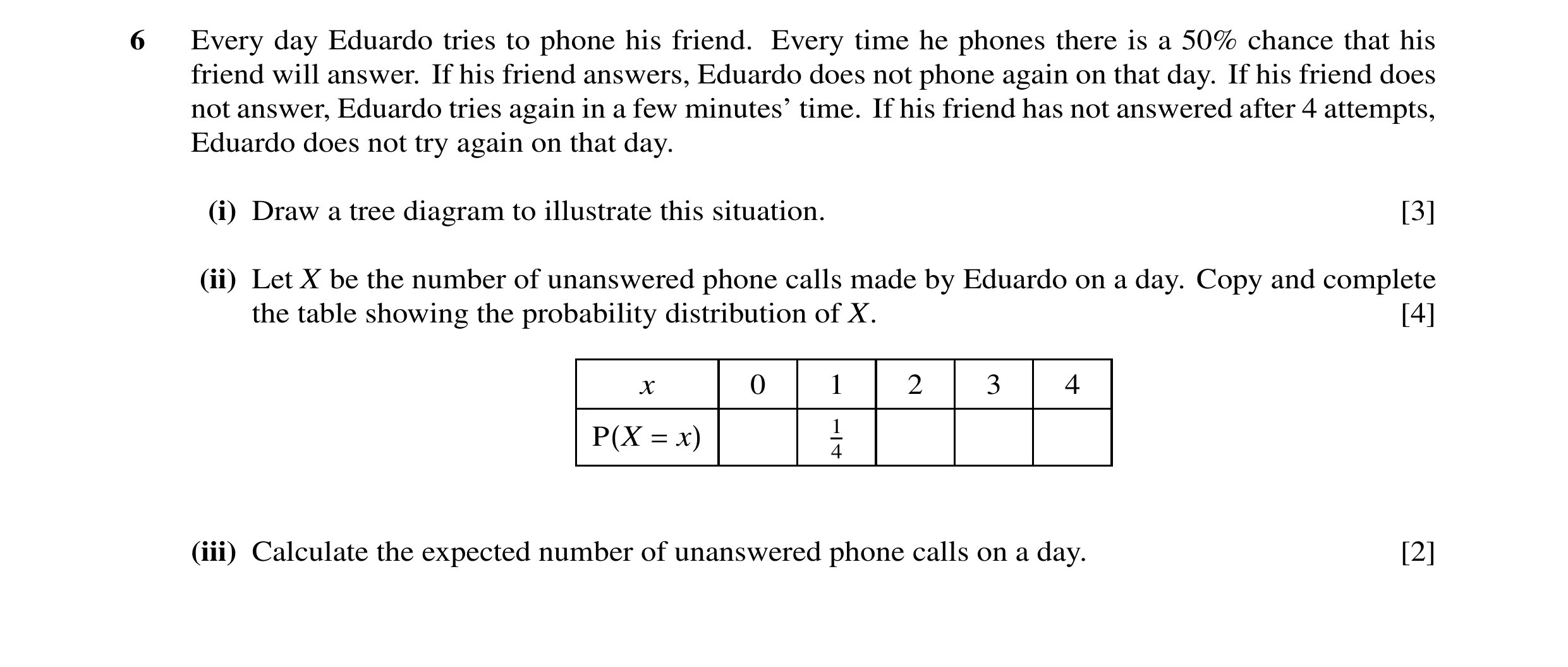
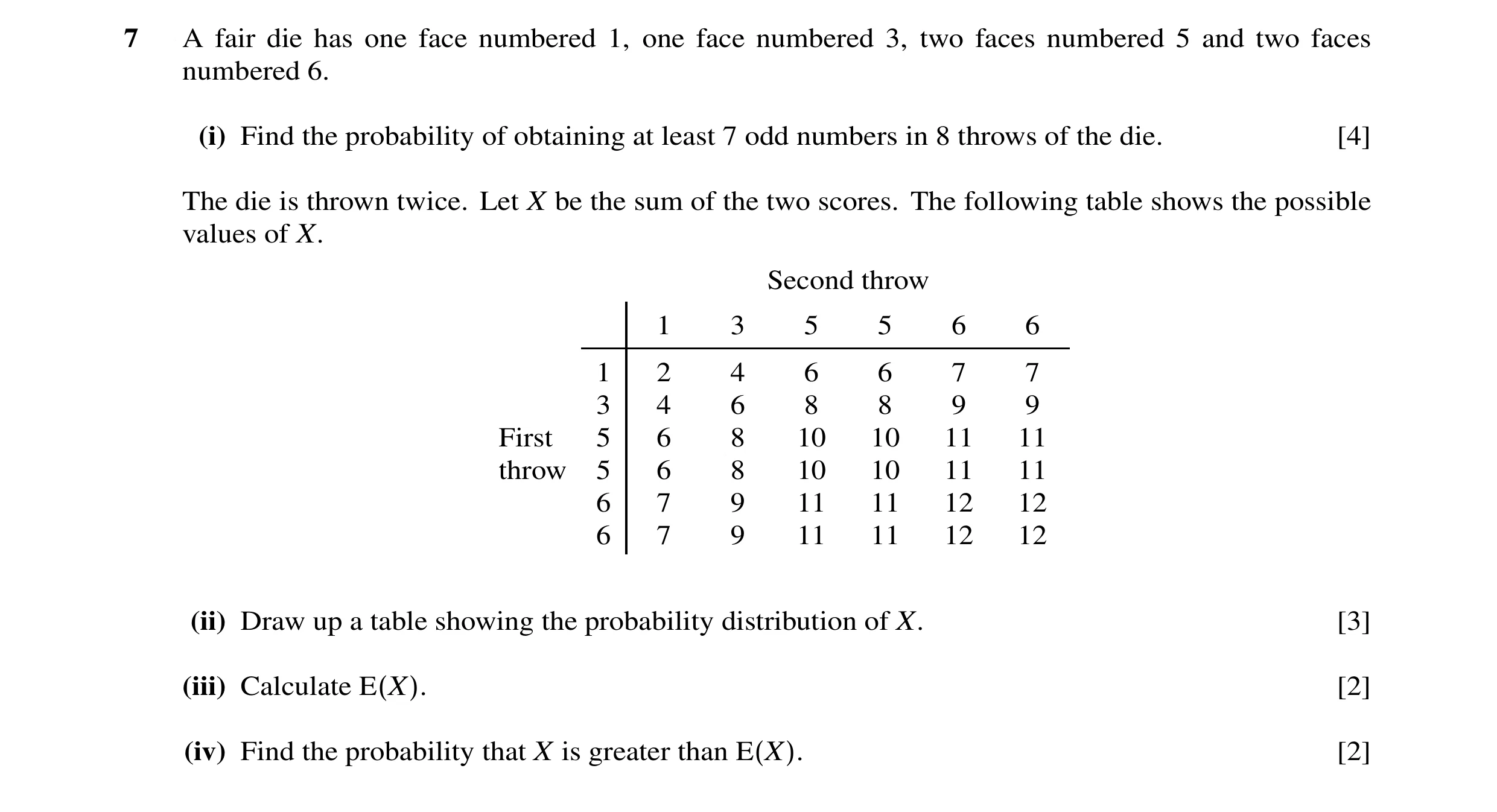 1 / 116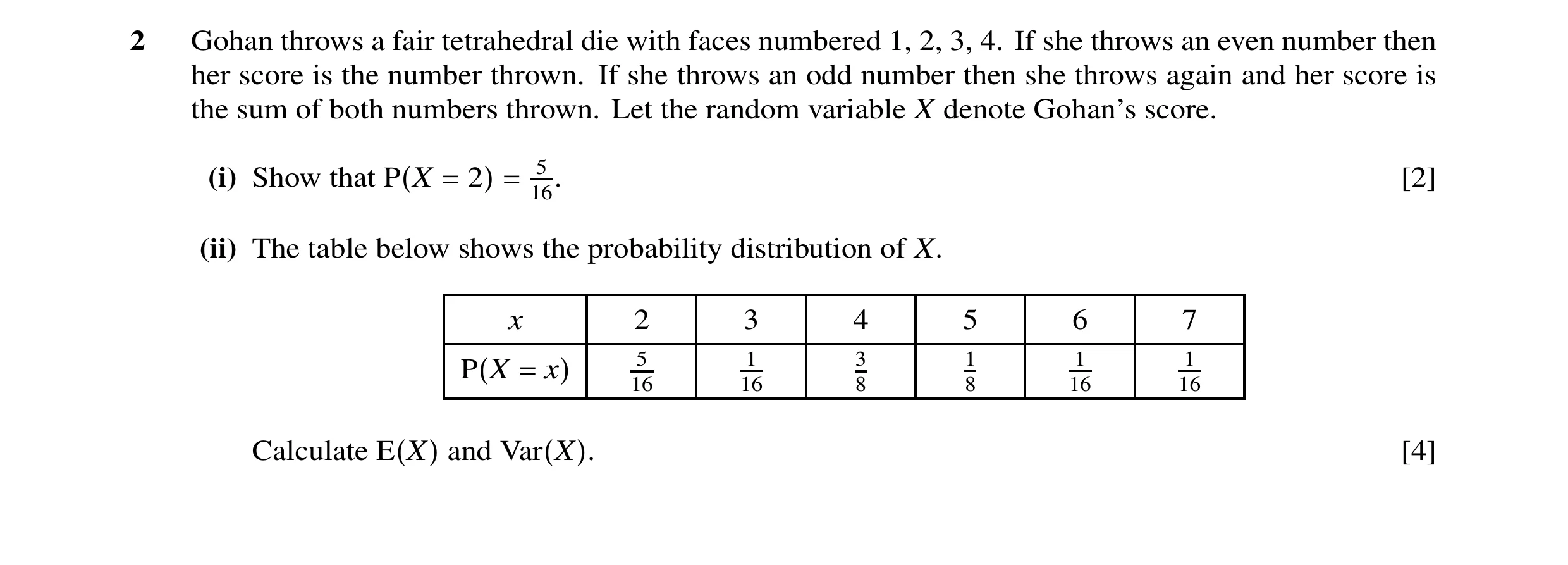

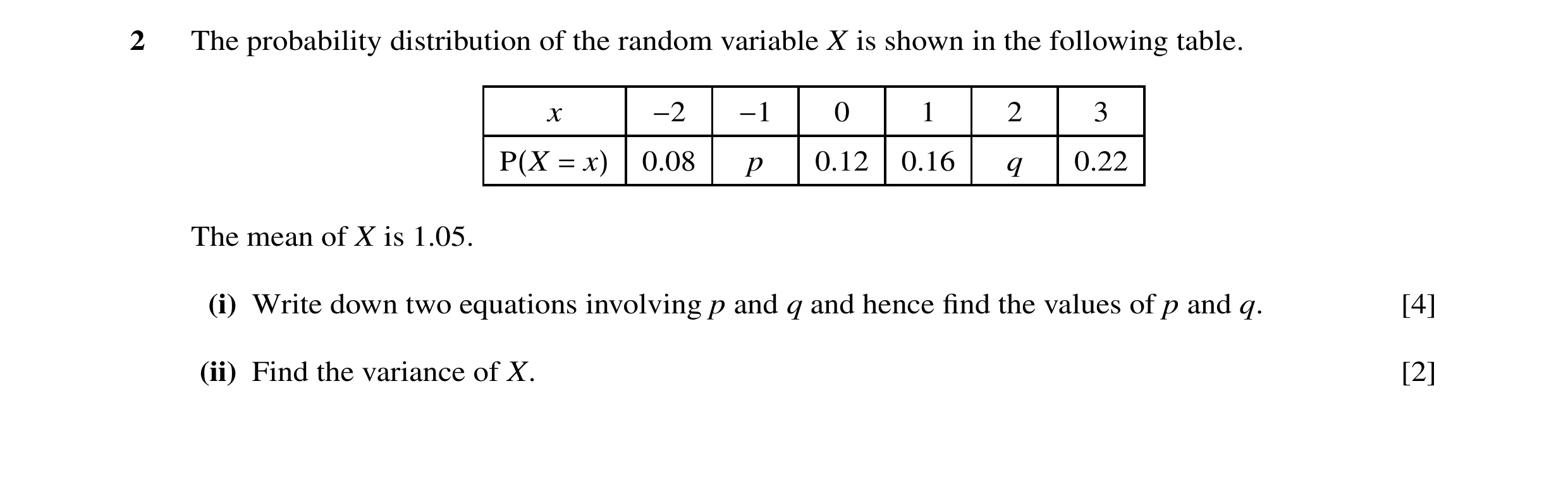
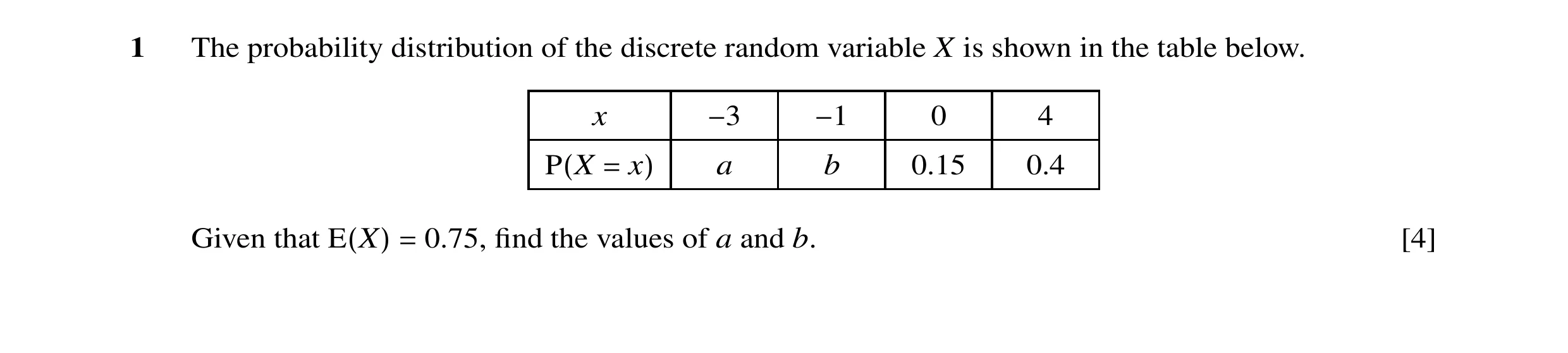 2 / 116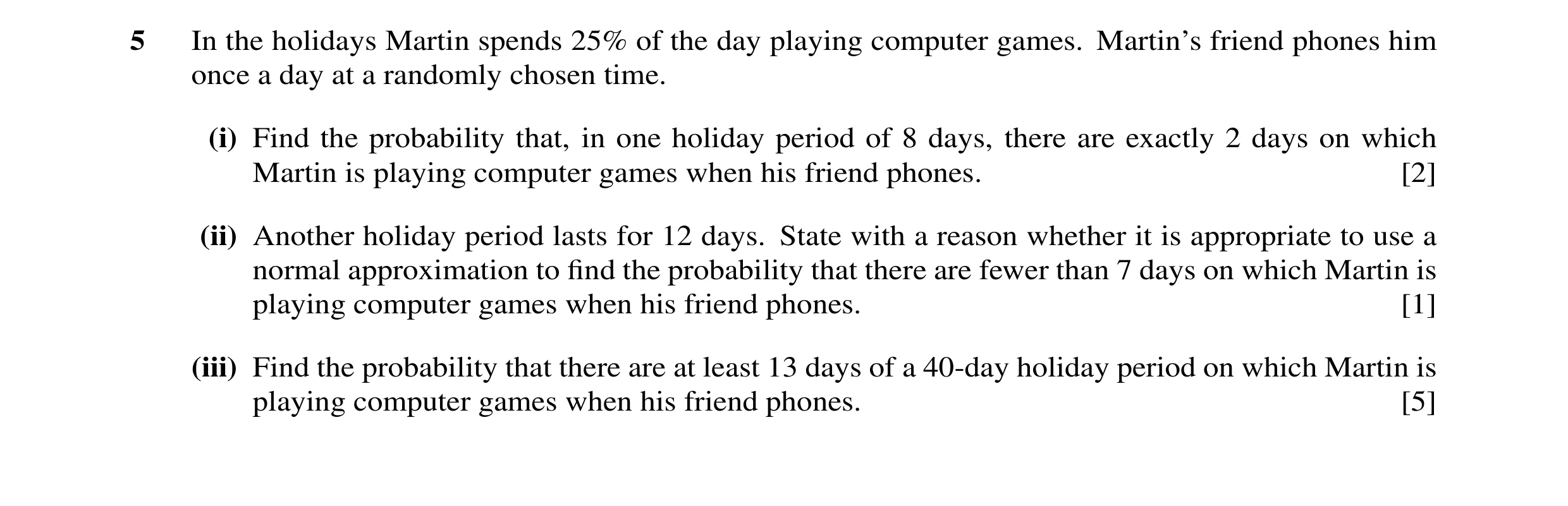
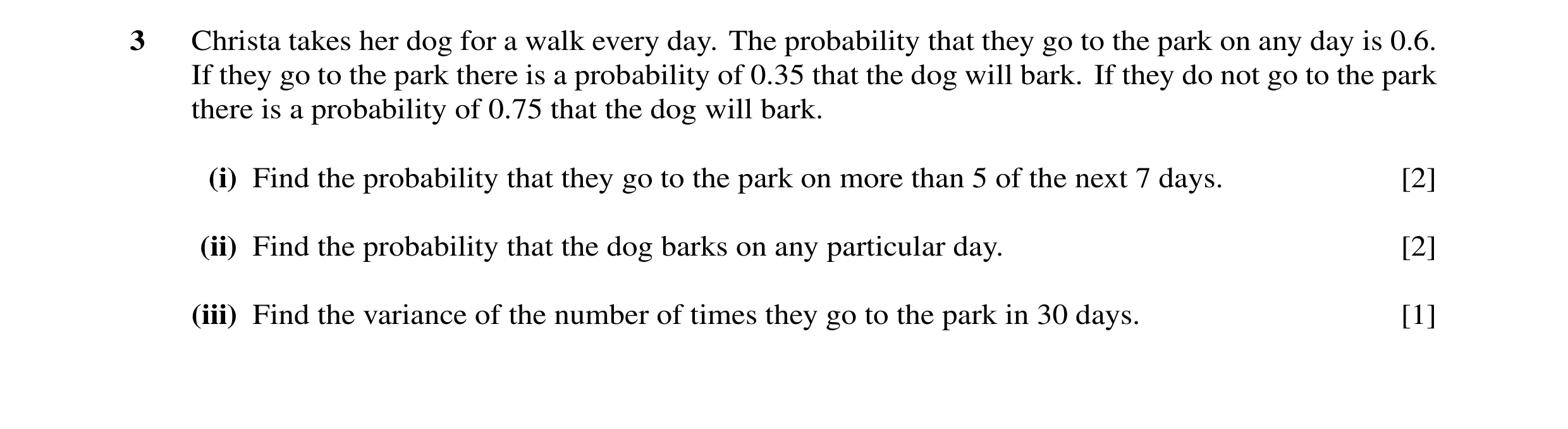
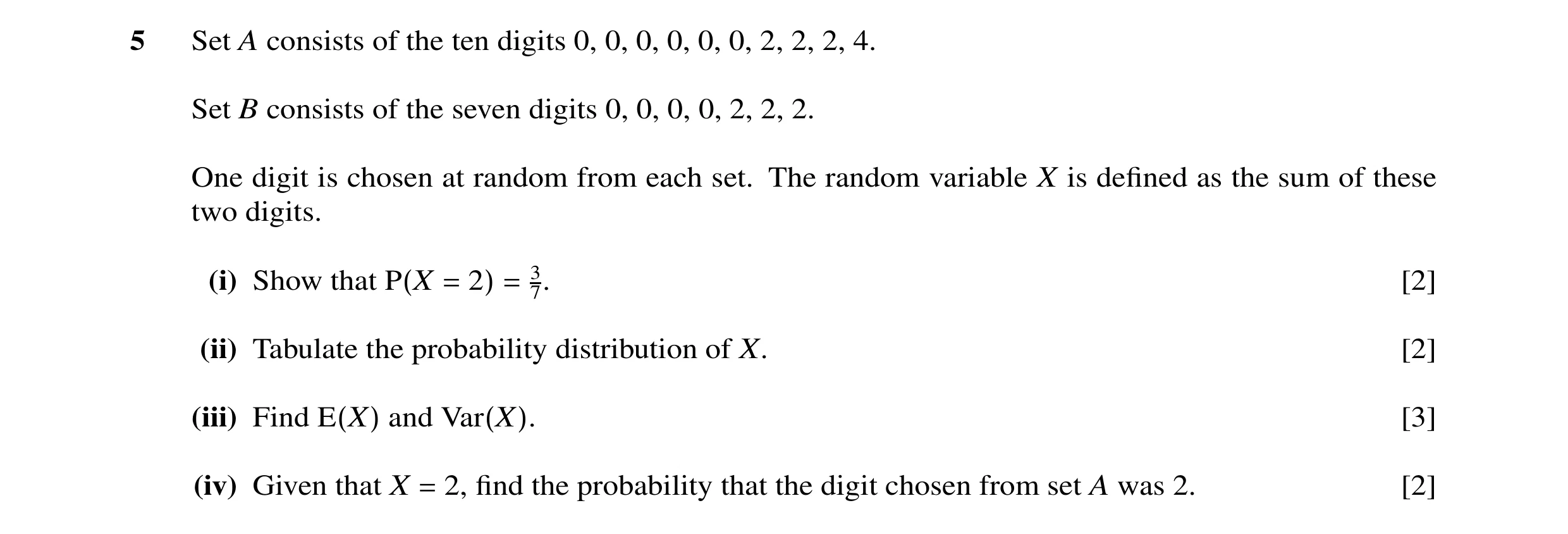
 3 / 116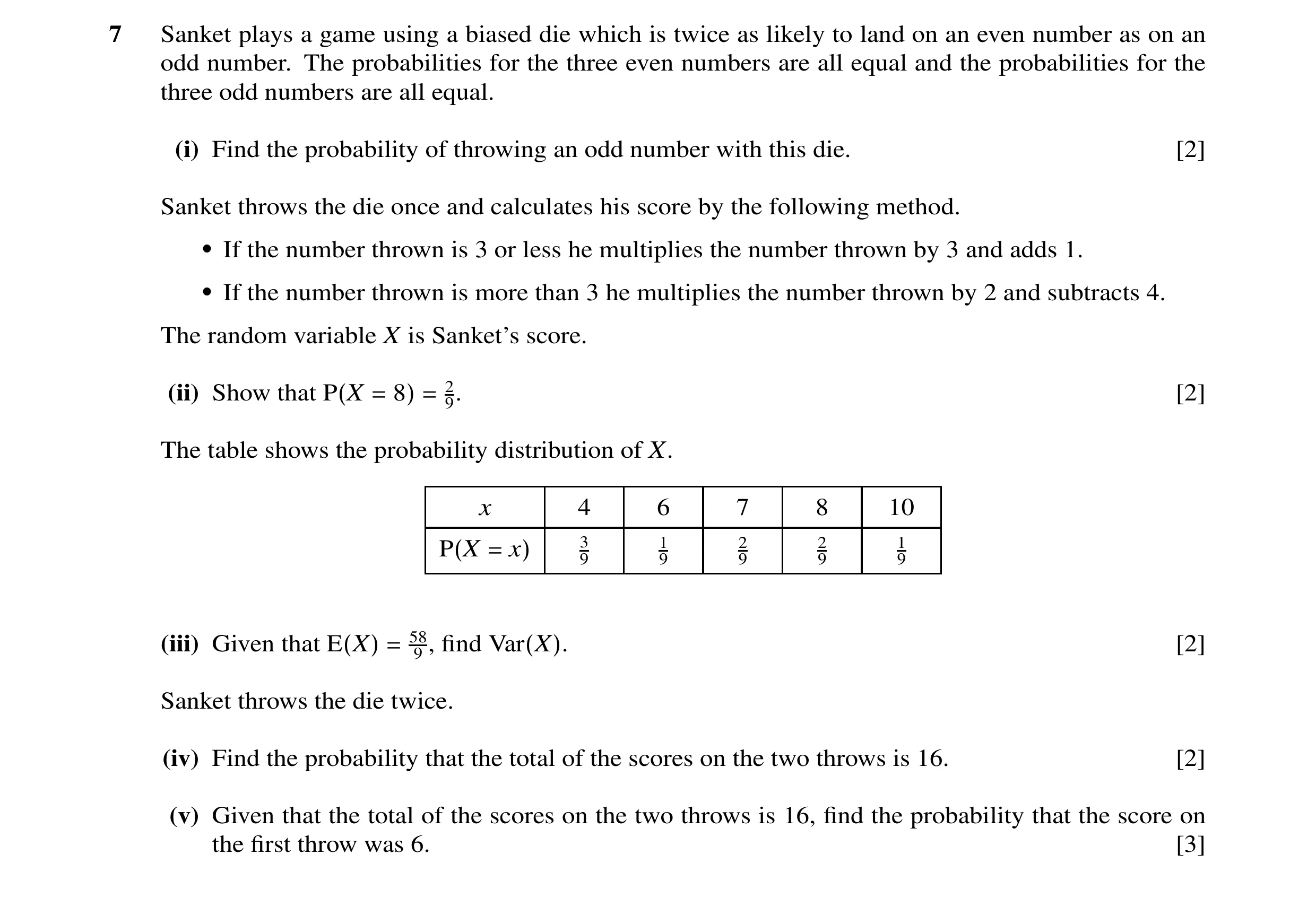
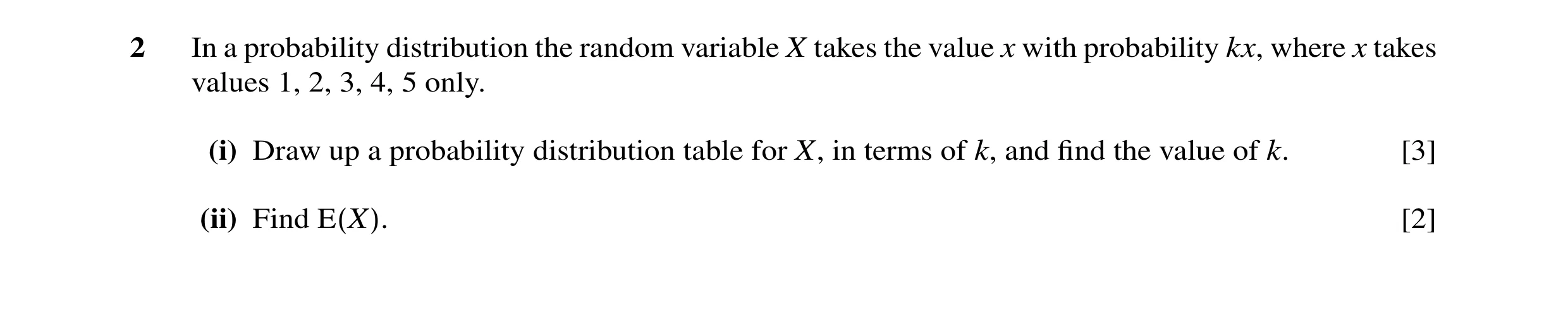
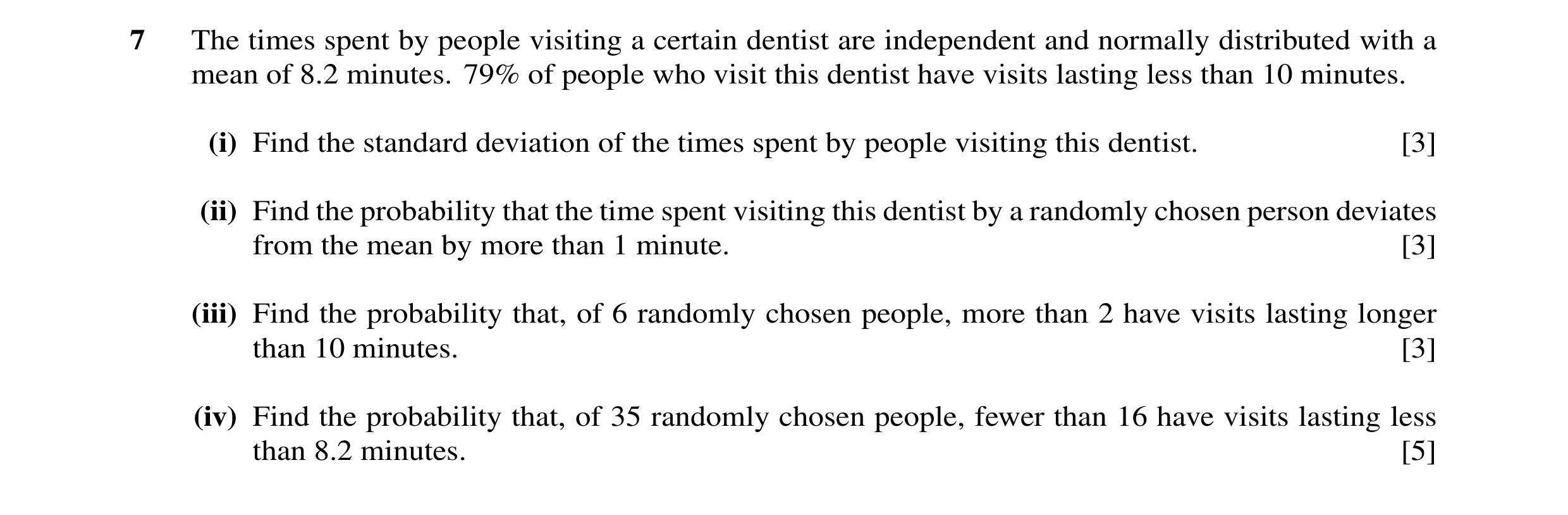 4 / 116

 5 / 116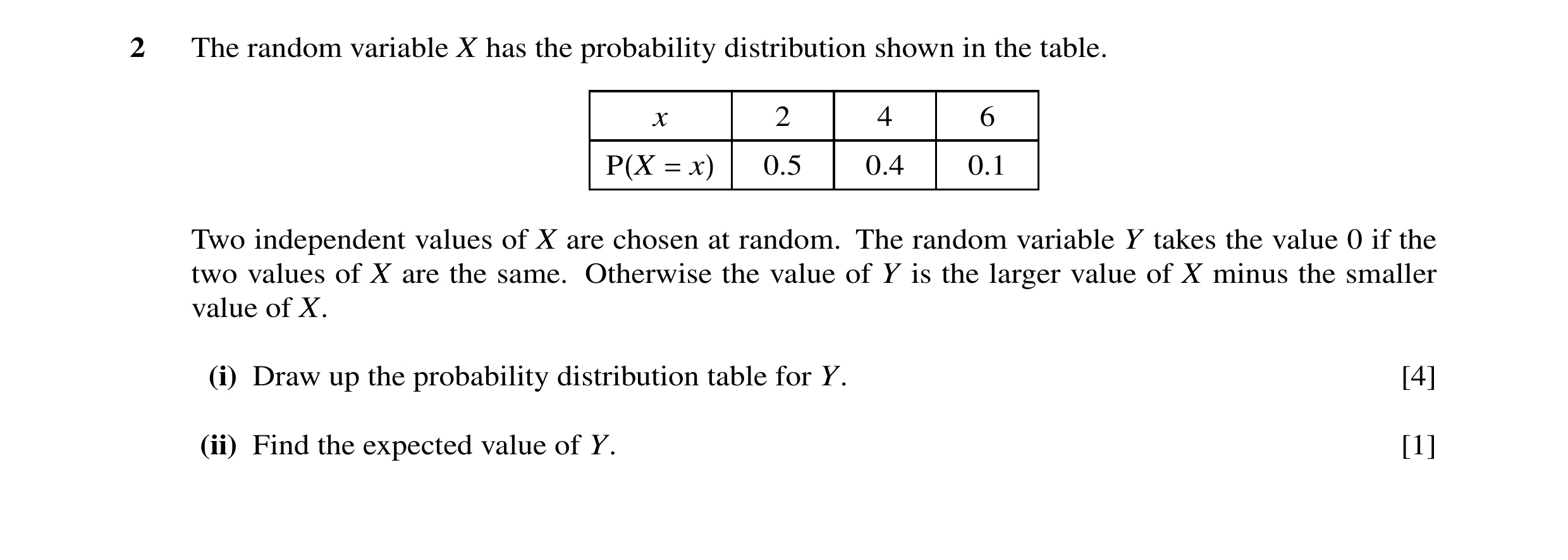
 6 / 116
![Question 27: (i) State three conditions which must be satisfied for a situation to be modelled by a binomial distribution. [2] George wants to invest som…](https://img.pastlit.com/crops/c5e9aabf-e647-40a9-b653-0546cab48c2b/q3.webp) 7 / 116
7 / 116
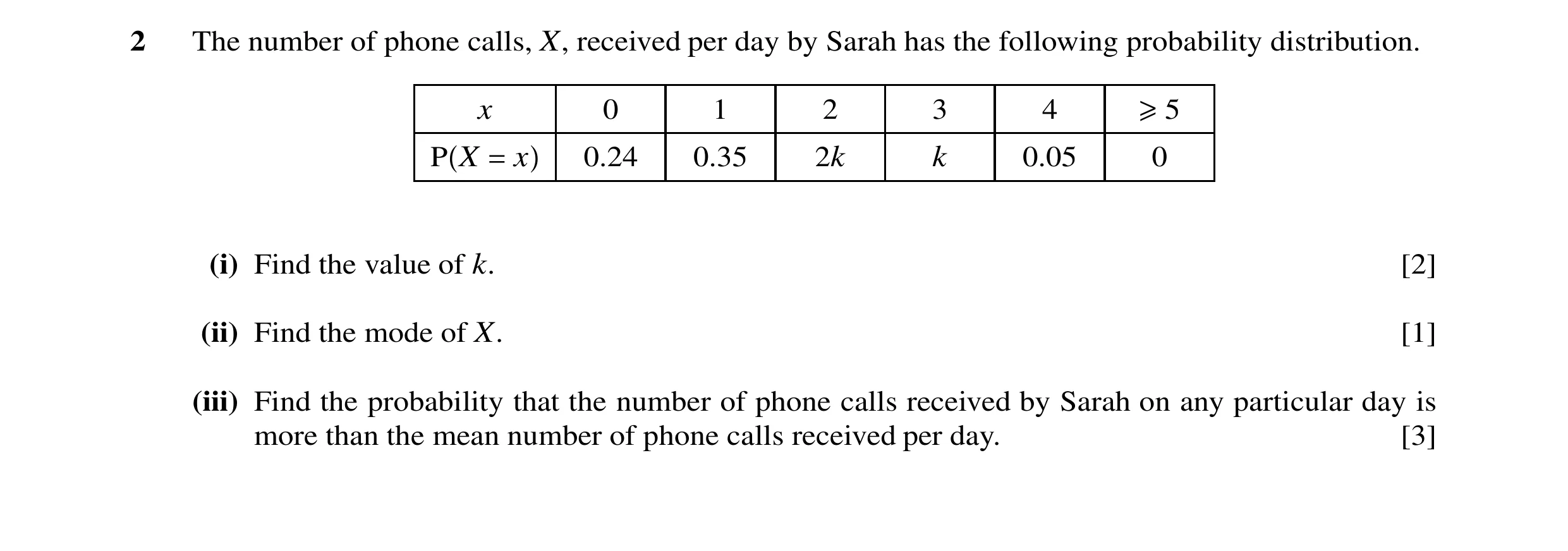
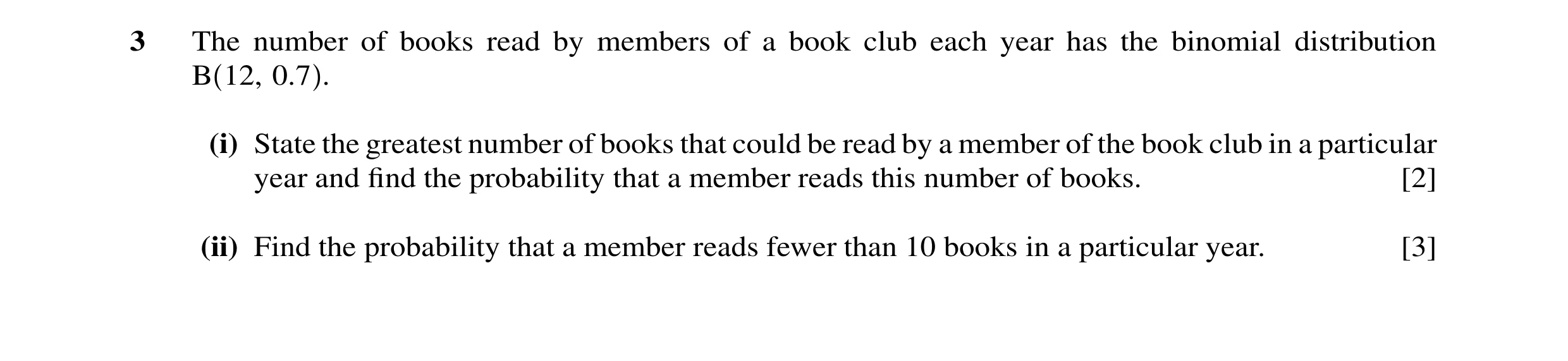

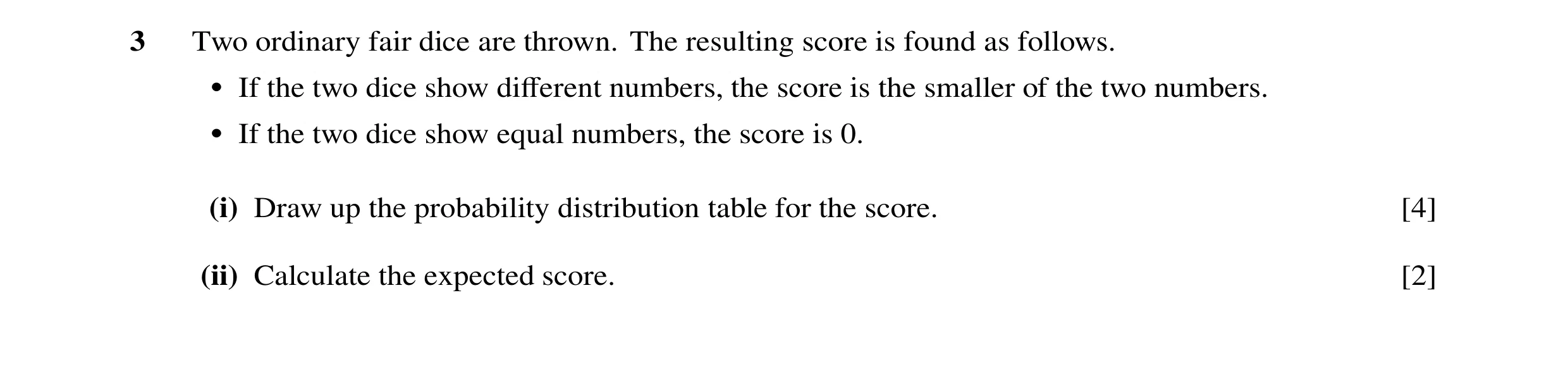 8 / 116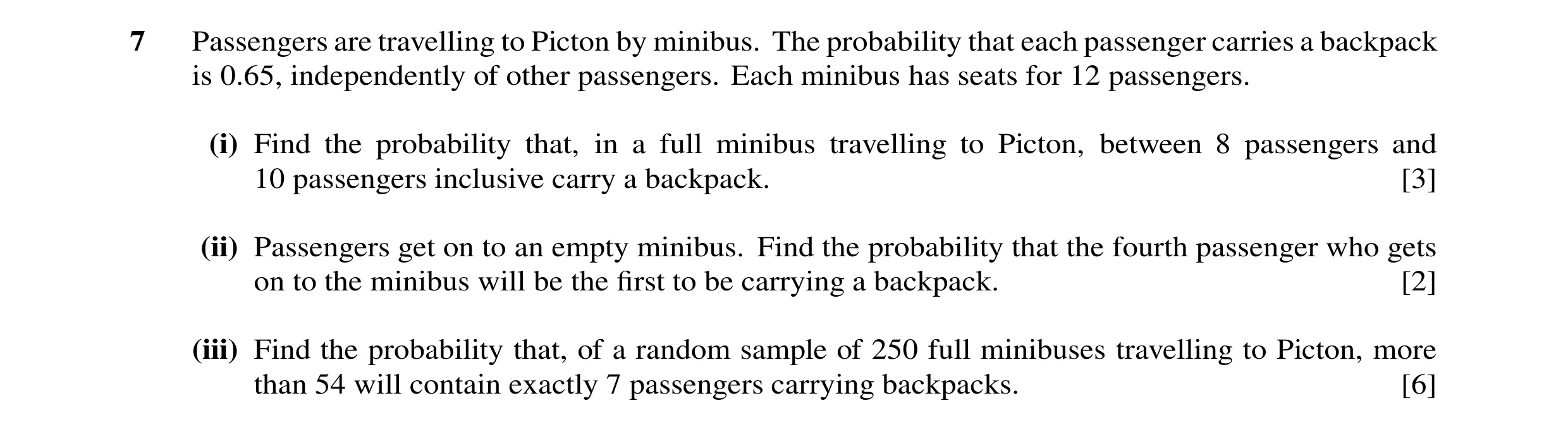
 9 / 116
 12 / 116
 15 / 116
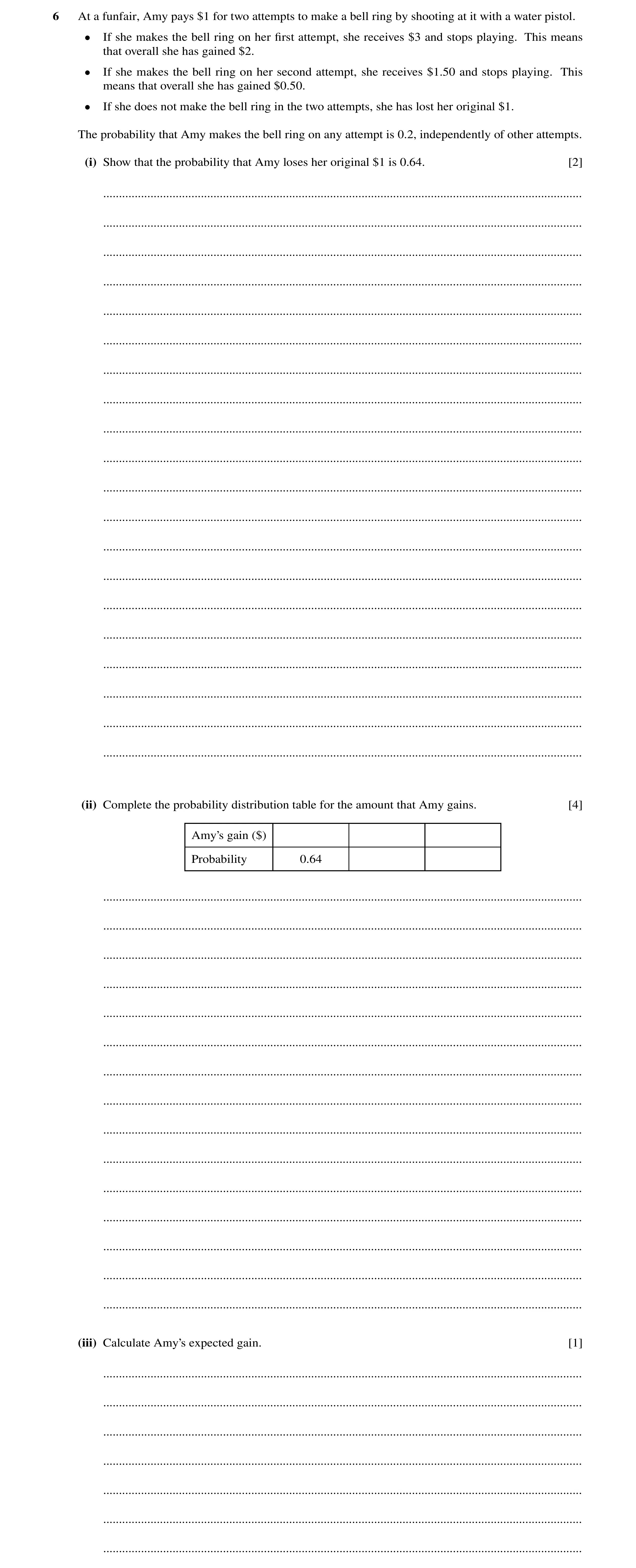
 23 / 116
 28 / 116
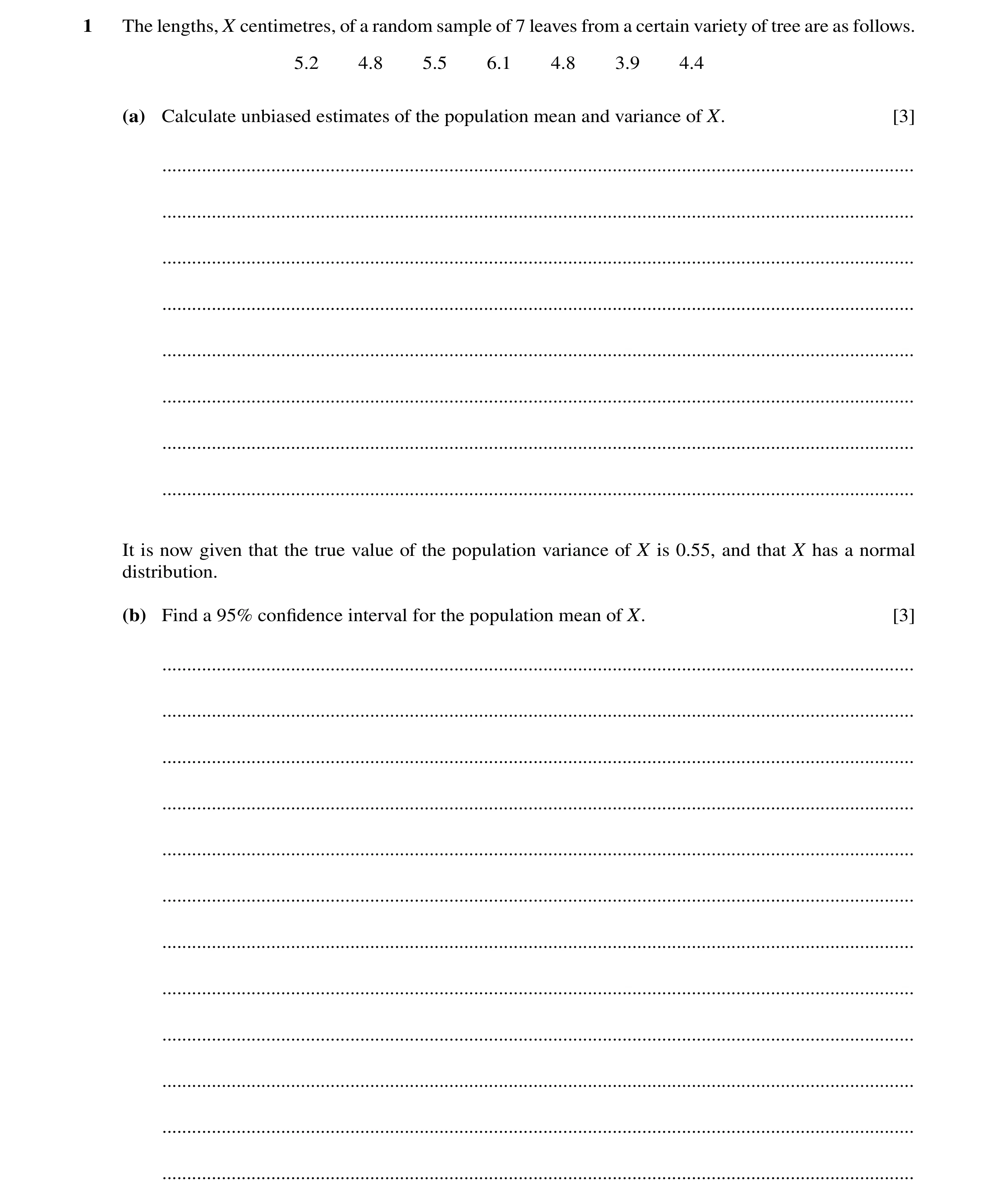 31 / 116
 46 / 116
 47 / 116
 52 / 116
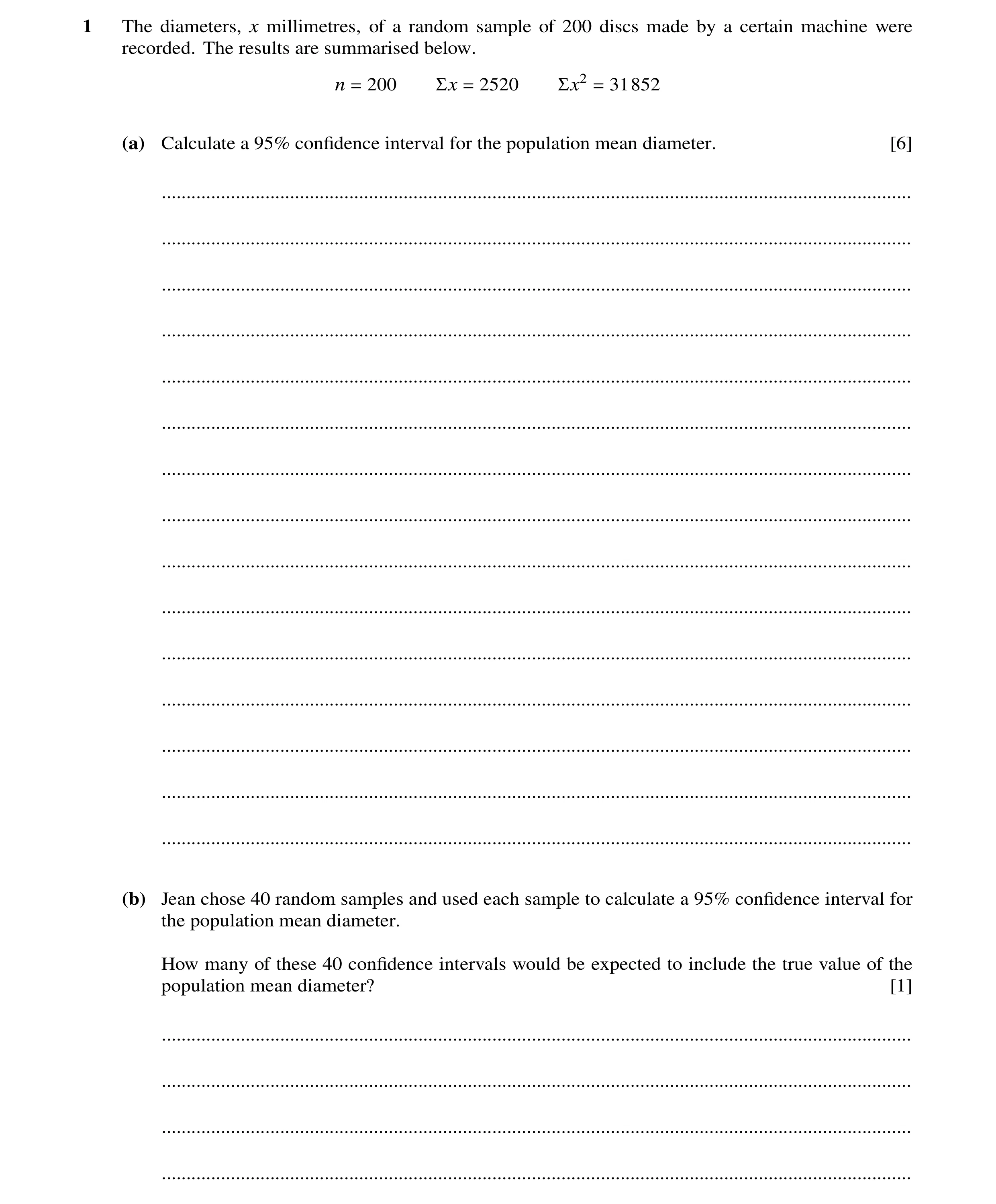 53 / 116
 56 / 116
 61 / 116
 64 / 116
 65 / 116
 66 / 116
 67 / 116
 68 / 116
 73 / 116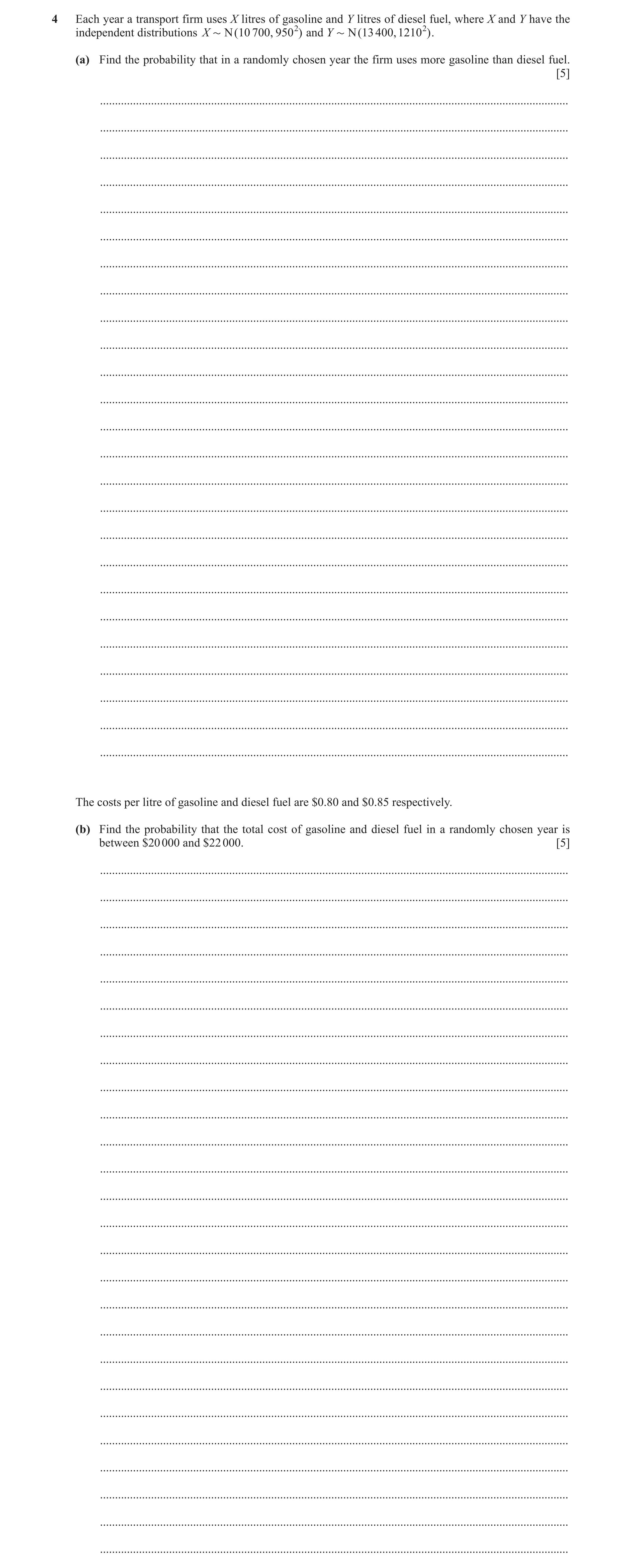
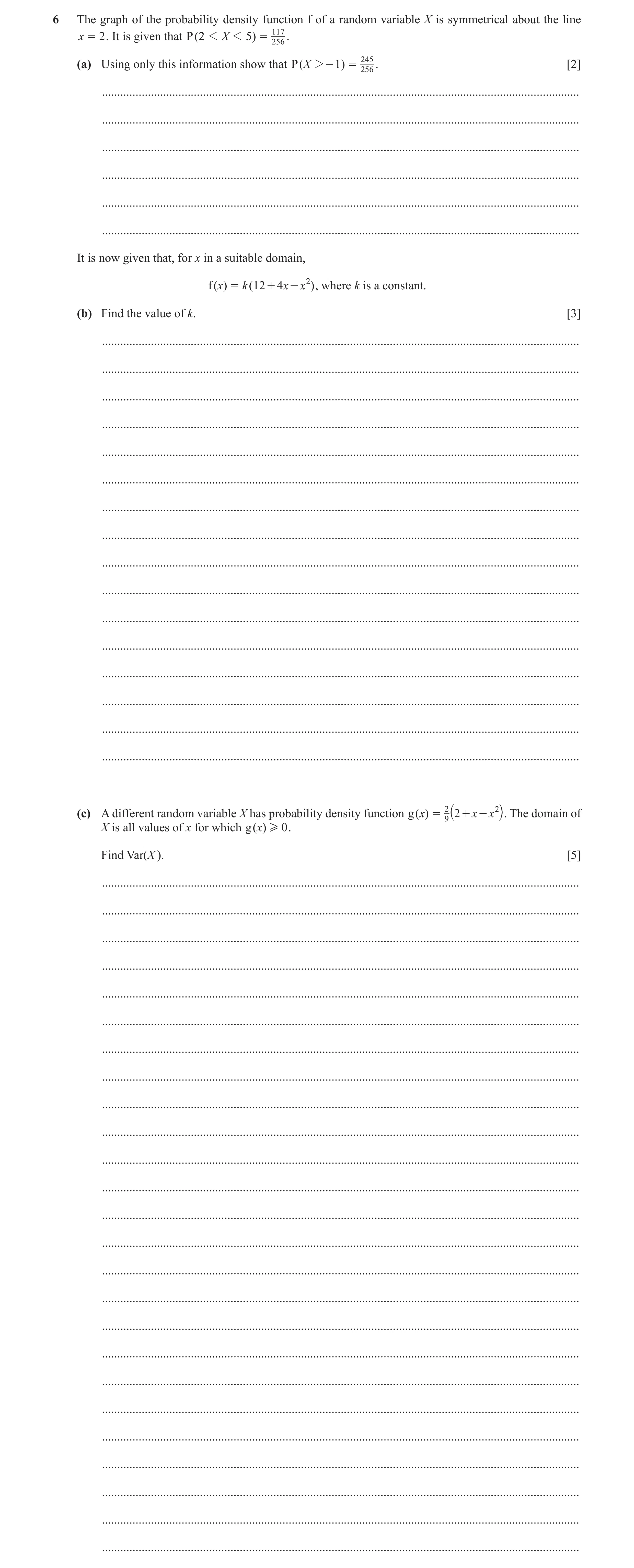
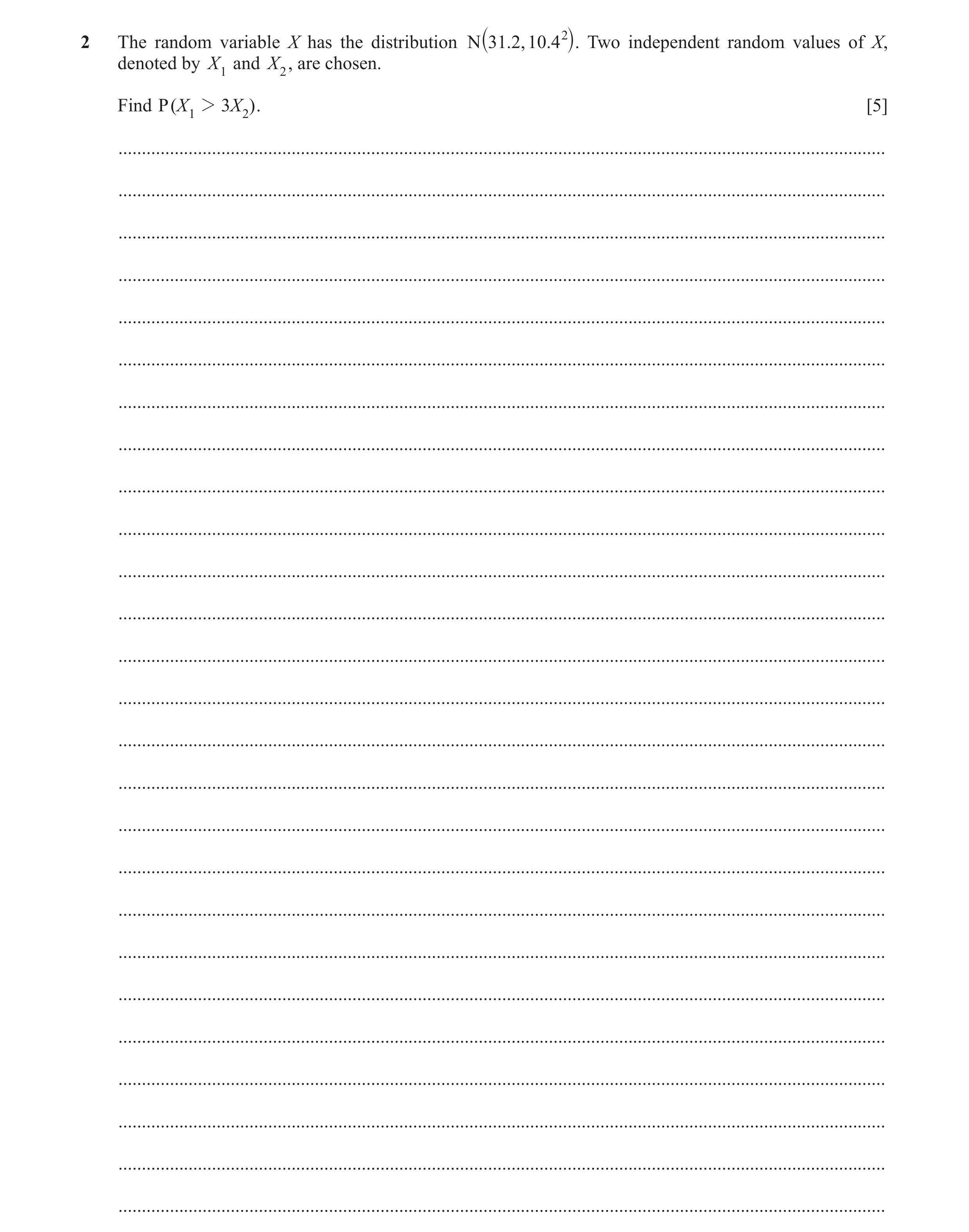 78 / 116
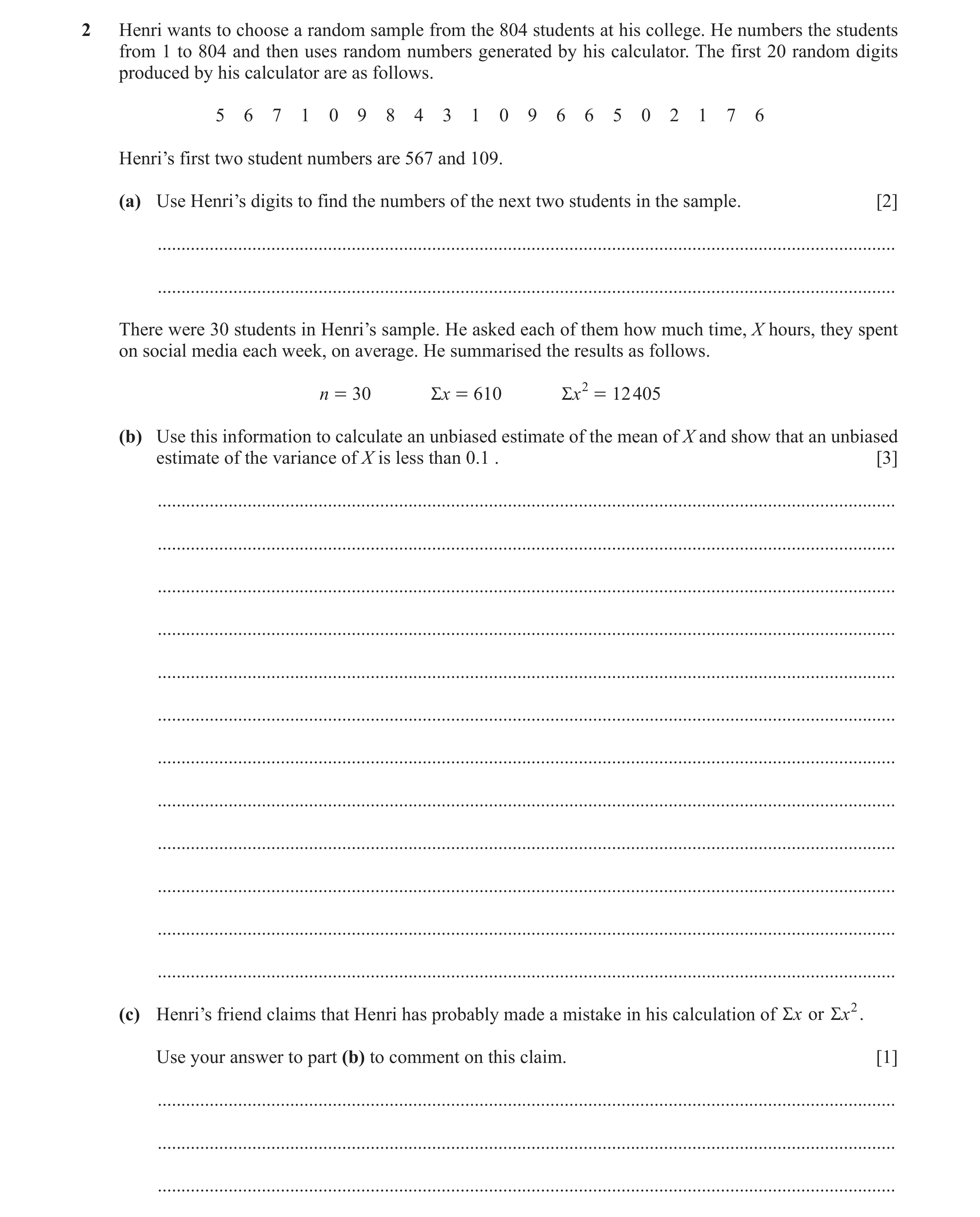 79 / 116
 80 / 116
![Question 83: The random variable X has the distribution B ( 4000 , 0.001) . (a) Use a suitable approximating distribution to find P ( 2 G X 1 5 ) . [3] …](https://img.pastlit.com/crops/e606ea69-e120-4006-946c-198bf33e3e7d/q1.webp) 81 / 116
81 / 116 82 / 116
 83 / 116
 84 / 116
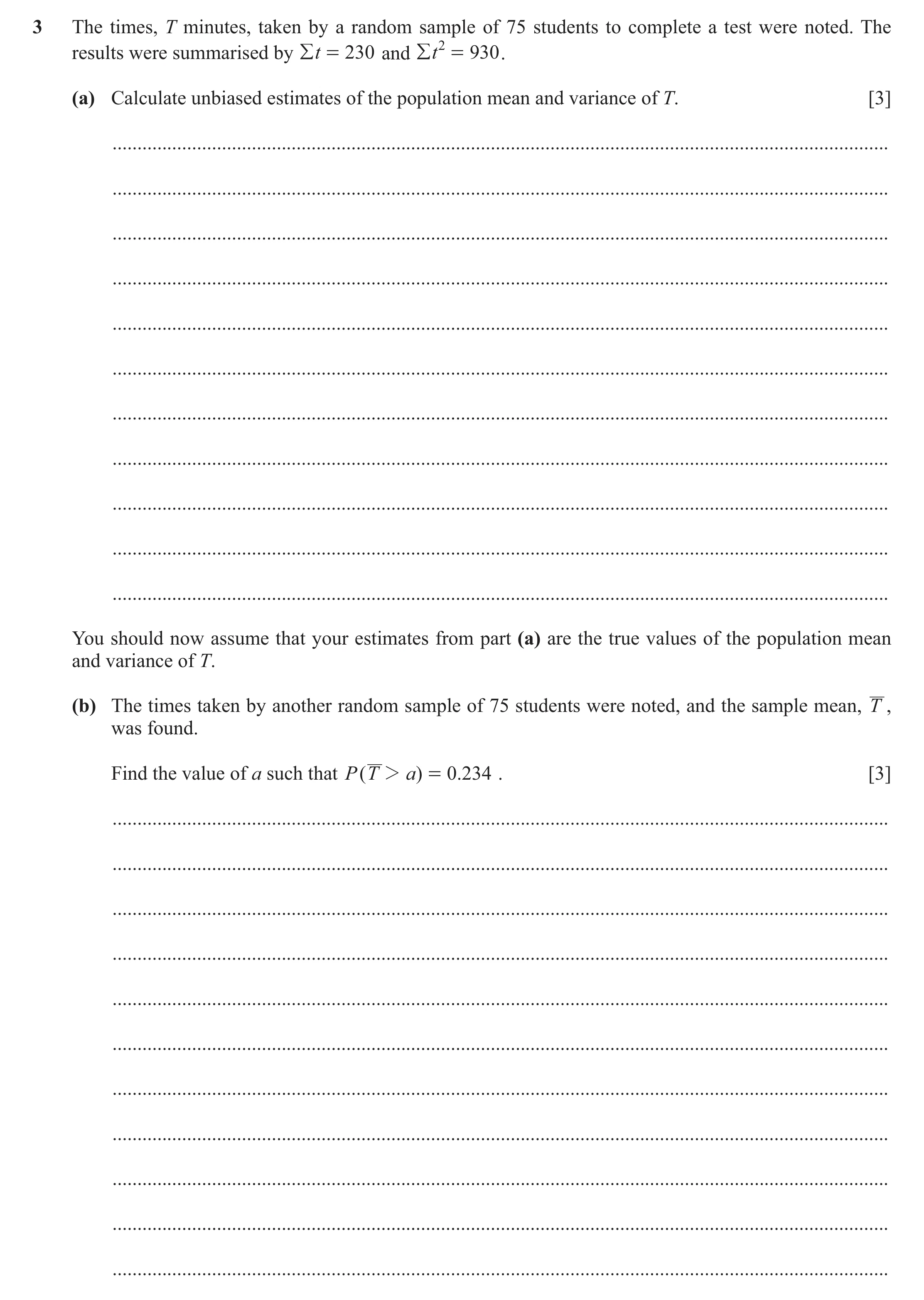 85 / 116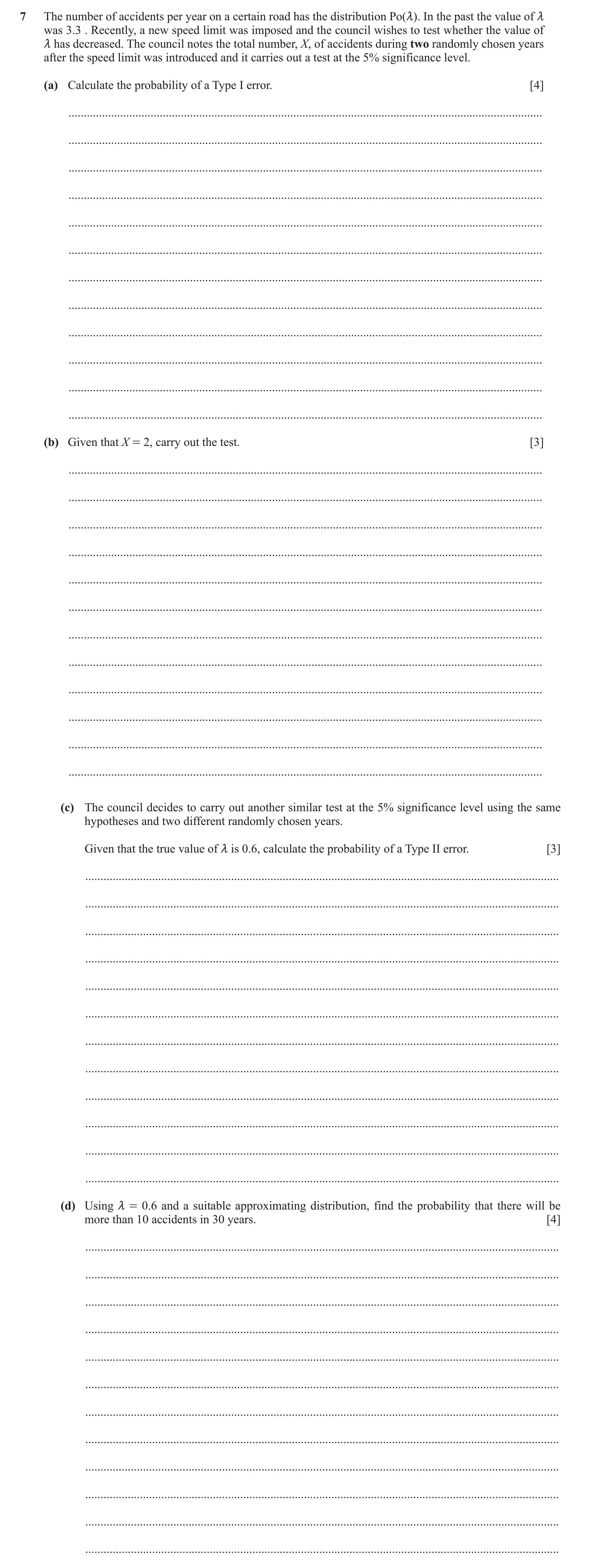
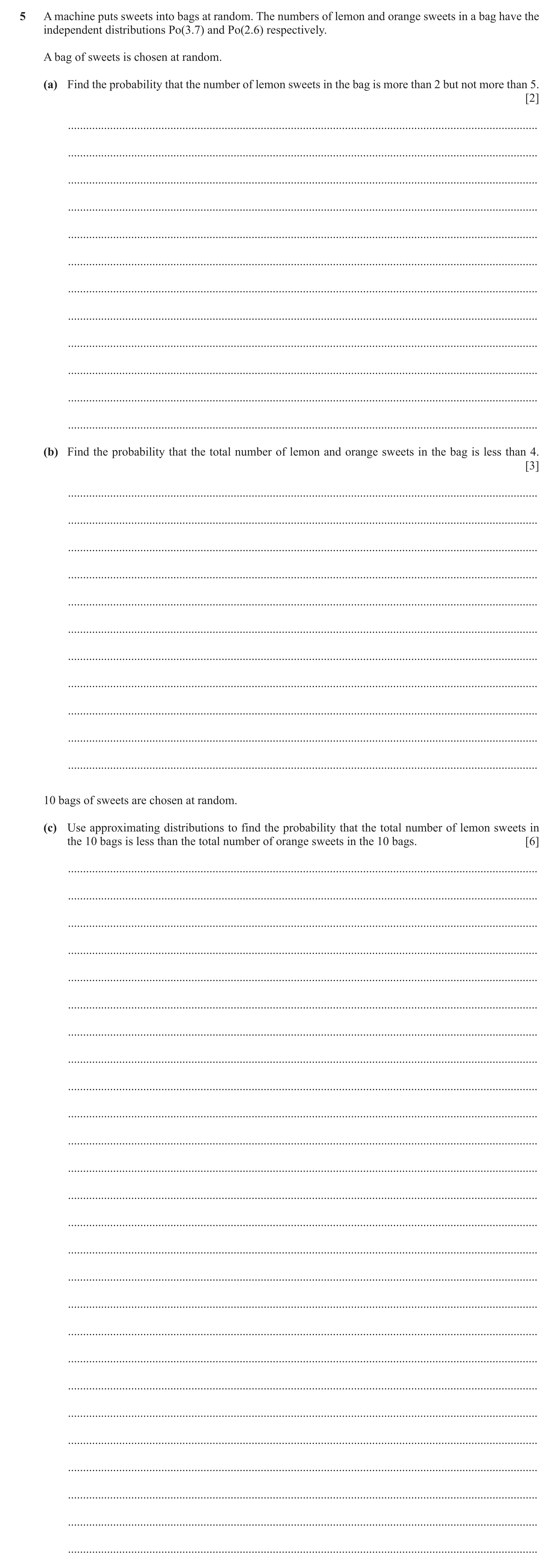
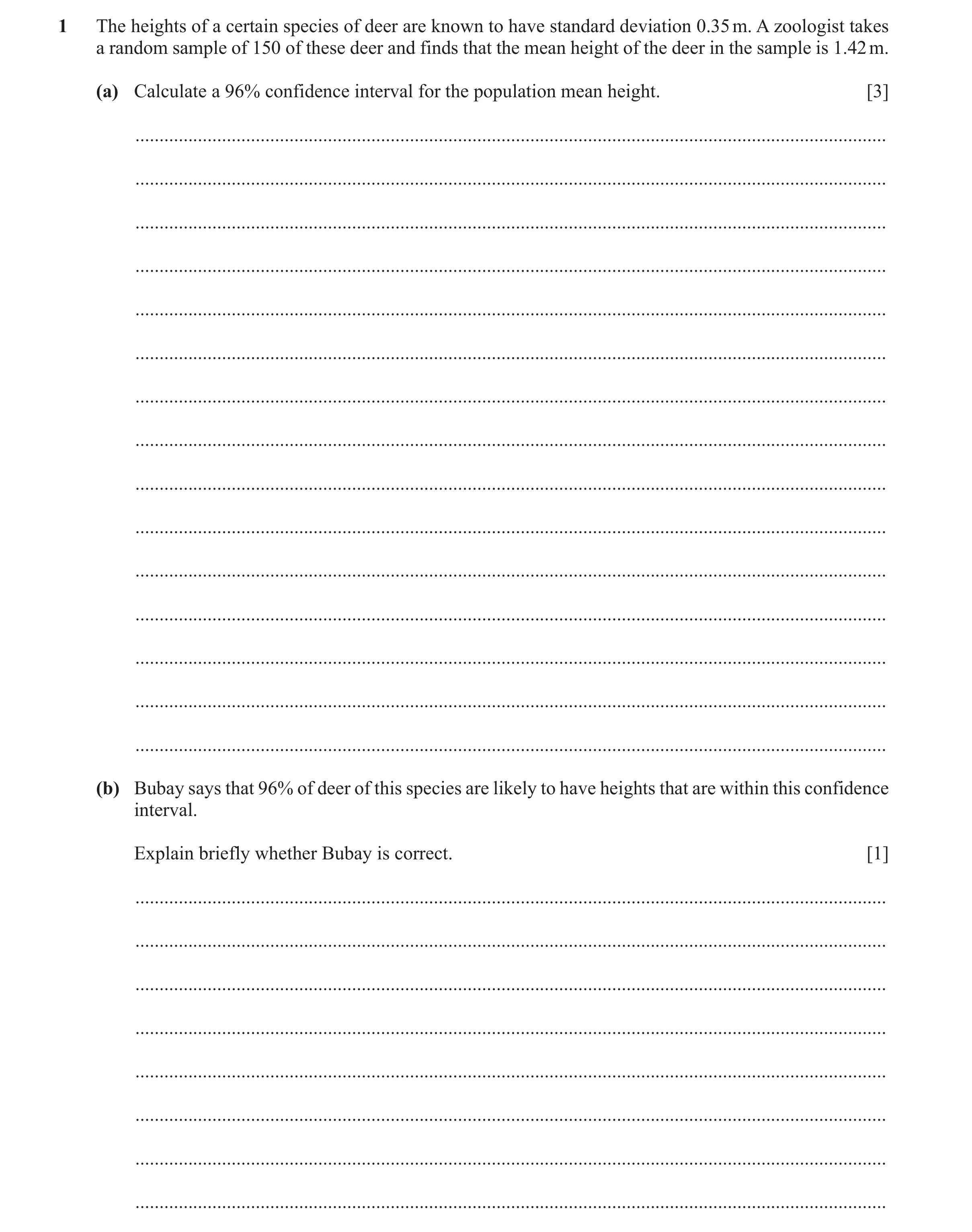 90 / 116
 91 / 116
![Question 92: The random variables X and Y have the independent distributions N(44, 16) and N(30, 9) respectively. Find P ( X - Y 1 15) . [5] ...........…](https://img.pastlit.com/crops/99cffce1-152a-4069-a2d9-91017d774b70/q1.webp) 92 / 116
92 / 116
 97 / 116
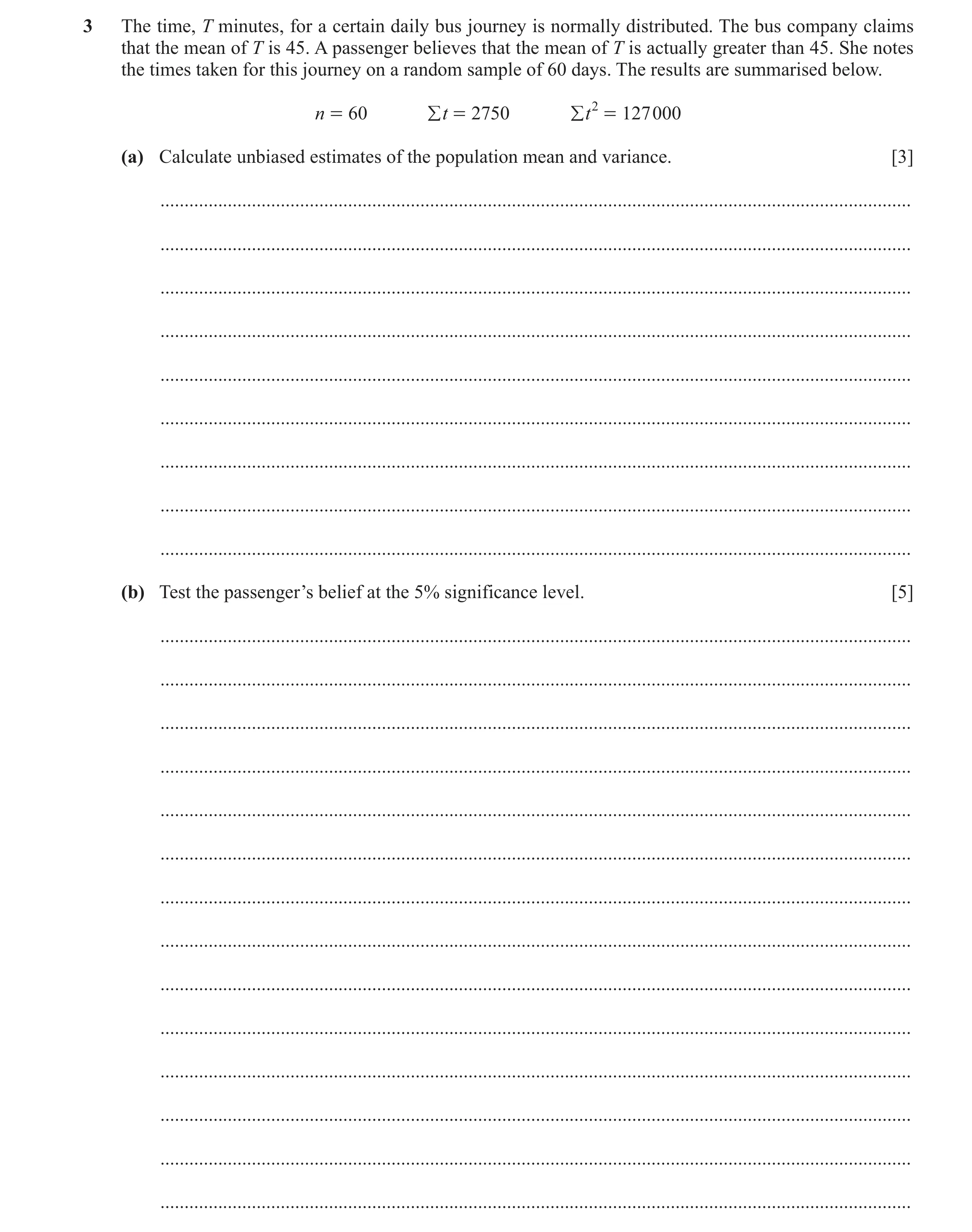 98 / 116
 99 / 116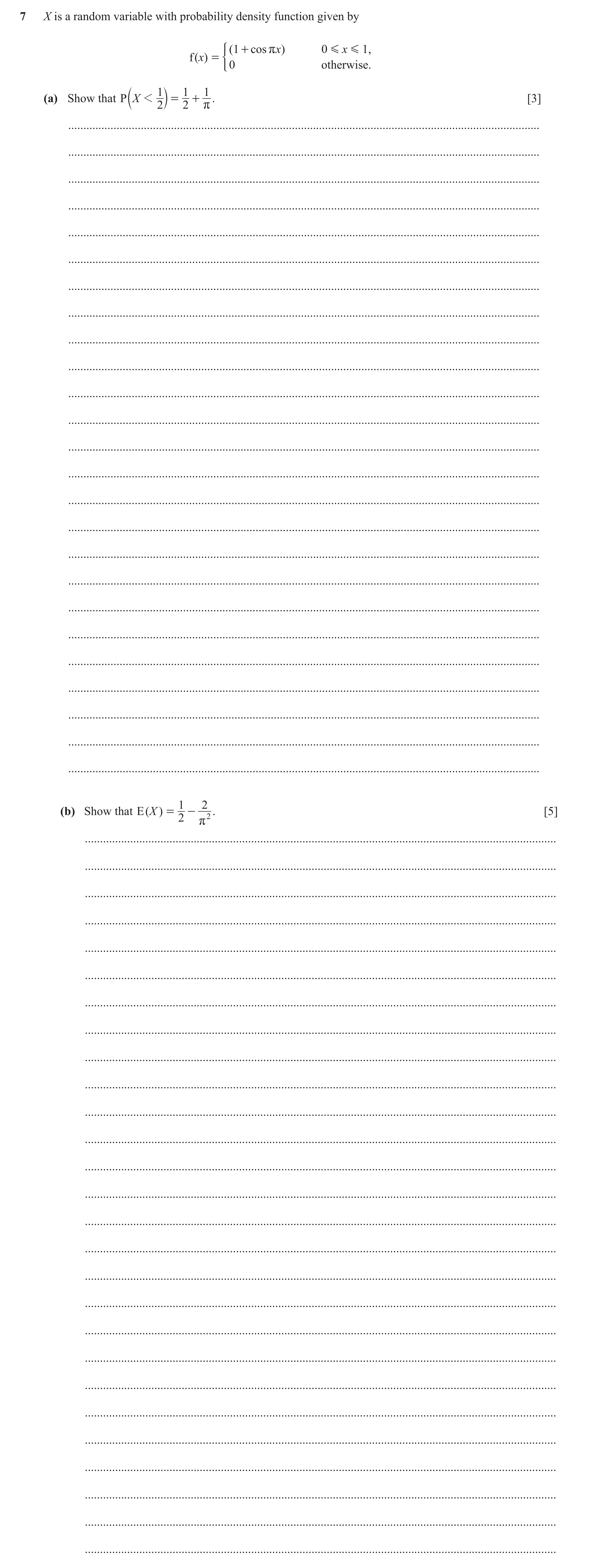
 102 / 116
 103 / 116
 104 / 116
 105 / 116
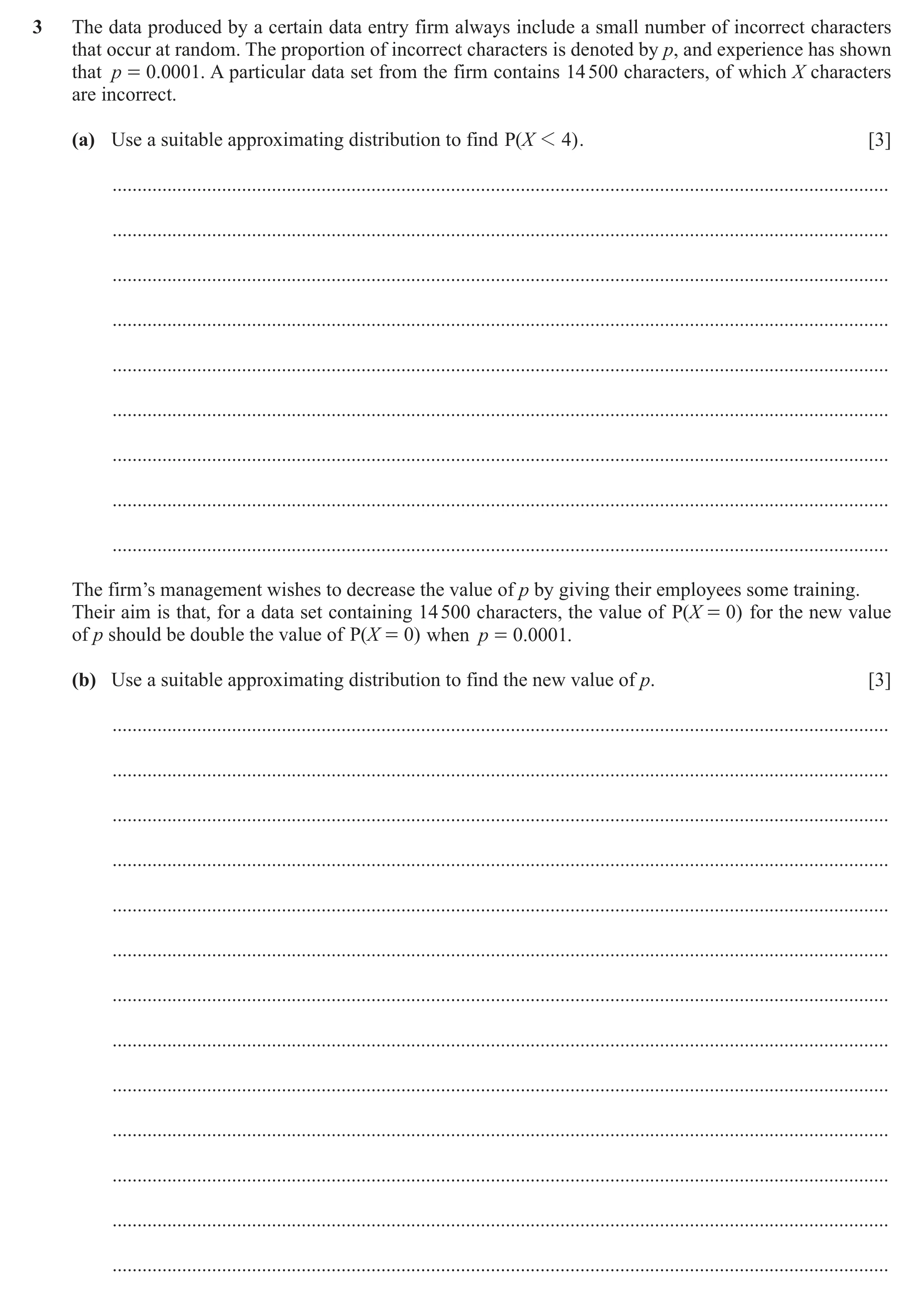 108 / 116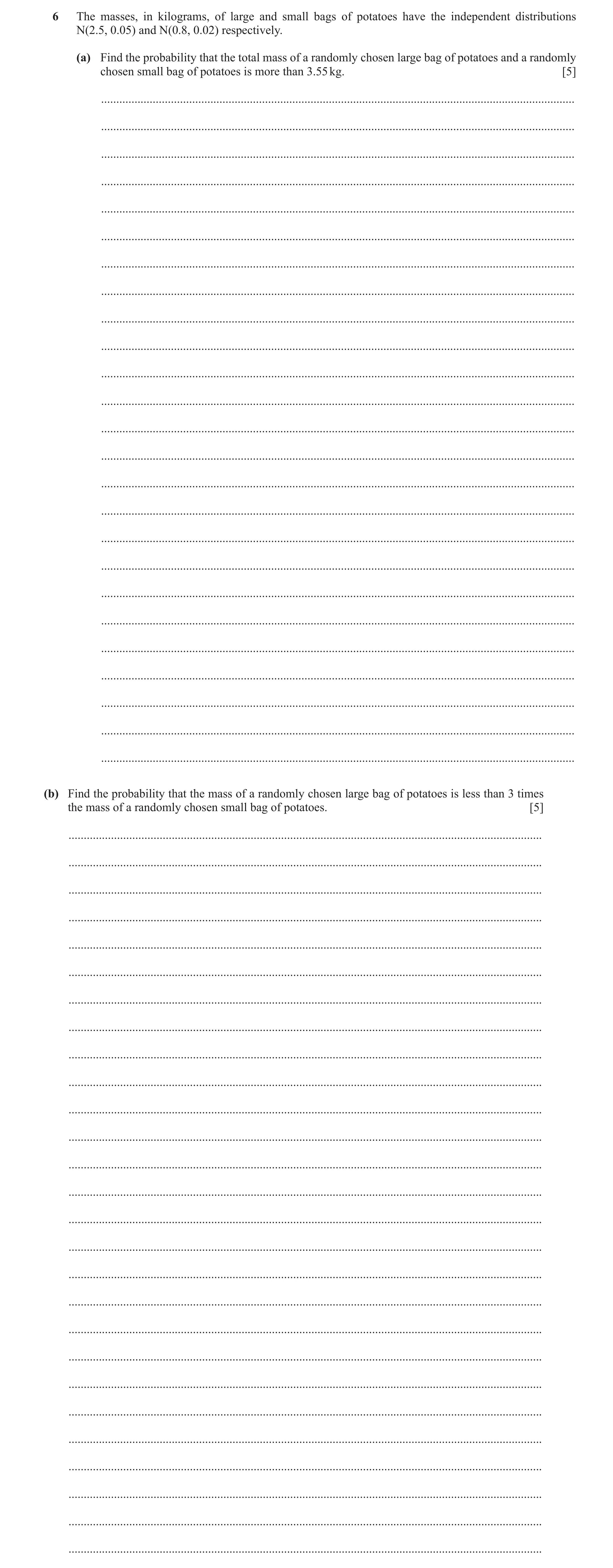
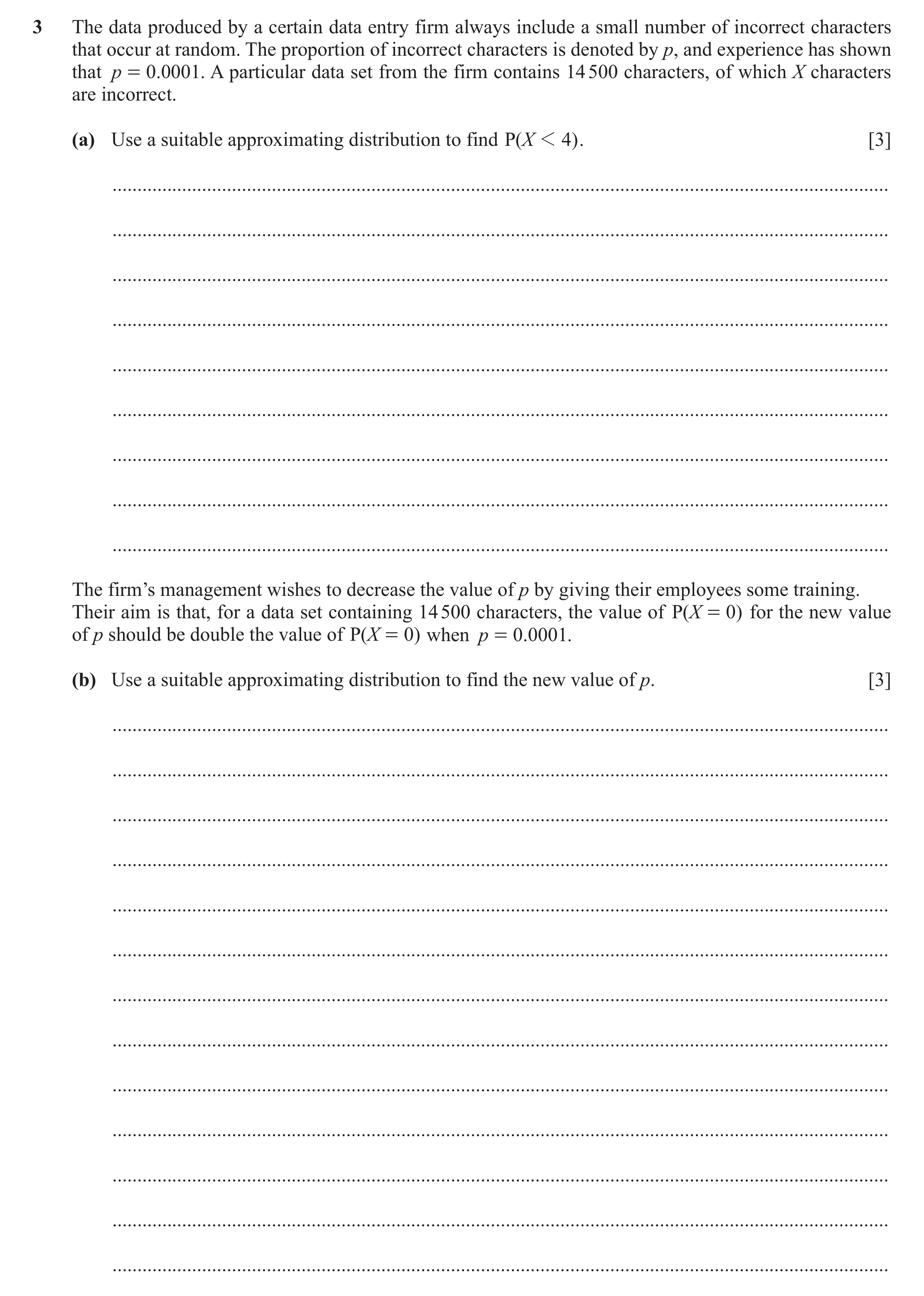 111 / 116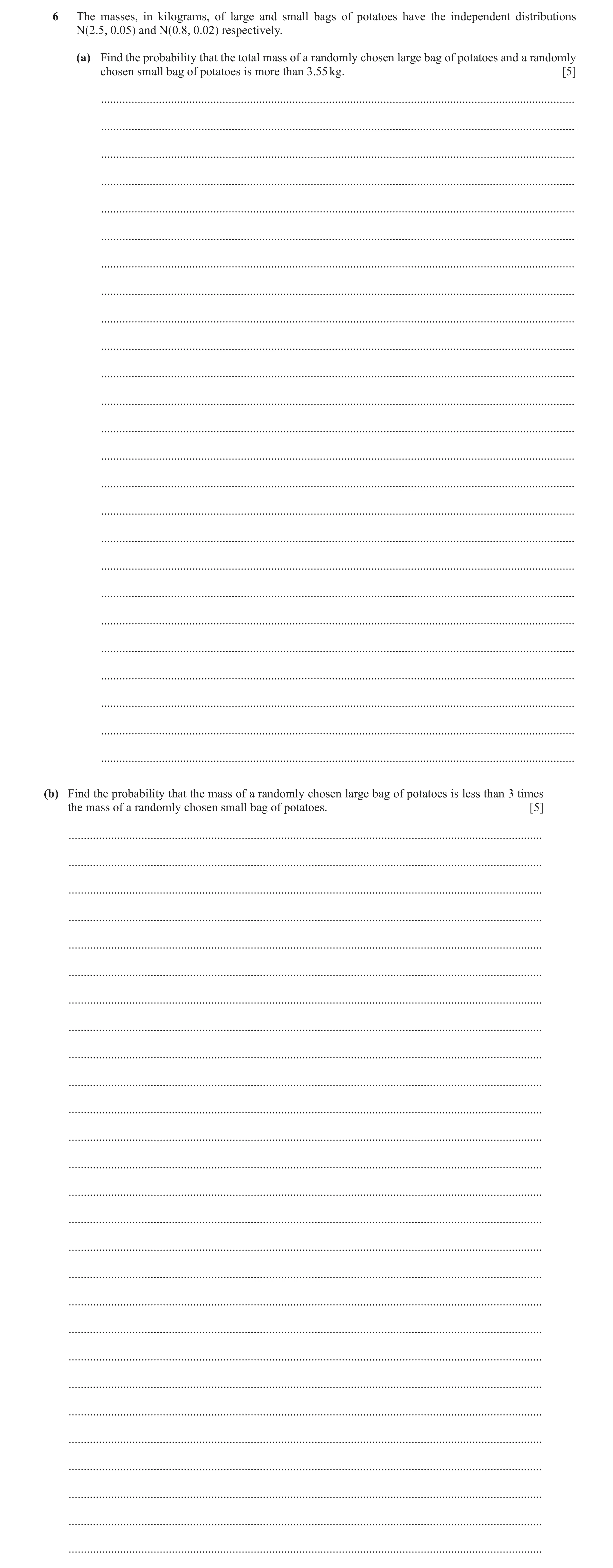
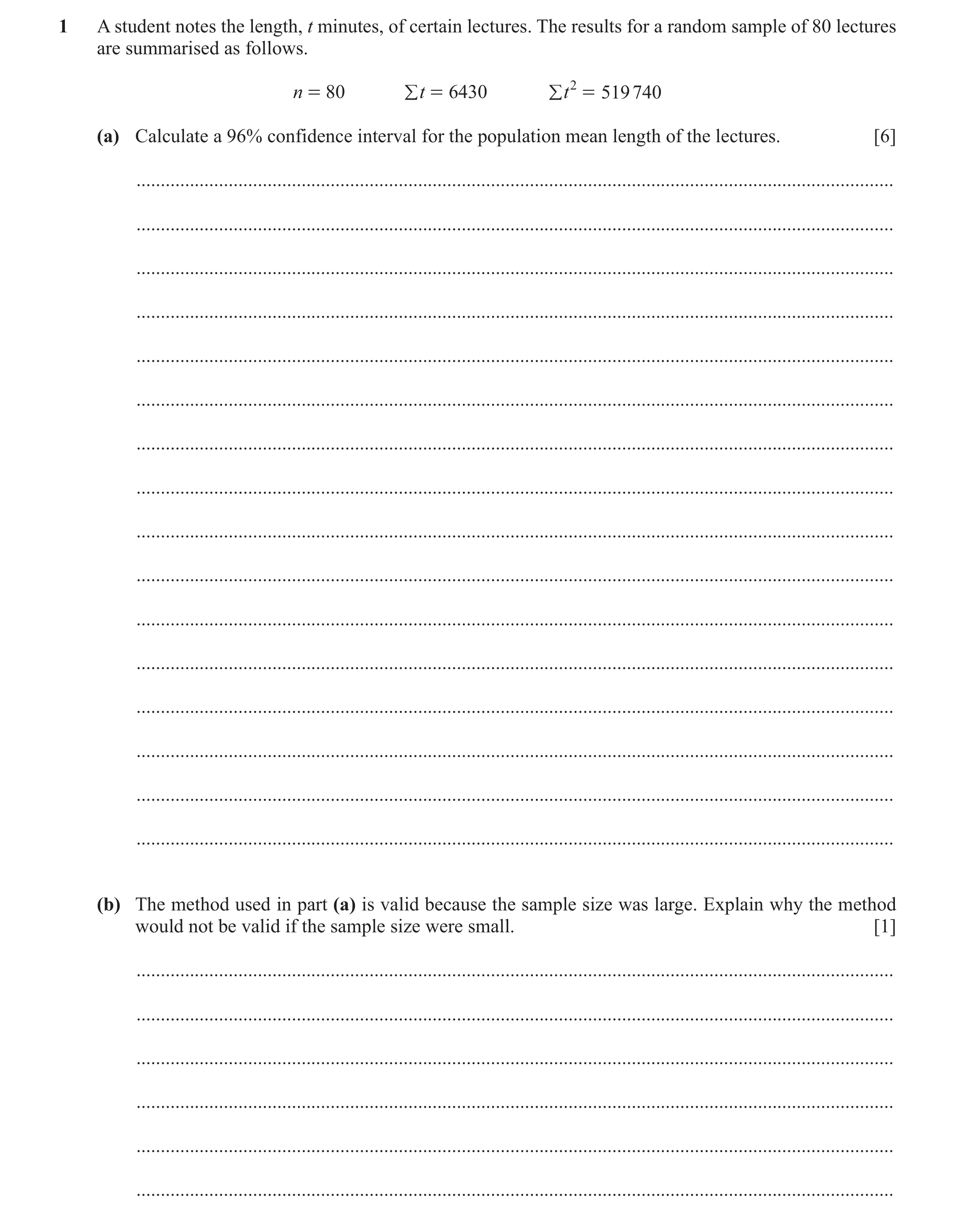 114 / 116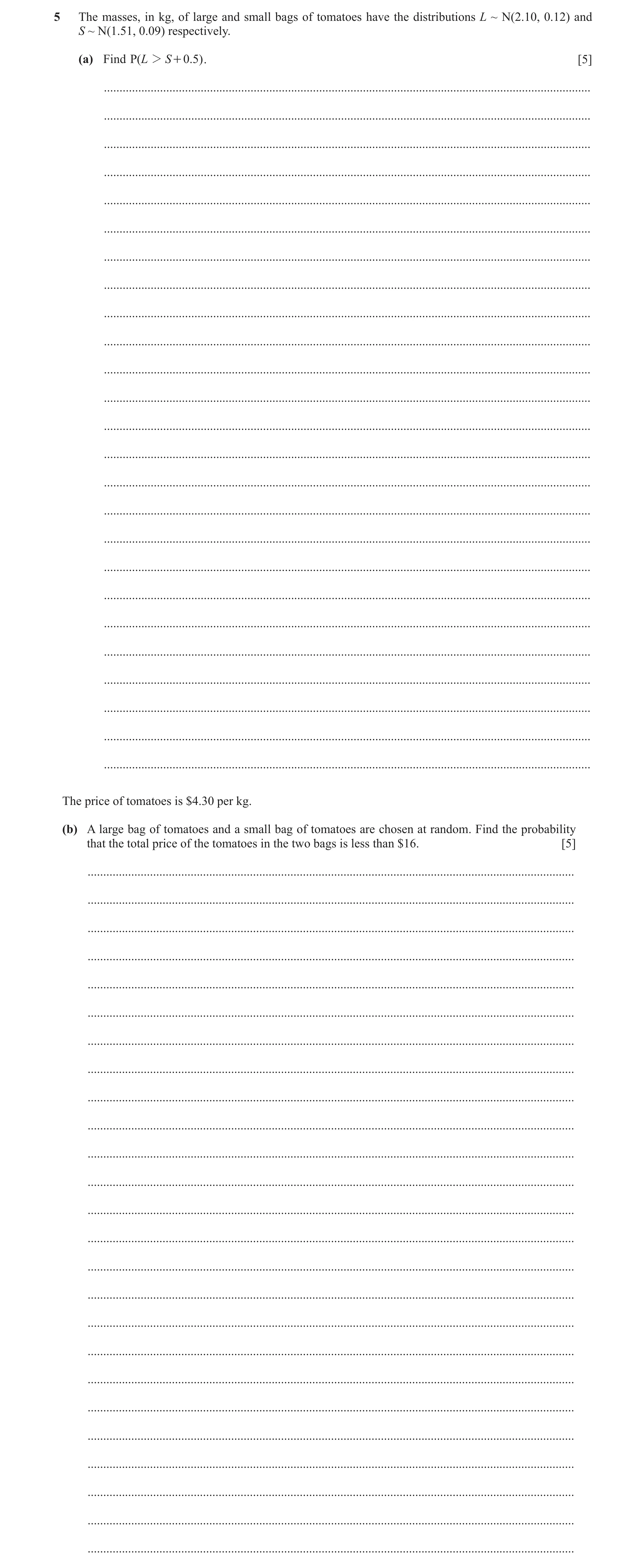
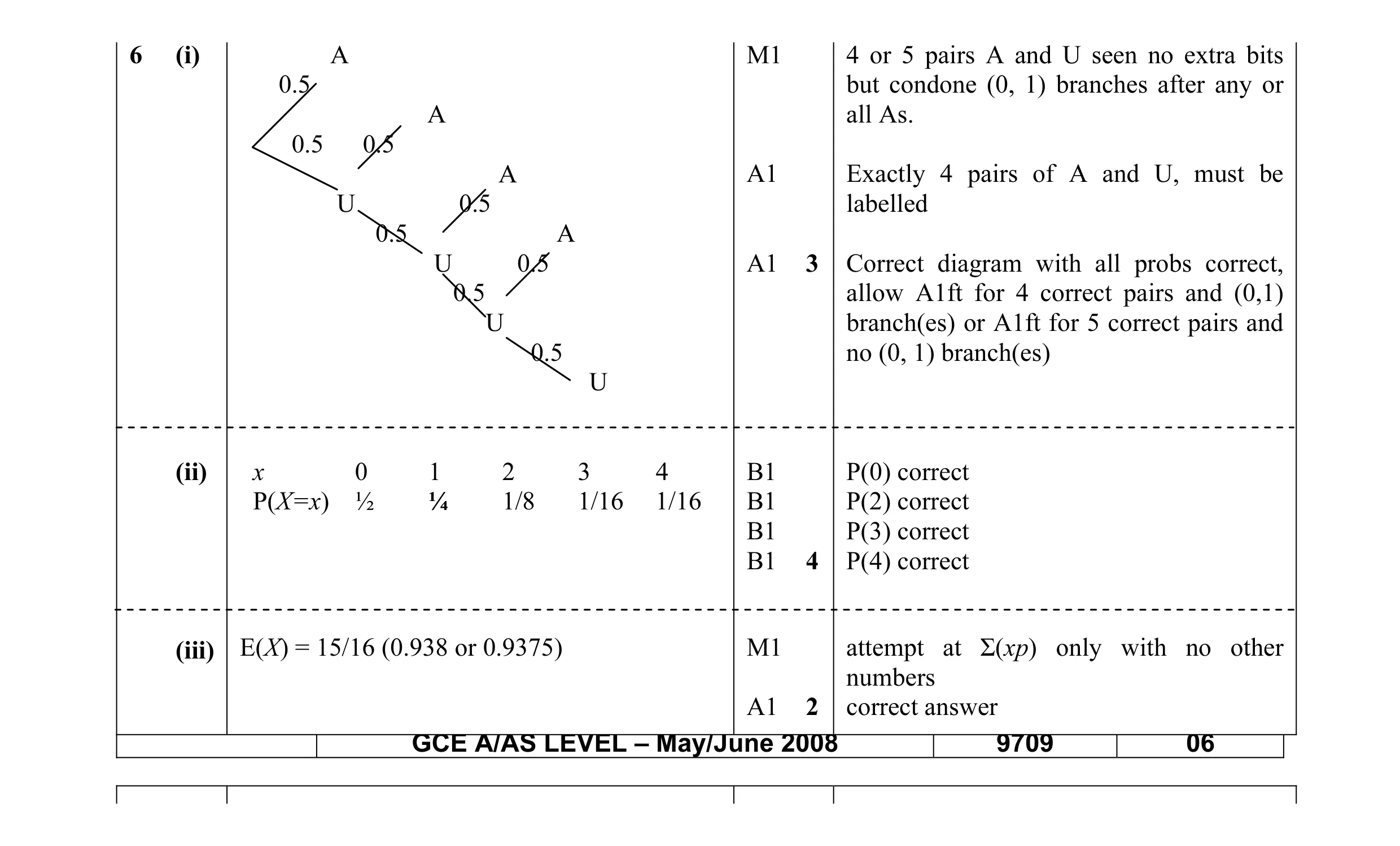 9
9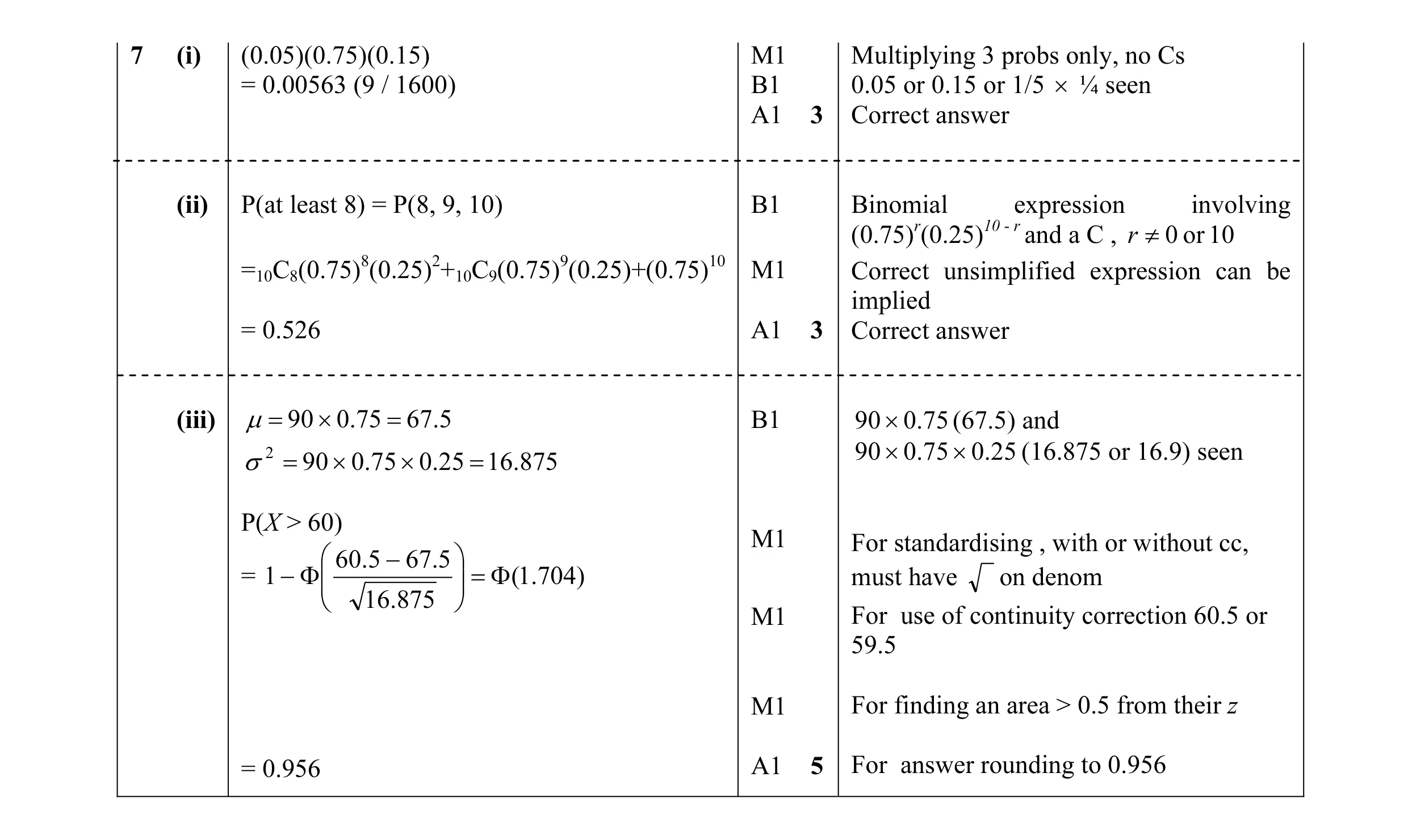 11
11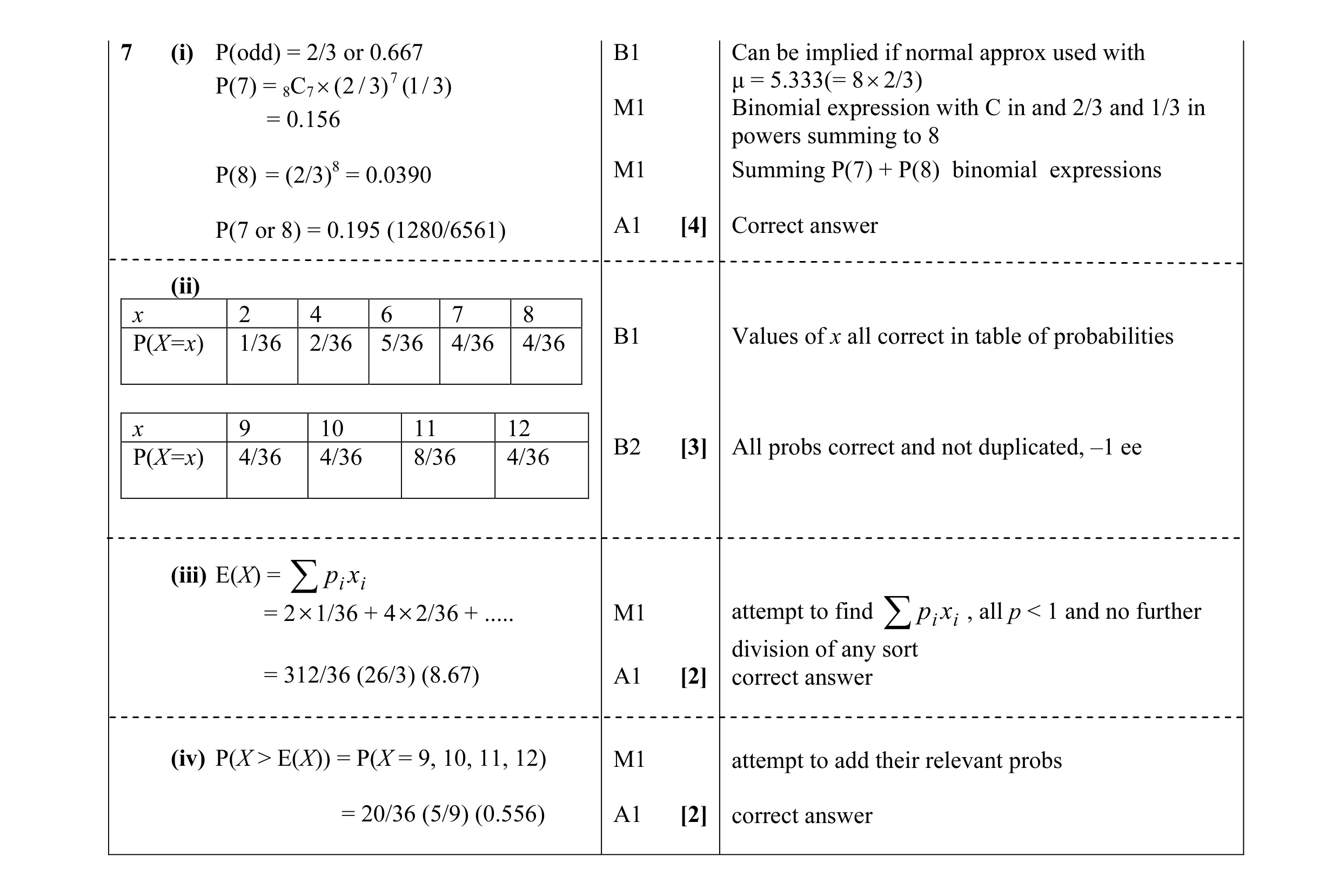 11
11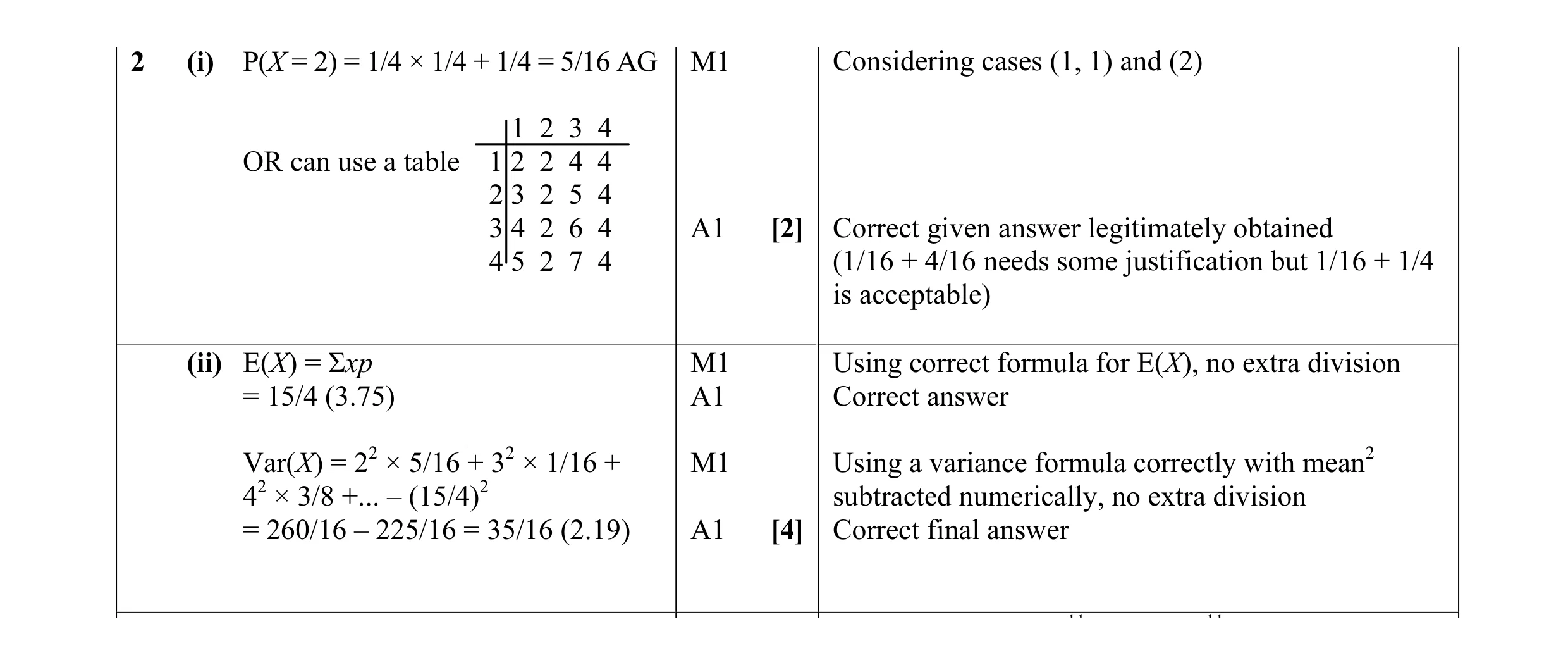 6
6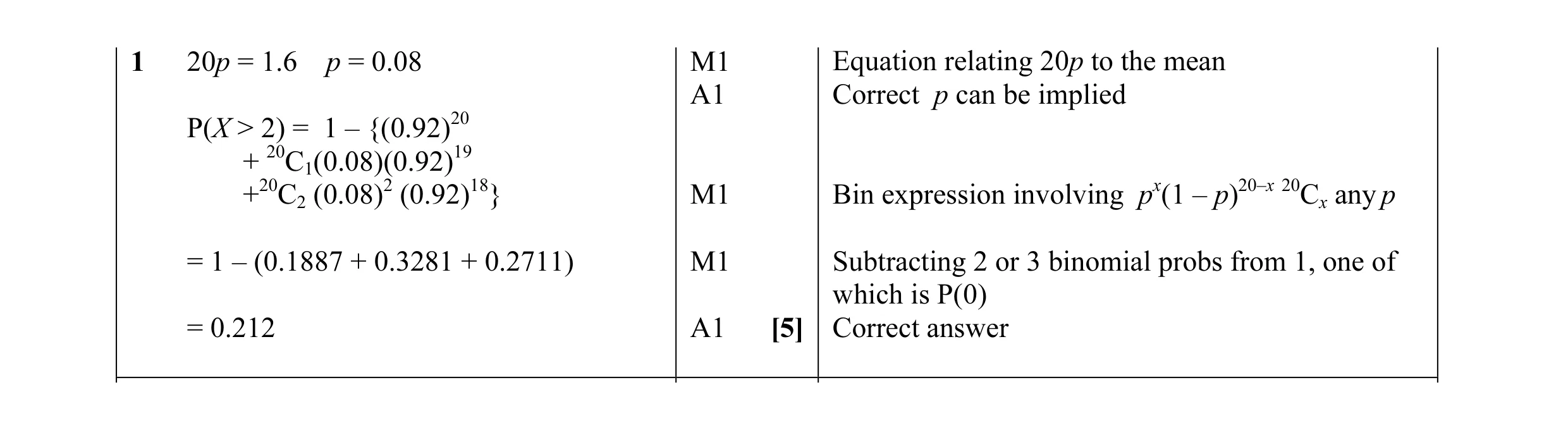 5
5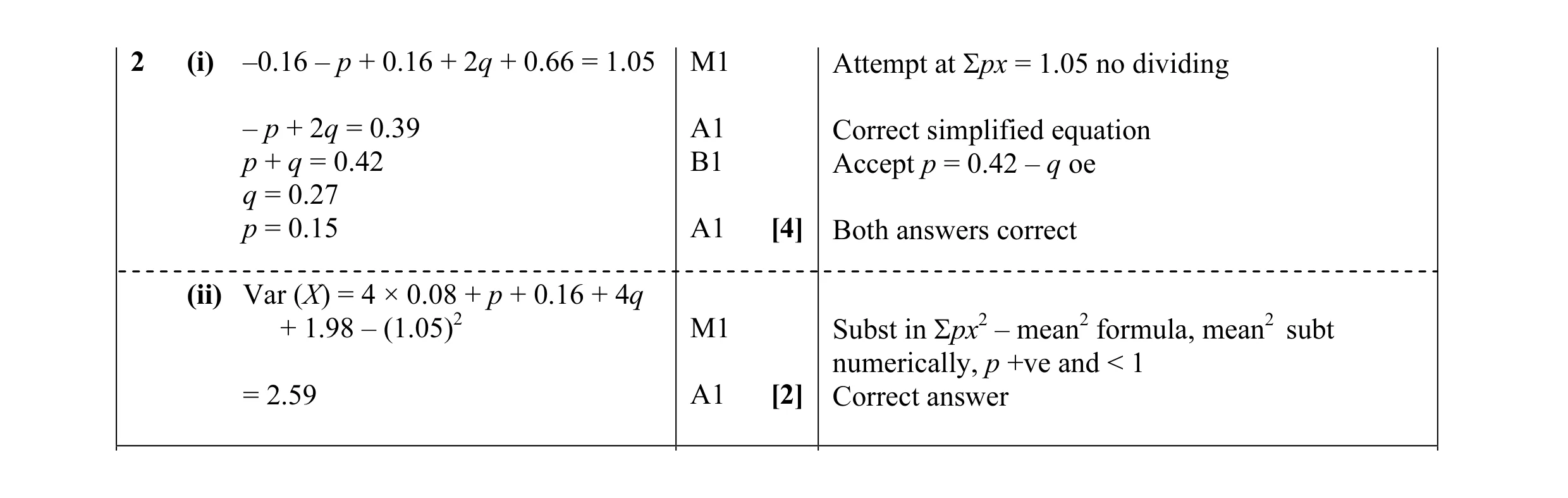 6
6 4
4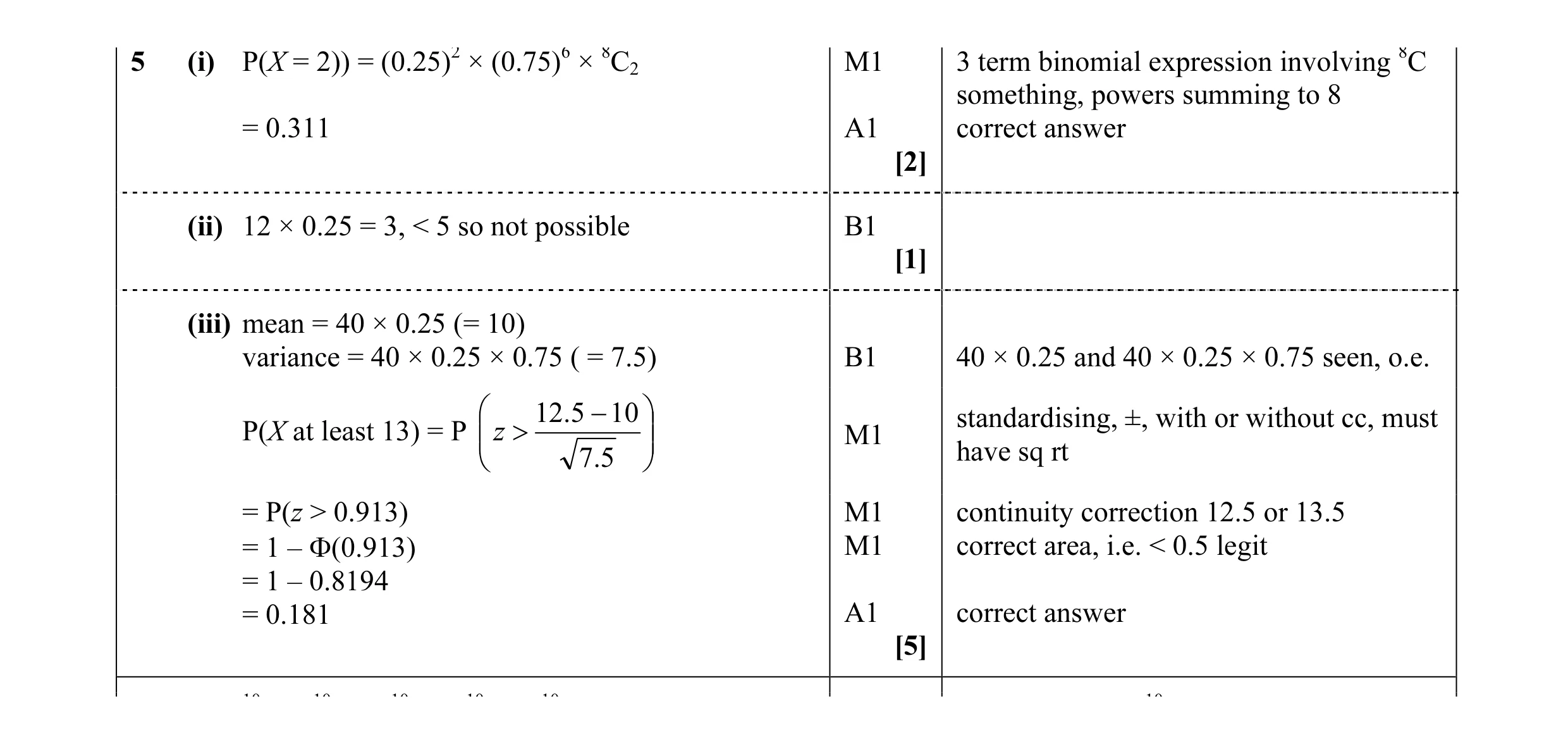 8
8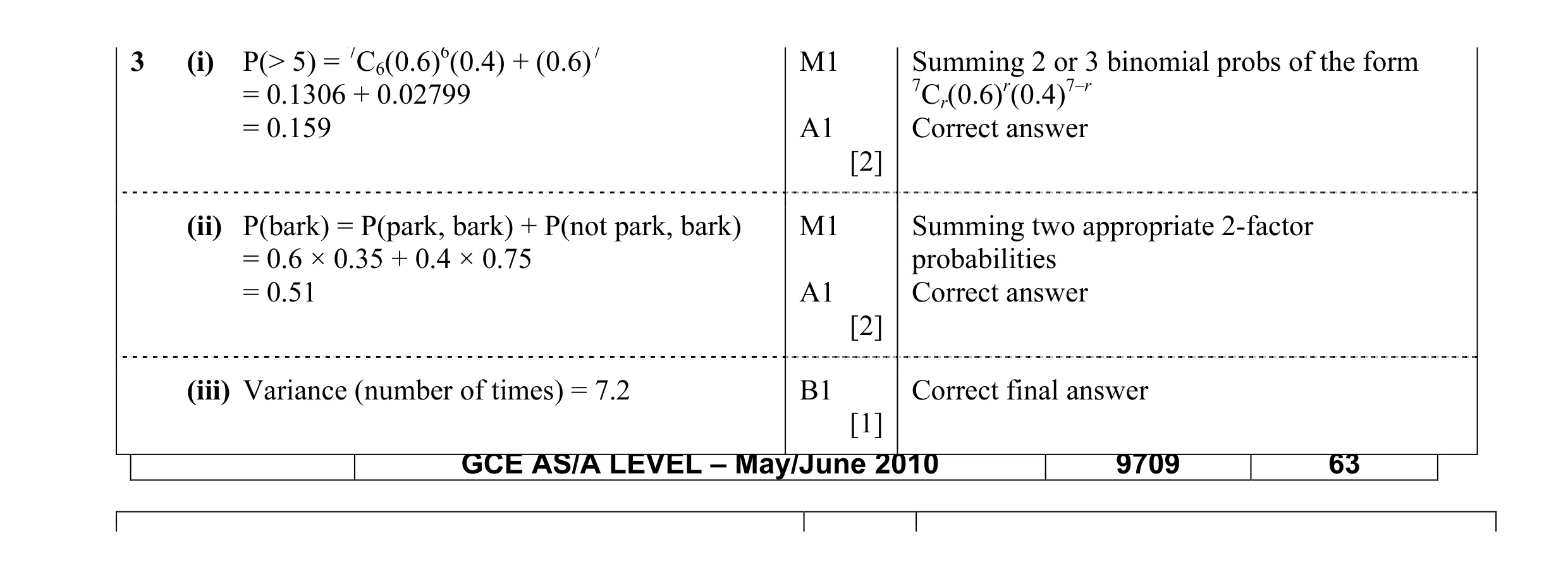 5
5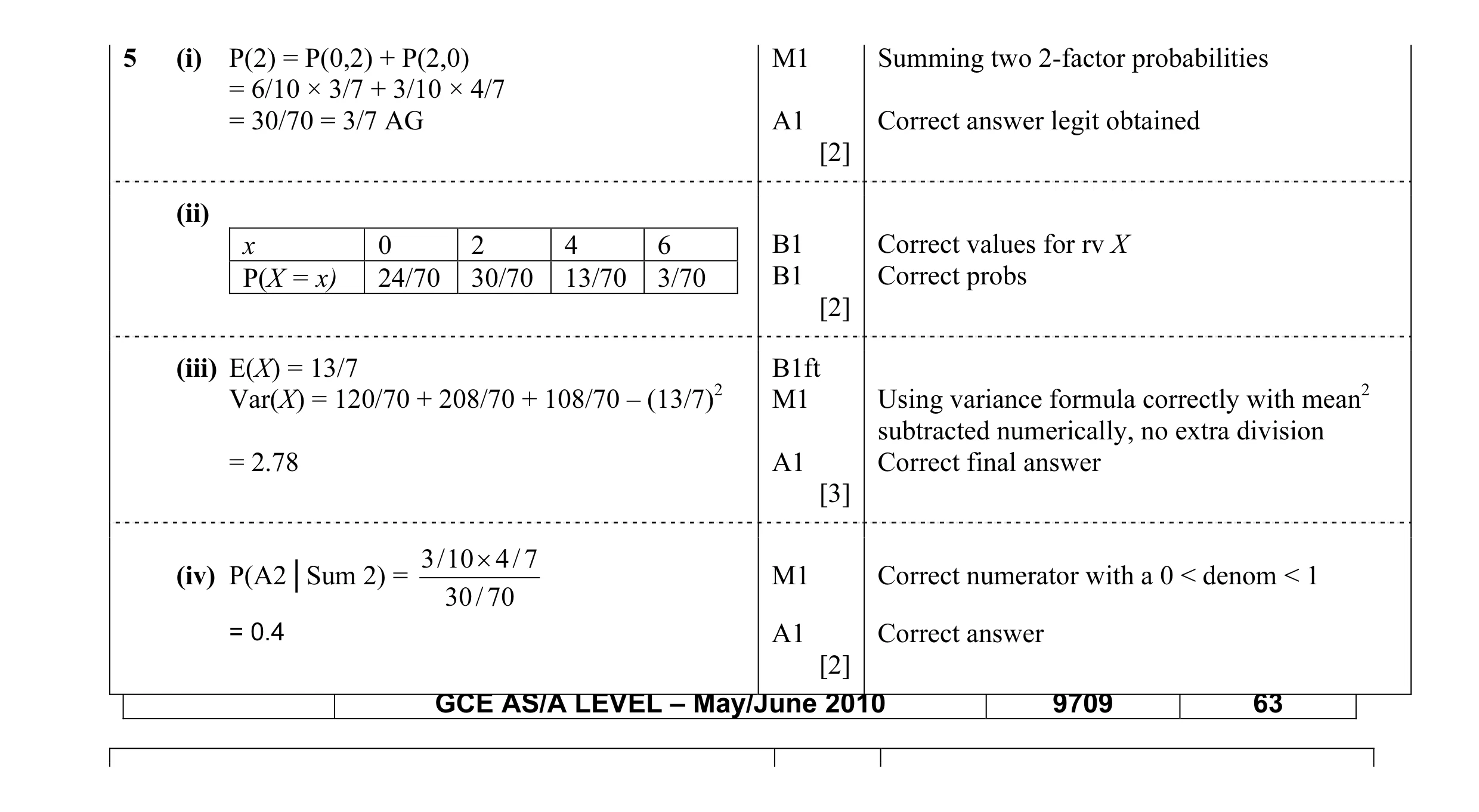 9
9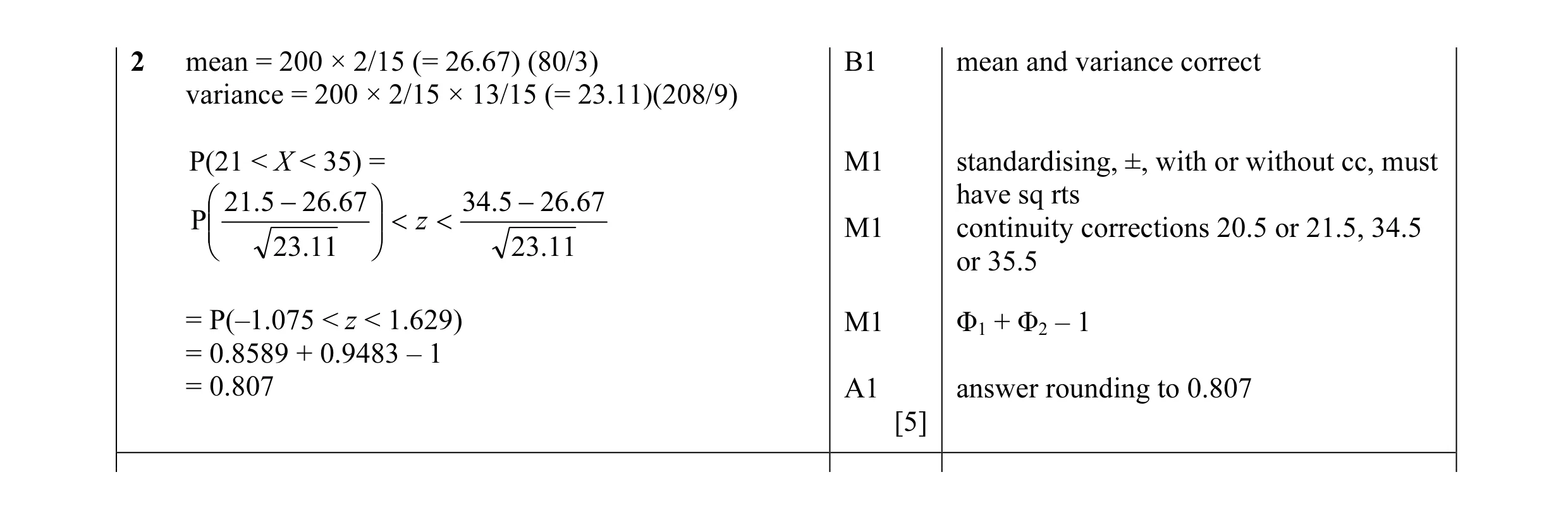 5
5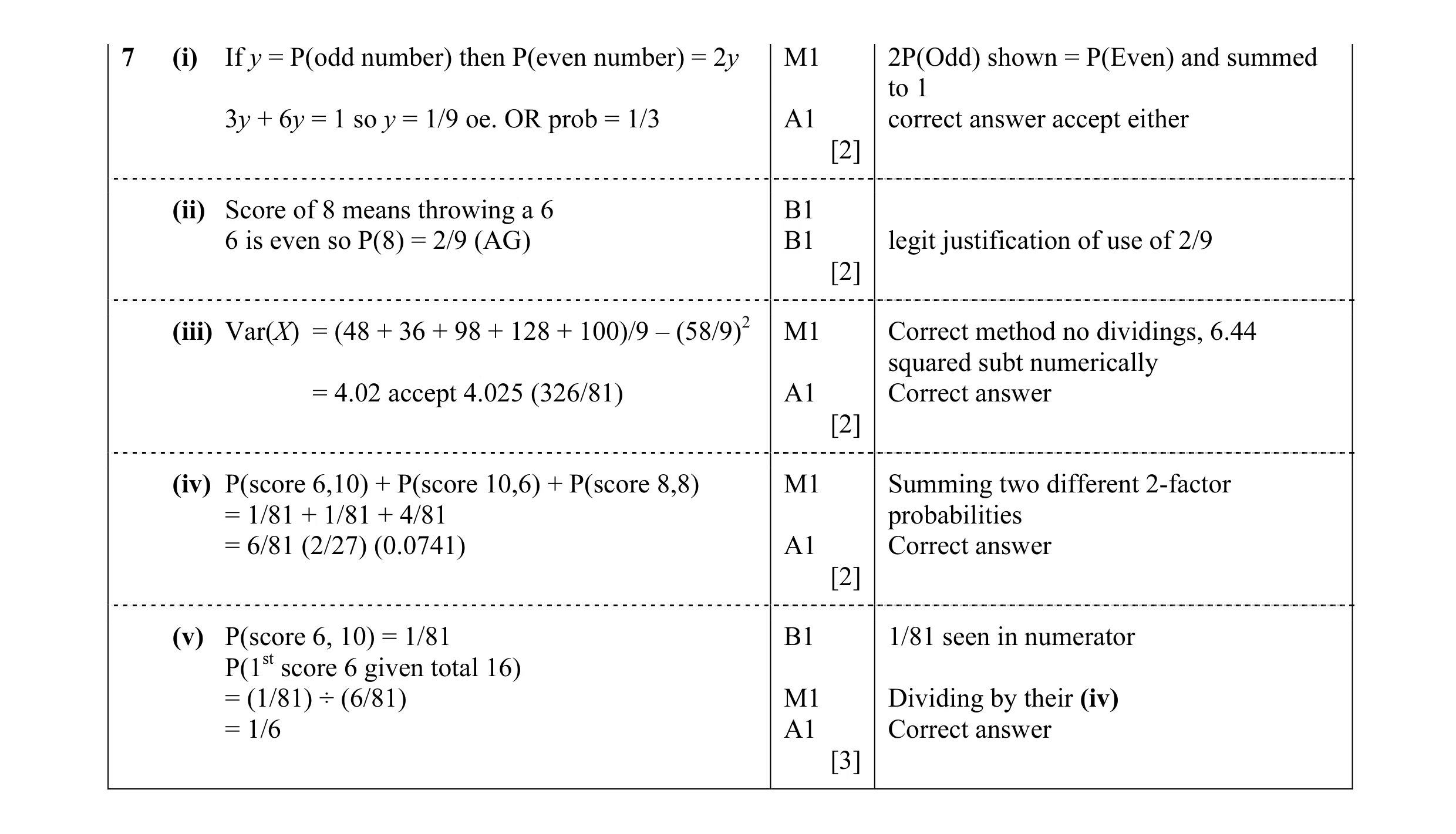 11
11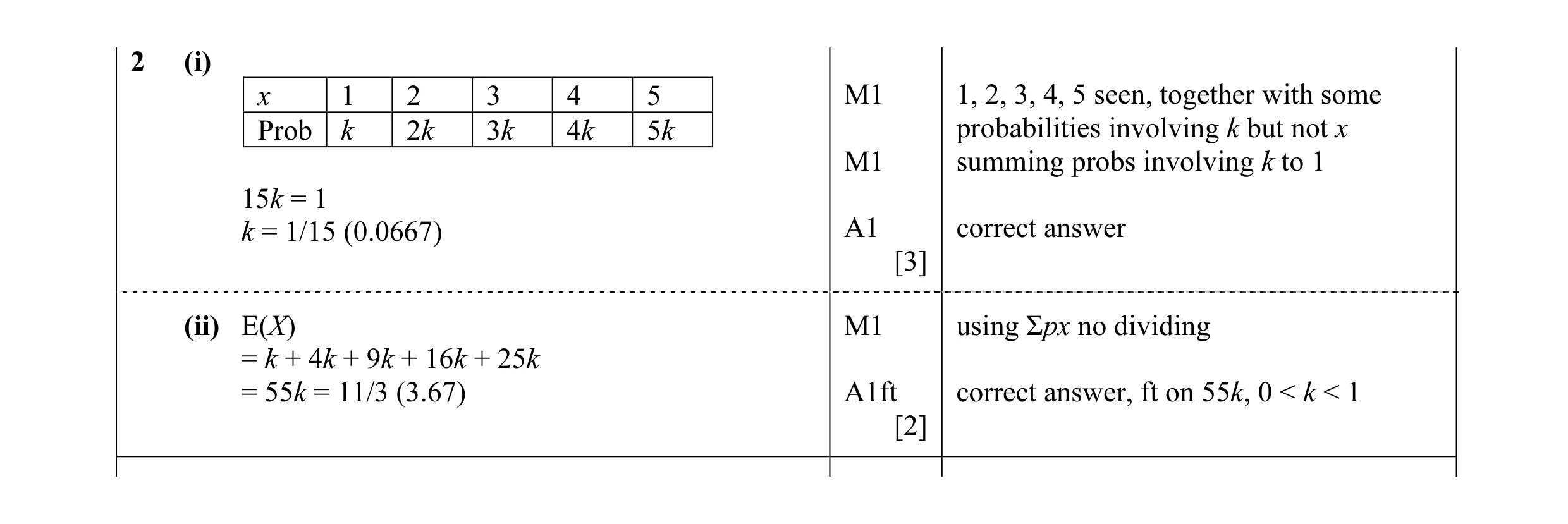 5
5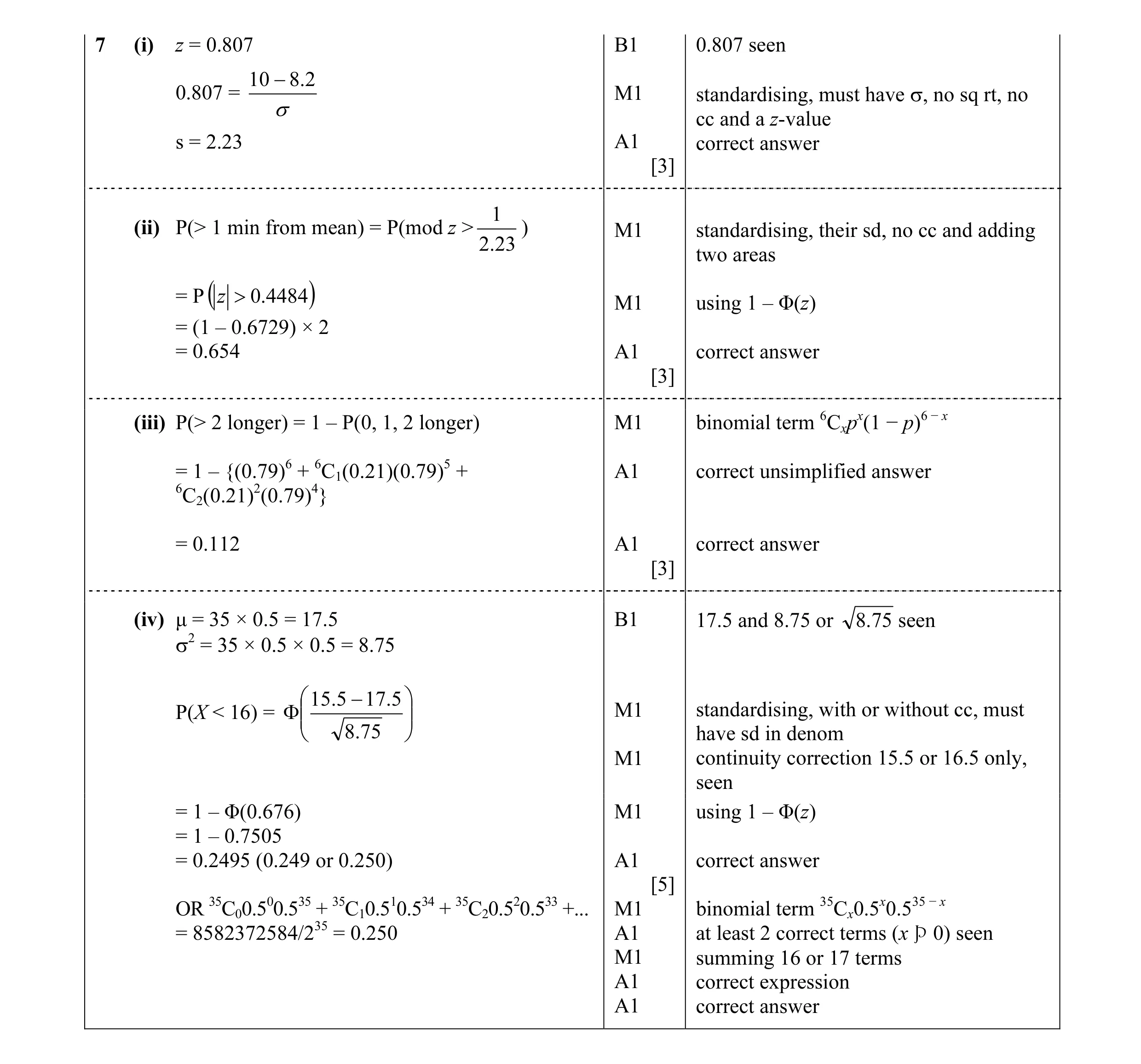 14
14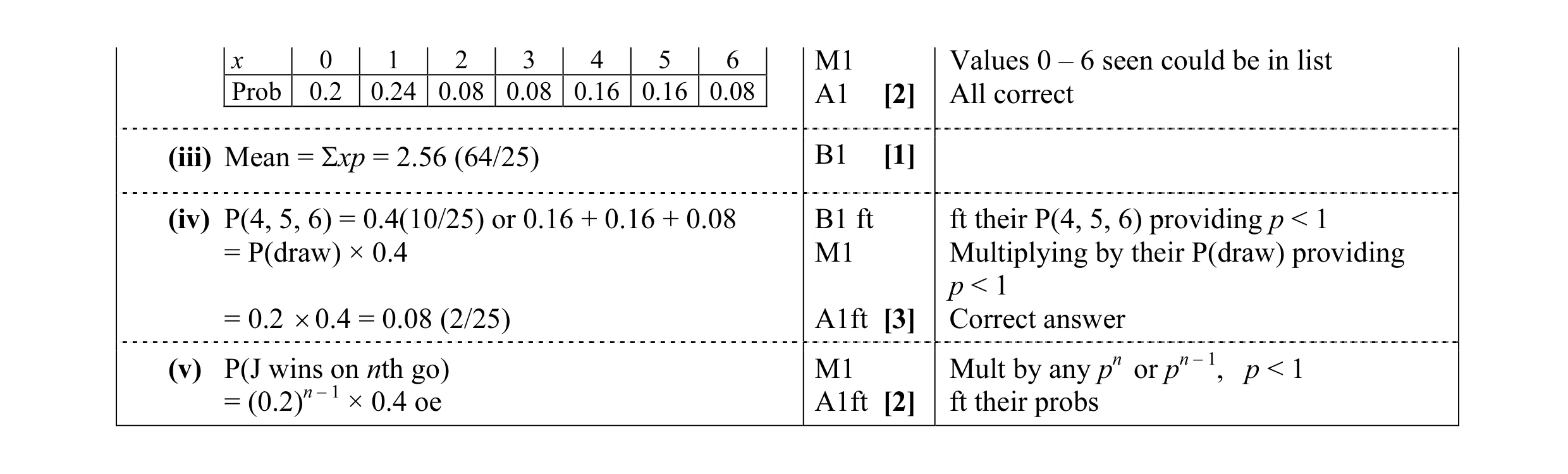 5
5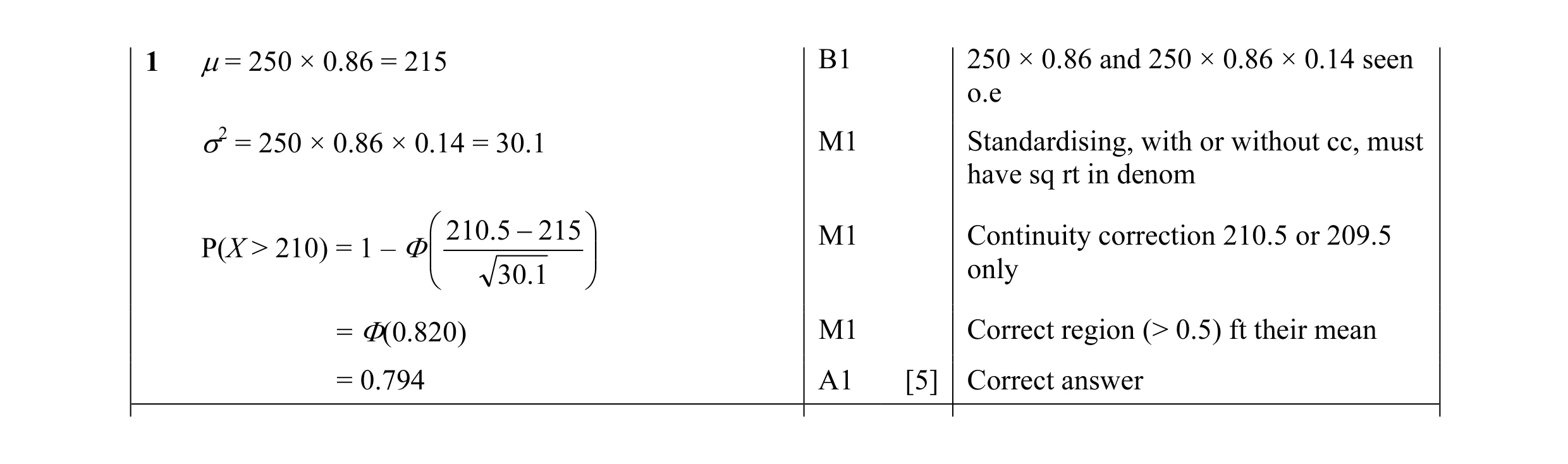 5
5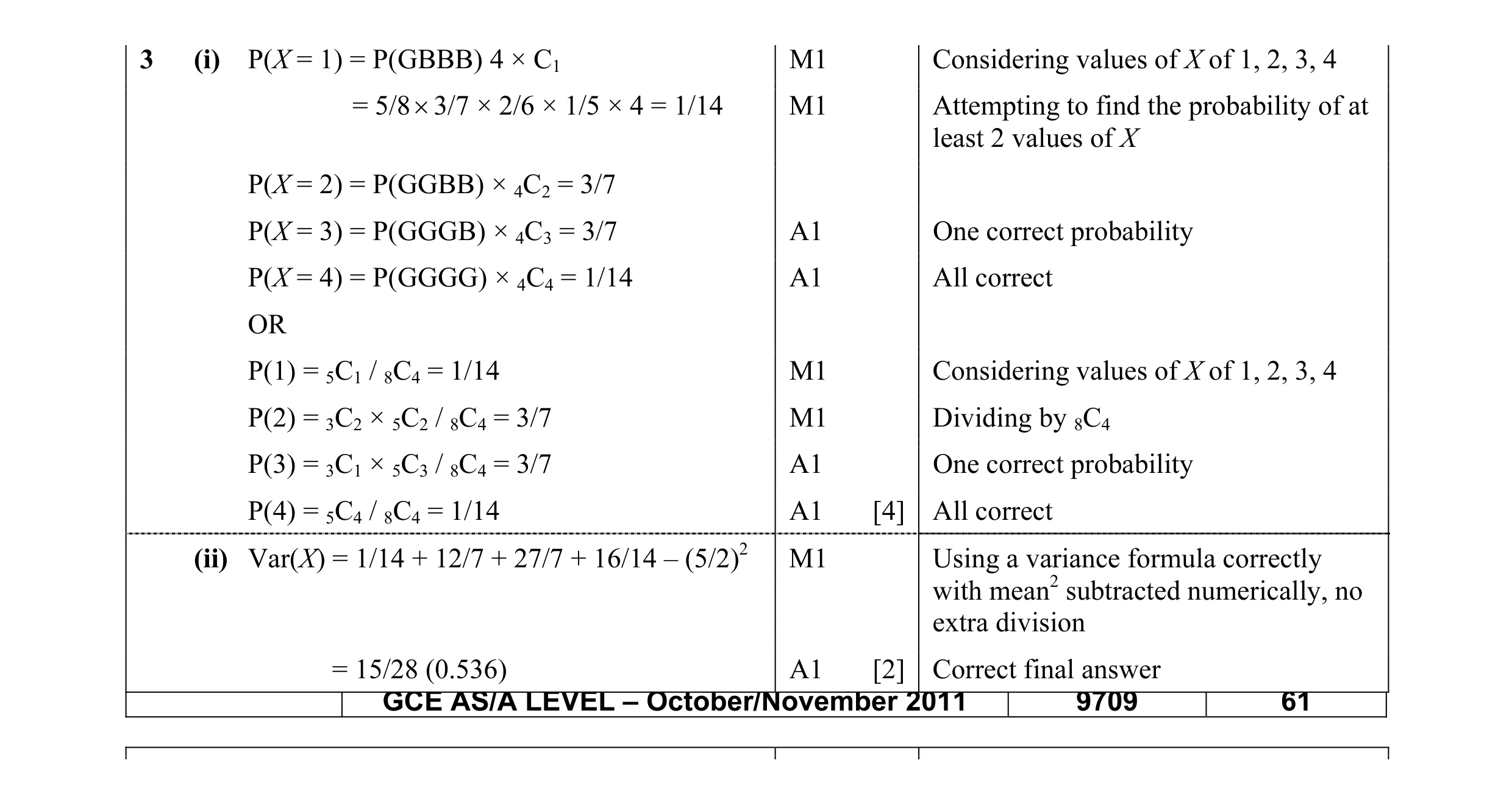 6
6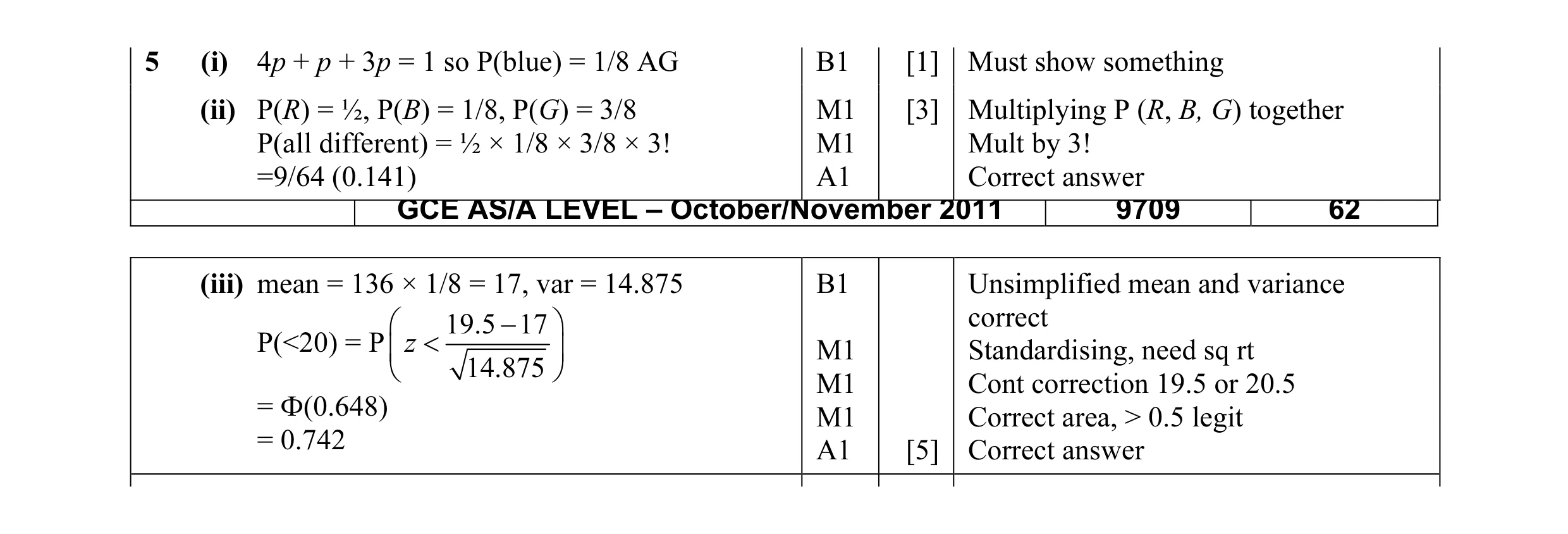 9
9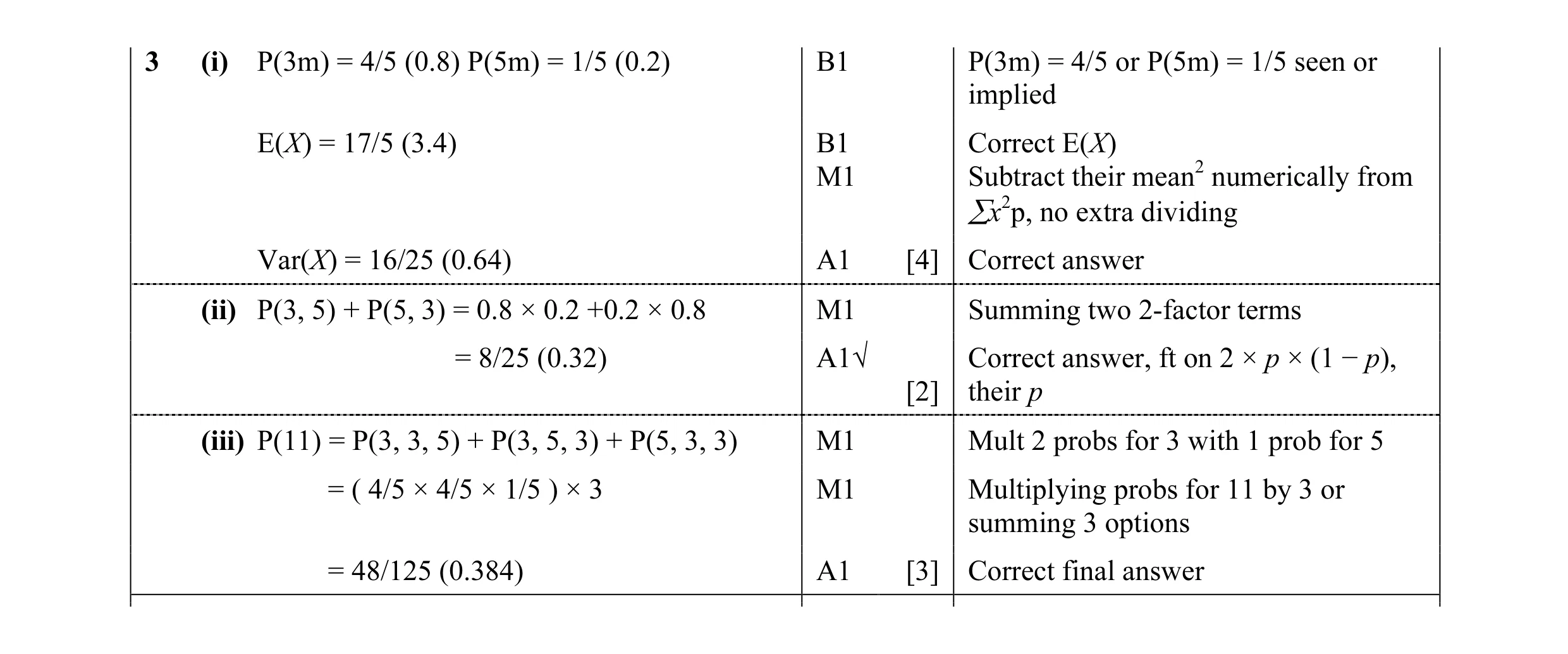 9
9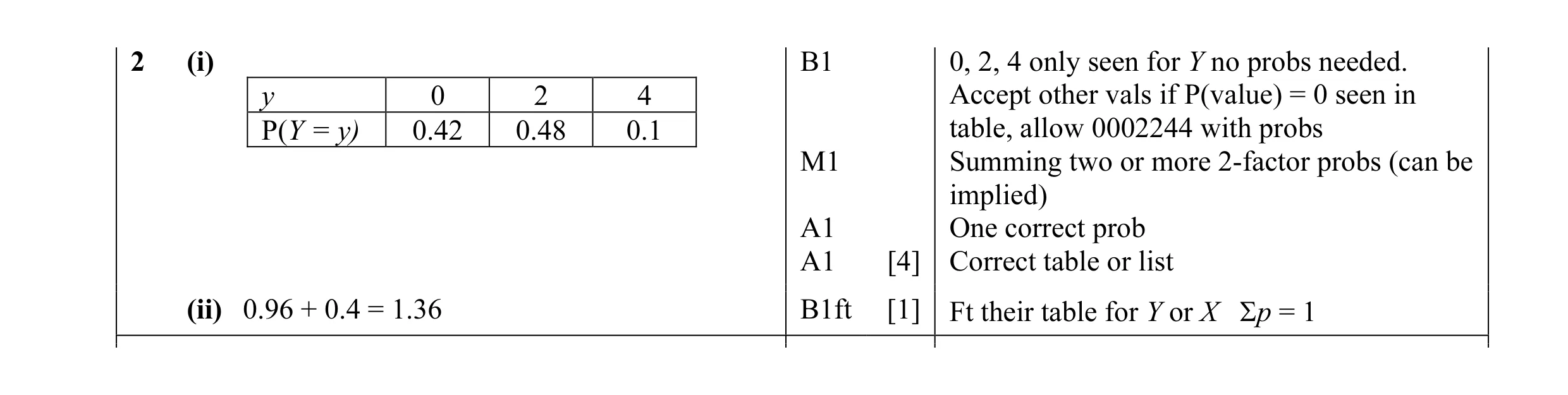 5
5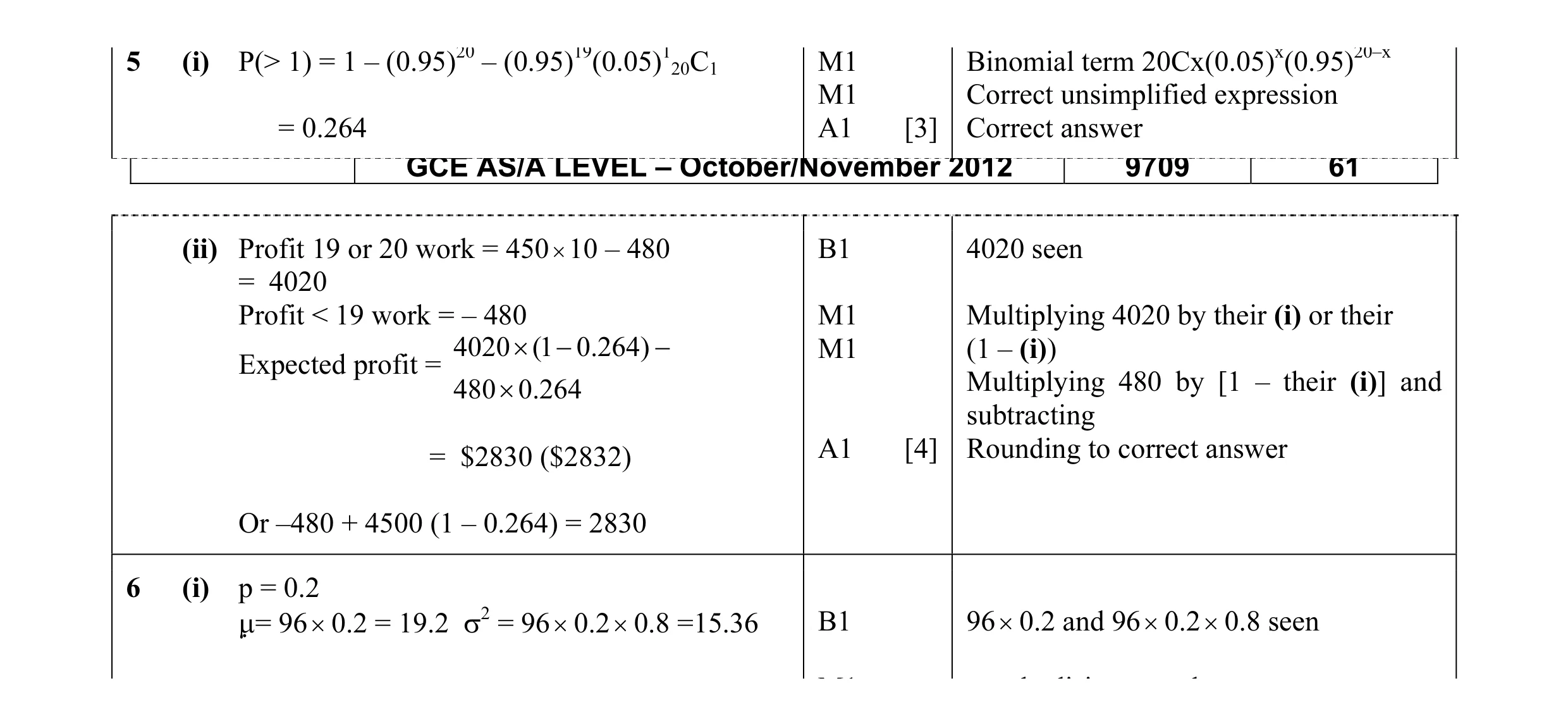 7
7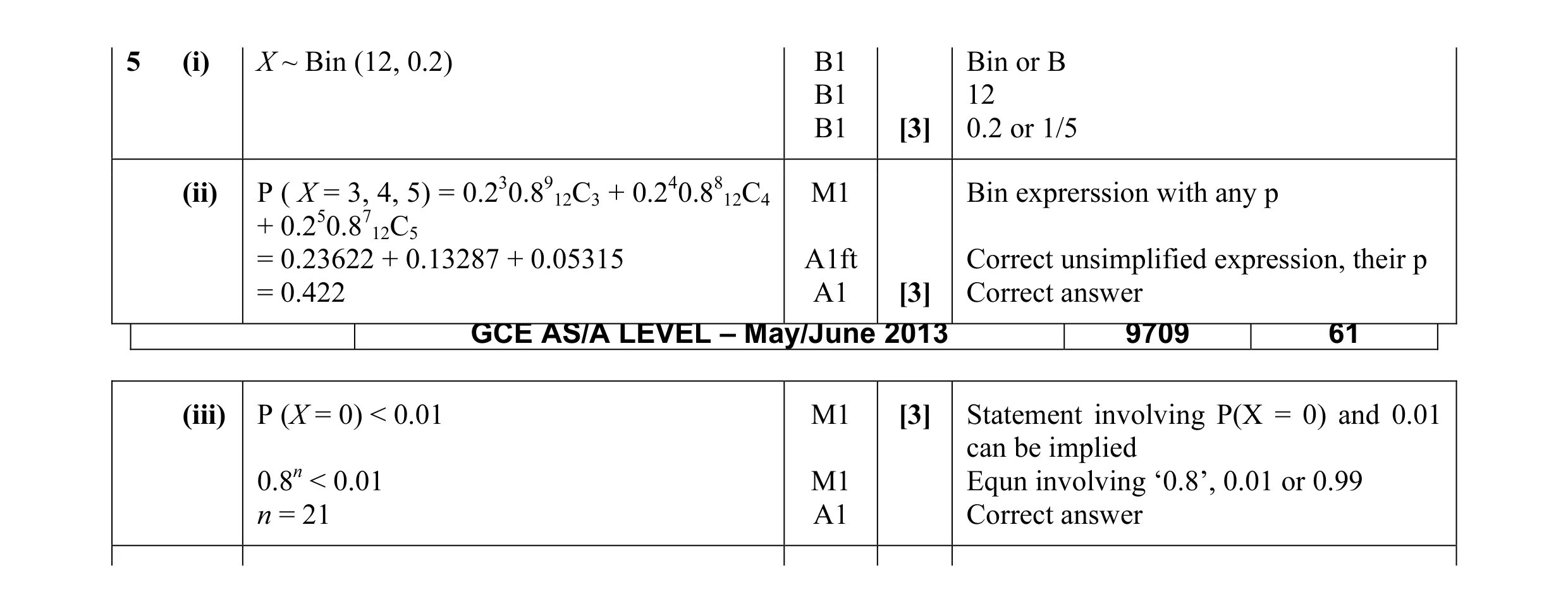 9
9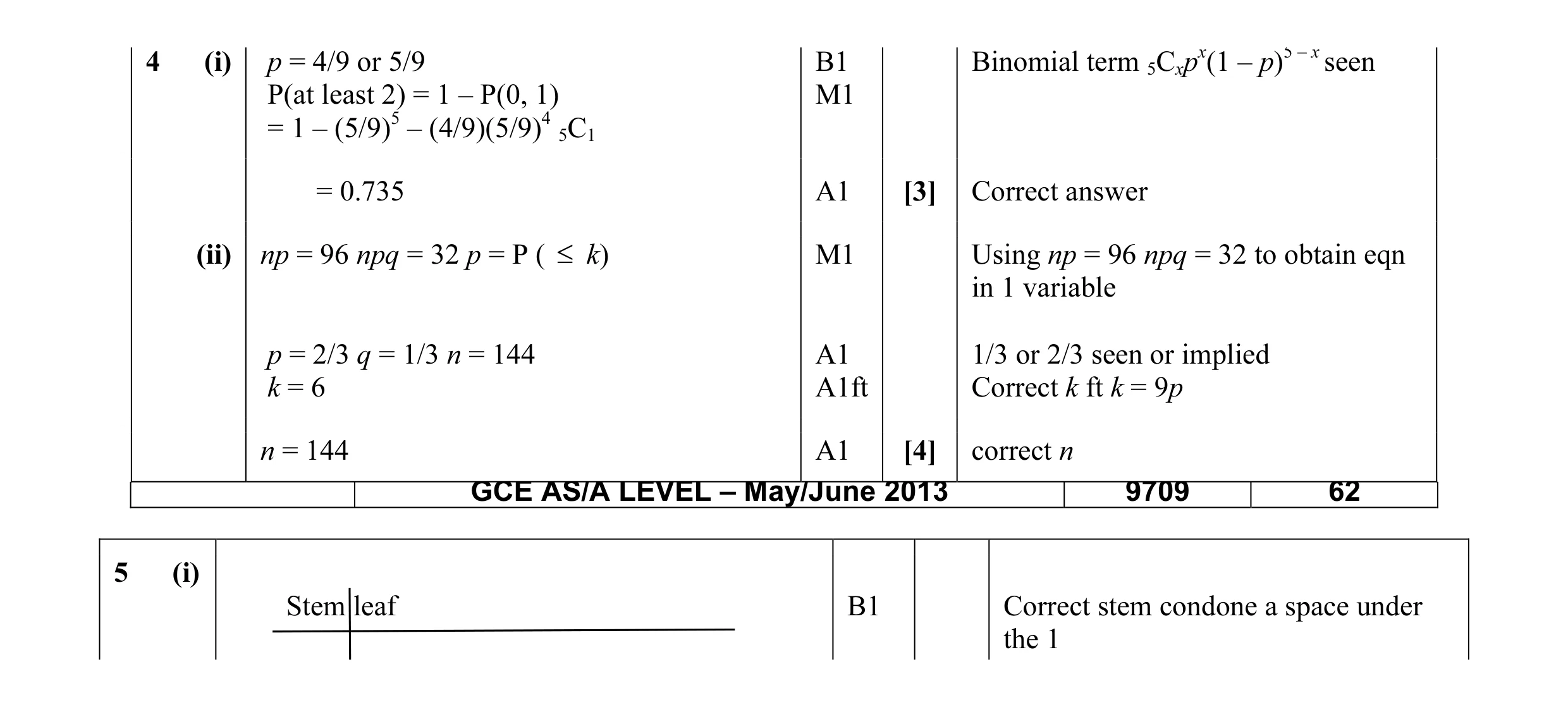 7
7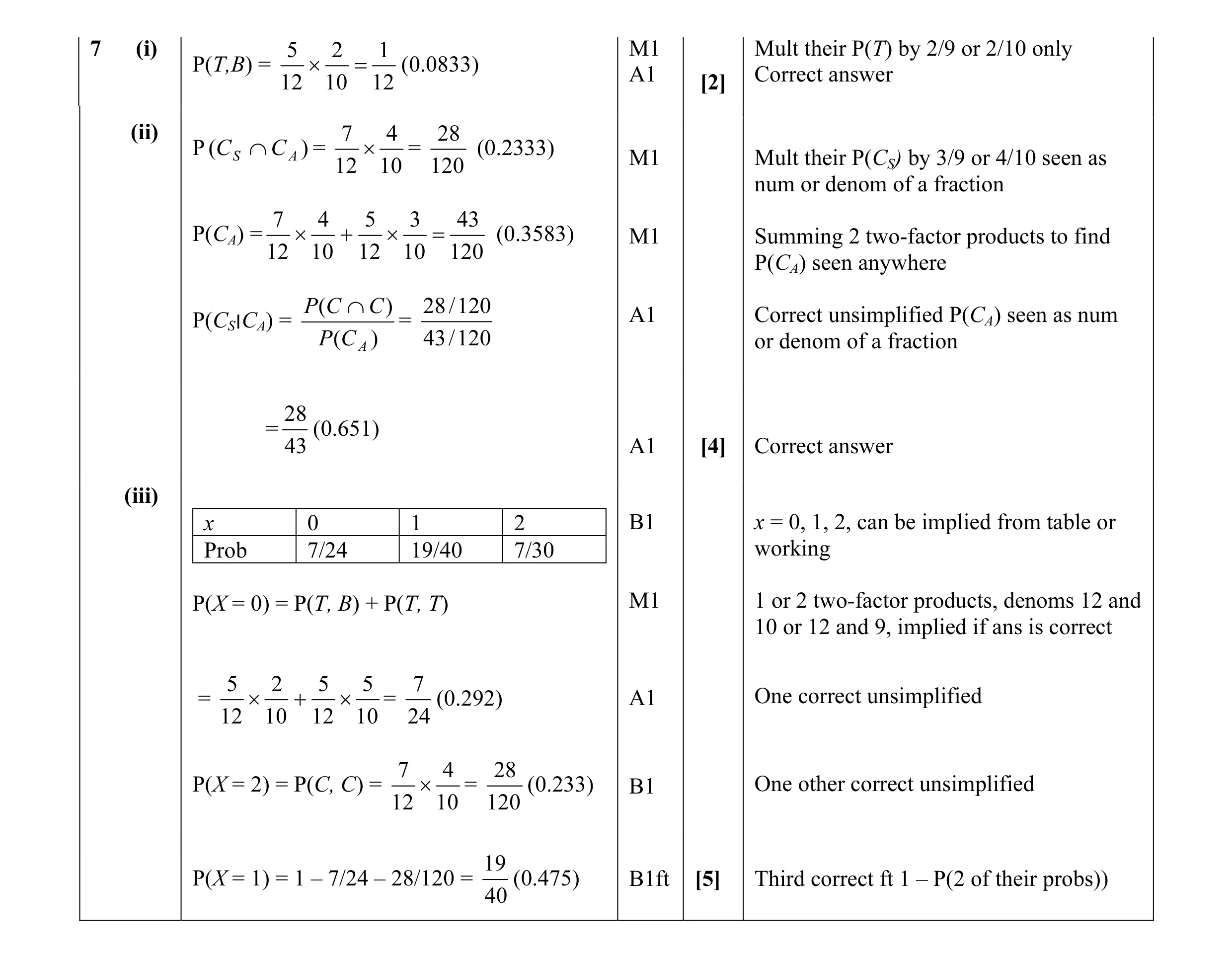 11
11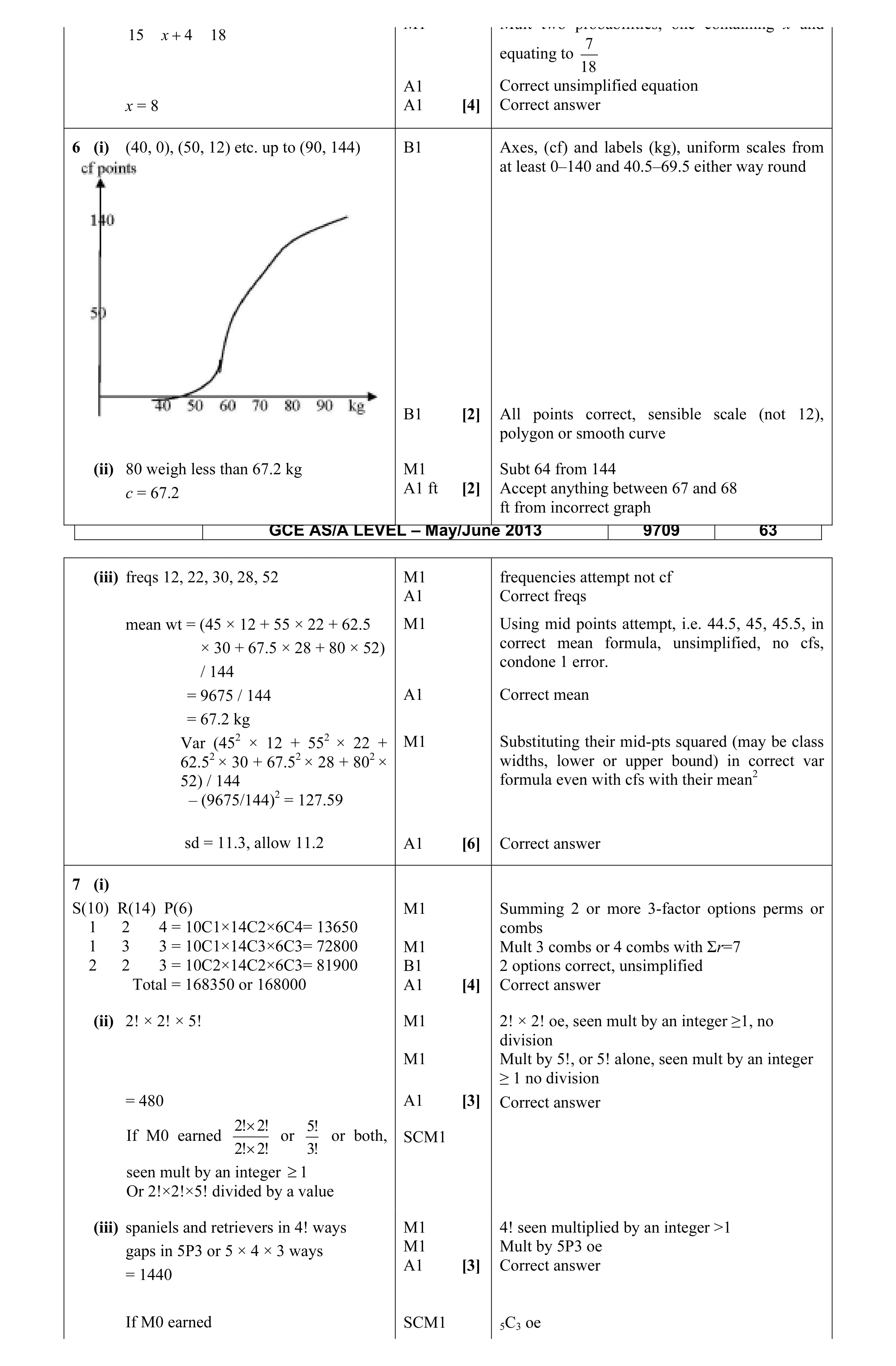 7
7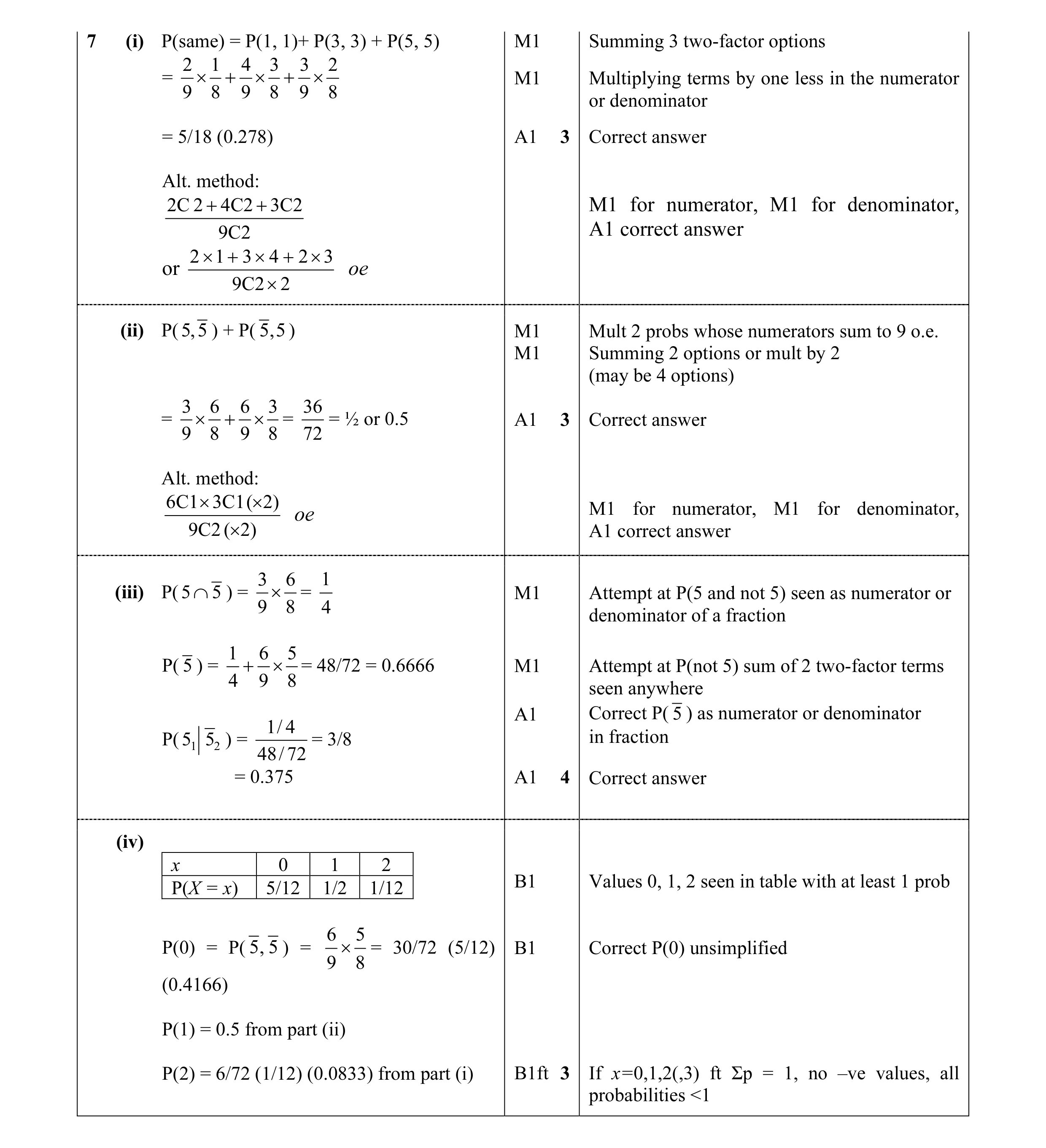 13
13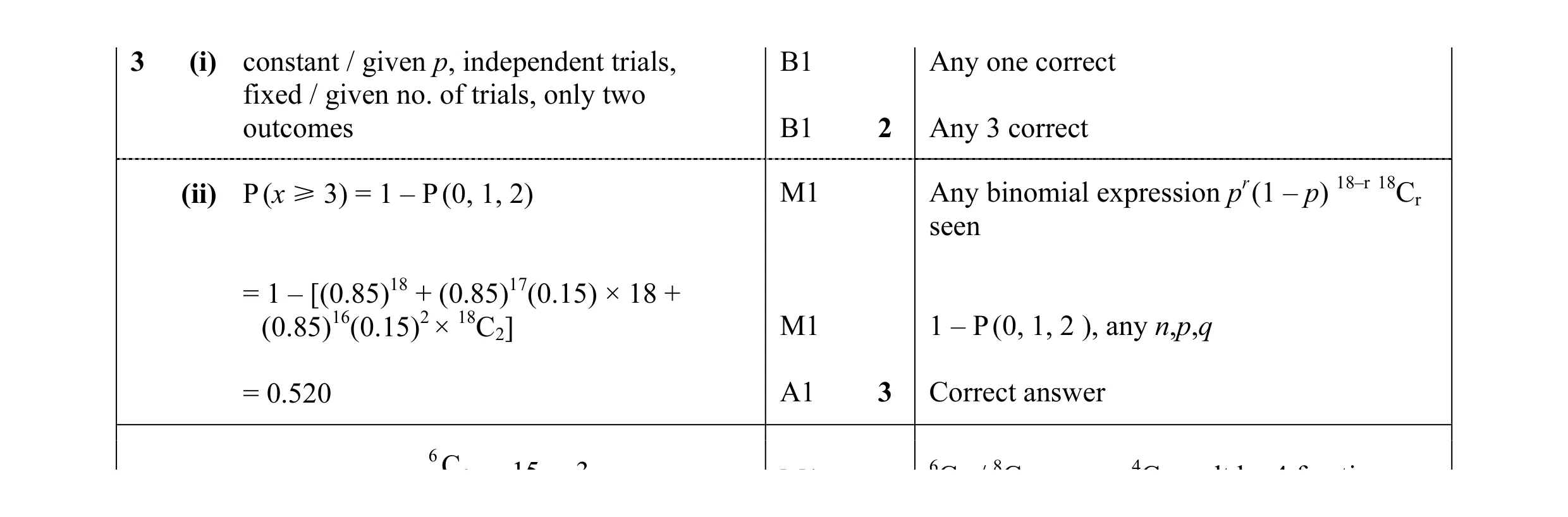 5
5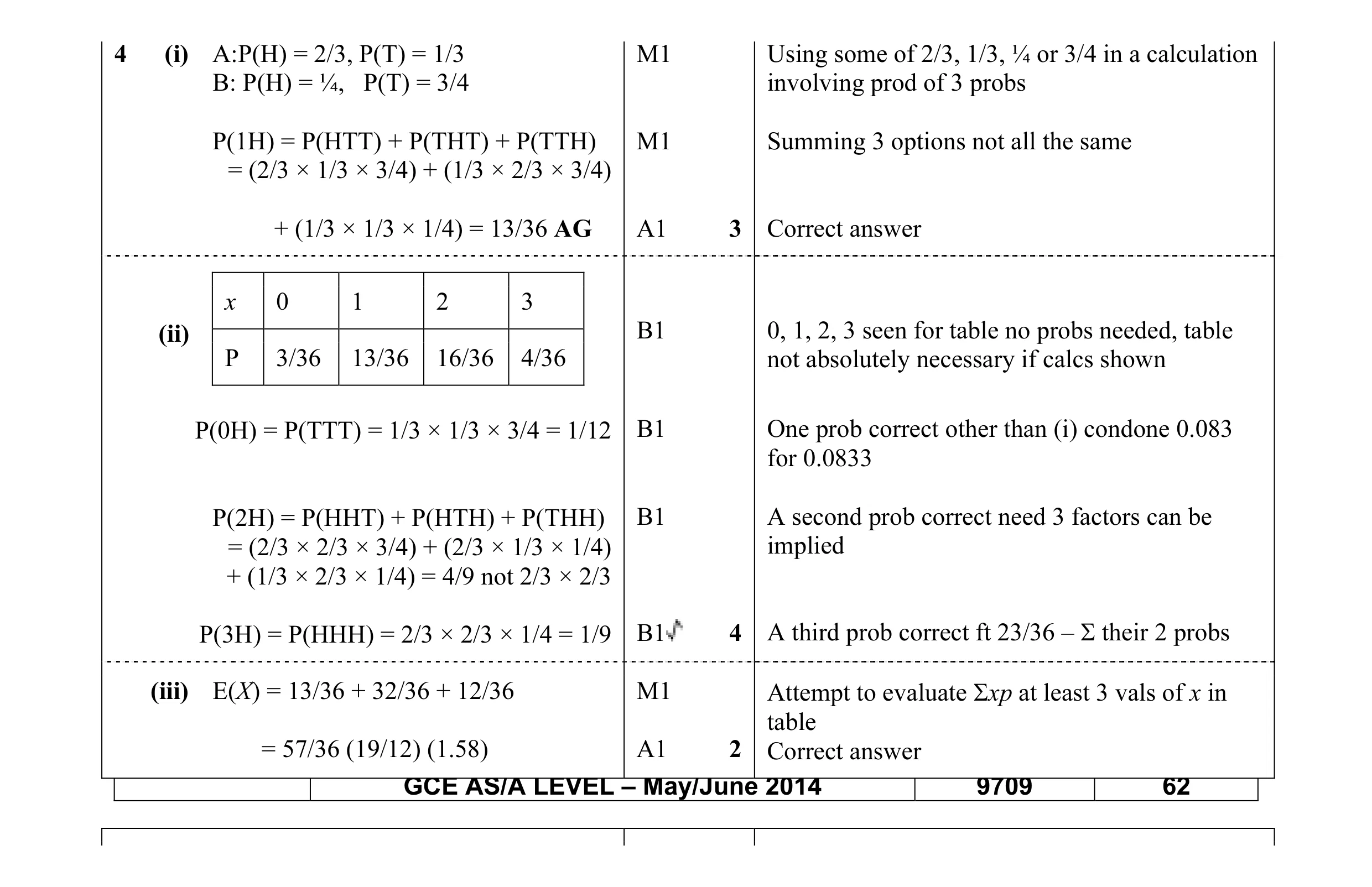 9
9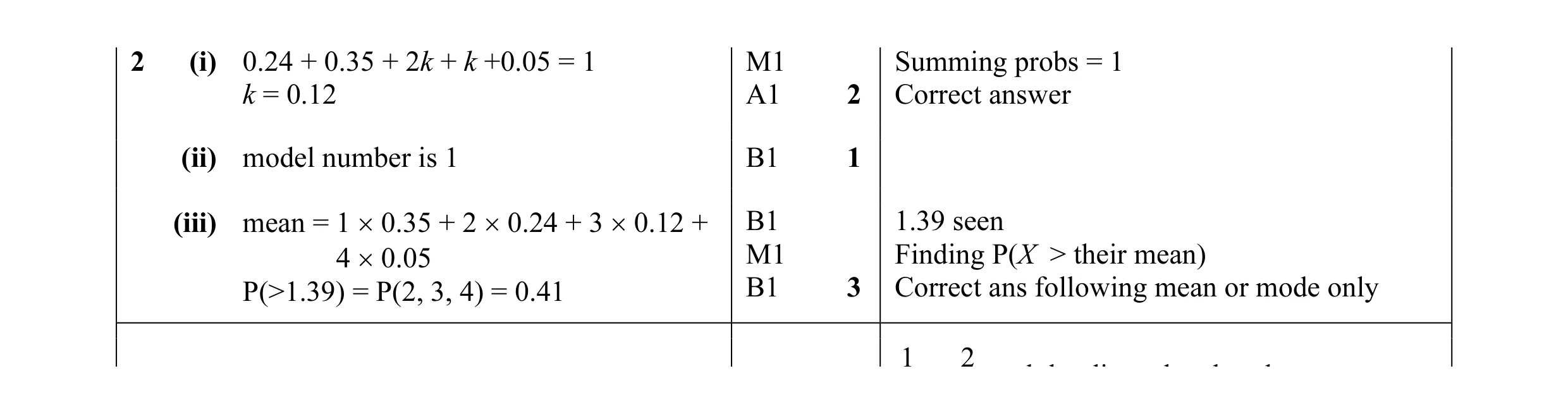 6
6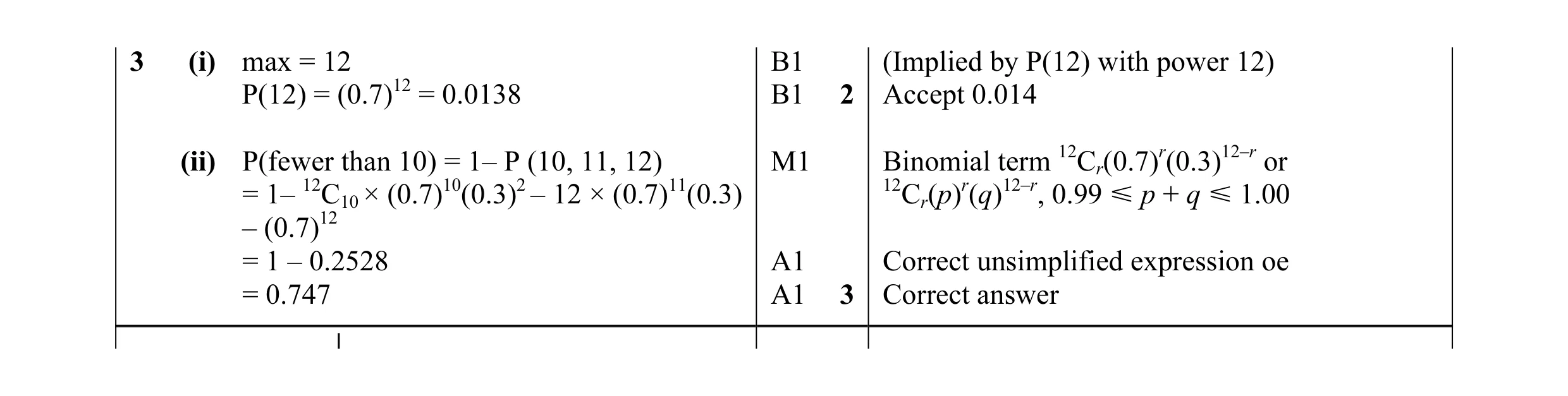 5
5 5
5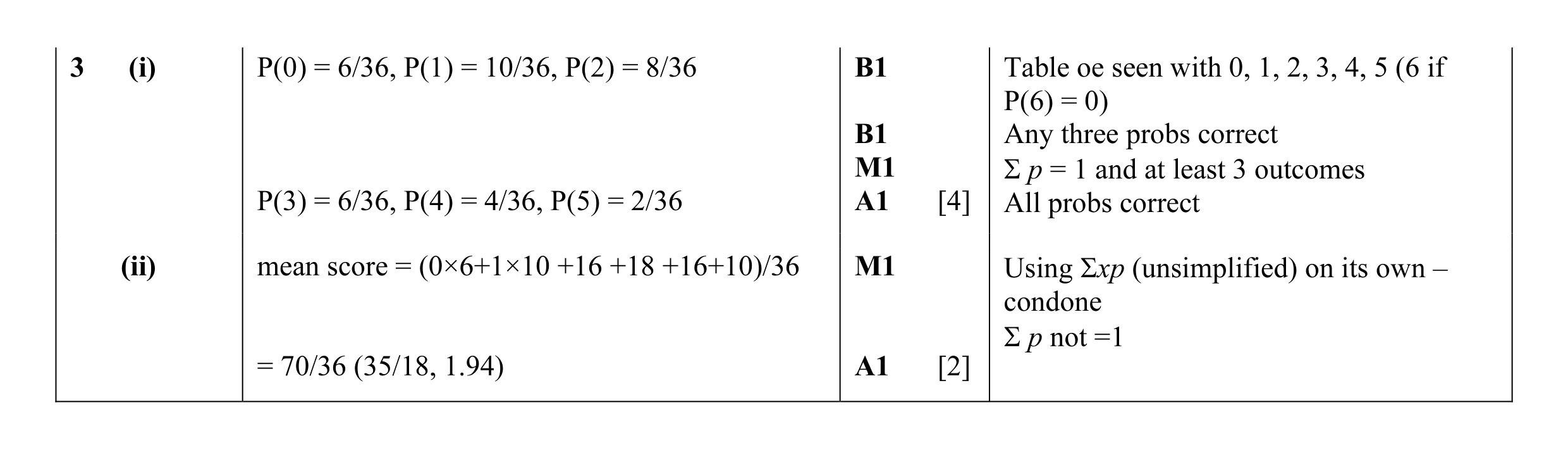 6
6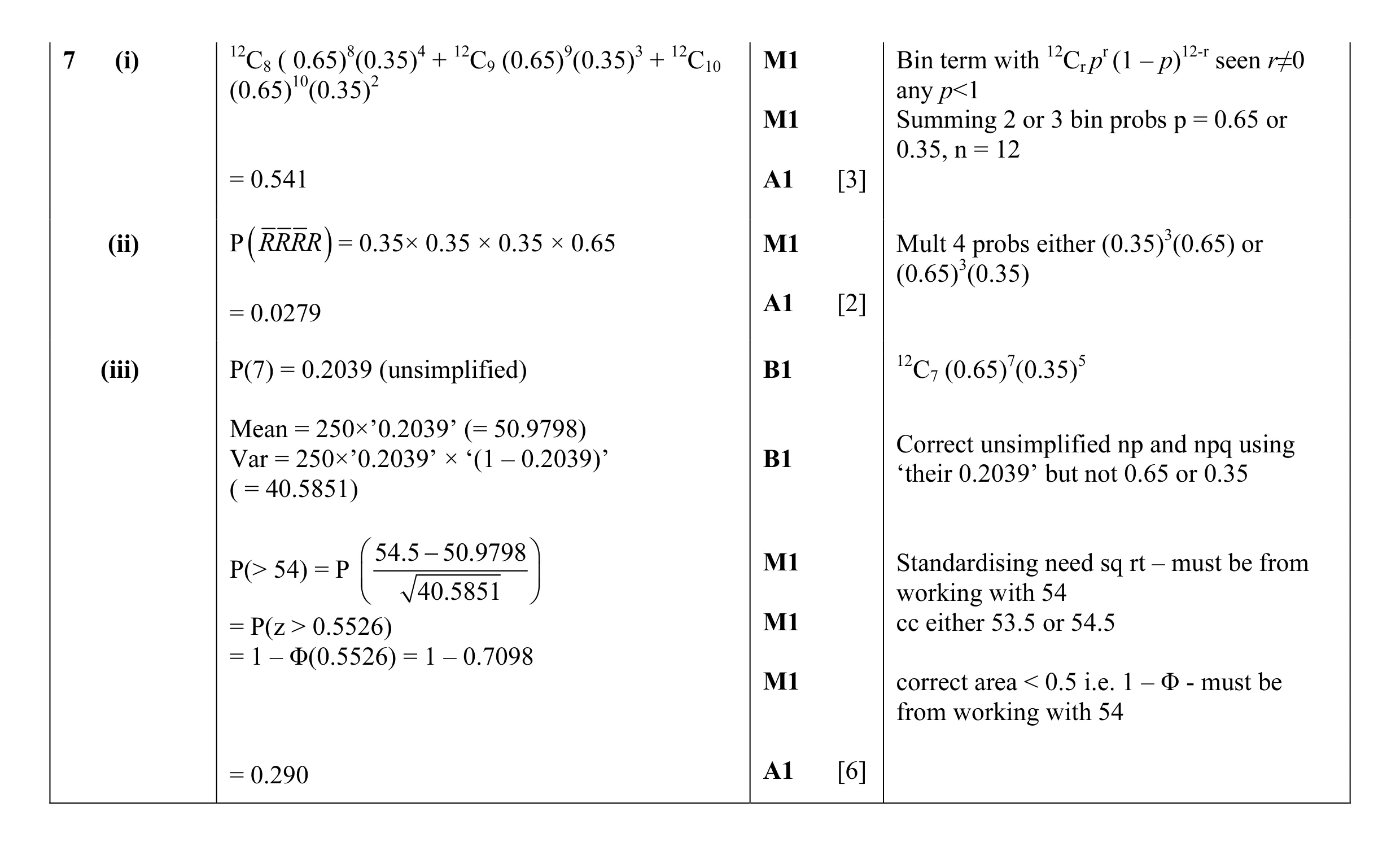 11
11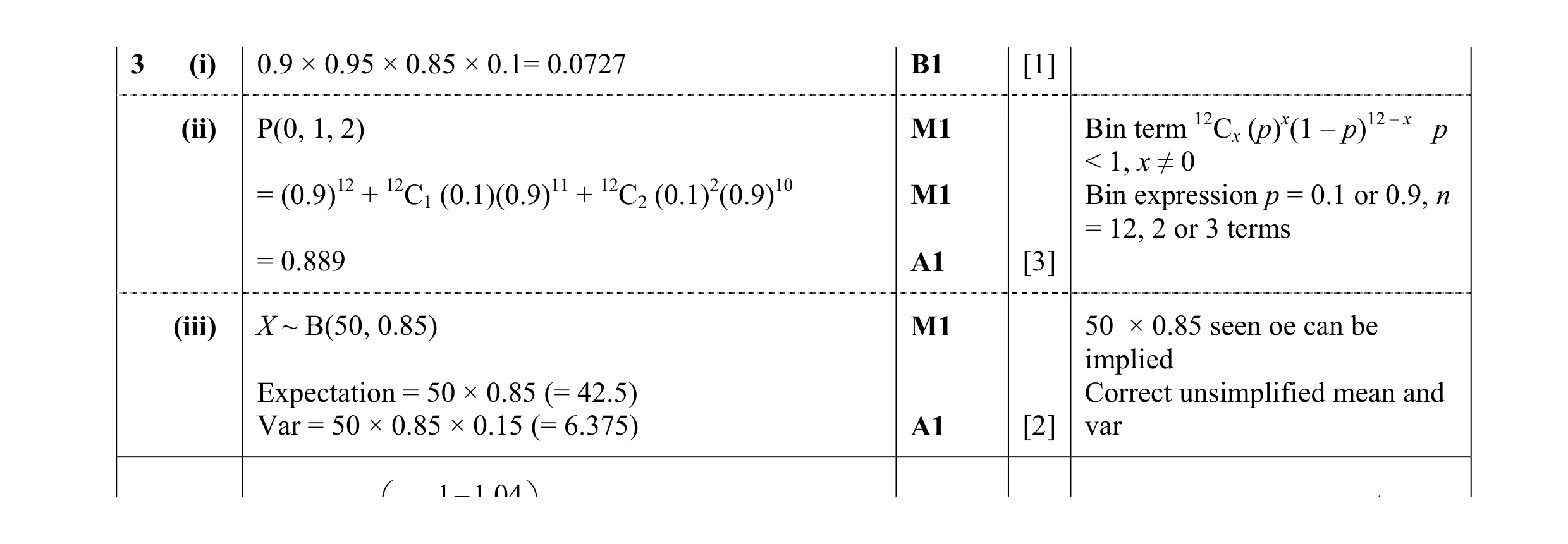 6
6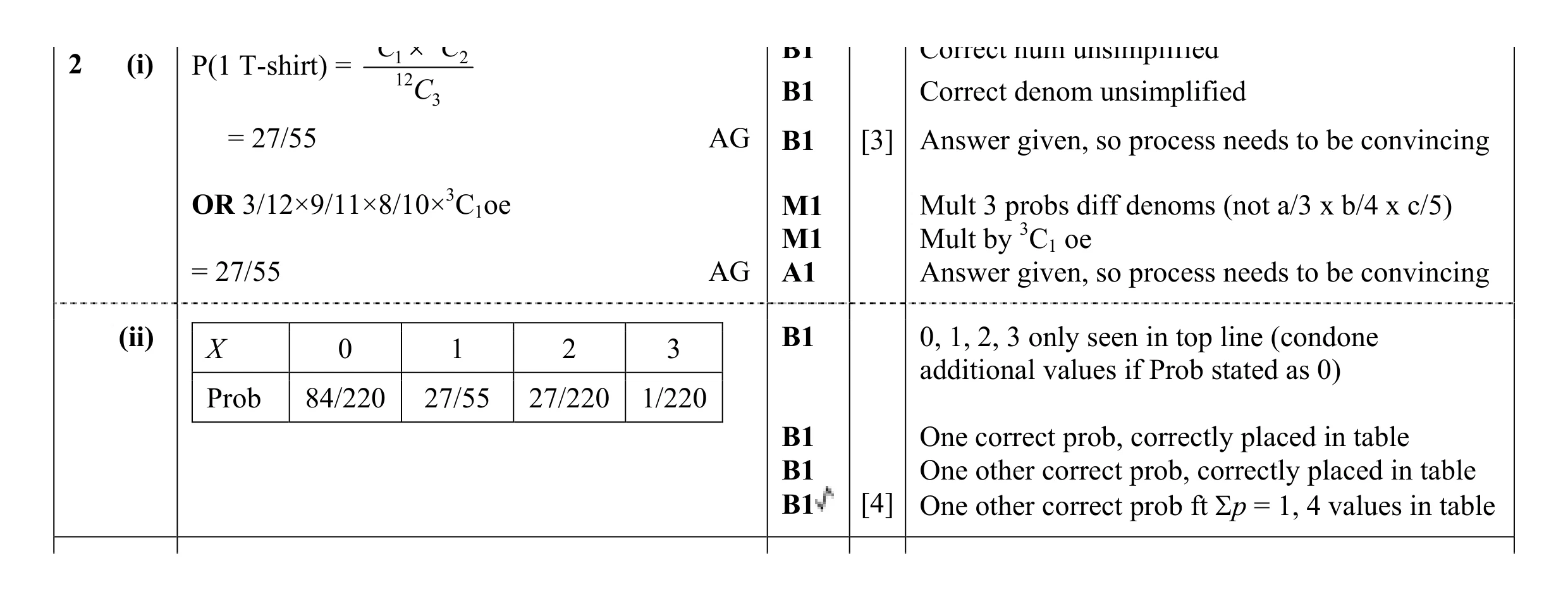 7
7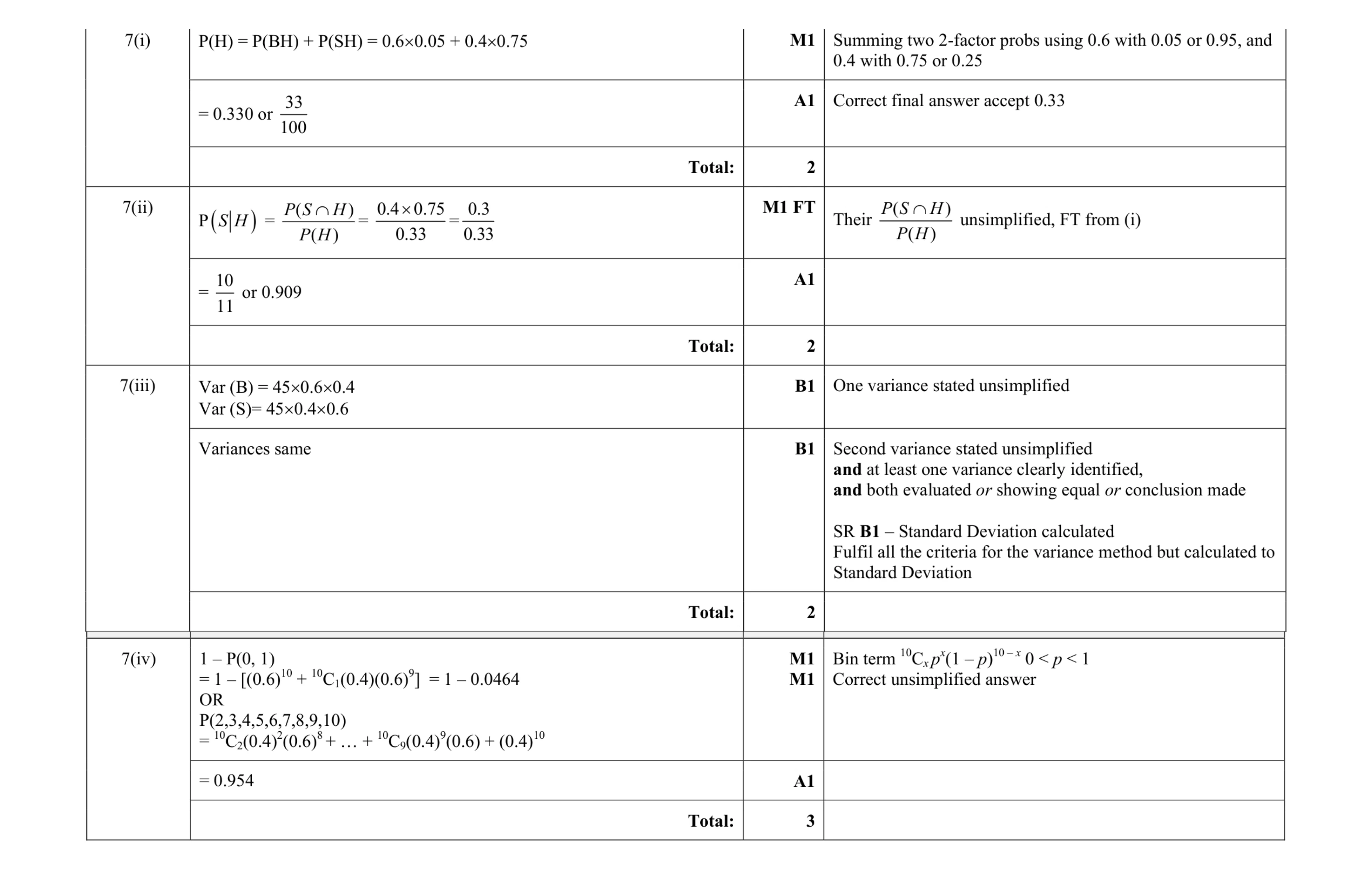 9
9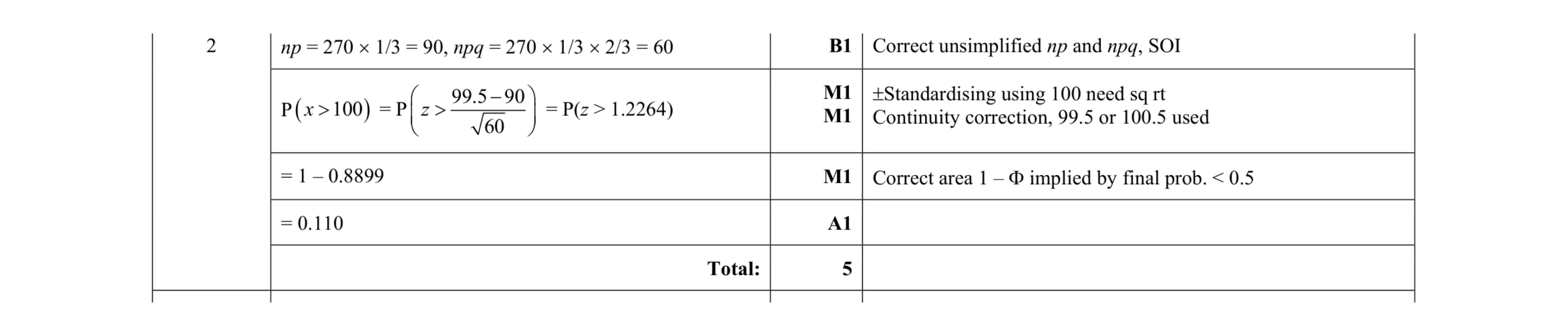 5
5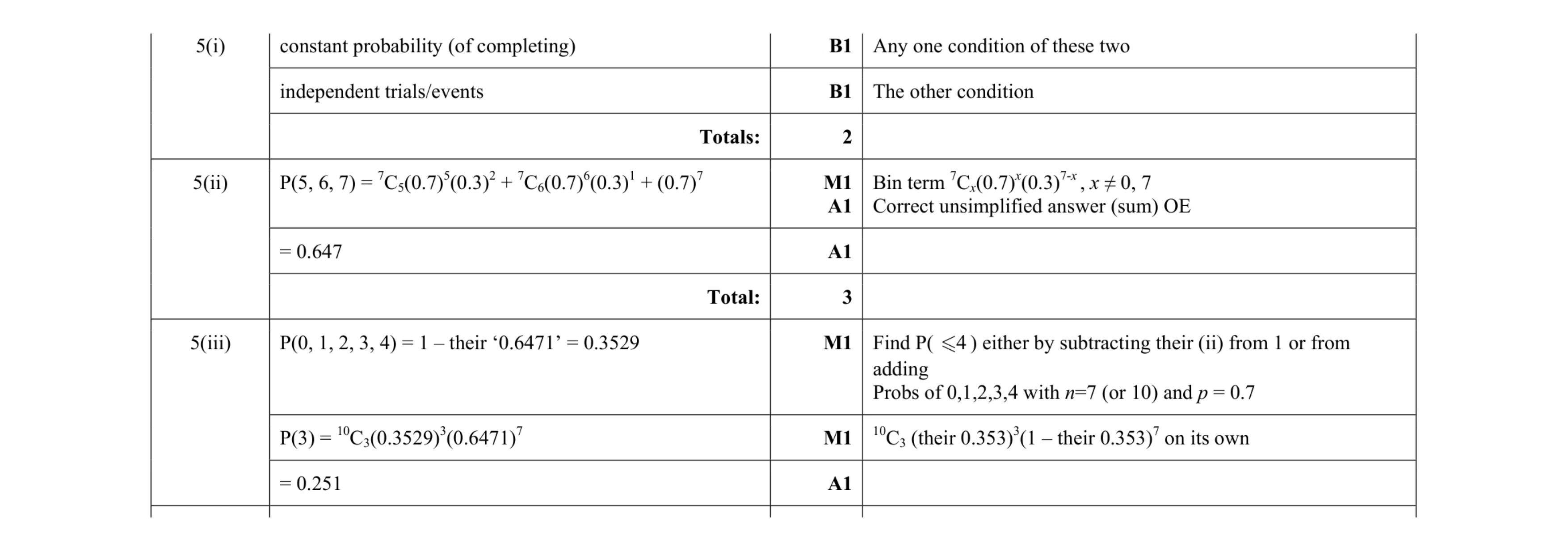 8
8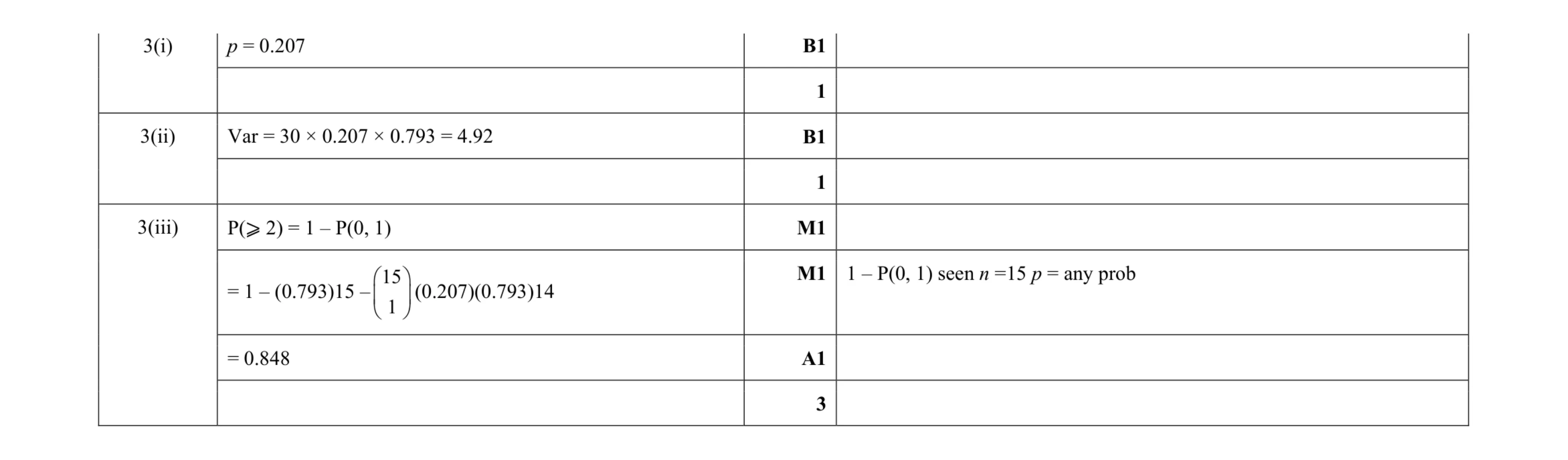 5
5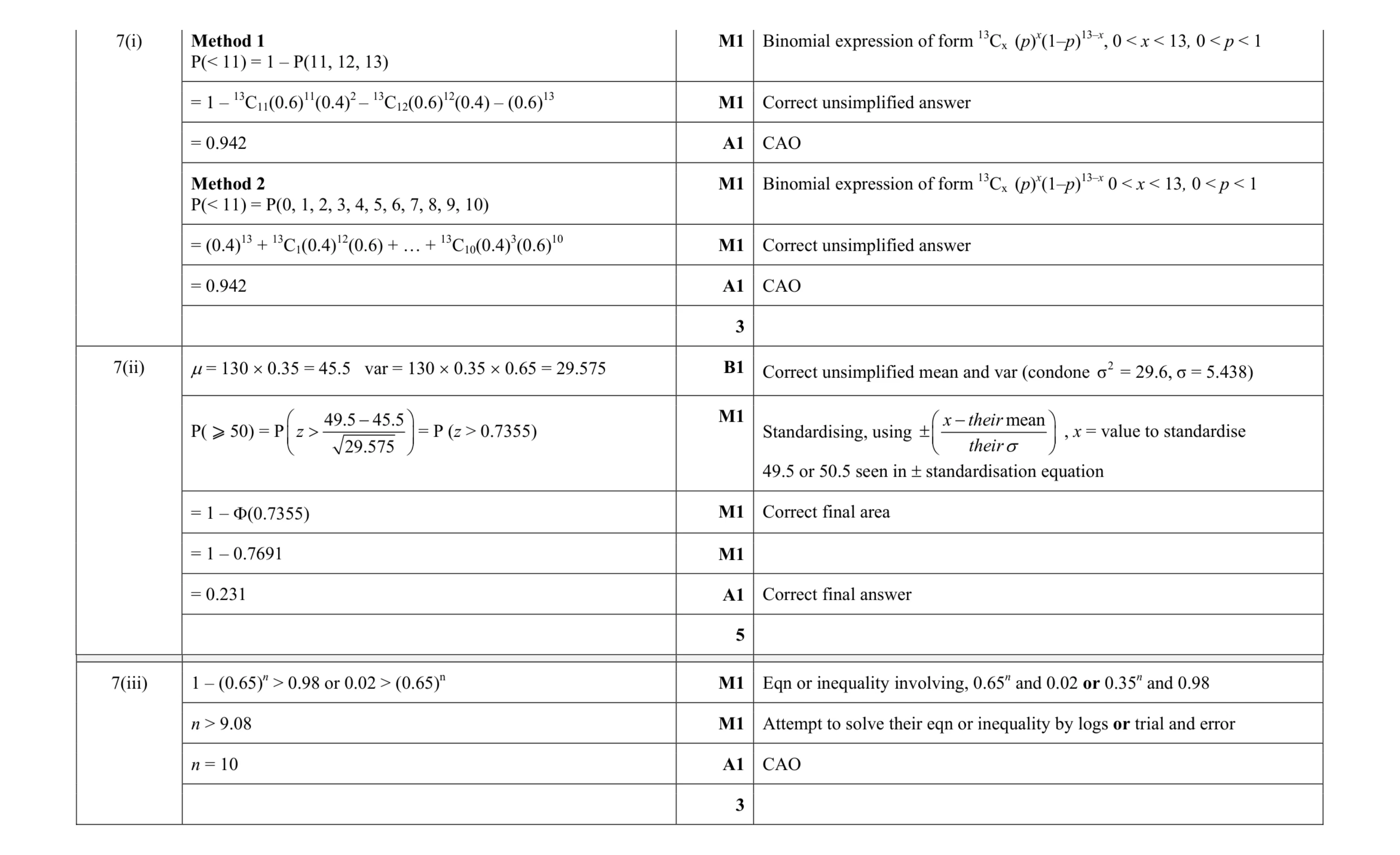 11
11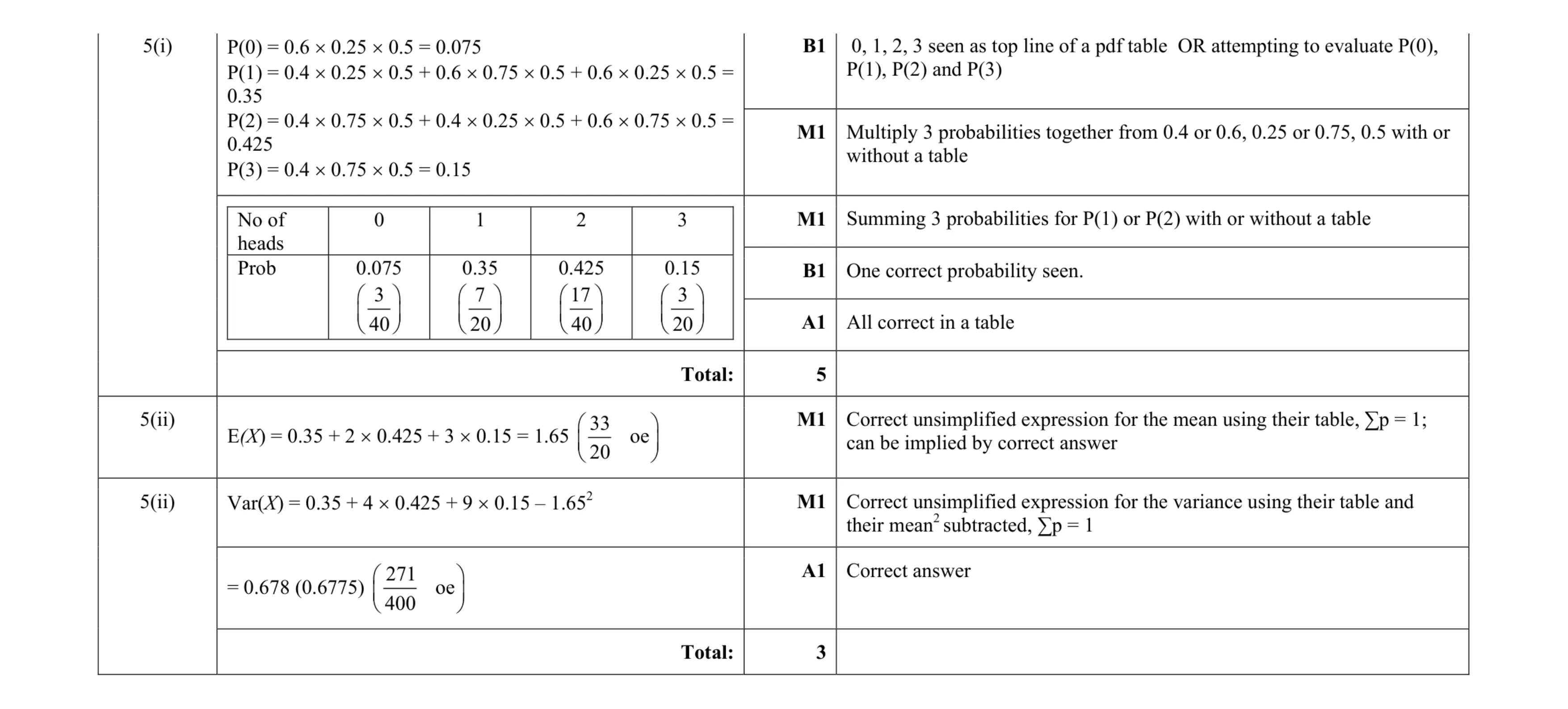 8
8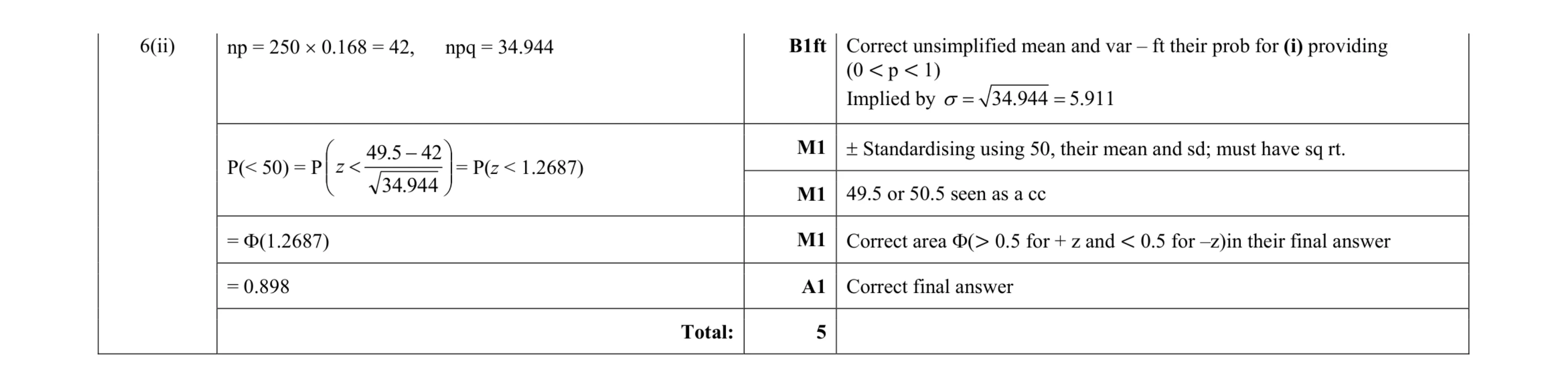 8
8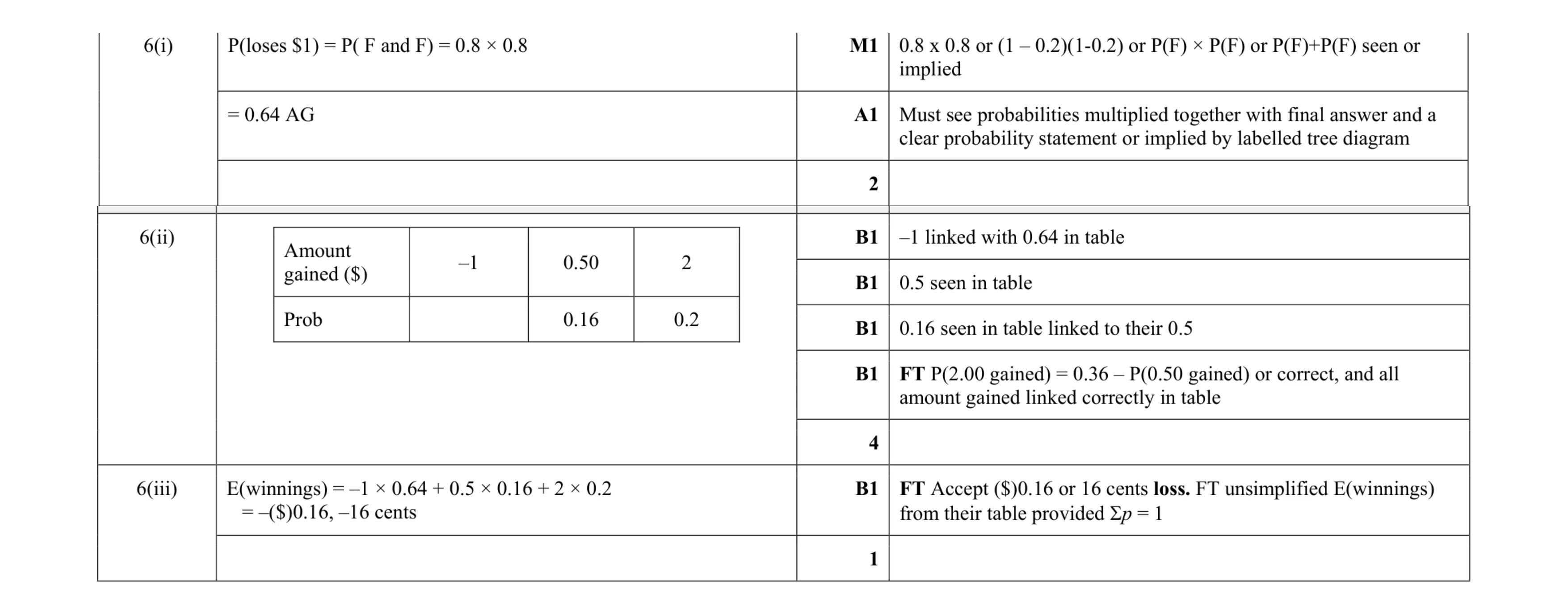 7
7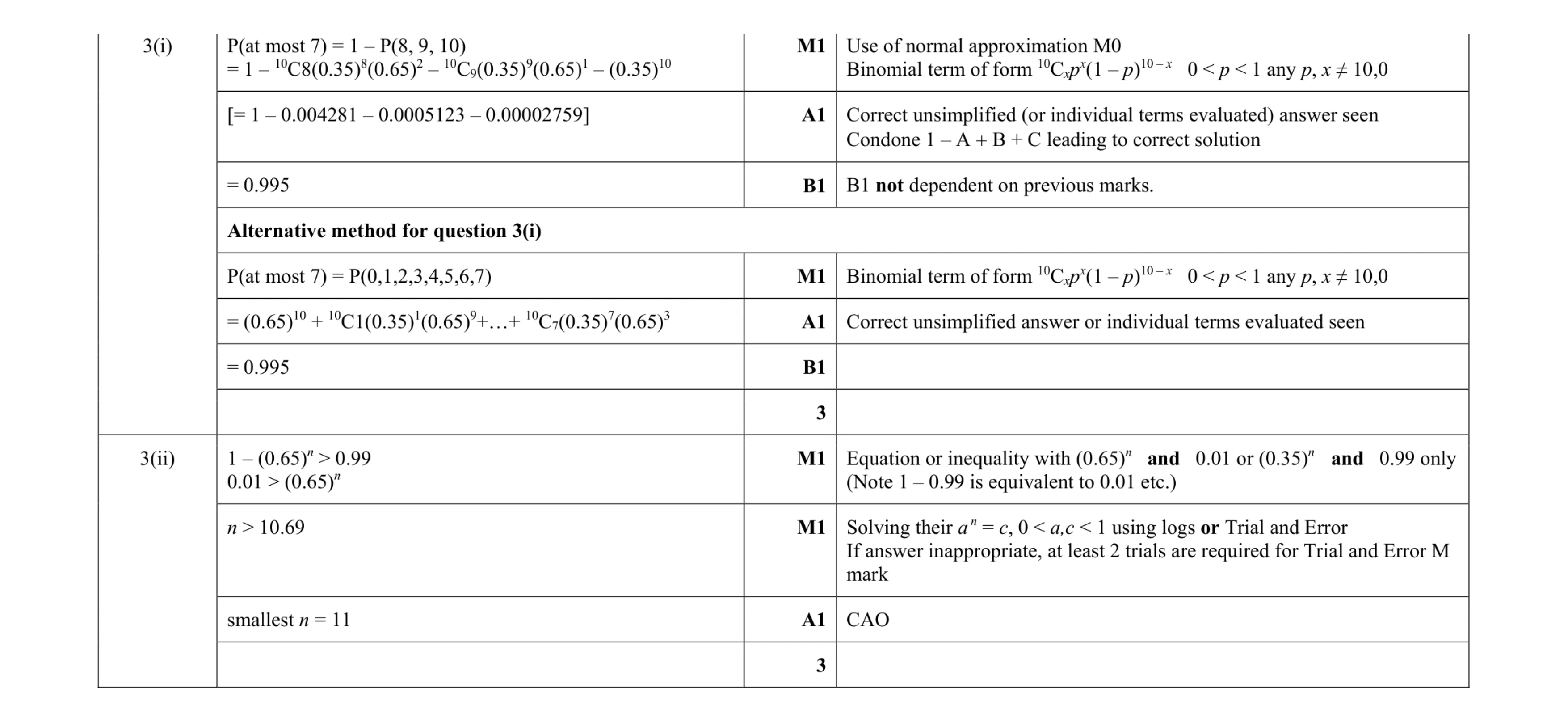 6
6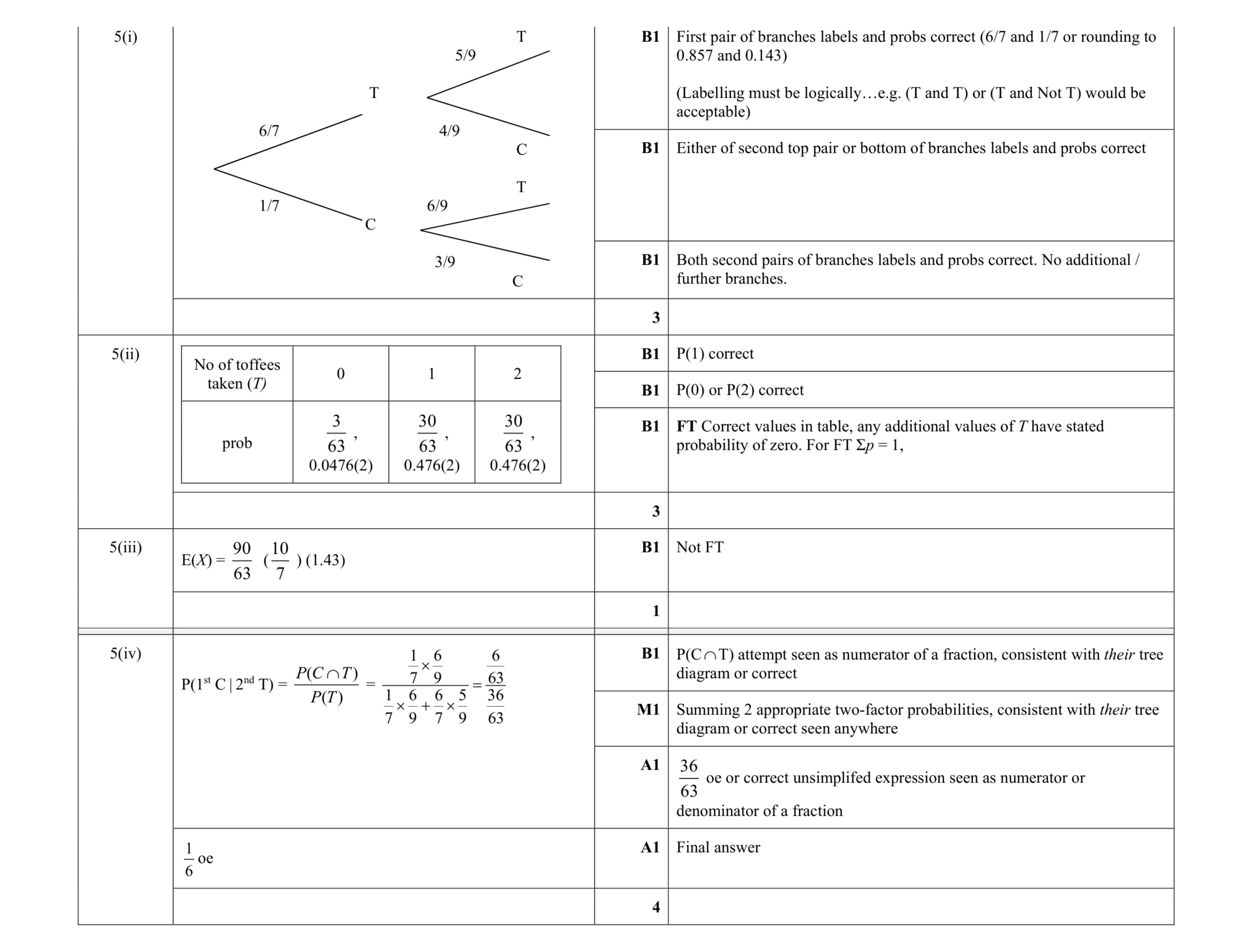 11
11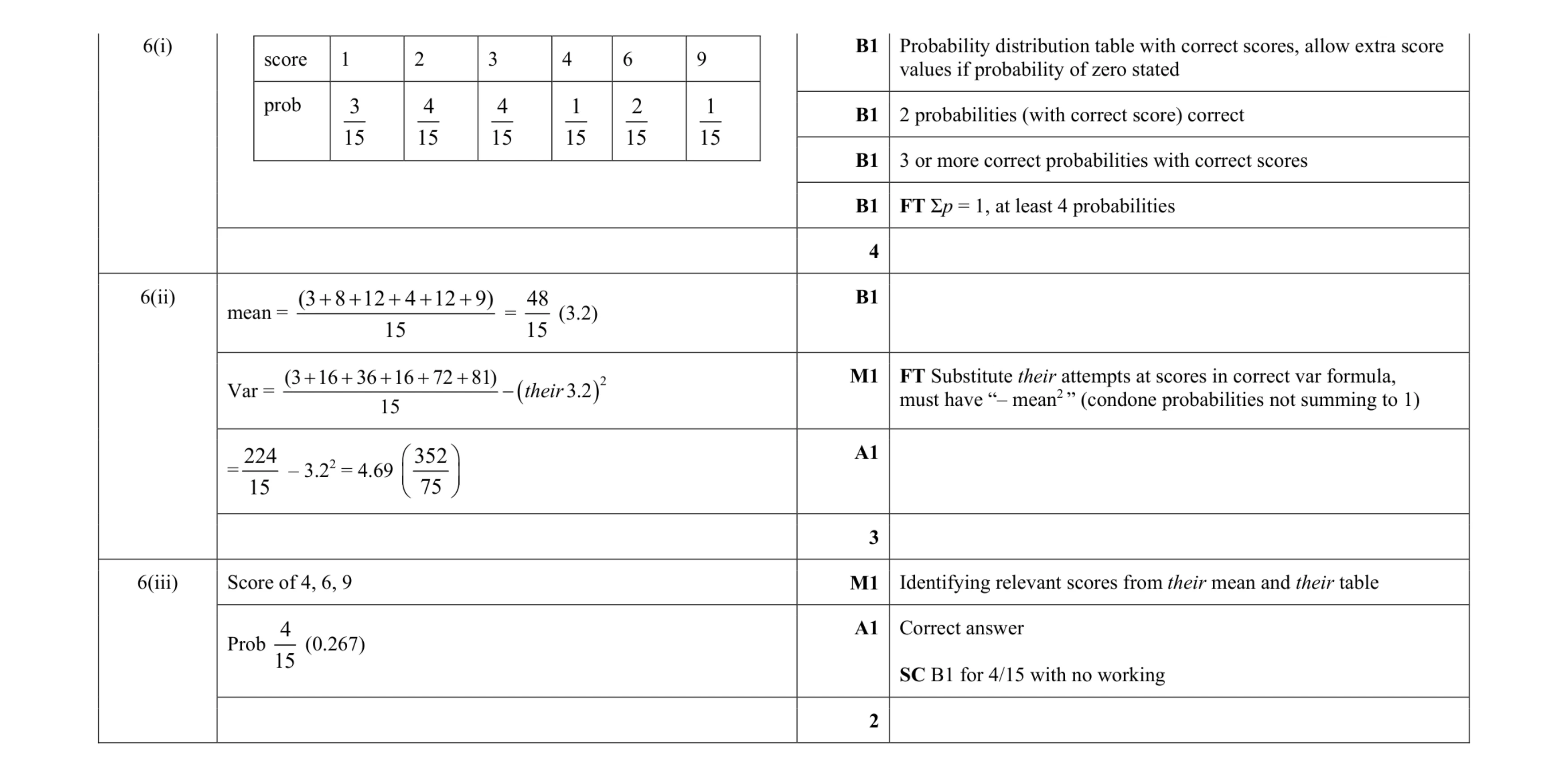 9
9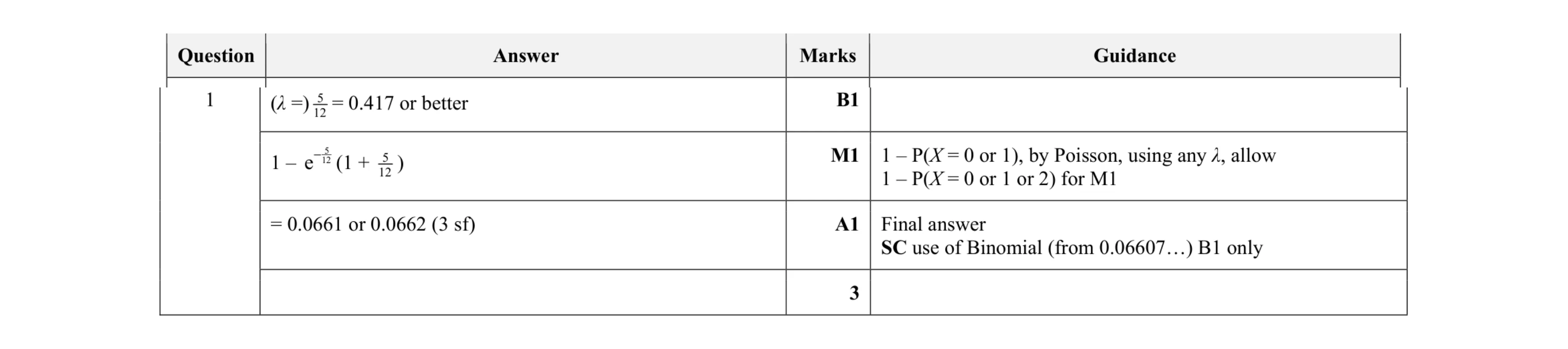 3
3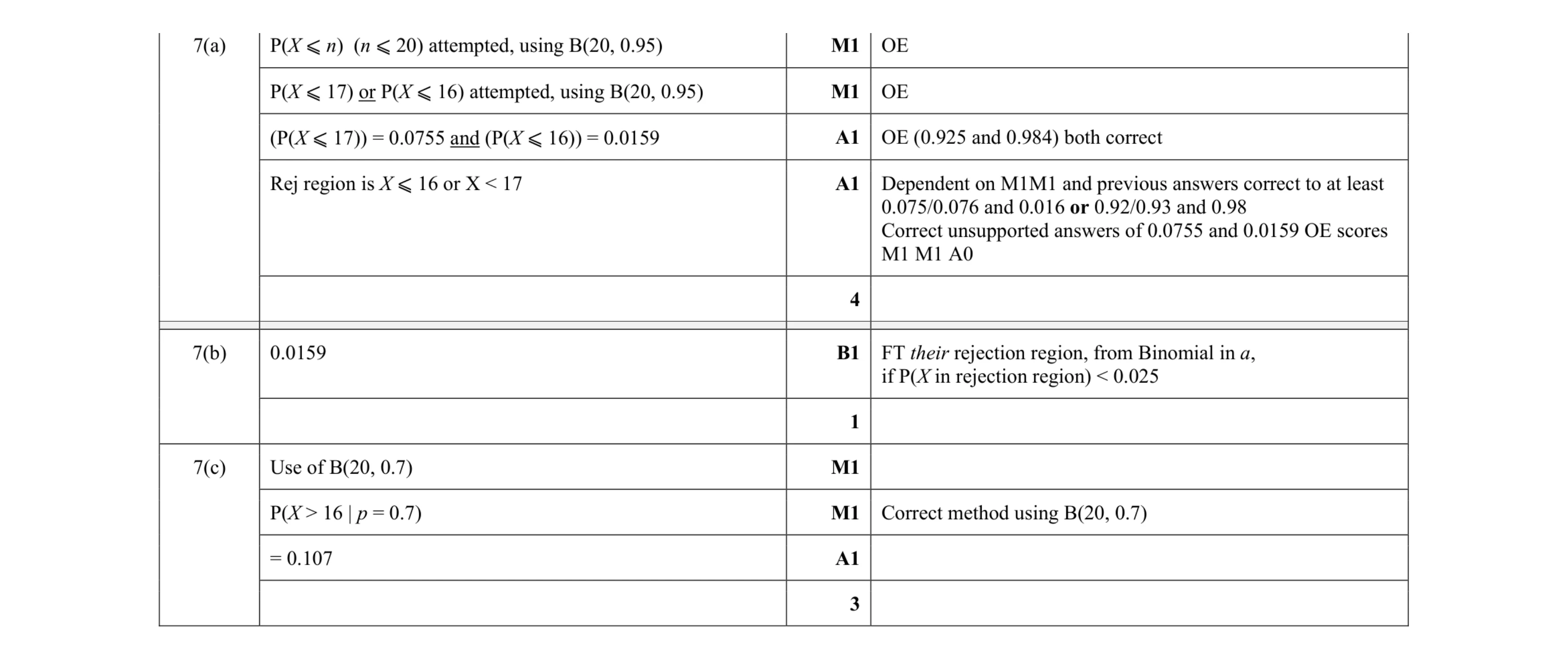 8
8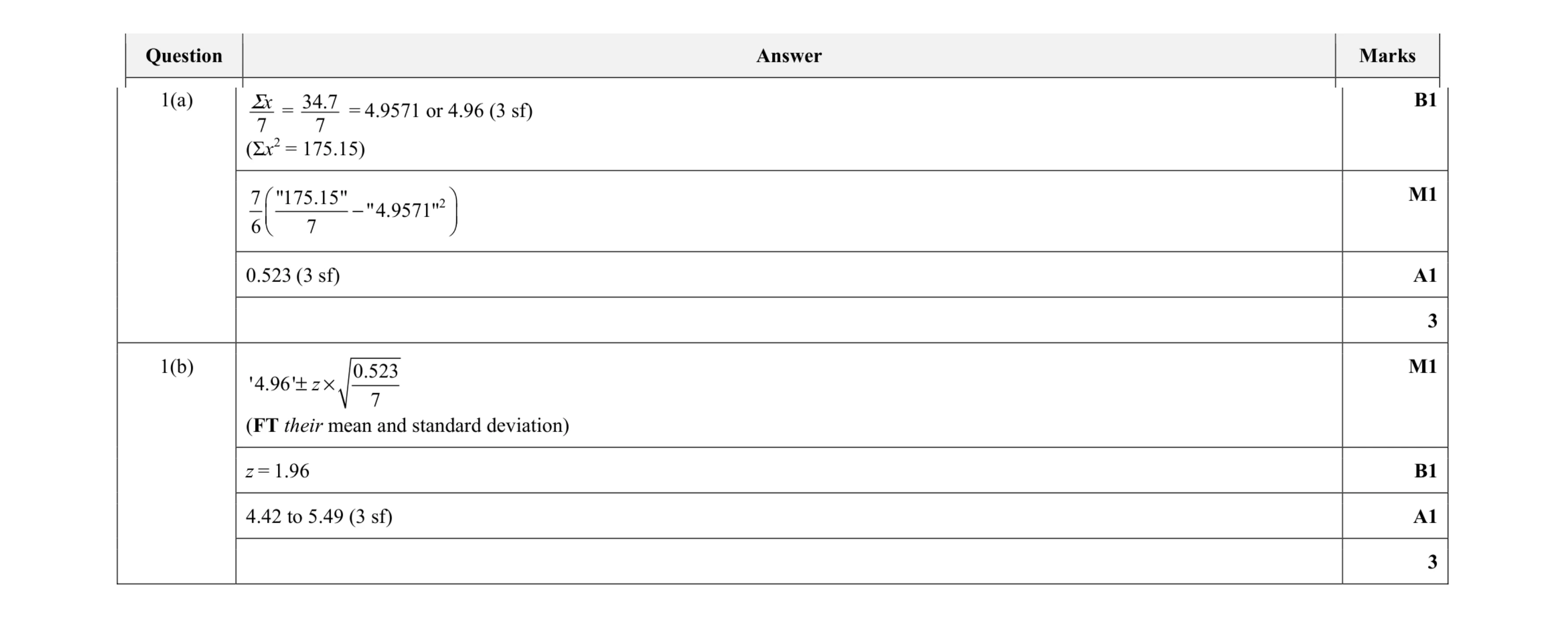 6
6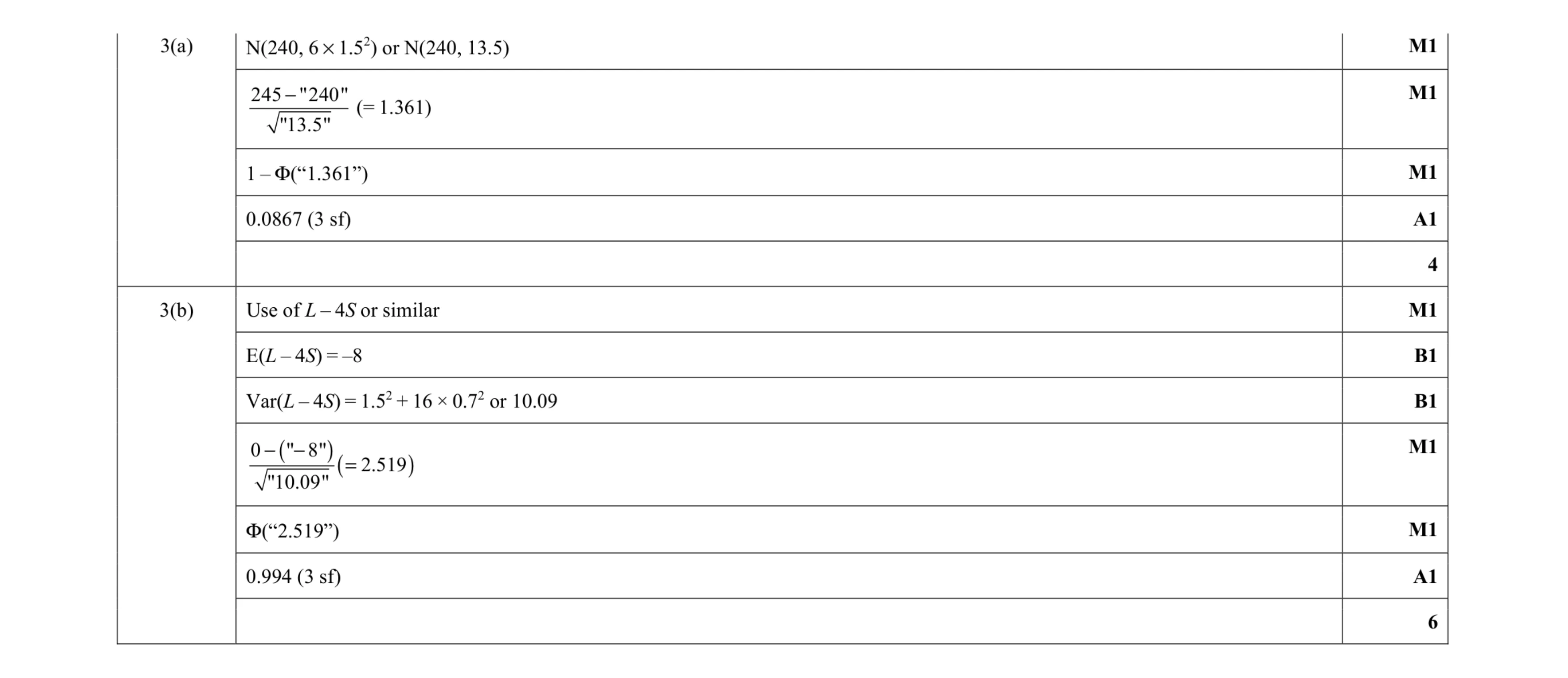 10
10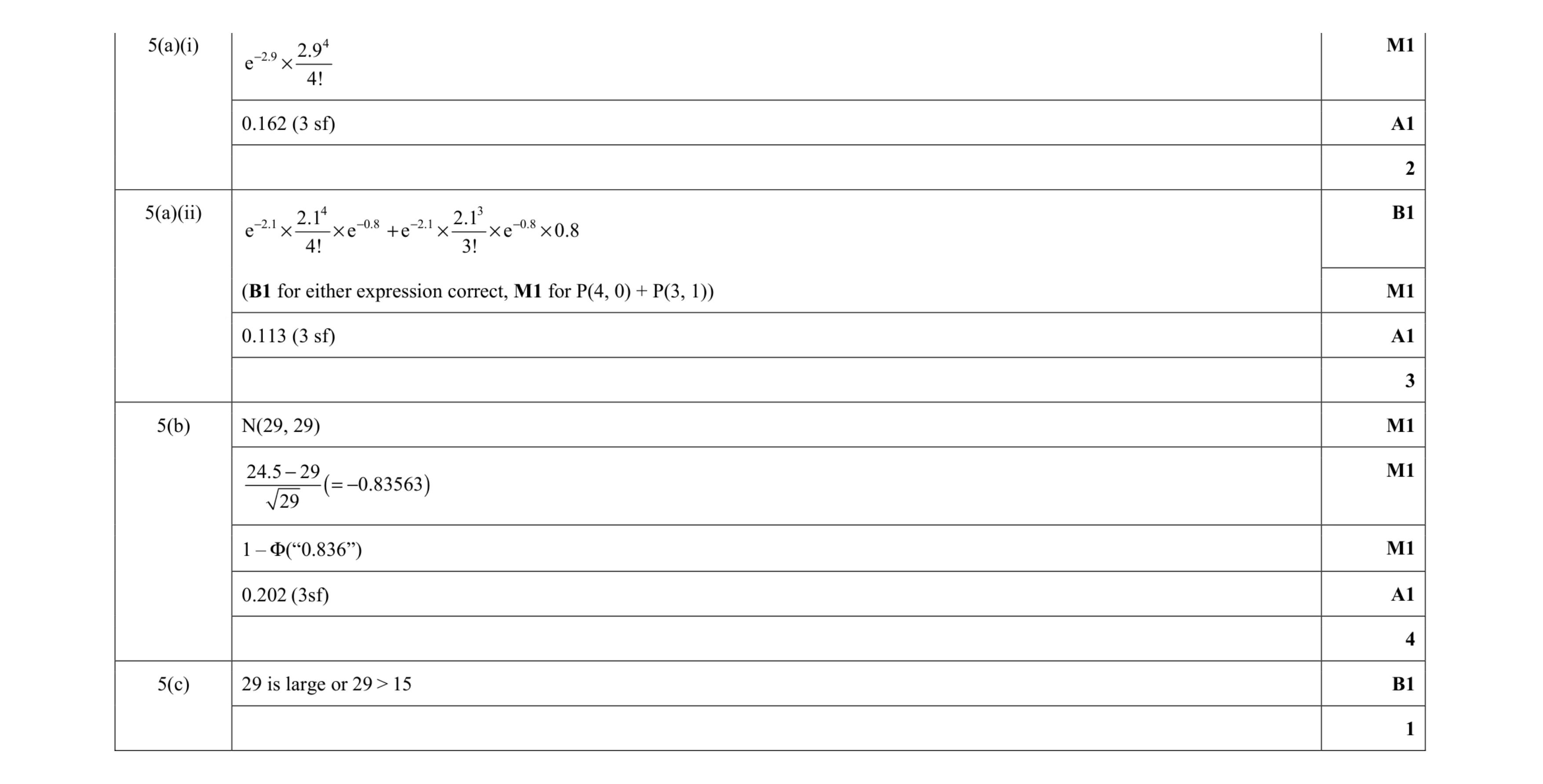 10
10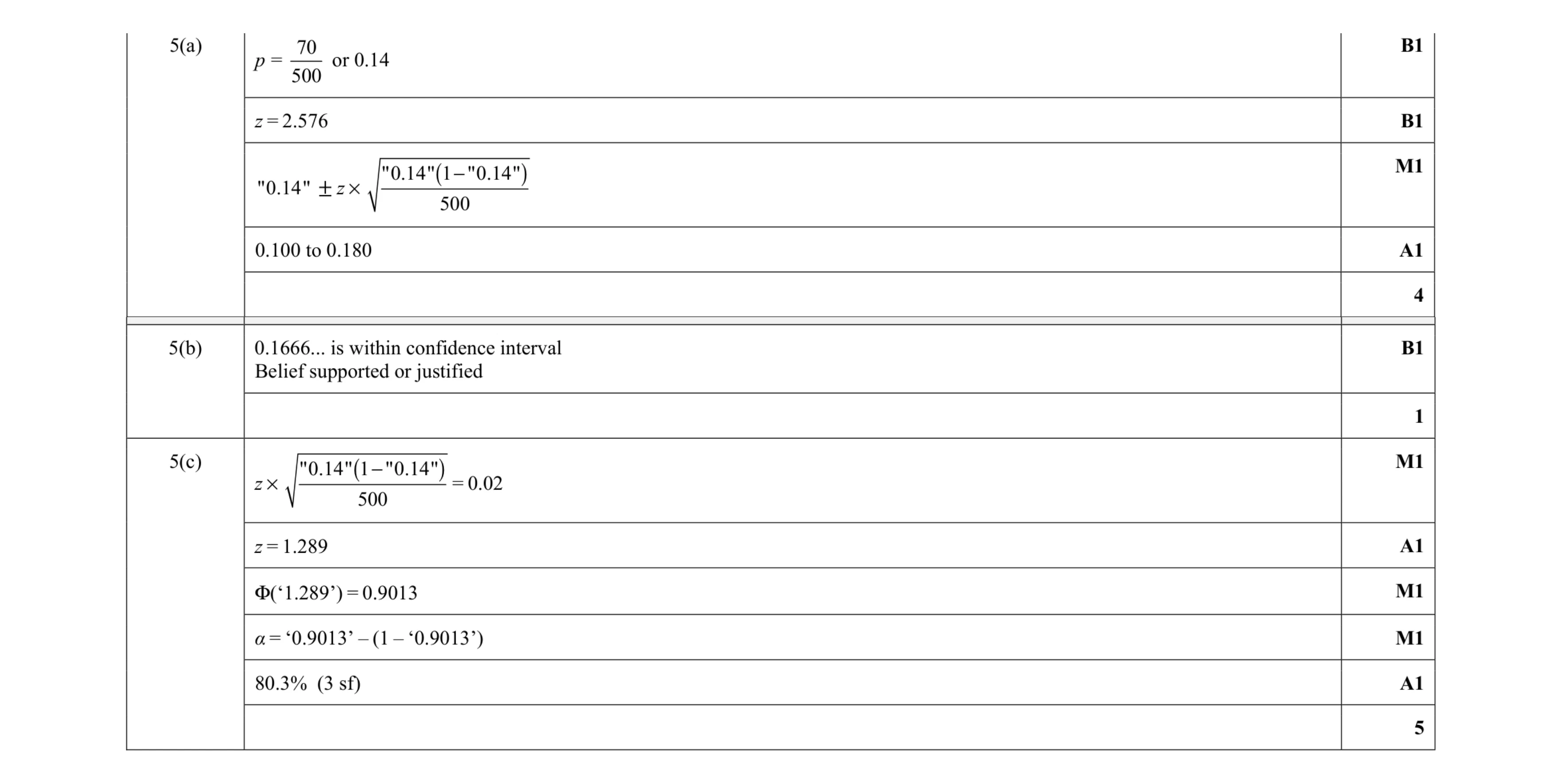 10
10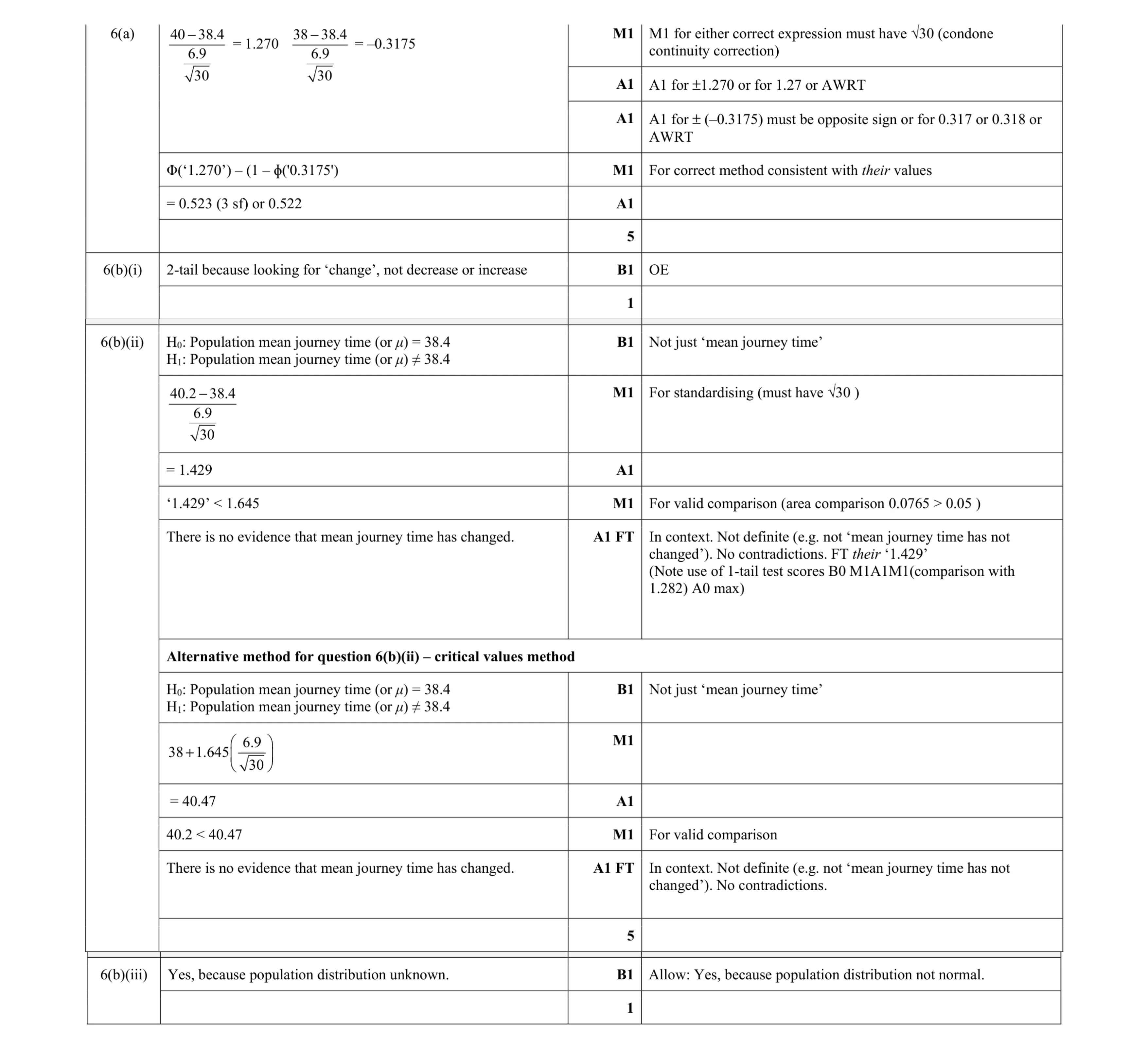 12
12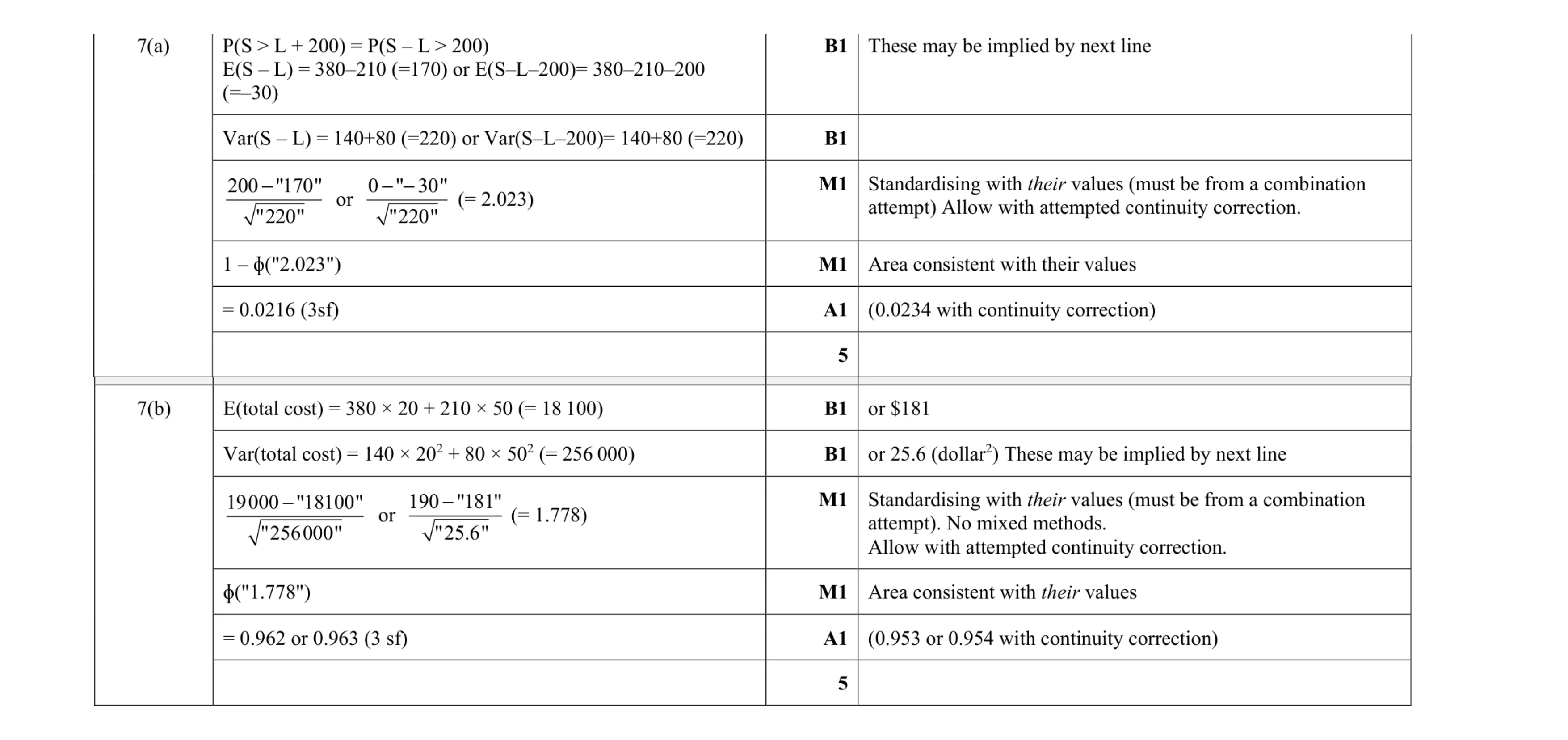 10
10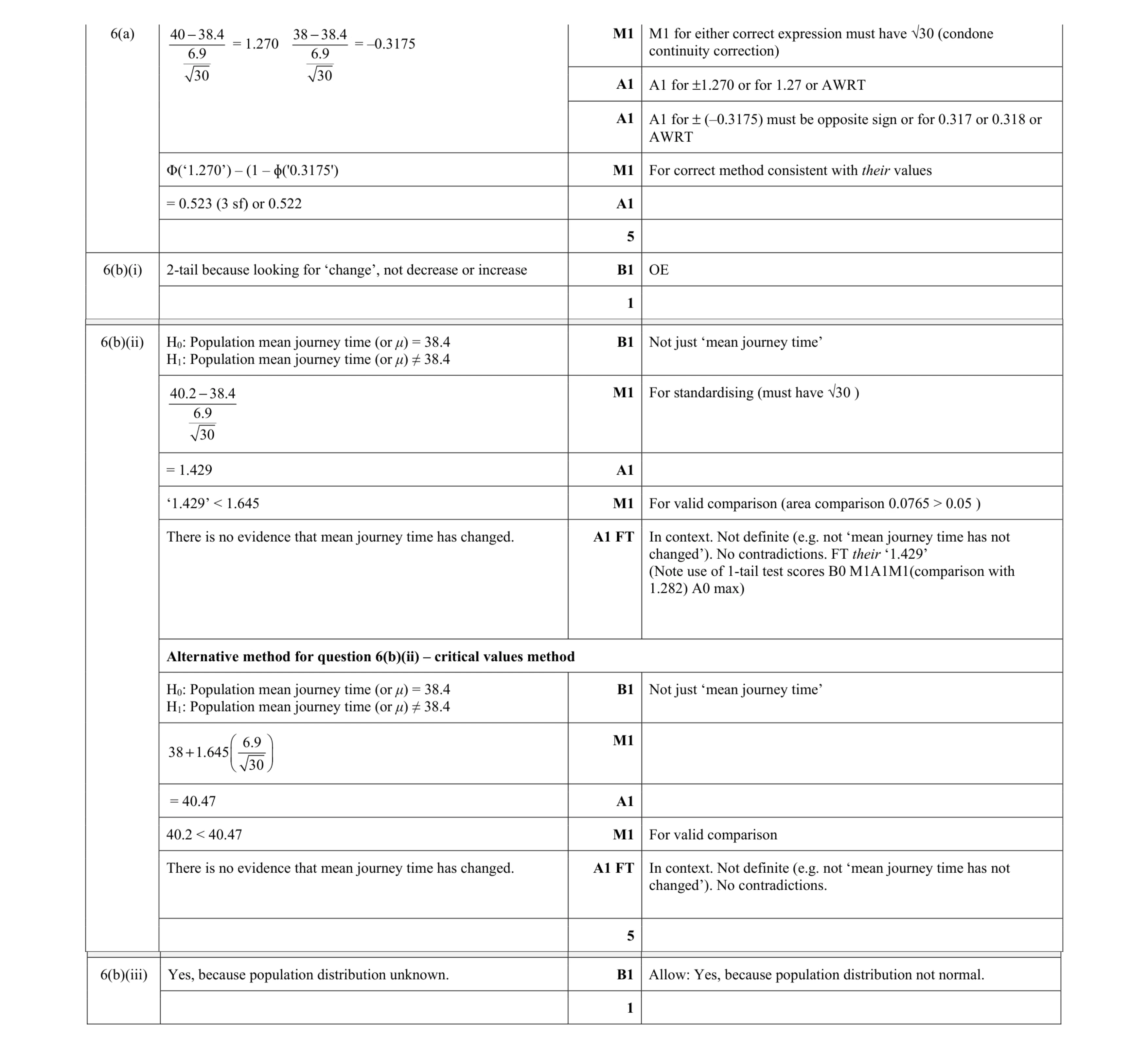 12
12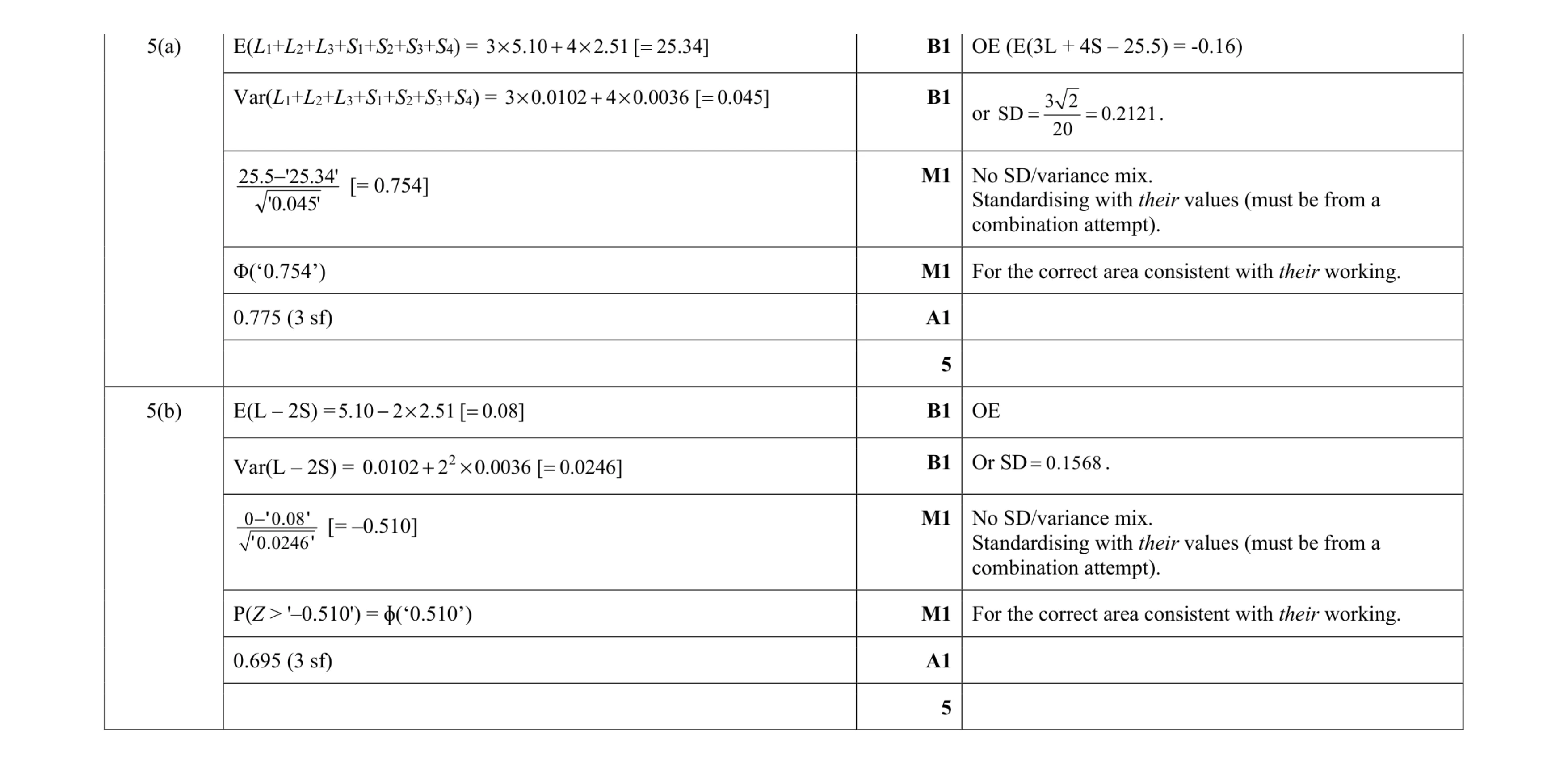 10
10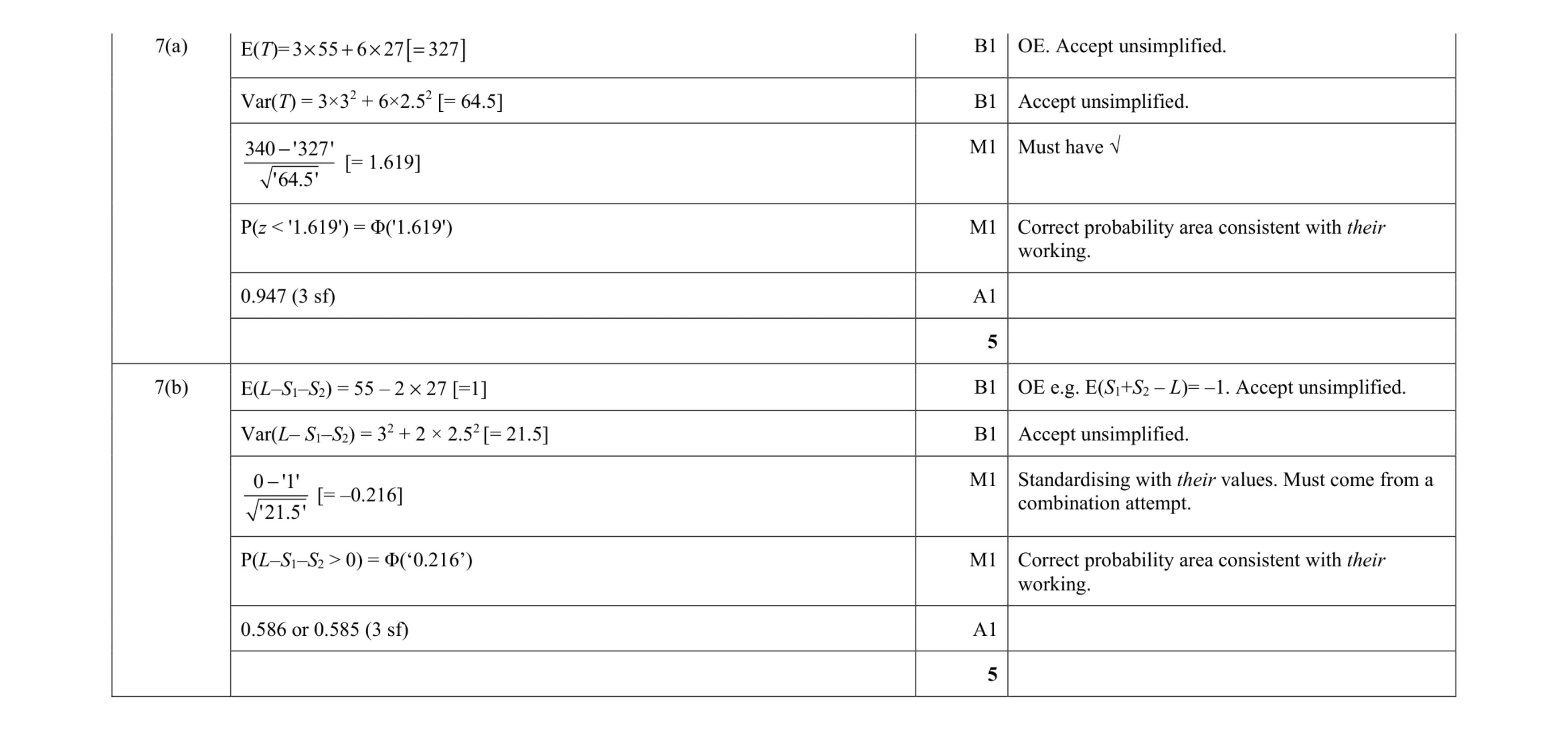 10
10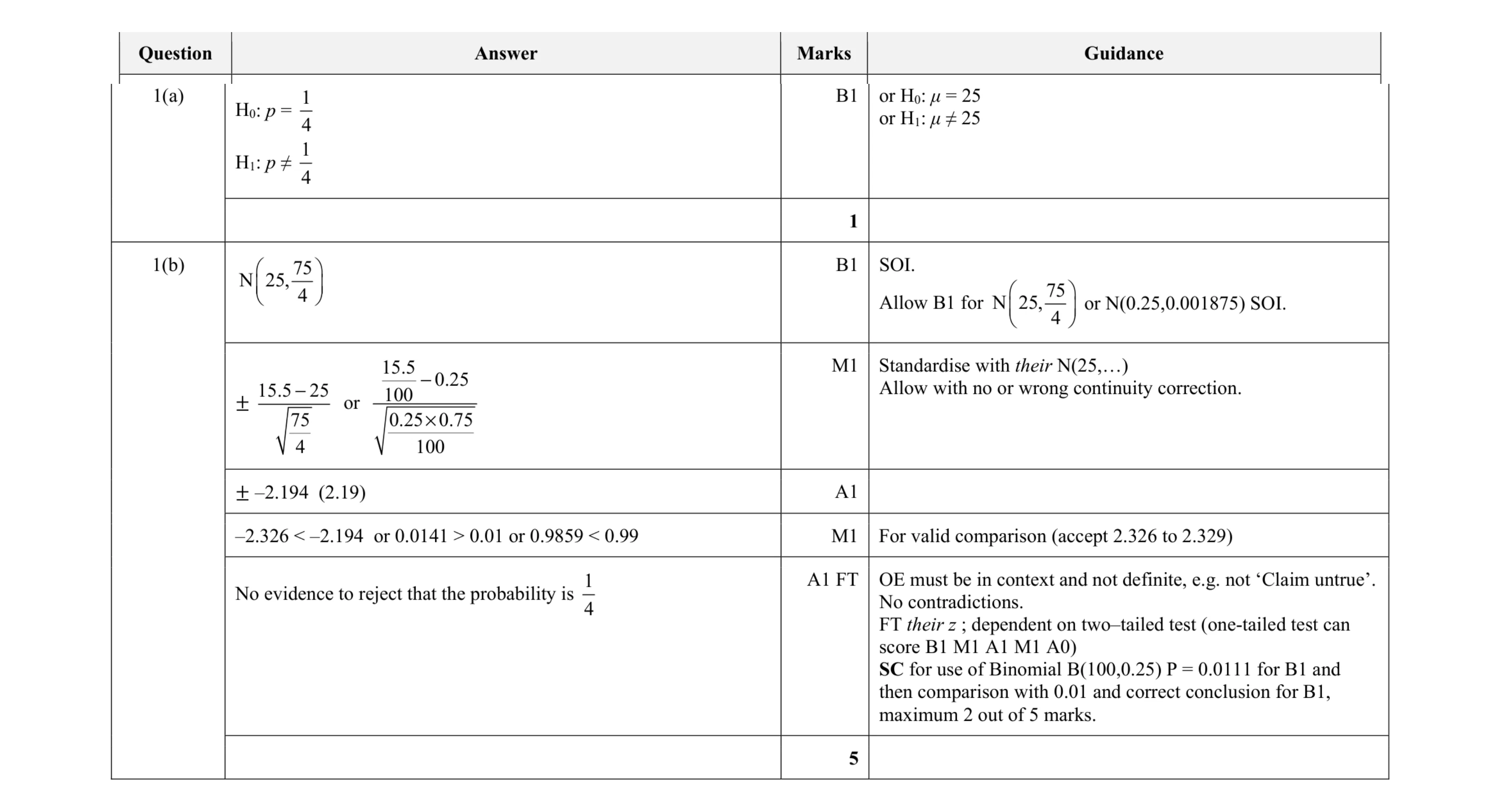 6
6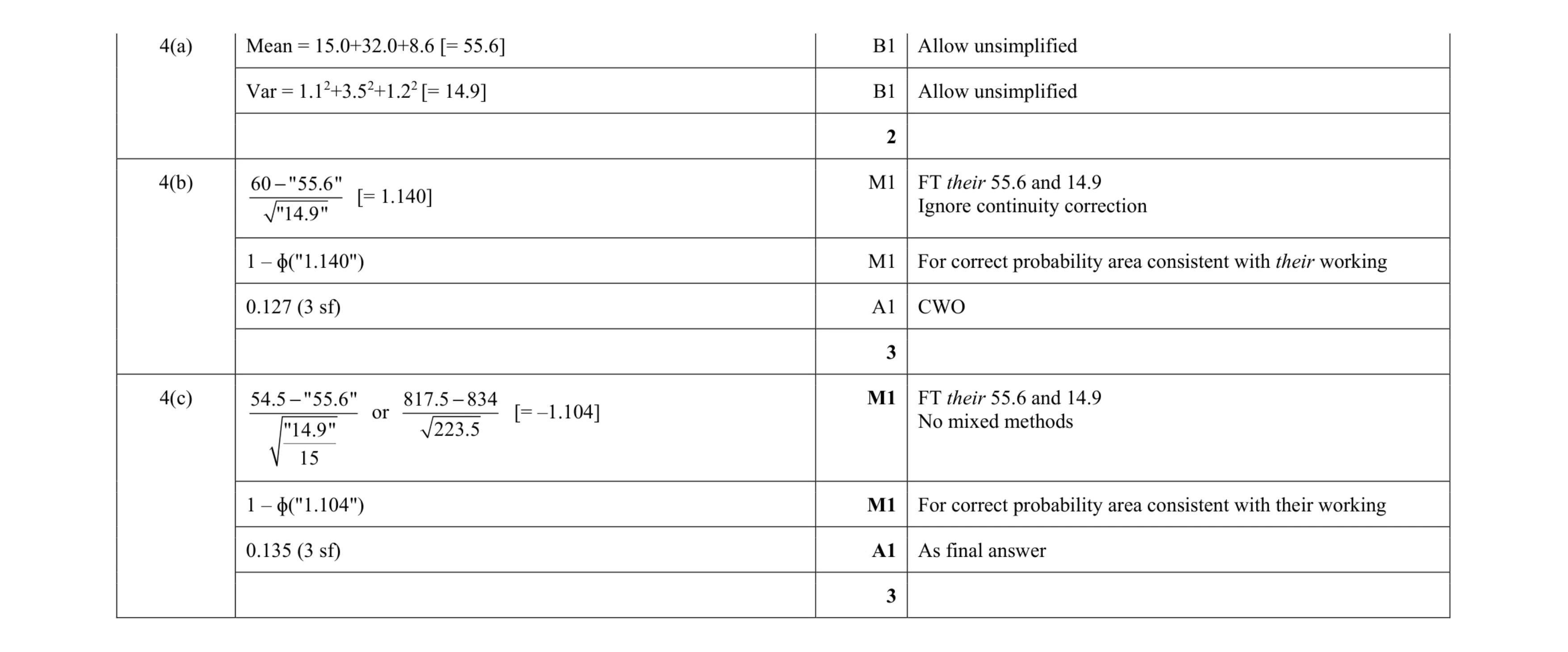 8
8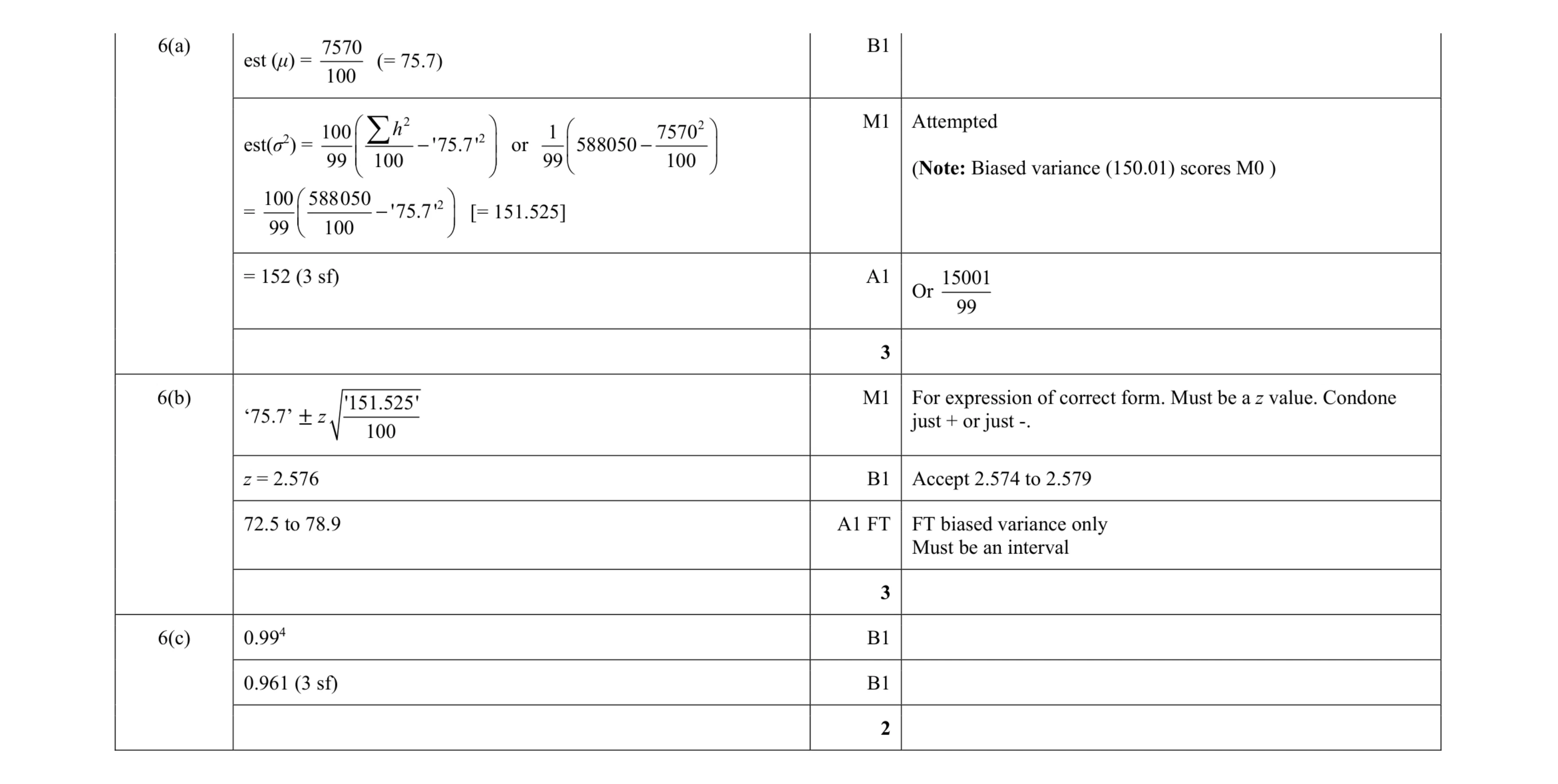 8
8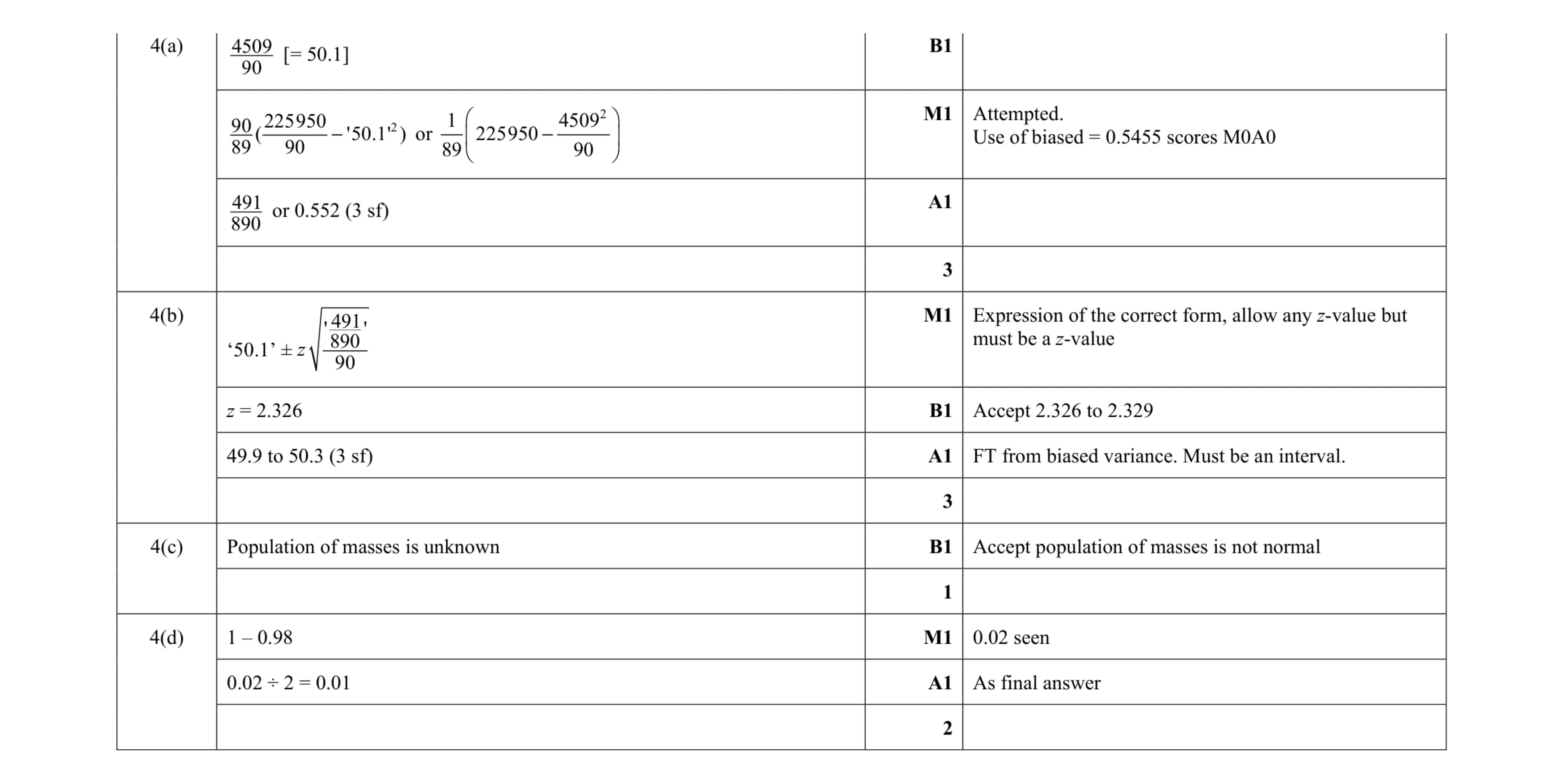 9
9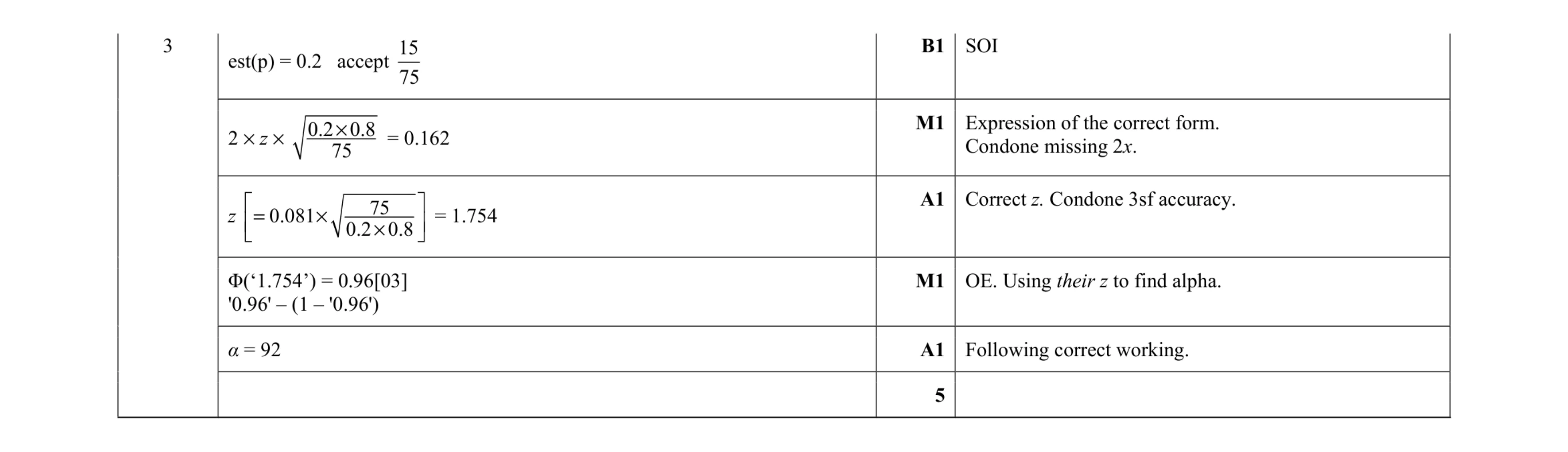 5
5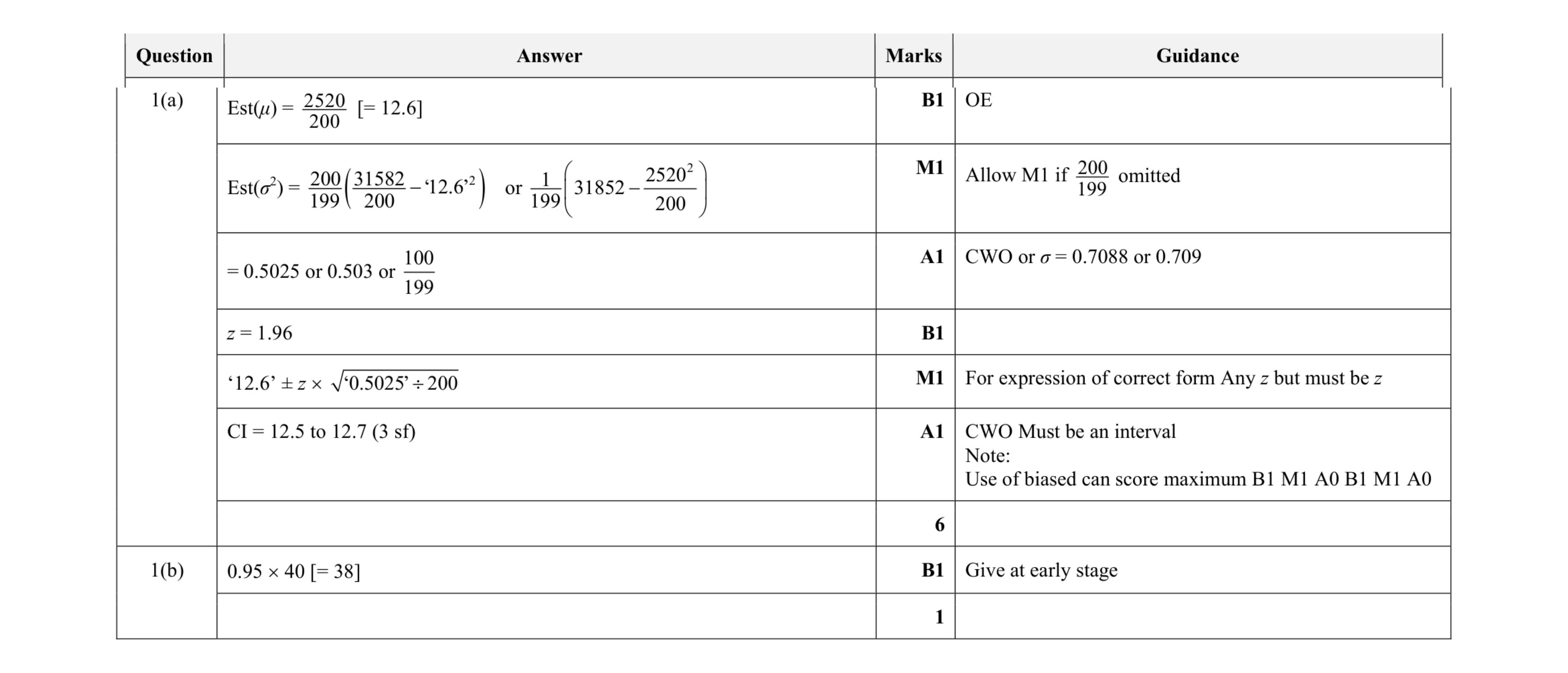 7
7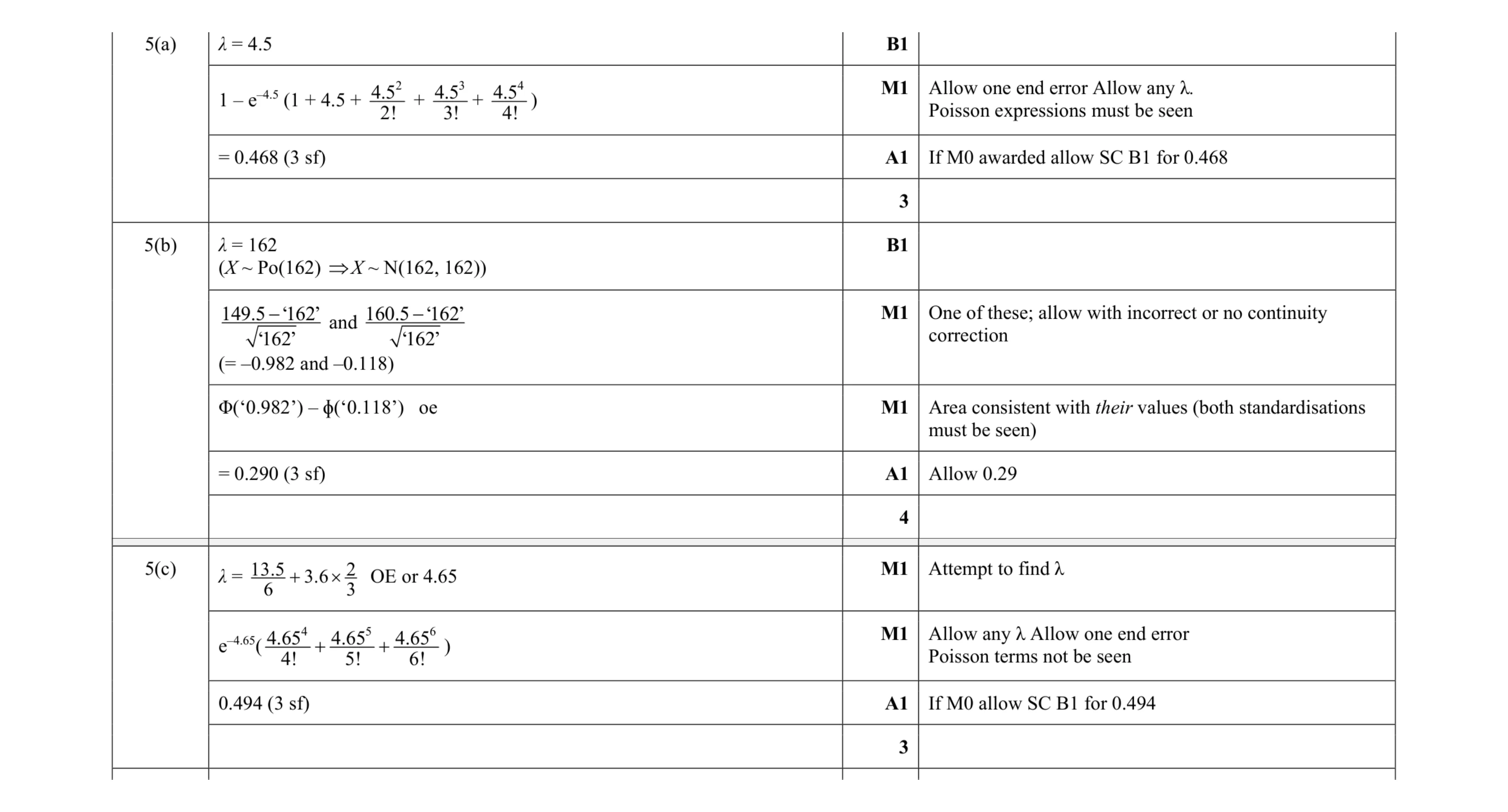 10
10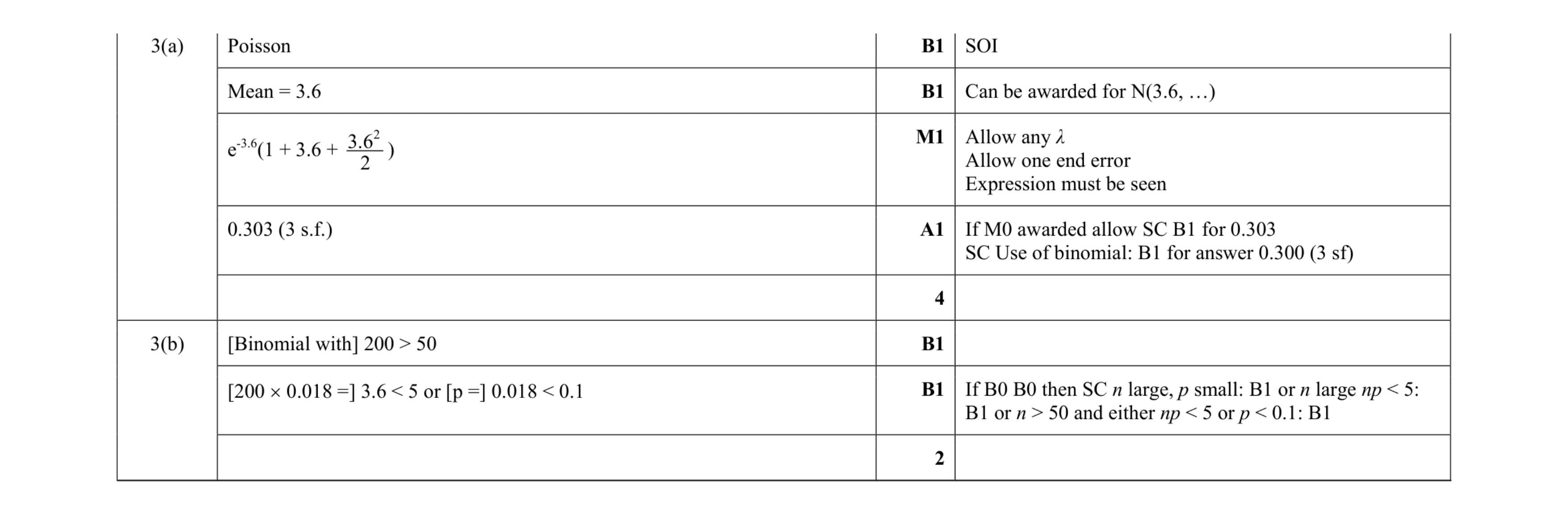 6
6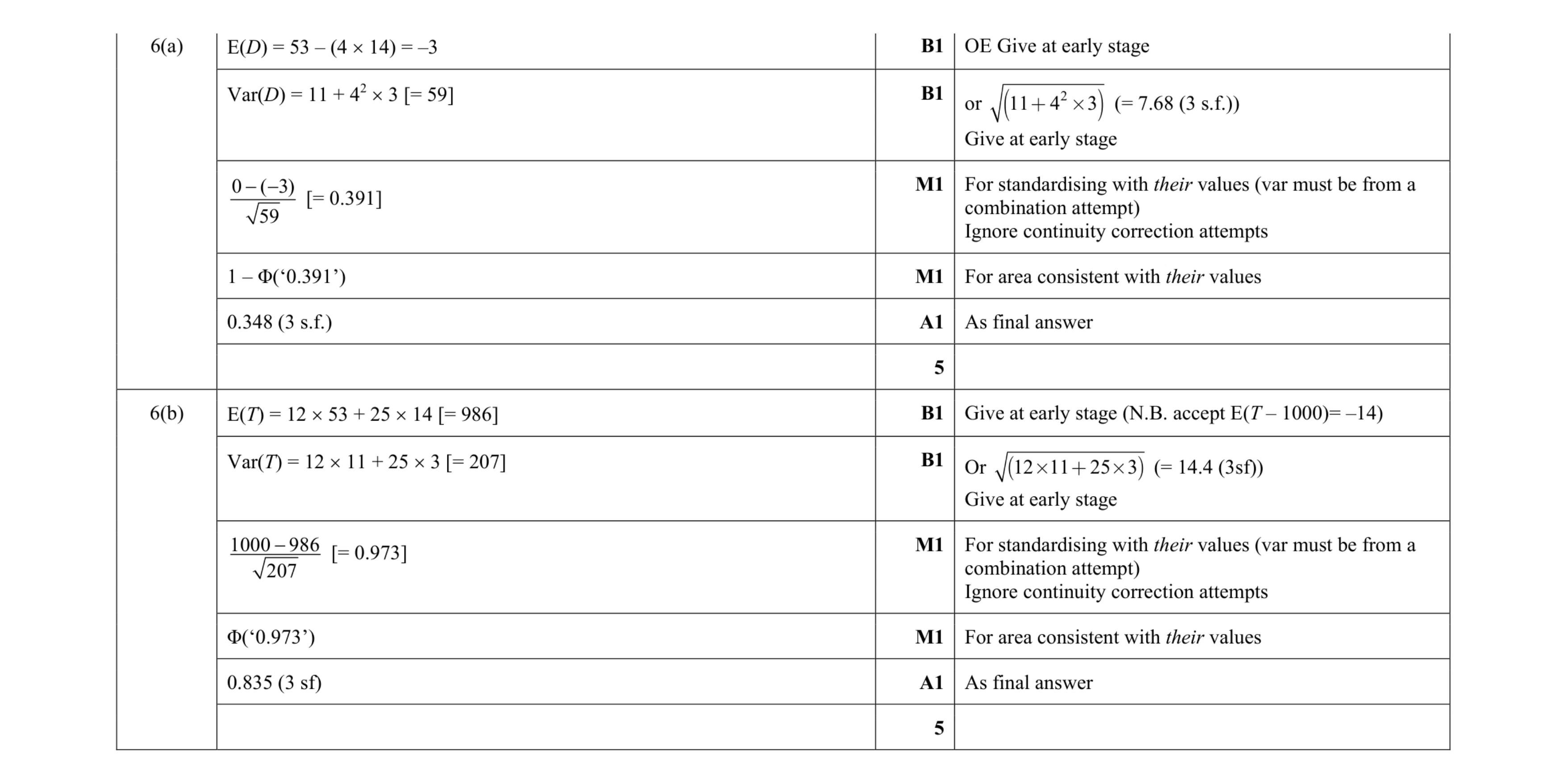 10
10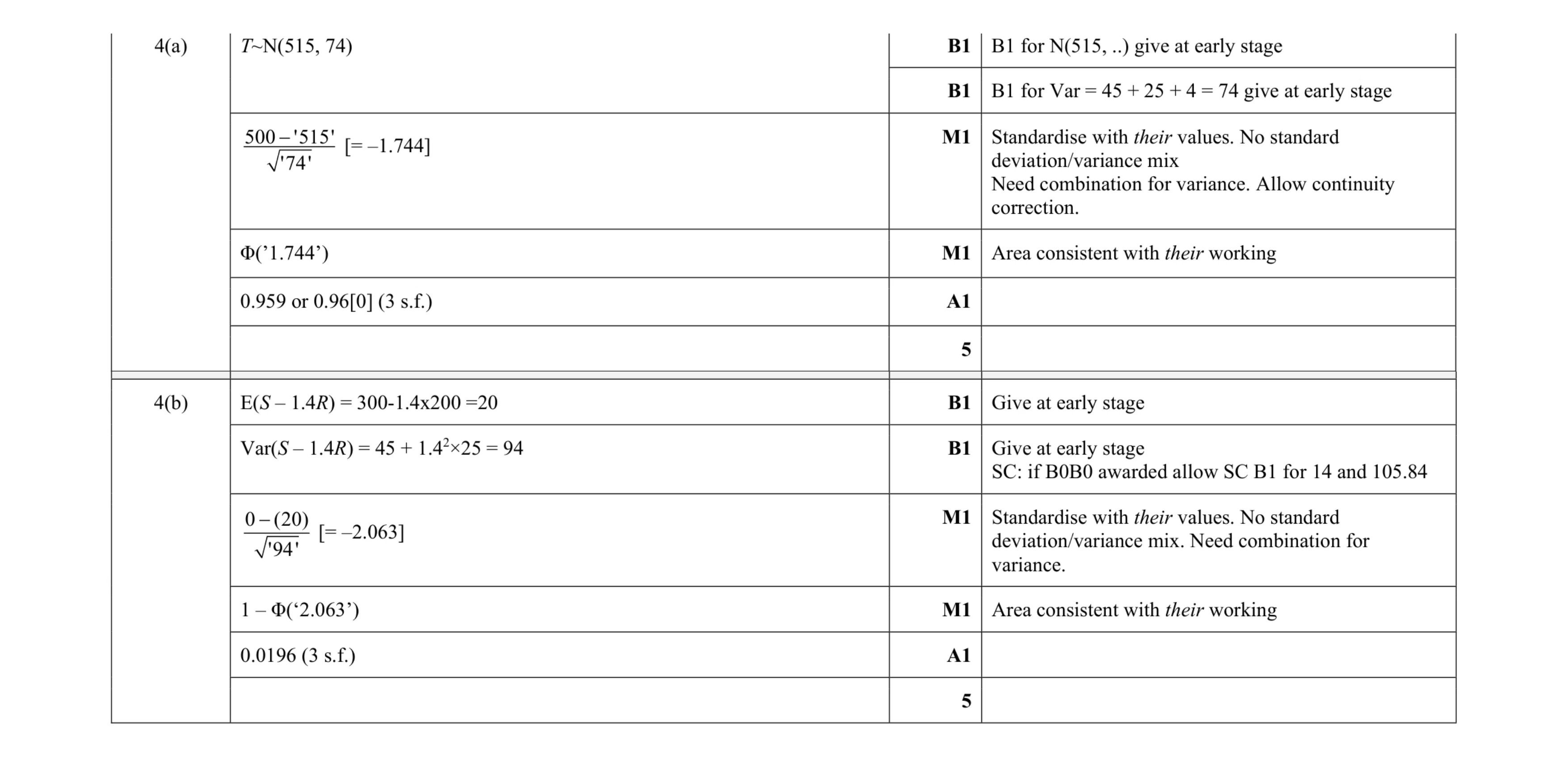 10
10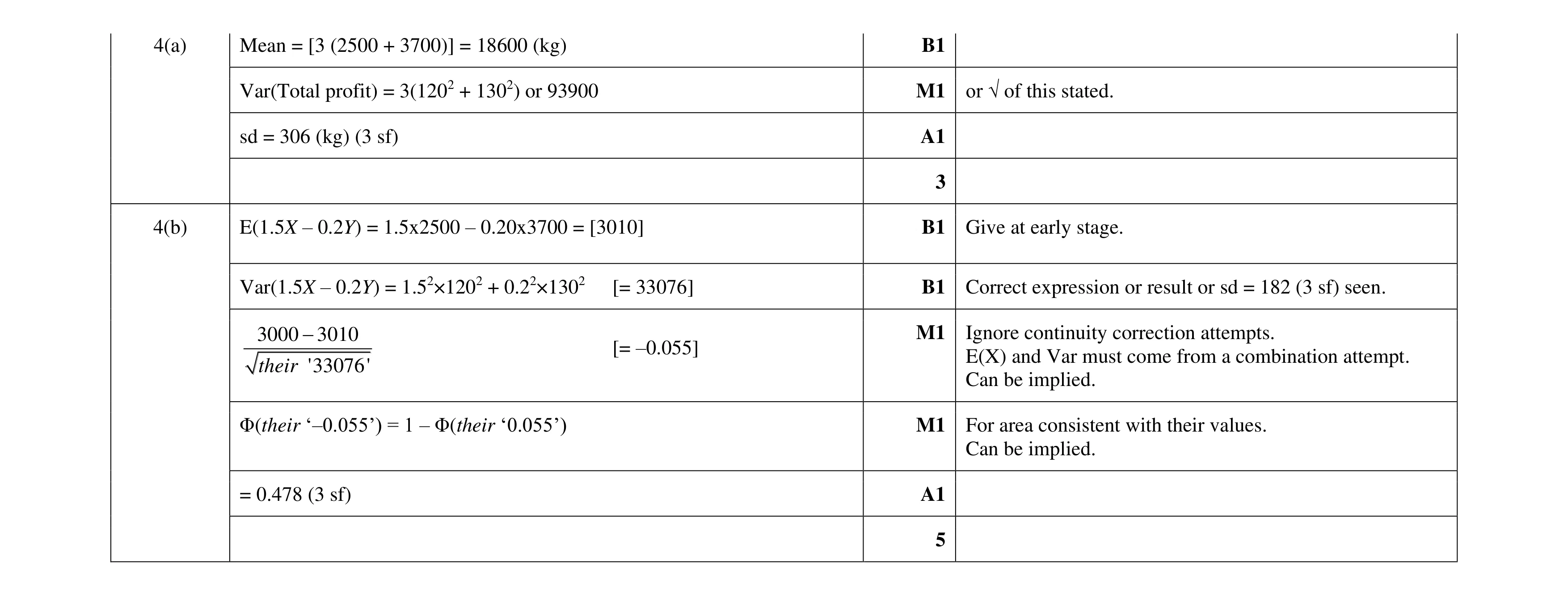 8
8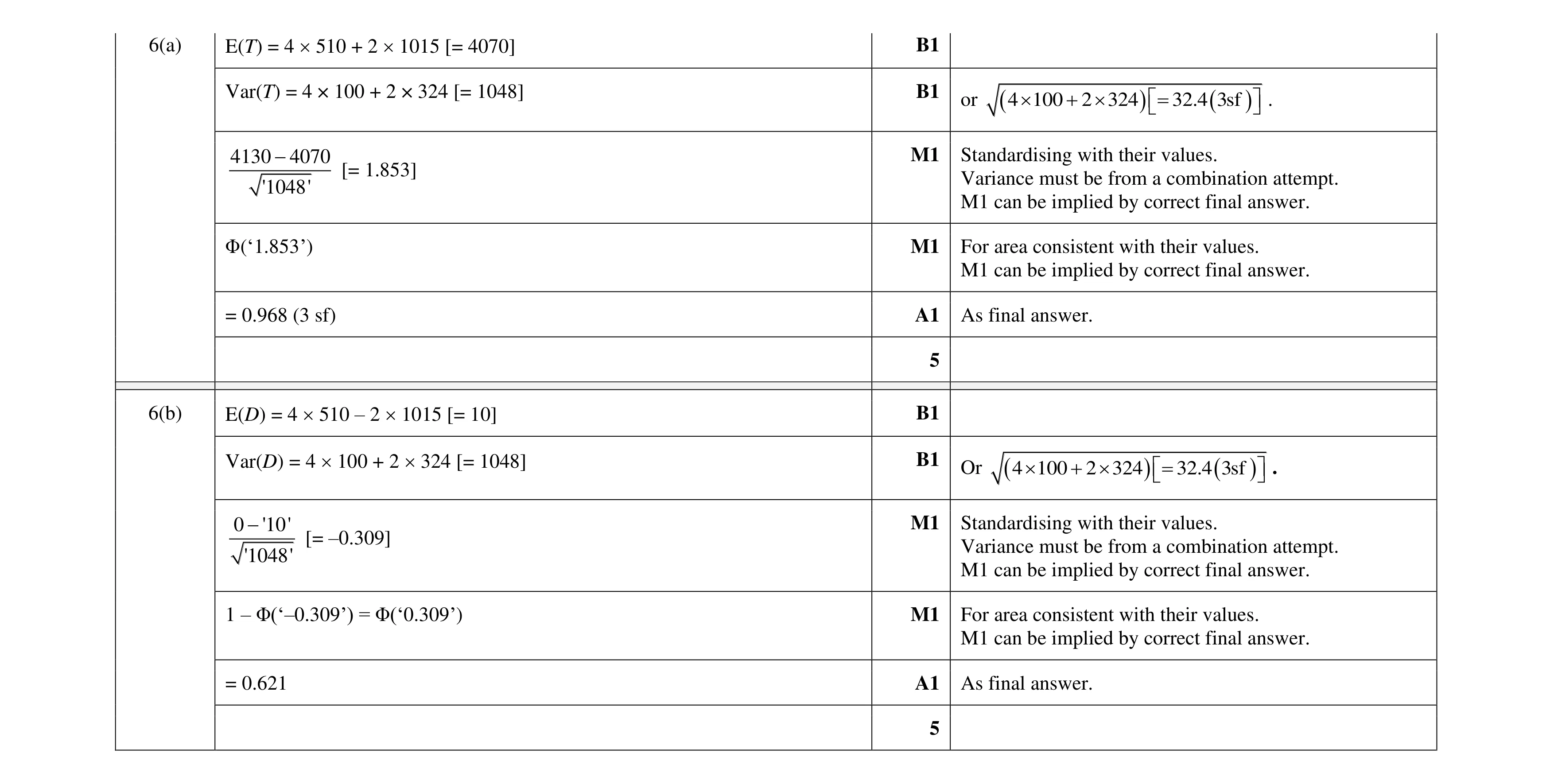 10
10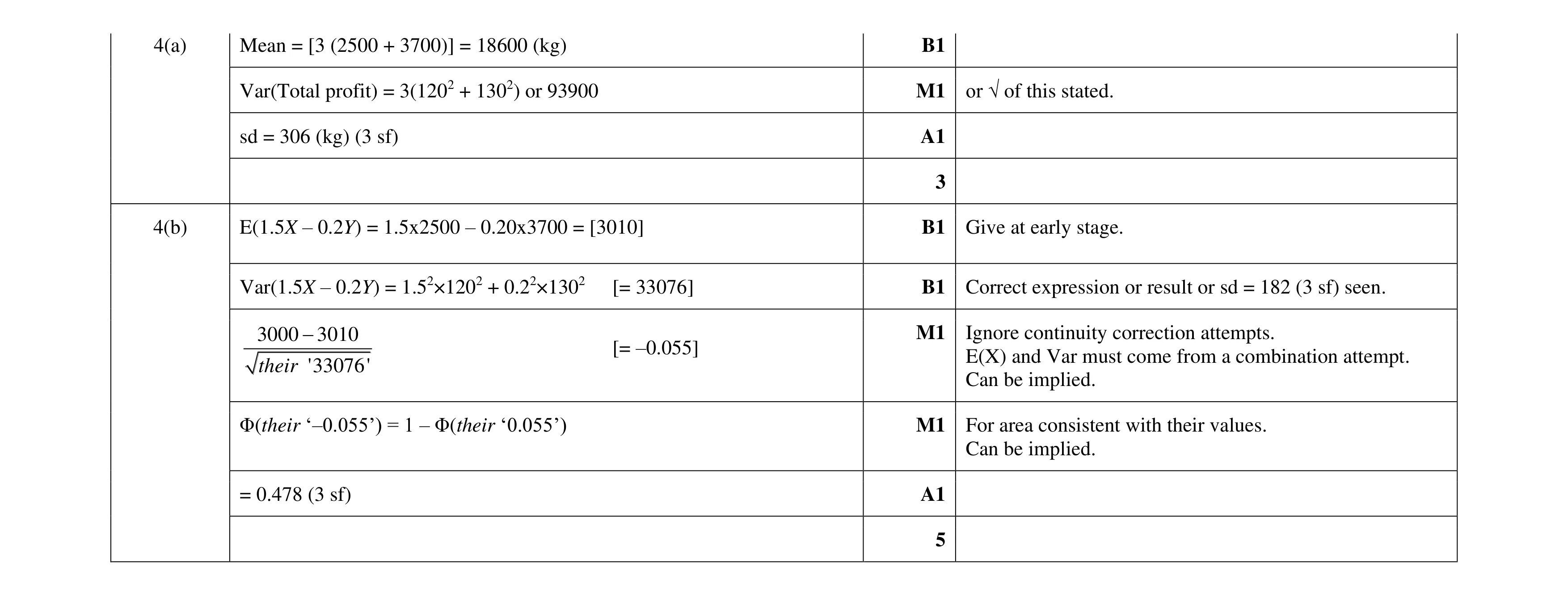 8
8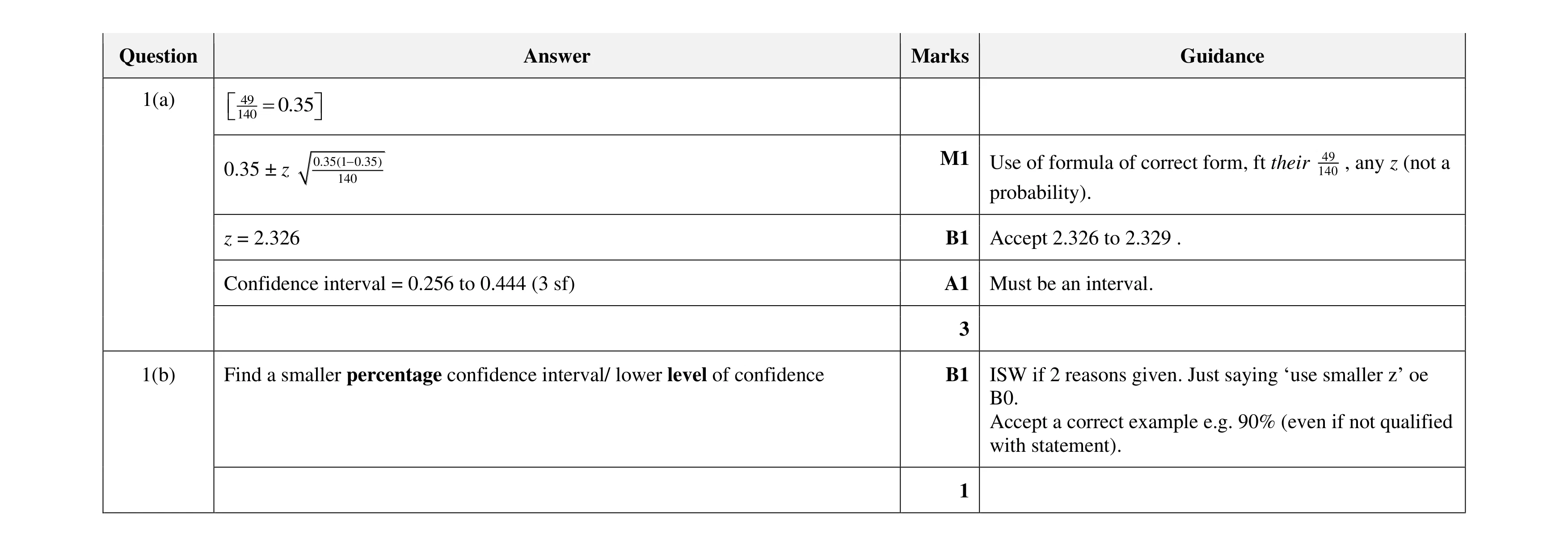 4
4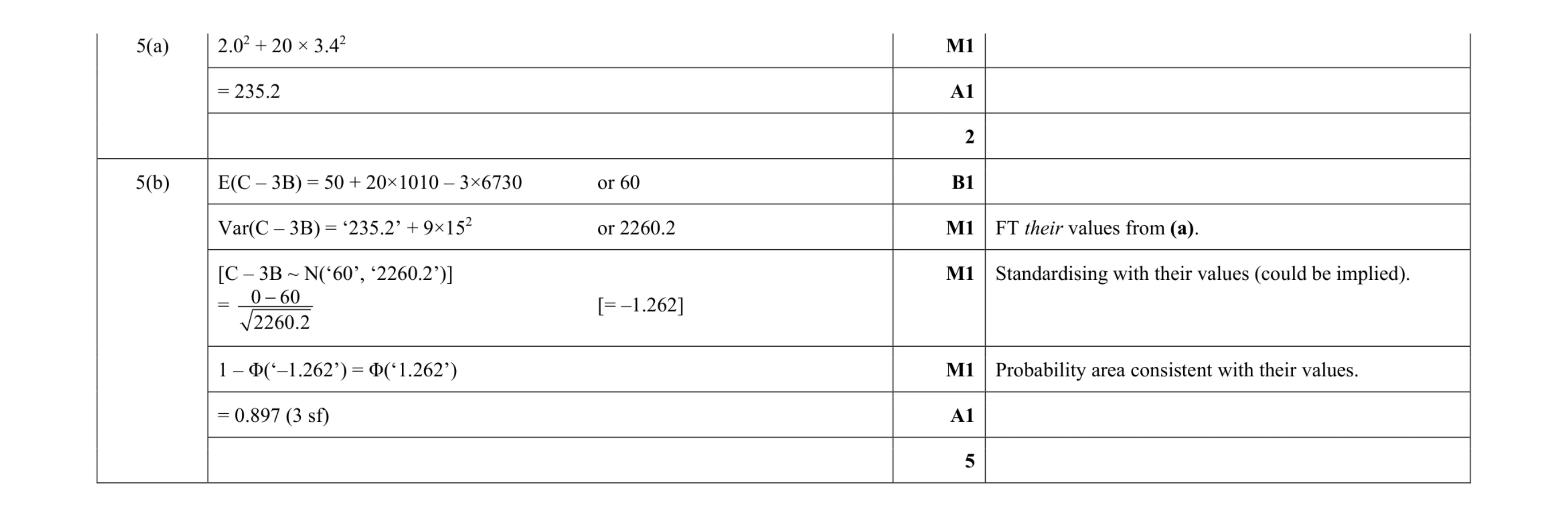 7
7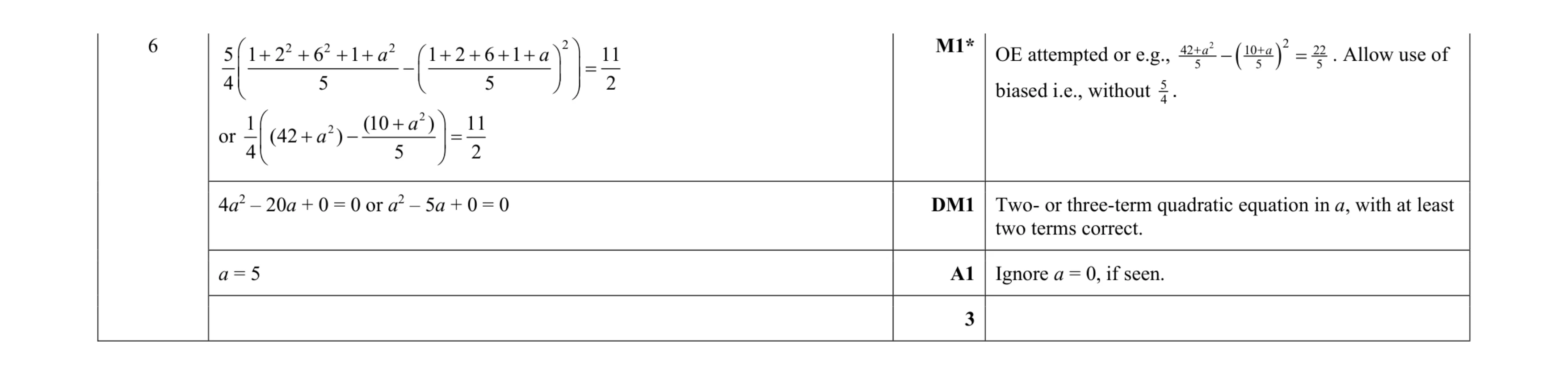 3
3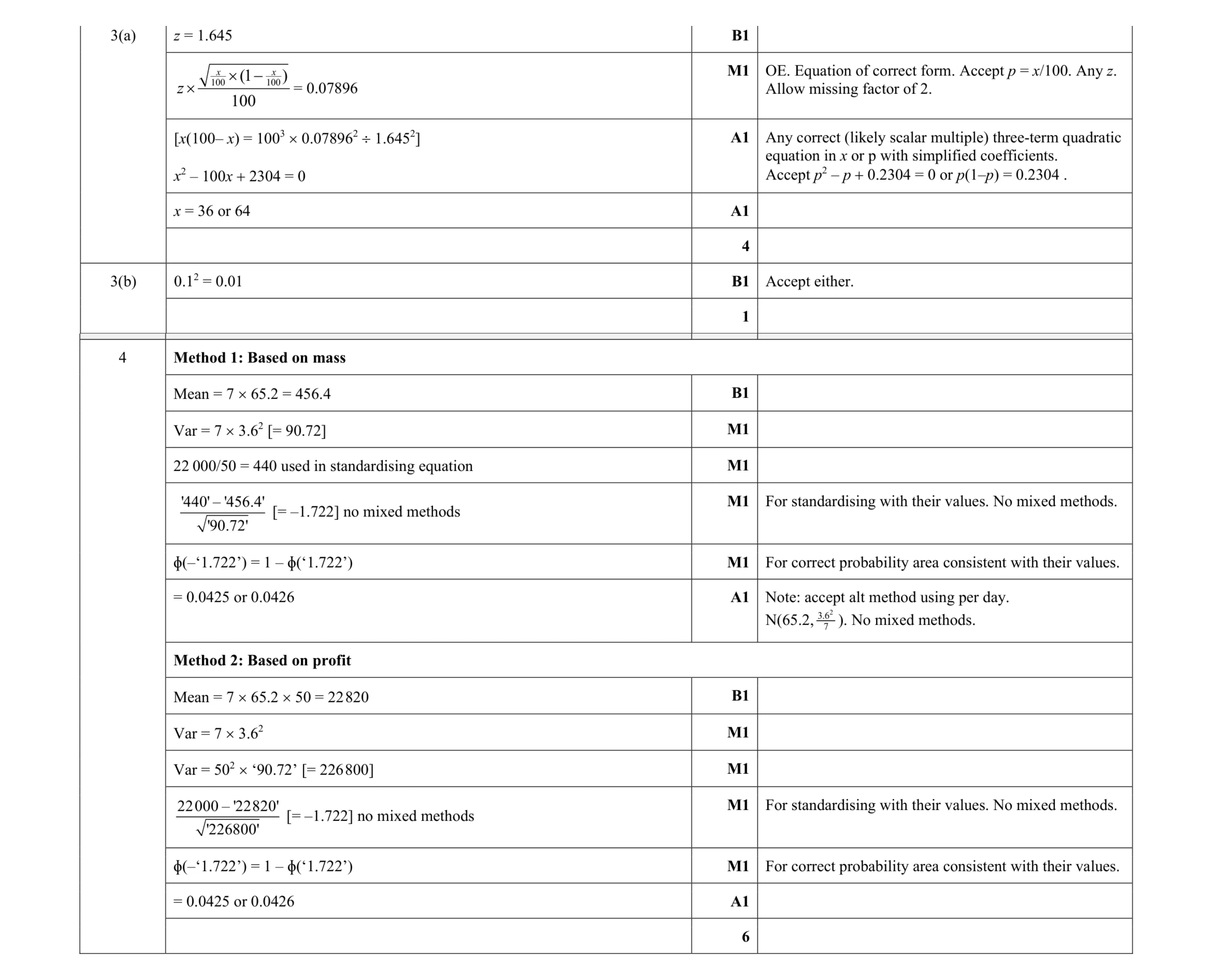 5
5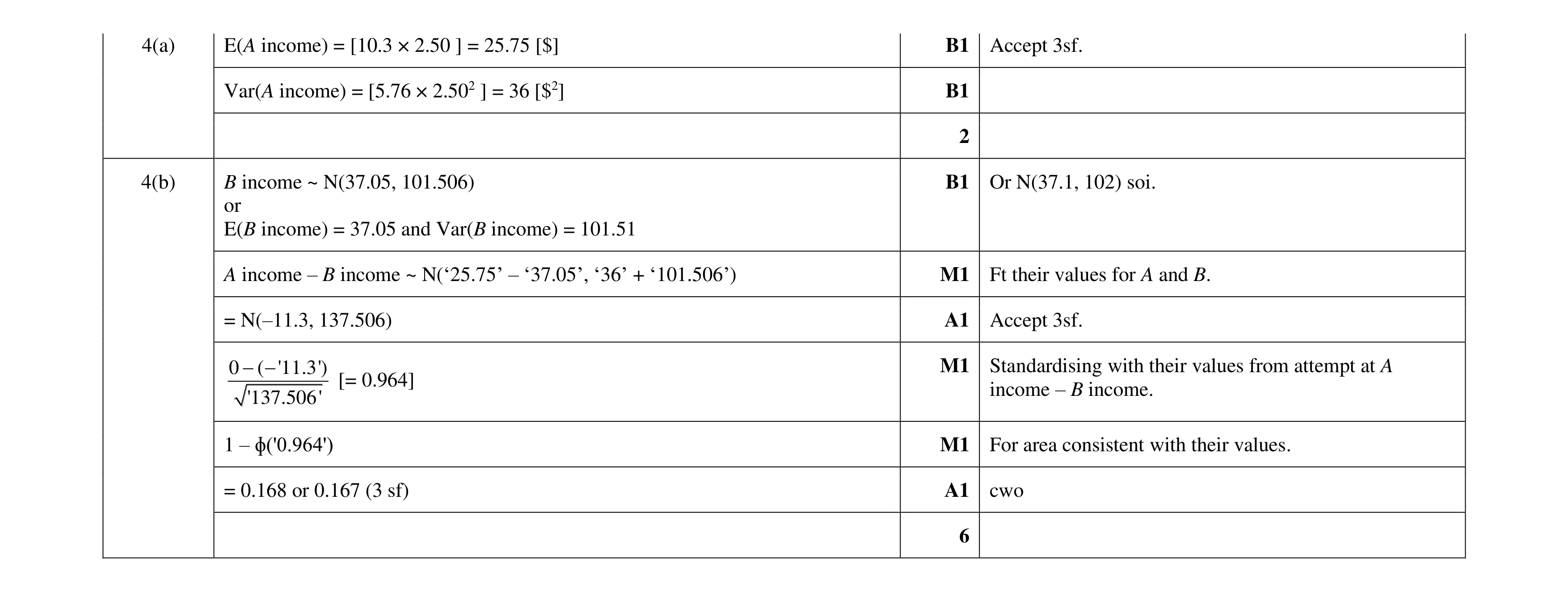 8
8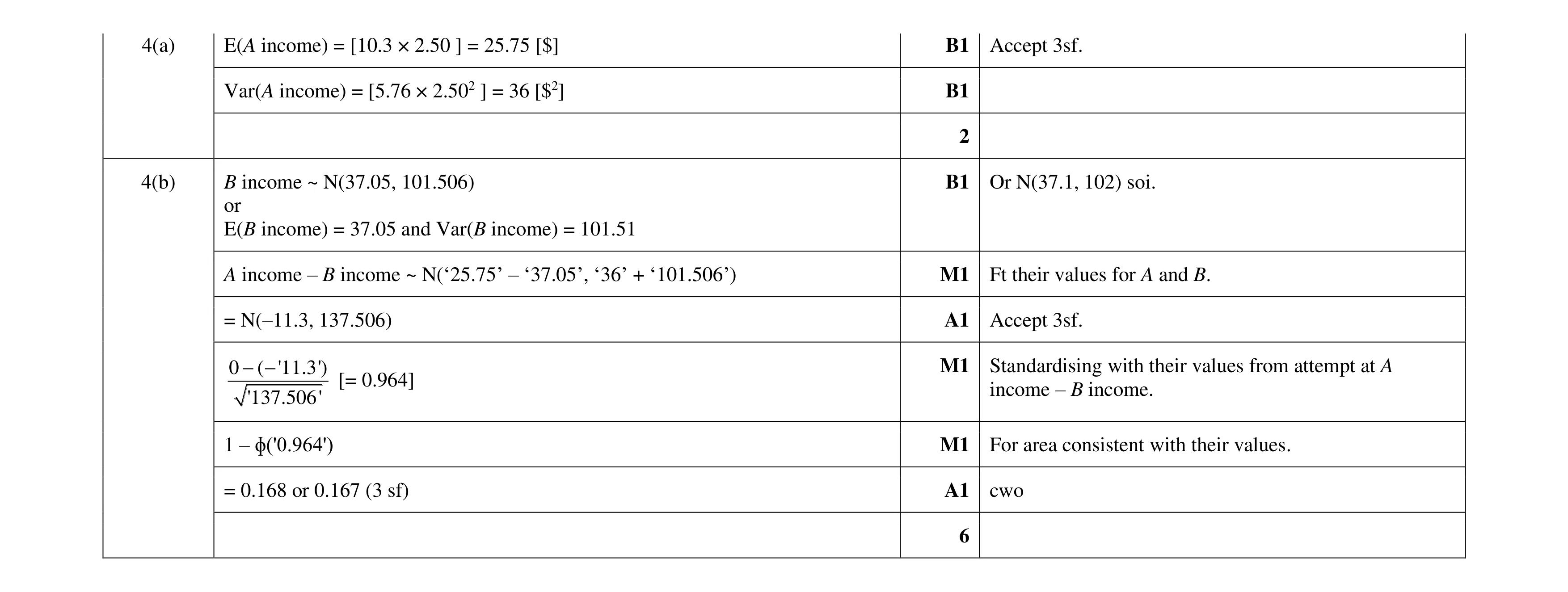 8
8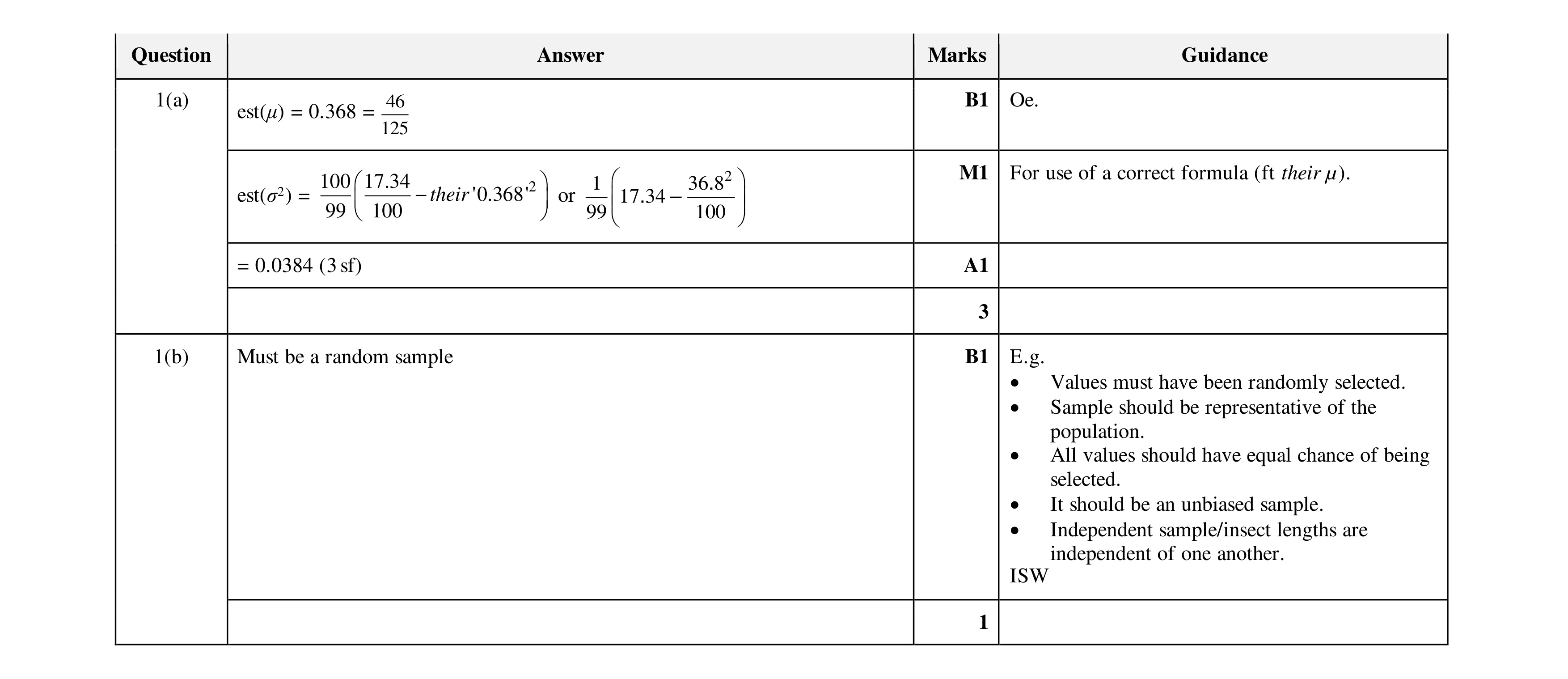 4
4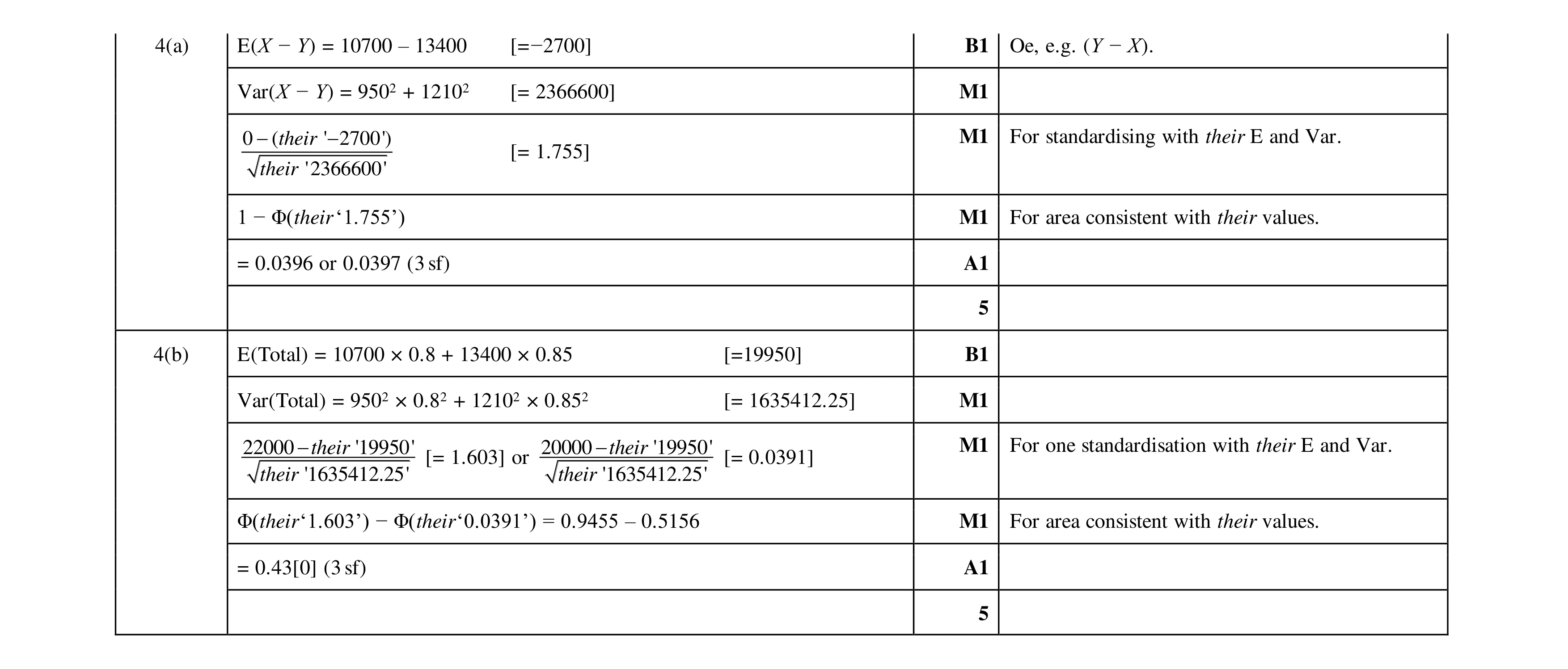 10
10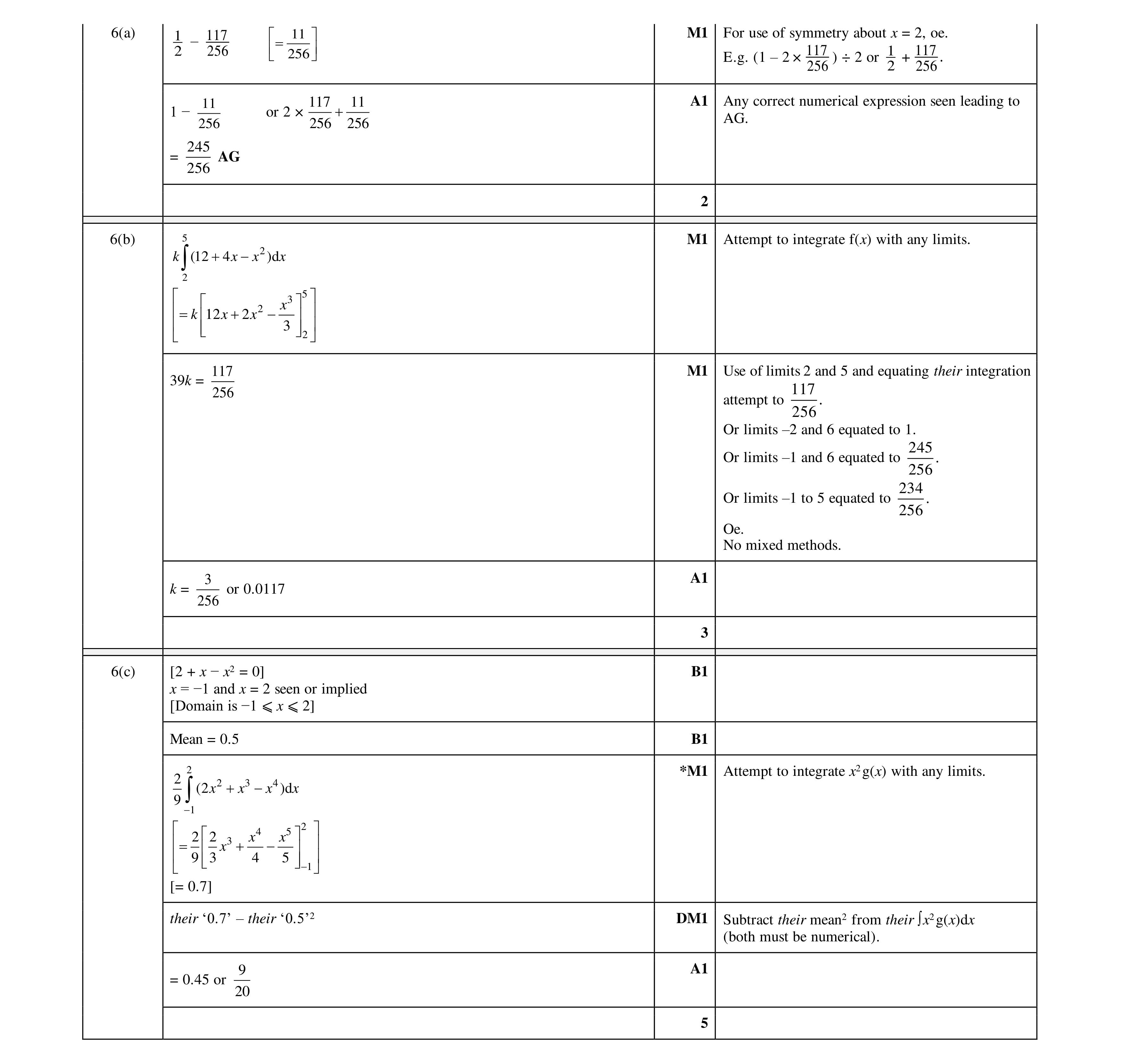 10
10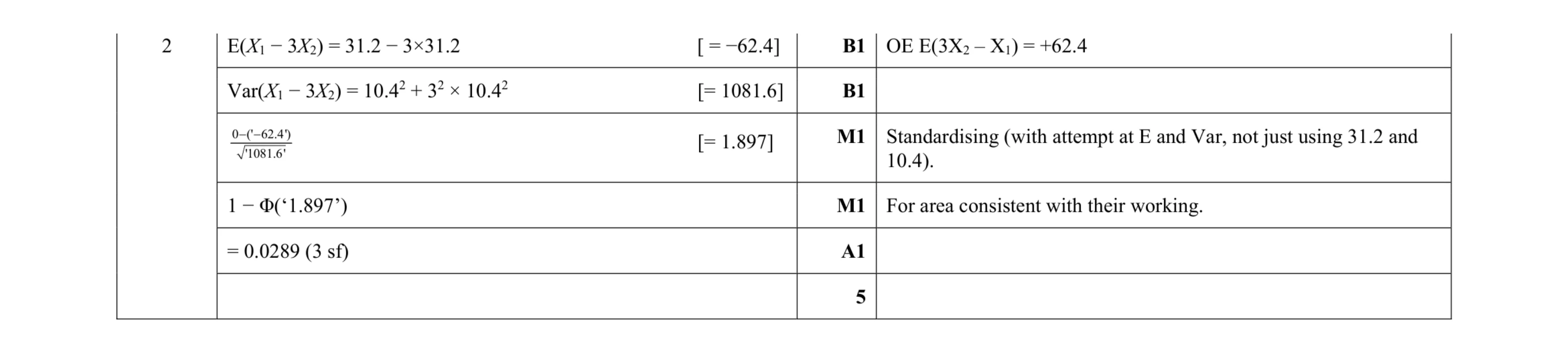 5
5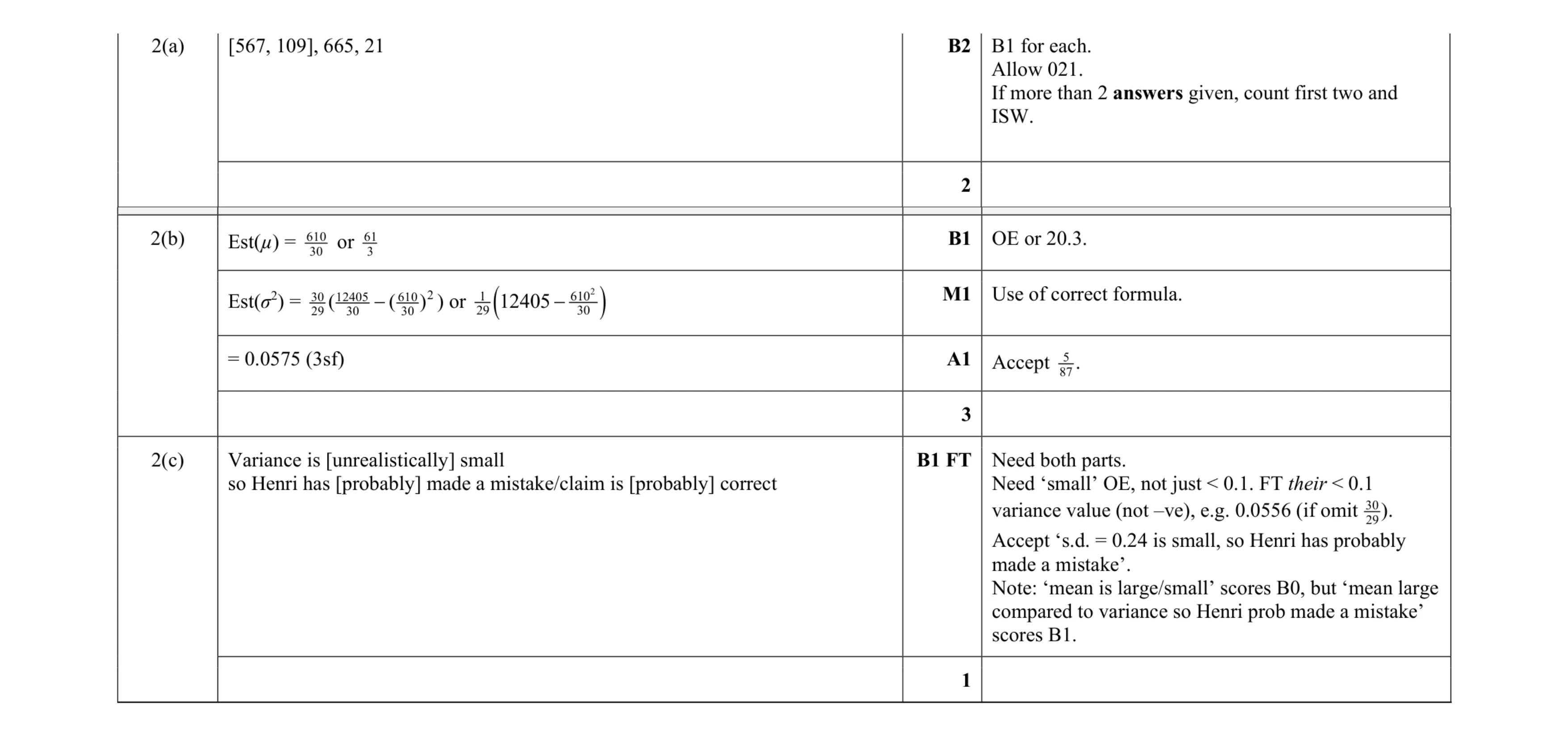 6
6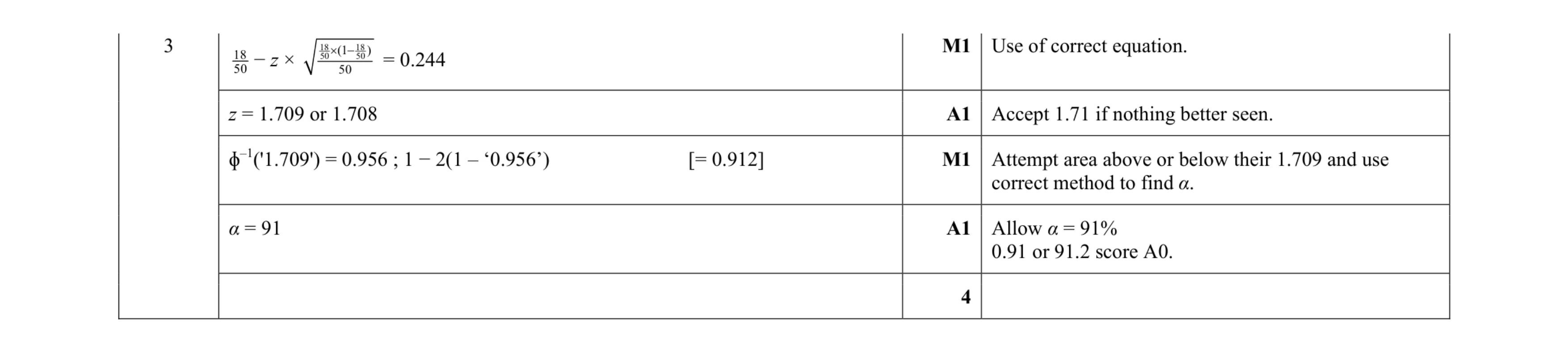 4
4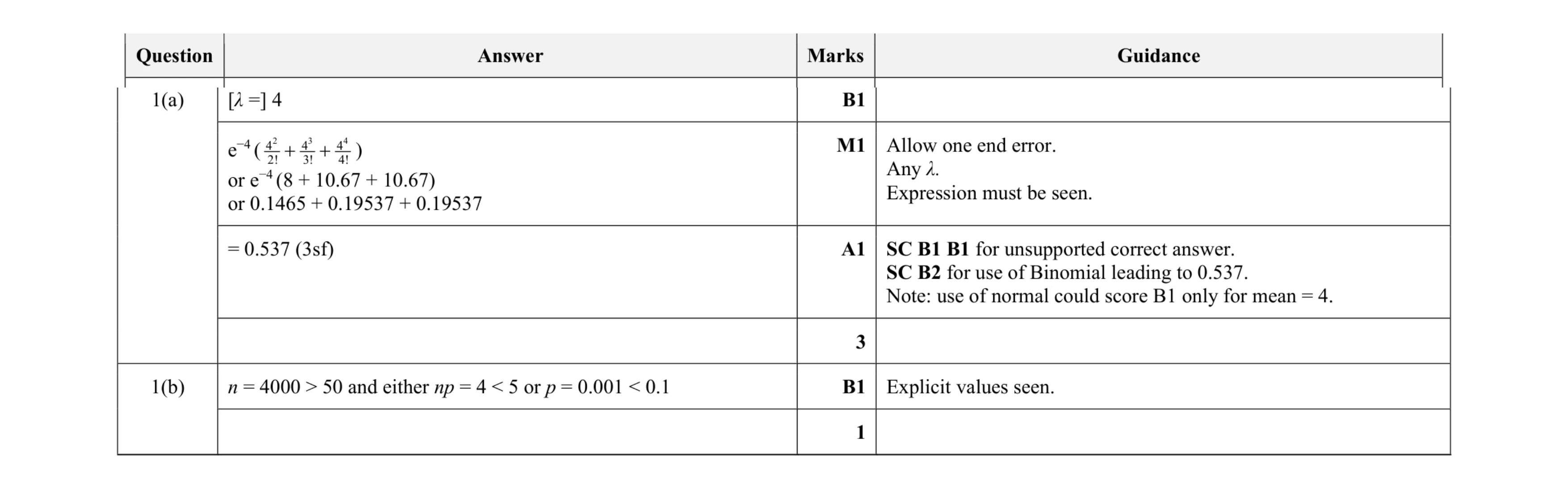 4
4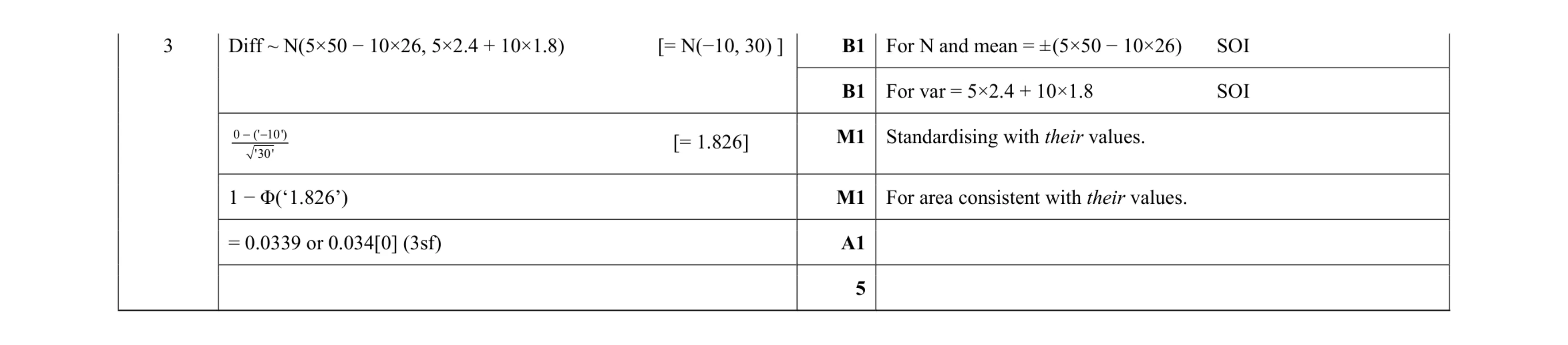 5
5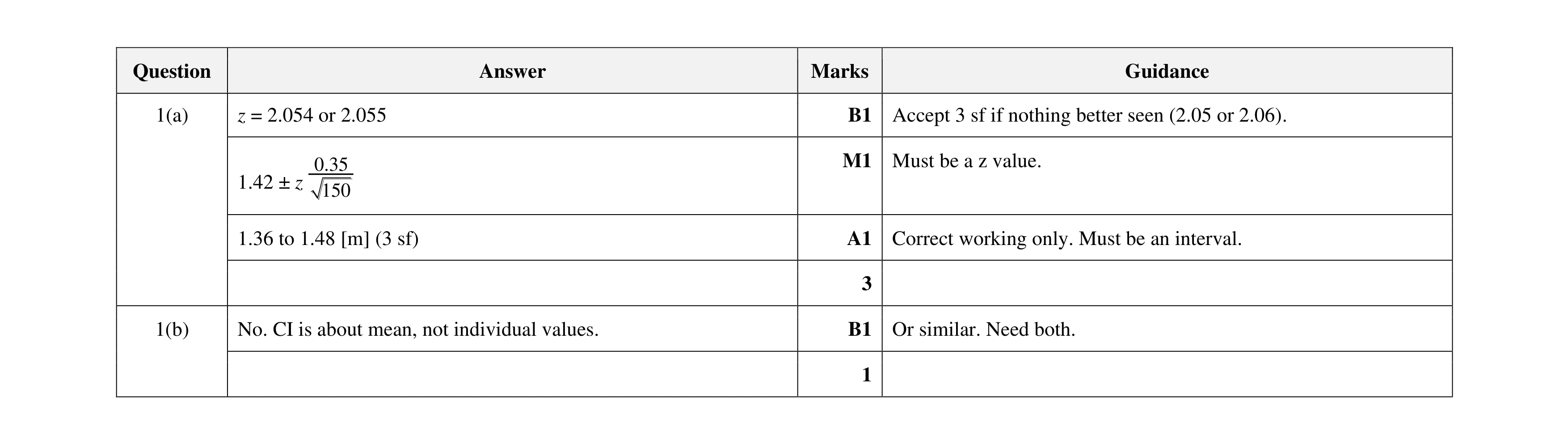 4
4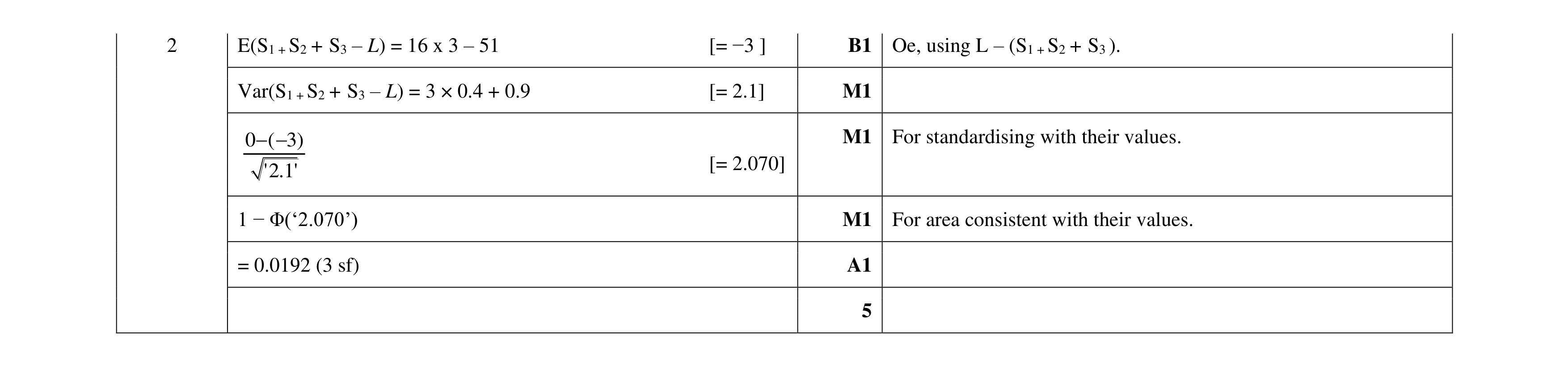 5
5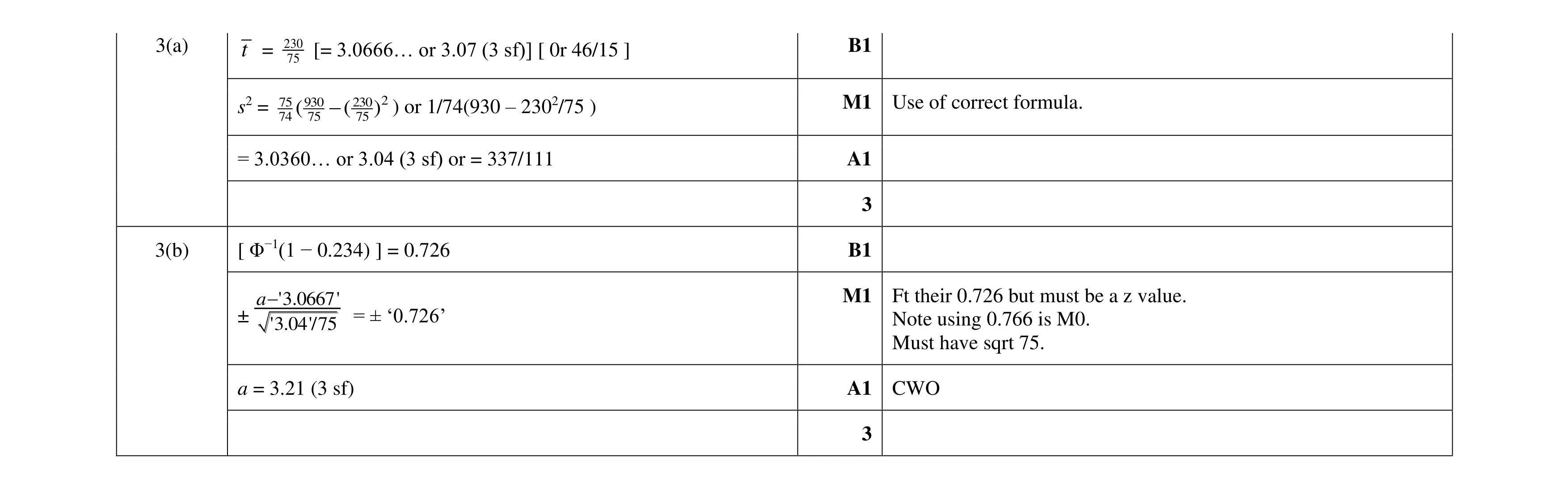 6
6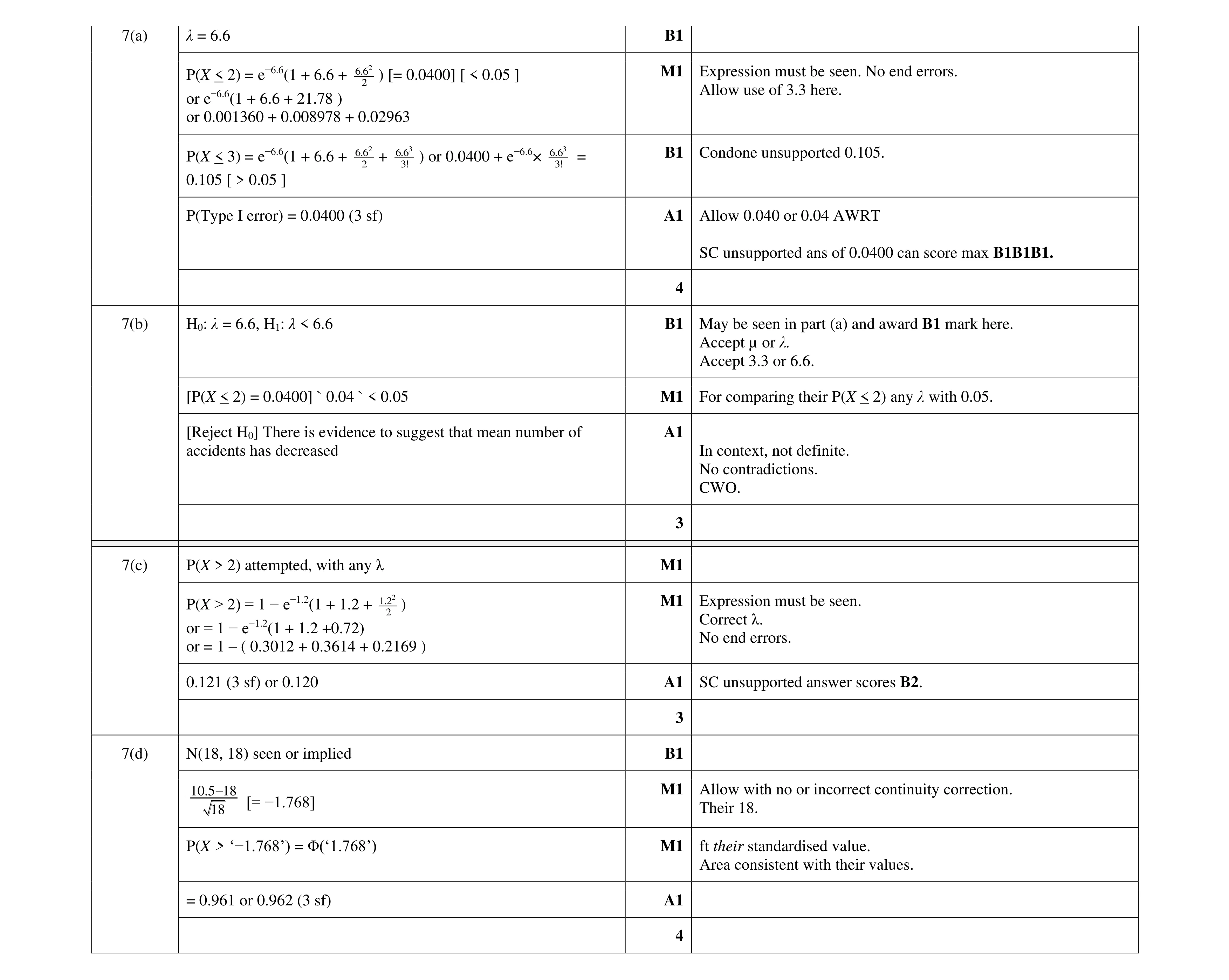 14
14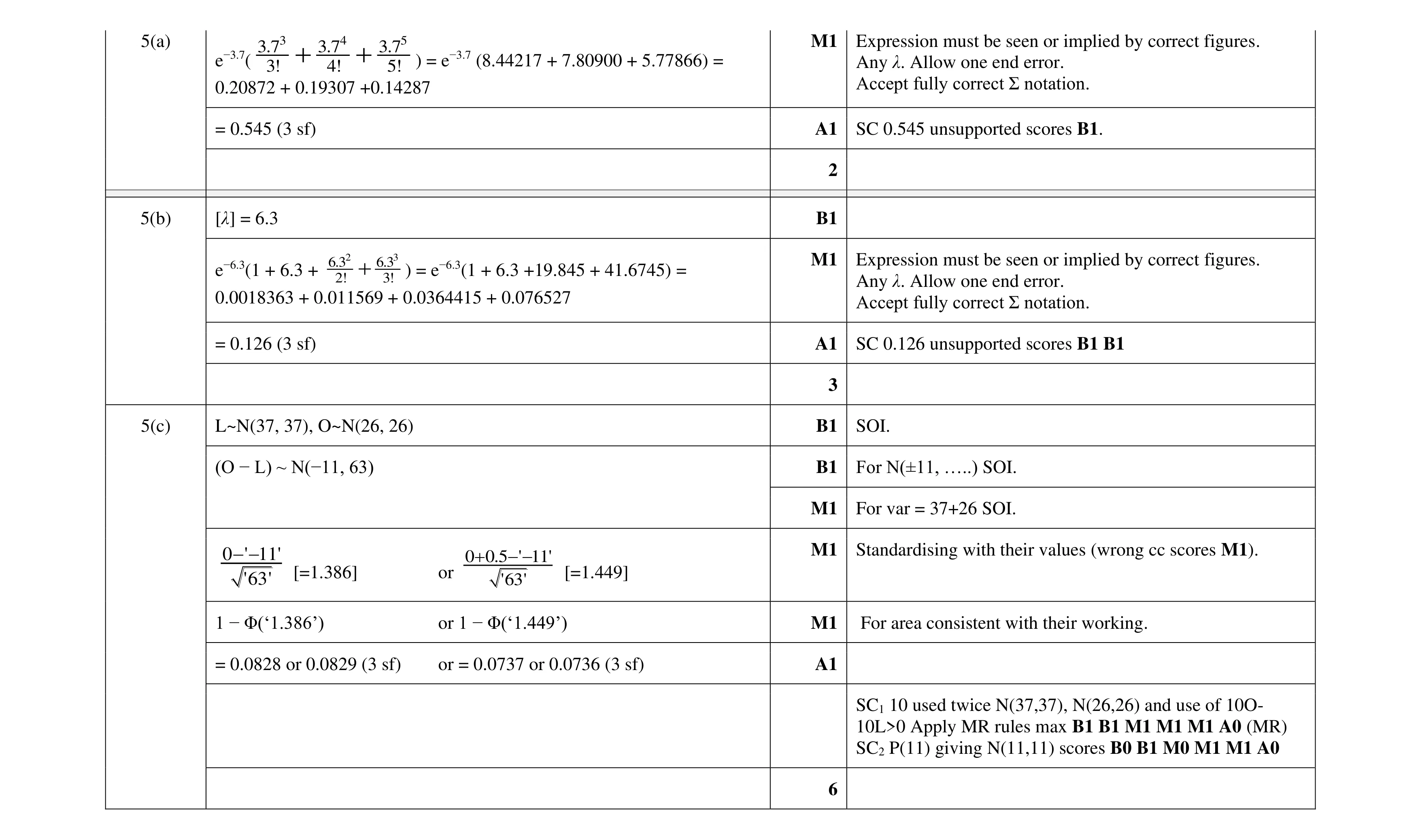 11
11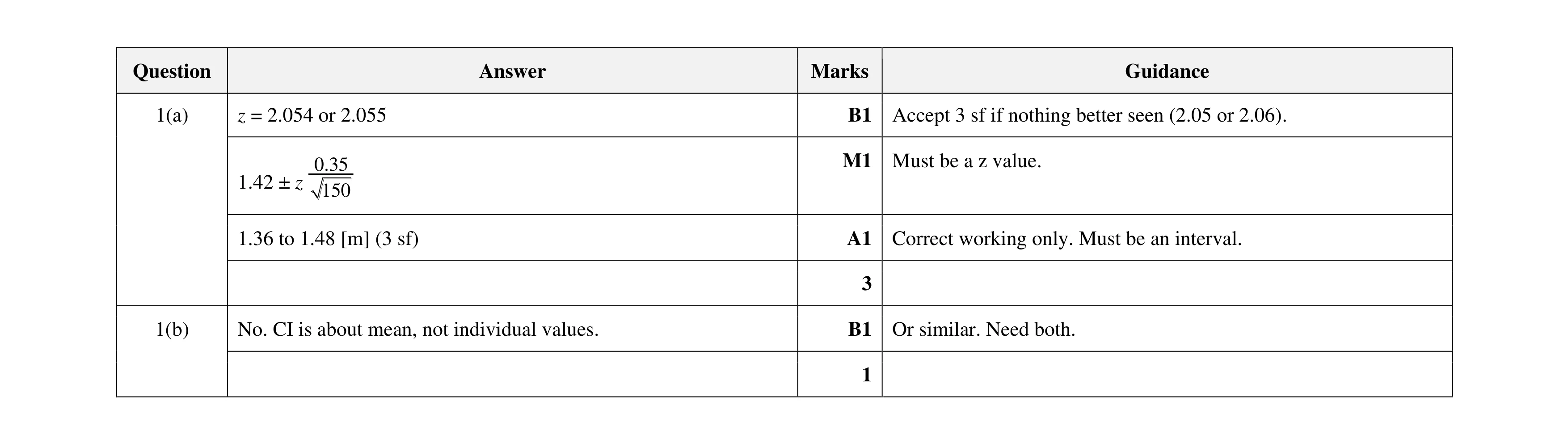 4
4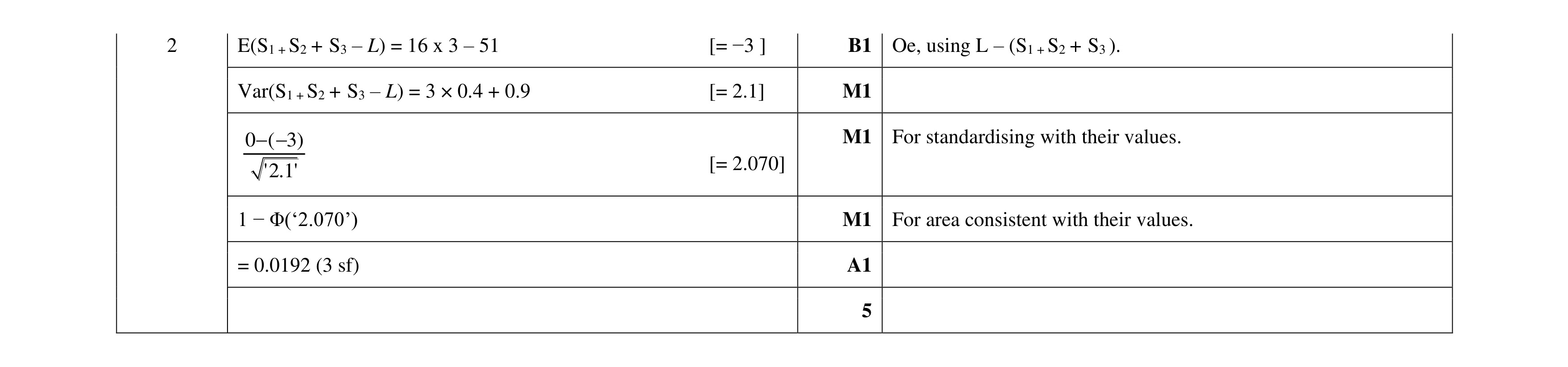 5
5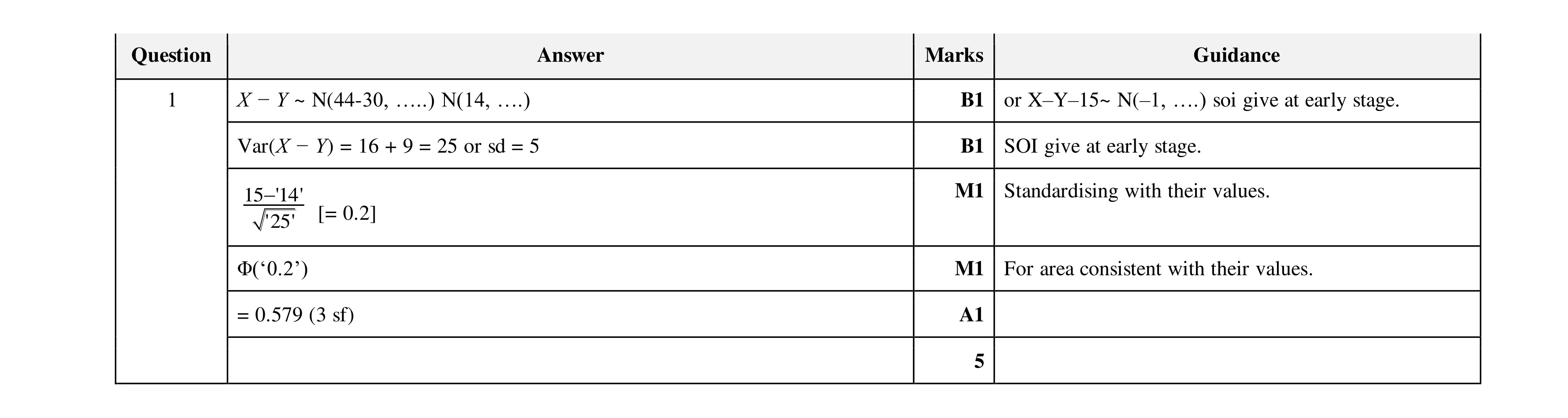 5
5 9
9 8
8 7
7 8
8 6
6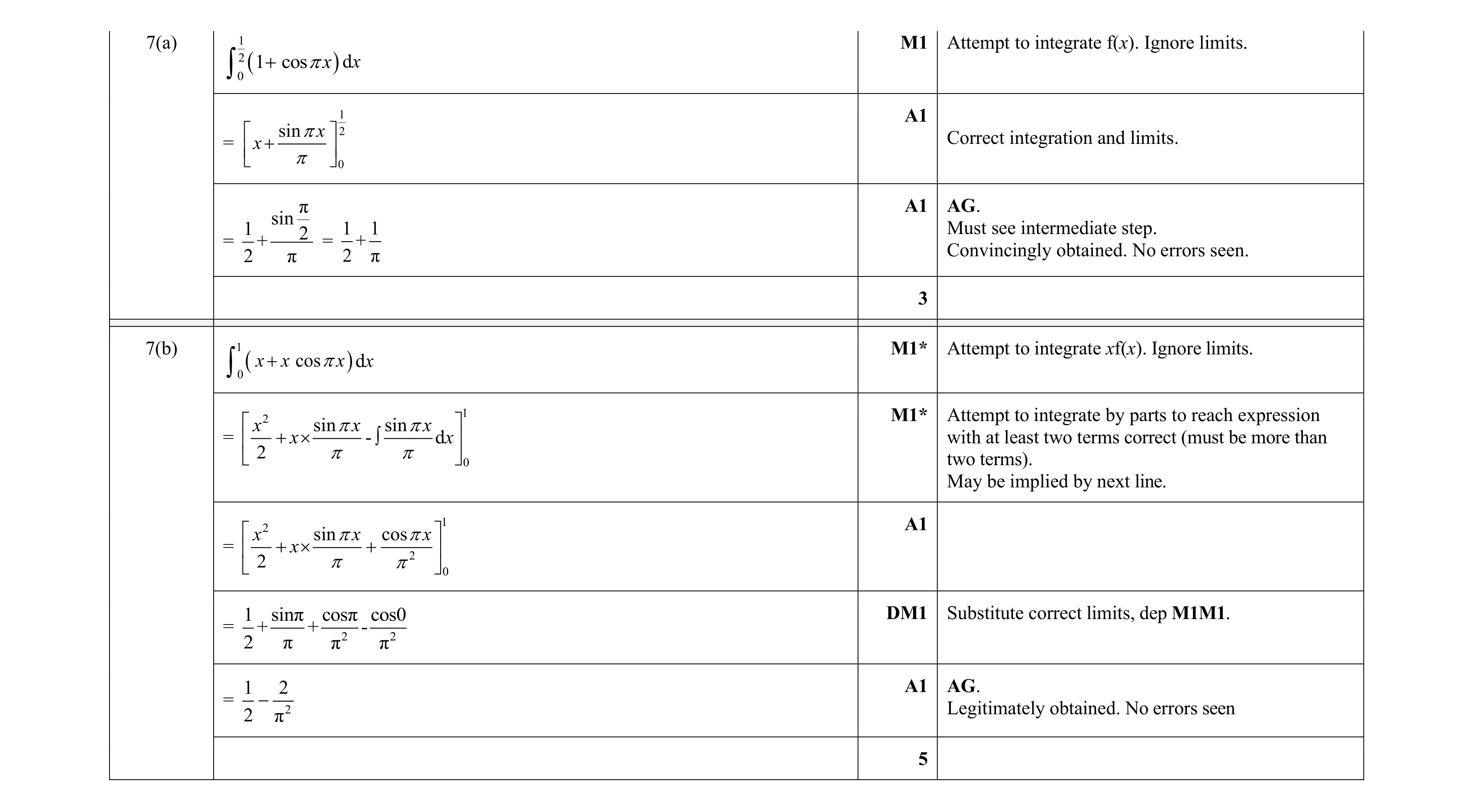 8
8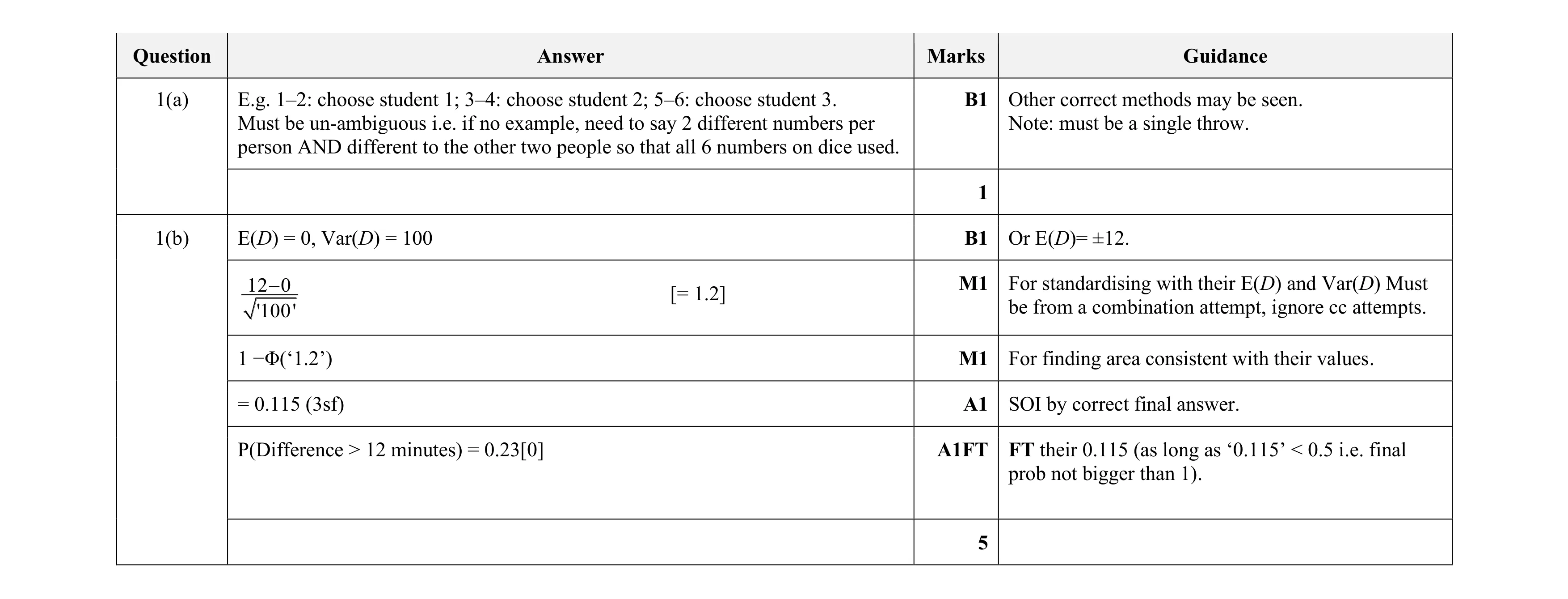 6
6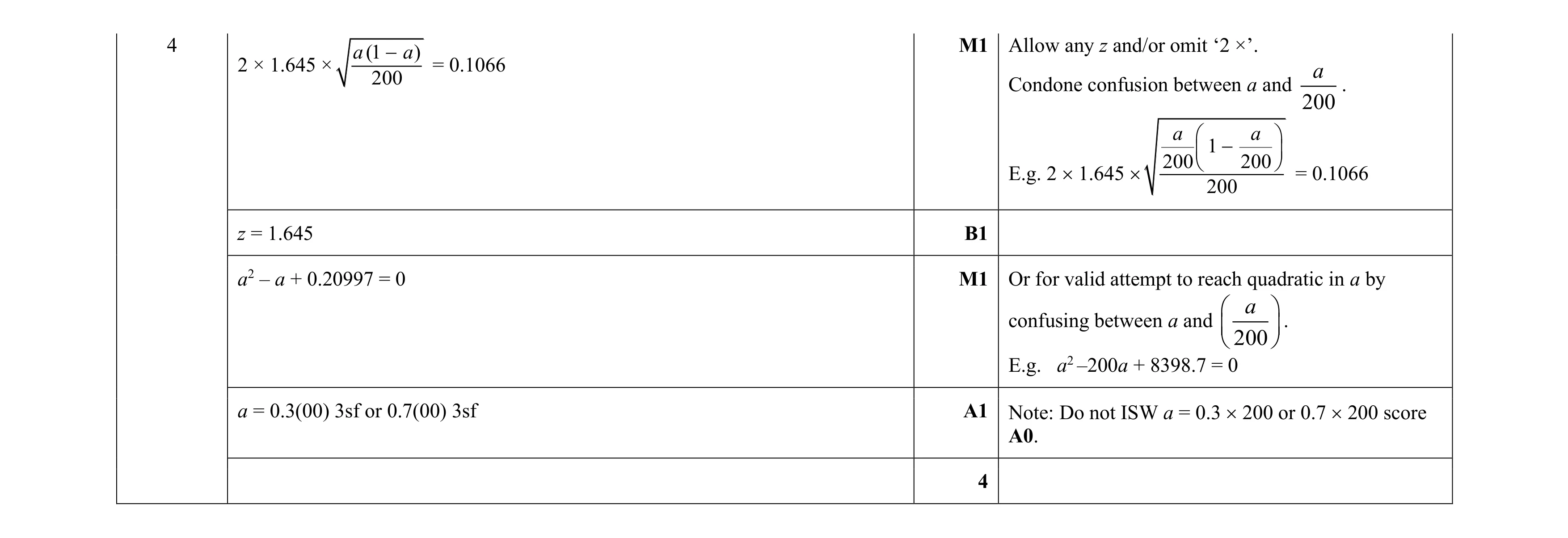 4
4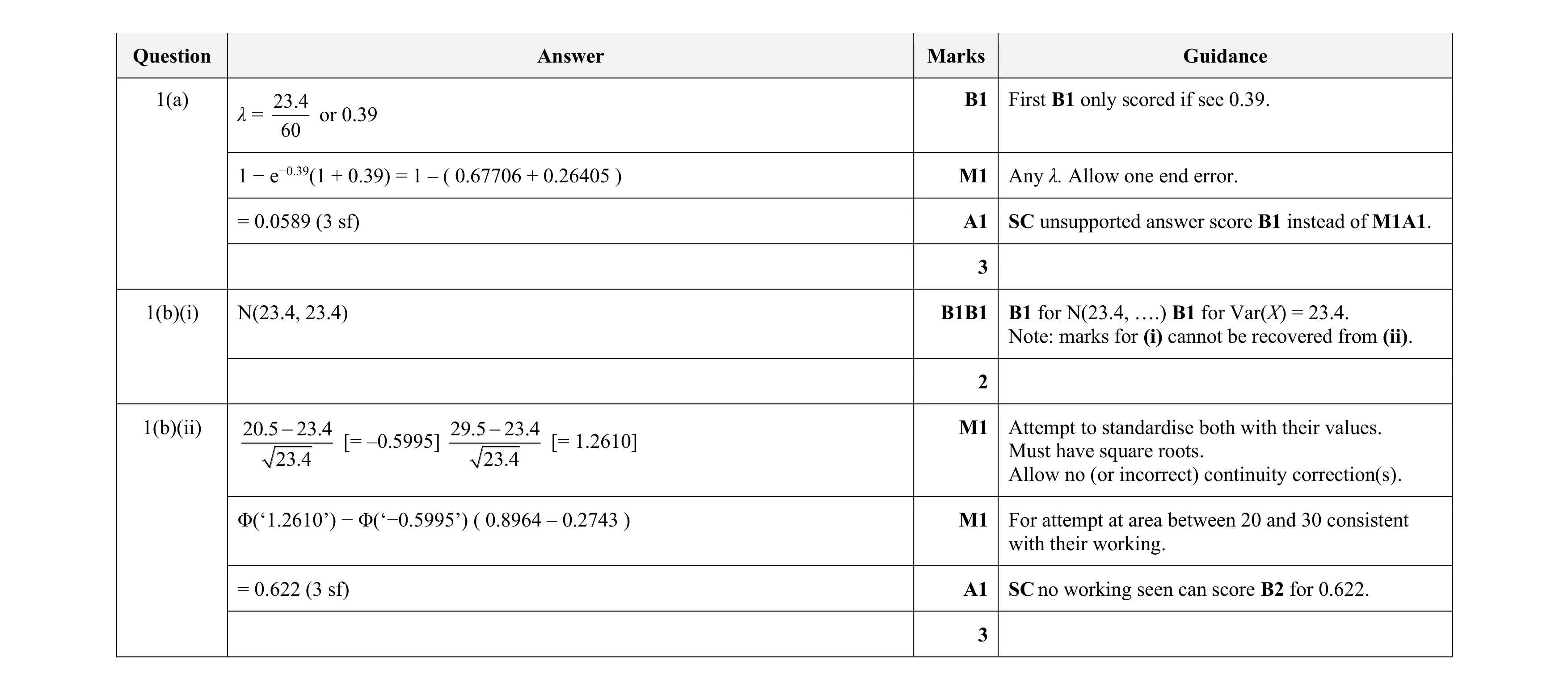 8
8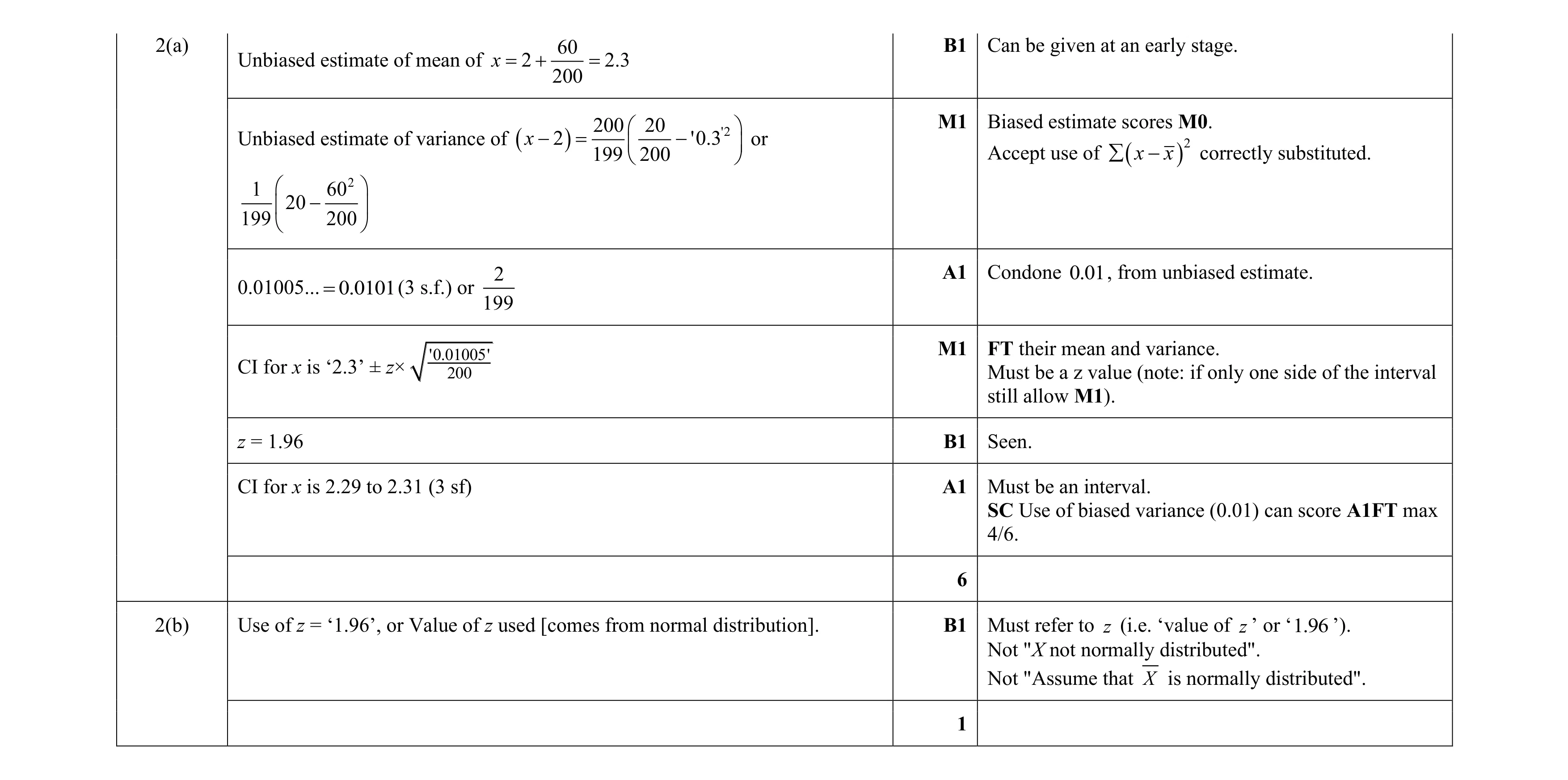 7
7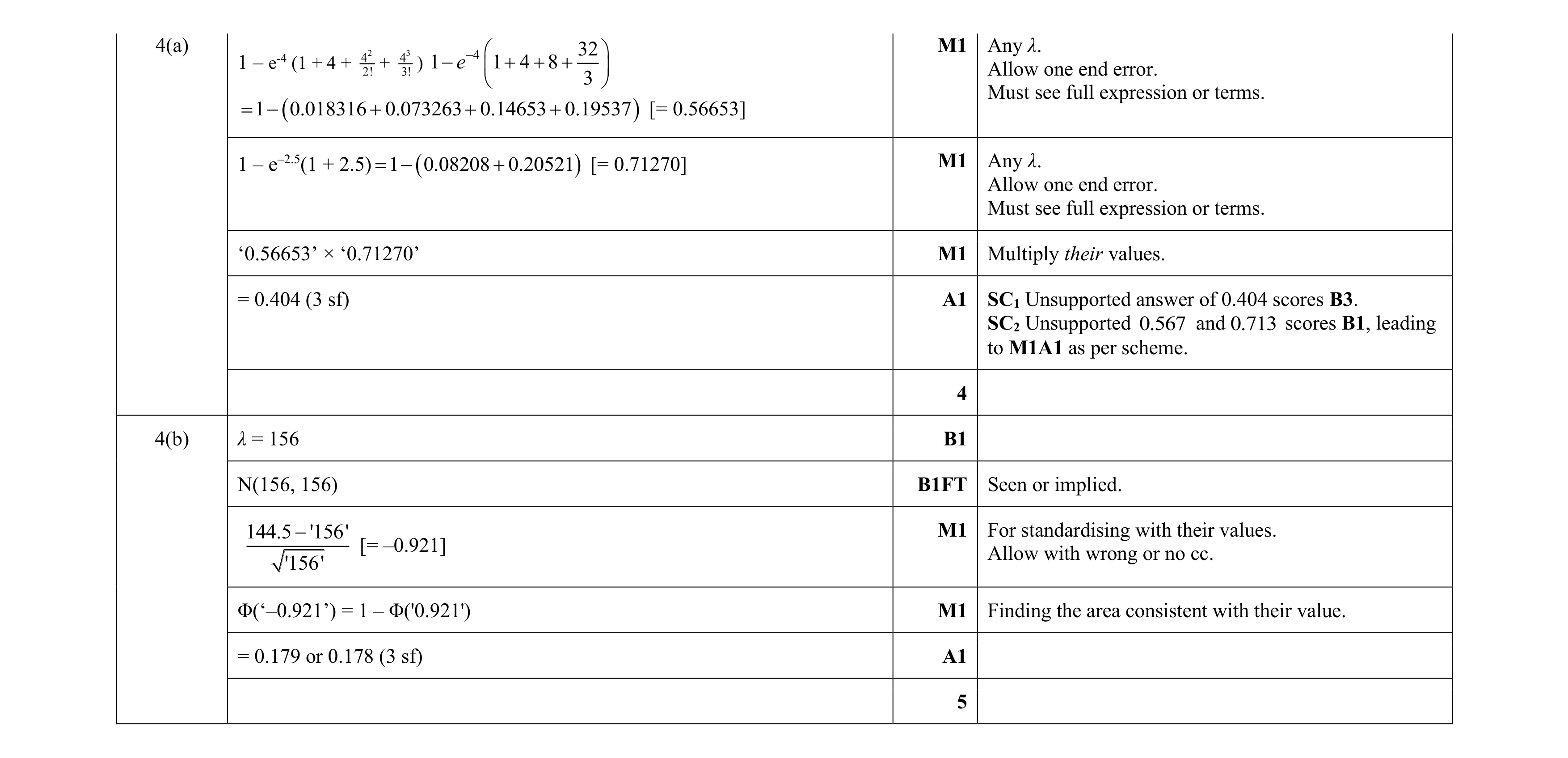 9
9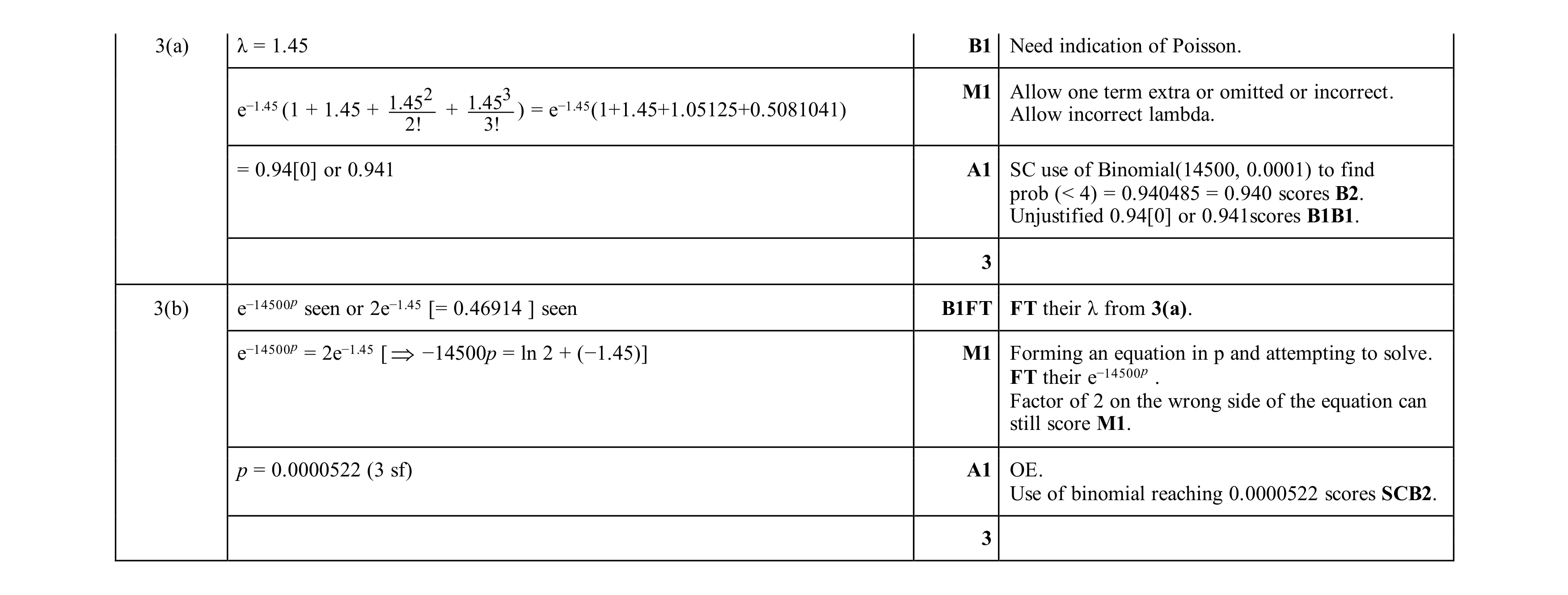 6
6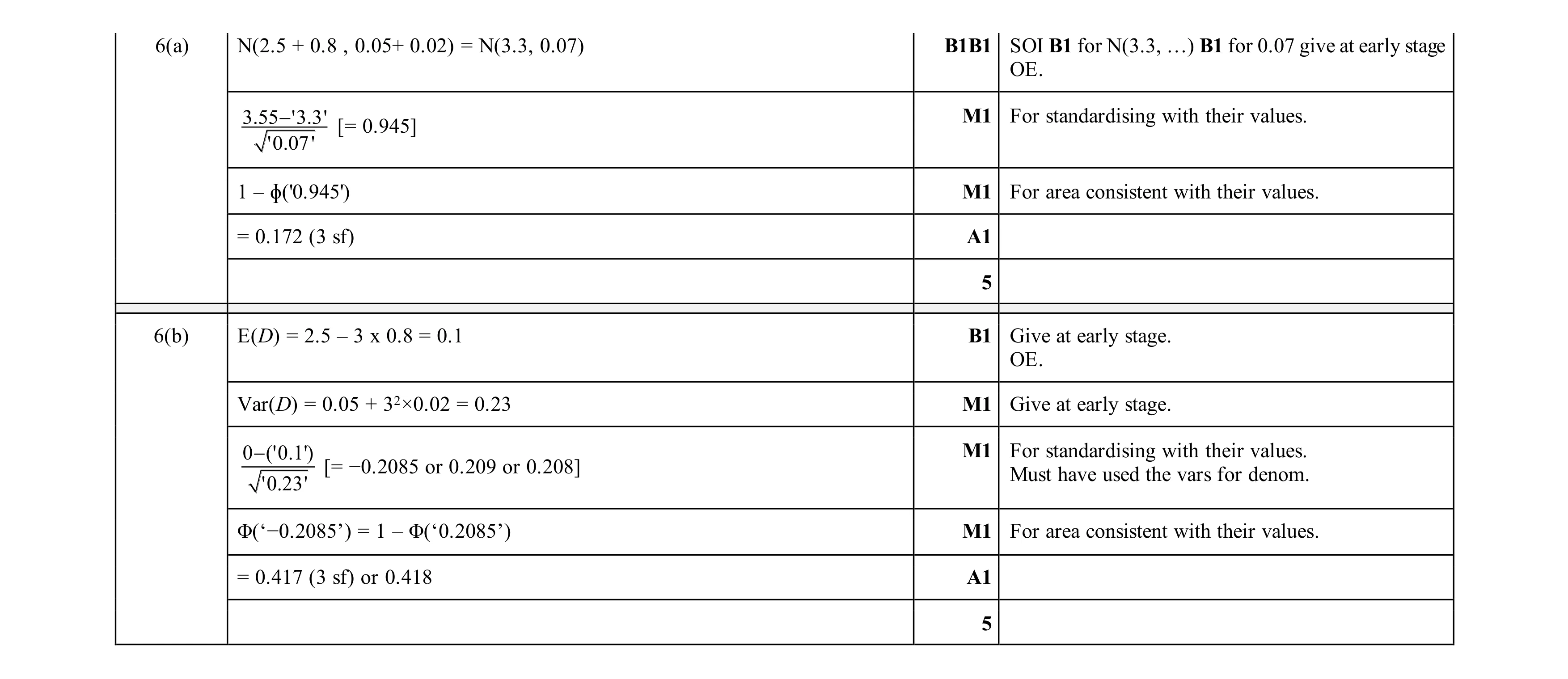 10
10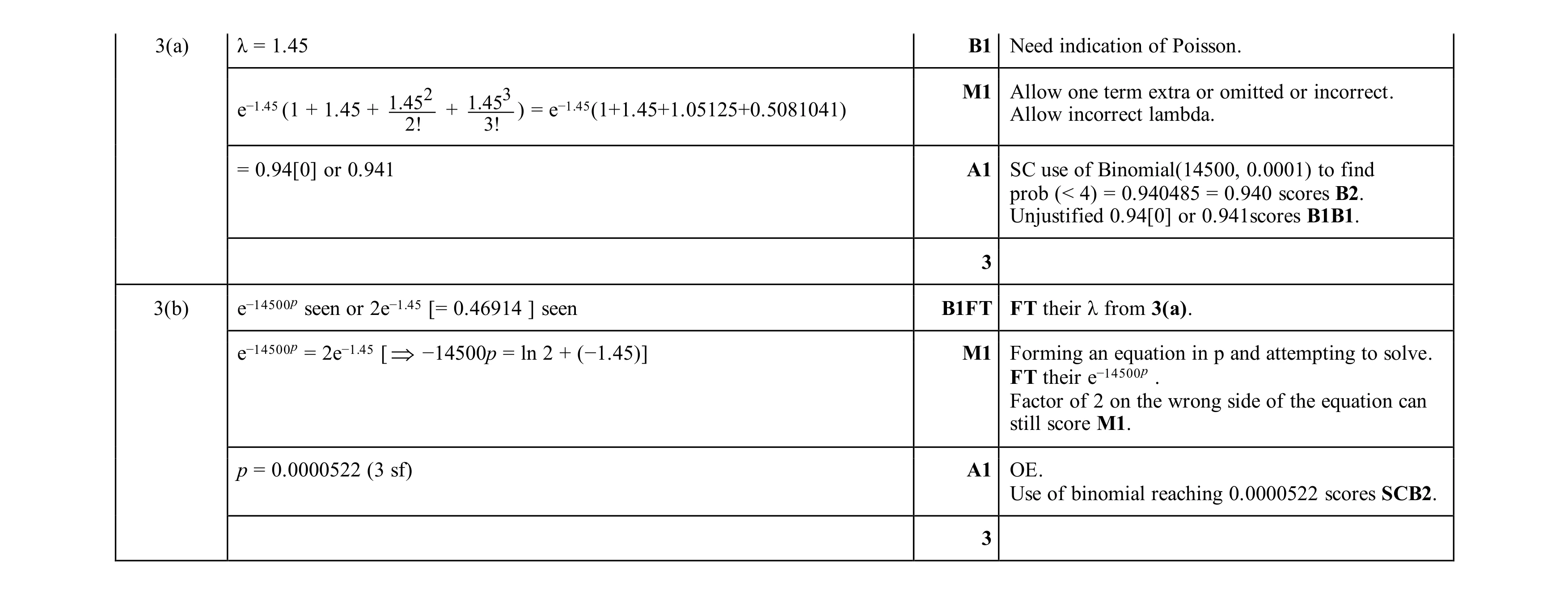 6
6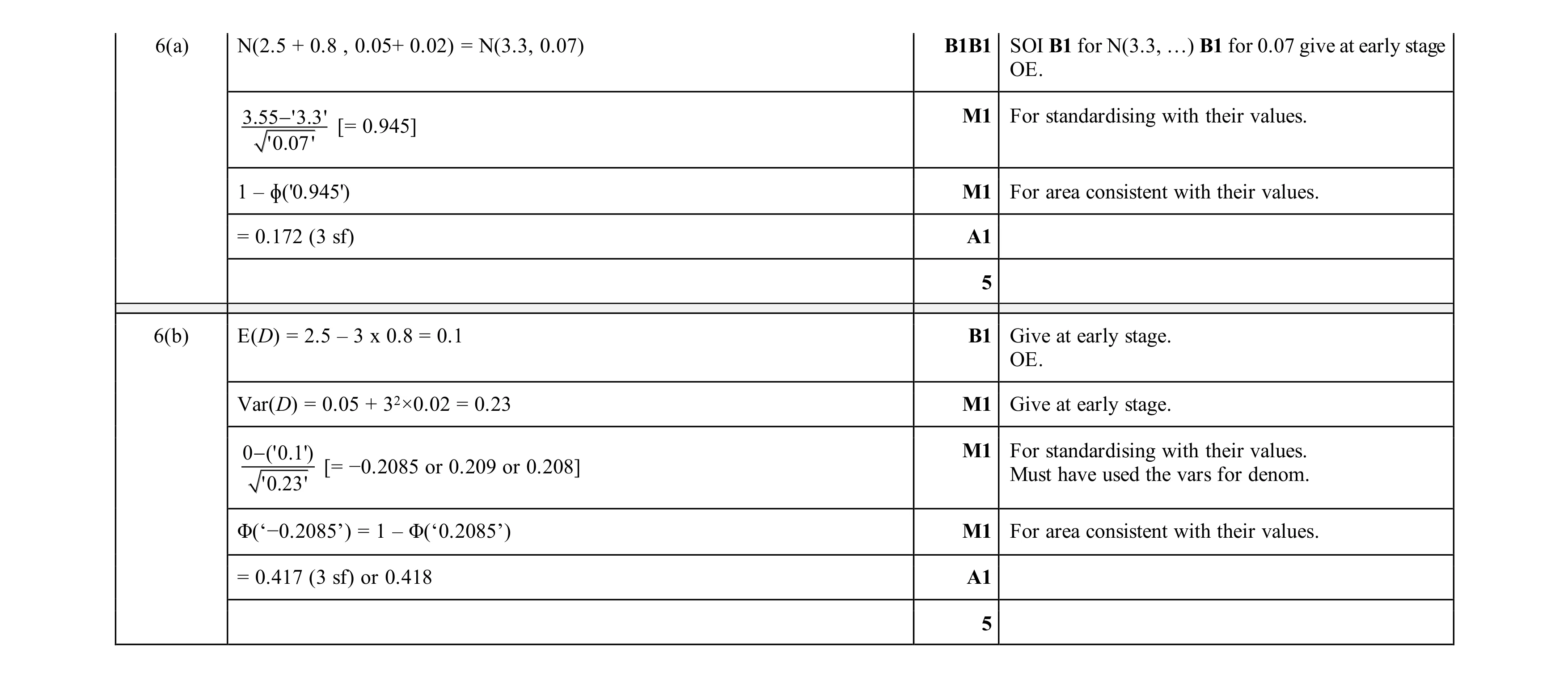 10
10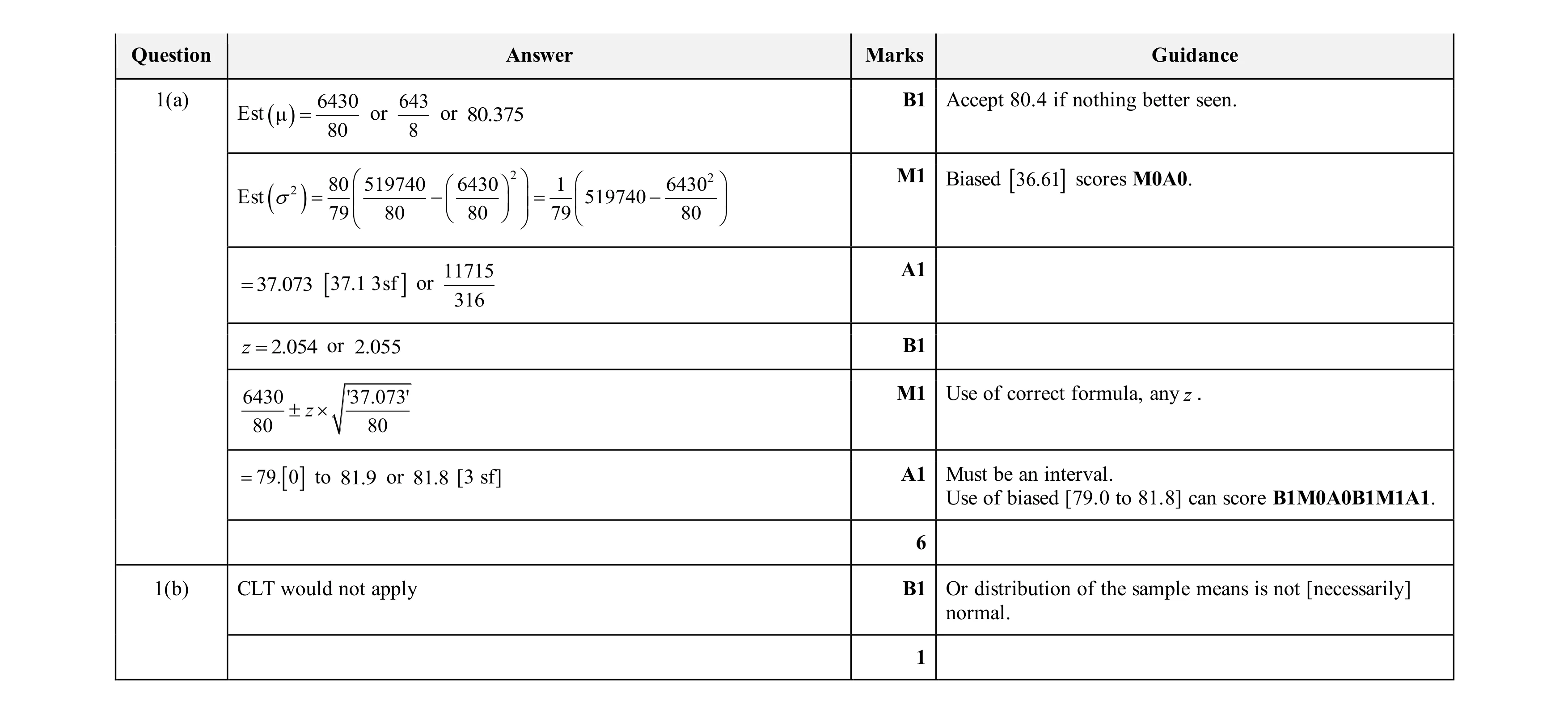 7
7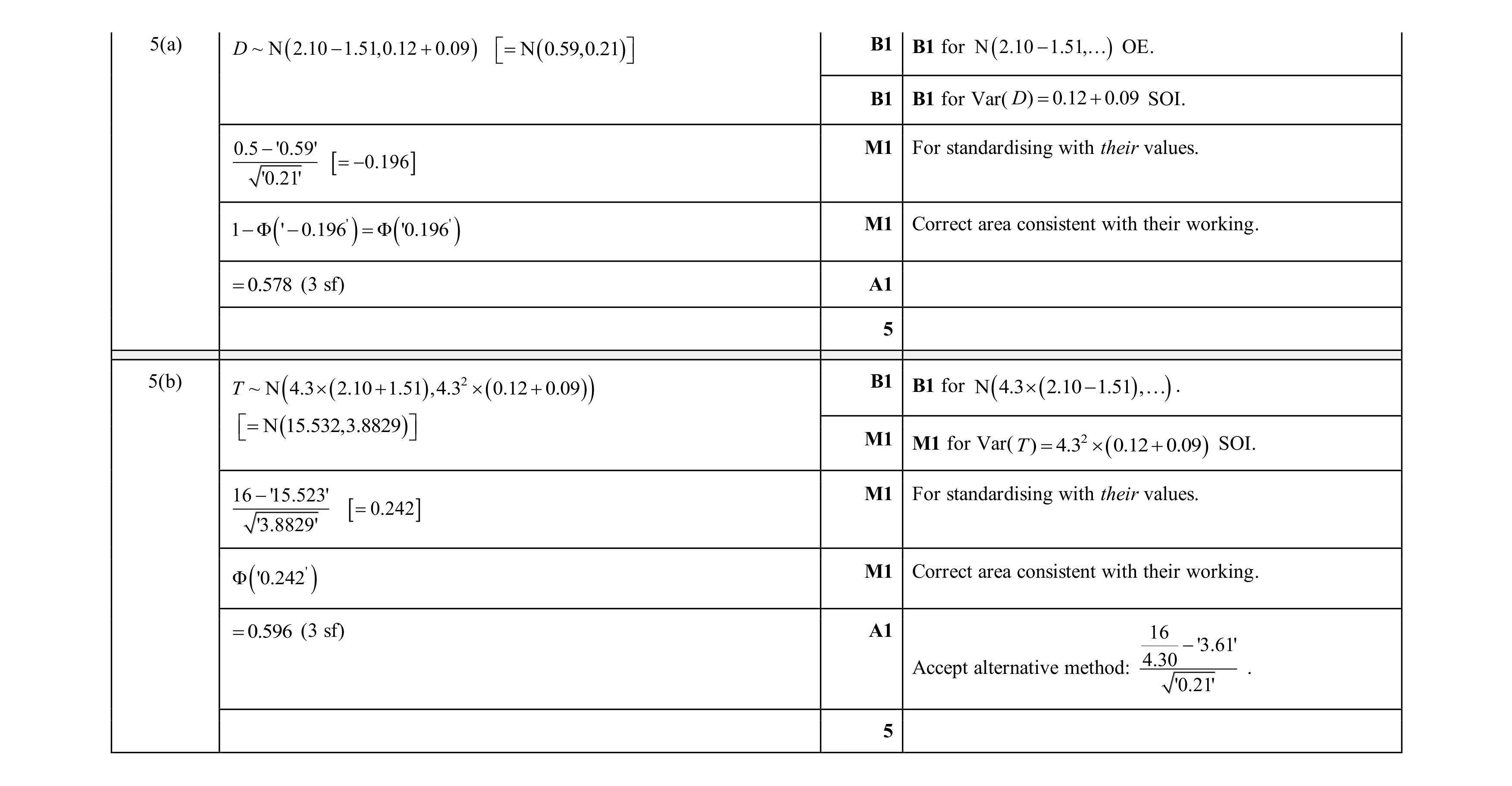 10
10