Cambridge A Level Mathematics 9709 — 2009 May/June Paper 6 · Variant 1
9709/61/M/J/09 · 6 questions · 50 marks · ≈56 min
The question paper and its mark scheme, free to read here and free to download. This is Cambridge’s own paper, exactly as it was sat.
Question paper4 pages

Mark scheme6 pages
Answers below. Sit the paper first if you are practising.
Questions as text
Q1 · The volume of milk in millilitres in cartons is normally distributed with mean µ and…
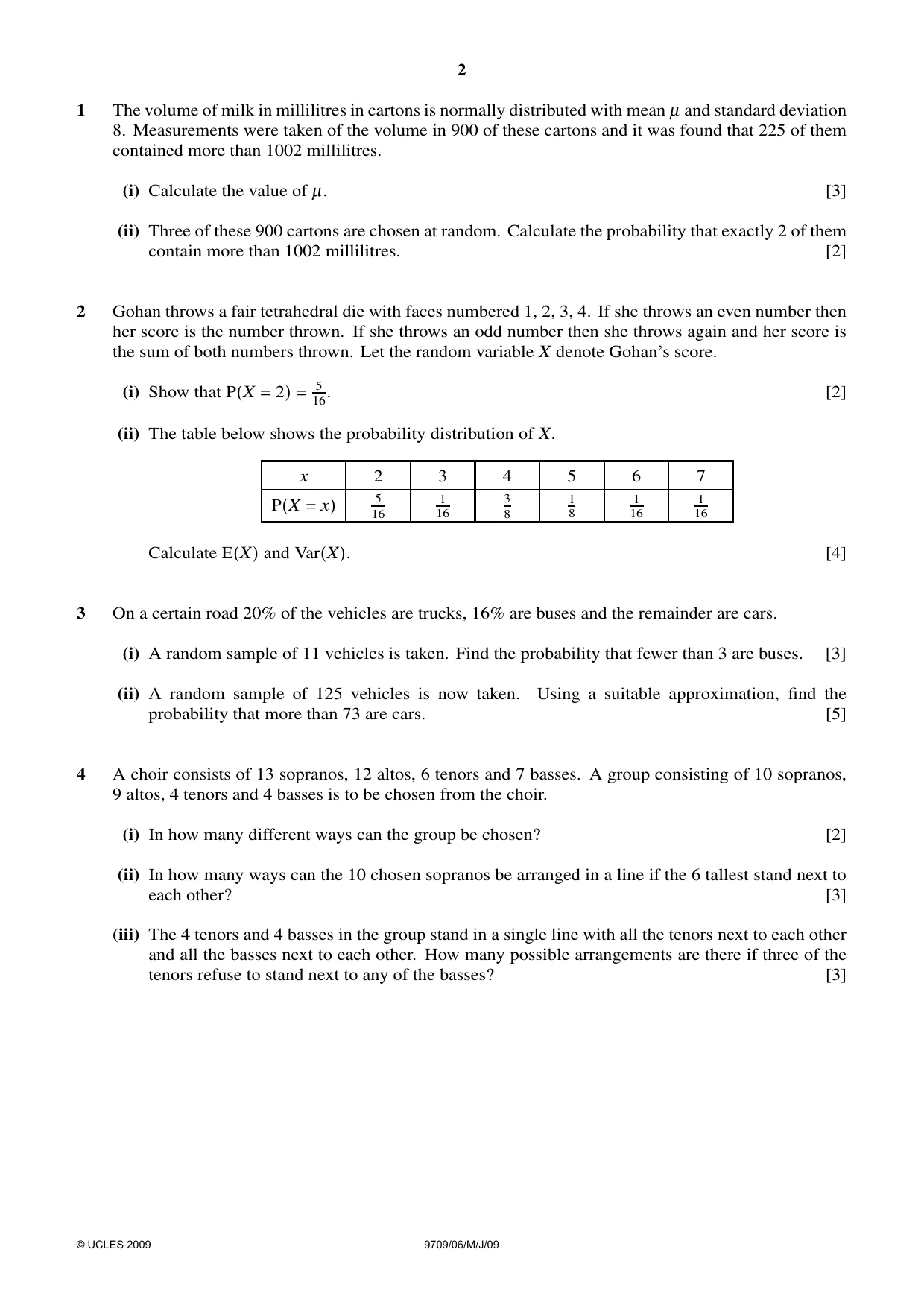
1 The volume of milk in millilitres in cartons is normally distributed with mean µ and standard deviation 8. Measurements were taken of the volume in 900 of these cartons and it was found that 225 of them contained more than 1002 millilitres. (i) Calculate the value of µ. [3] (ii) Three of these 900 cartons are chosen at random. Calculate the probability that exactly 2 of them contain more than 1002 millilitres. [2]
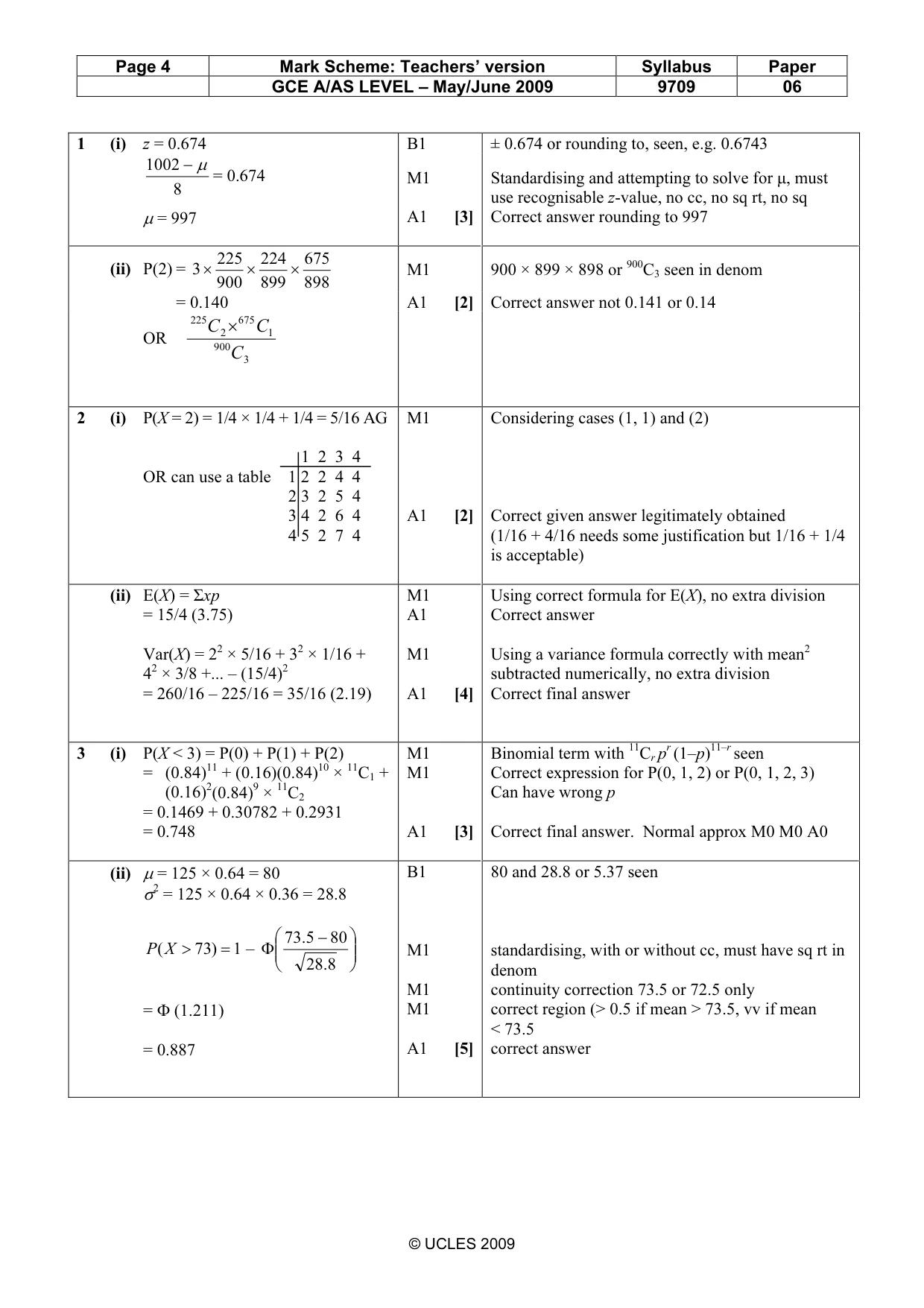
Mark scheme: 1 (i) z = 0.674 B1 ± 0.674 or rounding to, seen, e.g. 0.6743 1002 − µ = 0.674 M1 Standardising and attempting to solve for µ, must 8 use recognisable z-value, no cc, no sq rt, no sq µ = 997 A1 [3] Correct answer rounding to 997 225 224 675 (ii) P(2) = 3 × × × M1 900 × 899 × 898 or 900C3 seen in denom 900 899 898 = 0.140 A1 [2] Correct answer not 0.141 or 0.14 225 C 2 × 675 C1 OR 900 C 3
Q2 · Gohan throws a fair tetrahedral die with faces numbered 1, 2, 3, 4
2 Gohan throws a fair tetrahedral die with faces numbered 1, 2, 3, 4. If she throws an even number then her score is the number thrown. If she throws an odd number then she throws again and her score is the sum of both numbers thrown. Let the random variable X denote Gohan’s score. (i) Show that P(X = 2) = 16.5 [2] (ii) The table below shows the probability distribution of X. x 2 3 4 5 6 7 P(X = x) 5 1 3 1 1 1 16 16 8 8 16 16 Calculate E(X) and Var(X). [4]
Mark scheme: 2 (i) P(X = 2) = 1/4 × 1/4 + 1/4 = 5/16 AG M1 Considering cases (1, 1) and (2) 1 2 3 4 OR can use a table 1 2 2 4 4 2 3 2 5 4 3 4 2 6 4 A1 [2] Correct given answer legitimately obtained 4 5 2 7 4 (1/16 + 4/16 needs some justification but 1/16 + 1/4 is acceptable) (ii) E(X) = Σxp M1 Using correct formula for E(X), no extra division = 15/4 (3.75) A1 Correct answer Var(X) = 22 × 5/16 + 32 × 1/16 + M1 Using a variance formula correctly with mean2 42 × 3/8 +... – (15/4)2 subtracted numerically, no extra division = 260/16 – 225/16 = 35/16 (2.19) A1 [4] Correct final answer 11 11
Q3 · On a certain road 20% of the vehicles are trucks, 16% are buses and the remainder are cars
3 On a certain road 20% of the vehicles are trucks, 16% are buses and the remainder are cars. (i) A random sample of 11 vehicles is taken. Find the probability that fewer than 3 are buses. [3] (ii) A random sample of 125 vehicles is now taken. Using a suitable approximation, find the probability that more than 73 are cars. [5]
Mark scheme: 3 (i) P(X < 3) = P(0) + P(1) + P(2) M1 Binomial term with 11Cr pr (1–p)11–r seen = (0.84)11 + (0.16)(0.84)10 × 11C1 + M1 Correct expression for P(0, 1, 2) or P(0, 1, 2, 3) (0.16)2(0.84)9 × 11C2 Can have wrong p = 0.1469 + 0.30782 + 0.2931 = 0.748 A1 [3] Correct final answer. Normal approx M0 M0 A0 (ii) µ = 125 × 0.64 = 80 B1 80 and 28.8 or 5.37 seen σ2 = 125 × 0.64 × 0.36 = 28.8 735. − 80 P (X > 73) = 1 – Φ M1 standardising, with or without cc, must have sq rt in 288. denom M1 continuity correction 73.5 or 72.5 only = Φ (1.211) M1 correct region (> 0.5 if mean > 73.5, vv if mean < 73.5 = 0.887 A1 [5] correct answer GCE A/AS LEVEL – May/June 2009 9709 06 13 12 6 7
Q4 · A choir consists of 13 sopranos, 12 altos, 6 tenors and 7 basses
4 A choir consists of 13 sopranos, 12 altos, 6 tenors and 7 basses. A group consisting of 10 sopranos, 9 altos, 4 tenors and 4 basses is to be chosen from the choir. (i) In how many different ways can the group be chosen? [2] (ii) In how many ways can the 10 chosen sopranos be arranged in a line if the 6 tallest stand next to each other? [3] (iii) The 4 tenors and 4 basses in the group stand in a single line with all the tenors next to each other and all the basses next to each other. How many possible arrangements are there if three of the tenors refuse to stand next to any of the basses? [3]
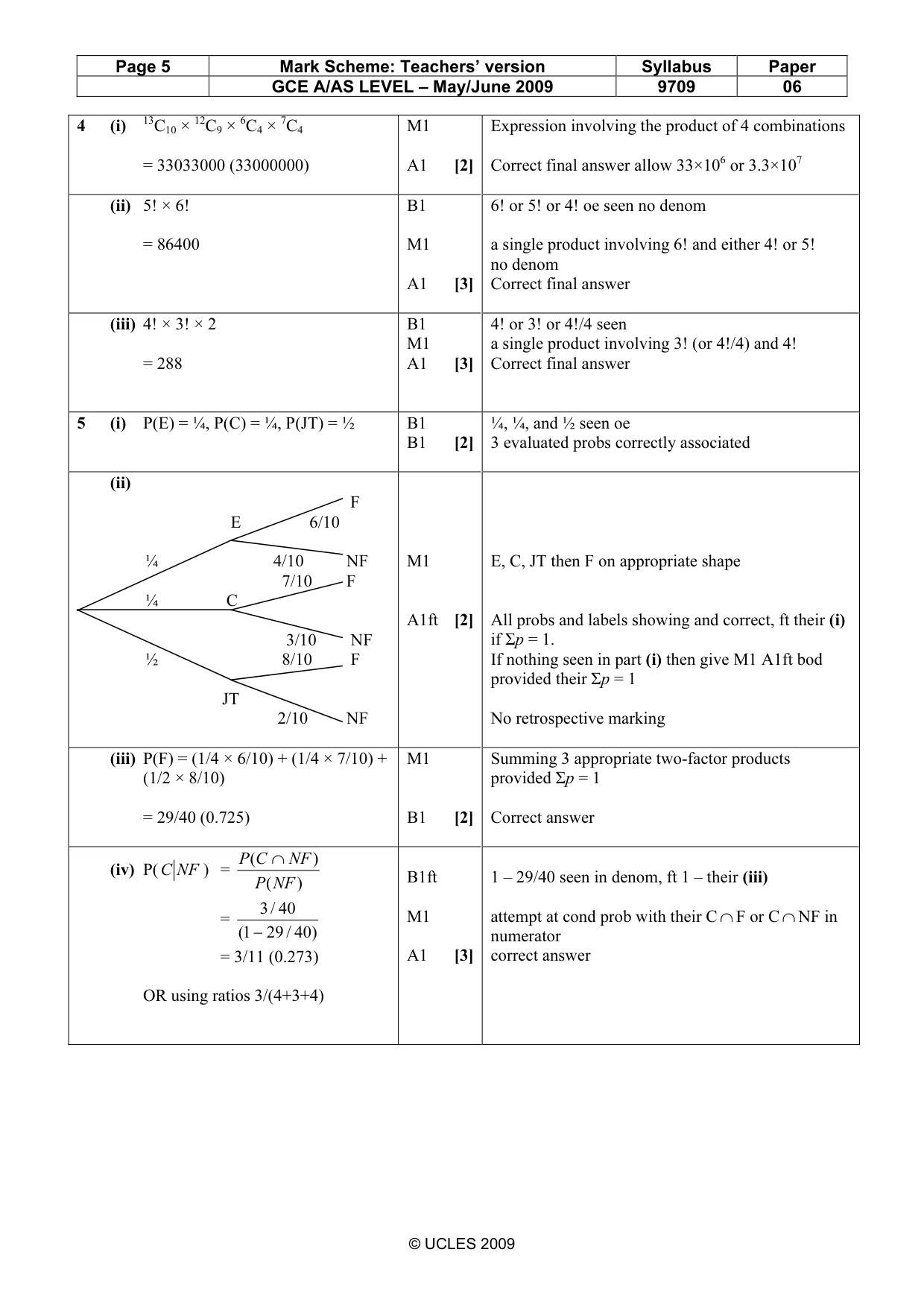
Mark scheme: 4 (i) 13C10 × 12C9 × 6C4 × 7C4 M1 Expression involving the product of 4 combinations = 33033000 (33000000) A1 [2] Correct final answer allow 33×106 or 3.3×10⁷ (ii) 5! × 6! B1 6! or 5! or 4! oe seen no denom = 86400 M1 a single product involving 6! and either 4! or 5! no denom A1 [3] Correct final answer (iii) 4! × 3! × 2 B1 4! or 3! or 4!/4 seen M1 a single product involving 3! (or 4!/4) and 4! = 288 A1 [3] Correct final answer
Q5 · At a zoo, rides are offered on elephants, camels and jungle tractors
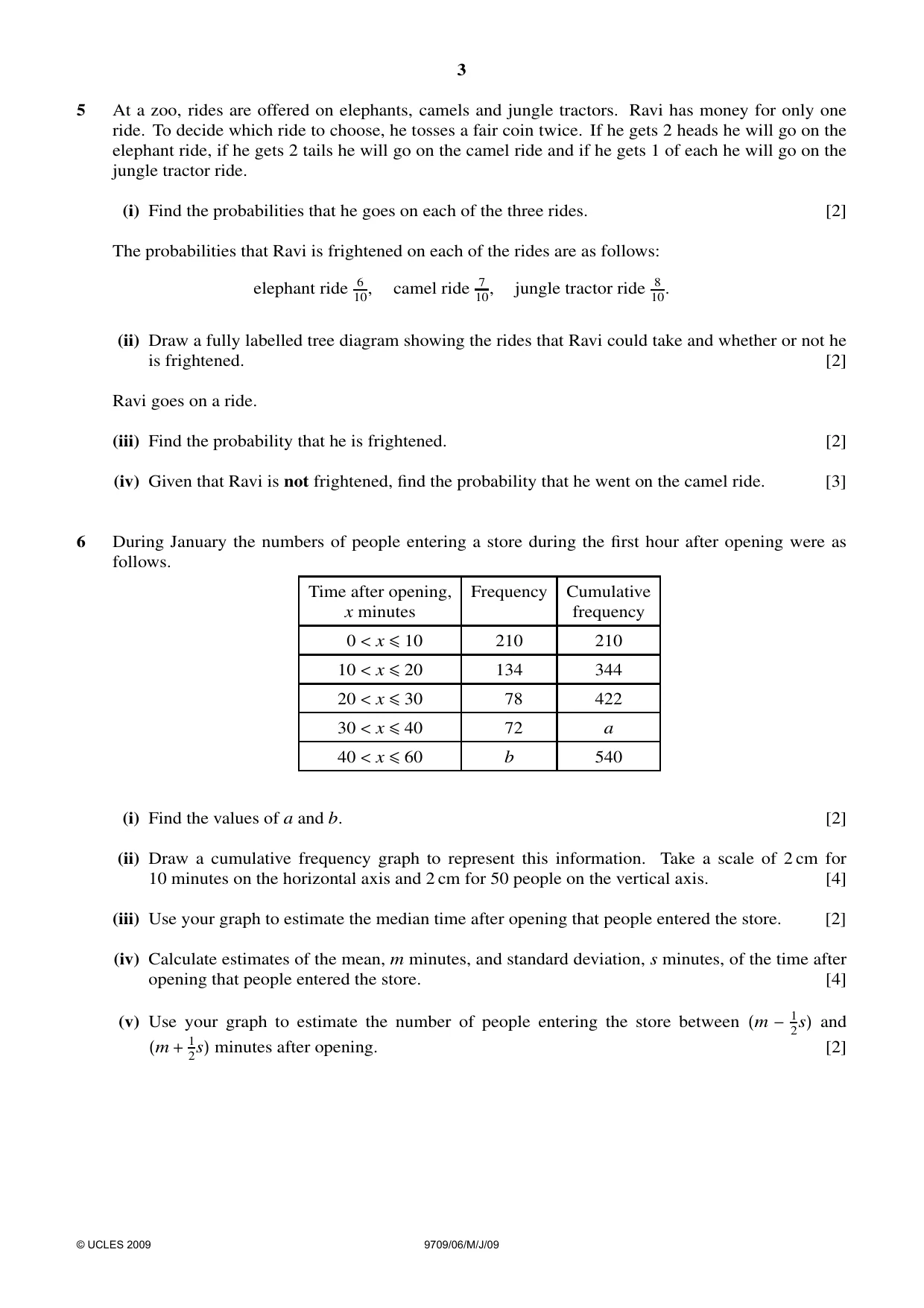
5 At a zoo, rides are offered on elephants, camels and jungle tractors. Ravi has money for only one ride. To decide which ride to choose, he tosses a fair coin twice. If he gets 2 heads he will go on the elephant ride, if he gets 2 tails he will go on the camel ride and if he gets 1 of each he will go on the jungle tractor ride. (i) Find the probabilities that he goes on each of the three rides. [2] The probabilities that Ravi is frightened on each of the rides are as follows: elephant ride 10,6 camel ride 10,7 jungle tractor ride 10.8 (ii) Draw a fully labelled tree diagram showing the rides that Ravi could take and whether or not he is frightened. [2] Ravi goes on a ride. (iii) Find the probability that he is frightened. [2] (iv) Given that Ravi is not frightened, find the probability that he went on the camel ride. [3]
Mark scheme: 5 (i) P(E) = ¼, P(C) = ¼, P(JT) = ½ B1 ¼, ¼, and ½ seen oe B1 [2] 3 evaluated probs correctly associated (ii) F E 6/10 ¼ 4/10 NF M1 E, C, JT then F on appropriate shape 7/10 F ¼ C A1ft [2] All probs and labels showing and correct, ft their (i) 3/10 NF if Σp = 1. ½ 8/10 F If nothing seen in part (i) then give M1 A1ft bod provided their Σp = 1 JT 2/10 NF No retrospective marking (iii) P(F) = (1/4 × 6/10) + (1/4 × 7/10) + M1 Summing 3 appropriate two-factor products (1/2 × 8/10) provided Σp = 1 = 29/40 (0.725) B1 [2] Correct answer P (C ∩ NF ) (iv) P( C NF ) = B1ft 1 – 29/40 seen in denom, ft 1 – their (iii) P ( NF ) 3 / 40 = M1 attempt at cond prob with their C ∩F or C ∩NF in 1( − 29 / 40 ) numerator = 3/11 (0.273) A1 [3] correct answer OR using ratios 3/(4+3+4) GCE A/AS LEVEL – May/June 2009 9709 06
Q6 · During January the numbers of people entering a store during the first hour after opening…
6 During January the numbers of people entering a store during the first hour after opening were as follows. Time after opening, Frequency Cumulative x minutes frequency 0 < x ≤10 210 210 10 < x ≤20 134 344 20 < x ≤30 78 422 30 < x ≤40 72 a 40 < x ≤60 b 540 (i) Find the values of a and b. [2] (ii) Draw a cumulative frequency graph to represent this information. Take a scale of 2 cm for 10 minutes on the horizontal axis and 2 cm for 50 people on the vertical axis. [4] (iii) Use your graph to estimate the median time after opening that people entered the store. [2] (iv) Calculate estimates of the mean, m minutes, and standard deviation, s minutes, of the time after opening that people entered the store. [4] (v) Use your graph to estimate the number of people entering the store between (m −12s) and (m + 12s) minutes after opening. [2]
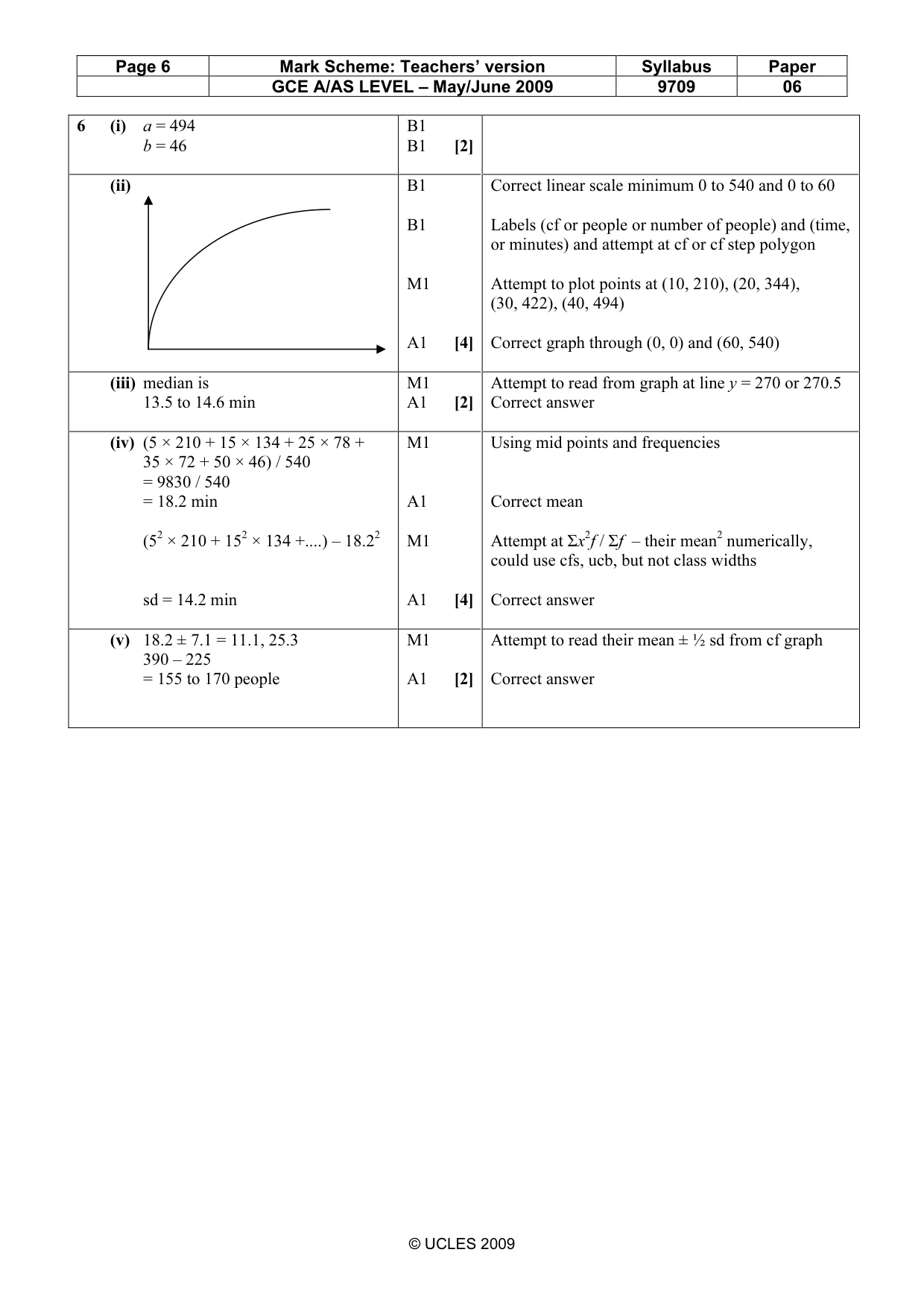
Mark scheme: 6 (i) a = 494 B1 b = 46 B1 [2] (ii) B1 Correct linear scale minimum 0 to 540 and 0 to 60 B1 Labels (cf or people or number of people) and (time, or minutes) and attempt at cf or cf step polygon M1 Attempt to plot points at (10, 210), (20, 344), (30, 422), (40, 494) A1 [4] Correct graph through (0, 0) and (60, 540) (iii) median is M1 Attempt to read from graph at line y = 270 or 270.5 13.5 to 14.6 min A1 [2] Correct answer (iv) (5 × 210 + 15 × 134 + 25 × 78 + M1 Using mid points and frequencies 35 × 72 + 50 × 46) / 540 = 9830 / 540 = 18.2 min A1 Correct mean (52 × 210 + 152 × 134 +....) – 18.22 M1 Attempt at Σx2f / Σf – their mean2 numerically, could use cfs, ucb, but not class widths sd = 14.2 min A1 [4] Correct answer (v) 18.2 ± 7.1 = 11.1, 25.3 M1 Attempt to read their mean ± ½ sd from cf graph 390 – 225 = 155 to 170 people A1 [2] Correct answer
What was in this paper
The subtopics covered by these 6 questions, and how many questions each got. Open one in a new tab to see every Cambridge question on it.
What you needed in this session
Cambridge’s own grade thresholds for 2009 May/June, Paper 6 · Variant 1. A higher threshold means an easier paper — the bar moves with how the cohort did.