Cambridge A Level Mathematics 9709 — 2008 May/June Paper 6 · Variant 1
9709/61/M/J/08 · 7 questions · 50 marks · ≈56 min
The question paper and its mark scheme, free to read here and free to download. This is Cambridge’s own paper, exactly as it was sat.
Question paper4 pages
Mark scheme6 pages
Answers below. Sit the paper first if you are practising.
Questions as text
Q1 · The stem-and-leaf diagram below represents data collected for the number of hits on an…
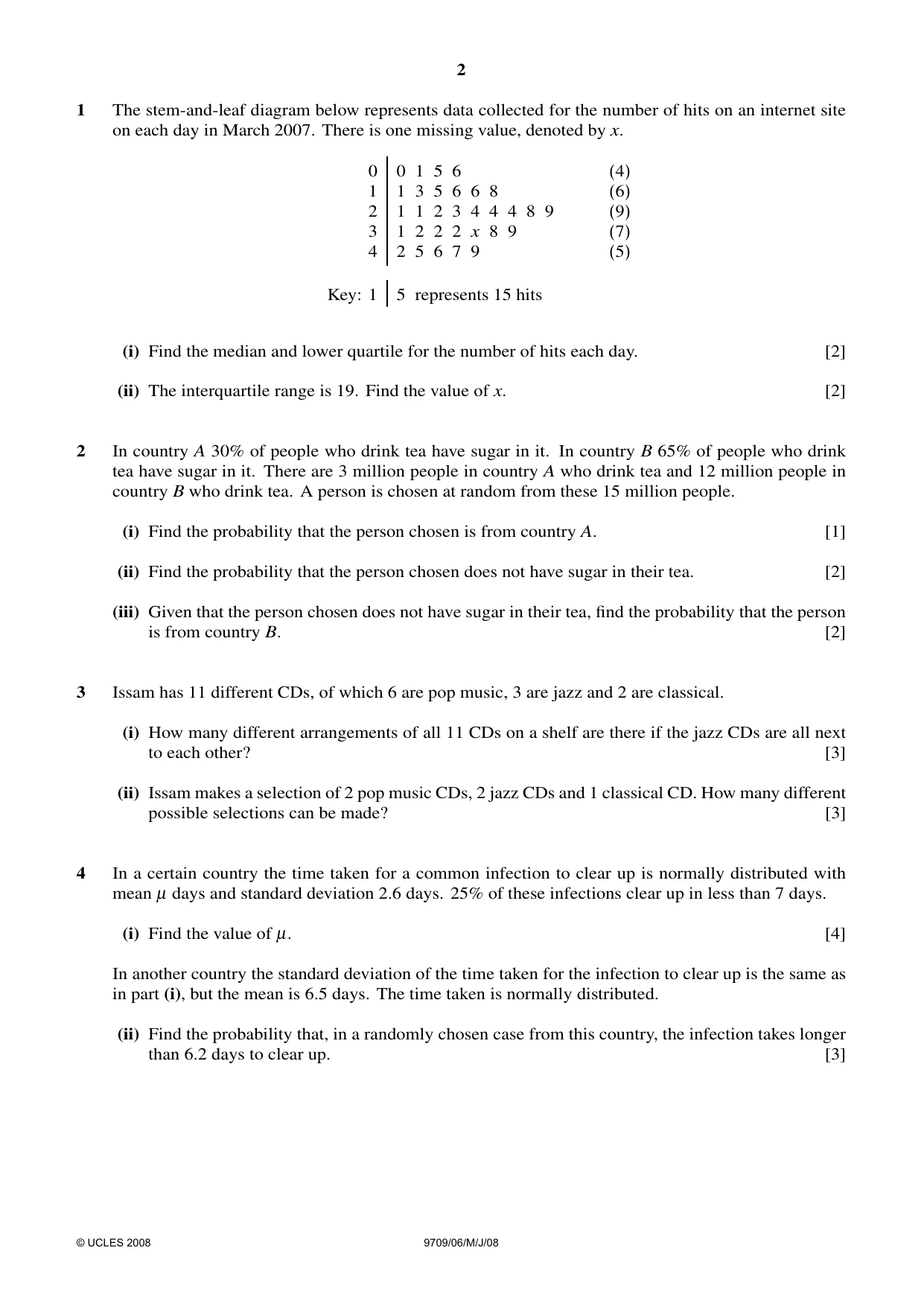
1 The stem-and-leaf diagram below represents data collected for the number of hits on an internet site on each day in March 2007. There is one missing value, denoted by x. 0 0 1 5 6 (4) 1 1 3 5 6 6 8 (6) 2 1 1 2 3 4 4 4 8 9 (9) 3 1 2 2 2 x 8 9 (7) 4 2 5 6 7 9 (5) Key: 1 5 represents 15 hits (i) Find the median and lower quartile for the number of hits each day. [2] (ii) The interquartile range is 19. Find the value of x. [2]
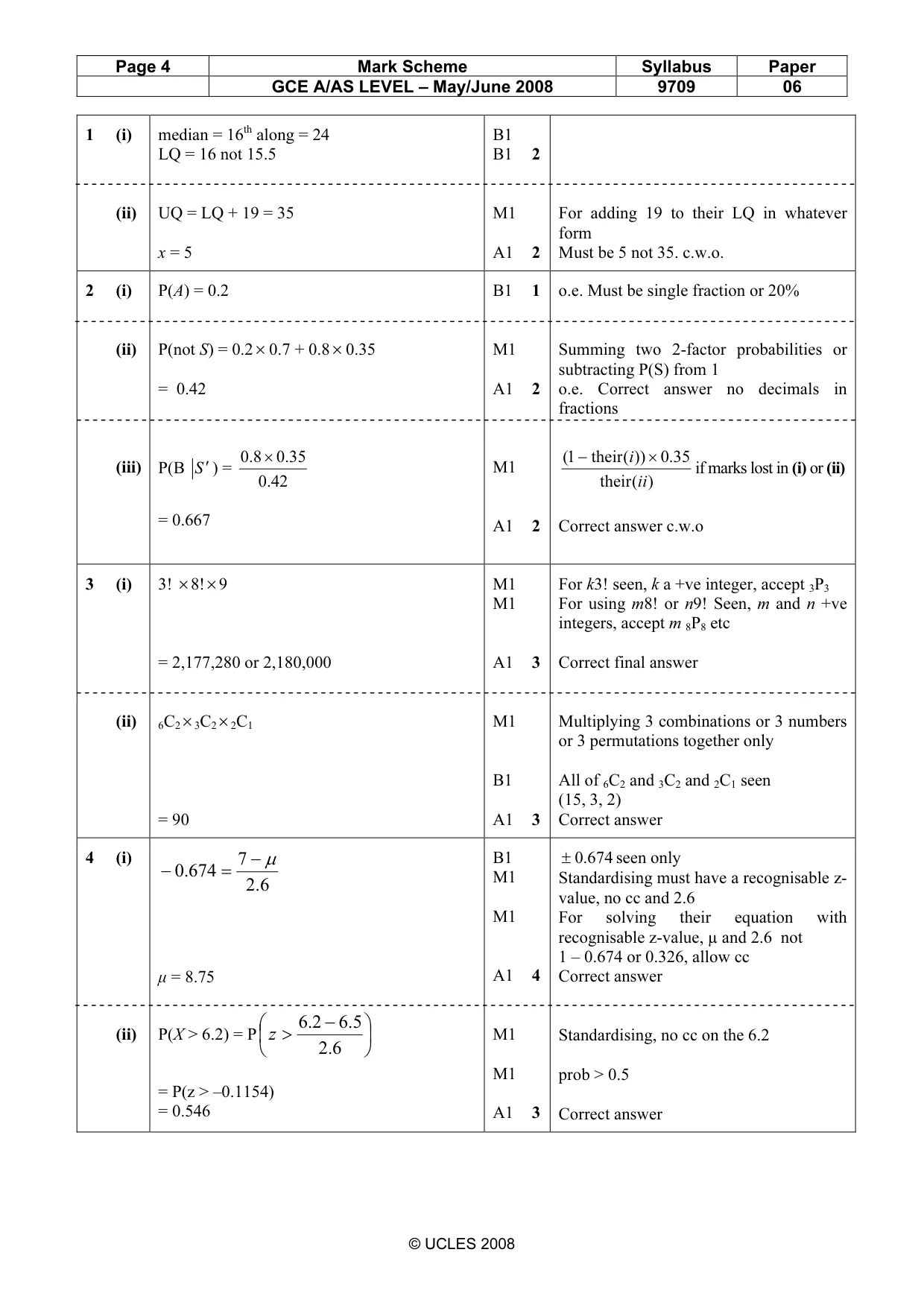
Mark scheme: 1 (i) median = 16th along = 24 B1 LQ = 16 not 15.5 B1 2 (ii) UQ = LQ + 19 = 35 M1 For adding 19 to their LQ in whatever form x = 5 A1 2 Must be 5 not 35. c.w.o.
Q2 · In country A 30% of people who drink tea have sugar in it
2 In country A 30% of people who drink tea have sugar in it. In country B 65% of people who drink tea have sugar in it. There are 3 million people in country A who drink tea and 12 million people in country B who drink tea. A person is chosen at random from these 15 million people. (i) Find the probability that the person chosen is from country A. [1] (ii) Find the probability that the person chosen does not have sugar in their tea. [2] (iii) Given that the person chosen does not have sugar in their tea, find the probability that the person is from country B. [2]
Mark scheme: 2 (i) P(A) = 0.2 B1 1 o.e. Must be single fraction or 20% (ii) P(not S) = 0.2× 0.7 + 0.8× 0.35 M1 Summing two 2-factor probabilities or subtracting P(S) from 1 = 0.42 A1 2 o.e. Correct answer no decimals in fractions 8.0 × .035 1( − their (i )) × .0 35 (iii) P(B S′ ) = M1 if marks lost in (i) or (ii) .042 their (ii ) = 0.667 A1 2 Correct answer c.w.o
Q3 · Issam has 11 different CDs, of which 6 are pop music, 3 are jazz and 2 are classical
3 Issam has 11 different CDs, of which 6 are pop music, 3 are jazz and 2 are classical. (i) How many different arrangements of all 11 CDs on a shelf are there if the jazz CDs are all next to each other? [3] (ii) Issam makes a selection of 2 pop music CDs, 2 jazz CDs and 1 classical CD. How many different possible selections can be made? [3]
Mark scheme: 3 (i) 3! ×8!×9 M1 For k3! seen, k a +ve integer, accept 3P3 M1 For using m8! or n9! Seen, m and n +ve integers, accept m 8P8 etc = 2,177,280 or 2,180,000 A1 3 Correct final answer (ii) 6C2× 3C2× 2C1 M1 Multiplying 3 combinations or 3 numbers or 3 permutations together only B1 All of 6C2 and 3C2 and 2C1 seen (15, 3, 2) = 90 A1 3 Correct answer
Q4 · In a certain country the time taken for a common infection to clear up is normally…
4 In a certain country the time taken for a common infection to clear up is normally distributed with mean µ days and standard deviation 2.6 days. 25% of these infections clear up in less than 7 days. (i) Find the value of µ. [4] In another country the standard deviation of the time taken for the infection to clear up is the same as in part (i), but the mean is 6.5 days. The time taken is normally distributed. (ii) Find the probability that, in a randomly chosen case from this country, the infection takes longer than 6.2 days to clear up. [3]
Mark scheme: 4 (i) 7 − µ B1 ± .0674 seen only − .0 674 = M1 Standardising must have a recognisable z- 6.2 value, no cc and 2.6 M1 For solving their equation with recognisable z-value, µ and 2.6 not 1 – 0.674 or 0.326, allow cc µ = 8.75 A1 4 Correct answer 2.6 − 5.6 (ii) P(X > 6.2) = P z > M1 Standardising, no cc on the 6.2 6.2 M1 prob > 0.5 = P(z > –0.1154) = 0.546 A1 3 Correct answer GCE A/AS LEVEL – May/June 2008 9709 06
Q5 · As part of a data collection exercise, members of a certain school year group were asked…
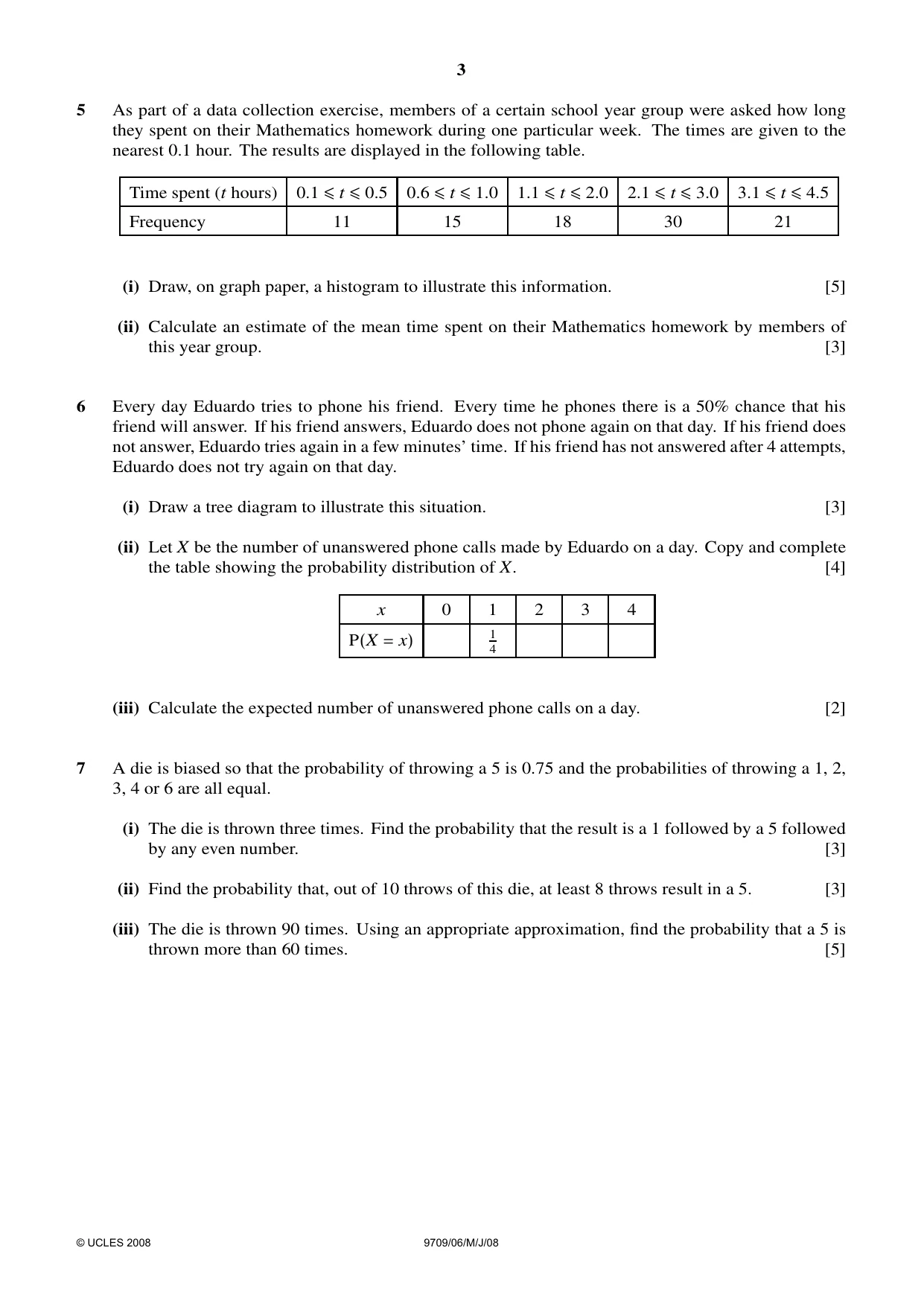
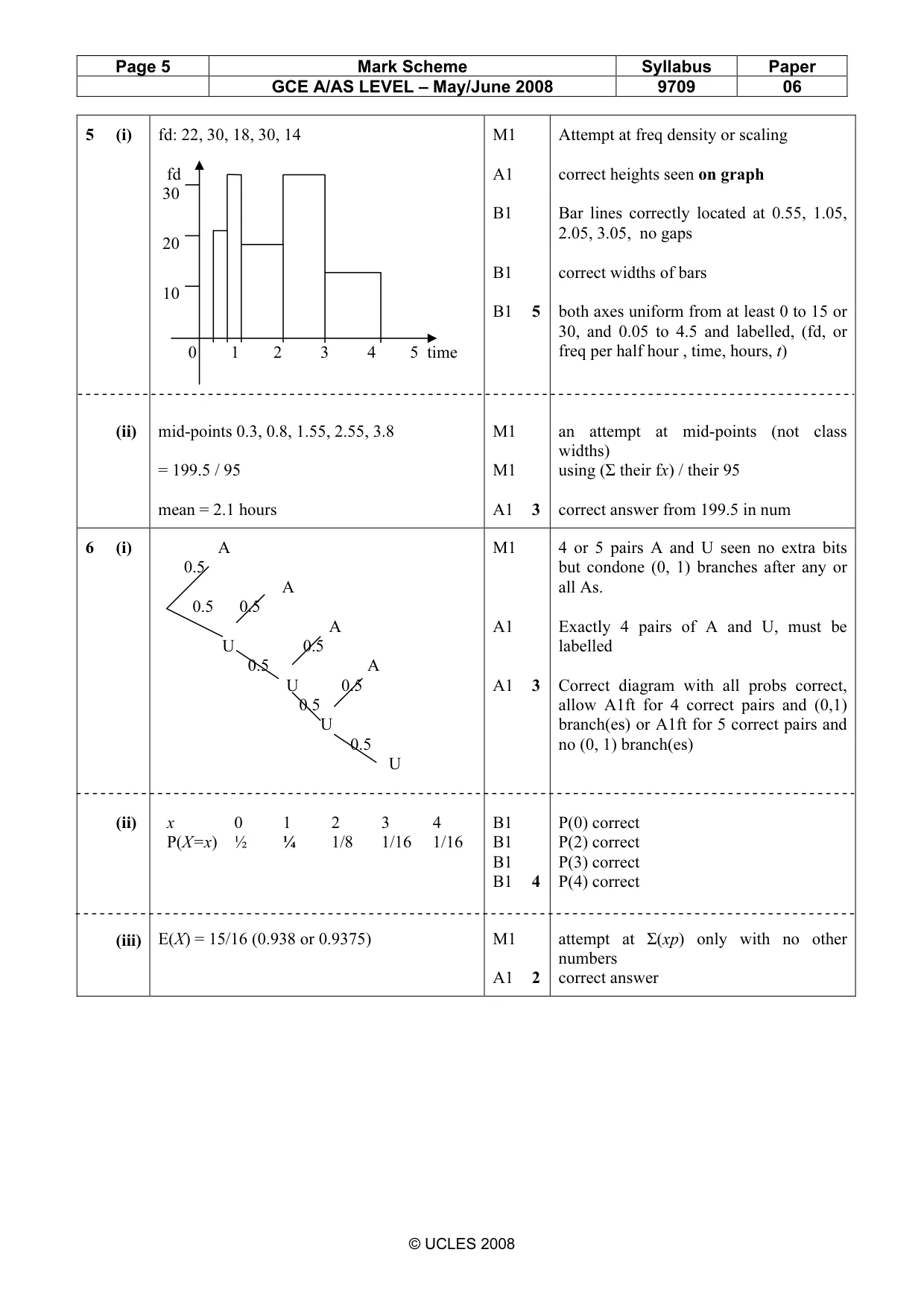
5 As part of a data collection exercise, members of a certain school year group were asked how long they spent on their Mathematics homework during one particular week. The times are given to the nearest 0.1 hour. The results are displayed in the following table. Time spent (t hours) 0.1 ≤t ≤0.5 0.6 ≤t ≤1.0 1.1 ≤t ≤2.0 2.1 ≤t ≤3.0 3.1 ≤t ≤4.5 Frequency 11 15 18 30 21 (i) Draw, on graph paper, a histogram to illustrate this information. [5] (ii) Calculate an estimate of the mean time spent on their Mathematics homework by members of this year group. [3]
Mark scheme: 5 (i) fd: 22, 30, 18, 30, 14 M1 Attempt at freq density or scaling fd A1 correct heights seen on graph 30 B1 Bar lines correctly located at 0.55, 1.05, 2.05, 3.05, no gaps 20 B1 correct widths of bars 10 B1 5 both axes uniform from at least 0 to 15 or 30, and 0.05 to 4.5 and labelled, (fd, or 0 1 2 3 4 5 time freq per half hour , time, hours, t) (ii) mid-points 0.3, 0.8, 1.55, 2.55, 3.8 M1 an attempt at mid-points (not class widths) = 199.5 / 95 M1 using (Σ their fx) / their 95 mean = 2.1 hours A1 3 correct answer from 199.5 in num
Q6 · Every day Eduardo tries to phone his friend
6 Every day Eduardo tries to phone his friend. Every time he phones there is a 50% chance that his friend will answer. If his friend answers, Eduardo does not phone again on that day. If his friend does not answer, Eduardo tries again in a few minutes’ time. If his friend has not answered after 4 attempts, Eduardo does not try again on that day. (i) Draw a tree diagram to illustrate this situation. [3] (ii) Let X be the number of unanswered phone calls made by Eduardo on a day. Copy and complete the table showing the probability distribution of X. [4] x 0 1 2 3 4 P(X = x) 1 4 (iii) Calculate the expected number of unanswered phone calls on a day. [2]
Mark scheme: 6 (i) A M1 4 or 5 pairs A and U seen no extra bits 0.5 but condone (0, 1) branches after any or A all As. 0.5 0.5 A A1 Exactly 4 pairs of A and U, must be U 0.5 labelled 0.5 A U 0.5 A1 3 Correct diagram with all probs correct, 0.5 allow A1ft for 4 correct pairs and (0,1) U branch(es) or A1ft for 5 correct pairs and 0.5 no (0, 1) branch(es) U (ii) x 0 1 2 3 4 B1 P(0) correct P(X=x) ½ ¼ 1/8 1/16 1/16 B1 P(2) correct B1 P(3) correct B1 4 P(4) correct (iii) E(X) = 15/16 (0.938 or 0.9375) M1 attempt at Σ(xp) only with no other numbers A1 2 correct answer GCE A/AS LEVEL – May/June 2008 9709 06
Q7 · A die is biased so that the probability of throwing a 5 is 0.75 and the probabilities of…
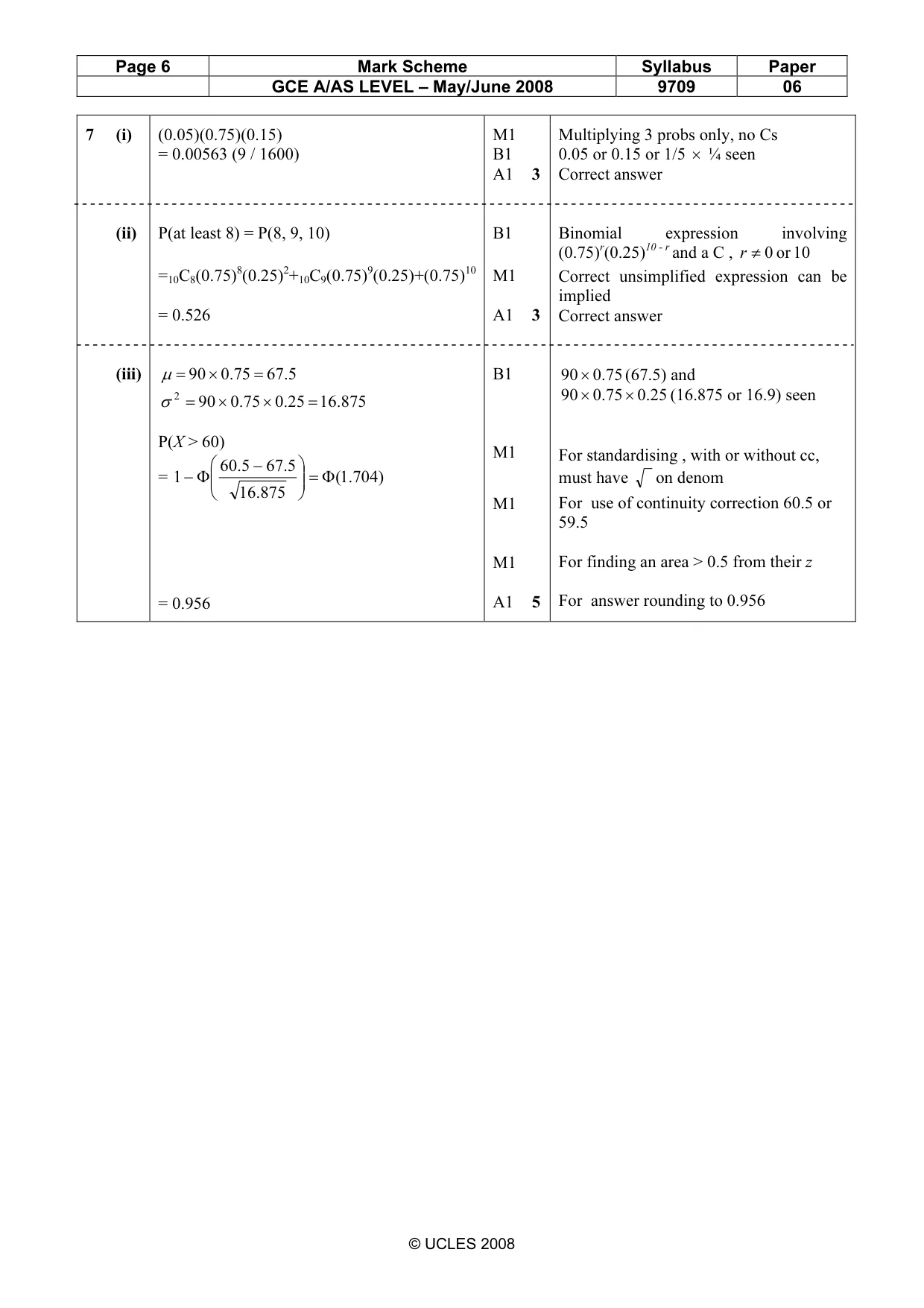
7 A die is biased so that the probability of throwing a 5 is 0.75 and the probabilities of throwing a 1, 2, 3, 4 or 6 are all equal. (i) The die is thrown three times. Find the probability that the result is a 1 followed by a 5 followed by any even number. [3] (ii) Find the probability that, out of 10 throws of this die, at least 8 throws result in a 5. [3] (iii) The die is thrown 90 times. Using an appropriate approximation, find the probability that a 5 is thrown more than 60 times. [5]
Mark scheme: 7 (i) (0.05)(0.75)(0.15) M1 Multiplying 3 probs only, no Cs = 0.00563 (9 / 1600) B1 0.05 or 0.15 or 1/5 × ¼ seen A1 3 Correct answer (ii) P(at least 8) = P(8, 9, 10) B1 Binomial expression involving (0.75)r(0.25)10 - r and a C , r ≠ 0 or 10 =10C8(0.75)8(0.25)2+10C9(0.75)9(0.25)+(0.75)10 M1 Correct unsimplified expression can be implied = 0.526 A1 3 Correct answer (iii) µ = 90 × .075 = 67 5. B1 90× .075 (67.5) and 2 90 × .075 × .025 (16.875 or 16.9) seen σ = 90 × .0 75 × .0 25 = 16 . 875 P(X > 60) M1 For standardising , with or without cc, 605. − 67 5. = 1 − Φ = Φ .1(704) must have on denom 16.875 M1 For use of continuity correction 60.5 or 59.5 M1 For finding an area > 0.5 from their z = 0.956 A1 5 For answer rounding to 0.956
What was in this paper
The subtopics covered by these 7 questions, and how many questions each got. Open one in a new tab to see every Cambridge question on it.
What you needed in this session
Cambridge’s own grade thresholds for 2008 May/June, Paper 6 · Variant 1. A higher threshold means an easier paper — the bar moves with how the cohort did.