Cambridge A Level Mathematics 9709 — 2011 Oct/Nov Paper 6 · Variant 3
9709/63/O/N/11 · 5 questions · 50 marks · ≈56 min
The question paper and its mark scheme, free to read here and free to download. This is Cambridge’s own paper, exactly as it was sat.
Question paper4 pages

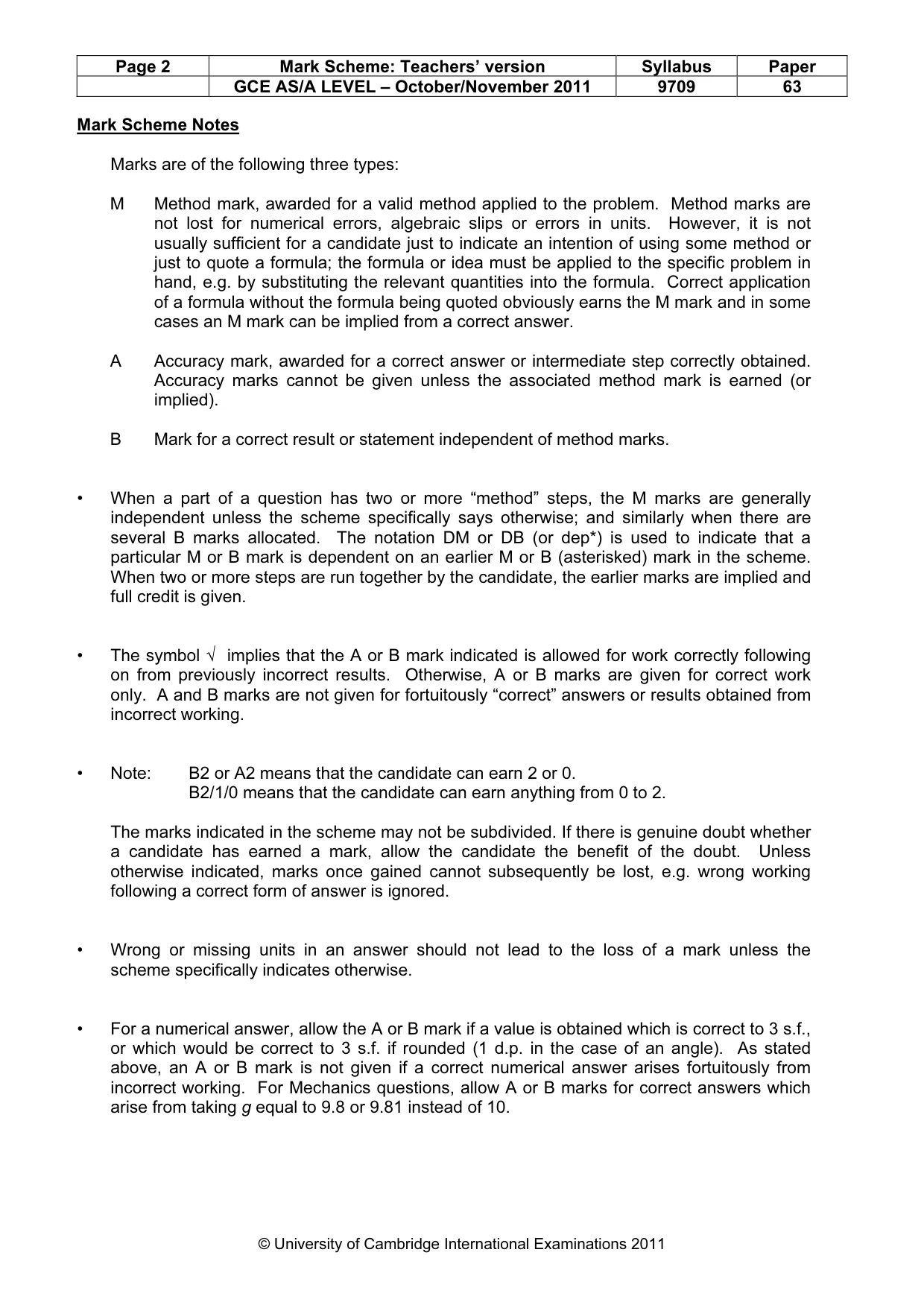
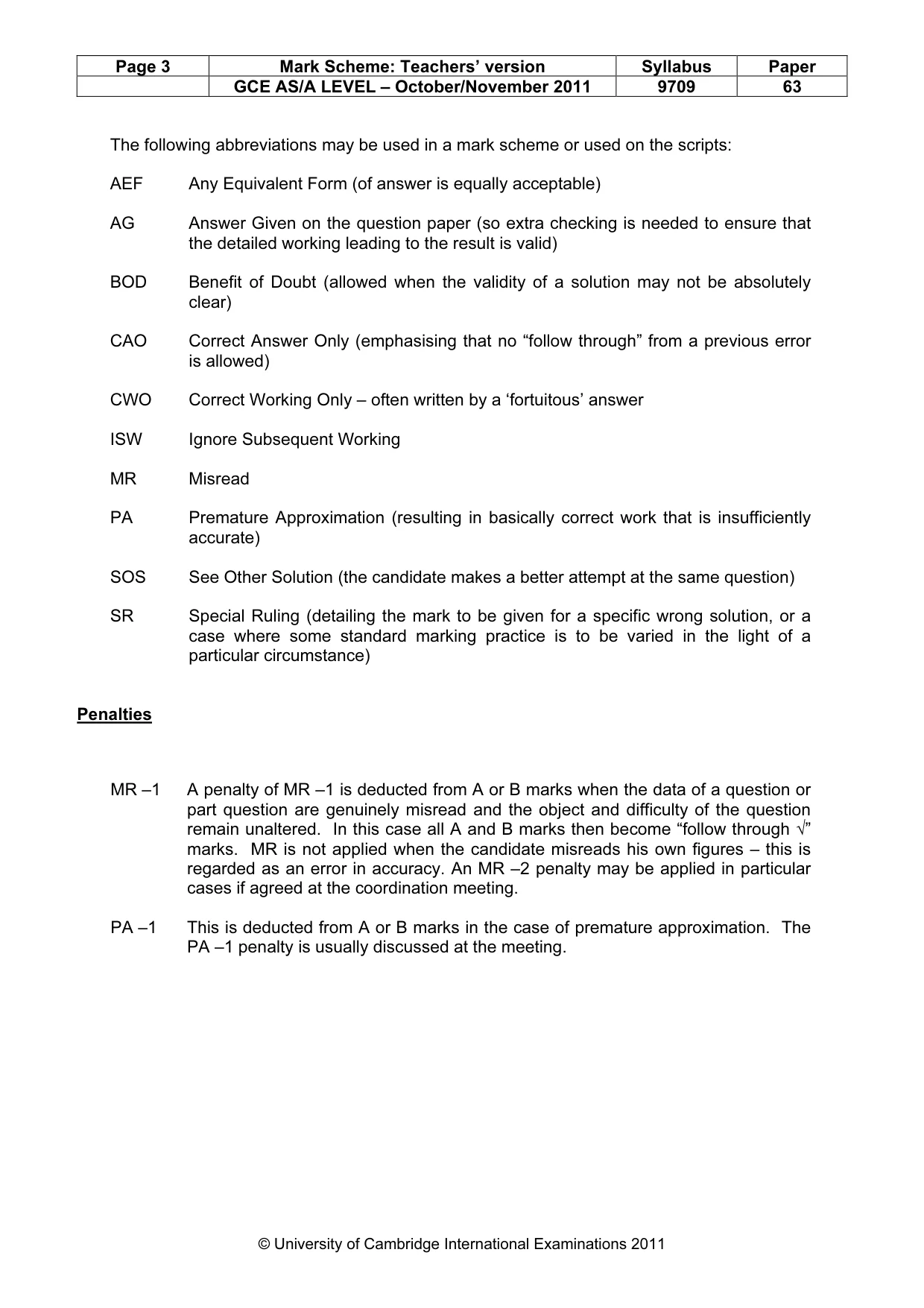
Mark scheme6 pages
Answers below. Sit the paper first if you are practising.
Questions as text
Q1 · The random variable X is normally distributed and is such that the mean µ is three times…
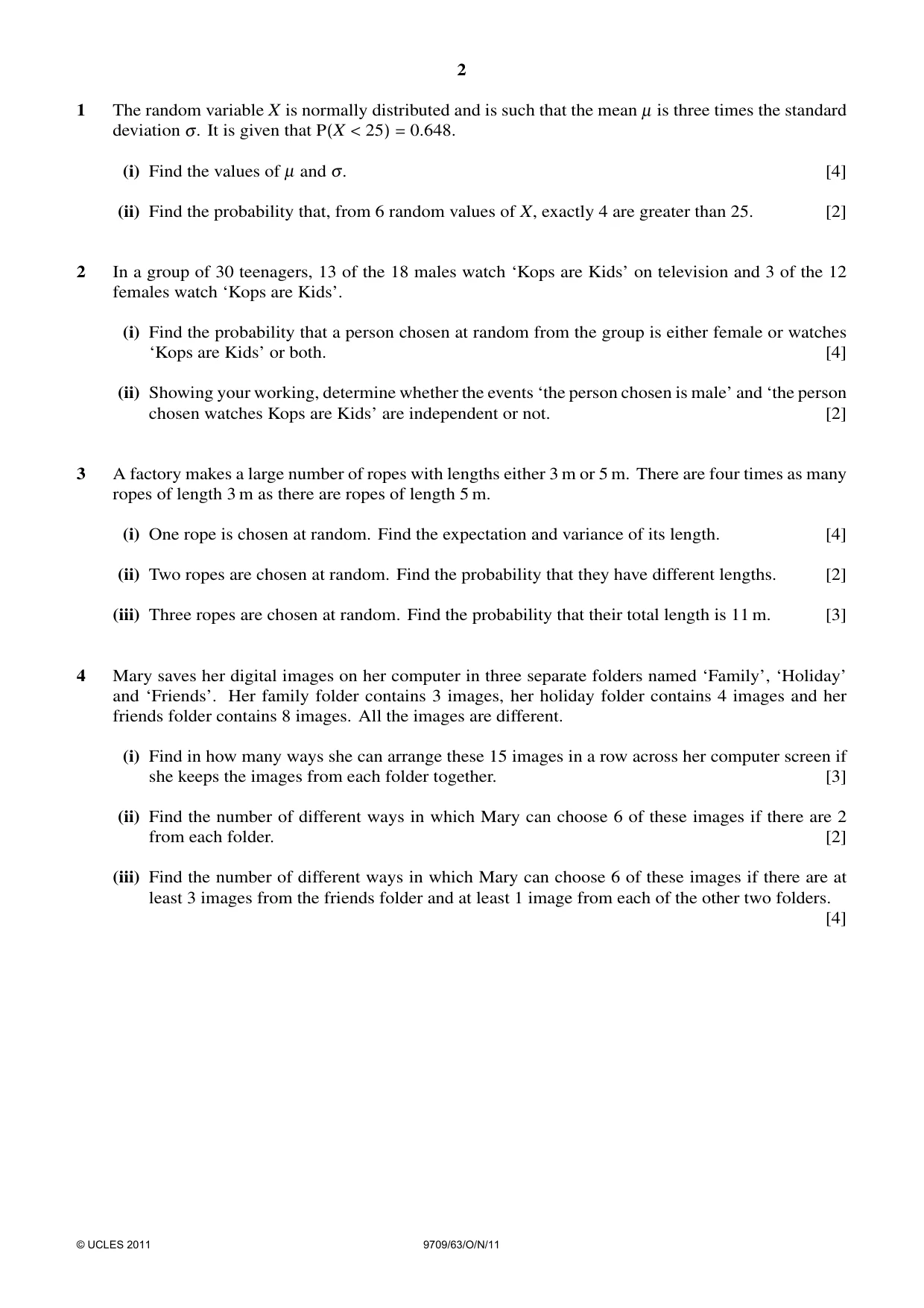
1 The random variable X is normally distributed and is such that the mean µ is three times the standard deviation σ. It is given that P(X < 25) = 0.648. (i) Find the values of µ and σ. [4] (ii) Find the probability that, from 6 random values of X, exactly 4 are greater than 25. [2]
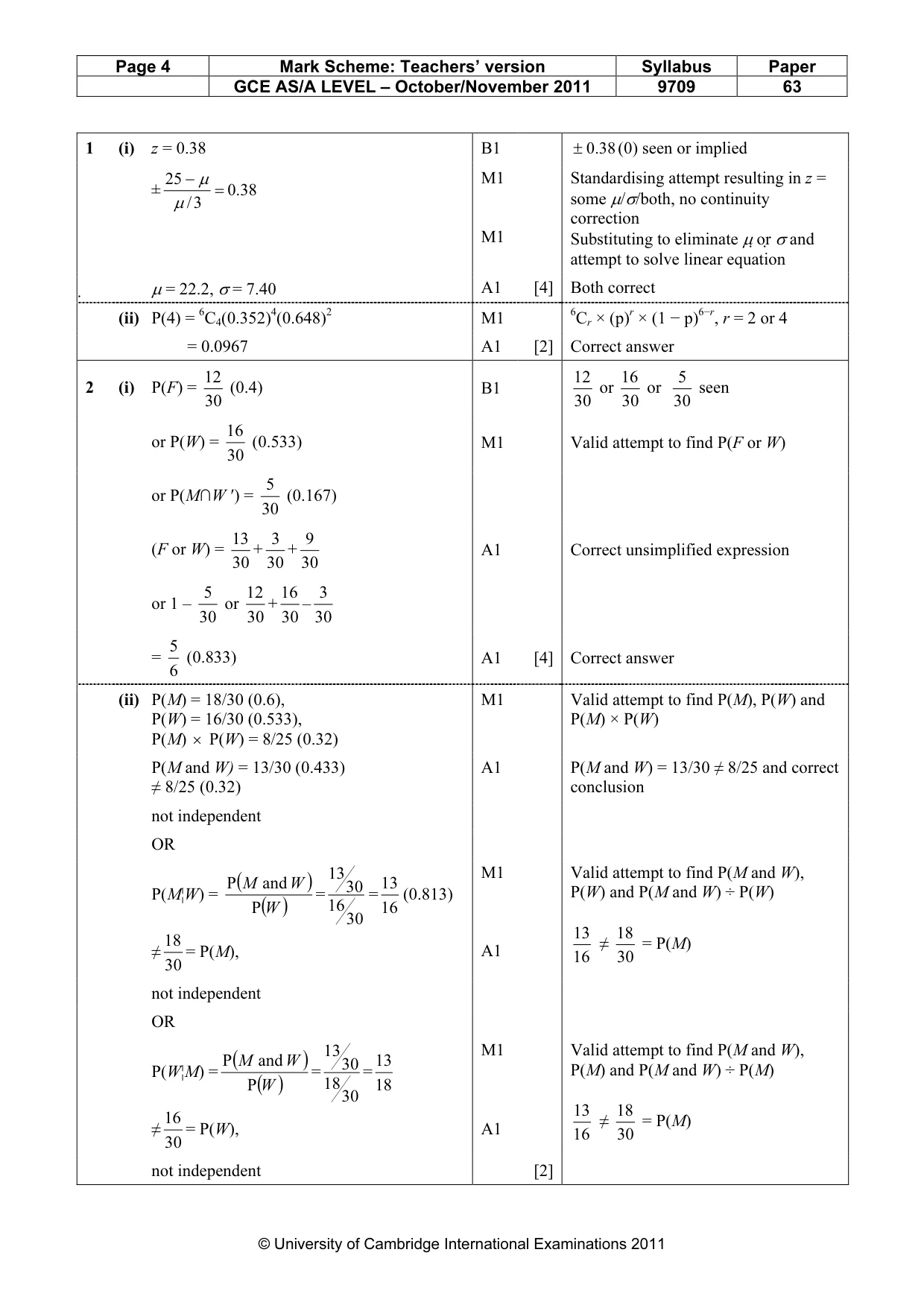
Mark scheme: 1 (i) z = 0.38 B1 ± .0 38 (0) seen or implied 25 − µ M1 Standardising attempt resulting in z = ± = .038 µ / 3 some µ/σ/both, no continuity correction M1 Substituting to eliminate µ or σ and attempt to solve linear equation µ = 22.2, σ = 7.40 A1 [4] Both correct (ii) P(4) = 6C4(0.352)4(0.648)2 M1 6Cr × (p)r × (1 − p)6−r, r = 2 or 4 = 0.0967 A1 [2] Correct answer 12 12 16 5
Q2 · In a group of 30 teenagers, 13 of the 18 males watch ‘Kops are Kids’ on television and 3…
2 In a group of 30 teenagers, 13 of the 18 males watch ‘Kops are Kids’ on television and 3 of the 12 females watch ‘Kops are Kids’. (i) Find the probability that a person chosen at random from the group is either female or watches ‘Kops are Kids’ or both. [4] (ii) Showing your working, determine whether the events ‘the person chosen is male’ and ‘the person chosen watches Kops are Kids’ are independent or not. [2]
Mark scheme: 12 12 16 5 2 (i) P(F) = (0.4) B1 or or seen 30 30 30 30 16 or P(W) = (0.533) M1 Valid attempt to find P(F or W) 30 5 or P(M∩W ′) = (0.167) 30 13 3 9 (F or W) = + + A1 Correct unsimplified expression 30 30 30 5 12 16 3 or 1 – or + – 30 30 30 30 5 = (0.833) A1 [4] Correct answer 6 (ii) P(M) = 18/30 (0.6), M1 Valid attempt to find P(M), P(W) and P(W) = 16/30 (0.533), P(M) × P(W) P(M) × P(W) = 8/25 (0.32) P(M and W) = 13/30 (0.433) A1 P(M and W) = 13/30 ≠ 8/25 and correct ≠ 8/25 (0.32) conclusion not independent OR 13 M1 Valid attempt to find P(M and W), P (M and W ) 30 13 P(M¦W) = = (0.813) P(W) and P(M and W) ÷ P(W) P (W ) 16 =16 30 13 18 18 ≠ = P(M) = P(M), A1 16 30 ≠30 not independent OR 13 M1 Valid attempt to find P(M and W), P (M and W ) 30 13 P(W¦M) = = P(M) and P(M and W) ÷ P(M) P (W ) 18 =18 30 13 18 16 ≠ = P(M) = P(W), A1 16 30 ≠30 not independent [2] GCE AS/A LEVEL – October/November 2011 9709 63
Q3 · A factory makes a large number of ropes with lengths either 3 m or 5 m
3 A factory makes a large number of ropes with lengths either 3 m or 5 m. There are four times as many ropes of length 3 m as there are ropes of length 5 m. (i) One rope is chosen at random. Find the expectation and variance of its length. [4] (ii) Two ropes are chosen at random. Find the probability that they have different lengths. [2] (iii) Three ropes are chosen at random. Find the probability that their total length is 11 m. [3]
Mark scheme: 3 (i) P(3m) = 4/5 (0.8) P(5m) = 1/5 (0.2) B1 P(3m) = 4/5 or P(5m) = 1/5 seen or implied E(X) = 17/5 (3.4) B1 Correct E(X) M1 Subtract their mean2 numerically from ∑x2p, no extra dividing Var(X) = 16/25 (0.64) A1 [4] Correct answer (ii) P(3, 5) + P(5, 3) = 0.8 × 0.2 +0.2 × 0.8 M1 Summing two 2-factor terms = 8/25 (0.32) A1√ Correct answer, ft on 2 × p × (1 − p), [2] their p (iii) P(11) = P(3, 3, 5) + P(3, 5, 3) + P(5, 3, 3) M1 Mult 2 probs for 3 with 1 prob for 5 = ( 4/5 × 4/5 × 1/5 ) × 3 M1 Multiplying probs for 11 by 3 or summing 3 options = 48/125 (0.384) A1 [3] Correct final answer
Q4 · Mary saves her digital images on her computer in three separate folders named ‘Family’…
4 Mary saves her digital images on her computer in three separate folders named ‘Family’, ‘Holiday’ and ‘Friends’. Her family folder contains 3 images, her holiday folder contains 4 images and her friends folder contains 8 images. All the images are different. (i) Find in how many ways she can arrange these 15 images in a row across her computer screen if she keeps the images from each folder together. [3] (ii) Find the number of different ways in which Mary can choose 6 of these images if there are 2 from each folder. [2] (iii) Find the number of different ways in which Mary can choose 6 of these images if there are at least 3 images from the friends folder and at least 1 image from each of the other two folders. [4]
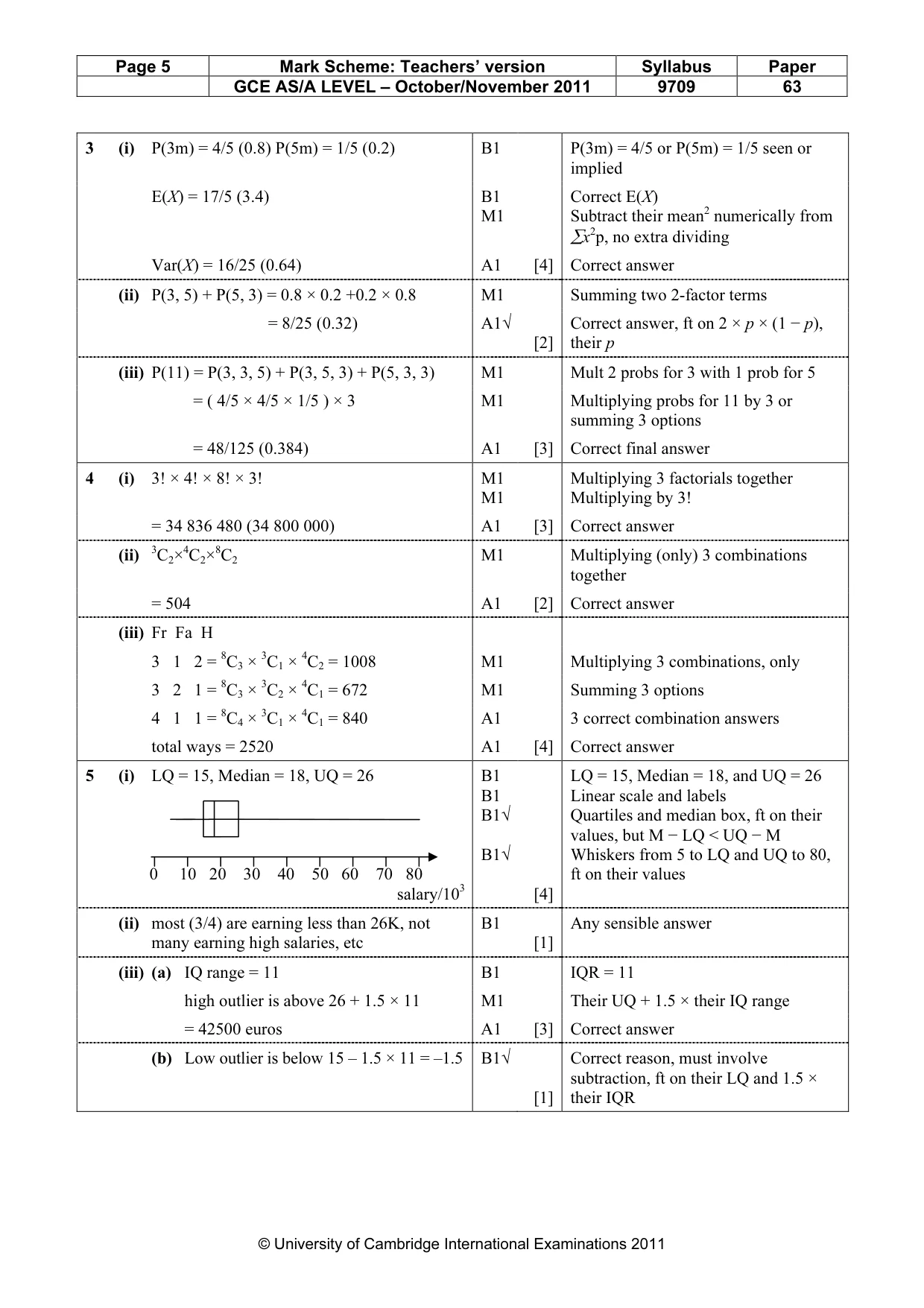
Mark scheme: 4 (i) 3! × 4! × 8! × 3! M1 Multiplying 3 factorials together M1 Multiplying by 3! = 34 836 480 (34 800 000) A1 [3] Correct answer (ii) 3C2×4C2×8C2 M1 Multiplying (only) 3 combinations together = 504 A1 [2] Correct answer (iii) Fr Fa H 3 1 2 = 8C3 × 3C1 × 4C2 = 1008 M1 Multiplying 3 combinations, only 3 2 1 = 8C3 × 3C2 × 4C1 = 672 M1 Summing 3 options 4 1 1 = 8C4 × 3C1 × 4C1 = 840 A1 3 correct combination answers total ways = 2520 A1 [4] Correct answer
Q5 · 500 + + 450 400 + 350 300 frequency 250 + 200 Cumulative 150 + 100 50 0 + 0 10 20 30 40…
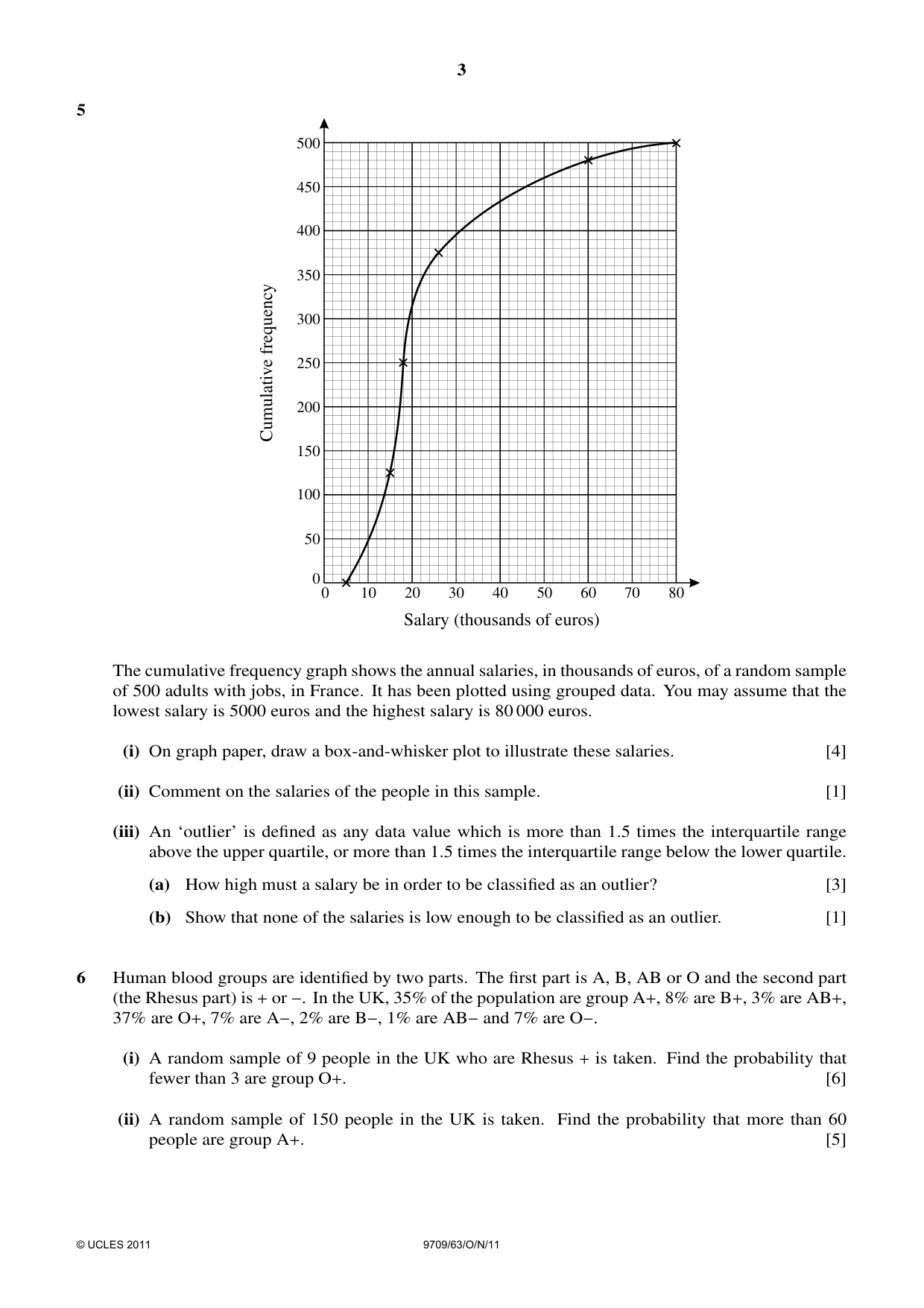
5 500 + + 450 400 + 350 300 frequency 250 + 200 Cumulative 150 + 100 50 0 + 0 10 20 30 40 50 60 70 80 Salary (thousands of euros) The cumulative frequency graph shows the annual salaries, in thousands of euros, of a random sample of 500 adults with jobs, in France. It has been plotted using grouped data. You may assume that the lowest salary is 5000 euros and the highest salary is 80 000 euros. (i) On graph paper, draw a box-and-whisker plot to illustrate these salaries. [4] (ii) Comment on the salaries of the people in this sample. [1] (iii) An ‘outlier’ is defined as any data value which is more than 1.5 times the interquartile range above the upper quartile, or more than 1.5 times the interquartile range below the lower quartile. (a) How high must a salary be in order to be classified as an outlier? [3] (b) Show that none of the salaries is low enough to be classified as an outlier. [1]
Mark scheme: 5 (i) LQ = 15, Median = 18, UQ = 26 B1 LQ = 15, Median = 18, and UQ = 26 B1 Linear scale and labels B1√ Quartiles and median box, ft on their values, but M − LQ < UQ − M B1√ Whiskers from 5 to LQ and UQ to 80,
What was in this paper
The subtopics covered by these 5 questions, and how many questions each got. Open one in a new tab to see every Cambridge question on it.
What you needed in this session
Cambridge’s own grade thresholds for 2011 Oct/Nov, Paper 6 · Variant 3. A higher threshold means an easier paper — the bar moves with how the cohort did.