Cambridge A Level Mathematics 9709 — 2009 Oct/Nov Paper 6 · Variant 1
9709/61/O/N/09 · 6 questions · 50 marks · ≈56 min
The question paper and its mark scheme, free to read here and free to download. This is Cambridge’s own paper, exactly as it was sat.
Question paper4 pages

Mark scheme6 pages
Answers below. Sit the paper first if you are practising.
Questions as text
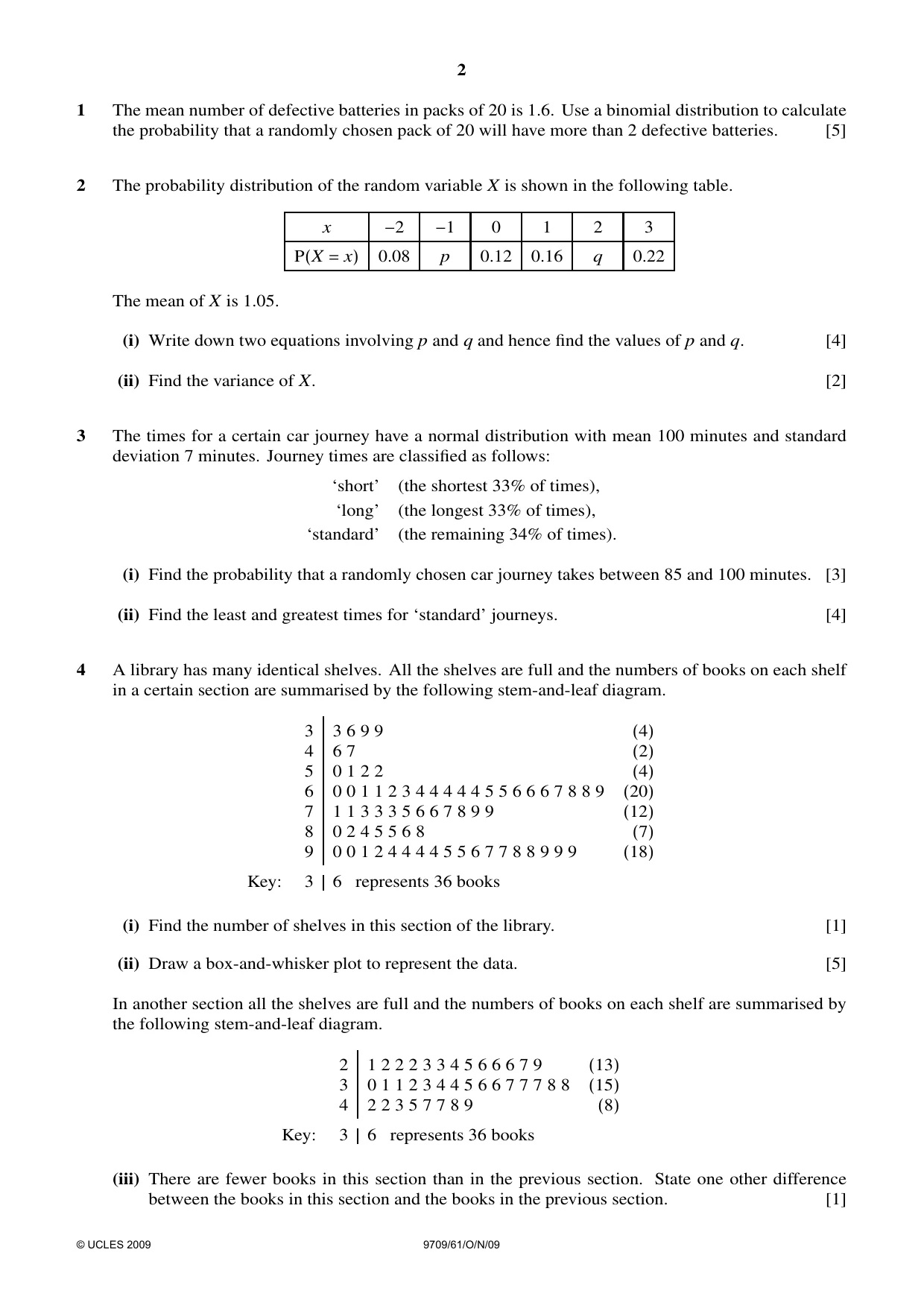
Q1 · The mean number of defective batteries in packs of 20 is 1.6
1 The mean number of defective batteries in packs of 20 is 1.6. Use a binomial distribution to calculate the probability that a randomly chosen pack of 20 will have more than 2 defective batteries. [5]
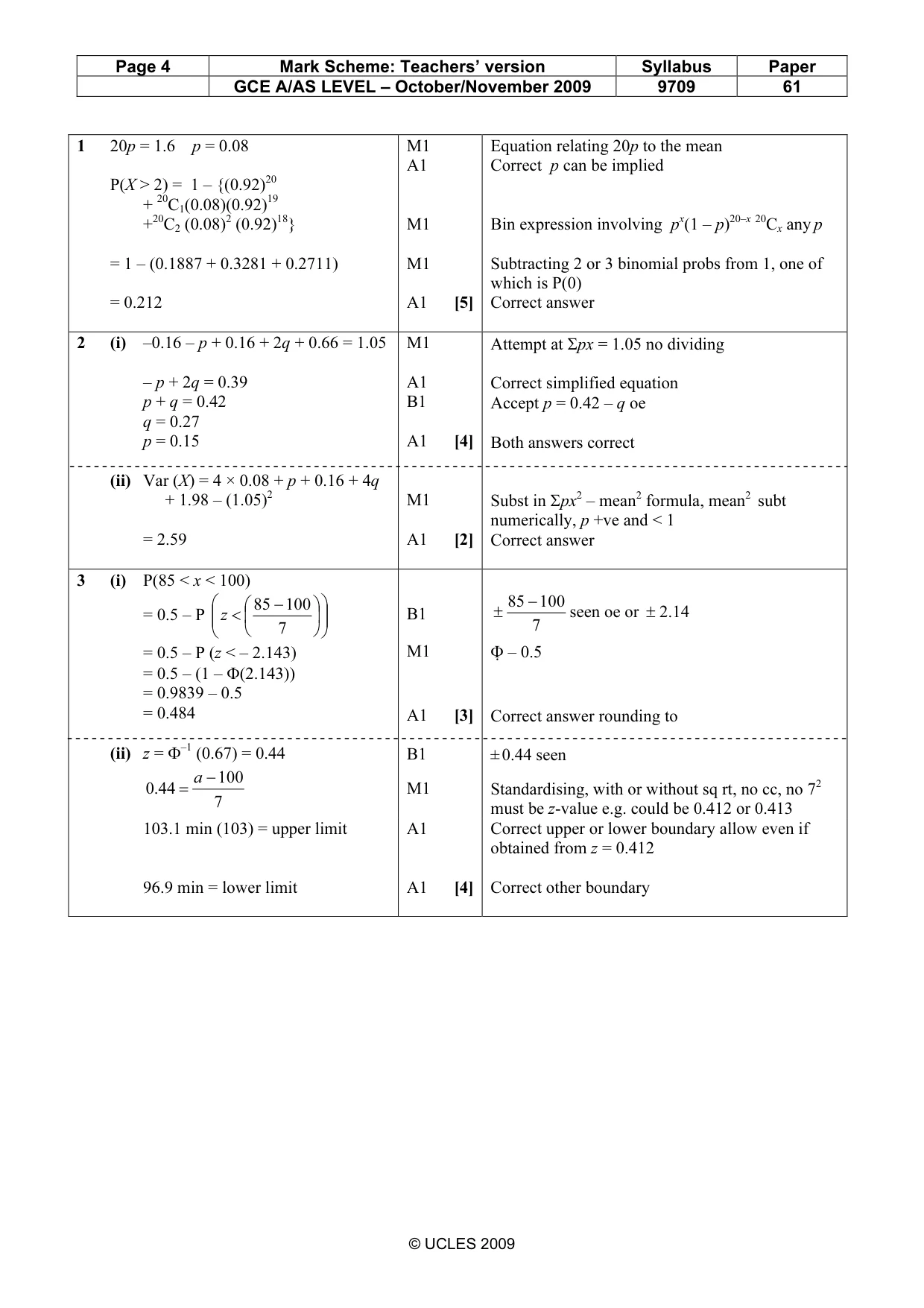
Mark scheme: 1 20p = 1.6 p = 0.08 M1 Equation relating 20p to the mean A1 Correct p can be implied P(X > 2) = 1 – {(0.92)20 + 20C1(0.08)(0.92)19 +20C2 (0.08)2 (0.92)18} M1 Bin expression involving px(1 – p)20–x 20Cx any p = 1 – (0.1887 + 0.3281 + 0.2711) M1 Subtracting 2 or 3 binomial probs from 1, one of which is P(0) = 0.212 A1 [5] Correct answer
Q2 · The probability distribution of the random variable X is shown in the following table
2 The probability distribution of the random variable X is shown in the following table. x −2 −1 0 1 2 3 P(X = x) 0.08 p 0.12 0.16 q 0.22 The mean of X is 1.05. (i) Write down two equations involving p and q and hence find the values of p and q. [4] (ii) Find the variance of X. [2]
Mark scheme: 2 (i) –0.16 – p + 0.16 + 2q + 0.66 = 1.05 M1 Attempt at Σpx = 1.05 no dividing – p + 2q = 0.39 A1 Correct simplified equation p + q = 0.42 B1 Accept p = 0.42 – q oe q = 0.27 p = 0.15 A1 [4] Both answers correct (ii) Var (X) = 4 × 0.08 + p + 0.16 + 4q + 1.98 – (1.05)2 M1 Subst in Σpx2 – mean2 formula, mean2 subt numerically, p +ve and < 1 = 2.59 A1 [2] Correct answer
Q3 · The times for a certain car journey have a normal distribution with mean 100 minutes and…
3 The times for a certain car journey have a normal distribution with mean 100 minutes and standard deviation 7 minutes. Journey times are classified as follows: ‘short’ (the shortest 33% of times), ‘long’ (the longest 33% of times), ‘standard’ (the remaining 34% of times). (i) Find the probability that a randomly chosen car journey takes between 85 and 100 minutes. [3] (ii) Find the least and greatest times for ‘standard’ journeys. [4]
Mark scheme: 3 (i) P(85 < x < 100) 85 − 100 85 − 100 seen oe or ± .214 B1 ± z < = 0.5 – P 7 7 = 0.5 – P (z < – 2.143) M1 Φ – 0.5 = 0.5 – (1 – Φ(2.143)) = 0.9839 – 0.5 = 0.484 A1 [3] Correct answer rounding to (ii) z = Φ–1 (0.67) = 0.44 B1 ± 0.44 seen a − 100 .044 = M1 Standardising, with or without sq rt, no cc, no 72 7 must be z-value e.g. could be 0.412 or 0.413 103.1 min (103) = upper limit A1 Correct upper or lower boundary allow even if obtained from z = 0.412 96.9 min = lower limit A1 [4] Correct other boundary GCE A/AS LEVEL – October/November 2009 9709 61
Q4 · A library has many identical shelves
4 A library has many identical shelves. All the shelves are full and the numbers of books on each shelf in a certain section are summarised by the following stem-and-leaf diagram. 3 3 6 9 9 (4) 4 6 7 (2) 5 0 1 2 2 (4) 6 0 0 1 1 2 3 4 4 4 4 4 5 5 6 6 6 7 8 8 9 (20) 7 1 1 3 3 3 5 6 6 7 8 9 9 (12) 8 0 2 4 5 5 6 8 (7) 9 0 0 1 2 4 4 4 4 5 5 6 7 7 8 8 9 9 9 (18) Key: 3 6 represents 36 books (i) Find the number of shelves in this section of the library. [1] (ii) Draw a box-and-whisker plot to represent the data. [5] In another section all the shelves are full and the numbers of books on each shelf are summarised by the following stem-and-leaf diagram. 2 1 2 2 2 3 3 4 5 6 6 6 7 9 (13) 3 0 1 1 2 3 4 4 5 6 6 7 7 7 8 8 (15) 4 2 2 3 5 7 7 8 9 (8) Key: 3 6 represents 36 books (iii) There are fewer books in this section than in the previous section. State one other difference between the books in this section and the books in the previous section. [1]
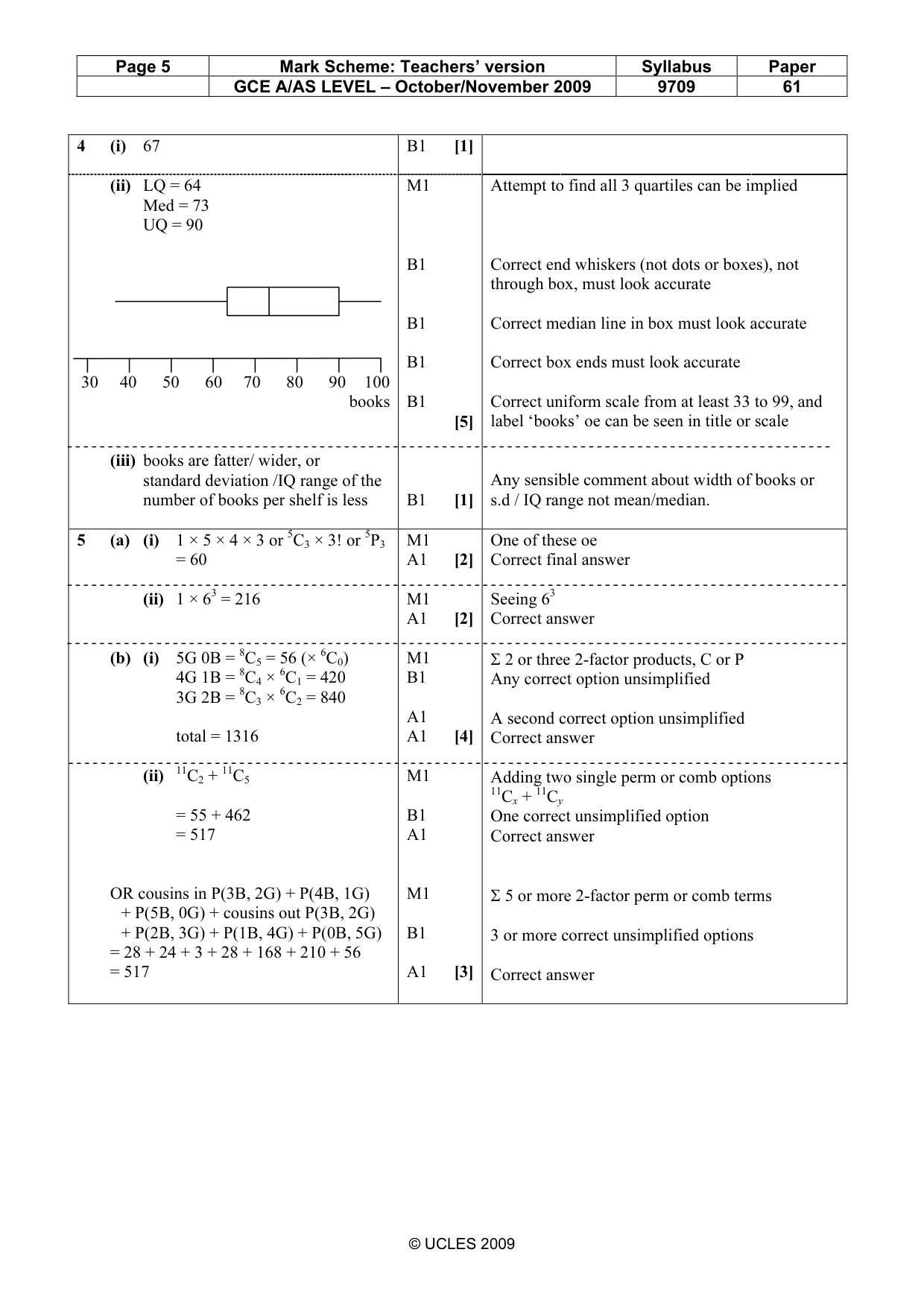
Mark scheme: 4 (i) 67 B1 [1] (ii) LQ = 64 M1 Attempt to find all 3 quartiles can be implied Med = 73 UQ = 90 B1 Correct end whiskers (not dots or boxes), not through box, must look accurate B1 Correct median line in box must look accurate B1 Correct box ends must look accurate
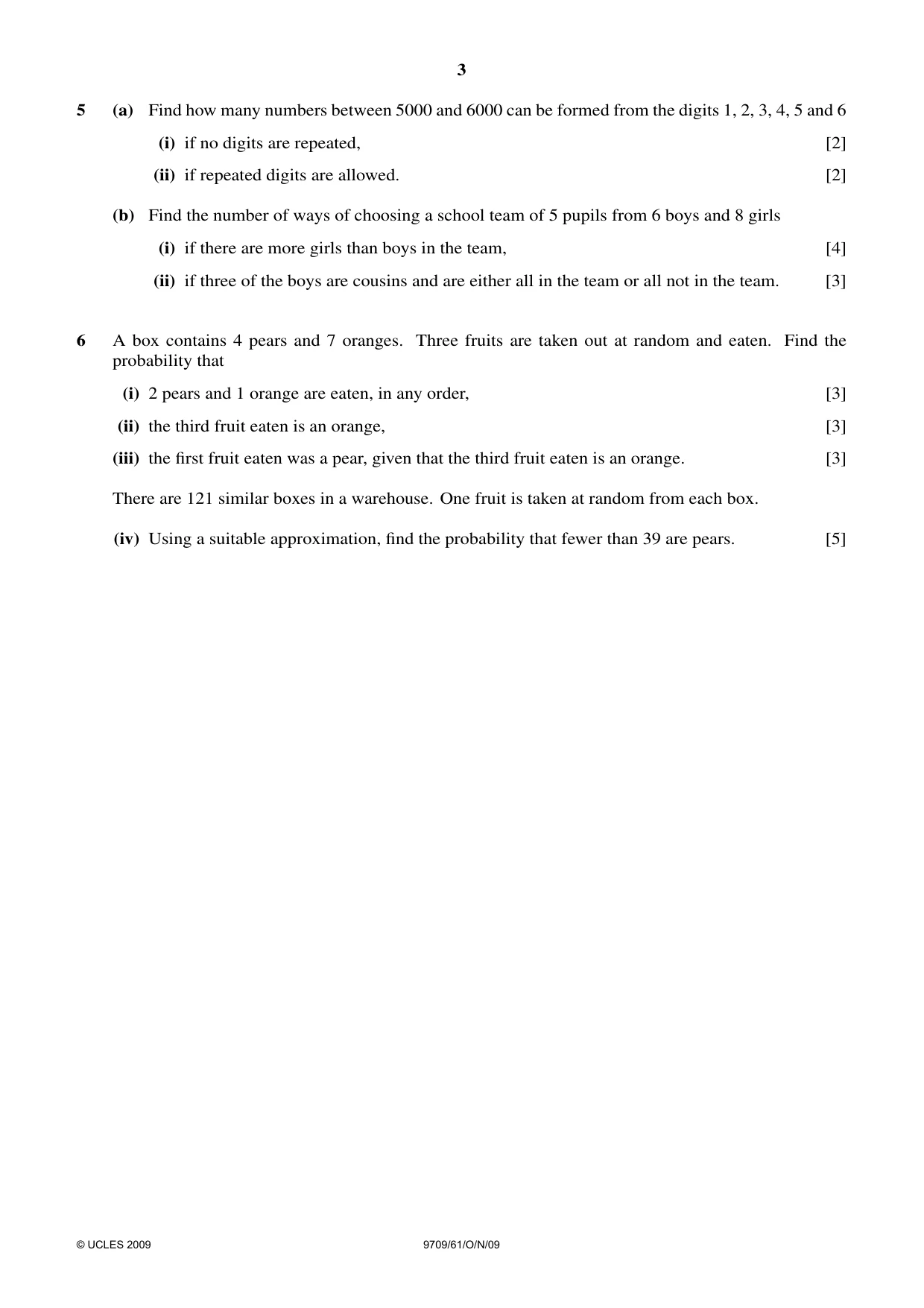
Q5 · Find how many numbers between 5000 and 6000 can be formed from the digits 1, 2, 3, 4, 5…
5 (a) Find how many numbers between 5000 and 6000 can be formed from the digits 1, 2, 3, 4, 5 and 6 (i) if no digits are repeated, [2] (ii) if repeated digits are allowed. [2] (b) Find the number of ways of choosing a school team of 5 pupils from 6 boys and 8 girls (i) if there are more girls than boys in the team, [4] (ii) if three of the boys are cousins and are either all in the team or all not in the team. [3]
Mark scheme: 5 (a) (i) 1 × 5 × 4 × 3 or 5C3 × 3! or 5P3 M1 One of these oe = 60 A1 [2] Correct final answer (ii) 1 × 63 = 216 M1 Seeing 63 A1 [2] Correct answer (b) (i) 5G 0B = 8C5 = 56 (× 6C0) M1 Σ 2 or three 2-factor products, C or P 4G 1B = 8C4 × 6C1 = 420 B1 Any correct option unsimplified 3G 2B = 8C3 × 6C2 = 840 A1 A second correct option unsimplified total = 1316 A1 [4] Correct answer (ii) 11C2 + 11C5 M1 Adding two single perm or comb options 11Cx + 11Cy = 55 + 462 B1 One correct unsimplified option = 517 A1 Correct answer OR cousins in P(3B, 2G) + P(4B, 1G) M1 Σ 5 or more 2-factor perm or comb terms + P(5B, 0G) + cousins out P(3B, 2G) + P(2B, 3G) + P(1B, 4G) + P(0B, 5G) B1 3 or more correct unsimplified options = 28 + 24 + 3 + 28 + 168 + 210 + 56 = 517 A1 [3] Correct answer GCE A/AS LEVEL – October/November 2009 9709 61 4 C 2 × 7 C1 M1 U i 2 b lt f t d 1 b f
Q6 · A box contains 4 pears and 7 oranges
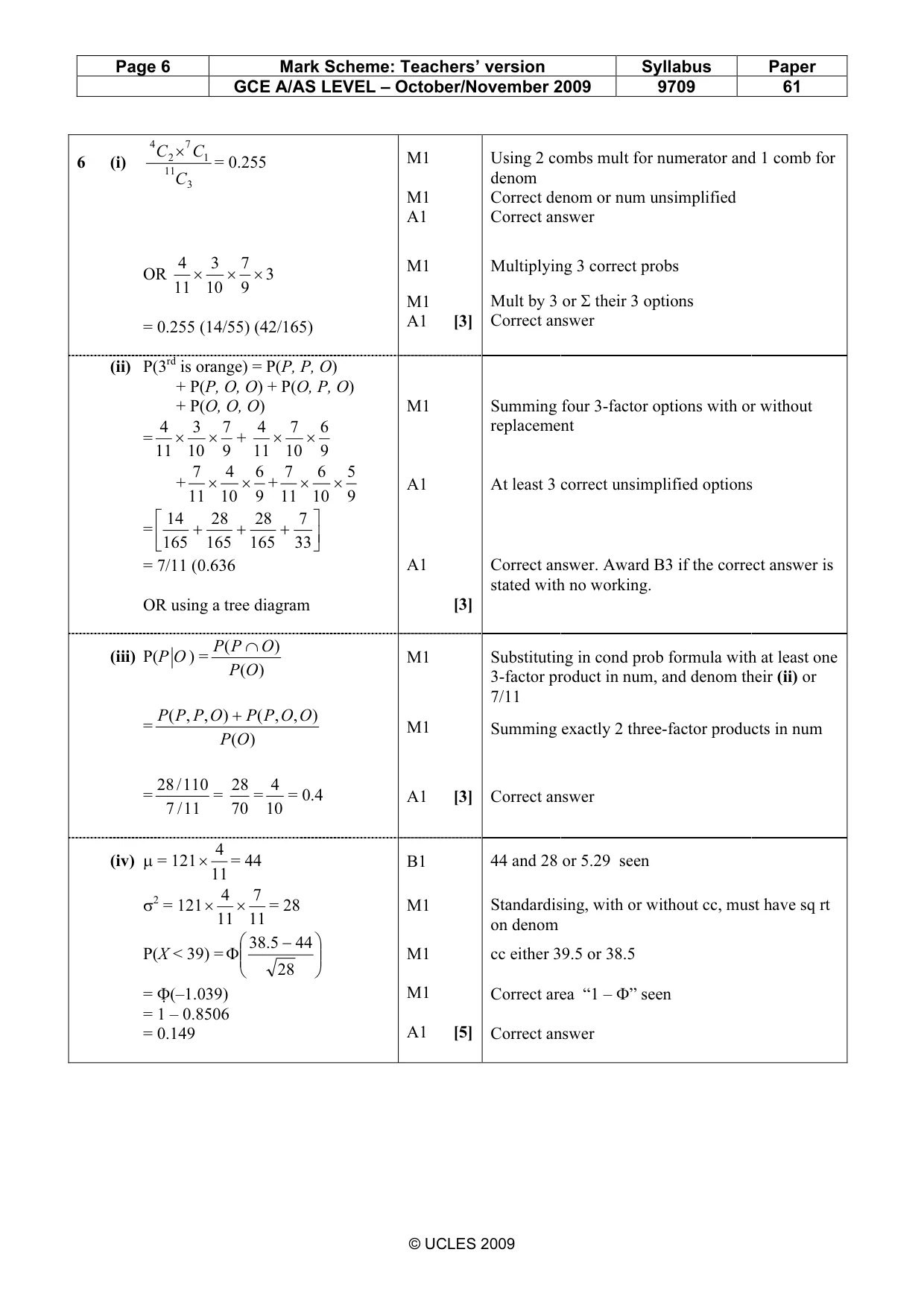
6 A box contains 4 pears and 7 oranges. Three fruits are taken out at random and eaten. Find the probability that (i) 2 pears and 1 orange are eaten, in any order, [3] (ii) the third fruit eaten is an orange, [3] (iii) the first fruit eaten was a pear, given that the third fruit eaten is an orange. [3] There are 121 similar boxes in a warehouse. One fruit is taken at random from each box. (iv) Using a suitable approximation, find the probability that fewer than 39 are pears. [5]
Mark scheme: C 2 × C16 (i) = 0.255 M1 Using 2 combs mult for numerator and 1 comb for 11C 3 denom M1 Correct denom or num unsimplified A1 Correct answer 4 3 7 M1 Multiplying 3 correct probs OR × × × 3 11 10 9 M1 Mult by 3 or Σ their 3 options A1 [3] Correct answer = 0.255 (14/55) (42/165) (ii) P(3rd is orange) = P(P, P, O) + P(P, O, O) + P(O, P, O) + P(O, O, O) M1 Summing four 3-factor options with or without 4 3 7 4 7 6 replacement = × × + × × 11 10 9 11 10 9 7 4 6 7 6 5 + × × + × × A1 At least 3 correct unsimplified options 11 10 9 11 10 9 14 28 28 7 = + + + 165 165 165 33 = 7/11 (0.636 A1 Correct answer. Award B3 if the correct answer is stated with no working. OR using a tree diagram [3] P ( P ∩ O ) (iii) P(P O ) = M1 Substituting in cond prob formula with at least one P (O ) 3-factor product in num, and denom their (ii) or 7/11 P ( P , P , O ) + P ( P , O , O ) = M1 Summing exactly 2 three-factor products in num P (O ) 28 / 110 28 4 = = = 0.4 A1 [3] Correct answer 7 / 11 70 =10 4 (iv) µ = 121 × = 44 B1 44 and 28 or 5.29 seen 11 4 7 σ2 = 121 × × = 28 M1 Standardising, with or without cc, must have sq rt 11 11 on denom 385. − 44 P(X < 39) = Φ M1 cc either 39.5 or 38.5 28 = Φ(–1.039) M1 Correct area “1 – Φ” seen = 1 – 0.8506 = 0.149 A1 [5] Correct answer
What was in this paper
The subtopics covered by these 6 questions, and how many questions each got. Open one in a new tab to see every Cambridge question on it.
What you needed in this session
Cambridge’s own grade thresholds for 2009 Oct/Nov, Paper 6 · Variant 1. A higher threshold means an easier paper — the bar moves with how the cohort did.