Cambridge A Level Mathematics 9709 — 2013 May/June Paper 6 · Variant 2
9709/62/M/J/13 · 5 questions · 50 marks · ≈56 min
The question paper and its mark scheme, free to read here and free to download. This is Cambridge’s own paper, exactly as it was sat.
Question paper4 pages
Mark scheme6 pages
Answers below. Sit the paper first if you are practising.
Questions as text
Q1 · The random variable Y is normally distributed with mean equal to five times the standard…
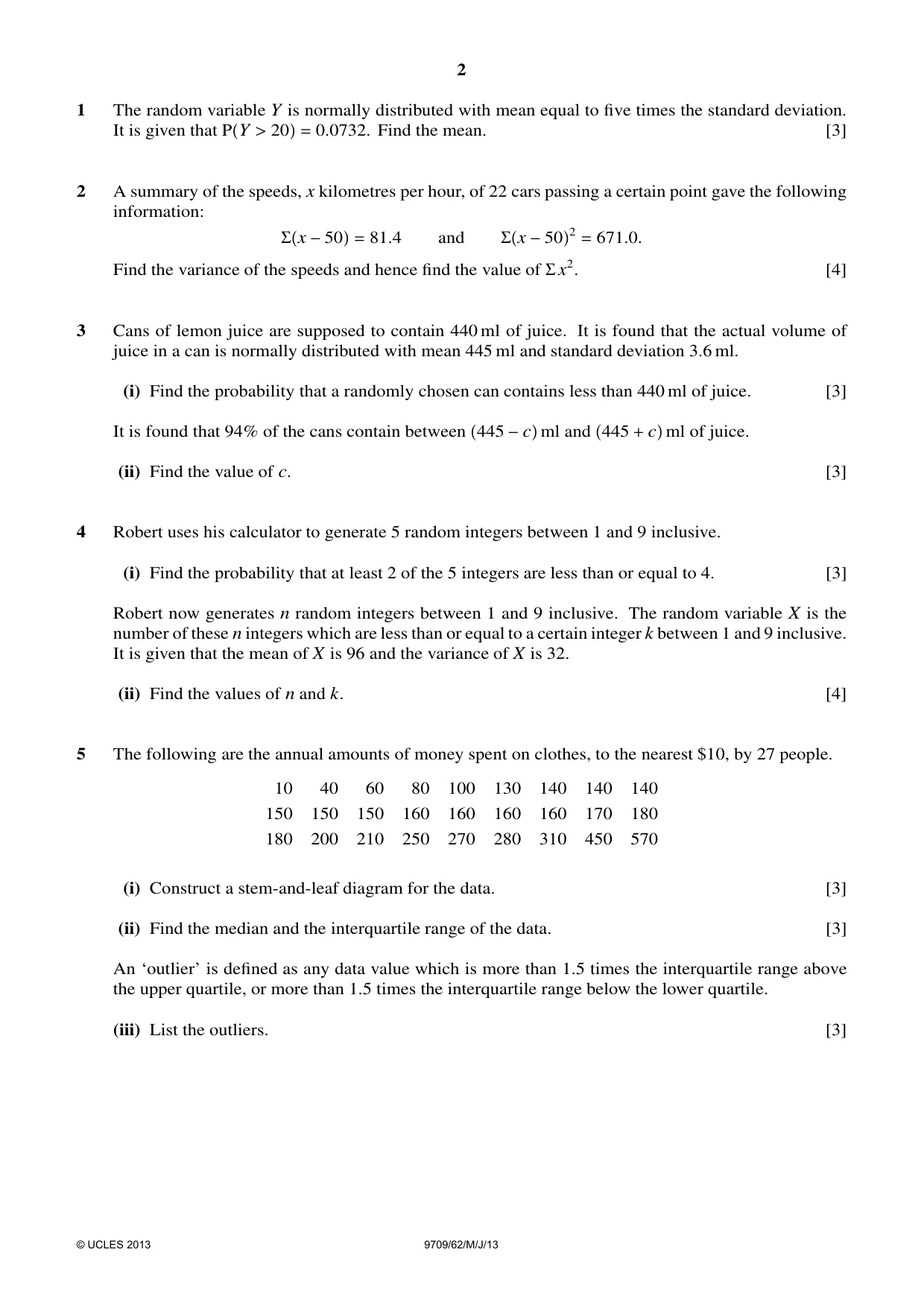
1 The random variable Y is normally distributed with mean equal to five times the standard deviation. It is given that P Y > 20 = 0.0732. Find the mean. [3]
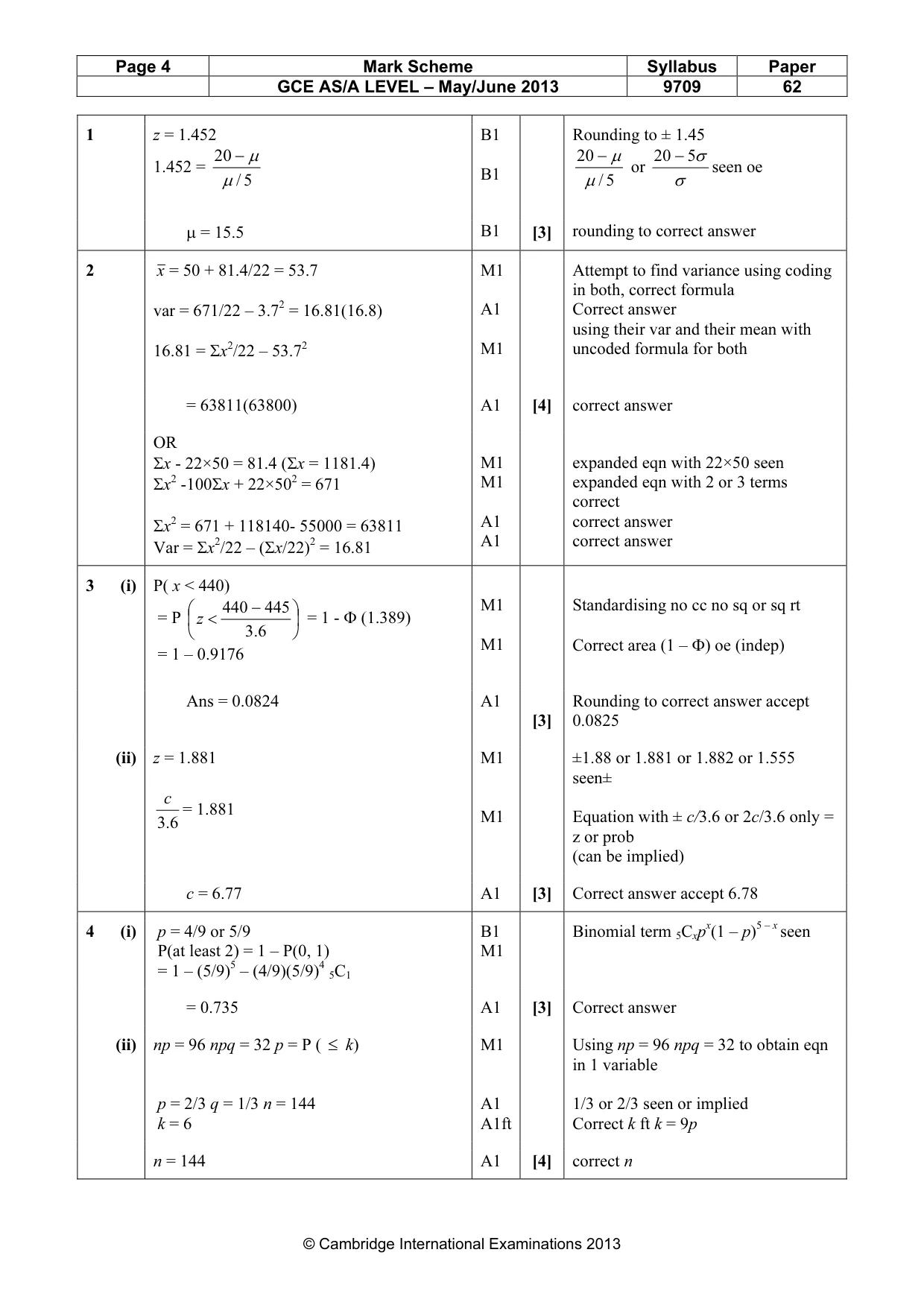
Mark scheme: 1 z = 1.452 B1 Rounding to ± 1.45 20 − µ 20 − µ 20 − 5σ 1.452 = or seen oe B1 µ / 5 µ / 5 σ µ = 15.5 B1 [3] rounding to correct answer
Q2 · A summary of the speeds, x kilometres per hour, of 22 cars passing a certain point gave…
2 A summary of the speeds, x kilometres per hour, of 22 cars passing a certain point gave the following information: Σ x −50 = 81.4 and Σ x −50 2 = 671.0. Find the variance of the speeds and hence find the value of Σx2. [4]
Mark scheme: 2 x = 50 + 81.4/22 = 53.7 M1 Attempt to find variance using coding in both, correct formula var = 671/22 – 3.72 = 16.81(16.8) A1 Correct answer using their var and their mean with 16.81 = Σx2/22 – 53.72 M1 uncoded formula for both = 63811(63800) A1 [4] correct answer OR Σx - 22×50 = 81.4 (Σx = 1181.4) M1 expanded eqn with 22×50 seen Σx2 -100Σx + 22×502 = 671 M1 expanded eqn with 2 or 3 terms correct Σx2 = 671 + 118140- 55000 = 63811 A1 correct answer A1 correct answer Var = Σx2/22 – (Σx/22)2 = 16.81
Q3 · Cans of lemon juice are supposed to contain 440 ml of juice
3 Cans of lemon juice are supposed to contain 440 ml of juice. It is found that the actual volume of juice in a can is normally distributed with mean 445 ml and standard deviation 3.6 ml. (i) Find the probability that a randomly chosen can contains less than 440 ml of juice. [3] It is found that 94% of the cans contain between 445 −c ml and 445 + c ml of juice. (ii) Find the value of c. [3]
Mark scheme: 3 (i) P( x < 440) 440 − 445 M1 Standardising no cc no sq or sq rt = P z < = 1 - Φ (1.389) 6.3 M1 Correct area (1 – Φ) oe (indep) = 1 – 0.9176 Ans = 0.0824 A1 Rounding to correct answer accept [3] 0.0825 (ii) z = 1.881 M1 ±1.88 or 1.881 or 1.882 or 1.555 seen± c = 1.881 M1 Equation with ± c/3.6 or 2c/3.6 only = 6.3 z or prob (can be implied) c = 6.77 A1 [3] Correct answer accept 6.78 5
Q4 · Robert uses his calculator to generate 5 random integers between 1 and 9 inclusive
4 Robert uses his calculator to generate 5 random integers between 1 and 9 inclusive. (i) Find the probability that at least 2 of the 5 integers are less than or equal to 4. [3] Robert now generates n random integers between 1 and 9 inclusive. The random variable X is the number of these n integers which are less than or equal to a certain integer k between 1 and 9 inclusive. It is given that the mean of X is 96 and the variance of X is 32. (ii) Find the values of n and k. [4]
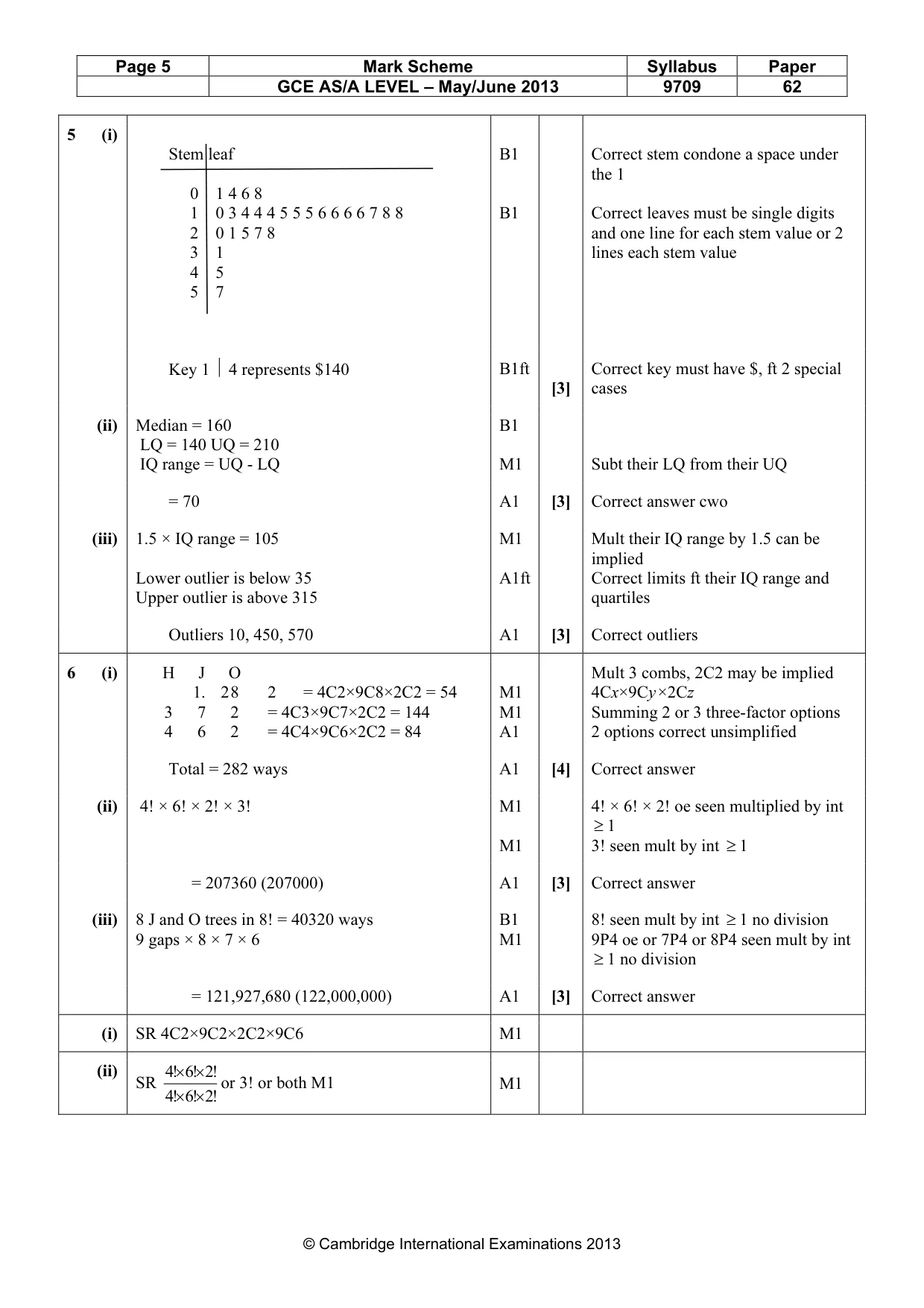
Mark scheme: 4 (i) p = 4/9 or 5/9 B1 Binomial term 5Cxpx(1 – p)5 – x seen P(at least 2) = 1 – P(0, 1) M1 = 1 – (5/9)5 – (4/9)(5/9)4 5C1 = 0.735 A1 [3] Correct answer (ii) np = 96 npq = 32 p = P ( ≤ k) M1 Using np = 96 npq = 32 to obtain eqn in 1 variable p = 2/3 q = 1/3 n = 144 A1 1/3 or 2/3 seen or implied k = 6 A1ft Correct k ft k = 9p n = 144 A1 [4] correct n GCE AS/A LEVEL – May/June 2013 9709 62 5 (i) Stem leaf B1 Correct stem condone a space under the 1
Q7 · Susan has a bag of sweets containing 7 chocolates and 5 toffees
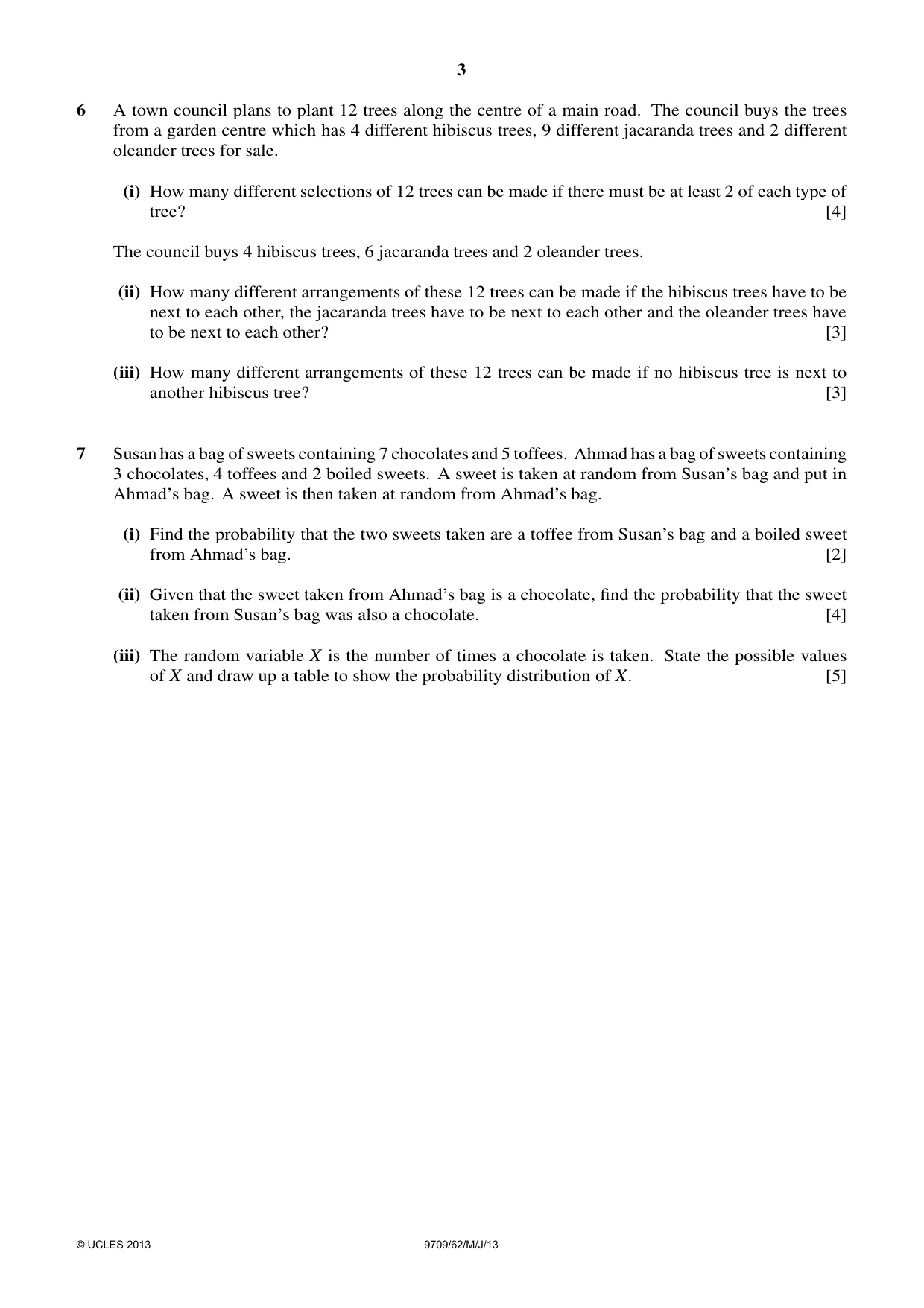
7 Susan has a bag of sweets containing 7 chocolates and 5 toffees. Ahmad has a bag of sweets containing 3 chocolates, 4 toffees and 2 boiled sweets. A sweet is taken at random from Susan’s bag and put in Ahmad’s bag. A sweet is then taken at random from Ahmad’s bag. (i) Find the probability that the two sweets taken are a toffee from Susan’s bag and a boiled sweet from Ahmad’s bag. [2] (ii) Given that the sweet taken from Ahmad’s bag is a chocolate, find the probability that the sweet taken from Susan’s bag was also a chocolate. [4] (iii) The random variable X is the number of times a chocolate is taken. State the possible values of X and draw up a table to show the probability distribution of X. [5]
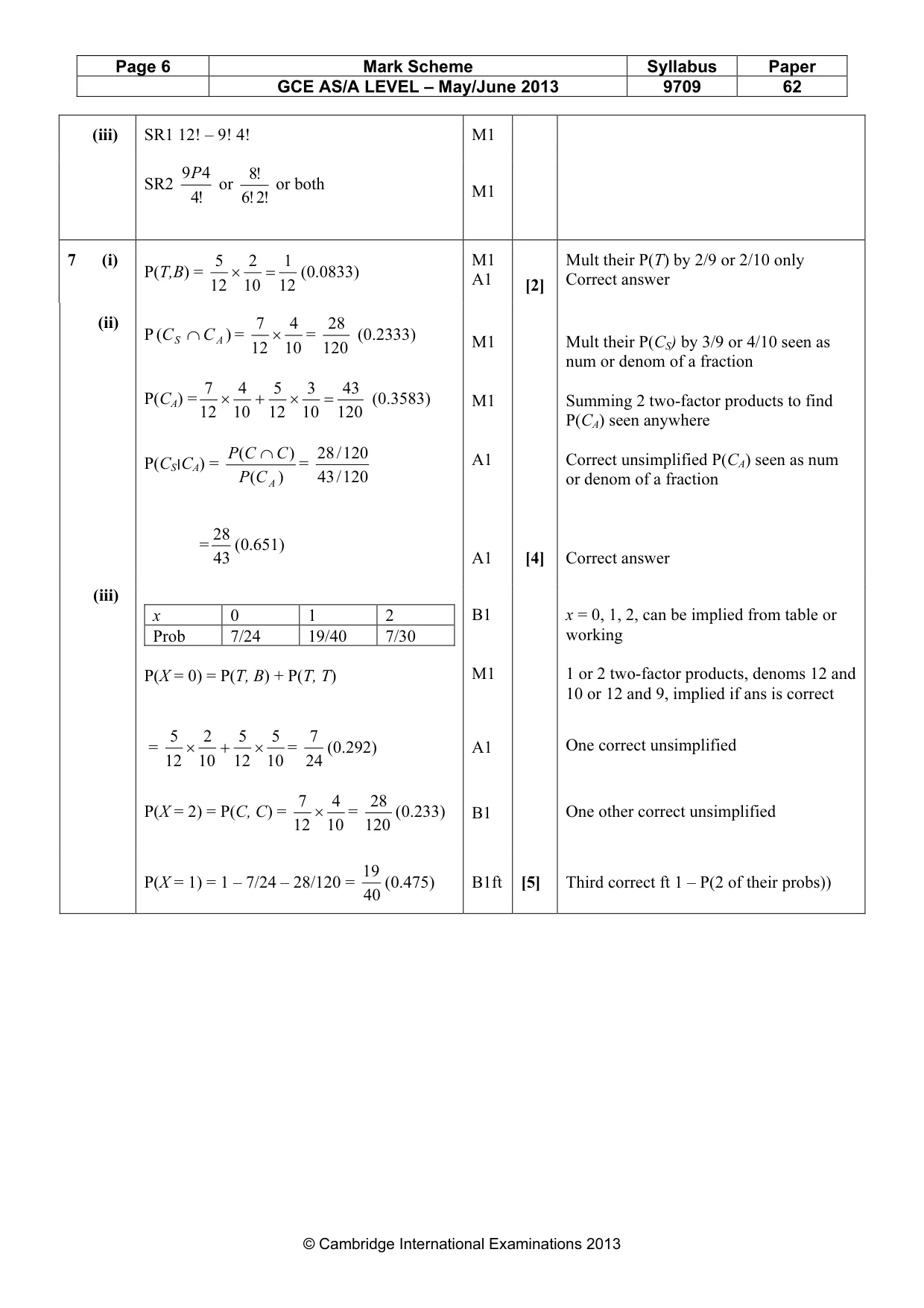
Mark scheme: 7 (i) 5 2 1 M1 Mult their P(T) by 2/9 or 2/10 only P(T,B) = × = (0.0833) A1 Correct answer 12 10 12 [2] (ii) 7 4 28 P (C S ∩ C A ) = × = (0.2333) M1 Mult their P(CS) by 3/9 or 4/10 seen as 12 10 120 num or denom of a fraction 7 4 5 3 43 P(CA) = × + × = (0.3583) M1 Summing 2 two-factor products to find 12 10 12 10 120 P(CA) seen anywhere P (C ∩ C ) 28 / 120 P(CS CA) = = A1 Correct unsimplified P(CA) seen as num P (C A ) 43 / 120 or denom of a fraction 28 = (0.651) 43 A1 [4] Correct answer (iii) x 0 1 2 B1 x = 0, 1, 2, can be implied from table or Prob 7/24 19/40 7/30 working P(X = 0) = P(T, B) + P(T, T) M1 1 or 2 two-factor products, denoms 12 and 10 or 12 and 9, implied if ans is correct 5 2 5 5 7 = × + × = (0.292) A1 One correct unsimplified 12 10 12 10 24 7 4 28 P(X = 2) = P(C, C) = × = (0.233) B1 One other correct unsimplified 12 10 120 19 P(X = 1) = 1 – 7/24 – 28/120 = (0.475) B1ft [5] Third correct ft 1 – P(2 of their probs)) 40
What was in this paper
The subtopics covered by these 5 questions, and how many questions each got. Open one in a new tab to see every Cambridge question on it.
What you needed in this session
Cambridge’s own grade thresholds for 2013 May/June, Paper 6 · Variant 2. A higher threshold means an easier paper — the bar moves with how the cohort did.