Cambridge A Level Mathematics 9709 — 2013 May/June Paper 6 · Variant 1
9709/61/M/J/13 · 7 questions · 50 marks · ≈56 min
The question paper and its mark scheme, free to read here and free to download. This is Cambridge’s own paper, exactly as it was sat.
Question paper4 pages
Mark scheme6 pages
Answers below. Sit the paper first if you are practising.
Questions as text
Q1 · A summary of 30 values of x gave the following information: Σ x −c = 234, Σ x −c 2 =…
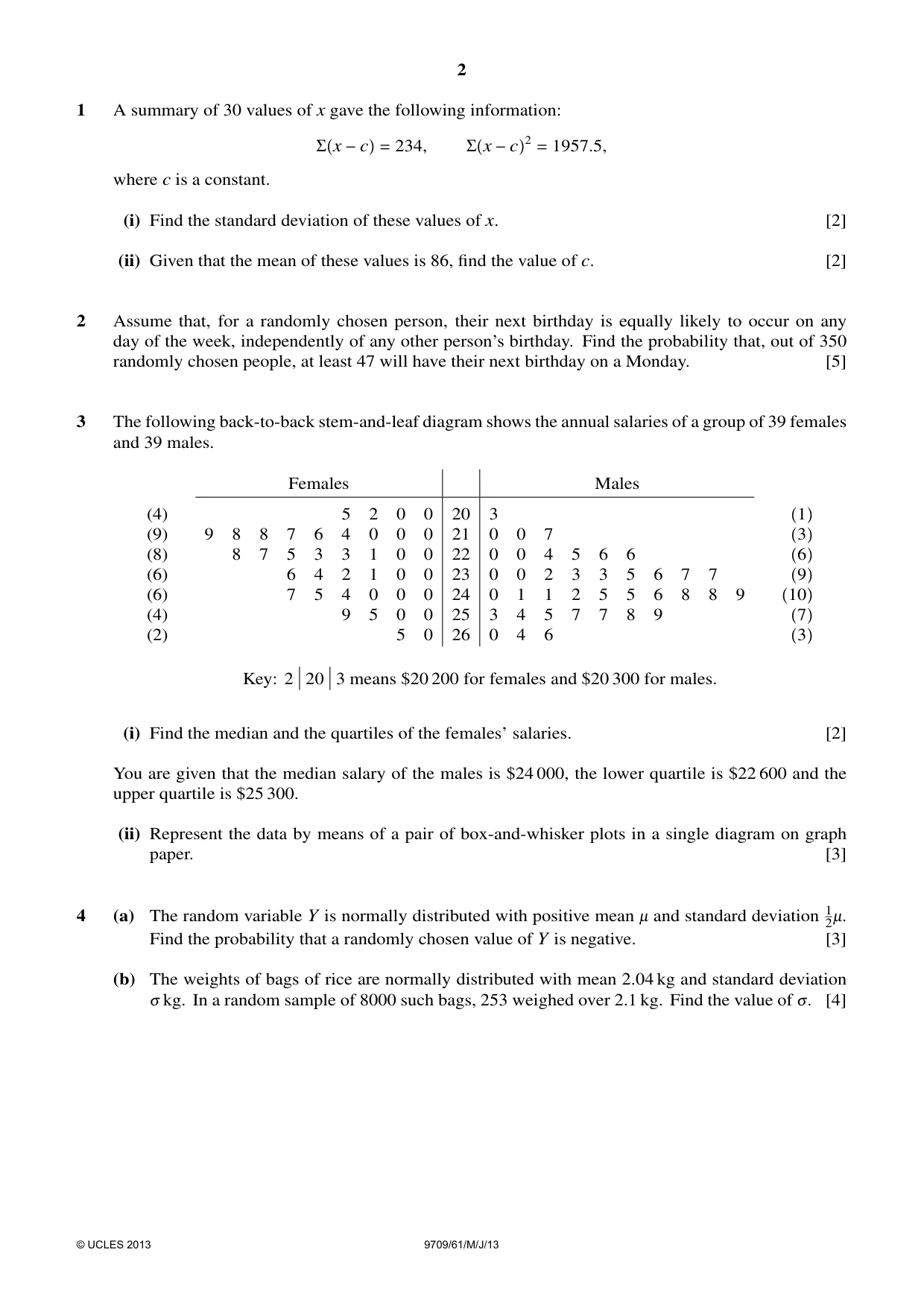
1 A summary of 30 values of x gave the following information: Σ x −c = 234, Σ x −c 2 = 1957.5, where c is a constant. (i) Find the standard deviation of these values of x. [2] (ii) Given that the mean of these values is 86, find the value of c. [2]
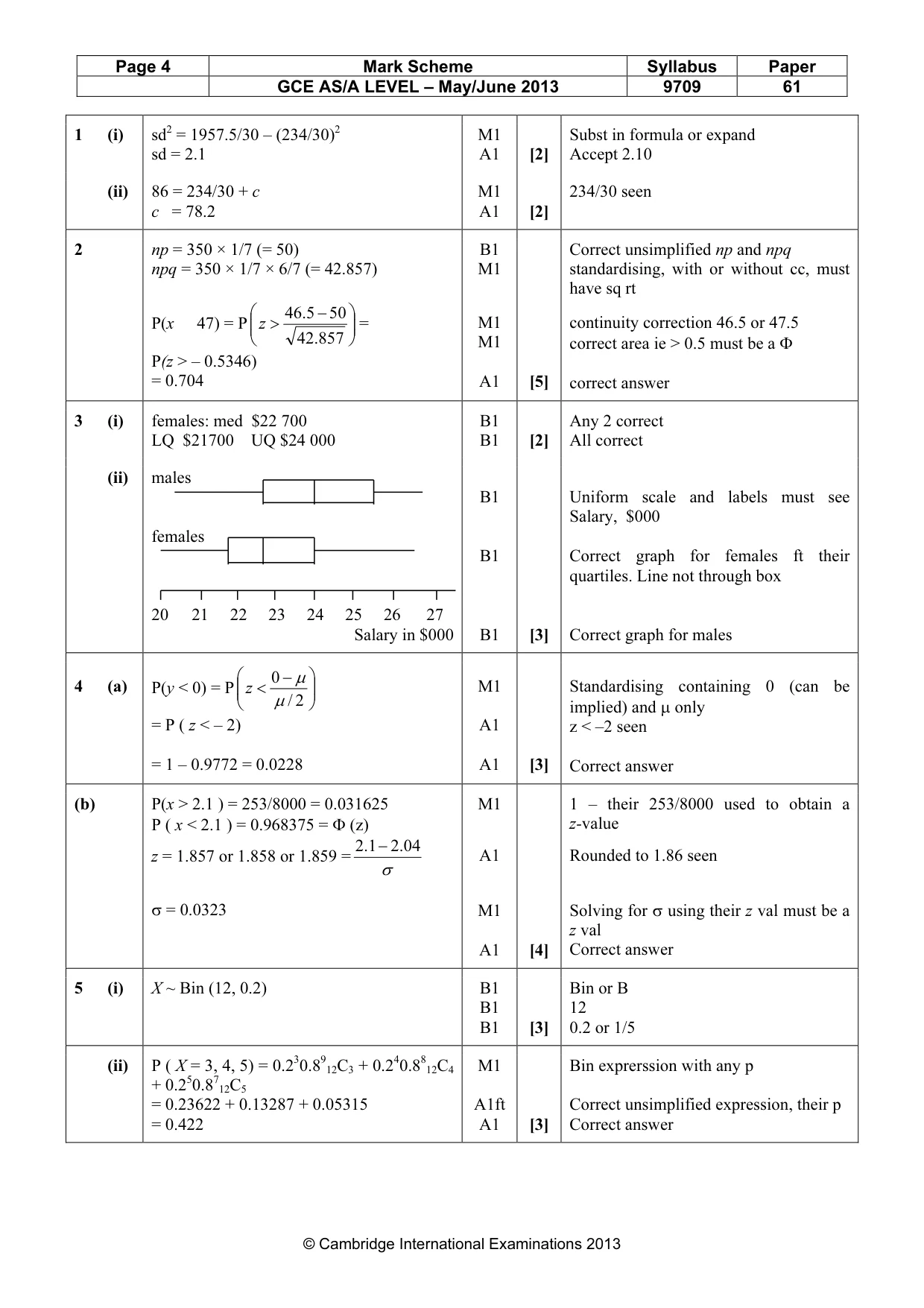
Mark scheme: 1 (i) sd2 = 1957.5/30 – (234/30)2 M1 Subst in formula or expand sd = 2.1 A1 [2] Accept 2.10 (ii) 86 = 234/30 + c M1 234/30 seen c = 78.2 A1 [2]
Q2 · Assume that, for a randomly chosen person, their next birthday is equally likely to occur…
2 Assume that, for a randomly chosen person, their next birthday is equally likely to occur on any day of the week, independently of any other person’s birthday. Find the probability that, out of 350 randomly chosen people, at least 47 will have their next birthday on a Monday. [5]
Mark scheme: 2 np = 350 × 1/7 (= 50) B1 Correct unsimplified np and npq npq = 350 × 1/7 × 6/7 (= 42.857) M1 standardising, with or without cc, must have sq rt 46 5. − 50 P(x 47) = P z > = M1 continuity correction 46.5 or 47.5 42 . 857 M1 correct area ie > 0.5 must be a Φ P(z > – 0.5346) = 0.704 A1 [5] correct answer
Q3 · The following back-to-back stem-and-leaf diagram shows the annual salaries of a group of…
3 The following back-to-back stem-and-leaf diagram shows the annual salaries of a group of 39 females and 39 males. Females Males (4) 5 2 0 0 20 3 (9) 9 8 8 7 6 4 0 0 0 21 0 0 7 (8) 8 7 5 3 3 1 0 0 22 0 0 4 5 6 6 (6) 6 4 2 1 0 0 23 0 0 2 3 3 5 6 7 7 (6) 7 5 4 0 0 0 24 0 1 1 2 5 5 6 8 8 9 10 (4) 9 5 0 0 25 3 4 5 7 7 8 9 (2) 5 0 26 0 4 6 Key: 2 20 3 means $20 200 for females and $20 300 for males. (i) Find the median and the quartiles of the females’ salaries. [2] You are given that the median salary of the males is $24 000, the lower quartile is $22 600 and the upper quartile is $25 300. (ii) Represent the data by means of a pair of box-and-whisker plots in a single diagram on graph paper. [3]
Mark scheme: 3 (i) females: med $22 700 B1 Any 2 correct LQ $21700 UQ $24 000 B1 [2] All correct (ii) males B1 Uniform scale and labels must see Salary, $000 females B1 Correct graph for females ft their quartiles. Line not through box 20 21 22 23 24 25 26 27 Salary in $000 B1 [3] Correct graph for males 0 − µ
Q4 · The random variable Y is normally distributed with positive mean - and standard deviation…
4 (a) The random variable Y is normally distributed with positive mean - and standard deviation 12-. Find the probability that a randomly chosen value of Y is negative. [3] (b) The weights of bags of rice are normally distributed with mean 2.04 kg and standard deviation 3 kg. In a random sample of 8000 such bags, 253 weighed over 2.1 kg. Find the value of 3. [4]
Mark scheme: 0 − µ 4 (a) P(y < 0) = P z < M1 Standardising containing 0 (can be µ / 2 implied) and µ only = P ( z < – 2) A1 z < –2 seen = 1 – 0.9772 = 0.0228 A1 [3] Correct answer (b) P(x > 2.1 ) = 253/8000 = 0.031625 M1 1 – their 253/8000 used to obtain a P ( x < 2.1 ) = 0.968375 = Φ (z) z-value 1.2 − .204 z = 1.857 or 1.858 or 1.859 = A1 Rounded to 1.86 seen σ σ = 0.0323 M1 Solving for σ using their z val must be a z val A1 [4] Correct answer
Q5 · Fiona uses her calculator to produce 12 random integers between 7 and 21 inclusive
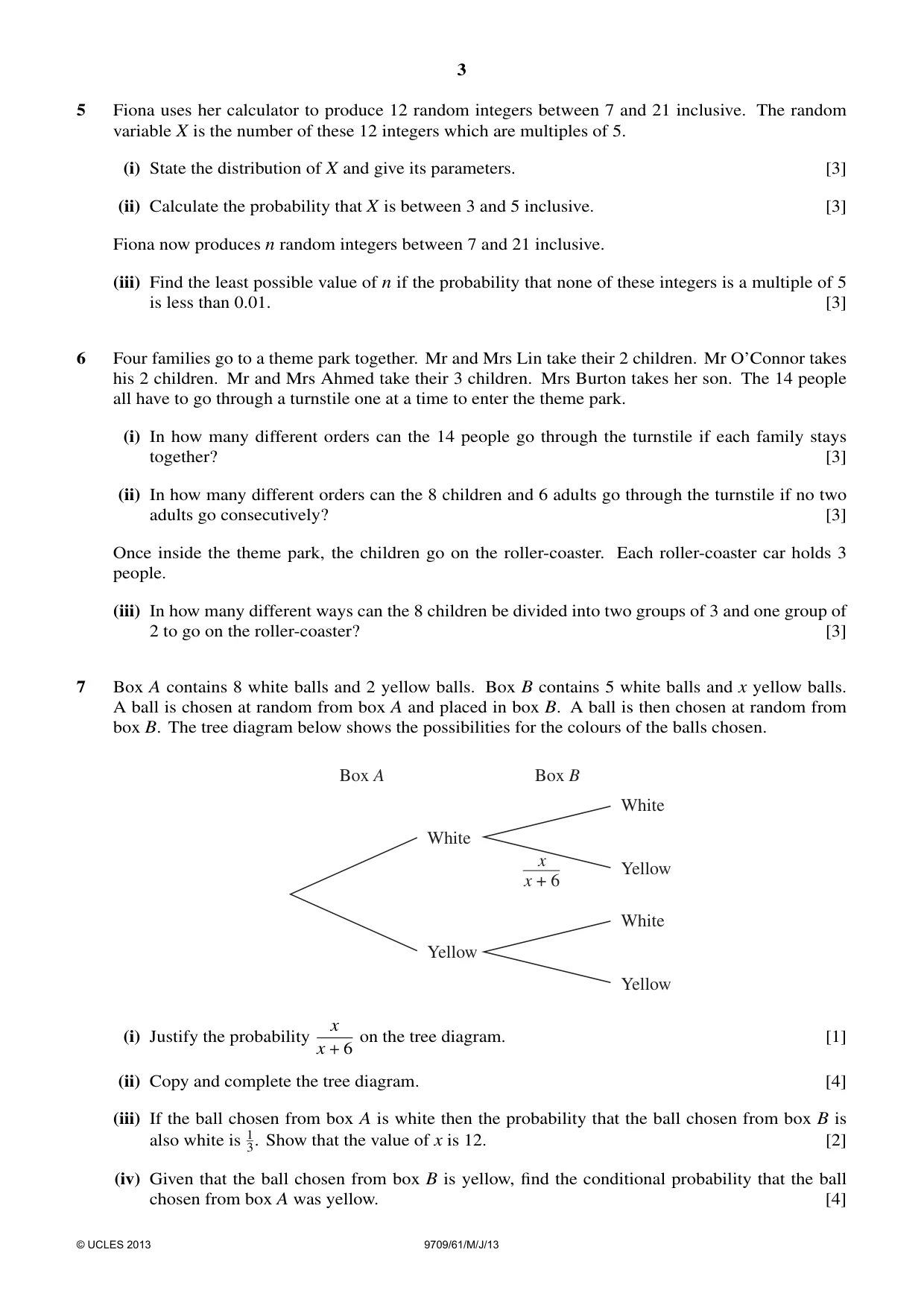
5 Fiona uses her calculator to produce 12 random integers between 7 and 21 inclusive. The random variable X is the number of these 12 integers which are multiples of 5. (i) State the distribution of X and give its parameters. [3] (ii) Calculate the probability that X is between 3 and 5 inclusive. [3] Fiona now produces n random integers between 7 and 21 inclusive. (iii) Find the least possible value of n if the probability that none of these integers is a multiple of 5 is less than 0.01. [3]
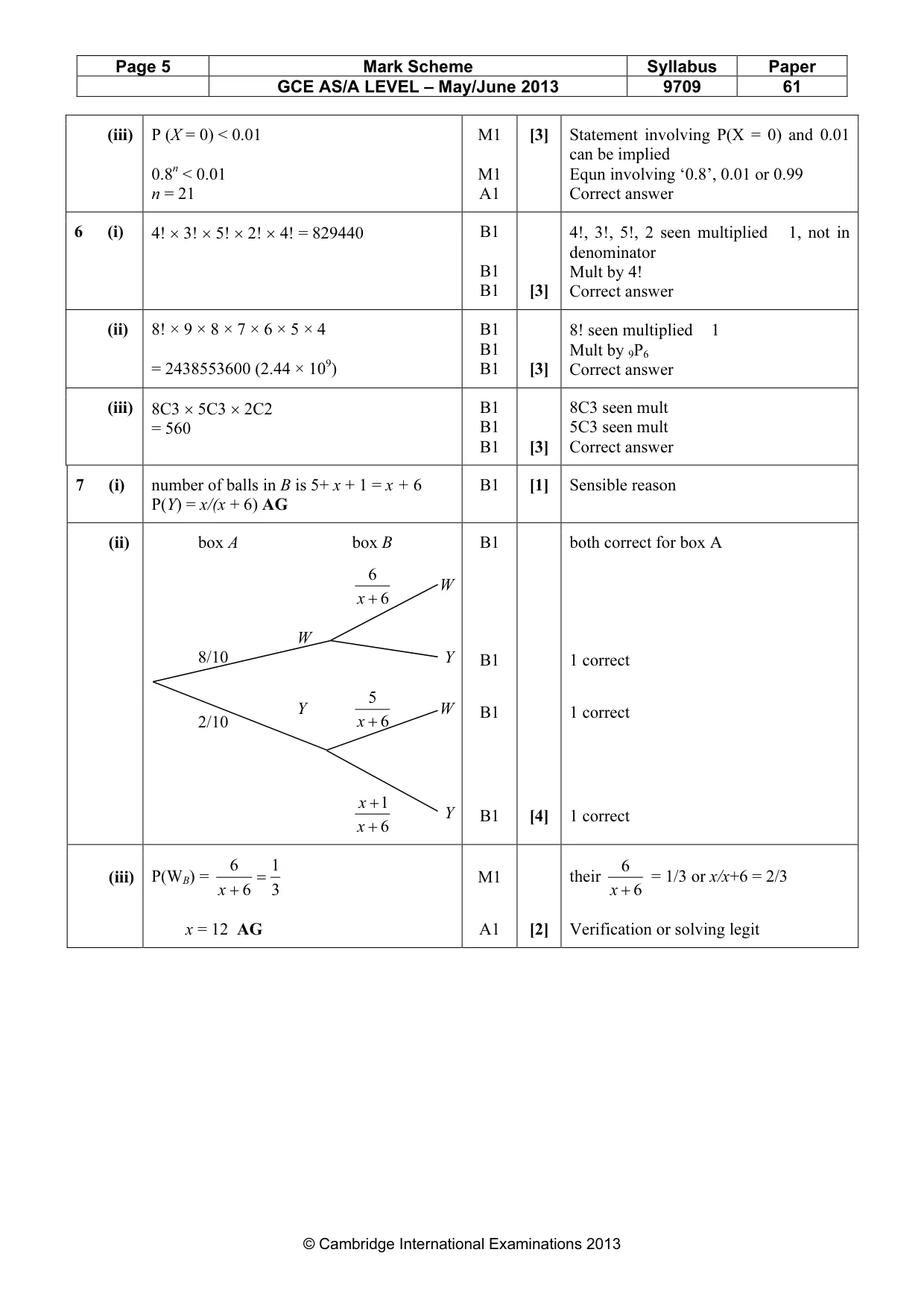
Mark scheme: 5 (i) X ~ Bin (12, 0.2) B1 Bin or B B1 12 B1 [3] 0.2 or 1/5 (ii) P ( X = 3, 4, 5) = 0.230.8912C3 + 0.240.8812C4 M1 Bin exprerssion with any p + 0.250.8712C5 = 0.23622 + 0.13287 + 0.05315 A1ft Correct unsimplified expression, their p = 0.422 A1 [3] Correct answer GCE AS/A LEVEL – May/June 2013 9709 61 (iii) P (X = 0) < 0.01 M1 [3] Statement involving P(X = 0) and 0.01 can be implied 0.8n < 0.01 M1 Equn involving ‘0.8’, 0.01 or 0.99 n = 21 A1 Correct answer
Q6 · Four families go to a theme park together
6 Four families go to a theme park together. Mr and Mrs Lin take their 2 children. Mr O’Connor takes his 2 children. Mr and Mrs Ahmed take their 3 children. Mrs Burton takes her son. The 14 people all have to go through a turnstile one at a time to enter the theme park. (i) In how many different orders can the 14 people go through the turnstile if each family stays together? [3] (ii) In how many different orders can the 8 children and 6 adults go through the turnstile if no two adults go consecutively? [3] Once inside the theme park, the children go on the roller-coaster. Each roller-coaster car holds 3 people. (iii) In how many different ways can the 8 children be divided into two groups of 3 and one group of 2 to go on the roller-coaster? [3]
Mark scheme: 6 (i) 4! × 3! × 5! × 2! × 4! = 829440 B1 4!, 3!, 5!, 2 seen multiplied 1, not in denominator B1 Mult by 4! B1 [3] Correct answer (ii) 8! × 9 × 8 × 7 × 6 × 5 × 4 B1 8! seen multiplied 1 B1 Mult by 9P6 = 2438553600 (2.44 × 10⁹) B1 [3] Correct answer (iii) 8C3 × 5C3 × 2C2 B1 8C3 seen mult = 560 B1 5C3 seen mult B1 [3] Correct answer
Q7 · Box A contains 8 white balls and 2 yellow balls
7 Box A contains 8 white balls and 2 yellow balls. Box B contains 5 white balls and x yellow balls. A ball is chosen at random from box A and placed in box B. A ball is then chosen at random from box B. The tree diagram below shows the possibilities for the colours of the balls chosen. Box A Box B White White x Yellow x + 6 White Yellow Yellow x (i) Justify the probability on the tree diagram. [1] x + 6 (ii) Copy and complete the tree diagram. [4] (iii) If the ball chosen from box A is white then the probability that the ball chosen from box B is also white is 13. Show that the value of x is 12. [2] (iv) Given that the ball chosen from box B is yellow, find the conditional probability that the ball chosen from box A was yellow. [4]
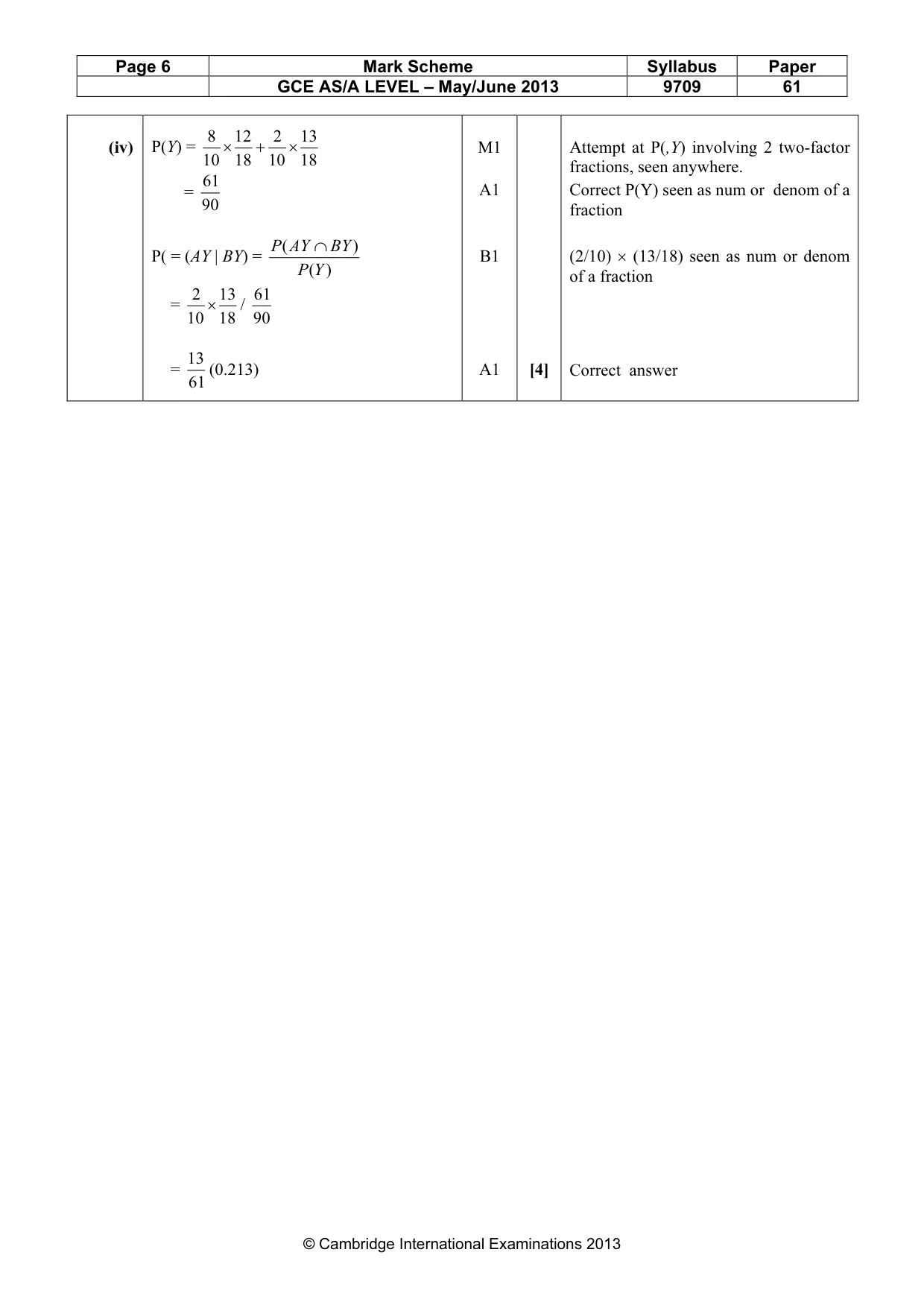
Mark scheme: 7 (i) number of balls in B is 5+ x + 1 = x + 6 B1 [1] Sensible reason P(Y) = x/(x + 6) AG (ii) box A box B B1 both correct for box A 6 W x + 6 W 8/10 Y B1 1 correct 5 Y W B1 1 correct 2/10 x + 6 x + 1 Y B1 [4] 1 correct x + 6 6 1 6 (iii) P(WB) = = M1 their = 1/3 or x/x+6 = 2/3 x + 6 3 x + 6 x = 12 AG A1 [2] Verification or solving legit GCE AS/A LEVEL – May/June 2013 9709 61 8 12 2 13 (iv) P(Y) = × + × M1 Attempt at P(,Y) involving 2 two-factor 10 18 10 18 fractions, seen anywhere. 61 = A1 Correct P(Y) seen as num or denom of a 90 fraction P ( AY ∩ BY ) P( = (AY | BY) = B1 (2/10) × (13/18) seen as num or denom P (Y ) of a fraction 2 13 61 = × / 10 18 90 13 = (0.213) A1 [4] Correct answer 61
What was in this paper
The subtopics covered by these 7 questions, and how many questions each got. Open one in a new tab to see every Cambridge question on it.
What you needed in this session
Cambridge’s own grade thresholds for 2013 May/June, Paper 6 · Variant 1. A higher threshold means an easier paper — the bar moves with how the cohort did.