Cambridge A Level Mathematics 9709 — 2011 Oct/Nov Paper 6 · Variant 1
9709/61/O/N/11 · 7 questions · 50 marks · ≈56 min
The question paper and its mark scheme, free to read here and free to download. This is Cambridge’s own paper, exactly as it was sat.
Question paper4 pages
Mark scheme6 pages
Answers below. Sit the paper first if you are practising.
Questions as text
Q1 · When a butternut squash seed is sown the probability that it will germinate is 0.86…
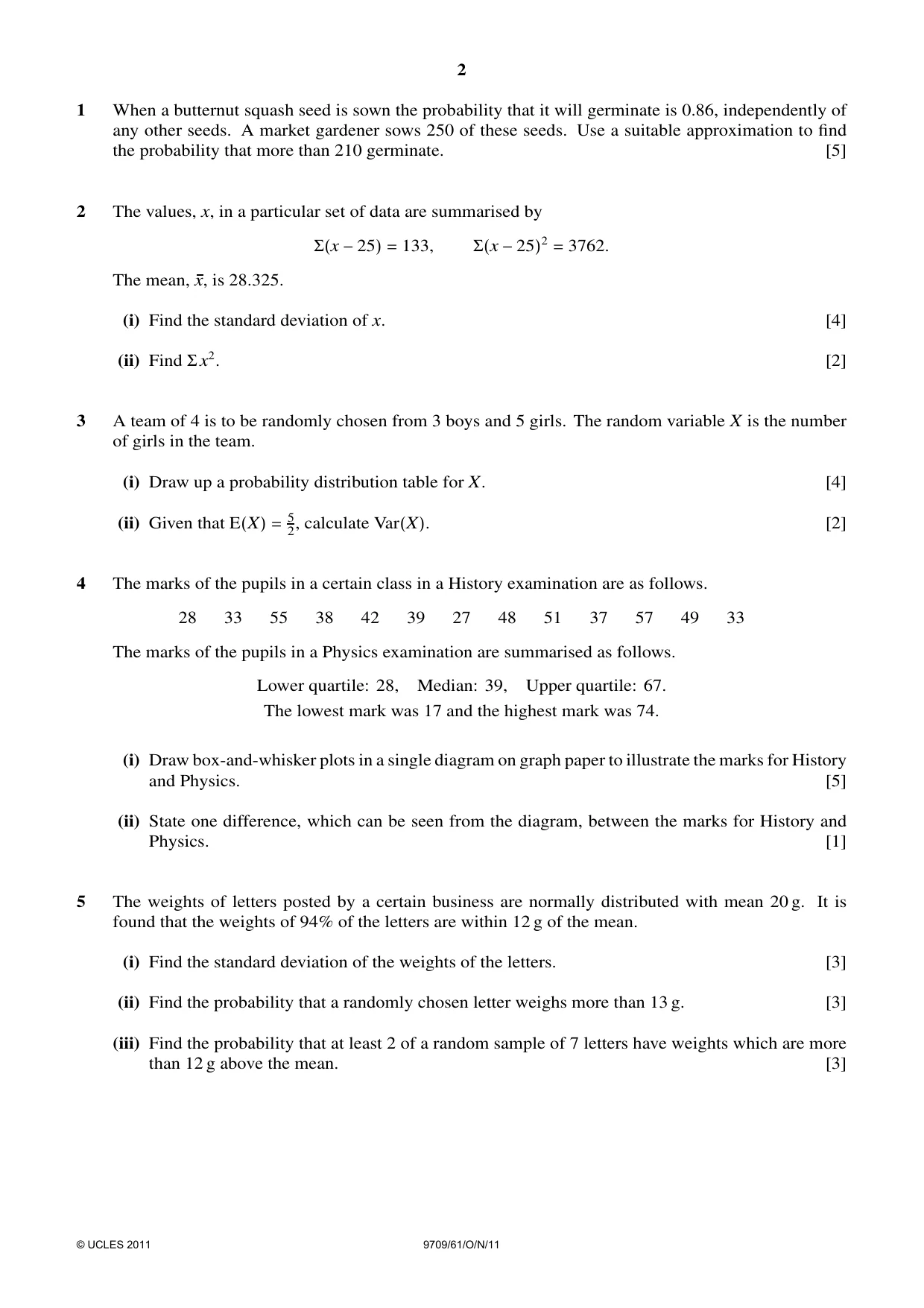
1 When a butternut squash seed is sown the probability that it will germinate is 0.86, independently of any other seeds. A market gardener sows 250 of these seeds. Use a suitable approximation to find the probability that more than 210 germinate. [5]
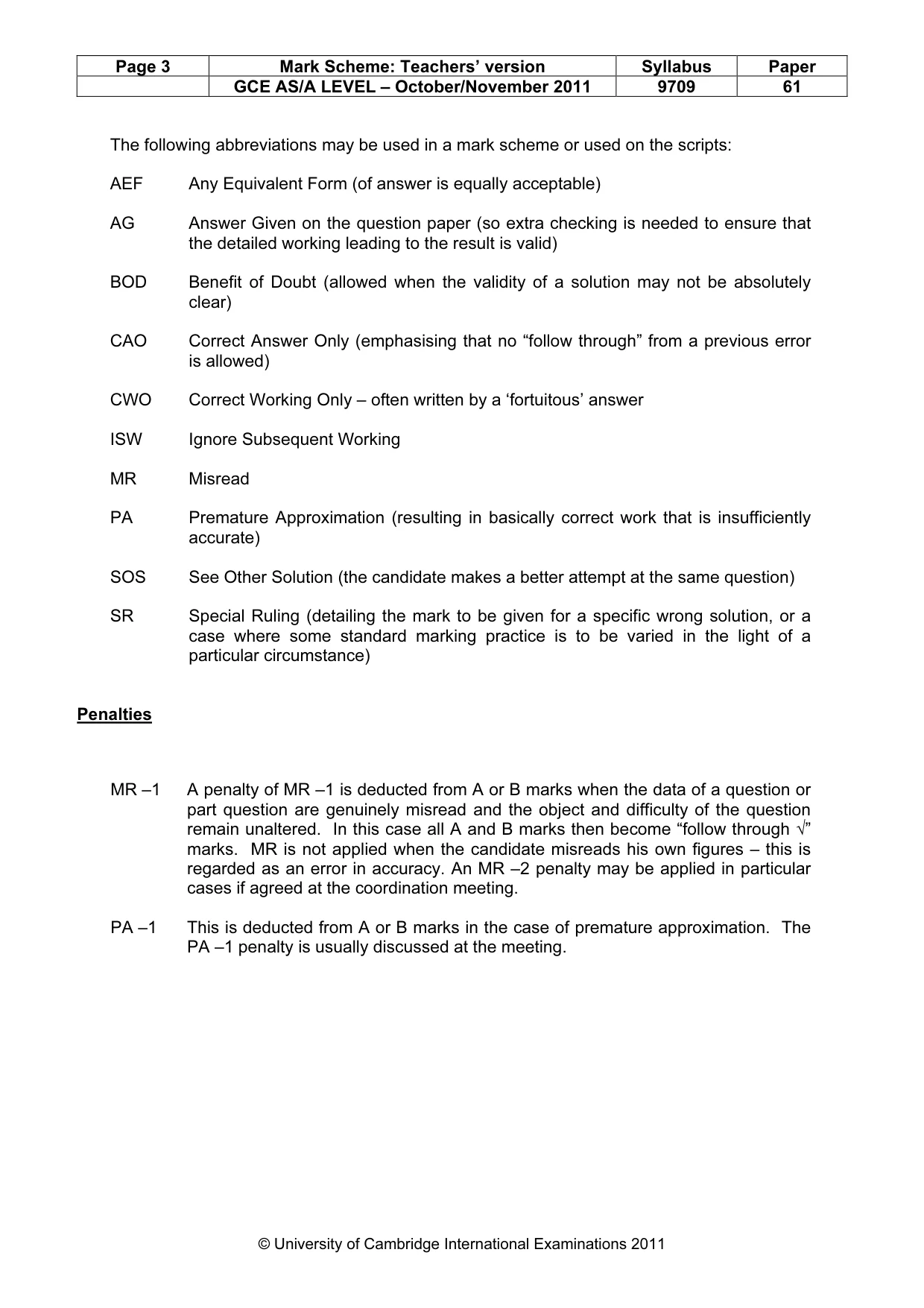
Mark scheme: 1 µ = 250 × 0.86 = 215 B1 250 × 0.86 and 250 × 0.86 × 0.14 seen o.e σ2 = 250 × 0.86 × 0.14 = 30.1 M1 Standardising, with or without cc, must have sq rt in denom 2105. − 215 M1 Continuity correction 210.5 or 209.5 P(X > 210) = 1 – Φ 301. only = Φ(0.820) M1 Correct region (> 0.5) ft their mean = 0.794 A1 [5] Correct answer
Q2 · The values, x, in a particular set of data are summarised by Σ(x −25) = 133, Σ(x −25)2 =…
2 The values, x, in a particular set of data are summarised by Σ(x −25) = 133, Σ(x −25)2 = 3762. The mean, x, is 28.325. (i) Find the standard deviation of x. [4] (ii) Find Σx2. [2]
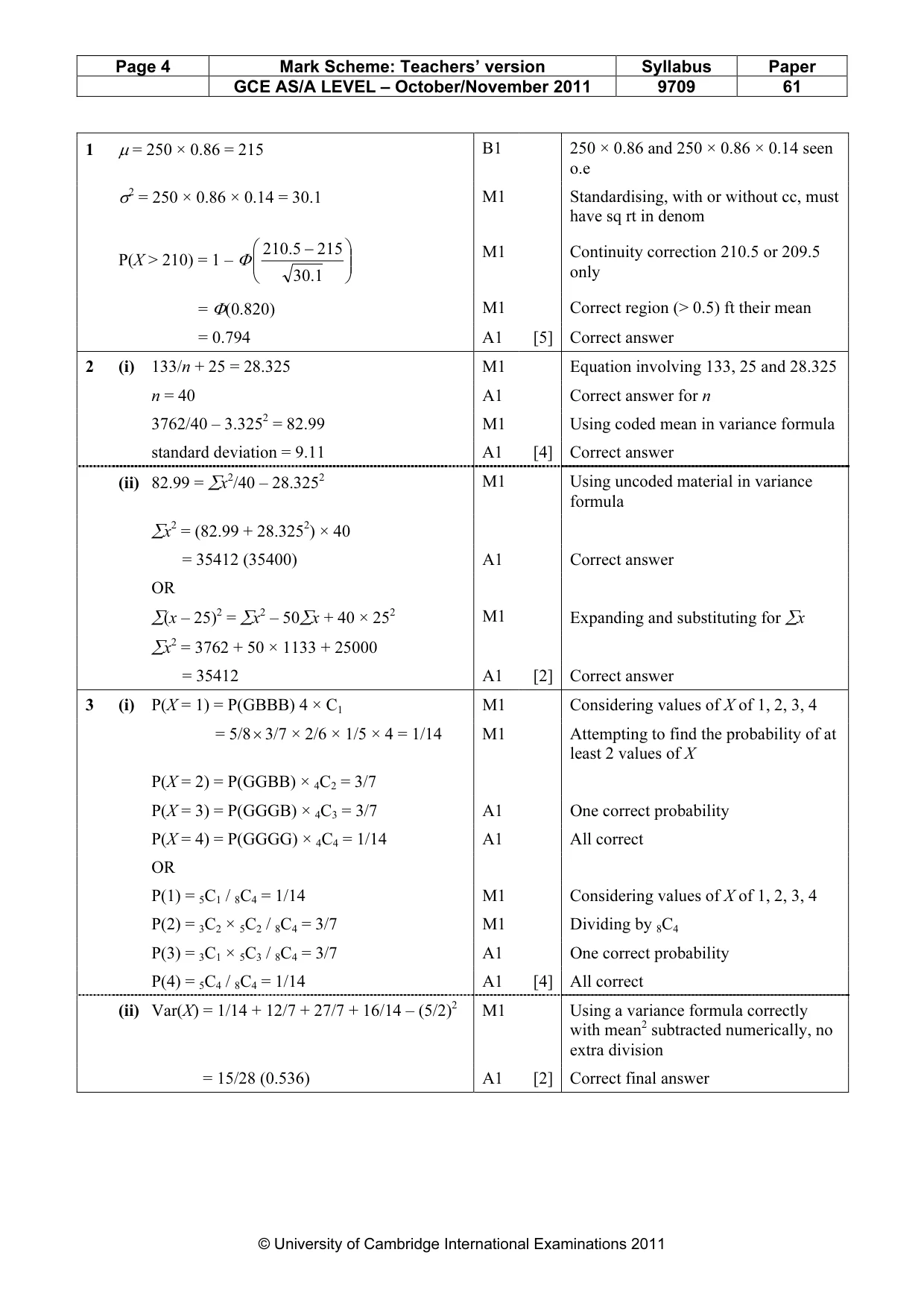
Mark scheme: 2 (i) 133/n + 25 = 28.325 M1 Equation involving 133, 25 and 28.325 n = 40 A1 Correct answer for n 3762/40 – 3.3252 = 82.99 M1 Using coded mean in variance formula standard deviation = 9.11 A1 [4] Correct answer (ii) 82.99 = ∑x2/40 – 28.3252 M1 Using uncoded material in variance formula ∑x2 = (82.99 + 28.3252) × 40 = 35412 (35400) A1 Correct answer OR ∑(x – 25)2 = ∑x2 – 50∑x + 40 × 252 M1 Expanding and substituting for ∑x ∑x2 = 3762 + 50 × 1133 + 25000 = 35412 A1 [2] Correct answer
Q3 · A team of 4 is to be randomly chosen from 3 boys and 5 girls
3 A team of 4 is to be randomly chosen from 3 boys and 5 girls. The random variable X is the number of girls in the team. (i) Draw up a probability distribution table for X. [4] (ii) Given that E(X) = 52, calculate Var(X). [2]
Mark scheme: 3 (i) P(X = 1) = P(GBBB) 4 × C1 M1 Considering values of X of 1, 2, 3, 4 = 5/8× 3/7 × 2/6 × 1/5 × 4 = 1/14 M1 Attempting to find the probability of at least 2 values of X P(X = 2) = P(GGBB) × 4C2 = 3/7 P(X = 3) = P(GGGB) × 4C3 = 3/7 A1 One correct probability P(X = 4) = P(GGGG) × 4C4 = 1/14 A1 All correct OR P(1) = 5C1 / 8C4 = 1/14 M1 Considering values of X of 1, 2, 3, 4 P(2) = 3C2 × 5C2 / 8C4 = 3/7 M1 Dividing by 8C4 P(3) = 3C1 × 5C3 / 8C4 = 3/7 A1 One correct probability P(4) = 5C4 / 8C4 = 1/14 A1 [4] All correct (ii) Var(X) = 1/14 + 12/7 + 27/7 + 16/14 – (5/2)2 M1 Using a variance formula correctly with mean2 subtracted numerically, no extra division = 15/28 (0.536) A1 [2] Correct final answer GCE AS/A LEVEL – October/November 2011 9709 61
Q4 · The marks of the pupils in a certain class in a History examination are as follows
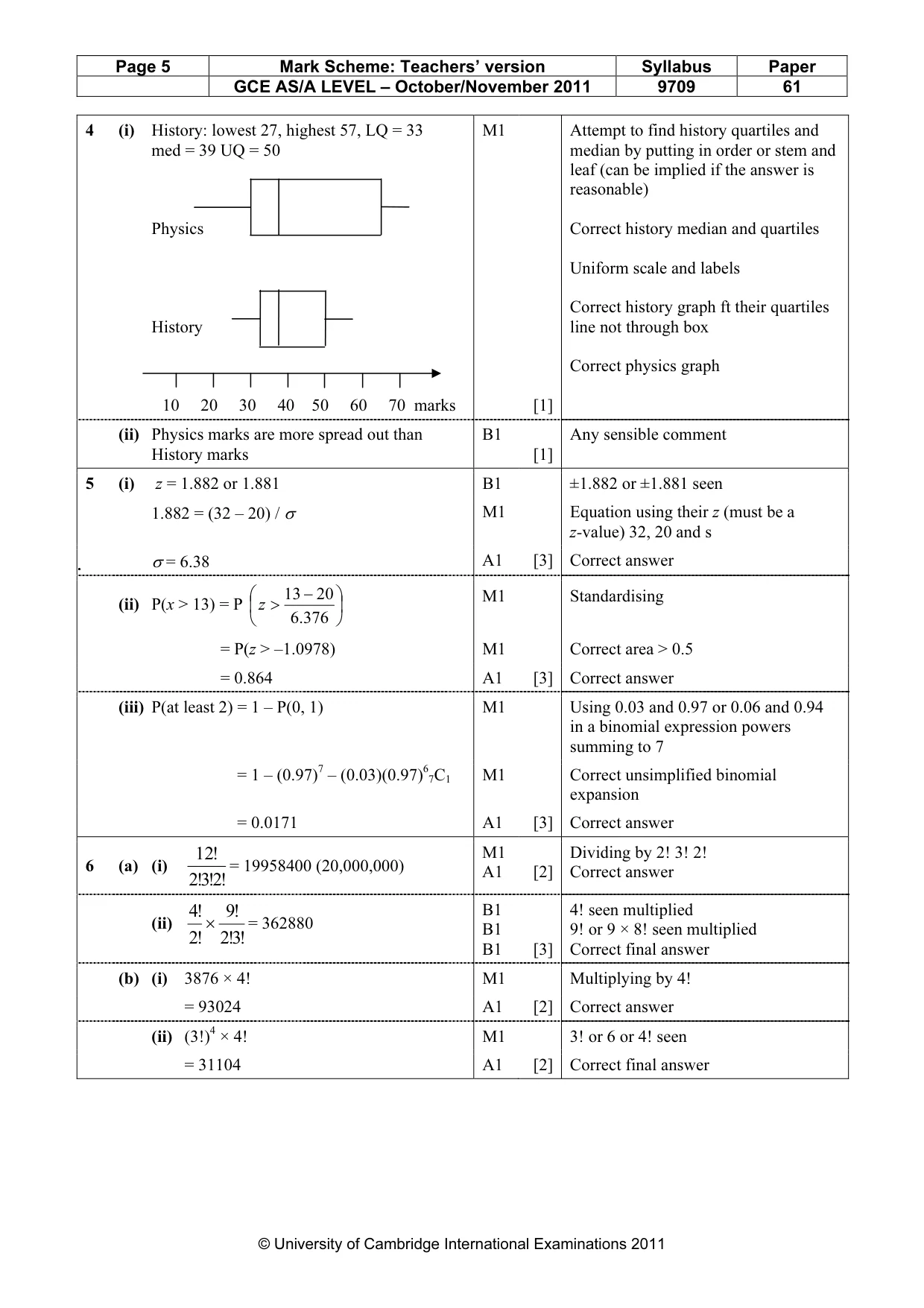
4 The marks of the pupils in a certain class in a History examination are as follows. 28 33 55 38 42 39 27 48 51 37 57 49 33 The marks of the pupils in a Physics examination are summarised as follows. Lower quartile: 28, Median: 39, Upper quartile: 67. The lowest mark was 17 and the highest mark was 74. (i) Draw box-and-whisker plots in a single diagram on graph paper to illustrate the marks for History and Physics. [5] (ii) State one difference, which can be seen from the diagram, between the marks for History and Physics. [1]
Mark scheme: 4 (i) History: lowest 27, highest 57, LQ = 33 M1 Attempt to find history quartiles and med = 39 UQ = 50 median by putting in order or stem and leaf (can be implied if the answer is reasonable) Physics Correct history median and quartiles Uniform scale and labels Correct history graph ft their quartiles History line not through box Correct physics graph
Q5 · The weights of letters posted by a certain business are normally distributed with mean 20…
5 The weights of letters posted by a certain business are normally distributed with mean 20 g. It is found that the weights of 94% of the letters are within 12 g of the mean. (i) Find the standard deviation of the weights of the letters. [3] (ii) Find the probability that a randomly chosen letter weighs more than 13 g. [3] (iii) Find the probability that at least 2 of a random sample of 7 letters have weights which are more than 12 g above the mean. [3]
Mark scheme: 5 (i) z = 1.882 or 1.881 B1 ±1.882 or ±1.881 seen 1.882 = (32 – 20) / σ M1 Equation using their z (must be a z-value) 32, 20 and s σ = 6.38 A1 [3] Correct answer 13 − 20 M1 Standardising (ii) P(x > 13) = P z > .6 376 = P(z > –1.0978) M1 Correct area > 0.5 = 0.864 A1 [3] Correct answer (iii) P(at least 2) = 1 – P(0, 1) M1 Using 0.03 and 0.97 or 0.06 and 0.94 in a binomial expression powers summing to 7 = 1 – (0.97)7 – (0.03)(0.97)67C1 M1 Correct unsimplified binomial expansion = 0.0171 A1 [3] Correct answer 12! M1 Dividing by 2! 3! 2!
Q6 · Find the number of different ways in which the 12 letters of the word STRAWBERRIES can be…
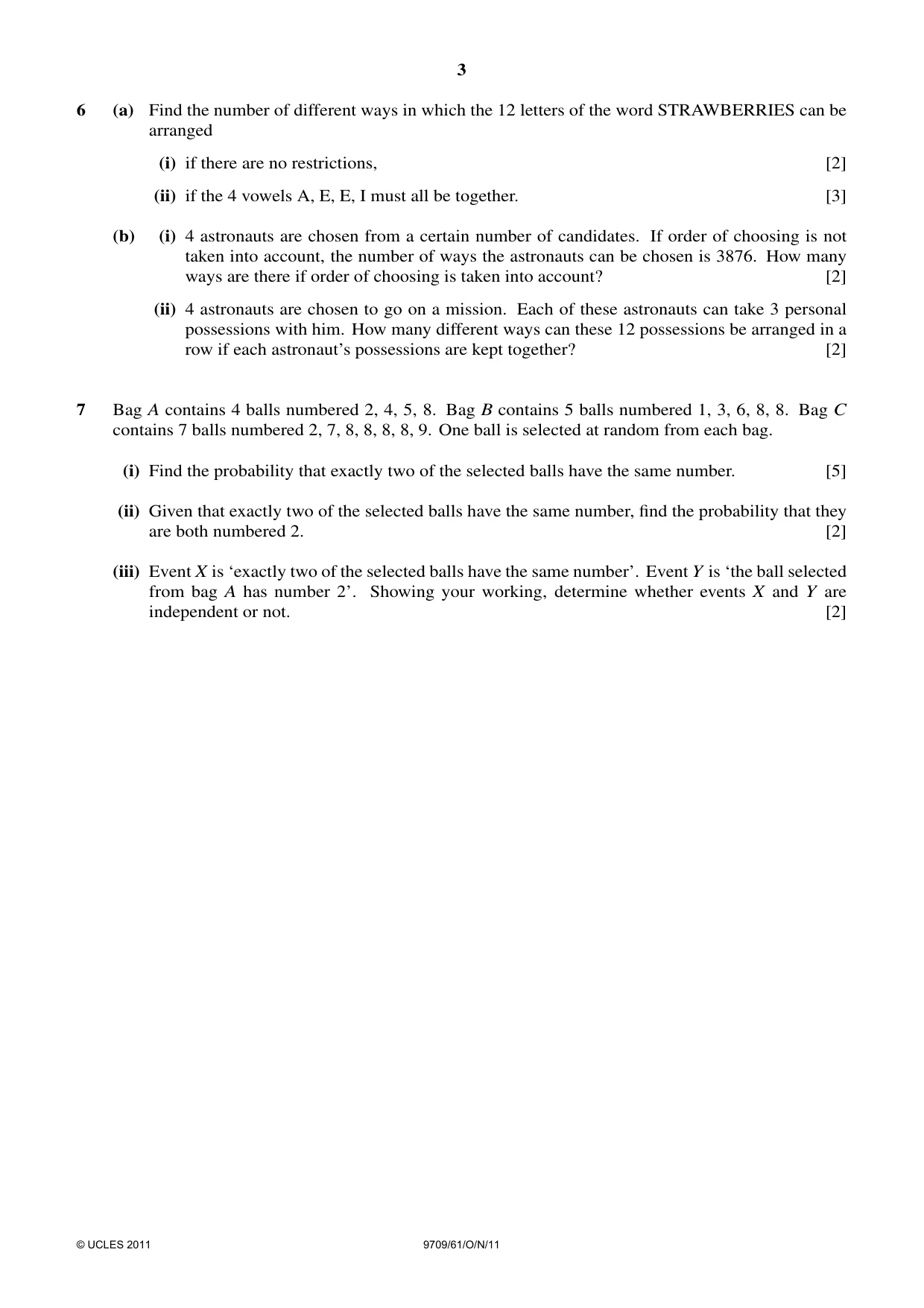
6 (a) Find the number of different ways in which the 12 letters of the word STRAWBERRIES can be arranged (i) if there are no restrictions, [2] (ii) if the 4 vowels A, E, E, I must all be together. [3] (b) (i) 4 astronauts are chosen from a certain number of candidates. If order of choosing is not taken into account, the number of ways the astronauts can be chosen is 3876. How many ways are there if order of choosing is taken into account? [2] (ii) 4 astronauts are chosen to go on a mission. Each of these astronauts can take 3 personal possessions with him. How many different ways can these 12 possessions be arranged in a row if each astronaut’s possessions are kept together? [2]
Mark scheme: 12! M1 Dividing by 2! 3! 2! 6 (a) (i) = 19958400 (20,000,000) A1 [2] Correct answer !2!3!2 !4 !9 B1 4! seen multiplied (ii) × = 362880 B1 9! or 9 × 8! seen multiplied !2 !3!2 B1 [3] Correct final answer (b) (i) 3876 × 4! M1 Multiplying by 4! = 93024 A1 [2] Correct answer (ii) (3!)4 × 4! M1 3! or 6 or 4! seen = 31104 A1 [2] Correct final answer GCE AS/A LEVEL – October/November 2011 9709 61
Q7 · Bag A contains 4 balls numbered 2, 4, 5, 8
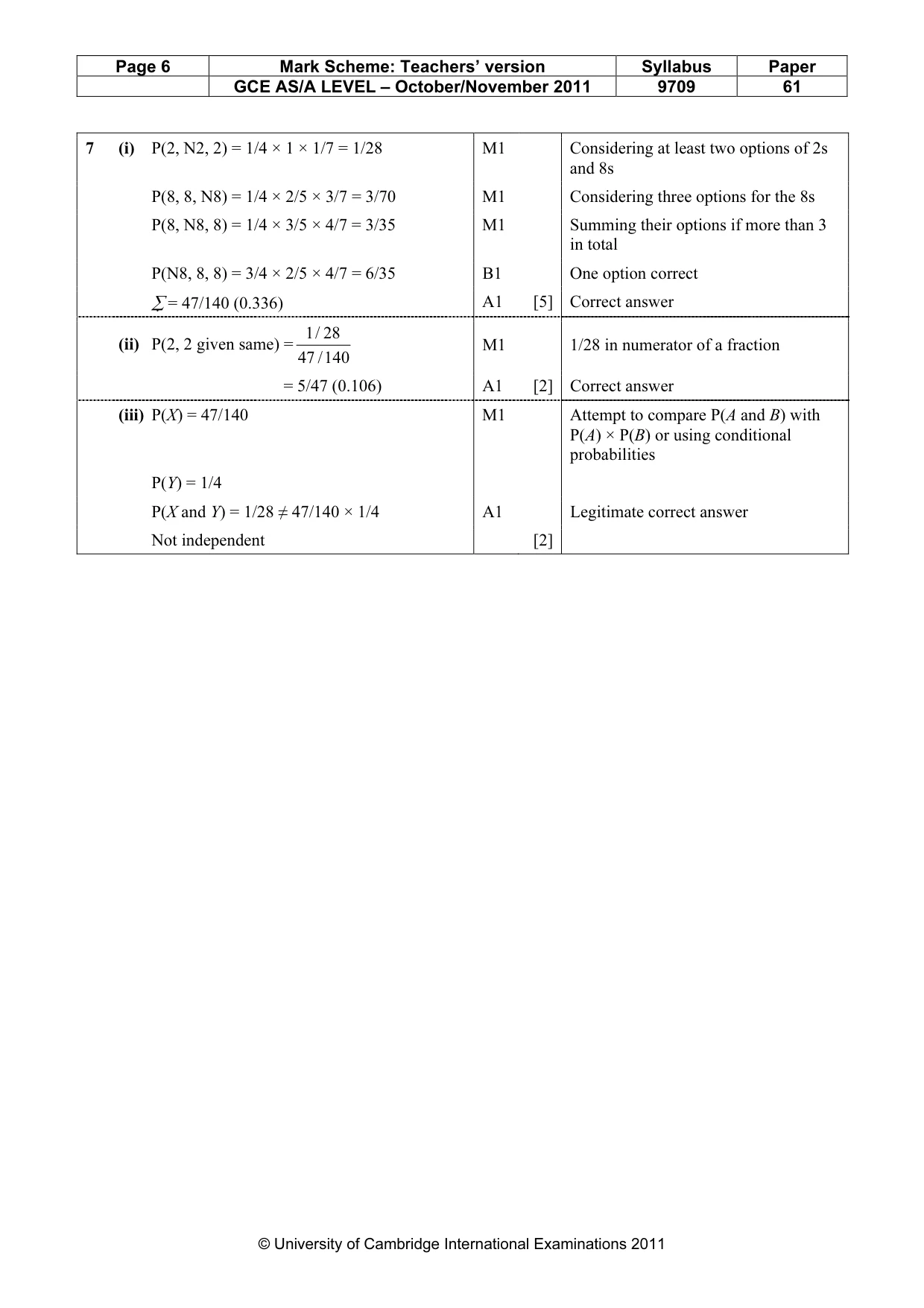
7 Bag A contains 4 balls numbered 2, 4, 5, 8. Bag B contains 5 balls numbered 1, 3, 6, 8, 8. Bag C contains 7 balls numbered 2, 7, 8, 8, 8, 8, 9. One ball is selected at random from each bag. (i) Find the probability that exactly two of the selected balls have the same number. [5] (ii) Given that exactly two of the selected balls have the same number, find the probability that they are both numbered 2. [2] (iii) Event X is ‘exactly two of the selected balls have the same number’. Event Y is ‘the ball selected from bag A has number 2’. Showing your working, determine whether events X and Y are independent or not. [2]
Mark scheme: 7 (i) P(2, N2, 2) = 1/4 × 1 × 1/7 = 1/28 M1 Considering at least two options of 2s and 8s P(8, 8, N8) = 1/4 × 2/5 × 3/7 = 3/70 M1 Considering three options for the 8s P(8, N8, 8) = 1/4 × 3/5 × 4/7 = 3/35 M1 Summing their options if more than 3 in total P(N8, 8, 8) = 3/4 × 2/5 × 4/7 = 6/35 B1 One option correct ∑ = 47/140 (0.336) A1 [5] Correct answer 1 / 28 (ii) P(2, 2 given same) = M1 1/28 in numerator of a fraction 47 / 140 = 5/47 (0.106) A1 [2] Correct answer (iii) P(X) = 47/140 M1 Attempt to compare P(A and B) with P(A) × P(B) or using conditional probabilities P(Y) = 1/4 P(X and Y) = 1/28 ≠ 47/140 × 1/4 A1 Legitimate correct answer Not independent [2]
What was in this paper
The subtopics covered by these 7 questions, and how many questions each got. Open one in a new tab to see every Cambridge question on it.
What you needed in this session
Cambridge’s own grade thresholds for 2011 Oct/Nov, Paper 6 · Variant 1. A higher threshold means an easier paper — the bar moves with how the cohort did.