Cambridge A Level Mathematics 9709 — 2014 May/June Paper 6 · Variant 2
9709/62/M/J/14 · 6 questions · 50 marks · ≈56 min
The question paper and its mark scheme, free to read here and free to download. This is Cambridge’s own paper, exactly as it was sat.
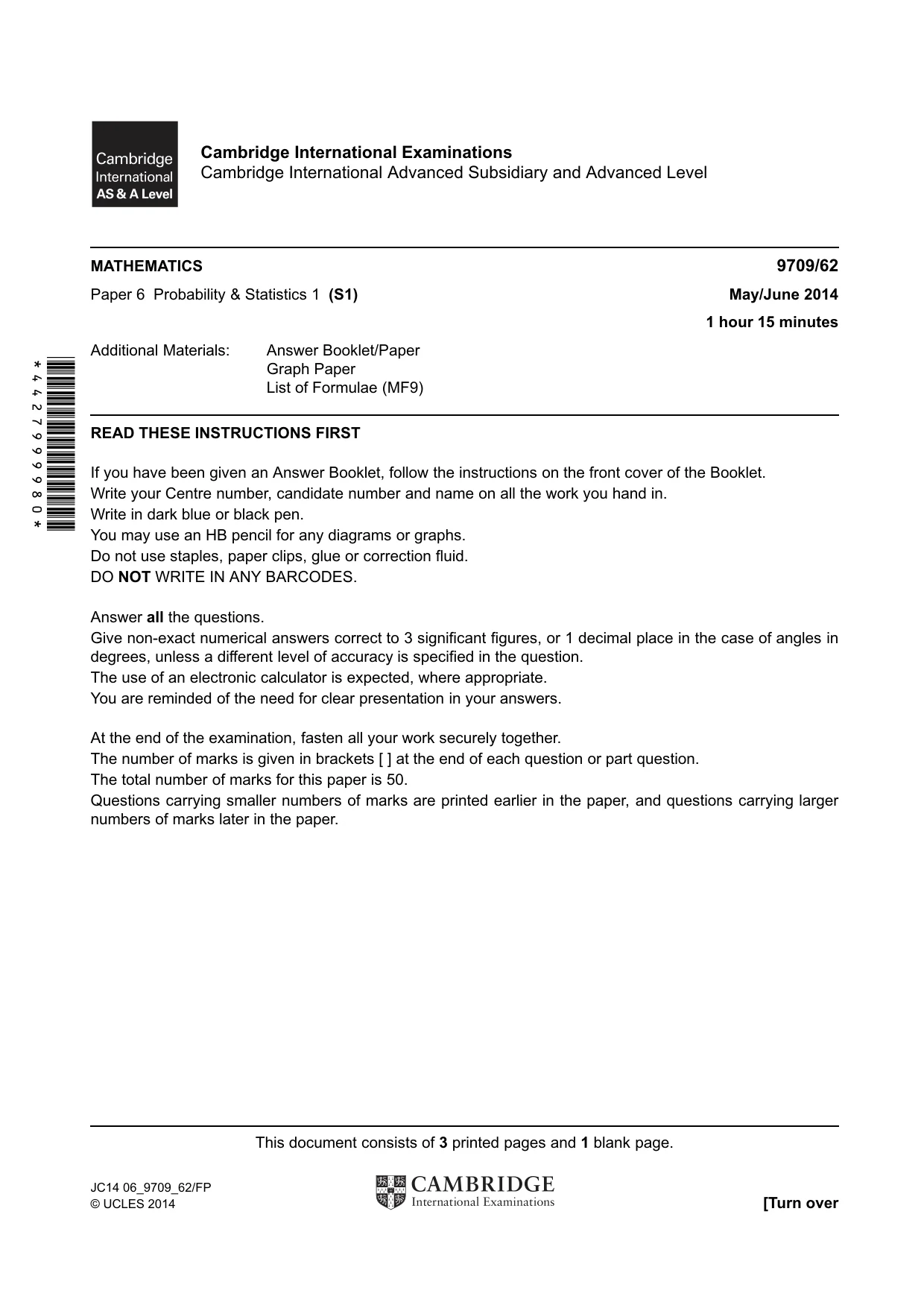
Question paper4 pages

Mark scheme6 pages
Answers below. Sit the paper first if you are practising.
Questions as text
Q1 · In a certain country 12% of houses have solar heating
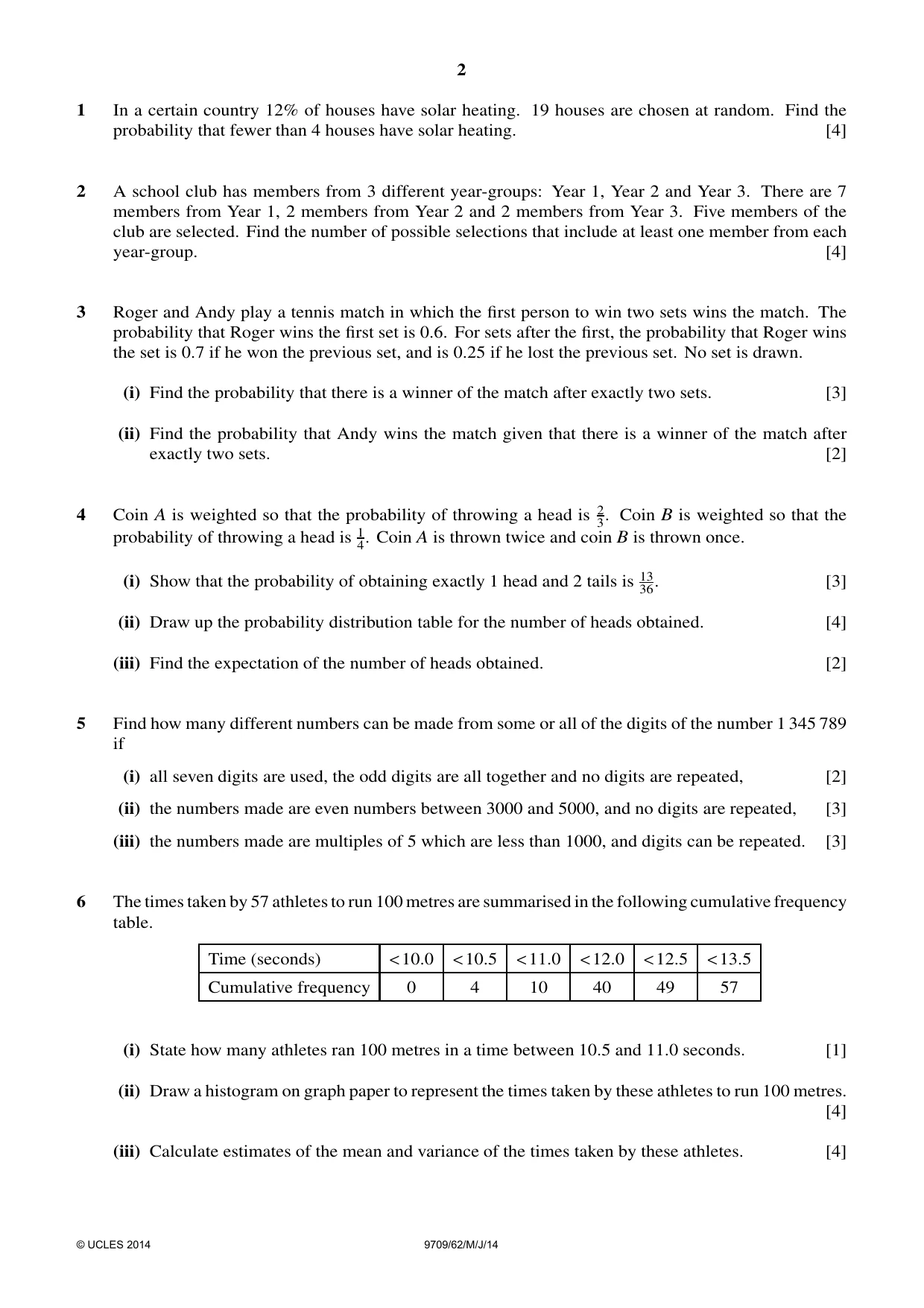
1 In a certain country 12% of houses have solar heating. 19 houses are chosen at random. Find the probability that fewer than 4 houses have solar heating. [4]
Mark scheme: 1 X ~ B(19, 0.12) M1 Any binomial term 19Cx px(1 – p)19 – x, 0<p<1 P(X < 4) = P(0, 1, 2, 3) = (0.88)19 + 19C1(0.12)1(0.88)18 + M1 Any binomial term nCx(0.12 or 0.88)x(0.88 or 19C2(0.12)2(0.88)17 + 19C3(0.12)3(0.88)16 0.12)n – x M1 P(0, 1, 2, 3) binomial expr with at least 2 consistent terms = 0.813 A1 4 Correct answer
Q3 · Roger and Andy play a tennis match in which the first person to win two sets wins the match
3 Roger and Andy play a tennis match in which the first person to win two sets wins the match. The probability that Roger wins the first set is 0.6. For sets after the first, the probability that Roger wins the set is 0.7 if he won the previous set, and is 0.25 if he lost the previous set. No set is drawn. (i) Find the probability that there is a winner of the match after exactly two sets. [3] (ii) Find the probability that Andy wins the match given that there is a winner of the match after exactly two sets. [2]
Mark scheme: 3 1 1 = 7C3 × 2C1 × 2C1 = 140 M1 Summing 3 or 4 options allow perms, wrong combs but second numbers must sum to 5 etc. Total = 231 A1 4 Correct answer 3 (i) P(RR) = 0.6 × 0.7 = 0.42 B1 Only 2 factors P(AA) = 0.4 × 0.75 = 0.3 B1 Only 2 factors P(2 sets in match) = 0.72 B1 3 ft previous answers P ( A wins and 2 sets ) P ( AA) (ii) = B1 Correct num or correct denom of a fraction ft P ( 2 sets ) P ( 2 sets) their (i) 3.0 5 = = (0.417) B1 2 Correct answer ft their or recovered AA/their or .072 12 recovered (i)
Q4 · Coin A is weighted so that the probability of throwing a head is 2 Coin B is weighted so…
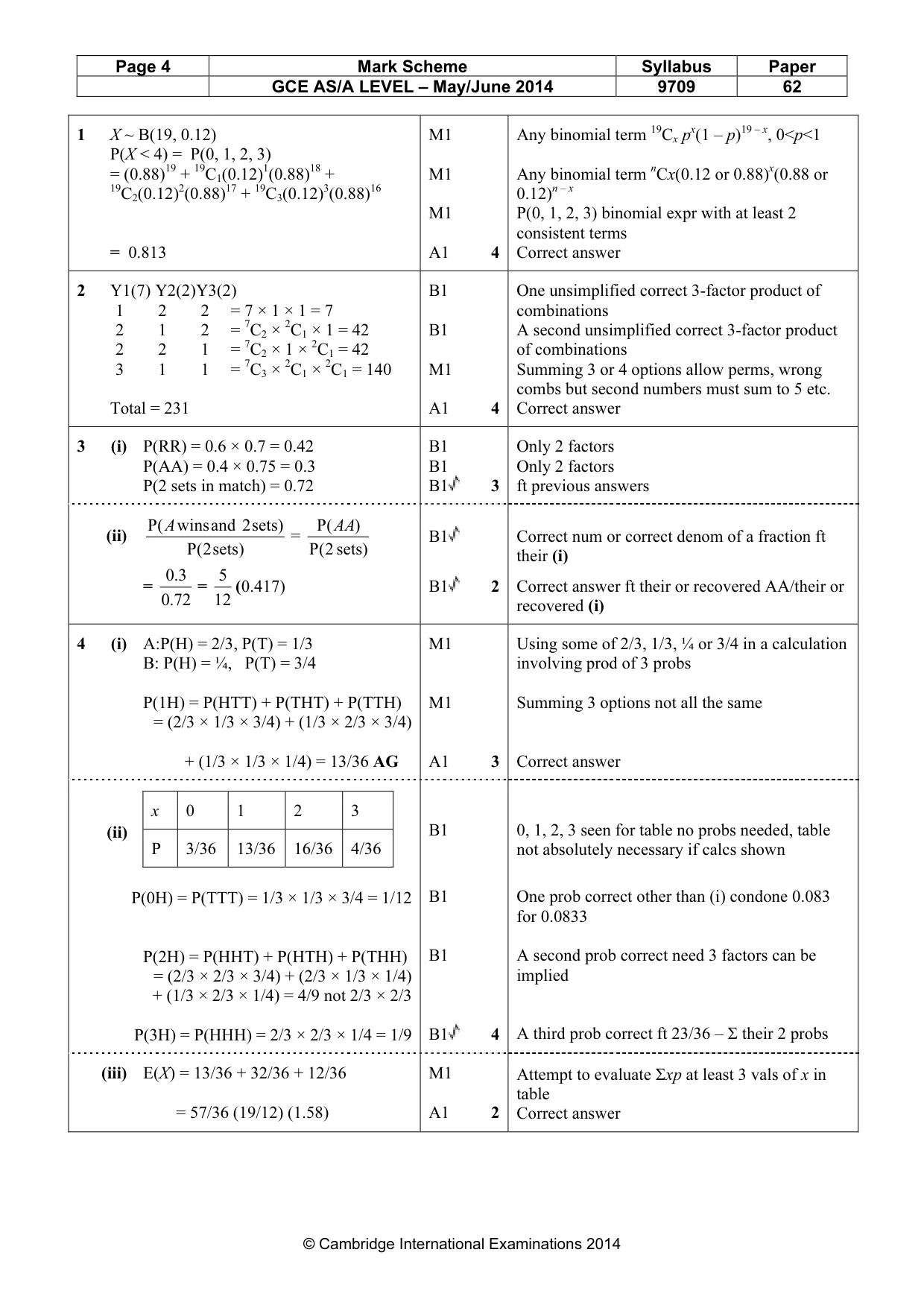
4 Coin A is weighted so that the probability of throwing a head is 2 Coin B is weighted so that the 3. probability of throwing a head is 1 Coin A is thrown twice and coin B is thrown once. 4. (i) Show that the probability of obtaining exactly 1 head and 2 tails is 36.13 [3] (ii) Draw up the probability distribution table for the number of heads obtained. [4] (iii) Find the expectation of the number of heads obtained. [2]
Mark scheme: 4 (i) A:P(H) = 2/3, P(T) = 1/3 M1 Using some of 2/3, 1/3, ¼ or 3/4 in a calculation B: P(H) = ¼, P(T) = 3/4 involving prod of 3 probs P(1H) = P(HTT) + P(THT) + P(TTH) M1 Summing 3 options not all the same = (2/3 × 1/3 × 3/4) + (1/3 × 2/3 × 3/4) + (1/3 × 1/3 × 1/4) = 13/36 AG A1 3 Correct answer x 0 1 2 3 (ii) B1 0, 1, 2, 3 seen for table no probs needed, table P 3/36 13/36 16/36 4/36 not absolutely necessary if calcs shown P(0H) = P(TTT) = 1/3 × 1/3 × 3/4 = 1/12 B1 One prob correct other than (i) condone 0.083 for 0.0833 P(2H) = P(HHT) + P(HTH) + P(THH) B1 A second prob correct need 3 factors can be = (2/3 × 2/3 × 3/4) + (2/3 × 1/3 × 1/4) implied + (1/3 × 2/3 × 1/4) = 4/9 not 2/3 × 2/3 P(3H) = P(HHH) = 2/3 × 2/3 × 1/4 = 1/9 B1 4 A third prob correct ft 23/36 – Σ their 2 probs (iii) E(X) = 13/36 + 32/36 + 12/36 M1 Attempt to evaluate Σxp at least 3 vals of x in table = 57/36 (19/12) (1.58) A1 2 Correct answer GCE AS/A LEVEL – May/June 2014 9709 62
Q5 · Find how many different numbers can be made from some or all of the digits of the number…
5 Find how many different numbers can be made from some or all of the digits of the number 1 345 789 if (i) all seven digits are used, the odd digits are all together and no digits are repeated, [2] (ii) the numbers made are even numbers between 3000 and 5000, and no digits are repeated, [3] (iii) the numbers made are multiples of 5 which are less than 1000, and digits can be repeated. [3]
Mark scheme: 5 (i) 5! × 3! or 6! B1 5! or 3! or 6! oe seen mult or alone = 720 B1 2 Correct final answer (ii) 3**4, 3**8, 4**8 M1 considering at least 2 types of 4-figure options ending with 4 or 8 and starting with 3 or 4 B1 One option correct unsimplified can be implied = 5 × 4 + 5 × 4 + 5 × 4 = 60 A1 3 Correct final answer (iii) 5, *5, **5, M1 Appreciating that the number must end in 5 (can be implied) = 1 + 7 + 72 M1 summing numbers ending in 5 with at least 2 different numbers of digits = 57 A1 3 Correct final answer
Q6 · The times taken by 57 athletes to run 100 metres are summarised in the following…
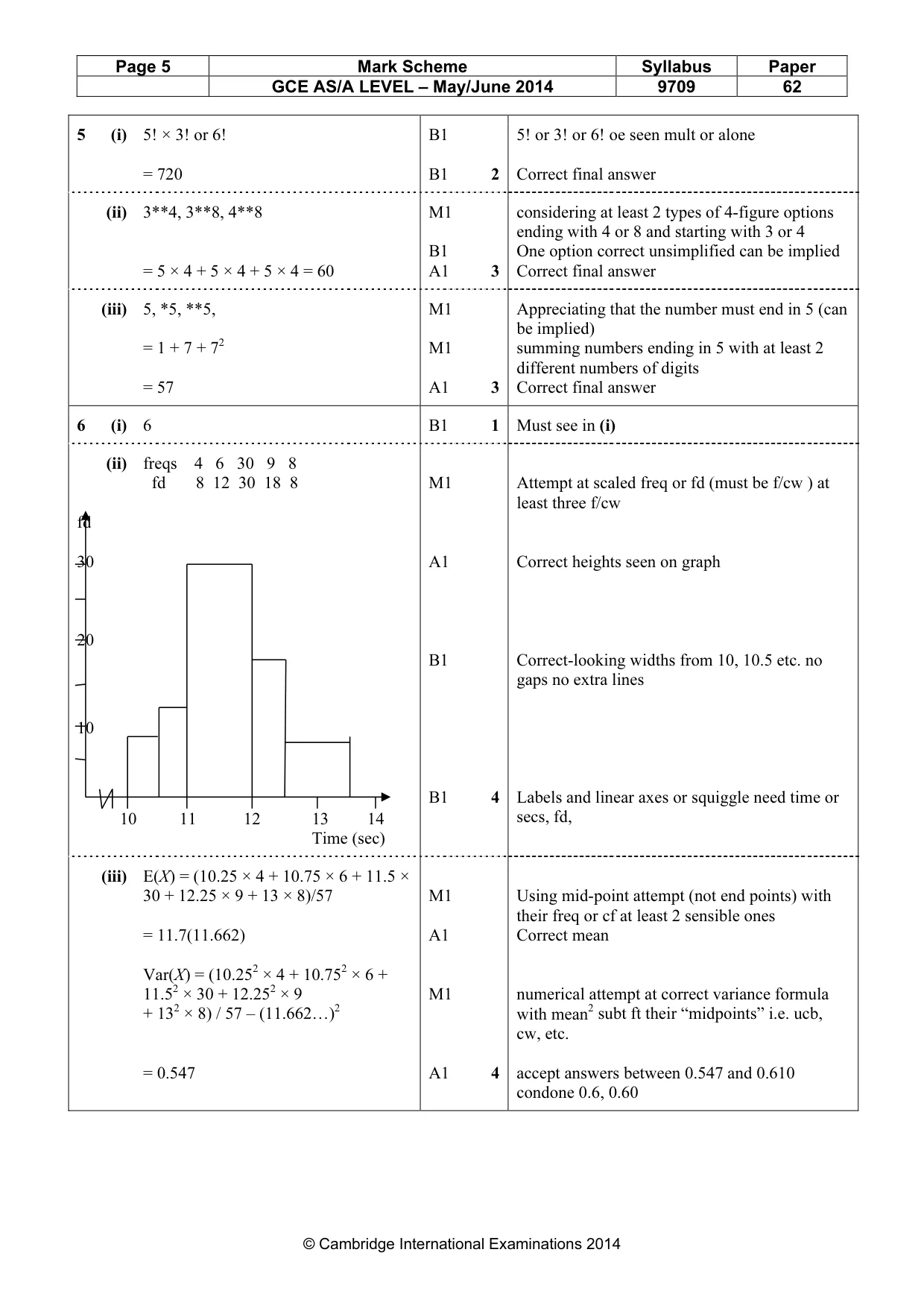
6 The times taken by 57 athletes to run 100 metres are summarised in the following cumulative frequency table. Time (seconds) <10.0 <10.5 <11.0 <12.0 <12.5 <13.5 Cumulative frequency 0 4 10 40 49 57 (i) State how many athletes ran 100 metres in a time between 10.5 and 11.0 seconds. [1] (ii) Draw a histogram on graph paper to represent the times taken by these athletes to run 100 metres. [4] (iii) Calculate estimates of the mean and variance of the times taken by these athletes. [4]
Mark scheme: 6 (i) 6 B1 1 Must see in (i) (ii) freqs 4 6 30 9 8 fd 8 12 30 18 8 M1 Attempt at scaled freq or fd (must be f/cw ) at least three f/cw fd
Q7 · The time Rafa spends on his homework each day in term-time has a normal distribution with…
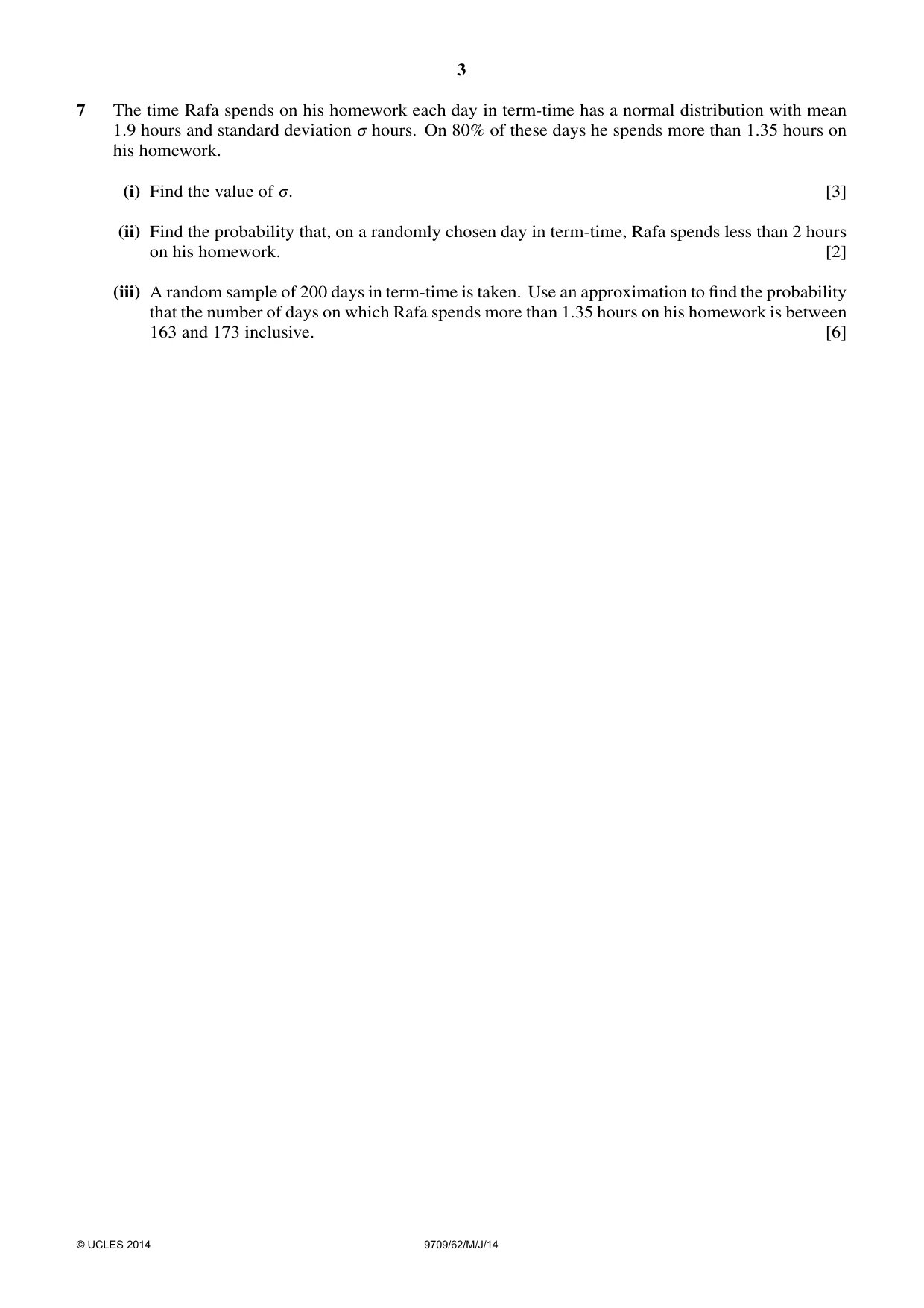
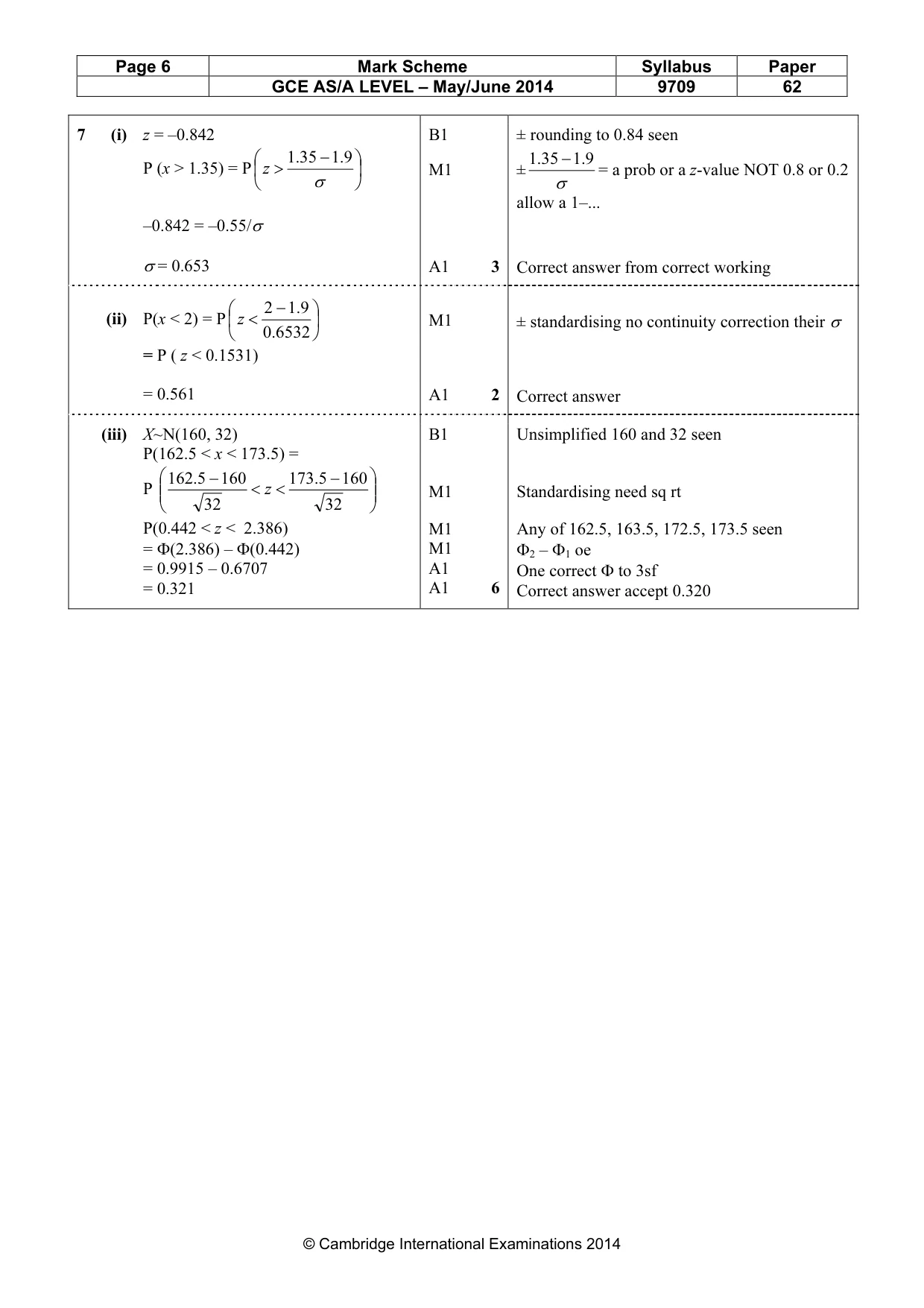
7 The time Rafa spends on his homework each day in term-time has a normal distribution with mean 1.9 hours and standard deviation 3 hours. On 80% of these days he spends more than 1.35 hours on his homework. (i) Find the value of 3. [3] (ii) Find the probability that, on a randomly chosen day in term-time, Rafa spends less than 2 hours on his homework. [2] (iii) A random sample of 200 days in term-time is taken. Use an approximation to find the probability that the number of days on which Rafa spends more than 1.35 hours on his homework is between 163 and 173 inclusive. [6]
Mark scheme: 7 (i) z = –0.842 B1 ± rounding to 0.84 seen .135 − 9.1 .135 − 9.1 P (x > 1.35) = P z > M1 ± = a prob or a z-value NOT 0.8 or 0.2 σ σ allow a 1–... –0.842 = –0.55/σ σ = 0.653 A1 3 Correct answer from correct working 2 − 9.1 (ii) P(x < 2) = P z < M1 ± standardising no continuity correction their σ .0 6532 = P ( z < 0.1531) = 0.561 A1 2 Correct answer (iii) X~N(160, 32) B1 Unsimplified 160 and 32 seen P(162.5 < x < 173.5) = 1625. − 160 1735. − 160 P < z < M1 Standardising need sq rt 32 32 P(0.442 < z < 2.386) M1 Any of 162.5, 163.5, 172.5, 173.5 seen = Φ(2.386) – Φ(0.442) M1 Φ2 – Φ1 oe = 0.9915 – 0.6707 A1 One correct Φ to 3sf = 0.321 A1 6 Correct answer accept 0.320
What was in this paper
The subtopics covered by these 6 questions, and how many questions each got. Open one in a new tab to see every Cambridge question on it.
What you needed in this session
Cambridge’s own grade thresholds for 2014 May/June, Paper 6 · Variant 2. A higher threshold means an easier paper — the bar moves with how the cohort did.