Cambridge A Level Mathematics 9709 — 2010 May/June Paper 6 · Variant 1
9709/61/M/J/10 · 7 questions · 50 marks · ≈56 min
The question paper and its mark scheme, free to read here and free to download. This is Cambridge’s own paper, exactly as it was sat.
Question paper4 pages
Mark scheme6 pages
Answers below. Sit the paper first if you are practising.
Questions as text
Q1 · The probability distribution of the discrete random variable X is shown in the table below
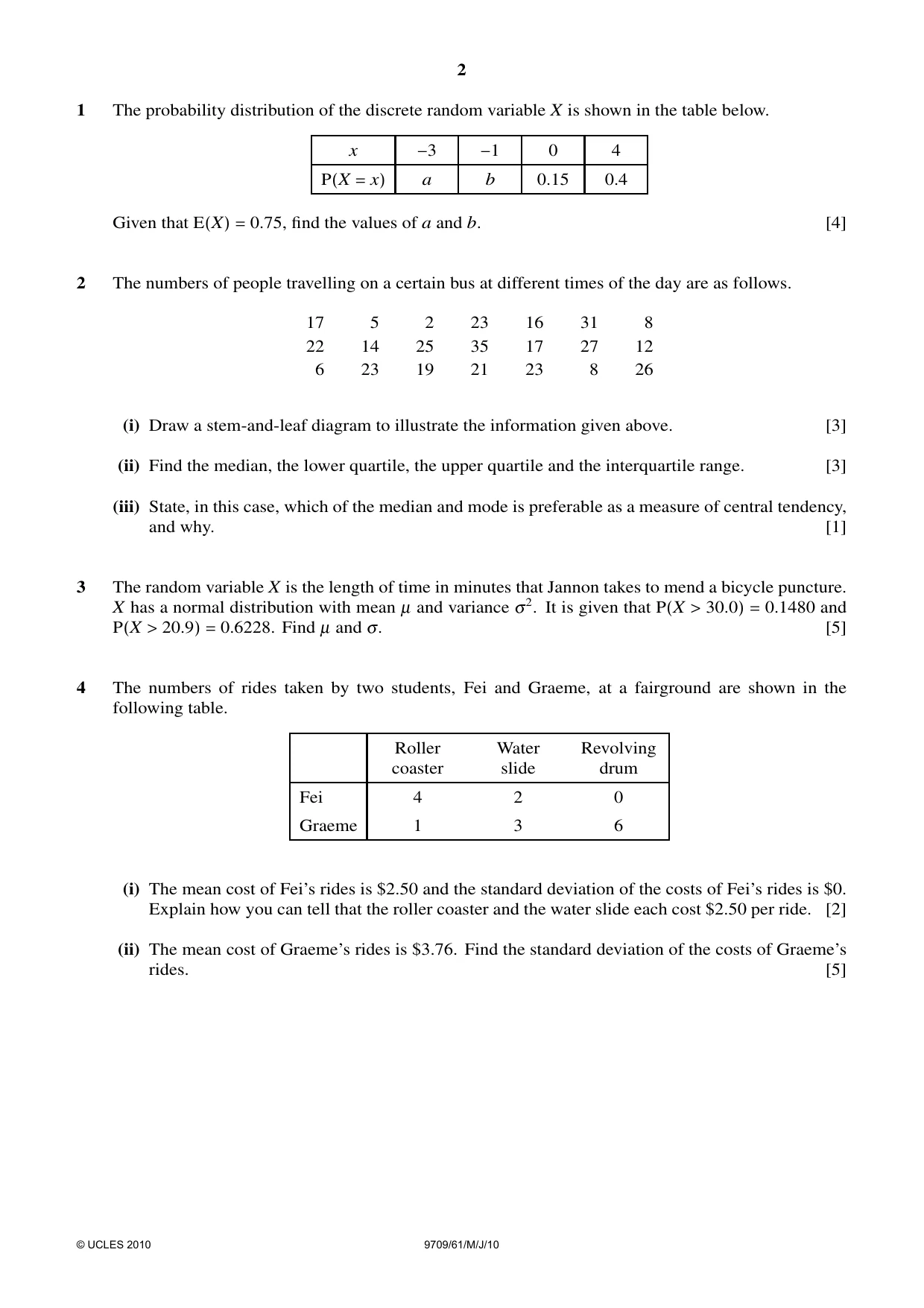
1 The probability distribution of the discrete random variable X is shown in the table below. x −3 −1 0 4 P(X = x) a b 0.15 0.4 Given that E(X) = 0.75, find the values of a and b. [4]
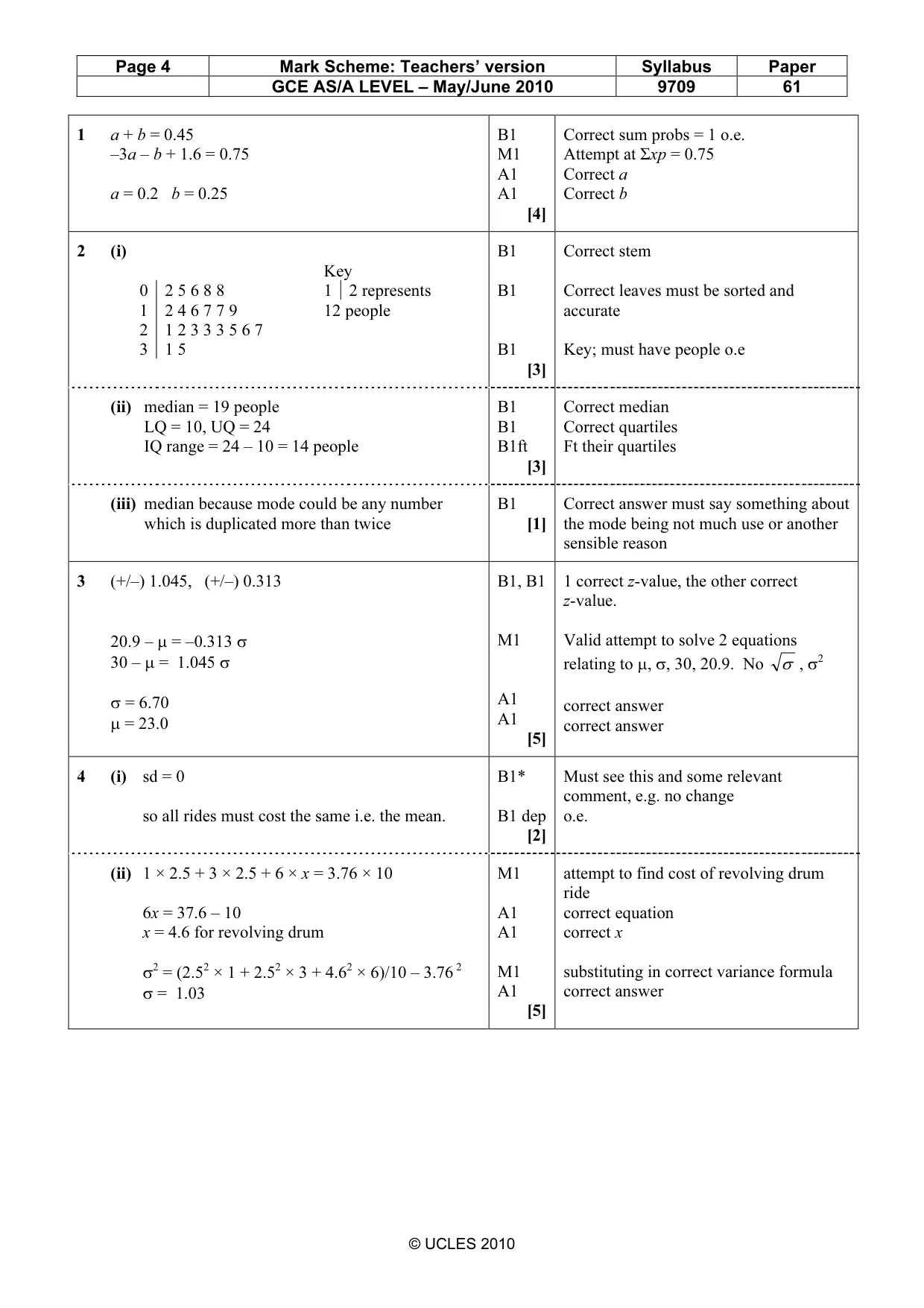
Mark scheme: 1 a + b = 0.45 B1 Correct sum probs = 1 o.e. –3a – b + 1.6 = 0.75 M1 Attempt at Σxp = 0.75 A1 Correct a a = 0.2 b = 0.25 A1 Correct b [4]
Q2 · The numbers of people travelling on a certain bus at different times of the day are as…
2 The numbers of people travelling on a certain bus at different times of the day are as follows. 17 5 2 23 16 31 8 22 14 25 35 17 27 12 6 23 19 21 23 8 26 (i) Draw a stem-and-leaf diagram to illustrate the information given above. [3] (ii) Find the median, the lower quartile, the upper quartile and the interquartile range. [3] (iii) State, in this case, which of the median and mode is preferable as a measure of central tendency, and why. [1]
Mark scheme: 2 (i) B1 Correct stem Key 0 2 5 6 8 8 1 2 represents B1 Correct leaves must be sorted and 1 2 4 6 7 7 9 12 people accurate 2 1 2 3 3 3 5 6 7 3 1 5 B1 Key; must have people o.e [3] (ii) median = 19 people B1 Correct median LQ = 10, UQ = 24 B1 Correct quartiles IQ range = 24 – 10 = 14 people B1ft Ft their quartiles [3] (iii) median because mode could be any number B1 Correct answer must say something about which is duplicated more than twice [1] the mode being not much use or another sensible reason
Q3 · The random variable X is the length of time in minutes that Jannon takes to mend a…
3 The random variable X is the length of time in minutes that Jannon takes to mend a bicycle puncture. X has a normal distribution with mean µ and variance σ2. It is given that P(X > 30.0) = 0.1480 and P(X > 20.9) = 0.6228. Find µ and σ. [5]
Mark scheme: 3 (+/–) 1.045, (+/–) 0.313 B1, B1 1 correct z-value, the other correct z-value. 20.9 – µ = –0.313 σ M1 Valid attempt to solve 2 equations 30 – µ = 1.045 σ relating to µ, σ, 30, 20.9. No σ , σ2 σ = 6.70 A1 correct answer µ = 23.0 A1 correct answer [5]
Q4 · The numbers of rides taken by two students, Fei and Graeme, at a fairground are shown in…
4 The numbers of rides taken by two students, Fei and Graeme, at a fairground are shown in the following table. Roller Water Revolving coaster slide drum Fei 4 2 0 Graeme 1 3 6 (i) The mean cost of Fei’s rides is $2.50 and the standard deviation of the costs of Fei’s rides is $0. Explain how you can tell that the roller coaster and the water slide each cost $2.50 per ride. [2] (ii) The mean cost of Graeme’s rides is $3.76. Find the standard deviation of the costs of Graeme’s rides. [5]
Mark scheme: 4 (i) sd = 0 B1* Must see this and some relevant comment, e.g. no change so all rides must cost the same i.e. the mean. B1 dep o.e. [2] (ii) 1 × 2.5 + 3 × 2.5 + 6 × x = 3.76 × 10 M1 attempt to find cost of revolving drum ride 6x = 37.6 – 10 A1 correct equation x = 4.6 for revolving drum A1 correct x σ2 = (2.52 × 1 + 2.52 × 3 + 4.62 × 6)/10 – 3.76 2 M1 substituting in correct variance formula σ = 1.03 A1 correct answer [5] GCE AS/A LEVEL – May/June 2010 9709 61 2 6 8 8
Q5 · In the holidays Martin spends 25% of the day playing computer games
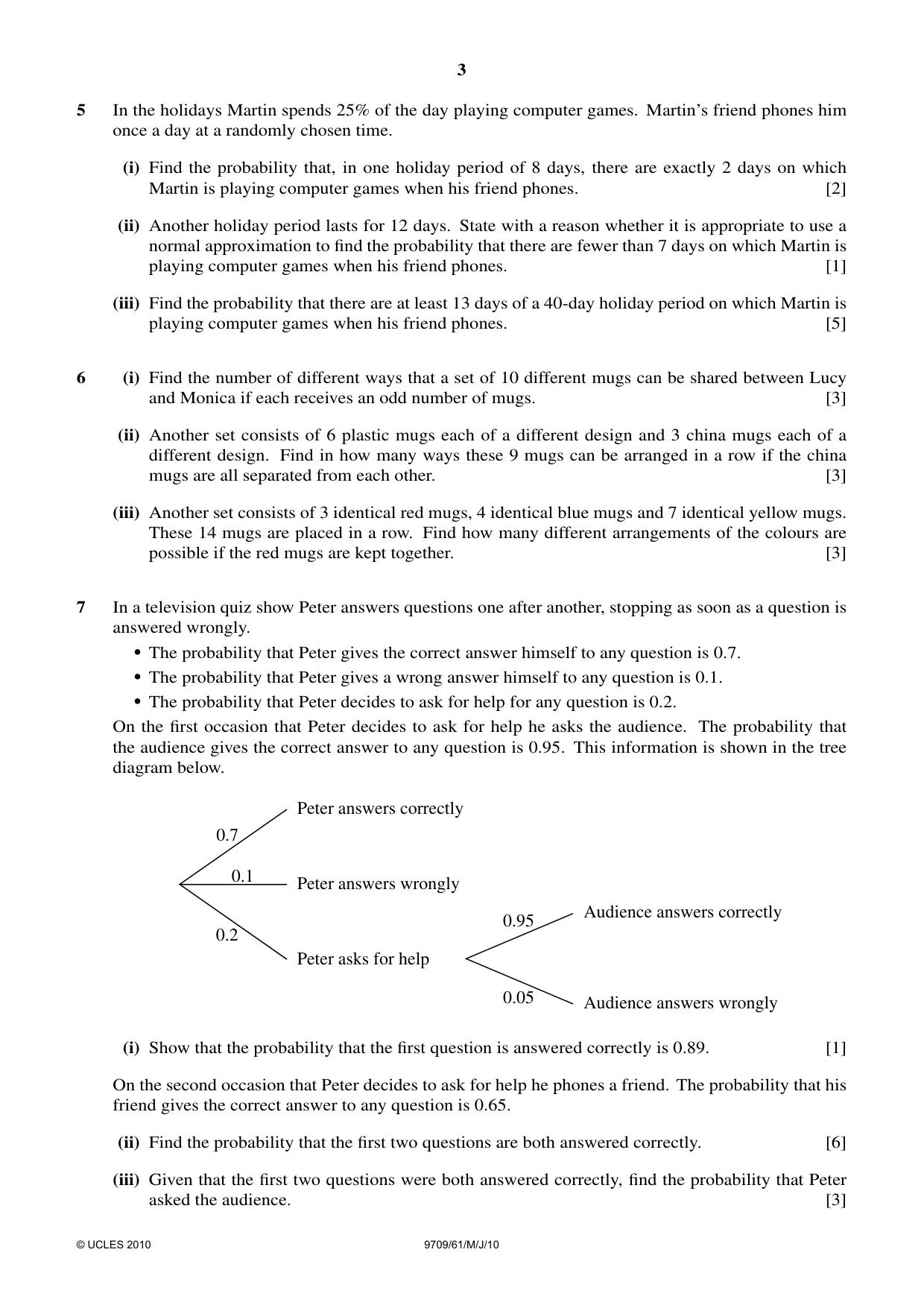
5 In the holidays Martin spends 25% of the day playing computer games. Martin’s friend phones him once a day at a randomly chosen time. (i) Find the probability that, in one holiday period of 8 days, there are exactly 2 days on which Martin is playing computer games when his friend phones. [2] (ii) Another holiday period lasts for 12 days. State with a reason whether it is appropriate to use a normal approximation to find the probability that there are fewer than 7 days on which Martin is playing computer games when his friend phones. [1] (iii) Find the probability that there are at least 13 days of a 40-day holiday period on which Martin is playing computer games when his friend phones. [5]
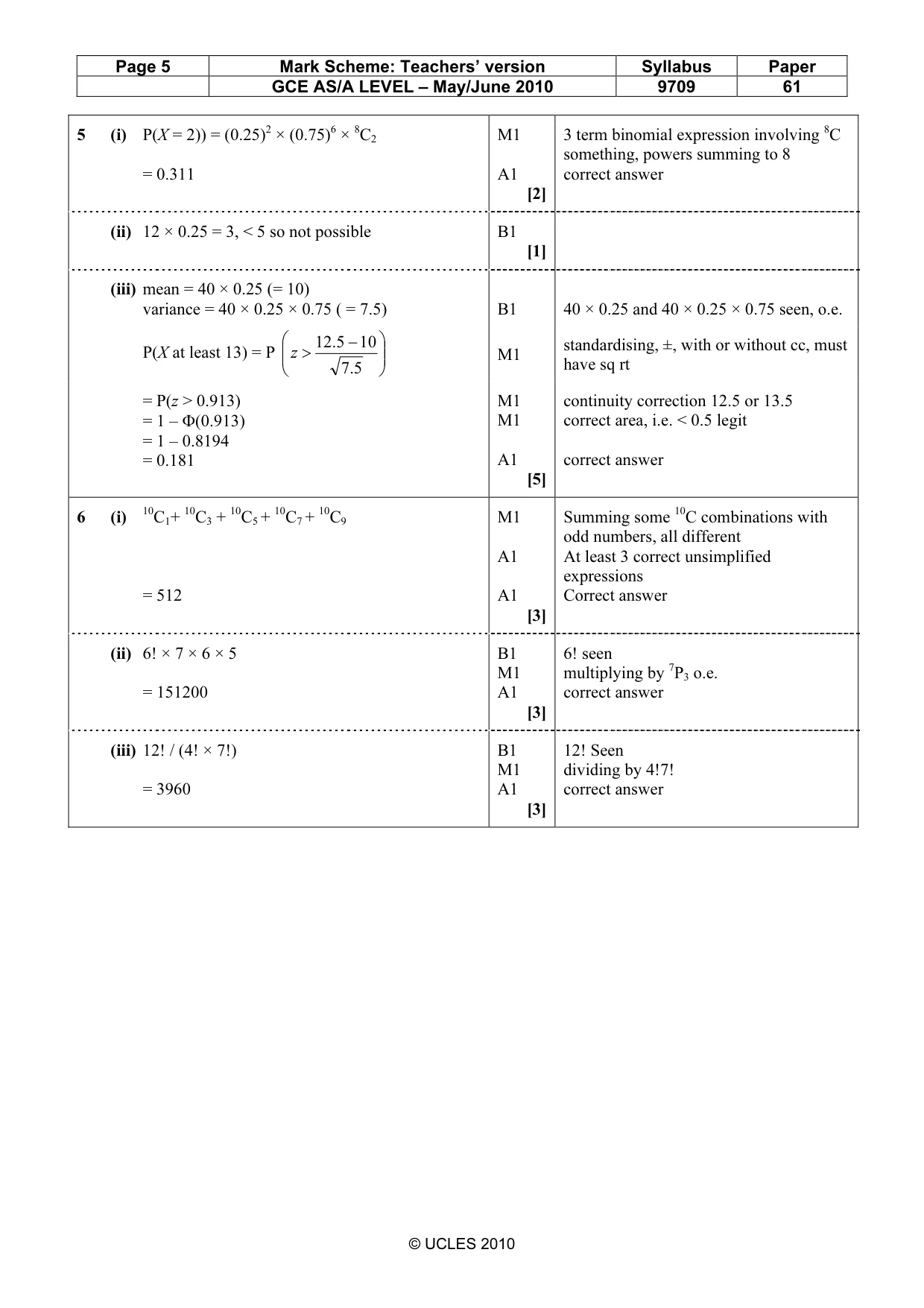
Mark scheme: 5 (i) P(X = 2)) = (0.25)2 × (0.75)6 × 8C2 M1 3 term binomial expression involving 8C something, powers summing to 8 = 0.311 A1 correct answer [2] (ii) 12 × 0.25 = 3, < 5 so not possible B1 [1] (iii) mean = 40 × 0.25 (= 10) variance = 40 × 0.25 × 0.75 ( = 7.5) B1 40 × 0.25 and 40 × 0.25 × 0.75 seen, o.e. 125. − 10 standardising, ±, with or without cc, must P(X at least 13) = P z > M1 5.7 have sq rt = P(z > 0.913) M1 continuity correction 12.5 or 13.5 = 1 – Φ(0.913) M1 correct area, i.e. < 0.5 legit = 1 – 0.8194 = 0.181 A1 correct answer [5] 10 10 10 10 10 10
Q6 · Find the number of different ways that a set of 10 different mugs can be shared between…
6 (i) Find the number of different ways that a set of 10 different mugs can be shared between Lucy and Monica if each receives an odd number of mugs. [3] (ii) Another set consists of 6 plastic mugs each of a different design and 3 china mugs each of a different design. Find in how many ways these 9 mugs can be arranged in a row if the china mugs are all separated from each other. [3] (iii) Another set consists of 3 identical red mugs, 4 identical blue mugs and 7 identical yellow mugs. These 14 mugs are placed in a row. Find how many different arrangements of the colours are possible if the red mugs are kept together. [3]
Mark scheme: 6 (i) 10C1+ 10C3 + 10C5 + 10C7 + 10C9 M1 Summing some 10C combinations with odd numbers, all different A1 At least 3 correct unsimplified expressions = 512 A1 Correct answer [3] (ii) 6! × 7 × 6 × 5 B1 6! seen M1 multiplying by 7P3 o.e. = 151200 A1 correct answer [3] (iii) 12! / (4! × 7!) B1 12! Seen M1 dividing by 4!7! = 3960 A1 correct answer [3] GCE AS/A LEVEL – May/June 2010 9709 61 t
Q7 · In a television quiz show Peter answers questions one after another, stopping as soon as…
7 In a television quiz show Peter answers questions one after another, stopping as soon as a question is answered wrongly. • The probability that Peter gives the correct answer himself to any question is 0.7. • The probability that Peter gives a wrong answer himself to any question is 0.1. • The probability that Peter decides to ask for help for any question is 0.2. On the first occasion that Peter decides to ask for help he asks the audience. The probability that the audience gives the correct answer to any question is 0.95. This information is shown in the tree diagram below. Peter answers correctly 0.7 0.1 Peter answers wrongly Audience answers correctly 0.95 0.2 Peter asks for help 0.05 Audience answers wrongly (i) Show that the probability that the first question is answered correctly is 0.89. [1] On the second occasion that Peter decides to ask for help he phones a friend. The probability that his friend gives the correct answer to any question is 0.65. (ii) Find the probability that the first two questions are both answered correctly. [6] (iii) Given that the first two questions were both answered correctly, find the probability that Peter asked the audience. [3]
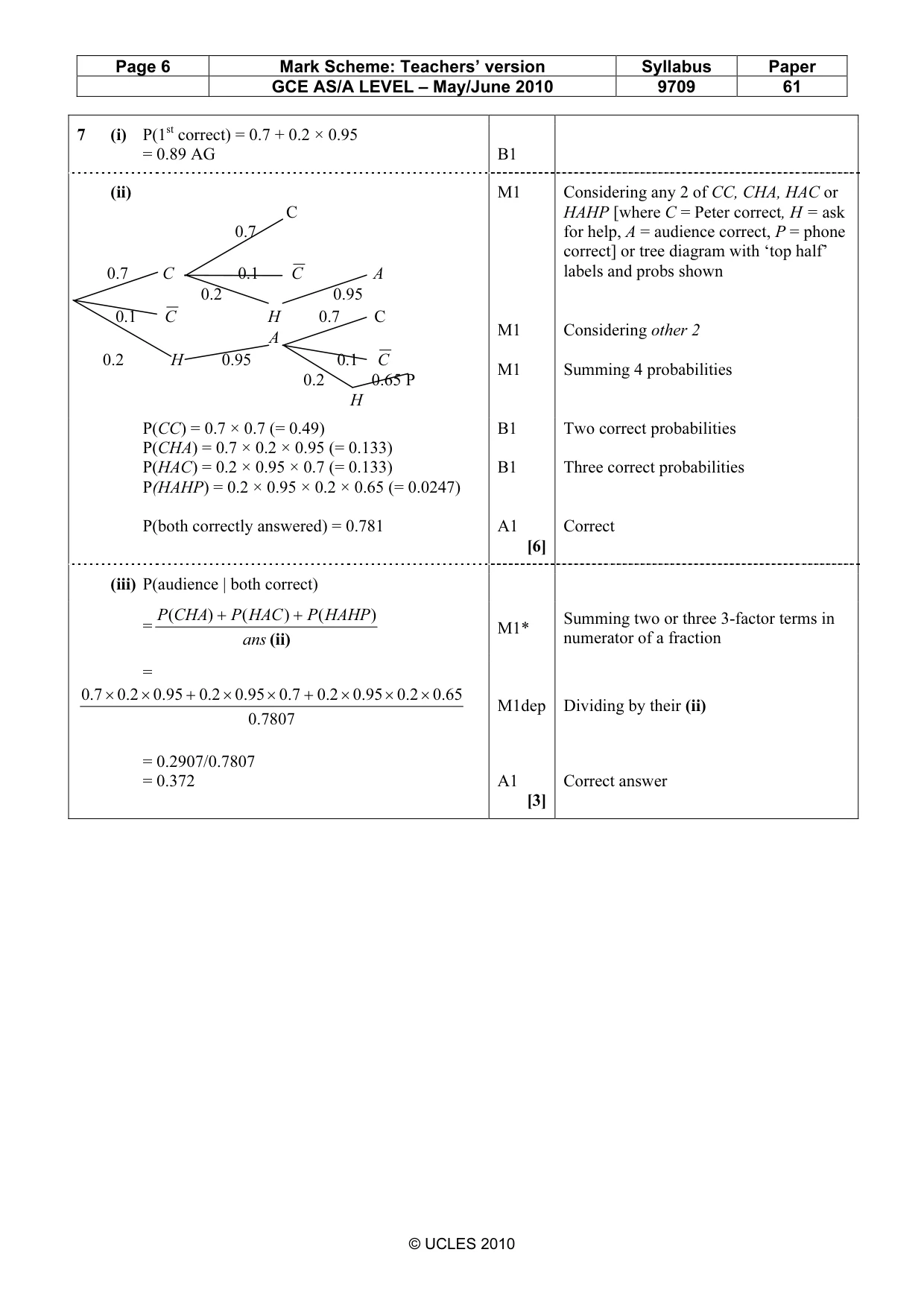
Mark scheme: 7 (i) P(1st correct) = 0.7 + 0.2 × 0.95 = 0.89 AG B1 (ii) M1 Considering any 2 of CC, CHA, HAC or C HAHP [where C = Peter correct, H = ask 0.7 for help, A = audience correct, P = phone correct] or tree diagram with ‘top half’ 0.7 C 0.1 C A labels and probs shown 0.2 0.95 0.1 C H 0.7 C M1 Considering other 2 A 0.2 H 0.95 0.1 C M1 Summing 4 probabilities 0.2 0.65 P H P(CC) = 0.7 × 0.7 (= 0.49) B1 Two correct probabilities P(CHA) = 0.7 × 0.2 × 0.95 (= 0.133) P(HAC) = 0.2 × 0.95 × 0.7 (= 0.133) B1 Three correct probabilities P(HAHP) = 0.2 × 0.95 × 0.2 × 0.65 (= 0.0247) P(both correctly answered) = 0.781 A1 Correct [6] (iii) P(audience | both correct) P (CHA) + P ( HAC ) + P ( HAHP ) Summing two or three 3-factor terms in = M1* ans (ii) numerator of a fraction = 7.0 × 2.0 × .095 + 2.0 × .095 × 7.0 + 2.0 × .095 × 2.0 × .065 M1dep Dividing by their (ii) .07807 = 0.2907/0.7807 = 0.372 A1 Correct answer [3]
What was in this paper
The subtopics covered by these 7 questions, and how many questions each got. Open one in a new tab to see every Cambridge question on it.
What you needed in this session
Cambridge’s own grade thresholds for 2010 May/June, Paper 6 · Variant 1. A higher threshold means an easier paper — the bar moves with how the cohort did.